• About

doubtfulsea

~ adventure fantasy

Tag Archives: The Lord of the Rings

Bogged Down

20 Wednesday Aug 2025

Posted by Ollamh in Uncategorized

≈ Leave a comment

Tags

Barrow-wight, bog bodies, bog sacrifices, bogs, Danish National Museum, de-bello-gallico, Dr Seuss, Fionn mac Cumhaill, Frodo, heroic burials, human sacrifice, La Tene, sacrificial-objects, The Lord of the Rings, Thomas Pennant, Tolkien, Tom Bombadil, Vimose

As always, dear readers, welcome.

What’s going on here?

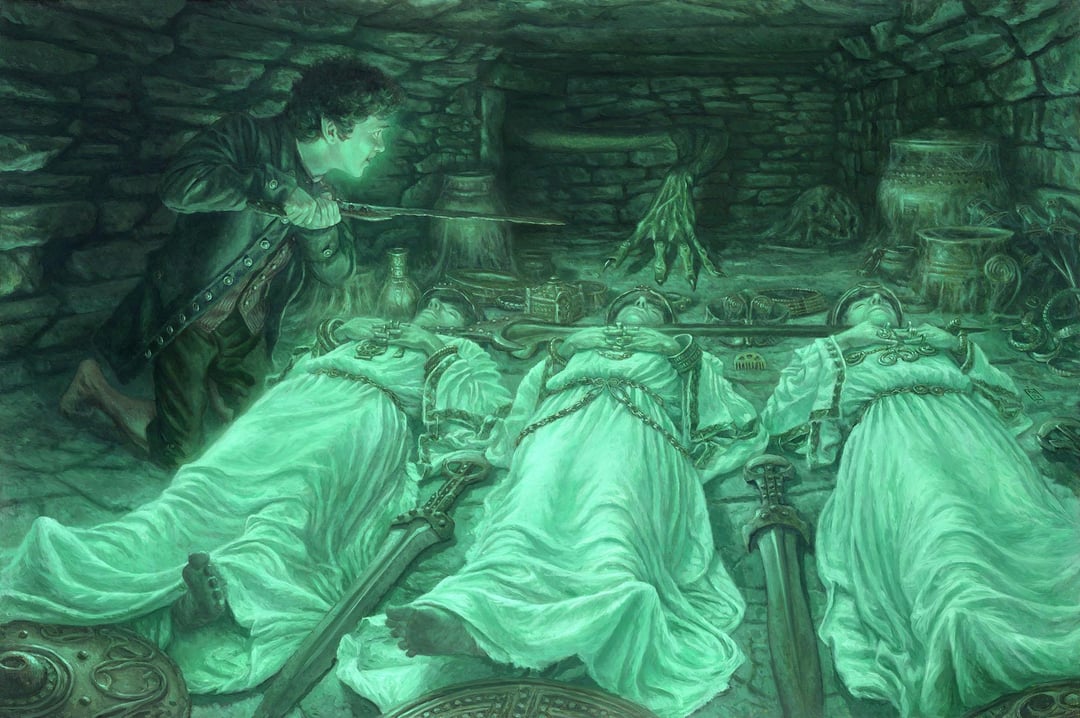
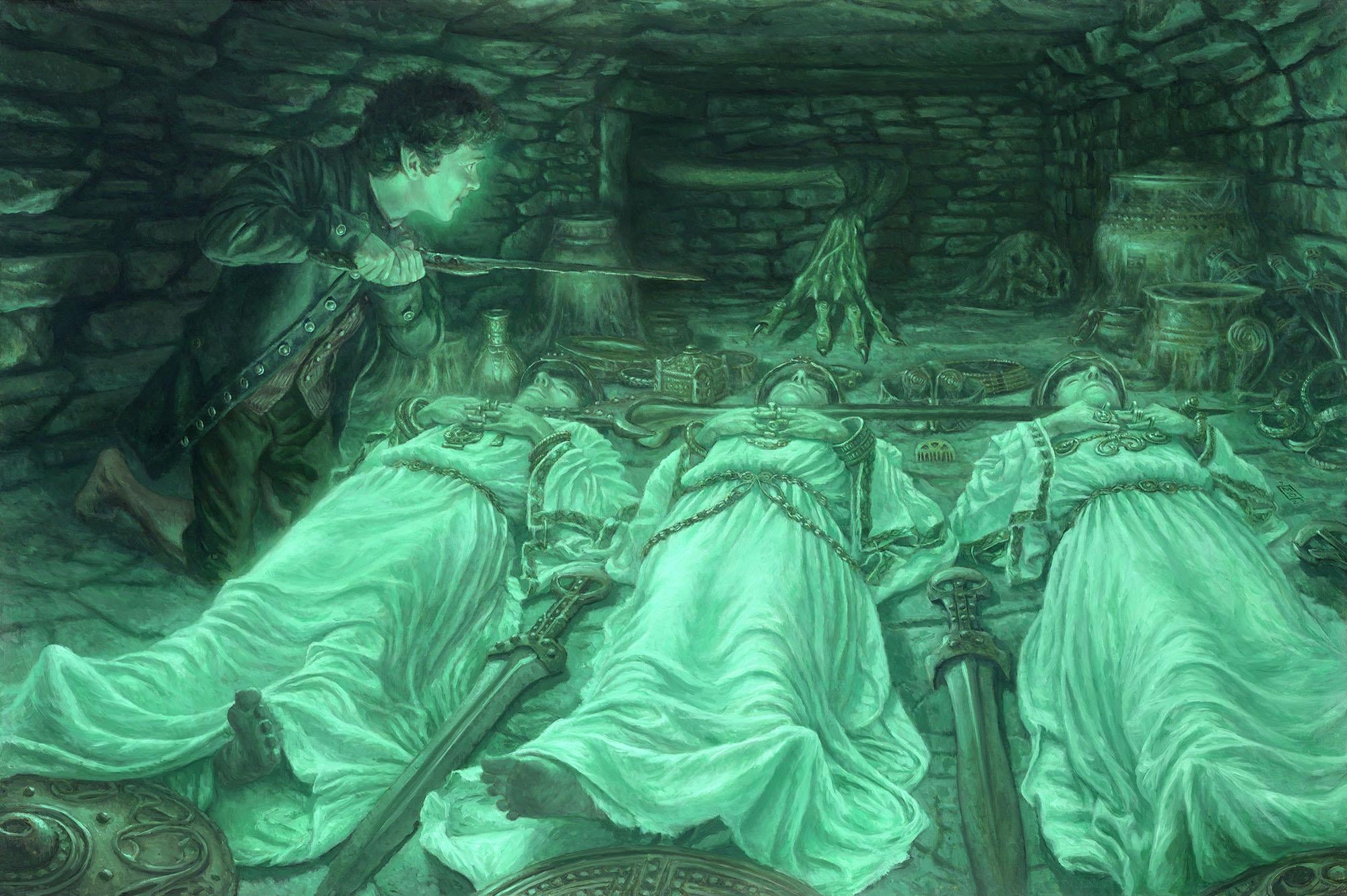
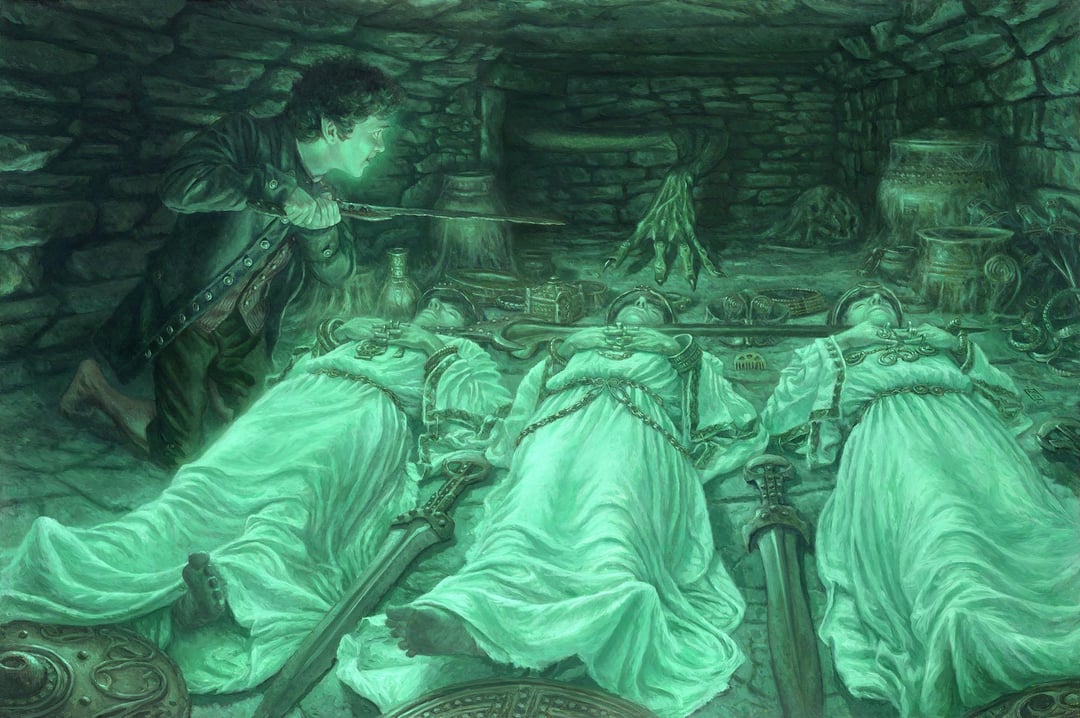
“He turned, and there in the cold glow he saw lying beside him Sam, Pippin, and Merry.  They were on their backs, and their faces looked deadly pale; and they were clad in white.  About them lay many treasures, of gold maybe, though in that light they looked cold and unlovely.  On their heads were circlets, gold chains were about their waists, and on their fingers were many rings.  Swords lay by their sides, and shields were at their feet.  But across their three necks lay one long naked sword.”  (The Fellowship of the Ring, Book One, Chapter 8, “Fog on the Barrow Downs”)

(Matthew Stewart–you can see more of his impressive work here: https://www.matthew-stewart.com/ I like his dragons especially.)

This might appear to look like an early heroic burial, with grave goods piled up,

like this chieftain’s grave from 530BC, found near Hochdorf an der Enz in Baden-Wuerttemberg, Germany—which even has this beautiful wagon (reconstructed—for more see:  https://en.wikipedia.org/wiki/Hochdorf_Chieftain%27s_Grave ).

There is a difficulty, however:  none of the hobbits is dead—although that sword across three of their necks suggests that they soon will be.

And I would further suggest that what we’re looking at is the scene of a potential human sacrifice—especially if we add what the narrator calls an “incantation” on the part of the Barrow-wight:

“Cold be hand and heart and bone,

And cold be sleep under stone:

Never more to wake on stony bed,

Never, till the Sun fails and the Moon is dead.

In the black wind the stars shall die,

And still on gold here let them lie,

Till the dark lord lifts his hand

Over dead sea and withered land.”

Human sacrifice had certainly been practiced in Middle-earth.  We know that Sauron, defeated temporarily, corrupts the king of Numenor, Tar-Calion (also known as Ar-Pharazon), preaching the worship of the fallen Vala, Morgoth:

“A new religion, and worship of the Dark, with its temple under Sauron arises.  The faithful are persecuted and sacrificed.  The Numenoreans carry their evil also to Middle-earth and there become cruel and wicked lords of necromancy, slaying and tormenting men… “ (letter to Milton Waldman, late 1951, Letters, 216-217—for more on this see “Melkor/Morgoth/Melqart” 29 June, 2022)
I suspect that Tolkien’s own first experience with such sacrifices may have come from a boyhood reading Julius Caear’s (100-44BC) De Bello Gallico, where he would have found:

“Natio est omnis Gallorum admodum dedita religionibus, atque ob eam causam, qui sunt adfecti gravioribus morbis quique in proeliis periculisque versantur, aut pro victimis homines immolant aut se immolaturos vovent administrisque ad ea sacrificia druidibus utuntur, quod, pro vita hominis nisi hominis vita reddatur, non posse deorum immortalium numen placari arbitrantur, publiceque eiusdem generis habent instituta sacrificia. Alii immani magnitudine simulacra habent, quorum contexta viminibus membra vivis hominibus complent; quibus succensis circumventi flamma exanimantur homines.”

“The whole nation of the Gauls is completely devoted to religious practices and because of this, those who are afflicted with very serious illnesses and those who are involved in battles and dangers either sacrifice men in place of animal victims or pledge that they will sacrifice them and use the druids as the priests for those sacrifices because they think that, unless the life of a person is paid back for the life of a person, the divine will of the immortal gods can’t be appeased and they [even] have sacrifices set up of the same kind at public expense.  Others have images of immense size of which the chambers, woven of willow withies, are filled with living people.   [So that], when they are set alight, the people, surrounded by flame, are killed.”  (De Bello Gallico, Book VI, Sec.16, my translation—you can read more at the invaluable Sacred Texts site here in a parallel Latin/English text:  https://sacred-texts.com/cla/jcsr/index.htm ) 

(This is from Thomas Pennant’s, 1726-1798, A Tour of Wales, 1778.  Pennant was a naturalist, antiquarian, traveler, etc etc and one of those wonderful 18th people seemingly interested in everything and eager to report what they discovered.  You can read about him here:  https://en.wikipedia.org/wiki/Thomas_Pennant but don’t forget to read about his draftsman, Moses Griffith, an equally impressively-talented man:  https://en.wikipedia.org/wiki/Moses_Griffith_(artist) There is even a Thomas Pennant Society:  https://www.cymdeithasthomaspennant.com/eng/t-p.html And you can read the Tour itself here:  https://archive.org/details/toursinwales00penngoog/page/n8/mode/2up  For more on the idea of the “wicker man”, see:  https://en.wikipedia.org/wiki/Wicker_man  )

The Romans, with very rare (and early) exceptions, frowned upon human sacrifice, but northern people, before being overwhelmed by the Romans, or too far north for them to conquer effectively, could, as in the case of the Gauls mentioned above, have a different approach to their gods.

Unfortunately, as they were not, like the Romans, extremely literate, what little description we have comes from people like Caesar, curious (and probably horrified) outsiders—and perhaps also propagandists, who wanted to paint those outside the Mediterranean world as savages and therefore worthy of nothing more than conquest.

We do, however, have other and very vivid evidence in the form of archaeological discoveries.

One of these turned up in my last posting, the “Vimose comb” (see “Runing Things”, 13 August, 2025).

The “-mose” in Vimose means “bog/wetland/moorland” in modern Danish, descended from “mosi” in Old Norse and this immediately tells us about a different method of making a sacrifice—and not necessarily a human one—dropping it into water.

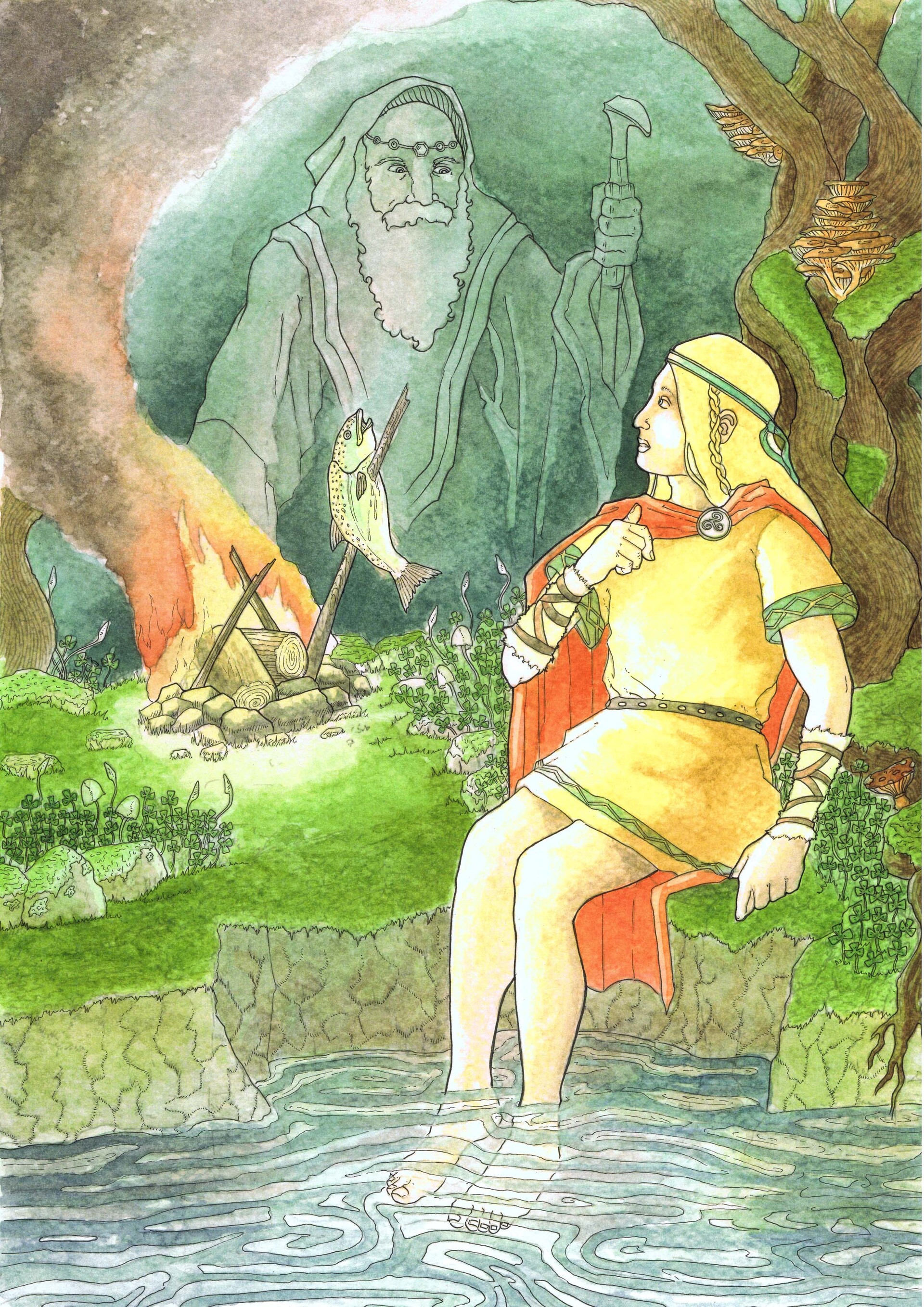
Without local explanation, we can only guess what was thought to happen when the object was deposited.  For myself, I’ve always thought of the pool in the story of Fionn mac Cumhaill. 

(Marga Gomila—you can see drafts of this work at:  https://margagomila.artstation.com/projects/OmEwgv )

This was connected with the otherworld and nuts from hazel trees would fall into the pool from that otherworld, to be consumed by a salmon in our world.  Cooking the salmon (caught in this world), Fionn, then a boy, burned his thumb and, putting it into his mouth, gained supernatural knowledge thereby.  (See for more:  https://en.wikipedia.org/wiki/Fionn_mac_Cumhaill and:  https://en.wikipedia.org/wiki/Wells_in_the_Irish_Dindsenchas There is a similar story attached to the Germanic hero, Sigurd, which you can read in the form Tolkien probably first read it:  https://www.gutenberg.org/cache/epub/540/pg540-images.html )

So, were these earlier sacrificers dropping in their treasures in hopes of sending them out of this world, presumably to the place where their gods lived?

Certainly the person who dropped the comb into the Vimose must have had some such hope and that person was hardly alone as, to date, about 2500 objects have been recovered from the site.  (For more on Vimose, check out this very interesting site:  https://ageofarthur.substack.com/p/the-homeland-of-the-angles-and-the See, as well, the Danish National Museum site, with all sorts of short articles on Vimose and other places:  https://en.natmus.dk/historical-knowledge/denmark/prehistoric-period-until-1050-ad/the-early-iron-age/the-weapon-deposit-from-vimose/the-offerings-in-vimose/ )

And it’s not the only site.  From Ireland eastwards through much of Germany, there are sites, some more specific, like La Tene, in Switzerland, where there was a huge cache of swords,

(no citation, but it looks like a Peter Connolly)

and Hjortspring, in Denmark, where there was a boat,

and Dejbjerg, also in Denmark, where there was a wagon.

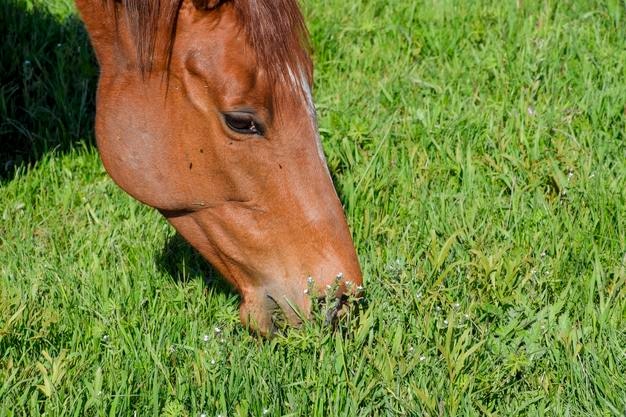
There are animal sacrifices,

(Miroslaw Kuzma–as a sometime horseman, I hesitated to include this illustration.)

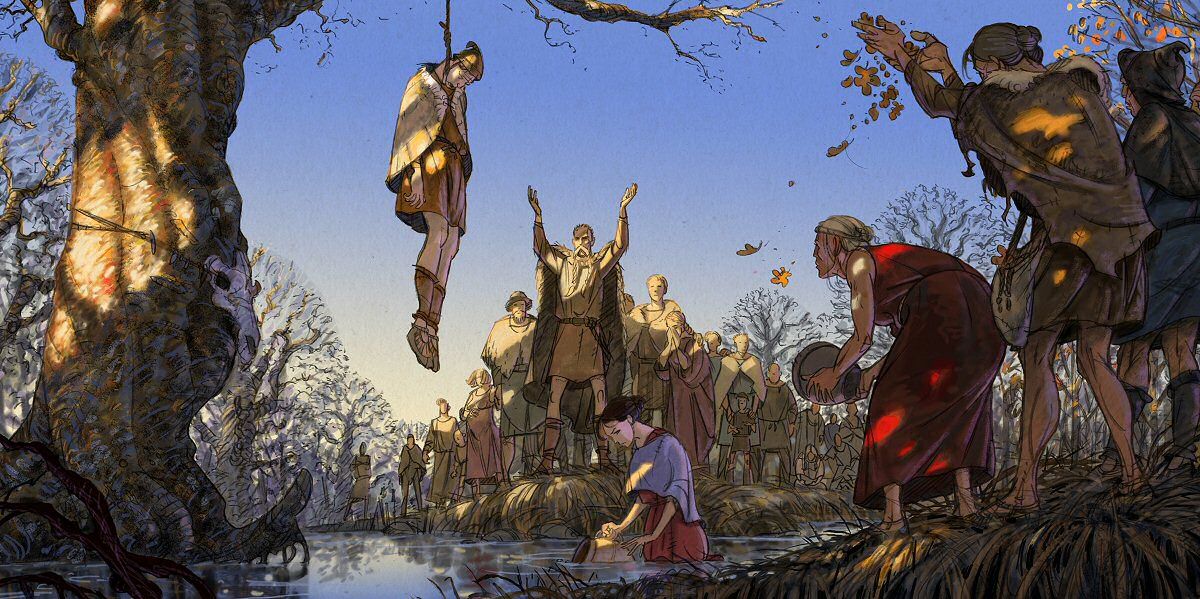
but the most sinister deposits are human ones,

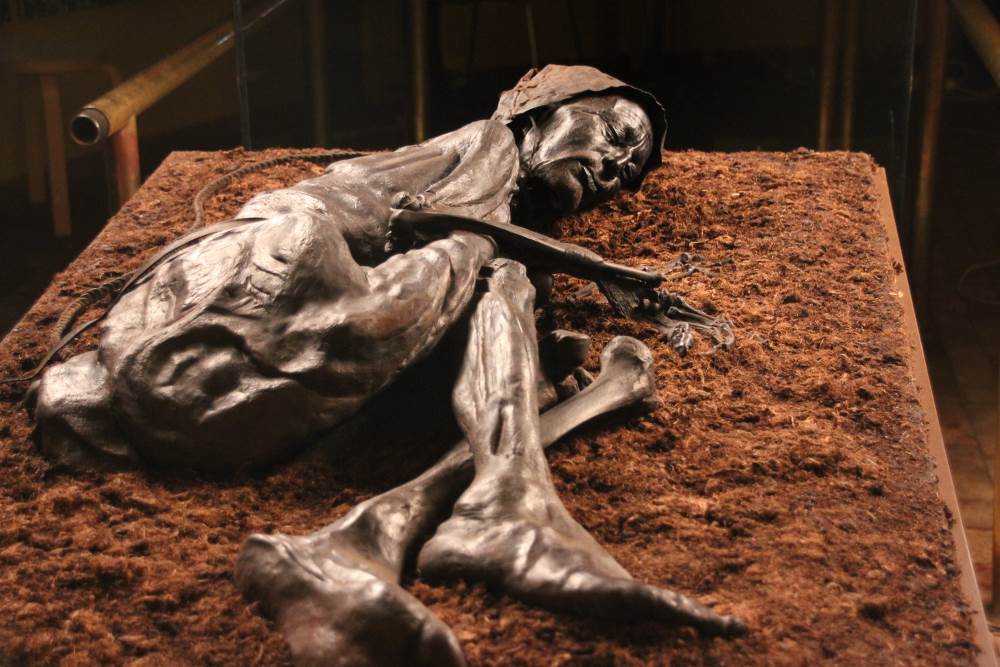
some of whose well-preserved remains would probably have worried those who believed that, once the victim had been dealt with, and sunk in the water, the sacrifice would have been accepted and then the next step would be a god’s.  (For more on so-called “bog bodies”, see:  https://en.wikipedia.org/wiki/Bog_body )

Although Frodo was responsible for halting what may have been about to be a sacrifice—

“But the courage that had been awakened in him was now too strong:  he could not leave his friends so easily.  He wavered, groping in his pocket, and then fought with himself again; and as he did so the arm crept nearer.  Suddenly resolve hardened in him, and he seized a short sword that lay beside him, and kneeling, he stooped low over the bodies of his companions.  With what strength he had he hewed at the crawling arm near the wrist, and the hand broke off; but at the same moment the sword splintered up to the hilt.  There was a shriek and the light vanished.  In the dark there was a snarling noise.”

It was the appearance of Tom Bombadil, summoned by Frodo, who rescued them all—

“There was a loud rumbling sound, as of stones rolling and falling, and suddenly light streamed in, real light, the plain light of day.  A low door-like opening appeared at the end of the chamber beyond Frodo’s feet; and there was Tom’s head (hat, feather, and all) framed against the light of the sun rising red behind him.”

And there was Tom’s incantation—

“Get out, you old Wight!  Vanish in the sunlight!

Shrivel like the cold mist, like the winds go wailing,

Out into the barren lands far beyond the mountains!

Come never here again!  Leave your barrow empty!

Lost and forgotten be, darker than the darkness,

Where gates stand for ever shut, till the world is mended.”  (The Fellowship of the Ring, Book One, Chapter 8, “Fog on the Barrow-downs”)

I wonder whether, about to be consecrated to a god we no longer know of, a victim might have called upon his/her gods, hoping for a similar rescue?

Thanks for reading, as ever.

Stay well,

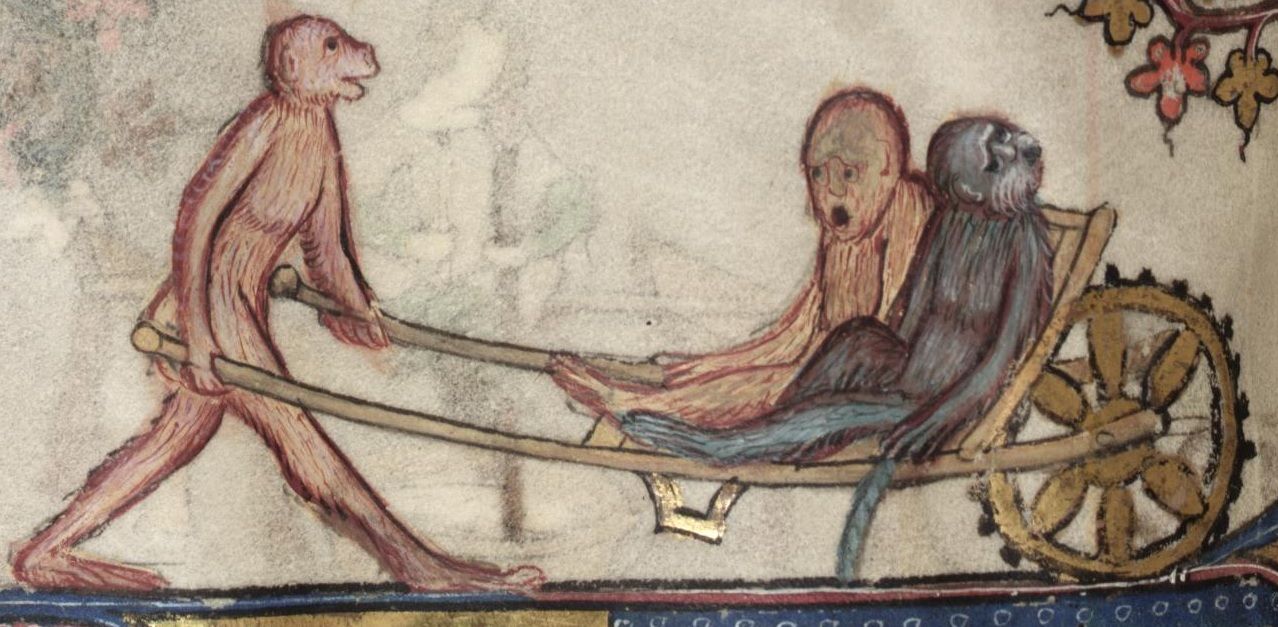
Avoid barrows—unless they’re wheeled,

(Is this by a medieval Dr. Seuss?)

Definitely stay out of bogs,

And remember that, as always, there’s

MTCIDC

O

PS

If you’re interested in a scientific explanation for the surprising preservation of some bodies, see:

https://en.natmus.dk/historical-knowledge/denmark/prehistoric-period-until-1050-ad/the-early-iron-age/the-woman-from-huldremose/the-chemistry-of-the-bog-bodies/

Runing Things

13 Wednesday Aug 2025

Posted by Ollamh in J.R.R. Tolkien, Language, Tolkien

≈ Leave a comment

Tags

Anglo-Frisian Runes, Balin, Bryggen, divination, Fireworks, Futhark, Futhorc, Gandalf, Harys Dalvi, Kylver Stone, Moria, Robwords, runes, Tacitus, The Lord of the Rings, Thror's Map, Tolkien, Vimose comb

Welcome, as ever, dear readers.

It is a grim moment, in The Lord of the Rings when the company, making its way through the complexity of Moria in near-darkness, save for Gandalf’s staff, reaches this—

“Their feet disturbed a deep dust upon the floor, and stumbled among things lying in the doorway whose shapes they could not at first make out.  The chamber was lit by a wide shaft high in the further eastern wall; it slanted upwards and, far above, a small square patch of blue sky could be seen.  The light of the shaft fell directly on a table in the middle of the room:  a single oblong block, about two feet high, upon which was laid a great slab of white stone.

(the Hildebrandts)

‘It looks like a tomb,’ muttered Frodo, and bent forwards with a curious sense of foreboding, to look more closely at it.  Gandalf came quickly to his side.  On the slab runes were deeply graven:

‘These are Daeron’s Runes, such as were used of old in Moria,’ said Gandalf.  ‘Here it is written in the tongues of Men and Dwarves:

BALIN SON OF FUNDIN

LORD OF MORIA ‘.”  (The Lord of the Rings, Book Two, Chapter 4, “A Journey in the Dark”)

Even if you’re not an expert in early western writing systems, you’ve probably encountered runes before.  They appear to be a Germanic invention, with their first known outside mention thought to be in P. Cornelius Tacitus’ (c.56-c.120 AD) essay on some northern tribes, Germania, where this passage is cited.

“[10] Auspicia sortesque ut qui maxime observant: sortium consuetudo simplex. Virgam frugiferae arbori decisam in surculos amputant eosque notis quibusdam discretos super candidam vestem temere ac fortuito spargunt. Mox, si publice consultetur, sacerdos civitatis, sin privatim, ipse pater familiae, precatus deos caelumque suspiciens ter singulos tollit, sublatos secundum impressam ante notam interpretatur.”

“[the Germans] pay very close attention to auspices and lot-drawing:  the practice of lot-drawing is simple.  They split a branch cut from a fruit tree into splinters and scatter those, marked out with certain signs, on a white robe casually and randomly.  Then a priest of the settlement, if it may be the public consulting of an oracle, but if private, the father of a family himself, having prayed to the gods and raising his eyes to the sky, draws three [splinters] one at a time [and] interprets those drawn according to the mark stamped upon [them] previously.”

(Tactius, Germania, Section 10—my translation.  If you’d like to read the whole text, here’s a useful Victorian translation:  https://archive.org/details/tacitusagricolag00taciiala/page/62/mode/2up )

We don’t know where Tacitus got his information from, but he lived at about the same time as one of the earliest currently-known runic inscriptions, the “Vimose comb”, dated to about 160AD,

(There seem to be two guesses at to what the inscription says—transliterated, it appears to read “harja”, meaning either the obvious “comb” or the less obvious “warrior”.  For more on this and other early rune-marked artifacts, see:  https://en.wikipedia.org/wiki/Vimose_inscriptions and https://en.natmus.dk/historical-knowledge/denmark/prehistoric-period-until-1050-ad/the-early-iron-age/the-weapon-deposit-from-vimose/the-offerings-in-vimose/   Until they sold out, you could even get a bone replica of the comb here:  https://norseimports.com/products/vimose-comb )

so the notae, “marks”, he mentioned could, indeed, be early runes.

We’ve seen runes three times before in the book, each time related to Gandalf and the first letter of his name in runes–

The first is a jolly appearance:

(Darrell K. Sweet, who died, unfortunately, in 2011, but you can see his archived website here:  https://web.archive.org/web/20110131141507/http://www.sweetartwork.com/DKSmainPage.html and read a little more about this very talented illustrator here:  https://en.wikipedia.org/wiki/Darrell_K._Sweet And I couldn’t resist adding this knowledgeable appreciation of his work:  https://blackgate.com/2022/04/17/an-adventure-to-be-had-a-journey-through-the-art-of-darrell-k-sweet/ )

“At the end of the second week in September a cart came in through Bywater from the direction of Brandywine Bridge in broad daylight.  An old man was driving it all alone…It had a cargo of fireworks…At Bilbo’s front door the old man began to unload:  there were great bundles of fireworks of all sorts and shapes, each labeled with a large red G [runic letter] and the elf-rune [see the image above].” (The Fellowship of the Ring, Book One, Chapter 1, “A Long-Expected Party”)

The second is not, being Gandalf’s much-delayed letter to Frodo, still at the Prancing Pony in Bree, instead of being delivered 3 months before to the Shire, meant to alert Frodo to the possibility that he won’t meet them, with some consolation that Strider might appear. (The Fellowship of the Ring, Book One, Chapter 10, “Strider”)

(the Hildebrandts)

And the third is only guessed at as seeming to be a sign from Gandalf on Weathertop:

“ ‘The stroke on the left might be a G-rune with thin branches,’ said Strider.  ‘It might be a sign left by Gandalf, though one cannot be sure…I should say…that they stood for G3, and were a sign that Gandalf was here on October the third:  that is three days ago now.  It would also show that he was in a hurry and danger was at hand, so he had no time or did not dare to write anything longer or plainer.  If that is so, we must be wary.’ “ (The Fellowship of the Ring, Book One, Chapter 11, “A Knife in the Dark”)

(John Howe)

In our Middle-earth, there are several iterations of runes, with the melodious (modern) names of “Futhark”(Elder and Younger) and “Futhorc”, which get those names, as the word “alphabet” does, from putting together a collection of the first letters of the series in a standard order.  Here’s the Elder Futhark—

It’s easy to see why the letters might be shaped as they were, appearing to be relatively easy to inscribe on things with a knife.  (Or a chisel for the stone inscriptions?)

(a 12th-century AD inscription on wood from Bryggen in Norway—one of 670 inscriptions on wood or bone found at the site since 1955—for more see:  https://en.wikipedia.org/wiki/Bryggen_inscriptions  and https://en.wikipedia.org/wiki/Bryggen One of the many amazing things about this second piece is that it underlines just how sophisticated trade could be in northern Europe in the Middle Ages.)

(This is the Kylver Stone from Gotland, Sweden, c.400AD, which lists the Elder Futhark letters.  For more, see:  https://en.wikipedia.org/wiki/Kylver_Stone and you can see from the translation of the runes where “Futhark” came from. )

Tolkien’s own runes, as he tells us, are derived from what are sometimes called the “Anglo-Saxon” or “Anglo-Frisian” Futhorc:

“There is the matter of the Runes.  Those used by Thorin and Co., for special purposes, were comprised of an alphabet of thirty-two letters (full list on application), similar to, but not identical, with the runes of Anglo-Saxon inscriptions.”  (letter to the editor of The Observer, published there 20 February, 1938, Letters, 42)

We can then imagine that this is what must appear as the “moon letters” on Thror’s map—


And this brings me to my final point.

In my last, in connection with the conlang (constructed language) toki pona, I mentioned the internet site Robwords, one of my favorite places for information and discussion about languages, primarily English, German, and French, but with some surprises (see last week’s “Simple Words” for more).

(This is Rob Watts, of Robwords)

One of those surprises was toki pona, but, in another, Rob made the suggestion that the Roman alphabet, in which I’m writing this posting, was rotten for the English language, being adapted from the Greek alphabet (in turn adapted from the Phoenician alphabet) via the Etruscan alphabet,

and lacking letters for certain common English sounds like “th” and “sh” and “ng”.

In his playful way, he suggested that we’d be better off with the runic system, and specifically that Anglo-Saxon version, aka Futhorc.

 To prove his point, he cites something familiar to Tolkien readers—

and then proceeds to translate it, showing that it’s not in the language of the dwarves, as one might expect from a dwarvish map, but English (or, if you prefer, “the Common Speech”).

Watch the video, then, and see if you agree with Rob: https://www.youtube.com/watch?v=4npuVmGxXuk

And, if you’d like to try your hand at using the runes, here’s something to help—it’s a link to Harys Dalvi’s Old English runic keyboard:  https://www.harysdalvi.com/futhorc/  Harys Dalvi’s website is full of really interesting language and computer stuff and just plain fun:  https://www.harysdalvi.com/

Thanks, as always, for reading,

(ᚦᚫᛝᚳᛋ᛫ᚫᛋ᛫ᚫᛚᚹᛠᛋ᛫ᚠᚪᚱ᛫ᚱᛁᛁᛞᛁᛝ)

Stay well,

(ᛥᛠ᛫ᚹᛖᛚ)

Try runisizing today,

(ᛏᚱᚫᛁ᛫ᚱᚢᚾᛁᛋᛁᛋᛁᛝ᛫ᛏᚣᛞᛠ)

And remember that, as always, there’s

ᛗᚪᚱ᛫ᛏᚣ᛫ᚳᚢᛗ᛫ᛁᚾ᛫ᛞᚣ᛫ᚳᚣᚱᛋ

O

PS

At “wikiHow” there’s a pronunciation guide and a rather New Age interpretation of the Elder Futhark’s runes.  It’s fun, but, as it sits to the left of such “How” guides as “telekinesis”, and “reading palms”, I myself would stick to the pronunciations!  https://www.wikihow.com/Elder-Futhark-Runes 

PPS

And how could I resist listing this:  https://runicstudies.org/ the website for the American Association for Runic Studies?  If you get hooked on runes—and I think that that would be quite easy to do, especially after playing on Harys’ website—this site has links in all directions.

Simple Words

06 Wednesday Aug 2025

Posted by Ollamh in Uncategorized

≈ Leave a comment

Tags

A Martian Odyssey, Aladdin, conlang, Robwords, science fiction, Stanley Weinbaum, The Lord of the Rings, Toki Pona, Tolkien

Welcome, as always, dear readers.

I’ve read and reread Tolkien since the surprising appearance of this—

and the two volumes which followed–

which got me hooked and, as the (rather tired) saying goes, the rest is history—although I much prefer the genie’s words at the end of Disney’s Aladdin

“…ciao!  I’m history!  No, I’m mythology!”

as JRRT himself said of creating a language:

“As one suggestion, I might fling out the view that [in] the perfect construction of an art-language it is found necessary to construct at least in outline a mythology concomitant…because the making of language and mythology are related functions.”  (“A Secret Vice” in J.R.R. Tolkien, The Monsters and the Critics, 210)

In all of those readings, however, I’ve never quite believed something which Tolkien wrote—and more than once—that:

“The invention of languages is the foundation.  The ‘stories’ were made rather to provide a world for the languages than the reverse.” (taken from letter to the Houghton Mifflin Co., June, 1955, Letters, 319)

Gollum?  Saruman?  Grishnakh and Ugluk?  Treebeard?  Sam?  All created only so that they could speak JRRT’s languages?  Such vivid major and minor characters—surely there was also a pure pleasure not only in having them talk, but in what they said and what effect their talk—and actions—had on the ‘stories’?

I can certainly believe, however, that the languages were a major feature of JRRT’s making of Middle-earth—just the essay I quoted above—“A Secret Vice”– would show you just how devoted Tolkien was to languages and their creation, or look up “Languages” in the Index to Letters

and you’ll find two columns and a little more (pages 667-669) of references to languages, name-formation, Quenya vs Sindarin, Dwarvish, the Black Speech, and much more.  And, digging below the surface, you can find such details as Tolkien writing to a fan with the declension of two nouns in Quenya:  cirya, “ship” and lasse, “leaf” (declensions are patterns of noun/adjective formation in which the functions of the words are shown by their endings—think of “whose” and “whom” in English as the last remnants of something which would earlier have look like this:

Nominative (shows subject):   who

Genitive (shows possession):  whose

Dative (indirect object):   whom

Accusative (direct object/takes prepositions):  whom

Ablative (would take some other prepositions—fell together with the accusative):   whom

and there can be other endings—all called “case endings”—like the instrumental, the ending of which would tell you that the noun was being used as a means to do something, the locative, which indicates at what place something is, and the vocative, employed when you’re addressing someone/thing)

(see “From a letter to Dick Plotz, c.1967, Letters, 522-523)

Such profusion is in strong contrast to something which I discovered a week or two on YouTube.

One of the real pleasures I find there are the number of languages and essays about them available in great profusion.  One of my current favorites is a feature called “RobWords”, which is written and presented by Rob Watts, its subjects tending to center around English, but touching upon German and French, among other topics, as well.

It’s a very informative and light-hearted site with occasional surprises, as I found with one entitled “The World’s Smallest Language”, which introduced a conlang (constructed language—in fact, just like Tolkien’s languages), but with an extremely simple grammar and an initial vocabulary of 120 words:  “Toki Pona” (you can see the episode here:  https://www.youtube.com/watch?v=PY3Qe_b9ufI )

The inventor, Sonja Lang, is, not surprisingly, a linguist, combining her knowledge of world languages with her own creations—something you might guess from the name of the language itself:  “toki” coming from the language “Tok Pisin”—that is, “Talk Pidgin”—“pidgin” meaning a kind of trade language—and “pona” coming from Latin “bonus –a –um”—“good”.  (More about pidgins here:  https://en.wikipedia.org/wiki/Pidgin and Tok Pisin here:  https://en.wikipedia.org/wiki/Tok_Pisin )

Here’s how Lang explains it:

“Toki Pona was my philosophical attempt to understand the meaning of life in 120 words. 

Through a process of soul-searching, comparative linguistics and playfulness, I designed a simple communication system to simplify my thoughts.”  (Toki Pona The Language of Good, Preface)

And simple it is:  things which appear in Indo-European languages like grammatical gender (whether a noun is masculine, feminine, or neuter—not important in English, but necessary, for instance, in language descended from Latin—Italian, French, Spanish, Catalan, Portuguese, and Romanian), plurals, case endings (see above), definite and indefinite articles (the/a/an in English) verb tenses, even more than one form for a verb—are all gone.  Sentence formation basically follows English, which is Subject, Verb, Object (SVO in linguistic terms—“Cats [subject] drink [verb] milk [object]”)—but use the link above to learn more and be entertained by a bit of a catchy pop song in Toki Pona.  If you want more about its grammar, see:  https://www.youtube.com/watch?v=_PgytSj-YVE and, if you go to YouTube, there are many more places to visit.  If you watch these two videos, you’ll see that that simplicity might easily lead to vagueness (something which “RobWords” points out), but, for a fluent speaker, with an imagination, perhaps it’s less vague than may seem at first.  For example, watch this speaker demonstrate how you can create the term “video game” using only the readily-available vocabulary:  https://www.youtube.com/shorts/z2ltEHfgR2g

Tolkien had been a learner and admirer of an earlier conlang:  Esperanto (if you don’t know about it, see:  https://en.wikipedia.org/wiki/Esperanto and https://esperanto.net/en/ ) and I wonder what he would have made of Toki Pona?  As a number of its words are derived from a language he loved, Finnish, I think that we might not be surprised if he found Toki Pona fun (see:  https://www.youtube.com/shorts/UoVTWjMrlp4  for a list of parallels between the two languages)—although he probably wouldn’t be able to resist adding to that 120-word basic vocabulary.

But all of this raises the question:  just how many words do you need to communicate?

In my science fiction reading, I’ve found one ingenious answer in a short story by Stanley G. Weinbaum, “A Martian Odyssey”, published in the July, 1934 issue of Wonder Stories.  For another wonder, it was his first published story in what was, unfortunately a brief career, Weinbaum dying in 1935.  (You can read more about him here:  https://en.wikipedia.org/wiki/Stanley_G._Weinbaum )

In this story, the main character, Jarvis, is one of a 4-man expedition, the first to reach Mars (and this is a Mars with Martian gravity, but also with a thin, breathable surface layer of oxygen).  While exploring, his ship crashes and he’s stranded many miles from where the rocket which brought the crew to Mars, the Ares, has landed.  While hoping that the others will search for him, he sets off to walk back towards the Ares and, in the process, rescues a local, whom he calls “Tweel”, as he can’t really pronounce the local’s actual name, that being a loose approximation.  He attempts to communicate, using a few words, based upon the setting, and then a little math, and it’s clear that the local understands some of what he tries to do, but, interestingly, while “Tweel” can speak a little of what Jarvis tries to convey, Jarvis has no luck—and doesn’t even really try—to speak the other’s language.  So, with about half-a-dozen words between them, they set off together on Jarvis’ original journey, meeting strange creatures—and a deadly one—on the way.

I won’t do a summary beyond this as, if you read this far and you’re interested in languages or science fiction, or both, you’ll want to read the story for yourself:  https://www.gutenberg.org/files/23731/23731-h/23731-h.htm

Thanks, as ever for reading,

Stay well,

mi tawa (“Goodbye” in Toki Pona—simply meaning “I’m going”, although I’d prefer to say the “hello” greeting, powa tawa sina—“peace be with you”),

And remember that, as always, there’s

MTCIDC

O

PS Weinbaum wrote a sequel to “A Martian Odyssey” which, if you enjoyed that story, you can read here:  https://gutenberg.org/cache/epub/22301/pg22301-images.html

Two Fingers

09 Wednesday Apr 2025

Posted by Ollamh in Uncategorized

≈ Leave a comment

Tags

Captain Hook, Dracula, Pirates, poison ivy, Remington, rum, Sherlock Holmes, The Lord of the Rings, Tolkien, Tolkien typing, typewriters, whisky

As ever, dear readers, welcome.

From the title of this posting, you, imaginative readers, might create any number of topic subjects.  It could be the name of a pirate,

his other fingers lost to a cutlass.

It could be the order by that pirate for whiskey,

since the barkeep has run out of rum–

or perhaps the pirate is an elegant gentleman, like James Hook,

(William Nicholson’s costume design for the original captain, 1904, in the V&M–Victoria and Albert Museum—collection)

a graduate of Eton College,

who knows his malts and knows that “two fingers” is a standard measure.

In Philip Pullman’s The Subtle Knife,

one of the protagonists, Will Parry, has lost two fingers in gaining the knife of the title—could this be the topic?

In the US, poison ivy

has the colloquial name “Three-fingered Jack”—perhaps this is a variant so deadly that it only needs two fingers? 

Or is this the title for one of Sherlock Holmes’

cases that Watson is so desperate to see—but never will:  “The Adventure of the Two Fingers”?

As you’re imaginative, I’ll let you go on from there, and I hope that you won’t be disappointed to learn that it’s none of the above, but, instead, it’s about typing.

The history of typewriters is a complex one (you can read all about it here:  https://historycooperative.org/who-invented-the-typewriter/  but, if the history of technology interests you as it does me, be sure to veer over to the article on the Hansen “writing ball”, which you can find here:  https://en.wikipedia.org/wiki/Hansen_Writing_Ball )

but Christopher Latham Sholes (along with Samuel Soule , Carlos Glidden, and James Densmore) is credited with producing the first commercially viable machine in 1868, the “Remington No.1”,

which employed the QWERTY pattern still seen today.

(For a wonderfully-detailed and enlighteningly-illustrated article on this, see:   https://readmultiplex.com/2022/10/21/the-actual-reasons-the-qwerty-keyboard-layout-was-invented-and-how-it-changed-us/   And yes, that “Remington” was the firearms company, which was diversifying.)

In the later 19th century, the Industrial Revolution seemed  to begin to find a second wind and offices were increasingly full of typewriters and typists (one of the ways in which young women came into the workforce).

You can really see this in 1897’s Dracula,

where a major character, Mina Harker, uses her typing and other secretarial skills to help to defeat the vampire.  (And, if you’ve never read it, here’s an American first edition for you:    https://www.gutenberg.org/cache/epub/45839/pg45839-images.html  For more on using the office to defeat Dracula, see “Take a Letter”, 30 December, 2020 on this blog)

But the machine which is the focus of this posting—and appears above, just after that Sidney Paget image of Holmes, wasn’t a Remington, but a Hammond, first put on the market in 1884.

(for more on early Hammonds, see:  https://www.antikeychop.com/hammondno1typewriter )

A much later version of one of these was owned by a Professor JRR Tolkien and, as he tells us, on which “I typed nearly all of The Lord of the Rings” (letter to Rayner Unwin, 22 June, 1952, Letters, 236).

The Hammond was a very different machine from the Remingtons in their various iterations, including, in time, the ability to shift typefaces (JRRT mentions in an airmail letter to Christopher during the war that he’s using a “midget” typeface to cram in more writing in the limited space of an airmail letter—see the letter of 7 July, 1944, Letters, 124.  For a very good article on Tolkien’s writing habits, see:  https://tonyriches.blogspot.com/2014/06/j-r-r-tolkiens-writing-habits.html )

With 1200 pages of manuscript, and only Tolkien to do the typing (or most of it, from his various accounts it’s unclear if he did every page himself—he had earlier typed out The Hobbit—see the letter to Christopher Bretherton, 16 July, 1964, Letters,  257), it’s not surprising that it took him so long to do a readable draft (and he only had one, as he tells Hugh Brogan –from a letter to Hugh Brogan, 4 September, 1950, Letters, 199-200), especially as he was not a trained typist.  “Touch typing” appeared as early as the 1880s, but it was a specialized skill (see https://en.wikipedia.org/wiki/Touch_typing )and we can only presume that JRRT was self-taught. 

And that he typed everything with only two fingers (see Philip Norman, “The Prevalence of Hobbits” in the New York Times Book Review, 15 January, 1967, which you can find here:   https://archive.nytimes.com/www.nytimes.com/books/01/02/11/specials/tolkien-mag67.html ).

And that’s where the two fingers of the title meet Tolkien’s Hammond typewriter.

Thanks, as always, for reading.

Stay well,

Imagine what JRRT could have done with a laptop,

And remember that there’s always

MTCIDC

O

Deserving

23 Wednesday Oct 2024

Posted by Ollamh in Uncategorized

≈ Leave a comment

Tags

Fantasy, J.R.R. Tolkien, lord-of-the-rings, The Lord of the Rings, Tolkien

Welcome, dear readers, as always.

“ ‘I am sorry,’ said Frodo.  ‘But I am frightened and I do not feel any pity for Gollum.’

‘You have not seen him,’ Gandalf broke in.

‘No, and I don’t want to,’ said Frodo.  ‘I can’t understand you.  Do you mean to say that you, and the Elves, have let him live on after all those horrible deeds?  Now at any rate he is as bad as an Orc, and just an enemy.  He deserves death.’

‘Deserves it!  I daresay he does.  Many that live deserve death.  And some that die deserve life.  Can you give it to them?  Then do not be too eager to deal out death in judgement.’”  (The Fellowship of the Ring, Book One, Chapter Two, “The Shadow of the Past”)

(Alan Lee)

I’ve always thought that this was one of the most striking passages early in The Lord of the Rings.  Gandalf has been telling Frodo about his meeting with Gollum, including the unwelcome thought that Sauron, who has found out from Gollum that the Ring wasn’t lost and, in fact, was in the hands of someone called “Baggins” and may even be aware that “Baggins” and “Shire” are linked.  Frodo’s natural reaction is to panic and to blame Gollum, turning vindictive in his fear.  In contrast, Gandalf, whose more humane reaction was probably a product of his Maia nature and his long experience of events and people in Middle-earth (having arrived there in TA 1000, 2000 years before the joint birthday party which sets The Lord of the Rings in motion—TA 3001—see Christopher Tolkien, Unfinished Tales, 405,    “The Istari”), opposes Frodo’s sentence of death with one of compassion, so, when Frodo says, “What a pity that Bilbo did not stab that vile creature when he had a chance!”  Gandalf replies, “Pity?  It was Pity that stayed his hand.  Pity, and Mercy:  not to strike without need.”

I’ve also wondered where such a humane sentiment came from in Gandalf’s creator.  His deep Christian faith must have played a part, but I think another element was his experience in 1916,

when, as he writes to his son, Michael:

“Bolted into the army:  July 1915.  I found the situation intolerable and married on March 22, 1916.  May found me crossing the Channel…for the carnage of the Somme.”  (from a letter to Michael Tolkien, 6-8 March, 1941, Letters, 73)

This was the beginning of Tolkien’s short experience of actual combat in what was called, at the time, The Great War—meaning “the Big War” in British English, as it was the biggest war in any contemporary’s experience and, without World War II, it obviously couldn’t be called “World War I”.  At the same time, I think that JRRT’s time at the front, although really only measured in a few months (June to November, 1916—see Carpenter, Tolkien, 90-96 for details) might have made him find that other meaning of “great” ironic and I suspect that he would have agreed with Yoda’s reply to Luke’s “I’m looking for a great warrior.”—“Ahhh!  A great warrior…Wars not make one great.” in Star Wars V .  (You can read the script for this scene, pages 55-58, at:  https://assets.scriptslug.com/live/pdf/scripts/star-wars-episode-v-the-empire-strikes-back-1980.pdf )

The new second lieutenant

belonged to one of the battalions (sub-units) of the Lancashire Fusiliers,

one of the oldest infantry regiments in the British Army (begun as “Peyton’s Regiment” in 1688—you can read more about it here:  https://en.wikipedia.org/wiki/Lancashire_Fusiliers ).  It was only one of the many units designated to be part of what would become known as “The Somme”, a battle which lasted from 1 July to 18 November, 1916—and which would cost the British alone 57,470 casualties on the first day and a total of 415,690 by 18 November.  (You can read a very detailed article about it here:  https://en.wikipedia.org/wiki/Battle_of_the_Somme )

The battlefield was huge—

and Tolkien would have seen only a tiny portion of it, but what he saw should have terrified any sensible person.

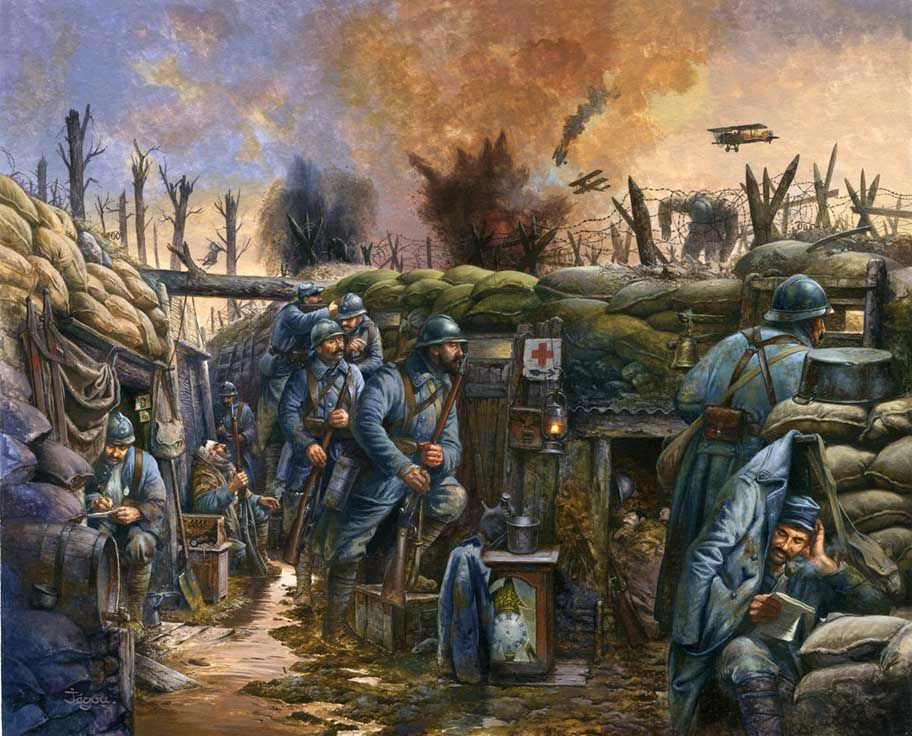
We begin with the trench he would have crouched in, waiting for the order to attack (going “over the top”, which means climbing up over the forward lip of the trench).

In front of the trench was a long stretch of barbed wire, which had to be negotiated before any further forward motion was to be made.

Ahead lay the wilderness called “no man’s land”.

This varied, depending upon what had been there before the War, but, since it was often pounded by one side or the other’s artillery, whatever had been there before—farms, villages, forests—had been turned into a beaten-down desert of ruins.

Beyond there, lay the enemy’s wire entanglements.

And, beyond there were the enemy’s trenches—as many as three lines of them.

These could look like the trench Tolkien had crawled out of, but they could also be much more elaborate, with pillboxes made of concrete, reinforced with steel girders, and buried under a layer of soil both to conceal them and to help to protect them from the shells which the enemy would attempt to drop on them.

(This is the rear entry of a German pillbox.)

In those trenches would be multiple machine guns, placed to sweep the wire which lay before them.

Each of these guns could fire 600 rounds per minute, to which would be added the rifle fire of the infantry who were the trenches’ garrison.

(Peter Dennis)

Behind the trenches would be artillery, whose job was, when an attack began, to fire as many shells as possible into the enemy trenches and into no man’s land, to slow down, if not stop, the enemy attack, forcing the attackers back with heavy casualties.

Before the attack on 1 July, the British had used their heavy artillery

to destroy enemy entrenchments and, hopefully, to cut apart those deep fields of barbed wire in front of them.

Unfortunately, on 1 July, the artillery—even after a massive bombardment—failed to disrupt the wire and soldiers were simply pinned to it, perfect targets for machine gunners and the casualties mounted—and mounted

so that one can easily see why Tolkien would refer to his experience in 1916 as “the carnage of the Somme” with its British 57,470 casualties on its first day and 415,690 by its final one.

In later years, he might have a somewhat ambivalent view of what he had gone through, writing to his son Michael that

“War is a grim hard ugly business.  But it is as good a master as Oxford, or better.” (letter to Michael Tolkien, 12 July, 1940, Letters, 61)

and yet could also write this about the end of the second war:

“The appalling destruction and misery of this war mount hourly, destruction of what should be (indeed is) the common wealth of Europe, and the world, if mankind were not so besotted, wealth the loss of which will affect us all, victors or not.  Yet people gloat to hear of the endless lines, 40 miles long, of miserable refugees, women and children pouring West, dying on the way.  There seem no bowels of mercy or compassion, no imagination, left in this dark diabolic hour.”  (letter to Christopher Tolkien, 20 January, 1945, Letters, 160)

Having experienced one of the bloodiest periods in the Great War, it is no wonder, then, that JRRT could sound like Gandalf, speaking of mercy, on the one hand, and, on the other, like a changed Frodo near the end of his adventures:

“ ‘Fight?’ said Frodo.  ‘Well, I suppose it may come to that.  But remember:  there is to be no slaying of hobbits, not even if they have gone over to the other side.  Really gone over, I mean;  not just obeying ruffians’ orders because they are frightened.  No hobbit has ever killed another on purpose in the Shire, and it is not to begin now.  And nobody is to be killed at all, if it can be helped.  Keep your tempers and hold your hands to the last possible moment.’ “ (The Return of the King, Book Six, Chapter 8, “The Scouring of the Shire”)

As always, thanks for reading.

Stay well,

Consider what, had Bilbo done what Frodo wished, might have been Frodo’s fate—and Middle-earth’s,

(Ted Nasmith)

And remember that, as always, there’s

MTCIDC

O

Evil—But…

09 Wednesday Oct 2024

Posted by Ollamh in Uncategorized

≈ Leave a comment

Tags

Fantasy, J.R.R. Tolkien, lord-of-the-rings, The Lord of the Rings, Tolkien

Welcome, dear readers, as always.

Although the hero of Robert Louis Stevenson’s Treasure Island, 1883,

is the young narrator, Jim Hawkins, the other major character is a rascal, Long John Silver.

If you haven’t read the book, it’s a story about buried treasure (surprised?), a map,

and a voyage to find that treasure—with a crew the half of which are, unknown at first to the protagonists, (temporarily) retired pirates, led by the cook, Silver, of the pirate captain who buried the treasure, Flint.

It’s easy to see why Silver is the other major character:  charming and cold-blooded by turns, he dominates those pirates and yet clearly has a soft spot in his heart for Jim Hawkins.  At the book’s end, while the other pirates are defeated and killed or marooned on the island, we hear that:

“Silver was gone…But that was not all.  The sea-cook had not gone empty-handed. He had cut through a bulkhead unobserved, and had removed one of the sacks of coin, worth, perhaps, three or four hundred guineas, to help him on his further wanderings.

I think we were all pleased to be so cheaply quit of him.” 

The other protagonists, like Squire Trelawney and Doctor Livesey,

are sympathetic, but pale in comparison with Silver, one moment genial, the next, treacherous. (Treasure Island, Chapter XXXIV “And Last”)

And so at least I, as a reader, have always been pleased as well.  (If you want to read the story in my favorite edition, from 1911, illustrated by N.C. Wyeth, here it is:  https://archive.org/details/treasureisland00stev/page/n5/mode/2up )

There is a tradition of having, at worst, a sneaking affection for a villain which dates in English literature at least as far back as the Romantics, when the Satan of Milton’s Paradise Lost, 1667/1674, is seen as other than the destroyer of Paradise.  Shelley, in his introduction to his Prometheus Unbound, 1820, almost casually refers to Satan as “the Hero of Paradise Lost” and Blake, in The Marriage of Heaven and Hell, 1790-1793, says of Milton that

“The reason Milton wrote in fetters when he wrote of Angels and God, and at liberty when of Devils and Hell, is because he was a true poet, and of the Devil’s party without knowing it.” (“The Voice of the Devil” 3. “Energy is Eternal Delight”—But I hasten to point out that there has been an enormous amount of scholarly ink spilled over what Blake may actually have meant by this—for my purpose, however, we’ll leave it as a kind of “sympathy for the Devil”.)

Both of these Romantics found Satan more interesting than Adam and angels—in his adversarial relationship to Heaven, he’s simply more developed, and therefore not only more realistic, but, in his way, more dangerous—and tempting.

And this is why I have a soft spot for Orcs.  It’s not that I admire their behavior, from murdering Boromir

(Inger Edelfeldt)

to murdering each other,

(Alan Lee—this is the pre-murder stage—very soon the archer will shoot an arrow into the other’s eye—see The Return of the King, Book Six, Chapter 2, “The Land of Shadow”)

but that Tolkien has brought them to life through his use of dialogue:  these are real foot soldiers in a real war and vivid because of it, even if they’re villains.

In the draft of a letter from 1956, he had written:

“My ‘Sam Gamgee’ is indeed, as you say, a reflexion of the English Soldier, of the privates and batmen I knew in the 1914 war, and recognized as so far superior to myself.”  (draft of a letter to H. Cotton Minchin, not dated, although JRRT noted that some version was sent 16 April, 1956, Letters, 358)

Although I would worry if Tolkien thought that the Orcs were superior to anyone, starting with himself, I would suggest that they are also modeled on the soldiers he knew in the Great War (note, by the way:  “batmen” here means “officers’ servants” not Bruce Wayne and descendants).

Consider, in comparison, the dialogue of the two Gondorian soldiers, Mablung and Damrod, we overhear when they are keeping an eye on Frodo and Sam—it seems more like an ancient history lesson than the talk of men in the trenches:

“ ‘Aye, curse the Southrons!’ said Damrod. ‘  ‘Tis said that there were dealings of old between Gondor and the kingdoms of the Harad in the Far South; there was never friendship.  In those days our bounds were away south beyond the mouths of Anduin, and Umbar, the nearest of their realms, acknowledged our sway.’ “ (The Two Towers,Book Three, Chapter 4, “Of Herbs and Stewed Rabbit”—I might add that “acknowledged our sway” sounds more like William Morris, 1834-1896, a strong influence on Tolkien, and one who revived archaic language in his writings, than the speech of ordinary infantry of any age.)

Now here are two Orcs, Grishnak and Ugluk, who sound more like Great War sergeants than historians:

“At that moment Pippin saw why some of the troop had been pointing eastward.  From that direction there now came hoarse cries, and there was Grishnakh again, and at his back a couple of score of others like him:  long-armed crook-legged Orcs.  They had a red eye painted on their shields.  Ugluk stepped forward to meet them.

‘So you’ve come back?’ he said.  ‘Thought better of it, eh?’

‘I’ve returned to see that Orders are carried out and the prisoners safe,’ answered Grishnakh.

‘Indeed!’ said Ugluk.  ‘Waste of effort.  I’ll see that orders are carried out in my command.  And what else did you come back for?  Did you leave anything behind?’

‘I left a fool,’ snarled Grishnakh.  ‘But there were some stout fellows with him that are too good to lose. I knew that you’d lead them into a mess.  I’ve come to help them.’ “  (The Two Towers, Book Three, Chapter 3, “The Uruk-hai”)

And what about this bit of reminiscence and wary conversation between Gorbag and Shagrat:

“…What d’you say?—if we get a chance, you and me’ll slip off and set up somewhere on our own with a few trusty lads, somewhere where there’s good loot nice and handy, and no big bosses.’

‘Ah!’ said Shagrat.  ‘Like old times!’

‘Yes,’ said Gorbag.  ‘But don’t count on it.  I’m not easy in my mind.  As I said, the Big Bosses, ay,’ his voice sank almost to a whisper, ‘ay, even the Biggest, can make mistakes.  Something nearly slipped, you say.  I say, something has slipped.  And we’ve got to look out.  Always the poor Uruks to put slips right, and small thanks.  But don’t forget:  the enemies don’t love us any more than they love Him, and if they get topsides on Him, we’re done too…’ “ (The Two Towers, Book Four, Chapter 10, “The Choices of Master Samwise”)

You won’t love them, considering their behavior towards Merry and Pippin, Frodo and Sam, you’ll probably be glad that at least 3 out of 4 are killed (Shagrat, though wounded by Snaga, escapes to report to the Barad-dur—see The Return of the King, Book Six, Chapter 1, “The Tower of Cirith Ungol”), but, perhaps, like me, you might remember Tolkien’s description of the Orcs to Peter Hastings:

“…fundamentally a race of ‘rational incarnate’ creatures, though horribly corrupted, if no more so than many Men to be met today.” (draft of letter to Peter Hastings, September, 1954, Letters, 285)

and find that, like “many Men to be met today”—and even for fictional men, like Long John Silver—you can have, as JRRT seems to, a brief moment of sympathy for them in their corruption as well as admitting that they can often be a lot more engaging than their virtuous Gondorian and Rohirric opponents.

Thanks, as always, for reading.

Stay well,

Beware the temptation of the Dark Side, even if it makes you want to turn the page and read on,

And remember that there’s always

MTCIDC

O

Stratigraphy

18 Wednesday Sep 2024

Posted by Ollamh in Uncategorized

≈ Leave a comment

Tags

Fantasy, J.R.R. Tolkien, lord-of-the-rings, The Lord of the Rings, Tolkien

Welcome, as always, dear readers.

If you read this blog regularly, you know that one thing which always interests me is Tolkien’s sources, both direct and indirect.  In my last, for example, you would have read about one which he directly acknowledged, S.R. Crockett’s 1899 historical novel, The Black Douglas.

(See “Wolfing”, 11 September, 2024 for more)

In this posting, however, I want to begin with a source which prompted my writing this.

It is a pair of stanzas from Theophile Gautier’s (1811-1872)   

poem “L’Art”, which I read just the other day (my translation)–

“Toute passe—L’art robuste

Seul a l’eternite;

   Le buste

Survit a la cite.

Et la medaille austere

Que trouve un laboureur

   Sous terre

Revele un empereur.”

“Everything passes–only sturdy art

To eternity;

The bust survives the city

And the austere medallion

Which the workman finds

Under the ground

Reveals an emperor.”

Gautier belonged to the beginnings of a 19th-century movement which was called “Art for Art’s Sake” and this poem is a declaration, directed towards artists themselves, of his belief that art survives—and should survive—the ages. 

What really caught my attention was the second of these two stanzas, first because the medallion reminded me of this medallion, which I use to teach the Germanification of the later western Roman Empire–

It was minted for the first Ostrogothic king, Theoderic (454-526), who controlled Italy and some areas to the east from 493-526AD, ruling as an ostensible agent of the eastern Roman Empire, but actually a kind of smaller version of the former western Roman emperors.  I’ve always found this image useful because it suggests several things at once:

1. although it’s in Latin (“Theodericus Rex Pius Princi[p]s—for “Princeps”—originally “Headman”—primum caput—in Roman Republican terms, the speaker of the Senate—later an imperial honorific—now the basis of our word “prince”), “Theoderic, king, religious, prince”, underneath that name is the Gothic language which, along with Latin and Greek, Theoderic (or the older spelling, Theodoric) spoke, his Gothic name being something like “Thiudareiks”.  The Greco-Roman name would mean “Gift of God (theo- god, originally Zeus, + dor- gift)”, whereas the Gothic name is a compound of thiuda, “people” and reiks, “ruler”, so “ruler of the people”.   And the name, being in two languages at once, would seem to suggest, perhaps inadvertently, that Theoderic is the ruler of both the older Roman population and the newer Gothic.

2. this message is underlined by the portrait of the king himself–although he has the general look of a later Roman ruler—his lamellar armor (armor made of overlapping metal plates) and the little Nike (not sneaker, but the angelic figure in his left hand, symbolizing victory)—his haircut and the mustache are definitely not, being Germanic.

(For more on this medallion, see:  https://pancoins.org/wp-content/uploads/2018/03/Theorodoric-entire-article.pdf and https://cccrh.org/wp-content/uploads/2021/05/the-coins-of-theoderic-the-ostrogoth.pdf )

The second reason that stanza caught my attention was Gautier’s suggestion that the medallion, along with the bust, are archaeological finds which have survived as emblems of a previous age, itself long lost.

Sometimes, as in the case of Gautier’s workman, finds are simply stumbled upon. The famous Rosetta Stone, for example,

was found built into a wall by French engineers from Napoleon’s 1798 invasion of Egypt,

who were, in fact, not looking for antiquities (although Napoleon’s expeditionary force actually had a scientific element attached—here’s an image of one of the volumes which, eventually, they published),

but were improving some fortifications at the time.

As time went on, however, scientific archaeology developed and began very carefully recording discoveries brought from the ground layer by layer, which is called stratigraphy, and is used by geologists and paleontologists, as well.

The thinking behind this is simply logical:  that which you find below something else is older (unless the ground is disturbed, which can and does happen), that which you find above is newer.

Something I’ve always loved about Tolkien’s work (and Tolkien himself) is the careful, patient way he’s built up Middle-earth, which is, in fact, stratigraphically designed.  For an easy example, look at Appendix A of The Lord of the Rings:

“Annals of the Kings and Rulers”,

which is then divided into:

“I  The Numenorean Kings”

which is then subdivided in turn into:

“(i) Numenor

(ii) The Realms in Exile

(iii) Eriador, Arnor, and the Heirs of Isildur

(iv) Gondor and the Heirs of Anarion

The Stewards”

to which is added

(v) Here Follows a Part of the Tale of Aragorn and Arwen”

before we move on to

“II. The House of Eorl”

Layer by layer, JRRT piles on time and its events—and this isn’t just in annalistic form—that is, a date is provided, then an event is briefly recorded (although we see this form at the beginning of Appendix B in“The Tale of Years”)—instead, we find whole short stories, like that of King Arvedui, which occupies about 2 full pages in the 50th anniversary edition which I use in these postings (1041-1043).

The consequence of this is always a sense that Middle-earth is extremely old, inhabited, colonized, with stratum after stratum of human/elvish/dwarfish activity laid on top of each other—and sometimes standing long after those originally involved are long gone.  Consider, for example, the “Pukel-men”:

“At each turn of the road there were great standing stones that had been carved in the likeness of men, huge and clumsy-limbed, squatting cross-legged with their stumpy arms folded on fat bellies.  Some in the wearing of the years had lost all features save the dark holes of their eyes that still stared sadly at the passers-by…

Such was the dark Dunharrow, the work of long-forgotten men.  Their name was lost and no song or legend remembered it.  For what purpose they had made this place, as a town or secret temple or a tomb of kings, none in Rohan could say.  Here they laboured in the Dark Years, before ever ship came to the western shores, or Gondor of the Dunedain was built; and now they had vanished, and only the old Pukel-men were left, still sitting at the turnings of the road.” (The Return of the King, Book Five, Chapter 3, “The Muster of Rohan”)

On its own, this careful, detailed building of the past gives tremendous power to present events:  for ages, other people have struggled, built, fought, and perished in Middle-earth and left behind a long record of their deeds—although sometimes only nearly-forgotten monuments are all that survives.
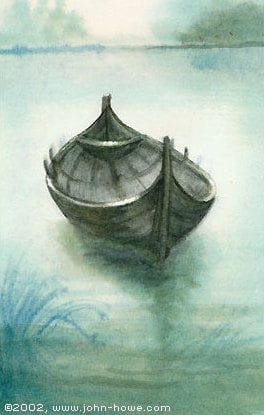
But I think that we might also see a larger picture here, as well.

Middle-earth was not chosen just because Tolkien, as a medievalist, had it in his vocabulary.  As he tells us:
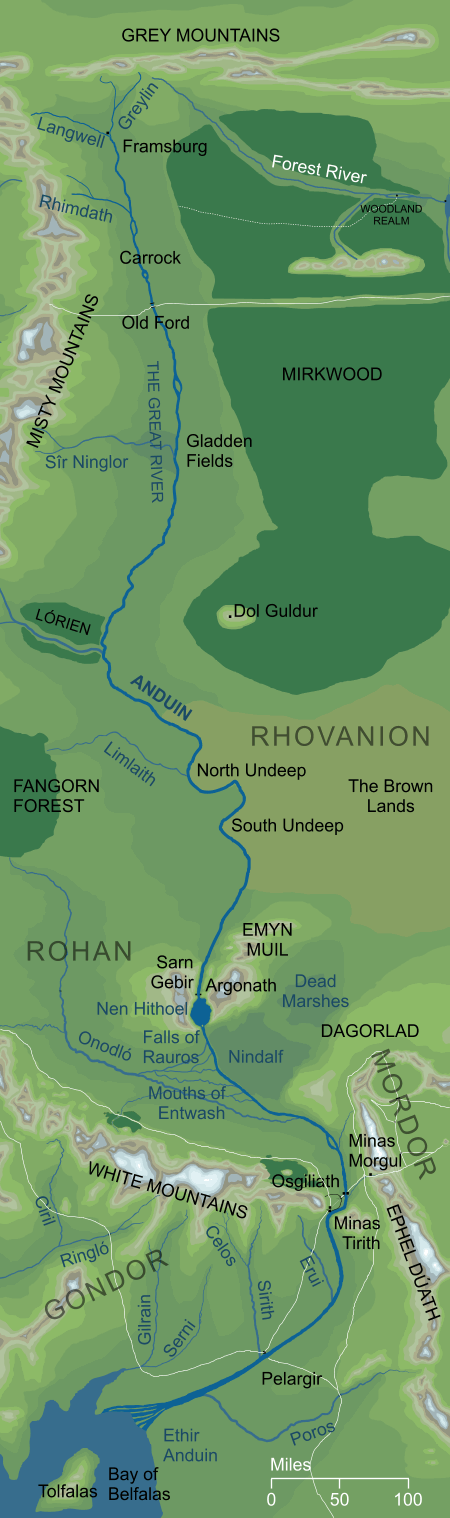
“I am historically minded.  Middle-earth is not an imaginary world.  The name is the modern form (appearing in the 13th century and still in use) of midden-erd >middel-erd, an ancient word for the ‘oikoumene’, the abiding place of Men, the objectively real world, in use specifically opposed to imaginary worlds (as Fairyland) or unseen worlds (as Heaven and Hell).  The theatre of my tale is this earth, the one in which we now live, but the historical period is imaginary.  The essentials of that abiding place are all there (at any rate for inhabitants of N.W. Europe), so naturally it feels familiar, even if a little glorified by the enchantment of distance in time.” (“Notes on W.H. Auden’s review of The Return of the King, 1956?, Letters,345)

To which we might add:

“May I say that all this is ‘mythical’…As far as I know it is merely an imaginative invention, to express, in the only way I can, some of my (dim) apprehensions of the world.  All I can say is that, if it were ‘history’ it would be difficult to fit the lands and events (or ‘cultures’) into such evidence as we possess, archaeological or geological, concerning the nearer or remoter part of what is now called Europe…I could have fitted things in with greater verisimilitude, if the story had not become too far developed, before the question ever occurred to me.  I doubt if there would have been much gain; and I hope the, evidently long but undefined, gap in time between the Fall of Barad-dur and our Days is sufficient for ‘literary credibility’, even for readers acquainted with what is known or surmised of ‘pre-history’. “

And Tolkien has footnoted this with:

“I imagine the gap to be about 6000 years:  that is we are now at the end of the Fifth Age, if the Ages were about the same length as S.A. and T.A.  But they have, I think, quickened; and I imagine we are actually at the end of the Sixth Age, or in the Seventh.”  (Letter to Rhona Beare, 14 October, 1958, Letters, 404)

In other words, what Tolkien has done for his version of our world is to create a simulacrum of what humans in time have done for our version of our world and, as we read The Lord of the Rings, including its appendices, we are acting as something like literary archaeologists, beginning at the surface of the Third Age in its last years and reading slowly down through its strata, just as archaeologists in our world work their way down through the historical layers, recording the strata as they dig.  Although I’m admirer of good fan fiction, I don’t think that I would ever write it, but I can imagine a story which begins with an archaeologist in our world (6000 years after the Third Age) digging more deeply than ever and coming upon

“…a tall pillar loomed up before them.  It was black; and set upon it was a great stone, carved and painted in the likeness of a long White Hand…” (The Two Towers, Book Three, Chapter 8, “The Road to Isengard”)

Where might the story go from there?

Thanks, as ever, for reading.

Stay well,

When excavating always keep a careful record,

And remember that, as always, there’s

MTCIDC

O

Dos Mackaneeks

26 Wednesday Jun 2024

Posted by Ollamh in Uncategorized

≈ Leave a comment

Tags

Fantasy, lord-of-the-rings, The Lord of the Rings, Tolkien, Writing

Welcome, as always, dear readers.

Star Wars:  the Phantom Menace

certainly begins with a bang:  a Jedi and his padawan, sent on a peace mission to the planet Naboo, are attacked by poisoned gas and droids

(reminding me at once of those lines from Weird Al Jankovic’s song:

“But their response, it didn’t thrill us

They locked the doors and tried to kill us”

If you don’t know “The Saga Begins”, you can watch it here:  https://www.youtube.com/watch?v=hEcjgJSqSRU )

but escape to the surface only to be almost squashed in an invasion of droid armor

before they rescue an unlikely helper (right out of Thompson’s Motif-Index of Folk-Literature B350-B390, “Grateful Animals”),

who takes them to an underwater city where they come before Boss Nass, who blames upperworlders for the invasion

and responds to their warning that, after they finish with the upperworlders, the invaders will be coming for those below the water:

“Dos mackaneeks no comen here.  Dey not know of usen.”

The Gungans (which is what these people call themselves) are sophisticated technologically enough to have an underwater city

and self-propelled transport,

and they even can produce an energy shield,

but faced with the armament of the invading droid army—

and its hordes of infantry,

their use of energy balls (“boomas”)

and shields

which bear a faint resemblance to Celtic shields in some clear material

show them to be really no match for the droids and their technology.  Only luck from the outside saves them.

The Gungans are brave and their weapons can cause some damage, but it’s obvious that they’re outclassed technologically, which makes me think of the Aztecs, the center of whose capital, Tenochtitlan, built in the middle of a lake, was a series of sophisticated and elegant stone buildings (complete with an aqueduct),

but who, unfortunately for them, were a late Neolithic culture who, with no metal with which to work, made their weapons using volcanic glass, obsidian, which was sharp,

(this and the next by Angus McBride)

but no match for the conquistadores’ steel weapons, armor, and early firearms.

And this brings me to a “what if”.

When Helm’s Deep is attacked,

(JRRT)

the orcs’ original method is perhaps the worst in the repertoire:  escalade—that is, putting ladders up against a wall, then climbing up them.  You can imagine why I call it the worst—

the attackers are visible all the way up the ladders and:

1. they can be pushed off

2. the ladders can be pushed off

3. people can whack you when you reach the top

4. people can shoot you on the way up

5. people can drop things on you on the way up

(In several historical assaults, ladders were found to be too short, adding an extra difficulty.)

Such attacks usually only succeed if:

1. they are a surprise  (this happened at the terrible siege of Badajoz in 1812—the French garrison was too focused in one direction and some of the British attackers climbed up the back of the fortress–)

2. the attackers can pin down enough of the defenders with archery/gunfire to allow the climbers to reach the top—and an attack can still fail if those at the top aren’t supported by others coming up behind them—Alexander the Great almost died when he was isolated after scaling an enemy wall (reinforcements overburdened the ladders and they broke—see Arrian The Anabasis of Alexander, Book VI, Sections 9-10—which you can read in translation here:  https://www.gutenberg.org/cache/epub/46976/pg46976-images.html#Page_329  )

The orcs, however, are concealing a secret weapon—

“Even as they spoke there came a blare of trumpets.  Then there was a crash and a flash of flame and smoke.  The waters of the Deeping-stream poured out hissing and foaming:  they were choked no longer, a gaping hole was blasted in the wall.  A host of dark shapes poured in.

‘Devilry of Saruman!’ cried Aragorn.  ‘They have crept in the culvert again, while we talked, and they have lit the fire of Orthanc beneath our feet.’ “  (The Two Towers, Book Three, Chapter 7, “Helm’s Deep”)

And it’s not just Saruman’s “Devilry”—

“The bells of day had scarcely rung out again, a mockery in the unlightened dark, when far away he saw fires spring up, across in the dim spaces where the walls of the Pelennor stood.  The watchmen cried aloud, and all men in the City stood to arms.  Now ever and anon there was a red flash, and slowly through the heavy air dull rumbles could be heard.

‘They have taken the wall!’ men cried.  ‘They are blasting breaches in it.  They are coming!’ “ (The Return of the King, Book Five, Chapter 4, “The Siege of Gondor”)

I think that we can assume that “the fire of Orthanc” is, in fact, gunpowder.

In our Western world, the first known mention of it was by Friar Roger Bacon in the mid-13th century,

and the first known depiction of a gunpowder weapon dates from the early 14th century.

The only uses in The Lord of the Rings are for what would be called, in later times, “mines”.  In our Middle-earth, medieval technology further developed the use of gunpowder into bigger, deadlier forms—early cannon, called “bombards”

and miniaturized them as “handgonnes”.

(Liliane and Fred Funcken)

What if Saruman—and Sauron—had had time to develop their “fire of Orthanc”?

This is how we usually see orcs and their armament—all medieval—spears, swords, bows.

(Alan Lee)

Suppose, however, that there had been further armament.  Imagine orcs with handgonnes, for example.

And, instead of massive stone-throwers employed to break down the walls of Minas Tirith—also a medieval weapon—

giant bombards.

It was weapons like these, in 1453, which broke holes in the ancient walls of Constantinople,

allowing the Turkish besiegers to enter a place which only once before, in its 1000 year plus history, had been broken into.

And why stop there? 

Leonardo da Vinci (1452-1519)

was born only the year before the fall of Constantinople, just at the very end of the Western Middle Ages.  In 1487, he sketched this—

which, in terms of much of its technology, was possible in 1487, although it would have been more than a little crowded inside with all of those guns, especially when they jerked backwards in the recoil which would have come with firing them.  Fortunately for the West, da Vinci doesn’t appear to have figured out a useful way of propelling his invention

and it was only in the early 20th century that the internal combustion engine could be employed to move such a metal monster.

Consider, however, if the opponents of the West in the later Third Age had developed what clearly they had begun.  Seeing such approaching, on foot or, worse, in an armored vehicle, what could Rohirrim or Gondorians have done beyond believing what Qui Gon had tried to warn Boss Nass about:

Dos Mackaneeks!

Thanks, as always, for reading.

Stay well,

Remember the places where tanks are vulnerable,

and remember, as well, that there’s always

MTCIDC

O

Orc Logistics

07 Tuesday May 2024

Posted by Ollamh in Uncategorized

≈ Leave a comment

Tags

Fantasy, J.R.R. Tolkien, lord-of-the-rings, The Lord of the Rings, Tolkien

As always, dear readers, welcome.

Sauron, although he rather rashly placed much of his power (as well as his life force) in what is, basically, a magic ring, has always struck me as rather a practical person when it comes to war and foreign affairs.  In order to conquer the West, he’s:

1. turned his rather bleak realm into a giant military camp

2. brought back the final destroyer of Arnor, the Witch King of Angmar, as his chief lieutenant

3. made treaties with peoples to the east and south to bolster his already extensive armies and cleverly turned pirates loose to raid the southern shores of Gondor to distract his opponents and force them to divide their forces

4. corrupted one of the West’s traditional allies, Saruman, turning him into a kind of “Mini Me”


5. weakened another, Rohan, through a spy in the king’s court, Grima, who has somehow turned that king into a prematurely-aged man

6. worked on the mind of the commander of Gondor, Denethor, using an ancient communications device, making him suspicious of his younger son and promoting a defeatist attitude

As well, he seems quite aware of what we call geo-politics, as we see in his demands at the Black Gate:

“ ‘The rabble of Gondor and its deluded allies shall withdraw at once beyond the Anduin, first taking oaths never again to assail Sauron the Great in arms, open or secret.  All lands east of the Anduin shall be Sauron’s for ever, solely.  West of the Anduin as far as the Misty Mountains and the Gap of Rohan shall be tributary to Mordor, and men there shall bear no weapons, but shall have leave to govern their own affairs.  But they shall help to rebuild Isengard which they have wantonly destroyed, and that shall be Sauron’s and there his lieutenant shall dwell:  not Saruman, but one more worthy of trust.”  (The Return of the King, Book Five, Chapter 10, “The Black Gate Opens”)

Reading this passage, however, I’m puzzled:

“Time passed.  At length watchers on the walls could see the retreat of the out-companies.  Small bands of weary and often wounded men came first with little order; some were running wildly as if pursued.  Away to the eastward the distant fires flickered, and now it seemed that here and there they crept across the plain.  Houses and barns were burning.  Then from many points little rivers of red flame came hurrying on, winding through the gloom, converging towards the line of the broad road that led from the City-gate to Osgiliath.”  (The Return of the King, Book 5, Chapter 4, “The Siege of Gondor”)

As we know, JRRT himself had been a soldier, though perhaps a reluctant one,

and thus would have been well aware of the saying, sometimes attributed to Napoleon, that “an army marches on its stomach”.  In 1916, such an army needed massive supply dumps,

which needed railroads to bring food and ammunition to them.

From there, wagons

and, in time, early trucks,

then mules and horses would have taken supplies farther forward

and, from there, the troops themselves might have formed what were called “carrying parties”.

Image7:  carrying

(This is actually a “wiring party”, with its “screw pickets”, which were twisted into the ground and used to hold up the barbed wire, but it can stand in for a “carrying party”.  For more on “wiring parties”, see:  https://en.wikipedia.org/wiki/Wiring_party  )

One fact alone might suggest how big the task of keeping the British Army supplied :  “By 1918, the British were sending over 67 million lbs (30 million kg) of meat to the Western Front each month.”  (This is from an article entitled “The Food That Fuelled the Front” from the Imperial War Museum website, which you can see here:  https://www.iwm.org.uk/history/the-food-that-fuelled-the-front  )

This was a vast, modern army, with all the modern technology available in 1918 to enable resupply (such supplying is called “logistics”).  Sauron’s army is of a much earlier time, its basis seemingly infantry, armed with swords, spears, and bows,

(Alan Lee)

assisted by a certain number of oliphaunts,

(Alan Lee)

horsemen,

(These are actually Mongols, but all the text says is “Before them went a great cavalry of horsemen moving like ordered shadows…”  The Two Towers, Book Four, Chapter 8, “The Stairs of Cirith Ungol”, leaving it up to us to imagine what they might have looked like.)

and perhaps a warband of wargs,

(Artist?)

yet its basic needs would have been the same as those of the British Army in which Tolkien served.

To provide a parallel a bit closer to The Lord of the Rings, we might imagine an earlier army, like the army of New Kingdom Egypt

as we might have seen it marching to fight the Hittites

(Angus McBride)

at the Battle of Kadesh, in the summer of 1274BC. 

No oliphaunts or cavalry (or wargs) in support, but definitely chariots, maybe 2000 of them.

(Again, Angus McBride, one of my favorite military artists of the 20th century). 

The Egyptian army of Rameses II

may have numbered about 20,000, with as many as 4,000 chariot horses, and here are some potential logistic figures for such an earlier army—

Thinking of water alone, the average modern horse will drink 5-10 gallons (19-38 ltrs) of water a day, depending on working conditions, and that same horse needs to eat 15-20 pounds  (7-9 kg) of hay.  An average present-day American eats about 5.5  pounds (2.5 kg) of food per day and drinks 2 quarts (2 ltrs) of water.  On the one hand, ancient Egyptians were somewhat smaller than we are and probably less well-fed to begin with, but, on the other, that water requirement is an average and doesn’t factor in  marching for miles on dusty summertime roads in the Middle East.

Could Rameses’ army have carried enough supplies with it for the long march (perhaps about 500 miles—about 805km)?  Rameses would have had available to him no trains or trucks, but the ancient Egyptians had carts (probably pulled by oxen, as were their plows)

and certainly used pack mules.

As to possible baggage camels,

there is a lot of scholarly argument about their use.  Although camel remains (a few depictions, bones, rope from camel hair) are there, there doesn’t appear to be any clear evidence for the use of camels as carriers until much later.  Food—the ordinary Egyptian diet was simple, including barley bread

and beer (also made from barley),

so large supplies of barley flour might be carried, but how to carry—and preserve–beer?  Water could be substituted, but could it be carried?  Or would the Egyptians have done as armies have done throughout history and foraged, picking up supplies of food and drink from the locals, willingly or unwillingly?  Both Rameses II’s and Sauron’s armies had horses, but add oliphaunts in Sauron’s, and all in need of fodder, this would include, in season, cutting grass

and, in and out of season, probably looting barns and granaries, as well.

Consider, then, Sauron’s armies and the Pelennor into which they had broken. 

We don’t know their numbers, but it’s clear that they are enormous, far outnumbering the defenders of Minas Tirith.   And this is what puzzles me.  Tolkien was certainly aware of such needs in general—as he once wrote:  “I am not incapable of or unaware of economic thought…” (letter to Naomi Mitchison, 25 September, 1954, Letters, 292).   And yet—

“It drew now to evening by the hour, and the light was so dim that even far-sighted men upon the Citadel could discern little clearly out upon the fields, save only the burnings that ever multiplied, and the lines of fire that grew in length and speed.”

Perhaps the army brought some provisions with it (Saruman and Sauron’s orcs seem to have had something like field rations, as we learn after they carry off Merry and Pippin), but, if the siege of Minas Tirith had proved to be a long one, what would such a vast host and its beasts have eaten, having destroyed the nearest source of food and fodder?  We’ve seen that Sauron was shrewd and showed a great amount of foresight in his pre-war preparations, so my only answer is a question:   did JRRT, who certainly had a taste for the dramatic moment–think of the way in which the Rohirrim appear at the edge of the Rammas Echor–

deliberately sacrifice economics for drama?  We’ll probably never know for certain, but, if you stand for a moment, on the wall of the first circle of Minas Tirith in the darkness, and see those fires spread across the Pelennor…

As always, thanks for reading.

Stay well,

If you have a yen for conquest, remember to pack a lunch (with carrots for your horse, of course),

And remember that, as always, there’s

MTCIDC

O

Glittering Caves, or, Cheese, Hobbit!

13 Wednesday Mar 2024

Posted by Ollamh in Uncategorized

≈ Leave a comment

Tags

Fantasy, J.R.R. Tolkien, lord-of-the-rings, The Lord of the Rings, travel

Welcome, dear readers, as ever.

In a letter to a “Mr. Wrigley”, Tolkien made this remark:

“I fear you may be right that the search for the sources of The Lord of the Rings is going to occupy academics for a generation or two.  I wish this need not be so.  To my mind it is the particular use in a particular situation of any motive, whether invented, deliberately borrowed, or unconsciously remembered that is the most interesting thing to consider.”  (letter to Mr. Wrigley, 25 May, 1972, Letters, 587)

I would like to add:  not just unconsciously remembered, but also consciously, as in the Caves of Aglarond.

“Strange are the ways of Men, Legolas!” Gimli suddenly burst out, continuing:  “Here they have one of the marvels of the Northern World, and what do they say of it?  Caves, they say!  Caves!  Holes to fly to in time of war, to store fodder in!  My good Legolas, do you know that the caverns of Helm’s Deep are vast and beautiful?  There would be an endless pilgrimage of Dwarves, merely to gaze at them, if such things were known to be.  Aye indeed, they would pay pure gold for a brief glance!”  (The Two Towers, Book Three, Chapter 8, “The Road to Isengard”)

Gimli and Legolas have just survived Saruman’s failed attack on Helm’s Deep,

(the Hildebrandts)

where Gimli, separated from his companions, has taken refuge in the very caves he is now raving about.

(Ted Nasmith—and, as ever, he has chosen a moment no one else has thought to illustrate—one of the many reasons I so admire his work)

As Gimli goes on—and he does for half a page—we hear of

“immeasurable halls, filled with an everlasting music of water that tinkles into pools, as fair as Kheled-zaram in the starlight…gems and crystals and veins of precious ore glint in the polished walls; and the light glows through folded marbles, shell-like, translucent as the living hands of Queen Galadriel.”

Remembering Gimli’s ultimate request from Galadriel—a strand of her hair:

“…which surpasses the gold of the earth as the stars surpass the gems of the mine.” (The Fellowship of the Ring, Book Two, Chapter 8, “Farewell to Lorien”)

this is an impressive comparison.  But, for all of JRRT’s wonderful imagination, in fact these caves, although perhaps embroidered by that imagination, were based upon a real place, as Tolkien tells us in a letter:

“I was most pleased by your reference to the description of ‘glittering caves’.  No other critic, I think, has picked it out for special mention.  It may interest you to know that the passage was based on the caves in Cheddar Gorge and was written just after I had revisited these in 1940 but was still coloured by my memory of them much earlier before they became so commercialized.  I had been there during my honeymoon nearly thirty years earlier.”  (letter to P. Rorke, SJ, 4 February, 1971, Letters, 572)

Cheddar Gorge is a natural feature in Dorset, in southwest England in the area of the Mendip Hills.

A gorge is a kind of valley and Cheddar Gorge is one which has cut through layers of limestone to form it.

As you can see, this is spectacular in itself, but there is an attraction within the attraction:  a series of caves in the limestone and this is the sort of thing which Tolkien might have seen on his two visits—

which then inspired Gimli’s impassioned speech (which, by the way, is totally unnecessary to the plot, but which brilliantly illuminates (sorry!) Gimli’s character and adds to his growing friendship with Legolas, who, persuaded by the dwarf’s rhetoric, pledges to return to the caves with him—in return for visiting Fangorn Forest with Legolas).

For those who love cheese, there is another connection here, of course:  billed as “the world’s most popular cheese”, there is Cheddar, a tangy, solid variety, which seems to have originated—yes, in the village of Cheddar, just below the Gorge (and it has been suggested that some of the caves were used to age the cheese in the past).

In a left (or perhaps wrong) turn from Tolkien’s “the particular use in a particular situation of any motive, whether invented, deliberately borrowed, or unconsciously remembered that is the most interesting thing to consider”, I found that, once I made the association:  Caves of Aglarond, Cheddar Gorge, my next step was directly to Cheddar Cheese and, from there, to another English cheese, Wensleydale, made to the northeast, in Yorkshire.

And here’s where cheese and hobbits became intertwined with the characters most devoted to Wensleydale, Wallace and his skeptical dog, Gromit.

These are the brilliant stop-motion creations of Nick Park,

beginning with the pair’s first adventure, “A Grand Day Out” (1989)

in which, in search of a cheese holiday,

they visit the moon in a ramshackle rocket which Wallace (a part-time inventor) built for the trip.

Since then, they have had a number of adventures—“The Wrong Trousers” (1993), “A Close Shave” (1995), and “A Matter of Loaf and Death” (2008), all shorts, along with a feature-length film, “The Curse of the Were-Rabbit” (2005).  If you don’t know them, you can see “A Grand Day Out” for free at the wonderful Internet Archive:  https://archive.org/details/agranddayout_202001 and, if this delights you as much as it’s always delighted me, you can see more at the Archive under “Aardman Animations”, including a series of very short films highlighting some of Wallace’s inventions:  https://archive.org/details/94920

This is very much English humor:  wacky, but played straight, as if visiting the Moon in search of exotic cheese is a perfectly normal thing to do.  I don’t know if JRRT would have enjoyed Wallace and Gromit, but he says this of hobbits:

“…I am personally immensely amused by hobbits as such, and can contemplate them eating and making their rather fatuous jokes indefinitely…” (letter to D.A. Furth, 24 July, 1938, Letters, 49)

so perhaps the adventures of two eccentrics—well, one eccentric and one very sensible canine–

would tickle him.  As I was writing this, I discovered, however, that someone else had already made the association of Cheddar (Gorge) and Wallace and Gromit, at least–

Thanks for reading, as always,

Stay well,

Squirrel away, as Wallace does, Jacob’s Cream Crackers—you just shouldn’t run out,

And remember that there’s always

MTCIDC

O

PS

For more on Cheddar Gorge, see:  https://en.wikipedia.org/wiki/Cheddar_Gorge   For more on Cheddar cheese see:  https://en.wikipedia.org/wiki/Cheddar_cheese

← Older posts
Newer posts →

The Doubtful Sea Series Facebook Page

The Doubtful Sea Series Facebook Page

  • Ollamh

Categories

  • Artists and Illustrators
  • Economics in Middle-earth
  • Fairy Tales and Myths
  • Films and Music
  • Games
  • Heroes
  • Imaginary History
  • J.R.R. Tolkien
  • Language
  • Literary History
  • Maps
  • Medieval Russia
  • Military History
  • Military History of Middle-earth
  • Narnia
  • Narrative Methods
  • Poetry
  • Research
  • Star Wars
  • Terra Australis
  • The Rohirrim
  • Theatre and Performance
  • Tolkien
  • Uncategorized
  • Villains
  • Writing as Collaborators
Follow doubtfulsea on WordPress.com

Across the Doubtful Sea

Recent Postings

  • Through a glass… January 7, 2026
  • Heffalumps? December 31, 2025
  • We Three Kings December 24, 2025
  • A Moon disfigured December 17, 2025
  • On the Roads Again—Once More December 10, 2025
  • (Not) Crossing Bridges December 3, 2025
  • On the Road(s) Again—Again November 26, 2025
  • On the Road(s) Again November 19, 2025
  • To Bree (Part 2) November 12, 2025

Blog Statistics

  • 104,127 Views

Posting Archive

  • January 2026 (1)
  • December 2025 (5)
  • November 2025 (4)
  • October 2025 (5)
  • September 2025 (4)
  • August 2025 (4)
  • July 2025 (5)
  • June 2025 (4)
  • May 2025 (4)
  • April 2025 (5)
  • March 2025 (4)
  • February 2025 (4)
  • January 2025 (5)
  • December 2024 (4)
  • November 2024 (4)
  • October 2024 (5)
  • September 2024 (4)
  • August 2024 (4)
  • July 2024 (5)
  • June 2024 (4)
  • May 2024 (5)
  • April 2024 (4)
  • March 2024 (4)
  • February 2024 (4)
  • January 2024 (5)
  • December 2023 (4)
  • November 2023 (5)
  • October 2023 (4)
  • September 2023 (4)
  • August 2023 (5)
  • July 2023 (4)
  • June 2023 (4)
  • May 2023 (5)
  • April 2023 (4)
  • March 2023 (5)
  • February 2023 (4)
  • January 2023 (4)
  • December 2022 (4)
  • November 2022 (5)
  • October 2022 (4)
  • September 2022 (4)
  • August 2022 (5)
  • July 2022 (4)
  • June 2022 (5)
  • May 2022 (4)
  • April 2022 (4)
  • March 2022 (5)
  • February 2022 (4)
  • January 2022 (4)
  • December 2021 (5)
  • November 2021 (4)
  • October 2021 (4)
  • September 2021 (5)
  • August 2021 (4)
  • July 2021 (4)
  • June 2021 (5)
  • May 2021 (4)
  • April 2021 (4)
  • March 2021 (5)
  • February 2021 (4)
  • January 2021 (4)
  • December 2020 (5)
  • November 2020 (4)
  • October 2020 (4)
  • September 2020 (5)
  • August 2020 (4)
  • July 2020 (5)
  • June 2020 (4)
  • May 2020 (4)
  • April 2020 (5)
  • March 2020 (4)
  • February 2020 (4)
  • January 2020 (6)
  • December 2019 (4)
  • November 2019 (4)
  • October 2019 (5)
  • September 2019 (4)
  • August 2019 (4)
  • July 2019 (5)
  • June 2019 (4)
  • May 2019 (5)
  • April 2019 (4)
  • March 2019 (4)
  • February 2019 (4)
  • January 2019 (5)
  • December 2018 (4)
  • November 2018 (4)
  • October 2018 (5)
  • September 2018 (4)
  • August 2018 (5)
  • July 2018 (4)
  • June 2018 (4)
  • May 2018 (5)
  • April 2018 (4)
  • March 2018 (4)
  • February 2018 (4)
  • January 2018 (5)
  • December 2017 (4)
  • November 2017 (4)
  • October 2017 (4)
  • September 2017 (4)
  • August 2017 (5)
  • July 2017 (4)
  • June 2017 (4)
  • May 2017 (5)
  • April 2017 (4)
  • March 2017 (5)
  • February 2017 (4)
  • January 2017 (4)
  • December 2016 (4)
  • November 2016 (5)
  • October 2016 (6)
  • September 2016 (5)
  • August 2016 (5)
  • July 2016 (5)
  • June 2016 (5)
  • May 2016 (4)
  • April 2016 (4)
  • March 2016 (5)
  • February 2016 (4)
  • January 2016 (4)
  • December 2015 (5)
  • November 2015 (5)
  • October 2015 (4)
  • September 2015 (5)
  • August 2015 (4)
  • July 2015 (5)
  • June 2015 (5)
  • May 2015 (4)
  • April 2015 (3)
  • March 2015 (4)
  • February 2015 (4)
  • January 2015 (4)
  • December 2014 (5)
  • November 2014 (4)
  • October 2014 (6)
  • September 2014 (1)

Blog at WordPress.com.

  • Subscribe Subscribed
    • doubtfulsea
    • Join 78 other subscribers
    • Already have a WordPress.com account? Log in now.
    • doubtfulsea
    • Subscribe Subscribed
    • Sign up
    • Log in
    • Report this content
    • View site in Reader
    • Manage subscriptions
    • Collapse this bar
 

Loading Comments...