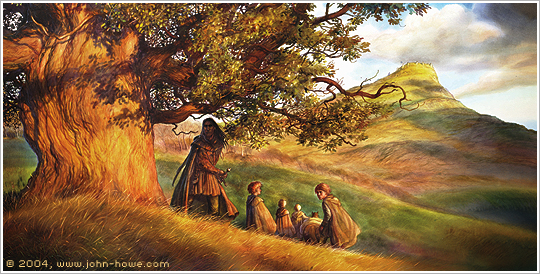
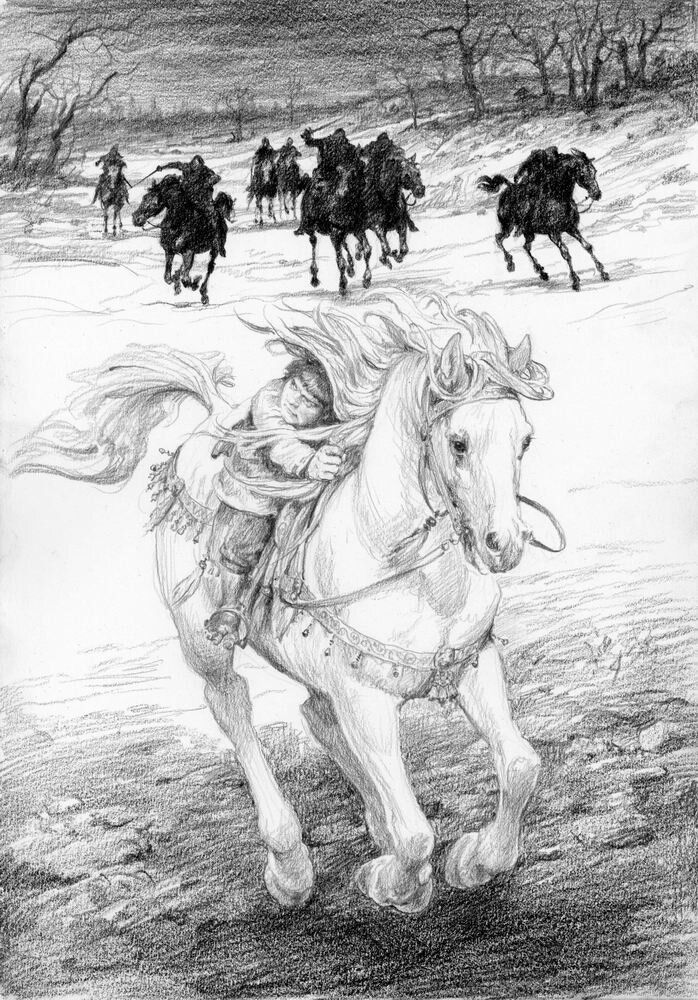
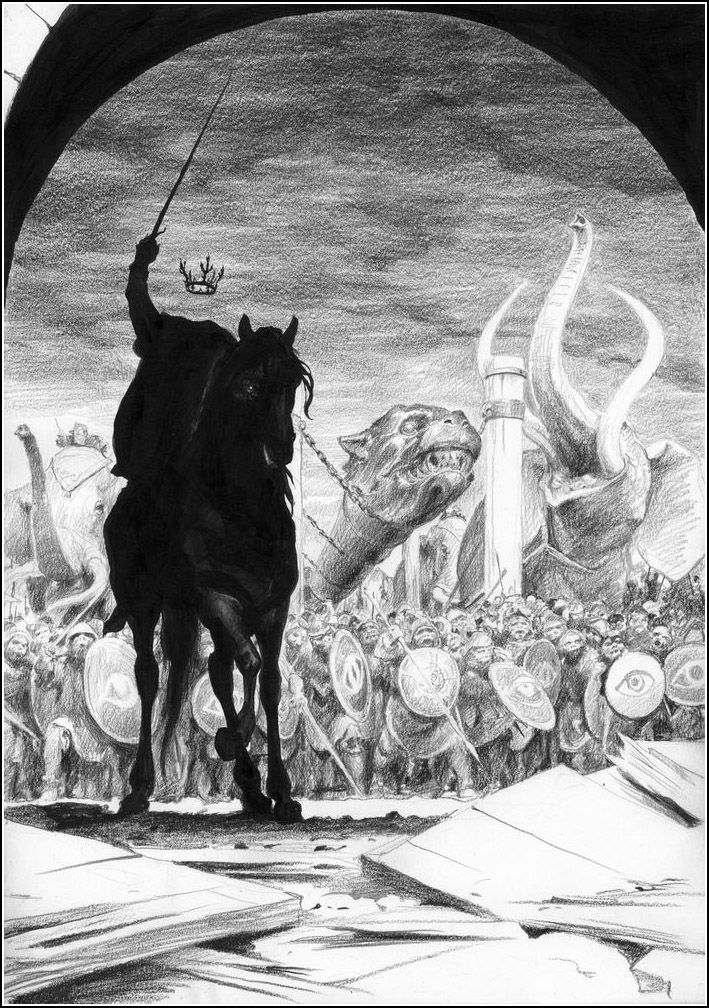
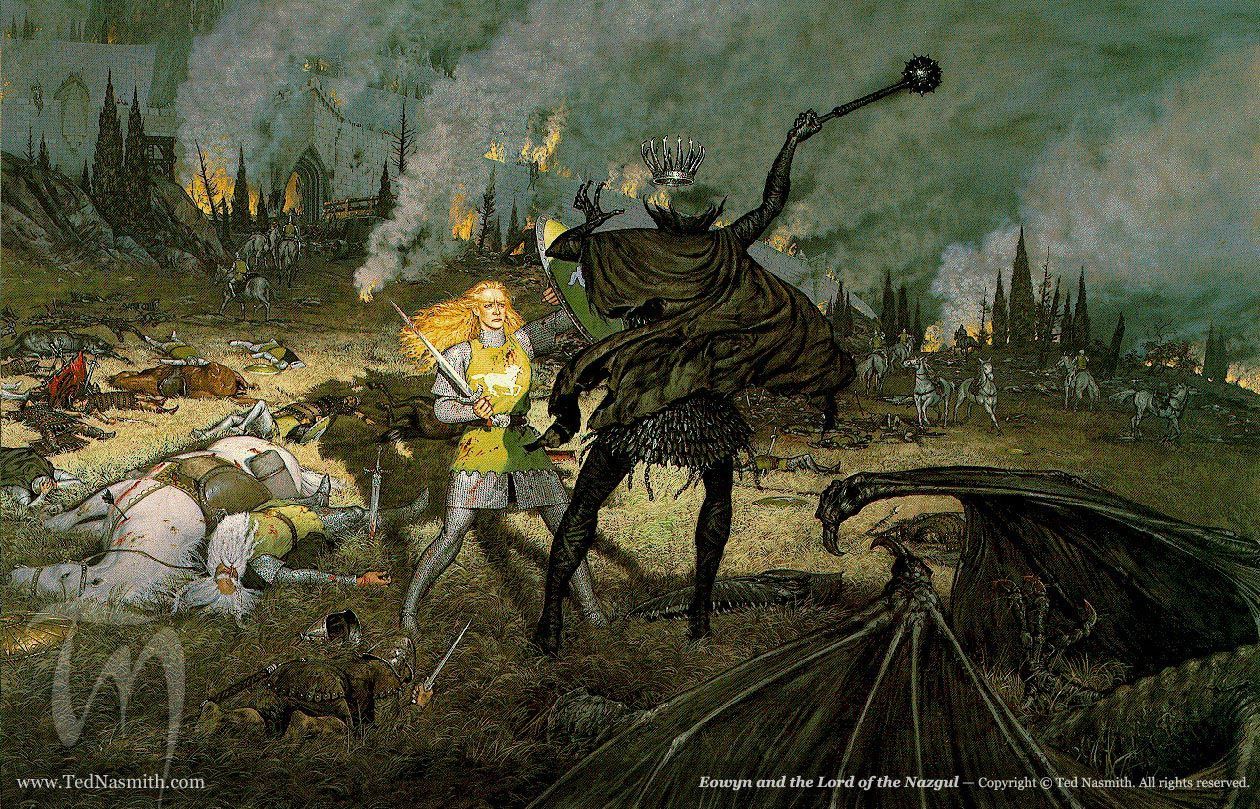
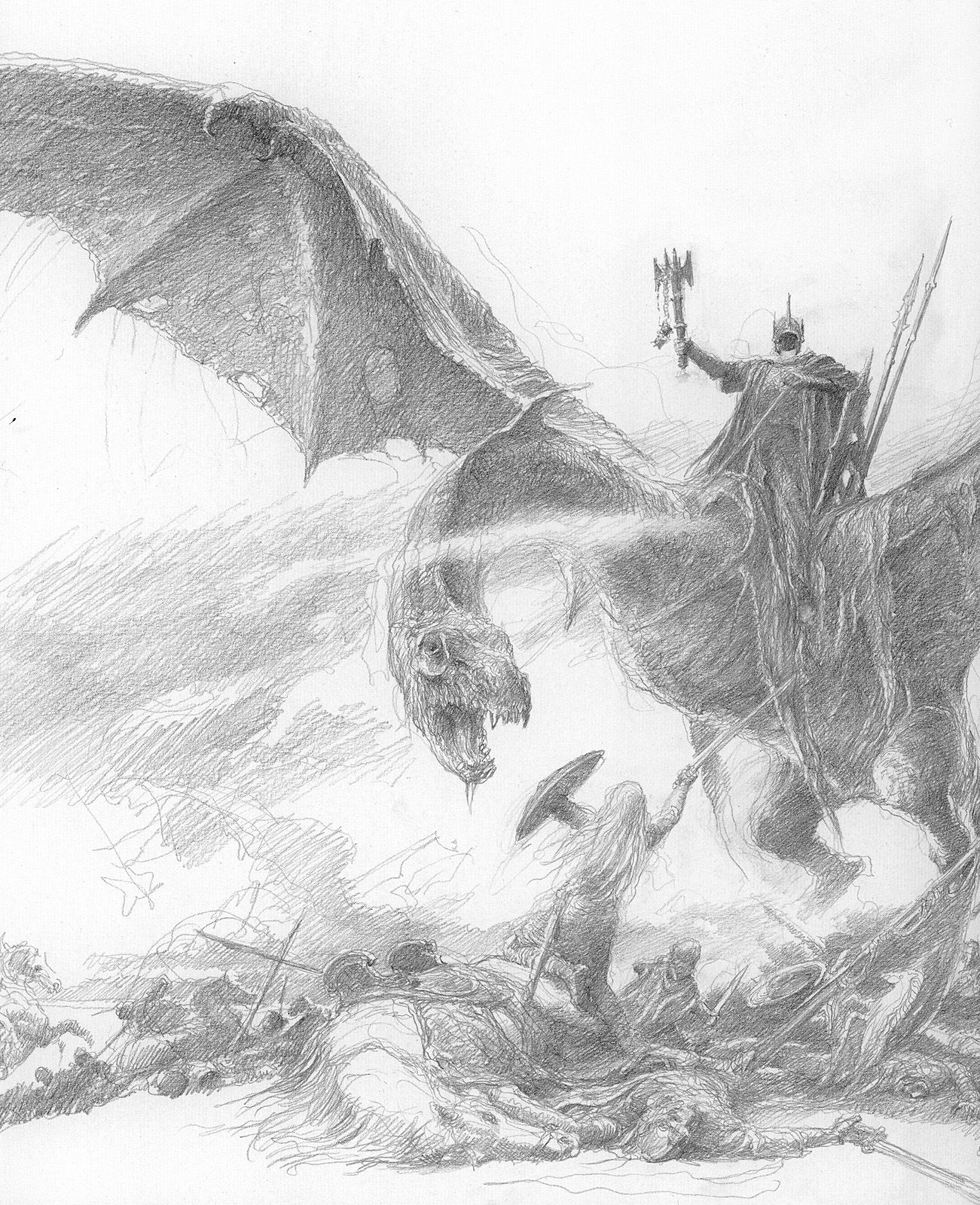
• About

doubtfulsea

~ adventure fantasy

Tag Archives: The Lord of the Rings

Heffalumps?

31 Wednesday Dec 2025

Posted by Ollamh in Uncategorized

≈ Leave a comment

Tags

Alexander, Dunlendings, elephant, Fantasy, Hannibal, Heffalumps, movies, Mumak, Perseus, Poros, Seleucus, The Lord of the Rings, The War Of the Rohirrim, the-war-of-the-rohrrim, Tolkien, Winnie the Pooh

Welcome, as always, dear readers.

“And then, just as they came to the Six Pine Trees, Pooh looked round to see that nobody else was listening, and said in a very solemn voice:

‘Piglet, I have decided something.’

‘What have you decided, Pooh?’

‘I have decided to catch a Heffalump.’ ” (Winnie-the-Pooh, Chapter V, “In Which Piglet Meets a Heffalump”)

Winnie-the-Pooh has just turned 100,

the book’s birthday being in1926, but the Pooh himself first appeared on Christmas eve, 1925, in the The Evening News.

(For more Poohsiana, including the origins of the character, see:  https://en.wikipedia.org/wiki/Winnie-the-Pooh )

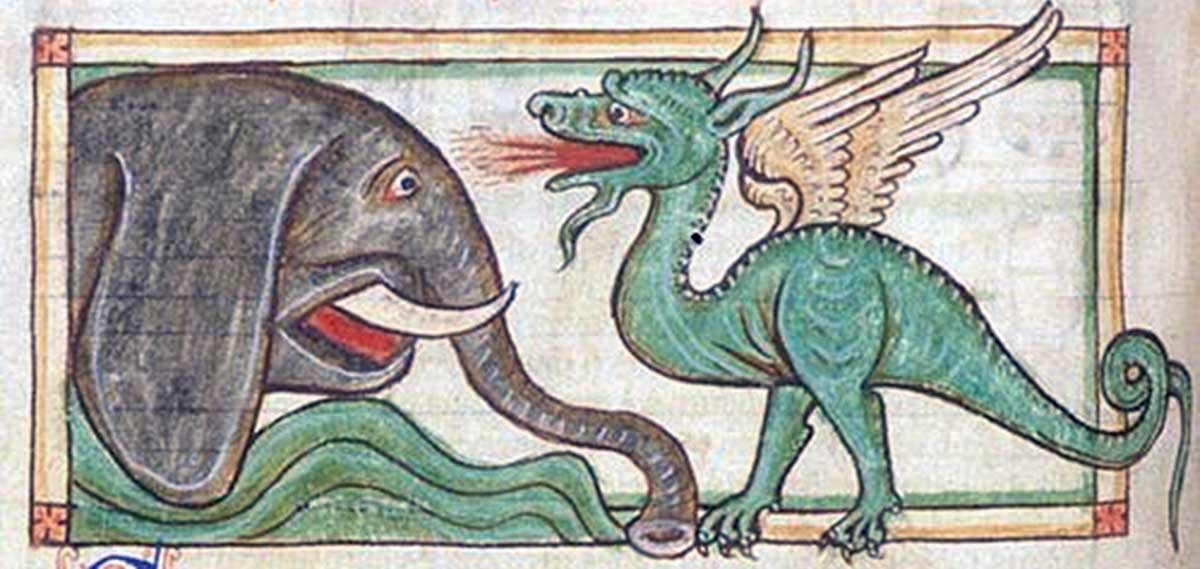
Although it’s never defined, from the tone of the chapter, I’ve always imagined that a “heffalump” was, in fact, an elephant. 

(An elephant and a tradional mortal enemy.  This is from the 13th-century Harley MS 3244, in the British Library, which I found at a wonderful medieval site:  https://medievalbestiary.info/index.html  )

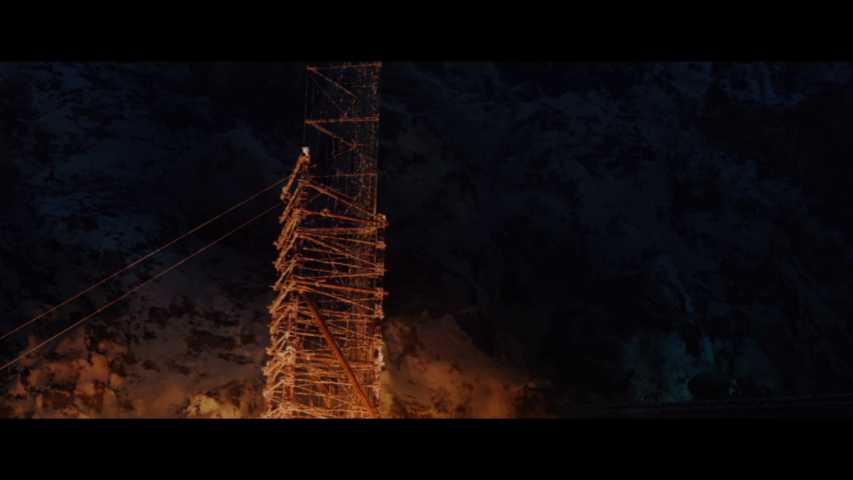
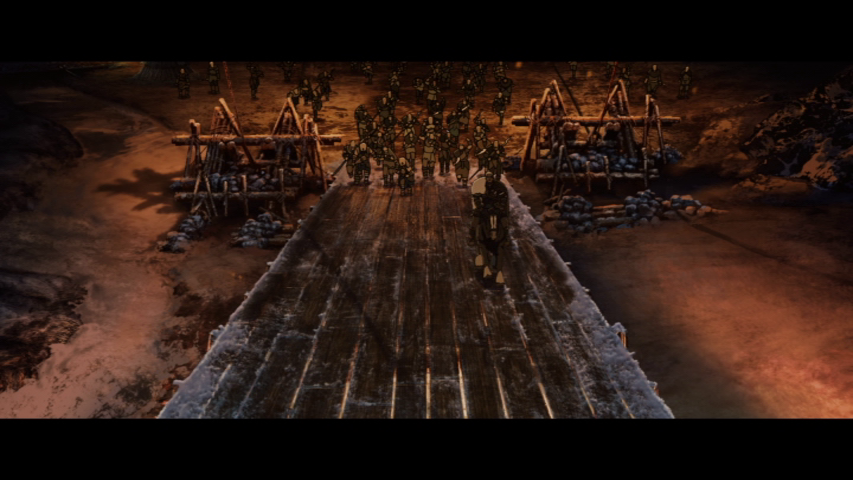
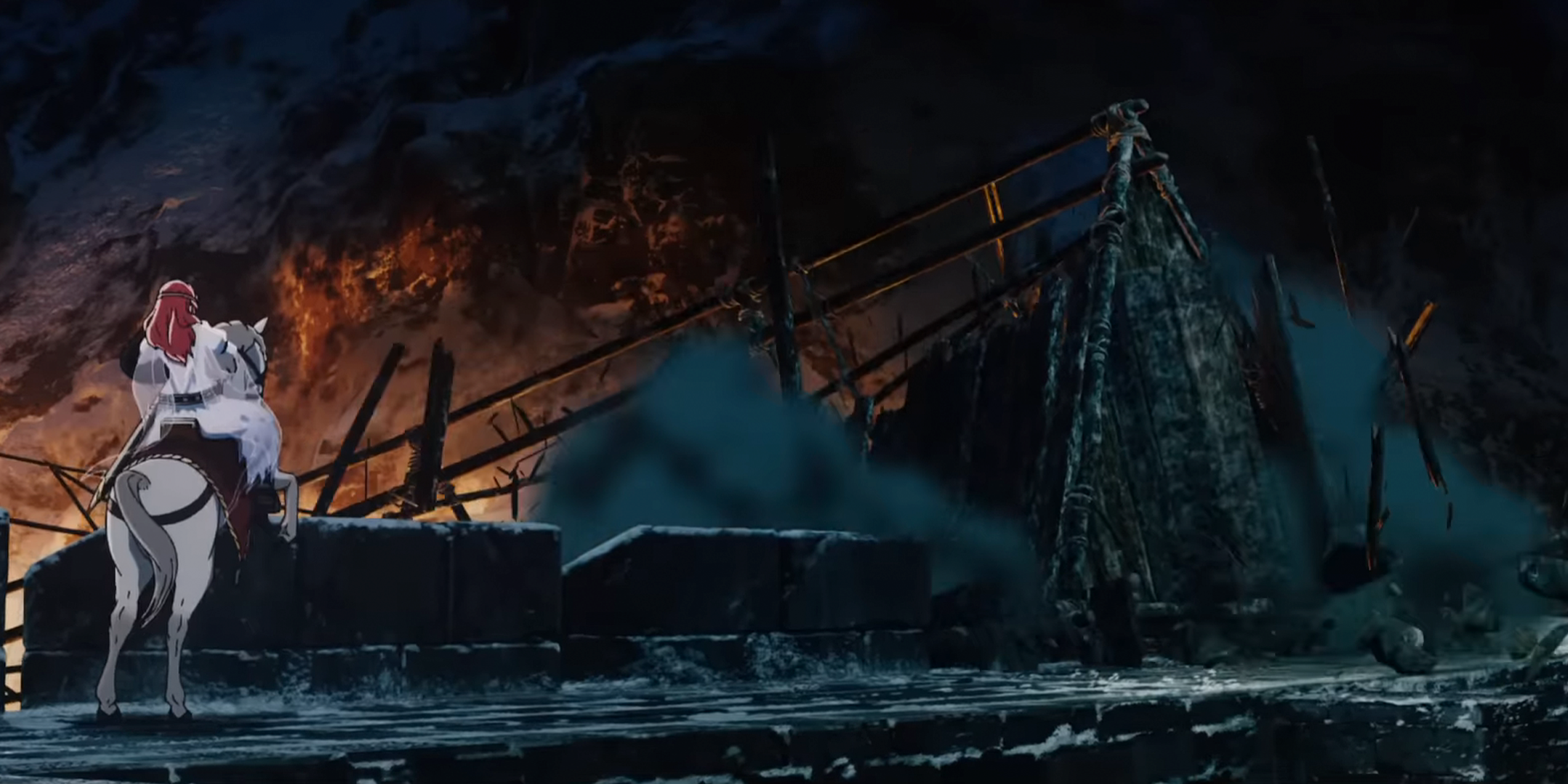
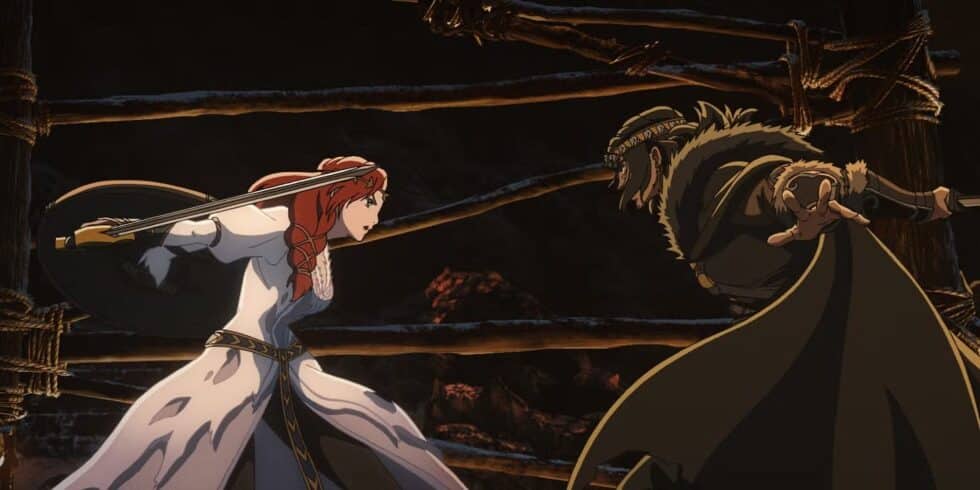
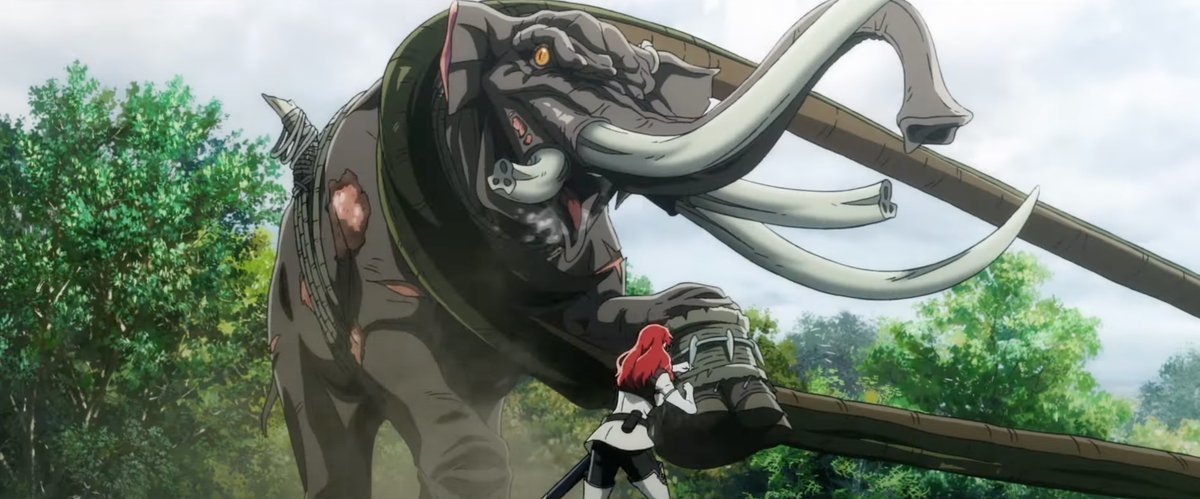
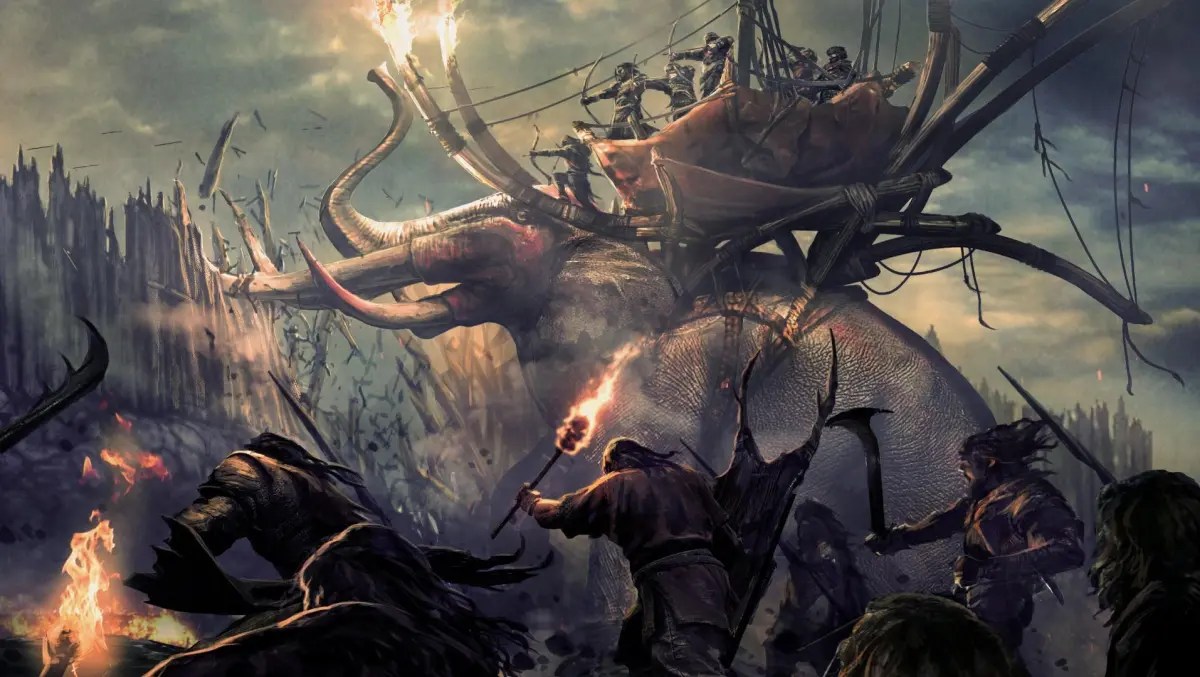
And that elephant reminded me—traditionally, elephants are supposed to have wonderful memories, after all–that I was going to continue my review of the anime The War of the Rohirrim, where, surprisingly, a heffalump—sorry—a mumak—that is, an elephant, appears.

But why? 

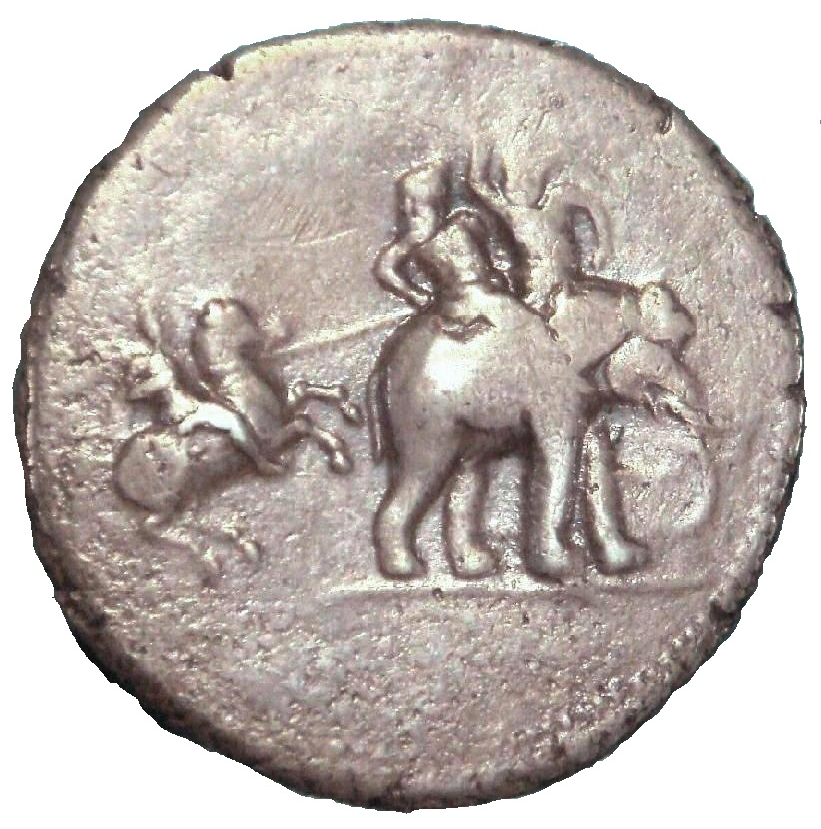
The West first encountered war elephants when Alexander, marching eastwards, came up against the forces of Poros, an Indian king.

(a Macedonian commemorative coin c.324-3222BC, depicting an elephant-borne Poros.  For more on Poros, see:  https://en.wikipedia.org/wiki/Porus  )

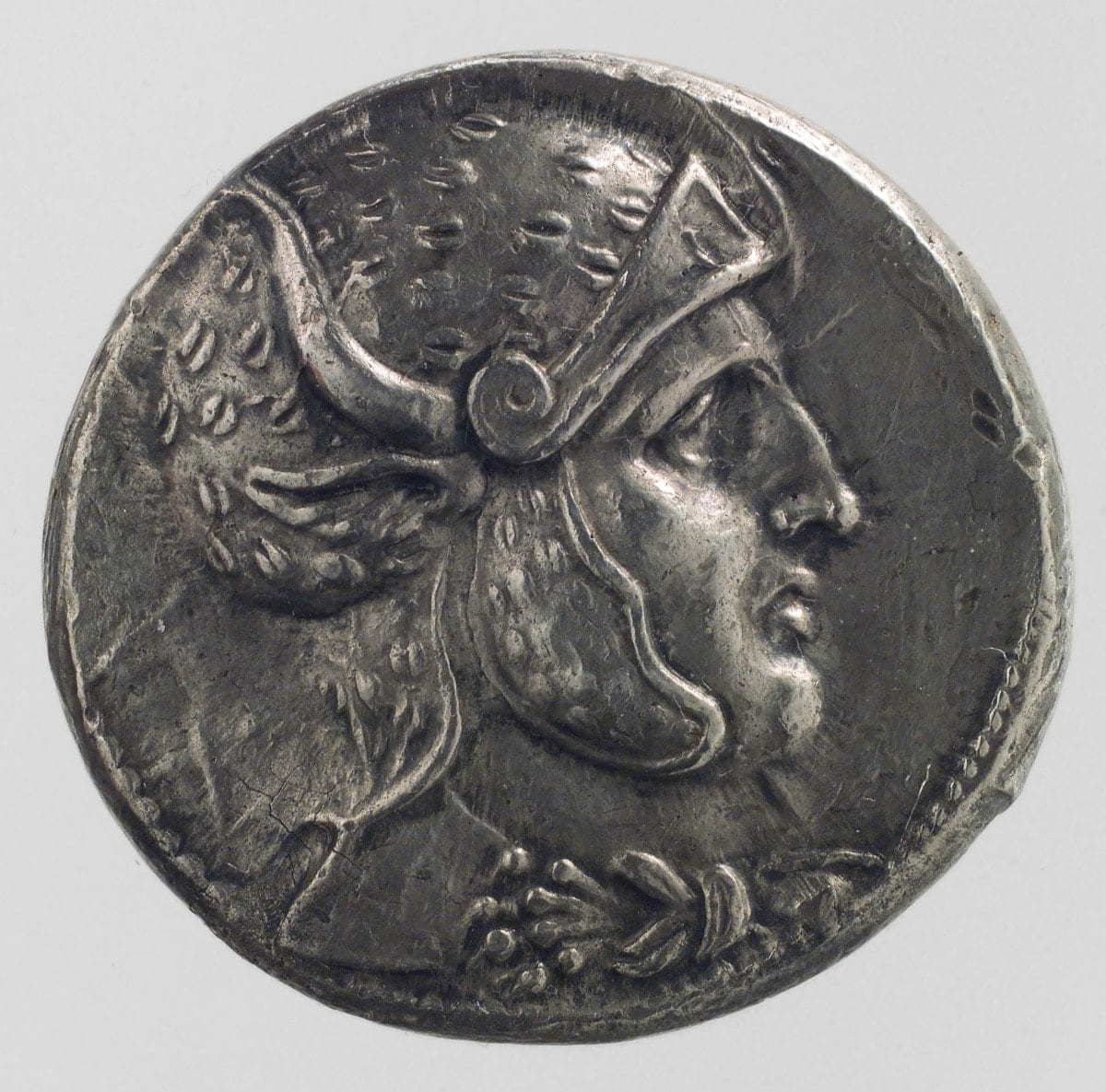
One of Alexander’s generals—and successors—Seleucus, c.358-281BC,

in a treaty with the Indian Mauryan kingdom, received 500 war elephants, which were then employed at the Battle of Ipsus, in 301BC,

during the wars which Alexander’s generals fought among themselves to define who would control various parts of Alexander’s empire.

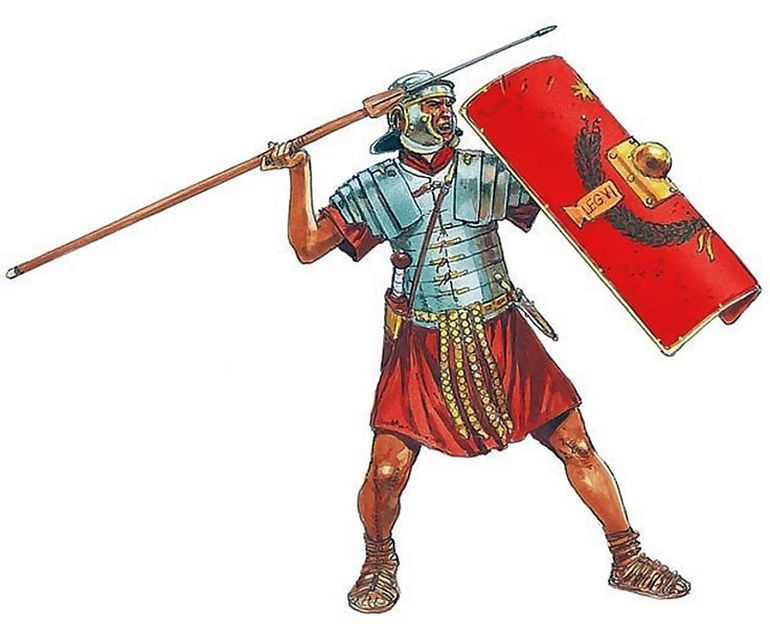
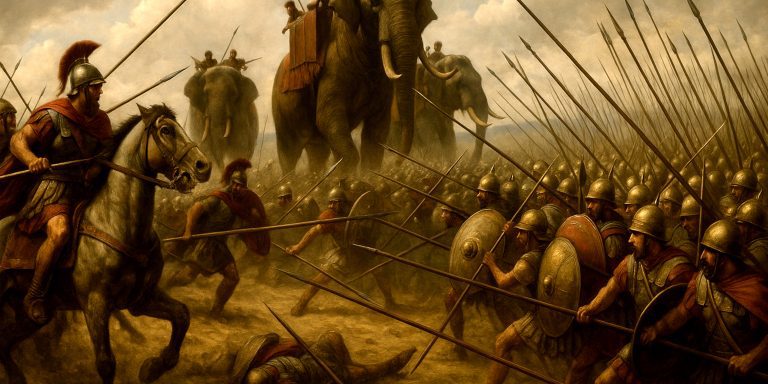
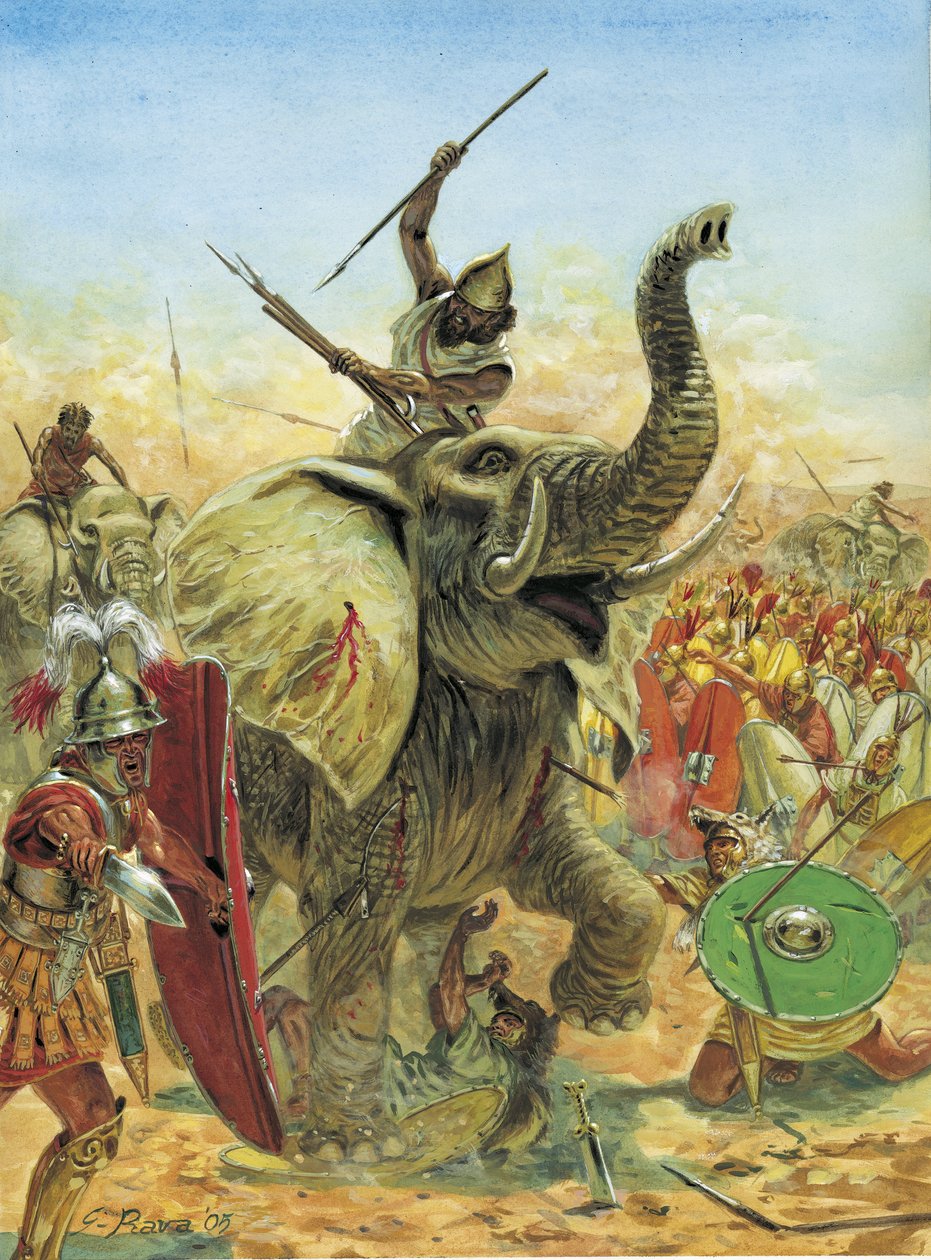
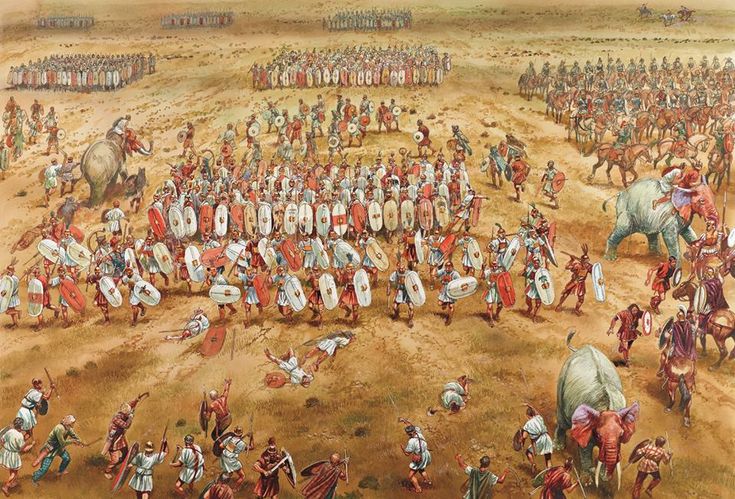
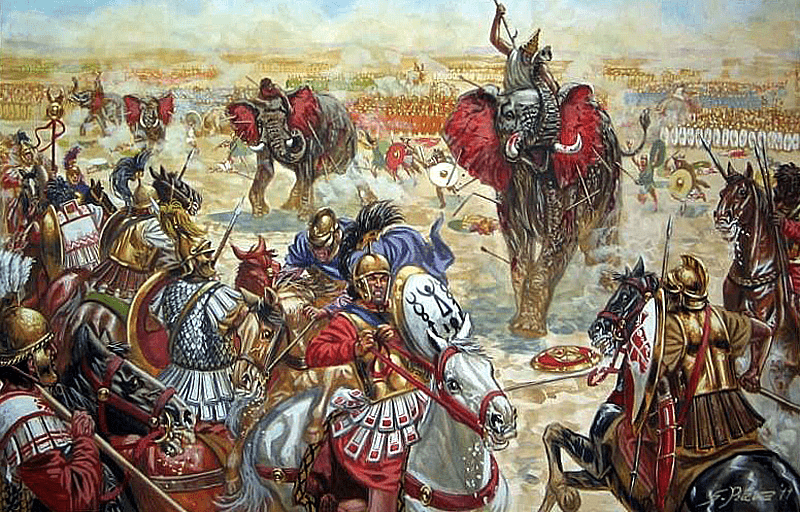
Elephants could be seen as rather like tanks—large, mobile weapons to break enemy lines—

(Peter Dennis)

(Giuseppe Rava)

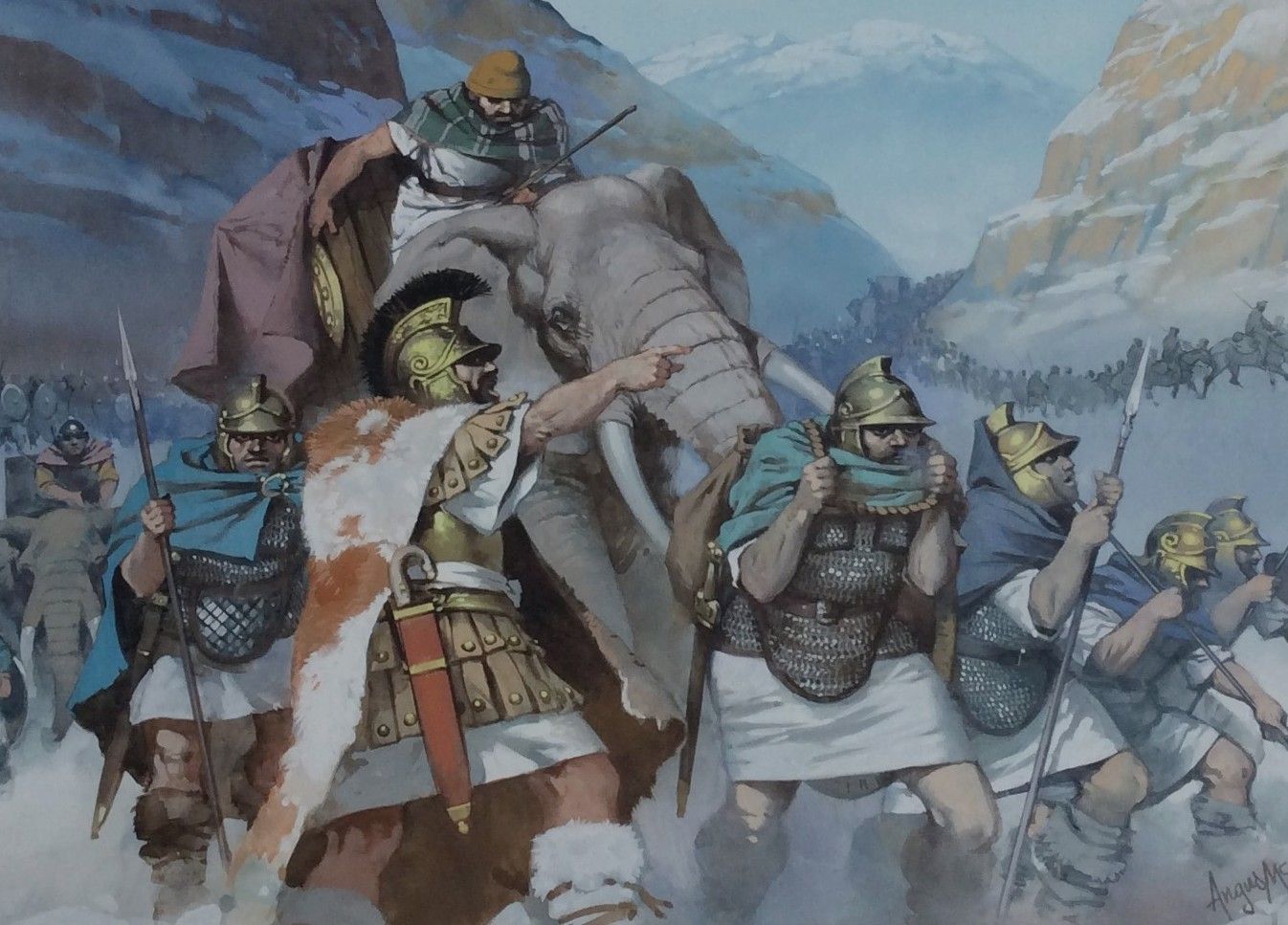
and would continue to be used in the West at least until the Romans defeated the last Macedonian king, Perseus, at the Battle of Pydna, in 168BC, but saw perhaps their most dramatic use in the wars of Carthage against Rome, particularly in the second war, where the Carthaginian general, Hannibal, invaded Italy by crossing the Alps, bringing a number of elephants with him.

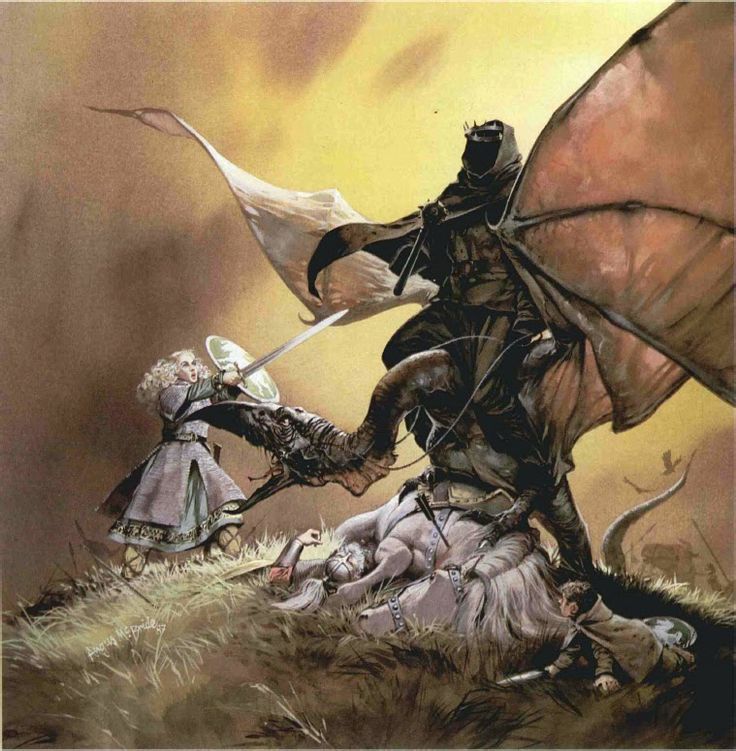
(Angus McBride)

Unfortunately for Hannibal—and his elephants—the Romans had learned to deal with the great beasts and even to turn them back against their owners—

(Peter Dennis)

(for more on war elephants, see:  https://en.wikipedia.org/wiki/War_elephant )

Another factor in warfare was the belief that horses are frightened of elephants,

(Giuseppe Rava)

something which even Tolkien mentions—

“But wherever the mumakil came there the horses would not go, but blenched and swerved away…” (The Return of the King, Book Five, Chapter 6, “The Battle of the Pelennor Fields”)

(For more on horses’ potential hippophobia, see:  https://iere.org/are-horses-scared-of-elephants/  )

But that is in relation to the allies of Mordor in its attack on Minas Tirith:  why is there one of these monsters prominent at the Dunlendings’ attack on Edoras, some 250 years earlier? 

The film’s script-writers seem to be depending upon this passage from Appendix A of The Lord of the Rings:

“Four years later ([TA2758) great troubles came to Rohan, and no help could be sent from Gondor, for three fleets of the Corsairs attacked it and there was war on all its coasts.  At the same time Rohan was again invaded from the East, and the Dunlendings seeing their chance came over the Isen and down from Isengard.  It was soon known that Wulf was their leader.  They were in great force, for they were joined by Enemies of Gondor that landed in the mouths of Lefnui and Isen.”   (Appendix II:  The House of Eorl)

Thank goodness for a map—as, although I know the Isen from Isengard, I had no idea where the Lefnui was—and here, from the Tolkien Gateway, you can see both.  And you can also wonder about how such forces got to Rohan, about which JRRT is completely silent, particularly those who landed at the mouth of the Lefnui, as, straight ahead of them would have been miles of the White Mountains.  Long detour north, then east, through the Gap of Rohan, then southeast into Rohan itself?  

(from the Encyclopedia of Arda)

To which they might add:

“In the days of Beren, the nineteenth Steward, an even greater peril came upon Gondor.  Three great fleets, long prepared, came up from Umbar and the Harad, and assailed the coasts of Gondor in great force;  and the enemy made many landings, even as far north as the mouth of the Isen.  At the same time the Rohirrim were assailed from the west and the east, and their land was overrun, and they were driven into the dales of the White Mountains.” (Appendix A, (iv) Gondor and the Heirs of Anarion; The Stewards)

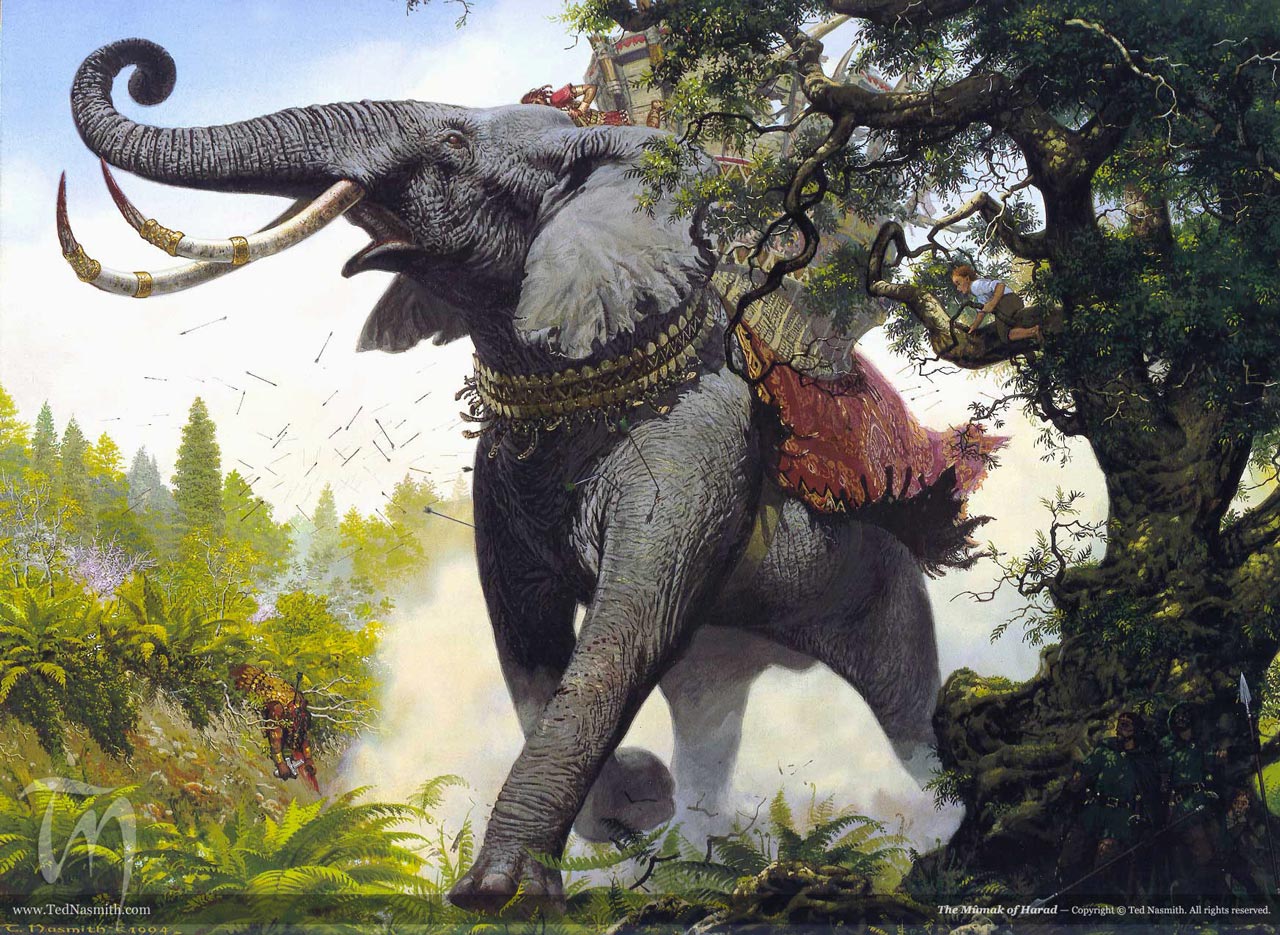
You can see where this argument might go:  Wulf—the antagonist of The War of the Rohirrim—invades Rohan.  His invasion force includes “…Enemies of Gondor that landed at the mouths of Lefnui and Isen” and those enemies, who were part of the fleet which attacked the west coast of Gondor, “…came up from Umbar and the Harad”, and we’re told in The Lord of the Rings that “…the Mumak of Harad was indeed a beast of vast bulk…” (The Two Towers, Book Four, Chapter 4, “Of Herbs and Stewed Rabbit”).

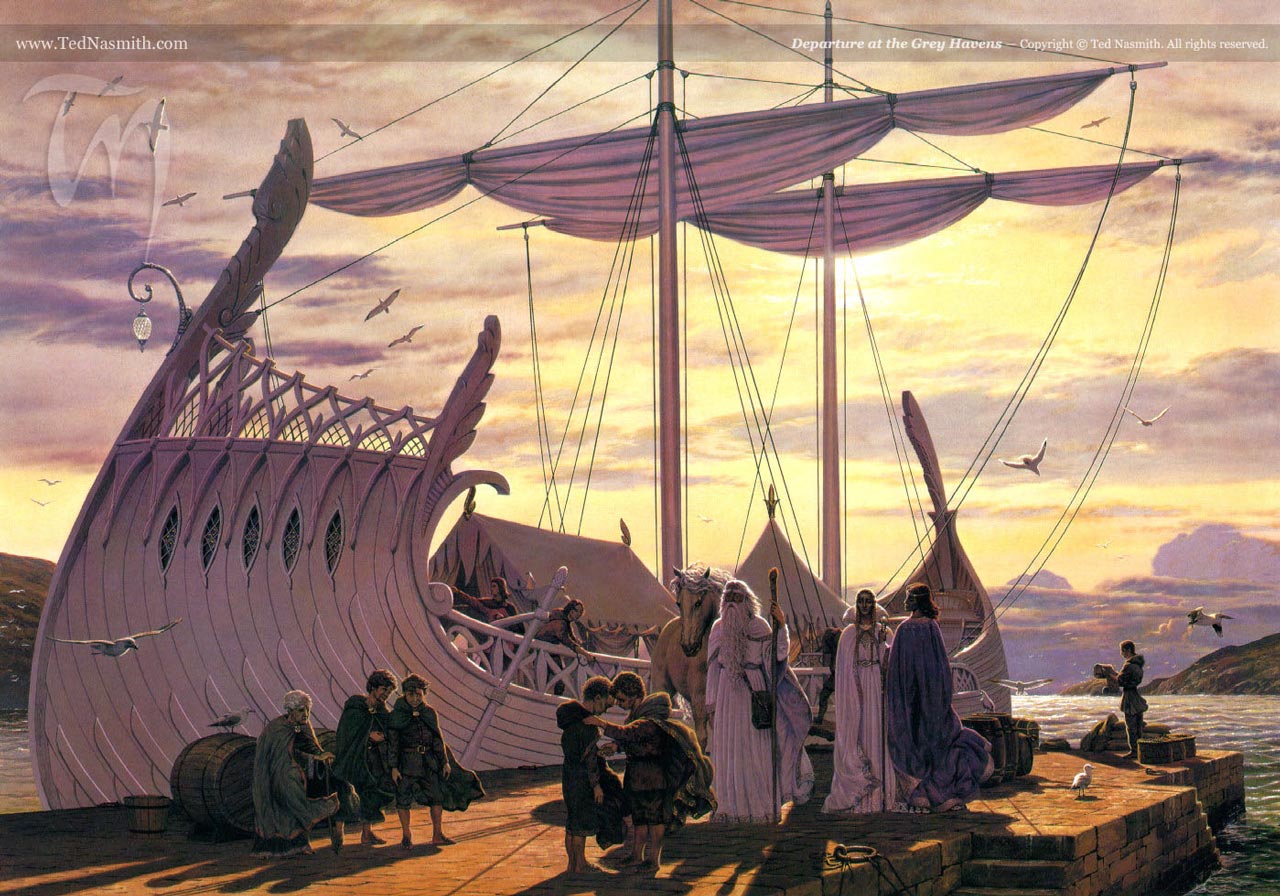
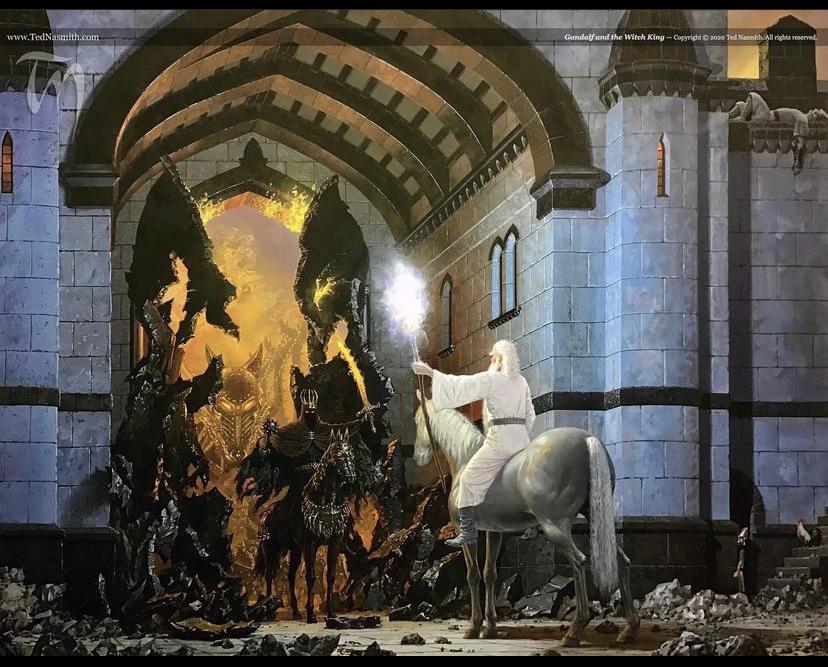
(Ted Nasmith)

So, their reasoning goes:

1. some of the Corsairs were from Harad

2. Harad is where Mumakil come from

3. some of the invasion force which followed Wulf were from the Corsairs who attacked the west coast of Gondor and therefore were from Harad

4. and thus there was the possibility that they might have brought Mumakil with them

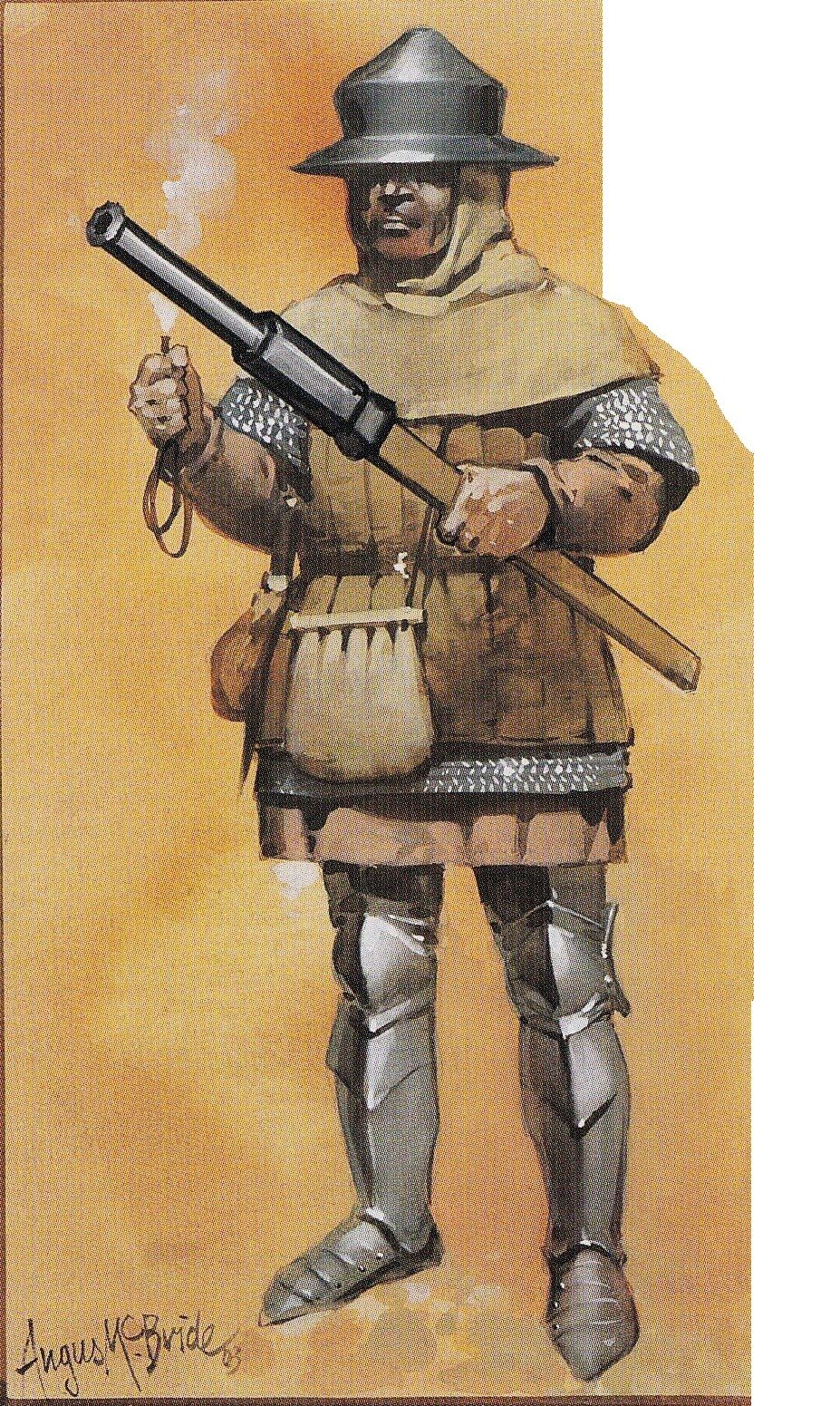
Back in 2024, I had written a posting (“Dos Mackaneeks”, 26 June, 2024—here:  https://doubtfulsea.com/2024/06/26/dos-mackaneeks/ ) in which, while discussing “The Phantom Menace”, I had followed this reasoning:  both Saruman and Sauron clearly have access to blasting material of some sort–Saruman’s forces blow a hole in the wall of Helm’s Deep and Sauron’s do the same with the Causeway Forts on their way into the Pelennor.  And so, why would the next step not have been arming their orc armies with early “hand gonnes”?

(Angus McBride)

The answer is, they didn’t:  because the author chose for them not to, even though he provided evidence that he could have.  It’s clear that Tolkien was a very deliberate writer, taking years to construct his texts in draft after draft.  And so, had he wanted to have Wulf’s forces include Mumakil, I would suggest that, as he chose to depict them both ambushed by Faramir’s rangers and forming part of the armies which attacked Minas Tirith, they were certainly a possibility at any other point in his long story, but they don’t appear there.

At base, the real problem here, as I and others have suggested, is the extreme thinness of the material upon which The War of the Rohirrim is based:  it’s really only a little over two pages in Appendix A in my 50th Anniversary edition (1065-67).  To flesh this out into a film more than 2 hours long, the script writers created a character named “Hera” out of the nearly-anonymous “Helm’s daughter”, making her a “shield maiden”, adding a nurse for her (“Olwyn”), and a kind of page (“Lief”), as well as constructing a childhood friendship for “Hera” and Wulf, among other additions to a very small story, which is really only background to the later story of Helm’s Deep. 

If you read this blog regularly, you know that I dislike vicious reviews, mostly because, along with what they suggest about their authors, they’re usually simply not helpful, and I don’t write them.  This is my second partial review of The War of the Rohirrim (see “Plain and Grassy”, 24 September, 2025, for the first part:  https://doubtfulsea.com/2025/09/24/plain-and-grassy/ )  and, while I will continue to praise the enormous artistic effort which went into making this film—I’d love to see more anime of heroic stories—I wish someone would make an anime Beowulf, or Sir Gawaine and the Green Knight, just as easy examples—I also wish that the creators would move on—what about a Ramayana, for instance, if they wanted to choose a long-established story?—or, even better, create a completely new story, one in which there would be a fierce, independent heroine, rather than try to make her out of Arwen or Galadriel or invent one like “Tauriel” or “Hera”? 

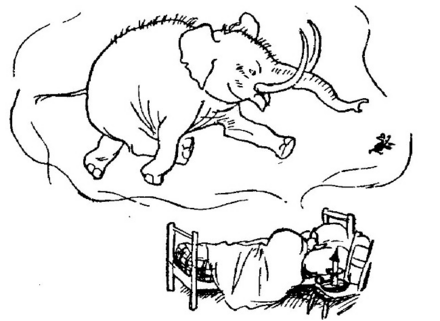
In the meantime, it’s back to Pooh and Piglet, as they try to trap the illusive Heffalump (which they never succeed in doing).

(E.H. Shepard)

As always, thanks for reading.

Stay well,

Enjoy the New Year and may it be a very happy one for you,

And remember that, as always, there’s

MTCIDC

O

A Moon disfigured

17 Wednesday Dec 2025

Posted by Ollamh in Uncategorized

≈ Leave a comment

Tags

Elizabeth I, herald, Heraldry, livery, Middle-earth, Minas Ithil, Minas Morgul, Orcs, puzzle, Sam, Saruman, Sauron, Sir Roger de Trumpington, The Great War, The Lord of the Rings, Tolkien, uniforms

As always, dear readers, welcome.  And perhaps welcome to a little Tolkien puzzle.

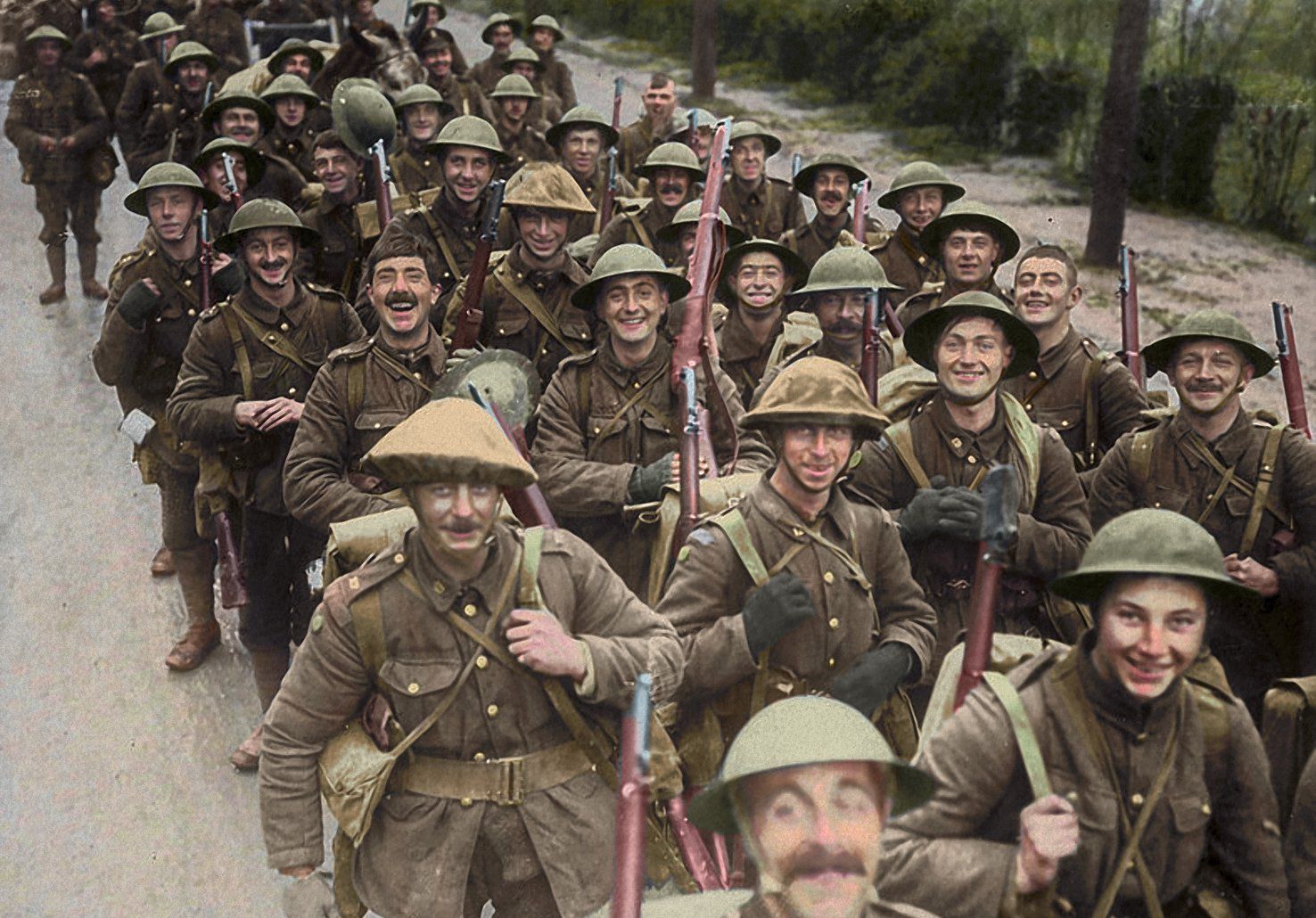
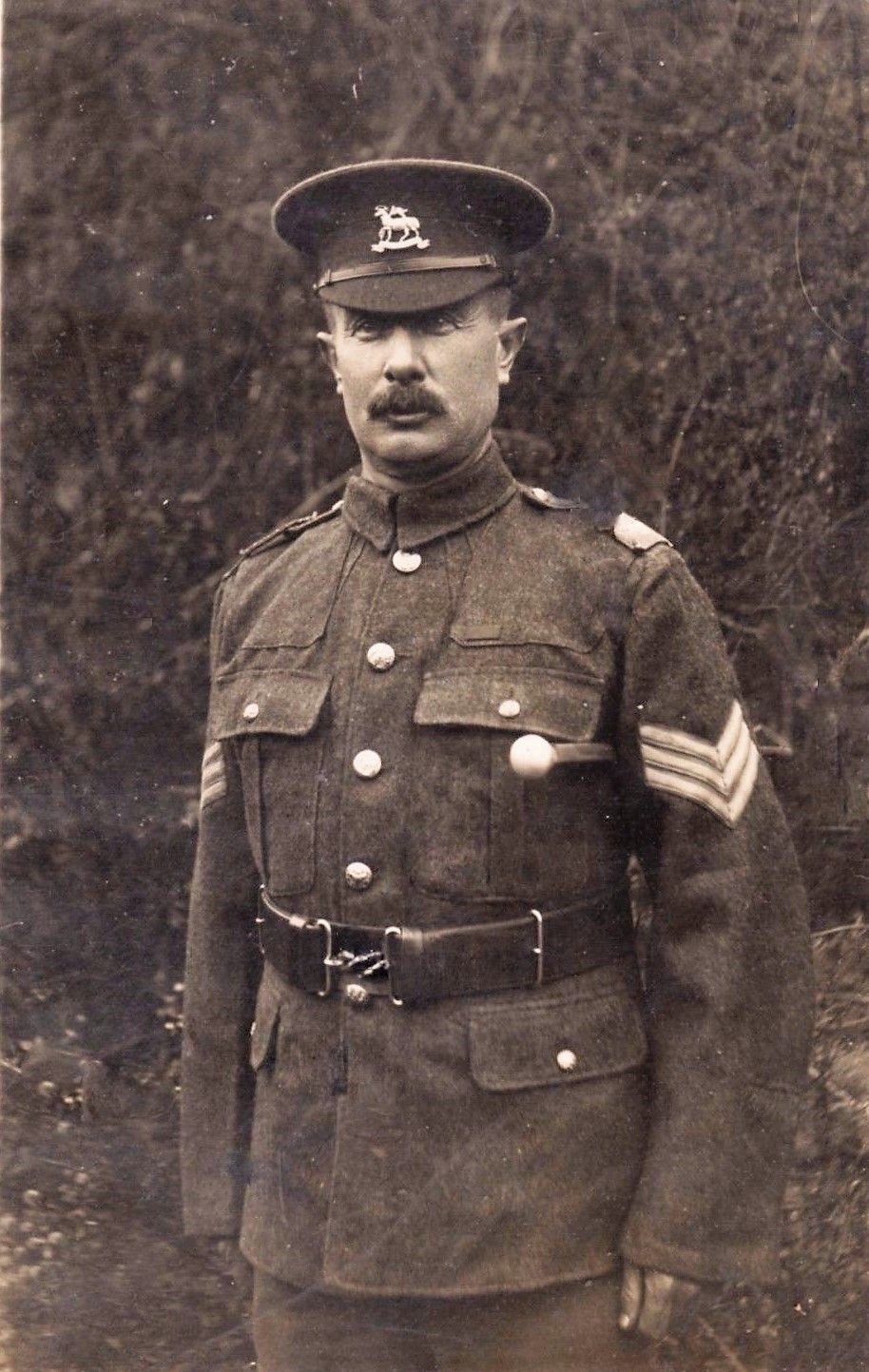
On parade, soldiers of the early 20th century could be peacocks for finery.

But then they met the new technological reality of heavy machine guns

and increasingly heavy artillery

and, in time, even the danger of being spotted from the air,

so soldiers not only dug in,

but modified their uniforms, making themselves less visible.

(Gerry Embleton)

After the war, most armies, except for special guard units,

 never went back to being peacocks, abandoning a bright tradition which went back to the 17th century.

(Richard Hook)

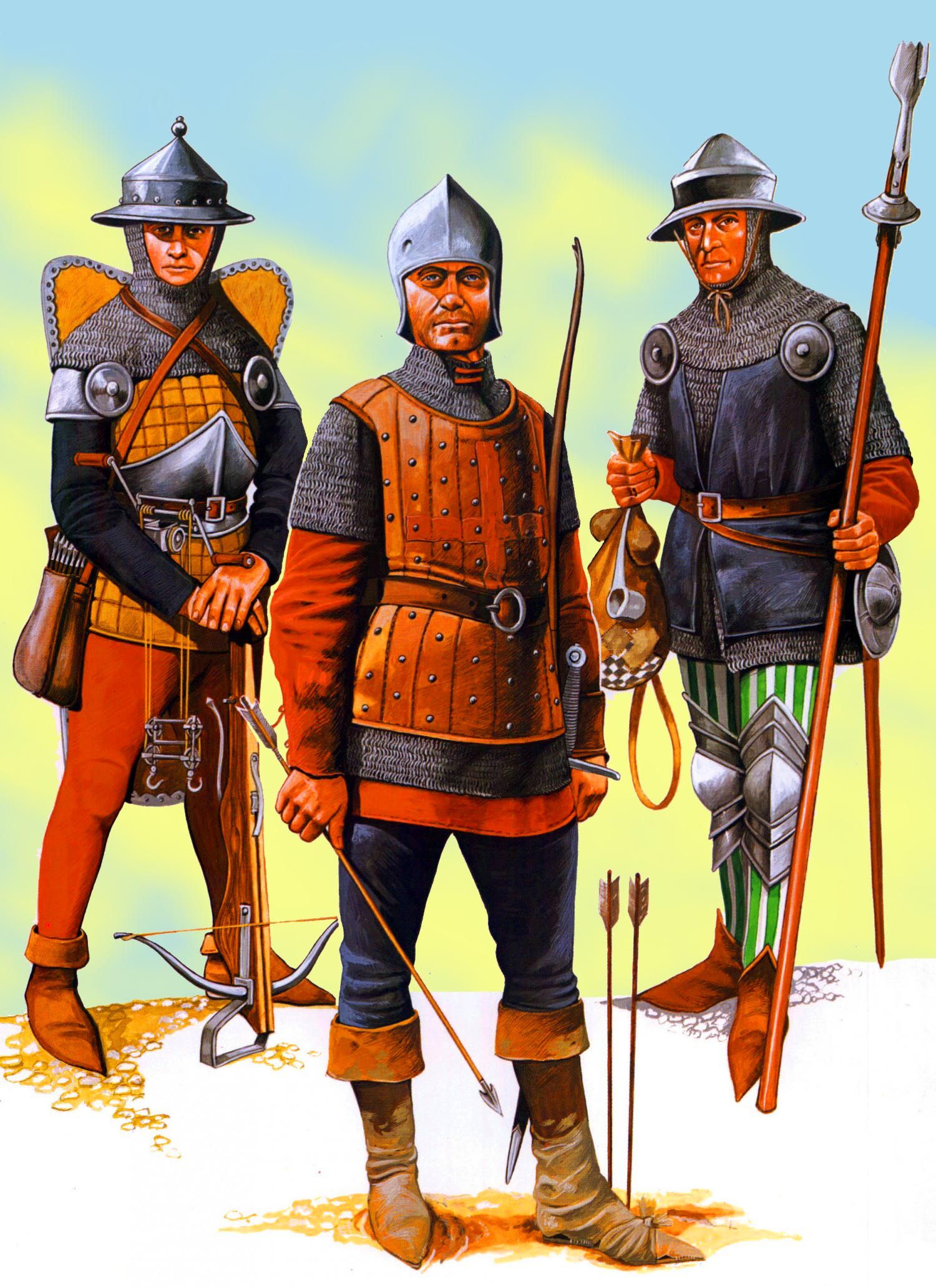
Even in the 17th century, soldiers not wearing the same-colored clothing might distinguish themselves from their enemies by what would be called “field signs”, like wearing a strip of cloth on one arm, or sticking a particular piece of a plant or even a scrap of paper in your hatband.

(Henri IV, 1553-1610, king of France, was famous for the white plume he always wore in his hat.)

Before this, soldiers might wear the distinctive colors of their commanders (usually noblemen), called “livery”—

(Angus McBride)

Here we can see that Sir Edward Stanley has given this archer clothing in his colors of green and mustard-yellow, while the Earl of Surrey provided his soldiers with his colors of green and white.  You’ll also notice that the archer has some distinctive badges on the front of his coat—an eagle’s claw and crowns.  These are personal indicators of Sir Edward, heraldic markers to indicate to whom the archer belonged.

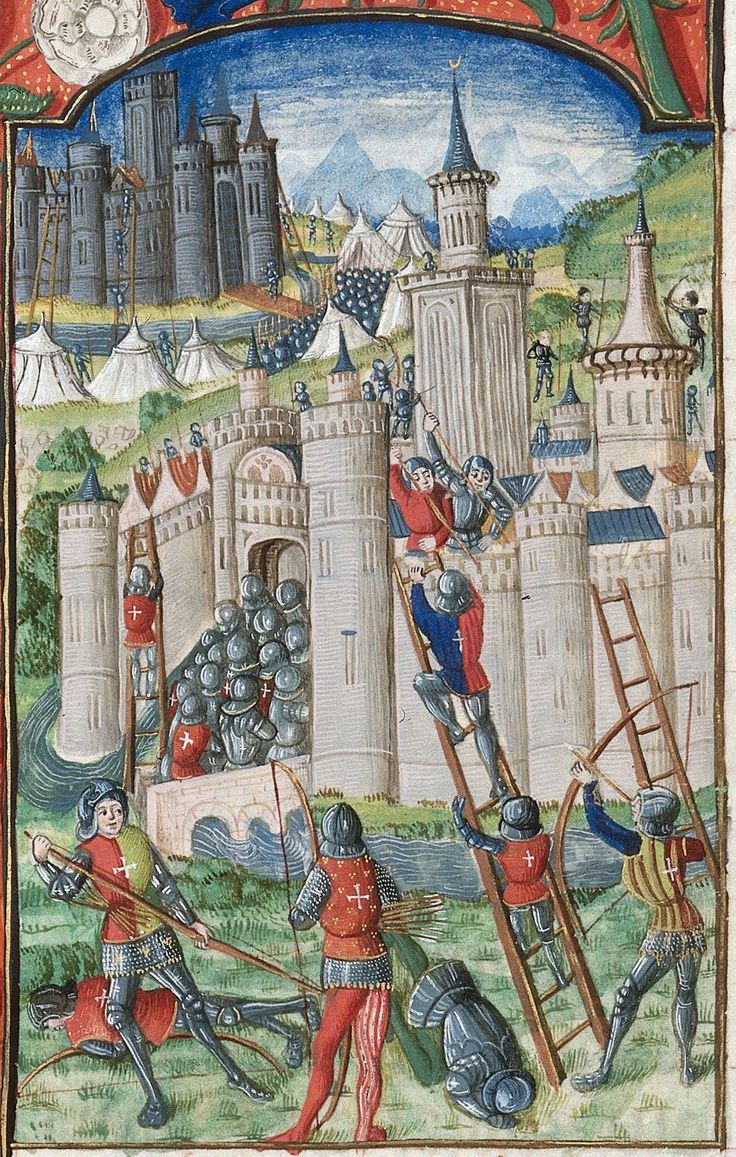
In the days before distinctive military dress, heraldry—the use of emblems to mark out one knight, and perhaps his followers, from another—had been developed to a high level.  When everyone was covered in metal,

such emblems were a way to identify a knight—and if he had issued similar emblems to his soldiers, a way to identify the troops he had brought and commanded at a battle.

As emblems developed, there also developed a person with a specialized skill to identify them—a herald.

He himself, as you can see, wore distinctive clothing, which also helped him in his other role as messenger between military opponents—he was considered as a neutral and could therefore pass freely.  (For more on heralds, see “Herald-ry in Middle-Earth”, 30 March, 2016 here:  https://doubtfulsea.com//?s=herald&search=Go )

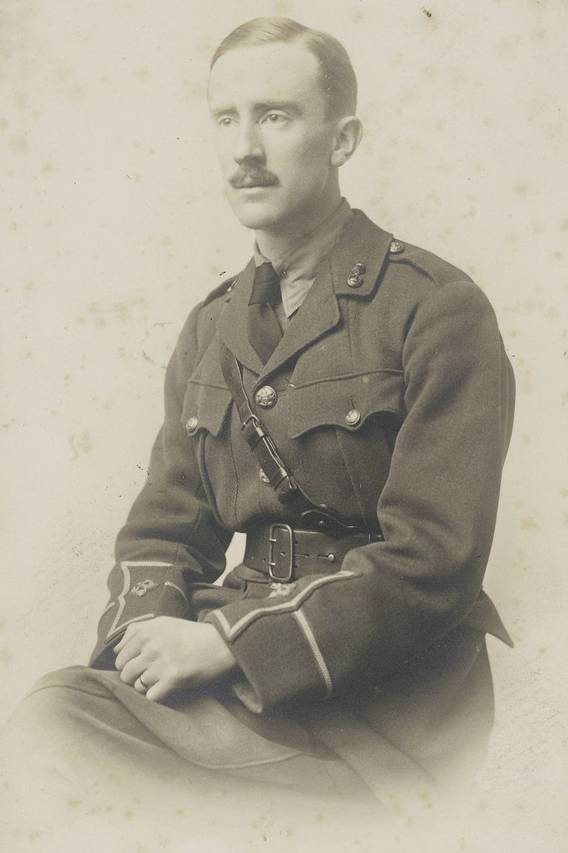
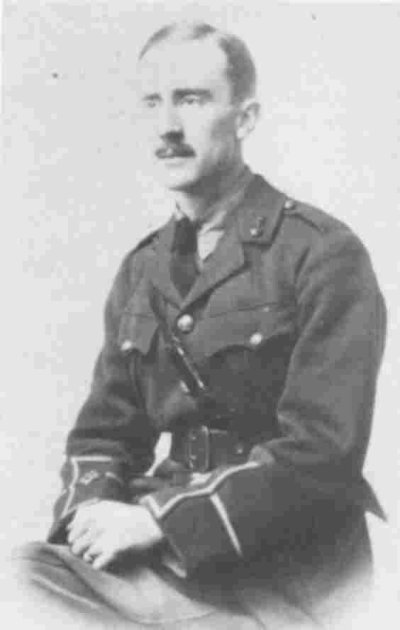
Tolkien himself belonged to the age of drab—

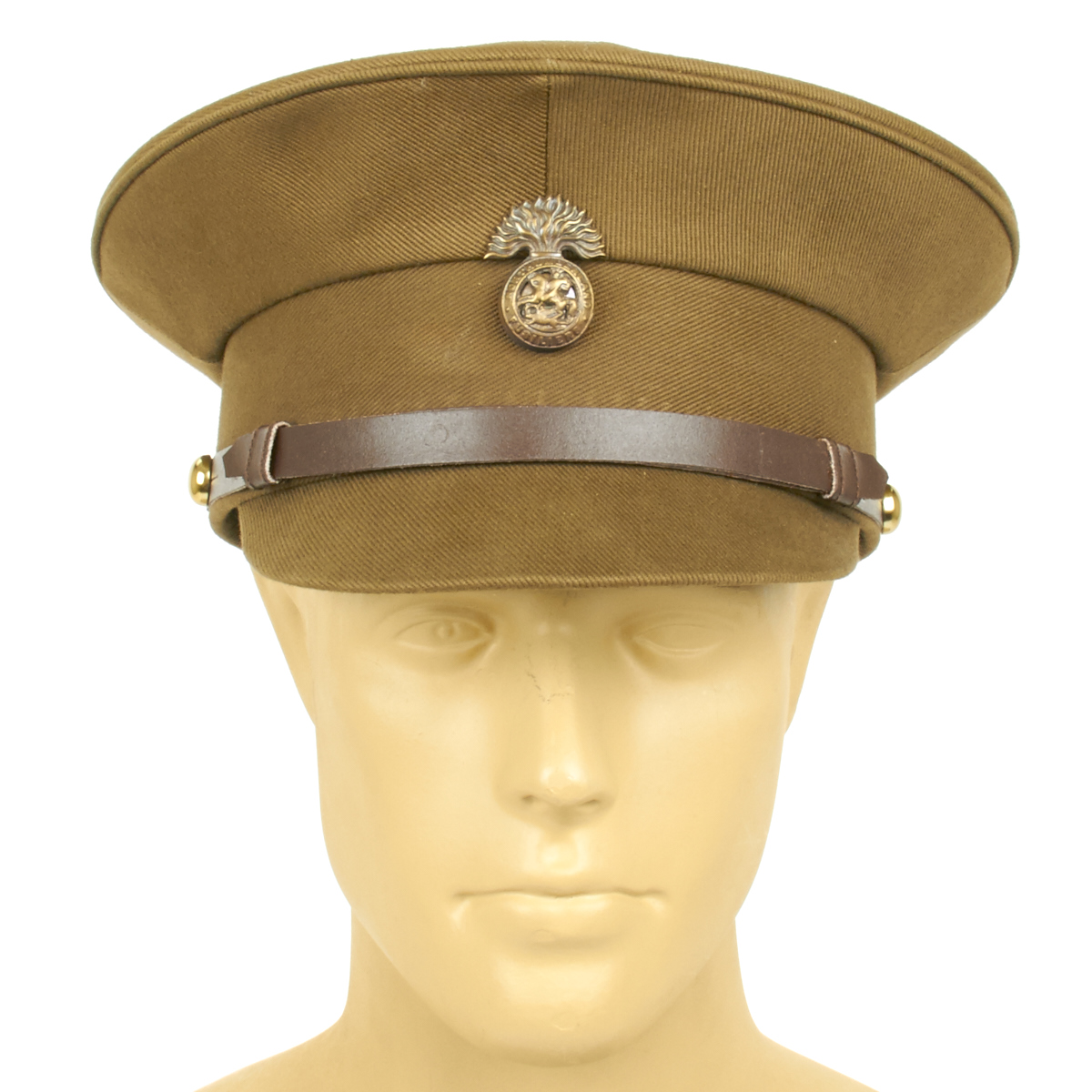
(Here’s what that uniform would have looked like in color—although this is a much higher level officer—looks to be a major—JRRT was commissioned as a second lieutenant and eventually promoted to first lieutenant )

but was well aware of earlier flashiness and we can see it in his description of the guards at Denethor’s gate—even though he sees their outfits as a throwback, just like British soldiers ever returning to bright red uniforms—except for the monarch’s guards:

“The Guards of the gate were robed in black, and their helmets were of strange shape, high-crowned, with long cheek-guards close-fitting to the face, and above the cheek-guards were set the white wings of sea-birds; but the helms gleamed with a flame of silver, for they were indeed wrought of mithril, heirlooms from the glory of old days.  Upon the black surcoats were embroidered in white a tree blossoming like snow beneath a silver crown and many-pointed stars.  This was the livery of the heirs of Elendil, and none wore it now in all Gondor, save the Guards of the Citadel before the Court of the Fountain where the White Tree had grown.”  (The Return of the King, Book Five, Chapter 1, “Minas Tirith”)

(from the Jackson films—as you can see, the helmet fits the description, but the surcoat has disappeared and, instead, the Tree, stars, and crown have been shifted to the breastplate, removing the dramatic contrast between the black cloth and white embroidered emblems which JRRT intended)

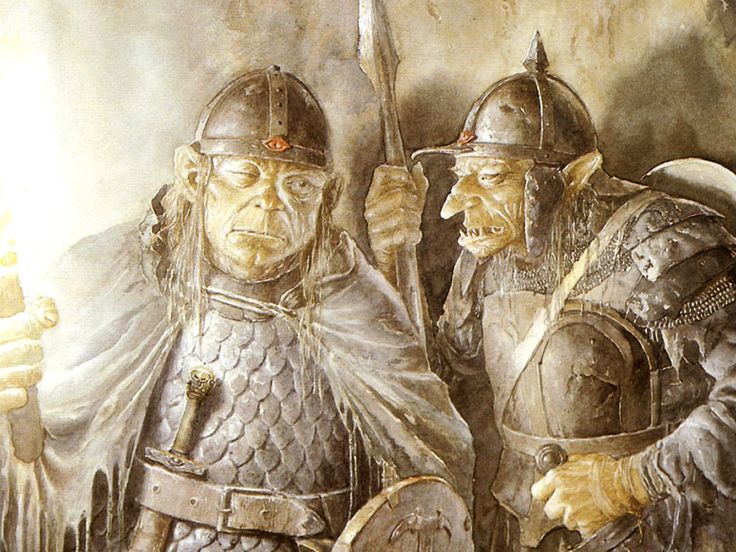
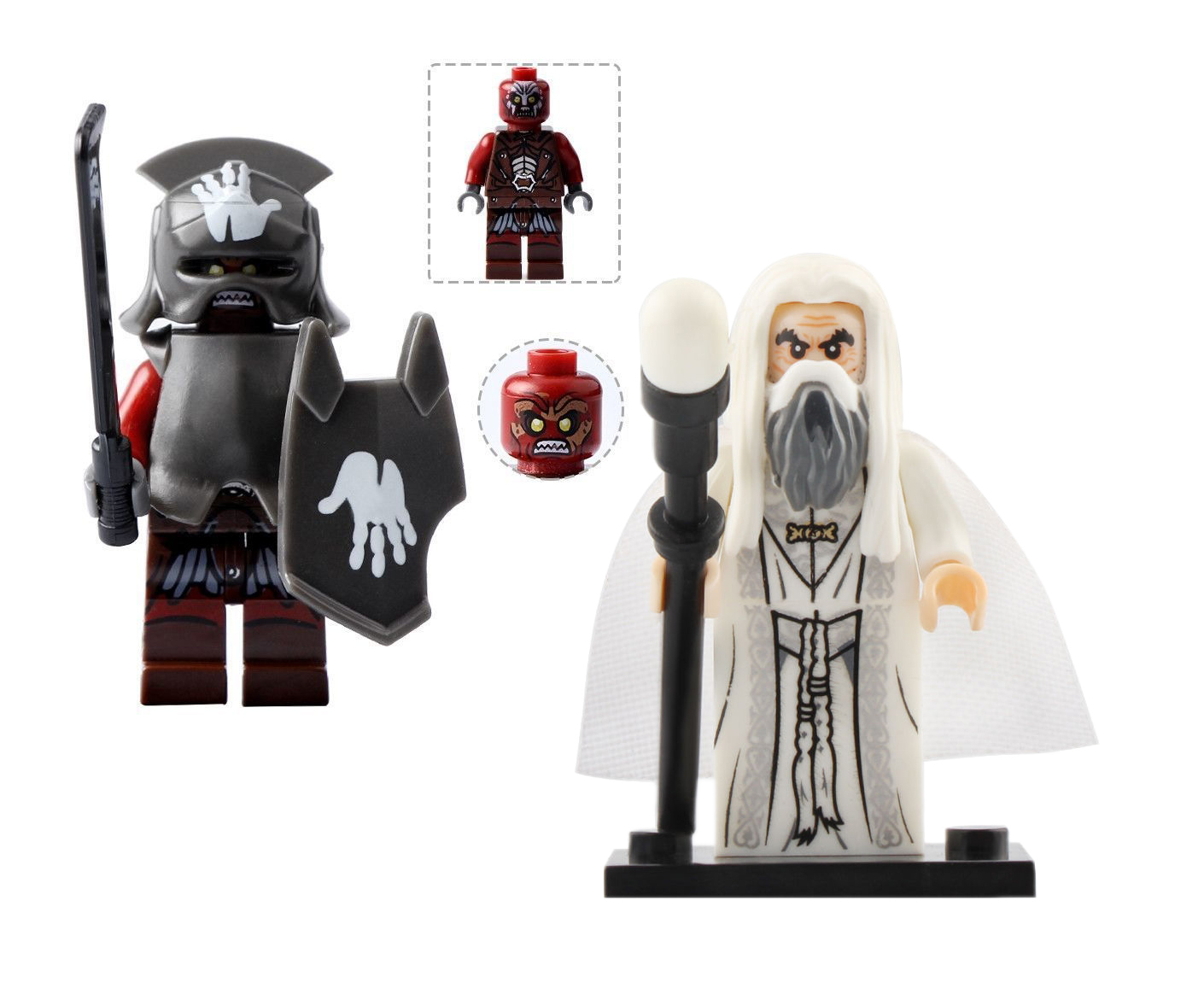
As well, although the orcs wear no livery—no uniforms or even part-colored clothing—they do have badges—the white hand of Saruman

(perhaps suggesting that he has his hand over everything?  I think of the “Armada Portrait” of Queen Elizabeth the First here—just look at the quiet statement in her hand)

and the red eye of Sauron,

(Angus McBride—perhaps implying that, like Big Brother, Sauron has his eye on you?)

but then there’s a new one, only mentioned once, which provided the title for this posting and the puzzle—

“Two liveries Sam noticed, one marked by the Red Eye, the other by a Moon disfigured with a ghastly face of death…” (The Return of the King, Book Six, Chapter 1, “The Tower of Cirith Ungol”)

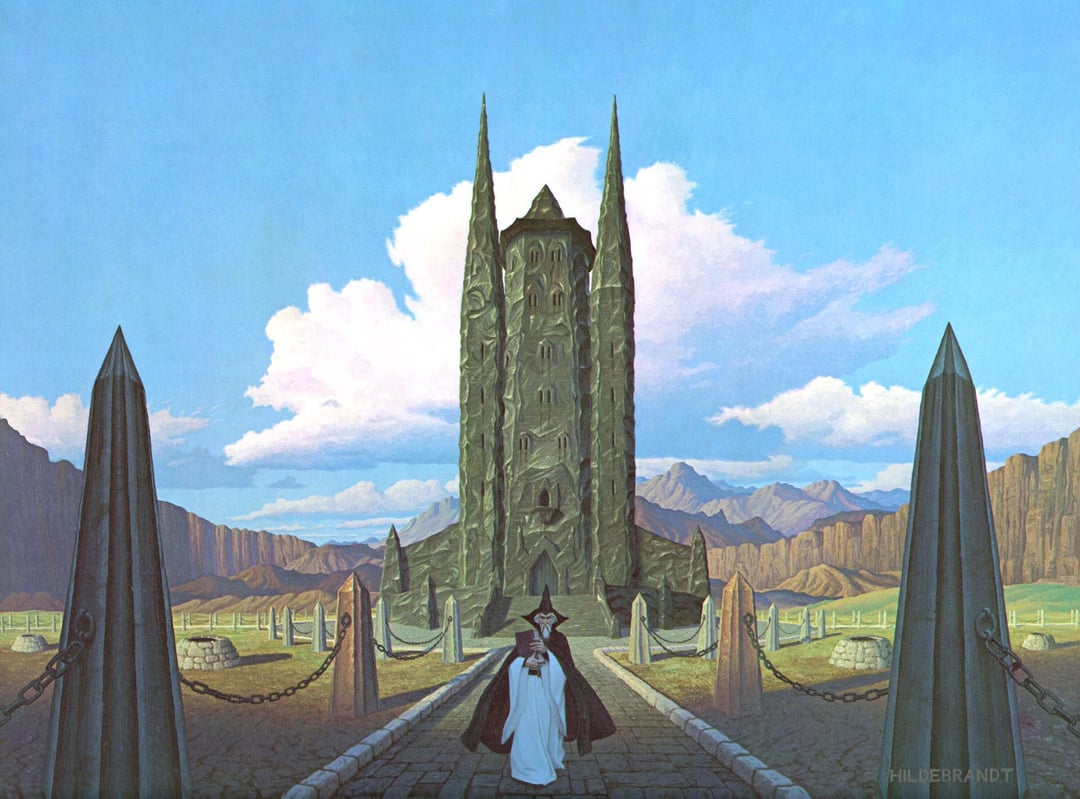
What is JRRT up to here?  Minas Morgul,  the “Tower of Black Sorcery”, the center of this gateway into Mordor,

(Ted Nasmith)

had been built as Minas Ithil, “the Tower of the Moon” and it’s clear that those having that badge must come specifically from that place, and a mockery of its previous Gondorian name, which is interesting because the rest of Sauron’s forces appear to wear only the Red Eye.  Yet, if we can trust an orc, we may have the sense that Sauron doesn’t appreciate deviation, as Grishnakh asks rhetorically of Ugluk:

“They might ask where his strange ideas came from.  Did they come from Saruman, perhaps?  Who does he think he is, setting up on his own with his filthy white badges?  They might agree with me, with Grishnakh their trusted messenger; and I Grishnakh say this:  Saruman is a fool, and a dirty treacherous fool.  But the Great Eye is on him.”  (The Two Towers, Book Three, Chapter 3, “The Uruk-hai”)

So what’s going on here?  Certainly there’s rivalry between Saruman’s orcs and Sauron’s, but just how deep does orc rivalry go?  When Sam arrives at the Tower of Cirith Ungol, he finds it a battleground and, climbing into the tower itself he hears two orcs arguing, Shagrat, the captain of the Tower, and Snaga, one of his men.  Snaga says:

“You won’t be a captain long when They hear about all these goings-on.  I’ve fought for the Tower against those stinking Morgul-rats, but a nice mess you two precious captains have made of things, fighting over the swag.” (The Return of the King, Book Six, Chapter 1, “The Tower of Cirith Ungol”)

So, seeing that emblem on a shield, with “a Moon disfigured with a ghastly face of death”, just whose face is that?  And whose death?

As ever, thanks for reading.

Stay well,

If you were to come up with your own livery, what would it be?—sometimes knights made visual puns—like Sir Roger de Trumpington—

Think about that, pencil in hand, and remember that there’s always

MTCIDC

O

PS

For more on livery, see:  https://en.wikipedia.org/wiki/Livery

There has been some wonderfully imaginative work done on heraldry in Tolkien.  Here’s a link to get you started:  https://en.wikipedia.org/wiki/Heraldry_of_Middle-earth   

On the Roads Again—Once More

10 Wednesday Dec 2025

Posted by Ollamh in Uncategorized

≈ Leave a comment

Tags

Bilbo, Fantasy, Frodo, lotr, Minas Morgul, Mordor, Mt Doom, Orcs, Orodruin, Osgiliath, Roads, Sam, The Lord of the Rings, Tolkien, Udun

As always, dear readers, welcome.

“The Road goes ever on and on
Down from the door where it began.
Now far ahead the Road has gone,
And I must follow, if I can,
Pursuing it with eager feet,
Until it joins some larger way
Where many paths and errands meet.
And whither then? I cannot say.”

as Bilbo sings, on his way away from the Shire to Rivendell.

(JRRT)

We, however, are currently standing at the broken bridge

at Osgiliath,

(from The Encyclopedia of Arda)

but, through the magic of the internet, we’ll hop over the Anduin and continue our journey along the roads of Middle-earth, this time to the worst possible place (unless you’re an orc)—

(Alan Lee)

Mordor.

To get there, we walk the old road which, in the days before Sauron’s previous invasion attempt, ran from Minas Anor (the “ Tower of the Sun”—now Minas Tirith, “Tower of Guard”),

(Ted Nasmith)

to Minas Ithil (the “Tower of the Moon”)—now Minas Morgul  (the “Tower of Black Sorcery”).

(another Ted Nasmith)

This will lead us eastwards to the crossing of the Ithilien north/south road, where there is a much- abused seated figure—

“The brief glow fell upon a huge sitting figure, still and solemn as the great stone kings of Argonath.  The years had gnawed it, and violent hands had maimed it.  Its head was gone, and in its place was set in mockery a round rough-hewn stone, rudely painted  by savage hands in the likeness of a grinning face with one large red eye in the midst of its forehead.  Upon its knees and mighty chair, and all about the pedestal, were idle scrawls mixed with the foul symbols that the maggot-folk of Mordor used.”  (The Two Towers, Book Four, Chapter 7, “Journey to the Cross-roads”)

(and one more Ted Nasmith.  Notice—except for the figure’s size, perhaps, which here wouldn’t be called “huge” nor its chair “mighty”—how carefully the artist has paid attention to the text—typical of Nasmith’s always fine work.)

Frodo and Sam pause here, but we’ll keep moving eastwards on the road towards Minas Morgul.

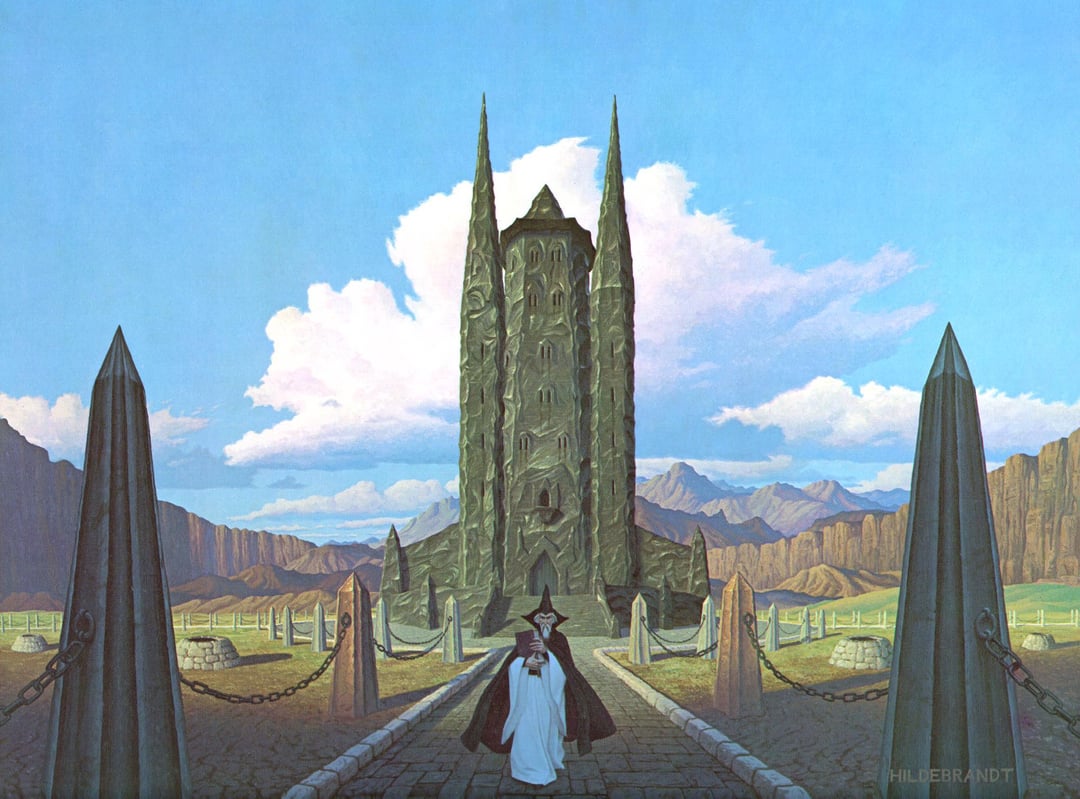
(the Hildebrandts, with a very different view of it and of Gollum)

We don’t appear to have a description of this road, but, if you’ve read the previous postings on roads, you’ll know that I would like to imagine that it’s not just a worn dirt track,

but the sort of thing which the Romans built all over their empire,

but now grassgrown and abandoned, like the figure at the crossroads.

Frodo, Sam, and Gollum skirt Minas Morgul, climbing around it, and we’ll join them, although we’ll avoid the tunnel in which Shelob lives,

(and one more Ted Nasmith)

to come down into Mordor itself.

(Christopher Tolkien)

This is, to say the least, a very bleak place,

(in reality, this is Mt Haleakala National Park, on the island of Maui)

but it seems heavily populated with camps of orcs and Sauron’s allies.

“As far as their eyes could reach, along the skirts of the Morgai and away southward, there were camps, some of tents, some ordered like small towns.  One of the largest of these was right below them.  Barely a mile out into the plain it clustered like some huge nest of insects, with straight dreary streets of huts and long low drab buildings.”  (The Return of the King, Book Six, Chapter 2, “The Land of Shadow”)

(Alan Lee)

There are clearly roads, at least in the northern area—

(from the Encyclopedia of Arda)

and when Frodo and Sam disguise themselves as orcs,

(Denis Gordeev)

they make their way along a major one, only to be taken for potential deserters and driven into an orc marching column.

(Denis Gordeev)

Before they reach such a road, however,

“…they saw a beaten path that wound its way under the feet of the westward cliffs.  Had they known, they could have reached it quicker, for it was a track that left the main Morgul-road at the western bridge-end and went down by a long stair cut in the rock to the valley’s bottom.” (The Return of the King, Book Six, Chapter 2, “The Land of Shadow”)

We’ll follow them down this path and eventually reach a road:

“…at the point where it swung east towards the Isenmouthe  twenty miles away.  It was not a broad road, and it had no wall or parapet along the edge, and as it ran on the sheer drop from its brink became deeper and deeper.”  (The Return of the King, Book Six, Chapter 2, “The Land of Shadow”)

When Frodo and Sam are picked up and driven along in the column,

(John Howe)

we can now see that the column is headed for Isenmouthe and the entrance to the northernmost part of Mordor, Udun,

(from Karen Wynn Fonstad, The Atlas of Middle-Earth)

but the two manage to escape just before the entrance, dropping

“…over the further edge of the road.  It had a high kerb by which troop-leaders could guide themselves in black night or fog, and it was banked up some feet above the level of the open land.”  (The Return of the King, Book Six, Chapter 2, “The Land of  Shadow”)

(perhaps something like this on the right?)

Frodo and Sam now try cutting across open country, which, although full of places to hide, is hard going—

“As the light grew a little [Sam] saw to his surprise that what from a distance had seemed wide and featureless flats were in fact all broken and tumbled. “  (The Return of the King, Book Six, Chapter 3, “Mount Doom”)

The going, however, is simply too rough for them in their current condition, and they return to the road, as will we, approaching Orodruin (Mt. Doom), where, for the first time since finding a spring on the eastern slope of the Mountains of Shadow, they find water—

“All long ago would have been spent, if they had not dared to follow the orc-road.  For at long intervals on that highway cisterns had been built for the use of troops sent in haste through the waterless regions. 

In one Sam found some water left, stale, muddied by the orcs, but still sufficient for their desperate case.”   (The Return of King, Book Six, Chapter 3, “Mount Doom”)

Struggling to the foot of Mt. Doom (Orodruin), Sam discovers a path—our last road in this series of postings—which is actually part of Sauron’s road from the Barad-dur to the volcano.

(from the Encyclopedia of Arda)

“…for amid the rugged humps and shoulders above him he saw plainly a path or road.  It climbed like a rising girdle from the west and wound snakelike about the Mountain, until before it went round out of view it reached the foot of the cone on the eastern side.”  (The Return of King, Book Six, Chapter 3, “Mount Doom”)

Finally coming to the path, they find

“…that it was broad, paved with broken rubble and beaten ash” The Return of King, Book Six, Chapter 3, “Mount Doom”)

But, before the eagles come to rescue Frodo and Sam, we’ll take our own eagle back to the door where our roads began.

(the Hildebrandts)

As always, thanks for reading.

Stay well,

Remember how perilous it may be to step out your front door,

And remember, as well, that there’s always

MTCIDC

O

PS

For a bit more on the roads of Middle-earth, see:  https://thainsbook.minastirith.cz/roads.html

(Not) Crossing Bridges

03 Wednesday Dec 2025

Posted by Ollamh in Uncategorized

≈ Leave a comment

Tags

Anduin, Boromir, bridges, Etruscans, Horatius, Lars Porsena, Lays of Ancient Rome, Osgiliath, Tarquinius Superbus, The Lord of the Rings, Tolkien

Welcome, dear readers, as always.

We’ve been traveling along the roads of Middle-earth in the last two postings, but we’ve taken a pause at Osgiliath,

(from the Encylopedia of Arda)

before our trip across the Anduin and beyond.

Frodo and Sam had crossed the Anduin by boat, much farther upstream,

(John Howe)

(Encyclopedia of Arda)

but the bridge here is broken—

and the real reason why it’s broken may lie, not in this Middle-earth, but in our own Middle-earth and far in the past, in the early history of Rome.

The earliest Italic settlers of the area had been farmers, who built communities on seven hills to the east of the Tiber River and farmed the land below.

To their north was an older civilization, the Etruscans,

who were, culturally, a more sophisticated people.

They were also a more powerful military people

(Giuseppe Rava)

and eventually took over Rome for about a century (616-509BC).

Their last ruler of the city, Tarquinius Superbus (“Tarquinius the Arrogant”), was ejected, however, in 509BC, but did not leave quietly, going to the Etruscan king, Lars Porsena, in another Etruscan town, Clusium (Etruscan “Clevsin”),

for help.  Porsena marched on Rome—

(Peter Connolly)

but, after this, ancient histories diverge—and so will we, as we pause once more at that bridge—the Pons Sublicius—the first bridge at the crossing of the Tiber.  As Lars Porsena moved against the city, the Roman militia came out to fight and were defeated.

Their only chance to save Rome, they believed, was to break down the bridge and three Romans, led by a lower-rank officer, Horatius, held back the Etruscans with two higher-rank officers while that was done.

Under Etruscan pressure, the other two began to retreat, but Horatius stood his ground, even though wounded more than once, until he had word that the bridge had been broken.  Upon that news, he turned, leaped into the Tiber, and swam to the other bank.

(Richard Hook)

At least one of our sources, Titus Livius (59BC-17AD), is doubtful about all of this, especially because Horatius was said to have done his swimming in full armor, but it fits into a regular story-pattern for Romans, in which a Roman suffers bravely—all for the sake of Rome.  A favorite in this pattern was the story of Regulus, a Roman official, who, being allowed by his Carthaginian captors to return to Rome to deal with terms for a prisoner exchange, spoke against it in Rome, then returned to his captors to meet an unpleasant end.  (For more on Regulus see:  https://en.wikipedia.org/wiki/Marcus_Atilius_Regulus_(consul_267_BC) )

Long after Rome’s empire was history—and legends—Horatius’ story survived and, in Victorian England, had become a literary staple because of the poem “Horatius ”, the first chapter in Thomas Babington Macaulay’s  (1800-1859)

 Lays of Ancient Rome (1842).

This also became a schoolboy staple, a popular favorite for memorizing and reciting in a world and time in which public poetic recitation was common.  (Winston Churchill claimed that he had once won a school prize for doing so.  See:  https://en.wikipedia.org/wiki/Horatius_Cocles  You can have your own copy of the first edition of Macaulay to recite from here:  https://archive.org/details/macaulaylaysofancientrome/page/n7/mode/2up  )

As a Victorian schoolboy, Tolkien

would have had a double exposure to this story, then:  first, in his copy of Livy’s history of Rome, Ab Urbe Condita, and then in Macaulay—which is why, rereading this passage, in which Boromir details Gondor’s rearguard action against Mordor, I saw what may have been the ultimate source for Tolkien’s bridge:

“ ‘Only a remnant of our eastern force came back, destroying the last bridge that still stood amid the ruins of Osgiliath.

I was in the company that held the bridge, until it was cast down behind us.  Four only were saved by swimming:  my brother and myself and two others.’ “ (The Fellowship of the Ring, Book Two, Chapter 2, “The Council of Elrond”)

Thanks, as ever, for reading.  Next posting:  the third and last part of the little series on Middle-earth roads, where we’ll leap over the Anduin and move east.

Stay well,

Building bridges is always better than breaking them–just ask a Roman,

And remember that, as always, there’s

MTCIDC

O

On the Road(s) Again

19 Wednesday Nov 2025

Posted by Ollamh in Uncategorized

≈ Leave a comment

Tags

Argonautica, Bilbo, Bree, Fantasy, Frodo, Gondor, Great East Road, Jason, Journey to the West, lotr, Tharbad, The Argonautica, The Bridge of Strongbows, the Greenway, The Hobbit, The Lord of the Rings, The Odyssey, the-great-east-road, Tolkien, Willie Nelson

“Just can’t wait to get on the road again
The life I love is makin’ music with my friends
And I can’t wait to get on the road again
And I can’t wait to get on the road again”

As always, welcome, dear readers.  This is from a Willie Nelson, a US country and western singer’s,

virtual theme song, and it seemed to fit where this posting wanted to go.

Having just written two postings about traveling to Bree, it struck me just how many Western adventure stories, as a main element of the plot, require the characters to travel, often long distances.  (I’m sure that there are lots of Eastern stories which do this, too—see, for example, Wu Cheng’en’s (attributed) Journey to the West, which appeared in the 16th century—see, for more:  https://en.wikipedia.org/wiki/Journey_to_the_West  You can read an abridged translation  of this at:  https://www.fadedpage.com/books/20230303/html.php ) 

Such adventures are commonly quests—that is, journeys with a particular goal and are commonly round- trip adventures.  (For more on quests, see:  https://en.wikipedia.org/wiki/Quest )

There are lots of folktales with this pattern, but the literary begins for us with the story of Jason, and his task of finding the Golden Fleece and bringing it back to Greece.  (You can read a summary of the story here:  https://en.wikipedia.org/wiki/Golden_Fleece  The full Greek version we have of the story is from a 3rd century BC poem, the Argonautica of Apollonius of Rhodes, which you can read in a translation here:  https://archive.org/details/apolloniusrhodiu00apol   And you can read about the poem itself here:  https://en.wikipedia.org/wiki/Argonautica  )

(Jason delivering the fleece to King Pelias—for more on Pelias, who is actually Jason’s uncle, see:  https://en.wikipedia.org/wiki/Pelias )

Then there’s the Odyssey, a later story, in mythological time, in which the main plot is that of Odysseus, a Greek and ruler of the island of Ithaka, who, having participated in the war against Troy, spends 9+ years of many adventures getting home to his island once more.

It’s no wonder, then, that Tolkien, originally destined to be a classicist, in telling a long story to his children, would make it a quest.

This quest would take the protagonist, Bilbo Baggins, from his home in the Shire hundreds of miles east, to the Lonely Mountain (Erebor) and back.

(Pauline Baynes—probably JRRT’s favorite illustrator—and whom he recommended to CS Lewis, for whom she illustrated all the Narnia books.  You can read about her here:  https://en.wikipedia.org/wiki/Pauline_Baynes )

In the last two postings, we first followed Bilbo eastwards to Bree—only to find that, in The Hobbit, there is no Bree.  We then retraced our steps and followed Frodo and his friends as they journeyed in the same direction, although this time with more success.

(Ted Nasmith)

Part of Frodo’s trip (with some detours), took him along the Great East Road, which ran through the Shire,

(Christopher Tolkien)

crossing the Greenway ( the old north/south road—more about this in a moment) at Bree and proceeding eastwards from there–

(Barbara Strachey, The Journeys of Frodo, 1981)

although Frodo and his friends, led by Strider,

(the Hildebrandts)

took an alternate route from there to Weathertop.

Because I’m always interested in the physical world of Middle-earth, I try to imagine what, in our Middle-earth, either suggested things to JRRT, or at least what we can use to try to reconstruct something comparable. 

For the Great East Road, because it was constructed by the kings of Arnor, and had a major bridge (the Bridge of Strongbows—that is, strong arches), across the Brandywine,

(actually a 16thcentury Ottoman bridge near the village of Balgarene in Bulgaria.  For more on Bulgarian bridges, some of which are quite spectacular, see:  https://vagabond.bg/bulgarias-wondrous-bridges-3120 )
I had imagined something like a Roman road, wide, paved, with perhaps drainage on both sides.
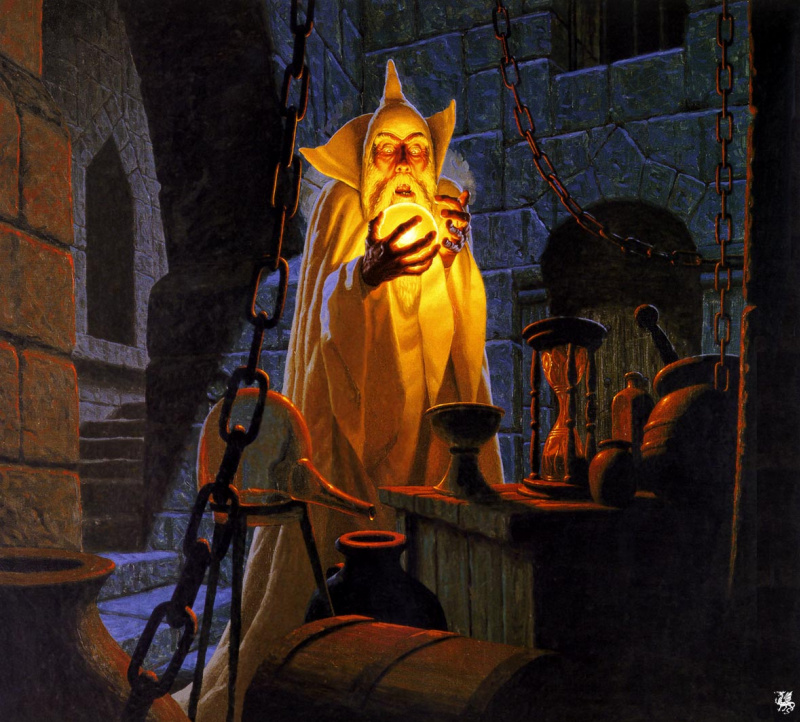
The Romans were serious engineers and roads could be very methodically laid out and built.

Latest research suggests that they may have constructed as many as almost 200,000 miles of roads (299,171km)—not all so elaborate, and some were doubtless improved local roads, but a vast number (see for more:  https://www.sciencealert.com/massive-new-map-reveals-300000-km-of-ancient-roman-roads ) were of the standard construction.

This may have been true once, but the road Frodo and his friends eventually reach doesn’t sound much like surviving Roman work—

“…the Road, now dim as evening drew on, wound away below them.  At this point it ran nearly from South-west to North-east, and on their right it fell quickly down into a wide hollow.  It was rutted and bore many signs of the recent heavy rain; there were pools and pot-holes full of water.”  (The Fellowship of the Ring, Book One, Chapter 8, “Fog on the Barrow-downs”)

Following the road, however, has made me consider just how many miles of roads we actually see in Middle-earth and over which various characters travel and how they might appear.  Just look at a map—

(cartographer? clearly based on JRRT and Christopher Tolkien’s map)

The Great East Road (named “East-West Road” there) is drawn and identified, and we can see the North Road (as “North-South Road”), but these are hardly the only roads in Middle-earth and certainly not in the story, and, as we’re following Frodo & Co. on their journeys, I thought that it would be interesting to examine some of the others—the main ones, and one nearly-lost one.

So, when Frodo and his friends eventually reach the edge of Bree, they’re actually at a crossroads—

“For Bree stood at the old meeting of ways:  another ancient road crossed the East Road just outside the dike at the western end of the village, and in former days Men and other folk of various sorts had traveled much on it.  ‘Strange as News from Bree’ was still a saying in the Eastfarthing, descending from those days, when news from North, South, and East could be heard in the inn, and when the Shire-hobbits used to go more to hear it.”

With the fall of the northern realm of Arnor about TA1974, however, things had changed:

“But the Northern Lands had long been desolate, and the North Road was now seldom used:  it was grass-grown, and the Bree-folk called it the Greenway.”  (The Fellowship of the Ring, Book One, Chapter 9, “At the Sign of the Prancing Pony”)

We’re not given a detailed description of this road—was it like what I had imagined the Great East Road might have looked like, Roman and paved, but overgown?

If so, it led back to the city of Tharbad to the south, which had had its own elaborate bridge at the River Greyflood—

“…where the old North Road crossed the river by a ruined town.”

Of this bridge we know:

“…both kingdoms [Arnor and Gondor] together built and maintained the Bridge of Tharbad and the long causeways that carried the road to it on either of the Gwathlo [Greyflood]…”  (JRRT Unfinished Tales, 277)

It must have been massive—could it have looked something like this?

(the 1ST century Roman bridge at Merida, Spain—you can read about it here:  https://en.wikipedia.org/wiki/Puente_Romano,_M%C3%A9rida )

As we also know, it had fallen into ruin, becoming only a dangerous ford, as Boromir found out, losing his horse there on the way north (The Fellowship of the Ring, Book Two, Chapter 8, “Farewell to Lorien”)

(the “Ponte Rotto” (“ruined bridge”) actually the 2nd century BC Pons Aemilius.  You can read about it here:  https://en.wikipedia.org/wiki/Pons_Aemilius  This is a 1690 painting by Caspar van Wittel, a very interesting and talented man, and you can read about him here:  https://en.wikipedia.org/wiki/Caspar_van_Wittel   )

We’ll pause here, however, waiting, perhaps, for a drought,

before we continue down the road towards Gondor…

Thanks for reading, as always.

Stay well,

Don’t cross any bridge till you come to it,

And remember that there’s always

MTCIDC

O

To Bree (Part 2)

12 Wednesday Nov 2025

Posted by Ollamh in Uncategorized

≈ Leave a comment

Tags

Barrow-downs, Barrow-wight, Bilbo, Bree, bridge-of-strongbows, Fantasy, Frodo, Great East Road, Nazgul, Shire, The Bridge of Stonebows, The Lord of the Rings, The Prancing Pony, Tolkien, Tom Bombadil, travel

As always, welcome, dear readers.

In “To Bree (Part 1)”, we had followed Bilbo & Co.

(Hildebrandts)

(Hildebrandts)

eastwards,

but only as far as Bree, echoing the remark in The Lord of the Rings:

“It was not yet forgotten that there had been a time when there was much coming and going between the Shire and Bree.” (The Fellowship of the Ring, Book One, Chapter 9, “At the Sign of the Prancing Pony”)

Oddly, however, although I supposed that we were traveling through the East Farthing

(Christopher Tolkien)

through Frogmorton and Whitfurrows,

to the Bridge of Strongbows,

(Stirling Bridge, actually—for more see:  https://www.historicenvironment.scot/visit-a-place/places/stirling-old-bridge/ )

the description in The Hobbit was wildly different:

“Then they came to lands where people spoke strangely, and sang songs Bilbo had never heard before.  Now they had gone on far into the Lone-lands, where there were no people left, no inns, and the roads grew steadily worse.  Not far ahead were dreary hills, rising higher and higher, dark with trees.  On some of them were old castles with an evil look, as if they had been built by wicked people.”  (The Hobbit, Chapter 2, “Roast Mutton”) 

with, eventually, a surprise for us Bree-bound folk:  no Bree.

So, back we went to the Green Dragon, in Bywater, where Bilbo started and now we begin again, with Frodo.  Times have changed, however, and unlike the innocent Bilbo, we are in a different world, where Mordor isn’t just a distant place name and its servants are looking for Baggins.

(Denis Gordeev)

Frodo doesn’t take the Great East Road,

(Christopher Tolkien)

but cuts across country, narrowly avoiding one of the searchers,

(Angus McBride)

taking shelter with a local farmer, and finally reaching the ferry across the Brandywine just ahead of his pursuers.

Although this is a very indirect route, Frodo and his companions eventually reach Bree, but even though I would love to meet Tom Bombadil,

(the Hildebrandts)

I prefer a direct route, so we’ll continue on the Great East Road, cross the Bridge of Strongbows, and head eastwards. 

(from Barbara Strachey, The Journeys of Frodo, a much-recommended book, if you don’t have a copy)

So what do we see?  

Over the bridge—and here’s another possibility for it, the Clopton Bridge at Stratford-upon-Avon—

(you can see more of Stratford and the shire—Warwickshire, that is—here:  https://www.ourwarwickshire.org.uk/content/catalogue_wow/stratford-upon-avon-clopton-bridge-2 )

the road runs, not surprisingly, due eastwards and here, consulting our map,

 is the Old Forest to our right,

described, by our narrator, as Frodo and his friends see it on their detour away from the Great East Road:

“Looking ahead they could see only tree-trunks of innumerable sizes and shapes:  straight or bent, twisted, leaning, squat or slender, smooth or gnarled and branched; and all the stems were green or grey with moss and slimy, shaggy growths.” (The Fellowship of the Ring, Book One, Chapter 6, “The Old Forest”)

Keep in mind, however, that we’re seeing it through a long line of trees planted alongside the road, probably as a windbreak.

We know that they’re there because Merry says:

“ ‘That is a line of trees,’ said Merry, ‘and that must mark the Road.  All along it for many leagues east of the Bridge there are trees growing.  Some say they were planted in the old days.’ “ (The Fellowship of the Ring, Book One, Chapter 8, “Fog on the Barrow-downs”)

As we travel farther along the road, if we look to our right, through the trees, we then come to the edge of the Barrow-downs,

with their ancient standing stones

and tumuli—

where Frodo and his friends almost end their trip.

(Matthew Stewart)

But we haven’t strayed, as they did, and, passing the Downs, we see, again on our right:

“The dark line they had seen was not a line of trees but a line of bushes growing on the edge of a deep dike, with a steep wall on the further side.”

A dike is a ditch, usually with an earthen embankment made from the spoil of the ditch.  There are several of these in England, like Offa’s Dyke—

The narrator adds:

“…with a steep wall on the further side”

and I’m presuming that that is the earthen embankment, with:

“…a gap in the wall” through which Frodo and friends rode and

…when at last they saw a line of tall trees ahead…they knew that they had come back to the Road.”

If you’re read the first part of this posting, you will know that I’ve been assuming that that Road, laid in ancient times to a stone bridge and beyond, would be like a Roman road, and be paved,

if a bit weedy, but now we find:

“…the Road, now dim as evening drew on, wound away below them.  At this point it ran nearly from South-west to North-east, and on their right it fell quickly down into a wide hollow.  It was rutted and bore many signs of the recent heavy rain; there were pools and pot-holes full of water.”

Does this suggest that it was, at best and in the past, simply a dirt road, through well-kept?  Or is it a very run-down road, worn and covered over with leaves and dirt, the ancient blocks gradually becoming separated under the weight of centuries, allowing for pot-holes?

In any event, we now continue our journey with Frodo and his compantions until–

“…they saw lights twinkling some distance ahead.

Before them rose Bree-hill barring the way, a dark mass against misty stars; and under its western flank nestled a large village.  Towards it they [and we] now hurried desiring only to find a fire, and a door between them and the night.”

We’re not in Bree yet, however, as:

“The village of Bree had some hundred stone houses of the Big Folk, mostly above the Road, nestling on the hillside with windows looking west.  On that side, running in more than half a circle from the hill and back to it, there was a deep dike with a thick hedge on the inner side.  Over this the Road crossed by a causeway; but where it pierced the hedge it was barred by a great gate.  There was another gate in the southern corner where the Road ran out of the village.  The gates were closed at nightfall; but just inside them were small lodges for the gatekeepers.”  (The Fellowship of the Ring, Book One, Chapter 9, “At the Sign of the Prancing Pony”)

We’ve seen a dike just now, at the Great East Road, but now we have to add a hedge

and a gate.

Once inside, however, lies the Prancing Pony

(Ted Nasmith)

and one more pint before bed.

As always, thanks for reading.

Stay well,

Read road signs carefully,

And remember that, as always, there’s

MTCIDC

O

To Bree (Part 1)

05 Wednesday Nov 2025

Posted by Ollamh in Uncategorized

≈ Leave a comment

Tags

Bilbo, Bree, Fantasy, The Bridge of Strongbows, The Green Dragon, The Hobbit, The Lord of the Rings, the Sphinx, the Three Farthing Stone, the-great-east-road, Tolkien, travel-in-middle-earth, trolls

Welcome, as always, dear readers.

For me, one of the great pleasures of The Hobbit and The Lord of the Rings is that they are both so wonderfully imagined.  Consider the beginning of The Hobbit, for example, where the opening could just have been the bare line “In a hole in the ground there lived a hobbit.” Instead, it continues:

“Not a nasty, dirty, wet hole, filled with the ends of worms and an oozy smell, nor yet a dry, bare, sandy hole with nothing in it to sit down on or to eat:  it was a hobbit-hole, and that means comfort.”

(JRRT)

And even this is not enough, as it continues:

“It had a perfectly round door like a porthole, painted green, with a shiny yellow brass knob in the exact middle.”

And it will go on for an entire paragraph beyond that sentence, listing rooms and even explaining why some are preferred.

Even with so much detail, I sometimes find myself wanting more—often more of the outside world.  In this posting, then, I thought that we might take a trip to Bree and spend some time sightseeing as we go.  Via the Great East Road, this is about 100 of our miles (160 km), according to the very useful website of Becky Burkheart (which you can visit here:  https://www.beckyburkheart.com/traveltimesinmiddleearth ).

Why Bree?  To quote The Lord of the Rings:

“It was not yet forgotten that there had been a time when there was much coming and going between the Shire and Bree.” (The Fellowship of the Ring, Book One, Chapter 9, “At the Sign of the Prancing Pony”)

If we use both The Hobbit and The Lord of the Rings together, however, we’ll soon encounter some difficulties, as we shall see.

Our starting point for Bilbo is the Green Dragon Inn, in Bywater. 

(Christopher Tolkien)

Tolkien doesn’t describe the inn, but, using a real inn, we might imagine the Green Dragon as looking something like this–

(This is the White Lion in Barthomley, in Cheshire, built in 1614.  You can read more about it and about Barthomley here:   https://drive.google.com/file/d/1oeQEpGsXlN1A_4T8nOhUwpggDA_pEFTM/view )

Just to the south of Bywater is the spot where the Hobbiton road meets the Great East Road.  Again, Tolkien gives us no description, but there may be a hint as to this road in the original grant of the Shire by Argeleb II in TA1601:

“For it was in the one thousand six hundred and first year of the Third Age that the Fallohide brothers, Marcho and Blanco, set out from Bree; and having obtained permission from the high king at Fornost, they crossed the brown river Baranduin with a great following of Hobbits.  They passed over the Bridge of Strongbows, that had been built in the days of the power of the North Kingdom, and they took all the land beyond to dwell in, between the river and the Far Downs.  All that was demanded of them was that they should keep the Great Bridge in repair, and all other bridges and roads, speed the king’s messengers, and acknowledge his lordship.”   (The Lord of the Rings, Prologue I, “Concerning Hobbits”)

We’ll cross the bridge a little later in our journey, but we might start with the road.  That it’s sometimes called “the Great East Road” suggests that it’s more than a dirt path.

Could Tolkien have been thinking of the bits of surviving Roman road which crisscross England?  Most are now buried under modern roads, but, here and there some are still available on the surface, as here—

and perhaps we can use this as a model. As an ancient stone road, it would certainly fit in with the ancient stone Bridge, as we’ll see.

Just beyond the spot where the lesser road meets the greater, we see marked on our map, the “Three Farthing Stone”.  A “farthing” is a “four-thing”—that is, a quarter, and it marks the spot where three of the quarters, the four farthings, of the Shire meet.  This appears to be modeled on the “Four Shire Stone” in our Middle-earth

which you can read about here:  https://thirdeyetraveller.com/four-shire-stone-tolkien/ )

And, from here, we head eastwards—and meet our first difficulty.  Here’s the description in The Hobbit—

“At first they had passed through hobbit-lands, a wide respectable country inhabited by decent folk, with good roads, an inn or two, and now and then a dwarf or a farmer ambling by on business.”

That fits our Shire map:  we might be traveling through Frogmorton and Whitfurrows, villages which might look like this—

but then there’s—

“Then they came to lands where people spoke strangely, and sang songs Bilbo had never heard before.  Now they had gone on far into the Lone-lands, where there were no people left, no inns, and the roads grew steadily worse.  Not far ahead were dreary hills, rising higher and higher, dark with trees.  On some of them were old castles with an evil look, as if they had been built by wicked people.”  (The Hobbit, Chapter 2, “Roast Mutton”) 

The bridge is just ahead, but “dreary hills”?  “old castles”? 

And you can really see the difference here between the two books.  Tolkien had yet to discover much of the East Farthing and was simply penciling in something which we might think of as “travel filler”, to indicate that the expedition was riding eastwards, but the trip was already becoming more difficult.

And then we come to the (here unnamed) bridge:

“Fortunately the road went over an ancient stone bridge, for the river, swollen with the rains, came rushing down from the hills and mountains in the north.”

As this is the first bridge mentioned, I’m going to assume that this is the “Bridge of Strongbows/Great Bridge” mentioned in Argeleb II’s grant to the original hobbit settlers.

(This is the Roman Pont Julien in southeastern France—over a bit drier patch than described in the book.  For more on this ancient bridge, see:  https://en.wikipedia.org/wiki/Pont_Julien )

Once over this bridge, we’re in a different world.  We reach another river:

“Then one of the ponies took fright at nothing and bolted.  He got into the river before they could catch him…” 

Then, attempting to camp in the rain, Bilbo and the dwarves spot a fire, go to it, and find trolls.

(JRRT)

With the trolls dealt with by Gandalf, we move on to Rivendell–

(JRRT)

and suddenly we realize that:   there’s no Bree!

It’s at the crossroads of the Great East Road and what the locals call “the Greenway”, the old north/south road, now long overgrown,

but, somehow, Bilbo and the dwarves have not encountered it.  The reason is clear, of course:  just as the Tolkien of The Hobbit had yet to discover the East Farthing, so, too, he had yet to discover Breeland.

So, it looks like we have to turn around, back to the Green Dragon, stop for a pint, as any hobbit would,

and try again—in “To Bree (Part 2”).

As always, thanks for reading.

Stay well,

When approaching a crossroads, be prepared for anything—especially monsters with questions–

And remember that, as always, there’s

MTCIDC

O

Plain and Grassy

24 Wednesday Sep 2025

Posted by Ollamh in Uncategorized

≈ Leave a comment

Tags

anime, Fantasy, Mononoke, movies, Rohan, The Lord of the Rings, The War Of the Rohirrim, Tolkien, Yuhimov

Welcome, as always, dear readers.

If you read this blog regularly, you know that, when I review something, I will see it/read it twice before I put fingers to keyboard and that I always try to understand, as best I can, what it is that the creators are intending, finding completely negative reviews of the sort which are too common on the internet simply unhelpful. 

 I’ve watched The War of the Rohirrim only once, so far,

and, after I’ve seen it a second time, I’m sure that I’ll want to say more, but one point struck me immediately and I thought that others might find it interesting—or puzzling, as I did.

To begin with, I very much enjoy anime and have seen all sorts of examples, from the adventures of Cowboy Bebop

to the sad and beautiful adaptation of When Marnie was Here

to the almost hallucinatory Mononoke.

My curiosity, then, was aroused to read that someone was making an anime-influenced film from section II, “The House of Eorl” of Appendix A of The Lord of the Rings, both because of the anime and because I’m always interested to see how different artists might imagine works with which I’m familiar.

Some years ago, for instance, a Russian artist, Sergey Yuhimov, had illustrated The Lord of the Rings in the style of Russian religious art, which was an intriguing idea.  Here’s the death of Boromir, as an  example–
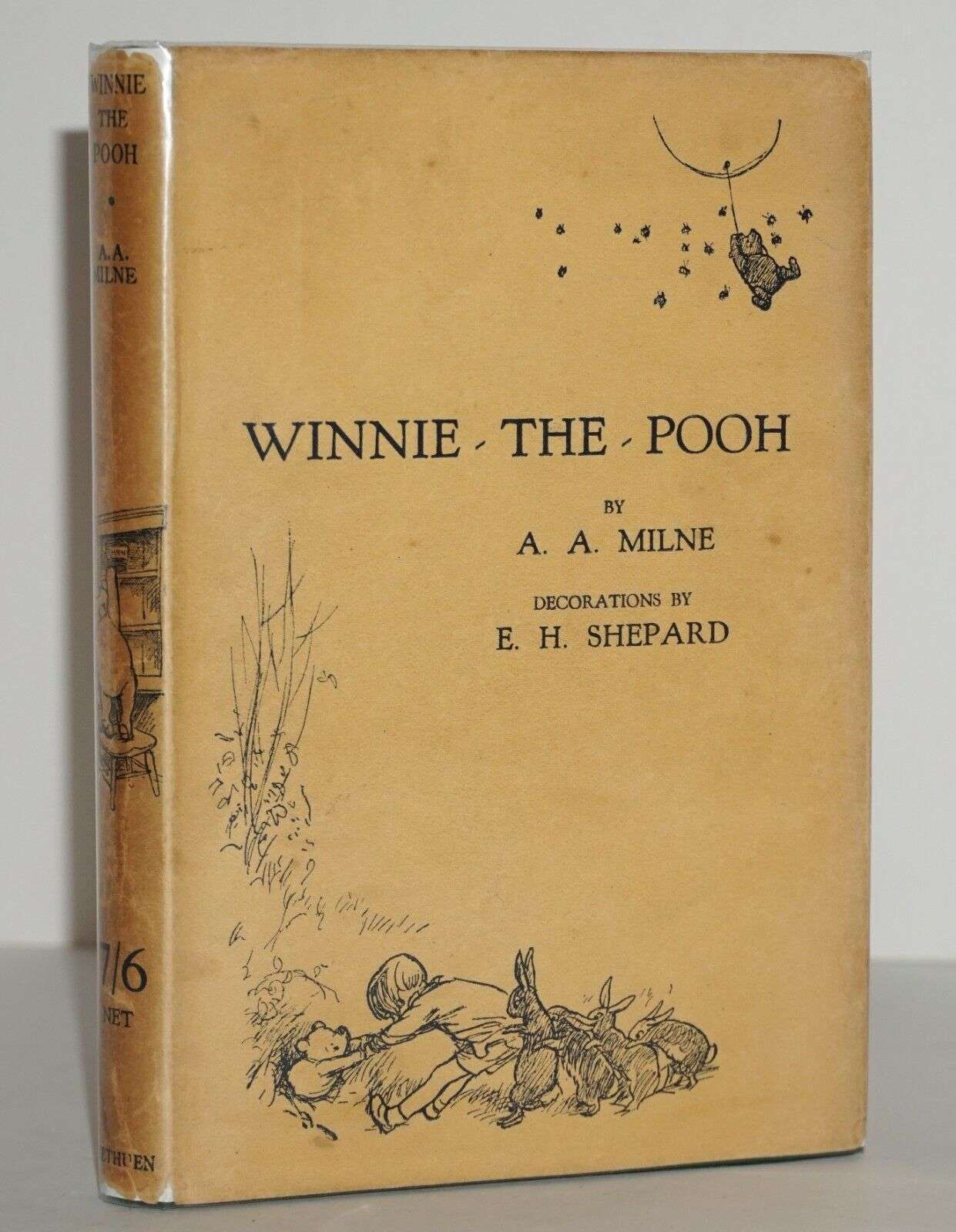
(For more, see:  https://www.openculture.com/2014/06/russian-illustrations-of-the-lord-of-the-rings-in-a-medieval-iconographic-style-1993.html )

At the same time, I was a bit concerned about just what could be made of this material when there was so little of it—pages 1065-1067 in my 50th-anniversary edition of the book.
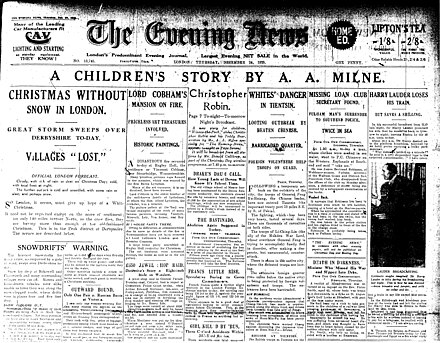
Remembering my dismay at “Azog”

and “Tauriel”

 in P. Jackson’s The Hobbit, where there was plenty of original material with which to work, I wondered if this would this mean the appearance of a number of characters never devised—or intended—by the author?  (for more on this see “A Fine Romance”, 15 February, 2023)

As I said, however, more on the film in general in a future posting, but for now I want to concentrate on a bit of geography.

Here’s a map of Rohan, the location of the film’s story

It’s divided into a couple of regions, their names based on Old English words—“Wold”, I’m presuming coming for “weald”, defined as “high land covered with wood”, which would be appropriate for land just outside Fangorn, “Emnet” from “emnett”, “a plain”—basically a level or flat area, and “Fold” from a word used in compounds, meaning “earth/land”.  (See Bosworth & Toller’s  Anglo-Saxon Dictionary here:  https://bosworthtoller.com/  )  So, the central area, at least, is, at best, rolling, I would say, and we know, from the text, covered in grass:

“Turning back they saw across the River the far hills kindled.  Day leaped into the sky.  The red rim of the sun rose over the shoulders of the dark land.  Before them in the West the world lay still, formless and grey; but even as they looked, the shadows of night melted, the colours of the waking earth returned:  green flowed over the wide meads of Rohan…” (The Two Towers, Book Three, Chapter 2, “The Riders of Rohan”)

“Mead” is from Old English “maed”, “meadow” (itself from Old English “maedwe”, which Etymonline, from the OED, glosses as “low, level tract of land under grass; pasture” (for more, see:  https://www.etymonline.com/search?q=meadow )

I’ve always imagined, then, something like this—

it being a perfect place for grazing for the herds of horses kept by the Rohirrim.

Unfortunately, New Zealand doesn’t appear to have such places and so Jackson, in his films, had to make do with this—

With those snowy mountains in the background, it makes an impressive scene, but it’s not really what JRRT had clearly—and rather beautifully–imagined.

I thought, however, that the makers of the new film would take advantage of the fact that, their landscape being anything which they could imagine and depict, and would restore to us Tolkien’s vision of the plains of Rohan as he described them.

Unfortunately, that’s not what happened:  instead, the artists simply copied the Jackson look of the nearly-barren countryside, far from anything a horse people would delight in—

Why do this?  The creators weren’t limited, as Jackson was, by the available landscape, and yet they simply followed what was already available on film, virtually down to the last detail.

Needless to say, I was disappointed, and it made me wonder what else I would see as the film progressed.  But that’s for another posting.

Thanks for reading, as ever.

Stay well,

May you always seek green—but not greener– pastures,

And remember that, as always, there’s

MTCIDC

O

Going Around in Cycles

17 Wednesday Sep 2025

Posted by Ollamh in Uncategorized

≈ Leave a comment

Tags

Barrow-wight, Finnegans Wake, Giambattista Vico, goblin king, James Joyce, La Scienza Nuova, lotr, Mirkwood spiders, Nazgul, Ouroboros, Palantir, runes, Shelob, swords, The Hobbit, The Lord of the Rings, The Return of the King, Tolkien, Tom Bombadil, Yogi Berra

“It’s déjà vue all over again.”

(attributed to Yogi Berra, US baseball player, but see:  https://quoteinvestigator.com/2013/10/08/deja-vu-again/ )

Dear readers, as always, welcome.

In later life, James Joyce, 1882-1941,

was interested in the work of the 17-18th-century philosopher (among other things) Giambattista Vico, 1668-1744,

and his idea that history followed a definite repeated pattern in three ages, Divine, Heroic, and Human, posited in his 1725-1744 work, La Scienza Nuova (“the new understanding, knowledge, learning”).

(For more on Vico, see:  https://www.philosopheasy.com/p/the-eternal-return-giambattista-vicos  This is, potentially, a very large subject, and even more so when Joyce is combined with Vico.  For an introductory view, see:  https://archive.org/details/vicojoyce00vere_0/page/n5/mode/2up ) 

Joyce incorporated his understanding of Vico in his last work, Finnegans Wake, 1939, in which

the idea of repeated patterns cycling throughout appears in the very opening—and closing– lines of the book:

“A way a lone a last a loved a long the / riverrun, past Eve and Adam’s, from swerve of shore to bend of bay, brings us by a commodius vicus of recirculation back to Howth Castle and Environs.” 

which, in fact, are reversed, the opening of the book being:

“…riverrun, past Eve and Adam’s, from swerve of shore to bend of bay, brings us by a commodius vicus of recirculation back to Howth Castle and Environs…”

and the last words of the book are:

“A way a lone a last a loved a long the…”

so that, by joining them, we have the effect of the serpent Ouroboros, tail/tale joined to mouth—and the book can begin again.

(For more on Finnegans Wake, see:  https://en.wikipedia.org/wiki/Finnegans_Wake  For more on the serpent, see:   https://en.wikipedia.org/wiki/Ouroboros )

I’ve always thought that leaving Tom Bombadil and the Barrow-wight

(Matthew Stewart—see more of his work here:  https://www.matthew-stewart.com/  See, in particular, his Middle-earth work, but then go through his other galleries to view his impressive ability to capture other imaginary worlds.)

out of the first Lord of the Rings film was a mistake, even though Tolkien himself once wrote:

“Tom Bombadil is not an important person—to the narrative.”  (letter to Naomi Mitchison, 25 April, 1954, Letters, 268—but read on, as JRRT has much more to say and, to my mind, justifies his position in the narrative, in fact, in a spiritual way.)

Tom is interesting in himself, being a kind of parallel for Treebeard, among other things (and the writers of the Rings of Power series thought highly enough of him to include him in their telling), but, for me, in the narrative, it’s what he gives them, particularly Merry, which is important—

“For each of the hobbits he chose a dagger, long, leaf-shaped, and keen, of marvelous workmanship…”

(probably something like this, but more elaborately-worked)

‘Old knives are long enough as swords for hobbit-people,’ he said…Then he told them that the blades were forged many long years ago by Men of Westernesse:  they were foes of the Dark Lord, but they were overcome by the evil king of Carn Dum in the Land of Angmar.”  (The Fellowship of the Ring, Book One,  Chapter 8, “Fog on the Barrow-downs”)

This is, of course, the weapon  which Merry uses to stab the chief of the Nazgul while he’s attacking Eowyn, the Nazgul being the very witch-king who had overcome the Men of Westernesse so long before.

(Ted Nasmith)

To keep Tom and the Barrow-wight in the film is then to underline the cyclic nature of much of the story.

 This unnamed but crucial sword is only one of the swords scattered throughout the later story of Middle-earth, however, and there is a cyclic potential for others, as well.

Think of the swords which Gandalf and Co. find in the trolls’ hideout in The Hobbit—

“…and among them were several swords of various makes, shapes, and sizes.  Two caught their eyes particularly, because of their beautiful scabbards and jeweled hilts…

‘These look like good blades,’ said the wizard, half drawing them and looking at them curiously.  ‘They were not made by any troll, nor by any smith among men in these parts and days; but when we can read the runes on them, we shall know more about them.’ “ (The Hobbit, Chapter Two, “Roast Mutton”)

In the next chapter, Elrond then identifies them:

“Elrond knew all about runes of every kind.  That day he looked at the swords they had brought from the trolls’ lair, and he said:  ‘These are not troll-make.  They are old swords, very old swords of the High Elves of the West, my kin.  They were made in Gondolin for the Goblin-wars.  They must have come from a dragon’s hoard or goblin plunder, for dragons and goblins destroyed that city many ages ago.  This, Thorin, the runes name Orcrist, the Goblin-cleaver in the ancient tongue of Gondolin; it was a famous blade.  This, Gandalf, is Glamdring, a Foe-hammer that the king of Gondolin once wore.’ “ (The Hobbit, Chapter Three.  “A Short Rest”)

And you’ll remember that Gandalf runs the king of later goblins through in the next chapter with that very sword:

“Suddenly a sword flashed in its own light.  Bilbo saw it go right through the Great Goblin as he stood dumb-founded in the middle of his rage.  He fell dead, and the goblin soldiers fled before the sword shrieking into the darkness.”  (The Hobbit, Chapter Four, “Over Hill and Under Hill”)

(Alan Lee)

The knife which Bilbo picks up from the trolls’ hoard “only a tiny pocket-knife for a troll, but it was as good as a short sword for the hobbit”, comes in handy later in The Hobbit, when Bilbo uses it to kill some of the spiders of Mirkwood,

(Oleksiy Lipatov—you can see more of his work here:  https://www.deviantart.com/lipatov/gallery/85631839/old-comic  )

but it will reappear many years later in The Lord of the Rings, when Frodo and Sam use it against another ancient evil, Shelob–

(Ted Nasmith again—and, unusually for his work, just plain weird—but vivid!)

Perhaps the most consequential sword  to return, however, is that which maimed Sauron many centuries ago, causing him to lose the Ring, and which, reforged, Aragorn shows him in Saruman’s palantir

(the Hildebrandts)

(itself appearing from a far older world, being as Aragorn says, “For this assuredly is the palantir of Orthanc, from the treasury of Elendil, set here by the Kings of Gondor.”  The Two Towers, Book Three, Chapter 11, “The Palantir”):

“…The eyes in Orthanc did not see through the armour of Theoden; but Sauron has not forgotten Isildur and the sword of Elendil.  Now in the very hour of his great designs the heir of Isildur and the Sword are revealed; for I showed the blade re-forged to him.  He is not so mighty yet that he is above fear; nay doubt ever gnaws him.”  (The Return of the King, Book Five, Chapter 2, “The Passing of the Grey Company”)

And there are more cyclings.

Consider the Ring itself:  forged in the fires of Mt Doom, it is eventually returned there and destroyed,

(another Ted Nasmith)

which causes the final end of Sauron, after several ages of struggle,

(and one more Ted Nasmith–and who better to paint a cataclysm?)

and which, in turn, brings the—return of the King.

(Denis Gordeev–and note that the artist has painted Aragorn’s crown as depicted by Tolkien in a letter to Rhona Beare, 14 October, 1958, see Letters, 401.)

After thinking about this, I can see that there are even more cyclic events, like the movement of the elves westwards, and  Gandalf traveling the same way, originally sent eastwards to oppose Sauron,

(one more Ted Nasmith)

but I think that this is enough for one posting—though considering all of the cycles I’ve already identified,  I’ll end with another (supposed) quotation from Yogi Berra:

Thanks, as always, for reading.

Stay well,

Remember one more piece of Yogi wisdom

And remember, as well, that there’s always

MTCIDC

O

Horse, Two

03 Wednesday Sep 2025

Posted by Ollamh in Uncategorized

≈ Leave a comment

Tags

Achilles, Alexander the Great, Balios and Xanthus, Bucephalus, Grani, Nazgul, Podarge, Richard III, Shadowfax, Shakespeare, Sleipnir, The Lord of the Rings, the-iliad, Tolkien, Volsunga Saga, Zephyrus

Welcome , dear readers, as always, and, as always, I’m interested in Tolkien’s inspirations…

Enter Richard

King    A horse, a horse, my kingdome for a horse.

Cates   Withdraw my lord, ile helpe you to a horse.

King   Slaue I haue set my life vpon a cast,

And I will stand the hazard of the die,

I thinke there be sixe Richmonds in the field,

Fiue haue I slaine to daie in stead of him,

A horse, a horse, my kingdome for a horse.  (Wm Shakespeare, Richard III, Act V,  Scene 4,  First Quarto, 1597  You can read it here at the excellent Internet Shakespeare site: https://internetshakespeare.uvic.ca/doc/R3_Q1/index.html    )

(artist?)

Richard III is clearly not having a good day:  one of his allies has waited out the battle until a fatal moment, then changed sides.  And Richard has lost his horse, which, as a good horseback soldier, gives him an advantage, in terms of mobility on the battlefield, height over enemy infantry,

(Adam Hook)

and even a better chance of escape.  Without it, surrounded by enemy soldiers, he’s about to be dead.  (In the Shakespeare play, he’s killed by the Earl of Richmond, Henry Tudor, who, in turn, is about to become Henry VII, but, in reality, we don’t know who did him in, but see here for more:  https://le.ac.uk/richard-iii/identification/osteology/injuries/how-richard-iii-died )

Soldiers in the West didn’t begin on horseback.  The Sumerians first had yoked wild asses to their battle cars.

The ancient Egyptians had, by the New Kingdom (1550-1070BC), yoked horses to chariots.

(Rameses II, c.1303-1213BC)

The Assyrians, breeding bigger horses, began to sit soldiers upon their backs.

Greeks in the Iliad went to battle in and sometimes fought from their chariots (sometimes called by classical scholars “battle taxis” under the mistaken impression that they used those chariots only for transportation, which a close reading of the text shows not to be the case), although cavalry, as cavalry, are briefly mentioned, though never shown in action.

But cavalry, when it finally appeared in the Greek world, was meant for scouting and pursuit.

(Angus McBride)

All of this changed with Philip II of Macedon. 382-336BC, and his son, Alexander.  Macedon was prime horse-breeding country and Philip was a military innovator, so, with chariots long gone, Philip trained real battle cavalry, which Alexander then led to victory.

(Peter Connolly)

Alexander had a famous horse, Bucephalus (“Ox Head”),

whom he alone could tame. (see Plutarch’s life of Alexander here—section.6:    https://www.lexundria.com/plut_alex/1-77/prr )

He also fancied himself a kind of descendent of the Trojan War hero Achilles, who had two famous horses, Balios (“Dapple”)  and Xanthus (“Palomino”), born of a Fury, Podarge (“Swiftfoot”), and Zephyrus, the god of the West Wind.

This divine lineage for horses made me think about a famous horse in another adventure story:  Shadowfax.

(Luca Michelucci—you can see more of his work here:  https://www.artnet.com/artists/luca-michelucci/  I like especially his image of Gwaihir rescuing Gandalf from Orthanc)

Shadowfax, according to Gandalf, is the chief of the Mearas, horses descended from one Felarof,  the horse of Eorl, the founder of Rohan.  Felarof was said to have understood the speech of men (Rohirric, we can presume) and may have been brought by Orome, the huntsman of the Valar, from across the sea, suggesting a horse of the Valar themselves.  (See The Lord of the Rings, Appendix A, II, “The House of Eorl”)

Mearas is the plural of mearh, one of the Old English words for “horse” and this might suggest that, with his  interest in things early Germanic, we might imagine that Tolkien would have looked towards Grani,

(from the Ramsund Carving—for more:  https://en.wikipedia.org/wiki/Sigurd_stones )

the horse of Sigurd, descended from Odin’s 8-legged steed, Sleipnir

(on the Tjaengvide image stone—you can read more about it here:  https://en.wikipedia.org/wiki/Tj%C3%A4ngvide_image_stone     For the story of how Sigurd found Grani, see the Icelandic Volsunga Saga  in this bilingual edition, pages 23-24:   https://archive.org/details/vo-lsungasaga-text-translation-finch/page/n89/mode/2up

And I can’t resist this very clever way of producing a modern Sleipnir—

Lachlan Templar—his work appears at Deviant Art, but, when I try to find out more, the site is blocked.)

as an inspiration, but, remembering that Tolkien had begun his formal education in the traditional way:   studying Classics at King Edward’s School in Birmingham,

and, initially, continuing  in Classics at Oxford,

I wonder—and return to Balios and Xanthus.  These are horses with as distinguished a lineage as Grani, coming from a Fury

and the god of the West Wind.

As well,  Felarof—and, in turn, Shadowfax–understand human speech and Balios and Xanthus show emotion more human than equine, weeping when their temporary master and charioteer, Patroclus, is killed in battle by the Trojan hero, Hector, refusing to return to battle, but, instead—

“…but as a monument remains firmly in the ground, one set up on a tomb

For a dead man or woman,

So they remained, immobile, holding the very beautiful chariot [still],

Leaning [their] heads to the earth, and their hot tears

Flow down from under [their] eyelids to the ground

In longing for [their] charioteer.”  (Iliad, Book 17.434-439—my translation]

And  there’s more.   Felarof and Shadowfax may understand human speech, and Balios and Xanthus may grieve, in a human way for the death of Achilles’ friend and charioteer, Patroclus, but, in an eerie moment, one of them, Xanthus, actually speaks to Achilles, warning him of his own impending doom:

“We will still keep you safe for now, mighty Achilles,

But a deadly day is near to you.”  (Iliad, Book 19.408-409—my translation)

Could there be another link here?

“But lo!  suddenly in the midst of the glory of the king his golden shield was dimmed.  The new morning was blotted from the sky.  Dark fell about him.  Horses reared and screamed.  Men cast from the saddle lay groveling on the ground…Snowmane wild with terror stood up on high, fighting with the air, and then with a great scream he crashed upon his side; a black dart had pierced him.  The king fell beneath him…” 

(Ted Nasmith)

Although we have no idea of Snowmane’s lineage except that he’s “Lightfoot’s foal”, and he never speaks a word, he’s certainly involved in a death and, as Balios and Xanthus might have inspired Shadowfax, could this horse-speech be related to Theoden’s horse, Snowmane?

(Joona  Kujanen, aka Tulikoura, a bit more of whose work you can see here:  https://hole-intheground.blogspot.com/2012/03/fridays-at-mathom-house-joona-kujanen.html )

We have no idea of the fate of Achilles’ horses, though we are told that Achilles himself was buried in a mound—

as Agamemnon says to him in the Underworld, speaking of the cremated remains of Achilles and his friend, Patroclus (over whom Achilles’ horses mourned):

“And over them then we, mighty army of the Argive spearmen,

Heaped up a tumulus…”  (Odyssey, Book 24.81-81—my translation)

Just as Snowmane received a similar grave:

“And afterwards when all was over men returned and made a fire there and burned the carcase of the beast; but for Snowmane they dug a grave and set up a stone upon which was carved in the tongues of Gondor and the Mark:

‘Faithful servant yet master’s bane,

Lightfoot’’s foal, swift Snowbane.’

Green and long grew the grass on Snowmane’s Howe…”  (The Return of the King, Book Five, Chapter 6, “The Battle of the Pelennor Fields”)

All coincidence?   Or were JRRT’s many years of classical training still at work, when he’d long abandoned it for Germanic, Finnish, and Welsh?

As ever, thanks for reading.

Stay well,

Horses are wonderful, but remember that they, like us, have their limits—what would you do if a Nazgul on a frightful thing came down upon you?

(Craig J. Spearing—you can read more about him and his work here:  https://pathfinderwiki.com/wiki/Craig_J_Spearing )

And remember that, as ever, there’s

MTCIDC

O

← Older posts

The Doubtful Sea Series Facebook Page

The Doubtful Sea Series Facebook Page

  • Ollamh

Categories

  • Artists and Illustrators
  • Economics in Middle-earth
  • Fairy Tales and Myths
  • Films and Music
  • Games
  • Heroes
  • Imaginary History
  • J.R.R. Tolkien
  • Language
  • Literary History
  • Maps
  • Medieval Russia
  • Military History
  • Military History of Middle-earth
  • Narnia
  • Narrative Methods
  • Poetry
  • Research
  • Star Wars
  • Terra Australis
  • The Rohirrim
  • Theatre and Performance
  • Tolkien
  • Uncategorized
  • Villains
  • Writing as Collaborators
Follow doubtfulsea on WordPress.com

Across the Doubtful Sea

Recent Postings

  • Through a glass… January 7, 2026
  • Heffalumps? December 31, 2025
  • We Three Kings December 24, 2025
  • A Moon disfigured December 17, 2025
  • On the Roads Again—Once More December 10, 2025
  • (Not) Crossing Bridges December 3, 2025
  • On the Road(s) Again—Again November 26, 2025
  • On the Road(s) Again November 19, 2025
  • To Bree (Part 2) November 12, 2025

Blog Statistics

  • 104,101 Views

Posting Archive

  • January 2026 (1)
  • December 2025 (5)
  • November 2025 (4)
  • October 2025 (5)
  • September 2025 (4)
  • August 2025 (4)
  • July 2025 (5)
  • June 2025 (4)
  • May 2025 (4)
  • April 2025 (5)
  • March 2025 (4)
  • February 2025 (4)
  • January 2025 (5)
  • December 2024 (4)
  • November 2024 (4)
  • October 2024 (5)
  • September 2024 (4)
  • August 2024 (4)
  • July 2024 (5)
  • June 2024 (4)
  • May 2024 (5)
  • April 2024 (4)
  • March 2024 (4)
  • February 2024 (4)
  • January 2024 (5)
  • December 2023 (4)
  • November 2023 (5)
  • October 2023 (4)
  • September 2023 (4)
  • August 2023 (5)
  • July 2023 (4)
  • June 2023 (4)
  • May 2023 (5)
  • April 2023 (4)
  • March 2023 (5)
  • February 2023 (4)
  • January 2023 (4)
  • December 2022 (4)
  • November 2022 (5)
  • October 2022 (4)
  • September 2022 (4)
  • August 2022 (5)
  • July 2022 (4)
  • June 2022 (5)
  • May 2022 (4)
  • April 2022 (4)
  • March 2022 (5)
  • February 2022 (4)
  • January 2022 (4)
  • December 2021 (5)
  • November 2021 (4)
  • October 2021 (4)
  • September 2021 (5)
  • August 2021 (4)
  • July 2021 (4)
  • June 2021 (5)
  • May 2021 (4)
  • April 2021 (4)
  • March 2021 (5)
  • February 2021 (4)
  • January 2021 (4)
  • December 2020 (5)
  • November 2020 (4)
  • October 2020 (4)
  • September 2020 (5)
  • August 2020 (4)
  • July 2020 (5)
  • June 2020 (4)
  • May 2020 (4)
  • April 2020 (5)
  • March 2020 (4)
  • February 2020 (4)
  • January 2020 (6)
  • December 2019 (4)
  • November 2019 (4)
  • October 2019 (5)
  • September 2019 (4)
  • August 2019 (4)
  • July 2019 (5)
  • June 2019 (4)
  • May 2019 (5)
  • April 2019 (4)
  • March 2019 (4)
  • February 2019 (4)
  • January 2019 (5)
  • December 2018 (4)
  • November 2018 (4)
  • October 2018 (5)
  • September 2018 (4)
  • August 2018 (5)
  • July 2018 (4)
  • June 2018 (4)
  • May 2018 (5)
  • April 2018 (4)
  • March 2018 (4)
  • February 2018 (4)
  • January 2018 (5)
  • December 2017 (4)
  • November 2017 (4)
  • October 2017 (4)
  • September 2017 (4)
  • August 2017 (5)
  • July 2017 (4)
  • June 2017 (4)
  • May 2017 (5)
  • April 2017 (4)
  • March 2017 (5)
  • February 2017 (4)
  • January 2017 (4)
  • December 2016 (4)
  • November 2016 (5)
  • October 2016 (6)
  • September 2016 (5)
  • August 2016 (5)
  • July 2016 (5)
  • June 2016 (5)
  • May 2016 (4)
  • April 2016 (4)
  • March 2016 (5)
  • February 2016 (4)
  • January 2016 (4)
  • December 2015 (5)
  • November 2015 (5)
  • October 2015 (4)
  • September 2015 (5)
  • August 2015 (4)
  • July 2015 (5)
  • June 2015 (5)
  • May 2015 (4)
  • April 2015 (3)
  • March 2015 (4)
  • February 2015 (4)
  • January 2015 (4)
  • December 2014 (5)
  • November 2014 (4)
  • October 2014 (6)
  • September 2014 (1)

Blog at WordPress.com.

  • Subscribe Subscribed
    • doubtfulsea
    • Join 78 other subscribers
    • Already have a WordPress.com account? Log in now.
    • doubtfulsea
    • Subscribe Subscribed
    • Sign up
    • Log in
    • Report this content
    • View site in Reader
    • Manage subscriptions
    • Collapse this bar
 

Loading Comments...