• About

doubtfulsea

~ adventure fantasy

Tag Archives: Smaug

Knowledge, Rule, Order

06 Wednesday Jan 2016

Posted by Ollamh in Fairy Tales and Myths, Imaginary History, J.R.R. Tolkien, Military History, Military History of Middle-earth, Narrative Methods

≈ 2 Comments

Tags

Adolf Hitler, Anduin, Benedict Cumberbatch, Benito Mussolini, British Government, Charlie Chaplin, dictatorships, England, Gandalf, George V, Germany, Gondor, gothic script, Government, History, India, Isengard, Kaiser Willhelm II, Lenin, Mehmed VI, Middle-earth, monarchs, Mordor, Nazis, newsreel, Numenor, Ottoman Empire, Oz, Peter Jackson, Queen Mary, Queen Victoria, Rohan, Saruman, Sauron, Scott, Smaug, Stalin, Stock Market Crash of 1929, Sultan, The Great Dictator, The Lord of the Rings, Tolkien, Treaty of Versailles, Valar, Victoria Louise, Weimar Republic, William Morris, Writing

Dear Readers,

Welcome, as always.

Have you ever wondered what Middle Earth would have been like if the Fourth Age had begun on a calendar written by Sauron?

That of the Third Age was hardly a democratic paradise: a king rules Rohan, a stand-in for king rules Gondor. Elrond and Celeborn/Galadriel behave and are treated like royalty and Thranduil, as we learn from The Hobbit, is the king of Mirkwood. The dwarves have hereditary rulers.   Only the outliers—communities like Bree and the Shire and the earlier inhabitants like Tom Bombadil and Fangorn—appear to be completely independent. (The Shire even has elections and a mayor, although the actual government, except for the shire reeves, appears to bemostly token—you wonder who’s running their seemingly-efficient postal service.)

This is not surprising, not only for an author born during the later years of Victoria,

queenvic.jpg

but also for someone powerfully influenced by the medievalist interests of everyone from Scott

Sir_William_Allan_-_Sir_Walter_Scott,_1771_-_1832._Novelist_and_poet_-_Google_Art_Project.jpg

to William Morris.

William_Morris_age_53.jpg

(We might add that the world of fairy tales, full of princes and princesses, queens and kings, was also a powerful influence at the time—and not only on story-tellers born in monarchies—after all, even Oz is ruled by a queen—

OzmaOz.jpg

Yet, after Smaug—who could better be a medieval fantasy villain (especially with the voice of the incomparable Benedict Cumberbatch attached)?

p8204516_n279079_cc_v4_aa.jpg

—something changed in Tolkien’s world. In fact, something changed in the whole outside world. With the end of World War One, monarchs toppled all over Europe and beyond, from:

Kaiser Wilhelm II of Germany

KAISER-WILHELM_2994889b.jpg

to Mehmed VI, last Sultan of the Ottoman Empire.
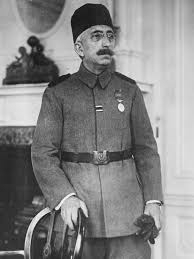
mehmed6.jpg

In place of the former, there appeared the always-troubled Weimar Republic, full of good intentions, but badly crippled, not only by the war which had sapped its manpower and resources, but by all kinds of social unrest and then by the Crash of 1929, which notoriously destroyed the value of its currency.

weimar currency.jpg

As early as 1919, there had been clashes among the forces of different ideologies—
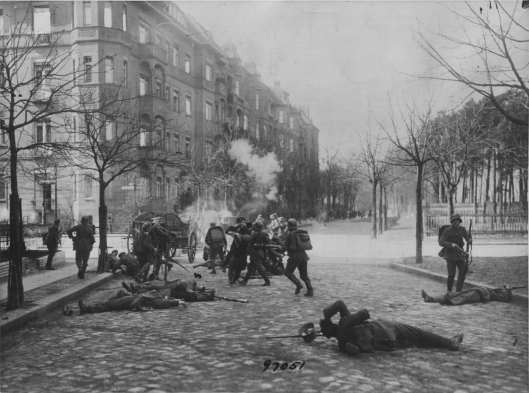
CombatesEnBerlín19190903.jpg

And, amidst all of the unrest, there was a failed coup attempt in 1923 by the man in the overcoat in this picture.

Bundesarchiv_Bild_102-00344A,_München,_nach_Hitler-Ludendorff_Prozess.jpg

He, of course, was only following the footsteps of this man, who had pushed his way into power the year before—

March_on_Rome.jpg

to be followed, in turn, by the man on the left, from the mid-1920s.

stalinandfriends.jpg

That first man, having failed at obvious violence, tried again through more complicated means (although still employing violence, if it suited his purposes) and succeeded in 1933.

Hitler-Papen-First-Reichstag-1933.jpg

He was, so we are told, a riveting public speaker, but, if the newsreels we’ve seen are evidence, we guess you would have had to have been there.

hitlerspeaking.jpg

Some people thought the style exaggerated in the 1930s and caricatured it even then.

chaplin2.jpg

He had a definite social agenda, which he outlined at length and often, although concealing certain of the most horrible aspects. And he liked big words and big concepts, like:

einfolk.jpg

It would have been impossible for someone as intelligent and generally well-informed as Tolkien not to have been very much aware of this man and all of the other like men, busy oppressing as much of the world as they could. And this would have been especially true in a time when radio and film were changing how people received news—and how those interested in influencing others might shape what people saw. As early as 1911, the British government was using newsreel film to show the might and reach of its empire (2/5 of the globe was in their hands) when the king, George V, and his wife, Queen Mary, visited India.

Delhi_Durbar,_1911.jpg

Not to be outdone, Kaiser Wilhelm II encouraged a grand—and filmed–event in 1913, for the wedding of his daughter, Victoria Louise—and some of the film was even in color.

vlouisekaiser.jpg

The Marriage of Victoria Louise Color Film

It would be easy to imagine, then, that the weight of such public figures might have influenced Tolkien in his depiction of late-3rd-Age villains. We can see it in Saruman’s unsuccessful attempt to persuade Gandalf to join him:

“ ‘He drew himself up then and began to declaim, as if he were making a speech long rehearsed. ‘The Elder Days are gone. The Middle Days are passing. The Younger Days are beginning. The time of the Elves is over, but our time is at hand: the world of Men, which we must rule. But we must have power, power to order all things as we will, for that good which only the Wise can see.” (The Fellowship of the Ring, Chapter 2, “The Council of Elrond”)

Thus, unlike the script of Jackson’s version, there is no plan to wipe out men and replace them with orcs. Instead, men are to survive: to be ruled—perhaps under what definitely sounds like it should be a translation from something written in Fraktur—the fake Gothic script favored by the Nazis–

die-schöne-deutsche-Schrift-detail1.jpg

“ ‘We can bide our time,’” says Saruman, “ ‘we can keep our thoughts in our hearts, deploring maybe evils done by the way, but approving the high and ultimate purpose: Knowledge, Rule, Order; all the things that we have so far striven in vain to accomplish…’ ”

Such abstract, but somehow menacing, words sound like a translation of something from Hitler’s Germany: Kenntnisse, Herrschaft, Ordnung. They do not sound in the least like Gandalf’s goals, ever, and he, in fact, replies by implying that not only are they not really Saruman’s words, but that Saruman is foolish for believing them:

“ ‘Saruman,’ I said, ‘I have heard speeches of this kind before, but only in the mouths of emissaries sent from Mordor to deceive the ignorant.’ “

As really the words of Sauron, however, they give us an idea of what to expect in a world under his control. Knowledge would be for Sauron alone, we suppose, perhaps after regaining his lost ring? Certainly he wouldn’t share it with Saruman, whom, it will become clear, he never trusted. As for Rule and Order, the world would be a place full of rules and those watching that they be obeyed. And here we can remember Sharkey’s Shire, with its “by order of the Chief” signs—and its gangs of human enforcers. As well, we can think of its grey, industrial character, as we’ve discussed in a previous post, a universal Mordor, devoted to production. To this, we can add the Mouth of Sauron’s recitation of surrender conditions, delivered to the allies before the Morannon:

“ ‘These are the terms…The rabble of Gondor and its deluded allies shall withdraw at once beyond the Anduin, first taking oaths never again to assail Sauron the Great in arms, open or secret. All lands east of the Anduin shall be Sauron’s for ever, solely. West of the Anduin as far as the Gap of Rohan shall be tributary to Mordor, and men there shall bear no weapons, but shall have leave to govern their own affairs. But they shall help to rebuild Isengard which they have wantonly destroyed, and that shall be Sauron’s, and there his lieutenant shall dwell: not Saruman, but one more worthy of trust.’ “ (The Return of the King, Chapter 10, “The Black Gate Opens”)

In keeping with the influence of current events in this world, we might see this as being a parallel with the 1919 Versailles Treaty, in which Germany was to be forced to make huge territorial concessions, to disarm almost entirely, and to pay massive amounts in reparation to the victorious allies.

Treaty_of_Versailles,_English_version.jpg

The Treaty of Versailles– Wiki Article

Such terms as Sauron offers would also destroy Rohan as an ally and set up a permanent garrison between it and the north. We might also expect the restored Isengard to be a staging area for an assault upon Fangorn and the ents, to their ultimate destruction. As well, “west of the Anduin” is a very vague expression—does it include Gondor, as well as Rohan?

Religion in The Lord of the Rings has always been the subject of debate: how much or how little? Of what kind? Tolkien is quoted as saying that it was monotheistic, although, when attacked by the Mumak, Faramir’s men called on the (plural) Valar. There is no mention, in what is often extremely detailed landscape description, of any kind of temple or shrine, however. Nevertheless, we would like to conclude with an eerie thought about religion in this alternative Fourth Age. The Mouth of Sauron, aka, The Lieutenant of the Tower of Barad-dur, is described as:

“…a renegade, who came of the race of those that are named the Black Numenoreans; for they established their dwellings in Middle-earth during the years of Sauron’s domination, and they worshipped him, being enamoured of evil knowledge.”

Could we imagine that, in this other Fourth Age, a new and horrible religion might have appeared, one dedicated to the worship of Sauron—and to that Knowledge which Saruman finds so important? What do you think, dear readers?

As always, thanks for reading.

MTCIDC

CD

Fairy Tale to Bill of Sale

19 Wednesday Aug 2015

Posted by Ollamh in Economics in Middle-earth, Fairy Tales and Myths, J.R.R. Tolkien

≈ Leave a comment

Tags

Alice in Wonderland, Baggins, Bilbo, Contract, Dragon, Dwarves, Economics, Elves, Fairy Tale, Fantasy, Goblins, Hoard, Laketown, Middle-earth, Mirkwood, Odysseus, On Fairy Stories, Smaug, The Hobbit, The Odyssey, Tolkien

Dear Readers,

Welcome, as always!

Recently, when we discussed the economics of Middle-earth, Tolkien told us that he was not entirely ignorant about such matters, saying “…the situations are so devised that economic likelihood is there and could be worked out”. LT, 296

So that’s what we’ve set out to do in this posting, working out something of those economics in a modest way.

The Hobbit, as everyone knows, began as a story for his children, set in a fairytale world of elves, goblins, dwarves, and a dragon—the sorts of things which, in Tolkien’s essay “On Fairy Stories”, are derived from fantasy, which is “a natural human activity. It certainly does not destroy or even insult Reason,” but enhances it, lest fantasy become mere “Morbid Delusion” (which, later in the essay, Tolkien links with a work like Alice in Wonderland).

But something begins to happen, even early on, when Bilbo signs a contract before setting out for his adventure—an odd start for a fairytale hero who, traditionally, has to prove himself.  The story proceeds for some time in fairy tale mode, but then, when the party loses everything in Mirkwood, it’s necessary for Bilbo and Company to resupply and here the story moves seriously from a fairytale world to capitalism, as the fairy tale quest evolves into a commercial venture.

To replace lost materiel, the company turns to the people of Laketown,

Laketown

who provide it–and clearly do so on speculation, since the Dwarves have nothing to offer but promises.

The fairytale then seems to resume.  The party reaches the mountain, gets in, the dragon wakes–but then things go very wrong, at least for the investors, as Smaug, easily putting together that two and two equal Laketown, sets off to destroy it and is destroyed himself, in the process.  And then the fairy tale comes apart completely in a potential war over economic resources and compensation for damage caused during the investment:  Laketowners versus Dwarves, which escalates when Elves stake a claim and then Dwarves come to reenforce Dwarves and then, just to keep things in flux, a goblin army arrives. One almost wonders whether the Eagles, when they arrived, have invested in Laketown bonds and are expecting to cash them in, with interest!

When all of this is resolved, we might think that we’ve returned to the fairy tale world once more:  Bilbo, with his share of the hoard, sets off for home, where happily ever after lies–or does it?

OdysseusSuitors

In The Odyssey, Odysseus comes home to find his house in the hands of suitors, and must deal with them with the help of a goddess—very much a folktale. Bilbo comes home to find that his house and goods have just been auctioned off, and has to retrieve his happy ending by buying back his own things. That initial contract seems to have haunted the story, even to this moment.

Fantasy for Tolkien was, “founded on the harsh recognition that things are so in the world as they appear under the sun”—one of those things was economics, something which Bilbo may have found almost as unavoidable as a vengeful dragon.

What do you think, dear readers?

As always, thank you for reading,

MTCIDC,

CD

The Sadness of a Second Reading

27 Wednesday May 2015

Posted by Ollamh in Artists and Illustrators, J.R.R. Tolkien, Narrative Methods, Villains

≈ Leave a comment

Tags

Aragorn, Arwen, Canterbury Tales, Chaucer, Ents, Fangorn, Frodo, Gandalf, Herblore, Hildebrandt, Hobbits, Isengard, Meduseld, Merry and Pippin, Ring, Saruman, Sauron, Smaug, The Lord of the Rings, Theoden, Tolkien, Villains

Welcome again, dear readers!

We’re sure to return to villains—Orcs first, we think—but, as we reread material for the last posting, we came across a passage which so struck us that we had to sit down and write a posting about it…

   Isengard is ruined. So much of what Tolkien described in such vivid detail in “The Road to Isengard”, both before Saruman decided to be a rival to Sauron and after, has been destroyed—here is the Hildebrandts’ version of it in Saruman’s early days

greg-hildebrandt-isengard-orthanc-saruman-607429-1300x962

And here it is when Saruman’s ambition overcame his sense of mission as one of the Istari and he could tell Gandalf that their job was to strive for “Knowledge, Rule, Order”—

Isengard_by_Nagzuku

But Fangorn and his Ents have changed all of that—

The Wrath of the Ents, by Ted Nasmith

So that, when Gandalf and his company appear, they see

“…And all about, stone, cracked and splintered into countless jagged shards, was scattered far and wide, or piled in ruinous heaps.” 

On top of one of those heaps                  

ruins 

“…two small figures…at their ease. One seemed asleep; the other, with crossed legs and arms behind his head leaned back against a broken rock and sent from his mouth long wisps and little rings of thin blue smoke.”

     Not tiny Smaugs sunning, it is, of course Merry and Pippin making themselves comfortable in the wreckage of Saruman’s palace/fortress/factory. That comfort is an affront to Gimli—or, at least, he pretends that it is—but it is a source of amusement to the rest of the company and the Hobbits themselves are a source of amazement to Theoden:

     “The days are fated to be filled with marvels. Already I have seen many since I left my house; and now here before my eyes stand yet another of the folk of legend. Are these not the Halflings, that some among us call the Holbytlan?” 

     But Theoden’s wonder is greater: not only are these figures from distant legend, but, “I had not heard that they spouted smoke from their mouths.”

     This sets Merry off on a lecture, which prefigures, of course, his later treatise, Herblore of the Shire, but which Gandalf stops in its tracks, saying,

“You do not know your danger, Theoden…These hobbits will sit on the edge of ruin [ironic here, as they are, in fact, doing so—it’s Saruman’s ruin] and discuss the pleasures of the table, or the small doings of their fathers, grandfathers, and great-grandfathers and remoter cousins to the ninth degree, if you encourage them with undue patience.” 

     Theoden, however, shows that, in the future, at least, he will encourage them with that patience—

“Farewell, my hobbits! May we meet again in my house! There you shall sit beside me and tell me all that your hearts desire: the deeds of your grandsires, as far as you can reckon them; and we will speak also of Tobold the Old and his herb-lore. Farewell!”

     Merry and Pippin, usually less-than-respectful, are quite charmed by this and behave better than usual:

     “The Hobbits bowed low. ‘So that is the King of Rohan!’ said Pippin in an undertone. ‘A fine old fellow. Very polite.’”

      If this is your first reading, there is something to look forward to—or, if you are Gandalf, to dread. For the more experienced, we already see the splitting up of Merry and Pippin, Pippin’s whirlwind ride with Gandalf to Minas Tirith, and Merry’s equally grueling ride to the Pelennor and his part in the last heroic moments of Theoden’s life and his final words on the subject of that earlier promise:

“Live now in blessedness; and when you sit in peace with your pipe, think of me! For never now shall I sit with you in Meduseld, as I promised, or listen to your herb-lore.” 

deathoftheoden

   And this brings us to the point: if you know what’s going to happen—in detail—why read this again?

     The answers are many and here are only a few from an entire spectrum: it’s such a rich story that you can easily read it again and find something new every time; you’d like to escape to Middle Earth because, even troubled as it is with Sauron, it makes more sense than Here and Now; you don’t read it all, but there are scenes and/or characters you like to revisit; it has become a kind of happy yearly ritual, as Chaucer fans reread The Canterbury Tales every spring. For us, among all of the other reasons (and we would say that probably every one makes sense, in its way) there is another reason and it has to do with that knowing.

     Wherever the sun shines directly on an object, a person, there is a shadow. Shadows can be knife-edge precise or vague, still or moving, smaller than that which casts them or greater. Knowing what’s to come in Tolkien is like seeing each event with its outcome, its shadow, all at the same moment and, as so often in The Lord of the Rings, what’s to come is compromised—if there’s happiness, it’s happiness of the moment: Sauron is defeated, but the Elves fade; Arwen marries Aragorn at last, but, he being mortal, even if a long-lived one, she is left a widow for many years; Frodo survives the Ring quest, but somehow is never healed. Events cast shadows in our current life, but we only see the shadows in retrospect in this world. In Middle Earth, on second and subsequent readings, events cast their shadows before as well as after themselves. And there is a pleasure in this. One might say, “Hmph. Adolescent thinking. Really self-pity in literary disguise.” We would disagree.

     One of the most powerful enhancers of emotion is contrast, beginning with the very idea of human mortality. As so many religions and philosophical systems advise: live now, in the moment, because there are just so many moments and then…?

     Thus, to read Theoden’s affectionate promise to the hobbits and to know, at that same moment, that it will be broken, and very dramatically, with Theoden’s death, is, potentially, to see that shadow, which is the contrast between what is said now and what will happen then.

     So, dear readers, what do you think? We imagine that you’re like us, with favorite books about which it doesn’t matter in the least that you know them practically by heart—surprise is only the first sensation—like opening a wonderful present which, once opened, you’ll use and love again and again, always grateful to the giver.

MTCIDC

CD

Newer posts →

The Doubtful Sea Series Facebook Page

The Doubtful Sea Series Facebook Page

  • Ollamh

Categories

  • Artists and Illustrators
  • Economics in Middle-earth
  • Fairy Tales and Myths
  • Films and Music
  • Games
  • Heroes
  • Imaginary History
  • J.R.R. Tolkien
  • Language
  • Literary History
  • Maps
  • Medieval Russia
  • Military History
  • Military History of Middle-earth
  • Narnia
  • Narrative Methods
  • Poetry
  • Research
  • Star Wars
  • Terra Australis
  • The Rohirrim
  • Theatre and Performance
  • Tolkien
  • Uncategorized
  • Villains
  • Writing as Collaborators
Follow doubtfulsea on WordPress.com

Across the Doubtful Sea

Recent Postings

  • The Damage of Dragons March 11, 2026
  • Encouragement March 4, 2026
  • Eavesdropping February 25, 2026
  • Do You Speak Villain? (Part 3) February 18, 2026
  • Do You Speak Villain? (2) February 11, 2026
  • Do You Speak Villain? (Part 1) February 4, 2026
  • Towering January 28, 2026
  • Tolkien Among the Indians January 21, 2026
  • Thin and Stretched January 14, 2026

Blog Statistics

  • 108,895 Views

Posting Archive

  • March 2026 (2)
  • February 2026 (4)
  • January 2026 (4)
  • December 2025 (5)
  • November 2025 (4)
  • October 2025 (5)
  • September 2025 (4)
  • August 2025 (4)
  • July 2025 (5)
  • June 2025 (4)
  • May 2025 (4)
  • April 2025 (5)
  • March 2025 (4)
  • February 2025 (4)
  • January 2025 (5)
  • December 2024 (4)
  • November 2024 (4)
  • October 2024 (5)
  • September 2024 (4)
  • August 2024 (4)
  • July 2024 (5)
  • June 2024 (4)
  • May 2024 (5)
  • April 2024 (4)
  • March 2024 (4)
  • February 2024 (4)
  • January 2024 (5)
  • December 2023 (4)
  • November 2023 (5)
  • October 2023 (4)
  • September 2023 (4)
  • August 2023 (5)
  • July 2023 (4)
  • June 2023 (4)
  • May 2023 (5)
  • April 2023 (4)
  • March 2023 (5)
  • February 2023 (4)
  • January 2023 (4)
  • December 2022 (4)
  • November 2022 (5)
  • October 2022 (4)
  • September 2022 (4)
  • August 2022 (5)
  • July 2022 (4)
  • June 2022 (5)
  • May 2022 (4)
  • April 2022 (4)
  • March 2022 (5)
  • February 2022 (4)
  • January 2022 (4)
  • December 2021 (5)
  • November 2021 (4)
  • October 2021 (4)
  • September 2021 (5)
  • August 2021 (4)
  • July 2021 (4)
  • June 2021 (5)
  • May 2021 (4)
  • April 2021 (4)
  • March 2021 (5)
  • February 2021 (4)
  • January 2021 (4)
  • December 2020 (5)
  • November 2020 (4)
  • October 2020 (4)
  • September 2020 (5)
  • August 2020 (4)
  • July 2020 (5)
  • June 2020 (4)
  • May 2020 (4)
  • April 2020 (5)
  • March 2020 (4)
  • February 2020 (4)
  • January 2020 (6)
  • December 2019 (4)
  • November 2019 (4)
  • October 2019 (5)
  • September 2019 (4)
  • August 2019 (4)
  • July 2019 (5)
  • June 2019 (4)
  • May 2019 (5)
  • April 2019 (4)
  • March 2019 (4)
  • February 2019 (4)
  • January 2019 (5)
  • December 2018 (4)
  • November 2018 (4)
  • October 2018 (5)
  • September 2018 (4)
  • August 2018 (5)
  • July 2018 (4)
  • June 2018 (4)
  • May 2018 (5)
  • April 2018 (4)
  • March 2018 (4)
  • February 2018 (4)
  • January 2018 (5)
  • December 2017 (4)
  • November 2017 (4)
  • October 2017 (4)
  • September 2017 (4)
  • August 2017 (5)
  • July 2017 (4)
  • June 2017 (4)
  • May 2017 (5)
  • April 2017 (4)
  • March 2017 (5)
  • February 2017 (4)
  • January 2017 (4)
  • December 2016 (4)
  • November 2016 (5)
  • October 2016 (6)
  • September 2016 (5)
  • August 2016 (5)
  • July 2016 (5)
  • June 2016 (5)
  • May 2016 (4)
  • April 2016 (4)
  • March 2016 (5)
  • February 2016 (4)
  • January 2016 (4)
  • December 2015 (5)
  • November 2015 (5)
  • October 2015 (4)
  • September 2015 (5)
  • August 2015 (4)
  • July 2015 (5)
  • June 2015 (5)
  • May 2015 (4)
  • April 2015 (3)
  • March 2015 (4)
  • February 2015 (4)
  • January 2015 (4)
  • December 2014 (5)
  • November 2014 (4)
  • October 2014 (6)
  • September 2014 (1)

Blog at WordPress.com.

  • Subscribe Subscribed
    • doubtfulsea
    • Join 78 other subscribers
    • Already have a WordPress.com account? Log in now.
    • doubtfulsea
    • Subscribe Subscribed
    • Sign up
    • Log in
    • Report this content
    • View site in Reader
    • Manage subscriptions
    • Collapse this bar
 

Loading Comments...