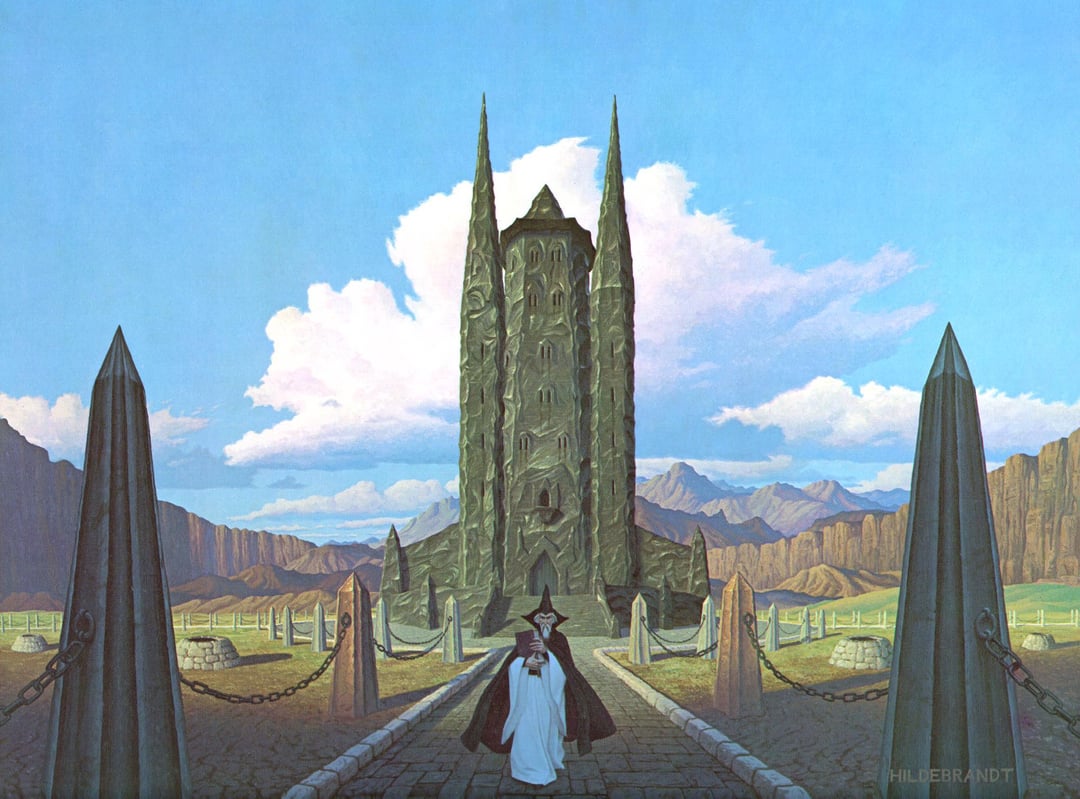
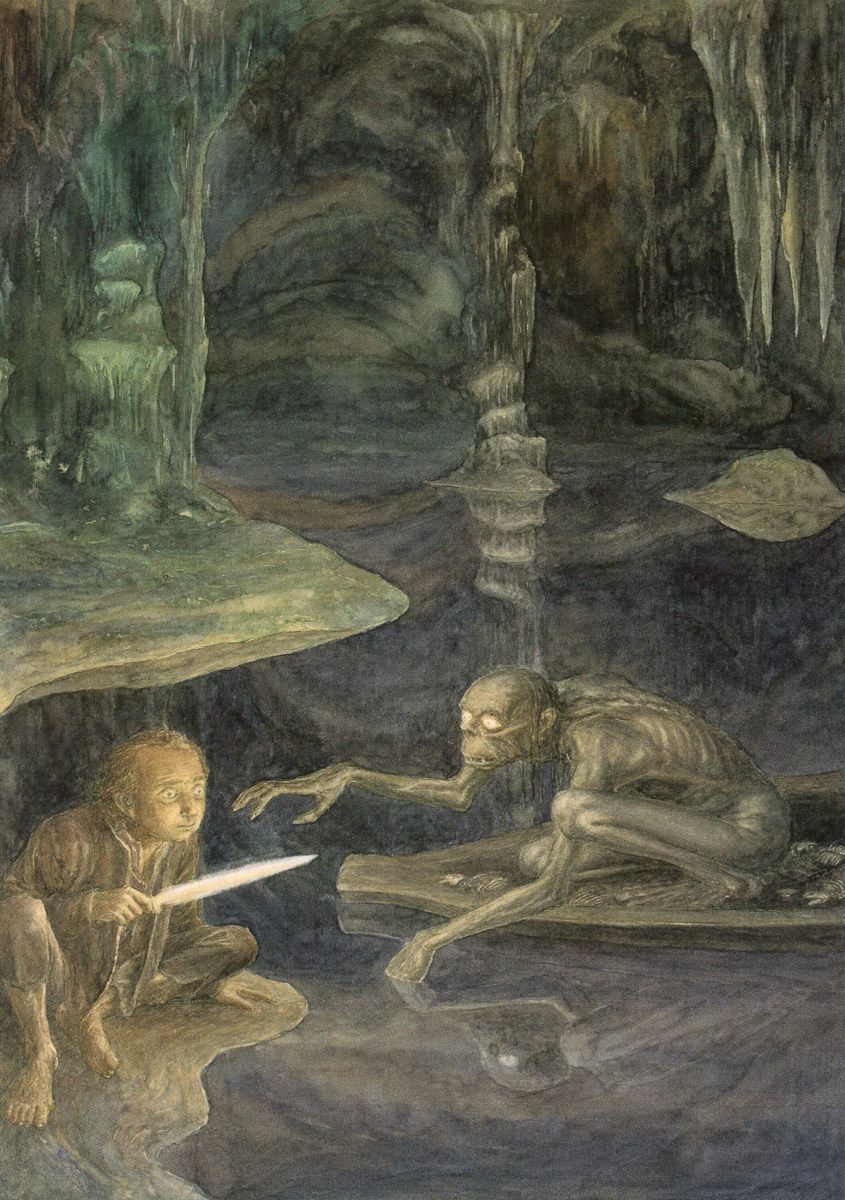
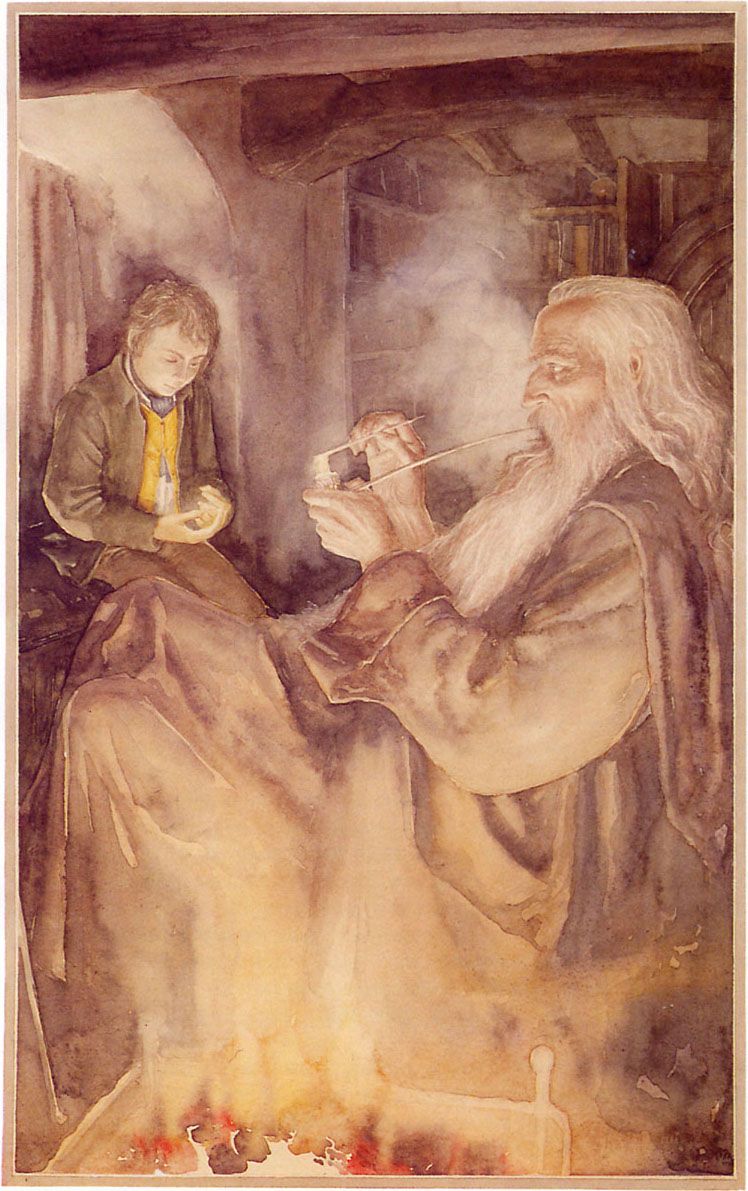
• About

doubtfulsea

~ adventure fantasy

Tag Archives: lotr

On the Roads Again—Once More

10 Wednesday Dec 2025

Posted by Ollamh in Uncategorized

≈ Leave a comment

Tags

Bilbo, Fantasy, Frodo, lotr, Minas Morgul, Mordor, Mt Doom, Orcs, Orodruin, Osgiliath, Roads, Sam, The Lord of the Rings, Tolkien, Udun

As always, dear readers, welcome.

“The Road goes ever on and on
Down from the door where it began.
Now far ahead the Road has gone,
And I must follow, if I can,
Pursuing it with eager feet,
Until it joins some larger way
Where many paths and errands meet.
And whither then? I cannot say.”

as Bilbo sings, on his way away from the Shire to Rivendell.

(JRRT)

We, however, are currently standing at the broken bridge

at Osgiliath,

(from The Encyclopedia of Arda)

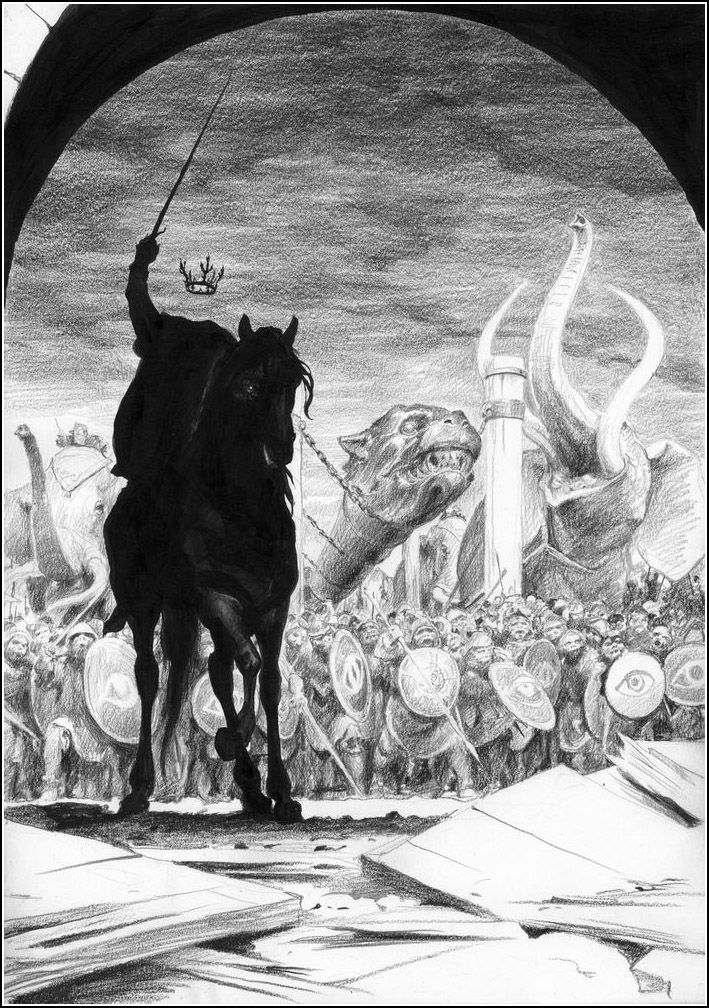
but, through the magic of the internet, we’ll hop over the Anduin and continue our journey along the roads of Middle-earth, this time to the worst possible place (unless you’re an orc)—

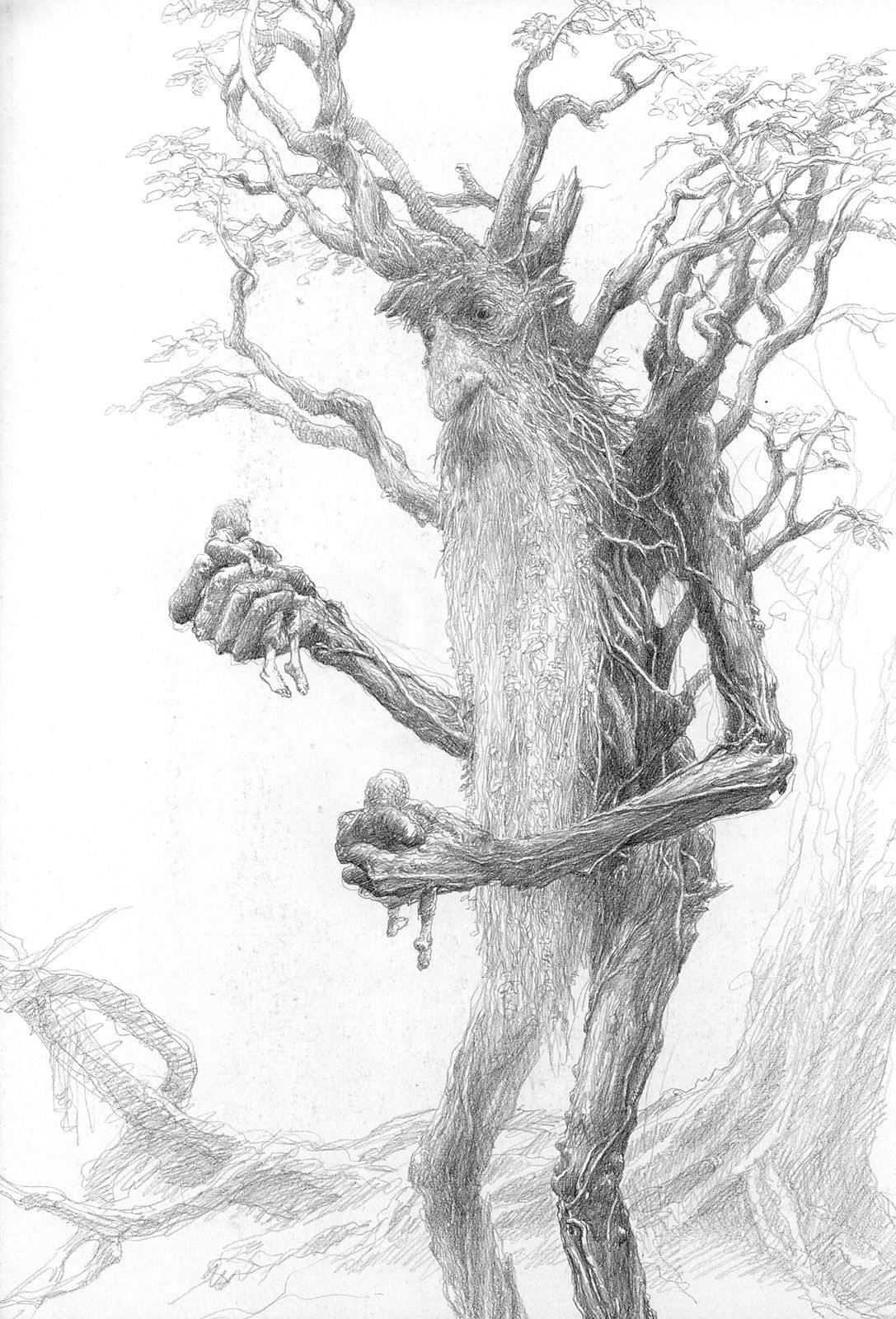
(Alan Lee)

Mordor.

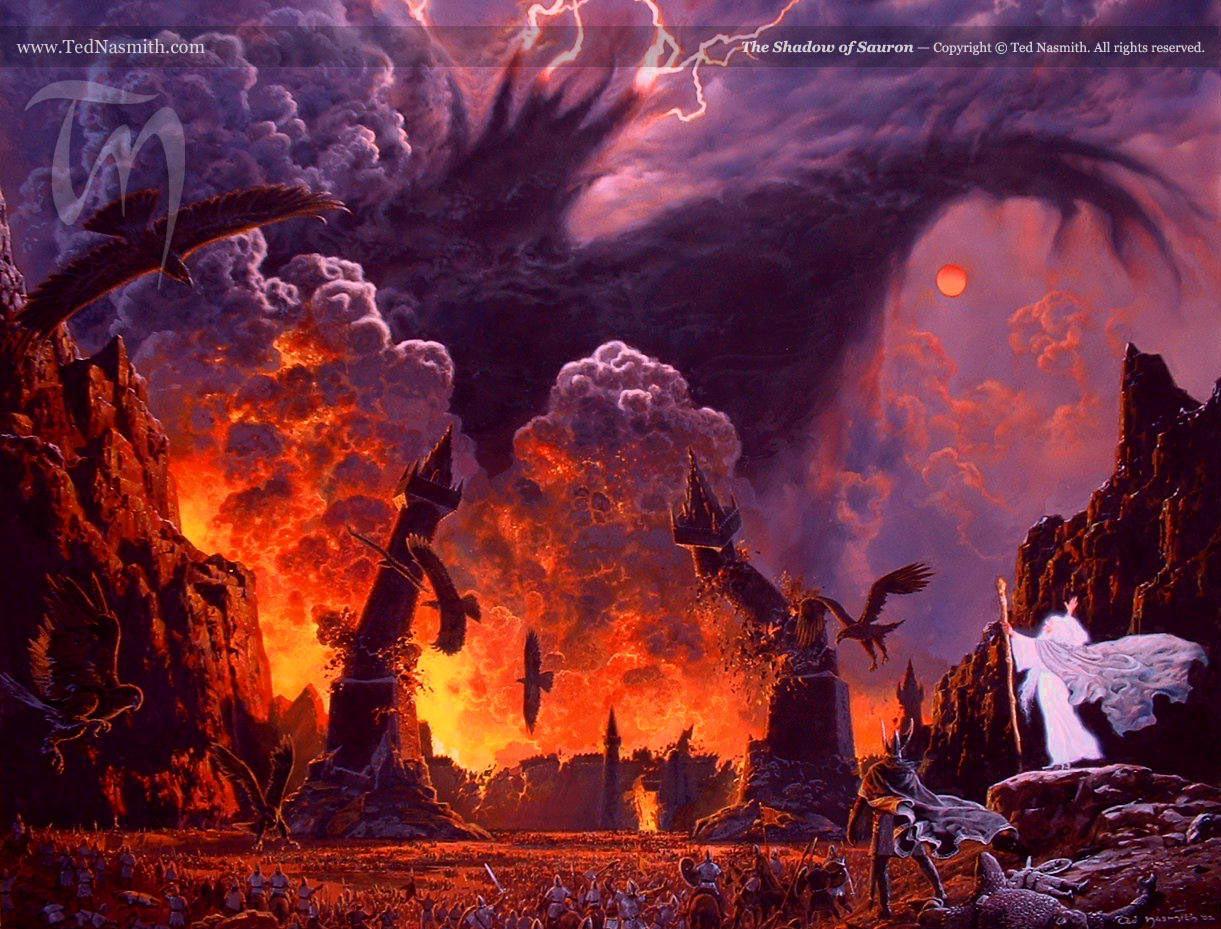
To get there, we walk the old road which, in the days before Sauron’s previous invasion attempt, ran from Minas Anor (the “ Tower of the Sun”—now Minas Tirith, “Tower of Guard”),

(Ted Nasmith)

to Minas Ithil (the “Tower of the Moon”)—now Minas Morgul  (the “Tower of Black Sorcery”).

(another Ted Nasmith)

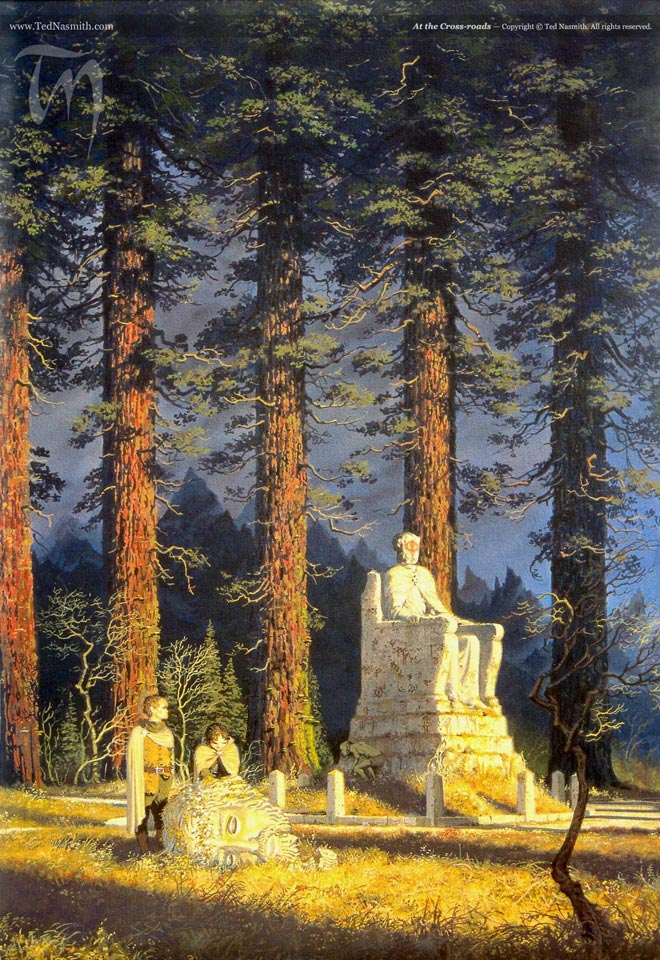
This will lead us eastwards to the crossing of the Ithilien north/south road, where there is a much- abused seated figure—

“The brief glow fell upon a huge sitting figure, still and solemn as the great stone kings of Argonath.  The years had gnawed it, and violent hands had maimed it.  Its head was gone, and in its place was set in mockery a round rough-hewn stone, rudely painted  by savage hands in the likeness of a grinning face with one large red eye in the midst of its forehead.  Upon its knees and mighty chair, and all about the pedestal, were idle scrawls mixed with the foul symbols that the maggot-folk of Mordor used.”  (The Two Towers, Book Four, Chapter 7, “Journey to the Cross-roads”)

(and one more Ted Nasmith.  Notice—except for the figure’s size, perhaps, which here wouldn’t be called “huge” nor its chair “mighty”—how carefully the artist has paid attention to the text—typical of Nasmith’s always fine work.)

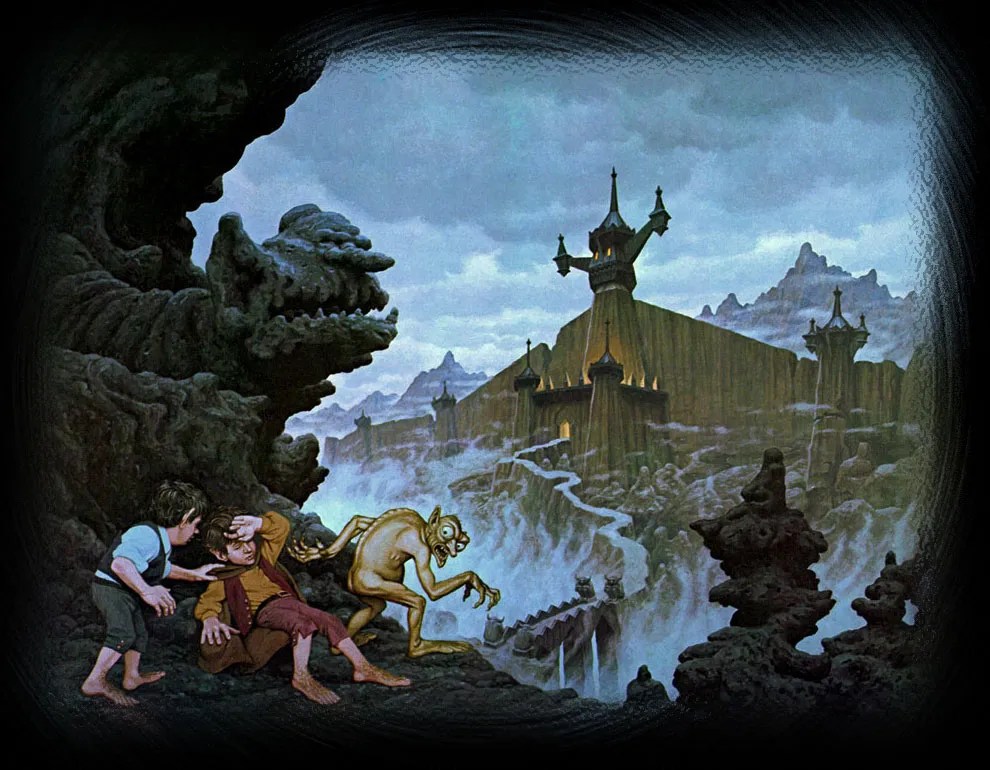
Frodo and Sam pause here, but we’ll keep moving eastwards on the road towards Minas Morgul.

(the Hildebrandts, with a very different view of it and of Gollum)

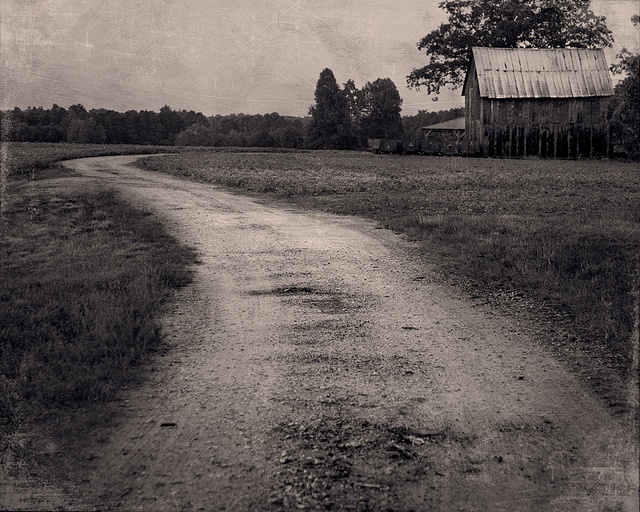
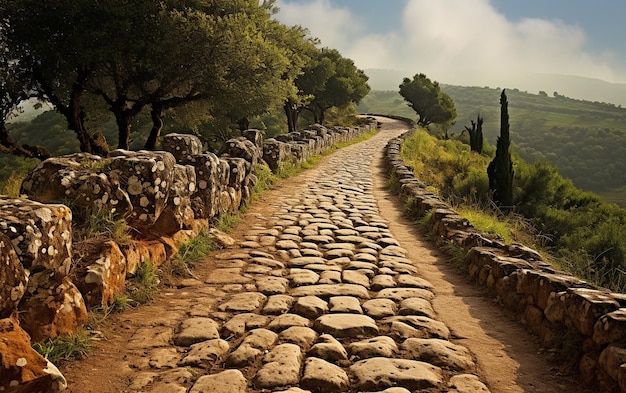
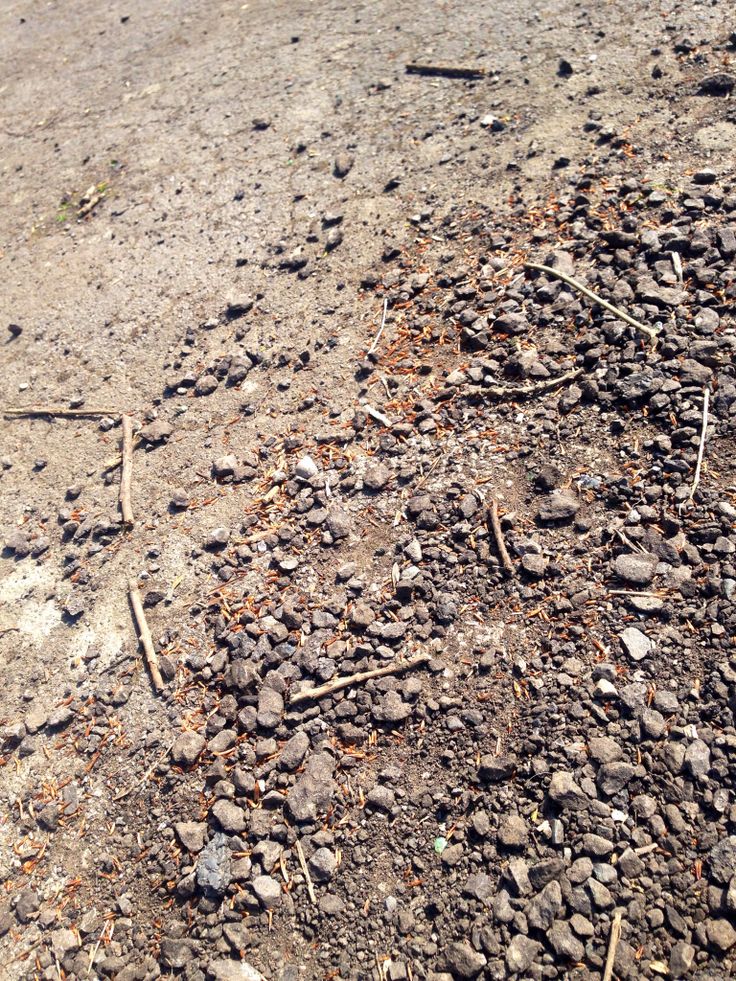
We don’t appear to have a description of this road, but, if you’ve read the previous postings on roads, you’ll know that I would like to imagine that it’s not just a worn dirt track,

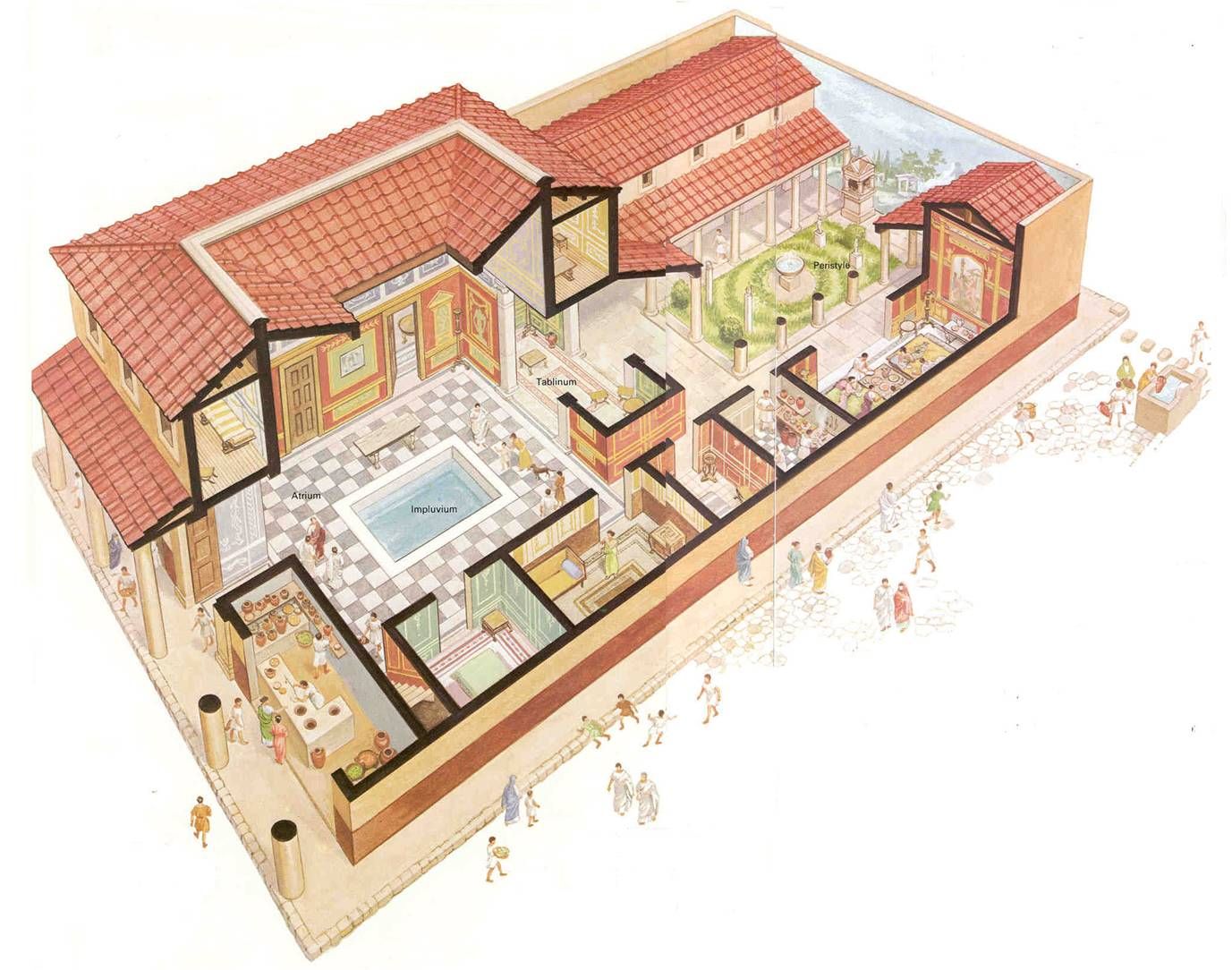
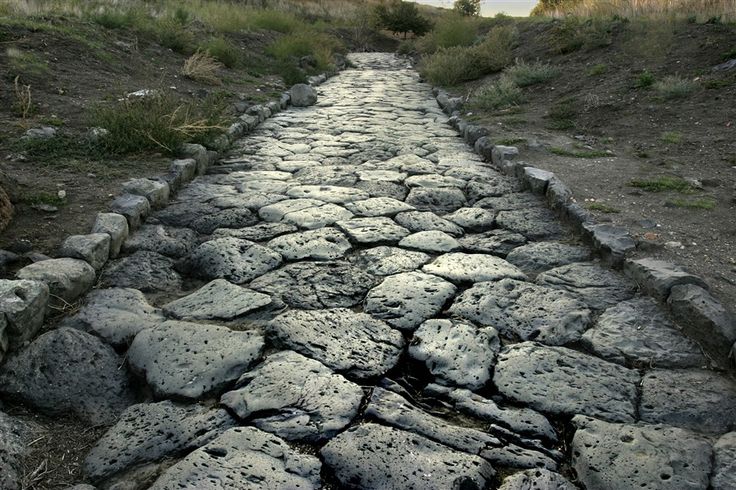
but the sort of thing which the Romans built all over their empire,

but now grassgrown and abandoned, like the figure at the crossroads.

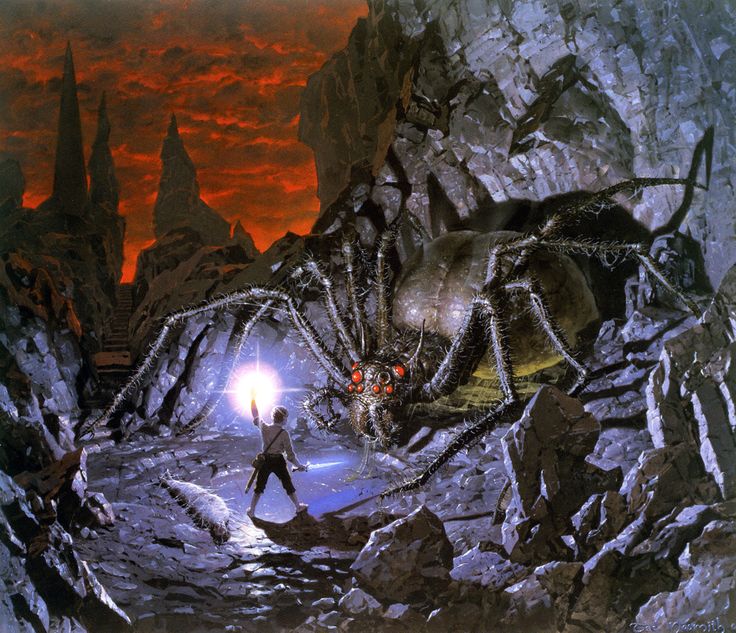
Frodo, Sam, and Gollum skirt Minas Morgul, climbing around it, and we’ll join them, although we’ll avoid the tunnel in which Shelob lives,

(and one more Ted Nasmith)

to come down into Mordor itself.

(Christopher Tolkien)

This is, to say the least, a very bleak place,

(in reality, this is Mt Haleakala National Park, on the island of Maui)

but it seems heavily populated with camps of orcs and Sauron’s allies.

“As far as their eyes could reach, along the skirts of the Morgai and away southward, there were camps, some of tents, some ordered like small towns.  One of the largest of these was right below them.  Barely a mile out into the plain it clustered like some huge nest of insects, with straight dreary streets of huts and long low drab buildings.”  (The Return of the King, Book Six, Chapter 2, “The Land of Shadow”)

(Alan Lee)

There are clearly roads, at least in the northern area—

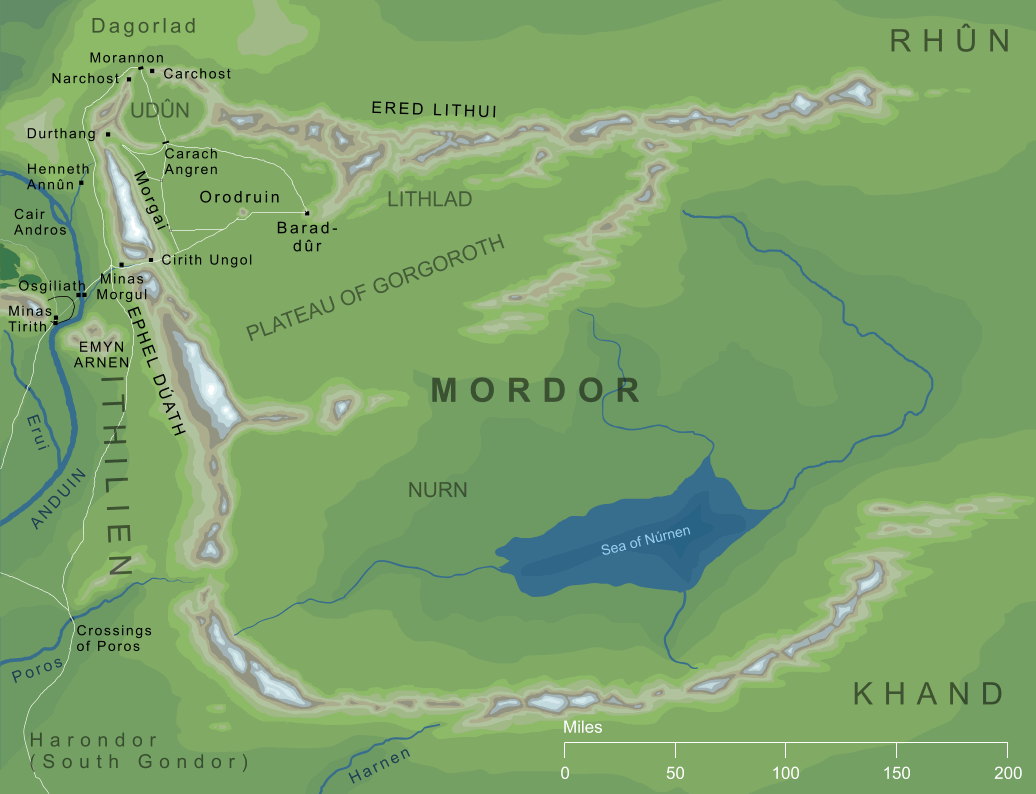
(from the Encyclopedia of Arda)

and when Frodo and Sam disguise themselves as orcs,

(Denis Gordeev)

they make their way along a major one, only to be taken for potential deserters and driven into an orc marching column.

(Denis Gordeev)

Before they reach such a road, however,

“…they saw a beaten path that wound its way under the feet of the westward cliffs.  Had they known, they could have reached it quicker, for it was a track that left the main Morgul-road at the western bridge-end and went down by a long stair cut in the rock to the valley’s bottom.” (The Return of the King, Book Six, Chapter 2, “The Land of Shadow”)

We’ll follow them down this path and eventually reach a road:

“…at the point where it swung east towards the Isenmouthe  twenty miles away.  It was not a broad road, and it had no wall or parapet along the edge, and as it ran on the sheer drop from its brink became deeper and deeper.”  (The Return of the King, Book Six, Chapter 2, “The Land of Shadow”)

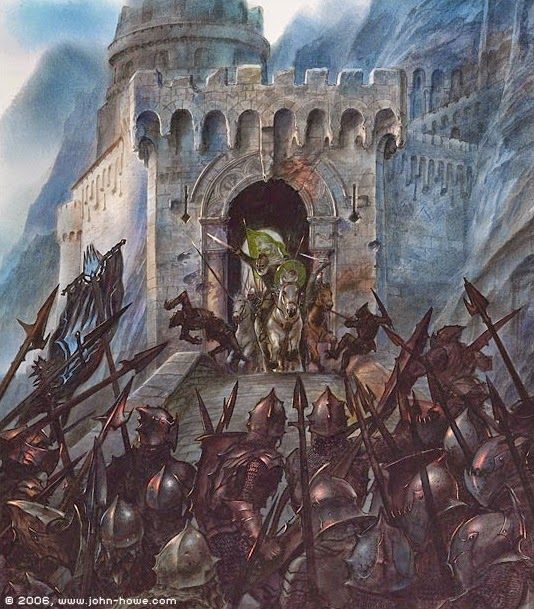
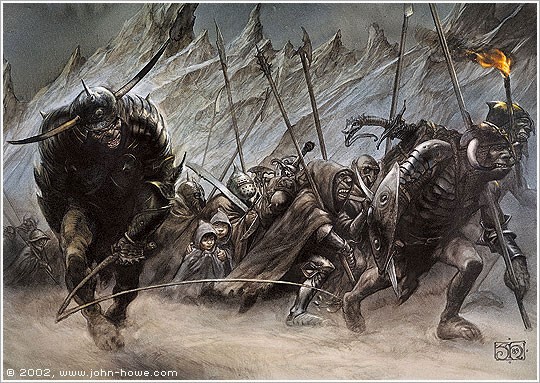
When Frodo and Sam are picked up and driven along in the column,

(John Howe)

we can now see that the column is headed for Isenmouthe and the entrance to the northernmost part of Mordor, Udun,

(from Karen Wynn Fonstad, The Atlas of Middle-Earth)

but the two manage to escape just before the entrance, dropping

“…over the further edge of the road.  It had a high kerb by which troop-leaders could guide themselves in black night or fog, and it was banked up some feet above the level of the open land.”  (The Return of the King, Book Six, Chapter 2, “The Land of  Shadow”)

(perhaps something like this on the right?)

Frodo and Sam now try cutting across open country, which, although full of places to hide, is hard going—

“As the light grew a little [Sam] saw to his surprise that what from a distance had seemed wide and featureless flats were in fact all broken and tumbled. “  (The Return of the King, Book Six, Chapter 3, “Mount Doom”)

The going, however, is simply too rough for them in their current condition, and they return to the road, as will we, approaching Orodruin (Mt. Doom), where, for the first time since finding a spring on the eastern slope of the Mountains of Shadow, they find water—

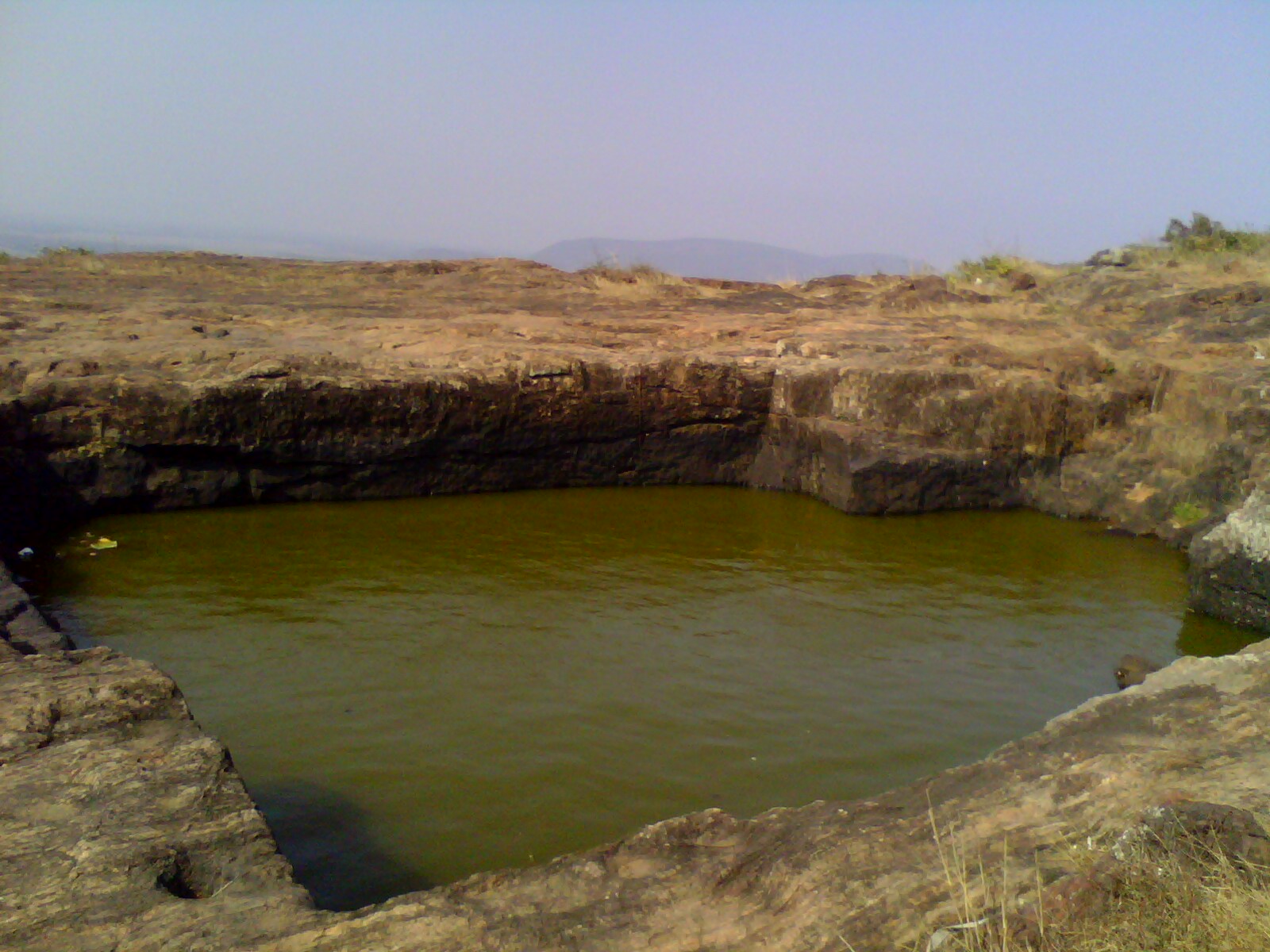
“All long ago would have been spent, if they had not dared to follow the orc-road.  For at long intervals on that highway cisterns had been built for the use of troops sent in haste through the waterless regions. 

In one Sam found some water left, stale, muddied by the orcs, but still sufficient for their desperate case.”   (The Return of King, Book Six, Chapter 3, “Mount Doom”)

Struggling to the foot of Mt. Doom (Orodruin), Sam discovers a path—our last road in this series of postings—which is actually part of Sauron’s road from the Barad-dur to the volcano.

(from the Encyclopedia of Arda)

“…for amid the rugged humps and shoulders above him he saw plainly a path or road.  It climbed like a rising girdle from the west and wound snakelike about the Mountain, until before it went round out of view it reached the foot of the cone on the eastern side.”  (The Return of King, Book Six, Chapter 3, “Mount Doom”)

Finally coming to the path, they find

“…that it was broad, paved with broken rubble and beaten ash” The Return of King, Book Six, Chapter 3, “Mount Doom”)

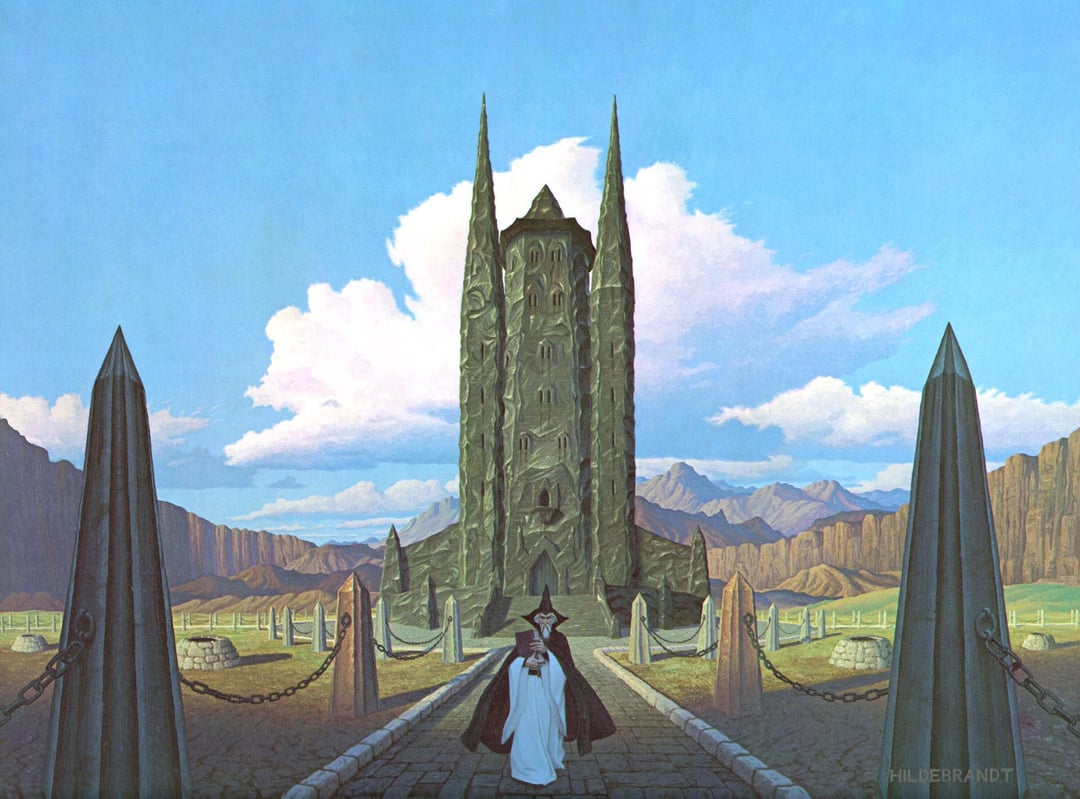
But, before the eagles come to rescue Frodo and Sam, we’ll take our own eagle back to the door where our roads began.

(the Hildebrandts)

As always, thanks for reading.

Stay well,

Remember how perilous it may be to step out your front door,

And remember, as well, that there’s always

MTCIDC

O

PS

For a bit more on the roads of Middle-earth, see:  https://thainsbook.minastirith.cz/roads.html

On the Road(s) Again

19 Wednesday Nov 2025

Posted by Ollamh in Uncategorized

≈ Leave a comment

Tags

Argonautica, Bilbo, Bree, Fantasy, Frodo, Gondor, Great East Road, Jason, Journey to the West, lotr, Tharbad, The Argonautica, The Bridge of Strongbows, the Greenway, The Hobbit, The Lord of the Rings, The Odyssey, the-great-east-road, Tolkien, Willie Nelson

“Just can’t wait to get on the road again
The life I love is makin’ music with my friends
And I can’t wait to get on the road again
And I can’t wait to get on the road again”

As always, welcome, dear readers.  This is from a Willie Nelson, a US country and western singer’s,

virtual theme song, and it seemed to fit where this posting wanted to go.

Having just written two postings about traveling to Bree, it struck me just how many Western adventure stories, as a main element of the plot, require the characters to travel, often long distances.  (I’m sure that there are lots of Eastern stories which do this, too—see, for example, Wu Cheng’en’s (attributed) Journey to the West, which appeared in the 16th century—see, for more:  https://en.wikipedia.org/wiki/Journey_to_the_West  You can read an abridged translation  of this at:  https://www.fadedpage.com/books/20230303/html.php ) 

Such adventures are commonly quests—that is, journeys with a particular goal and are commonly round- trip adventures.  (For more on quests, see:  https://en.wikipedia.org/wiki/Quest )

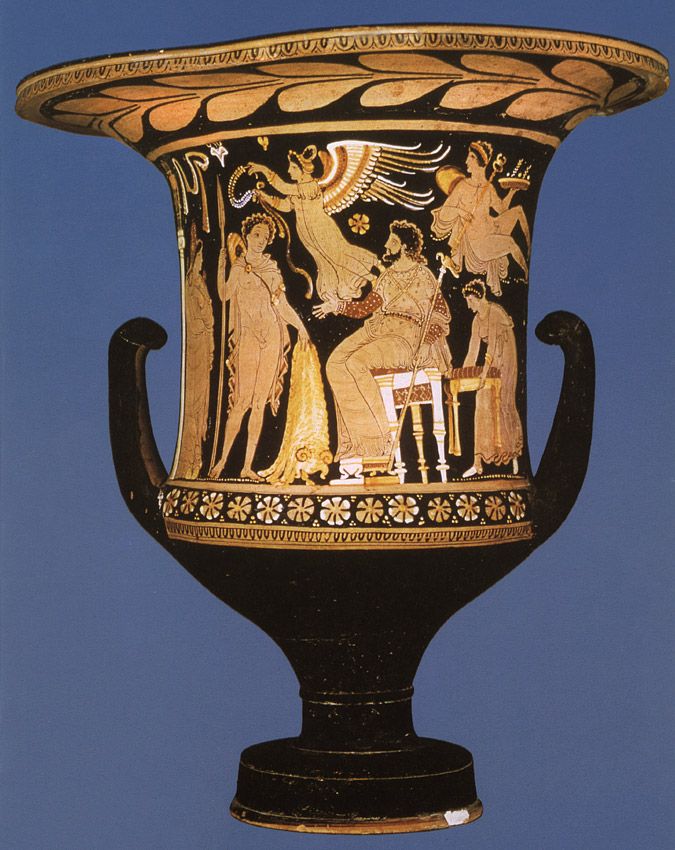
There are lots of folktales with this pattern, but the literary begins for us with the story of Jason, and his task of finding the Golden Fleece and bringing it back to Greece.  (You can read a summary of the story here:  https://en.wikipedia.org/wiki/Golden_Fleece  The full Greek version we have of the story is from a 3rd century BC poem, the Argonautica of Apollonius of Rhodes, which you can read in a translation here:  https://archive.org/details/apolloniusrhodiu00apol   And you can read about the poem itself here:  https://en.wikipedia.org/wiki/Argonautica  )

(Jason delivering the fleece to King Pelias—for more on Pelias, who is actually Jason’s uncle, see:  https://en.wikipedia.org/wiki/Pelias )

Then there’s the Odyssey, a later story, in mythological time, in which the main plot is that of Odysseus, a Greek and ruler of the island of Ithaka, who, having participated in the war against Troy, spends 9+ years of many adventures getting home to his island once more.

It’s no wonder, then, that Tolkien, originally destined to be a classicist, in telling a long story to his children, would make it a quest.

This quest would take the protagonist, Bilbo Baggins, from his home in the Shire hundreds of miles east, to the Lonely Mountain (Erebor) and back.

(Pauline Baynes—probably JRRT’s favorite illustrator—and whom he recommended to CS Lewis, for whom she illustrated all the Narnia books.  You can read about her here:  https://en.wikipedia.org/wiki/Pauline_Baynes )

In the last two postings, we first followed Bilbo eastwards to Bree—only to find that, in The Hobbit, there is no Bree.  We then retraced our steps and followed Frodo and his friends as they journeyed in the same direction, although this time with more success.

(Ted Nasmith)

Part of Frodo’s trip (with some detours), took him along the Great East Road, which ran through the Shire,

(Christopher Tolkien)

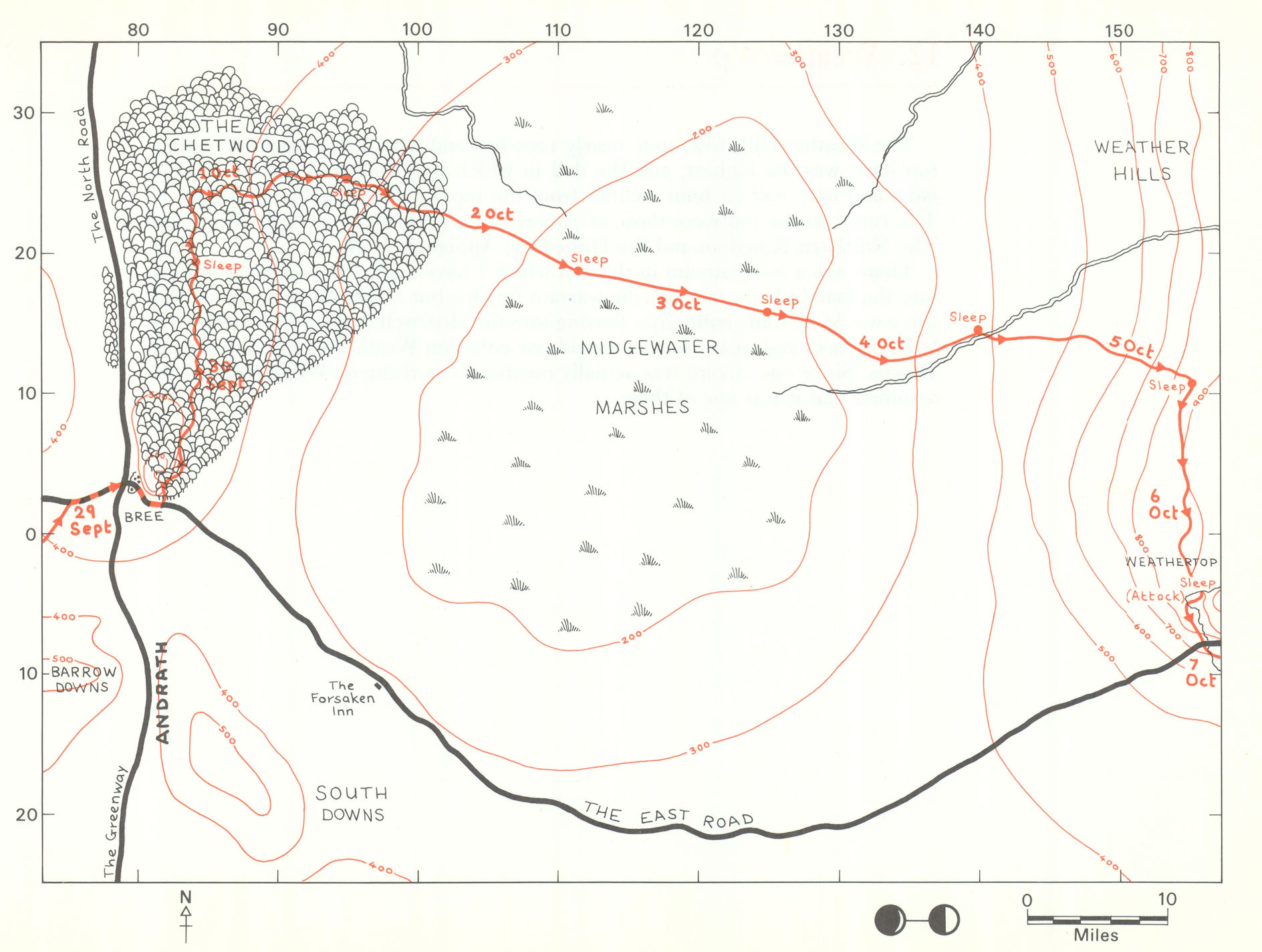
crossing the Greenway ( the old north/south road—more about this in a moment) at Bree and proceeding eastwards from there–

(Barbara Strachey, The Journeys of Frodo, 1981)

although Frodo and his friends, led by Strider,

(the Hildebrandts)

took an alternate route from there to Weathertop.

Because I’m always interested in the physical world of Middle-earth, I try to imagine what, in our Middle-earth, either suggested things to JRRT, or at least what we can use to try to reconstruct something comparable. 

For the Great East Road, because it was constructed by the kings of Arnor, and had a major bridge (the Bridge of Strongbows—that is, strong arches), across the Brandywine,

(actually a 16thcentury Ottoman bridge near the village of Balgarene in Bulgaria.  For more on Bulgarian bridges, some of which are quite spectacular, see:  https://vagabond.bg/bulgarias-wondrous-bridges-3120 )

I had imagined something like a Roman road, wide, paved, with perhaps drainage on both sides.

The Romans were serious engineers and roads could be very methodically laid out and built.

Latest research suggests that they may have constructed as many as almost 200,000 miles of roads (299,171km)—not all so elaborate, and some were doubtless improved local roads, but a vast number (see for more:  https://www.sciencealert.com/massive-new-map-reveals-300000-km-of-ancient-roman-roads ) were of the standard construction.

This may have been true once, but the road Frodo and his friends eventually reach doesn’t sound much like surviving Roman work—

“…the Road, now dim as evening drew on, wound away below them.  At this point it ran nearly from South-west to North-east, and on their right it fell quickly down into a wide hollow.  It was rutted and bore many signs of the recent heavy rain; there were pools and pot-holes full of water.”  (The Fellowship of the Ring, Book One, Chapter 8, “Fog on the Barrow-downs”)

Following the road, however, has made me consider just how many miles of roads we actually see in Middle-earth and over which various characters travel and how they might appear.  Just look at a map—

(cartographer? clearly based on JRRT and Christopher Tolkien’s map)

The Great East Road (named “East-West Road” there) is drawn and identified, and we can see the North Road (as “North-South Road”), but these are hardly the only roads in Middle-earth and certainly not in the story, and, as we’re following Frodo & Co. on their journeys, I thought that it would be interesting to examine some of the others—the main ones, and one nearly-lost one.

So, when Frodo and his friends eventually reach the edge of Bree, they’re actually at a crossroads—

“For Bree stood at the old meeting of ways:  another ancient road crossed the East Road just outside the dike at the western end of the village, and in former days Men and other folk of various sorts had traveled much on it.  ‘Strange as News from Bree’ was still a saying in the Eastfarthing, descending from those days, when news from North, South, and East could be heard in the inn, and when the Shire-hobbits used to go more to hear it.”

With the fall of the northern realm of Arnor about TA1974, however, things had changed:

“But the Northern Lands had long been desolate, and the North Road was now seldom used:  it was grass-grown, and the Bree-folk called it the Greenway.”  (The Fellowship of the Ring, Book One, Chapter 9, “At the Sign of the Prancing Pony”)

We’re not given a detailed description of this road—was it like what I had imagined the Great East Road might have looked like, Roman and paved, but overgown?

If so, it led back to the city of Tharbad to the south, which had had its own elaborate bridge at the River Greyflood—

“…where the old North Road crossed the river by a ruined town.”

Of this bridge we know:

“…both kingdoms [Arnor and Gondor] together built and maintained the Bridge of Tharbad and the long causeways that carried the road to it on either of the Gwathlo [Greyflood]…”  (JRRT Unfinished Tales, 277)

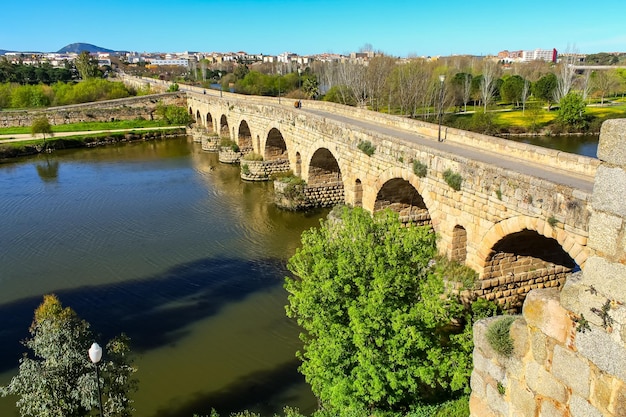
It must have been massive—could it have looked something like this?

(the 1ST century Roman bridge at Merida, Spain—you can read about it here:  https://en.wikipedia.org/wiki/Puente_Romano,_M%C3%A9rida )

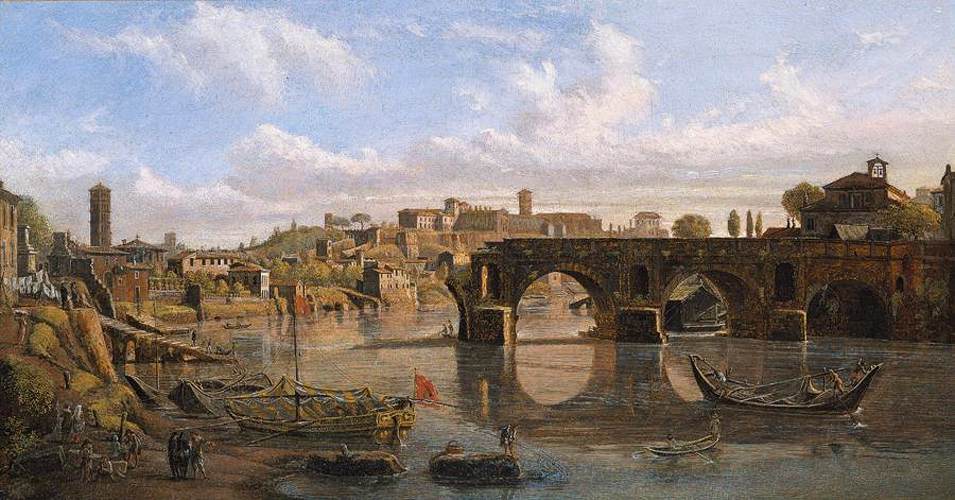
As we also know, it had fallen into ruin, becoming only a dangerous ford, as Boromir found out, losing his horse there on the way north (The Fellowship of the Ring, Book Two, Chapter 8, “Farewell to Lorien”)

(the “Ponte Rotto” (“ruined bridge”) actually the 2nd century BC Pons Aemilius.  You can read about it here:  https://en.wikipedia.org/wiki/Pons_Aemilius  This is a 1690 painting by Caspar van Wittel, a very interesting and talented man, and you can read about him here:  https://en.wikipedia.org/wiki/Caspar_van_Wittel   )

We’ll pause here, however, waiting, perhaps, for a drought,

before we continue down the road towards Gondor…

Thanks for reading, as always.

Stay well,

Don’t cross any bridge till you come to it,

And remember that there’s always

MTCIDC

O

Going Around in Cycles

17 Wednesday Sep 2025

Posted by Ollamh in Uncategorized

≈ Leave a comment

Tags

Barrow-wight, Finnegans Wake, Giambattista Vico, goblin king, James Joyce, La Scienza Nuova, lotr, Mirkwood spiders, Nazgul, Ouroboros, Palantir, runes, Shelob, swords, The Hobbit, The Lord of the Rings, The Return of the King, Tolkien, Tom Bombadil, Yogi Berra

“It’s déjà vue all over again.”

(attributed to Yogi Berra, US baseball player, but see:  https://quoteinvestigator.com/2013/10/08/deja-vu-again/ )

Dear readers, as always, welcome.

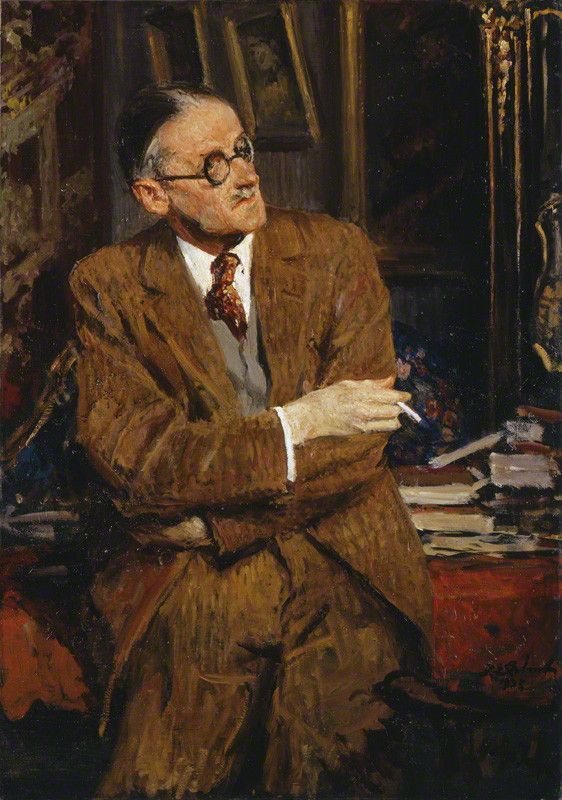
In later life, James Joyce, 1882-1941,

was interested in the work of the 17-18th-century philosopher (among other things) Giambattista Vico, 1668-1744,

and his idea that history followed a definite repeated pattern in three ages, Divine, Heroic, and Human, posited in his 1725-1744 work, La Scienza Nuova (“the new understanding, knowledge, learning”).

(For more on Vico, see:  https://www.philosopheasy.com/p/the-eternal-return-giambattista-vicos  This is, potentially, a very large subject, and even more so when Joyce is combined with Vico.  For an introductory view, see:  https://archive.org/details/vicojoyce00vere_0/page/n5/mode/2up ) 

Joyce incorporated his understanding of Vico in his last work, Finnegans Wake, 1939, in which

the idea of repeated patterns cycling throughout appears in the very opening—and closing– lines of the book:

“A way a lone a last a loved a long the / riverrun, past Eve and Adam’s, from swerve of shore to bend of bay, brings us by a commodius vicus of recirculation back to Howth Castle and Environs.” 

which, in fact, are reversed, the opening of the book being:

“…riverrun, past Eve and Adam’s, from swerve of shore to bend of bay, brings us by a commodius vicus of recirculation back to Howth Castle and Environs…”

and the last words of the book are:

“A way a lone a last a loved a long the…”

so that, by joining them, we have the effect of the serpent Ouroboros, tail/tale joined to mouth—and the book can begin again.

(For more on Finnegans Wake, see:  https://en.wikipedia.org/wiki/Finnegans_Wake  For more on the serpent, see:   https://en.wikipedia.org/wiki/Ouroboros )

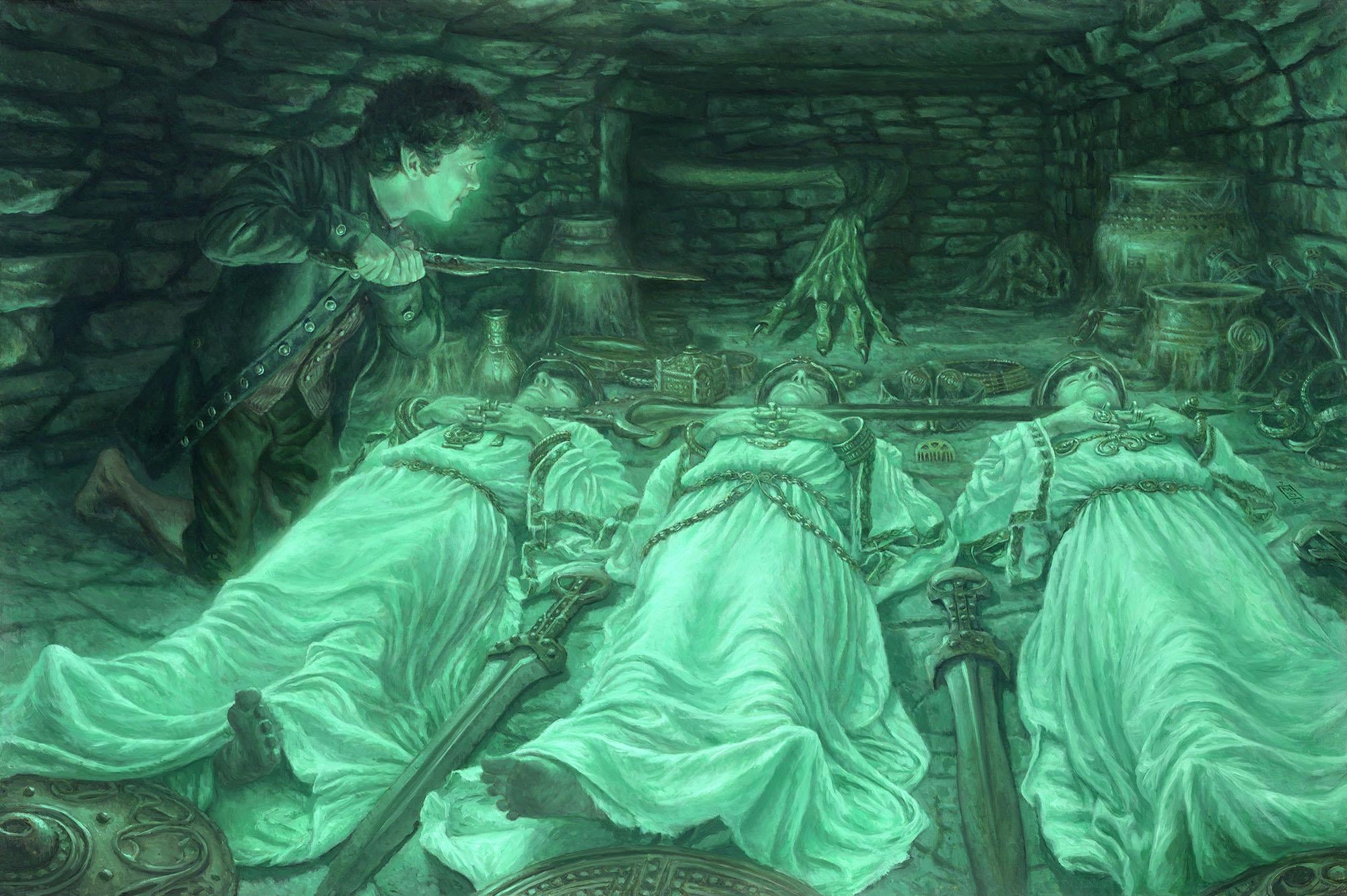
I’ve always thought that leaving Tom Bombadil and the Barrow-wight

(Matthew Stewart—see more of his work here:  https://www.matthew-stewart.com/  See, in particular, his Middle-earth work, but then go through his other galleries to view his impressive ability to capture other imaginary worlds.)

out of the first Lord of the Rings film was a mistake, even though Tolkien himself once wrote:

“Tom Bombadil is not an important person—to the narrative.”  (letter to Naomi Mitchison, 25 April, 1954, Letters, 268—but read on, as JRRT has much more to say and, to my mind, justifies his position in the narrative, in fact, in a spiritual way.)

Tom is interesting in himself, being a kind of parallel for Treebeard, among other things (and the writers of the Rings of Power series thought highly enough of him to include him in their telling), but, for me, in the narrative, it’s what he gives them, particularly Merry, which is important—

“For each of the hobbits he chose a dagger, long, leaf-shaped, and keen, of marvelous workmanship…”

(probably something like this, but more elaborately-worked)

‘Old knives are long enough as swords for hobbit-people,’ he said…Then he told them that the blades were forged many long years ago by Men of Westernesse:  they were foes of the Dark Lord, but they were overcome by the evil king of Carn Dum in the Land of Angmar.”  (The Fellowship of the Ring, Book One,  Chapter 8, “Fog on the Barrow-downs”)

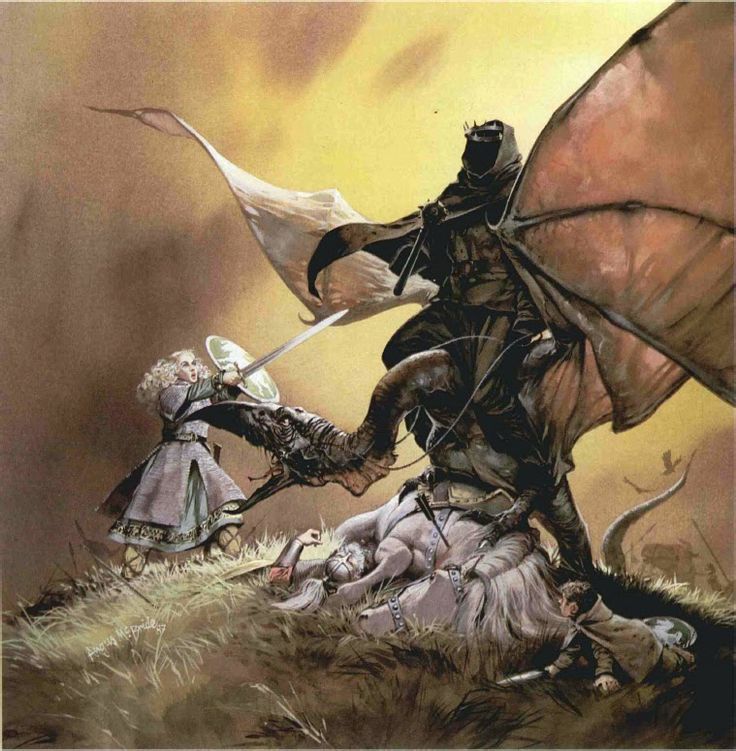
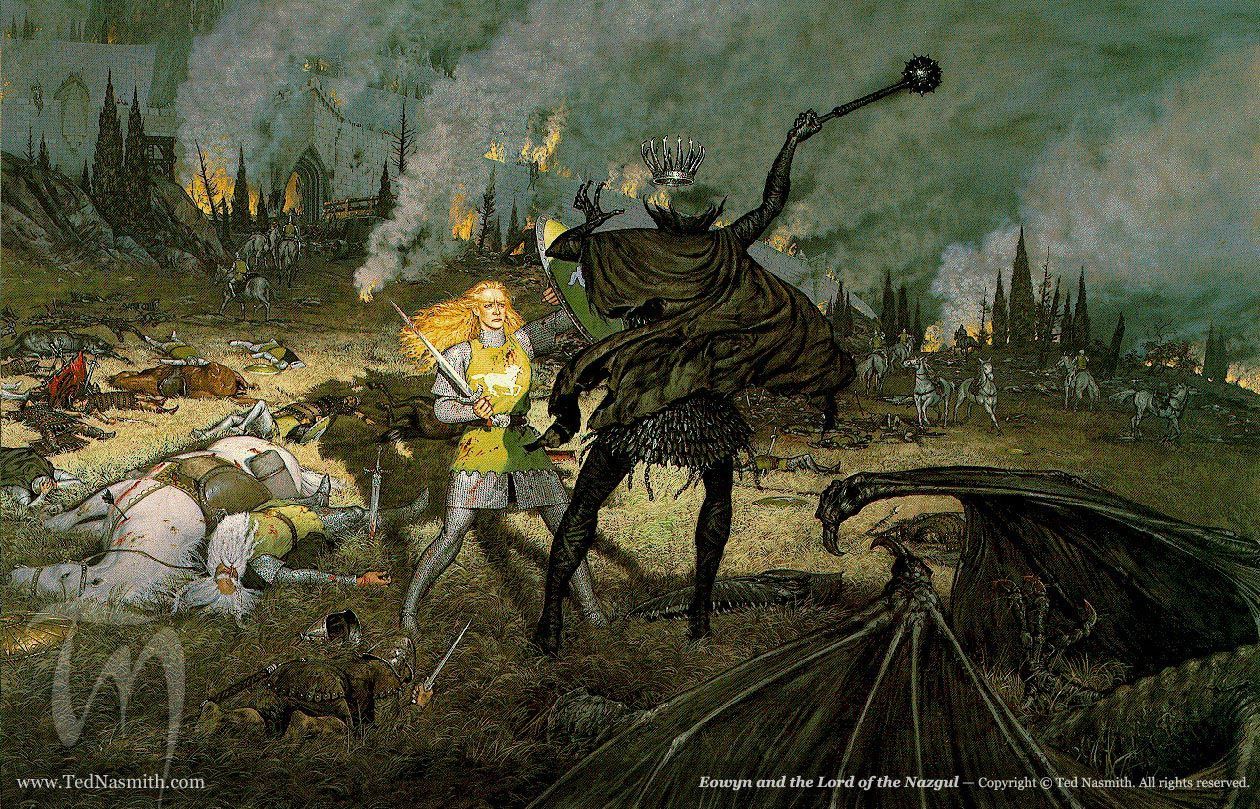
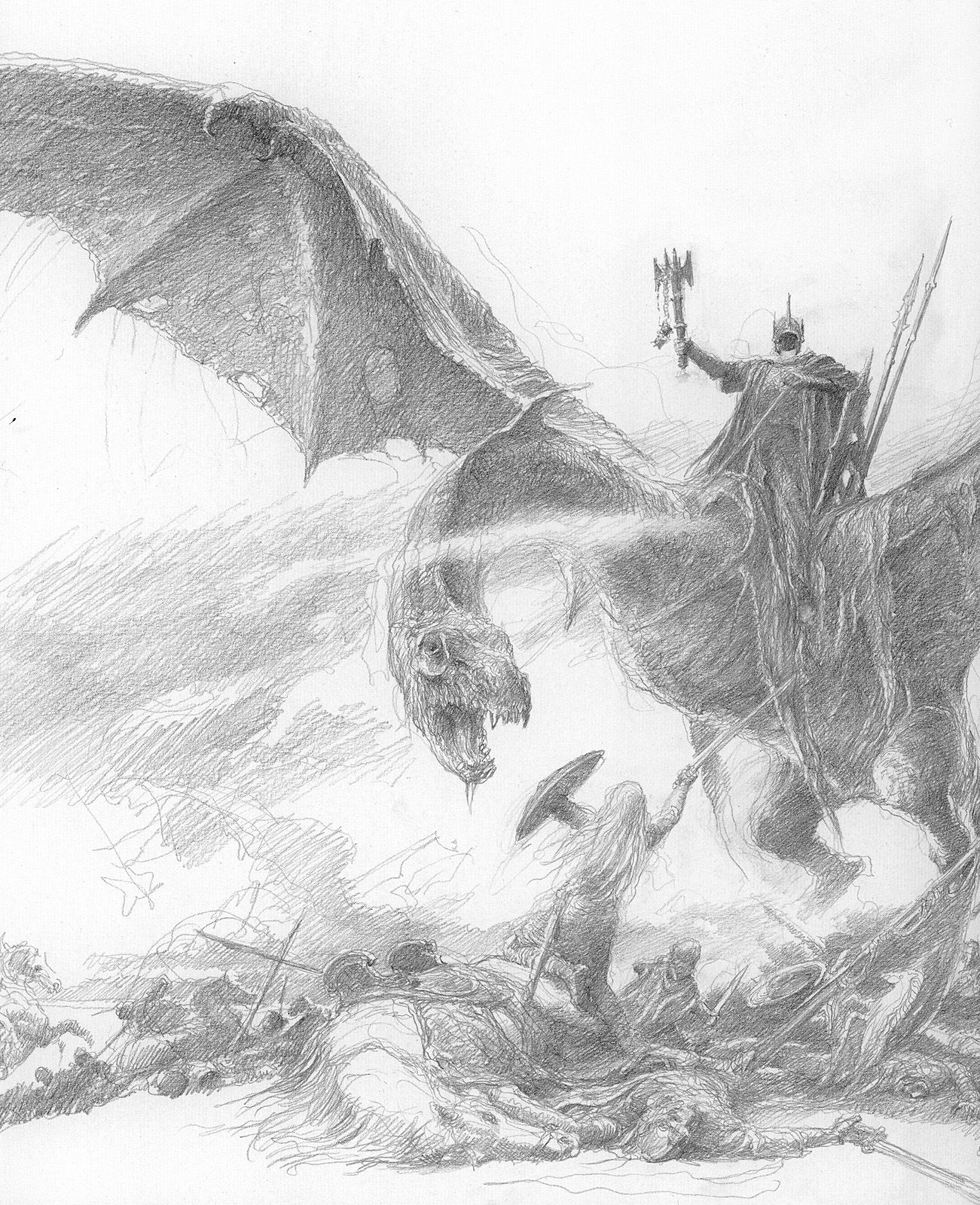
This is, of course, the weapon  which Merry uses to stab the chief of the Nazgul while he’s attacking Eowyn, the Nazgul being the very witch-king who had overcome the Men of Westernesse so long before.

(Ted Nasmith)

To keep Tom and the Barrow-wight in the film is then to underline the cyclic nature of much of the story.

 This unnamed but crucial sword is only one of the swords scattered throughout the later story of Middle-earth, however, and there is a cyclic potential for others, as well.

Think of the swords which Gandalf and Co. find in the trolls’ hideout in The Hobbit—

“…and among them were several swords of various makes, shapes, and sizes.  Two caught their eyes particularly, because of their beautiful scabbards and jeweled hilts…

‘These look like good blades,’ said the wizard, half drawing them and looking at them curiously.  ‘They were not made by any troll, nor by any smith among men in these parts and days; but when we can read the runes on them, we shall know more about them.’ “ (The Hobbit, Chapter Two, “Roast Mutton”)

In the next chapter, Elrond then identifies them:

“Elrond knew all about runes of every kind.  That day he looked at the swords they had brought from the trolls’ lair, and he said:  ‘These are not troll-make.  They are old swords, very old swords of the High Elves of the West, my kin.  They were made in Gondolin for the Goblin-wars.  They must have come from a dragon’s hoard or goblin plunder, for dragons and goblins destroyed that city many ages ago.  This, Thorin, the runes name Orcrist, the Goblin-cleaver in the ancient tongue of Gondolin; it was a famous blade.  This, Gandalf, is Glamdring, a Foe-hammer that the king of Gondolin once wore.’ “ (The Hobbit, Chapter Three.  “A Short Rest”)

And you’ll remember that Gandalf runs the king of later goblins through in the next chapter with that very sword:

“Suddenly a sword flashed in its own light.  Bilbo saw it go right through the Great Goblin as he stood dumb-founded in the middle of his rage.  He fell dead, and the goblin soldiers fled before the sword shrieking into the darkness.”  (The Hobbit, Chapter Four, “Over Hill and Under Hill”)

(Alan Lee)

The knife which Bilbo picks up from the trolls’ hoard “only a tiny pocket-knife for a troll, but it was as good as a short sword for the hobbit”, comes in handy later in The Hobbit, when Bilbo uses it to kill some of the spiders of Mirkwood,

(Oleksiy Lipatov—you can see more of his work here:  https://www.deviantart.com/lipatov/gallery/85631839/old-comic  )

but it will reappear many years later in The Lord of the Rings, when Frodo and Sam use it against another ancient evil, Shelob–

(Ted Nasmith again—and, unusually for his work, just plain weird—but vivid!)

Perhaps the most consequential sword  to return, however, is that which maimed Sauron many centuries ago, causing him to lose the Ring, and which, reforged, Aragorn shows him in Saruman’s palantir

(the Hildebrandts)

(itself appearing from a far older world, being as Aragorn says, “For this assuredly is the palantir of Orthanc, from the treasury of Elendil, set here by the Kings of Gondor.”  The Two Towers, Book Three, Chapter 11, “The Palantir”):

“…The eyes in Orthanc did not see through the armour of Theoden; but Sauron has not forgotten Isildur and the sword of Elendil.  Now in the very hour of his great designs the heir of Isildur and the Sword are revealed; for I showed the blade re-forged to him.  He is not so mighty yet that he is above fear; nay doubt ever gnaws him.”  (The Return of the King, Book Five, Chapter 2, “The Passing of the Grey Company”)

And there are more cyclings.

Consider the Ring itself:  forged in the fires of Mt Doom, it is eventually returned there and destroyed,

(another Ted Nasmith)

which causes the final end of Sauron, after several ages of struggle,

(and one more Ted Nasmith–and who better to paint a cataclysm?)

and which, in turn, brings the—return of the King.

(Denis Gordeev–and note that the artist has painted Aragorn’s crown as depicted by Tolkien in a letter to Rhona Beare, 14 October, 1958, see Letters, 401.)

After thinking about this, I can see that there are even more cyclic events, like the movement of the elves westwards, and  Gandalf traveling the same way, originally sent eastwards to oppose Sauron,

(one more Ted Nasmith)

but I think that this is enough for one posting—though considering all of the cycles I’ve already identified,  I’ll end with another (supposed) quotation from Yogi Berra:

Thanks, as always, for reading.

Stay well,

Remember one more piece of Yogi wisdom

And remember, as well, that there’s always

MTCIDC

O

Starre-crost

25 Wednesday Jun 2025

Posted by Ollamh in Uncategorized

≈ Leave a comment

Tags

Beowulf, Bilbo, Cirdan, Dorothy, Fantasy, Gandalf, Herakles, Kansas, King Arthur, lotr, Mulan, Narya, Rings of Power, Superman, The Grey Havens, The Hobbit, The Rings of Power, Tolkien, tornado, Valar

As always, dear readers, welcome.

In adventure stories, heroes—and heroines– seem to appear in all sorts of ways.

Sometimes, it seems that they are just born for adventure, like Herakles, who,

although apparently the offspring of two mortals, Alkmene and Amphitryon, was actually the son of Zeus.

Others belong to noble families, where heroism is expected of them, like Beowulf, nephew of the king of the Geats.

(Here, meeting the Danish coastguard—but we just can’t escape those Wagnerian winged helmets, can we?)

Then there is Mulan, who, pretending to be a man, replaces her father in the army and serves valiantly for twelve years.

(As you can see from the label, this comes from a site called “Chinese Posters.net”—and it’s quite a site:  5100 propaganda posters from the Chinese past.  Here’s the address:  https://chineseposters.net/ For more on the original but probably fictional Mulan, see:  https://www.worldhistory.org/article/1596/mulan-the-legend-through-history/ and https://mulanbook.com/pages/northern-wei/ballad-of-mulan/ and https://en.m.wikisource.org/wiki/Translation:Ballad_of_Mulan –two versions of the early “Ballad of Mulan)

A common motif is that of the apparent good-for-nothing—or at least for not much—who turns out to be of heroic material.  I immediately think of King Arthur, who is, basically, a servant until he fetches that sword from the stone/anvil.

Heroes and heroines, then, can be anything from a demigod to a nobleman to a good girl who loves her father to a good-for-nothing who is more than he seems, and set out on adventures or, as in the case of Arthur, adventure finds them.

Ordinary—or seemingly ordinary—people can also be pulled into adventures, as Bilbo is.

(the Hildebrandts)

Then there are people who are literally dropped into adventures,

(WW Denslow)

sometimes beginning those adventures in a very dramatic—and ultimately decisive—way.

Dorothy, of course, has been whirled by a tornado from Kansas to Oz,

(from the 1939 film)

but, when she arrives in Oz in the film, Glinda, the Good Witch of the North

(also from the film)

sings:

“Come out, come out, wherever you are and meet the young lady

Who fell from a star.

She fell from the sky, she fell very far and Kansas, she says,

Is the name of that star.”

Not true, of course, of Dorothy, (although Kansas has its beauties, no doubt), but it is true of another hero, Superman,

who had been shipped in a rocket by his parents from the dying planet, Krypton, and discovered in a field by Ma and Pa Kent, who would become his foster parents.

If you read this blog regularly, you know that I don’t find negative reviews which are nothing but hatchet jobs

at all helpful and, in my own reviews, I try to understand what it is that the creators attempted to do and react to that, being aware, of course, that I do have my own perspective on things.  I also buy DVDs of everything I can, so that I can watch things more than once before I review. 

I’ve now seen “Rings of Power”, both seasons,

only once, so I’m not going to attempt to review the whole two seasons here.  Certainly there have been some very impressive visuals and some very good acting.  I’m not sure how I feel about the two as a whole—some of the plot I found rather confusing and I’m not sure how I feel about proto-hobbits with Irish accents, although the idea of using proto-hobbits was, I thought, pretty ingenious—but I want to end this posting by talking about Gandalf.

He first appears—like Dorothy in Oz, but even more so like the baby Superman, in a dramatic fashion, having been conveyed in which appears to be a kind of meteor which roars across the sky and slams into the earth, leaving a fiery crater.

(Thank goodness that, whoever sent him, dressed him in underpants so that he wouldn’t embarrass himself or us when he stood up.)

At first, he seems stricken and quite clueless, not even really having language at first, although certainly having great powers, and it takes two seasons for him to begin to understand himself and what he’s been sent to do and I suspect that this stricken quality comes from a hint in Christopher/JRR Tolkien’s Unfinished Tales, where, under “The Istari” we find:

“For it is said indeed that being embodied the Istari had need to learn much anew by slow experience…” (Unfinished Tales, 407)

I understand that the creators of the series were somewhat hampered in their work—should they want to be as faithful as possible to Tolkien—because they were restricted in their sources, being confined, in this case, to The Lord of the Rings and its appendices.  And, at first glance, the appearance in Middle-earth of the Istari does seem rather vague.

In Appendix B, “The Third Age”, of The Lord of the Rings, we read:

“When maybe a thousand years had passed, and the first shadow had fallen on Greenwood the Great, the Istari or Wizards appeared in Middle-earth.  It was afterwards said that they came out of the Far West and were messengers sent to contest the power of Sauron, and to unite all those who had the will to resist him…” 

No meteors are mentioned, but no other means of transport, either, yet turn the page and we then read:

“Gil-galad before he died gave his ring to Elrond; Cirdan later surrendered his to Mithrandir (aka Gandalf).  For Cirdan saw further and deeper than any other in Middle-earth, and he welcomed Mithrandir at the Grey Havens, knowing whence he came and wither he would return.”  

If you know The Lord of the Rings, you know that the Grey Havens is a seaport on the west coast of Middle-earth:  it’s where Gandalf and others, including Frodo, depart for the Uttermost West—that is, Valinor.

(Ted Nasmith and a gorgeous view)

In fact, it was the Valar who had sent the Istari in the first place, as we know from Unfinished Tales, 406:

“For with the consent of Eru they sent members of their own high order, but clad in bodies as of Men, real and not feigned…”

And thus, from the source to which I’m informed the creators were confined, they would have learned that the Istari had sailed to Middle-earth, not been shot across the sky like Dorothy or Superman.  Why make such a change, especially as, because Cirdan recognizes Gandalf’s worth, he gives him one of the original Elvish rings, Narya, which turns up on his hand in the subsequent The Lord of the Rings?

The title of this posting is a quotation from Shakespeare, from the prologue to “An EXCELLENT conceited Tragedie OF Romeo and Juliet” (as the First Quarto title page reads) in which the Prologue says of the protagonists:  “A paire of starre-crost Louers tooke their life”. 

The creators of The Rings of Power, even with evidence available to them, have veered away from that evidence with no explanation as to why they have made such a choice.  What else may they have chosen to change and how might that affect JRRT’s view of the earlier history of Middle-earth, as well as ours?

As I begin my second viewing of The Rings of Power, then, I’ll be curious to see if another Shakespeare quotation, this from “The Tragedie of Julius Caesar”, Act 1, Scene 1, when Cassius, the leader of the plot against Julius Caesar, is trying to persuade Brutus to join him, may apply to the creators and their work:

“The fault (deere Brutus) is not in our Starres,

But in our Selues…”

Thanks, as always, for reading.

Stay well,

Think about what Cassius is telling us about horoscopes,

And remember that, as always, there’s

MTCIDC

O

To Horse!

18 Wednesday Jun 2025

Posted by Ollamh in Uncategorized

≈ Leave a comment

Tags

Agincourt, bicycle, Boer War, cavalry charges, Charge of the Light Brigade, Cu Chulainn, Dwarves, Fredegunda, Gregory of Tours, heavy artillery, Historia Francorum, Hobbits, horses, King Edward's Horse, lotr, machine gun, machine-guns, Nazgul, Normans, Pegasus, Rohirrim, Russian Civil War, signals officer, Sleipnir, The Hobbit, Tolkien, Valkyries

In a colleague’s office, I once saw this on his wall—

“Proletariat, to horse!”

It’s a recruiting poster from the Russian civil war (1918-1922), showing the Reds trying to raise cavalry for their armies, but, at the time this call came, the military world was changing and, although horsemen would still appear, very sporadically, on battlefields, for some years to come, the day of events like this—

was rapidly coming to a close.

It didn’t happen all at once, however.  As you can imagine, traditional cavalrymen—those who believed that swinging a sword in a valiant charge was the point of cavalry—

fought back.  The evidence was against them, however, in two ways.

First, in the case of the British, there had been the Boers,

with whom the British had fought a war, from 1899-1902.  The Boers (Dutch for “farmers”) had been militia—men obliged by law to defend the state upon demand.  Across the wide open spaces of so much of South Africa, they had fought as mounted infantry, using horses as a means of moving from place to place, then dismounting for combat and, if things didn’t go their way, mounting up and escaping.

To counter this, especially in the later phases of the war, the British were forced to develop their own mounted infantry,

which suggested to some military theorists at the time that the wave of the future was not in sword-swingers, but in riflemen, who could rapidly move to where they were needed, but employ horses for transport, not for gallant charges.  (This also led to the rise of units mounted entirely on bicycles,

but we can imagine the off-road difficulties for early machines and, although there were bicycle units as late as WW2, they never had the popularity—or the dash—of horsemen.)

The second piece of evidence lies in technological change. 

With the coming of the 20th century, machine guns, sometimes firing as many as 600 rounds (shots) per minute,

appeared in increasing numbers and artillery was developed to become more accurate at greater distances.

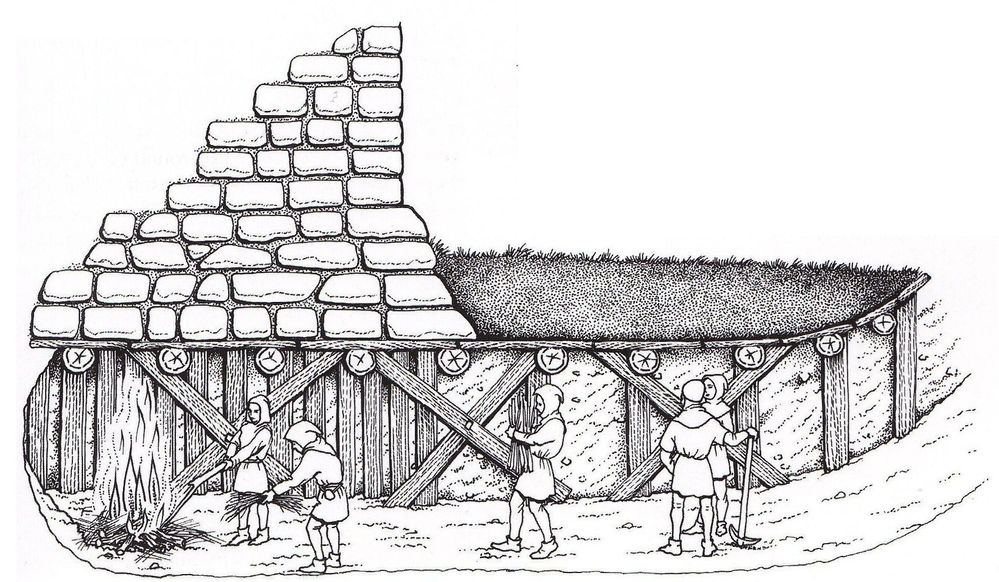
In self-defense, soldiers would be forced to take cover wherever they could,

at first in holes simply scraped out of the ground, but, in time, in very sophisticated lines, shored up with wood and metal and sandbags.

On the Western Front, where everyone was dug into the ground, and being in the open could mean instant destruction, there simply wasn’t a place for old-fashioned cavalry, for all that there were still lots of old-fashioned cavalrymen in the army—like the first commander of the British in France in 1914, Sir John French.

Imagine, then, that this was all happening when Tolkien was very young—when the Boer War ended, in 1902, for instance, he would have been only 10.

(JRRT and his brother, Hillary, in 1905)

His own military career had begun at King Edward’s School in Birmingham, when he entered the new Cadet Corps in 1907.

(For more, see this essay by John Garth: https://johngarth.wordpress.com/2014/03/05/tolkien-at-fifteen-a-warrior-to-be/ )

Then, in the summer of 1912, he was briefly a member of a territorial (a sort of national guard unit) cavalry regiment, King Edward’s Horse.  (The reference here is to Carpenter’s J.R.R.Tolkien, 66.  John Garth later added detail to this, but subsequently qualified it, saying that his evidence was faulty.  See:  https://oxfordinklings.blogspot.com/2009/06/tolkien-and-horses.html )

(Officers of the regiment about 1916)

It was clearly an indication of the drop in the use of cavalry, however, when JRRT began his second enlistment not in a cavalry, but an infantry regiment, the Lancashire Fusiliers, in which he was commissioned as a 2nd Lieutenant in 1915.

In his brief battlefield career, he was the signals officer for his battalion, the 11th.  In the advance into the Somme in July, 1916, Tolkien, although armed with a revolver,

would have been too busy to do any fighting as his work involved

“More code, flag and disc signaling, the transmission of messages by heliograph and lamp, the use of signal rockets and field-telephones, even how to handle carrier pigeons…” (Carpenter, 86)

To ask for reinforcements, as well as to avoid artillery fire which could be called in to fend off German counterattacks, but which might hit friendly troops instead, it was extremely necessary for attacking units to let their positions and situations be known as often as possible, so JRRT would have been more than a little occupied during the months (1 July-18 November, 1916) of the very costly (nearly 58,000 British casualties the first day alone) offensive.  Fortunately for him—and for us—he fell ill with so-called “trench fever” and left France for good early in November, going home to England and, ultimately, to Middle-earth.

Although his military service in the field was relatively brief, and his career with cavalry even briefer (he resigned from King Edward’s Horse in January, 1913), we see horses everywhere in Middle-earth, from the ponies of the dwarves in The Hobbit

(from Painting Valley—no artist listed)

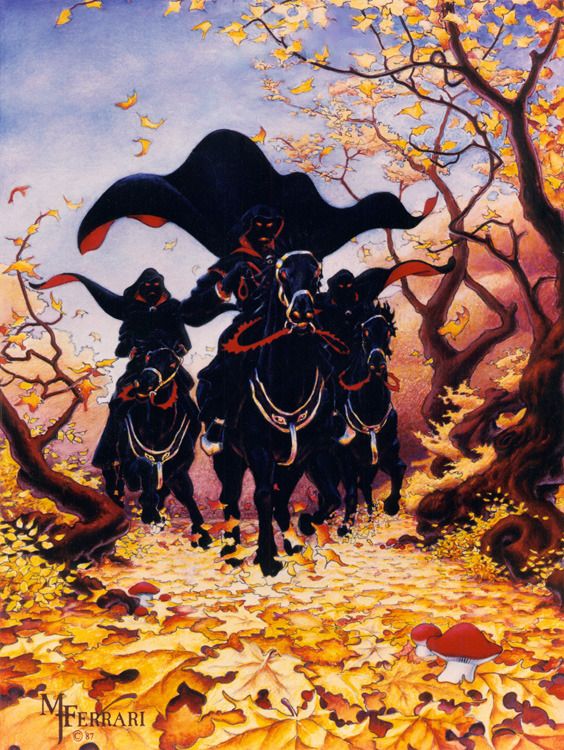
to the horses of the Nazgul in The Lord of the Rings.

(with the Gaffer, one of my favorite illustrations by Denis Gordeev)

But, although cavalry might have been only a brief flirtation for Tolkien, horses had been part of his life since its beginnings.  Part of this would have been mundane—it was only after the Great War that the internal combustion engine really began to dominate the streets.  When JRRT was young, Birmingham and London, as well as Berlin, Paris, and New York, would have looked like this—

His early reading would have given him Bellerophon on Pegasus,

to which would have been added the Valkyries,

and, in time, Sleipnir, Odin’s 8-legged steed,

(This is the Tjaengvide image stone, one of a group of runic stones, called the “Sigurd stones”, found in Sweden and dated to between 700 and 1100AD.  You can read more about it here:  https://en.wikipedia.org/wiki/Tj%C3%A4ngvide_image_stone You can read about the other stones here:  https://en.wikipedia.org/wiki/Sigurd_stones  Tolkien would first have heard about Sigurd from Andrew Lang’s The Red Fairy Book, 1890, which you can find here:   https://archive.org/details/redfairybook00langiala/redfairybook00langiala/mode/2up  Sigurd himself possessed the offspring of Sleipnir, Grani, which you can read about here:  https://en.wikipedia.org/wiki/Grani )

and further medieval reading would have filled his mind with mythic and magic horses, like Cu Chulainn, the Irish hero’s, chariot pair, water horses named Liath Macha and Dub Sainglend (although he wasn’t very enthusiastic about Old Irish literature which, I suspect, he found much wilder and stranger and more disturbing than, say, the Welsh Mabinogion, which you can read about here:    https://en.wikipedia.org/wiki/Mabinogion )

(a rather over-the-top image by the usually dependable Angus McBride—someone should have mentioned to him that, although “Dub” means “black”, Liath means “grey”.  Cu Chulainn is one of my favorite ancient berserkers—to mix cultures—and, if you don’t know him, you can begin to read about him here:  https://en.wikipedia.org/wiki/C%C3%BA_Chulainn )

But there are magical horses in many places—see https://en.wikipedia.org/wiki/List_of_horses_in_mythology_and_folklore for many more, with at least many of the medieval, he would have been familiar. 

And while we’re speaking of Middle-earth and horses, we need to mention the Normans, who, combined with the Anglo-Saxons for language, were the basis of the Rohirrim–

“The Rohirrim were not ‘medieval’ in our sense.  The styles of the Bayeux Tapestry…fit them well enough…” (letter to Rhona Beare, 14 October, 1958, Letters, 401)

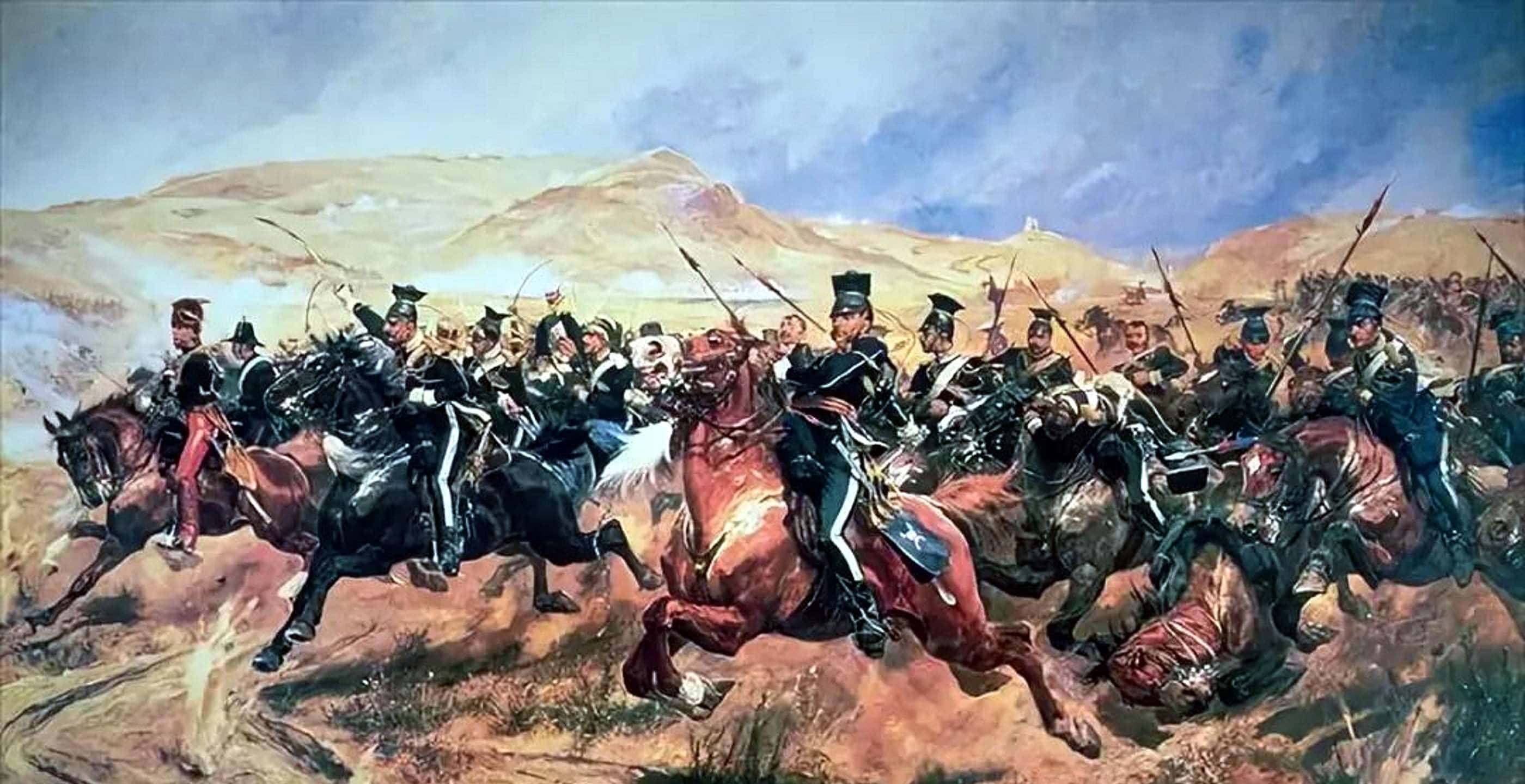
The Rohirrim, in turn, lead us back to the opening of this posting.  Although, in Tolkien’s day, cavalry and glorious charges,

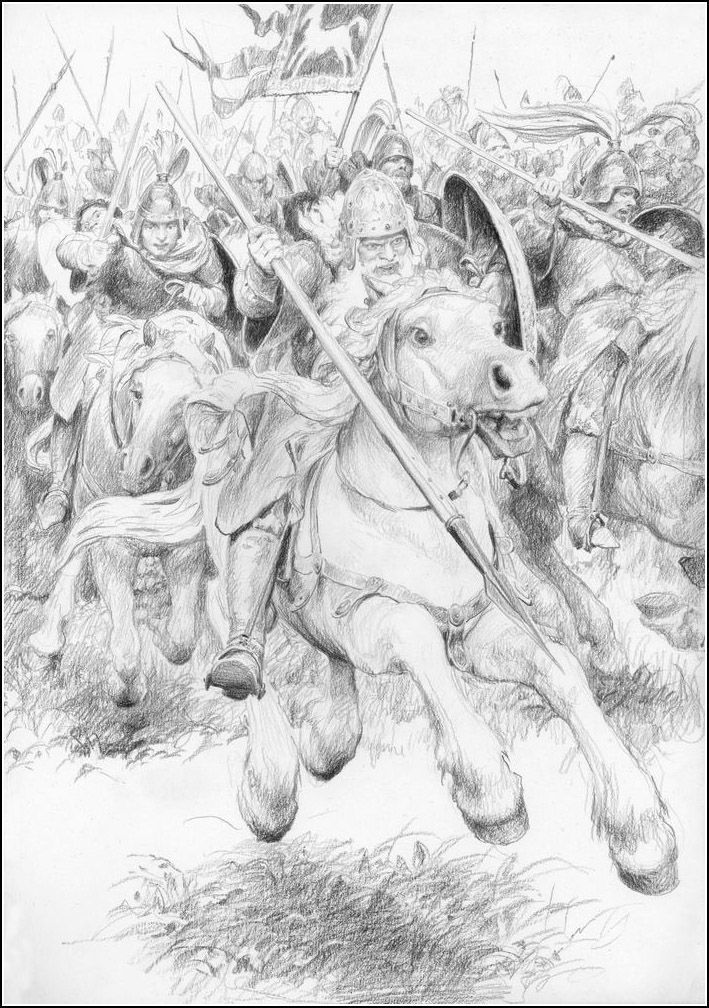
like that of the British Light Brigade at Balaclava in 1854, commemorated in Tennyson’s poem, were almost at the end of their military usefulness, for a Romantic, like Tolkien, the idea of such a charge was still a powerful image and one he couldn’t resist, depicting the heroic Rohirrim assembling

(from the Jackson film)

and roaring down on the unsuspecting orcs. 

(Abe Papakhian)

JRRT was writing medieval fantasy, however, but, as I’m always interested in “what if’s”, here I’m remembering what actually happened to that Light Brigade charge, an attack made in the teeth of Russia artillery.

The consequence was that, out of 609 men who rode towards the Russians, only 198 returned, and Lady Butler’s picture, “Balaclava the Return 25 October 1854” (1911) sums up the actual aftermath of that charge.

There’s evidence in the destruction of the Causeway Forts that Sauron’s army had some sort of blasting powder—suppose, instead of using it just as a siege tool, it had been employed with some sort of projectile propelled by it out of a tube—what might that have done to the Rohirrim’s valiant attack? 

Or even using the technique of the English army against the French at Agincourt, in our medieval world of 1415AD:  pointed stakes to threaten horses, behind which stood massed bowmen:  what would have been the outcome of that?

(Angus Mcbride)

475 horses were lost in the Charge of the Light Brigade.  Military progress so often just means more killing, but the replacement of horses with machines seems to me, who loves horses, a turn for the better.   At the same time, with Tolkien, I can feel the attraction for wild charges with swords at top speed (although cavalry did better when, at most, it went in at the canter—galloping causes loss of formation which can blunt the effect of such an attack), but, as in the charge of the Rohirrim, I’m glad if they only appear in fiction—and far from modern weaponry.

Thanks, as ever, for reading,

Stay well,

Remember that there’s a special spot, just behind the poll (top of the head), which, if scratched in the right place, makes many horses happy,

And remember, as well, that there’s always

MTCIDC

O

PS

One of those little “what if” quirks of history–Tolkien’s immediate family had been in the Orange Free State at the time of his birth, in 1892.  Tolkien’s father, Arthur, was manager of the Bloemfontein branch there of the Bank of Africa.  The Orange Free State was one of the Boer republics attacked by Britain in the Boer War of 1899-1902. If Tolkien’s mother hadn’t brought JRRT and his brother, Hilary, back to England, in 1895, and Arthur hadn’t died of the effects of rheumatic fever in 1896,

Tolkien might have been in the Orange Free State when Bloemfontein was occupied by the British on 13 March, 1900.  (You can see early film of the Scots Guards marching in here:  https://www.youtube.com/watch?v=DHy2cEFwlIo )

PPS

In last week’s posting, I mentioned the story of the wonderfully bloodthirsty Frankish queen Fredegunda, as she appears in Gregory of Tours Historia Francorum.  I wrote there that you might read about her assassination of Bishop Praetextatus and her cold-blooded visit to him on his deathbed afterwards—but it required reading Gregory’s 6th-century Latin, as I didn’t provide a translation.  It seemed lazy of me not to include one of that scene, however, so here it is with the original Latin.  As always, I could smooth this out, but I prefer to stick as close as I can to the text, to give you a better feel for what’s actually been written.

Advenientem autem dominicae resurrectionis diae, cum sacerdos ad implenda aeclesiastica officia ad aeclesiam maturius properasset, antefanas iuxta consuetudinem incipere per ordinem coepit. Cumque inter psallendum formolae decumberet, crudelis adfuit homicida, qui episcopum super formolam quiescentem, extracto baltei cultro, sub ascella percutit. Ille vero vocem emittens, ut clerici qui aderant adiuvarent, nullius ope de tantis adstantibus est adiutus. At ille plenas sanguine manus super altarium extendens, orationem fundens et Deo gratias agens, in cubiculo suo inter manus fidelium deportatus et in suo lectulo collocatus est. Statimque Fredegundis cum Beppoleno duce et Ansovaldo adfuit, dicens: ‘Non oportuerat haec nobis ac reliquae plebi tuae, o sancte sacerdos, ut ista tuo cultui evenirent. Sed utinam indicaretur, qui talia ausus est perpetrare, ut digna pro hoc scelere supplicia susteneret’. Sciens autem ea sacerdos haec dolose proferre, ait: ‘Et quis haec fecit nisi his, qui reges interemit, qui saepius sanguinem innocentem effudit, qui diversa in hoc regno mala commisit?’ Respondit mulier: ‘Sunt aput nos peritissimi medici, qui hunc vulnere medere possint. Permitte, ut accedant ad te’. Et ille: ‘Iam’, inquid, ‘me Deus praecepit de hoc mundo vocare. Nam tu, qui his sceleribus princeps inventa es, eris maledicta in saeculo, et erit Deus ultur sanguinis mei de capite tuo’. Cumque illa discederit, pontifex, ordinata domo sua, spiritum exalavit. 

“However, with the coming of the day of [Our] Lord’s resurrection, when the priest [Praetextatus] had hurried early to the church to fulfill [his] ecclesiastical duties, he started to begin [the] antiphons according to custom [in their proper] order.  And when, between the psalms, he was lying on a bench, a cruel murderer appeared, who, when a knife had been pulled from [his] belt, struck the bishop, resting on the bench, under the armpit.  He [the bishop], however, [although] shouting so that the clergy who were present might help him, was aided with help of none from so many being present.  Yet he, stretching his hands, full of blood, above the altar, pouring [out] a prayer and thanking God, was carried off into his bedchamber by the hands of [his] faithful [followers] and placed on his bed.  And straightaway Fredegunda, with the Duke Beppolenus and Ansovaldus, appeared, saying, ‘Oh holy priest, this was not right for us and for the rest of your people that such things should happen in your worshipping.  But would that it would be revealed who had dared to carry out such things that he should suffer punishment worthy of this crime.’  The priest, knowing, however, that she was speaking of these things deceptively, said, ‘And who has done these things if not [the one] who has killed kings, who very often has poured out innocent blood, who has committed many evil deeds in this kingdom’  The woman replied:  ‘There are in our household highly experienced doctors who would be able to heal this wound.  Allow [it] that they may come to you.’  And he [said]:    ‘God has decreed to call me from this world.  On the other hand, you who have been exposed as chief in these crimes, you will be cursed in the future and God will be the avenger of my blood on your head.’  And when she had left, the bishop, affairs arranged in his house, breathed out his spirit.”

And how could I not include Alma-Tadema’s illustration?

By Ear (3)

21 Wednesday May 2025

Posted by Ollamh in Uncategorized

≈ Leave a comment

Tags

Brutus, cassius, ears, Fantasy, Gandalf, Hamlet, henbane, Julius Caesar, lotr, Marcus Antonius, Orthanc, Palantir, poison, Saruman, Sauron, Shakespeare, Tolkien

Welcome, dear readers, as always.

In the closing of the second part of this little series, I quoted Marcus Antonius in his funeral oration upon Julius Caesar in Shakespeare’s play of the same name.

It is a masterpiece, both in its design and in its deception:  saying one thing for the assassins, led by Brutus, to hear, and, on the other, poisoning the common people against the assassins, originally seen as liberators of the Republic.  You probably remember its opening:

“Friends, Romans, Countrymen, lend me your ears:

I come to bury Caesar, not to praise him:

The euill that men do, liues after them,

The good is oft enterred with their bones,

So let it be with Caesar. The Noble Brutus,

Hath told you Caesar was Ambitious:

If it were so, it was a greeuous Fault,

And greeuously hath Caesar answer’d it.

Heere, vnder leaue of Brutus, and the rest

(For Brutus is an Honourable man,

So are they all; all Honourable men)

Come I to speake in Caesars Funerall.”

(Julius Caesar, Act III, Scene 2, from the First Folio, 1623, in the original spelling.  You can see it at my favorite site for the plays:  https://internetshakespeare.uvic.ca/doc/JC_F1/scene/3.2/index.html )

Speech with a deceptive goal is a theme of this series, as, in the first part, were poison–and ears.

In the scene in Shakespeare’s play, Marcus Antonius plays a dangerous game.  In order to be able to speak, he has made a deal with the assassins of Caesar not to say anything inflammatory against them, and so we see those words “Honourable men” repeated, as if Antonius is going to praise them—while only burying Caesar, as he says—just the sort of thing which we can imagine the assassins wanted to hear.  And yet, as he continues, “Honourable men” gradually becomes ironic and, by the end of his speech, he controls the mob and it’s clear that the assassins are no longer considered liberators, but murderers, Antonius having successfully poisoned those lent ears against the very men who foolishly gave him leave to speak.

We began the series with poison—and Shakespeare:  literal poison (possibly henbane)

which, as Hamlet’s ghostly father tells Hamlet, had been administered to him through his ear by his own brother, Claudius, while he was napping in his garden

But, as we progressed, we moved from that chemical murder to a different kind of destruction, spiritual, in the case of Saruman in the second installment, and now, in the third and final installment, we move to the instrument of that poisoning, include a second poisoning victim, and find the mind behind it all and that mind’s method of persuasion, which, I would suggest, must be very like Antonius’ initial remarks, seeming to praise the assassins, but, just like his, with another motive underneath.

(JRRT)

When Saruman, failing to succeed with Theoden, has turned to Gandalf, Gandalf has alluded to his previous visit with Saruman, saying:

“What have you to say that you did not say at our last meeting?…Or, perhaps, you have things to unsay?”  (The Two Towers, Book Three, Chapter 10, “The Voice of Saruman”)

That last meeting had ended with Gandalf’s imprisonment in the tower of Orthanc,

(the Hildebrandts)

but, before that, Saruman had tried to persuade Gandalf to become an ally, and not only of Saruman, but of someone else, his speech including these words:

“We can bide our time, we can keep our thoughts in our hearts, deploring evils done by the way, but approving the high and ultimate purpose:  Knowledge, Rule, Order; all the things we have so far striven in vain to accomplish…”  (The Fellowship of the Ring, Book Two, Chapter 2, “The Council of Elrond”)

Gandalf’s reply then suggests that what Saruman is saying is not really his own argument:

“ ‘I have heard speeches of this kind before, but only in the mouths of emissaries sent from Mordor to deceive the ignorant.’ “

What is it in those words which betrays their original authorship?

In the draft of a letter to Peter Hastings, Tolkien wrote:

“Sauron was of course not ‘evil’ in origin.  He was a ‘spirit’ corrupted by the Prime Dark Lord…Morgoth.  …at the beginning of the Second Age he was still beautiful to look at, or could still assume a beautiful visible shape—and was not indeed wholly evil, not unless all ‘reformers’ who want to hurry up with ‘reconstruction’ and ‘reorganization’ are wholly evil, even before pride and the lust to exert their will eat them up.”  (draft of a letter to Peter Hastings, September, 1954, Letters, 284)

What Gandalf is actually hearing then is the thinking of Sauron and his “high and ultimate purpose”, but wrapped in words which will sound familiar to Saruman and appeal to his increasing arrogance—those words “high and ultimate purpose” echo Saruman’s depiction later in the story of just who the Istari are:

“Are we not both members of a high and ancient order, most excellent in Middle-earth?”  (The Two Towers, Book Three, Chapter 10, “The Voice of Saruman”)

That “order” was not sent to Middle-earth for “Knowledge, Rule, Order”, however, as this entry in the Appendices to The Lord of the Rings tells us:

“When maybe a thousand years had passed, and the first shadow had fallen on Greenwood the Great, the Istari, or Wizards appeared in Middle-earth.  It was afterwards said that they came out of the Far West and were messengers sent to contest the power of Sauron, and to unite all those who had the will to resist him; but they were forbidden to match his power with power, or to seek to dominate Elves or Men by force and fear.”  (The Lord of the Rings, Appendix B: “The Third Age”)

Marcus Antonius has spoken indirectly to the assassins and directly to the mob, both through their ears, but Sauron’s words have reached Saruman through this—

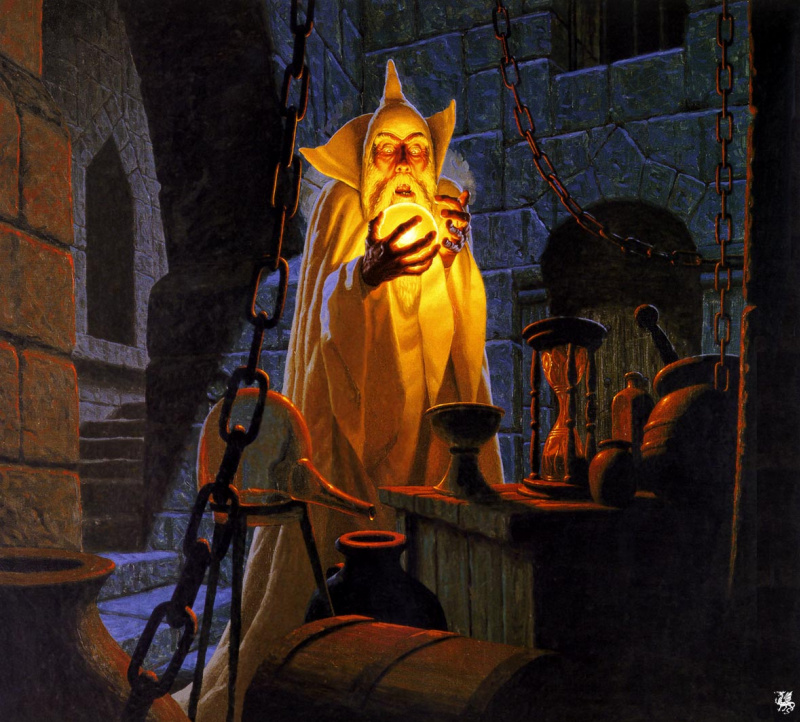
(the Hildebrandts)

which we know that Saruman has had as it is flung through the doorway of Orthanc by Grima and almost brains Gandalf—

“With a cry Saruman fell back and crawled away.  At that moment a heavy shining thing came hurtling down from above.  It glanced off the iron rail, even as Saruman left it, passing close to Gandalf’s head, it smote the stair on which he stood.”

I never think of a palantir without thinking of another device used for conning unsuspecting victims—

Staring into the ball might have a kind of hypnotic effect, but it clearly also has the effect of focusing the will of another upon the victim—as Pippin found out to his grief:

“In a low hesitating voice Pippin began again, and his words grew clearer and stronger.  ‘I saw a dark sky, and tall battlements…And tiny stars.  It seemed very far away and long ago, yet hard and clear…Then he came.  He did not speak so that I could hear words.  He just looked and I understood…He said:  “Who are you?’  I still did not answer, but it hurt me horribly; and he pressed me, so I said:  ‘A hobbit.’  Then suddenly he seemed to see me, and he laughed at me.  It was cruel.  It was like being stabbed with knives…Then he gloated over me.  I felt I was falling to pieces.’ “  (The Two Towers, Book Three, Chapter 11, “The Palantir”)

This isn’t Sauron’s only use of such a device for his poisoning—another palantir lies in Minas Tirith and it’s clear from its possessor, Denethor’s, speech how Sauron has reached him:

“Do I not know thee, Mithrandir?  Thy hope is to rule in my stead, to stand behind every throne, north, south, or west.  I have read thy mind and its policies…So!  With the left hand thou wouldst use me for a little while as a shield against Mordor, and with the right bring up this Ranger of the North to supplant me.”

And here we see how Sauron has distorted the original Istari goals, which Tolkien had described to Naomi Mitchison:

“They were thought to be Emissaries (in the terms of this tale from the Far West beyond the Sea), and their proper function, maintained by Gandalf and perverted by Saruman, was to encourage and bring out the native powers of the Enemies of Sauron.”  (letter to Naomi Mitchison, 25 April, 1954, Letters 269-270)

Denethor is correct in understanding that Gandalf—and supposedly all of the Istari—are meant to stand behind thrones—but to encourage their possessors to oppose Sauron, not to gain power for themselves, as Saruman deceived himself into thinking.  Denethor has not read Gandalf’s mind, but Sauron has definitely read Denethor’s—when Gandalf asks him what he wants, he replies:

“ ‘I would have things as they were in all the days of my life…and in the days of my longfathers before me:  to be the Lord of this City in peace, and leave my chair to a son after me, who would be his own master and no wizard’s pupil.”

The Stewards are not the kings of Gondor.  Although they have ruled for centuries, they are merely the lieutenants of the Numenorean kings, holding Gondor until a rightful king should appear, but it’s clear that Denethor has forgotten that, seeming to assume that he is the king—something surely in which Sauron has encouraged him .  And we see here another sore point:  Faramir.

In the midst of a complex scene in which Faramir reports that he had met Frodo, Denethor turns to him sharply:

“Your bearing is lowly in my presence, yet it is long since you turned from your own way at my counsel.  See, you have spoken skillfully, as ever; but I, have I not seen your eyes fixed on Mithrandir, seeking whether you said well or too much?  He has long had your heart in his keeping.”  (The Return of the King, Book Five, Chapter 4, “The Siege of Gondor”)

So Sauron has spotted two weak points in Denethor:  a mistaken idea about his role in the governing of Gondor and his jealous attitude towards his younger son.  This almost leads to Faramir’s death by burning and certainly does his father’s.

(Robert Chronister—about whom I have so far found nothing, although it’s clear that he’s illustrated more than one scene from The Lord of the Rings.)

Marcus Antonius, one of Julius Caesar’s right-hand men, has tricked Caesar’s assassins into letting him speak,

initially using language which they want to hear, but, just below the surface, and increasingly, as he proceeds, his word choice turns the mob listening to those same words into a force which will help to drive the assassins from Rome and, eventually, in the case of two of the main assassins, Brutus,

(This is a very famous coin pattern.  On the obverse—the “heads”—we see what we presume is an image of Brutus, with the caption “Brut[us]” and his assertion that he has the state’s authority:  “Imp[erator]”, along with the name of the mint master, “L[ucius] Plaet[orius] Cest[ianus]”.  On the reverse—the “tails”—we see a shorthand version of the claim of the assassins:  “Eid[ibus] Mar[tis]”—“on the ides of March”, plus two Roman “pugiones”—military daggers—bracketing a “liberty cap”—used in the ceremony of freeing a slave—hence:  “On the Ides of March, I/we, by the use of these daggers, freed Rome from its slavery (to Caesar)” )

and Cassius,

(Unfortunately, we have no definite image of Cassius—this is a coin minted on his authority by his deputy, Marcus Servilius.  The obverse has an image of “Libertas”, along with an abbreviated form of his name, “C[aius] Cassi[us]”, and that claim to have the authority of the state:  “Imp[erator]”.  The reverse has the name of his lieutenant, “M[arcus] Servilius”, his deputy rank “Leg[atus]” and what’s called an “aplustre”, which is the decorative stern of a Roman warship, thought to commemorate Cassius’ defeat of the navy of Rhodes.)

to defeat and suicide—Marcus Antonius’ ear-poison working very effectively.

For Middle-earth, there is a happier ending.  The real goal of sending the Istari succeeds, even with the treachery of Saruman, brought about through the poison introduced and spread by Sauron through the palantiri, which affects Denethor, as well, teaching us that toxicity is just as deadly in word as it is in deed.

Thanks, as always, for reading.

Stay well,

Lend no one your ears unless you’re clear what he/she wants,

And remember that, as ever, there’s

MTCIDC

O

By Ear (1)

07 Wednesday May 2025

Posted by Ollamh in Uncategorized

≈ Leave a comment

Tags

Claudius, ear, Fantasy, Gandalf, Grima, Hamlet, henbane, lotr, Palantir, poison, Saruman, Theoden, Tolkien

Welcome, dear readers, as always.

No matter how often I read or see the play, I’m always struck by how multifacted Hamlet is—a revenge tragedy, a murder mystery, a psychological study, a ghost story, all in one (and probably more than this list besides).  Tolkien was not a big fan of reading Shakespeare, but, seeing a performance in 1944, he wrote to his son, Christopher:   “Plain news is on the airgraph [a form of letter photographed onto microfilm, shipped, then printed out at its destination—called “V-Mail” in the US—a useful background:  https://rarehistoricalphotos.com/v-mail-photos/ ]; but the only event worth of talk was the performance of Hamlet which I had been to just before I wrote last.  I was full of it then…It was a very good performance, with a young rather fierce Hamlet; it was played fast without cuts; and it came out as a very exciting play.” (letter to Christopher Tolkien, 28 July, 1944, Letters, 126)

That ghost story is the explanation for the murder mystery, the victim being Hamlet’s father, Hamlet Senior, and the murderer being his brother, Claudius, the ghost telling Hamlet:

“Sleeping within my orchard,

My custom always of the afternoon,

Upon my secure hour, thy uncle stole

With juice of cursèd hebona in a vial,

And in the porches of my ears did pour

The lep’rous distillment, whose effect

Holds such an enmity with blood of man

That swift as quicksilver it courses through

The natural gates and alleys of the body,

And with a sudden vigor it doth possess

And curd like eager droppings into milk

The thin and wholesome blood; so did it mine,

And a most instant tetter barked about

Most lazarlike with vile and loathsome crust

All my smooth body.”  (Hamlet, Act 1, Scene 5 from the 2nd Quarto, 1604—this is from my go-to Shakespeare internet site, which you can visit here:  https://internetshakespeare.uvic.ca/doc/Ham_Q2/scene/index.html )

“Hebona” has been argued about for years, some scholars, seeing what appears to be a linguistic similarity with “henbane”,

have suggested that, as the poison, and, seeing its effects, I’m not surprised:

“As a result of this distinct chemical and pharmacological profile, overdoses can result not only in delirium, but also severe anticholinergic syndrome, coma, respiratory paralysis, and death.” (see:  https://en.wikipedia.org/wiki/Toxidrome#Anticholinergic for lots more distressing symptoms on the way to the end—although some of the above description doesn’t appear to be present in such poisoning—“tetter” means a kind of skin eruption, which is why Hamlet Sr. uses“lazarlike”, meaning “leprous”.  For more on other possible poisons, see:  https://en.wikipedia.org/wiki/Hebenon And for more on Shakespeare’s drugs, see:  https://www.bbc.com/future/article/20140416-do-shakespeares-poisons-work ) 

One can see why Uncle Claudius uses the method he does:  he’s assuming that, if all the poison is absorbed, there will be no outside traces, which is why Hamlet Senior says, “’Tis given out that, sleeping in my orchard/A serpent stung me” (although, given the usual nature of bites, one might have thought that someone would have checked for a snake bite wound, suggesting that Claudius was already prepared with a quick explanation for what had happened to his brother—“it is given out” sounds like palace propaganda, doesn’t it?).

Hamlet’s father is poisoned through the ear with an actual toxic substance, whatever it was, and that supposedly left no trace of the crime, but, in Tolkien’s own work, we see another ear poison, which also leaves no obvious physical trace, being administered by this—

(the Hildebrandts)

but which is just as deadly—spiritually.

We know from Gandalf (and the chapter title) that Saruman has an unusual weapon:

“ ‘What’s the danger?’ asked Pippin.  ‘Will he shoot at us, and pour fire out of the windows; or can he put a spell on us from a distance?’

‘The last is most likely, if you ride to his door with a light heart,’ said Gandalf…. ‘And Saruman has powers you do not guess:  Beware of his voice!’ “  (The Two Towers, Book Three, Chapter 10, “The Voice of Saruman”)

We then see that voice in operation:

“ ‘But come now,’ said the soft voice.  ‘Two at least of you I know by name.  Gandalf I know too well to have much hope that he seeks help or counsel here.  But you, Theoden Lord of the Mark of Rohan, are declared by your noble devices, and still more by the fair countenance of the House of Eorl.  O worthy son of Thengel the Thrice-renowned!  Why have you not come before, and as a friend?  Much have I desired to see you, mightiest king of western lands, and especially in these latter years, to save you from the unwise and evil counsels that beset you!  Is it yet too late?  Despite the injuries that have been done to me, in which the men of Rohan, alas! have had some part, still I would save you, and deliver you from the ruin that draws nigh inevitably, if you ride upon this road which you have taken.  Indeed I alone can aid you now.’ “

The effect of this upon the Rohirrim is just what Saruman must have hoped for—and it underlines his method of address:

“The Riders stirred at first, murmuring with approval of the words of Saruman; and then they too were silent, as men spell-bound.  It seemed to them that Gandalf had never spoken so fair and fittingly to their lord.  Rough and proud now seemed all his dealings with Theoden.  And over their hearts crept a shadow, the fear of a great danger:  the end of the Mark in a darkness to which Gandalf was driving them, while Saruman stood beside a door of escape, holding it half open so that a ray of light came through…” 

Saruman has, by:

1. addressing Theoden in a stately way, almost overdoing it with his “Lord”, “noble”, “fair”, “worthy”, “mightiest”, suggesting that he has only the greatest respect for him

2. mentioning the defeat of his ravaging army and the destruction of his mini-Mordor as if they were “wrongs” done to him, rather than the treasonous behavior they actually represented

3. threatening doom awaiting the Mark

4. offering himself as the only savior,

turns himself from the Sauron he aspires to be into the gentle, admiring friend, who, though he has been harmed, is still willing to be that friend—and, in fact, the only friend for Theoden.  And, as the Rohirrim are meant to understand, this is all designed to be in contrast to Gandalf, that false savior.

(It’s clear that Saruman has been working to undercut Gandalf’s position in Rohan for some time previously:  see Theoden’s original greeting to Gandalf—prompted—and poisoned—by Grima in The Two Towers, Book Three, Chapter 6, “The King of the Golden Hall”.)

(Alan Lee)

Eomer, seeing Theoden silent, hesitating, tries to intervene, only to have that Voice—angered, but quickly controlled, turn everything rightly said against him into the “you do it, too” argument:

“ ‘But my lord of Rohan, am I to be called a murderer, because valiant men have fallen in battle?  If you go to war, needlessly, for I did not desire it, then men will be slain.  But if I am a murderer on that account, then all the House of Eorl is stained with murder; for they have fought many wars, and assailed many who defied them.’ “

It’s not just Saruman’s voice that one should be wary of–he is so skilled in deception—or so he thinks–that he can try to use such a cheap argument, then turn it around into what is intended to sound like a reasonable proposal:

“ ‘Yet with some they have afterwards made peace, none the worse for being politic.  I say, Theoden King:  shall we have peace and friendship, you and I?  It is ours to command.’ “

And notice how it’s now not “you”, but “we” and “ours”—any attack is being turned into “being politic” and not “you do it, too”, but “we all do it sometimes” and then we make peace and everything is fine.

Theoden’s response is not what Saruman expected, although, because Theoden had remained silent, we can imagine that Saruman was smiling quietly to himself in admiration of his own powers:

“ ‘We will have peace,’ said Theoden at last thickly and with an effort…’Yes, we will have peace,’ he said, now in a clear voice, ‘we will have peace, when you and all your works have perished—and the works of your dark master to whom you would deliver us.  You are a liar, Saruman, and a corrupter of men’s hearts…When you hang from a gibbet at your own window for the sport of your own crows, I will have peace with you and Orthanc…Turn elsewhither.  But I fear your voice has lost its charm.”

(Ted Nasmith—another side of this excellent artist)

The magic of that voice still lingers for a moment:

“The Riders gazed up at Theoden like men startled out of dream.  Harsh as an old raven’s their master’s voice sounded in their ears after the music of Saruman.”

But there is then a change in that music:

“But Saruman for a while was beside himself with wrath.  He leaned over the rail as if he would simite the King with his staff.  To some suddenly it seemed that they saw a snake coiling itself to strike.”

And Saruman becomes even more serpentine:

“ ‘Gibbets and crows!’ he hissed and they shuddered at the hideous change.’ “

Thwarted, we see him basically reverse his address to Theoden.  Where before Theoden was “Lord”, “noble”, “fair”, “worthy”, “mightiest”, now he is “dotard” and his “noble”, “fair” family becomes “the house of Eorl…but a thatched barn where brigands drink in the reek, and their brats roll on the floor among the dogs”.

He isn’t quite finished, however—

“ ‘But you, Gandalf!  For you at least I am grieved, feeling for your shame.  How comes it that you can endure such company?  For you are proud, Gandalf—and not without reason, having a noble mind and eyes that look both deep and far.  Even now will you not listen to my counsel?’ “

Theoden’s eventual reply was bitter—and biting—but Gandalf’s reaction is of a different sort altogether—though it still has a sting:

“Gandalf stirred, and looked up.  ‘What have you to say that you did not say at our last meeting?’ he asked.  ‘Or, perhaps, you have things to unsay?’ “

That last meeting saw Gandalf Saruman’s prisoner on the top of Orthanc–

(the Hildebrandts)

but what was it which Saruman said, how was it put, and what or who might lie behind it, will be the subject of Part 2 of this posting.

Thanks for reading, as always.

Stay well,

Remember that line from another Shakespeare play, “All that glisters is not gold”,

And also remember that, as always, there’s

MTCIDC

O

Alternatives

23 Wednesday Apr 2025

Posted by Ollamh in Uncategorized

≈ Leave a comment

Tags

lotr, Morgoth, Mouth of Sauron, Sauron, Sharkey, Tolkien, Turtledove, What If

As always, dear readers, welcome.

I’ve written before about “What Ifs”—that is, alternative views of things, be they historical,

(and interesting here to see an introduction by Harry Turtledove, who has written a raft of “what ifs” himself)

or based upon fantasy.

Recently, I wrote about Sauron’s terms, as stated by the Mouth of Sauron in “The Black Gate Opens”,

(Douglas Beekman—prolific sci-fi/fantasy artist—you can read a little about him here:  https://www.askart.com/artist/Doug_L_Beekman/122294/Doug_L_Beekman.aspx )

 to Gandalf and the others, taking apart the terms, as well as the behavior of the Mouth (see “Treating”, 26 March, 2025)), but the thought has occurred to me–a what if—what if the leaders of the West had agreed, if only to buy time?  After all, they had had no news of Frodo until the Mouth had produced his garments and, seeing them, mightn’t they have assumed that the Ring had gone back to its master?  And, if Sauron once more had the Ring, what next?

Here are the terms once more:

“ ‘The rabble of Gondor and its deluded allies shall withdraw at once beyond the Anduin, first taking oaths never again to assail Sauron the Great in arms, open or secret.  All lands east of the Anduin shall be Sauron’s for ever, solely.  West of the Anduin as far as the Misty Mountains and the Gap of Rohan shall be tributary to Mordor, and men there shall bear no weapons, but shall have leave to govern their own affairs.  But they shall help to rebuild Isengard which they have wantonly destroyed, and that shall be Sauron’s, and there his lieutenant shall dwell:  not Saruman, but one more worthy of trust.”  (The Return of the King, Book Five, Chapter 10, “The Black Gate Opens”)

At first glance, as insulting as the tone is, the terms are fairly mild, coming down to:

1. Sauron keeps Ithilien and beyond—which he mostly already holds, in fact

2. Rohan and, although it’s not named directly, we can presume Gondor:

 a. will pay tribute to Mordor

 b. but, although disarmed, will be allowed their own government

 c. although, with Isengard rebuilt, one presumes that Sauron’s lieutenant (the Mouth assumes that it will be he) will keep a close eye on Rohan and Gondor in the future

What this would mean, perhaps, is that Eomer would rule Rohan, but who would rule Gondor is uncertain—we would doubt highly that it would be Aragorn, considering that he’s already, using the Palantir, threatened Sauron—so possibly the Stewardship would continue, under Faramir?  If Sauron has a sense of irony, that would be fitting as, under his rule, there would never be a return of the King.

But was any of this real?  Would Sauron ever back down, even for a moment?  He did, many many years ago after the defeat of Morgoth, and again, when defeated by Tar-Calion, so we might see here another wavering of his purpose—after all, his minion (although he apparently isn’t aware of the fact that the Palantir has turned him into Sauron’s puppet) Saruman, has been defeated, his orc army destroyed, and his stronghold breached, and Sauron’s plan to attack Minas Tirith by land and sea has also failed, including the end of the chief of the Nazgul, Sauron’s general.  So far, things haven’t been going his way.

We’ll never know about what might have happened, however, if any of these terms were agreed to, because, upon Gandalf’s refusing them and threatening the Mouth, as in the chapter title, the Black Gate opens and the hordes of Mordor roar out to surround and nearly defeat the Westerners until eagles and the destruction of the Ring bring the whole thing to a crashing halt, literally.

(Ted Nasmith—and hasn’t he outdone himself with this painting?)

But could any of this ever have been a possibility?  To begin with, it would have meant that Aragorn would have been on the run and Gandalf, too, for that matter, as it’s doubtful that Sauron would have let either of the two escape alive.  We can presume, as well, that he would have attacked both Lorien and Rivendell and the forest elves’ kingdom, and probably even stretched that long, threatening arm

(JRRT)

beyond Rivendell to Bree and the Shire, although, if “Sharkey” was already busy industrializing the Shire, it might have amused Sauron to let him survive there, both as a puppet and as vengeance on the Shire for having been the hiding place of the Ring for so long.

(Alan Lee)

And can we doubt that he would have ordered his new lieutenant at Isengard to deal with Fangorn and the Ents?

But would this even be the end of things?  One has only to remember Sauron’s behavior in the Second Age:

“He denies the existence of God, saying that the One is a mere invention of the jealous Valar of the West, the oracle of their own wishes.  The chief of the gods is he that dwells in the Void, who will conquer in the end, and in the void make endless realms for his servants….

A new religion, and worship of the Dark, with its temple under Sauron arises.  The Faithful are persecuted and sacrificed…”  (from a letter to Milton Waldman, late 1951, Letters, 216)

(Aztec sacrifice—as even Ted Nasmith and Denis Gordeev have yet to tackle this part of the story!)

So, might we also see new buildings and sinister ones at that?

And, when Sauron speaks of Morgoth (“chief of the gods is he that dwells in the Void”), does he have a plan to bring him back? 

As far as I know, only Ted Nasmith has tried to represent Morgoth–

even JRRT himself doesn’t appear to have done so, so perhaps this is a “what if” taken a bit too far!

Thanks, for reading, as ever.

Stay well,

Be thankful that, for all that combating evil in Middle-earth is “the long defeat”, it hasn’t won yet,

And remember that, as always, there’s

MTCIDC

O

Lingua Orca

16 Wednesday Apr 2025

Posted by Ollamh in Uncategorized

≈ Leave a comment

Tags

Black Speech, Fantasy, lingua franca, lotr, Merry and Pippin, Native American sign language, Nazgul, Orcs, Orkish, the-black-speech, Tok Pisin, Tolkien

Welcome, dear readers, as always.

I begin this posting with a riddle:  how are Tolkien and Sauron alike? 

But we’ll come back to that.

Before that, I want to talk about the title of this posting. 

When Boromir is killed by the Orcs.

(Ted Nasmith)

Merry and Pippin are captured and carried off across country,

(Denis Gordeev)

Pippin waking eventually to this—

“He struggled a little, quite uselessly.  One of the Orcs sitting near laughed and said something to a companion in their abominable language..  ‘Rest while you can, little fool!’ he then said to Pippin, in the Common Speech, which he made almost as hideous as his own language.”

But what does that “abominable language” sound like?  Another Orc, equally gentle, gives us an example.

“ ‘If I had my way, you’d wish that you were dead now,’ said the other….’Don’t draw attention to yourself, or I may forget my orders,’ he hissed.  Curse the Isengarders!  Ugluk u bagronk sha pushdug Saruman-glob bubhosh skai’:  he passed into a long angry speech in his own tongue that slowly died away into muttering and snarling.”

One word is easy to pick out, of course—Saruman—but the rest calls for translating, something which Tolkien doesn’t provide in The Lord of the Rings, but there are, in fact, at least three translations:

1. “Ugluk to the cesspool, sha!  the dungfilth; the great Saruman-fool, skai!”  which comes from a draft of Appendix F of The Peoples of Middle-earth

2. “Ugluk to the dung-pit with stinking Saruman-filth—pig-guts, gah!”  which is a translation by Carl Hostetter in Vinyar Tengwar 26

3. “Ugluk to torture(chamber) with stinking Saruman-filth.  Dung-heap.  Skai!”  which is from Parma Eldalamberon XVII

(You can see the whole reference here:  https://tolkiengateway.net/wiki/Ugl%C3%BAk_u_bagronk_sha_pushdug_Saruman-glob_b%C3%BAbhosh_skai   For a bit more, including JRRT’s comment on Orkish, suggesting that he has bowdlerized this a bit in that 3rd translation, see:  https://glaemscrafu.jrrvf.com/english/ugluk.html )

Pippin can’t understand a word of this—

“Terrified Pippin lay still, though the pain at his wrists and ankles was growing, and the stones beneath him were boring into his back.  To take his mind off himself he listened intently to all that he could hear.  There were many voices round about, and though orc-speech sounded at all times full of hate and anger, it seemed plain that something like a quarrel had begun, and was getting hotter.” 

but still senses that there is strong emotion behind the Orcs’ words and part of how that “hate and anger” was conveyed to Pippin probably from the very sounds of the language—full of the hissing SH—sha, push-dug, bub-hosh—and words of only one or two syllables—Ug-luk, ba-gronk, sha, push-dug, bub-hosh, skai, making it sound abrupt.  And you can then see that 3-syllable “Saruman” was clearly a foreign word, which was then turned into an Orkish compound with that final single-syllable “glob”.

And yet:

“To Pippin’s surprise he found that much of the talk was intelligible; many of the Orcs were using ordinary language.”

“ordinary language” here is Pippin’s tongue—the Common Speech of Middle-earth (“Westron”)—which is also the language in which The Lord of the Rings was supposed  originally to have been written.

Dazed as he might be (“I suppose I was knocked on the head” he says to himself when he first wakes), Pippin, listening, comes to a clever conclusion as to why the Common Speech is employed by the Orcs who, after all, appear to have their own language:

“Apparently the members of two or three quite different tribes were present, and they could not understand one another’s orc-speech.”  (all of the above quotations from The Fellowship of the Ring, Book Two, Chapter 3, “The Uruk-hai”)

It’s interesting to see what the Orcs are doing here:  finding a way to converse because their own languages—or at least their dialects—are not mutually intelligible.

This has been a problem throughout history, wherever one people meets another with which it doesn’t share a language.

Several different approaches have been created.

On the Great Plains of the US West, for example,

Native Americans produced a kind of universal sign language, which employed standardized gestures for common concepts and ideas.  Here’s a chart of a few of those gestures—

and here’s a possible extension—although I must say that it strikes me that it would take two very linguistically talented people, with a wide gesture vocabulary, to convey all of this.

(You can read about it here, which includes a wonderful piece of film in which various Native Americans and a seemingly-fluent US Government representative converse in gesture:  https://en.wikipedia.org/wiki/Plains_Indian_Sign_Language )

Besides gesture, people have constructed what’s called a “lingua franca”—literally “French tongue”—that is, a kind of trade tongue, which might have a base in one language, but which then borrows words from other regional languages to build its working vocabulary.  The term comes from such a language employed from the early medieval period up into the 19th century in the Mediterranean, “franca” being used really to mean not “French” so much as “foreign”.    (You can read more about it here:  https://en.wikipedia.org/wiki/Lingua_franca )

In contemporary Papua/New Guinea,

there is the English-based Tok Pisin, which has become so useful that it has become the first language of some groups.  (For more, see:  https://en.wikipedia.org/wiki/Tok_Pisin , which includes a demonstration of TP as spoken, although the background noise makes it a little difficult to hear.  Fortunately, there are a fair number of YouTube videos, should you want to hear more—and I hope you do.  YouTube is full of languages, both living and now no longer in use—I won’t say “dead”, because, if any language is still comprehensible, even if the last speakers are gone, I wouldn’t write an epitaph for it, myself– and we’re so lucky to be given so much to learn and understand.)

The Orcs, however, have simply resorted to employing another language entirely—although it would be interesting to see whether, had we more of their speech, we might find elements from other languages—there’s a clue in that “Saruman-glob”, where the speaker takes a word from another language and simply attaches an Orc word to it.

What was that “orc-speech”, which Pippin couldn’t understand?

“The Orcs were first bred by the Dark Power of the North in the Elder Days.  It is said that they had no language of their own, but took what they could of other languages and perverted it to their own liking, yet they made only brutal jargons, scarcely sufficient even for their own needs, unless it were for curses and abuse.  And these creatures, being filled with malice, hating even their own kind, quickly developed as many barbarous dialects as there were groups or settlements of their race, so that their Orkish speech was of little use to them in intercourse between different tribes.”

And so what we’re seeing is that the Orcs were actually developing a series of languages rather like linguae francae—basing them on whatever other language was locally available, then adding the odd curse or form of abuse which appealed to them, all of which turned their speech, even if once based upon a common borrowed language, into something incomprehensible to others from the same race.

It’s clear that Sauron, from whom Saruman got his definition of what Saruman claimed was always the goal of the Istari:  “Knowledge, Rule, Order”, wished Rule and Order to be at the heart of his dominion and therefore:

“It is said that the Black Speech was devised by Sauron in the Dark Years, and that he desired to make it the language of all those who served him…”

but the power of the Linguae Orcae, as we can call them, won out:

“…but [Sauron] failed in that purpose.  From the Black Speech, however, were derived many of the words that were in the Third Age wide-spread among the Orcs, such as ghash, ‘fire’, but after the first overthrow of Sauron this language in its ancient form was forgotten by all but the Nazgul.” 

And so even their master’s invention became nothing more than a vocab pool, from which to draw that which the Orcs fancied—and we know their preferences.

It’s no wonder, then, that

“So it was that in the Third Age Orcs used for communication between breed and breed the Westron tongue; and many indeed of the older tribes, such as those that still lingered in the North and in the Misty Mountains, had long used the Westron as their native language…”—just like those for whom Tok Pisin had moved from a trade tongue to a first tongue—but here’s an Orkish difference:  “though in such a fashion as to make it hardly less lovely than Orkish.” (all quotations from “The Orcs were first bred…” on from The Lord of the Rings, Appendix F)

And the answer to the riddle—I think that you’ve guessed it already:  “How are Tolkien and Sauron alike?”  Both were creators of languages, the difference being that it seems that virtually everyone in Middle-earth, from Elves to Dwarves to Ents to Orcs, speaks Westron, while no one speaks the Black Speech but Sauron’s last and soon to be lost, enslaved kings, the Nazgul.

(Denis Gordeev)

Thanks, as always, for reading.

Stay well,

Consider the endless borrowings which English has made from world languages,

And remember that, as always, there’s

MTCIDC

O

Rad Aghast

02 Wednesday Apr 2025

Posted by Ollamh in Uncategorized

≈ Leave a comment

Tags

Forrest J Ackerman, Lon Chaney Sr, lotr, Radagast, The Hobbit, Tolkien

As ever, dear readers, welcome.

I was very pleased when the new, expanded edition of The Letters of JRR Tolkien appeared in 2023,

not only for what new information might be contained in that word “expanded”, but also as, having used my paperback copy of the first edition to the point where, although the pages were still intact, the whole book seemed a little tired, as if it had been employed a little more often than it would have preferred.

When I first opened this new edition, I immediately paged through to what I had hoped was among the expanded letters:  “From a Letter to Forrest J. Ackerman” (“Not dated; June 1958”, Letters, 389-397).

This, as Humphrey Carpenter’s note tells us, was “Tolkien’s comments on the film ‘treatment’ of The Lord of the Rings”.

Ackerman doesn’t appear in Carpenter’s Tolkien biography, but he does appear in several letters, including the long excerpt, and Carpenter makes reference to him, as “agent for the film company” (Letters, 628).  In fact, he was a major figure in the American world of fantasy/science fiction/horror in the 1950s and 1960s, including being the editor of an early fan magazine, Famous Monsters of Filmland, 1958-1983, which provided an impressionable young man with this particularly haunting image—

(This is Lon Chaney, Sr., in the missing London After Midnight, 1927, which you can read about here:   https://silentology.wordpress.com/2022/10/31/everything-you-ever-wanted-to-know-about-london-after-midnight-practically/  If, like me, you love silent film, this is a good site to learn from.  You can read about the rather tangled history  of Famous Monsters  here:   https://en.wikipedia.org/wiki/Forrest_J_Ackerman and about Ackerman here:  https://en.wikipedia.org/wiki/Forrest_J_Ackerman )

From the additional material available in the new edition, we can see that Tolkien liked the visual samples with which he was presented, but—there’s no other word for it—appalled by the “treatment”, of which he wrote:

“If Z. [Zimmerman, the writer of the treatment] and/or others do so [that is, read Tolkien’s comments], they may be irritated or aggrieved by the tone of many of my criticisms.  If so, I am sorry (though not surprised).  But I would ask them to make an effort of imagination sufficient to understand the irritation (and on occasion resentment) of an author, who finds, increasingly as he proceeds, his work treated as it would seem carelessly in general, in places recklessly, and with no evident signs of any appreciation of what it is all about…”   (From a Letter…,389)

What I had hoped for was the complete letter, as, from what has actually been printed, Tolkien tells us, in his criticism, just what he might have wanted in a film of The Lord of the Rings and, in the process, provides us with a different perspective on his perspective.  Certainly, what is included  underscores what he wrote in the beginning of the letter, and something I take from it is that the writer has imagined much of the book as being downright clownish—as in Tolkien’s comments on the presentation of Tom Bombadil:

“7. The first paragraph misrepresents Tom Bombadil.  He is not the owner of the woods; and he would never make any such threat. 

‘Old scamp!’ This is a good example of the general tendency that I find in Z to reduce and lower the tone towards that of a more childish fairy-tale. “  (Letters, 391)

Add to this Tolkien’s later comment on the appearance of Merry and Pippin as Saruman’s “door-keepers”:

“14. Why on earth should Z say that the hobbits ‘were munching ridiculously long sandwiches’?” (Letters, 396)

(Michael Herring—you can see more of his work here:  https://www.artnet.com/artists/michael-herring/ )

Of himself, Tolkien once wrote:

“[I] have a very simple sense of humour (which even my appreciative critics find tiresome)” (from a letter to Deborah Webster, 25 October, 1958, Letters, 412)

So he was not against comedy in general:

“I return Rayner’s [Rayner Unwin, the son of Sir Stanley, Tolkien’s publisher] remarks with thanks to you both.  I am sorry he felt overpowered, and I particularly miss any reference to the comedy, with which I imagined the first ‘book’ [that is, The Fellowship] was well supplied.  It may have misfired.  I cannot bear funny books or plays myself, I mean those that set out to be all comic; but it seems to me that in real life, as here, it is precisely against the darkness of the world that comedy arises…” (letter to Sir Stanley Unwin, 31 July, 1947, Letters, 172)

Tolkien could even be a practical joker—see Humphrey Carpenter, JRR Tolkien:  A Biography, 134, for more on this.

And yet we can see, from his Ackerman comments, that, when it came to his creative work, he was not only serious, but expected others to take it seriously—to treat it seriously—as well.

So what are we to make of the portrayal of Radagast the Brown in The Hobbit of P. Jackson and Co.?

Well, we might begin by saying that he is only mentioned in Tolkien’s Hobbit, (Chapter 7, “Queer Lodgings”) and appears, but only briefly, as a messenger from Saruman in The Fellowship of the Ring, Book Two, Chapter 2, “The Council of Elrond”. 

He is one of the 5 Istari, sent to Middle-earth as a counter-balance to Sauron.  (On the Istari, see Unfinished Tales, 405-412).  It may be that Tolkien himself thought that he had become a little too acclimatized:

“Indeed, of all the Istari, one only remained faithful, and he was the last-comer.  For Radagast, the fourth, became enamoured of the many beasts and birds that dwelt in Middle-earth, and forsook Elves and Men, and spent his days among the wild creatures.”  (JRR Tolkien, The Lost Tales, 407)

But this doesn’t mean that he’s become what Saruman sneeringly calls him:  “Radagast the Bird-tamer!  Radagast the Simple!  Radagast the fool!” (The Fellowship of the Ring, Book Two, Chapter 2, “The Council of Elrond”)—although he could easily be taken for that in Jackson’s Hobbit, for all that he’s had invented for him a role that seems to want to combine the clownish with the heroic, but, for me,  as JRRT did not create this role and would certainly have been upset by the clownish aspects of it–

see his comment  on illustrations for a German translation of The Hobbit sent him by Horus Engels:

“He has sent me some illustrations (of the Trolls and Gollum) which despite certain merits, such as one would expect of a German, are I fear too ‘Disnified’ for my taste:  Bilbo with a dribbling nose, and Gandalf as a figure of vulgar fun rather than the Odinic wanderer that I think of…” (letter to Sir Stanley Unwin, 7 December, 1946, Letters 171-172)

he seems not only unnecessary, but exactly what disturbed Tolkien about the Zimmerman “treatment” of The Lord of the Rings, the reaction of an author who finds:

“…increasingly as he proceeds, his work treated as it would seem carelessly , in places recklessly, and with no evident signs  of any appreciation of what it is all about…”

Hence the title of this posting—not  the fear generated by the Old English gaest , of the original word, but certainly a sense of disturbance of the sort JRRT felt in that “treatment” and I’m sure would have felt even more strongly seeing what had happened to his character in the hands of those who, at best, are reckless.

Thanks, as always, for reading,

Stay well,

Believe that the author means what she/he says,

And remember that, as always, there’s

MTCIDC

O

PS

For me, this illustration, by Lucas Graciano, seems a better depiction—

(you can see more of his imaginative art here:  https://www.lucasgraciano.com/ )

← Older posts

The Doubtful Sea Series Facebook Page

The Doubtful Sea Series Facebook Page

  • Ollamh

Categories

  • Artists and Illustrators
  • Economics in Middle-earth
  • Fairy Tales and Myths
  • Films and Music
  • Games
  • Heroes
  • Imaginary History
  • J.R.R. Tolkien
  • Language
  • Literary History
  • Maps
  • Medieval Russia
  • Military History
  • Military History of Middle-earth
  • Narnia
  • Narrative Methods
  • Poetry
  • Research
  • Star Wars
  • Terra Australis
  • The Rohirrim
  • Theatre and Performance
  • Tolkien
  • Uncategorized
  • Villains
  • Writing as Collaborators
Follow doubtfulsea on WordPress.com

Across the Doubtful Sea

Recent Postings

  • On the Roads Again—Once More December 10, 2025
  • (Not) Crossing Bridges December 3, 2025
  • On the Road(s) Again—Again November 26, 2025
  • On the Road(s) Again November 19, 2025
  • To Bree (Part 2) November 12, 2025
  • To Bree (Part 1) November 5, 2025
  • A Plague o’ Both—No, o’ All Your Houses! October 29, 2025
  • It’s in Writing (2:  I’st a Prologue, or a Poesie for a Ring?) October 22, 2025
  • It’s in Writing (1) October 15, 2025

Blog Statistics

  • 102,696 Views

Posting Archive

  • December 2025 (2)
  • November 2025 (4)
  • October 2025 (5)
  • September 2025 (4)
  • August 2025 (4)
  • July 2025 (5)
  • June 2025 (4)
  • May 2025 (4)
  • April 2025 (5)
  • March 2025 (4)
  • February 2025 (4)
  • January 2025 (5)
  • December 2024 (4)
  • November 2024 (4)
  • October 2024 (5)
  • September 2024 (4)
  • August 2024 (4)
  • July 2024 (5)
  • June 2024 (4)
  • May 2024 (5)
  • April 2024 (4)
  • March 2024 (4)
  • February 2024 (4)
  • January 2024 (5)
  • December 2023 (4)
  • November 2023 (5)
  • October 2023 (4)
  • September 2023 (4)
  • August 2023 (5)
  • July 2023 (4)
  • June 2023 (4)
  • May 2023 (5)
  • April 2023 (4)
  • March 2023 (5)
  • February 2023 (4)
  • January 2023 (4)
  • December 2022 (4)
  • November 2022 (5)
  • October 2022 (4)
  • September 2022 (4)
  • August 2022 (5)
  • July 2022 (4)
  • June 2022 (5)
  • May 2022 (4)
  • April 2022 (4)
  • March 2022 (5)
  • February 2022 (4)
  • January 2022 (4)
  • December 2021 (5)
  • November 2021 (4)
  • October 2021 (4)
  • September 2021 (5)
  • August 2021 (4)
  • July 2021 (4)
  • June 2021 (5)
  • May 2021 (4)
  • April 2021 (4)
  • March 2021 (5)
  • February 2021 (4)
  • January 2021 (4)
  • December 2020 (5)
  • November 2020 (4)
  • October 2020 (4)
  • September 2020 (5)
  • August 2020 (4)
  • July 2020 (5)
  • June 2020 (4)
  • May 2020 (4)
  • April 2020 (5)
  • March 2020 (4)
  • February 2020 (4)
  • January 2020 (6)
  • December 2019 (4)
  • November 2019 (4)
  • October 2019 (5)
  • September 2019 (4)
  • August 2019 (4)
  • July 2019 (5)
  • June 2019 (4)
  • May 2019 (5)
  • April 2019 (4)
  • March 2019 (4)
  • February 2019 (4)
  • January 2019 (5)
  • December 2018 (4)
  • November 2018 (4)
  • October 2018 (5)
  • September 2018 (4)
  • August 2018 (5)
  • July 2018 (4)
  • June 2018 (4)
  • May 2018 (5)
  • April 2018 (4)
  • March 2018 (4)
  • February 2018 (4)
  • January 2018 (5)
  • December 2017 (4)
  • November 2017 (4)
  • October 2017 (4)
  • September 2017 (4)
  • August 2017 (5)
  • July 2017 (4)
  • June 2017 (4)
  • May 2017 (5)
  • April 2017 (4)
  • March 2017 (5)
  • February 2017 (4)
  • January 2017 (4)
  • December 2016 (4)
  • November 2016 (5)
  • October 2016 (6)
  • September 2016 (5)
  • August 2016 (5)
  • July 2016 (5)
  • June 2016 (5)
  • May 2016 (4)
  • April 2016 (4)
  • March 2016 (5)
  • February 2016 (4)
  • January 2016 (4)
  • December 2015 (5)
  • November 2015 (5)
  • October 2015 (4)
  • September 2015 (5)
  • August 2015 (4)
  • July 2015 (5)
  • June 2015 (5)
  • May 2015 (4)
  • April 2015 (3)
  • March 2015 (4)
  • February 2015 (4)
  • January 2015 (4)
  • December 2014 (5)
  • November 2014 (4)
  • October 2014 (6)
  • September 2014 (1)

Blog at WordPress.com.

  • Subscribe Subscribed
    • doubtfulsea
    • Join 78 other subscribers
    • Already have a WordPress.com account? Log in now.
    • doubtfulsea
    • Subscribe Subscribed
    • Sign up
    • Log in
    • Report this content
    • View site in Reader
    • Manage subscriptions
    • Collapse this bar
 

Loading Comments...