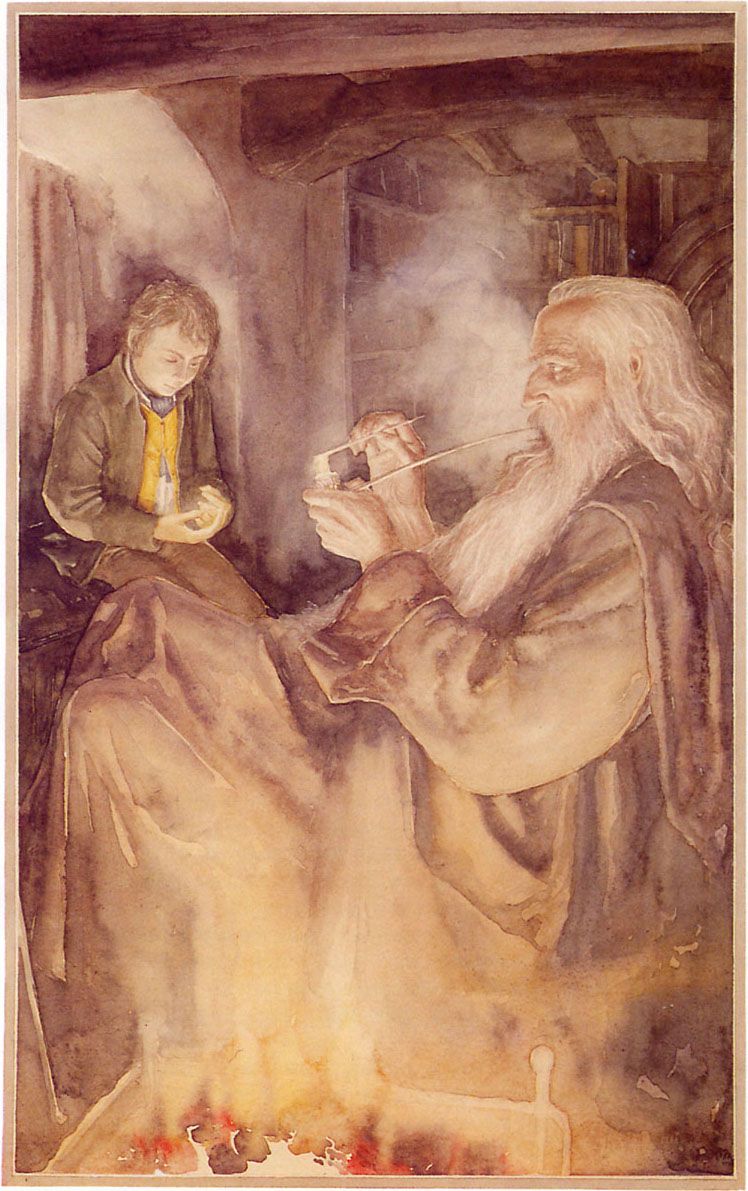
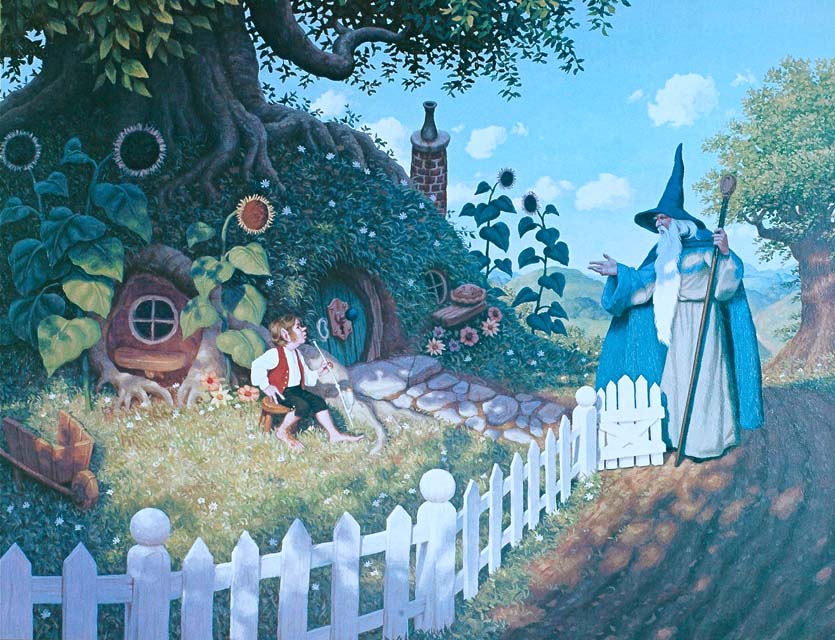
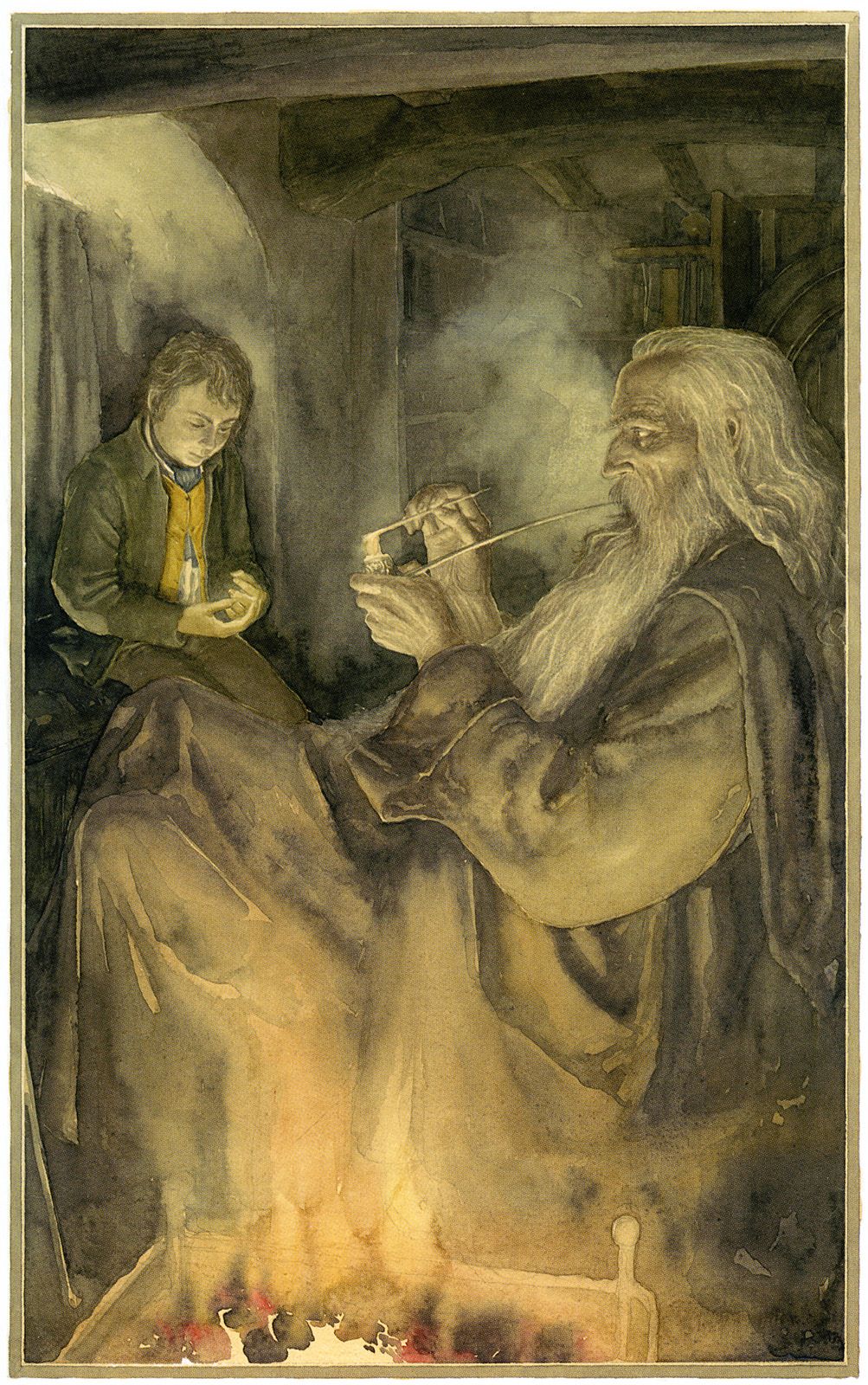
You recognized where the title of this posting comes from, I’m sure. Bilbo and Gandalf
have been talking and Bilbo describes his current state:
“ ‘I am old, Gandalf. I don’t look it, but I am beginning to feel it in my heart of hearts. Well-preserved indeed!…Why, I feel all thin, sort of stretched, if you know what I mean: like butter that has been scraped over too much bread.’ “ (The Fellowship of the Ring, Book One, Chapter 1, “A Long-expected Party”)
(You’ll notice the pun here—as I’m sure JRRT did–in the combination of “preserve(d)” with butter and bread—did he write this originally during breakfast one morning?)
After this, there is a very tense scene where Gandalf inquires about the Ring, Bilbo becomes hostile, but, in the end, Bilbo leaves the Ring and clearly feels great relief, even singing.
Nine years later, in a subsequent scene, after Gandalf had related, the previous night, some details about the Ring to Frodo, we can see what had been going on in Gandalf’s mind those nine years before and his concern for Bilbo then, persuading him to put the Ring aside:
“ ‘A mortal, Frodo, who keeps one of the Great Rings, does not die, but he does not grow or obtain more life, he merely continues, until at last every minute is a weariness. And if he often uses the Ring to make himself invisible, he fades: he becomes in the end invisible permanently, and walks in the twilight under the eye of the Dark Power that rules the Rings. Yes, sooner or later—later, if he is strong or well-meaning to begin with, but neither strength nor good purpose will last—sooner or later the Dark Power will devour him.” (The Fellowship of the Ring, Book One, Chapter 2, “The Shadow of the Past”)
Bilbo was, indeed, as stretched as he felt—and in more danger than he could know. And it was a danger others had undergone before him—had they known what would happen?
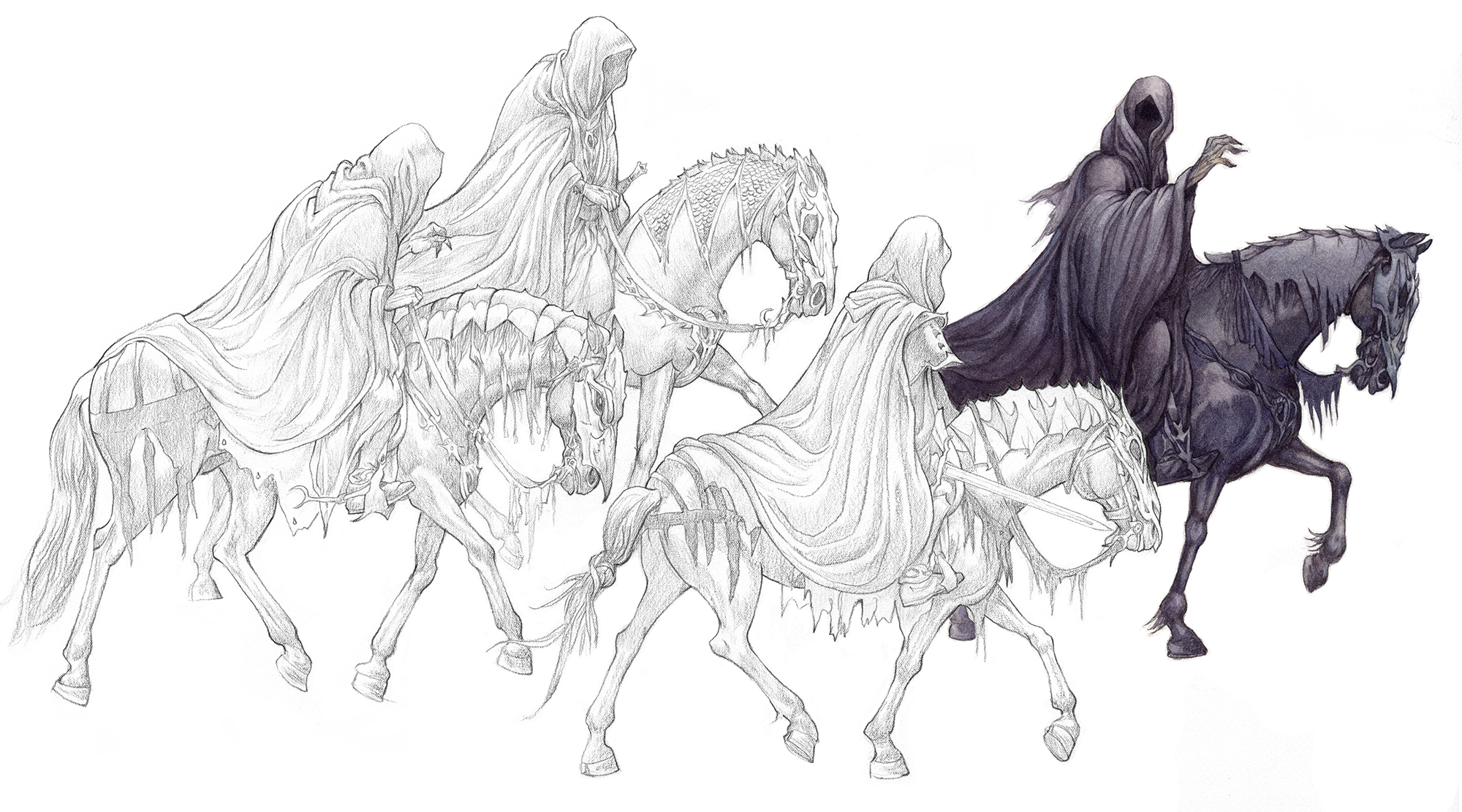
Gandalf goes on to explain the history of the Nazgul to Frodo, in relation to the very Ring we see here:
“ ‘Nine he gave to Mortal Men, proud and great, and so ensnared them. Long ago they fell under the dominion of the One, and they became Ringwraiths, shadows under his great Shadow, his most terrible servants. Long ago.’ “
And Gandalf continues, being more prophetic than he knows:
“ ‘It is many a year since the Nine walked abroad. Yet who knows? As the Shadow grows once more, they too may walk again.’ ” (The Fellowship of the Ring, Book One, Chapter 2, “The Shadow of the Past”)
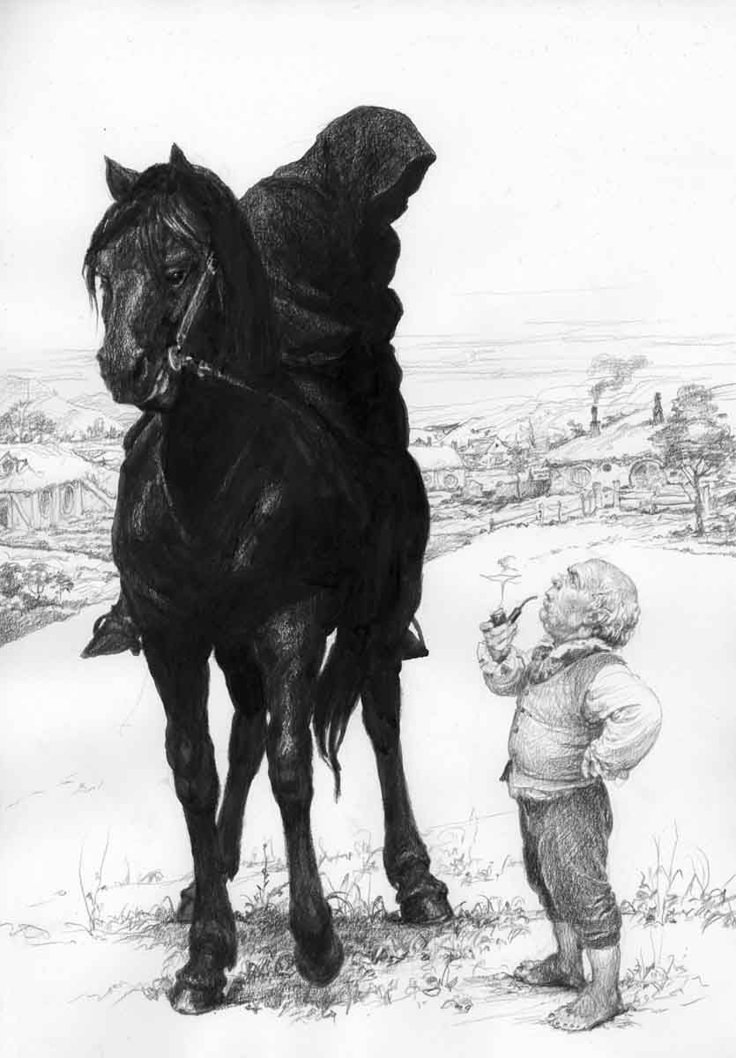
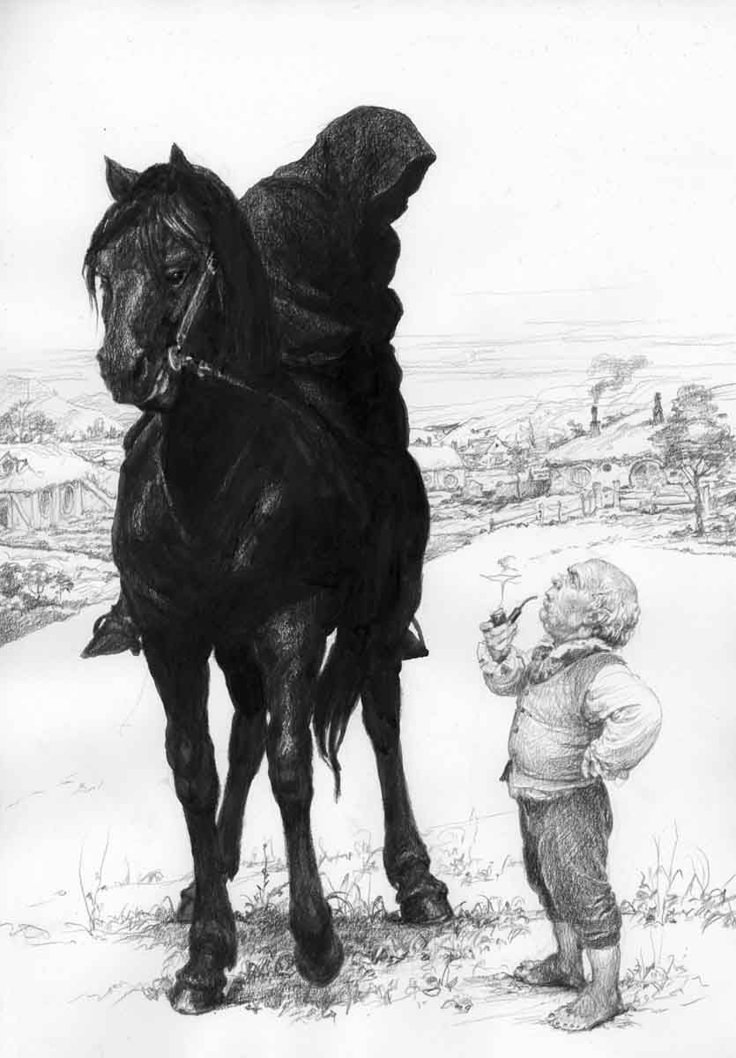
The Ringwraiths, the Nazgul, will appear again and again in the story, pursuing Frodo and his friends in their initial journey from the Shire, attempting to bribe Gaffer Gamgee,
(Denis Gordeev)
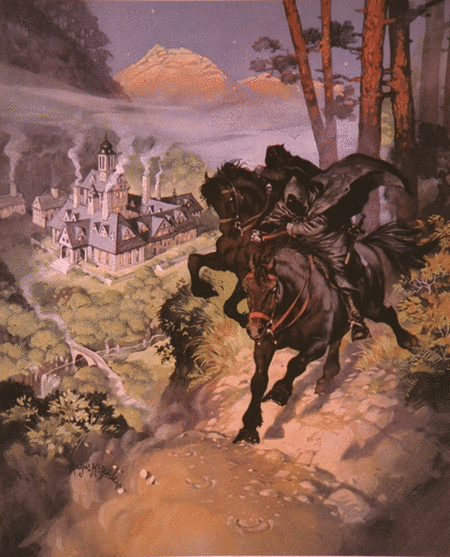
making an attack upon Frodo and his friends at the Prancing Pony,
(Ted Nasmith)
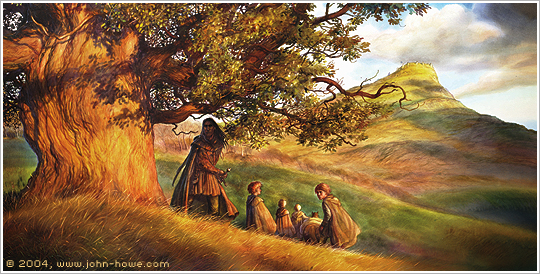
nearly fatally wounding Frodo on Weathertop,
(John Howe)
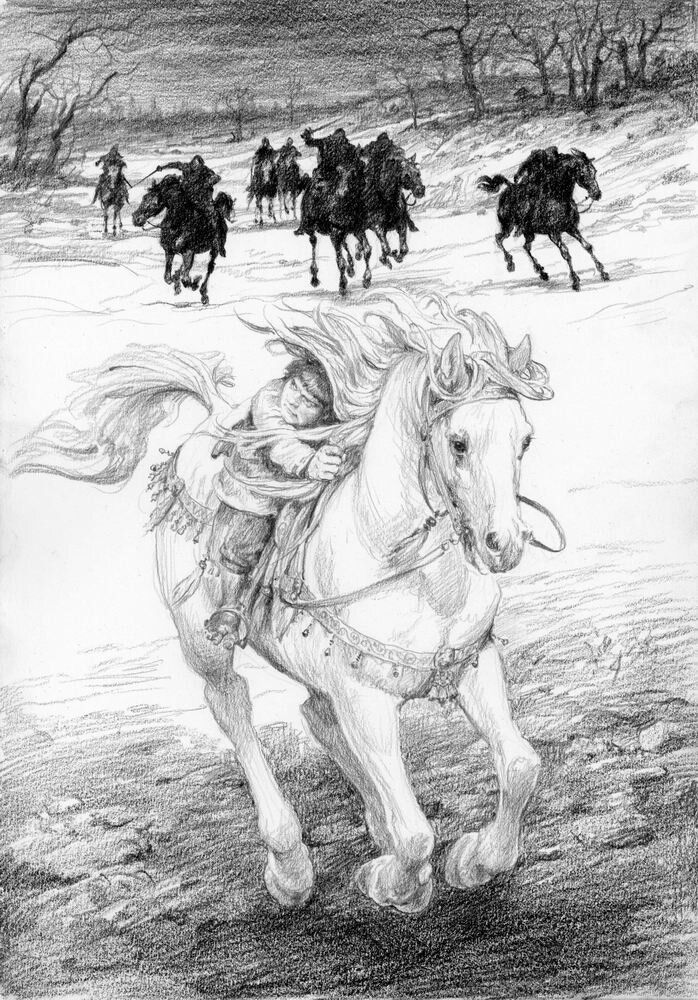
pursuing him to the ford,
(Denis Gordeev)
but, although washed away there,
(Ted Nasmith)
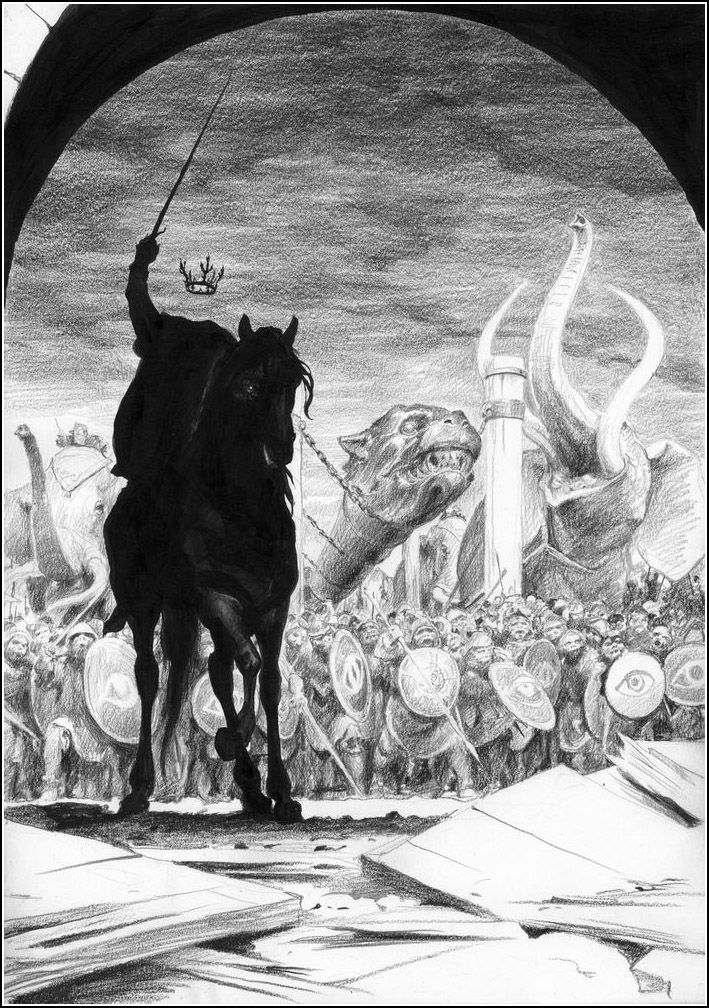
after a pause (although occasionally seen in the sky), participating in the assault on Minas Tirith,
(Denis Gordeev)
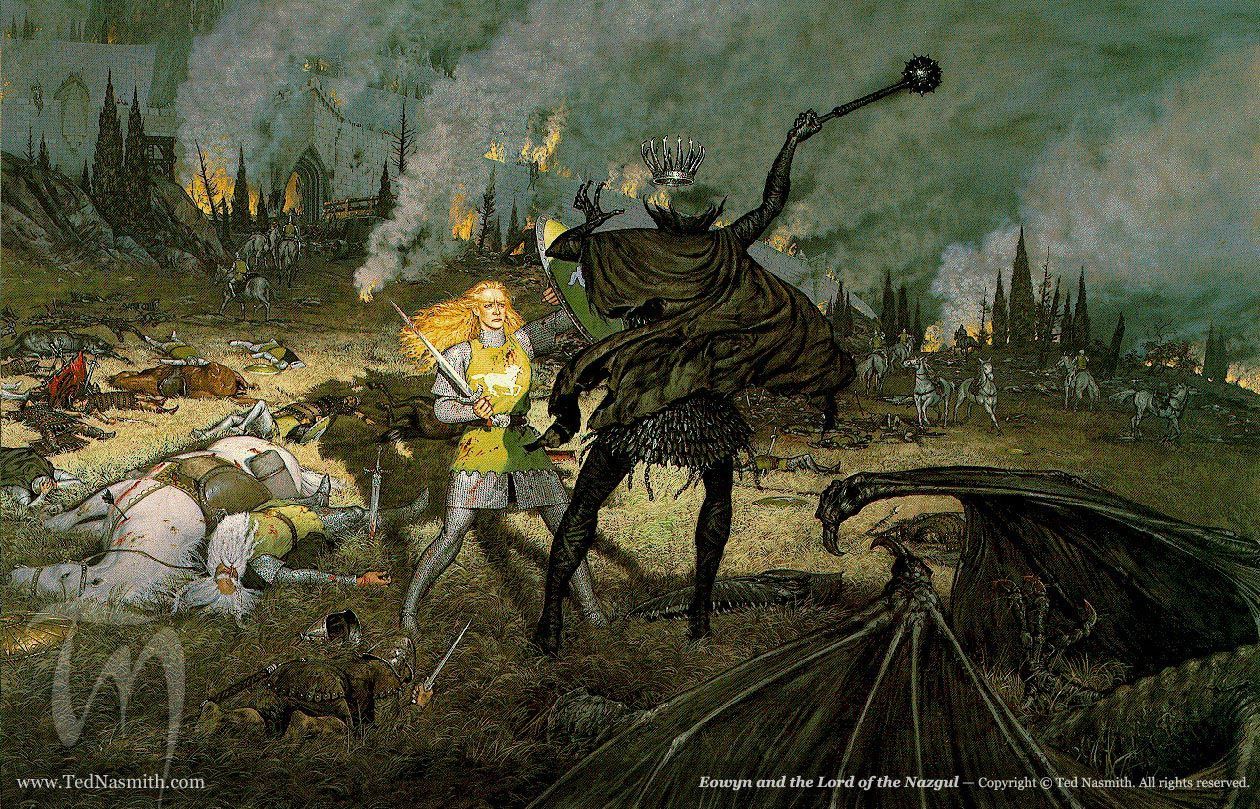
with the leader of their number finally destroyed by a combination of Eowyn and Merry.
(Ted Nasmith)
But this brings up a question: if the Ringwraiths are “shadows under [Sauron’s] Great Shadow”, how can they:
1. carry weapons (think of the Morgul knife which wounds Frodo)
2. ride horses
3. somehow, after those horses are destroyed, make their way back to Mordor for replacements
4. although disembodied, be wounded and even destroyed by mortal weapons?
And the answer is: unclear. This is a place where I think JRRT wanted spookiness and substance, too, so his insubstantial menace—the Nazgul seem, in fact, to need those cloaks to be embodied—can do things like ride horses and other, unmentionable, things,
(Alan Lee)
and wield real weapons, as well as suffer wounds, like the mortals they once were. And that leader even wears a crown—
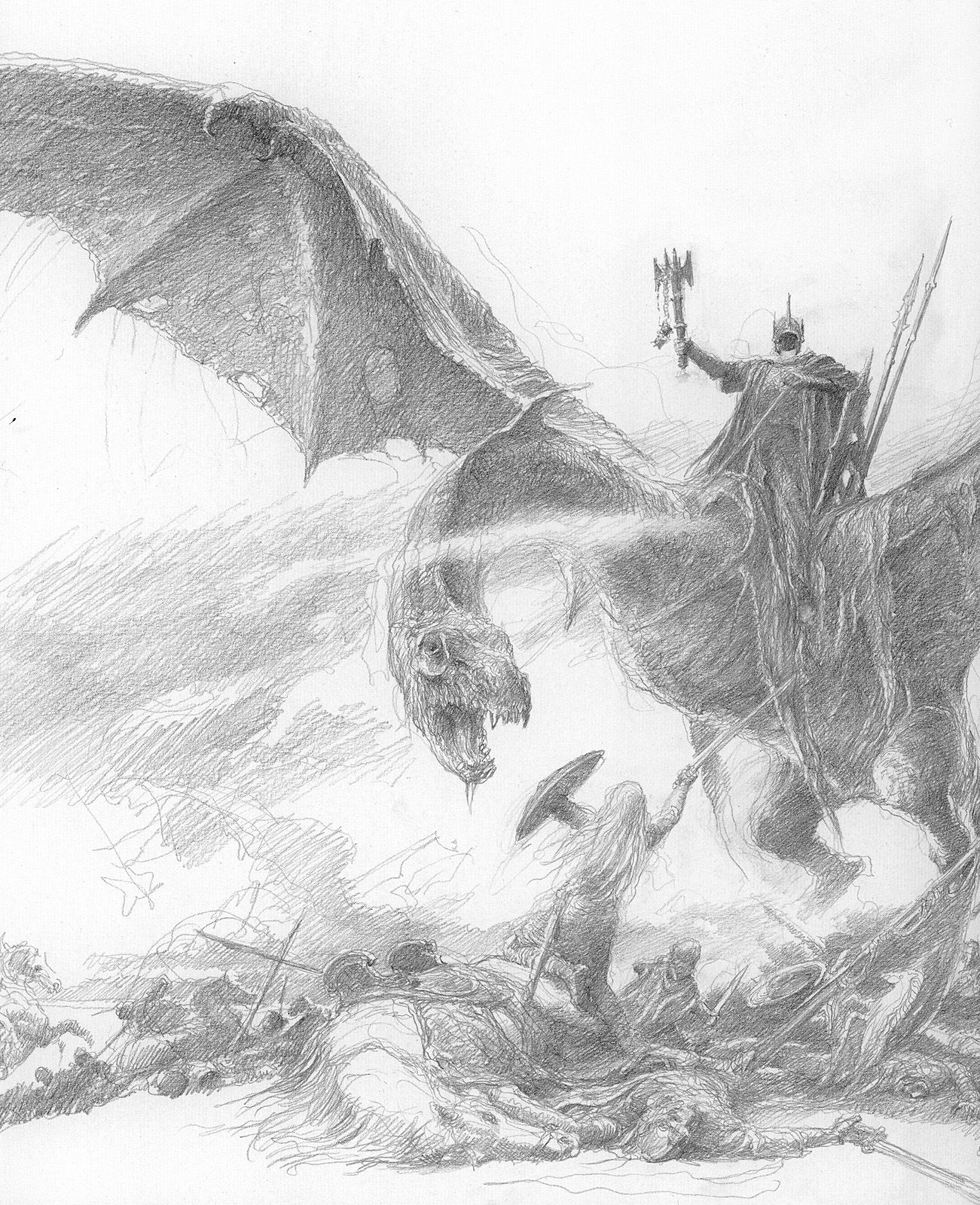
“Upon [the beast] sat a shape, black-mantled, huge and threatening. A crown of steel he bore, but between rim and robe naught was there to see, save only a deadly gleam of eyes.” (The Return of the King, Book Five, Chapter 6, “The Battle of the Pelennor Fields”)
which might, in fact, give us a clue as to where that invisibility—and something more– might originally have sprung from.
Recently, I’ve been rereading John Milton’s (1608-1674) Paradise Lost 1667-1674),
where I came upon this scene, in which we see Satan, defeated in battle, with plans for revenge, is flying towards new-made Eden. In his flight, he sees:
“…The other shape,
If shape it might be called that shape had none
Distinguishable in member, joint, or limb,
Or substance might be called that shadow seemed,
For each seemed either; black it stood as Night,
Fierce as ten Furies, terrible as Hell,
And shook a dreadful dart; what seemed his head
The likeness of a kingly crown had on.” (Paradise Lost, Book II, lines 666-673)
This is, in fact, Death, we’re told, the offspring of Satan and the personification of Sin. The Witch King of Angmar (the head of the Nazgul) may not be quite so dramatic a figure as that, and, for all that he’s the shadow of a shadow, he isn’t deathless, but the similarities—the lack of substance, the crown– are such that it makes me wonder: while he was having that creative breakfast, did Tolkien have his copy of Paradise Lost propped up on the table in front of him?
Thanks for reading, as always.
Stay well,
Always try to come between the Nazgul and his prey,
which comes from the apostle, Paul’s, first letter to the Corinthians (Chapter 13, Verse 12).
I knew about glasses—I drank from them—
and I looked through them—
and all I could think of was that maybe the glass was dirty.
It was only as a grownup that I found out that “glass” was Jacobean shorthand (from the “King James Bible” of 1611) for “looking glass” as we can see in Jerome’s (c.342-420AD) Latin translation
“videmus nunc per speculum in enigmate”
of the Greek
“βλέπομεν γὰρ ἄρτι δι’ ἐσόπτρου ἐν αἰνίγματι,”
in which “speculum”, “mirror”, is his version of the Greek εἴσοπτρον (eisoptron), “mirror”.
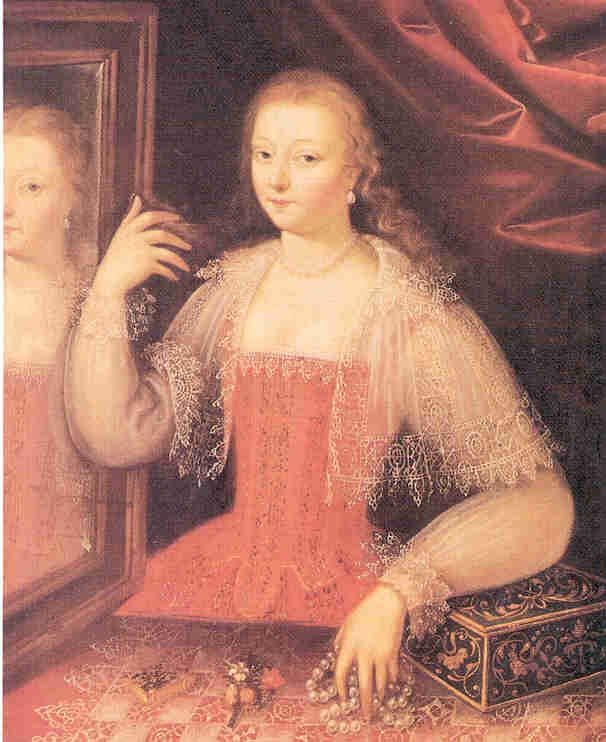
Here’s what the Jacobean translators might have thought of as a “glass”,
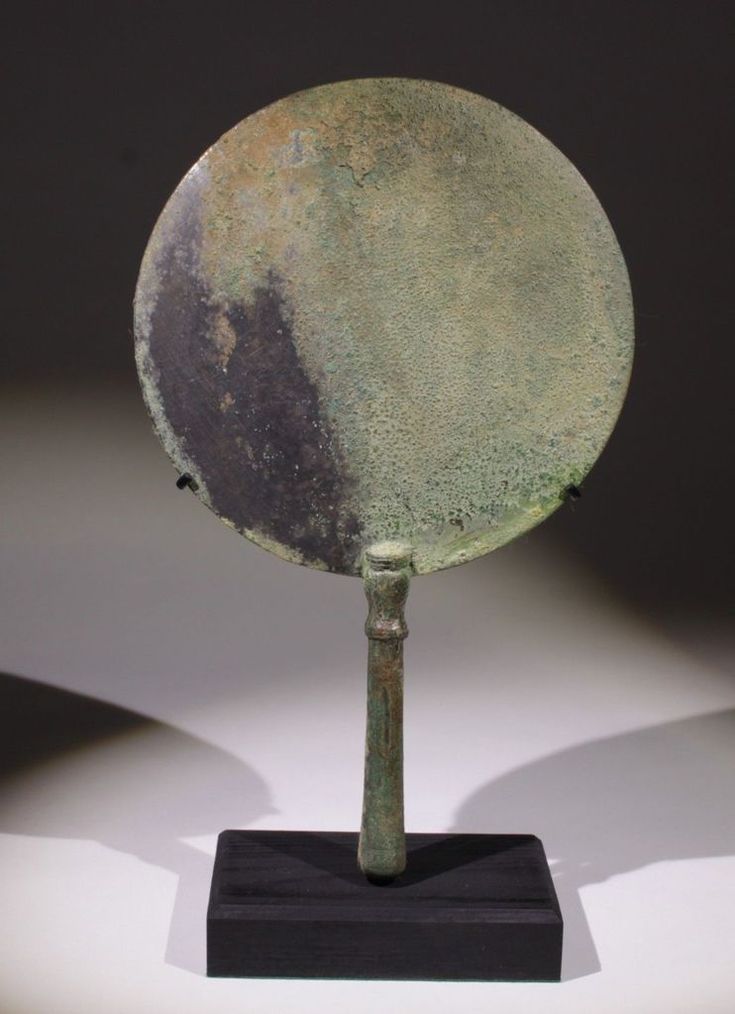
but Paul would have imagined something more like this—
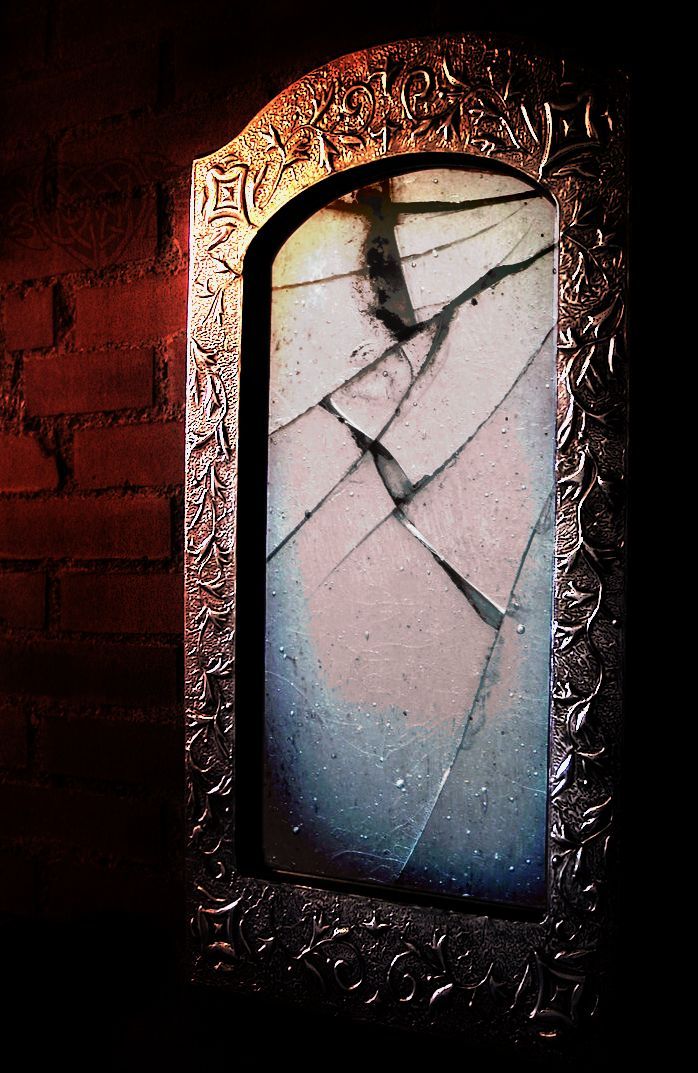
which would have been made of highly-polished metal, commonly bronze, so it’s easier to imagine that “darkly”, if the metal became tarnished.
But that translation of “in enigmate” or the original ἐν αἰνίγματι, might make the mirror even darker, as it comes from αἴνιγμα, which means “riddle” and this isn’t surprising as I, at least, have always found mirrors a little odd—spooky, even—and I’m hardly alone in this—think of the wicked, vain queen in “Snow White”, with her magic mirror—
or that moment in Chapter 2 of Dracula where Jonathan Harker, in Dracula’s castle, has an unnerving experience—
“I only slept a few hours when I went to bed, and feeling that I could not sleep any more, got up. I had hung my shaving glass by the window, and was just beginning to shave. Suddenly I felt a hand on my shoulder, and heard the Count’s voice saying to me, “Good-morning.” I started, for it amazed me that I had not seen him, since the reflection of the glass covered the whole room behind me. In starting I had cut myself slightly, but did not notice it at the moment. Having answered the Count’s salutation, I turned to the glass again to see how I had been mistaken. This time there could be no error, for the man was close to me, and I could see him over my shoulder. But there was no reflection of him in the mirror! The whole room behind me was displayed; but there was no sign of a man in it, except myself.” (You can read this—and the whole book—in a first edition here: https://gutenberg.org/files/345/345-h/345-h.htm#chap02 )
So, what about another mirror, but one not made of bronze, or silvered metal behind glass, like more modern versions—but more like a miniature reflecting pool–
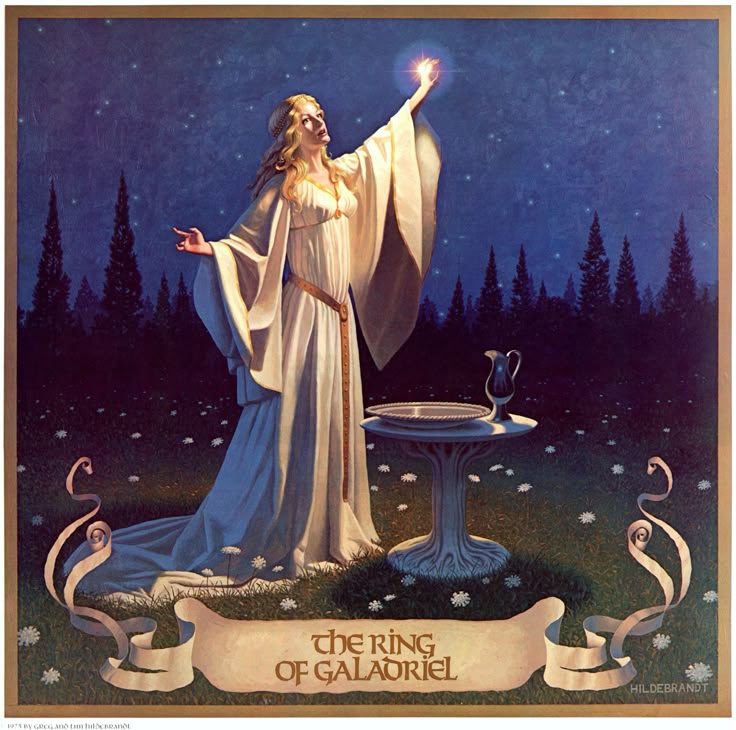
the mirror of Galadriel?
(Greg Hildebrandt)
I’ve written a little about this before (see: “Mirror, Mirror”, 9 December, 2015 ), but I’ve come back to this chapter with—I hope—further thoughts. Why is it there at all? One reason might be that, after their harrowing adventure in Moria, the Fellowship—and the readers—need a breather and, though they could continue on foot, having already come hundreds of miles that way, perhaps this is a way to vary their travels by adding water and that’s something with which the elves can and do aid them —
“ ‘I see that you do not yet know what to do,’ said Celeborn. ‘It is not my part to choose for you; but I will help you as I may. There are some among you who can handle boats: Legolas, whose folk know the swift Forest River; and Boromir of Gondor; and Aragorn the traveller.’ “ (The Fellowship of the Ring, Book Two, Chapter 8, “Farewell to Lorien”)
I would add that Lorien, Galadriel’s home, although it seems to be a place of refuge for the Fellowship,is also clearly a place for testing—and not all of that testing appears friendly, at least at first, and the deepest test for the two most important for the fate of the Ring lies in that mirror.
The testing begins, however, when Galadriel says:
“But I will say this to you: your Quest stands upon the edge of a knife. Stray but a little and it will fail, to the ruin of all.”
And then she continues:
“Yet hope remains while all the Company is true.”
And, having said this—
“And with that word she held them with her eyes, and in silence looked searchingly at each of them in turn. None save Legolas and Aragorn could long endure her glance: Sam quickly blushed and hung his head.” (The Fellowship of the Ring, Book Two, Chapter 7, “The Mirror of Galadriel”)
Beyond her glance lies, we’re told, a kind of temptation—as Sam reveals:
“ ‘If you want to know, I felt as if I hadn’t got nothing on, and I didn’t like it. She seemed to be looking inside me and asking me what I would do if she gave me the chance of flying back home to the Shire to a nice little hole with—with a bit of garden of my own.’ “
And, although almost none of the Fellowship reveals what he was offered, there was the same approach:
“All of them, it seemed, had fared alike: each had felt that he was offered a choice between a shadow full of fear that lay ahead, and something that he greatly desired: clear before his mind it lay, and to get it he had only to turn aside from the road and leave the Quest and the war against Sauron to others.”
Boromir’s experience might suggest that the test was even more revealing—and perhaps damning—than simply being allowed to leave the Quest, as Gimli says, “ ‘And it seemed to me, too…that my choice would remain secret and known only to myself.’ “ While Boromir explains:
“ ‘To me it seemed exceedingly strange…but almost I should have said that she was tempting us, and offering what she pretended to have the power to give. It need not be said that I refused to listen. The Men of Minas Tirith are true to their word.’ “
the narrator reveals the potentially damning part—remembering what Boromir later tried to do:
“But what he thought that the Lady had offered him Boromir did not tell.”
Did she offer him the Ring?
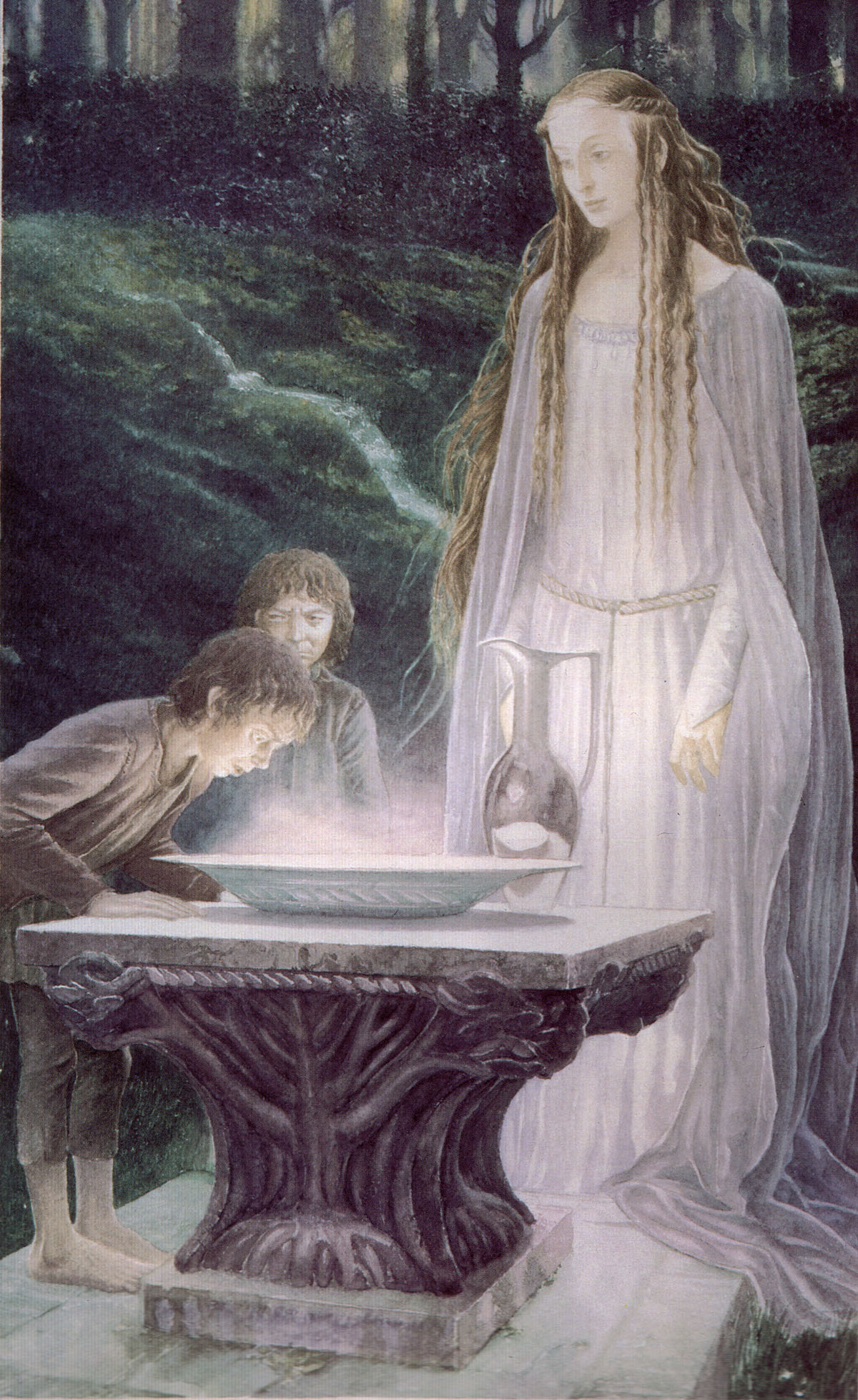
And now we come to the second test, a more selective one, as only Frodo and Sam are involved.
(Alan Lee)
It’s interesting to see the mirrors I’ve already mentioned and how they function in their stories. “Snow White’s” queen employs hers as a surveillance device, in which the mirror encloses an omniscient spy and not her own reflection. Alice’s looking glass is a barrier to another world and the fact that it’s a mirror which she must climb through suggests that, as mirrors invert things, so the world which she enters will be reversed, or at least topsey-turvey—definitely like stepping into an enigma. Jonathan Harker’s is a simple traveler’s shaving mirror, but stands in the middle of a mystery: Dracula seems at first like the customer Jonathan has traveled to Transylvania to meet, businesslike, but hospitable and yet, for a nobleman living in a castle, he appears to have no servants and the castle is nearly ruined. And then: he has no reflection—what is Dracula?
Galadriel’s mirror, although it can repeat an image—
“Sam climbed up on the foot of the pedestal and leaned over the basin. The water looked hard and dark. Stars were reflected in it.”
has other properties—and, interestingly, can be controlled, to some extent, by Galadriel:
“ ‘Many things I can command the Mirror to reveal…and to some I can show what they desire to see.’ “
This has an ambiguous ring to it: does she mean that she can make the Mirror simply reflect what people want to see, rather than what really may be seen? If so, this seems in line with her earlier temptation/testing. She goes on, however:
“ ‘But the Mirror will also show things unbidden, and those are often stranger and more profitable than things which we wish to behold.’”
This would then suggest that the Mirror may also have a mind of its own, beyond her control—“things unbidden”—and yet perhaps more useful—“profitable”.
She then continues:
“ ‘What you will see, if you leave the Mirror free to work, I cannot tell. For it shows things that were, and things that are, and things that yet may be. But what it is that he sees, even the wisest cannot always tell.’ “
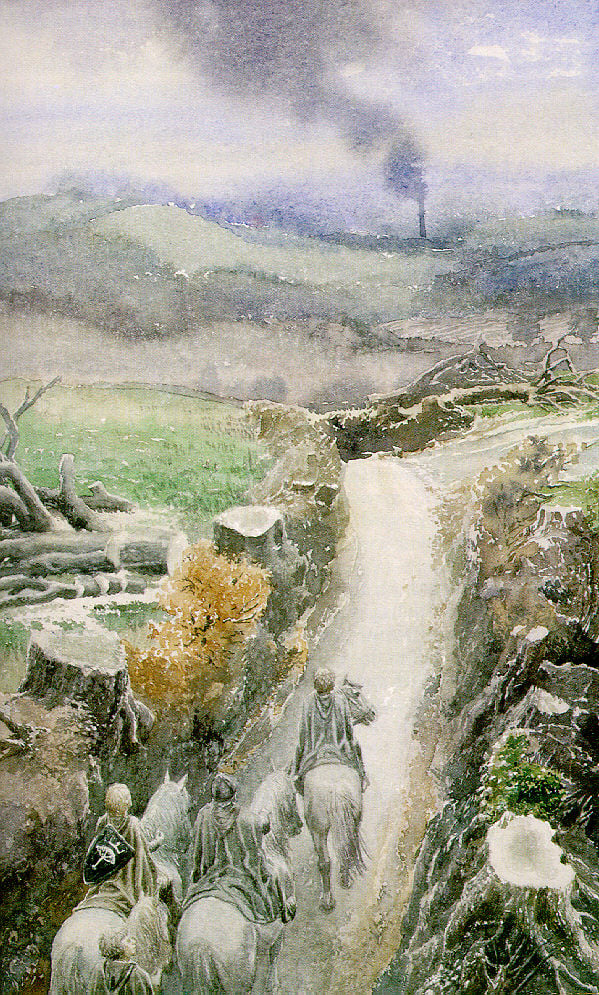
We notice right away that third part: “things that yet may be”—and this important for what happens next. Sam looks in, sees a little of the future which we know will happen: “Frodo with a pale face lying fast asleep under a great dark cliff…himself going along a dim passage, and climbing an endless winding stair”—we can imagine that this is the crossing of the mountains into Mordor. But then Sam sees the Shire and what we know will be Saruman/Sharkey’s planned industrialization—and ruin—of the Shire, with its “tall red chimney nearby” and here Sam almost fails the test, panicking and shouting “I must go home!”
(Alan Lee)
Here, Galadriel intervenes, reminding Sam of something she has already told him and Frodo:
“ ‘Remember that the Mirror shows many things, and not all have yet to come to pass.’”
To which she adds an important caution, echoing also her earlier warning:
“ ‘But I will say this to you: your Quest stands upon the edge of a knife. Stray but a little and it will fail, to the ruin of all. Yet hope remains while all the Company is true.’ ”
saying to Sam:
“ ‘Some never come to be, unless those that behold the visions turn aside from their path to prevent them. The Mirror is dangerous as a guide to deeds.’ “
And, at this, Sam, though miserable, then passes the test:
“ ‘No, I’ll go home by the long road with Mr. Frodo, or not at all.’ “
Frodo’s visions include Gandalf (although he believes that it might be Saruman), then sees what looks to be Sauron’s attack on Minas Tirith, but then something which might be the ship which takes him and others from the Grey Havens towards Valinor (“…and into the mist a small ship passed away, twinkling with lights.”) before his visions are replaced with
“…a single Eye that slowly grew, until it filled nearly all the Mirror.”
And it gets worse:
“The Mirror seemed to be growing hot and curls of steam were rising from the water.”
before Galadriel stops things by quietly saying, “Do not touch the water.”
With this interruption, however, the test, if, as it was for Sam, a test, is never completed, and so we don’t know if Frodo would have passed it. But perhaps it is a warning: should Frodo foolishly try to keep the Ring for himself, as he almost does before Gollum seizes it,
( Ted Nasmith)
would he, unable to master it, be swallowed up into Sauron’s eye, or worse?
“The Road goes ever on and on Down from the door where it began. Now far ahead the Road has gone, And I must follow, if I can, Pursuing it with eager feet, Until it joins some larger way Where many paths and errands meet. And whither then? I cannot say.”
as Bilbo sings, on his way away from the Shire to Rivendell.
(JRRT)
We, however, are currently standing at the broken bridge
at Osgiliath,
(from The Encyclopedia of Arda)
but, through the magic of the internet, we’ll hop over the Anduin and continue our journey along the roads of Middle-earth, this time to the worst possible place (unless you’re an orc)—
(Alan Lee)
Mordor.
To get there, we walk the old road which, in the days before Sauron’s previous invasion attempt, ran from Minas Anor (the “ Tower of the Sun”—now Minas Tirith, “Tower of Guard”),
(Ted Nasmith)
to Minas Ithil (the “Tower of the Moon”)—now Minas Morgul (the “Tower of Black Sorcery”).
(another Ted Nasmith)
This will lead us eastwards to the crossing of the Ithilien north/south road, where there is a much- abused seated figure—
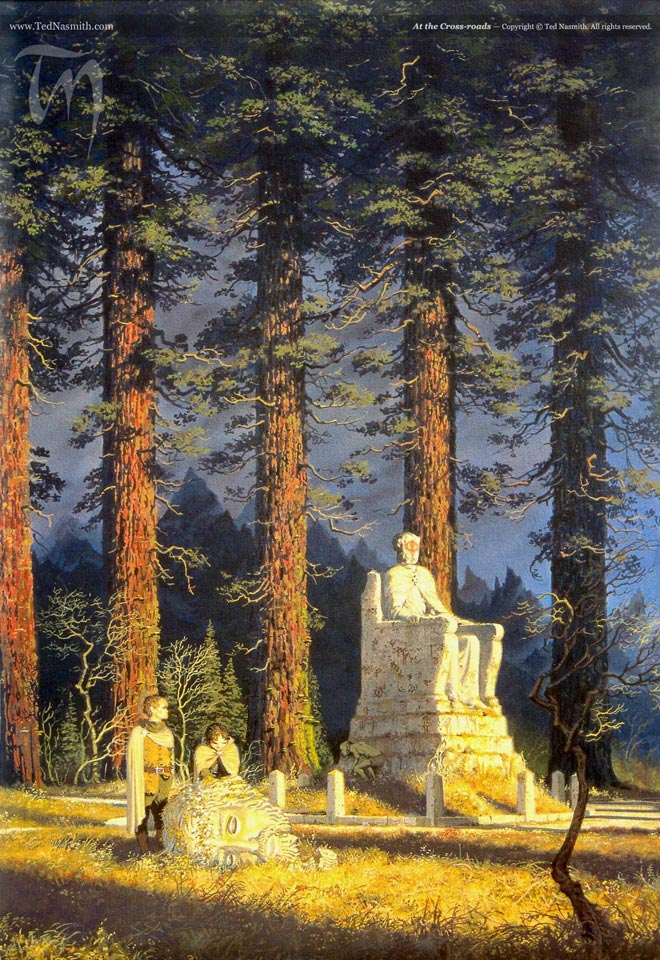
“The brief glow fell upon a huge sitting figure, still and solemn as the great stone kings of Argonath. The years had gnawed it, and violent hands had maimed it. Its head was gone, and in its place was set in mockery a round rough-hewn stone, rudely painted by savage hands in the likeness of a grinning face with one large red eye in the midst of its forehead. Upon its knees and mighty chair, and all about the pedestal, were idle scrawls mixed with the foul symbols that the maggot-folk of Mordor used.” (The Two Towers, Book Four, Chapter 7, “Journey to the Cross-roads”)
(and one more Ted Nasmith. Notice—except for the figure’s size, perhaps, which here wouldn’t be called “huge” nor its chair “mighty”—how carefully the artist has paid attention to the text—typical of Nasmith’s always fine work.)
Frodo and Sam pause here, but we’ll keep moving eastwards on the road towards Minas Morgul.
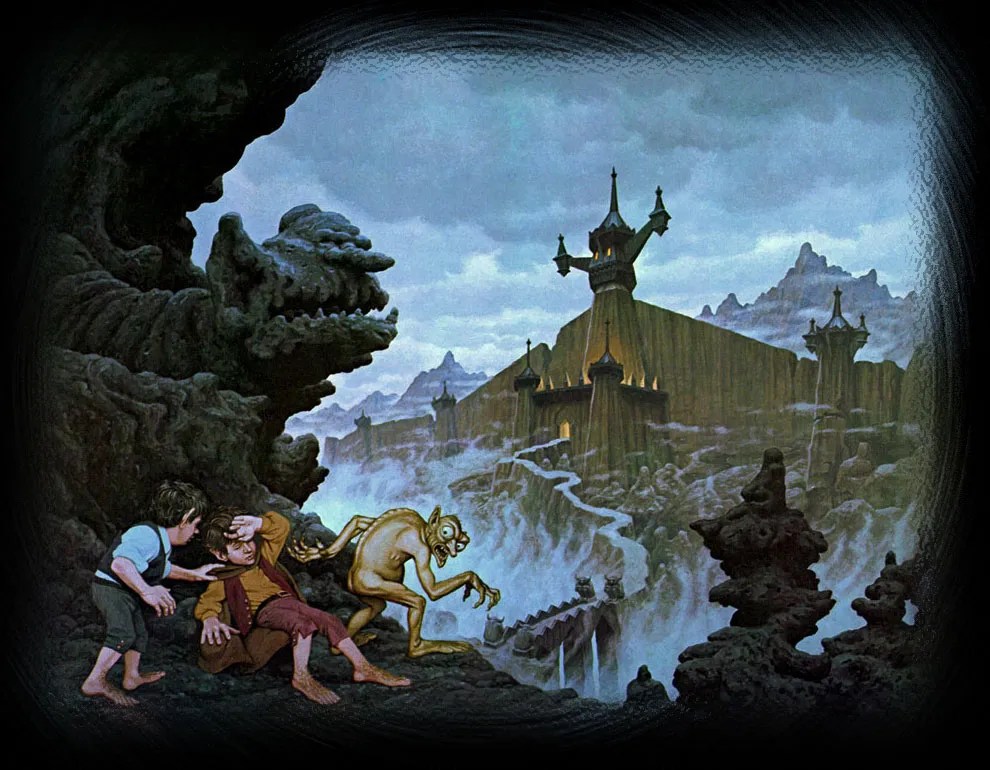
(the Hildebrandts, with a very different view of it and of Gollum)
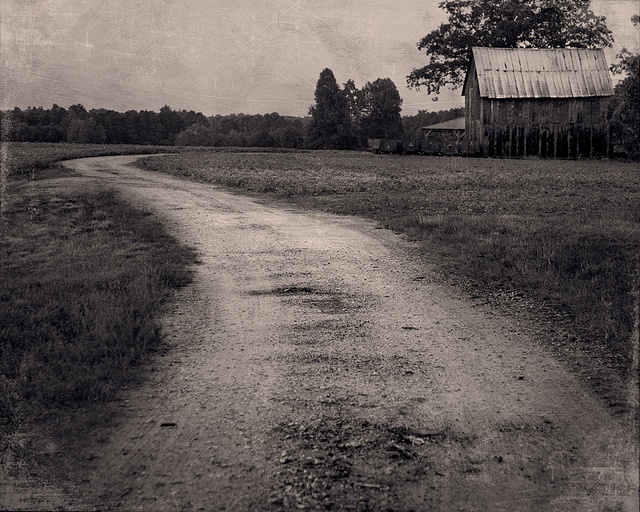
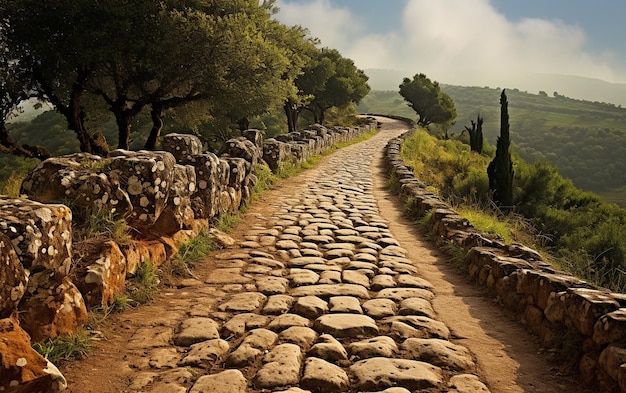
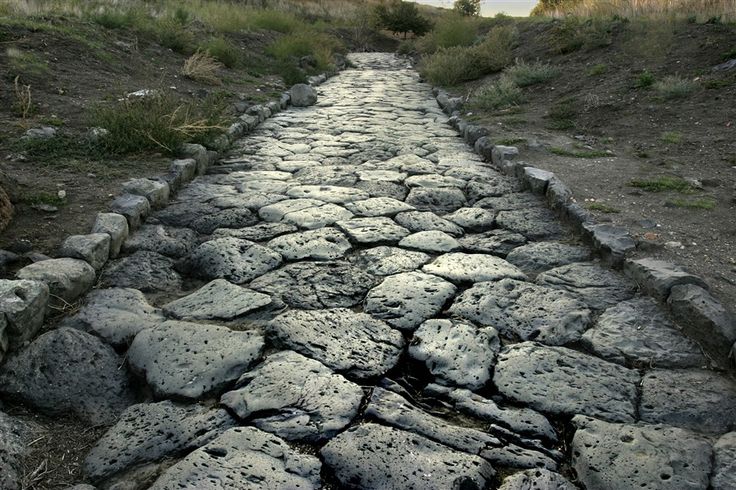
We don’t appear to have a description of this road, but, if you’ve read the previous postings on roads, you’ll know that I would like to imagine that it’s not just a worn dirt track,
but the sort of thing which the Romans built all over their empire,
but now grassgrown and abandoned, like the figure at the crossroads.
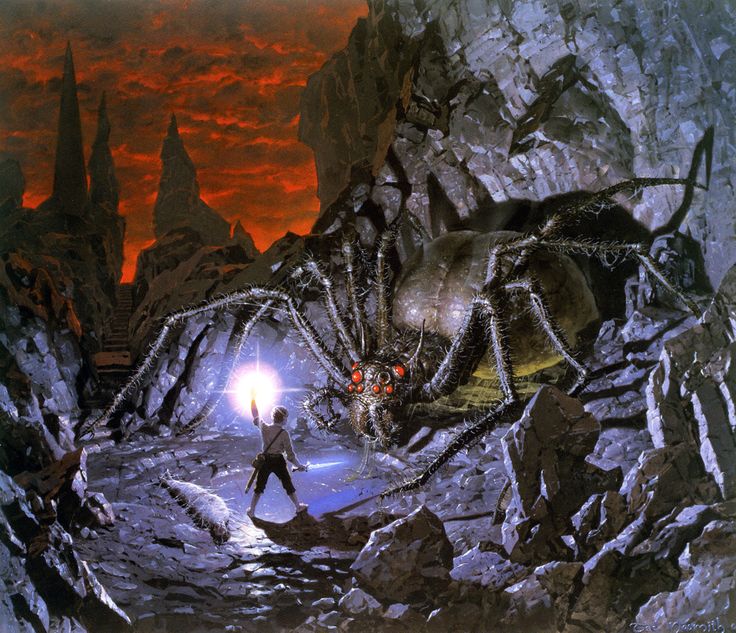
Frodo, Sam, and Gollum skirt Minas Morgul, climbing around it, and we’ll join them, although we’ll avoid the tunnel in which Shelob lives,
(and one more Ted Nasmith)
to come down into Mordor itself.
(Christopher Tolkien)
This is, to say the least, a very bleak place,
(in reality, this is Mt Haleakala National Park, on the island of Maui)
but it seems heavily populated with camps of orcs and Sauron’s allies.
“As far as their eyes could reach, along the skirts of the Morgai and away southward, there were camps, some of tents, some ordered like small towns. One of the largest of these was right below them. Barely a mile out into the plain it clustered like some huge nest of insects, with straight dreary streets of huts and long low drab buildings.” (The Return of the King, Book Six, Chapter 2, “The Land of Shadow”)
(Alan Lee)
There are clearly roads, at least in the northern area—
(from the Encyclopedia of Arda)
and when Frodo and Sam disguise themselves as orcs,
(Denis Gordeev)
they make their way along a major one, only to be taken for potential deserters and driven into an orc marching column.
(Denis Gordeev)
Before they reach such a road, however,
“…they saw a beaten path that wound its way under the feet of the westward cliffs. Had they known, they could have reached it quicker, for it was a track that left the main Morgul-road at the western bridge-end and went down by a long stair cut in the rock to the valley’s bottom.” (The Return of the King, Book Six, Chapter 2, “The Land of Shadow”)
We’ll follow them down this path and eventually reach a road:
“…at the point where it swung east towards the Isenmouthe twenty miles away. It was not a broad road, and it had no wall or parapet along the edge, and as it ran on the sheer drop from its brink became deeper and deeper.” (The Return of the King, Book Six, Chapter 2, “The Land of Shadow”)
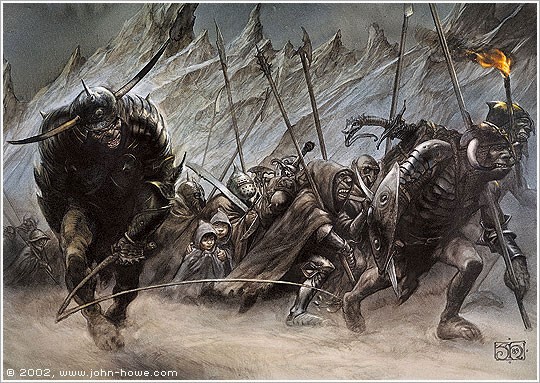
When Frodo and Sam are picked up and driven along in the column,
(John Howe)
we can now see that the column is headed for Isenmouthe and the entrance to the northernmost part of Mordor, Udun,
(from Karen Wynn Fonstad, The Atlas of Middle-Earth)
but the two manage to escape just before the entrance, dropping
“…over the further edge of the road. It had a high kerb by which troop-leaders could guide themselves in black night or fog, and it was banked up some feet above the level of the open land.” (The Return of the King, Book Six, Chapter 2, “The Land of Shadow”)
(perhaps something like this on the right?)
Frodo and Sam now try cutting across open country, which, although full of places to hide, is hard going—
“As the light grew a little [Sam] saw to his surprise that what from a distance had seemed wide and featureless flats were in fact all broken and tumbled. “ (The Return of the King, Book Six, Chapter 3, “Mount Doom”)
The going, however, is simply too rough for them in their current condition, and they return to the road, as will we, approaching Orodruin (Mt. Doom), where, for the first time since finding a spring on the eastern slope of the Mountains of Shadow, they find water—
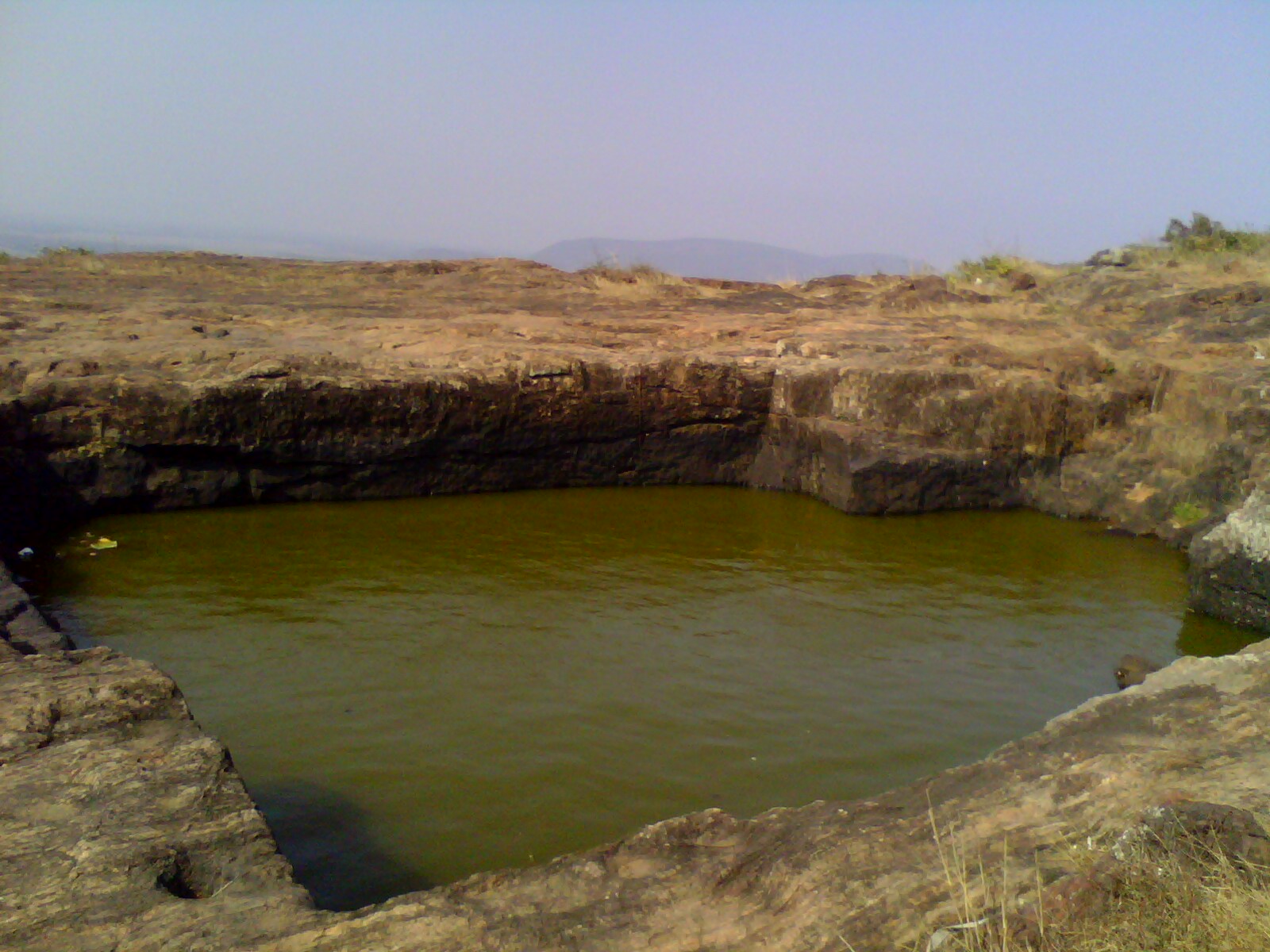
“All long ago would have been spent, if they had not dared to follow the orc-road. For at long intervals on that highway cisterns had been built for the use of troops sent in haste through the waterless regions.
In one Sam found some water left, stale, muddied by the orcs, but still sufficient for their desperate case.” (The Return of King, Book Six, Chapter 3, “Mount Doom”)
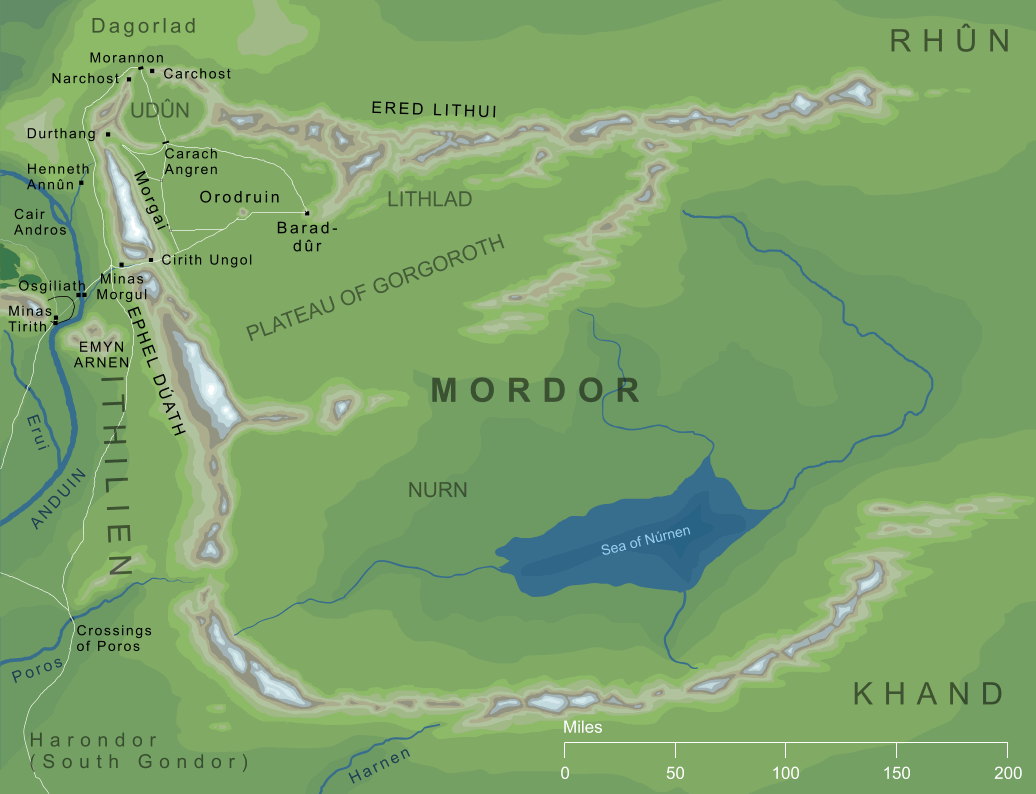
Struggling to the foot of Mt. Doom (Orodruin), Sam discovers a path—our last road in this series of postings—which is actually part of Sauron’s road from the Barad-dur to the volcano.
(from the Encyclopedia of Arda)
“…for amid the rugged humps and shoulders above him he saw plainly a path or road. It climbed like a rising girdle from the west and wound snakelike about the Mountain, until before it went round out of view it reached the foot of the cone on the eastern side.” (The Return of King, Book Six, Chapter 3, “Mount Doom”)
Finally coming to the path, they find
“…that it was broad, paved with broken rubble and beaten ash” The Return of King, Book Six, Chapter 3, “Mount Doom”)
But, before the eagles come to rescue Frodo and Sam, we’ll take our own eagle back to the door where our roads began.
(the Hildebrandts)
As always, thanks for reading.
Stay well,
Remember how perilous it may be to step out your front door,
“Just can’t wait to get on the road again The life I love is makin’ music with my friends And I can’t wait to get on the road again And I can’t wait to get on the road again”
As always, welcome, dear readers. This is from a Willie Nelson, a US country and western singer’s,
virtual theme song, and it seemed to fit where this posting wanted to go.
Having just written two postings about traveling to Bree, it struck me just how many Western adventure stories, as a main element of the plot, require the characters to travel, often long distances. (I’m sure that there are lots of Eastern stories which do this, too—see, for example, Wu Cheng’en’s (attributed) Journey to the West, which appeared in the 16th century—see, for more: https://en.wikipedia.org/wiki/Journey_to_the_West You can read an abridged translation of this at: https://www.fadedpage.com/books/20230303/html.php )
Such adventures are commonly quests—that is, journeys with a particular goal and are commonly round- trip adventures. (For more on quests, see: https://en.wikipedia.org/wiki/Quest )
There are lots of folktales with this pattern, but the literary begins for us with the story of Jason, and his task of finding the Golden Fleece and bringing it back to Greece. (You can read a summary of the story here: https://en.wikipedia.org/wiki/Golden_Fleece The full Greek version we have of the story is from a 3rd century BC poem, the Argonautica of Apollonius of Rhodes, which you can read in a translation here: https://archive.org/details/apolloniusrhodiu00apol And you can read about the poem itself here: https://en.wikipedia.org/wiki/Argonautica )
Then there’s the Odyssey, a later story, in mythological time, in which the main plot is that of Odysseus, a Greek and ruler of the island of Ithaka, who, having participated in the war against Troy, spends 9+ years of many adventures getting home to his island once more.
It’s no wonder, then, that Tolkien, originally destined to be a classicist, in telling a long story to his children, would make it a quest.
This quest would take the protagonist, Bilbo Baggins, from his home in the Shire hundreds of miles east, to the Lonely Mountain (Erebor) and back.
(Pauline Baynes—probably JRRT’s favorite illustrator—and whom he recommended to CS Lewis, for whom she illustrated all the Narnia books. You can read about her here: https://en.wikipedia.org/wiki/Pauline_Baynes )
In the last two postings, we first followed Bilbo eastwards to Bree—only to find that, in The Hobbit, there is no Bree. We then retraced our steps and followed Frodo and his friends as they journeyed in the same direction, although this time with more success.
(Ted Nasmith)
Part of Frodo’s trip (with some detours), took him along the Great East Road, which ran through the Shire,
(Christopher Tolkien)
crossing the Greenway ( the old north/south road—more about this in a moment) at Bree and proceeding eastwards from there–
(Barbara Strachey, The Journeys of Frodo, 1981)
although Frodo and his friends, led by Strider,
(the Hildebrandts)
took an alternate route from there to Weathertop.
Because I’m always interested in the physical world of Middle-earth, I try to imagine what, in our Middle-earth, either suggested things to JRRT, or at least what we can use to try to reconstruct something comparable.
For the Great East Road, because it was constructed by the kings of Arnor, and had a major bridge (the Bridge of Strongbows—that is, strong arches), across the Brandywine,
(actually a 16thcentury Ottoman bridge near the village of Balgarene in Bulgaria. For more on Bulgarian bridges, some of which are quite spectacular, see: https://vagabond.bg/bulgarias-wondrous-bridges-3120 )
I had imagined something like a Roman road, wide, paved, with perhaps drainage on both sides.
The Romans were serious engineers and roads could be very methodically laid out and built.
This may have been true once, but the road Frodo and his friends eventually reach doesn’t sound much like surviving Roman work—
“…the Road, now dim as evening drew on, wound away below them. At this point it ran nearly from South-west to North-east, and on their right it fell quickly down into a wide hollow. It was rutted and bore many signs of the recent heavy rain; there were pools and pot-holes full of water.” (The Fellowship of the Ring, Book One, Chapter 8, “Fog on the Barrow-downs”)
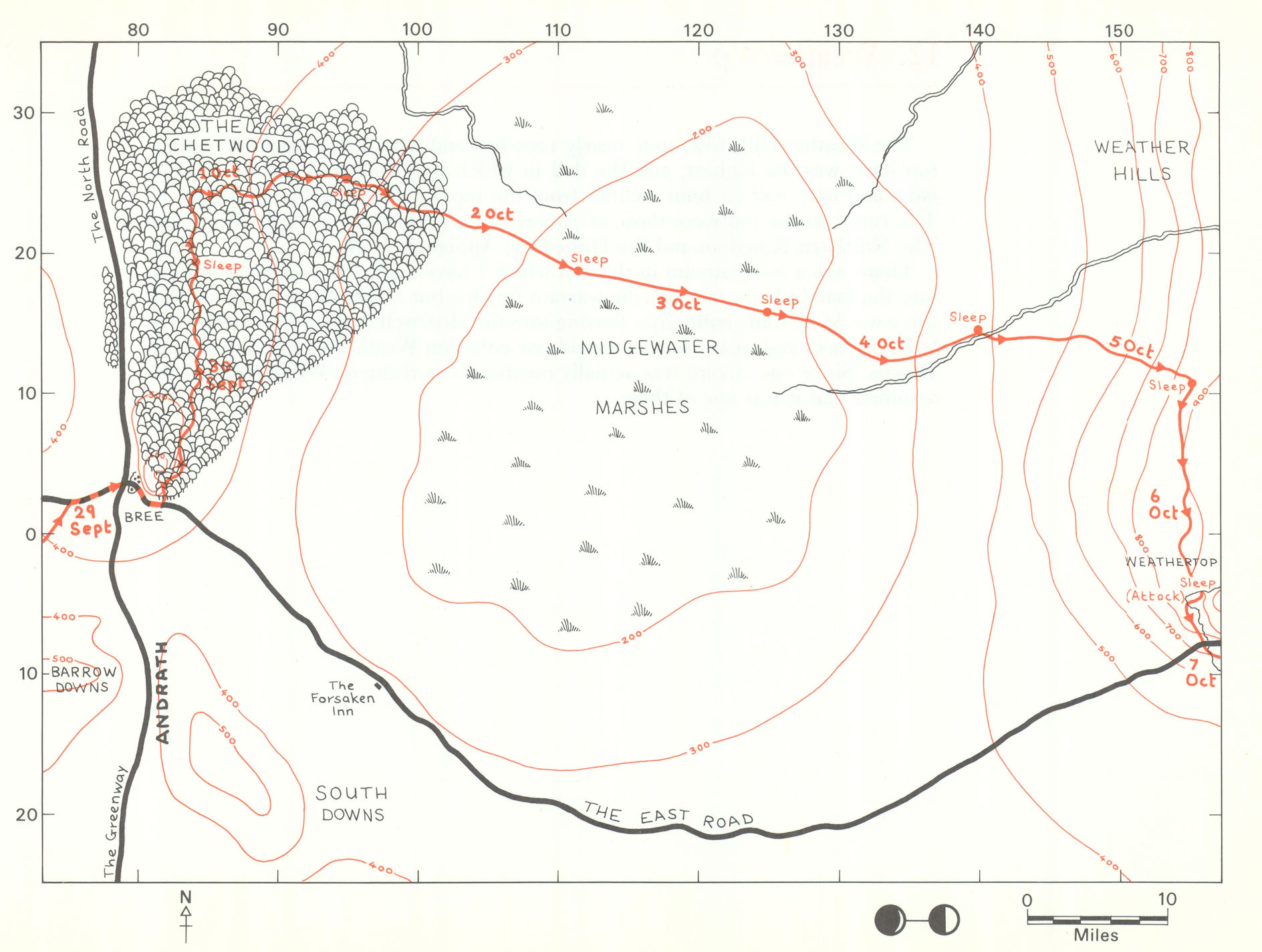
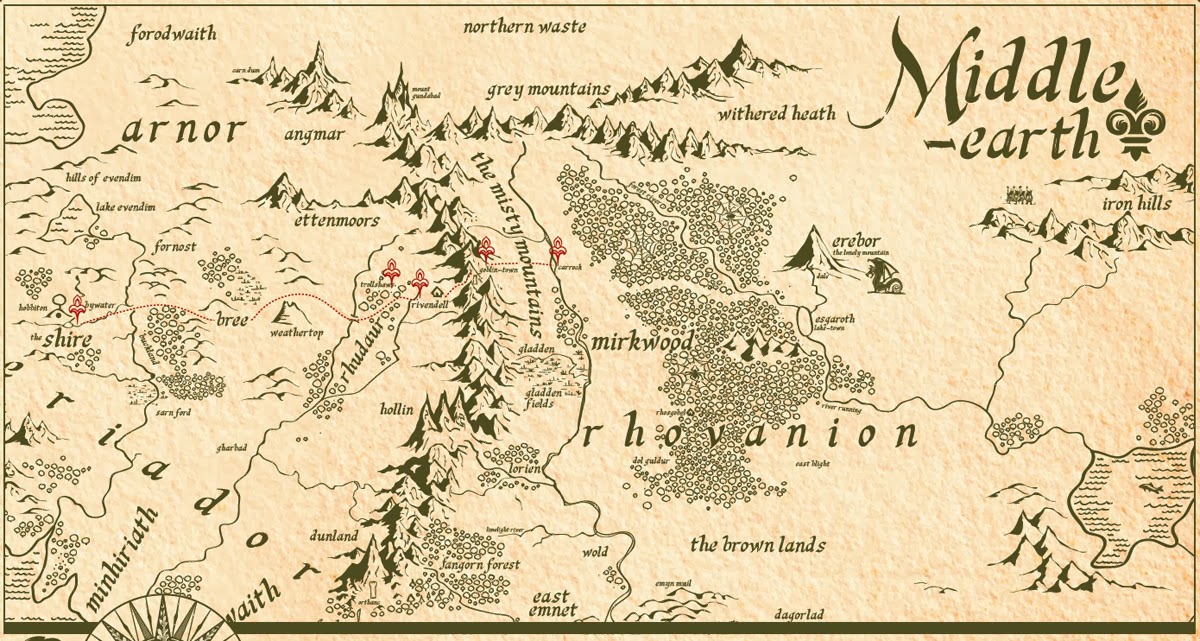
Following the road, however, has made me consider just how many miles of roads we actually see in Middle-earth and over which various characters travel and how they might appear. Just look at a map—
(cartographer? clearly based on JRRT and Christopher Tolkien’s map)
The Great East Road (named “East-West Road” there) is drawn and identified, and we can see the North Road (as “North-South Road”), but these are hardly the only roads in Middle-earth and certainly not in the story, and, as we’re following Frodo & Co. on their journeys, I thought that it would be interesting to examine some of the others—the main ones, and one nearly-lost one.
So, when Frodo and his friends eventually reach the edge of Bree, they’re actually at a crossroads—
“For Bree stood at the old meeting of ways: another ancient road crossed the East Road just outside the dike at the western end of the village, and in former days Men and other folk of various sorts had traveled much on it. ‘Strange as News from Bree’ was still a saying in the Eastfarthing, descending from those days, when news from North, South, and East could be heard in the inn, and when the Shire-hobbits used to go more to hear it.”
With the fall of the northern realm of Arnor about TA1974, however, things had changed:
“But the Northern Lands had long been desolate, and the North Road was now seldom used: it was grass-grown, and the Bree-folk called it the Greenway.” (The Fellowship of the Ring, Book One, Chapter 9, “At the Sign of the Prancing Pony”)
We’re not given a detailed description of this road—was it like what I had imagined the Great East Road might have looked like, Roman and paved, but overgown?
If so, it led back to the city of Tharbad to the south, which had had its own elaborate bridge at the River Greyflood—
“…where the old North Road crossed the river by a ruined town.”
Of this bridge we know:
“…both kingdoms [Arnor and Gondor] together built and maintained the Bridge of Tharbad and the long causeways that carried the road to it on either of the Gwathlo [Greyflood]…” (JRRT Unfinished Tales, 277)
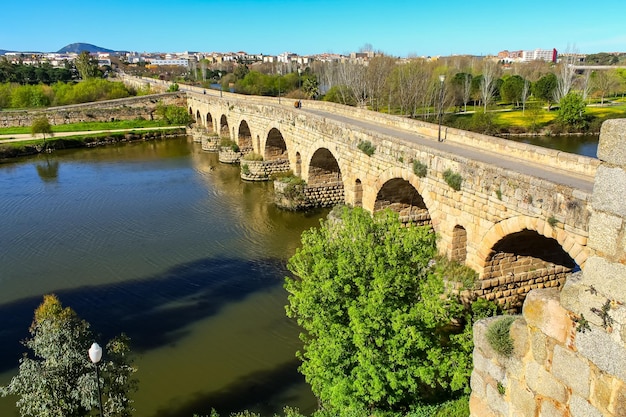
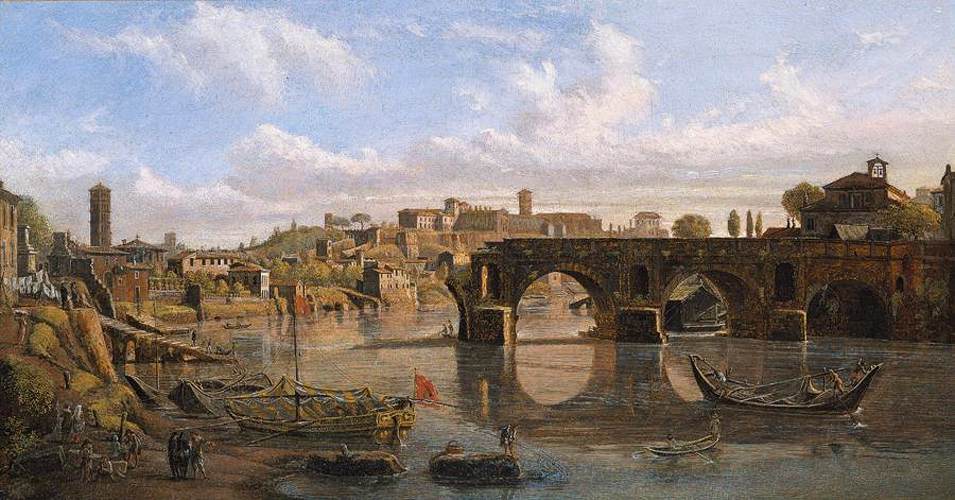
It must have been massive—could it have looked something like this?
As we also know, it had fallen into ruin, becoming only a dangerous ford, as Boromir found out, losing his horse there on the way north (The Fellowship of the Ring, Book Two, Chapter 8, “Farewell to Lorien”)
In “To Bree (Part 1)”, we had followed Bilbo & Co.
(Hildebrandts)
(Hildebrandts)
eastwards,
but only as far as Bree, echoing the remark in The Lord of the Rings:
“It was not yet forgotten that there had been a time when there was much coming and going between the Shire and Bree.” (The Fellowship of the Ring, Book One, Chapter 9, “At the Sign of the Prancing Pony”)
Oddly, however, although I supposed that we were traveling through the East Farthing
the description in The Hobbit was wildly different:
“Then they came to lands where people spoke strangely, and sang songs Bilbo had never heard before. Now they had gone on far into the Lone-lands, where there were no people left, no inns, and the roads grew steadily worse. Not far ahead were dreary hills, rising higher and higher, dark with trees. On some of them were old castles with an evil look, as if they had been built by wicked people.” (The Hobbit, Chapter 2, “Roast Mutton”)
with, eventually, a surprise for us Bree-bound folk: no Bree.
So, back we went to the Green Dragon, in Bywater, where Bilbo started and now we begin again, with Frodo. Times have changed, however, and unlike the innocent Bilbo, we are in a different world, where Mordor isn’t just a distant place name and its servants are looking for Baggins.
(Denis Gordeev)
Frodo doesn’t take the Great East Road,
(Christopher Tolkien)
but cuts across country, narrowly avoiding one of the searchers,
(Angus McBride)
taking shelter with a local farmer, and finally reaching the ferry across the Brandywine just ahead of his pursuers.
Although this is a very indirect route, Frodo and his companions eventually reach Bree, but even though I would love to meet Tom Bombadil,
(the Hildebrandts)
I prefer a direct route, so we’ll continue on the Great East Road, cross the Bridge of Strongbows, and head eastwards.
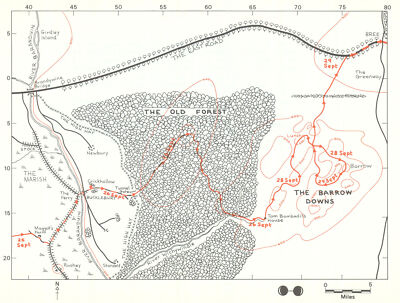
(from Barbara Strachey, The Journeys of Frodo, a much-recommended book, if you don’t have a copy)
So what do we see?
Over the bridge—and here’s another possibility for it, the Clopton Bridge at Stratford-upon-Avon—
the road runs, not surprisingly, due eastwards and here, consulting our map,
is the Old Forest to our right,
described, by our narrator, as Frodo and his friends see it on their detour away from the Great East Road:
“Looking ahead they could see only tree-trunks of innumerable sizes and shapes: straight or bent, twisted, leaning, squat or slender, smooth or gnarled and branched; and all the stems were green or grey with moss and slimy, shaggy growths.” (The Fellowship of the Ring, Book One, Chapter 6, “The Old Forest”)
Keep in mind, however, that we’re seeing it through a long line of trees planted alongside the road, probably as a windbreak.
We know that they’re there because Merry says:
“ ‘That is a line of trees,’ said Merry, ‘and that must mark the Road. All along it for many leagues east of the Bridge there are trees growing. Some say they were planted in the old days.’ “ (The Fellowship of the Ring, Book One, Chapter 8, “Fog on the Barrow-downs”)
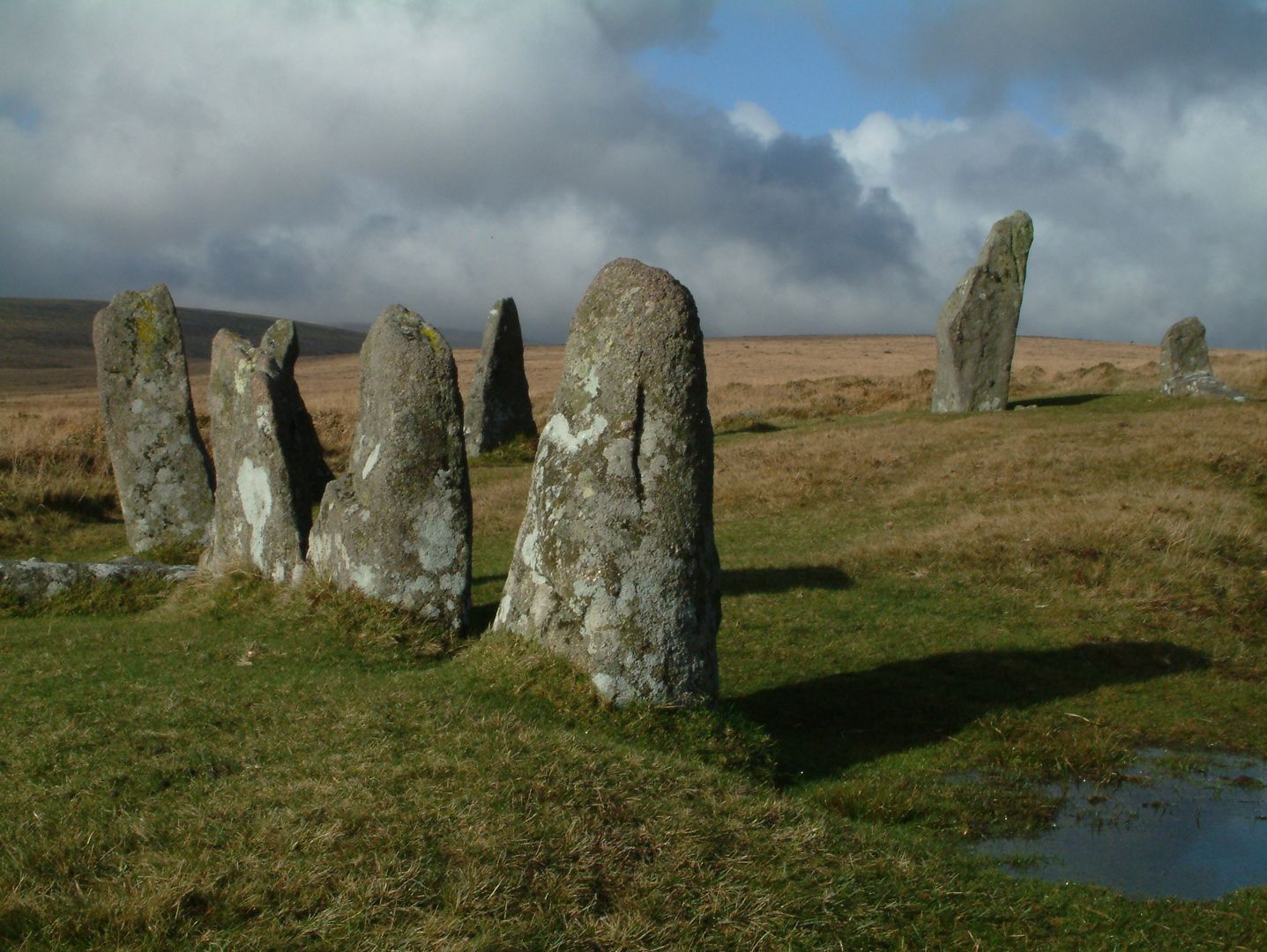
As we travel farther along the road, if we look to our right, through the trees, we then come to the edge of the Barrow-downs,
with their ancient standing stones
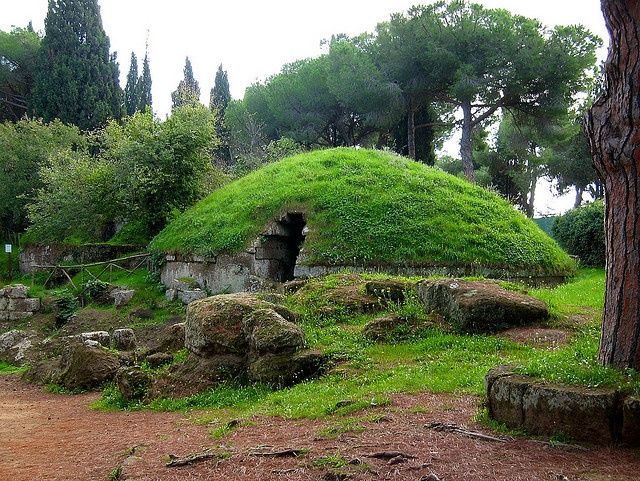
and tumuli—
where Frodo and his friends almost end their trip.
(Matthew Stewart)
But we haven’t strayed, as they did, and, passing the Downs, we see, again on our right:
“The dark line they had seen was not a line of trees but a line of bushes growing on the edge of a deep dike, with a steep wall on the further side.”
A dike is a ditch, usually with an earthen embankment made from the spoil of the ditch. There are several of these in England, like Offa’s Dyke—
The narrator adds:
“…with a steep wall on the further side”
and I’m presuming that that is the earthen embankment, with:
“…a gap in the wall” through which Frodo and friends rode and
…when at last they saw a line of tall trees ahead…they knew that they had come back to the Road.”
If you’re read the first part of this posting, you will know that I’ve been assuming that that Road, laid in ancient times to a stone bridge and beyond, would be like a Roman road, and be paved,
if a bit weedy, but now we find:
“…the Road, now dim as evening drew on, wound away below them. At this point it ran nearly from South-west to North-east, and on their right it fell quickly down into a wide hollow. It was rutted and bore many signs of the recent heavy rain; there were pools and pot-holes full of water.”
Does this suggest that it was, at best and in the past, simply a dirt road, through well-kept? Or is it a very run-down road, worn and covered over with leaves and dirt, the ancient blocks gradually becoming separated under the weight of centuries, allowing for pot-holes?
In any event, we now continue our journey with Frodo and his compantions until–
“…they saw lights twinkling some distance ahead.
Before them rose Bree-hill barring the way, a dark mass against misty stars; and under its western flank nestled a large village. Towards it they [and we] now hurried desiring only to find a fire, and a door between them and the night.”
We’re not in Bree yet, however, as:
“The village of Bree had some hundred stone houses of the Big Folk, mostly above the Road, nestling on the hillside with windows looking west. On that side, running in more than half a circle from the hill and back to it, there was a deep dike with a thick hedge on the inner side. Over this the Road crossed by a causeway; but where it pierced the hedge it was barred by a great gate. There was another gate in the southern corner where the Road ran out of the village. The gates were closed at nightfall; but just inside them were small lodges for the gatekeepers.” (The Fellowship of the Ring, Book One, Chapter 9, “At the Sign of the Prancing Pony”)
We’ve seen a dike just now, at the Great East Road, but now we have to add a hedge
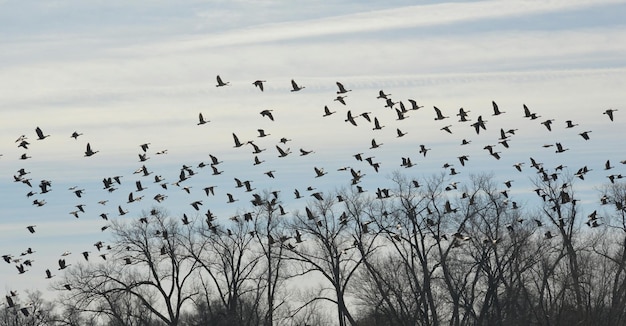
The first part of this posting began as far from Middle-earth and its history as possible: the Biblical lands of our Middle-earth and the story of the ancient prophet, Daniel and specifically the event which gained Daniel his position in the court first of Belshazzar, the Babylonian king, and then in that of his conqueror/successor, Darius the Persian. Uniquely for early prophecy, Belshazzar hadn’t been warned that he would be deposed by any of the accepted means—the reading of the flight of birds
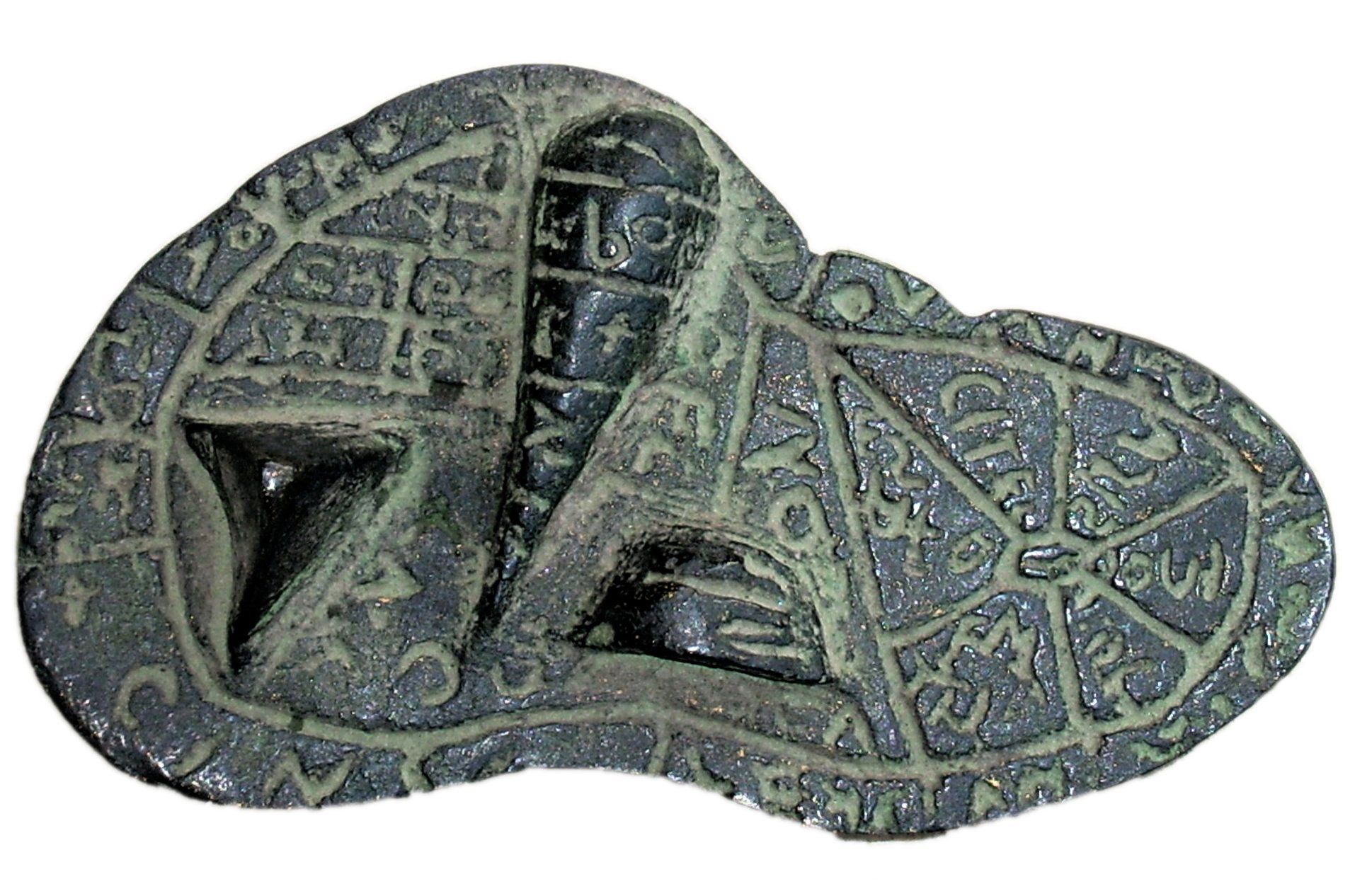
or the reading of animal intestines, for example,
(This is a bit of Etruscology, being a bronze model of a sheep’s liver believed to be used as a guide to interpreting what an Etruscan priest might find on an actual sheep’s liver. For more, see: https://en.wikipedia.org/wiki/Haruspex )
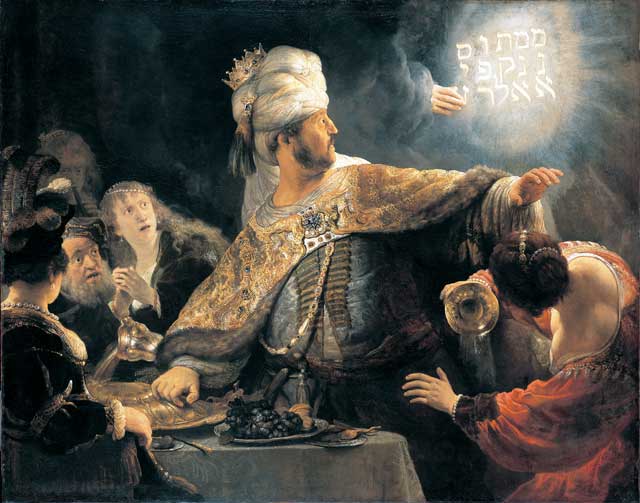
but by a message written by a detached hand on an interior wall of his palace.
(Rembrandt—as I said in the first part of this posting, having no idea of what real Babylonians looked like, the artist went for the Magi look)
In that posting, I suggested that Daniel’s story not only confirmed his role as prophet, but, for the posting, that he was literate, which would have marked him out in a world in which literacy was a specialized skill, like being a boatwright.
This, in turn, had led to considering literacy in Middle-earth, chiefly among hobbits, and, in particular, the literacy of one rather unlikely hobbit, Sam Gamgee.
(Robert Chronister)
For more on this, see that earlier posting, “It’s in Writing (1)” 15 October, 2025, but my conclusion, based upon the final chapter of The Lord of the Rings, “The Grey Havens”, was that, as the story of Daniel makes Daniel literate in order to elevate him to a level of prophetic importance, so JRRT makes Sam literate in order to allow him to be the author who will complete the story of the Ring.
That posting briefly examined hobbits and even suggested some evidence of literacy among dwarves, but it was never meant to be a full inventory of mentions of literacy in Middle-earth—although I think that that would be a very interesting project and well worth doing—and one thing it omitted entirely was any mention of literacy in Mordor.
Did Orcs read and write, for example?
(Alan Lee)
Considering the conversation of people like Ugluk and Grishnakh, it would seem that they were mainly oral, as much of their and other talk is based upon what they hear, rather than read. (“ ‘What are they wanted for?’ asked several voices. ‘Why alive? Do they give good sport?’ ‘No! I heard that one of them has got something, something that’s wanted for the war…” The Two Towers, Book Three, Chapter 3, “The Uruk-hai”—for more on Orcs and gossip, among other things, see “Scuttlebutt”, 27 October, 2021)
And yet there’s this:
“The brief glow fell upon a huge sitting figure, still and solemn like the great stone kings of Argonath. The years had gnawed it, and violent hands had maimed it..Upon its knees were idle scrawls mixed with the foul symbols that the maggot-folk of Mordor used.” (The Two Towers, Book Four, Chapter 7, Journey to the Cross-roads”)
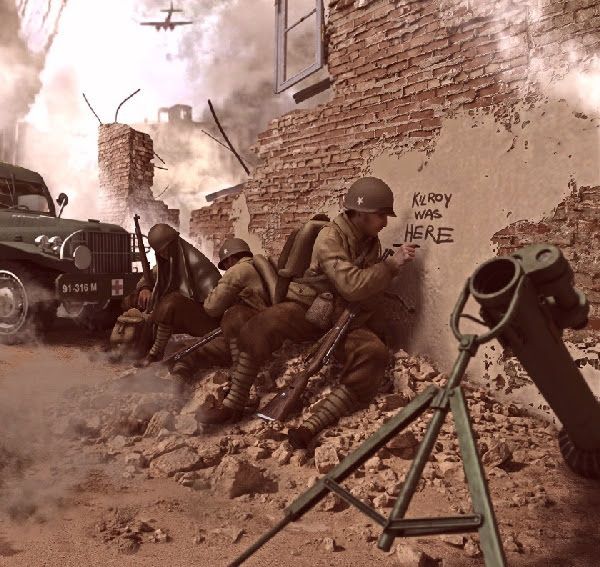
The “maggot-folk of Mordor” must certainly be the Orcs and “idle scrawls” suggests graffiti, like the World War 2-era favorite–
So what did they write in? Pippin, while a prisoner of the Orcs, notices that they seem to speak different languages—or at least dialects—but employ the Common Speech to understand each other:
“To Pippin’s surprise he found that much of the talk was intelligible; many of the Orcs were using ordinary language. Apparently the members of two or three quite different tribes were present, and they could not understand one another’s orc-speech.” (The Two Towers, Book Three, Chapter 3, “The Uruk-hai”)
Can we presume, then, that the “idle scrawls” were in the writing system called the Tengwar, as “[its letters] had spread over much of the same area as that in which the Common Speech was known” (The Lord of the Rings, Appendix E, II, “Writing”)? Or possibly the runic Cirith, as “[it] became known to many peoples, to Men and Dwarves, and even to Orcs, all of whom altered it to suit their purposes and according to their skill or lack of it.”
But what about the Black Speech?
“It is said that the Black Speech was devised by Sauron in the Dark Years, and that he had desired to make it the language of all those that served him…”
however—
“…after the first overthrow of Sauron this language in its ancient form was forgotten by all but the Nazgul. When Sauron arose again, it became once more the language of Barad-dur and of the captains of Mordor.”
It was the formal language of the top of the chain of command, then, but, as JRRT had written earlier of Sauron’s first attempt to make it the official language, “he failed in that purpose” and the Orcs picked and chose what they found useful and nothing more. (See The Lord of the Rings, Appendix F, “Of the Other Races”)
Save for what might be the Black Speech in a curse (“Ugluk u bagronk sha pushdug Saruman-glob bubhosh skai”, says one menacing Orc to Pippin– The Two Towers, Book Three, Chapter 3, “The Uruk-hai”), when we hear it, it’s Gandalf, reciting what he read when he “set the golden thing in the fire a while” (The Fellowship of the Ring, Book Two, Chapter 2, “The Council of Elrond”).
And this brings us back to reading and writing. Why was there writing on that particular ring?
Not being a party to its maker’s mind, this is only my guess, but I think that it may have had several possible purposes.
First—and this seems the most obvious—comes from something Gandalf says, repeating a remark made by Saruman:
“ ‘The Nine, the Seven, and the Three…had each their proper gem. Not so the One. It was round and unadorned, as it were one of the lesser rings; but its maker set marks upon it that the skilled, maybe, could still see and read.” (The Fellowship of the Ring, Book Two, Chapter 2, “The Council of Elrond”).
Thus, Sauron had written on it to distinguish it from the other rings—and this writing was seemingly to be seen only by Sauron, as Isildur suggests:
“It was hot when I first took it, hot as a glede [a hot coal], and my hand was scorched, so that I doubt if ever again I shall be free of the pain of it. Yet even as I write it is cooled, and it seemeth to shrink, though it loseth neither its beauty nor its shape. Already the writing upon it, which at first was as clear as red flames, fadeth and is only barely to be read.”
Isildur’s explanation for this fading was:
“The Ring misseth, maybe, the heat of Sauron’s hand, which was black and yet burned like fire.” (The Fellowship of the Ring, Book Two, Chapter 2, “The Council of Elrond”).
The second purpose, then, might be that The Ring mirrored, in a way, its master, the inscription legible to him because it took its heat from his hand and, with that removed, it cooled, eventually, into silence. Isildur had guessed that heat might revive it (“…maybe were the gold made hot again, the writing would be refreshed”) but it was Gandalf, having read Isildur’s suggestion, who did, by placing it into an environment like to its original. That it would lose that inscription if the Ring were removed from its owner’s hand might also suggest a third purpose, which lies in what the writing actually said:
“One Ring to rule them all, One Ring to find them,
One Ring to bring them all and in the darkness bind them.” (The Fellowship of the Ring, Book One, Chapter 2, “The Shadow of the Past”)
Although Gandalf says that this formed part of “a verse long known in Elven-lore”, the Ring itself was meant to be the master ring:
“He only needs the One; for he made that Ring himself, it is his, and he let a great part of his own former power pass into it, so that he could rule all the others.”
Thus, though it may have been part of a “verse long known in Elven-lore”, it sounds to me like a kind of spell Sauron would have chanted as he made the Ring, not only putting “a great part of his own former power” into it, but binding the lesser rings to it, as the words written on the Ring may have eventually been part of later tradition, but, logically, must have been his words long before they became part of that tradition.
These might have been Sauron’s purposes, but they also serve the narrative. As Bilbo’s ring, passed down traumatically to Frodo, is “round and unadorned”, Gandalf has to have some way to prove to himself and to Frodo that this ring is the Ring.
(Alan Lee)
When Gandalf begins explaining to Frodo in detail about it and about Bilbo’s connection to it, he first mentions that
“A mortal…who keeps one of the Great Rings, does not die, but he does not grow or obtain more life, he merely continues, until at last every minute is a weariness.”
and Bilbo, says Gandalf, “…was getting restless and uneasy. Thin and Stretched, he said.”
He speaks further about his worries about Bilbo and then tells Frodo that “There is a last test to make”, meaning in his confirmation that this is the Ring.
That last test takes place when, reluctantly, Frodo hands the Ring to Gandalf, and Gandalf throws it into the fire on Frodo’s hearth, where, when Frodo picks it up, he spots “fine lines, finer than the finest pen-strokes, running along the ring, outside and inside: lines of fire that seemed to form the letters of a flowing script” and that script says:
“One Ring to rule them all, One Ring to find them, One Ring to bring them all and in the Darkness bind them.” (translation by Gandalf—earlier quotations from The Fellowship of the Ring, Book One, Chapter 2, “The Shadow of the Past”, the Black Speech from Book Two, Chapter 2, “The Council of Elrond” For more on the Black Speech, see: https://en.wikipedia.org/wiki/Black_Speech )
For Gandalf, that inscription is the final element in his understanding of just what, long ago, Bilbo picked up in the tunnels under the Misty Mountains. He explains that it’s “only two lines of a verse long known in Elven-lore”, but those two lines are apparently all that’s necessary.
But where might the idea for an inscription have come to JRRT from originally? I have no proof, but, as a medievalist, Tolkien might have been aware of what we find in medieval bling and is later picked up in Hamlet.
If you, like me, are a Shakespeare fan, you may recognize the subtitle of this posting as a sharp little remark by Hamlet in Act III, Scene 2 (you can read it here in the First Quarto of 1603: https://internetshakespeare.uvic.ca/doc/Ham_Q1/complete/index.html ). Hamlet is making fun of a very brief prologue before The Murder of Gonzago, the “play within a play” (renamed “The Mousetrap” by Hamlet) by which he hopes to force his uncle, Claudius, to reveal his guilt in the death of Hamlet’s father, but it’s the second half of that line, “a Poesie for a Ring” which provides an answer to my question.
What Hamlet is suggesting is that the prologue is as clumsy as the poetry found within a ring (although occasionally on the outside) usually given by one lover to another in the late medieval era at least into the 18th century, like this one—
where inside is written “When this you see, remember me.”
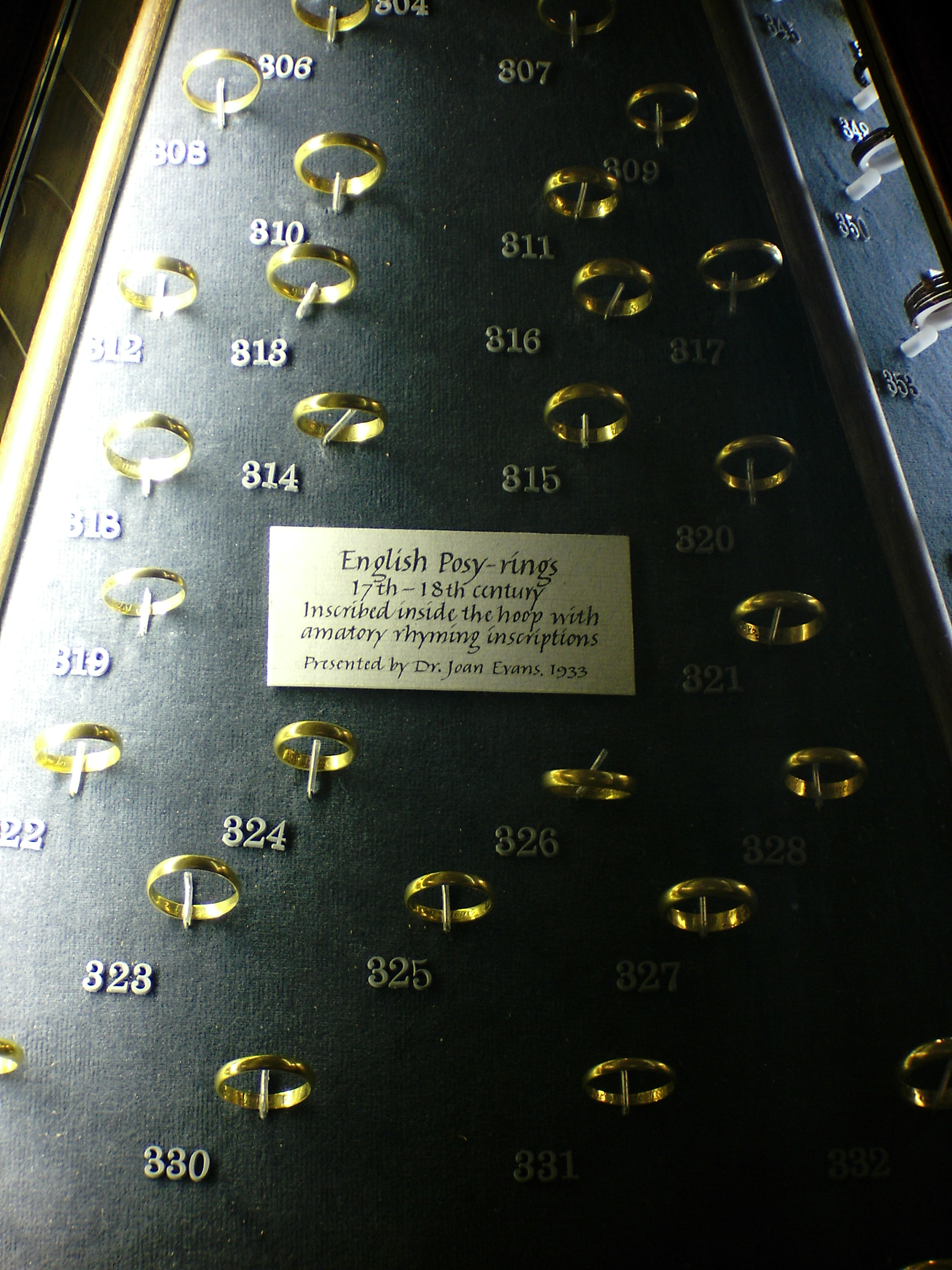
Often called “posy rings” (a contracted form of “poesie”, as in the Shakespeare quotation), there are hundreds of surviving examples—here are only a small number from the Ashmolean Museum in Oxford—
The texts vary, from what appears confident–“In thee my choice I do rejoice”—to the less so: “I live in Hope”, but the general purpose of these little gifts is clear, if less sinister than Sauron’s. They are meant to remind someone that someone else is thinking of them. The difference, however, is that, if there’s one thing you wouldn’t want, it would be to have the Eye of Sauron looking in your direction.
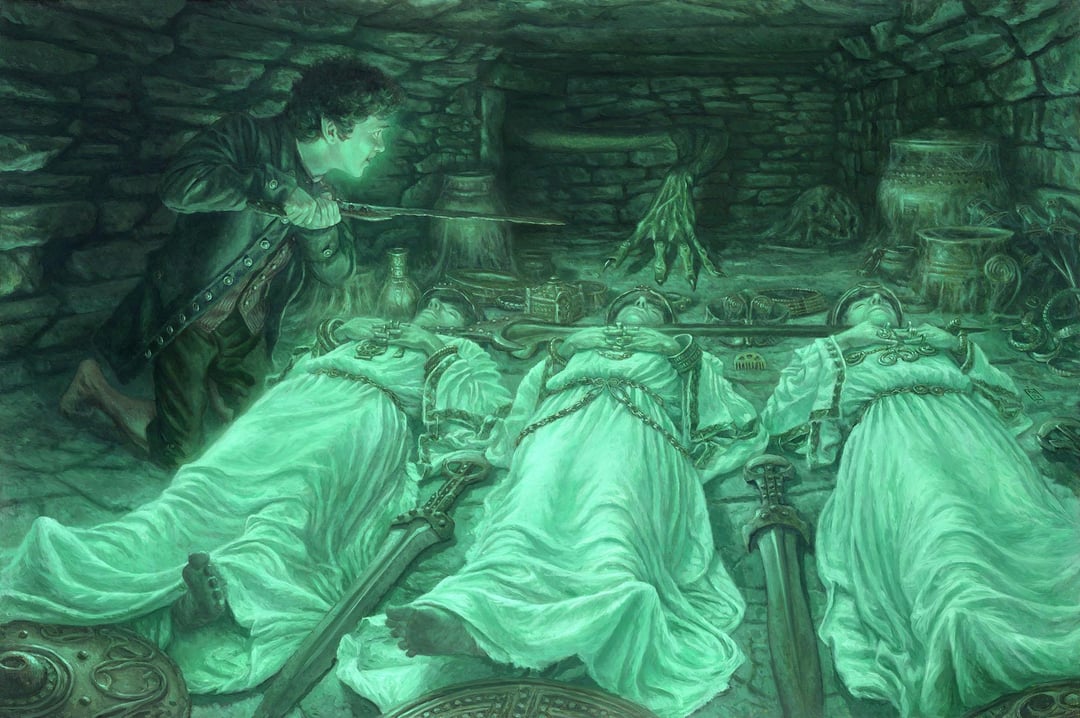
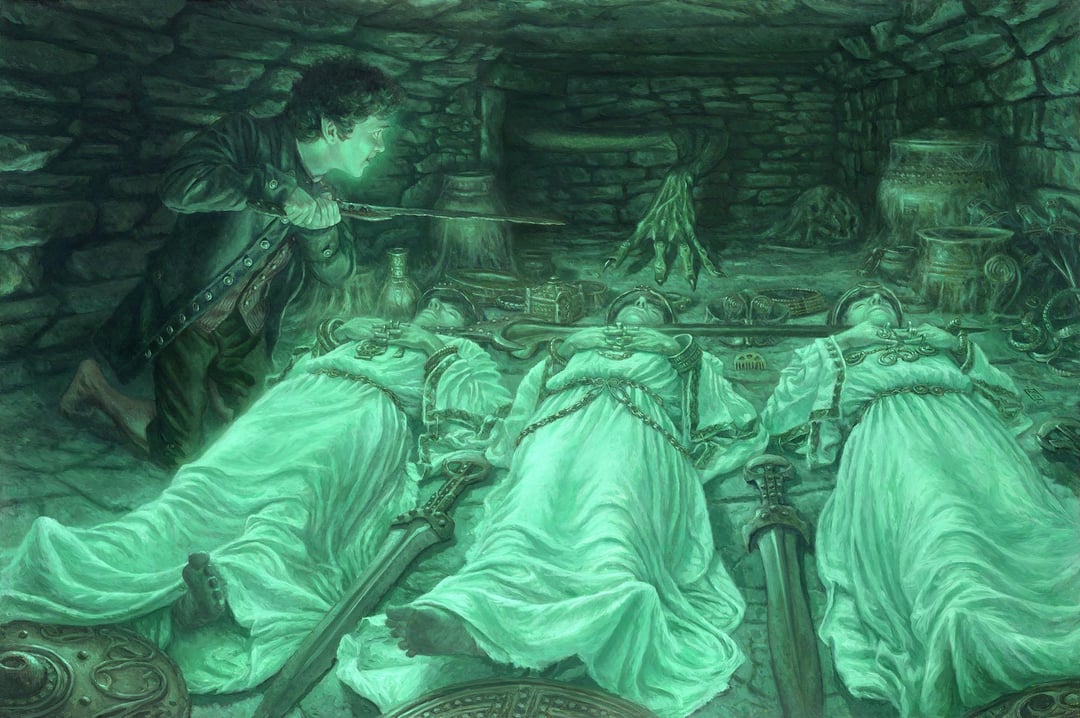
“He turned, and there in the cold glow he saw lying beside him Sam, Pippin, and Merry. They were on their backs, and their faces looked deadly pale; and they were clad in white. About them lay many treasures, of gold maybe, though in that light they looked cold and unlovely. On their heads were circlets, gold chains were about their waists, and on their fingers were many rings. Swords lay by their sides, and shields were at their feet. But across their three necks lay one long naked sword.” (The Fellowship of the Ring, Book One, Chapter 8, “Fog on the Barrow Downs”)
There is a difficulty, however: none of the hobbits is dead—although that sword across three of their necks suggests that they soon will be.
And I would further suggest that what we’re looking at is the scene of a potential human sacrifice—especially if we add what the narrator calls an “incantation” on the part of the Barrow-wight:
“Cold be hand and heart and bone,
And cold be sleep under stone:
Never more to wake on stony bed,
Never, till the Sun fails and the Moon is dead.
In the black wind the stars shall die,
And still on gold here let them lie,
Till the dark lord lifts his hand
Over dead sea and withered land.”
Human sacrifice had certainly been practiced in Middle-earth. We know that Sauron, defeated temporarily, corrupts the king of Numenor, Tar-Calion (also known as Ar-Pharazon), preaching the worship of the fallen Vala, Morgoth:
“A new religion, and worship of the Dark, with its temple under Sauron arises. The faithful are persecuted and sacrificed. The Numenoreans carry their evil also to Middle-earth and there become cruel and wicked lords of necromancy, slaying and tormenting men… “ (letter to Milton Waldman, late 1951, Letters, 216-217—for more on this see “Melkor/Morgoth/Melqart” 29 June, 2022)
I suspect that Tolkien’s own first experience with such sacrifices may have come from a boyhood reading Julius Caear’s (100-44BC) De Bello Gallico, where he would have found:
“Natio est omnis Gallorum admodum dedita religionibus, atque ob eam causam, qui sunt adfecti gravioribus morbis quique in proeliis periculisque versantur, aut pro victimis homines immolant aut se immolaturos vovent administrisque ad ea sacrificia druidibus utuntur, quod, pro vita hominis nisi hominis vita reddatur, non posse deorum immortalium numen placari arbitrantur, publiceque eiusdem generis habent instituta sacrificia. Alii immani magnitudine simulacra habent, quorum contexta viminibus membra vivis hominibus complent; quibus succensis circumventi flamma exanimantur homines.”
“The whole nation of the Gauls is completely devoted to religious practices and because of this, those who are afflicted with very serious illnesses and those who are involved in battles and dangers either sacrifice men in place of animal victims or pledge that they will sacrifice them and use the druids as the priests for those sacrifices because they think that, unless the life of a person is paid back for the life of a person, the divine will of the immortal gods can’t be appeased and they [even] have sacrifices set up of the same kind at public expense. Others have images of immense size of which the chambers, woven of willow withies, are filled with living people. [So that], when they are set alight, the people, surrounded by flame, are killed.” (De Bello Gallico, Book VI, Sec.16, my translation—you can read more at the invaluable Sacred Texts site here in a parallel Latin/English text: https://sacred-texts.com/cla/jcsr/index.htm )
The Romans, with very rare (and early) exceptions, frowned upon human sacrifice, but northern people, before being overwhelmed by the Romans, or too far north for them to conquer effectively, could, as in the case of the Gauls mentioned above, have a different approach to their gods.
Unfortunately, as they were not, like the Romans, extremely literate, what little description we have comes from people like Caesar, curious (and probably horrified) outsiders—and perhaps also propagandists, who wanted to paint those outside the Mediterranean world as savages and therefore worthy of nothing more than conquest.
We do, however, have other and very vivid evidence in the form of archaeological discoveries.
One of these turned up in my last posting, the “Vimose comb” (see “Runing Things”, 13 August, 2025).
The “-mose” in Vimose means “bog/wetland/moorland” in modern Danish, descended from “mosi” in Old Norse and this immediately tells us about a different method of making a sacrifice—and not necessarily a human one—dropping it into water.
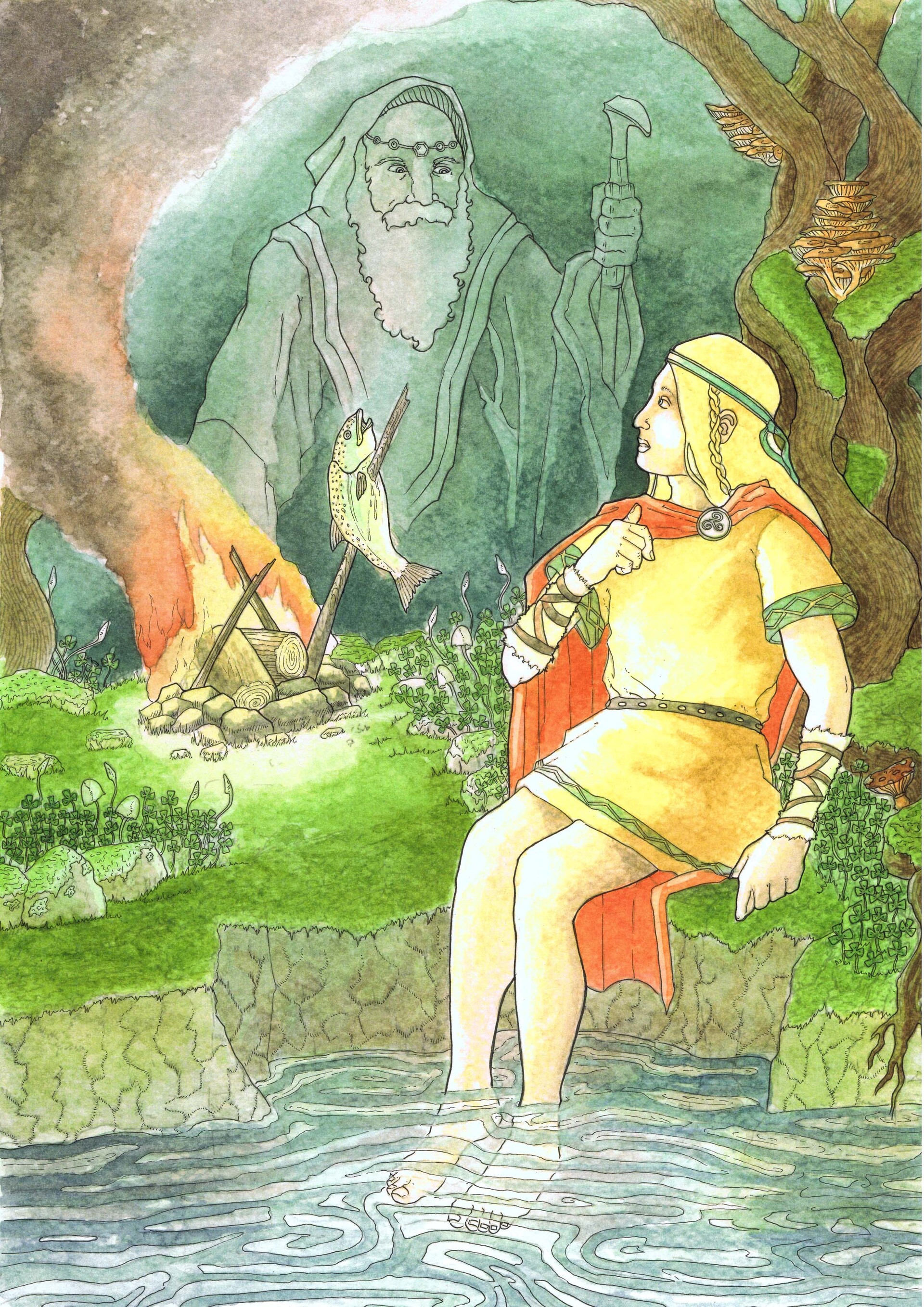
Without local explanation, we can only guess what was thought to happen when the object was deposited. For myself, I’ve always thought of the pool in the story of Fionn mac Cumhaill.
So, were these earlier sacrificers dropping in their treasures in hopes of sending them out of this world, presumably to the place where their gods lived?
And it’s not the only site. From Ireland eastwards through much of Germany, there are sites, some more specific, like La Tene, in Switzerland, where there was a huge cache of swords,
(no citation, but it looks like a Peter Connolly)
and Hjortspring, in Denmark, where there was a boat,
and Dejbjerg, also in Denmark, where there was a wagon.
There are animal sacrifices,
(Miroslaw Kuzma–as a sometime horseman, I hesitated to include this illustration.)
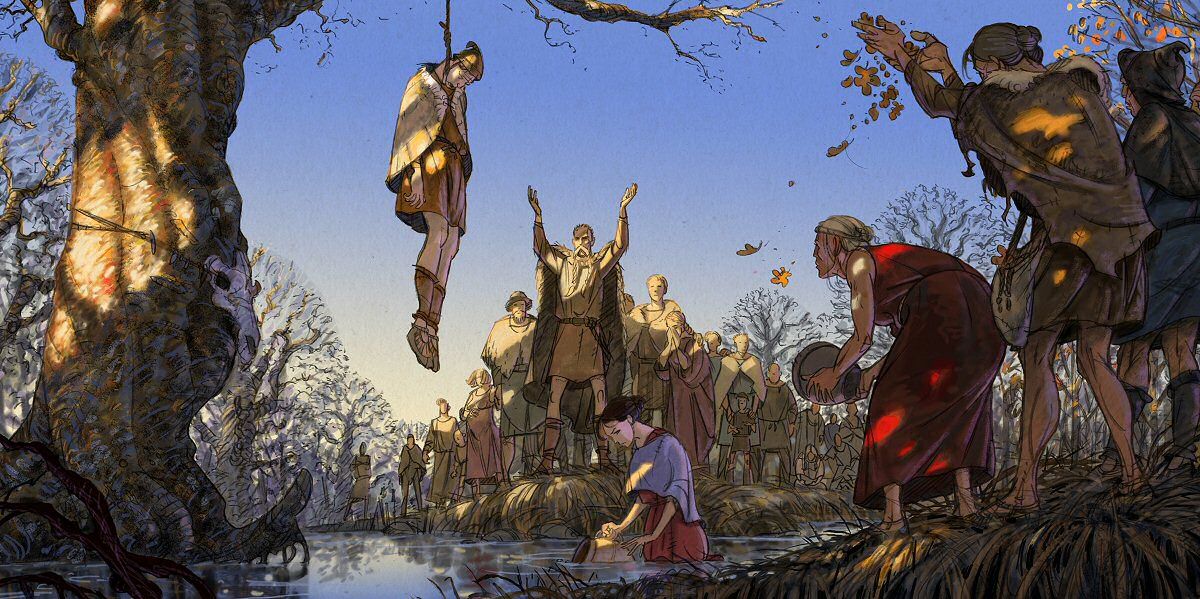
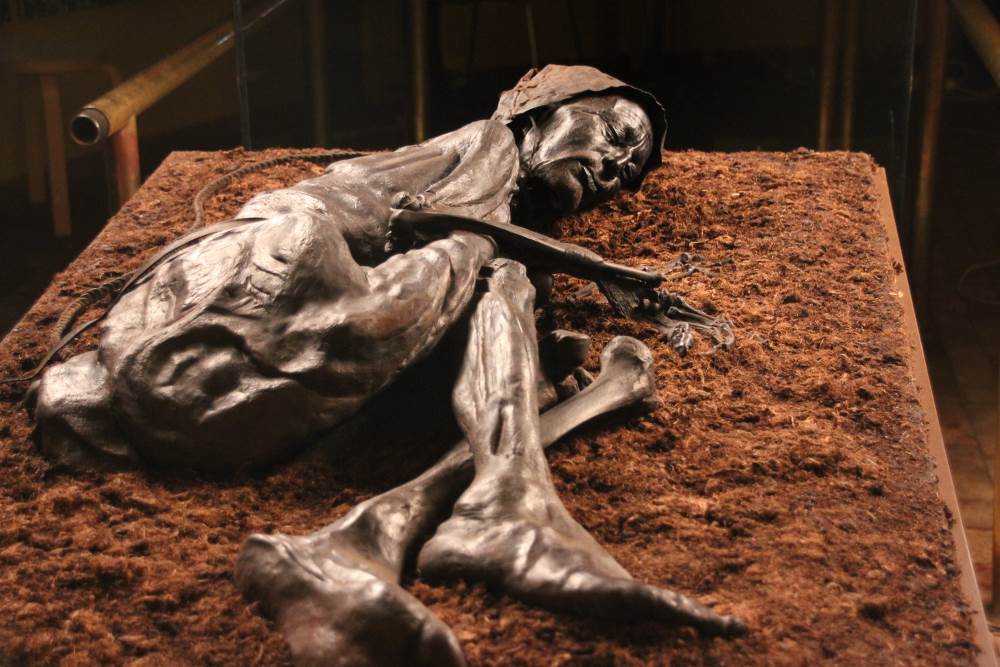
but the most sinister deposits are human ones,
some of whose well-preserved remains would probably have worried those who believed that, once the victim had been dealt with, and sunk in the water, the sacrifice would have been accepted and then the next step would be a god’s. (For more on so-called “bog bodies”, see: https://en.wikipedia.org/wiki/Bog_body )
Although Frodo was responsible for halting what may have been about to be a sacrifice—
“But the courage that had been awakened in him was now too strong: he could not leave his friends so easily. He wavered, groping in his pocket, and then fought with himself again; and as he did so the arm crept nearer. Suddenly resolve hardened in him, and he seized a short sword that lay beside him, and kneeling, he stooped low over the bodies of his companions. With what strength he had he hewed at the crawling arm near the wrist, and the hand broke off; but at the same moment the sword splintered up to the hilt. There was a shriek and the light vanished. In the dark there was a snarling noise.”
It was the appearance of Tom Bombadil, summoned by Frodo, who rescued them all—
“There was a loud rumbling sound, as of stones rolling and falling, and suddenly light streamed in, real light, the plain light of day. A low door-like opening appeared at the end of the chamber beyond Frodo’s feet; and there was Tom’s head (hat, feather, and all) framed against the light of the sun rising red behind him.”
And there was Tom’s incantation—
“Get out, you old Wight! Vanish in the sunlight!
Shrivel like the cold mist, like the winds go wailing,
Out into the barren lands far beyond the mountains!
Come never here again! Leave your barrow empty!
Lost and forgotten be, darker than the darkness,
Where gates stand for ever shut, till the world is mended.” (The Fellowship of the Ring, Book One, Chapter 8, “Fog on the Barrow-downs”)
I wonder whether, about to be consecrated to a god we no longer know of, a victim might have called upon his/her gods, hoping for a similar rescue?
Thanks for reading, as ever.
Stay well,
Avoid barrows—unless they’re wheeled,
(Is this by a medieval Dr. Seuss?)
Definitely stay out of bogs,
And remember that, as always, there’s
MTCIDC
O
PS
If you’re interested in a scientific explanation for the surprising preservation of some bodies, see:
If you’re a Game of Thrones fan (and I include myself here), you’ll immediately think of Khal Drogo, the leader of a tribe of the nomadic Dothraki,
whether you’ve seen the films,
or read the books,
or both.
I’m presuming that “Khal” is modeled on “khan”, a word of disputed origin among scholars, but which signifies someone above “king”—imagine something more like “high king”—and is used as the title for the ruler of an “ulus”, a “horde” in English. (For more about the name, see: https://en.wikipedia.org/wiki/Khan_(title) ) When you hear that word, you may think of Temujin, c.1162-1227AD, aka Chinggiz/Genghis Khan,
who founded the Mongol Empire and began the great wave of conquest from China to Russia. (More about him here: https://en.wikipedia.org/wiki/Genghis_Khan I’ll add here that, so far, I’ve been unable to locate an artist for the illustration below.)
But he’s not the Drogo who is the subject of this posting.
Instead, it’s a much more humble Drogo, but, without him, Sauron’s Ring
would, barring that near disaster,
(Ted Nasmith)
never have been destroyed and, with it, Sauron.
(another Nasmith—and you can see why he’s one of my favorite Tolkien illustrators: no scene too big and also no scene less known will stop him)
JRRT has reported to us the Hobbits’ passion for genealogy:
“All Hobbits were, in any case, clannish and reckoned up their relationships with great care. They drew long and elaborate family-trees with innumerable branches.” (The Lord of the Rings, Prologue I, “Concerning Hobbits”)
And here we see that name in the Appendices, C “Family Trees (Hobbits)”
I I I
Dora Drogo Dudo
1302-1406 1308-1380 1311-1409
= Primula I
Brandybuck I
I I
Frodo Daisy
1368 1350
= Griffo
Boffin
It is, of course, Frodo’s father, drowned in a boating accident thought suspicious by some. (The Fellowship of the Ring, Book One, Chapter 1, “A Long-expected Party)
I don’t have either the Hobbits’—or Tolkien’s—enthusiasm for genealogy, but I was curious, as I always am, about JRRT’s sources: just where did this name come from? It could be entirely from his fertile imagination, of course, but, as so much good scholarship has pointed to medieval sources for certain details in his works—think about those dwarvish names, right out of Icelandic saga material—the 13th-century Prose Edda of Snorri Sturluson (whose own name has a dwarvish ring and whose work you can read here: https://archive.org/details/proseedda01brodgoog/page/n54/mode/2up The dwarf name list is to be found on page 26)—I thought that a medieval influence might be possible.
At the moment, I have a short list of possible medieval candidates:
1. Drogo, the short-lived Duke of Brittany (reigned 952-958AD)—who may have been murdered by the connivance of his step-father, Fulk II, the Count of Anjou. (This is from the 11th-century Chronicle of Nantes, of which only fragments survive, but the murder plot does—Fulk threatens and persuades Drogo’s nurse to do away with him in his bath—see pages 109-110 in the 1896 edition of the fragments by Rene Merlet here: https://archive.org/details/lachroniquedenan00merl/page/108/mode/2up )
2. Drogo de la Beuvriere (? 11th century)—a companion of William the Conqueror, best known for poisoning his wife (these Normans and their allies seem to specialize in violence, don’t they?)—this information is in little bits of gossip, with the added fact that Drogo then borrowed travel money from William to enable his escape–https://en.wikipedia.org/wiki/Drogo_de_la_Beuvri%C3%A8re
3. Drogo d’Hauteville, the Norman count of Apulia (died 1051AD)—the Normans had gradually conquered whole sections of Italy and Sicily in the 11th century
and this Drogo succeeded his brother, William, as count, only to be murdered!
4. and then there’s Saint Drogo (1105-1186AD)—a Flemish nobleman who, suffering from a disease that made it difficult for people to look at him (leprosy?), he became a hermit and, not surprisingly, is the patron saint of shepherds (feast day, April 16). As, unlike the other Drogos, he seems to have died of natural causes, after a long life, I think that we should end our catalogue here!
Thanks, as always, for reading.
Stay well,
Be very suspicious of ambitious Normans,
And remember that there’s always
MTCIDC
O
PS
Perhaps the violence done to so many of those Drogos influenced Tolkien in that nasty rumor about his Drogo?
PPS
If you are Hobbitish or Tolkienean in your interest in genealogy, there’s another Drogo—Drogo de Teigne—whom you can read about here—with the warning: if there were a genealogical rabbit hole, you’ll be standing at the mouth of it when you begin to read this: https://www.carolbaxter.com/Drew-families-of-Devonshire-and-Ireland?r_done=1
“At last they were brought to a halt. The ridge took a sharper bend northward and was gashed by a deeper ravine. On the farther side it reared up again, many fathoms at a single leap; a great grey cliff loomed before them, cut sheer down as if by a knife stroke. They could go no further forwards, and must turn now either west or east. But west would lead them only into more labour and delay, back towards the heart of the hills; east would take them to the outer precipice.”
Frodo and Sam have been traveling away from the Anduin and their friends, headed for Mordor, even as Sam has said,
“ ‘What a fix!…That’s the one place in all the lands we’ve ever heard of that we don’t want to see any closer, and that’s the place we’re trying to get to!’ “
And now they’re in the area called Emyn Muil (translated by Paul Stack as “Drear Hills”—see: https://eldamo.org/index.html )
(This appears to be from Karen Wynn Fonstad’s The Atlas of Middle Earth, an invaluable book.)
which, to me, has always seemed volcanic, like this—
and Peter Jackson must have had a similar idea, as this part of his second film was set in the land near Mt. Ruapeha, an active volcano on New Zealand’s North Island—
Confronted by that ravine, Frodo has tried climbing down, only “…to come down with a jolt to his feet on a wider ledge not many yards lower down.” Sam, helpless, shouts that he’ll come down, until Frodo replies: “Wait! You can’t do anything without a rope.”
An approaching storm has darkened the air around them, but Frodo’s words bring a sudden light to him:
“Rope!…Well, if I don’t deserve to be hung on the end of one as a warning to numbskulls! You’re nowt but a ninnyhammer, Sam Gamgee: that’s what the Gaffer said to me often enough, it being a word of his. Rope!”
And not ordinary rope, but Elvish rope:
“ ‘Maybe you remember them putting the ropes in the boats, as we started off in the Elvish country,’ “ says Sam. “ ‘I took a fancy to it, and I stowed a coil in my pack… ‘It may be a help in many needs’ he said: Haldir, or one of those folk. And he spoke right.’ “
And so Sam “unslung his pack and rummaged in it. There indeed at the bottom was a coil of the silken-grey rope made by the folk of Lorien.”
With it, Frodo is quickly up beside Sam and soon, using the rope, they reach the bottom of the ravine.
(Donato Giancola—you can see more of his impressive work here: https://donatoarts.com/ Don’t forget to check out the dragons.)
But there’s a further problem:
“But Sam did not answer: he was staring back up the cliff. ‘Ninnyhammers!’ he said. ‘Noodles! My beautiful rope! There it is tied to a stump and we’re at the bottom. Just as nice a little stair for that stinking Gollum as we could leave.’ “
And then—
“ [Sam] looked up and gave one last pull to the rope as if in farewell.
To the complete surprise of both the hobbits it came loose. Sam fell over, and the long grey coils slithered silently down on top of him.”
Frodo, of course, mocks Sam, who, hurt, replies:
“ ‘I may not be much good at climbing, Mr. Frodo…but I do know something about rope and about knots. It’s in the family as you might say. Why, my grand-dad, and my uncle Andy after him, him that was the Gaffer’s eldest brother, he had a rope-walk over by Tightfield many a year.’ “ (all of the above from The Two Towers, Book Four, Chapter 1, “The Taming of Smeagol”)
When you read the title of this posting, you’ll probably smile and say, “That means understanding how something works”, and you’d be right. Imagine, however, that the expression began with someone press-ganged (forcibly drafted) into the British Navy during the Napoleonic era.
The Royal Navy’s pressgangs tried to kidnap actual sailors, usually from commercial vessels, but, to make up numbers, practically any male of over a certain age might do.
Once aboard (and incapable of escaping), the new crew member might be assigned any number of different duties, from cook
(Long John Silver, from Stevenson’s Treasure Island, was originally a cook)
to gunner,
but a major job was in handling the complicated power which made the ship move: the sails and what controlled the sails, the rigging. Many sailors were specifically trained to deal with the sails, but, in emergencies, it could even mean “all hands to the rigging!” (To learn more about how complex this process is, see this 1848 The Art of Rigging: https://archive.org/details/artrigging00steegoog/page/n4/mode/2up based upon David Steel’s 1794 2-volume work.)
An 18th-century naval frigate (smaller war ship), like this one, HMS Pomone,
required, as you can imagine, a vast amount of rope for its rigging, and the biggest ships, like HMS Victory,
needed the equivalent of over 30 miles (48km+) of the stuff, so “learning the ropes” was clearly never an easy job for a beginning (and, if pressganged, probably very reluctant) sailor!
To provide that rope, there were what Sam’s grandfather and uncle had—ropewalks—and long walks they could be, like this one, from the Chatham dockyards in England.
To make rope, one began with the fibers of the hemp plant
and twisted and stretched them just as is done with wool to make woolen thread.
The difference is that rope is commonly much longer than thread, as is the case with the ropes needed for HMS Victory’s rigging and so ropewalks had to be long enough to produce long lines. (It’s a complicated process so, for more on this, see: https://en.wikipedia.org/wiki/Ropewalk )
It might seem puzzling, looking at that ropewalk, and thinking about HMS Victory, why hobbits, who certainly weren’t sailors (think: Frodo’s parents died in what must have been a rowboat accident on the Brandywine—see The Fellowship of the Ring, Book One, Chapter 1, “A Long-Expected Party” for gossip on the subject) would have a ropewalk, but we might ask the same question of the elves of Lorien, which was far from the sea, even though elves did take ship at the Grey Havens,
Departure at the Grey Havens, by Ted Nasmith
(Ted Nasmith)
to sail westwards. The answer might be, as Sam and Frodo found out, in Haldir’s words, “It may be a help in many needs” and even if one needs and uses rope, it isn’t necessary for most people to require Victory’s 30 miles of the stuff.
But then there’s that other question: if Sam was as familiar with rope as he claimed, and an expert at knot-tying, why did that elvish rope come tumbling down on his head after supporting the two hobbits on their climb?
Thanks for reading, as always.
Stay well,
Considering solving knotty rope problems as Alexander did, with the Gordian knot,
Welcome, as always, dear readers.
Not long ago, we had a posting about Frodo’s wound from a Morgul-knife and the extraction of an arrow from the skull of Prince Hal, the future Henry V.
This, in turn, has led us to think about the kinds of wounds we see among the major characters of The Lord of the Rings and their cures—and about their creator.
The first one wounded is, of course, Frodo. In his case, it’s not so much the original knife wound, but the aftermath—the point of the blade which, as Gandalf describes it, “was deeply buried, and it was working inwards.” (The Fellowship of the Ring, Book Two, Chapter 1, “Many Meetings”). This, then, was no ordinary fighting knife, but the equivalent of the injection of a kind of poison or even parasite—“They tried to pierce your heart with a Morgul-knife which remains in the wound.”
Treatment was surgical—“Then Elrond removed a splinter…”—just as in the case of the young Prince Hal. We have no idea what else Elrond might have done, but, in Hal’s case, the surgeon was extremely careful to prevent infection. Any good medieval doctor would have been well aware of the danger and would have recognized the symptoms, but, once infection would have set in, would have been at a loss as to how to prevent the consequences. If a limb had been affected, he would have amputated, hoping to have pinched off the infection.
As Hal’s was a head wound, well, all the doctor could have done was what he did—keep the wound clean until the healing was clearly going well.
The difficulty was, medieval doctors could be aware of infection and could even try various methods to prevent it, but they had no accurate idea of what it was and where it came from. In their world, infection was either a mystery (possibly divinely inflicted) or, in the case of infectious disease, caused by something which they called miasma, an ancient Greek word which means, in fact, “pollution” (often “ritual pollution”).
This miasma was believed to be caused by rotting matter and was to be found in the air—and, in a world of open sewers in towns,
the “bad air” (where the word “malaria” comes from), would have been everywhere, especially when plague hit and burial services were quickly overwhelmed.
Part of the problem lay in the reliance upon ancient, outdated medical ideas, derived from Greco-Roman sources. Part, however, lay with the lack of tools available.
The medieval doctor had only his naked eyes with which to observe and to diagnose illness. The microscope was the invention of two Dutchmen, father and son Zacharias and Hans Janssen, in the 1590s.
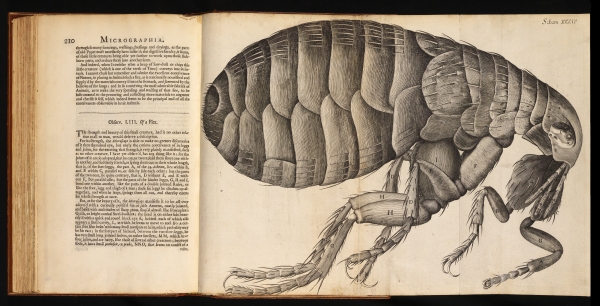
Just seeing what’s there wasn’t enough, however, although what could be seen was absolutely amazing to people who had no idea what existed in worlds beyond this one. In 1665, the English polymath, Robert Hooke (1635-1703), published Micrographia, with a series of engravings of things seen under magnification which must have astounded people.
Just look at this flea, for example.
Ironically, in the gut of this flea could be the bacterium Yersinia Pestis,
which is the basis of black plague—but everyone in 1665 knew that the plague was caused by miasma—which was still the theory for infectious diseases in Victorian days, as this cartoon shows. (Death is here depicted as one of the scavengers of the river, major characters in Charles Dickens’ last completed novel, Our Mutual Friend, 1864-65.)
The Thames, was filled with sewage, chemicals, refuse, dead animals, the overflow of cattle markets, and anything else horrible one might imagine. Of course it stank—in the summer of 1858 in fact, the smell was so overpowering that Parliament adjourned and fled its handsome and nearly-new home. One imagines that this was as much in fear of what that smell might portend as disgust at the odor.
It was only in the mid-19th century that the work of scientists like Louis Pasteur (1822-1895)
began the process of retiring the miasma theory in favor of the theory still used in the early 21st century, the germ theory. This was not an overnight process: the medical profession was very cautious and some members clung to outdated beliefs long after they could see that the efforts of forward-looking surgeons like Sir Joseph Lister (1827-1912) drastically cut the number of deaths directly related to the dangers of surgery before his changes.
Lister believed that, by sterilizing the operating room and the instruments with carbolic acid (we would call it “phenol”, a petroleum derivative), as well as aggressive handwashing and careful and frequent cleansing of wounds, lives could be saved—and they were.
That Prince Hal’s surgeon, lacking knowledge of germs, could still be as energetic as he was in keeping Hal’s horrible wound clean, must be remembered when we imagine that medieval doctors were nothing more than ignorant charlatans. Some, at least, were observant and creative, even as they struggled to save their patients from dangers understood from their outcome, rather than from their origins.
(And so, if you remember that the medieval medical community believed that “bad air” carried disease, that crow-like mask which can be seen on late illustrations of “plague doctors” isn’t silly: the “beak”, packed with what they believed were “healthy” herbs, was meant to act as a filter against that air.
In fact, that idea wasn’t so far from the idea of World War One gas masks, which also carried a filter to cleanse the air of the poisonous gases—real ones, this time—with which both sides sometimes tried to flood the enemy’s trenches.)
Prince Hal’s arrow reminds us of the second wounding in The Lord of the Rings, this one fatal: Boromir.
Unlike Prince Hal, there was no possibility of extraction: Boromir had been hit multiple times: “…Aragorn saw that he was pierced with many black-feathered arrows.” (The Two Towers,, Book One, Chapter 1, “The Departure of Boromir”) And Ted Nasmith’s illustration tells it all—just look how pale Boromir is—he’s dying from blood loss.
[This always reminds us of the death of Toshiro Mifune as the Macbeth figure in Kurosawa’s wonderful 1957 film, Throne of Blood.)
As in the case of infection, only so much could be done for the sufferer in the medieval world. Arrows could be extracted, but, if they were barbed,
they caused more damage coming out than going in—although a brilliant Arab doctor, whom we’ve mentioned before, al-Zahrawi, had invented an “arrow spoon” for this very problem. (We once saw this demonstrated, but we currently have no illustration, unfortunately. In the near future, however, we’re going to have a feature on JRRT’s Haradrim/Corsairs of Umbar vs actual medieval Arabic culture, where we’ll include discussion of the brilliant intellectual life of the Arabic world from Spain to the Middle East.)
After Boromir’s death, our next injury would be not a physical, but a psychological (or magical?) one. Pippin, peeping into a palantir, has had an encounter with Sauron and it hasn’t been a pleasant one:
“Then suddenly he seemed to see me, and he laughed at me. It was cruel. It was like being stabbed with knives….Then he gloated over me. I felt I was falling to pieces.” (The Two Towers, Book Three, Chapter 11, “The Palantir”)
In response, Gandalf commands Pippin to look at him:
“Pippin looked up straight into his eyes. The wizard held his gaze for a moment in silence. Then his face grew gentler, and the shadow of a smile appeared. He laid his hand softly on Pippin’s head. ‘All right!’ he said. ‘Say no more! You have taken no harm.’ ”
Pippin has escaped, then, though Gandalf has said that it was a close call: “You have been saved, and all your friends too, mainly by good fortune, as it is called.”
Our next injury—that of Faramir—won’t be so easy… But that’s for next time!
Thanks, as always, for reading—in “Healings.2”, we’ll look at other wounds in The Lord of the Rings, then move on to another war and one of its millions of victims…



























































 doubtfulsea