Grocer or Burglar?

Tags

, , , ,

As always, dear readers, welcome.

For Bilbo Baggins, what promised to be an easy morning suddenly turned dark with the arrival of “an unexpected party” (this is a Tolkien pun:  “party” in Victorian English could mean “person” as well as “event”—and it’s still available in legal English, as in “the party of the first part”—which turns up in an hilarious scene from the Marx Brothers’ Night at the Opera, 1935—

in which Groucho, a shyster lawyer named “Otis P. Driftwood”, makes an agreement with the manager, played by Chico (say that “CHICK-oh” as he was supposedly always after girls), of an Italian tenor,

the agreement consists of mock legalese and—well, here, see it for yourselves:  https://www.youtube.com/watch?v=G_Sy6oiJbEk ).

This party is Gandalf

(the Hildebrandts)

and his arrival leads to that second party—the one with all of the dwarves—

(another Hildebrandts)

and the map

(JRRT—with the later addition of the moon letters)

and Bilbo’s reaction to the danger involved in joining the dwarves as a “burglar”:

“At may never return he began to feel a shriek coming up inside, and very soon it burst out like the whistle of an engine coming out of a tunnel…Then he fell flat on the floor, and kept calling out ‘struck by lightning, struck by lightning!’ over and over again…”  (The Hobbit, Chapter One, “An Unexpected Party”)

Needless to say, this did not leave a very good impression upon the dwarves, leading Bilbo to overhearing Gloin say:

“It is all very well for Gandalf to talk about this hobbit being fierce, but one shriek like that in a moment of excitement would be enough to wake the dragon and all his relatives, and kill the lot of us.  I think it sounded more like fright than excitement!  In fact, if it had not been for the sign on the door, I should have been sure we had come to the wrong house.  As soon as I clapped eyes on the little fellow bobbing and puffing on the mat, I had my doubts.  He looks more like a grocer than a burglar!”

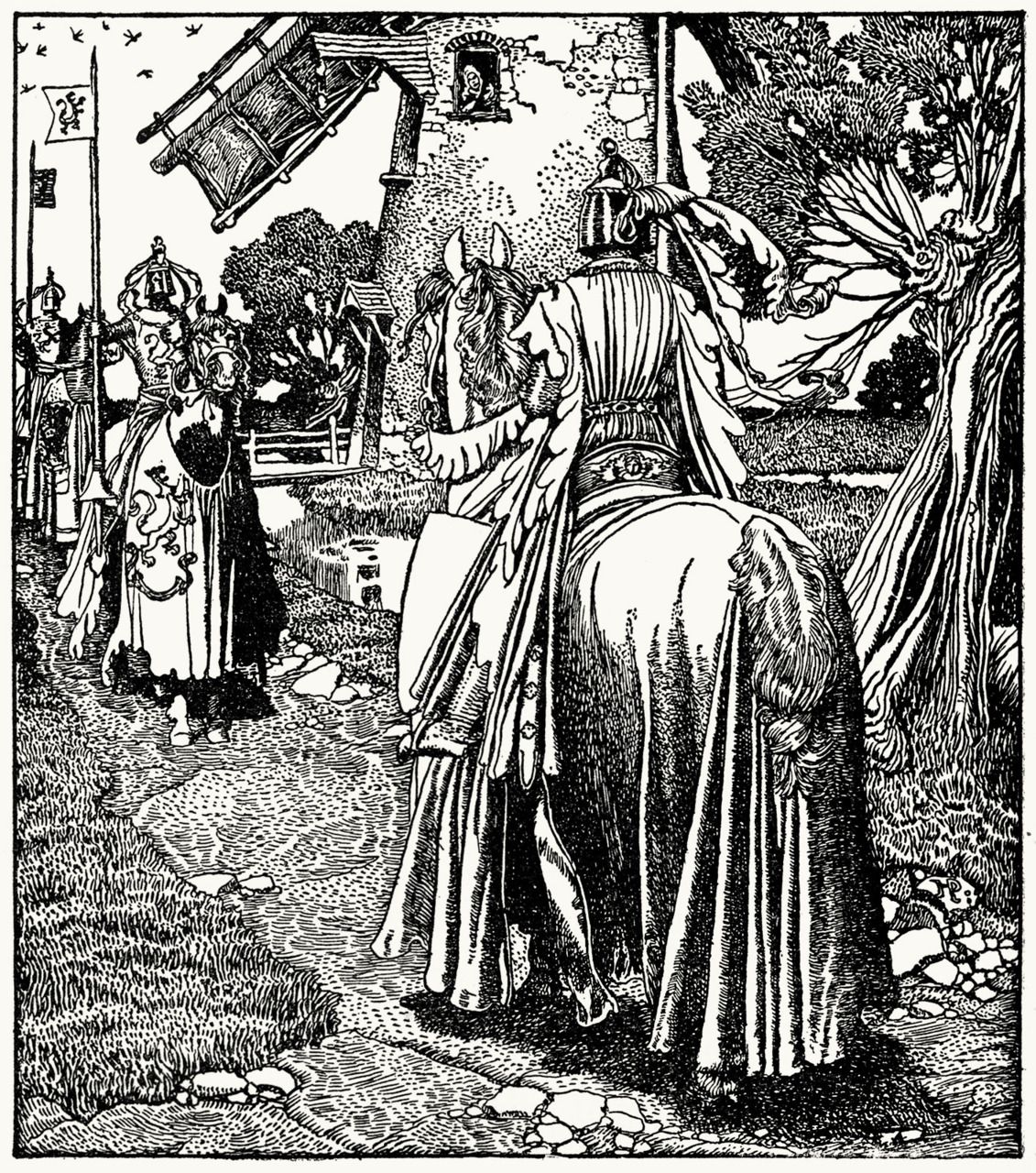
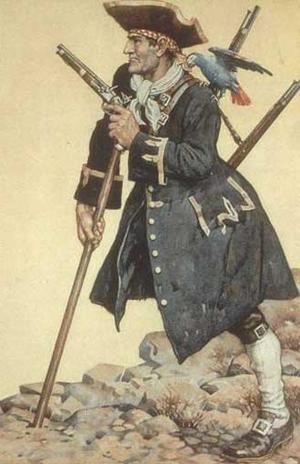
But what does a burglar look like?  I’ve always presumed that Tolkien, if not Gloin, had in mind someone like this—

which certainly differs from Bilbo in every way.

If he doesn’t look like that, does he resemble a grocer?  What does a grocer look like?

In Tolkien’s England, except for a big city, like London, which had department stores like Whiteley’s,

people bought their necessities along certain streets (sometimes called “the high”), where there were shops for anything and everything (also true in middle and lower class neighborhoods even in big cities).

Thus, for example, you went to the butcher shop for meat,

the bakery for bread,

the fruiterer for fruit,

and the greengrocer for vegetables.

(This can still be the case today—I’ve certainly walked down such streets in recent years in what are commonly called “market towns”—

even when, just outside town, there are supermarkets with large parking lots—

Sainsbury’s itself began as a single shop in London in 1869—)

Such shops, and many others, including department stores, as they began to appear in the 1870s and beyond, were not self-service, as most stores are now, but were staffed with clerks, whose job was to take orders from customers, acting as in-store middlemen, like this fellow—

or these

and there could be a kind of obsequiousness to their behavior (where “the customer is always right” must have come from) which is, I think, what JRRT had in mind when he has Gloin say “more like a grocer”, “puffing and blowing”.

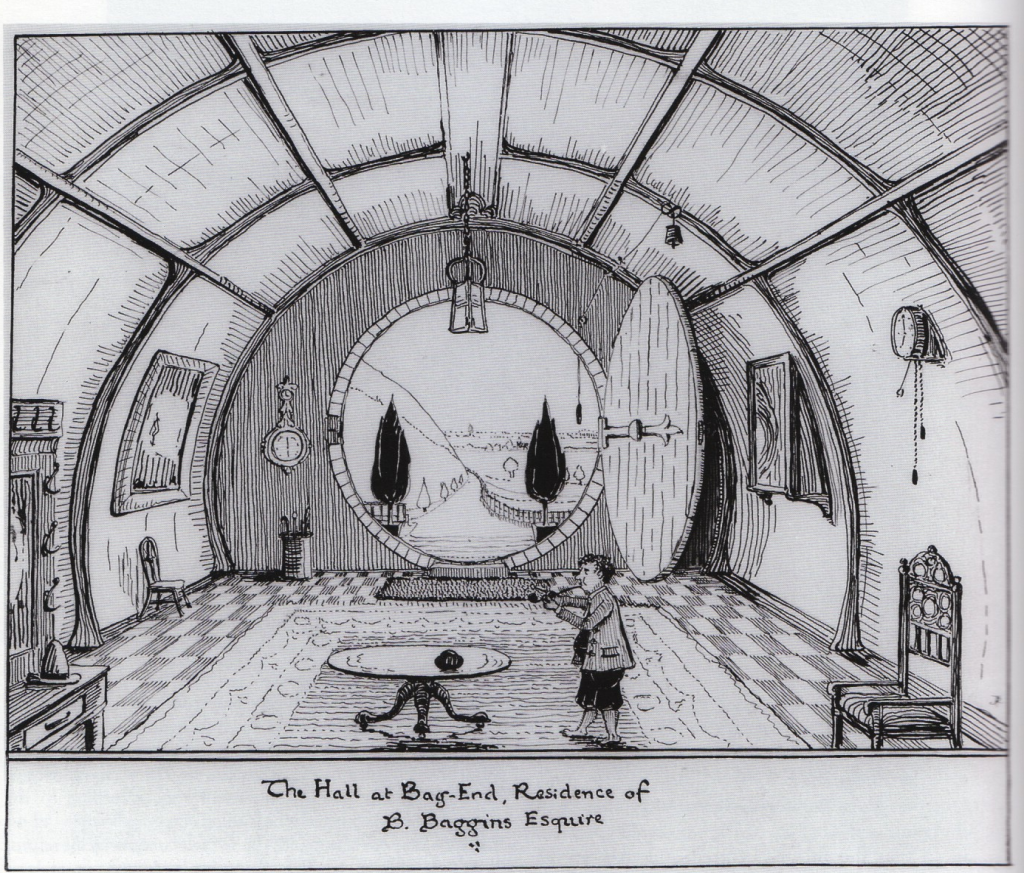
That Bilbo was a well-off individual, living in a rather luxurious dwelling, to begin with,

(JRRT)

and then being called “a shop assistant” or the equivalent, we can see why:

“The Took side had won.  He suddenly felt he would go without bed and breakfast to be thought fierce.  As for little fellow bobbing on the mat it almost made him really fierce.”

And so Bilbo was on his way to becoming the burglar Gandalf had advertized him to be. 

(Alan Lee)

Thanks for reading, as ever.

Stay well,

Be wary of eavesdropping on dwarves,

And remember that, as always, there’s

MTCIDC

O
PS

If you’d like to read about a completely different burglar, (someone Tolkien could easily have read about), you might try A.J. Raffles, an “amateur cracksman”—that is, a gentleman burglar–created by E.W. Hornung (1866-1921), the brother-in-law of Arthur Conan Doyle—with The Amateur Cracksman, 1899, here:  https://archive.org/details/amateurcracksma03horngoog/page/n9/mode/2up

Feudal

Tags

, , , ,

As always, dear readers, welcome.

As Gondor prepares to meet Sauron’s massive assault, it calls in troops from the south:

“And so the companies came and were hailed and cheered through the Gate, men of the Outlands marching to defend the City of Gondor in a dark hour…The men of Ringlo Vale behind the son of their lord, Dervorin striding on foot:  three hundreds…From the Anfalas, the Langstrand far away, a long line of men of many sorts…scantily equipped save for the household of Golasgil their lord…” (The Return of the King, Book Five, Chapter 1, “Minas Tirith”)

When the text repeatedly says, “their lord”, what, precisely, does that mean?

Although born in 1892, during the last years of the reign of Victoria (1819-1901),

Tolkien was not a convinced monarchist, writing to his son, Christopher:

“Give me a king whose chief interest in life is stamps, railways, or race-horses; and who has the power to sack his Vizier (or whatever you care to call him) if he does not like the cut of his trousers.”  (letter to Christopher Tolkien, 29 November, 1943, Letters, 90)

At the same time, he was not a passionate democrat, either, referring to the Prime Minister, Winston Churchill (1874-1965),

in the same letter as ‘Winston and his gang’,

having said that his own “…political opinions lean more and more to Anarchy (philosophically understood, meaning abolition of control not whiskered men with bombs)”.

And yet, in creating Middle-earth, he shows a preference for a medieval world, and, for his homeland, England, this means the form of government from which the Victorian government descended, feudalism.

Feudalism comes from Anglo-Norman French fe, which, at base, means “trust/faith”, and, in a secondary meaning, is the basis for “fief”—that is, an estate, a parcel of land given in trust.  (For more on meanings and forms, see the extremely useful Anglo-Norman French dictionary here:  https://anglo-norman.net/entry/fe

It comes from Anglo-Norman because it was the Normans under Duke William of Normandy (c.1028-1087)

who introduced the concept to their newly-conquered country after 1066AD. 

The foundation of the concept is that:

1. all the land in a kingdom belongs to the king—who has received it from God

2. he then parcels the land out to his chief followers, who then

3. parcel it out to their main followers

In return, all the followers in #3 owe military service to those in #2, who, in turn, owe military service to #1.  This creates a kind of pyramid, like this–

(correct the spelling of “fife” to “fief”)

Those in #3 would then collect those below them to form the units they would bring with them when their overlords, at the king’s demand, would gather forces for whatever the king had in mind.

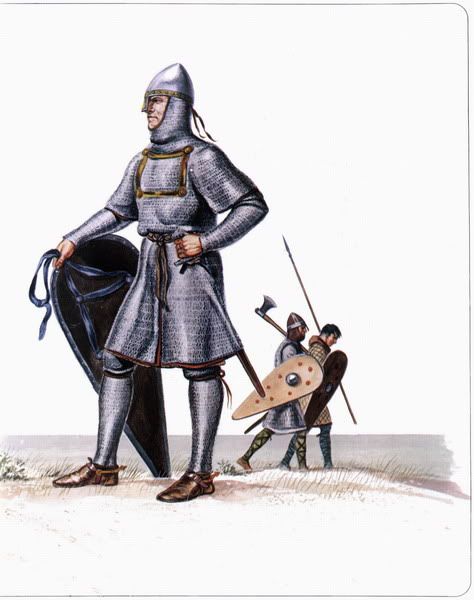
(by Eugene Leliepvre, one of my favorite 20th century French military illustrators)

You’ll notice, of course, that those at the bottom of the pyramid—the 99% in modern terms—had no say in any of this:  when called, they were forced to go.

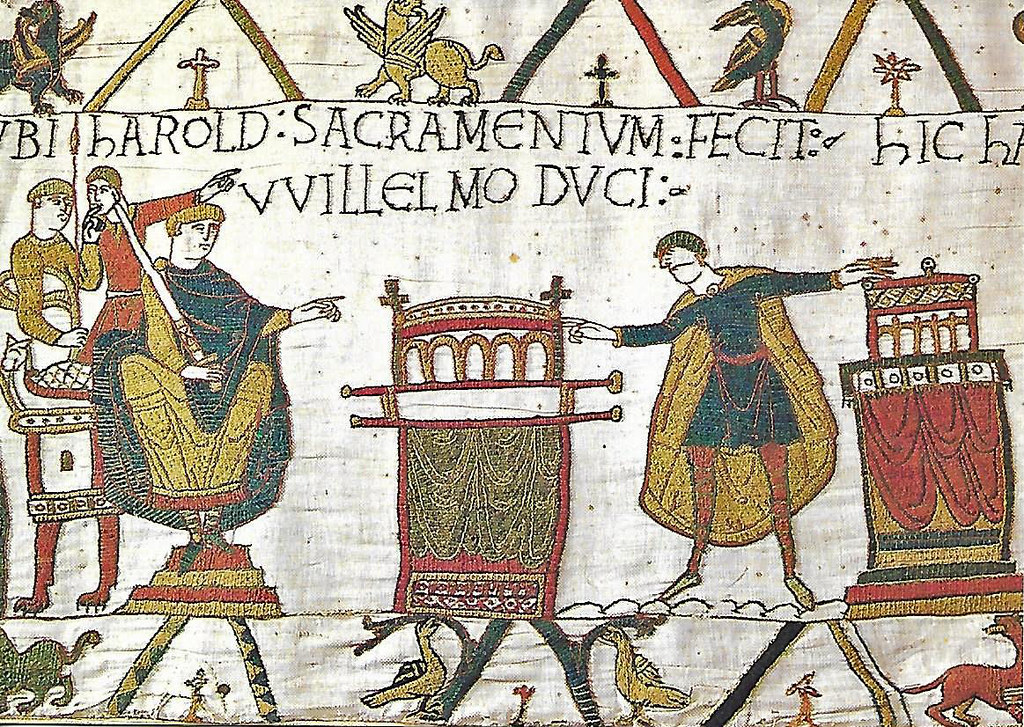
This was because they were the conquered.  When the Normans invaded and defeated the previous government, in the form of the death of the Anglo-Saxon king, Harold Godwinson,

they then spread out across the landscape, ousting the previous Anglo-Saxon owners and setting up forts, called “motte and baileys”,

to control the land and the locals, who, at first at least, were simply possessions.  (Feudalism became much more complicated over time, including grades of the 99%, who could be freemen, but who still had feudal obligations.)

The same idea of conquest, in some sense, must have been true of the ancestors of the men of Gondor, who were not indigenous to Middle-earth, but had come from the wreckage of Numenor and who gradually came to dominate the western lands, driving the older peoples—the Dunlendings and the Woses–

(the Hildebrandts)

into exile in mountain and forest, rather than enslaving them, as the Normans did the Anglo-Saxons.

From those words “their lord”, however, it’s clear that lesser Gondorians had become part of a similar socio-economic system.

In a letter to Naomi Mitchison, JRRT has this to say about such:

“I am not incapable of or unaware of economic thought; and I think as far as the ‘mortals’ go, Men, Hobbits, and Dwarfs, that the situations are so devised that economic likelihood is there and could be worked out:  Gondor has sufficient ‘townlands’ and fiefs with a good water and road approach to provide for its population…”  (letter to Naomi Mitchison, 25 September, 1954, Letters, 292)

And there’s that word “fief”and all that it implies about rulers and ruled, both in Norman England and Gondor:  a comfortable life for those at the top,

but endless hard work, taxes, and military service for those—the great majority—at the bottom.

The British troops who surrounded Tolkien in the trenches in 1916

were, in a sense, the descendants of that feudal 99% and, although, when called upon, could be fearsomely brave, they were also well aware that they were still peasants to many of those in charge and so had songs with lyrics like:

“If you want to find the colonel,

I know where he is.

If you want to find the colonel,

I know where he is.

He’s sitting in comfort, stuffing his bloody gut.

I saw him.  I saw him,

Sitting in comfort, stuffing his bloody gut.”

(from “Hanging on the Old Barbed Wire”—you can hear a recording of some of the many mocking verses to this by the English group “Chumbawamba” here:  https://www.youtube.com/watch?v=zZhzV68U48w )

So, although Tolkien describes

“…Imrahil, Prince of Dol Amroth…and a company of knights in full harness riding grey horses; and behind them seven hundreds of men at arms, tall as lords, grey-eyed, dark-haired, singing as they came.”

we might wonder if JRRT, self-described as leaning “more and more to Anarchy”, could still hear the privates of 1916, and, if so, just what those men slogging along on foot behind “knights in full harness riding grey horses”  might actually have been singing?  Could it have been something as subversive as “Hanging on the Old Barbed Wire”, or maybe this couplet from an actual English peasant revolt in 1381:

“When Adam delved [dug]

And Eve span [spun],

Who was then

The gentleman?” 

Thanks, as ever, for reading.

Stay well,

Remember the Golden Rule,

(from the comic strip “The Wizard of Id”)

And remember, as well, that there’s

MTCIDC

O

Dos Mackaneeks

Tags

, , , ,

Welcome, as always, dear readers.

Star Wars:  the Phantom Menace

certainly begins with a bang:  a Jedi and his padawan, sent on a peace mission to the planet Naboo, are attacked by poisoned gas and droids

(reminding me at once of those lines from Weird Al Jankovic’s song:

“But their response, it didn’t thrill us

They locked the doors and tried to kill us”

If you don’t know “The Saga Begins”, you can watch it here:  https://www.youtube.com/watch?v=hEcjgJSqSRU )

but escape to the surface only to be almost squashed in an invasion of droid armor

before they rescue an unlikely helper (right out of Thompson’s Motif-Index of Folk-Literature B350-B390, “Grateful Animals”),

who takes them to an underwater city where they come before Boss Nass, who blames upperworlders for the invasion

and responds to their warning that, after they finish with the upperworlders, the invaders will be coming for those below the water:

“Dos mackaneeks no comen here.  Dey not know of usen.”

The Gungans (which is what these people call themselves) are sophisticated technologically enough to have an underwater city

and self-propelled transport,

and they even can produce an energy shield,

but faced with the armament of the invading droid army—

and its hordes of infantry,

their use of energy balls (“boomas”)

and shields

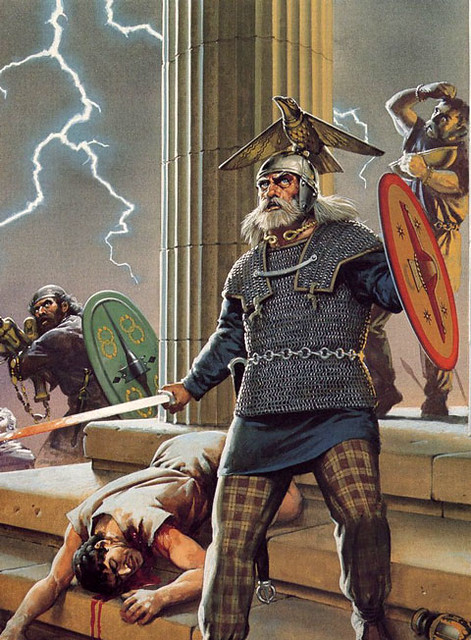
which bear a faint resemblance to Celtic shields in some clear material

show them to be really no match for the droids and their technology.  Only luck from the outside saves them.

The Gungans are brave and their weapons can cause some damage, but it’s obvious that they’re outclassed technologically, which makes me think of the Aztecs, the center of whose capital, Tenochtitlan, built in the middle of a lake, was a series of sophisticated and elegant stone buildings (complete with an aqueduct),

but who, unfortunately for them, were a late Neolithic culture who, with no metal with which to work, made their weapons using volcanic glass, obsidian, which was sharp,

(this and the next by Angus McBride)

but no match for the conquistadores’ steel weapons, armor, and early firearms.

And this brings me to a “what if”.

When Helm’s Deep is attacked,

(JRRT)

the orcs’ original method is perhaps the worst in the repertoire:  escalade—that is, putting ladders up against a wall, then climbing up them.  You can imagine why I call it the worst—

the attackers are visible all the way up the ladders and:

1. they can be pushed off

2. the ladders can be pushed off

3. people can whack you when you reach the top

4. people can shoot you on the way up

5. people can drop things on you on the way up

(In several historical assaults, ladders were found to be too short, adding an extra difficulty.)

Such attacks usually only succeed if:

1. they are a surprise  (this happened at the terrible siege of Badajoz in 1812—the French garrison was too focused in one direction and some of the British attackers climbed up the back of the fortress–)

2. the attackers can pin down enough of the defenders with archery/gunfire to allow the climbers to reach the top—and an attack can still fail if those at the top aren’t supported by others coming up behind them—Alexander the Great almost died when he was isolated after scaling an enemy wall (reinforcements overburdened the ladders and they broke—see Arrian The Anabasis of Alexander, Book VI, Sections 9-10—which you can read in translation here:  https://www.gutenberg.org/cache/epub/46976/pg46976-images.html#Page_329  )

The orcs, however, are concealing a secret weapon—

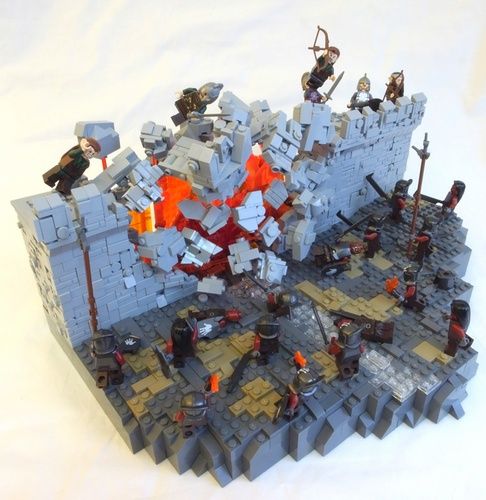
“Even as they spoke there came a blare of trumpets.  Then there was a crash and a flash of flame and smoke.  The waters of the Deeping-stream poured out hissing and foaming:  they were choked no longer, a gaping hole was blasted in the wall.  A host of dark shapes poured in.

‘Devilry of Saruman!’ cried Aragorn.  ‘They have crept in the culvert again, while we talked, and they have lit the fire of Orthanc beneath our feet.’ “  (The Two Towers, Book Three, Chapter 7, “Helm’s Deep”)

And it’s not just Saruman’s “Devilry”—

“The bells of day had scarcely rung out again, a mockery in the unlightened dark, when far away he saw fires spring up, across in the dim spaces where the walls of the Pelennor stood.  The watchmen cried aloud, and all men in the City stood to arms.  Now ever and anon there was a red flash, and slowly through the heavy air dull rumbles could be heard.

‘They have taken the wall!’ men cried.  ‘They are blasting breaches in it.  They are coming!’ “ (The Return of the King, Book Five, Chapter 4, “The Siege of Gondor”)

I think that we can assume that “the fire of Orthanc” is, in fact, gunpowder.

In our Western world, the first known mention of it was by Friar Roger Bacon in the mid-13th century,

and the first known depiction of a gunpowder weapon dates from the early 14th century.

The only uses in The Lord of the Rings are for what would be called, in later times, “mines”.  In our Middle-earth, medieval technology further developed the use of gunpowder into bigger, deadlier forms—early cannon, called “bombards”

and miniaturized them as “handgonnes”.

(Liliane and Fred Funcken)

What if Saruman—and Sauron—had had time to develop their “fire of Orthanc”?

This is how we usually see orcs and their armament—all medieval—spears, swords, bows.

(Alan Lee)

Suppose, however, that there had been further armament.  Imagine orcs with handgonnes, for example.

And, instead of massive stone-throwers employed to break down the walls of Minas Tirith—also a medieval weapon—

giant bombards.

It was weapons like these, in 1453, which broke holes in the ancient walls of Constantinople,

allowing the Turkish besiegers to enter a place which only once before, in its 1000 year plus history, had been broken into.

And why stop there? 

Leonardo da Vinci (1452-1519)

was born only the year before the fall of Constantinople, just at the very end of the Western Middle Ages.  In 1487, he sketched this—

which, in terms of much of its technology, was possible in 1487, although it would have been more than a little crowded inside with all of those guns, especially when they jerked backwards in the recoil which would have come with firing them.  Fortunately for the West, da Vinci doesn’t appear to have figured out a useful way of propelling his invention

and it was only in the early 20th century that the internal combustion engine could be employed to move such a metal monster.

Consider, however, if the opponents of the West in the later Third Age had developed what clearly they had begun.  Seeing such approaching, on foot or, worse, in an armored vehicle, what could Rohirrim or Gondorians have done beyond believing what Qui Gon had tried to warn Boss Nass about:

Dos Mackaneeks!

Thanks, as always, for reading.

Stay well,

Remember the places where tanks are vulnerable,

and remember, as well, that there’s always

MTCIDC

O

Soul Divided

Tags

, , , ,

As always, dear readers, welcome.

Although I’ve never reread any but the first of them, I enjoyed the “Harry Potter” books when they were originally published, beginning in 1997.

My favorite was that first,

or, by its US title.

I prefer the original British title because it suggests something magical.  “Sorcerer’s Stone” was a make-shift replacement, with no resonance.  The “philosopher’s stone”, however, was a real (or at least hoped-for) thing, being thought of as a kind of alchemical tool which could turn substances into precious metals, and which seemed very appropriate for a book set mostly in a boarding school for witches and wizards.  (You can read more about it here:  https://en.wikipedia.org/wiki/Philosopher’s_stone   Illustrating the article is a wonderful painting by Joseph Wright of Derby, 1734-1797,

which, although entitled–in short form—the full title is practically a brief lecture–“The Alchymist, in Search of the Philosopher’s Stone…”, has always struck me as potentially being a very useful portrait of Merlin.  If you know T.H. White’s The Once and Future King, you might imagine that that’s the young Wart—aka Arthur—in the background.)

When the series continued, I wondered how far the author would take what was, initially, a clever takeoff on a literary type:  the school story, which dates at least as far back as Thomas Hughes’ 1857 Tom Brown’s School Days and which you can read here:  https://www.gutenberg.org/cache/epub/1480/pg1480-images.html

In fact, although the series progressed with the main protagonists continuing their magical education, it became increasingly entangled with the villain, Voldemort, and a world folktale, classified in the Aarne-Thompson-Uther Index as “The Giant (Ogre) who had no heart in his body” (ATU302).  In this story, of which at least 250 versions exist, the Giant (or his equivalent), to protect himself, removes his heart and conceals it where (he hopes) it cannot be found.   The protagonist (along with helpers) must find that location and destroy the heart—or at least use it as leverage.  (You can read the translation of a Norwegian version of it here, under the title “Cinder-Lad and His Six Brothers”:  https://archive.org/details/fairystoriesmych00shim/page/n7/mode/2up   And you can read more about the tale here:  https://en.wikipedia.org/wiki/The_Giant_Who_Had_No_Heart_in_His_Body )  In the Harry Potter books, it’s not one piece of his heart–here, his soul–but 7, all hidden in what are called “Horcruxes”, and it takes Harry and his friends (along with the headmaster, at one point) to locate and destroy the set, providing for a major plot element beginning with the second book Harry Potter and the Chamber of Secrets.  (For more, see: https://fortheloveofharry.com/list-of-horcruxes/  )

When all of the Horcruxes are gone, so is Voldemort and this brings to mind another complex story.

“The Enemy still lacks one thing to give him strength and knowledge to beat down all resistance, break the last defences, and cover all the lands in a second darkness.  He lacks the One Ring…

…the Nine he has gathered to himself; the Seven also, or else they are destroyed.  The Three are hidden still.  But that no longer troubles him.  He only needs the One; for he made that Ring himself, it is his, and he let a great part of his own former power pass into it, so that he could rule all the others.  If he recovers it, then he will command them all again, wherever they be, even the Three, and all that has been wrought with them will be laid bare, and he will be stronger than ever.”  (The Fellowship of the Ring, Book One, Chapter 2, “The Shadow of the Past”)

If this Ring is so crucial, it would be easy to wonder why Sauron hasn’t been more aggressive in finding it, but Gandalf answers that next:

“…He believed that the One had perished, that the Elves had destroyed it, as should have been done.  But he knows now that it has not perished, that it has been found.  So he is seeking it, seeking it, and all his thought is bent on it…”

In the Norwegian version of “The Giant (Ogre) who had no heart in his body”, the Giant’s heart was concealed in an egg and, when the egg was broken, “the giant burst to pieces”.

When the last Horcrux is gone, Voldemort seems to melt away,

rather like the demise of the Wicked Witch of the West when she is doused with water.

When the Ring is destroyed, the end is a bit more dramatic:

“And even as he spoke the earth rocked beneath their feet.  Then rising swiftly up, far above the Towers of the Black Gate, high above the mountains, a vast soaring darkness sprang into the sky, flickering with fire.  The earth groaned and quaked.  The Towers of the Teeth swayed, tottered, and fell down; the mighty rampart crumbled; the Black Gate was hurled in ruin; and from far away, now dim, now growing, now mounting to the clouds,  there came a drumming rumble, a roar, a long echoing roll of ruinous noise.

…And as the Captains gazed south to the Land of Mordor, it seemed to them that, black against the pall of cloud, there rose a huge shape of shadow, impenetrable, lightning-crowned, filling all the sky.  Enormous it reared above the world, and stretched out towards them a vast threatening hand, terrible but impotent:  for even as it leaned over them, a great wind took it, and it was all blown away, and passed; and then a hush fell.” (The Return of the King, Book Six, Chapter 4, “The Field of Cormallen”)

(An amazing illustration by Ted Nasmith)

Somehow, in contrast, for all that his end brings a dramatic conclusion to the Harry Potter series, the melting of Voldemort seems more like the melting of Vole de Mort, in comparison.

(by Exifia at Deviant Art—I’m sorry that I can’t say more, but Deviant Art’s website appears to be unavailable at present)

Thanks, as ever, for reading.

Stay well,

When it comes to hiding things, see E.A. Poe, “The Purloined Letter” here:  https://poestories.com/read/purloined

And remember that, as always, there’s

MTCIDC

O

PS

Looking at Vole de Mort, I’m reminded of one of my (many) favorite Terry Pratchett characters,  The Death of Rats (“aka ‘The Grim Squeaker’ “).  Put a black robe on him and perhaps a resemblance?

(credited to Paul Southard)

For more, see:  https://wiki.lspace.org/Death_of_Rats

Istanbul, not…

Tags

, , , ,

Welcome, dear readers, as always. Last’s weeks visit to Harry Turtledove’s Videssos (aka Byzantium) brought a certain song to mind and so the title of this posting comes from a 1953 pop hit by a Canadian vocal group called “The Four Lads”.

It’s perhaps an “ear worm”, based pretty much on the rhythm IS-tan-BUL, not CON-stan-ti-NOP-le, repeated throughout, so parental caution.  Here’s the whole lyric—

“Istanbul was Constantinople
Now it’s Istanbul, not Constantinople
Been a long time gone, Constantinople
Now it’s Turkish delight on a moonlit night

Every gal in Constantinople
Lives in Istanbul, not Constantinople
So if you’ve a date in Constantinople
She’ll be waiting in Istanbul

Even old New York was once New Amsterdam
Why they changed it I can’t say
People just liked it better that way

So, take me back to Constantinople
No, you can’t go back to Constantinople
Been a long time gone, Constantinople
Why did Constantinople get the works?
That’s nobody’s business but the Turks

Istanbul, Istanbul

Istanbul, Istanbul

Even old New York was once New Amsterdam
Why they changed it I can’t say
People just liked it better that way

Istanbul was Constantinople
Now it’s Istanbul, not Constantinople
Been a long time gone, oh Constantinople
Why did Constantinople get the works?
That’s nobody’s business but the Turks

So, take me back to Constantinople
No, you can’t go back to Constantinople
Been a long time gone, Constantinople
Why did Constantinople get the works?
That’s nobody’s business but the Turks

Istanbul!”

(from a site called “Songfacts”—although they credit it to the 1990 cover by They Might Be Giants.  You can hear the original here:  https://www.youtube.com/watch?v=Wcze7EGorOk )

“Constantinople” was originally “Byzantium”,  meaning of the name unknown.  It was a 7th-century BC Greek settlement based upon an earlier Thracian one.

In 330AD, the Roman emperor whom we call Constantine I (c272-337AD),

to be closer not only to the goods and raw materials which came from the Black Sea region, but also to keep an eye on the Empire’s latest eastern threat, the Sassanids.

Constantine, clearly intending to indicate the continuity of his choice of capital, even if it was far from the old heartland of Italy, called it Nova Roma, but the inhabitants tended to call it “the city of Constantine” or “Constantinoupolis”—or, for short, simply “the city” “he polis” (say “he” as “hay”—it’s the definite article “the”—and the custom of shortening can even be seen here in the US:  people who live around New York City never call it “New York City”, but always “the City”). 

As if Constantine’s name for it had a charm, this “new Rome”, successfully weathered the changes which turned the western empire, with its ancient capital of “old Rome”, into a series of Germanic kingdoms, surviving into the mid-15th century AD.  By its later years, however, its territory, like its power, shrank and shrank

to a couple of small enclaves and the City itself.  

And this is what Tolkien was thinking of when he wrote

“In the south Gondor rises to a peak of power, almost reflecting Numenor, and then fades slowly to decayed Middle Age, a kind of proud, venerable, but increasingly impotent Byzantium.”  (from a letter to Milton Waldman, “probably written late in 1951”, Letters, 219)

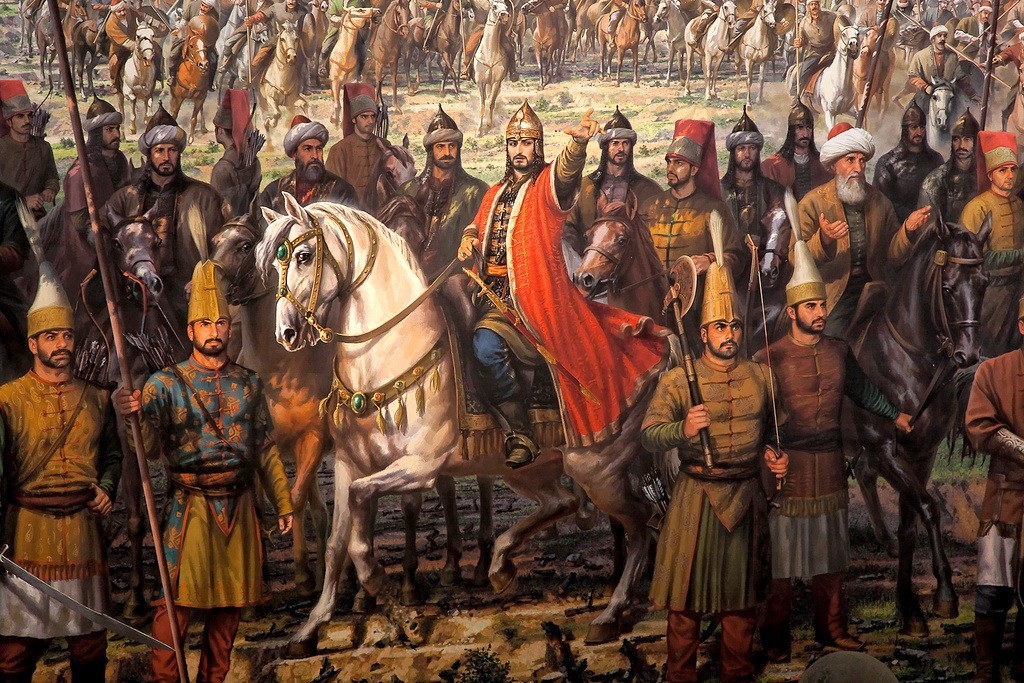
This impotence finally came to an end, at least for “New Rome”, on 29 May, 1453, when a huge Ottoman army, under Mehmet II,

using that very modern weapon, the bombard,

broke into the city and captured it.

In earlier postings, I went into a comparison of the two, Byzantium and Minas Tirith, their look and their sieges, in some detail (see “The Fall of Two Cities?”, 9 March, 2016, and “A Kind of Proud, Venerable, But Increasingly Impotent Byzantium”, 1 June, 2016), but as JRRT himself went to some lengths in more than one letter to discuss toponymy (place names and their study) and the proper translation of place names (see, for instance, the letter to Rayner Unwin, 3 July, 1956, Letters, 359-361), I find it interesting to see what happened to Byzantium/New Rome/Constantinople.

The song says that it’s “Istanbul, not Constantinople”, but, surprisingly, this isn’t an Ottoman Turkish name and here we see that, although the Ottoman Sultan may have captured the city, he somehow never captured what it was called.  As I wrote above, the locals had called it “Constantinoupolis”, or simply “he Polis”.  Thus, when someone might ask, “Where are you going?” you might reply, “Eis ten Polin”—“to/towards the City” and that form, spoken casually, probably became “Is-tan-bul”, thus retaining part of its ancient Byzantine nomenclature—which it retains to this day, the name being legalized as the name in 1930.

But this brings me to an interesting point.  Minas Tirith, “the Tower of Guard” (formerly Minas Anor, “the Tower of the Sun”—even in Middle-earth names move around, depending upon historical circumstance) survived Sauron’s attack, which Byzantium/New Rome/Constantinople did not—and yet its name survived.

(Ted Nasmith)

When Sauron’s forces captured Minas Tirith/Anor’s matching fortress, Minas Ithil (“the Tower of the Moon”), its name was changed to the grim-sounding Minas Morgul (“the Tower of Dark Sorcery”).

(and another Ted Nasmith)

Had Minas Tirith fallen to Sauron, what might have happened to its name—or is that nobody’s business but the orcs’?

Thanks, as ever, for reading.

Stay well,

Imagine what maps and signposts would look like in the Black Speech (“One Road to Rule Them All, One Road to Lose Them”?).

And remember that, as always, there’s

MTCIDC

O

PS

Reading about “Istanbul” by the Four Lads, I noted that a jazz critic suggested that it was actually written in reply to a 1928 song, “Constantinople”, which you can listen to (warning:  it’s catchy) here:  https://www.youtube.com/watch?v=OFDdPT9H_dQ

And He Sent Out a (Turtle) Dove

Welcome, dear readers, as always.

“cumque transissent quadraginta dies aperiens Noe fenestram arcae quam fecerat dimisit corvumqui egrediebatur et revertebatur donec siccarentur aquae super terram emisit quoque columbam post eum ut videret si iam cessassent aquae super faciem terraequae cum non invenisset ubi requiesceret pes eius reversa est ad eum in arcam aquae enim erant super universam terram extenditque manum et adprehensam intulit in arcamexpectatis autem ultra septem diebus aliis rursum dimisit columbam ex arcaat illa venit ad eum ad vesperam portans ramum olivae virentibus foliis in ore suo intellexit ergo Noe quod cessassent aquae super terramexpectavitque nihilominus septem alios dies et emisit columbam quae non est reversa ultra ad eum”

“And when forty days had passed, Noah, opening a window of the ark which he had made, sent out a raven, who was going out and returning while the waters were drying up over the earth.  He sent out as well a dove after him so that he might see if now the waters had gone down [literally, “ceased”] over the surface of the earth who, when she had not found where she might rest her foot, returned into the ark to him (for the waters were still over the whole earth) and he stretched out [his] hand and brought the captured [bird] into the ark.  However, when a further seven days had been waited out, he again sent out the dove from the ark, but it came to him at evening carrying in its mouth an olive branch with growing leaves and so Noah understood that the waters had receded over the earth and he waited no more than seven more days and sent out the dove which did not return again to him.”

(Genesis 8.6-12—my translation.  The text is from Jerome’s translation, which you can read more of here, both in Latin and English, in Genesis 6-8:  https://vulgate.org/ot/genesis_6.htm    )

The story of the Flood stretches out, like its waters, over much of early Western human history, not only in the Judeo-Christian Bible, and in the story of Pyrrha and Deucalion in Ovid’s  Metamorphoses (for more on Pyrrha, Deucalion, and floods, see “Flooded Out”, 6 April, 2022), but even in Tolkien, with the destruction of Numenor, but, for me, it’s both a wonderful story, and inspired some of my favorite medieval mosaics, those in the cathedral at Monreale, in Sicily.

Inside this amazingly colorful space, almost hallucinogenic, on one wall, are a series of images illustrating the story of Noah and his Ark.

I love the whole series (here it is:  https://www.christianiconography.info/sicily/noahMonreale.html ), but, if I had to choose among them, it would be the building of the Ark

and the one which illustrates the title of this posting which I love most—

The construction of the building began in the reign of William II (1167-1189),

the Norman ruler of this part of Sicily.  Here, he’s presenting the (in his time unfinished) structure to the Virgin Mary.  Although, unfortunately, we don’t know the names of the artists who created such wonderful images, they presumably were either Byzantines or were trained in the Byzantine style of mosaic-making (for more see:  https://en.wikipedia.org/wiki/Monreale_Cathedral_mosaics ) and this makes another Tolkien connection for me, remembering his remark, in a letter to Milton Waldman, that

“In the south Gondor rises to a peak of power, almost reflecting Numenor, and then fades slowly to decayed Middle Age, a kind of proud, venerable, but increasingly impotent Byzantium.”  (letter to Milton Waldman, “probably written in late 1951”, Letters, 203)

And “dove” and “Byzantium” bring me to the main subject of this posting, the science fiction/fantasy author, Harry Turtledove (1949-and may he live to be a 100 and more).

Turtledove, a lifelong Californian, got his PhD in Byzantine history from UCLA in 1977 with a dissertation entitled “The Immediate Successors of Justinian: A Study of the Persian Problem and of Continuity and Change in Internal Secular Affairs in the Later Roman Empire During the Reigns of Justin II and Tiberius II Constantine (AD 565–582) and this also fits into this posting—although Turtledove himself never fit into the academic world (too few jobs for Byzantinists, alas!) and, instead, became an astonishingly prolific author, with approximately 111 books by 2023 (not counting collaborations, short stories, edited collections and the fact that my eyes crossed after I counted 100—you can see a list in chronological order by series here:  https://www.bookseriesinorder.com/harry-turtledove/ ).  For a comparison, there’s Anthony Trollope (1815-1882),

a Victorian novelist known in his own time for his prolificacy, but who only turned out about 60 novels between 1847 and 1882.  (For a list, see:  https://www.orderofbooks.com/authors/anthony-trollope/  If you enjoy long, complex social novels written by someone with an eye for character and detail, and you don’t know his work, I would recommend starting with The Warden, 1855, which you can read here in an 1862 American reprint:   https://archive.org/details/warden02trolgoog/page/n4/mode/2up )

I had first met Turtledove’s work in a “what if” novel, The Guns of the South (1992),

in which time-travelers provide Robert E. Lee’s Army of Northern Virginia with AK47s in 1863, with consequences which you might image for the Union Army of the Potomac and beyond.  It was a good, gripping read and I was curious to see what else this man had written. My further connection with Turtledove was not “what if”, but fantasy–based upon the real Byzantium–and which began with a recommendation of his “Videssos” series by a friend who had once had seen him appear as a substitute for her regular professor in a class at UCLA.   He lectured for over an hour without notes and, if she didn’t use the word “spell-binding”, she certainly gave me the impression that this was a born story-teller. 

And so I came to “Videssos”, which is, in fact, Byzantium by another name, as the map which appears in the various series immediately indicates—

in which the world of the Mediterranean has been (roughly) reversed.

There are three series in all, plus one extra novel, The Bridge of the Separator (2005), a kind of “prequel” to the series published first (or perhaps to the whole series–I’m not quite clear on this), but which was not in the ultimate chronological structure of the whole.

The series first published (all in 1987) is that sometimes called “The Videssos Cycle”—

 but which actually takes place at the end of the era which the total collection portrays.  Next, moving backward, comes “The Time of Troubles”—

and finally comes the “Krispos” series.

Unlike Turtledove, I’m not a Byzantinist, but it’s possible to recognize certain elements immediately.  The “Makuraners”, for instance, appear to be based upon the fierce Sassanid Persians, with their heavily-armored cavalry,

(Angus McBride)

of which we actually have a period image from a sgraffito on a wall in Dura-Europos, which fell to the Sassanid king, Shapur I, in 257AD (Dura-Europos is a fascinating place in itself:  https://en.wikipedia.org/wiki/Dura-Europos#Looting_by_ISIS )

The capital of Videssos, sometimes called “Videssos the City”, has a number of elements which make it an easy match for Byzantium at its height.

(For more parallels, see:  https://en.wikipedia.org/wiki/Videssos_cycle )

It’s not, however, the parallels which have interested me so much as the complexity of the world which these books provide.  Like that of The Lord of the Rings, this is an ancient world, with a complicated history, ruled by dynasties which can be overthrown, all of it entangled with religion (much of it based upon ancient Zoroastrianism) and the most intelligent understanding—and depiction—of magic which I’ve read in fantasy novels.  My friend’s depiction of Turtledove was clearly extremely accurate and, if you enjoy these, that’s only about a dozen books out of over a hundred.  For years there’s been a game in which you’re asked, “If you could only take ________ with you to a desert island, what would you take?”  Certainly, if I had to spend the (about) 370 days on the Ark with Noah, his family, and their vast collection of animals in 2s and 7s, I’d think seriously about answering, “How about the whole Turtledove opus?”

As ever, thanks for reading.

Stay well,

Try to remember just how long a cubit is,

And remember that, as always, there’s

MTCIDC

O

How Stands the Glass Around?

Tags

, , , ,

As always, dear readers, welcome.

I admit that the title of this posting, upon further reading, may seem a little deceptive.  It’s the title of a (perhaps) early 18th-century English song, sometimes called “General Wolfe’s Song” because, somehow, a story appeared that General James Wolfe (1727-1759)

(by George Townshend, 1724-1807, one of Wolfe’s senior officers, who disliked him, but did this little watercolor which, to me, looks much more like the real man than the formal portraits we normally see)

sang it before his death (and victory) at Quebec, in 1759.  (This appears to have had no basis in fact, but has been repeated more than once, in various books about English popular song.)

(by Edward Penny, 1763?—this, one of several versions of the picture by the painter, is in the Fort Ligonier museum in Ligonier, Pennsylvania)

The tune, at least, appears to be some years older, the first citation I can find is to a song from Thomas Odell’s (1691-1749) ballad opera The Patron (1729), where the tune for the lyric is given as that of “Why, Soldiers, Why”, which is the beginning of the second verse.  (For the first two verses, see:  https://tunearch.org/wiki/Annotation:Why_Soldiers_Why%3F    The tune may be older yet, as there’s a 1712 broadside entitled “The Duke of Marlborough’s Delight” set “to a new tune” which has similar lyrics—see the text here:  http://ballads.bodleian.ox.ac.uk/static/images/sheets/20000/16153.gif  You can hear the tune to “Why, Soldiers, Why” here:  https://www.youtube.com/watch?v=-VxlkhsOcRI )

The glass I want to talk about is, in fact, both related to the lyric, with its “Let mirth and wine abound”, and another kind of glass entirely.

When the dwarves overwhelm Bilbo’s house, in the first chapter of The Hobbit (“An Unexpected Party”—which is, in fact, a pun—JRRT admits, in a letter to Deborah Webster 25 October, 1958,  Letters,    to having a simple, hobbit sense of humor—not only is a party a festivity—although this one, for Bilbo was far from it—but, in older English, “party” can also mean “a person”—so that “unexpected party/person is presumably Gandalf, as it’s in the singular),

(Alan Lee)                                                                                                                          

they mock his discomfort in a clean-up song which begins:

“Chip the glasses and crack the plates!”

and this made me wonder:  The Hobbit, like The Lord of the Rings, is set in a pre-industrial—really, medieval—world:  what kind of glasses might these be?

Glass, as a material, is much older than the western Middle Ages.  As you might expect from something which may have originated in the middle of the 3rd millennium BC (2500BC?—there’s lots of on-line discussion, but see, for example:  https://www.smithsonianmag.com/science-nature/a-brief-scientific-history-of-glass-180979117/  ), there has been much scholarly debate on the subject, but let’s go with that rough date for the present.

A combination of silica sand,

lime,

(powdered, of course)

and sodium carbonate,

(plus lots of other elements for various additional properties—see for more:  http://www.historyofglass.com/glass-making-process/glass-ingredients/ )

when heated to about 2400 degrees Fahrenheit (about 1315C), produces a moldable, shapeable liquid.

(For an experiment on making early glass, see:  https://www.youtube.com/watch?v=Lg7kZpTVoms This is from a YouTube series called “How to Make Everything” and, if you’re like me, interested in all early technologies, definitely recommended.  There’s an interesting suggestion there, as well, that glass may have been an accidental byproduct of early metal-working.) 

The first surviving glass seems to be beads–

these are Mesopotamian, but found in a grave in Denmark, showing just how extensive early trade networks were.

The Egyptians went into the glass business at some point,

and, eventually, the later Assyrians even produced the first known glass-making manual in the reign of King Ashurbanipal (reigned 669-631BC)—you can read about it here:  https://historyofknowledge.net/2018/12/05/you-us-and-them-glass-and-procedural-knowledge-in-cuneiform-cultures/  and read a translation of the cuneiform tablets on which it was written here:  https://www.nemequ.com/texts )

The Romans produced some rather amazing creations in glass,

as well as the first window glass.

(For how Romans made window glass, see:  http://www.theglassmakers.co.uk/archiveromanglassmakers/articles.htm#No  This is actually a small collection of interesting articles.  Scroll to the last to see the specific piece about window glass.)

Even after the change in the western Roman empire from imperial rule to Germanic kingdoms and their later successors, the art of glass-making was never lost, but it appears that the older method of making larger panes may have been, since medieval domestic windows used smaller pieces of glass framed in metal, called “mullioning”—

and this was only for the very wealthy.  This leads me to wonder about:

“The best rooms were all on the left-hand side (going in), for these were the only ones to have windows, deep-set round windows looking over his garden, and meadows beyond, sloping down to the river.”  (The Hobbit, Chapter One, “An Unexpected Party”)

(JRRT)

Is this hobbit mullioning?  Other buildings in the Shire look to have had ordinary glass windows, as in—

“…some new houses had been built:  two-storeyed with narrow straight-sided windows, bare and dimly lit, all very gloomy and un-Shirelike.”

and

“The Shirriff-house at Frogmorton was as bad as the Bridge-house.  It had only one storey, but it had the same narrow windows…”

I suspect that what Tolkien had in mind was something like these Victorian railway workers’ houses,

as mentioned earlier:

“Worse, there was a whole line of the ugly new houses all along Pool Side…”

(All of these grim quotations are from The Return of the King, Book Six, Chapter 8, “The Scouring of the Shire”)

Clearly, “Shirelike” means windows of an entirely different design—and that means round, as Tolkien’s own view towards Bag End shows us—

(JRRT)

(Although you can see, by the way, in this earlier sketch, that Tolkien had not originally decided upon the window-shape consistency of the later illustration, or on the true meaning of “Shirelike”.)

But, though a window plays an important part in recruiting a crucial member of the Fellowship of the Ring:

“Suddenly he stopped as if listening.  Frodo became aware that all was very quiet, inside and outside.  Gandalf crept to one side of the window.  Then with a dart he sprang to the sill, and thrust a long arm out and downwards.  There was a squawk, and up came Sam Gamgee’s curly head hauled by one ear.”  (The Fellowship of the Ring, Book One, Chapter 2, “The Shadow of the Past”)

(Artist?  I’m always glad to credit one, but I’m stumped here.)

the glasses which the dwarves threaten to chip are clearly of the drinking variety. 

I imagine that the glasses in the Tolkien household looked like this

or, for more formal occasions, like this

and what JRRT drank from at The Eagle and Child (aka “The Bird and Baby”) or The Lamb and Flag would have been something like this–

But that’s the first half of the 20th century. 

Could we see this actual medieval glass as a model?

It seems awfully dainty and, remembering the dwarves’ demands for what seems like endless rounds of food and drink, however, perhaps it wasn’t chipped glasses which Bilbo should worry about at all, but dented tankards!

Thanks, as ever, for reading.

Stay well,

When necessary, sing quietly to yourself, “Ho, ho, ho, To the bottle I go…”,

And remember that, as always, there’s

MTCIDC

O

PS

As you can tell, the history of glass—and windows—is long and complicated.

See this for more on glass:  https://en.wikipedia.org/wiki/History_of_glass

And this on windows:  https://en.wikipedia.org/wiki/Window

Speak Friend, or, Open, Sez Me

Tags

, , ,

As always, welcome, dear readers.

Occasionally, I return to something I’ve already written about, but, this time around, hope to see in a new, or at least newish, light.  The subject of today’s posting first appeared back in “Do What I Say, Not What I Speak”, 13 June, 2018, but, since then, I began my campaign to read all of The Arabian Nights and am now in the second volume of the Penguin edition (for the first volume, see “Arabian Nights for Days”, 31 January, 2024).

I’ve known some of the stories in this vast collection since childhood, but the first two stories I heard as a child are actually so-called “orphan tales”, being stories which appear to have no early manuscript tradition, first appearing in Antoine Galland’s (1646-1715)

Les Mille et Une Nuits (1704-1717).

and from there into the first edition in English, the anonymous so-called “Grub Street Edition” of 1706-1721.

(This is an image from the earliest edition I can locate—as you can see, it’s from 1781.  Only two copies of the first edition are known to exist, one in the Bodleian Library at Oxford, the other in the rare books collection of Princeton University and clearly they don’t get out much.)

There has been much discussion as to the actual origins of “Aladdin”

and “Ali Baba and the Forty Thieves”–

in particular, that, although they contain standard folktale motifs, they are actually the work of a Syrian storyteller named Antun Yusuf Hanna Diyab (c.1668-post-1763) and were added by Galland to his translation without attribution.  (For more, see:  https://en.wikipedia.org/wiki/Hanna_Diyab

Whatever is the truth of this, these were the stories I carried in my head for years before I came back to them when commencing my “Arabian Nights” reading campaign. 

When I was small, they were actually quite scary—the magician who pretends to be Aladdin’s long-lost uncle and who only wants to use him long enough to obtain the lamp, then would let him die in the cave where the lamp was kept, and the merciless thieves, who once they found their cave with its secret password was compromised, cut up Ali Baba’s brother who had discovered the secret but, who, forgetting the password, was trapped until the thieves returned, were among the creepier parts of my childhood, and, as may always be the case with creepy things, not easily forgotten.

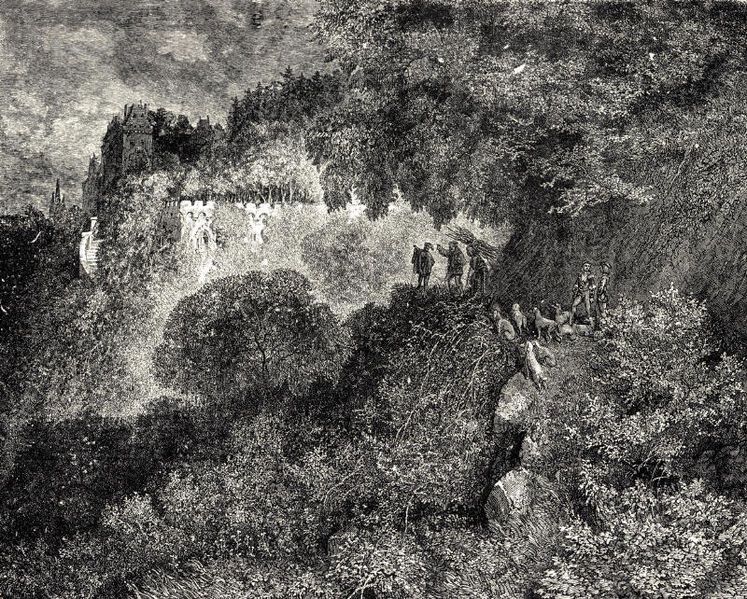
At the same time, I was always puzzled by the opening to “Ali Baba”:

“IN a town in Persia there dwelt two brothers, one named Cassim,

the other Ali Baba. Cassim was married to a rich wife and lived

in plenty, while Ali Baba had to maintain his wife and children by

cutting wood in a neighbouring forest and selling it in the town.

One day, when Ali Baba was in the forest, he saw a troop of men

on horseback, coming towards him in a cloud of dust. He was

afraid they were robbers, and climbed into a tree for safety.  When

they came up to him and dismounted, he counted forty of them.

They unbridled their horses and tied them to trees. The finest man

among them, whom Ali Baba took to be their captain, went a little

way among some bushes, and said: ‘ Open, Sesame!’ so plainly that

Ali Baba heard him. A door opened in the rocks, and having made

the troop go in, he followed them, and the door shut again of itself.”

Why would a door obey a password?  And why that word, which I knew was a kind of seed.

(For more—much more—see:  https://en.wikipedia.org/wiki/Sesame#Allergy )

This sat somewhere in my memory until I read:

“But close under the cliff there stood, still strong and living, two tall trees, larger than any trees of holly that Frodo had ever seen or imagined…

(JRRT)

‘Well, here we are at last!’ said Gandalf.  ‘Here the Elven-way from Hollin ended.  Holly was the token of the people of that land, and they planted it here to mark the end of their domain; for the West-door was made chiefly for their use in their traffic with the Lords of Moria.’ …

…they turned to watch Gandalf.  He appeared to have done nothing.  He was standing between the two trees gazing at the blank wall of the cliff, as if he would bore a hole into it…

 ‘Dwarf-doors are not made to be seen when shut,’ said Gimli.  ‘They are invisible, and their own makers cannot find them or open them, if their secret is forgotten.’

‘But this Door was not made to be a secret known only to Dwarves,’ said Gandalf…’Unless things are altogether changed, eyes that know what to look for may discover the signs.’

He walked forward to the wall.  Right between the shadow of the trees there was a smooth space, and over this he passed his hands to and fro, muttering words under his breath.  Then he stepped back.

‘Look!’ he said.  ‘Can you see anything now?’

…Then slowly on the surface, where the wizard’s hands had passed, faint lines appeared, like slender veins of silver running in the stone…

At the top, as high as Gandalf could reach, was an arch of interlacing letters of an Elvish character.

(Ted Nasmith)

Below, though the threads were in places blurred or broken, the outline could be seen…

(JRRT)

‘What does the writing say?’ asked Frodo…

‘…They say only:  The Doors of Durin, Lord of Moria.  Speak, friend, and enter.’

‘What does it mean…?’ asked Merry.

‘That is plain enough,’ said Gimli.  ‘If you are a friend, speak the password, and the doors will open, and you can enter.’ “  (The Fellowship of the Ring, Book Two, Chapter 4, “A Journey in the Dark”)

We know from various clues, like the story title “Storia Moria Castle”, that Tolkien had read—or been read to—from Andrew Lang’s (1844-1912) The Red Fairy Book, 1890,

but, interestingly, “Aladdin” and “Ali Baba” both appear in Lang’s previous The Blue Fairy Book, 1889,

from which both the “Ali Baba” quotation and illustration above, come.  Could Tolkien have been read to from, or read, “Ali Baba” there?  Certainly we see that door, and the need for the password.  But what about that password?

In The Fellowship of the Ring, Gandalf tells us that “ ‘I will tell you that these doors open outwards.  From the inside you may thrust them open with your hands.  From the outside nothing will move them save the spell of command.  They cannot be forced inwards.’   Try as he might, however, Gandalf can’t come up with that word—until he realizes that he’s made a slight mistranslation: 

“ ‘The opening word was inscribed on the archway all the time!  The translation should have been Say “Friend’ and enter.  I had only to speak the Elvish word for friend and the doors opened.’ “

To a linguist with a fine ear, like JRRT’s, the distinction, in English, between the verb “to speak”, as in “to speak a language”, and “to say”, as in “to say the right thing”, can be subtle—in this case, almost too subtle—as Gandalf says:

“ ‘Quite simple.  Too simple for a learned lore-master in these suspicious days.’ “

With the problem solved, the doors swing open—but where they’re about to go is, ultimately, worse than Ali Baba’s thieves’ treasure cave, even as I’m reminded of what happens to Ali Baba’s jealous brother.  Obtaining the password, he easily enters the cave, but, when he tries to leave, he confuses “sesame” with other grains, is trapped, and eventually dismembered by the returning thieves.  (Think Balrog and “Drums in the Dark”…)

And, though “Friend”, says Gandalf, is quite simple, and, adding, “Those were happier times” in which such a pleasant password was all that was necessary,  I’m still puzzled about “sesame” and, in both cases, I wonder about those doors—who or what was doing the opening?  Then again, when I post this,  I’ll need a password and, when I employ it, the site will pop open—who or what is doing the opening there?

Thanks, as always, for reading.

Stay well,

When it comes to locks, I prefer a good, sturdy key,

And remember that, as always, there’s

MTCIDC

O

PS

In case you want to read the two fairy books—and I hope you do—here they are:

The Blue Fairy Book 

https://archive.org/details/bluefairybook00langiala/page/n7/mode/2up

The Red Fairy Book

https://archive.org/details/cu31924084424013/page/n9/mode/2up

Terror Weapon

Tags

, , , ,

Welcome, dear readers, as always.

If you grew up, as I did, with the 1939 film, The Wizard of Oz,

but had never read the original,

L. Frank Baum’s The Wonderful Wizard of Oz, 1900,

you would be surprised to open the book and find that Chapter 1 is entitled “The Cyclone”,

which, considering the use of that terrifying force of nature in the story isn’t surprising, but that “Miss Almira Gulch”, the initial incarnation of the story’s main antagonist, with her wonderful last name (a “gulch” is, as Etymonline tells us, a “deep ravine” suggesting that Miss Gulch is empty—and treacherous, as “ to dry gulch” someone is archaic Wild West slang for “to ambush”) is not to be seen.

As a small child, I found almost everything about her disturbing.  As someone who, initially, wanted to deal with Toto and had the economic power to do it (shades of 1930s social commentary about the 1%), she was bad enough.  It was the green skin of her next incarnation and those dagger-like fingernails, however,

which were at the edge of nightmares, and even more so the menace of flight—not only her own skywriting,

but her nasty little airborne monkeys.

These seemed almost too prescient for what was about to happen in the real world as, on 1 September, 1939, only about two weeks after the Hollywood premiere of the film on 15 August, Germany invaded Poland, and, in less than a year, Denmark, Holland, Norway, and France, major weapons being a deadly form of those flying monkeys—

(by Mike Chappell, a favorite military artist)

paratroopers, and dive bombers, the notorious  Ju87, “Stuka” (short for “Sturzkampfflugzeug”—“dive bomber”).

To add to the effect of having such a thing racing down to drop a bomb on you, sirens were attached to the landing gear or wings, the so-called “Jericho trumpets”  (You can read more about them here:  https://www.warhistoryonline.com/instant-articles/trumpets-jericho-luftwaffe.html And you can hear one here:  https://www.youtube.com/watch?v=80bOdm2P9Y8 ), giving a wailing, screeching sound to the attacker in hopes of destroying morale even before a bomb hit.  Although designed to be support for infantry and armor, numbers were employed in the air campaign against Britain and, although Oxford was never attacked as the great ports and manufacturing centers were, I wonder if Tolkien, as a volunteer air raid warden, ever heard that sound overhead.

Even if it only appeared in a newsreel, it must have been an unforgettable noise and my wondering brought me to this:

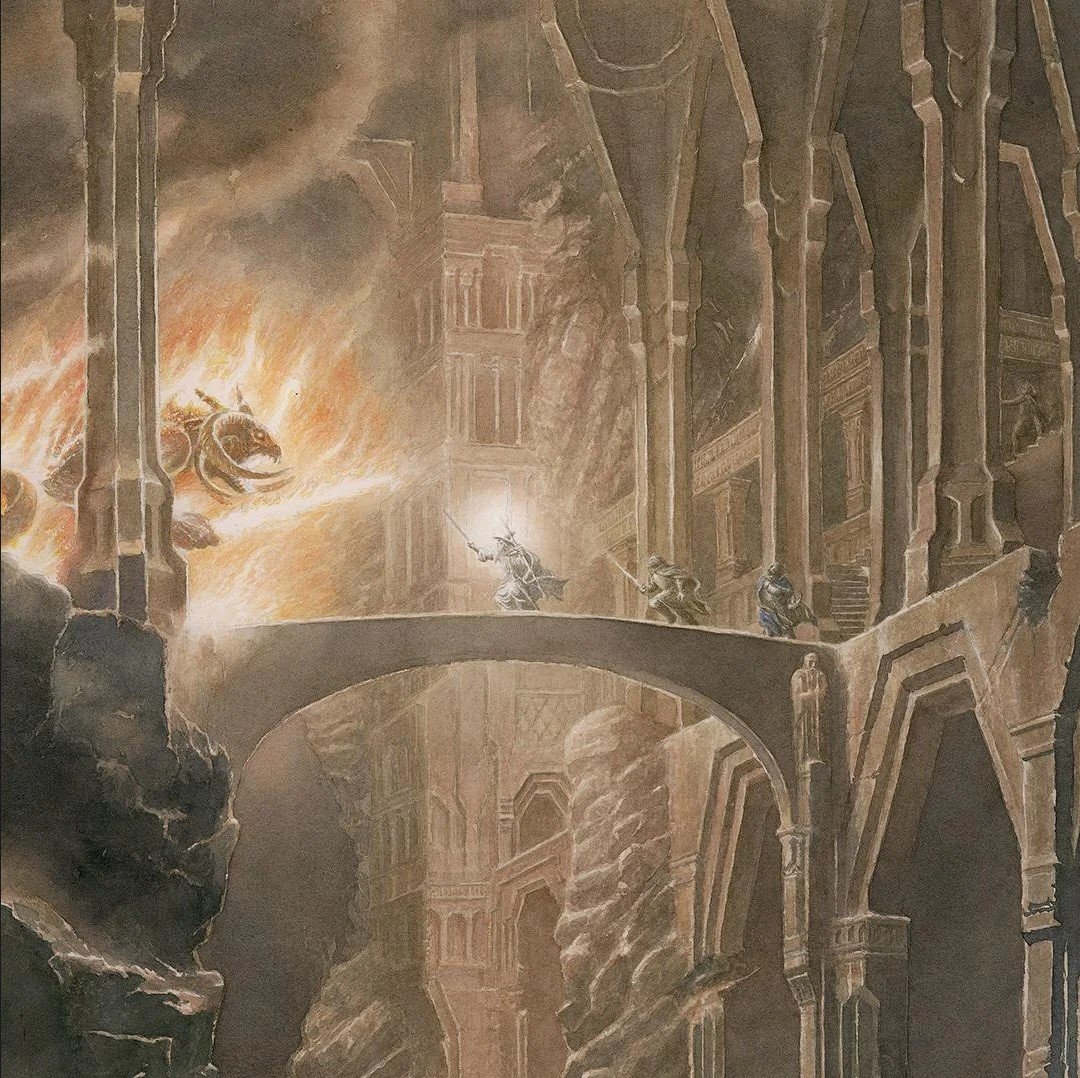
“And Minas Morgul answered.  There was a flare of livid lightnings:  forks of blue flame springing up from the tower and from the encircling hills into the sullen clouds.  The earth groaned; and out of the city there came a cry.  Mingled with harsh high voices as of birds of prey, and the shrill neighing of horses wild with rage and fear there came a rending screech, shivering, rising swiftly to a piercing pitch beyond the range of hearing.  The hobbits wheeled round towards it, and cast themselves down, holding their hands upon their ears.”  (The Two Towers, Book Four, Chapter 8, “The Stairs of Cirith Ungol”)

In Minas Tirith, Pippin heard something very similar:

“Suddenly as they talked they were stricken dumb, frozen as it were to listening stones.  Pippin cowered down with his hands pressed to his ears…”

Not Stukas diving out of the clouds to bomb the city,

but

“…now wheeling swiftly across it, like shadows of untimely night, he saw in the middle airs below him five birdlike forms, horrible as carrion-fowl yet greater than eagles, cruel as death.  Now they swooped near, venturing almost within bowshot of the walls, now they circled away.

‘Black Riders!’ muttered Pippin.  ‘Black Riders of the air!’ “

And this was not the first time that any of the hobbits had heard that terrible sound:

“Pippin knew that shuddering cry that he had heard:  it was the same that he had heard long ago in the Marish of the Shire, but now it was grown in power and hatred, piercing the heart with a poisonous despair.”

It’s unclear if Frodo and Sam had heard the same cry at Cirith Ungol, but certainly what Pippin heard and to which he reacted violently:

“Another long screech rose and fell, and he threw himself back again from the wall, panting like a hunted animal.”  (The Return of the King, Book Five, Chapter 4, “The Siege of Gondor”)

(Alan Lee)

had the same effect—and, in fact, the same effect which Stukas were intended to have upon their victims—just as the Wicked Witch, aka, Miss Gulch—had had a similar effect upon me as a little boy,

even without her creepy little simian assistants.

Thanks, as ever, for reading.

Stay well,

When going outdoors, always cast a wary eye upwards,

And remember that, as always, there’s

MTCIDC

O

PS

In case you don’t have a first edition of The Wonderful Wizard of Oz with its original illustrations, here it is for you:  https://www.youtube.com/watch?v=80bOdm2P9Y8

Orc Logistics

Tags

, , , ,

As always, dear readers, welcome.

Sauron, although he rather rashly placed much of his power (as well as his life force) in what is, basically, a magic ring, has always struck me as rather a practical person when it comes to war and foreign affairs.  In order to conquer the West, he’s:

1. turned his rather bleak realm into a giant military camp

2. brought back the final destroyer of Arnor, the Witch King of Angmar, as his chief lieutenant

3. made treaties with peoples to the east and south to bolster his already extensive armies and cleverly turned pirates loose to raid the southern shores of Gondor to distract his opponents and force them to divide their forces

4. corrupted one of the West’s traditional allies, Saruman, turning him into a kind of “Mini Me”


5. weakened another, Rohan, through a spy in the king’s court, Grima, who has somehow turned that king into a prematurely-aged man

6. worked on the mind of the commander of Gondor, Denethor, using an ancient communications device, making him suspicious of his younger son and promoting a defeatist attitude

As well, he seems quite aware of what we call geo-politics, as we see in his demands at the Black Gate:

“ ‘The rabble of Gondor and its deluded allies shall withdraw at once beyond the Anduin, first taking oaths never again to assail Sauron the Great in arms, open or secret.  All lands east of the Anduin shall be Sauron’s for ever, solely.  West of the Anduin as far as the Misty Mountains and the Gap of Rohan shall be tributary to Mordor, and men there shall bear no weapons, but shall have leave to govern their own affairs.  But they shall help to rebuild Isengard which they have wantonly destroyed, and that shall be Sauron’s and there his lieutenant shall dwell:  not Saruman, but one more worthy of trust.”  (The Return of the King, Book Five, Chapter 10, “The Black Gate Opens”)

Reading this passage, however, I’m puzzled:

“Time passed.  At length watchers on the walls could see the retreat of the out-companies.  Small bands of weary and often wounded men came first with little order; some were running wildly as if pursued.  Away to the eastward the distant fires flickered, and now it seemed that here and there they crept across the plain.  Houses and barns were burning.  Then from many points little rivers of red flame came hurrying on, winding through the gloom, converging towards the line of the broad road that led from the City-gate to Osgiliath.”  (The Return of the King, Book 5, Chapter 4, “The Siege of Gondor”)

As we know, JRRT himself had been a soldier, though perhaps a reluctant one,

and thus would have been well aware of the saying, sometimes attributed to Napoleon, that “an army marches on its stomach”.  In 1916, such an army needed massive supply dumps,

which needed railroads to bring food and ammunition to them.

From there, wagons

and, in time, early trucks,

then mules and horses would have taken supplies farther forward

and, from there, the troops themselves might have formed what were called “carrying parties”.

Image7:  carrying

(This is actually a “wiring party”, with its “screw pickets”, which were twisted into the ground and used to hold up the barbed wire, but it can stand in for a “carrying party”.  For more on “wiring parties”, see:  https://en.wikipedia.org/wiki/Wiring_party  )

One fact alone might suggest how big the task of keeping the British Army supplied :  “By 1918, the British were sending over 67 million lbs (30 million kg) of meat to the Western Front each month.”  (This is from an article entitled “The Food That Fuelled the Front” from the Imperial War Museum website, which you can see here:  https://www.iwm.org.uk/history/the-food-that-fuelled-the-front  )

This was a vast, modern army, with all the modern technology available in 1918 to enable resupply (such supplying is called “logistics”).  Sauron’s army is of a much earlier time, its basis seemingly infantry, armed with swords, spears, and bows,

(Alan Lee)

assisted by a certain number of oliphaunts,

(Alan Lee)

horsemen,

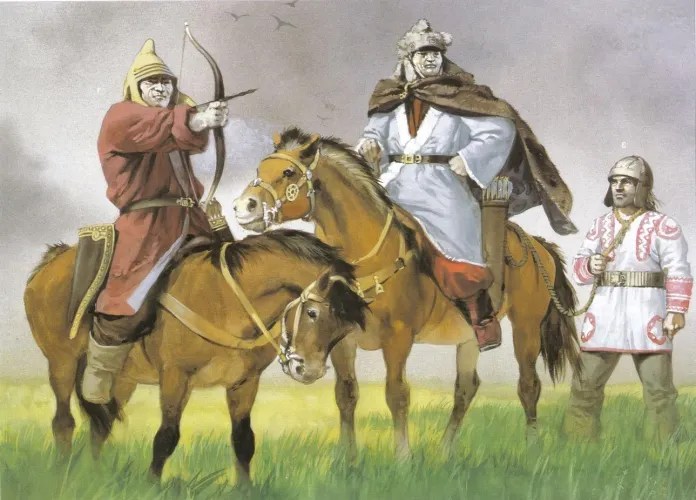
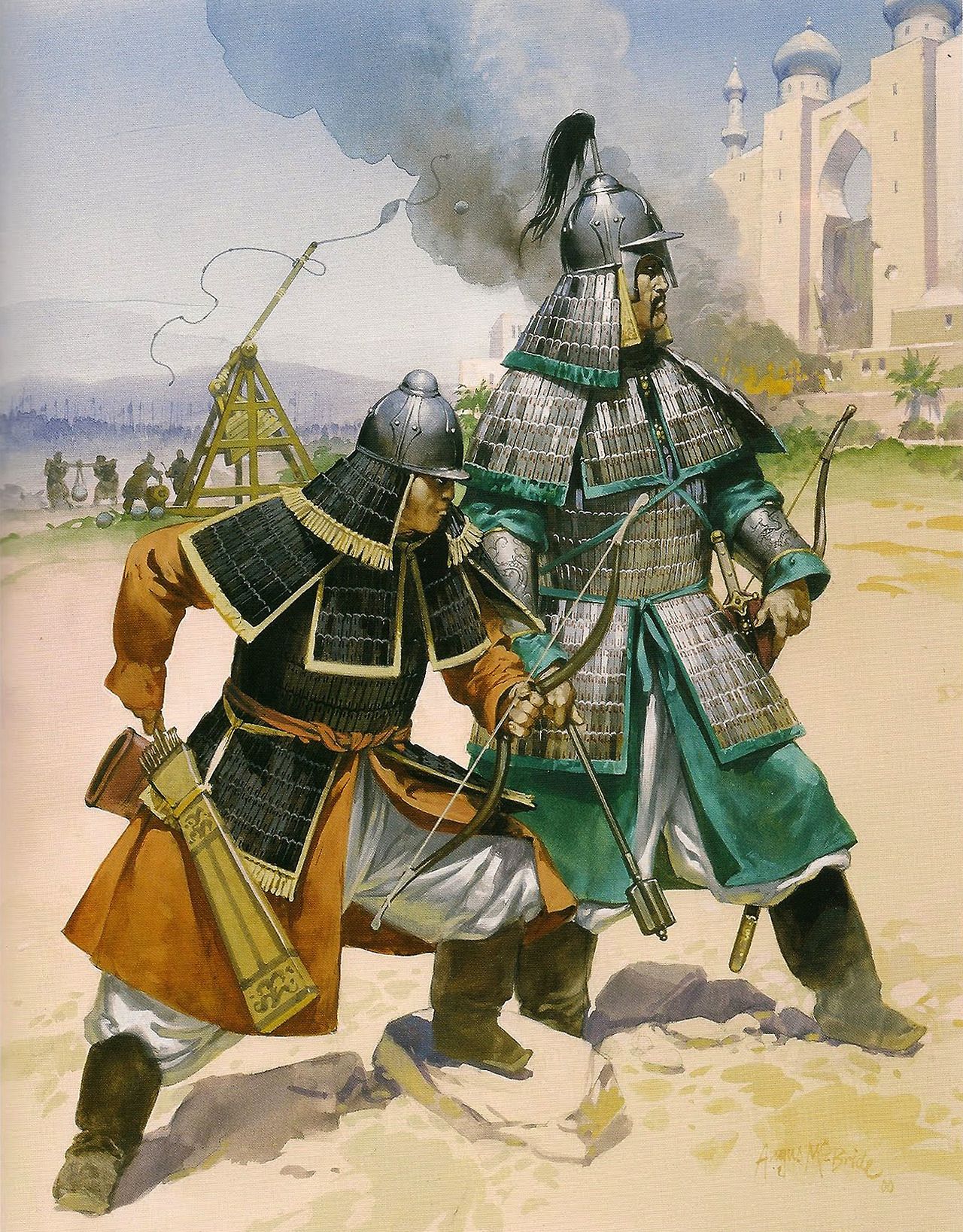
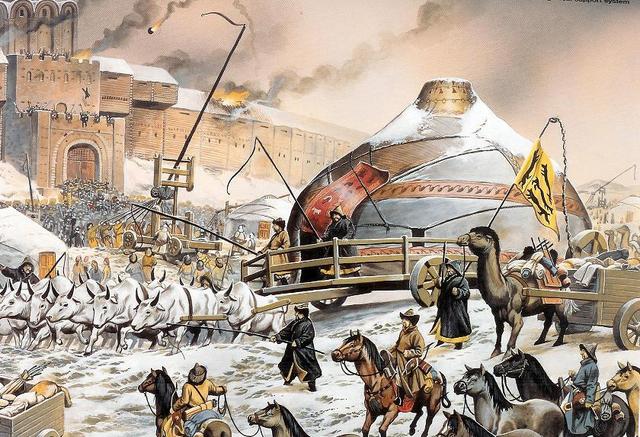
(These are actually Mongols, but all the text says is “Before them went a great cavalry of horsemen moving like ordered shadows…”  The Two Towers, Book Four, Chapter 8, “The Stairs of Cirith Ungol”, leaving it up to us to imagine what they might have looked like.)

and perhaps a warband of wargs,

(Artist?)

yet its basic needs would have been the same as those of the British Army in which Tolkien served.

To provide a parallel a bit closer to The Lord of the Rings, we might imagine an earlier army, like the army of New Kingdom Egypt

as we might have seen it marching to fight the Hittites

(Angus McBride)

at the Battle of Kadesh, in the summer of 1274BC. 

No oliphaunts or cavalry (or wargs) in support, but definitely chariots, maybe 2000 of them.

(Again, Angus McBride, one of my favorite military artists of the 20th century). 

The Egyptian army of Rameses II

may have numbered about 20,000, with as many as 4,000 chariot horses, and here are some potential logistic figures for such an earlier army—

Thinking of water alone, the average modern horse will drink 5-10 gallons (19-38 ltrs) of water a day, depending on working conditions, and that same horse needs to eat 15-20 pounds  (7-9 kg) of hay.  An average present-day American eats about 5.5  pounds (2.5 kg) of food per day and drinks 2 quarts (2 ltrs) of water.  On the one hand, ancient Egyptians were somewhat smaller than we are and probably less well-fed to begin with, but, on the other, that water requirement is an average and doesn’t factor in  marching for miles on dusty summertime roads in the Middle East.

Could Rameses’ army have carried enough supplies with it for the long march (perhaps about 500 miles—about 805km)?  Rameses would have had available to him no trains or trucks, but the ancient Egyptians had carts (probably pulled by oxen, as were their plows)

and certainly used pack mules.

As to possible baggage camels,

there is a lot of scholarly argument about their use.  Although camel remains (a few depictions, bones, rope from camel hair) are there, there doesn’t appear to be any clear evidence for the use of camels as carriers until much later.  Food—the ordinary Egyptian diet was simple, including barley bread

and beer (also made from barley),

so large supplies of barley flour might be carried, but how to carry—and preserve–beer?  Water could be substituted, but could it be carried?  Or would the Egyptians have done as armies have done throughout history and foraged, picking up supplies of food and drink from the locals, willingly or unwillingly?  Both Rameses II’s and Sauron’s armies had horses, but add oliphaunts in Sauron’s, and all in need of fodder, this would include, in season, cutting grass

and, in and out of season, probably looting barns and granaries, as well.

Consider, then, Sauron’s armies and the Pelennor into which they had broken. 

We don’t know their numbers, but it’s clear that they are enormous, far outnumbering the defenders of Minas Tirith.   And this is what puzzles me.  Tolkien was certainly aware of such needs in general—as he once wrote:  “I am not incapable of or unaware of economic thought…” (letter to Naomi Mitchison, 25 September, 1954, Letters, 292).   And yet—

“It drew now to evening by the hour, and the light was so dim that even far-sighted men upon the Citadel could discern little clearly out upon the fields, save only the burnings that ever multiplied, and the lines of fire that grew in length and speed.”

Perhaps the army brought some provisions with it (Saruman and Sauron’s orcs seem to have had something like field rations, as we learn after they carry off Merry and Pippin), but, if the siege of Minas Tirith had proved to be a long one, what would such a vast host and its beasts have eaten, having destroyed the nearest source of food and fodder?  We’ve seen that Sauron was shrewd and showed a great amount of foresight in his pre-war preparations, so my only answer is a question:   did JRRT, who certainly had a taste for the dramatic moment–think of the way in which the Rohirrim appear at the edge of the Rammas Echor–

deliberately sacrifice economics for drama?  We’ll probably never know for certain, but, if you stand for a moment, on the wall of the first circle of Minas Tirith in the darkness, and see those fires spread across the Pelennor…

As always, thanks for reading.

Stay well,

If you have a yen for conquest, remember to pack a lunch (with carrots for your horse, of course),

And remember that, as always, there’s

MTCIDC

O