• About

doubtfulsea

~ adventure fantasy

Author Archives: Ollamh

Freddie

11 Wednesday Jun 2025

Posted by Ollamh in Uncategorized

≈ Leave a comment

As always, welcome, dear readers.

The title of this posting might lead you to think, if you’re a fan of fantasy/romantic comedies, of Fat Freddie,

the feckless elder brother of Tom Hanks in

In fact, although the name is the same, where it comes from is from a different category altogether.

As his correspondence shows us more than once, Tolkien was very particular about names, both of places and people, in his work.

“I hope you and the Foreign Rights Dept., will forgive my now at length writing to you about the Dutch translation.  The matter is (to me) important; it has disturbed and annoyed me greatly…

In principle I object as strongly as is possible to the ‘translation’ of the nomenclature at all (even by a competent person)…

May I say now at once that I will not tolerate any similar tinkering with the personal nomenclature.”  (from a letter to Rayner Unwin, 3 July, 1956, Letters, 359, 361)

Although it seems obvious why he might feel this way—it was his work, after all, and why would he approve of anyone making changes to it?–he adds another cogent reason—implying, as he does so, who would be competent enough to match his work–and would be able to take the time to develop it?

“That this is a ‘imaginary’ world does not give him [a translator] any right to remodel it according to his fancy, even if he could in a few months create a new coherent structure which it took me years to work out.”

Of course, Tolkien, maintaining the fiction that he is the editor and translator, rather than author, of his work, himself translated names, as he tells us that Samwise was actually Banazir, for instance (see The Lord of the Rings, Appendix F, II, “On Translation”).

But numbers of the personal names in Tolkien’s work are not translations—or even his creations—and their sources always interest me, as I began to talk about in “Drogo?”, 26 February, 2025.

We know that the names of The Hobbit’s dwarves and even Gandalf’s name come from the Old Norse of the Voeluspa (the “Prophecy of the Seeress”) in the Poetic Edda (you can read more about that here:  https://en.wikipedia.org/wiki/V%C3%B6lusp%C3%A1 and you can read an older translation—1906–of it here:  https://www.gutenberg.org/files/14726/14726-h/14726-h.htm#VOLUSPA_THE_VALAS_PROPHECY ).

Another Tolkien source for names, however, is pure Germanic.  As JRRT tells us in Appendix F, II, “On Translation” of The Lord of the Rings:

“In some old families, especially those of Fallohide origin, such as the Tooks and the Bolgers, it was, however, the custom to give high-sounding first-names.  Since most of these seem to have been drawn from legends of the past, of Men as well as of Hobbits, and many while now meaningless to Hobbits closely resembled the names of Men in the Vale of Anduin, or in Dale, or in the Mark, I have turned them into those old names, largely of Frankish or Gothic origin, that are still used by us or are met in our histories.”

So, take the “Freddie” of this posting’s title.  This is Fredegar Bolger—“Fatty”—the friend of Frodo, who is involved in his removal to Crickhollow (see The Fellowship of the Rings, Book One, Chapter 3, “Three is Company” ).

I can locate no reference to its origins in Tolkien’s Letters, usually a good source for all sorts of background material, but, taking his hint of his use of “old names, largely of Frankish or Gothic origin”, we find the well-known 7th-century AD Chronicle of Fredegar, a 4-book compilation of Frankish history,

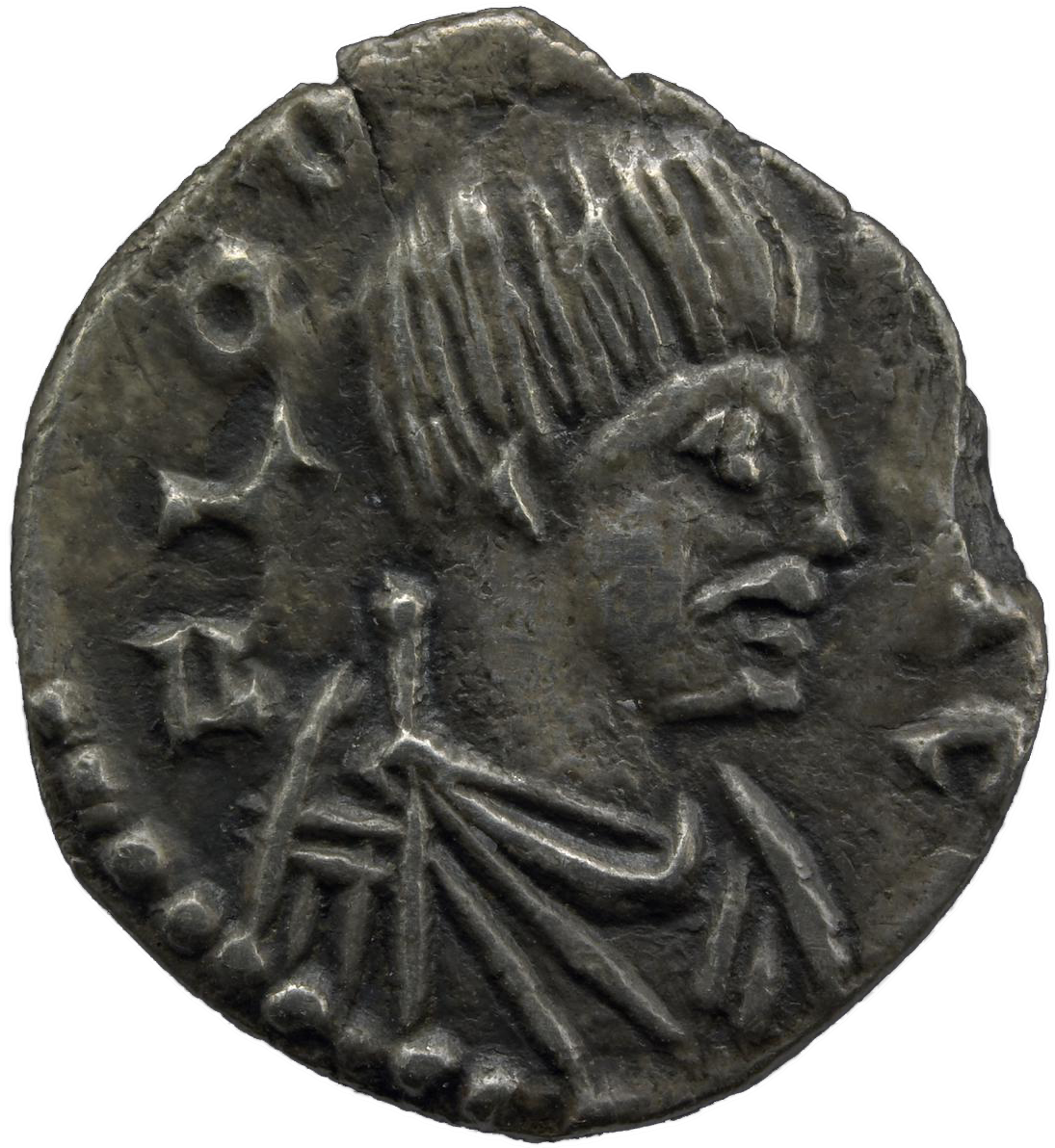
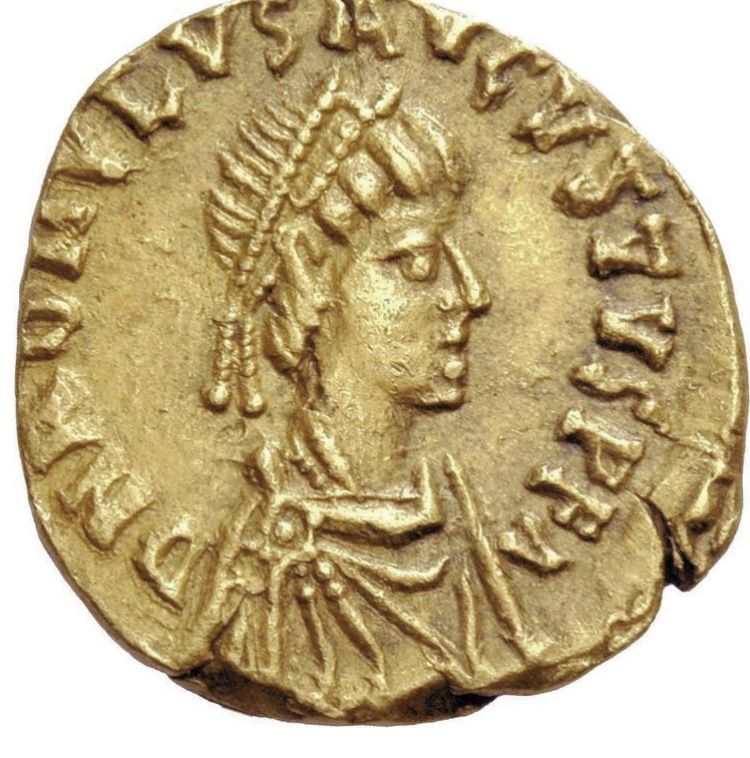
which we can certainly imagine Tolkien the medievalist would have known about—especially as he says—and shows–a distinct taste for other early Germanic names in the Bolger family:  Adalbert, Adalgar, Alfrida, Filibert, Gerda, Gundabald, Gundabad, Gundahar, Heribald, Herugar, Odovacar, Rudibert, Rudigar, Rudolph, Theobald, Wilibald, Wilimar.  He’s also slipped in a famous name:  Odovacar—aka Odovacer or Odoacer, the late 5th-century AD Gothic

(There’s argument about his origins—see: https://en.wikipedia.org/wiki/Odoacer ), ruler of northern Italy under the eastern Romans.  He deposed Romulus, the last western emperor, in 476, replacing him with—himself,

but, who was, in turn, replaced by Theodoric—reportedly by being cut nearly in two by Theodoric himself (this detail being from the early 7th-century Byzantine historian, John of Antioch—you can read a translation of his depiction of the murder here:   https://eprints.whiterose.ac.uk/id/eprint/195321/1/10.1515_ang-2022-0056.pdf on pages 382-383.)

(I’ve always valued this coin as a perfect example of the shift of power from Roman to Germanic rulers in the West.  On the surface, it looks late Roman:

1. its inscription is in Latin:  “Rex Theodoricus Pius Princ[eps] I[nvictus] S[emper]”—“King Theodoric Righteous Head of State Always Unbeaten”

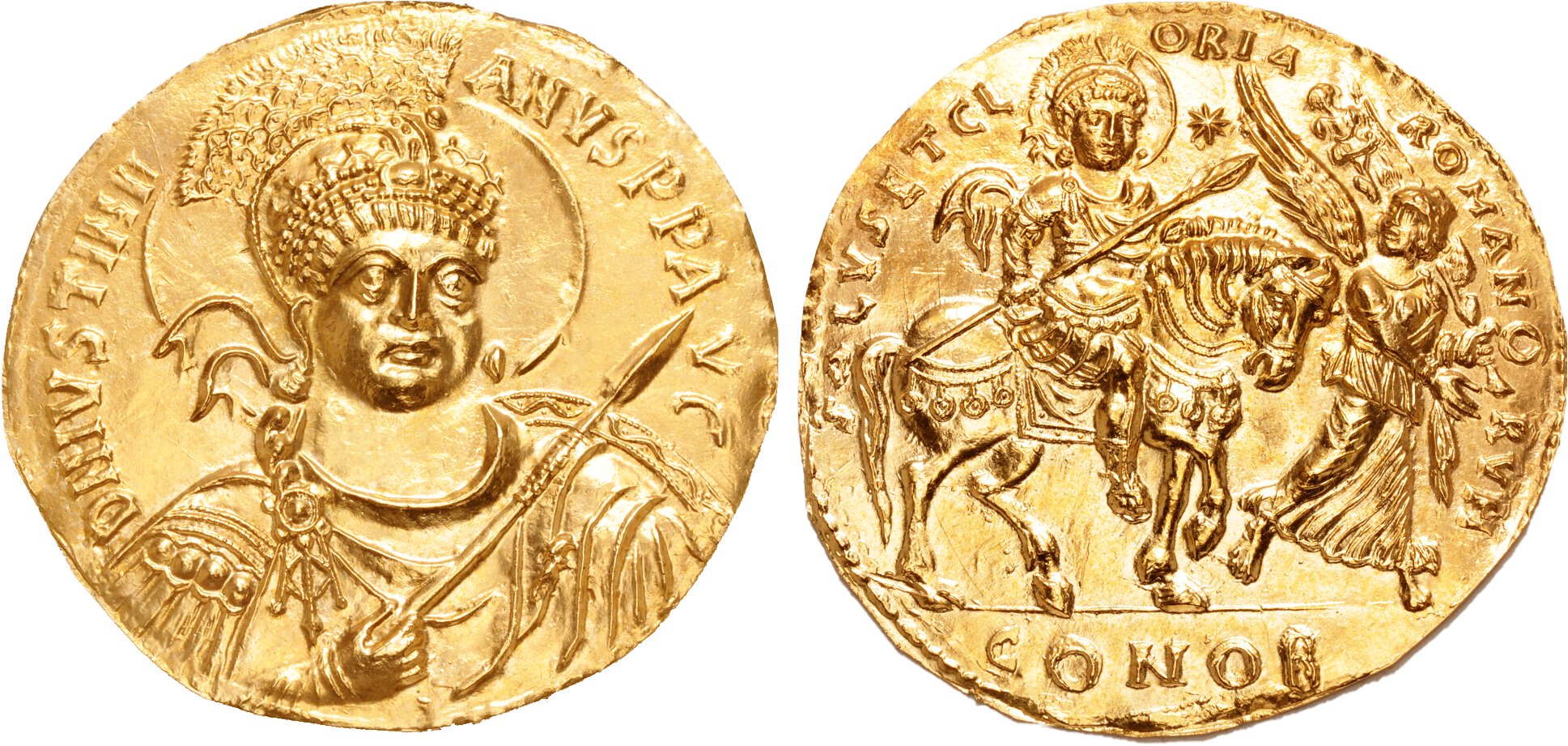
2. he’s dressed for the part—with late Roman armor and a military cloak over his left shoulder and pinned on the right—like the Eastern emperor, Justinian, on this medallion

3. he has, perched (probably on a scepter) on his left hand like a pet bird, a figure of Nike, the ancient goddess of victory—and you can see her dancing in front of Justinian

4. but then there are those touches of something else—

  a. the word “rex” was not a word a Roman ruler would ever use of himself, from the overthrow of the last of the Etruscan kings in 509BC being a term synonymous with “bloody tyrant”—which is why the later rulers of Rome from Augustus’ successor, Tiberius on, used “imperator”—“holder of state authority” instead

  b. Theodoricus looks like a good Greco-Roman name, combining “theos”, “god (Zeus originally)” with the root “dor-“ “gift”, so “Giftofgod”, but there is another possibility:  this could also be a Gothic compound—“theuda”—“of the people”—and “reiks”—“ruler”—another way of saying “king”

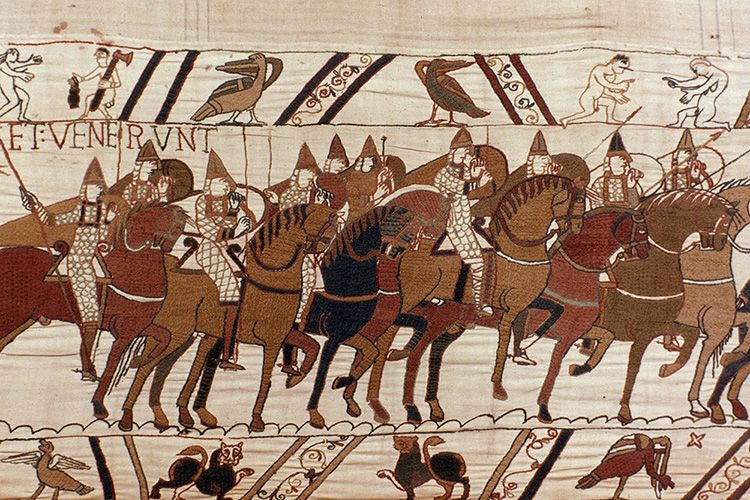
  c. and notice Theodoric’s upper lip—a droopy Germanic mustache like this one worn by the later Harold, last Anglo-Saxon king of England–

to our right is William, Duke of Normandy, distinguished by not wearing a Germanic mustache.  You’ll also notice that Odoacer also displays such a characteristic piece of lip-decoration.)

There is another Freddie associated with Fredegar’s work.  This is Fredegunda (often referred to in modern texts as “Fredegund”),

(A very worn portrait on her tomb in the Basilica of St Denis, Paris)

wife of Chilperic I, king of that part of the Frankish world called Neustria,

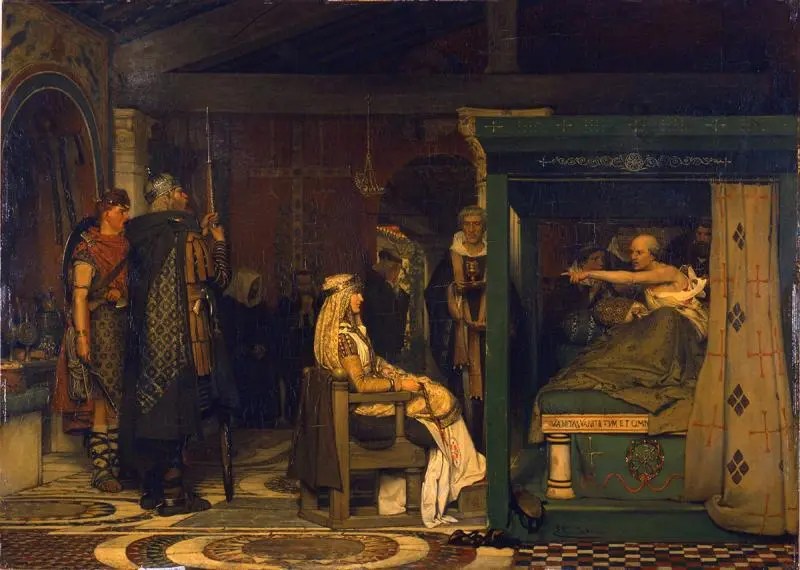
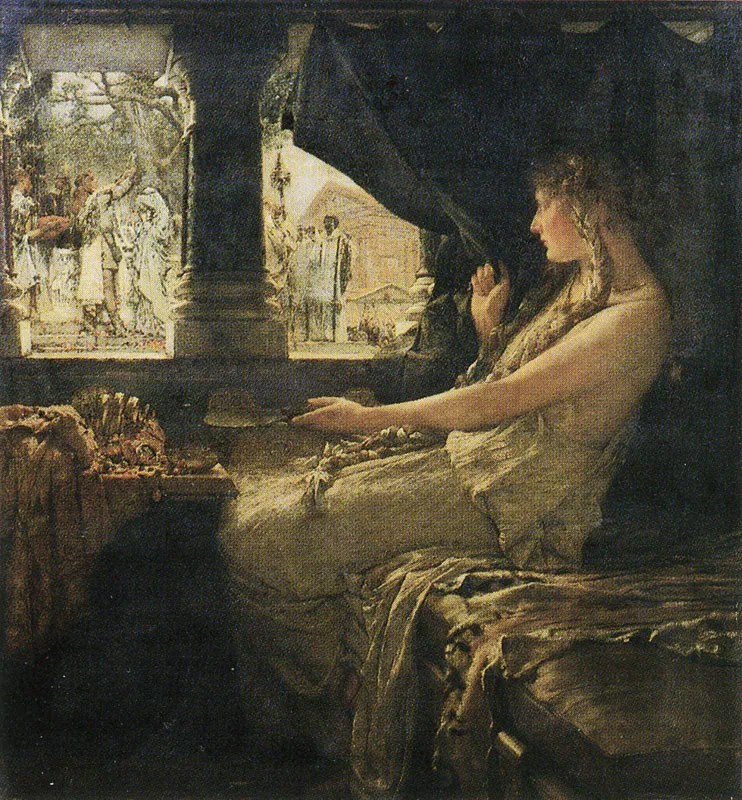
in the later 6th century AD.  Unlike Fredegar Bolger, seemingly a peaceful person, Fredegunda was credited with about a dozen assassinations (including that of Bishop Praetextatus, stabbed while, of all times, celebrating Easter mass in his cathedral at Rouen in 586AD.)

(A wonderfully sinister scene by the Victorian historical painter, Lawrence Alma-Tadema, 1836-1912.  It’s based upon one of Fredegar’s sources, the Historia Francorum, “The History of the Franks”, by Gregory of Tours, 538-594.  In this telling, Fredegunda comes to Praetextatus’ deathbed and offers him medical help, while calmly listening to him curse his murderer.)

She seems to have been quite a monster, even attempting to murder her own daughter, Rigunth[a] in a fit of jealousy by trying to break her neck while she was reaching into a treasure chest—

For more on her, see:  https://en.wikipedia.org/wiki/Fredegund  The queen’s assassination and visit to the dying bishop is in Gregory, Book VIII, Chapter 31, which, if you’re a Latin reader, you can find here:  https://www.thelatinlibrary.com/gregorytours/gregorytours8.shtml

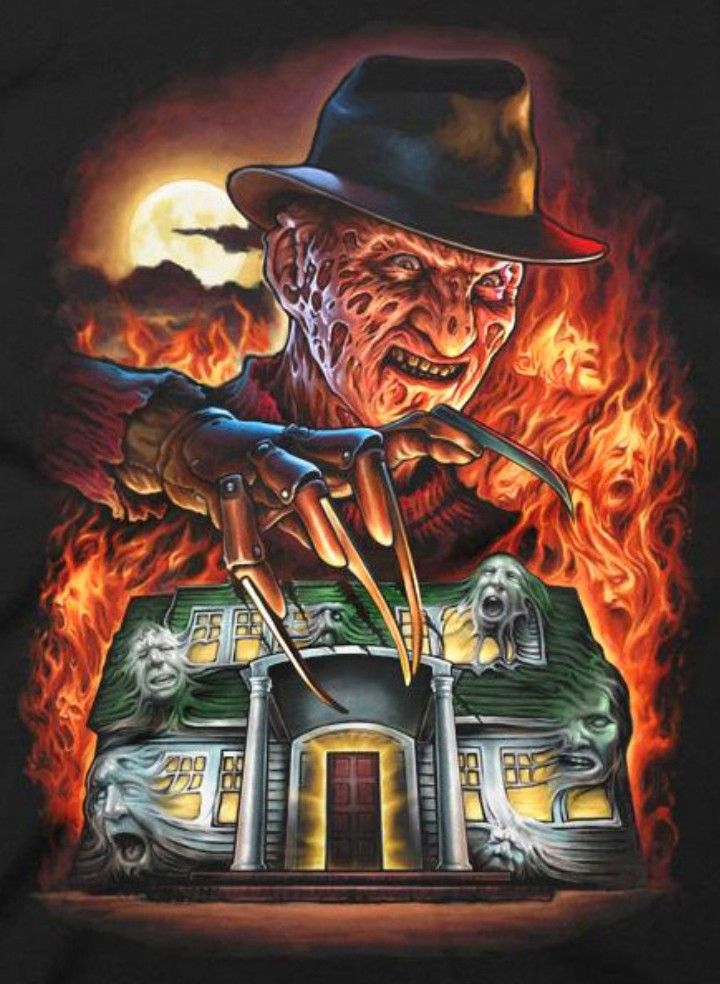
But her impressive violence reminded me of another Freddie—or Freddy–

from not just one film, but from a series,

and I wonder if the queen, who also seems to have been a bit of a seductress, might have found that Mr. Krueger, though not in her social circle, was a tempting conquest—or, better, collaborator—although, if I were he, I would always be a little anxious when the queen played with knives.

(another Alma-Tadema—here we see Fredegunda, who has just been dumped by Chilperic for a Visigothic princess, Galswintha, watching their wedding—and thinking…)

As ever, thanks for reading.

Stay well,

That old furnace in the basement is just that:  an old furnace,

And remember that, as always, there’s

MTCIDC

O

PS

A funny little detail, but which might have been a private joke for JRRT:  in the Bolger family tree, in Appendix C of The Lord of the Rings, we note that Willibald Bolger married Prisca Baggins.  Prisca was JRRT’s pet name for his daughter, Priscilla—

Babeling

04 Wednesday Jun 2025

Posted by Ollamh in Uncategorized

≈ Leave a comment

Tags

allergory, Common Speech, languages of Middle-earth, Monsters and the Critics, Tolkien, Tower of Babel

Dear readers, welcome, as always.
For someone who claimed that he disliked allegory (see, for example, his letter to Milton Waldman, late 1951, Letters, 204), it might seem odd that Tolkien devised one, which we can read near the beginning of “Beowulf:  the Monsters and the Critics”:

“A man inherited a field in which was an accumulation of old stone, part of an older hall.  Of the old stone some had already been used in building the house in which he actually lived, not far from the old house of his fathers.  Of the rest he took some and built a tower.  But his friends coming perceived at once (without troubling to climb the steps) that these stones had formerly belonged to a more ancient building.   So they pushed the tower over, with no little labour, in order to look for hidden carvings and inscriptions, or to discover when the man’s distant forefathers had obtained their building material.” (7-8)

Tolkien goes on to explain his allegory as being about Beowulf and its critics over the years, including more recent ones—

“To reach these we must pass in rapid flight over the heads of many decades of critics.”

It’s the beginning of the next sentence which then interests me:  “As we do so a conflicting babel mounts up to us…” (8)

From that word “babel”, we can see where Tolkien probably acquired his central image–

(from the early 15th-century Bedford Hours—for more see:  https://en.wikipedia.org/wiki/Bedford_Hours )

and its basis–

“1 Erat autem terra labii unius, et sermonum eorumdem.2 Cumque proficiscerentur de oriente, invenerunt campum in terra Senaar, et habitaverunt in eo.3 Dixitque alter ad proximum suum: Venite, faciamus lateres, et coquamus eos igni. Habueruntque lateres pro saxis, et bitumen pro cæmento:4 et dixerunt: Venite, faciamus nobis civitatem et turrim, cujus culmen pertingat ad cælum: et celebremus nomen nostrum antequam dividamur in universas terras.5 Descendit autem Dominus ut videret civitatem et turrim, quam ædificabant filii Adam,6 et dixit: Ecce, unus est populus, et unum labium omnibus: cœperuntque hoc facere, nec desistent a cogitationibus suis, donec eas opere compleant.7 Venite igitur, descendamus, et confundamus ibi linguam eorum, ut non audiat unusquisque vocem proximi sui.8 Atque ita divisit eos Dominus ex illo loco in universas terras, et cessaverunt ædificare civitatem.9 Et idcirco vocatum est nomen ejus Babel, quia ibi confusum est labium universæ terræ: et inde dispersit eos Dominus super faciem cunctarum regionum.”

“The earth was of one language, however, and of the same speech.  And when they were setting forth from the east, they found a plain in the land of Senaar and they settled in that [place].  And one said to his neighbor, ‘Come, let us make bricks and bake them with fire.’  And they had bricks in place of stones and pitch in place of cement.  And they said, ‘Come, let us make a city and tower for ourselves, whose top may reach the sky; and let us glorify our name before we may be split up into all the lands.’  The Lord came down, however, so that he might see the city and the tower which the sons of Adam were building and said:  “Look—there is one people and language for all.  They have begun to do this nor will they desist from their plans until they may fill them with [their] labor.  Come, therefore.  Let us go down and confuse their speech there so that each one may not hear [i.e. understand] the tongue of his neighbor.’  And so the Lord split them up from that place into many lands and they stopped building the city.  And on account of that the name of this [place] has been called “Babel” since there the speech of the whole land has been confused and thence the Lord scattered them over the surface of all the regions.” (Genesis 11.1-9, my translation—the meaning of “Babel” and its origin have been the subject of scholarly argument—see:    https://en.wikipedia.org/wiki/Tower_of_Babel  )

It’s interesting, however, to see that this is a tower of Babel in reverse:  instead of it being built, it is being pulled down—although, as in the case of the Biblical tower, events around the tower produce confusion:  in the case of Babel, linguistic; in the case of Tolkien’s tower, critical, with so many differing opinions about approaches to Beowulf.

In our world, Tolkien had early been concerned with the fact that the earth was full of languages, Biblically created or not, for which he believed that a common language, a lingua franca, might be a cure, a cure he believed might lie in Esperanto:

“Personally I am a believer in an ‘artificial’ language, at any rate for Europe—a believer, that is, in its desirability, as the one thing antecedently necessary for uniting Europe, before it is swallowed by non-Europe; as well as for many other good reasons—a believer in its possibility because the history of the world seems to exhibit, as far as I know it, both an increase in human control of (or influence upon) the uncontrollable, and a progressive widening of the range of more or less uniform languages.  Also I particularly like Esperanto…” (“A Secret Vice”, in Tolkien, The Monsters and the Critics, 198.  For more on Esperanto, see:  https://en.wikipedia.org/wiki/Esperanto and https://ia800205.us.archive.org/13/items/esperantotheuniv00ocon/esperantotheuniv00ocon.pdf          and for more on Tolkien and the subject, see:  Arden R. Smith, “Tolkien and Esperanto”, Journal of the Marion E. Wade Center, Vol.17 (2000), 27-46) 

For Europe perhaps one language, then, but, for Middle-earth?

If we only think of those spoken or mentioned in The Lord of the Rings, we find numerous languages—not surprising for someone who more than once had said that he created people so that there would be someone to speak his languages (see, for example, his letter to Houghton Mifflin, 30 June, 1955, Letters, 319—note:  this is only a rough list for a much more complicated subject—for more, see, for example, The Lord of the Rings, Appendix F, I, “The Languages and Peoples of the Third Age”).  Here is a basic roster:

1. the Elves (Quenya and Sindarin—for more, see:  https://en.wikipedia.org/wiki/Elvish_languages_of_Middle-earth )

2. the Dwarves (Khuzdul)—for a very good, linguistically-based essay on this, see:  https://en.wikipedia.org/wiki/Khuzdul

3. the Rohirrim (Rohirric—or Rohanese—or simply Rohan—see this essay for more on the various possible names for the language:  https://tolkiengateway.net/wiki/Rohanese )  The Hobbits appear to have spoken at some point in their history a related language—see Appendix F “Of Hobbits” for more.

4. the Dunlendings and the Wild Men of Druadan Forest (?  descended from very early humans in Middle-earth—in Appendix F, Tolkien describes their language:  “Wholly alien was the speech of the Wild Men of Druadan Forest.  Alien, too, or remotely akin, was the language of the Dunlendings.”)

5. the Ents (seemingly invented their own language, described in Appendix F as “…unlike all others:  slow, sonorous, agglomerated, repetitive, indeed long-winded…”)

6. men (here meaning descendants of the Numeroreans—Westron—complicated—see Appendix F “Of Men” for some of that complication)

7. Orcs (“it is said that they had no language of their own, but took what they could of other tongues and perverted it to their own liking”—to which would be added the “Black Speech”, invented by Sauron as—yes, a lingua orca, or common speech—see Appendix F, “Of Other Races”, “Orcs and the Black Speech”)

8. to which we might add the languages of the Easterlings and the Haradrim

And here we’re back to Babel again.

(Gustave Dore, from his very dramatic illustrations for La Bible)

People in Middle-earth can revert to their own languages—

“…Following the winding way up the green shoulders of the hills, they came at last to the wide wind-swept walls and the gates of Edoras.

There sat many men in bright mail, who sprang at once to their feet and barred the way with spears.  ‘Stay, strangers here unknown!’ they cried in the tongue of the Riddermark, demanding the names and errand of the strangers.”

“ ‘Well do I understand your speech…yet few strangers do so.  Why then do you not speak in the Common Tongue, as is the custom in the West, if you wish to be answered?’ “  (The Two Towers, Book Three, Chapter 6, “The King of the Golden Hall”)

Here Gandalf reveals, that, just as there was Tolkien’s Esperanto in our world, in Middle-earth there was clearly an equivalent:  “the Common Tongue”.  Descended from the language of the Numenorean invaders of Middle-earth (letter to Naomi Mitchison, 25 April, 1954, Letters, 264), this was just what its name says:  it was the common speech of a majority of the people in western Middle-earth—along with the exceptions listed above.  To JRRT, it was also the equivalent of the English into which the text had been “translated”.  In that same letter to Naomi Mitchison, Tolkien wrote:

“If it will interest you, I will send you a copy (rather rough) of the matter dealing with Languages (and Writing), Peoples and Translation.

The latter has given me much thought.  It seems seldom regarded by other creators of imaginary worlds, however gifted as narrators (such as Eddison).  But then I am a philologist, and much though I should like to be more precise on other cultural aspects and features, that is not within my competence.  Anyway ‘language’ is the most important, for the story has to be told, and the dialogue conducted in a language; but English cannot have been the language of any people at that time.  What I have, in fact, done, is to equate the Westron or wide-spread Common Speech of the Third Age with English; and translate everything, including names such as The Shire, that was in Westron into English terms…” (263-264)

In other words, what Tolkien has done is exactly the opposite of what the Lord was said to have done.  The account in Genesis tells us that, by “confundens ibi linguam eorum”—“confusing there their language”, the Lord intentionally had caused chaos, breaking up the single people into many groups, each speaking its own language and therefore unable to collaborate in continuing their daring construction.  JRRT, by writing—he would say “translating”—his work almost entirely in English (Tolkien had added in the letter to Mitchison “Languages quite alien to the C[ommon] S[peech] have been left alone), has produced a work in which he has brought together the speakers of a number of different languages, combining them into one, in order to produce what—pardon the pun—is a towering achievement.

(This image has produced a fair amount of confusion, it seems, on the internet—in some sources it’s labeled as by Rudolf von Ems, but sometimes another image of the building of the tower is substituted.  For the moment, I’ll go with Rudy c.1370—but check out this site for more Babel-building:  https://www.babelstone.co.uk/Blog/2007/01/72-views-of-tower-of-babel.html labeled as 72 views of the tower )

Thanks, as always, for reading.

Stay well,

Consider how dull the world would be with only one language, instead of the more than 7000 currently spoken (see:  https://www.worldatlas.com/society/how-many-languages-are-there-in-the-world.html ),

And remember, in any language you like—including Entish—that there’s

MTCIDC

O

PS

For more on the languages of Tolkien, there are a number of useful sites such as:  https://ardalambion.net/ .

Why a Dragon?

28 Wednesday May 2025

Posted by Ollamh in Uncategorized

≈ Leave a comment

Tags

Beowulf, Bilbo, bilbo-burglar, Dragons, Dwarves, Fafnir, Fantasy, Hippogriff, Hoard, Marx Brothers, quest, Sigurd, Smaug, The Hobbit, The Reluctant Dragon, Thorin, Tolkien

As always, dear readers, welcome.

I think that I’ve always been a fan of the Marx brothers.

Their lack of respect for pompous men in silk hats,

opera-goers who are only interested because it gives them social status,

and self-important artists,

among many others, and their creative methods of deflating such people,

have always cheered me immensely.

There is another side to their comedy, however, which means just as much to me:  their endless play with words, delivered always deadpan and with perfect timing—not to mention absolute absurdist nonsequiturism.

Take, for example, this fragment from The Cocoanuts, their first surviving film, from 1929.  It’s set during the 1920s Florida land boom (read about that here:  https://en.wikipedia.org/wiki/Florida_land_boom_of_the_1920s ) and, in this scene, “Mr. Hammer”, Groucho, is explaining the layout of a real estate plot to “Chico”, Chico,

saying, at one point:

“Groucho:   Now, here is a little peninsula, and, eh, here is a viaduct leading over to the mainland.

Chico:  Why a duck?

Groucho:  I’m all right, how are you?  I say, here is a little peninsula, and here is a viaduct leading over to the mainland.

Chico:   All right, why a duck?

Groucho:  I’m not playing ‘Ask Me Another’, I say that’s a viaduct.

[Ask Me Another was originally an early 1927 equivalent of “Trivia”.  You can read about it here:  https://www.thefedoralounge.com/threads/how-do-you-play-ask-me-another.62135/ and here’s a copy—

Chico:  All right!  It’s what…why a duck?  Why no a chicken?

Groucho:  I don’t know why no a chicken—I’m a stranger here myself.  All I know is that it’s a viaduct.  You try to cross over there a chicken and you’ll find out why a duck.”

(For the entire script see:  https://www.marx-brothers.org/marxology/cocoanuts-script.htm )

By the same kind of logic which produced this, I found myself thinking about The Hobbit:  and hence the title of this posting:  why a dragon?

The plot of The Hobbit is, basically, a quest:  a journey with a goal.

Quests are a familiar form of adventure story and still common—just think about Indiana Jones, with his Lost Ark

and his Holy Grail, for example.

Indiana has to travel to Tibet and Egypt and to an unnamed island in the Mediterranean for the Ark and to Germany and Turkey for the Grail.

Although Thorin doesn’t mention the travel in his “mission statement”, much of the story will be about travel, from the Shire to the Lonely Mountain and back again,

to reach the dwarves’ goal, as stated in the first chapter by Thorin:

“But we have never forgotten our stolen treasure.  And even now, when I will allow we have a good bit laid by and are not so badly off…we still mean to get it back, and to bring our curses home to Smaug—if we can.”  (The Hobbit, Chapter 1, “An Unexpected Party”)

The goal, then, is in two parts:

1. to regain the treasure taken from the dwarves by the dragon

2. to take revenge upon said dragon

Because they are aware that the dragon can be lying on top of the treasure (“Probably”, says Thorin, “for that is the dragons’ way, he has piled it all up in a great heap far inside, and sleeps on it for a bed.”), it’s clear that 1 and 2 have to be dealt with as a sequence:  no getting the treasure without getting rid of the dragon.

Which brings us back to my title.  Indiana Jones commonly has Nazis (and eventually Communists and even Neo-Nazis) as opponents,

these being the characters who compete for his goal and stand in the way of his achieving his quest. 

Tolkien was a medievalist, writing a sort of fairy tale, so what would be his equivalent and why?

 We know that Tolkien had been interested in dragons since far childhood—at least the age of 6, when he tried to write a poem about a “green, great dragon” (to the Houghton Mifflin Company [summer, 1955?], Letters, 321—JRRT tells a somewhat different version of this to W.H. Auden in a letter of 7 June, 1955, Letters, 313) and he confesses to an early love for them in his lecture “On Fairy-Stories” where he mentions Fafnir and Sigurd, suggesting that he may have had read to him or had read for himself from Andrew Lang’s The Red Fairy Book, 1890, the last chapter of which is “The Story of Sigurd”, and since, elsewhere, he mentions “Soria Moria Castle”, which is the third story in the same book.

(Your copy is here:  https://archive.org/details/redfairybook00langiala/redfairybook00langiala/ )

Fafnir, the dragon in the Sigurd story, is described as, having killed his own father:

“he went and wallowed on the gold…and no man dared go near it.”  (“The Story of Sigurd”, 360)

The next major dragon story with which Tolkien was probably involved saw the same draconic behavior, as, in Beowulf, we’re told that the unnamed dragon, having discovered a hoard in a tumulus:

“This hoarded loveliness did the old despoiler wandering

in the gloom find standing unprotected, even he who filled

with fire seeks out mounds (of burial), the naked dragon of

1915

fell heart that flies wrapped about in flame: him do earth’s

dwellers greatly dread. Treasure in the ground it is ever his

wont to seize, and there wise with many years he guards the

heathen gold – no whit doth it profit him.”

(from JRRT’s draft translation of 1920-26 in Christopher Tolkien’s 2014 publication)

Traditionally, then, dragons and gold go together—and, as JRRT admitted in a letter to the Editor of the Observer, “Beowulf is among my most valued sources” (letter to the Editor of the Observer, printed in the Observer, 28 February, 1938, Letters, 41)

There is a very interesting twist in Tolkien’s version of the story, however.

By lying in a pit below the dragon, Sigurd slays Fafnir

and Beowulf, along with his companion (and successor), Wiglaf, make an end of the nameless dragon,

Beowulf fighting against a dragon. Scene from the early medieval epic poem “Beowulf”. It is one of the most important works of Old English literature and was probably created after the year 700 and plays in the time before 600 AD in Scandinavia. Chromolithograph after drawing by Walter Zweigle (German painter, 1859 – 1904), published in 1896.

(This is a pretty silly version, with costumes and armor which look like they came from the original production of Der Ring des Nibelungen, but finding a depiction of the two attacking the dragon has seemed surprisingly difficult.)

but, in The Hobbit, although we have the traditional dragon on the traditional hoard, we don’t have the traditional dragon-slayer, a fact underlined by Thorin’s “to bring our curses home to Smaug, if we can”.

This has always struck me as the potential weak point in the quest:  to travel hundreds of miles through dangerous territory filled with trolls, goblins, wolves, hostile elves, and even giant spiders, to come to a mountain inhabited by a fearsome dragon—but to have no plan in mind as to how to deal with it, especially when the other half of the plan—to get back the dwarvish treasure—requires somehow eliminating the current guardian of that treasure.

(JRRT)

Faced with that possible weak point, so much now may appear to have a certain haphazard happenstance about it, the kind of attempted slight-of-hand which indicates an author who hasn’t the skill to create a narrative in which every element seems to fall naturally into place, and this might make us question the finding of the Ring, the convenient rescue at Lake-town, even the ray of sun which indicates the opening to the back door of the Lonely Mountain (suppose it had been overcast).

But this is where the burglar comes in—and the story of Sigurd once more.

It seems that Bilbo was not Gandalf’s first choice for the quest when he came to visit him.

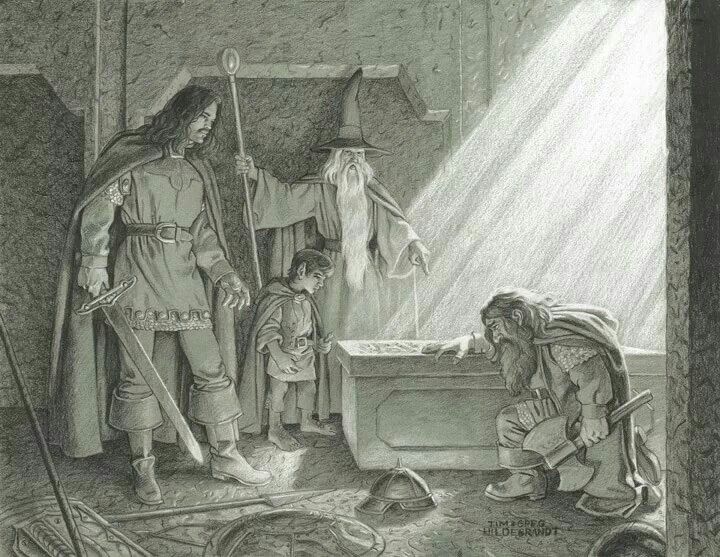
(the Hildebrandts)

Thorin has just mentioned the inconvenient dragon and the awkwardness of his sudden appearance, to which Gandalf replies:

“That would be no good…not without a mighty Warrior, even a Hero.  I tried to find one; but warriors are busy fighting one another in distant lands, and in this neighbourhood heroes are scarce, or simply not to be found.”

And he continues:

“That is why I settled on burglary—especially when I remembered the existence of a Side-door.  And here is our little Bilbo Baggins, the burglar, the chosen and selected burglar.”

Bilbo’s first attempt at burglary:  picking a troll’s pocket,

(JRRT)

almost ends in disaster, but, with the eventual aid of the Ring, he even manages, first, to steal from Smaug, in a direct echo of Beowulf,

(artist?  So far, I haven’t seen one credited.)

and then to confront Smaug in his lair and escape, at worst, with only a singeing. 

(JRRT)

So far, it’s been burglary, with some help from the Ring, but then the Sigurd story comes in.

You’ll remember that, although the version in The Red Fairy Book doesn’t say so, it was clear that the vulnerable part of the dragon Fafnir was its underside, which is why Sigurd hid in a pit so that, when the dragon crawled over it, Sigurd could stab him in that unprotected underbelly. 

Using his burglarious skills, as well as a fluent tongue, Bilbo actually persuades Smaug unknowingly to expose his own vulnerability:

“ ‘I have always understood…that dragons were softer underneath, especially in the region of the—er—chest; but doubtless one so fortified has thought of that.’

The dragon stopped short in his boasting.  ‘Your information is antiquated,’ he snapped.  ‘I am armoured above and below with iron scales and hard gems.  No blade can pierce me.’”

And the smooth-tongued burglar actually flatters Smaug into rolling over, exposing “…a large patch in the hollow of his left breast as bare as a snail out of its shell”.

What to do with this potentially deadly piece of information requires the reverse of the Sigurd story.

In that story, Sigurd, having killed Fafnir, has been asked by his mentor, Regin, to roast the dragon’s heart and serve it to him.  In the process, Sigurd burns a finger, puts it in his mouth, and suddenly understands that all of the birds above him are talking about him and telling him to beware of Regin.

In The Hobbit, the opposite happens:  the thrush who had tapped the snail

(Alan Lee)

and therefore set off the chain of events which revealed the back door to the Lonely Mountain to Bilbo and the dwarves, overhears Bilbo telling the dwarves about Smaug’s vulnerable spot, which he then conveys to Bard the Archer, who is then the dragon-slayer

(Michael Hague—one of my favorite Hobbit illustrators)

needed to dispose of the one-time guardian of the hoard.

And so the dragon is disposed of—but he has one more use in the story:  as a negative model. 

Although Thorin has led the quest to retrieve the dwarves’ treasure, it seems that there’s only one which he craves, the Arkenstone,

(Donato Giancola)

and it’s clear that, in its pursuit, he becomes much like the Smaug who once reacted almost hysterically when he sensed that something was missing from his hoard:

“Thieves!  Fire!  Murder!…His rage passes description—the sort of rage that is only seen when rich folk that have more than they can enjoy suddenly lose something that they have long had but have never before used or wanted.”  (The Hobbit, Chapter 12, “Inside Information”)

Here’s his dwarvish parallel:

“ ‘For the Arkenstone of my father,’ he said, ‘is worth more than a river of gold in itself, and to me it is beyond price.  That stone of all the treasure I name unto myself, and I will be avenged on anyone who finds it and withholds it.”  (The Hobbit, Chapter 16, “A Thief in the Night”)

And, when he finds that Bilbo has taken it as a way to make peace between the dwarves, the elves, and the Lake-town men, Thorin almost does take revenge:

“ ‘You! You!’ cried Thorin, turning upon him and grasping him with both hands.  ‘You miserable hobbit!  You undersized—burglar!…By the beard of Durin!  I wish I had Gandalf here!  Curse him for his choice of you!  May his beard wither!  As for you I will throw you to the rocks!’ he cried and lifted Bilbo in his arms.”  (The Hobbit, Chapter 17, “The Clouds Burst”)

So why a dragon?

First, to Tolkien the medievalist, gold and dragons go together:  a quest for treasure needs a particularly powerful enemy and the dragon of Beowulf, who actually fatally wounds Beowulf,

who had previously defeated two terrible opponents in Grendel and his mother, provides a strong model.

Second, JRRT had, from childhood, a long-standing interest in dragons—he’ll return to them in his 1938/49 novella, “Farmer Giles of Ham”, where the practical farmer eventually not only tames the dragon, Chrysophylax (“Goldwatchman”, perhaps), but makes him disgorge much of his treasure—this time by doing nothing more than outfacing him and threatening him with his sword, “Tailbiter”.

It’s interesting, by the way, that, although, in “The Story of Sigurd”, the dragon talks, he has only one short speech:  a curse on anyone who touches his gold, whereas, in perhaps the greatest draconic influence upon Tolkien, Beowulf, another wyrm who enjoys lying on a hoard, is mute.

Smaug, in The Hobbit, however, is not only positively talky, but, like Saruman in The Lord of the Rings, his voice and manner have their own dangerously persuasive power, at one point in his conversation with Bilbo even beginning to seed Bilbo’s mind with doubts about the dwarves Bilbo accompanies (The Hobbit, Chapter 12, “Inside Information”).

Chrysophylax, in “Farmer Giles of Ham” is even more talkative than Smaug, and I wonder about the model for these chatty beasts.  Tolkien was a great fan of Kenneth Grahame (1859-1932) and of his well-known children’s book, The Wind in the Willows (1908),

mentioning in a letter to Christopher Tolkien that Elspeth Grahame, Grahame’s widow, is publishing a book with other stories about the main characters of The Wind in the Willows, a book which JRRT is very eager to obtain (letter to Christopher Tolkien, 31 July, 1944, Letters, 128).  In 1898, Grahame published a collection of stories, Dream Days,

which included “The Reluctant Dragon”, in which we see another very loquacious beast,

(from the original book, illustrated by Maxfield Parrish)

(I couldn’t resist including E.H. Shepard’s 1938 version)

but rather more like the ultimately rather timid dragon of “Farmer Giles” than the grim and mute creature of Beowulf or the more-than-a-little-pleased-with-himself Smaug, but, in his garrulousness, could he have been a model for Smaug?  (You can make your own comparison with:  https://www.gutenberg.org/files/35187/35187-h/35187-h.htm )

To this we add perhaps not a model, but a parallel:  Thorin as becoming a kind of dwarvish dragon in his obsession with the Arkenstone.  Fafnir dies with a curse, however, the Beowulf beast dies killing Beowulf, and Smaug dies destroying Lake-town,

but, in his own last moments, Thorin escapes such a poisonous model, saying to Bilbo:

“Farewell, good thief…I go now to the halls of waiting to sit beside my fathers, until the world is renewed.  Since I leave now all gold and silver, and go where it is of little worth, I wish to part in friendship from you, and I would take back my words and deeds at the Gate.” (The Hobbit, Chapter 18, “The Return Journey”)

(Darrell Sweet—you can read a little about him here:  https://en.wikipedia.org/wiki/Darrell_K._Sweet )

And so “Why a dragon?”—and not “Why No a Hippogriff?”

(artist? so far, I haven’t found one–a pity, too, as it’s quite a splendid illustration and I’ll love to mention the author!)

Thanks, as ever, for reading.

Stay well,

Remember not to laugh at live dragons,

And remember, as well, that there’s

MTCIDC

O

By Ear (3)

21 Wednesday May 2025

Posted by Ollamh in Uncategorized

≈ Leave a comment

Tags

Brutus, cassius, ears, Fantasy, Gandalf, Hamlet, henbane, Julius Caesar, lotr, Marcus Antonius, Orthanc, Palantir, poison, Saruman, Sauron, Shakespeare, Tolkien

Welcome, dear readers, as always.

In the closing of the second part of this little series, I quoted Marcus Antonius in his funeral oration upon Julius Caesar in Shakespeare’s play of the same name.

It is a masterpiece, both in its design and in its deception:  saying one thing for the assassins, led by Brutus, to hear, and, on the other, poisoning the common people against the assassins, originally seen as liberators of the Republic.  You probably remember its opening:

“Friends, Romans, Countrymen, lend me your ears:

I come to bury Caesar, not to praise him:

The euill that men do, liues after them,

The good is oft enterred with their bones,

So let it be with Caesar. The Noble Brutus,

Hath told you Caesar was Ambitious:

If it were so, it was a greeuous Fault,

And greeuously hath Caesar answer’d it.

Heere, vnder leaue of Brutus, and the rest

(For Brutus is an Honourable man,

So are they all; all Honourable men)

Come I to speake in Caesars Funerall.”

(Julius Caesar, Act III, Scene 2, from the First Folio, 1623, in the original spelling.  You can see it at my favorite site for the plays:  https://internetshakespeare.uvic.ca/doc/JC_F1/scene/3.2/index.html )

Speech with a deceptive goal is a theme of this series, as, in the first part, were poison–and ears.

In the scene in Shakespeare’s play, Marcus Antonius plays a dangerous game.  In order to be able to speak, he has made a deal with the assassins of Caesar not to say anything inflammatory against them, and so we see those words “Honourable men” repeated, as if Antonius is going to praise them—while only burying Caesar, as he says—just the sort of thing which we can imagine the assassins wanted to hear.  And yet, as he continues, “Honourable men” gradually becomes ironic and, by the end of his speech, he controls the mob and it’s clear that the assassins are no longer considered liberators, but murderers, Antonius having successfully poisoned those lent ears against the very men who foolishly gave him leave to speak.

We began the series with poison—and Shakespeare:  literal poison (possibly henbane)

which, as Hamlet’s ghostly father tells Hamlet, had been administered to him through his ear by his own brother, Claudius, while he was napping in his garden

But, as we progressed, we moved from that chemical murder to a different kind of destruction, spiritual, in the case of Saruman in the second installment, and now, in the third and final installment, we move to the instrument of that poisoning, include a second poisoning victim, and find the mind behind it all and that mind’s method of persuasion, which, I would suggest, must be very like Antonius’ initial remarks, seeming to praise the assassins, but, just like his, with another motive underneath.

(JRRT)

When Saruman, failing to succeed with Theoden, has turned to Gandalf, Gandalf has alluded to his previous visit with Saruman, saying:

“What have you to say that you did not say at our last meeting?…Or, perhaps, you have things to unsay?”  (The Two Towers, Book Three, Chapter 10, “The Voice of Saruman”)

That last meeting had ended with Gandalf’s imprisonment in the tower of Orthanc,

(the Hildebrandts)

but, before that, Saruman had tried to persuade Gandalf to become an ally, and not only of Saruman, but of someone else, his speech including these words:

“We can bide our time, we can keep our thoughts in our hearts, deploring evils done by the way, but approving the high and ultimate purpose:  Knowledge, Rule, Order; all the things we have so far striven in vain to accomplish…”  (The Fellowship of the Ring, Book Two, Chapter 2, “The Council of Elrond”)

Gandalf’s reply then suggests that what Saruman is saying is not really his own argument:

“ ‘I have heard speeches of this kind before, but only in the mouths of emissaries sent from Mordor to deceive the ignorant.’ “

What is it in those words which betrays their original authorship?

In the draft of a letter to Peter Hastings, Tolkien wrote:

“Sauron was of course not ‘evil’ in origin.  He was a ‘spirit’ corrupted by the Prime Dark Lord…Morgoth.  …at the beginning of the Second Age he was still beautiful to look at, or could still assume a beautiful visible shape—and was not indeed wholly evil, not unless all ‘reformers’ who want to hurry up with ‘reconstruction’ and ‘reorganization’ are wholly evil, even before pride and the lust to exert their will eat them up.”  (draft of a letter to Peter Hastings, September, 1954, Letters, 284)

What Gandalf is actually hearing then is the thinking of Sauron and his “high and ultimate purpose”, but wrapped in words which will sound familiar to Saruman and appeal to his increasing arrogance—those words “high and ultimate purpose” echo Saruman’s depiction later in the story of just who the Istari are:

“Are we not both members of a high and ancient order, most excellent in Middle-earth?”  (The Two Towers, Book Three, Chapter 10, “The Voice of Saruman”)

That “order” was not sent to Middle-earth for “Knowledge, Rule, Order”, however, as this entry in the Appendices to The Lord of the Rings tells us:

“When maybe a thousand years had passed, and the first shadow had fallen on Greenwood the Great, the Istari, or Wizards appeared in Middle-earth.  It was afterwards said that they came out of the Far West and were messengers sent to contest the power of Sauron, and to unite all those who had the will to resist him; but they were forbidden to match his power with power, or to seek to dominate Elves or Men by force and fear.”  (The Lord of the Rings, Appendix B: “The Third Age”)

Marcus Antonius has spoken indirectly to the assassins and directly to the mob, both through their ears, but Sauron’s words have reached Saruman through this—

(the Hildebrandts)

which we know that Saruman has had as it is flung through the doorway of Orthanc by Grima and almost brains Gandalf—

“With a cry Saruman fell back and crawled away.  At that moment a heavy shining thing came hurtling down from above.  It glanced off the iron rail, even as Saruman left it, passing close to Gandalf’s head, it smote the stair on which he stood.”

I never think of a palantir without thinking of another device used for conning unsuspecting victims—

Staring into the ball might have a kind of hypnotic effect, but it clearly also has the effect of focusing the will of another upon the victim—as Pippin found out to his grief:

“In a low hesitating voice Pippin began again, and his words grew clearer and stronger.  ‘I saw a dark sky, and tall battlements…And tiny stars.  It seemed very far away and long ago, yet hard and clear…Then he came.  He did not speak so that I could hear words.  He just looked and I understood…He said:  “Who are you?’  I still did not answer, but it hurt me horribly; and he pressed me, so I said:  ‘A hobbit.’  Then suddenly he seemed to see me, and he laughed at me.  It was cruel.  It was like being stabbed with knives…Then he gloated over me.  I felt I was falling to pieces.’ “  (The Two Towers, Book Three, Chapter 11, “The Palantir”)

This isn’t Sauron’s only use of such a device for his poisoning—another palantir lies in Minas Tirith and it’s clear from its possessor, Denethor’s, speech how Sauron has reached him:

“Do I not know thee, Mithrandir?  Thy hope is to rule in my stead, to stand behind every throne, north, south, or west.  I have read thy mind and its policies…So!  With the left hand thou wouldst use me for a little while as a shield against Mordor, and with the right bring up this Ranger of the North to supplant me.”

And here we see how Sauron has distorted the original Istari goals, which Tolkien had described to Naomi Mitchison:

“They were thought to be Emissaries (in the terms of this tale from the Far West beyond the Sea), and their proper function, maintained by Gandalf and perverted by Saruman, was to encourage and bring out the native powers of the Enemies of Sauron.”  (letter to Naomi Mitchison, 25 April, 1954, Letters 269-270)

Denethor is correct in understanding that Gandalf—and supposedly all of the Istari—are meant to stand behind thrones—but to encourage their possessors to oppose Sauron, not to gain power for themselves, as Saruman deceived himself into thinking.  Denethor has not read Gandalf’s mind, but Sauron has definitely read Denethor’s—when Gandalf asks him what he wants, he replies:

“ ‘I would have things as they were in all the days of my life…and in the days of my longfathers before me:  to be the Lord of this City in peace, and leave my chair to a son after me, who would be his own master and no wizard’s pupil.”

The Stewards are not the kings of Gondor.  Although they have ruled for centuries, they are merely the lieutenants of the Numenorean kings, holding Gondor until a rightful king should appear, but it’s clear that Denethor has forgotten that, seeming to assume that he is the king—something surely in which Sauron has encouraged him .  And we see here another sore point:  Faramir.

In the midst of a complex scene in which Faramir reports that he had met Frodo, Denethor turns to him sharply:

“Your bearing is lowly in my presence, yet it is long since you turned from your own way at my counsel.  See, you have spoken skillfully, as ever; but I, have I not seen your eyes fixed on Mithrandir, seeking whether you said well or too much?  He has long had your heart in his keeping.”  (The Return of the King, Book Five, Chapter 4, “The Siege of Gondor”)

So Sauron has spotted two weak points in Denethor:  a mistaken idea about his role in the governing of Gondor and his jealous attitude towards his younger son.  This almost leads to Faramir’s death by burning and certainly does his father’s.

(Robert Chronister—about whom I have so far found nothing, although it’s clear that he’s illustrated more than one scene from The Lord of the Rings.)

Marcus Antonius, one of Julius Caesar’s right-hand men, has tricked Caesar’s assassins into letting him speak,

initially using language which they want to hear, but, just below the surface, and increasingly, as he proceeds, his word choice turns the mob listening to those same words into a force which will help to drive the assassins from Rome and, eventually, in the case of two of the main assassins, Brutus,

(This is a very famous coin pattern.  On the obverse—the “heads”—we see what we presume is an image of Brutus, with the caption “Brut[us]” and his assertion that he has the state’s authority:  “Imp[erator]”, along with the name of the mint master, “L[ucius] Plaet[orius] Cest[ianus]”.  On the reverse—the “tails”—we see a shorthand version of the claim of the assassins:  “Eid[ibus] Mar[tis]”—“on the ides of March”, plus two Roman “pugiones”—military daggers—bracketing a “liberty cap”—used in the ceremony of freeing a slave—hence:  “On the Ides of March, I/we, by the use of these daggers, freed Rome from its slavery (to Caesar)” )

and Cassius,

(Unfortunately, we have no definite image of Cassius—this is a coin minted on his authority by his deputy, Marcus Servilius.  The obverse has an image of “Libertas”, along with an abbreviated form of his name, “C[aius] Cassi[us]”, and that claim to have the authority of the state:  “Imp[erator]”.  The reverse has the name of his lieutenant, “M[arcus] Servilius”, his deputy rank “Leg[atus]” and what’s called an “aplustre”, which is the decorative stern of a Roman warship, thought to commemorate Cassius’ defeat of the navy of Rhodes.)

to defeat and suicide—Marcus Antonius’ ear-poison working very effectively.

For Middle-earth, there is a happier ending.  The real goal of sending the Istari succeeds, even with the treachery of Saruman, brought about through the poison introduced and spread by Sauron through the palantiri, which affects Denethor, as well, teaching us that toxicity is just as deadly in word as it is in deed.

Thanks, as always, for reading.

Stay well,

Lend no one your ears unless you’re clear what he/she wants,

And remember that, as ever, there’s

MTCIDC

O

By Ear (2)

14 Wednesday May 2025

Posted by Ollamh in Uncategorized

≈ Leave a comment

Tags

Fantasy, Gandalf, Hamlet, Istari, Orthanc, Palantir, poison, Saruman, Sauron, Shakespeare, Theoden, Tolkien

Welcome, dear readers, as always.

In Part 1 of this posting, I began talking about ear poisons, beginning with the actual poisoning of Hamlet’s father by Hamlet’s uncle, Claudius, who, according to Hamlet’s father’s ghost:

“Sleeping within my orchard,

My custom always of the afternoon,

Upon my secure hour, thy uncle stole

With juice of cursèd hebona in a vial,

And in the porches of my ears did pour

The lep’rous distilment…” (Hamlet, Act 1, Scene 5)

But there are poisons just as potent which come in the form of poisonous words, as we began to see in Saruman’s attempts to win over Theoden,

(Francesco Amadio)

and, failing that, with Gandalf:

“Gandalf stirred, and looked up.  ‘What have you to say that you did not say at our last meeting?’ he asked.  ‘Or, perhaps, you have things to unsay?’ “

In their last meeting, Gandalf became Saruman’s prisoner in Orthanc—

(the Hildebrandts)

but the words which Saruman employed then were revealing, as Gandalf says, having listened to Saruman’s plea:

“A new Power is rising…We may join with that Power.  It would be wise, Gandalf.  There is hope that way.  Its victory is at hand; and there will be rich reward for those that aid it.  As the Power grows, its proved friends will also grow; and the Wise, such as you and I, may with patience come at last to direct its courses, to control it.  We can bide our time, we can keep our thoughts in our hearts, deploring maybe evils done by the way, but approving the high and ultimate purpose:  Knowledge, Rule, Order; all the things that we have so far striven in vain to accomplish, hindered rather than helped by our weak or idle friends.  There need not be, there would not be, any real change in our designs, only in our means.”  (The Fellowship of the Ring, Book Two, Chapter 2, “The Counsel of Elrond”)

When attempting to win over Theoden, Saruman had chosen words which suggested how much Saruman honored and respected him, defending himself from his own aggressive actions by saying that, if he had used violence against Rohan, so had Rohan used violence in the past, and now, together, he and Theoden could make peace—and therefore avoid what Saruman calls “the ruin that draws nigh inevitably”, even implying a bond between them, changing his former address from “you” to “we” and “our”—

“Shall we make our counsels together against evil days, and repair our injuries with such good will that our estates shall both come to fairer flower than ever before?”

When that hadn’t worked, Saruman had turned to Gandalf, at whom he had sneered only moments before, saying now that Gandalf had “a noble mind and eyes that look both deep and far”—in other words, attempting the same flattery which had failed with Theoden.  And he tried the same kind of shift from “you” to “we” here:

“I fear that in my eagerness to persuade you, I lost patience.  And indeed I regret it.  For I bore you no ill-will; and even now I bear none, though you return to me in the company of the violent and the ignorant.  How should I?  Are we not both members of a high and ancient order, most excellent in Middle-earth?”

That word “order” reminds us of something which Gandalf had said to Frodo long before about Saruman:

“He is the chief of my order and the head of the Council…The lore of the Elven-rings, great and small, is his province.”

(Alan Lee)

And yet:

“I might perhaps have consulted [him], but something always held me back.” (The Fellowship of the Ring, Book One, Chapter 2, “The Shadow of the Past”)

Gandalf has, then, long had doubts about Saruman, even though Saruman was head of that “order”. 

But what, actually, was that “order”?

“When maybe a thousand years had passed, and the first shadow had fallen on Greenwood the Great, the Istari, or Wizards appeared in Middle-earth.  It was afterwards said that they came out of the Far West and were messengers sent to contest the power of Sauron, and to unite all those who had the will to resist him; but they were forbidden to match his power with power, or to seek to dominate Elves or Men by force and fear.”  (The Lord of the Rings, Appendix B: “The Third Age”)

Recall, then, what Saruman has so far done:

1. he has turned Isengard into a miniature version of Mordor, ravaging the surrounding landscape

2. roused the Dunlendings to attack Rohan

3. created his own army of orcs—and perhaps done something worse to them than simply create them, if Treebeard’s thoughts are true (“Worse than that:  he has been doing something to them; something dangerous…For these Isengarders are more like wicked men.”  The Two Towers, Book Three, Chapter 4, “Treebeard”)

4. attacked Rohan and, in the process, Theoden’s son, Theodred, has been killed

5. not to mention that, when Gandalf has resisted his proposals, Saruman has imprisoned him

And so, how believable could anything Saruman says be?  And yet he persists:

“Our friendship would profit us both alike.  Much we could still accomplish together, to heal the disorders of the world.  Let us understand one another, and dismiss from thought these lesser folk!  Let them wait on our decisions!  For the common good I am willing to redress the past, and to receive you.  Will you not consult with me?  Will you not come up?”

In other words, of everything which Saruman, as one of the Istari, has been sent to do, he has done the opposite—and persists, even when he has failed in his plans and is now a prisoner in his own domain.

(Carl Lundgren–you can read about him here: https://en.wikipedia.org/wiki/Carl_Lundgren_(illustrator) )

Yet his tone, for the moment, still has the remains of its ability to charm:

“So great was the power that Saruman exerted in this last effort that none that stood within hearing were unmoved.  But now the spell was wholly different.  They heard the gentle remonstrance of a kindly king with an erring but much-loved minister.  But they were shut out, listening at a door to words not meant for them…”

Until—

“Then Gandalf laughed.  The fantasy vanished like a puff of smoke.”

And what follows reveals not only why Gandalf declines the offer, but who Gandalf believes lies behind all of those empty words about “heal[ing] the disorders of the world” and “the common good” and, earlier, “knowledge, rule, order”—poisonous words when coming from the mouth of Saruman:

“I keep a clearer memory of your arguments, [says Gandalf] and deeds, than you suppose.  When last I visited you, you were the jailor of Mordor, and there I was to be sent.”

Saruman’s reaction is predictable:  each time he finds that his magic tones do not lull the listener, he falls into a rage, but, this time, there is something else mixed with it:

“A shadow passed over Saruman’s face; then it went deadly white.  Before he could conceal it, they saw through the mask the anguish of a mind in doubt, loathing to stay and dreading to leave its refuge.  For a second he hesitated, and no one breathed.  Then he spoke, and his voice was shrill and cold.  Pride and hate were conquering him.”

Pride and hate, but there is something more, as Gandalf warns him:

“ ‘Reasons for leaving you can see from your windows…

(Ted Nasmith)

Others will occur to your thought.  Your servants are destroyed and scattered; your neighbors you have made your enemies; and you have cheated your new master, or tried to do so.  When his eye turns hither, it will be the red eye of wrath.’ “

Gandalf snaps Saruman’s staff and, as if on-cue:

“With a cry Saruman fell back and crawled away.  At that moment a heavy shining thing came hurtling down from above.  It glanced off the iron rail, even as Saruman left it, passing close to Gandalf’s head, it smote the stair on which he stood.”

What this can be and how it figures in all of this poison will appear in the final part of this short series—

(the Hildebrandts)

As ever, thanks for reading.

Stay well,

Remember what Marcus Antonius says to the mob in Shakespeare’s Julius Caesar, “The evil that men do lives after them…” when he is supposedly only burying Caesar, not praising him…

And remember, as well, that there’s

MTCIDC,

O

By Ear (1)

07 Wednesday May 2025

Posted by Ollamh in Uncategorized

≈ Leave a comment

Tags

Claudius, ear, Fantasy, Gandalf, Grima, Hamlet, henbane, lotr, Palantir, poison, Saruman, Theoden, Tolkien

Welcome, dear readers, as always.

No matter how often I read or see the play, I’m always struck by how multifacted Hamlet is—a revenge tragedy, a murder mystery, a psychological study, a ghost story, all in one (and probably more than this list besides).  Tolkien was not a big fan of reading Shakespeare, but, seeing a performance in 1944, he wrote to his son, Christopher:   “Plain news is on the airgraph [a form of letter photographed onto microfilm, shipped, then printed out at its destination—called “V-Mail” in the US—a useful background:  https://rarehistoricalphotos.com/v-mail-photos/ ]; but the only event worth of talk was the performance of Hamlet which I had been to just before I wrote last.  I was full of it then…It was a very good performance, with a young rather fierce Hamlet; it was played fast without cuts; and it came out as a very exciting play.” (letter to Christopher Tolkien, 28 July, 1944, Letters, 126)

That ghost story is the explanation for the murder mystery, the victim being Hamlet’s father, Hamlet Senior, and the murderer being his brother, Claudius, the ghost telling Hamlet:

“Sleeping within my orchard,

My custom always of the afternoon,

Upon my secure hour, thy uncle stole

With juice of cursèd hebona in a vial,

And in the porches of my ears did pour

The lep’rous distillment, whose effect

Holds such an enmity with blood of man

That swift as quicksilver it courses through

The natural gates and alleys of the body,

And with a sudden vigor it doth possess

And curd like eager droppings into milk

The thin and wholesome blood; so did it mine,

And a most instant tetter barked about

Most lazarlike with vile and loathsome crust

All my smooth body.”  (Hamlet, Act 1, Scene 5 from the 2nd Quarto, 1604—this is from my go-to Shakespeare internet site, which you can visit here:  https://internetshakespeare.uvic.ca/doc/Ham_Q2/scene/index.html )

“Hebona” has been argued about for years, some scholars, seeing what appears to be a linguistic similarity with “henbane”,

have suggested that, as the poison, and, seeing its effects, I’m not surprised:

“As a result of this distinct chemical and pharmacological profile, overdoses can result not only in delirium, but also severe anticholinergic syndrome, coma, respiratory paralysis, and death.” (see:  https://en.wikipedia.org/wiki/Toxidrome#Anticholinergic for lots more distressing symptoms on the way to the end—although some of the above description doesn’t appear to be present in such poisoning—“tetter” means a kind of skin eruption, which is why Hamlet Sr. uses“lazarlike”, meaning “leprous”.  For more on other possible poisons, see:  https://en.wikipedia.org/wiki/Hebenon And for more on Shakespeare’s drugs, see:  https://www.bbc.com/future/article/20140416-do-shakespeares-poisons-work ) 

One can see why Uncle Claudius uses the method he does:  he’s assuming that, if all the poison is absorbed, there will be no outside traces, which is why Hamlet Senior says, “’Tis given out that, sleeping in my orchard/A serpent stung me” (although, given the usual nature of bites, one might have thought that someone would have checked for a snake bite wound, suggesting that Claudius was already prepared with a quick explanation for what had happened to his brother—“it is given out” sounds like palace propaganda, doesn’t it?).

Hamlet’s father is poisoned through the ear with an actual toxic substance, whatever it was, and that supposedly left no trace of the crime, but, in Tolkien’s own work, we see another ear poison, which also leaves no obvious physical trace, being administered by this—

(the Hildebrandts)

but which is just as deadly—spiritually.

We know from Gandalf (and the chapter title) that Saruman has an unusual weapon:

“ ‘What’s the danger?’ asked Pippin.  ‘Will he shoot at us, and pour fire out of the windows; or can he put a spell on us from a distance?’

‘The last is most likely, if you ride to his door with a light heart,’ said Gandalf…. ‘And Saruman has powers you do not guess:  Beware of his voice!’ “  (The Two Towers, Book Three, Chapter 10, “The Voice of Saruman”)

We then see that voice in operation:

“ ‘But come now,’ said the soft voice.  ‘Two at least of you I know by name.  Gandalf I know too well to have much hope that he seeks help or counsel here.  But you, Theoden Lord of the Mark of Rohan, are declared by your noble devices, and still more by the fair countenance of the House of Eorl.  O worthy son of Thengel the Thrice-renowned!  Why have you not come before, and as a friend?  Much have I desired to see you, mightiest king of western lands, and especially in these latter years, to save you from the unwise and evil counsels that beset you!  Is it yet too late?  Despite the injuries that have been done to me, in which the men of Rohan, alas! have had some part, still I would save you, and deliver you from the ruin that draws nigh inevitably, if you ride upon this road which you have taken.  Indeed I alone can aid you now.’ “

The effect of this upon the Rohirrim is just what Saruman must have hoped for—and it underlines his method of address:

“The Riders stirred at first, murmuring with approval of the words of Saruman; and then they too were silent, as men spell-bound.  It seemed to them that Gandalf had never spoken so fair and fittingly to their lord.  Rough and proud now seemed all his dealings with Theoden.  And over their hearts crept a shadow, the fear of a great danger:  the end of the Mark in a darkness to which Gandalf was driving them, while Saruman stood beside a door of escape, holding it half open so that a ray of light came through…” 

Saruman has, by:

1. addressing Theoden in a stately way, almost overdoing it with his “Lord”, “noble”, “fair”, “worthy”, “mightiest”, suggesting that he has only the greatest respect for him

2. mentioning the defeat of his ravaging army and the destruction of his mini-Mordor as if they were “wrongs” done to him, rather than the treasonous behavior they actually represented

3. threatening doom awaiting the Mark

4. offering himself as the only savior,

turns himself from the Sauron he aspires to be into the gentle, admiring friend, who, though he has been harmed, is still willing to be that friend—and, in fact, the only friend for Theoden.  And, as the Rohirrim are meant to understand, this is all designed to be in contrast to Gandalf, that false savior.

(It’s clear that Saruman has been working to undercut Gandalf’s position in Rohan for some time previously:  see Theoden’s original greeting to Gandalf—prompted—and poisoned—by Grima in The Two Towers, Book Three, Chapter 6, “The King of the Golden Hall”.)

(Alan Lee)

Eomer, seeing Theoden silent, hesitating, tries to intervene, only to have that Voice—angered, but quickly controlled, turn everything rightly said against him into the “you do it, too” argument:

“ ‘But my lord of Rohan, am I to be called a murderer, because valiant men have fallen in battle?  If you go to war, needlessly, for I did not desire it, then men will be slain.  But if I am a murderer on that account, then all the House of Eorl is stained with murder; for they have fought many wars, and assailed many who defied them.’ “

It’s not just Saruman’s voice that one should be wary of–he is so skilled in deception—or so he thinks–that he can try to use such a cheap argument, then turn it around into what is intended to sound like a reasonable proposal:

“ ‘Yet with some they have afterwards made peace, none the worse for being politic.  I say, Theoden King:  shall we have peace and friendship, you and I?  It is ours to command.’ “

And notice how it’s now not “you”, but “we” and “ours”—any attack is being turned into “being politic” and not “you do it, too”, but “we all do it sometimes” and then we make peace and everything is fine.

Theoden’s response is not what Saruman expected, although, because Theoden had remained silent, we can imagine that Saruman was smiling quietly to himself in admiration of his own powers:

“ ‘We will have peace,’ said Theoden at last thickly and with an effort…’Yes, we will have peace,’ he said, now in a clear voice, ‘we will have peace, when you and all your works have perished—and the works of your dark master to whom you would deliver us.  You are a liar, Saruman, and a corrupter of men’s hearts…When you hang from a gibbet at your own window for the sport of your own crows, I will have peace with you and Orthanc…Turn elsewhither.  But I fear your voice has lost its charm.”

(Ted Nasmith—another side of this excellent artist)

The magic of that voice still lingers for a moment:

“The Riders gazed up at Theoden like men startled out of dream.  Harsh as an old raven’s their master’s voice sounded in their ears after the music of Saruman.”

But there is then a change in that music:

“But Saruman for a while was beside himself with wrath.  He leaned over the rail as if he would simite the King with his staff.  To some suddenly it seemed that they saw a snake coiling itself to strike.”

And Saruman becomes even more serpentine:

“ ‘Gibbets and crows!’ he hissed and they shuddered at the hideous change.’ “

Thwarted, we see him basically reverse his address to Theoden.  Where before Theoden was “Lord”, “noble”, “fair”, “worthy”, “mightiest”, now he is “dotard” and his “noble”, “fair” family becomes “the house of Eorl…but a thatched barn where brigands drink in the reek, and their brats roll on the floor among the dogs”.

He isn’t quite finished, however—

“ ‘But you, Gandalf!  For you at least I am grieved, feeling for your shame.  How comes it that you can endure such company?  For you are proud, Gandalf—and not without reason, having a noble mind and eyes that look both deep and far.  Even now will you not listen to my counsel?’ “

Theoden’s eventual reply was bitter—and biting—but Gandalf’s reaction is of a different sort altogether—though it still has a sting:

“Gandalf stirred, and looked up.  ‘What have you to say that you did not say at our last meeting?’ he asked.  ‘Or, perhaps, you have things to unsay?’ “

That last meeting saw Gandalf Saruman’s prisoner on the top of Orthanc–

(the Hildebrandts)

but what was it which Saruman said, how was it put, and what or who might lie behind it, will be the subject of Part 2 of this posting.

Thanks for reading, as always.

Stay well,

Remember that line from another Shakespeare play, “All that glisters is not gold”,

And also remember that, as always, there’s

MTCIDC

O

Hair Today

30 Wednesday Apr 2025

Posted by Ollamh in Uncategorized

≈ Leave a comment

Tags

Andrew Lang, Basile, d'Urfey, de-caumont, fairy-tales, friederich-schulz, Gingerbread, Grimm Brothers, Munchkins, Pentamerone, Persinette, Petrosinella, rampion, Rapunzel, Rock Parsley, Romeo and Juliet, Seurat, Shahnameh, Tolkien

As always, dear readers, welcome.

I often pass by a very unusual house, one which I would find hard to describe—perhaps something the Munchkins might build,

combined with a gingerbread house,

in the spotty colors and patterns of a Seurat pointillismist painting.

(Seurat, “La Tour Eiffel” , 1889—if you like the look of this, see:  https://www.georgesseurat.net/  for lots more—and, for more about this painting:  https://artincontext.org/the-eiffel-tower-by-georges-seurat/ )

All of that might make you slam on the brakes and drive as slowly as possible past, but there’s an added detail—for the past year, there has been a ladder propped from the ground to a closed window on the second floor.  It’s not anything exotic, just a plain aluminum extension ladder.

When I first spotted it, I probably thought:  fixing a storm window or painting trim and didn’t think about it again. 

But, after seeing it for a year, and remembering what the house looks like, I began to consider other possibilities—and I’m sure that, with that combination, you’re considering them, too. 

Dismissing fire drills, it struck me that, as the house has a fairy tale look, it must have something to do with such stories,

First, ir could be something Romeo and Julietesque—but, instead of standing under her balcony

and then scaling it,

Romeo stopped by the local hardware store and properly equipped himself.    (They eloped, as planned, this time, without the tragic ending, where everyone’s been stabbed or poisoned.)

Or—not Romeo and Juliet, but Rapunzel and her (fill in name here—“Charming” being a common place-holder) Prince, who is, for a change, a little more considerate than the usual prince in the story..

After all, have you ever had your hair pulled?  Granted, if you’ve got fifteen feet or more of it—but wait—let’s go back a bit.

(Although, in an interesting variant of this theme, from Ferdowsi’s  10th/11th-century epic poem “Shahnameh”, a prince, Zal, when offered a princess, Rudaba’s,, hair as a means of escalade, takes a lariat from a retainer, instead.  See:  https://archive.org/details/shahnama01firduoft/page/270/mode/2up  )

It all seems to begin with a late Renaissance story collection, Giambattista Basile’s (1583-1632 )

 Pentamerone.

(so far the earliest printing I can find—as you can see, it’s dated 1749—but it gives away a secret:  Giambattista Basile was actually Gian Alesio Abbattutis—although “abbattuto” in modern Italian means “depressed”—so was his work, like Thomas d’Urfey’s subtitle to his “Wit and Mirth”—“ or Pills to Purge Melancholy”,  an eventual 6-volume collection of poems and songs, published between 1698 and 1720, an attempt to relieve despair?  You can see all six of d’Urfey’s volumes here:  https://archive.org/details/imslp-and-mirth-or-pills-to-purge-melancholy-durfey-thomas/PMLP144559-Vol._1/page/n5/mode/2up  Don’t be confused by the spelling of the subtitle of the Basile, by the way:  this is the southern Italian/Sicilian spelling of “conto”—“story”, so it means “the story of stories”, meaning “the very best of stories” .)

published posthumously by his sister, Adriana, in two volumes, in 1634 and 1636.

Its title means something like “Five Days” and the title comes from the framing story—which you can read about here:  https://en.wikipedia.org/wiki/Pentamerone  In sum, ten story-tellers are hired each to tell one story a day for five days, making a total of fifty stories.

The first story on the second day is “Petrosinella”—“Parsley”, the title coming from the name of the main character.  (The modern Italian word is “prezzemolo” so I’m assuming that this is dialectal/archaic or both.  Pliny, in his Natural History, Book XX, Chapter 47, mentions “petroselinon”—the Latin form being “petroselinum”—“rock (petra) parsley”, so I’m guessing that “Petrosinella” is what is called a metathetic form, where part of the word has been transposed with another, like “calvary” for “cavalry”.  Maybe also confused with the Italian diminutive ending “-ella”, as if the meaning is “Little Parsley”.  If you’d like to read what Pliny has to say about it—including being useful for snake bite, see:   https://www.perseus.tufts.edu/hopper/text?doc=Perseus%3Atext%3A1999.02.0137%3Abook%3D20%3Achapter%3D47 )

A brief summary of the plot:

A pregnant woman repeatedly visits the garden of an orca (ogress—now, however, a killer whale—not what Basile had in mind, I’m sure)) to steal parsley,   The ogress catches her, but lets her go on condition that the ogress  gets the child.  Sounds familiar, doesn’t it?  Eventually, she gets the child, whom she puts into a tower with only one high window and visits her by using the girl’s hair.

And, if you know “Rapunzel”, you know what happens next—prince, etc—but then the story becomes quite different, with Petrosinella and the prince escaping and the ogress eventually being killed.  (Here’s the whole story for you in  J.E. Taylor’s  1847 translation in a 1911 illustrated reprinting:  https://archive.org/details/31383047427094/page/82/mode/2up )

Well, until the later part of the story, this looks more or less familiar, but, if this is the Rapunzel story, why is the main character called “Parsley”?

For that, we need to move to its next incarnation, “Persinette”, by Charlotte-Rose de Caumont de la Force, who published her version of the story, which she claimed was original, in a volume the title of which suggests that she had, in fact, read Basile:  Les Contes des Contes (1698), making a slight change by pluralizing that first story in Basile’s subtitle, not to mention the fact that her heroine is named “Little Parsley” (“Persinette”—although one might expect “Persilette”, as the French word for parsley is “persil”).

A major difference between this and Basile’s text is that de Caumont’s is much more elaborate—including the detail that parsley was not available at that time and that the Fairy (no longer an ogress) has had to have it imported from India!  Much of the basic story we read in Basile is there—the hair, the tower, but more has been added, beginning with it being Persinette’s father-to-be who steals the parsley, rather than her mother, the fact that the Fairy causes the tower to appear by magic, that, finding Persinette to be pregnant, the Fairy isolates her in a cottage by the sea, that Persinette has twins there, that the Fairy tricks the prince, who leaps from the tower and is blinded—so much more of which fits in with the familiar Rapunzel story.  (Here’s a summary:  https://en.wikipedia.org/wiki/Persinette  but, for the complete story, so far I’ve only managed to find a 1785 French version, which, if you have some French—with 18th-century spelling conventions—you can read here:  https://en.wikipedia.org/wiki/Persinette )

But, although there are lots more familiar details here, we’re still in the land of parsley—how did we move  to “rapunzel”—which isn’t parsley, but something called “rampion”?

This is an edible plant, once commonly grown and eaten, but now seems to have lost its popularity (for more, see here:  https://botanical.com/botanical/mgmh/r/rampio03.html  And a more scientific description here:  https://www.missouribotanicalgarden.org/PlantFinder/PlantFinderDetails.aspx?taxonid=278824 )

The answer to the question of name change is:  we move from Italian to French to German, as rampion replaces parsley in Friedrich Schulz’ 1790 collection Kleine Romane, “Little Novels”, in which he included his translation of de Caumont (available here in a transcription from the Fraktur (old German script) of the original:  https://babel.hathitrust.org/cgi/ssd?id=chi.81388905;page=ssd;view=plaintext;seq=281;num=271#seq281  and pages beyond–I’ve done a quick survey of the text, which sticks  pretty closely to the French—except for that “rapunzel”, which is noted to be a rare plant, just as the parsley is in de Caumont, although the Fairy doesn’t get it from India.) 

This, in turn, was used by the Grimm brothers in the first edition of Kinder und Hausmaerchen (something like “Children’s and Domestic Wonder-tales”) in 1812.

But one more but—how does the story come into English?

The first “translation” of the Grimm brothers’ work is the two volumes by Edgar Taylor, published in 1823 and 1826.

This is, in fact, only a selection, and doesn’t include “Rapunzel”, possibly because of Rapunzel’s pregnancy out of wedlock.  As far as I can currently determine, the first English translation to include the story is the Edward H. Wehnert Household Stories, 1853, in two volumes, “Rapunzel” being in the first, and you can read it here:  https://archive.org/details/householdstorie01grimgoog/page/n6/mode/2up?view=theater

From there we can move to  Margaret Hunt’s 1884 translation in 2 volumes (here:  https://archive.org/details/grimmshouseholdt01grim/page/n3/mode/2up?view=theater  for volume 1 and here:  https://archive.org/details/grimmshouseholdt2grim/page/n7/mode/2up for volume 2.  This translation is noted in particular as it includes the Grimms’ editiorial notes, the first edition to do so.)

And, interesting–this edition had an introduction by Andrew Lang, who then included it in his 1890 The Red Fairy Book (https://www.gutenberg.org/files/540/540-h/540-h.htm ), where JRRT probably read it, as we know he knew other stories from the volume.

So, why is that ladder there?  An updated fairy tale?   Or just an absent-minded repairman?  I’d prefer to think the former, although, in comparison with that long column of golden hair in the old stories

an aluminum extension ladder seems awfully drab.

Thanks, as ever, for reading.

Stay well,

If you’re acrophobic, best to seek adventure among dwarves,

And remember that, as always, there’s

MTCIDC

O

PS

The change from “parsley” to “rampion”—and even which plant is “rampion”—has been the subject of scholarly discussion.  See:   https://writinginmargins.weebly.com/home/what-is-the-plant-in-rapunzel  .Edward Taylor, in his 1846 collection, The Fairy Ring, even decided that either name was inappropriate for his British readers and changed her name to “Violet”!  You can read his version here:  https://babel.hathitrust.org/cgi/ssd?id=uc1.31158001207546;page=ssd;view=plaintext;seq=367;num=321#seq367  

PPS

If you would like to compare various English translations, from 1823 to 1927, see:  https://archive.org/details/householdstorie01grimgoog/page/n6/mode/2up?view=theate

Alternatives

23 Wednesday Apr 2025

Posted by Ollamh in Uncategorized

≈ Leave a comment

Tags

lotr, Morgoth, Mouth of Sauron, Sauron, Sharkey, Tolkien, Turtledove, What If

As always, dear readers, welcome.

I’ve written before about “What Ifs”—that is, alternative views of things, be they historical,

(and interesting here to see an introduction by Harry Turtledove, who has written a raft of “what ifs” himself)

or based upon fantasy.

Recently, I wrote about Sauron’s terms, as stated by the Mouth of Sauron in “The Black Gate Opens”,

(Douglas Beekman—prolific sci-fi/fantasy artist—you can read a little about him here:  https://www.askart.com/artist/Doug_L_Beekman/122294/Doug_L_Beekman.aspx )

 to Gandalf and the others, taking apart the terms, as well as the behavior of the Mouth (see “Treating”, 26 March, 2025)), but the thought has occurred to me–a what if—what if the leaders of the West had agreed, if only to buy time?  After all, they had had no news of Frodo until the Mouth had produced his garments and, seeing them, mightn’t they have assumed that the Ring had gone back to its master?  And, if Sauron once more had the Ring, what next?

Here are the terms once more:

“ ‘The rabble of Gondor and its deluded allies shall withdraw at once beyond the Anduin, first taking oaths never again to assail Sauron the Great in arms, open or secret.  All lands east of the Anduin shall be Sauron’s for ever, solely.  West of the Anduin as far as the Misty Mountains and the Gap of Rohan shall be tributary to Mordor, and men there shall bear no weapons, but shall have leave to govern their own affairs.  But they shall help to rebuild Isengard which they have wantonly destroyed, and that shall be Sauron’s, and there his lieutenant shall dwell:  not Saruman, but one more worthy of trust.”  (The Return of the King, Book Five, Chapter 10, “The Black Gate Opens”)

At first glance, as insulting as the tone is, the terms are fairly mild, coming down to:

1. Sauron keeps Ithilien and beyond—which he mostly already holds, in fact

2. Rohan and, although it’s not named directly, we can presume Gondor:

 a. will pay tribute to Mordor

 b. but, although disarmed, will be allowed their own government

 c. although, with Isengard rebuilt, one presumes that Sauron’s lieutenant (the Mouth assumes that it will be he) will keep a close eye on Rohan and Gondor in the future

What this would mean, perhaps, is that Eomer would rule Rohan, but who would rule Gondor is uncertain—we would doubt highly that it would be Aragorn, considering that he’s already, using the Palantir, threatened Sauron—so possibly the Stewardship would continue, under Faramir?  If Sauron has a sense of irony, that would be fitting as, under his rule, there would never be a return of the King.

But was any of this real?  Would Sauron ever back down, even for a moment?  He did, many many years ago after the defeat of Morgoth, and again, when defeated by Tar-Calion, so we might see here another wavering of his purpose—after all, his minion (although he apparently isn’t aware of the fact that the Palantir has turned him into Sauron’s puppet) Saruman, has been defeated, his orc army destroyed, and his stronghold breached, and Sauron’s plan to attack Minas Tirith by land and sea has also failed, including the end of the chief of the Nazgul, Sauron’s general.  So far, things haven’t been going his way.

We’ll never know about what might have happened, however, if any of these terms were agreed to, because, upon Gandalf’s refusing them and threatening the Mouth, as in the chapter title, the Black Gate opens and the hordes of Mordor roar out to surround and nearly defeat the Westerners until eagles and the destruction of the Ring bring the whole thing to a crashing halt, literally.

(Ted Nasmith—and hasn’t he outdone himself with this painting?)

But could any of this ever have been a possibility?  To begin with, it would have meant that Aragorn would have been on the run and Gandalf, too, for that matter, as it’s doubtful that Sauron would have let either of the two escape alive.  We can presume, as well, that he would have attacked both Lorien and Rivendell and the forest elves’ kingdom, and probably even stretched that long, threatening arm

(JRRT)

beyond Rivendell to Bree and the Shire, although, if “Sharkey” was already busy industrializing the Shire, it might have amused Sauron to let him survive there, both as a puppet and as vengeance on the Shire for having been the hiding place of the Ring for so long.

(Alan Lee)

And can we doubt that he would have ordered his new lieutenant at Isengard to deal with Fangorn and the Ents?

But would this even be the end of things?  One has only to remember Sauron’s behavior in the Second Age:

“He denies the existence of God, saying that the One is a mere invention of the jealous Valar of the West, the oracle of their own wishes.  The chief of the gods is he that dwells in the Void, who will conquer in the end, and in the void make endless realms for his servants….

A new religion, and worship of the Dark, with its temple under Sauron arises.  The Faithful are persecuted and sacrificed…”  (from a letter to Milton Waldman, late 1951, Letters, 216)

(Aztec sacrifice—as even Ted Nasmith and Denis Gordeev have yet to tackle this part of the story!)

So, might we also see new buildings and sinister ones at that?

And, when Sauron speaks of Morgoth (“chief of the gods is he that dwells in the Void”), does he have a plan to bring him back? 

As far as I know, only Ted Nasmith has tried to represent Morgoth–

even JRRT himself doesn’t appear to have done so, so perhaps this is a “what if” taken a bit too far!

Thanks, for reading, as ever.

Stay well,

Be thankful that, for all that combating evil in Middle-earth is “the long defeat”, it hasn’t won yet,

And remember that, as always, there’s

MTCIDC

O

Lingua Orca

16 Wednesday Apr 2025

Posted by Ollamh in Uncategorized

≈ Leave a comment

Tags

Black Speech, Fantasy, lingua franca, lotr, Merry and Pippin, Native American sign language, Nazgul, Orcs, Orkish, the-black-speech, Tok Pisin, Tolkien

Welcome, dear readers, as always.

I begin this posting with a riddle:  how are Tolkien and Sauron alike? 

But we’ll come back to that.

Before that, I want to talk about the title of this posting. 

When Boromir is killed by the Orcs.

(Ted Nasmith)

Merry and Pippin are captured and carried off across country,

(Denis Gordeev)

Pippin waking eventually to this—

“He struggled a little, quite uselessly.  One of the Orcs sitting near laughed and said something to a companion in their abominable language..  ‘Rest while you can, little fool!’ he then said to Pippin, in the Common Speech, which he made almost as hideous as his own language.”

But what does that “abominable language” sound like?  Another Orc, equally gentle, gives us an example.

“ ‘If I had my way, you’d wish that you were dead now,’ said the other….’Don’t draw attention to yourself, or I may forget my orders,’ he hissed.  Curse the Isengarders!  Ugluk u bagronk sha pushdug Saruman-glob bubhosh skai’:  he passed into a long angry speech in his own tongue that slowly died away into muttering and snarling.”

One word is easy to pick out, of course—Saruman—but the rest calls for translating, something which Tolkien doesn’t provide in The Lord of the Rings, but there are, in fact, at least three translations:

1. “Ugluk to the cesspool, sha!  the dungfilth; the great Saruman-fool, skai!”  which comes from a draft of Appendix F of The Peoples of Middle-earth

2. “Ugluk to the dung-pit with stinking Saruman-filth—pig-guts, gah!”  which is a translation by Carl Hostetter in Vinyar Tengwar 26

3. “Ugluk to torture(chamber) with stinking Saruman-filth.  Dung-heap.  Skai!”  which is from Parma Eldalamberon XVII

(You can see the whole reference here:  https://tolkiengateway.net/wiki/Ugl%C3%BAk_u_bagronk_sha_pushdug_Saruman-glob_b%C3%BAbhosh_skai   For a bit more, including JRRT’s comment on Orkish, suggesting that he has bowdlerized this a bit in that 3rd translation, see:  https://glaemscrafu.jrrvf.com/english/ugluk.html )

Pippin can’t understand a word of this—

“Terrified Pippin lay still, though the pain at his wrists and ankles was growing, and the stones beneath him were boring into his back.  To take his mind off himself he listened intently to all that he could hear.  There were many voices round about, and though orc-speech sounded at all times full of hate and anger, it seemed plain that something like a quarrel had begun, and was getting hotter.” 

but still senses that there is strong emotion behind the Orcs’ words and part of how that “hate and anger” was conveyed to Pippin probably from the very sounds of the language—full of the hissing SH—sha, push-dug, bub-hosh—and words of only one or two syllables—Ug-luk, ba-gronk, sha, push-dug, bub-hosh, skai, making it sound abrupt.  And you can then see that 3-syllable “Saruman” was clearly a foreign word, which was then turned into an Orkish compound with that final single-syllable “glob”.

And yet:

“To Pippin’s surprise he found that much of the talk was intelligible; many of the Orcs were using ordinary language.”

“ordinary language” here is Pippin’s tongue—the Common Speech of Middle-earth (“Westron”)—which is also the language in which The Lord of the Rings was supposed  originally to have been written.

Dazed as he might be (“I suppose I was knocked on the head” he says to himself when he first wakes), Pippin, listening, comes to a clever conclusion as to why the Common Speech is employed by the Orcs who, after all, appear to have their own language:

“Apparently the members of two or three quite different tribes were present, and they could not understand one another’s orc-speech.”  (all of the above quotations from The Fellowship of the Ring, Book Two, Chapter 3, “The Uruk-hai”)

It’s interesting to see what the Orcs are doing here:  finding a way to converse because their own languages—or at least their dialects—are not mutually intelligible.

This has been a problem throughout history, wherever one people meets another with which it doesn’t share a language.

Several different approaches have been created.

On the Great Plains of the US West, for example,

Native Americans produced a kind of universal sign language, which employed standardized gestures for common concepts and ideas.  Here’s a chart of a few of those gestures—

and here’s a possible extension—although I must say that it strikes me that it would take two very linguistically talented people, with a wide gesture vocabulary, to convey all of this.

(You can read about it here, which includes a wonderful piece of film in which various Native Americans and a seemingly-fluent US Government representative converse in gesture:  https://en.wikipedia.org/wiki/Plains_Indian_Sign_Language )

Besides gesture, people have constructed what’s called a “lingua franca”—literally “French tongue”—that is, a kind of trade tongue, which might have a base in one language, but which then borrows words from other regional languages to build its working vocabulary.  The term comes from such a language employed from the early medieval period up into the 19th century in the Mediterranean, “franca” being used really to mean not “French” so much as “foreign”.    (You can read more about it here:  https://en.wikipedia.org/wiki/Lingua_franca )

In contemporary Papua/New Guinea,

there is the English-based Tok Pisin, which has become so useful that it has become the first language of some groups.  (For more, see:  https://en.wikipedia.org/wiki/Tok_Pisin , which includes a demonstration of TP as spoken, although the background noise makes it a little difficult to hear.  Fortunately, there are a fair number of YouTube videos, should you want to hear more—and I hope you do.  YouTube is full of languages, both living and now no longer in use—I won’t say “dead”, because, if any language is still comprehensible, even if the last speakers are gone, I wouldn’t write an epitaph for it, myself– and we’re so lucky to be given so much to learn and understand.)

The Orcs, however, have simply resorted to employing another language entirely—although it would be interesting to see whether, had we more of their speech, we might find elements from other languages—there’s a clue in that “Saruman-glob”, where the speaker takes a word from another language and simply attaches an Orc word to it.

What was that “orc-speech”, which Pippin couldn’t understand?

“The Orcs were first bred by the Dark Power of the North in the Elder Days.  It is said that they had no language of their own, but took what they could of other languages and perverted it to their own liking, yet they made only brutal jargons, scarcely sufficient even for their own needs, unless it were for curses and abuse.  And these creatures, being filled with malice, hating even their own kind, quickly developed as many barbarous dialects as there were groups or settlements of their race, so that their Orkish speech was of little use to them in intercourse between different tribes.”

And so what we’re seeing is that the Orcs were actually developing a series of languages rather like linguae francae—basing them on whatever other language was locally available, then adding the odd curse or form of abuse which appealed to them, all of which turned their speech, even if once based upon a common borrowed language, into something incomprehensible to others from the same race.

It’s clear that Sauron, from whom Saruman got his definition of what Saruman claimed was always the goal of the Istari:  “Knowledge, Rule, Order”, wished Rule and Order to be at the heart of his dominion and therefore:

“It is said that the Black Speech was devised by Sauron in the Dark Years, and that he desired to make it the language of all those who served him…”

but the power of the Linguae Orcae, as we can call them, won out:

“…but [Sauron] failed in that purpose.  From the Black Speech, however, were derived many of the words that were in the Third Age wide-spread among the Orcs, such as ghash, ‘fire’, but after the first overthrow of Sauron this language in its ancient form was forgotten by all but the Nazgul.” 

And so even their master’s invention became nothing more than a vocab pool, from which to draw that which the Orcs fancied—and we know their preferences.

It’s no wonder, then, that

“So it was that in the Third Age Orcs used for communication between breed and breed the Westron tongue; and many indeed of the older tribes, such as those that still lingered in the North and in the Misty Mountains, had long used the Westron as their native language…”—just like those for whom Tok Pisin had moved from a trade tongue to a first tongue—but here’s an Orkish difference:  “though in such a fashion as to make it hardly less lovely than Orkish.” (all quotations from “The Orcs were first bred…” on from The Lord of the Rings, Appendix F)

And the answer to the riddle—I think that you’ve guessed it already:  “How are Tolkien and Sauron alike?”  Both were creators of languages, the difference being that it seems that virtually everyone in Middle-earth, from Elves to Dwarves to Ents to Orcs, speaks Westron, while no one speaks the Black Speech but Sauron’s last and soon to be lost, enslaved kings, the Nazgul.

(Denis Gordeev)

Thanks, as always, for reading.

Stay well,

Consider the endless borrowings which English has made from world languages,

And remember that, as always, there’s

MTCIDC

O

Two Fingers

09 Wednesday Apr 2025

Posted by Ollamh in Uncategorized

≈ Leave a comment

Tags

Captain Hook, Dracula, Pirates, poison ivy, Remington, rum, Sherlock Holmes, The Lord of the Rings, Tolkien, Tolkien typing, typewriters, whisky

As ever, dear readers, welcome.

From the title of this posting, you, imaginative readers, might create any number of topic subjects.  It could be the name of a pirate,

his other fingers lost to a cutlass.

It could be the order by that pirate for whiskey,

since the barkeep has run out of rum–

or perhaps the pirate is an elegant gentleman, like James Hook,

(William Nicholson’s costume design for the original captain, 1904, in the V&M–Victoria and Albert Museum—collection)

a graduate of Eton College,

who knows his malts and knows that “two fingers” is a standard measure.

In Philip Pullman’s The Subtle Knife,

one of the protagonists, Will Parry, has lost two fingers in gaining the knife of the title—could this be the topic?

In the US, poison ivy

has the colloquial name “Three-fingered Jack”—perhaps this is a variant so deadly that it only needs two fingers? 

Or is this the title for one of Sherlock Holmes’

cases that Watson is so desperate to see—but never will:  “The Adventure of the Two Fingers”?

As you’re imaginative, I’ll let you go on from there, and I hope that you won’t be disappointed to learn that it’s none of the above, but, instead, it’s about typing.

The history of typewriters is a complex one (you can read all about it here:  https://historycooperative.org/who-invented-the-typewriter/  but, if the history of technology interests you as it does me, be sure to veer over to the article on the Hansen “writing ball”, which you can find here:  https://en.wikipedia.org/wiki/Hansen_Writing_Ball )

but Christopher Latham Sholes (along with Samuel Soule , Carlos Glidden, and James Densmore) is credited with producing the first commercially viable machine in 1868, the “Remington No.1”,

which employed the QWERTY pattern still seen today.

(For a wonderfully-detailed and enlighteningly-illustrated article on this, see:   https://readmultiplex.com/2022/10/21/the-actual-reasons-the-qwerty-keyboard-layout-was-invented-and-how-it-changed-us/   And yes, that “Remington” was the firearms company, which was diversifying.)

In the later 19th century, the Industrial Revolution seemed  to begin to find a second wind and offices were increasingly full of typewriters and typists (one of the ways in which young women came into the workforce).

You can really see this in 1897’s Dracula,

where a major character, Mina Harker, uses her typing and other secretarial skills to help to defeat the vampire.  (And, if you’ve never read it, here’s an American first edition for you:    https://www.gutenberg.org/cache/epub/45839/pg45839-images.html  For more on using the office to defeat Dracula, see “Take a Letter”, 30 December, 2020 on this blog)

But the machine which is the focus of this posting—and appears above, just after that Sidney Paget image of Holmes, wasn’t a Remington, but a Hammond, first put on the market in 1884.

(for more on early Hammonds, see:  https://www.antikeychop.com/hammondno1typewriter )

A much later version of one of these was owned by a Professor JRR Tolkien and, as he tells us, on which “I typed nearly all of The Lord of the Rings” (letter to Rayner Unwin, 22 June, 1952, Letters, 236).

The Hammond was a very different machine from the Remingtons in their various iterations, including, in time, the ability to shift typefaces (JRRT mentions in an airmail letter to Christopher during the war that he’s using a “midget” typeface to cram in more writing in the limited space of an airmail letter—see the letter of 7 July, 1944, Letters, 124.  For a very good article on Tolkien’s writing habits, see:  https://tonyriches.blogspot.com/2014/06/j-r-r-tolkiens-writing-habits.html )

With 1200 pages of manuscript, and only Tolkien to do the typing (or most of it, from his various accounts it’s unclear if he did every page himself—he had earlier typed out The Hobbit—see the letter to Christopher Bretherton, 16 July, 1964, Letters,  257), it’s not surprising that it took him so long to do a readable draft (and he only had one, as he tells Hugh Brogan –from a letter to Hugh Brogan, 4 September, 1950, Letters, 199-200), especially as he was not a trained typist.  “Touch typing” appeared as early as the 1880s, but it was a specialized skill (see https://en.wikipedia.org/wiki/Touch_typing )and we can only presume that JRRT was self-taught. 

And that he typed everything with only two fingers (see Philip Norman, “The Prevalence of Hobbits” in the New York Times Book Review, 15 January, 1967, which you can find here:   https://archive.nytimes.com/www.nytimes.com/books/01/02/11/specials/tolkien-mag67.html ).

And that’s where the two fingers of the title meet Tolkien’s Hammond typewriter.

Thanks, as always, for reading.

Stay well,

Imagine what JRRT could have done with a laptop,

And remember that there’s always

MTCIDC

O

← Older posts
Newer posts →

The Doubtful Sea Series Facebook Page

The Doubtful Sea Series Facebook Page

  • Ollamh

Categories

  • Artists and Illustrators
  • Economics in Middle-earth
  • Fairy Tales and Myths
  • Films and Music
  • Games
  • Heroes
  • Imaginary History
  • J.R.R. Tolkien
  • Language
  • Literary History
  • Maps
  • Medieval Russia
  • Military History
  • Military History of Middle-earth
  • Narnia
  • Narrative Methods
  • Poetry
  • Research
  • Star Wars
  • Terra Australis
  • The Rohirrim
  • Theatre and Performance
  • Tolkien
  • Uncategorized
  • Villains
  • Writing as Collaborators
Follow doubtfulsea on WordPress.com

Across the Doubtful Sea

Recent Postings

  • Through a glass… January 7, 2026
  • Heffalumps? December 31, 2025
  • We Three Kings December 24, 2025
  • A Moon disfigured December 17, 2025
  • On the Roads Again—Once More December 10, 2025
  • (Not) Crossing Bridges December 3, 2025
  • On the Road(s) Again—Again November 26, 2025
  • On the Road(s) Again November 19, 2025
  • To Bree (Part 2) November 12, 2025

Blog Statistics

  • 104,236 Views

Posting Archive

  • January 2026 (1)
  • December 2025 (5)
  • November 2025 (4)
  • October 2025 (5)
  • September 2025 (4)
  • August 2025 (4)
  • July 2025 (5)
  • June 2025 (4)
  • May 2025 (4)
  • April 2025 (5)
  • March 2025 (4)
  • February 2025 (4)
  • January 2025 (5)
  • December 2024 (4)
  • November 2024 (4)
  • October 2024 (5)
  • September 2024 (4)
  • August 2024 (4)
  • July 2024 (5)
  • June 2024 (4)
  • May 2024 (5)
  • April 2024 (4)
  • March 2024 (4)
  • February 2024 (4)
  • January 2024 (5)
  • December 2023 (4)
  • November 2023 (5)
  • October 2023 (4)
  • September 2023 (4)
  • August 2023 (5)
  • July 2023 (4)
  • June 2023 (4)
  • May 2023 (5)
  • April 2023 (4)
  • March 2023 (5)
  • February 2023 (4)
  • January 2023 (4)
  • December 2022 (4)
  • November 2022 (5)
  • October 2022 (4)
  • September 2022 (4)
  • August 2022 (5)
  • July 2022 (4)
  • June 2022 (5)
  • May 2022 (4)
  • April 2022 (4)
  • March 2022 (5)
  • February 2022 (4)
  • January 2022 (4)
  • December 2021 (5)
  • November 2021 (4)
  • October 2021 (4)
  • September 2021 (5)
  • August 2021 (4)
  • July 2021 (4)
  • June 2021 (5)
  • May 2021 (4)
  • April 2021 (4)
  • March 2021 (5)
  • February 2021 (4)
  • January 2021 (4)
  • December 2020 (5)
  • November 2020 (4)
  • October 2020 (4)
  • September 2020 (5)
  • August 2020 (4)
  • July 2020 (5)
  • June 2020 (4)
  • May 2020 (4)
  • April 2020 (5)
  • March 2020 (4)
  • February 2020 (4)
  • January 2020 (6)
  • December 2019 (4)
  • November 2019 (4)
  • October 2019 (5)
  • September 2019 (4)
  • August 2019 (4)
  • July 2019 (5)
  • June 2019 (4)
  • May 2019 (5)
  • April 2019 (4)
  • March 2019 (4)
  • February 2019 (4)
  • January 2019 (5)
  • December 2018 (4)
  • November 2018 (4)
  • October 2018 (5)
  • September 2018 (4)
  • August 2018 (5)
  • July 2018 (4)
  • June 2018 (4)
  • May 2018 (5)
  • April 2018 (4)
  • March 2018 (4)
  • February 2018 (4)
  • January 2018 (5)
  • December 2017 (4)
  • November 2017 (4)
  • October 2017 (4)
  • September 2017 (4)
  • August 2017 (5)
  • July 2017 (4)
  • June 2017 (4)
  • May 2017 (5)
  • April 2017 (4)
  • March 2017 (5)
  • February 2017 (4)
  • January 2017 (4)
  • December 2016 (4)
  • November 2016 (5)
  • October 2016 (6)
  • September 2016 (5)
  • August 2016 (5)
  • July 2016 (5)
  • June 2016 (5)
  • May 2016 (4)
  • April 2016 (4)
  • March 2016 (5)
  • February 2016 (4)
  • January 2016 (4)
  • December 2015 (5)
  • November 2015 (5)
  • October 2015 (4)
  • September 2015 (5)
  • August 2015 (4)
  • July 2015 (5)
  • June 2015 (5)
  • May 2015 (4)
  • April 2015 (3)
  • March 2015 (4)
  • February 2015 (4)
  • January 2015 (4)
  • December 2014 (5)
  • November 2014 (4)
  • October 2014 (6)
  • September 2014 (1)

Blog at WordPress.com.

  • Subscribe Subscribed
    • doubtfulsea
    • Join 78 other subscribers
    • Already have a WordPress.com account? Log in now.
    • doubtfulsea
    • Subscribe Subscribed
    • Sign up
    • Log in
    • Report this content
    • View site in Reader
    • Manage subscriptions
    • Collapse this bar
 

Loading Comments...