• About

doubtfulsea

~ adventure fantasy

Author Archives: Ollamh

Bogged Down

20 Wednesday Aug 2025

Posted by Ollamh in Uncategorized

≈ Leave a comment

Tags

Barrow-wight, bog bodies, bog sacrifices, bogs, Danish National Museum, de-bello-gallico, Dr Seuss, Fionn mac Cumhaill, Frodo, heroic burials, human sacrifice, La Tene, sacrificial-objects, The Lord of the Rings, Thomas Pennant, Tolkien, Tom Bombadil, Vimose

As always, dear readers, welcome.

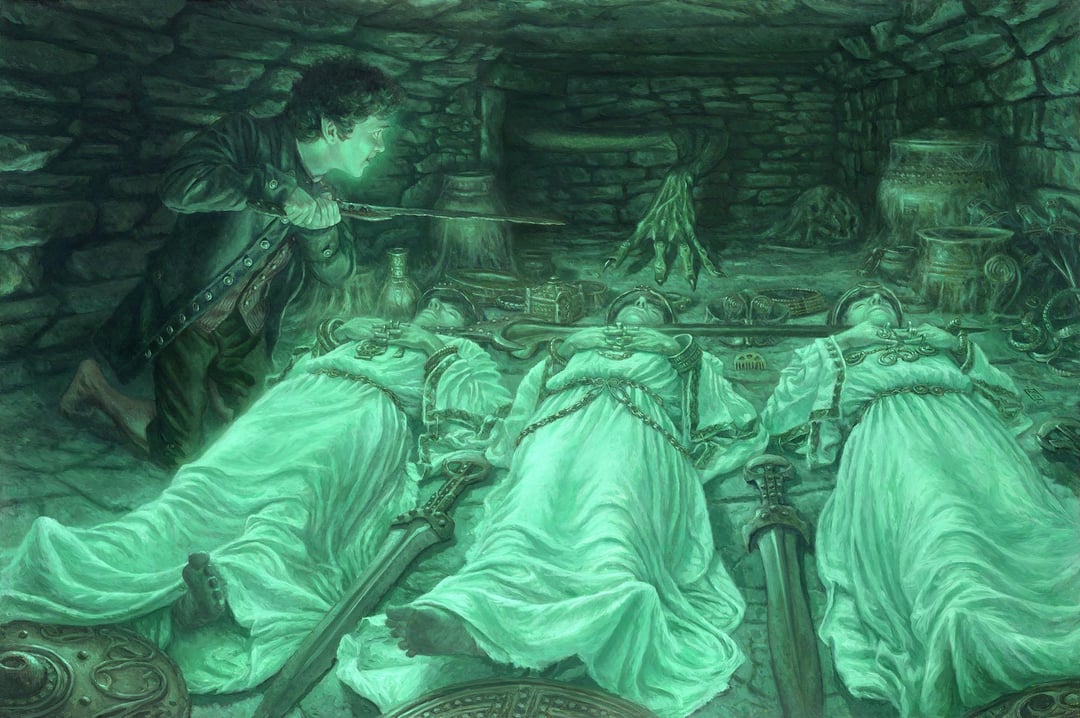
What’s going on here?

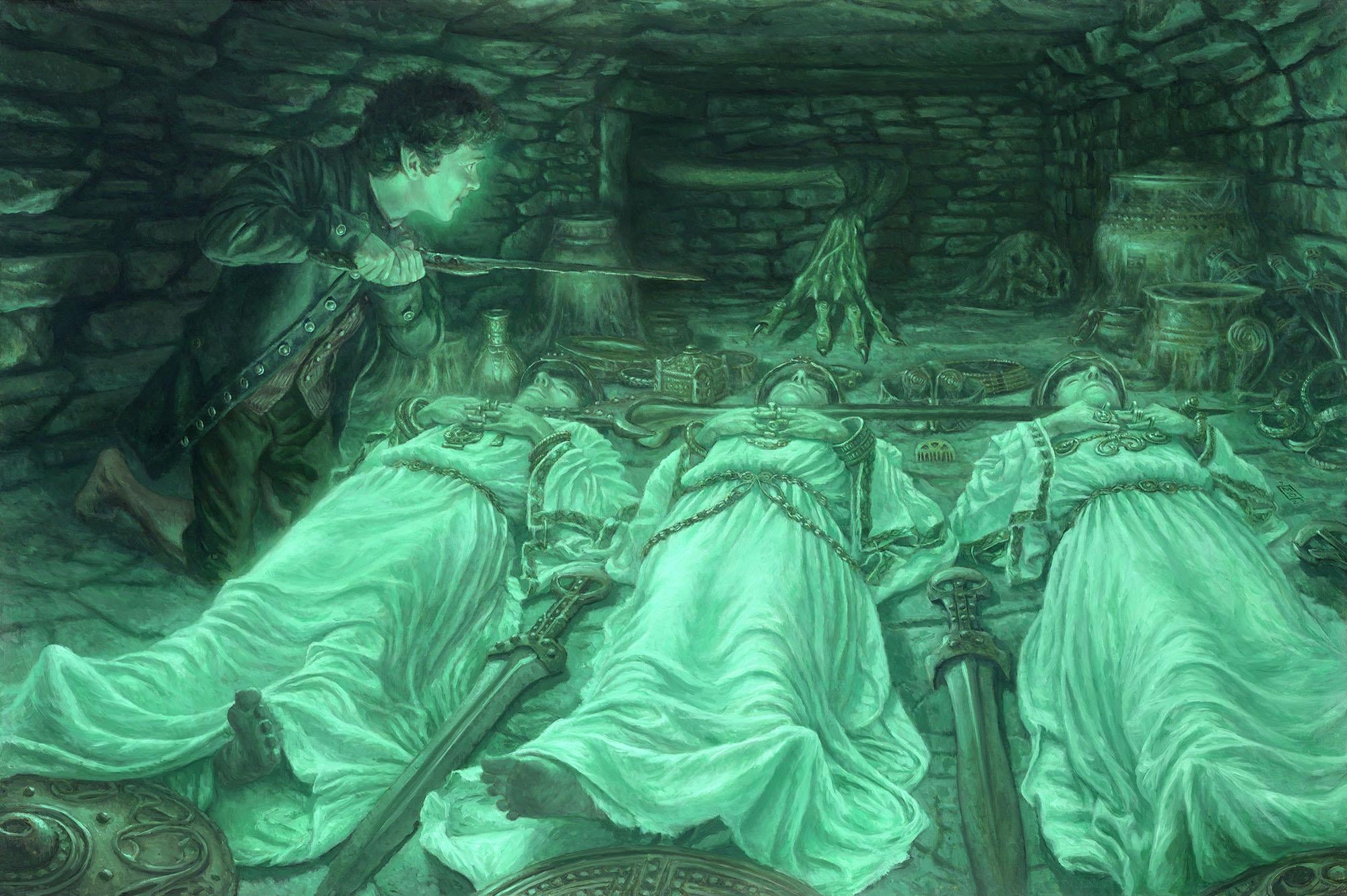
“He turned, and there in the cold glow he saw lying beside him Sam, Pippin, and Merry.  They were on their backs, and their faces looked deadly pale; and they were clad in white.  About them lay many treasures, of gold maybe, though in that light they looked cold and unlovely.  On their heads were circlets, gold chains were about their waists, and on their fingers were many rings.  Swords lay by their sides, and shields were at their feet.  But across their three necks lay one long naked sword.”  (The Fellowship of the Ring, Book One, Chapter 8, “Fog on the Barrow Downs”)

(Matthew Stewart–you can see more of his impressive work here: https://www.matthew-stewart.com/ I like his dragons especially.)

This might appear to look like an early heroic burial, with grave goods piled up,

like this chieftain’s grave from 530BC, found near Hochdorf an der Enz in Baden-Wuerttemberg, Germany—which even has this beautiful wagon (reconstructed—for more see:  https://en.wikipedia.org/wiki/Hochdorf_Chieftain%27s_Grave ).

There is a difficulty, however:  none of the hobbits is dead—although that sword across three of their necks suggests that they soon will be.

And I would further suggest that what we’re looking at is the scene of a potential human sacrifice—especially if we add what the narrator calls an “incantation” on the part of the Barrow-wight:

“Cold be hand and heart and bone,

And cold be sleep under stone:

Never more to wake on stony bed,

Never, till the Sun fails and the Moon is dead.

In the black wind the stars shall die,

And still on gold here let them lie,

Till the dark lord lifts his hand

Over dead sea and withered land.”

Human sacrifice had certainly been practiced in Middle-earth.  We know that Sauron, defeated temporarily, corrupts the king of Numenor, Tar-Calion (also known as Ar-Pharazon), preaching the worship of the fallen Vala, Morgoth:

“A new religion, and worship of the Dark, with its temple under Sauron arises.  The faithful are persecuted and sacrificed.  The Numenoreans carry their evil also to Middle-earth and there become cruel and wicked lords of necromancy, slaying and tormenting men… “ (letter to Milton Waldman, late 1951, Letters, 216-217—for more on this see “Melkor/Morgoth/Melqart” 29 June, 2022)

I suspect that Tolkien’s own first experience with such sacrifices may have come from a boyhood reading Julius Caear’s (100-44BC) De Bello Gallico, where he would have found:

“Natio est omnis Gallorum admodum dedita religionibus, atque ob eam causam, qui sunt adfecti gravioribus morbis quique in proeliis periculisque versantur, aut pro victimis homines immolant aut se immolaturos vovent administrisque ad ea sacrificia druidibus utuntur, quod, pro vita hominis nisi hominis vita reddatur, non posse deorum immortalium numen placari arbitrantur, publiceque eiusdem generis habent instituta sacrificia. Alii immani magnitudine simulacra habent, quorum contexta viminibus membra vivis hominibus complent; quibus succensis circumventi flamma exanimantur homines.”

“The whole nation of the Gauls is completely devoted to religious practices and because of this, those who are afflicted with very serious illnesses and those who are involved in battles and dangers either sacrifice men in place of animal victims or pledge that they will sacrifice them and use the druids as the priests for those sacrifices because they think that, unless the life of a person is paid back for the life of a person, the divine will of the immortal gods can’t be appeased and they [even] have sacrifices set up of the same kind at public expense.  Others have images of immense size of which the chambers, woven of willow withies, are filled with living people.   [So that], when they are set alight, the people, surrounded by flame, are killed.”  (De Bello Gallico, Book VI, Sec.16, my translation—you can read more at the invaluable Sacred Texts site here in a parallel Latin/English text:  https://sacred-texts.com/cla/jcsr/index.htm ) 

(This is from Thomas Pennant’s, 1726-1798, A Tour of Wales, 1778.  Pennant was a naturalist, antiquarian, traveler, etc etc and one of those wonderful 18th people seemingly interested in everything and eager to report what they discovered.  You can read about him here:  https://en.wikipedia.org/wiki/Thomas_Pennant but don’t forget to read about his draftsman, Moses Griffith, an equally impressively-talented man:  https://en.wikipedia.org/wiki/Moses_Griffith_(artist) There is even a Thomas Pennant Society:  https://www.cymdeithasthomaspennant.com/eng/t-p.html And you can read the Tour itself here:  https://archive.org/details/toursinwales00penngoog/page/n8/mode/2up  For more on the idea of the “wicker man”, see:  https://en.wikipedia.org/wiki/Wicker_man  )

The Romans, with very rare (and early) exceptions, frowned upon human sacrifice, but northern people, before being overwhelmed by the Romans, or too far north for them to conquer effectively, could, as in the case of the Gauls mentioned above, have a different approach to their gods.

Unfortunately, as they were not, like the Romans, extremely literate, what little description we have comes from people like Caesar, curious (and probably horrified) outsiders—and perhaps also propagandists, who wanted to paint those outside the Mediterranean world as savages and therefore worthy of nothing more than conquest.

We do, however, have other and very vivid evidence in the form of archaeological discoveries.

One of these turned up in my last posting, the “Vimose comb” (see “Runing Things”, 13 August, 2025).

The “-mose” in Vimose means “bog/wetland/moorland” in modern Danish, descended from “mosi” in Old Norse and this immediately tells us about a different method of making a sacrifice—and not necessarily a human one—dropping it into water.

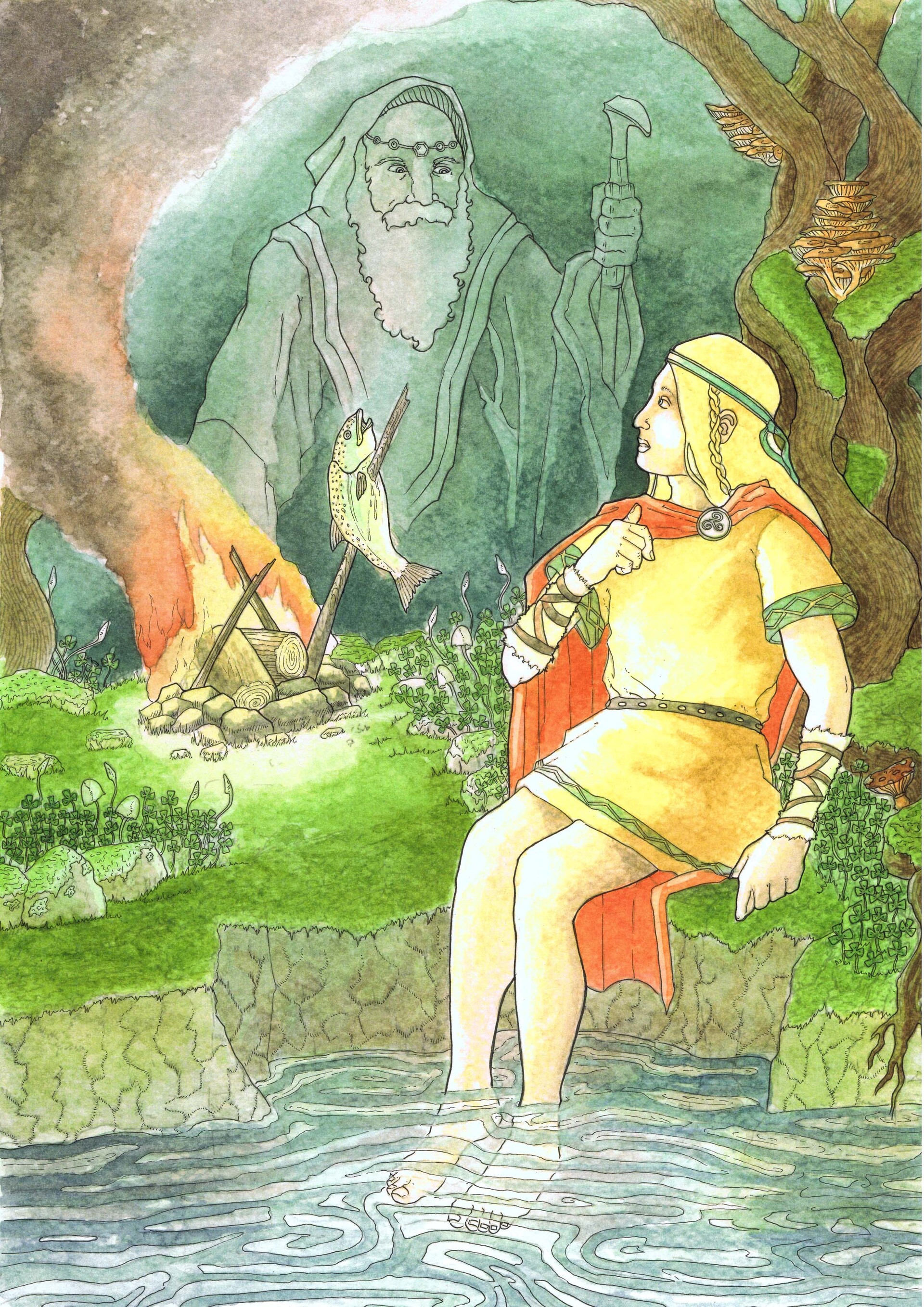
Without local explanation, we can only guess what was thought to happen when the object was deposited.  For myself, I’ve always thought of the pool in the story of Fionn mac Cumhaill. 

(Marga Gomila—you can see drafts of this work at:  https://margagomila.artstation.com/projects/OmEwgv )

This was connected with the otherworld and nuts from hazel trees would fall into the pool from that otherworld, to be consumed by a salmon in our world.  Cooking the salmon (caught in this world), Fionn, then a boy, burned his thumb and, putting it into his mouth, gained supernatural knowledge thereby.  (See for more:  https://en.wikipedia.org/wiki/Fionn_mac_Cumhaill and:  https://en.wikipedia.org/wiki/Wells_in_the_Irish_Dindsenchas There is a similar story attached to the Germanic hero, Sigurd, which you can read in the form Tolkien probably first read it:  https://www.gutenberg.org/cache/epub/540/pg540-images.html )

So, were these earlier sacrificers dropping in their treasures in hopes of sending them out of this world, presumably to the place where their gods lived?

Certainly the person who dropped the comb into the Vimose must have had some such hope and that person was hardly alone as, to date, about 2500 objects have been recovered from the site.  (For more on Vimose, check out this very interesting site:  https://ageofarthur.substack.com/p/the-homeland-of-the-angles-and-the See, as well, the Danish National Museum site, with all sorts of short articles on Vimose and other places:  https://en.natmus.dk/historical-knowledge/denmark/prehistoric-period-until-1050-ad/the-early-iron-age/the-weapon-deposit-from-vimose/the-offerings-in-vimose/ )

And it’s not the only site.  From Ireland eastwards through much of Germany, there are sites, some more specific, like La Tene, in Switzerland, where there was a huge cache of swords,

(no citation, but it looks like a Peter Connolly)

and Hjortspring, in Denmark, where there was a boat,

and Dejbjerg, also in Denmark, where there was a wagon.

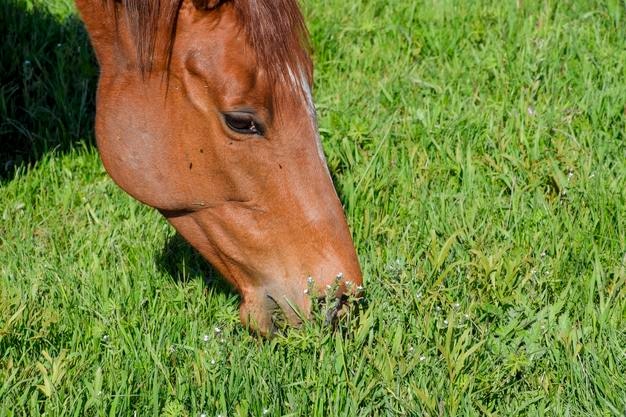
There are animal sacrifices,

(Miroslaw Kuzma–as a sometime horseman, I hesitated to include this illustration.)

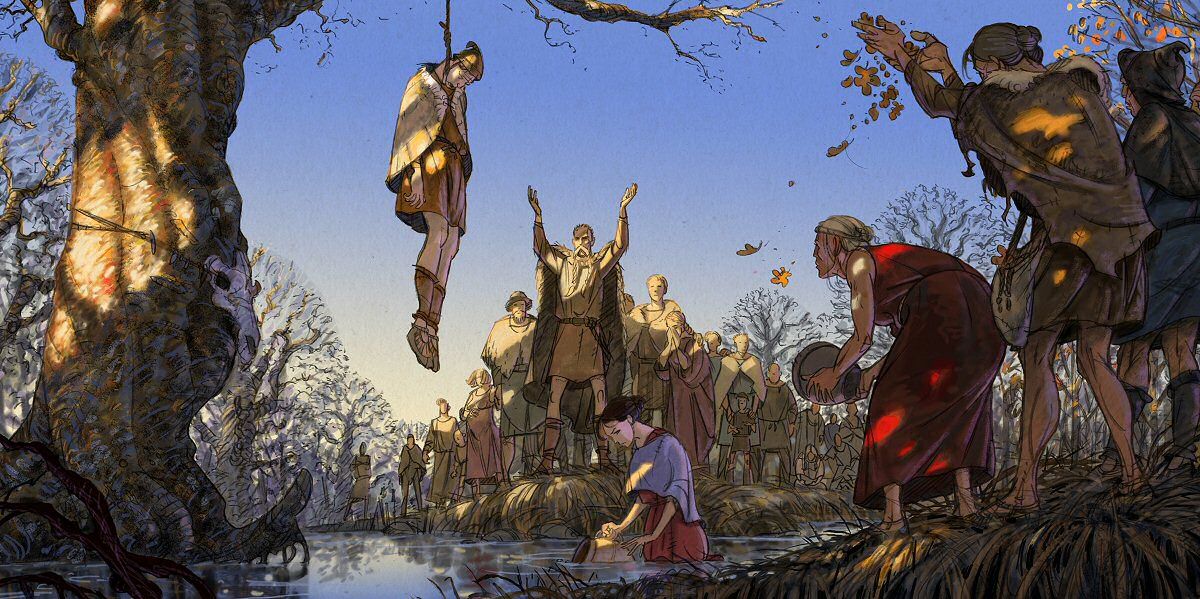
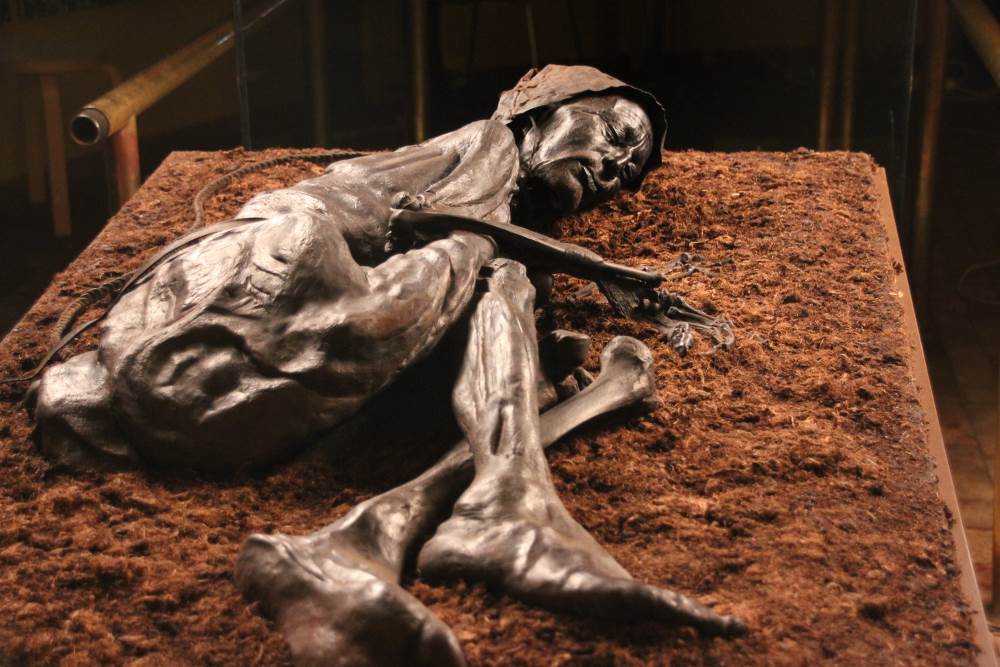
but the most sinister deposits are human ones,

some of whose well-preserved remains would probably have worried those who believed that, once the victim had been dealt with, and sunk in the water, the sacrifice would have been accepted and then the next step would be a god’s.  (For more on so-called “bog bodies”, see:  https://en.wikipedia.org/wiki/Bog_body )

Although Frodo was responsible for halting what may have been about to be a sacrifice—

“But the courage that had been awakened in him was now too strong:  he could not leave his friends so easily.  He wavered, groping in his pocket, and then fought with himself again; and as he did so the arm crept nearer.  Suddenly resolve hardened in him, and he seized a short sword that lay beside him, and kneeling, he stooped low over the bodies of his companions.  With what strength he had he hewed at the crawling arm near the wrist, and the hand broke off; but at the same moment the sword splintered up to the hilt.  There was a shriek and the light vanished.  In the dark there was a snarling noise.”

It was the appearance of Tom Bombadil, summoned by Frodo, who rescued them all—

“There was a loud rumbling sound, as of stones rolling and falling, and suddenly light streamed in, real light, the plain light of day.  A low door-like opening appeared at the end of the chamber beyond Frodo’s feet; and there was Tom’s head (hat, feather, and all) framed against the light of the sun rising red behind him.”

And there was Tom’s incantation—

“Get out, you old Wight!  Vanish in the sunlight!

Shrivel like the cold mist, like the winds go wailing,

Out into the barren lands far beyond the mountains!

Come never here again!  Leave your barrow empty!

Lost and forgotten be, darker than the darkness,

Where gates stand for ever shut, till the world is mended.”  (The Fellowship of the Ring, Book One, Chapter 8, “Fog on the Barrow-downs”)

I wonder whether, about to be consecrated to a god we no longer know of, a victim might have called upon his/her gods, hoping for a similar rescue?

Thanks for reading, as ever.

Stay well,

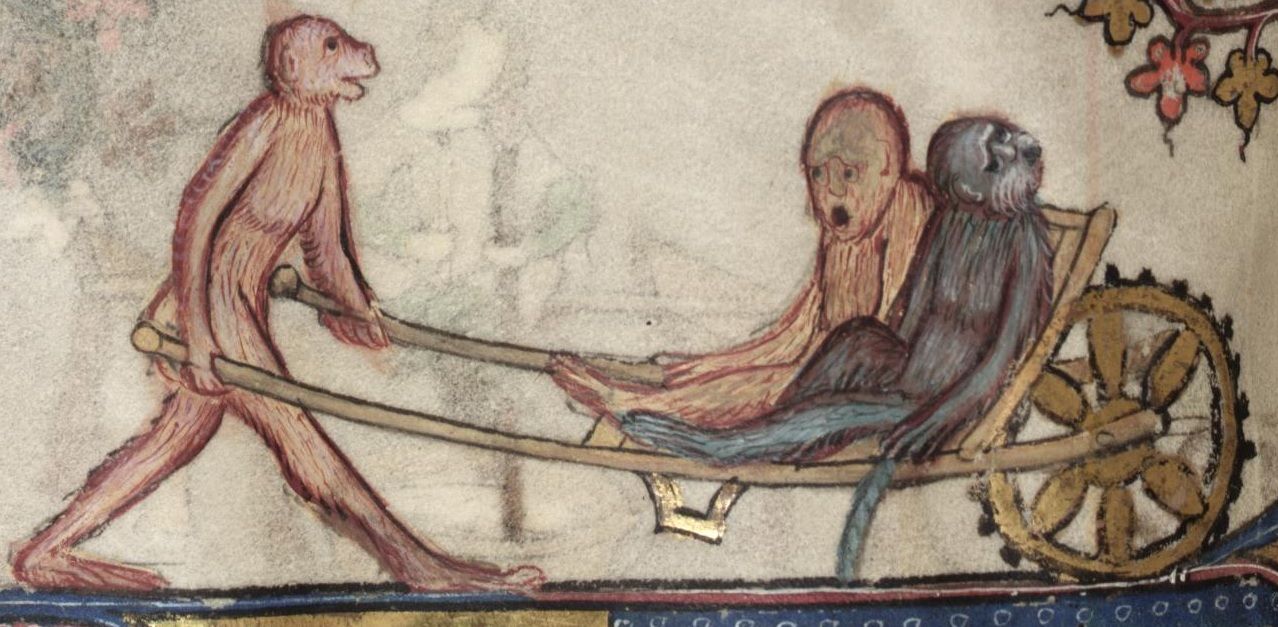
Avoid barrows—unless they’re wheeled,

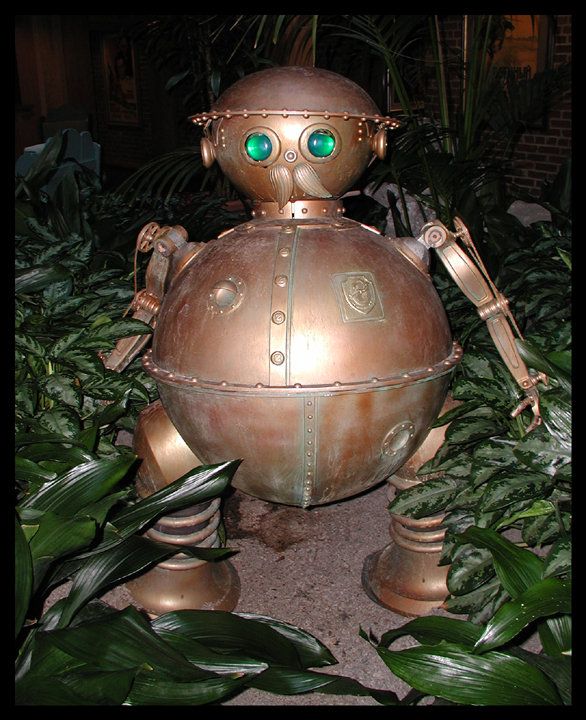
(Is this by a medieval Dr. Seuss?)

Definitely stay out of bogs,

And remember that, as always, there’s

MTCIDC

O

PS

If you’re interested in a scientific explanation for the surprising preservation of some bodies, see:

https://en.natmus.dk/historical-knowledge/denmark/prehistoric-period-until-1050-ad/the-early-iron-age/the-woman-from-huldremose/the-chemistry-of-the-bog-bodies/

Runing Things

13 Wednesday Aug 2025

Posted by Ollamh in J.R.R. Tolkien, Language, Tolkien

≈ Leave a comment

Tags

Anglo-Frisian Runes, Balin, Bryggen, divination, Fireworks, Futhark, Futhorc, Gandalf, Harys Dalvi, Kylver Stone, Moria, Robwords, runes, Tacitus, The Lord of the Rings, Thror's Map, Tolkien, Vimose comb

Welcome, as ever, dear readers.

It is a grim moment, in The Lord of the Rings when the company, making its way through the complexity of Moria in near-darkness, save for Gandalf’s staff, reaches this—

“Their feet disturbed a deep dust upon the floor, and stumbled among things lying in the doorway whose shapes they could not at first make out.  The chamber was lit by a wide shaft high in the further eastern wall; it slanted upwards and, far above, a small square patch of blue sky could be seen.  The light of the shaft fell directly on a table in the middle of the room:  a single oblong block, about two feet high, upon which was laid a great slab of white stone.

(the Hildebrandts)

‘It looks like a tomb,’ muttered Frodo, and bent forwards with a curious sense of foreboding, to look more closely at it.  Gandalf came quickly to his side.  On the slab runes were deeply graven:

‘These are Daeron’s Runes, such as were used of old in Moria,’ said Gandalf.  ‘Here it is written in the tongues of Men and Dwarves:

BALIN SON OF FUNDIN

LORD OF MORIA ‘.”  (The Lord of the Rings, Book Two, Chapter 4, “A Journey in the Dark”)

Even if you’re not an expert in early western writing systems, you’ve probably encountered runes before.  They appear to be a Germanic invention, with their first known outside mention thought to be in P. Cornelius Tacitus’ (c.56-c.120 AD) essay on some northern tribes, Germania, where this passage is cited.

“[10] Auspicia sortesque ut qui maxime observant: sortium consuetudo simplex. Virgam frugiferae arbori decisam in surculos amputant eosque notis quibusdam discretos super candidam vestem temere ac fortuito spargunt. Mox, si publice consultetur, sacerdos civitatis, sin privatim, ipse pater familiae, precatus deos caelumque suspiciens ter singulos tollit, sublatos secundum impressam ante notam interpretatur.”

“[the Germans] pay very close attention to auspices and lot-drawing:  the practice of lot-drawing is simple.  They split a branch cut from a fruit tree into splinters and scatter those, marked out with certain signs, on a white robe casually and randomly.  Then a priest of the settlement, if it may be the public consulting of an oracle, but if private, the father of a family himself, having prayed to the gods and raising his eyes to the sky, draws three [splinters] one at a time [and] interprets those drawn according to the mark stamped upon [them] previously.”

(Tactius, Germania, Section 10—my translation.  If you’d like to read the whole text, here’s a useful Victorian translation:  https://archive.org/details/tacitusagricolag00taciiala/page/62/mode/2up )

We don’t know where Tacitus got his information from, but he lived at about the same time as one of the earliest currently-known runic inscriptions, the “Vimose comb”, dated to about 160AD,

(There seem to be two guesses at to what the inscription says—transliterated, it appears to read “harja”, meaning either the obvious “comb” or the less obvious “warrior”.  For more on this and other early rune-marked artifacts, see:  https://en.wikipedia.org/wiki/Vimose_inscriptions and https://en.natmus.dk/historical-knowledge/denmark/prehistoric-period-until-1050-ad/the-early-iron-age/the-weapon-deposit-from-vimose/the-offerings-in-vimose/   Until they sold out, you could even get a bone replica of the comb here:  https://norseimports.com/products/vimose-comb )

so the notae, “marks”, he mentioned could, indeed, be early runes.

We’ve seen runes three times before in the book, each time related to Gandalf and the first letter of his name in runes–

The first is a jolly appearance:

(Darrell K. Sweet, who died, unfortunately, in 2011, but you can see his archived website here:  https://web.archive.org/web/20110131141507/http://www.sweetartwork.com/DKSmainPage.html and read a little more about this very talented illustrator here:  https://en.wikipedia.org/wiki/Darrell_K._Sweet And I couldn’t resist adding this knowledgeable appreciation of his work:  https://blackgate.com/2022/04/17/an-adventure-to-be-had-a-journey-through-the-art-of-darrell-k-sweet/ )

“At the end of the second week in September a cart came in through Bywater from the direction of Brandywine Bridge in broad daylight.  An old man was driving it all alone…It had a cargo of fireworks…At Bilbo’s front door the old man began to unload:  there were great bundles of fireworks of all sorts and shapes, each labeled with a large red G [runic letter] and the elf-rune [see the image above].” (The Fellowship of the Ring, Book One, Chapter 1, “A Long-Expected Party”)

The second is not, being Gandalf’s much-delayed letter to Frodo, still at the Prancing Pony in Bree, instead of being delivered 3 months before to the Shire, meant to alert Frodo to the possibility that he won’t meet them, with some consolation that Strider might appear. (The Fellowship of the Ring, Book One, Chapter 10, “Strider”)

(the Hildebrandts)

And the third is only guessed at as seeming to be a sign from Gandalf on Weathertop:

“ ‘The stroke on the left might be a G-rune with thin branches,’ said Strider.  ‘It might be a sign left by Gandalf, though one cannot be sure…I should say…that they stood for G3, and were a sign that Gandalf was here on October the third:  that is three days ago now.  It would also show that he was in a hurry and danger was at hand, so he had no time or did not dare to write anything longer or plainer.  If that is so, we must be wary.’ “ (The Fellowship of the Ring, Book One, Chapter 11, “A Knife in the Dark”)

(John Howe)

In our Middle-earth, there are several iterations of runes, with the melodious (modern) names of “Futhark”(Elder and Younger) and “Futhorc”, which get those names, as the word “alphabet” does, from putting together a collection of the first letters of the series in a standard order.  Here’s the Elder Futhark—

It’s easy to see why the letters might be shaped as they were, appearing to be relatively easy to inscribe on things with a knife.  (Or a chisel for the stone inscriptions?)

(a 12th-century AD inscription on wood from Bryggen in Norway—one of 670 inscriptions on wood or bone found at the site since 1955—for more see:  https://en.wikipedia.org/wiki/Bryggen_inscriptions  and https://en.wikipedia.org/wiki/Bryggen One of the many amazing things about this second piece is that it underlines just how sophisticated trade could be in northern Europe in the Middle Ages.)

(This is the Kylver Stone from Gotland, Sweden, c.400AD, which lists the Elder Futhark letters.  For more, see:  https://en.wikipedia.org/wiki/Kylver_Stone and you can see from the translation of the runes where “Futhark” came from. )

Tolkien’s own runes, as he tells us, are derived from what are sometimes called the “Anglo-Saxon” or “Anglo-Frisian” Futhorc:

“There is the matter of the Runes.  Those used by Thorin and Co., for special purposes, were comprised of an alphabet of thirty-two letters (full list on application), similar to, but not identical, with the runes of Anglo-Saxon inscriptions.”  (letter to the editor of The Observer, published there 20 February, 1938, Letters, 42)

We can then imagine that this is what must appear as the “moon letters” on Thror’s map—


And this brings me to my final point.

In my last, in connection with the conlang (constructed language) toki pona, I mentioned the internet site Robwords, one of my favorite places for information and discussion about languages, primarily English, German, and French, but with some surprises (see last week’s “Simple Words” for more).

(This is Rob Watts, of Robwords)

One of those surprises was toki pona, but, in another, Rob made the suggestion that the Roman alphabet, in which I’m writing this posting, was rotten for the English language, being adapted from the Greek alphabet (in turn adapted from the Phoenician alphabet) via the Etruscan alphabet,

and lacking letters for certain common English sounds like “th” and “sh” and “ng”.

In his playful way, he suggested that we’d be better off with the runic system, and specifically that Anglo-Saxon version, aka Futhorc.

 To prove his point, he cites something familiar to Tolkien readers—

and then proceeds to translate it, showing that it’s not in the language of the dwarves, as one might expect from a dwarvish map, but English (or, if you prefer, “the Common Speech”).

Watch the video, then, and see if you agree with Rob: https://www.youtube.com/watch?v=4npuVmGxXuk

And, if you’d like to try your hand at using the runes, here’s something to help—it’s a link to Harys Dalvi’s Old English runic keyboard:  https://www.harysdalvi.com/futhorc/  Harys Dalvi’s website is full of really interesting language and computer stuff and just plain fun:  https://www.harysdalvi.com/

Thanks, as always, for reading,

(ᚦᚫᛝᚳᛋ᛫ᚫᛋ᛫ᚫᛚᚹᛠᛋ᛫ᚠᚪᚱ᛫ᚱᛁᛁᛞᛁᛝ)

Stay well,

(ᛥᛠ᛫ᚹᛖᛚ)

Try runisizing today,

(ᛏᚱᚫᛁ᛫ᚱᚢᚾᛁᛋᛁᛋᛁᛝ᛫ᛏᚣᛞᛠ)

And remember that, as always, there’s

ᛗᚪᚱ᛫ᛏᚣ᛫ᚳᚢᛗ᛫ᛁᚾ᛫ᛞᚣ᛫ᚳᚣᚱᛋ

O

PS

At “wikiHow” there’s a pronunciation guide and a rather New Age interpretation of the Elder Futhark’s runes.  It’s fun, but, as it sits to the left of such “How” guides as “telekinesis”, and “reading palms”, I myself would stick to the pronunciations!  https://www.wikihow.com/Elder-Futhark-Runes 

PPS

And how could I resist listing this:  https://runicstudies.org/ the website for the American Association for Runic Studies?  If you get hooked on runes—and I think that that would be quite easy to do, especially after playing on Harys’ website—this site has links in all directions.

Simple Words

06 Wednesday Aug 2025

Posted by Ollamh in Uncategorized

≈ Leave a comment

Tags

A Martian Odyssey, Aladdin, conlang, Robwords, science fiction, Stanley Weinbaum, The Lord of the Rings, Toki Pona, Tolkien

Welcome, as always, dear readers.

I’ve read and reread Tolkien since the surprising appearance of this—

and the two volumes which followed–

which got me hooked and, as the (rather tired) saying goes, the rest is history—although I much prefer the genie’s words at the end of Disney’s Aladdin

“…ciao!  I’m history!  No, I’m mythology!”

as JRRT himself said of creating a language:

“As one suggestion, I might fling out the view that [in] the perfect construction of an art-language it is found necessary to construct at least in outline a mythology concomitant…because the making of language and mythology are related functions.”  (“A Secret Vice” in J.R.R. Tolkien, The Monsters and the Critics, 210)

In all of those readings, however, I’ve never quite believed something which Tolkien wrote—and more than once—that:

“The invention of languages is the foundation.  The ‘stories’ were made rather to provide a world for the languages than the reverse.” (taken from letter to the Houghton Mifflin Co., June, 1955, Letters, 319)

Gollum?  Saruman?  Grishnakh and Ugluk?  Treebeard?  Sam?  All created only so that they could speak JRRT’s languages?  Such vivid major and minor characters—surely there was also a pure pleasure not only in having them talk, but in what they said and what effect their talk—and actions—had on the ‘stories’?

I can certainly believe, however, that the languages were a major feature of JRRT’s making of Middle-earth—just the essay I quoted above—“A Secret Vice”– would show you just how devoted Tolkien was to languages and their creation, or look up “Languages” in the Index to Letters

and you’ll find two columns and a little more (pages 667-669) of references to languages, name-formation, Quenya vs Sindarin, Dwarvish, the Black Speech, and much more.  And, digging below the surface, you can find such details as Tolkien writing to a fan with the declension of two nouns in Quenya:  cirya, “ship” and lasse, “leaf” (declensions are patterns of noun/adjective formation in which the functions of the words are shown by their endings—think of “whose” and “whom” in English as the last remnants of something which would earlier have look like this:

Nominative (shows subject):   who

Genitive (shows possession):  whose

Dative (indirect object):   whom

Accusative (direct object/takes prepositions):  whom

Ablative (would take some other prepositions—fell together with the accusative):   whom

and there can be other endings—all called “case endings”—like the instrumental, the ending of which would tell you that the noun was being used as a means to do something, the locative, which indicates at what place something is, and the vocative, employed when you’re addressing someone/thing)

(see “From a letter to Dick Plotz, c.1967, Letters, 522-523)

Such profusion is in strong contrast to something which I discovered a week or two on YouTube.

One of the real pleasures I find there are the number of languages and essays about them available in great profusion.  One of my current favorites is a feature called “RobWords”, which is written and presented by Rob Watts, its subjects tending to center around English, but touching upon German and French, among other topics, as well.

It’s a very informative and light-hearted site with occasional surprises, as I found with one entitled “The World’s Smallest Language”, which introduced a conlang (constructed language—in fact, just like Tolkien’s languages), but with an extremely simple grammar and an initial vocabulary of 120 words:  “Toki Pona” (you can see the episode here:  https://www.youtube.com/watch?v=PY3Qe_b9ufI )

The inventor, Sonja Lang, is, not surprisingly, a linguist, combining her knowledge of world languages with her own creations—something you might guess from the name of the language itself:  “toki” coming from the language “Tok Pisin”—that is, “Talk Pidgin”—“pidgin” meaning a kind of trade language—and “pona” coming from Latin “bonus –a –um”—“good”.  (More about pidgins here:  https://en.wikipedia.org/wiki/Pidgin and Tok Pisin here:  https://en.wikipedia.org/wiki/Tok_Pisin )

Here’s how Lang explains it:

“Toki Pona was my philosophical attempt to understand the meaning of life in 120 words. 

Through a process of soul-searching, comparative linguistics and playfulness, I designed a simple communication system to simplify my thoughts.”  (Toki Pona The Language of Good, Preface)

And simple it is:  things which appear in Indo-European languages like grammatical gender (whether a noun is masculine, feminine, or neuter—not important in English, but necessary, for instance, in language descended from Latin—Italian, French, Spanish, Catalan, Portuguese, and Romanian), plurals, case endings (see above), definite and indefinite articles (the/a/an in English) verb tenses, even more than one form for a verb—are all gone.  Sentence formation basically follows English, which is Subject, Verb, Object (SVO in linguistic terms—“Cats [subject] drink [verb] milk [object]”)—but use the link above to learn more and be entertained by a bit of a catchy pop song in Toki Pona.  If you want more about its grammar, see:  https://www.youtube.com/watch?v=_PgytSj-YVE and, if you go to YouTube, there are many more places to visit.  If you watch these two videos, you’ll see that that simplicity might easily lead to vagueness (something which “RobWords” points out), but, for a fluent speaker, with an imagination, perhaps it’s less vague than may seem at first.  For example, watch this speaker demonstrate how you can create the term “video game” using only the readily-available vocabulary:  https://www.youtube.com/shorts/z2ltEHfgR2g

Tolkien had been a learner and admirer of an earlier conlang:  Esperanto (if you don’t know about it, see:  https://en.wikipedia.org/wiki/Esperanto and https://esperanto.net/en/ ) and I wonder what he would have made of Toki Pona?  As a number of its words are derived from a language he loved, Finnish, I think that we might not be surprised if he found Toki Pona fun (see:  https://www.youtube.com/shorts/UoVTWjMrlp4  for a list of parallels between the two languages)—although he probably wouldn’t be able to resist adding to that 120-word basic vocabulary.

But all of this raises the question:  just how many words do you need to communicate?

In my science fiction reading, I’ve found one ingenious answer in a short story by Stanley G. Weinbaum, “A Martian Odyssey”, published in the July, 1934 issue of Wonder Stories.  For another wonder, it was his first published story in what was, unfortunately a brief career, Weinbaum dying in 1935.  (You can read more about him here:  https://en.wikipedia.org/wiki/Stanley_G._Weinbaum )

In this story, the main character, Jarvis, is one of a 4-man expedition, the first to reach Mars (and this is a Mars with Martian gravity, but also with a thin, breathable surface layer of oxygen).  While exploring, his ship crashes and he’s stranded many miles from where the rocket which brought the crew to Mars, the Ares, has landed.  While hoping that the others will search for him, he sets off to walk back towards the Ares and, in the process, rescues a local, whom he calls “Tweel”, as he can’t really pronounce the local’s actual name, that being a loose approximation.  He attempts to communicate, using a few words, based upon the setting, and then a little math, and it’s clear that the local understands some of what he tries to do, but, interestingly, while “Tweel” can speak a little of what Jarvis tries to convey, Jarvis has no luck—and doesn’t even really try—to speak the other’s language.  So, with about half-a-dozen words between them, they set off together on Jarvis’ original journey, meeting strange creatures—and a deadly one—on the way.

I won’t do a summary beyond this as, if you read this far and you’re interested in languages or science fiction, or both, you’ll want to read the story for yourself:  https://www.gutenberg.org/files/23731/23731-h/23731-h.htm

Thanks, as ever for reading,

Stay well,

mi tawa (“Goodbye” in Toki Pona—simply meaning “I’m going”, although I’d prefer to say the “hello” greeting, powa tawa sina—“peace be with you”),

And remember that, as always, there’s

MTCIDC

O

PS Weinbaum wrote a sequel to “A Martian Odyssey” which, if you enjoyed that story, you can read here:  https://gutenberg.org/cache/epub/22301/pg22301-images.html

Pippin

30 Wednesday Jul 2025

Posted by Ollamh in Heroes, Imaginary History, J.R.R. Tolkien, Maps

≈ Leave a comment

Tags

Charlemagne, Child Ballads, Childeric III, Merovingian Kingdom, Pepin le Bref, Perry the Platypus, Pippin, pipping, Pope Zachary, The Bayeux Tapestry, Tolkien

Welcome, as always, dear readers.

When I was little, I heard a folksong, “I gave my love a cherry”, with these lines:

“I gave my love a cherry that has no stone
I gave my love a chicken that has no bone
I gave my love a ring that has no end
I gave my love a baby with no cryen

How can there be a cherry that has no stone?
How can there be a chicken that has no bone?
How can there be a ring that has no end?
How can there be a baby with no cryen?

A cherry, when it’s blooming, it has no stone
A chicken when it’s pipping, it has no bone
A ring when it’s rolling, it has no end
A baby when it’s sleeping, has no cryen.”

Now, I know that it belongs to a riddle song tradition seen in two Child Ballads:  “Riddles Wisely Expounded” (#1) and “Captain Wedderburn’s Courtship” (#46), as well as in several supposedly-impossible task ballads, including “The Elfin Knight” (#2), but then it was just puzzling—especially that line about “A chicken when it’s pipping”. 

Since then, I have seen two explanations:

1. “pipping” is the chick still developing in the egg

2. “pipping” is the act of the chick breaking out of the egg and its bones have not yet matured

“Pipping” is characteristically sung “pippin’” and that was undoubtedly in my head when I first read The Lord of the Rings, and there was “Pippin”—Peregrine Took.

Took is a Norman-English family name, the first member in England being one of the invaders in 1066,

mentioned in (Robert? his first name is under discussion—sometimes he’s just called “Master”) Wace’s 12th century verse chronicle Roman de Rou (the “story of Rollo”—that is, of Hrolfr, a Viking colonizer of the western coast of France who became a vassal of the French king, Charles III (“ the Simple”), under the name “Rollo”, controlling what would become Normandy—“Norsemanland”—for more, see:  https://vikingr.org/explorers/rollo )

(from his tomb in Rouen Cathedral—a medieval idea of his appearance–and they wouldn’t have had much to go on as the tomb has been despoiled more than once:  report has it that only one femur remains inside)

which includes material about the conquest of England and where the sire “de Touques” (Touques is a town and river in Normandy—see:  https://en.wikipedia.org/wiki/Touques,_Calvados )  appears (see Master Wace, his chronicle of the Norman Conquest from the Roman de Rou, translated and edited by Edgar Taylor, 1837, where you can see the name on page 212:  https://archive.org/details/masterwacehischr00waceuoft/page/210/mode/2up )

“Peregrine” is Latin peregrinus, formed from peregre, literally “through the fields” (per agros), meaning “coming from somewhere else”, hence “foreign(er)/strang(er)/and, eventually, “pilgrim”.  See for more:  https://www.etymonline.com/word/pilgrim  I suspect that the name was inspired by Tolkien’s religious background, where there are several saints with that name:

1.  a 2nd-century AD martyr (you can read about him here:  https://www.catholic.org/saints/saint.php?saint_id=5564 )

2. a 7th-century Celtic figure (you can read about him here:  https://www.saintforaminute.com/saints/saint_peregrinus_of_modena )

3. a 13th-century Italian (you can read about him here:  https://en.wikipedia.org/wiki/Peregrine_Laziosi )

“Pippin”, however, appears to be a bit murkier.  One would assume that the nickname for Peregrine would be “Perry” (as in Perry the Platypus from the wonderful animated series “Phineas and Ferb”—for more see:   https://en.wikipedia.org/wiki/Phineas_and_Ferb    ).

So where does Pippin come from? 

I go back to what so often I find helpful for JRRT:  the Middle Ages.

And here I find Latin “Pipinus”, who could be this colorful character, Pepin (nicknamed “Shorty”—le Bref), c.714-768, the 8th-century Mayor of the Palace (chief officer under the king)

(to the right is Pepin’s father, Mayor of  the Palace before him, Charles “Martel”–“the Hammer”)

in Merovingian Francia (for more on this, see:  https://en.wikipedia.org/wiki/Merovingian_dynasty .

Pepin is known in history for two things:

1. with the blessing of Pope Zachary, in 751, he overthrew the Merovingian king, Childeric III, ending the dynasty and making himself king

2. he was the father of Charlemagne, 747-814, creator of the short-lived Carolingian Empire (800-843)

(As always, coins have so much to tell us beyond their monetary significance.  This is a good example of using a Roman model to suggest that, somehow, the person depicted is descended from earlier Roman rulers:  it’s in Latin and uses Roman imperial titles—“IMP” = “Imperator”, once only “one holding the Senate’s authority outside Rome” but, from the time of Tiberius, 42BC-37AD, used as we use “emperor”; “AUG” = “Augustus”, a title originally given by a subservient Senate to Octavian, the heir to his greatuncle, Julius Caesar, and, after 30BC, owner of the whole Mediterranean basin.  As well, Charlemagne is wearing just the suggesting of later Roman armor, covered by a Roman military cloak and, on his head, is the early—and modest—imperial crown—a victor’s wreath.  Charlemagne’s ancestors were the Franks, Germanic invaders who would give France its name.  Charlemagne’s name is the Latin form, “Carolus”, of a Germanic name, “Karl” and note how it’s spelled in the Latin inscription:  “Karolus”.  Latin doesn’t use the letter K—so, a Germanic practice?) 

As Drogo and Freddie are out of the medieval Germanic past, I would suggest that, whereas Took is Anglo-Norman and Peregrine is Latin, Pippin may have gotten his nickname from a similar source, a fittingly distinguished name for someone who, after the War of the Ring, would become Thain of the Shire, Knight of Gondor, and Counsellor of the North Kingdom.

Thanks for reading, as always.

Stay well,

Dark Ages?  What Dark Ages?  You just have to know where to look—Tolkien did,

And remember that there’s always

MTCIDC

O

King Returns and Tax Returns?

23 Wednesday Jul 2025

Posted by Ollamh in Uncategorized

≈ Leave a comment

Tags

Argeleb II, Dismal Science, Farthings, taxes, The Bridge of Stonebows, The Shire, Tolkien

As always, dear readers, welcome.

I’m always interested to try to imagine things which Tolkien may allude to, but goes into no more detail about—a kind of teaser, and, for me, a challenge:  what can we reconstruct—and how?

“About this time legend among the Hobbits first becomes history…They passed over the Bridge of Stonebows, that had been built in the days of the power of the North Kingdom, and they took all of the land beyond to dwell in, between the river and the Far Downs.  All that was demanded of them was that they should keep the Great Bridge in repair, and all other bridges and roads, speed the king’s messengers, and acknowledge his lordship.”  (The Lord of the Rings, Prologue I:  “Concerning Hobbits”)

The “Bridge of the Strongbows” is the stone bridge which crosses the Baranduin/Brandywine on the road into the Shire from Bree, “bow” here meaning “arch”.

As far as I know, no artist has as yet depicted it, but I’ve always imagined it as looking rather like the Elvet Bridge, which spans the River Wear in the middle of Durham, England.

This was begun in 1160AD by the Norman bishop, Hugh de Puiset (c.1125-1195—a very interesting figure in the early centuries of Norman domination—you can read about him here:  https://en.wikipedia.org/wiki/Hugh_de_Puiset and read more about the bridge here:  https://en.wikipedia.org/wiki/Elvet_Bridge ), but only finished sometime in the following century, suggesting both the time-consuming nature of its construction, as well as the expense, something less visible, but always there in the medieval world—cathedrals could take centuries to build, and not only because they were large and complex.

So, as it took time and money to build the “Bridge of Strongbows”, it would have taken more time and money to keep it in repair, let alone “all other bridges and roads”.

And here we are in what Thomas Carlyle, 1795-1881, referred to as the “dismal science”:  economics in Middle-earth.  (Carlyle uses the term more than once, but the general citation is to his–originally published under a pseudonym–“ Occasional Discourse on the Negro Question”, which you can read here:  https://cruel.org/econthought/texts/carlyle/carlodnq.html  If you read this site regularly, you know that one of its pleasures for me is being able to recommend all sorts of books, articles, music, to my readers.  In this case, however, I must say that, for once, I don’t recommend something—unless you are curious as to the horrific attitudes of some 19th-century intellectuals on the subject of race and bondage.  As an historical artifact, then, it’s worth a glance, but as an example of bigotry, it’s appalling, and unworthy of a man with the mind and sensibilities to know better.)

Tolkien himself was well aware of economics.  As he says in a letter to Naomi Mitchison:

“I am not incapable of economic thought; and I think as far as the ‘mortals’ go, Men, Hobbits, and Dwarfs, that the situations are so devised that economic likelihood is there and could be worked out…”

(letter to Naomi Mitchison, 25 September, 1954, Letters, 292)

Tolkien, however, adds something to his letter which makes his ideas a little clearer and adds a medieval touch:

“…Gondor has sufficient ‘townlands’ and fiefs with a good water and road approach to provide for its population…”

“Townlands”, as Tolkien used it, was a term employed in Ireland to indicate the holdings, by landlords, of multiple farms held by tenants, who paid rent to the landlords.  “Fief” is the feudal term for land given to a vassal by an overlord in return for taxes and military support when required.  In other words, these are economic units, in which those who work the land pay for that work with rent, in one form or another. 

So let’s consider the Shire.

In that same letter, Tolkien says:

“The Shire is placed in a water and mountain situation and a distance from the sea and a latitude that would give it a natural fertility, quite apart from the stated fact that it was a well-tended region when they took it over (no doubt with a good deal of older arts and crafts).”

As far as we can see, there are neither “townlands” or “fiefs”, but there is a form of government—in fact, a rather confused form:

1. a Thain–from Old English “thegn”–a significant landholder, one step down from an “ealdorman” (it’s much more complicated—see:  https://en.wikipedia.org/wiki/Thegn for more) a hereditary position owned by the Took family, whose holder was “master of the Shire-moot, and captain of the Shire-muster and the Hobbitry-in arms”

2. the Mayor of Michel Delving (or of the Shire) “who was elected every seven years at the Free Fair on the White Downs at the Lithe, that is at Mid-summer”  JRRT says that “as mayor almost his only duty was to preside at banquets given on the Shire-holidays”, but then, I think, contradicts himself somewhat, saying “But the offices of Postmaster and First Shirriff were attached to the mayoralty, so that he managed both the Messenger Service and the Watch.  These were the only Shire-services, and the Messengers were the most numerous, and much the busier of the two.”  The Shirriffs were only a dozen—three per quarter—“Farthings” of the Shire, but there were, at the time of The Lord of the Rings another, larger group, the “Bounders”, meaning border guards, presumably also under his command.

There’s a postal service, then, and a two-part police force, as well as the need for infrastructure maintenance, all of which require that which Tolkien understands, as he tells us, but does not go into:  money in some form. 

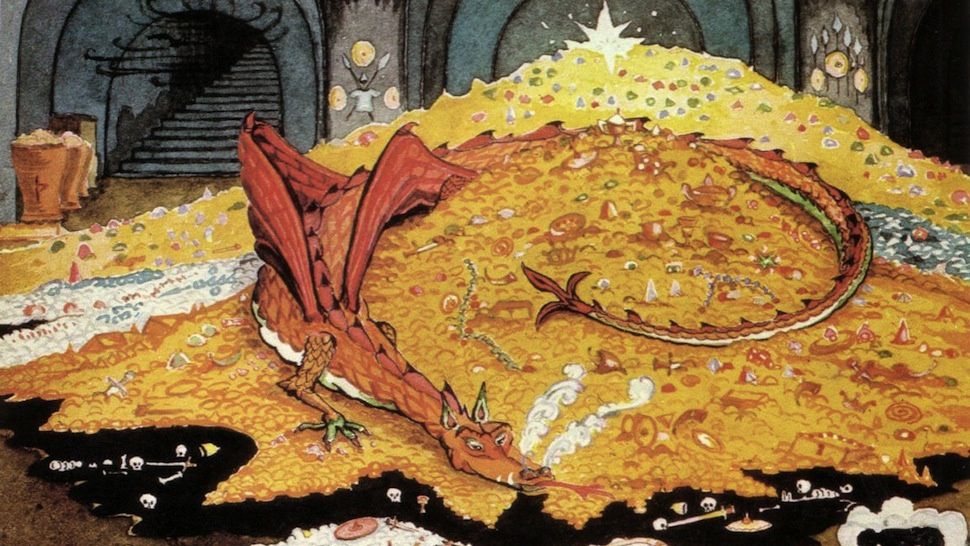
Money turns up in fantasy literature, but it only seems to belong to kings and people at the top, as well as in dragon hoards,

(JRRT)

and in mysterious caches linked to beings like witches,

(Vladyslav Yerko—you can read about him here:  https://www.artlex.com/artists/vladyslav-yerko/ and here:  http://ababahalamaha.com.ua/en/Vladyslav_Yerko )

as well as in the hands of thieves.

Tolkien, just like other such fantasy creators, doesn’t tell us where the money comes from ultimately, but I would suggest that he gives us some clues.

We can begin with the Shire itself.  It’s not a large place—

(JRRT/Christopher Tolkien?)

“Forty leagues it stretched from the Far Downs to the Brandywine Bridge, and fifty from the northern moors to the marshes in the south.”  (The Lord of the Rings, Prologue I:  “Concerning Hobbits”)  If we take about 3 miles per league (4.8km), then 40 leagues = 120 miles (193km), and 50 leagues = 150 miles (241km) and yet it’s divided into quarters, suggesting that this was done for some sort of administrative purposes, cutting it down into more manageable sections.  As there’s voting, perhaps the Shire is broken up into voting districts, as it is the method used here, in the US.

And, just as likely, it may be done for tax purposes—after all, how else is money raised for police, post, and infrastructure?

Tolkien would have been well aware that the Anglo-Saxons were sophisticated bureaucrats, producing detailed records—which the Normans took over in the so-called “Domesday Book”,

a late Anglo-Saxon joke on taxes being as sure and as unforgiving as the Last Judgment.

Not all of the volumes survive from the original survey of the 1080s, but what does survive breaks down the countryside by shires (sound familiar?), listing in great detail who owns what and how much tax does he pay on it.  (For more on this incredibly interesting document see:  https://en.wikipedia.org/wiki/Domesday_Book )

One can imagine, then, the Shire equivalent, each of the farthings listed and, beneath each, the villages, farms, and private dwellings, with the name of the owner, what he possesses, and what he owes.  The North Farthing would then include:

NORTH FARTHING                 

Overhill

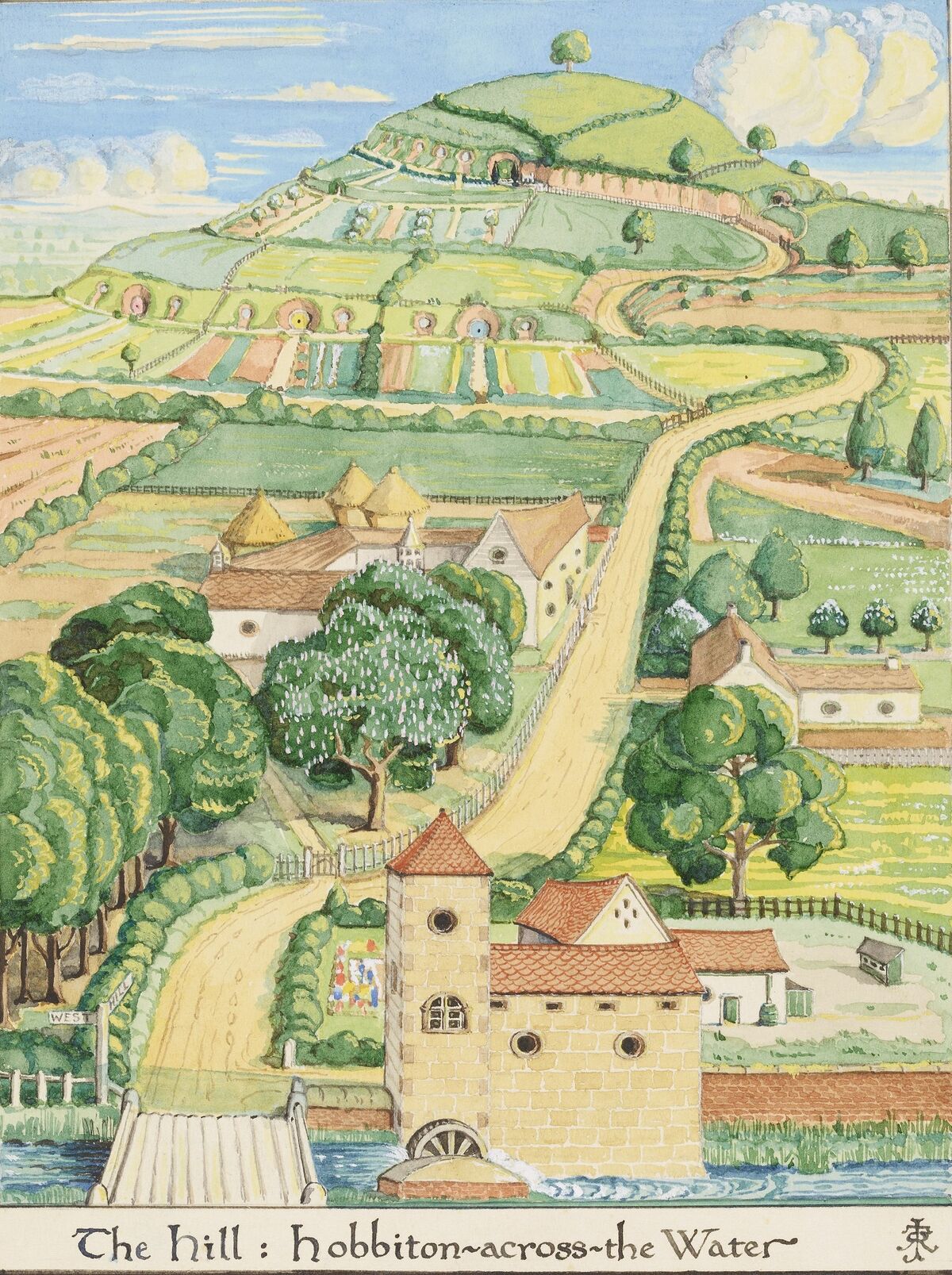
The Hill

in which would be “Bag End”, “Bilbo Baggins”, what property produces revenue, and what taxes he owes for it

Hobbiton

The king who had originally granted land to the Hobbits was Argeleb II, in TA1601, but it’s clear that, as the Northern Kingdom faded, so did the Hobbits’ memory of Numenorean kings, except in their folklore:

“But there had been no king for nearly a thousand years…Yet the Hobbits still said of wild folk and wicked things (such as trolls) that they had not heard of the king.  For they attributed to the king of old all their essential laws; and usually they kept the laws of free will, because they were The Rules (as they said), both ancient and just.”  (The Lord of the Rings, Prologue I:  “Concerning Hobbits”)

As they kept “The Rules”, however, we can presume that the Hobbits maintained their obligation to Argeleb, who had died in TA1670, as the Bridge of Strongbows was still standing when Frodo and his friends arrived there in TA3019.  Soon after, however, a new king appeared, Elessar (aka Aragorn II), and we might wonder:  what would he demand of the Shire?  After all, the War of the Ring had caused tremendous damage to Gondor and it’s clear that the new king had plans to rebuild Arnor (Aragorn travels to the site of the old northern capital, Annuminas, in TA1436  The Lord of the Rings, Appendix B, “Later Events Concerning the Members of the Fellowship of the Ring”) and so we’re back to economics:  would the return of the king mean, as the title of this piece suggests, tax returns?  Certainly the first Norman king, William, pretty quickly set his clerks to work wringing every penny they could out of local land-holders.

We aren’t told if the Shire was required to continue the agreement made so many centuries ago with Argeleb, but the new king was clearly very grateful, at least to certain Hobbits, and:

“[SR—Shire Reckoning]1427…King Elessar issues an edict that Men are not to enter the Shire, and he makes it a Free Land under the protection of the Northern Sceptre.”  (The Lord of the Rings, Appendix B, “Later Events Concerning the Members of the Fellowship of the Ring”)

Presumably, this lifts the responsibility for royal taxes, but, as the king visits his old friends at the bridge in FA1436, (The Lord of the Rings, Appendix B, “Later Events Concerning the Members of the Fellowship of the Ring”) I think that we can also presume that the ancient infrastructure agreement is still in force, even if the king doesn’t cross the bridge.

As for the post and the police?  We have a modern expression which mirrors the thinking behind the ancient sad joke about the “Domesday Book”:  “nothing is sure in this life except death—and taxes”.

Thanks, as always, for reading.

Stay well,

To add another proverbial expression, when it comes to their taxes, perhaps the Hobbits would cross that bridge when they came to it,

And remember that, as always, there’s

MTCIDC

O

Mars, Two

16 Wednesday Jul 2025

Posted by Ollamh in Uncategorized

≈ Leave a comment

Tags

A Princess of Mars, Around the Moon, Columbiad, Cyrano de Bergerac, Edgar Rice Burroughs, From the Earth to the Moon, HG Wells, Jules Verne, Mars, Percival Lowell, science fiction, The First Men in the Moon, The Gods of Mars, The War of the Worlds, The Warlords of Mars, Twenty Thousand Leagues Under the Sea, twenty-thousands-leagues-under-the-sea

Welcome, as ever, dear readers.

Recently, I’ve returned to my long-term project to learn more about Science Fiction, which I began several years ago.

When I began to assemble a reading list (it keeps growing), I knew that it would include older authors like Jules Verne (1828-1905),

whom I had first met through his novel, Vingt Mille Lieues Sous Les Mers

(first English translation, 1873)

usually (slightly mis-) translated as Twenty Thousand Leagues Under the Sea—but needs a final –s on “Sea-“, which the first English translation, following the original French, added.  At first sight, one might think that those masses of leagues were about depth, but, in fact, they were about length:  the idea being that the Nautilus, the submarine of the antagonist, Captain Nemo, traveled that distance below the waves during the story—that is 20,000 x 2.5 miles—maybe about two circumferences of the Earth.  Here’s the ship from the original French publication—

but, for me, the Nautilus (inspired by an actual submarine experiment in France—see:  https://en.wikipedia.org/wiki/French_submarine_Plongeur ) will always be the ship seen in Disney’s 1954 version of the story.

Some years earlier, in 1865, Verne had written De la Terre a la Lune, trajet direct en 97 heures et 20 minutes—From the Earth to the Moon, Direct Route in 97 Hours and 20 Minutes (usually simply translated as From the Earth to the Moon   You can read about it here:  https://en.wikipedia.org/wiki/From_the_Earth_to_the_Moon  and read an early translation here: https://web.archive.org/web/20110520193116/http://jv.gilead.org.il/pg/moon/   Be aware that this is not a very good translation and cuts the text, as well, but it’s free and will give you a general idea of the story).

(the 1874 translation)

In this adventure, an organization called the “Baltimore Gun Club” constructed a giant cannon

(called a “Columbiad” after this heavy coastal defense gun—only much bigger—for more, see:  https://en.wikipedia.org/wiki/Columbiad )

designed to shoot passengers to the Moon.  How they are to return is only revealed in the 1869 sequel, Autour de la Lune—Around the Moon—

(the second translation, 1874)

You can read about it here:  https://en.wikipedia.org/wiki/Around_the_Moon And you can read the early translation depicted above here:  https://www.gutenberg.org/cache/epub/16457/pg16457-images.html  This book inspired the early French film-maker, Georges, Melies, 1861-1938, to produce his own burlesque version, Le Voyage dans la Lune, 1902, which included that cannon—and a chorus line!)

Along with Verne, H.G. Wells, 1866-1946, was on my list, including The First Men in the Moon, 1901.

Wells’ protagonists reach the moon through a man-made anti-gravity material, called “Cavorite”, after its inventor (one of the two lunar travelers), which is attached in carefully-monitored sheets to a steel and glass sphere.  You can read the book yourself here:  https://ia601308.us.archive.org/2/items/firstmeninmoo00well/firstmeninmoo00well.pdf

(from the original English edition)

Early in my exploration of science fiction writers, I had read Edgar Rice Burroughs’, 1875-1950, A Princess of Mars (serialized 1912, first book edition, 1917).

(You can read about it here:  https://en.wikipedia.org/wiki/A_Princess_of_Mars and read the story itself here:  https://gutenberg.org/cache/epub/62/pg62-images.html )

As I said, I had known Verne already, and Wells from The War of the Worlds, (serialized 1897, first book publication 1898)

(read about it here:   https://en.wikipedia.org/wiki/The_War_of_the_Worlds and read it here:  https://www.gutenberg.org/cache/epub/36/pg36-images.html ), but all I knew about Burroughs was

and so I was hesitant, but I was pleasantly surprised that, even with a certain amount of what we might call “period” language (and cultural attitudes), this was a very readable book.  (See “Busting Into Mars”, 27 September, 2023, for more.)

Taking a recent pause from my other reading, then, I tackled the next in Burroughs’ series, The Gods of Mars (serialized 1913, first published as a novel, 1918).

And, again, I found myself sucked in.  John Carter, the hero of the previous book, was back and quickly in the thick of it again.  (Here it is for you to read:  https://archive.org/details/godsofmars02burr )

And, as well, I found that part of what had struck me in the first book caught me again:  the attention to the detail of the physical world of “Barsoom” (Burroughs’ local name for Mars).

Burroughs had clearly prepped himself with the latest scientific ideas, many of them from Percival Lowell, 1855-1916, a prominent Victorian astronomer, who had become convinced, having read the work of the Italian astronomer, Giovanni Schiaparelli, 1835-1910, who, in 1877, having closely observed Mars during its nearest approach to Earth, believed that he could see long, straight, intersecting lines across the planet’s surface.  He published a map of Mars in which he called these lines “canali”, which has a number of meanings in Italian, including “ducts” and even “gullies”, but also means “channels” and, fatally, “canals”, which was immediately seized upon by some to suggest that Mars was—or at least had been—inhabited—and by people who had the engineering ability to create many-miles-long canals.

(We should probably consider terrestrial canals here, such as that the long-needed, occasionally-attempted 120-mile (193km) Suez Canal, which had only been relatively recently successfully completed in 1869.  We might add to this the 61-mile (98km) Kiel Canal, finished in 1895.  Could these have appeared as earthly parallels to those who wanted to believe in Martian versions?)

What were they for?  As Mars has a large northern ice cap, which grows and recedes yearly, it’s clear that the canals were used to direct melt across the planet.  But why?  To irrigate a dry planet, of course.  In time, Lowell published three books on the subject:   Mars (1896—read it here:  https://archive.org/details/marsbypercivallo00lowe ), Mars and Its Canals (1906—read it here:  https://archive.org/details/marsitscanals00loweuoft/page/n9/mode/2up ),  and Mars As the Abode of Life (1908—read it here:  https://archive.org/details/marsabodeoflife00loweiala )  They are filled with charts and graphs and illustrations,

piled high to convince his audience that what he observed through his powerful telescope was real.

In reality, none of it was—but it certainly inspired writers like Burroughs, who produced a world with:

1. increasing aridity

2. canals

3. declining civilizations, some of whose elaborate cities had been abandoned, only to be occasionally inhabited by tribes of warrior nomads

4. underground seas

5. 5 races of differently-hued (white, black, green, yellow, red) humanoids (although oviparous) plus masses of creatures, some tamable, some simply monstrous, like the Plant Men who appear in The Gods of Mars, which is, in fact, an ironic title, as what we see are various pretenders to that title, including the Therns, who belong to the white race and who run a kind of confidence game in which they maintain what is supposed to be a peaceful afterlife in a green river valley, but which is, in fact, a feeding ground for those Plant Men and for the fearsome White Apes.

(Michael Whalen—you can see more of his impressive work here:  https://www.michaelwhelan.com/ )

Setting these peoples into an increasingly-harsh environment then allowed Burroughs to explain why certain of these peoples—the green ones, in particular—were themselves harsh, as the declining climate turned them into brutal survivalists.

6. sophisticated aircraft and even submarines (for use on the underground waters)—for more on the aircraft, see:  https://www.erbzine.com/mag28/2806.html  This is from:  https://www.erbzine.com/mag/ the weekly on-line magazine devoted to Burroughs and his output.  I wish that every one of my favorite authors had people as creative and dedicated at work on websites as rich as this one.

7. sophisticated firearms, but, when it comes to real fighting, it is always swords

For more on things Barsoomian, see:  https://en.wikipedia.org/wiki/Barsoom as well as the extensive Erbzine.  I’ve already provided the text of The Gods of Mars above, and you can read a plot summary and more here:  https://en.wikipedia.org/wiki/The_Gods_of_Mars .  There are the occasional creaky moments, but, on the whole, this was as much fun as A Princess of Mars.  And there’s an added twist here:  it ends as a cliff-hanger.

(This is, in fact, Harold Lloyd, in his comedy Safety Last!, 1923.  Overshadowed in time, I would say, by Chaplin, Lloyd was an accomplished comic actor and this film is a pleasure to watch—and laugh at.  You can see it here:   https://archive.org/details/SafetyLastHaroldLloyd1923.FullMovieexcellentQuality.  It’s one of a great number of early films available at the Internet Archive, which, if you read this blog regularly, you know is my go-to place for any number of different things, from silent films like this one to Percival Lowell on Mars—and much more.)

But there is one little problem.  Verne’s voyagers travel in what is, basically, an enormous artillery shell.  Wells’ two men ride in a sphere powered by some sort of anti-gravity material.  Neither of these, I suppose, is really any more convincing than Cyrano de Bergerac’s claim to have visited the Moon using, in his first attempt, bottles of dew in his L’Histoire comique des Etats et Empires de la Lune, 1655 (You can read about Cyrano’s adventures here:  https://www.gutenberg.org/cache/epub/46547/pg46547-images.html and you can read about the book here:   https://en.wikipedia.org/wiki/Comical_History_of_the_States_and_Empires_of_the_Moon  ),

but they at least travel in their bodies.  John Carter’s voyage to Barsoom is done through what appears to be an “astral body”:

“ I made the same mighty and superhuman effort to break the bonds of the strange anaesthesia which held me, and again came the sharp click as of the sudden parting of a taut wire, and I stood naked and free beside the staring, lifeless thing that had so recently pulsed with the warm, red life-blood of John Carter.

With scarcely a parting glance I turned my eyes again toward Mars, lifted my hands toward his lurid rays, and waited.

Nor did I have long to wait; for scarce had I turned ere I shot with the rapidity of thought into the awful void before me. There was the same instant of unthinkable cold and utter darkness that I had experienced twenty years before, and then I opened my eyes in another world, beneath the burning rays of a hot sun, which beat through a tiny opening in the dome of the mighty forest in which I lay.” (The Gods of Mars, Chapter 1, “The Plant Men”)

This isn’t explained, but, however it’s done, Carter is able to use his terrestrial muscles, developed under a much denser gravity, to bounce around the Martian surface, pilot aircraft, and swing a sword, so I, for one, am able to perform a “willing suspension of disbelief” and see how the story gets off that cliff in The Warlord of Mars.

Thanks, as ever, for reading.

Stay well,

When visiting, remember that Mars’ gravity is only 38% of Earth, so look before you leap,

And remember, as well that, as always, there’s

MTCIDC

O

PS

Although he was wrong about those canals, Lowell was a creative and energetic scientist, as well as a highly-intelligent and well-read man—and a very interesting man, as well.  You can read more about him here:  https://en.wikipedia.org/wiki/Percival_Lowell  If you find him as intriguing as I do, here’s the Internet Archive page on his works—which include more than writings about Mars:  https://archive.org/search?query=creator%3A%22Percival+Lowell%22

Bard

09 Wednesday Jul 2025

Posted by Ollamh in Uncategorized

≈ Leave a comment

Tags

Agincourt, anti-aircraft gun, Archery, Arthur Machen, Bard, Bilbo, black arrow, Crecy, Dwarves, Fafnir, Fantasy, Howard Pyle, James Fenimore Cooper, Le Cateau, NC Wyeth, Poitiers, Robert Louis Stevenson, Robin Hood, Sigurd, Smaug, The Bowmen, The Hobbit, Tolkien

Welcome, as ever, dear readers,

When Bilbo and the dwarves

(the Hildebrandts)

set out on their quest, they’re aware that, at its end, they must face the reason the dwarves’ forebears died or fled Erebor, the “Lonely Mountain”.

(JRRT)

And yet they go, suggesting an almost foolhardy shrug of an attitude, particularly as Gandalf has suggested that they need someone right out of myth to help them:

“ ‘That would be no good…not without a mighty Warrior, even a Hero.’ “

But:

“ ‘I tried to find one; but warriors are busy fighting one another in distant lands, and in this neighbourhood heroes are scarce, or simply not to be found.’ “ (The Hobbit, Chapter 1, “An Unexpected Party”) 

Everything about this trip already seems haphazard, having no map of their destination, till Gandalf furnishes them with one,

(JRRT)

and even then they have no idea of another, secret entrance until Elrond spots the inscription which describes it—and how to open it.  Clearly, then, this is a case of “we’ll cross that bridge when we come to it.”

Uh oh.

There’s also no clue in the text as to who or what may destroy the destroyer—until Bilbo, flattering Smaug, spots that fatal weak point:

“ ‘I’ve always understood…that dragons were softer underneath, especially in the region of the—er—chest…’ “

The dragon stopped short in his boasting.  ‘Your information is antiquated,’ he snapped.  ‘I am armoured above and below with iron scales and hard gems.  No blade can pierce me.’ “

There’s a clue here, if not for Bilbo, for readers who are aware of something in Tolkien’s own past reading: 

“Then Sigurd went down into that deep place, and dug many pits

in it, and in one of the pits he lay hidden with his sword drawn.

There he waited, and presently the earth began to shake with the

weight of the Dragon as he crawled to the water. And a cloud of

venom flew before him as he snorted and roared, so that it would

have been death to stand before him.

But Sigurd waited till half of him had crawled over the pit, and

then he thrust the sword Gram right into his very heart.”  (Andrew Lang, ed., The Red Fairy Book, 1890, “The Story of Sigurd”, page 360)

And Bilbo persists, goading Smaug to turn over, where Bilbo sees—and says:

“ ‘Old fool!  Why, there is a large patch in the hollow of his left breast as bare as a snail out of its shell!’ “ (The Hobbit, Chapter 12, “Inside Information”)

Still, although we might have a target now, who will make use of it and how and with what?  Sigurd is just what Gandalf says is not locally available, a Hero, and it’s clear that neither Bilbo nor the dwarves are capable of taking on that role.

And here we can bring in another clue from Tolkien’s past.

In “On Fairy-Stories”, he writes:

“I had very little desire to look for buried treasure or to fight pirates, and Treasure Island left me cool.  Red Indians were better:  there were bows and arrows (I had and have a wholly unsatisfied desire to shoot well with a bow)…”  (“On Fairy Stories”, 134)

This suggests that Tolkien may have been exposed to the works of James Fenimore Cooper, 1789-1851, who, beginning with The Pioneers, 1823, wrote a series of novels set on the 18th-century western Frontier (much of it what is now central and eastern New York State), called the “Leatherstocking Tales”,

the best known, even now, being The Last of the Mohegans, 1826. 

These books were filled with battles between the British and French, with Native Americans on both sides and I wonder if it’s from the adventures depicted there that JRRT was inspired with his passion for bows and arrows?

(artist?  A handsome depiction and I wish I could identify the painter.)

Another clue might lie in British history.  During the medieval struggle for English control of France, the so-called “Hundred Years War” (1337-1453), the English enjoyed three great victories, at Crecy (1346), Poitiers (1356), and Agincourt (1415), where companies of English longbowmen shot their French opponents to pieces.

(Angus McBride)

Tolkien would have read about this as a schoolboy, but, in an odd way, he might have had his knowledge of these long-ago events refreshed in 1914.

Outnumbered and in danger of being outflanked by massive German columns, the small BEF (British Expeditionary Force), in the early fall of 1914, retreated, one unit (2nd Corps) fighting a desperate battle to slow the Germans at Le Cateau.

The British managed to fend off the enveloping Germans and, considering the odds against them, some might have believed their escape miraculous. 

Enter the fantasist Arthur Machen, 1863-1947. 

In the September 29th,  1914,  issue of The Evening News, Machen published a short story which he entitled “The Bowmen”.  This was a supposed first-hand account of a British soldier who had seen a line of ghostly British longbowmen shooting down German pursuers, just as they had shot down the French, centuries before.

Machen subsequently republished it with other stories in 1915—

but was astonished when his fiction was believed to have been true, and widely circulated as such. We don’t have any evidence that JRRT actually read this story, but it was extremely widespread at the time and, once more, we see men with bows. (For more on this, see:  https://en.wikipedia.org/wiki/Angels_of_Mons And you can read the stories in Machen’s volume here:  https://en.wikipedia.org/wiki/Angels_of_Mons )

I think we can add to this the legends of Robin Hood, which could appear in any number of sources—our first known reference being in William Langland’s (c.1330-c.1386) late 14th-century Piers Plowman, where Sloth—a priest deserving of his name, doesn’t seem to have any religious knowledge, but says,

“Ich can rymes of Robyn Hode” (that is, “I know rhymes/songs about Robin Hood”—see the citation at:  https://robinhoodlegend.com/piers-plowman/ at the impressively rich Robin Hood site:  https://robinhoodlegend.com/ )

Then there is the collection of poems/songs from about 1500, A Gest of Robyn Hode,

which JRRT might have encountered in F.J. Child’s (1825-1896) The English and Scottish Popular Ballads, 1882-1898,

where it appears as #117.  (If you don’t know the so-called “Child Ballads”, here’s a beginning:  https://en.wikipedia.org/wiki/Child_Ballads  And, for a massive one-volume edition:  https://archive.org/details/englishscottishp1904chil/page/n11/mode/2up The texts are interesting in themselves, but, for me, they’re even better as songs.  To hear one, you might try one of my favorite folk singers, Ewan McColl’s version of “The Dowie Dens o’ Yarrow here:  https://www.youtube.com/watch?v=Vfsv8zUdqKM&list=RDVfsv8zUdqKM&start_radio=1 For more on Yarrow, see “Yarrow”, 10 April, 2024.

For lots more on Robin Hood, see:  https://en.wikipedia.org/wiki/Robin_Hood )

In more recent times, perhaps Tolkien had seen Howard Pyle’s (1853-1911) The Merry Adventures of Robin Hood, 1883,

 or Paul Creswick’s (1866-1947) 1917 Robin Hood,

with its wonderful illustrations by N.C.Wyeth (1882-1945).

(If the Tolkien journal Amon Hen, is available to you–but, alas, not to me–you might also have a look at Alex Voglino’s “Middle-earth and the Legend of Robin Hood” in issue 284.)

And, although Tolkien may not have liked Treasure Island, we might add to this possible influence Robert Louis Stevenson’s (1850-1894) The Black Arrow (serialized 1883, published as a book in 1888).

An adventure story set during the Wars of the Roses, you can read it here:  https://archive.org/details/blackarrowatale02stevgoog/page/n1/mode/2up

Although there are more possibilities (Tolkien might have read Sir Walter Scott’s (1771-1832) Ivanhoe, 1819, where Robin Hood makes an appearance, for instance—and here’s the book:  https://archive.org/details/ivanhoe-sir-walter-scott/page/n7/mode/2up )

that title suggests something else:

“ ‘Arrow!’ said the bowman.  ‘Black arrow!  I have saved you to the last.  You have never failed me and always I have recovered you.  I had you from my father and he from of old.  If ever you came from the forges of the true king under the Mountain, go now and speed well!’ “ (The Hobbit, Chapter 14, “Fire and Water”)

(Michael Hague, one of my favorite Hobbit illustrators)

So, we’re about to see that the Hero to kill Smaug is a Lake-town local, Bard, and his weapon of choice is Tolkien’s special favorite, the bow.  But how to attack?

We first see Smaug on the ground, lying on his hoard.

(JRRT)

Angered at Bilbo’s teasing, he gets up long enough to attempt to flame him, but his real method of destruction is to take to the air.

(Ted Nasmith)

Fafnir was never airborne, dragging himself along the ground.  Sigurd solved the problem of his scaly protection by digging a pit and attacking him from below with his sword.  It makes good sense, then, with all of the possible bowman influences upon him, that Tolkien would imagine that the way to deal with a flying dragon would be an arrow from below.

(JRRT)

To which we might add one more potential influence from JRRT’s own experience. 

In 1914, there were few military aircraft and their main task was reconnaissance.

By 1918, there were many different models, with different tasks, including heavy bombers.

To protect their troops on the ground, all of the warring nations developed the first artillery defenses:  anti-aircraft guns, designed to shoot down threats from above. 

JRRT would certainly have seen such guns and possibly even in action, attempting to knock flying danger out of the sky.

Some of those guns were rapid-firing, spraying the air with metal, hoping to guarantee the success of their defense.  Bard, in turn, has his black arrow—and not just any black arrow, but one seemingly created perfectly for revenge:  “  ‘I had you from my father and he from of old.  If ever you came from the forges of the true king under the Mountain, go now and speed well.’ “

That is, this is an arrow created by the dwarves, whom Smaug had driven out or killed—or eaten—and it’s also an heirloom from the days before Smaug destroyed Dale:  what better weapon to deal vengeance to the wicked creature who had ruined so much?  To take out such a flying danger, but with a glaring vulnerability below, what means of propulsion, especially one known to have defeated whole medieval armies?  And, as the seemingly last descendant of the last lord of Dale, Girion, who better to take that revenge? 

As ever, thanks for reading.

Stay well,

Always monitor the skies—who knows what’s watching from above?

And remember that, as always, there’s

MTCIDC

O

PS

For more on birds, Bard, and Smaug, see “Why a Dragon?” 28 May, 2025.

PPS

While looking for just the right Smaug images, I came upon this, entitled, “Dante aka Smaug on his hoard” and couldn’t resist.

Swords Drawn

02 Wednesday Jul 2025

Posted by Ollamh in Uncategorized

≈ Leave a comment

Tags

Anduril, arthur-hughes, bent-swords, Fafnir, George Macdonald, Glamdring, Goblins, great-goblin, Howard Pyle, King Edward's Horse, NC Wyeth, Orcrist, Scimitar, Sigurd, Sigurd Portal, swords, The Hobbit, Tolkien, William Morris

Welcome, dear readers, as always.

Every time I read or teach The Hobbit, I come to this passage:

“There in the shadows on a large flat stone sat a tremendous goblin with a huge head, and armed goblins were standing round him carrying the axes and the bent swords which they use.”  (The Hobbit, Chapter 4, “Over Hill and Under Hill”)

and I wonder: what does Tolkien mean by “bent swords”?

As a medievalist, and as someone who grew up in the world of illustrators like Howard Pyle (1853-1911)

and NC Wyeth (1882-1945),

as well as an avid reader of the stories of William Morris (1834-1896),

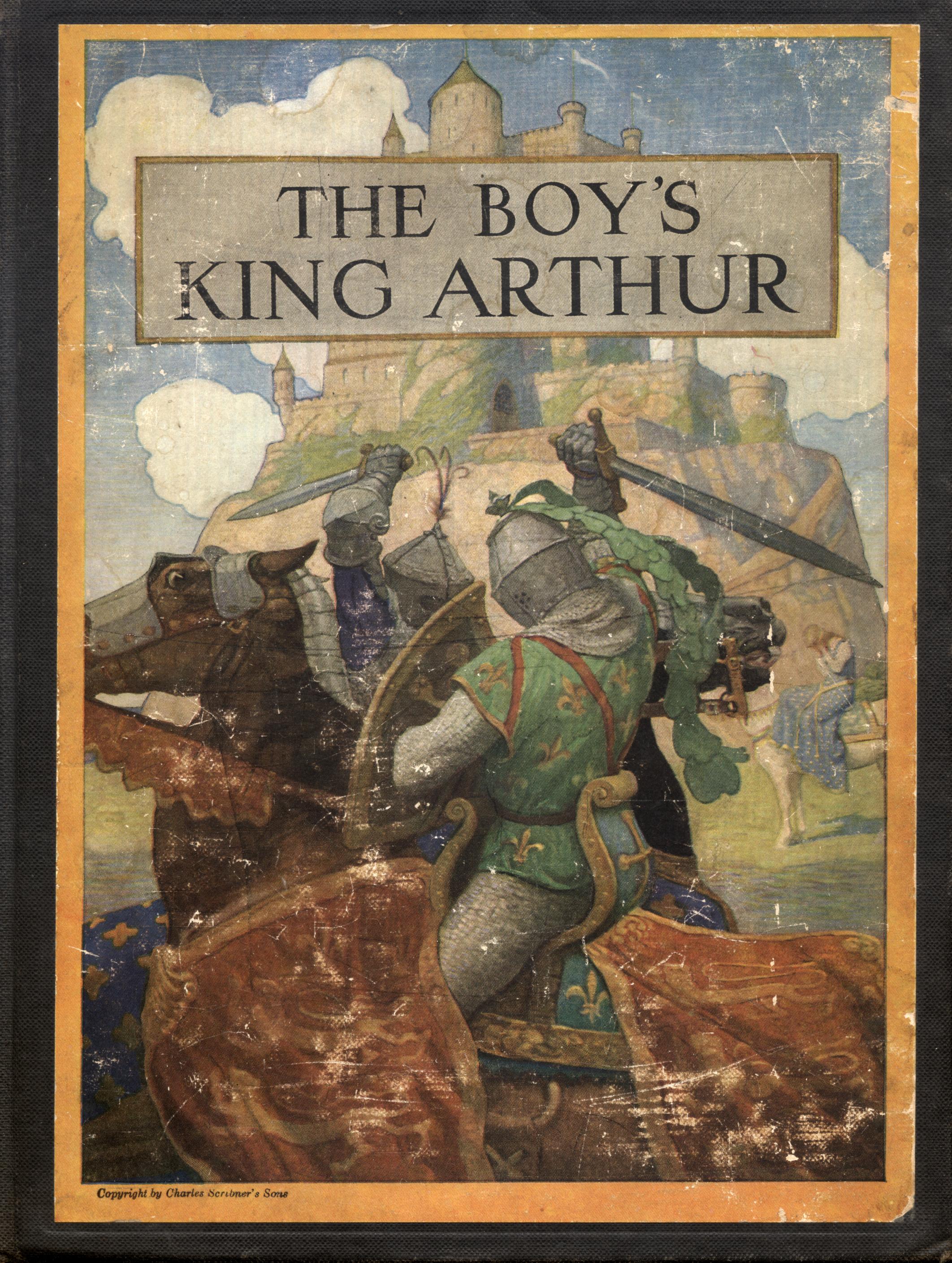
it’s not surprising that Tolkien’s works so often include swords, although perhaps the first sword he met may have been in Andrew Lang’s (1844-1912) The Red Fairy Book, 1890, where, in the last chapter, he would have found Sigurd and a, to us, strangely-familiar sword—

“ONCE upon a time there was a King in the North who had won many wars, but now he was old. Yet he took a new wife, and then another Prince, who wanted to have married her, came up against him with a great army. The old King went out and fought bravely, but at last his sword broke, and he was wounded and his men fled. But in the night, when the battle was over, his young wife came out and searched for him among the slain, and at last she found him, and asked whether he might be healed. But he said ‘ No,’ his luck was gone, his sword was broken, and he must die. And he told her that she would have a son, and that son would be a great warrior, and would avenge him on the other King, his enemy. And he bade her keep the broken pieces of the sword, to make a new sword for his son, and that blade should be called Gram.”  (“The Story of Sigurd”, 357  If you don’t have your own copy of Lang’s collection, here it is for you:  https://archive.org/details/redfairybook00langiala/redfairybook00langiala/mode/2up courtesy of the invaluable Internet Archive.  If  you don’t know this source, and you enjoy this blog, you should check it out.  It has the most remarkable things, even including a very good selection of silent films and film classics, like Kurosawa’s “The Seven Samurai”, 1954, which, for me—and for George Lucas—is a model for adventure films and you can see it here for free:  https://archive.org/details/seven-samurai-1954_202402 )

Yes, “the sword that was broken”—Anduril—and Sigurd has it reforged—and uses it to kill Fafnir, the dragon.

(This is from the “Sigurd Portal” of a  lost stave—wooden—church from Hylestad, in Norway, dating c1200AD.  Fortunately, the doorway carvings were saved and they show in detail the story of Sigurd.  Here’s where you can read more:  https://sites.pitt.edu/~dash/sigurddoor.html#location and here:  https://en.wikipedia.org/wiki/Hylestad_stave_church )

In his own life, Tolkien would have been personally familiar with swords.  When he was a member, briefly, of King Edward’s Horse,

in 1912, he would have been issued with this, the Pattern 1908 cavalry sword.

To me, it’s rather a strange weapon, seemingly designed only to stab,

whereas earlier cavalry blades might be used both to stab and to slash (very useful in chasing off enemy infantry)

Then, a new 2nd lieutenant in 1915,

JRRT would have had to buy himself the Pattern 1897 infantry officer’s sword

(as there were an increasing number of new officers from families who couldn’t afford it, there was a kind of subscription created to help such officers acquire a required piece of equipment.  For more on just what was required of officers, who had to provide their own kit, see Field Service Manual 1914, pages 16-18, here (and yes, again, it’s from the Internet Archive):  https://archive.org/details/fieldservicemanu00greauoft/page/n11/mode/2up )

These, as you can see, are straight-bladed swords, however.

Tolkien’s earliest experience with goblins was probably with George MacDonald’s (1824-1905) The Princess and the Goblin (1871/2), and he likens his own later goblins/orcs to them (see Letters, 267, 279).

The illustrations are by Arthur Hughes (1832-1915) and, as far as I can see, there’s not a bent sword among them  (If you don’t know the story, here’s the text, but without its original illustrations, alas: https://www.gutenberg.org/cache/epub/708/pg708-images.html )

If we try some Tolkien goblin illustrators, we find Justin Gerard’s version of the scene with the Great Goblin, where there are a few pole arms off to the left, but the only sword must be Orcrist.

(Justin Gerard—you can see more of his work here:  https://www.artstation.com/justingerardillustration and here:  https://www.justingerard.com/the-art-of-justin-gerard )

Here’s John Howe’s version of the scene—

with Orcrist peeking out of its scabbard and a straight sword and a couple of spears off to the left.

Then there’s Alan Lee’s, with the seemingly inevitable Orcrist, but with, just below it, perhaps a sabre—a curved sword

and we see this again in Lee’s depiction of Bilbo’s encounter with the goblin door guards.

In Michael Hague’s illustration for the escape from the Great Goblin’s throne room,

we see both Orcrist and Glamdring, along with one more seemingly curved sword.

Are any of these, however, an example of a “bent sword”?  Archaeologists have discovered numerous ancient swords which appear to have been “sacrificed” by being bent–

but this is hardly what Tolkien meant.  Then there is what might be taken literally for a “bent sword”—

from Jackson’s The Lord of the Rings, but I must say, this looks pretty improbable as a sword—if you see how the grip is shaped, that spike at the end if pointing upwards:  what could it possibly be for?  In fact, when one sees a chart of swords from the films, I’m not sure about many of them as useful weapons—

Those to the left share patterns with swords from our Middle-earth, both those on the right look like they might be dramatic over a fireplace, but I’d question their use as practical weapons.

So what might this “bent sword” be?  Some of the swords in the illustrations above would suggest that their artists believed that, by “bent”, Tolkien meant “curved”.  One possibility:  we know that Tolkien had read or had read to him at least one of Andrew Lang’s fairy books (the Red Fairy Book, as mentioned above), but perhaps he had also seen Lang’s Arabian Nights Entertainments (1898) in which there are a number of illustrations with scimitars in them—

(Here’s a copy of the book for you:  https://archive.org/details/arabiannightsent00lang/page/n9/mode/2up )

Scimitars are curved and, barring silly ones like those in Disney’s Aladdin—which look more like something used for carving meat–

are both deadly and would seem very exotic, if not alien,

in contrast to very medieval swords like Orcrist and Glamdring.

I doubt that we’ll ever know exactly what JRRT had in mind, but, if I had to illustrate “armed goblins…carrying axes and the bent swords…” I might consider drawing—in both senses—such blades.

Stay well,

Avoid inviting caves, even if Stone Giants are playing dodge ball outside,

And remember that, as always, there’s

MTCIDC

O

PS

I’ve just discovered a contemporary illustrator who clearly enjoys the dramatic style of artists like Pyle and Wyeth, as well as French historical artists, like Meissonier (1815-1891).  This is Ugo Pinson (1987-) and here is a sample of his work.

He has illustrated book covers as well as several graphic novels and done illustrations for the “Witcher” series.  His sketches alone show his skill and talent.  You can see more samples here:  https://duckduckgo.com/?q=ugo+pinson&iar=images&iai=http%3A%2F%2Fbdzoom.com%2Fwp-content%2Fuploads%2F2016%2F07%2F13427953_10154226704759687_4371726455862878086_n.jpg 

Starre-crost

25 Wednesday Jun 2025

Posted by Ollamh in Uncategorized

≈ Leave a comment

Tags

Beowulf, Bilbo, Cirdan, Dorothy, Fantasy, Gandalf, Herakles, Kansas, King Arthur, lotr, Mulan, Narya, Rings of Power, Superman, The Grey Havens, The Hobbit, The Rings of Power, Tolkien, tornado, Valar

As always, dear readers, welcome.

In adventure stories, heroes—and heroines– seem to appear in all sorts of ways.

Sometimes, it seems that they are just born for adventure, like Herakles, who,

although apparently the offspring of two mortals, Alkmene and Amphitryon, was actually the son of Zeus.

Others belong to noble families, where heroism is expected of them, like Beowulf, nephew of the king of the Geats.

(Here, meeting the Danish coastguard—but we just can’t escape those Wagnerian winged helmets, can we?)

Then there is Mulan, who, pretending to be a man, replaces her father in the army and serves valiantly for twelve years.

(As you can see from the label, this comes from a site called “Chinese Posters.net”—and it’s quite a site:  5100 propaganda posters from the Chinese past.  Here’s the address:  https://chineseposters.net/ For more on the original but probably fictional Mulan, see:  https://www.worldhistory.org/article/1596/mulan-the-legend-through-history/ and https://mulanbook.com/pages/northern-wei/ballad-of-mulan/ and https://en.m.wikisource.org/wiki/Translation:Ballad_of_Mulan –two versions of the early “Ballad of Mulan)

A common motif is that of the apparent good-for-nothing—or at least for not much—who turns out to be of heroic material.  I immediately think of King Arthur, who is, basically, a servant until he fetches that sword from the stone/anvil.

Heroes and heroines, then, can be anything from a demigod to a nobleman to a good girl who loves her father to a good-for-nothing who is more than he seems, and set out on adventures or, as in the case of Arthur, adventure finds them.

Ordinary—or seemingly ordinary—people can also be pulled into adventures, as Bilbo is.

(the Hildebrandts)

Then there are people who are literally dropped into adventures,

(WW Denslow)

sometimes beginning those adventures in a very dramatic—and ultimately decisive—way.

Dorothy, of course, has been whirled by a tornado from Kansas to Oz,

(from the 1939 film)

but, when she arrives in Oz in the film, Glinda, the Good Witch of the North

(also from the film)

sings:

“Come out, come out, wherever you are and meet the young lady

Who fell from a star.

She fell from the sky, she fell very far and Kansas, she says,

Is the name of that star.”

Not true, of course, of Dorothy, (although Kansas has its beauties, no doubt), but it is true of another hero, Superman,

who had been shipped in a rocket by his parents from the dying planet, Krypton, and discovered in a field by Ma and Pa Kent, who would become his foster parents.

If you read this blog regularly, you know that I don’t find negative reviews which are nothing but hatchet jobs

at all helpful and, in my own reviews, I try to understand what it is that the creators attempted to do and react to that, being aware, of course, that I do have my own perspective on things.  I also buy DVDs of everything I can, so that I can watch things more than once before I review. 

I’ve now seen “Rings of Power”, both seasons,

only once, so I’m not going to attempt to review the whole two seasons here.  Certainly there have been some very impressive visuals and some very good acting.  I’m not sure how I feel about the two as a whole—some of the plot I found rather confusing and I’m not sure how I feel about proto-hobbits with Irish accents, although the idea of using proto-hobbits was, I thought, pretty ingenious—but I want to end this posting by talking about Gandalf.

He first appears—like Dorothy in Oz, but even more so like the baby Superman, in a dramatic fashion, having been conveyed in which appears to be a kind of meteor which roars across the sky and slams into the earth, leaving a fiery crater.

(Thank goodness that, whoever sent him, dressed him in underpants so that he wouldn’t embarrass himself or us when he stood up.)

At first, he seems stricken and quite clueless, not even really having language at first, although certainly having great powers, and it takes two seasons for him to begin to understand himself and what he’s been sent to do and I suspect that this stricken quality comes from a hint in Christopher/JRR Tolkien’s Unfinished Tales, where, under “The Istari” we find:

“For it is said indeed that being embodied the Istari had need to learn much anew by slow experience…” (Unfinished Tales, 407)

I understand that the creators of the series were somewhat hampered in their work—should they want to be as faithful as possible to Tolkien—because they were restricted in their sources, being confined, in this case, to The Lord of the Rings and its appendices.  And, at first glance, the appearance in Middle-earth of the Istari does seem rather vague.

In Appendix B, “The Third Age”, of The Lord of the Rings, we read:

“When maybe a thousand years had passed, and the first shadow had fallen on Greenwood the Great, the Istari or Wizards appeared in Middle-earth.  It was afterwards said that they came out of the Far West and were messengers sent to contest the power of Sauron, and to unite all those who had the will to resist him…” 

No meteors are mentioned, but no other means of transport, either, yet turn the page and we then read:

“Gil-galad before he died gave his ring to Elrond; Cirdan later surrendered his to Mithrandir (aka Gandalf).  For Cirdan saw further and deeper than any other in Middle-earth, and he welcomed Mithrandir at the Grey Havens, knowing whence he came and wither he would return.”  

If you know The Lord of the Rings, you know that the Grey Havens is a seaport on the west coast of Middle-earth:  it’s where Gandalf and others, including Frodo, depart for the Uttermost West—that is, Valinor.

(Ted Nasmith and a gorgeous view)

In fact, it was the Valar who had sent the Istari in the first place, as we know from Unfinished Tales, 406:

“For with the consent of Eru they sent members of their own high order, but clad in bodies as of Men, real and not feigned…”

And thus, from the source to which I’m informed the creators were confined, they would have learned that the Istari had sailed to Middle-earth, not been shot across the sky like Dorothy or Superman.  Why make such a change, especially as, because Cirdan recognizes Gandalf’s worth, he gives him one of the original Elvish rings, Narya, which turns up on his hand in the subsequent The Lord of the Rings?

The title of this posting is a quotation from Shakespeare, from the prologue to “An EXCELLENT conceited Tragedie OF Romeo and Juliet” (as the First Quarto title page reads) in which the Prologue says of the protagonists:  “A paire of starre-crost Louers tooke their life”. 

The creators of The Rings of Power, even with evidence available to them, have veered away from that evidence with no explanation as to why they have made such a choice.  What else may they have chosen to change and how might that affect JRRT’s view of the earlier history of Middle-earth, as well as ours?

As I begin my second viewing of The Rings of Power, then, I’ll be curious to see if another Shakespeare quotation, this from “The Tragedie of Julius Caesar”, Act 1, Scene 1, when Cassius, the leader of the plot against Julius Caesar, is trying to persuade Brutus to join him, may apply to the creators and their work:

“The fault (deere Brutus) is not in our Starres,

But in our Selues…”

Thanks, as always, for reading.

Stay well,

Think about what Cassius is telling us about horoscopes,

And remember that, as always, there’s

MTCIDC

O

To Horse!

18 Wednesday Jun 2025

Posted by Ollamh in Uncategorized

≈ Leave a comment

Tags

Agincourt, bicycle, Boer War, cavalry charges, Charge of the Light Brigade, Cu Chulainn, Dwarves, Fredegunda, Gregory of Tours, heavy artillery, Historia Francorum, Hobbits, horses, King Edward's Horse, lotr, machine gun, machine-guns, Nazgul, Normans, Pegasus, Rohirrim, Russian Civil War, signals officer, Sleipnir, The Hobbit, Tolkien, Valkyries

In a colleague’s office, I once saw this on his wall—

“Proletariat, to horse!”

It’s a recruiting poster from the Russian civil war (1918-1922), showing the Reds trying to raise cavalry for their armies, but, at the time this call came, the military world was changing and, although horsemen would still appear, very sporadically, on battlefields, for some years to come, the day of events like this—

was rapidly coming to a close.

It didn’t happen all at once, however.  As you can imagine, traditional cavalrymen—those who believed that swinging a sword in a valiant charge was the point of cavalry—

fought back.  The evidence was against them, however, in two ways.

First, in the case of the British, there had been the Boers,

with whom the British had fought a war, from 1899-1902.  The Boers (Dutch for “farmers”) had been militia—men obliged by law to defend the state upon demand.  Across the wide open spaces of so much of South Africa, they had fought as mounted infantry, using horses as a means of moving from place to place, then dismounting for combat and, if things didn’t go their way, mounting up and escaping.

To counter this, especially in the later phases of the war, the British were forced to develop their own mounted infantry,

which suggested to some military theorists at the time that the wave of the future was not in sword-swingers, but in riflemen, who could rapidly move to where they were needed, but employ horses for transport, not for gallant charges.  (This also led to the rise of units mounted entirely on bicycles,

but we can imagine the off-road difficulties for early machines and, although there were bicycle units as late as WW2, they never had the popularity—or the dash—of horsemen.)

The second piece of evidence lies in technological change. 

With the coming of the 20th century, machine guns, sometimes firing as many as 600 rounds (shots) per minute,

appeared in increasing numbers and artillery was developed to become more accurate at greater distances.

In self-defense, soldiers would be forced to take cover wherever they could,

at first in holes simply scraped out of the ground, but, in time, in very sophisticated lines, shored up with wood and metal and sandbags.

On the Western Front, where everyone was dug into the ground, and being in the open could mean instant destruction, there simply wasn’t a place for old-fashioned cavalry, for all that there were still lots of old-fashioned cavalrymen in the army—like the first commander of the British in France in 1914, Sir John French.

Imagine, then, that this was all happening when Tolkien was very young—when the Boer War ended, in 1902, for instance, he would have been only 10.

(JRRT and his brother, Hillary, in 1905)

His own military career had begun at King Edward’s School in Birmingham, when he entered the new Cadet Corps in 1907.

(For more, see this essay by John Garth: https://johngarth.wordpress.com/2014/03/05/tolkien-at-fifteen-a-warrior-to-be/ )

Then, in the summer of 1912, he was briefly a member of a territorial (a sort of national guard unit) cavalry regiment, King Edward’s Horse.  (The reference here is to Carpenter’s J.R.R.Tolkien, 66.  John Garth later added detail to this, but subsequently qualified it, saying that his evidence was faulty.  See:  https://oxfordinklings.blogspot.com/2009/06/tolkien-and-horses.html )

(Officers of the regiment about 1916)

It was clearly an indication of the drop in the use of cavalry, however, when JRRT began his second enlistment not in a cavalry, but an infantry regiment, the Lancashire Fusiliers, in which he was commissioned as a 2nd Lieutenant in 1915.

In his brief battlefield career, he was the signals officer for his battalion, the 11th.  In the advance into the Somme in July, 1916, Tolkien, although armed with a revolver,

would have been too busy to do any fighting as his work involved

“More code, flag and disc signaling, the transmission of messages by heliograph and lamp, the use of signal rockets and field-telephones, even how to handle carrier pigeons…” (Carpenter, 86)

To ask for reinforcements, as well as to avoid artillery fire which could be called in to fend off German counterattacks, but which might hit friendly troops instead, it was extremely necessary for attacking units to let their positions and situations be known as often as possible, so JRRT would have been more than a little occupied during the months (1 July-18 November, 1916) of the very costly (nearly 58,000 British casualties the first day alone) offensive.  Fortunately for him—and for us—he fell ill with so-called “trench fever” and left France for good early in November, going home to England and, ultimately, to Middle-earth.

Although his military service in the field was relatively brief, and his career with cavalry even briefer (he resigned from King Edward’s Horse in January, 1913), we see horses everywhere in Middle-earth, from the ponies of the dwarves in The Hobbit

(from Painting Valley—no artist listed)

to the horses of the Nazgul in The Lord of the Rings.

(with the Gaffer, one of my favorite illustrations by Denis Gordeev)

But, although cavalry might have been only a brief flirtation for Tolkien, horses had been part of his life since its beginnings.  Part of this would have been mundane—it was only after the Great War that the internal combustion engine really began to dominate the streets.  When JRRT was young, Birmingham and London, as well as Berlin, Paris, and New York, would have looked like this—

His early reading would have given him Bellerophon on Pegasus,

to which would have been added the Valkyries,

and, in time, Sleipnir, Odin’s 8-legged steed,

(This is the Tjaengvide image stone, one of a group of runic stones, called the “Sigurd stones”, found in Sweden and dated to between 700 and 1100AD.  You can read more about it here:  https://en.wikipedia.org/wiki/Tj%C3%A4ngvide_image_stone You can read about the other stones here:  https://en.wikipedia.org/wiki/Sigurd_stones  Tolkien would first have heard about Sigurd from Andrew Lang’s The Red Fairy Book, 1890, which you can find here:   https://archive.org/details/redfairybook00langiala/redfairybook00langiala/mode/2up  Sigurd himself possessed the offspring of Sleipnir, Grani, which you can read about here:  https://en.wikipedia.org/wiki/Grani )

and further medieval reading would have filled his mind with mythic and magic horses, like Cu Chulainn, the Irish hero’s, chariot pair, water horses named Liath Macha and Dub Sainglend (although he wasn’t very enthusiastic about Old Irish literature which, I suspect, he found much wilder and stranger and more disturbing than, say, the Welsh Mabinogion, which you can read about here:    https://en.wikipedia.org/wiki/Mabinogion )

(a rather over-the-top image by the usually dependable Angus McBride—someone should have mentioned to him that, although “Dub” means “black”, Liath means “grey”.  Cu Chulainn is one of my favorite ancient berserkers—to mix cultures—and, if you don’t know him, you can begin to read about him here:  https://en.wikipedia.org/wiki/C%C3%BA_Chulainn )

But there are magical horses in many places—see https://en.wikipedia.org/wiki/List_of_horses_in_mythology_and_folklore for many more, with at least many of the medieval, he would have been familiar. 

And while we’re speaking of Middle-earth and horses, we need to mention the Normans, who, combined with the Anglo-Saxons for language, were the basis of the Rohirrim–

“The Rohirrim were not ‘medieval’ in our sense.  The styles of the Bayeux Tapestry…fit them well enough…” (letter to Rhona Beare, 14 October, 1958, Letters, 401)

The Rohirrim, in turn, lead us back to the opening of this posting.  Although, in Tolkien’s day, cavalry and glorious charges,

like that of the British Light Brigade at Balaclava in 1854, commemorated in Tennyson’s poem, were almost at the end of their military usefulness, for a Romantic, like Tolkien, the idea of such a charge was still a powerful image and one he couldn’t resist, depicting the heroic Rohirrim assembling

(from the Jackson film)

and roaring down on the unsuspecting orcs. 

(Abe Papakhian)

JRRT was writing medieval fantasy, however, but, as I’m always interested in “what if’s”, here I’m remembering what actually happened to that Light Brigade charge, an attack made in the teeth of Russia artillery.

The consequence was that, out of 609 men who rode towards the Russians, only 198 returned, and Lady Butler’s picture, “Balaclava the Return 25 October 1854” (1911) sums up the actual aftermath of that charge.

There’s evidence in the destruction of the Causeway Forts that Sauron’s army had some sort of blasting powder—suppose, instead of using it just as a siege tool, it had been employed with some sort of projectile propelled by it out of a tube—what might that have done to the Rohirrim’s valiant attack? 

Or even using the technique of the English army against the French at Agincourt, in our medieval world of 1415AD:  pointed stakes to threaten horses, behind which stood massed bowmen:  what would have been the outcome of that?

(Angus Mcbride)

475 horses were lost in the Charge of the Light Brigade.  Military progress so often just means more killing, but the replacement of horses with machines seems to me, who loves horses, a turn for the better.   At the same time, with Tolkien, I can feel the attraction for wild charges with swords at top speed (although cavalry did better when, at most, it went in at the canter—galloping causes loss of formation which can blunt the effect of such an attack), but, as in the charge of the Rohirrim, I’m glad if they only appear in fiction—and far from modern weaponry.

Thanks, as ever, for reading,

Stay well,

Remember that there’s a special spot, just behind the poll (top of the head), which, if scratched in the right place, makes many horses happy,

And remember, as well, that there’s always

MTCIDC

O

PS

One of those little “what if” quirks of history–Tolkien’s immediate family had been in the Orange Free State at the time of his birth, in 1892.  Tolkien’s father, Arthur, was manager of the Bloemfontein branch there of the Bank of Africa.  The Orange Free State was one of the Boer republics attacked by Britain in the Boer War of 1899-1902. If Tolkien’s mother hadn’t brought JRRT and his brother, Hilary, back to England, in 1895, and Arthur hadn’t died of the effects of rheumatic fever in 1896,

Tolkien might have been in the Orange Free State when Bloemfontein was occupied by the British on 13 March, 1900.  (You can see early film of the Scots Guards marching in here:  https://www.youtube.com/watch?v=DHy2cEFwlIo )

PPS

In last week’s posting, I mentioned the story of the wonderfully bloodthirsty Frankish queen Fredegunda, as she appears in Gregory of Tours Historia Francorum.  I wrote there that you might read about her assassination of Bishop Praetextatus and her cold-blooded visit to him on his deathbed afterwards—but it required reading Gregory’s 6th-century Latin, as I didn’t provide a translation.  It seemed lazy of me not to include one of that scene, however, so here it is with the original Latin.  As always, I could smooth this out, but I prefer to stick as close as I can to the text, to give you a better feel for what’s actually been written.

Advenientem autem dominicae resurrectionis diae, cum sacerdos ad implenda aeclesiastica officia ad aeclesiam maturius properasset, antefanas iuxta consuetudinem incipere per ordinem coepit. Cumque inter psallendum formolae decumberet, crudelis adfuit homicida, qui episcopum super formolam quiescentem, extracto baltei cultro, sub ascella percutit. Ille vero vocem emittens, ut clerici qui aderant adiuvarent, nullius ope de tantis adstantibus est adiutus. At ille plenas sanguine manus super altarium extendens, orationem fundens et Deo gratias agens, in cubiculo suo inter manus fidelium deportatus et in suo lectulo collocatus est. Statimque Fredegundis cum Beppoleno duce et Ansovaldo adfuit, dicens: ‘Non oportuerat haec nobis ac reliquae plebi tuae, o sancte sacerdos, ut ista tuo cultui evenirent. Sed utinam indicaretur, qui talia ausus est perpetrare, ut digna pro hoc scelere supplicia susteneret’. Sciens autem ea sacerdos haec dolose proferre, ait: ‘Et quis haec fecit nisi his, qui reges interemit, qui saepius sanguinem innocentem effudit, qui diversa in hoc regno mala commisit?’ Respondit mulier: ‘Sunt aput nos peritissimi medici, qui hunc vulnere medere possint. Permitte, ut accedant ad te’. Et ille: ‘Iam’, inquid, ‘me Deus praecepit de hoc mundo vocare. Nam tu, qui his sceleribus princeps inventa es, eris maledicta in saeculo, et erit Deus ultur sanguinis mei de capite tuo’. Cumque illa discederit, pontifex, ordinata domo sua, spiritum exalavit. 

“However, with the coming of the day of [Our] Lord’s resurrection, when the priest [Praetextatus] had hurried early to the church to fulfill [his] ecclesiastical duties, he started to begin [the] antiphons according to custom [in their proper] order.  And when, between the psalms, he was lying on a bench, a cruel murderer appeared, who, when a knife had been pulled from [his] belt, struck the bishop, resting on the bench, under the armpit.  He [the bishop], however, [although] shouting so that the clergy who were present might help him, was aided with help of none from so many being present.  Yet he, stretching his hands, full of blood, above the altar, pouring [out] a prayer and thanking God, was carried off into his bedchamber by the hands of [his] faithful [followers] and placed on his bed.  And straightaway Fredegunda, with the Duke Beppolenus and Ansovaldus, appeared, saying, ‘Oh holy priest, this was not right for us and for the rest of your people that such things should happen in your worshipping.  But would that it would be revealed who had dared to carry out such things that he should suffer punishment worthy of this crime.’  The priest, knowing, however, that she was speaking of these things deceptively, said, ‘And who has done these things if not [the one] who has killed kings, who very often has poured out innocent blood, who has committed many evil deeds in this kingdom’  The woman replied:  ‘There are in our household highly experienced doctors who would be able to heal this wound.  Allow [it] that they may come to you.’  And he [said]:    ‘God has decreed to call me from this world.  On the other hand, you who have been exposed as chief in these crimes, you will be cursed in the future and God will be the avenger of my blood on your head.’  And when she had left, the bishop, affairs arranged in his house, breathed out his spirit.”

And how could I not include Alma-Tadema’s illustration?

← Older posts
Newer posts →

The Doubtful Sea Series Facebook Page

The Doubtful Sea Series Facebook Page

  • Ollamh

Categories

  • Artists and Illustrators
  • Economics in Middle-earth
  • Fairy Tales and Myths
  • Films and Music
  • Games
  • Heroes
  • Imaginary History
  • J.R.R. Tolkien
  • Language
  • Literary History
  • Maps
  • Medieval Russia
  • Military History
  • Military History of Middle-earth
  • Narnia
  • Narrative Methods
  • Poetry
  • Research
  • Star Wars
  • Terra Australis
  • The Rohirrim
  • Theatre and Performance
  • Tolkien
  • Uncategorized
  • Villains
  • Writing as Collaborators
Follow doubtfulsea on WordPress.com

Across the Doubtful Sea

Recent Postings

  • Through a glass… January 7, 2026
  • Heffalumps? December 31, 2025
  • We Three Kings December 24, 2025
  • A Moon disfigured December 17, 2025
  • On the Roads Again—Once More December 10, 2025
  • (Not) Crossing Bridges December 3, 2025
  • On the Road(s) Again—Again November 26, 2025
  • On the Road(s) Again November 19, 2025
  • To Bree (Part 2) November 12, 2025

Blog Statistics

  • 104,209 Views

Posting Archive

  • January 2026 (1)
  • December 2025 (5)
  • November 2025 (4)
  • October 2025 (5)
  • September 2025 (4)
  • August 2025 (4)
  • July 2025 (5)
  • June 2025 (4)
  • May 2025 (4)
  • April 2025 (5)
  • March 2025 (4)
  • February 2025 (4)
  • January 2025 (5)
  • December 2024 (4)
  • November 2024 (4)
  • October 2024 (5)
  • September 2024 (4)
  • August 2024 (4)
  • July 2024 (5)
  • June 2024 (4)
  • May 2024 (5)
  • April 2024 (4)
  • March 2024 (4)
  • February 2024 (4)
  • January 2024 (5)
  • December 2023 (4)
  • November 2023 (5)
  • October 2023 (4)
  • September 2023 (4)
  • August 2023 (5)
  • July 2023 (4)
  • June 2023 (4)
  • May 2023 (5)
  • April 2023 (4)
  • March 2023 (5)
  • February 2023 (4)
  • January 2023 (4)
  • December 2022 (4)
  • November 2022 (5)
  • October 2022 (4)
  • September 2022 (4)
  • August 2022 (5)
  • July 2022 (4)
  • June 2022 (5)
  • May 2022 (4)
  • April 2022 (4)
  • March 2022 (5)
  • February 2022 (4)
  • January 2022 (4)
  • December 2021 (5)
  • November 2021 (4)
  • October 2021 (4)
  • September 2021 (5)
  • August 2021 (4)
  • July 2021 (4)
  • June 2021 (5)
  • May 2021 (4)
  • April 2021 (4)
  • March 2021 (5)
  • February 2021 (4)
  • January 2021 (4)
  • December 2020 (5)
  • November 2020 (4)
  • October 2020 (4)
  • September 2020 (5)
  • August 2020 (4)
  • July 2020 (5)
  • June 2020 (4)
  • May 2020 (4)
  • April 2020 (5)
  • March 2020 (4)
  • February 2020 (4)
  • January 2020 (6)
  • December 2019 (4)
  • November 2019 (4)
  • October 2019 (5)
  • September 2019 (4)
  • August 2019 (4)
  • July 2019 (5)
  • June 2019 (4)
  • May 2019 (5)
  • April 2019 (4)
  • March 2019 (4)
  • February 2019 (4)
  • January 2019 (5)
  • December 2018 (4)
  • November 2018 (4)
  • October 2018 (5)
  • September 2018 (4)
  • August 2018 (5)
  • July 2018 (4)
  • June 2018 (4)
  • May 2018 (5)
  • April 2018 (4)
  • March 2018 (4)
  • February 2018 (4)
  • January 2018 (5)
  • December 2017 (4)
  • November 2017 (4)
  • October 2017 (4)
  • September 2017 (4)
  • August 2017 (5)
  • July 2017 (4)
  • June 2017 (4)
  • May 2017 (5)
  • April 2017 (4)
  • March 2017 (5)
  • February 2017 (4)
  • January 2017 (4)
  • December 2016 (4)
  • November 2016 (5)
  • October 2016 (6)
  • September 2016 (5)
  • August 2016 (5)
  • July 2016 (5)
  • June 2016 (5)
  • May 2016 (4)
  • April 2016 (4)
  • March 2016 (5)
  • February 2016 (4)
  • January 2016 (4)
  • December 2015 (5)
  • November 2015 (5)
  • October 2015 (4)
  • September 2015 (5)
  • August 2015 (4)
  • July 2015 (5)
  • June 2015 (5)
  • May 2015 (4)
  • April 2015 (3)
  • March 2015 (4)
  • February 2015 (4)
  • January 2015 (4)
  • December 2014 (5)
  • November 2014 (4)
  • October 2014 (6)
  • September 2014 (1)

Blog at WordPress.com.

  • Subscribe Subscribed
    • doubtfulsea
    • Join 78 other subscribers
    • Already have a WordPress.com account? Log in now.
    • doubtfulsea
    • Subscribe Subscribed
    • Sign up
    • Log in
    • Report this content
    • View site in Reader
    • Manage subscriptions
    • Collapse this bar
 

Loading Comments...