• About

doubtfulsea

~ adventure fantasy

Tag Archives: The Reluctant Dragon

Why a Dragon?

28 Wednesday May 2025

Posted by Ollamh in Uncategorized

≈ Leave a comment

Tags

Beowulf, Bilbo, bilbo-burglar, Dragons, Dwarves, Fafnir, Fantasy, Hippogriff, Hoard, Marx Brothers, quest, Sigurd, Smaug, The Hobbit, The Reluctant Dragon, Thorin, Tolkien

As always, dear readers, welcome.

I think that I’ve always been a fan of the Marx brothers.

Their lack of respect for pompous men in silk hats,

opera-goers who are only interested because it gives them social status,

and self-important artists,

among many others, and their creative methods of deflating such people,

have always cheered me immensely.

There is another side to their comedy, however, which means just as much to me:  their endless play with words, delivered always deadpan and with perfect timing—not to mention absolute absurdist nonsequiturism.

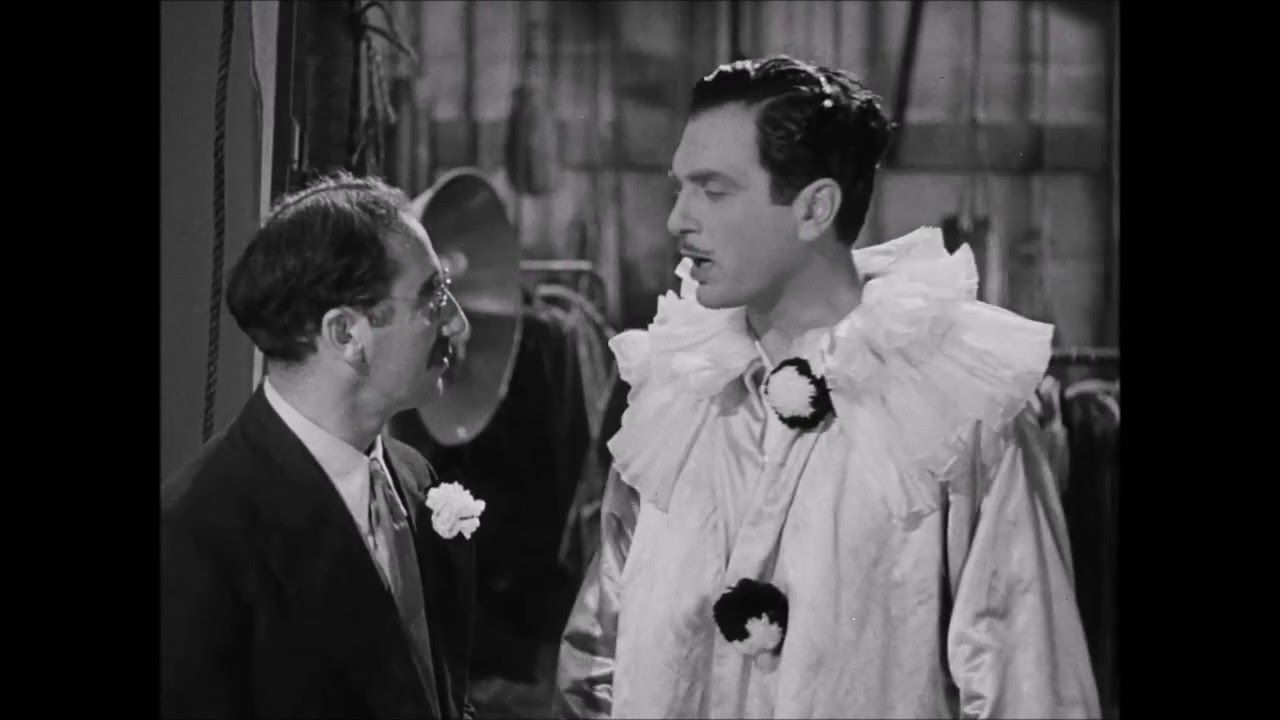
Take, for example, this fragment from The Cocoanuts, their first surviving film, from 1929.  It’s set during the 1920s Florida land boom (read about that here:  https://en.wikipedia.org/wiki/Florida_land_boom_of_the_1920s ) and, in this scene, “Mr. Hammer”, Groucho, is explaining the layout of a real estate plot to “Chico”, Chico,

saying, at one point:

“Groucho:   Now, here is a little peninsula, and, eh, here is a viaduct leading over to the mainland.

Chico:  Why a duck?

Groucho:  I’m all right, how are you?  I say, here is a little peninsula, and here is a viaduct leading over to the mainland.

Chico:   All right, why a duck?

Groucho:  I’m not playing ‘Ask Me Another’, I say that’s a viaduct.

[Ask Me Another was originally an early 1927 equivalent of “Trivia”.  You can read about it here:  https://www.thefedoralounge.com/threads/how-do-you-play-ask-me-another.62135/ and here’s a copy—

Chico:  All right!  It’s what…why a duck?  Why no a chicken?

Groucho:  I don’t know why no a chicken—I’m a stranger here myself.  All I know is that it’s a viaduct.  You try to cross over there a chicken and you’ll find out why a duck.”

(For the entire script see:  https://www.marx-brothers.org/marxology/cocoanuts-script.htm )

By the same kind of logic which produced this, I found myself thinking about The Hobbit:  and hence the title of this posting:  why a dragon?

The plot of The Hobbit is, basically, a quest:  a journey with a goal.

Quests are a familiar form of adventure story and still common—just think about Indiana Jones, with his Lost Ark

and his Holy Grail, for example.

Indiana has to travel to Tibet and Egypt and to an unnamed island in the Mediterranean for the Ark and to Germany and Turkey for the Grail.

Although Thorin doesn’t mention the travel in his “mission statement”, much of the story will be about travel, from the Shire to the Lonely Mountain and back again,

to reach the dwarves’ goal, as stated in the first chapter by Thorin:

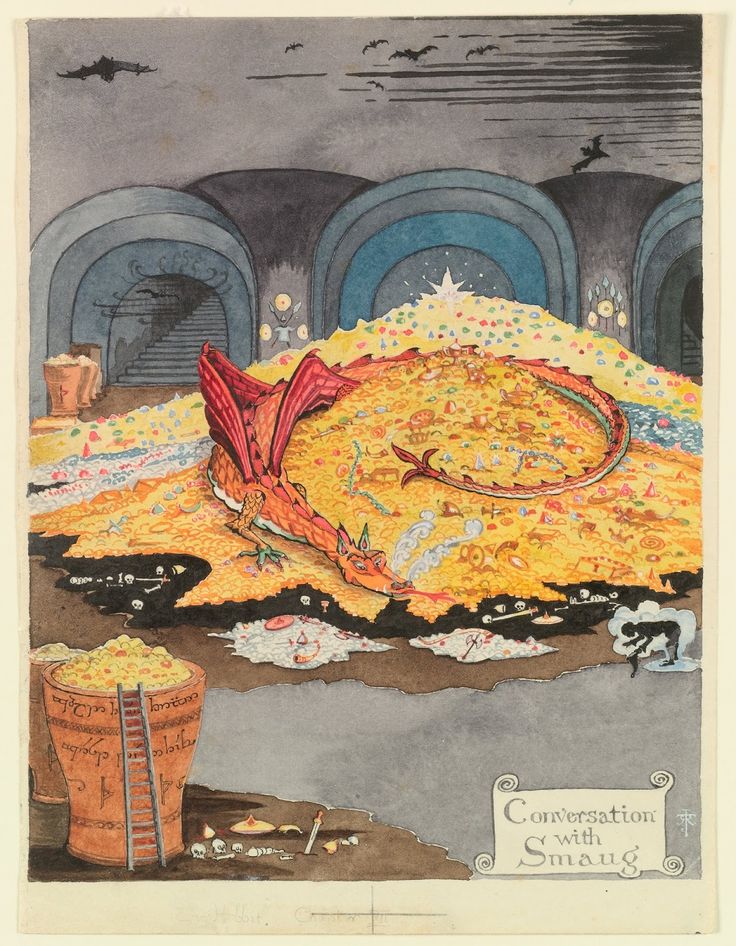
“But we have never forgotten our stolen treasure.  And even now, when I will allow we have a good bit laid by and are not so badly off…we still mean to get it back, and to bring our curses home to Smaug—if we can.”  (The Hobbit, Chapter 1, “An Unexpected Party”)

The goal, then, is in two parts:

1. to regain the treasure taken from the dwarves by the dragon

2. to take revenge upon said dragon

Because they are aware that the dragon can be lying on top of the treasure (“Probably”, says Thorin, “for that is the dragons’ way, he has piled it all up in a great heap far inside, and sleeps on it for a bed.”), it’s clear that 1 and 2 have to be dealt with as a sequence:  no getting the treasure without getting rid of the dragon.

Which brings us back to my title.  Indiana Jones commonly has Nazis (and eventually Communists and even Neo-Nazis) as opponents,

these being the characters who compete for his goal and stand in the way of his achieving his quest. 

Tolkien was a medievalist, writing a sort of fairy tale, so what would be his equivalent and why?

 We know that Tolkien had been interested in dragons since far childhood—at least the age of 6, when he tried to write a poem about a “green, great dragon” (to the Houghton Mifflin Company [summer, 1955?], Letters, 321—JRRT tells a somewhat different version of this to W.H. Auden in a letter of 7 June, 1955, Letters, 313) and he confesses to an early love for them in his lecture “On Fairy-Stories” where he mentions Fafnir and Sigurd, suggesting that he may have had read to him or had read for himself from Andrew Lang’s The Red Fairy Book, 1890, the last chapter of which is “The Story of Sigurd”, and since, elsewhere, he mentions “Soria Moria Castle”, which is the third story in the same book.

(Your copy is here:  https://archive.org/details/redfairybook00langiala/redfairybook00langiala/ )

Fafnir, the dragon in the Sigurd story, is described as, having killed his own father:

“he went and wallowed on the gold…and no man dared go near it.”  (“The Story of Sigurd”, 360)

The next major dragon story with which Tolkien was probably involved saw the same draconic behavior, as, in Beowulf, we’re told that the unnamed dragon, having discovered a hoard in a tumulus:

“This hoarded loveliness did the old despoiler wandering

in the gloom find standing unprotected, even he who filled

with fire seeks out mounds (of burial), the naked dragon of

1915

fell heart that flies wrapped about in flame: him do earth’s

dwellers greatly dread. Treasure in the ground it is ever his

wont to seize, and there wise with many years he guards the

heathen gold – no whit doth it profit him.”

(from JRRT’s draft translation of 1920-26 in Christopher Tolkien’s 2014 publication)

Traditionally, then, dragons and gold go together—and, as JRRT admitted in a letter to the Editor of the Observer, “Beowulf is among my most valued sources” (letter to the Editor of the Observer, printed in the Observer, 28 February, 1938, Letters, 41)

There is a very interesting twist in Tolkien’s version of the story, however.

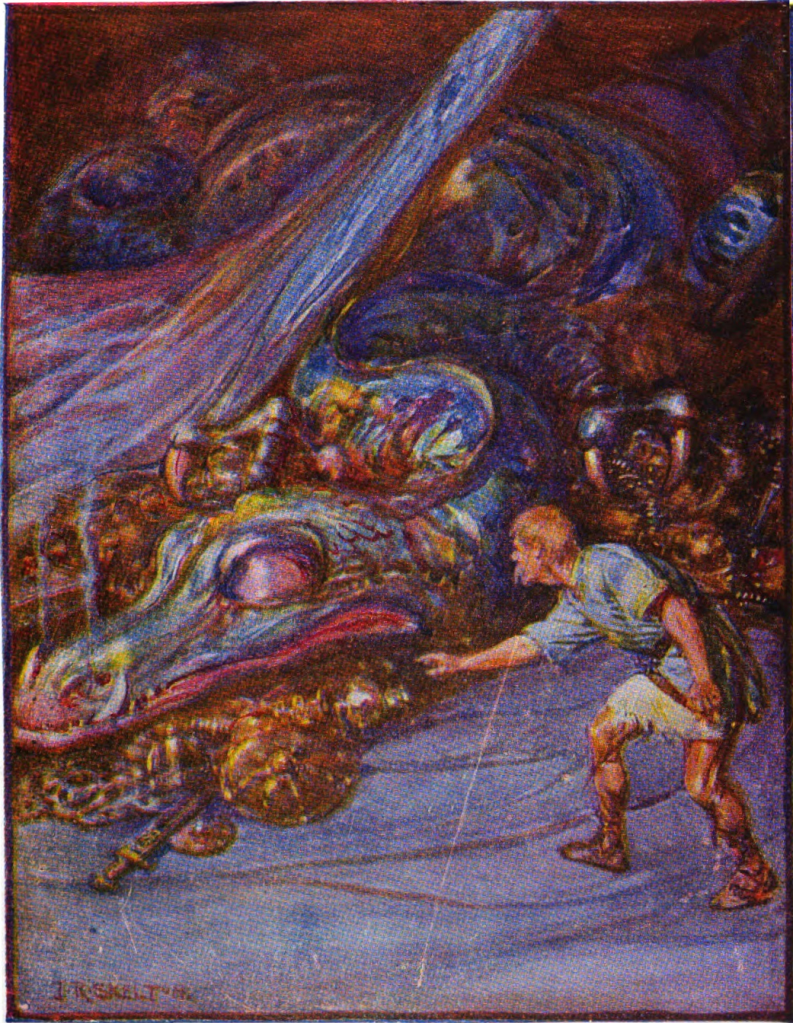
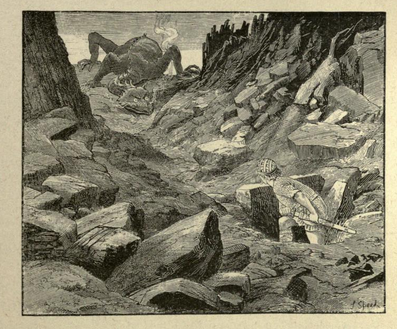
By lying in a pit below the dragon, Sigurd slays Fafnir

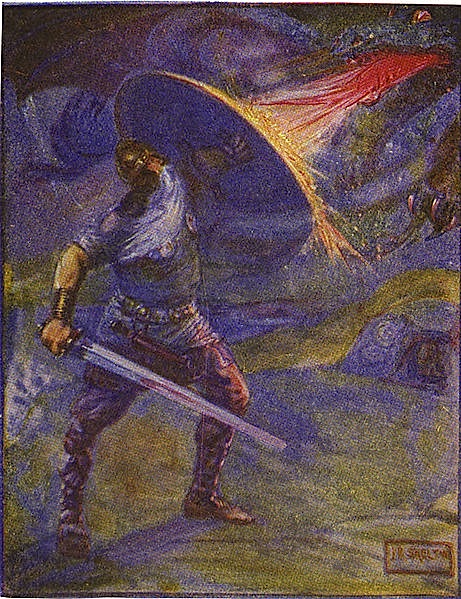
and Beowulf, along with his companion (and successor), Wiglaf, make an end of the nameless dragon,

Beowulf fighting against a dragon. Scene from the early medieval epic poem “Beowulf”. It is one of the most important works of Old English literature and was probably created after the year 700 and plays in the time before 600 AD in Scandinavia. Chromolithograph after drawing by Walter Zweigle (German painter, 1859 – 1904), published in 1896.

(This is a pretty silly version, with costumes and armor which look like they came from the original production of Der Ring des Nibelungen, but finding a depiction of the two attacking the dragon has seemed surprisingly difficult.)

but, in The Hobbit, although we have the traditional dragon on the traditional hoard, we don’t have the traditional dragon-slayer, a fact underlined by Thorin’s “to bring our curses home to Smaug, if we can”.

This has always struck me as the potential weak point in the quest:  to travel hundreds of miles through dangerous territory filled with trolls, goblins, wolves, hostile elves, and even giant spiders, to come to a mountain inhabited by a fearsome dragon—but to have no plan in mind as to how to deal with it, especially when the other half of the plan—to get back the dwarvish treasure—requires somehow eliminating the current guardian of that treasure.

(JRRT)

Faced with that possible weak point, so much now may appear to have a certain haphazard happenstance about it, the kind of attempted slight-of-hand which indicates an author who hasn’t the skill to create a narrative in which every element seems to fall naturally into place, and this might make us question the finding of the Ring, the convenient rescue at Lake-town, even the ray of sun which indicates the opening to the back door of the Lonely Mountain (suppose it had been overcast).

But this is where the burglar comes in—and the story of Sigurd once more.

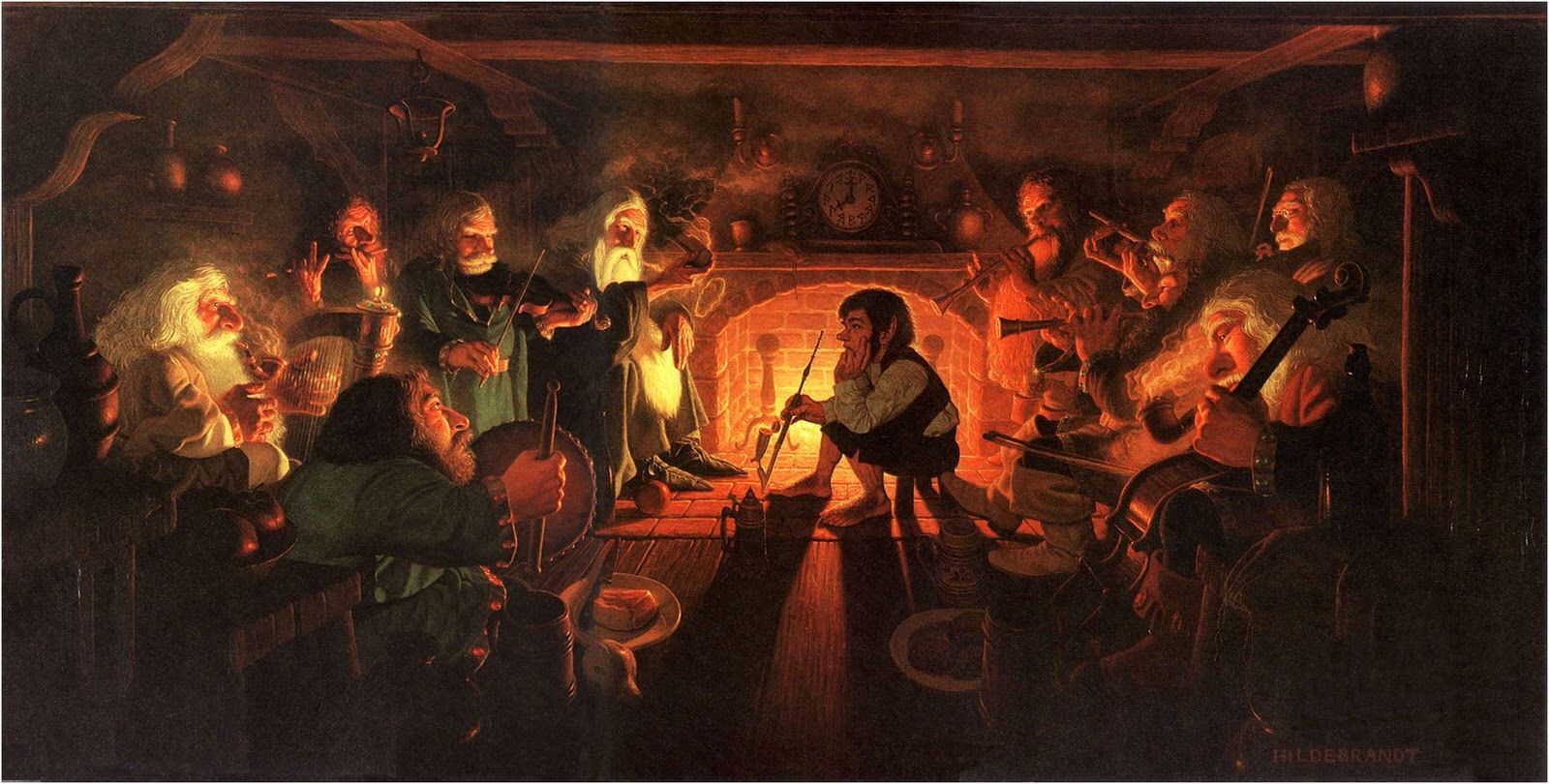
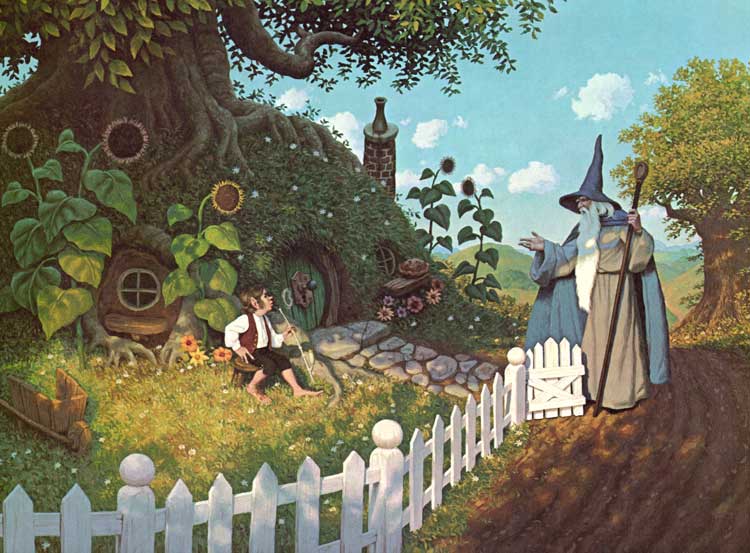
It seems that Bilbo was not Gandalf’s first choice for the quest when he came to visit him.

(the Hildebrandts)

Thorin has just mentioned the inconvenient dragon and the awkwardness of his sudden appearance, to which Gandalf replies:

“That would be no good…not without a mighty Warrior, even a Hero.  I tried to find one; but warriors are busy fighting one another in distant lands, and in this neighbourhood heroes are scarce, or simply not to be found.”

And he continues:

“That is why I settled on burglary—especially when I remembered the existence of a Side-door.  And here is our little Bilbo Baggins, the burglar, the chosen and selected burglar.”

Bilbo’s first attempt at burglary:  picking a troll’s pocket,

(JRRT)

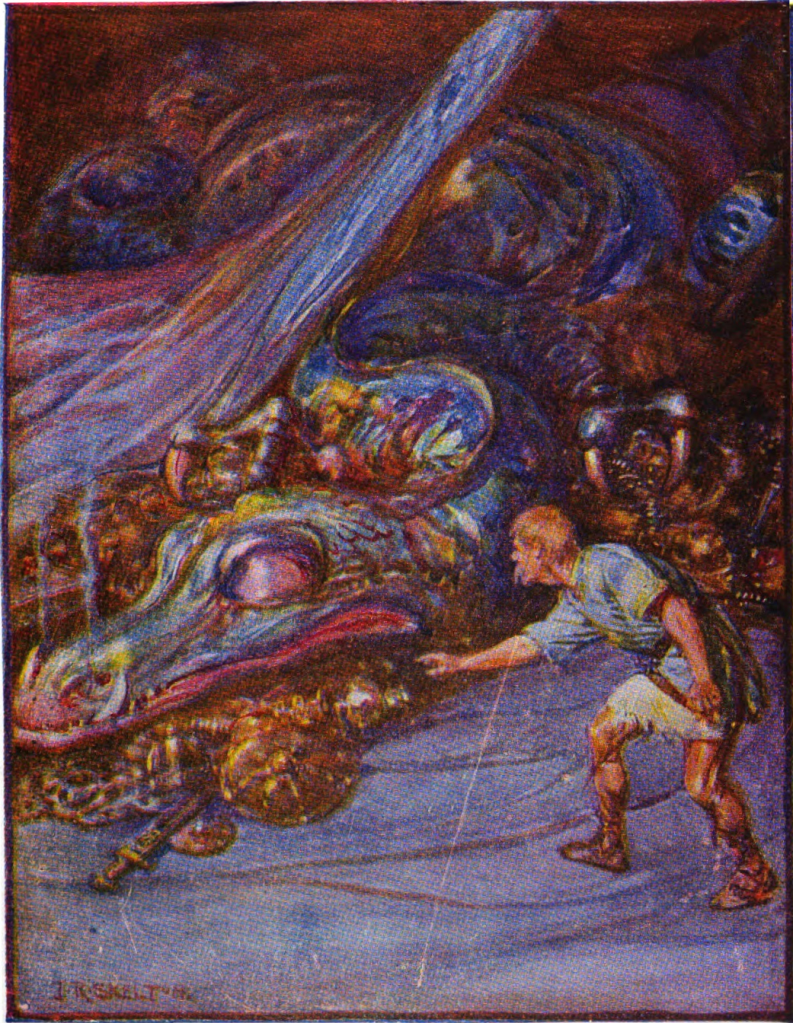
almost ends in disaster, but, with the eventual aid of the Ring, he even manages, first, to steal from Smaug, in a direct echo of Beowulf,

(artist?  So far, I haven’t seen one credited.)

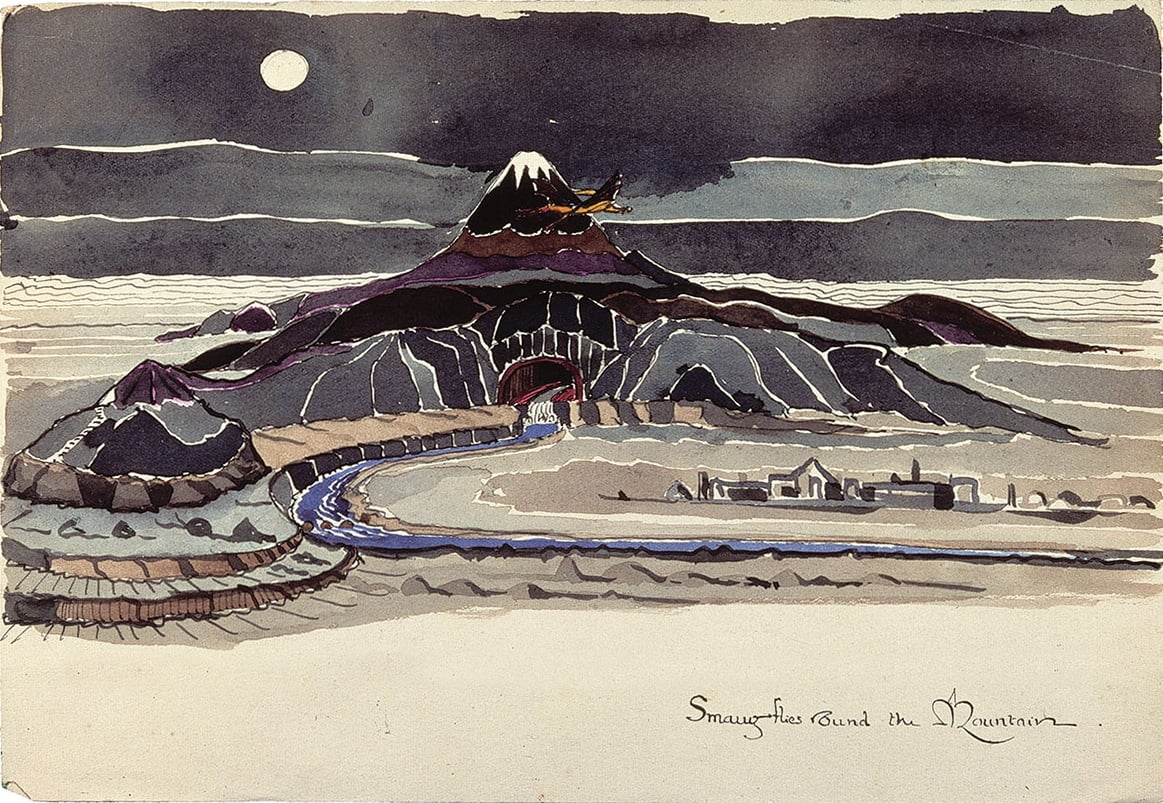
and then to confront Smaug in his lair and escape, at worst, with only a singeing. 

(JRRT)

So far, it’s been burglary, with some help from the Ring, but then the Sigurd story comes in.

You’ll remember that, although the version in The Red Fairy Book doesn’t say so, it was clear that the vulnerable part of the dragon Fafnir was its underside, which is why Sigurd hid in a pit so that, when the dragon crawled over it, Sigurd could stab him in that unprotected underbelly. 

Using his burglarious skills, as well as a fluent tongue, Bilbo actually persuades Smaug unknowingly to expose his own vulnerability:

“ ‘I have always understood…that dragons were softer underneath, especially in the region of the—er—chest; but doubtless one so fortified has thought of that.’

The dragon stopped short in his boasting.  ‘Your information is antiquated,’ he snapped.  ‘I am armoured above and below with iron scales and hard gems.  No blade can pierce me.’”

And the smooth-tongued burglar actually flatters Smaug into rolling over, exposing “…a large patch in the hollow of his left breast as bare as a snail out of its shell”.

What to do with this potentially deadly piece of information requires the reverse of the Sigurd story.

In that story, Sigurd, having killed Fafnir, has been asked by his mentor, Regin, to roast the dragon’s heart and serve it to him.  In the process, Sigurd burns a finger, puts it in his mouth, and suddenly understands that all of the birds above him are talking about him and telling him to beware of Regin.

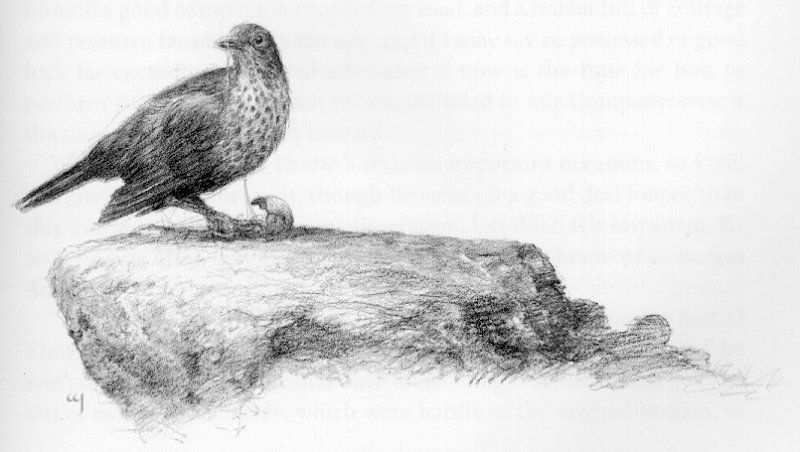
In The Hobbit, the opposite happens:  the thrush who had tapped the snail

(Alan Lee)

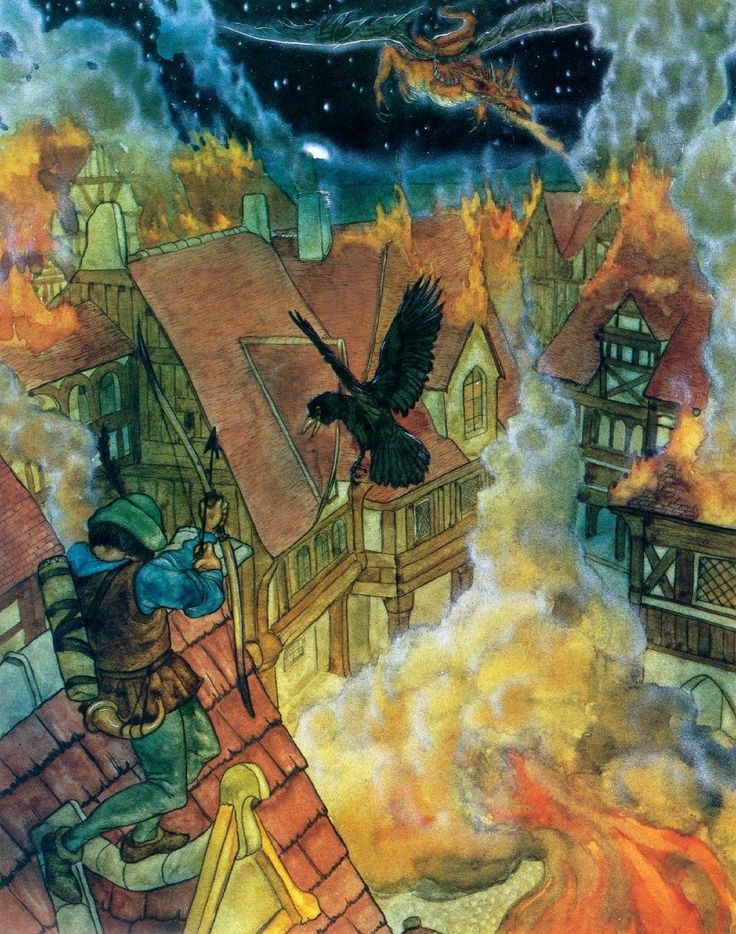
and therefore set off the chain of events which revealed the back door to the Lonely Mountain to Bilbo and the dwarves, overhears Bilbo telling the dwarves about Smaug’s vulnerable spot, which he then conveys to Bard the Archer, who is then the dragon-slayer

(Michael Hague—one of my favorite Hobbit illustrators)

needed to dispose of the one-time guardian of the hoard.

And so the dragon is disposed of—but he has one more use in the story:  as a negative model. 

Although Thorin has led the quest to retrieve the dwarves’ treasure, it seems that there’s only one which he craves, the Arkenstone,

(Donato Giancola)

and it’s clear that, in its pursuit, he becomes much like the Smaug who once reacted almost hysterically when he sensed that something was missing from his hoard:

“Thieves!  Fire!  Murder!…His rage passes description—the sort of rage that is only seen when rich folk that have more than they can enjoy suddenly lose something that they have long had but have never before used or wanted.”  (The Hobbit, Chapter 12, “Inside Information”)

Here’s his dwarvish parallel:

“ ‘For the Arkenstone of my father,’ he said, ‘is worth more than a river of gold in itself, and to me it is beyond price.  That stone of all the treasure I name unto myself, and I will be avenged on anyone who finds it and withholds it.”  (The Hobbit, Chapter 16, “A Thief in the Night”)

And, when he finds that Bilbo has taken it as a way to make peace between the dwarves, the elves, and the Lake-town men, Thorin almost does take revenge:

“ ‘You! You!’ cried Thorin, turning upon him and grasping him with both hands.  ‘You miserable hobbit!  You undersized—burglar!…By the beard of Durin!  I wish I had Gandalf here!  Curse him for his choice of you!  May his beard wither!  As for you I will throw you to the rocks!’ he cried and lifted Bilbo in his arms.”  (The Hobbit, Chapter 17, “The Clouds Burst”)

So why a dragon?

First, to Tolkien the medievalist, gold and dragons go together:  a quest for treasure needs a particularly powerful enemy and the dragon of Beowulf, who actually fatally wounds Beowulf,

who had previously defeated two terrible opponents in Grendel and his mother, provides a strong model.

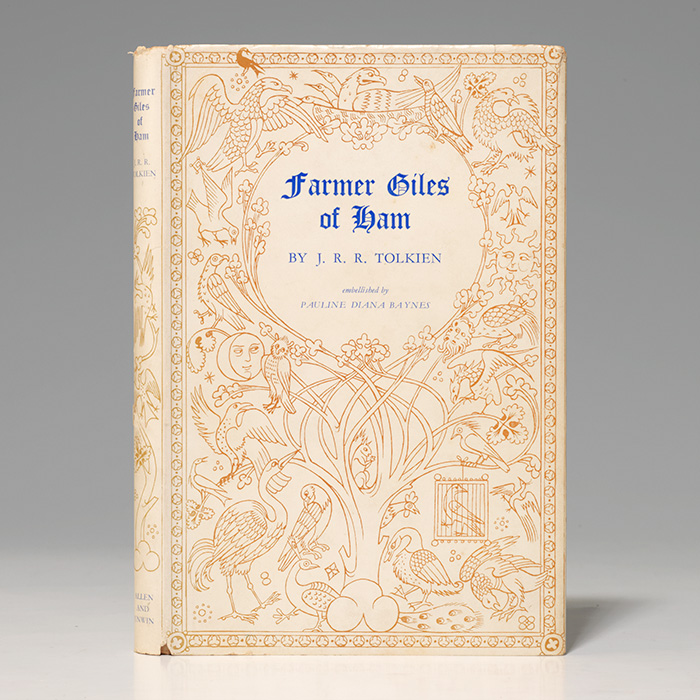
Second, JRRT had, from childhood, a long-standing interest in dragons—he’ll return to them in his 1938/49 novella, “Farmer Giles of Ham”, where the practical farmer eventually not only tames the dragon, Chrysophylax (“Goldwatchman”, perhaps), but makes him disgorge much of his treasure—this time by doing nothing more than outfacing him and threatening him with his sword, “Tailbiter”.

It’s interesting, by the way, that, although, in “The Story of Sigurd”, the dragon talks, he has only one short speech:  a curse on anyone who touches his gold, whereas, in perhaps the greatest draconic influence upon Tolkien, Beowulf, another wyrm who enjoys lying on a hoard, is mute.

Smaug, in The Hobbit, however, is not only positively talky, but, like Saruman in The Lord of the Rings, his voice and manner have their own dangerously persuasive power, at one point in his conversation with Bilbo even beginning to seed Bilbo’s mind with doubts about the dwarves Bilbo accompanies (The Hobbit, Chapter 12, “Inside Information”).

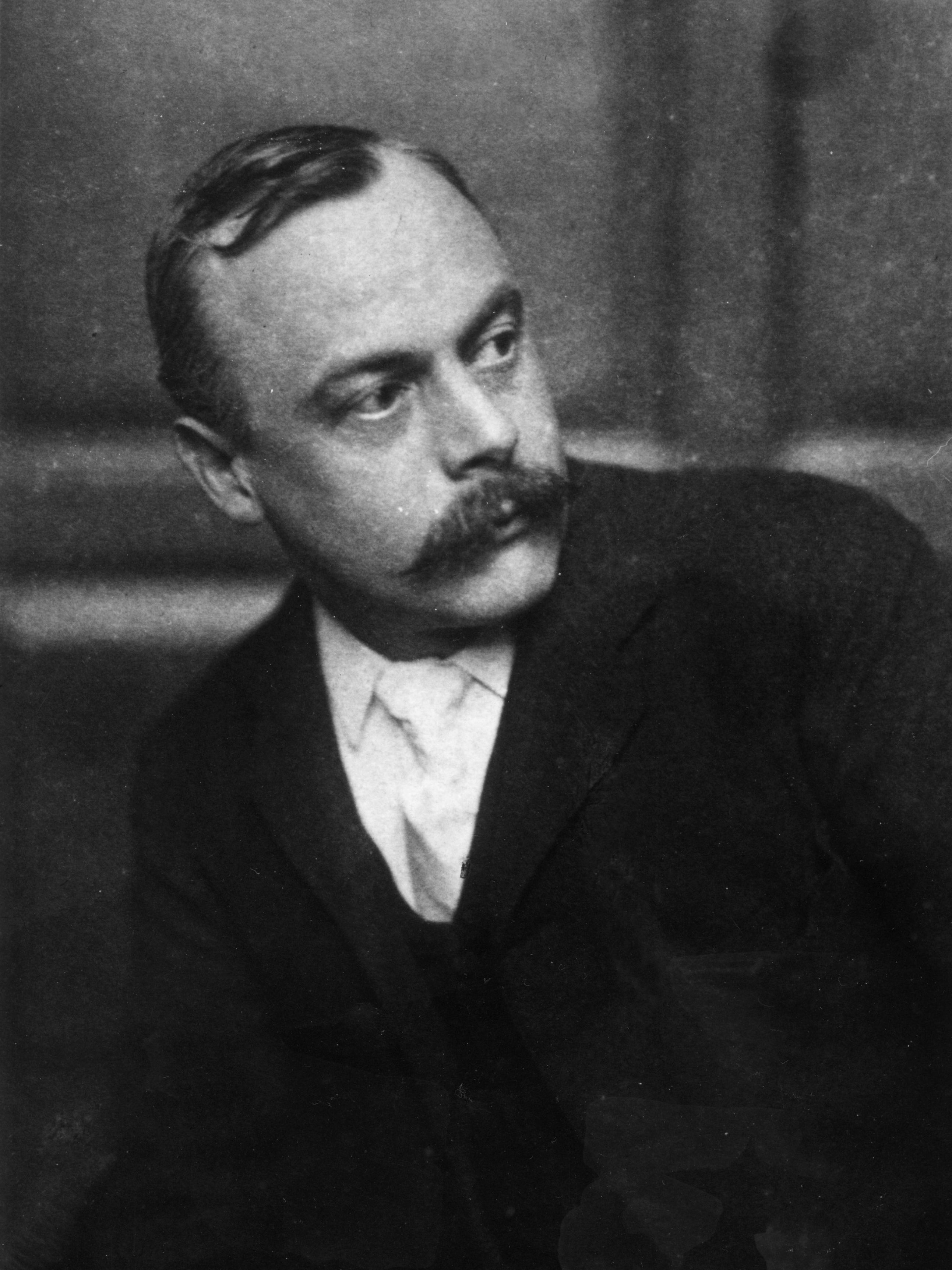
Chrysophylax, in “Farmer Giles of Ham” is even more talkative than Smaug, and I wonder about the model for these chatty beasts.  Tolkien was a great fan of Kenneth Grahame (1859-1932) and of his well-known children’s book, The Wind in the Willows (1908),

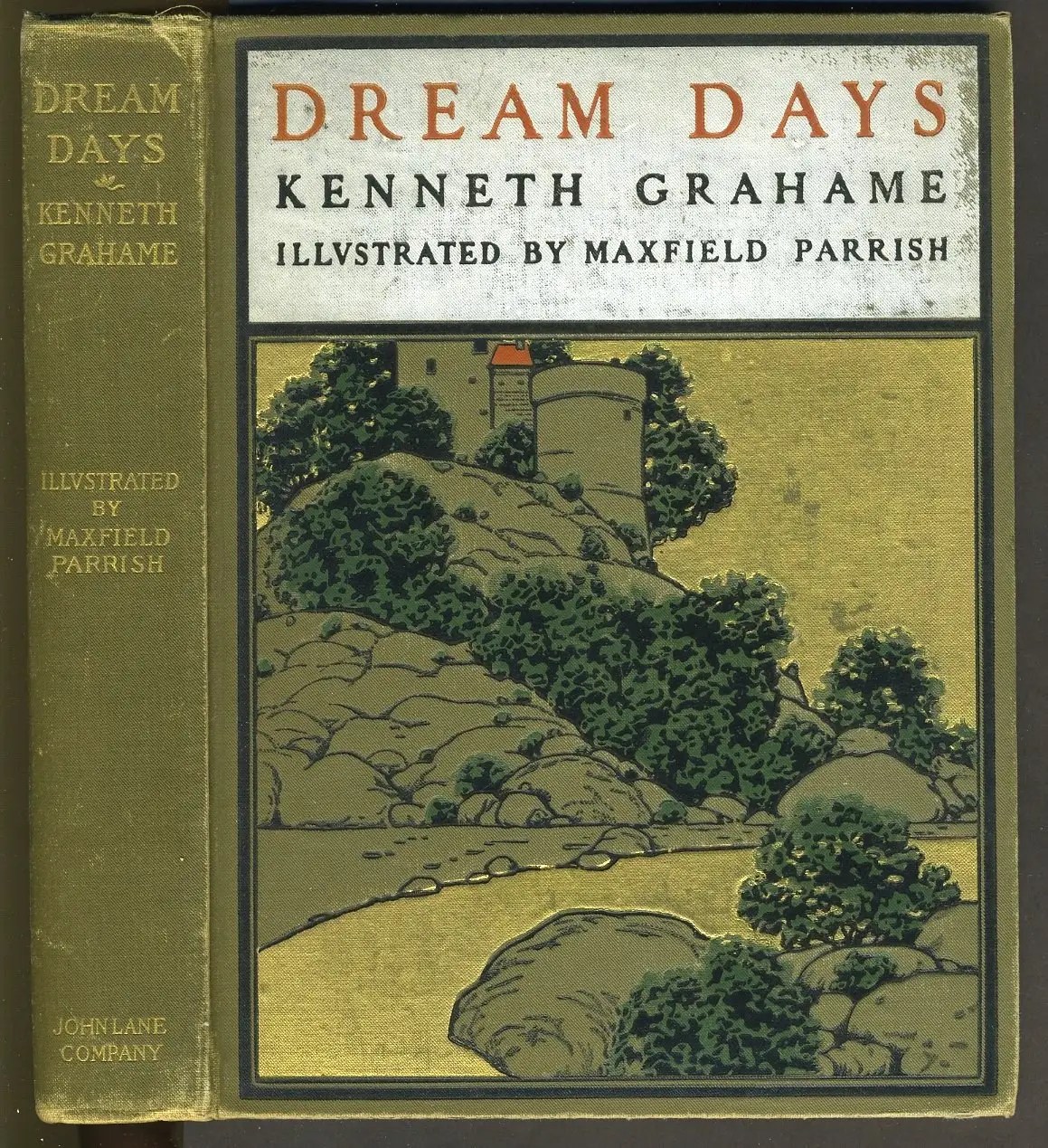
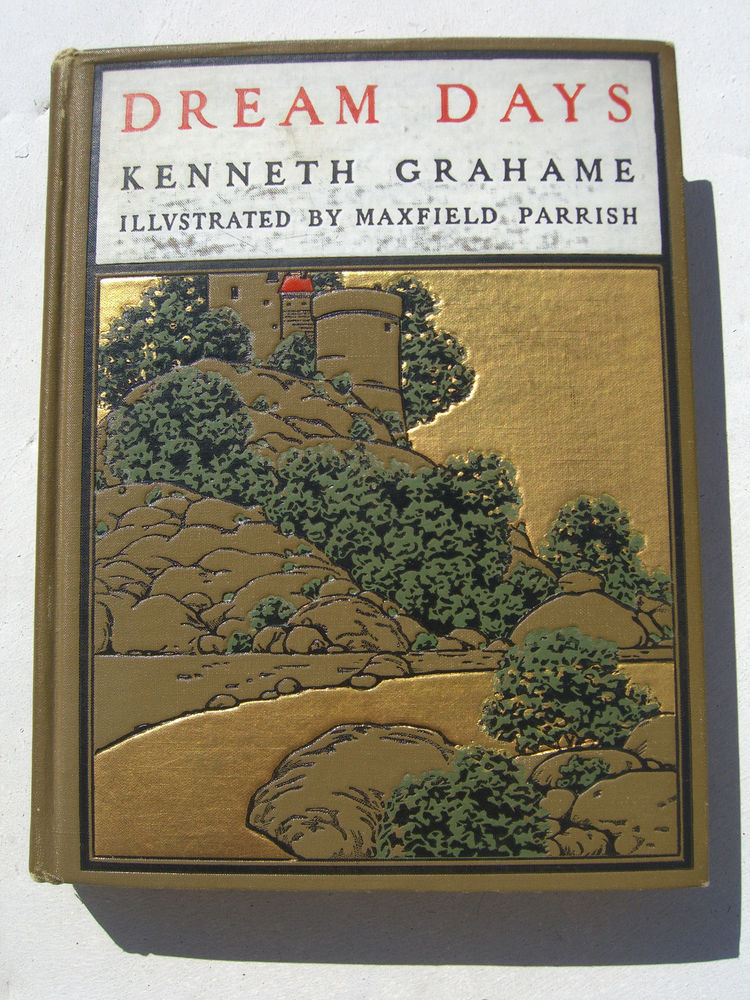
mentioning in a letter to Christopher Tolkien that Elspeth Grahame, Grahame’s widow, is publishing a book with other stories about the main characters of The Wind in the Willows, a book which JRRT is very eager to obtain (letter to Christopher Tolkien, 31 July, 1944, Letters, 128).  In 1898, Grahame published a collection of stories, Dream Days,

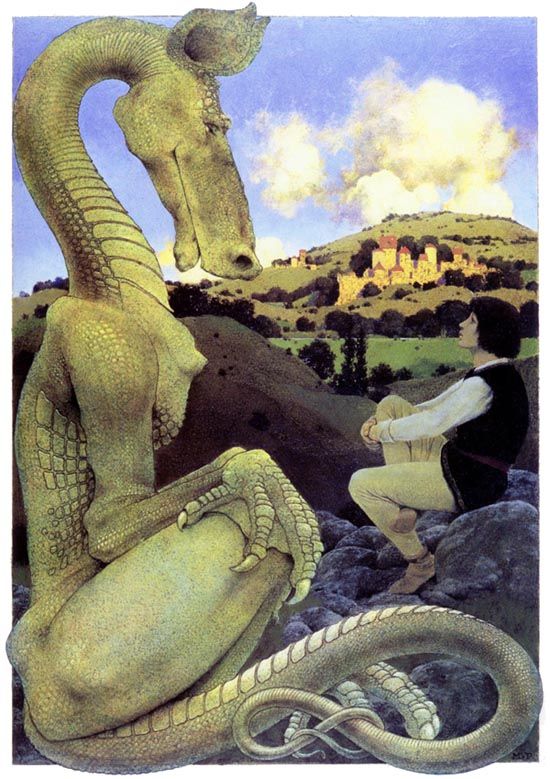
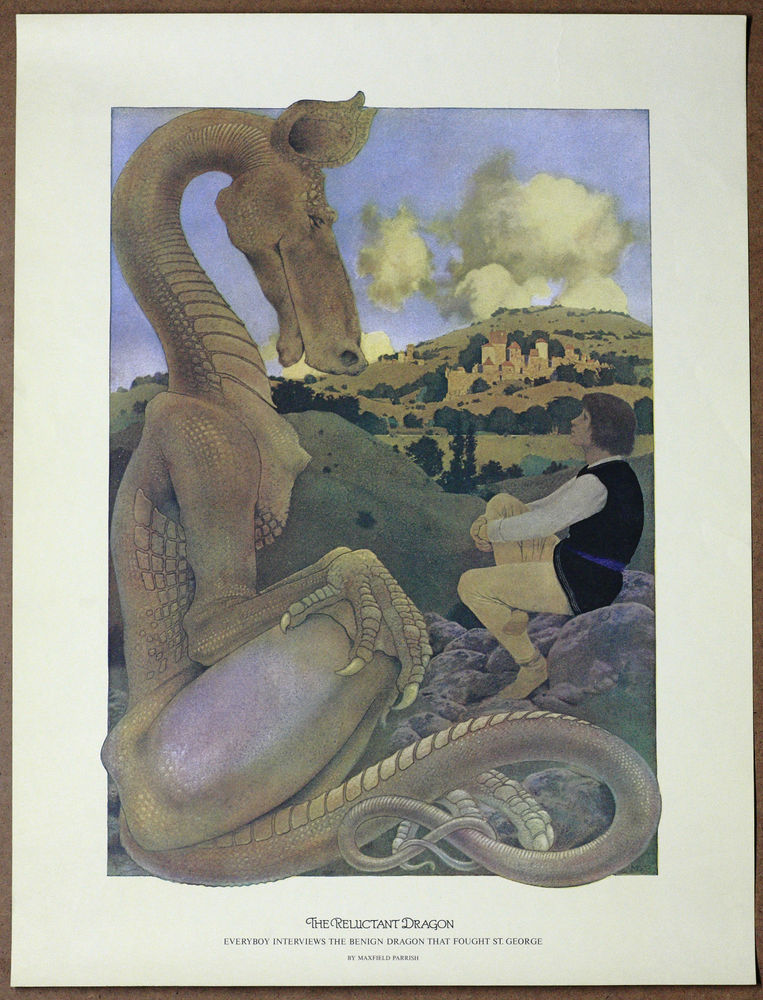
which included “The Reluctant Dragon”, in which we see another very loquacious beast,

(from the original book, illustrated by Maxfield Parrish)

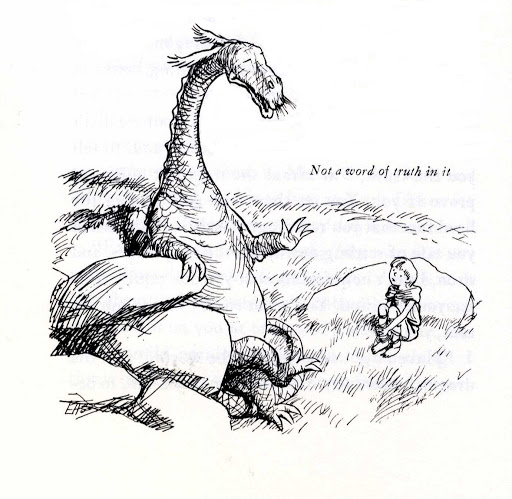
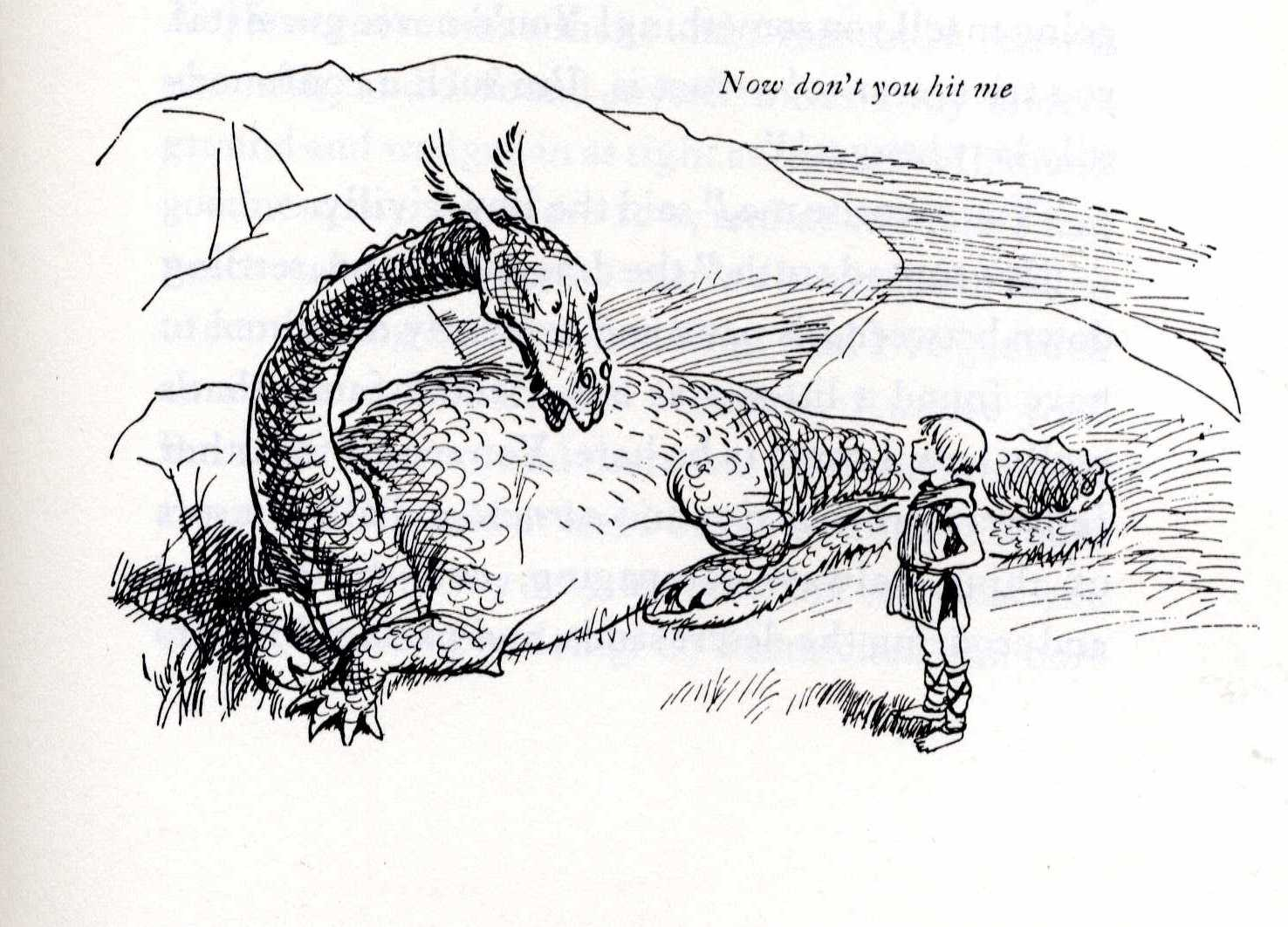
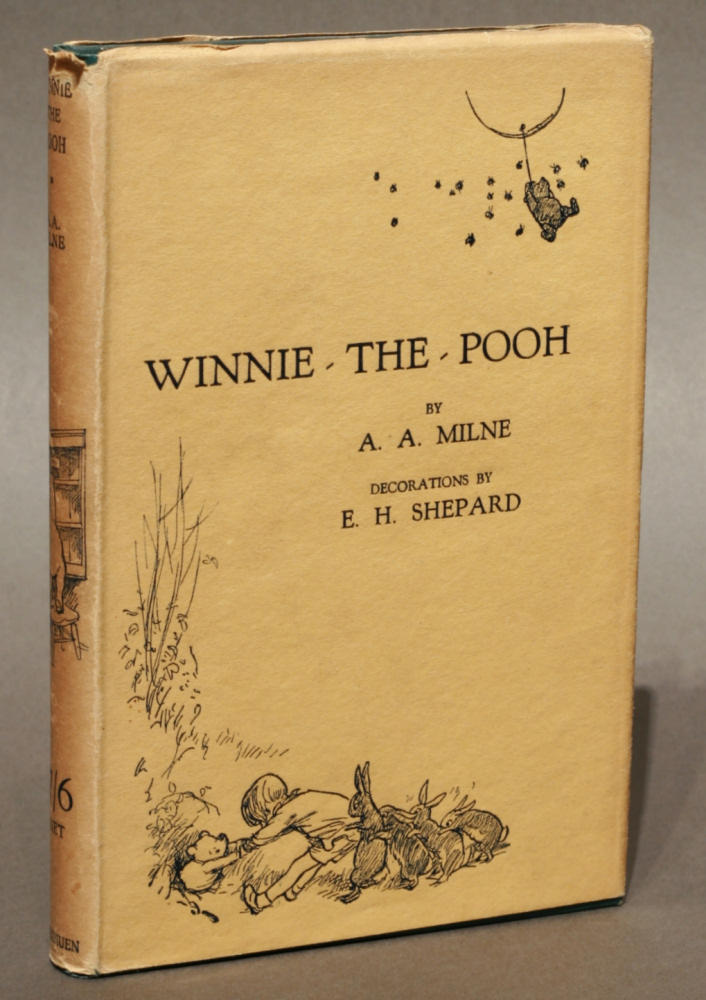
(I couldn’t resist including E.H. Shepard’s 1938 version)

but rather more like the ultimately rather timid dragon of “Farmer Giles” than the grim and mute creature of Beowulf or the more-than-a-little-pleased-with-himself Smaug, but, in his garrulousness, could he have been a model for Smaug?  (You can make your own comparison with:  https://www.gutenberg.org/files/35187/35187-h/35187-h.htm )

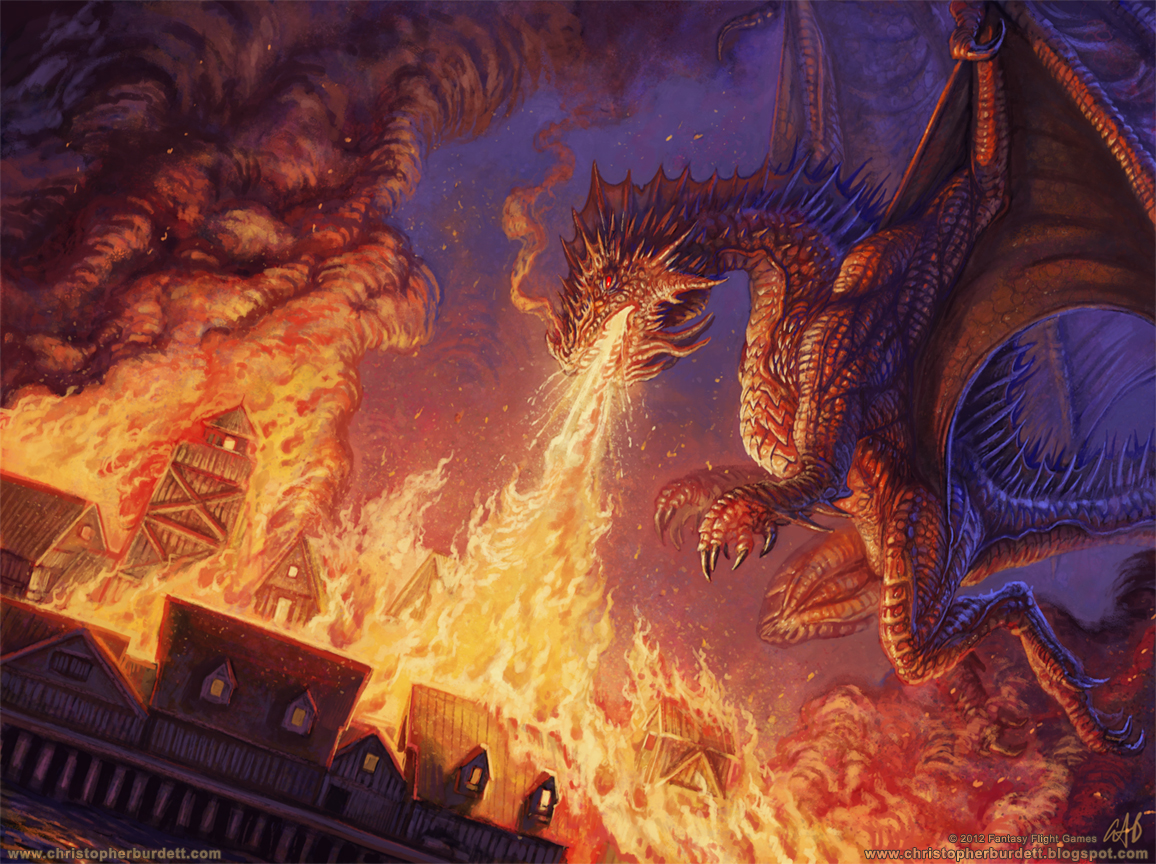
To this we add perhaps not a model, but a parallel:  Thorin as becoming a kind of dwarvish dragon in his obsession with the Arkenstone.  Fafnir dies with a curse, however, the Beowulf beast dies killing Beowulf, and Smaug dies destroying Lake-town,

but, in his own last moments, Thorin escapes such a poisonous model, saying to Bilbo:

“Farewell, good thief…I go now to the halls of waiting to sit beside my fathers, until the world is renewed.  Since I leave now all gold and silver, and go where it is of little worth, I wish to part in friendship from you, and I would take back my words and deeds at the Gate.” (The Hobbit, Chapter 18, “The Return Journey”)

(Darrell Sweet—you can read a little about him here:  https://en.wikipedia.org/wiki/Darrell_K._Sweet )

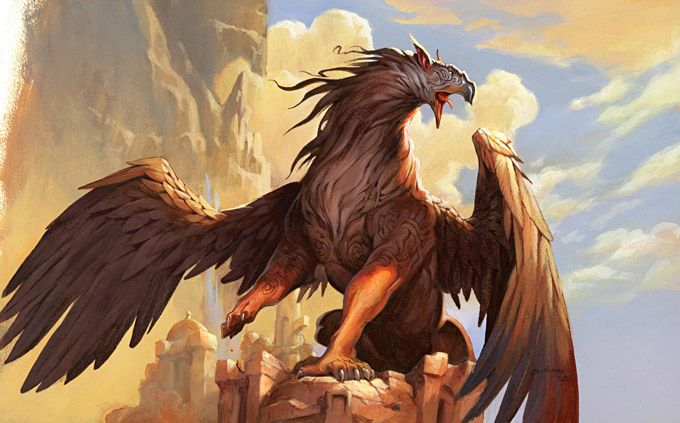
And so “Why a dragon?”—and not “Why No a Hippogriff?”

(artist? so far, I haven’t found one–a pity, too, as it’s quite a splendid illustration and I’ll love to mention the author!)

Thanks, as ever, for reading.

Stay well,

Remember not to laugh at live dragons,

And remember, as well, that there’s

MTCIDC

O

“Dragons, Other”

21 Wednesday Mar 2018

Posted by Ollamh in Artists and Illustrators, Fairy Tales and Myths, Heroes, J.R.R. Tolkien, Literary History, Maps

≈ Leave a comment

Tags

Arthur Rackham, Beowulf, C.S. Lewis, Chrysophylax, Custard the Dragon, Dragons, Dream Days, Esgaroth, Farmer Giles of Ham, Jabberwock, Jabberwock-slayer, Kenneth Grahame, Lewis Carroll, Lonely Mountain, Luttrell Psalter, map, Middle-earth, Narnia, Ogden Nash, Pauline Baynes, Rumer Godden, Smaug, St George, The Chronicles of Narnia, The Dragon of Og, The Hobbit, The Lion The Witch and the Wardrobe, The Lord of the Rings, The Reluctant Dragon, Through the Looking-Glass, Tolkien, Walt Disney

As always, readers, welcome.

One of us is currently teaching a class where our present focus is upon The Hobbit.

image1hob1st.jpg

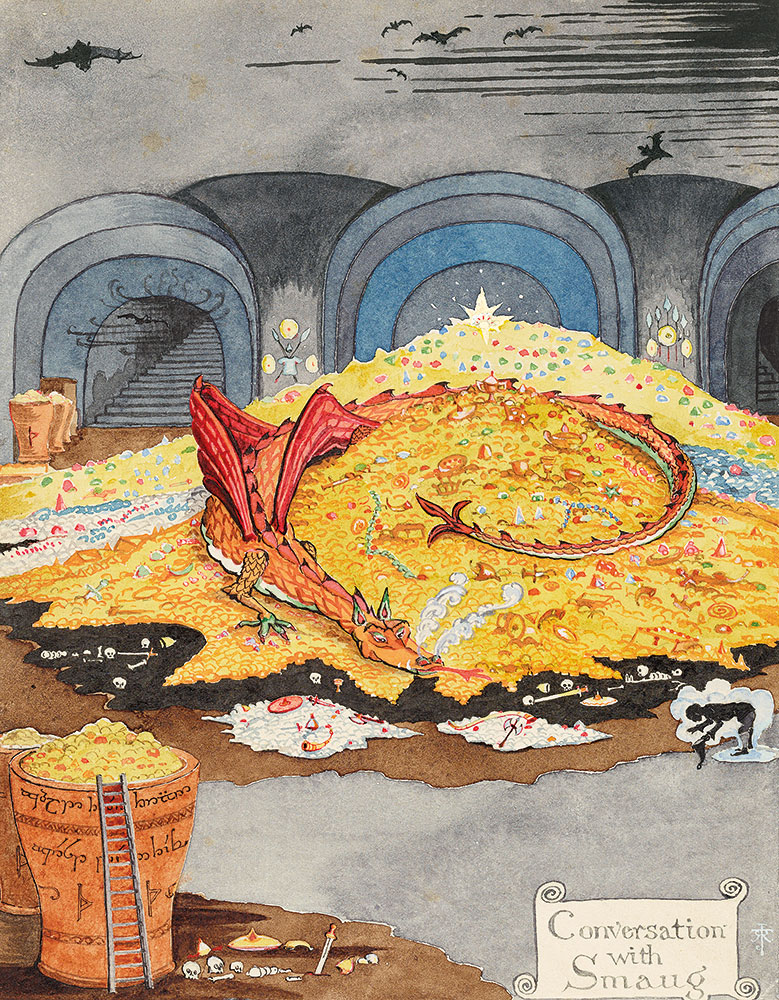
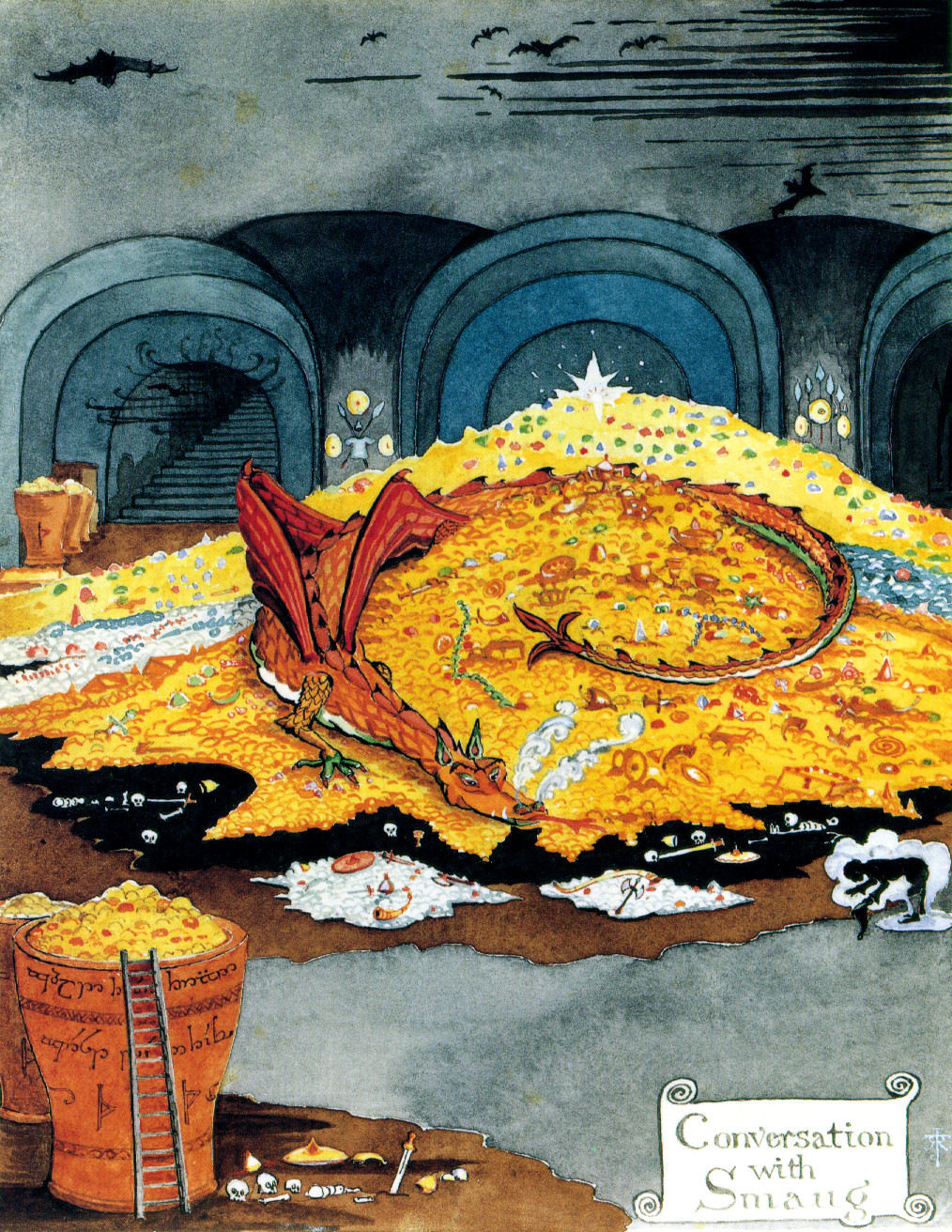
At the center of the book is the Lonely Mountain and at the center of that is Smaug.

image2aerebor.jpg

image2smaug.jpg

This got us to thinking about other dragons in our experience, and some of those are not quite of the same breed as the hoard-sitter faced by Bilbo and the dwarves.  That dragon is closely related to the Beowulf variety

image3beowulfdragon.jpg

which, unlike Smaug, has neither a name nor (it seems) human speech, but it certainly has the same suspicious streak:  when an escaped slave steals a cup from its hoard, it’s almost immediately aware that it’s missing and suspects a human.

image4stealingcup.jpg

And they are both vengeful.  As Smaug devastates Esgaroth, even if he dies for it,

image5esgaroth.jpg

image6smaug.jpg

so Beowulf’s dragon scorches the countryside in revenge for the theft.

But what about those other dragons?

First, we thought of Kenneth Grahame’s Dream Days (1898),

image7kg.jpg

image8dreamdays.jpg

a collection of short stories, the next-to-last of which is “The Reluctant Dragon”.

image9reluct.jpg

This is the story of a beast the very opposite of Smaug—no hoard, no suspicion, no flaming violence, and, in fact, a poetry lover.  This story was then converted into a Disney cartoon of 1941.

image10reluct.jpg

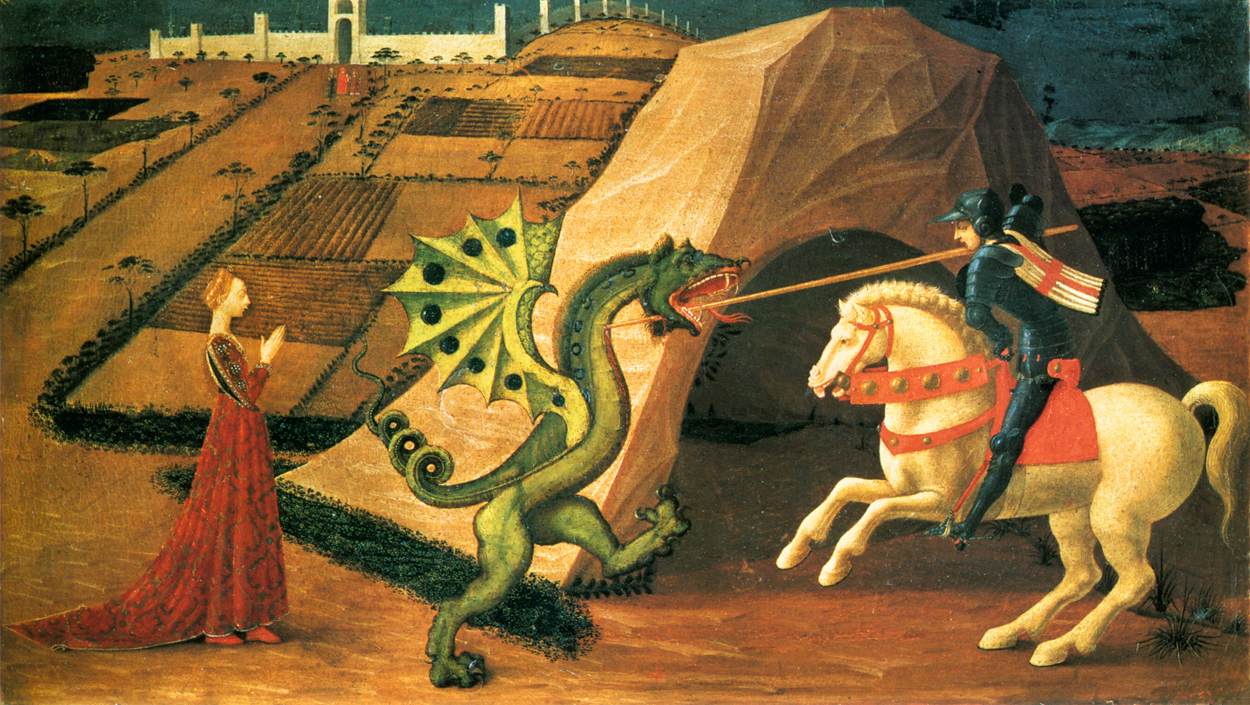
Needless to say, although the core of the plot is the same, what makes the Grahame distinctive is the language.  All of the major characters:  the dragon, the little boy who finds him, and St. George, who is brought in as a dragon-slayer, are thoughtful and articulate late Victorians who would rather discuss literature than do battle—a far cry not only from Beowulf’s encounter, but also from every other earlier depiction we could think of.

image11ucellostgeo.jpg

image12stgeo.jpg

image13stgeo.jpg

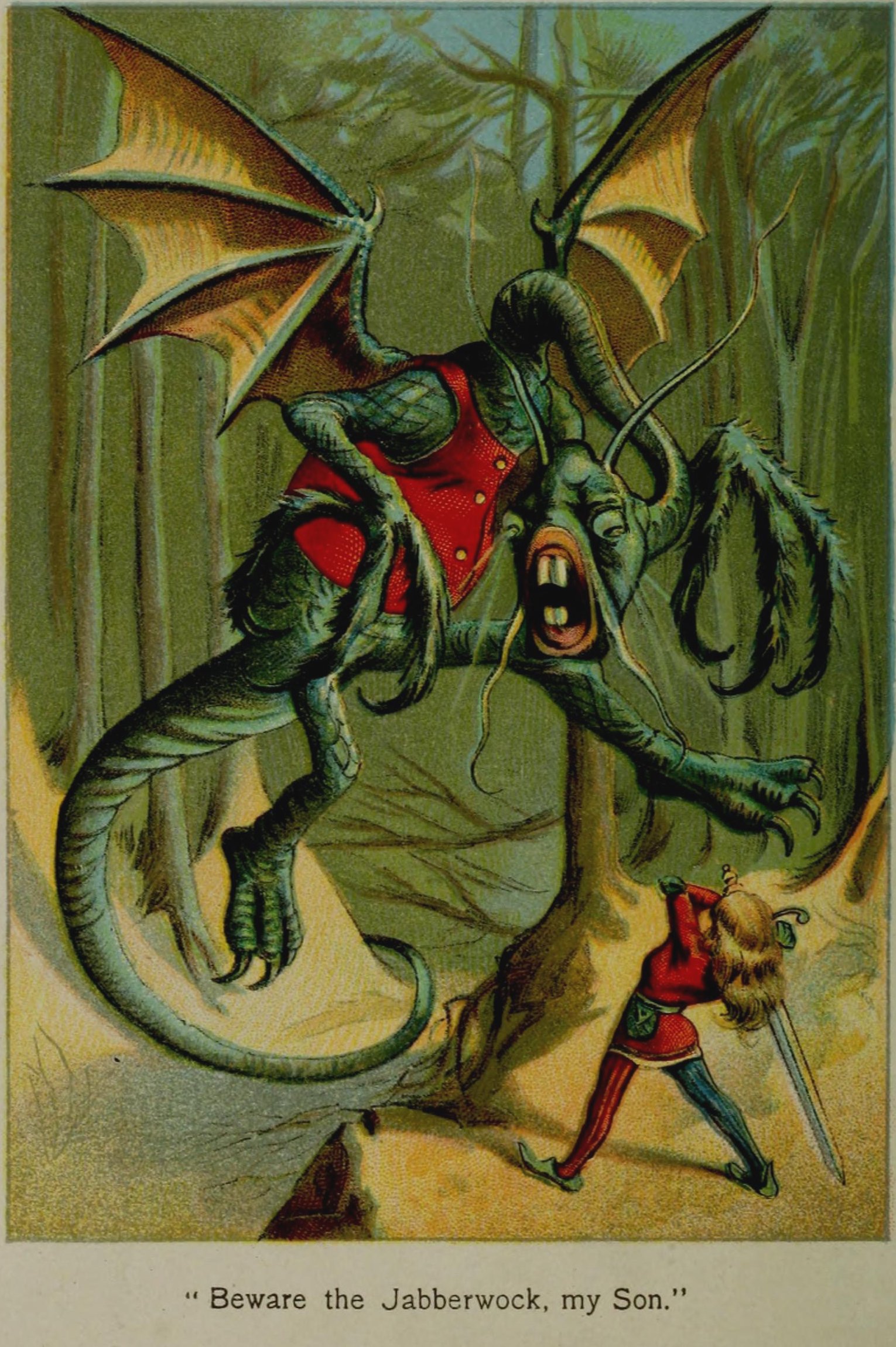
The sword in this last one looks like it actually belongs in the hands of the jabberwock-slayer

image14jabberwocky.jpg

in Lewis Carroll’s Through the Looking-Glass (1872).

image15through.jpg

Here’s a LINK to Dream Days so that you can enjoy the story for yourselves.

Nearly sixty years later, the comic verse writer, Ogden Nash,

image16nash.jpg

produced not a literary dragon, but a timid one in “Custard the Dragon” (1959).

image17custard.jpg

This is a poem in 15 stanzas and is a story about Belinda and her pets, including a dragon, who is taunted by the other pets as being less than brave.  To underline this, the last line in a number of stanzas is a variation upon the first version of the line, “But Custard cried for a nice safe cage”.  (Here’s a LINK to the poem.)

The surprise is that, when a pirate climbs in through the window (this happens all the time here—possibly they escape from dreams?), Custard promptly eats him—and the cries of “Coward!” disappear immediately.

In contrast to the unnamed dragon in “The Reluctant Dragon” and in “Custard the Dragon”, our next dragon is a talker—like Smaug, but also like Smaug, potentially malevolent.  This is Chrysophylax in JRRT’s 1937/1949 Farmer Giles of Ham.  (JRRT is having a quiet joke here—“Chrysophylax” is Ancient Greek for “Goldguard”.)

image18chrysophylax.jpg

image19afgoh.jpg

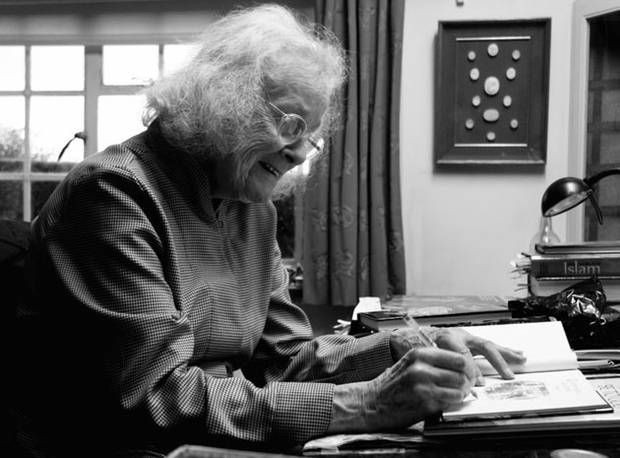
The artwork is by Pauline Baynes (1922-2008).

image19pb.jpg

If, like us, you’ve loved the Narnia books, then you know her as their original illustrator.

image20lion.jpg

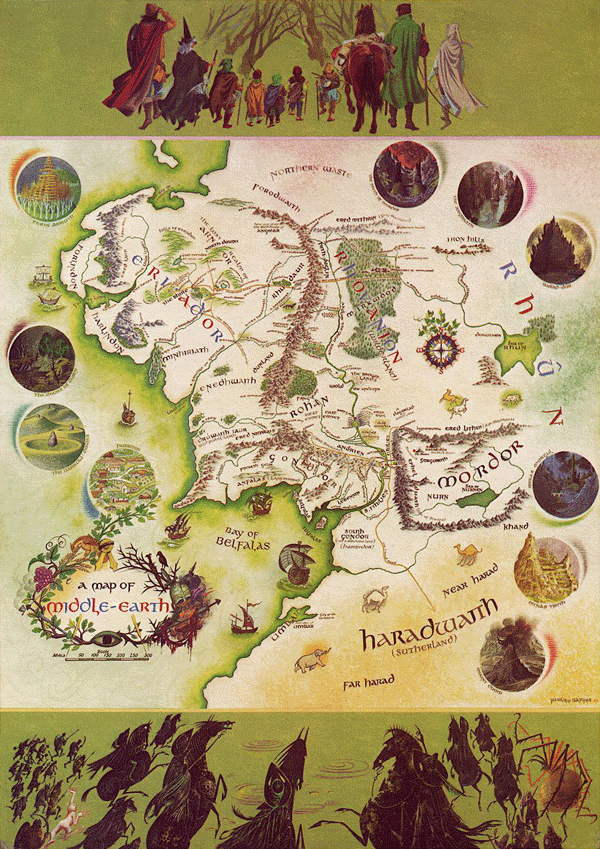
She was also the artist for an early Middle-earth map.

image21memap.gif

Her 2008 obituary in The Daily Telegraph tells of how they came to work together:

“In 1948 Tolkien was visiting his publishers, George Allen & Unwin, to discuss some disappointing artwork that they had commissioned for his novella Farmer Giles of Ham, when he spotted, lying on a desk, some witty reinterpretations of medieval marginalia from the Luttrell Psalter that greatly appealed to him.  These, it turned out, had been sent to the publishers “on spec”by the then unknown Pauline Baynes.”   (The Daily Telegraph, 8 August, 2008)

JRRT was then so impressed with her work that it appeared both in other later publications and his recommendation led to her being engaged by CS Lewis’ publisher for the Narnia books, as well.  (And here’s a LINK to that obituary, which has more on Tolkien and Baynes, as well as Lewis.)

And the Baynes connection leads us to one further dragon, that in Rumer Godden’s  (1902-1998) 1981 The Dragon of Og, for which Baynes provided the cover art.

image22rg.jpg

image23dragog.jpg

It’s not our practice to discuss work we haven’t read, but we’ve just discovered this novel and have already put it on our spring reading list.  The little we know about it comes from a blurb or two, but it looks promising:  this is more of the reluctant dragon, but one who is in danger of being provoked by a new local lord until his wife steps in and cleverly changes the situation.

Before we close, however, we want to look back for a second at the Tolkien/Baynes connection and add two further things.  First off, here’s the first page of JRRT’s graceful letter of thanks and praise to Baynes for her work in illustrating Farmer Giles.

image24letter.jpg

Second, as the Telegraph obituary says, Tolkien was impressed with her versions of the marginalia from the Luttrell Psalter, which is high on our list of favorite medieval manuscripts.

image25luttrellpsalter.jpg

In our next, we want to spend some time looking at that work, thinking about marginalia, and not only there, but also in the work of another favorite illustrator, Arthur Rackham (1867-1939).

Till then, thanks, as always, for reading.

MTCIDC

CD


And Then the Dragon Came

14 Wednesday Jun 2017

Posted by Ollamh in Artists and Illustrators, Fairy Tales and Myths, Heroes, Imaginary History, J.R.R. Tolkien, Literary History, Narrative Methods, Villains

≈ Leave a comment

Tags

A.A. Milne, Apollonius, Arthur Rackham, Beowulf, Chrysophylax, Cressida Cowell, Dragons, Drawn From Life, Drawn From Memory, Dream Days, E.H. Shepard, Edwardian, Farmer Giles of Ham, How to Train Your Dragon, Kenneth Grahame, Maxfield Parrish, Nine Dragons, Now We Are Six, Octavian, Prince Valiant, Renaissance, Sir Gawain, Smaug, St. George and the Dragon, The Argonautica, The Hobbit, The House at Pooh Corners, The Reluctant Dragon, The Wind in the Willows, Tolkien, Victorian, Walt Disney, Western Medieval, When We Were Very Young, Winnie the Pooh

Welcome, dear readers, as always.
One of us is in the midst of creating a course for the fall term. It’s called “Handling Monsters: A Handbook” and several of those monsters are dragons—the “Sleepless Serpent/Dragon” of the ancient Greek literary epic by Apollonius, The Argonautica,
image1sleepless.jpg
the dragon which Beowulf fights,
image2beowulf.jpg
(when small, we always imagined this as looking like the one which Sir Gawain, Prince Valiant’s master, fights)
image3sirgawaine.jpg
Smaug,
image4smaug.jpg
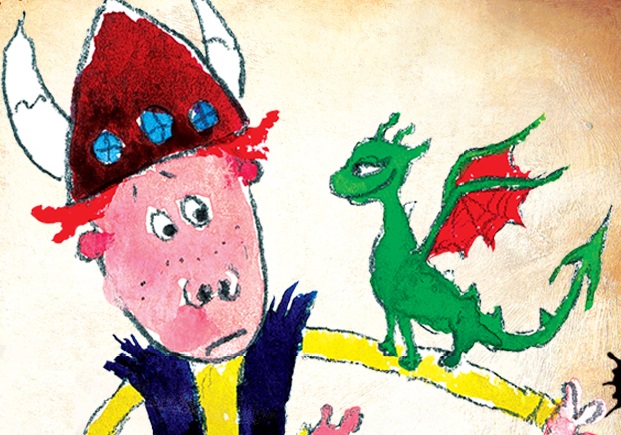
and Toothless, from How to Train Your Dragon (by Cressida Cowell—there’s also a movie by that name, which is fun—great flying scenes–but it’s so different from the book that it really should have another title!)
image5hiccup.jpg
We must confess that we’ve never been big saurian fans, either dinosaurs or dragons, but, as monsters go, they have their uses. Saying that, however, we do have to add that we’ve always loved the “Nine Dragons” scroll, a 13th-century Chinese painting…
image6nine.png
[And here’s a LINK to a site at the Center for the Art of East Asia which you can see the whole scroll—well worth the visit—and revisit, if you’re like us and love Chinese painting.]
While putting together this course, we’ve been spending some time gathering dragon images. Sometimes, they seem pretty fantastic—painters with wild imaginations—
image7meddragon.jpg
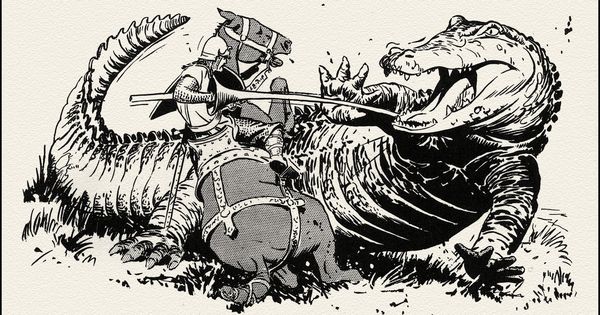
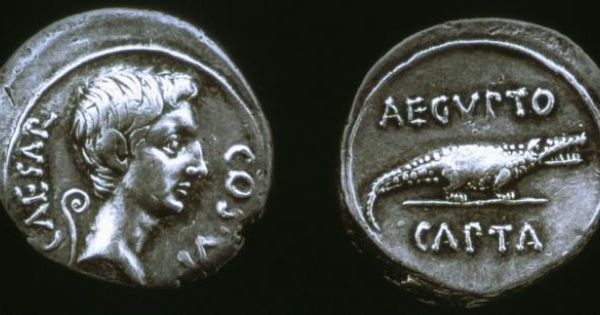
And sometimes they look like someone once saw a crocodile.
image8stg.jpg
[Perhaps on an old coin? For example, Octavian—the Emperor Augustus-to-be—after the defeat of Antonius and Cleopatra, issued this coin, which reads “Egypt Taken”,

image9aegypta.jpg
suggesting that, when a Roman thought of Egypt, it wasn’t the pyramids which came to mind, but a scaly, many-toothed amphibian!]
And the image before the coin reminds us that, in Western medieval/early Renaissance art, a major source of dragon pictures is religious, being depictions of St. George and his dragon-slaying.
image10stg1.jpg

image11stgeo2.jpg
We’ve mentioned JRRT and Smaug, but that it only his first dragon story. There is another, Farmer Giles of Ham, written in 1937 and published in 1949.
image12farmergiles.jpg
If you haven’t read it, we recommend it as a look at JRRT at play, more Hobbit than Lord of the Rings. The story is about a very practical, but hardly adventurous farmer, Giles, who, after chasing off a giant from his village, is given the job of dealing with an invading dragon, Chrysophylax (maybe something like “Watchman of the Gold”).
image13xryso.jpg
Although the dragon is tricksy, Giles eventually overcomes him with a combination of shrewdness and a famous sword, Caudimordax (“Tailbiter”). In the process, he becomes not only wealthy, but also founds his own kingdom-within-a-kingdom. As well, though JRRT, more than once in his letters, lets us know that he is not an enthusiast for democracy, he provides a very critical view of monarchy and its pretensions. (This may also explain why, although those in the Shire may refer to “the king” and “the rules”, which presumably came with that monarch, their own local form of government is more familial than bureaucratic.)
Chrysophylax is chatty, rather like Smaug, but there is a much lighter touch here, and Chrysophylax reminds us of our favorite dragon after Tolkien’s, the unnamed dragon in Kenneth Grahame’s
image14kgrahame.jpg
short story, “The Reluctant Dragon”, from his 1898 collection, Dream Days.
image15dreamdays.jpg
If you recognize Grahame’s name, you probably know it from his 1908 novel, The Wind in the Willows, with its well-known characters, Toad, Rat, Mole, and Badger—not to mention the wicked weasels!–
image16wiw1sted.jpg
image17wiwcharacters.jpg
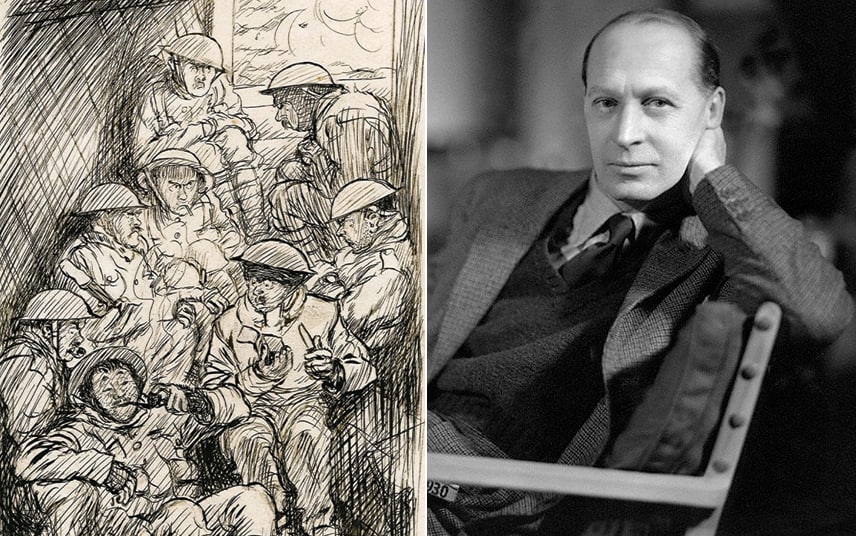
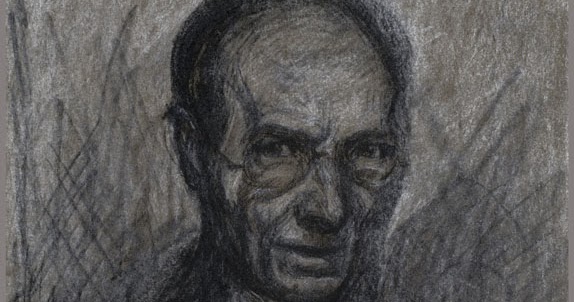
first illustrated by E.H. Shepard
image18ehshepard.jpg
whom you may also know as the illustrator of A.A. Milne’s Winnie the Pooh, The House at Pooh Corners, When We Were Very Young, and Now We are Six.
image19wthepfirst.jpg
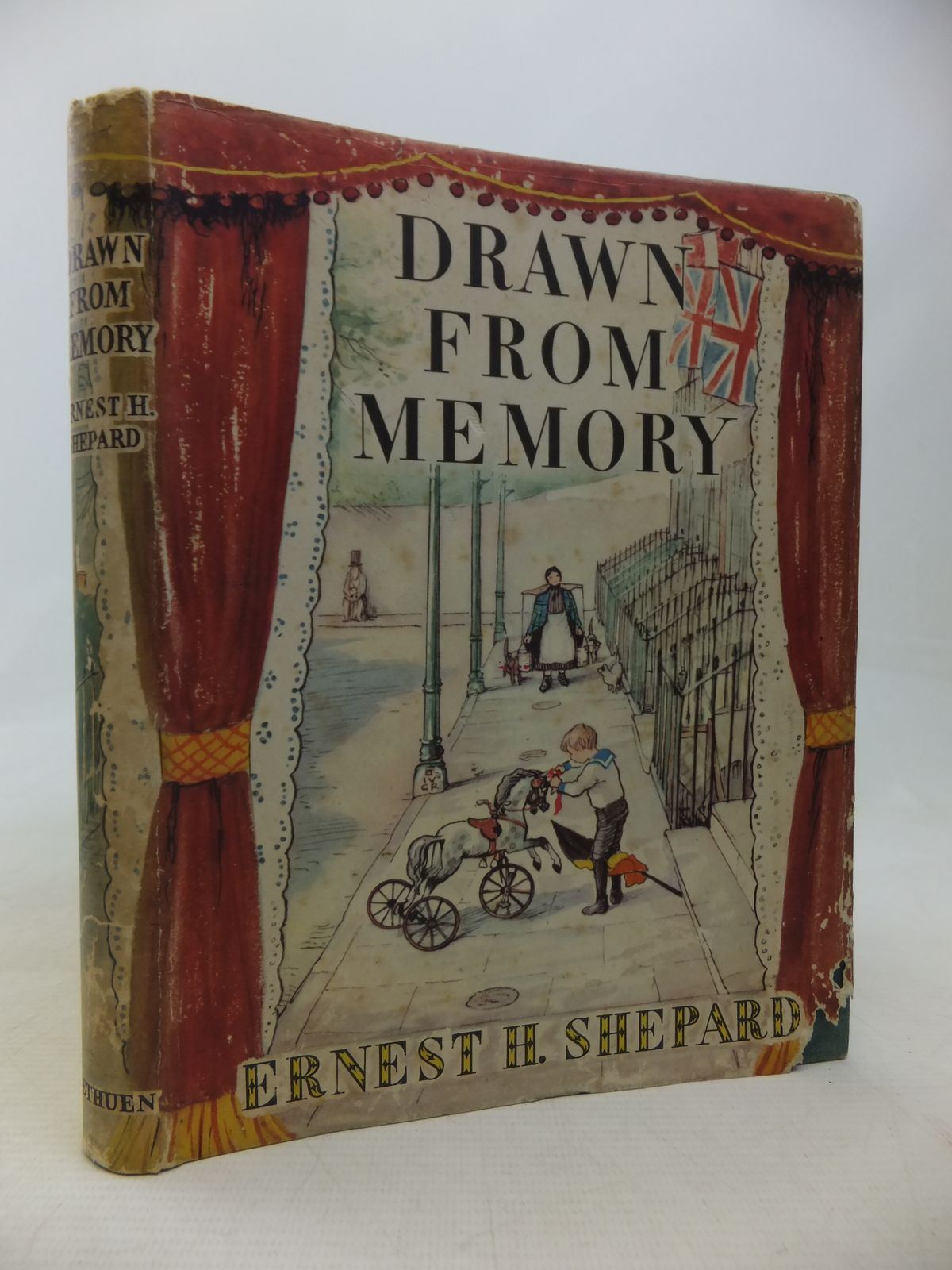
[Shepard also wrote two volumes of autobiography—which he illustrated, of course—Drawn from Memory (1957) and Drawn from Life (1961)
image19drawnfrommem.JPG

image20drawnfromlife.JPG
and, for a picture of a growing up in the later Victorian world, beautifully written and illustrated, we very much recommend both.]
[And a second footnote here: Arthur Rackham—one of our favorite late-19th-early-20th-century illustrators– also illustrated The Wind in the Willows,
image22rackham.jpg

image23wiwrack.jpg
his last project before his death in 1939. It was published a year later, in 1940.]
The title gives away a great deal of the plot of Grahame’s “The Reluctant Dragon”. Instead of being a murderous hoarder, like Beowulf’s dragon, or Smaug, this is dragon-as-pacifist, (as depicted by his original illustrator, Maxfield Parrish):
image24fearless.jpg
not in the least interested in plundering and burning, but rather in viewing sunsets and living a peaceful existence—until St. George appears. As to what happens next, we’re not going to issue a spoiler alert here, but rather provide links to three works by Grahame: two collections of stories and essays, The Golden Age (1895), Dream Days (1898), and The Wind in the Willows (1908), inviting you to read for yourself and to enjoy Grahame’s elegant Edwardian prose and gentle approach.
With thanks, dear readers, for…reading.
MTCIDC
CD

PS
Walt Disney studios made cartoons of “The Reluctant Dragon” (1941) and “The Wind in the Willows” (1949), which are currently available in Disney collections. They both stray rather far from the original stories, but are fun in themselves (and Eric Blore’s voice is perfect for “the handsome and popular Toad”).
PPS
One of us has written what we might immodestly call a very good short story based upon Arthur Rackham’s last days and his determination to finish his illustrations to The Wind in the Willows before his death and we plan to publish it here next week as a kind of “Summer Holidays Extra”. We hope you’ll enjoy it.


The Doubtful Sea Series Facebook Page

The Doubtful Sea Series Facebook Page

  • Ollamh

Categories

  • Artists and Illustrators
  • Economics in Middle-earth
  • Fairy Tales and Myths
  • Films and Music
  • Games
  • Heroes
  • Imaginary History
  • J.R.R. Tolkien
  • Language
  • Literary History
  • Maps
  • Medieval Russia
  • Military History
  • Military History of Middle-earth
  • Narnia
  • Narrative Methods
  • Poetry
  • Research
  • Star Wars
  • Terra Australis
  • The Rohirrim
  • Theatre and Performance
  • Tolkien
  • Uncategorized
  • Villains
  • Writing as Collaborators
Follow doubtfulsea on WordPress.com

Across the Doubtful Sea

Recent Postings

  • Through a glass… January 7, 2026
  • Heffalumps? December 31, 2025
  • We Three Kings December 24, 2025
  • A Moon disfigured December 17, 2025
  • On the Roads Again—Once More December 10, 2025
  • (Not) Crossing Bridges December 3, 2025
  • On the Road(s) Again—Again November 26, 2025
  • On the Road(s) Again November 19, 2025
  • To Bree (Part 2) November 12, 2025

Blog Statistics

  • 104,106 Views

Posting Archive

  • January 2026 (1)
  • December 2025 (5)
  • November 2025 (4)
  • October 2025 (5)
  • September 2025 (4)
  • August 2025 (4)
  • July 2025 (5)
  • June 2025 (4)
  • May 2025 (4)
  • April 2025 (5)
  • March 2025 (4)
  • February 2025 (4)
  • January 2025 (5)
  • December 2024 (4)
  • November 2024 (4)
  • October 2024 (5)
  • September 2024 (4)
  • August 2024 (4)
  • July 2024 (5)
  • June 2024 (4)
  • May 2024 (5)
  • April 2024 (4)
  • March 2024 (4)
  • February 2024 (4)
  • January 2024 (5)
  • December 2023 (4)
  • November 2023 (5)
  • October 2023 (4)
  • September 2023 (4)
  • August 2023 (5)
  • July 2023 (4)
  • June 2023 (4)
  • May 2023 (5)
  • April 2023 (4)
  • March 2023 (5)
  • February 2023 (4)
  • January 2023 (4)
  • December 2022 (4)
  • November 2022 (5)
  • October 2022 (4)
  • September 2022 (4)
  • August 2022 (5)
  • July 2022 (4)
  • June 2022 (5)
  • May 2022 (4)
  • April 2022 (4)
  • March 2022 (5)
  • February 2022 (4)
  • January 2022 (4)
  • December 2021 (5)
  • November 2021 (4)
  • October 2021 (4)
  • September 2021 (5)
  • August 2021 (4)
  • July 2021 (4)
  • June 2021 (5)
  • May 2021 (4)
  • April 2021 (4)
  • March 2021 (5)
  • February 2021 (4)
  • January 2021 (4)
  • December 2020 (5)
  • November 2020 (4)
  • October 2020 (4)
  • September 2020 (5)
  • August 2020 (4)
  • July 2020 (5)
  • June 2020 (4)
  • May 2020 (4)
  • April 2020 (5)
  • March 2020 (4)
  • February 2020 (4)
  • January 2020 (6)
  • December 2019 (4)
  • November 2019 (4)
  • October 2019 (5)
  • September 2019 (4)
  • August 2019 (4)
  • July 2019 (5)
  • June 2019 (4)
  • May 2019 (5)
  • April 2019 (4)
  • March 2019 (4)
  • February 2019 (4)
  • January 2019 (5)
  • December 2018 (4)
  • November 2018 (4)
  • October 2018 (5)
  • September 2018 (4)
  • August 2018 (5)
  • July 2018 (4)
  • June 2018 (4)
  • May 2018 (5)
  • April 2018 (4)
  • March 2018 (4)
  • February 2018 (4)
  • January 2018 (5)
  • December 2017 (4)
  • November 2017 (4)
  • October 2017 (4)
  • September 2017 (4)
  • August 2017 (5)
  • July 2017 (4)
  • June 2017 (4)
  • May 2017 (5)
  • April 2017 (4)
  • March 2017 (5)
  • February 2017 (4)
  • January 2017 (4)
  • December 2016 (4)
  • November 2016 (5)
  • October 2016 (6)
  • September 2016 (5)
  • August 2016 (5)
  • July 2016 (5)
  • June 2016 (5)
  • May 2016 (4)
  • April 2016 (4)
  • March 2016 (5)
  • February 2016 (4)
  • January 2016 (4)
  • December 2015 (5)
  • November 2015 (5)
  • October 2015 (4)
  • September 2015 (5)
  • August 2015 (4)
  • July 2015 (5)
  • June 2015 (5)
  • May 2015 (4)
  • April 2015 (3)
  • March 2015 (4)
  • February 2015 (4)
  • January 2015 (4)
  • December 2014 (5)
  • November 2014 (4)
  • October 2014 (6)
  • September 2014 (1)

Blog at WordPress.com.

  • Subscribe Subscribed
    • doubtfulsea
    • Join 78 other subscribers
    • Already have a WordPress.com account? Log in now.
    • doubtfulsea
    • Subscribe Subscribed
    • Sign up
    • Log in
    • Report this content
    • View site in Reader
    • Manage subscriptions
    • Collapse this bar
 

Loading Comments...