• About

doubtfulsea

~ adventure fantasy

Tag Archives: The Red Book of Westmarch

See, the Conquering Hero?

09 Wednesday Oct 2019

Posted by Ollamh in Films and Music, Heroes, J.R.R. Tolkien, Narrative Methods

≈ Leave a comment

Tags

Battle of Culloden, Beethoven, celebrations, Crowning of Aragorn, endings, George Lucas, Haendel, Joshua, Judas Maccabaeus, oratorio, Return of the Jedi, Star Wars, The Empire Strikes Back, The Field of Cormallen, the Force, The Grey Havens, The Last Jedi, The Lord of the Rings, The Phantom Menace, The Red Book of Westmarch, The Return of the King, The Scouring of the Shire, Tolkien

Welcome, as ever, dear readers.

With Star Wars IX to appear in mid-December, completing the series, we’ve been going back through all of the previous episodes, from I (The Phantom Menace)

image1phantom.png

through VIII (The Last Jedi).

image2last.jpg

It’s a remarkable achievement and we’re very grateful to George Lucas,

image3gl.jpg

for bringing it so far, even if his strong sense of the story seems to have been abandoned after VI (Return of the Jedi).

Because there are now so many films (including all of the offshoots, like the animated features, as well as Rogue One and Solo), it’s sometimes hard to remember that, once upon a time, there was only Star Wars (only later A New Hope), with its triumphant conclusion—mass formations of troops, Princess Leia in an actual princess outfit, and medals all around.

image4sw1.jpg

The next film—now V (The Empire Strikes Back) had a much less secure ending, with Darth Vader and the Emperor appearing to win and Han Solo a prisoner, on his way to Jaba the Hutt,

image5ending5.jpg

but VI (The Return of the Jedi) is once more triumphant, both in its original ending, on the forest moon of Endor,

image6return.jpg

and in the later revised version, where we see galaxy-wide celebrations.
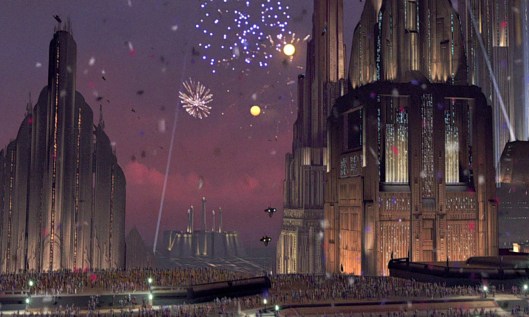
image7return.jpg

Among the other films, we’ve seen another celebration, on Naboo, at the end of I (The Phantom Menace),

image8phantom.jpg

a secret marriage in II (Attack of the Clones),
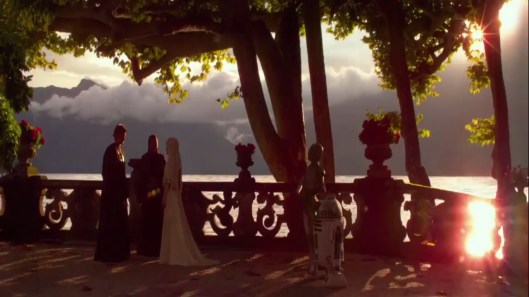
image9attack.jpg

and a complex web of plot, including the construction of the Death Star, the separation of the babies—Leia to Alderan, Luke to Tatooine—and the funeral of Padme in III (The Revenge of the Sith).
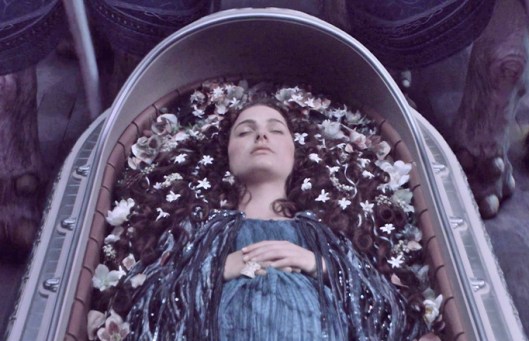
image10padme.jpg

VII (The Force Awakens) had a mysterious ending:  Rey having gone to what appears the far end of the galaxy to find—
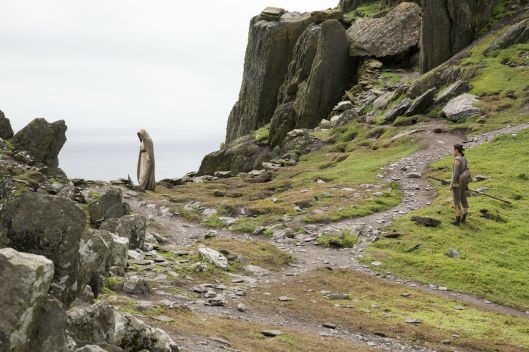
image11rey.jpg

while VIII (The Last Jedi) seemed vaguely hopeful, with an unnamed stable boy showing signs of having the Force within him, as Anakin did in I.
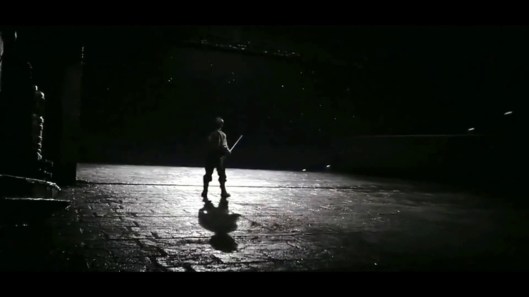
image12last.jpg

With such a build-up, we’ve been wondering how IX (The Rise of Skywalker) will end.  As it’s supposedly the final episode, we assume that it will not conclude up in the air, like V, but will it have a mass celebration, like I, IV, and VI?

Or will it, like III, have multiple endings?  As we’ve thought about it, you could really see that as the case with The Lord of the Rings.

First, like I, IV, and VI, there are celebrations:  of Frodo and Sam at the field of Cormallen, in The Return of the King, Book Six, Chapter 4, “The Field of Cormallen”.

image13afield.JPG

Then, in Chapter 5, “The Steward and the King”, we have the crowning of Aragorn
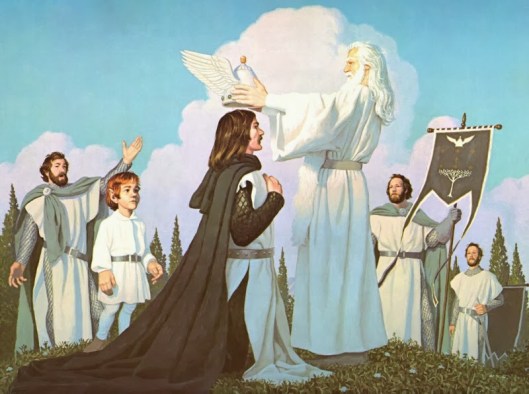
image13coronation.jpg

followed by the wedding of Arwen and Aragorn.

image14wedding.jpg

After that, we have the return of the hobbits to the Shire and the defeat and death of Saruman in Chapter 8, “The Scouring of the Shire”.  The Shire has been badly damaged by Saruman and his henchmen, however, so that, although they are gone, the healing will take many years.

image15adeath.jpg

And the story doesn’t conclude there.  Only a little time goes by and then there is another ending:  the trip to the Grey Havens and beyond in Chapter 9, “The Grey Havens”.

image16grey.jpg

And then the story finally ends—or does it?  We’ve seen in Star Wars VIII, when the stable boy seems to use the Force, though only for a moment,

image12last

the implication that perhaps the title, The Last Jedi, is more of a puzzle than it would first appear.  The very last line of The Lord of the Rings, spoken by Sam, is “Well, I’m back…”  and it’s true, as far as Sam won’t go off on another adventure.  Before this, however, Frodo has been busy writing:

“There was a big book with plain red leather covers; its tall pages were now almost filled.  At the beginning there were many leaves covered with Bilbo’s thin wavering hand, but most of it was written in Frodo’s firm flowing script.  It was divided into chapters but Chapter 80 was unfinished, and after that were some blank leaves…

‘Why, you have nearly finished it, Mr. Frodo!’ Sam exclaimed.  ‘Well, you have kept at it, I must say.’

‘I have quite finished, Sam,’ said Frodo.  ‘The last pages are for you.’”

But what does this imply?  We have no idea what Sam may have added, but the volume Frodo gave him was the origin of The Red Book of Westmarch, the basis not only for The Lord of the Rings, but for The Hobbit, as well.  Are we being told that writing about adventure is an adventure in itself, and almost as important?
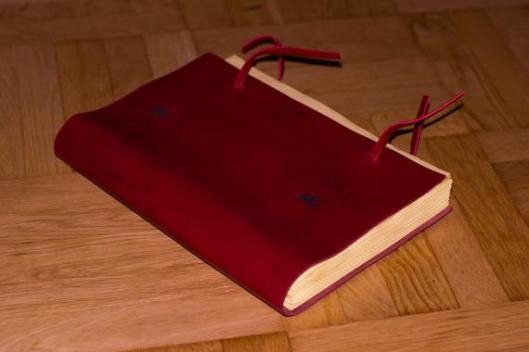
image17redbook.jpg

Thanks, as always, for reading.

MTCIDC, of course!

CD

ps

When we think of music in triumphs, the first piece which pops into our minds (after the Gungan march, of course) was one written by Haendel (1685-1759), “See, the Conquering Hero Comes”.

image18gfh


It was originally intended for his oratorio, Joshua (1747), but it fit his earlier piece, Judas Maccabaeus (1746) so well that he transferred it to the score of that oratorio.  Judas Maccabaeus was composed as a tribute to the second son of George II of England, William Augustus, the Duke of Cumberland,
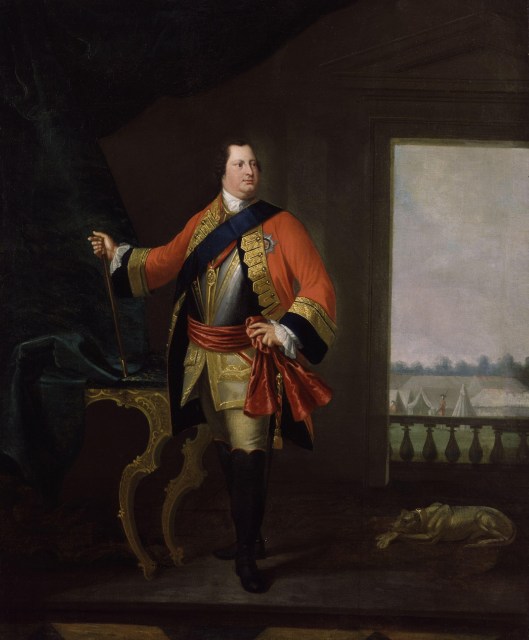
 

image19duke

after he had decisively beaten the attempt to overthrow his father and replace him with the son of the former monarch, James II, at the battle of Culloden.

image20cull.jpg

Here’s a LINK to a stirring performance.

In 1796, the young Beethoven (1770-1827)
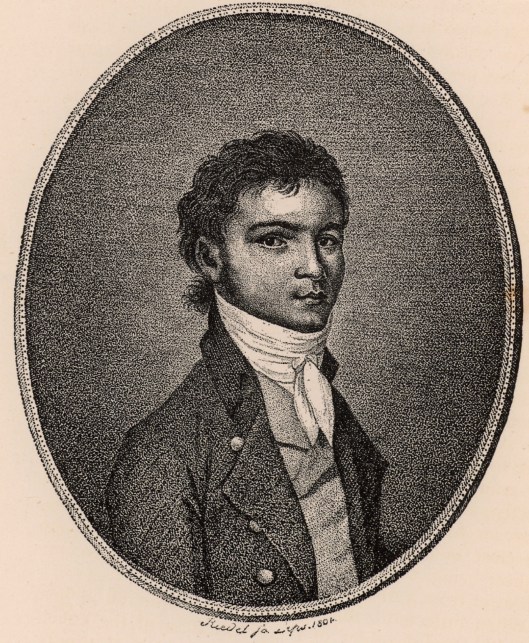
image21bvn.jpg

wrote a series of 12 variations on the theme for cello and fortepiano.  It’s a lot of fun to hear what Beethoven can do with Haendel’s tune, so we give you a LINK here.
Strange as News from Bree

03 Wednesday Feb 2016

Posted by Ollamh in Fairy Tales and Myths, J.R.R. Tolkien, Language, Literary History, Narrative Methods

≈ Leave a comment

Tags

acta, Barad-Dur, Barliman Butterbur, Bree, Bronte, copyists, Dwarves, English coaching inn, Forum Romanum, Frodo Baggins, Gandalf, Gondor, Gutenberg, Haworth, Johann Carolus, Literacy, manuscripts, Medieval, Minas Tirith, Orality, Peter Jackson, pre-print, press, printing press, Romans, royal archives, Sauron, scriptoria, Story, The Lord of the Rings, The Prancing Pony, The Red Book of Westmarch, The Shire, Tolkien, War of the Ring, word-of-mouth, Yorkshire

Welcome, dear readers, as always.

After the last couple of postings, full of war, this is a rather peaceful one. We want to put forward a scheme for a larger project, all about orality versus literacy in Middle Earth, of which this is one small step, our initial question for the project being, “What is written and how and what is only spoken and remembered?”

Early in Chapter 9 of The Fellowship of the Ring (“At the Sign of the Prancing Pony”), we encounter this passage:

“For Bree stood at an old meeting of ways; another ancient road crossed the East Road just outside the dike at the western end of the village, and in former days Men and other folk of various sorts had travelled much on it. Strange as News from Bree was still a saying in the East Farthing, descending from those days, when news from North, South, and East could be heard in the inn, and when the Shire-hobbits used to go more often to hear it.”

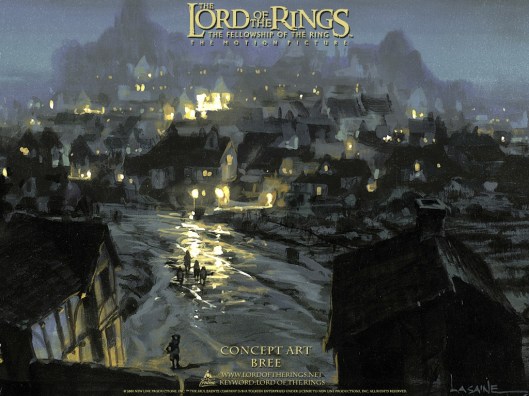
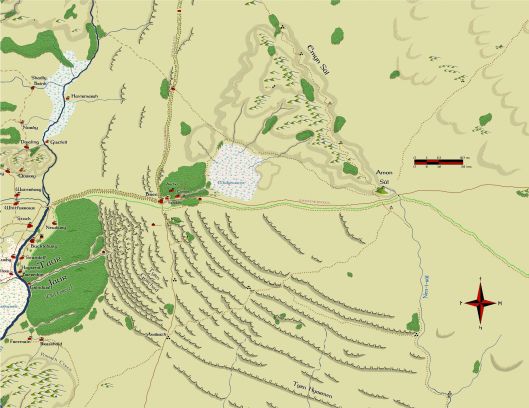
Bree, of course, is the little town to which Frodo and his companions travel once they have gotten free of the Barrow Downs.

ICE Bree and the Barrow-downs (Late Third Age) v1.3.jpg

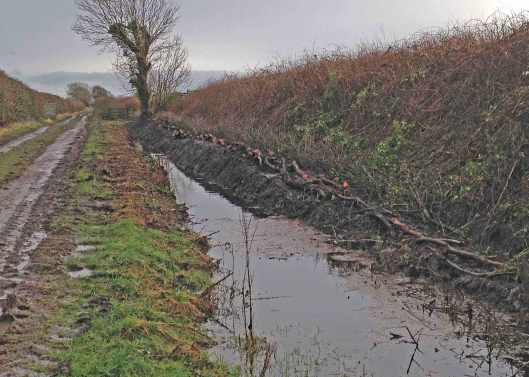
The little town is described as being surrounded by a dike—a wide ditch, the inner side topped with a thick hedge—perhaps something like this—

D21-15-2-14-More-hedging-activity_0670.jpg

And consisting of “some hundred stone houses of the Big Folk, mostly above the Road…”. Without knowing the kind of stone, we have imagined it as looking rather like Haworth, in Yorkshire, the home of the Bronte family (without the modern touristy stuff, of course).

haworth.jpg

(And we note, by the way, that its depiction in the Jackson films doesn’t appear to reflect JRRT’s description that the houses were made of stone: rather, it appears to be filled with half-timbered, plaster and lath constructions.)

LOTR Bree.JPG


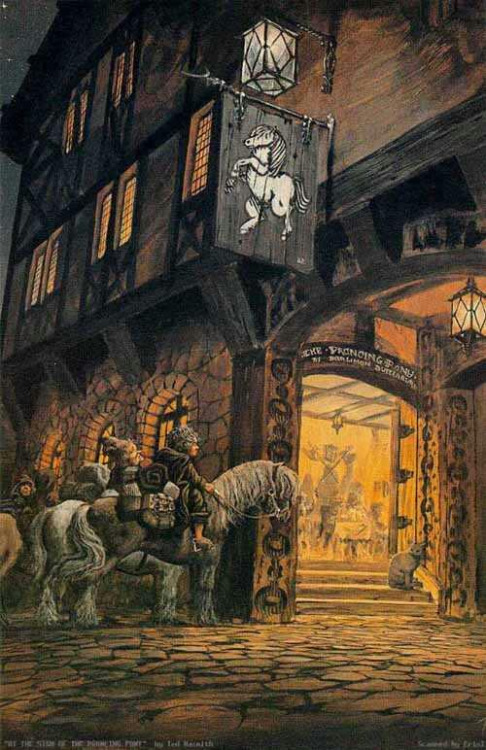
Here, the Hobbits stay at the Prancing Pony.

naismithprancingpony.jpg

Tolkien describes it as

“a meeting place for the idle, talkative, and inquisitive among the inhabitants, large and small…”

To our minds, it probably looked like one of those very old English coaching inns.

111-1000011im.jpg


And we begin our research inside.

Before we do, let’s spend a moment thinking about that word “news”, as in “Strange as news from Bree”.

In pre-print days, for most people in most places, information about events was circulated only by word-of-mouth. There were a few exceptions: the government in Rome produced hand-written circulars, called acta which were put up in the Forum Romanum from the middle of the last century BC through to the 3rd century AD. These would obviously have had a very limited circulation, however, and we can imagine that the contents would still have been passed on mouth-to-mouth for most people in Rome.

To gain greater circulation really demanded print. Although Gutenberg produced the first press and movable lead type by 1440,

gutenberg.jpg

the earliest surviving printed newspaper known at present dates from 1609, produced in Germany. (It appears that the publisher, Johann Carolus, had actually begun printing, rather than hand-copying, in 1605.)

Relation_Aller_Fuernemmen_und_gedenckwuerdigen_Historien_(1609).jpg

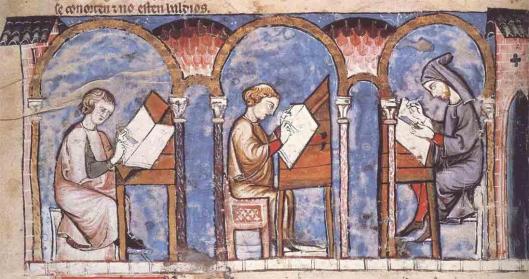
As far as we can tell, true to the general image of Middle Earth as a medieval world, printing presses have yet to appear (unless Sauron is producing very limited editions at the Barad-dur Press and circulation consists of exactly one copy). This means that we are still in the preprint world of hand-copying, when it comes to documents. In the western European world, on which places like Gondor are modeled, this means scriptoria—copy centers—mainly in monasteries and in royal courts where the copyists had probably been trained in monastic scriptoria.

scriptorium.jpg

Because there are no religious foundations or even schools of any sort mentioned in Middle Earth, we don’t know how or where documents were written or copied or even how and where anyone learned to read and write (except Sam, who was taught his letters by Frodo), but literacy turns up all over the place, from the Red Book of Westmarch to the runes of the dwarves to the writings Gandalf says he searched through in the archives of Minas Tirith.

All of this is, in a sense, commemorative—it’s history, really, whether a dwarvish map or tomb inscription, or an account of the War of the Ring. What about other things, however—word of daily events, or even entertainment forms, like songs and poems, things which may some day become part of history but, at the present, seem much more ephemeral? That’s what we’ve come to Bree to find out—and we’re quickly helped in our investigation by the host of the Prancing Pony, Barliman Butterbur, who says to Frodo and the others:

“ ‘I don’t know whether you would care to join the company…Perhaps you would rather go to your beds. Still the company would be very pleased to welcome you, if you had a mind. We don’t get Outsiders—travelers from the Shire, I should say, begging your pardon—often; and we like to hear a bit of news, or any story or song you may have in mind…’ “

And there’s that emphasis on the oral: “we like to hear”. You, readers, have a world of electronic devices to turn to for “a bit of news, or any story or song”, as well as, in the case of news, actual newspapers, not to mention bookstores, libraries, and the wonderful resources of Gutenberg and the Internet Archive. None of that in any form is available to carry or preserve information in Middle Earth. What books there are—and they are manuscripts, remember, things which look like this—

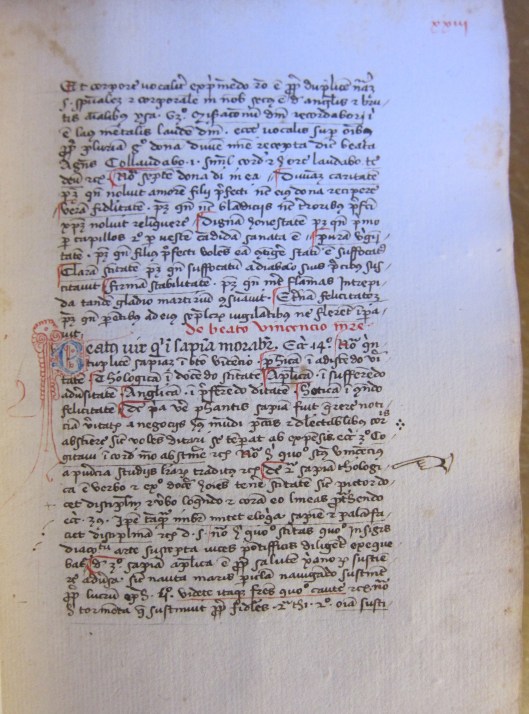
MS-Italian.jpg

or, if you are rich, this—

frms.png

are either in royal archives, as in the case of those which Gandalf consults in Minas Tirith, or in the hands of families, as is the fate of The Red Book of Westmarch and other such items in the Shire. And so people are, on the one hand, eager for news and entertainment, but, on the other, forced either to make it for themselves or to wait for willing strangers to add to their meager store.

It’s natural, then, that “As soon as the Shire-hobbits entered, there was a chorus of welcome from the Bree-landers.” The first local reaction to Frodo’s attempts to create an explanation for why he and his companions are traveling is also natural:

“He gave out that he was interested in history and geography (at which there was much wagging of heads, although neither of these words were [sic] much used in the Bree-dialect). He said he was thinking of writing a book (at which there was silent astonishment), and that he and his friends wanted to collect information about hobbits living outside the Shire, especially in the eastern lands.”

In the nearly-oral world of Bree (there must be some literacy—the Prancing Pony has a sign with an inscription and Barliman seems to know what a letter is), the next reaction is also natural:

“At this a chorus of voices broke out. If Frodo had really wanted to write a book, and had had many ears, he would have learned enough for several chapters in a few minutes. And if that was not enough, he was given a whole list of names, beginning with ‘Old Barliman here’, to whom he could go for further information.”

These would all be so-called “oral informants”—not one mention of manuscripts or documents to suggest that information is conveyed and recorded in writing—and so the Breelanders’ third and final reaction is also natural:

“But after a time, as Frodo did not show any sign of writing a book on the spot, the hobbits returned to their questions about doings in the Shire.”

It’s obvious then, that books, like the words “history” and “geography”, are almost alien to these people and so their interest is in the spoken—or sung—word, which is why, when Frodo breaks into Bilbo’s “There is an inn…” to distract the audience from Pippin’s indiscreet recounting of the birthday party, his stratagem almost works—until he overdoes it and—

But even in the aftermath, although it leads to more trouble for Frodo and his companions, Butterbur can imagine that, in time, that surprising event, like all of the others in this near-oral world, will subside into word-of-mouth.

“He reckoned, very probably, that his house would be full again on many future nights, until the present mystery had been thoroughly discussed.”

And then it would become just another piece of strange news from Bree.

Thanks, as always, for reading.

MTCIDC

CD

The Doubtful Sea Series Facebook Page

The Doubtful Sea Series Facebook Page

  • Ollamh

Categories

  • Artists and Illustrators
  • Economics in Middle-earth
  • Fairy Tales and Myths
  • Films and Music
  • Games
  • Heroes
  • Imaginary History
  • J.R.R. Tolkien
  • Language
  • Literary History
  • Maps
  • Medieval Russia
  • Military History
  • Military History of Middle-earth
  • Narnia
  • Narrative Methods
  • Poetry
  • Research
  • Star Wars
  • Terra Australis
  • The Rohirrim
  • Theatre and Performance
  • Tolkien
  • Uncategorized
  • Villains
  • Writing as Collaborators
Follow doubtfulsea on WordPress.com

Across the Doubtful Sea

Recent Postings

  • A Moon disfigured December 17, 2025
  • On the Roads Again—Once More December 10, 2025
  • (Not) Crossing Bridges December 3, 2025
  • On the Road(s) Again—Again November 26, 2025
  • On the Road(s) Again November 19, 2025
  • To Bree (Part 2) November 12, 2025
  • To Bree (Part 1) November 5, 2025
  • A Plague o’ Both—No, o’ All Your Houses! October 29, 2025
  • It’s in Writing (2:  I’st a Prologue, or a Poesie for a Ring?) October 22, 2025

Blog Statistics

  • 103,220 Views

Posting Archive

  • December 2025 (3)
  • November 2025 (4)
  • October 2025 (5)
  • September 2025 (4)
  • August 2025 (4)
  • July 2025 (5)
  • June 2025 (4)
  • May 2025 (4)
  • April 2025 (5)
  • March 2025 (4)
  • February 2025 (4)
  • January 2025 (5)
  • December 2024 (4)
  • November 2024 (4)
  • October 2024 (5)
  • September 2024 (4)
  • August 2024 (4)
  • July 2024 (5)
  • June 2024 (4)
  • May 2024 (5)
  • April 2024 (4)
  • March 2024 (4)
  • February 2024 (4)
  • January 2024 (5)
  • December 2023 (4)
  • November 2023 (5)
  • October 2023 (4)
  • September 2023 (4)
  • August 2023 (5)
  • July 2023 (4)
  • June 2023 (4)
  • May 2023 (5)
  • April 2023 (4)
  • March 2023 (5)
  • February 2023 (4)
  • January 2023 (4)
  • December 2022 (4)
  • November 2022 (5)
  • October 2022 (4)
  • September 2022 (4)
  • August 2022 (5)
  • July 2022 (4)
  • June 2022 (5)
  • May 2022 (4)
  • April 2022 (4)
  • March 2022 (5)
  • February 2022 (4)
  • January 2022 (4)
  • December 2021 (5)
  • November 2021 (4)
  • October 2021 (4)
  • September 2021 (5)
  • August 2021 (4)
  • July 2021 (4)
  • June 2021 (5)
  • May 2021 (4)
  • April 2021 (4)
  • March 2021 (5)
  • February 2021 (4)
  • January 2021 (4)
  • December 2020 (5)
  • November 2020 (4)
  • October 2020 (4)
  • September 2020 (5)
  • August 2020 (4)
  • July 2020 (5)
  • June 2020 (4)
  • May 2020 (4)
  • April 2020 (5)
  • March 2020 (4)
  • February 2020 (4)
  • January 2020 (6)
  • December 2019 (4)
  • November 2019 (4)
  • October 2019 (5)
  • September 2019 (4)
  • August 2019 (4)
  • July 2019 (5)
  • June 2019 (4)
  • May 2019 (5)
  • April 2019 (4)
  • March 2019 (4)
  • February 2019 (4)
  • January 2019 (5)
  • December 2018 (4)
  • November 2018 (4)
  • October 2018 (5)
  • September 2018 (4)
  • August 2018 (5)
  • July 2018 (4)
  • June 2018 (4)
  • May 2018 (5)
  • April 2018 (4)
  • March 2018 (4)
  • February 2018 (4)
  • January 2018 (5)
  • December 2017 (4)
  • November 2017 (4)
  • October 2017 (4)
  • September 2017 (4)
  • August 2017 (5)
  • July 2017 (4)
  • June 2017 (4)
  • May 2017 (5)
  • April 2017 (4)
  • March 2017 (5)
  • February 2017 (4)
  • January 2017 (4)
  • December 2016 (4)
  • November 2016 (5)
  • October 2016 (6)
  • September 2016 (5)
  • August 2016 (5)
  • July 2016 (5)
  • June 2016 (5)
  • May 2016 (4)
  • April 2016 (4)
  • March 2016 (5)
  • February 2016 (4)
  • January 2016 (4)
  • December 2015 (5)
  • November 2015 (5)
  • October 2015 (4)
  • September 2015 (5)
  • August 2015 (4)
  • July 2015 (5)
  • June 2015 (5)
  • May 2015 (4)
  • April 2015 (3)
  • March 2015 (4)
  • February 2015 (4)
  • January 2015 (4)
  • December 2014 (5)
  • November 2014 (4)
  • October 2014 (6)
  • September 2014 (1)

Blog at WordPress.com.

  • Subscribe Subscribed
    • doubtfulsea
    • Join 78 other subscribers
    • Already have a WordPress.com account? Log in now.
    • doubtfulsea
    • Subscribe Subscribed
    • Sign up
    • Log in
    • Report this content
    • View site in Reader
    • Manage subscriptions
    • Collapse this bar
 

Loading Comments...