Tags
Bilbo, Death, Eowyn, Fantasy, Frodo, Gandalf, John Milton, lotr, Merry, Nazgul, Paradise Lost, Rings, Ringwraiths, The Lord of the Rings, Tolkien, Witch King of Angmar, Witch-King of Angmar
Welcome, dear readers, as always.
You recognized where the title of this posting comes from, I’m sure. Bilbo and Gandalf
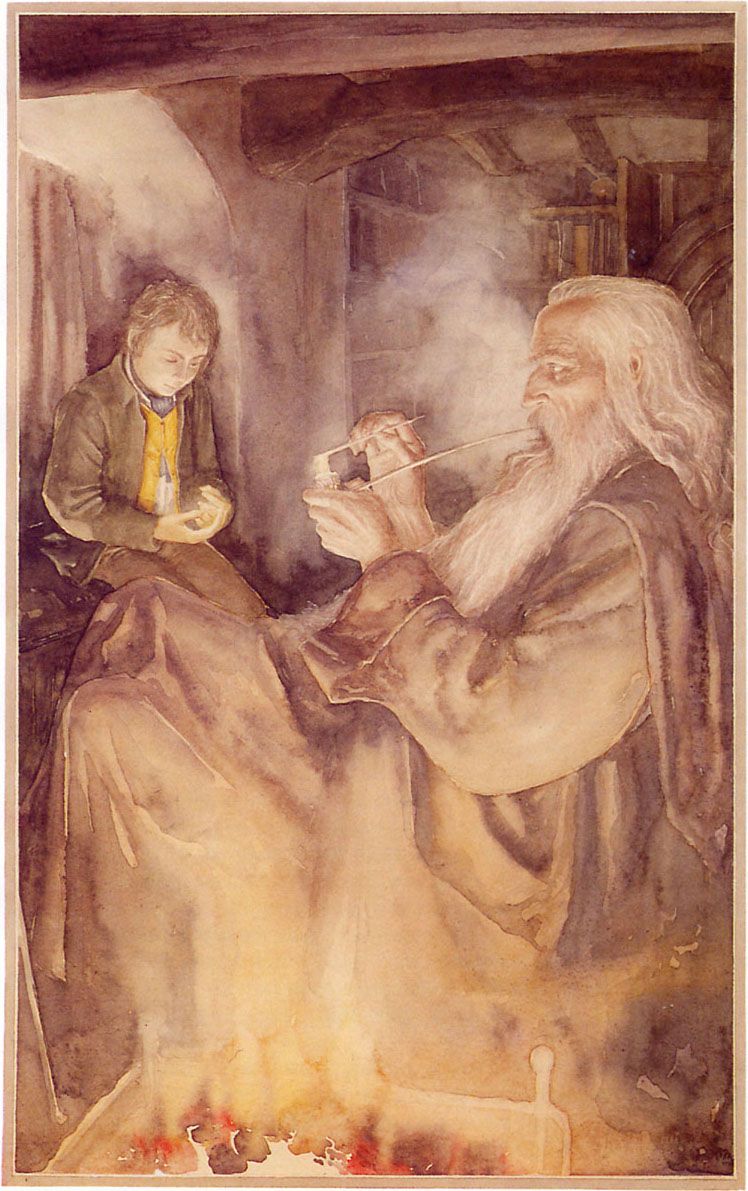
have been talking and Bilbo describes his current state:
“ ‘I am old, Gandalf. I don’t look it, but I am beginning to feel it in my heart of hearts. Well-preserved indeed!…Why, I feel all thin, sort of stretched, if you know what I mean: like butter that has been scraped over too much bread.’ “ (The Fellowship of the Ring, Book One, Chapter 1, “A Long-expected Party”)

(You’ll notice the pun here—as I’m sure JRRT did–in the combination of “preserve(d)” with butter and bread—did he write this originally during breakfast one morning?)

After this, there is a very tense scene where Gandalf inquires about the Ring, Bilbo becomes hostile, but, in the end, Bilbo leaves the Ring and clearly feels great relief, even singing.
Nine years later, in a subsequent scene, after Gandalf had related, the previous night, some details about the Ring to Frodo, we can see what had been going on in Gandalf’s mind those nine years before and his concern for Bilbo then, persuading him to put the Ring aside:
“ ‘A mortal, Frodo, who keeps one of the Great Rings, does not die, but he does not grow or obtain more life, he merely continues, until at last every minute is a weariness. And if he often uses the Ring to make himself invisible, he fades: he becomes in the end invisible permanently, and walks in the twilight under the eye of the Dark Power that rules the Rings. Yes, sooner or later—later, if he is strong or well-meaning to begin with, but neither strength nor good purpose will last—sooner or later the Dark Power will devour him.” (The Fellowship of the Ring, Book One, Chapter 2, “The Shadow of the Past”)
Bilbo was, indeed, as stretched as he felt—and in more danger than he could know. And it was a danger others had undergone before him—had they known what would happen?
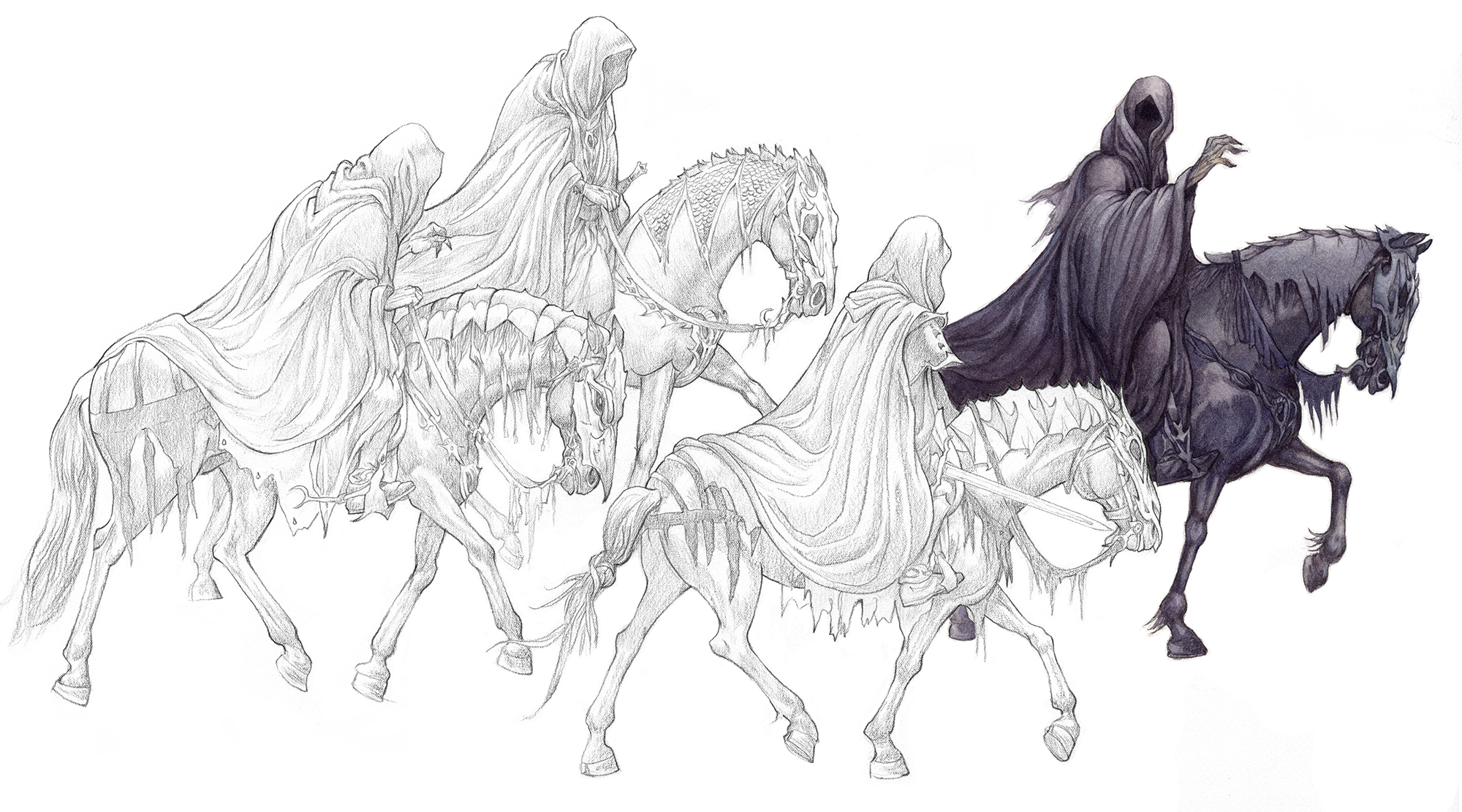
(David T. Wenzel—you can see more of his work here: https://ixgallery.com/artists/davidwenzel/ and visit his website here: https://davidwenzel.com/ Be sure to spend time looking at his sketches—he’s a beautiful draftsman and his work is a pleasure to examine.)
Gandalf goes on to explain the history of the Nazgul to Frodo, in relation to the very Ring we see here:
“ ‘Nine he gave to Mortal Men, proud and great, and so ensnared them. Long ago they fell under the dominion of the One, and they became Ringwraiths, shadows under his great Shadow, his most terrible servants. Long ago.’ “
And Gandalf continues, being more prophetic than he knows:
“ ‘It is many a year since the Nine walked abroad. Yet who knows? As the Shadow grows once more, they too may walk again.’ ” (The Fellowship of the Ring, Book One, Chapter 2, “The Shadow of the Past”)
The Ringwraiths, the Nazgul, will appear again and again in the story, pursuing Frodo and his friends in their initial journey from the Shire, attempting to bribe Gaffer Gamgee,
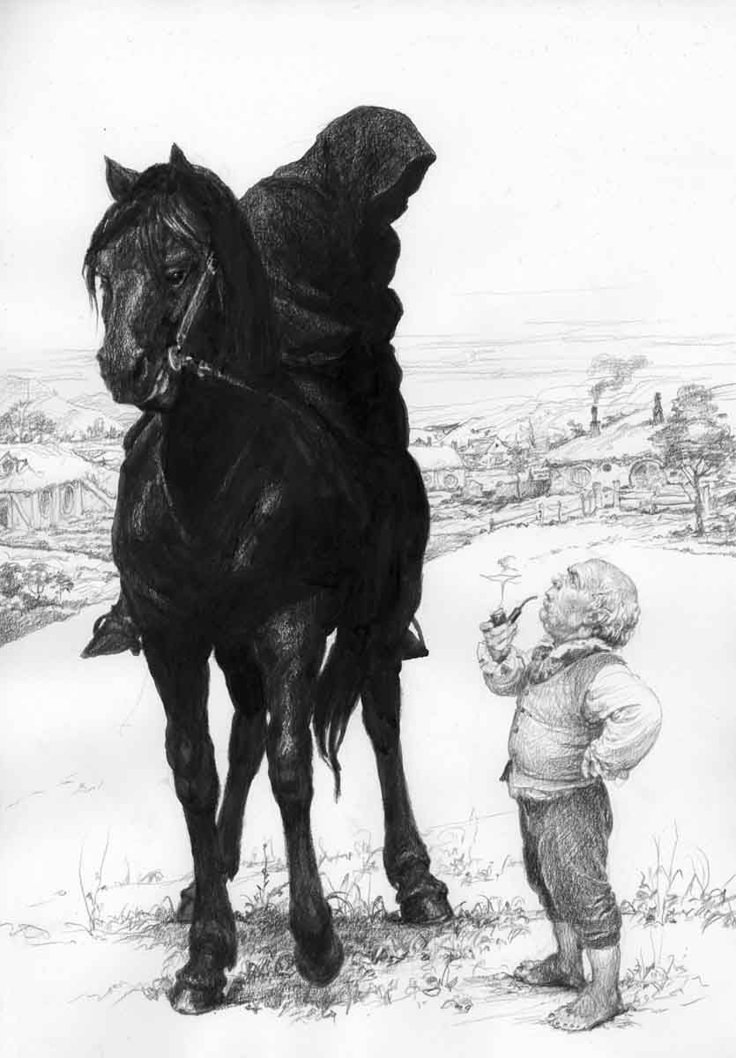
(Denis Gordeev)
making an attack upon Frodo and his friends at the Prancing Pony,

(Ted Nasmith)
nearly fatally wounding Frodo on Weathertop,
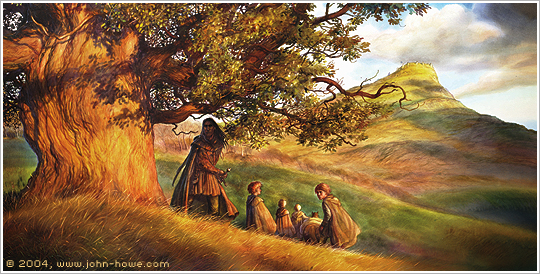
(John Howe)
pursuing him to the ford,
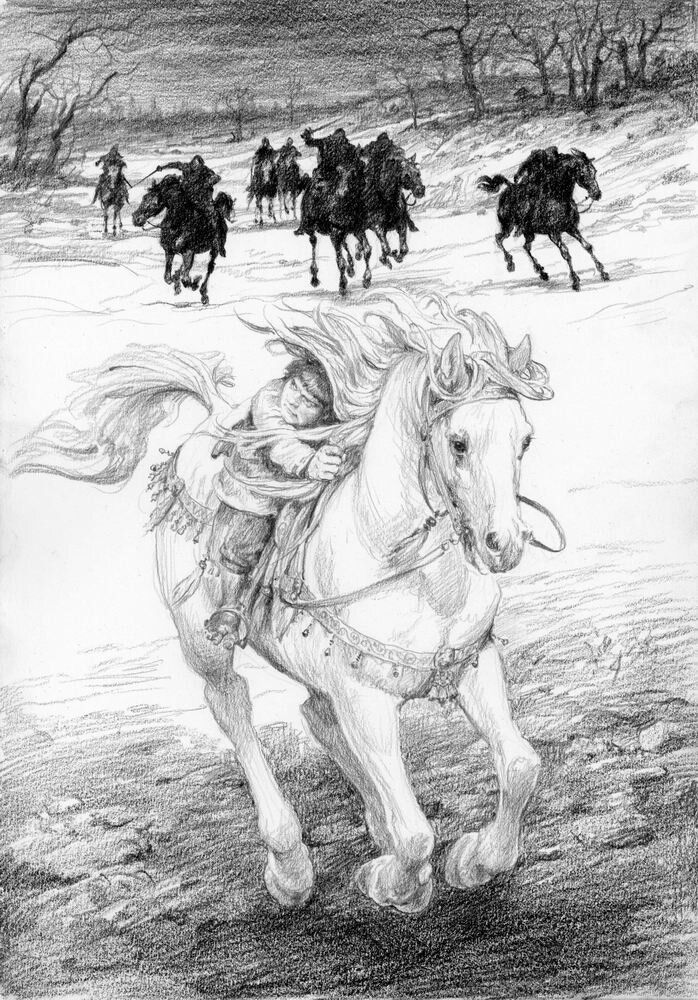
(Denis Gordeev)
but, although washed away there,

(Ted Nasmith)
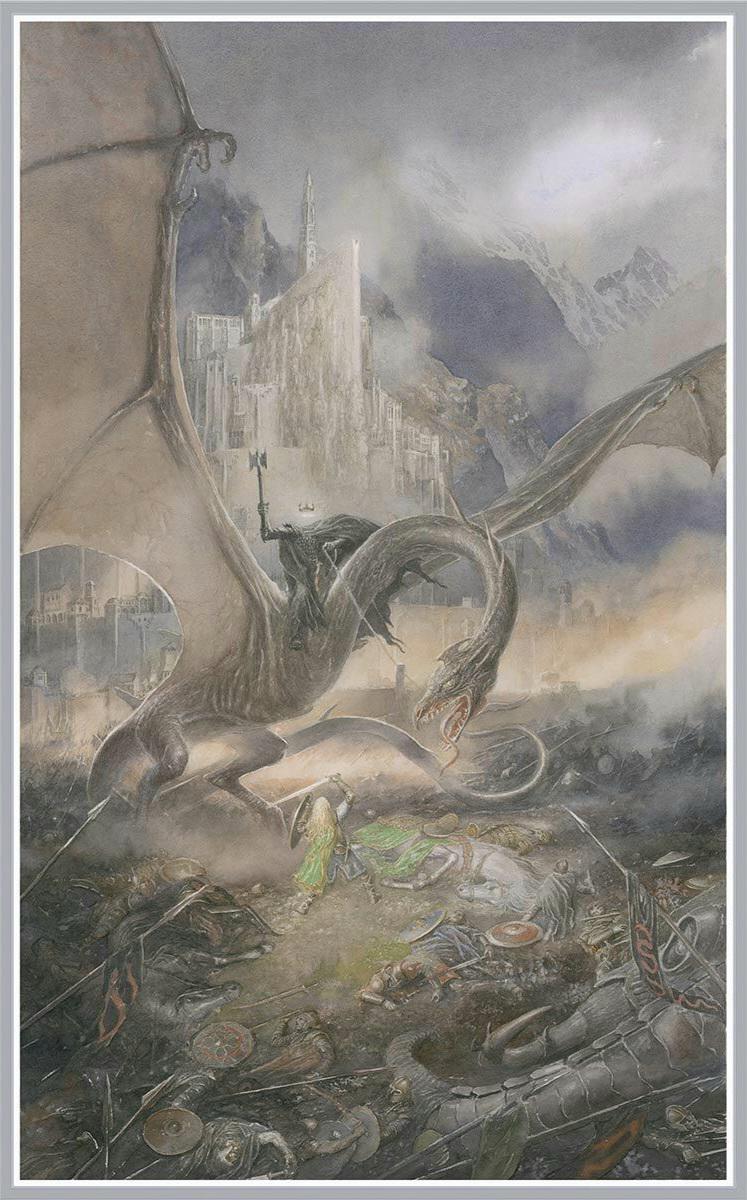
after a pause (although occasionally seen in the sky), participating in the assault on Minas Tirith,
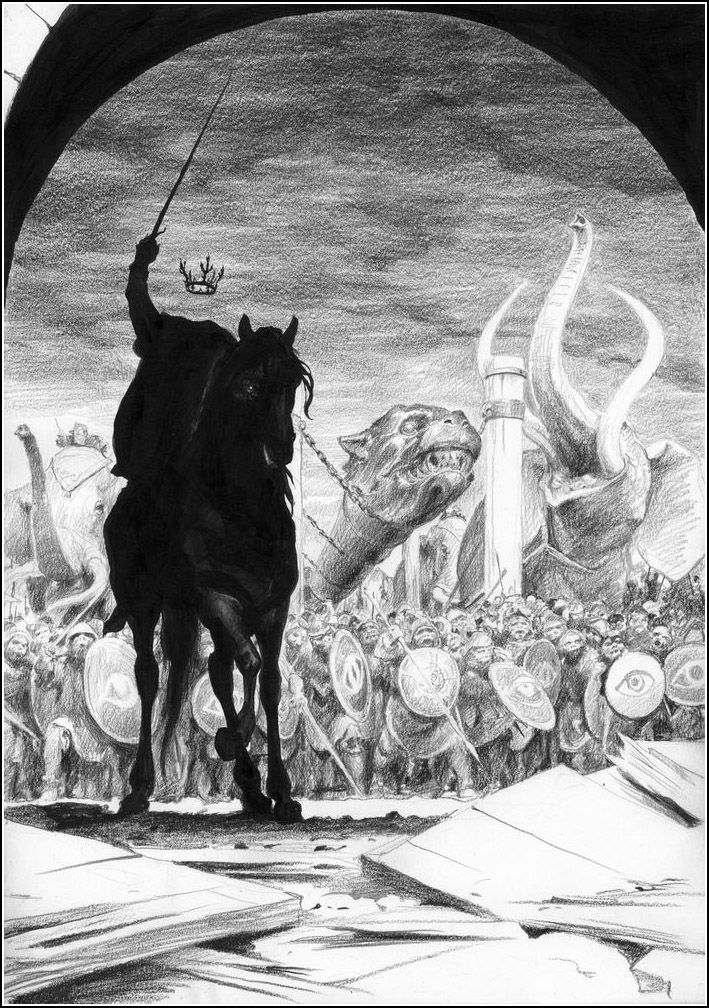
(Denis Gordeev)
with the leader of their number finally destroyed by a combination of Eowyn and Merry.
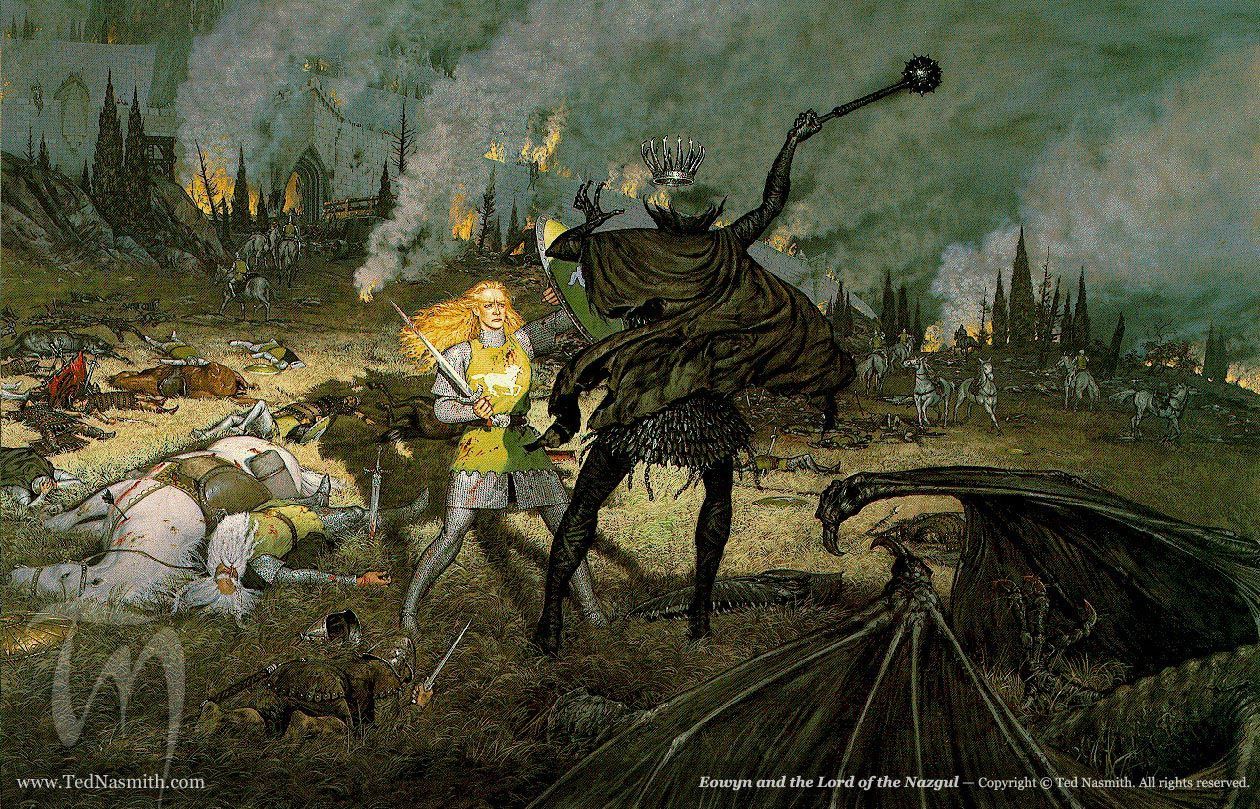
(Ted Nasmith)
But this brings up a question: if the Ringwraiths are “shadows under [Sauron’s] Great Shadow”, how can they:
1. carry weapons (think of the Morgul knife which wounds Frodo)
2. ride horses
3. somehow, after those horses are destroyed, make their way back to Mordor for replacements
4. although disembodied, be wounded and even destroyed by mortal weapons?
And the answer is: unclear. This is a place where I think JRRT wanted spookiness and substance, too, so his insubstantial menace—the Nazgul seem, in fact, to need those cloaks to be embodied—can do things like ride horses and other, unmentionable, things,
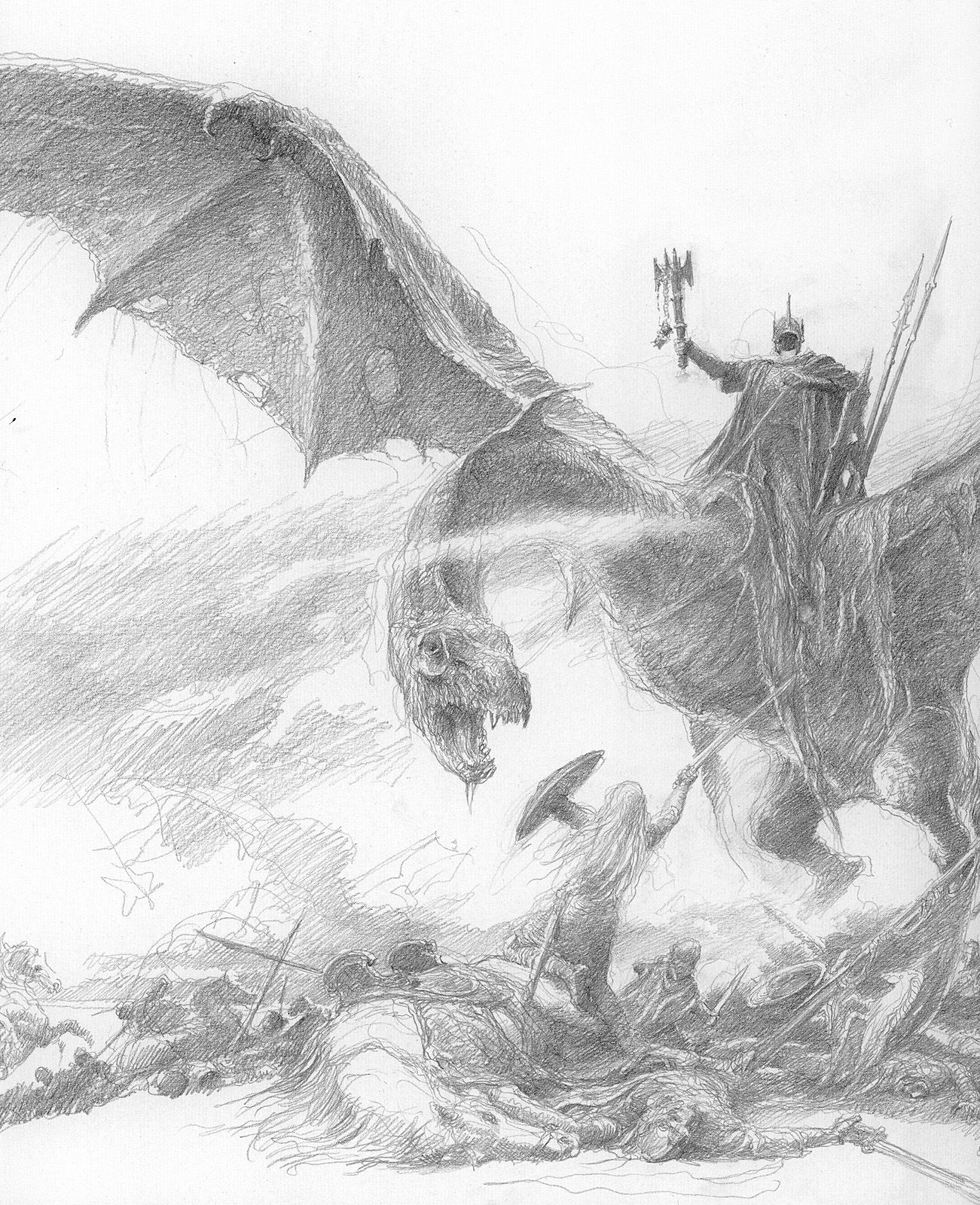
(Alan Lee)
and wield real weapons, as well as suffer wounds, like the mortals they once were. And that leader even wears a crown—
“Upon [the beast] sat a shape, black-mantled, huge and threatening. A crown of steel he bore, but between rim and robe naught was there to see, save only a deadly gleam of eyes.” (The Return of the King, Book Five, Chapter 6, “The Battle of the Pelennor Fields”)
which might, in fact, give us a clue as to where that invisibility—and something more– might originally have sprung from.
Recently, I’ve been rereading John Milton’s (1608-1674) Paradise Lost 1667-1674),

where I came upon this scene, in which we see Satan, defeated in battle, with plans for revenge, is flying towards new-made Eden. In his flight, he sees:
“…The other shape,
If shape it might be called that shape had none
Distinguishable in member, joint, or limb,
Or substance might be called that shadow seemed,
For each seemed either; black it stood as Night,
Fierce as ten Furies, terrible as Hell,
And shook a dreadful dart; what seemed his head
The likeness of a kingly crown had on.” (Paradise Lost, Book II, lines 666-673)
This is, in fact, Death, we’re told, the offspring of Satan and the personification of Sin. The Witch King of Angmar (the head of the Nazgul) may not be quite so dramatic a figure as that, and, for all that he’s the shadow of a shadow, he isn’t deathless, but the similarities—the lack of substance, the crown– are such that it makes me wonder: while he was having that creative breakfast, did Tolkien have his copy of Paradise Lost propped up on the table in front of him?

Thanks for reading, as always.
Stay well,
Always try to come between the Nazgul and his prey,

(Federico—for more of his work, see: https://pigswithcrayons.com/author/federico-piatti/ )
And remember that, as ever, there’s
MTCIDC
O




















 doubtfulsea