• About

doubtfulsea

~ adventure fantasy

Tag Archives: Ford of Bruinen

Who Goes There? (2)

21 Wednesday Nov 2018

Posted by Ollamh in J.R.R. Tolkien

≈ Leave a comment

Tags

Beowulf, Ford of Bruinen, Haldir, Jules Verne, Lorien, Moria, Nautilus, Rivendell, Sentries, The Argonath, The Hobbit, The Lord of the Rings, The Shire, Tolkien, Twenty Thousand Leagues Under the Sea

As ever, dear readers, welcome.

In our last, we had begun discussion of the use of watchmen/sentries in The Lord of the Rings.  In our last, in fact, we had stopped with what is well-known to have been a strong influence—especially in The Hobbit—upon JRRT:  Beowulf, and its two such figures.  Here’s Beowulf with the first.

image8coastguard

What particularly interests us is that, often when such a figure—or figures—is encountered, it slows the action, but, interestingly, may cause further action at the same time:  the protagonist can be challenged, questioned, or even forced to act—all part of what we call “no fiction without friction”—and we’ll see what this does for the characters now as we’re off on our journey through Middle-earth, beginning  where The Lord of the Rings begins, in the Shire.
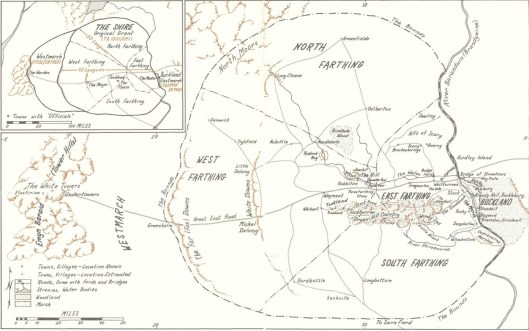
image2shire

Before we go farther, however, we would like to expand our definition of watchman/sentry just a little to include the mobile equivalent of sentries, patrols:

“The Shirriffs was the name that the Hobbits gave to their police, or the nearest equivalent that they possessed…There were in the Shire only twelve of them, three in each Farthing, for Inside Work.  A rather larger body, varying at need, was employed to ‘beat the bounds’, and to see that Outsiders of any kind, great or small, did not make themselves a nuisance.”  (The Lord of the Rings, Prologue, 3, “Of the Ordering of the Shire”)

Tolkien says of these shirriffs that “they were in practice rather haywards then policemen”, and “hay” here doesn’t  mean horse and cattle feed  but, rather, it’s an old word for “hedge”(from Old English “haga”) and we see our next sentry at the hedge which surrounds Bree.  Initially, this is “old Harry”, who seems, when the hobbits arrive, a bit too inquisitive:

“They came to the West-gate and found it shut; but at the door of the lodge beyond it, there was a man sitting.  He jumped up and fetched a lantern and looked over the gate at them in surprise.” (The Fellowship of the Ring, Book One, Chapter 9, “At the Sign of the Prancing Pony”)

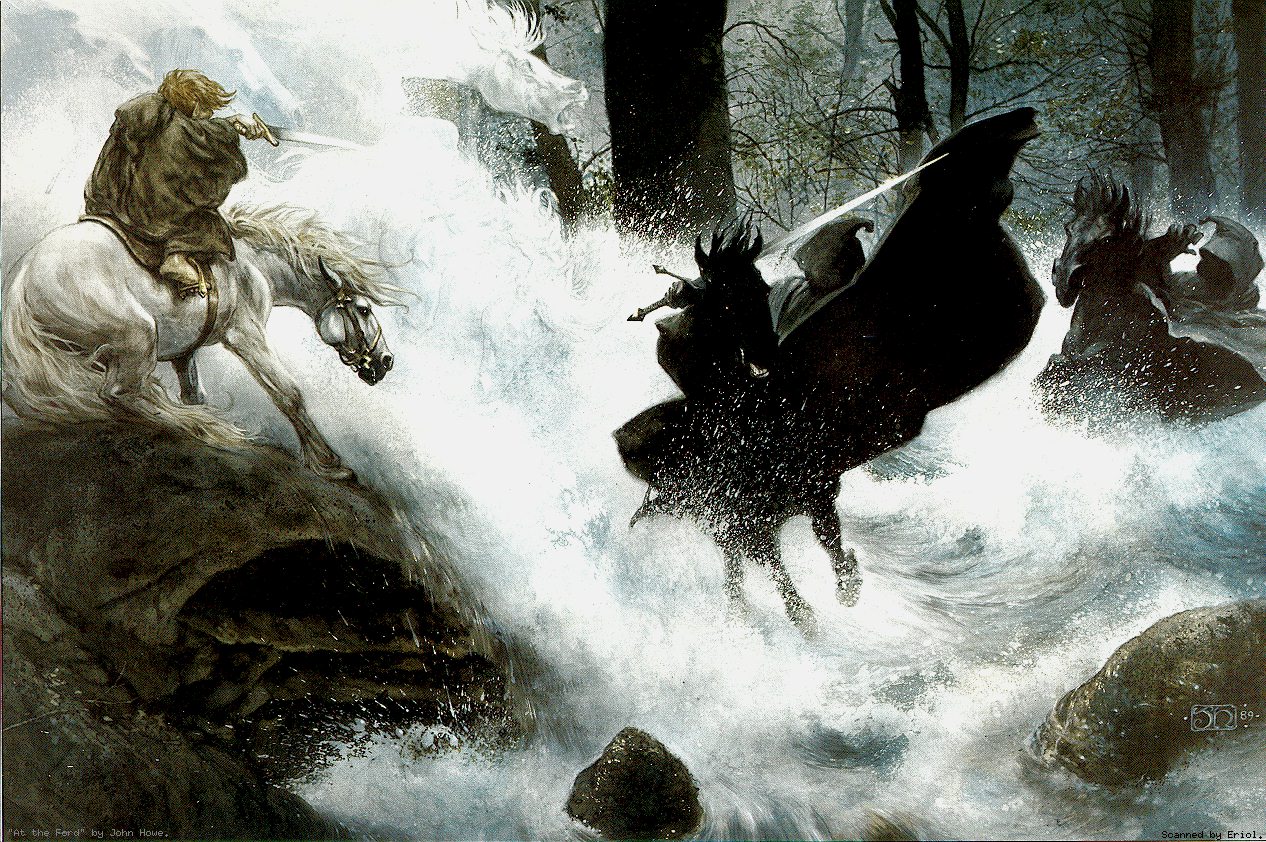
It says, perhaps, something about the confidence of the Elves that, at Rivendell, there are neither sentries nor patrols—although perhaps the River Bruinen might be considered at least a defense, considering that it sweeps away the Nazgul when they try to cross.

At the Ford, by Ted Nasmith

(Image by one of our favorite Tolkien illustrators, Ted Nasmith)

This idea of a natural force as sentry appears again before the Fellowship enters Moria—although, this time, as they climb along the mountains on the way south, it is decidedly not on their side:

“They heard eerie noises in the darkness round them.  It may have been only a trick of the wind in the cracks and gullies of the rocky wall, but the sounds were those of shrill cries, and wild howls of laughter.  Stones began to fall from the mountain-side, whistling over their heads, or crashing on the path beside them.  Every now and again they heard a dull rumble, as a great boulder rolled down from hidden heights above.” (The Fellowship of the Ring, Book Two, Chapter 3, “The Ring Goes South”)

The combination of rock and snow forces the Fellowship to make what seems at the time a fatal decision:  to go not south, but east, into the Mines of Moria, with the disappearance of Gandalf as the consequence.

At the western doors of Moria, however, they encounter another negative force, something in the manmade lake in front of those doors.  It is a watcher, if not an active sentry, although what it really is, even Gandalf doesn’t know:

“Something has crept or has been driven out of dark waters under the mountains.  There are older and fouler things than Orcs in the deep places of the world.”  (The Fellowship of the Ring, Book Two, Chapter 4, “A Journey in the Dark”)

alan-lee-moria-gate-particolare

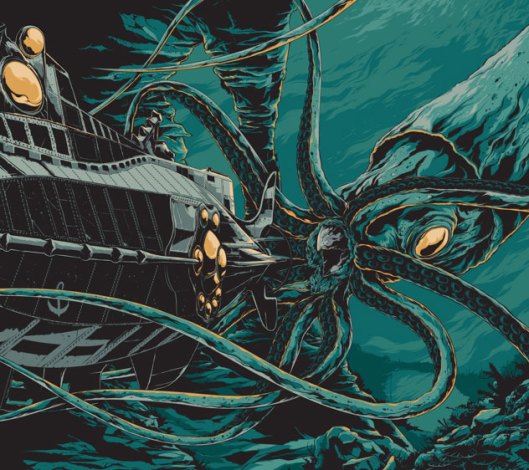
Whatever this creature may be (and it has lots of tentacles, which makes us think immediately of the squid with which the crew of the submarine Nautilus has to contend in Jules Verne’s Twenty Thousand Leagues Under the Sea)
20000detail

their encounter with it insures that their choice of traveling through Moria can’t be revoked:

“Many coiling arms seized the doors on either side, and with horrible strength, swung them round.  With a shattering echo they slammed, and all light was lost.  A noise of rending and crashing came dully through the ponderous stone…They heard Gandalf go back down the steps and thrust his staff against the doors.  There was a quiver in the stone and the stairs trembled, but the doors did not open.”

On the far side of Moria, at the edge of Lorien, the company meets its next watcher—or watchers, rather, a listening post of Elves set on a platform in a tree, where:

“…[Frodo] found Legolas seated with three other Elves.  They were clad in shadowy-grey, and could not be seen among the tree-stems, unless they moved suddenly.”  (The Fellowship of the Ring, Book Two, Chapter 6, “Lothlorien”)

And here we see an interesting development brought on by contact with the Elves at this sentry-post.  Because the Elves are mistrustful of Gimli, there is an awkward moment:  he is to be led blindfolded into the center of Lorien, something he resists until Aragorn proposes that all be blindfolded, to which Gimli makes a counterproposal that only Legolas need be blindfolded, which Legolas resists, and all are back to Aragorn’s proposal, but the leader of the Elves, Haldir, draws a moral from the situation:

“Indeed in nothing is the power of the Dark Lord more clearly shown than in the estrangement that divides all those who still oppose him.”

Our last sentries for this posting are more a symbol in that they are inanimate, but full of warning all the same:

“  ‘Behold the Argonath, the Pillars of the Kings!’ cried Aragorn…

As Frodo was borne towards them the great pillars rose like towers to meet him.  Giants they seemed to him, vast grey figures silent but threatening.  Then he saw that they were indeed shaped and fashioned…Upon great pedestals founded in the deep waters stood two great kings of stone:  still with blurred eyes and crannied brows they frowned upon the North.  The left hand of each was raised palm outwards in gesture of warning; in each right hand there was an axe; upon each head there was a crumbling helm and crown.  Great power and majesty they still wore, the silent wardens of a long-vanished kingdom. “  (The Fellowship of the Ring, Book Two, Chapter 9, “The Great River”)

argonath hildebrandt

But, for all their forbidding look, they spark something in Aragorn—

“ ‘Fear not!’ said a strange voice behind him.  Frodo turned and saw Strider, and yet not Strider; for the weatherworn Ranger was no longer there.  In the stern sat Aragorn son of Arathorn, proud and erect, guiding the boat with skilful strokes; his hood was cast back, and his dark hair was blowing in the wind, a light was in his eyes:  a king returning from exile to his own land.”

And, on that inspiring note, we’ll pause for this posting, saving the rest of the sentries, watchers, and patrols for Part 3.

In the meantime, thanks, as always, for reading.

MTCIDC

CD

Dead Ringers?

01 Wednesday Jul 2015

Posted by Ollamh in Fairy Tales and Myths, J.R.R. Tolkien, Narrative Methods, Poetry

≈ 1 Comment

Tags

Daydreaming, Dragon, Eagles, Ford of Bruinen, Frigates, Frodo, Kites, Nazgul, Pterodactyl, Red-Tailed Hawk, Ring Wraiths, Robert Burns, Shire, Tam O'Shanter, The Legend of Sleepy Hollow, The Lord of the Rings, Tolkien, Washington Irving, Witches' Sabbath

Welcome! In this posting, we plan to talk about the Ring Wraiths (probably in hushed voices).

This entry was initially inspired by looking out the window (and no, we weren’t daydreaming—really!).

There was a harsh call from the sky.

Red-Tailed Hawk Scream (YouTube)

Peering out, we saw the local hawks, who are nesting on a tall building across the road, circling, balancing high on a thermal in that amazing way, something like a kite

Ancient-China-kites-2

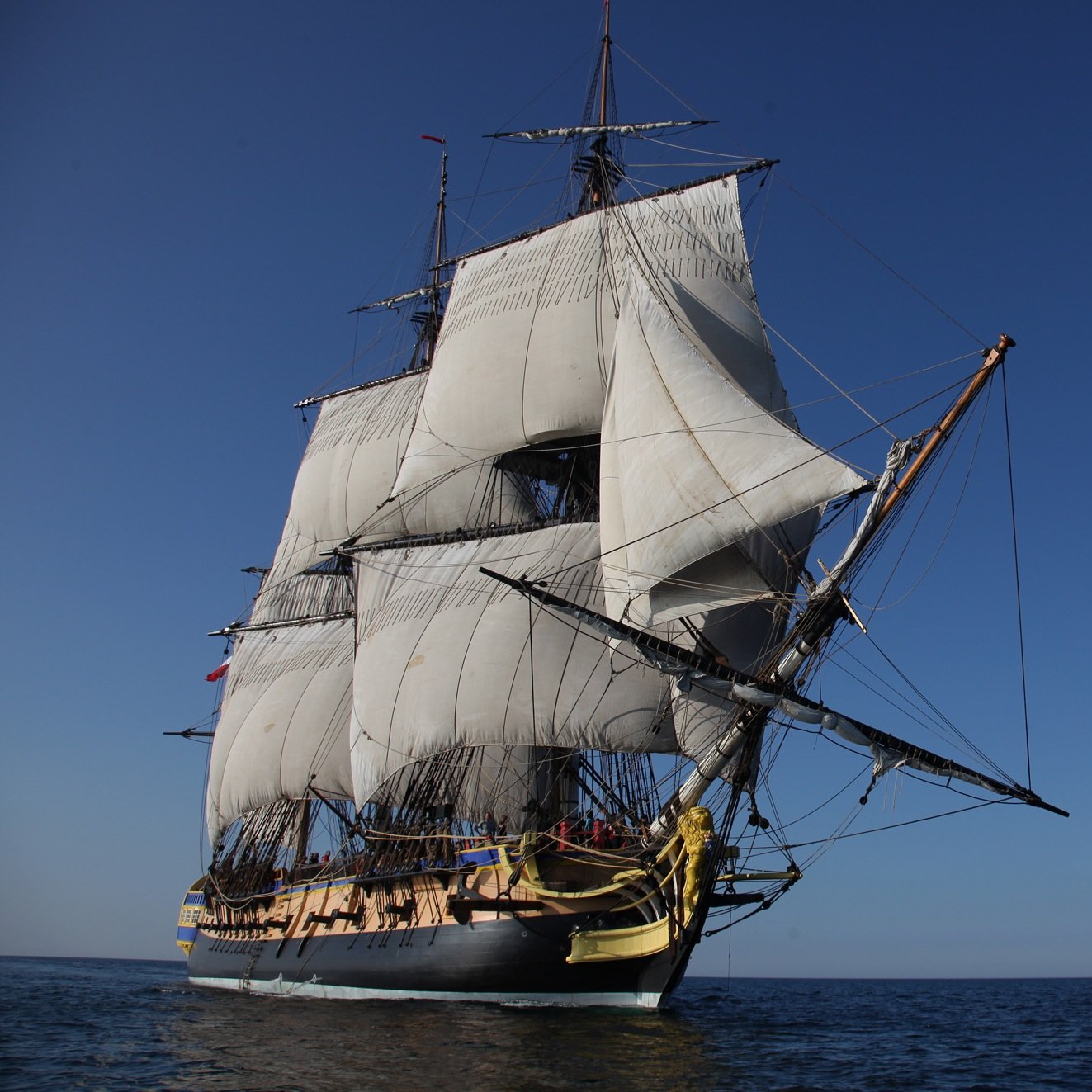
combined with the nimbleness of an 18th-c. frigate.

l'hermione

Red-Tailed Hawks Circling (YouTube)

And suddenly we were looking up at something completely different—

7affeea5ca3551eddd3ae8bc4abd7b47

Nazgul!

In contrast to those very convenient Tolkien eagles, traditionally admired as a fierce and noble bird

tumblr_inline_mvvy21Tf9e1rnrk68

the Wraiths appear to be riding a cross between a flying dragon

Fantasy_In_the_clouds_flying_dragon_067388_

and a pterodactyl.

Pterodactyl_2_(PSF)

nazgul_by_daroz-d5hdnn9

Of course, we first encounter the Nazgul on the ground

nazgul_by_jarrettonions-d47wvdd

in their invasion of the Shire and their subsequent pursuit of Frodo.

And here, at the final moment, at the Ford of Bruinen, where the Wraiths are swept away,

ford

perhaps we can catch a glimpse of one of the origins of a very dramatic scene.

The Scots poet, Robert Burns

burnshead1

wrote “Tam O’Shanter” in 1790 and published it the following year.

Tam O’Shanter Poem and Translation

It’s the story in verse of a farmer who stays too late at his local.

Tam_o'_Shanter_and_Souter_Johnny_at_Kirkton_Jean's

Then, on the way home, he is attracted by light in a local abandoned (and, of course, haunted) church

Alloway_Kirk

where a witches’ Sabbath is going on.

(c) City of Edinburgh Council; Supplied by The Public Catalogue Foundation

Still quite tipsy, he cheers it on and, of course, the witches and other otherworldly creatures are immediately in hot pursuit.

(c) Cutty Sark Trust; Supplied by The Public Catalogue Foundation

Tam can escape, but only if he can reach the nearby river Doon and cross its bridge.

bridgeofdoune

He just manages to do this, but his poor horse, Meg, loses her tail.

four

If this plot has a familiar ring, it’s because the American author, Washington Irving,

Portrait of Washington Irving

used the poem as a major source for his short story, “The Legend of Sleepy Hollow” (published in 1820). We begin with a very different story: in 1790, a poor schoolmaster with the poetic name of Ichabod Crane comes to the Hudson River valley town of Sleepy Hollow and, in the course of his stay, becomes such an annoyance to the local bravo, that he uses the local legend of a headless horseman to frighten Crane off.

keller_sleepyhollow

To do this, he convinces Crane that, should he be pursued by such a creature, he can only escape it by crossing running water. (And here we can see the strong influence of Burns.) In the subsequent narrative, as the horseman, the bravo chases Crane to a bridge, and there the story stops. Crane disappears, never to be seen in Sleepy Hollow again. Irving_Sleepy 

John_Quidor_-_The_Headless_Horseman_Pursuing_Ichabod_Crane_-_Google_Art_Project

Unfortunately, neither the Carpenter letters nor the Hammond/Scull volumes provides any reference to Burns or Irving, but the idea that crossing the ford might stop the unearthly has, to us, a definite suggestion that, somewhere in the leaf mould, there may have been a tiny acorn of memory…

Thanks, as ever, for reading!

MTCIDC

CD

ps

You might know “The Legend of Sleepy Hollow” from this–

legendofsleepyhollow-chase

The Doubtful Sea Series Facebook Page

The Doubtful Sea Series Facebook Page

  • Ollamh

Categories

  • Artists and Illustrators
  • Economics in Middle-earth
  • Fairy Tales and Myths
  • Films and Music
  • Games
  • Heroes
  • Imaginary History
  • J.R.R. Tolkien
  • Language
  • Literary History
  • Maps
  • Medieval Russia
  • Military History
  • Military History of Middle-earth
  • Narnia
  • Narrative Methods
  • Poetry
  • Research
  • Star Wars
  • Terra Australis
  • The Rohirrim
  • Theatre and Performance
  • Tolkien
  • Uncategorized
  • Villains
  • Writing as Collaborators
Follow doubtfulsea on WordPress.com

Across the Doubtful Sea

Recent Postings

  • A Moon disfigured December 17, 2025
  • On the Roads Again—Once More December 10, 2025
  • (Not) Crossing Bridges December 3, 2025
  • On the Road(s) Again—Again November 26, 2025
  • On the Road(s) Again November 19, 2025
  • To Bree (Part 2) November 12, 2025
  • To Bree (Part 1) November 5, 2025
  • A Plague o’ Both—No, o’ All Your Houses! October 29, 2025
  • It’s in Writing (2:  I’st a Prologue, or a Poesie for a Ring?) October 22, 2025

Blog Statistics

  • 103,200 Views

Posting Archive

  • December 2025 (3)
  • November 2025 (4)
  • October 2025 (5)
  • September 2025 (4)
  • August 2025 (4)
  • July 2025 (5)
  • June 2025 (4)
  • May 2025 (4)
  • April 2025 (5)
  • March 2025 (4)
  • February 2025 (4)
  • January 2025 (5)
  • December 2024 (4)
  • November 2024 (4)
  • October 2024 (5)
  • September 2024 (4)
  • August 2024 (4)
  • July 2024 (5)
  • June 2024 (4)
  • May 2024 (5)
  • April 2024 (4)
  • March 2024 (4)
  • February 2024 (4)
  • January 2024 (5)
  • December 2023 (4)
  • November 2023 (5)
  • October 2023 (4)
  • September 2023 (4)
  • August 2023 (5)
  • July 2023 (4)
  • June 2023 (4)
  • May 2023 (5)
  • April 2023 (4)
  • March 2023 (5)
  • February 2023 (4)
  • January 2023 (4)
  • December 2022 (4)
  • November 2022 (5)
  • October 2022 (4)
  • September 2022 (4)
  • August 2022 (5)
  • July 2022 (4)
  • June 2022 (5)
  • May 2022 (4)
  • April 2022 (4)
  • March 2022 (5)
  • February 2022 (4)
  • January 2022 (4)
  • December 2021 (5)
  • November 2021 (4)
  • October 2021 (4)
  • September 2021 (5)
  • August 2021 (4)
  • July 2021 (4)
  • June 2021 (5)
  • May 2021 (4)
  • April 2021 (4)
  • March 2021 (5)
  • February 2021 (4)
  • January 2021 (4)
  • December 2020 (5)
  • November 2020 (4)
  • October 2020 (4)
  • September 2020 (5)
  • August 2020 (4)
  • July 2020 (5)
  • June 2020 (4)
  • May 2020 (4)
  • April 2020 (5)
  • March 2020 (4)
  • February 2020 (4)
  • January 2020 (6)
  • December 2019 (4)
  • November 2019 (4)
  • October 2019 (5)
  • September 2019 (4)
  • August 2019 (4)
  • July 2019 (5)
  • June 2019 (4)
  • May 2019 (5)
  • April 2019 (4)
  • March 2019 (4)
  • February 2019 (4)
  • January 2019 (5)
  • December 2018 (4)
  • November 2018 (4)
  • October 2018 (5)
  • September 2018 (4)
  • August 2018 (5)
  • July 2018 (4)
  • June 2018 (4)
  • May 2018 (5)
  • April 2018 (4)
  • March 2018 (4)
  • February 2018 (4)
  • January 2018 (5)
  • December 2017 (4)
  • November 2017 (4)
  • October 2017 (4)
  • September 2017 (4)
  • August 2017 (5)
  • July 2017 (4)
  • June 2017 (4)
  • May 2017 (5)
  • April 2017 (4)
  • March 2017 (5)
  • February 2017 (4)
  • January 2017 (4)
  • December 2016 (4)
  • November 2016 (5)
  • October 2016 (6)
  • September 2016 (5)
  • August 2016 (5)
  • July 2016 (5)
  • June 2016 (5)
  • May 2016 (4)
  • April 2016 (4)
  • March 2016 (5)
  • February 2016 (4)
  • January 2016 (4)
  • December 2015 (5)
  • November 2015 (5)
  • October 2015 (4)
  • September 2015 (5)
  • August 2015 (4)
  • July 2015 (5)
  • June 2015 (5)
  • May 2015 (4)
  • April 2015 (3)
  • March 2015 (4)
  • February 2015 (4)
  • January 2015 (4)
  • December 2014 (5)
  • November 2014 (4)
  • October 2014 (6)
  • September 2014 (1)

Blog at WordPress.com.

  • Subscribe Subscribed
    • doubtfulsea
    • Join 78 other subscribers
    • Already have a WordPress.com account? Log in now.
    • doubtfulsea
    • Subscribe Subscribed
    • Sign up
    • Log in
    • Report this content
    • View site in Reader
    • Manage subscriptions
    • Collapse this bar
 

Loading Comments...