• About

doubtfulsea

~ adventure fantasy

Tag Archives: Fantasy

The Unquiet of the World

29 Thursday Feb 2024

Posted by Ollamh in Uncategorized

≈ Leave a comment

Tags

Fantasy, J.R.R. Tolkien, literature, lord-of-the-rings, Tolkien

As always, dear readers, welcome.

We know that Tolkien had mixed feelings about allegory.  As he wrote in a long, detailed description of his work to Milton Waldman in 1951:

“I dislike Allegory—the conscious and intentional allegory—yet any attempt to explain the purport of myth or fairytale must use allegorical language.  (And, of course, the more ‘life’ a story has the more readily will it be susceptible of allegorical interpretations:  while the better a deliberate allegory is made the more nearly will it be acceptable just as a story.)” (from the typescript of a letter to Milton Waldman, late in 1951, Letters, 204)

This has made me think about Saruman and the Shire.

Defeated at the end of the Second Age, it’s easy to see from a map why Sauron returned to Mordor as his refuge.

It’s clearly a natural fortress, protected on three sides by forbidding mountain ranges pierced by only two gates, the Morannon

(the Hildebrandts)

and Minas Morgul (formerly Minas Ithil).

(another Hildebrandts)

His command center, the Barad-dur, was located there.

(and yet another Hildebrandts)

Sited near an active volcano, Mt. Doom,

(This is actually Villarrica in Chile erupting in March, 2015.)

it was also a blighted land, nearly waterless and bleak.

(This is the Parque Nacional de Timanfaya on the island of Lanzarote in the Canary Islands.  As someone who loves the US Southwest, I find this place absolutely stunning, but, imagining it marched across by companies of orcs and suffered across by Sam and Frodo, it might easily stand in for Mordor.)

Although at the time of The Lord of the Rings it has become a vast camp,

filled with all of the tents and workshops and stables which an army like Sauron’s would require, I have no sense that it was ever anything more than as it must have looked even in the Second Age:  bleak and waterless and dominated to the north by Mt Doom, a vast volcanic plain.  Sauron hadn’t intended to blight it.  Nature had already made it that way and it was useful for what he required:  protection from prying eyes and invading troops and space to spread his growing forces.  (Although I wonder about his water supply—Sam and Frodo are lucky to find the trickle they do—and even “dark pools fed by threads of water trickling down from some source higher up the valley”—by the western mountain wall—The Return of the King, Book Six, Chapter 2, “The Land of Shadow”.  Food seems to have been supplied by slave farms to the south and southeast, also briefly described in this chapter.  Ever-practical Sam wonders about all of this:  “ ‘Pretty hopeless, I call it—saving that where there’s such a lot of folk there must be wells or water, not to mention food.’ “ )

In contrast, there was the Shire—

(JRRT)

As Tolkien imagined it:

“The Shire is placed in a water and mountain situation and a distance from the sea and a latitude that would give it a natural fertility, quite apart from the stated fact that it was a well-tended region when they [the hobbits] took it over…” (letter to Naomi Mitchison, 25 September, 1954, Letters, 292)

It was based, as he stated more than once, on

“…a Warwickshire village of about the period of the Diamond Jubilee [the 60th anniversary of Queen Victoria’s ascension to the throne, 1897]…” (letter to Allen & Unwin, 12 December, 1955, Letters, 334)

which, although the actual village, Sarehole, was just south of the booming manufacturing center of Birmingham, Tolkien describes this world as “…in a pre-mechanical age.”  (letter to Deborah Webster, 25 October, 1958, Letters, 411)

And, to Tolkien, this was

“…in the quiet of the world, when there was less noise and more green…” (The Hobbit, Chapter One, “An Unexpected Party”)

But then Saruman arrives, telling the hobbits:

“ ‘One ill turn deserves another…It would have been a sharper lesson, if only you had given me a little more time and more Men.  Still I have already done much that you will find it hard to mend or undo in your lives.  And it will be pleasant to think of that and set it against my injuries.’ ” (The Return of the King, Book Six, Chapter 8, “The Scouring of the Shire”)

It’s clear from the description given us in “The Scouring of the Shire”, however, that what Saruman intends isn’t just wanton destruction, but something more complex:  a complete reorganization of the Shire.  Part of that is a social restructuring, where a form of communism is forced upon the population.  Monitoring that is the apparatus of a police state, with many rules, a curfew, and a number of the hobbits themselves being recruited to the “Shirriffs”.   But there’s more:

“The pleasant row of old hobbit-holes in the bank on the north side of the Pool were deserted, and their little gardens that used to run down bright to the water’s edge were rank with weeds.  Worse, there was a whole line of the ugly new houses all along Pool Side, where the Hobbiton Road ran close to the bank.  An avenue of trees had stood there.  They were all gone.  And looking with dismay up the road towards Bag End they saw a tall chimney of brick in the distance.  It was pouring out black smoke into the evening air.”

Thus, what Saruman was clearly intending wasn’t just desolation, like Mordor, but rather something more like the imaginary Coketown of Charles Dickens’ Hard Times, 1854:

“It was a town of red brick, or of brick that would have been red if the smoke and ashes had allowed it; town of machinery and tall chimneys, out of which interminable serpents of smoke trailed themselves for ever and ever, and never got uncoiled.  It had a black canal in it, and a river that ran purple with ill-smelling dye, and vast piles of building full of windows where there was a rattling and a trembling all day long, and where the piston of the steam-engine worked monotonously up and down, like the head of an elephant in a state of melancholy madness.  It contained several large streets all very like one another, and many small streets still more like one another, inhabited by people equally like one another, who all went in and out at the same hours, with the same sound upon the same pavements, to do the same work, and to whom every day was the same as yesterday and to-morrow, and every year the counterpart of the last and the next.”   (Hard Times, Chapter 5, “The Keynote” which you can read here:  https://www.gutenberg.org/files/786/786-h/786-h.htm )

Tolkien more than once lamented the passing of the “quiet of the world” and his Shire, which he described in a letter as “where an ordered, civilized, if simple and rural life is maintained” embodied for him that quiet.  (from that same letter to Milton Waldman, late 1951, Letters, 219)

And so, although JRRT wrote, in a letter to the editor of New Republic, Michael Straight, that:

“There is no special reference to England in the ‘Shire’…there is no post-war reference.”

at the same time, he adds:

“…the spirit of ‘Isengard’, if not of Mordor, is of course always cropping up.” (draft of a letter to Michael Straight, “probably January or February 1956, Letters, 340)

We know what that spirit is inspired by, as Treebeard tells us:

“He has a mind of metal and wheels; and he does not care for growing things, except as far as they serve him for the moment.” (The Two Towers, Book Three, Chapter 4, “Treebeard”)

Isengardism—or Sarumanism (a word JRRT himself employs in that same letter to Naomi Mitchison quoted above, saying that he is not a ‘reformer’ (by exercise of power) since it seems doomed to Sarumanism”) to Tolkien meant brutal change—in this case, in the conversion of the Shire into a mini-industrial state, run by a Stalinist tyrant and a cowed population.  Considering Tolkien’s sadness at the conversion of the rural world of his childhood into the industrial world of his present, might we not then see what Saruman does to the Shire as rather like allegory as Tolkien once defined it:

“Of course, Allegory and Story converge, meeting somewhere in Truth.”?  (letter to Sir Stanley Unwin, 31 July, 1947, Letters, 174)

Thanks, as ever, for reading.

Stay well,

Think green thoughts,

And remember that, as always, there’s

MTCIDC

O
What If? (2)

21 Wednesday Feb 2024

Posted by Ollamh in Uncategorized

≈ Leave a comment

Tags

Fantasy, J.R.R. Tolkien, lord-of-the-rings, The Lord of the Rings, Tolkien

Welcome, dear readers, as ever.

In the Star Wars fan world, there has been a lot of recent chatter about a Star Wars “What If?” film.  So far, it seems to be just chatter, but the speculation has gone in all sorts of directions and some very creative people have even produced potential posters, like this one—

with Anakin in his Darth Vader suit, which is real, but Obi Wan and Ahsoka as Imperial officers—a very grim idea.  (For more on possible scenarios, see:  https://thedirect.com/article/star-wars-what-if-disney-plus-2024  I think my favorite is the idea of Jar Jar Binks as a Sith lord—

see this especially silly version here:  https://www.youtube.com/watch?v=dB4sKebTr5k  )

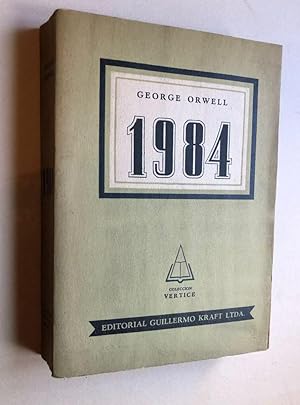
What Ifs are common in the world of fictions of all sorts, from Sci-Fi to Historical, and I’ll bet that you can immediately produce a few titles—from 1984

(a very complex “What If?” in which, unlike many of the genre, we don’t begin with actual history taking a left turn, as in something like some of Harry Turtledove’s books, where, for instance, the South has won the Civil War,

but a world in which something has changed things earlier, producing a series of three large warring states, at least one of which, Oceania, is a reflection of a kind of Stalinist UK)

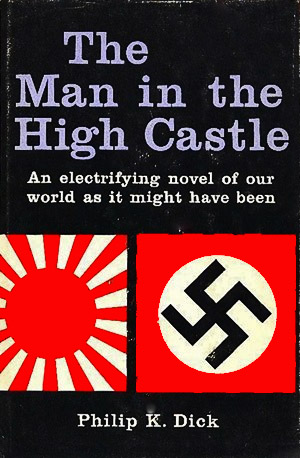
to The Man in the High Castle,

as well as many more. 

It’s always an interesting approach to a story and, when well done, can be anything from entertaining to disturbing.  One which comes to mind as a dead failure, however, might begin with this:

“ ‘I have come,’ he said.  ‘But I do not choose now to do what I came to do.  I will not do this deed.  The Ring is mine!’ And suddenly, as he set it on his finger, he vanished from Sam’s sight.”  (The Return of the King, Book Six, Chapter 3, “Mount Doom”.)

(Alan Lee)

We all know what happens next.  Sauron is suddenly not so sure of his triumph:

“And far away, as Frodo put on the Ring and claimed it for his own, even in Sammath Naur the very heart of his realm, the Power in Barad-dur was shaken, and the Tower trembled from its foundations to its proud and bitter crown.”

But then:

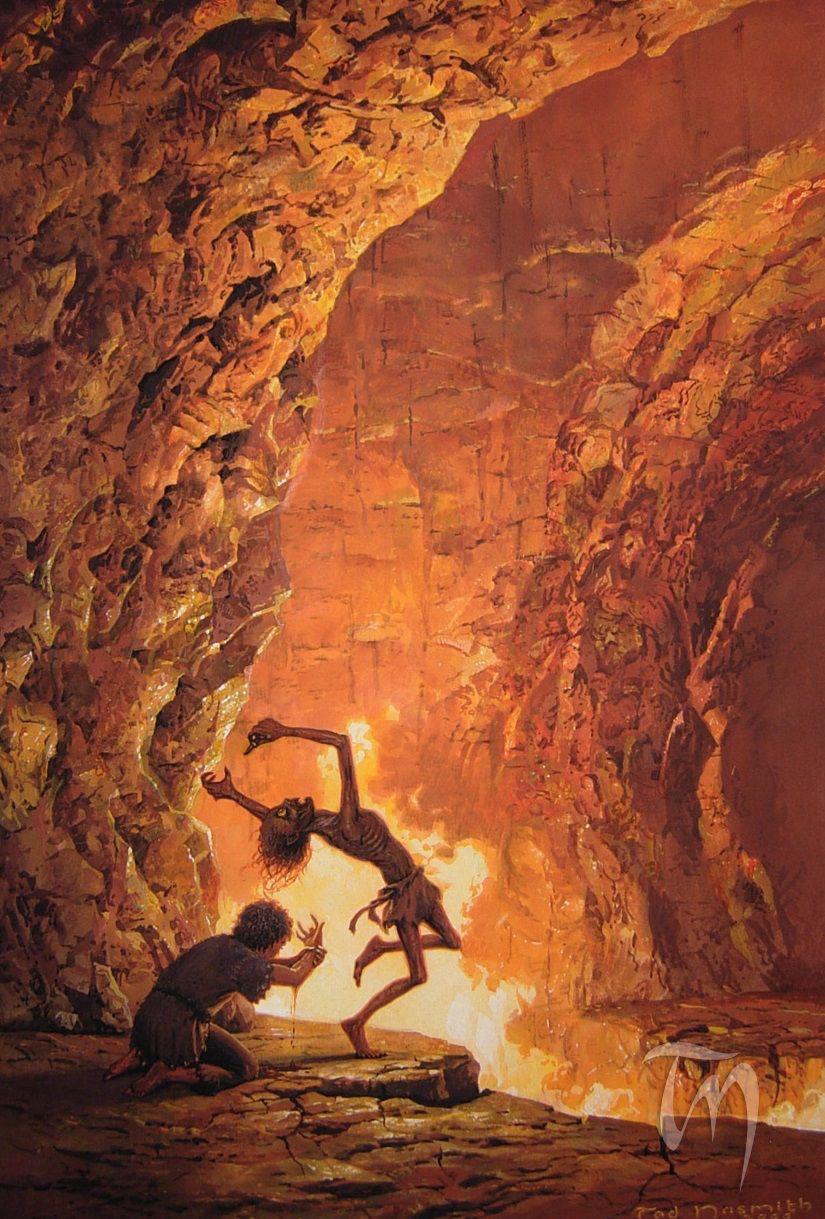
“Suddenly Sam saw Gollum’s long hands draw upwards towards his mouth; his white fangs gleamed, and snapped as they bit.  Frodo gave a cry, and there he was, fallen upon his knees at the chasm’s edge.  But Gollum, dancing like a mad thing, held aloft the ring, a finger still thrust through its circle.”

And then:

“ ‘Precious, precious, precious!’ Gollum cried.  ‘My Precious!  O my Precious!’  And with that, even as his eyes were lifted up to gloat on his prize, he stepped too far, toppled, wavered for a moment on the brink, and then with a shriek he fell.  Out of the depths came his last wail Precious, and he was gone.”

(Ted Nasmith)

In a brief space, we’re confronted with not one, but two, What Ifs, but let’s deal with the second one first, as, after all, Gollum had actually had control of the Ring long before Frodo even became aware of it—for 478 years.  During that time, what had he done with it and himself?

1. he had murdered a friend to obtain it

2. taking up eaves-dropping and petty theft, he’d eventually been exiled from his people

3. finally, he had crept under the Misty Mountains, where he lived on a diet of fish and goblins (when he could catch one) until he lost the Ring (or, perhaps more correctly, the Ring lost him) 80 years before The Lord of the Rings.

The only use he seems to have had for the Ring all that time was as a kind of cloaking device.  I think that we can presume that, had he successfully escaped Sam and Frodo, he would have been quickly apprehended by Sauron’s agents and deprived of his Precious, and worse.

This leaves us with Frodo—and yet we shouldn’t forget the Ring’s other previous possessors.  First, there was Isildur, who cut the Ring from Sauron’s hand at the Battle of Dagorlad—only to have it betray him to orc archers at the Gladden Fields.  Perhaps he hadn’t time to do anything with it, having held it so briefly, it being only 2 years after Dagorlad, but Tolkien never shows him doing anything more than wearing it as a kind of trophy.

And then, of course, there is Bilbo, who, in fact, uses it rather as Gollum did, to disappear from time to time, both in the adventure to the Lonely Mountain and back again and in the years afterwards.  If a king who had actually defeated Sauron did nothing with the Ring’s power, what could one expect from a hobbit?

This brings us back to Frodo.  He is recorded as having put the Ring on only twice:  at Weathertop, when he was almost mortally wounded by one of the Nazgul, and, later, on Amon Hen, where he was terrified by the sudden attention of Sauron:

“And suddenly he felt the Eye.  There was an eye in the Dark Tower that did not sleep.  He knew that it had become aware of his gaze.  A fierce eager will was there.  It leaped towards him; almost like a finger he felt it, searching for him.  Very soon it would nail him down, know just exactly where he was.  Amon Lhaw it touched.  It glanced upon Tol Brandir—he threw himself down from the search, crouching, covering his head with his grey hood.” (The Fellowship of the Ring, Book Two, Chapter 10, “The Breaking of the Fellowship”)

The problem is that, as JRRT explains:

“[Sauron] rules a growing empire from the great dark tower of Barad-dur in Mordor, near to the Mountain of Fire, wielding the One Ring.

But to achieve this he had been obliged to let a great part of his own inherent power…pass into the One Ring.  While he wore it, his power on earth was actually enhanced.  But even if he did not wear it, that power existed and was in ‘rapport’ with himself:  he was not ‘diminished’.”

And yet—

“Unless some other seized it and became possessed of it.”

There is, however, a condition to this—

“If that happened, the new possessor could (if sufficiently strong and heroic by nature) challenge Sauron, become master of all that he had learned or done since the making of the One Ring, and so overthrow him and usurp his place.”

At the same time:

“Also so great was the Ring’s power of lust, that anyone who used it became mastered by it; it was beyond the strength of any will (even his own) to injure it, cast it away, or neglect it.” (draft of a letter to Milton Waldman, “late in 1951”, Letters, 214)

It appears, then, that the Ring enhances the power of him who holds it—but consider those who had, beyond Sauron—what power did any of them, besides Isildur, have?  And what power did Isildur have, when, faced with the Ring’s destruction, as Elrond tells us:

“ ‘Isildur took it, as should not have been.  It should have been cast then into Orodruin’s fire nigh at hand where it was made.  But few marked what Isildur did.  He alone stood by his father in that last mortal contest; and by Gil-galad only Cirdan stood, and I.  But Isildur would not listen to our counsel…

…and therefore whether we would or no, he took it to treasure it.  But soon he was betrayed by it to his death; and so it is named in the North Isildur’s Bane.  Yet death maybe was better than what else might have befallen him.”  (The Fellowship of the Ring, Book Two, Chapter 2, “The Council of Elrond”)

If Gollum used it for burglary and Bilbo for concealment and Isildur is brought to his death by it—and might have fared worse, had he lived—what would have been the fate of Frodo, had he been able to retain the Ring, as he attempted, at the last minute, to do?  Heroic he might be, but with a strength to equal Sauron’s?

I suspect that the consequences would have been the same as those of the Gollum What If and as described by the Mouth of Sauron in his gloating threat to Gandalf when it was suggested that Frodo was in Sauron’s hands:

“And now he shall endure the slow torment of years, as long and slow as our arts in the Great Tower can contrive, and never be released unless maybe when he is changed and broken…” (The Return of the King, Book Five, Chapter 10, “The Black Gate Opens”)

For all that Frodo suffers from the Ring before and after Gollum’s attack, better those sufferings than that possible What If.

Thanks, as ever, for reading.

Stay well,

Say with Faramir, “Not if I found it on the highway would I take it”,

And remember that, as always, there’s

MTCIDC

O

Romance

14 Wednesday Feb 2024

Posted by Ollamh in Uncategorized

≈ Leave a comment

Tags

books, Fantasy, lord-of-the-rings, The Lord of the Rings, Tolkien

Welcome, as ever, dear readers.

As I believe I’ve reported before, I’ve been rewatching Jackson’s The Lord of the Ring films after a number of years and something struck me in his The Fellowship of the Ring which has brought to mind Tolkien’s own remarks about going from book to film.

In 1958, it was proposed to make a film of The Lord of the Rings.  Tolkien, via Forrest J. Ackerman, was sent a story-line created by a “Mr. Zimmerman” and spent a good deal of time reading through and commenting.  There are only some sections of this commentary available to us in Letters, but these suggest that what he read seriously dismayed and displeased him:

“The commentary goes along page by page, according to the copy of Mr. Zimmerman’s work, which was left with me, and which I now return.  I earnestly hope that someone will take the trouble to read it.

If Z and/or others do so, they may be irritated or aggrieved by the tone of many of my criticisms.  If so, I am sorry (though not surprised).  But I would ask them to make an effort of imagination sufficient to understand the irritation (and on occasion the resentment) of an author, who finds, increasingly as he proceeds, his work treated as it would seem carelessly in general, in places recklessly, and with no evident signs of any appreciation of what it is all about…

The canons of narrative art in any medium cannot be wholly different; and the failure of poor films is often precisely in exaggeration, and in the intrusion of unwarranted matter owing to not perceiving where the core of the original lies.” (from an undated—June, 1958—letter to Forrest J. Ackerman, Letters, 389-390)

As I watched, I found myself thinking about what Tolkien wrote and about, of all things, romance, but, as it’s Valentine’s Day, 14 February, what could be more appropriate for a posting?

Valentine’s Day was once celebrated in the Christian calendar as the occasion of the martyrdom of Valentinus, a 3rd-century AD priest, the date first (perhaps) officially appearing in the 8th-century Gelasian Sacramentary,

aka the Liber Sacramentorum Ecclesiae Romanae, where you’ll find, inLiber Secundus, XI, “Orat. in Natali Valentini, Vitalis, Feliculae”–“Prayers on the Martyrdom of Valentinus, Vitalis, and Felicula”, dated for “xvi Kal. Martias”—that is, 14 February.  (You can read it here:  https://books.google.com/books?id=S-20jhQQZBMC&dq=sacramentary&pg=RA3-PA1#v=onepage&q=sacramentary&f=false  The Gelasius mentioned is a 5th-century pope who probably had nothing whatever to do with the book—for more see:  https://en.wikipedia.org/wiki/Gelasian_Sacramentary )

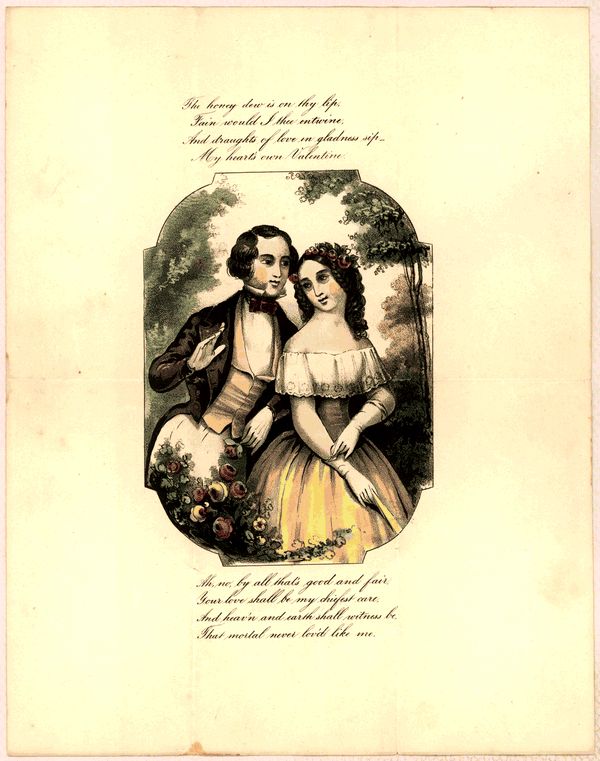
Valentinus was squeezed out of the ecclesiastical calendar in 1969 (which you can read about here:  https://aleteia.org/2022/02/09/why-is-st-valentines-feast-day-not-on-the-churchs-calendar/ ), but St Valentine’s day has been part of Western romantic tradition since at least the later Middle Ages and began to become a commercial success in the 19th century, when preprinted cards first appeared.

(And I can’t resist this—possibly the first printed valentine—which dates, in fact, to 1797.

See this for more:  https://www.bbc.co.uk/ahistoryoftheworld/objects/L1NM_6mWRymAMKXcRDlXJA

and see this for more on early commercial valentines:  http://www.go-star.com/antiquing/early-valentines.htm )

The romance I want to talk about in this posting, however, comes from a different time although, according to its author, Tolkien, not from a different place.

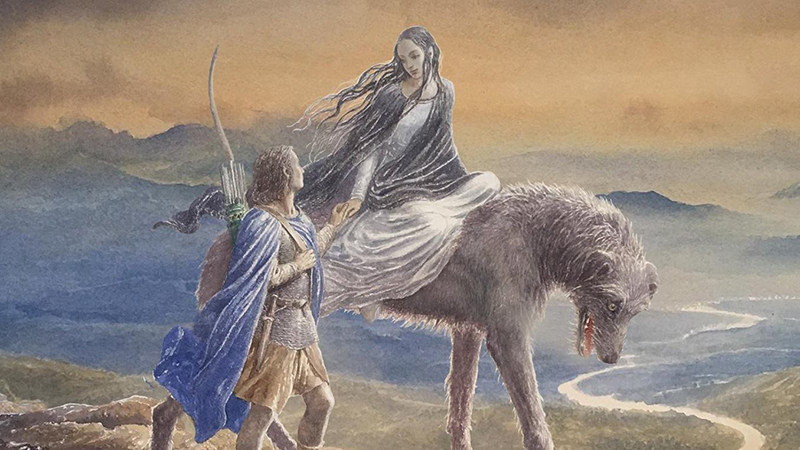
In a way, it’s actually a kind of echo-romance, in which the first part happened some 6500 years before the second part, in the First Age of Middle-earth, but many of its conditions were the same. 

The Tale of Beren and Lúthien, by J.R.R. Tolkie

(Alan Lee)

A note, however:   this is a very complex story, which JRRT developed over many years, appearing in one form in the Silmarillion, 1977,

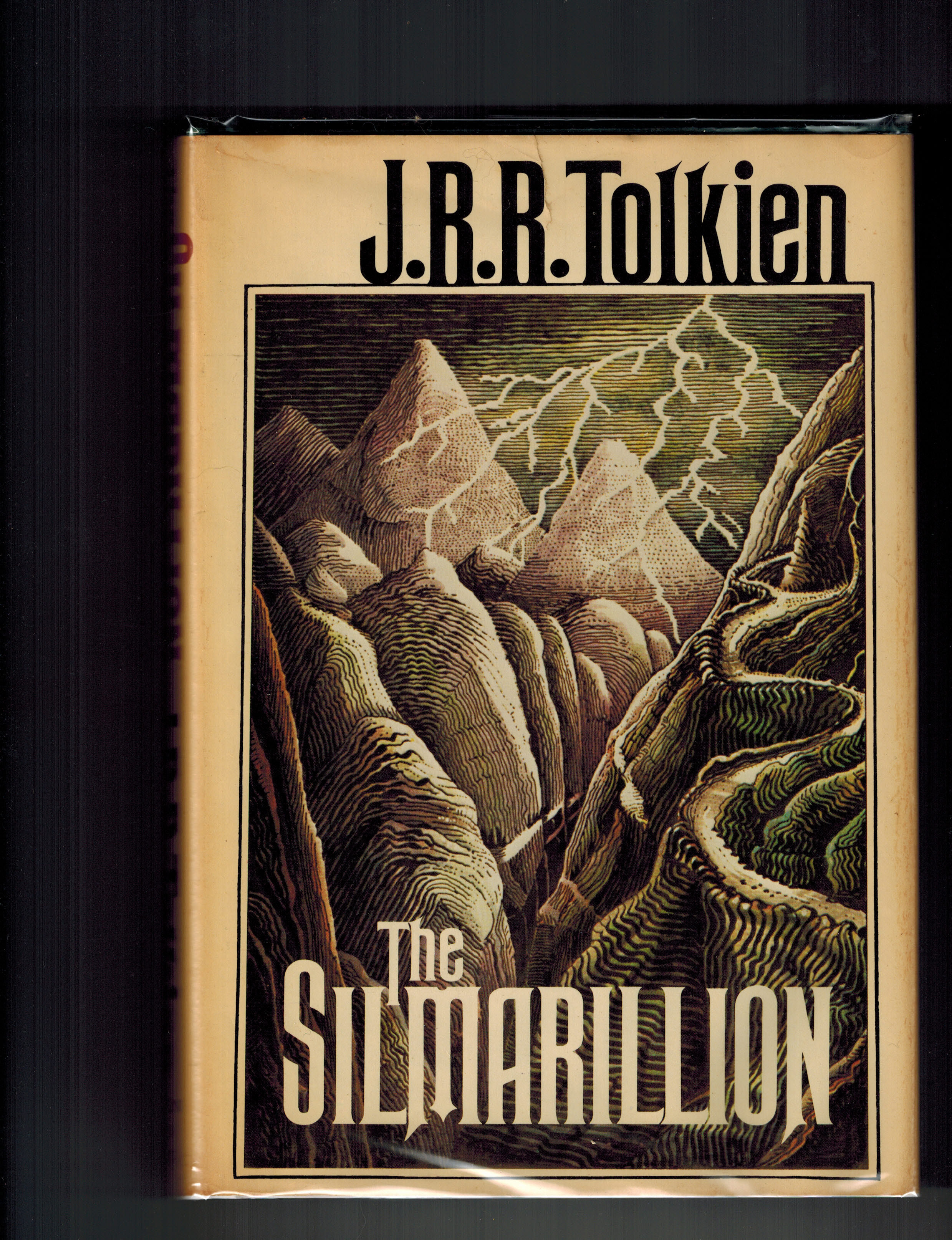
and in a multiform, Beren and Luthien, 2017, both versions edited by Christopher Tolkien.

For my purposes, I’m going to compress the story into the simplest form possible—something like this:

1. Beren is a mortal, who falls in love with Luthien, an elven immortal and the daughter of Thingol, king of Doriath

2. Thingol sets Beren a task:  for Beren to wed Luthien, he must retrieve one of the Silmarils from the crown of Morgoth

3. Beren, with Luthien’s help, finally manages to do this and can marry Luthien, but, later, is killed and Luthien goes to the Halls of Mandos (basically, the ruler of the dead) and manages, through song (yes, Orpheus and Eurydice is in there somewhere)

to regain him, but is faced with a choice:  she can retain her immortality and go on to Valinor, the home of the immortal Valar, without Beren, or she can go back to Middle-earth with Beren, become mortal, and die

4. She stays with Beren and, from that comes “the Choice of Luthien”—giving up immortality to remain with a mortal loved one

This brings us to the echo:  Aragorn and Arwen, the many details of which you can read in Appendix A, V, in The Lord of the Rings, “Here Follows a Part of the Tale of Aragorn and Arwen”, but, in simplified form:

1. Aragorn, a mortal, falls in love with Arwen, an elf and daughter of Elrond

2. Elrond sets the condition that only if Aragorn can make himself king of Gondor and Arnor can he marry Arwen

3. we know how this turns out:  Aragorn eventually becomes king and gains Arwen

(the Hildebrandts)

4. but she, too, must make the “Choice of Luthien” and, as JRRT tells us:

“When the Great Ring was unmade and the Three were shorn of their power, then Elrond grew weary at last and forsook Middle-earth, never to return.  But Arwen became as a mortal woman, and yet it was not her lot to die until all that she had gained was lost.”  (The Lord of the Rings, Appendix A, V,
“Here Follows a Part of the Tale of Aragorn and Arwen”)

It’s clear that this choice, once made, is irrevocable, as Arwen tells the fading Aragorn, when he suggests that she can still make the journey to Valinor after his passing: 

“Nay, dear lord…that choice is long over.  There is now no ship that would bear me hence, and I must indeed abide the Doom of Men, whether I will or I nill:  the loss and the silence.”

And, to me, this is what takes Tolkien’s story from being a wonderful fantasy to a higher level:  heroic people here make choices which will bring bitter loss, but still choose to make them:  Frodo to save the Shire, as he tells us he originally hoped, Arwen to remain with Aragorn, fully aware of the consequences.   It’s grown-up romance and Arwen’s choice is central to that.

In Jackson’s film of The Fellowship of the Ring, however, we’re shown a completely different reason for Arwen’s choice:  she trades her immortality for Frodo’s life.  Here’s what happens in Scene 21:

“Frodo suddenly becomes very weak as Arwen lies [sic] him on the ground.

ARWEN:  No! Frodo! No!  Frodo don’t give in, not now.

Tears spring into her eyes as she hugs him.

ARWEN

VOICE:  What grace has given me, let it pass to him.  Let him be spared.

Visions of Rivendell appear.  Frodo appears sleeping in the visions.

ARWEN

VOICE:  Save him.

ELROND:  (face appears in the vision)  Lasto beth non.  Tolo dan na ngalad.  (Hear my voice, come back to the light)” (You can read the whole text of the film here:  http://www.ageofthering.com/atthemovies/scripts/fellowshipofthering1to4.php )

Much of Tolkien’s criticism of “Mr. Zimmerman’s” script is that, as he says, it shows “no evident appreciation of what it is all about”.  In this case, this is Arwen’s sacrifice not for someone she, in the book, will not meet at this point in the story, the script-writers having replaced the actual character who attempts to rescue Frodo, the elf lord Glorfindel, with Arwen, but her sacrifice of her immortality for her love, Aragorn, just as Luthien had done for Beren, thousands of years before.  The echo, besides its poignancy, is intentional on Tolkien’s part:

“Arwen is not ‘a re-incarnation’ of Luthien…but a descendant very like her in looks, character, and fate.  When she weds Aragorn…she ‘makes the choice of Luthien’…” (draft of a letter to Peter Hastings, September, 1954, Letters, 288)

In 1963, Tolkien tried to explain not her choice, which, to him, was evident, but the reason behind Frodo’s ability to pass to the West:

“It is not made explicit how she could arrange this.  She could not of course just transfer her ticket on the boat like that!  For any except those of the Elvish race ‘sailing was not permitted, and any exception required ‘authority’, and she was not in direct communication with the Valar, especially not since her choice to become ‘mortal’.”  (from the drafts of a letter to Mrs. Eileen Elgar, September, 1963, Letters, 462)

Eventually, he suggests that Gandalf must have been involved, but what’s important here—and for the romance with which I began—is that Arwen’s surrender of her immortality was not a generous act to save a fading hobbit, but rather the renewal of a sacrifice made for the same reason by a distant ancestor, Luthien (who is also, in fact, a distant ancestor of Aragorn, as well), many years earlier.  As I said before, it’s grown-up romance and her choice is central to that.

All of that being said, happy Valentine’s Day.

Thanks, as always, for reading.

Stay well,

Be glad for saints—the good ones have much to teach us,

And remember that, as always, there’s

MTCIDC

O

PS

There is, in fact, competition for the title of St. Valentine of the cards, flowers, and chocolate.  See:  https://en.wikipedia.org/wiki/Saint_Valentine )

Arabian Nights for Days

31 Wednesday Jan 2024

Posted by Ollamh in Uncategorized

≈ Leave a comment

Tags

book-review, book-reviews, books, Fantasy, reading

As always, dear readers, welcome.

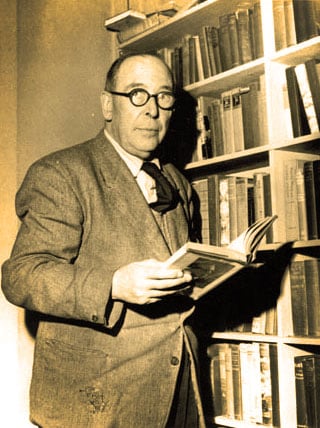
C.S. Lewis once remarked that, “You can’t get a cup of tea large enough or a book long enough to suit me.”  (from a transcript of a lecture given by Lewis’ sometime editor and biographer, Walter Hooper—here’s the whole piece:  https://www.historyspage.com/post/cs-lewis-inklings-memories-walter-hooper )

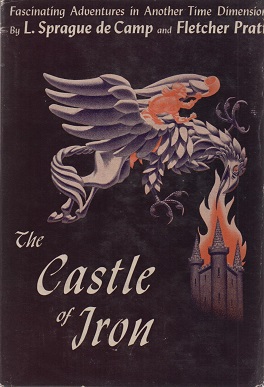
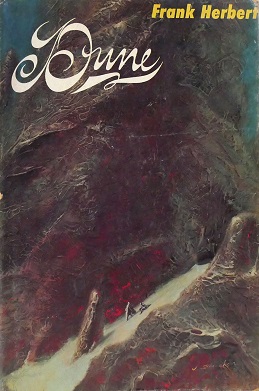
Considering my affection, not only for

but

and such works as these,

as well as a life-long love of

(but such a small cup!),

it’s clear that I’m in whole-hearted agreement with “Jack”, as his brother, “Warnie”, had named him in childhood.

In this spirit, during the early fall, I embarked upon a project I’ve long told myself I would do:  read the whole of The Thousand Nights and One Night—in translation, unfortunately.

I began with this introduction—

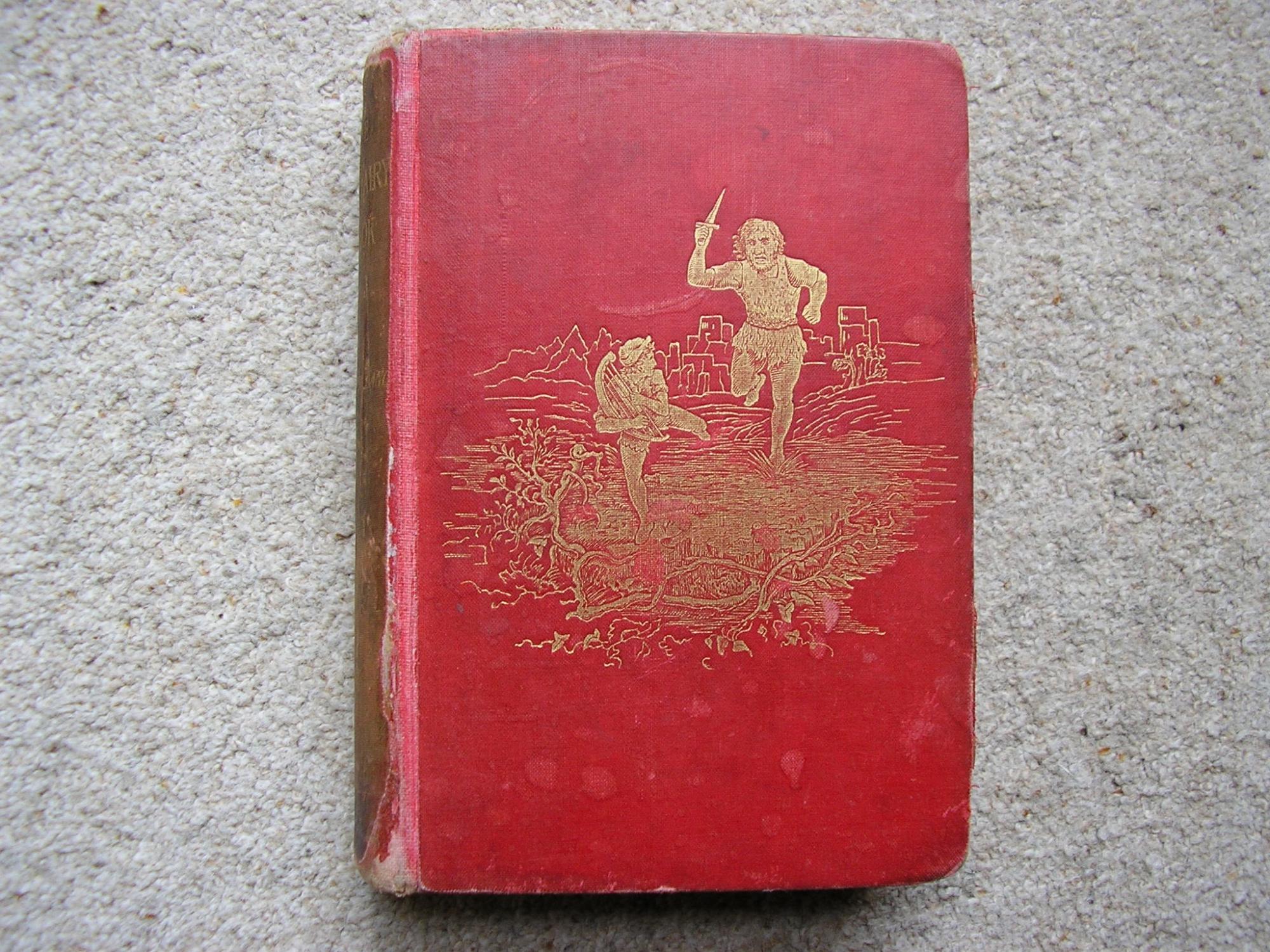
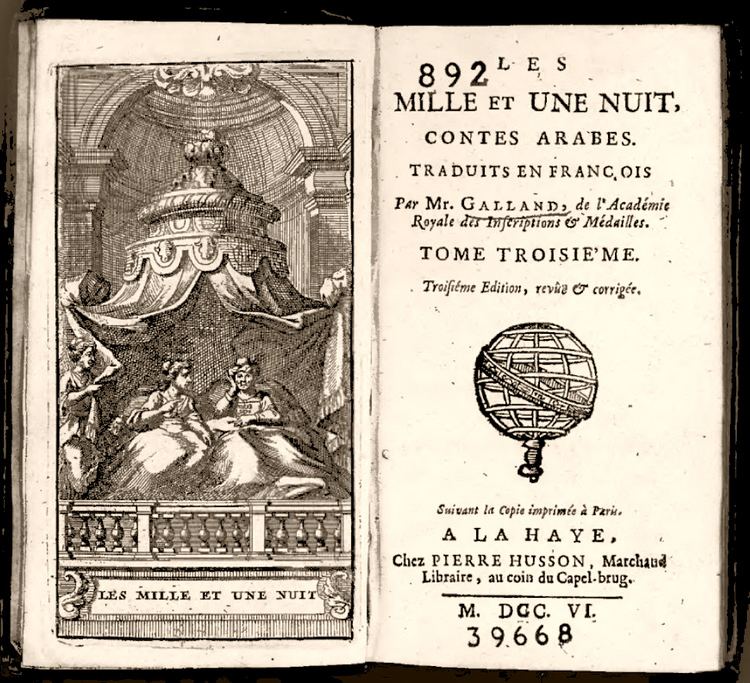
From earlier work (and postings) on the origins of “contes des fees”, as early French authors—the creators of our literary stories, like “La Belle et La Bete”, originally written by Gabrielle-Suzanne Barbot de Villeneuve in 1740, but better known by the revised 1756 version of Jeanne-Marie Leprince de Beaumont–called them—I knew something of the story of how English-speakers first encountered The Arabian Nights in the so-called “Grub Street” edition of 1706, itself an anonymous translation of Antoine Galland’s (1646-1715)

Les Mille et Une Nuits of 1704-1717.

I soon discovered, however, just how much more there was to know.  In chapters with intriguing titles like “Beautiful Infidels” and “Oceans of Story”, the author, Robert Irwin, laid out the complex history of this vast collection, which most of us know from tales which aren’t even in the main collection, “orphan stories” like “Aladdin”

(Albert Robida, 1848-1926)

and “Ali Baba and the Forty Thieves.” 

(Edmond Dulac, 1882-1953)

(For more on translations, see: https://en.wikipedia.org/wiki/Les_mille_et_une_nuits and https://en.wikipedia.org/wiki/Translations_of_One_Thousand_and_One_Nights )

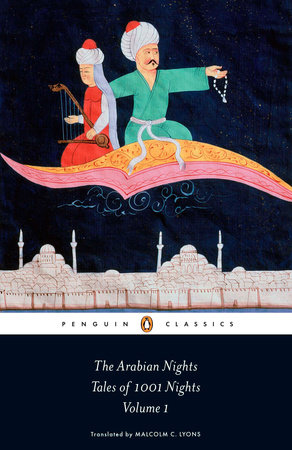
Armed with the knowledge Irwin provided, it was time to begin reading.  I chose what seemed the best translation in English, by Malcolm C. Lyons, in a set of four Penguin volumes and launched into the first.

I imagine that you know the general frame:  King Shahryar learns that his wife is unfaithful.   To keep himself from being cuckolded again, he marries a new bride every night and has her beheaded the next morning.  His Vizier’s daughter Shahrazad, decides to stop this by marrying the Sultan but then, telling one story after another, to keep him so interested night after night by stopping a story at the night’s end without finishing, to force him to suspend his murderous habit to find out what happened next. 

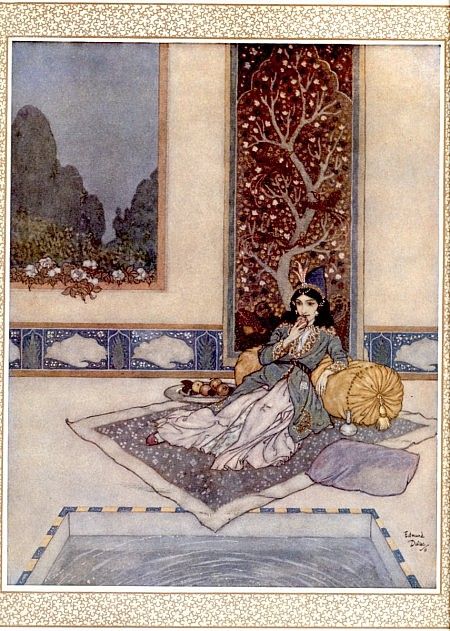
(Another Dulac.  If you’d like to see more of his gorgeous illustrations, look here:  https://www.gutenberg.org/cache/epub/51432/pg51432-images.html )

Finally, after 1001 stories (or perhaps a few more), he decides not to continue murdering brides, Shahrazad is saved, and, presumably, lives happily ever after (really?  Could you ever trust this man not to change his mind?).

I’ve just finished Volume 1 and set off into Volume 2

and it’s been an extremely interesting experience.  Unlike a long novel, like War and Peace, where we follow the adventures of a few main characters—Natasha, Pierre, and Andrei—even when surrounded by a host of other characters (and Tolstoy’s book has a flood of them), in The Arabian Nights, except for the shell characters—the king, the story-teller, and the story-teller’s sister, who can act as a prompter–the main characters can change often, sometimes making it difficult to remember who is doing what with or to whom.  More than once, I had to turn back a page, scan paragraphs, asking myself, “Who is Ali ibn Ishaq again?” or “Is this the brother—or is it brother-in-law?  And is this the same slave who…?”  As well, this unexpurgated text is filled with poetry, some of which is reflective of something going on in the story, some—maybe more than some—is simply poetry which has been inserted into the text.  Because it might be part of the story, I continued to read it, but often it was just what it appeared to be:  poetry inserted for some reason I didn’t understand into the text. 

At the same time, as story spawned story, stories were interwoven, stories linked themselves here and there into complex narratives, there was a certain hypnotic quality to it which kept me reading, not so much because the characters had looped me in as that the method of telling itself had.  I might not care about why X was beheaded, but I was certainly interested to understand how the story had turned in that direction and he was.  In other words, just as Shahrazad had seduced the king with her telling into wanting more and more, so she had seduced me into reading on, always wondering, “Where is this going and how will it end?”  And—just as interesting—“How will we move to the next story?”

At over 950 pages on average for each of 4 volumes, each of these would surely have (at least temporarily) satisfied C.S. Lewis—but where would we ever find a tea cup large enough to keep him—and me—going?

Thanks, as ever, for reading.

Stay well,

Uncork no bottle unless you’ve already planned how to deal with the djinn inside,

And know that, as always, there’s

MTCIDC

O
Down the Hole

24 Wednesday Jan 2024

Posted by Ollamh in Uncategorized

≈ Leave a comment

Tags

book-review, books, Fantasy, J.R.R. Tolkien, Tolkien

As ever, welcome, dear readers.

“In another moment down went Alice after it, never once considering how in the world she was to get out again.

The rabbit-hole went straight on like a tunnel for some way, and then dipped suddenly down, so suddenly that Alice had not a moment to think about stopping herself before she found herself falling down what seemed to be a very deep well.” (Alice’s Adventures in Wonderland, Chapter One, “Down the Rabbit-hole”  and you can have your own copy of the second version of the first—1865-66 edition here:  https://ia600505.us.archive.org/27/items/alicesadventur00carr/alicesadventur00carr.pdf and read about why I wrote “1865-66 edition” and much more here:   https://en.wikipedia.org/wiki/Alice%27s_Adventures_in_Wonderland )

(I discovered this image on two different pinterest sites, one in Korean, the other under the name “Ree Smith”, but with no artist identified, alas.   I love all puppets and shadow puppets in particular and this so reminded me of the work of Lotte Reiniger (1899-1981) and her “Adventures of Prince Achmed”, 1926,

that it made me wish that she had made an “Alice”.  To learn more about Reiniger and her work, see:  https://silentfilm.org/the-adventures-of-prince-achmed-1/   The original film hasn’t survived as such, but to see a reconstruction by a passionate amateur—and it’s a remarkable work—look here:  https://archive.org/details/prince-achmed-english-subtitles  )

As you can see from where I’ve just gone, English has adopted “down the rabbit hole” to mean “digressive”, which, in turn, comes from the Latin verb, digredior, “to go away from”, (literally, “to walk away from”, being a combination of dis, “apart/away from” plus gradus, “a step”)—and look, have I just begun to do a mini-rabbit hole again?

I, myself, in writing nearly 500 postings, have happily fallen down almost innumerable such holes, and this posting began with a tumble down another.

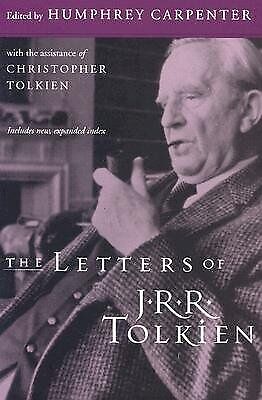
I was delighted to learn, last autumn, that there was to be a new edition of Carpenter/Tolkien’s 1981 The Letters of J.R.R. Tolkien, a mainstay for anyone with a strong interest, not only in Tolkien and his work, but in the writing of fantasy in general.

Humphrey Carpenter (1946-2005), with the aid of Christopher Tolkien, had done—as in his biography of Tolkien, 1977—an amazing job of collecting the materials (for a brief, affectionate obituary of Carpenter, see:  https://www.theguardian.com/news/2005/jan/05/guardianobituaries.booksobituaries ), but as we learn, he had done almost too good a job and the publisher was forced to have rather significant cuts made.  This new edition includes both material cut from letters and a series of letters cut from that original addition, as well.

Needless to say, it arrived and I was paging through it when I came across this rather mystifying reference in a letter to Christopher from 29 November, 1944:

“Very trying having your chief audience Ten Thousand Miles away, on or off The Walloping Window-blind.” (to Christopher Tolkien, 29 November, 1944, Letters, 147)

Unusually for Carpenter, there was no endnote as to what this was a reference, so—oh yes, yet again, a rabbit hole plunge, which revealed this:


“A capital ship for an ocean trip

Was “The Walloping Window-blind;”

No gale that blew dismayed her crew

Or troubled the captain’s mind.

The man at the wheel was taught to feel

Contempt for the wildest blow,

And it often appeared, when the weather had cleared,

That he’d been in his bunk below.

The boatswain’s mate was very sedate,

Yet fond of amusement, too;

And he played hop-scotch with the starboard watch

While the captain tickled the crew.

And the gunner we had was apparently mad,

For he sat on the after-rail,

And fired salutes with the captain’s boots,

In the teeth of the booming gale.

The captain sat in a commodore’s hat,

And dined, in a royal way,

On toasted pigs and pickles and Jigs

And gummery bread, each day.

But the cook was Dutch, and behaved as such;

For the food .that he gave the crew

Was a number of tons of hot-cross buns,

Chopped up with sugar and glue.

And we all felt ill as mariners will,

On a diet that’s cheap and rude;

And we shivered and shook as we dipped the cook

In a tub of his gluesome food.

Then nautical pride we laid aside,

And we cast the vessel ashore

On the Gulliby Isles, where the Poohpooh smiles,

And the Anagazanders roar.

Composed of sand was that favored land,

And trimmed with cinnamon straws;

And pink and blue was the pleasing hue

Of the Tickletoeteaser’s claws.

And we sat on the edge of a sandy ledge

And shot at the whistling bee;

And the Binnacle-bats wore water-proof hats

As they danced in the sounding sea.

On rubagub bark, from dawn to dark,

We fed, till we all had grown

Uncommonly shrunk, when a Chinese junk

Came by from the torriby zone.

She was stubby and square, but we didn’t much care,

And we cheerily put to sea;

And we left the crew of the junk to chew

The bark of the rubagub tree.”

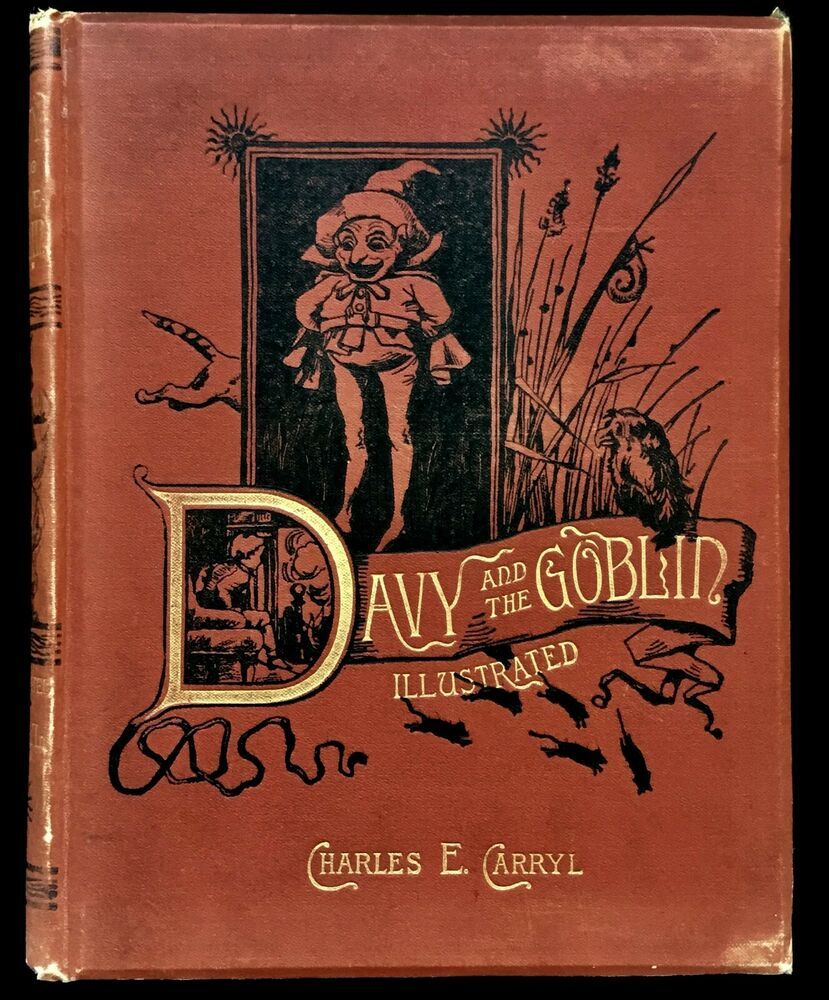
This is quoted from Davy and the Goblin, 1884-5,

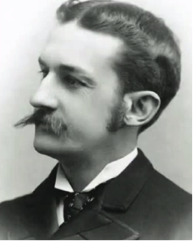
by Charles E. Carryl (1841-1920), a later-Victorian/Edwardian American children’s author.

(You can read your own copy here:  https://archive.org/details/davythegoblinorw00carriala , finding the poem on pages 89-90.  There are free-floating copies of this poem at various sites, but often oddly adulterated, so, if you wish to read what Carryl wrote, here it is.)

Carryl subtitled this, “or, What Followed Reading ‘Alice’s Adventures in Wonderland’ “ and the text consists of the Goblin of the title leading the Davy of the title on a “Believing Voyage”.  This is stocked with a series of characters, some from children’s literature like Sinbad and Robinson Crusoe, some fantastical creatures, including a Whale in a Waistcoat and talking waves, and the perhaps inevitable fairies, although their queen is rather more like the Queen of Hearts in Alice than something dreamlike.  

The Goblin’s goal is to persuade Davy, who has apparently maintained that he “doesn’t believe in fairies, nor in giants, nor in goblins, nor in anything the story-books tell you.”  to change his mind on the subject.  Perhaps I’m an inattentive reader, but I’m not sure that, when Davy awakes at the end of Chapter XIV (another inevitability, at least given Alice as an influence), he’s any more a believer than he was in Chapter I, but the whimsy involved has a certain charm and Carryl can get a catchy prosodic pattern going, as in “The Walloping Window-blind”.  Although that subtitle suggests not only Carroll’s episodic—perhaps even picaresque—narrative and certainly there’s something Carrollish about the poems scattered throughout, I would suggest two other influences upon the verses:  Edward Lear (1812-1888) and W.S. Gilbert (1836-1911), in such items as Gilbert’s “The Yarn of the Nancy Bell” (see:  https://allpoetry.com/The-Yarn-of-the-Nancy-Bell )–but I sense another rabbit hole dead ahead!

As always, thanks for reading,

Stay well,

Resist puns, when possible—Carryl can’t,

And remember that, as always there’s

MTCIDC

O

Lingua Orca

10 Wednesday Feb 2016

Posted by Ollamh in Imaginary History, J.R.R. Tolkien, Language, Literary History, Narrative Methods

≈ Leave a comment

Tags

Adventure, Black Speech, Bree, Cirth, Fantasy, Gandalf, L. Frank Baum, Mordor, Orcs, Origin of Orcs, Ozma of Oz, Princess Langwidere, The Lord of the Rings, Thorin, Tolkien

Welcome, dear readers, as always.

In P. Jackson’s The Desolation of Smaug, there is a scene at the opening, cut from whole cloth as so much of the later Hobbit movies, in which Gandalf meets Thorin in The Prancing Pony in Bree.

gandalfandthorin.jpg

There Gandalf shows Thorin a “message”.

“Gandalf: It is Black Speech.

[Thorin looks at Gandalf with unease]

Gandalf: A promise of payment.

Thorin: For what?

Gandalf: Your head. Someone wants you dead.”

One can laugh at that last—is there the possibility that someone who promised payment for a head would not want the owner dead? (Here we thought, for a moment, of the Princess Langwidere in L. Frank Baum’s Ozma of Oz, who has a collection of 30 exchangeable heads which she keeps locked in a cabinet.)

princesslangwidere.jpg

After laughing, however, we began to wonder just who that message was supposed to be for.

Tolkien says of the Black Speech:

“It is said that the Black Speech was devised by Sauron in the Dark Years, and that he had desired to make it the language of all those that served him, but he failed in that purpose.”

We are never told why he failed: was it too complicated? Too impractical? Too limited? (In modern terms, we can imagine Sauron sending out memos, saying things like: “To All Departments: it has come to Our attention that there are those who are not using the Black Speech in all official documents. Please conform to standards as laid out in Mordor Bulletin #512. Immediate.”) If what Isildur has to say about the inscription inside the ring is true,

One_Ring_Inscription_In_Three_Languages.jpg

Sauron doesn’t appear to have devised a script in which to write it:

“Already the writing upon it, which at first was as clear as red flame, fadeth and is now only barely to be read. It is fashioned in an elven-script of Eregion, for they have no letters in Mordor for such subtle work…” (The Fellowship of the Ring, Book 2, Chapter 2, “The Council of Elrond”)

Tolkien continues:

From the Black Speech, however, were derived many of the words that were in the Third Age wide- spread among the Orcs, such as ghash ‘fire’, but after the first overthrow of Sauron this language in its ancient form was forgotten by all but the Nazgul. When Sauron arose again, it became once more the language of Barad-dur and of the captains of Mordor.”

Could the “promise of payment” be meant for the Nazgul, then? That hardly seems likely—after all, they are the main servants of Sauron, bound to him by the rings they wear, Nazgul, after all, meaning “ring wraith”. Sauron’s success is their success—just as his failure seems to mean their end.

Because this scene exists only in the minds of the scriptwriters, we could have just shrugged it off right there as being a piece with the resurrected Azog and that ridiculous arm which he seems to have borrowed from a macho Frosty the Snowman, “Tauriel” and the embarrassing romance with a Dwarf, etc, etc, etc. Instead, we decided to play with the idea.

Using Tolkien’s actual texts as the basis of our thinking, we wondered: if the message wasn’t for the Nazgul and the Black Speech is specifically linked to Mordor, who else might be the recipient? Well, there are always the Orcs—but could they read it?

We know—sort of—what they are. Fangorn tells Merry and Pippin that they were made by Sauron as mockery of Elves. Tolkien himself seemed initially a bit puzzled about Orcish origins, calling them, in a letter to Milton Waldman (Letters no.131, 151, “probably in late 1951”) “…the Orcs (goblins) and other monsters bred by the First Enemy”. The same is said in Appendix F of The Lord of the Rings: “The Orcs were first bred by the Dark Power of the North in the Elder Days.” Then, in a letter to Naomi Mitchison (Letters, no.144, 177-8, 25 April, 1954), however, he writes: “Orcs…are nowhere clearly stated to be of any particular origin. But since they are servants of the Dark Power, and later of Sauron, neither of whom could, or would, produce living things, they must be ‘corruptions.’” And, again, in the draft of a letter to Peter Hastings, from later in the same year, he explains, quoting Frodo, speaking to Sam: “ ‘The Shadow that bred them can only mock, it cannot make real new things of its own. I don’t think it gave life to the Orcs, it only ruined them and twisted them.’” to which he adds, “In the legends of the Elder Days it is suggested that the Diabolus subjugated and corrupted some of the earliest Elves…” (Letters, no.153, 191). (This is continued later in the same letter, 195.)

Of their speech, JRRT wrote:

“It is said that they had no language of their own, but took what they could of other tongues and perverted it to their own liking; yet they made only brutal jargons, scarcely sufficient for their own needs, unless it were for curses and abuse. So it was in the Third Age Orcs used for communication between breed and breed the Westron tongue…” (The Lord of the Rings, Appendix F)

(Linguistically, we wonder if it would be possible for a people—especially a people who appear, in the later Third Age, to be extensive in number—could actually have had no language—or languages–of their own, particularly if they were a people who had existed before being corrupted by Morgoth. In The Lord of the Rings, for example, although they speak the Common Speech, they clearly have names out of some other language—what might that have been?)

Taking the next step, in a previous posting, we had begun to probe the question of literacy versus orality in Middle Earth and here we might ask the question: were Orcs literate at all? The only possible clue we’d found is in Appendix E of The Lord of the Rings, where it is said of the form of writing called “Cirth”:

d5256b13ca277364da6f842a2744b63c.gif

“The Cirth in their older and simpler form spread eastward in the Second Age, and became known to many peoples, to Men and Dwarves, and even to Orcs…”

This would suggest that they were.

When we actually see the Orcs, however, do we find any evidence of the use of that writing?

There are only a couple of extended passages when we hear the Orcs as well as see them. The first is in the chapter entitled “The Uruk-hai”. In this chapter, the Orcs who have Merry and Pippin argue over their captives and we hear several talk about “orders” and “my orders”, but no documents appear or are mentioned: are these only oral orders? The second time we hear the Orcs is in “The Choices of Master Samwise.” Here, Sam overhears two Orc officers, Gorbag and Shagrat, talking. “The messages go through quicker than anything could fly, as a rule. But I don’t inquire how it’s done. Safest not to.” says Gorbag. And, a little later, Shagrat says, “A message came: Nazgul uneasy. Spies feared on Stairs. Double vigilance. Patrol to head of Stairs.” Unfortunately, there’s no further information here– although that second message almost sounds like it’s one step from being a tweet! (Or, in JRRT’s time, a Western Union telegram.) But then Shagrat says, “ I have my orders…Any trespasser found by the guard is to be held at the tower. Prisoner to be stripped. Full description of every article, garment, weapon, letter, ring, or trinket to be sent to Lugburz at once, and to Lugburz only…” Does such detail require writing? It does say “full description…to be sent”, which certainly suggests it.

We have a final glimpse and earful of the Orcs from “The Tower of Cirith Ungol” and into “The Land of Shadow”, but there are no more discussions of orders or messages or descriptions, just more of the brutality and treachery which seems the norm for such creatures.

So, we have two statements, in total, which are more suggestive than actual proof: Cirth was known to Orcs and the order for a “full description” to be sent to Barad-dur. Does that mean that, should Shagrat or Gorbag have written, he would have done so in Cirth? If so, this proves only literacy in that form and, when we look back to the one sample we have of any length (all of two lines) of the actual Black Speech, it is in Tengwar as we know, from Isildur, that Sauron—at least at the time of the making of the ring—had no Black Speech writing system to employ.

Conclusions? Although it was fun to do the research, at base, this was a fool’s errand—the whole thing, after all, was a creation of the same people who brought you Thranduil on an Irish elk (for more on that, google the extremely useful—and entertaining!– www.tolkien-treasures and see the entry on Thranduil and his mount).

elf-elk-lord-of-the-rings-the-hobbit-Favim.com-2609245.jpg

If we play along, as we have, there’s only a process of elimination. The only people who had anything to do with the (revived) Black Speech were in Mordor. If it wasn’t the Nazgul and it wasn’t the Orcs, who’s left? Only one possibility seems to remain: Sauron wrote it as a memo to himself, a kind of Barad-dur post-it, (“To Me: Thorin. Head. Reward? Do soonest.”), but, being very busy in contract negotiations with Benedict Cumberbatch’s agent on voice-overs, he absentmindedly sent it.

What do you think, dear readers?

As always, thanks for reading!

MTCIDC

CD

The Man Who Was Killed

30 Wednesday Dec 2015

Posted by Ollamh in J.R.R. Tolkien, Military History, Military History of Middle-earth, Narrative Methods

≈ Leave a comment

Tags

"The Man He Killed", Adventure, British Infantry, British Militia, Crimean War, Damrod, Fantasy, Faramir, Frodo, Haradrim, History, Lamellar, Mablung, Middle-earth, military history, Military recruiters, Napoleonic Wars, Sam Gamgee, Second Boer War, The Dynasts, The Lord of the Rings, The Two Towers, Thomas Hardy, Time's Laughingstocks, Tolkien, Waterloo, WWI

Dear Readers,

Welcome, as always. In this posting, we propose to suggest a connection—one, at the moment, at least, which we can’t prove—between Tolkien and the late-Victorian/Edwardian/Georgian (he was born in 1840 and died in 1928) poet/novelist, Thomas Hardy.

We begin with a quotation from The Two Towers, Chapter 4, “Of Herbs and Stewed Rabbit”. Sam and Frodo have been taken by Faramir’s rangers and, with Damrod and Mablung as their minders, they are about to sit out the ambush staged by Faramir to destroy a column of Haradrim. Unthinkingly, Sam has become an eager spectator, and:

“Then suddenly straight over the rim of their sheltering bank, a man fell, crashing through the slender trees, nearly on top of them. He came to rest in the fern a few feet away, face downward, green arrow-feathers sticking from his neck below a golden collar. His scarlet robes were tattered, his corslet of overlapping brazen plates was rent and hewn, his black plaits of hair braided with gold were drenched with blood. His brown hand still clutched the hilt of a broken sword.”

The Haradrim are from the far south, but, wherever this man was from, he was wearing a type of armor called “lamellar”, from the Latin word, “lamella”, meaning, “a little, thin plate”, it being a diminutive of “lamina”, “a thin piece of something/a plate, leaf”. It’s a kind of protection worn over many centuries in many parts of the world. Basically, it looks like this:

d3934595510aec78efa73aa58041de6c.jpg

It can be made, as the one described, of lamellae of bronze, or of iron, which are sewn to an underlying fabric.

78477F80D31240E0BFBAA3A67A63844D02jpg.jpg

So, perhaps, this dead warrior looked a bit like this:

big_img_20070912155947.jpg

Sam’s curiosity was quickly dampened by the sight—and it makes us wonder if what we are also seeing here is Lieutenant Tolkien’s first glimpse of a dead enemy soldier.

tolkien-xdeadgerman

“It was Sam’s first view of a battle of Men against Men, and he did not like it much. He was glad that he could not see the dead face. He wondered what the man’s name was and where he came from; and if he was really evil of heart, or what lies or threats had led him on the long march from his home; and if he would not really rather have stayed there in peace—“

It was this brief meditation—abruptly interrupted by the appearance of a Mumak—which reminded us of this Thomas Hardy poem, “The Man He Killed”:

“Had he and I but met
            By some old ancient inn,
We should have sat us down to wet
            Right many a nipperkin!


            “But ranged as infantry,
            And staring face to face,
I shot at him as he at me,
            And killed him in his place.


            “I shot him dead because —
            Because he was my foe,
Just so: my foe of course he was;
            That’s clear enough; although


            “He thought he’d ‘list, perhaps,
            Off-hand like — just as I —
Was out of work — had sold his traps —
            No other reason why.


            “Yes; quaint and curious war is!
            You shoot a fellow down
You’d treat if met where any bar is,
            Or help to half-a-crown.”

The language—“nipperkin”, “ ‘list”—and the social situation depicted: “was out of work—had sold his traps” (“traps” being slang of the time for “personal possessions”)—would suggest that the speaker is a working man. Such, along with farm boys, were prime material for military recruiters

victorianrecruiters.jpg

in the Victorian world in which this poem was written (1902—published in Hardy’s Time’s Laughingstocks, 1909 ). The speaker is, in his own words, however, from an earlier day. When Hardy wrote the poem, the Second Boer War (1899-1902) was just ending, but it was hardly a war in which soldiers did as the speaker says, “but ranged as infantry,/and staring face to face,/I shot at him as he at me,/and killed him in his place.” The war had begun with British infantry attacking in spread-out lines, but still very visible on the landscape and it had cost them dearly.

Sidney_Paget00.jpg

Their enemy—mostly all militia—that is, part-time soldiers—had dug in from the start.

Colenso,_KwaZulu-Natal_-_Project_Gutenberg_eText_16462.jpg

boer-main.jpg

British losses had taught them to do the same.

boer-II-01.jpg

What the speaker is describing sounds much more like earlier European wars, in which soldiers stood in long lines at a narrowing distance from each other and fired. The last of these, for Britain, had been the Crimean War (1854-56).

download-193789-The-23rd-Regiment-Royal-Welsh-Fusiliers-at-the-Battle-of-the-Alma-on-20th-September,-1854.jpg

Hardy, however, had a strong interest in the Napoleonic wars of the late-18th-early 19th-centuries, had published a massive dramatic piece, The Dynasts (1904-08), set in that period, and had even twice visited the battlefield of Waterloo (1876, 1896). Thus, we imagine that the poem’s speaker is actually describing something like this:

Lejeune_-_Bataille_de_Marengo.jpg

Had Tolkien read the Hardy poem and perhaps have even been inspired by it? Both scenes include a battlefield, a battle death, and a lingering sense of regret—although Sam hadn’t killed the man from Harad, he displays that same sense of “this was just a person, an ordinary person, once” which gives the Hardy poem its power.

As ever, we leave it to you, dear readers—what do you think?

Thanks, as ever, for reading!

MTCIDC

CD

Fairy Tale to Bill of Sale

19 Wednesday Aug 2015

Posted by Ollamh in Economics in Middle-earth, Fairy Tales and Myths, J.R.R. Tolkien

≈ Leave a comment

Tags

Alice in Wonderland, Baggins, Bilbo, Contract, Dragon, Dwarves, Economics, Elves, Fairy Tale, Fantasy, Goblins, Hoard, Laketown, Middle-earth, Mirkwood, Odysseus, On Fairy Stories, Smaug, The Hobbit, The Odyssey, Tolkien

Dear Readers,

Welcome, as always!

Recently, when we discussed the economics of Middle-earth, Tolkien told us that he was not entirely ignorant about such matters, saying “…the situations are so devised that economic likelihood is there and could be worked out”. LT, 296

So that’s what we’ve set out to do in this posting, working out something of those economics in a modest way.

The Hobbit, as everyone knows, began as a story for his children, set in a fairytale world of elves, goblins, dwarves, and a dragon—the sorts of things which, in Tolkien’s essay “On Fairy Stories”, are derived from fantasy, which is “a natural human activity. It certainly does not destroy or even insult Reason,” but enhances it, lest fantasy become mere “Morbid Delusion” (which, later in the essay, Tolkien links with a work like Alice in Wonderland).

But something begins to happen, even early on, when Bilbo signs a contract before setting out for his adventure—an odd start for a fairytale hero who, traditionally, has to prove himself.  The story proceeds for some time in fairy tale mode, but then, when the party loses everything in Mirkwood, it’s necessary for Bilbo and Company to resupply and here the story moves seriously from a fairytale world to capitalism, as the fairy tale quest evolves into a commercial venture.

To replace lost materiel, the company turns to the people of Laketown,

Laketown

who provide it–and clearly do so on speculation, since the Dwarves have nothing to offer but promises.

The fairytale then seems to resume.  The party reaches the mountain, gets in, the dragon wakes–but then things go very wrong, at least for the investors, as Smaug, easily putting together that two and two equal Laketown, sets off to destroy it and is destroyed himself, in the process.  And then the fairy tale comes apart completely in a potential war over economic resources and compensation for damage caused during the investment:  Laketowners versus Dwarves, which escalates when Elves stake a claim and then Dwarves come to reenforce Dwarves and then, just to keep things in flux, a goblin army arrives. One almost wonders whether the Eagles, when they arrived, have invested in Laketown bonds and are expecting to cash them in, with interest!

When all of this is resolved, we might think that we’ve returned to the fairy tale world once more:  Bilbo, with his share of the hoard, sets off for home, where happily ever after lies–or does it?

OdysseusSuitors

In The Odyssey, Odysseus comes home to find his house in the hands of suitors, and must deal with them with the help of a goddess—very much a folktale. Bilbo comes home to find that his house and goods have just been auctioned off, and has to retrieve his happy ending by buying back his own things. That initial contract seems to have haunted the story, even to this moment.

Fantasy for Tolkien was, “founded on the harsh recognition that things are so in the world as they appear under the sun”—one of those things was economics, something which Bilbo may have found almost as unavoidable as a vengeful dragon.

What do you think, dear readers?

As always, thank you for reading,

MTCIDC,

CD

More Russian Favorites

10 Tuesday Feb 2015

Posted by Ollamh in Artists and Illustrators, Fairy Tales and Myths, Medieval Russia

≈ Leave a comment

Tags

Adventure, Epic, Fairytale Illustrators, Fantasy, Heroic, Medieval, Russia, Song

Dear Reader,

Welcome, as always.

We are very visual people. A picture in a museum, an illustration in a book, something in a film, will always catch our eye and sometimes inspire our writing.

This was certainly the case in our first book, Across the Doubtful Sea, where the drawings and paintings from the three Cook expeditions to the South Seas (1768-1779) filled us with a combination of wonder and curiosity. Although they were sometimes strongly influenced by period ideas of the sublime, here were images as close to historical photos as we would ever see.

Hodges,_Resolution_and_Adventure_in_Matavai_Bay

In the case of our second book, The Good King’s Daughter, however, because it was set in a world based loosely upon the medieval Russia of fairy tales, we looked to other sources, particularly those later-19th and 20th-century Russian artists who illustrated moments from the Russian heroic songs (byliny) and from the fairy and folktales themselves.

In our last, we showed you a few images from the work of perhaps the most famous (outside Russia, at least) illustrator, Ivan Bilibin (1876-1942). Pictures like “The Island of Buyan” (1905):

Ivanbilibin

In this posting, we would add two more artists, Victor Vasnetsov (1848-1926—not to be confused with his equally-talented brother, Apollinary 1856-1923) and the more recent Nikolai Kochergin (1897-1974).

As you can see from the pictures below, Vasnetsov can move from the grandly (and grimly) heroic world of the byliny and its bogatyr (epic hero) to a more fanciful world of fairy tales like The Firebird (but still rather grim and grand).

1898_Vasnetsov_Bogatyrs_anagoria Igorsvyat Vasnetsov_samolet Viktor%20Vasnetsov-526879

hero

a-knight-at-the-crossroads-1878

Kochergin strikes us as more like Bilibin—brightly-colored, folk-influenced.

4f463a868cf7b31a66ad1c87e00 9f97a52394ba8269194a869df52 berendei-palace nicolai-kochergin_the-wooden-eagle

tumblr_mxjgrquVKF1rz5qxqo1_500

nicolai-kochergin_seven-simeons-seven-workers

tumblr_ndw64pRZCk1rgcyvso2_500

What inspires us in these pictures? To a degree, it’s what attracts us to the fairy/folktales: the strange scenes (even when you know the story), the swirl of color, that suggestion of a complex world of patterns from a different time and place, one in which there were yagas and firebirds and heroes who could be helped by wise animals.

And you, reader, do these pictures inspire you?

Thanks for reading!

MTCIDC

CD

PS

If you would like to know more about Russian heroic song—and for free—you might try:

Hapgood, Isabel Florence, The Epic Songs of Russia (1916)

Harrison, Marion Chilton, Byliny Book: Hero Tales of Russia (1915)

at archive.org. They are clearly older books, but, for those on a budget, they can provide a starting place into a rich world worth visiting.

Tracking

09 Monday Feb 2015

Posted by Ollamh in Imaginary History, J.R.R. Tolkien, Maps, Narrative Methods, Research

≈ Leave a comment

Tags

Adventure, Book, Exploration, Fantasy, Fiction, History, Maps, Tolkien

Dear Readers,

While working on Across the Doubtful Sea, the Doubtful Sea series, and a forthcoming series that takes place in an alternate medieval Russia, we discovered for ourselves what our friend J.R.R. Tolkien worked on meticulously during the course of his work—the importance of maps in a story, whether they are real, fictional, or a mixture of both, in the case of our work. “If you’re going to have a story,” he said, “you must work a map; otherwise, you’ll never have a map of it afterwards.”

This became apparent when we were working on Across, using previously drawn maps of the theoretical Terra Australis: 

image1 Finaeus_antart

To give us a sense of where our characters and we were (and still are) going. 

When we began talking about the geography of our alternative Russia, we began to ask ourselves, first, how do you make a map in relation to a story? It was a start to look over the shoulder of JRRT, and to see what was done before us. From there, we go on to ask, what is it that made Middle-earth Middle-earth? It’s clear that Tolkien took a considerable amount of time and care to chart out his elaborate fictional world, from Bilbo’s own maps of the Shire and the world beyond.

imgE1 

Some were detailed enough to follow the day-by-day travels of the Fellowship, while others were used to record specific moments in time, both historically and geographically.

In his letters, Tolkien often addressed the subject of his maps. Much of his enthusiasm in creating maps for his worlds had to do with the pleasure of doing so, and the satisfaction of building the physical structure of such an elaborate story. He was, however, sometimes overwhelmed by them—perhaps as if the more landscape he made, the more he had to carry—and said to his publisher that it was a matter of a “lack of skill combined with being harried” (Tolkien, letter 141). He was fortunate to have, in this aspect of his work, collaboration not unlike ours—his son, Christopher, was a talented cartographer, and after discussing the landscapes with his father, would draw the intricate world in accordance with Bilbo and Frodo’s adventures.

middle_earth_map

Tolkien, by creating the maps first, created a landscape which seems to exist not only before the story, but is bigger than the story. When Frodo travels eastwards, for example, there is more of the Shire and beyond than that which he actually travels over. In our case, it was rather like someone laying track while driving a train over it. The tracklayer decides where the train will go, but, looking back, can see a landscape left behind as it moves on. In this way, the story and its landscape are written as they progress, and a narrative railroad is left behind on which readers may ride. And so, unlike Tolkien, by constructing a map this way, we appear to be providing primarily a view from the track itself. If there’s more landscape, we can only know it from the map we’ve constructed afterwards.

oldforest 

With the previously-drawn map, we can see the journey, in contrast, from a bird’s eye view.

shire_map

But this leaves us with a question: is it best to construct a bird’s eye view first, then to lay the track, or to lay track and then to look back?

This brings us to a second question: by either method, how does one make a fictional map credible?

MTCIDC,

CD

PS

For an example of simultaneous train-driving and track-laying, see Wallace and Gromit, The Wrong Trousers.

← Older posts
Newer posts →

The Doubtful Sea Series Facebook Page

The Doubtful Sea Series Facebook Page

  • Ollamh

Categories

  • Artists and Illustrators
  • Economics in Middle-earth
  • Fairy Tales and Myths
  • Films and Music
  • Games
  • Heroes
  • Imaginary History
  • J.R.R. Tolkien
  • Language
  • Literary History
  • Maps
  • Medieval Russia
  • Military History
  • Military History of Middle-earth
  • Narnia
  • Narrative Methods
  • Poetry
  • Research
  • Star Wars
  • Terra Australis
  • The Rohirrim
  • Theatre and Performance
  • Tolkien
  • Uncategorized
  • Villains
  • Writing as Collaborators
Follow doubtfulsea on WordPress.com

Across the Doubtful Sea

Recent Postings

  • Do You Speak Villain? (Part 3) February 18, 2026
  • Do You Speak Villain? (2) February 11, 2026
  • Do You Speak Villain? (Part 1) February 4, 2026
  • Towering January 28, 2026
  • Tolkien Among the Indians January 21, 2026
  • Thin and Stretched January 14, 2026
  • Through a glass… January 7, 2026
  • Heffalumps? December 31, 2025
  • We Three Kings December 24, 2025

Blog Statistics

  • 107,650 Views

Posting Archive

  • February 2026 (3)
  • January 2026 (4)
  • December 2025 (5)
  • November 2025 (4)
  • October 2025 (5)
  • September 2025 (4)
  • August 2025 (4)
  • July 2025 (5)
  • June 2025 (4)
  • May 2025 (4)
  • April 2025 (5)
  • March 2025 (4)
  • February 2025 (4)
  • January 2025 (5)
  • December 2024 (4)
  • November 2024 (4)
  • October 2024 (5)
  • September 2024 (4)
  • August 2024 (4)
  • July 2024 (5)
  • June 2024 (4)
  • May 2024 (5)
  • April 2024 (4)
  • March 2024 (4)
  • February 2024 (4)
  • January 2024 (5)
  • December 2023 (4)
  • November 2023 (5)
  • October 2023 (4)
  • September 2023 (4)
  • August 2023 (5)
  • July 2023 (4)
  • June 2023 (4)
  • May 2023 (5)
  • April 2023 (4)
  • March 2023 (5)
  • February 2023 (4)
  • January 2023 (4)
  • December 2022 (4)
  • November 2022 (5)
  • October 2022 (4)
  • September 2022 (4)
  • August 2022 (5)
  • July 2022 (4)
  • June 2022 (5)
  • May 2022 (4)
  • April 2022 (4)
  • March 2022 (5)
  • February 2022 (4)
  • January 2022 (4)
  • December 2021 (5)
  • November 2021 (4)
  • October 2021 (4)
  • September 2021 (5)
  • August 2021 (4)
  • July 2021 (4)
  • June 2021 (5)
  • May 2021 (4)
  • April 2021 (4)
  • March 2021 (5)
  • February 2021 (4)
  • January 2021 (4)
  • December 2020 (5)
  • November 2020 (4)
  • October 2020 (4)
  • September 2020 (5)
  • August 2020 (4)
  • July 2020 (5)
  • June 2020 (4)
  • May 2020 (4)
  • April 2020 (5)
  • March 2020 (4)
  • February 2020 (4)
  • January 2020 (6)
  • December 2019 (4)
  • November 2019 (4)
  • October 2019 (5)
  • September 2019 (4)
  • August 2019 (4)
  • July 2019 (5)
  • June 2019 (4)
  • May 2019 (5)
  • April 2019 (4)
  • March 2019 (4)
  • February 2019 (4)
  • January 2019 (5)
  • December 2018 (4)
  • November 2018 (4)
  • October 2018 (5)
  • September 2018 (4)
  • August 2018 (5)
  • July 2018 (4)
  • June 2018 (4)
  • May 2018 (5)
  • April 2018 (4)
  • March 2018 (4)
  • February 2018 (4)
  • January 2018 (5)
  • December 2017 (4)
  • November 2017 (4)
  • October 2017 (4)
  • September 2017 (4)
  • August 2017 (5)
  • July 2017 (4)
  • June 2017 (4)
  • May 2017 (5)
  • April 2017 (4)
  • March 2017 (5)
  • February 2017 (4)
  • January 2017 (4)
  • December 2016 (4)
  • November 2016 (5)
  • October 2016 (6)
  • September 2016 (5)
  • August 2016 (5)
  • July 2016 (5)
  • June 2016 (5)
  • May 2016 (4)
  • April 2016 (4)
  • March 2016 (5)
  • February 2016 (4)
  • January 2016 (4)
  • December 2015 (5)
  • November 2015 (5)
  • October 2015 (4)
  • September 2015 (5)
  • August 2015 (4)
  • July 2015 (5)
  • June 2015 (5)
  • May 2015 (4)
  • April 2015 (3)
  • March 2015 (4)
  • February 2015 (4)
  • January 2015 (4)
  • December 2014 (5)
  • November 2014 (4)
  • October 2014 (6)
  • September 2014 (1)

Blog at WordPress.com.

  • Subscribe Subscribed
    • doubtfulsea
    • Join 78 other subscribers
    • Already have a WordPress.com account? Log in now.
    • doubtfulsea
    • Subscribe Subscribed
    • Sign up
    • Log in
    • Report this content
    • View site in Reader
    • Manage subscriptions
    • Collapse this bar
 

Loading Comments...