• About

doubtfulsea

~ adventure fantasy

Category Archives: J.R.R. Tolkien

Dragon Economics 101

03 Wednesday Jul 2019

Posted by Ollamh in Economics in Middle-earth, J.R.R. Tolkien, Military History

≈ Leave a comment

Tags

Artillery, Belgium, Cathedral, Cloth Hall, Dale, Esgaroth, Great War, howitzers, Laketown, Lonely Mountain, No Man's Land, Smaug, The Hobbit, The Lord of the Rings, Tolkien, trenches, Ypres

Here is a postcard of the town of Ypres, in southern Belgium, in the years before the Great War, with its famous Cloth Hall and cathedral.

image1clothhallcath.jpg

The Cloth Hall was begun in 1200 and finished in 1304, being a center of the woolen trade in the region.

image2clothhall.jpg

The cathedral was begun in 1230 and finished in 1370.

image3cathedral.jpg

Then the Great War began and Ypres was just behind Allied lines.
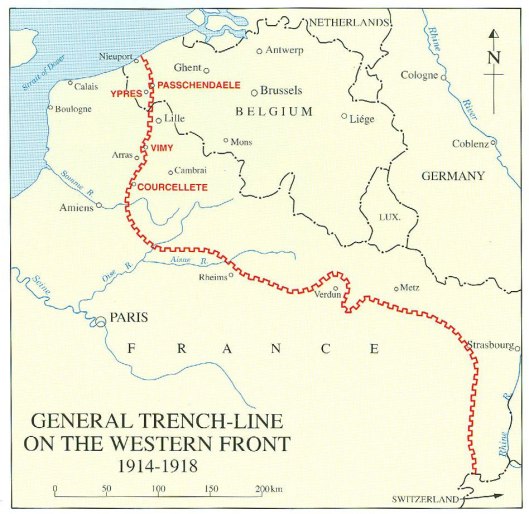
image4map.jpg

Artillery had begun in the Middle Ages, as something which looks like a high school science experiment (plus armor).

image5millemete.jpg

By 1914, it was much bigger and much more efficient.

image6howitzer.jpg

(The German says, “Our Growlers!”—perhaps a soldier’s slang word for heavy howitzers like these?)

And, as the war progressed, bigger and more efficient yet.
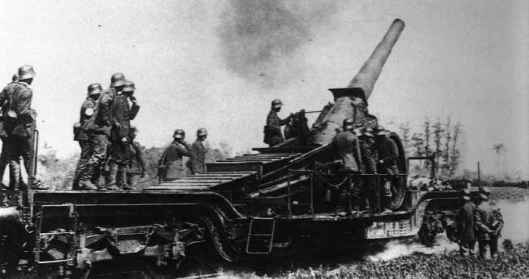
image7biggergun.jpg

And even more so—to the point where some guns became so big and heavy that only railways could move them around.

image8railwaygun.jpg

Needless to say, when shells from such guns hit Ypres, the damage they caused was enormous.
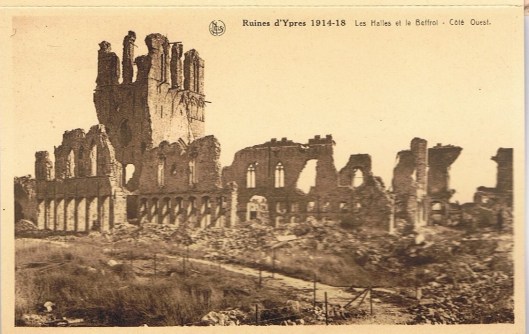
image9ypres


image10ruins.jpg

And not only to Ypres, but to the whole region—entire villages disappeared, as did forests, landscapes became moonscapes.
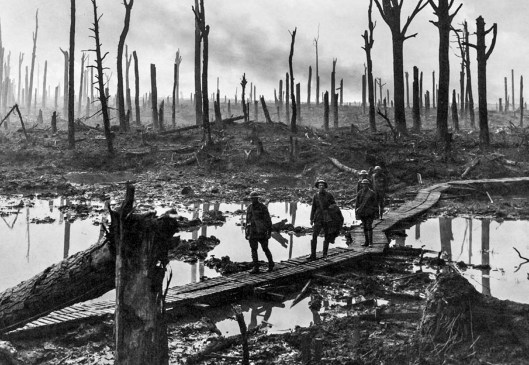
image11nomansland.jpg

For some months in 1916, Second Lieutenant Tolkien walked through, lived through, this devastated world,
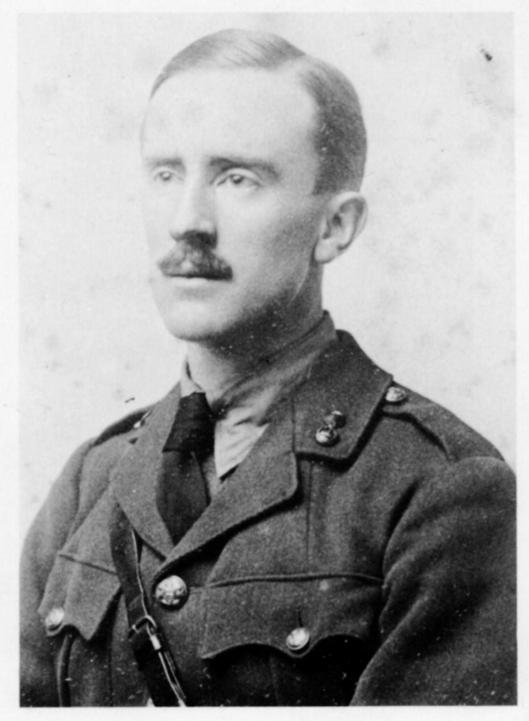
image12jrrt

which took many years to be repaired.
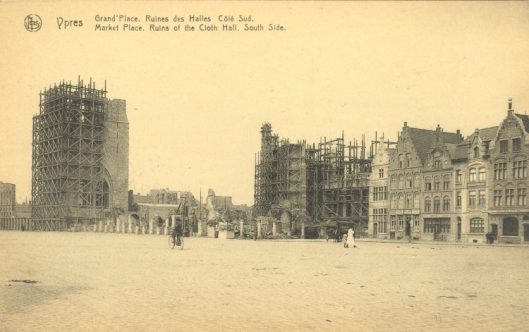
image13ypres.jpg

And, in the meantime, the economies of Europe suffered, with so much damaged or shifted to war work, and governments left with enormous debts, both the victors and the vanquished.

This devastation made us think about another devastation, first described by Thorin in Chapter One of The Hobbit, and, of course we wondered if JRRT thought of the damage caused by the endless, pitiless bombardments as he wrote about the ruin brought by a dragon.

Thorin begins, as we did at the opening of this posting, showing a peaceful, prosperous world:

“Altogether those were good days for us, and the poorest of us had money to spend and to lend, and leisure to make beautiful things just for the fun of it, not to speak of the most marvellous and magical toys, the like of which is not to be found in the world now-a-days.  So my grandfather’s halls became full of armour and jewels and carvings and cups, and the toy market of Dale was the wonder of the North.”

But, just as the Great War came to the ridges north of Ypres, so Smaug came down upon the town of Dale just below the Lonely Mountain and to the Mountain, as well:

“Then he came down the slopes and when he reached the woods they all went up in fire.  By that time all the bells were ringing in Dale and the warriors were arming.  The dwarves rushed out of their great gate; but there was the dragon waiting for them.  None escaped that way.  The river rushed up in steam and a fog fell on Dale, and in the fog the dragon came on them and destroyed most of the warriors…Then he went back and crept in through the Front Gate and routed out all the halls, and lanes, and tunnels, alleys, cellars, mansions and passages…Later he used to crawl out of the great gate and come by night to Dale, and carry away people, especially maidens, to eat, until Dale was ruined and all the people dead or gone.  What goes on there now I don’t know for certain, but I don’t suppose any one lives nearer the Mountain than the far edge of the Long Lake now-a-days.”

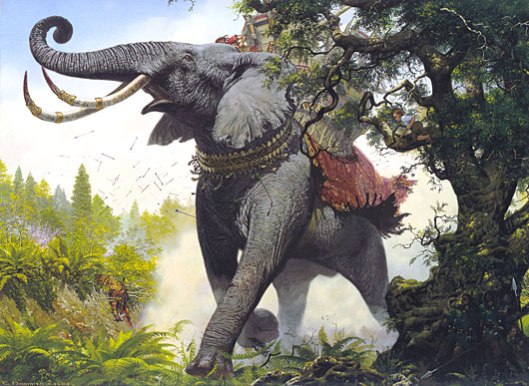
image14erebor.jpg

Thorin is correct about this:  Dale is ruined and abandoned (you can see the remains of the town on the right hand side of this illustration) and the Mountain has only one inhabitant.

image15smaug.jpg

When Bilbo disturbs him and steals a cup, Smaug goes on a second rampage, flying as far south as Lake-town:

“Fire leaped from the dragon’s jaws.  He circled for a while high in the air above them lighting all the lake…Fire leaped from the thatched roofs and wooden beam-ends as he hurtled down and past and round again…Flames unquenchable sprang high into the night. “  (The Hobbit, Chapter Fourteen, “Fire and Water”)

image16laketown.jpg

And, even when Bard’s arrow brings him down, Smaug causes a final wave of destruction:

“Full on the town he fell.  His last throes splintered it to sparks and gledes.  The lake roared in.  A vast steam leaped up, white in the sudden dark under the moon.  There was a hiss, a gushing whirl, and then silence.  And that was the end of Smaug and Esgaroth…”

Just as certain parts of Europe were destroyed and their economies stunted by the Great War, we can hear, in Thorin’s words, that the same has happened to Dale and the Lonely Mountain:  with no dwarves and no men to make the “armour and jewels and carvings and cups”, not to mention the “most marvellous and magical toys”, the whole economy of the area to the north of the Long Lake was completely destroyed.  Survivors built up Lake-town, but no one dared to revive the trade which had once enriched an entire region.

image17laketown.jpg

And, as for the few remaining dwarves:

“After that we went away, and we have had to earn our livings as best we could up and down the lands, often sinking as low as black-smith-work or even coal-mining.” says Thorin.

Although Thorin dies in the struggle to regain what was lost, there is a happy ending of sorts for the dwarves.  With Smaug dead, they can finally return, as can men, and rebuild, just as Europe began to rebuild—Ypres restored both Cloth Hall and cathedral in time.
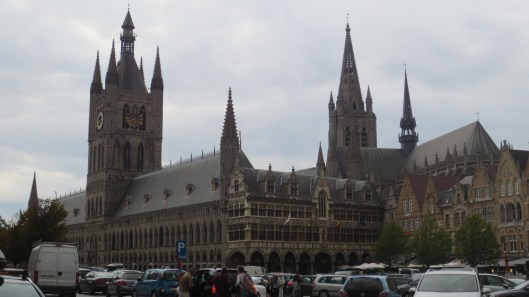
 

image18ypres


But the dragon would return and all too soon…

Thanks, as always, for reading and

MTCIDC

CD

Out of Touch

26 Wednesday Jun 2019

Posted by Ollamh in Economics in Middle-earth, J.R.R. Tolkien

≈ 1 Comment

Tags

Barliman Butterbur, Bayeux Tapestry, Beacons, call box, Cell Phones, communication, Eagles, Gondor, Great War, messenger dog, messenger pigeon, military post, Moth, motorcycle messenger, Nazgul, Palantir, pay phone, Postal Service, Postmen, runner, semaphore, signal lamp, telegrams, telegraphy, The Lord of the Rings, The Prancing Pony, Tolkien, wireless telegraphy

Welcome, as always, dear readers.

Recently, we were charging our cell/mobile phone and completely forgot it when we walked out of the house.

image1cell


We were down the road when we realized it and the thought came to us:  how times have changed!  Before people could carry their little, flat phones in their pockets, away from home, if you had an emergency, you looked for a pay phone/call box.

image2payphone.jpg

image3callbox.jpg

When JRRT was born, in 1893, the main forms of long-distance communication were the post

image4post.jpg

and the telegram—brought to your house by a specially-uniformed messenger.

image5telegraph.jpg

The telephone had been invented in 1875, but was still far from common–

image6earlyphone.jpg

London’s first telephone directory, issued in 1880, listed about 300 customers in a city of 5,000,000 and, when the first actual phone book arrived, in 1896, it had 81,000 numbers for the whole of Britain, with a population of perhaps 30,000,000.  (To give you a literary example, Bram Stoker’s Dracula was published in 1896 and, although telegrams are common in the book, no one ever mentions or uses a telephone.)

When Second Lieutenant Tolkien

image7ltjrrt.jpg

became his battalion’s signals officer in 1916, there were, in fact, a surprising number of forms of communication available, although most of them would not have ever appeared in civilian form.

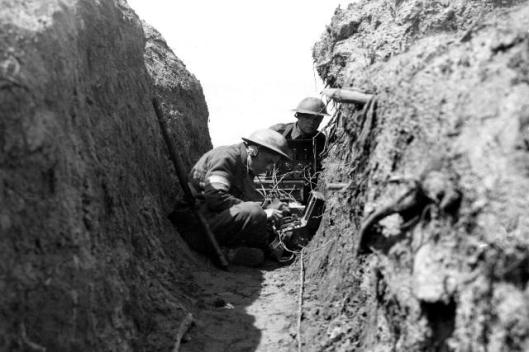
There was the telephone, which, with its miles of wire, could be extremely vulnerable to enemy shellfire.


image8telephone

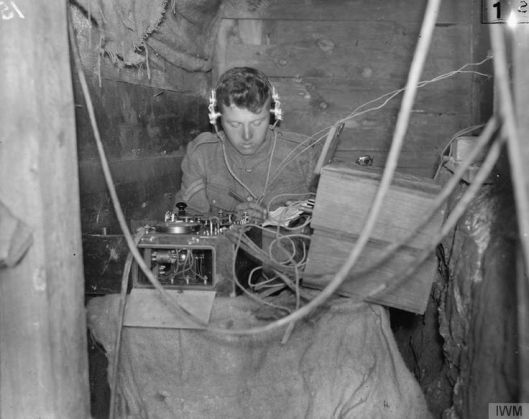
There was what would be called “wireless telegraphy”, an early form of radio, but not very dependable.

image9radio


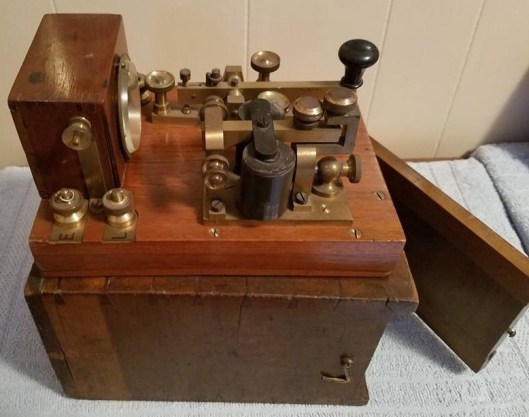
There was actual telegraphy which, again, used miles of wire.

image10telegraph.jpg

There was the military post—mostly used not to transmit orders, but to maintain contact with home.

image11militarypost


And then there were the more specifically military methods.  At the most basic, there was the runner.

image12runner

Then there was the motorcycle messenger,

image13motorcycle

the signal lamp,

image14lamp

and even the semaphore.

image15semaphore

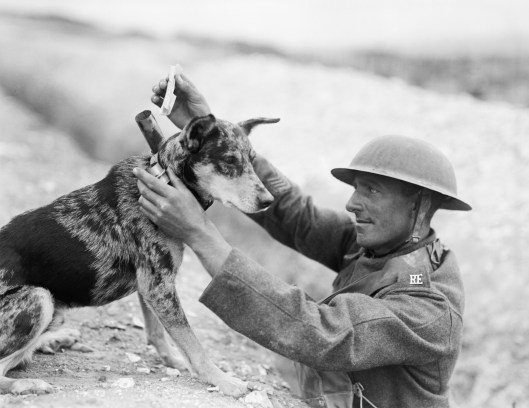
Beyond the human, there were the messenger dog,

image16dog.jpg

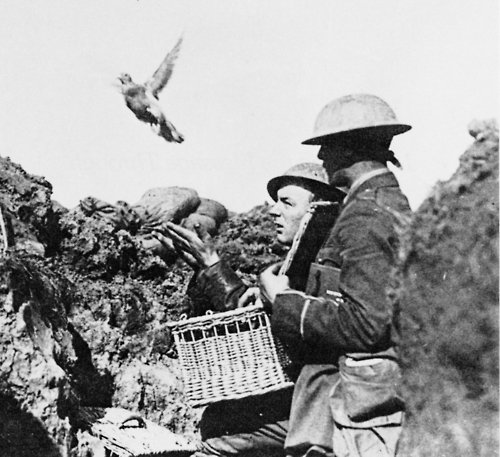
and the messenger pigeon.

image17pigeon.jpg

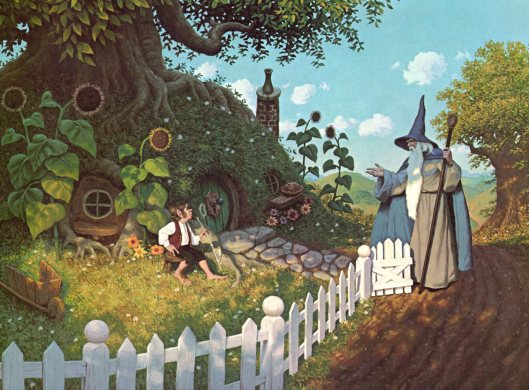
So, we asked ourselves, what were Tolkien’s Middle-earth equivalents?  First of all, we see Bilbo in Chapter One of The Hobbit, reading his morning’s mail when Gandalf appears.

image18bandg.jpg

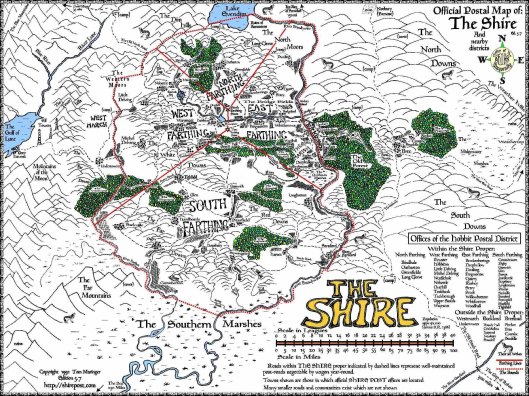
This is expanded upon in the Prologue to The Lord of the Rings, where we hear about the post as being one of the few actual public services in the Shire.  (Here’s someone’s wonderful creation of a postal map of the Shire, complete with regional divisions.)

image19postalmap.jpg

This service clearly doesn’t extend beyond the Shire as Gandalf is forced to leave a letter for Frodo at The Prancing Pony

image20pony.jpg

in Bree, to be given to the first person going westwards.  The innkeeper, Butterbur, completely forgets it, with serious consequences.

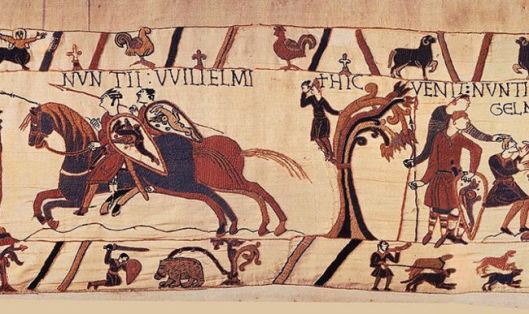
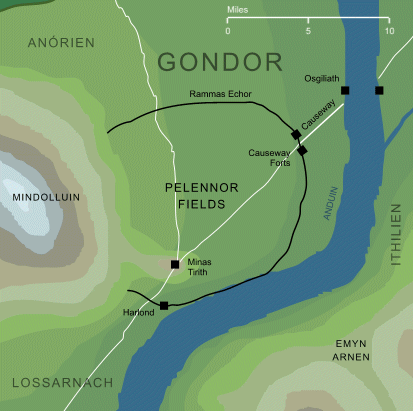
Because this is a pre-industrial world, none of the electronic means would be available, of course.  Gondor used mounted messengers, as two are discovered ambushed by the Rohirrim on the road to the Rammas Echor (The Return of the King, Book Five, Chapter 5,“The Ride of the Rohirrim”).

image21nuntii.jpg

(This image is, of course, from the Bayeux Tapestry, the caption saying “Nuntii Wilielmi”, “William’s Messengers”, but the only illustrations of Gondorian mounted men we’ve found are all heavily-armored, something you wouldn’t expect a courier to be, so we’re suggesting this possibility, instead.)

A second method is by the chain of beacon fires along the mountains to the west of Gondor.

image22beacon.jpg

As for their opponents, we suppose that one might imagine the Nazgul as the airborne equivalent of mounted messengers, since they seem, when not pursuing Frodo and leading attacks on Gondor, to be couriers for Sauron.

image23naz.jpg

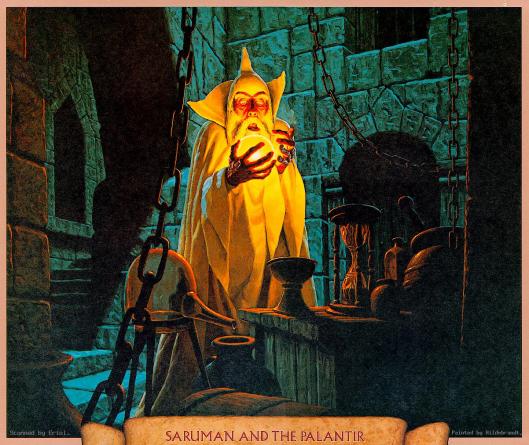
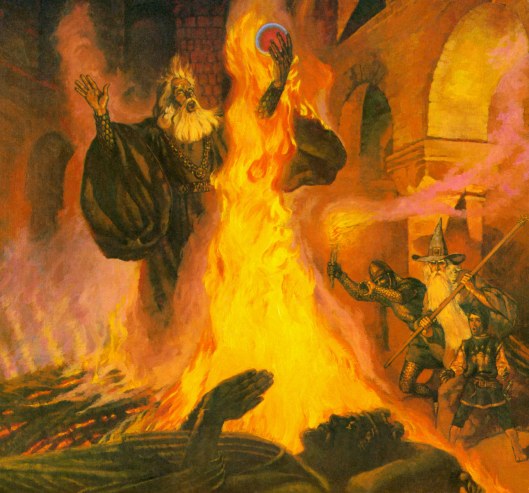
Sauron’s main communication device, however, appears to be the palantir, whereby he controls the actions of Saruman and, to a degree, of Denethor, the Steward.

image24sar.jpg

image25den.jpg

It’s rather surprising, we suppose, that Gandalf, who is powerful enough to deal with a palantir (although it’s Aragorn who is its rightful owner), can be so easily trapped by Saruman and left on top of Orthanc, completely isolated when he is so needed in the north.

image26orthanc.jpg

In P. Jackson’s film, he uses what looks like a fancy moth to call for help,

image27moth.jpg

which appears in the form of one of those eagles, so conveniently available when someone really gets into trouble (Bilbo, Gandalf, and the dwarves in The Hobbit, as well as dwarves, elves, and men vs goblins and Wargs, Frodo and Sam on the edge of Mt Doom in The Return of the King).  Suppose, instead, if Gandalf had reached into this robe and pulled out his cell phone–

image28cell.jpg

which he would never have left behind after charging it…

Thanks for reading and

MTCIDC

CD


It’s a Long Way…

22 Wednesday May 2019

Posted by Ollamh in Films and Music, J.R.R. Tolkien, Literary History, Military History, Military History of Middle-earth

≈ Leave a comment

Tags

American Civil War, Aulos, Crusaders, Great War, Greek, Hoplites, Julius Caesar, Macbeth, Marching song, May 4th, Palestine Song, Rohirrim, Roman songs, songs, Star Wars, Star Wars Day, The Hobbit, The Lord of the Rings, Tolkien, Walter von der Vogelweide

Welcome, dear readers, as always.

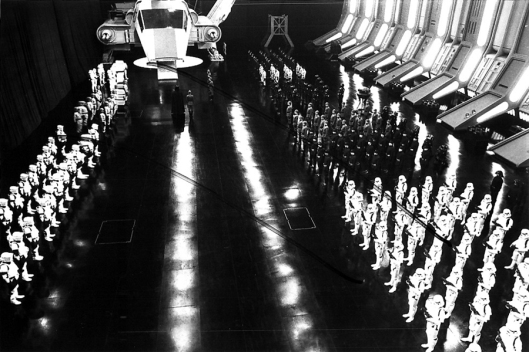
Perhaps because we’re writing this on May the 4th, we’ve been in a musical mood—after all, there’s such a catchy tune involved with it—

image1vader

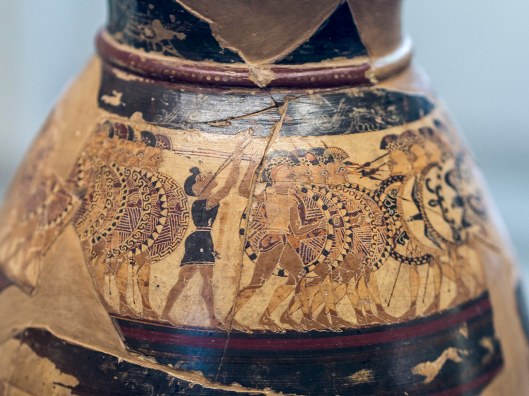
And we wondered if there were words to it?  Certainly soldiers have been singing songs seemingly forever.  Greek hoplites sang a hymn to Apollo before battle.

image2chigi

(They are accompanied by an aulos player here.  “Aulos” is sometimes mistranslated “flute”, but it’s not a kind of recorder.  Instead, it’s a member of the oboe family.)

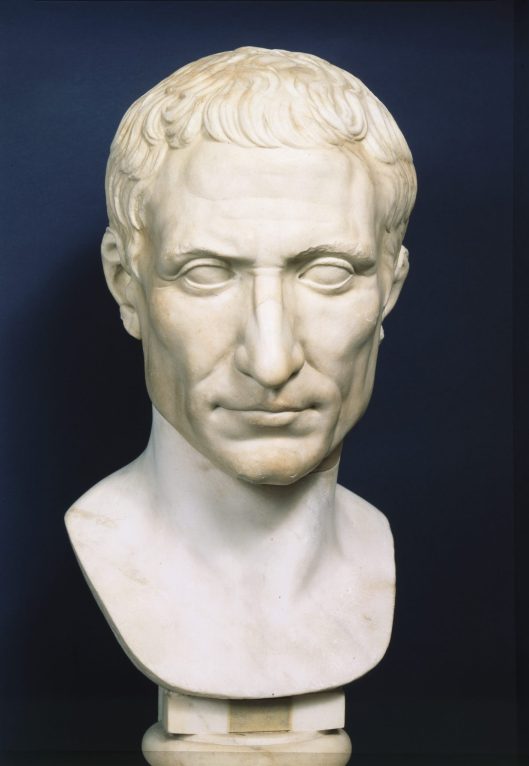
Julius Caesar’s (100-44bc)

image3jc

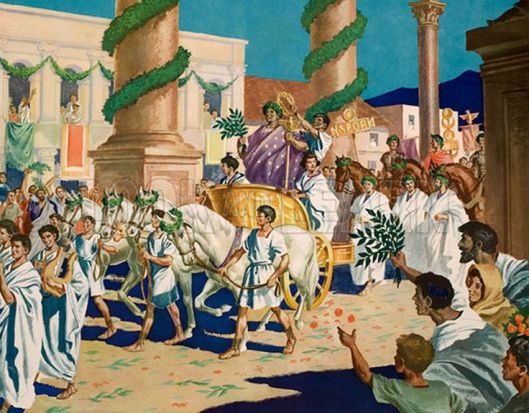
soldiers, marching behind his chariot when he celebrated his triumph (formal victory parade) in Rome

image4triumph

sang an unprintable song about his sex life.  There’s only a fragment surviving and we’ll print it here—but in Latin—a typical Victorian thing to do.

“Urbani, servate uxores: moechum calvom adducimus.
Aurum in Gallia effutuisti, hic sumpsisti mutuum.”

(Here’s a LINK which we would recommend about reconstructing Roman soldiers’ songs.)

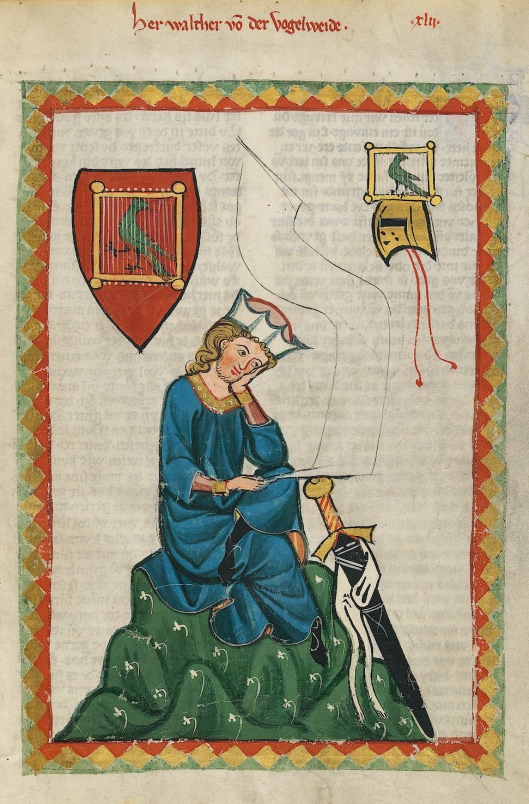
There’s a stirring piece by Walter von der Vogelweide (c.1170-c.1230),

image5walt

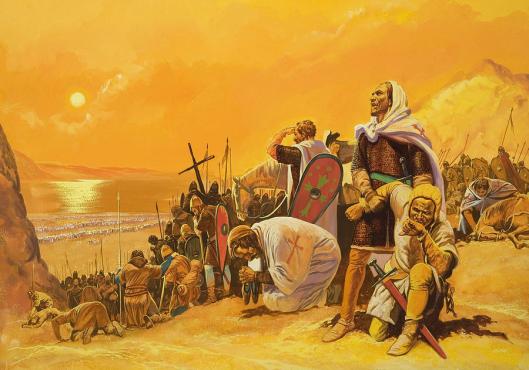
called the “Palestine Song”, supposedly sung by a crusader after reaching the Holy Land.  We can imagine later Crusaders singing it as they marched

image6cru

As in the case of the Caesar fragment, however, we won’t print the text—we aren’t enthusiastic about crusades, especially the medieval ones, believing them to have been the drawn-out attempt at a massive landgrab of places already long-inhabited.

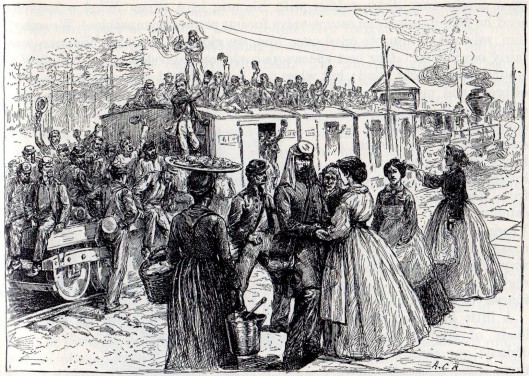
On long, monotonous marches, we imagine soldiers always sang.  The American Civil War was fought over hundreds of miles and, with the rare exception when trains could be used,

image7train

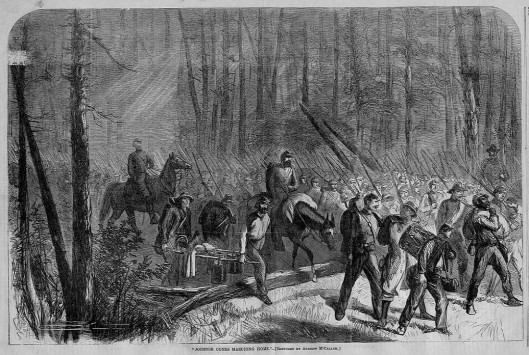
soldiers walked everywhere.

image8marching

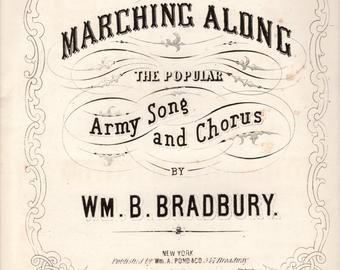
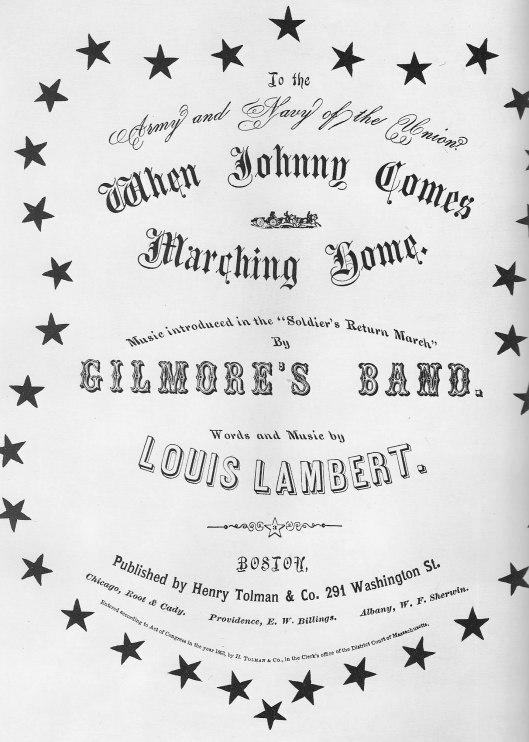
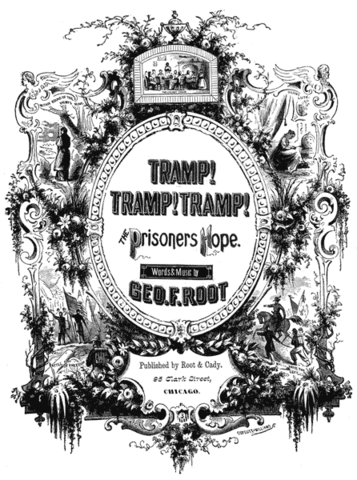
That being the case, it’s no wonder that so many of their favorite songs had the word “marching” in the title.

image9marching

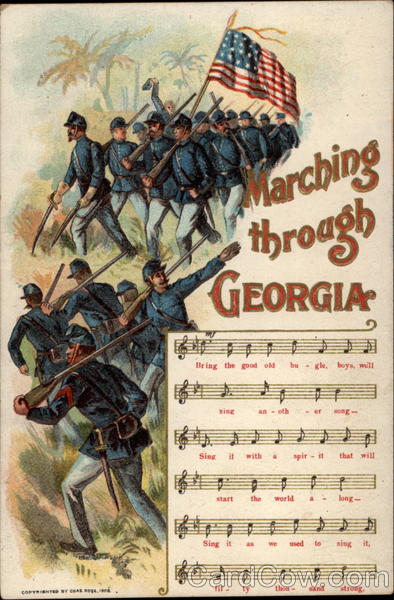
Marching Through Georgia Music and Lyrics

image11marchimage12

(And that last one’s chorus begins, “Tramp, tramp, tramp, the boys are marching…”)

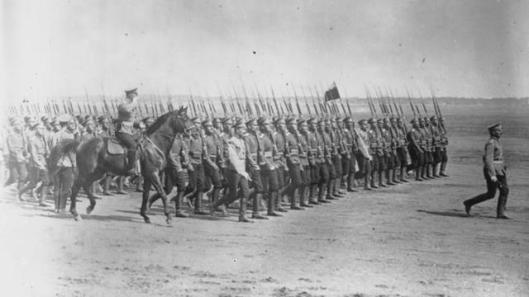
Russian soldiers appear to have had designated regimental singers, who, when called, hurried up to the front of the column and broke into choruses to keep up the men’s spirits on long journeys.

image13rus

(We apologize that these Russians aren’t singing—but this is, in fact, a film of the last czar, Nicholas II, reviewing his guards just before the Great War, so, at least, they’re marching.)

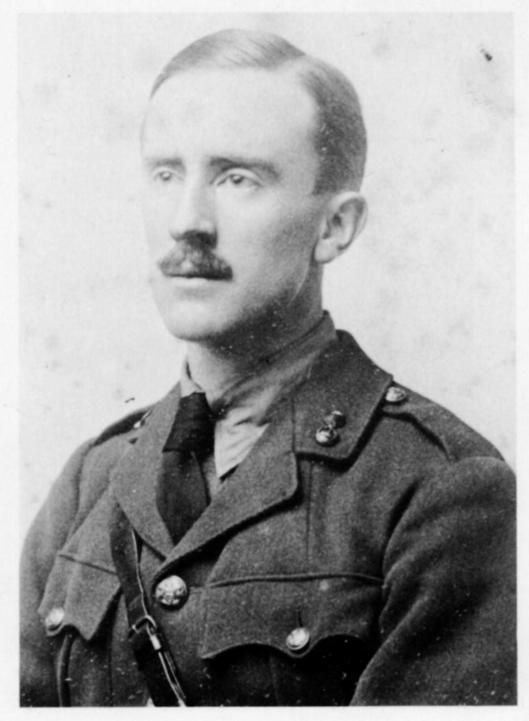
Which brings us to the Great War and our own officer in it, JRRT.

image14jrrt.jpg

Certainly, the soldiers in his battalion (13th, Lancashire Fusiliers)

image15lancs

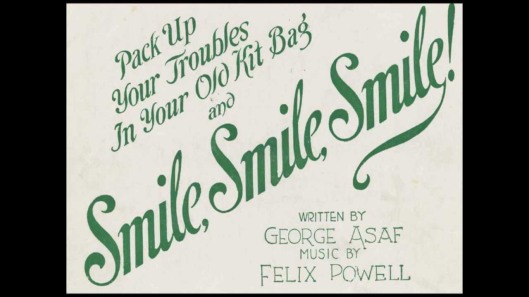
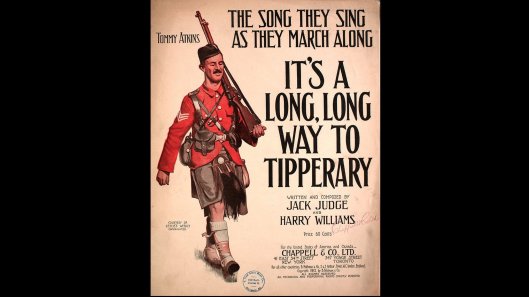
would have sung—here are two popular favorites—

image16smile

image17tip

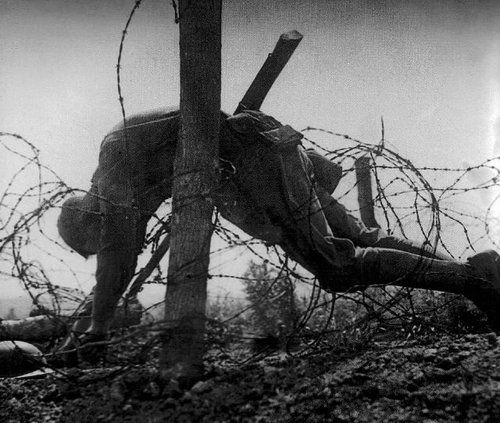
There were other songs, too, but not cheery at all, and officers were instructed to discourage their singing.  The words of one, sung to the tune of “Auld Lang Syne”,  expressed the terrible monotonous nature of trench warfare, being only “We’re here because we’re here because we’re here because we’re here”.  A second, “Hangin’ On the Old Barbed Wire”, as it was called, had a mocking little tune, like something from a music hall, but described the whereabouts of soldiers who, for various reasons, were out of the firing line—until it came to the last verse:

“If you want the old battalion,

I know where they are, I know where they are, I know where they are

If you want to find the old battalion, I know where they are,

They’re hanging on the old barbed wire,

I’ve seen ’em, I’ve seen ’em, hanging on the old barbed wire.

I’ve seen ’em, I’ve seen ’em, hanging on the old barbed wire.“


image17awire

Here’s a LINK, if you’d like to hear an abbreviated version.  In this , the group, Chumbawamba, uses an alternative line, “If you want to find the private”, but both versions are grim—and we presume that Tolkien knew all of these songs and many more, some, like the song about Julius Caesar, completely unprintable!

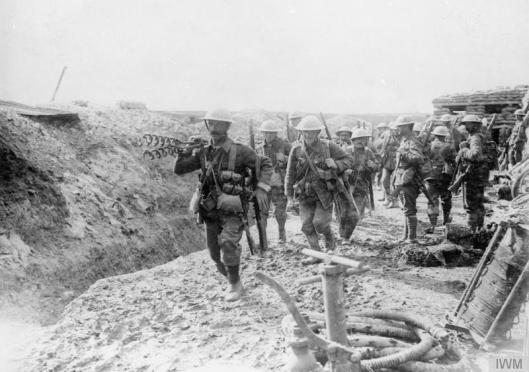
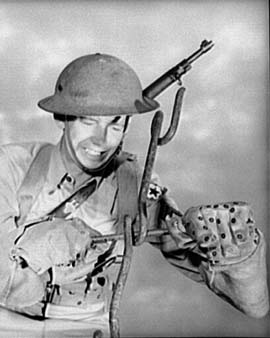
(Our image, by the way, is of a wiring party from the 1st Battalion, Lancashire Fusiliers.  Those curly things, called “screw pickets”,  you see resting on the front man’s right shoulder are the stakes which were twisted into the ground and then barbed wire was run through them and wrapped around them.   Here’s  an early US WW2 picture of a soldier working with the upper loops of one.)

gloves_barbedwire_ww2_375

As we’ve often discussed before, things from JRRT’s real life sometimes have a way of seeping into his fiction, and we can certainly see it here.

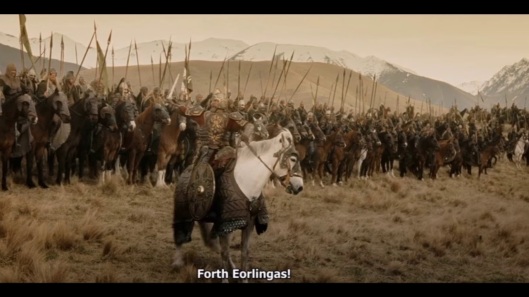
Although they’ve been silent on the march, on their way to the attack, the Rohirrim, for example, are far from that:

image19rohirrim.jpg

“And then all of the host of Rohan burst into song, and they sang as they slew, for the joy of battle was on them, and the sound of their singing that was fair and terrible came even to the City.”  (The Return of the King, Book Five, Chapter 5, “The Ride of the Rohirrim”)

Unfortunately, we have no idea what their songs might have been like—perhaps they would have resembled Theoden’s cry to the Rohirrim:

“Arise, arise, Riders of Theoden!

Fell deeds awake:  fire and slaughter!

Spear shall be shaken, shield be splintered,

A sword-day, a red day, ere the sun rises!

Ride now, ride now!  Ride to Gondor!”

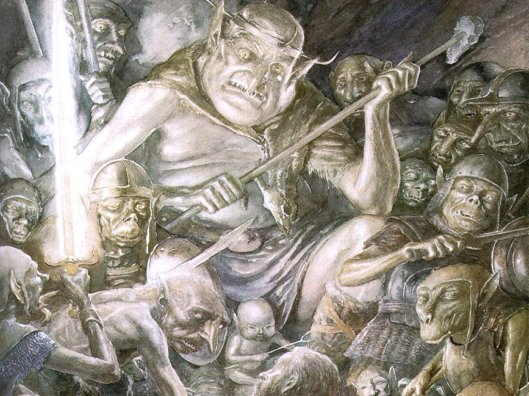
Oddly, we do have two of what might be called Goblin marching songs,

image20goblins.jpg

both from The Hobbit.  The first is sung right after the dwarves are captured in a cave in which they’ve taken shelter in the Misty Mountains.

“Clap! Snap! the black crack!
Grip, grab! Pinch, nab!
And down down to Goblin-town
You go, my lad!

Clash, crash! Crush, smash!
Hammer and tongs! Knocker and gongs!
Pound, pound, far underground!
Ho, ho! my lad!

Swish, smack! Whip crack!
Batter and beat! Yammer and bleat!
Work, work! Nor dare to shirk,
While Goblins quaff, and Goblins laugh,
Round and round far underground
Below, my lad!”

(Chapter Four, “Over Hill and Under Hill”)

The second appears two chapters later, when the company is trapped in the pines and the Goblins and Wargs are below:

“Burn, burn tree and fern!
Shrivel and scorch! A fizzling torch
To light the night for our delight
Ya hey!

Bake and toast ’em, fry and roast ’em!
till beards blaze, and eyes glaze;
till hair smells and skins crack,
fat melts, and bones black
in cinders lie
beneath the sky!
So dwarves shall die,
and light the night for our delight,
Ya hey!
Ya-harri-hey!
Ya hoy!”

(Chapter Six, “Out of the Frying-pan Into the Fire”)

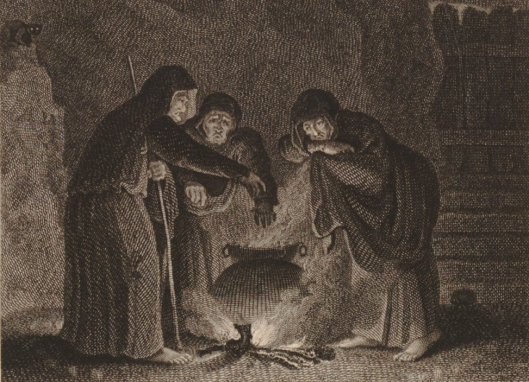
We notice that the opening of the second bears a certain resemblance to another song sung in a wild location—by wild people:

“First Witch
Round about the cauldron go;
In the poison’d entrails throw.
Toad, that under cold stone
Days and nights has thirty-one
Swelter’d venom sleeping got,
Boil thou first i’ the charmed pot.

All
Double, double, toil and trouble; (10)
Fire burn, and cauldron bubble.

Second Witch
Fillet of a fenny snake,
In the cauldron boil and bake;
Eye of newt and toe of frog,
Wool of bat and tongue of dog,
Adder’s fork and blind-worm’s sting,
Lizard’s leg and howlet’s wing,
For a charm of powerful trouble,
Like a hell-broth boil and bubble.”

(Macbeth, Act 4, Scene 1)

image21cauldron.jpg

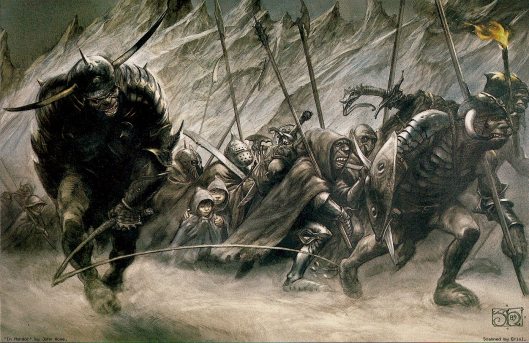
In  The Lord of the Rings, JRRT blurs Goblins and orcs and, considering that we almost always see orcs as moving in companies, we’ll see them that way, too, marching across Rohan or on the stone roads of Mordor, and we’d like to imagine that they, too, have songs to make the way shorter.  But what do they sing about?  And, judging by the Goblin’s songs, do we want to know?

image22orcs.jpg

Thanks, as always, for reading and

MTCIDC

CD


ps

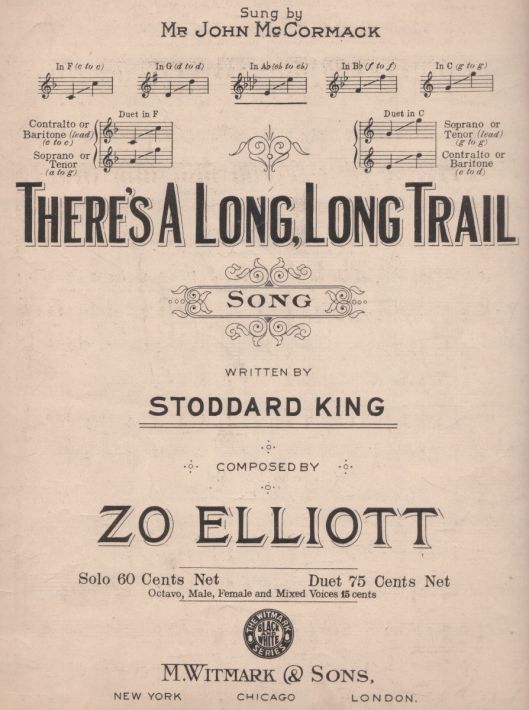
Another Great War soldiers’ song was more melancholy than sarcastic, although it still suggested marching,

image23songsheet.jpg

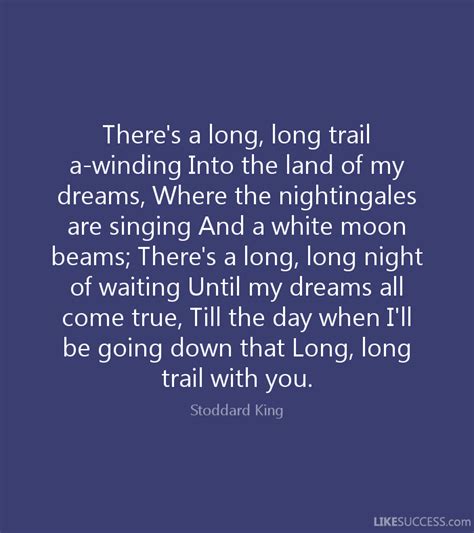
and, when you read the chorus, you’ll see why.

image24lyrics.jpg

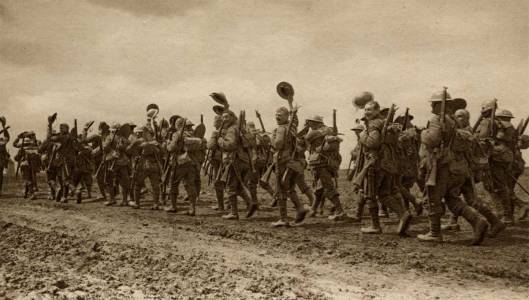
Here’s a LINK of it sung by a famous tenor of that time, John McCormack (1884-1945) and here are soldiers at a happier moment and we hope that Tolkien sometimes saw them this way, too.

image25cheer.jpg


Matchless

15 Wednesday May 2019

Posted by Ollamh in Fairy Tales and Myths, J.R.R. Tolkien, Literary History

≈ Leave a comment

Tags

anachronism, Hans Christian Andersen, matches, Swan Vestas, The Hobbit, The Little Match Girl, The Lord of the Rings, tinder, tinder box, Tolkien, Vesta, Vilhelm Pedersen

As always, dear readers, welcome.

Recently, we’ve been examining anachronisms in The Hobbit.  These are always such minor things that JRRT, before its initial publication in 1937,

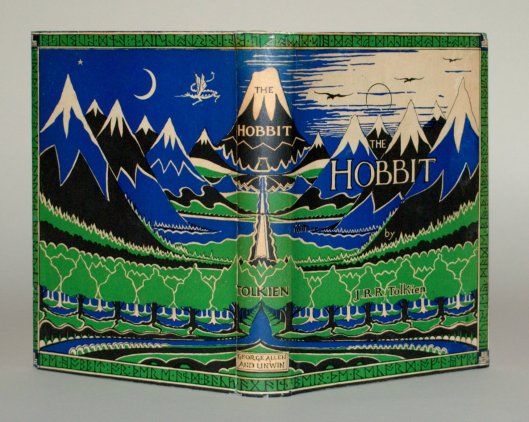
image1hobbit.jpg

doesn’t appear even to have noticed them (see our recent postings for more on them) and only corrected some in succeeding editions.

In our last, it was “guns”, but, in this, our last, at least for the present, it’s this:

“After some time he felt for his pipe…Then he felt for his pouch…Then he felt for matches…”

(The Hobbit, Chapter Five, “Riddles in the Dark”)

Others have noticed this before—Anderson in his invaluable The Annotated Hobbit even has a footnote on it (page 116), adding the detail from Chapter Six that “…Oin and Gloin had lost their tinder-boxes.  (Dwarves have never taken to matches even yet.)”

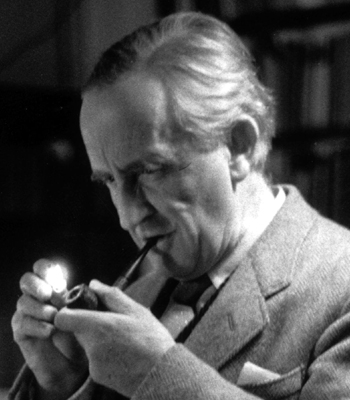
Why are matches an anachronism?  Tolkien, a life-long pipe smoker,

image2jrrt.jpg

would have used them without thinking—perhaps these, “Swan Vestas”, long sold as “the smoker’s match”.

image3swan.JPG

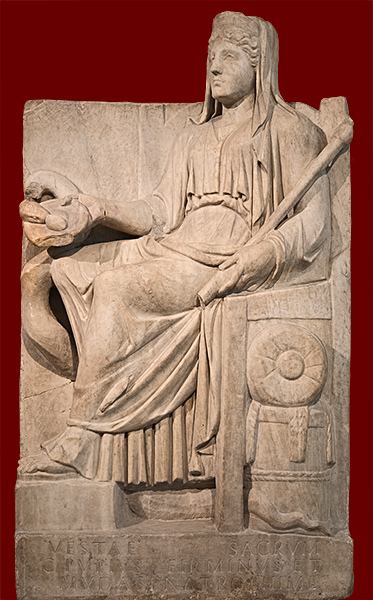
(The name “Vesta” comes from the Roman goddess of the hearth,

image4vesta.jpg

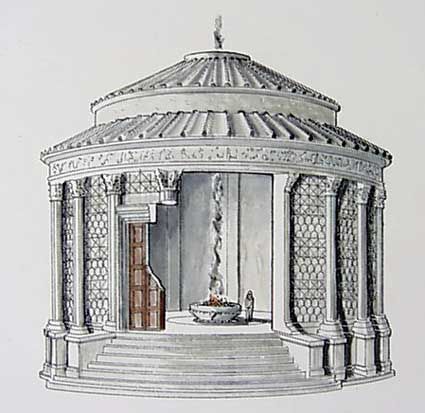
a fragment of whose temple still stands in the Roman Forum in Rome.

image5temple.jpg

Inside was a hearth—a fire pit—which symbolized all of the hearths in Rome.)

image6temple.jpg

Matches, however, are a nineteenth-century invention, with a complicated history—and, at the beginning, a complicated ignition.  For example, these, from 1828, had a tip of sulphur which burst into flame when dipped into a container of phosphorus.

image7match.JPG

This was hardly a practical way to strike a light and soon matches were made by which friction could be used to light them.  After 1830, the tips of these were coated with white phosphorus, which was rather unstable and could be set off by everything from rubbing against each other to strong sunlight.  They were made by the millions in factories (many employing young women and girls)

image8phos.jpg

image9factory.jpg

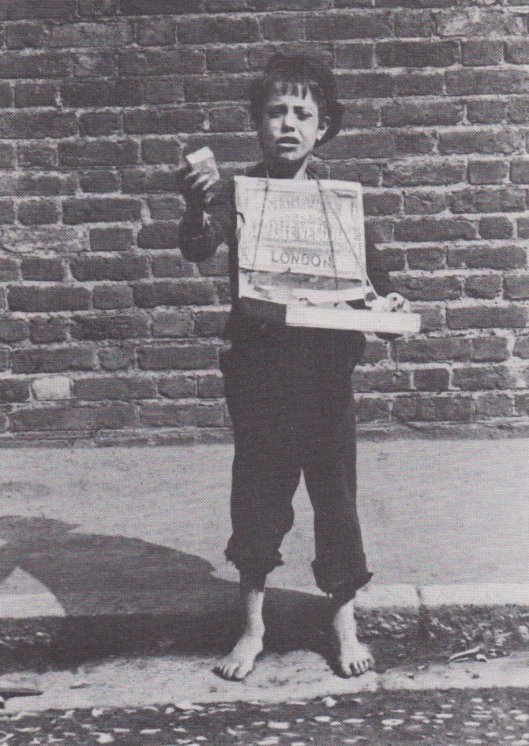
and sold on street corners everywhere, commonly by children and the very poor.

image10match.jpg

Considering this made us think of a Hans Christian Andersen (1805-1875)

image11hca.jpg

story we can’t bear to read.  In English, it’s called “The Little Match Girl” and was first published in 1845.  Here’s an illustration for it by Vilhelm Pedersen (1820-1859), Andersen’s favorite illustrator.

image12match.jpg

(If you would like to read it—we’ve warned you!– here’s the LINK to a very rich site, which has all of Andersen’s fairy tales both in the original Danish and translated into English, along with all of the rest of Andersen’s extensive literary work.)

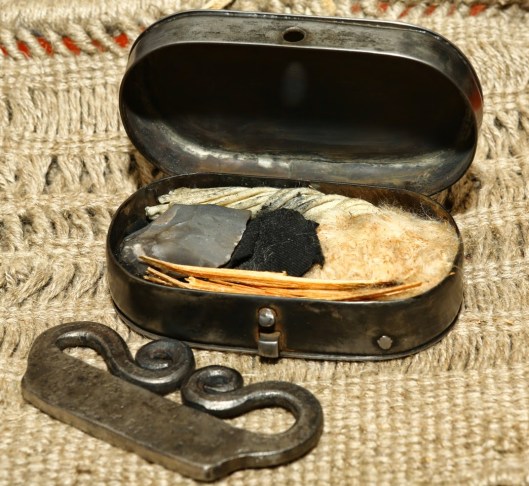
But, if Bilbo lives in a sort of medieval world, where, presumably, matches wouldn’t be available, then what can he use?  The answer, of course, is what Oin and Gloin have lost (and Sam will have in The Lord of the Rings–see The Fellowship of the Ring, Book One, Chapter 6, “The Old Forest”):  a tinder box.

image13tinder.jpeg

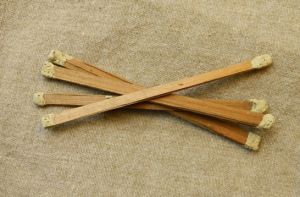
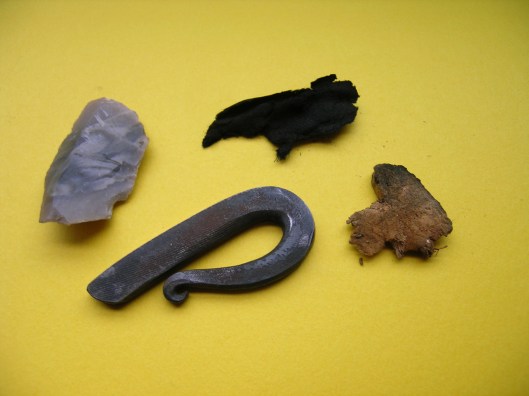
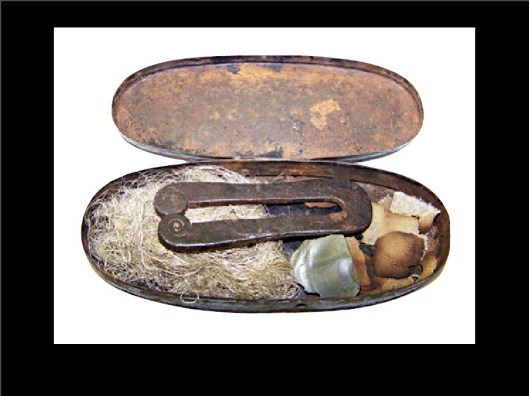
Such a box would contain three basic items:  a dry material in which to catch a spark (bark, dry moss, linen rags), a piece of steel and a piece of flint to make sparks.

image14tinder.jpg

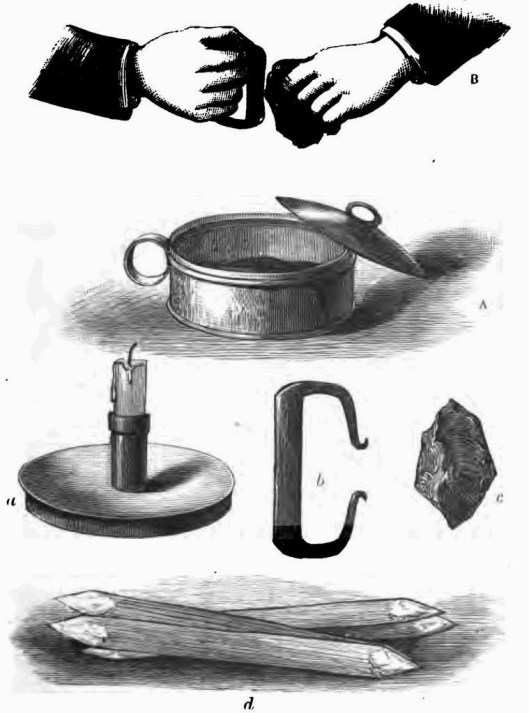
And here’s how it works—

image15works.jpg

Long before the invention of matches, this was the common way in the western world to strike a light (literally) with “flint and steel”, as it was called—and it’s what the dwarves use in The Hobbit.

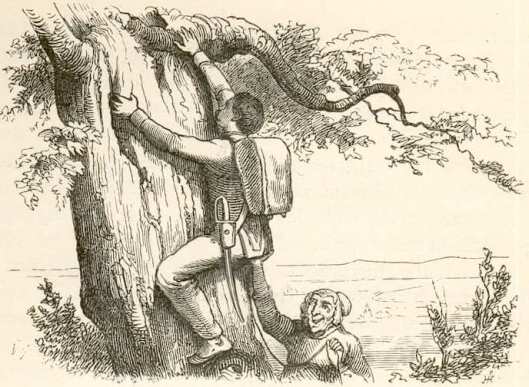
It’s also the title of another Hans Christian Andersen story, but a jollier one, called, in English, “The Tinder Box”, first published in 1835—and here’s another Pedersen illustration.

image16tinder.jpg

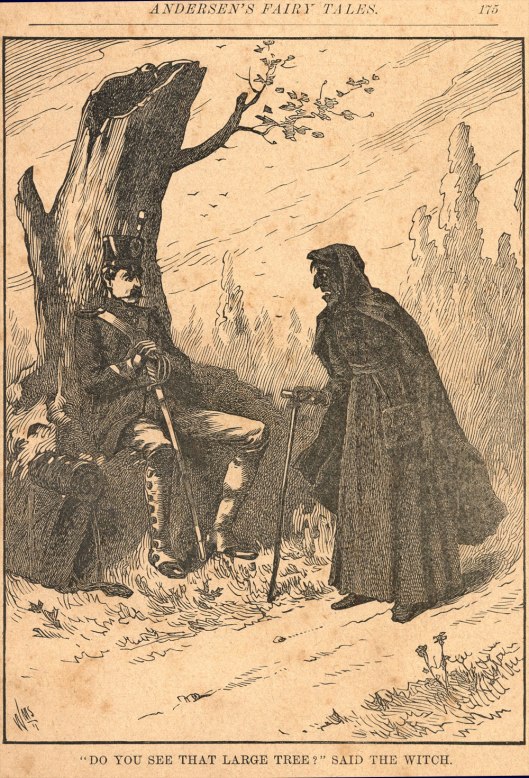
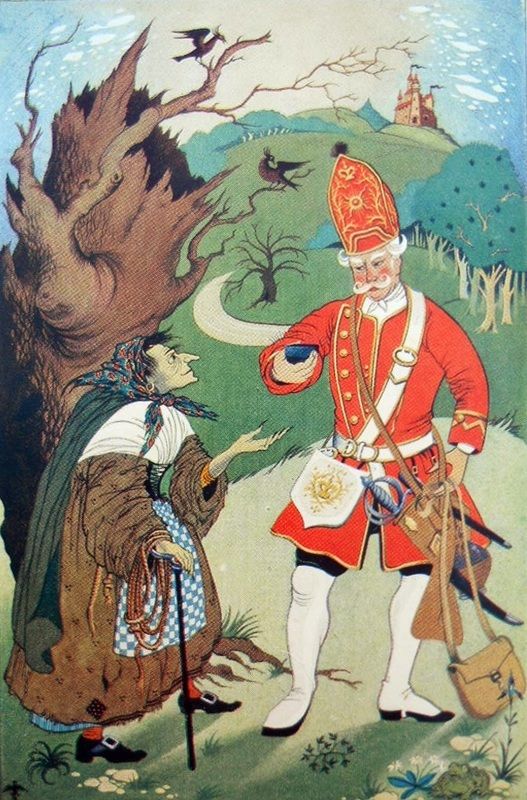
In this story, a soldier on the way home from war is stopped by an old lady on the side of the road.

image17tinder.jpg

She tells him that there’s treasure below a tree and, if he will climb in, he can take all that he wants and all that she wants in return is a little tinder box to be found there.

image18atinder.jpg

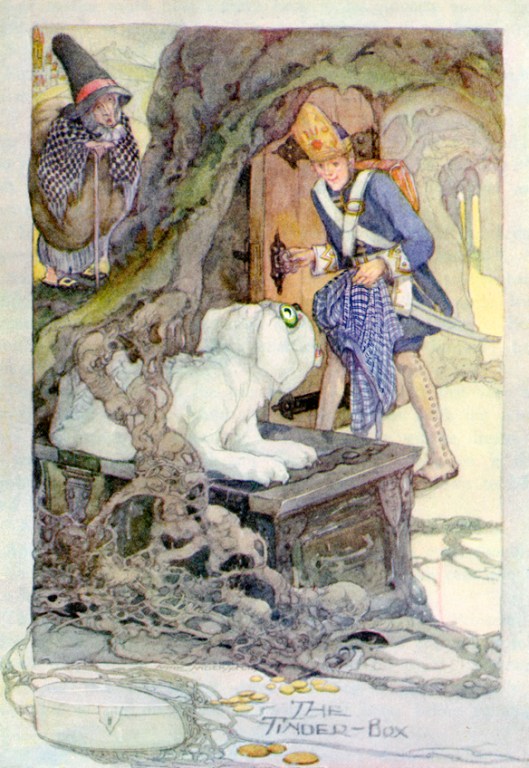
He climbs in and discovers rooms full of riches, as well as three dogs of increasingly enormous size.

image18tinder.jpg

The tinder box is, of course, not a little nothing, but the key to the dogs and to the magic beyond, although the soldier doesn’t know that at the time.  When he climbs out of the tree, and the old woman (a witch, of course), demands the box, however, he grows suspicious and, instead of handing her the box, the soldier hands her her head.

image19tinder.jpg

(We said that this was a jollier story—but clearly not if you’re a witch.)

We refer you to the LINK we mentioned earlier for the rest of the story—SPOILER ALERT:  it does have a happy ending.  As does The Hobbit, except for goblins and wargs, of course.  Oh, and Thorin.

image20thorin.jpg

And then there’s Smaug, whose fire goes out—dare we say it?—like a burnt match.

image21smaug.jpg

Thanks, as always, for reading and, as ever,

MTCIDC

CD

Gun Control?

08 Wednesday May 2019

Posted by Ollamh in J.R.R. Tolkien, Military History

≈ Leave a comment

Tags

anachronism, Dettingen, Fireworks, Gandalf, George Frederich Haendel, gunpowder, guns, Helm's Deep, kettle drums, King George II, Millemete Manuscript, petard, Rammas Echor, The Hobbit, The Lord of the Rings, The War of Austrian Succession, Tolkien

Welcome, dear readers, as always—and with our apology if you googled “gun control” and are a bit puzzled as to what has turned up (this often happens with us, making us wonder how googling images of “Saruman” suddenly produces a picture of sardines).

It’s our last posting which got us into this.  We had spotted another anachronism in The Hobbit (clarinets) and had written about it, but then, as a teaser, had concluded with another, referring to Beorn’s joining the Battle of the Five Armies:  “The roar of his voice was like drums and guns…” (Chapter 18, “The Return Journey”)

“Guns” had, of course, stood out.  Some time ago, we had written about Saruman’s use of some sort of explosive at Helm’s Deep

image1hd.jpg

as well as the destruction by a similar force of portions of the causeway forts of the Rammas Echor, of which no one has seemingly produced an illustration.

image2rammas.gif

Whatever this force was, it only seems to be used in siegework, suggesting things like a petard

image3petard.jpg

an explosive device used to blow holes in gates and doors.

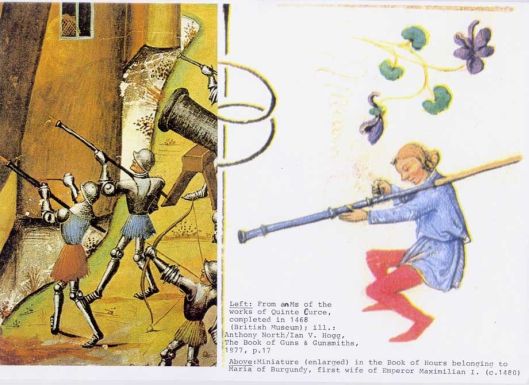
Guns, however, do not appear in any form in Tolkien’s world—except here.  Of course, when one thinks about it, there isn’t much of a step from using a blast to destroy a door to funneling that force to propel a missile—as we first see in the Millemete Manuscript of 1326-1327.

image4millemete.jpg

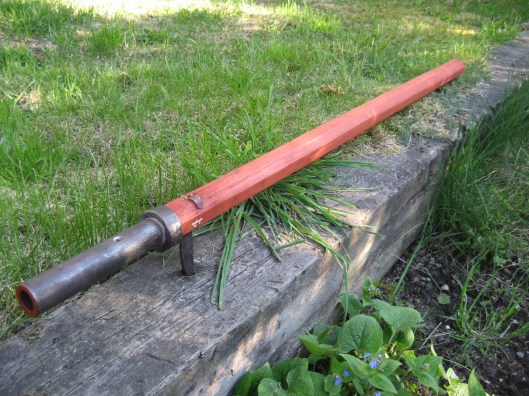
This doesn’t appear to be portable, but the basic object is simply a tube on a stick, easy to make, easy to carry

image5handgonne


and certainly late medieval people had them and employed them,

image6handgonnes.jpg

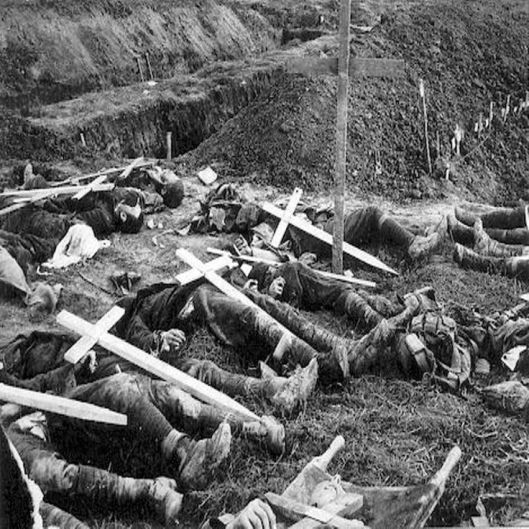
so, presumably, they might have appeared in Middle-earth (we once wrote a “what-if” posting on the subject).  Why not?  As JRRT introduced explosives, that seems to provide an opening, but we wonder if he had seen all too often and all too clearly the effect of thousands upon thousands of gunpowder weapons on real people in 1916 and, somehow, the idea of lances and swords seemed more appealing—or, at least, more “heroic”.

image7dead.jpg

image8knights.jpg

But the quotation was “like drums and guns”.

As we pointed out in our last, drums certainly appear in The Lord of the Rings—there is that disturbing reference to “drums, drums in the deep” in The Fellowship of the Ring, Book Two, Chapter 5, “The Bridge of Khazad-dum”, for example.  But what about “the roar of his voice was like drums and guns”?

When we thought about this, we asked ourselves, what would this actually sound like?  A possible answer appeared from 1749.

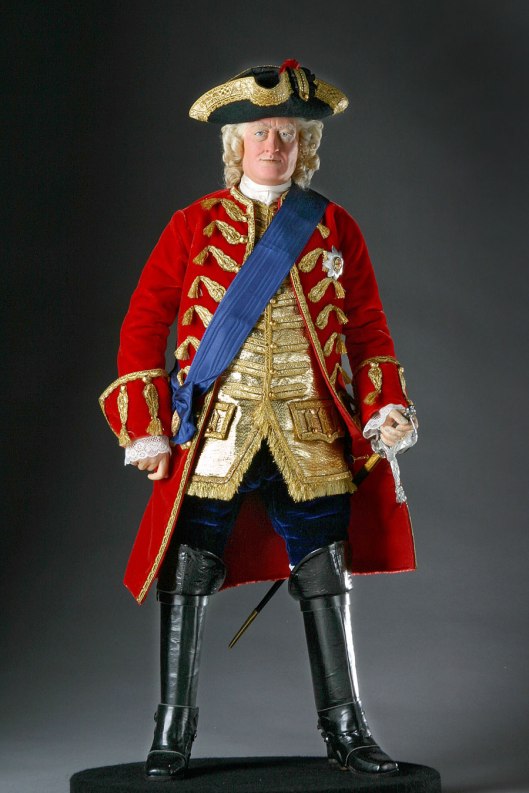
In 1749, George II of England

image9george2.jpg

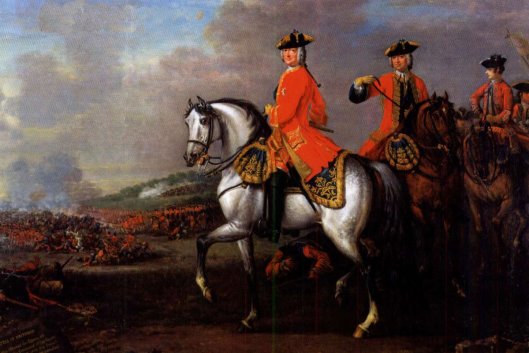
had been one of the winners of what would become known as “The War of the Austrian Succession” (1740-1748).

image10geo2.jpg

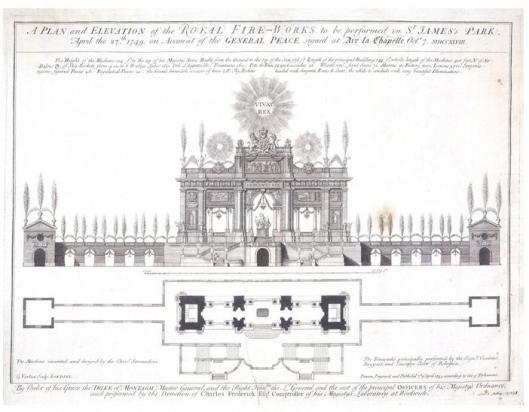
He was definitely in a party mood, so he decided to throw a giant fireworks celebration in London.  To provide the soundtrack, he commissioned George Frederick Haendel (say that “HEN-del”, not as people commonly mispronounce it, “HAHN-del”) (1685-1759).

image11gfh.jpg

George was the last English king actually to see battle, at Dettingen, in 1743,

image12dettingen.jpgimage13dettingen.jpg

and wasn’t interested in anything sweet and soft, with lots of violins.

image14violinist.jpg

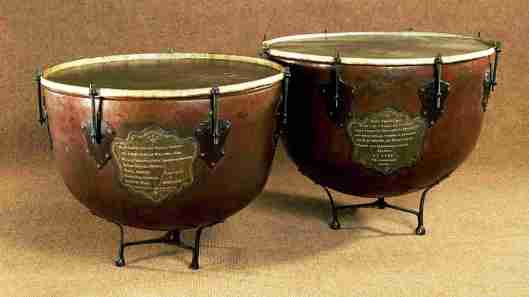
Instead, he wanted bangs and booms, starting with kettle drums.

image15kettledrums.jpg

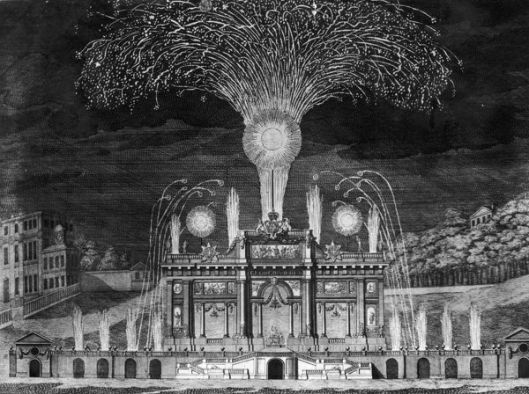
Then he hired someone to design a giant framework for the fireworks,

image16frame.jpg

and threw in 101 cannon, just to make sure that it wasn’t too quiet.

image17guns.jpg

And, on the evening of 27 April, 1749, perhaps as many as 12,000 people (London had perhaps between 600,000 and 700,000 people in 1750) stood around the Green Park to watch.

image18fireworks.jpg

Here’s a LINK, if you’d like to hear the music (you’ll have to supply your own cannon and fireworks).

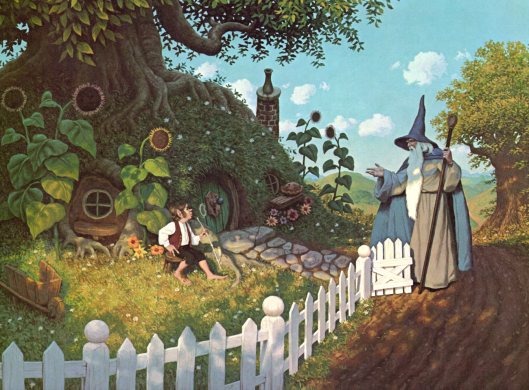
But fireworks brings us back to Tolkien, doesn’t it?  When Gandalf first appears to Bilbo in the first chapter of The Hobbit,

image19bilgan.jpg

it seems that almost all that Bilbo knows about Gandalf is his fireworks:

“Not the man that used to make such particularly excellent fireworks!  I remember those!  Old Took used to have them on Midsummer’s Eve.  Splendid!  They used to go up like great lilies and snapdragons and laburnums of fire and hang in the twilight all evening!”  (Chapter One, “An Unexpected Party”)

And, when Gandalf reappears in the Shire, to celebrate Bilbo and Frodo’s joint birthday, what does he bring?

image20gandalf.jpg

Thanks, as ever, for reading (and listening).

MTCIDC

CD

Bilbo’s Clarinet

01 Wednesday May 2019

Posted by Ollamh in Films and Music, J.R.R. Tolkien

≈ Leave a comment

Tags

anachronism, Antonio Vivaldi, Benny Goodman, clarinet, Disney, Dwarves, Fantasia 2000, George Gershwin, instruments, Johann Cristoph Denner, Juditha Triumphans, medieval musicians, Paul Dukas, Rhapsody in Blue, The Hobbit, The Lord of the Rings, The Sorcerer's Apprentice, Tolkien

Welcome, as always, dear readers.

Tolkien scholars have long noticed that the 1937 Hobbit has a certain number of anachronisms—as did JRRT himself.

image1firsted.jpg

As have we, too, in past postings, including one on popguns

image2popgun.jpg

[Gandalf speaking to Bilbo:  “It is not like you, Bilbo, to keep friends waiting on the mat, and the open the door like a pop-gun.”  “An Unexpected Party”)]

and tomatoes

image3tomatoes.jpg

[Gandalf:  “And just bring out the cold chicken and tomatoes!”  “An Unexpected Party”]

and steam engines.

image4tunnel.jpg

[“At may never return he began to feel a shriek coming up inside, and very soon it burst out like the whistle of an engine coming out of a tunnel.”  “An Unexpected Party”]

In the 1966 edition, Tolkien changed “tomatoes” to “pickles” and considered changing that engine whistle to “like the whee of a rocket going up into the sky” (see Douglas A. Anderson, The Annotated Hobbit, 47, note 35) but decided against it.  And the popgun—remained the popgun.

Recently, we fell upon another:

“Kili and Fili rushed for their bags and brought back little fiddles; Dori, Nori, and Ori brought out flutes from somewhere inside their coats; Bombur produced a drum from the hall; Bifur and Bofur went out too, and came back with clarinets that they had left among the walking-sticks.” (“An Unexpected Party”)

image5hild.jpg

Hmm, we thought.  Well, Middle-earth is more or less a medieval world and medieval musicians played stringed instruments and drums and flutes, both transverse (like a modern flute) and recorders, as well as certain other wind instruments, but clarinets?

image6medmus.jpgimage7medmus.jpg

image8medmus


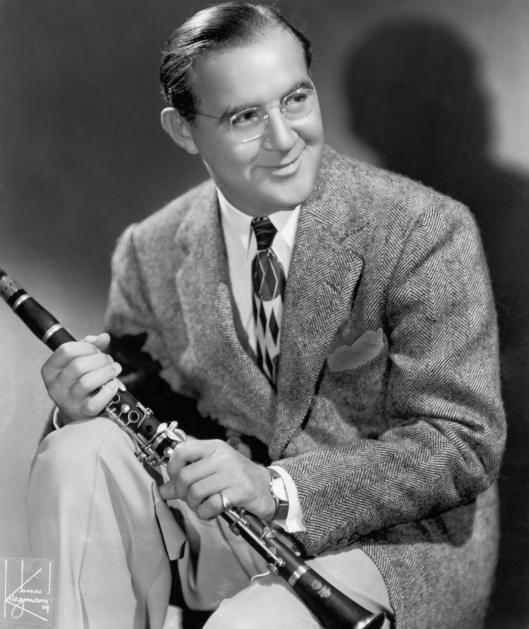
When we think of clarinets, the first thing which comes into our minds is the famous 20th-century clarinetist, Benny Goodman (1909-1986)

image9goodman.png

with his Bflat clarinet,

image10bflat.jpg

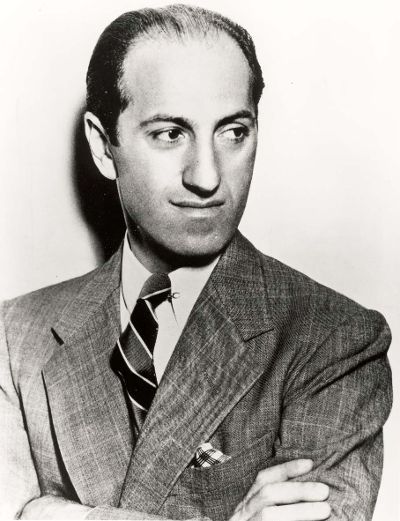
playing the opening of George Gershwin’s (1898-1937)

image11gg.jpg

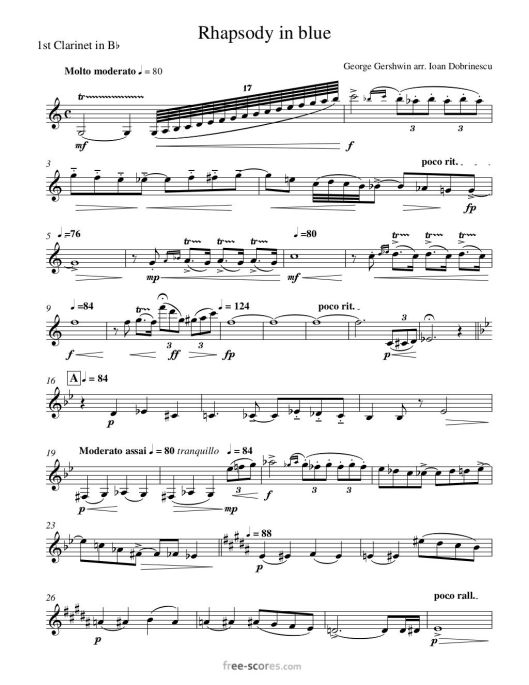
Rhapsody in Blue (1924)


image12rhap

in a 1942 recording.  (Here’s a LINK so you can hear that recording for yourself.)  Even if you don’t read music, you can see (and hear) that it begins with a clarinet doing a long trill, then playing a glissando, meaning a slide, up several octaves.  We wonder if Bifur and Bofur could play like that!

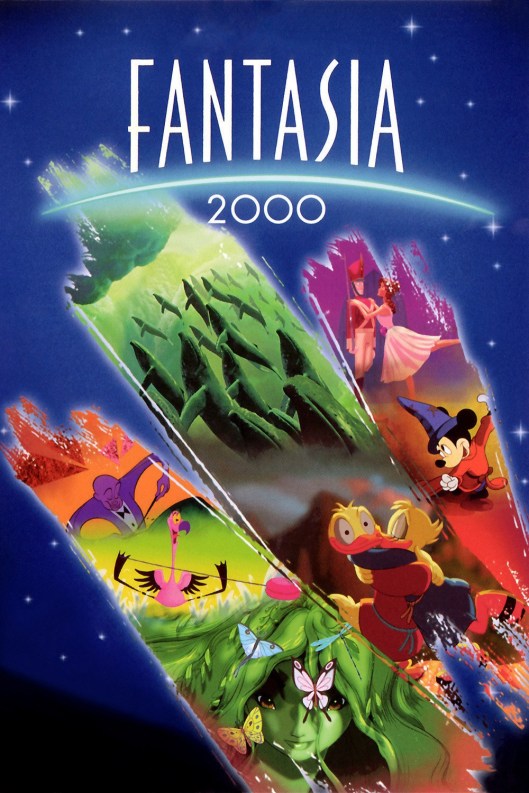
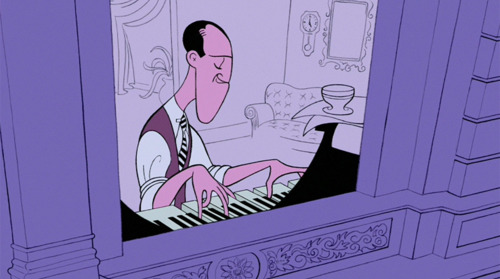
(We also recommend a very unusual rendition of the piece.  In 2000, Disney Studios released a film called Fantasia 2000,

image13fantasia


which was their modern take on the 1940 Fantasia

OLYMPUS DIGITAL CAMERA

which consisted of a series of piece of classical pieces with Disney animation interpretations.  Here’s a famous moment from Paul Dukas’ The Sorcerer’s Apprentice.

image15mick

The 2000 version features a very lively performance of Rhapsody drawn as if it’s taking place during the Great Depression—and even features a cameo appearance by Gershwin himself.

image16gg

Here’s a LINK to the scene so that you can enjoy it for yourself.)

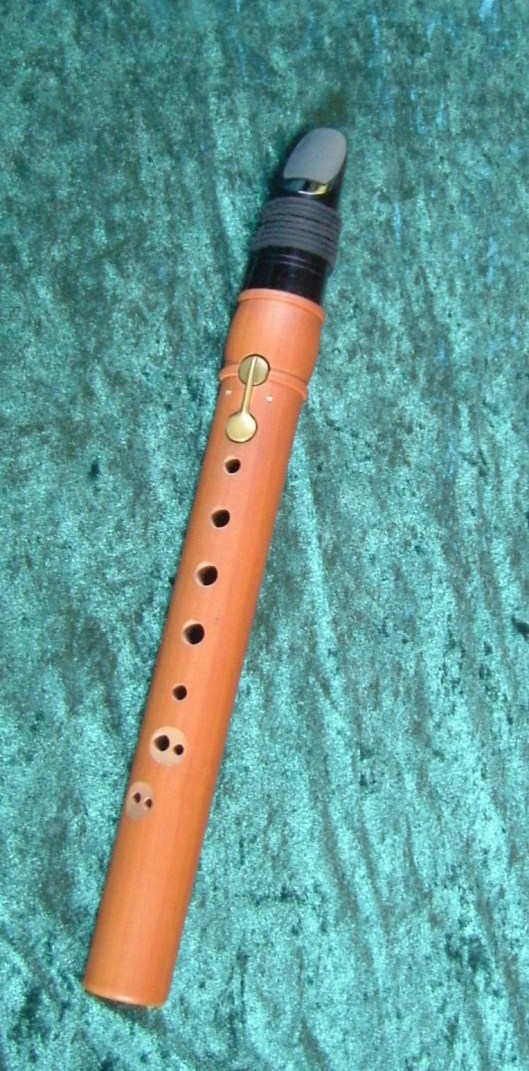
But we were wondering about those clarinets, so we did a little research and found this, the ancestor of the clarinet, the chalumeau.

image17chal

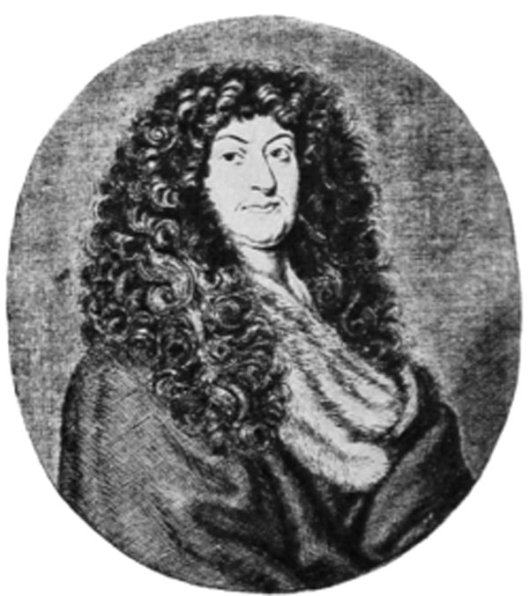
About 1700, it is thought, this man, Johann Christoph Denner, (1655-1707)

image18denner

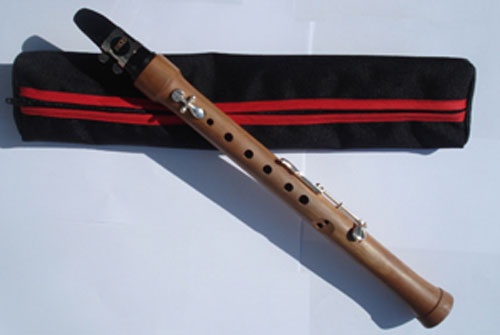
a famous wind instrument maker, extended the range of the chalumeau and thus made it a more flexible instrument.

image19clar

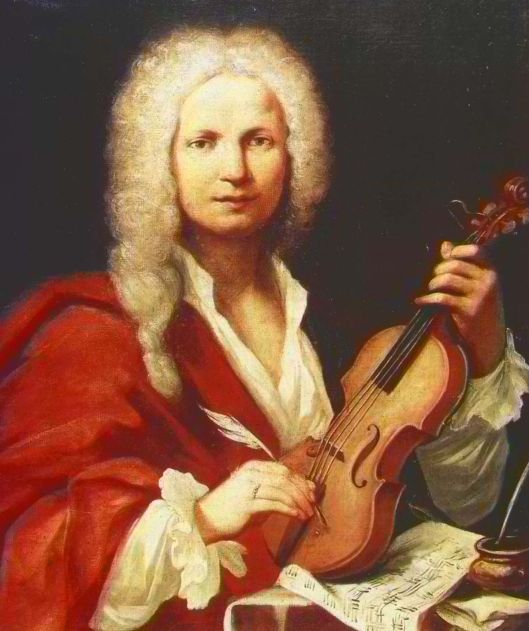
The (presently) first known use of clarinets in an orchestra is in Antonio Vivaldi’s (1678-1741)

image20vivaldi

1716 oratorio, Juditha Triumphans.

image21juditha

And, with that, we thought:  “Hmm.  Yep.  Another anachronism” and were about to move on when our eye was caught by this about Beorn at the Battle of the Five Armies:

“The roar of his voice was like drums and guns…” (Chapter 18, “The Return Journey”)

Drums—well, of course.  Bombur had one.  And, in The Lord of the Rings, there’s that mention of “drums, drums in the deep”, but…guns?

Thanks, as ever, for reading and—as you can see—

MTCIDC

CD

A What?

24 Wednesday Apr 2019

Posted by Ollamh in J.R.R. Tolkien, Narrative Methods, Villains

≈ Leave a comment

Tags

bokor, Bran, Circe, Cleromancy, Dol Guldur, Dracula, King Saul, Necromancer, necromancy, Odyssey, Oneiromancy, Robert Southey, Rockapella, Romania, Samuel, Sauron, Teiresias, The Hobbit, The Lord of the Rings, The Walking Dead, Tolkien, Zombie, Zombie Jamboree

“It was a Zombie Jamboree,
Took place in the New York Cemetery.
It was a Zombie Jamboree,
Took place in the New York Cemetery.

Zombies from all parts of the island
Some of them were great calypsonians.
Since the season was carnival,
They got together in bacchanal
HUH! And they were singing:

Back to back, belly to belly
Well I don’t give a damn
‘Cause I’m stone dead already!
Back to back, belly to belly
It’s a Zombie Jamboree.” (Conrad Eugene Mauge, Jr., c.1953)

What in the world are we doing, dear readers? Are we about to launch into a posting about The Walking Dead?

image1wd.jpg

Well, no. Unless we mean the “walking-again dead”, which we do. And how did we get here?

It all began with our last two postings, on see-ers—that is, seers–and so many different ways of telling the future, like oneiromancy (dream interpretation) and cleromancy (using numbers), but, among them, we think the most sinister is necromancy—and this brought it to mind:

“Some here will remember that many years ago I myself dared to pass the doors of the Necromancer in Dol Guldur, and secretly explored his ways and found thus our fears were true: he was none other than Sauron, our Enemy of old, at length taking shape and power again.” (The Fellowship of the Ring, Book Two, Chapter 2, “The Council of Elrond”)

This is Gandalf recounting his adventure in Isengard. What he’s relating here happened somewhat before the action in The Hobbit, followed by the White Council’s attack on Dol Guldur (“The Hill of Dark Sorcery”), in the southern part of Mirkwood.

image2attack.jpg

That was parallel in time to the travels of Bilbo and the dwarves towards the Lonely Mountain.

bigmap.jpg

Here’s how John Howe thought Dol Guldur might have looked.

image4dg.jpg

And here’s how it appears in The Hobbit films

image5dg.jpg

although why it’s a ruin is unclear—Gandalf has said above that Sauron is “taking shape and power again”, and so we would imagine that, just as he’s reconstituting himself, there’s been a rebuilding campaign at his headquarters in the forest. So, rather like Howe, we see the place as more imposing, perhaps like Bran castle, in Romania, which is advertised as “Dracula’s castle” in tourist literature.

image6bran.jpg

Just as cleromancy means “telling the future by lots” (that is, by casting lots—think of throwing dice–giving you a supposed “random” result) and oneiromancy means “telling the future by dreams”, so a necromancer uses the dead to find things out, suggesting something really horrible about someone with that title.

The process of questioning the dead goes back a long way in western literature. In the Odyssey, Circe,

image7circe.jpg

who once turned part of Odysseus’ crew into pigs, tells him that, before he can go home, he must sail south, to the Otherworld, to consult Teiresias, who is a seer (see our last two postings for more on people like this)

image8t.jpg

for current information about his home on Ithaca and for coaching about his future behavior. To deal with the dead, Circe tells Odysseus in detail how to make a kind of drink offering of animal blood in a pit.

image9under.png

Then, because all of the dead will be drawn to the blood (we’re back to Dracula here, aren’t we?), he is to draw his sword and stand over the pit, only allowing those he would question to sip the blood.

But why would a sword threaten ghosts? one might ask. We think that the answer is that it’s iron and iron, in folklore, is a protection against evil magic. Odysseus has used his sword earlier to threaten Circe, who is a very powerful sorceress. See this LINK for more.

image10xiphos.jpg

image11oandc.jpg

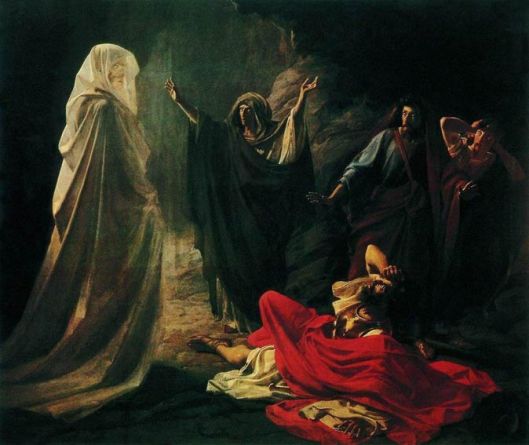
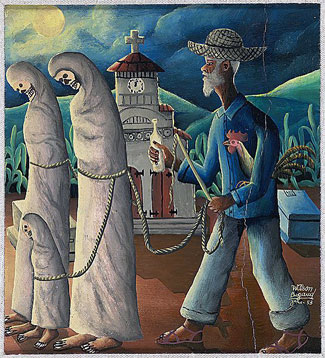
Odysseus is successful in his quest, but King Saul, in First Samuel, in the Hebrew Bible, who has already banished necromancers and magicians from his kingdom, is not. Saul is anxious about a battle to come and, when he is not answered via prayers and cleromancy about its outcome, he consults a kind of witch, who may (scholars argue over this) produce the spirit of the prophet Samuel.

image12sam.jpg

When Samuel appears, his response to Saul is not what Saul had hoped for. Instead, Samuel scolds Saul and gives him a fortune-telling he’d rather not hear, that he will lose the battle, his army, and his life the next day, all of which comes true.

Saul had hoped that he could make Samuel do his bidding, which was less than successful, but what if one might make the dead one’s slaves? This is where our opening comes in. The tradition of zombies is complex, including the word itself. At the moment, the earliest reference to the word in English is found in 1819, in volume 3 of the poet, Robert Southey’s (1774-1843),

image13rs.jpg

History of Brazil, Part the Third, page 24:

They were under the government of an elective Chief, who was chosen for his justice as well as his valour, and held the office for life : all men of experience and good repute had access to him as counsellors : he was obeyed with perfect loyalty; and it is said that no conspiracies or struggles for power had ever been known among them. Perhaps a feeling of religion contributed to this obedience ; for Zombi, the title whereby he was called, is the name for the Deity, in the Angolan tongue.”

The subsequent history of zombies is complex, but a recurrent theme is that they are the dead, brought back to serve the living, usually by an evil magician, called a bokor. Among the possible tasks for such a slave is telling the future, thus making a bokor a necromancer, like Sauron.

image14bokor.jpg

We’ve done an extensive image search under “zombie” and the weirdest things turn up, none of which we would put into a posting, so this is the best we can do.

image15zombies.jpg

If, however, this is the best a bokor can manage, we can’t imagine what news of the future one of these zombies might possibly give Sauron—and it’s no wonder that he loses the Ring.

But thanks for reading!

And

MTCIDC

CD

ps

If you’d like to see “Zombie Jamboree” performed, here’s a LINK to our favorite version, by Rockapella.


See-r (2)

17 Wednesday Apr 2019

Posted by Ollamh in J.R.R. Tolkien, Literary History, Narrative Methods

≈ Leave a comment

Tags

Apollo, Babylonian, Claros, Delphi, Didyma, Dodona, Dr Seuss, epic metre, Etruscan, Extispicy, Flamen, Galadrien, Greek, Gustave Moreau, Haruspex, King Galdaran, Mirror of Galadriel, Oracle, Pytho, Rome, Romulus and Remus, Star Wars, The Lord of the Rings, Theogony, Tolkien, Yoda

Here we are again, dear readers, welcoming you to the second half of that posting with the odd name—or at least the odd spelling.

In the first half of this, we began with questions about Galadriel’s mirror: where did it come from? What was it doing in the text?

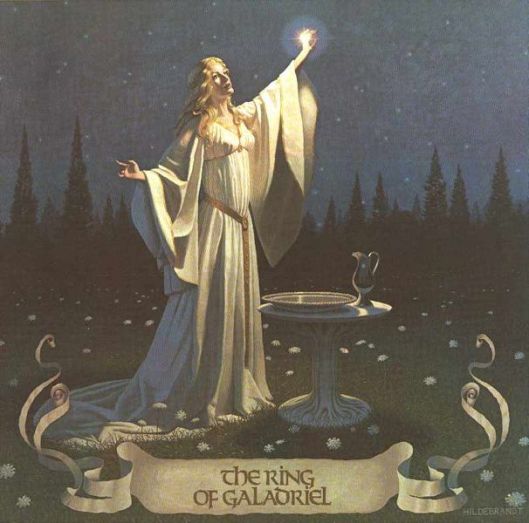
image1galad.jpg

We saw that it had begun life in a manuscript note as the mirror of “King Galdaran”, but then became the mirror of “Galadrien” as JRRT smoothed and polished both the scene and the character.   In that earlier note—a kind of shorthand plot summary—it’s stated that, “King Galdaran says the mirror shows past, present, and future, and the skill needed to decide which…”—that is, one needs skill to decide which might be past, present, or future. Such skill, especially to read the future, led us to thinking about the history of attempting to read the future, and we briefly discussed the use of turtle plastrons (the underside of a turtle) and ox shoulder blades, then number patterns, in ancient China, dreams in Egypt, and the insides of certain animals in Babylon.

In this posting, we want to take that history a bit farther.

Just as the Babylonians practiced extispicy—the examination of the intestines of certain animals or birds—so did the Etruscans, whom we think of as Rome’s “big brothers”, as many Roman practices and customs appear to have been borrowed from them. In our last, we showed a Babylonian model of a sheep’s liver,

image2bab.jpg

presumably used as a guide to reading an actual liver. Here’s a bronze Etruscan model, with various areas marked off and labeled.

image3liver.jpg

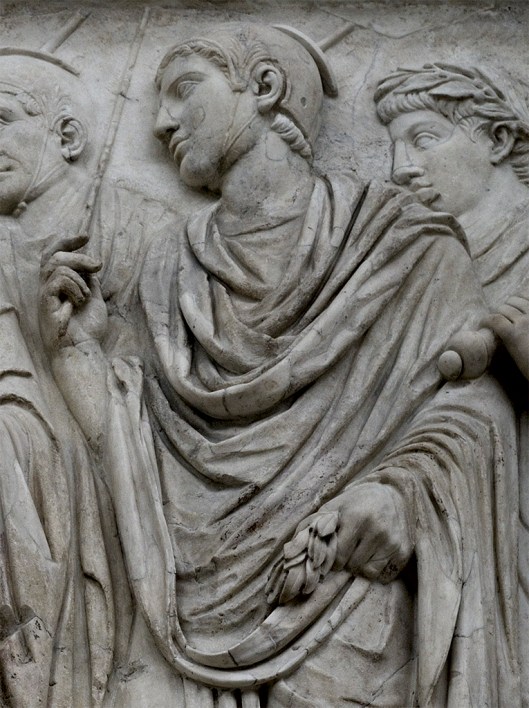
And here’s a fourth-century bc bronze model of an Etruscan priest, a “haruspex”, the Romans would have called him.

image4haru.png

(Sometimes, even though we spend a great deal of time in the classical world, there are things which will always seem a little odd—the hat on this fellow can’t help but remind us of something from Dr Seuss,

image5cat.png

just as that on a Roman flamen—a kind of priest—makes us think of a certain propeller helmet…)

image6famen.jpg

image7prop.jpg

Romans borrowed the custom from the Etruscans, it seems, and also read bird-signs. In fact, it was a disagreement over the interpretation of a flight of birds which may have sparked the murder of one of the founders of Rome, Remus, by his twin brother, Romulus.

image8rom.jpg

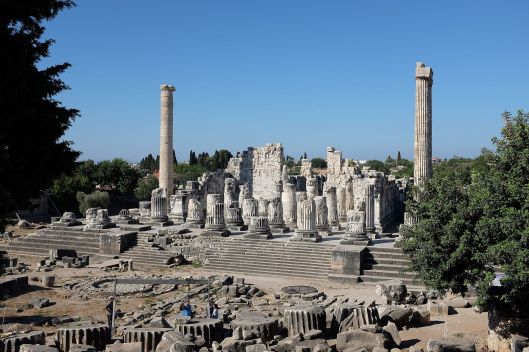
Besides Etruscan and home-grown methods of trying to find out about the future, the Romans also continued the Greek tradition of visiting prophetic shrines. The most famous were dedicated to Apollo

image9apollo.jpg

and were located (see map below—west to east)

image10map.png

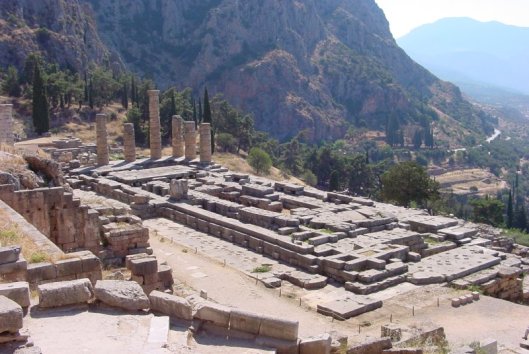
at Delphi

image11delphi.jpg

Claros

image12claros.jpg

and Didyma.

image13didyma.JPG

There was also a well-known shrine dedicated to Zeus at Dodona,

image14do.jpg

but the oracle at Delphi was perhaps the most famous.

image15del.jpg

image16del.jpg

It’s not always clear how these places worked. The oracle at Dodona, for example, may have used two methods: sacred doves and the wind in the leaves of the enclosed grove you see in the picture. At Delphi, a pilgrim waited to pose a question to the priestess, called the “Pytho”

image17pythia.jpg

and, if she chose to respond, it was in the standard Greek epic metre, dactylic hexameter. Her answers were famously riddling and ambiguous, as when she told Croesus, the king of Lydia that, if he went to war with the Persians, a kingdom would fall (guess whose!).   To interpret such a response correctly would have taken King Galdaran’s response that, to interpret what his mirror told, one must have skill to decide just what the future might be.

When it comes to Galadrien/Galadriel, it’s not skill which she lacks, but rather she practices a kind of caution in interpretation:

“Many things I can command the Mirror to reveal…and to some I can show what they desire to see. But the Mirror will also show things unbidden, and those are often stranger and more profitable than things which we wish to behold. What you will see, if you leave the Mirror free to work, I cannot tell. For it shows things that were, and things that are, and things that may yet be. But which it is that he sees, even the wisest cannot always tell.” (The Fellowship of the Ring, Book Two, Chapter 7, “The Mirror of Galadriel”)

(We can’t resist a footnote here. In the early Greek poem, Theogony, the poet Hesiod tells us that he was a shepherd on a hillside when he was visited by the Muses, who told him that they could say many false things as if they were true, but could also speak the truth when they felt like it. They then gave him a staff and inspired him to make songs about things in the future, as well as things in the past, all of which sounds rather familiar here. Here’s a LINK if you’d like to read the story. And here’s a rather over-the-top painting by Gustave Moreau, (1826-1898.)

image18moreau.jpg

What Sam sees he finds deeply disturbing—the industrialization of the Shire—and it so disturbing that he leaps up and shouts that he must go home. What Frodo sees is more complex—perhaps Gandalf, what looks to be the arrival of the Numenorians to found Gondor, and, finally, the Eye, ever restless, ever searching.

So why is the Mirror here? We would suggest, tentatively, for several reasons:

  1. first, because this is a kind of turning point in the story: after the pursuit through Moria and the death of Gandalf (as far as the Fellowship knows), this is the first breathing space which the company has had and it’s a very safe and peaceful one—for the moment. As Celeborn says:

“Now is the time…when those who wish to continue the Quest must harden their hearts to leave this land. Those who no longer wish to go forward may remain here, for a while. But whether they stay or go, none can be sure of peace.” (The Fellowship of the Ring, Book Two, Chapter 8, “Farewell to Lorien”)

After so much struggle and the loss of a major figure, it’s clearly a good moment to rest, take stock, and look towards the future.

  1. second, Galadriel had earlier probed each of the company, testing their minds and finding out just who they were—sometimes to their discomfort, if not distress. Now the company is narrowed to just two: the ring-bearer and his servant, and here at her Mirror, she offers them a final test, but we can imagine that, unlike her earlier probing, this is much more free-form and ambiguous, as if she had allowed the two to make up their own tests. For Sam, it’s the possible ruination of what he loves most in the world, the Shire, and he almost fails, until Galadriel gently upbraids him:

“You did not wish to go home without your master before you looked in the Mirror, and yet you knew that evil things might well be happening in the Shire.”

Frodo’s test is less focused upon a place or event. Rather, it was a kind of suggestion of the past (Gondor), with the implication that that past’s continuation depends upon confronting the present danger, which is not to be underestimated. Galadriel’s words to Sam underline this:

“Remember that the Mirror shows many things, and not all have yet come to pass. Some never come to be, unless those that behold the visions turn aside from their path to prevent them.”

Shaken, both pass the test, it seems.

  1. by implying that what Sam and Frodo see might actually happen, the author adds an extra note of urgency to the story, something always to be felt after that moment: the Shire could be in danger, Frodo may have to confront Sauron, directly or indirectly.

But you’ll notice that, taking Galadriel’s lead, we wrote “could be” and “may have to”, rather than “will be” and “must” and here we hear the voice of a wise person from another epic adventure.

image19starwars.jpg

image20yoda.jpg

Thanks, as always, for reading, and, as ever,

MTCIDC

CD

See-r (1)

10 Wednesday Apr 2019

Posted by Ollamh in J.R.R. Tolkien, Literary History, Narrative Methods

≈ Leave a comment

Tags

Achillea, Babylonians, Cleromancy, Drafts, dream interpretation, Dream manual, Egypt, future, Galadriel, Galdaran, haruspicy, I Ching, Lothlorien, Mirror of Galadriel, Oneiromancy, plastrons, Ramesses II, ritual, Shang Dynasty, spiritual, tarot, The Lord of the Rings, Tolkien, Zhou

Welcome, as always, dear readers.

You’ll notice our odd title.  Which came from a puzzle.  We had been thinking about Galadriel and her mirror:  when did it enter the story and, more important for the narrative, why was the episode there?

image1galad.jpg

In an earlier sketch for the text, JRRT had written:

“King Galdaran’s mirror shown to Frodo.  Mirror is of silver filled with fountain water in sun.

Sees Shire far away.  Trees being felled and a tall building being made where the old mill was.  Gaffer Gamgree turned out.  Open trouble, almost war, between Marish and Buckland on one hand—and the West.  Cosimo Sackville-Baggins very rich, buying up land.  (All/Some of this in future.)  King Galdaran says the mirror shows past, present, and future, and skill needed to decide which.  Sees a grey figure like Gandalf [?going along] in twilight but it seems to be clad in white.  Perhaps it is Saruman.

Sees a mountain spouting flame  Sees Gollum?”  (The Treason of Isengard, 249-250)

Interesting to see that the scene we know from The Fellowship of the Ring, Book Two, Chapter 7, was once very different, beginning with the fact that Galadriel’s mirror had no Galadriel—and Sam’s nightmare vision of the Shire was, originally, Frodo’s.  (There was once more potentially more of that nightmare—on a surviving scrap of paper is:  “Cosimo has industrialized it.  Factories and smoke.  The Sandymans have a biscuit factory.  Iron is found.”  Treason, 216.  We wonder, by the way, if, since he lived and worked in Oxford, JRRT’s choice of a biscuit (US:  cookie) factory might have been influenced by the Oxford Biscuits company, founded in Denmark in 1922.)

Galadriel was in the narrative at this time, and she even performs her emotional x-ray on the company (Treason, 248), but it’s in the main draft that she gains the mirror (although her name is “Galadrien” at this stage—reading the various manuscripts, we often see many characters have everything from complete name-changes—the Aragorn-as-ranger figure was once called “Trotter”—to slight adjustments). And, as Christopher Tolkien writes,

“It is seen that it was while my father was writing the ‘Lothlorien’ story ab initio [“from the beginning”] that the Lady of Lothlorien emerged…and it is also seen that the figure of Galadriel (Rhien, Galadrien) as a great power in Middle-earth was deepened and extended as he wrote.”  (Treason, 250)

All of which is true, but doesn’t help us with the second part of our question:  why is the episode there?

Seeking for clues, we looked at that early sketch, in which “King Galdaran says the mirror shows past, present, and future, and the skill needed to decide which…” which then made us think about that skill.  At first, we considered that deciding that an event was in the past would be rather easy—after all, events which had happened leave a history, and often consequences.  Suppose, however, that that history came from another place, or was never written down—after all, this is medieval Middle-earth, not our 21st-century world.  In our own western Middle Ages, literacy was limited, there was almost no long-distance communication, and people lived on rumors.  Would Middle-earth be any different?  The same would be true for the present in Middle-earth:  what would someone in the Shire know of someone in Rohan?

This brought us to the future and, speaking of history, the attempt to understand the future spreads far back into recorded time and perhaps beyond.

Shang Dynasty China (c.1600-1046BC) has provided us with an extensive archaeological record for this in the form of a vast archive of rather unusual objects, the two main ones being bundles of these

image2plastron.jpg

and piles of these.

image2shoulder.JPG

The first of these is the plastron or breastplate of a turtle.

image4plastron.jpg

The second is the shoulder blade of a cow.

image5shoulderblade.JPG

These were used for a number of spiritual contact purposes, including finding out about the future, but the method was always the same:

  1. once the surface was cleaned, a series of shallow holes was carved or drilled into the surface
  2. blood was applied to the surface (for purification? Or perhaps to attract a spirit?)
  3. questions were written to one side of each hole
  4. a hot iron was applied to the hole
  5. the surface would then crack under the heat
  6. the officiator would interpret the crack, then write his interpretation on the surface, as well

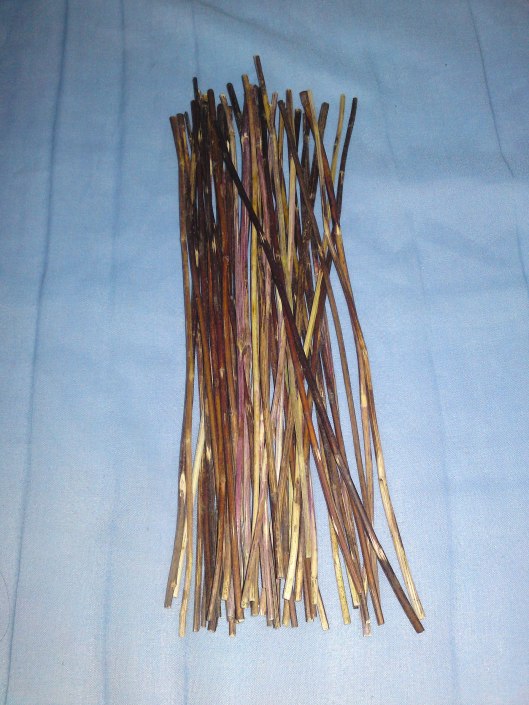
During the next dynasty, the Zhou (1000-221BC), another method was added and, in time, this became more popular.  This used the stalks of a plant of the family Achillea

image6stalks.JPG

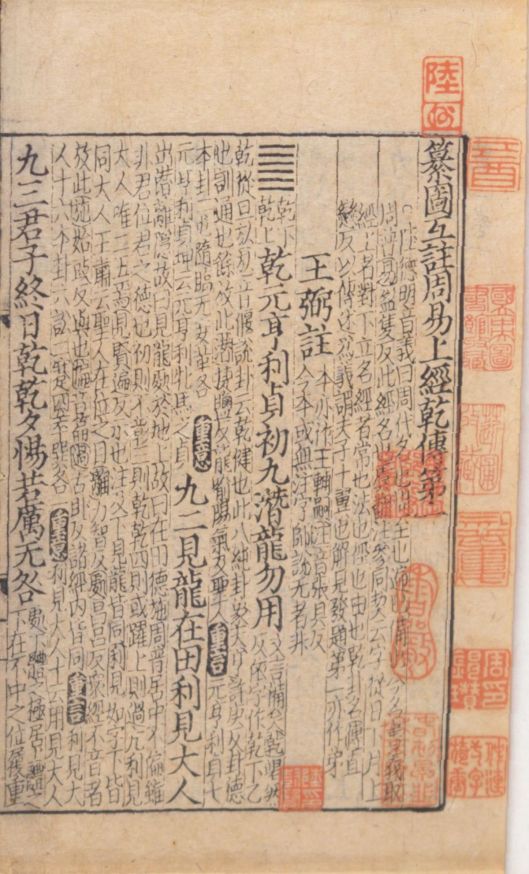
for the practice of cleromancy, which, basically, means using a series of random numbers to try to understand something about the spiritual world.  This is a very complicated process, as far as we can see, including not only the stalks, but a book called the I Ching.

image7iching.jpg

If you would like to know more, here’s a LINK which explains the practice in 12 steps.

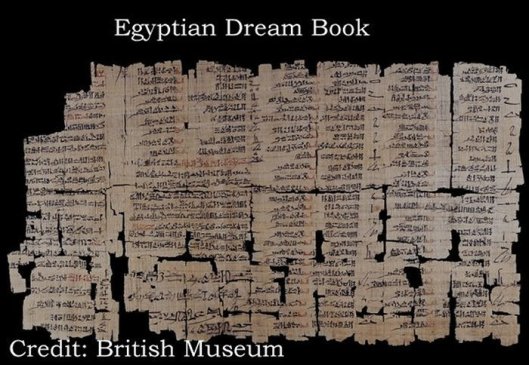
A method of telling the future in ancient Egypt was by interpreting dreams (oneiromancy) and we have a dream manual dated to the time of Ramesses II (1279-1213BC).

image8dreammanual.jpg

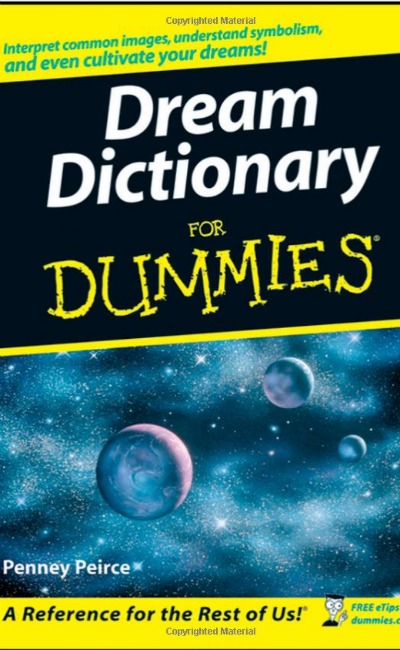
This lists common patterns in dreams, identifies whether they are bad or good, then goes on to interpret them.  Because dreams are universal, this is a world-wide method and all one has to do is to google “dream interpretation book” to see just how much is available in English alone.

image9dreams.jpg

Babylonians used dreams, among other methods, as well as haruspicy, in which a specially-trained priest examined the entrails of certain animals, birds and sheep being especially useful.  Here’s a model of a sheep’s liver (2050-1750BC) used to help in the process.

image10liver.jpg

The holes were for pegs, to help the priest makes comparisons between the actual liver and the model.

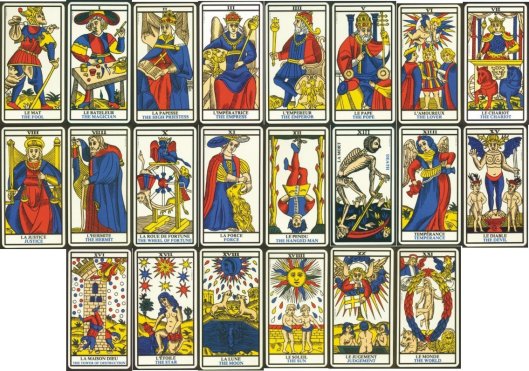
In our next, we’ll discuss a few other early methods of attempting to see the future and, if we play our cards right,

image11tarot.jpg

we’ll circle back to Galadriel’s mirror and its place in The Lord of the Rings.

image12galad.jpg

Thanks, as ever, for reading and—this part of the future we can read—

MTCIDC

CD

Camouflaged

27 Wednesday Mar 2019

Posted by Ollamh in Films and Music, Heroes, J.R.R. Tolkien, Military History, Military History of Middle-earth

≈ Leave a comment

Tags

camouflage, Disney, Douglas Fairbanks Sr., Errol Flynn, Faramir, feldgrau, Great War, Ithilien, jaeger, khaki, Men in Tights, Richard Knoetel, Robin Hood, The Lord of the Rings, Tolkien, trenches, uniforms

As ever, dear readers, welcome.

After standing and reciting his “party piece”, and stewing two rabbits, Sam is about to see his first—and only—oliphaunt.

image1.jpg

Before he does, however:

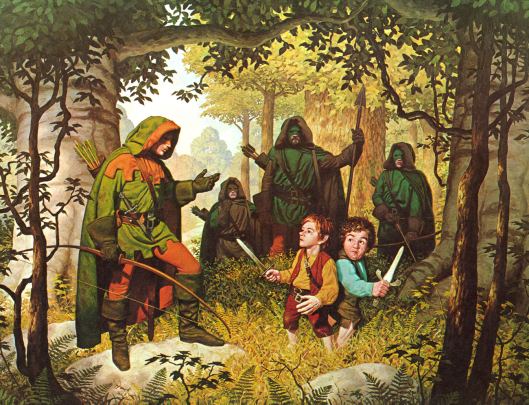
“Four tall Men stood there.  Two had spears in their hands with broad bright heads.  Two had great bows, almost of their own height, and great quivers of long green-feathered arrows.  All had swords at their sides, and were clad in green and brown of varied hues, as if the better to walk unseen in the glades of Ithilien.  Green gauntlets covered their hands, and their faces were hooded and masked with green, except for their eyes, which were very keen and bright.”  (The Two Towers, Book Four, Chapter 4, “Of Herbs and Stewed Rabbit”)

image2.jpg

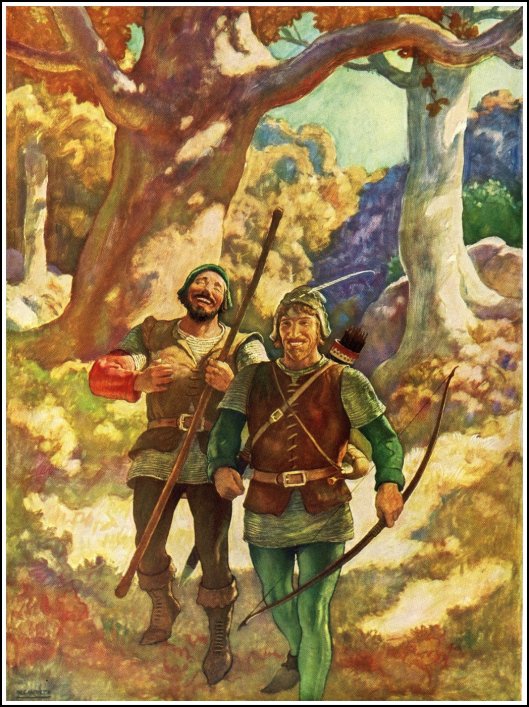
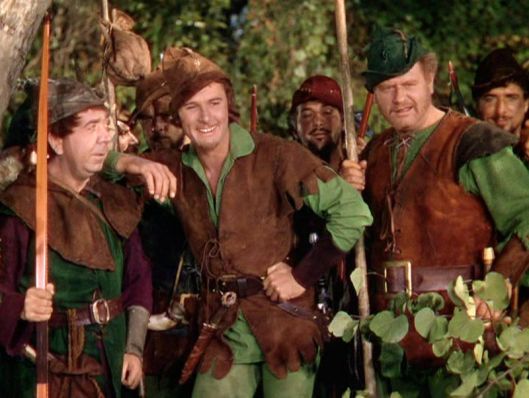
The chief of these men soon identifies himself as “Faramir, Captain of Gondor” and the men with him are rangers, a term which first appears in 14th-century English to mean “game keeper”, which seems appropriate for Faramir and his men, as far as their dress is concerned.  One might expect that those who spend their days in the woods would only naturally want to blend in, especially if part of their job is to apprehend poachers—trespassers who illegally hunt game.  Faramir’s and his men’s clothing could also be that of poachers, if we match that description—the green and brown part—with some very familiar figures from another famous story—

image3ncw.jpg

If you read us regularly, you will probably recognize them, especially if we add one of our favorite illustrations.

image4rob.jpg

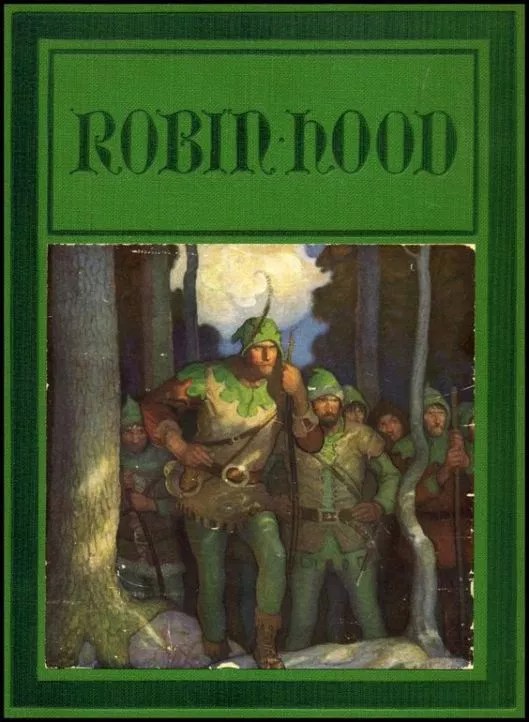
If you still don’t recognize them, we’ll add a book cover.

image5rh.jpg

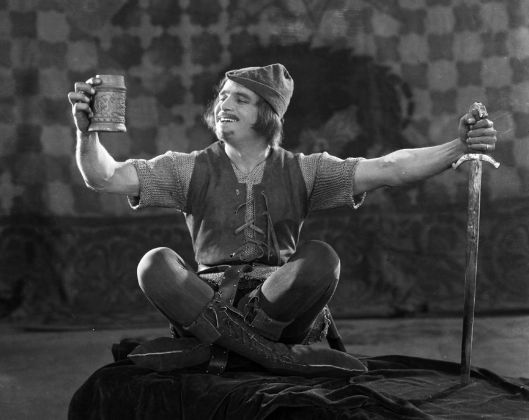
This is the 1917 publication of the retelling of the Robin Hood stories, with illustrations by NC Wyeth and it’s clear that his depictions of Robin and his men—just like his illustrations of pirates—have influenced story-tellers and costume-designers long after that initial 1917 publication.  Just look at Douglas Fairbanks Sr.’s 1922 Robin Hood,

cbe9537043957223ed32b027acbd3812

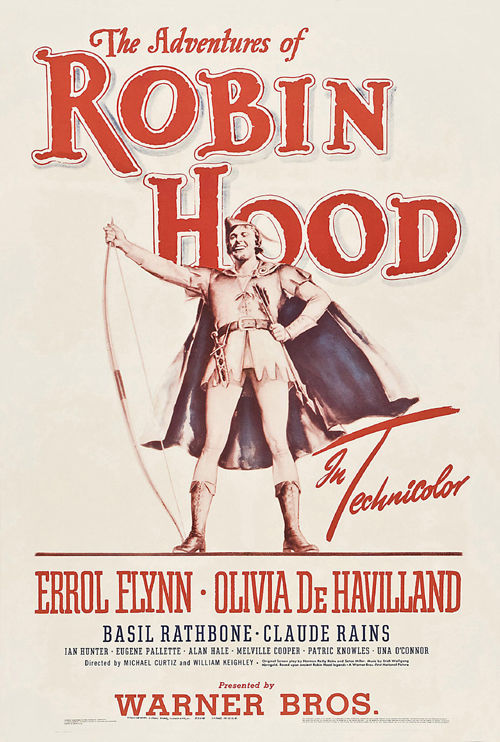
or the 1938 Errol Flynn The Adventures of Robin Hood


image7rh.jpg

image8rh.jpg

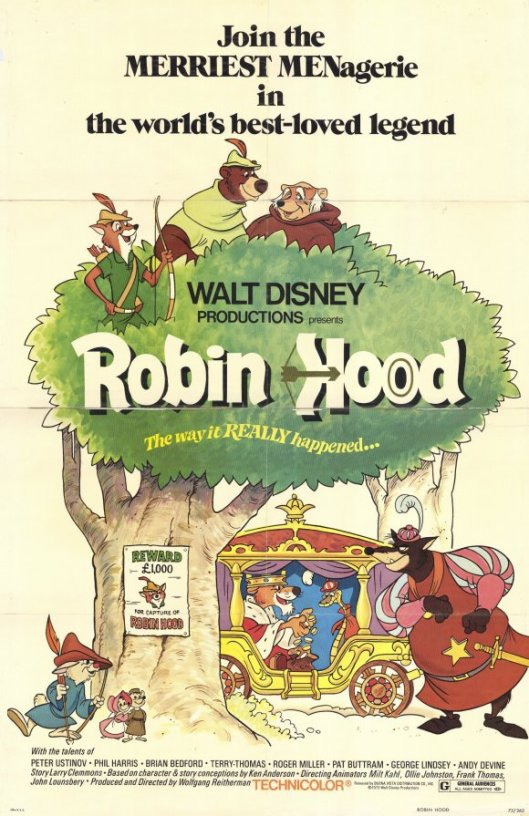
or even Disney’s 1973 animated Robin Hood

image9rh.jpg

and even the 1993 parody, Robin Hood:  Men in Tights.

image10rh.jpg

Tolkien, we presume, would have known the Wyeth illustrations and perhaps the Errol Flynn, and might have had them in mind when he was describing the basic dress of Robin and his men.  Beyond the basic outfit, however, these men are clearly dressed for more than poaching and apprehending—and it isn’t just the weapons, but also the gloves and the face-coverings.  These men are soldiers and rangers have been soldiers, or the models for them, since at least the 18th century, when certain German states, including Prussia and Hesse Kassel, employed forest rangers as light infantry—men trained as sharpshooters and skirmishers, called jaeger (“hunter” in German).

image11jaeger.jpg

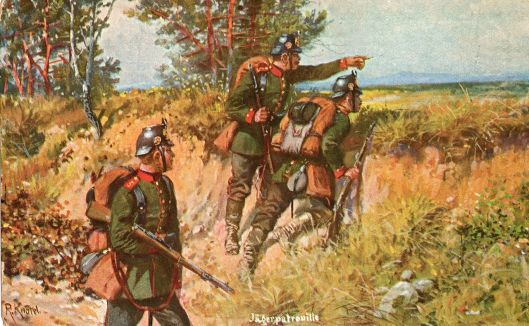
In the 19th century, increasing numbers of ordinary troops of many western nations were given similar training, but the jaeger continued to be allowed special uniforms, usually green.

image12jaeger1910.jpg

This is an illustration by one of the greatest (and one of our favorite) German military/historical artists of the late 19th-early-20th centuries, Richard Knoetel, dated 1910.

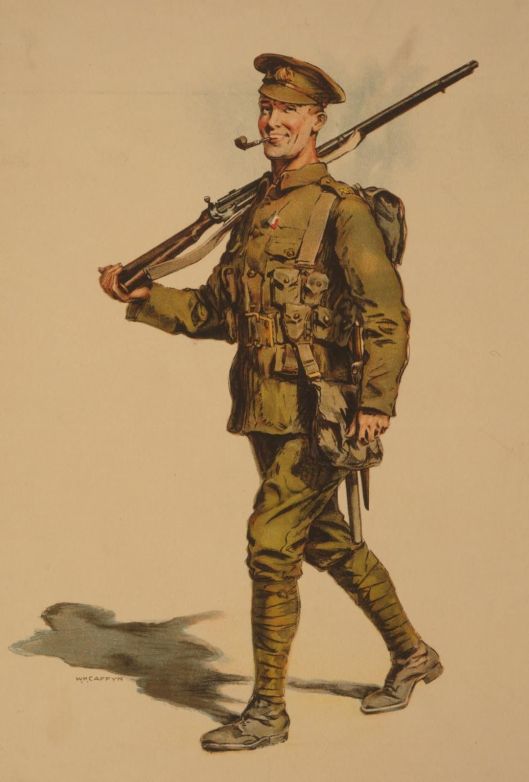
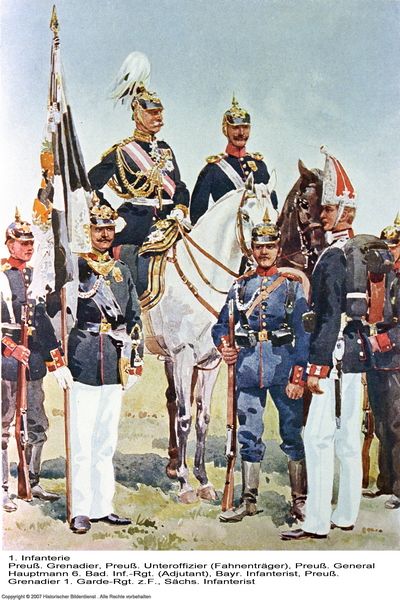
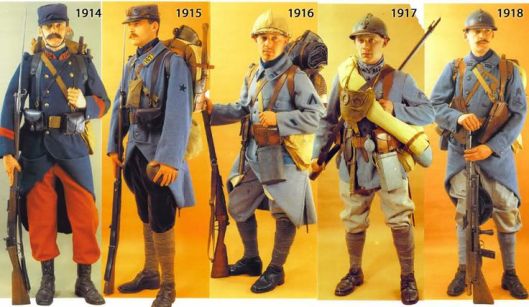
When the Great War began in 1914, all the soldiers of many of the countries involved were already moving away from the bright-colored uniforms of past years and dressing more like hunters.  The British put off their parade uniforms

image13homeservice.jpg

and dressed in a mud-color, that color being called “khaki” (originally a Persian word meaning “dust”).

image14khaki.jpg

The Germans, whose parade dress was blue,

image15parade.jpg

dressed in a color called feldgrau (“field grey”).

image16feld.jpg

Only the French began the war still on parade,

image17french.jpg

but even they gradually changed into something which blended in better with the terrain.

image18french.jpg

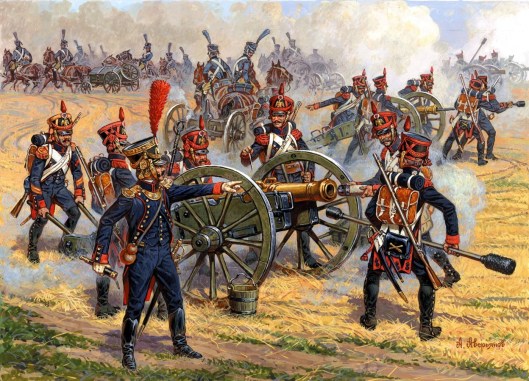
And blending in was absolutely necessary in a world in which war was being fought not with muskets and cannon, as in Napoleon’s days

image19gun.jpg

but with machine guns which could fire 600 rounds per minute

image20mg.jpg

and guns so big that some had to be transported on railroad trains.

image21rr.jpg

Whenever possible, soldiers dug in, spending their days below ground level, in trenches.

image22trench.jpg

When they had to go above ground level, they wanted to be as inconspicuous as possible.  Here’s what 2nd Lieutenant Tolkien might have looked like in 1916 (notice that, by 1916, British soldiers had put aside caps in the trenches and used helmets which looked positively medieval).

image23jrrt.jpg

image24kettle.jpg

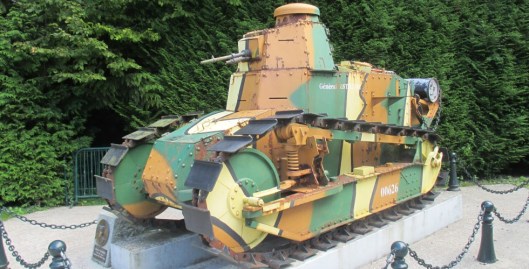
The term for this blending-in was “camouflage”, which entered English from French in 1917 and it was used not only by infantry, but the practice was extended to everything on the battlefield and beyond– to the new tanks

image25tank.jpg

and even to ships, where the goal was to conceal or sometimes simply to confuse the eye.

image26ship.jpg

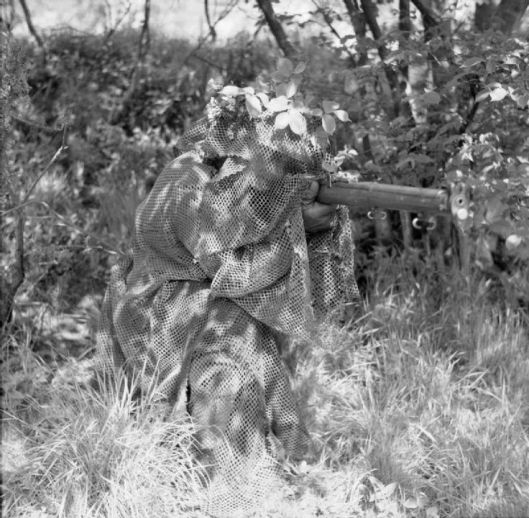
Some of the most extreme varieties take us back to the rangers of South Ithilien, like this sniper, whose job was to pick off unsuspecting soldiers (officers were a special prize) from complete concealment.

image27sniper.jpg

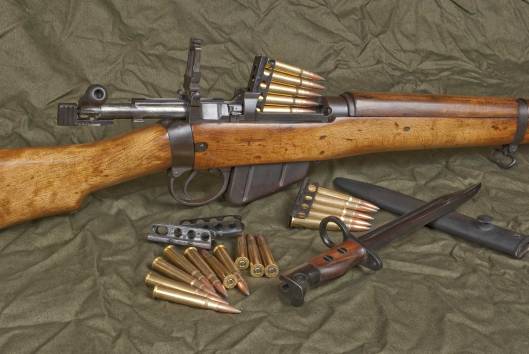
This makes us wonder what Faramir and his men would have done if they had been armed with magazine rifles,

image28smle.jpg

instead of bows as, after all, they are there for an ambush…

image29faramir.jpg

As always, thanks for reading and

MTCIDC

CD
← Older posts
Newer posts →

The Doubtful Sea Series Facebook Page

The Doubtful Sea Series Facebook Page

  • Ollamh

Categories

  • Artists and Illustrators
  • Economics in Middle-earth
  • Fairy Tales and Myths
  • Films and Music
  • Games
  • Heroes
  • Imaginary History
  • J.R.R. Tolkien
  • Language
  • Literary History
  • Maps
  • Medieval Russia
  • Military History
  • Military History of Middle-earth
  • Narnia
  • Narrative Methods
  • Poetry
  • Research
  • Star Wars
  • Terra Australis
  • The Rohirrim
  • Theatre and Performance
  • Tolkien
  • Uncategorized
  • Villains
  • Writing as Collaborators
Follow doubtfulsea on WordPress.com

Across the Doubtful Sea

Recent Postings

  • Through a glass… January 7, 2026
  • Heffalumps? December 31, 2025
  • We Three Kings December 24, 2025
  • A Moon disfigured December 17, 2025
  • On the Roads Again—Once More December 10, 2025
  • (Not) Crossing Bridges December 3, 2025
  • On the Road(s) Again—Again November 26, 2025
  • On the Road(s) Again November 19, 2025
  • To Bree (Part 2) November 12, 2025

Blog Statistics

  • 104,128 Views

Posting Archive

  • January 2026 (1)
  • December 2025 (5)
  • November 2025 (4)
  • October 2025 (5)
  • September 2025 (4)
  • August 2025 (4)
  • July 2025 (5)
  • June 2025 (4)
  • May 2025 (4)
  • April 2025 (5)
  • March 2025 (4)
  • February 2025 (4)
  • January 2025 (5)
  • December 2024 (4)
  • November 2024 (4)
  • October 2024 (5)
  • September 2024 (4)
  • August 2024 (4)
  • July 2024 (5)
  • June 2024 (4)
  • May 2024 (5)
  • April 2024 (4)
  • March 2024 (4)
  • February 2024 (4)
  • January 2024 (5)
  • December 2023 (4)
  • November 2023 (5)
  • October 2023 (4)
  • September 2023 (4)
  • August 2023 (5)
  • July 2023 (4)
  • June 2023 (4)
  • May 2023 (5)
  • April 2023 (4)
  • March 2023 (5)
  • February 2023 (4)
  • January 2023 (4)
  • December 2022 (4)
  • November 2022 (5)
  • October 2022 (4)
  • September 2022 (4)
  • August 2022 (5)
  • July 2022 (4)
  • June 2022 (5)
  • May 2022 (4)
  • April 2022 (4)
  • March 2022 (5)
  • February 2022 (4)
  • January 2022 (4)
  • December 2021 (5)
  • November 2021 (4)
  • October 2021 (4)
  • September 2021 (5)
  • August 2021 (4)
  • July 2021 (4)
  • June 2021 (5)
  • May 2021 (4)
  • April 2021 (4)
  • March 2021 (5)
  • February 2021 (4)
  • January 2021 (4)
  • December 2020 (5)
  • November 2020 (4)
  • October 2020 (4)
  • September 2020 (5)
  • August 2020 (4)
  • July 2020 (5)
  • June 2020 (4)
  • May 2020 (4)
  • April 2020 (5)
  • March 2020 (4)
  • February 2020 (4)
  • January 2020 (6)
  • December 2019 (4)
  • November 2019 (4)
  • October 2019 (5)
  • September 2019 (4)
  • August 2019 (4)
  • July 2019 (5)
  • June 2019 (4)
  • May 2019 (5)
  • April 2019 (4)
  • March 2019 (4)
  • February 2019 (4)
  • January 2019 (5)
  • December 2018 (4)
  • November 2018 (4)
  • October 2018 (5)
  • September 2018 (4)
  • August 2018 (5)
  • July 2018 (4)
  • June 2018 (4)
  • May 2018 (5)
  • April 2018 (4)
  • March 2018 (4)
  • February 2018 (4)
  • January 2018 (5)
  • December 2017 (4)
  • November 2017 (4)
  • October 2017 (4)
  • September 2017 (4)
  • August 2017 (5)
  • July 2017 (4)
  • June 2017 (4)
  • May 2017 (5)
  • April 2017 (4)
  • March 2017 (5)
  • February 2017 (4)
  • January 2017 (4)
  • December 2016 (4)
  • November 2016 (5)
  • October 2016 (6)
  • September 2016 (5)
  • August 2016 (5)
  • July 2016 (5)
  • June 2016 (5)
  • May 2016 (4)
  • April 2016 (4)
  • March 2016 (5)
  • February 2016 (4)
  • January 2016 (4)
  • December 2015 (5)
  • November 2015 (5)
  • October 2015 (4)
  • September 2015 (5)
  • August 2015 (4)
  • July 2015 (5)
  • June 2015 (5)
  • May 2015 (4)
  • April 2015 (3)
  • March 2015 (4)
  • February 2015 (4)
  • January 2015 (4)
  • December 2014 (5)
  • November 2014 (4)
  • October 2014 (6)
  • September 2014 (1)

Blog at WordPress.com.

  • Subscribe Subscribed
    • doubtfulsea
    • Join 78 other subscribers
    • Already have a WordPress.com account? Log in now.
    • doubtfulsea
    • Subscribe Subscribed
    • Sign up
    • Log in
    • Report this content
    • View site in Reader
    • Manage subscriptions
    • Collapse this bar
 

Loading Comments...