Villains with ambitious plans for world conquest need armies.
Emperor Palpatine
initially employs droids by the million to face the Republic’s clone armies, and not just ordinary foot soldier droids—
but super battle droids
and even commando battle droids
before, in his complex plan, he turns the Republic’s clones against his real target, the Jedi, in Order 66.
On a lighter level, Gru,
of Despicable Me, has masses of Minions to work his will (sort of)—
It’s clear that Sauron has similar plans—and similar armies—orcs—along with masses of humans.
(Alan Lee)
Orcs, we’re told, are a kind of distortion of actual living creatures—
“But Trolls are only counterfeits, made by the Enemy in the Great Darkness, in mockery of Ents, as Orcs were of Elves.” (The Two Towers, Book Three, Chapter 4, “Treebeard”)
Orcs began, however, as something more traditional and, for Tolkien, begin with the works of George MacDonald (1824-1905),
and, in particular, with one of his fantasy novels, The Princess and the Goblin, 1870-2.
(First US edition, 1871)
For our purposes, the princess, although an heroic figure, can be removed, as we’re interested in those goblins.
(Arthur Hughes)
Later in life, Tolkien became disenchanted with MacDonald’s work, failing to complete a proposed preface for his The Golden Key, a short story from MacDonald’s Dealings with the Fairies, 1867—you can read it here: https://archive.org/details/dealingswithfair00macd_0/page/n5/mode/2up
and you can read about his disenchantment in Carpenter’s J.R.R. Tolkien, page 244.). Earlier, however, he had acknowledged MacDonald’s influence, writing to the editor of The Observer about The Hobbit:
“As for the rest of the tale it is, as the Habit [the pen name of a commentator on the book] suggests, derived from (previously digested) epic, mythology, and fairy-story—not, however, Victorian in authorship, as a rule to which George Macdonald [sic] is the chief exception.” (letter to the editior, February, 1938, Letters, 40-41)
Tolkien refers to this influence again in a much later letter to Hugh Brogan:
“Your preference of goblins to orcs involves a large question and a matter of taste, and perhaps historical pedantry on my part. I personally prefer Orcs (since these creatures are not ‘goblins’, not even the goblins of George MacDonald, which they do to some extent resemble).” (letter to Hugh Brogan, 18 September, 1954, Letters, 278)
And a little earlier, in a letter to Naomi Mitchison:
“They are not based on direct experience of mine [an interesting remark—did JRRT have supernatural experiences which he doesn’t discuss?]; but owe, I suppose, a good deal to the goblin tradition (goblin is used as a translation in The Hobbit, where orc only occurs once, I think), especially as it appears in George MacDonald, except for the soft feet which I never believed in.” (letter to Naomi Mitchison, 25 April, 1954, Letters, 267)
Those soft feet turn out to be the Achilles’ heel (sorry!) of the goblins as we overhear in a conversation between a goblin father and son:
” ‘You say so, dad. I think myself I’m all right. But I could carry ten times as much if it wasn’t for my feet.’
Recently, however, I’ve met another goblin, to whom I was introduced by a dear friend. This is Book Goblin.
Unlike the clones and droids and Minions and orcs, who only exist to do their master’s bidding, Book Goblin lives for books, stacking shelves full, longing for the mailman to bring more, even believing in “Bookhalla”, which is, basically, an immense library, where those who are gathered there read books all day and hold book clubs all night. You can see and hear Book Goblin describing it here: https://www.youtube.com/shorts/vkjErlwUA2A Only brave readers are allowed to go there, including those who read “without bookmarks”!
Book Goblin is, in fact, the creation of the fantasy author Elizabeth Wheatley
and you can read more about her and her work here: https://www.bookseriesinorder.com/elisabeth-wheatley/ And YouTube has many short features in which Book Goblin discusses likes and dislikes and often seems like the Id of all passionate readers, which is why I bring her to your attention. Unlike droids, clones, Minions, and orcs, however, she is one of kind and, as for world conquest—I suspect that it would interfere with her reading.
Thanks for your reading, as always,
Stay well,
If you’re like me, you probably aren’t brave enough to read without a bookmark, so I guess no Bookhalla, sadly,
“ ‘I greet you…and maybe you look for welcome. But truth to tell your welcome is doubtful here, Master Gandalf. You have ever been a herald of woe. Troubles follow you like crows, and ever the oftener the worse….Here you come again! And with you come evils worse than before, as might be expected. Why should I welcome you, Gandalf Stormcrow?’ “ (The Two Towers, Book Three, Chapter 6, “The King of the Golden Hall”)
Theoden is being less than hospitable, although we soon learn that he’s being manipulated by Grima to be so,
(Alan Lee)
but his insulting name seems odd: “Stormcrow”?
If we were southerners in the US, we might imagine that Theoden is actually calling Gandalf a cuckoo, as the yellow-billed cuckoo, native there, is sometimes called that,
because, as the Wiki article says, the nickname perhaps comes from the fact of “the bird’s habit of calling on hot days, often presaging rain or thunderstorms”. (For more, see: https://en.wikipedia.org/wiki/Yellow-billed_cuckoo )
Although we don’t hear of cuckoos in Middle-earth, certainly Gandalf appears in Meduseld in the middle of another kind of tempest, as Grima continues Theoden’s line of reasoning:
“ ‘It is not yet five days since the bitter tidings came that Theodred your son was slain upon the West Marches: your right-hand, Second Marshal of the Mark. In Eomer there is little trust…And even now we learn from Gondor that the Dark Lord is stirring in the East…Why indeed should we welcome you, Master Stormcrow?’ “
And there that word is again. What does Tolkien have against crows?
There might be a clue in that line “troubles follow you like crows”, which reminds me of something which happened earlier in The Lord of the Rings when “Flocks of birds, flying at great speed”, appeared over the Fellowship. Aragorn wakes and reports to Gandalf:
“ ‘Regiments of black crows are flying over all the land between the Mountains and the Greyflood…and they have passed over Hollin. They are not natives here; they are crebain out of Fangorn and Dunland. I do not know what they are about…but I think they are spying out the land.’ “ (The Fellowship of the Ring, Book Two, Chapter 3, “The Ring Goes South”)
It’s clear that, in Tolkien’s mind, crows do not get good press. Here they are in The Hobbit, as well, as Balin says to Bilbo:
“ ‘Those were crows! And nasty suspicious-looking creatures at that, and rude as well. You must have heard the ugly names they were calling after us.’ “ (The Hobbit, Chapter 15, “The Gathering of the Clouds”)
So, crows are “nasty suspicious-looking creatures”, “rude”, and even possibly spies.
They are also in contrast to another large black bird—
(I apologize to my non-North American readers for using North American birds in this chart, but this seemed the best choice and the European varieties are similar.)
“ ‘I only wish he was a raven!’ said Balin.
‘I thought that you did not like them! You seemed very shy of them, when we came this way before.’
‘Those were crows!…But the ravens are different. There used to be great friendship between them and the people of Thror; and they often brought us secret news…
‘They live many a year, and their memories are long, and they hand on their wisdom to their children.’ “ (The Hobbit, Chapter 15, “The Gathering of the Clouds”)
(Alan Lee)
Why the preference for ravens?
Possibly, as a small child, Tolkien was upset by this nursery rhyme—
Crows are also linked to the death of the Irish hero, Cuchulain,
the Morrigan, 3-formed battle goddess, who brings about the hero’s end , sometimes employing that form as “the Badb” (“Bath-v”, where the “a” is that in “father” and “th” is like the “th” in “either”, the name meaning “crow”). And Tolkien was not fond of Old Irish literature, writing:
“I do know Celtic things (many in their original languages Irish and Welsh), and feel for them a certain distaste: largely for their fundamental unreason. They have bright colour, but are like a broken stained glass window reassembled without design.” (letter to Stanley Unwin, 16 December, 1937, Letters, 35— I would strongly disagree with JRRT. Raised in Classics and fond of medieval chivalry, Tolkien, I suspect, found the Irish stories in particular full of an earlier, more chaotic, world-view, as well as sometimes wild violence, which, to him, meant “unreason”. But this is one of those times when I wish that we could e-mail him and ask him to say more! For the death of Cuchulain, see: The Cuchullin Saga in Irish Literature here: https://archive.org/details/cu31924026824940 beginning on page 251)
The real reason for his choice of ravens might actually be completely different: an association with Gandalf.
In a letter to Stanley Unwin in which he discusses potential illustrations by Horus Engels for a German translation of The Hobbit, he says:
“He has sent me some illustrations (of the Trolls and Gollum) which despite certain merits, such as one would expect of a German, are I fear too ‘Disnified’ for my taste: Bilbo with a dribbling nose, and Gandalf as a figure of vulgar fun rather than the Odinic wanderer that I think of…” (letter to Stanley Unwin, 7 December, 1946, Letters, 172)
Odin is the Germanic high god and has not only a many-legged horse, Sleipnir,
If Tolkien sees Gandalf as “Odinic”, then we can imagine that his preference for ravens over crows may not come from dread of a nursery rhyme or dislike of a Celtic warrior, but from his strong attachment to things northern Germanic and, if so, then Theoden and his puppeteer, Grima, were right in picking a bird to label Gandalf, but wrong in choosing which one—although “stormraven” sounds a little clunky in comparison with “stormcrow”.
I’m always interested in influences on Tolkien and have written about them here and there in the past. It’s clear that he was always susceptible to them and would sometimes, when questioned, candidly admit to them, as he did, in this letter to the editor of The Observer:
“Beowulf is among my most valued sources; though it was not consciously present to the mind in the process of writing, in which the episode of the theft [of a cup by an escaped slave from a dragon’s hoard] arose naturally (and almost inevitably) from the circumstances. It is difficult to think of any other way of conducting the story at that point. I fancy the author of Beowulf would say much the same.” (letter to the editor of The Observer, printed 20 February, 1938, Letters, 41)
This theft and its consequences are readily apparent in Beowulf. Athough, unlike Smaug, he never speaks a word, the dragon who has suffered the loss very eloquently protests that theft—
”Then the baleful fiend its fire belched out, and bright homes burned. The blaze stood high all landsfolk frighting. No living thing 2315would that loathly one leave as aloft it flew. Wide was the dragon’s warring seen, its fiendish fury far and near, as the grim destroyer those Geatish people hated and hounded. To hidden lair, 2320to its hoard it hastened at hint of dawn. Folk of the land it had lapped in flame, with bale and brand.”
Along with the theft, Tolkien actually uses the idea of dragon destruction more than once, beginning with:
“The pines were roaring on the height,
The winds were moaning in the night.
The fire was red, it flaming spread;
The trees like torches blazed with light.
The bells were ringing in the dale
And men looked up with faces pale;
The dragon’s ire more fierce than fire
Laid low their towers and houses frail.”
(The Hobbit, Chapter One, “An Unexpected Party”)
where the dwarves sing it in the dark in Bilbo’s house.
(the Hildebrandts)
This is a poetic description of Smaug’s initial taking possession of Mt Erebor (“the Lonely Mountain”), after destroying the town of Dale, just below it.
(JRRT You can see the remains of Dale, just to the lower right.)
We’ll see more of this when Smaug later attacks Lake-town—
“Fire leaped from thatched roofs and wooden beam-ends as he [Smaug] hurtled down and past and round again…Back swirled the dragon. A sweep of his tail and the roof of the Great House crumbled and smashed down. Flames unquenchable sprang high into the night. Another swoop and another, and another house and then another sprang afire and fell…” (The Hobbit, Chapter Fourteen, “Fire and Water”)
This is wonderful, vivid story-telling, but, for me, the most powerful part of it is not the destruction itself, but the consequences of such destruction, beginning with Smaug’s original arrival, something which Bilbo only learns about from eavesdropping on the boatmen, in whose barrels Bilbo has hidden the dwarves in their escape from the forest elves.
(JRRT)
“As he listened to the talk of the raftmen and pieced together the scraps of information they let fall, he soon realized that he was very fortunate ever to have seen it [the Lonely Mountain] at all, even from this distance…The talk was all of the trade that came and went on the waterways and the growth of the traffic on the river, as the roads out of the East towards Mirkwood vanished or fell into disuse; and of the bickering of the Lake-men and the Wood-elves about the upkeep of the Forest River and the care of the banks. Those lands had changed much since the days when dwarves dwelt in the Mountain…Great floods and rains had swollen the waters that flowed east; and there had been an earthquake or two (which some were inclined to attribute to the dragon…). The marshes and bogs had spread wider and wider on either side. Paths had vanished, and many a rider and wanderer too, if they had tried to find the lost ways across. The elf-road through the wood which the dwarves had followed on the advice of Beorn now came to a doubtful and little used end at the eastern edge of the forest…” (The Hobbit, Chapter Ten, “A Warm Welcome”)
The dragon, the cup and its theft, and the consequences for Beowulf’s southern Sweden all are derived from the Old English poem.
For all of this landscape of destruction described by the raftsmen, however, I would propose one further source, not something which Tolkien had read, but which he himself had experienced.
When JRRT arrived in northern France in June, 1916, just in time for the Somme offensive, the war had been going on for nearly two years in the region and the heavy artillery of the era
had done a very good job of leveling virtually everything in sight, from houses
to churches
to whole towns
to bridges
to railways,
and this was the world through which Tolkien walked for some months, till invalided out with trench fever in November, 1916.
The destruction either caused by or attributed to Smaug would seem to be everywhere in these images.
I would add, however, a prophetic element to JRRT’s description.
The idea of Tolkien’s Great War experiences and how they may have shaped his views on many things has become a commonplace of Tolkien studies, the seminal work being John Garth’s Tolkien and the Great War, 2003.
But then another war came, and, with it, many dragons flying over Britain,
remind him, on the one hand, of what he had seen in the Great War, and, on the other, of what he had imagined and described from what he had seen then?
“They removed northward higher up the shore; for ever after they had a dread of the water where the dragon lay. He would never again return to his golden bed, but was stretched cold as stone, twisted upon the floor of the shallows. There for ages his huge bones could be seen in calm weather amid the ruined piles of the old town . But few dared to cross the cursed spot, and none dared to dive into the shivering water or recover the precious stones that fell from his rotting carcase.” (The Hobbit, Chapter Fourteen, “Fire and Water”)
Thanks, as always, for reading.
Stay well,
When you think of dragons, remember the Reluctant one, as well as the terrible,
I almost feel like I should be delivering a parental warning before adding this terrible image.
This is the execution of a senior British naval officer, Admiral John Byng (1704-1757), by firing squad on the quarterdeck of HMS Monarch, 14 March, 1757, for what we might call “hesitation in the face of the enemy”. (For more on this, see: https://en.wikipedia.org/wiki/John_Byng#Death_warrant )
Byng was, it would seem, a scapegoat for poor naval policy and government mismanagement of the war with France, and this provoked the French philosopher, dramatist, and satirist, Voltaire (Francois-Marie Arouet, 1694-1778),
who had a personal connection to Byng, to include his death in his satirical novel, Candide (1759).
(Because of its controversial nature, the novel was published outside France and, as you can see by this image of the title page of the first edition, not even under the author’s name—for more on this see: https://en.wikipedia.org/wiki/Candide )
In Chapter XXIII, entitled “Candide and Martin Land on the English Coast: What They See There”, we read a description of Byng’s execution—although Byng himself is never named, the victim simply being called “un Amiral”—“an admiral”. Puzzled as to what’s happening, Candide asks who the man is and why he’s being shot, the reply becoming a classic quotation: “Mais dans ce pays-ci il est bon de tuer de tems en tems un Amiral pour encourager les autres.”—“But in this country it’s good to kill an admiral, from time to time, in order to put heart in the others.”
This is obviously meant as a jab at what Voltaire thought of as the barbaric behavior of Britain towards a distinguished officer, but it made me think about that “putting heart” in a military context in The Lord of the Rings. Here, however, instead of focusing upon encouraging the leaders, as Voltaire has mockingly remarked, I want to examine how certain leaders try—or don’t try—to do the same for their followers, focusing upon two kings, Theoden
Theoden, when we first meet him, has almost lapsed into senescence and certainly has developed a hostility towards those who were once his allies.
(the Hildebrandts)
“Slowly the old man rose to his feet, leaning heavily upon a short black staff with a handle of white bone…
‘I greet you…and maybe you look for welcome. But truth to tell your welcome is doubtful here, Master Gandalf. You have ever been a herald of woe. Troubles follow you like crows, and ever the oftener the worse. I will not deceive you: when I heard that Shadowfax had come back riderless, I rejoiced at the return of the horse, but still more at the lack of the rider…”
It soon turns out that this hostility—and, perhaps the senescence—are the work of Theoden’s counselor, Grima Wormtongue.
(Alan Lee)
“Wormtongue” would seem a strange epithet for a counselor, unless we remember Bilbo’s experience with Smaug, where, because of Smaug’s speech, Bilbo begins to question his trust in the dwarves: “That is the effect that dragon-talk has on the inexperienced.” (The Hobbit, Chapter 12, “Inside Information”) “Wormtongue”, then, can suggest persuasiveness—but maybe persuasiveness to be wary of, which is certainly the case here, where it’s clear that Grima is, in fact, behind Theoden’s look and behavior, and, freed from Grima by Gandalf, Theoden becomes a different man, taking Eomer’s sword and
“As his fingers took the hilt, it seemed to the watchers that firmness and strength returned to his thin arm. Suddenly he lifted the blade and swung it shimmering and whistling in the air. Then he gave a great cry. His voice rang clear as he chanted in the tongue of Rohan a call to arms.
‘Arise now, arise, Riders of Theoden!
Dire deeds awake, dark is it eastward.
Let horse be bridled, horn be sounded!
Forth Eorlingas!’ “
And here’s where the encouragement begins:
“The guards, thinking that they were summoned, sprang up the stair. They looked at their lord in amazement, and then as one man they drew their swords and laid them at his feet. ‘Command us!’ they said.
‘Westu Theoden hal!’ cried Eomer. ‘It is a joy to us to see you return into your own. Never again shall it be said, Gandalf, that you come only with grief!’ “ (The Two Towers, Book Three, Chapter 6, “The King of the Golden Hall”)
The King’s sudden energy energizes his men, and that energy is mixed with a kind of fierce joy, which Theoden will soon need as it is learned that Saruman is directing an attack against Rohan. With the threat of being overwhelmed, Theoden and the others enter the stronghold of Helm’s Deep.
(JRRT)
There, with the threat of Saruman’s “blasting fire”, Theoden decides to make a sortie—that is, to make a mounted attack on the besieging forces outside the walls and here we see his determination—even if it’s of a grim variety:
“ ‘But I will not end here, taken like an old badger in a trap…When dawn comes, I will bid men sound Helm’s horn, and I will ride forth. Will you ride with me then, son of Arathorn? Maybe we shall cleave a road, or make such an end as will be worth a song—if any be left to sing of us hereafter.’ “
(In fact, badgers, when cornered, are very fierce, as I’m sure that JRRT was aware, seizing an opponent in a kind of death grip. For more, see: https://en.wikipedia.org/wiki/Badger#Culling )
He then leads a charge of the traditional “hell for leather” sort, which JRRT would have known from such earlier historical events as the charge of the Light Brigade at Balaclava in October, 1854—
and, once again, we see a kind of fierce excitement which the King brings to his men.
“ ‘Helm! Helm!’ the Riders shouted. ‘Helm is arisen and comes back to war. Helm for Theoden King!’
And with that shout the king came. His horse was white as snow, golden was his shield, and his spear was long….Light sprang in the sky. Night departed.
‘Forth Eorlingas!’ With a cry and a great noise they charged. Down from the gates they roared, over the causeway they swept, and they drove through the hosts of Isengard as a wind among grass.” (The Two Towers, Book Three, Chapter 7, “Helm’s Deep”)
(John Howe)
Theoden will repeat this at his final battle in the Pelennor Fields–
(Denis Gordeev)
“At that sound the bent shape of the king sprang suddenly erect. Tall and proud he seemed again and rising in his stirrups he cried in a loud voice, more clear than any there had ever heard a mortal man achieve before:
‘Arise, arise, Riders of Theoden!
Fell deeds awake: fire and slaughter!
spear shall be shaken, shield be splintered,
a sword-day, a red day, ere the sun rises!
Ride now, ride now! Ride to Gondor!’
Suddenly the king cried to Snowmane and the horse sprang away. Behind him his banner blew in the wind, white horse upon a field of green, but he outpaced it. After him thundered the knights of his house, but he was ever before them…And then all the host of Rohan burst into song, and they sang as they slew, for the joy of battle was on them, and the sound of their singing that was fair and terrible came even to the City.” (The Return of the King, Book Five, Chapter 5, “The Ride of the Rohirrim”)
We can see now how Theoden’s encouragement works: he’s always in the lead and he has stirring words in poetic form to give heart to his followers.
In contrast, there is the chief of the Nazgul, once a king himself.
Unlike Theoden, who has had a kind of rebirth, that chief is clearly one of the undead, a disturbing figure among a group of disturbing figures, as we hear in Grishnakh’s reaction—
“ ‘Nazgul, Nazgul,’ said Grishnakh, shivering and licking his lips, as if the word had a foul taste that he savoured painfully. ‘You speak of what is deep beyond the reach of your muddy dreams, Ugluk!’ “ (The Two Towers, Book Three, Chapter 3, “The Uruk-hai”)
His method of leading is also disturbing—as an anonymous messenger says of him:
“ ‘But it is the Black Captain that defeats us. Few will stand and abide even the rumour of his coming. His own folk quail at him, and they would slay themselves at his bidding.’ “ (The Return of the King, Book Five, Chapter 4, “The Siege of Gondor”)
To which we can add Gandalf’s description:
“…the Captain of Despair does not press forward yet. He rules rather according to the wisdom that you have just spoken, from the rear, driving his slaves in madness on before.’ “
Unlike Theoden, he has no poetry and virtually no words—certainly nothing encouraging. His only two speeches are full of contempt, addressed to Gandalf, at the ruined gate of Minas Tirith–The Return of the King, Book Five, Chapter 4, “The Siege of Gondor”—and to Eowyn—The Return of the King, Book Five, Chapter 6, “The Battle of the Pelennor Fields”, although before he sneers at Gandalf, he seems to chant a spell of some sort to help Grond destroy the gate—
“Then the Black Captain rose in his stirrups and cried aloud in a dreadful voice, speaking in some forgotten tongue words of power and terror to rend both heart and stone.
Thrice he cried. Thrice the great ram boomed. And suddenly upon the last stroke the Gate of Gondor broke. As if stricken by some blasting spell it burst asunder: there was a flash of searing lightning, and the doors tumbled in riven fragments to the ground.” (The Return of the King, Book Five, Chapter 4, “The Siege of Gondor”)
It seems then, that, in contrast to Theoden, the chief of the Nazgul’s only method of encouragement is the very opposite of giving heart, being more like what Voltaire suggested was behind the execution of poor Admiral Byng: the desire to create fear. Does it work? Britain defeated France at sea, their greatest victory being at Quiberon Bay in 1759,
although Hawke, the British admiral there, had always been an aggressive and imaginative sailor (who had also testified against Byng) and would have needed no threat of court martial to spur him on.
With the aid of Fangorn,
(Alan Lee)
the Ents, and Gandalf, Theoden’s men destroy Saruman’s army at Helm’s Deep, and, with the aid of Aragorn, his men ruin Sauron’s plans for Gondor, which leads, with the destruction of the Ring, to the destruction of Sauron himself.
(Ted Nasmith)
The end of Sauron brought peace and a new Age to Middle-earth. War broke out again between Britain and France in 1778, which led to the loss of 13 of Britain’s North American colonies, and there was war with France again between 1793 and 1815. Granted that the wars of our Middle-earth are often larger and more long-lasting (no Ring to destroy Napoleon—although Britain, I’m sure, would have been glad of one) but, given the choice, I, for one, would rather follow Theoden than a Nazgul.
Thanks, as always, for reading.
Stay well,
When you think of Theoden, imagine this wonderful creation made from Legos,
And remember that, as ever, there’s
MTCIDC
O
PS
For an English translation of Chapter 18 of Candide:
Where are “eaves” anyway, and why would you drop from them?
On a modern roof, they look like this—
If you lived in the mid-15th century, when the expression “eavesdropper” first appears, it might look like this—that’s the overhang of the thatched roof–
As Etymonline will be happy to tell you,“eaves” is from Old English “efes”, the “overhang of a roof”, plus “dropa”, “a drop (as of rain)”, so “that area of the roof from which the rain drips”. (For more, see: https://www.etymonline.com/word/eavesdrop )
The idea, then, is that, if you wanted to listen in on an indoor conversation, you might climb on a roof, hang your head over the side, and follow someone speaking below, say at an open window—rather as Sam Gamgee does, although he does so less precariously—
(Robert Chronister)
In our modern world, more than once, I’ve found myself doing this—and probably you have, too–although inadvertently, as someone nearby has been bellowing into his/her cellphone while sitting or standing near you.
Unless the person at the other end is bellowing, too, you don’t hear that end of the conversation, only the local speaker, but it might be an interesting experiment, perhaps, to see what you could reconstruct from this end and, in this posting, I want to try to do that–not with a cellphone, but with a rather older device, a palantir,
(Angus McBride)
and the person we’ll be eavesdropping on isn’t that loud person on the bus, but the Steward of Gondor, Denethor.
(Alan Lee)
Initially, we don’t know that Denethor has one, of course, although we receive hints in the text—
“ ‘Yea,’ he [Denethor] said; ‘for though the Stones be lost, they say, still the lords of Gondor have keener sight than lesser men…’ “
“ ‘And the Lord Denethor is unlike other men: he sees far. Some say that as he sits alone in his high chamber in the Tower at night, and bends his thought this way and that, he can read somewhat of the future, and that he will at times search even the mind of the Enemy, wrestling with him.’ “ (The Return of the King, Book Five, Chapter 1, “Minas Tirith”)
“But he [Denethor] himself went up alone into the secret room under the summit of the Tower; and many who looked up thither at that time saw a pale light that gleamed and flickered from the narrow windows for a while, and then flashed and went out.” (The Return of the King, Book Five, Chapter 4, “The Siege of Gondor”)
It’s only at Denethor’s end that we see what gleamed and flickered and with what, as Beregond says, he “wrestles” with the Enemy—
(Robert Chronister)
“Then suddenly Denethor laughed. He stood up tall and proud again, and stepping swifly back to the table he lifted from it the pillow on which his head had lain. Then coming to the doorway he drew aside the covering, and lo! he had between his hands a palantir. As he held it up, it seemed to those that looked on that the globe began to glow with an inner flame, so that the lean face of the Lord was lit as with a red fire.” (The Return of the King, Book Five, Chapter 7, “The Pyre of Denethor”)
We don’t, unfortunately, have record of either end of the conversations which Denethor has had, but we know one thing: these were not happy chats—Beregond says, continuing the description above—“And so it is that he is old, worn before his time.”
And it’s not hard to guess another: at the far end of the connection is Sauron, as Gandalf explains to Pippin:
“ ‘Who knows where the lost Stones of Arnor and Gondor now lie buried, or drowned deep? But one at least Sauron must have obtained and mastered to his purposes. I guess that it was the Ithil-stone, for he took Minas Ithil long ago and turned it into an evil place: Minas Morgul, it has become.’ “
We can also guess what has happened to Denethor—exactly what happened to Saruman:
(the Hildebrandts)
“ ‘…yet it seems that he was not content. Further and further abroad he gazed, until he cast his gaze upon Barad-dur. Then he was caught!…Easy it is now to guess how quickly the roving eye of Saruman was trapped and held; and how ever since he has been persuaded from afar, and daunted when persuasion would not serve…How long, I wonder, has he been constrained to come often to his glass for inspection and instruction, and the Orthanc-stone so bent towards Barad-dur that, if any save a will of adamant now looks into it, it will bear his mind and sight swiftly thither?’ “ (The Two Towers, Book Three, Chapter 11, “The Palantir”)
The power of the voice is a strong theme, both in The Hobbit, where we see that Smaug
(JRRT)
can begin to damage Bilbo’s trust in the dwarves with a few words, and in The Lord of the Rings, Saruman’s spy, Grima,
(Alan Lee)
can actually prematurely age Theoden with his talk, sowing, as well, distrust of allies.
Perhaps the most powerful voice is that of Saruman himself, as Gandalf warns Pippin:
“ ‘But there is no knowing what he can do, or may choose to try. A wild beast cornered is not safe to approach. And Saruman has powers you do not guess. Beware of his voice!’ “
(Carl Lundgren)
One example will underline Gandalf’s warning:
“ ‘But my lord of Rohan, am I to be called a murderer, because valiant men have fallen in battle? If you go to war, needlessly, for I did not desire it, then men will be slain…I say, Theoden King: shall we have peace and friendship, you and I? It is ours to command.’ ”
Saruman’s words are simply lies: he began the war when his Orcs marched against Rohan and attacked Helm’s Deep, but his power is as dangerous as Gandalf has warned:
“For many the sound of the voice alone was enough to hold them enthralled; but for those whom it conquered the spell endured when they were away, and ever they heard that soft voice whispering and urging them. But none were unmoved; none rejected its pleas and its commands without an effort of mind and will, so long as its master had control of it.” (The Two Towers, Book Three, Chapter 10, “The Voice of Saruman”)
The few words we actually hear from Sauron are brief questions and commands, but, at least initially, these wouldn’t have come to control as powerful a personality as Denethor, so I’m imagining something more like Saruman, but, judging from Denethor’s reactions to others, this included the kind of undermining which Smaug and Grima practice.
(This is medieval undermining, and shows one of two possibilities. The first is to dig all the way under a castle wall and burst out suddenly behind the defenders. The second, shown here, is to dig under the way, replace the foundations with wooden props, then set fire to the props in hopes that, without them, the wall will crumble. The illustration is from the site “Classroom Adventures” and I recommend the essay which is attached to the illustration as a very useful way of getting up to speed on how medieval sieges—like that of Minas Tirith—were conducted: https://www.classroomadventures.co.uk/post/under-siege-a-history-of-siege-weaponshttps://www.classroomadventures.co.uk/post/under-siege-a-history-of-siege-weapons )
This posting had a different title, when I began it: “Sauron Psychologist” and, in Denethor’s reactions, it would appear that Denethor has been attacked on two main fronts: jealousy and insecurity, suggesting that, in his conversations with the Steward, Sauron has learned just where Denethor’s psychological vulnerabilities lie.
Although Denethor favors Boromir, he seems more than a little anxious at Faramir’s attraction to Gandalf, as Denethor says bitterly:
“ ‘See, you have spoken skillfully, as ever; but I, have I not seen your eyes fixed on Mithrandir, seeking whether you said well or too much? He has long had your heart in his keeping…For Boromir was loyal to me and no wizard’s pupil.” (The Return of the King, Book Five, Chapter 4, “The Siege of Gondor”)
Sauron also appears to have worked to undermine Denethor’s understanding of his role in Gondor. He is, after all, not the King, but the King’s lieutenant. His family has ruled in place of the King for so long, however, that Denethor seems—I think that we can assume with Sauron’s encouragement– to have made the assumption that he is the King:
“ ‘I will not step down to be the dotard chamberlain of an upstart. Even were his claim proved to me, still he comes but of the line of Isildur. I will not bow to such a one, last of a ragged house long bereft of lordship and dignity.’ “
And I would suggest that, just as Gandalf, long before, has said that the beginning of Saruman’s attempt to persuade him in Orthanc had seemed “as if he were making a speech long rehearsed”, so Denethor’s reply to Gandalf’s question “What then would you have…if your will could have its way?” has that same ring, and is just as false:
“ ‘I would have things as they were in all the days of my life…and in the days of my longfathers before: to be the Lord of this City in peace, and leave my chair to a son after me, who would be his own master and no wizard’s pupil. But if doom denies this to me, then I will have naught: neither life diminished, nor love halved, nor honour abated.’ “(The Return of the King, Book Five, Chapter 7, “The Pyre of Denethor”)
Without Sauron’s actual words, this can only be a guess, but I wonder if, behind all of this is Sauron’s “whispering and urging”, saying things like: “You once had two sons, but your favorite died on a mission which failed, and the other is no longer yours, is he? A wizard’s pupil now, and you fear, but know, this. And will the pupil ever become master, or will his master become master of all? Without the interference of wizards, we could have had peace, you and I—it was in our power—two wise rulers sharing Middle-earth—I the East, you the West, for no King would ever return—should ever return—to take your place, in Gondor. But now”—and here I switch from my text to JRRT’s–‘For a little space you may triumph on the field, for a day. But against the Power that now arises there is no victory. To this City only the first finger of its hand has yet been stretched. All the East is moving. And even now the wind of thy hope cheats thee and wafts up the Anduin a fleet with black sails. The West has failed. It is time for all to depart who would not be slaves.’ “
Smaug ultimately didn’t convince Bilbo. Gandalf freed Theoden from Grima’s attempt at senescence. Theoden’s mockery of Saruman broke the spell of Saruman’s voice. But there was no rescue for Denethor:
“Then Denethor leaped upon the table; and standing there wreathed in fire and smoke he took up the staff of his stewardship and broke it on his knee. Casting the pieces into the blaze he bowed and laid himself on the table, clasping the palantir with both hands upon his breast. And it was said that ever after, if any man looked in that Stone, unless he had a great strength of will to turn it to other purpose, he saw only two aged hands withering in flame.” (The Return of the King, Book Five, Chapter 7, “The Pyre of Denethor”)
Thanks, as always, for reading.
Stay well,
Noise-canceling earphones definitely have their merits,
In Parts 1 and 2 of this short series, I’ve looked at Tolkien’s use of speech to characterize—and bring to life—the antagonists of The Lord of the Rings, leaving out Sauron, as having little to say for himself, but observing Saruman,
(the Hildebrandts)
the chief of the Nazgul,
(the Hildebrandts)
and the Mouth of Sauron.
(Douglas Beekman)
I’ve been doing this as a descent down the social ladder and now we’ve reached the foot with the Orcs.
(Alan Lee)
JRRT had very complex thoughts and feelings about them, as his letters show us (see, for instance, some of his thoughts in his unfinished, unsent letter to Peter Hastings, September, 1954, Letters, 285 and 291) but then the Orcs themselves seem more complex than mere (in more modern terms) “cannon-fodder”—that is, a simple mass of undifferentiated infantry.
(Alan Lee)
Something which has always struck me about them is Tolkien’s choices for their speech. At one level, as I pointed out in “Tolkien Among the Indians”, (21 January, 2026), one of their leaders, Ugluk, can sound like a figure out of James Fenimore Cooper’s The Last of the Mohicans—
“ ‘We are the fighting Uruk-hai! We slew the great warrior. We took the prisoners. We are the servants of Saruman the Wise, the White Hand: the Hand that gives us man’s-flesh to eat. We came out of Isengard, and led you here, and we shall lead you back by the way we choose. I am Ugluk. I have spoken.’ ”
On another level—but here I want to quote another of Tolkien’s letters, one often cited when referring to Sam Gamgee:
“My ‘Sam Gamgee’ is indeed, as you say, a reflexion of the English Soldier, of the privates and batmen [officers’ servants, not denizens of Gotham] I knew in the 1914 war, and recognized as so far superior to myself.” (draft of a letter to H. Cotton Minchin, April, 1956, Letters, 358)
and obviously Tolkien knew what he intended, but I’ve always seen those “privates and batmen” as something more: as models for the Orcs—
and their commanders, Ugluk and Grishnakh—and later Shagrat and Gorbag—not as of the officer class, to which Tolkien belonged—
but as sergeants, the tough, experienced men who ran the infantry on a day-to-day basis.
Here they are, talking—
“ ‘Orders,’ said a third voice in a deep growl. ‘Kill all but NOT the Halflings; they are to be brought back ALIVE as quickly as possible. That’s my orders.’
“ ‘What are they wanted for?’ asked several voices. ‘Why alive? Do they give good sport?’
‘No! I heard that one of them has got something, something that’s wanted for the War, some Elvish plot or other. Anyway they’ll both be questioned.’
‘Is that all you know? Why don’t we search them and find out? We might find something that we could use ourselves.’
‘That is a very interesting remark,’ sneered a voice, softer than the others but more evil. ‘I may have to report that. The prisoners are NOT to be searched or plundered: those are my orders.’
‘And mine too,’ said the deep voice. ‘Alive and as captured, no spoiling. That’s my orders.’ “
So far, those two main voices—the “deep growl” and the “softer…but more evil”–are just that: voices. And we can tell immediately that they, being the ones given orders and threatening to make reports, are in charge. Shortly, we’ll find that the deep voice belongs to ”a large black Orc, probably Ugluk” and the softer to Grishnakh, “a short, crook-legged creature, very broad and with long arms that hung almost to the ground.”
Why sergeants, not officers? It’s the tone, I think. When Grishnakh proposes taking the prisoners to the east bank of the Anduin, where a Nazgul is waiting, Ugluk replies
“ ‘Maybe, maybe! Then you’ll fly off with our prisoners, and get the pay and praise in Lugburz, and leave us to foot it as best we can through the Horse-country.’ “
“pay and praise” and “footing it” sound to me more like the language of soldiers than those of higher ranks, but there’s something more to their talk. Ugluk sneers at the Nazgul and Grishnakh replies:
“ ‘Nazgul, Nazgul,’ said Grishnakh, shivering and licking his lips, as if the word had a foul taste that he savoured painfully. ‘You speak of what is deep beyond the reach of your muddy dreams, Ugluk.’ “
There is a fear in this that’s a little surprising: aren’t the Nazgul on the same side as Grishnakh, at least?
There is a rivalry between the two groups as well—and clearly even between their two masters, as Grishnakh reveals:
“ ‘You have spoken more than enough, Ugluk,’ sneered the evil voice. ‘I wonder how they would like it in Lugburz…They might ask where his strange ideas came from. Did they come from Saruman, perhaps? Who does he think he is, setting up on his own with his filthy white badges? They might agree with me, with Grishnakh their trusted messenger; and I Grishnakh say this: Saruman is a fool, and a dirty treacherous fool.’ “ (all of the text here is from The Two Towers, Book Three, Chapter 3, “The Uruk-hai”)
All of this shows a level of internal tension which would not bode well for an alliance between Sauron and Saruman and, when we reach Shagrat and Gorbag, later in the story, there’s even something more and we’ve already seen it in that “We might find something that we can use ourselves.”
So far, the speech of the two Orc leaders has suggested creatures who clearly don’t trust each other, and one is fearful of something on his own side, revealing, as well, that his master, Sauron, is less than impressed by Saruman and his efforts.
And now we find that such sergeants may not even trust their men, as when Shagrat says to Gorbag:
“ ‘…but they’ve got eyes and ears everywhere; some among my lot, as like as not.’ “
But why such wariness? First, because these Orcs are aware that knowledge of the progress of the war in which they’re a part is being kept from them, and it’s not good news:
“ ‘…they’re troubled about something. The Nazgul down below are, by your account; and Lugburz is too. Something nearly slipped…As I said, the Big Bosses, ay,’ his voice sank almost to a whisper, ‘ay, even the Biggest, can make mistakes. Something nearly slipped, you say. I say, something has slipped.’ “
And second because these Orcs, not trusting their masters and perhaps even fearful of them, may have plans of their own—
“ ‘What d’you say?—if we get a chance, you and me’ll slip off and set up somewhere on our own with a few trusty lads, somwhere where there’s good loot nice and handy, and no big bosses.’
‘Ah!’ said Shagrat. ‘Like old times!’ “ (The Two Towers, Book Four, Chapter 10, “The Choices of Master Samwise”)
As we’ll see, however, later in the story, Shagrat and Gorbag don’t even trust each other—
“Quick as a snake, Shagrat slipped aside, twisted round, and drove his knife into his enemy’s throat.
‘Got you, Gorbag!’ he cried. ‘Not quite dead, eh? Well, I’ll finish my job now.’ He sprang on to the fallen body, and stamped and trampled it in his fury, stooping now and again to stab and slash it with his knife.“ (The Return of the King, Book Six, Chapter 1, “The Tower of Cirith Ungol”)
So much for “old times”! But a fitting ending for this posting. Here, on the lowest rung of the social ladder, we see how JRRT shows both the threat of the enemies’ soldiers and, at the same time, undercuts that threat, as we hear the Orcs doing everything from threatening each other, dissing their own leaders and those of their own side, mistrusting each other and their own men, and even plotting to desert and set up their own little kingdoms before cheerfully knifing each other. We might wonder—even if Sauron had won, how long would his empire have lasted, with such allies and underlings?
Thanks, as ever, for reading.
Stay well,
I guess that I don’t have to tell you now: watch your back,
And remember that there’s
MTCIDC
O
PS
For more on Orcs and their language, see “Lingua Orca”, 16 April, 2025.
It is sometimes surprising to see how social class can influence vocabulary. For instance–
this is a Roman villa—
in Pompeii, where wealthy city people might live.
And this is a country villa—
(Billl Donohoe)
which, in its more elaborate form, might offer some of the comforts of a city dwelling, but would often also be a working farm and here are a couple
of Roman farm workers (probably slaves), each of whom, as someone attached to a villa, could be called a villanus—and I’m sure that you see where this is going: rural people could be uncultivated (no pun, there) and therefore crude and, by a snobbish leap of imagination from 12th-century Old French to mid-16th century English, people who could be expected to be involved in the worst antisocial behavior: crime. (For more on this, see: https://www.etymonline.com/word/villain )
In the previous posting, we began examining Tolkien’s villains in The Lord of the Rings, and how Tolkien, with his wonderful ear for language (and a great dramatic gift), used speech to depict their characters, as well as their behavior.
Since Sauron provides such a small sample of speech, we began with Saruman,
(the Hildebrandts)
who, as reported by Gandalf in Book One, could be by turns, sarcastic, conspiratorial, falsely chummy, and coldly imperious, all the while, though only at first obliquely, attempting to persuade Gandalf to reveal to him the location of The Ring and, in doing so, revealing to Gandalf not only his corrupt ambition, but also his lack of awareness of how much that corruption came from his communication with Mordor.
(the Hildebrandts)
In this posting, I want to continue that examination by extending it down the social scale of villains, beginning with the Nazgul, who, as former kings, might be thought of as next after Saruman.
On the whole, unlike Saruman, who gives away so much in his speech, they don’t have much to say for themselves, but their leader, the Witch-king of Angmar,
(Angus McBride)
has two bits of dialogue: first, when he encounters Gandalf at the broken gate of Minas Tirith,
(Ted Nasmith)
where he speaks briefly in a threat:
“ ‘Old fool!’ he said. ‘Old fool! This is my hour. Do you not know Death when you see it? Die now and curse in vain!’” (The Return of the King, Book Five, Chapter 4, “The Siege of Gondor”)
This only shows his (misplaced) contempt for Gandalf, but he addresses Gandalf as an equal in using “you”, rather than as an inferior, as when he confronts Eowyn:
“ ‘Come not between the Nazgul and his prey!’ “
The Witch-king is ancient—being from the Second Age of Middle-earth—and therefore we might expect his speech to sound archaic, even if here he uses the Common Speech of everyone else we see in The Lord of the Rings, and we see it here with this inverted construction. If it were a person from the present, we might expect “Don’t come” or perhaps “Don’t you come”, but “Come not” immediately suggests a speaker from an earlier time.
He continues:
“ ‘Or he will not slay thee in thy turn.’ “
And note here the archaic “thee” (the accusative/dative/ablative of “thou”), which serves a double purpose: on the one hand, suggesting the Witch-king’s great age and, on the other, this is how a superior would speak to an inferior (as in the case of the Romance languages—where French even has verbs for using “you” vs “thou”—vouvoyer vs tutoyer).
And continues:
“He will bear thee away to the houses of lamentation, beyond all darkness, where thy flesh shall be devoured, and thy shrivelled mind be left naked to the Lidless Eye.’ “ (The Return of the King, Book Five, Chapter 6, “The Battle of the Pelennor Fields”)
The Witch-king persists in his use of “thou”, but then becomes what I feel is quite Biblical in “the houses of lamentation”—where is this place? My immediate thought was that it was the same place where Gollum was tortured (we get a hint of this in Gandalf’s long explanation in The Fellowship of the Ring, Book One, Chapter 2, “The Shadow of the Past”) and where the Mouth of Sauron suggests that Frodo was taken (The Return of the King, Book Five, Chapter 10, “The Black Gate Opens”). As to its name, I was reminded of “The Book of Lamentations” in the Judeo-Christian Bible, a collection of laments over the fall of Jerusalem to the Babylonians in 587/6BC.
(James Tissot, 1836-1902—actually Jacques Joseph Tissot, a very interesting late-Victorian French artist who did much of his later work in England, where he—or his name, at least—became Anglicized. You can read about him and his art here: https://en.wikipedia.org/wiki/James_Tissot )
Sections of “Lamentations” are read during Lent, in Christian services, and we can assume that JRRT, as a practicing Catholic, was well aware of the book. (You can read more about it here: https://en.wikipedia.org/wiki/Book_of_Lamentations )
Wherever the idea came from, the Witch-king continues it in an extremely graphic manner, repeating his use of “thou” to the end of his threat, at the same time.
We see this use of “thou” once more from another on that social scale, the Mouth of Sauron.
This is, again, an ancient figure, as we’re told that “…he was a renegade, who came of the race of those that are named the Black Numenoreans”—that is, followers of Sauron in the Second Age—and he begins as Saruman began, with contempt—
“ ‘Is there anyone in this rout with authority to treat with me?’ “
“Rout” is an archaic word for “rabble”, so the Mouth is already suggesting that, in comparison with him, there is no one of stature with whom he could speak. And he goes on—
“ ‘Or indeed with wit to understand me?’ “
He’s establishing his bargaining position here: he’s of higher social standing and smarter than anyone he faces and he continues, addressing Aragorn:
“ ‘It needs more to make a king than a piece of Elvish glass, or a rabble such as this, Why, another brigand of the hills can show as good a following!’ “
So far, then, the Mouth shows arrogance—but his next behavior shows that, underneath that arrogance is cowardice—
“Aragorn said naught in answer, but he took the other’s eye and held it, and for a moment they strove thus; but soon, though Aragorn did not stir or move hand to weapon, the other quailed and gave back as if menaced by a blow. ‘I am a herald and ambassador, and may not be assailed!’ he cried.”
(And this is where Jackson’s portrayal in the film version of the scene fails completely, as Aragorn then cuts him down, which no respectable king—or even knight—would do, as the Mouth is correct in that heralds and ambassadors, traditionally, could claim immunity.)
Gandalf reassures him, although he also cautions him that that immunity might not last forever, before the Mouth continues:
“ ‘So!’ said the Messenger. ‘Then thou art the spokesman, old grey-beard?’ “
This is insulting in several ways: first, that use of “thou”, as though to an inferior; second, as the Mouth clearly recognizes Aragorn, so he would recognize Gandalf, and calling him “old grey-beard” has the same effect as when the Witch-king earlier called him “old fool”.
He then indirectly admits that he does, indeed, recognize Gandalf:
“ ‘Have we not heard of thee at whiles, and of thy wanderings, ever hatching plots and mischief at a safe distance? But this time thou hast stuck out thy nose too far, Master Gandalf, and thou shalt see what comes to him who sets his foolish webs before the feet of Sauron the Great.’ “
Vocabulary is key here: “wanderings”, “hatching plots and mischief”, sticking out “thy nose”, “foolish webs”, all suggest denigration, keeping with the Mouth’s original address, which painted the Gondorians and their allies as a mob of bandits, with no legitimacy to address the Messenger of Sauron, or even the IQ to do so.
Pippin recognizing Frodo’s mithril coat gives the Mouth the chance to continue that denigration, calling Pippin “imp” and “brat” and calling the Shire “little rat-land”, before going on to name the conditions Sauron demands, both for the return of Frodo and for “peace” between him and the allies, conditions which are simply surrender in other terms.
So far, by his very language, the Mouth has attempted to dictate the scenario, using “we” as if it were Sauron himself speaking, attempting to suggest that Sauron is the master of the situation and that he, as Sauron’s spokesman, is in sole charge of the parley, but it’s interesting to see how he responds when spoken to in the same way by Gandalf, who has revealed his own power, pulling the mithril coat and others of Frodo’s possessions from the Mouth’s hands.
“ ‘…Get you gone, for your embassy is over and death is near to you. We did not come here to waste words in treating with Sauron, faithless and accursed; still less with one of his slaves. Begone!’ “
The Mouth’s reaction is the very opposite of his original self-depiction at the beginning of the parley: instead of mocking and presenting himself as above the level of those on the other side, he is literally speechless—and more than mute, being likened to a beast with no ability to communicate at all:
“Then the Messenger laughed no more. His face was twisted with amazement and anger to the likeness of some wild beast that, as it crouches on its prey, is smitten on the muzzle with a stinging rod. Rage filled him and his mouth slavered, and shapeless sounds of fury came strangling from his throat.” (The Return of the King, Book Six, Chapter 10, “The Black Gate Opens”)
So, the Mouth is dropped into the Animal Kingdom by Gandalf’s words (and notice that archaic “Get you gone!”—the archaism we hear from the Witch-king seems to be catching) and, in the third part of the posting, we’ll drop lower in the social scale, as well.
Stay well,
Imagine how useful “thou” and “thee” might be in English today,
And remember that, as ever, there’s
MTCIDC
O
PS I recently happened upon a very useful article on illustrating Tolkien which I want to pass on to you here: https://en.wikipedia.org/wiki/Illustrating_Middle-earth I love looking at all of the different ways in which artists, all the way back to the 1960s, imagine Tolkien’s work.
If you do a quick search of the internet for discussion on creating villains, you can be almost overwhelmed with all the advice you find. Much is about behavior, but one important point which I’ve seen more than once (I’m quoting here from Gillian Adams’ website) is to avoid: “1. Grandiose Speeches”. (For more of her list, see: https://gillianbronteadams.com/2011/12/villainy-101/ ) Such speeches can easily lead to what beginning writers are often warned against and which is commonly called an “information dump”, where an author employs that grandiose speech to fill in a great deal of plot—often criticized as lazy writing.
Tolkien was certainly, if anything, not a lazy writer and I thought that it would be fun to look at the speech not of one antagonist, but of several, in The Lord of the Rings to see how he portrays their dialogue and, through it, them.
Sauron, the chief antagonist, although he presents the main difficulty in the story has, unfortunately, few lines—just questions and imperatives—but then he’s only an eye—
although I suppose we could take that brevity as implying that, as a character, he is nothing but a strong will, used to making demands on all those around him and expecting instant obedience.
So let’s begin with his (although he doesn’t know it) minion, Saruman—
(the Hildebrandts)
as initially reported by Gandalf.
Saruman, although, through Radagast the Brown, has sent for Gandalf, is hardly welcoming:
“ ‘So you have come, Gandalf…For aid? It has seldom been heard of that Gandalf the Grey sought for aid, one so cunning, so wise, wandering about the lands, and concerning himself in every business, whether it belongs to him or not.’”
This leads him to continue:
“ ‘How long, I wonder, have you concealed from me, the head of the Council, a matter of greatest import? What brings you now from your lurking-place in the Shire?’ ”
So, we hear sarcasm,–“so cunning, so wise” and “lurking-place”–but then there’s something more—and it seems characteristic of Saruman that this villain, at least, can be quite roundabout in coming to the point—the real point—of his invitation. But then we’re shown something which begins to look like he’s launching into the Grandiose–
“ He drew himself up then and began to declaim, as if he were giving a speech long rehearsed“ Gandalf begins—and notice that we’re being given stage directions, providing us with an idea not only of Saruman’s posture, but of his tone—this is an oration, not an intimate conversation:
“ ‘The Elder Days are gone. The Middle Days are passing. The Younger Days are beginning. The time of the Elves is over, but our time is at hand: the world of Men, which we must rule. But we must have power, power to order all things as we will, for that the good which only the Wise, can see.’ “
Here, in true oratorical fashion, Saruman provides a preface: three grand ages—and note, as well, that rhetorical pattern of three—of which the first is gone, the second about to be gone, and the third just coming into being. And then he begins to come to his point—but only begins: “the world of Men, which we must rule.” Upon which he then expands: “But we must have power, power to order all things as we will, for that good which only the Wise can see.”
So far, then, this definitely might seem like it was leaning towards the Grandiose—although JRRT has already suggested that Gandalf is aware of that lean by having him say that Saruman seems not to be speaking naturally, but declaiming. At the same time, however, we can also see that, although Saruman’s subject is power, he suggests that Gandalf is his natural confederate in gaining it, attempting flattery—“…we must have power, power to order all things as we will…’ ” and that “we” are the [capital W] Wise.
From declamation, Saruman slips into the more conversational—really conspiratorial—tone:
“ ‘And listen, Gandalf, my old friend and helper!’ he said, [and another stage direction here] coming near and speaking now in a softer voice, ‘I said we, for we it may be, if you will join with me.’ “
From a history lesson, Saruman has quickly exposed his real theme, and he continues:
“ ‘A new Power is rising. Against it the old allies and policies will not avail us at all. There is no hope left in Elves or dying Numenor.’ “
So—not even men—after all, Numenorians—or, rather the descendants of the Numenorians—are men—are enough, and the Elves are just about out of the picture, meaning that, potentially, not only is there no hope left in either of them, but no hope left at all—but hope of what, Saruman has not yet said. He’s about to hint at it, however, continuing his roundabout method:
“ ‘This then is one choice left before you, before us. We may join with that Power. It would be wise, Gandalf. There is hope that way. Its victory is at hand; and there will be rich reward for those that aided it.’ “
Still not saying what that hope might be of—until
“ ‘As the Power grows, its proved friends will also grow; and the Wise, such as you and I, may with patience come at last to direct its courses, to control it.’ “
Saruman’s hope, then, is that he—uh, they—although unable to resist that Power (as Saruman persists in capitalizing it), can come to be its directors—
“ ‘We can bide our time, we can keep our thoughts in our hearts, deploring maybe evils done by the way…’ “
And now, discarding rhetoric, Saruman has begun to reveal himself: once sent by the Valar as a counterbalance to Sauron, to gain his own power, Saruman is willing to act like the very one he was sent against—or worse:
“ ‘…but approving the high and ultimate purpose: Knowledge, Rule, Order; all the things that we have so far striven in vain to accomplish, hindered rather than helped by our weak or idle friends.’ “
If the Valar had meant the Maiar, the Wizards, to oppose Sauron, their purpose was certainly not to gain abstractions like “Knowledge, Rule, Order” (which sounds like something from Orwell’s 1984) and Saruman gives away his own “high and ultimate purpose” in this and underlines it with:
“ ‘There need not be, there would not be, any real change in our designs, only in our means.’ “
Tolkien so far, then, has shown Saruman through his speech as sarcastic, then pompous, acting like a public orator in front of a crowd, although speaking only to Gandalf—then sly, attempting to flatter by suggesting that:
1. Gandalf is his “old friend and helper”
2. and that, if Gandalf goes along, he, too, will be one of “the Wise”
as well as glossing over what Gandalf might object to—“deploring maybe evils done by the way”, to achieve goals which seem the very opposite of that of the Valar—“Knowledge, Rule, Order”, and continuing that slyness by not defining any of those, simply implying that Gandalf must already not only understand them, but have already been a partner in working towards them in the past—although we notice that, although he’s called Gandalf “his old friend”, he has added “and helper”, reducing Gandalf to a subordinate position with that one word.
Still, Saruman continues to be oblique—he talks about the Power, talks about somehow coming to manage and direct it although never suggesting how, but, when Gandalf objects, he comes a little closer to the point—with more stage directions: “drew himself up”, “speaking now in a softer voice”,
“He looked at me sidelong, and paused a while considering. ‘Well, I see that this wise course does not commend itself to you…Not yet? Not if some better way can be contrived?’
He came and laid his long hand on my arm. [Think here about Saruman’s badge—on the shields and helmets of his orcs]
“ ‘And why not, Gandalf?’ he whispered. ‘Why not? The Ruling Ring?’ “
And now we come to the real reason for Saruman’s invitation:
“ ‘If we could command that, then the Power would pass to us. That is in truth why I brought you here. For I have many eyes in my service, and I believe that you know where this precious [from Saruman’s badge to Gollum with one word!]
(Alan Lee)
thing now lies. Is it not so? Or why do the Nine ask for the Shire, and what is your business there?’ “
So, so far, we’ve seen Saruman’s speech as sarcastic, pompous/declamatory, sly, and whispering/conspiratorial, but, when Gandalf once more rejects his approach, he takes on one more tone–menace:
“He was cold now and perilous. ‘Yes,’ he said, ‘I did not expect you to show wisdom, even in your own behalf; but I gave you the chance of aiding me willingly, so saving yourself much trouble and pain. The third choice is to stay here, until the end…Until you reveal to me where the One may be found. I may find means to persuade you. Or until it is found in your despite, and the Ruler has time to turn to lighter matters: to devise, say, a fitting reward for the hindrance and insolence of Gandalf the Grey.’ “
(all of the quotations are from The Fellowship of the Ring, Book Two, Chapter 2, “The Council of Elrond”)
What has happened to “my old friend and helper”? and “the Power would pass to us”? Now it’s “I gave you the chance of aiding me” and someone wants to become “the Ruler”. Although Tolkien has provided us with a certain number of physical clues, as in“laid his long hand on my arm”, it’s in his manner of speaking and how it changes throughout the scene that we see Saruman, once the Head of the Maiar, become “Saruman the Wise, Saruman Ring-maker, Saruman of Many Colours!”, traitor to the good people of Middle-earth, far from his original mission, and ultimately not “the Ruler” he foolishly assumes that he will be, with or without Gandalf.
In Part 2, we’ll move from this greater villain to much lesser ones, to see what their speech tells us about them.
As always, thanks for reading.
Stay well,
Beware of people who call you “my old friend”, and then threaten you,
And remember that, as always, there’s
MTCIDC
O
PS
For more on Saruman’s manner of speaking—in his second appearance, when he’s a prisoner in his own tower—see: “By Ear (2)”, 14 May, 2025.
This is another in a short series of mini-reviews of The War of the Rohirrim, a film which I’ve now, as is my custom, seen several times before I review it. It’s complex enough, I would say, to make it worth taking it apart and reviewing different sections/details–for another in the series, see: Heffalumps? 31 December, 2025. The previous review was about the introduction of a mumak into the story, for which there was no textual authority in the 2+ pages of the original in Appendix A of The Lord of the Rings and, on the same theme, I want to talk a little more about that earlier war.
If you were an ancient Roman
or medieval
soldier, and you were faced with an enemy’s wall,
you would have a number of options. The most dangerous would be to pick up a ladder and attempt to climb—an escalade–
as, after all, high on a ladder, exposed to the enemy above you and, with men climbing below you making it difficult to climb down, you would be in a very awkward position—so perhaps other choices would be preferable?
One possibility would be to dig under.
And here in this illustration we see two choices, really:
1. digging a tunnel all the way under the wall and popping out behind the defenders
2. undermining the wall: cutting away the ground below the wall, substituting wooden props for the missing ground, then setting fire to the props so that the wall above, lacking support, would come crashing down (or so you would hope) This worked at the siege of Rochester castle in AD1215, where it brought down a corner tower–
If, however, a wall had been built on a rocky base, as was sometimes the case, tunneling would not be a option.
Another choice: try battering the wall with a ram (or the gates—often the weakest point)
(Julius Caesar, in his commentaries on his campaigns in Gaul, used the image of battering to suggest that, although he was always inclined towards clemency, once one of his rams had touched an enemy’s town wall (in this case that of the Atuatuci) and those inside hadn’t surrendered–si prius quam murum aries attigisset se dedidissent—his clemency was at an end—and so was the town. See Caesar De Bello Gallico, Book II, Chapter XXXII (32) for the quotation, either in Latin here: https://www.thelatinlibrary.com/caesar/gall2.shtml or in English here: https://classics.mit.edu/Caesar/gallic.2.2.html Interesting to note that Caesar also describes the Roman use of a siege tower just before this—see Chapters XXX and XXXI.)
(Lincoln Renall—an artist who seems to be able to draw/paint anything—see more about his work here: https://lincoln.artstation.com/ )
or, if the wall isn’t stone, but mud brick, try prying the wall apart—the ancient Assyrians even seem to have had a device dedicated to it (sometimes captioned as a “battering ram”, but it employed a kind of chisel, rather than a ram).
You might try a stone-thrower of some sort, gradually breaking down the wall from above, like this mangonel–
Then again, you could attempt to go over the wall with a siege tower, in what might be a safer manner than an escalade .
This is a machine made of wood, placed on rollers, built to approach a wall, but to be a little higher and, when it reaches the wall, a drawbridge is dropped and you and your companions rush across it, over the wall, and onto the walkway behind it, where, if your plan works, you then deal with the enemy soldiers there and move towards opening a gate below. Instead of climbing on a totally exposed ladder set against a hostile wall, then, you will climb on a ladder protected by the tower, safe until you reach that drawbridge. To further insure the attackers’ safety, the tower has to be rolled as close to the wall as possible and the drawbridge has to fall onto the wall so that the assault team (you) won’t be vulnerable for long in passing from the tower to the walkway, although, after that, you’re on your own. (The Atuatuci in Caesar’s narrative, first spot the tower from a distance and make fun of it, laughing at the idea that the Romans would build such a big thing so far away—until the Romans begin to move it closer and they stop laughing and talk surrender.)
We hear of such towers at the siege of Minas Tirith:
“Then perceiving that the valour of the city was already beaten down, the hidden Captain put forth his strength. Slowly the great siege-towers built in Osgiliath rolled forward through the dark.” (The Return of the King, Book Five, Chapter 4, “The Siege of Gondor”)
Saruman’s forces at the siege of Helm’s Deep don’t appear to use them, however, having only ladders,
but of course they also have early gunpowder, or something like it.
At the earlier attack on Helm’s Deep, almost 200 years before, as realized in 2024’s The War of the Rohirrim, we see an earlier use of a siege tower. And here, as in the case of the mumak, this was created by the screen writers—there’s no mention of such a device in the brief summary of that earlier war which appears in The Lord of the Rings. (See The Lord of the Rings, Appendix A, II “The House of Eorl”) The siege of Helm’s Deep went through a long winter (“November to March, 2758-9” says the text), but says nothing at all about anything but a kind of standoff, in which Rohan’s enemies lay outside the Hornburg and “Both the Rohirrim and their foes suffered grievously in the cold, and in the dearth which lasted longer.” And it lasted until:
“Soon after the winter broke. Then Frealaf, son of Hild, Helm’s sister, came down out of Dunharrow, to which many had fled, and with a small company of desperate men surprised Wulf in Meduseld and slew him, and regained Edoras. There were great floods after the snows, and the vale of Entwash became a vast fen. The Eastern invaders perished or withdrew and there came help at last from Gondor…Before the year (2759) was ended the Dunlendings were driven out, even from Isengard, and Frealaf became king.” (The Lord of the Rings, Appendix A, II “The House of Eorl”)
The film, however, has the siege continue while Wulf, the antagonist, commands the building of that siege tower—
(I apologize for the somewhat dim image—it’s a screen capture from the film, the best I can provide as this whole scene is very dark in the film.)
And the tower, as depicted, is hardly something of the sort created by Roman or medieval siege engineers, being tall and spindly—rickety might also be a useful term—with no protection at all for those inside. In fact, it is built in place, rather than rolled up to the wall, so that, when finished, it needs an enormously long drawbridge which it seems like the entire besieging army then attempts to cross at once, including horses—something no ancient or medieval soldier would do, as, first, the bridge might not be able to take such weight and movement and, second, the watching enemy would fill such a mass of men and horses full of arrows before it could even cross to the wall.
“Hera”, the protagonist, then confronts Wulf at first on that very drawbridge—and on horseback—
before finally killing him, rather improbably, with a shield, before standing back to see the besiegers fleeing from her cousin, Frealaf, coming like the cavalry in an old western.
(Frederick Remington)
As I’ve said before, I have nothing but praise for the hard work in making such a film, but look at what the script writers have done to Tolkien’s short text:
1. they employ a heroine plus several supporting characters, none of whom appears in JRRT’s text,
2. who then kills the main antagonist (who appears at the siege in the film when JRRT says that he’s back in Meduseld and is killed there)
3. after he attempts an assault via an impossible tower not mentioned in the narrative which Tolkien published.
As always, I approach films and books believing that those who create them are not out to cheat us, but to provide genuine entertainment and do so after long, hard labor, which clearly The War of the Rohirrim was. At the same time, I wonder about the honesty of making so many changes and additions to a text, then attaching it to the work of an author who, long dead, had no say in what was done and, in fact, had very strong feelings about others making changes to his work. With so many changes, it feels more like fan fiction, than the original, and, while I think fan fiction, if well-meaning, is a good tool for learning how to write, no one doing so should then attach the original author’s name to it. All one has to read are Tolkien’s comments on an earlier attempt at filming his work (see his letter to Forrest J. Ackerman, June, 1958, in Letters, 389-397 ) to imagine what Tolkien would say and the best I can say is that he would be both puzzled and probably very unhappy.
Thanks, as ever, for reading.
Stay well,
If not rickety towers, at least avoid rickety bridges,
I’ve borrowed the title of this posting from a 1938 book by M.R. Harrington, Dickon Among the Lenape Indians (shortened for a reprint to Dickon Among the Indians),
a very interesting attempt to recreate the lives of Algonkian-speaking Native Americans in New Jersey and eastern Pennsylvania at the beginning of colonization. (Harrington was fortunate in having local Native Americans to help him in his research. For more on Harrington, see: https://en.wikipedia.org/wiki/Mark_Raymond_Harrington , himself a very interesting man. Please note, by the way, that, although I will use “Indians” occasionally in this piece, when appropriate, I commonly employ the now-standard “Native Americans”.)
The subject of early Native Americans is worth many postings in itself, but where does JRRT fit in?
Well, when you visualize Tolkien, what do you think of?
The schoolboy?
The 2nd lieutenant?
The serious professor?
The man who loved trees?
Suppose, however, instead of military caps
or the shapeless thing we see on his head in later pictures,
we provide him with something as splendid as this—
(A recreation of a Lakota war headdress)
As a man obsessed (a radical term, perhaps, but really accurate, I would say) with language and languages, Tolkien had set himself a problem, when it came to his approach to The Lord of the Rings. It was meant to be a translation, and he himself the editor/translator. Although he would mix in bits of several languages he had invented, the main body of the text would be in English—but English would, in fact, substitute for what he called the “Common Speech”. And yet, because of his passion for language, he wouldn’t allow for complete uniformity of speech, especially as not everyone in his Middle-earth spoke the Common Speech as their first language. One possibility would be to approximate the Common Speech with marks for different accents—the speech of the Rohirrim, for instance, as speakers of what was actually a Germanic language (Old English), might be depicted with the effects of English-speaking Germanic speakers in Tolkien’s day. There was definitely a danger in this, of course—the effect is easily overdone and Tolkien would have been well aware of things like what was—and is—called “stage Irish” with lots of “sure an begorras! and “top of the mornin’s”, caricaturing, in fact, Anglo-Irish. As far as I know, JRRT never considered this approach (although we notice that Sam speaks in a different dialect from Frodo—imitated in the Jackson films by having him speak what in the UK is called “Mummershire”, based upon the distinctive sound of West Country English). Were there other possible models? And, if so, what might be useful? Consider the Orcs, for instance. As Pippin notices, to his surprise, he can understand the Orcs who have captured him and Merry because the first who speaks to him speaks “in the Common Speech, which he made almost as hideous as his own language.” (The Two Towers, Book Three, Chapter 3, “The Uruk-hai”) The Orcs, then, although they use the Common Speech with outsiders, have their own distinctive language (actually languages, but use the Common Speech as their lingua franca—for more, see The Lord of the Rings, Appendix F, “Of Other Races”).
What, then, might Tolkien employ as a model for an Orc leader giving a speech, one which would be in the Common Speech, but yet distinctively Orcish—and yet not “stage Orchish”?
And here is where I suggest that Tolkien turned to his childhood reading and his interest in Native Americans—at least those he found in books.
If we go by something which he himself once remarked, perhaps this isn’t so far-fetched a theory as it might appear at first:
“I had very little desire to look for buried treasure or fight pirates, and Treasure Island left me cool. Red Indians were better: there were bows and arrows (I had and have wholly unsatisfied desire to shoot well with a bow), and strange languages, and glimpses of an archaic mode of life, and, above all, forests in such stories.” (On Fairy-Stories in The Monsters and the Critics, 134 For those who might like to see if they remain cool to Treasure Island, see https://archive.org/details/treasureisland00stev/mode/2up with its beautiful illustrations by N.C. Wyeth—and, if you do open it, be sure to read the epigraph: “To the Hesitating Purchaser” as a kind of response to JRRT, although Tolkien would have been a toddler when Stevenson died in 1894.)
We know that William Morris (1834-1896)
was a strong influence on Tolkien’s writing, inspiring medieval elements in JRRT’s work, but there may have been another influence we can detect, which provided a model, using Tolkien’s “strange languages, and glimpses of an archaic mode of life” as a clue—at least for speech: the work of James Fenimore Cooper (1789-1851), a once-famous author of historical fiction about the 18th-century US, and, probably, the first author to present Native Americans to Tolkien.
So, how does an Orc leader speak?—sometimes collectively in a highly rhetorical fashion :
“We are the fighting Uruk-hai! We slew the great warrior. We took the prisoners. We are the servants of Saruman the Wise, the White Hand: the Hand that gives us man’s-flesh to eat. We came out of Isengard and led you here, and we shall lead you back by the way we choose. I am Ugluk. I have spoken.” (The Two Towers, Book Three, Chapter 3, “The Uruk-hai”)
Compare it, then, with this:
“We came from the place where the sun is hid at night, over
great plains where the buffaloes live, until we reached the big
river. There we fought the Alligewi, till the ground was red with
their blood. From the banks of the big river to the shores of the
salt lake, there was none to meet us. The Maquas followed at a
distance. We said the country should be ours from the place
where the water runs up no longer on this stream, to a river
twenty suns’ journey toward the summer. The land we had
taken like warriors, we kept like men. We drove the Maquas
into the woods with the bears. They only tasted salt at
the licks; they drew no fish from the great lake; we threw them
the bones.”
This is Chingachgook, a Mohican (the last, in fact), speaking to another major character, Natty Bumpo, in James Fenimore Cooper’s The Last of the Mohicans, 1826 (Chapter III—you can read the novel—again illustrated by N.C. Wyeth—here: https://dn720005.ca.archive.org/0/items/lastofmohicansna00coop/lastofmohicansna00coop.pdf I should add a small warning: Cooper is a man of his time and therefore racism slips in here and there. As well, he is not the world’s best prose stylist, but he was once a best-selling author and the first famous US novelist, so worth your time—and his basic story is still, as far as I’m concerned, a good one. For comic criticism of him, however, see Mark Twain’s “Fenimore Cooper’s Literary Offences”,1895, here: https://www.gutenberg.org/files/3172/3172-h/3172-h.htm ).
And such a manner of speaking might be adapted to other “strange languages, and glimpses of an archaic mode of life”–
“ ‘Let Ghan-buri-Ghan finish!…More than one road he knows. He will lead you by road where no pits are, no gorgun walk, only Wild Men and beasts. Many paths were made when Stonehouse-folk were stronger. They carved hills as hunters carve beast-flesh. Wild Men think they ate stone for food. They went through Druadan to Rimmon with great wains. They go no longer. Road is forgotten, but not by Wild Men. Over hill and behind hill it lies still under grass and tree, there behind Rimmon and down to Din, and back at the end to Horse-men’s road. Wild Men will show you that road. Then you will kill gorgun and drive away bad dark with bright iron, and Wild Men can go back to sleep in the wild woods.” (The Return of the King, Book Five, Chapter 5, “The Ride of the Rohirrim”)
(the Hildebrandts)
This is, in fact, the chief of the Woses, an early people of Middle-earth now confined to a forest area not far from Minas Tirith. His home language (of which JRRT tells us very little) is clearly not the Common Speech and so his address to Theoden and his lieutenants follows that of Ugluk and, in fact, of Chingachgook, suggesting, once more by the use of the model provided long before by James Fenimore Cooper, that Tolkien has earned his own place “among the Indians”.
As ever, thanks for reading.
Stay well,
If someone from many centuries before the time of The Lord of the Rings, the chief Nazgul, speaks in what is meant to be an archaic dialect, what would Sauron, older yet, sound like?
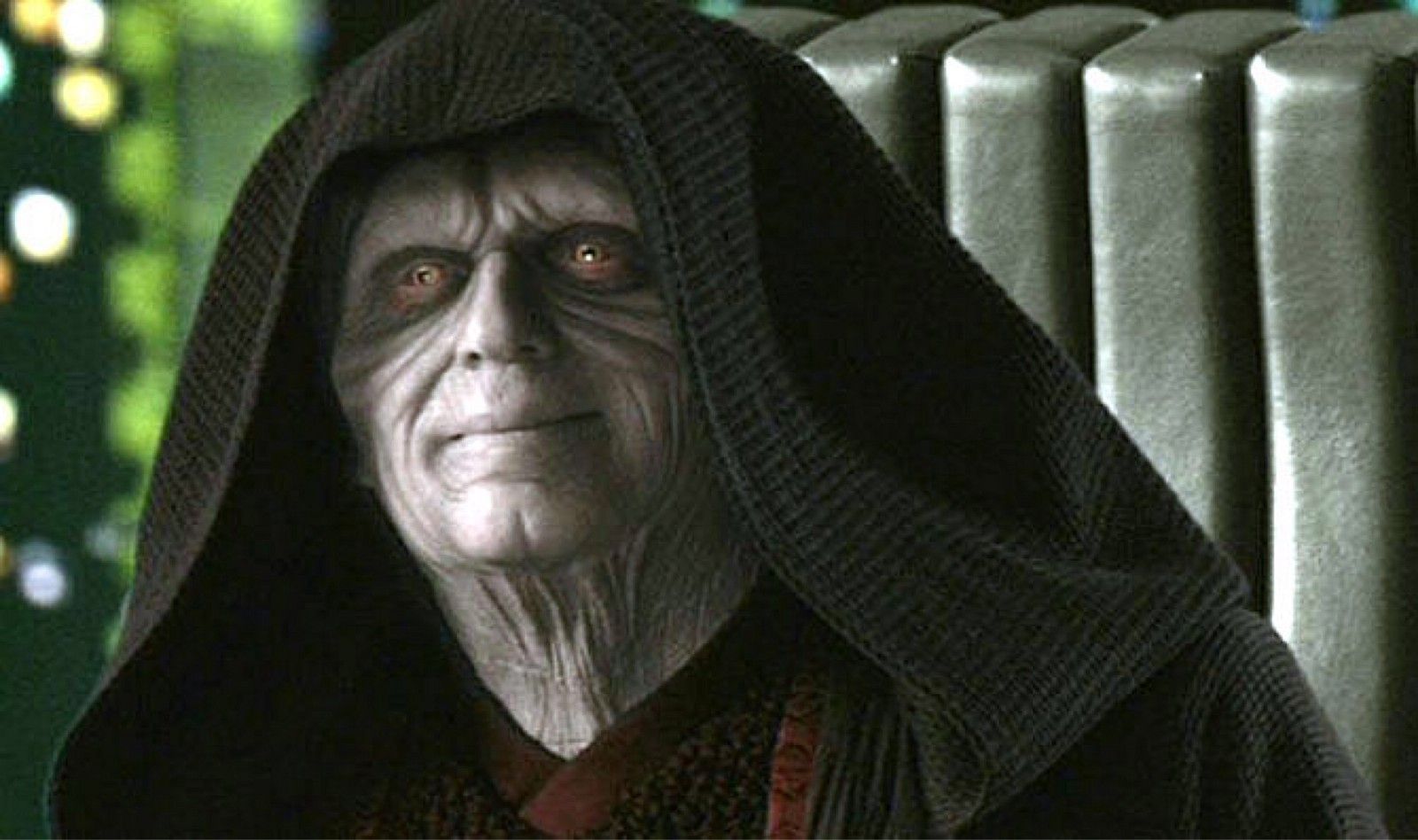
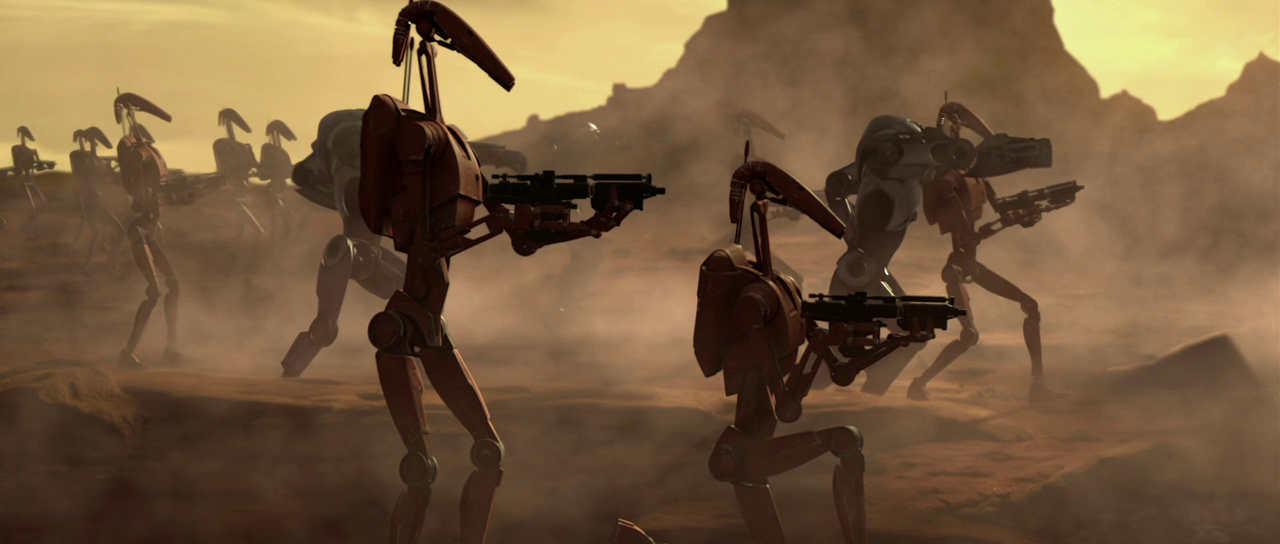
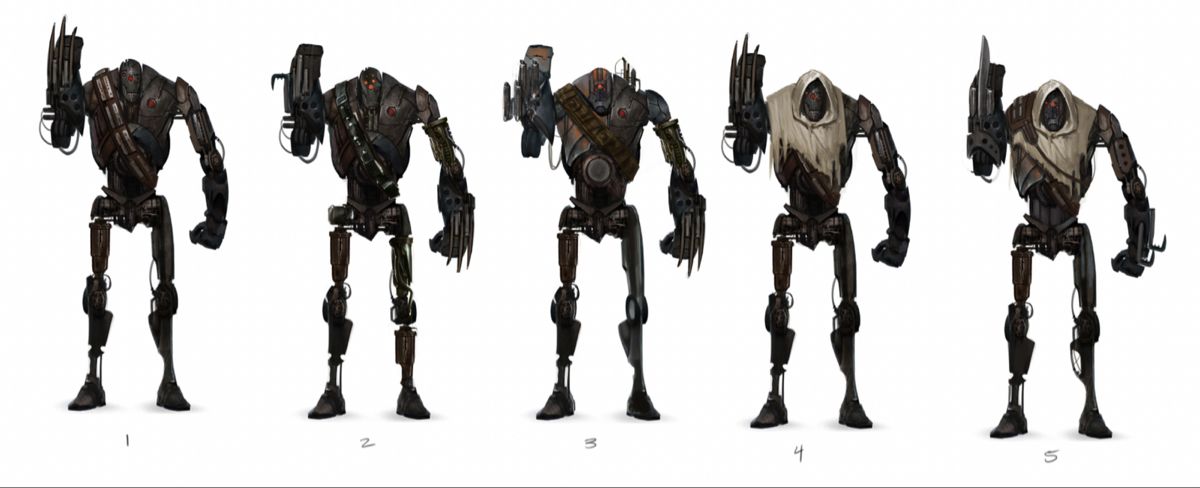
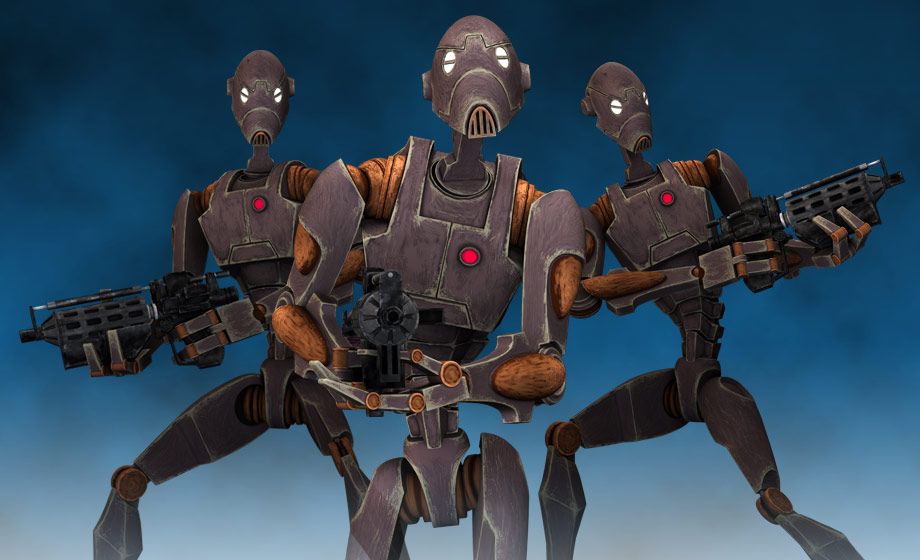
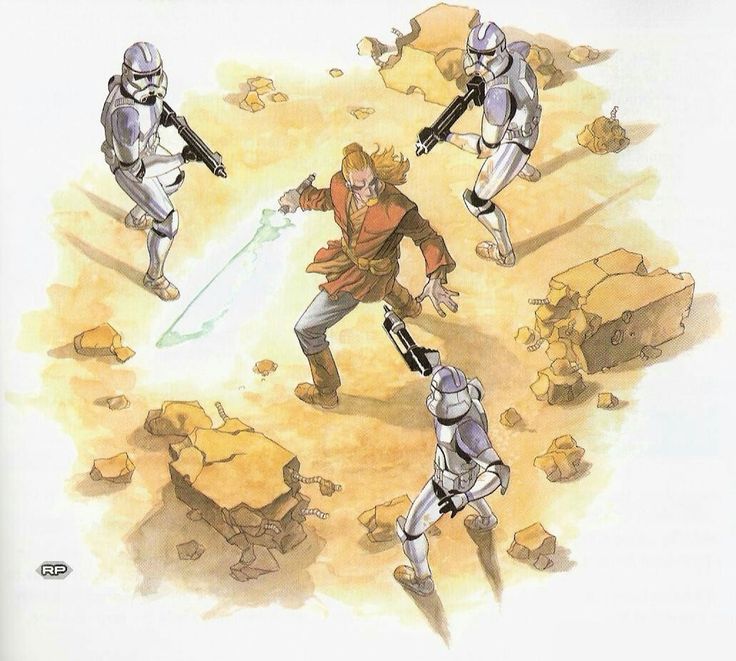
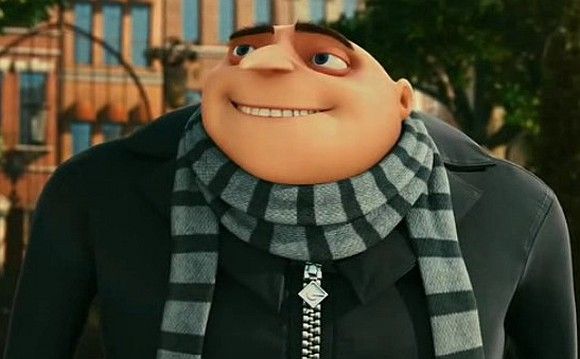

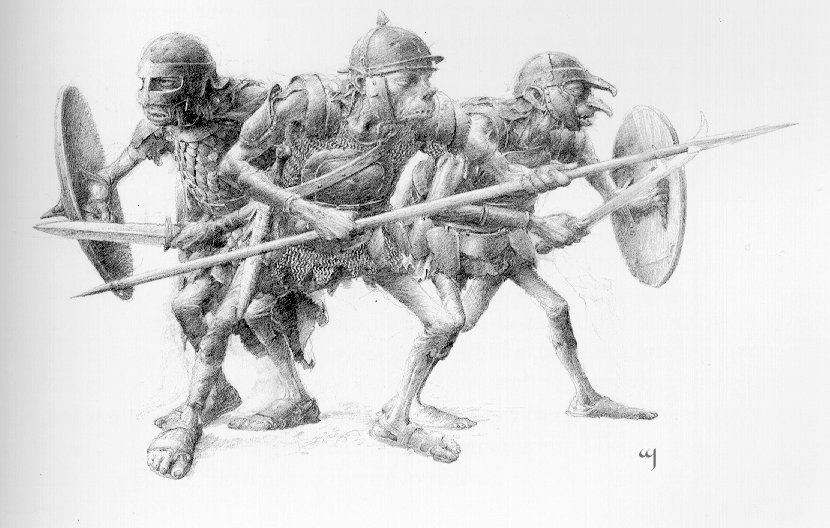
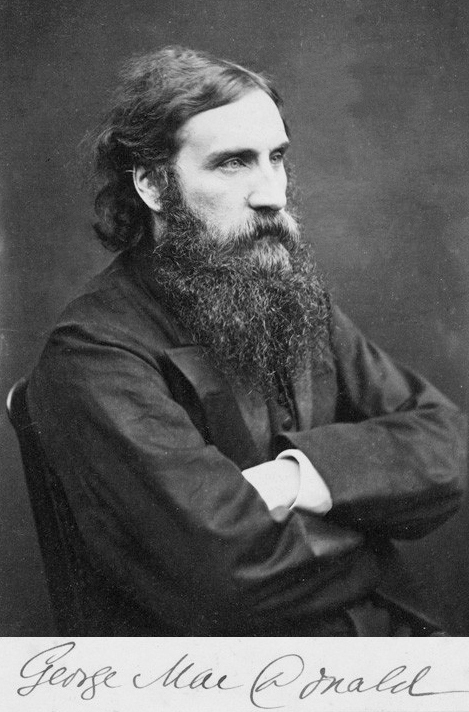
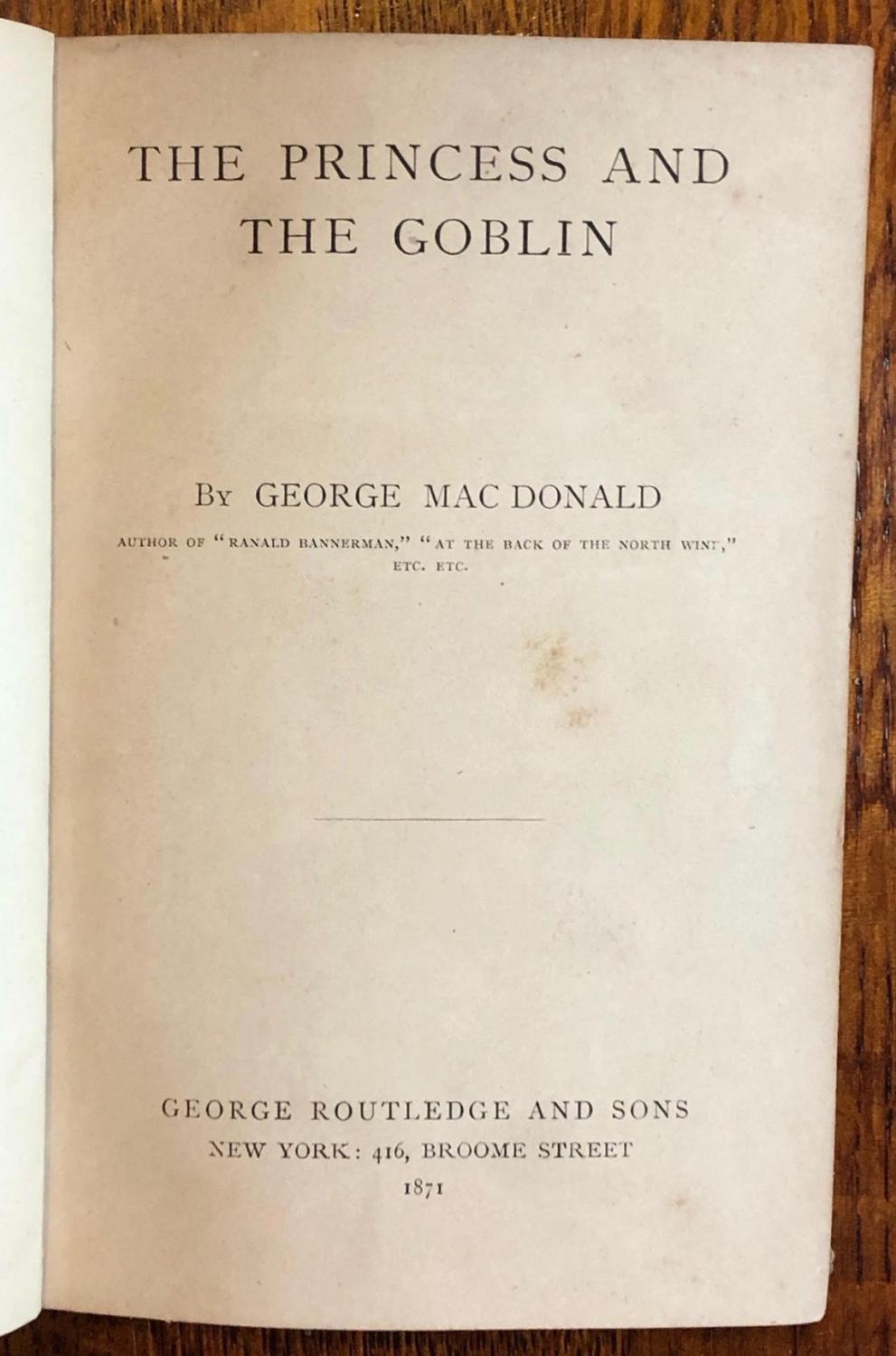
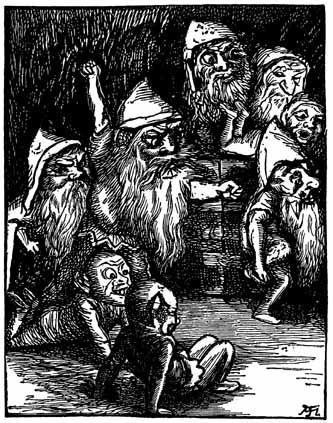
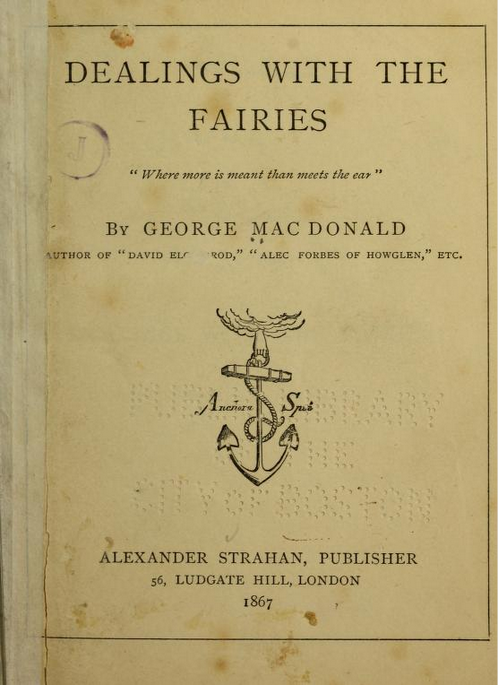
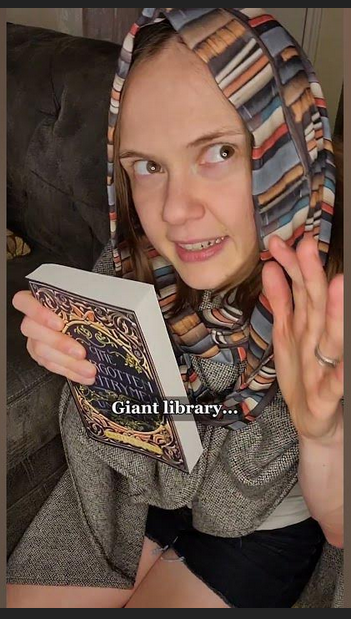
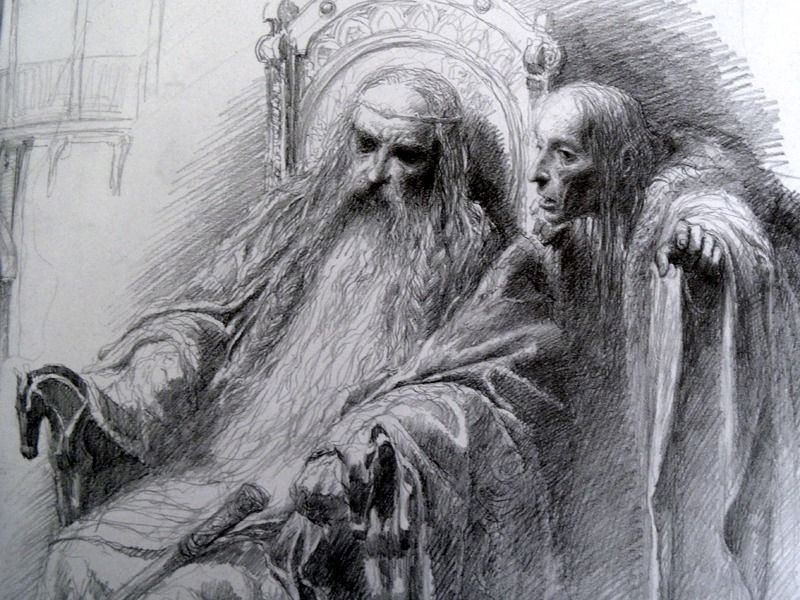

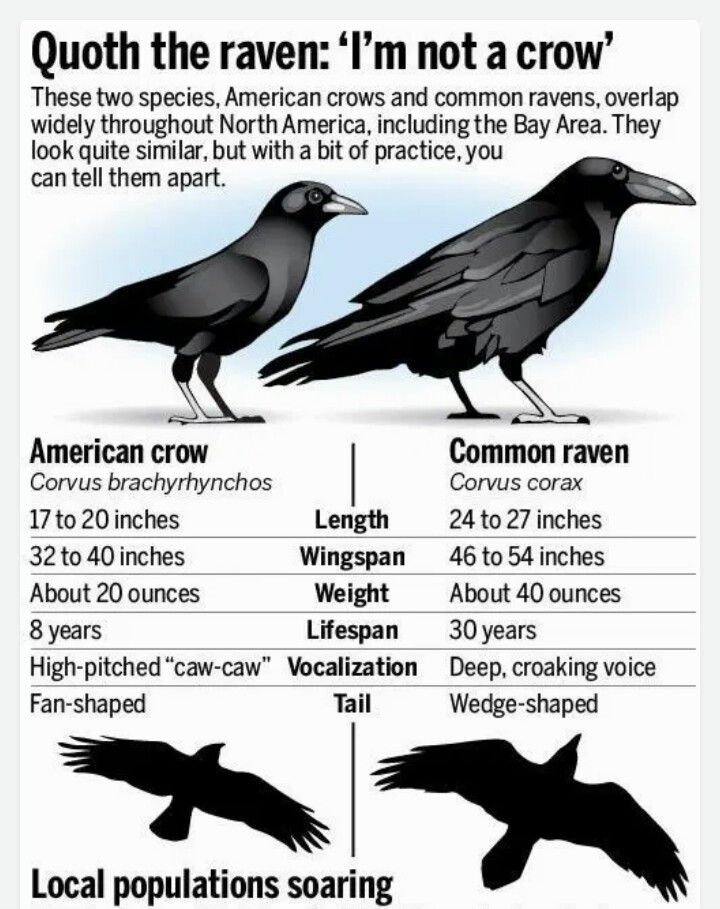
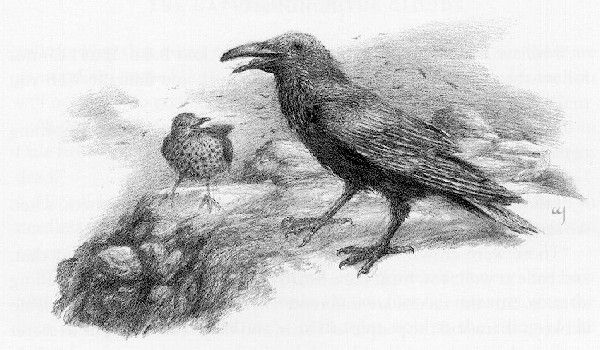
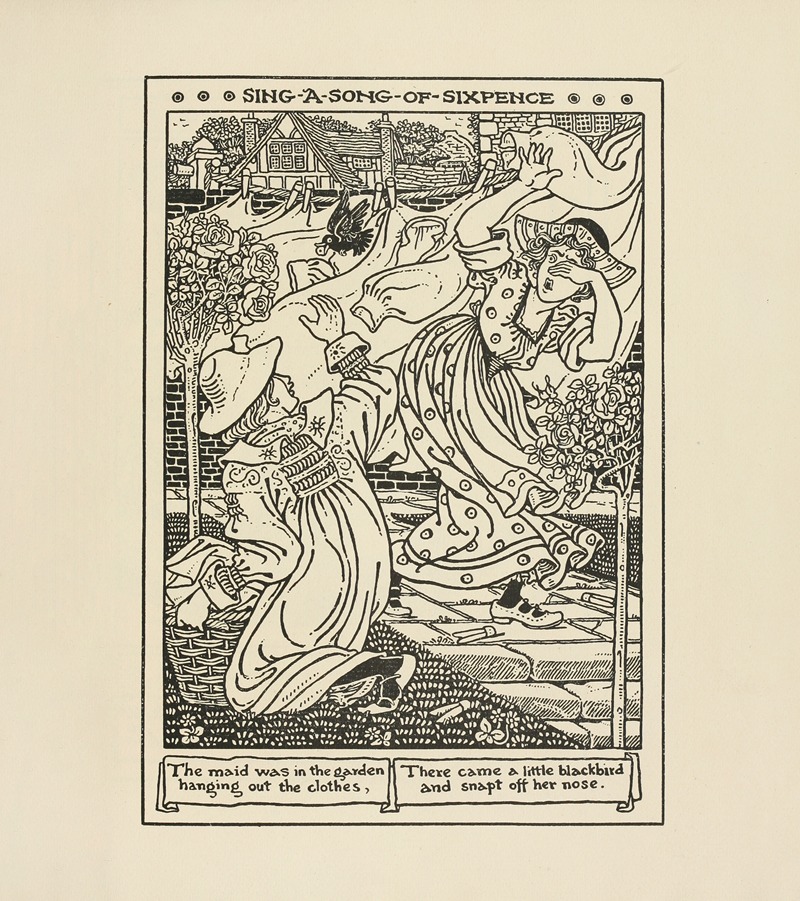
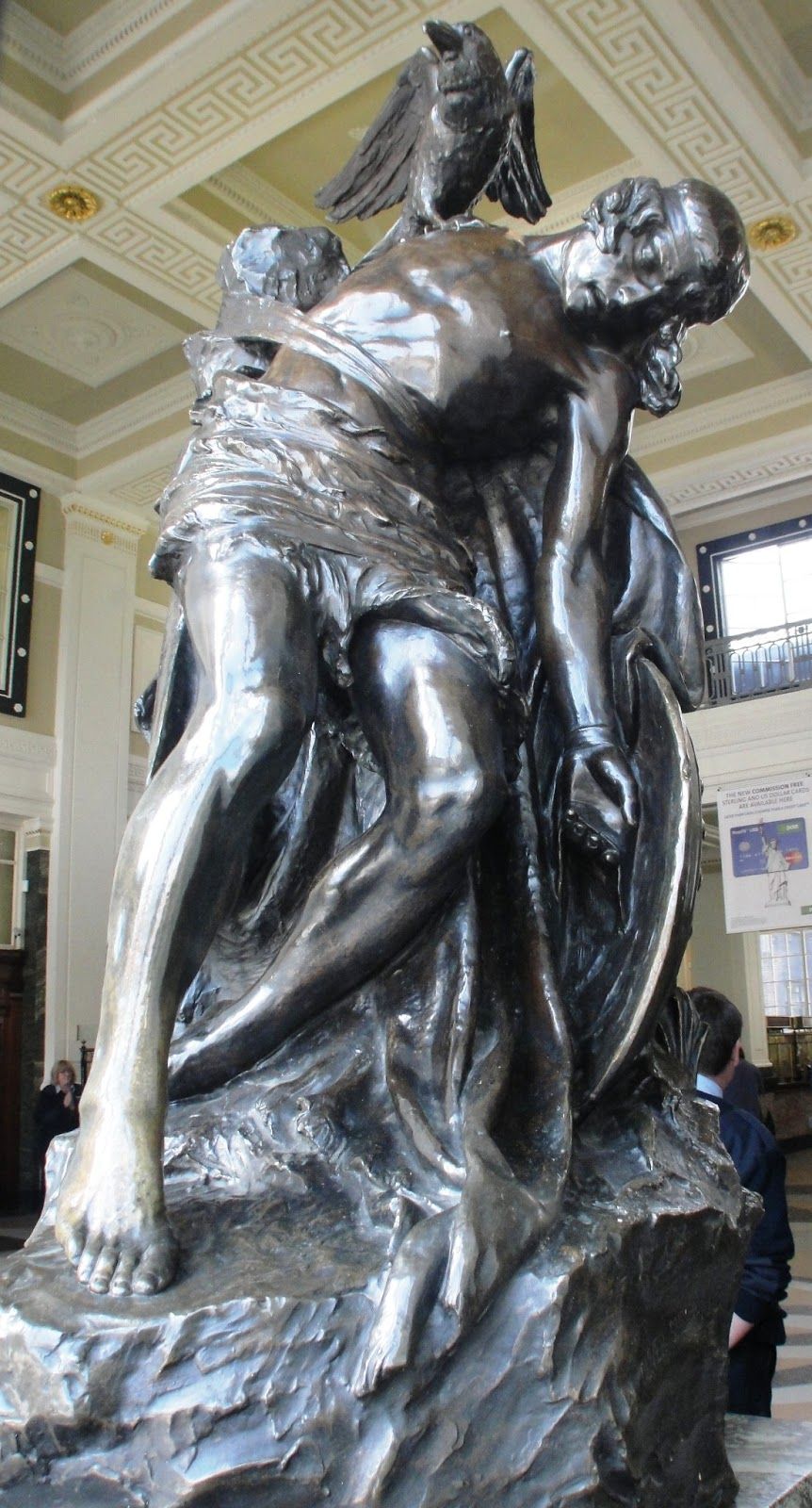
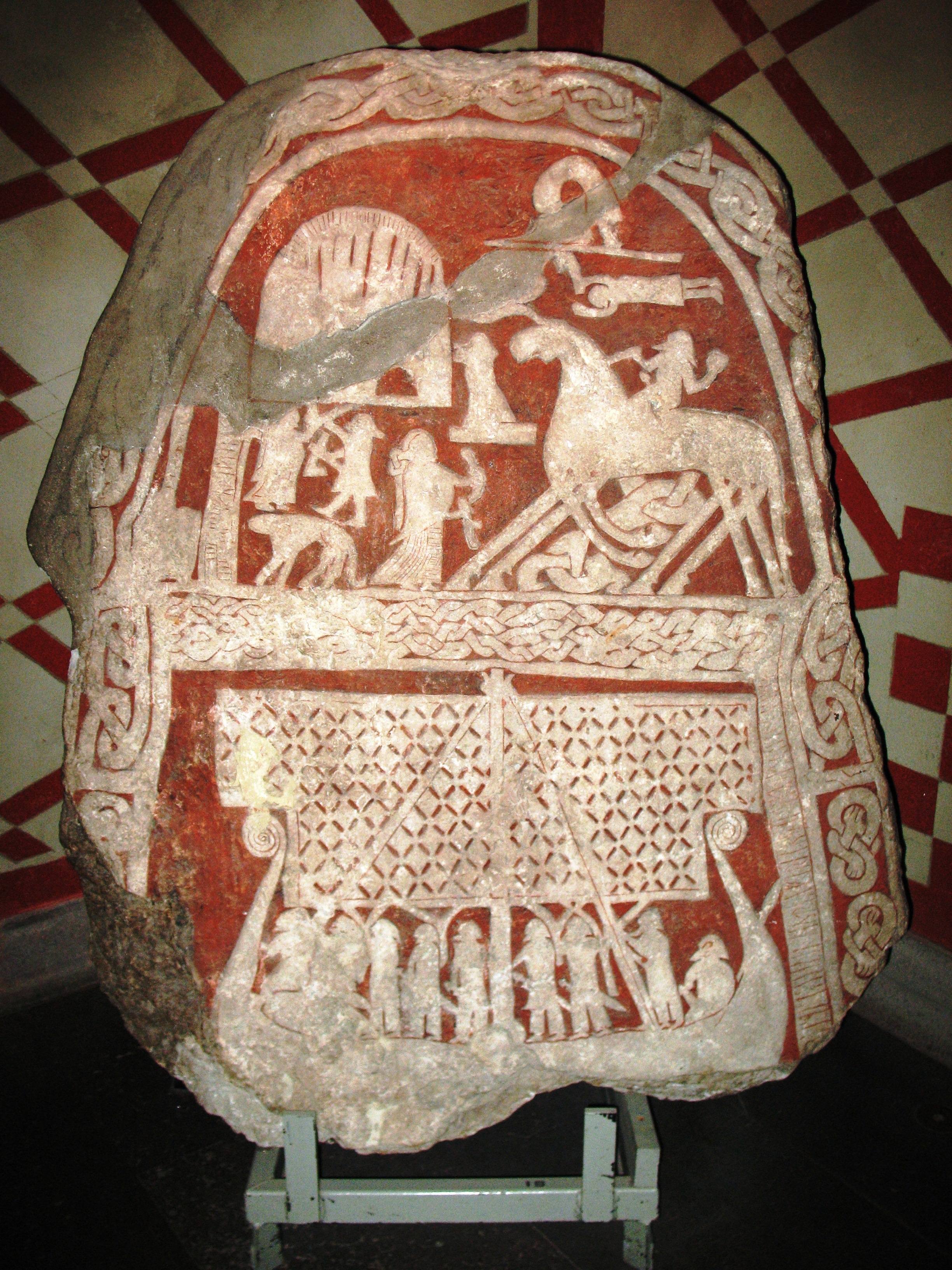
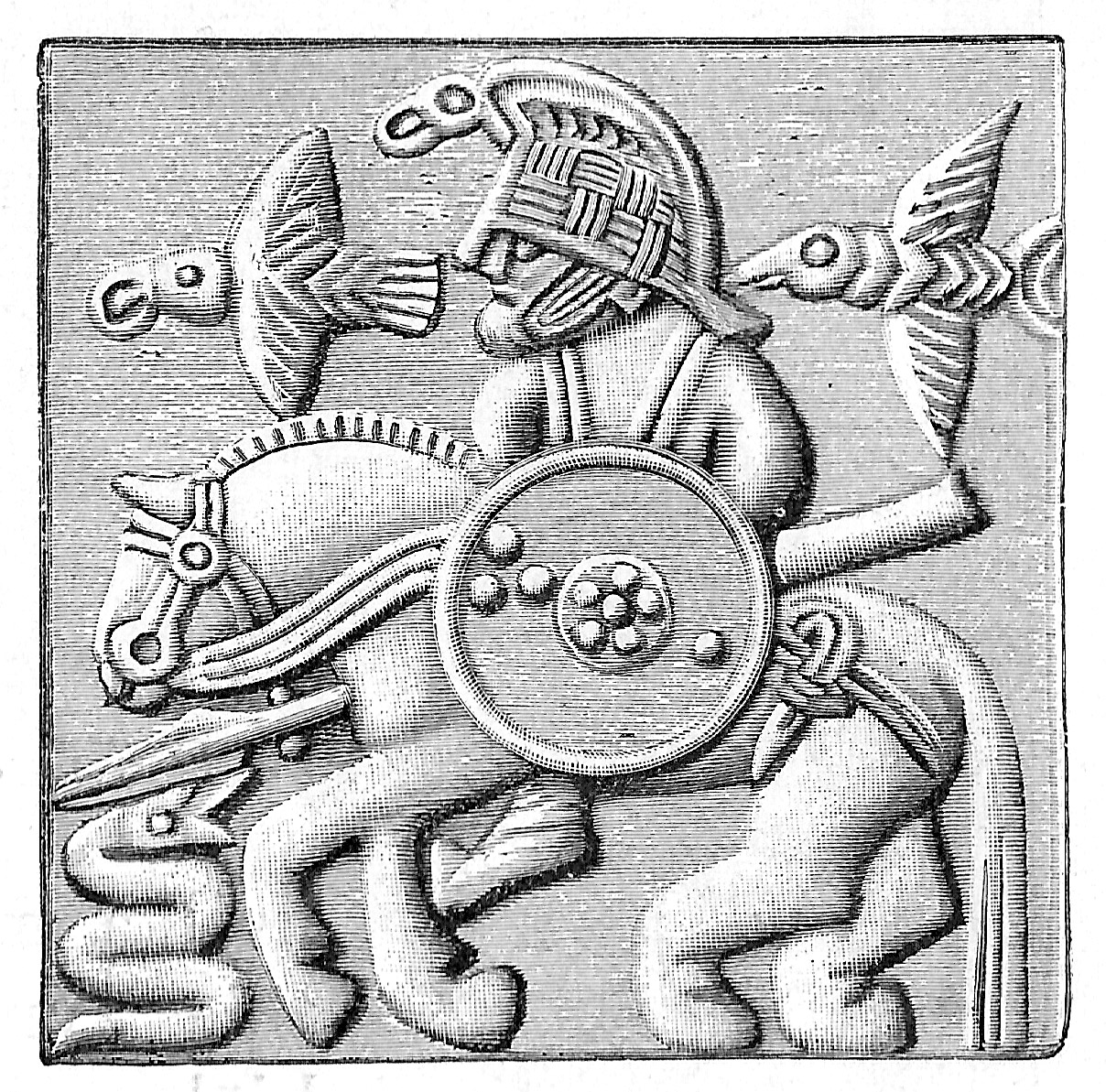
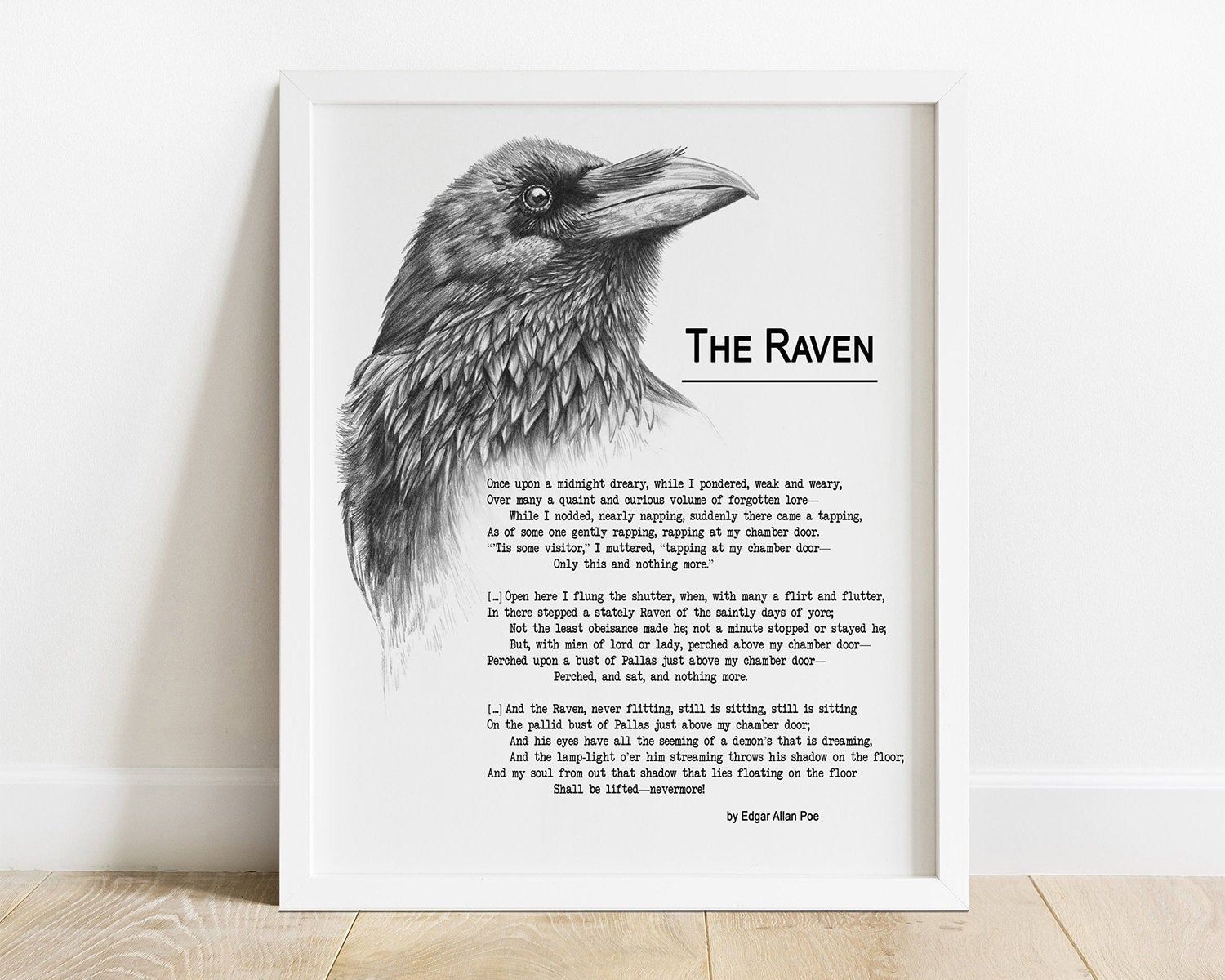
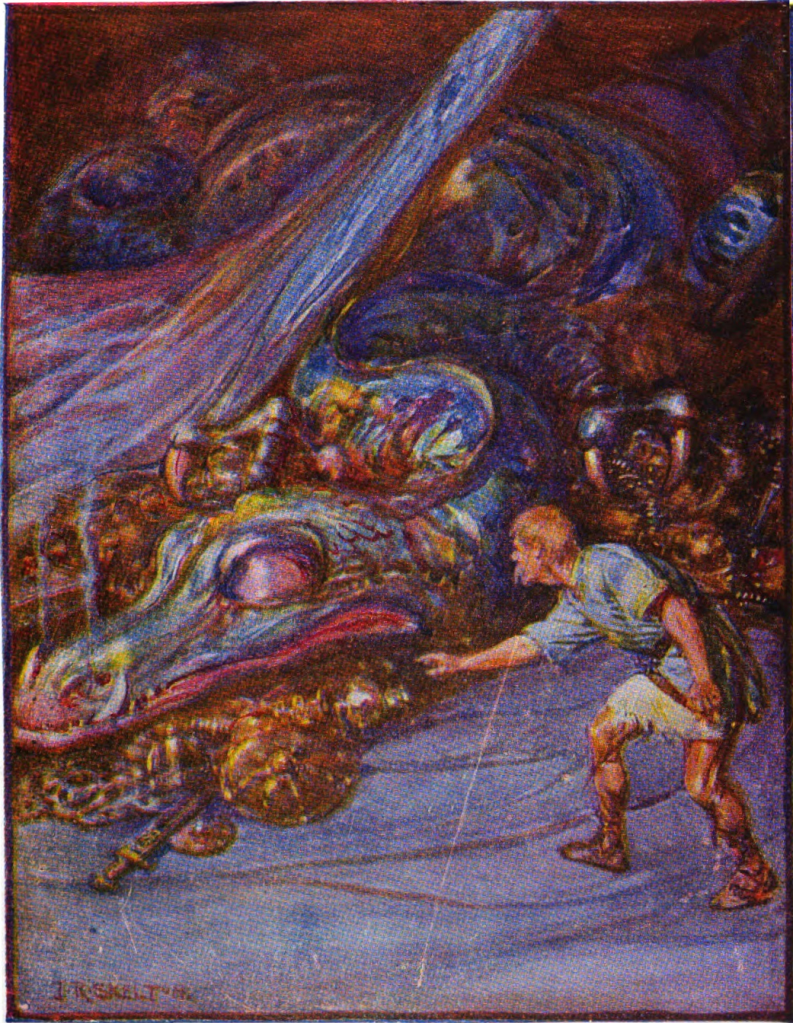
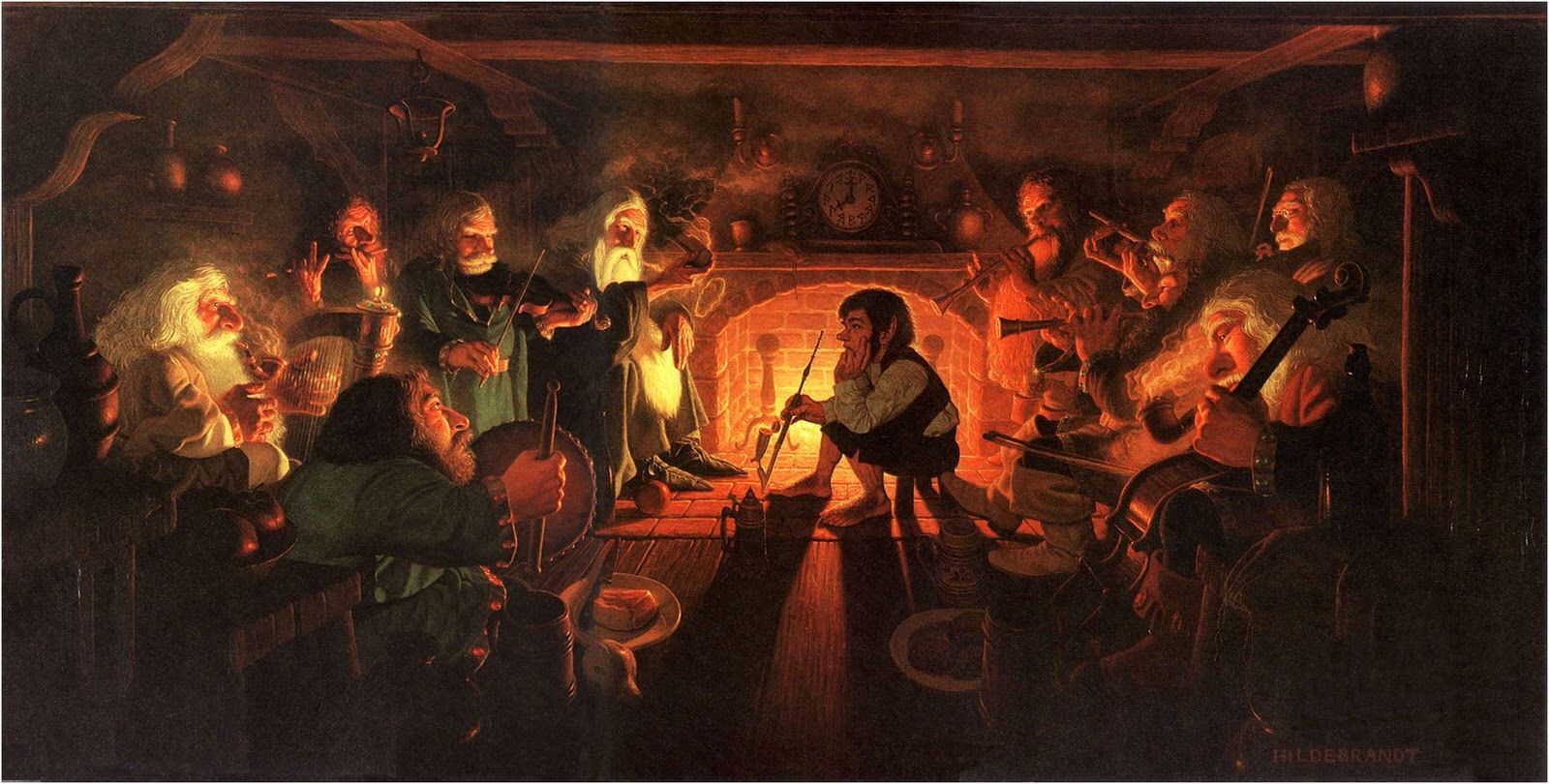
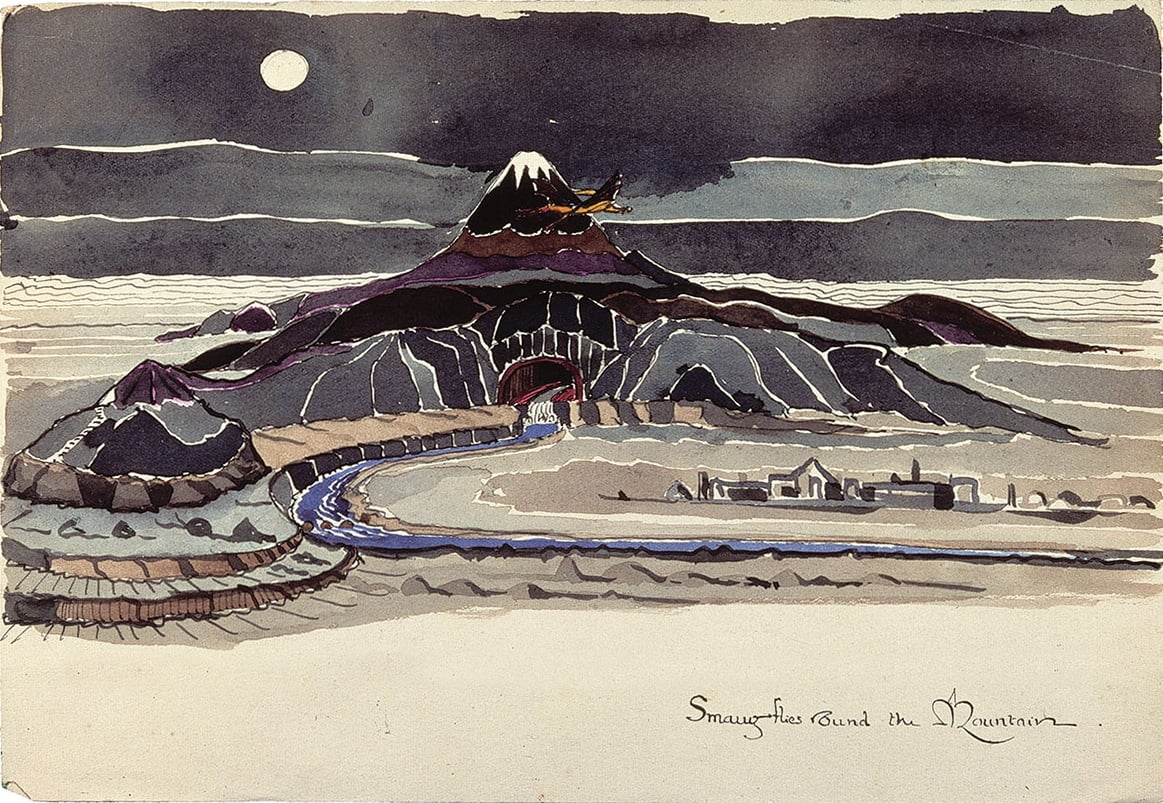
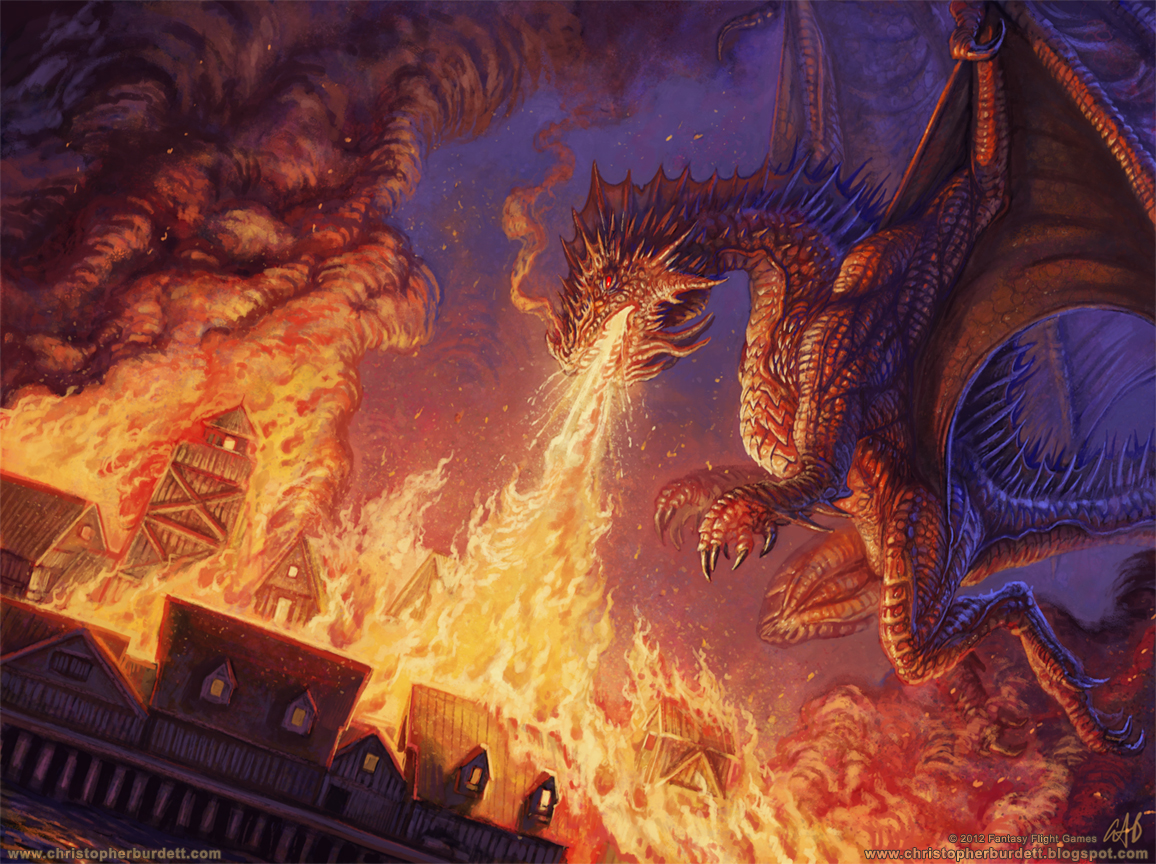
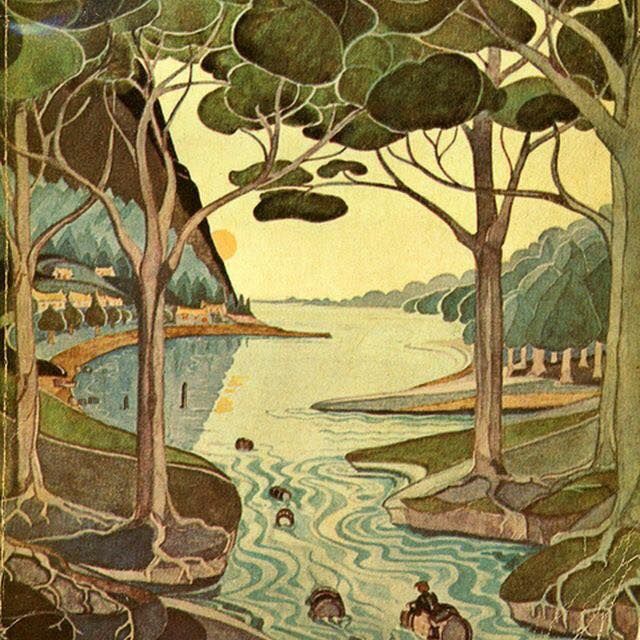
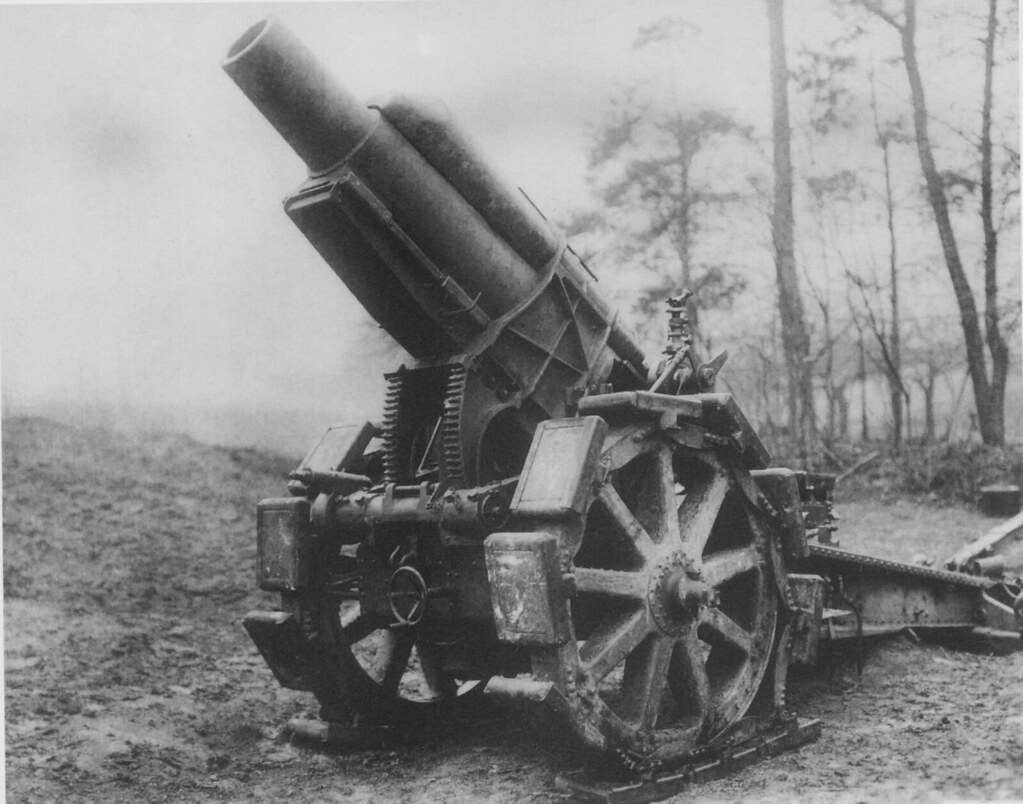
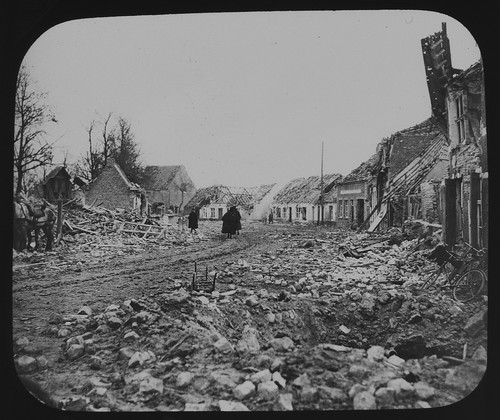
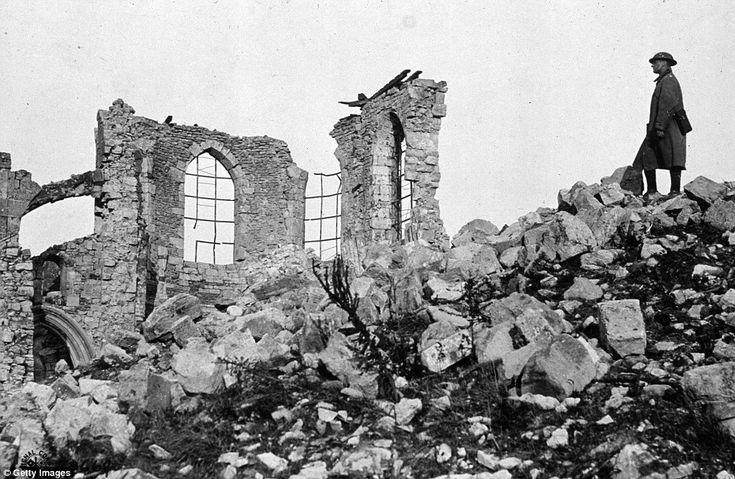
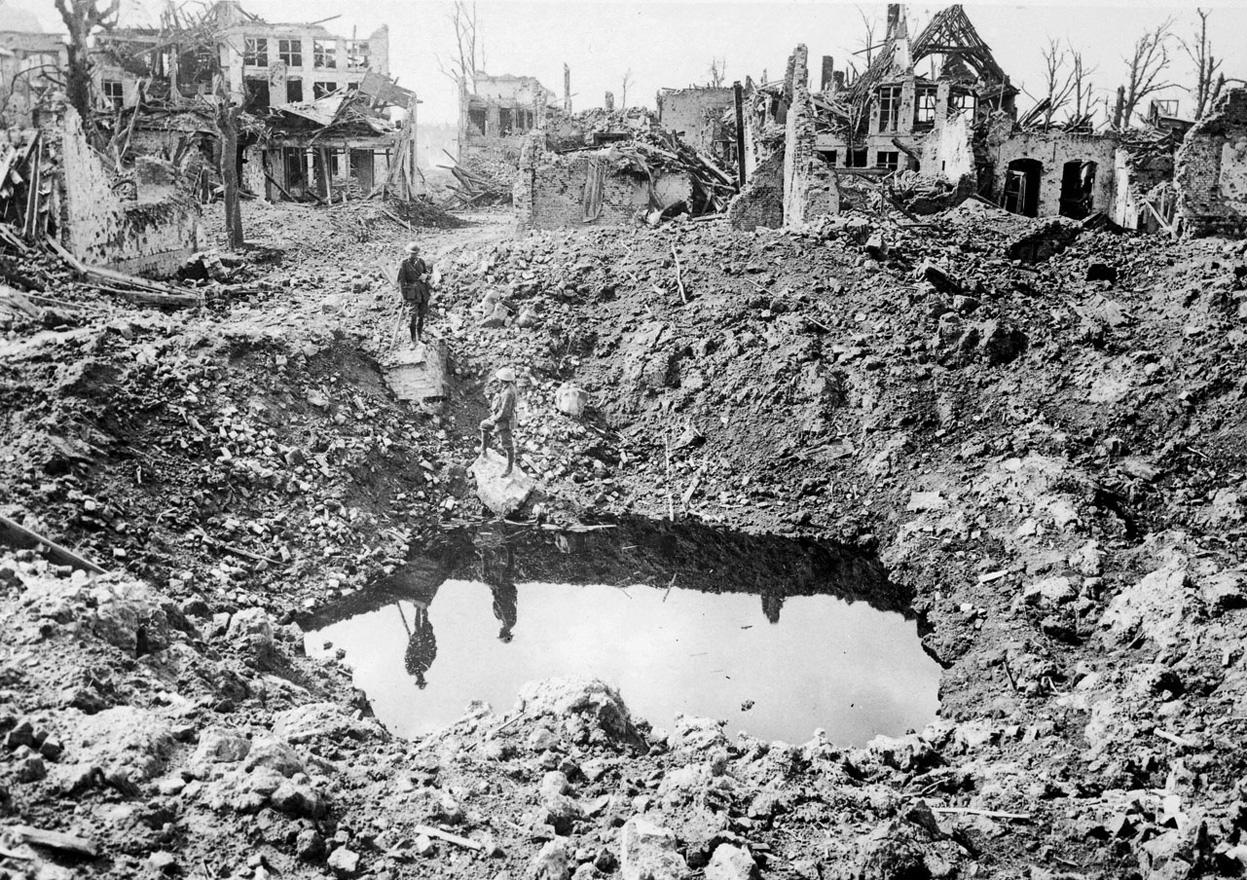
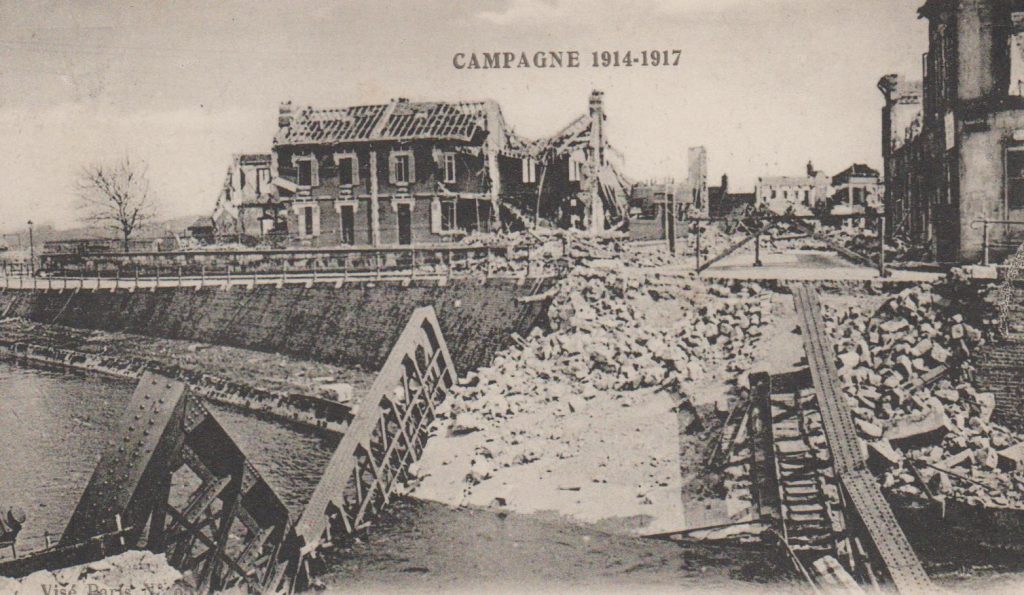
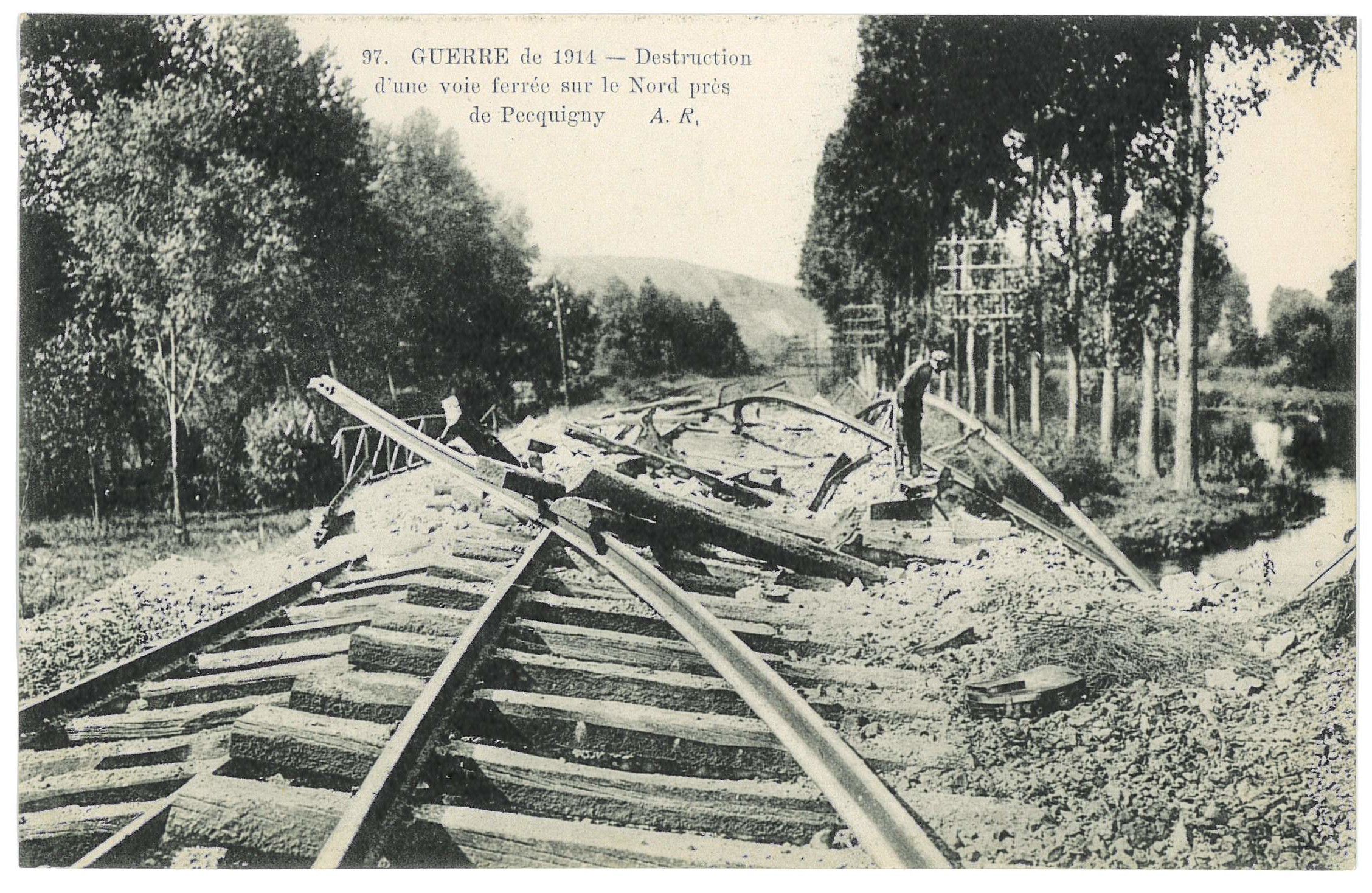
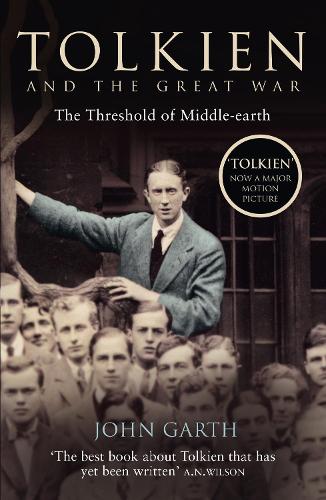
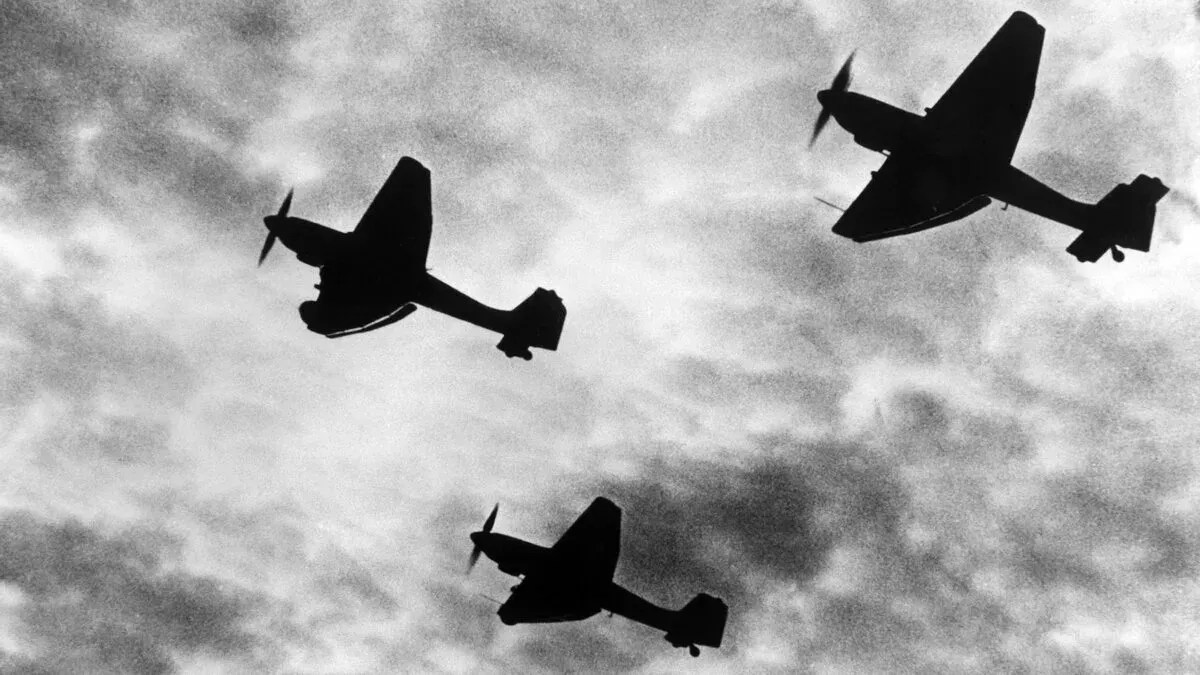
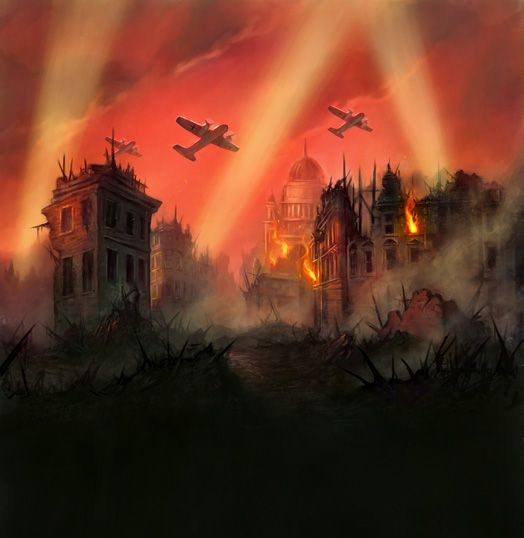
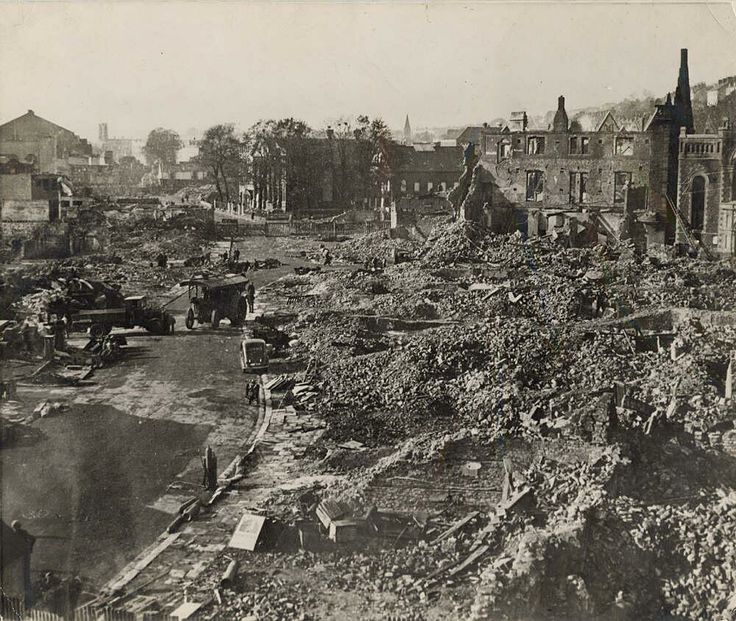
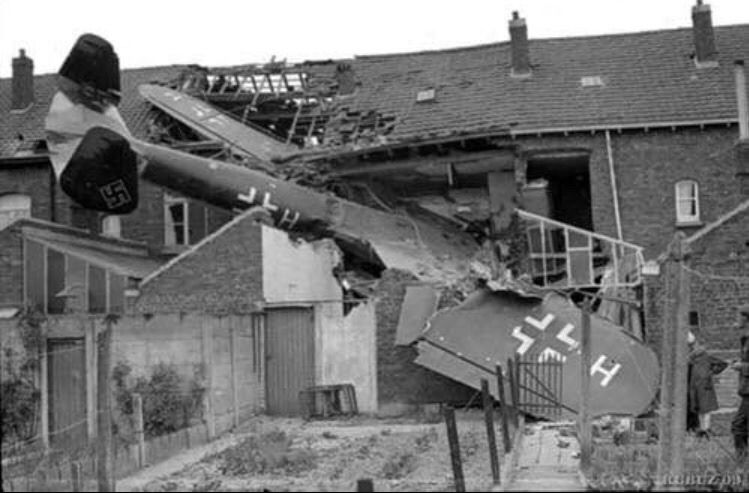
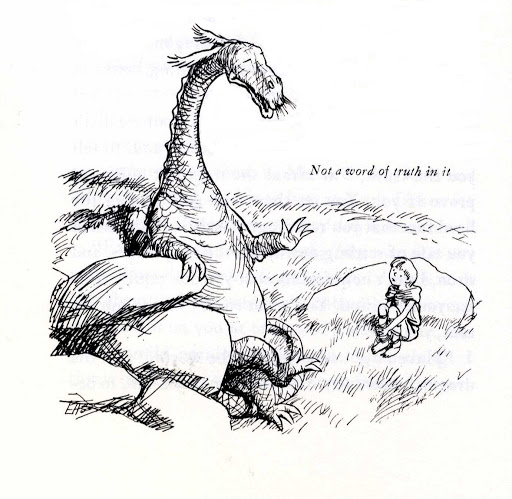
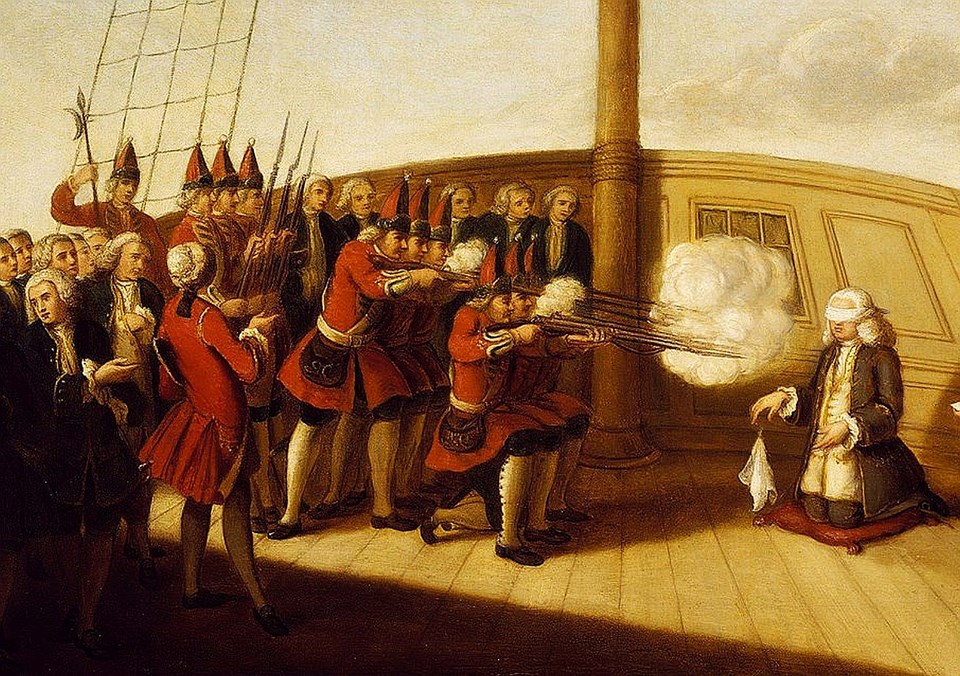
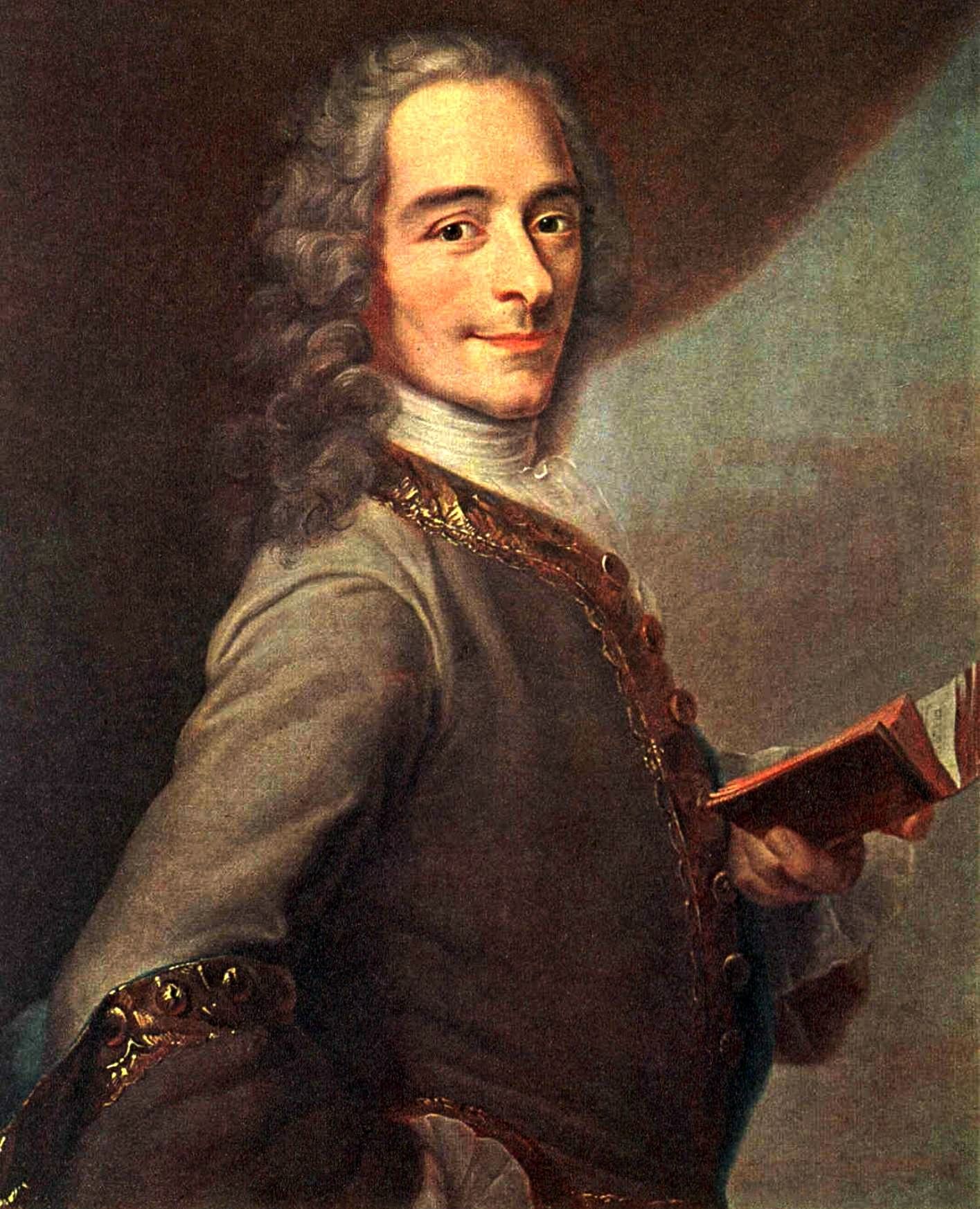
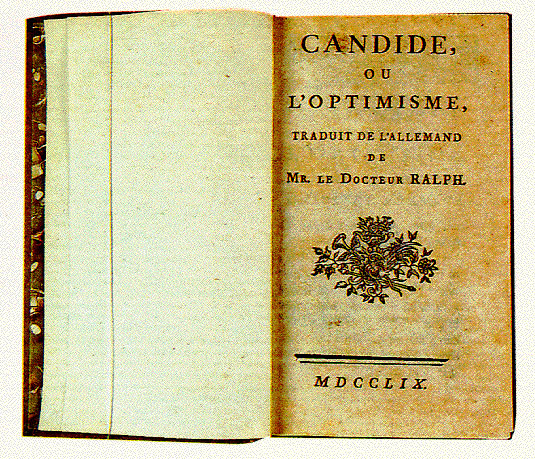
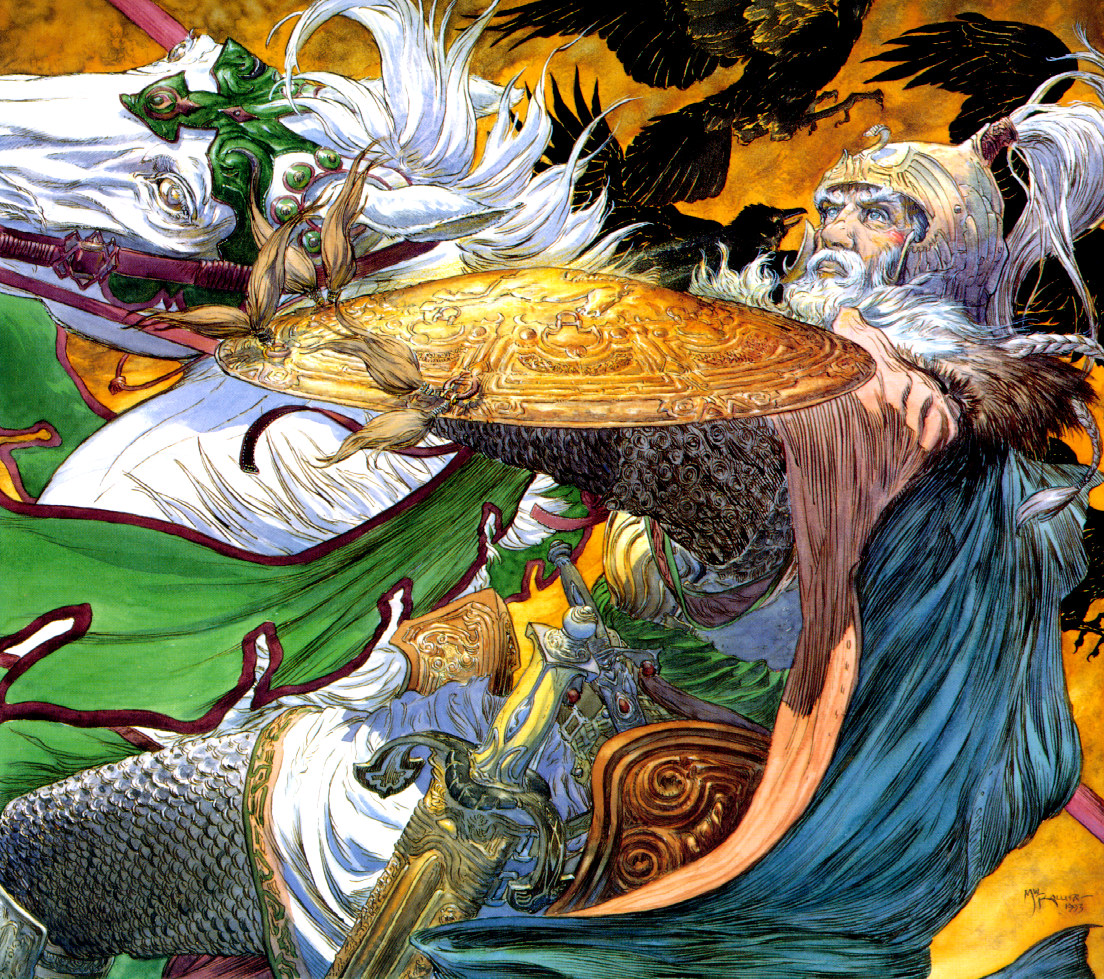
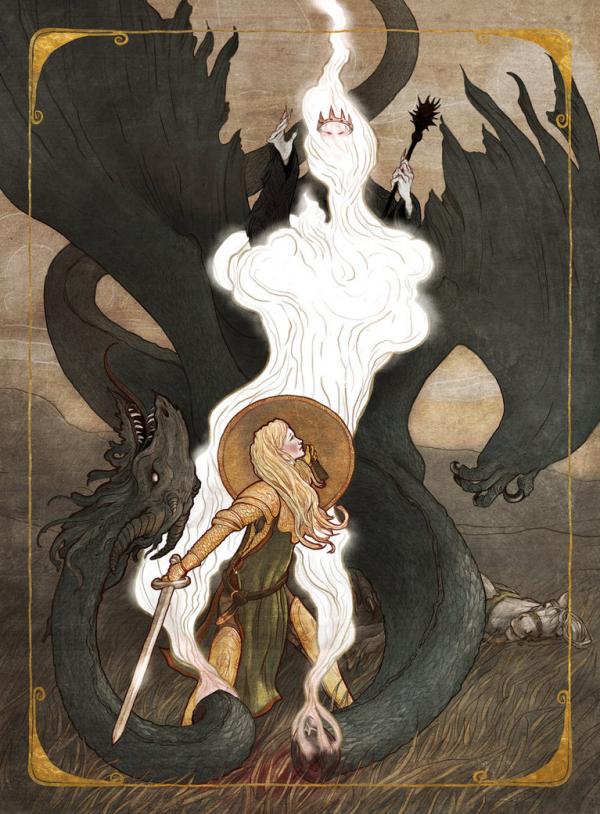
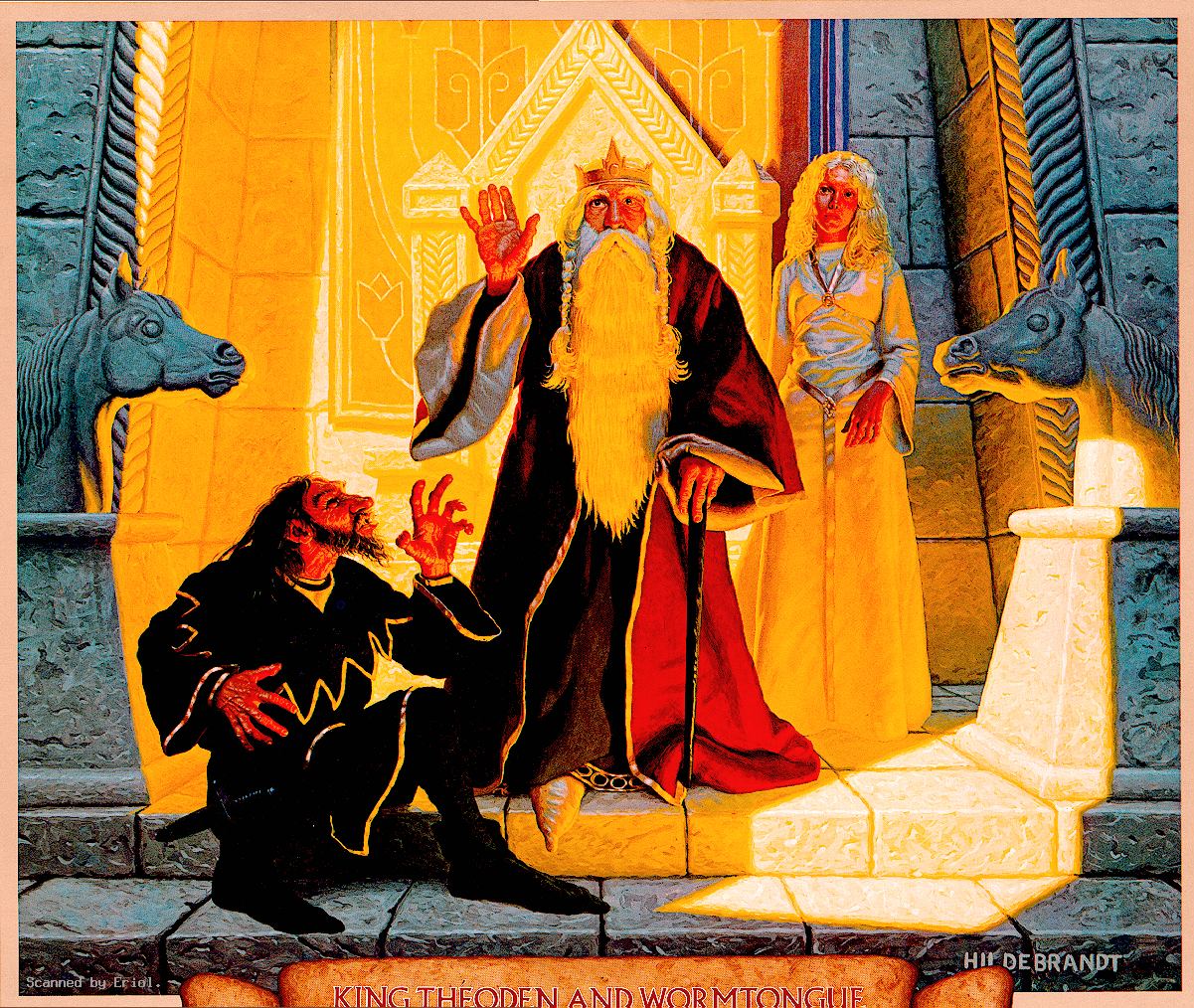
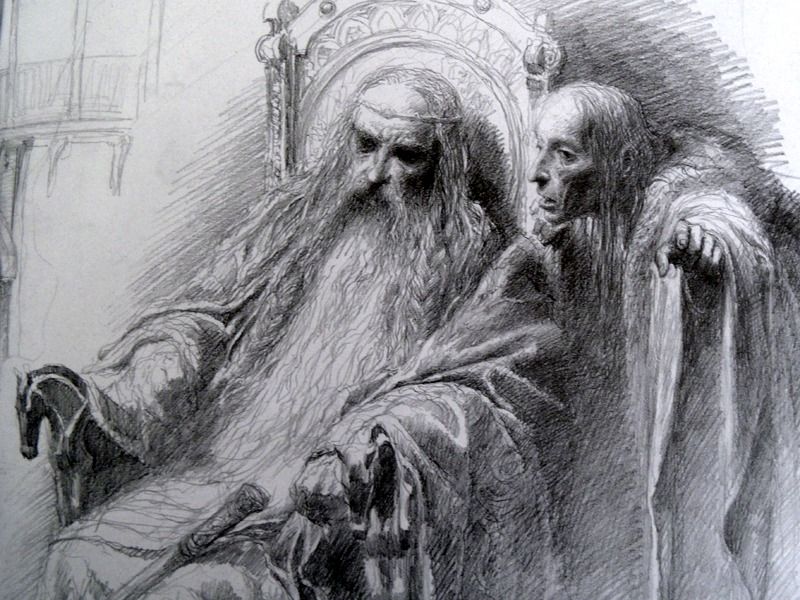
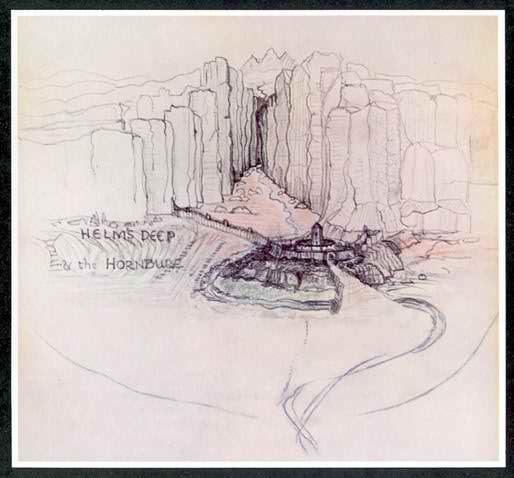

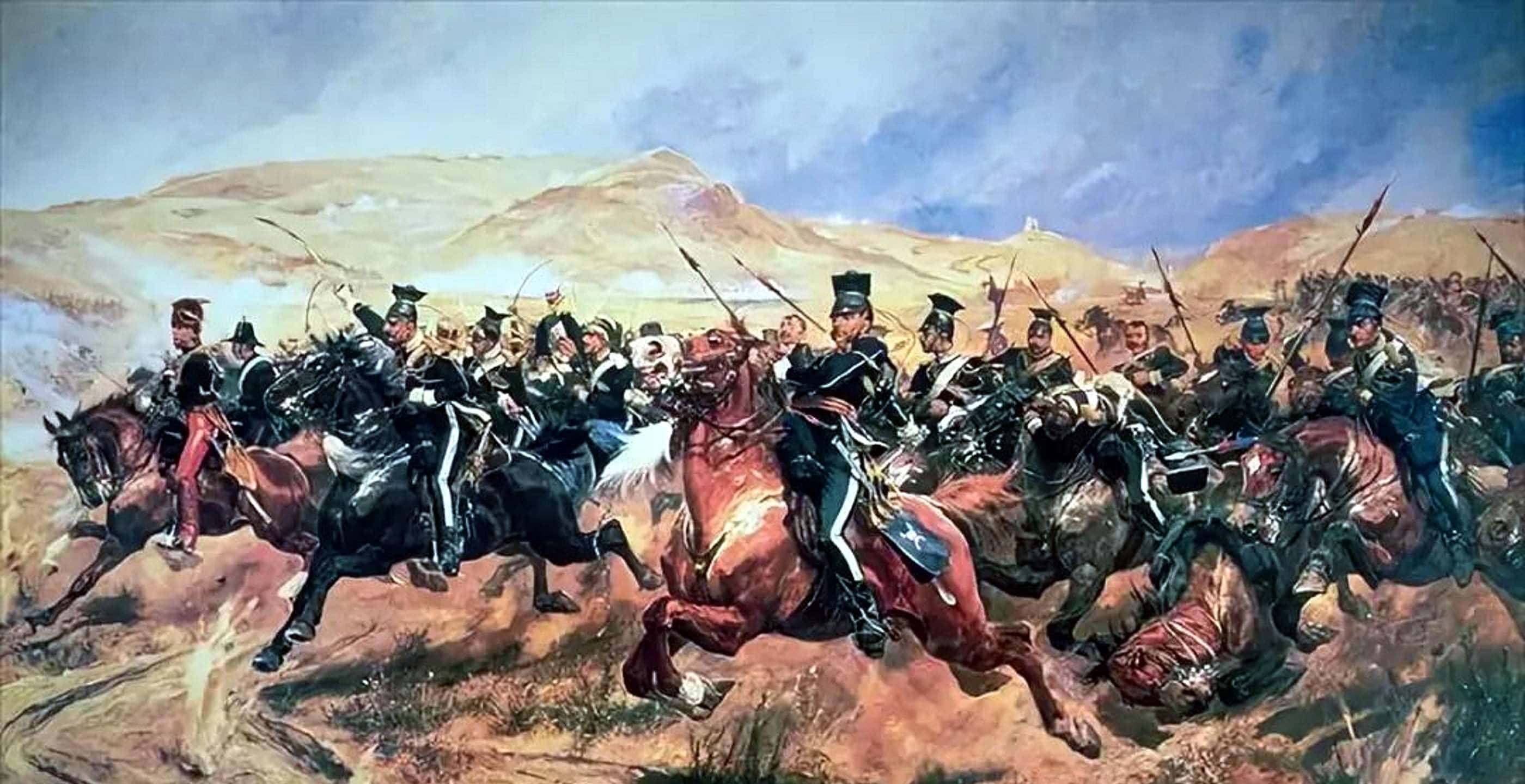
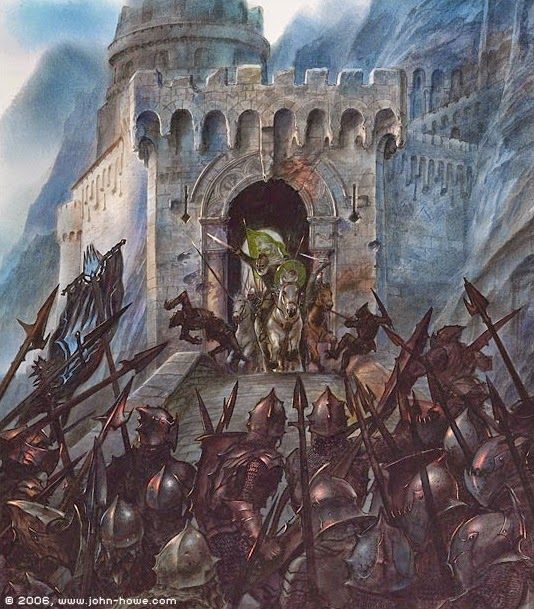
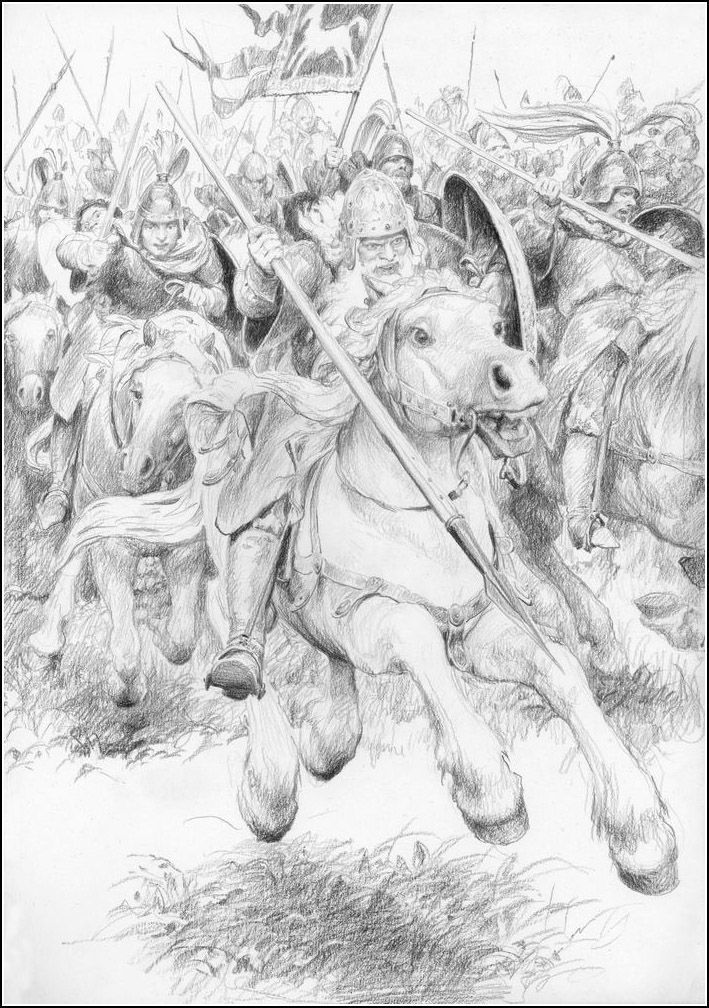
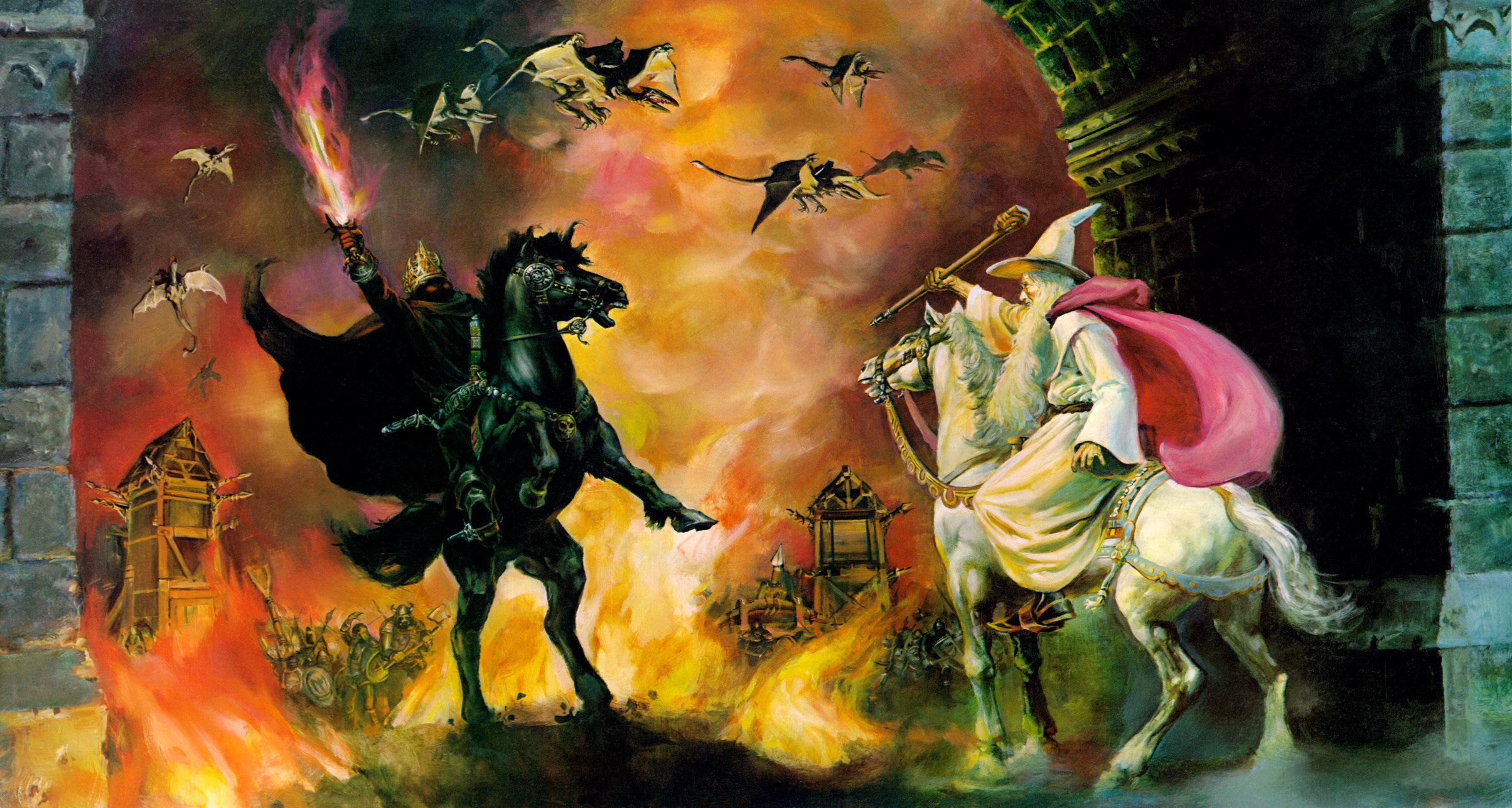
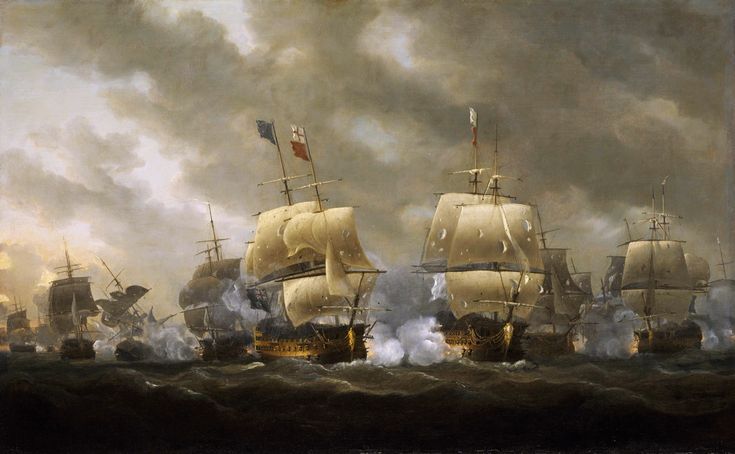
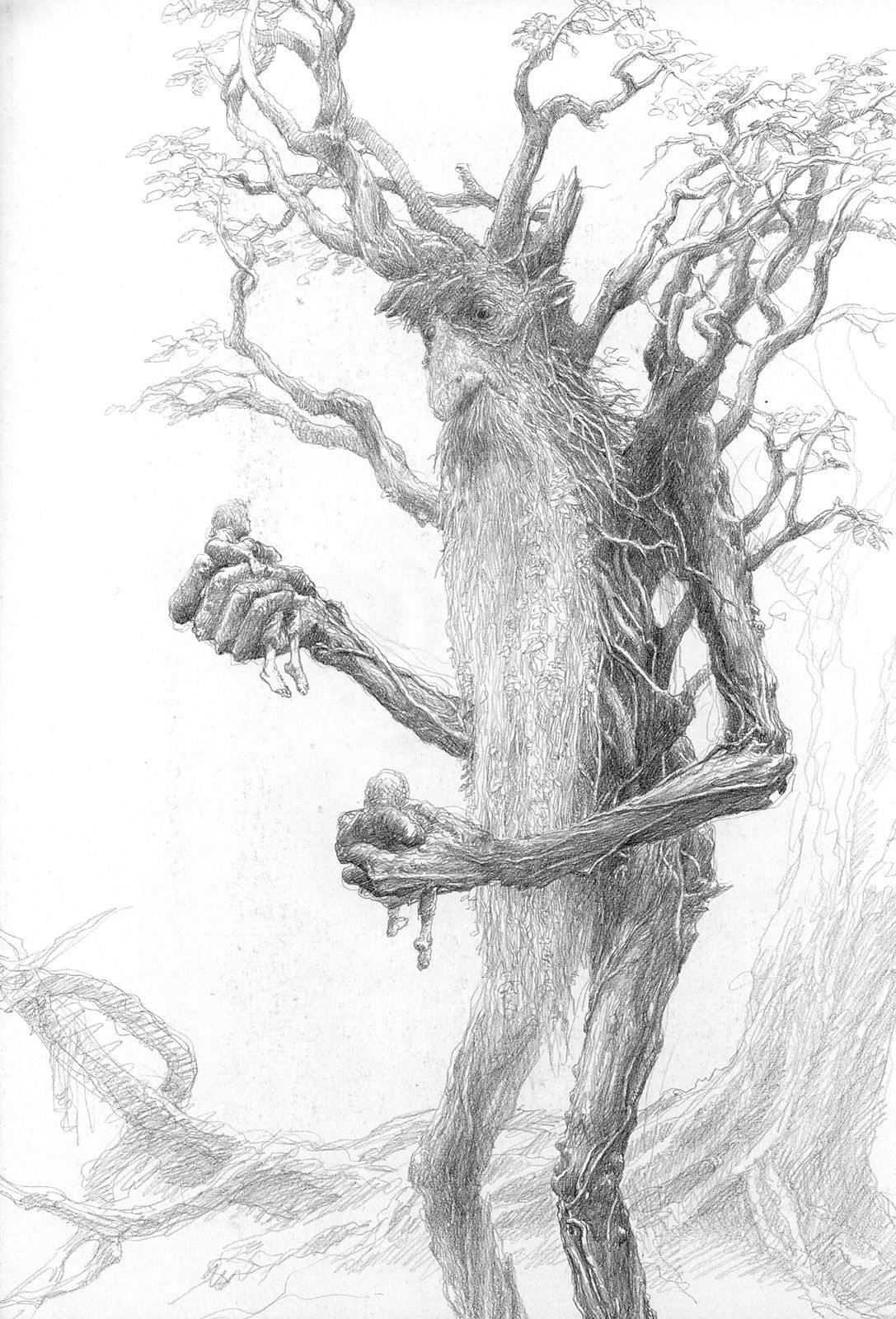
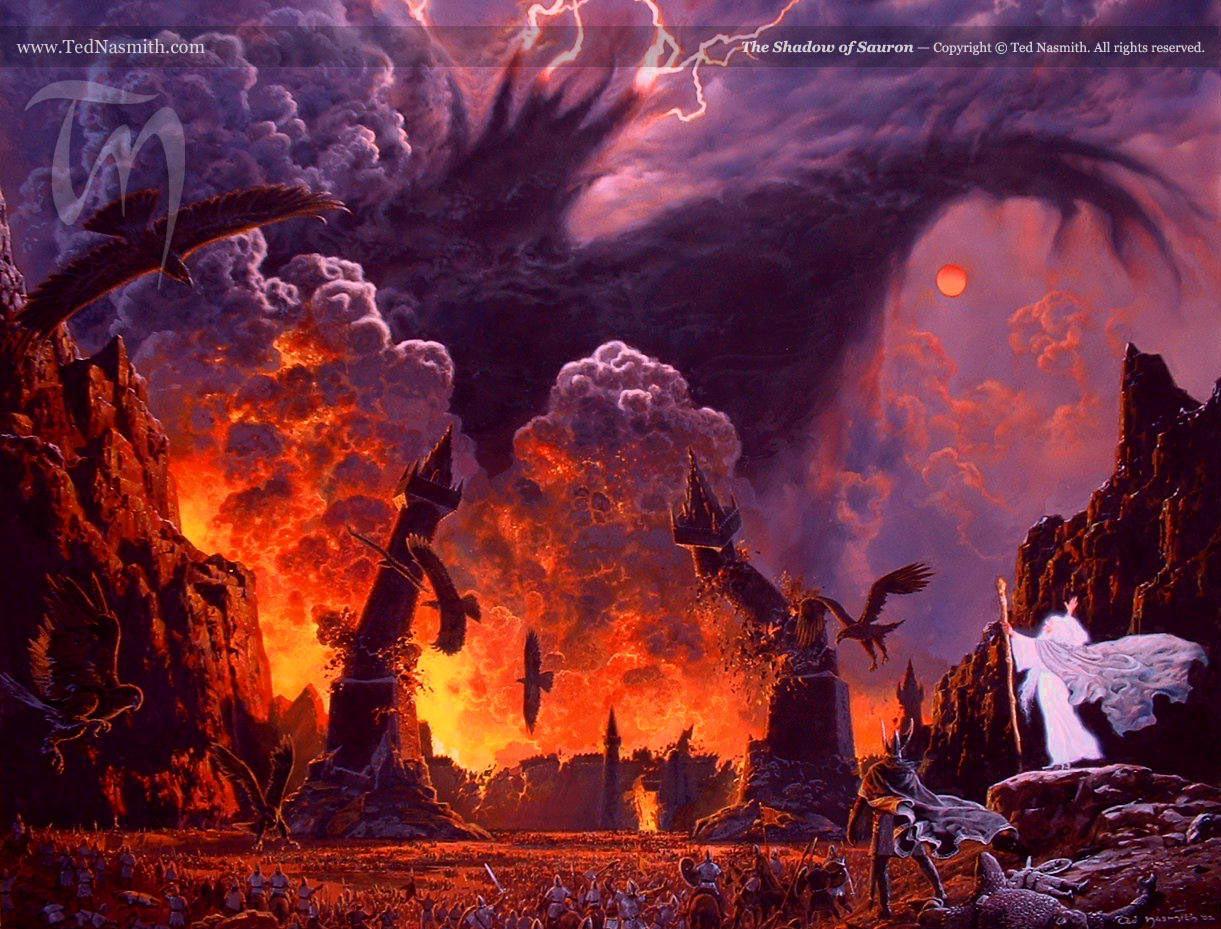
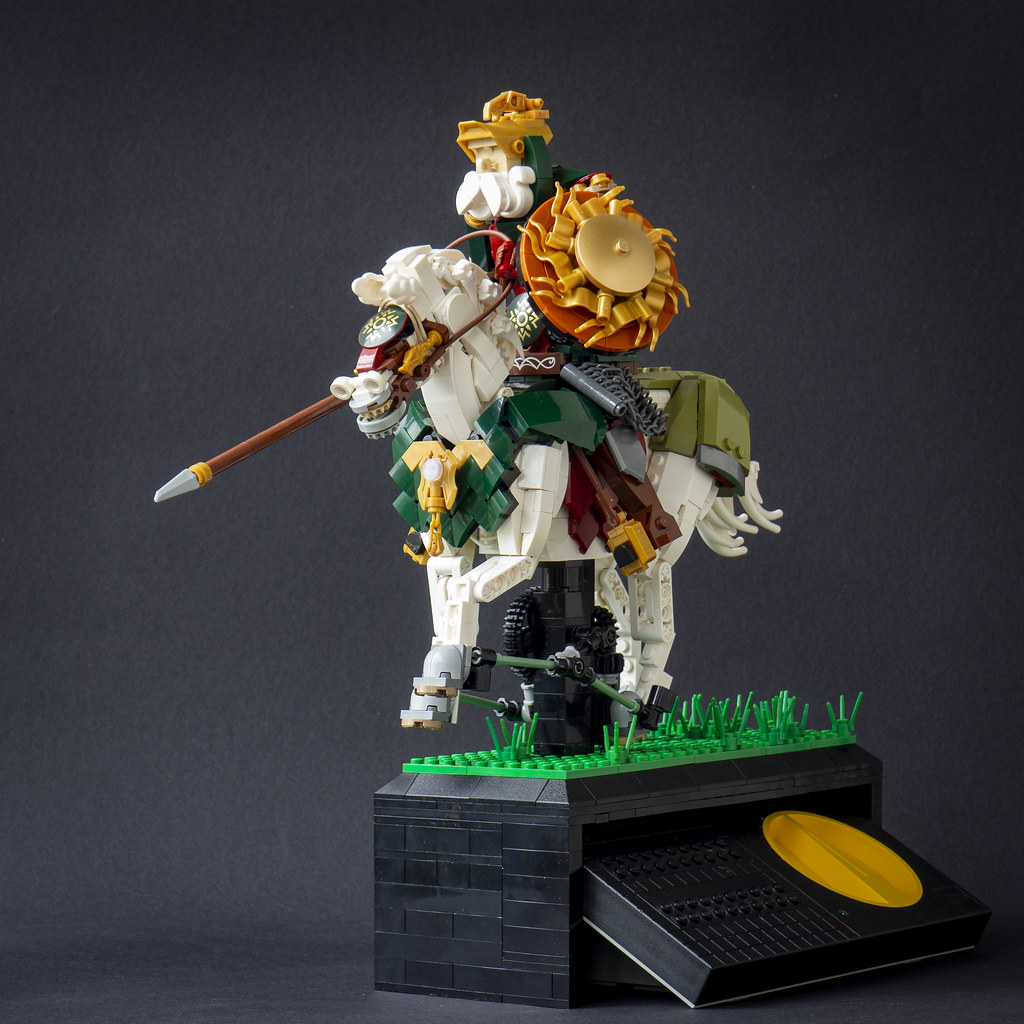
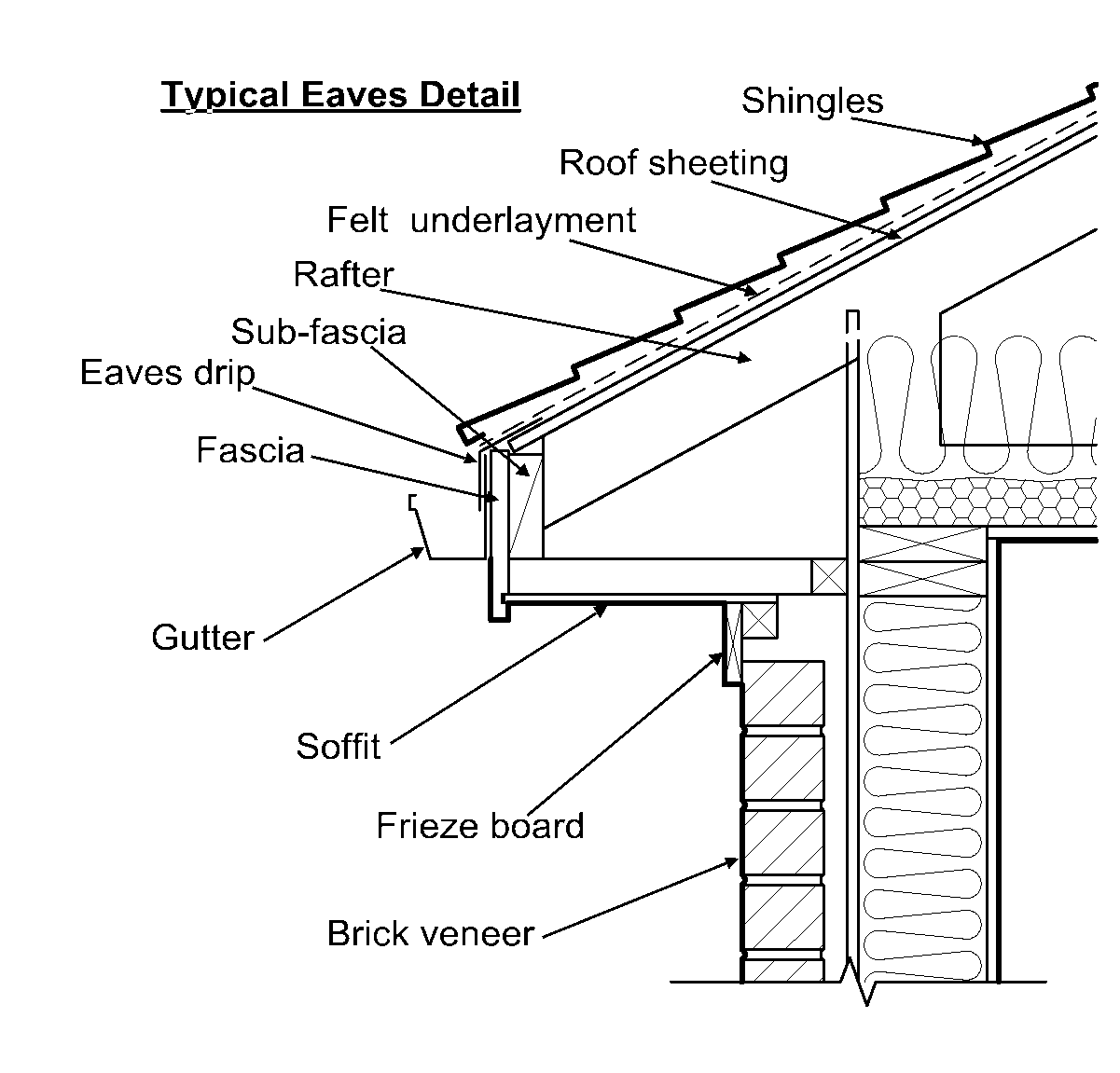
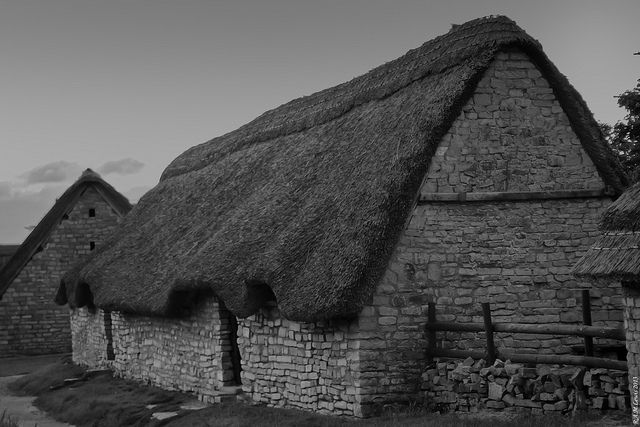
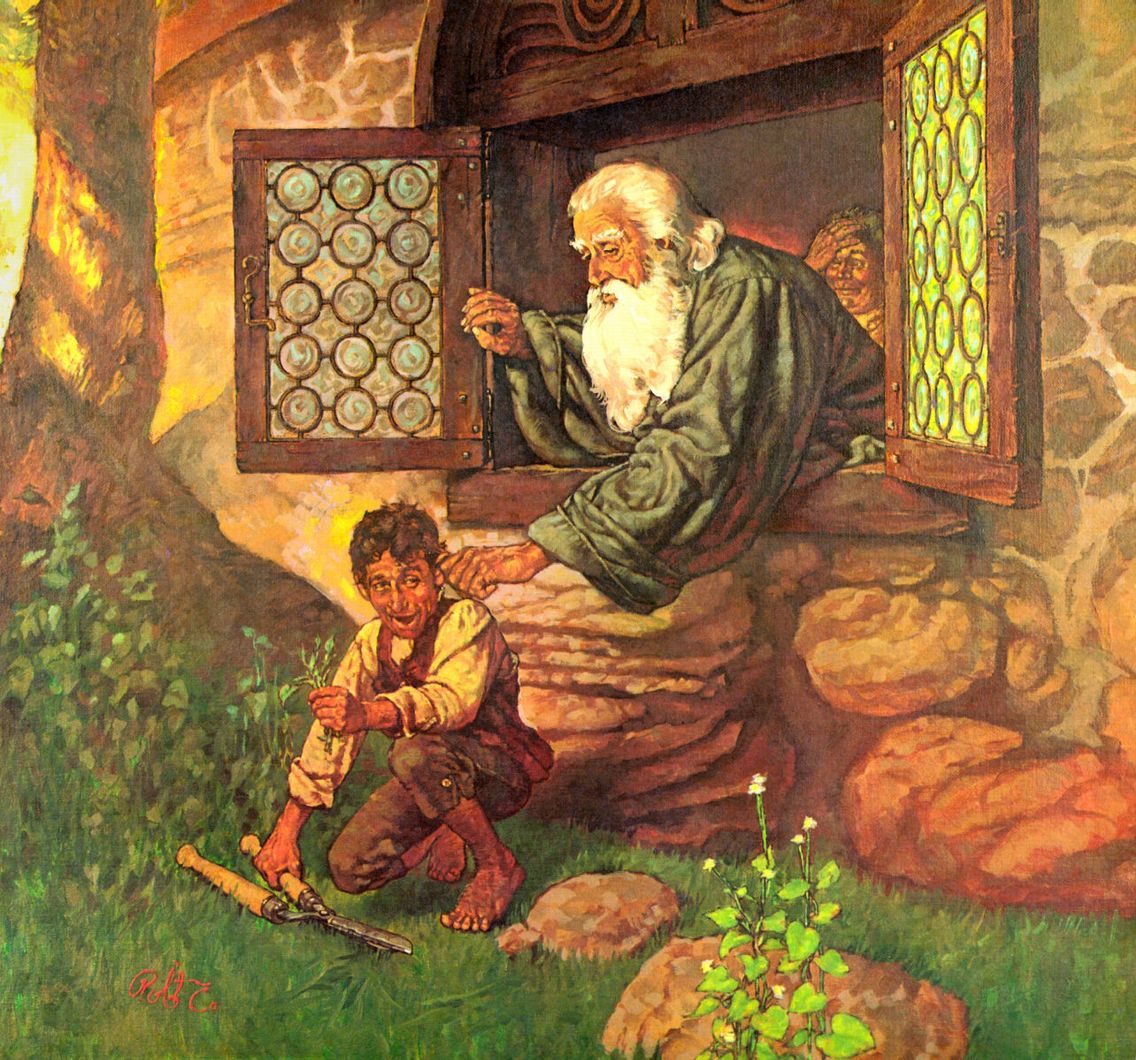
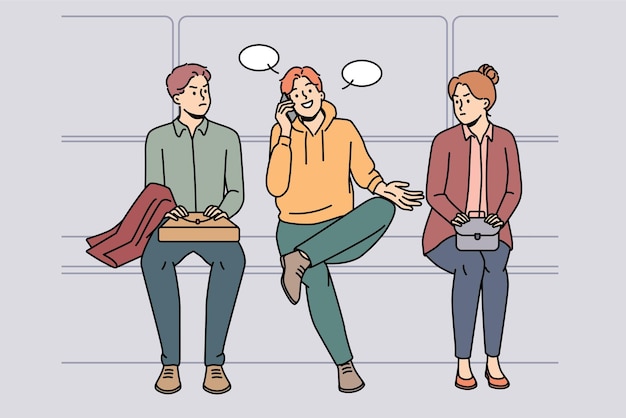
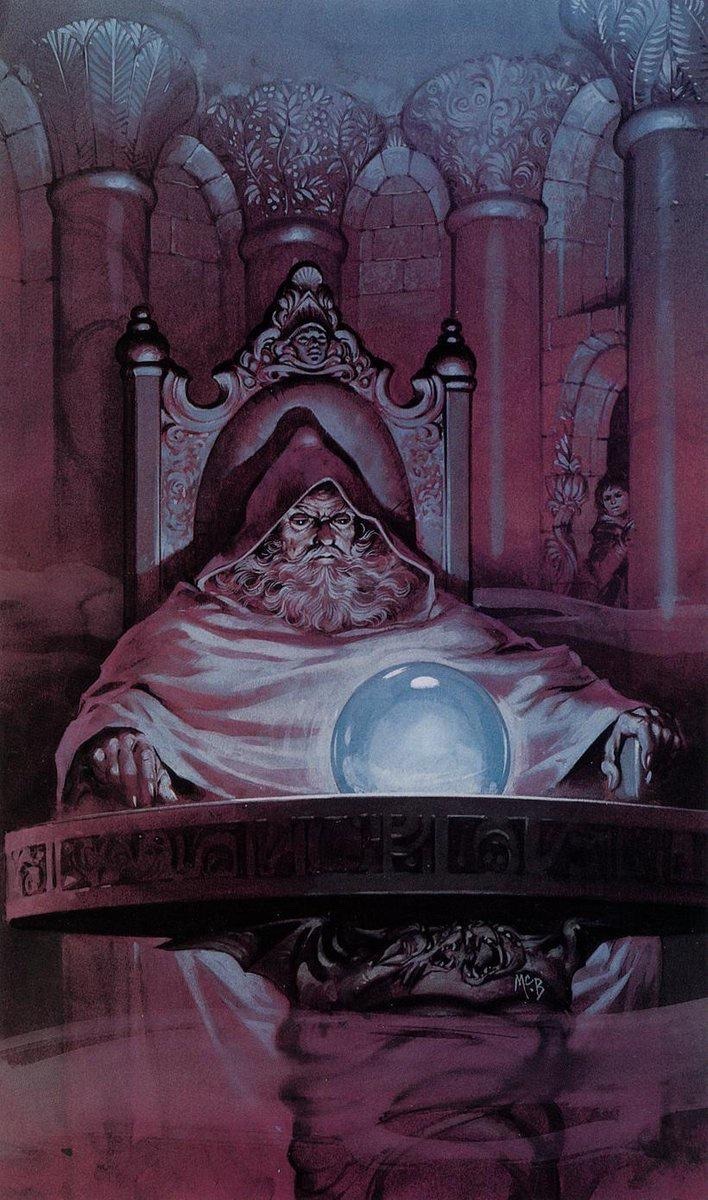
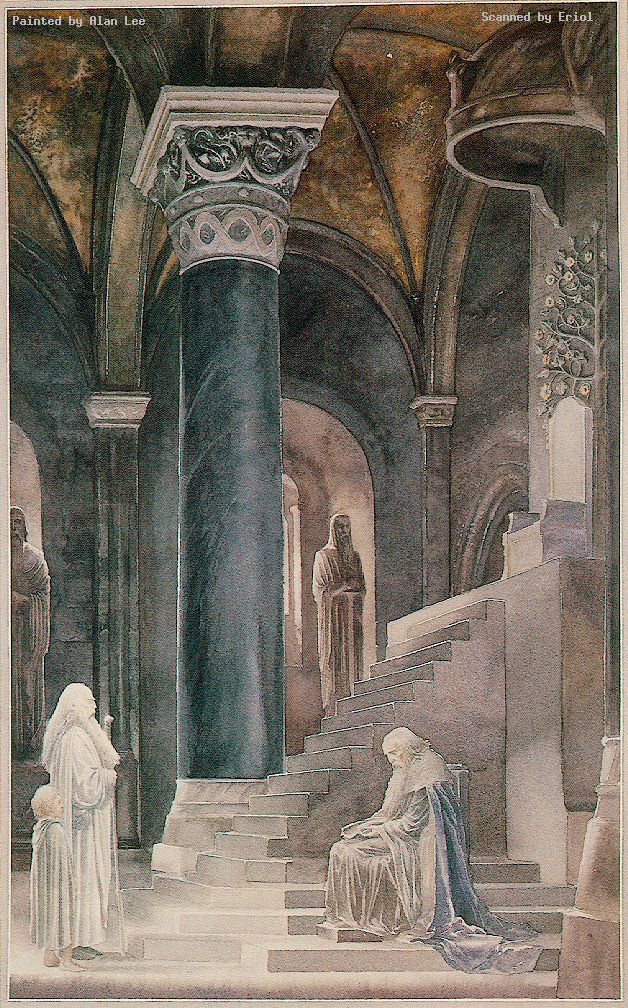
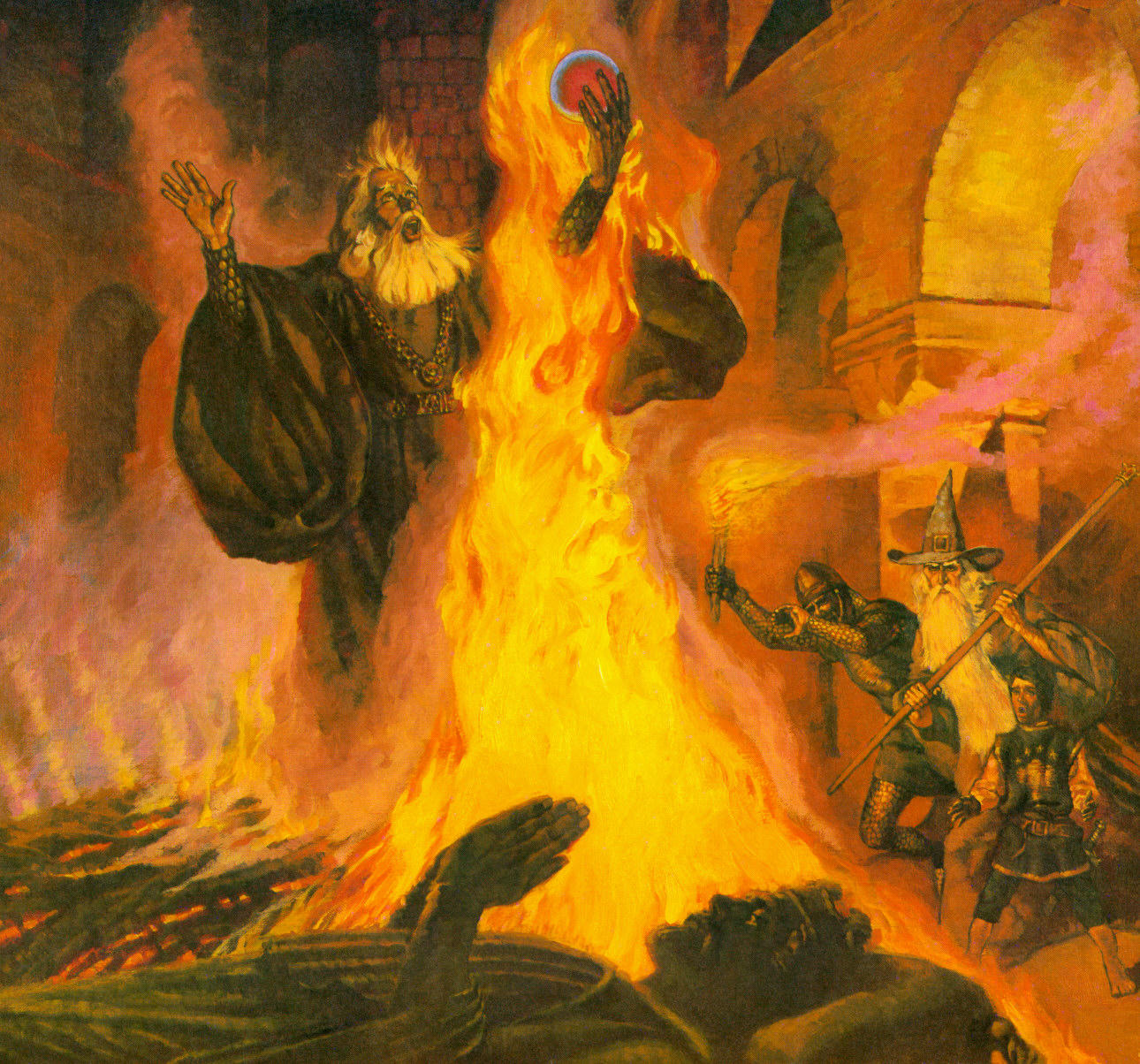
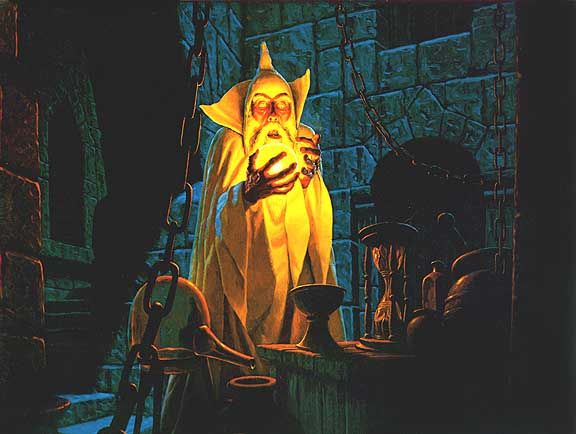
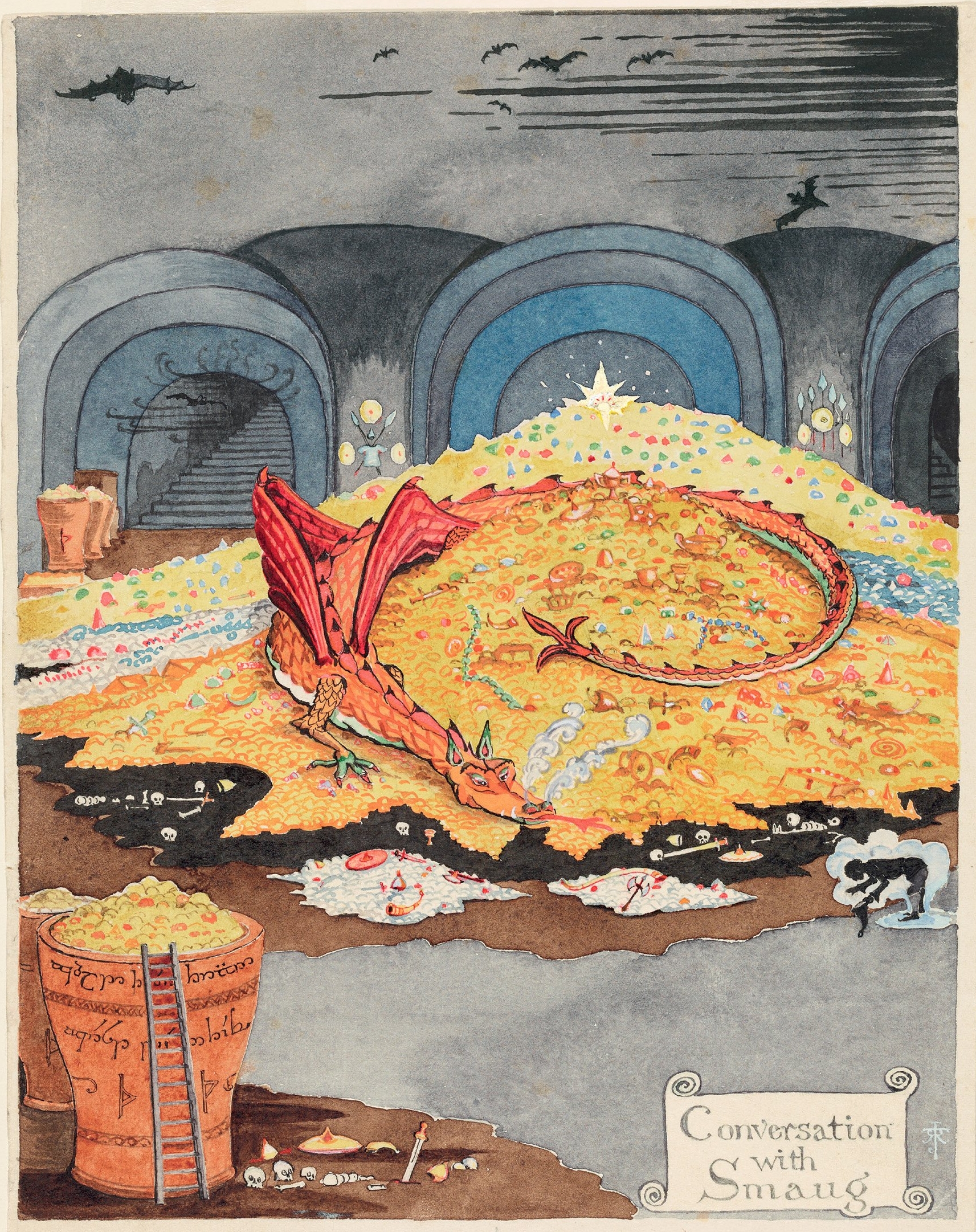
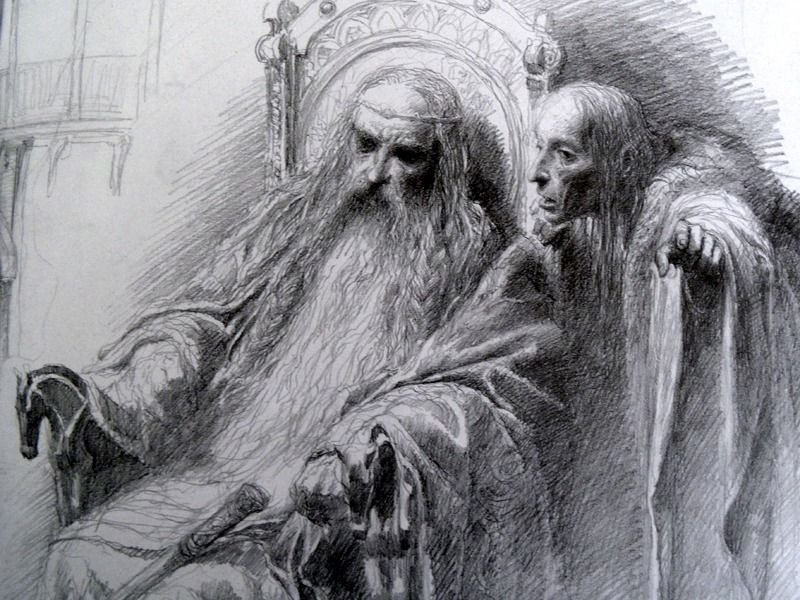
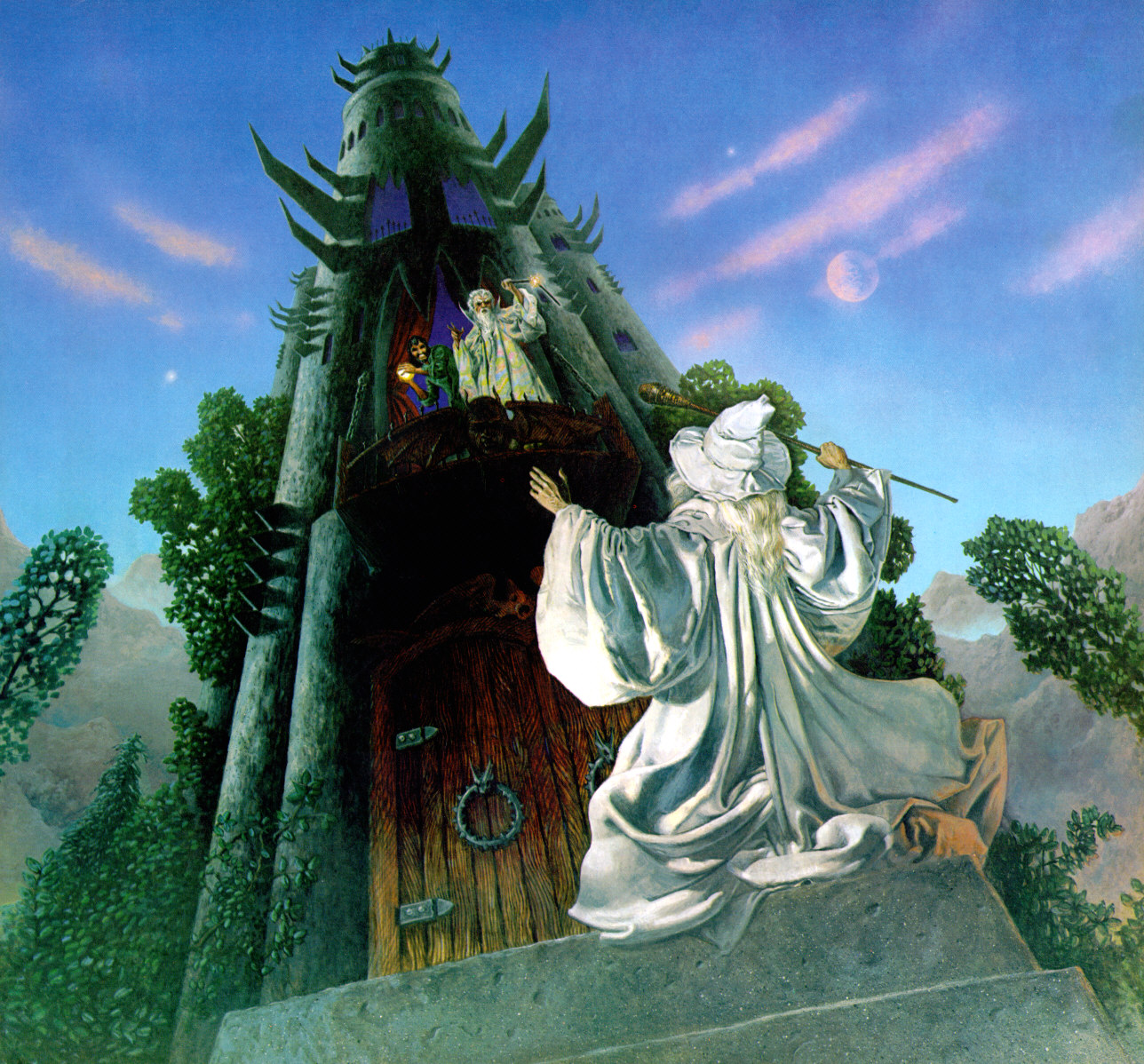
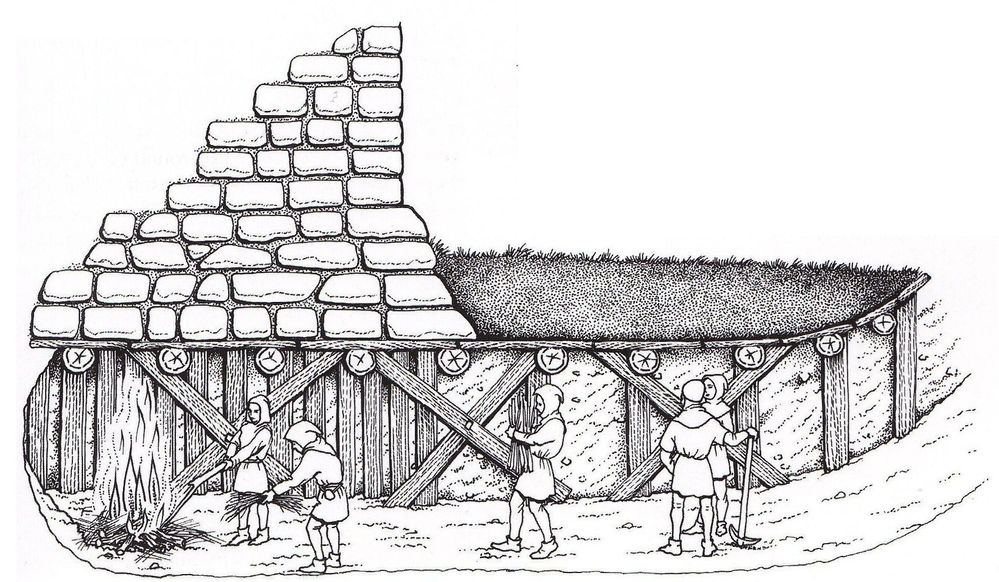


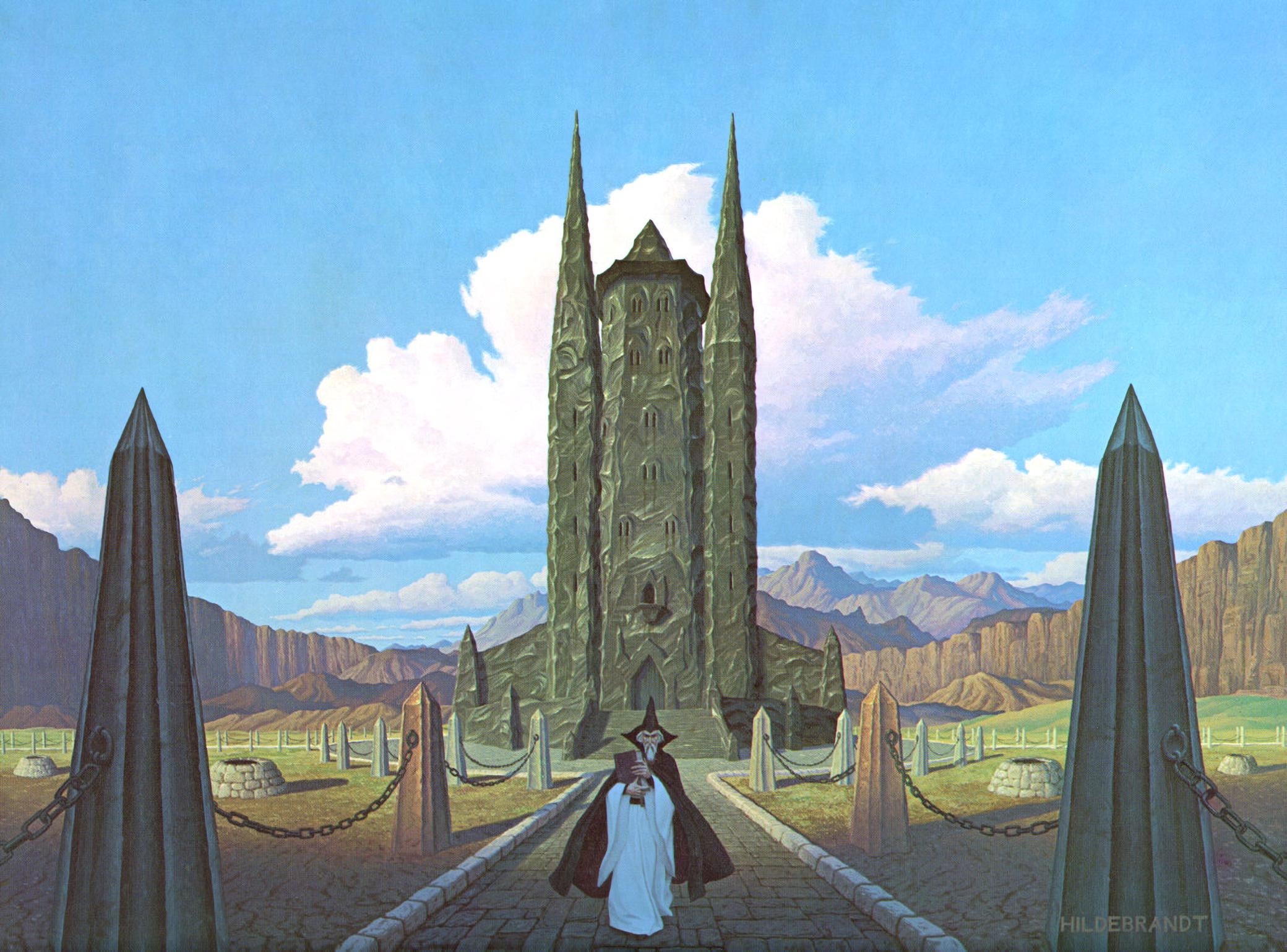
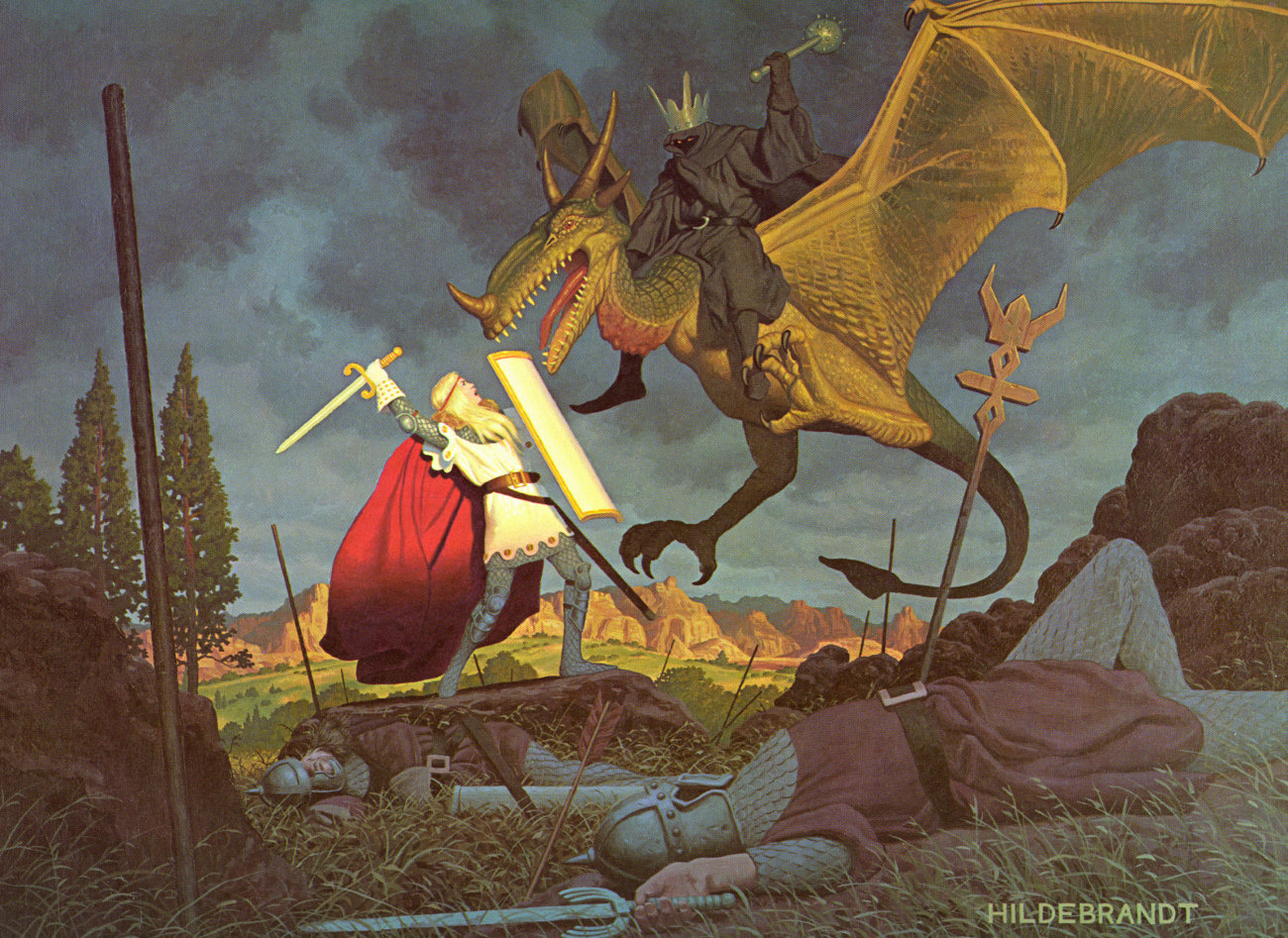
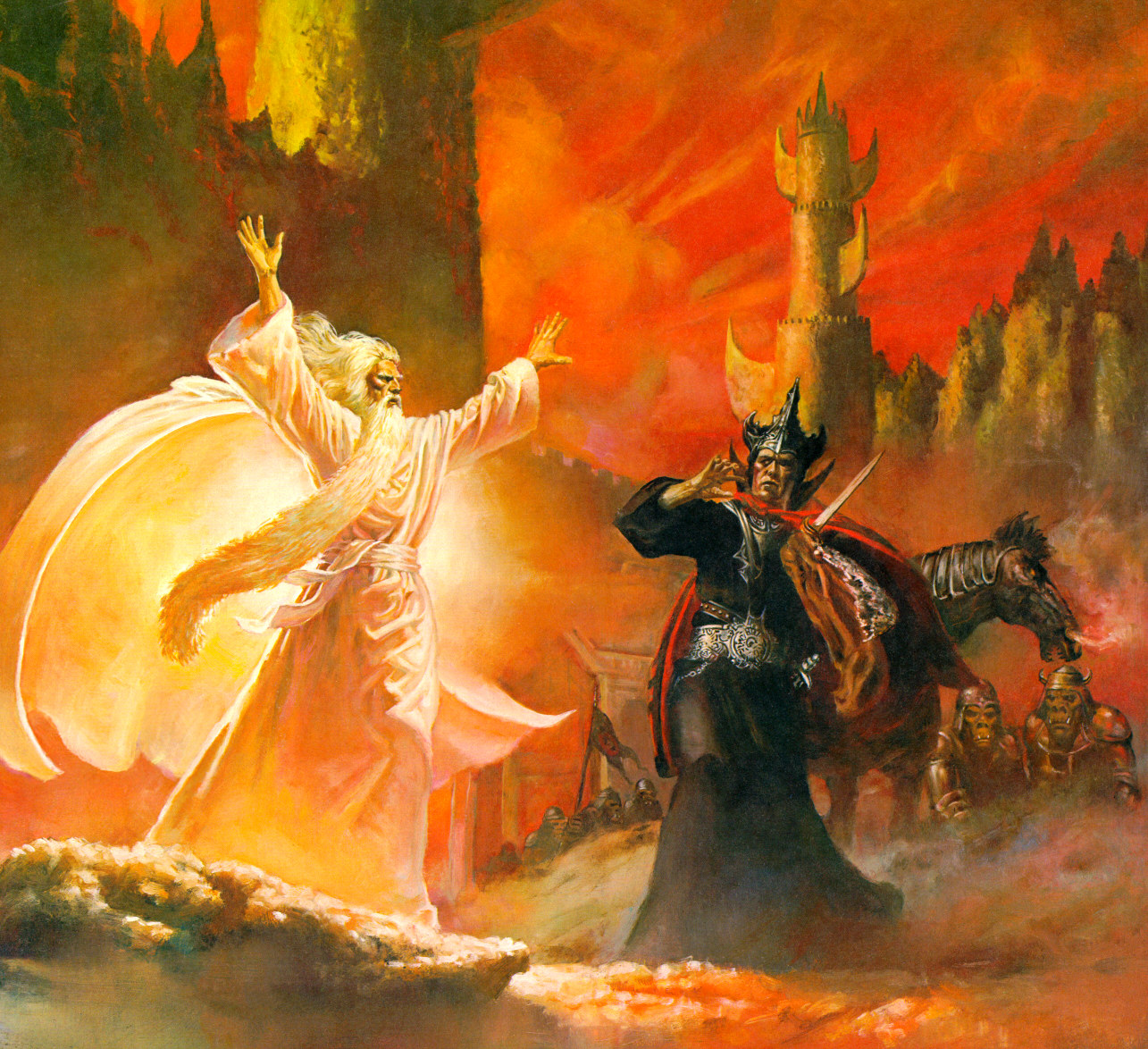
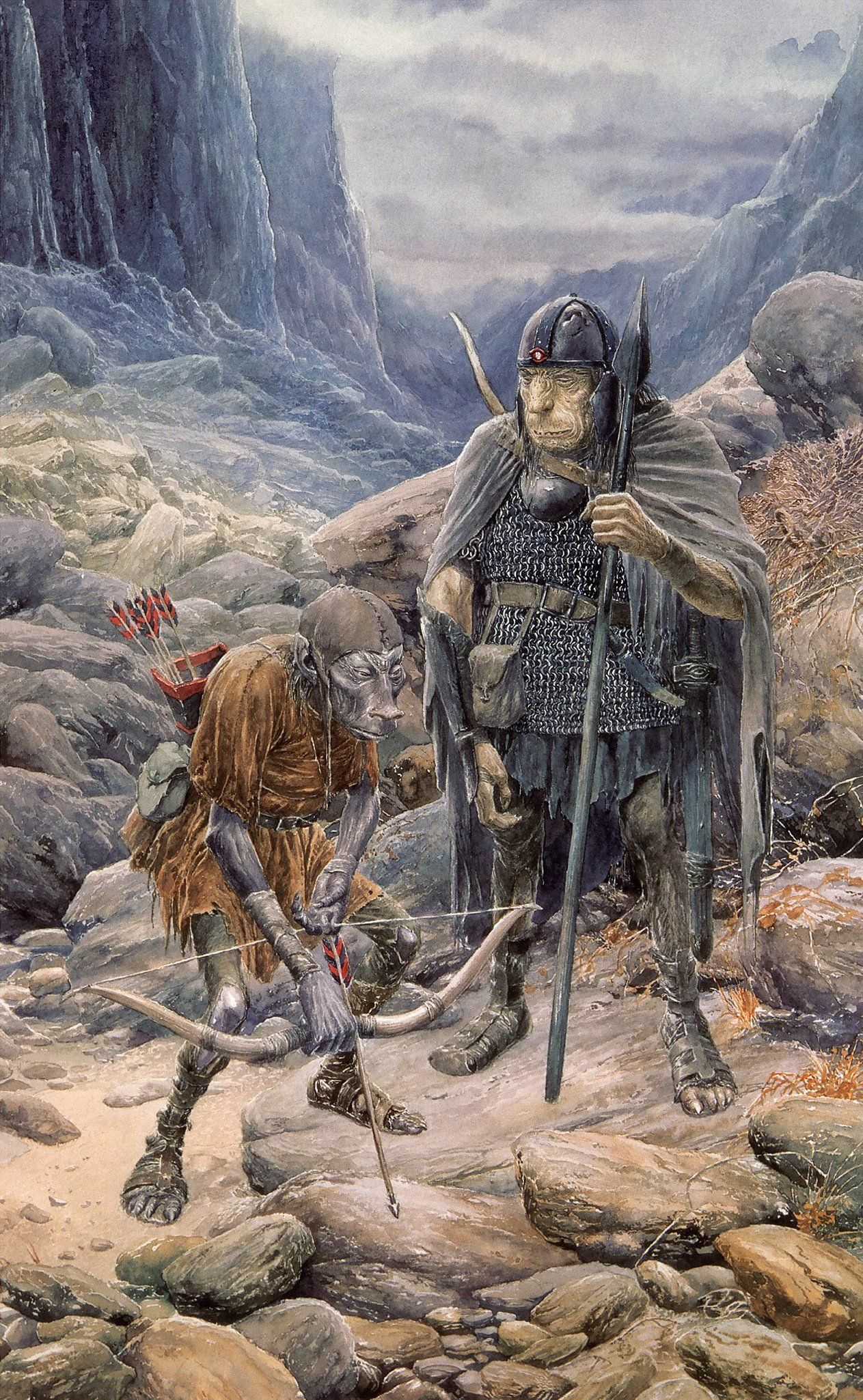
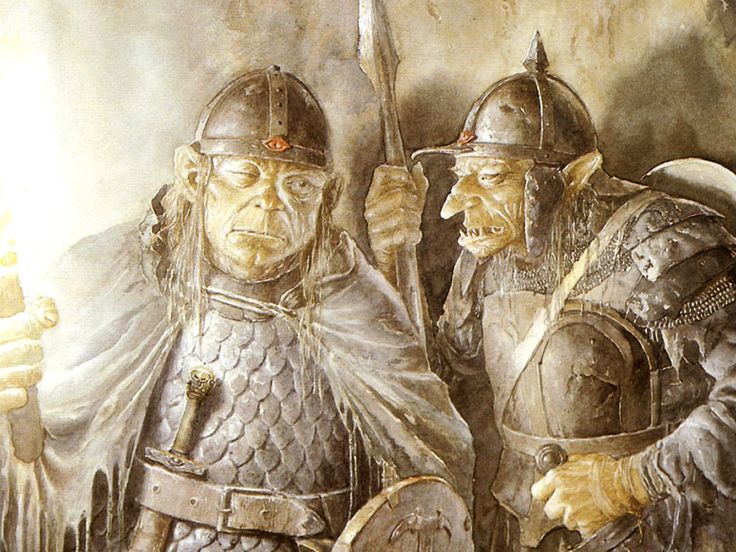
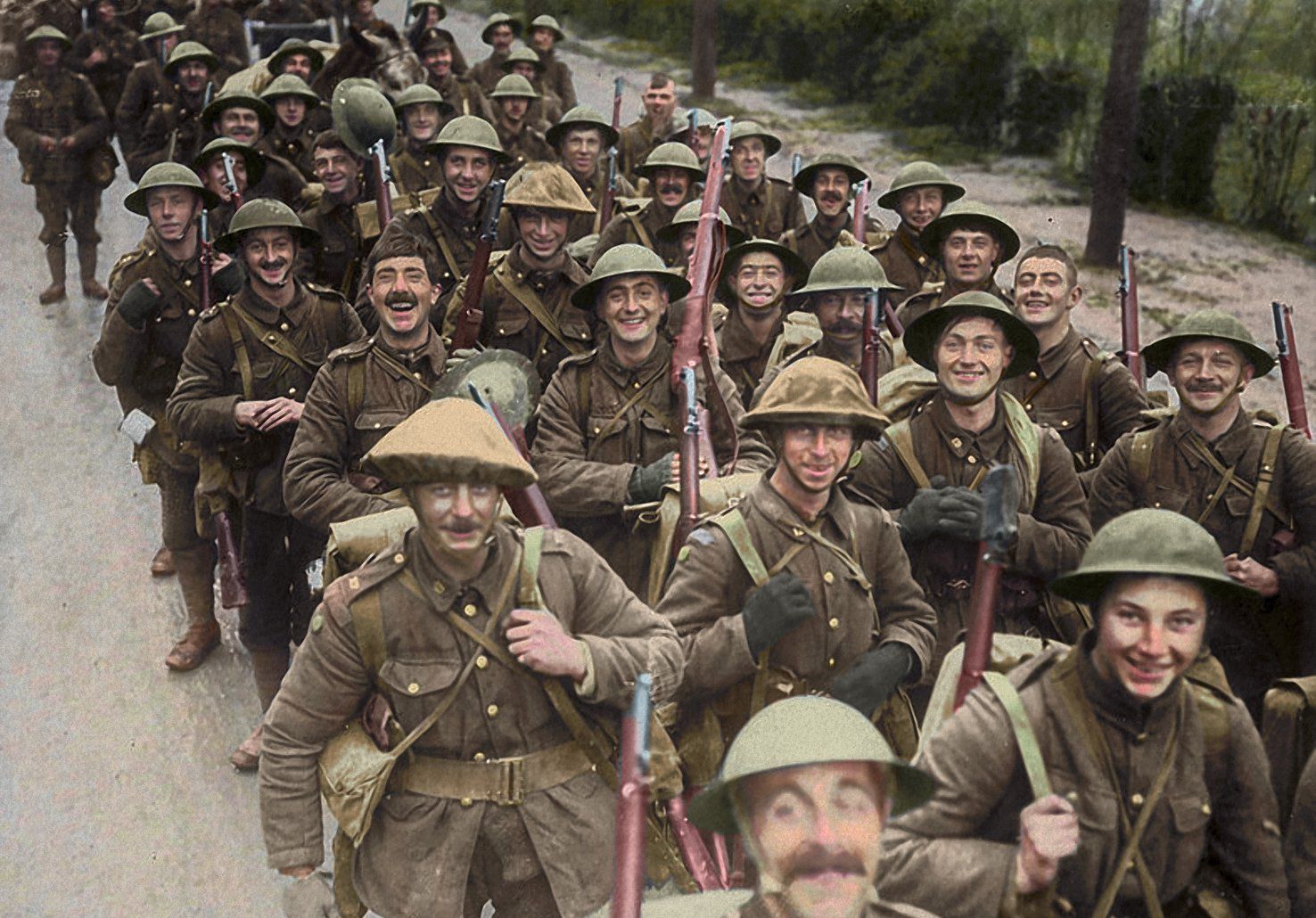
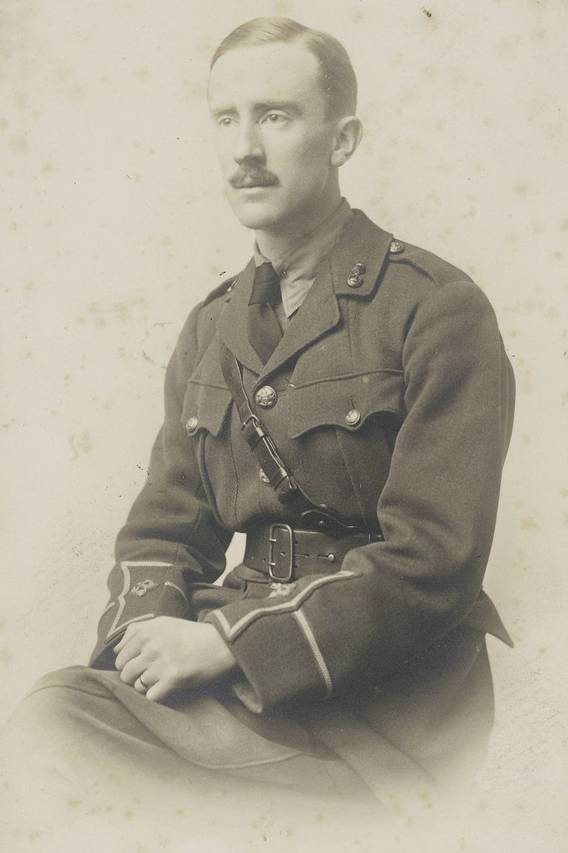
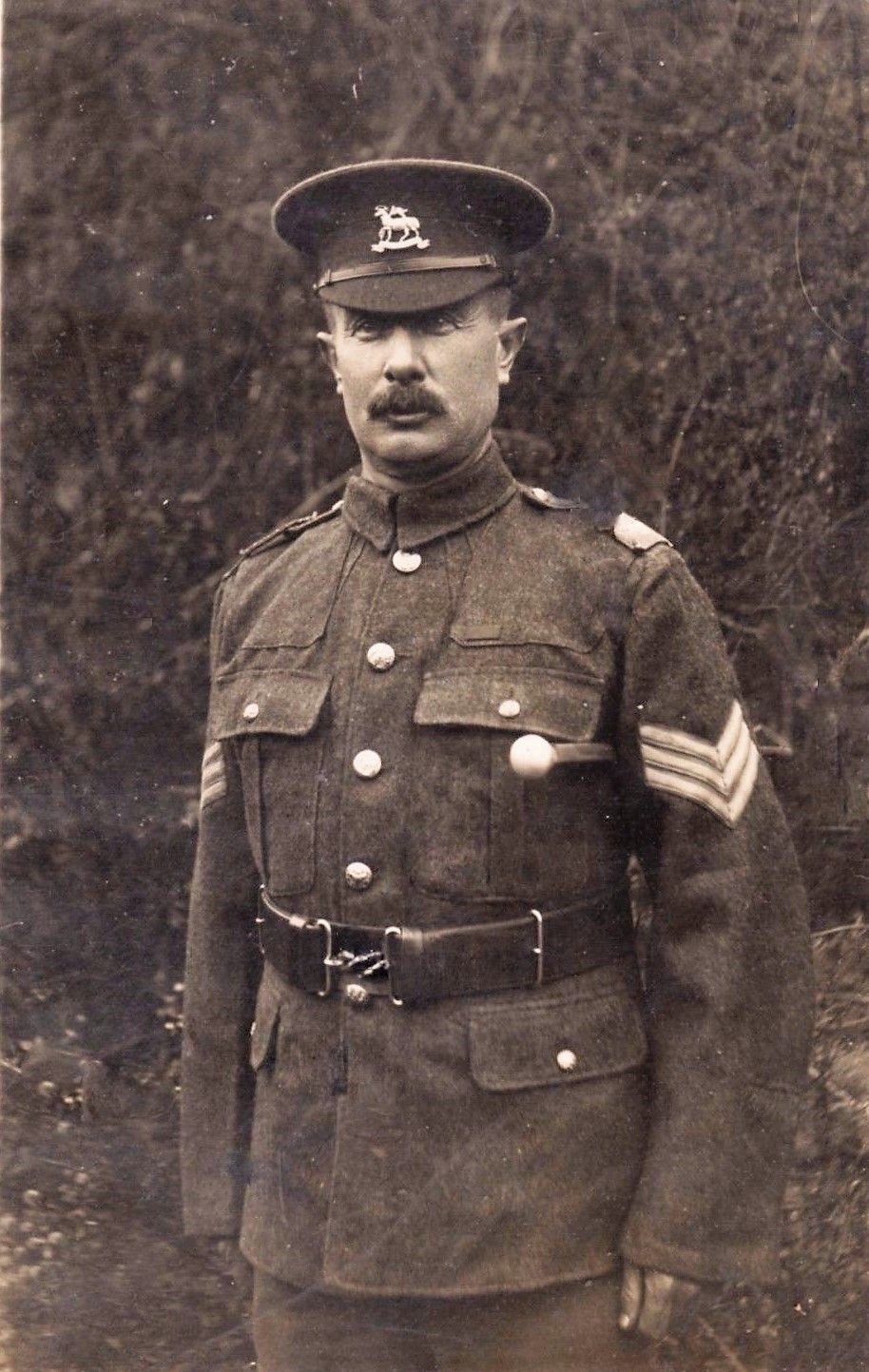
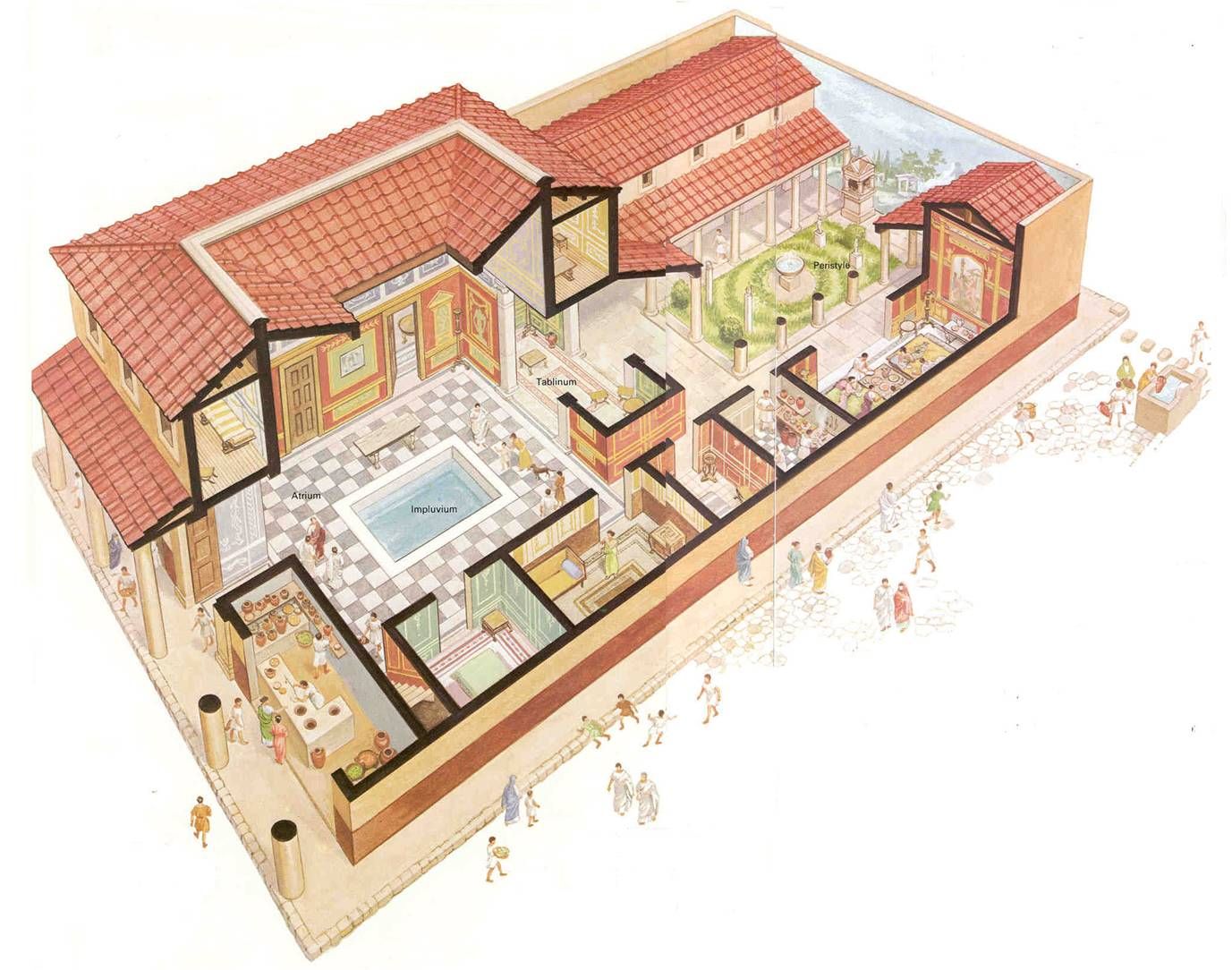
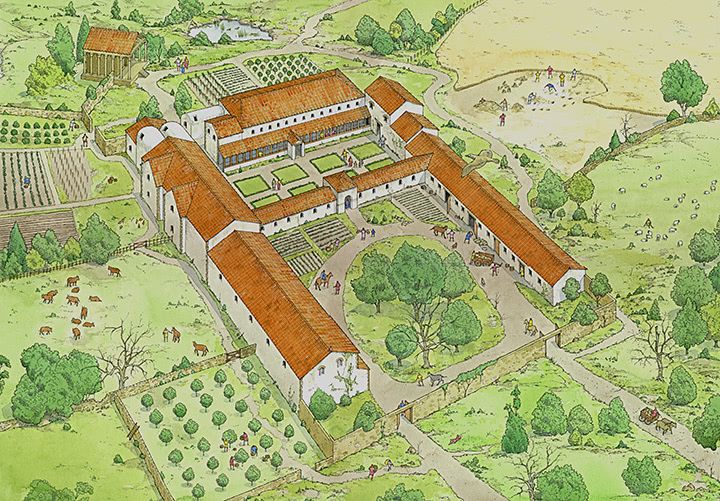
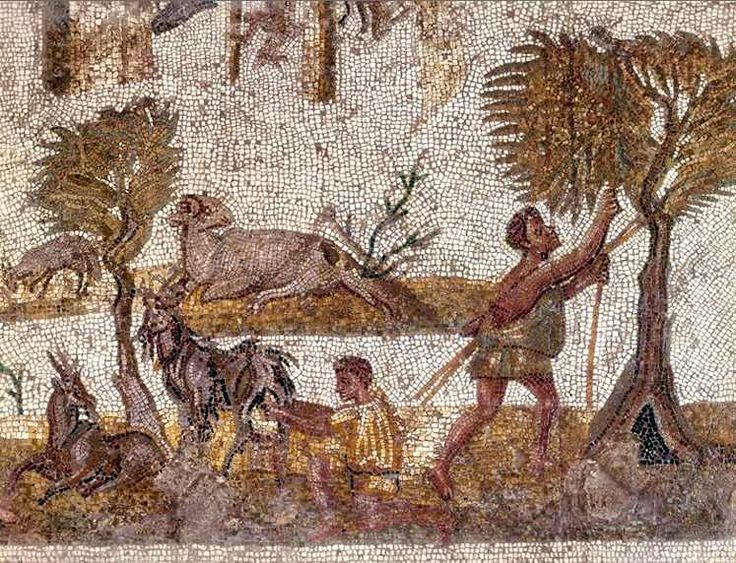
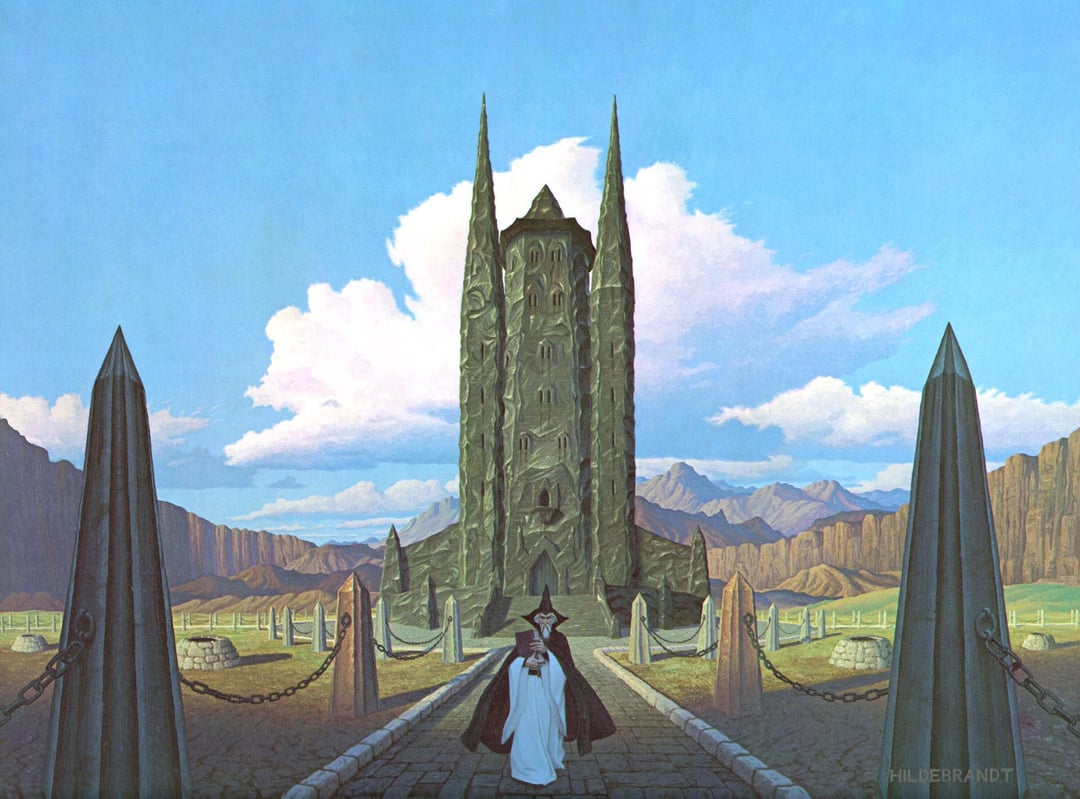
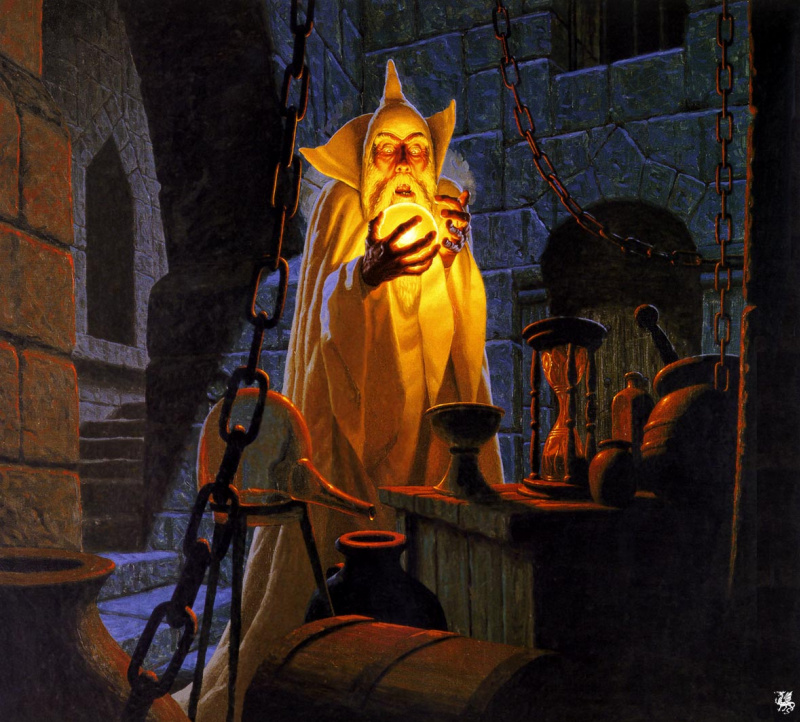
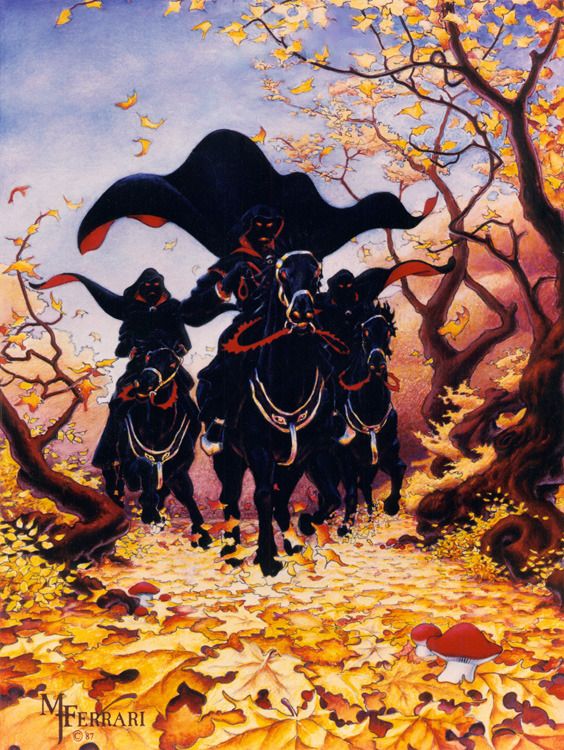
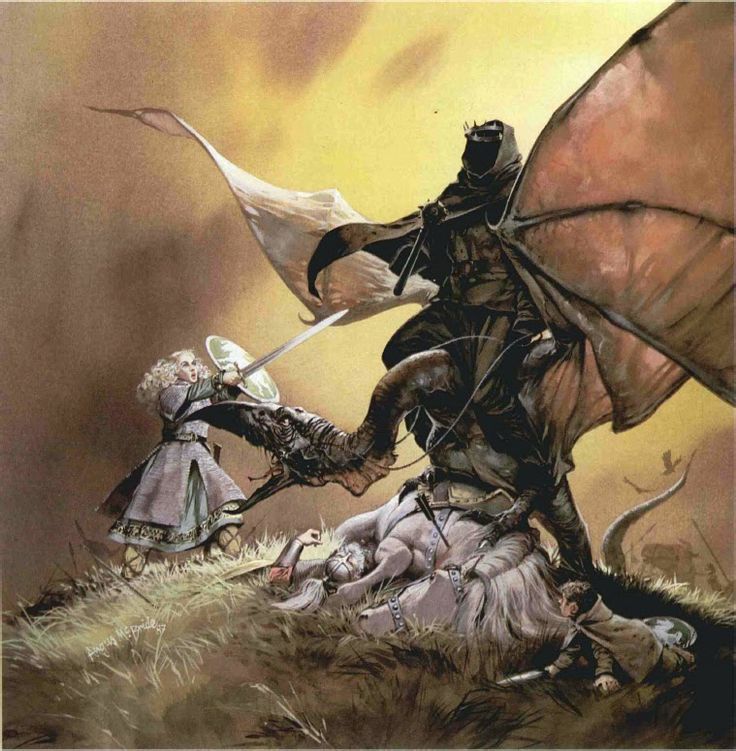
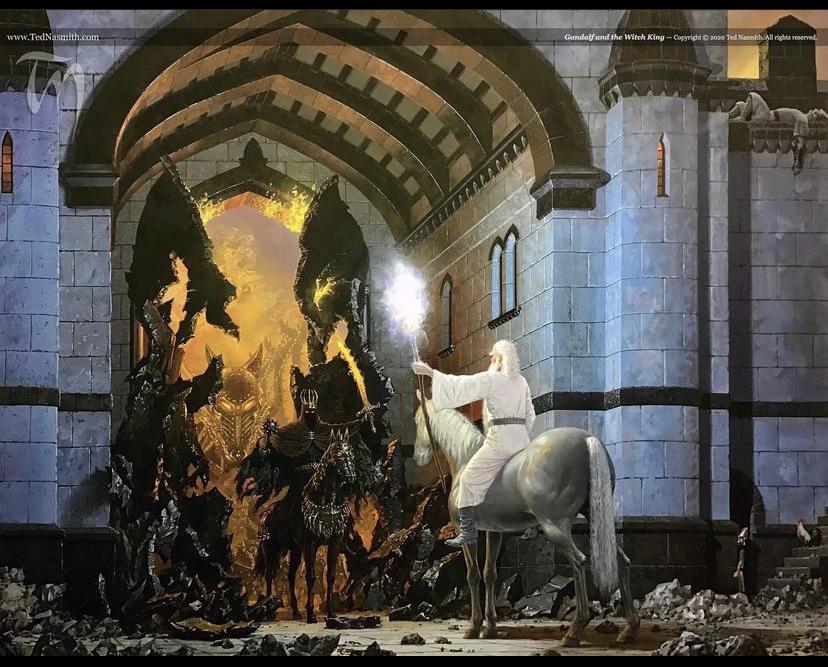
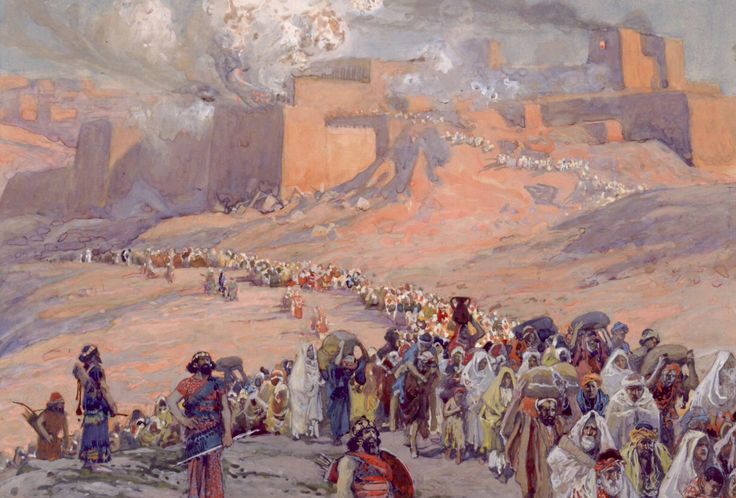
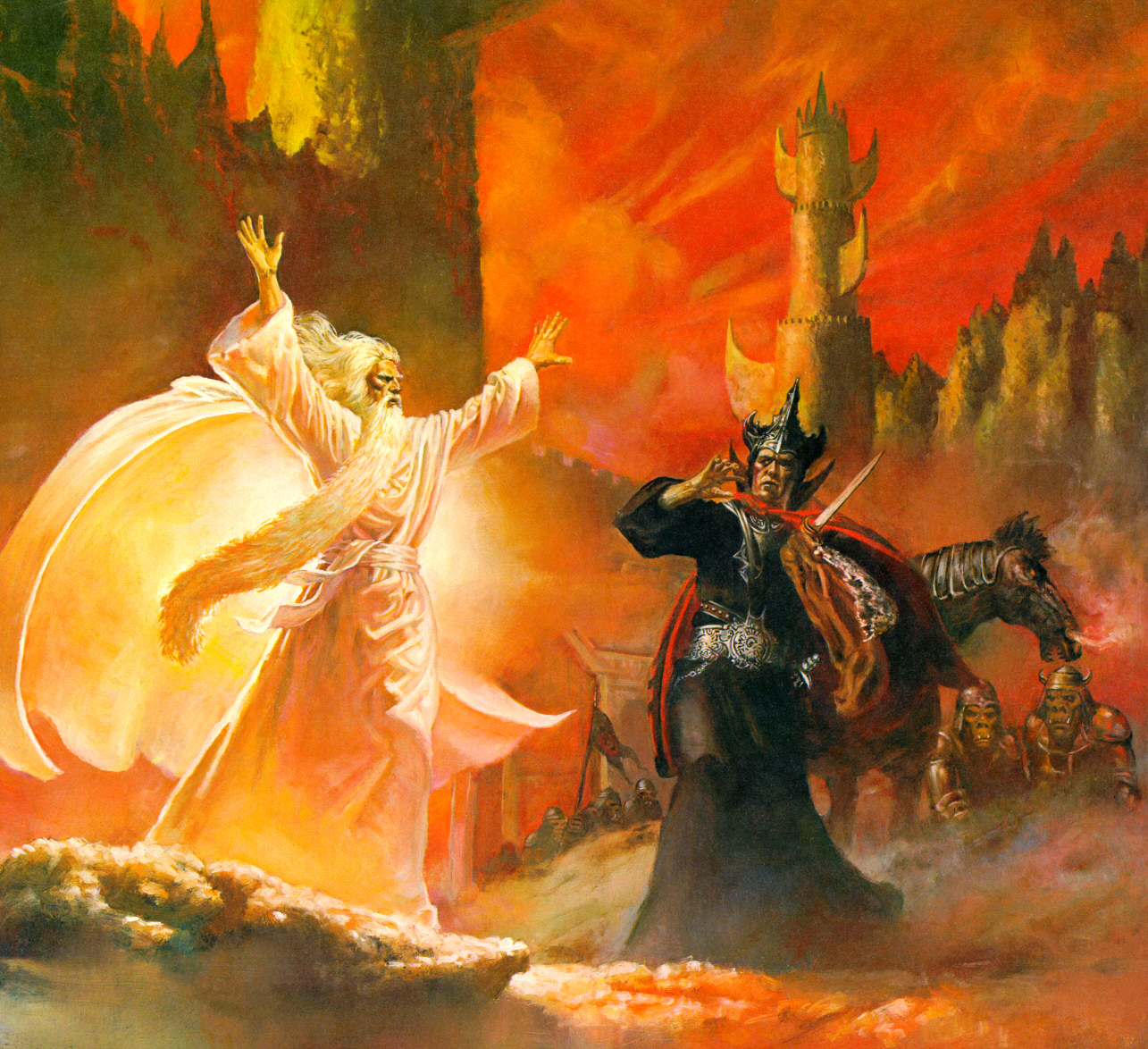
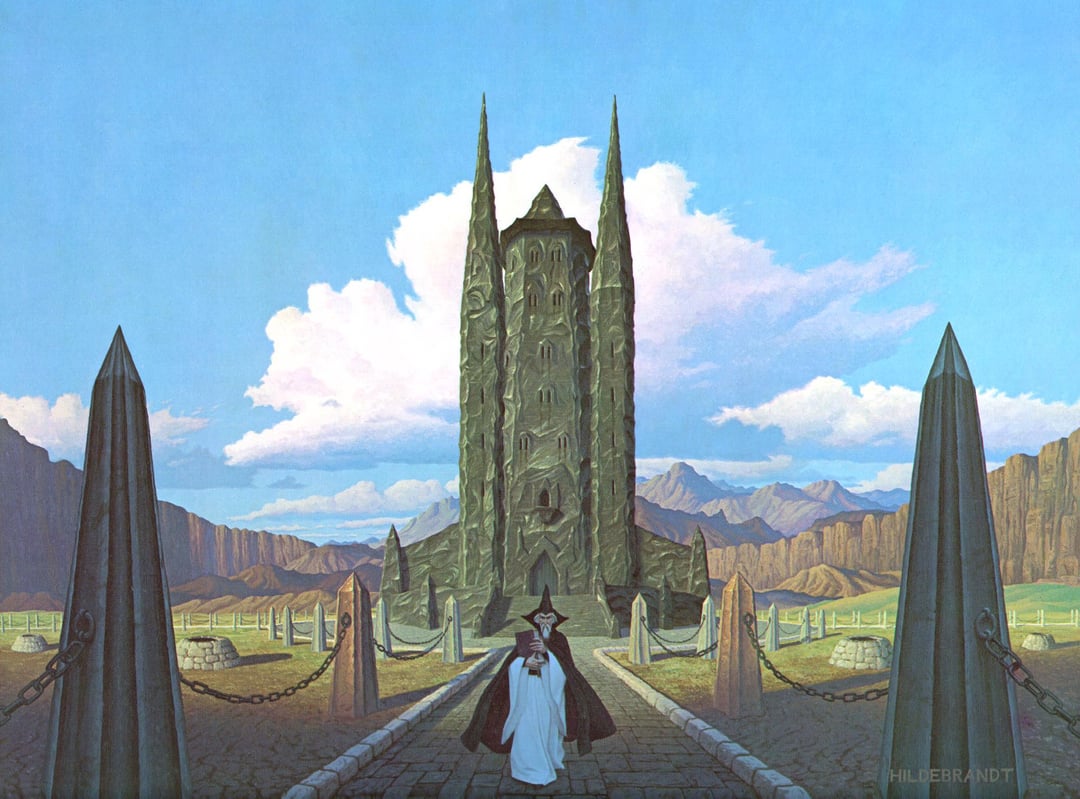
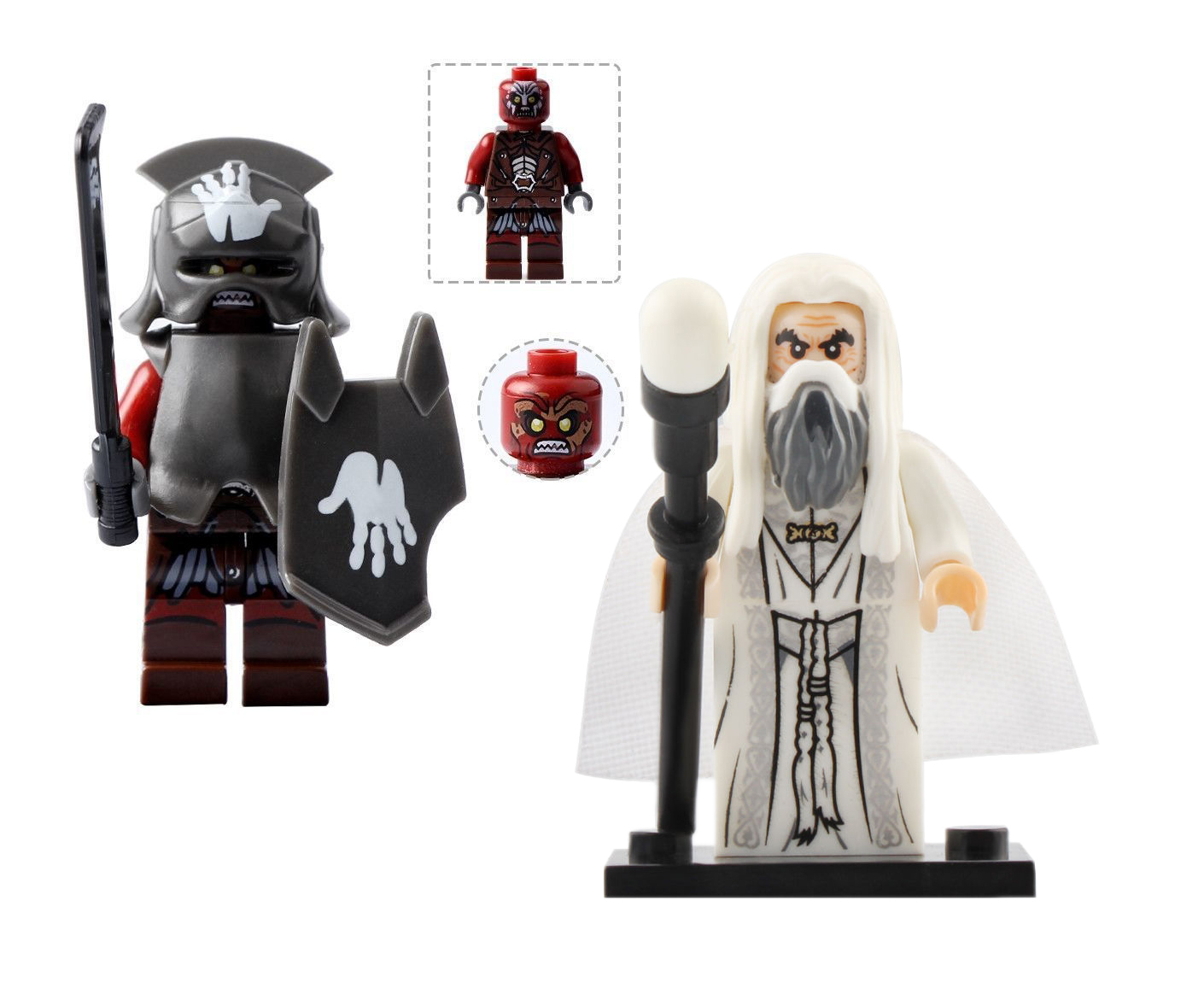
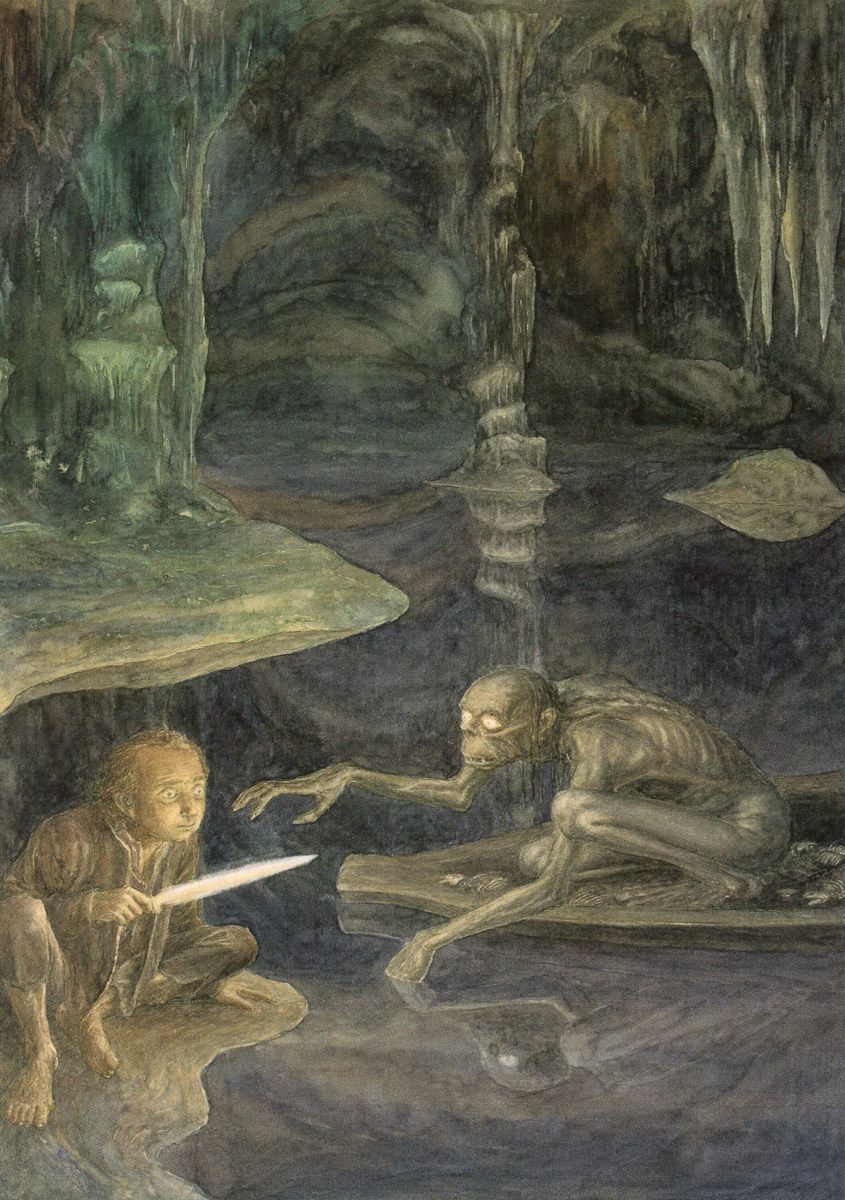
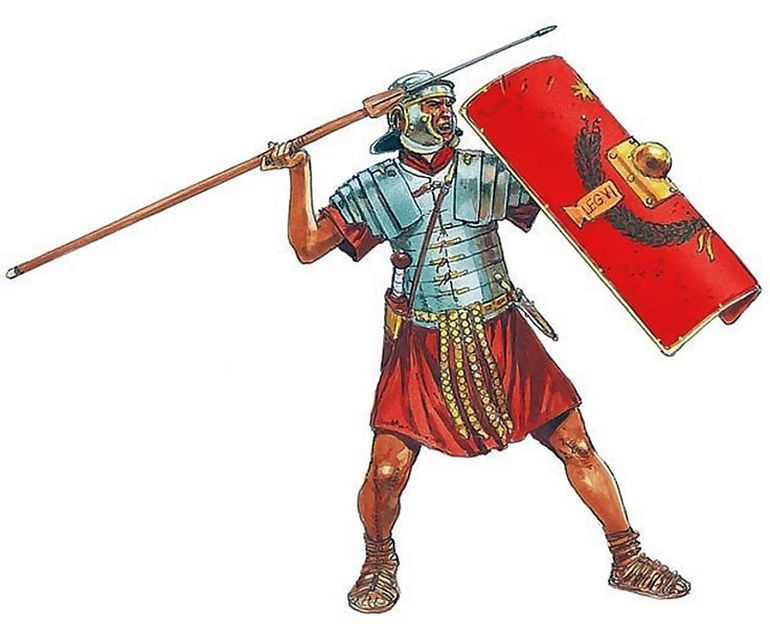
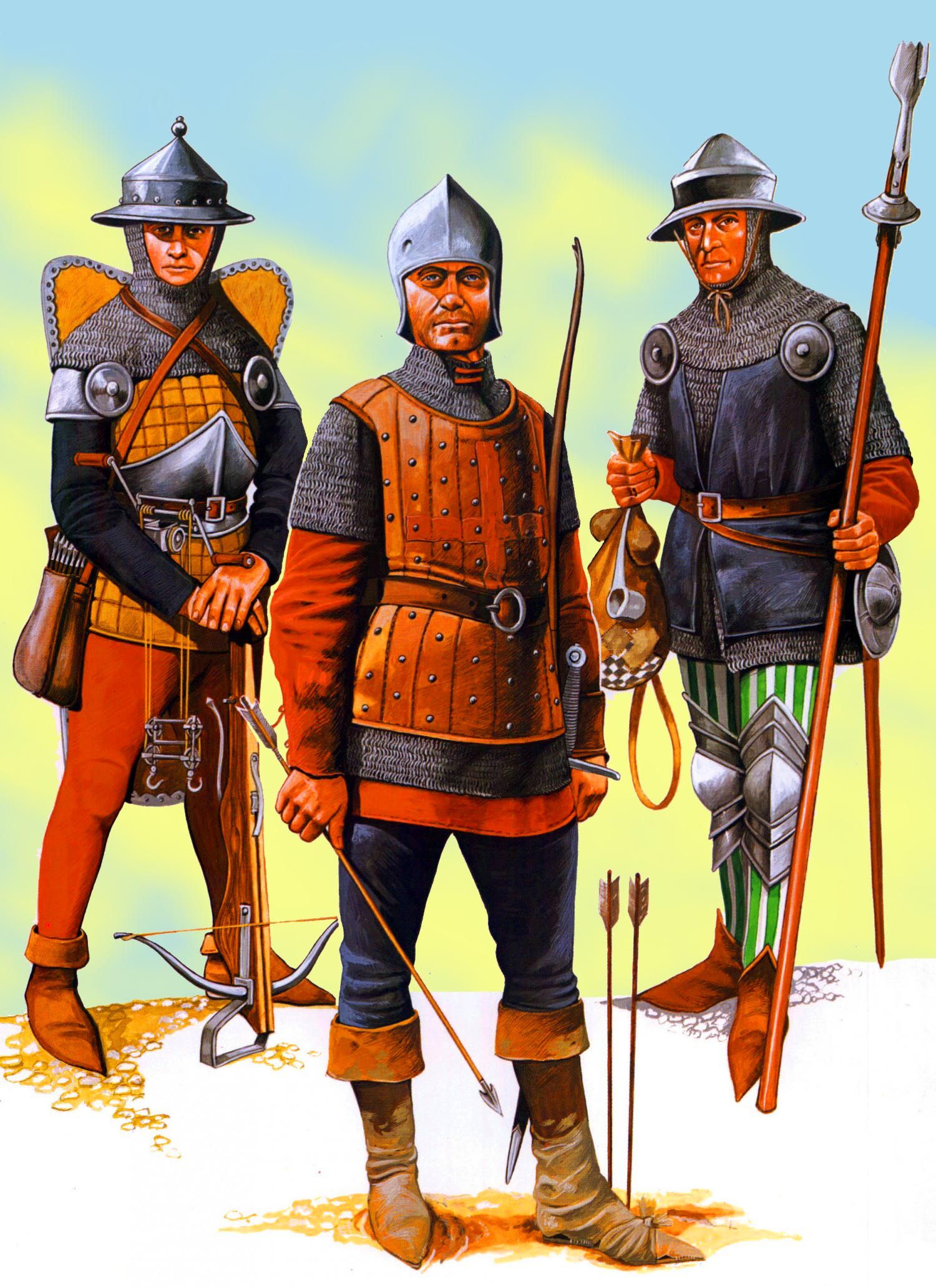
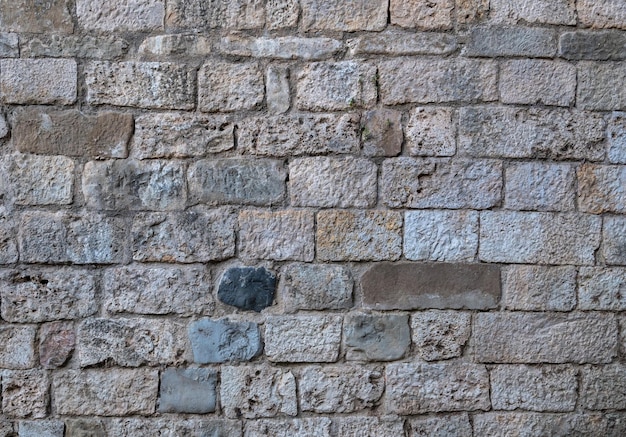
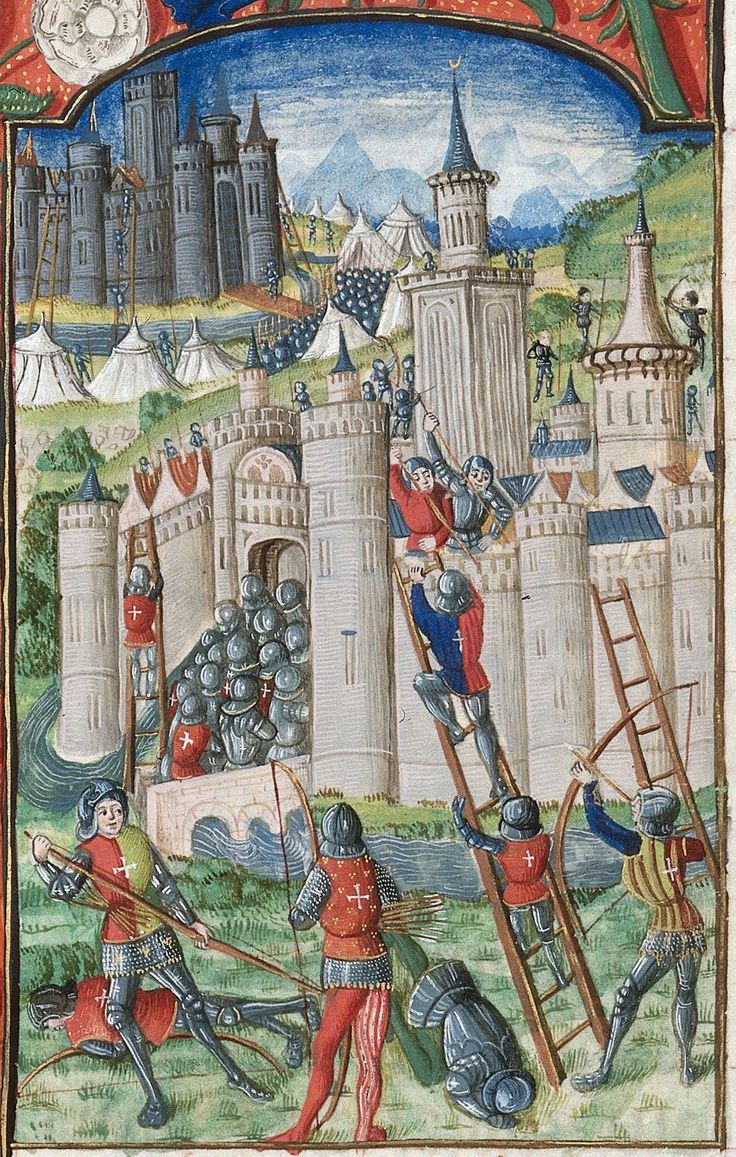
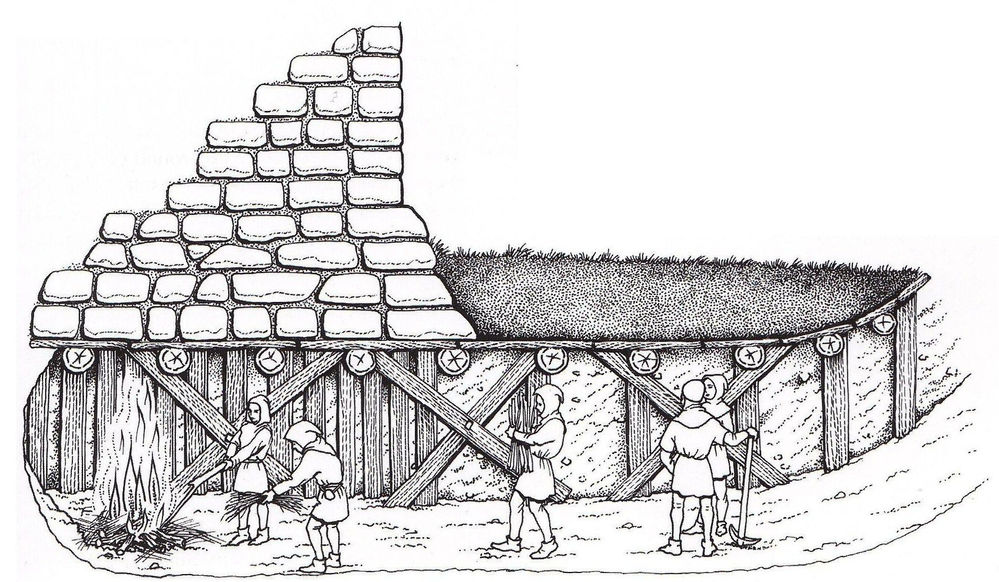
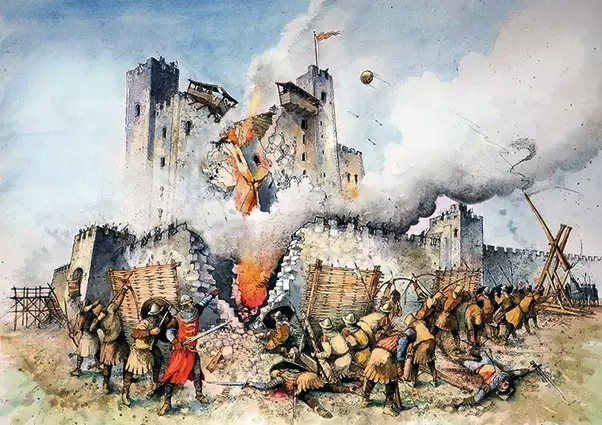
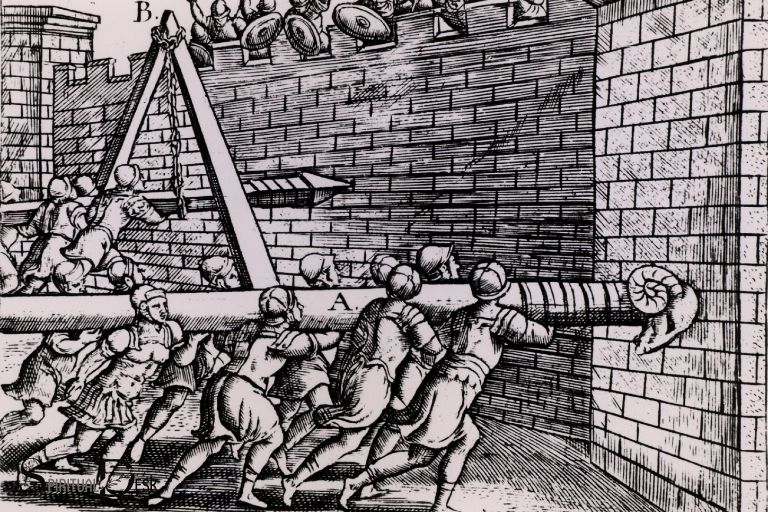
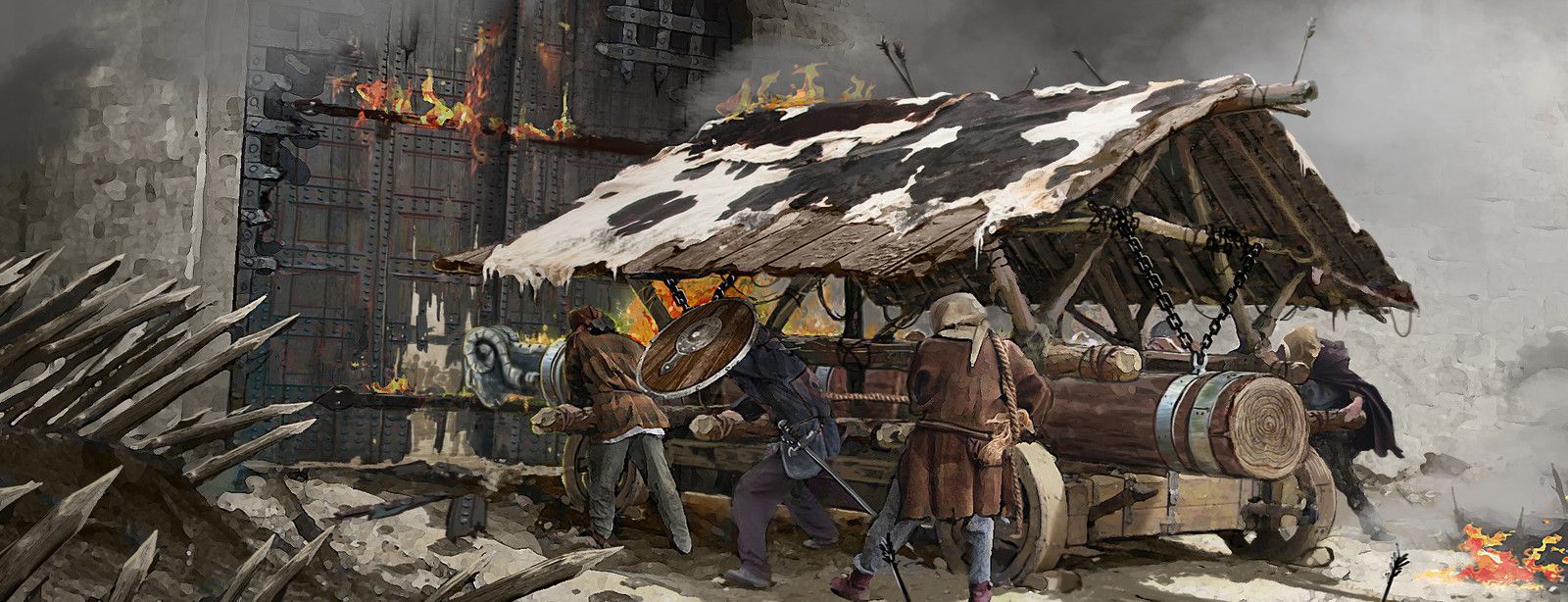
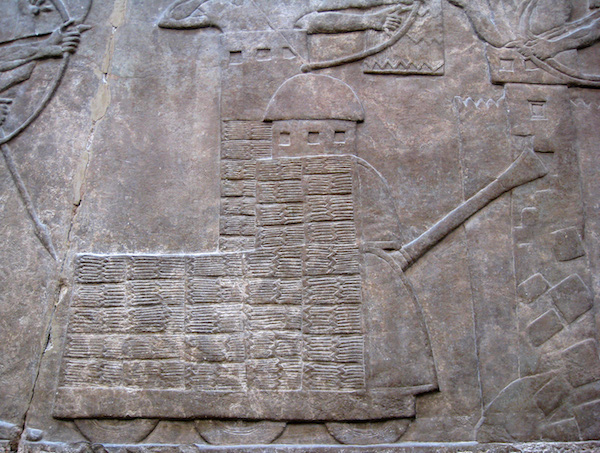
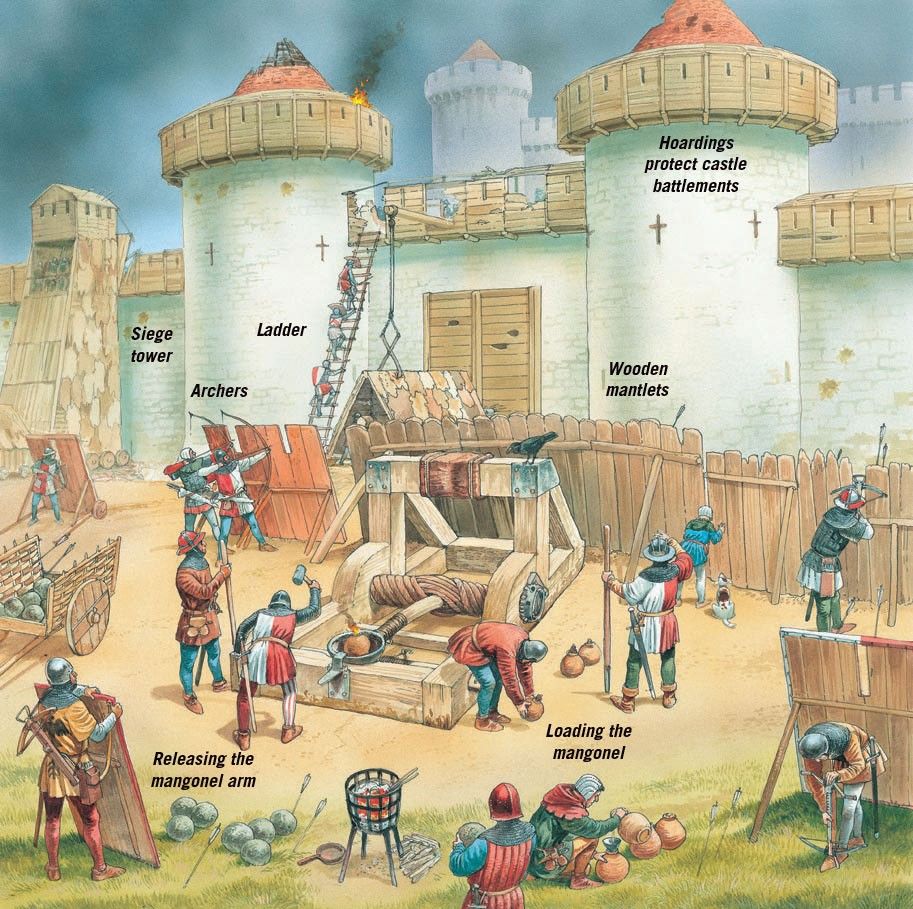
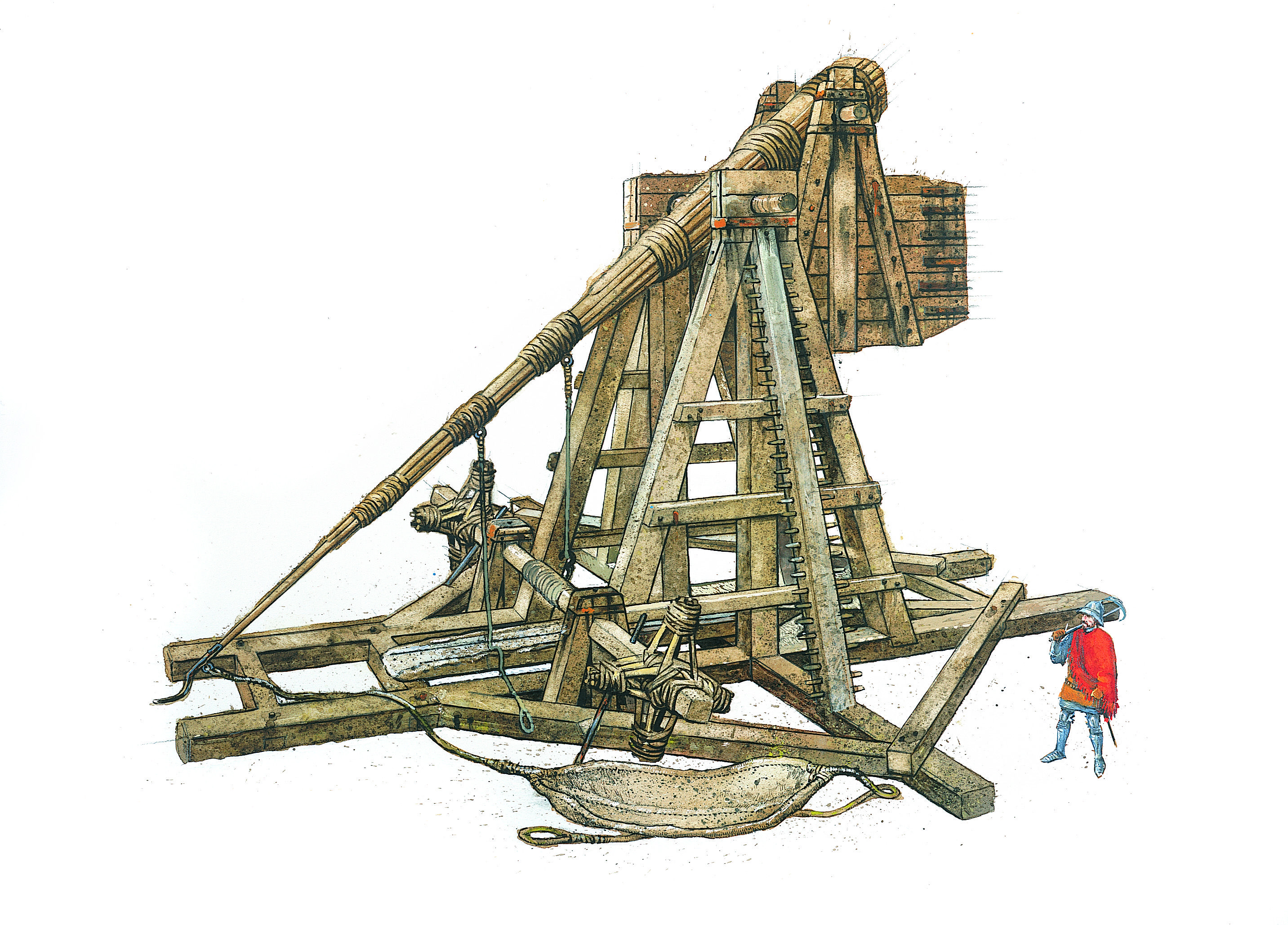
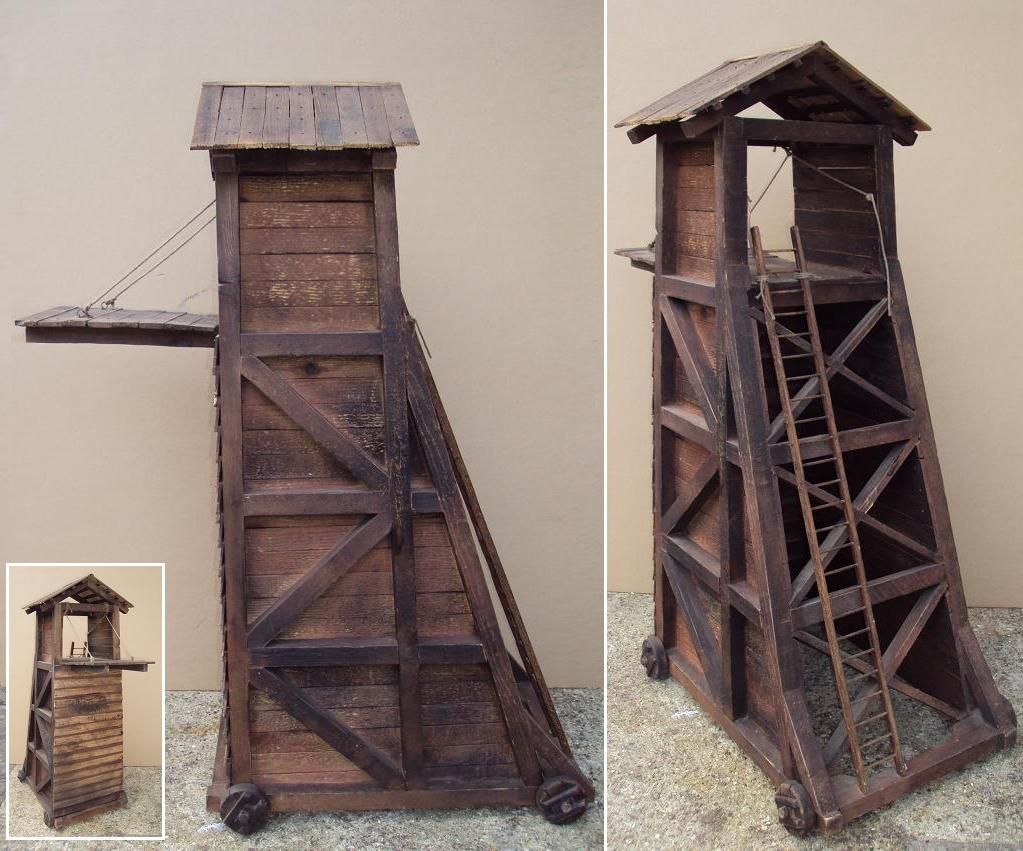
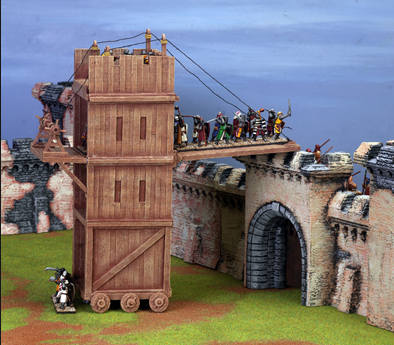
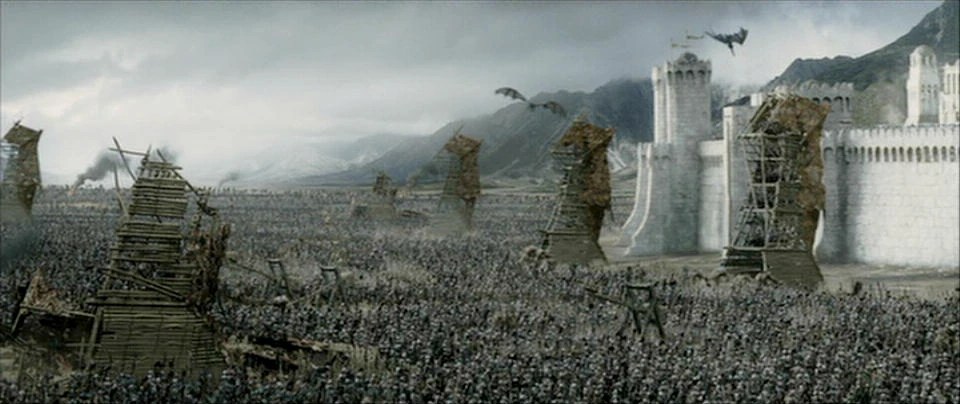
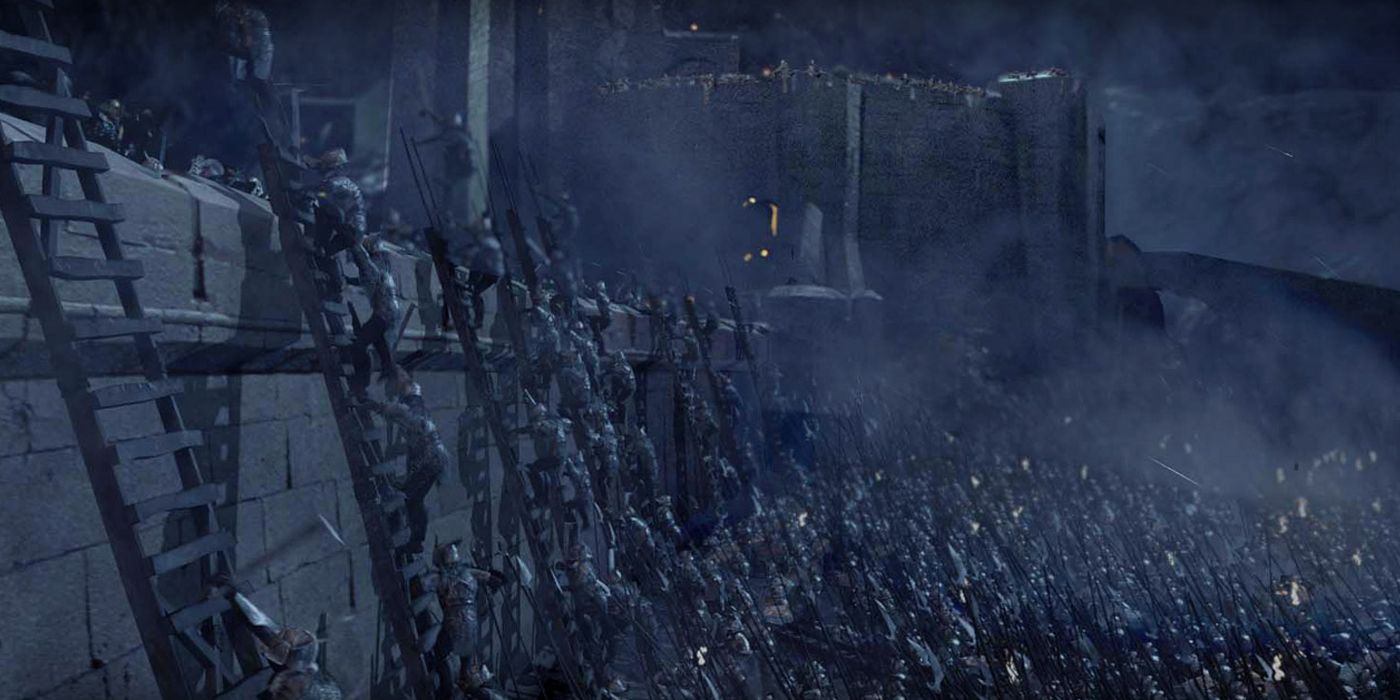
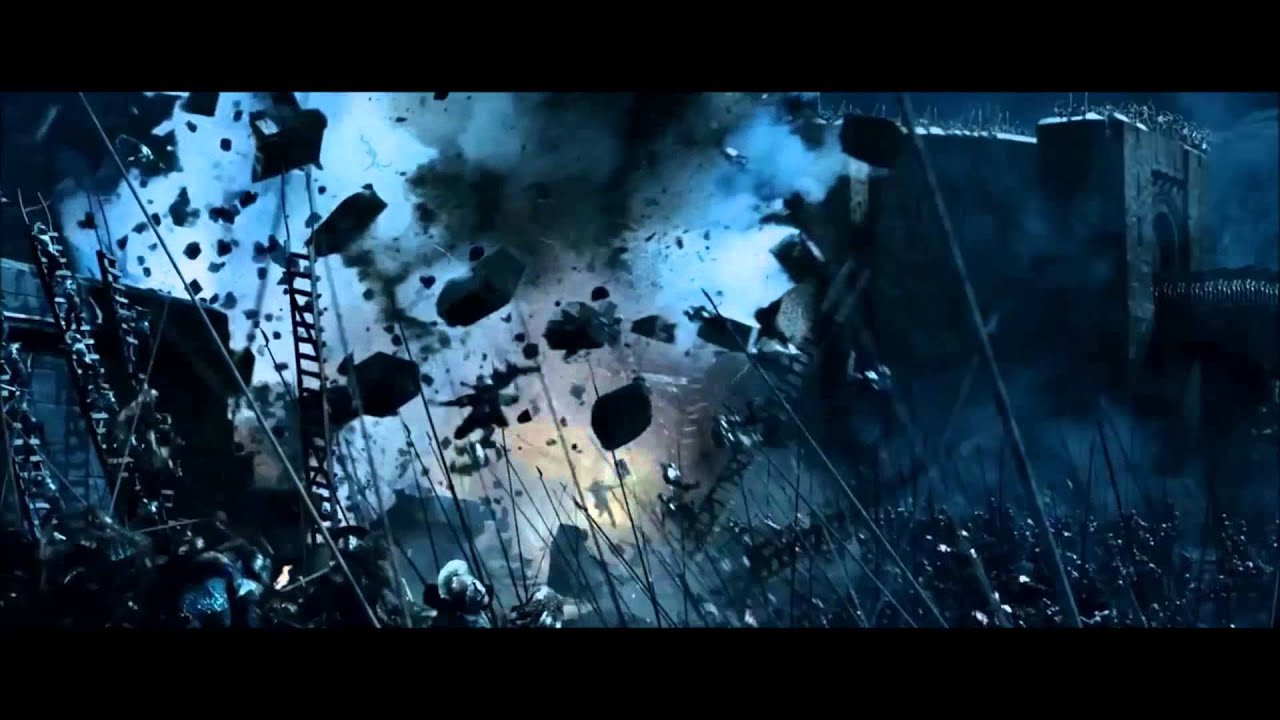
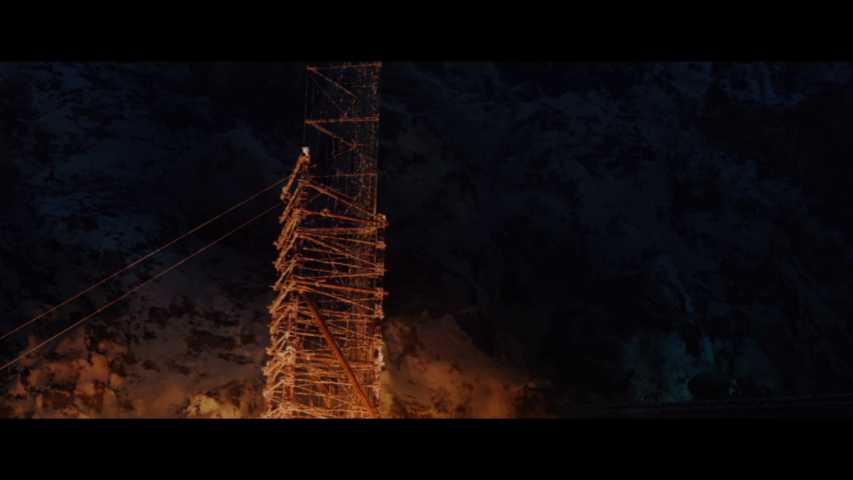
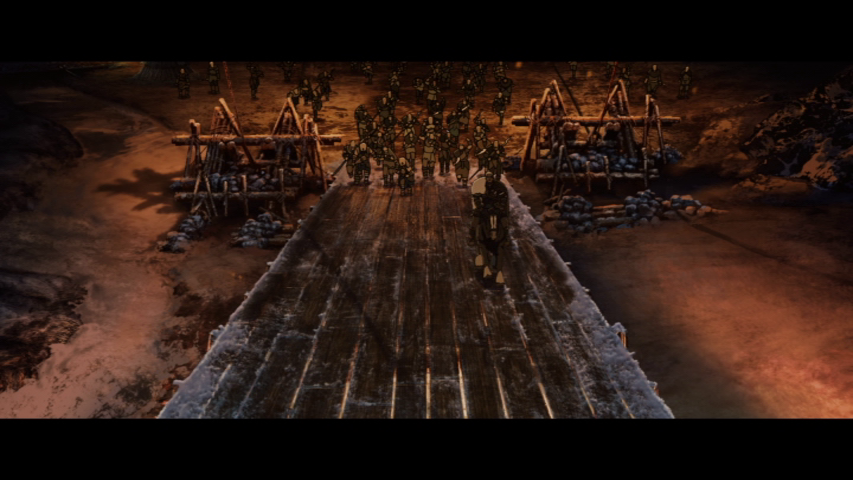
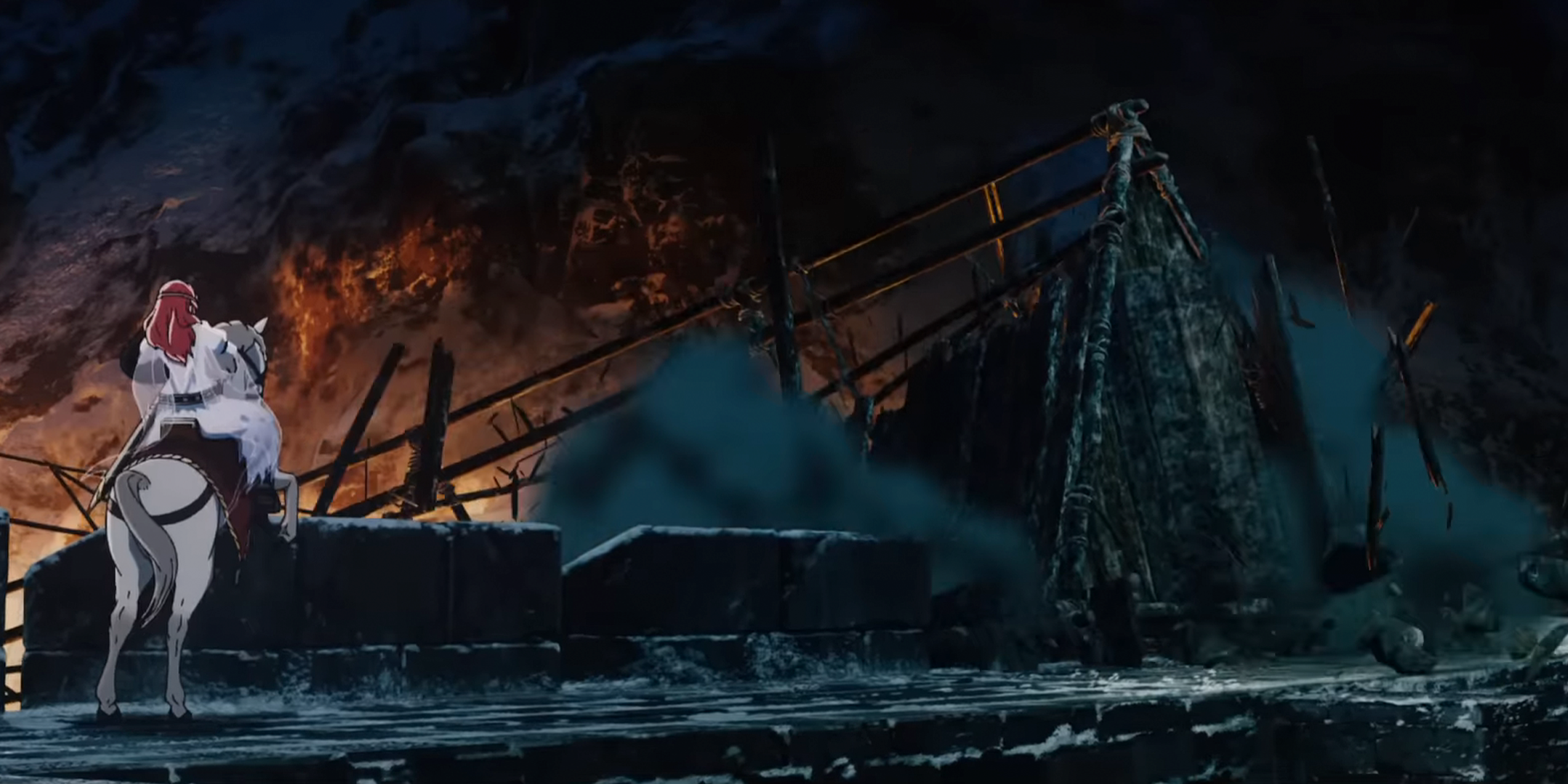
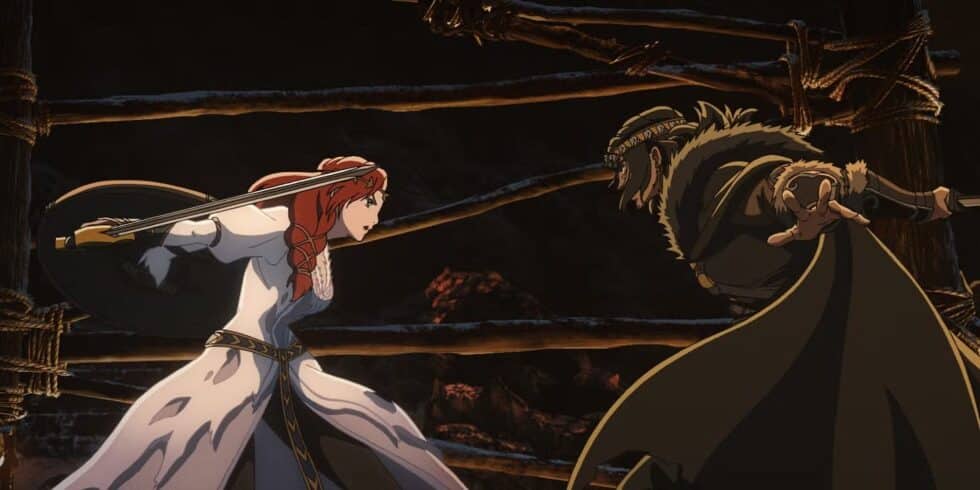
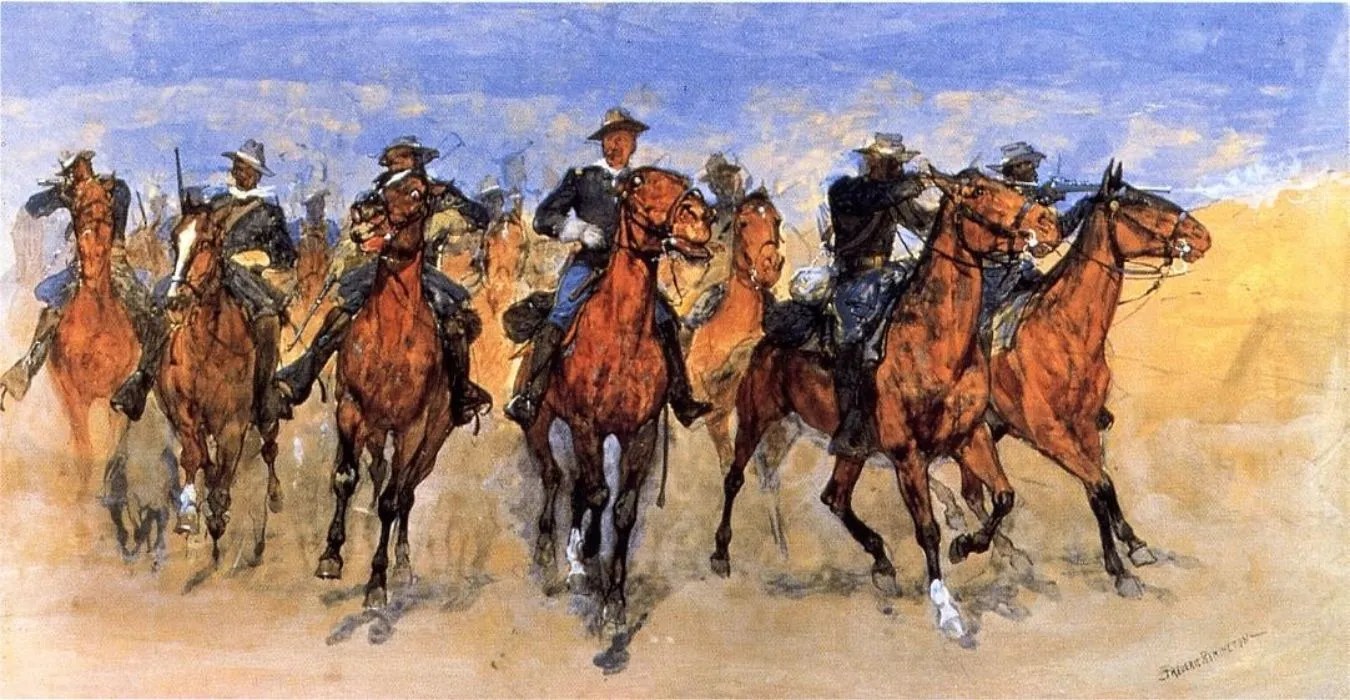

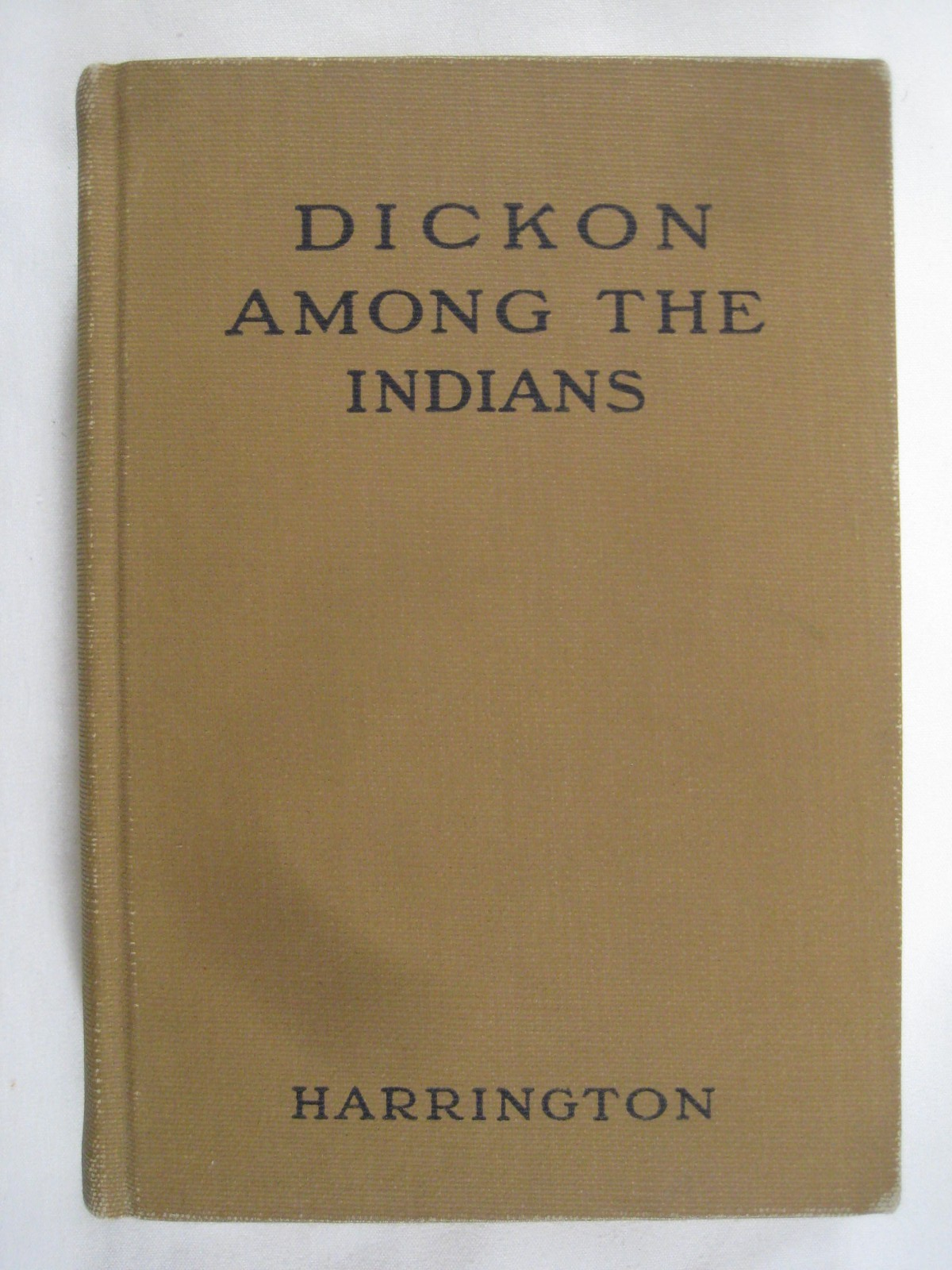
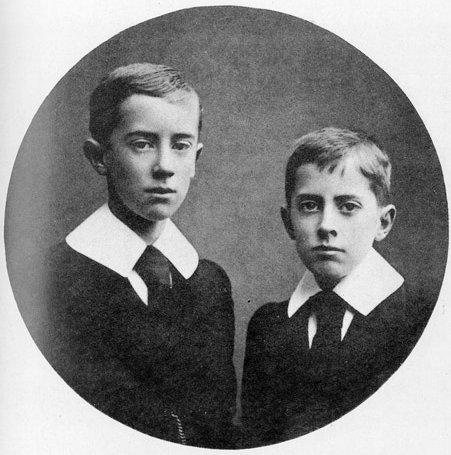
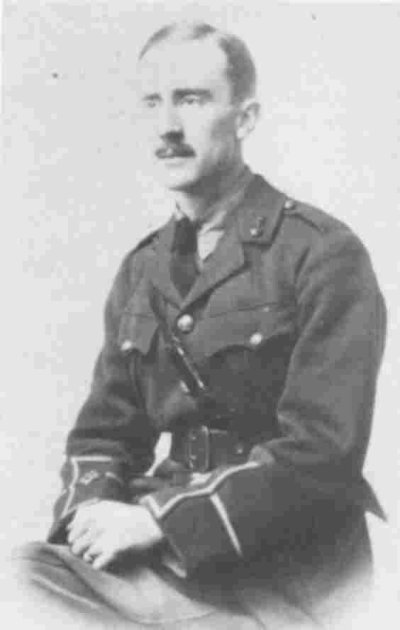
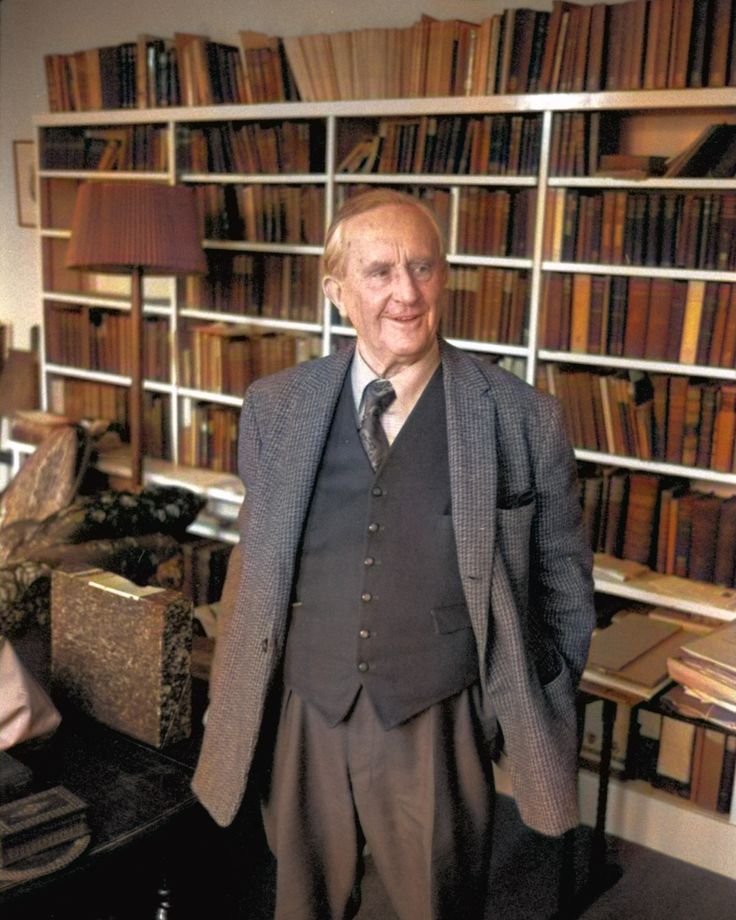
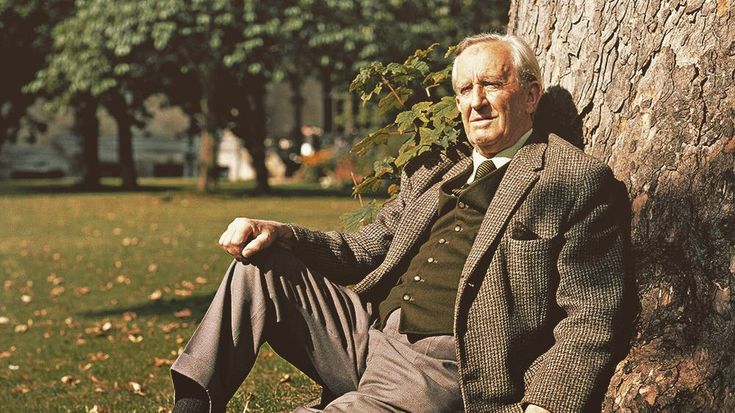



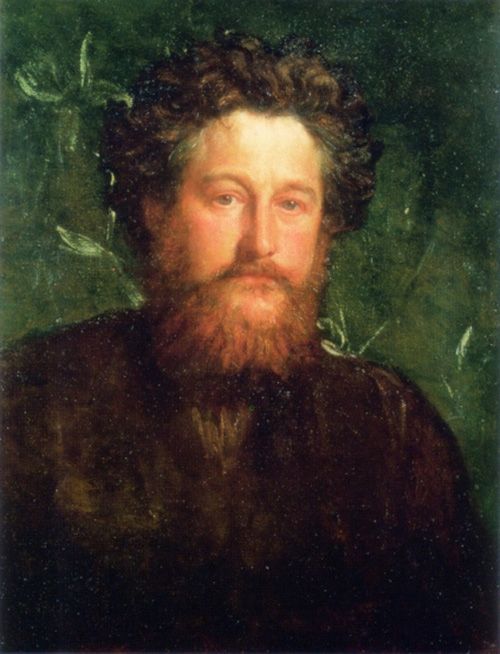
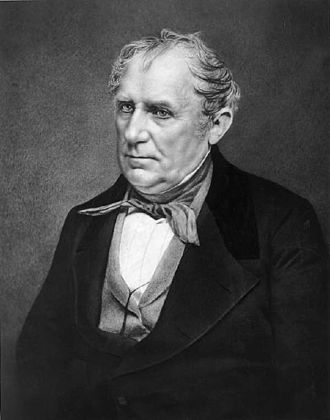
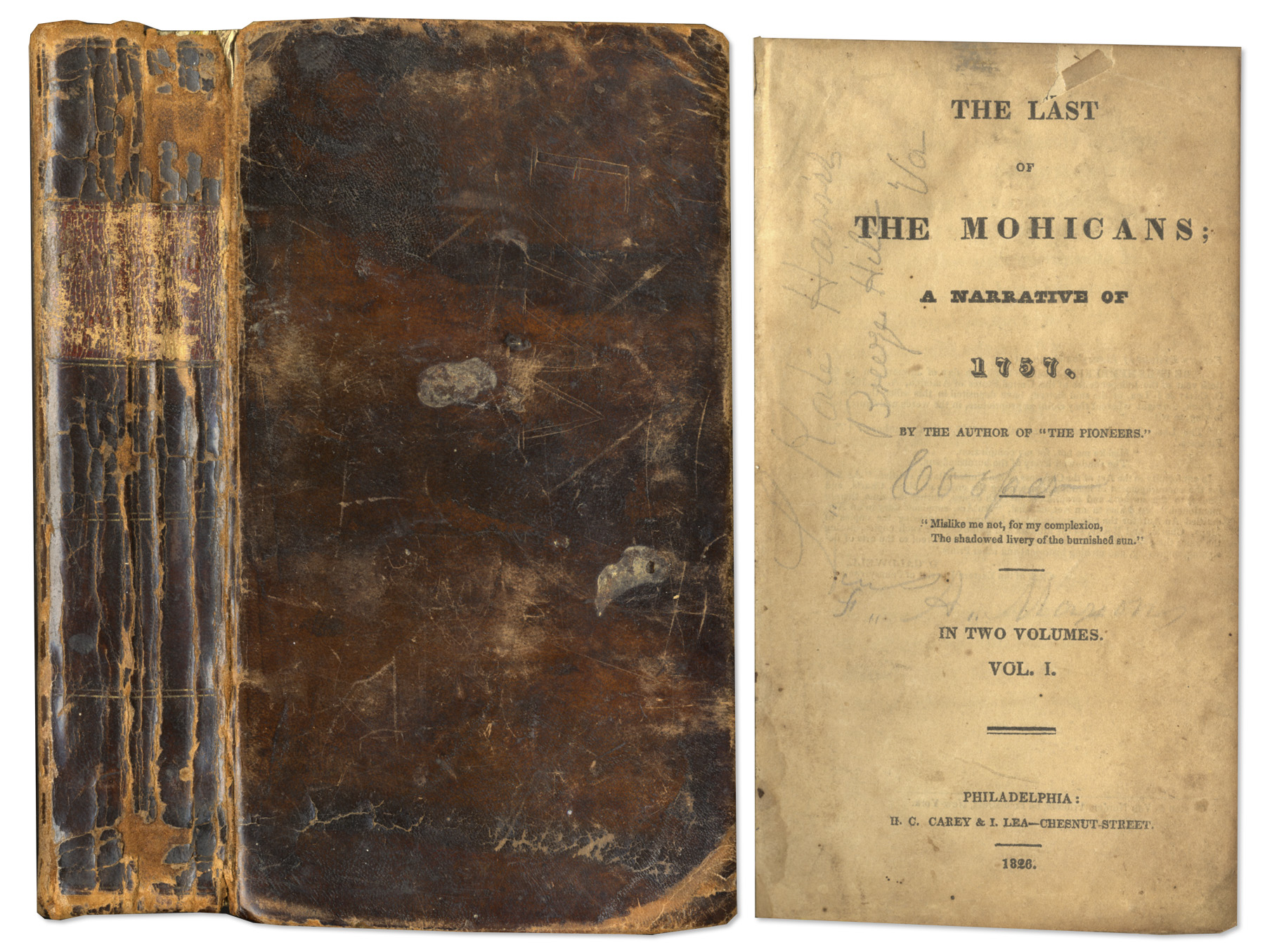
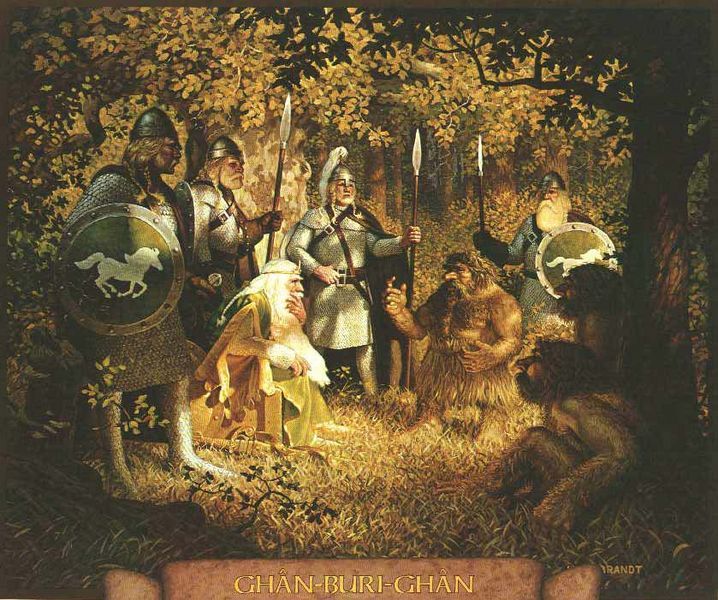
 doubtfulsea