• About

doubtfulsea

~ adventure fantasy

Tag Archives: The Hobbit

Tea Time

12 Wednesday Mar 2025

Posted by Ollamh in Uncategorized

≈ Leave a comment

Tags

Alice, camellias, Dwarves, Tea, The Hobbit

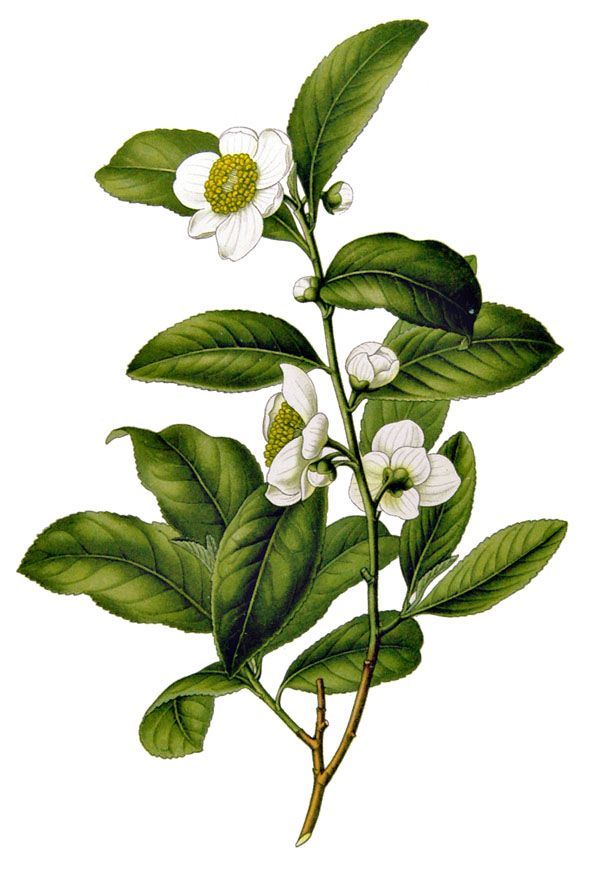
This is camellia sinensis

and, without it, two literary moments might never have appeared:  one zany (or weird, depending upon your taste for such things) scene, and one scene crucial to the whole fabric of the piece.

The genus is clearly very talented, producing, on the one hand, camellias, with their beautiful flowers, like this—

(this is by Clara Maria Pope and comes from Samuel Curtis’ A Monograph on the Genus Camellia, 1819)

and, on the other, this—

The history of drinking the latter stretches back farther in Chinese history than is probably ever datable (you can read about it here:  https://en.wikipedia.org/wiki/History_of_tea ), but we’ll join it when it arrives as a popular beverage in England.   That early history begins, in fact,  with coffee.

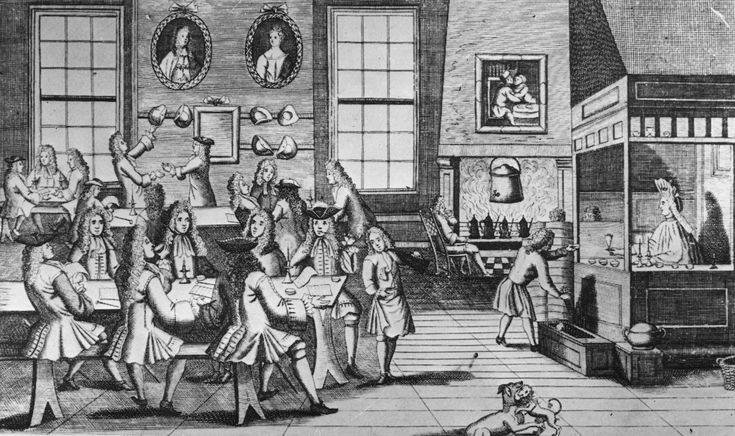
In 1652, the valet of an English Levant (Middle-Eastern) merchant, Pascua Rosee, opened what is thought to be the first coffee house in London.  It was a success and soon coffee houses became popular hangouts for those with the time and money for the then-exotic drink.

Rosee even advertized it as a kind of health-drink.

(Note the “scientific” tone of this handbill.)

In 1657, Thomas Garway (also spelled “Garraway”) began selling tea at his coffee house, later producing his own handbill on his new product.

How it spread from a London venue and eventually became a “national institution” is really about society and its influence, beginning with the wife of Charles II, Catherine of Branganza, 1638-1705,

who was already drinking tea, probably because the Portuguese had, from the early 16th century, been trading in China.  As tea was initially expensive, it remained in the hands (and mouths) of the upper classes, in part because it was taxed, almost from its beginnings.  As happened here in colonial America, this led to smuggling, but, in contrast to American violent protests,

this, in turn, led to pressure by British tea merchants upon Parliament and the tax was lowered and lowered and, in time, tea became a common (non-alcoholic) drink, even becoming part of the Temperance (anti-alcohol) Movement.  (for a good survey of all this, see:  http://www.tea.co.uk/page.php?id=98 )

As for “tea” as a kind of meal, there is a rather comic story of its invention by Anna Maria Russell, the 7th Duchess of Bedford, which you can read here:  https://www.britishmuseum.org/blog/tea-rific-history-victorian-afternoon-tea  She claimed to have created afternoon tea about 1840, but, in fact, “tea” as a meal stretches back into the 18th century, as you can read here:  https://en.wikipedia.org/wiki/Tea_(meal)   Afternoon tea, as practiced by the wealthier classes, could be quite a spread, as you’ll read,

but it could also be simply a sort of late afternoon break, about 4, and I wonder if that must be the time of our first literary moment.

(Arthur Rackham)

“THERE was a table set out under a tree in front of the house, and the March Hare and the Hatter were having tea at it: a Dormouse was sitting between them, fast asleep, and the other two were using it as a cushion resting their elbows on it, and talking over its head. ‘Very uncomfortable for the Dormouse,’ thought Alice; ‘only as it’s asleep, I suppose it doesn’t mind.’ “  (Alice’s Adventures in Wonderland, Chapter VII, “A Mad Tea-Party”)

(A dormouse is a kind of mouse, as the name suggests, but I suspect that Carroll, with his keen ear for language, was also hearing “dormeuse”—French for a feminine “sleeper”)

The oddness of it is that, with a long, set table, there are only three participants, until Alice arrives and the Hatter and Hare then both shout “No room!  No room!”

“Mad as a hatter” and “mad as a March hare” are old expressions for being less-than-sane, but there is an odd sane answer for the long, set table.  It seems that, for a rather complex reason, local time has stopped, as the Hatter explains, adding:

“‘It’s always six o’clock now.’

A bright idea came into Alice’s head. ‘Is that the reason so many tea-things are put out here?’ she asked.

‘Yes, that’s it,’ said the Hatter with a sigh: ‘it’s always tea-time, and we’ve no time to wash the things between whiles.’

‘Then you keep moving round, I suppose?’ said Alice.

‘Exactly so,’ said the Hatter:  ‘as the things get used up.’

‘But what happens when you come to the beginning again?’ Alice ventured to ask.”

But, like so many questions in Wonderland, this is never answered.

Afternoon tea is, customarily, at 4pm, suggesting that, in fact, the Hatter and Hare really don’t dirty the dishes because, if it’s always 6pm, tea is long over and therefore they may never actually have it, which is a very Carrollian way of thinking.  (Alice, however, helps herself to tea and bread and butter, but perhaps this is because, of the three (or four, counting the dormouse), she is the only sane—and perhaps real?—one.)

Our second literary moment begins with an actual invitation to tea—after all, Alice simply sat down, which the March Hare suggests was very rude.  But was it really meant?

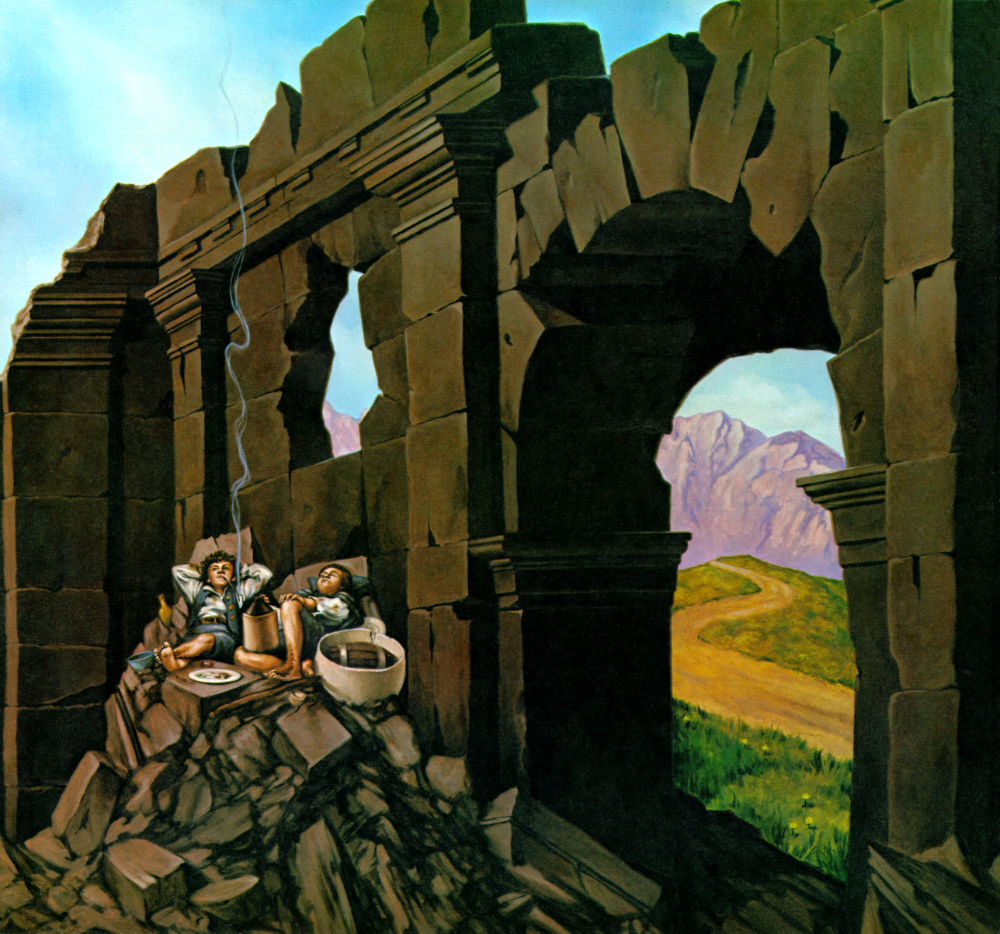
“ ‘Sorry!  I don’t want any adventures, thank you.  Not today.  Good morning!  But please come to tea-any time you like!  Why not come tomorrow?  Come tomorrow!  Good bye!’

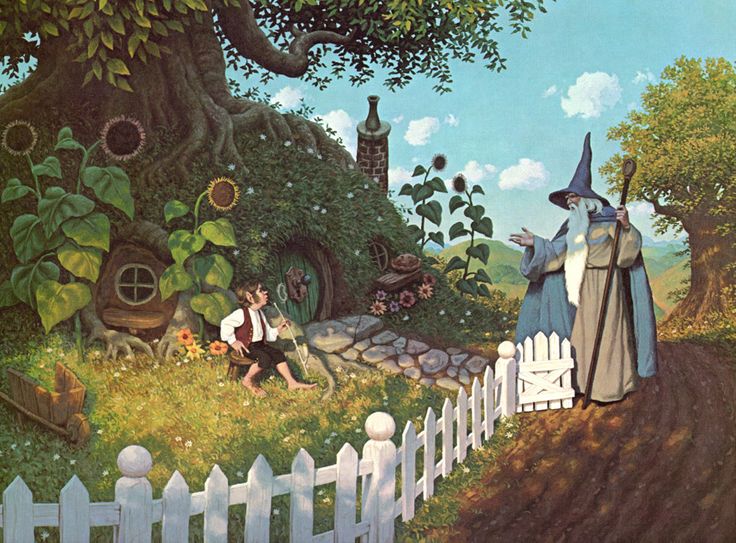
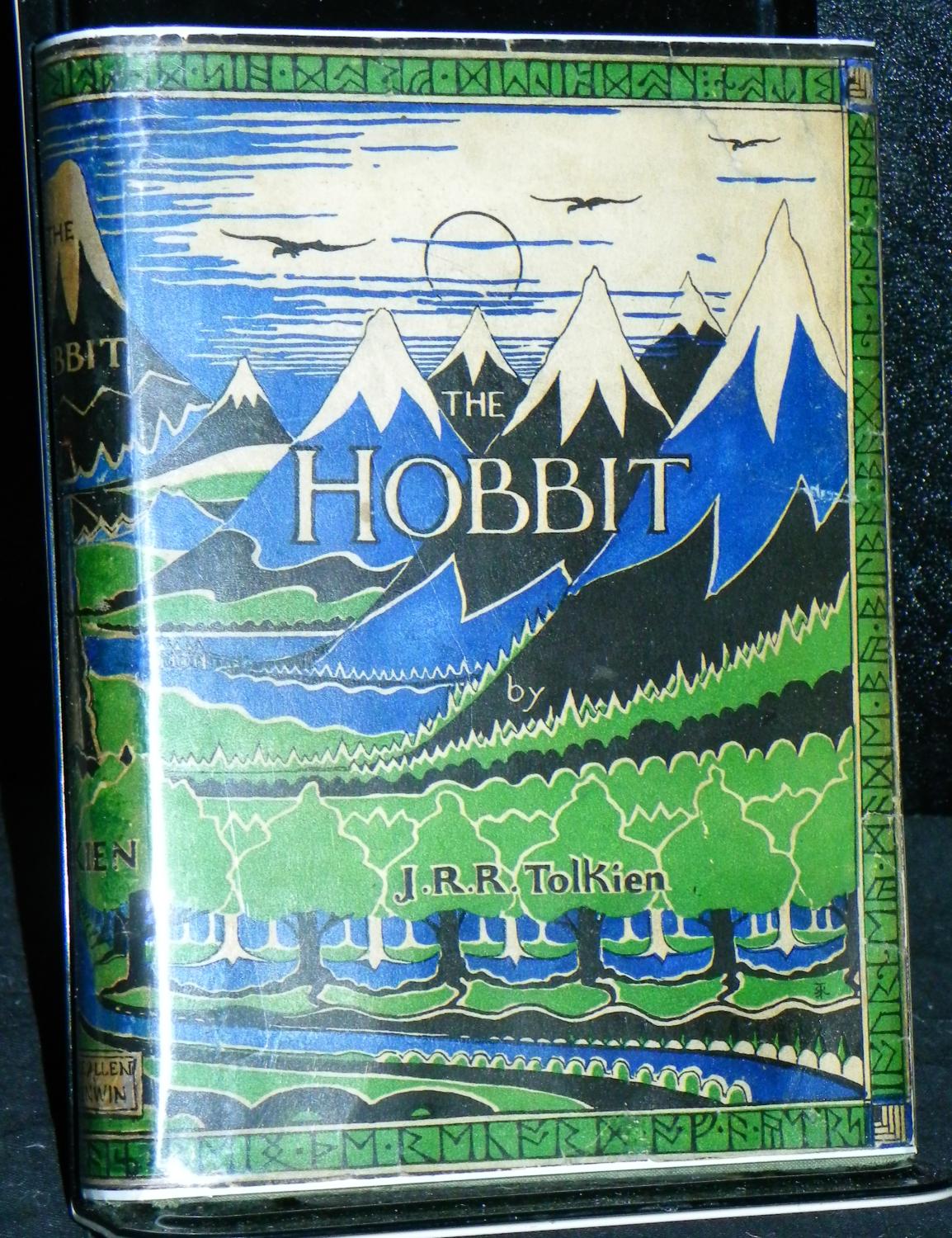
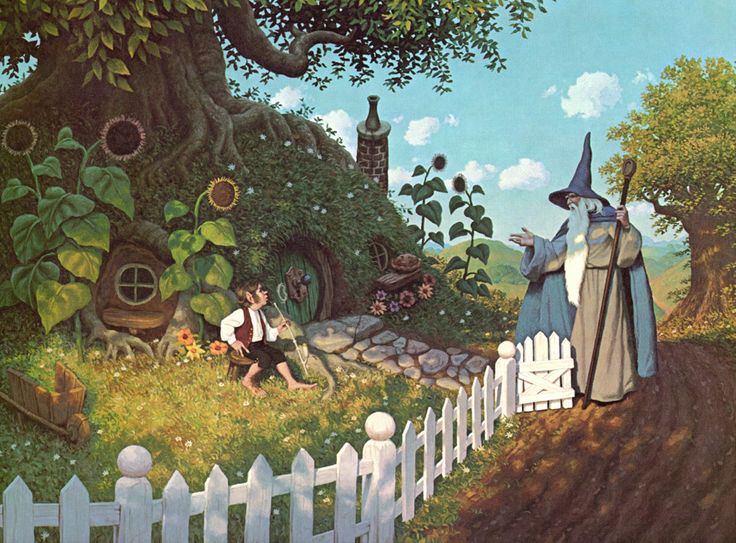
With that the hobbit turned and scuttled inside his round green door, and shut it as quickly as he dared, not to seem rude.”  (The Hobbit, Chapter 1, “An Unexpected Party”)

(the Hildebrandts)

We know what happens next, of course:  the next day, not only Gandalf, but a whole troop of dwarves arrive and the quiet tea for two quickly becomes a boisterous—not afternoon tea (as we know from Chapter 18 that Bilbo sees tea as the traditional 4pm and serves cake)–but what’s called “high tea” or “meat tea” , and which, in older days, might have been dinner for working class people.

(the Hildebrandts again)

Meat tea, as its name suggests, is more than bread and butter or cake (you can read about it here:  https://en.wikipedia.org/wiki/Tea_(meal)#High_tea  )—and that’s exactly what the dwarves—and Gandalf– demand, from “mince-pies and cheese” to “cold chicken and pickles”, but, interestingly, tea itself quickly disappears as coffee, red wine, and ale are called for, so what began as a simple invitation—and one meant to avoid adventure—itself becomes a culinary adventure, but, for that tea originally offered, would there ever have been any adventure at all?

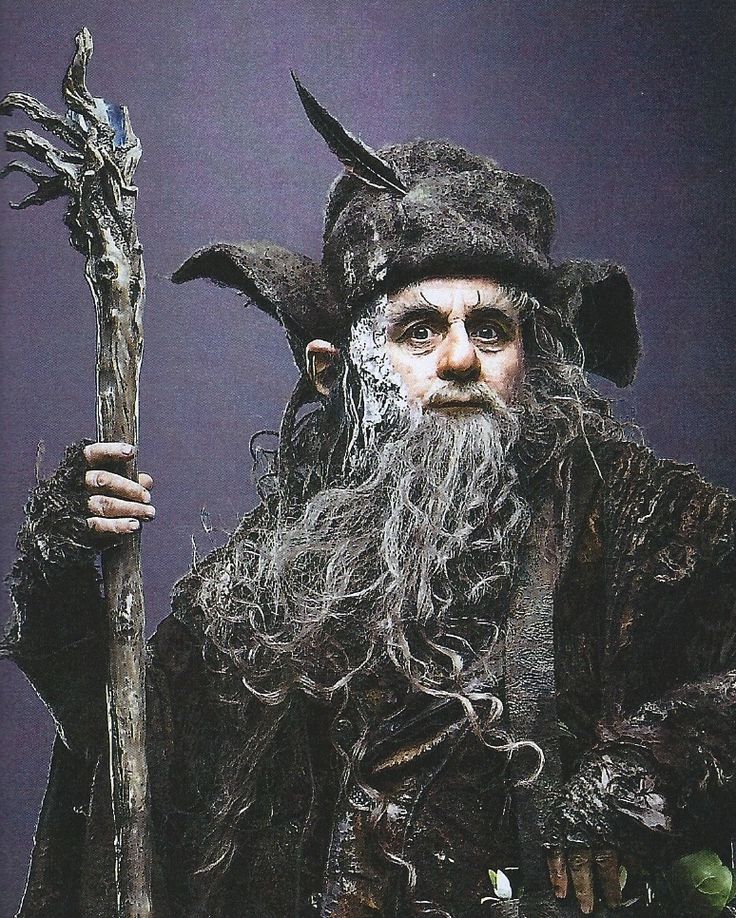
And, remembering where tea came from in our Middle-earth, where do you suppose Bilbo’s may have come from?

Thanks, as always, for reading.

Stay well,

Enjoy this pixilated version of the tea party from Disney’s Alice , 1951:  https://www.youtube.com/watch?v=5KDwE6MjfmQ  (warning:  if you’re a purist, this will not be—dare I say it?—your cup of tea)

And remember that there’s always

MTCIDC

O

Chickening In

12 Wednesday Feb 2025

Posted by Ollamh in Uncategorized

≈ Leave a comment

Tags

anachronisms, bacon and eggs, Billina, Chickens, Claymation, Nomes, Oz, Ozma, The Hobbit, Winky Guards

Welcome, dear readers, as always.

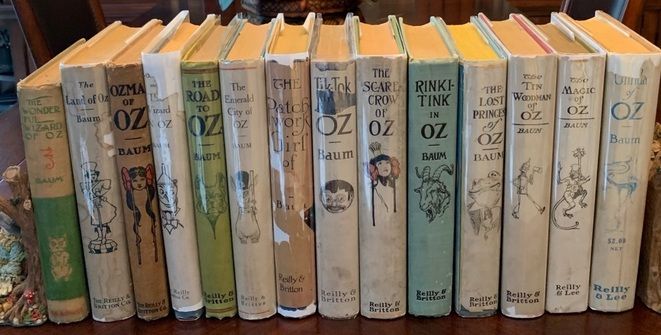
Recently, I had an interesting conversation with a dear friend on the subject of Oz books.  As a child, he had read all of them, whereas I used to look at the whole shelf of them in the local library

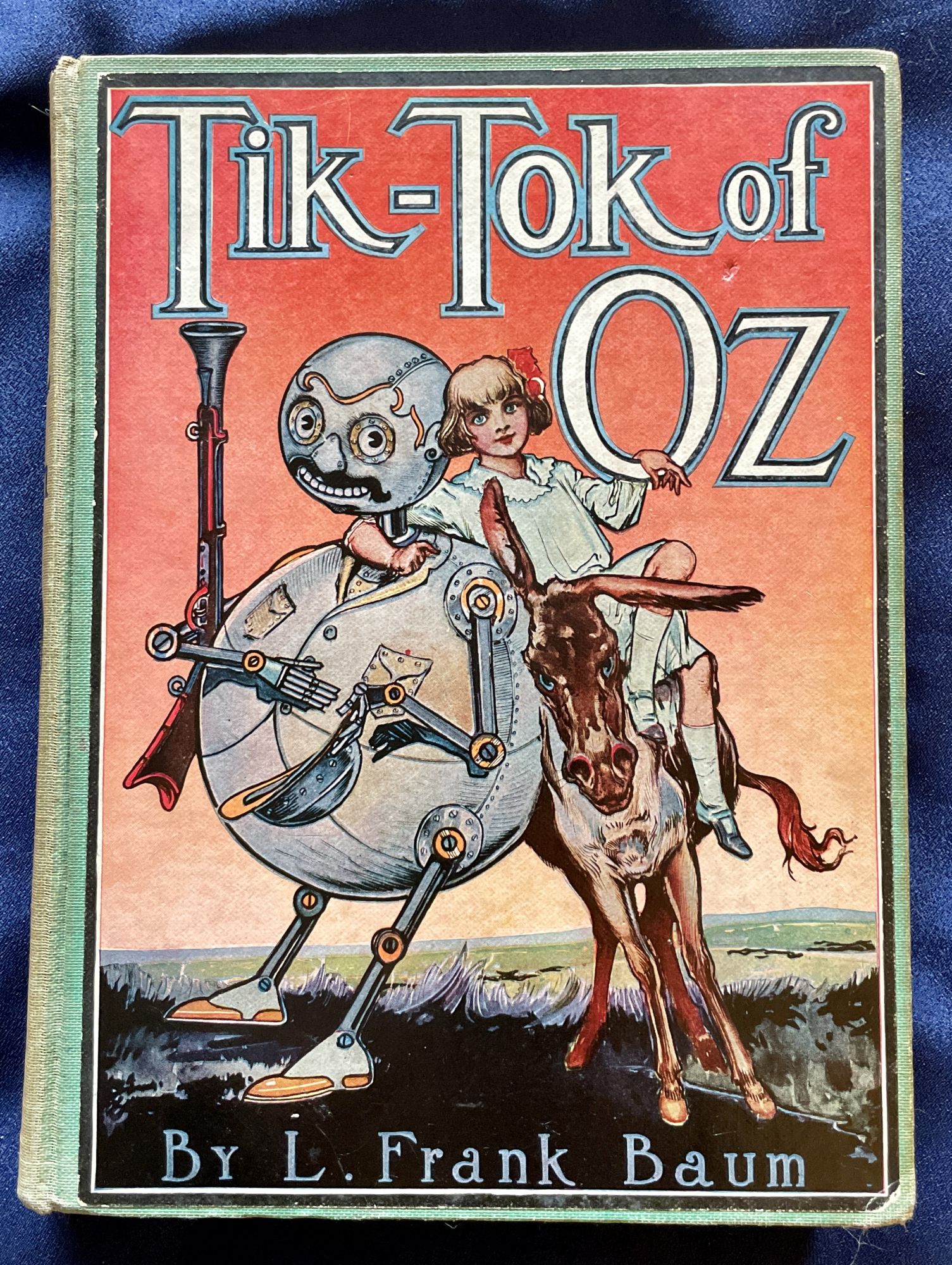
and puzzle over names like “Tik-Tok” and “Rinky-Tink”, with their strange covers,

but, interested in history and science fiction, I never read one of them, going to other sections of the library for my books.  My only contact with Oz lay in the (then) yearly showing of “The Wizard of Oz” on TV, where I would be yearly creeped out by what I later found out were the Winky Guards and their song—

which you can see/hear here, in case you’ve forgotten the Winkies:  https://www.youtube.com/watch?v=nx8-J66yawM

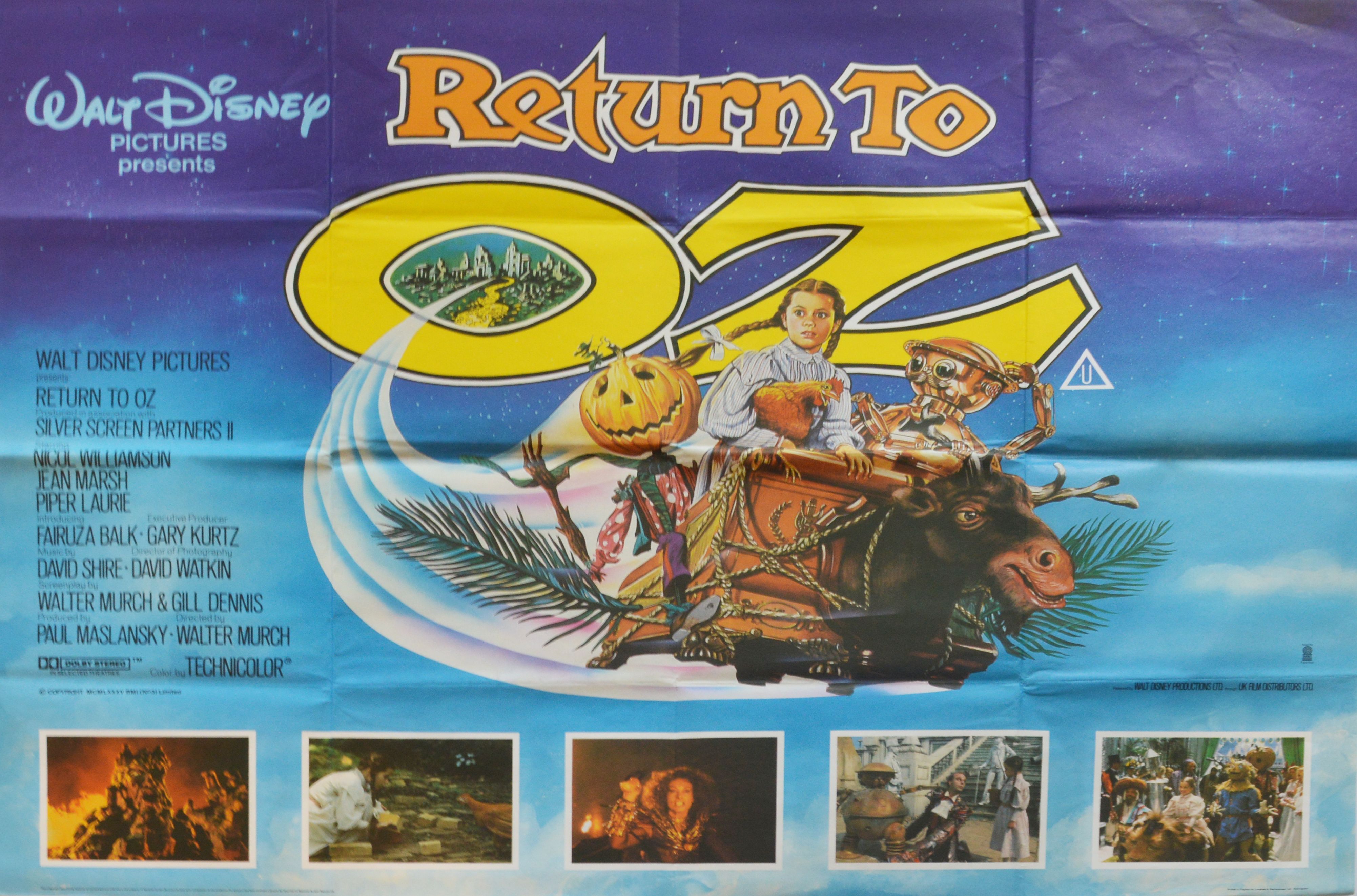
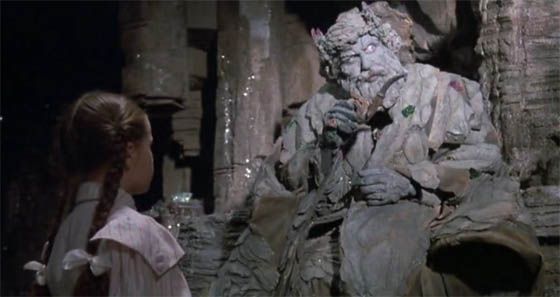
Then came a kind of sequel, “The Return to Oz”,

with its wonderful Claymation figures

and its critics:  it had run together a number of different Oz books, taking something from here and there, as well as adding what might be a disturbing element about the early use of shock treatment (Dorothy’s Aunt Em has Uncle Henry take her to an early clinic where her stories of her adventures in Oz are to be—literally—shocked out of her.  Anyone who has read Silvia Plath’s The Bell Jar, 1963, will know what a horrific form of treatment this is.)

As someone innocent of Oz, I had no idea if any of this criticism were true—although I was sure that L. Frank would never have sent Dorothy to such a place—but much later, doing research for an earlier posting, I saw that the script writers had combined two figures the witch Mombi, from The Marvelous Land of Oz, 1904

with Princess Langwidere, from Ozma of Oz, 1907,

making her the “Princess” Mombi and giving her the actual Princess’ collection of heads (she liked to change them, depending upon her mood).  Also from Ozma, along with other characters and details, came the Nomes, led by their king, Dorothy, and Dorothy’s pet chicken, Billina, who, in the world of Oz, could talk.

This last character would actually be crucial in the film as in the book, as the Nomes had a definite weakness:

“But—thunderation! Don’t you know that eggs are poison?” roared the King, while his rock-colored eyes stuck out in great terror. «Poison! well, I declare,” said Billina, indignantly. «I’ll have you know all my eggs are warranted strictly fresh and up to date. Poison, indeed!” «You don’t understand,” retorted the little monarch, nervously. “Eggs belong only to the outside world—to the world on the earth’s surface, where you came from. Here, in my underground kingdom, they are rank poison, as I said, and we Nomes can’t bear them around.” (Ozma of Oz, Chapter XV, “Billina Frightens the Nome King”)

In the film, it’s one of Billina’s eggs which destroys the Nome king, but, in the book, they are more of a provocation and the Nome king is defeated—but not killed—when his magic belt (which Billina has heard mentioned earlier) is pulled from him.

Dorothy and Billina are, of course—and proudly—from Kansas but, as I’m always interested in backstories and origins, I wondered:  before Kansas, where did chickens come from originally?  Are chickens indigenous?

But, as chickens turn out to be ancient, the answer is “it’s complicated”.

Wikipedia begins:

“The chicken (Gallus gallus domesticus) is a large and round short-winged bird, domesticated from the red junglefowl of Southeast Asia around 8,000 years ago.”

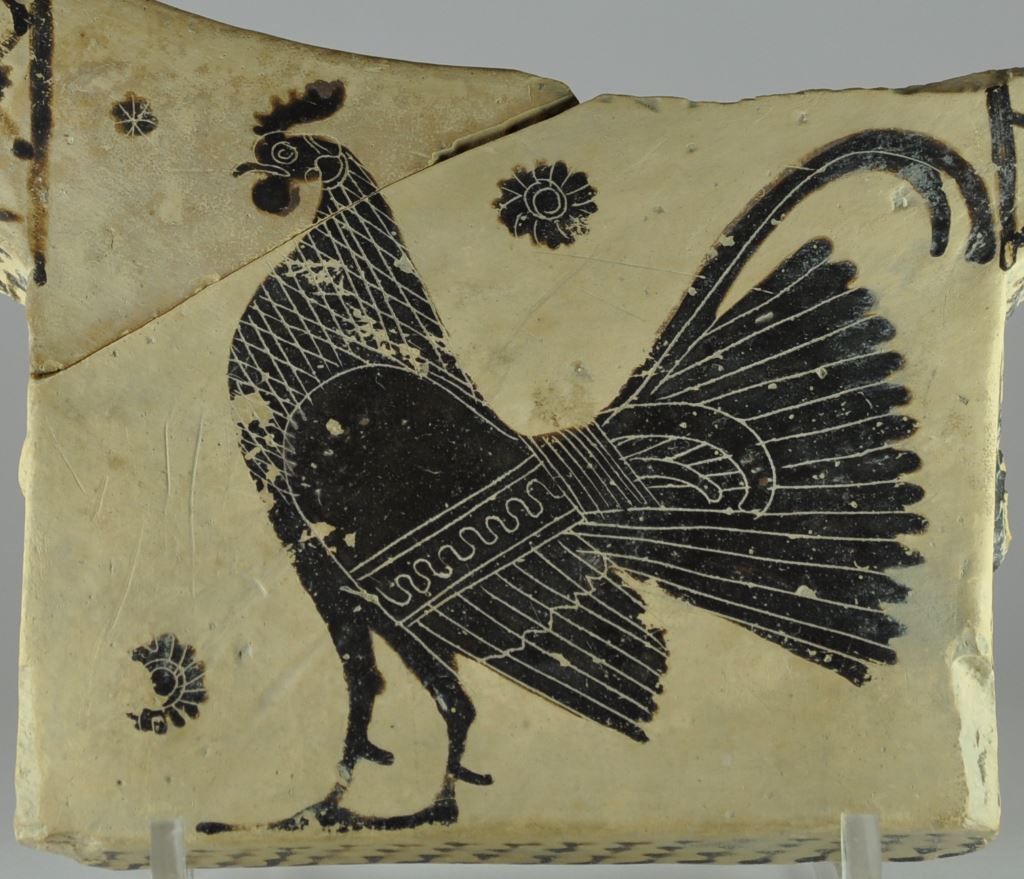
The first question which immediately springs to mind is:  “Southeast Asia?  Around 8,000 years ago?”  And how did this domesticated creature come west—and when?  Lots of mystery here, with explanations like “it came via Persia”, which is a pretty long distance from Southeast Asia.  Ancient Greece, clearly had them, but, although it has a word for “rooster” (“alektor”, among related forms, transliterated) and provides us with lots of illustrations of them,

(5th century BC)

doesn’t appear to have a separate word for hens—without hens, however, no more roosters, so hens were obviously present.  Ancient Rome has gallus for a rooster and gallina for a hen (along with pullus, which has a more generic meaning of “young one”—but is clearly the ancestor of “pullet” from Old French poulette, a diminutive of poule, “a hen”), but, when it comes to illustrations, images are seemingly almost entirely of roosters

and images of hens are as rare as—dare I say it?—hens’ teeth.

The Romans didn’t introduce chickens to the UK—recent archeological evidence suggests the pre-Roman 5th-3rd century BC—but we can presume that the chickens found a home there and, from there, traveled to the New World in the Age of Colonization, eventually making their way to Kansas, where some gallinaceous ancestors produced Billina.

As we know, Tolkien became aware of anachronisms in the 1937 The Hobbit—

things like:

“…he began to feel a shriek coming up inside, and very soon it burst out like the whistle of an engine coming out of a tunnel”

and, in the 1966 revision of the text, he considered replacing them.  Ultimately, references to tobacco remained, as did that engine, but one thing did change, Gandalf’s demand:

“And just bring out the cold chicken and tomatoes”

 became “And just bring out the cold chicken and pickles!” 

Gandalf just previously had requested, “Put on a few eggs, there’s a good fellow!”

showing an instance where the egg came before the chicken—always a philosophical problem as to precedence—but it’s clear that JRRT was quite convinced that, although tomatoes might be alien, chickens and their produce were native and that the Nome king’s view of eggs:

“Eggs belong only to the outside world—to the world on the earth’s surface, where you came from. Here, in my underground kingdom, they are rank poison, as I said, and we Nomes can’t bear them around.”

might pertain to Oz, but not to Middle-earth.

As always, thanks for reading.

Stay well,

Whichever came first, where would bacon be without eggs?

Fresh breakfast with a tasty fried egg and crispy bacon in a sauce pan waiting to be served and eaten

(Bilbo might be polled on this as, throughout The Hobbit, his thought of comfort always includes this dish)

And remember that there’s always

MTCIDC

O

Bacon and Eggs, Etc.

08 Wednesday Jan 2025

Posted by Ollamh in Uncategorized

≈ Leave a comment

Tags

bacon and eggs, being eaten, Eating, Fantasy, Goblins, Gollum, seed-cake, Smaug, snails, spiders, The Hobbit, Tolkien, Tolkien as hobbit, trolls

Dear readers, welcome, as always.

When Tolkien admitted that he was a hobbit, he defined them—and himself—in part in this way:

“…I like gardens, trees and unmechanized farmlands; I smoke a pipe, and like good plain food (unrefrigerated), but detest French cooking… “ (from a letter to Deborah Webster, 25 October, 1958, Letters, 411)

This follows, of course, his description in “Concerning Hobbits” in the Prologue to The Lord of the Rings:

“Their faces were as a rule good-natured rather than beautiful, broad, bright-eyed, red-cheeked, with mouths apt to laughter, and to eating and drinking.  And laugh they did, and eat, and drink, often and heartily, being fond of simple jests at all times, and of six meals a day (when they could get them).”

And this is an extension of the description in the first chapter, “An Unexpected Party”, of The Hobbit:

“[they] have long clever brown fingers, good-natured faces, and laugh deep fruity laughs (especially after dinner, which they have twice a day when they can get it).”

This propensity for the consumption of comestibles—and for the reporting of and description of eating and all that might go with it—is more, in The Hobbit, than simply a fond look at a foible, however.  In fact, it is a theme which seems, at times to dominate the book—and we see this practically on the first page of the novel, not only in that mention of multiple dinners, but even in the fact that hobbit laughs are “fruity”.

The opening setting itself announces the theme:  “Bilbo Baggins was standing at his door after breakfast…” and soon Bilbo is resisting Gandalf’s proposal of an adventure by saying “Nasty disturbing uncomfortable things!  Make you late for dinner!”  (The Hobbit, Chapter 1, “An Unexpected Party”)

(the Hildebrandts)

There follows the rattled Bilbo’s invitation to Gandalf to come to tea (after which he consoles himself with “a cake or two and a drink of something”), and then the party from the chapter title, which includes not only a major depletion of Bilbo’s pantry (or pantries, as the narrator has already informed us that Bilbo’s house has “lots of these”), but even a kind of heroic catalogue of what’s called for and which Bilbo seems able to supply including:  tea, beer, seed-cake, coffee, scones, ale, porter, red wine, raspberry jam, apple-tart, mince-pies, cheese, pork-pie, salad, eggs, chicken, and pickles (and a single biscuit—that is, cookie, for Bilbo).

The chapter ends with one last burst of food-talk as Bilbo offers bed and breakfast to the dwarves (as a way of seeing them off) and Thorin orders breakfast as if Bilbo were running an inn:

“But I agree about bed and breakfast.  I like six eggs with my ham, when starting on a journey:  fried not poached, and mind you don’t break ‘em.”

(Eggs and ham—those eggs will appear again, but with bacon, when Bilbo, more than once, yearns for them.  This is from a rather mouth-watering website called “The English Kitchen”, which you can visit here:  https://www.theenglishkitchen.co/2020/04/proper-ham-eggs.html  And, as, when you search for a useful image of ham and eggs, you suddenly find yourself surrounded by images of Dr. Seuss’ wonderful Green Eggs and Ham, you can it read here:  https://ia601502.us.archive.org/20/items/green-eggs-and-ham_202211/GreenEggs%20Ham.pdf )

And Bilbo goes off the bed annoyed not only at Thorin, but at all of the other dwarves, who have made similar orders.

After that opening, it’s not surprising that Chapter 2 begins with a still-annoyed Bilbo, faced with a mountain of dirty dishes, the remains of a breakfast he didn’t fix, but, cleaning up, he enjoys his own first breakfast and is starting on a second one when Gandalf appears and Bilbo is suddenly off on the adventure which takes up the rest of the book.

Food soon appears again as one of their ponies “got into the river before they could catch him…and all the baggage that he carried was washed away off him.  Of course it was mostly food, and there was mighty little left for supper, and less for breakfast.”  (Chapter 2)

But then the eating theme takes a different and disturbing turn:  trolls

(JRRT)

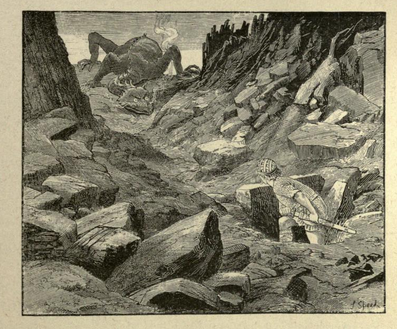
who, though currently munching mutton, have “…et a village and a half between yer, since we come down from the mountains” and soon, like amateur chefs on “The Great Goblin Bake Off”, are discussing how to prepare dwarf—will it be roasting?  boiling?  before the judge, one Gandalf, decides the argument by tricking them into being exposed to the sun and turned to stone.

(JRRT)

This is, in its way, a mirror to the original eating idea, in which the protagonists who do the consuming are at risk of becoming a potential article for consumption and we’ll see this repeated more than once with:

1. the goblins (Chapter 4):  “For goblins eat horses and ponies and donkeys (and other much more dreadful things), and they are always hungry.”

(Alan Lee)

2. Gollum (Chapter 5):  “He was looking out of his pale lamp-eyes for blind fish, which he grabbed with his long fingers as quick as thinking.  Goblin he thought good, when he could get it…” and there’s the possibility that Bilbo might be on the menu—if he loses the riddle contest.

(Alan Lee)

3. the spiders (Chapter 8):  “  ‘What nasty thick skins they [the dwarves] have to be sure, but I’ll wager there is good juice inside.’ ‘Aye, they’ll make fine eating, when they’ve hung a bit…’ ”

(and another Alan Lee)

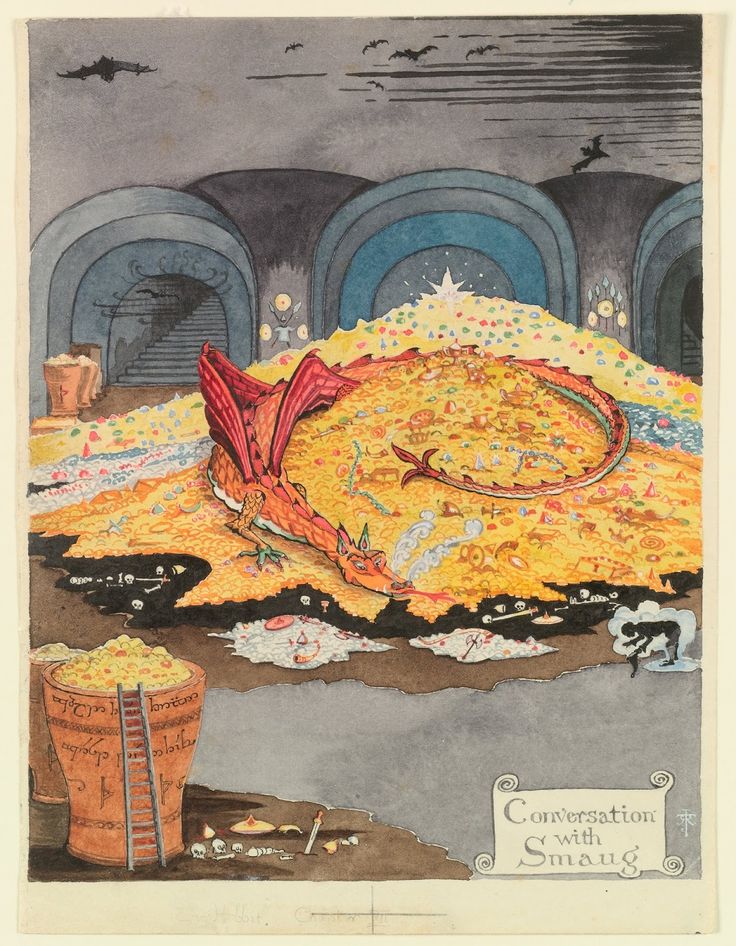
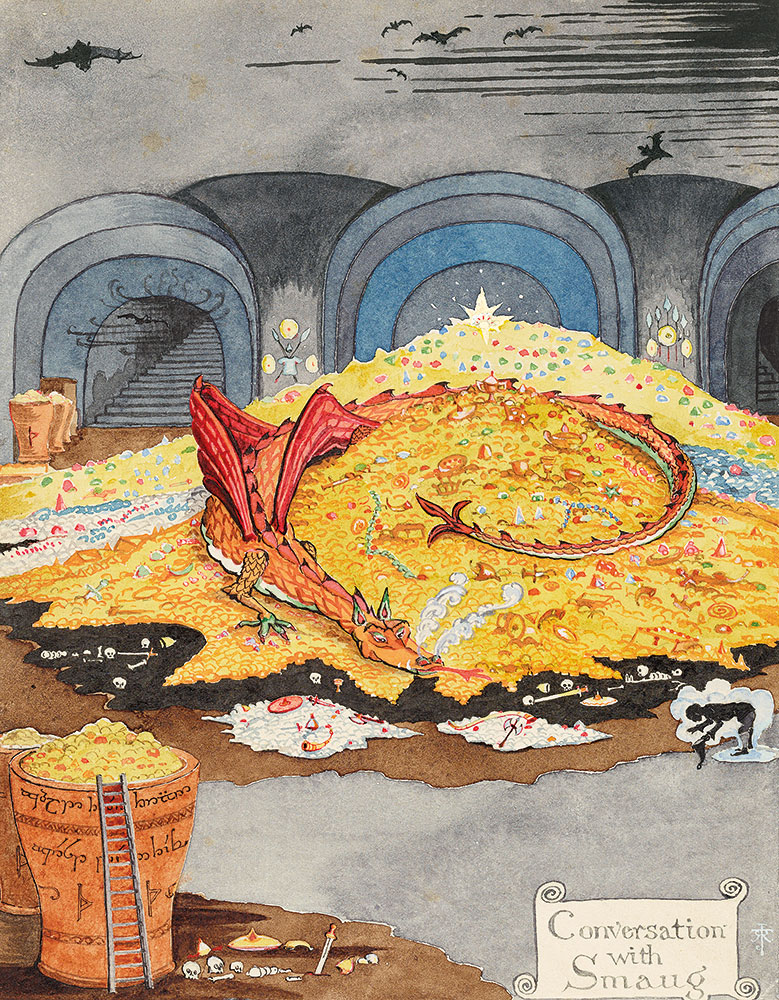
4. and, of course, Smaug (Chapter 12):  “ ‘Let me tell you I ate six ponies last night and I shall catch and eat all the others before long…I know the smell (and taste) of dwarf…Girion Lord of Dale is dead, and I have eaten his people like a wolf among sheep…’ “

(JRRT)

On the other side (the eating, not eaten), however, there are:

1. supper with the Rivendell elves (Chapter 3)

(JRRT)

2. rabbit, hare, and sheep with the eagles (Chapter 6)

(JRRT)

3. meals with Beorn (Chapter 7)

(Ted Nasmith)

4. starving in Mirkwood while being tantalized by elvish feasts (Chapter 8)

(another elf king, in an illustration by A.W. Bayes, 1831-1909)

5. prison rations in the dungeons of Thranduil, the king of the forest elves (Chapter 9)—as well as food stolen by Bilbo

(a generic dungeon as, so far, I haven’t discovered a useful illustration of the original situation)

6. feasts in Lake-town (Chapter 10)

(JRRT)

7. a gourmet diet of snails (Chapter 11)

(Alan Lee)

8. and even the threat of siege and starvation (Chapter 15)—

(Alan Lee)

Given that so much of the text is handed over to eating and drinking, it’s surprising that the conclusion of the story doesn’t have Gandalf returning (with Balin) to tea some years later—

(Alan Lee)

could it be that even that academic hobbit is finally full?

As always, thanks for reading.

Stay well,

One slice of cake should do, I think, don’t you? Or maybe two?

And remember that, as always, there’s

MTCIDC

O

Opera…Tolkien?

16 Wednesday Oct 2024

Posted by Ollamh in Uncategorized

≈ Leave a comment

Tags

books, Fantasy, J.R.R. Tolkien, The Hobbit, Tolkien

As always, dear readers, welcome.

I’ve just read an interesting piece of news:  there’s going to be an opera based upon The Lord of the Rings (see:  https://www.classicfm.com/music-news/lord-of-the-rings-opera-approved-tolkien-estate/ ).  The composer is Paul Corfield Godfrey, 1950-, who had already composed a rather massive work on the Silmarillion, of which you can hear an excerpt here:   https://www.youtube.com/watch?v=Q4HUnCx4dLI                           You can also hear “The Lament for Boromir” here:  https://www.youtube.com/watch?v=6nxvzZ98LS4  and “The Man in the Moon Came Down Too Soon” and “The Song of the Troll”, along with one or two others on YouTube as well.  (There’s the proviso with these:  you may be accused of being a bot, unless you know the secret password.)

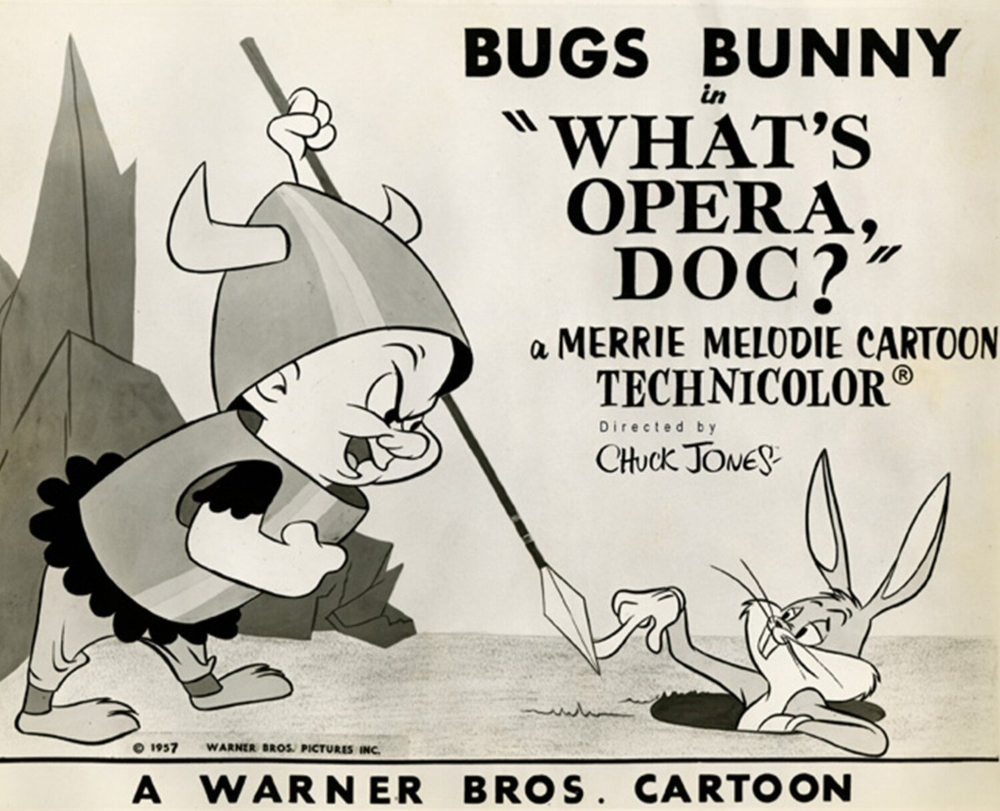
For me, opera began with a cartoon.

As a child, I saw it, loved it (Bugs Bunny always being a favorite, along with Daffy Duck), and that’s where opera first appeared in my life.

In terms of real opera, it’s an odd little piece, having, at one level, a standard plot:  Elmer Fudd pursues Bugs, as he had done many times before.

At another level, however, it’s a parody of grand opera, in which Elmer plays the Wagnerian hero, Siegfried, and Bugs, at a certain point in the story, turns himself into the Valkyrie, Brunnhilde.

And, for only the third time in their lives of pursuit and escape, Elmer actually succeeds in dealing with Bugs.

Although, in case you haven’t seen it, or forgot the plot and are worried, Bugs comes back from the dead long enough to say to the audience, “Well, what did you expect in an opera?  A happy ending?” before subsiding again.  (You can see it here:  https://www.youtube.com/watch?v=6jDcWAWRRHo provided, of course, that you’re not a bot.  You can also read a very interesting article about the making of the cartoon here:  https://en.wikipedia.org/wiki/What%27s_Opera,_Doc%3F )

Peter Schickele, 1935-2024,

the creator of PDQ Bach, 1807-1742?,

whom he once described as “the youngest and oddest of Johann Sebastian’s 20-odd children”, in a memorable introduction to Baroque opera as exemplified in PDQ Bach’s, “Haensel and Gretel and Ted and Alice”, explained that there were, in the period, two kinds of opera, “opera seria”, which was concerned with tragedies and histories, and “opera funnia”—and you can guess where this would go.

Opera seria, however, was real and where opera began, with Jacopo Peri’s, 1561-1633,

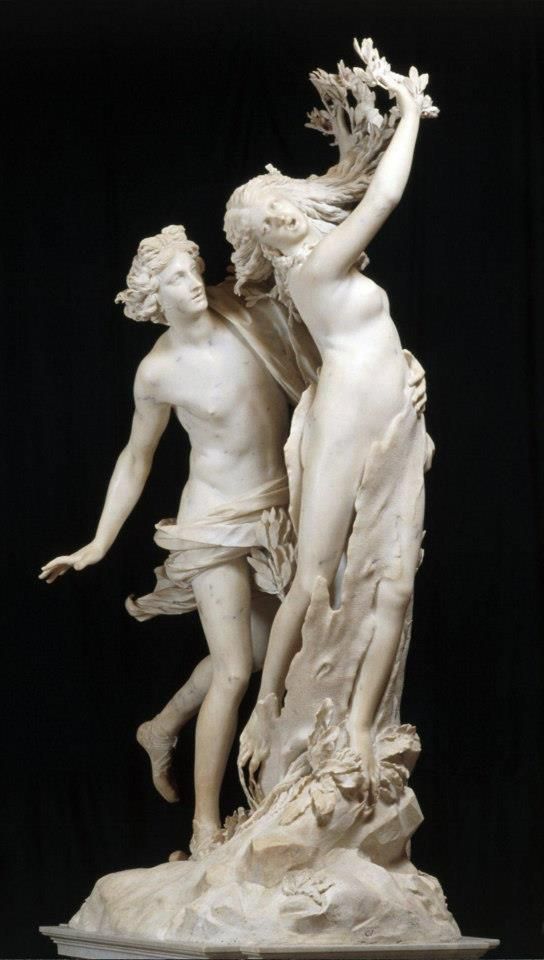
Dafne, in 1598.  This is based upon the ancient story of Daphne, who, pursued by Apollo, is turned into a laurel tree (you can read the most familiar version of the story, as told by Ovid in Book 1 of his Metamorphoses, here:  https://www.theoi.com/Text/OvidMetamorphoses1.html at line 452 and following).

(by Gian Lorenzo Bernini, 1598-1680, dated to 1622-25)

The goal of this and subsequent works, both by Peri and others, was to attempt to revive what they understood Greek tragedy to have been like, with its dark mythological stories—truly opera seria!  To Peri and his contemporaries, this meant not only solo songs and choruses, but that all of the dialogue would be sung, too, in what came to be called recitativo, and this convention continued into the 20th century.

There is another possibility, however, although not “opera funnia”.  It’s a form known in German as “Singspiel” and in French as “Opera comique” and combines the solo songs and choruses of opera seria with spoken dialogue, rather than recitativo, in just the way contemporary musicals are really plays with music, where songs appear at important dramatic points in the story.

(Rodgers and Hammerstein’s “Oklahoma”, 1943)

In 1964, an English composer, Carey Blyton, 1932-2002, wrote to JRR Tolkien requesting his permission to create a “Hobbit overture”.  Tolkien was clearly delighted and granted permission immediately, providing for us, as well, with this sidelight on himself and music:

“As an author I am honoured to hear that I have inspired a composer.  I have long hoped to do so, and hope also that I might find the result intelligible to me, or feel that it was akin to my own inspiration…I have little musical knowledge.  Though I come from a musical family, owing to defects of education and opportunity as an orphan, such music as was in me was submerged (until I married a musician), or was transformed into linguistic terms.  Music gives me great pleasure and sometimes inspiration, but I remain in the position in reverse of one who likes to read or hear poetry but knows little of its technique or tradition, or of linguistic structure.”  (from a letter to Carey Blyton, 16 August, 1964, Letters, 490.  You  can hear Blyton’s overture, composed in 1967 as Opus 52a, here:  https://www.youtube.com/watch?v=rybV4xDq_DM  –that is, if you persist in insisting that you’re not a bot.)

The musician was, of course, his wife, Edith, and Tolkien’s interest in music was certainly developed enough that, in a trip to Italy in 1955 with his daughter, Priscilla, he reacted to a performance of Giuseppe Verdi’s Rigoletto, with the words “Perfectly astounding”.  (from a letter to Christopher and Faith Tolkien, 15 August, 1955, Letters, 325)

I’ll be very curious to see what comes of this opera project, which claims to be retaining Tom Bombadil

(the Hildebrandts)

and the equally neglected Barrow-wight.

Under the Spell of the Barrow-wight, by Ted Nasmith

(Ted Nasmith)

If the selection I’ve heard from Godfrey’s Silmarillion provides us with an idea of his treatment of The Lord of the Rings, we will hear not only Tolkien’s poems, like “The Man in the Moon”, set to music, but the dialogue may also be done in recitativo, and I’ll be very curious to see how he manages this, as there’s so much of it—perhaps a narrator for continuity? 

Thinking about this has set me wondering about how one might turn The Hobbit into an opera, dialogue aside.  Tolkien has provided us with about 15 lyrics throughout:

Chapter 1, “An Unexpected Party”: 

“Chip the glasses…”  a chorus for the dwarves

“Far over the misty mountains cold…”  a second chorus for the dwarves

“Far over the misty mountains cold…”  a reprise of the first verse, sung by Thorin and overheard by Bilbo

Chapter 3, “A Short Rest”

“O!  What are you doing…”  a chorus for elves

Chapter 4, “Over Hill and Under Hill”

“Clap!  Snap!  the black crack!”  a chorus for goblins

Chapter 5, “Riddles in the Dark”

Just a thought, but perhaps these riddles could all be sung, the glaring exception being Bilbo’s “What have I got in my pocket?”

Chapter 6, “Out of the Frying-Pan into the Fire”

“Fifteen birds in five fir-trees” another goblin chorus

“Burn, burn tree and fern” a goblin chorus—but possibly add in the howling of the wolves?

Chapter 7, “Queer Lodgings”

“The wind was on the withered heath”  a chorus for dwarves

Chapter 8, “Flies and Spiders” 

“Old fat spider”

“Lazy lob and crazy cob”  two songs for Bilbo—the first time we’ve heard his voice

Chapter 9. “Barrels Out of Bond”

“Roll—roll—roll—roll”

“Down the swift dark stream you go”  two choruses for the forest elves

Chapter 10, “A Warm Welcome”

“The King beneath the mountains”  sung by the people of Lake-town

Chapter 15, “The Gathering of the Clouds”

“Under the Mountain dark and tall”  a dwarf chorus

Chapter 19, “The Last Stage”

“The dragon is withered”  a chorus for the elves of Rivendell

“Sing all ye joyful, now sing all together!”  a second chorus for the elves

“Roads go ever ever on”  a song for Bilbo and the last in the book

Reading through this list:

1. it’s easy to see that the majority of the lyrics are meant for a chorus of dwarves, goblins, Lake-town people, and assorted elves

2. the only solo numbers (excepting the riddles, if sung) are few in number and given to Bilbo

3. there are lyric gaps in the potential script:  Chapters 11-14 and 16-18 have no songs at all

If you were the librettist, how would you fill not only those gaps, but provide for more solos—for Gandalf, Bilbo,Thorin, the Chief Goblin, Gollum, Beorn, Thranduil (the forest elf king), the Master of Lake-town, Bard, Smaug, Roac (the elderly raven), as well as perhaps small comic parts for the Sackville-Bagginses, and something for the stone trolls (a trio about eating might be appropriate) too?  It’s also important to note the complete lack (except with the possible exception of the Lake-towners) of female voices in solos and choruses.  How could that imbalance be readjusted—without seriously messing with Tolkien’s text (and we know from his correspondence with Forrest J. Ackerman on a potential film version of The Lord of the Rings that, although he conceded that a different art form might require some adjustment, he had his limits as to just what and how much might be altered—see “from a letter to Forrest J. Ackerman”, June, 1958, Letters, 389-397)  Considering the story, it would seem that it would be a fitting subject for an opera seria, but there would be the danger—as there will be for Godfrey’s The Lord of the Rings—that, not maintaining the tone and making too many additions or changes to the text might quickly turn it into an opera—funnia.

Thanks for reading, as ever,

Stay well,

Beware of Godfrey’s “The Song of the Troll”—it’s catchy!

And remember that, as always, there’s

MTCIDC

O

PS

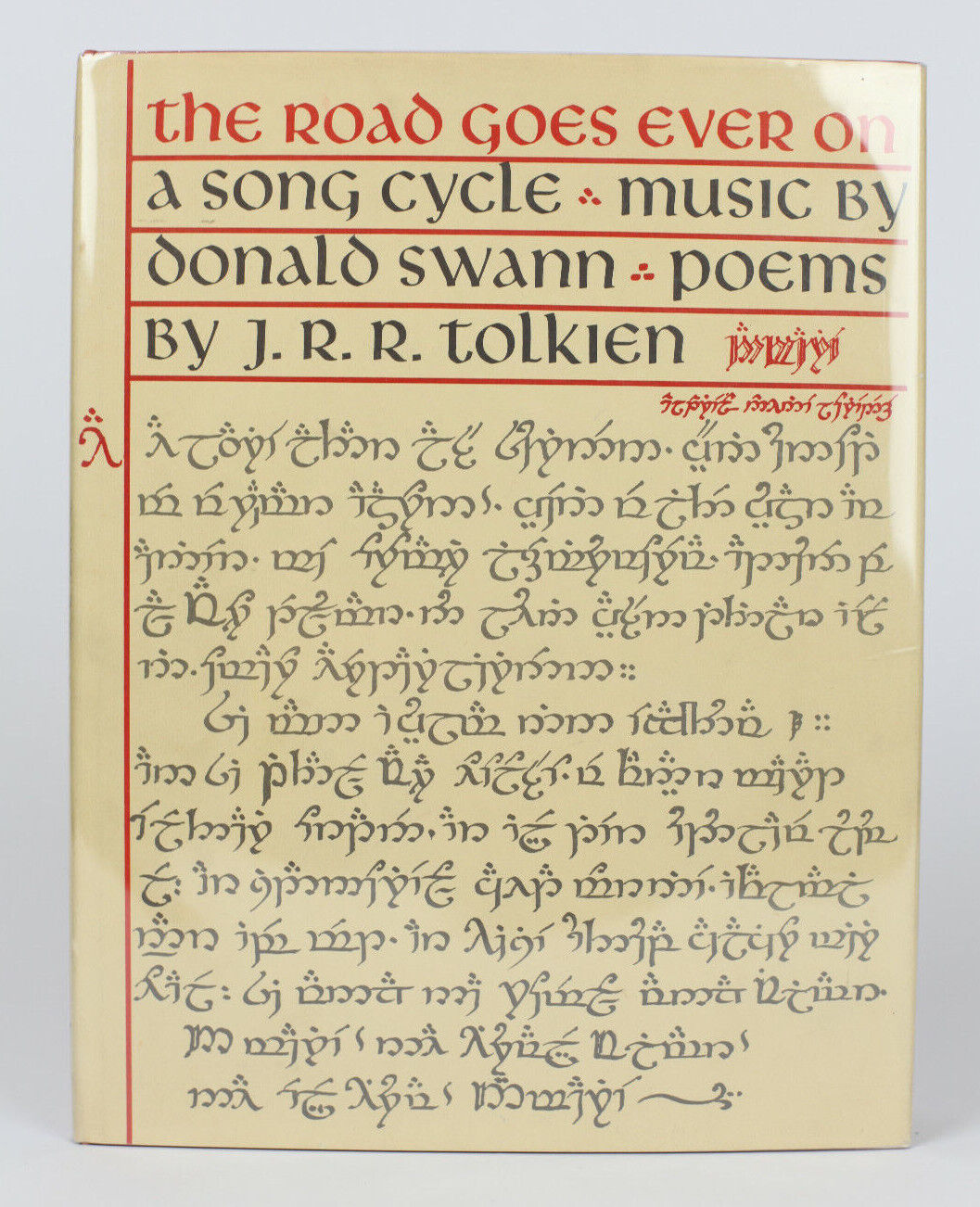
I’m not aware that Tolkien ever heard that “Hobbit overture”, but, in 1967, he collaborated with the composer, Donald Swann, 1923-1994, on a short cycle of his poems drawn from various sources, entitled The Road Goes Ever On. 

 You can read about it here:  https://en.wikipedia.org/wiki/The_Road_Goes_Ever_On  And, provided that you have finally proved to YouTube’s satisfaction that you are not, indeed, a bot, you can hear it here:  https://www.youtube.com/watch?v=YtH6ROfV7WA  I’ve loved the cycle for years, have sung it, and very much recommend it. )

Grocer or Burglar?

11 Thursday Jul 2024

Posted by Ollamh in Uncategorized

≈ Leave a comment

Tags

books, Fantasy, J.R.R. Tolkien, The Hobbit, Tolkien

As always, dear readers, welcome.

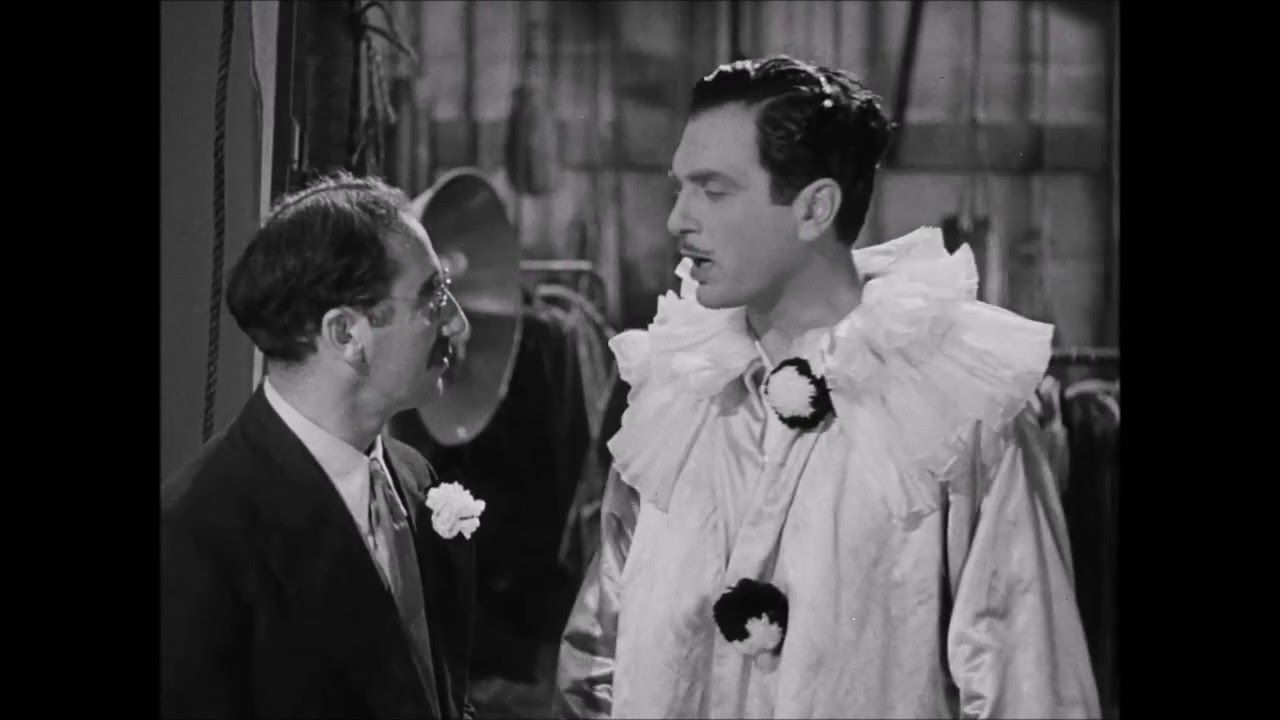
For Bilbo Baggins, what promised to be an easy morning suddenly turned dark with the arrival of “an unexpected party” (this is a Tolkien pun:  “party” in Victorian English could mean “person” as well as “event”—and it’s still available in legal English, as in “the party of the first part”—which turns up in an hilarious scene from the Marx Brothers’ Night at the Opera, 1935—

in which Groucho, a shyster lawyer named “Otis P. Driftwood”, makes an agreement with the manager, played by Chico (say that “CHICK-oh” as he was supposedly always after girls), of an Italian tenor,

the agreement consists of mock legalese and—well, here, see it for yourselves:  https://www.youtube.com/watch?v=G_Sy6oiJbEk ).

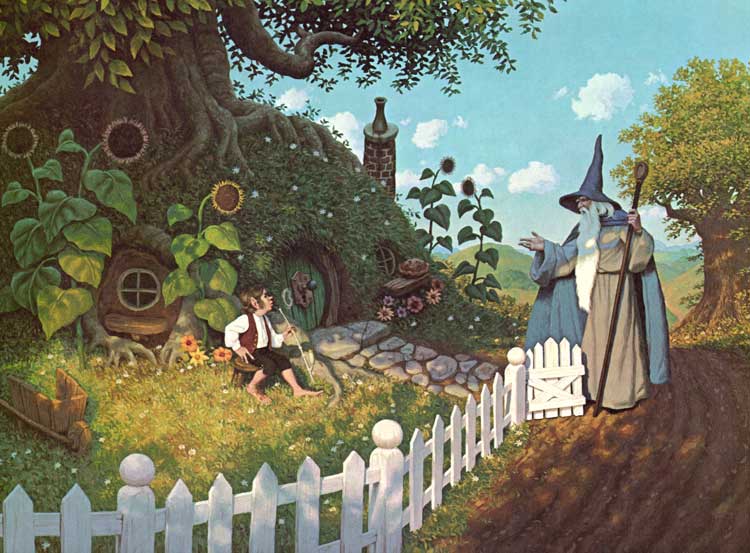
This party is Gandalf

(the Hildebrandts)

and his arrival leads to that second party—the one with all of the dwarves—

(another Hildebrandts)

and the map

(JRRT—with the later addition of the moon letters)

and Bilbo’s reaction to the danger involved in joining the dwarves as a “burglar”:

“At may never return he began to feel a shriek coming up inside, and very soon it burst out like the whistle of an engine coming out of a tunnel…Then he fell flat on the floor, and kept calling out ‘struck by lightning, struck by lightning!’ over and over again…”  (The Hobbit, Chapter One, “An Unexpected Party”)

Needless to say, this did not leave a very good impression upon the dwarves, leading Bilbo to overhearing Gloin say:

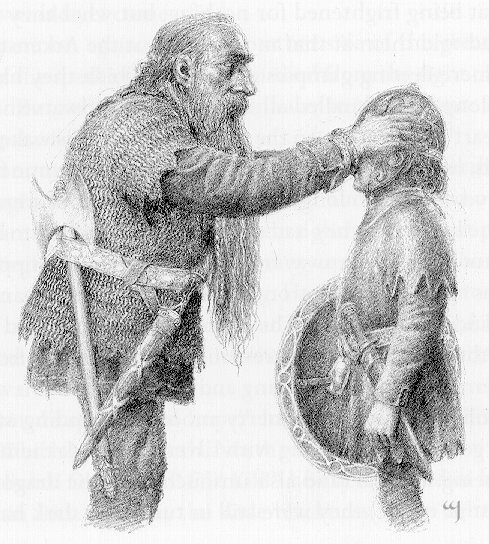
“It is all very well for Gandalf to talk about this hobbit being fierce, but one shriek like that in a moment of excitement would be enough to wake the dragon and all his relatives, and kill the lot of us.  I think it sounded more like fright than excitement!  In fact, if it had not been for the sign on the door, I should have been sure we had come to the wrong house.  As soon as I clapped eyes on the little fellow bobbing and puffing on the mat, I had my doubts.  He looks more like a grocer than a burglar!”

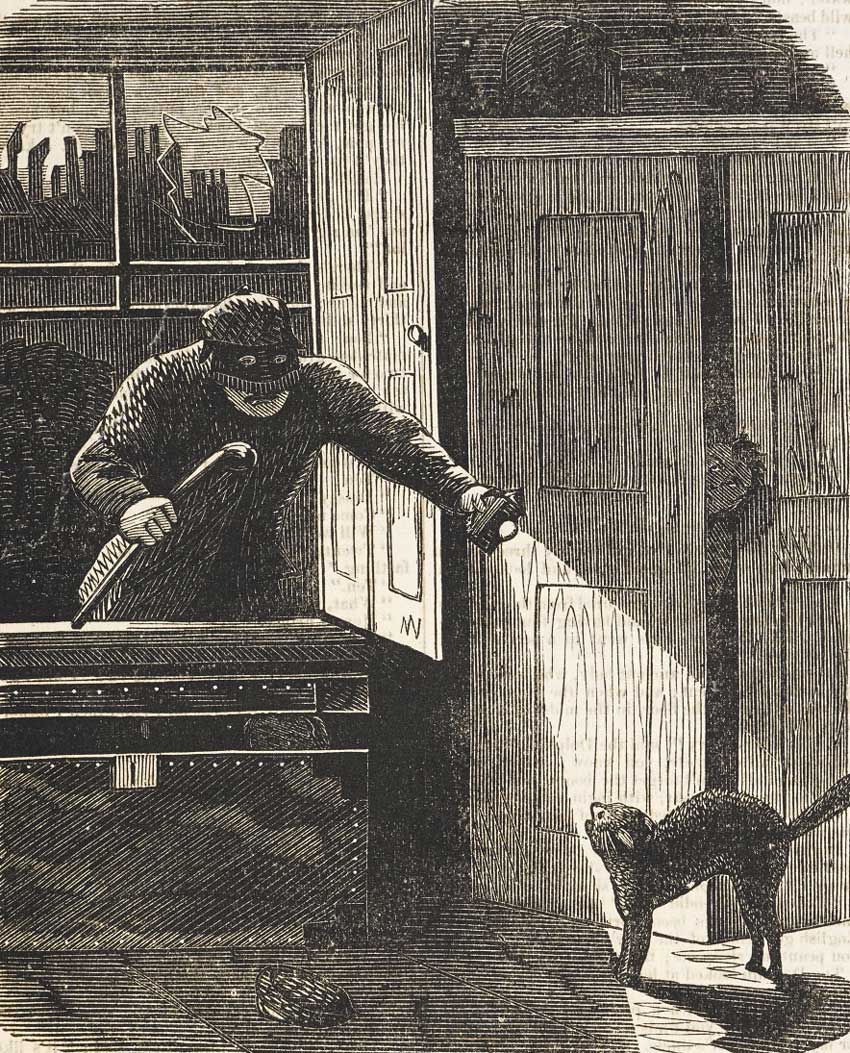
But what does a burglar look like?  I’ve always presumed that Tolkien, if not Gloin, had in mind someone like this—

which certainly differs from Bilbo in every way.

If he doesn’t look like that, does he resemble a grocer?  What does a grocer look like?

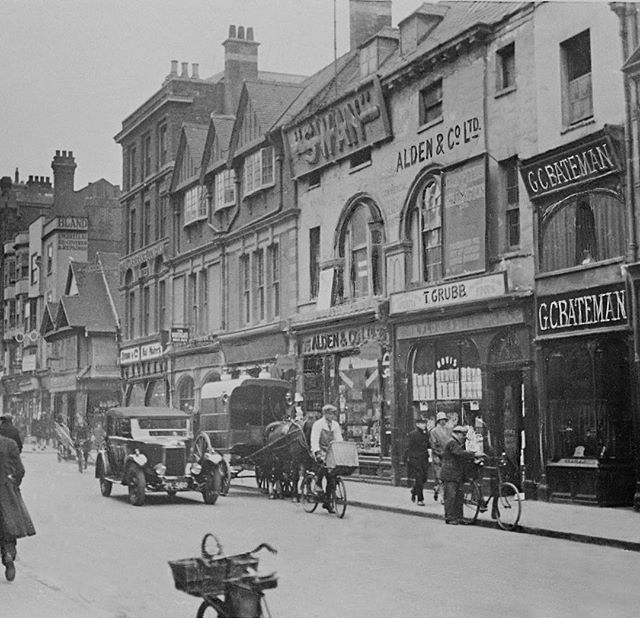
In Tolkien’s England, except for a big city, like London, which had department stores like Whiteley’s,

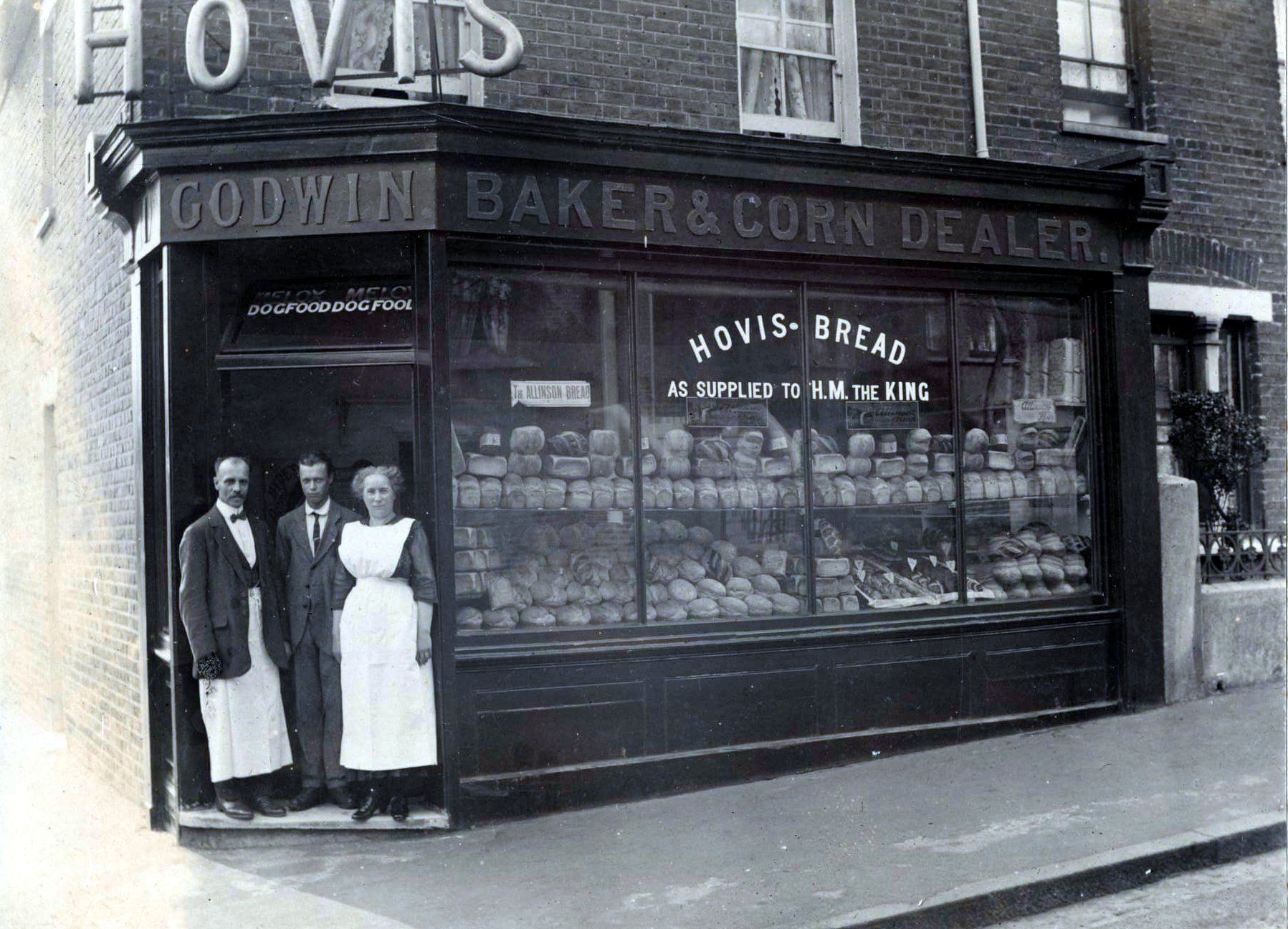
people bought their necessities along certain streets (sometimes called “the high”), where there were shops for anything and everything (also true in middle and lower class neighborhoods even in big cities).

Thus, for example, you went to the butcher shop for meat,

the bakery for bread,

the fruiterer for fruit,

and the greengrocer for vegetables.

(This can still be the case today—I’ve certainly walked down such streets in recent years in what are commonly called “market towns”—

even when, just outside town, there are supermarkets with large parking lots—

Sainsbury’s itself began as a single shop in London in 1869—)

Such shops, and many others, including department stores, as they began to appear in the 1870s and beyond, were not self-service, as most stores are now, but were staffed with clerks, whose job was to take orders from customers, acting as in-store middlemen, like this fellow—

or these

and there could be a kind of obsequiousness to their behavior (where “the customer is always right” must have come from) which is, I think, what JRRT had in mind when he has Gloin say “more like a grocer”, “puffing and blowing”.

That Bilbo was a well-off individual, living in a rather luxurious dwelling, to begin with,

(JRRT)

and then being called “a shop assistant” or the equivalent, we can see why:

“The Took side had won.  He suddenly felt he would go without bed and breakfast to be thought fierce.  As for little fellow bobbing on the mat it almost made him really fierce.”

And so Bilbo was on his way to becoming the burglar Gandalf had advertized him to be. 

(Alan Lee)

Thanks for reading, as ever.

Stay well,

Be wary of eavesdropping on dwarves,

And remember that, as always, there’s

MTCIDC

O

PS

If you’d like to read about a completely different burglar, (someone Tolkien could easily have read about), you might try A.J. Raffles, an “amateur cracksman”—that is, a gentleman burglar–created by E.W. Hornung (1866-1921), the brother-in-law of Arthur Conan Doyle—with The Amateur Cracksman, 1899, here:  https://archive.org/details/amateurcracksma03horngoog/page/n9/mode/2up

How Stands the Glass Around?

29 Wednesday May 2024

Posted by Ollamh in Uncategorized

≈ Leave a comment

Tags

Fantasy, J.R.R. Tolkien, lord-of-the-rings, The Hobbit, Tolkien

As always, dear readers, welcome.

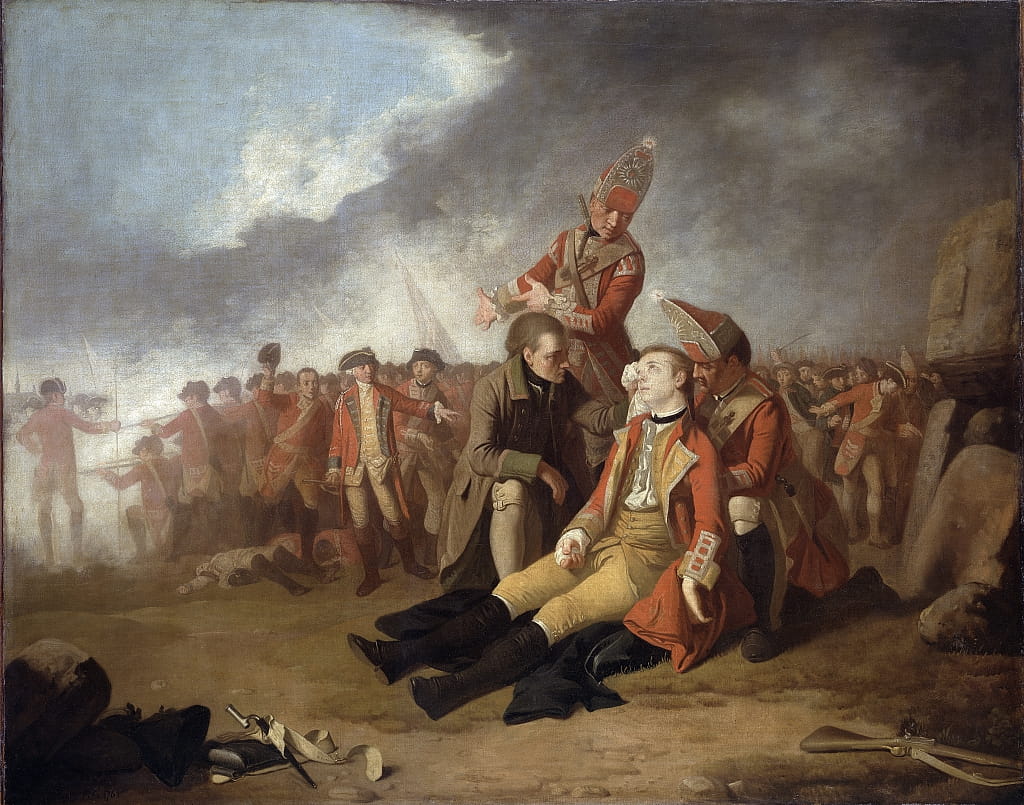
I admit that the title of this posting, upon further reading, may seem a little deceptive.  It’s the title of a (perhaps) early 18th-century English song, sometimes called “General Wolfe’s Song” because, somehow, a story appeared that General James Wolfe (1727-1759)

(by George Townshend, 1724-1807, one of Wolfe’s senior officers, who disliked him, but did this little watercolor which, to me, looks much more like the real man than the formal portraits we normally see)

sang it before his death (and victory) at Quebec, in 1759.  (This appears to have had no basis in fact, but has been repeated more than once, in various books about English popular song.)

(by Edward Penny, 1763?—this, one of several versions of the picture by the painter, is in the Fort Ligonier museum in Ligonier, Pennsylvania)

The tune, at least, appears to be some years older, the first citation I can find is to a song from Thomas Odell’s (1691-1749) ballad opera The Patron (1729), where the tune for the lyric is given as that of “Why, Soldiers, Why”, which is the beginning of the second verse.  (For the first two verses, see:  https://tunearch.org/wiki/Annotation:Why_Soldiers_Why%3F    The tune may be older yet, as there’s a 1712 broadside entitled “The Duke of Marlborough’s Delight” set “to a new tune” which has similar lyrics—see the text here:  http://ballads.bodleian.ox.ac.uk/static/images/sheets/20000/16153.gif  You can hear the tune to “Why, Soldiers, Why” here:  https://www.youtube.com/watch?v=-VxlkhsOcRI )

The glass I want to talk about is, in fact, both related to the lyric, with its “Let mirth and wine abound”, and another kind of glass entirely.

When the dwarves overwhelm Bilbo’s house, in the first chapter of The Hobbit (“An Unexpected Party”—which is, in fact, a pun—JRRT admits, in a letter to Deborah Webster 25 October, 1958,  Letters,    to having a simple, hobbit sense of humor—not only is a party a festivity—although this one, for Bilbo was far from it—but, in older English, “party” can also mean “a person”—so that “unexpected party/person is presumably Gandalf, as it’s in the singular),

(Alan Lee)                                                                                                                          

they mock his discomfort in a clean-up song which begins:

“Chip the glasses and crack the plates!”

and this made me wonder:  The Hobbit, like The Lord of the Rings, is set in a pre-industrial—really, medieval—world:  what kind of glasses might these be?

Glass, as a material, is much older than the western Middle Ages.  As you might expect from something which may have originated in the middle of the 3rd millennium BC (2500BC?—there’s lots of on-line discussion, but see, for example:  https://www.smithsonianmag.com/science-nature/a-brief-scientific-history-of-glass-180979117/  ), there has been much scholarly debate on the subject, but let’s go with that rough date for the present.

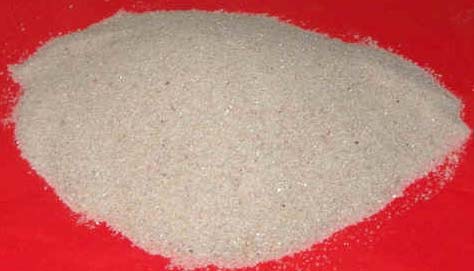
A combination of silica sand,

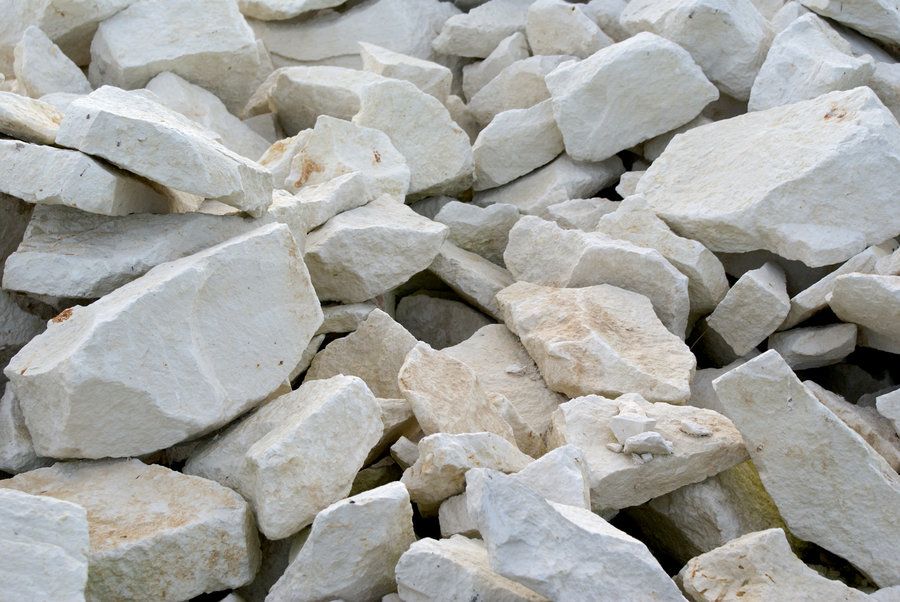
lime,

(powdered, of course)

and sodium carbonate,

(plus lots of other elements for various additional properties—see for more:  http://www.historyofglass.com/glass-making-process/glass-ingredients/ )

when heated to about 2400 degrees Fahrenheit (about 1315C), produces a moldable, shapeable liquid.

(For an experiment on making early glass, see:  https://www.youtube.com/watch?v=Lg7kZpTVoms This is from a YouTube series called “How to Make Everything” and, if you’re like me, interested in all early technologies, definitely recommended.  There’s an interesting suggestion there, as well, that glass may have been an accidental byproduct of early metal-working.) 

The first surviving glass seems to be beads–

these are Mesopotamian, but found in a grave in Denmark, showing just how extensive early trade networks were.

The Egyptians went into the glass business at some point,

and, eventually, the later Assyrians even produced the first known glass-making manual in the reign of King Ashurbanipal (reigned 669-631BC)—you can read about it here:  https://historyofknowledge.net/2018/12/05/you-us-and-them-glass-and-procedural-knowledge-in-cuneiform-cultures/  and read a translation of the cuneiform tablets on which it was written here:  https://www.nemequ.com/texts )

The Romans produced some rather amazing creations in glass,

as well as the first window glass.

(For how Romans made window glass, see:  http://www.theglassmakers.co.uk/archiveromanglassmakers/articles.htm#No  This is actually a small collection of interesting articles.  Scroll to the last to see the specific piece about window glass.)

Even after the change in the western Roman empire from imperial rule to Germanic kingdoms and their later successors, the art of glass-making was never lost, but it appears that the older method of making larger panes may have been, since medieval domestic windows used smaller pieces of glass framed in metal, called “mullioning”—

and this was only for the very wealthy.  This leads me to wonder about:

“The best rooms were all on the left-hand side (going in), for these were the only ones to have windows, deep-set round windows looking over his garden, and meadows beyond, sloping down to the river.”  (The Hobbit, Chapter One, “An Unexpected Party”)

(JRRT)

Is this hobbit mullioning?  Other buildings in the Shire look to have had ordinary glass windows, as in—

“…some new houses had been built:  two-storeyed with narrow straight-sided windows, bare and dimly lit, all very gloomy and un-Shirelike.”

and

“The Shirriff-house at Frogmorton was as bad as the Bridge-house.  It had only one storey, but it had the same narrow windows…”

I suspect that what Tolkien had in mind was something like these Victorian railway workers’ houses,

as mentioned earlier:

“Worse, there was a whole line of the ugly new houses all along Pool Side…”

(All of these grim quotations are from The Return of the King, Book Six, Chapter 8, “The Scouring of the Shire”)

Clearly, “Shirelike” means windows of an entirely different design—and that means round, as Tolkien’s own view towards Bag End shows us—

(JRRT)

(Although you can see, by the way, in this earlier sketch, that Tolkien had not originally decided upon the window-shape consistency of the later illustration, or on the true meaning of “Shirelike”.)

But, though a window plays an important part in recruiting a crucial member of the Fellowship of the Ring:

“Suddenly he stopped as if listening.  Frodo became aware that all was very quiet, inside and outside.  Gandalf crept to one side of the window.  Then with a dart he sprang to the sill, and thrust a long arm out and downwards.  There was a squawk, and up came Sam Gamgee’s curly head hauled by one ear.”  (The Fellowship of the Ring, Book One, Chapter 2, “The Shadow of the Past”)

(Artist?  I’m always glad to credit one, but I’m stumped here.)

the glasses which the dwarves threaten to chip are clearly of the drinking variety. 

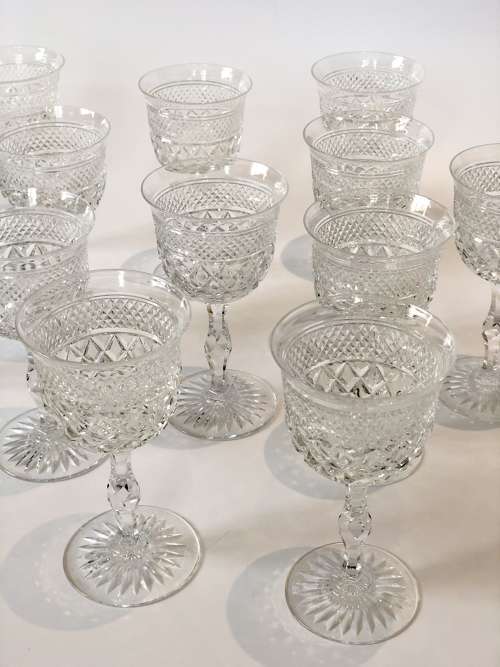
I imagine that the glasses in the Tolkien household looked like this

or, for more formal occasions, like this

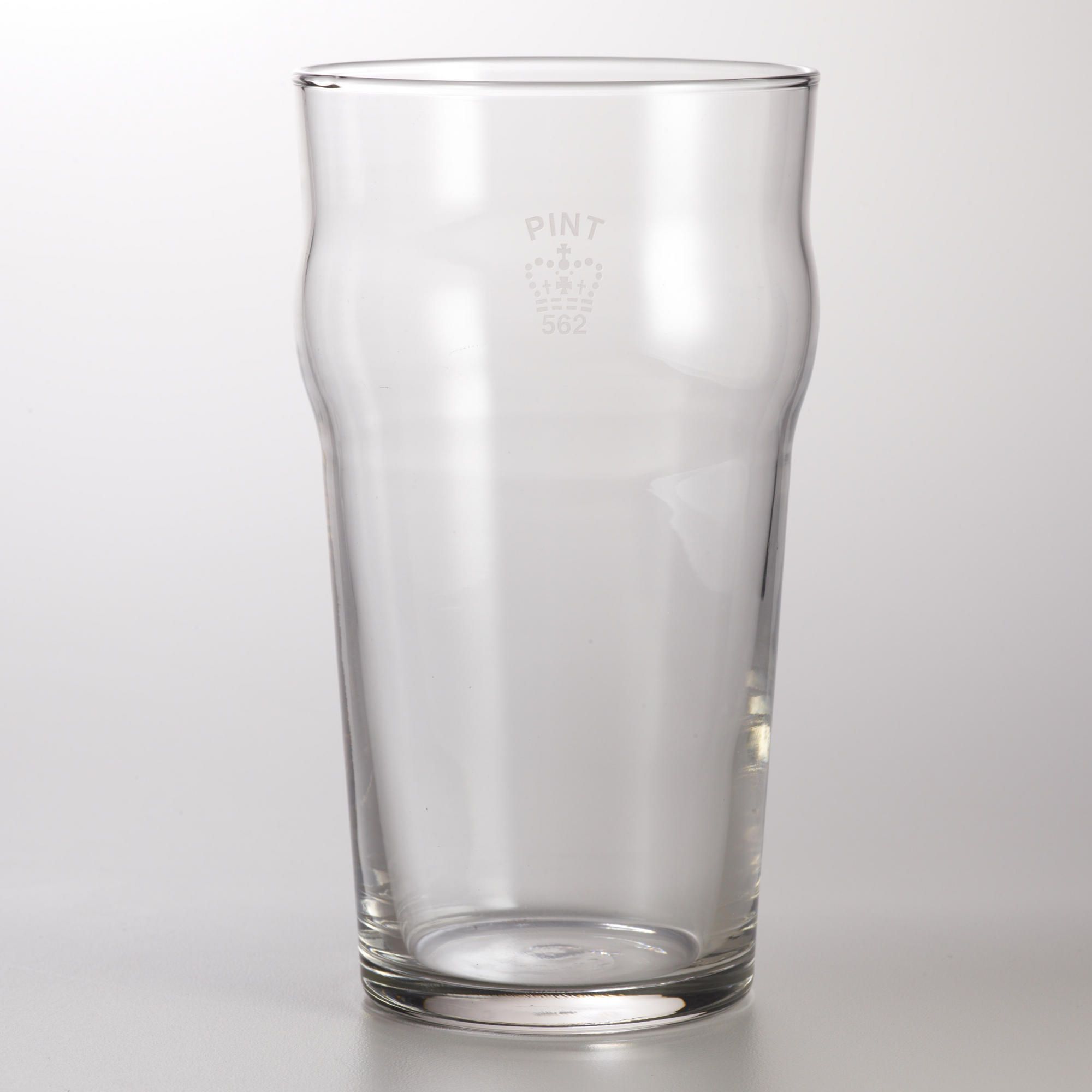
and what JRRT drank from at The Eagle and Child (aka “The Bird and Baby”) or The Lamb and Flag would have been something like this–

But that’s the first half of the 20th century. 

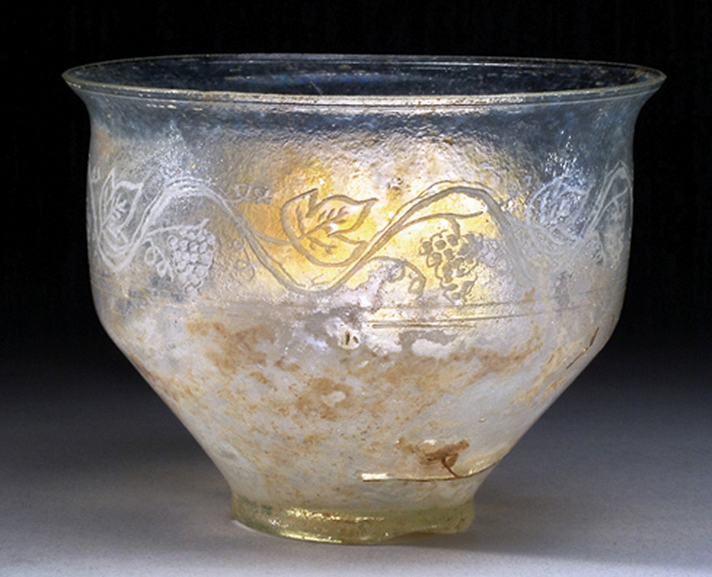
Could we see this actual medieval glass as a model?

It seems awfully dainty and, remembering the dwarves’ demands for what seems like endless rounds of food and drink, however, perhaps it wasn’t chipped glasses which Bilbo should worry about at all, but dented tankards!

Thanks, as ever, for reading.

Stay well,

When necessary, sing quietly to yourself, “Ho, ho, ho, To the bottle I go…”,

And remember that, as always, there’s

MTCIDC

O

PS

As you can tell, the history of glass—and windows—is long and complicated.

See this for more on glass:  https://en.wikipedia.org/wiki/History_of_glass

And this on windows:  https://en.wikipedia.org/wiki/Window

Speak Friend, or, Open, Sez Me

22 Wednesday May 2024

Posted by Ollamh in Uncategorized

≈ Leave a comment

Tags

books, Fantasy, Gandalf, The Hobbit

As always, welcome, dear readers.

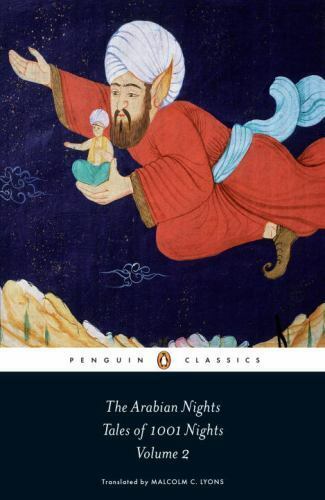
Occasionally, I return to something I’ve already written about, but, this time around, hope to see in a new, or at least newish, light.  The subject of today’s posting first appeared back in “Do What I Say, Not What I Speak”, 13 June, 2018, but, since then, I began my campaign to read all of The Arabian Nights and am now in the second volume of the Penguin edition (for the first volume, see “Arabian Nights for Days”, 31 January, 2024).

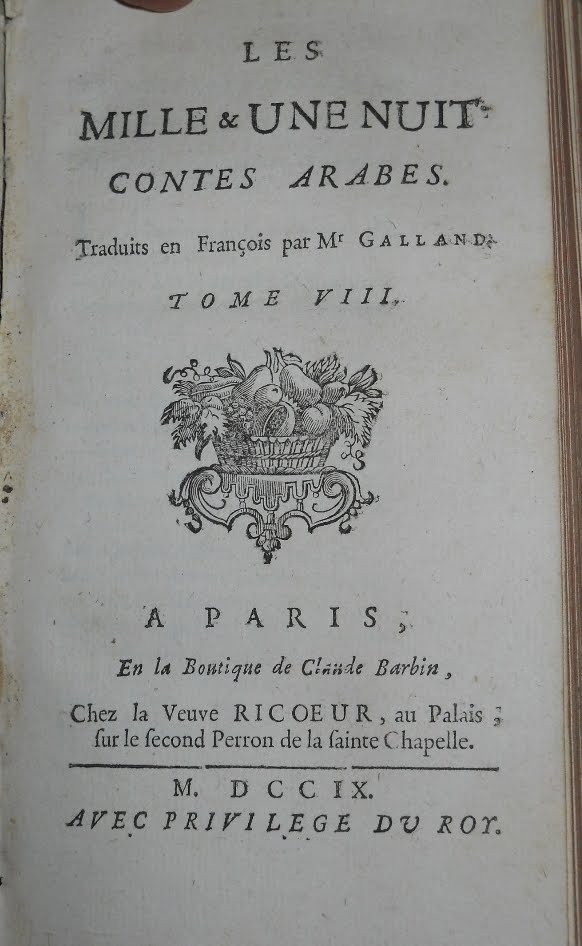
I’ve known some of the stories in this vast collection since childhood, but the first two stories I heard as a child are actually so-called “orphan tales”, being stories which appear to have no early manuscript tradition, first appearing in Antoine Galland’s (1646-1715)

Les Mille et Une Nuits (1704-1717).

and from there into the first edition in English, the anonymous so-called “Grub Street Edition” of 1706-1721.

(This is an image from the earliest edition I can locate—as you can see, it’s from 1781.  Only two copies of the first edition are known to exist, one in the Bodleian Library at Oxford, the other in the rare books collection of Princeton University and clearly they don’t get out much.)

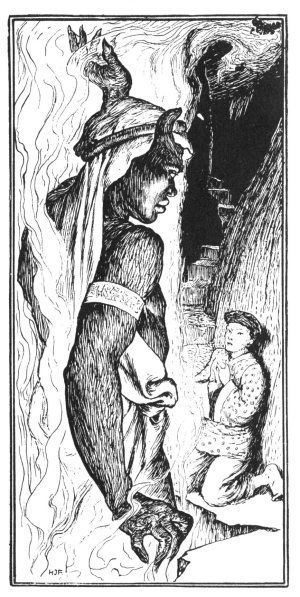
There has been much discussion as to the actual origins of “Aladdin”

and “Ali Baba and the Forty Thieves”–

in particular, that, although they contain standard folktale motifs, they are actually the work of a Syrian storyteller named Antun Yusuf Hanna Diyab (c.1668-post-1763) and were added by Galland to his translation without attribution.  (For more, see:  https://en.wikipedia.org/wiki/Hanna_Diyab ) 

Whatever is the truth of this, these were the stories I carried in my head for years before I came back to them when commencing my “Arabian Nights” reading campaign. 

When I was small, they were actually quite scary—the magician who pretends to be Aladdin’s long-lost uncle and who only wants to use him long enough to obtain the lamp, then would let him die in the cave where the lamp was kept, and the merciless thieves, who once they found their cave with its secret password was compromised, cut up Ali Baba’s brother who had discovered the secret but, who, forgetting the password, was trapped until the thieves returned, were among the creepier parts of my childhood, and, as may always be the case with creepy things, not easily forgotten.

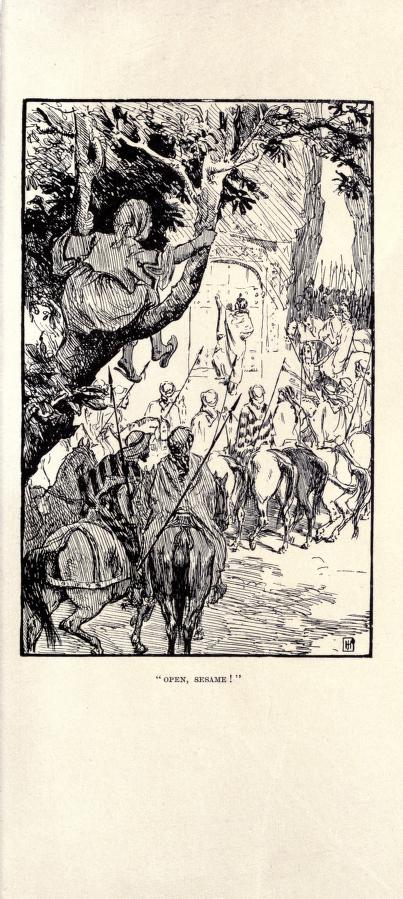
At the same time, I was always puzzled by the opening to “Ali Baba”:

“IN a town in Persia there dwelt two brothers, one named Cassim,

the other Ali Baba. Cassim was married to a rich wife and lived

in plenty, while Ali Baba had to maintain his wife and children by

cutting wood in a neighbouring forest and selling it in the town.

One day, when Ali Baba was in the forest, he saw a troop of men

on horseback, coming towards him in a cloud of dust. He was

afraid they were robbers, and climbed into a tree for safety.  When

they came up to him and dismounted, he counted forty of them.

They unbridled their horses and tied them to trees. The finest man

among them, whom Ali Baba took to be their captain, went a little

way among some bushes, and said: ‘ Open, Sesame!’ so plainly that

Ali Baba heard him. A door opened in the rocks, and having made

the troop go in, he followed them, and the door shut again of itself.”

Why would a door obey a password?  And why that word, which I knew was a kind of seed.

(For more—much more—see:  https://en.wikipedia.org/wiki/Sesame#Allergy )

This sat somewhere in my memory until I read:

“But close under the cliff there stood, still strong and living, two tall trees, larger than any trees of holly that Frodo had ever seen or imagined…

(JRRT)

‘Well, here we are at last!’ said Gandalf.  ‘Here the Elven-way from Hollin ended.  Holly was the token of the people of that land, and they planted it here to mark the end of their domain; for the West-door was made chiefly for their use in their traffic with the Lords of Moria.’ …

…they turned to watch Gandalf.  He appeared to have done nothing.  He was standing between the two trees gazing at the blank wall of the cliff, as if he would bore a hole into it…

 ‘Dwarf-doors are not made to be seen when shut,’ said Gimli.  ‘They are invisible, and their own makers cannot find them or open them, if their secret is forgotten.’

‘But this Door was not made to be a secret known only to Dwarves,’ said Gandalf…’Unless things are altogether changed, eyes that know what to look for may discover the signs.’

He walked forward to the wall.  Right between the shadow of the trees there was a smooth space, and over this he passed his hands to and fro, muttering words under his breath.  Then he stepped back.

‘Look!’ he said.  ‘Can you see anything now?’

…Then slowly on the surface, where the wizard’s hands had passed, faint lines appeared, like slender veins of silver running in the stone…

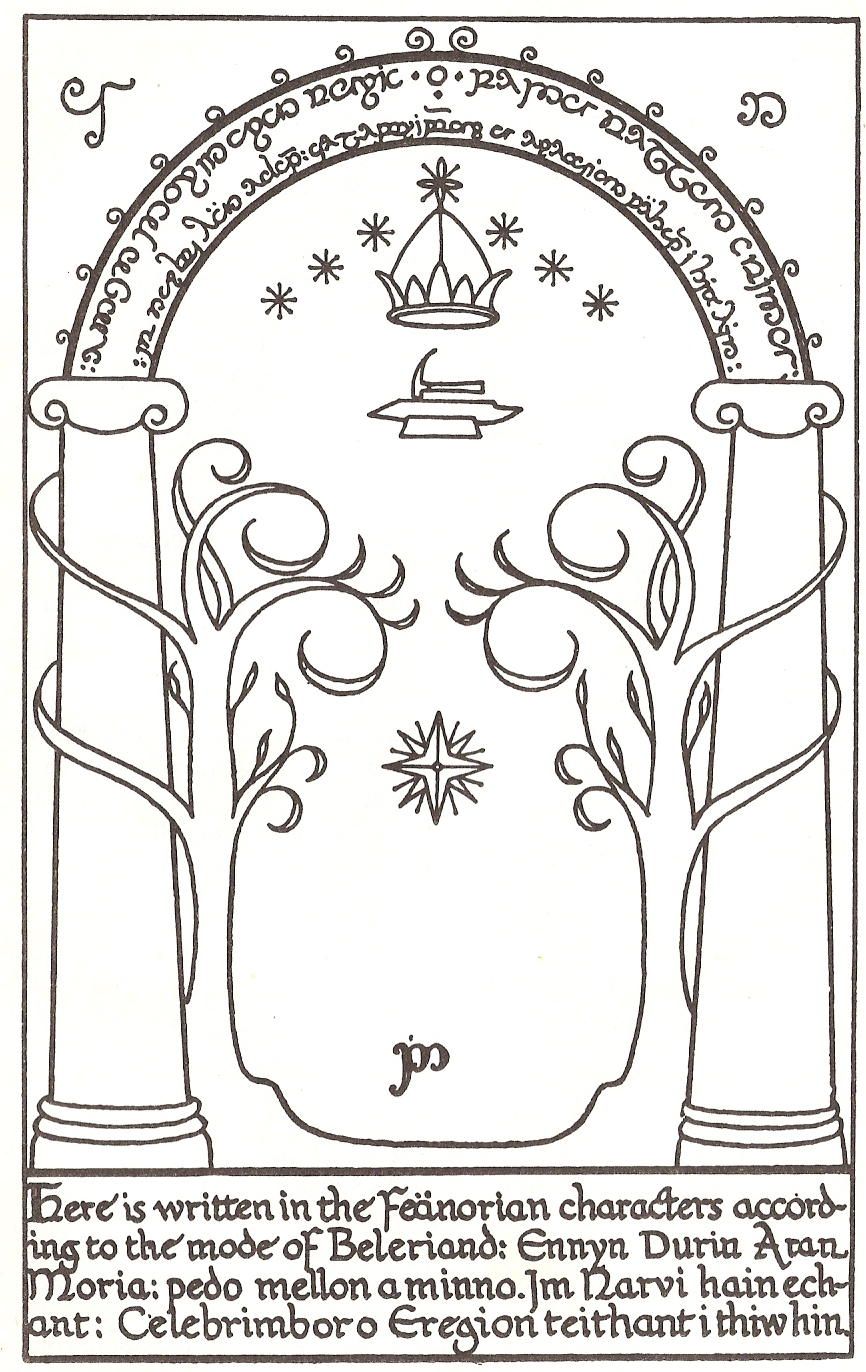
At the top, as high as Gandalf could reach, was an arch of interlacing letters of an Elvish character.

(Ted Nasmith)

Below, though the threads were in places blurred or broken, the outline could be seen…

(JRRT)

‘What does the writing say?’ asked Frodo…

‘…They say only:  The Doors of Durin, Lord of Moria.  Speak, friend, and enter.’

‘What does it mean…?’ asked Merry.

‘That is plain enough,’ said Gimli.  ‘If you are a friend, speak the password, and the doors will open, and you can enter.’ “  (The Fellowship of the Ring, Book Two, Chapter 4, “A Journey in the Dark”)

We know from various clues, like the story title “Storia Moria Castle”, that Tolkien had read—or been read to—from Andrew Lang’s (1844-1912) The Red Fairy Book, 1890,

but, interestingly, “Aladdin” and “Ali Baba” both appear in Lang’s previous The Blue Fairy Book, 1889,

from which both the “Ali Baba” quotation and illustration above, come.  Could Tolkien have been read to from, or read, “Ali Baba” there?  Certainly we see that door, and the need for the password.  But what about that password?

In The Fellowship of the Ring, Gandalf tells us that “ ‘I will tell you that these doors open outwards.  From the inside you may thrust them open with your hands.  From the outside nothing will move them save the spell of command.  They cannot be forced inwards.’   Try as he might, however, Gandalf can’t come up with that word—until he realizes that he’s made a slight mistranslation: 

“ ‘The opening word was inscribed on the archway all the time!  The translation should have been Say “Friend’ and enter.  I had only to speak the Elvish word for friend and the doors opened.’ “

To a linguist with a fine ear, like JRRT’s, the distinction, in English, between the verb “to speak”, as in “to speak a language”, and “to say”, as in “to say the right thing”, can be subtle—in this case, almost too subtle—as Gandalf says:

“ ‘Quite simple.  Too simple for a learned lore-master in these suspicious days.’ “

With the problem solved, the doors swing open—but where they’re about to go is, ultimately, worse than Ali Baba’s thieves’ treasure cave, even as I’m reminded of what happens to Ali Baba’s jealous brother.  Obtaining the password, he easily enters the cave, but, when he tries to leave, he confuses “sesame” with other grains, is trapped, and eventually dismembered by the returning thieves.  (Think Balrog and “Drums in the Dark”…)

And, though “Friend”, says Gandalf, is quite simple, and, adding, “Those were happier times” in which such a pleasant password was all that was necessary,  I’m still puzzled about “sesame” and, in both cases, I wonder about those doors—who or what was doing the opening?  Then again, when I post this,  I’ll need a password and, when I employ it, the site will pop open—who or what is doing the opening there?

Thanks, as always, for reading.

Stay well,

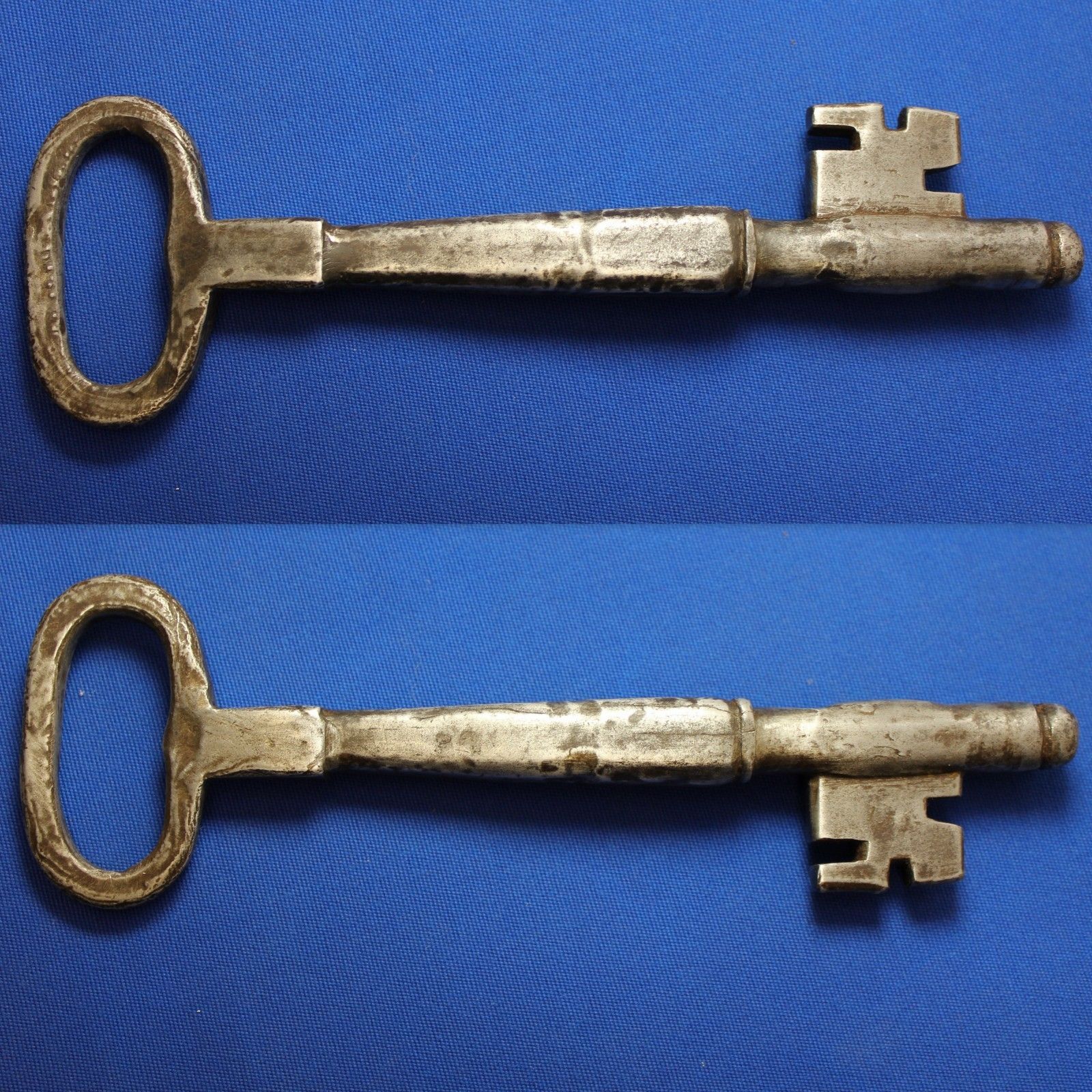
When it comes to locks, I prefer a good, sturdy key,

And remember that, as always, there’s

MTCIDC

O

PS

In case you want to read the two fairy books—and I hope you do—here they are:

The Blue Fairy Book 

https://archive.org/details/bluefairybook00langiala/page/n7/mode/2up

The Red Fairy Book

https://archive.org/details/cu31924084424013/page/n9/mode/2up

Unbuttoned

18 Thursday Apr 2024

Posted by Ollamh in Uncategorized

≈ Leave a comment

Tags

beatrix-potter, Fantasy, peter-rabbit, reviews, The Hobbit

As always, dear readers, welcome.

As far as I’ve come to know her, Beatrix Potter (1866-1943)

(with her collie, Skep)

was not one to dwell upon horrors.

And yet, the first of her stories I ever had read to me as a small child filled me with dread, almost from its very opening:

“ ‘Now my dears,’ said old Mrs. Rabbit one morning, ‘you may go into the fields or down the lane, but don’t go into Mr. McGregor’s garden: your Father had an accident there; he was put in a pie by Mrs. McGregor.’ “

This was said so casually, as if being murdered by an angry gardener and then eaten was only “an accident”, that I knew that the story to come was not going to be a sunny one. 

“Flopsy, Mopsy, and Cotton-tail, who were good little bunnies, went down the lane to gather blackberries:”

Had I been able to read this for myself, that colon after “blackberries” might have tipped me off that something awful was about to happen—

“But Peter, who was very naughty, ran straight away to Mr. McGregor’s garden, and squeezed under the gate!”

You can see already where this is going—towards another “accident” and Peter in a pie.  Fortunately, this doesn’t happen, although Peter, after stuffing himself on Mr. McGregor’s lettuce, French beans, and radishes, is spotted by the dread gardener himself and much of the middle of the story is taken up with his relentless pursuit of Peter, in which Peter loses his shoes, but

“I think he might have got away altogether if he had not unfortunately run into a gooseberry net, and got caught by the large buttons on his jacket. It was a blue jacket with brass buttons, quite new.”

Peter escapes the murderous McGregor, leaving his jacket behind and, eventually, even finds his way home, but, menacingly, the gardener hangs up the lost shoes and jacket “for a scare-crow to frighten the blackbirds”—one wonders what he did with Peter’s father’s clothes!

This is, of course, The Tale of Peter Rabbit,

first published in 1902 and Beatrix Potter’s first successful children’s book,  with 22 more to come, including two nursery rhyme collections, between 1902 and 1930.

The stories are simple, as appropriate for small books for small children, but the illustrations are anything but, being little marvels of depiction, everything from the anthropomorphized animals who are the main characters, to the world, both natural and human, in which they function.  This shouldn’t be surprising in that the author was herself both a highly-talented draftswoman and a great naturalist and had been since childhood.

At some point later in life, I must have gotten over my fear of the bloody-handed McGregor,

as I found myself increasingly interested in his creator and her complex life and personality—an upper-class Victorian/Edwardian lady who, though barred from the sorts of things her naturalist life should have allowed her—an academic education, dealing with male naturalists on their own turf, for example—still managed to publish extensively, gain wealth from it, employ that wealth in intelligent ways, and leave behind not only such lovely books and wonderful art, but also a large expanse of land in the English Lake District which forms much of a National Park.  (You can begin learning about her here:  https://en.wikipedia.org/wiki/Beatrix_Potter  You can also read a first edition of The Tale of Peter Rabbit here:   https://www.gutenberg.org/cache/epub/14838/pg14838-images.html )

Someone else who clearly knew at least some of her work mentions it somewhat obliquely in an angry letter to his publisher on the subject of a Dutch translation of his work:

“If you think I am being absurd, then I shall be greatly distressed; but I fear not altered in my opinions.  The few people I have been able to consult, I must say, express themselves equally strongly.  Anyway I am not going to be treated a la Mrs Tiggywinkle=Poupette a l’epingle.  Not that B [eatrix] P [otter] did not give translators hell.  Though possibly from securer grounds than I have.  I am no linguist, but I do know something about nomenclature, and have specially studied it, and I am actually very angry indeed.” (letter to Rayner Unwin, 3 July, 1956, Letters, 361)

This is the only direct reference I’ve seen to “BP’s” work in Tolkien’s letters, but I would offer proof of another sort in another work:

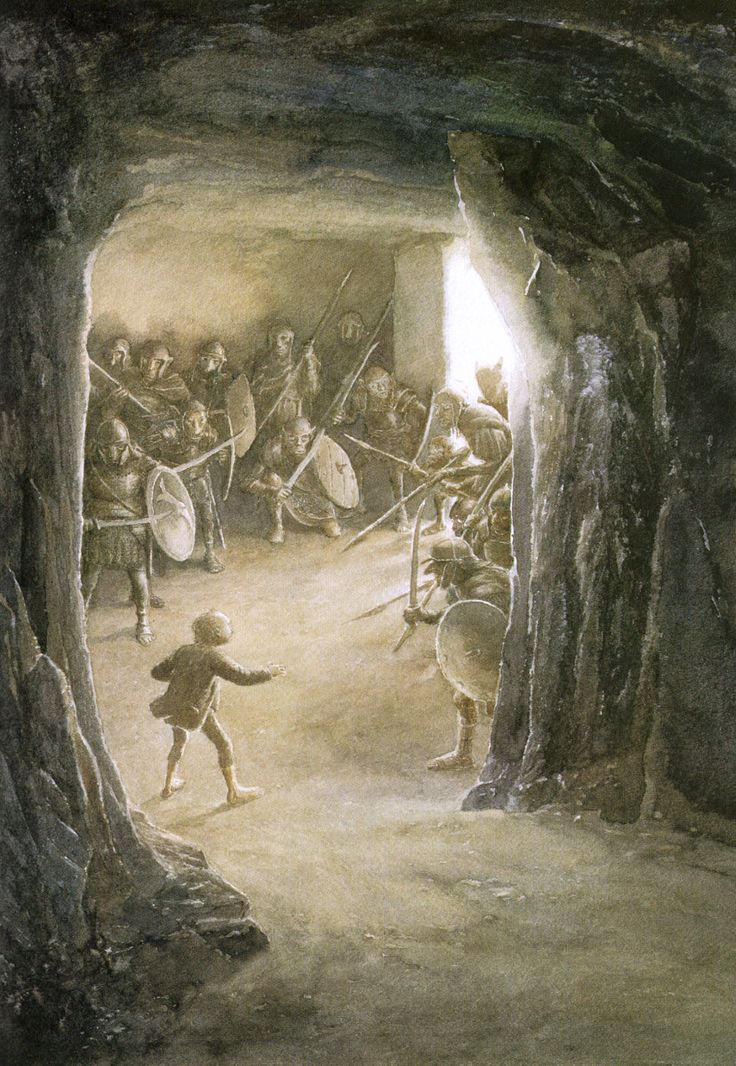
“The place was full of goblins running about, and the poor little hobbit dodged this way and that…slipped between the legs of the captain just in time, got up, and ran for the door.

It was still ajar, but a goblin had pushed it nearly to.  Bilbo struggled but he could not move it.  He tried to squeeze through the crack.  He squeezed and squeezed and he stuck!  It was awful.  His buttons had got wedged on the edge of the door and the door-post.  He could see outside into the open air…but he could not get through.

Suddenly one of the goblins inside shouted:  ‘There is a shadow by the door.  Something is outside!’

Bilbo’s heart jumped into this mouth.  He gave a terrific squirm.  Buttons burst off in all directions.  He was through, with a torn coat and waistcoat, leaping down the steps like a goat, while bewildered goblins were still picking up his nice brass buttons on the doorstep….

Bilbo had escaped.”  (The Hobbit, Chapter Five, “Riddles in the Dark”)

(Alan Lee)

What do you suppose JRRT as a child made of that violent, pie-eating McGregor?

As always, thanks for reading.

Stay well,

Always listen to your mother and you’ll never lose your buttons,

And, as ever, remember that there’s

MTCIDC

O

Pub Crawl

17 Wednesday Jul 2019

Posted by Ollamh in Economics in Middle-earth, J.R.R. Tolkien, Literary History

≈ Leave a comment

Tags

CS Lewis, Dorothy Sayers, Eagles, Green Dragon Inn, Hutchinson Family Singers, inn, pub, Smaug, The Eagle and Child, The Green Dragon, The Hobbit, The Inklings, The Ivy Bush, The King's Arms, The Lord of the Rings, The Mitre, The Prancing Pony, The Vulture of the Alps, The White Horse, Tolkien

As ever, dear readers, welcome.

After a very disturbing evening with a group of vengeful and determined dwarves,

image1banddwarves.jpg

Bilbo wakes to a wreck of breakfast dishes and, soon after, the appearance of Gandalf, who prompts him to see that he has a note from Thorin (& Co.).  It makes an appointment for 11am that morning at the Green Dragon Inn, in Bywater.

image2bywatermap.jpg

With Gandalf harrying him, Bilbo barely makes it, but, a moment later, the journey eastward of The Hobbit begins.

It is ironic, of course, that a trip which focuses upon removing a dragon

image3smaug.jpeg

should commence with a place named after one, but, judging by the number of Green Dragon pubs in Britain one might find by googling right now, it may be nothing more than a common name—

image4pubsign.jpg

image5greendragsign.jpg

image6greendrag.jpg

image7greendrag.jpg

although, as Douglas Anderson points out in The Annotated Hobbit, 61, we know that JRRT had been interested in dragons, especially green ones, from childhood, as he wrote to WH Auden:

“I first tried to write a story when I was about seven.  It was about a dragon.  I remember nothing about it except a philological fact.  My mother said nothing about the dragon, but pointed out out one could not say ‘a green great dragon,’ but had to say, ‘a great green dragon.’  I wondered why, and still do.” (Letters, 214, 7 June, 1955)

The countryside east of the Shire and the story itself are empty of pubs (short for “public houses”, originally meaning simply a place open to the general public, but, in time, it came to mean a place licensed by the government to sell alcoholic beverages) after this, but, until we reach Bree, there are a certain number mentioned in The Lord of the Rings.  We meet the first, The Ivy Bush, in The Fellowship of the Ring, Book One, Chapter 1, “An Unexpected Party”, where we see a group of hobbits gossiping about Bilbo and Frodo.  In the next chapter,  “The Shadow of the Past”, The Green Dragon makes its second appearance in Tolkien when Sam Gamgee has a verbal tussle with Ted Sandyman on the subject of things seen and unseen, as well as on the sanity, or lack of it, of Bilbo and Frodo, there.

The Ivy Bush will only appear once more, linked with The Green Dragon, in the succeeding chapter, “Three Is Company”, but we will see The Green Dragon (mentioned by Sam in hopes that The Prancing Pony in Bree will measure up to it in Chapter 8, “Fog on the Barrow-Downs”) close to the end of The Lord of the Rings.  In The Return of the King, Book Six, Chapter 8, “The Scouring of the Shire”, it appears as an emblem of the endless ruin by Sharkey and gang of the old ways of the Shire:  “When they reached The Green Dragon, the last house on the Hobbiton side [of the Water], now lifeless and with broken windows…”

This is in great contrast to The Prancing Pony Sam worried about earlier

image8prancingpony.jpg

as we see it in The Fellowship of the Ring, Book One, Chapter 9, “At the Sign of the Prancing Pony”.  At first, the place seems menacing, especially to Sam, who:

“…stared up at the inn with its three storeys and many windows, and felt his heart sink.”

But then—

“As they [the hobbits] hesitated outside in the gloom, someone began singing a merry song inside, and many cheerful voices joined loudly in the chorus.  They listened to this encouraging sound for a moment and then got off their ponies.  The song ended and there was a burst of laughter and clapping.”

Pubs, and their upscale cousins, inns, would have been vital to people traveling before motels, hotels, and b&bs, as we can see in Book One of The Fellowship, and, for most of the rest of the novel, with the exceptions of Rivendell, Lorien, Edoras, and Minas Tirith, accommodation for the night would have meant a blanket on the ground.  For Tolkien and his friends in the writers’ group called The Inklings,

image9inklings.jpg

they were vital meeting points—not for the reading of new work, which appears to have been done in one member, C.S. Lewis’, rooms at Oxford,

image10csl.jpg

but for socializing and discussion, which was equally important for such a group of intelligent, educated, and highly-creative men.  (No women, alas!  One of our favorite mystery novelists and Dante-translator, Dorothy Sayers, 1893-1957, was friends with several members but, with the short-sightedness of the 1930s-50s, was never invited to join.)

image11dls.jpg

They met during the week not only at the best-known of their watering holes, the Eagle and Child,

image12bird.jpg

but at The Mitre,

image13mitre.jpg

The King’s Arms,

image14kingsarms.JPG

and at The White Horse.

image15whitehorse

The one which caught our eye in particular is the first, which, as we said, is probably the one most closely associated with Tolkien and his friends.  Here’s its sign—

image16bird.jpg

The explanation of the pub’s name is, to us, a bit murky, supposedly coming from an element of the crest of the Stanley family which portrays an infant stolen by an eagle,

image17crest.jpg

but found alive and unharmed.  (Here’s a LINK so that you can judge for yourself.)

For ourselves, the idea of a child stolen by a raptor makes us think of a really awful 19th-century song, “The Vulture of the Alps”, a poem set to music about 1842 by a famous American vocal group of the 1840s-1870s, the Hutchinson Family Singers.  The title pretty much says it all.

image18hutch.jpg

If you’d like to know more, here’s a LINK.

When we think of eagles and Tolkien, however, we remember them as rescuers—of Gandalf, the dwarves, and Bilbo from the goblins and Wargs

image19rescue.jpg

and as providers of air assault in The Hobbit.

image20battle.jpg

And, in The Lord of the Rings, rescuer of Gandalf from Saruman,

image21rescue


as allies of the West at the battle at the Morannon,

image22black.jpg

and as saviors of Frodo and Sam on Mt Doom.

image23savior.jpg

And it may be a crazy idea, but it makes us wonder—although Tolkien had abandoned The Hobbit unfinished in the early 1930s, he had picked it up again in 1936, just about the time the Inklings were meeting regularly (the first documented mention of them, apparently, is in a 1936 letter from CS Lewis to the novelist, Charles Williams, inviting him to join—see The Collected Letters of CS Lewis, Vol.2, 183—in a letter to William Luther White 9/11/67, JRRT dates the origins of the Inklings as “probably mid-thirties”—Letters, 387).  Could he have found his inspiration for these heroic birds and their habit of picking people up from the name of his pub?

As ever, thanks for reading.

MTCIDC

CD

ps

If you haven’t read CS Lewis’ wonderful essay, “On Three Ways of Writing for Children”, here’s a LINK.

pps

We have no illustration of Tolkien’s Green Dragon, but here’s a Tudor example from Wymondham in Norfolk which we think would do quite well.

image24green.jpg

Dragon Economics 101

03 Wednesday Jul 2019

Posted by Ollamh in Economics in Middle-earth, J.R.R. Tolkien, Military History

≈ Leave a comment

Tags

Artillery, Belgium, Cathedral, Cloth Hall, Dale, Esgaroth, Great War, howitzers, Laketown, Lonely Mountain, No Man's Land, Smaug, The Hobbit, The Lord of the Rings, Tolkien, trenches, Ypres

Here is a postcard of the town of Ypres, in southern Belgium, in the years before the Great War, with its famous Cloth Hall and cathedral.

image1clothhallcath.jpg

The Cloth Hall was begun in 1200 and finished in 1304, being a center of the woolen trade in the region.

image2clothhall.jpg

The cathedral was begun in 1230 and finished in 1370.

image3cathedral.jpg

Then the Great War began and Ypres was just behind Allied lines.

image4map.jpg

Artillery had begun in the Middle Ages, as something which looks like a high school science experiment (plus armor).

image5millemete.jpg

By 1914, it was much bigger and much more efficient.

image6howitzer.jpg

(The German says, “Our Growlers!”—perhaps a soldier’s slang word for heavy howitzers like these?)

And, as the war progressed, bigger and more efficient yet.

image7biggergun.jpg

And even more so—to the point where some guns became so big and heavy that only railways could move them around.

image8railwaygun.jpg

Needless to say, when shells from such guns hit Ypres, the damage they caused was enormous.

image9ypres


image10ruins.jpg

And not only to Ypres, but to the whole region—entire villages disappeared, as did forests, landscapes became moonscapes.

image11nomansland.jpg

For some months in 1916, Second Lieutenant Tolkien walked through, lived through, this devastated world,

image12jrrt

which took many years to be repaired.

image13ypres.jpg

And, in the meantime, the economies of Europe suffered, with so much damaged or shifted to war work, and governments left with enormous debts, both the victors and the vanquished.

This devastation made us think about another devastation, first described by Thorin in Chapter One of The Hobbit, and, of course we wondered if JRRT thought of the damage caused by the endless, pitiless bombardments as he wrote about the ruin brought by a dragon.

Thorin begins, as we did at the opening of this posting, showing a peaceful, prosperous world:

“Altogether those were good days for us, and the poorest of us had money to spend and to lend, and leisure to make beautiful things just for the fun of it, not to speak of the most marvellous and magical toys, the like of which is not to be found in the world now-a-days.  So my grandfather’s halls became full of armour and jewels and carvings and cups, and the toy market of Dale was the wonder of the North.”

But, just as the Great War came to the ridges north of Ypres, so Smaug came down upon the town of Dale just below the Lonely Mountain and to the Mountain, as well:

“Then he came down the slopes and when he reached the woods they all went up in fire.  By that time all the bells were ringing in Dale and the warriors were arming.  The dwarves rushed out of their great gate; but there was the dragon waiting for them.  None escaped that way.  The river rushed up in steam and a fog fell on Dale, and in the fog the dragon came on them and destroyed most of the warriors…Then he went back and crept in through the Front Gate and routed out all the halls, and lanes, and tunnels, alleys, cellars, mansions and passages…Later he used to crawl out of the great gate and come by night to Dale, and carry away people, especially maidens, to eat, until Dale was ruined and all the people dead or gone.  What goes on there now I don’t know for certain, but I don’t suppose any one lives nearer the Mountain than the far edge of the Long Lake now-a-days.”

image14erebor.jpg

Thorin is correct about this:  Dale is ruined and abandoned (you can see the remains of the town on the right hand side of this illustration) and the Mountain has only one inhabitant.

image15smaug.jpg

When Bilbo disturbs him and steals a cup, Smaug goes on a second rampage, flying as far south as Lake-town:

“Fire leaped from the dragon’s jaws.  He circled for a while high in the air above them lighting all the lake…Fire leaped from the thatched roofs and wooden beam-ends as he hurtled down and past and round again…Flames unquenchable sprang high into the night. “  (The Hobbit, Chapter Fourteen, “Fire and Water”)

image16laketown.jpg

And, even when Bard’s arrow brings him down, Smaug causes a final wave of destruction:

“Full on the town he fell.  His last throes splintered it to sparks and gledes.  The lake roared in.  A vast steam leaped up, white in the sudden dark under the moon.  There was a hiss, a gushing whirl, and then silence.  And that was the end of Smaug and Esgaroth…”

Just as certain parts of Europe were destroyed and their economies stunted by the Great War, we can hear, in Thorin’s words, that the same has happened to Dale and the Lonely Mountain:  with no dwarves and no men to make the “armour and jewels and carvings and cups”, not to mention the “most marvellous and magical toys”, the whole economy of the area to the north of the Long Lake was completely destroyed.  Survivors built up Lake-town, but no one dared to revive the trade which had once enriched an entire region.

image17laketown.jpg

And, as for the few remaining dwarves:

“After that we went away, and we have had to earn our livings as best we could up and down the lands, often sinking as low as black-smith-work or even coal-mining.” says Thorin.

Although Thorin dies in the struggle to regain what was lost, there is a happy ending of sorts for the dwarves.  With Smaug dead, they can finally return, as can men, and rebuild, just as Europe began to rebuild—Ypres restored both Cloth Hall and cathedral in time.


image18ypres


But the dragon would return and all too soon…

Thanks, as always, for reading and

MTCIDC

CD

← Older posts
Newer posts →

The Doubtful Sea Series Facebook Page

The Doubtful Sea Series Facebook Page

  • Ollamh

Categories

  • Artists and Illustrators
  • Economics in Middle-earth
  • Fairy Tales and Myths
  • Films and Music
  • Games
  • Heroes
  • Imaginary History
  • J.R.R. Tolkien
  • Language
  • Literary History
  • Maps
  • Medieval Russia
  • Military History
  • Military History of Middle-earth
  • Narnia
  • Narrative Methods
  • Poetry
  • Research
  • Star Wars
  • Terra Australis
  • The Rohirrim
  • Theatre and Performance
  • Tolkien
  • Uncategorized
  • Villains
  • Writing as Collaborators
Follow doubtfulsea on WordPress.com

Across the Doubtful Sea

Recent Postings

  • Towering January 28, 2026
  • Tolkien Among the Indians January 21, 2026
  • Thin and Stretched January 14, 2026
  • Through a glass… January 7, 2026
  • Heffalumps? December 31, 2025
  • We Three Kings December 24, 2025
  • A Moon disfigured December 17, 2025
  • On the Roads Again—Once More December 10, 2025
  • (Not) Crossing Bridges December 3, 2025

Blog Statistics

  • 105,543 Views

Posting Archive

  • January 2026 (4)
  • December 2025 (5)
  • November 2025 (4)
  • October 2025 (5)
  • September 2025 (4)
  • August 2025 (4)
  • July 2025 (5)
  • June 2025 (4)
  • May 2025 (4)
  • April 2025 (5)
  • March 2025 (4)
  • February 2025 (4)
  • January 2025 (5)
  • December 2024 (4)
  • November 2024 (4)
  • October 2024 (5)
  • September 2024 (4)
  • August 2024 (4)
  • July 2024 (5)
  • June 2024 (4)
  • May 2024 (5)
  • April 2024 (4)
  • March 2024 (4)
  • February 2024 (4)
  • January 2024 (5)
  • December 2023 (4)
  • November 2023 (5)
  • October 2023 (4)
  • September 2023 (4)
  • August 2023 (5)
  • July 2023 (4)
  • June 2023 (4)
  • May 2023 (5)
  • April 2023 (4)
  • March 2023 (5)
  • February 2023 (4)
  • January 2023 (4)
  • December 2022 (4)
  • November 2022 (5)
  • October 2022 (4)
  • September 2022 (4)
  • August 2022 (5)
  • July 2022 (4)
  • June 2022 (5)
  • May 2022 (4)
  • April 2022 (4)
  • March 2022 (5)
  • February 2022 (4)
  • January 2022 (4)
  • December 2021 (5)
  • November 2021 (4)
  • October 2021 (4)
  • September 2021 (5)
  • August 2021 (4)
  • July 2021 (4)
  • June 2021 (5)
  • May 2021 (4)
  • April 2021 (4)
  • March 2021 (5)
  • February 2021 (4)
  • January 2021 (4)
  • December 2020 (5)
  • November 2020 (4)
  • October 2020 (4)
  • September 2020 (5)
  • August 2020 (4)
  • July 2020 (5)
  • June 2020 (4)
  • May 2020 (4)
  • April 2020 (5)
  • March 2020 (4)
  • February 2020 (4)
  • January 2020 (6)
  • December 2019 (4)
  • November 2019 (4)
  • October 2019 (5)
  • September 2019 (4)
  • August 2019 (4)
  • July 2019 (5)
  • June 2019 (4)
  • May 2019 (5)
  • April 2019 (4)
  • March 2019 (4)
  • February 2019 (4)
  • January 2019 (5)
  • December 2018 (4)
  • November 2018 (4)
  • October 2018 (5)
  • September 2018 (4)
  • August 2018 (5)
  • July 2018 (4)
  • June 2018 (4)
  • May 2018 (5)
  • April 2018 (4)
  • March 2018 (4)
  • February 2018 (4)
  • January 2018 (5)
  • December 2017 (4)
  • November 2017 (4)
  • October 2017 (4)
  • September 2017 (4)
  • August 2017 (5)
  • July 2017 (4)
  • June 2017 (4)
  • May 2017 (5)
  • April 2017 (4)
  • March 2017 (5)
  • February 2017 (4)
  • January 2017 (4)
  • December 2016 (4)
  • November 2016 (5)
  • October 2016 (6)
  • September 2016 (5)
  • August 2016 (5)
  • July 2016 (5)
  • June 2016 (5)
  • May 2016 (4)
  • April 2016 (4)
  • March 2016 (5)
  • February 2016 (4)
  • January 2016 (4)
  • December 2015 (5)
  • November 2015 (5)
  • October 2015 (4)
  • September 2015 (5)
  • August 2015 (4)
  • July 2015 (5)
  • June 2015 (5)
  • May 2015 (4)
  • April 2015 (3)
  • March 2015 (4)
  • February 2015 (4)
  • January 2015 (4)
  • December 2014 (5)
  • November 2014 (4)
  • October 2014 (6)
  • September 2014 (1)

Blog at WordPress.com.

  • Subscribe Subscribed
    • doubtfulsea
    • Join 78 other subscribers
    • Already have a WordPress.com account? Log in now.
    • doubtfulsea
    • Subscribe Subscribed
    • Sign up
    • Log in
    • Report this content
    • View site in Reader
    • Manage subscriptions
    • Collapse this bar
 

Loading Comments...