• About

doubtfulsea

~ adventure fantasy

Tag Archives: mirror

Mirror Image

03 Wednesday Jan 2018

Posted by Ollamh in Imaginary History, J.R.R. Tolkien, Narrative Methods

≈ Leave a comment

Tags

ancient mirrors, Bag End, chiaroscuro, Claude Debussy, Egyptians, Etruscans, Georges de la Tour, Greeks, hall stand, Headington, Magic mirror, Maurice Ravel, Medieval, Miroirs, mirror, North Oxford, Parmigianino, Portrait of the Money-Lender and His Wife, Quentin Matsys, Reflections in the Water, Reflets dans L'eau, Renaissance, Romans, Snow White, The Lord of the Rings, Tolkien, Victorian

Welcome, as ever, dear readers.

In English, we have the expression “upon reflection”, meaning something like “I’ve looked back at something and have considered (or reconsidered)”.  When we look at the word “reflection”, we see its Latin origin, re “back/again” and flection, from the verb flecto, flectere, flexi, flexum “to bend/turn/bow” (we show all four of what are called the “principal parts” of the verb so that you can see where words like “flexible”—and, together with that re—“reflex” come from) and can imagine that, originally, it was almost a physical act—as if a person were believed literally to have turned back to a thought, event, action, to think about it again.

But that made us wonder about a reflection in a different sense—when an image is repeated, in water, say.

image1blockprint.jpg

(And here we provide a YouTube LINK for a beautiful piece of music “Reflets dans L’eau”—“Reflections in the Water” by Claude Debussy—1862-1918, from the set entitled, Images, Book One—1905.)

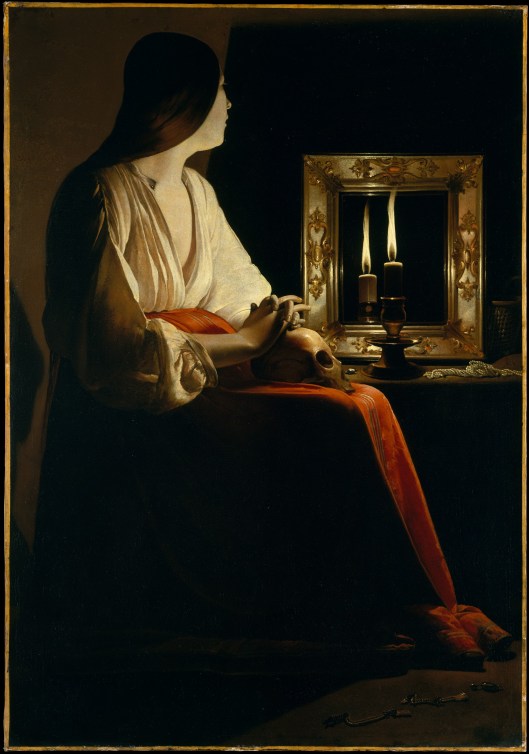
Or in a mirror.

image2gdelatour.jpg

(This haunting painting is by Georges de la Tour, 1593-1652—known for his chiaroscuro—shadow-versus-light effects—style.)

Fancifully, we might ask: does a “reflection” in this sense suggest that the image in the mirror was turning back to look at the viewer?  More realistically, we might say that the image is bent/turned back upon the viewer—but we also wonder if the Latin word from which our word mirror comes might give a certain flavor of the uncanny about it.  Miror, mirari, miratus sum in Latin means “to wonder/be amazed at something” (Put the Latin preposition ad– on the front of this and you’re looking at English “admire”—originally “to wonder at something”—our modern sense of this has lost something of the wide-eyed nature implied in the original, but that’s how language works—sharp things, like knives, become dull with use.  In Spanish, for example, mirar comes to mean “to look at/watch/observe”.)

Certainly, folktales and folk customs once preserved something eerie about mirrors.  Think of the wicked queen’s magic mirror in Snow White.

image3snowwhitemirror.png

If you know the Disney version of Snow White, you probably expected us to show this image.

image4mirror.jpg

But this so creeped us out as children that it was not our first choice!

In various western European countries, looking into a mirror on New Year’s Eve (lots of extra things to do:  while combing hair, eating an apple, taking a bath first so that the mirror is steamy) will show you the image of your intended spouse.  And breaking a mirror can mean seven years of bad luck.

image5brokenmirror.jpg

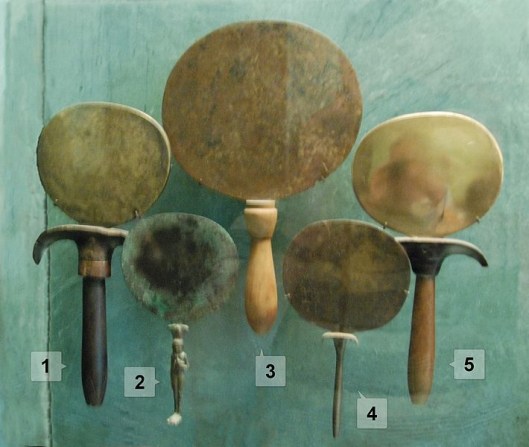
For Egyptians,

image6egyptianmirrors.jpg

Greeks,

image7greekmirror.jpg

Etruscans,

image8etruscan.jpg

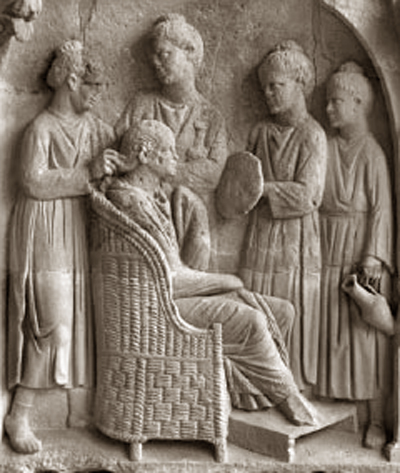
Romans,

image9roman.jpg

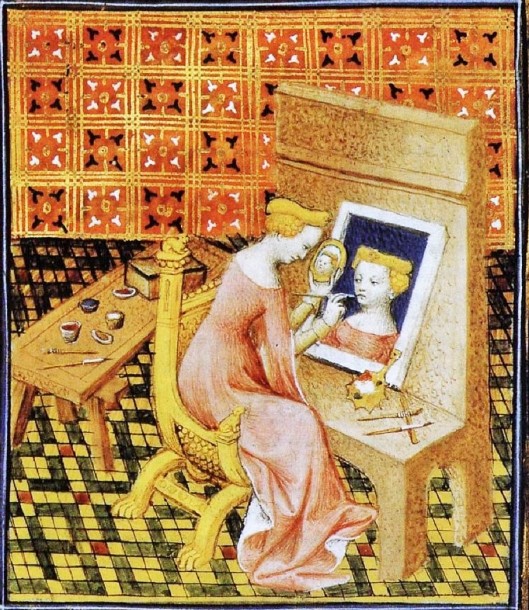
and western Medieval people, as well,

image10med.jpg

mirrors were not very breakable, however, being commonly made of a piece of polished bronze (although there were attempts, apparently, from late classical times on to do something with glass and a metal backing).  Artists in the classical world, rarely missing a chance to do something more, used the backs of mirrors as surfaces for decoration, as well.  Here’s a very interesting Etruscan mirror back, including an inscription (it’s the story of Icarus and Daedalus).

image11ic.jpg

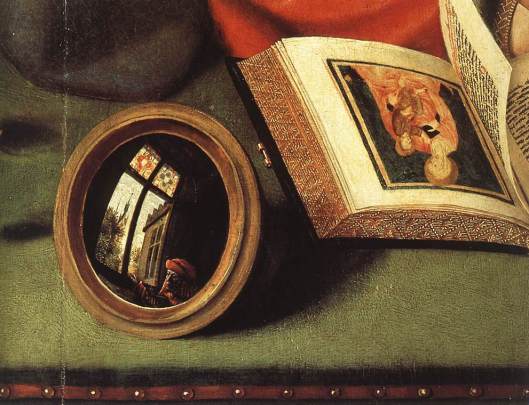
Mirrors with a silvered back and glass cover, the direct ancestors of modern mirrors, appeared during the Renaissance.

image12money.jpg

This is a little joke—a self-portrait of the painter—which has been included in Quentin Matsys’ (1466-1530) painting “Portrait of the Money-Lender and His Wife” (1514).

image13moneylender.jpg

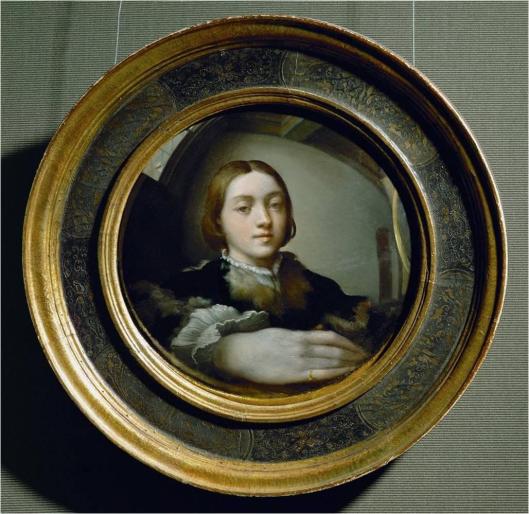
(And, speaking of Renaissance paintings with mirrors, we couldn’t resist including this famous little painting by Parmigianino (1503-1540), a self-portrait painted on a mirror-shaped convex panel.)

image14parma.jpg


If silver-backed, glass-covered mirrors only appeared in the Renaissance, however, what can we say about this object on the left house wall in this picture?

image15bilbo.png

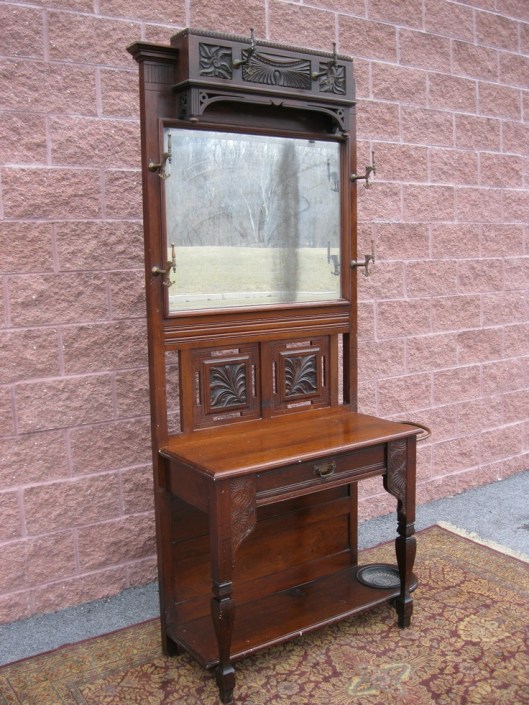
We can tell it’s meant to be a mirror as, looking closely, you can just make out the reflection of a tree which is outside to the right of the open door on its surface.  And is that another mirror, on the piece of furniture in the foreground on the left?  If so, it fits the kind of thing called a “hall stand” which one might see in a later-Victorian house—like this piece from the 1870s.

image16hallstand.jpg

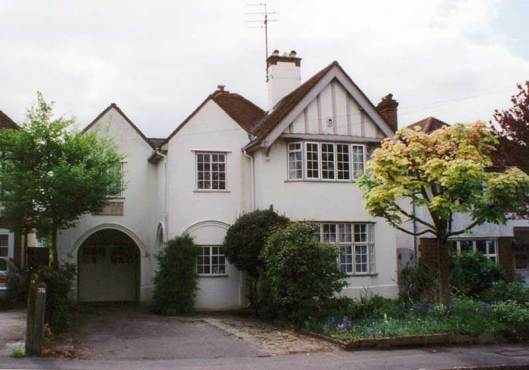
This makes us wonder once again:  how much of this entryway depicts a Middle-earth based not upon the Middle Ages, but upon the memory of houses JRRT grew up in or perhaps furnishings from his own homes in North Oxford or Headington as an adult?

image17northox.jpg

image18head.jpg

But we’ll save what appears to be a Gothic Revival chair there on the right for another day…

In the meantime, thanks, as ever, for reading!

MTCIDC

CD

PS

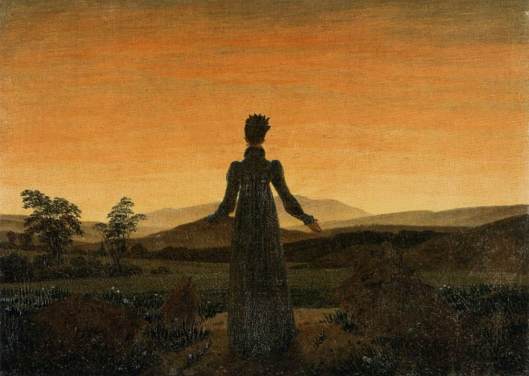
We would like to take a moment and turn to the west to thank the Valar for the full recovery of our dear friend and fellow Tolkien enthusiast, EMH, from a serious operation.  Get even well-er soon!

Caspar_David_Friedrich_-_Woman_before_the_Rising_Sun_(Woman_before_the_Setting_Sun)_-_WGA08253.jpg

PPS

If you enjoyed the Debussy in the link above, perhaps you might also enjoy Maurice Ravel’s (1875-1937) Miroirs (1906)—here’s a LINK.

Mirror, Mirror

09 Wednesday Dec 2015

Posted by Ollamh in Fairy Tales and Myths, J.R.R. Tolkien, Narrative Methods

≈ Leave a comment

Tags

A Christmas Carol, Denethor, Dickens, Disney, Evil Stepmother, Fates, Fiction, Folktale, Frodo, Galadriel, Gandalf, Gondor, Grimm Brothers, Istari, Kinder und Hausmaerchen, Lothlorien, Magic mirror, Maiar, Middle-earth, mirror, Mordor, Muses, Norns, Norse Mythology, Numenor, Ornthanc, Palantir, Saruman, Sauron, Schneewittchen, Scrooge, scrying stone, Snow White, Story, The Lord of the Rings, The Theogony, Tolkien, Urtharbrunnr, Valar, Yggdrasil

Dear Readers,

Welcome, as always.

This is the second of two postings which, as we said in our last, was originally just one. That earlier draft linked the Palantiri with Galadriel’s mirror, but, on reconsideration, we believed—at least at first–that, in fact, they weren’t so close as we thought and so we separated them.

In our last, we discussed the Palantiri and what might have been a possible inspiration for them. In this posting, we propose to look a little more closely at Galadriel’s mirror (but we promise not to touch the water).

When we speak of mirrors—and, in this case, magic ones—the first one which pops into our mind is from childhood—the mirror in Snow White and the particularly creepy mirror in the 1937 Disney animated film.

girmagicmirror.gif

In the original Schneewittchen, first published in the Grimm brothers’ Kinder und Hausmaerchen in the original edition of 1812,

grimm_bruder_1847_klein.jpg firstedkundh.JPG

the mirror belongs to Snow White’s stepmother, of whom the story says (in our translation):

“She was a very beautiful woman, but she was proud and arrogant and couldn’t allow that anyone would surpass her in beauty.”

She monitored her position by means of that mirror:

“She had a wonderful mirror. When she stepped before it and looked at herself within it, she said:

Little mirror, little mirror, on the wall,

Who is the most beautiful in the whole land?

The mirror answered thus:

Madame Queen, you are the most beautiful in the land.”

Franz_Jüttner_Schneewittchen_1.jpg

This makes us wonder about the stepmother. Was she like so many of the people we see around us every day (and not “everyday”, which is a compound adjective, meaning “commonly” as in “everyday usage does not necessarily equal correct usage in language”), compulsively fiddling with their electronic devices? How often did she go to that mirror and ask that question? As it was attached to the wall, she wasn’t carrying it in her back pocket, so, can we picture her making excuses to the king, to the prime minister, to her ladies in waiting, just so that she could go back to visit it? The text only says that she did—it’s a folktale, after all, and therefore old and so before current addictions were available, but she seems so obsessed—and familiar.

But then comes the day when the answer is:

“Madame Queen, you’re the most beautiful here,

But Snow White is a thousand times more beautiful than you.”

And the story goes on from there to places we don’t intend to follow.  It is interesting, however, that the mirror itself appears to do the talking, not a visible spirit within it, as in the Disney movie, and there is a certain logic to this. After all, normally, a mirror is only a reflecting device: it shows the person who is looking into it, as we see the stepmother doing. Then again, having someone—or something—looking out when you look in raises all sorts of interesting questions: who is it? Where is it? How does it know what it knows and how to speak? Does it have limits?

We might imagine, from her single, repeated question that the woman does. She never, for example, asks “Was there anyone as beautiful before me?” or “Will I always be the most beautiful?” She seems trapped in the moment and, without a greater context, the mirror’s last reply will be that much more shocking.

In contrast, Galadriel’s mirror, is neither on a wall, nor portable. In fact, it’s not really a mirror in the conventional sense at all.

“With water from the stream Galadriel filled the basin to the brim, and breathed on it, and when the water was still again she spoke. ‘Here is the Mirror of Galadriel,’ she said. ‘I have brought you here so that you may look in it, if you will.’ “ (The Fellowship of the Ring, Book 2, “The Mirror of Galadriel”)

64b97a1e010e45710323b25705b62626.jpg

When Frodo asks what might be seen therein, Galadriel replies:

‘Many things I can command the Mirror to reveal,’ she answered, ‘and to some I can show what they desire to see. But the Mirror will also show things unbidden, and those are often stranger and more profitable than things which we wish to behold. What you will see if you leave the Mirror free to work, I cannot tell. For it shows things that were, and things that are, and things that yet may be. But which is it that he sees, even the wisest cannot always tell.’ (The Fellowship of the Ring, Book 2, “The Mirror of Galadriel”)

There appear to be several possible influences here. In the ancient Greek poem, The Theogony, the Muses are described as knowing past, present, and future (Theogony 380), as they choose the shepherd, Hesiod, to become a poet.

Muses_sarcophagus_Louvre_MR880.jpg

Others have suggested that an influence upon the author here was the Urtharbrunnr, the well of fate, as it may be translated, from Norse mythology, which lies at the foot of the tree called Yggdrasil. Here the Norns, or Fates in Norse tradition, sit to do their work.

Nornorna_vid_Urdarbrunnen.jpg

Another possibility yet might be the three Christmases who visit Ebenezer Scrooge in Charles Dickens’ A Christmas Carol and an advantage to pointing to them is that Christmas Yet to Come, although mute, shows Scrooge what turn out to be only “things that yet may be”, as Scrooge, by his change in behavior, diverts fate.

The_Last_of_the_Spirits-John_Leech,_1843.jpg

That sense of potentiality about the future is clearly a very important feature of Galadriel’s Mirror. Lorien is not only a haven from Orcish pursuit,

Lothlorien.jpg

but also a testing ground, where the surviving members of the Fellowship are probed by the Lady of the Wood, even as she herself is inadvertently tested when Frodo offers her the Ring. Sam may suffer the most from this, being shown what appears to be the destruction of the Shire and the destitution of his own grandfather.

ruinedshire.png

And yet, as Galadriel says,

‘But the Mirror will also show things unbidden, and those are often stranger and more profitable than things which we wish to behold.’ (The Fellowship of the Ring, Book 2, “The Mirror of Galadriel”)

What Sam sees shakes him for a moment to the point of stepping back from the basin, saying (almost shouting, as the sentence ends with an exclamation point), “I must go home!” (The Fellowship of the Ring, Book 2, “The Mirror of Galadriel”) He recovers immediately, however, resolving, “ ‘No, I’ll go home by the long road with Mr. Frodo, or not at all.’” And thus he, like Galadriel, passes the test and perhaps that’s what the odd word “profitable” means in her explanation. Sam is confronted with what must have been that which he subconsciously dreaded most, but his new resolution ultimately proves the salvation of Middle Earth, on the one hand, and the healing of the Shire by means of Galadriel’s gift of a little Lorien, on the other. And, considering that Sam first appears in the story as an eaves-dropping gardener and hardly a giant elf-warrior, that other adjective, “stranger” may be appropriate, too.

So far, the Mirror has nothing in common with a Palantir, which was clearly designed not as a “scrying stone”, but as a communication device. And yet there is Galadriel’s remark,

“ ‘Many things I can command the Mirror to reveal,’ she answered, ‘and to some I can show what they desire to see.’ “

This strikes us as an ambiguous statement—and probably meant to be. Does Galadriel mean:

  1. people come to ask her, for example, to see their future—implication being that she shows them that, and nothing more
  2. people come, ask, and she shows them what they want to see—implication being that what they see is not necessarily what is real?

When Frodo looks into Mirror, he sees the very last thing he would want to see, however:

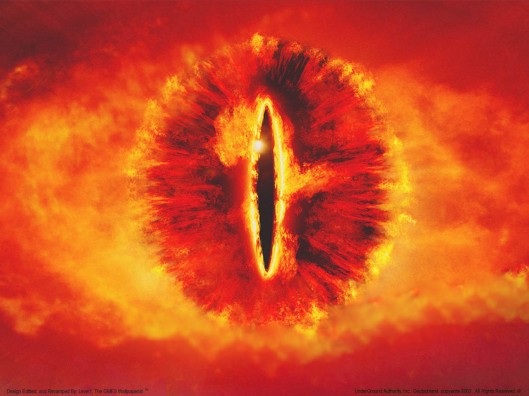
“But suddenly the Mirror went altogether dark, as dark as if a hole had opened in the world of sight, and Frodo looked into emptiness. In the black abyss there appeared a single Eye that slowly grew, until it filled nearly all the mirror. So terrible was it that Frodo stood rooted, unable to cry out or to withdraw his gaze. The Eye was rimmed with fire, but was itself glazed, yellow as a cat’s, watchful and intent, and the black slit of its pupil opened on a pit, a window into nothing.” (The Fellowship of the Ring, Book 2, “The Mirror of Galadriel”)
eye-o-sauron-03.jpeg

This is especially true in that:

“Then the Eye began to rove, searching this way and that; and Frodo knew with certainty and horror that among the many things that it sought he himself was one.” (The Fellowship of the Ring, Book 2, “The Mirror of Galadriel”)

This is clearly not the past or the future, as Frodo sees it, but the all-too-realistic present. And this is not just a present to be viewed. Like the figure in the mirror in the old Disney Snow White, this is someone who would respond directly to what he sees, if he could. And Frodo is aware of this:

“But he also knew that it could not see him—not yet, not unless he willed it.” (The Fellowship of the Ring, Book 2, “The Mirror of Galadriel”)

Does the Mirror have more potential, then? Can it be used as a communication device, like a Palantir? If it can combine the functions of “magic mirror” and Palantir, might the Palantir be able to combine functions, as well?

Certainly Sauron does something which ruins Denethor’s ability to resist Sauron’s view of the future to the point where he attempts to commit flaming suicide along with his one surviving son, having abandoned his city to its fate.

pyre.jpg

Denethor, though, is just a human, and rather a vain one, at that.

How would Sauron do the same with one of the Maiar, those beings sent by the Valar to protect Middle Earth from the danger which Sauron represents? Certainly we know that Sauron has communicated with Saruman through the Palantir.

palantir.jpg

There may be a clue in Gandalf’s reply to Saruman, just before he is held captive in Orthanc:

“I have heard speeches of this kind before, but only in the mouths of emissaries sent from Mordor to deceive the ignorant.” (The Fellowship of the Ring, Book 2, “The Council of Elrond”)

What Gandalf is responding to is:

“A new Power is rising. Against it the old allies and policies will not avail us at all. There is no hope left in Elves or dying Numenor. This then is one choice before you, before us. We may join with that Power. It would be wise, Gandalf. There is hope that way. Its victory is at hand; and there will be rich reward for those that aided it. As the Power grows, its proved friends will also grow; and the Wise, such as you and I, may with patience come at last to direct its courses, to control it. We can bide our time, we can keep our thoughts in our hearts, deploring maybe evils done by the way, but approving the high and ultimate purpose: Knowledge, Rule, Order; all the things that we have so far striven in vain to accomplish,,hindered rather than helped by our weak or idle friends. There need not be, there would not be, any real change in our designs, only in our means.” (The Fellowship of the Ring, Book 1, “The Council of Elrond”)

“Knowledge, Rule, Order”? It’s no wonder that Gandalf replies as he does. Such words sound more like the slogan of a totalitarian state—exactly what Mordor has become under its lidless-eyed master–than those of one of the Istari.

And how did Saruman come to have such a distorted vision of the future? Just as Denethor, bitter over his son’s death and the loss to Gandalf—he thinks—of his younger son, has been shown what must have been an increasingly-bleak picture of Gondor and its fate, so can we imagine that Sauron, sensing a latent arrogance and desire for power in Saruman, has given Saruman the second possible understanding of Galadriel’s statement. He has shown Saruman what Saruman secretly wishes for and, in doing so, he cunningly paints for Saruman, who is just wise enough to know that he will never be Sauron, a picture of an alliance which will grant him his wish. Why does Saruman, who is himself an extremely powerful figure, fall for this? Perhaps he’s like Snow White’s stepmother and limited to one question: “Little globe, little globe, who is the (second most) powerful in Middle Earth?”

What do you think, dear readers?

Thanks, as always, for reading.

MTCIDC

CD

Somewhere Over…Ephel Duath?

02 Wednesday Dec 2015

Posted by Ollamh in Fairy Tales and Myths, J.R.R. Tolkien, Narrative Methods

≈ Leave a comment

Tags

Aragorn, Auntie Em, communication, crystal ball, Denethor, Dorothy, Emerald City, Galadriel, heroine, Kansas, Margaret Hamilton, Middle-earth, mirror, Oxford, Oz, Palantir, Pippin, Professor Marvel, Saruman, Sauron, seeing-stones, skype, The Lord of the Rings, The Wizard of Oz, Tolkien, Villains, Wicked Witch

Dear Readers,

Welcome, as always. This posting is now one of two, but it was originally a single posting in which we discussed both Palantiri and Galadriel’s mirror.

Our first thought had been, in fact, a vague one: what did one see in such things? As we reviewed the various possibilities, we realized that they were, in fact, very different in function (yes, we probably didn’t think long and hard enough—we should have pulled out our spares and dipped into that cask of Longbottom Leaf for a three-pipe problem). So we separated them and here’s the first, on the Palantiri.

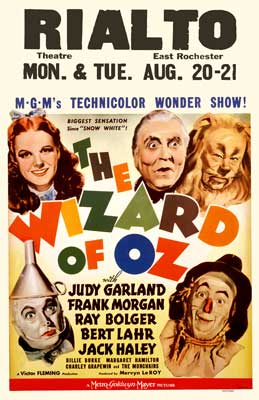
We begin in 1939. It’s not a happy time: war in Europe has broken out again after only two decades of peace. The Depression is still lingering. But there is a new film which Priscilla (age 10) has heard about and would very much like to see and her loving and indulgent father has agreed to take her—after all, this is a children’s movie and he, since his first novel was published in 1937, has become a children’s author.

The film was the story of a quest: the heroine, torn from home, acquires a magical object (two, in fact), slowly gathers a disparate band of companions who help her on her way, visits a grand city, has dealings with a wizard, defeats a powerful enemy and returns home, at last, a wiser person.

posterforwoo

In the very year he became a children’s author, the father had begun a new work. Based in part upon earlier materials and interests, as well as upon elements from his 1937 novel, this was to become not, as he thought at first (and his publishers hoped) a sequel to his previous work, but a kind of extension of that work and, in the years in which he continued to work on it, much more.

In the meantime, he sat in the theatre in Oxford and watched a bleak prairie worldkansas

turn into something almost hallucinogenically-technicolored

munchkinland

and filled with small and very energetic people.

munchkins

But the heroine, as we said, has been torn from home and, worse, she arrives and is immediately in trouble with a powerful enemy,

wickedwitchofthewest

having accidentally killed that enemy’s sibling.houseinwwoe

And the story moves on from there—the gathering of the companions

Wizard-of-Oz-w13

the grand city

oz

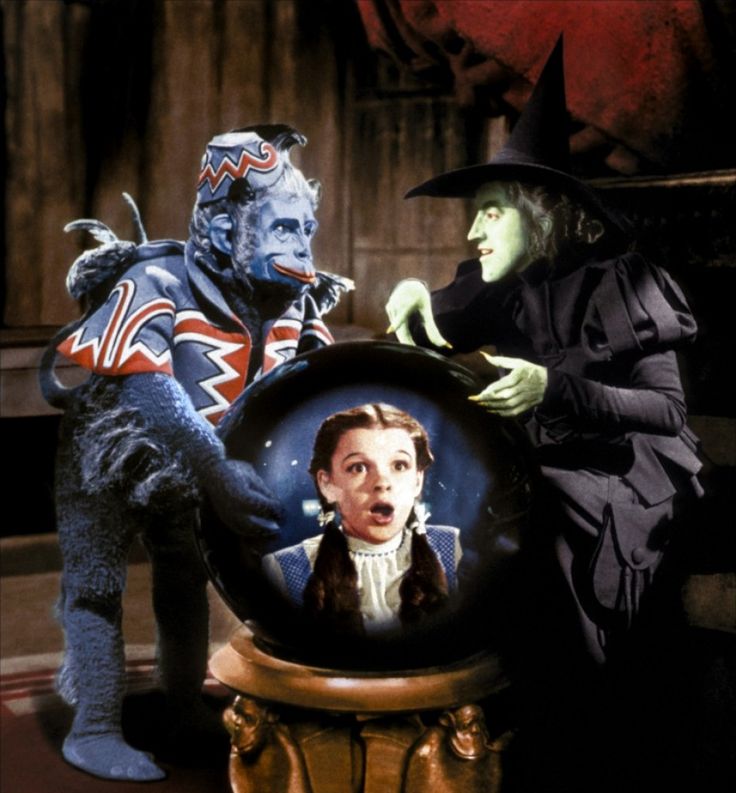
and, all the while, that powerful enemy is watching.

ball4

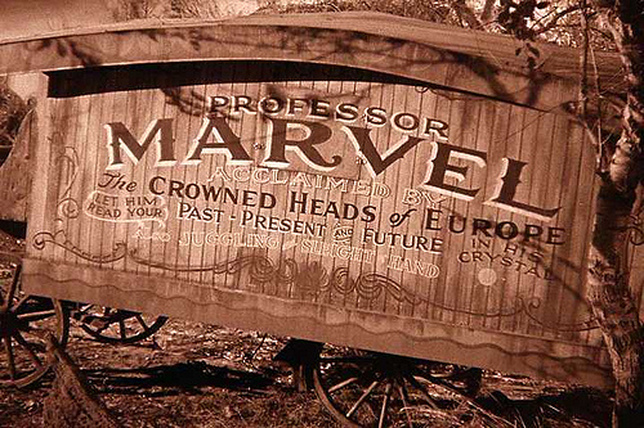
This isn’t the first time such a scrying device has been seen in the story. Earlier, the heroine had consulted another magical figure—or so he claimed.

profmarvelswagon Wizard-3-Marvel

What’s particularly interesting about this device is that, unlike crystal balls one remembers from film and books and from general folklore,

crystalball

the one which is actually used sees not the future, but the present.

The Wicked Witch of the West sees Dorothy—as, of course, that’s who they are–

wwowwithball

and Dorothy sees Auntie Em.

crystalballdseesem

(And “Professor Marvel”, as he calls himself, at least pretends to see the present.)

This made us wonder about the Palantiri.

For a useful summary of information about these so-called “seeing-stones”, see the entry for Palantiri at Tolkiengateway.net/wiki/Palantiri, but, in short, they are an ancient communication device. That is, they are unlike the usual crystal ball, which looks into the future (or possibly the past), but are rather like the Middle Earth form of skype.

skype

These items don’t have the security offered by our earthly form, however. Within The Lord of the Rings, we see them used by Saruman

sarumanpalantir

Pippin

Pippinpalantir

and Aragorn

palantirandaragorn

and Denethor.

denethorandpalantir

Aragorn, however, is the only one able to escape the control of Sauron as exerted by the sphere.

the_palantir_of_barad_dur_by_stirzocular-d7xwbi9

Their function as a medium of communication, so different from their usual use, brings us back to Margaret Hamilton, staring into her crystal ball

ball4

and we wondered whether, in that dark late summer of 1939, Tolkien might have sat in a theatre in Oxford, watching the Wicked Witch of the West, and, as he did so brilliantly with so many other things, absorbing, then recreating what he saw for his own purposes. What do you think, dear readers?

As always, thanks for reading.

MTCIDC

CD

The Doubtful Sea Series Facebook Page

The Doubtful Sea Series Facebook Page

  • Ollamh

Categories

  • Artists and Illustrators
  • Economics in Middle-earth
  • Fairy Tales and Myths
  • Films and Music
  • Games
  • Heroes
  • Imaginary History
  • J.R.R. Tolkien
  • Language
  • Literary History
  • Maps
  • Medieval Russia
  • Military History
  • Military History of Middle-earth
  • Narnia
  • Narrative Methods
  • Poetry
  • Research
  • Star Wars
  • Terra Australis
  • The Rohirrim
  • Theatre and Performance
  • Tolkien
  • Uncategorized
  • Villains
  • Writing as Collaborators
Follow doubtfulsea on WordPress.com

Across the Doubtful Sea

Recent Postings

  • A Moon disfigured December 17, 2025
  • On the Roads Again—Once More December 10, 2025
  • (Not) Crossing Bridges December 3, 2025
  • On the Road(s) Again—Again November 26, 2025
  • On the Road(s) Again November 19, 2025
  • To Bree (Part 2) November 12, 2025
  • To Bree (Part 1) November 5, 2025
  • A Plague o’ Both—No, o’ All Your Houses! October 29, 2025
  • It’s in Writing (2:  I’st a Prologue, or a Poesie for a Ring?) October 22, 2025

Blog Statistics

  • 103,217 Views

Posting Archive

  • December 2025 (3)
  • November 2025 (4)
  • October 2025 (5)
  • September 2025 (4)
  • August 2025 (4)
  • July 2025 (5)
  • June 2025 (4)
  • May 2025 (4)
  • April 2025 (5)
  • March 2025 (4)
  • February 2025 (4)
  • January 2025 (5)
  • December 2024 (4)
  • November 2024 (4)
  • October 2024 (5)
  • September 2024 (4)
  • August 2024 (4)
  • July 2024 (5)
  • June 2024 (4)
  • May 2024 (5)
  • April 2024 (4)
  • March 2024 (4)
  • February 2024 (4)
  • January 2024 (5)
  • December 2023 (4)
  • November 2023 (5)
  • October 2023 (4)
  • September 2023 (4)
  • August 2023 (5)
  • July 2023 (4)
  • June 2023 (4)
  • May 2023 (5)
  • April 2023 (4)
  • March 2023 (5)
  • February 2023 (4)
  • January 2023 (4)
  • December 2022 (4)
  • November 2022 (5)
  • October 2022 (4)
  • September 2022 (4)
  • August 2022 (5)
  • July 2022 (4)
  • June 2022 (5)
  • May 2022 (4)
  • April 2022 (4)
  • March 2022 (5)
  • February 2022 (4)
  • January 2022 (4)
  • December 2021 (5)
  • November 2021 (4)
  • October 2021 (4)
  • September 2021 (5)
  • August 2021 (4)
  • July 2021 (4)
  • June 2021 (5)
  • May 2021 (4)
  • April 2021 (4)
  • March 2021 (5)
  • February 2021 (4)
  • January 2021 (4)
  • December 2020 (5)
  • November 2020 (4)
  • October 2020 (4)
  • September 2020 (5)
  • August 2020 (4)
  • July 2020 (5)
  • June 2020 (4)
  • May 2020 (4)
  • April 2020 (5)
  • March 2020 (4)
  • February 2020 (4)
  • January 2020 (6)
  • December 2019 (4)
  • November 2019 (4)
  • October 2019 (5)
  • September 2019 (4)
  • August 2019 (4)
  • July 2019 (5)
  • June 2019 (4)
  • May 2019 (5)
  • April 2019 (4)
  • March 2019 (4)
  • February 2019 (4)
  • January 2019 (5)
  • December 2018 (4)
  • November 2018 (4)
  • October 2018 (5)
  • September 2018 (4)
  • August 2018 (5)
  • July 2018 (4)
  • June 2018 (4)
  • May 2018 (5)
  • April 2018 (4)
  • March 2018 (4)
  • February 2018 (4)
  • January 2018 (5)
  • December 2017 (4)
  • November 2017 (4)
  • October 2017 (4)
  • September 2017 (4)
  • August 2017 (5)
  • July 2017 (4)
  • June 2017 (4)
  • May 2017 (5)
  • April 2017 (4)
  • March 2017 (5)
  • February 2017 (4)
  • January 2017 (4)
  • December 2016 (4)
  • November 2016 (5)
  • October 2016 (6)
  • September 2016 (5)
  • August 2016 (5)
  • July 2016 (5)
  • June 2016 (5)
  • May 2016 (4)
  • April 2016 (4)
  • March 2016 (5)
  • February 2016 (4)
  • January 2016 (4)
  • December 2015 (5)
  • November 2015 (5)
  • October 2015 (4)
  • September 2015 (5)
  • August 2015 (4)
  • July 2015 (5)
  • June 2015 (5)
  • May 2015 (4)
  • April 2015 (3)
  • March 2015 (4)
  • February 2015 (4)
  • January 2015 (4)
  • December 2014 (5)
  • November 2014 (4)
  • October 2014 (6)
  • September 2014 (1)

Blog at WordPress.com.

  • Subscribe Subscribed
    • doubtfulsea
    • Join 78 other subscribers
    • Already have a WordPress.com account? Log in now.
    • doubtfulsea
    • Subscribe Subscribed
    • Sign up
    • Log in
    • Report this content
    • View site in Reader
    • Manage subscriptions
    • Collapse this bar
 

Loading Comments...