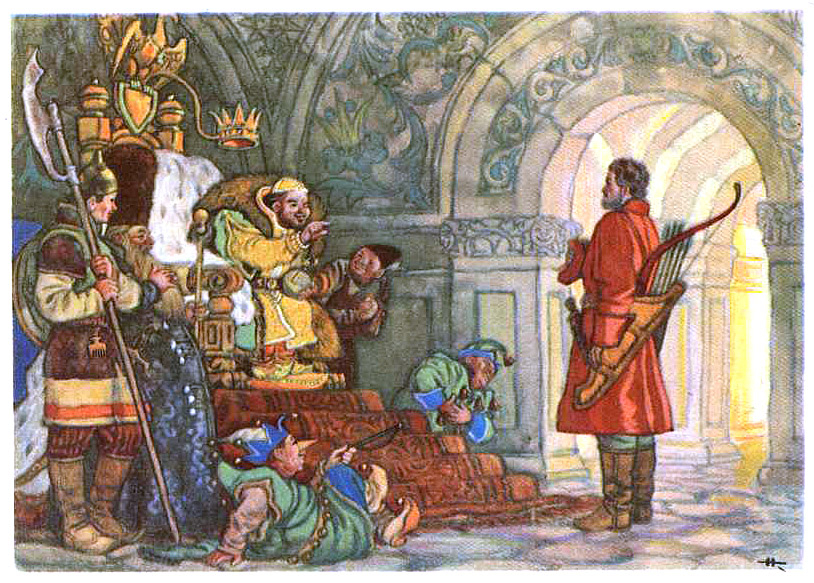
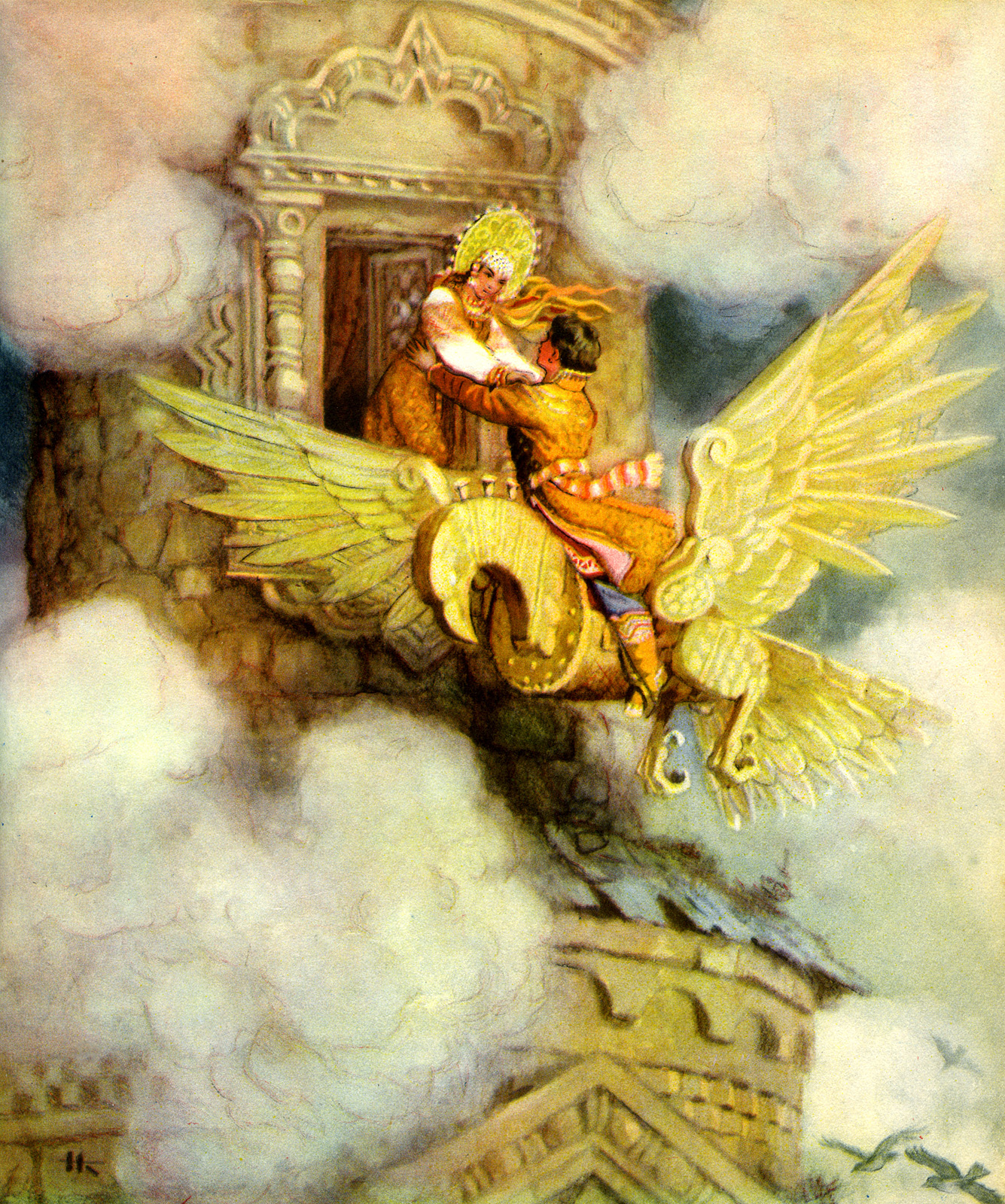
• About

doubtfulsea

~ adventure fantasy

Tag Archives: Medieval

Feudal-Earth?

13 Wednesday Jan 2016

Posted by Ollamh in Artists and Illustrators, Economics in Middle-earth, Fairy Tales and Myths, J.R.R. Tolkien, Literary History, Military History, Military History of Middle-earth, Narrative Methods

≈ 2 Comments

Tags

Bayeux Tapestry, feudalism, Gondor, Medieval, Prince Valiant, The Lord of the Rings, Tolkien

Welcome, dear readers, as always!

In this posting, we want to think out loud about something which has puzzled us for some time. Regular readers must know by this time that, along with literature of various times and places, we’re also very much interested in world history, from its human beginnings all the way up to the present. As those of you who have read past postings know, we have sometimes tried to apply our interest (and, we hope our knowledge) to the works of one of our favorite fantasy authors, JRR Tolkien. In our last posting, for example, we have spent a little time considering the 20th-century world of dictators and how they might have influenced JRRT’s depiction of Sauron and his plans.

In this posting, we want to look at something we’ve touched upon some time in the past, the economic/social structure of Middle Earth (or Middle-earth as it sometimes seems to appear). After all, kingdoms don’t just magically appear and survive: or, in Middle Earth, do they? For fun, we wondered what we might find in The Lord of the Rings which would remind us of our own Middle Ages.

In our world, particularly in western Europe , this is the period which appears physically similar to the end of the Third Age (minus Elves, etc), and, in this period, we find a social/economic structure called feudalism. There has been a great deal of scholarly discussion as to where the base word, feud comes from, but the structure is pretty basic and goes like this (with apologies to all actual medievalists for the gross simplification):
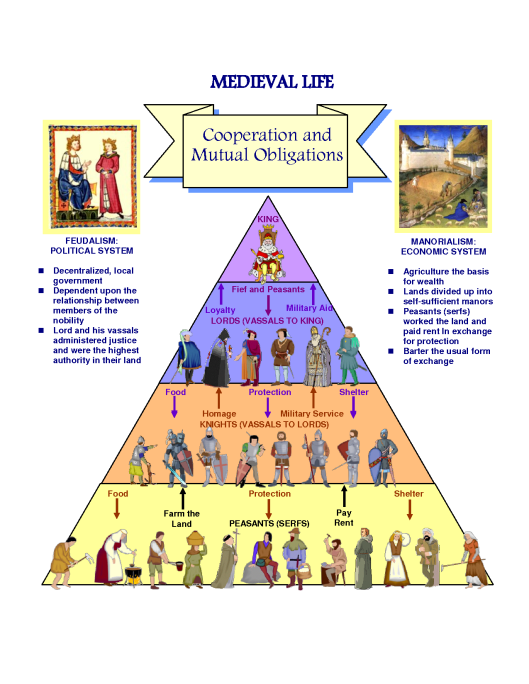
feudalsystemchart.png

At base, it’s all about two things: land and soldiers.

At the top—the very top—is God, who owns everything. He chooses a king (this comes down to us under the heading of “the divine right of kings” and is similar to “the mandate of heaven” in Chinese history). The king then claims that, because of his position as the Chosen One, he owns all of the land in the country. This land, however, he divides, keeping some for himself, but giving large portions to his chief nobles (the Church also owns a large chunk, but, as religion is rather subterranean in Middle Earth, we’ll leave it at that). They, in turn, divide it among lesser nobles (family members and/or those loyal to them), who, in turn, divide it among the lowest level of nobility (often knights). The simplest parcel is a manor and a knight may hold just one or more than one and this is true all the way up the chain.

4186733_orig.jpg

Each manor, in turn, has various grades of inhabitants, from freeholders, who own land but pay taxes on it, to peasants who are free, but are landless and have to work for others, and serfs, who are nothing more than slaves and considered part of the property. Even freemen might still owe an obligation in the form of labor to the lord of the manor.
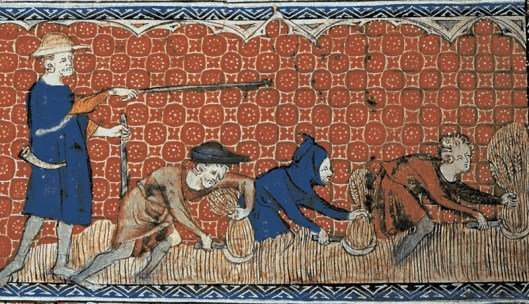
Reeve_and_Serfs.jpg

In return for a manor or for many manors, the nobles at every level owed the king military service.

Sir_Geoffrey_from_LPsalter.jpg

This was necessary, since, with the exception of a certain number of household troops or bodyguards, kings couldn’t afford to keep standing armies on their own.

When we began wondering if we could find traces of feudalism in Middle Earth, we thought first about titles. As we said, there are kings, so could we add to them “sirs”, “knights”, “lords”, and such? The densest patch of those would seem to be in The Return of the King, Chapter 1, “Minas Tirith”. Almost at the end of the chapter, Pippin and Beregond’s son, Bergil, watch reinforcements march into the city. Here we can list leaders, almost every one seeming to be a major landowner, judging by the number of his military followers, and all but one called “lord” : Forlong, Dervorin (“son of their lord”), Golasgil, and last and most feudal-like, Imrahil, Prince of Dol Amroth, who comes with “a company of knights in full harness”.

This last reminded us of an earlier posting, when we wondered whether JRRT had ever seen the Prince Valiant comic strip, which occasionally had scenes like this:

Prince-Valiant-10-2-38.jpg


Our other thought was this sounded rather like a combination of men entering the Alamo and a gathering of the clans.
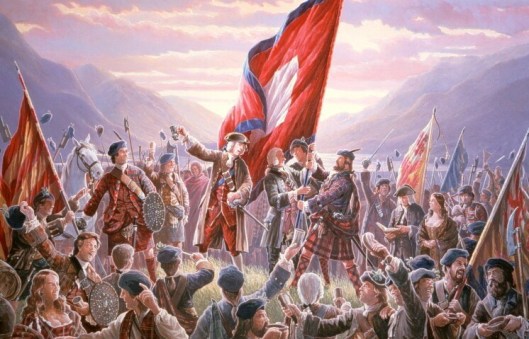
raising-the-standard-at-glenfinnan-1745-jacobite-rebellion.jpg

To gain a portion of land, all levels of nobles swore oaths of loyalty (called fealty, from Latin fidelitas, through Old French, the legal language of England after the Norman conquest) to those who gave them that land and that oath was commonly done publically and was legally binding.

There were different ways of confirming the earnestness of the person swearing. An altar or saint’s reliquary might be used, as seems to be the case from this scene on the “Bayeaux Tapestry”, in which Harold swears a sacramentum (a “sacred oath”, so Norman propaganda would afterwards claim) to be the vassal (sworn man) of Duke William of Normandy.

Bayeux_Tapestry_scene23_Harold_sacramentum_fecit_Willelmo_duci.jpg


Oaths might take the form of the receiver placing his hands between those of the giver and swearing.

1274514-miniature-depicting-a-knight-receiving-his-sword-from-the-king-guillaume-dorange.jpeg


An extremely useful site (www.dragonbear.com) provides a number of examples of the oath, which, while varying greatly through time and place, can be encapsulated in this version, from “The Laws of Alfred, Guthrum, and Edward the Elder”:

“Thus shall a man swear fealty oaths.

By the Lord, before whom this relic is holy, I will be to ____ faithful and true, and love all that he loves, and shun all that he shuns, according to God’s law, and according to the world’s principles, and never, by will nor by force, by word nor by work, do ought of what is loathful to him; on condition that he keep me as I am willing to deserve, and all that fulfil that our agreement was, when I to him submitted and chose his will.”

Compare this with Pippin’s oath to Denethor, after Pippin offers his sword to him:

“Here do I swear fealty and service to Gondor, and to the Lord and Steward of the realm, to speak and to be silent, to do and to let be, to come and to go, in need or plenty, in peace or war, in living or dying, from this hour henceforth, until my lord release me, or death take me, or the world end. So say I, Peregrin son of Paladin of the Shire of the Halflings.” (The Return of the King, Chapter 1, “Minas Tirith”)

There is no transfer of land involved here, but certainly there is military service.

JRRT, for all of the amazing detail which he put into Middle Earth, was content, it would seem, to leave it at that: there are kings to whom oaths are sworn, and that idea comes from feudal oaths. There are knights and lords—who else would be in charge of this quasi-medieval world (except, of course, among the non-men—elves, dwarves, and hobbits)? At the same time, this is a huge and wonderfully entertaining adventure, not a disguised treatise on the economic and social substructure of a mirror of the western Middle Ages, as interesting as, if anyone, Tolkien, could have made even that. It is fun, however, to spend a moment imagining what, given another ten years and several more drafts, Middle Earth might have looked like… As always, we ask: what do you think?

Thanks, as always, for reading.

MTCIDC

CD

Like Smoke From a Fire: Sharkey’s End

04 Wednesday Nov 2015

Posted by Ollamh in Fairy Tales and Myths, Imaginary History, J.R.R. Tolkien, Maps, Narrative Methods, Research

≈ Leave a comment

Tags

Adventure, Birmingham, Branywine, Bywater, Coketown, Dickens, Dol Amroth, England, Ents, factory, Fangorn, feudalism, Galadriel, Gandalf, Grima, Hard Times, Hobbiton, Idylls, industrial, Industrial Revolution, Isengard, King Edward School, Medieval, Merry, Midlands, Mordor, Morris, Oxford, Palantir, Pippin, poetry, pre-industrial, Saruman, Sauron, Scouring of the Shire, Sharkey, Southfarthing, Tennyson, The Lord of the Rings, The Shire, Tolkien

Dear Readers,

Welcome, as always.

In a previous posting, we talked about Saruman as a kind of imitation Sauron and Isengard as a mini-Mordor.

sarum1

In this posting, we want to consider the implications of Gandalf’s remark about him in “Many Partings”, from The Return of the King: “I fancy he could do some mischief still in a small mean way.”

The mischief, when we see it, is definitely mean, but not small, even though confined to the limits of the Shire.

The world of The Lord of the Rings is a pre-industrial one. The most advanced technology, on the one hand, is the palantir (actually perhaps a magical, rather than mechanical, device)

palantir

and , on the other hand, a watermill.

j-r-r-_tolkien_-_the_hill_-_hobbiton-across-the-water_colored

Beyond that, it’s a medieval world, but without, it seems, feudalism, although there are, for example, castles and knights in the form of the Prince of Dol Amroth.

We can easily see why JRRT wanted this regression. On the one hand, like so many boys of his age, he had grown up reading Tennyson

John_everett_millais_portrait_of_lord_alfred_tennyson firstedition1859idylls

and William Morris

Morris-Portrait1

morris_tapestry

who had created a world of Victorian medievalism, Tennyson in poetry, Morris in many different art forms.

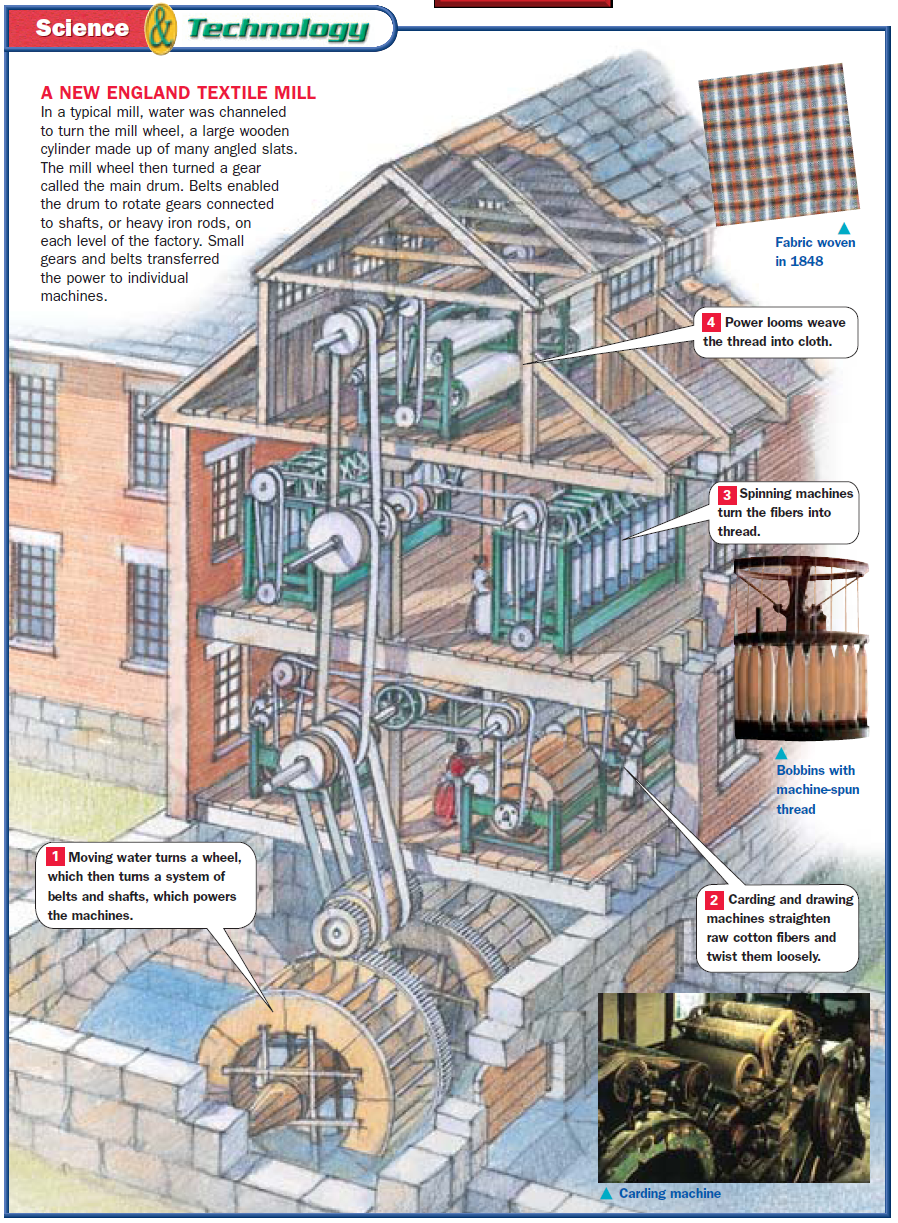
On the other, Tolkien had grown up in Birmingham, in the English Midlands, where there had been massive development throughout the era of the Industrial Revolution.

Textile Mill Diagram McConnel_&_Company_mills,_about_1820

Here’s Charles Dickens’ description of such a place from Hard Times (1856):

(Excerpt Describing Coketown)

Needless to say, although Tolkien kept a strong affection for King Edward School, where he was educated before Oxford,

KingEdwardsSchoolinBirmingham

he was less enthusiastic about the industrial world which surrounded it and this clearly colors his picture of Saruman. Look, for instance, at Fangorn’s description of him:

“He has a mind of metals and wheels; and he does not care for growing things, except as far as they serve him for the moment.” (The Two Towers, Book 1, Chapter 4, “Treebeard”) (It’s revealing, by the way that this is almost a quotation of something which Saruman later says of Gandalf, “When his tools have done their task he drops them.” The Return of the King, Book 2, Chapter 8, “The Scouring of the Shire”)

Saruman, then, with his metal mind, has turned the once-beautiful Isengardgreg-hildebrandt-isengard-orthanc-saruman-607429-1920x1080

into an arms factory

kruppworks

another Midlands,

isengardasfactory

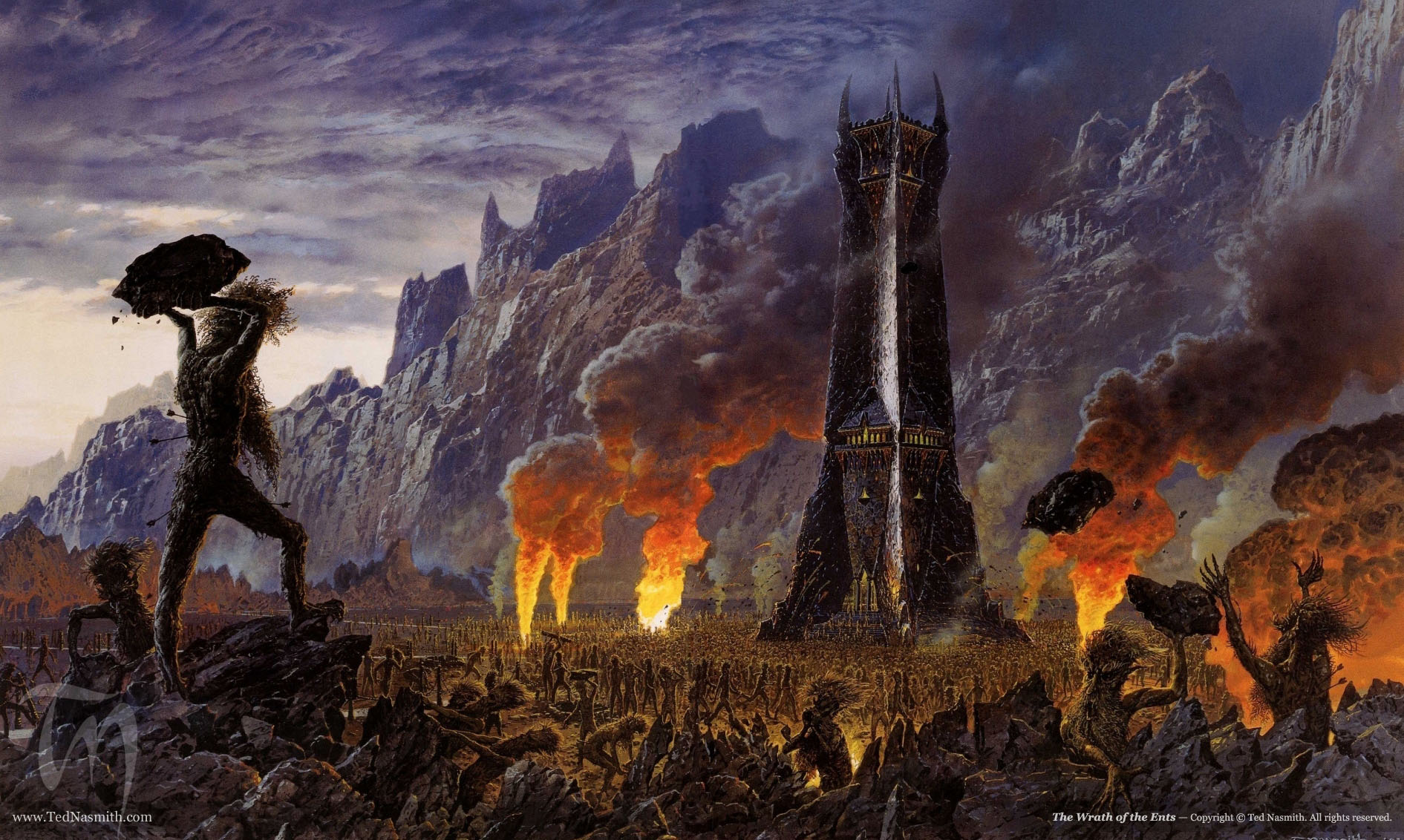
and has angered the Ents, as well, by the wanton destruction of trees, not just for fuel, it appears, but just out of sheer spitefulness.

The Wrath of the Ents, by Ted Nasmith

As we wrote earlier, all of this has remade Isengard into a mini-Mordor—as Frodo says: “Yes, this is Mordor…just one of its works. Saruman was doing its work all the time, even when he thought he was working for himself.” (The Return of the King, Book 2, Chapter 8, “The Scouring of the Shire”)

So, when Saruman, Grima in tow, leaves his ruined factory, one could almost imagine just what he might have in mind when he says to the hobbits:

“Well, it will serve you right when you come home, if you find things less good in the Southfarthing than you would like.” (The Return of the King, Book 2, Chapter 6, “Many Partings”)

We know from Merry and Pippin’s experience at the gate of Isengard that Saruman has been importing pipe-weed, a main export of the Southfarthing.

merrypippinisengard

But when the hobbits, having forced the gate at the Brandywine, are making their way towards Hobbiton, they begin to have a feeling that much more has been damaged than the South Farthing: “Still there seemed an unusual amount of burning going on, and smoke rose from many points round about. A great cloud of it was going up far away in the direction of the Woody End.” (The Return of the King, Book 2, Chapter 8, “The Scouring of the Shire”)

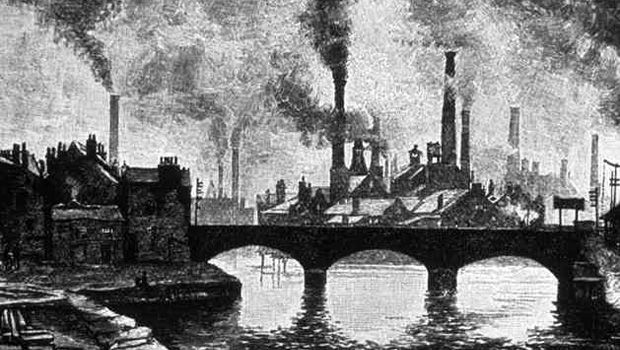
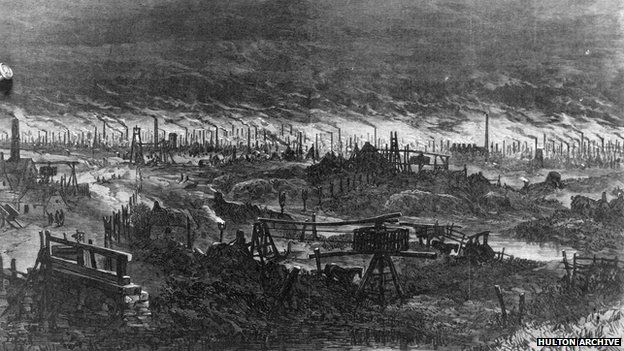
This smoke bears an ominous resemblance to the Midlands (and, in fact, to all of industrial England):

7ad841d6d5852b586a78fc03df7d64259715bddd.jpg__846x0_q80

There is worse to come, however: Bywater. “Many of the houses that they had known were missing. Some seemed to have been burned down. The pleasant row of old hobbit-holes in the bank on the north side of the Pool were deserted, and their little gardens that used to run down bright to the water’s edge were rank with weeds. Worse, there was a whole line of ugly new houses all along the Pool Side, where the Hobbiton Road ran close to the bank. An avenue of trees had stood there. They were all gone. And looking with dismay up the road towards Bag End they saw a tall chimney of brick in the distance. It was pouring out black smoke into the evening air.” (The Return of the King, Book 2, Chapter 8, “The Scouring of the Shire”)

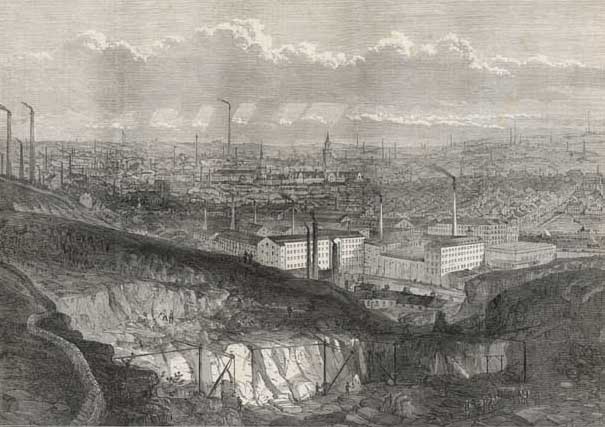
And here, we move from a single smoking mill to a smoking mill town.

BRADFORD/YORKSHIRE/1873

Saruman’s revenge has been more than small and mean, especially in terms of the industrial world which The Lord of the Rings rejects: the Shire is on its way to becoming another Midlands,

_77710962_3322454

even to the workers’ miserable housing.

preston

And the cutting down of trees (including, as we will find out, the Party Tree) insures the truth of Saruman’s sneering statement to the hobbits:

“…I have done much that you will find it hard to mend or undo in your lives.” (The Return of the King, Book 2, Chapter 8, “The Scouring of the Shire”)

But, as we know, Saruman, even in his moment of triumph, has no more than a moment to enjoy it. He is murdered by Grima and here we see the final irony. As Saruman has turned the medieval, bucolic Shire into a smoky horror, so he himself is turned to smoke:

“To the dismay of those that stood by, about the body of Saruman a grey mist gathered, and rising slowly to a great height like smoke from a fire, as a pale shrouded figure it loomed over the Hill. For a moment it wavered, looking to the West; but out of the West came a cold wind, and it bent away, and with a sigh dissolved into nothing.” (The Return of the King, Book 2, Chapter 8, “The Scouring of the Shire”)

61 - The scouring of the shire

A final thought, however. Might we see Saruman’s gesture towards the West, in which he clearly feels that he has been rejected by that which sent him to Middle Earth, as a mirror Galadriel’s gesture of rejection towards the East, when she refuses the Ring?

“She lifted up her hand and from the ring that she wore there issued a great light that illuminated her alone and left all else dark. She stood before Frodo seeming now tall beyond measurement, and beautiful beyond enduring, terrible and worshipful. Then she let her hand fall, and the light faded, and suddenly she laughed again, and lo! she was shrunken: a slender elf-woman, clad in simple white, whose gentle voice was soft and sad.” (The Fellowship of the Ring, Book 2, Chapter 7, “The Mirror of Galadriel”)

galadriel

Thanks, as always, for reading.

MTCIDC

CD

More Russian Favorites

10 Tuesday Feb 2015

Posted by Ollamh in Artists and Illustrators, Fairy Tales and Myths, Medieval Russia

≈ Leave a comment

Tags

Adventure, Epic, Fairytale Illustrators, Fantasy, Heroic, Medieval, Russia, Song

Dear Reader,

Welcome, as always.

We are very visual people. A picture in a museum, an illustration in a book, something in a film, will always catch our eye and sometimes inspire our writing.

This was certainly the case in our first book, Across the Doubtful Sea, where the drawings and paintings from the three Cook expeditions to the South Seas (1768-1779) filled us with a combination of wonder and curiosity. Although they were sometimes strongly influenced by period ideas of the sublime, here were images as close to historical photos as we would ever see.

Hodges,_Resolution_and_Adventure_in_Matavai_Bay

In the case of our second book, The Good King’s Daughter, however, because it was set in a world based loosely upon the medieval Russia of fairy tales, we looked to other sources, particularly those later-19th and 20th-century Russian artists who illustrated moments from the Russian heroic songs (byliny) and from the fairy and folktales themselves.

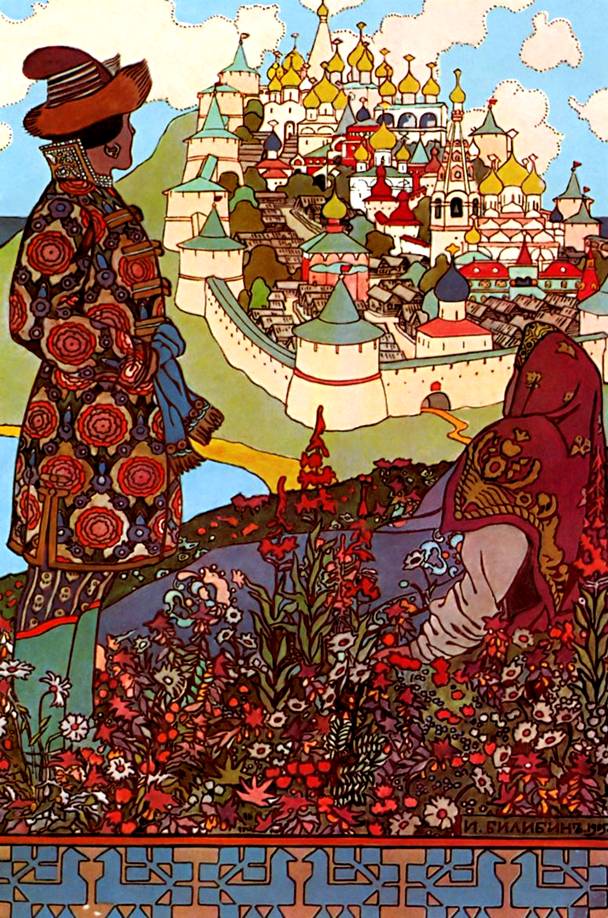
In our last, we showed you a few images from the work of perhaps the most famous (outside Russia, at least) illustrator, Ivan Bilibin (1876-1942). Pictures like “The Island of Buyan” (1905):

Ivanbilibin

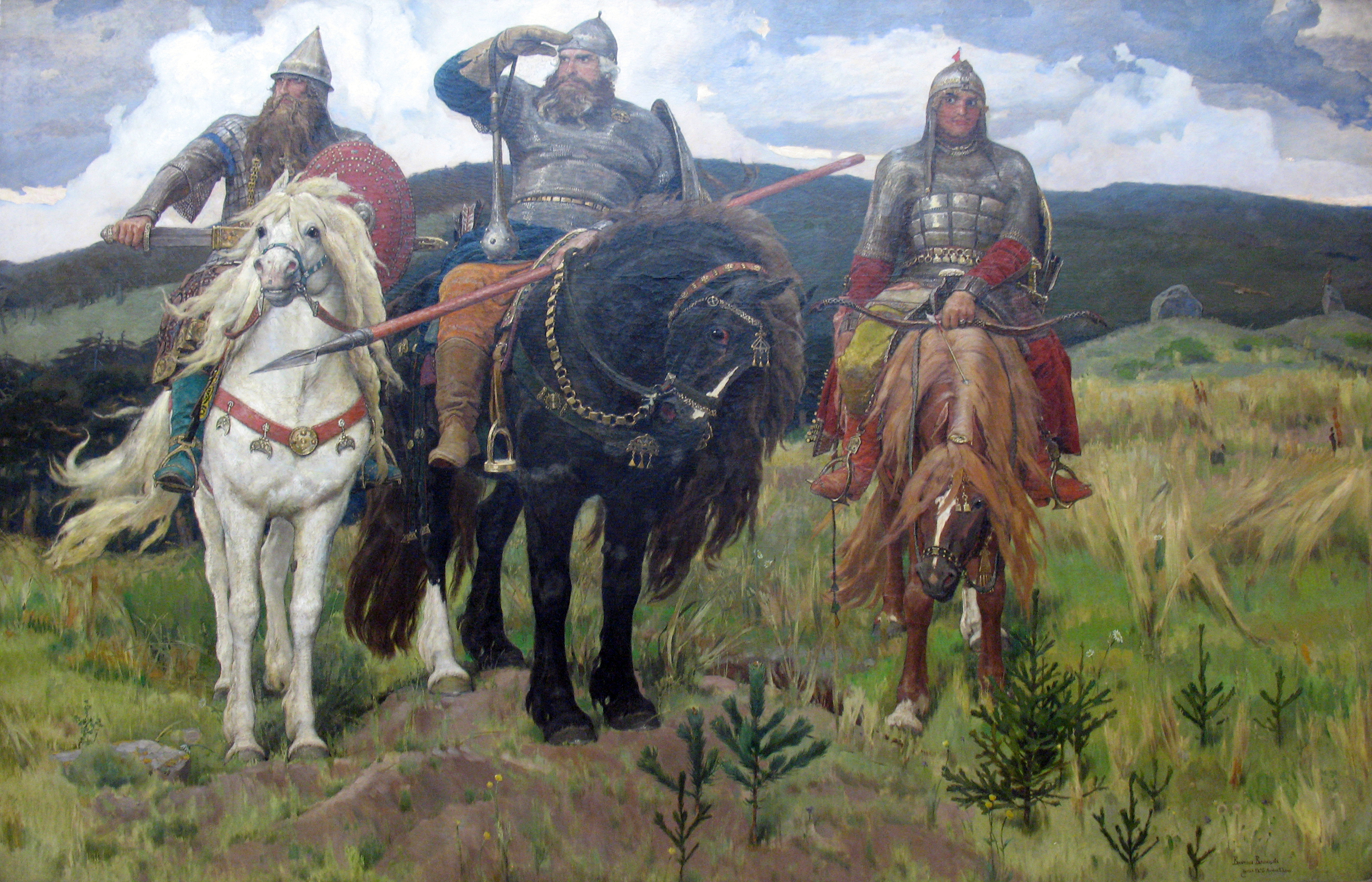
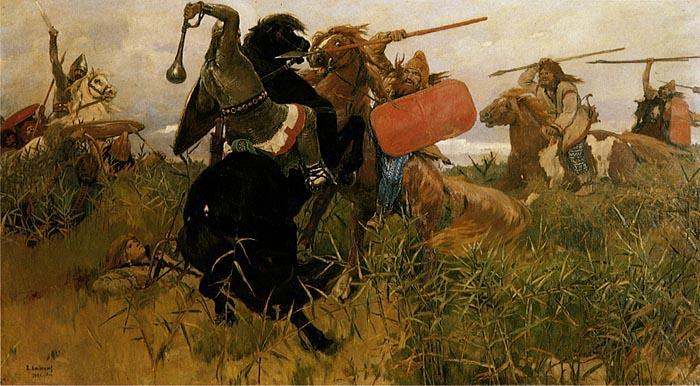
In this posting, we would add two more artists, Victor Vasnetsov (1848-1926—not to be confused with his equally-talented brother, Apollinary 1856-1923) and the more recent Nikolai Kochergin (1897-1974).

As you can see from the pictures below, Vasnetsov can move from the grandly (and grimly) heroic world of the byliny and its bogatyr (epic hero) to a more fanciful world of fairy tales like The Firebird (but still rather grim and grand).

1898_Vasnetsov_Bogatyrs_anagoria Igorsvyat Vasnetsov_samolet Viktor%20Vasnetsov-526879

hero

a-knight-at-the-crossroads-1878

Kochergin strikes us as more like Bilibin—brightly-colored, folk-influenced.

4f463a868cf7b31a66ad1c87e00 9f97a52394ba8269194a869df52 berendei-palace nicolai-kochergin_the-wooden-eagle

tumblr_mxjgrquVKF1rz5qxqo1_500

nicolai-kochergin_seven-simeons-seven-workers

tumblr_ndw64pRZCk1rgcyvso2_500

What inspires us in these pictures? To a degree, it’s what attracts us to the fairy/folktales: the strange scenes (even when you know the story), the swirl of color, that suggestion of a complex world of patterns from a different time and place, one in which there were yagas and firebirds and heroes who could be helped by wise animals.

And you, reader, do these pictures inspire you?

Thanks for reading!

MTCIDC

CD
PS

If you would like to know more about Russian heroic song—and for free—you might try:

Hapgood, Isabel Florence, The Epic Songs of Russia (1916)

Harrison, Marion Chilton, Byliny Book: Hero Tales of Russia (1915)

at archive.org. They are clearly older books, but, for those on a budget, they can provide a starting place into a rich world worth visiting.

Newer posts →

The Doubtful Sea Series Facebook Page

The Doubtful Sea Series Facebook Page

  • Ollamh

Categories

  • Artists and Illustrators
  • Economics in Middle-earth
  • Fairy Tales and Myths
  • Films and Music
  • Games
  • Heroes
  • Imaginary History
  • J.R.R. Tolkien
  • Language
  • Literary History
  • Maps
  • Medieval Russia
  • Military History
  • Military History of Middle-earth
  • Narnia
  • Narrative Methods
  • Poetry
  • Research
  • Star Wars
  • Terra Australis
  • The Rohirrim
  • Theatre and Performance
  • Tolkien
  • Uncategorized
  • Villains
  • Writing as Collaborators
Follow doubtfulsea on WordPress.com

Across the Doubtful Sea

Recent Postings

  • Through a glass… January 7, 2026
  • Heffalumps? December 31, 2025
  • We Three Kings December 24, 2025
  • A Moon disfigured December 17, 2025
  • On the Roads Again—Once More December 10, 2025
  • (Not) Crossing Bridges December 3, 2025
  • On the Road(s) Again—Again November 26, 2025
  • On the Road(s) Again November 19, 2025
  • To Bree (Part 2) November 12, 2025

Blog Statistics

  • 104,134 Views

Posting Archive

  • January 2026 (1)
  • December 2025 (5)
  • November 2025 (4)
  • October 2025 (5)
  • September 2025 (4)
  • August 2025 (4)
  • July 2025 (5)
  • June 2025 (4)
  • May 2025 (4)
  • April 2025 (5)
  • March 2025 (4)
  • February 2025 (4)
  • January 2025 (5)
  • December 2024 (4)
  • November 2024 (4)
  • October 2024 (5)
  • September 2024 (4)
  • August 2024 (4)
  • July 2024 (5)
  • June 2024 (4)
  • May 2024 (5)
  • April 2024 (4)
  • March 2024 (4)
  • February 2024 (4)
  • January 2024 (5)
  • December 2023 (4)
  • November 2023 (5)
  • October 2023 (4)
  • September 2023 (4)
  • August 2023 (5)
  • July 2023 (4)
  • June 2023 (4)
  • May 2023 (5)
  • April 2023 (4)
  • March 2023 (5)
  • February 2023 (4)
  • January 2023 (4)
  • December 2022 (4)
  • November 2022 (5)
  • October 2022 (4)
  • September 2022 (4)
  • August 2022 (5)
  • July 2022 (4)
  • June 2022 (5)
  • May 2022 (4)
  • April 2022 (4)
  • March 2022 (5)
  • February 2022 (4)
  • January 2022 (4)
  • December 2021 (5)
  • November 2021 (4)
  • October 2021 (4)
  • September 2021 (5)
  • August 2021 (4)
  • July 2021 (4)
  • June 2021 (5)
  • May 2021 (4)
  • April 2021 (4)
  • March 2021 (5)
  • February 2021 (4)
  • January 2021 (4)
  • December 2020 (5)
  • November 2020 (4)
  • October 2020 (4)
  • September 2020 (5)
  • August 2020 (4)
  • July 2020 (5)
  • June 2020 (4)
  • May 2020 (4)
  • April 2020 (5)
  • March 2020 (4)
  • February 2020 (4)
  • January 2020 (6)
  • December 2019 (4)
  • November 2019 (4)
  • October 2019 (5)
  • September 2019 (4)
  • August 2019 (4)
  • July 2019 (5)
  • June 2019 (4)
  • May 2019 (5)
  • April 2019 (4)
  • March 2019 (4)
  • February 2019 (4)
  • January 2019 (5)
  • December 2018 (4)
  • November 2018 (4)
  • October 2018 (5)
  • September 2018 (4)
  • August 2018 (5)
  • July 2018 (4)
  • June 2018 (4)
  • May 2018 (5)
  • April 2018 (4)
  • March 2018 (4)
  • February 2018 (4)
  • January 2018 (5)
  • December 2017 (4)
  • November 2017 (4)
  • October 2017 (4)
  • September 2017 (4)
  • August 2017 (5)
  • July 2017 (4)
  • June 2017 (4)
  • May 2017 (5)
  • April 2017 (4)
  • March 2017 (5)
  • February 2017 (4)
  • January 2017 (4)
  • December 2016 (4)
  • November 2016 (5)
  • October 2016 (6)
  • September 2016 (5)
  • August 2016 (5)
  • July 2016 (5)
  • June 2016 (5)
  • May 2016 (4)
  • April 2016 (4)
  • March 2016 (5)
  • February 2016 (4)
  • January 2016 (4)
  • December 2015 (5)
  • November 2015 (5)
  • October 2015 (4)
  • September 2015 (5)
  • August 2015 (4)
  • July 2015 (5)
  • June 2015 (5)
  • May 2015 (4)
  • April 2015 (3)
  • March 2015 (4)
  • February 2015 (4)
  • January 2015 (4)
  • December 2014 (5)
  • November 2014 (4)
  • October 2014 (6)
  • September 2014 (1)

Blog at WordPress.com.

  • Subscribe Subscribed
    • doubtfulsea
    • Join 78 other subscribers
    • Already have a WordPress.com account? Log in now.
    • doubtfulsea
    • Subscribe Subscribed
    • Sign up
    • Log in
    • Report this content
    • View site in Reader
    • Manage subscriptions
    • Collapse this bar
 

Loading Comments...