• About

doubtfulsea

~ adventure fantasy

Tag Archives: Marx Brothers

Why a Dragon?

28 Wednesday May 2025

Posted by Ollamh in Uncategorized

≈ Leave a comment

Tags

Beowulf, Bilbo, bilbo-burglar, Dragons, Dwarves, Fafnir, Fantasy, Hippogriff, Hoard, Marx Brothers, quest, Sigurd, Smaug, The Hobbit, The Reluctant Dragon, Thorin, Tolkien

As always, dear readers, welcome.

I think that I’ve always been a fan of the Marx brothers.

Their lack of respect for pompous men in silk hats,

opera-goers who are only interested because it gives them social status,

and self-important artists,
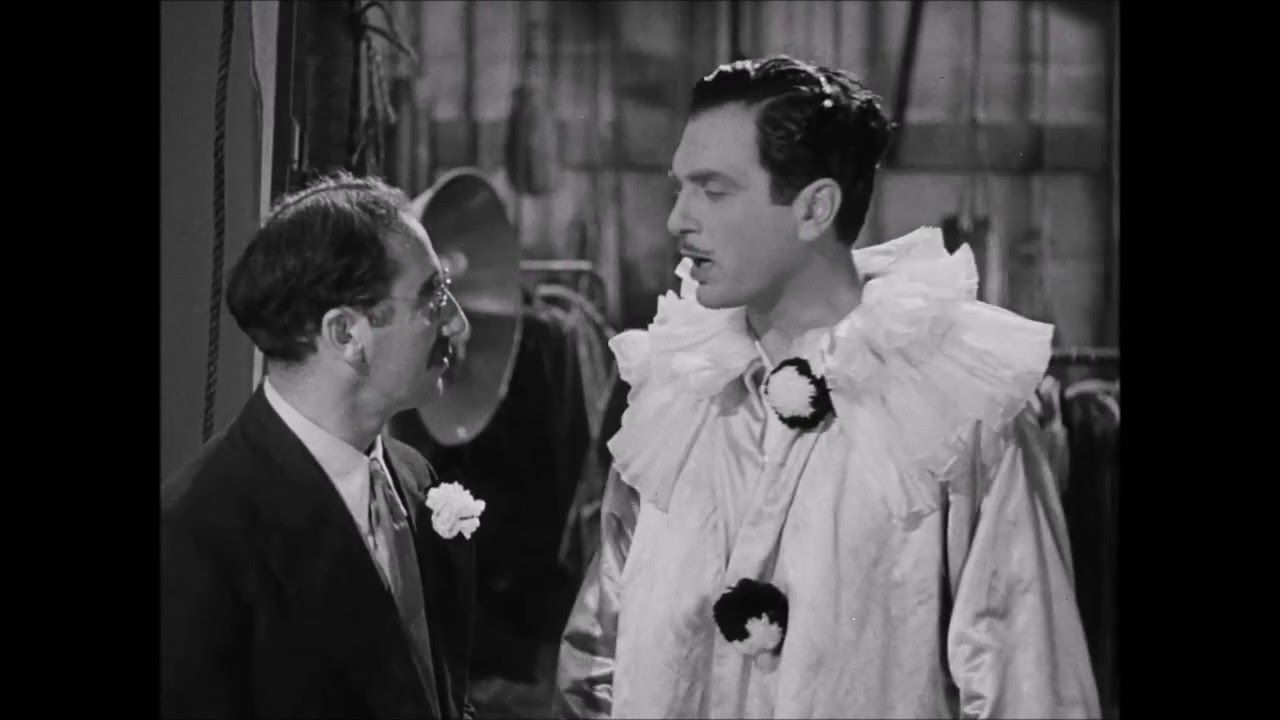
among many others, and their creative methods of deflating such people,

have always cheered me immensely.

There is another side to their comedy, however, which means just as much to me:  their endless play with words, delivered always deadpan and with perfect timing—not to mention absolute absurdist nonsequiturism.

Take, for example, this fragment from The Cocoanuts, their first surviving film, from 1929.  It’s set during the 1920s Florida land boom (read about that here:  https://en.wikipedia.org/wiki/Florida_land_boom_of_the_1920s ) and, in this scene, “Mr. Hammer”, Groucho, is explaining the layout of a real estate plot to “Chico”, Chico,

saying, at one point:

“Groucho:   Now, here is a little peninsula, and, eh, here is a viaduct leading over to the mainland.

Chico:  Why a duck?

Groucho:  I’m all right, how are you?  I say, here is a little peninsula, and here is a viaduct leading over to the mainland.

Chico:   All right, why a duck?

Groucho:  I’m not playing ‘Ask Me Another’, I say that’s a viaduct.

[Ask Me Another was originally an early 1927 equivalent of “Trivia”.  You can read about it here:  https://www.thefedoralounge.com/threads/how-do-you-play-ask-me-another.62135/ and here’s a copy—

Chico:  All right!  It’s what…why a duck?  Why no a chicken?

Groucho:  I don’t know why no a chicken—I’m a stranger here myself.  All I know is that it’s a viaduct.  You try to cross over there a chicken and you’ll find out why a duck.”

(For the entire script see:  https://www.marx-brothers.org/marxology/cocoanuts-script.htm )

By the same kind of logic which produced this, I found myself thinking about The Hobbit:  and hence the title of this posting:  why a dragon?

The plot of The Hobbit is, basically, a quest:  a journey with a goal.

Quests are a familiar form of adventure story and still common—just think about Indiana Jones, with his Lost Ark

and his Holy Grail, for example.

Indiana has to travel to Tibet and Egypt and to an unnamed island in the Mediterranean for the Ark and to Germany and Turkey for the Grail.

Although Thorin doesn’t mention the travel in his “mission statement”, much of the story will be about travel, from the Shire to the Lonely Mountain and back again,

to reach the dwarves’ goal, as stated in the first chapter by Thorin:

“But we have never forgotten our stolen treasure.  And even now, when I will allow we have a good bit laid by and are not so badly off…we still mean to get it back, and to bring our curses home to Smaug—if we can.”  (The Hobbit, Chapter 1, “An Unexpected Party”)

The goal, then, is in two parts:

1. to regain the treasure taken from the dwarves by the dragon

2. to take revenge upon said dragon

Because they are aware that the dragon can be lying on top of the treasure (“Probably”, says Thorin, “for that is the dragons’ way, he has piled it all up in a great heap far inside, and sleeps on it for a bed.”), it’s clear that 1 and 2 have to be dealt with as a sequence:  no getting the treasure without getting rid of the dragon.

Which brings us back to my title.  Indiana Jones commonly has Nazis (and eventually Communists and even Neo-Nazis) as opponents,

these being the characters who compete for his goal and stand in the way of his achieving his quest. 

Tolkien was a medievalist, writing a sort of fairy tale, so what would be his equivalent and why?

 We know that Tolkien had been interested in dragons since far childhood—at least the age of 6, when he tried to write a poem about a “green, great dragon” (to the Houghton Mifflin Company [summer, 1955?], Letters, 321—JRRT tells a somewhat different version of this to W.H. Auden in a letter of 7 June, 1955, Letters, 313) and he confesses to an early love for them in his lecture “On Fairy-Stories” where he mentions Fafnir and Sigurd, suggesting that he may have had read to him or had read for himself from Andrew Lang’s The Red Fairy Book, 1890, the last chapter of which is “The Story of Sigurd”, and since, elsewhere, he mentions “Soria Moria Castle”, which is the third story in the same book.

(Your copy is here:  https://archive.org/details/redfairybook00langiala/redfairybook00langiala/ )

Fafnir, the dragon in the Sigurd story, is described as, having killed his own father:

“he went and wallowed on the gold…and no man dared go near it.”  (“The Story of Sigurd”, 360)

The next major dragon story with which Tolkien was probably involved saw the same draconic behavior, as, in Beowulf, we’re told that the unnamed dragon, having discovered a hoard in a tumulus:

“This hoarded loveliness did the old despoiler wandering

in the gloom find standing unprotected, even he who filled

with fire seeks out mounds (of burial), the naked dragon of

1915

fell heart that flies wrapped about in flame: him do earth’s

dwellers greatly dread. Treasure in the ground it is ever his

wont to seize, and there wise with many years he guards the

heathen gold – no whit doth it profit him.”

(from JRRT’s draft translation of 1920-26 in Christopher Tolkien’s 2014 publication)

Traditionally, then, dragons and gold go together—and, as JRRT admitted in a letter to the Editor of the Observer, “Beowulf is among my most valued sources” (letter to the Editor of the Observer, printed in the Observer, 28 February, 1938, Letters, 41)

There is a very interesting twist in Tolkien’s version of the story, however.

By lying in a pit below the dragon, Sigurd slays Fafnir
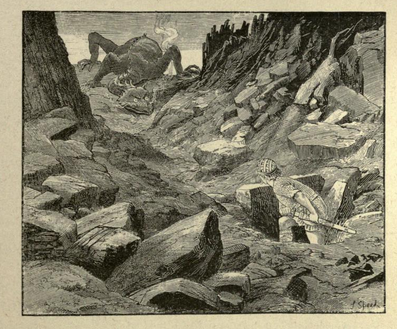
and Beowulf, along with his companion (and successor), Wiglaf, make an end of the nameless dragon,

Beowulf fighting against a dragon. Scene from the early medieval epic poem “Beowulf”. It is one of the most important works of Old English literature and was probably created after the year 700 and plays in the time before 600 AD in Scandinavia. Chromolithograph after drawing by Walter Zweigle (German painter, 1859 – 1904), published in 1896.

(This is a pretty silly version, with costumes and armor which look like they came from the original production of Der Ring des Nibelungen, but finding a depiction of the two attacking the dragon has seemed surprisingly difficult.)

but, in The Hobbit, although we have the traditional dragon on the traditional hoard, we don’t have the traditional dragon-slayer, a fact underlined by Thorin’s “to bring our curses home to Smaug, if we can”.

This has always struck me as the potential weak point in the quest:  to travel hundreds of miles through dangerous territory filled with trolls, goblins, wolves, hostile elves, and even giant spiders, to come to a mountain inhabited by a fearsome dragon—but to have no plan in mind as to how to deal with it, especially when the other half of the plan—to get back the dwarvish treasure—requires somehow eliminating the current guardian of that treasure.
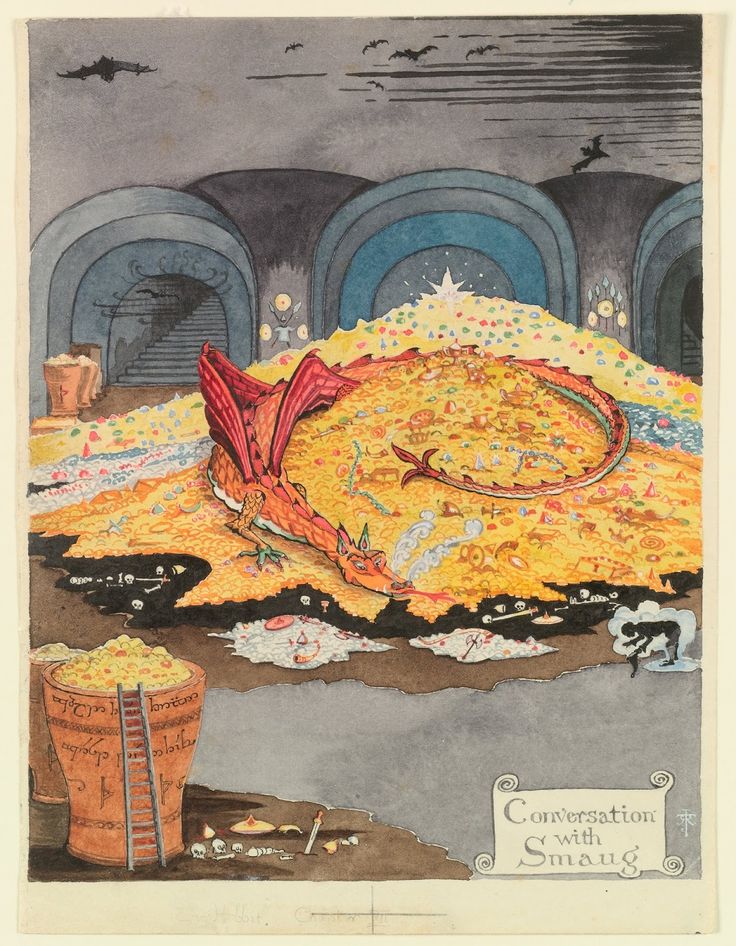
(JRRT)

Faced with that possible weak point, so much now may appear to have a certain haphazard happenstance about it, the kind of attempted slight-of-hand which indicates an author who hasn’t the skill to create a narrative in which every element seems to fall naturally into place, and this might make us question the finding of the Ring, the convenient rescue at Lake-town, even the ray of sun which indicates the opening to the back door of the Lonely Mountain (suppose it had been overcast).

But this is where the burglar comes in—and the story of Sigurd once more.

It seems that Bilbo was not Gandalf’s first choice for the quest when he came to visit him.
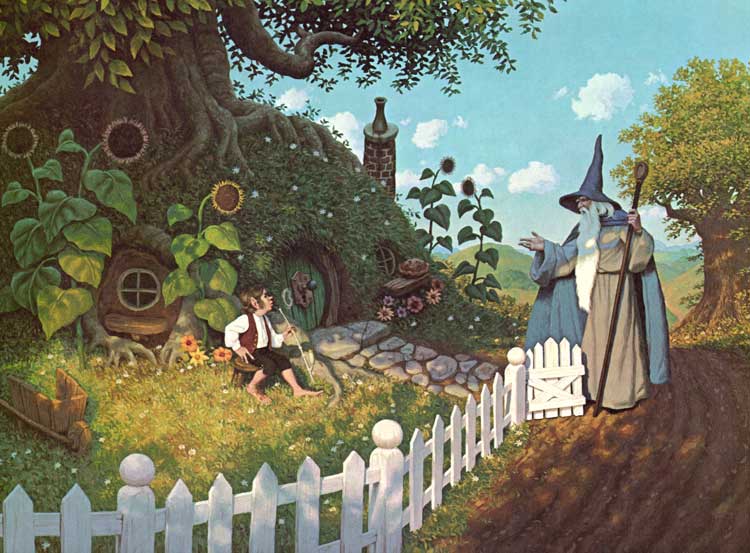
(the Hildebrandts)

Thorin has just mentioned the inconvenient dragon and the awkwardness of his sudden appearance, to which Gandalf replies:

“That would be no good…not without a mighty Warrior, even a Hero.  I tried to find one; but warriors are busy fighting one another in distant lands, and in this neighbourhood heroes are scarce, or simply not to be found.”

And he continues:

“That is why I settled on burglary—especially when I remembered the existence of a Side-door.  And here is our little Bilbo Baggins, the burglar, the chosen and selected burglar.”

Bilbo’s first attempt at burglary:  picking a troll’s pocket,

(JRRT)

almost ends in disaster, but, with the eventual aid of the Ring, he even manages, first, to steal from Smaug, in a direct echo of Beowulf,
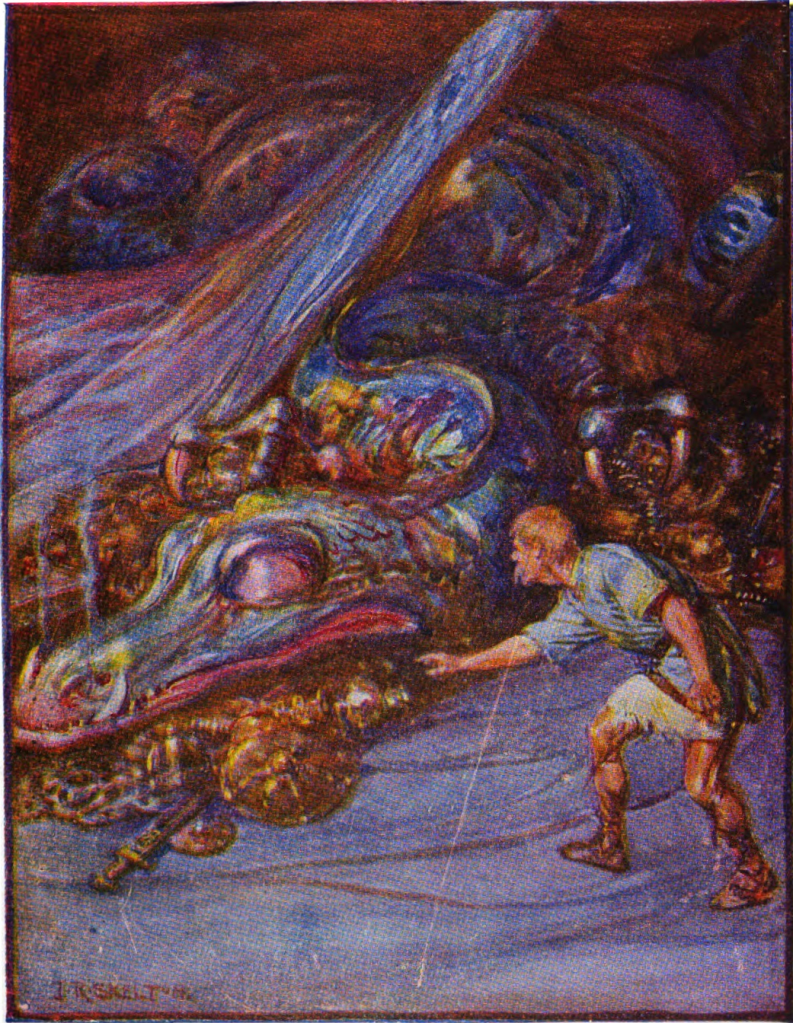
(artist?  So far, I haven’t seen one credited.)

and then to confront Smaug in his lair and escape, at worst, with only a singeing. 
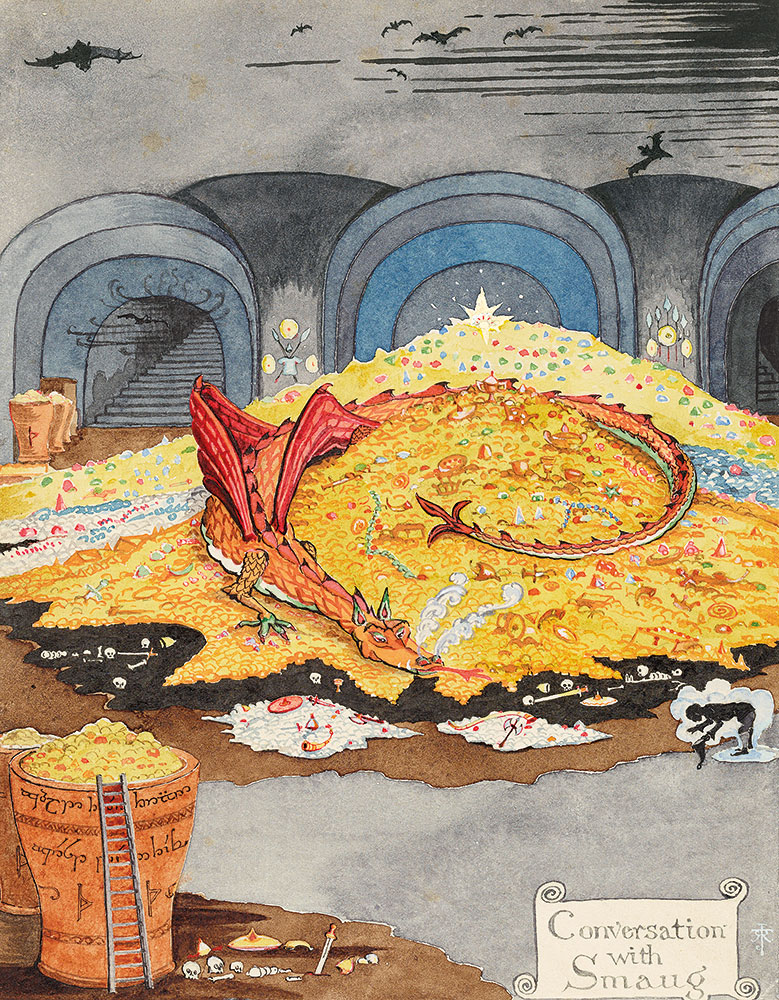
(JRRT)

So far, it’s been burglary, with some help from the Ring, but then the Sigurd story comes in.

You’ll remember that, although the version in The Red Fairy Book doesn’t say so, it was clear that the vulnerable part of the dragon Fafnir was its underside, which is why Sigurd hid in a pit so that, when the dragon crawled over it, Sigurd could stab him in that unprotected underbelly. 

Using his burglarious skills, as well as a fluent tongue, Bilbo actually persuades Smaug unknowingly to expose his own vulnerability:

“ ‘I have always understood…that dragons were softer underneath, especially in the region of the—er—chest; but doubtless one so fortified has thought of that.’

The dragon stopped short in his boasting.  ‘Your information is antiquated,’ he snapped.  ‘I am armoured above and below with iron scales and hard gems.  No blade can pierce me.’”

And the smooth-tongued burglar actually flatters Smaug into rolling over, exposing “…a large patch in the hollow of his left breast as bare as a snail out of its shell”.

What to do with this potentially deadly piece of information requires the reverse of the Sigurd story.

In that story, Sigurd, having killed Fafnir, has been asked by his mentor, Regin, to roast the dragon’s heart and serve it to him.  In the process, Sigurd burns a finger, puts it in his mouth, and suddenly understands that all of the birds above him are talking about him and telling him to beware of Regin.

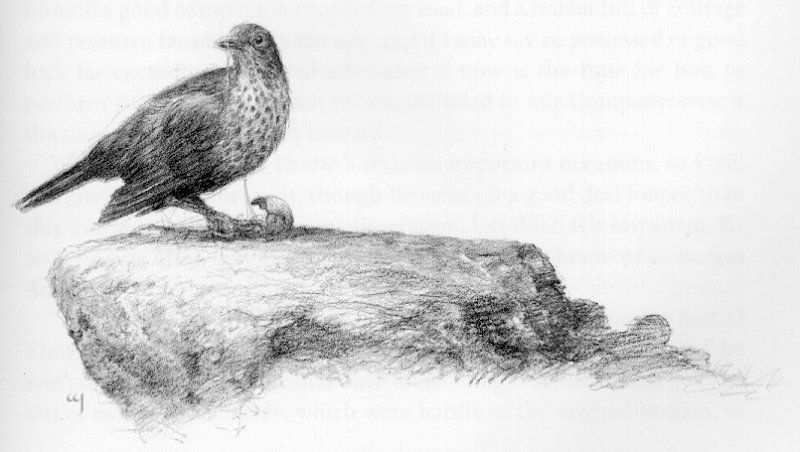
In The Hobbit, the opposite happens:  the thrush who had tapped the snail
(Alan Lee)

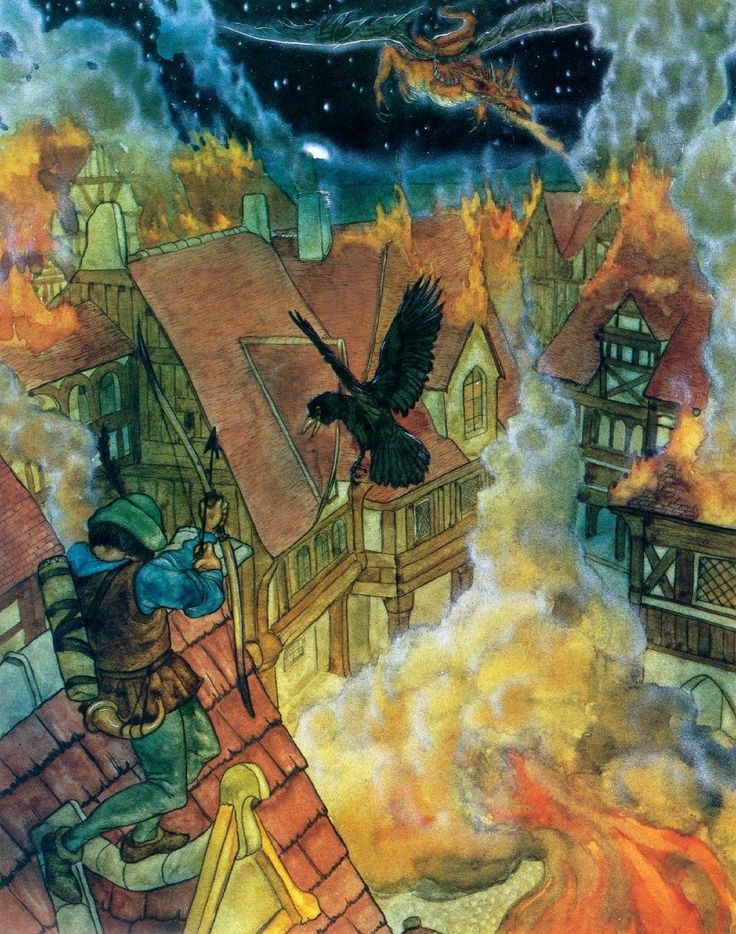
and therefore set off the chain of events which revealed the back door to the Lonely Mountain to Bilbo and the dwarves, overhears Bilbo telling the dwarves about Smaug’s vulnerable spot, which he then conveys to Bard the Archer, who is then the dragon-slayer
(Michael Hague—one of my favorite Hobbit illustrators)

needed to dispose of the one-time guardian of the hoard.

And so the dragon is disposed of—but he has one more use in the story:  as a negative model. 

Although Thorin has led the quest to retrieve the dwarves’ treasure, it seems that there’s only one which he craves, the Arkenstone,

(Donato Giancola)

and it’s clear that, in its pursuit, he becomes much like the Smaug who once reacted almost hysterically when he sensed that something was missing from his hoard:

“Thieves!  Fire!  Murder!…His rage passes description—the sort of rage that is only seen when rich folk that have more than they can enjoy suddenly lose something that they have long had but have never before used or wanted.”  (The Hobbit, Chapter 12, “Inside Information”)

Here’s his dwarvish parallel:

“ ‘For the Arkenstone of my father,’ he said, ‘is worth more than a river of gold in itself, and to me it is beyond price.  That stone of all the treasure I name unto myself, and I will be avenged on anyone who finds it and withholds it.”  (The Hobbit, Chapter 16, “A Thief in the Night”)

And, when he finds that Bilbo has taken it as a way to make peace between the dwarves, the elves, and the Lake-town men, Thorin almost does take revenge:

“ ‘You! You!’ cried Thorin, turning upon him and grasping him with both hands.  ‘You miserable hobbit!  You undersized—burglar!…By the beard of Durin!  I wish I had Gandalf here!  Curse him for his choice of you!  May his beard wither!  As for you I will throw you to the rocks!’ he cried and lifted Bilbo in his arms.”  (The Hobbit, Chapter 17, “The Clouds Burst”)

So why a dragon?

First, to Tolkien the medievalist, gold and dragons go together:  a quest for treasure needs a particularly powerful enemy and the dragon of Beowulf, who actually fatally wounds Beowulf,

who had previously defeated two terrible opponents in Grendel and his mother, provides a strong model.

Second, JRRT had, from childhood, a long-standing interest in dragons—he’ll return to them in his 1938/49 novella, “Farmer Giles of Ham”, where the practical farmer eventually not only tames the dragon, Chrysophylax (“Goldwatchman”, perhaps), but makes him disgorge much of his treasure—this time by doing nothing more than outfacing him and threatening him with his sword, “Tailbiter”.

It’s interesting, by the way, that, although, in “The Story of Sigurd”, the dragon talks, he has only one short speech:  a curse on anyone who touches his gold, whereas, in perhaps the greatest draconic influence upon Tolkien, Beowulf, another wyrm who enjoys lying on a hoard, is mute.

Smaug, in The Hobbit, however, is not only positively talky, but, like Saruman in The Lord of the Rings, his voice and manner have their own dangerously persuasive power, at one point in his conversation with Bilbo even beginning to seed Bilbo’s mind with doubts about the dwarves Bilbo accompanies (The Hobbit, Chapter 12, “Inside Information”).

Chrysophylax, in “Farmer Giles of Ham” is even more talkative than Smaug, and I wonder about the model for these chatty beasts.  Tolkien was a great fan of Kenneth Grahame (1859-1932) and of his well-known children’s book, The Wind in the Willows (1908),

mentioning in a letter to Christopher Tolkien that Elspeth Grahame, Grahame’s widow, is publishing a book with other stories about the main characters of The Wind in the Willows, a book which JRRT is very eager to obtain (letter to Christopher Tolkien, 31 July, 1944, Letters, 128).  In 1898, Grahame published a collection of stories, Dream Days,
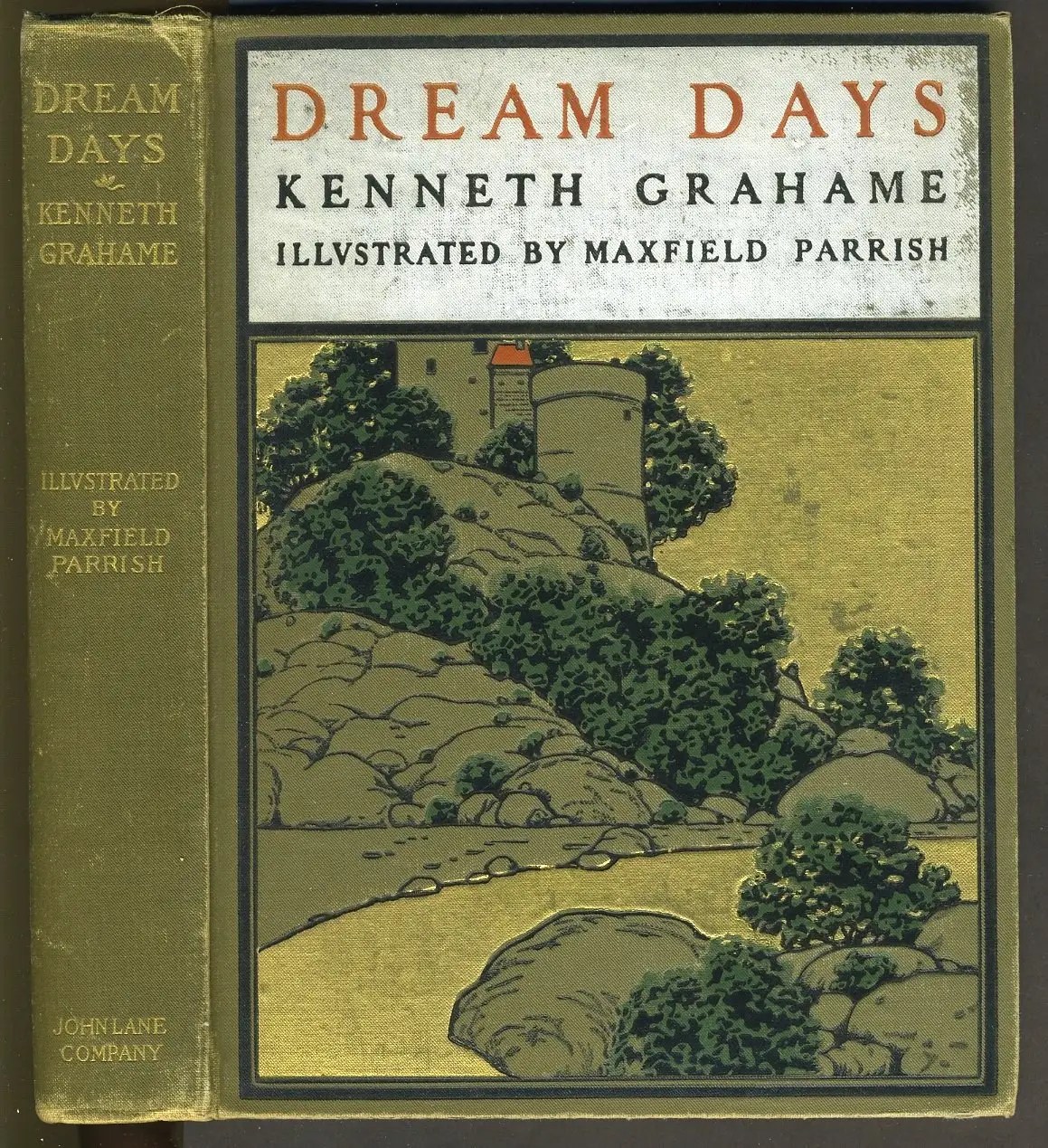
which included “The Reluctant Dragon”, in which we see another very loquacious beast,
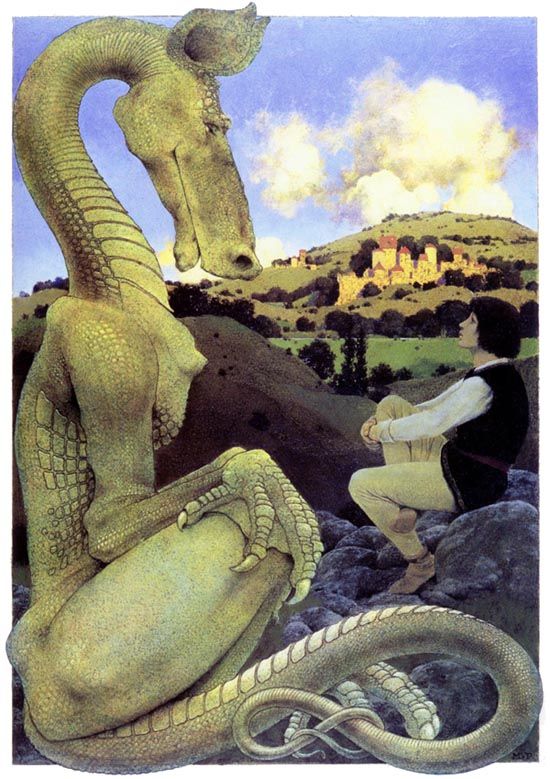
(from the original book, illustrated by Maxfield Parrish)
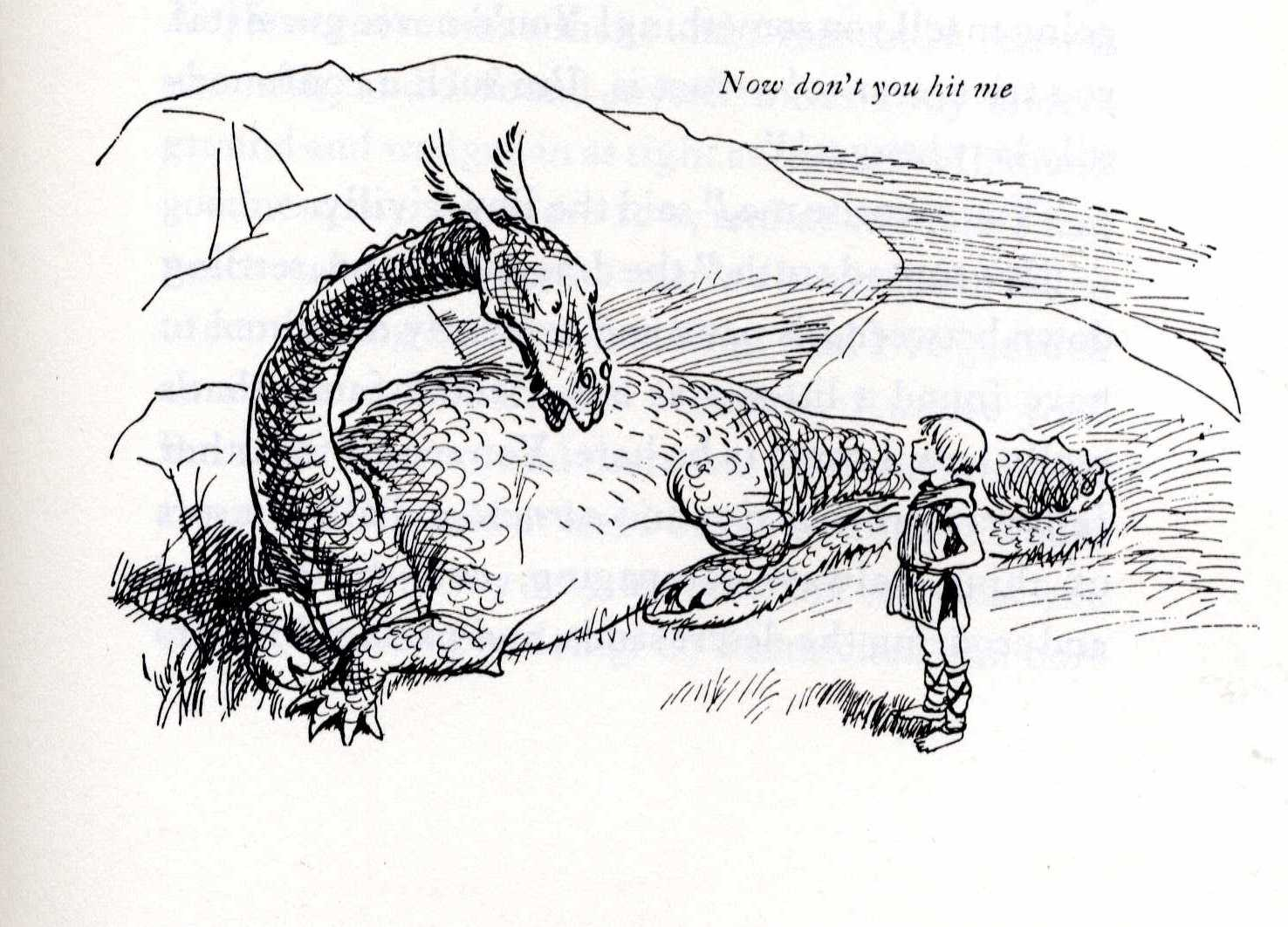
(I couldn’t resist including E.H. Shepard’s 1938 version)

but rather more like the ultimately rather timid dragon of “Farmer Giles” than the grim and mute creature of Beowulf or the more-than-a-little-pleased-with-himself Smaug, but, in his garrulousness, could he have been a model for Smaug?  (You can make your own comparison with:  https://www.gutenberg.org/files/35187/35187-h/35187-h.htm )

To this we add perhaps not a model, but a parallel:  Thorin as becoming a kind of dwarvish dragon in his obsession with the Arkenstone.  Fafnir dies with a curse, however, the Beowulf beast dies killing Beowulf, and Smaug dies destroying Lake-town,

but, in his own last moments, Thorin escapes such a poisonous model, saying to Bilbo:

“Farewell, good thief…I go now to the halls of waiting to sit beside my fathers, until the world is renewed.  Since I leave now all gold and silver, and go where it is of little worth, I wish to part in friendship from you, and I would take back my words and deeds at the Gate.” (The Hobbit, Chapter 18, “The Return Journey”)

(Darrell Sweet—you can read a little about him here:  https://en.wikipedia.org/wiki/Darrell_K._Sweet )

And so “Why a dragon?”—and not “Why No a Hippogriff?”
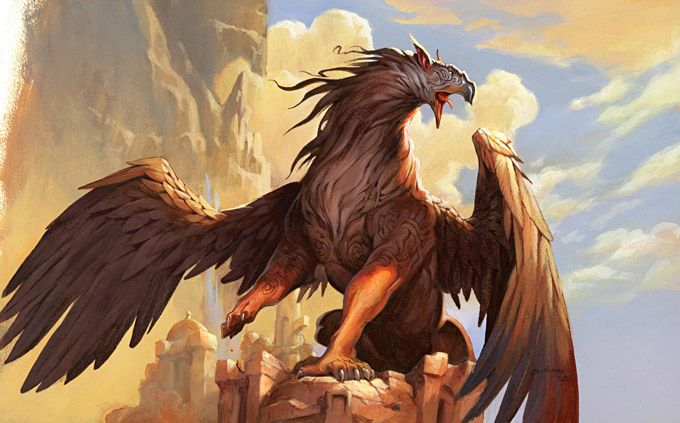
(artist? so far, I haven’t found one–a pity, too, as it’s quite a splendid illustration and I’ll love to mention the author!)

Thanks, as ever, for reading.

Stay well,

Remember not to laugh at live dragons,

And remember, as well, that there’s

MTCIDC

O

Do What I Say, Not What I Speak

13 Wednesday Jun 2018

Posted by Ollamh in Fairy Tales and Myths, Films and Music, J.R.R. Tolkien, Literary History, Narrative Methods

≈ Leave a comment

Tags

Ali Baba and the Forty Thieves, Captain Nemo, Door, Doors of Durin, Franklin Delano Roosevelt, Great War, Horse Feathers, Jules Verne, L. Frank Baum, Marx Brothers, Moria, Nautilus, passwords, Prohibition, Speak Friend and Enter, speakeasy, Swordfish, The Lord of the Rings, The Wizard of Oz, Tolkien, Twenty Thousand Leagues Under the Sea

Welcome, dear readers, as always.

Ever since we heard the story of “Ali Baba and the Forty Thieves” in childhood, we’ve been interested in doors and passwords.

Near the story’s beginning, Ali Baba, a poor woodcutter, happens to observe a group of bandits returning to their cave from a raid.  As he watches, the head of the bandits uses a secret phrase, “Open, sesame!” which opens the cave’s secret door.

[We include a LINK here to the whole story, if you don’t know it.]

Since then, we believe that we’ve had three major examples of the pattern:  door as barrier passed with difficulty.

The first was on a very different level altogether from “Ali Baba”.

After the US passed a law against alcohol just after the Great War, the tumultuous era called Prohibition began.

(The date is 1919 on the newspaper, but the law came into force in 1920.)

For all that the legislatures of various states approved it (“ratified” is the formal word), there were many who did not approve of it.

Because it was national law, however, police everywhere were required to enforce it.

To get around the law, secret bars began to appear.  These received the nickname “speakeasy” because it was a place to relax and drink in (what was hoped would be) safety and privacy.

Such places were made anonymous as possible:  a blank door—with a peephole.

To get in, a potential drinker had to be known—or know the secret password.

This went on until 1933, when the new president, Franklin Delano Roosevelt, worked to have the law repealed.

In 1932, the comedy team of the Marx Brothers

included a speakeasy scene in their latest film, Horse Feathers.

This is an almost indescribable scene in which one of the Marx Brothers (Chico—said “CHIK-o”) is on the inside and another (Groucho) is on the outside and then the fun begins—here’s a LINK so you can watch it for yourself.

The upshot (sorry for the spoiler!)—as you’ll see—is that both end up on the outside.  (We told you that this was on a different level!)

Our next example had no secret password, but, instead, it had a door guard and a very silly one, too!

In 1939, MGM released The Wizard of Oz,

based upon L. Frank Baum’s 1900 The Wonderful Wizard of Oz.

We doubt that we have to explain the plot to anyone who would read our blog, so we’ll just remind you of the moment when Dorothy and her friends—Scarecrow, Tin Woodsman, Lion—and Toto, too—have reached the Emerald City and have come to the door of the Wizard.

The guard (who bears a suspicious resemblance to certain other characters in the film) at first refuses them entry, saying the now-famous line that the Wizard won’t see:  “Not nobody!  Not nohow!” but eventually crumbles when Dorothy explains her quest and he begins to sympathize with her, finally allowing her and her friends to enter—although what they learn there is not the best news.

Finally, there is this door.

And, with this door, we are back to “Ali Baba”, it seems (if not to Horse Feathers).  When Gandalf and the Fellowship arrive, however, there appears to be no door there at all, just a pair of immense holly trees (probably English holly, ilex aquifolium), overshadowing a blank wall.

As the narrator describes them:

“But close under the cliff there stood, still strong and living, two tall trees, larger than any trees of hilly that Frodo had ever seen or imagined.  Their great roots spread from the wall to the water.  Under the looming cliffs they had looked like mere bushes, when seen far off from the top of the Stair; but now they towered overhead, stiff, dark, and silent, throwing deep night-shadows about their feet, standing like sentinel pillars at the end of the road.”  (The Fellowship of the Ring, Book One, Chapter 4, “A Journey in the Dark”)

It is only when Gandalf puts his hands on the rock face and murmurs what appears to be some sort of summoning spell that the doors appear:

“The Moon now shone upon the grey face of the rock; but they could see nothing else for a while.  Then slowly on the surface, where the wizard’s hands had passed, faint lines appeared, like slender veins of silver running in the stone.  At first, they were no more than pale gossamer-threads, so fine that they only twinkled fitfully where the Moon caught them, but steadily they grew broader and clearer, until their design could be guessed.”

As the pattern becomes more visible, so, too, becomes an inscription which reads, in part:

“The Doors of Durin, Lord of Moria.  Speak, friend, and enter.”

And trying to make sense of what it means now turns into a very awkward scene in which Gandalf struggles to find the password he believes is requested in that inscription, while the rest of the company gradually becomes more and more impatient (and it doesn’t help that wolves begin to howl in the distance and that there is something about a pool standing opposite the gate which makes them increasingly uneasy).

Finally, Gandalf realizes that what has stopped him depends upon his understanding of a single word in Elvish, a word which clearly has two meanings—and a little more punctuation might have helped!

As it’s inscribed, the vital part of the wording is:

Pedo Mellon a Minno.

As Gandalf originally translated this, it was “Speak, friend, and enter.”  After a good deal of frustration, Gandalf realizes that he has not only mistranslated—slightly—but mispunctuated—or, rather, overpunctuated– as well.  “Speak” and “say” in English are closely related, but there is a difference—for instance, one can “speak English”, but, idiomatically, one would never “say English”.  Thus, no one would ever give the command to someone else, “Say English”, but, rather would say to someone “Speak English”.  The same must be true in Elvish, where, in fact, it appears that “speak/say” is potentially one verb, whose singular imperative (command) is pedo. At first, Gandalf thought that he was being directed to “speak”—but what he was being told to speak he thought was somehow lost or forgotten.  This caused him to overpunctuate:  “Speak, friend, and enter”, where what he was actually being told was “Say [the word] ‘friend’ and enter”.  He finally does so, and the gates open.

In the case of Ali Baba, inside the thieves’ cave are riches, with some of which he quietly makes off.  Groucho and Chico eventually get into the speakeasy and Dorothy and her friends see the Wizard, all of them leaving the problematic entryway behind.  In the case of the doors to Moria, however, what is left behind refuses to stay that way:

“Frodo felt something seize him by the ankle, and he fell with a cry…Out from the water a long, sinuous tentacle had crawled; it was pale-green and luminous and wet…Twenty other arms came rippling out.  The dark water boiled, and there was a hideous stench.”

And this reminded us of something and made us wonder if JRRT had once read the same book we had (there’s nothing in the Letters, unfortunately).  In 1873, the first English translation of a novel by the French science fiction author, Jules Verne (1828-1905),

appeared, slightly mistitled Twenty Thousand Leagues Under the Sea.

Like the title, the rest of the book was filled with mistranslations (it should be Seas) and big cuts.  We hope, in fact, that, if Tolkien read the book (and we would be surprised if he hadn’t, it being the typical Victorian “boys’ adventure tale” of the period), we hope that he read the 1892 version, which cleaned up the errors.

If you haven’t read it, it’s the story of a French scientist who is invited by the US government to investigate a sea monster who is attacking world shipping in the later 1860s.  As the professor discovers, this isn’t a monster at all, but an early submarine, the Nautilus, invented and piloted by a man who calls himself “Captain Nemo” (nemo being Latin for “no one”) and who has a grudge against the imperialist nations of the world, against which he uses his submarine.  The professor, his assistant, and a third man, a harpooner, Ned Land, are taken aboard the Nautilus and, at one point, are involved in a combat against a pack of giant squid—each with 8 arms and two longer tentacles, one of which almost drags Nemo to his death until he’s saved by Ned.  Sounds a little familiar, doesn’t it?

Our favorite version of the story is that done by Disney in 1954.

There is only one squid here, but, as the poster shows, that seems plenty!  It’s a well-told version (simplified, but not too much so) and has a really splendid Nautilus in a high-Victorian design (steampunk long before steampunk?).

As we began this post with an opening, it seems appropriate to end with a closing:

“Gandalf turned and paused.  If he was considering what word would close the gate again from within, there was no need.  Many coiling arms seized the doors on either side, and with horrible strength, swung them round.  With a shattering echo they slammed, and all light was lost.  A noise of rending and crashing came dully through the ponderous stone.”

Thanks, as ever, for reading.

MTCIDC

CD

ps

Can you, our readers, think of other doors and passwords?  We’ve intentionally left one out here, although, when the thrush knocks…

What’s In a Name?

27 Wednesday Jul 2016

Posted by Ollamh in Imaginary History, J.R.R. Tolkien, Literary History, Narrative Methods

≈ Leave a comment

Tags

Adventure, akaletes, Baggins, Bilbo, Chico, cyclops, Gollum, Groucho, Marx Brothers, Odysseus, Polyphemus, Riddles in the Dark, The Hobbit, The Lord of the Rings, The Odyssey, Tolkien, trolls, xenia

Welcome, as always, dear readers.

In this posting, we are interested in the use and danger of using names in the history of the Ring, as well as looking at a possible parallel from an earlier heroic story.  How dangerous can a name be?

In Chapter 5 of The Hobbit, Bilbo makes what is almost a fatal mistake—not for himself so much as for Frodo, and not at the time, so much as some 77 years later.

Confronted by the curious Gollum deep under the Misty Mountains, Bilbo has responded to Gollum’s, “What iss he, my preciouss?” with, “I am Mr. Bilbo Baggins.”

The Riddle Game

First, of course, he hasn’t answered the question. He was asked what, not who. And, from Gollum’s viewpoint, in which seemingly all animate things are potentially at least a snack, if not a full meal (“I guess it’s a choice feast; at least a tasty morsel it’d make us, gollum!” The Hobbit, Chapter 5, “Riddles in the Dark”), “What is it?” is the more appropriate question.

Second, depending on the culture, names can have a much greater significance than simply being social identifiers. If your culture has a strong belief in magic, then your personal name is a point of vulnerability: someone who wishes to control you can use it in summoning spells. This is probably why, for example, Circe, in Book 10 of the Odyssey, when she can’t turn Odysseus into a pig, as she had already done with part of his crew, says that he’s akaletes—literally, “uncallable by name”. Although the story as we have it doesn’t say so, we can presume that, as he does in another circumstance—which we’re about to discuss—he gives the enchantress a false name and therefore escapes her magic.

This is not the first time Bilbo has slipped, however. William, the troll, has already asked, “What are yer?” And Bilbo has replied, “Bilbo Baggins, a bur-a hobbit.” (The Hobbit, Chapter 2, “Roast Mutton”)

TN-Trolls_colour_sketch

(By one of our favorite Tolkien artists, Ted Nasmith)

Again, Bilbo has given the wrong answer (reminding us of a scene in the Marx Brothers movie, Horsefeathers, 1932, where Chico, as Baravelli, the doorkeeper of a speakeasy, demands of Groucho, “Who are you?” to which Groucho replies, “I’m fine, thanks. Who are you?”).

Password Scene

He has also complicated matters by almost saying “burglar” (he’s just tried to steal William’s purse, after all, which has, in fact, asked him “’Ere, ‘oo are you?”), but, by changing it at the last moment, he’s then created a new confusion, as the trolls simultaneously ask, “A burrahobbit?” and William adds, “What’s a burrahobbit got to do with my pocket, anyways?”

(We also ask, is there a very mild joke here—“burra” could easily sound like “burrow” and, since hobbits traditionally lived in tunnels…?)

Gandalf and daylight take care of the trolls,

img__Art-The_Three_Trolls_are_Turned_to_Stone,_by_JRRT

but Gollum is another matter. Bilbo, caught off guard, gives him his name. This, in turn, under torture, is passed on to Sauron, now aware that the Ring has (literally) resurfaced on Middle-earth. And, somehow, the names “hobbits” and “Shire” have been added to Bilbo’s name, as Gandalf tells Frodo (The Fellowship of the Ring, Chapter 2, “The Shadow of the Past”). To find out more, Sauron sends out his search team, the Nazgul, and the danger begins…

ellenkurkinazgul

(A wonderfully atmospheric watercolor by Ella Kurki)

Odysseus, whom we mentioned earlier, has also been involved with a large and menacing creature, Polyphemus, the Cyclops, in Book 9 of the Odyssey.

Head-of-Polyphemos-Captmondo-wikimedia-commons

Having a little more experience of danger and living in a world where magic may be anywhere, he is more wary, however, than Bilbo and, when asked his name, replies “Ootis”, which is Greek for “Nobody”.

Scholars have argued for a very long time as to why Polyphemus, who has a Greek name (“The Much-Spoken-Of”) and speaks perfectly good Greek, can be so easily taken in by such a transparent trick and there are lots of theories to explain it. Perhaps, however, the answer is simply to point to Bilbo’s trolls, whom Tolkien describes as “slow in the uptake”—that is, they are not very quick to assess a new situation. Is this the case with Polyphemus? Or, being as big as he is, and not fearing the gods (as he informs Odysseus), perhaps he ignores Odysseus’ reply as simply part of the guest ritual known as xenia, in which, it is clear from his behavior, he does not believe anyway?

Over and over again, in the Odyssey, we see this social pattern, called xenia, which means something like “guest-friendship”, enacted   In this pattern, a person comes to another’s house in need of food and shelter. There is then a ritual, in which:

  1. the potential guest appeals to the householder
  2. the householder fulfills that person’s wants
  3. in return the person tells his name and his story
  1. the host gives the person guest-gifts and sends him on his way
  2. should he—or anyone to whom he’s related—be in the guest’s territory in the future, he can claim the same hospitality from the guest—and this can be passed down through generations

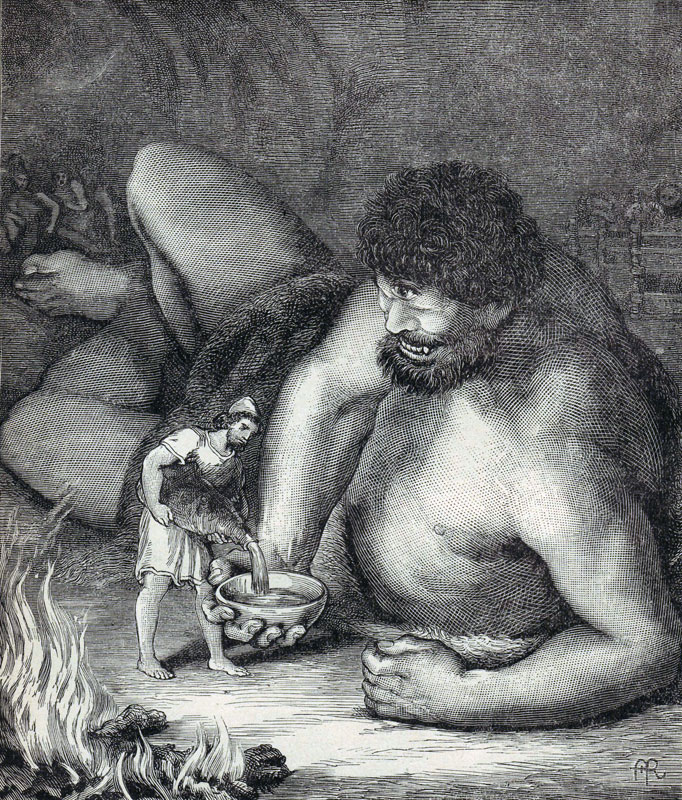
In the case of Polyphemus, Odysseus and his men have come to Polyphemus’ cave and helped themselves to his food while he was absent, therefore immediately disturbing the pattern. When the Cyclops comes home, his response is to kill and eat two of Odysseus’ men, a grim parody of the custom, in which he should be feeding them, not feeding on them. The situation escalates, with more men eaten, until Odysseus formulates an escape plan which includes getting the Cyclops drunk

Cyclops-Homer

and putting out his eye,

cyclops2

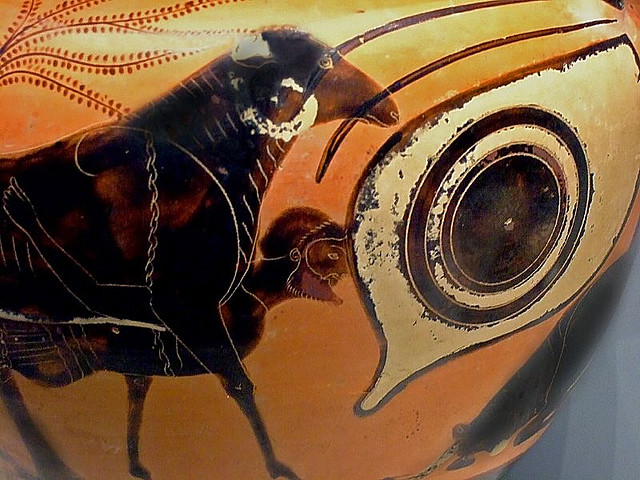
then using a flock of sheep as an escape vehicle.

FrCyclopsEscape

In the meantime, however, Polyphemus has asked for Odysseus’ name, gotten the “Nobody” answer, and offered a guest-gift in return: the Cyclops will eat Odysseus last. The plan works, Odysseus and his surviving men escape (with the sheep), and get back to their ship, but then things go wrong again. Even blind, Polyphemus pursues them and, tossing mountain tops, almost brings them back to shore.

cyclops3

They do manage to row out of range, however, but then Odysseus, seeming to destroy completely his earlier “Nobody” trick, and much to his crew’s horror, shouts out to the Cyclops not only who he really is, but where he lives, as well. What’s going on here?

polyphemos

Bilbo has twice, inadvertently, provided others with his name, if not his address.  Although Odysseus may be more able when it comes to thinking quickly in a dangerous situation than Bilbo, he also belongs to what is called a “face culture”. This means that who you are is a public thing. You only gain credit if you do things publically and your name is attached to what you do. In Odysseus’ case, he has bested a monster and avenged the deaths of his crewmen and it is important that that monster knows who did it. Unfortunately, that monster is the son of the sea god, Poseidon, to whom he prays for revenge and, knowing Odysseus’ name and address, this is a bit more pinpointed than simply saying, “Get that guy who put out my eye, dad!”

poseidon.jpg

Bilbo blundered into the territory of Gollum and, through inexperience and surprise, brought trouble, in time, to Frodo. Odysseus, having concealed his identity successfully, then exposed himself because his society and his position in that society required it. In turn, he returns home alone and on someone else’s ship, having brought trouble on himself and his crew.  In answer to our initial question, “How dangerous can a name be?”  The answer appears to be, “Very.”

Thanks, as always, for reading.

MTCIDC

CD


The Doubtful Sea Series Facebook Page

The Doubtful Sea Series Facebook Page

  • Ollamh

Categories

  • Artists and Illustrators
  • Economics in Middle-earth
  • Fairy Tales and Myths
  • Films and Music
  • Games
  • Heroes
  • Imaginary History
  • J.R.R. Tolkien
  • Language
  • Literary History
  • Maps
  • Medieval Russia
  • Military History
  • Military History of Middle-earth
  • Narnia
  • Narrative Methods
  • Poetry
  • Research
  • Star Wars
  • Terra Australis
  • The Rohirrim
  • Theatre and Performance
  • Tolkien
  • Uncategorized
  • Villains
  • Writing as Collaborators
Follow doubtfulsea on WordPress.com

Across the Doubtful Sea

Recent Postings

  • A Moon disfigured December 17, 2025
  • On the Roads Again—Once More December 10, 2025
  • (Not) Crossing Bridges December 3, 2025
  • On the Road(s) Again—Again November 26, 2025
  • On the Road(s) Again November 19, 2025
  • To Bree (Part 2) November 12, 2025
  • To Bree (Part 1) November 5, 2025
  • A Plague o’ Both—No, o’ All Your Houses! October 29, 2025
  • It’s in Writing (2:  I’st a Prologue, or a Poesie for a Ring?) October 22, 2025

Blog Statistics

  • 103,220 Views

Posting Archive

  • December 2025 (3)
  • November 2025 (4)
  • October 2025 (5)
  • September 2025 (4)
  • August 2025 (4)
  • July 2025 (5)
  • June 2025 (4)
  • May 2025 (4)
  • April 2025 (5)
  • March 2025 (4)
  • February 2025 (4)
  • January 2025 (5)
  • December 2024 (4)
  • November 2024 (4)
  • October 2024 (5)
  • September 2024 (4)
  • August 2024 (4)
  • July 2024 (5)
  • June 2024 (4)
  • May 2024 (5)
  • April 2024 (4)
  • March 2024 (4)
  • February 2024 (4)
  • January 2024 (5)
  • December 2023 (4)
  • November 2023 (5)
  • October 2023 (4)
  • September 2023 (4)
  • August 2023 (5)
  • July 2023 (4)
  • June 2023 (4)
  • May 2023 (5)
  • April 2023 (4)
  • March 2023 (5)
  • February 2023 (4)
  • January 2023 (4)
  • December 2022 (4)
  • November 2022 (5)
  • October 2022 (4)
  • September 2022 (4)
  • August 2022 (5)
  • July 2022 (4)
  • June 2022 (5)
  • May 2022 (4)
  • April 2022 (4)
  • March 2022 (5)
  • February 2022 (4)
  • January 2022 (4)
  • December 2021 (5)
  • November 2021 (4)
  • October 2021 (4)
  • September 2021 (5)
  • August 2021 (4)
  • July 2021 (4)
  • June 2021 (5)
  • May 2021 (4)
  • April 2021 (4)
  • March 2021 (5)
  • February 2021 (4)
  • January 2021 (4)
  • December 2020 (5)
  • November 2020 (4)
  • October 2020 (4)
  • September 2020 (5)
  • August 2020 (4)
  • July 2020 (5)
  • June 2020 (4)
  • May 2020 (4)
  • April 2020 (5)
  • March 2020 (4)
  • February 2020 (4)
  • January 2020 (6)
  • December 2019 (4)
  • November 2019 (4)
  • October 2019 (5)
  • September 2019 (4)
  • August 2019 (4)
  • July 2019 (5)
  • June 2019 (4)
  • May 2019 (5)
  • April 2019 (4)
  • March 2019 (4)
  • February 2019 (4)
  • January 2019 (5)
  • December 2018 (4)
  • November 2018 (4)
  • October 2018 (5)
  • September 2018 (4)
  • August 2018 (5)
  • July 2018 (4)
  • June 2018 (4)
  • May 2018 (5)
  • April 2018 (4)
  • March 2018 (4)
  • February 2018 (4)
  • January 2018 (5)
  • December 2017 (4)
  • November 2017 (4)
  • October 2017 (4)
  • September 2017 (4)
  • August 2017 (5)
  • July 2017 (4)
  • June 2017 (4)
  • May 2017 (5)
  • April 2017 (4)
  • March 2017 (5)
  • February 2017 (4)
  • January 2017 (4)
  • December 2016 (4)
  • November 2016 (5)
  • October 2016 (6)
  • September 2016 (5)
  • August 2016 (5)
  • July 2016 (5)
  • June 2016 (5)
  • May 2016 (4)
  • April 2016 (4)
  • March 2016 (5)
  • February 2016 (4)
  • January 2016 (4)
  • December 2015 (5)
  • November 2015 (5)
  • October 2015 (4)
  • September 2015 (5)
  • August 2015 (4)
  • July 2015 (5)
  • June 2015 (5)
  • May 2015 (4)
  • April 2015 (3)
  • March 2015 (4)
  • February 2015 (4)
  • January 2015 (4)
  • December 2014 (5)
  • November 2014 (4)
  • October 2014 (6)
  • September 2014 (1)

Blog at WordPress.com.

  • Subscribe Subscribed
    • doubtfulsea
    • Join 78 other subscribers
    • Already have a WordPress.com account? Log in now.
    • doubtfulsea
    • Subscribe Subscribed
    • Sign up
    • Log in
    • Report this content
    • View site in Reader
    • Manage subscriptions
    • Collapse this bar
 

Loading Comments...