• About

doubtfulsea

~ adventure fantasy

Tag Archives: Louvre

Weaving (Not Hugo)

31 Wednesday Jan 2018

Posted by Ollamh in Artists and Illustrators, Fairy Tales and Myths, J.R.R. Tolkien, Literary History, Military History, The Rohirrim

≈ Leave a comment

Tags

Anglo-Saxon, Battle of Hastings, Bayeux Cathedral, Bayeux Tapestry, Bishop of Bayeux, Edward the Confessor, Harold Godwinson, Lambert Leonard-Leforestier, Louvre, Musee Napoleon, Napoleon, Normans, Odo, Odo Earl of Kent, Old English Hexateuch, Rohan, Rohirrim, The Lord of the Rings, Tolkien, Tower of Babel, William Duke of Normandy, William the Conqueror

Welcome, dear readers, as ever.

In our last, we quoted JRRT on the subject of the Rohirrim:

“The styles of the Bayeux Tapestry (made in England) fit them well enough, if one remembers that the kind of tennis-nets [the] soldiers seem to have on are only a clumsy conventional sign for chain-mail of small rings.”  (Letters, 281)

We’ve mentioned the so-called Bayeux Tapestry before and even shown an illustration or two, but we thought that it would be fun to delve a little deeper into the subject—beginning with its name and why Tolkien added “(made in England)” to his sentence.

The first known reference to this approximately 230-foot-long (70.1 meters) by 20 inch high (.5m) piece of fabric dates from the latter part of the 15th century AD, from an inventory at Our Lady of Bayeux Cathedral—commonly known in English as Bayeux Cathedral—in 1476.  There has been much scholarly argument over its site of manufacture, but the evidence appears to us to identify the commissioner of the work as Odo, Bishop of Bayeux, and half-brother to William, Duke of Normandy (where Bayeux is situated), aka, “William the Conqueror”.  Odo is depicted and identified three times on the piece, twice in more peaceful settings—once blessing a meal,
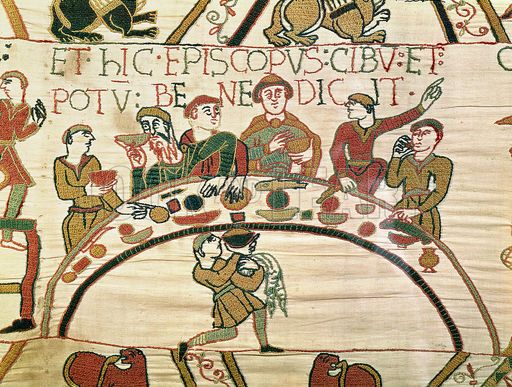
image1odo.jpg

once sitting with William and his half-brother, Robert,
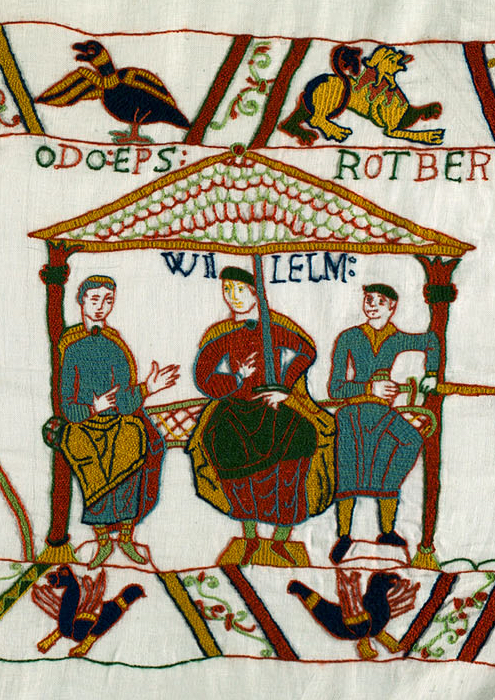
image2odo.jpeg

and once in a decidedly not peaceful setting, encouraging the troops at the Battle of Hastings, wearing a mail shirt and helmet and brandishing a club.  (The Latin inscription—called a titulus—says “Here Bishop Odo, holding a club, puts strength into the lads”.)
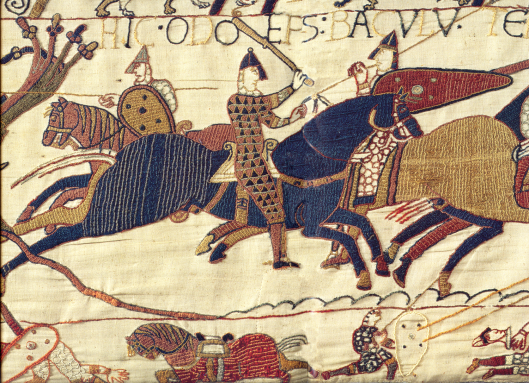
image3odo.png

As well, several of the figures on the piece have been identified as vassals (feudal allies) of Odo.  Finally, Odo was not only the Bishop of Bayeux, but also instrumental in rebuilding the cathedral in which the artefact was first known to have been housed, Bayeux Cathedral (elements of which are buried inside this later Gothic version).
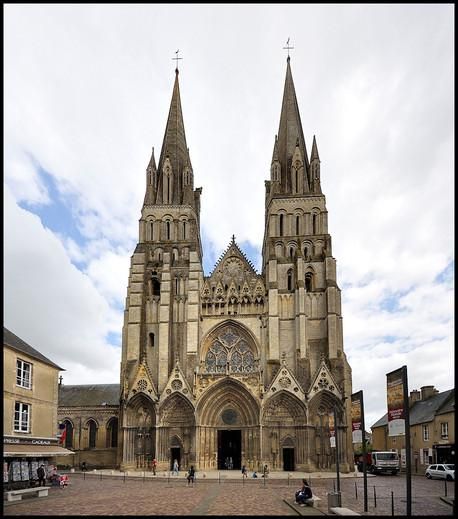
image4bayeux.jpg

It seems natural to us, then, that he, at one time William’s right-hand man, would have been responsible for the creation of the work.  (We might also add that the Norman victory made Odo Earl of Kent—one more reason for commissioning a work which shows that victory in detail.)

We said that there was argument as to where the work was made, but we, ourselves, would agree with JRRT and the idea that it was made in England for, among other reasons, the depiction of people and scenery on it remind us strongly of the Anglo-Saxon artistic tradition—especially embodied in the mid-11th-century manuscript of the “Old English Hexateuch”, with its 394 colored illustrations, which is to be found in the British Library (Cotton MS Claudius B. iv.).
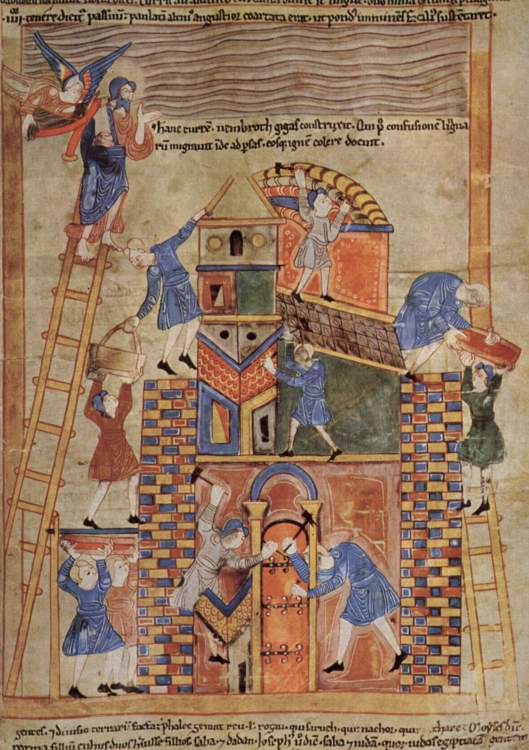
image5babel.jpg

This is a depiction of the construction of the Tower of Babel.  Below is a picture of Normans building ships for their invasion of England from the Bayeux work.
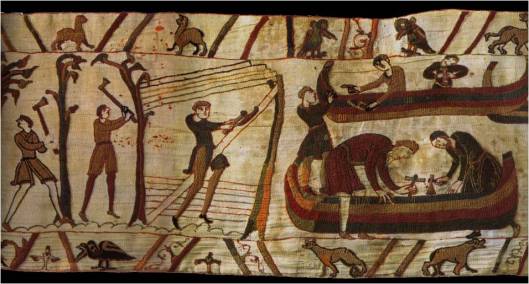
image6ship.jpg

The Bayeux work is much sparer, but there’s that same interest in illustrating motion.

But, when we say that the Bayeux work is sparer, that is not to say that it lacks detail, as there are (at least) four visual levels throughout.  If we take just one scene at random
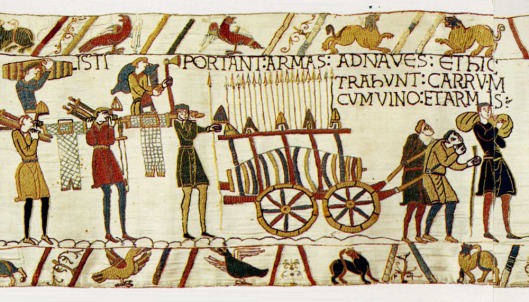
image7levels.jpg

and go from top to bottom we see:

  1. a narrow band of single figures—in this case, animals
  2. a broader band of action—in this case it’s Normans loading their equipment—and other things—for the attack on England (The titulus says: “These are carrying arms to the ships and here they are dragging a cart with wine and arms.”)
  3. the captions—tituli—for every scene
  4. a lower narrow band—again, here, animals, but there are other possibilities, as in this scene, where we see scavengers removing the arms and armor of the dead after the Battle of Hastings
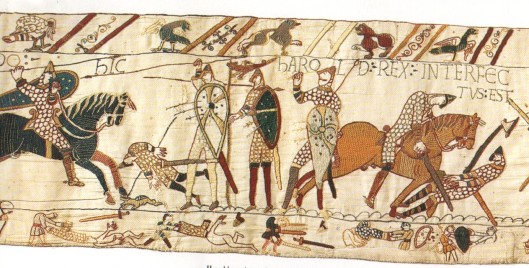
image8scavengers.jpg

The images in the “Old English Hexateuch” illustrate individual Bible stories.  Those in the Bayeux work are scenes, all parts of a long historical narrative, which begins in 1064 (it is thought) with Edward the Confessor, the King of England,
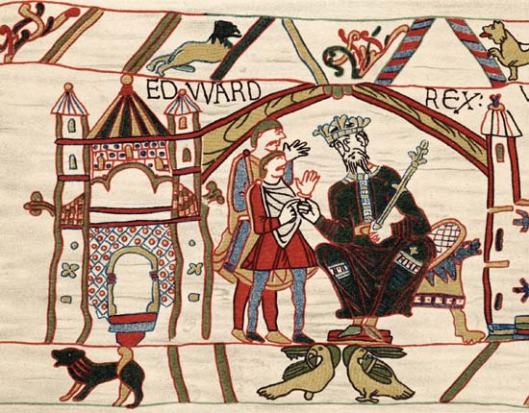
image9eddie.jpg

sending the powerful nobleman, Harold Godwinson, on what appears (from subsequent panels) to be a mission to France.

The last scenes, at the far end, include the death of Harold on the battlefield of Hastings
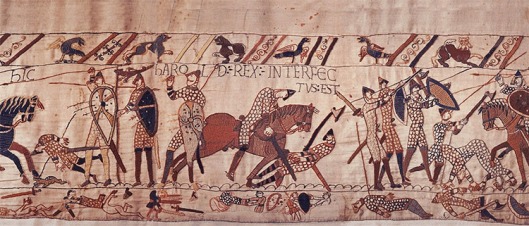
image10deathofharold.jpg

and the flight of the English from the field, with Normans in hot pursuit in October, 1066.
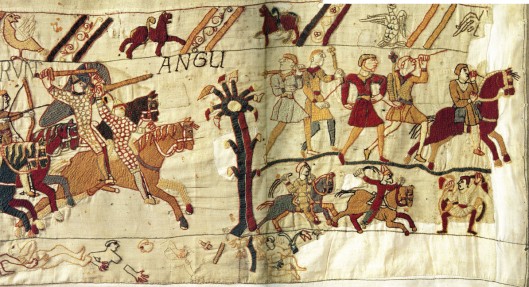
image11flight.jpg

Throughout our discussion, we have avoided calling this work by its traditional name because, in fact, the “Bayeux Tapestry” is not a tapestry.  A tapestry is a solid piece of fabric, woven on a loom.
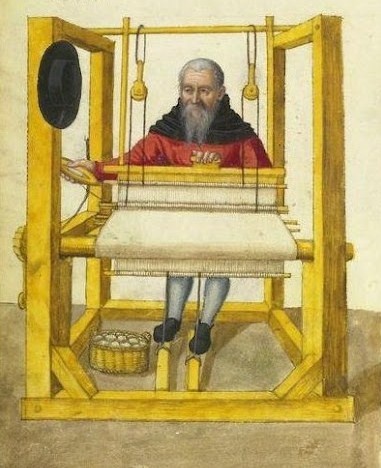
image12medloom.jpg

The Bayeux Tapestry is really the Bayeux Embroidery, in which various designs are stitched onto a cloth.
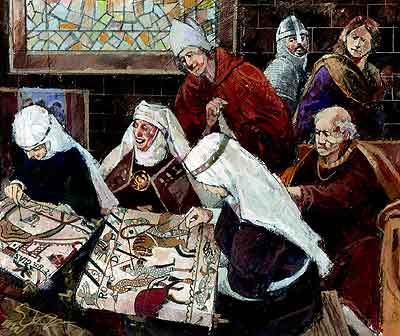
image13making.jpg

In this close-up, you can see how it’s done, with outlines giving the figures shape, as if they were drawn with a needle, then filled in.  (For more on this, and on the work in general, try this LINK.)
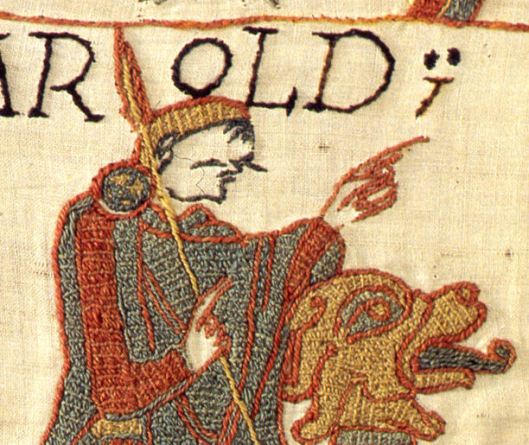
image14stitching.jpg

For its size and detail and historical importance, there’s no embroidery like it from early medieval England, and perhaps from Europe, but there was one moment when it almost disappeared for good.  During that period of the French Revolution when the Church (1% of the population which owned 10% of the land), was being nationalized (and plundered),
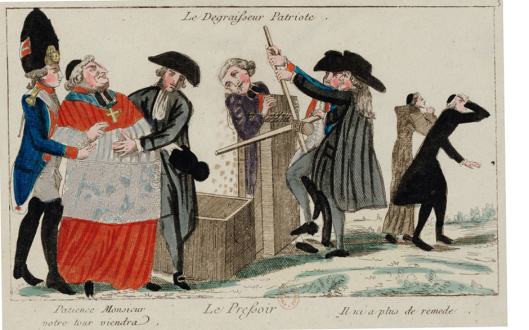
image15church.jpg

it was destined to be used for military wagon covers.
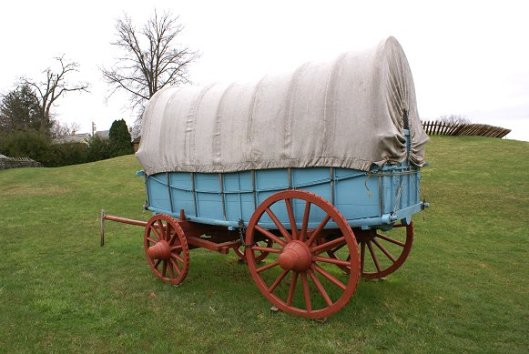
image16wagon.jpg

It was only saved at the last minute and shipped off to the Musee Napoleon (formerly—and subsequently—the Louvre).
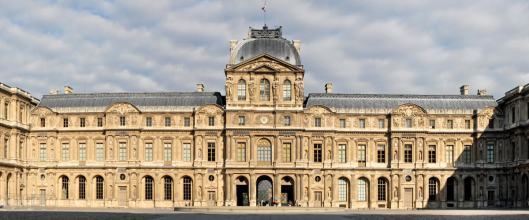
image17louvre.jpg

Eventually, it was returned to Bayeux where, today, it can be seen in a museum there, cleverly displayed in a way which allows the entire length to be viewed.
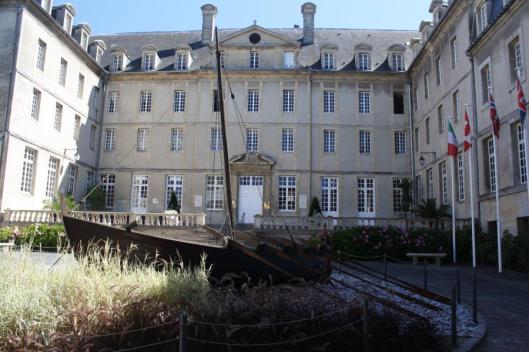
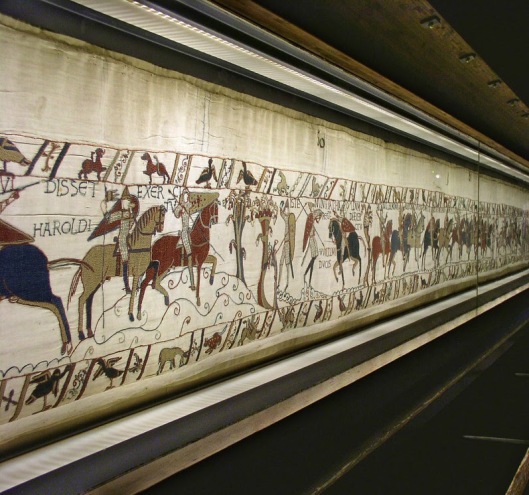
image18museum.jpg

image19display.jpg

Without a member of Bayeux’ city council, Lambert Leonard-Leforestier, and his quick thinking, however, the last anyone might have seen of it would have been more like this—
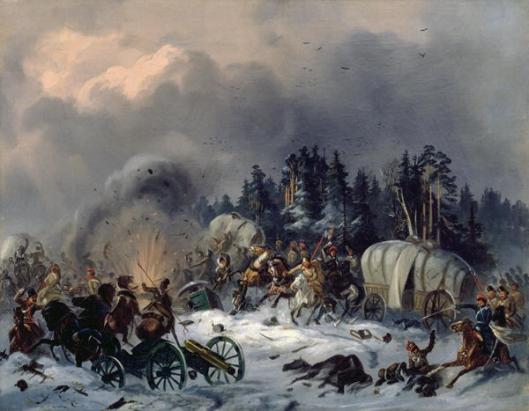
image20wagon.jpg

destroyed on wagons lost in Napoleon’s disastrous retreat from Russia.

Thanks, as ever, for reading.

MTCIDC

CD

PS

There is one more detail from the Bayeux Embroidery we’d like to mention.  If you’re a fan of Game of Thrones, you might remember a passing comet.  In fact, a passing comet—Halley’s Comet—appears on the Embroidery and, for people of the time, portended something big to come…
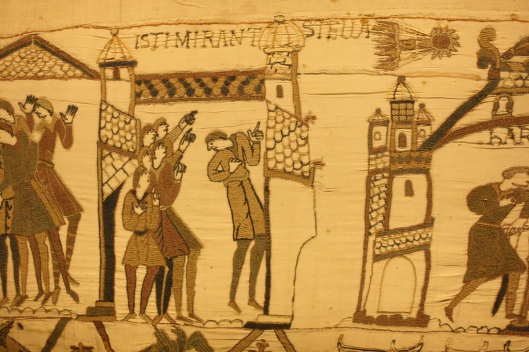
image21halleyscomet.jpg

For more on Halley’s comet, here’s a LINK.
Shire Portrait (I)

01 Wednesday Feb 2017

Posted by Ollamh in Economics in Middle-earth, J.R.R. Tolkien, Literary History, Maps, Military History, Military History of Middle-earth, Narrative Methods

≈ 1 Comment

Tags

British Museum, culture, elections, farthing, feudalism, Government, Hobbitry-in-arms, Hobbits, Louvre, Maps, Mathom-house, Mayor, Michel Delving, Middle-earth, museums, police, Postmen, Sharkey, Shire, Shire-moot, Shire-muster, Shirriffs, Thain, The Hobbit, The Lord of the Rings, The Scouring of the Shire, thegn, Tolkien, vassal, Vatican, voting, White Downs, Witch-King of Angmar

Welcome, dear readers, as always.

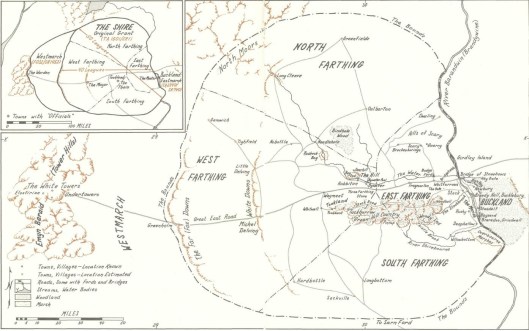
In our last post (well, next-to-last–the last was on circuses), we talked about museums and Mathom-houses and, thinking that the Shire had a museum, made us wonder about what we might call “Shire culture” in general. What is it which makes the Shire the Shire?

1theshire.jpg

To go about answering that, we tried to think of a model. Could we imagine ourselves doing a tourist brochure? A wiki article? And where would we begin?

Suppose, we thought, we begin with the outermost shell, rather as in our world: the government.

The first ten pages of the Prologue to The Lord of the Rings contain a good deal of information about hobbits and their homeland, with many other details to be gleaned from the main body of the text and the appendices and some from The Hobbit. There is undoubtedly more yet to be found in several of the subsidiary volumes, but we decided that, to make this a series of readable posts and not a small encyclopedia, we would stick to the two main works.

With all of that material to help us, all we needed was an entry point—and, almost immediately, we decided that we could begin where we left off, with that very museum, which originally attracted us because it stood out as something one would expect from a much more organized state, rather than from what, on the whole, appears to be such a rural and decentralized place.

After all, museums, as we have discussed, are a relatively recent invention in the west and public museums are even newer (the first state-sponsored museum in Britain, for example, only dates from the 1750s). Since our last posting, we’ve done a bit more research and, with one or two possible exceptions, it seems that public museums only begin to appear at all from the second half of the 17th century. (A quick and useful reference may be found at: https://museu.ms) Even so, such places have a good deal to say about a culture:

  1. that it values elements of its past, both historical and artistic, enough that it is willing to collect and preserve them
  2. that it believes that such elements should then be put upon public display (the why of that might include: to use for educational purposes—which assumes that the past has things to teach the present; to provide aesthetic pleasure; even to show the wealth and power of a state which has such a history and such artists)
  3. that it is willing to provide space, at the public expense, to house and display such things

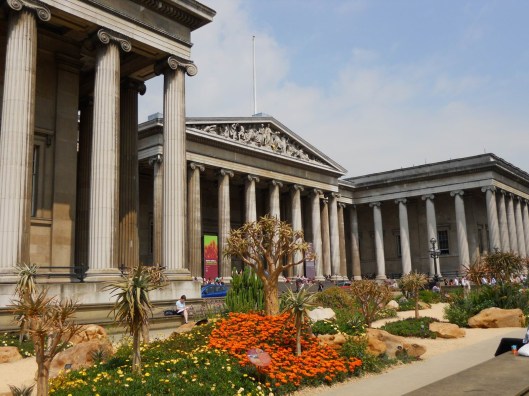
The Mathom-house is hardly, from JRRT’s description, the equivalent of the British Museum

1bm.jpg

or the Louvre

2louvre.jpg

or the Vatican

3vatican.jpg

or any of the other thousand wonderful museums around the world, big or small. And yet it is there and in the closest thing to a capital which the Shire has to offer, Michel Delving. It is only the closest thing because the Shire has almost no formal governing structure.

As the Prologue says:

“The Shire at this time had hardly any ‘government’. Families for the most part managed their own affairs…”

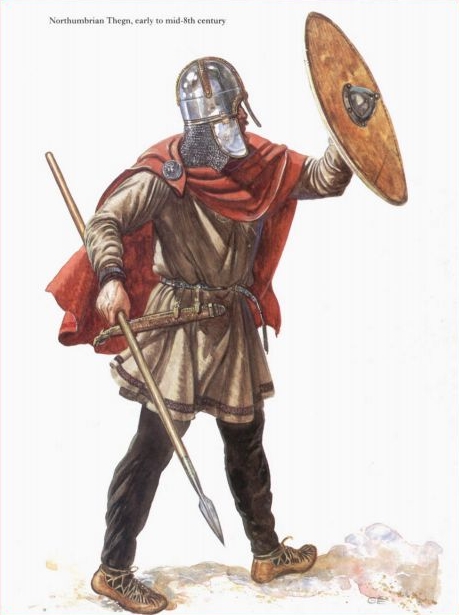
Originally, as the Prologue tells us, the Hobbits had moved into the land which would become the Shire with the permission of the high king of the North Kingdom, at Fornost. When the last king and his kingdom had fallen to the Witch King of Angmar, the Hobbits replaced him with a “Thain” (actually an Old English word for, among other things, a “vassal”—that is, one who acts as a subordinate—in a feudal system, this might imply that the person has received land from someone higher on the social scale in return for taxes and/or military service).  Here’s a thegn (Old English spelling) as a warrior.

5thegn.JPG

By the time of The Hobbit, this office had dwindled, but not quite disappeared:

“The Thain was the master of the Shire-moot, and captain of the Shire-muster and the Hobbitry-in-arms, but as muster and moot were only held in times of emergency, which no longer occurred, the Thainship had ceased to be more than a nominal dignity.”

In fact,

“The only real official in the Shire at this date was the Mayor of Michel Delving (or of the Shire), who was elected every seven years at the Free Fair on the White Downs at the Lithe, that is at Mid-summer. As mayor almost his only duty was to preside at banquets, given on the Shire-holidays, which occurred at frequent intervals. But the offices of Postmaster and First Shirriff were attached to the mayoralty, so that he managed both the Messenger Service and the Watch. These were the only Shire-services, and the Messengers were the most numerous, and much the busier of the two. By no means all Hobbits were lettered, but those who were wrote constantly to all their friends (and a selection of their relations) who lived further off than an afternoon’s walk.

The Shirriffs was the name that the Hobbits gave to their police, or the nearest equivalent that they possessed…they were in practice rather haywards than policemen, more concerned with the strayings of beasts than of people. There were in all the Shire only twelve of them, three in each Farthing, for Inside Work. A rather large body, varying at need, was employed to ‘beat the bounds’, and to see that Outsiders of any kind, great or small, did not make themselves a nuisance.”

This gives us the whole of the top level of Shire culture, the public face: a vestigial Thain (representative of the long-gone King), a figurehead Mayor, a postal service, and a tiny police force/border guard.

And how does any of these hold office?

The Thain, as we know, is hereditary.

The Mayor is, as quoted above, elected—although we have no idea of the process. Does one vote by town? By Farthing? Or is there simply a kind of country-wide method? We also have no idea of suffrage: who has the vote in the Shire? Is it general (England had general suffrage by the time JRRT was writing The Hobbit, all men over 21 by 1918, some women—householders over the age of 30—having been included in elections in 1918, women in general over 21 in 1928)? Or is it the older “only property-holders” method? Or are there “hereditary electors” who do the choosing? (As CD have just gone through an election here in the US, all of these questions, as you can imagine, are fresh in our minds!)

The “postmen” (our word) are, so far as we can tell, a mystery, both as to who they are or how they gain their employment.

Shirriffs appear to be volunteers, as we learn in “The Scouring of the Shire”, when Sam talks to Robin Smallburrow, who says “You know how I went for a Shirriff seven years ago, before any of this began.”

There being so little in the way of government, are there any public buildings except for the Mathom-house? If there are, we have yet to locate them. It’s striking that, when “Sharkey” takes over the Shire, he sets up a number of such places, but neither government buildings nor museums, instead, they are tokens of a police state: barracks and watch houses, dens reminding us of something which JRRT would have seen all too much of in newspapers and magazines, as well as newsreels as he worked on the early stages of The Lord of Rings:

4asentrybox.jpg

4schutzpo.jpg

(More on Sharkey and the takeover in a future posting!)

Considering that there is a small policing force, as well as a kind of postal institution, we looked for another government department: the Internal Revenue Service. After all, we pay for our police and used to pay for postage stamps, back in pre-internet days, and we pay for public museums, too: how does it work in the Shire? The simple answer is, we don’t know. In fact, we don’t really know much about how the economy works in general. And that will be the subject of our next posting.

Thanks, as always, for reading!

MTCIDC

CD

The Doubtful Sea Series Facebook Page

The Doubtful Sea Series Facebook Page

  • Ollamh

Categories

  • Artists and Illustrators
  • Economics in Middle-earth
  • Fairy Tales and Myths
  • Films and Music
  • Games
  • Heroes
  • Imaginary History
  • J.R.R. Tolkien
  • Language
  • Literary History
  • Maps
  • Medieval Russia
  • Military History
  • Military History of Middle-earth
  • Narnia
  • Narrative Methods
  • Poetry
  • Research
  • Star Wars
  • Terra Australis
  • The Rohirrim
  • Theatre and Performance
  • Tolkien
  • Uncategorized
  • Villains
  • Writing as Collaborators
Follow doubtfulsea on WordPress.com

Across the Doubtful Sea

Recent Postings

  • A Moon disfigured December 17, 2025
  • On the Roads Again—Once More December 10, 2025
  • (Not) Crossing Bridges December 3, 2025
  • On the Road(s) Again—Again November 26, 2025
  • On the Road(s) Again November 19, 2025
  • To Bree (Part 2) November 12, 2025
  • To Bree (Part 1) November 5, 2025
  • A Plague o’ Both—No, o’ All Your Houses! October 29, 2025
  • It’s in Writing (2:  I’st a Prologue, or a Poesie for a Ring?) October 22, 2025

Blog Statistics

  • 103,211 Views

Posting Archive

  • December 2025 (3)
  • November 2025 (4)
  • October 2025 (5)
  • September 2025 (4)
  • August 2025 (4)
  • July 2025 (5)
  • June 2025 (4)
  • May 2025 (4)
  • April 2025 (5)
  • March 2025 (4)
  • February 2025 (4)
  • January 2025 (5)
  • December 2024 (4)
  • November 2024 (4)
  • October 2024 (5)
  • September 2024 (4)
  • August 2024 (4)
  • July 2024 (5)
  • June 2024 (4)
  • May 2024 (5)
  • April 2024 (4)
  • March 2024 (4)
  • February 2024 (4)
  • January 2024 (5)
  • December 2023 (4)
  • November 2023 (5)
  • October 2023 (4)
  • September 2023 (4)
  • August 2023 (5)
  • July 2023 (4)
  • June 2023 (4)
  • May 2023 (5)
  • April 2023 (4)
  • March 2023 (5)
  • February 2023 (4)
  • January 2023 (4)
  • December 2022 (4)
  • November 2022 (5)
  • October 2022 (4)
  • September 2022 (4)
  • August 2022 (5)
  • July 2022 (4)
  • June 2022 (5)
  • May 2022 (4)
  • April 2022 (4)
  • March 2022 (5)
  • February 2022 (4)
  • January 2022 (4)
  • December 2021 (5)
  • November 2021 (4)
  • October 2021 (4)
  • September 2021 (5)
  • August 2021 (4)
  • July 2021 (4)
  • June 2021 (5)
  • May 2021 (4)
  • April 2021 (4)
  • March 2021 (5)
  • February 2021 (4)
  • January 2021 (4)
  • December 2020 (5)
  • November 2020 (4)
  • October 2020 (4)
  • September 2020 (5)
  • August 2020 (4)
  • July 2020 (5)
  • June 2020 (4)
  • May 2020 (4)
  • April 2020 (5)
  • March 2020 (4)
  • February 2020 (4)
  • January 2020 (6)
  • December 2019 (4)
  • November 2019 (4)
  • October 2019 (5)
  • September 2019 (4)
  • August 2019 (4)
  • July 2019 (5)
  • June 2019 (4)
  • May 2019 (5)
  • April 2019 (4)
  • March 2019 (4)
  • February 2019 (4)
  • January 2019 (5)
  • December 2018 (4)
  • November 2018 (4)
  • October 2018 (5)
  • September 2018 (4)
  • August 2018 (5)
  • July 2018 (4)
  • June 2018 (4)
  • May 2018 (5)
  • April 2018 (4)
  • March 2018 (4)
  • February 2018 (4)
  • January 2018 (5)
  • December 2017 (4)
  • November 2017 (4)
  • October 2017 (4)
  • September 2017 (4)
  • August 2017 (5)
  • July 2017 (4)
  • June 2017 (4)
  • May 2017 (5)
  • April 2017 (4)
  • March 2017 (5)
  • February 2017 (4)
  • January 2017 (4)
  • December 2016 (4)
  • November 2016 (5)
  • October 2016 (6)
  • September 2016 (5)
  • August 2016 (5)
  • July 2016 (5)
  • June 2016 (5)
  • May 2016 (4)
  • April 2016 (4)
  • March 2016 (5)
  • February 2016 (4)
  • January 2016 (4)
  • December 2015 (5)
  • November 2015 (5)
  • October 2015 (4)
  • September 2015 (5)
  • August 2015 (4)
  • July 2015 (5)
  • June 2015 (5)
  • May 2015 (4)
  • April 2015 (3)
  • March 2015 (4)
  • February 2015 (4)
  • January 2015 (4)
  • December 2014 (5)
  • November 2014 (4)
  • October 2014 (6)
  • September 2014 (1)

Blog at WordPress.com.

  • Subscribe Subscribed
    • doubtfulsea
    • Join 78 other subscribers
    • Already have a WordPress.com account? Log in now.
    • doubtfulsea
    • Subscribe Subscribed
    • Sign up
    • Log in
    • Report this content
    • View site in Reader
    • Manage subscriptions
    • Collapse this bar
 

Loading Comments...