• About

doubtfulsea

~ adventure fantasy

Tag Archives: Helm’s Deep

Tobago to Lothlorien 2

26 Wednesday Oct 2016

Posted by Ollamh in Heroes, J.R.R. Tolkien, Uncategorized

≈ Leave a comment

Tags

Anduin, Barad-Dur, Bree, Caras Galadhon, Cirith Ungol, defense, Edoras, fortification, Galadriel, Helm's Deep, Hildebrandts, John Howe, Lothlorien, Minas Tirith, Morannon, Nenya, Offa's Dyke, Rhodes, Robinson Crusoe, stockades, Swiss Family Robinson, The Lord of the Rings, Tolkien, tree house

Welcome, dear readers, as always. As you can see from the title, this is a continuation of our previous post.

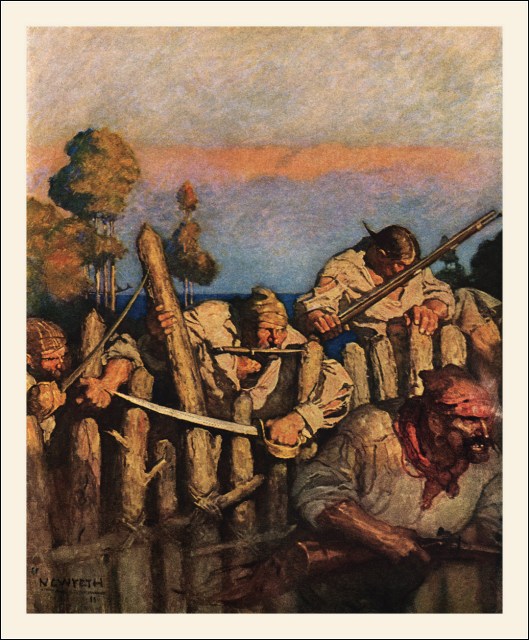
In that previous posting, we began with the novel, Robinson Crusoe (1719),

Robinson_Crusoe_1719_1st_edition.jpg

crusoewyeth.jpg

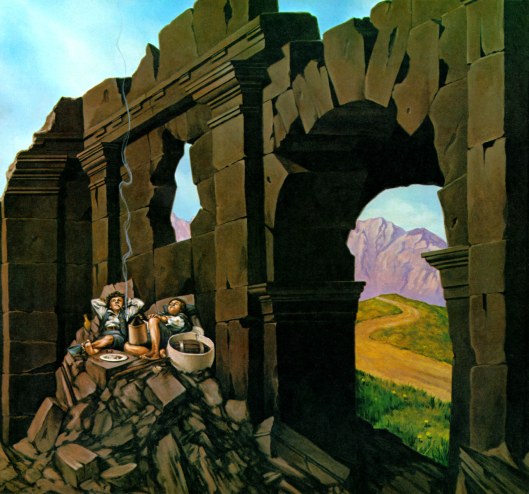
then on to Swiss Family Robinson (1812),

52062_swiss_rob_md.gif

being especially interested in the stockade of the former

0_8a62b_11562dfa_orig

and the tree house of the latter.

swiss-family-robinson

The connection here was the tree house and Lothlorien, where the elves lived high up in the trees.

lothlorien.jpg

At least, that’s where we began. As we looked more seriously at the architecture of Lothlorien, however, we began to wonder, in a world in which darkness had gradually spread, how it protected itself. After all, Robinson Crusoe, afraid of the cannibals he had seen, had walled himself in. Part of it was the power of Galadriel herself, as she implies to Frodo:

“But do not think that only by singing amid the trees, nor even by the slender arrows of elven-bows, is this land of Lothlorien maintained and defended against its Enemy.” (The Fellowship of the Ring, Book 2, Chapter 7, “The Mirror of Galadriel”)

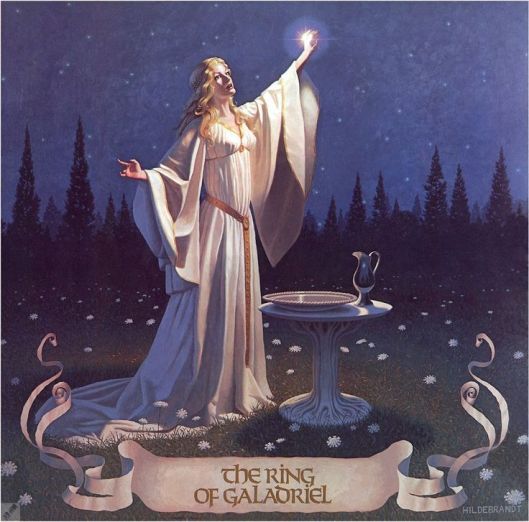
But was there anything more besides singing, arrows, and Nenya, the Ring of Adamant?

5d7d8ba33f058c6756ab6feed6ca5033.jpg

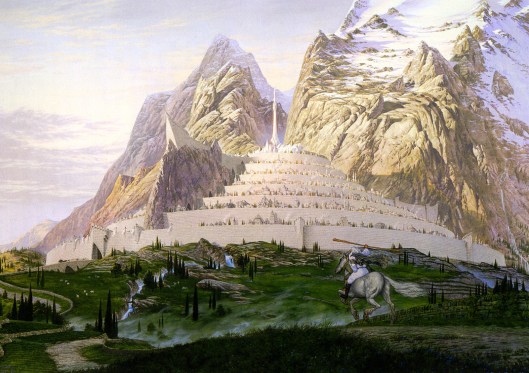
Far to the south, Minas Tirith had seven concentric (more or less) walls,

minastirithjhowe.jpg

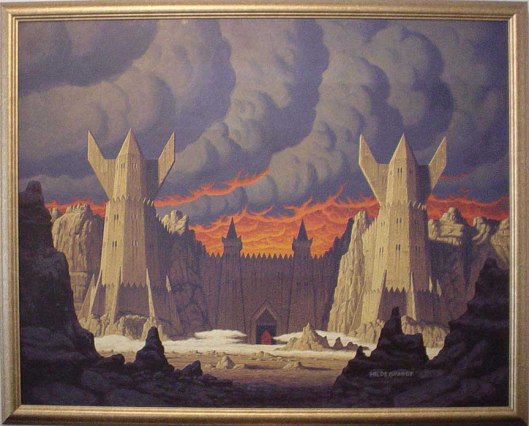
and its opponents across the Anduin had the Morannon

morannonhildebrandt.jpg

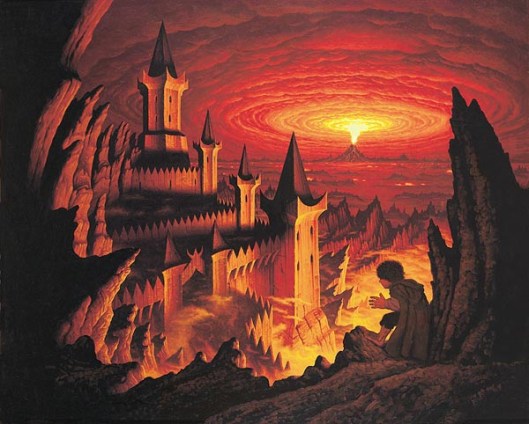
and Cirith Ungol

cirithungolhildebrandt.jpg

sam_at_cirith_ungol.jpg

and even the Barad Dur.

HidebrandtTolkienDarkTower.jpg

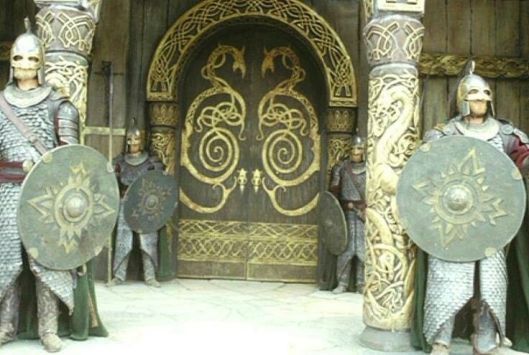
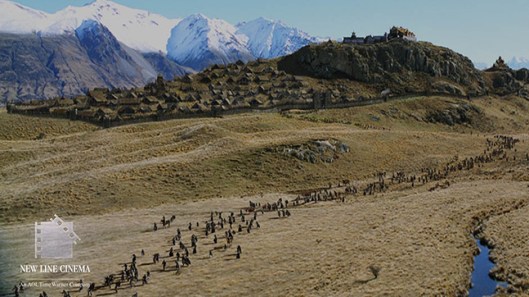
It is not so clear about Edoras. There is mention that “A dike [that is, a ditch/moat] and mighty wall and thorny fence encircle it”, along with the phrase “wide wind-swept walls and gates” (The Two Towers, Book 3, Chapter 6, “The King of the Golden Hall”), but little else. And you can see that lack of information reflected in the rather scanty look in the Jackson films—

LOTR_twoTowers_edoras_03_940.jpg

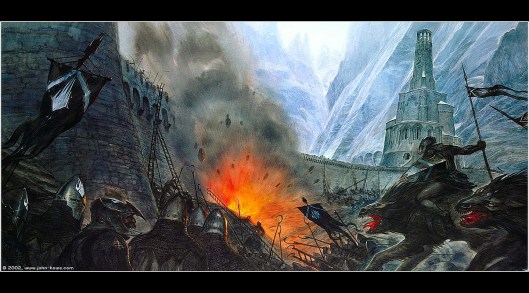
Helm’s Deep, is, of course, a different matter—we show you versions by the Hildebrandts and by John Howe

helmsdeephildebrandt.jpg

33171_the_lord_of_the_rings.jpg

Lothlorien is, in fact, not a single site, like any of the above. This map

LothlorienMap.jpg

gives you an idea of its complexity. There is the outer forest, with its camouflaged guard flets in trees, seemingly along its borders, and then the actual center, the city of Caras Galadhon. Here’s JRRT’s description of that center:

“There was a wide treeless space before them, running in a great circle and bending away on either hand. Beyond it was a deep fosse lost in soft shadow, but the grass upon its brink was green, as if it glowed still in memory of the sun that had gone. Upon the further side there rose to a great height a green wall encircling a green hill thronged with mallorn-trees taller than any they had yet seen in all the land.” (The Fellowship of the Ring, Book 2, Chapter 7, “The Mirror of Galadriel”)

We are then told that there is a bridge, on the southern side, which crosses to “the great gates of the city; they faced south-west, set between the ends of the encircling wall that here overlapped, and they were tall and strong, and hung with many lamps.”

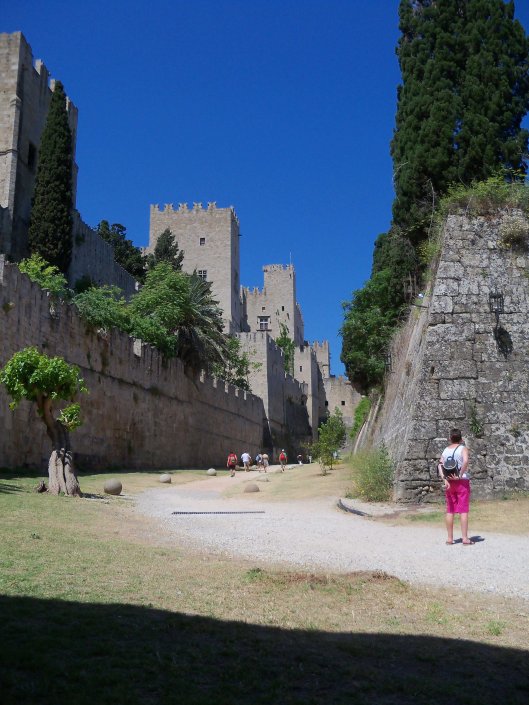
A fosse (from the Latin verb, fodio, fodere, fodi, fossum, “to dig”) means that there was a moat—in this case, it would appear to be a dry moat, like this one at the city of Rhodes.

moatrhodes.jpg

(Those stone balls, by the way, are left over from the Turkish artillery and stone-throwers which pounded the walls of Rhodes in 1522–when we have another posting–soon–on the attack on Minas Tirith, we’ll say more about that.)

That “green wall”, however, is a bit of a puzzle. Is it a wall of green stone of some sort? Or is it a “thorny fence”, like that which surrounds Edoras? There are two similar defenses, or at least boundaries, in LOTR. First, there is the border between Buckland and the Old Forest:

“Their land was originally unprotected from the East; but on that side they had built a hedge: the High Hay. It had been planted many generations ago, and it was now thick and tall…” (The Fellowship of the Ring, Book 1, Chapter 5, “A Conspiracy Unmasked”)

The second such construction appears at Bree (which sounds much like Edoras):

“On that side, running in more than half a circle from the hill and back to it, there was a deep dike with a thick hedge on the inner side.” (The Fellowship of the Ring, Book 1, Chapter 9, “At the Sign of the Prancing Pony”)

So what is the green wall?  English hedges can be very dense things, often to mark off fields, as in this photo of Offa’s Dyke–and you can see the fosse/ditch/moat here, as well.

offasdyke2.png

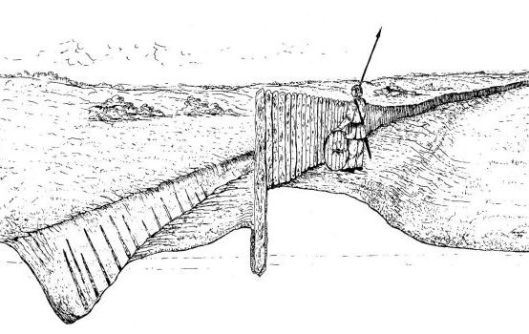
In at least one previous entry, we discussed Offa’s Dike, a (possibly) 8th-century-AD ditch and earthen wall between England and Wales.

664p.jpg

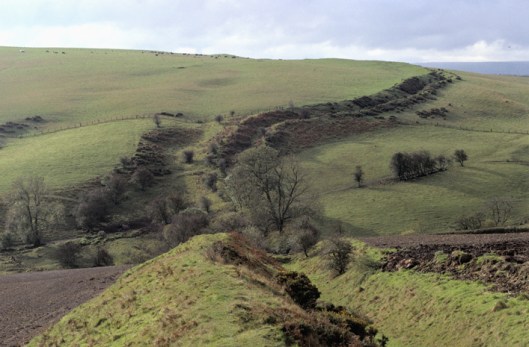
Can we imagine the palisading of this reconstruction replaced with a thorny hedge? Here’s a long shot of Offa’s Dike with a bit of hedging visible.

as_offas_dyke.jpg

When we consider the general look of Caras Galadhon, it is of something organic: the elves loved the trees and, instead of cutting them down, as the hobbits had done outside the High Hay, they climbed up into them. Might we then see that their physical barrier against their enemies was of the same green and growing material as were their dwellings?

What do you think, dear readers?

Thanks, as ever, for reading,

MTCIDC

CD
Charge! The End?

14 Wednesday Oct 2015

Posted by Ollamh in Films and Music, J.R.R. Tolkien, Military History, Military History of Middle-earth

≈ Leave a comment

Tags

Adventure, Bataclava, Bigelow, British, British Heavy Brigade, Cavalry, Cawnpore, Charges, Chasseurs d'Afrique, Crimean War, French, Funckens, Gandalf, Helm's Deep, John Ford, Minas Tirith, Oliphaunts, Prussian, Remington, Rohirrim, Rossbach, Russian, Schreyvogel, seige, Stagecoach, surreneder, The Charge of the Light Brigade, The Lord of the Rings, Tolkien, Trostle Farm, Warhorse, Waterloo, Western, William Simpson

Dear Readers,

Welcome, as always.

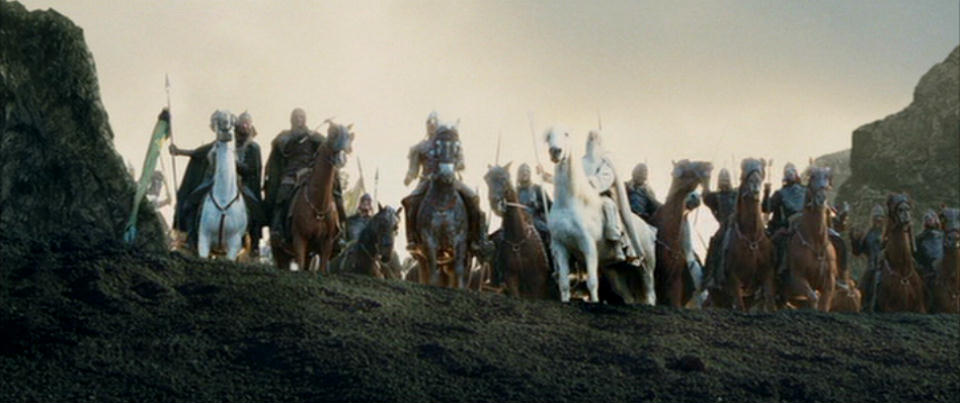
In our last, we were discussing film music, where it comes from and what it does. This brought us, as always, it seems, back to JRRT. In that post, we talked about the “Shire theme”. In this, we want to talk not about a theme, but about a scene, one we have mentioned before, the charge of the Rohirrim and the attempted raising of the siege of Minas Tirith.

gondorattacked rohirrimformup

Although, strictly speaking, what is happening to Minas Tirith is simply a frontal assault, not a siege in the classic sense. Although, seen in this illustration (by the wonderful husband and wife team of the Funckens), they may look the same—

funckenssiegeupclose

in a formal siege, you surround a town/fortress

siegediggingin

call on the place to surrender

The-Entrance-Into-Belfort-Of-The-German-Commander-Bearing-The-Flag-Of-Truce-4th-November-1870-1884

use your heavy weapons to bombard the place

catapault42cm

Drive the defenders back from their outer works

William Simpson - The Attack on the Malakoff 1855

And then call upon the defenders to surrender—which, often they do (fewer Alamos than myth would tell you)

surrender4

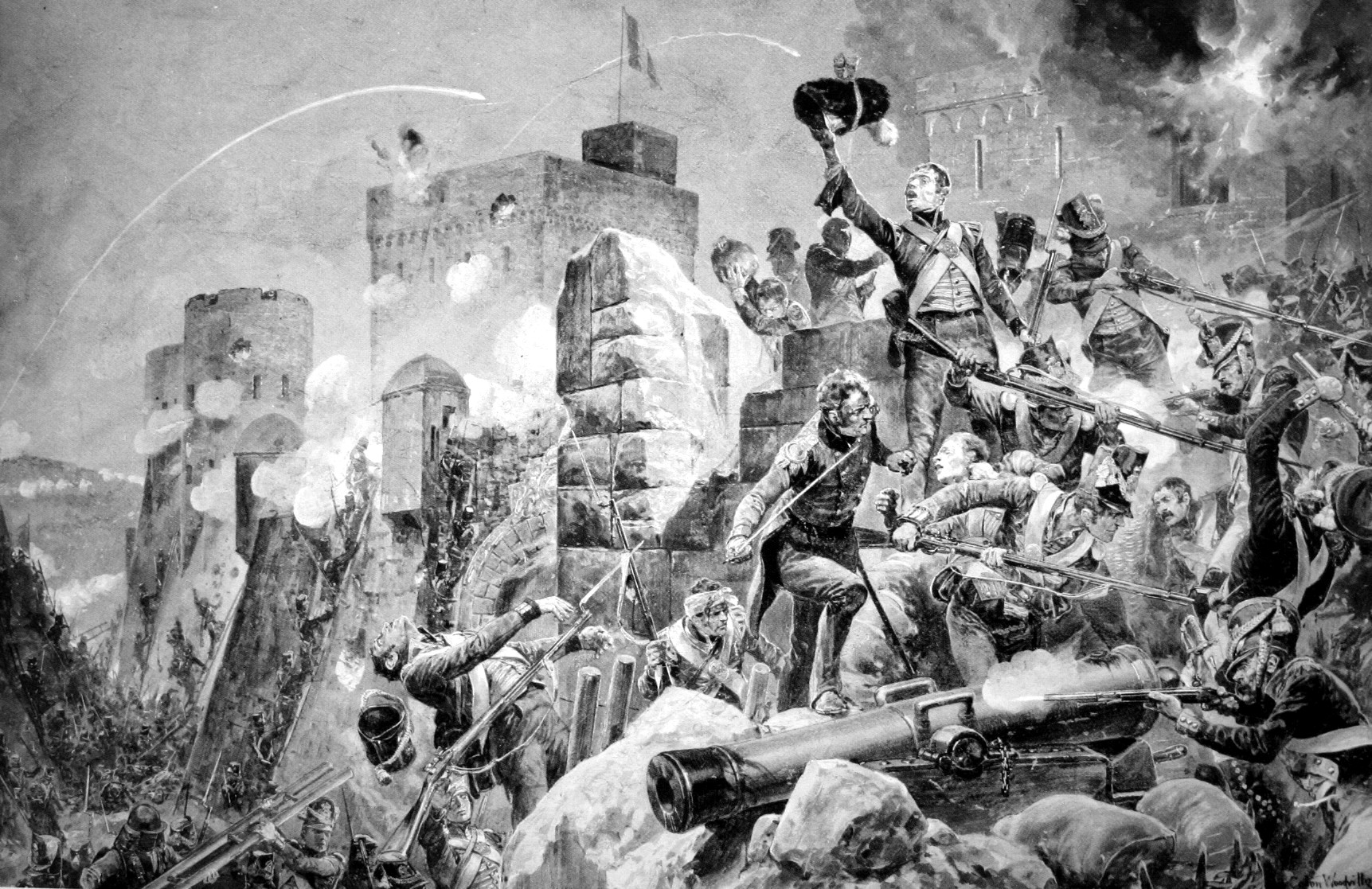
But, if not, a final—usually costly—attackSiege_of_Badajoz,_by_Richard_Caton_Woodville_Jr

march6

and, potentially, the massacre of all—or at least all of the garrison–inside. (In Jackson’s LoTR, the Orcs are certainly not taking prisoners as they break into Minas Tirith).

The charge of the Rohirrim, though, brought to mind other charges, such as the charge of the Prussian cavalry against the French/Allied army at Rossbach, in 1757—

Schlacht_bei_Roßbach1

or the French and British cavalry charges at Waterloo, 1815—

cavwaterloo1 ChargeofthelightBrigade

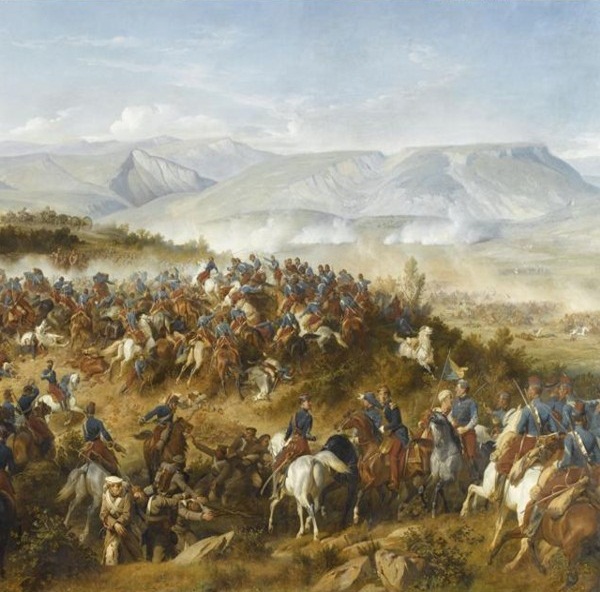
or those _other_ charges at the battle of Balaclava, 1854, that of the French 4th Chasseurs d’Afrique

Chasseurs_d'Afrique_à_Balaclava

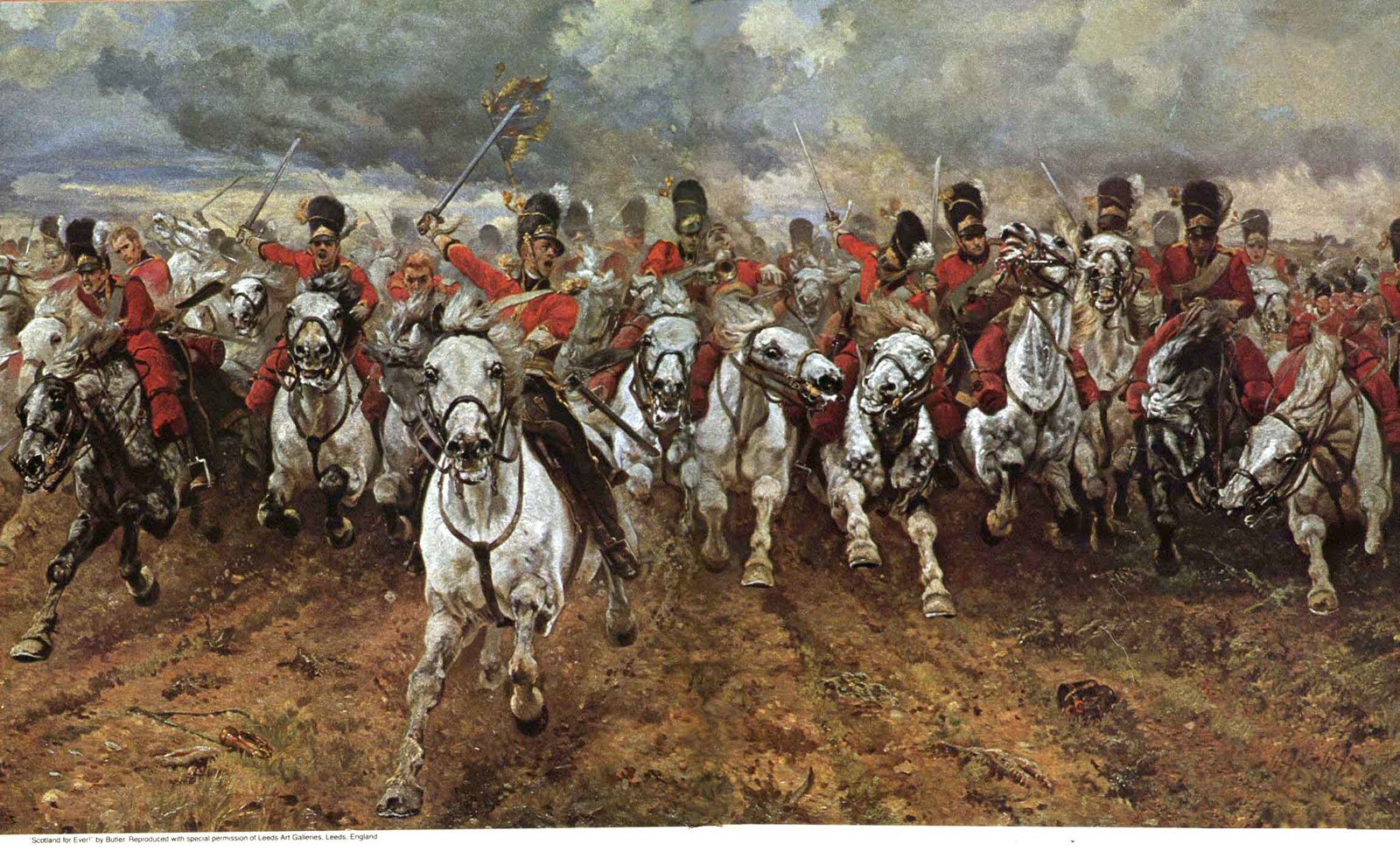
or of the British Heavy Brigade, which drove the Russian cavalry from the British camp.

balaclava-scots-greys-1200

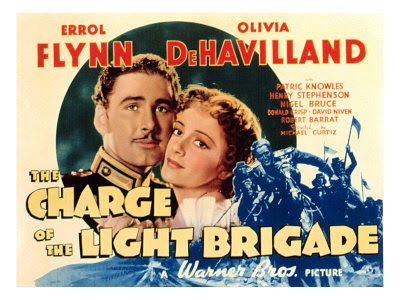
Those last two remind us, of course, of one of our favorite adventure movies, the 1936 The Charge of the Light Brigade

charge1

It is not so authentic in look as the 1968 movie of the same name,

Charge+of+the+Light+Brigade+movie+poster+2

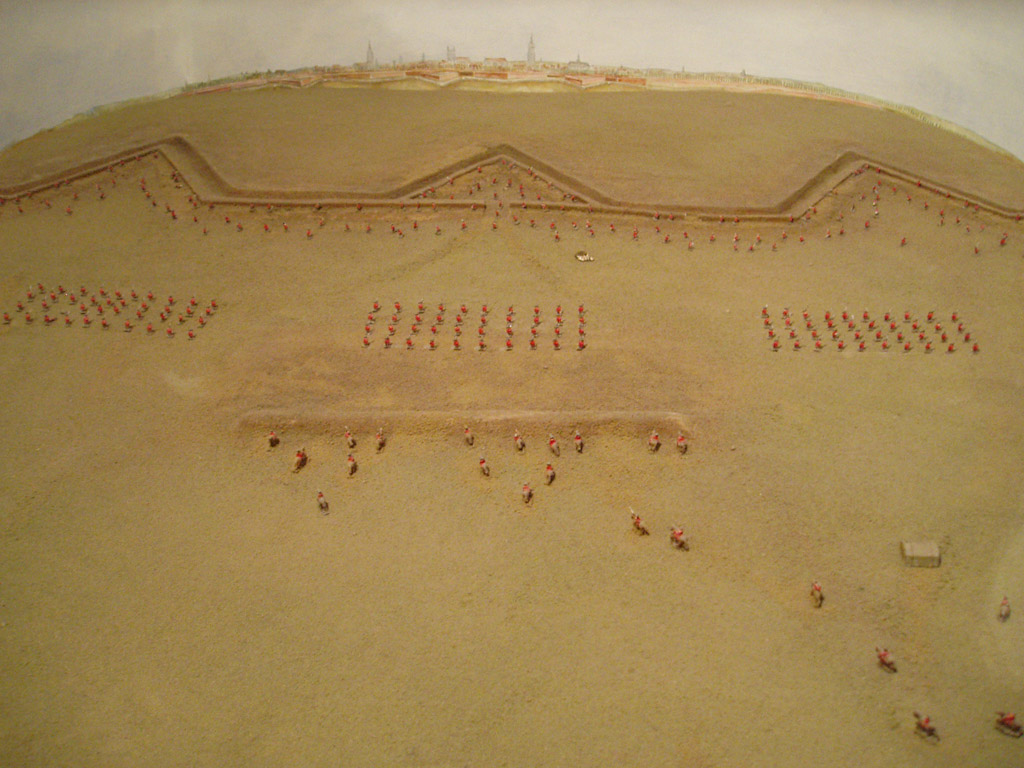
and, in fact, the film states at its opening that it’s only loosely based on actual historical events (including not only the charge, but the 1857 massacre at Cawnpore—which, in reality, occurred some three years after the Crimean War battle). It also beefs up the Russian defense—adding non-existent earthworks, for instance. Here’s the movie’s view

1225664651_the-charge-of-the-light-brigade_00016

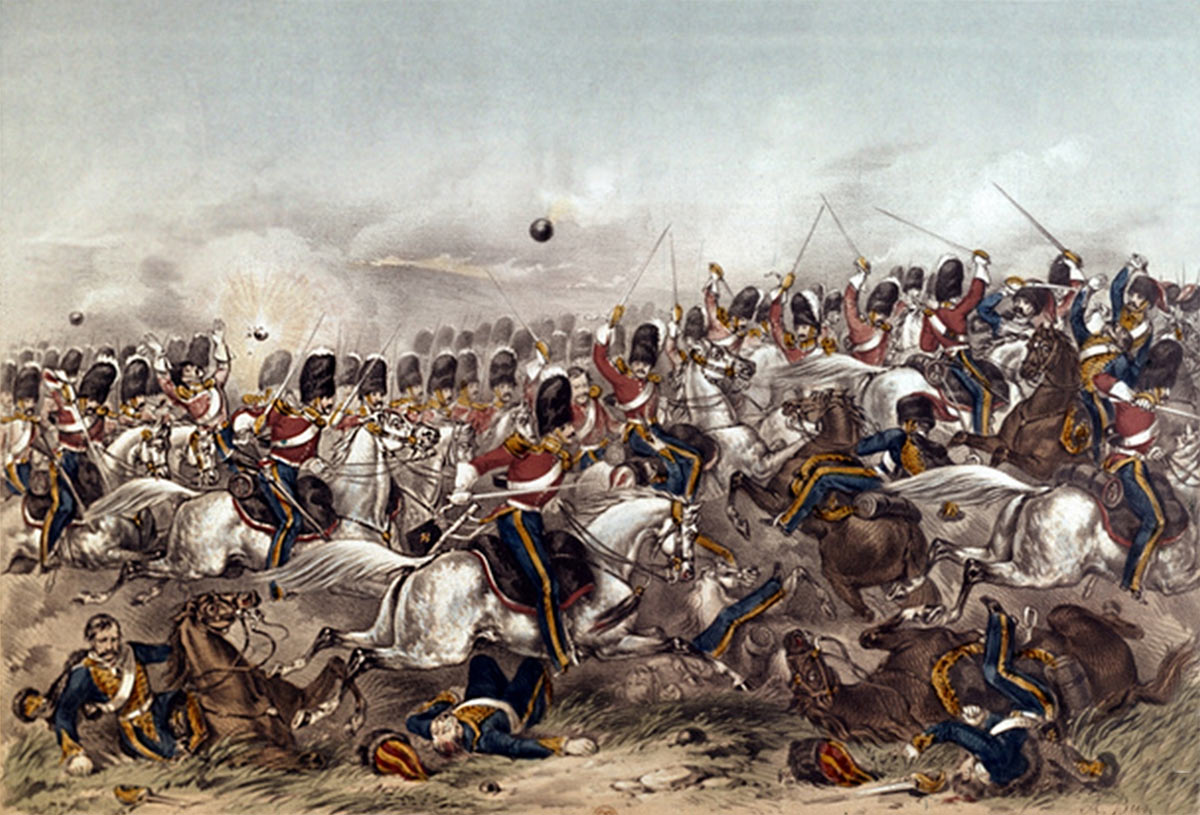
and here’s William Simpson’s near-contemporary illustration (Simpson arrived after the battle, but must have talked to survivors and certainly could have seen the terrain).

William_Simpson_-_Charge_of_the_light_cavalry_brigade,_25th_Oct._1854,_under_Major_General_the_Earl_of_Cardigan

All of these charges were directed at enemy forces on an open battlefield. The attack of the Rohirrim actually comes from a different scenario, one which is based upon a theme familiar to those who have seen American westerns: the arrival of the cavalry in the nick of time.

In this scenario, someone is trapped and surrounded—or at least persistently assaulted by a more numerous enemy—the classic is an attack upon circled wagons

frontier-wagon-circle

The crisis comes and it looks like those attacked are about to be overwhelmed

wagon-box-fight-1867-granger

but, at the last minute, help arrives—the cavalry, bugles sounding, guidons waving (although that illustrated in this vidcap is the 1885 pattern and the film from which this comes takes place in 1880—then again, the uniforms are a bit odd, too—here’s Remington’s and Schreyvogel’s more accurate views, as well) rides fearlessly to the rescue.

Stagecoach_216Pyxurz SCHREYVOGEL_Charles_Cavalry_Charge_1905_Wadsworth_Athenaeum_source_Sandstead_d2h_ remingtoncav

After sorting through more than 50 westerns, we believe that the movie from which our first image comes is probably the source of the modern idea of the arrival of the cavalry—see this clip from John Ford’s Stagecoach (1939)

CLIP

This happens twice, of course, in The Lord of the Rings, first at Helm’s deep, when Gandalf arrives—

helms-deep gandalfarrives

and again, as we began, at Minas Tirith. It’s interesting, however, to see that, in this second example, the cavalry rescue is not so successful, since there are those oliphaunts we discussed in an earlier posting—

mumakil_by_cg_warrior-d4muefu

In our world, it wasn’t giant oliphaunts who eventually defeated cavalry and drove them to the edges of the battlefield, where they lasted a little longer, but this

maximwarhorse

as you can see in this clip from Warhorse.

CLIP

And it’s for the best, really. It’s bad enough that we humans engage in violent actions without dragging the rest of the animal kingdom into it…

trostle-farm

(A few of the 80 horses lost by Bigelow’s 9th MA Battery at the Trostle Farm, 2 July, 1863—and, as a sad ps, 25 horses were killed or so badly injured that they were put down at the filming of the 1936 The Charge of the Light Brigade—this so shocked those in Congress that a law for the protection of animals in films was passed to prevent future harm).

Thanks, as always, for reading.

MTCIDC

CD

Where Did It Go– And Why?

17 Wednesday Jun 2015

Posted by Ollamh in J.R.R. Tolkien, Military History, Military History of Middle-earth

≈ Leave a comment

Tags

Arbeia, Boromir, Cavalry, Denethor, England, Faramir, Film, Gondor, Hadrian's Wall, Helm's Deep, Iliad, Minas Tirith, Offa's Dyke, Osgiliath, Pelennor, Peter Jackson, Rammas Echor, Script, The Great Wall, The Lord of the Rings, Tolkien, Wansdyke

Dear Readers,

Welcome, as always!

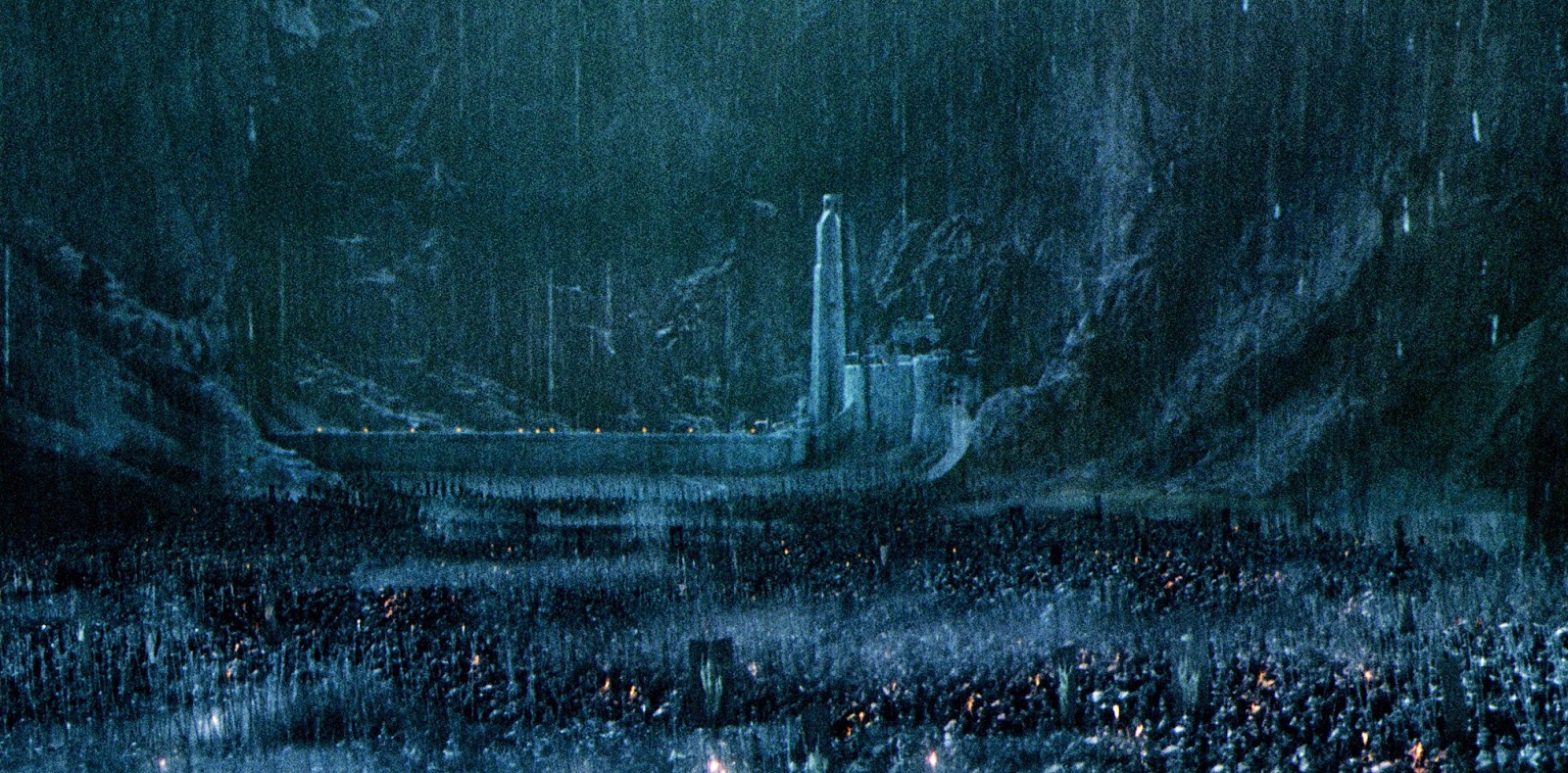
     In this post, we want to consider the Rammas Echor, which, in the original, had holes blown in it by the invading army of Sauron, but was demolished completely by the script writers for Peter Jackson’s LOTR.

The%20Siege%20of%20Minas%20Tirith

     We first meet it when Gandalf and Pippin, in their rapid journey to Minas Tirith, are briefly stopped at what appears to be a sally port in it (rather than a major gate, as Shadowfax is said to have “passed through a narrow gate in the wall” 749). Gandalf briefly trades remarks with an officer named Ingold (who appears briefly later in the story to report that the northern section has fallen, 821) before he and Pippin continue their journey.

     It is described thus:

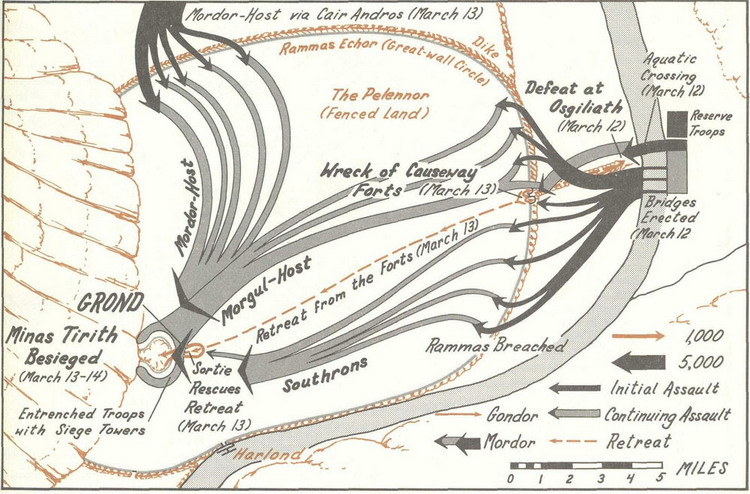
   “Gandalf passed now into the wide land beyond the Rammas Echor. So the men of Gondor called the out-wall that they had built with great labour, after Ithilien fell under the shadow of their Enemy. For ten leagues [about 30 miles in the English system—about 48 km in the metric] or more it ran from the mountains’ feet and so back again, enclosing in its fence the fields of the Pelennor: fair and fertile townlands on the long slopes and terraces falling to the deep levels of the Anduin. At its furthest point from the Great Gate of the City, north-eastward, the wall was four leagues [12 miles—about 19 km] distant, and there from a frowning bank it overlooked the long flats beside the river, and men had made it high and strong; for at that point, upon a walled causeway, the road came in from the fords and bridges of Osgiliath and passed through a guarded gate between embattled towers… “ 750.

     With so much of Tolkien, one can find illustrations from the usual artists—the Hildebrandts, Howe, Nasmith, and Lee—but for this particular—and important—architectural feature, we haven’t discovered—so far—a single illustration.

     It’s made of stone and has evidently not been well-maintained: “Many tall men heavily cloaked stood beside him [Shadowfax], and behind them in the mist loomed a wall of stone. Partly ruinous it seemed, but already before the night was passed the sound of hurried labour clould be heard: beat of hammers, clink of trowels, and the creak of wheels.” 748 And, as mentioned above, it has gates, but, beyond that, what does it look like?

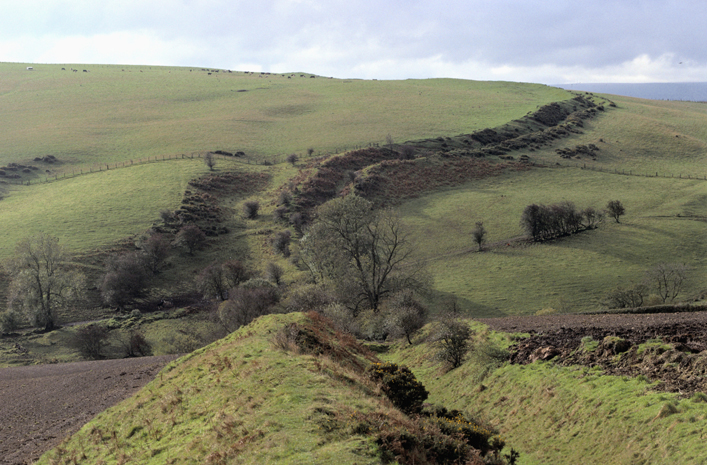
     England has a long history of long walls. There are the surviving earthen walls and ditches of the Dark Ages or early medieval Offa’s Dyke

Offa's_Dyke_near_Yew_Tree_Farm_-_geograph_org_uk_-_450420

1990s, Near Knighton, Wales, UK --- Offa's Dyke near Knighton in Wales. The dyke was created by Offa the King of Mercia from 757 to 796 AD and roughly formed the boundary between England and Wales. --- Image by © Homer Sykes/CORBIS

and Wansdyke

wansdyke

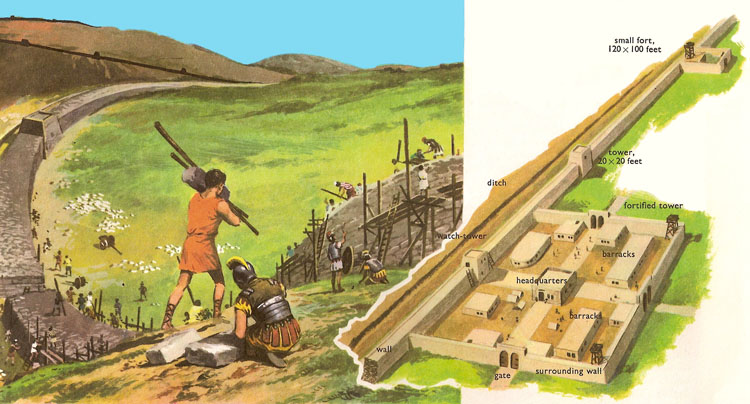
and, of course, the well-known 2nd –century AD work, Hadrian’s Wall, with its surviving stone work and its elaborate series of mile castles, gates, and supporting forts and camps.

Hadrians_Wall Hadrian's Wall phase 1 Central sector

   We might also cast further afield and in time. In Book 7 of the Iliad, the Greeks dig a ditch, fill it with sharpened stakes, and build a stone wall behind it to protect their ships from Trojan attack.

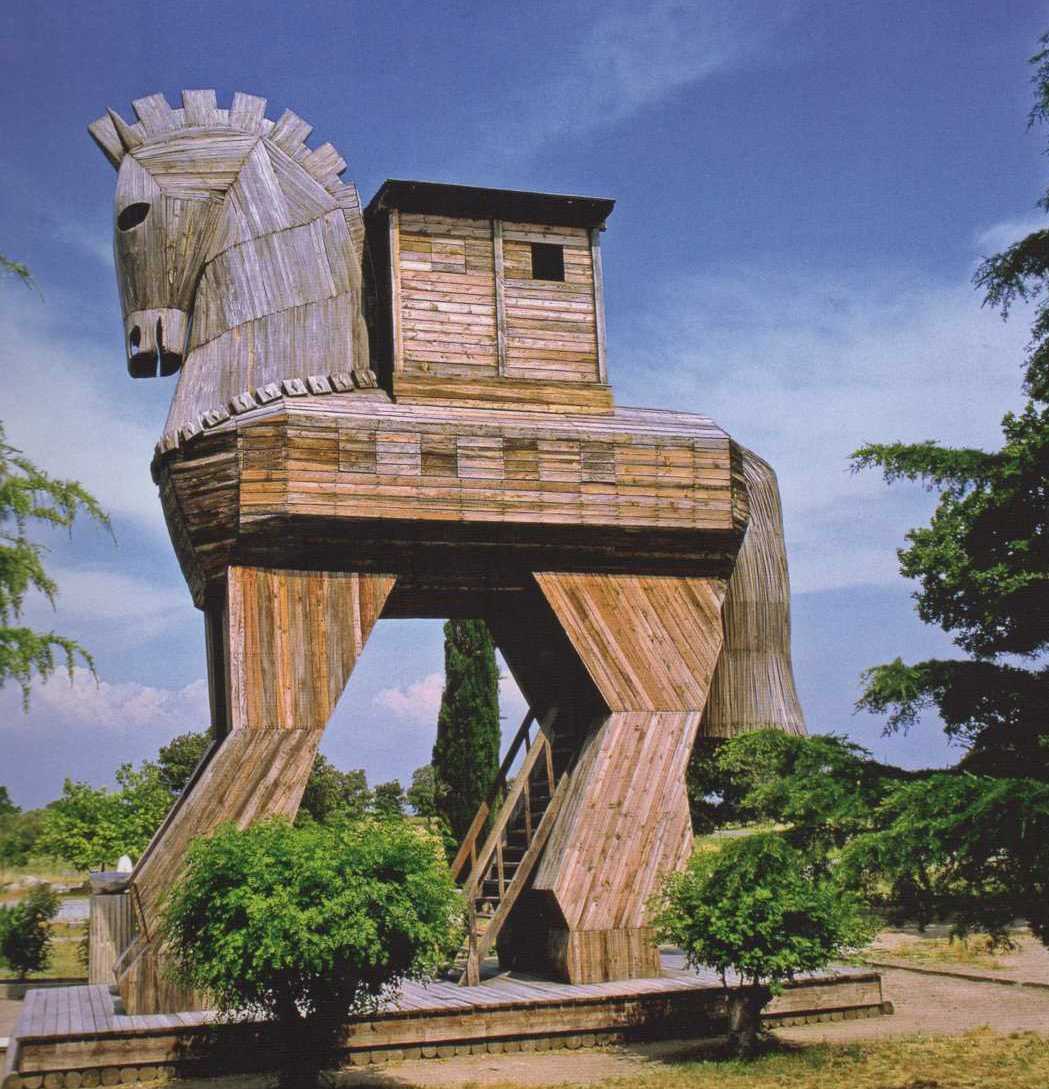
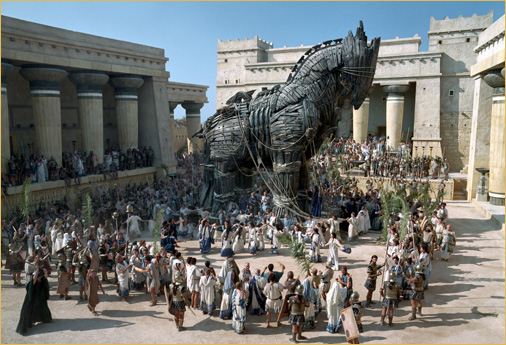
[We can’t find an image of that, but here’s a picture of one of our favorite features of today’s Truva/Hisalik, just to remind you of a later feature of the Trojan War—along with a still from the 2004 Brad Pitt film, known to those of us who love Homer for its rather casual attitude towards the traditional story.]

617-5-horse1

trojan-horse%20troy%20the%20movie

And how can we fail to mention the Great Wall of China?

thegreatwall_rcv

     For us, Hadrian’s Wall might do, with its stretch of stonework across the entire width of England (73 miles, 117.5 kilometres).

map-hadrians-wall

It even has the requisite main gate, which will be defended by Faramir.

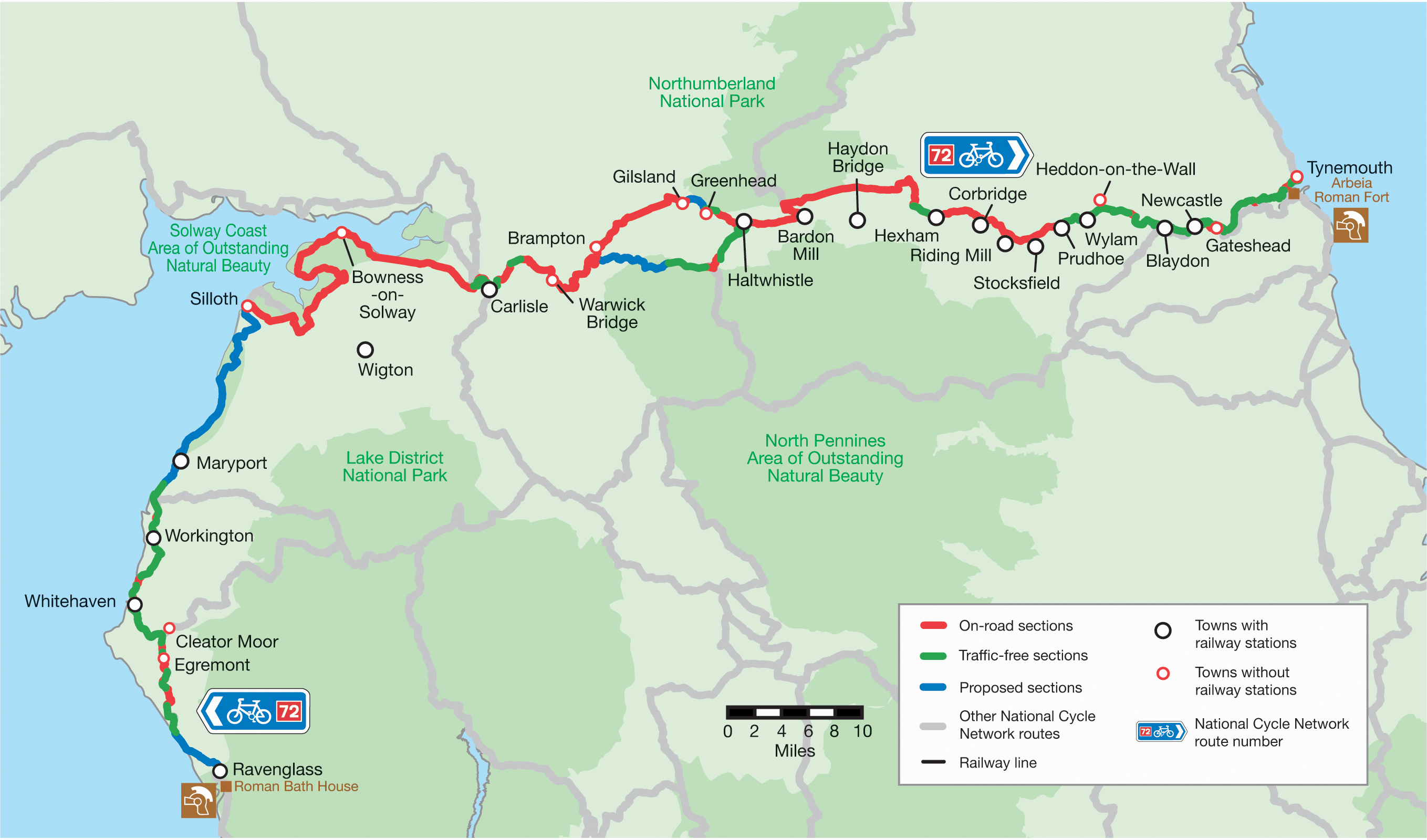
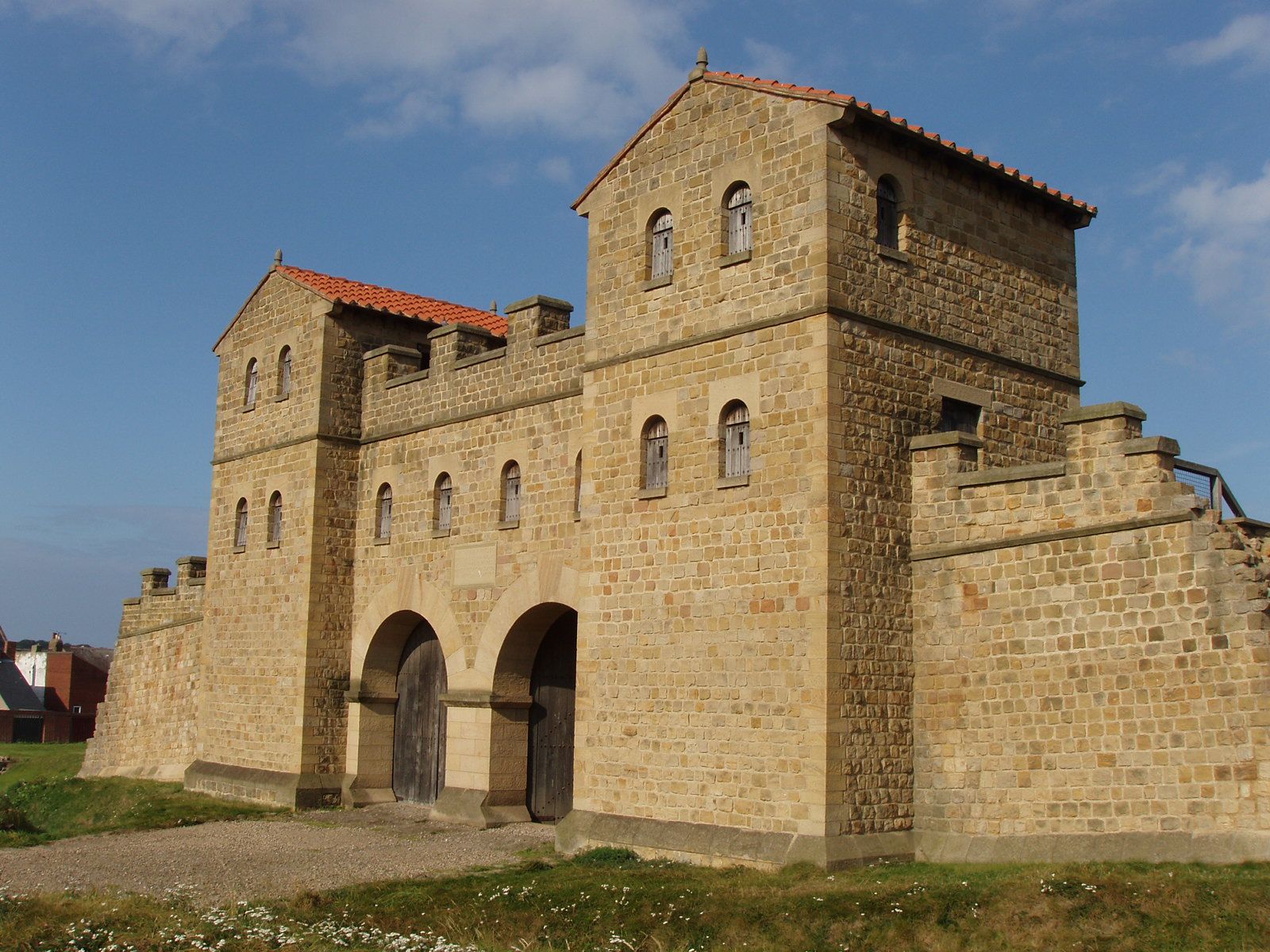
This is actually from the Roman fort of Arbeia, South Shields—a great site—but it gives you an idea of what something a little grander—after all, it connected the Pelennor with Osgiliath—might look like.

F00638REW

     That event, however, is in The Lord of the Rings, where Faramir maintains his reputation as a brave and far-sighted commander, as Beregond says to Pippin:

     “But things may change when Faramir returns. He is bold, more bold than many deem; for in these days men are slow to believe that a captain can be wise and learned in the scrolls of lore and song, as he is, and yet a man of hardihood and swift judgement in the field.” 766

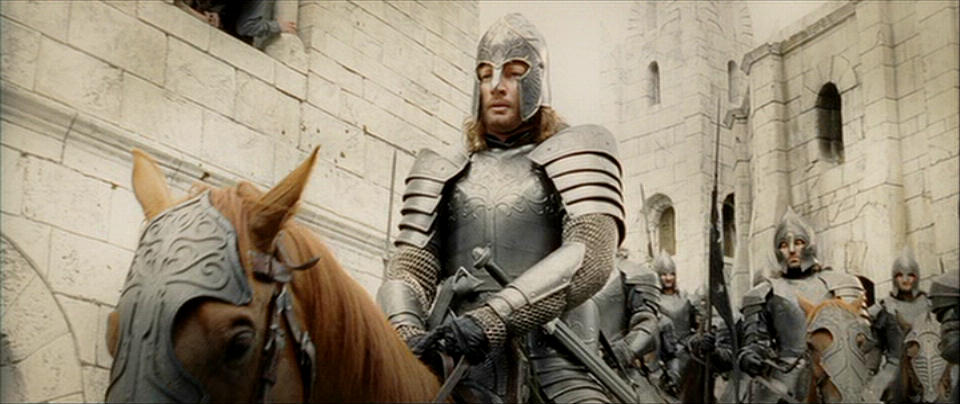
FaramirCaptainGondor

     In the film, it is quite a different matter. There is no Rammas Echor and Faramir, in contrast, is badly wounded in a cavalry charge against the walls of Osgiliath while his father, Denethor, has a rather messy and all-too-symbolic lunch.

maxresdefault

gondorianerritt-cb182208

gifdenethoreating

     What has happened here? First, no intelligent—maybe even foolish—commander would attack a stone wall with cavalry, and we know that Faramir is, indeed, intelligent. Second, what has happened to the Rammas, where Faramir actually had been just before he fell, commanding the rearguard?

     First, we would suggest that the script writers took their cue from the final scene between father and son, in which Faramir, already told by his father that his father had preferred his elder son, Boromir, volunteers to direct the defense of Osgiliath:

“But at length Faramir said: ‘I do not oppose your wil, sire. Since you are robbed of Boromir, I will go and do what I can in his stead—if you command it.’

     ‘I do so,’ said Denethor.

     “Then farewell!’ said Faramir. ‘But if I should return, think better of me!’

     ‘That depends upon the manner of your return,’ said Denethor.

     Gandalf it was that last spoke to Faramir ere he rode east. ‘Do not throw your life away rashly or in bitterness,’ he said. ‘You will be needed here, for other things than war. Your father loves you, Faramir, and will remember it ere the end. Farewell!’” 816-817

     To them, this might have indicated that Faramir—who had clearly been Gandalf’s pupil, as his father has said:

“See, you have spoken skillfully, as ever; but I, have I not seen your eyes fixed on Mithrandir, seeking whether you said well or too much? He has long had your heart in his keeping.” 812

does not listen to his tutor and deliberately sets out to get himself killed. In the text, however, Faramir is actually acting responsibly, fighting in the rearguard of the retreating detachment driven from the Rammas:

“Even as the Nazgul had swerved aside from the onset of the White Rider, there came flying a deadly dart, and Faramir, as he held at bay a mounted champion of Harad, had fallen to the earth.” 821

     (And we might add that Prince Imrahil, who brings the wounded Faramir back, says, “Your son has returned, lord, after great deeds…” 821, which, of course, could easily be understood to be ironic and is perhaps meant to be so on the part of Imrahil, considering Fararmir’s last words to his father and Denethor’s reply.)

     Thus, we see Faramir’s wounding completely changed, but what about the wall he had been defending?

     When one reads through the various chat sights, there was once a considerable amount of discussion about the Rammas Echor, but all was speculation, it seems, as we were unable to find anything said by the writers themselves. In the text, instead of concentrating on the main gate, Sauron’s engineers detonate explosions to each side and the troops then pour through the breaches to take the defenders in flank. This could be seen as a repetition of a similar earlier event at Helm’s Deep, in which Saruman’s forces blew a hole in the defenses.

blowingupthewallathelmsdeep

     As well, we think that, for the director, the big visual attraction was the attack on Minas Tirith. This means that it could simply have been a matter of where to spend time—and/or possibly money—and so the Rammas was sacrificed. If the decision had already been made to change—we will say misinterpret– the story of Faramir, simplifying it drastically and shifting the focus (just think of that dripping mouth!), then the choice to discard this defense would have been an easy one.

     So, suppose you were script writer or director, what would you have done, dear readers?

     Thanks, as always, for reading (and, we hope, speculating).

     MTCIDC

     CD

Newer posts →

The Doubtful Sea Series Facebook Page

The Doubtful Sea Series Facebook Page

  • Ollamh

Categories

  • Artists and Illustrators
  • Economics in Middle-earth
  • Fairy Tales and Myths
  • Films and Music
  • Games
  • Heroes
  • Imaginary History
  • J.R.R. Tolkien
  • Language
  • Literary History
  • Maps
  • Medieval Russia
  • Military History
  • Military History of Middle-earth
  • Narnia
  • Narrative Methods
  • Poetry
  • Research
  • Star Wars
  • Terra Australis
  • The Rohirrim
  • Theatre and Performance
  • Tolkien
  • Uncategorized
  • Villains
  • Writing as Collaborators
Follow doubtfulsea on WordPress.com

Across the Doubtful Sea

Recent Postings

  • Towering January 28, 2026
  • Tolkien Among the Indians January 21, 2026
  • Thin and Stretched January 14, 2026
  • Through a glass… January 7, 2026
  • Heffalumps? December 31, 2025
  • We Three Kings December 24, 2025
  • A Moon disfigured December 17, 2025
  • On the Roads Again—Once More December 10, 2025
  • (Not) Crossing Bridges December 3, 2025

Blog Statistics

  • 105,540 Views

Posting Archive

  • January 2026 (4)
  • December 2025 (5)
  • November 2025 (4)
  • October 2025 (5)
  • September 2025 (4)
  • August 2025 (4)
  • July 2025 (5)
  • June 2025 (4)
  • May 2025 (4)
  • April 2025 (5)
  • March 2025 (4)
  • February 2025 (4)
  • January 2025 (5)
  • December 2024 (4)
  • November 2024 (4)
  • October 2024 (5)
  • September 2024 (4)
  • August 2024 (4)
  • July 2024 (5)
  • June 2024 (4)
  • May 2024 (5)
  • April 2024 (4)
  • March 2024 (4)
  • February 2024 (4)
  • January 2024 (5)
  • December 2023 (4)
  • November 2023 (5)
  • October 2023 (4)
  • September 2023 (4)
  • August 2023 (5)
  • July 2023 (4)
  • June 2023 (4)
  • May 2023 (5)
  • April 2023 (4)
  • March 2023 (5)
  • February 2023 (4)
  • January 2023 (4)
  • December 2022 (4)
  • November 2022 (5)
  • October 2022 (4)
  • September 2022 (4)
  • August 2022 (5)
  • July 2022 (4)
  • June 2022 (5)
  • May 2022 (4)
  • April 2022 (4)
  • March 2022 (5)
  • February 2022 (4)
  • January 2022 (4)
  • December 2021 (5)
  • November 2021 (4)
  • October 2021 (4)
  • September 2021 (5)
  • August 2021 (4)
  • July 2021 (4)
  • June 2021 (5)
  • May 2021 (4)
  • April 2021 (4)
  • March 2021 (5)
  • February 2021 (4)
  • January 2021 (4)
  • December 2020 (5)
  • November 2020 (4)
  • October 2020 (4)
  • September 2020 (5)
  • August 2020 (4)
  • July 2020 (5)
  • June 2020 (4)
  • May 2020 (4)
  • April 2020 (5)
  • March 2020 (4)
  • February 2020 (4)
  • January 2020 (6)
  • December 2019 (4)
  • November 2019 (4)
  • October 2019 (5)
  • September 2019 (4)
  • August 2019 (4)
  • July 2019 (5)
  • June 2019 (4)
  • May 2019 (5)
  • April 2019 (4)
  • March 2019 (4)
  • February 2019 (4)
  • January 2019 (5)
  • December 2018 (4)
  • November 2018 (4)
  • October 2018 (5)
  • September 2018 (4)
  • August 2018 (5)
  • July 2018 (4)
  • June 2018 (4)
  • May 2018 (5)
  • April 2018 (4)
  • March 2018 (4)
  • February 2018 (4)
  • January 2018 (5)
  • December 2017 (4)
  • November 2017 (4)
  • October 2017 (4)
  • September 2017 (4)
  • August 2017 (5)
  • July 2017 (4)
  • June 2017 (4)
  • May 2017 (5)
  • April 2017 (4)
  • March 2017 (5)
  • February 2017 (4)
  • January 2017 (4)
  • December 2016 (4)
  • November 2016 (5)
  • October 2016 (6)
  • September 2016 (5)
  • August 2016 (5)
  • July 2016 (5)
  • June 2016 (5)
  • May 2016 (4)
  • April 2016 (4)
  • March 2016 (5)
  • February 2016 (4)
  • January 2016 (4)
  • December 2015 (5)
  • November 2015 (5)
  • October 2015 (4)
  • September 2015 (5)
  • August 2015 (4)
  • July 2015 (5)
  • June 2015 (5)
  • May 2015 (4)
  • April 2015 (3)
  • March 2015 (4)
  • February 2015 (4)
  • January 2015 (4)
  • December 2014 (5)
  • November 2014 (4)
  • October 2014 (6)
  • September 2014 (1)

Blog at WordPress.com.

  • Subscribe Subscribed
    • doubtfulsea
    • Join 78 other subscribers
    • Already have a WordPress.com account? Log in now.
    • doubtfulsea
    • Subscribe Subscribed
    • Sign up
    • Log in
    • Report this content
    • View site in Reader
    • Manage subscriptions
    • Collapse this bar
 

Loading Comments...