• About

doubtfulsea

~ adventure fantasy

Tag Archives: Helm’s Deep

Towering

28 Wednesday Jan 2026

Posted by Ollamh in Uncategorized

≈ Leave a comment

Tags

battering ram, Fantasy, Helm's Deep, Helms Deep, Hera, Hornburg, mangonel, movies, siege, siege tower, sieges, The Lord of the Rings, The War Of the Rohirrim, Tolkien, trebuchet, undermining, Wulf

Welcome, as always, dear readers.

This is another in a short series of mini-reviews of The War of the Rohirrim, a film which I’ve now, as is my custom, seen several times before I review it.  It’s complex enough, I would say, to make it worth taking it apart and reviewing different sections/details–for another in the series, see:  Heffalumps? 31 December, 2025.  The previous review was about the introduction of a mumak into the story, for which there was no textual authority in the 2+ pages of the original in Appendix A of The Lord of the Rings and, on the same theme, I want to talk a little more about that earlier war.

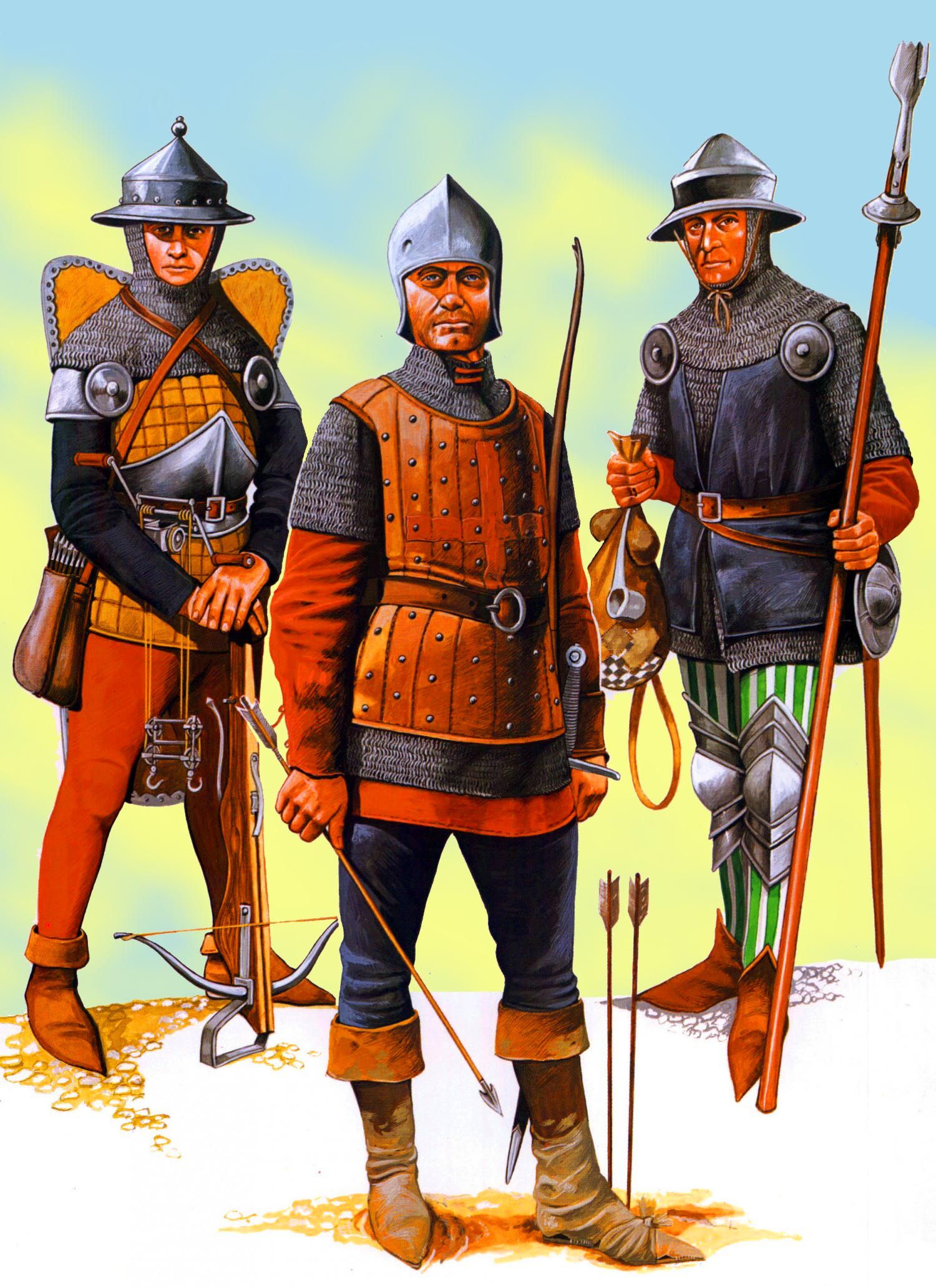
If you were an ancient Roman

or medieval

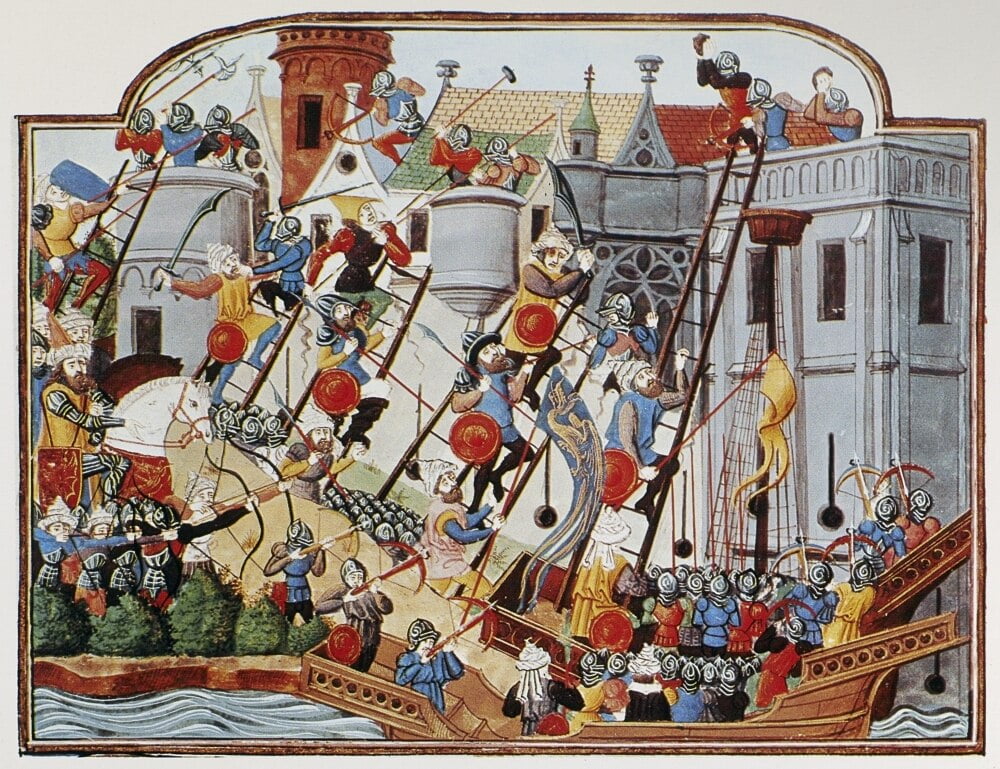
soldier, and you were faced with an enemy’s wall,

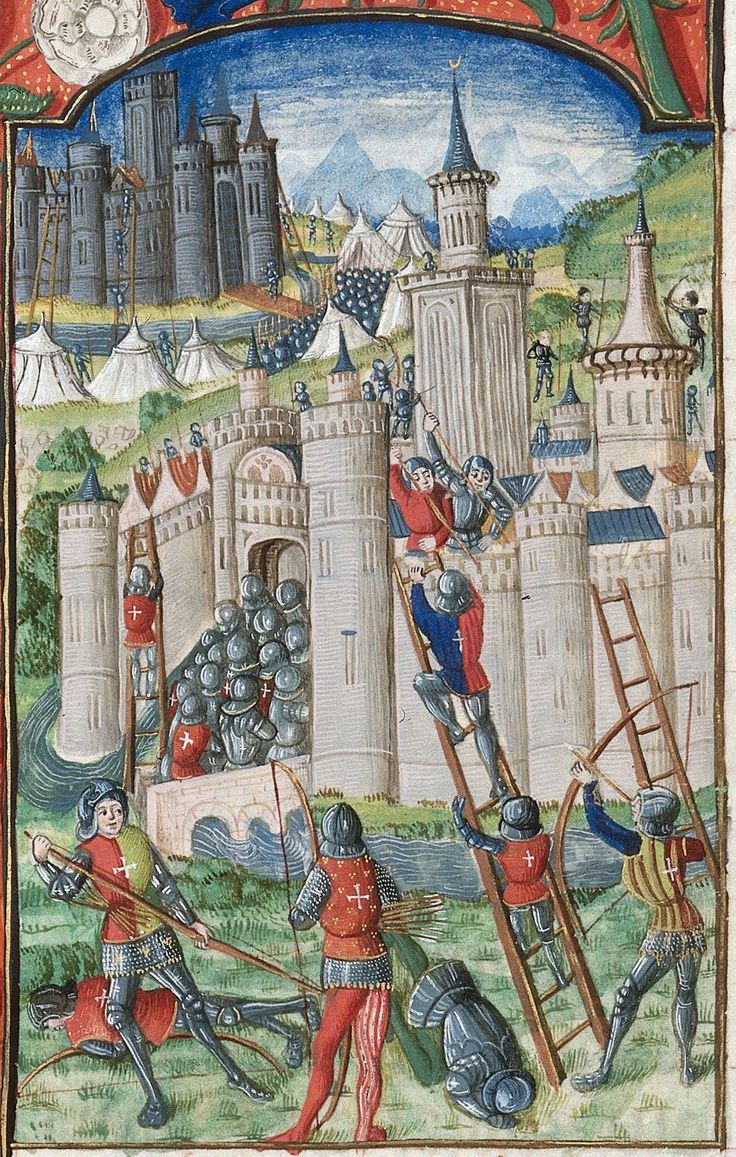
you would have a number of options.  The most dangerous would be to pick up a ladder and attempt to climb—an escalade–

as, after all, high on a ladder, exposed to the enemy above you and, with men climbing below you making it difficult to climb down, you would be in a very awkward position—so perhaps other choices would be preferable?

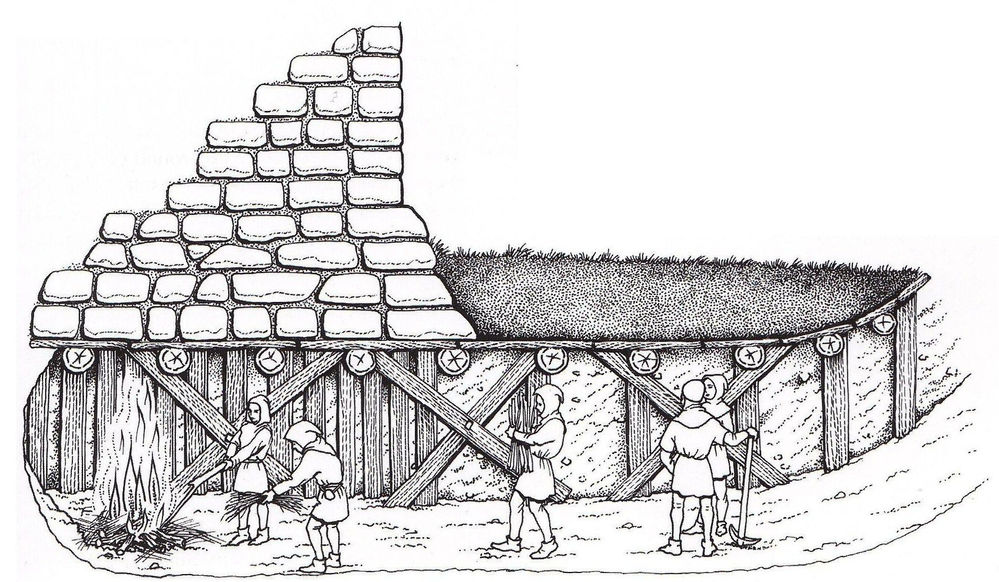
One possibility would be to dig under.

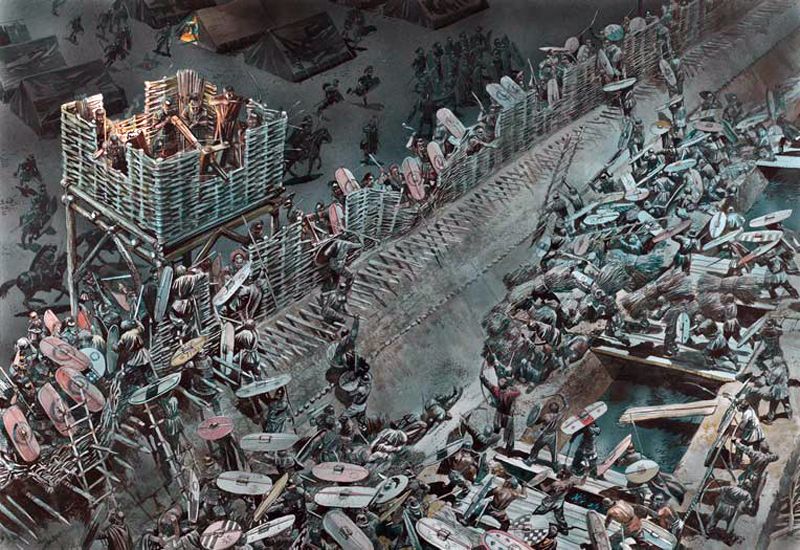
And here in this illustration we see two choices, really:

1. digging a tunnel all the way under the wall and popping out behind the defenders

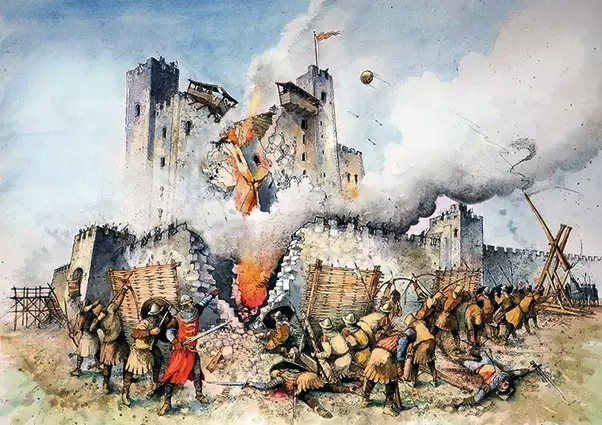
2. undermining the wall:  cutting away the ground below the wall, substituting wooden props for the missing ground, then setting fire to the props so that the wall above, lacking support, would come crashing down (or so you would hope)  This worked at the siege of Rochester castle in AD1215, where it brought down a corner tower–

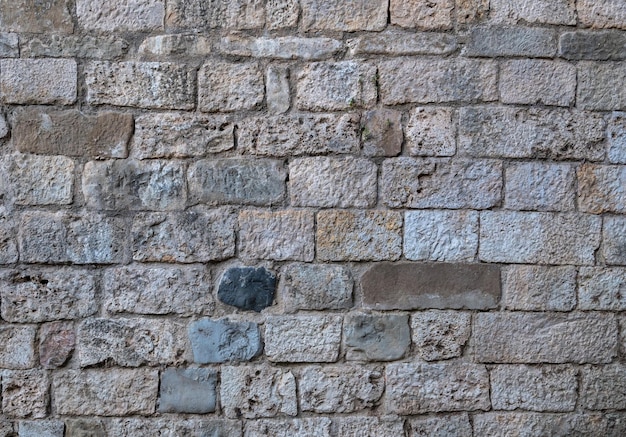
If, however, a wall had been built on a rocky base, as was sometimes the case, tunneling would not be a option.

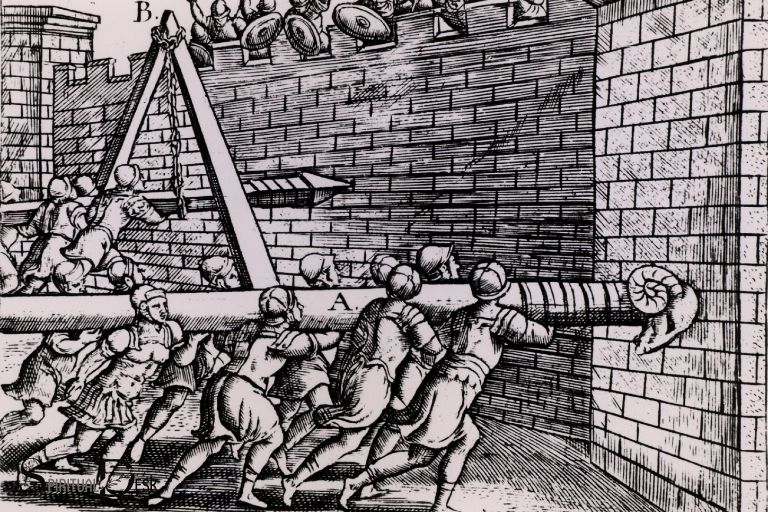
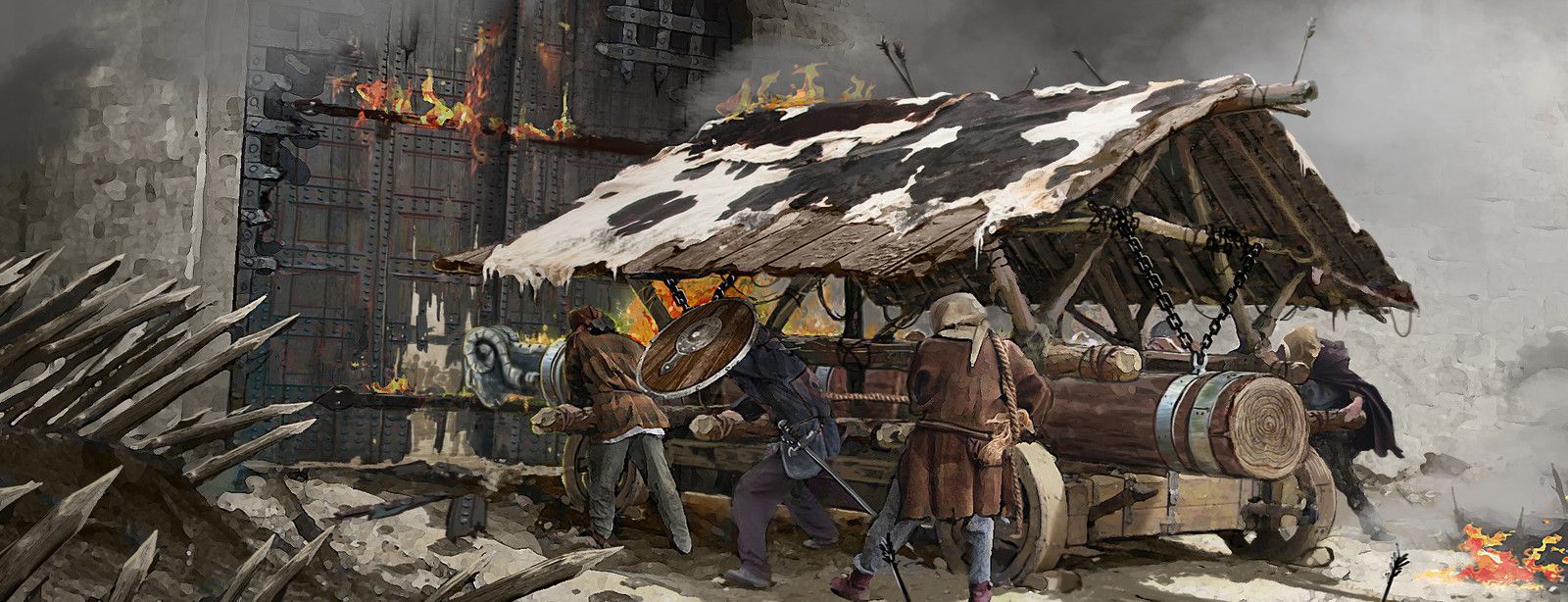
Another choice:  try battering the wall with a ram (or the gates—often the weakest point)

(Julius Caesar, in his commentaries on his campaigns in Gaul, used the image of battering to suggest that, although he was always inclined towards clemency, once one of his rams had touched an enemy’s town wall (in this case that of the Atuatuci) and those inside hadn’t surrendered–si prius quam murum aries attigisset se dedidissent—his clemency was at an end—and so was the town.  See Caesar De Bello Gallico, Book II, Chapter XXXII (32) for the quotation, either in Latin here:  https://www.thelatinlibrary.com/caesar/gall2.shtml or in English here:  https://classics.mit.edu/Caesar/gallic.2.2.html  Interesting to note that Caesar also describes the Roman use of a siege tower just before this—see Chapters XXX and XXXI.)

(Lincoln Renall—an artist who seems to be able to draw/paint anything—see more about his work here:  https://lincoln.artstation.com/ )

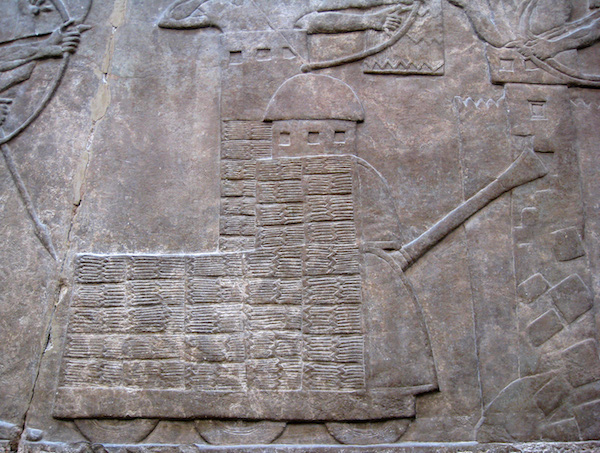
or, if the wall isn’t stone, but mud brick, try prying the wall apart—the ancient Assyrians even seem to have had a device dedicated to it (sometimes captioned as a “battering ram”, but it employed a kind of chisel, rather than a ram).

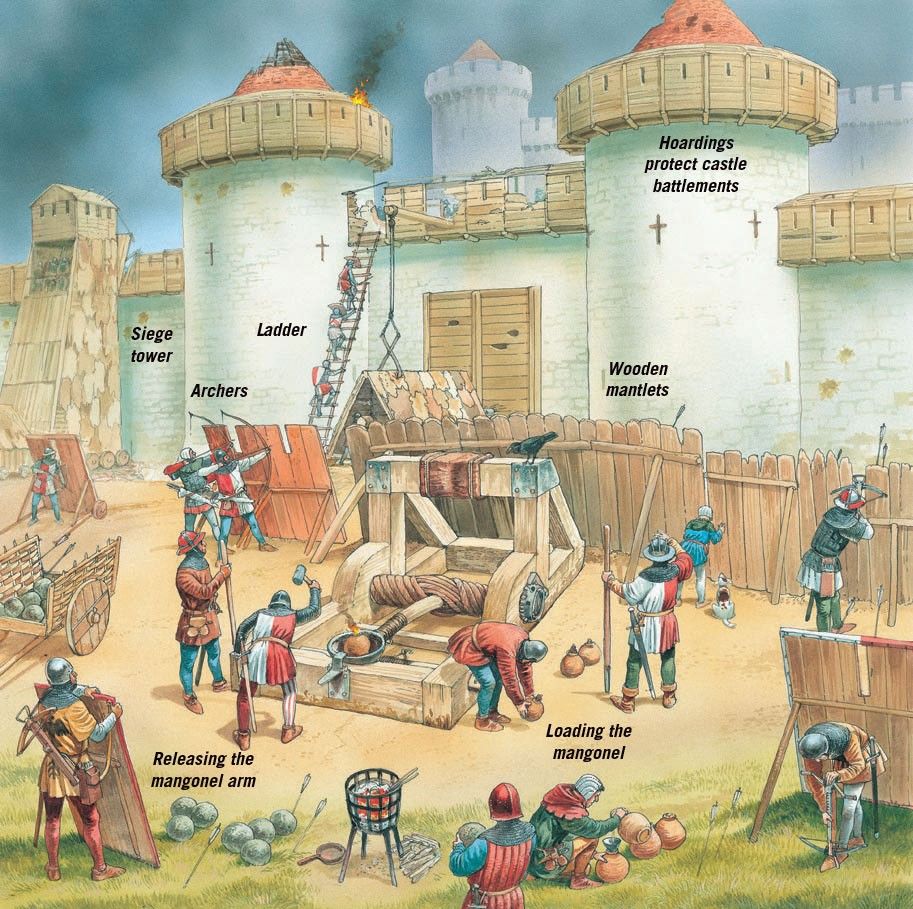
You might try a stone-thrower of some sort, gradually breaking down the wall from above, like this mangonel–

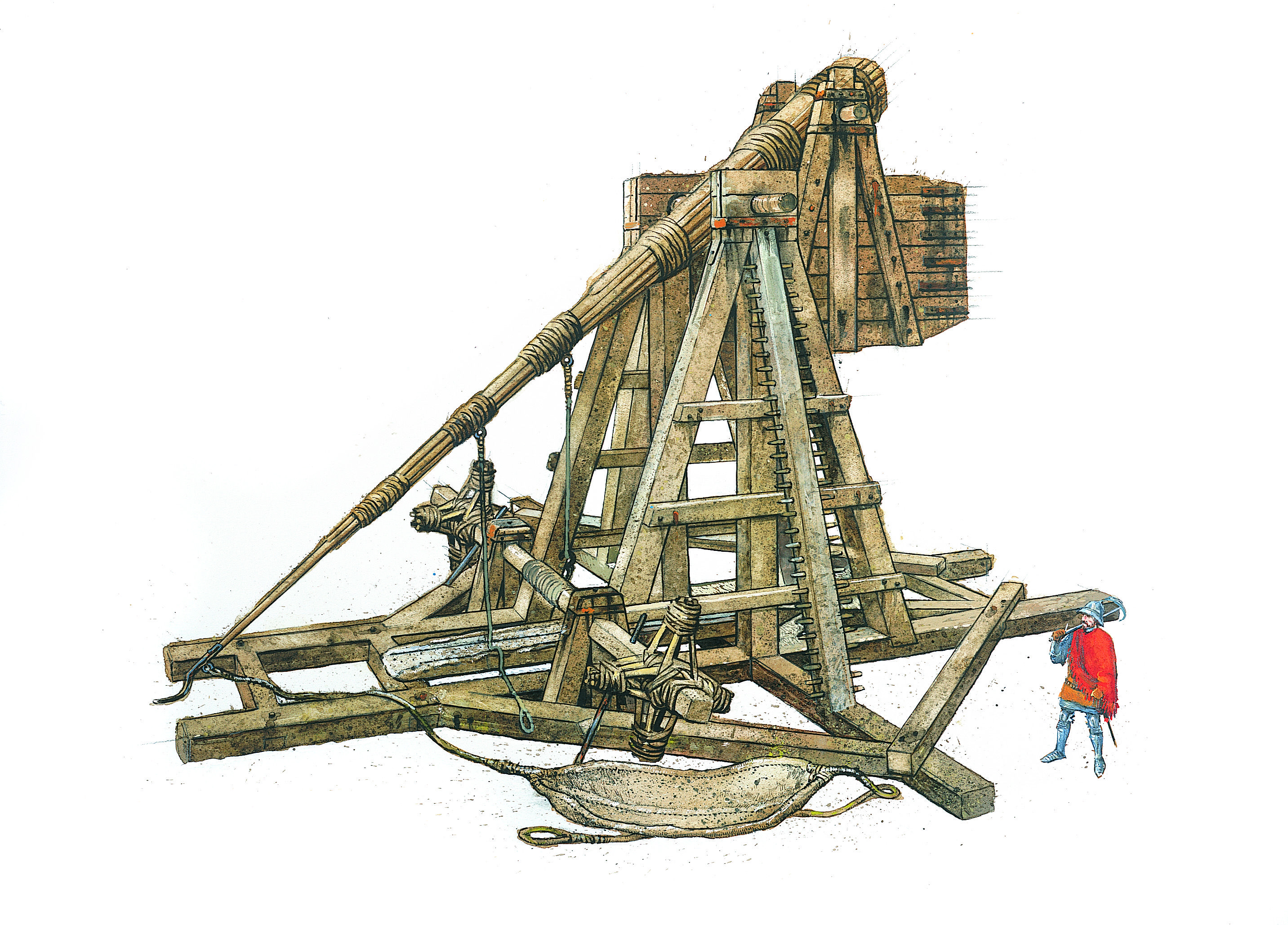
or its big brother, the trebuchet.

(for an interesting video on trebuchets and the damage they can do, see:  https://www.youtube.com/watch?v=QVO8VznqMeQ )

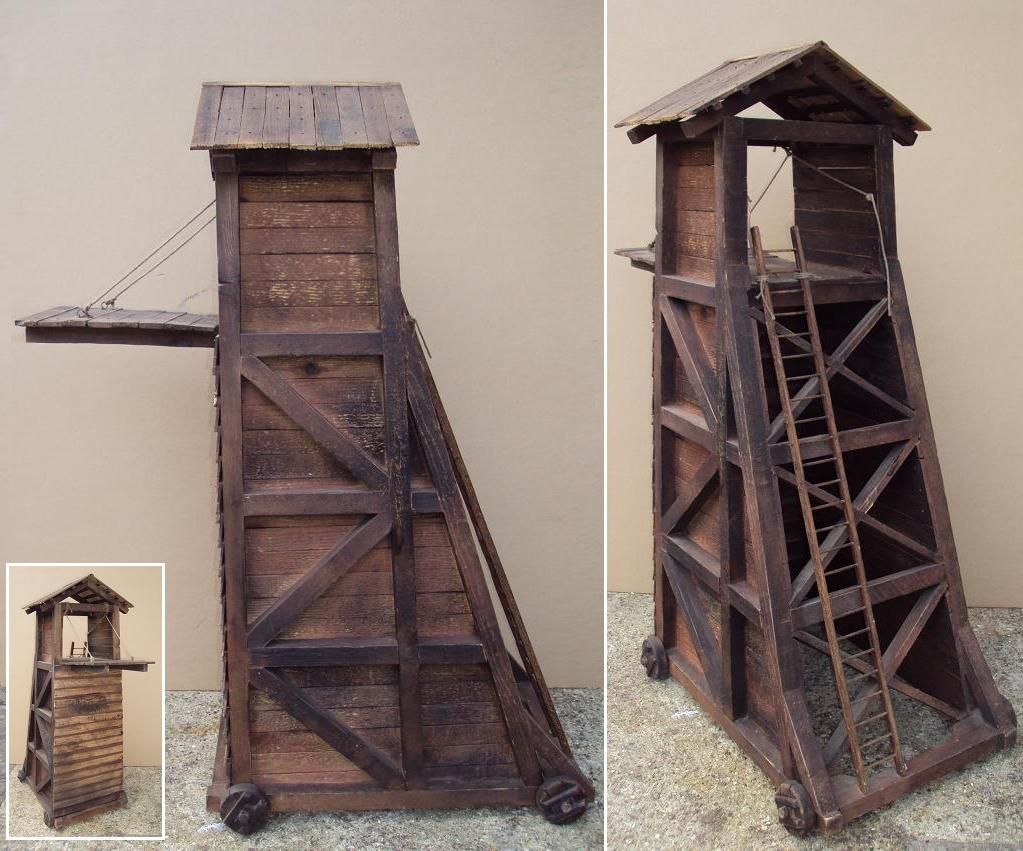
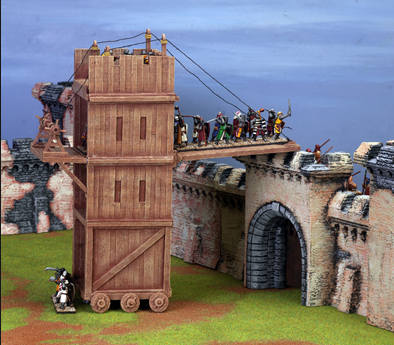
Then again, you could attempt to go over the wall with a siege tower, in what might be a safer manner than an escalade .

This is a machine made of wood, placed on rollers, built to approach a wall, but to be a little higher and, when it reaches the wall, a drawbridge is dropped and you and your companions rush across it, over the wall, and onto the walkway behind it, where, if your plan works, you then deal with the enemy soldiers there and move towards opening a gate below.  Instead of climbing on a totally exposed ladder set against a hostile wall, then, you will climb on a ladder protected by the tower, safe until you reach that drawbridge.  To  further insure the attackers’ safety, the tower has to be rolled as close to the wall as possible and the drawbridge has to fall onto the wall so that the assault team (you) won’t be vulnerable for long in passing from the tower to the walkway, although, after that, you’re on your own.  (The Atuatuci in Caesar’s narrative, first spot the tower from a distance and make fun of it, laughing at the idea that the Romans would build such a big thing so far away—until the Romans begin to move it closer and they stop laughing and talk surrender.)

We hear of such towers at the siege of Minas Tirith:

“Then perceiving that the valour of the city was already beaten down, the hidden Captain put forth his strength.  Slowly the great siege-towers built in Osgiliath rolled forward through the dark.”  (The Return of the King, Book Five, Chapter 4, “The Siege of Gondor”)

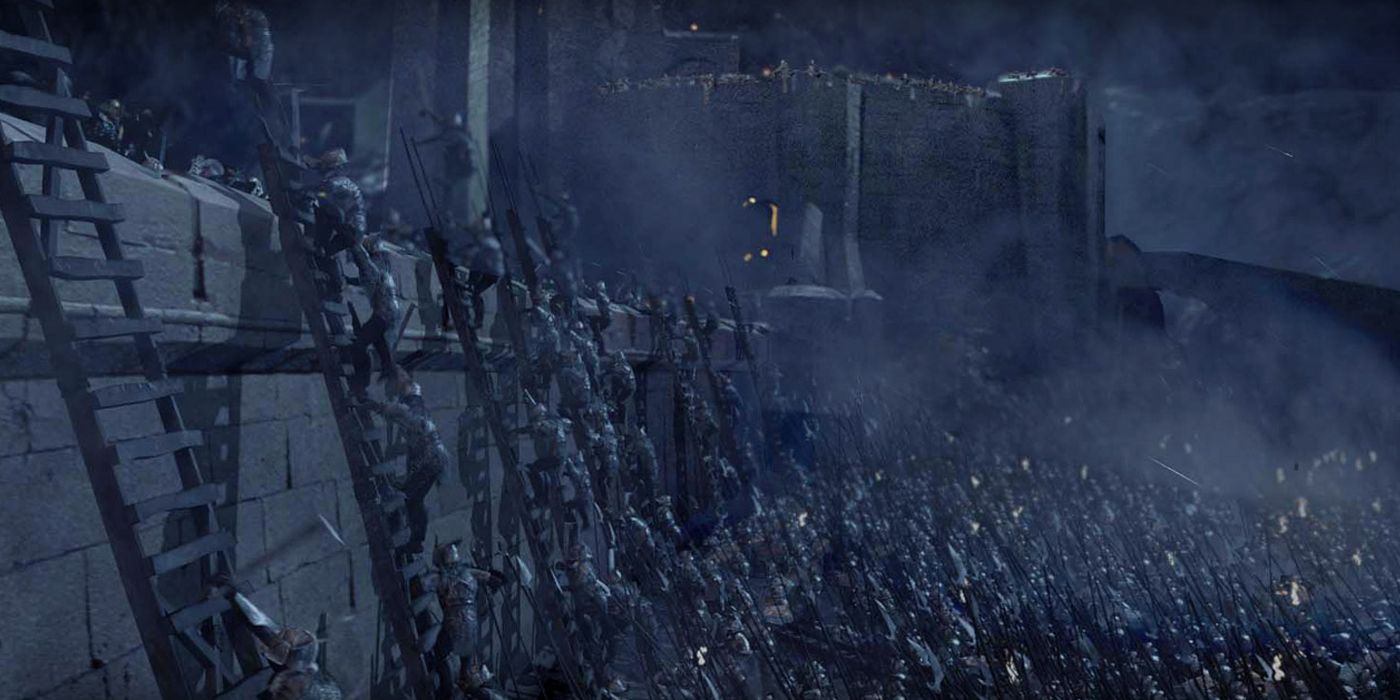
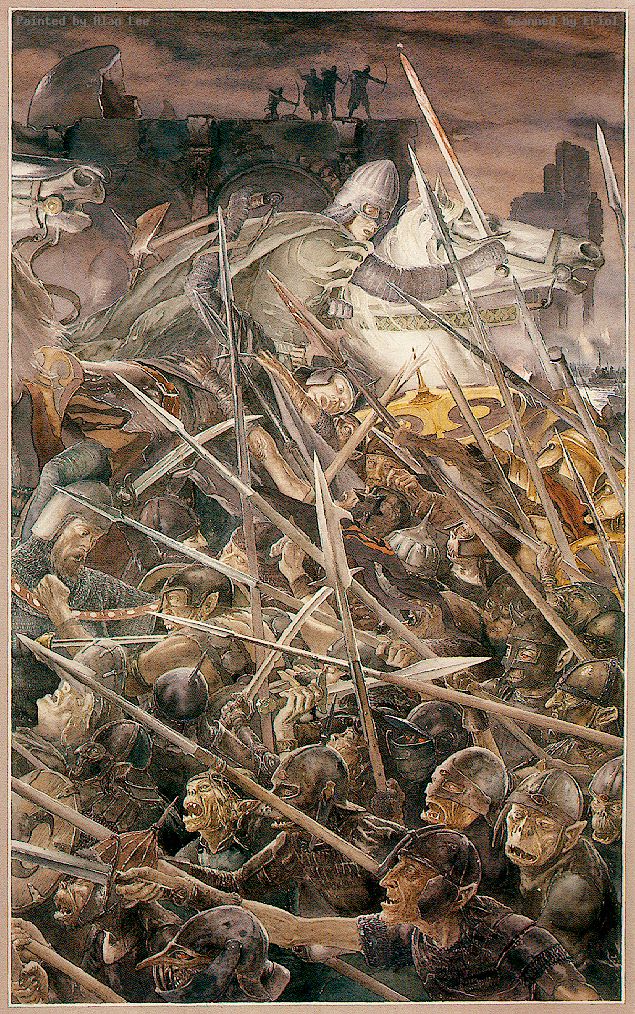
Saruman’s forces at the siege of Helm’s Deep don’t appear to use them, however, having only ladders,

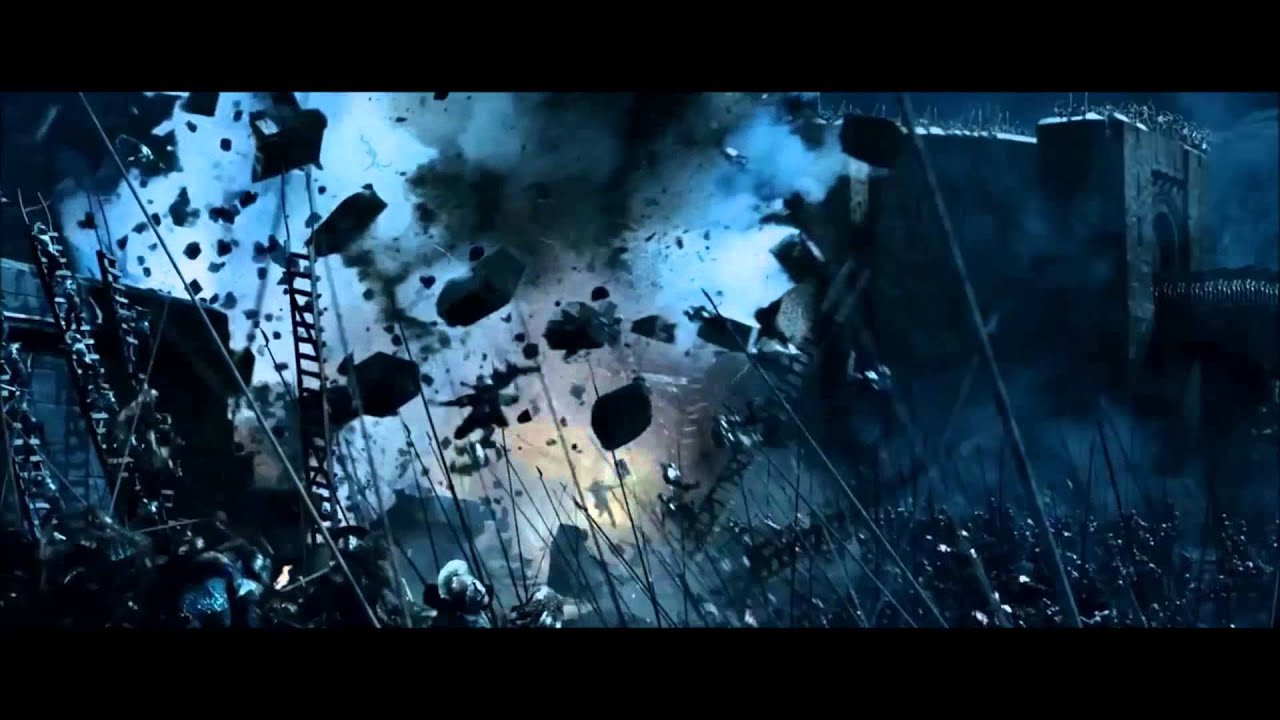
but of course they also have early gunpowder, or something like it.

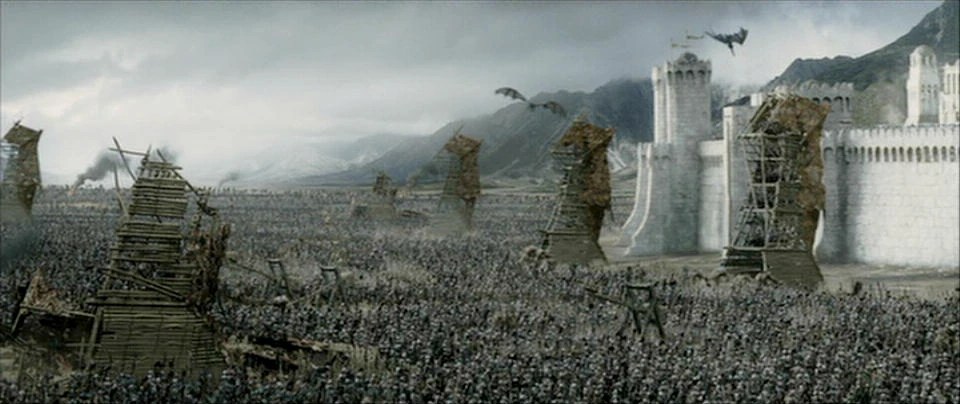
At the earlier attack on Helm’s Deep, almost 200 years before, as realized in 2024’s The War of the Rohirrim, we see an earlier use of a siege tower.  And here, as in the case of the mumak, this was created by the screen writers—there’s no mention of such a device in the brief summary of that earlier war which appears in The Lord of the Rings.  (See The Lord of the Rings, Appendix A, II “The House of Eorl”)  The siege of Helm’s Deep went through a long winter (“November to March, 2758-9” says the text), but says nothing at all about anything but a kind of standoff, in which Rohan’s enemies lay outside the Hornburg  and “Both the Rohirrim and their foes suffered grievously in the cold, and in the dearth which lasted longer.”  And it lasted until:

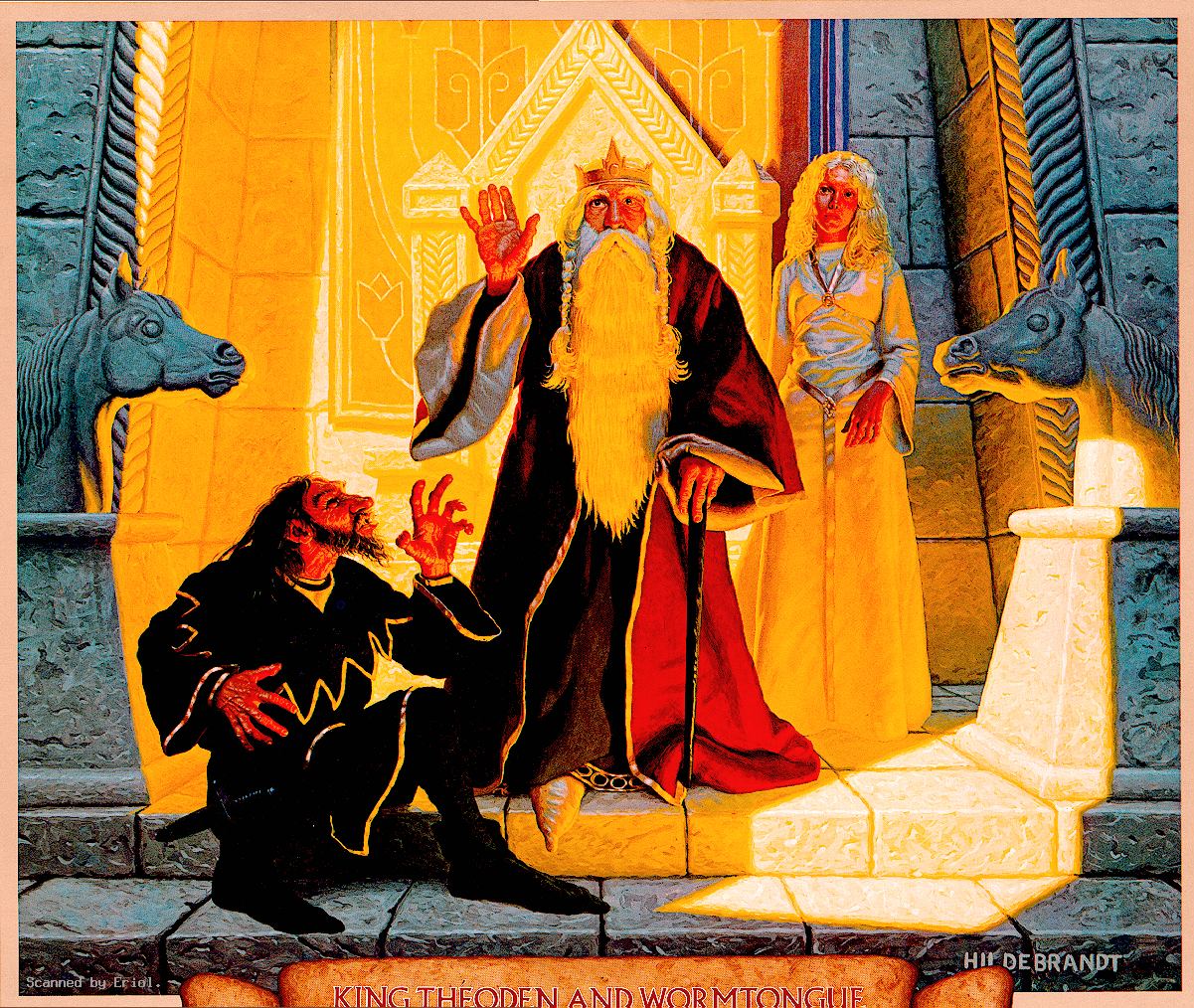
“Soon after the winter broke.  Then Frealaf, son of Hild, Helm’s sister, came down out of Dunharrow, to which many had fled, and with a small company of desperate men surprised Wulf in Meduseld and slew him, and regained Edoras.  There were great floods after the snows, and the vale of Entwash became a vast fen.  The Eastern invaders perished or withdrew and there came help at last from Gondor…Before the year (2759) was ended the Dunlendings were driven out, even from Isengard, and Frealaf became king.” (The Lord of the Rings, Appendix A, II “The House of Eorl”)

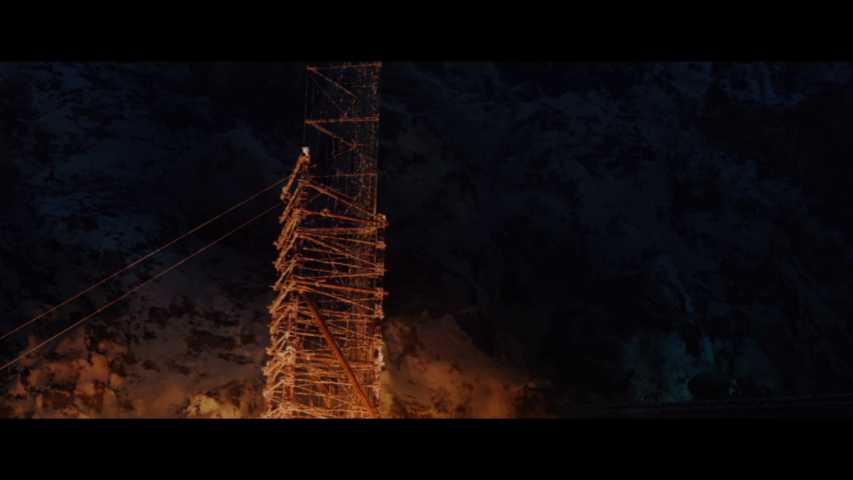
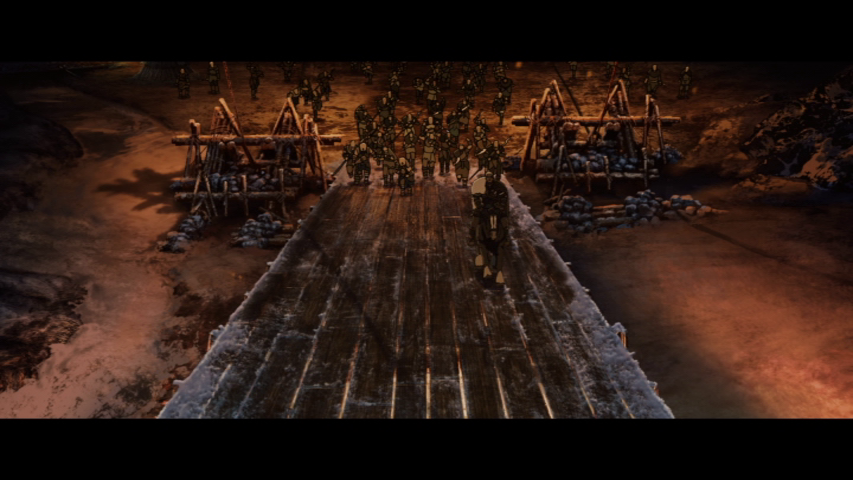
The film, however, has the siege continue while Wulf, the antagonist, commands the building of that siege tower—

(I apologize for the somewhat dim image—it’s a screen capture from the film, the best I can provide as this whole scene is very dark in the film.)

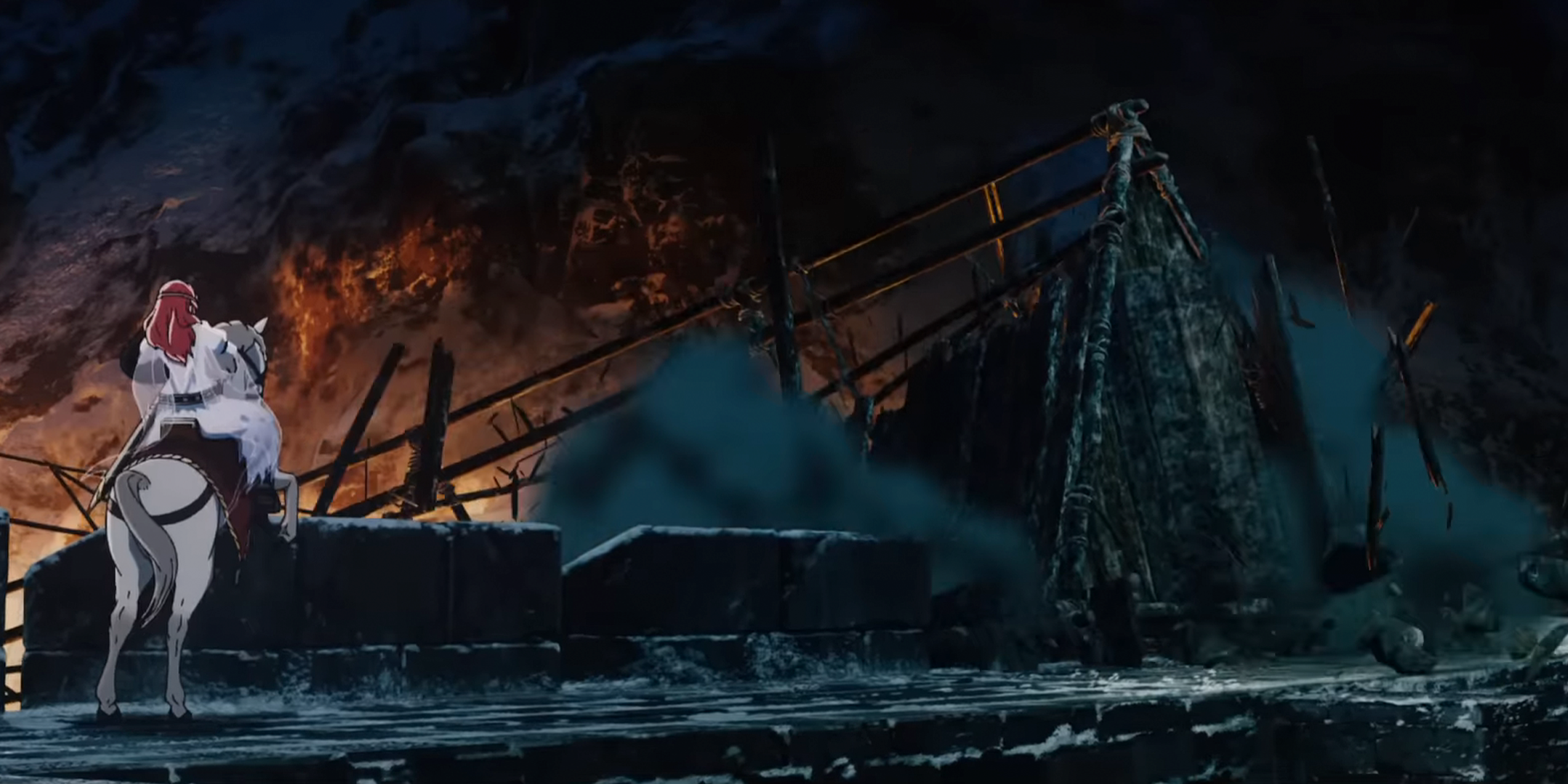
And the tower, as depicted, is hardly something of the sort created by Roman or medieval siege engineers, being tall and spindly—rickety might also be a useful term—with no protection at all for those inside.  In fact, it is built in place, rather than rolled up to the wall, so that, when finished, it needs an enormously long drawbridge which it seems like the entire besieging army then attempts to cross at once, including horses—something no ancient or medieval soldier would do, as, first, the bridge might not be able to take such weight and movement and, second, the watching enemy would fill such a mass of men and horses full of arrows before it could even cross to the wall.

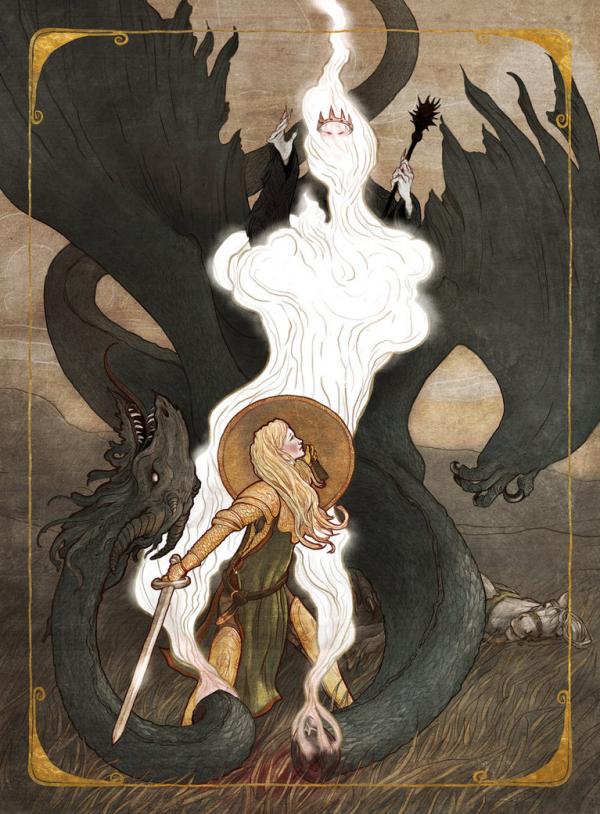
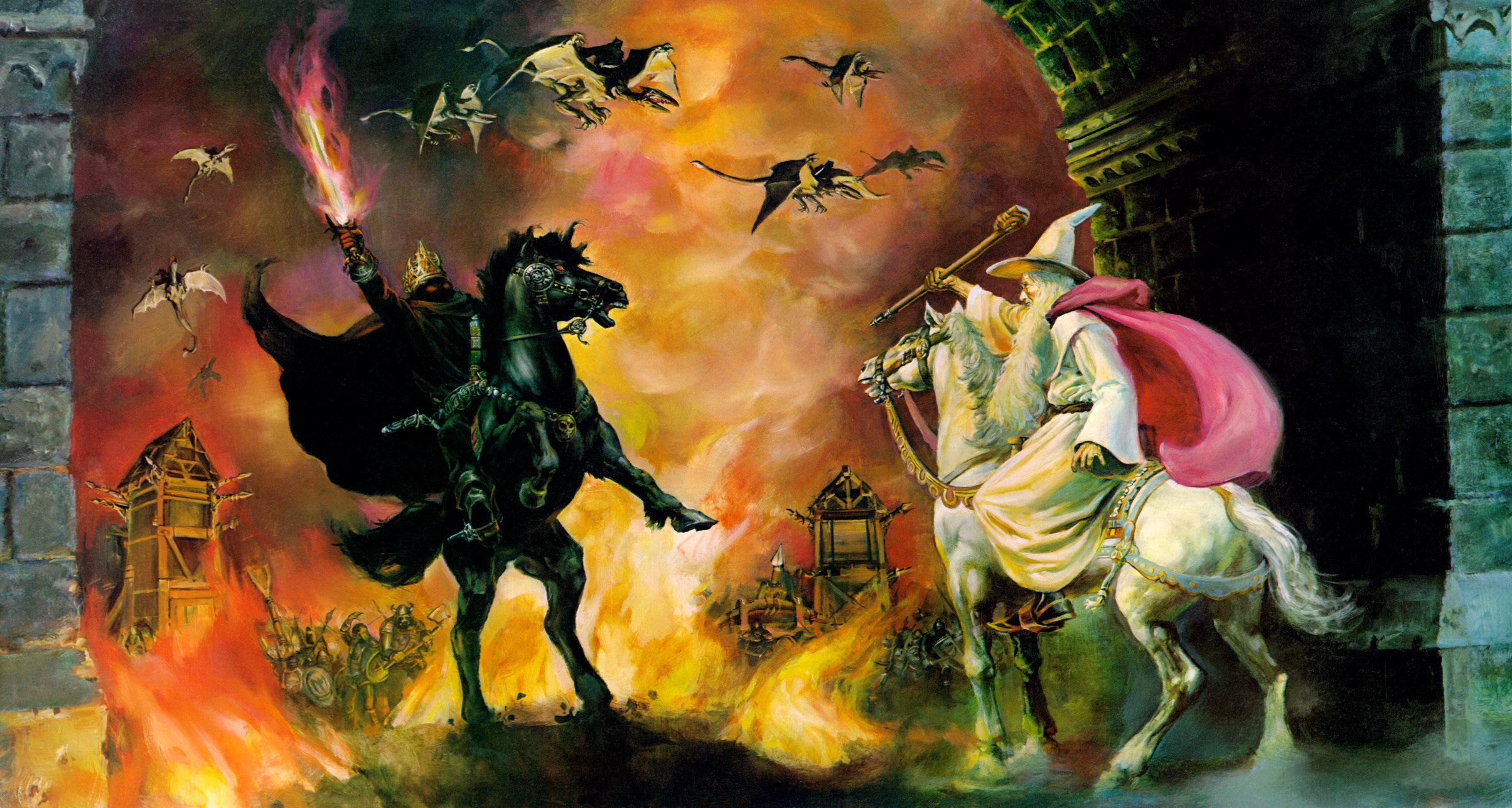
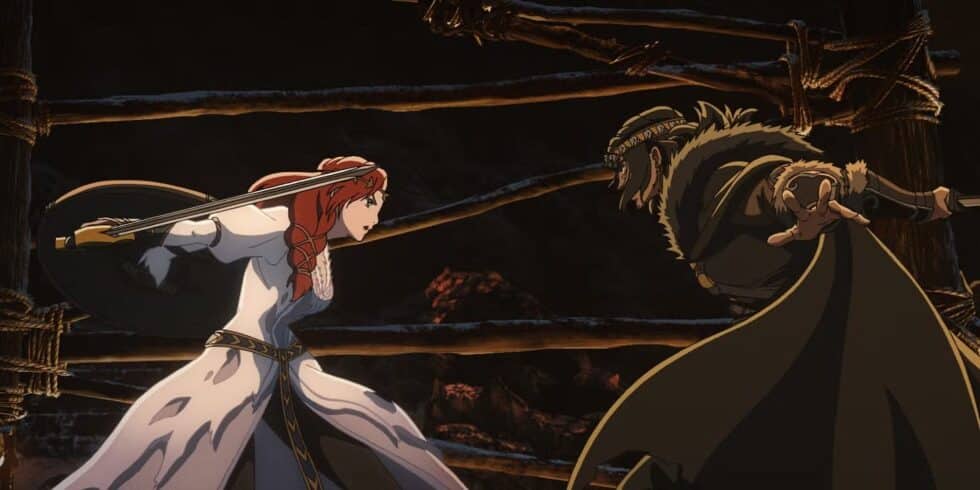
“Hera”, the protagonist, then confronts Wulf at first on that very drawbridge—and on horseback—

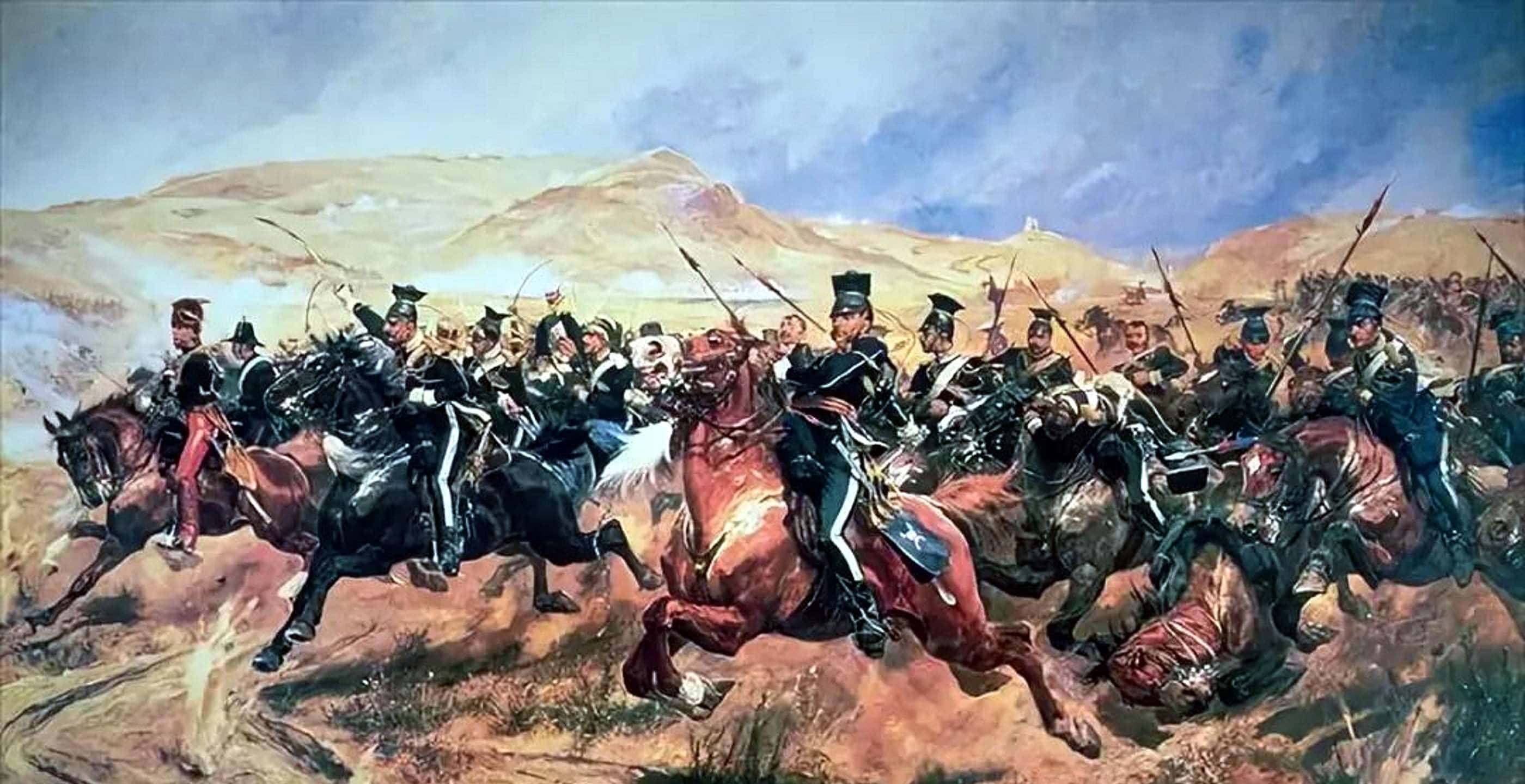
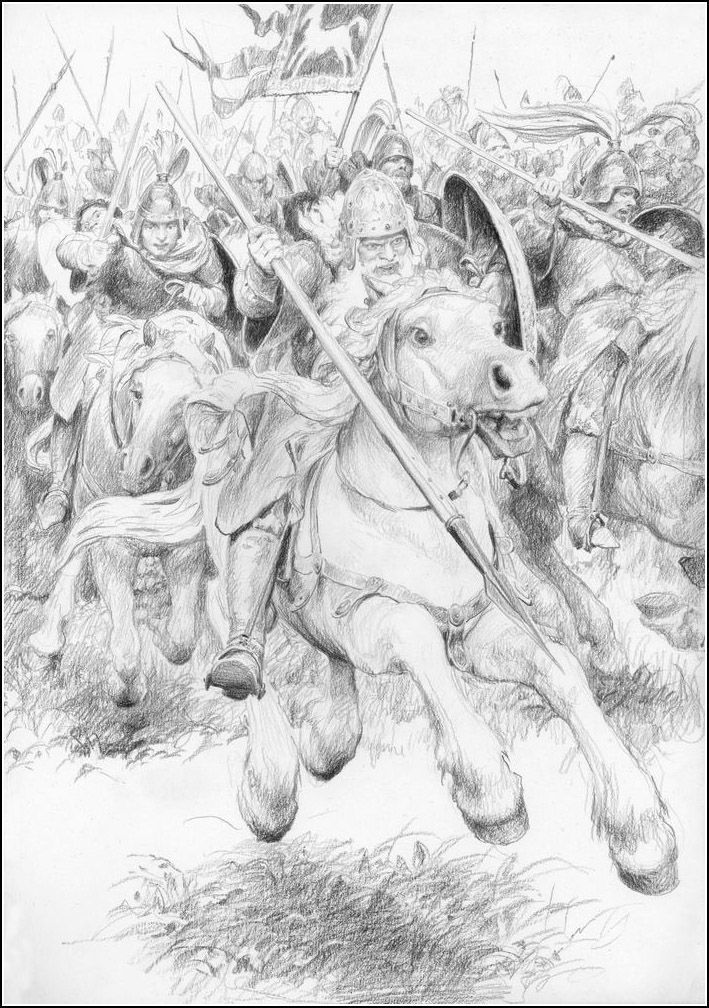
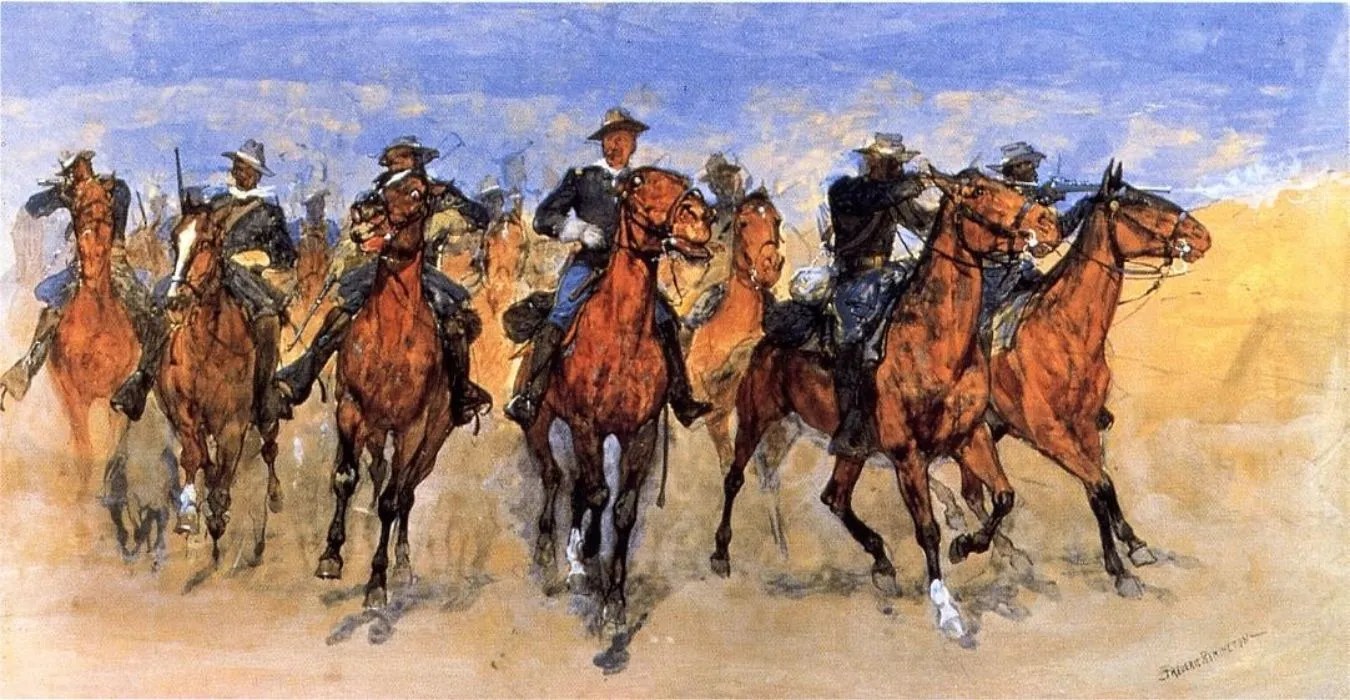
before finally killing him, rather improbably, with a shield, before standing back to see the besiegers fleeing from her cousin, Frealaf, coming like the cavalry in an old western.

(Frederick Remington)

As I’ve said before, I have nothing but praise for the hard work in making such a film, but look at what the script writers have done to Tolkien’s short text:

1. they employ a heroine plus several supporting characters, none of whom appears in JRRT’s text,

2. who then kills the main antagonist (who appears at the siege in the film when JRRT says that he’s back in Meduseld and is killed there)

3. after he attempts an assault via an impossible tower not mentioned in the narrative which Tolkien published.

As always, I approach films and books believing that those who create them are not out to cheat us, but to provide genuine entertainment and do so after long, hard labor, which clearly The War of the Rohirrim was.  At the same time, I wonder about the honesty of making so many changes and additions to a text, then attaching it to the work of an author who, long dead, had no say in what was done and, in fact, had very strong feelings about others making changes to his work.  With so many changes, it feels more like fan fiction, than the original, and, while I think fan fiction, if well-meaning, is a good tool for learning how to write, no one doing so should then attach the original author’s name to it.  All one has to read are Tolkien’s comments on an earlier attempt at filming his work (see his letter to Forrest J. Ackerman, June, 1958, in Letters, 389-397 ) to imagine what Tolkien would say and the best I can say is that he would be both puzzled and probably very unhappy.

Thanks, as ever, for reading.

Stay well,

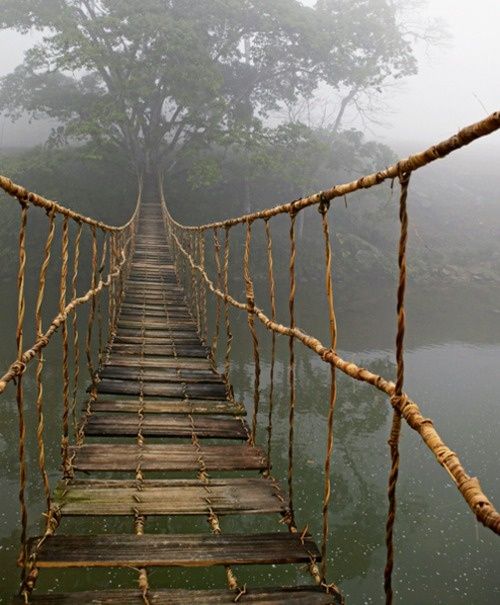
If not rickety towers, at least avoid rickety bridges,

And know that, as always, there’s

MTCDIC

O

On the Road(s) Again—Again

26 Wednesday Nov 2025

Posted by Ollamh in Uncategorized

≈ Leave a comment

Tags

Edoras, Fords of Isen, Ghan Buri Ghan, Helm's Deep, Isengard, Osgiliath, Rammas Echor, Rocky Road to Dublin, Stephen Dedalus, Stonewain Valley, Tharbad, Ulysses

Welcome, dear readers, as always.

“While in the merry month of May, from me home I started
Left the girls of Tuam so sad and broken hearted
Saluted father dear, kissed me darling mother
Drank a pint of beer, me grief and tears to smother

Then off to reap the corn, leave where I was born
Cut a stout black thorn to banish ghosts and goblins
Bought a pair of brogues rattling o’er the bogs
And fright’ning all the dogs on the rocky road to Dublin”

Another road song—this time an Irish one—and we’ll be continuing, in this posting, to follow the roads of Middle-earth, rocky and otherwise.

(This is a very catchy song and you can read the whole lyric here:  https://www.azlyrics.com/lyrics/dubliners/rockyroadtodublin.html   (although you’ll notice a couple of small discrepancies between the written lyric and the sung one) before you listen to Liam Clancy and Tommy Makem performing it here: https://www.youtube.com/watch?v=Vb2Xw424W0M&list=RDVb2Xw424W0M&start_radio=1  For something about the history of the song, see:  https://en.wikipedia.org/wiki/Rocky_Road_to_Dublin )

We had stopped our exploration at the ruined bridge at Tharbad—

(the so-called Ponte Rotto (“Ruined Bridge”) in Rome—actually the Pons Aemilius—here’s a very interesting article about it and other bridges in Rome:   https://www.througheternity.com/en/blog/hidden-sights/rome-most-beautiful-historic-bridges.html  )    

Tharbad had once been a Numenorean city, with an impressive bridge which spanned the River Gwathlo (“Greyflood”), but

“A considerable garrison of soldiers, mariners and engineers had been kept there until the seventeenth century of the Third Age.  But from then onwards the region fell quickly into decay; and long before the time of The Lord of the Rings had gone back into wild fenlands.  When Boromir made his great journey from Gondor to Rivendell…the North-South Road no longer existed except for the crumbling remains of the causeways, by which a hazardous approach to Tharbad might be achieved, only to find ruins on dwindling mounds, and a dangerous ford formed by the ruins of the bridge…” (JRRT/Christopher Tolkien, Unfinished Tales, 277)

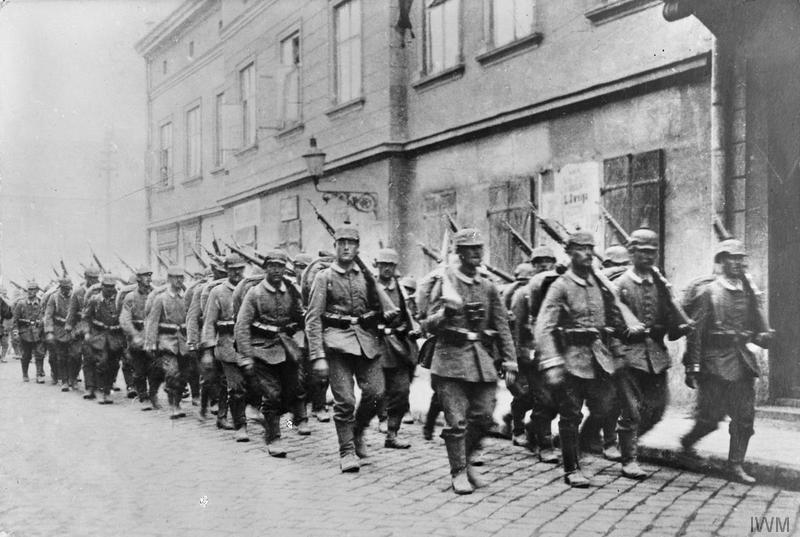
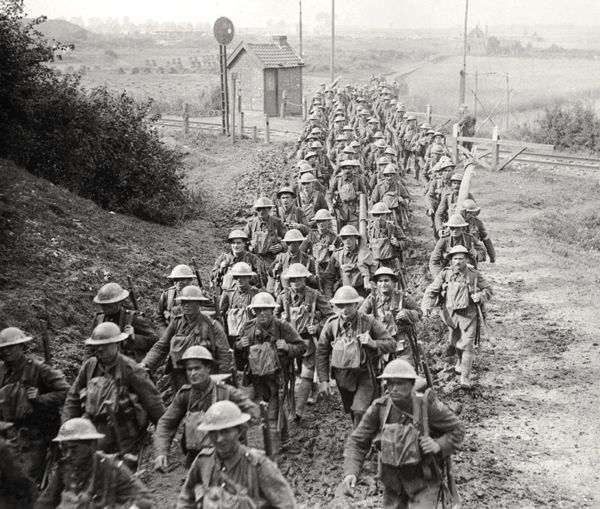
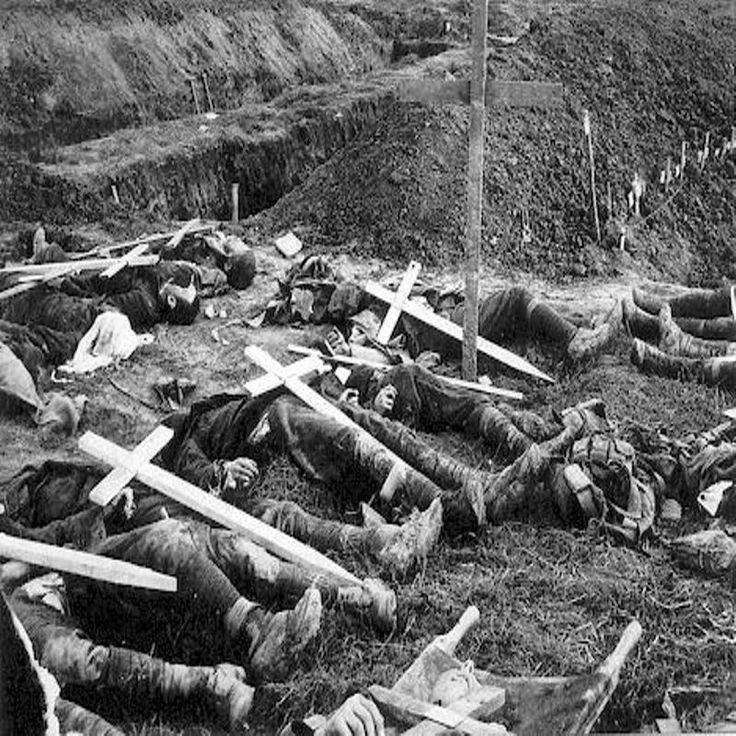
I wonder whether, when thinking of ruins, Tolkien had in mind the towns of southern Belgium destroyed by German shelling in the Great War, such as Ypres, which he would have walked through in 1916–

The road south from Tharbad, then, we can presume, was more like the Greenway farther north—grassgrown and abandoned.

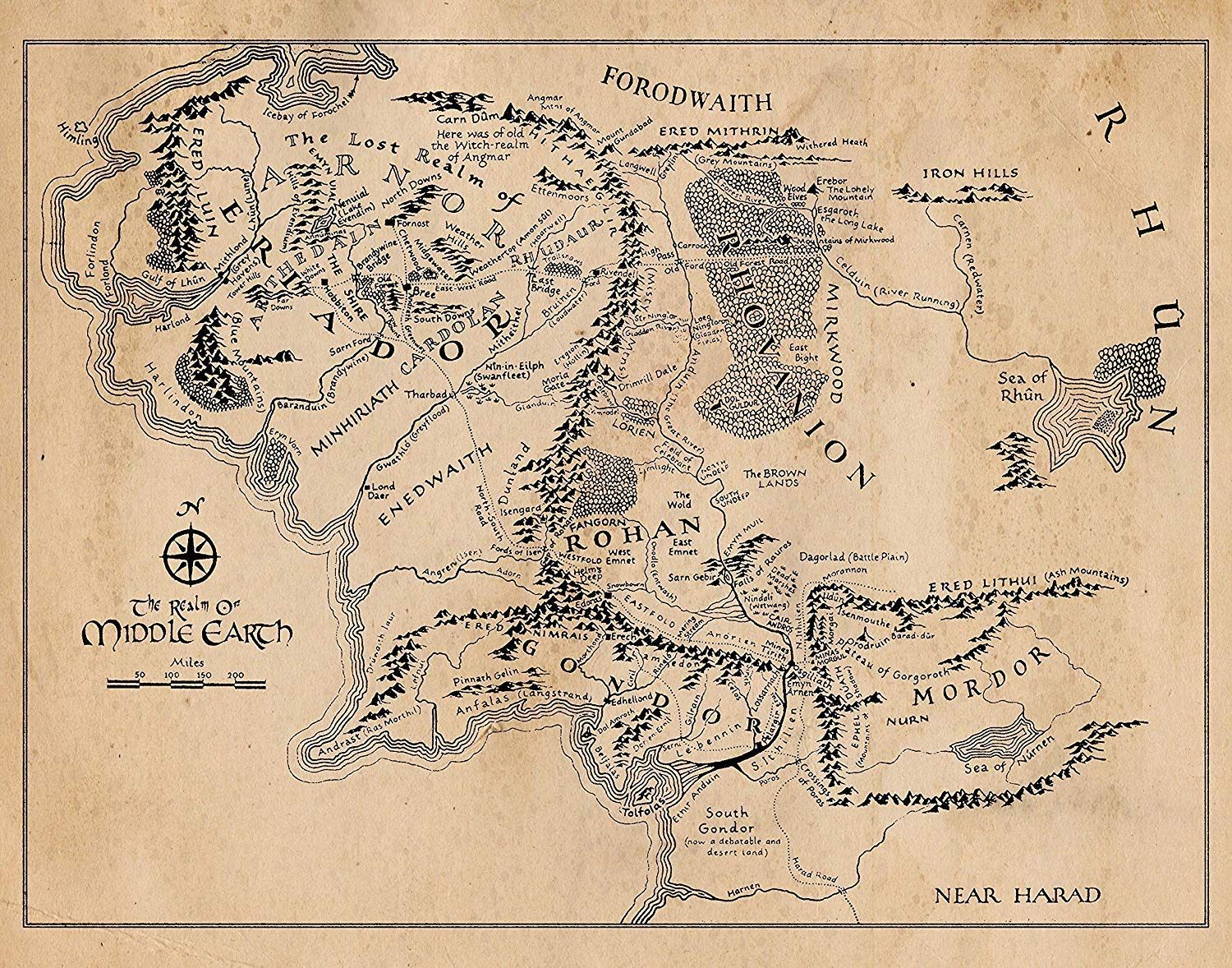
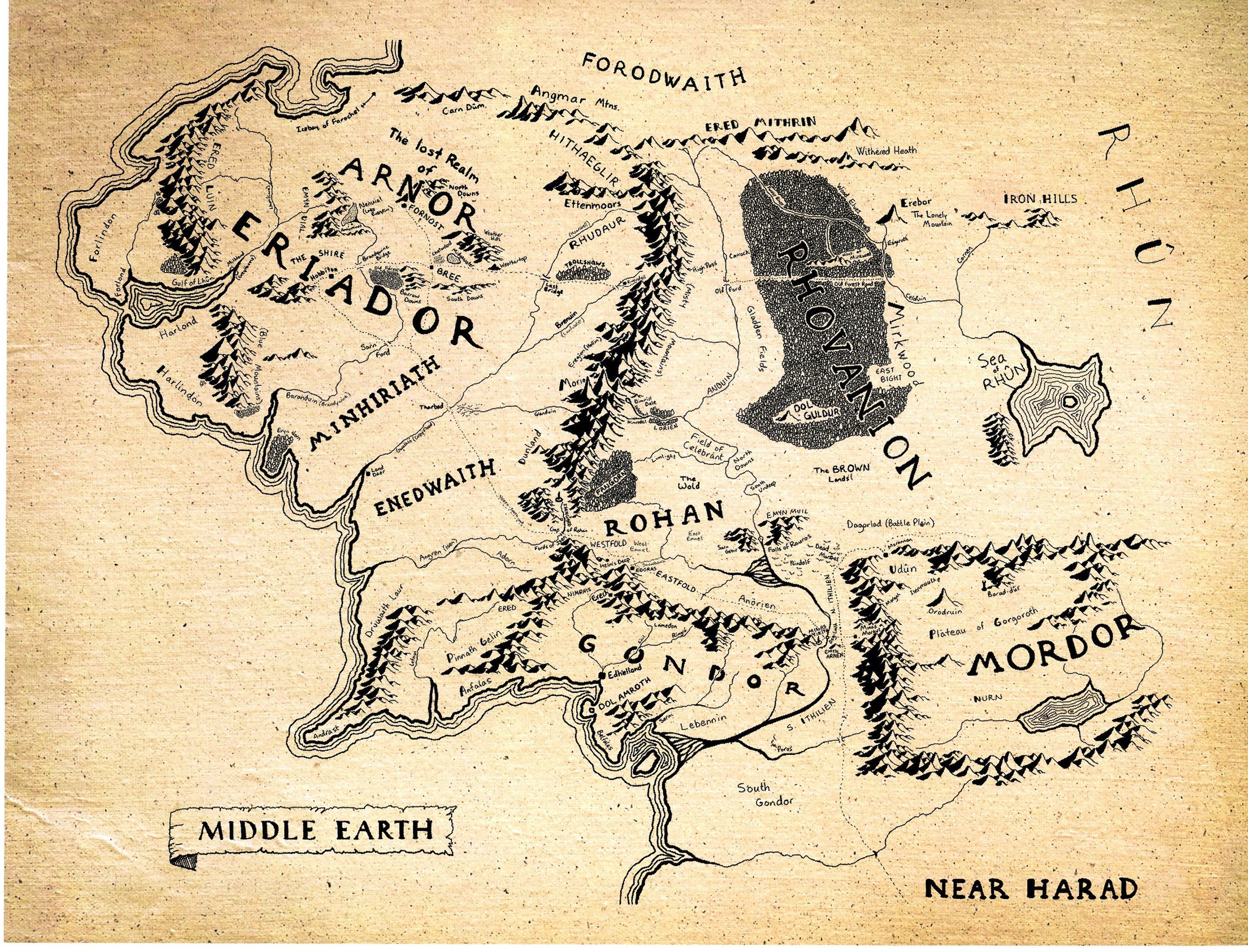
Using our map, we can see that the old road traveled through the Gap of Rohan,

(both this and the map above are derived, ultimately, from the Tolkiens’ map, but I haven’t seen this credited to anyone)

with Isengard off to its left,

(the Hildebrandts)

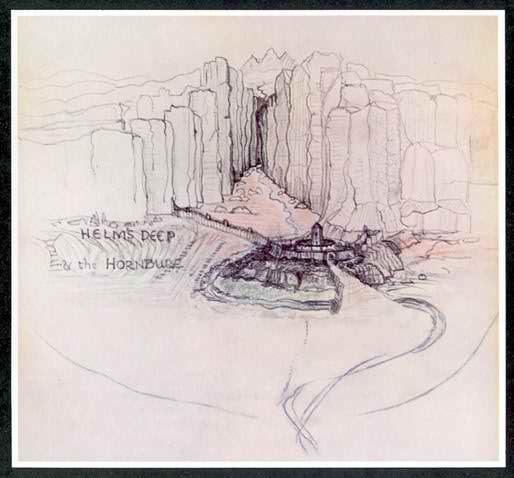
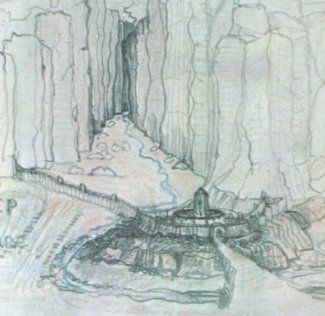
and, farther on, Helm’s Deep to its right,

(JRRT)

although I doubt that either was visible from the road, Isengard in particular being up the valley of the Isen.

JRRT has left us a useful description of the Fords of the Isen—

“There the river was broad and shallow, passing in two arms about a large eyot [from Old English, igeoth, “small island”], over a stony shelf covered with stones and pebbles brought down from the north.”  (Unfinished Tales, 372—there is a long and detailed account here, 372-390, including the heroic death of Theodred, son of Theoden.  This fills in the period when members of the Fellowship come to the defense of Helm’s Deep and Gandalf is abroad, looking for aid, while Merry and Pippin are rallying the Ents.)

Down from Helm’s Deep would also be Edoras,

(Alan Lee—notice, by the way, that the usual image of the wall of Edoras isn’t the spindly palisade shown in the films, but a solid stone wall, of the sort JRRT must have meant when he wrote:  “Following the winding way up the green shoulders of the hills, they came at last to the wide wind-swept walls and the gates of Edoras.”  (The Two Towers, Book Three, Chapter 6, “The King of the Golden Hall”)

and the road to Gondor and Minas Tirith.

(Ted Nasmith)

But we should pause here—as a hidden road will appear to our right—indicated to the Rohirrim in their ride south to the rescue of Minas Tirith by Ghan Buri Ghan, chief of the Woses (aka Wild Men—descendants  of pre-Numorean settlers of Gondor).

(Hildebrandts)

(This is taken from a large and elegant map which you can see here:  https://i.pinimg.com/originals/70/bc/b6/70bcb6ccc3a0ed5068d6ce15fb5a09a4.jpg )

As he describes it:

“ ‘Road is forgotten, but not by Wild Men.  Over hill and behind hill it lies under grass and tree, there behind Rimmon and down to Din, and back at the end to Horse-men’s road…Way is wide for four horses in Stonewain Valley yonder…but narrow at beginning and at end.  Wild Man could walk from here to Din between sunrise and noon.’ ”  (The Return of the King, Book Five, Chapter 5, “The Ride of the Rohirrim”)

And the narrator continues:

“It was late in the afternoon when the leaders came to wide grey thickets stretching beyond the eastward side of Amon Din, and masking a great gap in the line of hills that from Nardol to Din ran east and west.  Through the gap the forgotten wain-road long ago had run down, back into the main horse-way from the City through Anorien; but now for many lives of men trees had had their way with it, and it had vanished, broken and buried under the leaves of uncounted years.” (The Return of the King, Book Five, Chapter 5, “The Ride of the Rohirrim”)

A “wain” is a wagon

(This is the center of John Constable’s “The Hay Wain”, 1824, but it can give you an idea of what JRRT had in mind—picture this loaded with building stone instead of hay.)

and it’s clear that what we’re seeing here is an old quarry road, which led from stone quarries down to Minas Tirith, to build its walls.

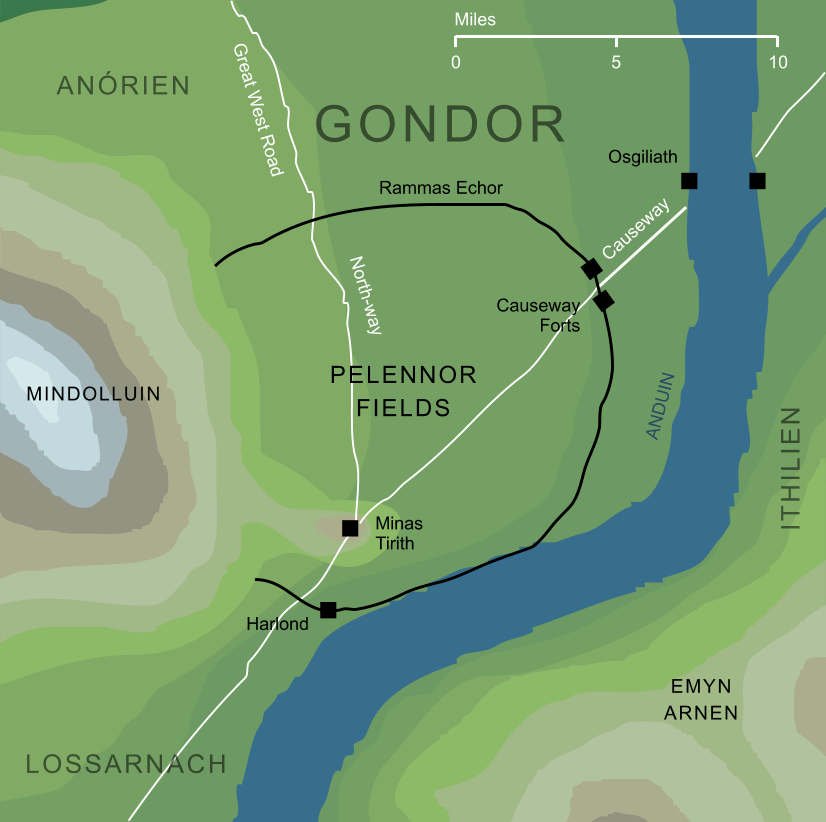
But, speaking of walls, we’re about to come up against one:  the Rammas Echor, or great circuit of wall that surrounded the Pelennor:

(from the Encyclopedia of Arda site)

“Many tall men heavily cloaked stood beside him, and behind them in the mist loomed a wall of stone.  Partly ruinous it seemed, but already before the night was passed the sound of hurried labour could be heard.”

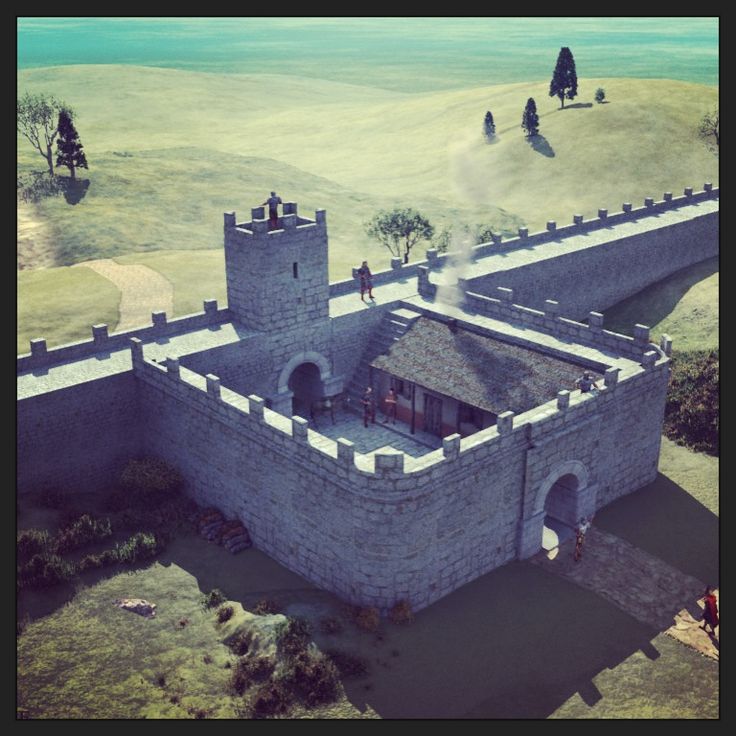
As you can see from the map, this was a very long wall (“For ten leagues or more it ran from the mountains’ feet and so back again…” —   a standard for a league is about 3 miles, so the wall is about 30 miles—about 48km–long) , and I’ve always imagined it as looking rather like Hadrian’s Wall in northern England, some 80+ miles long (about 129km), as it appeared when finished.

There were larger gates in the area called the Causeway Forts, but there were clearly single, smaller gates as in the image above, as the text tells us:  “…and the men made way for Shadowfax, and he passed through a narrow gate in the wall.” (The Return of the King, Book Five, Chapter 1, “Minas Tirith”)

I suppose that we could circle around the wall, and then we’d have to get onto the causeway—that’s a kind of elevated road—

(This is the stone causeway leading to St.Michael’s Mount, in Cornwall, southwest England, with the tide coming in—or going out.  You can read about St.Michael’s Mount here:  https://en.wikipedia.org/wiki/St_Michael%27s_Mount )

which leads to the ruined city of Osgiliath

where, alas, the bridges are broken (“And are not the bridges of Osgiliath broken down and all the landings held now by the Enemy?”  (The Fellowship of the Ring, Book Two, Chapter 8, “Farewell to Lorien “)

(Norris Rahming, 1886-1959)

and where we’ll stop for today, but pause at the site of one of those bridges in our next.

As ever, thanks for reading.

Stay well,

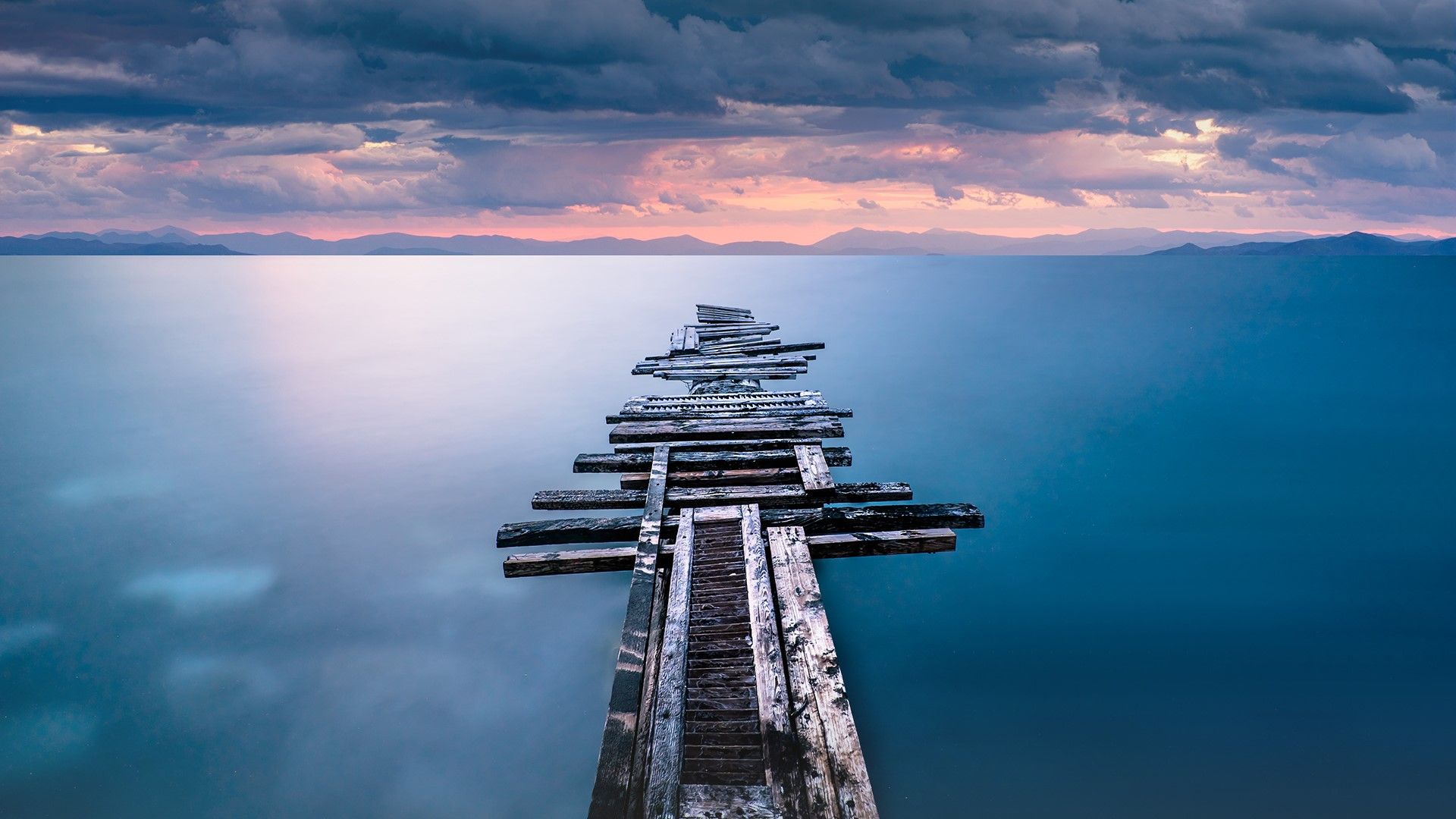
In James Joyce’s Ulysses, one of the main characters, Stephen Dedalus, calls a pier

a “disappointed bridge”—would you agree?

And remember that, as always, there’s

MTCIDC

O

Sally—and Harry

22 Wednesday Jan 2025

Posted by Ollamh in Uncategorized

≈ Leave a comment

Tags

Alesia, Aragorn, Ents, Eomer, Fantasy, harry, Helm's Deep, History, sally, siege

Welcome, as always, dear readers.

If you’d seen the title of an earlier posting, “You’ve Got Mail”,

you might believe that I’m beginning to specialize in romcoms from the 1980s-90s with this title—

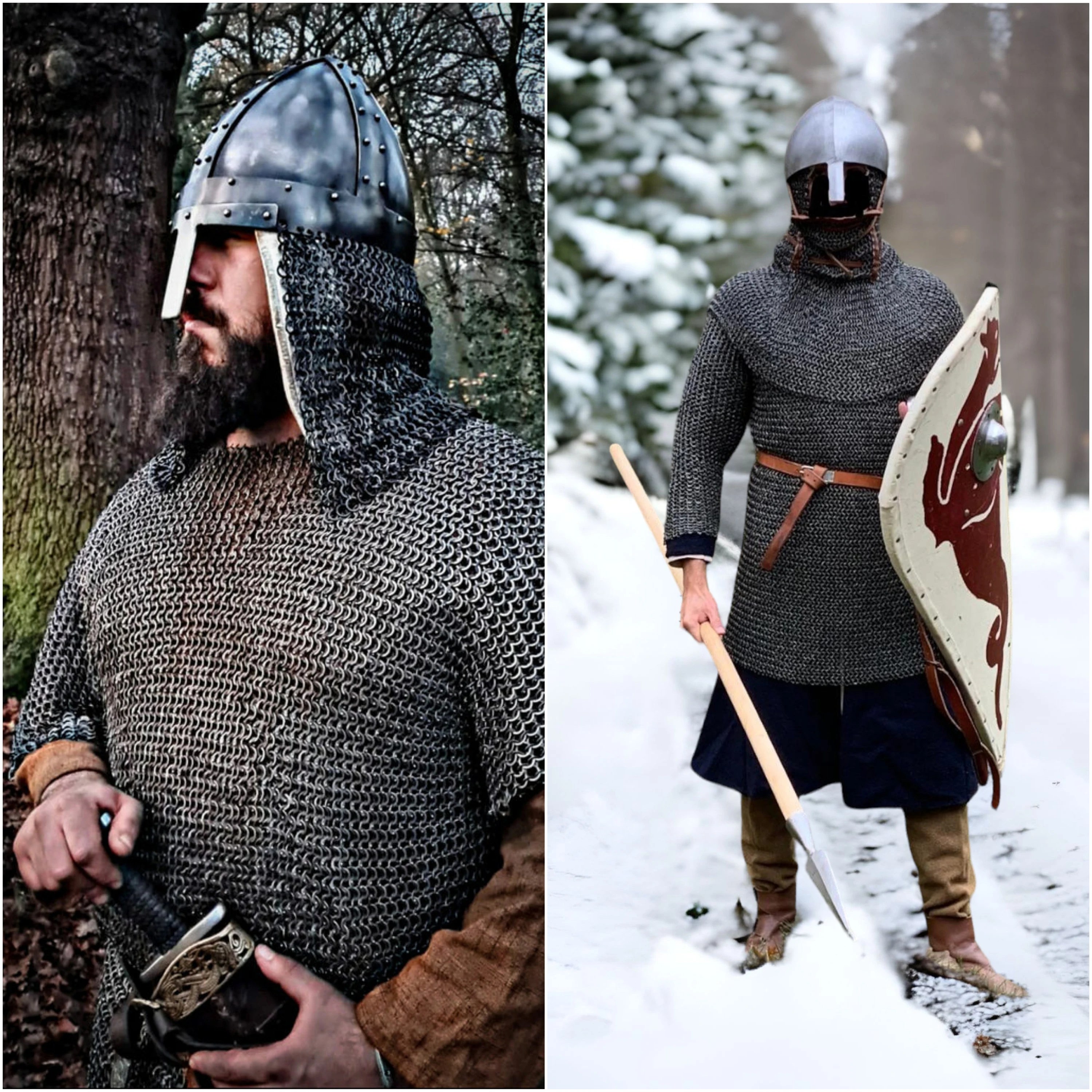
but, although some of the characters might be wearing mail in this posting,

(Denis Gordeev)

there’s no romance and no comedy.  Instead, it involves “sally” and “harry” not as nicknames for “Sarah” and “Henry”, but as verbs and nouns of destruction.

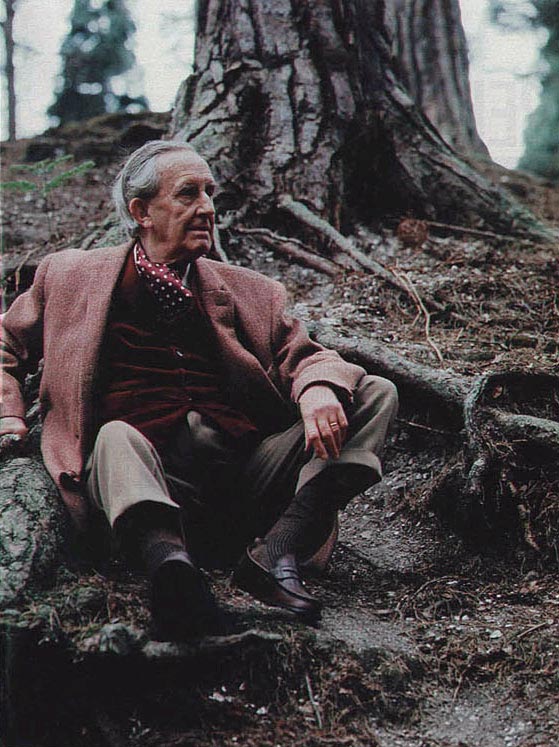
The war to which 2nd LieutenantTolkien

arrived in mid-1916

(Peter Dennis—a real favorite of mine for his ability to recreate scenes from the past, always with small, useful details.)

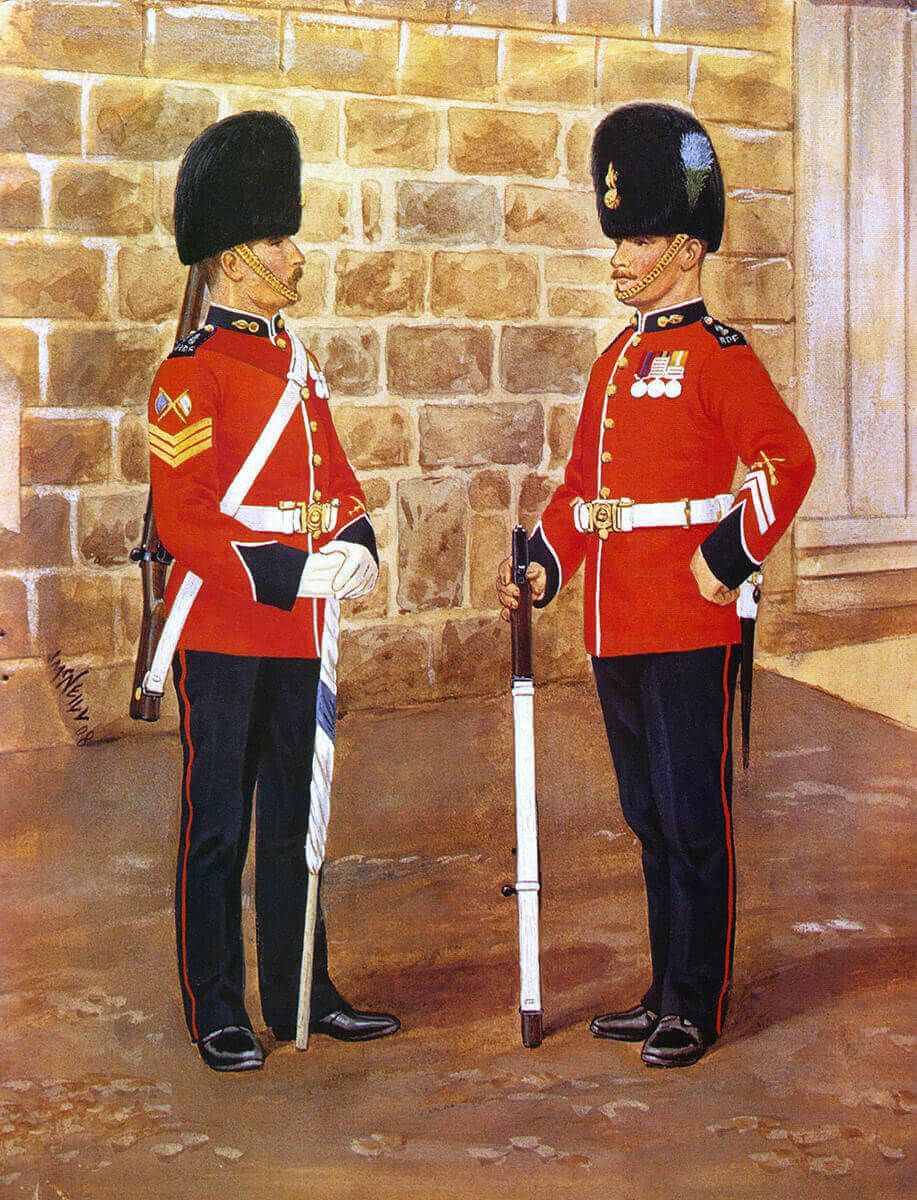
was not the war planned in 1913.  Into a world in which soldiers still wore fancy dress for parades—

(artist:  possibly Brian Fosten?)

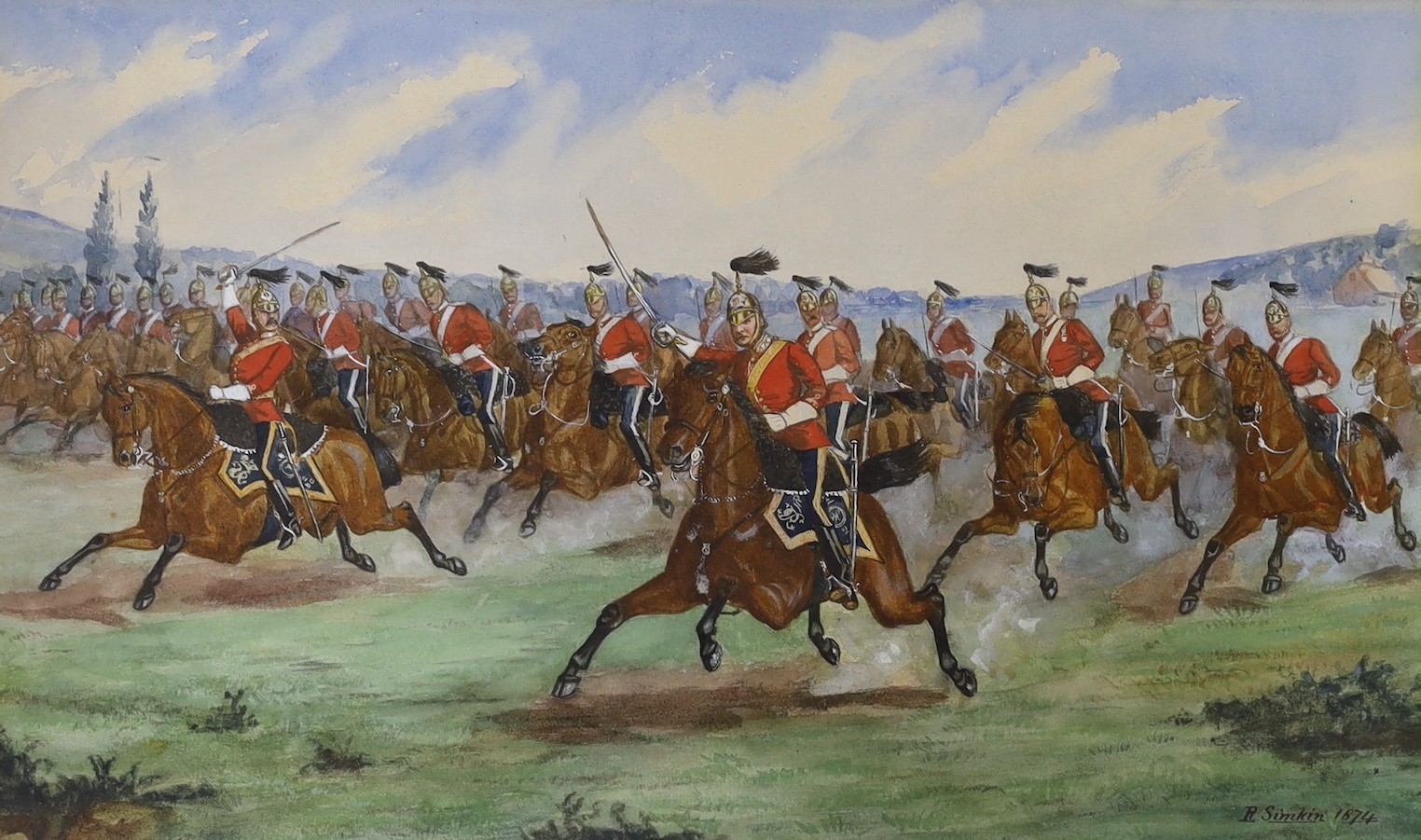
and cavalry officers still dreamed of heroic charges,

(Richard Simkin)

came these

and this sort of thing

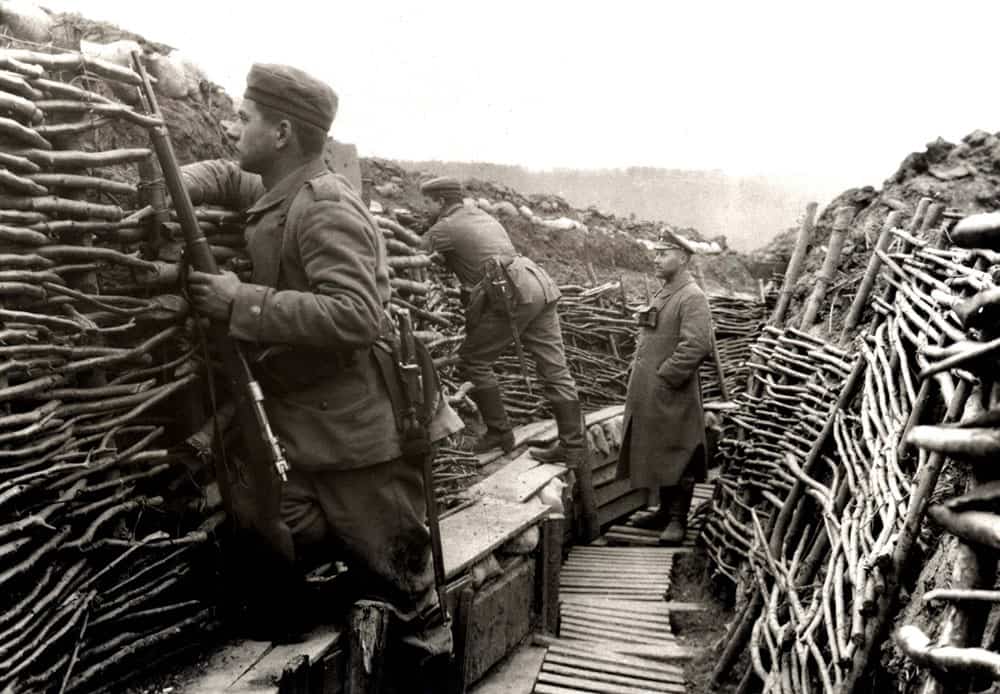
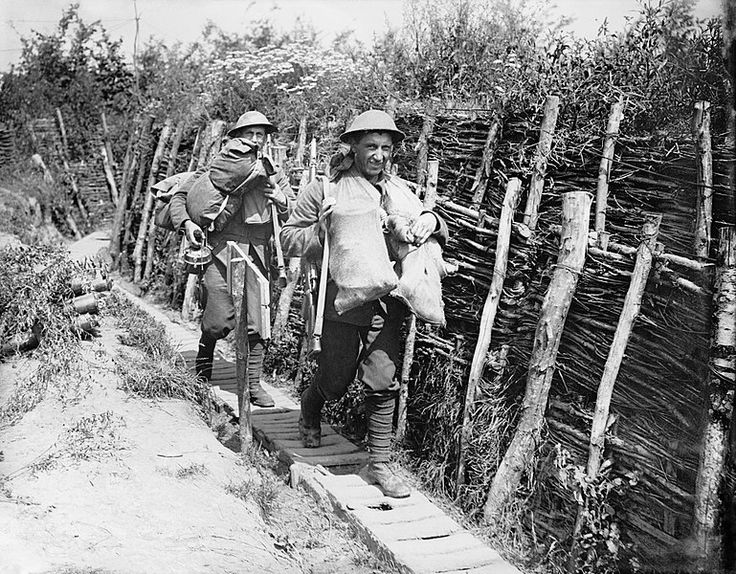
with many other horrors to come and soldiers did the only sensible thing, given that they couldn’t just run for their lives, and began to dig in.

(another Peter Dennis)

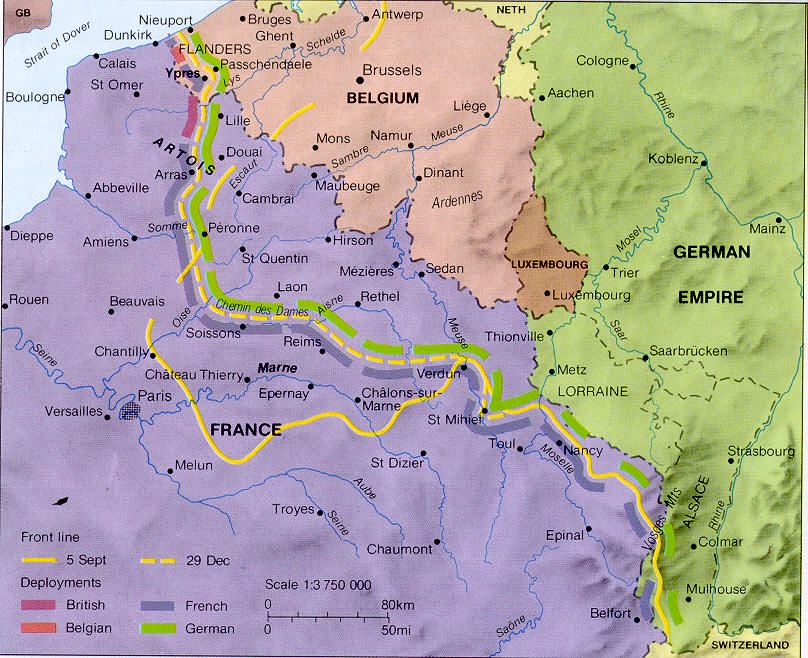
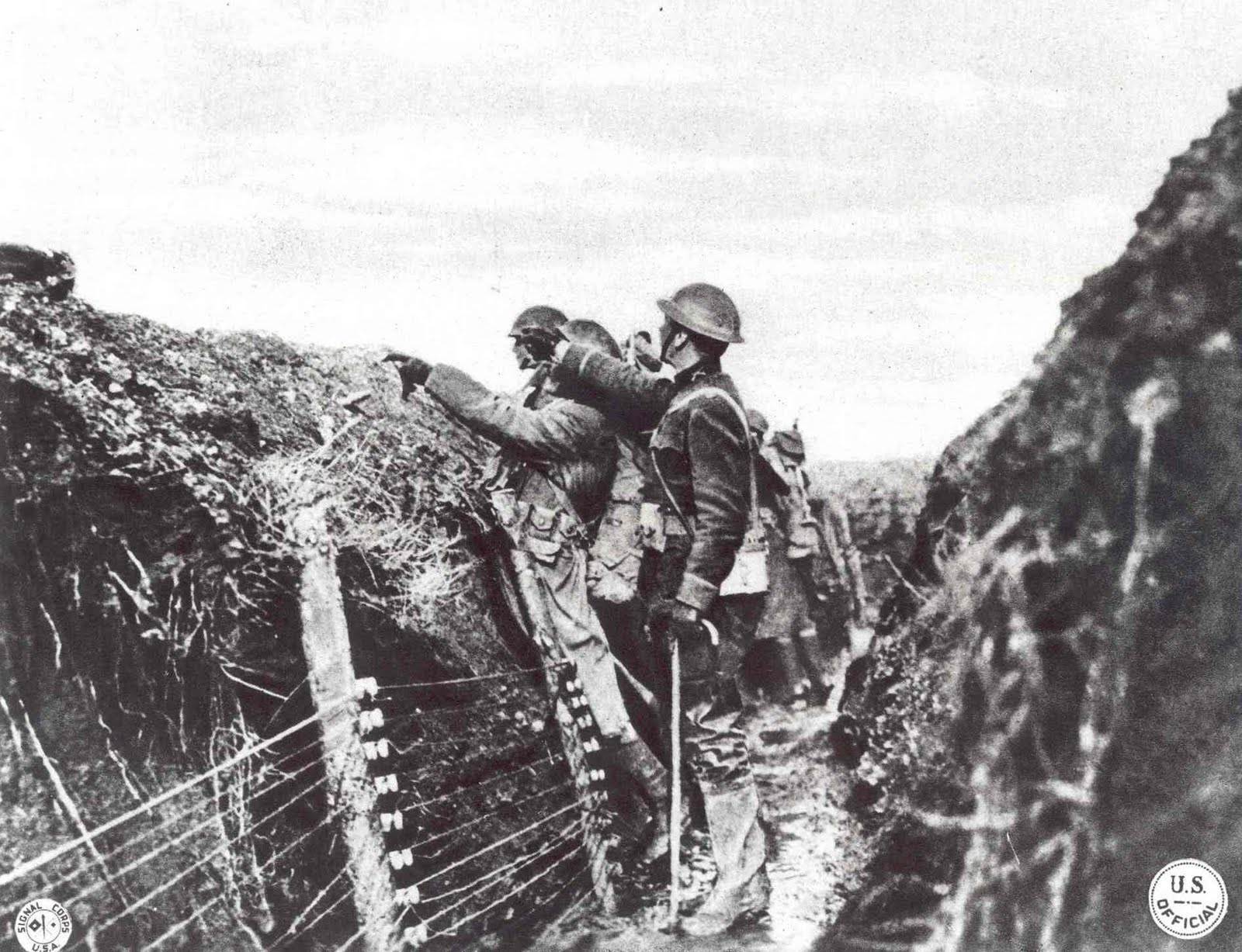
On the Western Front, where Tolkien served, this eventually meant 500 miles of such digging, from Switzerland to the North Sea, until, ultimately, there were two lines of trenches, one German, one Allied, now facing each other.

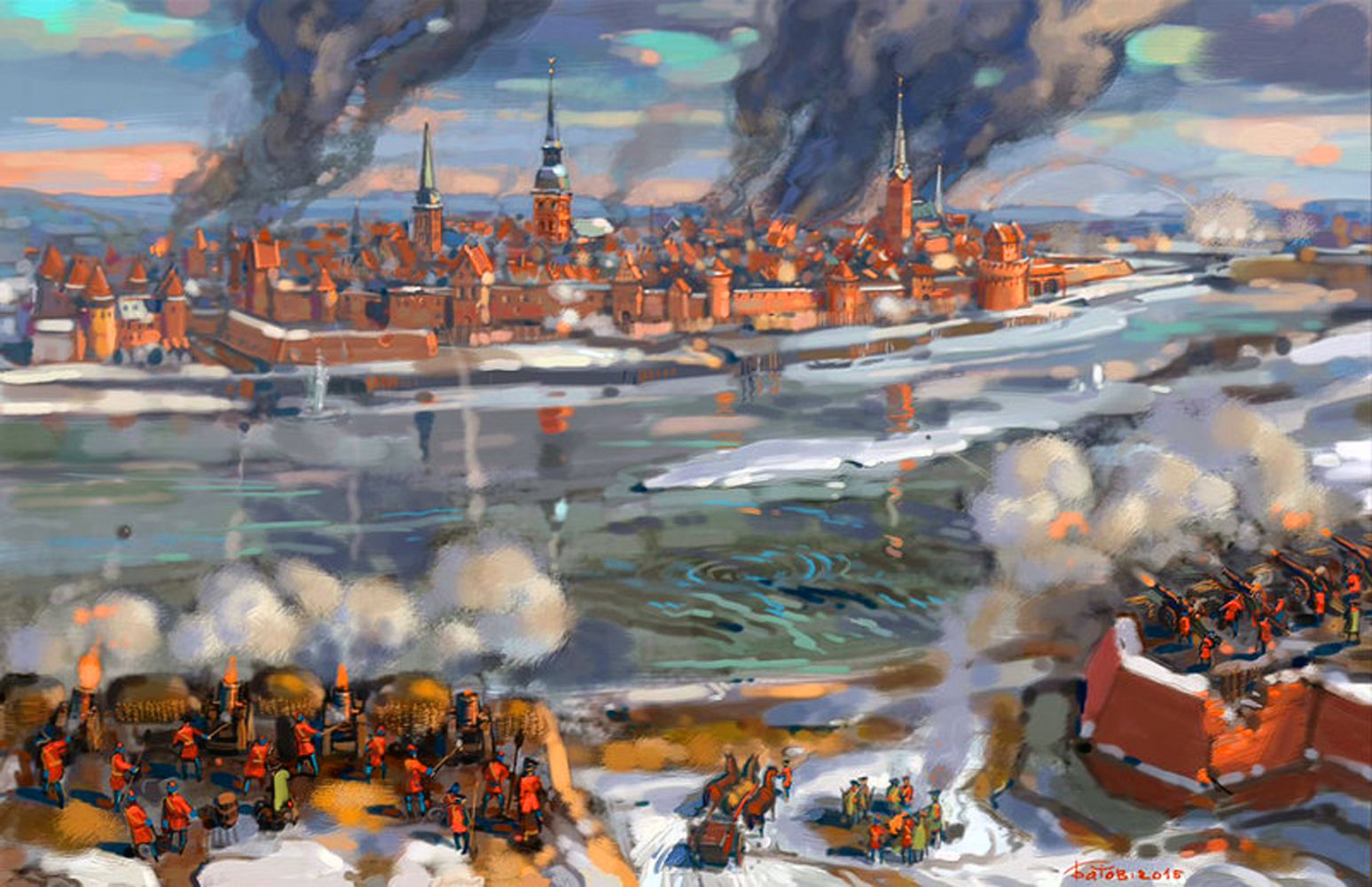
People at the time were reminded of what was called siege warfare, which, in the past had meant that an army surrounded a town or a fortress, blocking access to it from the outside, usually dug trenches to mark off the area and to protect their own soldiers and, depending upon the era and its weaponry, use various war machines against the walls and those inside.

(Julius Caesar’s siege of the Gallic stronghold of Alesia, 52bc)

(a kind of idealized medieval siege by Liliane and Fred Funcken)

(the siege of Swedish-occupied Riga by the Russians in 1710, by an artist whose name appears to be “Batov”)

The difference, in this case, being that both sides seemed to be besieging the other and neither was surrounding or surrounded.

During his stay on the Western Front in 1916, Tolkien participated in a massive assault on sections of the German lines—the Battle of the Somme—in which the British suffered over 50,000 casualties on the first day alone.

(and another Peter Dennis

Big battles like this were relatively rare, however, as they required so much planning and such great resources, but, in between them, soldiers raided each other’s trenches, both to keep their own soldiers busy and to keep the enemy off balance, as well as to gain intelligence from prisoners and captured documents.

(and a further Peter Dennis)

In older, traditional sieges, the besieged might try to do the same, as well as ruin the besiegers’ siege artillery and trenches, even carrying off the enemy’s entrenching tools.  This was called a “sally”, and here we can see the besieged Gauls trying this maneuver out at Caesar’s siege of Alesia in 52BC

(and yet another Peter Dennis)

and here are Texian volunteers sallying from the Alamo to destroy shacks (jacales) being used by Mexican skirmishers in 1836.

(Gary Zaboly)

“To sally” comes from French saillir, “to leap/jump”, and clearly implies “to jump out at someone”, preferably unexpectedly, and that’s why some fortresses have sally ports—

(this is at Fort Mifflin, on the Delaware River south of Philadelphia)

smaller gates which could be used for surprise attacks on attackers.  And, when you sally, your job is to harry the enemy, “to harry” coming from Old English hergian (HAIR-yee-an), “to harass/plunder/ravage”, among other warlike definitions.

Tolkien, perhaps with a strong memory of trench warfare, along with a reminiscence of the desperate Gauls at Alesia, recreates one of these attacks at Helm’s Deep, where Saruman’s army of orcs and Dunlendings has begun its assault upon the outer wall.

(the artist listed for this is “Brokenhill”, but the only one I could find was an art commune in Australia, which I’m hoping is correct and which you can visit here:  https://artofbrokenhill.com/ )

Strictly speaking, this isn’t really a siege, any more than the attack on Minas Tirith is really a siege, even though that’s the chapter title.  Rather, it’s an escalade—an assault by ladder, which has always struck me as about the last siege attack I’d join—look at what’s happening in this one—would you want to be on the top of a rickety ladder?

Included in the escalade is an attempt to break through the main gates:

“Again the trumpets rang, and a press of roaring men leaped forth.  They held their great shields above them like a roof, while in their midst they bore two trunks of mighty trees.  Behind them orc-archers crowded, sending a hail of darts against the bowmen on the walls.  They gained the gates.  The trees, swung by strong arms, smote the timbers with a rending boom.” 

That “like a roof” is, basically, a Roman formation called a “turtle”—a testudo—used in exactly the same way in Roman assaults.

(from the column of Trajan, showing Roman infantry attacking a Dacian town)

The tree trunks are improvised battering rams—although classical ones could be tipped with metal to make them more effective—

In response, Aragorn and Eomer, with “a handful of stout swordsmen”, attempt a sally: 

“There was a small postern-door that opened in an angle of the burg-wall on the west, where the cliff stretched out to meet it…Together Eomer and Aragorn sprang through the door, their men close behind.  The two swords flashed from the sheath as one.”

Initially, this harrying of the enemy is successful, driving them back from the gate, but then there are too many of them and Eomer is grabbed by two of the Orcs, only to be rescued by the sudden appearance of Gimli, as the sally party dodges back inside the postern/sally port, which is closed behind them.

(Donato Giancola—I’ve recommended his site before—and here it is:  https://donatoarts.com/ )

But this is only the first sally—Theoden, fretting at the rapidly decaying defensive situation, as Saruman’s early blasting powder blows holes in the ancient walls of the Deep, makes a second attack, although, this time, it seems more like the action of despair, rather than a good tactic:

“But I will not end here, taken like an old badger in a trap.  Snowmane and Hasufel and the horses of my guard are in the inner court.  When the dawn comes, I will bid men sound Helm’s horn and I will ride forth.  Will you ride with me then, son of Arathorn?  Maybe we shall cleave a road, or make such an end as will be worth a song—if any be left to sing of us hereafter.”  (this, as well as all of the previous quotations, are from The Two Towers, Book Three, Chapter 7, “Helm’s Deep”)
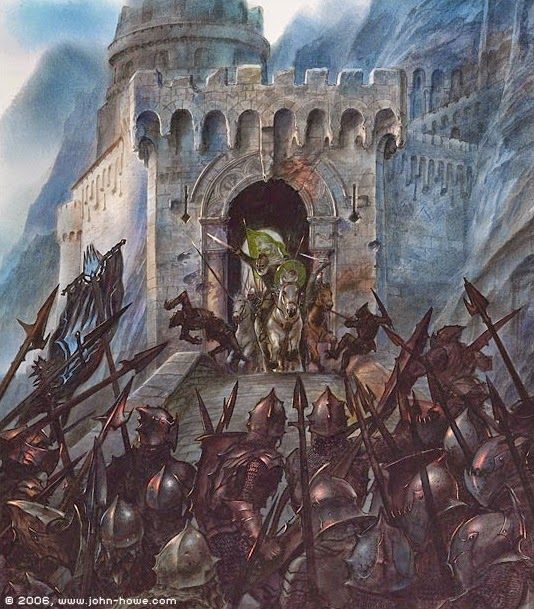
(Alan Lee)

It’s not, of course, a suicidal charge, as Gandalf arrives with re-enforcements and then there are the Ents, so the sally harries the Orcs to their doom among the trees

and, although there is, as I said at the beginning, neither comedy nor romance, this sally, like the romcom, has a happy ending.

As always, thanks for reading.

Stay well,

When deep in a forest, never sneer at the trees—someone might be listening,

(Alan Lee)

And remember that, also as always, there’s

MTCIDC

O

Orc Logistics

10 Wednesday Jul 2019

Posted by Ollamh in Economics in Middle-earth, J.R.R. Tolkien, Military History, Military History of Middle-earth

≈ 1 Comment

Tags

American Civil War, BEF, Belgium, British Expeditionary Force, food and ammunition, French Army, German Army, Great War, guerilla, Helm's Deep, Horace Smith-Dorrien, Le Cateau, Marius, Marius' mules, Minas Tirith, Mons, Orcs, Paris, Romans, Schlieffen, Schlieffen Plan, The Lord of the Rings, Tolkien, Wagons, World War I

Welcome, as always, dear readers.

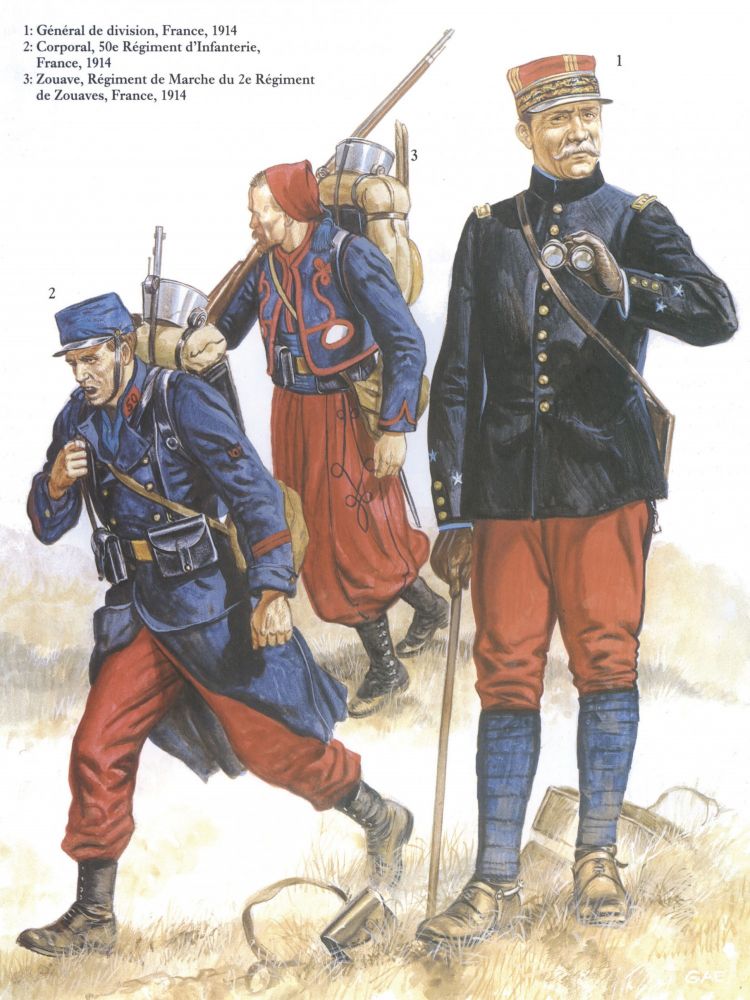
In August, 1914, as the German army was pushing through Belgium

image1germanarmy.jpg

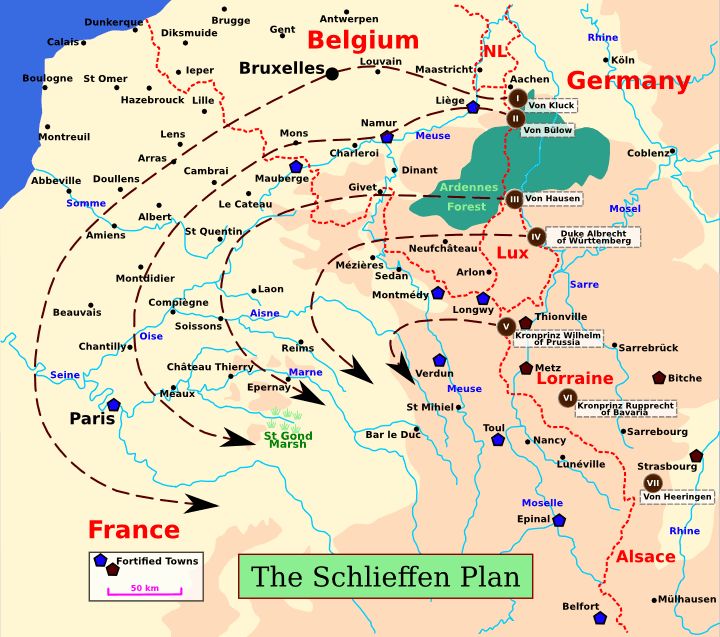
in its attempt to sweep to the west of Paris and drive the French armies

image2french.jpg

eastwards towards the Germans waiting for them there (the so-called Schlieffen Plan),

image3schlieffen.jpg

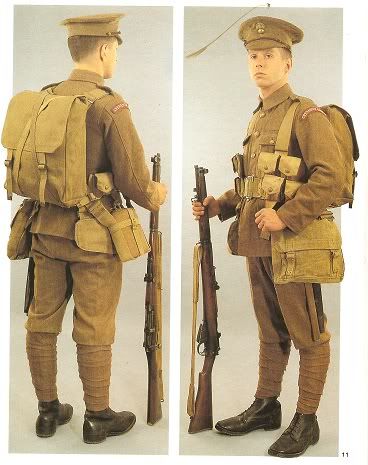
they were met by the small (70,000 man) BEF, British Expeditionary Force,

image4tommy.jpg

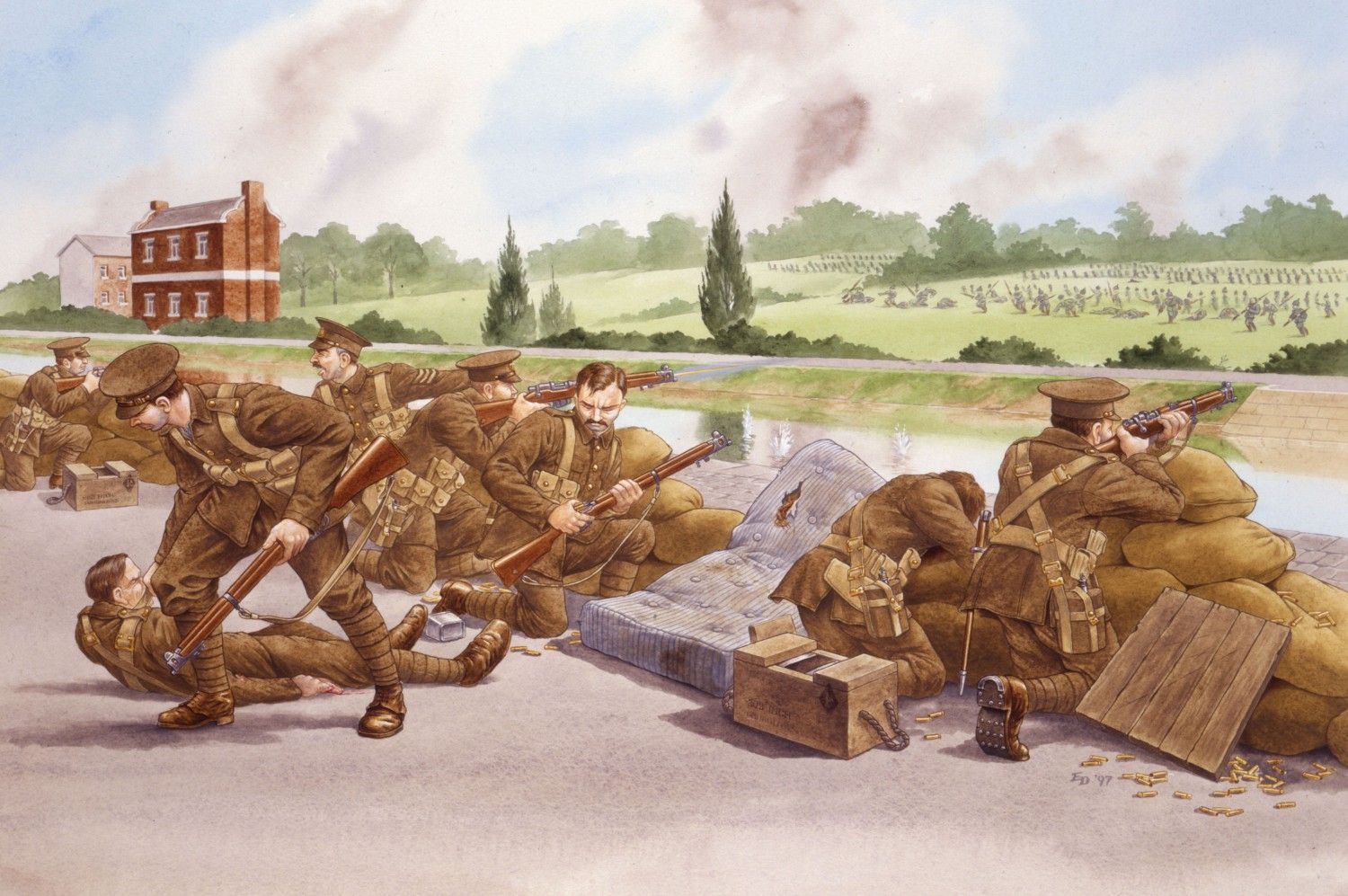
a few miles north of the Franco-Belgian border, near the town of Mons, where the British fought a delaying action.

image5mons.jpg

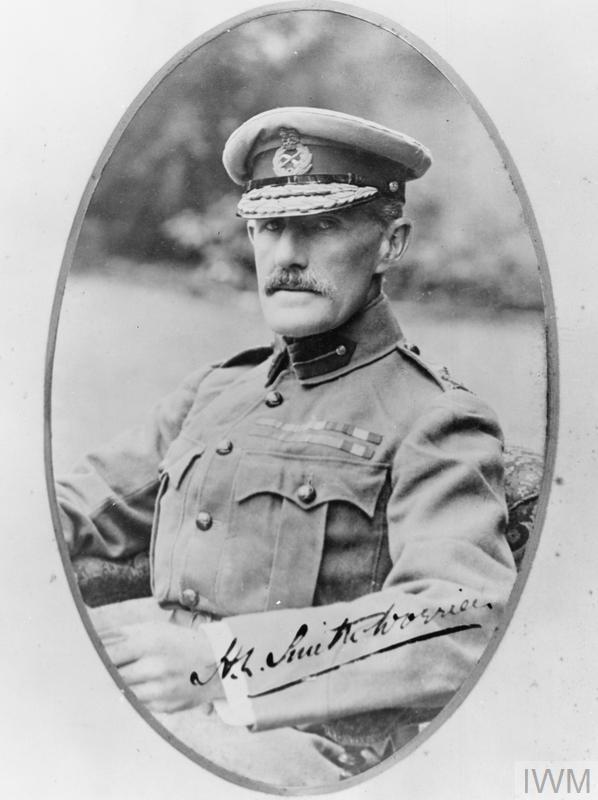
The Germans were in such strength that the British were forced to pull back, retreating southward with the Germans pursuing so closely that the commander of one half of the British army (2nd Corps), Horace Smith-Dorrien,

image6hsd.jpg

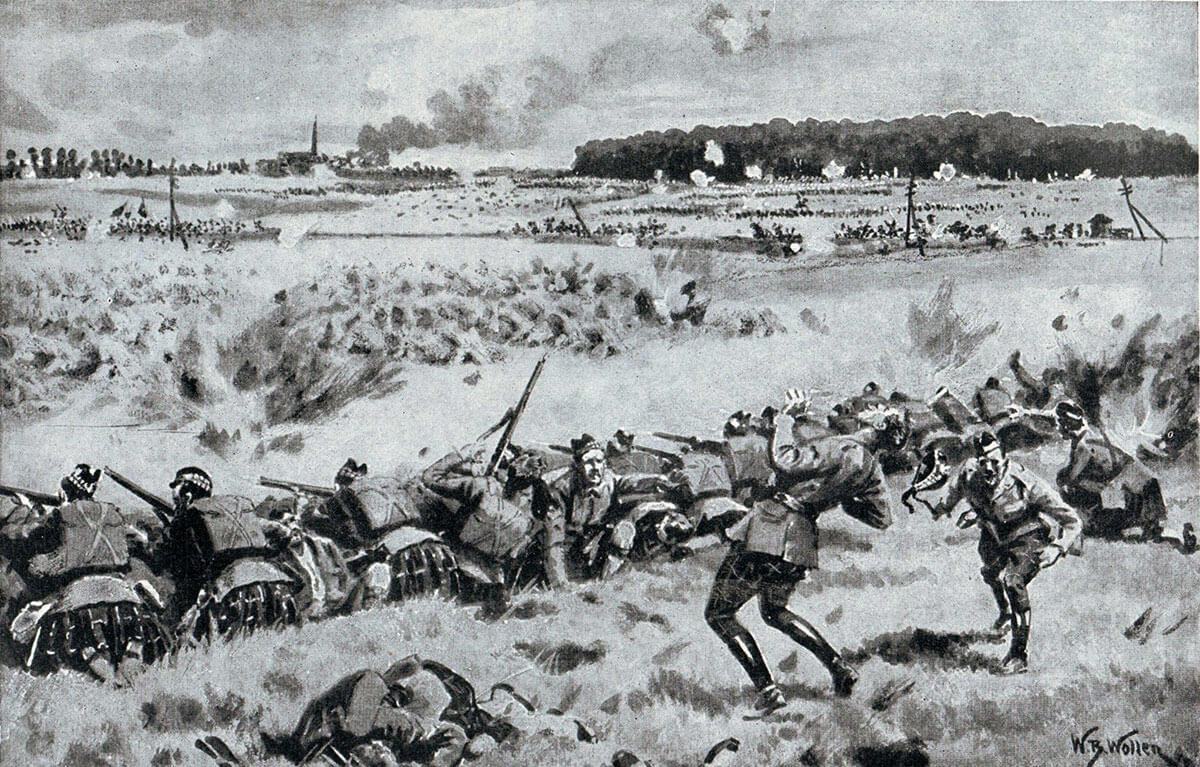
decided that it was necessary to fight a second delaying action, at Le Cateau.

image7lecateau.jpg

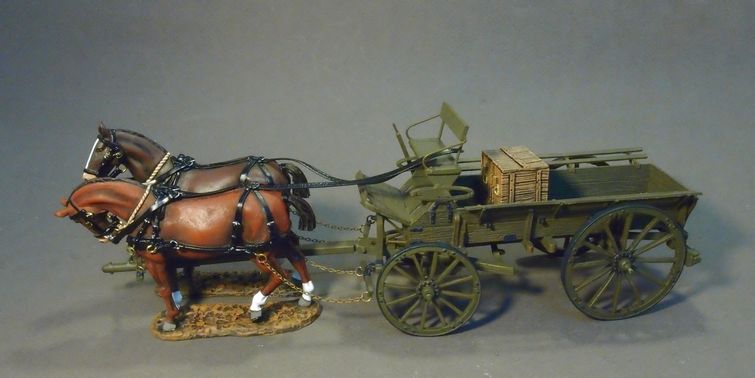
A major reason to do so was not just that the German pursuit was so close, but that it was necessary to protect the trains.  This doesn’t mean the railways, but the endless lines of wagons

image8gswagon.jpg

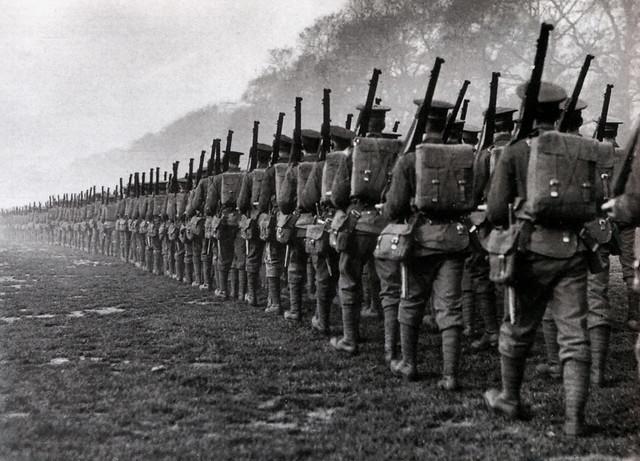
which carried all the food and ammunition for the soldiers and stretched for miles behind them..

image9marching.jpg

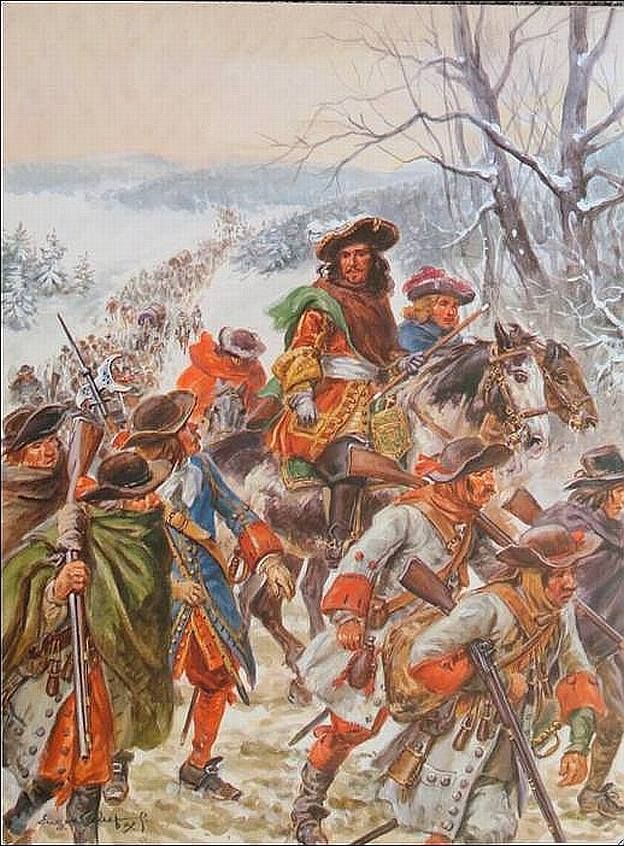
It was also primarily horse-drawn and, on narrow roads, mostly unpaved, the trains moved very slowly, which was a major reason why armies in earlier centuries rarely ever campaigned during winter.

image10turenne.jpg

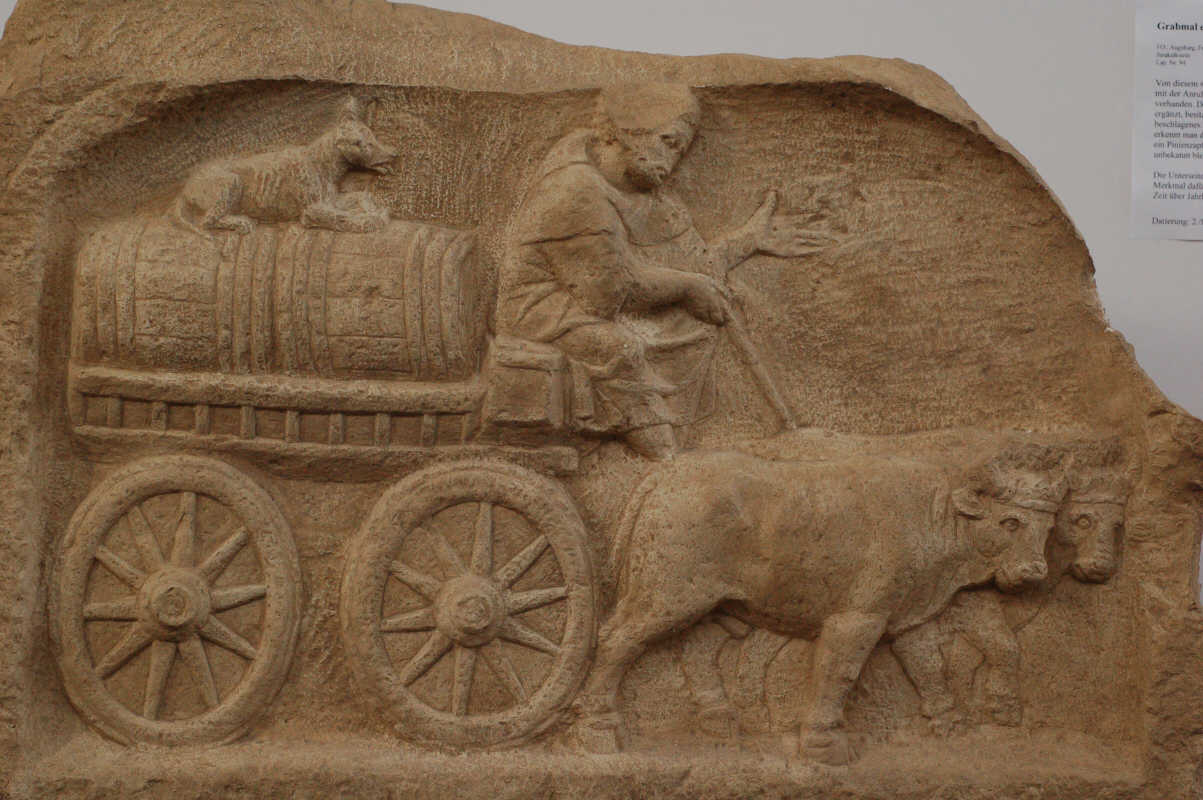
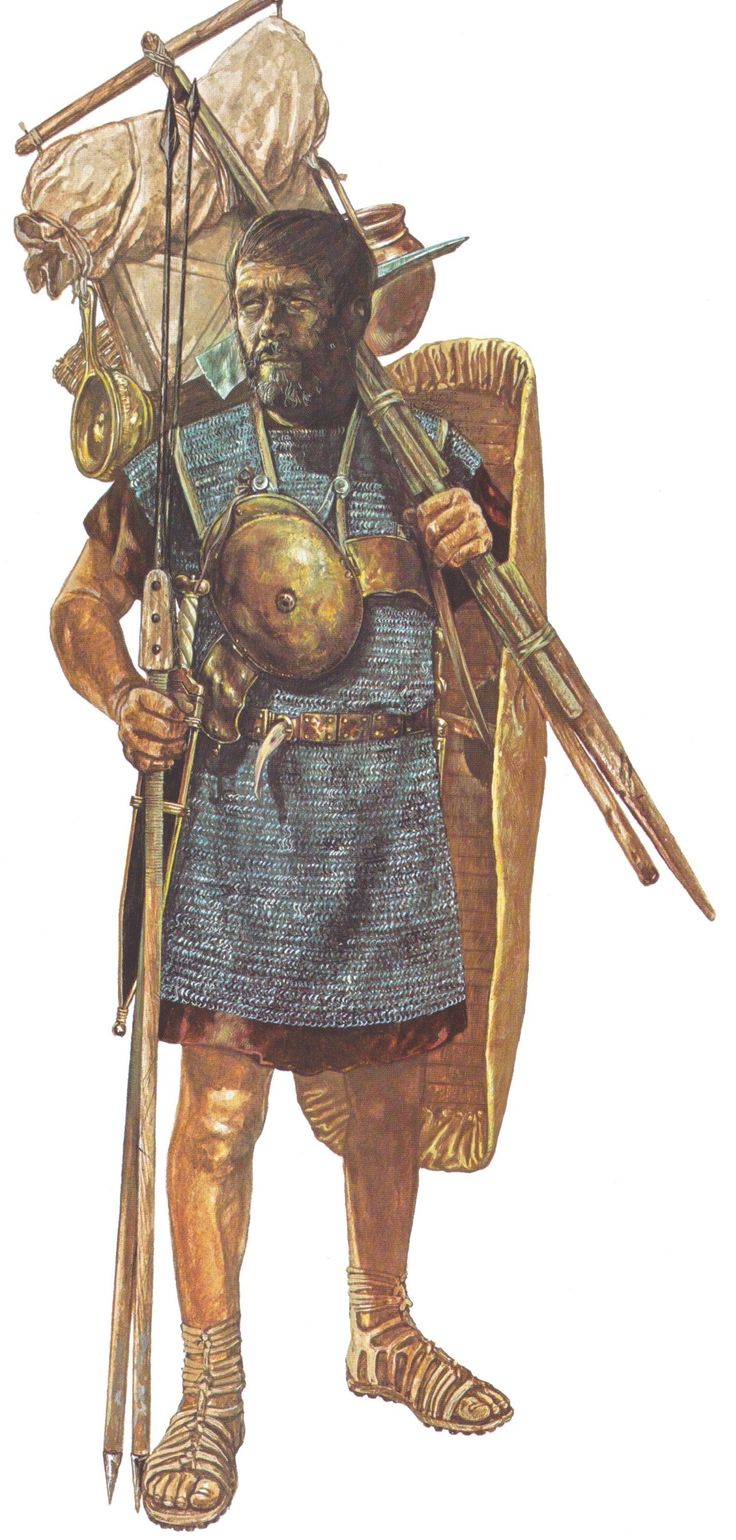
This was a problem, all the way back to the Romans.  In the 2nd century BC, the Roman general, Marius, in an attempt to do away with as much of a baggage train as he could,

image11romanwagon.JPG

ordered his men to carry as much of their equipment as possible, thus cutting down on baggage wagons and pack animals.  His men were less than pleased at being so loaded down and began to call themselves “Marius’ mules”.

image12mule.jpg

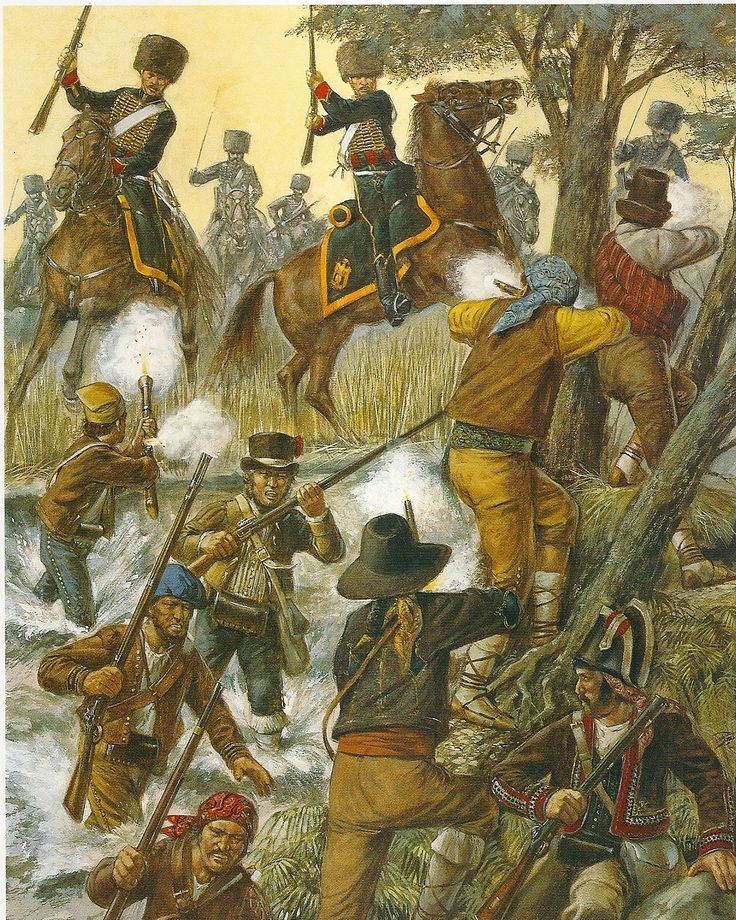
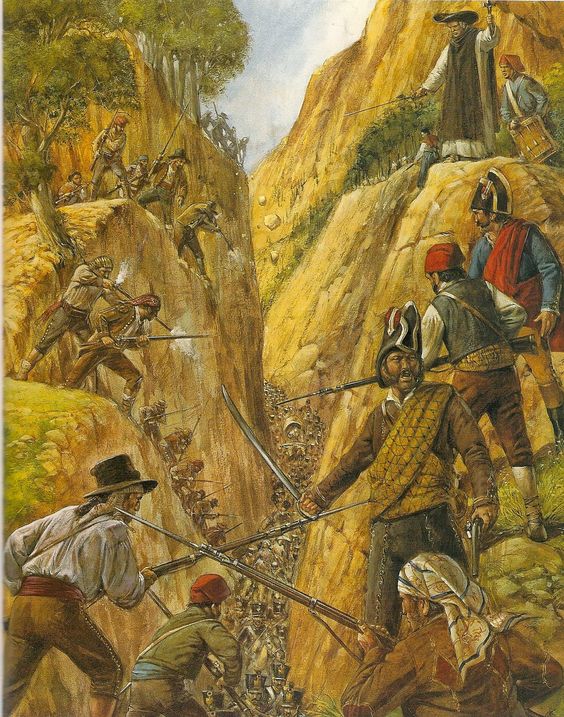
In the late 18th to early 19th century, when French revolutionary armies swelled beyond the ability to pay to supply them, the order was to travel lightly and to live off the land.  This may have reduced baggage—and even, perhaps, speeded up movement—but it made local people very hostile to the French and, in Spain, the response was to ambush the French whenever possible, which is where the word “guerilla” (originally meaning “little war”) comes from.

image13spguerillas.jpg

image14spguerillas.jpg

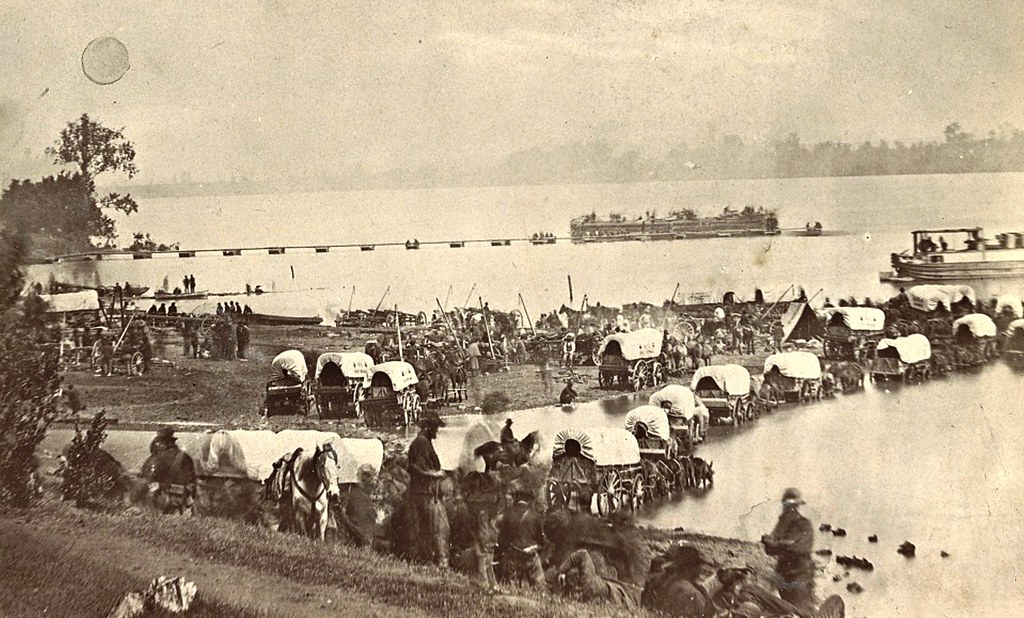
This could happen, particularly to Union supply trains,

image15wagons.jpg

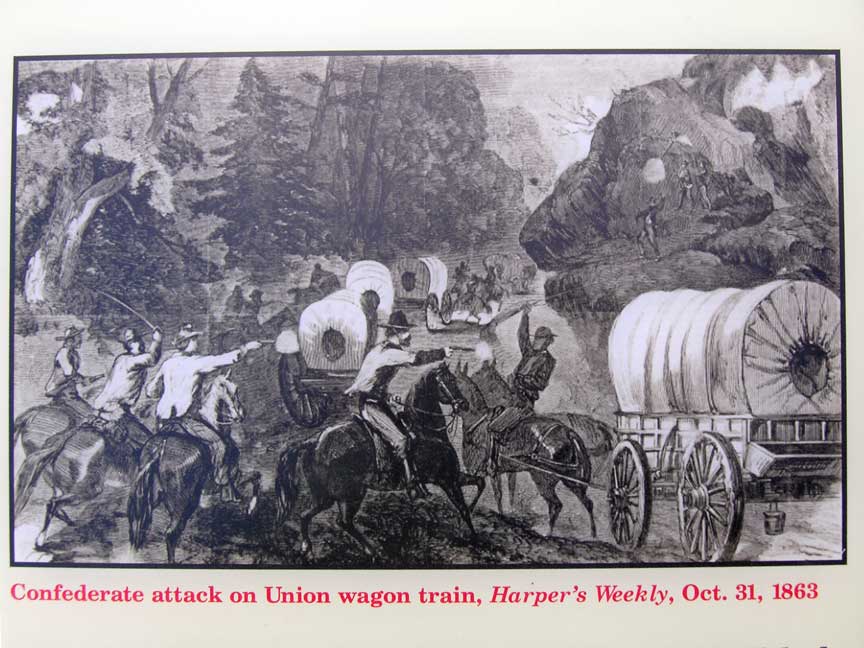
during the American Civil War.

image16ambush.jpg

So, such trains were utterly necessary—if a large army had to cross miles of territory and perhaps fight on the way, they would need everything a train could carry.  At the same time, trains could be both vulnerable and thus draw off numbers of soldiers to protect them when such soldiers might be better employed on the battlefield, as well as cumbersome, because they were slow-moving, forcing armies to march at their speed (and in dry summer weather, the dust they raised could give away the direction of an army’s movements).

image17wagontrain.jpg

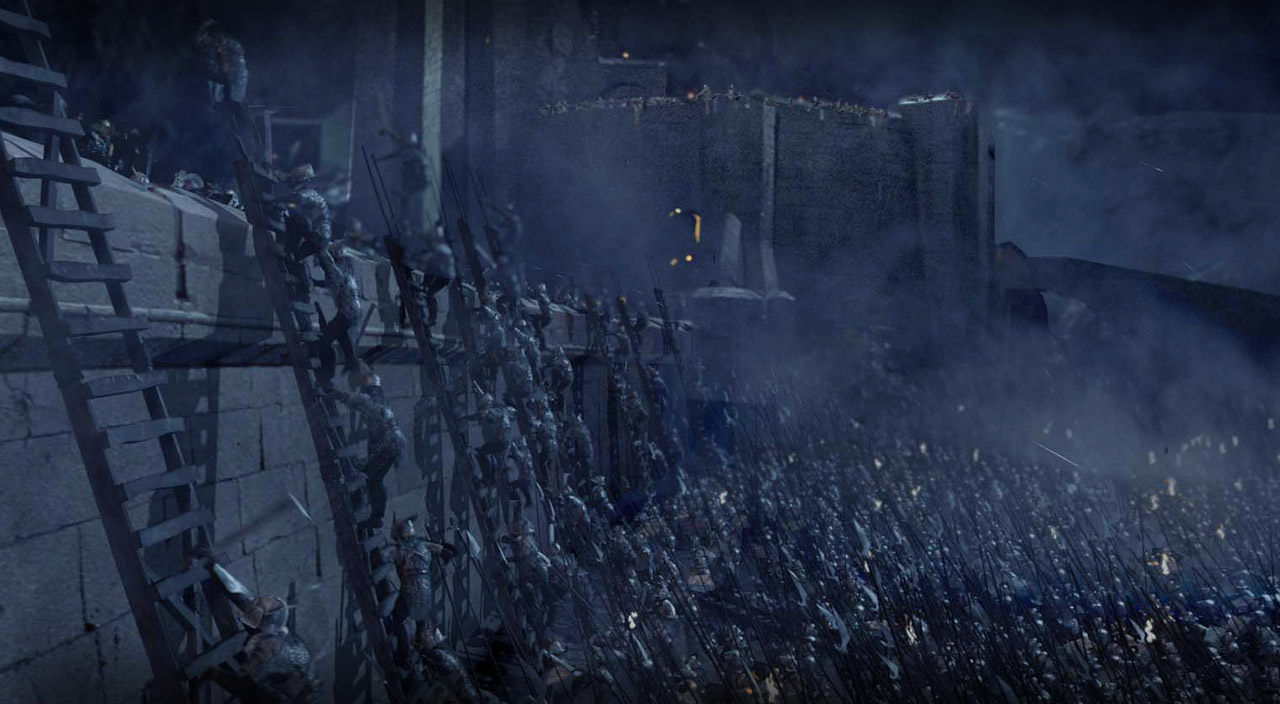
In The Lord of the Rings, we see two invasions:  that which attacks Helm’s Deep

image18helms.jpg

and that which attacks Minas Tirith.

image19mt.jpg

The mass of invaders is vividly described:

“For a staring moment the watchers on the walls saw all the space between them and Dike lit with white light:  it was boiling and crawling with black shapes, some squat and broad, some tall and grim, with high helms and sable shields.  Hundreds and hundreds more were pouring over the Dike and through the breach.”  (The Two Towers, Book Three, Chapter 7, “Helm’s Deep”)

“The numbers that had already passed over the River could not be guessed in the darkness, but when morning, or its dim shadow, stole over the plain, it was seen that even fear by night had scarcely over-counted them.  The plain was dark with their marching companies, and as far as eyes could strain in the mirk there sprouted, like a foul fungus-growth, all about the beleaguered city great camps of tents, blac or somber red.” (The Return of the King, Book Five, Chapter 4, “The Siege of Gondor”)

And yet there is no hint of what will supply them in their assaults and beyond.  We could argue, of course, that, as in so many things, JRRT is interested in the movement of his narrative and its effects:  masses of orcs are much more menacing than long lines of wagons, and we’re sure that this is actually the case, but there is another possibility.  The Great War began in Belgium as a war of movement, huge armies attempting to outflank and block each other like chess players.  For better or worse, those armies needed such baggage trains, as we’ve said.  By the time Tolkien had arrived at the Western Front, in mid-1916, the war had become static, as if both sides had dug trenches and were besieging each other.

image20atrench.jpg

image20trench.jpg

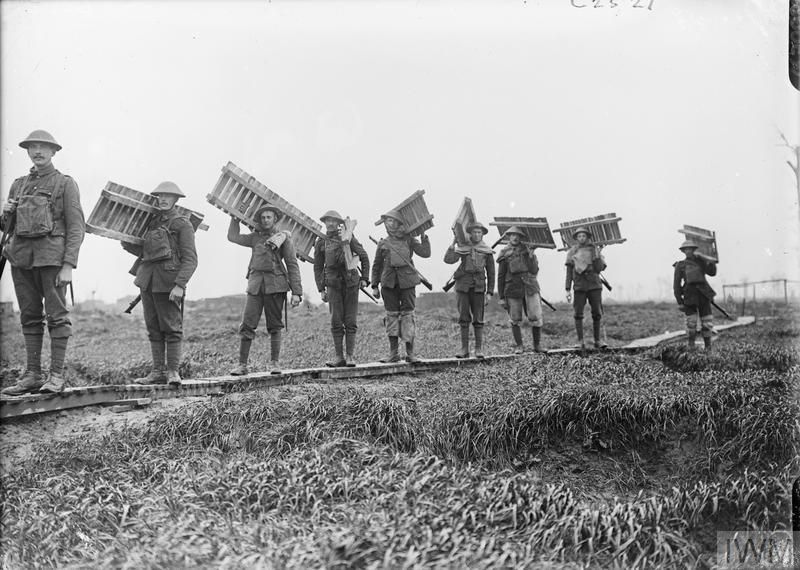
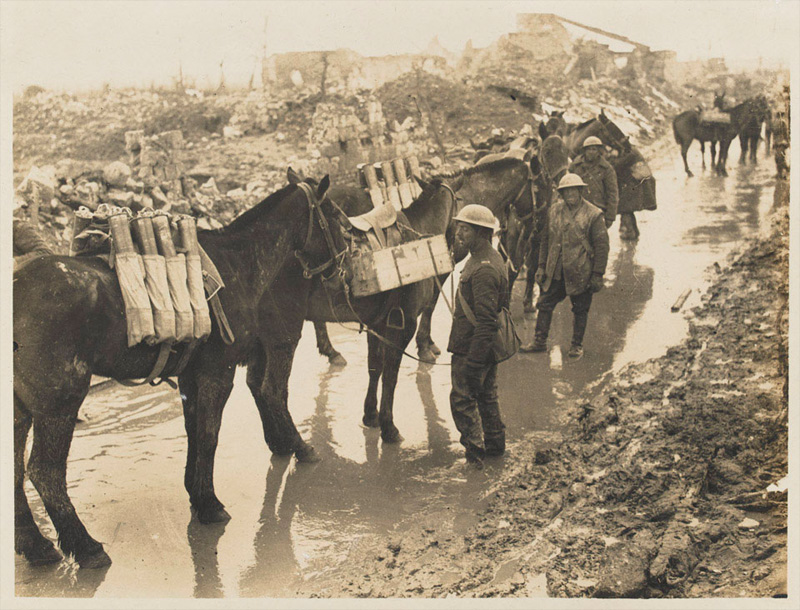
Supply was clearly still necessary, but it was a complex combination of ports and ships and railway lines and wagons and mules and even human mules, close to the front.

image21.jpg

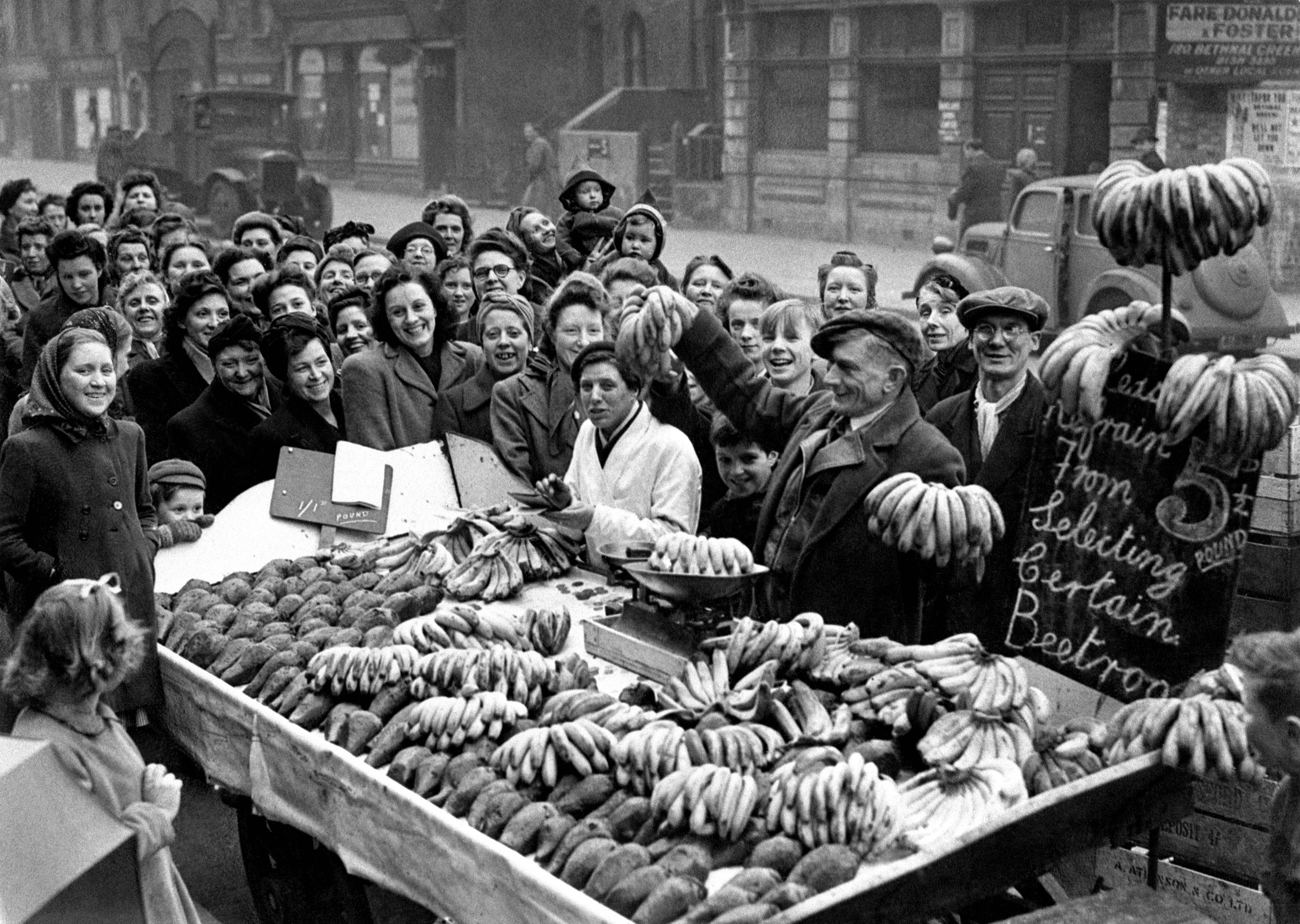
In a way, the whole business of supply had begun to look like just that:  a business, like importing bananas from the Caribbean, having them arrive in London, then passing them on by train to cities and towns across Britain.

image22bananas.jpg

So, instead of being part of long marching columns,image23marching.jpg

their even longer lines of wagons lagging behind, Second Lieutenant Tolkien would have seen long lines of men and animals, lugging endless boxes and cans and bundles—

image24carrying.jpg

image25carrying.jpg

necessary for war, but hardly dramatic, and so best left to the imagination of certain readers, those who can never see a battle without wondering, “When it’s time for lunch, who feeds all of those soldiers—or orcs (and never mind what certain people might eat)?”

image26lunch.jpg

As always, thanks for reading and

MTCIDC

CD

Gun Control?

08 Wednesday May 2019

Posted by Ollamh in J.R.R. Tolkien, Military History

≈ Leave a comment

Tags

anachronism, Dettingen, Fireworks, Gandalf, George Frederich Haendel, gunpowder, guns, Helm's Deep, kettle drums, King George II, Millemete Manuscript, petard, Rammas Echor, The Hobbit, The Lord of the Rings, The War of Austrian Succession, Tolkien

Welcome, dear readers, as always—and with our apology if you googled “gun control” and are a bit puzzled as to what has turned up (this often happens with us, making us wonder how googling images of “Saruman” suddenly produces a picture of sardines).

It’s our last posting which got us into this.  We had spotted another anachronism in The Hobbit (clarinets) and had written about it, but then, as a teaser, had concluded with another, referring to Beorn’s joining the Battle of the Five Armies:  “The roar of his voice was like drums and guns…” (Chapter 18, “The Return Journey”)

“Guns” had, of course, stood out.  Some time ago, we had written about Saruman’s use of some sort of explosive at Helm’s Deep

image1hd.jpg

as well as the destruction by a similar force of portions of the causeway forts of the Rammas Echor, of which no one has seemingly produced an illustration.

image2rammas.gif

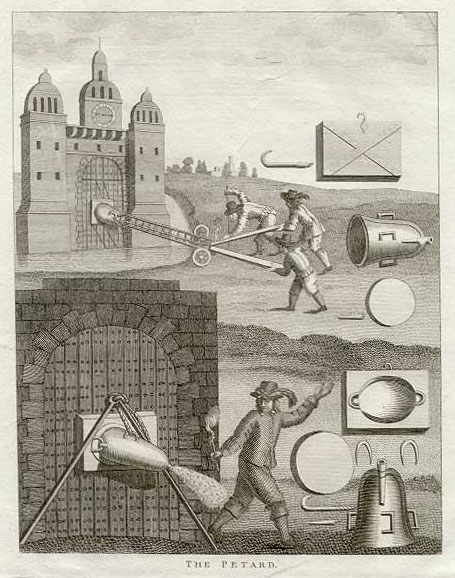
Whatever this force was, it only seems to be used in siegework, suggesting things like a petard

image3petard.jpg

an explosive device used to blow holes in gates and doors.

Guns, however, do not appear in any form in Tolkien’s world—except here.  Of course, when one thinks about it, there isn’t much of a step from using a blast to destroy a door to funneling that force to propel a missile—as we first see in the Millemete Manuscript of 1326-1327.

image4millemete.jpg

This doesn’t appear to be portable, but the basic object is simply a tube on a stick, easy to make, easy to carry

image5handgonne


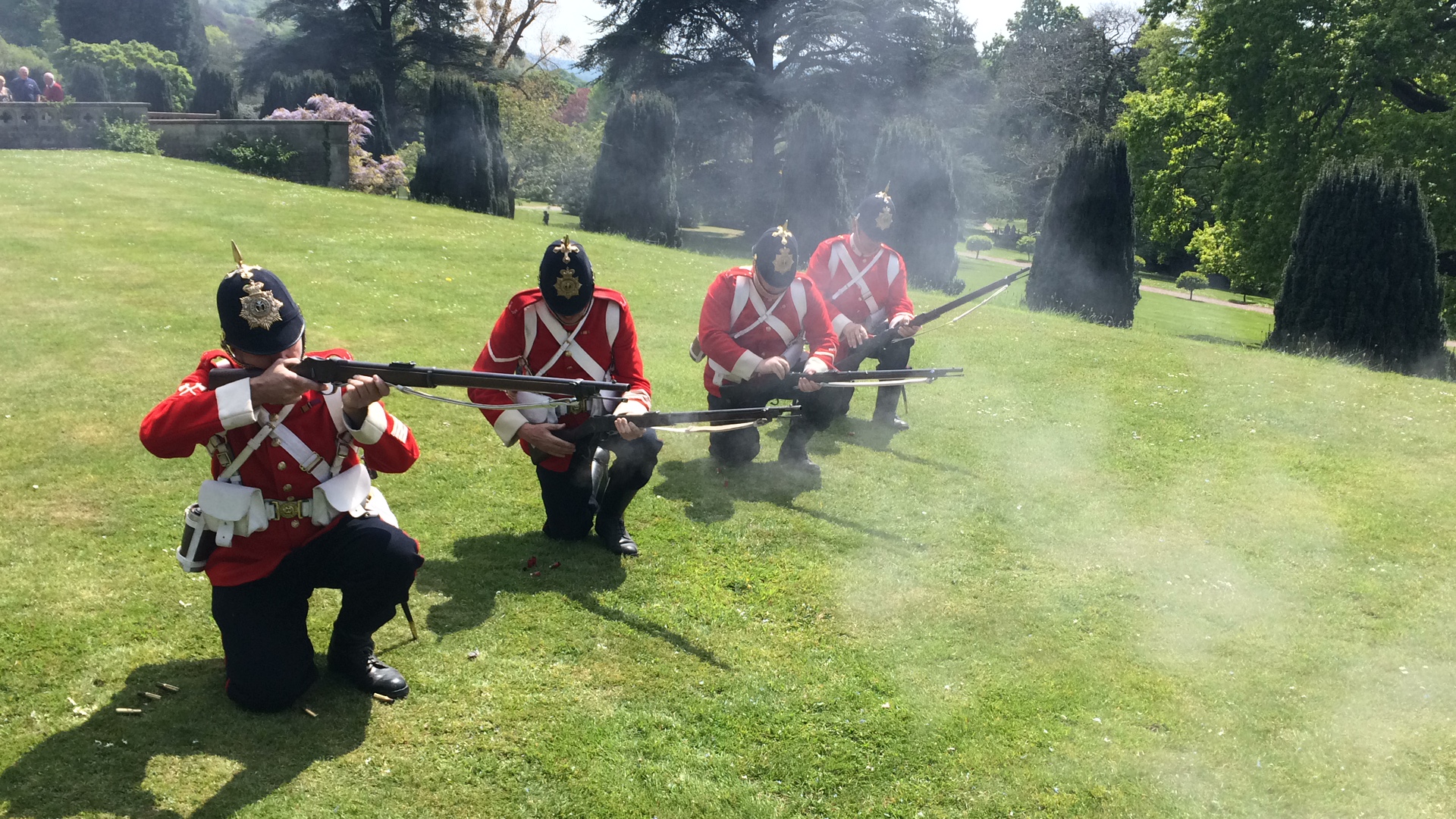
and certainly late medieval people had them and employed them,

image6handgonnes.jpg

so, presumably, they might have appeared in Middle-earth (we once wrote a “what-if” posting on the subject).  Why not?  As JRRT introduced explosives, that seems to provide an opening, but we wonder if he had seen all too often and all too clearly the effect of thousands upon thousands of gunpowder weapons on real people in 1916 and, somehow, the idea of lances and swords seemed more appealing—or, at least, more “heroic”.

image7dead.jpg

image8knights.jpg

But the quotation was “like drums and guns”.

As we pointed out in our last, drums certainly appear in The Lord of the Rings—there is that disturbing reference to “drums, drums in the deep” in The Fellowship of the Ring, Book Two, Chapter 5, “The Bridge of Khazad-dum”, for example.  But what about “the roar of his voice was like drums and guns”?

When we thought about this, we asked ourselves, what would this actually sound like?  A possible answer appeared from 1749.

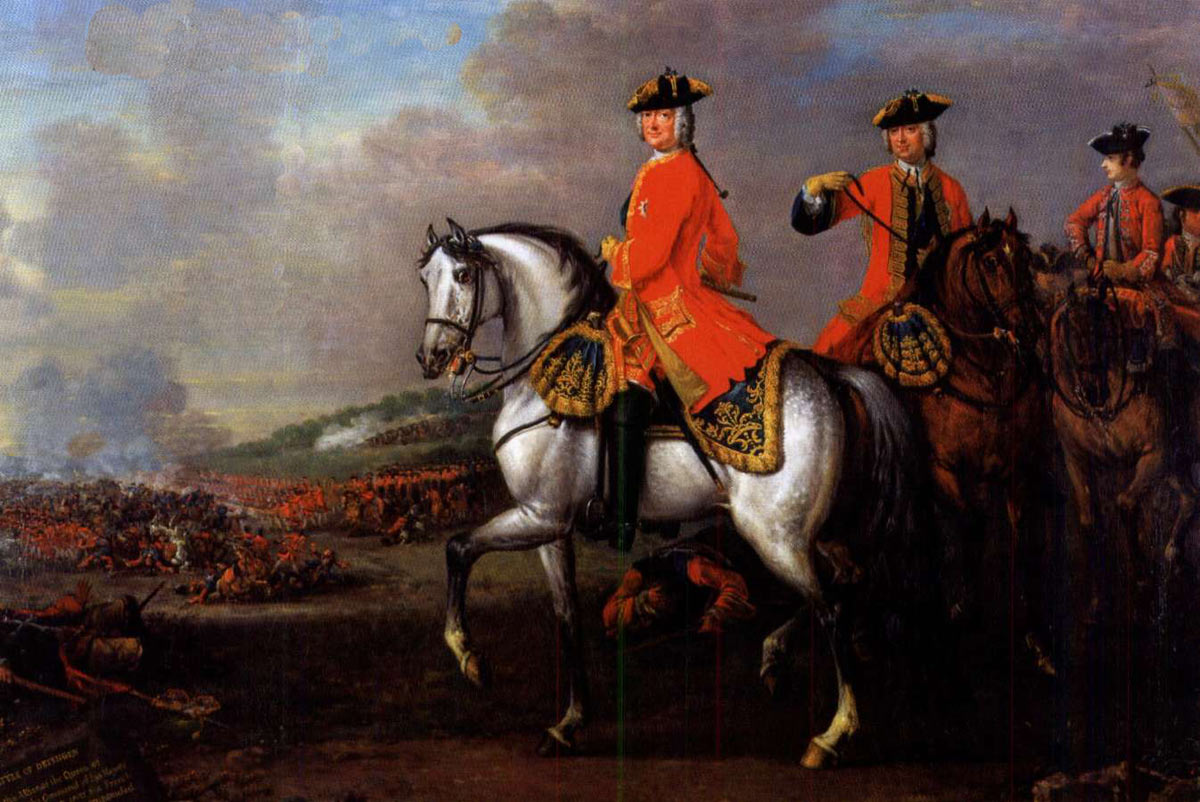
In 1749, George II of England

image9george2.jpg

had been one of the winners of what would become known as “The War of the Austrian Succession” (1740-1748).

image10geo2.jpg

He was definitely in a party mood, so he decided to throw a giant fireworks celebration in London.  To provide the soundtrack, he commissioned George Frederick Haendel (say that “HEN-del”, not as people commonly mispronounce it, “HAHN-del”) (1685-1759).

image11gfh.jpg

George was the last English king actually to see battle, at Dettingen, in 1743,

image12dettingen.jpgimage13dettingen.jpg

and wasn’t interested in anything sweet and soft, with lots of violins.

image14violinist.jpg

Instead, he wanted bangs and booms, starting with kettle drums.

image15kettledrums.jpg

Then he hired someone to design a giant framework for the fireworks,

image16frame.jpg

and threw in 101 cannon, just to make sure that it wasn’t too quiet.

image17guns.jpg

And, on the evening of 27 April, 1749, perhaps as many as 12,000 people (London had perhaps between 600,000 and 700,000 people in 1750) stood around the Green Park to watch.

image18fireworks.jpg

Here’s a LINK, if you’d like to hear the music (you’ll have to supply your own cannon and fireworks).

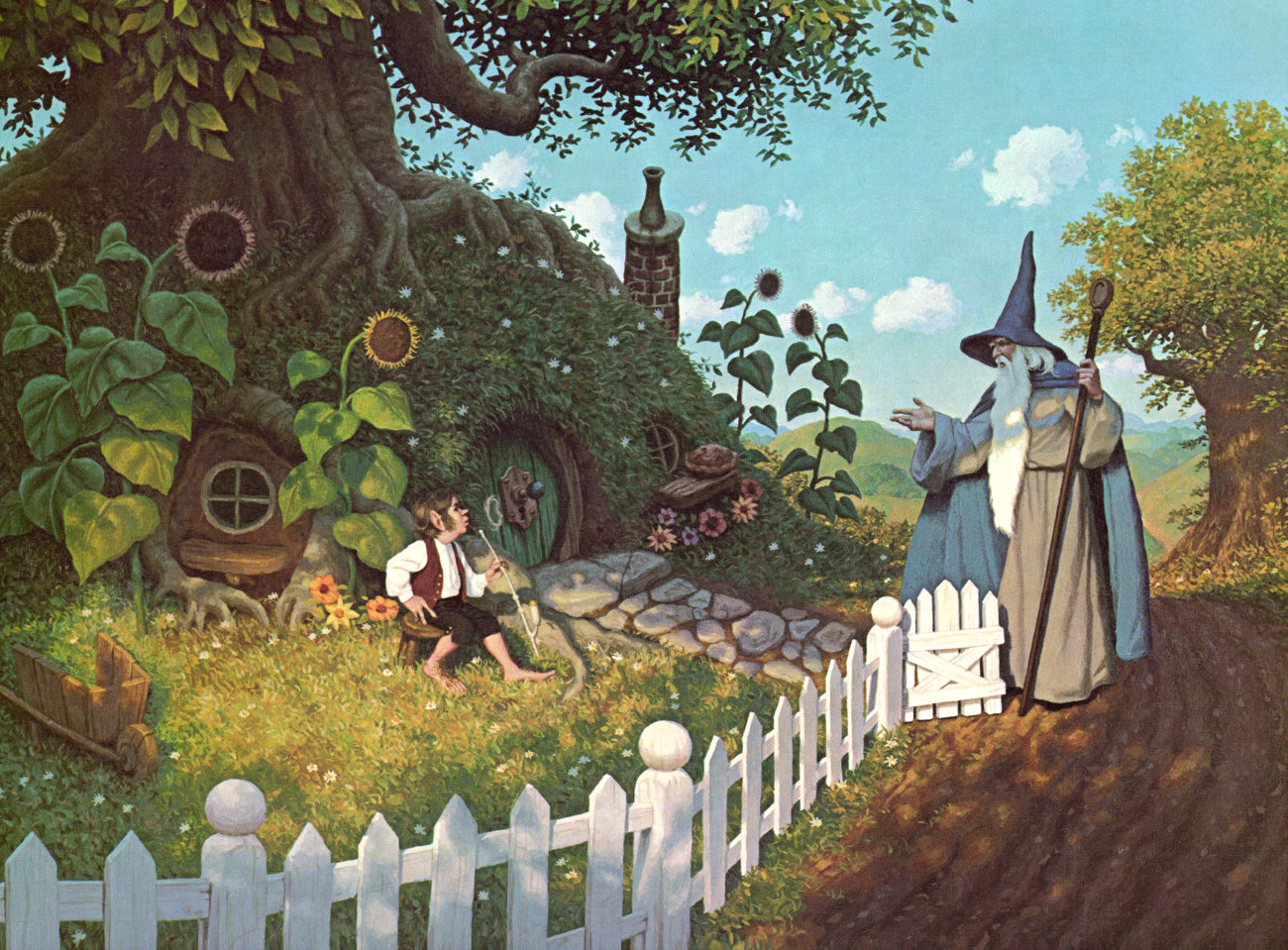
But fireworks brings us back to Tolkien, doesn’t it?  When Gandalf first appears to Bilbo in the first chapter of The Hobbit,

image19bilgan.jpg

it seems that almost all that Bilbo knows about Gandalf is his fireworks:

“Not the man that used to make such particularly excellent fireworks!  I remember those!  Old Took used to have them on Midsummer’s Eve.  Splendid!  They used to go up like great lilies and snapdragons and laburnums of fire and hang in the twilight all evening!”  (Chapter One, “An Unexpected Party”)

And, when Gandalf reappears in the Shire, to celebrate Bilbo and Frodo’s joint birthday, what does he bring?

image20gandalf.jpg

Thanks, as ever, for reading (and listening).

MTCIDC

CD

Baruk Khazad!

12 Wednesday Dec 2018

Posted by Ollamh in Artists and Illustrators, J.R.R. Tolkien, Military History, Military History of Middle-earth

≈ Leave a comment

Tags

Adze, Alan Lee, Axe, Bayeux Tapestry, Bilbo, Dane Axe, Dwarves, francisca, Gimli, Harold Godwinson, Helm's Deep, Huscarl, mithril, Skylitzis, The Hobbit, The Lord of the Rings, Thorin, Tolkien, Varangian Guard

As always, dear readers, welcome.

Ever since we saw the original Lord of the Rings films, we’ve been thinking about Gimli and his major weapon.

image1gimli.jpg

In The Hobbit, it would appear that the dwarves had not been armed until they used what was in the Lonely Mountain after Smaug had gone:

“Now the dwarves took down mail and weapons from the walls, and armed themselves.  Royal indeed did Thorin look, clad in a coat of gold-plated rings, with a silver-hafted axe in a belt crusted with scarlet stones.” (The Hobbit, Chapter 13, “Not at Home”)

This is where the mithril coat which eventually protects Frodo in Moria and turns up in the hands of the Mouth of Sauron comes from, when Thorin gives it to Bilbo.

image2mithril.jpg

Not long after we first meet Gimli, at the Council of Elrond, however, we see Gimli already kitted out for war:

“Gimli the dwarf alone wore openly a short shirt of steel rings, for dwarves make light of burdens; and in his belt was a broad-bladed axe.” (The Fellowship of the Ring, Book Two, Chapter 3, “The Ring Goes South”)

Certainly, the axe in Gimli’s right hand in the photo wouldn’t fit through a belt and allow for comfort or freedom of movement and we note that, in that same photo, Gimli appears to have another—but that looks too long for comfort, as well.

image3gimli.jpg

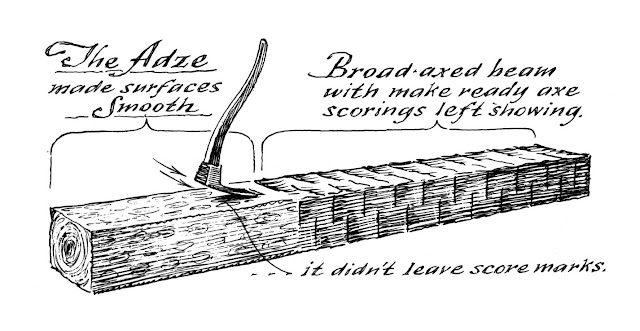
That the two axes fit in with the general persona of dwarves, however, seems to be true—after all, the translation of our title for this post is “Axes of the dwarves!”  (to be followed by Khazad ai-menu!  “the dwarves are upon you!”), which is the dwarves’ rallying cry.  What kind (or kinds) of axes these are doesn’t seem so clear, then.  Alan Lee, for example, shows us a dwarf with something which isn’t really an axe at all, but looks more like an adze, which is a tool used in woodworking to smooth and shape wood.

image4dwarf.jpg

the Broad Axe vs. the Adze - Handmade Houses... with Noah ...


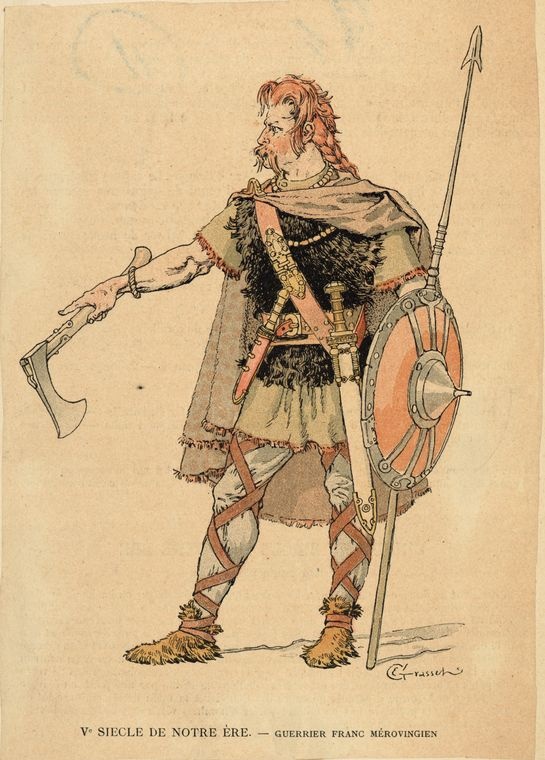
Because JRRT describes Gimli’s axe as being tuckable, we wondered whether he was thinking of the kind of throwing axe, a francisca, used by Frankish warriors (and which gave them their name).

image6francisca.jpg

image7frank.jpg

When we actually see Gimli in battle, however, he isn’t throwing, but swinging his axe.  At Helm’s deep he says to Legolas, “Give me a row of orc-necks and room to swing and all weariness will fall from me!”  And then he swings that axe:  “An axe swung and swept back.  Two Orcs fell headless.” (The Two Towers, Book Three, Chapter 7, “Helm’s Deep”)

This leads us to ask if perhaps JRRT himself wasn’t clear about Gimli’s weapon.  He never throws it, using it always as a chopper, and, when we thinking of axes with a haft—that is, handle–long enough to do that, we don’t think of that odd item in the image above—which doesn’t look substantial enough to cut through cervical vertebrae—

image8gimli.jpg

but rather of the long-hafted axe, or “Dane axe”  perhaps carried by the giant Viking who defended Stamford Bridge single-handedly against the Anglo-Saxons on 25 September, 1066,

image9stam.jpg

image10stam.jpg

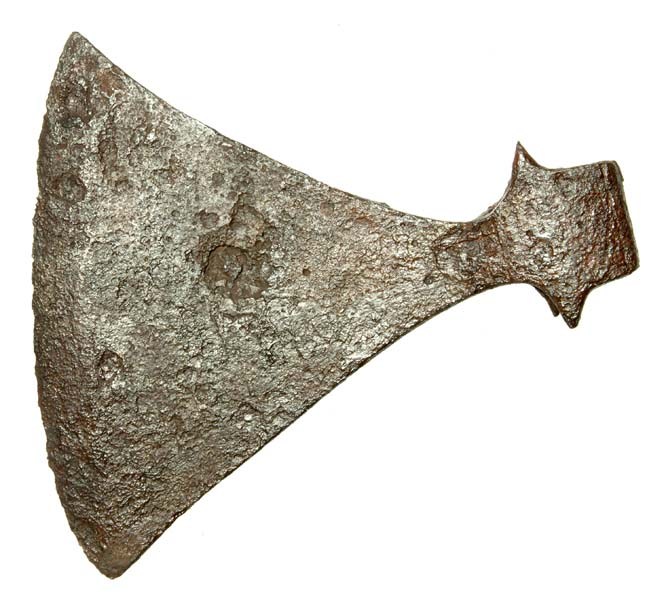
with its razor-sharp blade.

image11axe.jpg

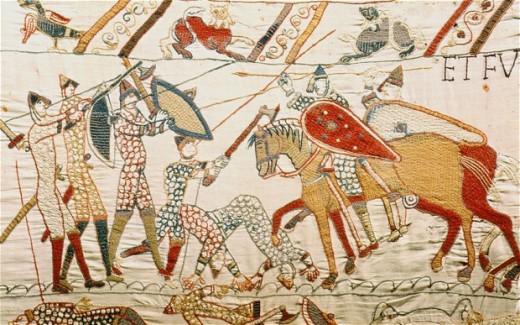
This was the kind of axe that we see carried by the huscarl, the bodyguards, of the English king, Harold Godwinson, in the depiction of the Battle of Hastings, 14 October, 1066, on the so-called Bayeux Tapestry.

image12bay.jpg

image13bay.jpg

One of which Harold may himself been carrying when he was killed, if the caption on the cloth is referring to Harold being cut down by the mounted Norman in this part of the tapestry.

image14harold.jpg

These same axes also appear to turn up as part of the armament of the Varangian Guard, the bodyguard of a number of Byzantine emperors from the 10th to 14th centuries, as depicted in the 11th-century  Skylitzis Chronicle.

image15varang.jpg

Much of this guard was made up of Norsemen and Anglo-Saxons, so the pattern of axe, we imagine, was something which both groups brought with them from their original homes.

image16varang.jpg

This is clearly the sort of thing to whack off heads, even two at a time, and so, if we can quietly detach it from Gimli’s belt and have him stand, perhaps even leaning on it, we have the Gimli who competes with Legolas at Helm’s Deep in the number of orcs each has dispatched.

image17vik.jpg

Thanks, as ever, for reading.

MTCIDC

CD

Pop!

13 Wednesday Dec 2017

Posted by Ollamh in J.R.R. Tolkien, Military History, Military History of Middle-earth, Narrative Methods

≈ Leave a comment

Tags

anachronism, Bag End, gun, gunpowder, hand gonne, Helm's Deep, pop-gun, Professor Moriarity, Reichenbach Falls, Rosenbach Library, Sherlock Holmes, Sir Arthur Conan Doyle, The Adventure of the Empty House, The Hobbit, The Hound of the Baskervilles, The Lord of the Rings, Tolkien, Trev's Air Gun Scrapbook

Welcome, as always, dear reader.

The anachronisms in the 1937 Hobbit are well known:  “cold chicken and tomatoes”, “like the whistle of an engine coming out of a tunnel”, etc.  We ourselves have contributed to the commentary in several past postings and here we are again.

This time, we were caught by something Gandalf says to Bilbo in Chapter 1:

“It is not like you, Bilbo, to keep friends waiting on the mat, and then open the door like a pop-gun” (The Hobbit, Chapter 1, “An Unexpected Party”)

So, “pop-gun”?

Just previously, Bilbo was described as pulling open “the door with a jerk” (and in tumble 4 dwarves), which suggests what the pop-gun sounds like, as well as how sudden the motion.

How is that sound made?  Here’s an example of such a gun.

image1popgun.jpg

As you can see, it’s just a tube.  Inside is a kind of plunger—a rod with a flattened end which faces towards the muzzle (the opening at the left).  You pull back the rod and it draws air into the barrel.  If you stick a cork in the muzzle, so that it makes a seal, when the rod is pushed up the barrel, the flattened rod end pushes the air in front of it, compressing it.  The compressed air then forces out the cork, which shoots out with a POP!

For all that it uses air to propel the cork, this is, as its name implies, a kind of gun.  Although there may be gunpowder in Middle-earth (see our earlier posting on the use of explosives at Helm’s Deep and the gate area of the Rammas Echor), it seems to be employed as the equivalent of dynamite,

image2helmsdeep.jpg

and never as the propulsive force in what medieval people in our world called a “hand gonne”.

image3handgonne.jpg

image4handgonne.jpg

And thus it falls into that category of anachronisms.  The idea of air guns, however, makes us think of the Daisy Air Rifle one of us had as a child.

image5daisy.jpg

The air was pulled in when the lever underneath the trigger was pulled down and then pushed back, to make it ready to fire.  The illustration fires bbs, but ours was more peaceful, firing cork balls.

But a very unpeaceful version appears in Sir Arthur Conan Doyle’s

image6conandoyle.jpg

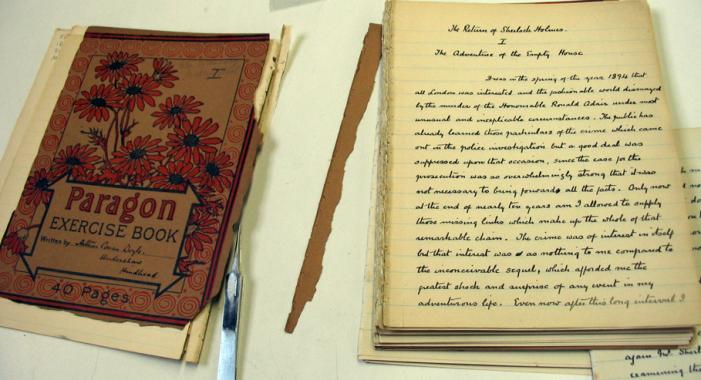
“The Adventure of the Empty House” (1903).  Here’s the first page of the manuscript, housed at the Rosenbach Library, in Philadelphia.  (And here’s a LINK to their excellent on-line magazine.)

image7ms.jpg

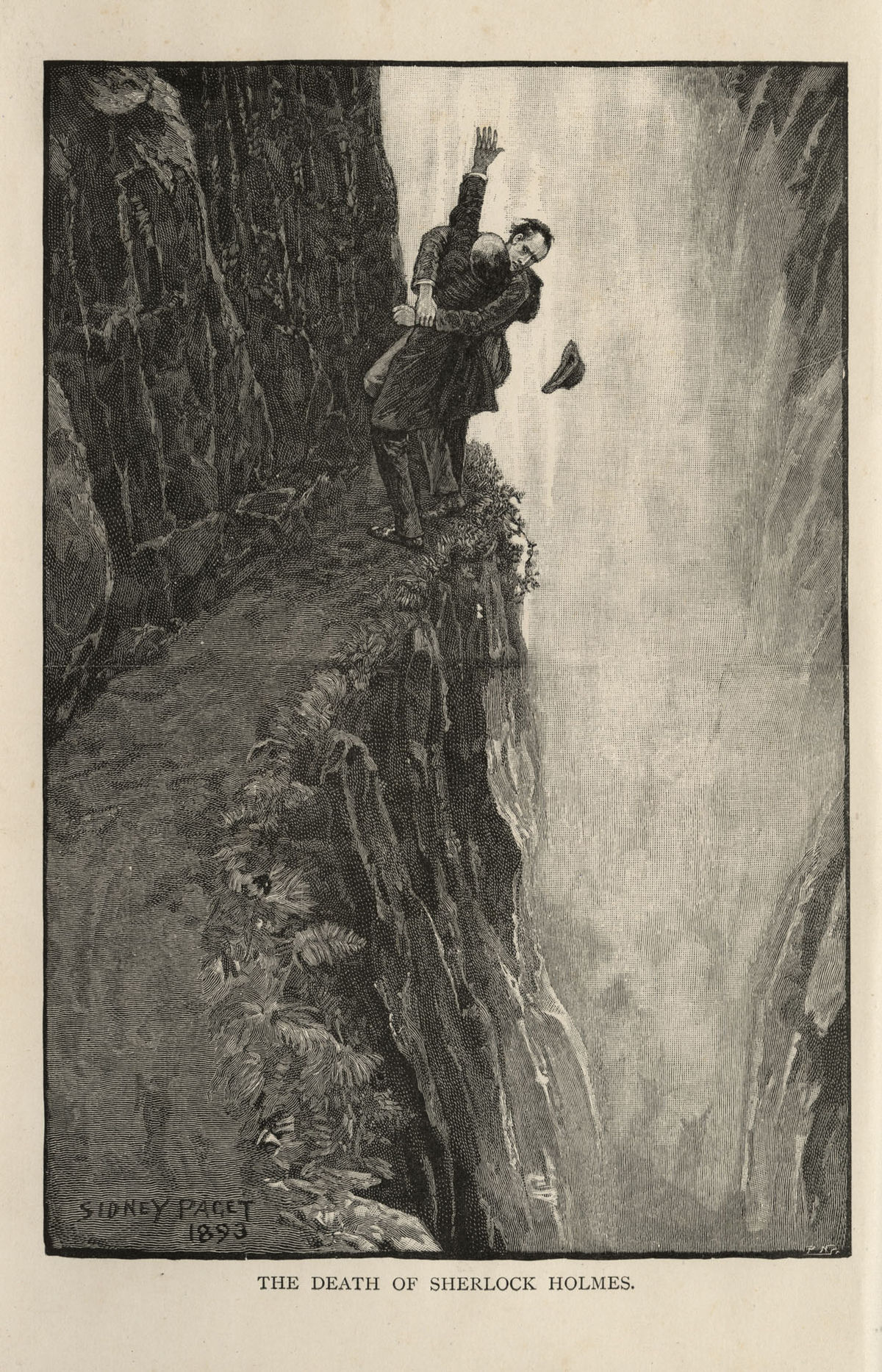
Sherlock Holmes had disappeared after his combat with Professor Moriarity at the Reichenbach Falls

image8reichenbach.jpeg

in Switzerland in 1891 (although the story in which this happens was published in The Strand Magazine in December, 1893).

image9moriarityholmes.jpg

For financial reasons, Conan Doyle brought Holmes back—first in the novel, The Hound of the Baskervilles in 1901,

image10hound.jpg

but this story was supposed to have taken place in 1889, two years before Holmes’ disappearance.  It was only with “The Adventure of the Empty House” that Holmes reappeared in contemporary London.  Here, it was revealed that Holmes had not fallen to his death with Moriarity, but had survived and had lived in disguise for some years, traveling the world and avoiding the vengeance of Moriarity’s men and, in particular, his chief lieutenant, Colonel Sebastian Moran, who had actually seen Holmes escape the clutches (literally) of Moriarity and had tried unsuccessfully to kill him with a fall of rock.

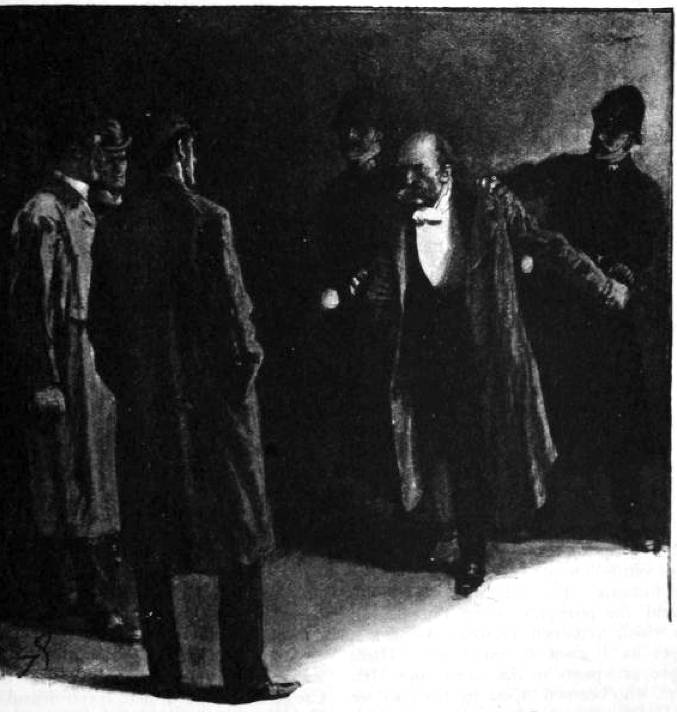
Back in London, Holmes appears to Watson and enlists his aid in trapping Moran, which Holmes does by placing a wax bust of himself in outline in the window of 221B Baker Street as a lure.  Holmes and Watson then wait across the street in an empty house (hence the title of the story), Holmes thinking that Moran will try to assassinate him from the street.  Instead, Moran climbs to the very room where the two are concealed and, opening a window, uses an air rifle to attempt to kill Holmes—before he’s tackled by the pair and subdued, with the aid of several policemen summoned from hiding nearby.

image11moranbroughtdown.jpg

Moran, Holmes explains, was thought to be the best shot in India, where he had been stationed for some years, so it’s not surprising that he would attempt the long-distance murder of Holmes, but why an air gun?  (This is from the Granada television series of the 1980s, with the brilliant Jeremy Brett as Holmes.)

image12airgun.JPG

Air guns had first begun to appear in the 16th century, but, by the later 19th century could be either a toy, or a useful weapon for snipers, mainly because of its propulsion method.  Until the 1890s, the main propellant was gunpowder which, when fired, produced a loud bang and a cloud of white smoke.

image13martinihenry.jpg

Imagine, instead, a weapon which made much less noise—or a noise very unlike a gun’s BANG! (Conan Doyle has Watson describe the sound as “a strange loud whiz”)– and no smoke at all.  Perfect for a nighttime assassination, as Colonel Moran has planned it, never realizing that Holmes is well aware of his plan and foils it neatly (as Holmes almost always does).

In the 21st century, smokeless powder is the norm and air guns are now used for target shooting (including an Olympic event), and pop-guns?  Still for sale—just google “toy pop guns” at Amazon.com

image14popgun.jpg

or E-Bay and see what you find—something Bilbo never could!

Thanks, as ever, for reading.

MTCIDC

CD

Ps

If you’d like to know more about air guns, here’s a LINK for a great source, “Trev’s Air Gun Scrapbook”.

A Pirate’s Life…

15 Wednesday Nov 2017

Posted by Ollamh in Imaginary History, J.R.R. Tolkien, Literary History, Maps, Military History, Military History of Middle-earth, Narrative Methods, Villains

≈ 1 Comment

Tags

Abd el-Ouahed ben Messaoud ben Mohammed Anoun, Algiers, Anduin, Barbary Coast, buccaneer, corsair barbary, Corsairs, draught, dromon, dromunds, galley, Harad, Haradrim, Harlond, Helm's Deep, Legatus Regis Barbariae, Pelennor, Pirates, Ramas Echor, Southrons, The Lord of the Rings, Tolkien, Turkish galley, Umbar, US Navy WW2 fighter

Welcome, dear readers, as always.

In a previous posting, we mentioned the Corsairs of Umbar.

If you google “corsair” in images, the first thing which appears is this:

image1corsair.jpg

It’s a US Navy WW2 fighter—but hardly what was sweeping to attack the south coast of Gondor in Sauron’s massive campaign.

Change that to “corsair pirate” and you see things like

image2piratecostume

which is definitely a bit better, but he looks so 18th-century.  As we have discussed in many of our postings, Middle-earth is Middle Ages (more or less), even if it mixes High Medieval (things like the plate armor of the Prince of Dol Amroth) with Anglo-Saxon (the Rohirrim).  So “corsair pirate” is too late in time.  Another word (with a much-discussed origin) for “pirate” is “buccaneer”, so, how about “corsair buccaneer”?

image3trailer

Ooops!  Okay—clearly that doesn’t work!

So what will—and what are we really looking for?  Well, what do these corsairs look like according to JRRT?

They have black sails:

For Anduin, from the bend at the Harlond, so flowed that[,]from the City[,] men could look down it lengthwise for some leagues, and the far-sighted could see any ships that approached.  And looking thither they cried in dismay; for black against the glittering stream they beheld a fleet borne up on the wind:  dromunds, and ships of great draught with many oars, and with black sails bellying in the breeze.

‘The Corsairs of Umbar!’ men shouted.  (The Return of the King, Book Five, Chapter 6, “The Battle of the Pelennor Fields”)

Anything more?

In The Lord of the Rings, unfortunately not.

Umbar is in Harad,

image5.jpg

however, and there is a little about the Haradrim.  Our first view of them is Sam’s:

Then suddenly straight over the rim of their sheltering bank, a man fell, crashing through the slender trees, nearly on top of them.  He came to rest in the fern a few feet away, face downward, green arrow-feathers sticking from his neck below a golden collar.  His scarlet robes were tattered, his corselet of overlapping brazen plates was rent and hewn, his black plaits of hair braided with gold were drenched with blood.  His brown hand still clutched the hilt of a broken sword. (The Two Towers, Book Four, Chapter 4, “Of Herbs and Stewed Rabbit”)

Other details?

Just before Sam speaks, Gollum has reported seeing:

‘Dark faces.  We have not seen Men like these before, no, Smeagol has not.  They are fierce.  They have black eyes, and long black hair, and gold rings in their ears; yes, lots of beautiful gold.  And some have red paint on their cheeks, and red cloaks; and their flags are red, and the tips of their spears; and they have found shields, yellow and black with big spikes.  Not nice; very cruel wicked Men they look.  Almost as bad as Orcs, and much bigger.’ (The Two Towers, Book Four, Chapter 3, “The Black Gate is Closed.”)

“cruel and tall” (The Return of the King, Book Five, Chapter 4, “The Siege of Gondor”)

They have cavalry and they are armed with scimitars. (The Return of the King, Book Five, Chapter 6, “The Battle of the Pelennor Fields”)

These would seem to be people from Near Harad (that is, near to Gondor).  The men to the south of them differ:

“…Southrons [men from Near Harad] in scarlet and out of Far Harad black men like half-trolls with white eyes and red tongues.” (The Return of the King, Book Five, Chapter 6, “The Battle of the Pelennor Fields”)

But all of this to us suggested a model from our own world (as always):  the Barbary Pirates.  So how about the search terms “corsair barbary”?

image4barbarycorsair.jpg

Ah.  That’s a bit more like it, we think.  He has to lose his gunpowder weapons, though—the only gunpowder in Middle-earth appears to be something in the hands of Saruman and Sauron’s orcs, as we see at Helm’s Deep

image6ahelmsdeep.jpg

and the wall of the Pelennor, the Ramas Echor.

We would imagine those corsairs, then, as looking like the infamous “Barbary Pirates”.

They certainly fill the bill geographically—they’re southern (at least in relation to JRRT’s England)–their hangouts being on the coast of North Africa

image6barbarycoast.jpg

and, if you wanted a big port city, as Umbar was supposed to be, here’s Algiers.

image7algiers.png

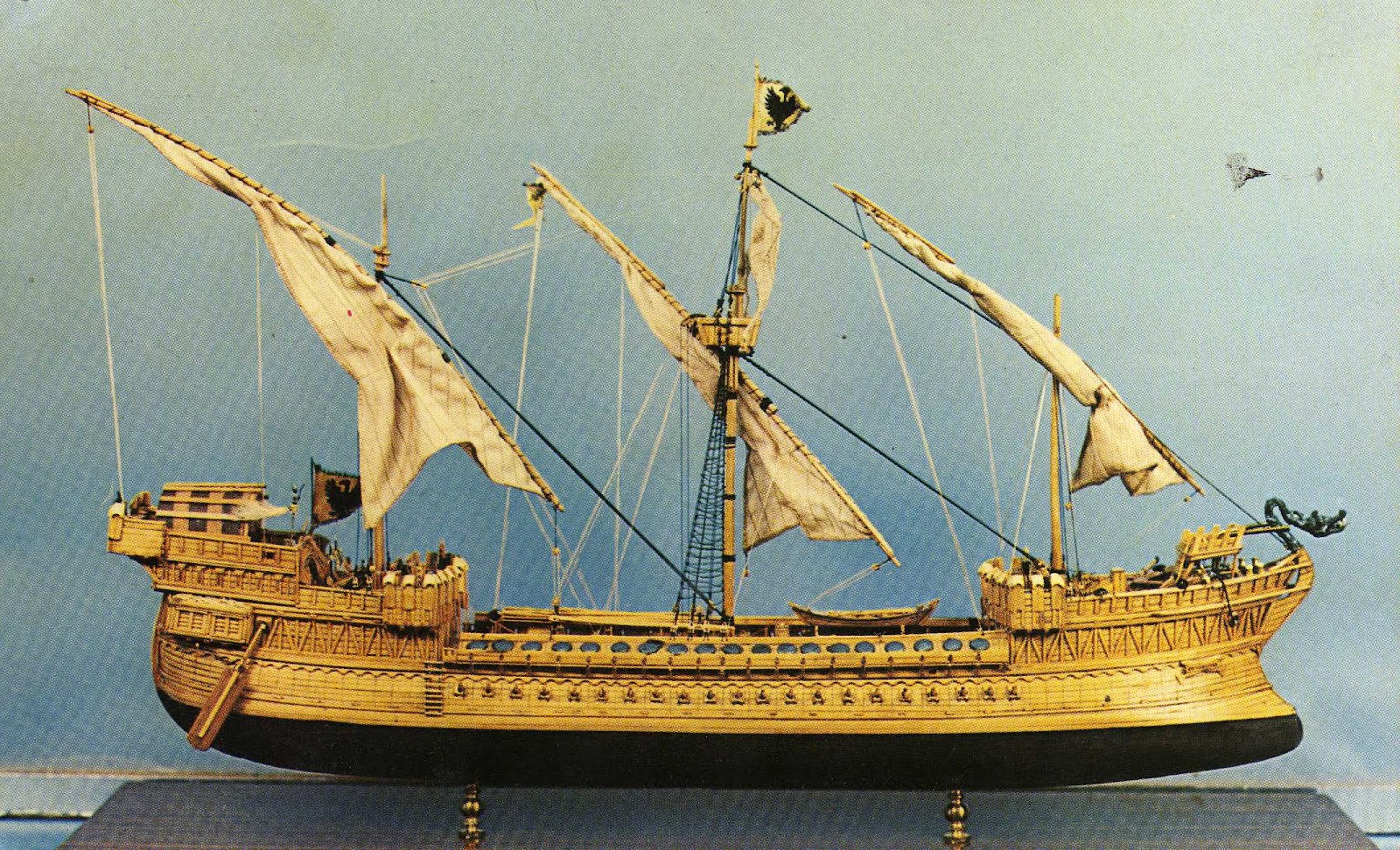
What about ships—that is, “dromunds and ships of great draught with many oars”?

“Dromund” is a medieval form of the Byzantine Greek dromon, literally a “runner”—a word you’d recognize from the English word “hippodrome”—the “place where horses run”.  This was the common larger Byzantine warship.

image8dromon.jpg

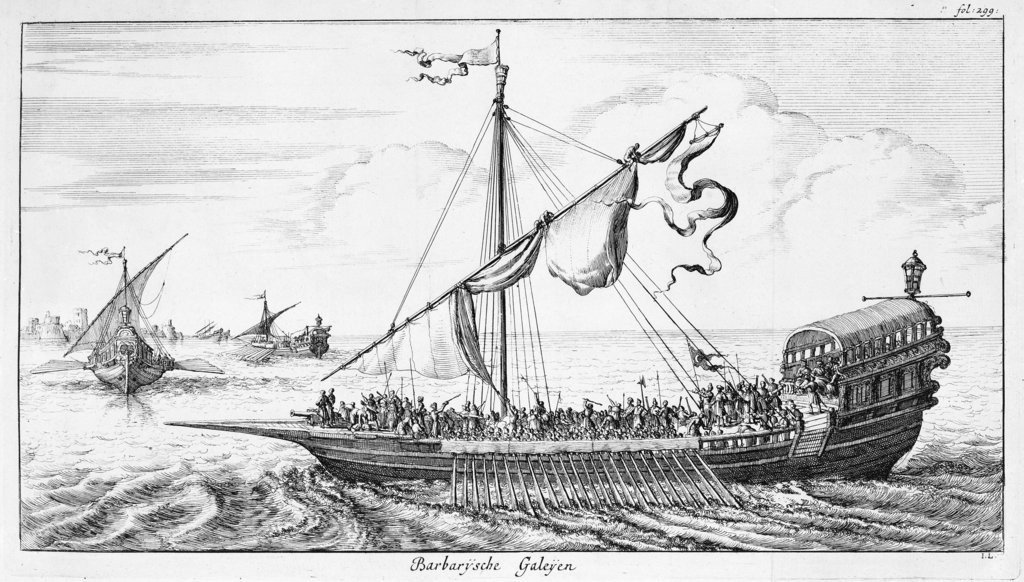
Here’s a Renaissance-era engraving of a Turkish galley.

image9barbarygalley.jpeg

There’s a difficulty with “ships of great draft with many oars”, however.  Draught (also spelled “draft”) is the distance between the waterline and the bottom of the keel, as in this diagram.

image10draft.jpg

Ships with many oars are, commonly, galleys,

image11medgalley.jpg

and galleys commonly have a shallow draft—both to allow for maneuver in shallow waters and to allow for the oars to do their job most efficiently.  So, we presume that all of the Corsairs’ vessels were actually galleys of various sizes.

image12galleys.jpg

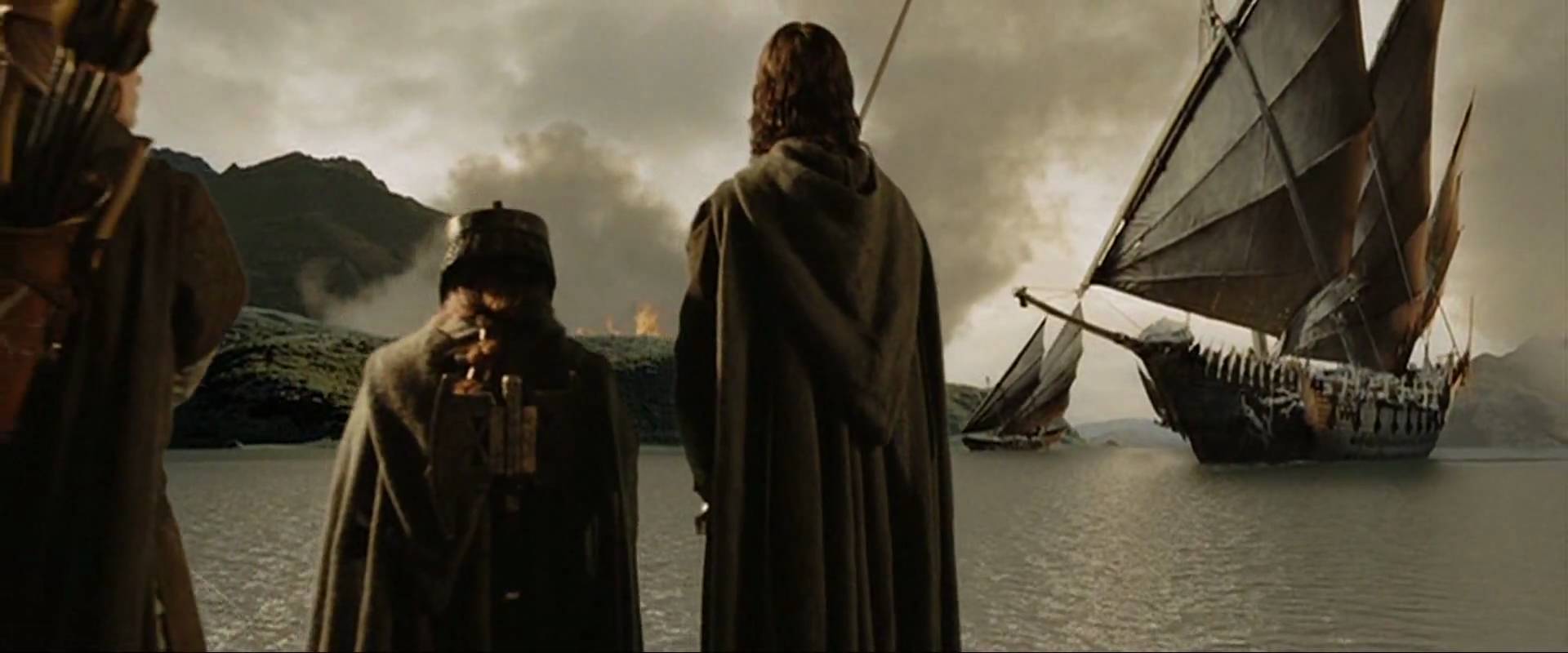
Jackson’s Corsair ships have something of the look of JRRT’s description, but his

image13ajacksonships.jpg

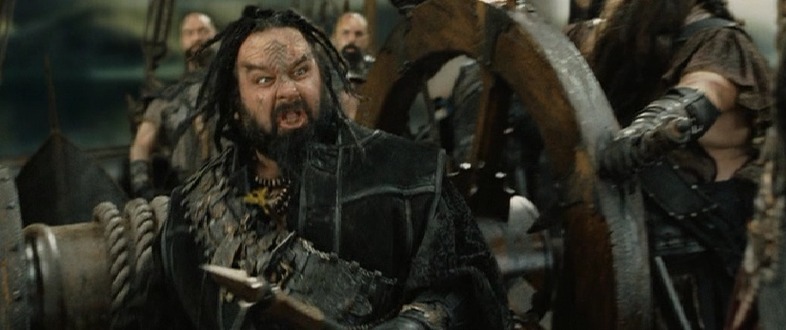
depiction of the Corsairs, unlike that of Rohan and the Rohirrim, is not even close to the little we have learned so far from the text.

image13jackson.jpg

The Barbary Pirates, to us, not only match point of origin and vessels, but are much more exotic and colorful, whereas those in the film look to us more like dingy Vikings.

image14pirates.jpg

image15pirates.jpg

And here’s a portrait

image16moroccanambassador.jpg

of the Moroccan ambassador to the court of Queen Elizabeth I (notice that, in the caption he’s called Legatus Regis Barbariae, “deputy of the King of Barbary”—a splendid figure with a splendid name:  Abd el-Ouahed ben Messaoud ben Mohammed Anoun—imagine him facing Aragorn from the deck of a galley—we think that the Oath-breakers would have had little fear for him, even as they overwhelmed him and his crew.

image17corsairs.jpg

So, as always, we ask you, readers, what do you think?

And thanks, as always, for reading.

MTCIDC

CD

PS

Just a thought, but, if Sauron, as one of the Maiar, was virtually immortal and had the kind of power which is displayed in the forging of the Ring, why did he need vast fortresses and armies and fleets?  Something to think about in a future posting!

Re: Tree

23 Wednesday Aug 2017

Posted by Ollamh in Imaginary History, J.R.R. Tolkien, Literary History, Narrative Methods, Poetry

≈ Leave a comment

Tags

Alfred Tennyson, Dreamflower, Fangorn Forest, Galadriel, Gondor, Helm's Deep, Isengard, Laurelindorenan, Lothlorien, Lotus-eaters, mallorn, Minas Tirith, Mirkwood, Old Forest, Old Man Willow, Palantir, Rath Dinen, Samwise Gamgee, Saruman, The Lord of the Rings, The Odyssey, Tolkien, Treebeard, trees, White Tree of Gondor

Welcome, as always, dear readers.
image1ajrrttree
The inspirations for our postings come from many places: from something we’re reading or have just watched/seen, from a connection between two texts, or between Tolkien’s world—the real or Middle-earth—and something from the history of this world. Sometimes ideas come from the Sortes Tolkienses—our take on an ancient fortune-telling method, in which one posed a question, then opened a copy of an important text like The Bible or Vergil’s Aeneid, closed one’s eyes, and pointed and the text where the finger landed was believed, through interpretation, to contain an answer to that question. In our case, should we require inspiration, we sometimes use our 50th Anniversary hardbound of The Lord of the Rings to do this and, surprisingly often, what we find gives us an idea about what to write.
In the case of this posting, however, it was more of a “we were working on something else entirely and then there it was.” The “it” here is the White Tree of Gondor.
image1treeofgondor
(We confess, by the way, that we have iphone cases with the image—and we are often complimented on them.)
image2phonecase
We had, in fact, been thinking about another post, this one about corruption through technology, as represented by the palantiri, and had been reading references to Denethor. This had led us to his fiery death in Rath Dinen, “Silent Street”, which led to the tombs of the kings and stewards of Gondor. Besides the rulers of Gondor, however, the street had another occupant, the old White Tree, long dead,
image3deadwhitetree.png
but which, when a new sapling
imag4blossom.jpg
was found in the mountains by Gandalf and Aragorn, was still treated with ceremony:
“Then the withered tree was uprooted, but with reverence; and they did not burn it, but laid it to rest in the silence of Rath Dinen.” (The Return of the King, Book Six, Chapter 5, “The Steward and the King”)
This seemed a rather odd thing to do to a tree and this led us, finally, to consider one function of trees in The Lord of the Rings: just as the White Tree is buried, as human rulers were, could trees act as a mirror for the condition of the human world at what would be the end of the Third Age? And can they also act as a mirror of change for the better?
Consider, for example, the dead White Tree as a symbol for the withering of Gondor itself, as Minas Tirith is described:
Pippin gazed in growing wonder “at the great stone city, vaster and more splendid than anything that he had dreamed of; greater and stronger than Isengard, and far more beautiful. Yet it was in truth falling year by year into decay; and already it lacked half the men that could have dwelt at ease there…(The Return of the King, Book Five, Chapter 1, “Minas Tirith”)
And this decay of city and tree appears to be echoed in the natural world of Middle-earth in general, as Treebeard says of Lothlorien:
image5alorien.jpg
“Do not risk getting entangled in the woods of Laurelindorenan! That is what the Elves used to call it, but now they make the name shorter: Lothlorien they call it. Perhaps they are right: maybe it is fading, not growing. Land of the Valley of Singing Gold, that was it, once upon a time. Now it is the Dreamflower.”
[Just a quick footnote here. “Dreamflower” immediately takes us to Odyssey, Book 9, 82-105, where a small party of Odysseus’ men, set ashore to explore, meet up with the Lotus-eaters, who give them the mysterious lotus to eat and that “whoever might eat of the sweet fruit of the lotus, no longer wished to bring word back or to return home/but wanted, feeding on lotus, to remain in the very same place with the lotus-eating men and to forget about home-going.” (94-97, our translation). This certainly could describe at least some of the Fellowship’s reaction to Lothlorien. Here’s an illustration from a cartoon-version:
image5blotuseaters.jpg
Alfred Tennyson wrote a poem on the same subject—here’s a LINK, in case you would like to read his 1832 (revised 1842) interpretation.]
Beyond Lothlorien, other parts of the tree-covered natural world seem more menacing–there’s the Old Forest,
image5oldforest.gif
and Mirkwood,
image6mirkwood.jpg
described by Haldir:
“ ‘There lies the fastness of Southern Mirkwood…It is clad in a forest of dark fir, where the trees strive against one another and their branches rot and wither.’ “ (The Fellowship of the Ring, Book Two, Chapter 6, “Lothlorien”)
It wouldn’t take much imagination to replace “where the trees strive” with “where the humans strive against one another and their kind rots and withers”!
There is the sentient, malevolent Old Man Willow,
image7omw.jpg
and even Treebeard and his forest do not at first offer the kind of invitation one hears in the first verse of this song, from Shakespeare’s As You Like It:
Under the greenwood tree
Who loves to lie with me
And tune his merry note,
Unto the sweet bird’s throat,
Come hither, come hither, come hither:
Here shall he see
No enemy
Than winter and rough weather.

Instead, when Treebeard
image8fangorn.jpg
overhears Pippin say:
“This shaggy old forest looked so different in the sunlight. I almost felt I liked the place.” (The Two Towers, Book Three, Chapter 4, “Treebeard”)
he says, “ ‘Almost felt you liked the Forest!’ That’s good! That’s uncommonly kind of you…Turn round and let me have a look at your faces. I almost feel that I dislike you both…”
Treebeard’s hostility towards Pippin and Merry actually springs from another source—Saruman:
“He and his foul folk are making havoc now. Down on the borders they are felling trees—good trees. Some of the trees they just cut down and leave to rot—orc-mischief that; but most are hewn up and carried off to feed the fires of Orthanc.”
Treebeard’s growing anger, however, then marks a turn in the behavior of the natural world: somehow the appearance of Pippin and Merry acts as a catalyst:
“Curse him, root and branch! Many of those trees were my friends, creatures I had known from nut and acorn; many had voices of their own that are lost for ever now. And there are wastes of stump and bramble where once there were singing groves. I have been idle. I have let things slip. It must stop!”
And it’s not simply the Revenge of the Ents. Treebeard has a larger strategy, saying to the two hobbits:
“You may be able to help me. You will be helping your own friends that way, too; for if Saruman is not checked Rohan and Gondor will have an enemy behind as well as in front.”
As we know, Treebeard convinces the other Ents to help and, in a short time, they not only destroy Isengard
image8trbdisen.jpg
but also the orcs at Helm’s Deep,
image9helmsdeep.jpg
effectively removing Saruman from the story except as an empty threat—and a final, petty Sauron, ruining the Shire, which included cutting down numbers of trees—among them the famous Party Tree. And here we see one more symbol, perhaps. Long before, Galadriel had given Sam a gift which, in her wisdom (and perhaps in her foresight?) seemed almost perfect for a gardener:
“She put into his hand a little box of plain grey wood, unadorned save for a single silver rune on the lid….’In this box there is earth from my orchard, and such blessing as Galadriel has still to bestow is upon it…Though you should find all barren and laid waste, there will be few gardens in Middle-earth that will bloom like your garden, if you sprinkle this earth there.’ “ (The Fellowship of the Ring, Book Two, Chapter 8, “Farewell to Lorien”)
Once the Shire has been scoured of Saruman’s final evil, Sam remembers this present and uses it, spreading the earth across the Shire:
“So Sam planted saplings in all the places where specially beautiful or beloved trees had been destroyed, and he put a grain of the precious dust in the soil at the root of each.” (The Return of the King, Book Six, Chapter 9, “The Grey Havens”)
And his plan succeeds:
“His trees began to sprout and grow, as if time was in a hurry and wished to make one year do for twenty.”
In midst of such fertility, there is an extra favor. Sam had found within Galadriel’s box “a seed, like a small nut with a silver shale [shell or husk].”
Sam planted this in the Party Field, where the tree had once stood, and, in the spring:
“In the Party Field a beautiful young sapling leaped up: it had silver bark and long leaves and burst into golden flowers in April. It was indeed a mallorn [the golden tree specific only to Lothlorien], and it was the wonder of the neighborhood.”
Just as the human world of Middle-earth, stunted by Sauron and his minions, is now free, so is the natural world free once more—no more orcs to abuse its forests, no malevolent will to taint its woods, and the reflowering of the Shire and, at its center, the mallorn, may stand as a symbol for that rebirth—and even be twinned with the new White Tree of Gondor, far to the south.
image10mallorns.jpg
[With thanks to Britta Siemen’s blog, where we found this image—LINK here]
Thanks, as ever, for reading!
MTCIDC
CD

When One Door Closes.3

23 Wednesday Nov 2016

Posted by Ollamh in J.R.R. Tolkien, Language, Literary History, Narrative Methods

≈ Leave a comment

Tags

Common Tongue, doors, Doorward, Edoras, Elvish, Fangorn Forest, Gandalf, Gondor, Hama, Helm's Deep, Isengard, John Ruskin, Meduseld, Minas Tirith, Moria, passages, Paths of the Dead, The Hobbit, The King of the Golden Hall, The King of the Golden River, The Lord of the Rings, Tolkien, Witch-King of Angmar

Welcome, dear readers, to the third part of our series on doors and entryways in JRRT’s The Hobbit and The Lord of the Rings.

We began, several postings ago, by writing that we were intrigued by Bilbo’s statement to Frodo: “It’s a dangerous business, Frodo, going out your door.” (The Fellowship of the Ring, Book 1, Chapter 3, “Three is Company”)

It made us want to look at doors (to which we quickly added entryways of all sorts) in Tolkien and, in doing so, we’ve come up with a very crude classification system, in which there were two kinds of doors, those which seemed to promise safety and those through which you might be in danger. And a major component of such places seems to be a challenge, and a challenger of some sort.

At the end of our second posting, we had come to the breaking up of the Fellowship and now we want to continue, having a look at what could be seen as good examples of what we mean along the way.

Because of the major split in the story, we decided to follow Aragorn, Gimli, and Legolas first.

The first part of their adventure takes place across open country or in Fangorn Forest. It’s only when they, with Gandalf, arrive at Edoras that we see the pattern fall into place.

But here we wondered if we should add an extra subcategory, linguistic challenge. We’ve already seen the western gates of Moria and the need to read Elvish and to know the word for friend, and now we have the gates of Edoras

Edoras.jpg

and a suspicious guard of Rohirrim:

“There sat many men in bright mail, who sprang at once to their feet and barred the way with spears. ‘Stay, strangers here unknown!’ they cried in the tongue of the Riddermark.” (The Two Towers, Book 3, Chapter 6, “The King of the Golden Hall”)

[We wonder, by the way, if the chapter’s title owes something to John Ruskin’s 1841/51 fairy tale “The King of the Golden River”, in which a major figure has been changed through evil magic, but is freed and eventually helps the underdog hero…]

King_of_the_Golden_River_-_Title_page.jpg

As he was (eventually) up to the challenge of the gate of Moria, so is Gandalf up to this and challenges them in return:

“ ‘Well do I understand your speech,’ he answered in the same language; ‘yet few strangers do so. Why then do you not speak in the Common Tongue, as is the custom in the West, if you wish to be answered?’ “

After a little parleying in this manner, Gandalf and his companions are allowed to enter and sent up to Meduseld, where there is a second challenger, the Doorward Hama.

Golden_Hall_of_Meduseld.png

meduseld.jpg

Here, after a brief repetition of the previous language challenge, things relax: “Then one of the guards stepped forward and spoke in the Common Speech.” After a tussle about leaving weapons behind (and Gandalf escapes this with his staff), they are permitted into the hall and the scene continues.

After the battle of Helm’s Deep, Denethor, Gandalf, and the rest of the company ride to Isengard, only to find there:

“…ruined gates. There they saw close beside them a great rubble-heap; and suddenly they were aware of two small figures lying on it at their ease, grey-clad, hardly to be seen among the stones. There were bottles and bowls and platters laid beside them…” (The Two Towers, Book 3, Chapter 8, “The Road to Isengard”)

merryandpippinatisengarde.jpg

It’s Merry and Pippin, of course, who describe themselves as “doorwardens”, just as Hama was at Meduseld. The difference is, instead of barring the door and challenging those who would enter, they are welcoming and comical in their lordly self-indulgence. This seems to turn the pattern on its head, and, although it’s the only time such a thing appears, we believe that it is an example of another subcategory, that of parody. It has the elements of other occasions, but, here, the door is a ruin and the guards seem slightly tipsy, rather than menacing, as well as very glad to see those who come to their ward.

In contrast to this merriness, there is stony silence at the next door:   The Paths of the Dead.

EntrancePathsDead-port.jpg

The challenge seems to be in the very air itself:

“And so they came at last deep into the glen; and there stood a sheer wall of rock, and in the wall the Dark Door gaped before them like the mouth of night. Signs and figures were carved above its wide arch too dim to read, and fear flowed from it like a grey vapour.” (The Return of the King, Book 5, Chapter 2, “The Passing of the Grey Company”)

It is Aragorn who accepts the challenge and leads the group through what, in the film, is a kind of funhouse of skulls and greenish figures,

dead.jpg

But, to us readers, what we think is much more disturbing is that there is no more than a restless murmur, which we hear through the dauntless, but quivering Gimli—

“…but if the Company halted, there seemed an endless whisper of voices all about him, a murmur of words in no tongue he had ever heard before.”

And, at the end of their passage, it is Aragorn who is the challenger—not to block those murmurers, but to invite them:

“ ‘Keep your hoards and your secrets hidden in the Accursed Years! Speed only we ask. Let us pass, and then come! I summon you to the Stone of Erech!’ “

We can see in this multiple ends: first, it fits the pattern of confrontations at doors (all feel the sense of Something There and must rise to the challenge, conquering their fear); second, it provides a route for Aragorn’s strategy: to gain supernatural allies on the way to natural ones along the southern seacoast; third, it underlines Aragorn’s right to the kingship: only he has the knowledge and authority to call up the long-dead for his purposes.

Our last challenge of this posting is at what is perhaps the most dramatic moment in the attack upon Minas Tirith. Grond the ram has, with the aid of the Lord of the Nazgul, burst open the great gate and the Wraith is about to enter when he encounters:

“…Gandalf upon Shadowfax…

‘You cannot enter here,’ said Gandalf, and the huge shadow halted. ‘Go back to the abyss prepared for you! Fall into the nothingness that awaits you and your Master. Go!’ ” (The Return of the King, Book 5, Chapter 4, “The Siege of Gondor”)

gandalfgate2.jpg

But—then? We admit it—we shamelessly want a cliffhanger here. And so we’ll stop—till our next, in which we’ll finish the story—we promise!—and provide a breakdown of all of the doors and entryways in a chart, as well.

Thanks, as always, for reading—and we’re sorry that we gave in to temptation, but, as novelists ourselves, we couldn’t resist!

MTCIDC

CD

← Older posts

The Doubtful Sea Series Facebook Page

The Doubtful Sea Series Facebook Page

  • Ollamh

Categories

  • Artists and Illustrators
  • Economics in Middle-earth
  • Fairy Tales and Myths
  • Films and Music
  • Games
  • Heroes
  • Imaginary History
  • J.R.R. Tolkien
  • Language
  • Literary History
  • Maps
  • Medieval Russia
  • Military History
  • Military History of Middle-earth
  • Narnia
  • Narrative Methods
  • Poetry
  • Research
  • Star Wars
  • Terra Australis
  • The Rohirrim
  • Theatre and Performance
  • Tolkien
  • Uncategorized
  • Villains
  • Writing as Collaborators
Follow doubtfulsea on WordPress.com

Across the Doubtful Sea

Recent Postings

  • Towering January 28, 2026
  • Tolkien Among the Indians January 21, 2026
  • Thin and Stretched January 14, 2026
  • Through a glass… January 7, 2026
  • Heffalumps? December 31, 2025
  • We Three Kings December 24, 2025
  • A Moon disfigured December 17, 2025
  • On the Roads Again—Once More December 10, 2025
  • (Not) Crossing Bridges December 3, 2025

Blog Statistics

  • 105,537 Views

Posting Archive

  • January 2026 (4)
  • December 2025 (5)
  • November 2025 (4)
  • October 2025 (5)
  • September 2025 (4)
  • August 2025 (4)
  • July 2025 (5)
  • June 2025 (4)
  • May 2025 (4)
  • April 2025 (5)
  • March 2025 (4)
  • February 2025 (4)
  • January 2025 (5)
  • December 2024 (4)
  • November 2024 (4)
  • October 2024 (5)
  • September 2024 (4)
  • August 2024 (4)
  • July 2024 (5)
  • June 2024 (4)
  • May 2024 (5)
  • April 2024 (4)
  • March 2024 (4)
  • February 2024 (4)
  • January 2024 (5)
  • December 2023 (4)
  • November 2023 (5)
  • October 2023 (4)
  • September 2023 (4)
  • August 2023 (5)
  • July 2023 (4)
  • June 2023 (4)
  • May 2023 (5)
  • April 2023 (4)
  • March 2023 (5)
  • February 2023 (4)
  • January 2023 (4)
  • December 2022 (4)
  • November 2022 (5)
  • October 2022 (4)
  • September 2022 (4)
  • August 2022 (5)
  • July 2022 (4)
  • June 2022 (5)
  • May 2022 (4)
  • April 2022 (4)
  • March 2022 (5)
  • February 2022 (4)
  • January 2022 (4)
  • December 2021 (5)
  • November 2021 (4)
  • October 2021 (4)
  • September 2021 (5)
  • August 2021 (4)
  • July 2021 (4)
  • June 2021 (5)
  • May 2021 (4)
  • April 2021 (4)
  • March 2021 (5)
  • February 2021 (4)
  • January 2021 (4)
  • December 2020 (5)
  • November 2020 (4)
  • October 2020 (4)
  • September 2020 (5)
  • August 2020 (4)
  • July 2020 (5)
  • June 2020 (4)
  • May 2020 (4)
  • April 2020 (5)
  • March 2020 (4)
  • February 2020 (4)
  • January 2020 (6)
  • December 2019 (4)
  • November 2019 (4)
  • October 2019 (5)
  • September 2019 (4)
  • August 2019 (4)
  • July 2019 (5)
  • June 2019 (4)
  • May 2019 (5)
  • April 2019 (4)
  • March 2019 (4)
  • February 2019 (4)
  • January 2019 (5)
  • December 2018 (4)
  • November 2018 (4)
  • October 2018 (5)
  • September 2018 (4)
  • August 2018 (5)
  • July 2018 (4)
  • June 2018 (4)
  • May 2018 (5)
  • April 2018 (4)
  • March 2018 (4)
  • February 2018 (4)
  • January 2018 (5)
  • December 2017 (4)
  • November 2017 (4)
  • October 2017 (4)
  • September 2017 (4)
  • August 2017 (5)
  • July 2017 (4)
  • June 2017 (4)
  • May 2017 (5)
  • April 2017 (4)
  • March 2017 (5)
  • February 2017 (4)
  • January 2017 (4)
  • December 2016 (4)
  • November 2016 (5)
  • October 2016 (6)
  • September 2016 (5)
  • August 2016 (5)
  • July 2016 (5)
  • June 2016 (5)
  • May 2016 (4)
  • April 2016 (4)
  • March 2016 (5)
  • February 2016 (4)
  • January 2016 (4)
  • December 2015 (5)
  • November 2015 (5)
  • October 2015 (4)
  • September 2015 (5)
  • August 2015 (4)
  • July 2015 (5)
  • June 2015 (5)
  • May 2015 (4)
  • April 2015 (3)
  • March 2015 (4)
  • February 2015 (4)
  • January 2015 (4)
  • December 2014 (5)
  • November 2014 (4)
  • October 2014 (6)
  • September 2014 (1)

Blog at WordPress.com.

  • Subscribe Subscribed
    • doubtfulsea
    • Join 78 other subscribers
    • Already have a WordPress.com account? Log in now.
    • doubtfulsea
    • Subscribe Subscribed
    • Sign up
    • Log in
    • Report this content
    • View site in Reader
    • Manage subscriptions
    • Collapse this bar
 

Loading Comments...