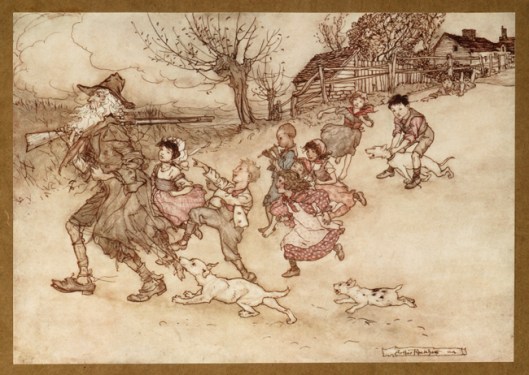
• About

doubtfulsea

~ adventure fantasy

Tag Archives: Arthur Rackham

Bring Back Your Dead!

12 Wednesday Apr 2017

Posted by Ollamh in Literary History, Narrative Methods

≈ 1 Comment

Tags

Arawn, Arthur Rackham, Badb, Branwen, Celtic Association of North America, Christopher Williams, Dallben, Disney, Fflewddur Fflam, Gundestrup Cauldron, Hercules, King Arthur, Lady Charlotte Guest, Lloyd Alexander, Lord of Annwn, Mabinogi, Mabinogion, Macbeth, Moirai, Morrigan, Norns, Princess Eilonwy, Pwyll, Shakespeare, Taran Wanderer, The Black Cauldron, The Castle of Llyr, The Chronicles of Prydain, the Fates, The First Two Lives of Lukas-Kasha, The High King, The Iron Ring, The Marvelous Misadventures od Sebastian, The Wizard in the Tree, The Xanadu Adventure, Time Cat, Walking Dead, Westmark, World War Z, zombies

Welcome, dear readers, as always.

In our last posting, we said that we intended to talk about otherworlds and also about one of our favorite YA (“Young Adult”) authors. That author is Lloyd Alexander (1924-2007)

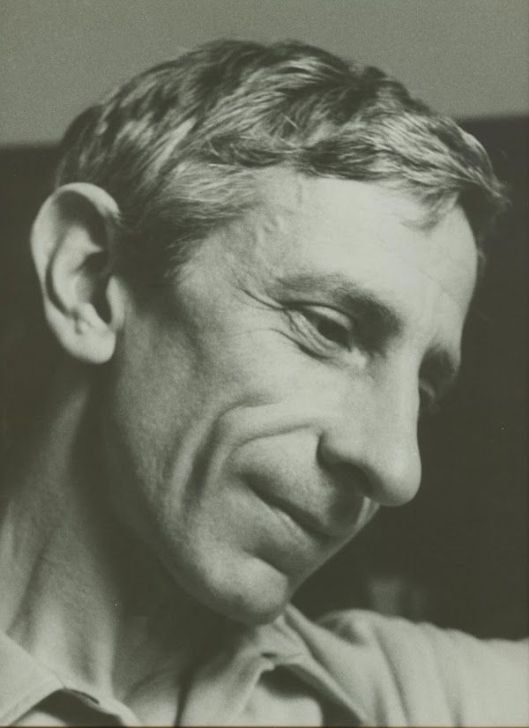
image1alawithcat.jpg

image1lalexander.jpg

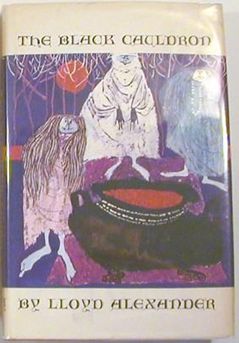
and we thought we’d open our exploration with one aspect of otherworlds: the dead, and with one aspect of them as seen in the second volume of Alexander’s pentalogy, The Chronicles of Prydain (1964-1968),
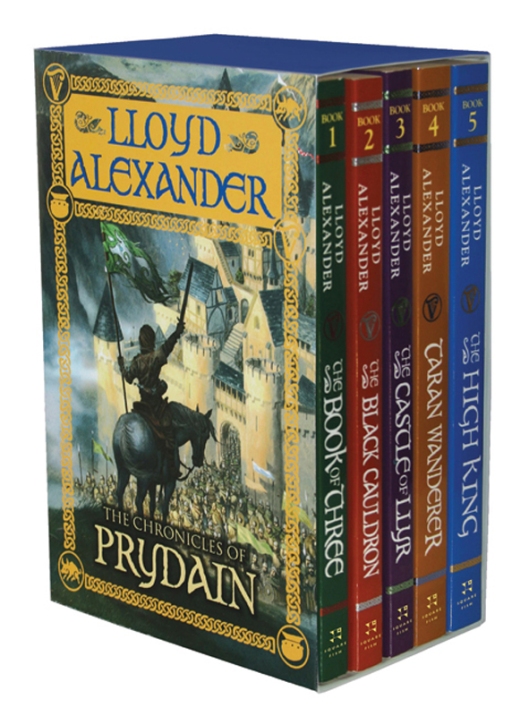
image2chronicles.jpg

The Black Cauldron.

image3blackc.JPG

Alexander wrote more than forty books, mostly YA.

image4timecatimage5sebastianimage6westmarkimage7theironringimage8lukaskashaimage9wizardimage10illyrian

Some are series, like “Westmark” and “Vesper Holly”, and some are one-offs, like The Iron Ring, and we’ve enjoyed them all, but those we have returned to most often are the books which make up The Chronicles: The Book of Three, The Black Cauldron, The Castle of Llyr, Taran Wanderer, The High King. These are lighter books than their Tolkien cousins, but they are equally serious, with genuinely unhappy moments, and a feel which might, at times, seem like a combination of The Hobbit and “The Grey Havens”, which is why we return to them. The characters can be familiar, like Taran the Assistant Pig Keeper, who is a foundling, but much more, and Dallben the very quiet wizard, but also unusual, like the Princess Eilonwy, a chatterbox with a practical mind, or Gurgi, who is somewhere between human and something else, and who talks in a distinctly rhythmic way, or the would-be minstrel, Fflewddur Fflam, who has trouble with the truth—something which his harp points out on a regular basis.

All of these characters and more have their home in “Prydain”,
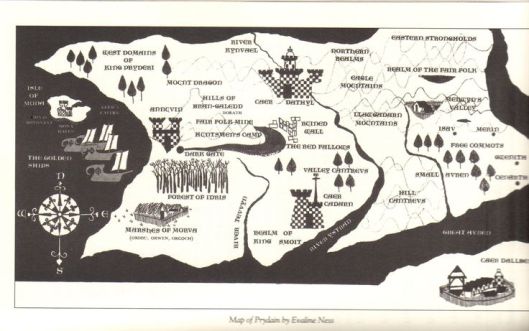
image11prydain.jpg

which is a kind of imaginary Wales, just as names and story elements in the pentalogy are derived from Welsh mythology and, in particular, from the medieval collection now called The Mabinogi (or Mabinogion—the title being the subject of much discussion). The first complete English translation was that of Lady Charlotte Guest (1838-1845) and it’s available at Sacred Texts. Here’s the link for the second edition of 1877).

In an interview with Scholastic, Alexander tells us that he spent a little time in Wales during World War II and fell in love with it and that the mythological part of the story came from a childhood love of King Arthur. (Here’s a link to the text of the interview—as well as one to the filmed interview, and, as a bonus, a separate film on Alexander.)

The general thread of the stories is derived, in part, from the story of Pwyll. (Yes—it looks unpronounceable, but it’s really not—go to this link from the Celtic Studies Association of North America to hear—for English speakers, that ll at the end would be the hardest—it’s said out of the corner of your mouth as a kind of musical hiss—if you know Sylvester the Pussycat from the old Warner Brothers cartoons,

image12sylvester.jpg

you can get a rough idea of the sound when he says—as everybody in the 1930s and 1940s appears to have said nearly constantly, if you believe their movies– “Say!”)

Pwyll is a prince who, when out hunting, has an encounter with Arawn (AH-ruhn, more or less), the Lord of Annwn (AH-nuhn), which is the name for the Otherworld. In the Alexander books, Arawn plans to conquer this world and Taran and his friends are brought into combat with his allies and Arawn himself again and again until Arawn’s final defeat.

One element in Arawn’s plans is a magical cauldron,
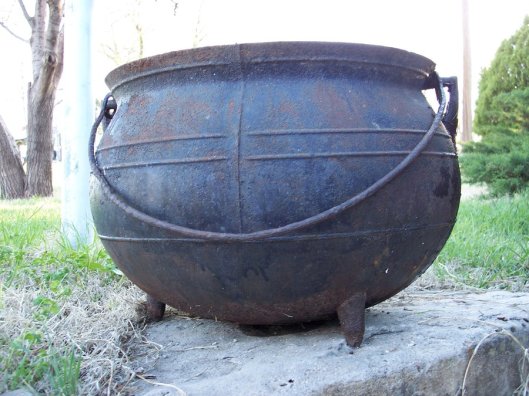
image13cauldron.jpg

which can bring back the dead. This is an idea which Alexander borrowed from another of the Mabinogi stories, that of Branwen, here depicted in a 1915 painting by Christopher Williams.
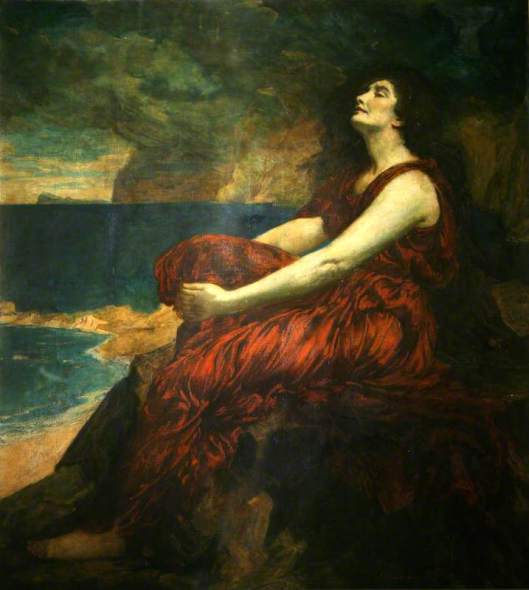
image14branwen.jpg

It has been suggested that the use of this cauldron can be seen upon the “Gundestrup Cauldron”, a silver vessel discovered in a peat bog at Gundestrup, Denmark, in 1891.

image15gundestrup.jpg

It’s a mysterious thing with lots of academic argument over who made it, where, and when, with dates between 200bc and 300ad, besides its purpose, but, among its many puzzling scenes is this:

image16gunddetail.jpg

In The Black Cauldron, although Arawn had once controlled it, the vessel really belongs to three mysterious figures—Orddu, Orwen, Orgoch—who live in a hut in the Marshes of Morva. Three haglike figures around a cauldron suggest another such trio—the three weird sisters in Shakespeare’s Macbeth.

image17macbeth.jpg

We believe, in fact, that these (in the play) are the three incarnations of the Irish goddess, the Badb (“Crow”). This image comes from a weird and interesting site called “Mygodpictures.com”.)

image18badb.jpg

She was also known as the Morrigan (“Great Queen”), who was thought to appear on battlefields, before, during, and after conflict.

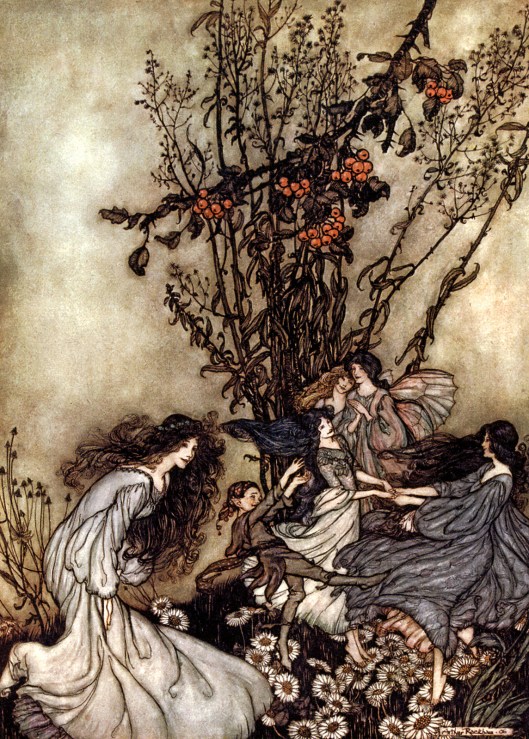
These hags also remind us of the three figures of fate from the Norse tradition, the Norns (seen here in an especially ghostly picture by Arthur Rackham)

image19norns.jpg

and, beyond those, the Moirai, the three fates of Greco-Roman religion

image20moirai.jpg

as well as the Fates from Disney’s Hercules

image21disneyfates.jpg

to go from the serious to the nearly-silly.

In recent years, popular entertainment has used the re-animated, from World War Z
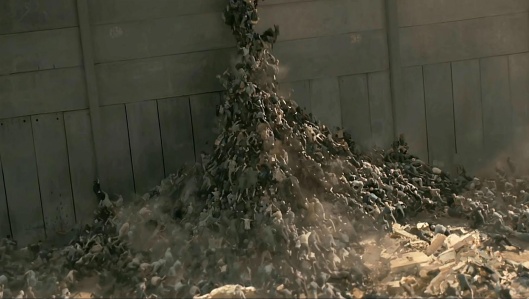
imag22worldwarz.jpg

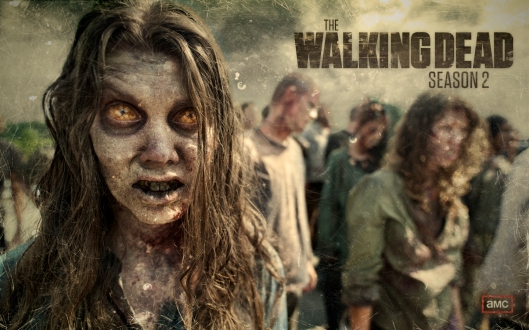
to The Walking Dead,

image23walkingdead.jpg

and can we ever escape zombies?

image24zombies.jpg

For us, however, perhaps the most powerful of images lies not in the gross graphics of decaying flesh, but that, in the story of Branwen, the dead can be brought back, but cannot speak. Why is this? It’s a haunting question: is it that death—or rebirth—is so terrible that they are blocked from talking about it? Is it that no one is alive who cannot communicate, in some form or other? What do you think about the mute dead, dear readers?

Thank you, as always, for reading and definitely

MTCIDC

CD

The Woods for the Trees…

05 Wednesday Oct 2016

Posted by Ollamh in Artists and Illustrators, Fairy Tales and Myths, J.R.R. Tolkien, Literary History

≈ 2 Comments

Tags

A Wonder Book, Arthur Rackham, Enid Blyton, Ent, Fairy Tale, Fairytale Illustrators, Fangorn, Farmer Giles of Ham, Harmsen Van Der Beek, Hawthorne, John Bauer, Middle-earth, Mirkwood, Old Man Willow, Pauline Baynes, Rackham Tree, The Lord of the Rings, The Old Forest, The Wind in the Willows, Tolkien, Treebeard, trees

Dear Readers,

Welcome.

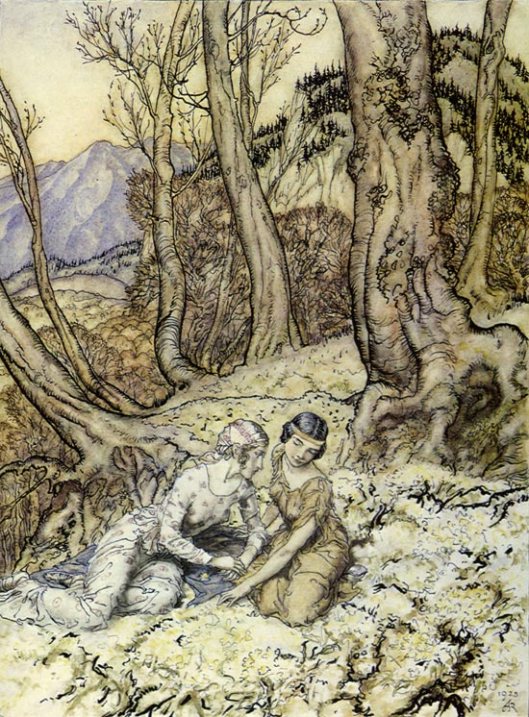
We’ve recently been admiring the illustrations of one of our favorite artists, Arthur Rackham (1867-1939). As a book illustrator, Rackham’s main focus was fairy tales, and for them, he developed a style which was described by E. V. Lucas in a letter to Rackham as his “grace and grotesque”. For us, what may be most striking about his work is the way he depicts landscapes and trees, with their distinctive “Rackhamesque” character.

11a9ca7244bf2060db41e7a5862344ab

From Nathaniel Hawthorne’s A Wonder Book, 1922

39e2b3c42d2341dfc53844a95a32e89d

“Come Now, a Roundel” from William Shakespeare’s A Midsummer Night’s Dream, 1908

429027

From Kenneth Grahame’s The Wind in the Willows, 1940

hermia_and_helena

From William Shakespeare’s A Midsummer Night’s Dream, 1908


As a tree admirer,

12930764_f520

He was certainly not alone.

553fada6b6a1f_

Being Tolkien people, this reminded us, of course, of JRRT’s own admiration of trees, of which he wrote in a sort of letter of introduction to Houghton Mifflin Co.: “I am (obviously) much in love with plants and above all trees, and always have been…” (Letters, 220).

JRRT himself was an illustrator of his own stories, and although he never cited Rackham as a direct influence, we know from Tolkien’s letters that he had seen Rackham’s work. He advised his illustrator Pauline Baynes to “avoid the Scylla of Blyton and the Charybdis of Rackham” (L 312).

Here is Pauline Baynes frontispiece for the first book which she illustrated for JRRT in 1949.

000901-3

Enid Blyton was an author of popular children’s books, but she was not an illustrator. We don’t know to what illustrations Tolkien might have been referring, but here is a Blyton book published in the same year, illustrated by the Dutch artist, Harmsen Van Der Beek. (The cover illustration reminds us of various illustrations for early translations of The Hobbit, illustrations which Tolkien hated.)

520wide+8030070

When we look at Tolkien’s forests

4d77f5a589fa1169c84c4fb29b56715b

we are often reminded of the work of the Swedish artist, John Bauer

John-Bauer-Elk-Cotton3

but for all of Tolkien’s warning to Baynes about Rackham’s style, there is a strong influence there, still.  After all, Tolkien did find Rackham’s illustrations “really astonishingly good pictures” (261). Sharing a passion for fairy tales with Rackham, which JRRT called “one of the highest forms of literature”, it’s no wonder to us that he would have found some inspiration in an artist who had similar tastes.

The influence seems strongest when it comes to animate trees.  As we were looking at the same Rackham illustrations which Tolkien would have seen, we found pictures which immediately reminded us, for example, of JRRT’s illustration of Old Man Willow.

ar_rvw2

7a81198748f0619bf839140c5cd4f60b

Just as Rackham’s work seems to have influenced JRRT as an illustrator, he seems to have inspired JRRT’s writing, as well. Being visual people, we can certainly say that, when writing Across the Doubtful Sea, we looked at several images which helped us to imagine the events, places, and characters in our south seas adventure. If you look at Rackham’s The Hawthorne Tree, dear readers, does it remind you of something—or someone?

b84eb67383d938d33e93ae7cfc9c82bd

It’s the wizened, knotted old face of Rackham’s Hawthorne Tree which made us think of this passage:

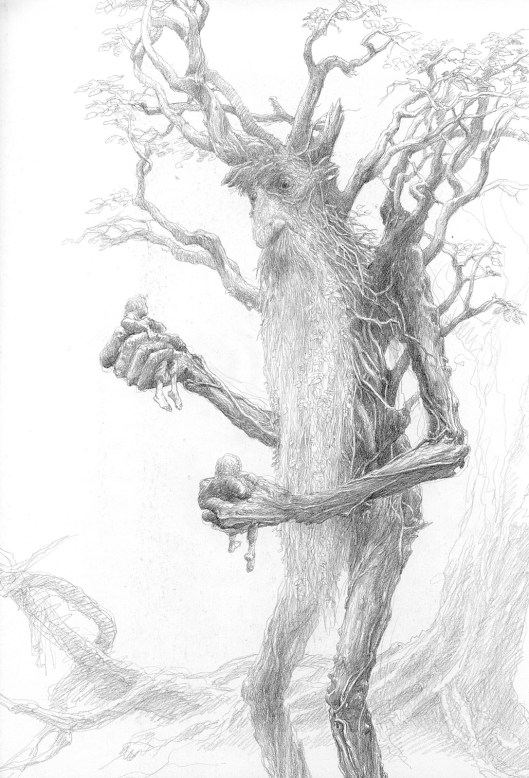
“They found that they were looking at a most extraordinary face. It belonged to a Man-like, almost troll-like, figure, at least fourteen foot high, very sturdy, with a tall head, and hardly any neck. Whether it was clad in stuff like green and grey bark, or whether that was its hide, was difficult to say. At any rate the arms, at a short distance from the trunk, were not wrinkled, but covered with a brown smooth skin… But at the moment, the Hobbits noted little but the eyes. These deep eyes were now surveying them, slow and solemn, but very penetrating.” (The Two Towers, “Treebeard”, 452)

treebeard

Treebeard is, in fact, not a tree, but an Ent. He is an ancient tree-like figure, however, and almost a description of Rackham’s illustration. Looking at Rackham’s paintings and drawings, it’s clear to us that they call out for story, and we wonder– is this how JRRT, with a passion for trees and an eye for illustration, felt about them, too?

Thank you, as always, for reading.

MTCIDC,

CD


STTL

06 Tuesday Sep 2016

Posted by Ollamh in Artists and Illustrators, Fairy Tales and Myths, Literary History

≈ Leave a comment

Tags

A Midsummer Night's Dream, Adventure, Alice's Adventures in Wonderland, Anthony Hope, Arthur Rackham, Cinderella, Fairies, N.C. Wyeth, Nathaniel Hawthorne's Wonder Book, Peter Pan in Kensington Gardens, Rip Van Winkle, Sleeping Beauty, The Dolly Dialogues, The Wind in the Willows, To the Other Side, trees

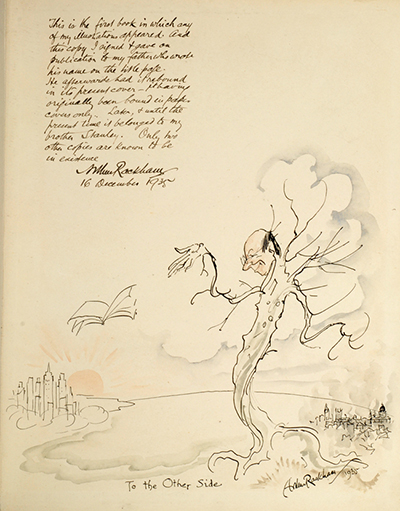
01573_art.jpg

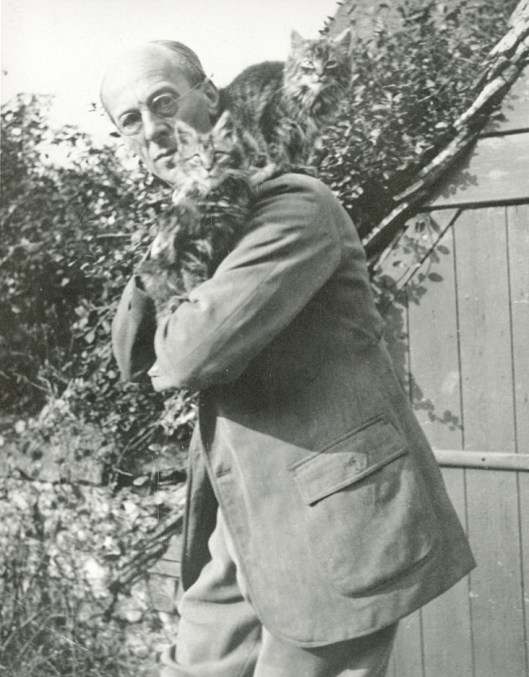
Welcome, as always, dear readers. This is a special day, so we have added an extra entry this week. 77 years ago today, on 6 September, 1939, 5 days after the beginning of World War 2, Arthur Rackham (1867-1939) died.

arthurrackhamwithcats.jpg

072038 Detail 2.JPG

Beginning as a clerk for the Westminster Fire Office (an insurance company, founded in 1717) who took art lessons,

Carlton-Hobbs-Westminster3.jpg

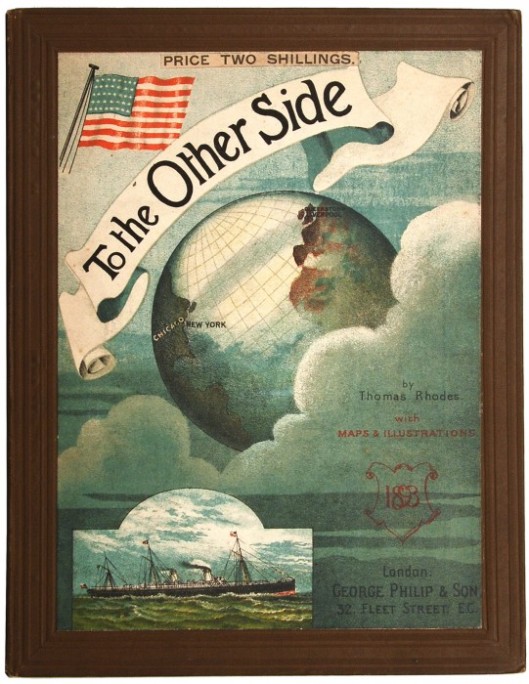
Rackham first shared illustrations with Alfred Bryant for the 1893 To the Other Side,

totheotherside1893.jpg

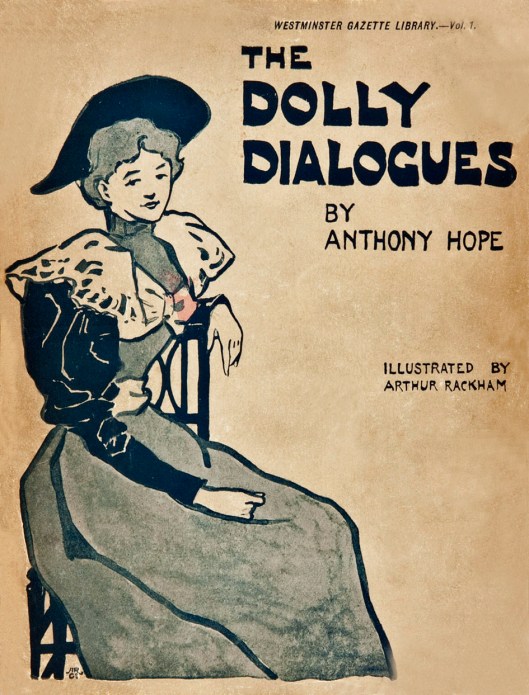
but his biographers tell us that it was his next book project, the illustrations for Anthony Hope’s The Dolly Dialogues,003 The Dolly Dialogues.jpg

which convinced him to put all of his energy into book illustrations, his focus from then until his death, in 1939.

dollydialogues01hopegoog_0046.jpg

A man dedicated to his art, Rackham turned out multitudes of images for books as varied as Rip Van Winkle (1905—also illustrated by N.C. Wyeth, another favorite of ours, in 1921),

ripvanwinkle1905

Peter Pan in Kensington Gardens (1906),

peterpankensington1906

danceyfairies

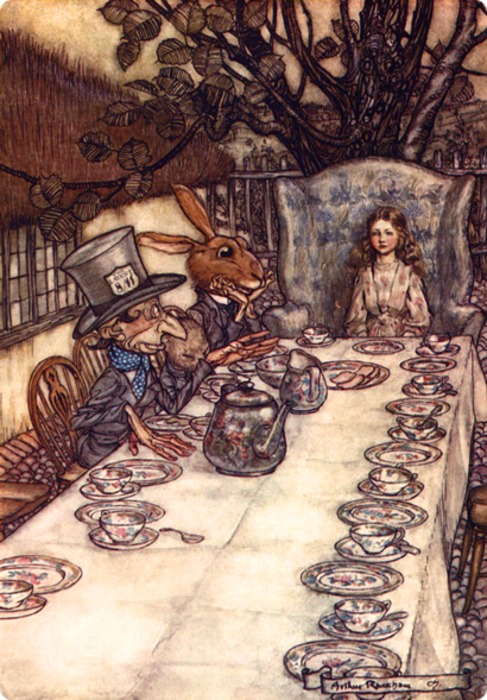
Alice’s Adventures in Wonderland (1907),

rackham5

A Midsummer Night’s Dream (1908),

arthur-rackham-midsummer-nights-dream-titania-sleeping

and The Wind in the Willows (published posthumously in 1940).

k900122-05

And his methods included the absolutely striking Cinderella (1919) and The Sleeping Beauty (1920), in which the illustrations are done almost completely in silhouette, as if the figures and scenes were designed for shadow plays.

Cinderellas-Pumpkin-Rackham-Silhouette.jpg

sleeping-beauty

Throughout, the themes of wonder and the fantastic/grotesque interested him the most and, for us, a major feature is his trees, of many types, but often haunted things with eyes and mouths.

02-arthur-rackham-imagina-1914-frontispiece

From William Shakespeare’s A Midsummer Night’s Dream, 1908

b84eb67383d938d33e93ae7cfc9c82bd

From Nathaniel Hawthorne’s A Wonder Book, 1922

39e2b3c42d2341dfc53844a95a32e89d

“Come Now, a Roundel” from William Shakespeare’s A Midsummer Night’s Dream, 1908

429027

From Kenneth Grahame’s The Wind in the Willows, 1940

hermia_and_helena

From William Shakespeare’s A Midsummer Night’s Dream, 1908

11a9ca7244bf2060db41e7a5862344ab

From Nathaniel Hawthorne’s A Wonder Book, 1922

12930764_f520

Although he was cremated, we still want to offer him a typical Roman farewell, sometimes found inscribed on Roman tombs and the title of this posting: Sit Tibi Terra Levis—“May the earth lie light upon you”. (Literally, “May the earth be light to you”)

Thanks, as ever, for reading.

MTCIDC

CD
Newer posts →

The Doubtful Sea Series Facebook Page

The Doubtful Sea Series Facebook Page

  • Ollamh

Categories

  • Artists and Illustrators
  • Economics in Middle-earth
  • Fairy Tales and Myths
  • Films and Music
  • Games
  • Heroes
  • Imaginary History
  • J.R.R. Tolkien
  • Language
  • Literary History
  • Maps
  • Medieval Russia
  • Military History
  • Military History of Middle-earth
  • Narnia
  • Narrative Methods
  • Poetry
  • Research
  • Star Wars
  • Terra Australis
  • The Rohirrim
  • Theatre and Performance
  • Tolkien
  • Uncategorized
  • Villains
  • Writing as Collaborators
Follow doubtfulsea on WordPress.com

Across the Doubtful Sea

Recent Postings

  • On the Road(s) Again—Again November 26, 2025
  • On the Road(s) Again November 19, 2025
  • To Bree (Part 2) November 12, 2025
  • To Bree (Part 1) November 5, 2025
  • A Plague o’ Both—No, o’ All Your Houses! October 29, 2025
  • It’s in Writing (2:  I’st a Prologue, or a Poesie for a Ring?) October 22, 2025
  • It’s in Writing (1) October 15, 2025
  • King Trotter? October 8, 2025
  • The Voices in His Head  October 2, 2025

Blog Statistics

  • 102,063 Views

Posting Archive

  • November 2025 (4)
  • October 2025 (5)
  • September 2025 (4)
  • August 2025 (4)
  • July 2025 (5)
  • June 2025 (4)
  • May 2025 (4)
  • April 2025 (5)
  • March 2025 (4)
  • February 2025 (4)
  • January 2025 (5)
  • December 2024 (4)
  • November 2024 (4)
  • October 2024 (5)
  • September 2024 (4)
  • August 2024 (4)
  • July 2024 (5)
  • June 2024 (4)
  • May 2024 (5)
  • April 2024 (4)
  • March 2024 (4)
  • February 2024 (4)
  • January 2024 (5)
  • December 2023 (4)
  • November 2023 (5)
  • October 2023 (4)
  • September 2023 (4)
  • August 2023 (5)
  • July 2023 (4)
  • June 2023 (4)
  • May 2023 (5)
  • April 2023 (4)
  • March 2023 (5)
  • February 2023 (4)
  • January 2023 (4)
  • December 2022 (4)
  • November 2022 (5)
  • October 2022 (4)
  • September 2022 (4)
  • August 2022 (5)
  • July 2022 (4)
  • June 2022 (5)
  • May 2022 (4)
  • April 2022 (4)
  • March 2022 (5)
  • February 2022 (4)
  • January 2022 (4)
  • December 2021 (5)
  • November 2021 (4)
  • October 2021 (4)
  • September 2021 (5)
  • August 2021 (4)
  • July 2021 (4)
  • June 2021 (5)
  • May 2021 (4)
  • April 2021 (4)
  • March 2021 (5)
  • February 2021 (4)
  • January 2021 (4)
  • December 2020 (5)
  • November 2020 (4)
  • October 2020 (4)
  • September 2020 (5)
  • August 2020 (4)
  • July 2020 (5)
  • June 2020 (4)
  • May 2020 (4)
  • April 2020 (5)
  • March 2020 (4)
  • February 2020 (4)
  • January 2020 (6)
  • December 2019 (4)
  • November 2019 (4)
  • October 2019 (5)
  • September 2019 (4)
  • August 2019 (4)
  • July 2019 (5)
  • June 2019 (4)
  • May 2019 (5)
  • April 2019 (4)
  • March 2019 (4)
  • February 2019 (4)
  • January 2019 (5)
  • December 2018 (4)
  • November 2018 (4)
  • October 2018 (5)
  • September 2018 (4)
  • August 2018 (5)
  • July 2018 (4)
  • June 2018 (4)
  • May 2018 (5)
  • April 2018 (4)
  • March 2018 (4)
  • February 2018 (4)
  • January 2018 (5)
  • December 2017 (4)
  • November 2017 (4)
  • October 2017 (4)
  • September 2017 (4)
  • August 2017 (5)
  • July 2017 (4)
  • June 2017 (4)
  • May 2017 (5)
  • April 2017 (4)
  • March 2017 (5)
  • February 2017 (4)
  • January 2017 (4)
  • December 2016 (4)
  • November 2016 (5)
  • October 2016 (6)
  • September 2016 (5)
  • August 2016 (5)
  • July 2016 (5)
  • June 2016 (5)
  • May 2016 (4)
  • April 2016 (4)
  • March 2016 (5)
  • February 2016 (4)
  • January 2016 (4)
  • December 2015 (5)
  • November 2015 (5)
  • October 2015 (4)
  • September 2015 (5)
  • August 2015 (4)
  • July 2015 (5)
  • June 2015 (5)
  • May 2015 (4)
  • April 2015 (3)
  • March 2015 (4)
  • February 2015 (4)
  • January 2015 (4)
  • December 2014 (5)
  • November 2014 (4)
  • October 2014 (6)
  • September 2014 (1)

Blog at WordPress.com.

  • Subscribe Subscribed
    • doubtfulsea
    • Join 78 other subscribers
    • Already have a WordPress.com account? Log in now.
    • doubtfulsea
    • Subscribe Subscribed
    • Sign up
    • Log in
    • Report this content
    • View site in Reader
    • Manage subscriptions
    • Collapse this bar
 

Loading Comments...