At Their Pleasure

Tags

, , , , , , , , ,

Dear readers, welcome, as always.

Because I enjoy reading letters from people in the past, I sometimes wonder from whom I would like to receive one—or more.  Certainly from the 18th-century English literary man, Horace Walpole (1717-1797),

who is credited with writing the first “Gothic” novel—1764—and, on the title page of the 2nd edition of 1765 actually calls it one—

and who so loved what he understood to be the medieval past that he built himself a castle in a “Gothic” style, Strawberry Hill, which you can visit today as it’s being lovingly restored.

The letters are gossipy and often quietly humorous and have the sound of a real voice, which is one reason why I enjoy reading them.  Here he is in 1760 complaining about the mail—

“I would give much to be sure those letters had reached you. Then, there is a little somebody of a German prince, through whose acre the post-road lies, and who has quarrelled with the Dutch about a halfpennyworth of postage ; if he has stopped my letters, I shall wish that some frow may have emptied her pail and drowned his dominions !”  (letter to Sir Horace Mann, 14 November, 1760—this is #722 in Volume V of the 16-volume Oxford collection, which you can find here:  https://archive.org/details/lettersofhoracew56walp/page/n7/mode/2up   “frow” is Walpole’s spelling of Dutch huisvrouw, “housewife” and I suspect that the “pail” is more likely a chamberpot, from his tone–)

Certainly I would be glad to receive something from Emily Dickinson, 1830-1886, which might even include a poem, as hers sometimes did.

Like Walpole’s, these are missives full of a living—and like Walpole, sometimes skeptical and humorous—person.  (There are two modern editions of the letters, the more recent just published last year, but you can get a sense of her for free from volume one of the first edition, from 1894, here:  https://archive.org/details/lettersofemilydi00dick )

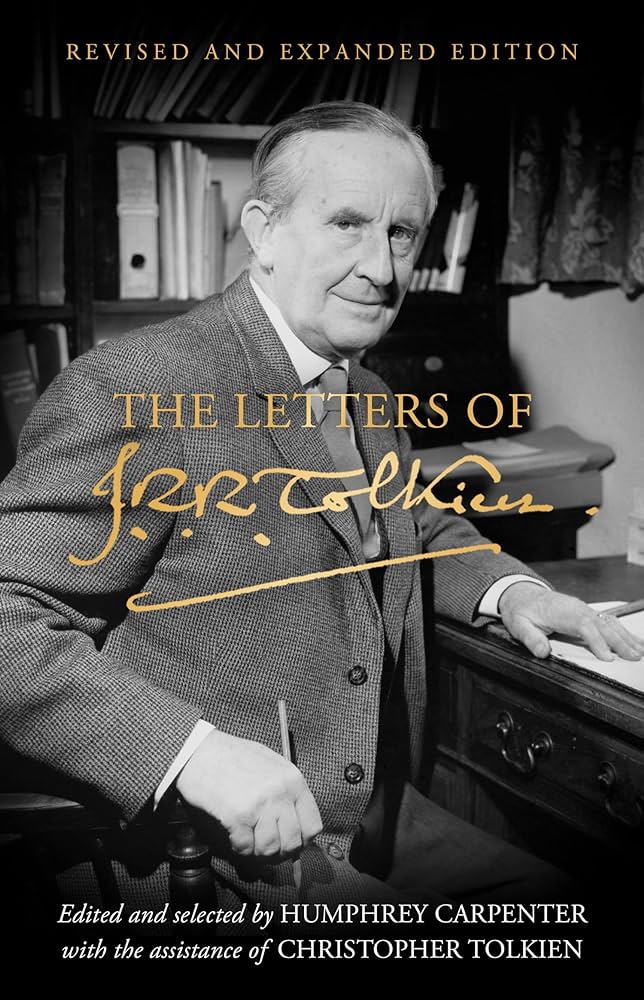
And, of course, letters directly from Tolkien, rather than being forced to read over his shoulder as we do with The Letters of J.R.R. Tolkien,

would be wonderful, not only for their voice, everything from affectionate to outraged, but also because there may be something more, even perhaps something unexpected to be read in them, even if you’ve read the same letters more than once.

Just the other day, for example, I was thumbing through, looking for something else, and I came upon this:

“But the Elves are not wholly good or in the right.  Not so much because they flirted with Sauron; as because with or without his assistance they were ‘embalmers’.  They wanted to have their cake and eat it:  to live in the mortal historical Middle-earth because they had become fond of it (and perhaps because they had there the advantages of a superior caste), and so tried to stop its change and history, stop its growth, keep it as a pleasaunce, even largely a desert, where they could be ‘artists’—and they were overburdened with sadness and nostalgic regret.” (to Naomi Mitchison, 25 September, 1954, Letters, 293)

What an interesting view of the Elves!  And that’s another reason to read letters:  you never know what you may learn and what may surprise you.  In this case, we are given a very much more nuanced picture of Middle-earth than, say, The Hobbit or The Lord of the Rings—and, in this case, a darker picture.

And one word in particular in this letter caught my attention:   “pleasaunce”, which can mean a “pleasure garden”.  Harkening back to Eden,

(Adam and Eve and a scaly friend from my favorite west-Byzantine mosaics in Monreale cathedral)

such places became a feature of medieval settings—both real and in literature—as we see in this depiction of the garden which is the scene of the opening of the 13th-century Roman de la Rose.

or Emilia in Theseus’ garden from Boccacio’s 14th-century Teseida.

They reached big—commercial—time in 18th-century London, with the very elaborate Ranelagh Gardens

with its large and elegant rotunda, and famous organ (Mozart at 9 played a concert at Ranelagh)

and Vauxhall,

known for its long, green avenues, its music,

and for the suggestion of naughtiness in such a large, but shadowy place.  (Although older, Vauxhall survived longer—its final closing came in 1859.  For more on both Gardens, see:  https://en.wikipedia.org/wiki/Ranelagh_Gardens and https://en.wikipedia.org/wiki/Vauxhall_Gardens )

A key feature of such places is the potential not only for including, but for excluding, as well.  After all, because of their naughtiness, Adam and Eve were eventually barred from their pleasaunce,

(another image from Monreale)

medieval gardens had walls to allow for limited entrance (the protagonist of The Roman of the Rose has to have the help of a character called “Indolence” to get in), and Ranelagh and Vauxhall had gates and entrance fees, so it’s interesting to see what Tolkien means by his choice of word.  As he says, his Elves had become “embalmers’, by which he means that they were like Egyptian mummifiers,

although their body was still alive, and their process was meant to stop history, not decay, and, at the same time, to change Middle-earth from something naturally progressing through time for all its inhabitants into a “pleasaunce”—an artificial walled pleasure garden for themselves, something frozen in time, in which they could enjoy themselves as if they were the sole owners and masters, including and excluding as they wished.

It would be easy to believe that Tolkien means by this to show the Elves as ultimately lordly and selfish and there is the suggestion of this—but there’s something more and I would suggest that this makes clear JRRT’s wish to move beyond the surface of his elaborate creation.  By their desire, the Elves might be thought selfish, but Tolkien reveals for us the price for such behavior:  “they were overburdened with sadness and nostalgic regret.”  By attempting to preserve the past, and yet seeing that it couldn’t be preserved, the Elves had created not a pleasaunce, but a mirror of the passing of time which, powerful as they were, they could never control, and, gazing into that mirror, they could only see that truth, leaving them with nothing more than to feel sadness and regret.

The melancholy of the Elves is always there, but, in this particular letter, Tolkien explains and therefore deepens that haunting feeling, giving us figures who, in some sense, have tried to do the impossible:  to stop time, and, realizing that they can’t, can only grieve—and retreat from the world of their failure. 

I’ll always read letters for the living voice I might find there (the ancient Roman Seneca, c.4BC-65AD, first became real for me from one of his letters), but this one underlines my other point:  reading letters—rereading letters—may bring surprises.

Thanks, as always, for reading.

Stay well,

Beware of staring too long into mirrors (think of Snow White’s stepmother),

And remember that, as always, there’s

MTCIDC

O

Lud-ite?

Tags

, , , , , ,

Welcome, as ever, dear readers.

Perhaps you’ve heard someone—often, I would say, an older person—who, confronted with something electronic, will say, “I’m not a Luddite, but…”

It’s taken to mean “I’m not against technology, but…”

But the history of the word casts a shadow on that disclaimer, as the real Luddites were very much against technology—technology which put them out of work and set them and their families to starve—or to be worked to death in the new factories.  (Charles Dickens captures a little of this in Hard Times, 1854:  https://archive.org/details/hardtimes0000char_w0u2/page/n11/mode/2up )

It all began with wool.

Wool production had made certain elements of medieval England very rich.

At the same time, because it was such a labor-intensive industry, it kept many ordinary people employed in everything from raising sheep to sheering, washing, carding, spinning, and weaving, almost all of which you can see in this illustration.

The demand for more and more wool and wool products in the later 18th century brought about the beginnings of the Industrial Revolution, when clever men began to invent devices which sped up the originally slow process of wool production, creating machines and then factories.

(This is a room in Quarry Bank, a wool mill complex in Cheshire, just a few miles from where Tolkien grew up, in Manchester.  It is held by the National Trust and, if like me, you’re interested in the history of the Industrial Revolution, you’ll want to learn more at:  https://en.wikipedia.org/wiki/Quarry_Bank_Mill )

Such places not only sped up production, but also cut down on the number of people needed to process the wool, which soon began to trouble the many who once lived by the old methods. 

As early as 1768, there had been attacks on machines and the name “Ludd” had originally been attached to an apprentice, “Ned Ludd”, who had supposedly smashed two knitting machines, called “stocking frames” in 1779.

In 1811, things had reached a stage where organized violence against machines, factories, and even factory-owners, increased and “King Ludd” or “General Ludd” became a kind of meme for the anti-industrial movement.  (You can read more here:  https://en.wikipedia.org/wiki/Luddite )

This imaginary Ludd is, however, only one of a number of figures under that name.  There is, for instance, the Biblical Lud, the son of Shem, the son of Noah.

(from the wonderful mosaics of Monreale, in Sicily—Noah, we’re told, got drunk and his embarrassed sons are covering him up—see Genesis 9.20-23 for details)

There is Lud, son of Heli, and king of Britain, according to Geoffrey of Monmouth’s 12th century Historia Regum Britanniae, the founder of London, and buried at Ludgate, of course.  (You can read, in a 1904 translation, about Lud in Historia 3.20 here:  https://archive.org/details/geoffreyofmonmou00geofuoft/geoffreyofmonmou00geofuoft/page/80/mode/2up

(as reconstructed in 1895—you can read more about the site here:  https://en.wikipedia.org/wiki/Ludgate  including the actual etymology of the name)

And then there’s Lud-in-the-Mist, a 1926 fantasy novel

by Hope Mirrlees (1887-1978),

where Lud is the name of a town in the imaginary country of Dorimare.

(Ryuk-Duck, but, when I’ve gone to DeviantArt, I’ve been unable to locate anything more.)

Mirrlees had published two previous novels, Madeleine:  One of Love’s Jansenists (1919)

and The Counterplot (1924),

as well as a rather complex “modernist” poem, Paris (1920),

but this was her only fantasy novel. 

(You can read all four of these four works here:  Madeleine https://www.gutenberg.org/cache/epub/65926/pg65926-images.html   Paris https://www.paris-a-poem.com/this is, by the way, a real work of scholarship and a very useful way to approach this poem—The Counterplot https://www.gutenberg.org/cache/epub/63935/pg63935-images.html and Lud-in-the-Mist https://www.gutenberg.org/cache/epub/68061/pg68061-images.html  You can read more about the author here:  https://en.wikipedia.org/wiki/Hope_Mirrlees )
I’ve just finished Lud-in-the-Mist, which, after disappearing for about 50 years, resurfaced in a first reprint in 1970, and several more, in 2000, 2005, and 2013.  The 2005 reprint had very distinguished opening matter:  a foreward by Neil Gaiman and an introduction by Douglas Anderson, of The Annotated Hobbit.  Gaiman has said of Lud-in-the-Mist that it’s “My favourite fairy tale/detective novel/history/fantasy”  (quoted from:  https://radicalreads.com/neil-gaiman-favorite-books/ ) and I would agree that it’s a combination at least of fairy tale and fantasy and there is a sort of detective story mixed in, but I’m not so sure that this all comes together for me as it clearly has for him.

The fantasy/fairy tale lies in the basic setting that:  Dorimare is an imaginary country and Lud-in-the-Mist is its capital, sitting at the meeting of two rivers:  Dapple and Dawl.  The Dawl seems to be the usual, expected kind of river, flowing southwards to the sea from somewhere inland, but the Dapple

“…had its source in Fairyland (from a salt inland sea, the geographers held) and flowed subterraneously under the Debatable Hills, was a humble little stream, and played no part in the commercial life of the town. But an old maxim of Dorimare bade one never forget that ‘The Dapple flows into the Dawl.’ It had come to be employed when one wanted to show the inadvisability of despising the services of humble agents; but, possibly, it had originally another application.”

This is at the very beginning of the second chapter, and already sets the tone:  Dorimare may be a picturesque little country on a river so broad that the town is also a seaport, although 20 miles from the actual sea, but that broad river is fed, in part, by a second stream, one which comes from the west (and the West, of course, is always a place perhaps to be dreaded, as it is often the direction to which the dead go in many folk traditions, as well as being the home of weird, otherworldly folk, the sort of people and creatures that voyagers west, like St Brendan

and Oisin, of the Irish Fenian Cycle, and Yeats’ early The Wanderings of Usheen, 1889, which you can read here:  https://www.gutenberg.org/files/38877/38877-h/38877-h.htm#THE_WANDERINGS_OF_USHEEN encounter. )  The river’s beginning lies, as well, in a place not visited by the Dorimarites for hundreds of years, Fairyland, and much of the book is taken up with “fairy fruit”, which is banned in Dorimare, along with any dealings or even mentions of fairies, but somehow keeps appearing and seriously disturbing the minds of those who consume it—as if the Dapple, under its pretty name, is actually underflowing and perhaps undercutting all of Dorimare.

The detective story seems almost a by-blow of the plot, although it involves a major character, Endymion Leer, who is a physician in Lud-in-the-Mist and, as the plot develops, much more, although I find that his role in the mystery somewhat trivializes the greater role he claims for himself near the end of the book at his trial for murder. 

I won’t summarize the complicated plot—you can read a brief and, I fear, inadequate précis here:  https://en.wikipedia.org/wiki/Lud-in-the-Mist and there are longer summaries to be had at various fantasy sites, although I find the ones I read, for me, too intent upon constructing complex, deeper meanings than I think the book really holds.

Instead, as I always do with reviews—films and books—I would encourage you to read it for yourself and come to your own conclusion.

There’s dry, quirky humor on the part of the narrator, some lush nature writing, a vivid depiction of what Fairyland might be like (unpleasant to nightmarish, I found it), and an appealing character in the protagonist, Nathaniel Chanticleer, who begins conventionally as a comfortable petit bourgeois (although he does have something haunting him), but grows into a feeling being through the fate of his son, Ranulph, all of which are at least enough to lure you in and perhaps keep you reading, as they did me.

So, as always, thanks for reading,

Wonder what fairy fruit might do to you,

And remember that, as ever, there’s

MTCIDC

O

PS

If going west myself, I should meet Hope Mirrlees, I would request that, should she, in some spiritual form, ever do a revised edition, she might include a map—a nice end paper one would do—as it would definitely help to keep one oriented in the characters’ travels around Dorimare.

PPS

For a powerful speech by Neil Gaiman on writing and reading and fantasy see:  https://www.theguardian.com/books/2013/oct/15/neil-gaiman-future-libraries-reading-daydreaming

Sally—and Harry

Tags

, , , , , , , , ,

Welcome, as always, dear readers.

If you’d seen the title of an earlier posting, “You’ve Got Mail”,

you might believe that I’m beginning to specialize in romcoms from the 1980s-90s with this title—

but, although some of the characters might be wearing mail in this posting,

(Denis Gordeev)

there’s no romance and no comedy.  Instead, it involves “sally” and “harry” not as nicknames for “Sarah” and “Henry”, but as verbs and nouns of destruction.

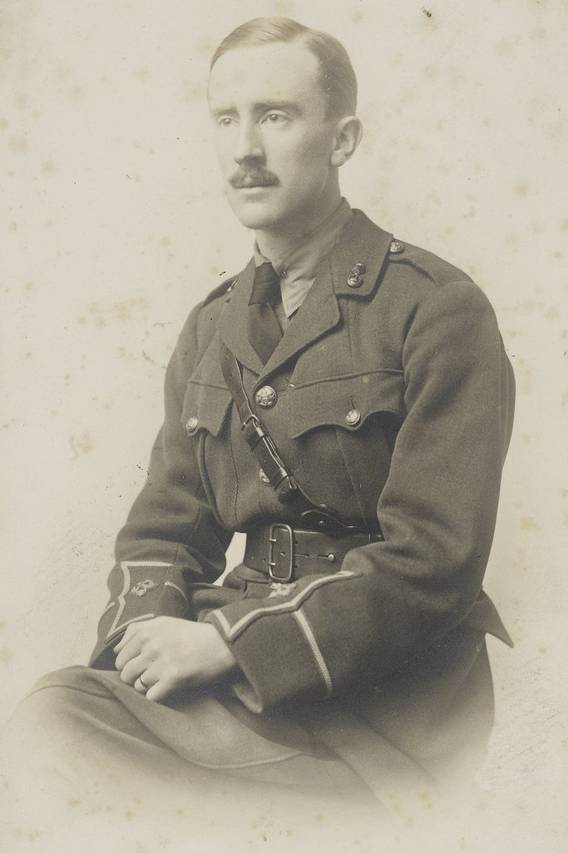
The war to which 2nd LieutenantTolkien

arrived in mid-1916

(Peter Dennis—a real favorite of mine for his ability to recreate scenes from the past, always with small, useful details.)

was not the war planned in 1913.  Into a world in which soldiers still wore fancy dress for parades—

(artist:  possibly Brian Fosten?)

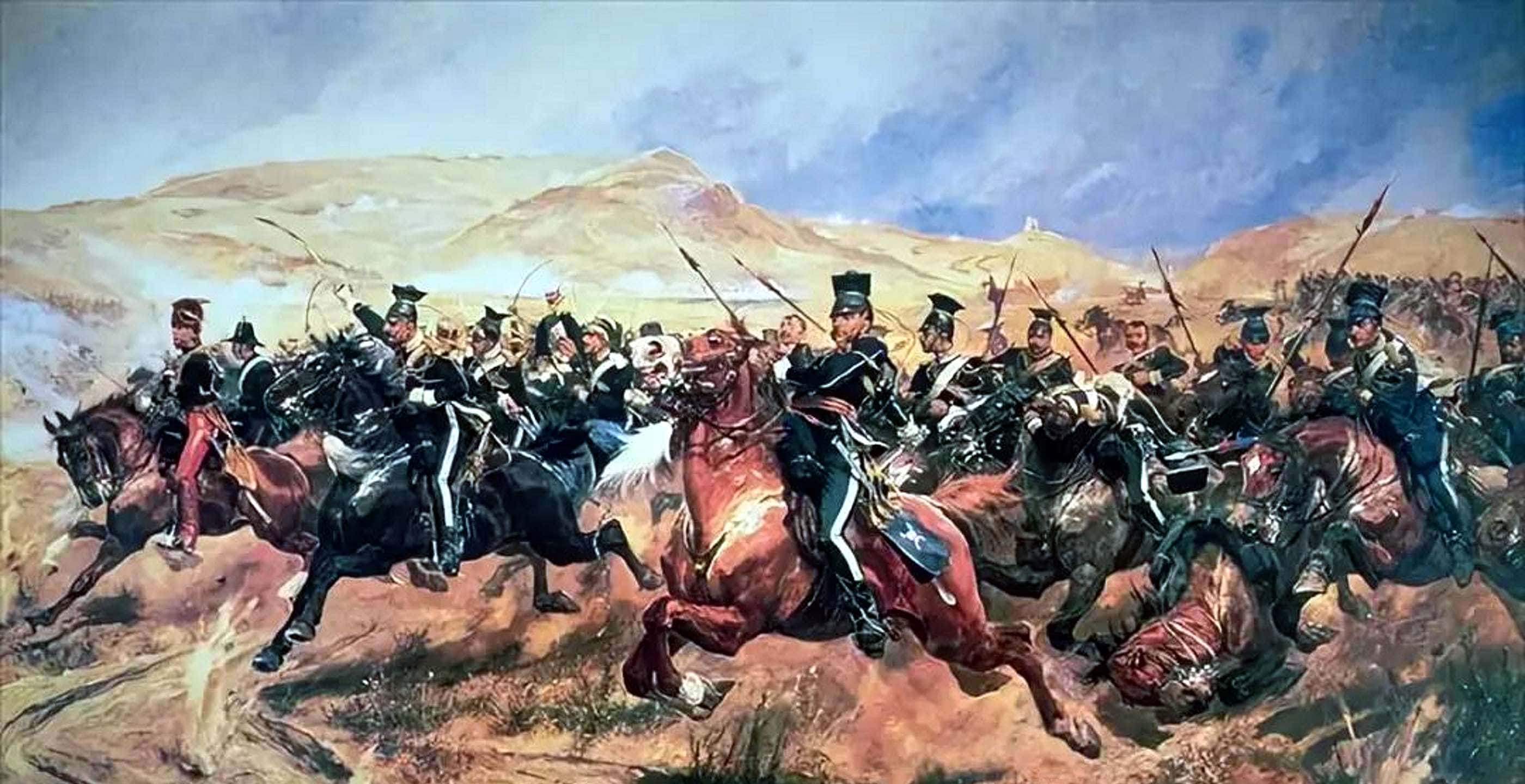
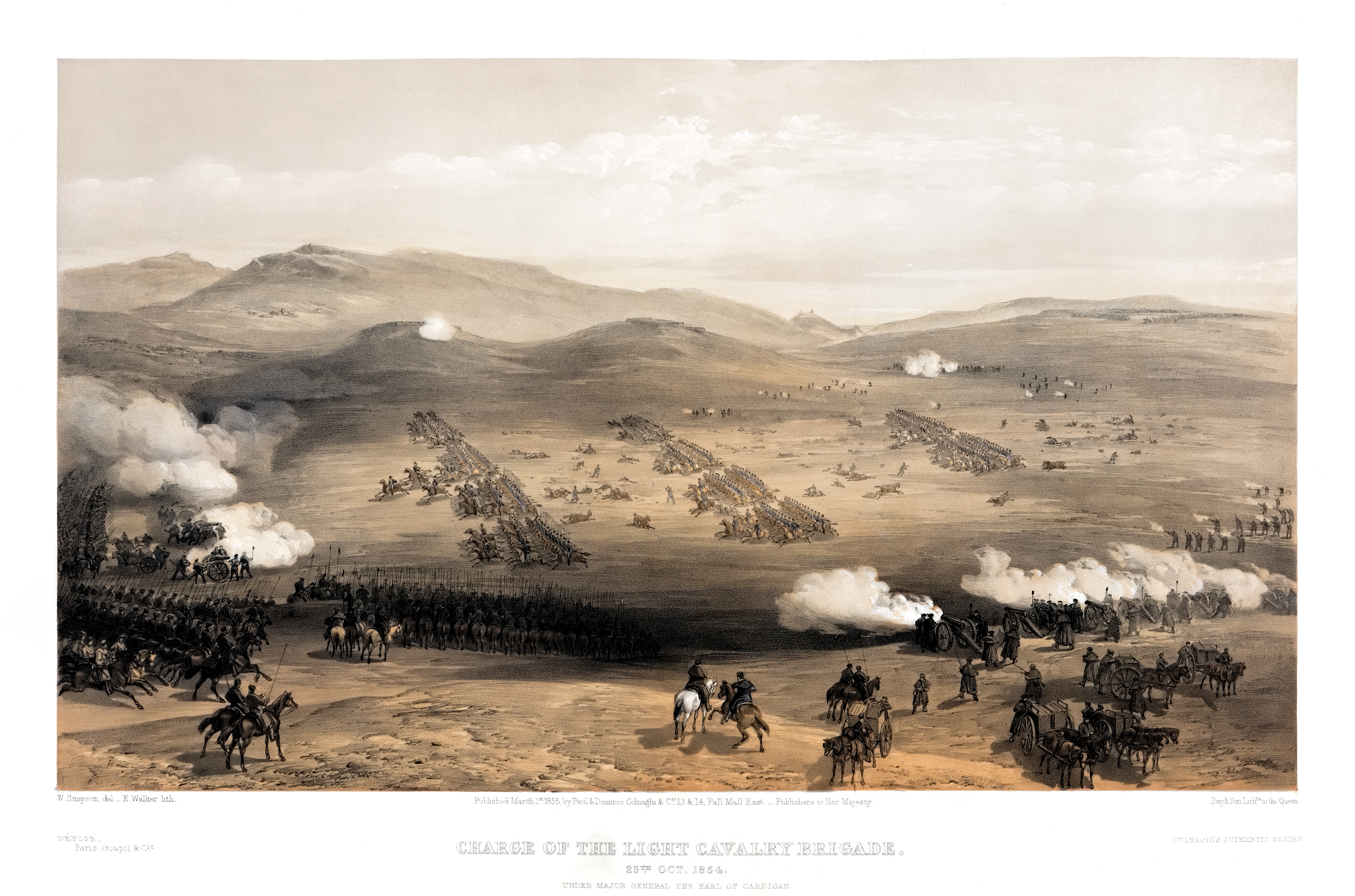
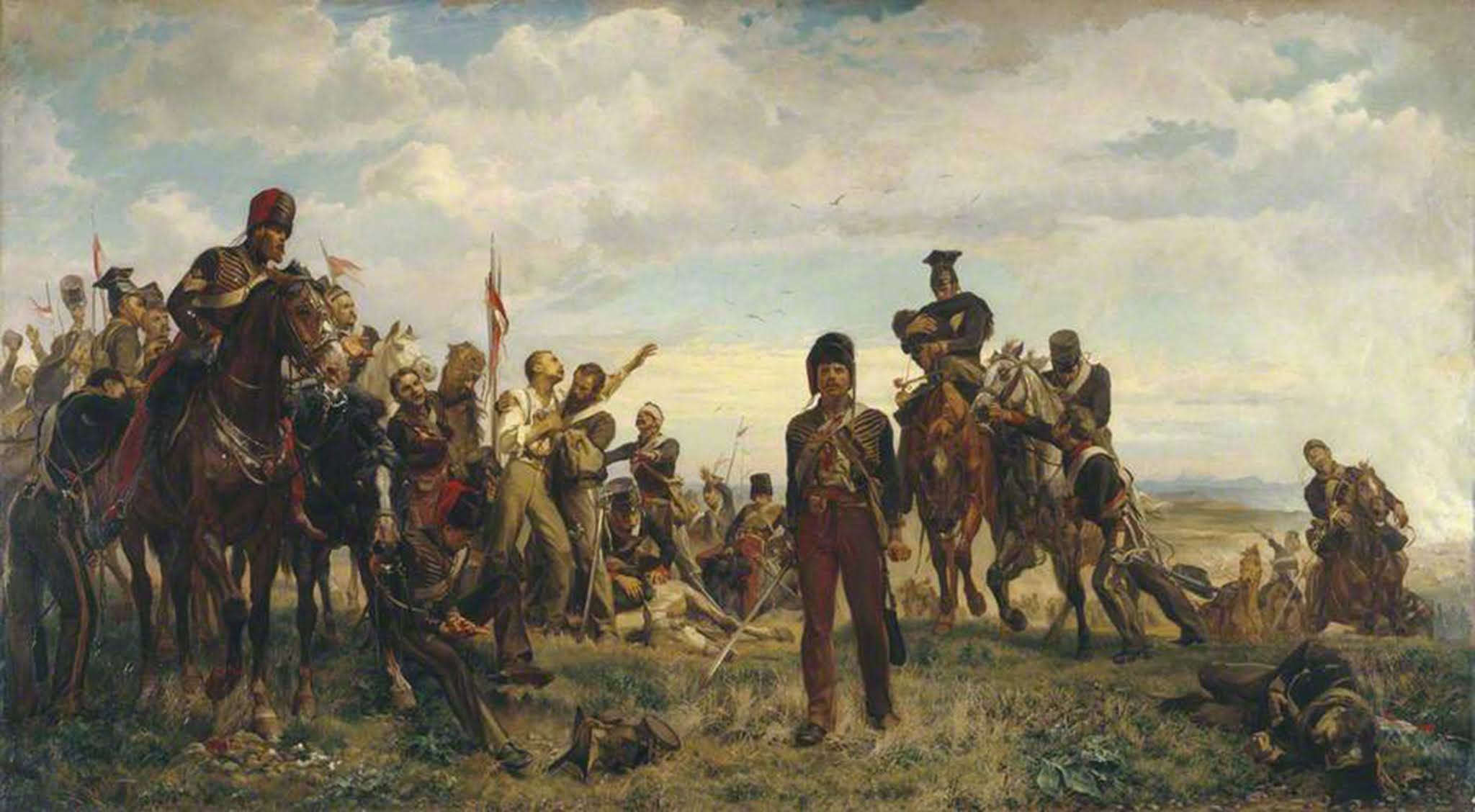
and cavalry officers still dreamed of heroic charges,

(Richard Simkin)

came these

and this sort of thing

with many other horrors to come and soldiers did the only sensible thing, given that they couldn’t just run for their lives, and began to dig in.

(another Peter Dennis)

On the Western Front, where Tolkien served, this eventually meant 500 miles of such digging, from Switzerland to the North Sea, until, ultimately, there were two lines of trenches, one German, one Allied, now facing each other.

People at the time were reminded of what was called siege warfare, which, in the past had meant that an army surrounded a town or a fortress, blocking access to it from the outside, usually dug trenches to mark off the area and to protect their own soldiers and, depending upon the era and its weaponry, use various war machines against the walls and those inside.

(Julius Caesar’s siege of the Gallic stronghold of Alesia, 52bc)

(a kind of idealized medieval siege by Liliane and Fred Funcken)

(the siege of Swedish-occupied Riga by the Russians in 1710, by an artist whose name appears to be “Batov”)

The difference, in this case, being that both sides seemed to be besieging the other and neither was surrounding or surrounded.

During his stay on the Western Front in 1916, Tolkien participated in a massive assault on sections of the German lines—the Battle of the Somme—in which the British suffered over 50,000 casualties on the first day alone.

(and another Peter Dennis

Big battles like this were relatively rare, however, as they required so much planning and such great resources, but, in between them, soldiers raided each other’s trenches, both to keep their own soldiers busy and to keep the enemy off balance, as well as to gain intelligence from prisoners and captured documents.

(and a further Peter Dennis)

In older, traditional sieges, the besieged might try to do the same, as well as ruin the besiegers’ siege artillery and trenches, even carrying off the enemy’s entrenching tools.  This was called a “sally”, and here we can see the besieged Gauls trying this maneuver out at Caesar’s siege of Alesia in 52BC

(and yet another Peter Dennis)

and here are Texian volunteers sallying from the Alamo to destroy shacks (jacales) being used by Mexican skirmishers in 1836.

(Gary Zaboly)

“To sally” comes from French saillir, “to leap/jump”, and clearly implies “to jump out at someone”, preferably unexpectedly, and that’s why some fortresses have sally ports—

(this is at Fort Mifflin, on the Delaware River south of Philadelphia)

smaller gates which could be used for surprise attacks on attackers.  And, when you sally, your job is to harry the enemy, “to harry” coming from Old English hergian (HAIR-yee-an), “to harass/plunder/ravage”, among other warlike definitions.

Tolkien, perhaps with a strong memory of trench warfare, along with a reminiscence of the desperate Gauls at Alesia, recreates one of these attacks at Helm’s Deep, where Saruman’s army of orcs and Dunlendings has begun its assault upon the outer wall.

(the artist listed for this is “Brokenhill”, but the only one I could find was an art commune in Australia, which I’m hoping is correct and which you can visit here:  https://artofbrokenhill.com/ )

Strictly speaking, this isn’t really a siege, any more than the attack on Minas Tirith is really a siege, even though that’s the chapter title.  Rather, it’s an escalade—an assault by ladder, which has always struck me as about the last siege attack I’d join—look at what’s happening in this one—would you want to be on the top of a rickety ladder?

Included in the escalade is an attempt to break through the main gates:

“Again the trumpets rang, and a press of roaring men leaped forth.  They held their great shields above them like a roof, while in their midst they bore two trunks of mighty trees.  Behind them orc-archers crowded, sending a hail of darts against the bowmen on the walls.  They gained the gates.  The trees, swung by strong arms, smote the timbers with a rending boom.” 

That “like a roof” is, basically, a Roman formation called a “turtle”—a testudo—used in exactly the same way in Roman assaults.

(from the column of Trajan, showing Roman infantry attacking a Dacian town)

The tree trunks are improvised battering rams—although classical ones could be tipped with metal to make them more effective—

In response, Aragorn and Eomer, with “a handful of stout swordsmen”, attempt a sally: 

“There was a small postern-door that opened in an angle of the burg-wall on the west, where the cliff stretched out to meet it…Together Eomer and Aragorn sprang through the door, their men close behind.  The two swords flashed from the sheath as one.”

Initially, this harrying of the enemy is successful, driving them back from the gate, but then there are too many of them and Eomer is grabbed by two of the Orcs, only to be rescued by the sudden appearance of Gimli, as the sally party dodges back inside the postern/sally port, which is closed behind them.

(Donato Giancola—I’ve recommended his site before—and here it is:  https://donatoarts.com/ )

But this is only the first sally—Theoden, fretting at the rapidly decaying defensive situation, as Saruman’s early blasting powder blows holes in the ancient walls of the Deep, makes a second attack, although, this time, it seems more like the action of despair, rather than a good tactic:

“But I will not end here, taken like an old badger in a trap.  Snowmane and Hasufel and the horses of my guard are in the inner court.  When the dawn comes, I will bid men sound Helm’s horn and I will ride forth.  Will you ride with me then, son of Arathorn?  Maybe we shall cleave a road, or make such an end as will be worth a song—if any be left to sing of us hereafter.”  (this, as well as all of the previous quotations, are from The Two Towers, Book Three, Chapter 7, “Helm’s Deep”)

(Alan Lee)

It’s not, of course, a suicidal charge, as Gandalf arrives with re-enforcements and then there are the Ents, so the sally harries the Orcs to their doom among the trees

and, although there is, as I said at the beginning, neither comedy nor romance, this sally, like the romcom, has a happy ending.

As always, thanks for reading.

Stay well,

When deep in a forest, never sneer at the trees—someone might be listening,

(Alan Lee)

And remember that, also as always, there’s

MTCIDC

O

Clubbing

Tags

, , , , , , , , , ,

Welcome, as always, dear readers.

So many earlier events are tied to this scene:

“The great shadow descended like a falling cloud…Upon it sat a shape, black-mantled, huge and threatening.”

It’s Eowyn about to challenge the Witch King of Angmar, the chief of the Nazgul, mounted upon his really disgusting creature.  Behind it lie:

1. the Black Riders

(the Gaffer and a Nazgul—perfectly captured by Denis Gordeev)

2. a sword taken from the barrow where the Barrow Wight almost makes an early end to the story

(a sketch for a painting by Matthew Stewart.  You can see more of his work here:  https://mattstewartartblog.blogspot.com/ )

3. Merry swearing fealty to Theoden

(a statue group from a Dutch site called “Odd World”:  https://www.oddworld.be/the-lord-of-rings-merry-and-theoden-miniatuur-beeld-1_prod11508.html

4. Eowyn, in despair over her unrequited love for Aragorn, disguising herself as “Dernhelm”, and taking Merry with her to Minas Tirith

(another Matthew Stewart)

5. one of those disgusting creatures

(Alan Lee)

And I’m sure that you can think of more, as it’s a wonderfully rich dramatic scene, including Tolkien at his archaizing best (William Morris would be very pleased with him):

“Begone, foul dwimmerlaik, lord of carrion!”

As you can imagine, there are numerous illustrations of it—from the Hildebrandts

to Alan Lee

to Ted Nasmith

to Denis Gordeev—

In each case, it’s interesting to see what moment in the scene each artist has chosen.  What caught my eye this time, however, wasn’t a person or creature or even the action, but an object:

“…the Lord of the Nazgul.  To the air he had returned, summoning his steed ere the darkness failed, and now he was come again, bringing ruin, turning hope to despair, and victory to death.  A great black mace he wielded.”

If you knew nothing about weaponry, you’d know that, at least, it’s a weapon, if, for no other reason,from its effect:

“With a cry of hatred that stung the very ears like venom he let fall his mace.  Her shield was shivered in many pieces, and her arm was broken…”  (The Return of the King, Book Five, Chapter 6, “The Battle of the Pelennor Fields”)

If you look up “mace” in Wikipedia, you find a wide variety of possibilities, however, everything from a spice

to a kind of tear gas

to a Star Wars character

(I’m afraid that I don’t have an artist for this, but how could I resist such a wonderful depiction?)

and more—which you can investigate here:  https://en.wikipedia.org/wiki/Mace –but it’s the weapon which I was interested in.

We have earlier seen Nazgul armed with swords:

“There were five tall figures:  two standing on the lip of the dell, three advancing.  In their white faces burned keen and merciless eyes; under their mantles were long grey robes; upon their grey hairs were helms of silver; in their haggard hands were swords of steel.”  (The Fellowship of the Ring, Book One, Chapter 11, “A Knife in the Dark”)

(Weathertop by Alan Lee)

And, of course, at least one dagger—the Morgul Knife which wounds Frodo.

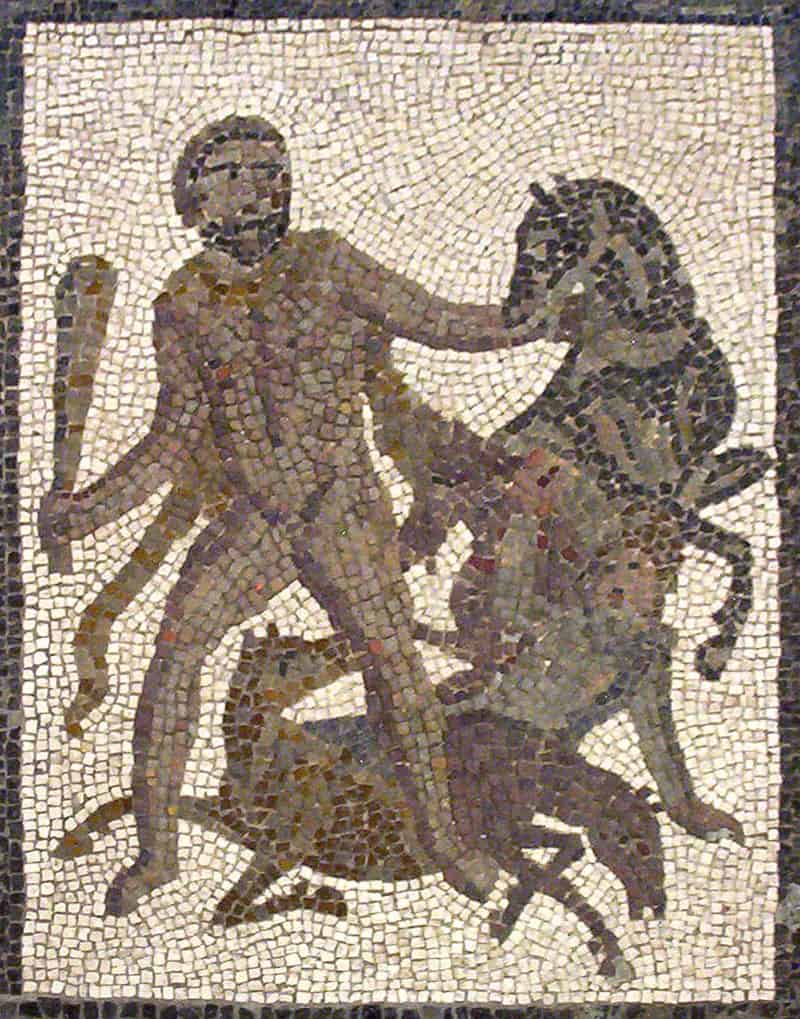
The mace, however, is new—but, in fact, very old.  It’s a kind of club, originally probably nothing more than the sort of thing which Herakles carries.

(a rather sea-sick looking Herakles, sailing in the cup of Helios)

When it comes to violence, however, people are endlessly inventive and, by the time of the Egyptians, we find polished stone heads

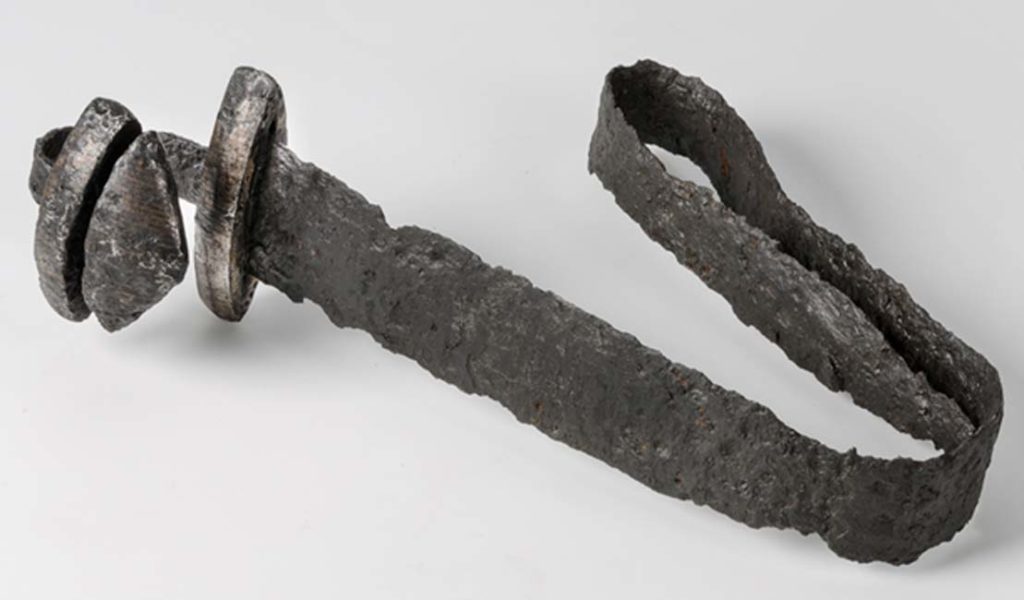
which, when attached to a stick, became a favorite early bashing weapon.

(from the so-called “Narmer palette”—31st century BC—this is an interesting find from 1894 from the ancient Egyptian site of Nekhen—you can read more about it here:  https://en.wikipedia.org/wiki/Hierakonpolis )

Tolkien’s model, however, would have come from a much later, probably medieval, period and the fact that it’s black might indicate that it’s made of iron.  Of course there’s one medieval wooden club which JRRT would have known—

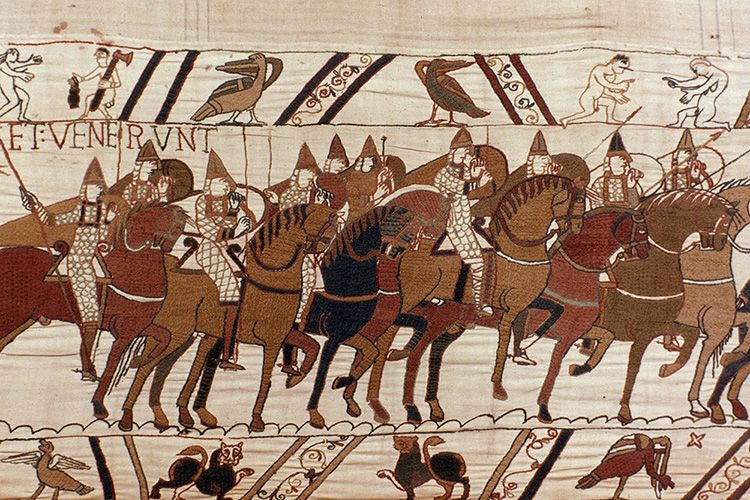
This is Odo, the bishop of Bayeux, in Normandy, the half-brother of Duke William, at the battle of Hastings.  Apparently, as an ecclesiastic, he felt unable to wield a sword or spear, like other Normans, and so he has armed himself with what might be thought of (although not by its victims) as a more “peaceable” weapon.

But this is, shall we say, unusual, and there were a wide variety of types to choose from—here’s a selection, along with other medieval weapons–

(by the Funckens, Liliane and Fred, from a very lively 3-volume set on medieval and Renaissance clothing, armor, and weaponry)

Various artists have made different choices, modeling their work on actual maces, or spinning off into fantasy, but perhaps we can do what Tolkien did with the Rohirrim, when he suggested that their armor would look like the mail of the Normans in the Bayeux Tapestry.  (see letter to Rhona Beare, 14 October, 1958, Letters, 401).  I haven’t spotted a Norman actually using a mace, but there appears to be an image of one here, between the charging Normans and the defending Anglo-Saxons, on the left (thrown by one of the latter?)–

It’s a bit small for Tolkien’s description, but, blow it up a bit for scale (after all, the Nazgul towers over Eowyn) and perhaps the one labeled “German 16” below would be a rough match?

Ironically, it’s Merry’s ancient sword which saves Eowyn, but, before that, that mace, combined with the force of the Nazgul’s swing, smashes Eowyn’s shield (probably made of overlapping layers of wood, perhaps with a metal covering?) and would have smashed her as well, reminding me of a remark supposedly made by the early 20th-century US President, Theodore Roosevelt, “Speak softly—and carry a big stick”!

Thanks, for reading, as always.

Stay well,

Dare I say stick around

Because, as always, there’s

MTCIDC?

O

Bacon and Eggs, Etc.

Tags

, , , , , , , , , , , , ,

Dear readers, welcome, as always.

When Tolkien admitted that he was a hobbit, he defined them—and himself—in part in this way:

“…I like gardens, trees and unmechanized farmlands; I smoke a pipe, and like good plain food (unrefrigerated), but detest French cooking… “ (from a letter to Deborah Webster, 25 October, 1958, Letters, 411)

This follows, of course, his description in “Concerning Hobbits” in the Prologue to The Lord of the Rings:

“Their faces were as a rule good-natured rather than beautiful, broad, bright-eyed, red-cheeked, with mouths apt to laughter, and to eating and drinking.  And laugh they did, and eat, and drink, often and heartily, being fond of simple jests at all times, and of six meals a day (when they could get them).”

And this is an extension of the description in the first chapter, “An Unexpected Party”, of The Hobbit:

“[they] have long clever brown fingers, good-natured faces, and laugh deep fruity laughs (especially after dinner, which they have twice a day when they can get it).”

This propensity for the consumption of comestibles—and for the reporting of and description of eating and all that might go with it—is more, in The Hobbit, than simply a fond look at a foible, however.  In fact, it is a theme which seems, at times to dominate the book—and we see this practically on the first page of the novel, not only in that mention of multiple dinners, but even in the fact that hobbit laughs are “fruity”.

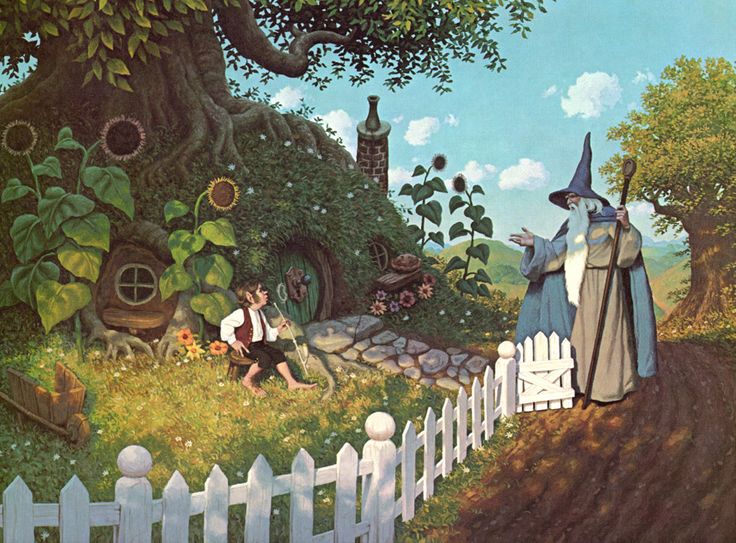
The opening setting itself announces the theme:  “Bilbo Baggins was standing at his door after breakfast…” and soon Bilbo is resisting Gandalf’s proposal of an adventure by saying “Nasty disturbing uncomfortable things!  Make you late for dinner!”  (The Hobbit, Chapter 1, “An Unexpected Party”)

(the Hildebrandts)

There follows the rattled Bilbo’s invitation to Gandalf to come to tea (after which he consoles himself with “a cake or two and a drink of something”), and then the party from the chapter title, which includes not only a major depletion of Bilbo’s pantry (or pantries, as the narrator has already informed us that Bilbo’s house has “lots of these”), but even a kind of heroic catalogue of what’s called for and which Bilbo seems able to supply including:  tea, beer, seed-cake, coffee, scones, ale, porter, red wine, raspberry jam, apple-tart, mince-pies, cheese, pork-pie, salad, eggs, chicken, and pickles (and a single biscuit—that is, cookie, for Bilbo).

The chapter ends with one last burst of food-talk as Bilbo offers bed and breakfast to the dwarves (as a way of seeing them off) and Thorin orders breakfast as if Bilbo were running an inn:

“But I agree about bed and breakfast.  I like six eggs with my ham, when starting on a journey:  fried not poached, and mind you don’t break ‘em.”

(Eggs and ham—those eggs will appear again, but with bacon, when Bilbo, more than once, yearns for them.  This is from a rather mouth-watering website called “The English Kitchen”, which you can visit here:  https://www.theenglishkitchen.co/2020/04/proper-ham-eggs.html  And, as, when you search for a useful image of ham and eggs, you suddenly find yourself surrounded by images of Dr. Seuss’ wonderful Green Eggs and Ham, you can it read here:  https://ia601502.us.archive.org/20/items/green-eggs-and-ham_202211/GreenEggs%20Ham.pdf )

And Bilbo goes off the bed annoyed not only at Thorin, but at all of the other dwarves, who have made similar orders.

After that opening, it’s not surprising that Chapter 2 begins with a still-annoyed Bilbo, faced with a mountain of dirty dishes, the remains of a breakfast he didn’t fix, but, cleaning up, he enjoys his own first breakfast and is starting on a second one when Gandalf appears and Bilbo is suddenly off on the adventure which takes up the rest of the book.

Food soon appears again as one of their ponies “got into the river before they could catch him…and all the baggage that he carried was washed away off him.  Of course it was mostly food, and there was mighty little left for supper, and less for breakfast.”  (Chapter 2)

But then the eating theme takes a different and disturbing turn:  trolls

(JRRT)

who, though currently munching mutton, have “…et a village and a half between yer, since we come down from the mountains” and soon, like amateur chefs on “The Great Goblin Bake Off”, are discussing how to prepare dwarf—will it be roasting?  boiling?  before the judge, one Gandalf, decides the argument by tricking them into being exposed to the sun and turned to stone.

(JRRT)

This is, in its way, a mirror to the original eating idea, in which the protagonists who do the consuming are at risk of becoming a potential article for consumption and we’ll see this repeated more than once with:

1. the goblins (Chapter 4):  “For goblins eat horses and ponies and donkeys (and other much more dreadful things), and they are always hungry.”

(Alan Lee)

2. Gollum (Chapter 5):  “He was looking out of his pale lamp-eyes for blind fish, which he grabbed with his long fingers as quick as thinking.  Goblin he thought good, when he could get it…” and there’s the possibility that Bilbo might be on the menu—if he loses the riddle contest.

(Alan Lee)

3. the spiders (Chapter 8):  “  ‘What nasty thick skins they [the dwarves] have to be sure, but I’ll wager there is good juice inside.’ ‘Aye, they’ll make fine eating, when they’ve hung a bit…’ ”

(and another Alan Lee)

4. and, of course, Smaug (Chapter 12):  “ ‘Let me tell you I ate six ponies last night and I shall catch and eat all the others before long…I know the smell (and taste) of dwarf…Girion Lord of Dale is dead, and I have eaten his people like a wolf among sheep…’ “

(JRRT)

On the other side (the eating, not eaten), however, there are:

1. supper with the Rivendell elves (Chapter 3)

(JRRT)

2. rabbit, hare, and sheep with the eagles (Chapter 6)

(JRRT)

3. meals with Beorn (Chapter 7)

(Ted Nasmith)

4. starving in Mirkwood while being tantalized by elvish feasts (Chapter 8)

(another elf king, in an illustration by A.W. Bayes, 1831-1909)

5. prison rations in the dungeons of Thranduil, the king of the forest elves (Chapter 9)—as well as food stolen by Bilbo

(a generic dungeon as, so far, I haven’t discovered a useful illustration of the original situation)

6. feasts in Lake-town (Chapter 10)

(JRRT)

7. a gourmet diet of snails (Chapter 11)

(Alan Lee)

8. and even the threat of siege and starvation (Chapter 15)—

(Alan Lee)

Given that so much of the text is handed over to eating and drinking, it’s surprising that the conclusion of the story doesn’t have Gandalf returning (with Balin) to tea some years later—

(Alan Lee)

could it be that even that academic hobbit is finally full?

As always, thanks for reading.

Stay well,

One slice of cake should do, I think, don’t you? Or maybe two?

And remember that, as always, there’s

MTCIDC

O

Hybrids

Tags

, , , , , , , , , , , , , , , , ,

As always, dear readers, welcome.

The title of this piece might suggest electric cars, and it definitely will mention several different wheeled vehicles, but it is actually what I hope is a little study in something Tolkien does wonderfully well:  taking different elements from different times and cultures and so blending them that they become believable new wholes.

Although I don’t always agree with elements in Jackson’s The Lord of the Rings, one thing has always given me pleasure:  the Rohirrim, whether en masse

or a small grouping.

And this is true for Edoras

as well as for Meduseld.

And yet they appear to be a kind of combination of peoples:  on the one hand, Tolkien imagined them to be Anglo-Saxons,

(Peter Dennis)

a people who primarily fought on foot, as at their last two major battles, Stamford Bridge,

(Victor Ambrus—who worked for years with the popular British archeology series, Time Team—which is available on YouTube and much recommended)

where they defeated another infantry force, the Vikings, and Hastings,

(Artist?)

in which they were overwhelmed at the battle’s conclusion by Norman cavalry.

(From the wonderful “Bayeux Tapestry”—actually the “Bayeux Embroidery”—if you’d like to see the whole thing, look here:  https://www.bayeuxmuseum.com/en/the-bayeux-tapestry/discover-the-bayeux-tapestry/explore-online/  To my knowledge, there’s nothing like it from the Middle Ages for depicting a specific series of events in the medieval world.)

On the other hand, the Rohirrim were mounted, more like those Normans who defeated the Anglo-Saxons,

although the language they speak is, basically, a form of Old English, the language of the Anglo-Saxons.  Tolkien imagined them, in fact, as looking like the Normans, as well, describing them in a letter to Rhona Beare:

“The styles of the Bayeux Tapestry (made in England) fit them well enough, if one remembers that the kind of tennis-nets [the] soldiers seem to have on are only a clumsy conventional sign for chain-mail of small rings.”  (letter to Rhona Beare, 14 October, 1958, Letters, 401)

That is, their armor actually can look like this—

(By Angus McBride—and ironic, as, for all that McBride must have painted dozens of figures in chain mail, he once confessed in an interview that it was his least favorite part of illustrating, as the mail took so long to do.)

It’s also interesting to think about them as a people.  Anglo-Saxons were descended from a combination of locals (Romano-British) and various groups of west-Germanic tribesmen who had either been early post-Roman invaders of Britain or Germanic tribesmen brought to Britain to protect the locals from those invaders and who had become colonizers in turn.

But who were the Rohirrim and where did they come from?

“Eorl the Young was lord of the Men of Eotheod.  That land lay near the sources of Anduin, between the furthest ranges of the Misty Mountains and the northernmost parts of Mirkwood.”

(JRRT)

They had not always lived there, however:

“The Eotheod [from Old English, “Horsefolk”] had moved to those regions in the days of King Earnil II [TA 1945-2043] from lands in the vales of Anduin between the Carrock and the Gladden, and they were in origin close akin to the Beornings and the men of the west-eaves of the forest.  The forefathers of Eorl claimed descent from kings in Rhovanion, whose realm lay beyond Mirkwood before the invasions of the Wainriders…They loved best the plains and delighted in horses and in all feats of horsemanship…” (The Lord of the Rings, Appendix A II “The House of Eorl”)

The combination of “They loved best the plains and delighted in horses” makes perfect sense when one thinks about comparative history in our Middle-earth.  Consider the Eurasian Steppe, stretching from western China all the way to the Hungarian puszta.

This is an immense belt of grassland,

some 5000 miles (8000km) wide,

and has been the homeland of numerous horsefolk throughout history, from the Scythians

to the Sarmatians

to the Huns

(Angus McBride)

to the Mongols.

(another McBride)

All of these peoples have used the Steppe to graze their herds of horses, sometimes moving west for grazing, sometimes moving west when pressured by others further east, and sometimes as predators, like the Huns, moving west to seek new plunder.

(I haven’t been able to identify an artist for this–it has the look of late-Victorian.)

In two of these cases, whole peoples might be on the move and this is perhaps where Tolkien has gotten part of his description of those Wainriders he mentions:

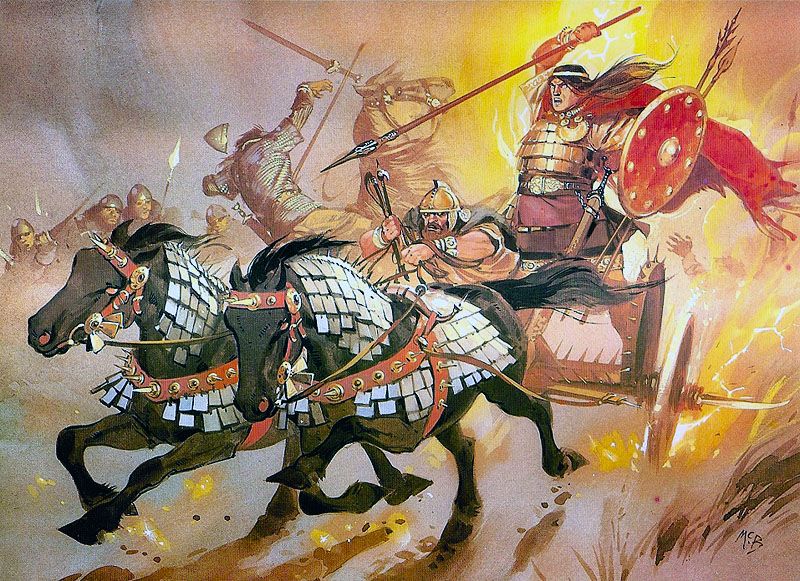
“The Wainriders were a people, or a confederacy of many peoples, that came from the East; but they were stronger and better armed than any that had appeared before.  They journeyed in great wains, and their chieftains fought in chariots…” 

So, we can imagine that the Eotheod, pressured by the Wainriders, were forced west, as one steppe people is pushed westward by another to the east. 

But Tolkien gives us another—or perhaps additional–possibility:

“Stirred up, as was afterwards seen, by the emissaries of Sauron, they made a sudden assault on Gondor…The people of eastern and southern Rhovanion were enslaved; and the frontiers of Gondor were for that time withdrawn to the Anduin and the Emyn Muil.” (The Lord of the Rings, Appendix A, IV “Gondor and the Heirs of Anarion”)

The Wainriders, then, might be both steppe peoples moving westwards, but also predators, like the Huns, or like the Mongols, who were both predators and empire-builders, and here we might see Mongols with their characteristic ger (a large round tent)—on a wagon—perhaps like the Wainriders?

(Wayne Reynolds)

Although there is no mention in our text of the Rohirrim migrating with wagons, it’s clear from parallels in our world that the peoples who crossed the Eurasian Steppe appear to have used them regularly.  But here, like the Rohirrim, we have another odd juxtaposition.  The Rohirrim are Anglo-Saxons on horseback:  cavalry, which was true for all of those migrants across the Steppe in our world.  Chariots, however, although Tolkien says that the Wainrider chiefs fought in them (of which fact this is the only mention) were not part of those other horsefolks’ arsenals.  Where did they come from?

The answer, I think, lies in the period of British history before the Anglo-Saxons and almost before the Romans, among the earlier Celtic settlers of England.  Julius Caesar encountered chariots there and described their use:

Genus hoc est ex essedis pugnae. Primo per omnes partes perequitant et tela coiciunt atque ipso terrore equorum et strepitu rotarum ordines plerumque perturbant, et cum se inter equitum turmas insinuaverunt, ex essedis desiliunt et pedibus proeliantur. 2 Aurigae interim paulatim ex proelio excedunt atque ita currus conlocant ut, si illi a multitudine hostium premantur, expeditum ad quos receptum habeant. 3 Ita mobilitatem equitum, stabilitatem peditum in proeliis praestant, ac tantum usu cotidiano et exercitatione efficiunt uti in declivi ac praecipiti loco incitatos equos sustinere et brevi moderari ac flectere et per temonem percurrere et in iugo insistere et se inde in currus citissime recipere consuerint.

“This is the kind of fighting from chariots.  At first, they ride around in all directions and throw spears and often, by the very frightfulness of the horses and the roar of the wheels, they shake the ranks [of the enemy] and, when they have slipped themselves among the troops of [enemy] cavalry, they leap from the chariots and fight on foot.  Meanwhile, the charioteers move out a little way from the fighting and so place their vehicles that, if they [the dismounted fighters] should be pressed by a large number of the enemy, they may have an easy retreat to them.  Thus, they provide the mobility of cavalry [as well as] the steadiness of infantry in [their] battles and they accomplish so much by daily practice and exercise that they are accustomed to control their stirred-up horses on a sloping and steep place and rein [them] in quickly and to turn [them] and to run along the yoke pole and to stand on the yoke and from there to take themselves back into the vehicles extremely speedily.”  (Caesar, De Bello Gallico, Book IV, Chapter 33—my translation)

(Angus McBride)

Tolkien may have remembered this from his schooldays, when he would first have encountered the text—and he might have found those wagons there, too, although slightly later.  When, in 60-61AD, the Iceni queen, Boudica, led a revolt against Roman rule,

(Peter Dennis)

in the final battle, when the tribesmen advanced towards the Roman formation, as Tacitus (c.56-c.120AD) tells us, their families watched from their wagons, placed behind the battle line (De Vita et Moribus Iulii Agricolae, Chapter 34).  And, as a prelude to the battle, Boudica had ridden among the ranks in a chariot (Chapter 35).

(another Peter Dennis—in fact, if you’d like to know more about this amazing woman, who, for a brief time, had been a real threat to the Romans, you might invest in: 

And so, as in combining Anglo-Saxon and Norman to create the Rohirrim, Tolkien may have taken Steppe people, added Celtic Britons, and produced the Wainriders. 

Thanks, as always for reading.

Stay well,

Remember that a horse will drink, on average, between 5 and 10 gallons (19-38 litres) of water a day,

And remember, as well, that there’s always

MTCIDC

O

The Toys of Dale

Tags

, , , ,

Welcome, as always, dear readers.

From his letters, it’s clear that Tolkien had very mixed feelings about Christmas. 

To his son, Christopher, far away in the RAF, he writes:

“Today is the ‘last day for posting in time for Christmas’, and though I resent the way in which this feast of peace and joy is made into a labour (not to say a nightmare of shabby commercialism)…”

and continues:

“…The shops, by the way, pass belief here this year.  There is stuff that a barbarian would be ashamed of, bits of shapeless wood and paper smeared with paint, and would certainly not be such fools as to purchase, selling for idiotic prices like 18/6 [18 shillings, 6 pence, when 1 shilling, 3 pence would buy a quart of milk—see:  https://www.sunnyavenue.co.uk/insight/how-much-is-a-shilling-worth-today ).  Surely this Xmas Gift business is a form of dementia, when it allows itself to be cheated so transparently.”  (letter to Christopher Tolkien, 10 December, 1944, Letters, 149-150)

He has, however, already qualified this a bit by calling Christmas a “feast of peace and joy”, with a further proviso some years later in a letter to his son Michael:

“Well here comes Christmas!  That astonishing thing that no ‘commercialism’ can in fact defile—unless you let it.” (letter to Michael Tolkien, 19 December, 1962, Letters, 457)

I have no idea what “bits of shapeless wood and paper smeared with paint” might actually be, but, as Tolkien has clearly been shopping and there are children in the family, I imagine that it was some crude, mass-produced toy, which might also suffer from wartime shortages of raw materials.  Perhaps something like this?

Born in 1893, Tolkien had grown up in a world of increasingly-sophisticated children’s playthings, from Marklin’s beautifully-engineered toy trains

to William Britain’s popular toy soldiers

for boys and elaborate dolls,

elegant tea sets,

and doll houses for girls, among other toys.

As one of two sons of a mother barely scraping by,

it’s unlikely that he, or his younger brother, Hilary, could ever have more than glimpsed such things in a toy shop window,

and had to be contented with the lesser toys of the age—clay rather than stone marbles,

a wooden hoop, rather than a steel one,

or, in a moment of splurging on his mother’s part, perhaps a pop gun—one is mentioned in The Hobbit where, in Chapter 1, Gandalf refers to Bilbo opening his door like one—for more on that and other such weapons in fiction, see “Pop!” 13 December, 2017 here:  https://doubtfulsea.com//?s=popgun&search=Go

In the Third Age of Middle-earth, we might expect to be surprised and puzzled by Gandalf’s remark, as there are no guns to be seen there and here we can’t use the plausible explanation for other anachronisms in the text, that it’s the narrator telling the story in the 1930s, as it’s Gandalf who says it, not the exterior—and much more modern—narrator.

But I would suggest another explanation—which also appears in The Hobbit.  Speaking of the long-lost world of the dwarves’ Lonely Mountain and the town of Dale at its foot, Thorin says:

“Altogether those were good days for us, and the poorest of us had money to spend, and to lend, and leisure to make beautiful things just for the fun of it, not to speak of the most marvelous and magical toys, the like of which is not to be found in the world now-a-days.  So my grandfather’s halls became full of armour and jewels and carvings and cups, and the toy market of Dale was the wonder of the North.”  (The Hobbit, Chapter One, “An Unexpected Party”)

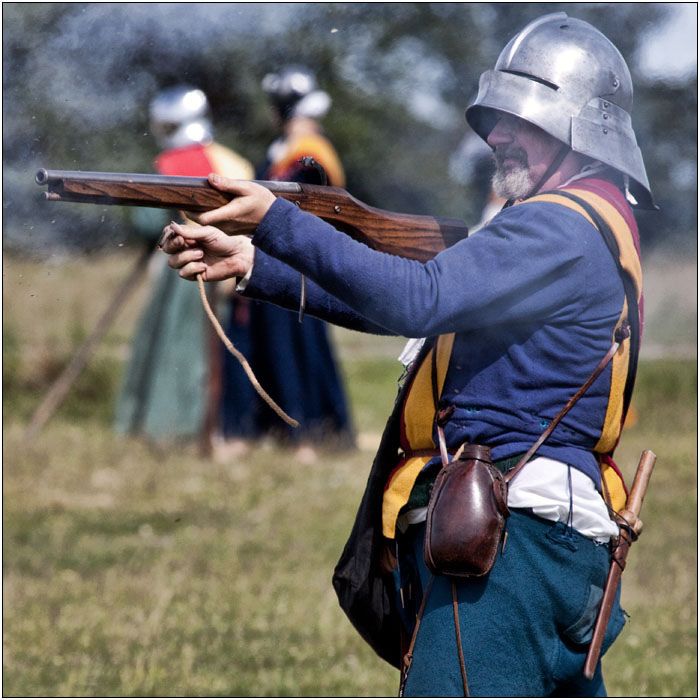
Perhaps, even before the appearance of gunpowder weapons (foreshadowed both by Saruman’s attack on Helm’s Deep and Sauron’s on the Causeway Forts in The Lord of the Rings), then, the dwarvish and human craftsmen of the region had created something which, in their time, used air to propel its missile, rather than this? 

But what about other “most marvelous and magical” toys?

The Third Age in Middle-earth is, at base, a medieval world, the kind of place Tolkien, as a boy, would have seen through the eyes of illustrators like Howard Pyle (1853-1911)

(from his The Story of King Arthur and his Knights, 1903, which you can read here:   https://archive.org/details/storykingarthur02pylegoog/page/n15/mode/2up )

and the writings of authors like his favorite, William Morris (1834-1896).

(You can read this here:  https://gutenberg.org/cache/epub/169/pg169-images.html )

Toys like that Marklin train above, therefore, wouldn’t have been available,

but, as Tolkien shows us a clock on the right-hand wall of the entryway at Bag End,

and, as mechanical toys were certainly for sale in the later Victorian world,

perhaps we can imagine something like this on sale in the Dale toy market?

or this?

always remembering that, although these might seem crude to us, they are antiques and worn from being once much-loved and much-played with, and, in medieval Middle-earth, anything which moved without being pushed or pulled would be magical!

Thanks for reading, as always.

Stay well,

Remember what JRRT said about keeping Christmas magical,

And remember, as well, that there’s

MTCIDC

O

PS

There are many sites for early mechanical toys, some informational, some for collectors, and some both at once.  Here’s one which is fun to read and has a practical side:  https://www.unclealstoys.com/origin-of-wind-up-toys-discovering-the-fascinating-history/

Underheard

Tags

, , , , ,

As always, dear readers, welcome.

If you read this blog regularly, you probably imagine that, as a small child, I lived in a constant state of puzzlement—and I did.  In part, this came from the fact that, before I could read and write, and sometimes after that, I lived in an oral world, where so much of my life was spent hearing things, rather than seeing them in print—and that could lead to interesting results.

For instance, there’s a patriotic song I was taught, probably in kindergarten, which begins:

“My country, ‘tis of thee,

Sweet land of liberty,

Of thee I sing.” 

From the oddly convoluted grammar, you might suspect that it was written to an already-existing tune—and you’d be right:  it’s set to “God Save the King”.  (You can read about its history here:  https://en.wikipedia.org/wiki/My_Country,_%27Tis_of_Thee  If you think that the use of a tune about a king as the basis for a song for a republic is surprising, just consider:  these words date from 1831, but there’s a 1786 song to the same tune entitled “God Save Great Washington”—only 3 years after the founding of a country which had fought for 8 years to escape the very king the original song had been written for.  

Here’s a verse from that:  

“God save great Washington,
His worth from eve’ry tongue,
Demands applause;
Ye tuneful pow’rs combine,
And each true Whig now join
Whose heart did ne’r resign
The glorious cause.” 

About the same level as “My Country, ‘tis of thee”, I would say.  This is quoted from a usually very useful source:  https://mudcat.org/thread.cfm?threadid=39759  but the work cited there says that the lyric is from The Philadelphia Continental Journal for 7 April, 1786, and, as far as I can determine, there was no such journal in Philadelphia at that time.  Perhaps this is a mistake for the Boston-based Continental Journal and Weekly Advertiser, which ran from 1776 to 1787?  For a list of 18th-century Philadelphia newspapers, see:  https://brainly.infogalactic.com/info/List_of_newspapers_in_Pennsylvania_in_the_18th_century#Philadelphia )

And this is where orality comes in.  Hearing a teacher sing this while we stumbled along behind her, I thought that what she sang was “My country, dizzily…” which, even (or perhaps especially) to a small child, was somewhat enigmatic.   You can imagine, then, what would be the case had I then tried to teach it to another child, or even an adult.

If you’ve ever played the game called “Whisper Down the Lane” or “Telephone”, you’ve seen what happens when someone initially says something which is then passed down a chain of listeners—you can read more about it at WikiHow here:  https://www.wikihow.com/Play-the-Telephone-Game  from which this illustration comes.

As the original message passes from mouth to ear to mouth, words change and it’s sometimes quite surprising when, if you had spoken that initial message, you heard the last person in the chain repeat what she or he heard.

It’s also a very good illustration of the effect of oral tradition on songs.

For example, in Child Ballad #200, (formally, The English and Scottish Popular Ballads, edited by Francis James Child), with a variety of titles including “The Wraggle Taggle Gypsies, O”.  The basic story is that a fine lady is enticed to go off with some Gypsies (a term no longer used, “Romani People” being currently employed, but, in discussing the ballad, I’m going to stick to the older term as that’s what’s in the text) and, in many variants, the idea is that the Gypsies have (literally) enchanted her, the word  used being “glamer/glamour/glamourie/-ye”, a Scots and perhaps even then archaic word for magic/magic spell.  Except for variant G, which, instead of the Gypsies casting their glamour/glamourie over her, has:  “They called their grandmother over.”

In an introductory note, Child writes that he collected it from the Roxburghe Ballads, a selection first published in 1847 (for more on this and its somewhat dubious history, see:  https://en.wikipedia.org/wiki/Roxburghe_Ballads   and for more on the original collection, see:  https://ebba.english.ucsb.edu/page/roxburghe ), and which is derived from a mass of popular sheet music of the 17th and 18th centuries. 

I suppose one could say that “grandmother” simply shows that the word “glamour/glamourie”, from Scots, was simply misunderstood by whoever was behind variant G, but, remembering “My country dizzily”, I would suggest that it’s just as likely that someone misheard the word—and a new character was added to the ballad.  (For the ballad and its variants in Child’s edition, see:   https://archive.org/details/englishandscopt104chiluoft/page/60/mode/2up )

And this is certainly true for another ballad example, in which another character sprang suddenly into being.  This is from Child #181, “The Bonnie Earl of Moray” in which the narrator sings:

 “Ye Highlands and ye Lawlands,

Oh where have you been?

They have slain the Earl o’ Moray

And layd him on the green.”

and from which came that character—Lady Mon de Green (also written Lady Mondegreen).  And what’s interesting here for me is that this has become a general term for a misheard lyric, a “mondegreen”, but invented not by a linguist, but by a humorist, Sylvia Wright (1917-1981), and published in an article in Harper’s Magazine in 1954.    (See:  “The death of Lady Mondegreen” in November’s issue)  Wright explained that she, as a child, had—you guessed it—misheard that line in “The Bonnie Earl of Moray”—so you can see that childhood (mine, Wright’s) and orality can have the same effect.  (For much more—and I mean much– on the subject, see:  https://en.wikipedia.org/wiki/Mondegreen )

But one more example—fitting for the season and what we might call a mondegreen with intent—in fact an entire song:

“Deck us all with Boston Charlie,
Walla Walla, Wash., an’ Kalamazoo!
Nora’s freezin’ on the trolley,
Swaller dollar cauliflower alley-garoo!

Don’t we know archaic barrel
Lullaby Lilla Boy, Louisville Lou?
Trolley Molly don’t love Harold,
Boola boola Pensacoola hullabaloo!

Bark us all bow-wows of folly,
Polly wolly cracker ‘n’ too-da-loo!
Donkey Bonny brays a carol,
Antelope Cantaloupe, ‘lope with you!

Hunky Dory’s pop is lolly,
Gaggin’ on the wagon, Willy, folly go through!
Chollie’s collie barks at Barrow,
Harum scarum five alarm bung-a-loo!

Dunk us all in bowls of barley,
Hinky dinky dink an’ polly voo!
Chilly Filly’s name is Chollie,
Chollie Filly’s jolly chilly view halloo!

Bark us all bow-wows of folly,
Double-bubble, toyland trouble! Woof, woof, woof!
Tizzy seas on melon collie!
Dibble-dabble, scribble-scrabble! Goof, goof, goof!”

As this is a well-known Christmas carol, I won’t supply either the original, or a translation (and how would you translate “Chollie’s collie barks at Barrow”?  or would you even want to?)  It is the work of the cartoonist/satirist Walt Kelly (1913-1973)

Kelly was the creator of the comic strip “Pogo” and it’s the characters from there who bring us this willfully misheard wonder—

You can listen to it here:  https://www.youtube.com/watch?v=SL0lPcNwRqQ and, with the lyrics above, join in.

As ever, thanks for reading.

Stay well,

Try to mishear something every day—it makes life…surprising,

And remember that, as always, there’s

MTCIDC

O

Spinning a Tale

Tags

, , , ,

As ever, dear readers, welcome.

“Cependant les fées commencèrent à faire leurs dons à la princesse. La plus jeune lui donna pour don qu’elle serait la plus belle personne du monde ; celle d’après, qu’elle aurait de l’esprit comme un ange ; la troisième, qu’elle aurait une grâce admirable à tout ce qu’elle ferait ; la quatrième, qu’elle danserait parfaitement bien ; la cinquième, qu’elle chanterait comme un rossignol ; et la sixième, qu’elle jouerait de toutes sortes d’instruments dans la dernière perfection. Le rang de la vieille fée étant venu, elle dit, en branlant la tête encore plus de dépit que de vieillesse, que la princesse se percerait la main d’un fuseau, et qu’elle en mourrait.”

“Nevertheless the fairies began to make their gifts to the princess.  The youngest gave her as a gift that she would be the most beautiful person in the world.  The next, that she would have the soul of an angel.  The third, that she would have an admirable grace in everything which she would do.  The fourth that she would play all manner of instruments to the utmost perfection.  The turn of the old fairy being come, she said, shaking her head more in spite than from age, that the princess would pierce her hand on a spindle and that she would die of it.”  (My translation, as with all of the text in this posting, based upon Feron’s 1902 edition of the Les Contes de Perrault which you can read here:  https://fr.wikisource.org/wiki/Contes_de_Perrault_(%C3%A9d._1902)/La_Belle_au_Bois_dormant )

You know this story—although you may know it by its English name, “Sleeping Beauty” and not by its original name “La Belle au Bois Dormant”—the “Beautiful Girl in the Sleeping Forest”—although that translation is wonderfully—and a little testily–argued over here:  https://forum.wordreference.com/threads/la-belle-au-bois-dormant.3158165/  For all that people joust over whether that present participle/adjective, “dormant” can modify “Belle”, I prefer the idea that, as Beauty has fallen asleep, so the whole world around her has joined in the enchantment, as the story says—and so even the woods are drowsing till the prince arrives.)

 This story first appeared in Charles Perrault’s (1628-1703)

 1697 collection Histoires ou Contes du Temps passé, avec des moralites—“Stories or Tales of Past Time, with Morals”, which sounds pretty dry—until you reach the subtitle:  Les Contes de ma Mere L’Oye—“The Tales of My Mother Goose” and suddenly we’ve passed into another Time Past entirely.

(As you can see, an early edition—1742—but not a first)

I’ve always loved the story, but, when I was small, there was one thing which I didn’t understand—  what was a “fuseau”—a “spindle”?

In my last posting, we had been briefly in Sam Gamgee’s uncle Andy’s rope walk

where we had been talking about how rope

 is made, with likening the twisting of the fibers

 to that of making thread.

(If you’d like to know more about making rope, have a look at this very informative WikiHow feature: https://www.wikihow.com/Make-Rope )

The simplest way to do this is to use a drop spindle—and here’s that “fuseau”–which allows gravity to do much of the work for you—

(Here’s the whole spindle)

(And here’s a WikiHow on spinning thread—which includes both a drop spindle and a spinning wheel:  https://www.wikihow.com/Spin-Wool  And there’s a YouTube video imbedded to make the process clearer.)

This is only a later part of the process of making cloth, which begins, of course, with shearing a sheep.

Then the fleece needs to be cleaned and the fibers need to be organized, with a pair of carding combs—

but here’s the whole process, in an 18th-century setting.

It’s a very labor-intensive process, as you can imagine, and you can see why the Industrial Revolution had, among its earliest inventions, the “Spinning Jenny”, which allowed one person to use a simple machine to produce numerous spools of thread at the same time, where a previous spinster (meaning someone who spins, not an unmarried woman, necessarily) could only produce one spool at a time and, at the time, it was said that it took five spinsters to keep a weaver busy.

(There was no “Jenny” by the way—it’s really “ginny”—18th-century Northeast English for “engine”—that is, in period technology, “machine”.)

In the story:

“Le roi, pour tâcher d’éviter le malheur annoncé par la vieille, fit publier aussitôt un édit par lequel il défendait à toutes personnes de filer au fuseau, ni d’avoir des fuseaux chez soi, sur peine de vie.”

“The king, to try to avoid the curse pronounced by the old fairy, immediately had an edict published by which he forbade anyone from spinning with a spindle, nor to have spindles in the home, on pain of death.” 

But, inevitably—this is a fairy tale, after all—when she is 15 or 16, the princess, exploring a family country house, discovers a room in which an old woman is using a spindle (and, surprisingly, unlike that which our suspicious modern minds would expect, the old woman is an innocent, as the text says that she simply hadn’t heard of the king’s proclamation) and, piercing her hand, the princess simply falls victim to the curse—and the counter-spell which puts her to sleep.

Why a spindle?  I’m sure that there are all sorts of Freudian explanations for this, but what I imagine Perrault—or whoever may have told the tale which he had once heard—if there ever was a real “ma Mere L’Oye”—thought was that, in the world of royalty, where clothes magically appeared in the hands of your servants,

(a much later image, but you get the idea)

a spindle might have seemed like a pretty—and novel—toy, as the princess exclaims, seeing the old woman at work:

“ ‘Ah ! que cela est joli !’ reprit la princesse ; ‘comment faites-vous ? donnez-moi que je voie si j’en ferais bien autant.’ “

“ ‘How pretty that is!…’How do you do it?  Give it to me so that I may see if I may do it as well.’ “

And, reaching for it, as she’s a little “etourdie”—“scatterbrained” (or, more gently, “thoughtless”)—

“elle s’en perça la main et tomba évanouie.”—“she pierced her hand and fainted.”

Now as the youngest fairy, who has hidden behind a curtain, sensing trouble when the old fairy appears, has decreed, a century will pass, and the country house and all in and around it—including the forest which surrounds it– will sleep.

Thanks, as always, for reading.

Stay well,

Avoid antagonizing elderly fairies,

And remember that, as always, there’s

MTCIDC

O

PS

In this season of Tchaikovsky’s “Nutcracker”, don’t forget that he also wrote a “Sleeping Beauty” ballet, which has its own wonderful music, which you can hear—and see–here:   https://www.youtube.com/watch?v=w7qLg1lOfrw

Learning the Ropes

Tags

, , , , , , , ,

As always, dear readers, welcome.

“At last they were brought to a halt.  The ridge took a sharper bend northward and was gashed by a deeper ravine.  On the farther side it reared up again, many fathoms at a single leap; a great grey cliff loomed before them, cut sheer down as if by a knife stroke.  They could go no further forwards, and must turn now either west or east.  But west would lead them only into more labour and delay, back towards the heart of the hills; east would take them to the outer precipice.” 

Frodo and Sam have been traveling away from the Anduin and their friends, headed for Mordor, even as Sam has said,

“ ‘What a fix!…That’s the one place in all the lands we’ve ever heard of that we don’t want to see any closer, and that’s the place we’re trying to get to!’ “

And now they’re in the area called Emyn Muil (translated by Paul Stack as “Drear Hills”—see: https://eldamo.org/index.html )

(This appears to be from Karen Wynn Fonstad’s The Atlas of Middle Earth, an invaluable book.)

which, to me, has always seemed volcanic, like this—

and Peter Jackson must have had a similar idea, as this part of his second film was set in the land near Mt. Ruapeha, an active volcano on New Zealand’s North Island—

Confronted by that ravine, Frodo has tried climbing down, only “…to come down with a jolt to his feet on a wider ledge not many yards lower down.”  Sam, helpless, shouts that he’ll come down, until Frodo replies:  “Wait!  You can’t do anything without a rope.”

 An approaching storm has darkened the air around them, but Frodo’s words bring a sudden light to him: 

“Rope!…Well, if I don’t deserve to be hung on the end of one as a warning to numbskulls!  You’re nowt but a ninnyhammer, Sam Gamgee:  that’s what the Gaffer said to me often enough, it being a word of his.  Rope!” 

And not ordinary rope, but Elvish rope:

“ ‘Maybe you remember them putting the ropes in the boats, as we started off in the Elvish country,’ “ says Sam.  “ ‘I took a fancy to it, and I stowed a coil in my pack… ‘It may be a help in many needs’ he said:  Haldir, or one of those folk.  And he spoke right.’ “

And so Sam “unslung his pack and rummaged in it.  There indeed at the bottom was a coil of the silken-grey rope made by the folk of Lorien.”

With it, Frodo is quickly up beside Sam and soon, using the rope, they reach the bottom of the ravine.

(Donato Giancola—you can see more of his impressive work here:  https://donatoarts.com/  Don’t forget to check out the dragons.)

But there’s a further problem:

“But Sam did not answer:  he was staring back up the cliff.  ‘Ninnyhammers!’ he said.  ‘Noodles!  My beautiful rope!  There it is tied to a stump and we’re at the bottom.  Just as nice a little stair for that stinking Gollum as we could leave.’ “

And then—

“ [Sam] looked up and gave one last pull to the rope as if in farewell.

To the complete surprise of both the hobbits it came loose.  Sam fell over, and the long grey coils slithered silently down on top of him.”

Frodo, of course, mocks Sam, who, hurt, replies:

“ ‘I may not be much good at climbing, Mr. Frodo…but I do know something about rope and about knots.  It’s in the family as you might say.  Why, my grand-dad, and my uncle Andy after him, him that was the Gaffer’s eldest brother, he had a rope-walk over by Tightfield many a year.’ “ (all of the above from The Two Towers, Book Four, Chapter 1, “The Taming of Smeagol”)

When you read the title of this posting, you’ll probably smile and say, “That means understanding how something works”, and you’d be right.  Imagine, however, that the expression began with someone press-ganged (forcibly drafted) into the British Navy during the Napoleonic era.

The Royal Navy’s pressgangs tried to kidnap actual sailors, usually from commercial vessels, but, to make up numbers, practically any male of over a certain age might do.

Once aboard (and incapable of escaping), the new crew member might be assigned any number of different duties, from cook

(Long John Silver, from Stevenson’s Treasure Island, was originally a cook)

to gunner,

but a major job was in handling the complicated power which made the ship move:  the sails and what controlled the sails, the rigging.  Many sailors were specifically trained to deal with the sails, but, in emergencies, it could even mean “all hands to the rigging!”  (To learn more about how complex this process is, see this 1848 The Art of Rigginghttps://archive.org/details/artrigging00steegoog/page/n4/mode/2up  based upon David Steel’s 1794 2-volume work.)

An 18th-century naval frigate (smaller war ship), like this one, HMS Pomone,

required, as you can imagine, a vast amount of rope for its rigging, and the biggest ships, like HMS Victory,

needed the equivalent of over 30 miles (48km+) of the stuff, so “learning the ropes” was clearly never an easy job for a beginning  (and, if pressganged, probably very reluctant) sailor! 

To provide that rope, there were what Sam’s grandfather and uncle had—ropewalks—and long walks they could be, like this one, from the Chatham dockyards in England.

To make rope, one began with the fibers of the hemp plant

and twisted and stretched them just as is done with wool to make woolen thread. 

The difference is that rope is commonly much longer than thread, as is the case with the ropes needed for HMS Victory’s rigging and so ropewalks had to be long enough to produce long lines.  (It’s a complicated process so, for more on this, see:  https://en.wikipedia.org/wiki/Ropewalk )

It might seem puzzling, looking at that ropewalk, and thinking about HMS Victory, why hobbits, who certainly weren’t sailors (think:  Frodo’s parents died in what must have been a rowboat accident on the Brandywine—see The Fellowship of the Ring, Book One, Chapter 1, “A Long-Expected Party” for gossip on the subject) would have a ropewalk, but we might ask the same question of the elves of Lorien, which was far from the sea, even though elves did take ship at the Grey Havens,

Departure at the Grey Havens, by Ted Nasmith

(Ted Nasmith)

to sail westwards.  The answer might be, as Sam and Frodo found out, in Haldir’s words, “It may be a help in many needs” and even if one needs and uses rope, it isn’t necessary for most people to require Victory’s 30 miles of the stuff. 

But then there’s that other question:  if Sam was as familiar with rope as he claimed, and an expert at knot-tying, why did that elvish rope come tumbling down on his head after supporting the two hobbits on their climb?

Thanks for reading, as always.

Stay well,

Considering solving knotty rope problems as Alexander did, with the Gordian knot,

And remember that, as always, there’s

MTCIDC

O