• About

doubtfulsea

~ adventure fantasy

Author Archives: Ollamh

Underheard

18 Wednesday Dec 2024

Posted by Ollamh in Uncategorized

≈ Leave a comment

Tags

Ballads, deck-us-all-with-boston-charlie, George Washington, god-save-the-king, mondegreen, pogo

As always, dear readers, welcome.

If you read this blog regularly, you probably imagine that, as a small child, I lived in a constant state of puzzlement—and I did.  In part, this came from the fact that, before I could read and write, and sometimes after that, I lived in an oral world, where so much of my life was spent hearing things, rather than seeing them in print—and that could lead to interesting results.

For instance, there’s a patriotic song I was taught, probably in kindergarten, which begins:

“My country, ‘tis of thee,

Sweet land of liberty,

Of thee I sing.” 

From the oddly convoluted grammar, you might suspect that it was written to an already-existing tune—and you’d be right:  it’s set to “God Save the King”.  (You can read about its history here:  https://en.wikipedia.org/wiki/My_Country,_%27Tis_of_Thee  If you think that the use of a tune about a king as the basis for a song for a republic is surprising, just consider:  these words date from 1831, but there’s a 1786 song to the same tune entitled “God Save Great Washington”—only 3 years after the founding of a country which had fought for 8 years to escape the very king the original song had been written for.  

Here’s a verse from that:  

“God save great Washington,
His worth from eve’ry tongue,
Demands applause;
Ye tuneful pow’rs combine,
And each true Whig now join
Whose heart did ne’r resign
The glorious cause.” 

About the same level as “My Country, ‘tis of thee”, I would say.  This is quoted from a usually very useful source:  https://mudcat.org/thread.cfm?threadid=39759  but the work cited there says that the lyric is from The Philadelphia Continental Journal for 7 April, 1786, and, as far as I can determine, there was no such journal in Philadelphia at that time.  Perhaps this is a mistake for the Boston-based Continental Journal and Weekly Advertiser, which ran from 1776 to 1787?  For a list of 18th-century Philadelphia newspapers, see:  https://brainly.infogalactic.com/info/List_of_newspapers_in_Pennsylvania_in_the_18th_century#Philadelphia )

And this is where orality comes in.  Hearing a teacher sing this while we stumbled along behind her, I thought that what she sang was “My country, dizzily…” which, even (or perhaps especially) to a small child, was somewhat enigmatic.   You can imagine, then, what would be the case had I then tried to teach it to another child, or even an adult.

If you’ve ever played the game called “Whisper Down the Lane” or “Telephone”, you’ve seen what happens when someone initially says something which is then passed down a chain of listeners—you can read more about it at WikiHow here:  https://www.wikihow.com/Play-the-Telephone-Game  from which this illustration comes.

As the original message passes from mouth to ear to mouth, words change and it’s sometimes quite surprising when, if you had spoken that initial message, you heard the last person in the chain repeat what she or he heard.

It’s also a very good illustration of the effect of oral tradition on songs.

For example, in Child Ballad #200, (formally, The English and Scottish Popular Ballads, edited by Francis James Child), with a variety of titles including “The Wraggle Taggle Gypsies, O”.  The basic story is that a fine lady is enticed to go off with some Gypsies (a term no longer used, “Romani People” being currently employed, but, in discussing the ballad, I’m going to stick to the older term as that’s what’s in the text) and, in many variants, the idea is that the Gypsies have (literally) enchanted her, the word  used being “glamer/glamour/glamourie/-ye”, a Scots and perhaps even then archaic word for magic/magic spell.  Except for variant G, which, instead of the Gypsies casting their glamour/glamourie over her, has:  “They called their grandmother over.”

In an introductory note, Child writes that he collected it from the Roxburghe Ballads, a selection first published in 1847 (for more on this and its somewhat dubious history, see:  https://en.wikipedia.org/wiki/Roxburghe_Ballads   and for more on the original collection, see:  https://ebba.english.ucsb.edu/page/roxburghe ), and which is derived from a mass of popular sheet music of the 17th and 18th centuries. 

I suppose one could say that “grandmother” simply shows that the word “glamour/glamourie”, from Scots, was simply misunderstood by whoever was behind variant G, but, remembering “My country dizzily”, I would suggest that it’s just as likely that someone misheard the word—and a new character was added to the ballad.  (For the ballad and its variants in Child’s edition, see:   https://archive.org/details/englishandscopt104chiluoft/page/60/mode/2up )

And this is certainly true for another ballad example, in which another character sprang suddenly into being.  This is from Child #181, “The Bonnie Earl of Moray” in which the narrator sings:

 “Ye Highlands and ye Lawlands,

Oh where have you been?

They have slain the Earl o’ Moray

And layd him on the green.”

and from which came that character—Lady Mon de Green (also written Lady Mondegreen).  And what’s interesting here for me is that this has become a general term for a misheard lyric, a “mondegreen”, but invented not by a linguist, but by a humorist, Sylvia Wright (1917-1981), and published in an article in Harper’s Magazine in 1954.    (See:  “The death of Lady Mondegreen” in November’s issue)  Wright explained that she, as a child, had—you guessed it—misheard that line in “The Bonnie Earl of Moray”—so you can see that childhood (mine, Wright’s) and orality can have the same effect.  (For much more—and I mean much– on the subject, see:  https://en.wikipedia.org/wiki/Mondegreen )

But one more example—fitting for the season and what we might call a mondegreen with intent—in fact an entire song:

“Deck us all with Boston Charlie,
Walla Walla, Wash., an’ Kalamazoo!
Nora’s freezin’ on the trolley,
Swaller dollar cauliflower alley-garoo!

Don’t we know archaic barrel
Lullaby Lilla Boy, Louisville Lou?
Trolley Molly don’t love Harold,
Boola boola Pensacoola hullabaloo!

Bark us all bow-wows of folly,
Polly wolly cracker ‘n’ too-da-loo!
Donkey Bonny brays a carol,
Antelope Cantaloupe, ‘lope with you!

Hunky Dory’s pop is lolly,
Gaggin’ on the wagon, Willy, folly go through!
Chollie’s collie barks at Barrow,
Harum scarum five alarm bung-a-loo!

Dunk us all in bowls of barley,
Hinky dinky dink an’ polly voo!
Chilly Filly’s name is Chollie,
Chollie Filly’s jolly chilly view halloo!

Bark us all bow-wows of folly,
Double-bubble, toyland trouble! Woof, woof, woof!
Tizzy seas on melon collie!
Dibble-dabble, scribble-scrabble! Goof, goof, goof!”

As this is a well-known Christmas carol, I won’t supply either the original, or a translation (and how would you translate “Chollie’s collie barks at Barrow”?  or would you even want to?)  It is the work of the cartoonist/satirist Walt Kelly (1913-1973)

Kelly was the creator of the comic strip “Pogo” and it’s the characters from there who bring us this willfully misheard wonder—

You can listen to it here:  https://www.youtube.com/watch?v=SL0lPcNwRqQ and, with the lyrics above, join in.

As ever, thanks for reading.

Stay well,

Try to mishear something every day—it makes life…surprising,

And remember that, as always, there’s

MTCIDC

O

Spinning a Tale

11 Wednesday Dec 2024

Posted by Ollamh in Uncategorized

≈ Leave a comment

Tags

fairy-tales, perrault, Sleeping Beauty, spindle, uncle-andy

As ever, dear readers, welcome.

“Cependant les fées commencèrent à faire leurs dons à la princesse. La plus jeune lui donna pour don qu’elle serait la plus belle personne du monde ; celle d’après, qu’elle aurait de l’esprit comme un ange ; la troisième, qu’elle aurait une grâce admirable à tout ce qu’elle ferait ; la quatrième, qu’elle danserait parfaitement bien ; la cinquième, qu’elle chanterait comme un rossignol ; et la sixième, qu’elle jouerait de toutes sortes d’instruments dans la dernière perfection. Le rang de la vieille fée étant venu, elle dit, en branlant la tête encore plus de dépit que de vieillesse, que la princesse se percerait la main d’un fuseau, et qu’elle en mourrait.”

“Nevertheless the fairies began to make their gifts to the princess.  The youngest gave her as a gift that she would be the most beautiful person in the world.  The next, that she would have the soul of an angel.  The third, that she would have an admirable grace in everything which she would do.  The fourth that she would play all manner of instruments to the utmost perfection.  The turn of the old fairy being come, she said, shaking her head more in spite than from age, that the princess would pierce her hand on a spindle and that she would die of it.”  (My translation, as with all of the text in this posting, based upon Feron’s 1902 edition of the Les Contes de Perrault which you can read here:  https://fr.wikisource.org/wiki/Contes_de_Perrault_(%C3%A9d._1902)/La_Belle_au_Bois_dormant )

You know this story—although you may know it by its English name, “Sleeping Beauty” and not by its original name “La Belle au Bois Dormant”—the “Beautiful Girl in the Sleeping Forest”—although that translation is wonderfully—and a little testily–argued over here:  https://forum.wordreference.com/threads/la-belle-au-bois-dormant.3158165/  For all that people joust over whether that present participle/adjective, “dormant” can modify “Belle”, I prefer the idea that, as Beauty has fallen asleep, so the whole world around her has joined in the enchantment, as the story says—and so even the woods are drowsing till the prince arrives.)

 This story first appeared in Charles Perrault’s (1628-1703)

 1697 collection Histoires ou Contes du Temps passé, avec des moralites—“Stories or Tales of Past Time, with Morals”, which sounds pretty dry—until you reach the subtitle:  Les Contes de ma Mere L’Oye—“The Tales of My Mother Goose” and suddenly we’ve passed into another Time Past entirely.

(As you can see, an early edition—1742—but not a first)

I’ve always loved the story, but, when I was small, there was one thing which I didn’t understand—  what was a “fuseau”—a “spindle”?

In my last posting, we had been briefly in Sam Gamgee’s uncle Andy’s rope walk

where we had been talking about how rope

 is made, with likening the twisting of the fibers

 to that of making thread.

(If you’d like to know more about making rope, have a look at this very informative WikiHow feature: https://www.wikihow.com/Make-Rope )

The simplest way to do this is to use a drop spindle—and here’s that “fuseau”–which allows gravity to do much of the work for you—

(Here’s the whole spindle)

(And here’s a WikiHow on spinning thread—which includes both a drop spindle and a spinning wheel:  https://www.wikihow.com/Spin-Wool  And there’s a YouTube video imbedded to make the process clearer.)

This is only a later part of the process of making cloth, which begins, of course, with shearing a sheep.

Then the fleece needs to be cleaned and the fibers need to be organized, with a pair of carding combs—

but here’s the whole process, in an 18th-century setting.

It’s a very labor-intensive process, as you can imagine, and you can see why the Industrial Revolution had, among its earliest inventions, the “Spinning Jenny”, which allowed one person to use a simple machine to produce numerous spools of thread at the same time, where a previous spinster (meaning someone who spins, not an unmarried woman, necessarily) could only produce one spool at a time and, at the time, it was said that it took five spinsters to keep a weaver busy.

(There was no “Jenny” by the way—it’s really “ginny”—18th-century Northeast English for “engine”—that is, in period technology, “machine”.)

In the story:

“Le roi, pour tâcher d’éviter le malheur annoncé par la vieille, fit publier aussitôt un édit par lequel il défendait à toutes personnes de filer au fuseau, ni d’avoir des fuseaux chez soi, sur peine de vie.”

“The king, to try to avoid the curse pronounced by the old fairy, immediately had an edict published by which he forbade anyone from spinning with a spindle, nor to have spindles in the home, on pain of death.” 

But, inevitably—this is a fairy tale, after all—when she is 15 or 16, the princess, exploring a family country house, discovers a room in which an old woman is using a spindle (and, surprisingly, unlike that which our suspicious modern minds would expect, the old woman is an innocent, as the text says that she simply hadn’t heard of the king’s proclamation) and, piercing her hand, the princess simply falls victim to the curse—and the counter-spell which puts her to sleep.

Why a spindle?  I’m sure that there are all sorts of Freudian explanations for this, but what I imagine Perrault—or whoever may have told the tale which he had once heard—if there ever was a real “ma Mere L’Oye”—thought was that, in the world of royalty, where clothes magically appeared in the hands of your servants,

(a much later image, but you get the idea)

a spindle might have seemed like a pretty—and novel—toy, as the princess exclaims, seeing the old woman at work:

“ ‘Ah ! que cela est joli !’ reprit la princesse ; ‘comment faites-vous ? donnez-moi que je voie si j’en ferais bien autant.’ “

“ ‘How pretty that is!…’How do you do it?  Give it to me so that I may see if I may do it as well.’ “

And, reaching for it, as she’s a little “etourdie”—“scatterbrained” (or, more gently, “thoughtless”)—

“elle s’en perça la main et tomba évanouie.”—“she pierced her hand and fainted.”

Now as the youngest fairy, who has hidden behind a curtain, sensing trouble when the old fairy appears, has decreed, a century will pass, and the country house and all in and around it—including the forest which surrounds it– will sleep.

Thanks, as always, for reading.

Stay well,

Avoid antagonizing elderly fairies,

And remember that, as always, there’s

MTCIDC

O

PS

In this season of Tchaikovsky’s “Nutcracker”, don’t forget that he also wrote a “Sleeping Beauty” ballet, which has its own wonderful music, which you can hear—and see–here:   https://www.youtube.com/watch?v=w7qLg1lOfrw

Learning the Ropes

04 Wednesday Dec 2024

Posted by Ollamh in Uncategorized

≈ Leave a comment

Tags

Emyn Muil, Fantasy, Frigate, Frodo, Gordian Knot, Ninnyhammer, Rope, Sam Gamgee, Tolkien

As always, dear readers, welcome.

“At last they were brought to a halt.  The ridge took a sharper bend northward and was gashed by a deeper ravine.  On the farther side it reared up again, many fathoms at a single leap; a great grey cliff loomed before them, cut sheer down as if by a knife stroke.  They could go no further forwards, and must turn now either west or east.  But west would lead them only into more labour and delay, back towards the heart of the hills; east would take them to the outer precipice.” 

Frodo and Sam have been traveling away from the Anduin and their friends, headed for Mordor, even as Sam has said,

“ ‘What a fix!…That’s the one place in all the lands we’ve ever heard of that we don’t want to see any closer, and that’s the place we’re trying to get to!’ “

And now they’re in the area called Emyn Muil (translated by Paul Stack as “Drear Hills”—see: https://eldamo.org/index.html )

(This appears to be from Karen Wynn Fonstad’s The Atlas of Middle Earth, an invaluable book.)

which, to me, has always seemed volcanic, like this—

and Peter Jackson must have had a similar idea, as this part of his second film was set in the land near Mt. Ruapeha, an active volcano on New Zealand’s North Island—

Confronted by that ravine, Frodo has tried climbing down, only “…to come down with a jolt to his feet on a wider ledge not many yards lower down.”  Sam, helpless, shouts that he’ll come down, until Frodo replies:  “Wait!  You can’t do anything without a rope.”

 An approaching storm has darkened the air around them, but Frodo’s words bring a sudden light to him: 

“Rope!…Well, if I don’t deserve to be hung on the end of one as a warning to numbskulls!  You’re nowt but a ninnyhammer, Sam Gamgee:  that’s what the Gaffer said to me often enough, it being a word of his.  Rope!” 

And not ordinary rope, but Elvish rope:

“ ‘Maybe you remember them putting the ropes in the boats, as we started off in the Elvish country,’ “ says Sam.  “ ‘I took a fancy to it, and I stowed a coil in my pack… ‘It may be a help in many needs’ he said:  Haldir, or one of those folk.  And he spoke right.’ “

And so Sam “unslung his pack and rummaged in it.  There indeed at the bottom was a coil of the silken-grey rope made by the folk of Lorien.”

With it, Frodo is quickly up beside Sam and soon, using the rope, they reach the bottom of the ravine.

(Donato Giancola—you can see more of his impressive work here:  https://donatoarts.com/  Don’t forget to check out the dragons.)

But there’s a further problem:

“But Sam did not answer:  he was staring back up the cliff.  ‘Ninnyhammers!’ he said.  ‘Noodles!  My beautiful rope!  There it is tied to a stump and we’re at the bottom.  Just as nice a little stair for that stinking Gollum as we could leave.’ “

And then—

“ [Sam] looked up and gave one last pull to the rope as if in farewell.

To the complete surprise of both the hobbits it came loose.  Sam fell over, and the long grey coils slithered silently down on top of him.”

Frodo, of course, mocks Sam, who, hurt, replies:

“ ‘I may not be much good at climbing, Mr. Frodo…but I do know something about rope and about knots.  It’s in the family as you might say.  Why, my grand-dad, and my uncle Andy after him, him that was the Gaffer’s eldest brother, he had a rope-walk over by Tightfield many a year.’ “ (all of the above from The Two Towers, Book Four, Chapter 1, “The Taming of Smeagol”)

When you read the title of this posting, you’ll probably smile and say, “That means understanding how something works”, and you’d be right.  Imagine, however, that the expression began with someone press-ganged (forcibly drafted) into the British Navy during the Napoleonic era.

The Royal Navy’s pressgangs tried to kidnap actual sailors, usually from commercial vessels, but, to make up numbers, practically any male of over a certain age might do.

Once aboard (and incapable of escaping), the new crew member might be assigned any number of different duties, from cook

(Long John Silver, from Stevenson’s Treasure Island, was originally a cook)

to gunner,

but a major job was in handling the complicated power which made the ship move:  the sails and what controlled the sails, the rigging.  Many sailors were specifically trained to deal with the sails, but, in emergencies, it could even mean “all hands to the rigging!”  (To learn more about how complex this process is, see this 1848 The Art of Rigging:  https://archive.org/details/artrigging00steegoog/page/n4/mode/2up  based upon David Steel’s 1794 2-volume work.)

An 18th-century naval frigate (smaller war ship), like this one, HMS Pomone,

required, as you can imagine, a vast amount of rope for its rigging, and the biggest ships, like HMS Victory,

needed the equivalent of over 30 miles (48km+) of the stuff, so “learning the ropes” was clearly never an easy job for a beginning  (and, if pressganged, probably very reluctant) sailor! 

To provide that rope, there were what Sam’s grandfather and uncle had—ropewalks—and long walks they could be, like this one, from the Chatham dockyards in England.

To make rope, one began with the fibers of the hemp plant

and twisted and stretched them just as is done with wool to make woolen thread. 

The difference is that rope is commonly much longer than thread, as is the case with the ropes needed for HMS Victory’s rigging and so ropewalks had to be long enough to produce long lines.  (It’s a complicated process so, for more on this, see:  https://en.wikipedia.org/wiki/Ropewalk )

It might seem puzzling, looking at that ropewalk, and thinking about HMS Victory, why hobbits, who certainly weren’t sailors (think:  Frodo’s parents died in what must have been a rowboat accident on the Brandywine—see The Fellowship of the Ring, Book One, Chapter 1, “A Long-Expected Party” for gossip on the subject) would have a ropewalk, but we might ask the same question of the elves of Lorien, which was far from the sea, even though elves did take ship at the Grey Havens,

Departure at the Grey Havens, by Ted Nasmith

(Ted Nasmith)

to sail westwards.  The answer might be, as Sam and Frodo found out, in Haldir’s words, “It may be a help in many needs” and even if one needs and uses rope, it isn’t necessary for most people to require Victory’s 30 miles of the stuff. 

But then there’s that other question:  if Sam was as familiar with rope as he claimed, and an expert at knot-tying, why did that elvish rope come tumbling down on his head after supporting the two hobbits on their climb?

Thanks for reading, as always.

Stay well,

Considering solving knotty rope problems as Alexander did, with the Gordian knot,

And remember that, as always, there’s

MTCIDC

O

You’ve Got Mail

27 Wednesday Nov 2024

Posted by Ollamh in Uncategorized

≈ Leave a comment

Tags

Bayeux Tapestry, chain mail, mithril

Dear readers, welcome, as ever.

Although that title has been used formerly elsewhere,

this posting isn’t about a romcom, but, instead, comes from a comment by Tolkien in a letter to Rhona Beare:

“The Rohirrim were not ‘medieval’ in our sense.  The styles of the Bayeux Tapestry (made in England) fit them well enough, if one remembers that the kind of tennis-nets [the] soldiers seem to have on are only a clumsy conventional sign for chain-mail of small rings.”  (Letter to Rhona Beare, 14 October, 1958, Letters, 401.)

“Tennis-nets”?

Let’s start off with the Bayeux Tapestry.

In fact, it’s not a tapestry at all.  Here’s a tapestry—

(3rd quarter 15th-century tapestry from “Pays-Bas meridionnaux”—“southern lowlands”—that is, the Netherlands, modern Belgium, and even northernmost France at the time this tapestry was made)

Tapestries are woven on looms. 

The Bayeux Tapestry is actually a 230-foot long by 20 inch high (70.1m. by 50.8cm) embroidery, in which a piece of cloth has a design plotted on the cloth and the design then stitched on—like this—

Whether it was made in England, as Tolkien very confidently asserts, or in Normandy is a question over which scholars tussle, but the subject is definitely Norman, as it depicts the conquest of southern Anglo-Saxon England by the Normans in 1066, including a little propaganda suggesting that the Anglo-Saxon king, Harold Godwinson, had violated a sacred oath in not handing the throne over to William, the Duke of Normandy, but, instead, taking it for himself (Harold is the one on the right, with the droopy mustache, William on the left, on the throne).

Those “tennis-nets”, which do, in fact, look a little like tennis nets,

are, as JRRT says, chain mail, which, in this image, both Anglo-Saxons (on foot on the left) and Norman (mounted, on the right) are wearing.  For a modern reconstruction—

(by Gerry Embleton, one of my favorite contemporary English military artists)

Seen up close, the mail can look like tiny fragments of chain, linked together—

Before there was plate armor of the kind you might see in a museum or in some films with medieval themes,

there were other methods to protect the body, including various kinds of lamellar (scale) armor—little overlapping plates sewn onto a backing—

and even overlapping metal strips strung together (the Roman lorica segmentata)—

the ancient Celts, who were wonderful metal-workers, had devised chain-mail

(Angus McBride)

which the Romans, ever on the lookout for better military technology, then adopted.

(Angus Mcbride again—and I really like the little sketch on the lower left-hand corner, giving you just a hint of how the artist worked).

Even when plate began to appear, mail was still used under certain sections of it, to allow for flexibility,

and foot soldiers might continue to wear it, as full plate was expensive.

(another Gerry Embleton)

What JRRT is imagining is that the Rohirrim would, basically, look like 11th-century Normans.

(one more Gerry Embleton)

And this is what we’re to visualize when it comes to that “mithril shirt” which, once upon a time, Thorin had given to Bilbo—

“ ‘Mr. Baggins!’ he cried.  ‘Here is the first payment of your reward!  Cast off your old coat and put on this!’

With that he put on Bilbo a small coat of mail, wrought for some young elf-prince long ago.  It was of silver-steel, which the elves call mithril…” (The Hobbit, Chapter 13, “Not At Home”)

(Alan Lee)

And, when an orc attacks Frodo in the Chamber of Records in Moria,

(Angus McBride again)

It’s no wonder that Frodo, to his friends’ surprise says, “ ‘I am all right…I can walk.  Put me down!”

since he is wearing that mithril coat passed on to him by Bilbo in Rivendell, although, when Gandalf mentions mithril and Bilbo’s coat in particular—

“ ‘I wonder what has become of it?  Gathering dust still in Michel Delving Mathom-house, I suppose.’”

And Gimli adds,

“ ‘What?…A corselet of Moria-silver?  That was a kingly gift!’ “

And Gandalf replies,

“ ‘Yes…I never told him, but its worth was greater than the value of the whole Shire and everything in it.’”

 it’s Frodo who is surprised—

“…he felt staggered to think that he had been walking about with the price of the Shire under his jacket.” (The Fellowship of the Ring, Book Two, Chapter 4, “A Journey in the Dark”)

Should you want to own a chain mail shirt of your own,

you can find one on line, but it’s not mithril, of course, nor made for a young elf-prince, but, at $87.00 (US), you can acquire one for far less than the price of the Shire.  Perhaps for Christmas?

Thanks, as ever, for reading.

Stay well,

Happy Thanksgiving, if you’re in a place where people celebrate it as a formal holiday, although I hope that they’re thankful all year round,

And remember that, as always, there’s

MTCIDC

O

Drums (but no guns)

20 Wednesday Nov 2024

Posted by Ollamh in Uncategorized

≈ Leave a comment

Tags

anachronism, Ben Hur, drums, Fantasy, guns, mehter, Music, Tolkien

Dear readers, welcome, as always.

JRRT was well aware of anachronisms and, in his 1966 revision of The Hobbit, he replaced certain items.  Certain ones remained, however, including:

“…In that last hour Beorn himself had appeared—no one knew how or from where.  He came alone, and in bear’s shape; and he seemed to have grown almost to giant-size in his wrath.

The roar of his voice was like drums and guns…”  (The Hobbit, Chapter 18, “The Return Journey”)

This is the narrator speaking and it has been argued, quite plausibly, to my mind, that he’s someone speaking in the 1930s, telling a tale to his children, and therefore is perfectly justified in using things which are normal in his own time period, as out of place as they might be in Bilbo’s world.  (Although Gandalf is known for his fireworks,

meaning that gunpowder is available, and, as we know from explosions at Helm’s Deep and the Causeways Forts, Saruman and Sauron both appear to use some sort of explosive.)

(This is by the brilliant Grant Davis, a Lego wizard—you can read something about him here:  https://www.georgefox.edu/journalonline/summer19/feature/building-blocks.html )

Drums, however, are a different matter and, when it comes to Tolkien, I always immediately think of

“…We cannot get out.  The end comes, and then drums, drums in the deep.”  (The Fellowship of the Ring, Book Two, Chapter 5, “The Bridge at Khazad-dum”)

Gandalf has been reading to the Fellowship from a ruined diary of the reoccupation of Moria by the dwarves

as they sit in what was once the Chamber of Records, having no idea that, very soon, they could be duplicating the same doomed words as orcs attack them.

(Angus McBride)

“Gandalf had hardly spoken these words, when there came a great noise:  a rolling Boom that seemed to come from depths far below, and to tremble in the stone at their feet.  They sprang towards the door in alarm.  Doom, doom it rolled again, as if huge hands were turning the very caverns of Moria into a vast drum.  Then there came an echoing blast:  a great horn was blown in the hall, and answering horns and harsh cries were heard farther off.  There was a hurrying sound of many feet.

‘They are coming!’ cried Legolas.

‘We cannot get out,’ said Gimli.

‘Trapped!’ cried Gandalf.  ‘Why did I delay?  Here we are, caught, just as they were before.  But I was not here then.  We will see what—‘

Doom, doom came the drum-beat and the walls shook.”

And this booming sound will pursue the company all the way to the Bridge of Khazad-dum itself.

(Alan Lee)

We never see this drum, but I’ve always wondered what it and other drums used by the orcs and other opponents of the Fellowship and their friends might have looked like and, if possible, sounded like.

Certainly whatever the orcs are using here must be rather large to penetrate the stone walls of Moria.

My first choice might be o-daiko, a Japanese drum which can be as big as six feet in diameter

and I’ve seen mention of one which is almost ten feet.  It is played with two large, thick wooden sticks, called bachi,

and has been used for everything from folk festivals to war to theatre.  By itself, it has a deep boom, but played in groups…

You can read about it here:   https://instrumentsoftheworld.com/instrument/131-Odaiko.html  and hear and watch three drummers here:  https://www.youtube.com/watch?v=C7HL5wYqAbU  (And perhaps I should add some sort of warning here:  they’re not only loud, but frenzied and, well, the sound can carry you away…)

And what about the Haradrim?  Here’s how they are depicted in the Jackson films—

(They are wearing, to me, a very odd helmet/mask, making them look a little like mechanical pandas—which is, I admit, a pretty terrifying thought!)

(By the wonderfully creative Patrick Lawrence.  You can see more of his work here:  https://pwlawrence.com/ )

but I’ve always pictured them as more like the Ottoman Turks, the sort who came to dominate southeastern Europe from the 14th century on, captured Constantinople in 1453,

and almost captured Vienna twice—in 1529 and again in 1683.

Their terror weapon—besides their fearsome reputation—was their music, often called mehter in the West. 

Drums, cymbals, wind and brass instruments combined to make a very fierce sound—as you can hear here:  https://www.youtube.com/watch?v=ktBSoeSmMio  and you can read more about them here:  https://en.wikipedia.org/wiki/Ottoman_military_band )

And I’d add to all of this booming racket one more sound from the enemy:

“For Anduin, from the bend at the Harlond, so flowed that from the City men could look down it lengthwise for some leagues, and the far sighted could see any ships that approached.  And looking thither they cried in dismay; for black against the glittering stream they beheld a fleet borne up on the wind:  dromonds, and ships of great draught with many oars, and with black sails bellying in the breeze.”  (The Return of the King, Book Five, Chapter 6, “The Battle of the Pelennor Fields”)

Here’s a dromond (this is a version of the word dromon, “runner”, the name of the standard Byzantine warship)

and you’ll notice that it is an oared vessel, as are those which JRRT describes  as“ships of great draught”.  To coordinate the oars, a basic tempo must be kept and that would mean, traditionally, a drum—and a fairly large one, too, to carry the rhythm across the ship, rather like the cartoons we always see of Roman galleys, like this from the French comic Asterix—

You can see/hear a classic rowing scene here (from the 1959 Ben Hur):  https://www.youtube.com/watch?v=ax7wcShvrus

So, as advertised in the title of this posting, no guns, but certainly lots of drums—perhaps Howard Shore would consider a second edition of his score?

Thanks, as ever, for reading.

Stay well,

If rammed, be sure to have your life jacket handy (and plan to save the Roman admiral, as Ben Hur does),

And remember that, as always, there’s

MTCIDC

O

PS

I couldn’t resist adding this image—surely the Haradrim from the far south would have had camels—and kettle drums?

(not sure of the artist–perhaps Richard Hook?)

Watery Connections?

13 Wednesday Nov 2024

Posted by Ollamh in Uncategorized

≈ Leave a comment

Tags

books, Excalibur, Fantasy, King Arthur, Tolkien

As ever, dear readers, welcome.

Dennis, the politicized peasant,

 has something to say:

“ARTHUR: I am your king!

WOMAN: Well, I didn’t vote for you.

ARTHUR: You don’t vote for kings.

WOMAN: Well, how did you become King, then?

ARTHUR: The Lady of the Lake,…

[angels sing]

…her arm clad in the purest shimmering samite, held aloft Excalibur from the bosom of the water signifying by Divine Providence that I, Arthur, was to carry Excalibur.

[singing stops]

That is why I am your king!

DENNIS: Listen. Strange women lying in ponds distributing swords is no basis for a system of government. Supreme executive power derives from a mandate from the masses, not from some farcical aquatic ceremony.

ARTHUR: Be quiet!

DENNIS: Well, but you can’t expect to wield supreme executive power just ’cause some watery tart threw a sword at you!”  (Monty Python and the Holy Grail, Scene 3, “Repression is Nine Tenths of the Law?”  which you can read here:  http://www.montypython.50webs.com/scripts/Holy_Grail/Scene3.htm  

In case you are wondering what “samite” is, see

and:  https://en.wikipedia.org/wiki/Samite

The Pythons, by the way, look to be mocking lines from “The Passing of Arthur”, a poem in Tennyson’s long series of Arthurian poems Idylls of the King here, where the dying Arthur commands his one surviving knight, Sir Bedivere, to toss his sword, Excalibur, into the local lake.  Bedivere is tempted not to, but, on his third try, he does so and

“So flashed and fell the brand Excalibur:
But ere he dipt the surface, rose an arm
Clothed in white samite, mystic, wonderful,
And caught him by the hilt, and brandished him
Three times, and drew him under in the mere.”

For the whole of the poem see:  https://d.lib.rochester.edu/camelot/text/tennyson-passing-of-arthur   Arthur had received the sword from this same Lady in “The Coming of Arthur”, which you can read here:  https://d.lib.rochester.edu/camelot/text/tennyson-coming-of-arthur  These are both drawn from the excellent Arthurian website which, if you don’t know it and are interested in Arthur, you need to:  https://d.lib.rochester.edu/camelot-project  There’s some confusion about Arthur and his swords, which you can read about here:  https://en.wikipedia.org/wiki/Excalibur )

“Strange women lying in ponds” is the Pythons’ way of mentioning a rather common phenomenon we see in various forms both in folklore and in literature which is influenced by it, everything from classical water nymphs, naiads,

to mermaids

to the Rhinemaidens (Rheintoechter—“Rhine Daughters”) who appear in the “Ring Cycle”, Der Ring des Nibelungen, the 4-part series of Germanic mythological operas of Richard Wagner (1813-1883).

(Here chatting with the trickster god, Loge, an illustration by Arthur Rackham, 1867-1939.  You can see all of his illustrations to Wagner’s story here:  https://archive.org/details/rhinegoldvalkyri00wagn )

They are the guardians of the mysterious, but powerful “Rheingold”

which the dwarf, Alberich,

steals from them and fashions into a ring containing all the power of the original gold, which would enable its possessor to rule the world.

With another Ring in mind, there is, I would suggest, a bit more than a faint resemblance here between Wagner’s story and Tolkien’s, although Tolkien, seemingly fairly knowledgeable about Wagner’s work from early in his school days (see Carpenter Tolkien, 52) was very clear about just how faint that resemblance was as far as he was concerned:

“Both rings were round, and there the resemblance ceases.”  (from a letter to Allen & Unwin, 23 February, 1961, Letters, 436)

But might there be at least a little more similarity than that?

One fact is obvious:  Tolkien’s is a circlet which embodies tremendous power, just as the Nibelungen ring does, although that power wasn’t in the material from which it was made, but in the maker, Sauron. 

Alberich’s ring, like Sauron’s, has not remained with him, coming first into the possession of the god Wotan, and then into the possession of a dragon, Fafner (formerly a giant), then into that of his killer,  Siegfried (who also happens to be Wotan’s grandson), and then into that of the Valkyrie, Bruennhilde, Siegfried’s lover, who, leaping onto Siegfried’s funeral pyre, leaves the Ring to be collected from her ashes by the Rhinemaidens while, meanwhile, there is a cataclysm in the background and Valhalla, the home of the gods, is destroyed, along with the gods—“die Goetterdaemmerung”—literally “the gods’ dusk”. 

That ring isn’t destroyed, but we can certainly note that combination of the ring changing hands and huge destruction associated with that act—

“And even as he spoke the earth rocked beneath their feet.  Then rising swiftly up, far above the Towers of the Black Gate, high above the mountains, a vast soaring darkness sprang into the sky, flickering with fire.  The earth groaned and quaked.  The Towers of the Teeth swayed, tottered and fell down; the mighty rampart crumbled; the Black Gate was hurled in ruin; and from far away, now dim, now growing, now mounting to the clouds, there came a drumming rumble, a roar, a long echoing roll of ruinous noise.”  (The Return of the King, Book Six, Chapter 4, “The Field of Cormallen”)

(Ted Nasmith)

As well, coming back to the beginning of this posting, there is also a water association.  In fact, two:

1. after the defeat of Sauron at the foot of Orodruin, in which Isildur took the Ring from Sauron:

“…It fell into the Great River, Anduin, and vanished.  For Isildur was marching north along the east bank of the River, and near the Gladden Fields he was waylaid by the Orcs of the Mountains, and almost all his folk were slain.  He leaped into the waters, but the Ring slipped from his finger as he swam, and there the Orcs saw him and killed him with arrows…And there in the dark pools amid the Gladden Fields…the Ring passed out of knowledge and legend…”

2. but, many years later, two “akin to the fathers of the fathers of the Stoors”

“…took a boat and went down to the Gladden Fields…There Smeagol got out and went nosing about the banks but Deagol sat in the boat and fished.  Suddenly a great fish took his hook, and before he knew where he was, he was dragged out and down into the water, to the bottom.  Then he let go of his line, for he thought he saw something shining in the river-bed; and holding his breath he grabbed at it.

Then up he came spluttering, with weeds in his hair and a handful of mud; and he swam to the bank.  And behold!  when he washed the mud away, there in his hand lay a beautiful golden ring…” (The Fellowship of the Ring, Book One, Chapter 2, “The Shadow of the Past”)

To steal the Rhinegold from the Rhinemaidens, Alberich the dwarf has dived into the Rhine.

His son, Hagen, trying to regain the ring, is dragged into the river and drowned by them, even as they keep the ring.

Might we imagine, then, that the death of Gollum and all which precedes it is—perhaps—somehow a bit more related to Wagner’s story than JRRT was comfortable with?

(Ted Nasmith)

As ever, thanks for reading.

Stay well,

Stay dry,

And remember that there’s always

MTCIDC

O

Paleo-Tolkien

06 Wednesday Nov 2024

Posted by Ollamh in Uncategorized

≈ Leave a comment

Tags

books, Conan Doyle, darwin, Fantasy, Fiction, literature, sloths, Tolkien

As always, welcome, dear readers.

Recently, I’ve been watching a very interesting dramatized documentary, “The Voyage of Charles Darwin”.

As the name implies, this includes his 5-year journey around the globe on HMS Beagle,

but goes on to follow his subsequent intellectual development through his gradual understanding of evolution.  (You can learn more about him from this rather provocative Britannica entry here:  https://www.britannica.com/biography/Charles-Darwin/The-Beagle-voyage )

On his travels along the east coast of South America, Darwin uncovered fossils which puzzled him, including those of a giant ground sloth,

a creature whose (much smaller) tree-dwelling descendant Darwin could see in his own day.

(For more on ground sloths, see:    https://en.wikipedia.org/wiki/Ground_sloth ;  for modern sloths, see:  https://en.wikipedia.org/wiki/Sloth  For more on Darwin and fossils, see:  https://www.khanacademy.org/partner-content/amnh/human-evolutio/x1dd6613c:evolution-by-natural-selection/a/charles-darwins-evidence-for-evolution )

When I first saw this series, replayed on PBS (Public Broadcasting Service) many years ago, I had come across it by accident—very much an accident because I had, I thought, no interest whatever in science, not having enjoyed the required courses in school (gross understatement).  It was so well done, both visually and dramatically, that I was hooked and now, years later, I’ve acquired both an active interest in the history of science as well as my own DVD set of the documentary and am enjoying it even more.  It was in my mind, then, when I came across this Tolkien letter to Rhona Beare, an early Tolkien enthusiast, who had written to Tolkien with a number of questions about various details in The Lord of the Rings, including “Did the Witch-king ride a pterodactyl at the siege of Gondor?” to which JRRT replied:

“Yes and no.  I did not intend the steed of the Witch-King to be what is now called a ‘pterodactyl’, and often is drawn (with rather less shadowy evidence than lies behind many monsters of the new and fascinating semi-scientific mythology of the ‘Prehistoric’).  But obviously it is pterodactylic and owes much to the new mythology, and its description even provides a sort of way in which it could be a last survivor of older geological eras.”  (letter to Rhona Beare, 14 October, 1958, Letters, 403)

The choice of “steed” Beare andTolkien are referring to is based upon this:

“The great shadow descended like a falling cloud.  And behold!  It was a winged creature:  if bird, then greater than all other birds, and it was naked, and neither quill nor feather did it bear, and its vast pinions were as webs of hide between horned fingers; and it stank.  A creature of an older world maybe it was, whose kind, lingering in forgotten mountains cold beneath the Moon, outstayed their day…” (The Return of the King, Book Five, Chapter 6, “The Battle of the Pelennor Fields”)

And one can see why a pterodactyl might be tempting—

(Alan Lee)

Those words in Tolkien’s text, “A creature of an older world maybe it was, whose kind, lingering in forgotten mountains cold beneath the Moon…” reminded me of a novel Tolkien may once have read, Conan Doyle’s The Lost World, 1912.  In this novel, a group of adventurers gains access to just that:  a secluded South American valley, in which various early creatures, including pterodactyls, are still living and, in fact, a young pterodactyl is even brought back to London.  Neither Letters nor Carpenter’s biography mentions Conan Doyle or the novel, but the idea of the “older world” and the pterodactyl suggest, at least to me, that this is a book which JRRT had read.  Here it is for you to read as well:  https://gutenberg.org/cache/epub/139/pg139-images.html

And, for further evidence, perhaps this, from Chapter IX?

“Well, suddenly out of the darkness, out of the night, there swooped something with a swish like an aeroplane. The whole group of us were covered for an instant by a canopy of leathery wings, and I had a momentary vision of a long, snake-like neck, a fierce, red, greedy eye, and a great snapping beak, filled, to my amazement, with little, gleaming teeth. The next instant it was gone—and so was our dinner. A huge black shadow, twenty feet across, skimmed up into the air; for an instant the monster wings blotted out the stars, and then it vanished over the brow of the cliff above us.”

This beast derived, perhaps, from Conan Doyle, and/or from what Tolkien called the “new and fascinating semi-scientific mythology of the ‘Prehistoric’”, made me think about another of Tolkien’s creatures, which some have fancifully believed may have come from memories of dinosaurs,

something which had engaged his imagination from far childhood:  dragons.

In his essay “On Fairy-Stories” he depicts this as a kind of early passion:

“I desired dragons with a profound desire.  Of course, I in my timid body did not wish to have them in the neighborhood, intruding into my relatively safe world, in which it was, for instance, possible to read stories in peace of mind, free from fear.  But the world that contained even the imagination of Fafnir was richer and more beautiful, at whatever cost of peril.”  (“On Fairy-Stories” in The Monsters and the Critics, 1983, edited by Christopher Tolkien, 135).

Tolkien freely admitted, and more than once, the strong influence of Beowulf on his work and nowhere is this influence stronger, I would say, than in The Hobbit.  And yet dragons in Beowulf are surprisingly disposable.  The dragon which brings about Beowulf’s dramatic death is dumped over a cliff into the sea:

dracan éc scufun

wyrm ofer weallclif·    léton wég niman,

flód fæðmian  frætwa hyrde. 

“The dragon, too, [that] wyrm they pushed over [the] cliff wall.  They let [the] waves take away,

To grasp, [the] keeper of [the] treasure.”  (Beowulf, 3132-33)

(My translation, with help from this excellent site:  https://heorot.dk/beowulf-rede-text.html I’ve kept “wyrm” mostly because it works nicely with those other double-u words, wall, waves, away. )

And, earlier in the poem, we are told that the dragon which Sigemund kills “hát gemealt”—“has melted”, presumably from its own heat.  (Beowulf, 897)

Smaug, however, is different.

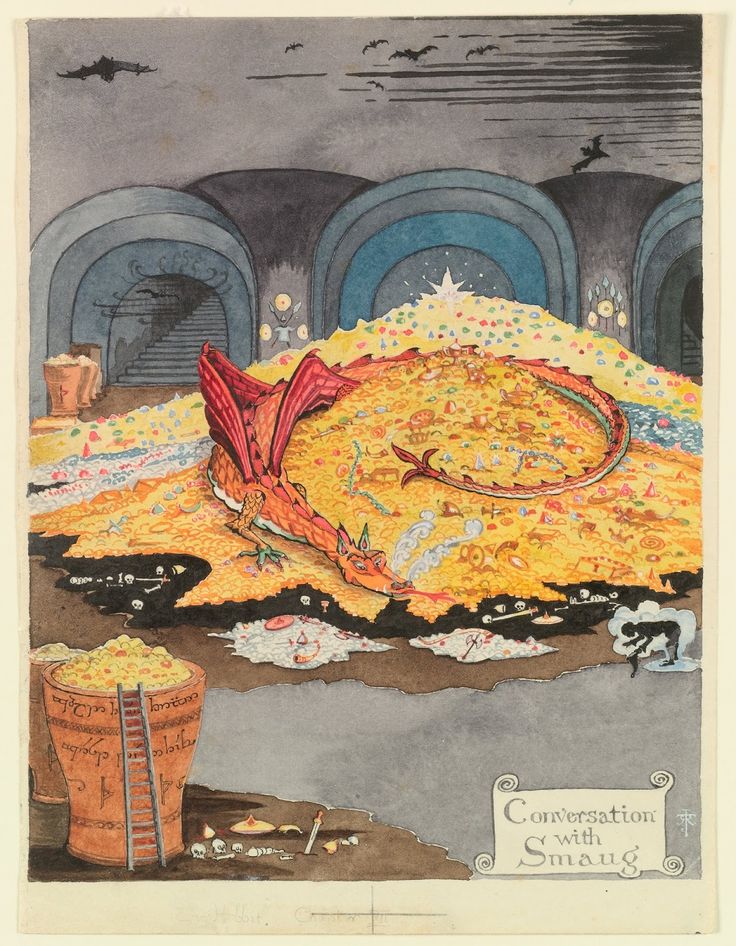
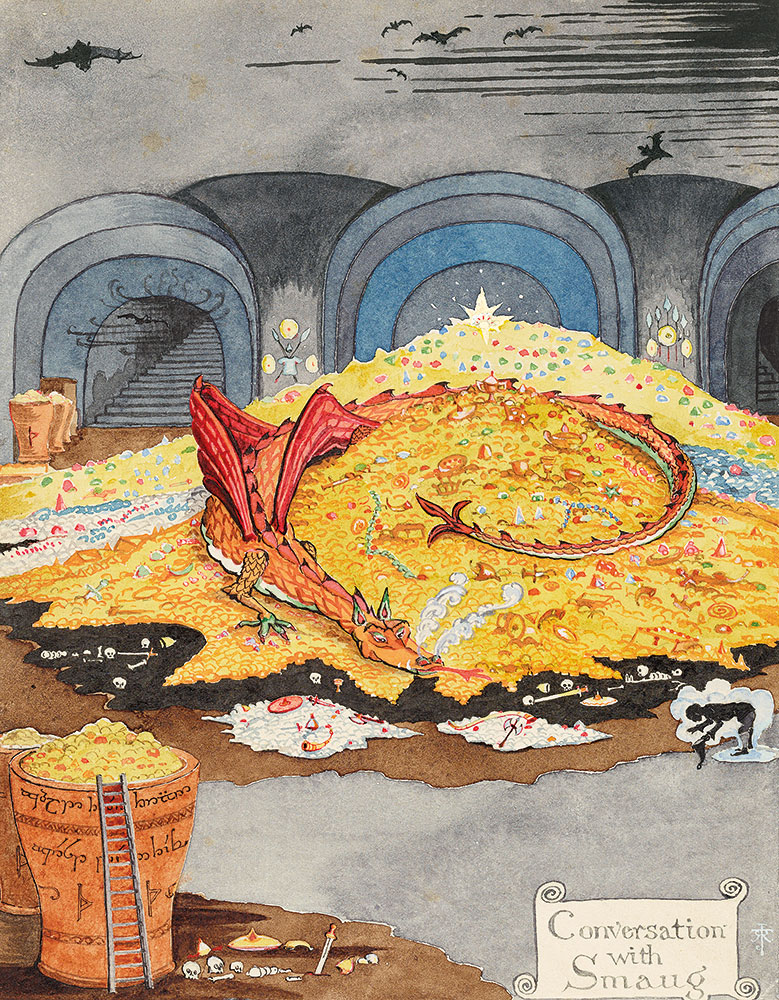
(JRRT)

Not only does he talk, which Beowulf’s dragon does not, but, killed by Bard’s black arrow, he becomes a potential paleontological discovery:

“He would never again return to his golden bed, but was stretched cold as stone, twisted upon the floor of the shallows.  There for ages his huge bones could be seen in calm weather amid the ruined piles of the old town.”  (The Hobbit, Chapter 14, “Fire and Water”)

If Darwin had been puzzled about giant ground sloth remains, what might he have felt if he had discovered Smaug?

Thanks, as always, for reading.

Stay well,

As the proverb says, “Never laugh at live dragons”,

And remember that, as ever, there’s

MTCIDC

O

PS

Flanders and Swann, whom I have mentioned before, have a quietly cheerful song about a sloth here:  https://www.youtube.com/watch?v=blDNO5qznjM

Pumpkinheaded

30 Wednesday Oct 2024

Posted by Ollamh in Uncategorized

≈ Leave a comment

Tags

art, fall, Halloween, Music

As ever, dear readers, welcome.

This posting will appear the day before Halloween, so, we’ll get into the spirit of the holiday (yes, pun intended),

with a story you might not know.

As a child, I most enjoyed and dreaded Halloween, the pleasure from thinking about what to dress up as—not to mention the candy—the dread because, yearly, there was the showing of this Disney animated feature—

In some ways, this was a Disney hybrid:  the usual wonderful artwork (who could better create the sinister atmosphere of Ichabod Crane’s lonely ride through the increasingly spooky woods?)

but with a swinging, catchy score featuring the famous crooner (a kind of soulful singer from the 1940s—the animated feature dates from 1949), Bing Crosby, 1903-1977.

And the heart of the dread was the appearance of this character—

the Headless Horseman.  (In case you don’t know the story, you can read it here, taken from Washington Irving’s, 1783-1859, The Sketch Book of Geoffrey Crayon, Gent., most of which being published serially in 1819-1820 and first time in book form in the US in 1824.

(one installment from the first British publication):  This is from a 1907 edition of the two best-known tales from that collection of essays and short stories, “Rip Van Winkle” and “The Legend of Sleepy Hollow, with illustrations by George H. Boughton:  https://archive.org/details/ripvanwinkleandl00irvi/mode/2up  For a complete edition (an illustrated version from 1864) see:  https://www.gutenberg.org/cache/epub/2048/pg2048-images.html   For more on the complicated publishing history of the work, see:  https://en.wikipedia.org/wiki/The_Sketch_Book_of_Geoffrey_Crayon,_Gent. )

I’m not going to add a spoiler here, but the protagonist, Ichabod Crane, pursued by what he believes to be the headless ghost of a “Hessian soldier”,

eventually disappears, all discovered of him being:

“the tracks of horses’ hoofs deeply

dented in the road, and evidently at furious

speed, were traced to the bridge, beyond

which, on the bank of a broad part of the

brook, where the water lay deep and black,

was found the hat of the unfortunate Ichabod,

and close beside it a shattered pumpkin.”

And this pumpkin brings us to another story, this one by Nathaniel Hawthorne, 1804-1864,

from his collection of short stories, Mosses from an Old Manse, first published in 1846.

This is “Feathertop”, originally published independently in 1852, and added to the collection for the second edition of 1854. 

Hawthorne came from a very old Massachusetts Bay family (an ancestor, John Hathorne, had been involved in the opening stages of the Salem witchcraft trials in 1692) and the history of the Bay haunted him, producing short stories like “Young Goodman Brown” (1835), and the novels The Scarlet Letter (1850) and my particular favorite The House of the Seven Gables (1851).

“Feathertop” involves Mother Rigby, a pipe-smoking old witch,

(a relatively young witch, by Gabriel Metsu, 1629-1667, but, as you’ll see, the pipe is crucial)

who builds a scarecrow for her garden,

(by Carl Gustav Carus, 1789-1869)

including

“The most important item of all, probably, although it made so little show, was a certain broomstick, on which Mother Rigby had taken many an airy gallop at midnight, and which now served the scarecrow by way of a spinal column, or, as the unlearned phrase it, a backbone. One of its arms was a disabled flail which used to be wielded by Goodman Rigby, before his spouse worried him out of this troublesome world; the other, if I mistake not, was composed of the pudding stick and a broken rung of a chair, tied loosely together at the elbow. As for its legs, the right was a hoe handle, and the left an undistinguished and miscellaneous stick from the woodpile. Its lungs, stomach, and other affairs of that kind were nothing better than a meal bag stuffed with straw.”

Having constructed the body, she added

“…its head; and this was admirably supplied by a somewhat withered and shrivelled pumpkin, in which Mother Rigby cut two holes for the eyes and a slit for the mouth, leaving a bluish-colored knob in the middle to pass for a nose. It was really quite a respectable face.”

She dresses it in the remains of what were once fine clothes, including a rooster tail for his hat (hence his name), but, continuing to look at it, she says to herself:

” ‘That puppet yonder,’ thought Mother Rigby, still with her eyes fixed on the scarecrow, ‘is too good a piece of work to stand all summer in a corn-patch, frightening away the crows and blackbirds. He’s capable of better things. Why, I’ve danced with a worse one, when partners happened to be scarce, at our witch meetings in the forest! What if I should let him take his chance among the other men of straw and empty fellows who go bustling about the world?’ “

As you can see, this is quickly turning from a story of enchantment into a satire, as she animates the “puppet” (a word used in the 17th century to have, for witches, the meaning of something like a voodoo doll and used for the same purpose)

by getting it to puff on her pipe

before sending it out in the world to prey upon an enemy, Master Gookin, a wealthy merchant with a pretty daughter Mother Rigby wants him to woo.

Needless to say, in his enchanted form, and puffing on the magic pipe (he claims it’s for medicinal purposes), the scarecrow gains entry to Gookin’s house and even begins to romance the merchant’s daughter when, by chance,

“…”she cast a glance towards the full-length looking-glass in front of which they happened to be standing. It was one of the truest plates in the world and incapable of flattery. No sooner did the images therein reflected meet Polly’s eye than she shrieked, shrank from the stranger’s side, gazed at him for a moment in the wildest dismay, and sank insensible upon the floor. Feathertop likewise had looked towards the mirror, and there beheld, not the glittering mockery of his outside show, but a picture of the sordid patchwork of his real composition stripped of all witchcraft.”

The scarecrow, being reminded of what he really is, rushes back to his maker, smashes the pipe, and collapses into his component parts, leaving his creator to say to herself:

” ‘Poor Feathertop!’ she continued.  ‘I could easily give him another chance and send him forth again tomorrow. But no; his feelings are too tender, his sensibilities too deep. He seems to have too much heart to bustle for his own advantage in such an empty and heartless world. Well! well! I’ll make a scarecrow of him after all. ‘Tis an innocent and useful vocation, and will suit my darling well; and, if each of his human brethren had as fit a one, ‘t would be the better for mankind; and as for this pipe of tobacco, I need it more than he.’ “

(You can read the story for yourself here:  https://gutenberg.org/cache/epub/512/pg512-images.html )

And perhaps that scarecrow eventually found himself in a much more heroic role, much later in time and as far away as Kansas—

As always, thanks for reading.

Stay well,

Happy Halloween,

And remember that, as always, there’s

MTCIDC

O

PS

Before pumpkins had come from the New World, the old world hollowed out turnips, like this one, putting a candle inside to light the dark world of the end of the old growing year.

PPS

In 1908, Percy MacKaye, 1875-1956, poet and playwright, dramatized a version of the story, which appeared briefly in New York in 1911, and you can read it here:   https://ia902901.us.archive.org/23/items/scarecroworglass00mackuoft/scarecroworglass00mackuoft.pdf

PPPS

In 1961, there was a television musical of Hawthorne’s story,

with music by Mary Rogers, who then went on to compose the music for Once Upon a Mattress, my favorite version of Andersen’s “The Princess and the Pea” (which, looking at the Danish, which is “Princessen Pa Aerten” should really be “The Princess On the Pea”).  You can hear a catchy duet between the witch and her scarecrow creation, “A Gentleman of Breeding” here:  https://www.youtube.com/watch?v=GXONisleuSw

Deserving

23 Wednesday Oct 2024

Posted by Ollamh in Uncategorized

≈ Leave a comment

Tags

Fantasy, J.R.R. Tolkien, lord-of-the-rings, The Lord of the Rings, Tolkien

Welcome, dear readers, as always.

“ ‘I am sorry,’ said Frodo.  ‘But I am frightened and I do not feel any pity for Gollum.’

‘You have not seen him,’ Gandalf broke in.

‘No, and I don’t want to,’ said Frodo.  ‘I can’t understand you.  Do you mean to say that you, and the Elves, have let him live on after all those horrible deeds?  Now at any rate he is as bad as an Orc, and just an enemy.  He deserves death.’

‘Deserves it!  I daresay he does.  Many that live deserve death.  And some that die deserve life.  Can you give it to them?  Then do not be too eager to deal out death in judgement.’”  (The Fellowship of the Ring, Book One, Chapter Two, “The Shadow of the Past”)

(Alan Lee)

I’ve always thought that this was one of the most striking passages early in The Lord of the Rings.  Gandalf has been telling Frodo about his meeting with Gollum, including the unwelcome thought that Sauron, who has found out from Gollum that the Ring wasn’t lost and, in fact, was in the hands of someone called “Baggins” and may even be aware that “Baggins” and “Shire” are linked.  Frodo’s natural reaction is to panic and to blame Gollum, turning vindictive in his fear.  In contrast, Gandalf, whose more humane reaction was probably a product of his Maia nature and his long experience of events and people in Middle-earth (having arrived there in TA 1000, 2000 years before the joint birthday party which sets The Lord of the Rings in motion—TA 3001—see Christopher Tolkien, Unfinished Tales, 405,    “The Istari”), opposes Frodo’s sentence of death with one of compassion, so, when Frodo says, “What a pity that Bilbo did not stab that vile creature when he had a chance!”  Gandalf replies, “Pity?  It was Pity that stayed his hand.  Pity, and Mercy:  not to strike without need.”

I’ve also wondered where such a humane sentiment came from in Gandalf’s creator.  His deep Christian faith must have played a part, but I think another element was his experience in 1916,

when, as he writes to his son, Michael:

“Bolted into the army:  July 1915.  I found the situation intolerable and married on March 22, 1916.  May found me crossing the Channel…for the carnage of the Somme.”  (from a letter to Michael Tolkien, 6-8 March, 1941, Letters, 73)

This was the beginning of Tolkien’s short experience of actual combat in what was called, at the time, The Great War—meaning “the Big War” in British English, as it was the biggest war in any contemporary’s experience and, without World War II, it obviously couldn’t be called “World War I”.  At the same time, I think that JRRT’s time at the front, although really only measured in a few months (June to November, 1916—see Carpenter, Tolkien, 90-96 for details) might have made him find that other meaning of “great” ironic and I suspect that he would have agreed with Yoda’s reply to Luke’s “I’m looking for a great warrior.”—“Ahhh!  A great warrior…Wars not make one great.” in Star Wars V .  (You can read the script for this scene, pages 55-58, at:  https://assets.scriptslug.com/live/pdf/scripts/star-wars-episode-v-the-empire-strikes-back-1980.pdf )

The new second lieutenant

belonged to one of the battalions (sub-units) of the Lancashire Fusiliers,

one of the oldest infantry regiments in the British Army (begun as “Peyton’s Regiment” in 1688—you can read more about it here:  https://en.wikipedia.org/wiki/Lancashire_Fusiliers ).  It was only one of the many units designated to be part of what would become known as “The Somme”, a battle which lasted from 1 July to 18 November, 1916—and which would cost the British alone 57,470 casualties on the first day and a total of 415,690 by 18 November.  (You can read a very detailed article about it here:  https://en.wikipedia.org/wiki/Battle_of_the_Somme )

The battlefield was huge—

and Tolkien would have seen only a tiny portion of it, but what he saw should have terrified any sensible person.

We begin with the trench he would have crouched in, waiting for the order to attack (going “over the top”, which means climbing up over the forward lip of the trench).

In front of the trench was a long stretch of barbed wire, which had to be negotiated before any further forward motion was to be made.

Ahead lay the wilderness called “no man’s land”.

This varied, depending upon what had been there before the War, but, since it was often pounded by one side or the other’s artillery, whatever had been there before—farms, villages, forests—had been turned into a beaten-down desert of ruins.

Beyond there, lay the enemy’s wire entanglements.

And, beyond there were the enemy’s trenches—as many as three lines of them.

These could look like the trench Tolkien had crawled out of, but they could also be much more elaborate, with pillboxes made of concrete, reinforced with steel girders, and buried under a layer of soil both to conceal them and to help to protect them from the shells which the enemy would attempt to drop on them.

(This is the rear entry of a German pillbox.)

In those trenches would be multiple machine guns, placed to sweep the wire which lay before them.

Each of these guns could fire 600 rounds per minute, to which would be added the rifle fire of the infantry who were the trenches’ garrison.

(Peter Dennis)

Behind the trenches would be artillery, whose job was, when an attack began, to fire as many shells as possible into the enemy trenches and into no man’s land, to slow down, if not stop, the enemy attack, forcing the attackers back with heavy casualties.

Before the attack on 1 July, the British had used their heavy artillery

to destroy enemy entrenchments and, hopefully, to cut apart those deep fields of barbed wire in front of them.

Unfortunately, on 1 July, the artillery—even after a massive bombardment—failed to disrupt the wire and soldiers were simply pinned to it, perfect targets for machine gunners and the casualties mounted—and mounted

so that one can easily see why Tolkien would refer to his experience in 1916 as “the carnage of the Somme” with its British 57,470 casualties on its first day and 415,690 by its final one.

In later years, he might have a somewhat ambivalent view of what he had gone through, writing to his son Michael that

“War is a grim hard ugly business.  But it is as good a master as Oxford, or better.” (letter to Michael Tolkien, 12 July, 1940, Letters, 61)

and yet could also write this about the end of the second war:

“The appalling destruction and misery of this war mount hourly, destruction of what should be (indeed is) the common wealth of Europe, and the world, if mankind were not so besotted, wealth the loss of which will affect us all, victors or not.  Yet people gloat to hear of the endless lines, 40 miles long, of miserable refugees, women and children pouring West, dying on the way.  There seem no bowels of mercy or compassion, no imagination, left in this dark diabolic hour.”  (letter to Christopher Tolkien, 20 January, 1945, Letters, 160)

Having experienced one of the bloodiest periods in the Great War, it is no wonder, then, that JRRT could sound like Gandalf, speaking of mercy, on the one hand, and, on the other, like a changed Frodo near the end of his adventures:

“ ‘Fight?’ said Frodo.  ‘Well, I suppose it may come to that.  But remember:  there is to be no slaying of hobbits, not even if they have gone over to the other side.  Really gone over, I mean;  not just obeying ruffians’ orders because they are frightened.  No hobbit has ever killed another on purpose in the Shire, and it is not to begin now.  And nobody is to be killed at all, if it can be helped.  Keep your tempers and hold your hands to the last possible moment.’ “ (The Return of the King, Book Six, Chapter 8, “The Scouring of the Shire”)

As always, thanks for reading.

Stay well,

Consider what, had Bilbo done what Frodo wished, might have been Frodo’s fate—and Middle-earth’s,

(Ted Nasmith)

And remember that, as always, there’s

MTCIDC

O

Opera…Tolkien?

16 Wednesday Oct 2024

Posted by Ollamh in Uncategorized

≈ Leave a comment

Tags

books, Fantasy, J.R.R. Tolkien, The Hobbit, Tolkien

As always, dear readers, welcome.

I’ve just read an interesting piece of news:  there’s going to be an opera based upon The Lord of the Rings (see:  https://www.classicfm.com/music-news/lord-of-the-rings-opera-approved-tolkien-estate/ ).  The composer is Paul Corfield Godfrey, 1950-, who had already composed a rather massive work on the Silmarillion, of which you can hear an excerpt here:   https://www.youtube.com/watch?v=Q4HUnCx4dLI                           You can also hear “The Lament for Boromir” here:  https://www.youtube.com/watch?v=6nxvzZ98LS4  and “The Man in the Moon Came Down Too Soon” and “The Song of the Troll”, along with one or two others on YouTube as well.  (There’s the proviso with these:  you may be accused of being a bot, unless you know the secret password.)

For me, opera began with a cartoon.

As a child, I saw it, loved it (Bugs Bunny always being a favorite, along with Daffy Duck), and that’s where opera first appeared in my life.

In terms of real opera, it’s an odd little piece, having, at one level, a standard plot:  Elmer Fudd pursues Bugs, as he had done many times before.

At another level, however, it’s a parody of grand opera, in which Elmer plays the Wagnerian hero, Siegfried, and Bugs, at a certain point in the story, turns himself into the Valkyrie, Brunnhilde.

And, for only the third time in their lives of pursuit and escape, Elmer actually succeeds in dealing with Bugs.

Although, in case you haven’t seen it, or forgot the plot and are worried, Bugs comes back from the dead long enough to say to the audience, “Well, what did you expect in an opera?  A happy ending?” before subsiding again.  (You can see it here:  https://www.youtube.com/watch?v=6jDcWAWRRHo provided, of course, that you’re not a bot.  You can also read a very interesting article about the making of the cartoon here:  https://en.wikipedia.org/wiki/What%27s_Opera,_Doc%3F )

Peter Schickele, 1935-2024,

the creator of PDQ Bach, 1807-1742?,

whom he once described as “the youngest and oddest of Johann Sebastian’s 20-odd children”, in a memorable introduction to Baroque opera as exemplified in PDQ Bach’s, “Haensel and Gretel and Ted and Alice”, explained that there were, in the period, two kinds of opera, “opera seria”, which was concerned with tragedies and histories, and “opera funnia”—and you can guess where this would go.

Opera seria, however, was real and where opera began, with Jacopo Peri’s, 1561-1633,

Dafne, in 1598.  This is based upon the ancient story of Daphne, who, pursued by Apollo, is turned into a laurel tree (you can read the most familiar version of the story, as told by Ovid in Book 1 of his Metamorphoses, here:  https://www.theoi.com/Text/OvidMetamorphoses1.html at line 452 and following).

(by Gian Lorenzo Bernini, 1598-1680, dated to 1622-25)

The goal of this and subsequent works, both by Peri and others, was to attempt to revive what they understood Greek tragedy to have been like, with its dark mythological stories—truly opera seria!  To Peri and his contemporaries, this meant not only solo songs and choruses, but that all of the dialogue would be sung, too, in what came to be called recitativo, and this convention continued into the 20th century.

There is another possibility, however, although not “opera funnia”.  It’s a form known in German as “Singspiel” and in French as “Opera comique” and combines the solo songs and choruses of opera seria with spoken dialogue, rather than recitativo, in just the way contemporary musicals are really plays with music, where songs appear at important dramatic points in the story.

(Rodgers and Hammerstein’s “Oklahoma”, 1943)

In 1964, an English composer, Carey Blyton, 1932-2002, wrote to JRR Tolkien requesting his permission to create a “Hobbit overture”.  Tolkien was clearly delighted and granted permission immediately, providing for us, as well, with this sidelight on himself and music:

“As an author I am honoured to hear that I have inspired a composer.  I have long hoped to do so, and hope also that I might find the result intelligible to me, or feel that it was akin to my own inspiration…I have little musical knowledge.  Though I come from a musical family, owing to defects of education and opportunity as an orphan, such music as was in me was submerged (until I married a musician), or was transformed into linguistic terms.  Music gives me great pleasure and sometimes inspiration, but I remain in the position in reverse of one who likes to read or hear poetry but knows little of its technique or tradition, or of linguistic structure.”  (from a letter to Carey Blyton, 16 August, 1964, Letters, 490.  You  can hear Blyton’s overture, composed in 1967 as Opus 52a, here:  https://www.youtube.com/watch?v=rybV4xDq_DM  –that is, if you persist in insisting that you’re not a bot.)

The musician was, of course, his wife, Edith, and Tolkien’s interest in music was certainly developed enough that, in a trip to Italy in 1955 with his daughter, Priscilla, he reacted to a performance of Giuseppe Verdi’s Rigoletto, with the words “Perfectly astounding”.  (from a letter to Christopher and Faith Tolkien, 15 August, 1955, Letters, 325)

I’ll be very curious to see what comes of this opera project, which claims to be retaining Tom Bombadil

(the Hildebrandts)

and the equally neglected Barrow-wight.

Under the Spell of the Barrow-wight, by Ted Nasmith

(Ted Nasmith)

If the selection I’ve heard from Godfrey’s Silmarillion provides us with an idea of his treatment of The Lord of the Rings, we will hear not only Tolkien’s poems, like “The Man in the Moon”, set to music, but the dialogue may also be done in recitativo, and I’ll be very curious to see how he manages this, as there’s so much of it—perhaps a narrator for continuity? 

Thinking about this has set me wondering about how one might turn The Hobbit into an opera, dialogue aside.  Tolkien has provided us with about 15 lyrics throughout:

Chapter 1, “An Unexpected Party”: 

“Chip the glasses…”  a chorus for the dwarves

“Far over the misty mountains cold…”  a second chorus for the dwarves

“Far over the misty mountains cold…”  a reprise of the first verse, sung by Thorin and overheard by Bilbo

Chapter 3, “A Short Rest”

“O!  What are you doing…”  a chorus for elves

Chapter 4, “Over Hill and Under Hill”

“Clap!  Snap!  the black crack!”  a chorus for goblins

Chapter 5, “Riddles in the Dark”

Just a thought, but perhaps these riddles could all be sung, the glaring exception being Bilbo’s “What have I got in my pocket?”

Chapter 6, “Out of the Frying-Pan into the Fire”

“Fifteen birds in five fir-trees” another goblin chorus

“Burn, burn tree and fern” a goblin chorus—but possibly add in the howling of the wolves?

Chapter 7, “Queer Lodgings”

“The wind was on the withered heath”  a chorus for dwarves

Chapter 8, “Flies and Spiders” 

“Old fat spider”

“Lazy lob and crazy cob”  two songs for Bilbo—the first time we’ve heard his voice

Chapter 9. “Barrels Out of Bond”

“Roll—roll—roll—roll”

“Down the swift dark stream you go”  two choruses for the forest elves

Chapter 10, “A Warm Welcome”

“The King beneath the mountains”  sung by the people of Lake-town

Chapter 15, “The Gathering of the Clouds”

“Under the Mountain dark and tall”  a dwarf chorus

Chapter 19, “The Last Stage”

“The dragon is withered”  a chorus for the elves of Rivendell

“Sing all ye joyful, now sing all together!”  a second chorus for the elves

“Roads go ever ever on”  a song for Bilbo and the last in the book

Reading through this list:

1. it’s easy to see that the majority of the lyrics are meant for a chorus of dwarves, goblins, Lake-town people, and assorted elves

2. the only solo numbers (excepting the riddles, if sung) are few in number and given to Bilbo

3. there are lyric gaps in the potential script:  Chapters 11-14 and 16-18 have no songs at all

If you were the librettist, how would you fill not only those gaps, but provide for more solos—for Gandalf, Bilbo,Thorin, the Chief Goblin, Gollum, Beorn, Thranduil (the forest elf king), the Master of Lake-town, Bard, Smaug, Roac (the elderly raven), as well as perhaps small comic parts for the Sackville-Bagginses, and something for the stone trolls (a trio about eating might be appropriate) too?  It’s also important to note the complete lack (except with the possible exception of the Lake-towners) of female voices in solos and choruses.  How could that imbalance be readjusted—without seriously messing with Tolkien’s text (and we know from his correspondence with Forrest J. Ackerman on a potential film version of The Lord of the Rings that, although he conceded that a different art form might require some adjustment, he had his limits as to just what and how much might be altered—see “from a letter to Forrest J. Ackerman”, June, 1958, Letters, 389-397)  Considering the story, it would seem that it would be a fitting subject for an opera seria, but there would be the danger—as there will be for Godfrey’s The Lord of the Rings—that, not maintaining the tone and making too many additions or changes to the text might quickly turn it into an opera—funnia.

Thanks for reading, as ever,

Stay well,

Beware of Godfrey’s “The Song of the Troll”—it’s catchy!

And remember that, as always, there’s

MTCIDC

O

PS

I’m not aware that Tolkien ever heard that “Hobbit overture”, but, in 1967, he collaborated with the composer, Donald Swann, 1923-1994, on a short cycle of his poems drawn from various sources, entitled The Road Goes Ever On. 

 You can read about it here:  https://en.wikipedia.org/wiki/The_Road_Goes_Ever_On  And, provided that you have finally proved to YouTube’s satisfaction that you are not, indeed, a bot, you can hear it here:  https://www.youtube.com/watch?v=YtH6ROfV7WA  I’ve loved the cycle for years, have sung it, and very much recommend it. )

← Older posts
Newer posts →

The Doubtful Sea Series Facebook Page

The Doubtful Sea Series Facebook Page

  • Ollamh

Categories

  • Artists and Illustrators
  • Economics in Middle-earth
  • Fairy Tales and Myths
  • Films and Music
  • Games
  • Heroes
  • Imaginary History
  • J.R.R. Tolkien
  • Language
  • Literary History
  • Maps
  • Medieval Russia
  • Military History
  • Military History of Middle-earth
  • Narnia
  • Narrative Methods
  • Poetry
  • Research
  • Star Wars
  • Terra Australis
  • The Rohirrim
  • Theatre and Performance
  • Tolkien
  • Uncategorized
  • Villains
  • Writing as Collaborators
Follow doubtfulsea on WordPress.com

Across the Doubtful Sea

Recent Postings

  • Subterranean April 22, 2026
  • Serendipity? April 15, 2026
  • Serendipity April 8, 2026
  • Verisimilitude April 1, 2026
  • Goblins and Goblin March 25, 2026
  • Crowing and Raven March 18, 2026
  • The Damage of Dragons March 11, 2026
  • Encouragement March 4, 2026
  • Eavesdropping February 25, 2026

Blog Statistics

  • 112,056 Views

Posting Archive

  • April 2026 (4)
  • March 2026 (4)
  • February 2026 (4)
  • January 2026 (4)
  • December 2025 (5)
  • November 2025 (4)
  • October 2025 (5)
  • September 2025 (4)
  • August 2025 (4)
  • July 2025 (5)
  • June 2025 (4)
  • May 2025 (4)
  • April 2025 (5)
  • March 2025 (4)
  • February 2025 (4)
  • January 2025 (5)
  • December 2024 (4)
  • November 2024 (4)
  • October 2024 (5)
  • September 2024 (4)
  • August 2024 (4)
  • July 2024 (5)
  • June 2024 (4)
  • May 2024 (5)
  • April 2024 (4)
  • March 2024 (4)
  • February 2024 (4)
  • January 2024 (5)
  • December 2023 (4)
  • November 2023 (5)
  • October 2023 (4)
  • September 2023 (4)
  • August 2023 (5)
  • July 2023 (4)
  • June 2023 (4)
  • May 2023 (5)
  • April 2023 (4)
  • March 2023 (5)
  • February 2023 (4)
  • January 2023 (4)
  • December 2022 (4)
  • November 2022 (5)
  • October 2022 (4)
  • September 2022 (4)
  • August 2022 (5)
  • July 2022 (4)
  • June 2022 (5)
  • May 2022 (4)
  • April 2022 (4)
  • March 2022 (5)
  • February 2022 (4)
  • January 2022 (4)
  • December 2021 (5)
  • November 2021 (4)
  • October 2021 (4)
  • September 2021 (5)
  • August 2021 (4)
  • July 2021 (4)
  • June 2021 (5)
  • May 2021 (4)
  • April 2021 (4)
  • March 2021 (5)
  • February 2021 (4)
  • January 2021 (4)
  • December 2020 (5)
  • November 2020 (4)
  • October 2020 (4)
  • September 2020 (5)
  • August 2020 (4)
  • July 2020 (5)
  • June 2020 (4)
  • May 2020 (4)
  • April 2020 (5)
  • March 2020 (4)
  • February 2020 (4)
  • January 2020 (6)
  • December 2019 (4)
  • November 2019 (4)
  • October 2019 (5)
  • September 2019 (4)
  • August 2019 (4)
  • July 2019 (5)
  • June 2019 (4)
  • May 2019 (5)
  • April 2019 (4)
  • March 2019 (4)
  • February 2019 (4)
  • January 2019 (5)
  • December 2018 (4)
  • November 2018 (4)
  • October 2018 (5)
  • September 2018 (4)
  • August 2018 (5)
  • July 2018 (4)
  • June 2018 (4)
  • May 2018 (5)
  • April 2018 (4)
  • March 2018 (4)
  • February 2018 (4)
  • January 2018 (5)
  • December 2017 (4)
  • November 2017 (4)
  • October 2017 (4)
  • September 2017 (4)
  • August 2017 (5)
  • July 2017 (4)
  • June 2017 (4)
  • May 2017 (5)
  • April 2017 (4)
  • March 2017 (5)
  • February 2017 (4)
  • January 2017 (4)
  • December 2016 (4)
  • November 2016 (5)
  • October 2016 (6)
  • September 2016 (5)
  • August 2016 (5)
  • July 2016 (5)
  • June 2016 (5)
  • May 2016 (4)
  • April 2016 (4)
  • March 2016 (5)
  • February 2016 (4)
  • January 2016 (4)
  • December 2015 (5)
  • November 2015 (5)
  • October 2015 (4)
  • September 2015 (5)
  • August 2015 (4)
  • July 2015 (5)
  • June 2015 (5)
  • May 2015 (4)
  • April 2015 (3)
  • March 2015 (4)
  • February 2015 (4)
  • January 2015 (4)
  • December 2014 (5)
  • November 2014 (4)
  • October 2014 (6)
  • September 2014 (1)

Blog at WordPress.com.

  • Subscribe Subscribed
    • doubtfulsea
    • Join 75 other subscribers
    • Already have a WordPress.com account? Log in now.
    • doubtfulsea
    • Subscribe Subscribed
    • Sign up
    • Log in
    • Report this content
    • View site in Reader
    • Manage subscriptions
    • Collapse this bar
 

Loading Comments...