• About

doubtfulsea

~ adventure fantasy

Monthly Archives: February 2026

Do You Speak Villain? (Part 3)

18 Wednesday Feb 2026

Posted by Ollamh in Uncategorized

≈ Leave a comment

Tags

books, Fantasy, Gorbag, Grishnakh, lotr, Orcs, Saruman, Sauron, sergeant, sergeants, Shagrat, soldiers, speech, The Lord of the Rings, Tolkien, Ugluk

As always, welcome, dear readers.

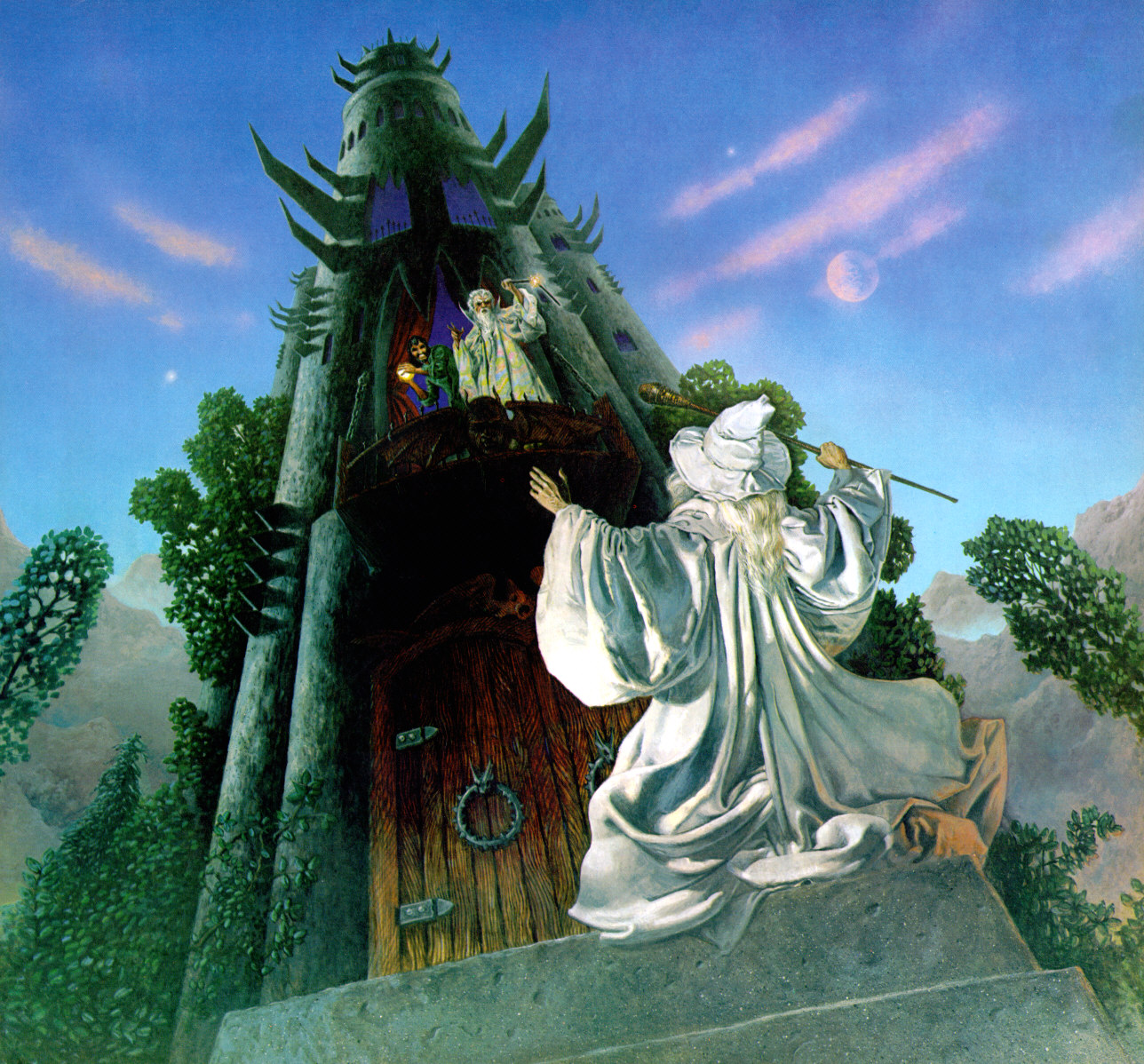
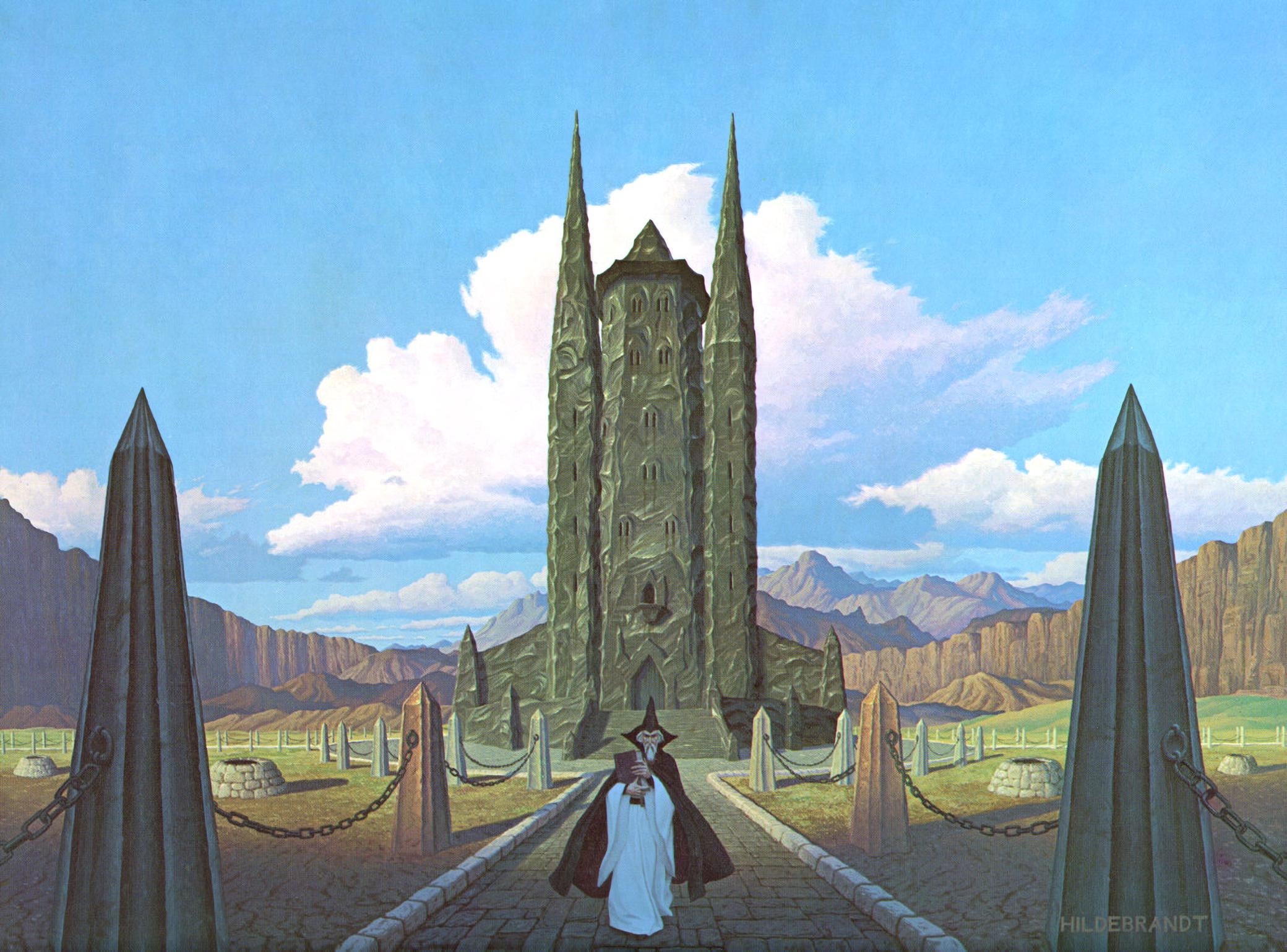
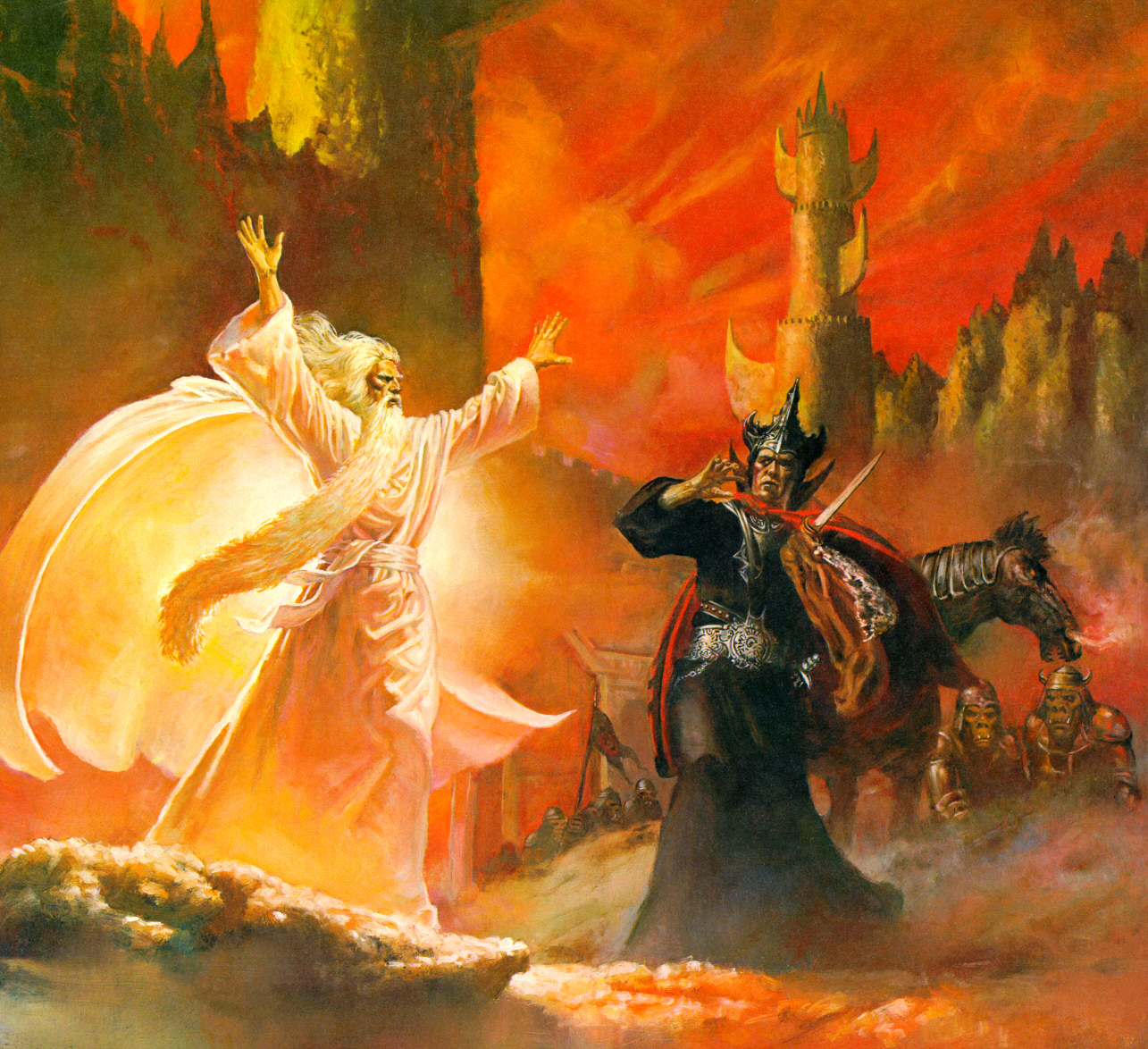
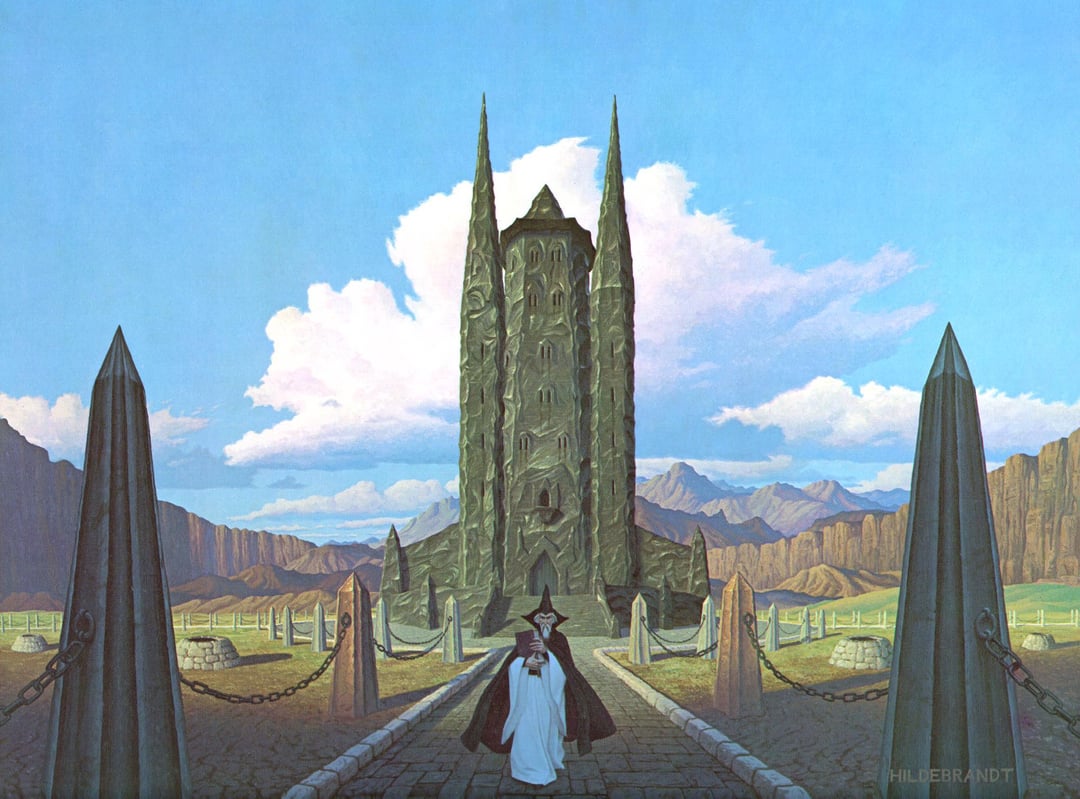
In Parts 1 and 2 of this short series, I’ve looked at Tolkien’s use of speech to characterize—and bring to life—the antagonists of The Lord of the Rings, leaving out Sauron, as having little to say for himself, but observing Saruman,

(the Hildebrandts)

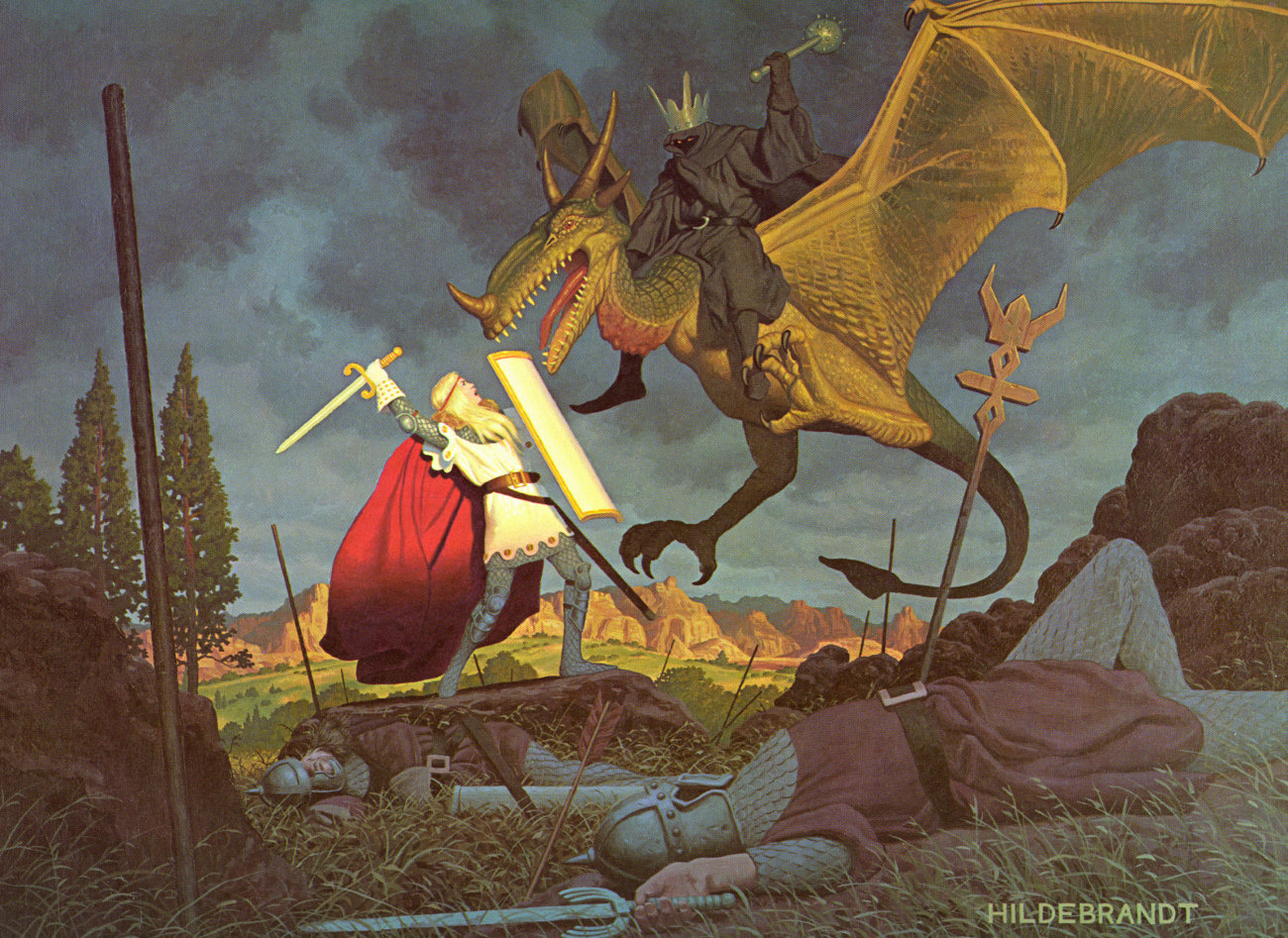
the chief of the Nazgul,

(the Hildebrandts)

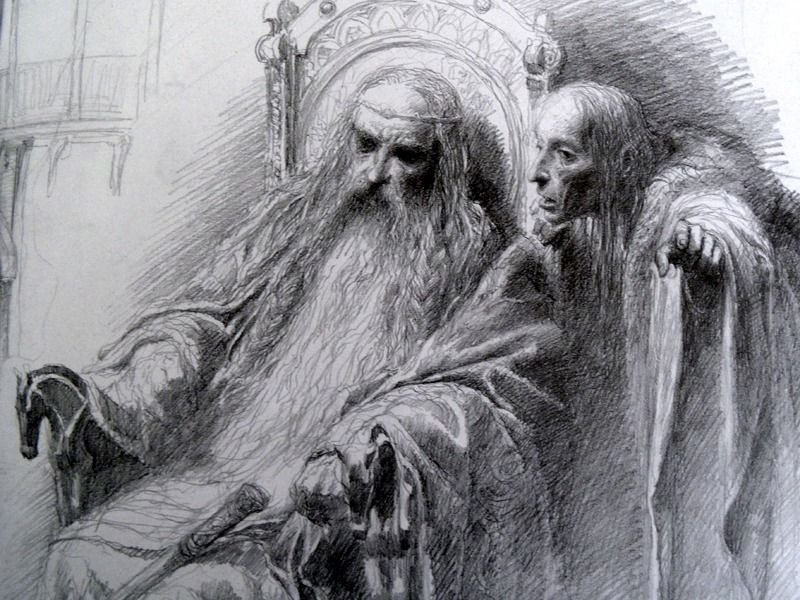
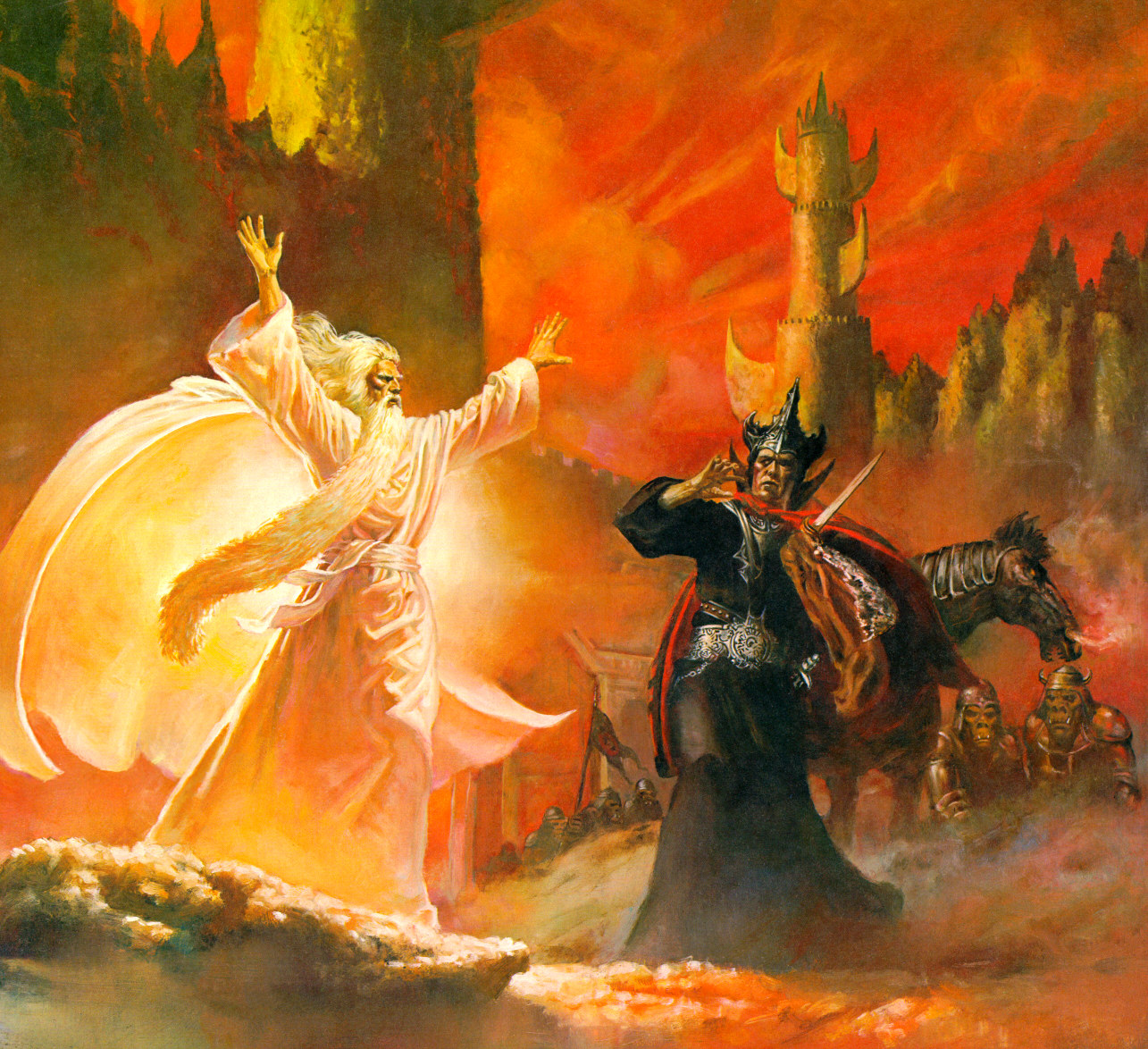
and the Mouth of Sauron.

(Douglas Beekman)

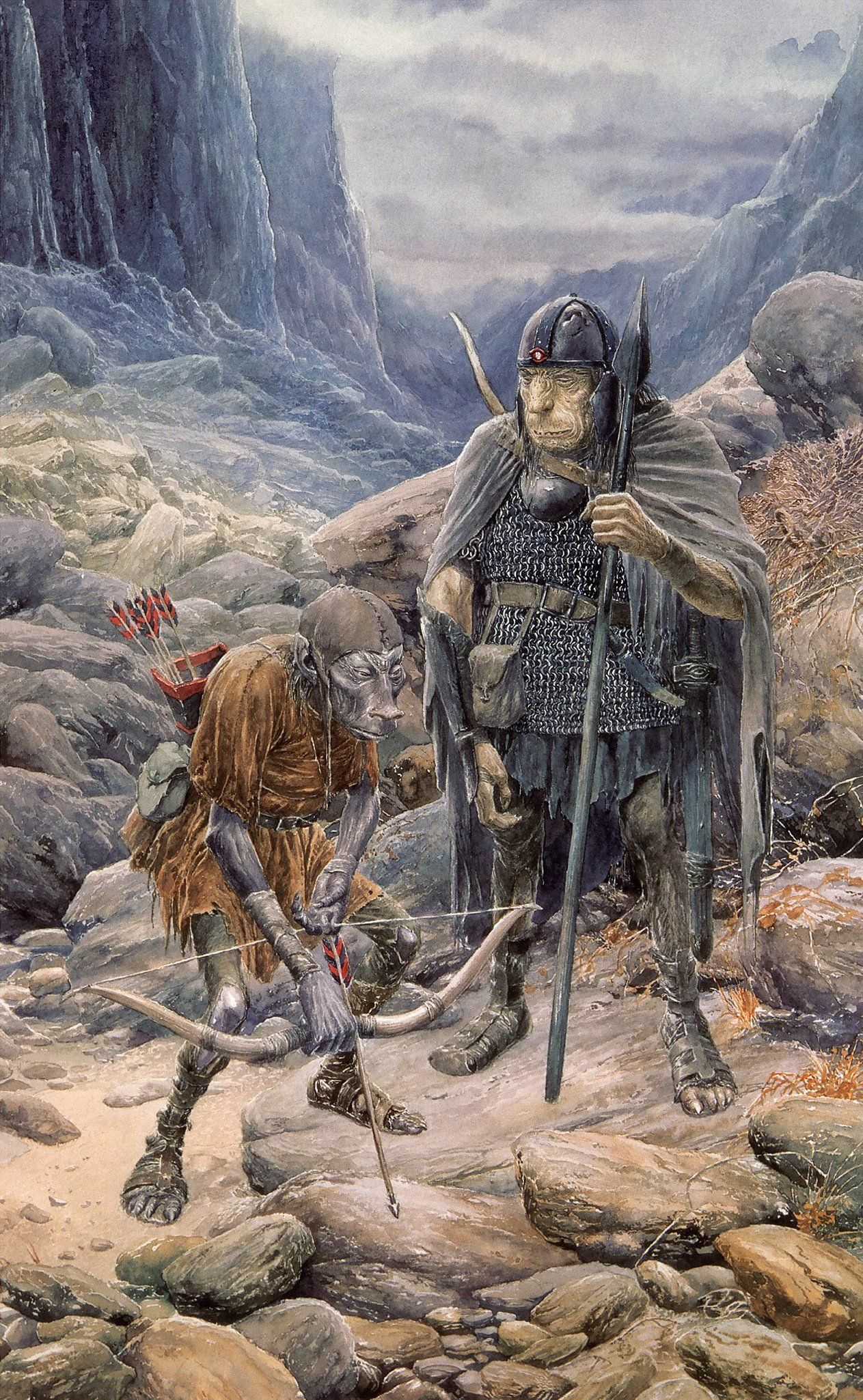
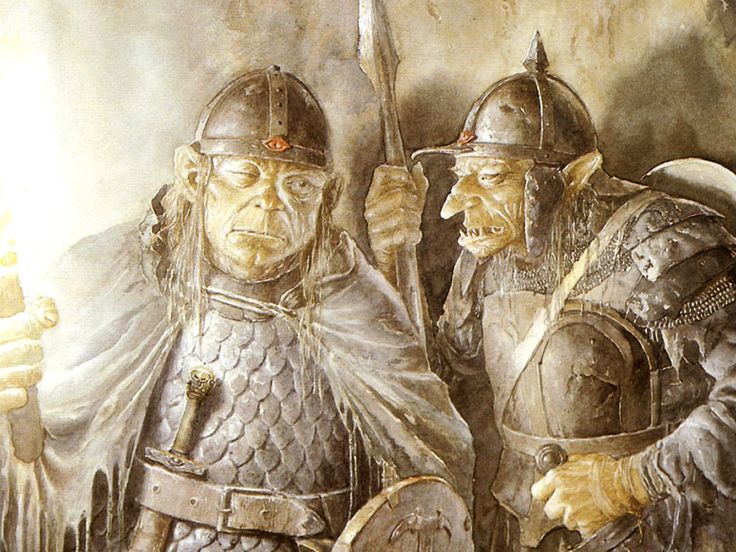
I’ve been doing this as a descent down the social ladder and now we’ve reached the foot with the Orcs.

(Alan Lee)

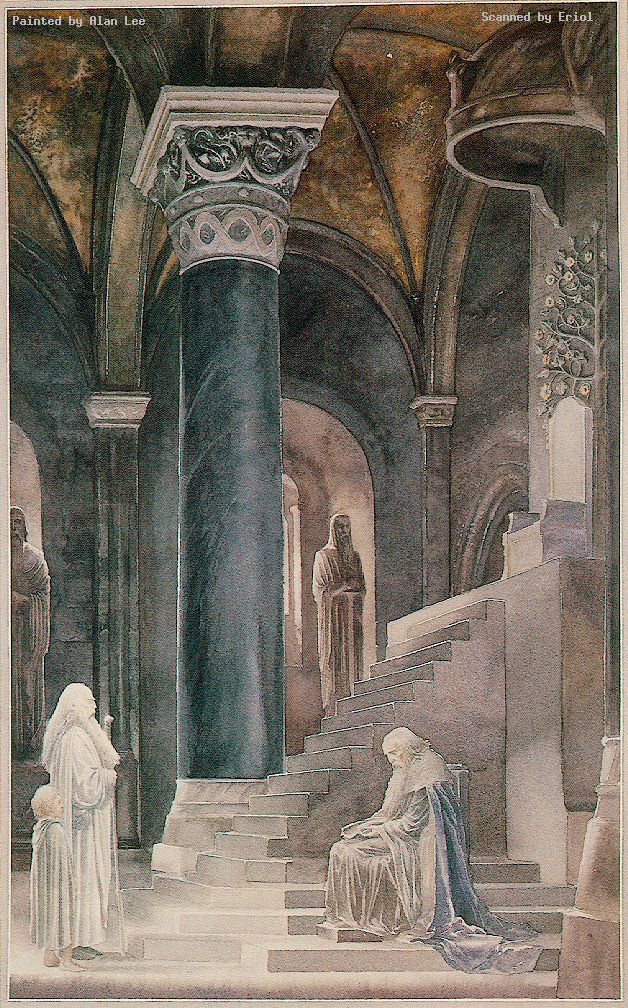
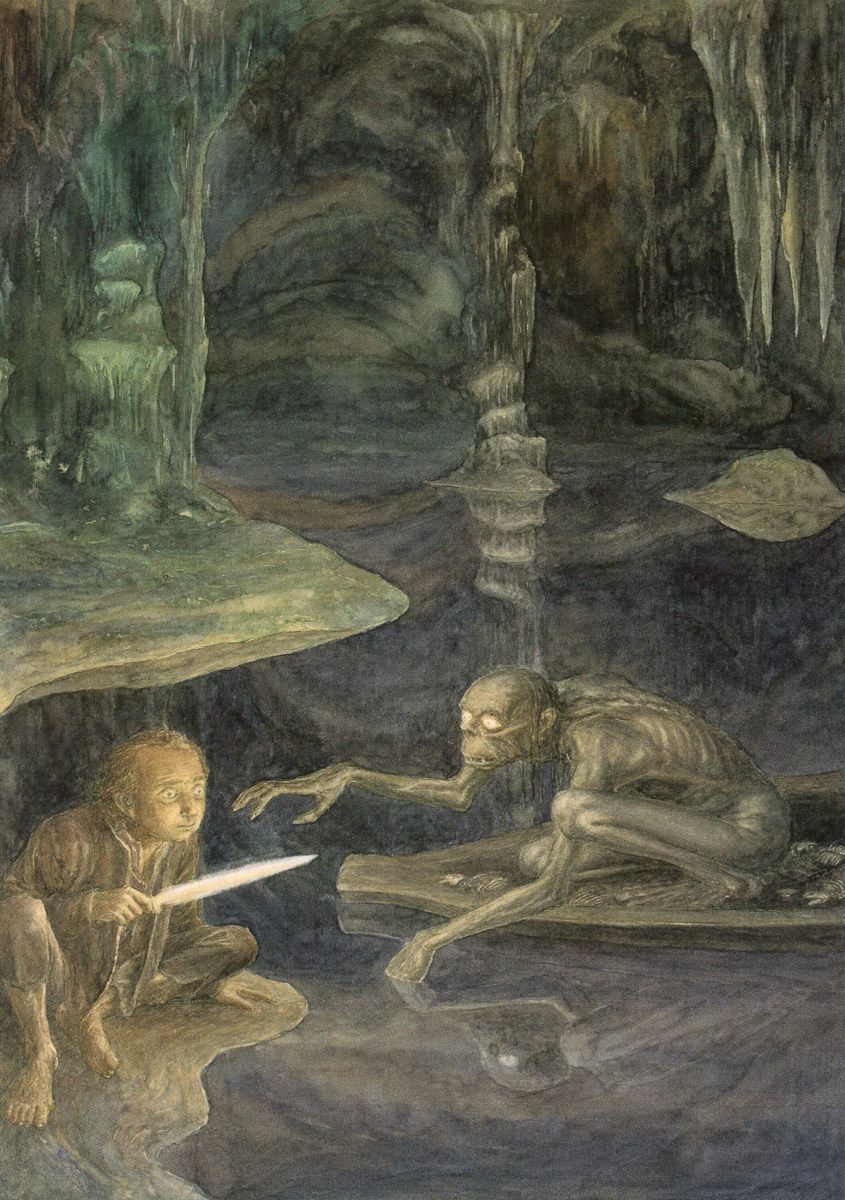
JRRT had very complex thoughts and feelings about them, as his letters show us (see, for instance, some of his thoughts in his unfinished, unsent letter to Peter Hastings, September, 1954, Letters, 285 and 291)  but then the Orcs themselves seem more complex than mere (in more modern terms) “cannon-fodder”—that is, a simple mass of undifferentiated infantry.

(Alan Lee)

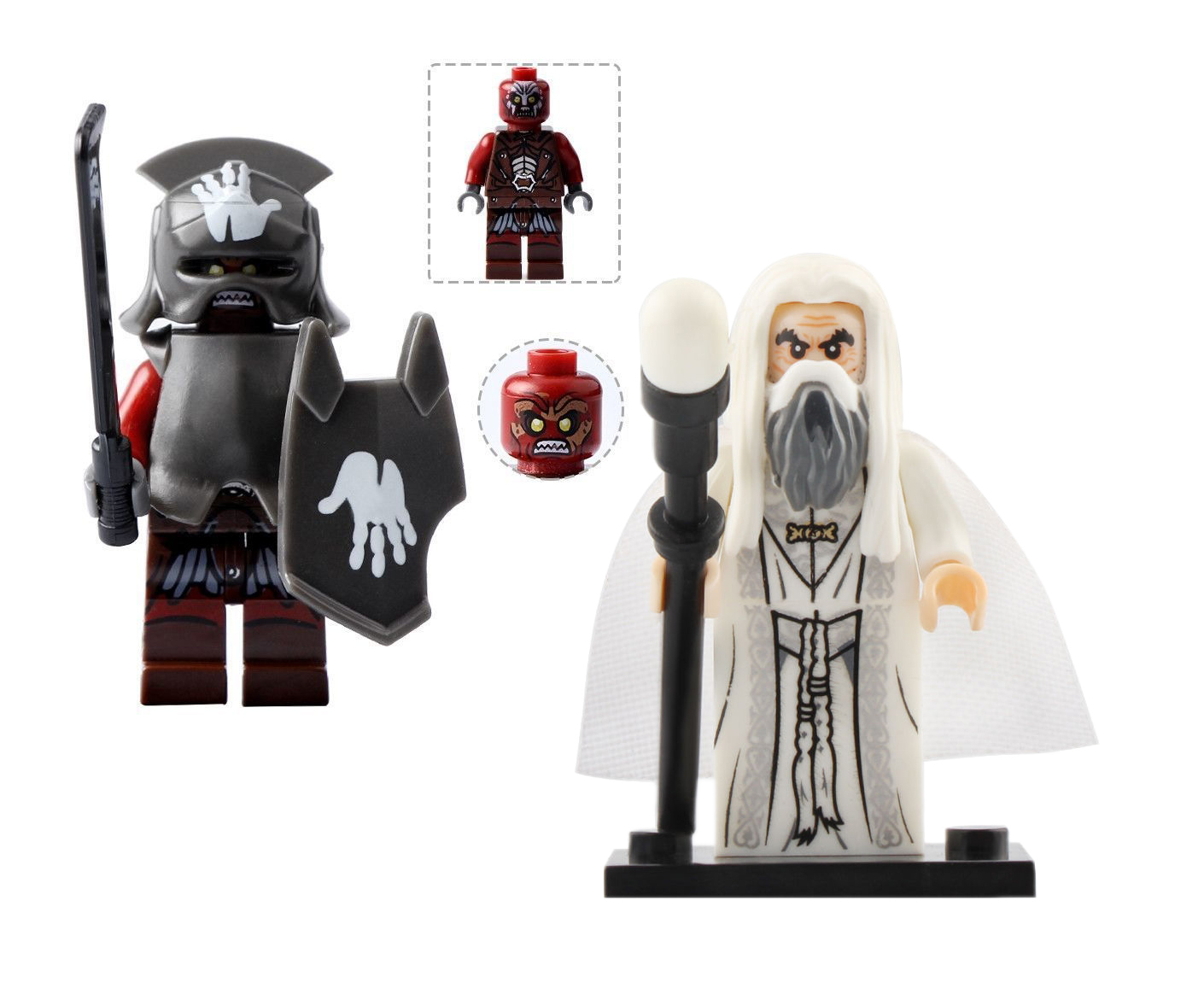
Something which has always struck me about them is Tolkien’s choices for their speech.  At one level, as I pointed out in “Tolkien Among the Indians”, (21 January, 2026), one of their leaders, Ugluk, can sound like a figure out of James Fenimore Cooper’s The Last of the Mohicans—

“ ‘We are the fighting Uruk-hai!  We slew the great warrior.  We took the prisoners.  We are the servants of Saruman the Wise, the White Hand:  the Hand that gives us man’s-flesh to eat.  We came out of Isengard, and led you here, and we shall lead you back by the way we choose.  I am Ugluk.  I have spoken.’ ”

On another level—but here I want to quote another of Tolkien’s letters, one often cited when referring to Sam Gamgee:

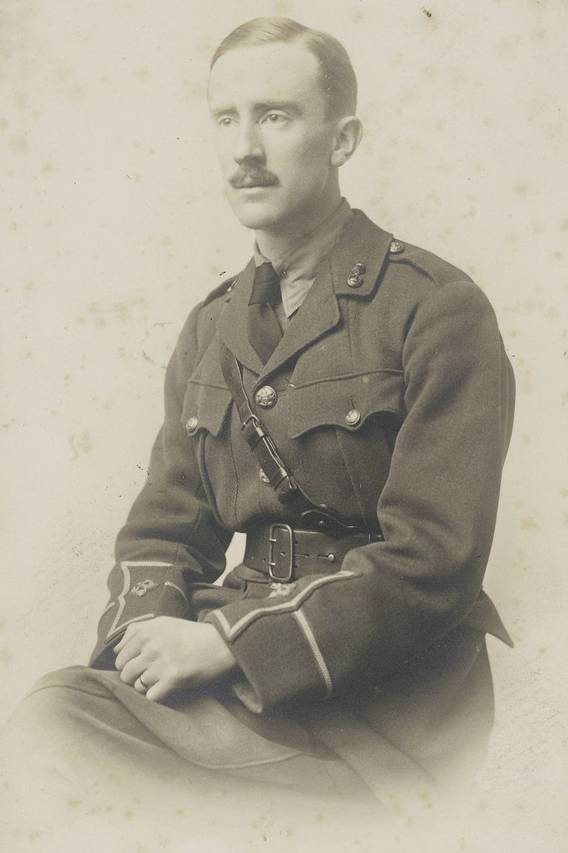
“My ‘Sam Gamgee’ is indeed, as you say, a reflexion of the English Soldier, of the privates and batmen [officers’ servants, not denizens of Gotham] I knew in the 1914 war, and recognized as so far superior to myself.”  (draft of a letter to H. Cotton Minchin, April, 1956, Letters, 358)

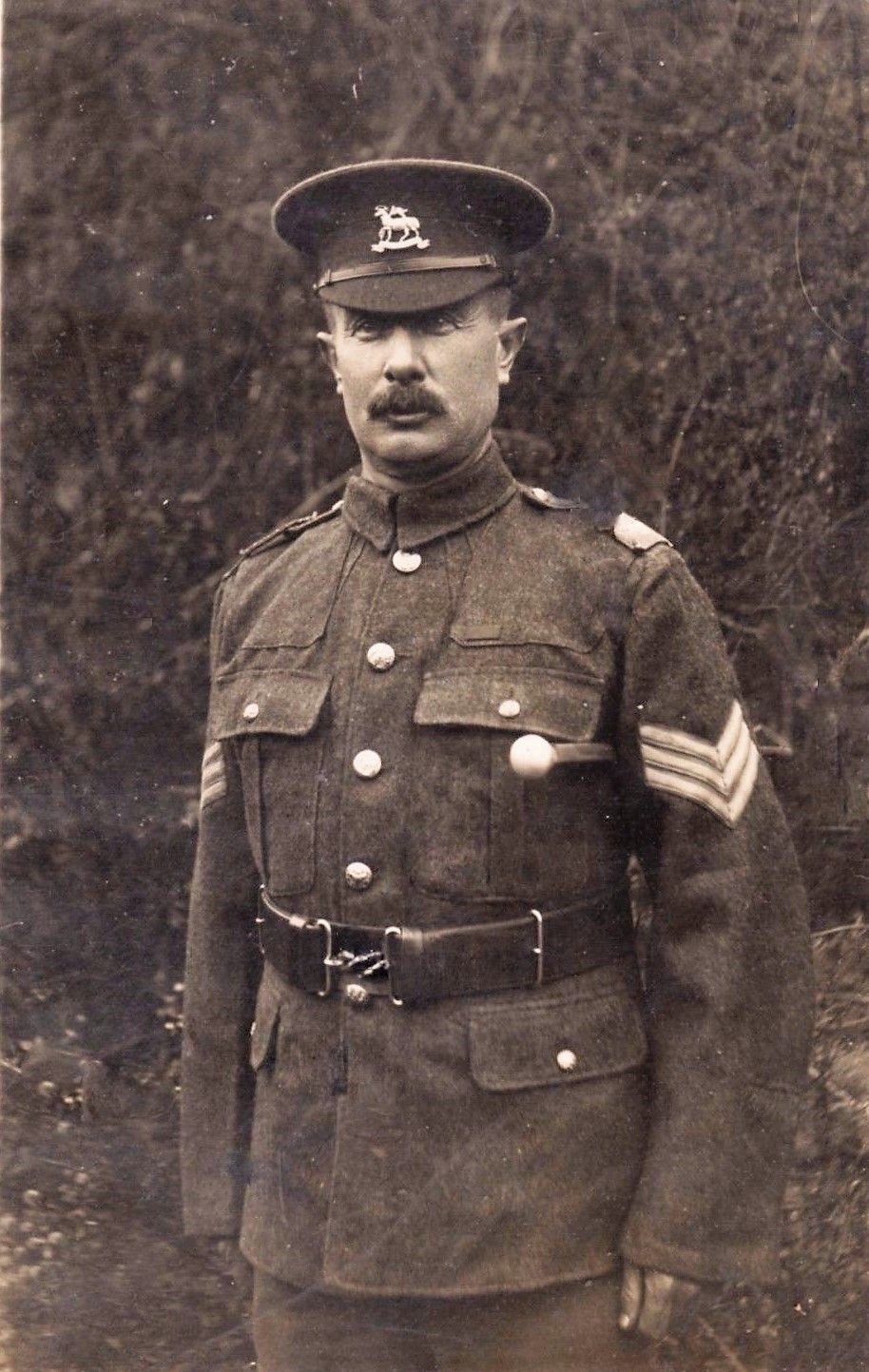
and obviously Tolkien knew what he intended, but I’ve always seen those “privates and batmen” as something more:  as models for the Orcs—

and their commanders, Ugluk and Grishnakh—and later Shagrat and Gorbag—not as of the officer class, to which Tolkien belonged—

but as sergeants, the tough, experienced men who ran the infantry on a day-to-day basis.

Here they are, talking—

“ ‘Orders,’ said a third voice in a deep growl.  ‘Kill all but NOT the Halflings; they are to be brought back ALIVE as quickly as possible.  That’s my orders.’

“ ‘What are they wanted for?’ asked several voices.  ‘Why alive?  Do they give good sport?’

‘No!  I heard that one of them has got something, something that’s wanted for the War, some Elvish plot or other.  Anyway they’ll both be questioned.’

‘Is that all you know?  Why don’t we search them and find out?  We might find something that we could use ourselves.’

‘That is a very interesting remark,’ sneered a voice, softer than the others but more evil.  ‘I may have to report that.  The prisoners are NOT to be searched or plundered:  those are my orders.’

‘And mine too,’ said the deep voice.  ‘Alive and as captured, no spoiling.  That’s my orders.’ “

So far, those two main voices—the “deep growl” and the “softer…but more evil”–are just that:  voices.  And we can tell immediately that they, being the ones given orders and threatening to make reports, are in charge.  Shortly, we’ll find that the deep voice belongs to ”a large black Orc, probably Ugluk” and the softer to Grishnakh, “a short, crook-legged creature, very broad and with long arms that hung almost to the ground.” 

Why sergeants, not officers?  It’s the tone, I think.  When Grishnakh proposes taking the prisoners to the east bank of the Anduin, where a Nazgul is waiting, Ugluk replies

“ ‘Maybe, maybe!  Then you’ll fly off with our prisoners, and get the pay and praise in Lugburz, and leave us to foot it as best we can through the Horse-country.’ “ 

“pay and praise” and “footing it” sound to me more like the language of soldiers than those of higher ranks, but there’s something more to their talk.  Ugluk sneers at the Nazgul and Grishnakh replies:

“ ‘Nazgul, Nazgul,’ said Grishnakh, shivering and licking his lips, as if the word had a foul taste that he savoured painfully.  ‘You speak of what is deep beyond the reach of your muddy dreams, Ugluk.’ “

There is a fear in this that’s a little surprising:  aren’t the Nazgul on the same side as Grishnakh, at least? 

There is a rivalry between the two groups as well—and clearly even between their two masters, as Grishnakh reveals:

“ ‘You have spoken more than enough, Ugluk,’ sneered the evil voice.  ‘I wonder how they would like it in Lugburz…They might ask where his strange ideas came from.  Did they come from Saruman, perhaps?  Who does he think he is, setting up on his own with his filthy white badges?  They might agree with me, with Grishnakh their trusted messenger; and I Grishnakh say this:  Saruman is a fool, and a dirty treacherous fool.’ “  (all of the text here is from The Two Towers, Book Three, Chapter 3, “The Uruk-hai”)

All of this shows a level of internal tension which would not bode well for an alliance between Sauron and Saruman and, when we reach Shagrat and Gorbag, later in the story, there’s even something more and we’ve already seen it in that “We might find something that we can use ourselves.”

So far, the speech of the two Orc leaders has suggested creatures who clearly don’t trust each other, and one is fearful of something on his own side, revealing, as well, that his master, Sauron, is less than impressed by Saruman and his efforts. 

And now we find that such sergeants may not even trust their men, as when Shagrat says to Gorbag:

“ ‘…but they’ve got eyes and ears everywhere; some among my lot, as like as not.’ “

But why such wariness?  First, because these Orcs are aware that knowledge of the progress of the war in which they’re a part is being kept from them, and it’s not good news:

“ ‘…they’re troubled about something.  The Nazgul down below are, by your account; and Lugburz is too.  Something nearly slipped…As I said, the Big Bosses, ay,’ his voice sank almost to a whisper, ‘ay, even the Biggest, can make mistakes.  Something nearly slipped, you say.  I say, something has slipped.’ “

And second because these Orcs, not trusting their masters and perhaps even fearful of them, may have plans of their own—

“ ‘What d’you say?—if we get a chance, you and me’ll slip off and set up somewhere on our own with a few trusty lads, somwhere where there’s good loot nice and handy, and no big bosses.’

‘Ah!’ said Shagrat.  ‘Like old times!’ “  (The Two Towers, Book Four,  Chapter 10, “The Choices of Master Samwise”)

As we’ll see, however, later in the story, Shagrat and Gorbag don’t even trust each other—

“Quick as a snake, Shagrat slipped aside, twisted round, and drove his knife into his enemy’s throat.

‘Got you, Gorbag!’ he cried.  ‘Not quite dead, eh?  Well, I’ll finish my job now.’  He sprang on to the fallen body, and stamped and trampled it in his fury, stooping now and again to stab and slash it with his knife.“  (The Return of the King, Book Six, Chapter 1, “The Tower of Cirith Ungol”)

So much for “old times”!  But a fitting ending for this posting.  Here, on the lowest rung of the social ladder, we see how JRRT shows both the threat of the enemies’ soldiers and, at the same time, undercuts that threat, as we hear the Orcs doing everything from threatening each other, dissing their own leaders and those of their own side, mistrusting each other and their own men, and even plotting to desert and set up their own little kingdoms before cheerfully knifing each other.  We might wonder—even if Sauron had won, how long would his empire have lasted, with such allies and underlings?

Thanks, as ever, for reading.

Stay well,

I guess that I don’t have to tell you now:  watch your back,

And remember that there’s

MTCIDC

O

PS

For more on Orcs and their language, see “Lingua Orca”, 16 April, 2025.

Do You Speak Villain? (2)

11 Wednesday Feb 2026

Posted by Ollamh in Uncategorized

≈ Leave a comment

Tags

dialogue, Fantasy, lotr, Mouth of Sauron, Nazgul, Saruman, The Lord of the Rings, thou-vs-you, Tolkien, villain, Witch-King of Angmar

Welcome, dear readers, as always.

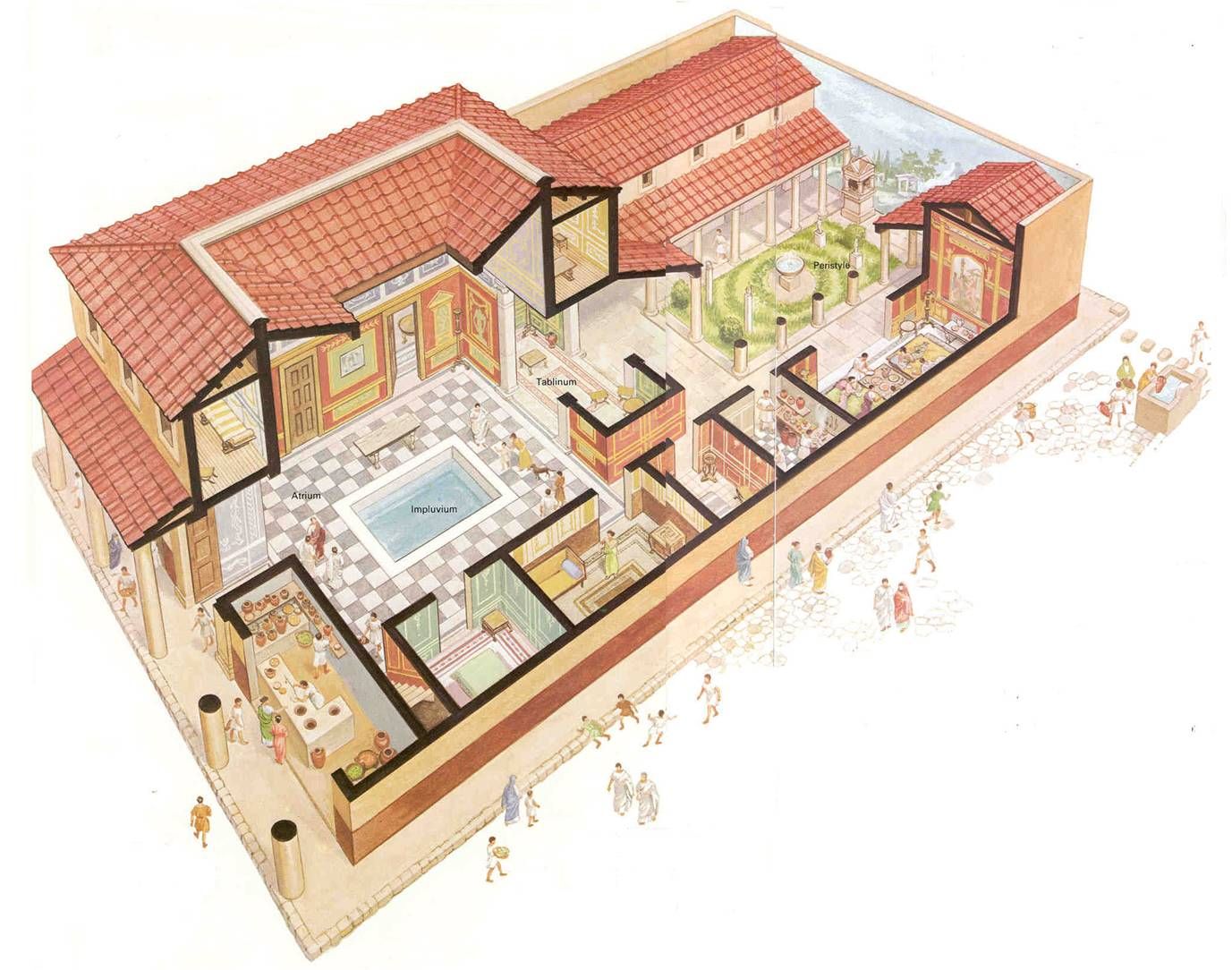
It is sometimes surprising to see how social class can influence vocabulary.  For instance–

this is a Roman villa—

in Pompeii, where wealthy city people might live.

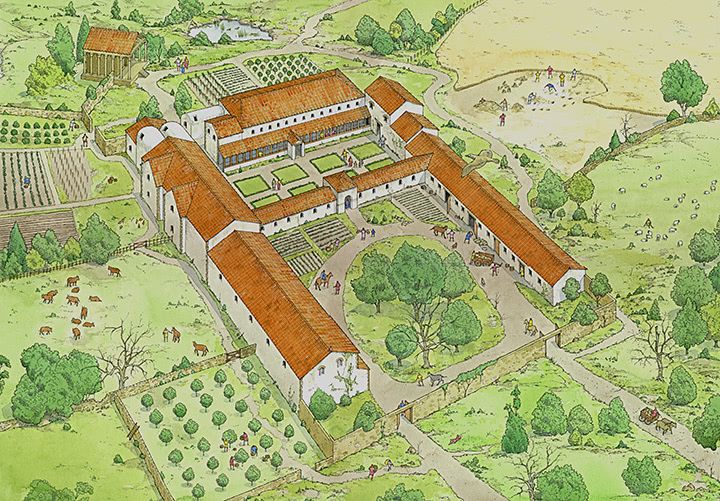
And this is a country villa—

(Billl Donohoe)

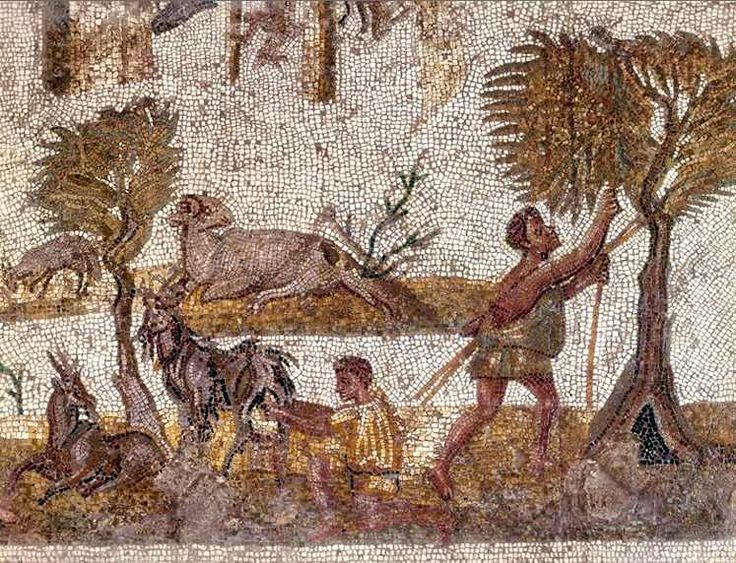
which, in its more elaborate form, might offer some of the comforts of a city dwelling, but would often also be a working farm and here are a couple

of Roman farm workers (probably slaves), each of whom, as someone attached to a villa, could be called a villanus—and I’m sure that you see where this is going:  rural people could be uncultivated (no pun, there) and therefore crude and, by a snobbish leap of imagination from 12th-century Old French to mid-16th century English, people who could be expected to be involved in the worst antisocial behavior:  crime.  (For more on this, see:  https://www.etymonline.com/word/villain )

In the previous posting, we began examining Tolkien’s villains in The Lord of the Rings, and how Tolkien, with his wonderful ear for language (and a great dramatic gift), used speech to depict their characters, as well as their behavior.

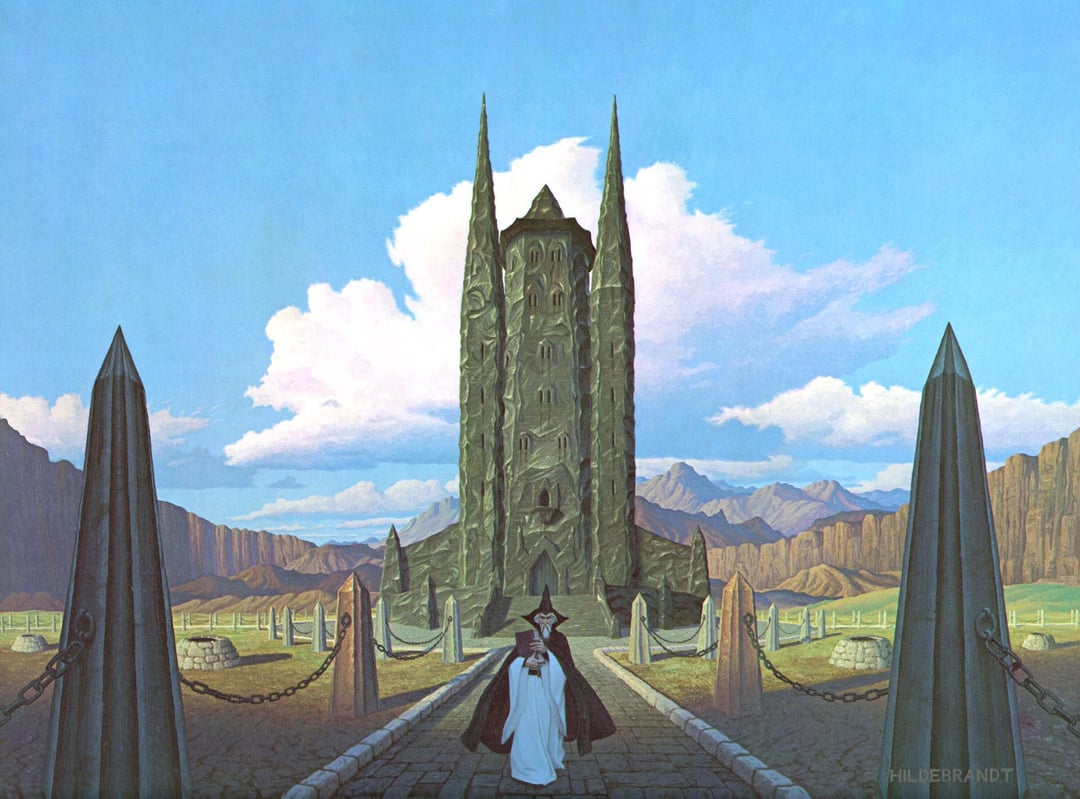
Since Sauron provides such a small sample of speech, we began with Saruman,

(the Hildebrandts)

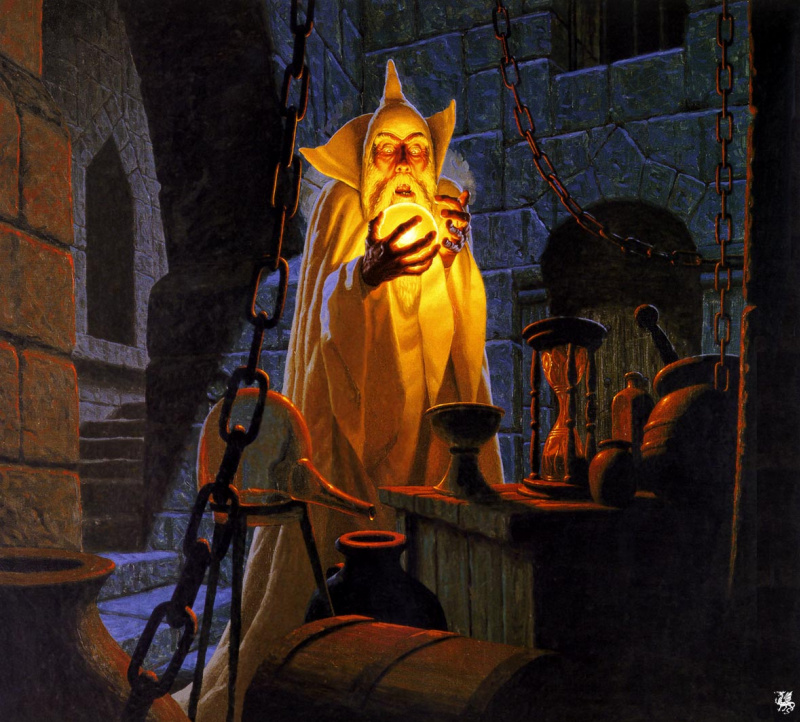
who, as reported by Gandalf in Book One, could be by turns, sarcastic, conspiratorial, falsely chummy, and coldly imperious, all the while, though only at first obliquely, attempting to persuade Gandalf to reveal to him the location of The Ring and, in doing so, revealing to Gandalf not only his corrupt ambition, but also his lack of awareness of how much that corruption came from his communication with Mordor.

(the Hildebrandts)

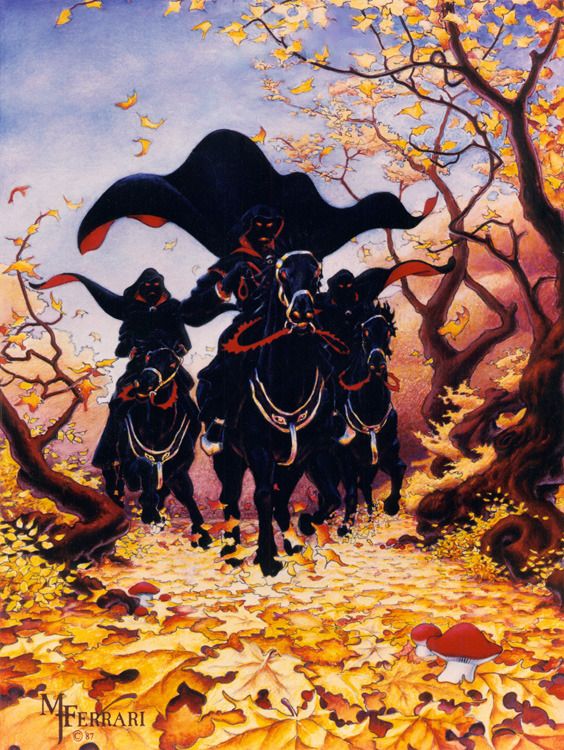
In this posting, I want to continue that examination by extending it down the social scale of villains, beginning with the Nazgul, who, as former kings, might be thought of as next after Saruman.

(Mark Ferrari—new to me, but I like the energy of this and you can see more at:  https://www.markferrari.com/image-archives )

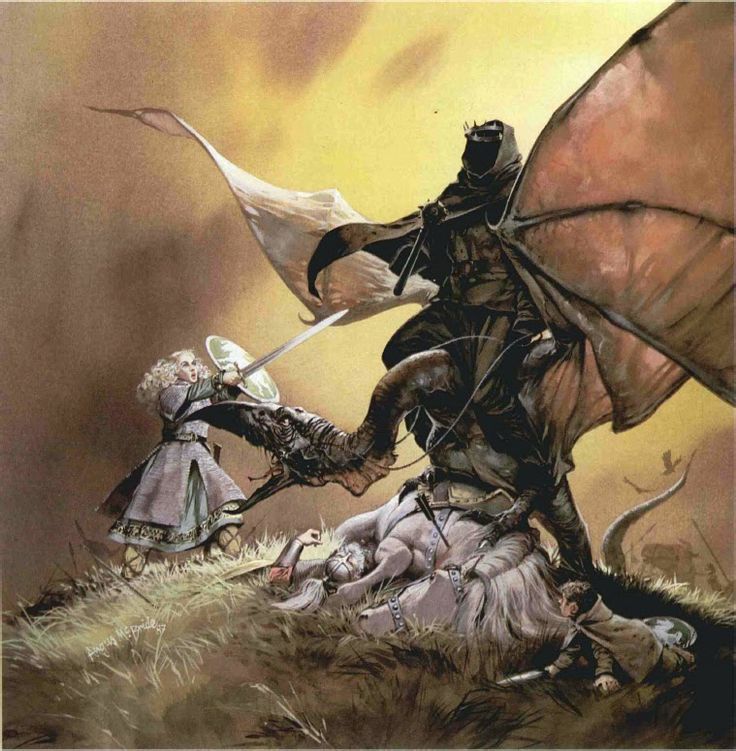
On the whole, unlike Saruman, who gives away so much in his speech, they don’t have much to say for themselves, but their leader, the Witch-king of Angmar,

(Angus McBride)

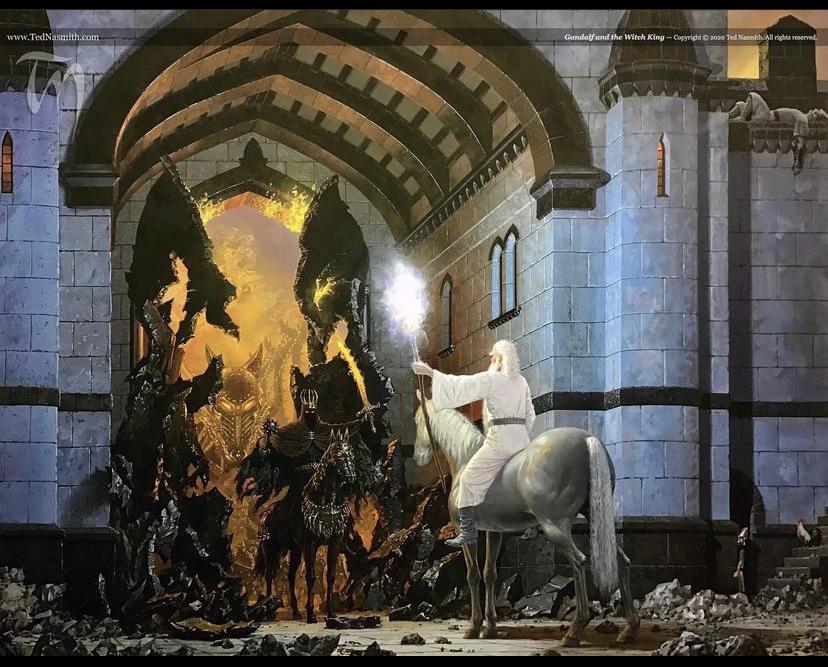
has two bits of dialogue:  first, when he encounters Gandalf at the broken gate of Minas Tirith,

(Ted Nasmith)

where he speaks briefly in a threat:

“ ‘Old fool!’ he said.  ‘Old fool!  This is my hour.  Do you not know Death when you see it?  Die now and curse in vain!’”  (The Return of the King, Book Five, Chapter 4, “The Siege of Gondor”)

This only shows his (misplaced) contempt for Gandalf, but he addresses Gandalf as an equal in using “you”, rather than as an inferior, as when he confronts Eowyn:

“ ‘Come not between the Nazgul and his prey!’ “

The Witch-king is ancient—being from the Second Age of Middle-earth—and therefore we might expect his speech to sound archaic, even if here he uses the Common Speech of everyone else we see in The Lord of the Rings, and we see it here with this inverted construction.  If it were a person from the present, we might expect “Don’t come” or perhaps “Don’t you come”, but “Come not” immediately suggests a speaker from an earlier time.

He continues:

“ ‘Or he will not slay thee in thy turn.’ “

And note here the archaic “thee” (the accusative/dative/ablative of “thou”), which serves a double purpose:  on the one hand, suggesting the Witch-king’s great age and, on the other, this is how a superior would speak to an inferior (as in the case of the Romance languages—where French even has verbs for using “you” vs “thou”—vouvoyer vs tutoyer).

And continues:

“He will bear thee away to the houses of lamentation, beyond all darkness, where thy flesh shall be devoured, and thy shrivelled mind be left naked to the Lidless Eye.’ “ (The Return of the King, Book Five, Chapter 6, “The Battle of the Pelennor Fields”)

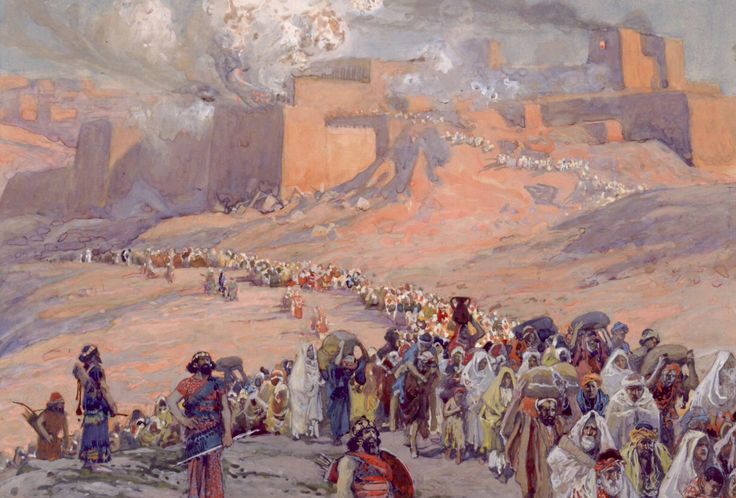
The Witch-king persists in his use of “thou”, but then becomes what I feel is quite Biblical in “the houses of lamentation”—where is this place?  My immediate thought was that it was the same place where Gollum was tortured (we get a hint of this in Gandalf’s long explanation in The Fellowship of the Ring, Book One, Chapter 2, “The Shadow of the Past”) and where the Mouth of Sauron suggests that Frodo was taken (The Return of the King, Book Five, Chapter 10, “The Black Gate Opens”).  As to its name, I was reminded of “The Book of Lamentations” in the Judeo-Christian Bible, a collection of laments over the fall of Jerusalem to the Babylonians in 587/6BC.

(James Tissot, 1836-1902—actually Jacques Joseph Tissot, a very interesting late-Victorian French artist who did much of his later work in England, where he—or his name, at least—became Anglicized.  You can read about him and his art here:  https://en.wikipedia.org/wiki/James_Tissot )

Sections of “Lamentations” are read during Lent, in Christian services, and we can assume that JRRT, as a practicing Catholic, was well aware of the book.  (You can read more about it here:  https://en.wikipedia.org/wiki/Book_of_Lamentations )

Wherever the idea came from, the Witch-king continues it in an extremely graphic manner, repeating his use of  “thou” to the end of his threat, at the same time.

We see this use of “thou” once more from another on that social scale, the Mouth of Sauron.

(Douglas Beekman—you can read a little more about him here:  https://www.askart.com/bio/Doug_L_Beekman/122294/Doug_L_Beekman )

This is, again, an ancient figure, as we’re told that “…he was a renegade, who came of the race of those that are named the Black Numenoreans”—that is, followers of Sauron in the Second Age—and he begins as Saruman began, with contempt—

“ ‘Is there anyone in this rout with authority to treat with me?’ “

“Rout” is an archaic word for “rabble”, so the Mouth is already suggesting that, in comparison with him, there is no one of stature with whom he could speak.  And he goes on—

“ ‘Or indeed with wit to understand me?’ “

He’s establishing his bargaining position here:  he’s of higher social standing and smarter than anyone he faces and he continues, addressing Aragorn:

“ ‘It needs more to make a king than a piece of Elvish glass, or a rabble such as this,  Why, another brigand of the hills can show as good a following!’ “

So far, then, the Mouth shows arrogance—but his next behavior shows that, underneath that arrogance is cowardice—

“Aragorn said naught in answer, but he took the other’s eye and held it, and for a moment they strove thus; but soon, though Aragorn did not stir or move hand to weapon, the other quailed and gave back as if menaced by a blow.  ‘I am a herald and ambassador, and may not be assailed!’ he cried.”

(And this is where Jackson’s portrayal in the film version of the scene fails completely, as Aragorn then cuts him down, which no respectable king—or even knight—would do, as the Mouth is correct in that heralds and ambassadors, traditionally, could claim immunity.)

Gandalf reassures him, although he also cautions him that that immunity might not last forever, before the Mouth continues:

“ ‘So!’ said the Messenger.  ‘Then thou art the spokesman, old grey-beard?’ “

This is insulting in several ways:  first, that use of “thou”, as though to an inferior; second, as the Mouth clearly recognizes Aragorn, so he would recognize Gandalf, and calling him “old grey-beard” has the same effect as when the Witch-king earlier called him “old fool”.

He then indirectly admits that he does, indeed, recognize Gandalf:

“ ‘Have we not heard of thee at whiles, and of thy wanderings, ever hatching plots and mischief at a safe distance?  But this time thou hast stuck out thy nose too far, Master Gandalf, and thou shalt see what comes to him who sets his foolish webs before the feet of Sauron the Great.’ “

Vocabulary is key here:  “wanderings”, “hatching plots and mischief”, sticking out “thy nose”, “foolish webs”, all suggest denigration, keeping with the Mouth’s original address, which painted the Gondorians and their allies as a mob of bandits, with no legitimacy to address the Messenger of Sauron, or even the IQ to do so.

Pippin recognizing Frodo’s mithril coat gives the Mouth the chance to continue that denigration, calling Pippin “imp” and “brat” and calling the Shire “little rat-land”, before going on to name the conditions Sauron demands, both for the return of Frodo and for “peace” between him and the allies, conditions which are simply surrender in other terms. 

So far, by his very language, the Mouth has attempted to dictate the scenario, using “we” as if it were Sauron himself speaking, attempting to suggest that Sauron is the master of the situation and that he, as Sauron’s spokesman, is in sole charge of the parley, but it’s interesting to see how he responds when spoken to in the same way by Gandalf, who has revealed his own power, pulling the mithril coat and others of Frodo’s possessions from the Mouth’s hands. 

“ ‘…Get you gone, for your embassy is over and death is near to you.  We did not come here to waste words in treating with Sauron, faithless and accursed; still less with one of his slaves.  Begone!’ “

The Mouth’s reaction is the very opposite of his original self-depiction at the beginning of the parley:  instead of mocking and presenting himself as above the level of those on the other side, he is literally speechless—and more than mute, being likened to a beast with no ability to communicate at all:

“Then the Messenger laughed no more.  His face was twisted with amazement and anger to the likeness of some wild beast that, as it crouches on its prey, is smitten on the muzzle with a stinging rod.  Rage filled him and his mouth slavered, and shapeless sounds of fury came strangling from his throat.” (The Return of the King, Book Six, Chapter 10, “The Black Gate Opens”)

So, the Mouth is dropped into the Animal Kingdom by Gandalf’s words (and notice that archaic “Get you gone!”—the archaism we hear from the Witch-king seems to be catching) and, in the third part of the posting, we’ll drop lower in the social scale, as well.

Stay well,

Imagine how useful “thou” and “thee” might be in English today,

And remember that, as ever, there’s

MTCIDC

O

PS I recently happened upon a very useful article on illustrating Tolkien which I want to pass on to you here:  https://en.wikipedia.org/wiki/Illustrating_Middle-earth   I love looking at all of the different ways in which artists, all the way back to the 1960s, imagine Tolkien’s work.

Do You Speak Villain? (Part 1)

04 Wednesday Feb 2026

Posted by Ollamh in Uncategorized

≈ Leave a comment

Tags

Fantasy, Gandalf, lotr, rhetoric, Saruman, Sauron, speaking villain, The Lord of the Rings, The Ring, Tolkien

As ever, welcome, dear readers.

How do antagonists talk? 

If you do a quick search of the internet for discussion on creating villains, you can be almost overwhelmed with all the advice you find.  Much is about behavior, but one important point which I’ve seen more than once (I’m quoting here from Gillian Adams’ website) is to avoid:  “1. Grandiose Speeches”.  (For more of her list, see:  https://gillianbronteadams.com/2011/12/villainy-101/ )   Such speeches can easily lead to what beginning writers are often warned against and which is commonly called an “information dump”, where an author employs that grandiose speech to fill in a great deal of plot—often criticized as lazy writing.

Tolkien was certainly, if anything, not a lazy writer and I thought that it would be fun to look at the speech not of one antagonist, but of several, in The Lord of the Rings to see how he portrays their dialogue and, through it, them.

Sauron, the chief antagonist, although he presents the main difficulty in the story has, unfortunately, few lines—just questions and imperatives—but then he’s only an eye—

although I suppose we could take that brevity as implying that, as a character, he is nothing but a strong will, used to making demands on all those around him and expecting instant obedience.

So let’s begin with his (although he doesn’t know it) minion, Saruman—

(the Hildebrandts)

as initially reported by Gandalf.

Saruman, although, through Radagast the Brown, has sent for Gandalf, is hardly welcoming:

“ ‘So you have come, Gandalf…For aid?  It has seldom been heard of that Gandalf the Grey sought for aid, one so cunning, so wise, wandering about the lands, and concerning himself in every business, whether it belongs to him or not.’”

This leads him to continue:

“ ‘How long, I wonder, have you concealed from me, the head of the Council, a matter of greatest import?  What brings you now from your lurking-place in the Shire?’ ”

So, we hear sarcasm,–“so cunning, so wise” and “lurking-place”–but then there’s something more—and  it seems characteristic of Saruman that this villain, at least, can be quite roundabout in coming to the point—the real point—of his invitation.  But then we’re shown something which begins to look like he’s launching into the Grandiose–

“ He drew himself up then and began to declaim, as if he were giving a speech long rehearsed“ Gandalf begins—and notice that we’re being given stage directions, providing us with an idea not only of Saruman’s posture, but of his tone—this is an oration, not an intimate conversation:

“ ‘The Elder Days are gone.  The Middle Days are passing.  The Younger Days are beginning.  The time of the Elves is over, but our time is at hand:  the world of Men, which we must rule.  But we must have power, power to order all things as we will, for that the good which only the Wise, can see.’ “

Here, in true oratorical fashion, Saruman provides a preface:  three grand ages—and note, as well, that rhetorical pattern of three—of which the first is gone, the second about to be gone, and the third just coming into being.  And then he begins to come to his point—but only begins:  “the world of Men, which we must rule.”  Upon which he then expands:  “But we must have power, power to order all things as we will, for that good which only the Wise can see.”

So far, then, this definitely might seem like it was leaning towards the Grandiose—although JRRT has already suggested that Gandalf is aware of that lean by having him say that Saruman seems not to be speaking naturally, but declaiming.  At the same time, however, we can also see that, although Saruman’s subject is power, he suggests that Gandalf is his natural confederate in gaining it, attempting flattery—“…we must have power, power to order all things as we will…’ ” and that “we” are the [capital W] Wise.

From declamation, Saruman slips into the more conversational—really conspiratorial—tone:

“ ‘And listen, Gandalf, my old friend and helper!’ he said, [and another stage direction here] coming near and speaking now in a softer voice, ‘I said we, for we it may be, if you will join with me.’ “

From a history lesson, Saruman has quickly exposed his real theme, and he continues:

“ ‘A new Power is rising.  Against it the old allies and policies will not avail us at all.  There is no hope left in Elves or dying Numenor.’ “

So—not even men—after all, Numenorians—or, rather the descendants of the Numenorians—are men—are enough, and the Elves are just about out of the picture, meaning that, potentially, not only is there no hope left in either of them, but no hope left at all—but hope of what, Saruman has not yet said.  He’s about to hint at it, however, continuing his roundabout method:

“ ‘This then is one choice left before you, before us.  We may join with that Power.  It would be wise, Gandalf.  There is hope that way.  Its victory is at hand; and there will be rich reward for those that aided it.’ “

Still not saying what that hope might be of—until

“ ‘As the Power grows, its proved friends will also grow; and the Wise, such as you and I, may with patience come at last to direct its courses, to control it.’ “

Saruman’s hope, then, is that he—uh, they—although unable to resist that Power (as Saruman persists in capitalizing it), can come to be its directors—

“ ‘We can bide our time, we can keep our thoughts in our hearts, deploring maybe evils done by the way…’ “

  And now, discarding rhetoric, Saruman has begun to reveal himself:  once sent by the Valar as a counterbalance to Sauron, to gain his own power, Saruman is willing to act like the very one he was sent against—or worse:

“ ‘…but approving the high and ultimate purpose:  Knowledge, Rule, Order; all the things that we have so far striven in vain to accomplish, hindered rather than helped by our weak or idle friends.’ “

If the Valar had meant the Maiar, the Wizards, to oppose Sauron, their purpose was certainly not to gain abstractions like “Knowledge, Rule, Order” (which sounds like something from Orwell’s 1984) and Saruman gives away his own “high and ultimate purpose” in this and underlines it with:

“ ‘There need not be, there would not be, any real change in our designs, only in our means.’ “

Tolkien so far, then, has shown Saruman through his speech as sarcastic, then pompous, acting like a public orator in front of a crowd, although speaking only to Gandalf—then sly, attempting to flatter by suggesting that: 

1. Gandalf is his “old friend and helper”

2. and that, if Gandalf goes along, he, too, will be one of “the Wise”

as well as glossing over what Gandalf might object to—“deploring maybe evils done by the way”, to achieve goals which seem the very opposite of that of the Valar—“Knowledge, Rule, Order”, and continuing that slyness by not defining any of those, simply implying that Gandalf must already not only understand them, but have already been a partner in working towards them in the past—although we notice that, although he’s called Gandalf “his old friend”, he has added “and helper”, reducing Gandalf to a subordinate position with that one word.

Still, Saruman continues to be oblique—he talks about the Power, talks about somehow coming to manage and direct it although never suggesting how, but, when Gandalf objects, he comes a little closer to the point—with more stage directions:  “drew himself up”, “speaking now in a softer voice”,

“He looked at me sidelong, and paused a while considering.  ‘Well, I see that this wise course does not commend itself to you…Not yet?  Not if some better way can be contrived?’

He came and laid his long hand on my arm. [Think here about Saruman’s badge—on the shields and helmets of his orcs]

“ ‘And why not, Gandalf?’ he whispered.  ‘Why not?  The Ruling Ring?’ “

And now we come to the real reason for Saruman’s invitation:

“ ‘If we could command that, then the Power would pass to us.  That is in truth why I brought you here.  For I have many eyes in my service, and I believe that you know where this precious [from Saruman’s badge to Gollum with one word!]

(Alan Lee)

thing now lies.  Is it not so?  Or why do the Nine ask for the Shire, and what is your business there?’ “

So, so far, we’ve seen Saruman’s speech as sarcastic, pompous/declamatory, sly, and whispering/conspiratorial, but, when Gandalf once more rejects his approach, he takes on one more tone–menace:

“He was cold now and perilous.  ‘Yes,’ he said, ‘I did not expect you to show wisdom, even in your own behalf; but I gave you the chance of aiding me willingly, so saving yourself much trouble and pain.  The third choice is to stay here, until the end…Until you reveal to me where the One may be found.  I may find means to persuade you. Or until it is found in your despite, and the Ruler has time to turn to lighter matters:  to devise, say, a fitting reward for the hindrance and insolence of Gandalf the Grey.’ “

(all of the quotations are from The Fellowship of the Ring, Book Two, Chapter 2, “The Council of Elrond”)

What has happened to “my old friend and helper”?  and “the Power would pass to us”?  Now it’s “I gave you the chance of aiding me” and someone wants to become “the Ruler”.  Although Tolkien has provided us with a certain number of physical clues, as in“laid his long hand on my arm”, it’s in his manner of speaking and how it changes throughout the scene that we see Saruman,  once the Head of the Maiar, become “Saruman the Wise, Saruman Ring-maker, Saruman of Many Colours!”, traitor to the good people of Middle-earth, far from his original mission, and ultimately not “the Ruler” he foolishly assumes that he will be, with or without Gandalf.

In Part 2, we’ll move from this greater villain to much lesser ones, to see what their speech tells us about them.

As always, thanks for reading.

Stay well,

Beware of people who call you “my old friend”, and then threaten you,

And remember that, as always, there’s

MTCIDC

O
PS

For more on Saruman’s manner of speaking—in his second appearance, when he’s a prisoner in his own tower—see:  “By Ear (2)”, 14 May, 2025.

The Doubtful Sea Series Facebook Page

The Doubtful Sea Series Facebook Page

  • Ollamh

Categories

  • Artists and Illustrators
  • Economics in Middle-earth
  • Fairy Tales and Myths
  • Films and Music
  • Games
  • Heroes
  • Imaginary History
  • J.R.R. Tolkien
  • Language
  • Literary History
  • Maps
  • Medieval Russia
  • Military History
  • Military History of Middle-earth
  • Narnia
  • Narrative Methods
  • Poetry
  • Research
  • Star Wars
  • Terra Australis
  • The Rohirrim
  • Theatre and Performance
  • Tolkien
  • Uncategorized
  • Villains
  • Writing as Collaborators
Follow doubtfulsea on WordPress.com

Across the Doubtful Sea

Recent Postings

  • Do You Speak Villain? (Part 3) February 18, 2026
  • Do You Speak Villain? (2) February 11, 2026
  • Do You Speak Villain? (Part 1) February 4, 2026
  • Towering January 28, 2026
  • Tolkien Among the Indians January 21, 2026
  • Thin and Stretched January 14, 2026
  • Through a glass… January 7, 2026
  • Heffalumps? December 31, 2025
  • We Three Kings December 24, 2025

Blog Statistics

  • 107,904 Views

Posting Archive

  • February 2026 (3)
  • January 2026 (4)
  • December 2025 (5)
  • November 2025 (4)
  • October 2025 (5)
  • September 2025 (4)
  • August 2025 (4)
  • July 2025 (5)
  • June 2025 (4)
  • May 2025 (4)
  • April 2025 (5)
  • March 2025 (4)
  • February 2025 (4)
  • January 2025 (5)
  • December 2024 (4)
  • November 2024 (4)
  • October 2024 (5)
  • September 2024 (4)
  • August 2024 (4)
  • July 2024 (5)
  • June 2024 (4)
  • May 2024 (5)
  • April 2024 (4)
  • March 2024 (4)
  • February 2024 (4)
  • January 2024 (5)
  • December 2023 (4)
  • November 2023 (5)
  • October 2023 (4)
  • September 2023 (4)
  • August 2023 (5)
  • July 2023 (4)
  • June 2023 (4)
  • May 2023 (5)
  • April 2023 (4)
  • March 2023 (5)
  • February 2023 (4)
  • January 2023 (4)
  • December 2022 (4)
  • November 2022 (5)
  • October 2022 (4)
  • September 2022 (4)
  • August 2022 (5)
  • July 2022 (4)
  • June 2022 (5)
  • May 2022 (4)
  • April 2022 (4)
  • March 2022 (5)
  • February 2022 (4)
  • January 2022 (4)
  • December 2021 (5)
  • November 2021 (4)
  • October 2021 (4)
  • September 2021 (5)
  • August 2021 (4)
  • July 2021 (4)
  • June 2021 (5)
  • May 2021 (4)
  • April 2021 (4)
  • March 2021 (5)
  • February 2021 (4)
  • January 2021 (4)
  • December 2020 (5)
  • November 2020 (4)
  • October 2020 (4)
  • September 2020 (5)
  • August 2020 (4)
  • July 2020 (5)
  • June 2020 (4)
  • May 2020 (4)
  • April 2020 (5)
  • March 2020 (4)
  • February 2020 (4)
  • January 2020 (6)
  • December 2019 (4)
  • November 2019 (4)
  • October 2019 (5)
  • September 2019 (4)
  • August 2019 (4)
  • July 2019 (5)
  • June 2019 (4)
  • May 2019 (5)
  • April 2019 (4)
  • March 2019 (4)
  • February 2019 (4)
  • January 2019 (5)
  • December 2018 (4)
  • November 2018 (4)
  • October 2018 (5)
  • September 2018 (4)
  • August 2018 (5)
  • July 2018 (4)
  • June 2018 (4)
  • May 2018 (5)
  • April 2018 (4)
  • March 2018 (4)
  • February 2018 (4)
  • January 2018 (5)
  • December 2017 (4)
  • November 2017 (4)
  • October 2017 (4)
  • September 2017 (4)
  • August 2017 (5)
  • July 2017 (4)
  • June 2017 (4)
  • May 2017 (5)
  • April 2017 (4)
  • March 2017 (5)
  • February 2017 (4)
  • January 2017 (4)
  • December 2016 (4)
  • November 2016 (5)
  • October 2016 (6)
  • September 2016 (5)
  • August 2016 (5)
  • July 2016 (5)
  • June 2016 (5)
  • May 2016 (4)
  • April 2016 (4)
  • March 2016 (5)
  • February 2016 (4)
  • January 2016 (4)
  • December 2015 (5)
  • November 2015 (5)
  • October 2015 (4)
  • September 2015 (5)
  • August 2015 (4)
  • July 2015 (5)
  • June 2015 (5)
  • May 2015 (4)
  • April 2015 (3)
  • March 2015 (4)
  • February 2015 (4)
  • January 2015 (4)
  • December 2014 (5)
  • November 2014 (4)
  • October 2014 (6)
  • September 2014 (1)

Blog at WordPress.com.

  • Subscribe Subscribed
    • doubtfulsea
    • Join 78 other subscribers
    • Already have a WordPress.com account? Log in now.
    • doubtfulsea
    • Subscribe Subscribed
    • Sign up
    • Log in
    • Report this content
    • View site in Reader
    • Manage subscriptions
    • Collapse this bar
 

Loading Comments...