• About

doubtfulsea

~ adventure fantasy

Tag Archives: James Joyce

Going Around in Cycles

17 Wednesday Sep 2025

Posted by Ollamh in Uncategorized

≈ Leave a comment

Tags

Barrow-wight, Finnegans Wake, Giambattista Vico, goblin king, James Joyce, La Scienza Nuova, lotr, Mirkwood spiders, Nazgul, Ouroboros, Palantir, runes, Shelob, swords, The Hobbit, The Lord of the Rings, The Return of the King, Tolkien, Tom Bombadil, Yogi Berra

“It’s déjà vue all over again.”

(attributed to Yogi Berra, US baseball player, but see:  https://quoteinvestigator.com/2013/10/08/deja-vu-again/ )

Dear readers, as always, welcome.

In later life, James Joyce, 1882-1941,
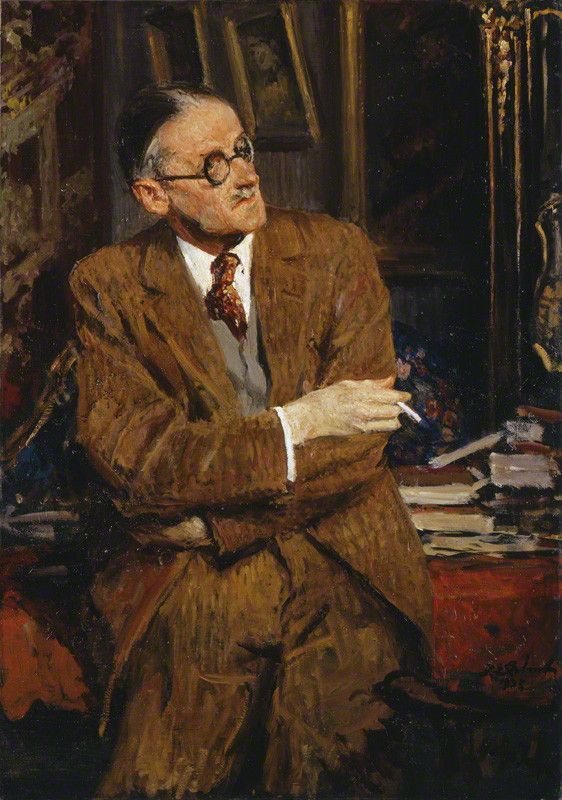
was interested in the work of the 17-18th-century philosopher (among other things) Giambattista Vico, 1668-1744,

and his idea that history followed a definite repeated pattern in three ages, Divine, Heroic, and Human, posited in his 1725-1744 work, La Scienza Nuova (“the new understanding, knowledge, learning”).

(For more on Vico, see:  https://www.philosopheasy.com/p/the-eternal-return-giambattista-vicos  This is, potentially, a very large subject, and even more so when Joyce is combined with Vico.  For an introductory view, see:  https://archive.org/details/vicojoyce00vere_0/page/n5/mode/2up ) 

Joyce incorporated his understanding of Vico in his last work, Finnegans Wake, 1939, in which

the idea of repeated patterns cycling throughout appears in the very opening—and closing– lines of the book:

“A way a lone a last a loved a long the / riverrun, past Eve and Adam’s, from swerve of shore to bend of bay, brings us by a commodius vicus of recirculation back to Howth Castle and Environs.” 

which, in fact, are reversed, the opening of the book being:

“…riverrun, past Eve and Adam’s, from swerve of shore to bend of bay, brings us by a commodius vicus of recirculation back to Howth Castle and Environs…”

and the last words of the book are:

“A way a lone a last a loved a long the…”

so that, by joining them, we have the effect of the serpent Ouroboros, tail/tale joined to mouth—and the book can begin again.

(For more on Finnegans Wake, see:  https://en.wikipedia.org/wiki/Finnegans_Wake  For more on the serpent, see:   https://en.wikipedia.org/wiki/Ouroboros )

I’ve always thought that leaving Tom Bombadil and the Barrow-wight
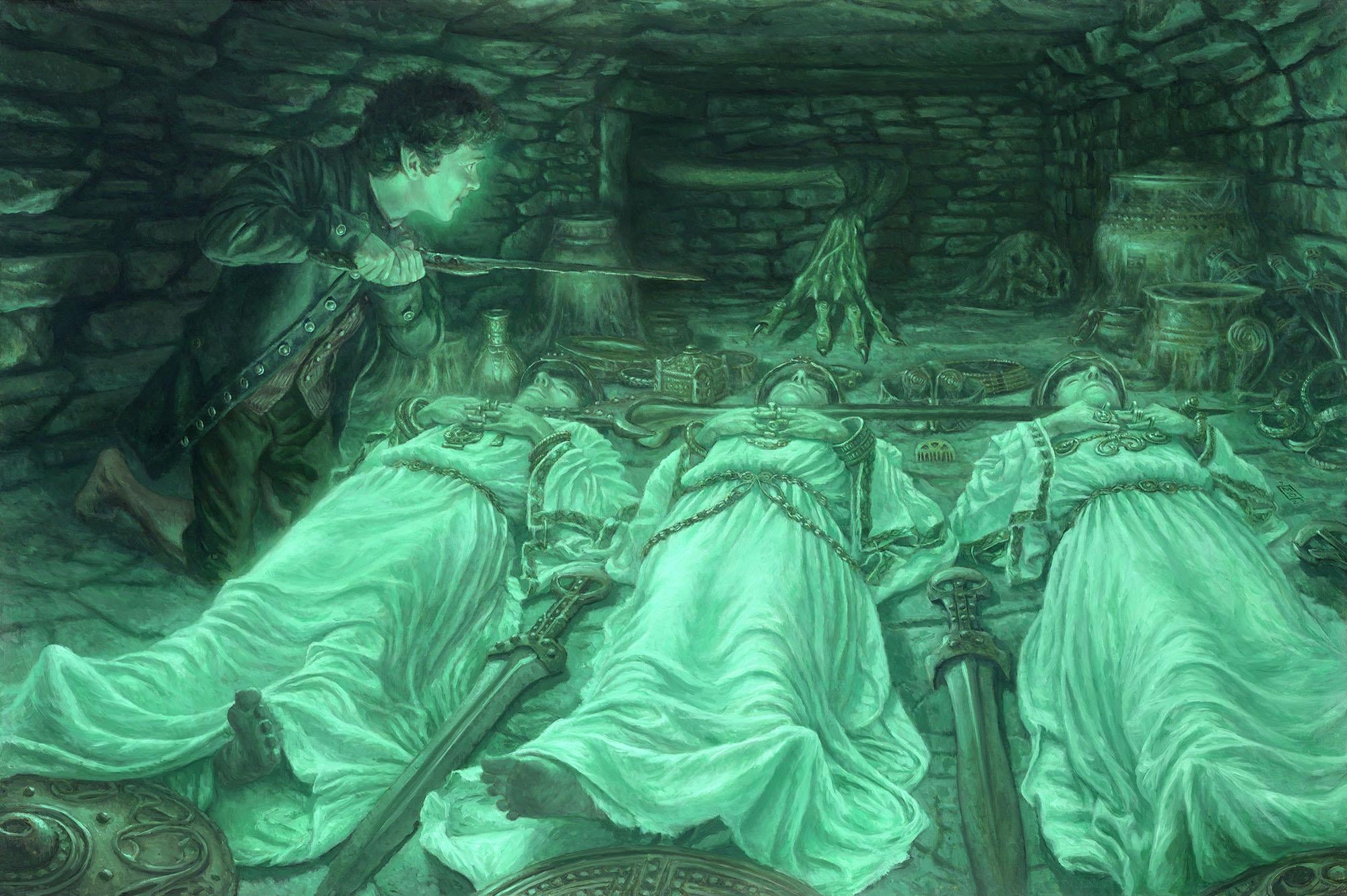
(Matthew Stewart—see more of his work here:  https://www.matthew-stewart.com/  See, in particular, his Middle-earth work, but then go through his other galleries to view his impressive ability to capture other imaginary worlds.)

out of the first Lord of the Rings film was a mistake, even though Tolkien himself once wrote:

“Tom Bombadil is not an important person—to the narrative.”  (letter to Naomi Mitchison, 25 April, 1954, Letters, 268—but read on, as JRRT has much more to say and, to my mind, justifies his position in the narrative, in fact, in a spiritual way.)

Tom is interesting in himself, being a kind of parallel for Treebeard, among other things (and the writers of the Rings of Power series thought highly enough of him to include him in their telling), but, for me, in the narrative, it’s what he gives them, particularly Merry, which is important—

“For each of the hobbits he chose a dagger, long, leaf-shaped, and keen, of marvelous workmanship…”

(probably something like this, but more elaborately-worked)

‘Old knives are long enough as swords for hobbit-people,’ he said…Then he told them that the blades were forged many long years ago by Men of Westernesse:  they were foes of the Dark Lord, but they were overcome by the evil king of Carn Dum in the Land of Angmar.”  (The Fellowship of the Ring, Book One,  Chapter 8, “Fog on the Barrow-downs”)

This is, of course, the weapon  which Merry uses to stab the chief of the Nazgul while he’s attacking Eowyn, the Nazgul being the very witch-king who had overcome the Men of Westernesse so long before.

(Ted Nasmith)

To keep Tom and the Barrow-wight in the film is then to underline the cyclic nature of much of the story.

 This unnamed but crucial sword is only one of the swords scattered throughout the later story of Middle-earth, however, and there is a cyclic potential for others, as well.

Think of the swords which Gandalf and Co. find in the trolls’ hideout in The Hobbit—

“…and among them were several swords of various makes, shapes, and sizes.  Two caught their eyes particularly, because of their beautiful scabbards and jeweled hilts…

‘These look like good blades,’ said the wizard, half drawing them and looking at them curiously.  ‘They were not made by any troll, nor by any smith among men in these parts and days; but when we can read the runes on them, we shall know more about them.’ “ (The Hobbit, Chapter Two, “Roast Mutton”)

In the next chapter, Elrond then identifies them:

“Elrond knew all about runes of every kind.  That day he looked at the swords they had brought from the trolls’ lair, and he said:  ‘These are not troll-make.  They are old swords, very old swords of the High Elves of the West, my kin.  They were made in Gondolin for the Goblin-wars.  They must have come from a dragon’s hoard or goblin plunder, for dragons and goblins destroyed that city many ages ago.  This, Thorin, the runes name Orcrist, the Goblin-cleaver in the ancient tongue of Gondolin; it was a famous blade.  This, Gandalf, is Glamdring, a Foe-hammer that the king of Gondolin once wore.’ “ (The Hobbit, Chapter Three.  “A Short Rest”)

And you’ll remember that Gandalf runs the king of later goblins through in the next chapter with that very sword:

“Suddenly a sword flashed in its own light.  Bilbo saw it go right through the Great Goblin as he stood dumb-founded in the middle of his rage.  He fell dead, and the goblin soldiers fled before the sword shrieking into the darkness.”  (The Hobbit, Chapter Four, “Over Hill and Under Hill”)

(Alan Lee)

The knife which Bilbo picks up from the trolls’ hoard “only a tiny pocket-knife for a troll, but it was as good as a short sword for the hobbit”, comes in handy later in The Hobbit, when Bilbo uses it to kill some of the spiders of Mirkwood,

(Oleksiy Lipatov—you can see more of his work here:  https://www.deviantart.com/lipatov/gallery/85631839/old-comic  )

but it will reappear many years later in The Lord of the Rings, when Frodo and Sam use it against another ancient evil, Shelob–

(Ted Nasmith again—and, unusually for his work, just plain weird—but vivid!)

Perhaps the most consequential sword  to return, however, is that which maimed Sauron many centuries ago, causing him to lose the Ring, and which, reforged, Aragorn shows him in Saruman’s palantir
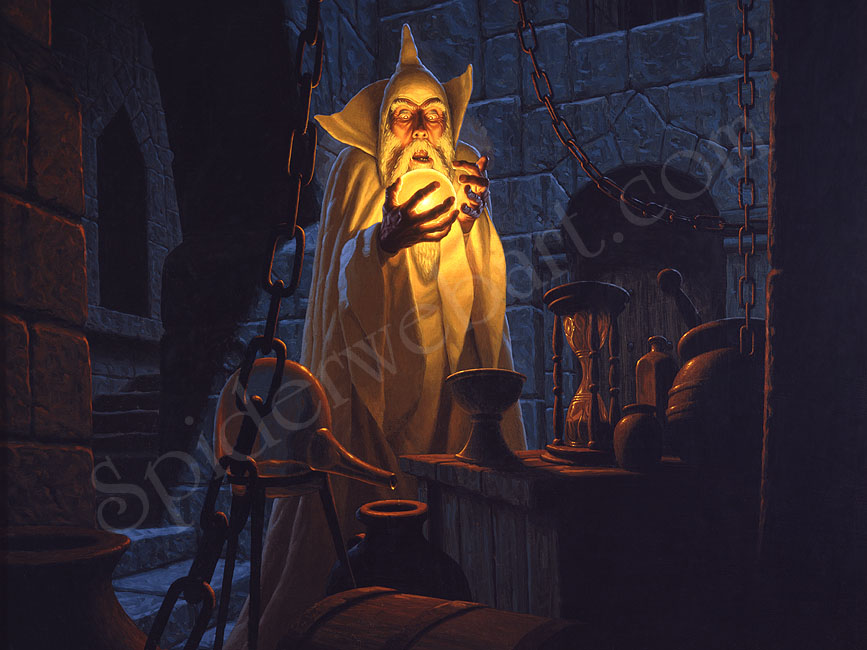
(the Hildebrandts)

(itself appearing from a far older world, being as Aragorn says, “For this assuredly is the palantir of Orthanc, from the treasury of Elendil, set here by the Kings of Gondor.”  The Two Towers, Book Three, Chapter 11, “The Palantir”):

“…The eyes in Orthanc did not see through the armour of Theoden; but Sauron has not forgotten Isildur and the sword of Elendil.  Now in the very hour of his great designs the heir of Isildur and the Sword are revealed; for I showed the blade re-forged to him.  He is not so mighty yet that he is above fear; nay doubt ever gnaws him.”  (The Return of the King, Book Five, Chapter 2, “The Passing of the Grey Company”)

And there are more cyclings.

Consider the Ring itself:  forged in the fires of Mt Doom, it is eventually returned there and destroyed,
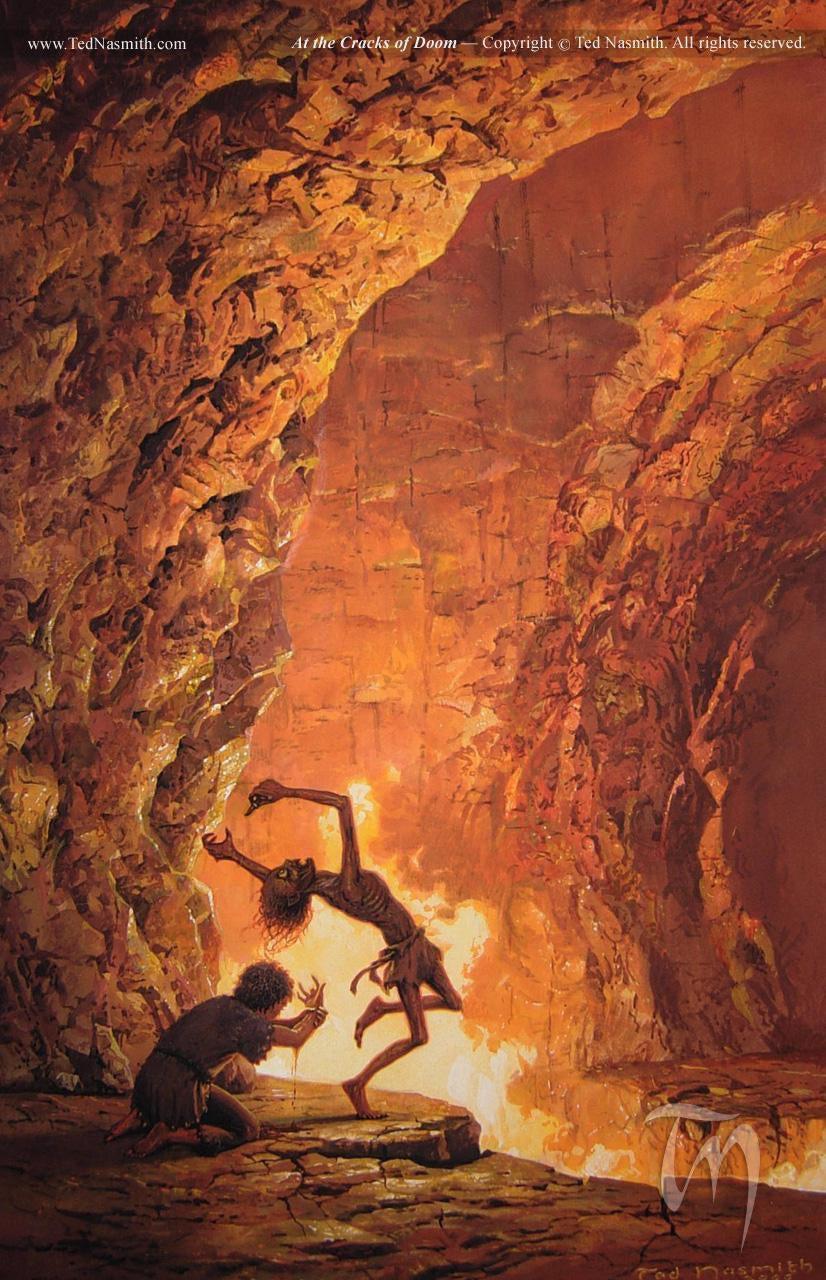
(another Ted Nasmith)

which causes the final end of Sauron, after several ages of struggle,

(and one more Ted Nasmith–and who better to paint a cataclysm?)

and which, in turn, brings the—return of the King.

(Denis Gordeev–and note that the artist has painted Aragorn’s crown as depicted by Tolkien in a letter to Rhona Beare, 14 October, 1958, see Letters, 401.)

After thinking about this, I can see that there are even more cyclic events, like the movement of the elves westwards, and  Gandalf traveling the same way, originally sent eastwards to oppose Sauron,
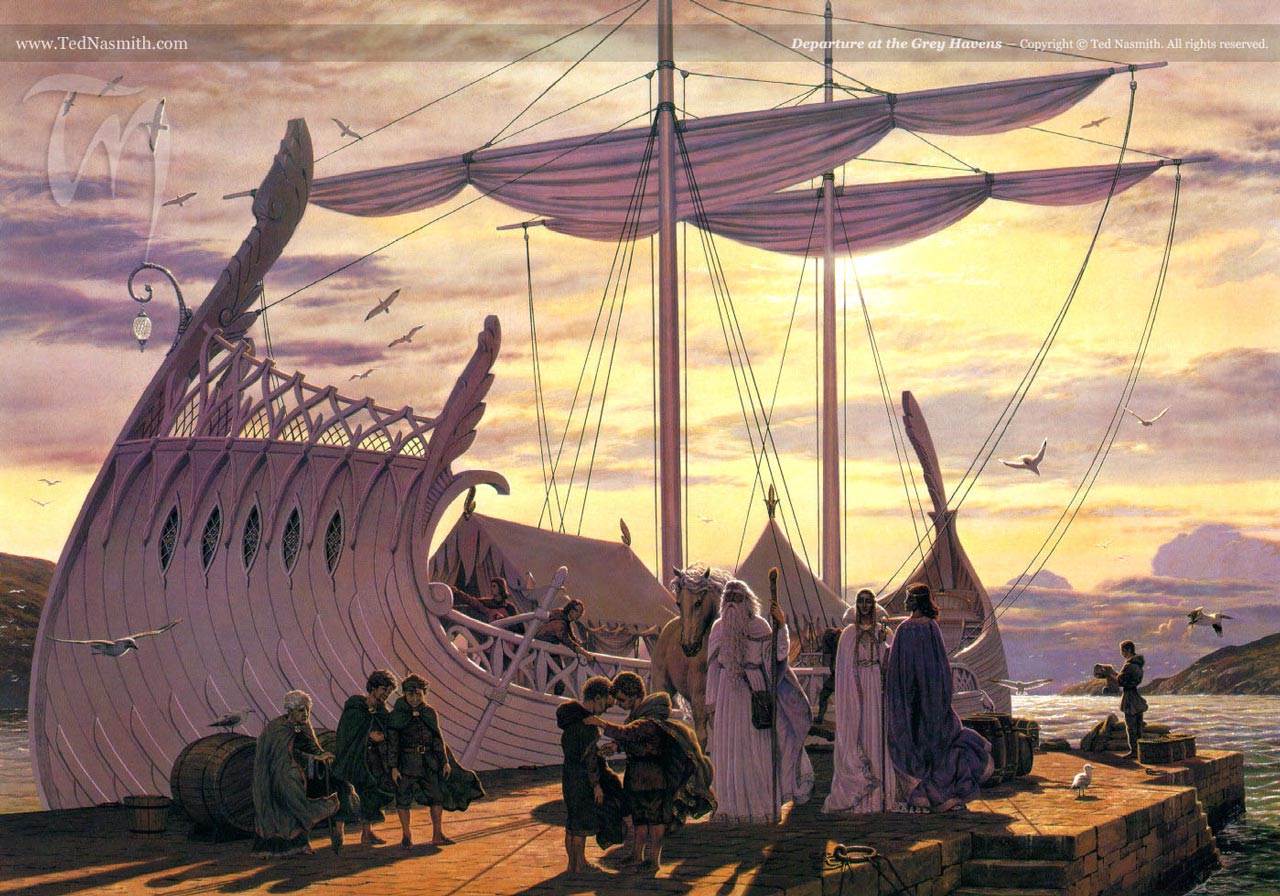
(one more Ted Nasmith)

but I think that this is enough for one posting—though considering all of the cycles I’ve already identified,  I’ll end with another (supposed) quotation from Yogi Berra:

Thanks, as always, for reading.

Stay well,

Remember one more piece of Yogi wisdom

And remember, as well, that there’s always

MTCIDC

O

In Depth

15 Wednesday Aug 2018

Posted by Ollamh in J.R.R. Tolkien, Language, Literary History

≈ Leave a comment

Tags

Beowulf, Canterbury Tales, Chaucer, Christopher Tolkien, conlang, Danian, David J Peterson, Dothraki, Elvish, English, Game of Thrones, Hamlet, Ilkorin, James Joyce, Jane Austen, language, Noldorin, Pride and Prejudice, Qenya, Shakespeare, Star Wars, Telerin, The Art of Language Invention, The Lord of the Rings, Tolkien, Ulysses

Welcome, as always, dear readers.

In 1977, the more observant viewers and critics commented upon the look and feel of a new film.  Instead of a world in which everything appeared newly-produced and sparkling, this was one in which it was clear that people had lived for a long time and many different peoples, at that.

image1moseisley.png

Even their vehicles had a scratched and dusty look.

image2speeder.jpg

We had been told, of course, in the very opening sequence that this was an old place—

image3long.png

but actually seeing its used look was that much more convincing

image4crawler.jpg

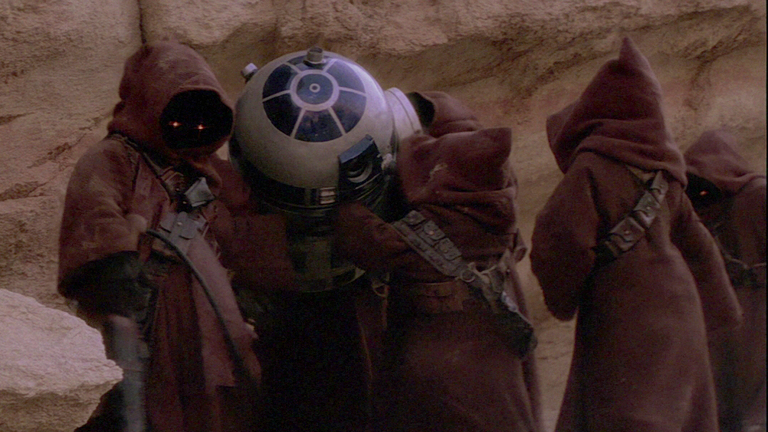
as was seeing—and hearing—its peoples,

image5jawas.jpeg

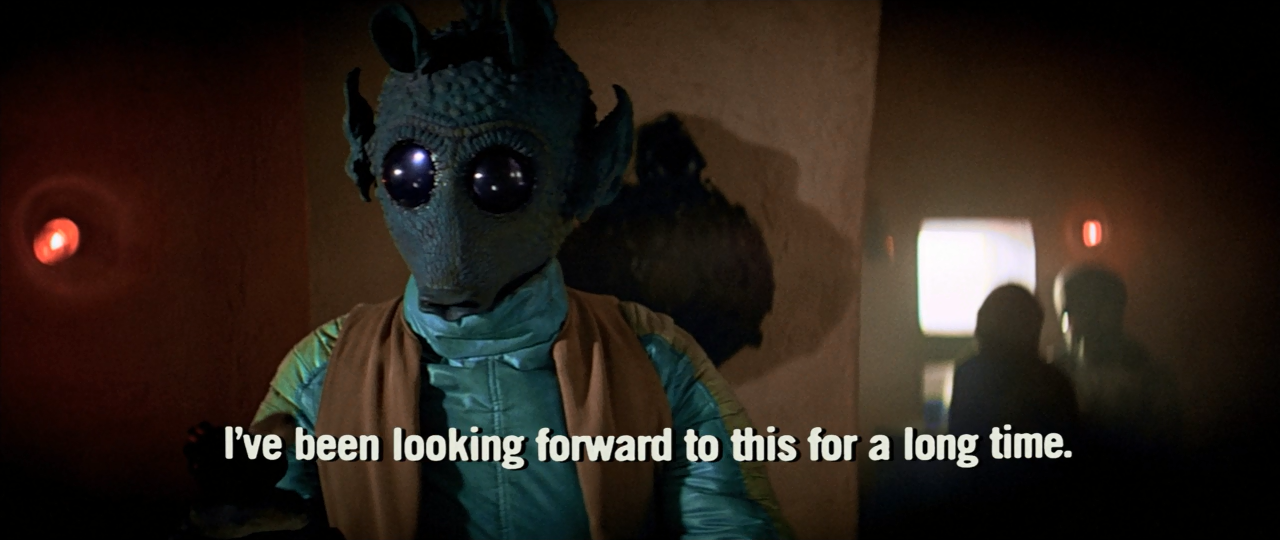
who sometimes even required subtitles, as if the audience were watching a foreign film.

image6greedo.png

In time, as the success of this film produced not only more films, but mountains of other material, from novels to graphic novels to spin-off series to toys and t-shirts and kitchen ware,

image7mugs.jpg

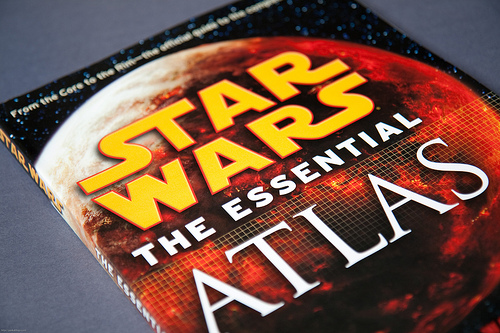
a whole literature appeared about this world—or, we should say, worlds. Its geography and even its extremely-varied animal life.

image8atlas.jpg

image9fauna.jpg

And, along with all of the other material, information about its languages began to appear.

image10aura.png

What prompted this posting, however, was something odd about one of those languages, that spoken by a character in what would, in time, become the sixth in the series.

image11boushh.jpg

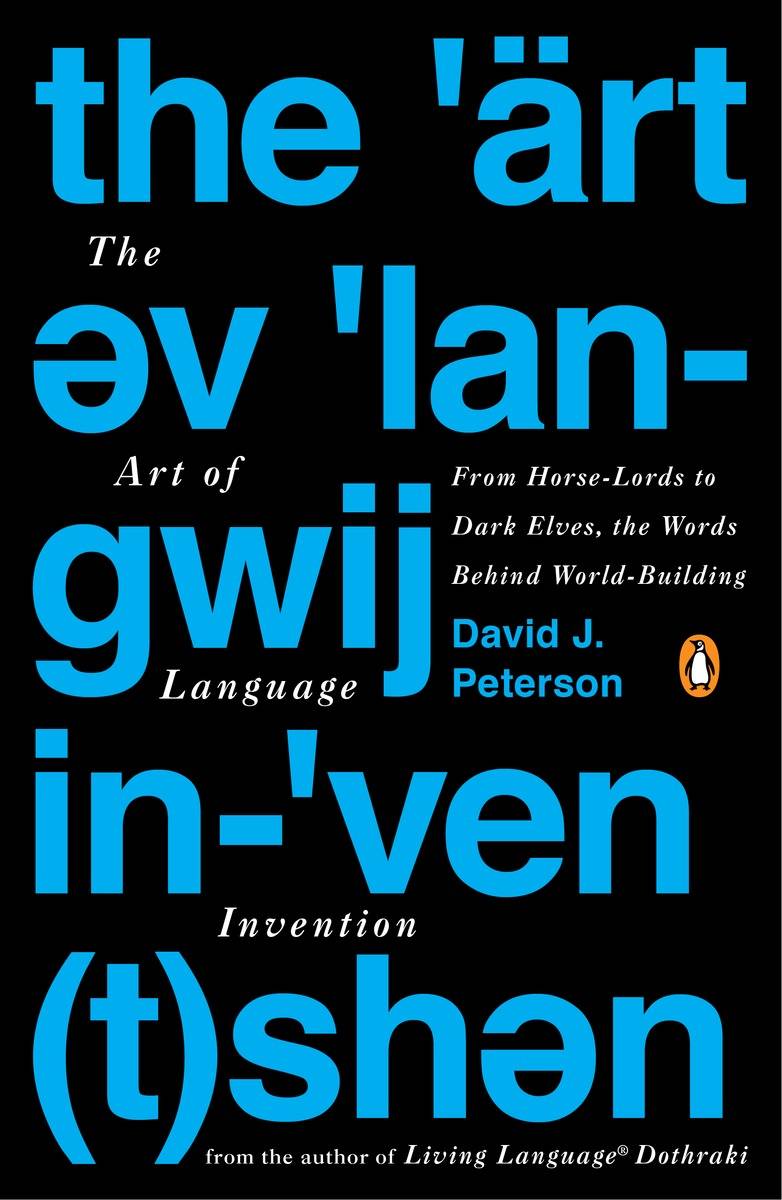
This was pointed out to us by David J. Peterson

image12peterson.jpg

in his 2015 book, The Art of Language Invention.

image13book.jpg

As a child, what had puzzled Peterson was that the character (who is subtitled), says only “Yate, yate, yoto, ei, yato, cha”—in total, only six different words, but they are translated as everything from “I have come for the bounty on this Wookiee” to “50,000, no less”.  (This is quoted and discussed on pages 3 to 5 of Peterson’s book—which is, by the way, one we would recommend, if you’re as interested in languages as we are.)

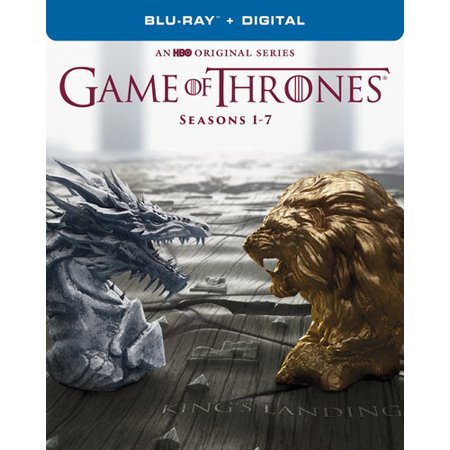
How could so few words mean so many different things?  As an adult, looking back, Peterson had his doubts and we would agree—especially when reading about the world in which Peterson lives, the world of “conlang”, which is short for “constructed languages”.  Peterson is the creator of Dothraki, the language of the nomadic Dothraki people,

image14dothraki.jpg

one of the numerous races which inhabit the landscape of George R R Martin’s Game of Thrones, first novels, then a huge, elaborate, and engrossing television series.

image15gamebooks.jpg

image16tv.jpeg

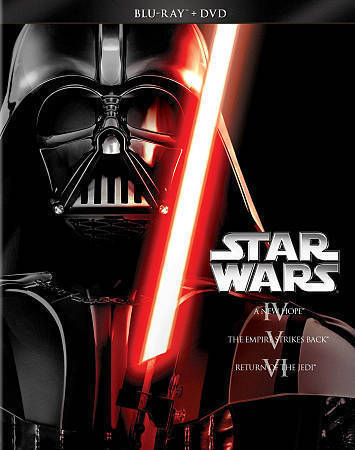
The difference between “yate”, etc and Dothraki is that those few words are there to suggest that someone is speaking in a language different from the language spoken by the majority of the characters—which is the method employed throughout not only this film, but its two immediate successors.

image17swset.jpg

What Peterson set out to do was to create the shape of an entire language (something he has done more than once).  Here’s a LINK to the Wiki site, which, as usual, leads to other sites, which lead to other sites, which lead… if you’d like to learn more.

As worn-looking buildings and vehicles, different peoples and flora and fauna, and at least the suggestion of other languages create a bigger, deeper picture of the setting of an adventure, so, too, does the suggestion of great age.  Over time, the huge pile of material for the film series we first mentioned showed, in detail, that what we were seeing was, in fact, only the latest phase in a whole galaxy of civilizations over many centuries—after all, “For over a thousand generations, the Jedi Knights were the guardians of peace and justice in the Old Republic”.

image18obiwan.jpg

Another way to suggest that great age is a much less dramatic one—perhaps even a nearly-invisible one–practiced by one of our favorite authors and the subject of innumerable postings, and here is one of his efforts.

image19chart.jpg

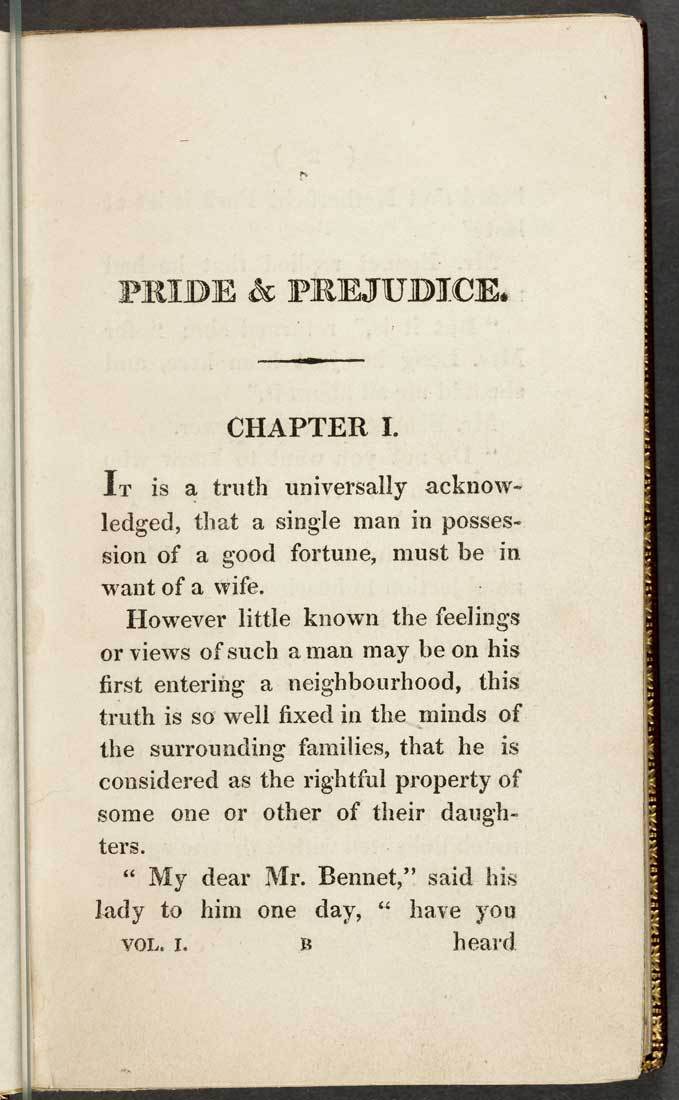
What we’re seeing here is JRRT working out the history of sounds throughout a series of Elf languages, Qenya, Telerin, Noldorin, Ilkorin, and Danian, part of his immense and immensely-detailed work on the tongues of Middle-earth.   All languages change through time, of course—here’s a rough version of the succession of periods of English—

Old English (the opening lines of Beowulf, 700-1000AD,

image20beo.jpg

Middle English (the opening of Chaucer’s Canterbury Tales, c.1400AD),

image21chaucer.jpg

Early Modern English (the beginning of the first scene of Shakepeare’s Hamlet, 1603),

image22hamlet.jpg

early 19th-century English (the first lines of Jane Austen’s Pride and Prejudice, 1813),

image23pp.jpg

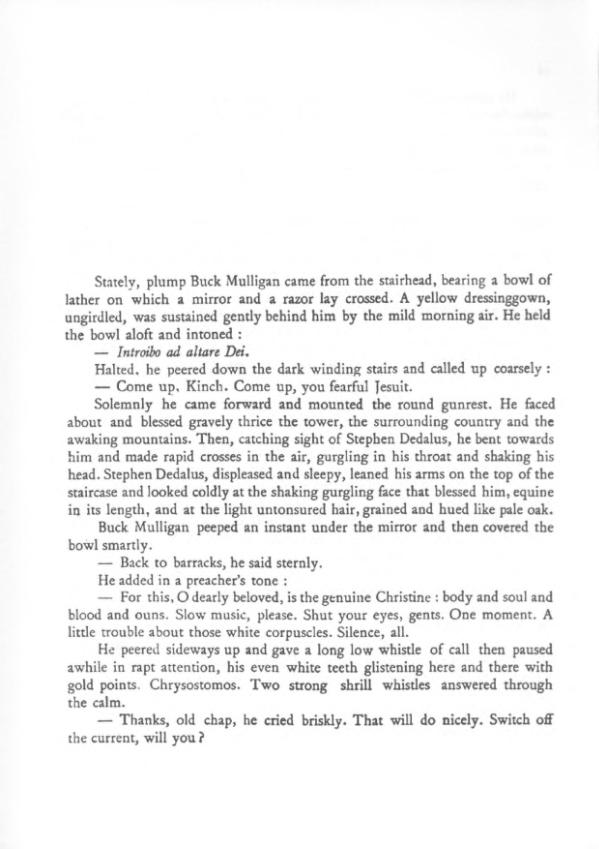
and early 20th-century English (the opening of James Joyce’s Ulysses, 1922).

image24ulysses.jpg

And Joyce even attempted to suggest the procession of those periods in Chapter 14 of Ulysses, “The Oxen of the Sun”, where the story is told through paragraphs which sound like earlier versions of the language gradually moving towards modern English.  (The novelist Nabokov, who played with language constantly, actually found this chapter boring, perhaps because it seemed to him like a one-off, not really in aid of the plot and its characters in general, but rather just a piece of private fun by and for the author?)

JRRT, however, goes one better.  Like other creators of big adventures, he used lots of means to deepen his story, from an extensive and detailed map

image25map.jpg

to describing the remains of earlier times still standing in the landscape of Middle-earth of the present,

image26argonath.jpg

to adding detailed historical appendices and chronologies (and his valiant son, Christopher, has added many volumes more),

image27ct.jpg

but using intricate sound changes and their logical development takes the idea of depth into new regions, especially because it would probably go unnoticed by most readers—there’s an awful lot of detail in those appendices—but whose meticulous creation is not in the least surprising for someone who once wrote, “The ‘stories’ were made rather to provide a world for the languages than the reverse.” (Letters, 219)

Thanks, as ever, for reading.

MTCIDC

CD


ps

Ah yes—the nearly-inevitable post scriptum—if the normal world/s of the films we first mentioned are “scruffy-looking” (to quote a character about another character), we notice that the world of the villains—the soldiers of the Empire and their surroundings—are hard and clean and shiny—which makes us feel a little better when we wonder when we may last have shined our shoes.

image28deathstar.jpg

The Doubtful Sea Series Facebook Page

The Doubtful Sea Series Facebook Page

  • Ollamh

Categories

  • Artists and Illustrators
  • Economics in Middle-earth
  • Fairy Tales and Myths
  • Films and Music
  • Games
  • Heroes
  • Imaginary History
  • J.R.R. Tolkien
  • Language
  • Literary History
  • Maps
  • Medieval Russia
  • Military History
  • Military History of Middle-earth
  • Narnia
  • Narrative Methods
  • Poetry
  • Research
  • Star Wars
  • Terra Australis
  • The Rohirrim
  • Theatre and Performance
  • Tolkien
  • Uncategorized
  • Villains
  • Writing as Collaborators
Follow doubtfulsea on WordPress.com

Across the Doubtful Sea

Recent Postings

  • A Moon disfigured December 17, 2025
  • On the Roads Again—Once More December 10, 2025
  • (Not) Crossing Bridges December 3, 2025
  • On the Road(s) Again—Again November 26, 2025
  • On the Road(s) Again November 19, 2025
  • To Bree (Part 2) November 12, 2025
  • To Bree (Part 1) November 5, 2025
  • A Plague o’ Both—No, o’ All Your Houses! October 29, 2025
  • It’s in Writing (2:  I’st a Prologue, or a Poesie for a Ring?) October 22, 2025

Blog Statistics

  • 103,208 Views

Posting Archive

  • December 2025 (3)
  • November 2025 (4)
  • October 2025 (5)
  • September 2025 (4)
  • August 2025 (4)
  • July 2025 (5)
  • June 2025 (4)
  • May 2025 (4)
  • April 2025 (5)
  • March 2025 (4)
  • February 2025 (4)
  • January 2025 (5)
  • December 2024 (4)
  • November 2024 (4)
  • October 2024 (5)
  • September 2024 (4)
  • August 2024 (4)
  • July 2024 (5)
  • June 2024 (4)
  • May 2024 (5)
  • April 2024 (4)
  • March 2024 (4)
  • February 2024 (4)
  • January 2024 (5)
  • December 2023 (4)
  • November 2023 (5)
  • October 2023 (4)
  • September 2023 (4)
  • August 2023 (5)
  • July 2023 (4)
  • June 2023 (4)
  • May 2023 (5)
  • April 2023 (4)
  • March 2023 (5)
  • February 2023 (4)
  • January 2023 (4)
  • December 2022 (4)
  • November 2022 (5)
  • October 2022 (4)
  • September 2022 (4)
  • August 2022 (5)
  • July 2022 (4)
  • June 2022 (5)
  • May 2022 (4)
  • April 2022 (4)
  • March 2022 (5)
  • February 2022 (4)
  • January 2022 (4)
  • December 2021 (5)
  • November 2021 (4)
  • October 2021 (4)
  • September 2021 (5)
  • August 2021 (4)
  • July 2021 (4)
  • June 2021 (5)
  • May 2021 (4)
  • April 2021 (4)
  • March 2021 (5)
  • February 2021 (4)
  • January 2021 (4)
  • December 2020 (5)
  • November 2020 (4)
  • October 2020 (4)
  • September 2020 (5)
  • August 2020 (4)
  • July 2020 (5)
  • June 2020 (4)
  • May 2020 (4)
  • April 2020 (5)
  • March 2020 (4)
  • February 2020 (4)
  • January 2020 (6)
  • December 2019 (4)
  • November 2019 (4)
  • October 2019 (5)
  • September 2019 (4)
  • August 2019 (4)
  • July 2019 (5)
  • June 2019 (4)
  • May 2019 (5)
  • April 2019 (4)
  • March 2019 (4)
  • February 2019 (4)
  • January 2019 (5)
  • December 2018 (4)
  • November 2018 (4)
  • October 2018 (5)
  • September 2018 (4)
  • August 2018 (5)
  • July 2018 (4)
  • June 2018 (4)
  • May 2018 (5)
  • April 2018 (4)
  • March 2018 (4)
  • February 2018 (4)
  • January 2018 (5)
  • December 2017 (4)
  • November 2017 (4)
  • October 2017 (4)
  • September 2017 (4)
  • August 2017 (5)
  • July 2017 (4)
  • June 2017 (4)
  • May 2017 (5)
  • April 2017 (4)
  • March 2017 (5)
  • February 2017 (4)
  • January 2017 (4)
  • December 2016 (4)
  • November 2016 (5)
  • October 2016 (6)
  • September 2016 (5)
  • August 2016 (5)
  • July 2016 (5)
  • June 2016 (5)
  • May 2016 (4)
  • April 2016 (4)
  • March 2016 (5)
  • February 2016 (4)
  • January 2016 (4)
  • December 2015 (5)
  • November 2015 (5)
  • October 2015 (4)
  • September 2015 (5)
  • August 2015 (4)
  • July 2015 (5)
  • June 2015 (5)
  • May 2015 (4)
  • April 2015 (3)
  • March 2015 (4)
  • February 2015 (4)
  • January 2015 (4)
  • December 2014 (5)
  • November 2014 (4)
  • October 2014 (6)
  • September 2014 (1)

Blog at WordPress.com.

  • Subscribe Subscribed
    • doubtfulsea
    • Join 78 other subscribers
    • Already have a WordPress.com account? Log in now.
    • doubtfulsea
    • Subscribe Subscribed
    • Sign up
    • Log in
    • Report this content
    • View site in Reader
    • Manage subscriptions
    • Collapse this bar
 

Loading Comments...