• About

doubtfulsea

~ adventure fantasy

Tag Archives: Frank Frazetta

Orc Looks

13 Wednesday Nov 2019

Posted by Ollamh in Artists and Illustrators, J.R.R. Tolkien, Villains

≈ Leave a comment

Tags

Alan Lee, Angus McBride, Count Orlok, Denis Gordeev, Description, Frank Frazetta, Hal Foster, Hildebrandts, Illustration, John Howe, Nosferatu, Orcs, Peter Jackson, Prince Valiant, Ted Nasmith, The Lord of the Rings, Tolkien, Villains

As ever, dear readers, welcome.

Two postings ago, we were discussing henchmen and, of course, orcs were among them.

While we were discussing, we began to wonder about orcs.  They appear numerous times in The Lord of the Rings, from pursuing the Fellowship in the mines of Moria
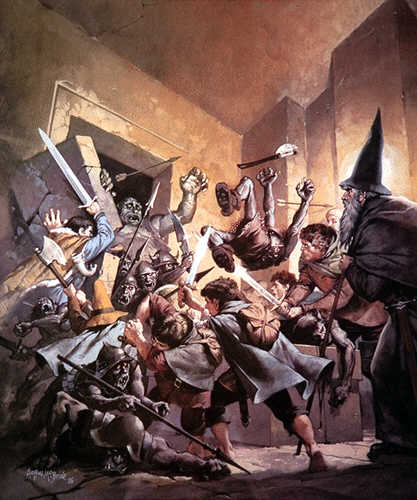
image1aamines.jpg

to attacking Boromir and capturing Merry and Pippin
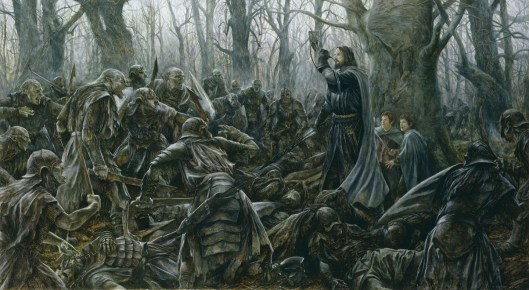
image1adeath.jpg

to forming the initial assault team on Minas Tirith.
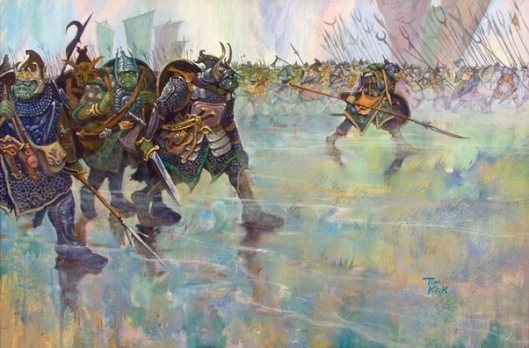
image1battack.jpg

But what do they really look like?

Here’s the first description we’re given, a second-hand one, spoken by Gandalf:

“There are Orcs, very many of them…And some are large and evil:  black Uruks of Mordor.”

(The Fellowship of the Ring, Book Two, Chapter 5, “The Bridge of Khazad-Dum”)

Our first real view of them comes just paragraphs later:

“…a huge orc-chieftain, almost man-high, clad in black mail from head to foot, leaped into the chamber…His broad flat face was swart, his eyes were like coals, and his tongue was red.”

If this orc-chieftain is representative, then, orcs are smaller than men, with dark skin and broad flat faces.  But is this a consistent description?

We next meet the orcs as casualties after the death of Boromir:

“There were four goblin-soldiers of greater stature, swart, slant-eyed, with thick legs and large hands.”

(The Two Towers, Book Three, Chapter 1, “The Departure of Boromir”)

As we know from other references to “goblins”, Tolkien came to blur the words “goblin” and “orc”, where the earlier Hobbit has only the former.  Thus, that compound “goblin-soldiers” really means “orcs” and we see that word “swart”—“dark/black” (like German schwarz)—again.  To which is added “slant-eyed” and the detail “of greater stature” (than the surrounding dead orcs), emphasizing a second time that many, if not most, orcs are apparently normally small creatures.

So far, then, orcs, in general, seem to be dark-skinned and little, with broad, flat faces.  And their next appearance may add a little more:

“In the twilight he saw a large black Orc, probably Ugluk, standing facing Grishnakh, a short crook-legged creature, very broad and with long arms that hung almost to the ground.  Round them were many smaller goblins.  Pippin supposed that these were ones from the North…

Ugluk shouted, and a number of other Orcs of nearly his own size ran up.”

(The Two Towers, Book Three, Chapter 3, “The Uruk-Hai”)

This suggests that there, in fact, at least two subspecies of orcs:  smaller ones (possibly from the north) in the service of Sauron, and larger ones, who are the followers of Saruman.

(There are also large orcs in Sauron’s pay, however, as we saw above in Moria.)

And we might add one more detail—at least one has rather menacing teeth:

“He stooped over Pippin, bringing his yellow fangs close to his face.”

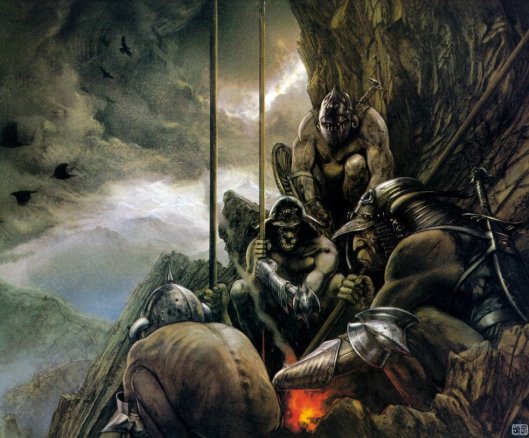
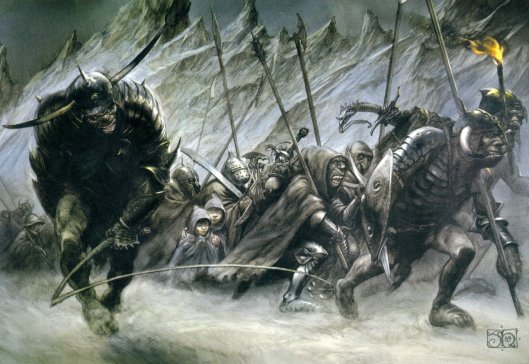
With this much information from the text, we turned to illustrations:  how close are they to these bits of description?  There are many images of orcs on the internet and we ourselves have used a certain number of those images over the years, beginning with this from the Hildebrandts, which we believe must be one of the earliest.
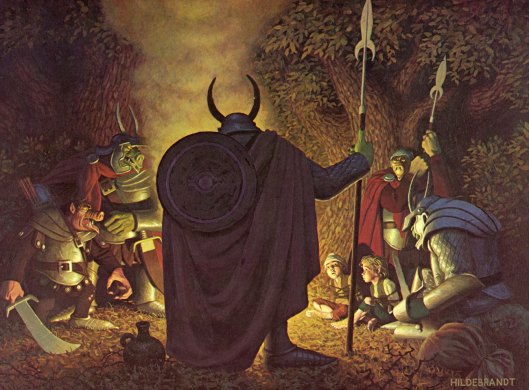
image1hild.jpg

These are mostly very piglike, reminding us both of a wild boar (with a close shave)

image2boar.jpgand of a connection which we suggested some time ago with Jabba the Hutt’s Gammorean Guard—

image3gammoreangd.jpg

That green skin color, both on the Hildebrandt orcs and the Gammorean Guard, will follow orcs through the work of many artists, like Angus McBride,
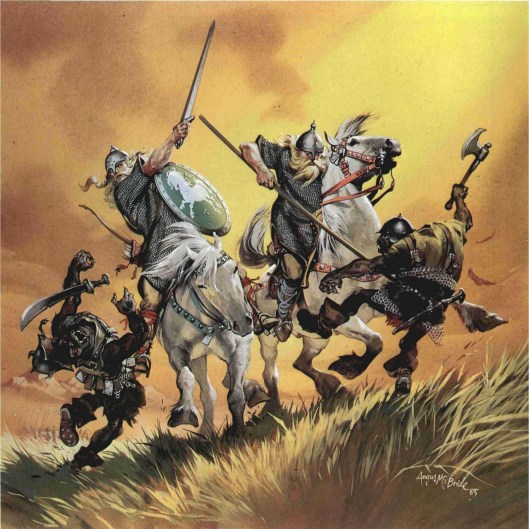
image4mcb.JPG

and Ted Nasmith–

image5nas.jpg

although not in this image of the wounding of Boromir–

image6bor.jpg

and sometimes in the work of Alan Lee,
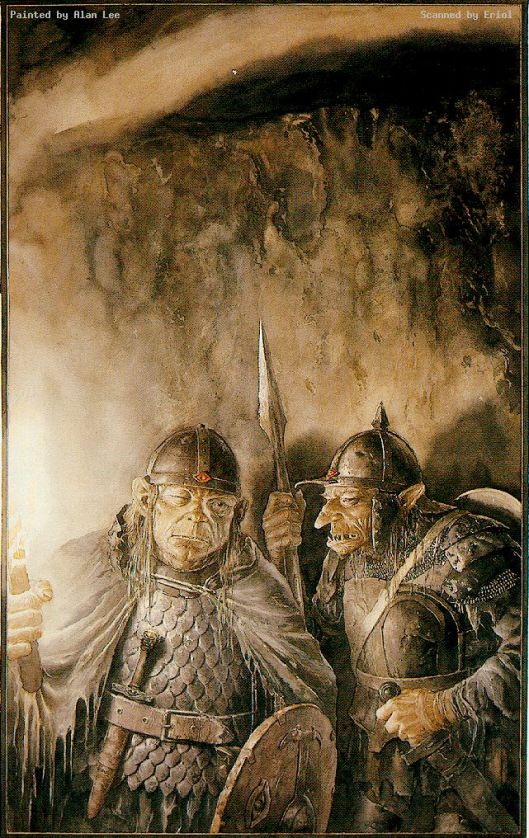
image7lee.jpg

as well as that of John Howe.

image8jhowe.jpg

In place of the piggyness, we see a kind of apelike quality in this illustration by Frank Frazetta

image9fraz.jpg

or this, by Alan Lee.

image10lee.jpg

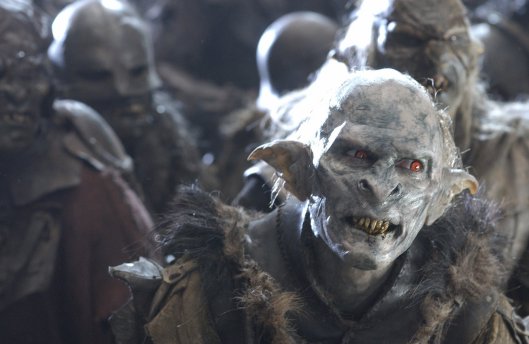
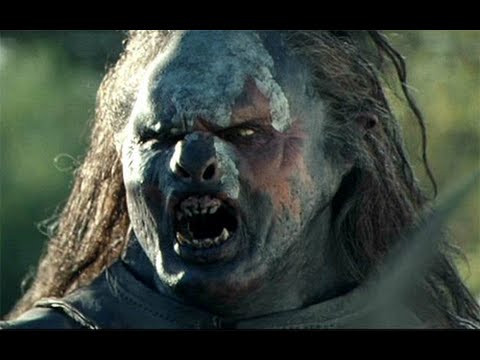
In the Jackson films, the orcs can range from what we think of as rather batlike

image11bat.jpg

image12orc.jpg

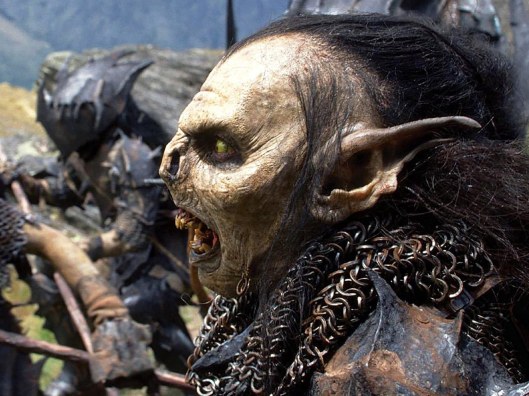
to resembling Count Orlok in Murnau’s 1922 film, Nosferatu,

image13nosf.jpg

image14orc.jpg

to being grossly human.

image15aorc.jpg

And then there’s an outlier in the illustrations of Denis Gordeev, who seems to have read a different version of The Lord of the Rings, as his orcs, whose faces are in the ape category, but who appear to be as shaggy as bears, though definitely “swart”.

image15bear.jpg

image16orcs.jpg

Thus, we mostly see images which don’t really match the descriptions in the books, the short (or almost man-height), black-skinned, flat-faced creatures of The Lord of the Rings, have mostly turned green, come in all sizes, and have faces which range from piglike to batlike.

But does JRRT have any more to say about the look of orcs?  In an undated letter from 1958 to Forrest J. Ackerman, he says of them:

“The Orcs are definitely stated to be corruptions of the ‘human’ form seen in Elves and Men.  They are (or were) squat, broad, flat-nosed, sallow-skinned with wide mouths and slant eyes:  in fact degraded and repulsive versions of the (to Europeans) less lovely Mongol-types.”  (Letters, 274)

The skin color has changed from “swart” to “sallow”, often meaning a kind of yellowish tint, rather like this image of Snape from the Harry Potter films.

image17asnape.jpg

Much of this description, however, seems to match, at least roughly, the earlier ones—except for the potentially racist tone of “less lovely Mongol-types”.  (We should always remember, though, that Tolkien was born in 1892, grew up in a world in which Britain controlled 2/5s of the earth’s land mass in colonies, and where a national poet like Kipling could refer to those colonized as “lesser breeds”.  This might at least explain something of his approach to non-Caucasian people, if not excuse it.)

Putting aside that tone for the moment, to try to understand what he had in mind in this description, what we come up with is something like this, from illustrations done for Hal Foster’s Prince Valiant Fights Attila the Hun (1952)—

image17val.jpgimage18val.jpg

We admit that this is only a rough guess—Tolkien’s orcs, though supposedly derived from elves and therefore more humanoid than most illustrators make them, are probably smaller and perhaps more caricatured or exaggerated, but, at the same time, these figures suggest, to us, something of the barbaric look we believe that JRRT had in mind.

As we’ve seen, however, Tolkien himself seems to have changed his mind over time, turning his orcs from “swart” to “sallow”, although the general impression of smaller, broad creatures with flat faces remained pretty much the same throughout The Lord of the Rings.  So many of his illustrators, however, appear to have had anything from a slightly different to a very different view, making us wish that we could read their letters to find out just where their ideas came from.

Thanks, as always, for reading and

MTCIDC

CD

ps

We do have an idea of where that green skin color came from—perhaps from a misreading of the text, in fact.  In “The Bridge of Khazad-Dum”, Gandalf, in the brief initial description of orcs we quoted above, adds “…but there is something else there.  A great cave-troll, I think, or more than one.”

Shortly after that, the Fellowship is attacked and:

“A huge arm and shoulder, with a dark skin of greenish scales, was thrust through the widening gap.  Then a great, flat, toeless foot was forced through below.”

This appears to be one of those “great cave-troll[s]” and perhaps that “skin of greenish scales” has been accidentally transferred to the orcs?

Helm (2)

04 Wednesday Sep 2019

Posted by Ollamh in Films and Music, J.R.R. Tolkien, Military History, Military History of Middle-earth, The Rohirrim

≈ Leave a comment

Tags

Alan Lee, Anglo-Saxon, Bayeux Tapestry, Christian Schwager, Dernhelm, Eowyn, Frank Frazetta, great helm, Great War, helmets, Howard Pyle, John Howe, kettle helm, King Arthur, spangenhelm, Tolkien, vikings, WWI

As ever, dear readers, welcome.

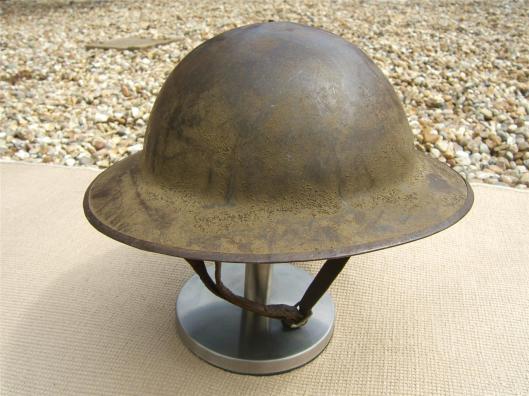
In our last, we focused upon the helmets worn by Tolkien and other European and US soldiers in the Great War, the French

image1adrian.jpg

the German,

image2coal.jpg

and the British (US troops eventually settled on the British pattern).

image3english.jpg

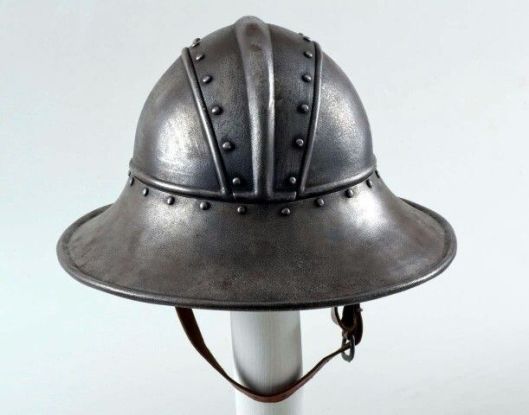
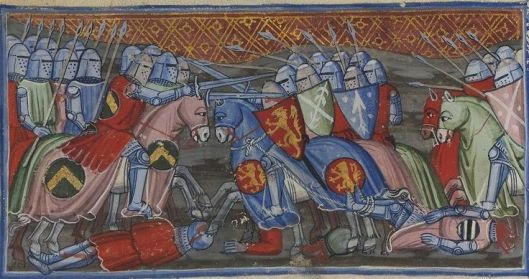
The British helmet, we said, has produced the common comment that it looks like it was inspired by the medieval “kettle helm” (the second image being from the 13th-century Maciejowski Bible—but these helmets were clearly so practical that they continued to be used well beyond that time).

image4kettle.jpg

image5kettle.jpg

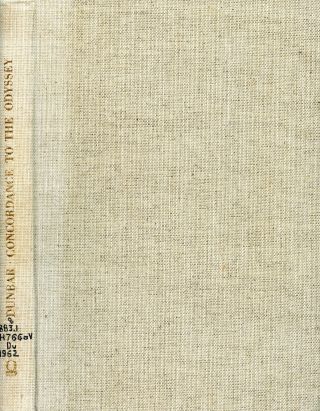
“inspired by medieval” is the way we commonly see JRRT’s Middle-earth, and it made us wonder about the kinds of helmets we would meet in The Lord of the Rings.  Unfortunately, if there were a concordance (that is, a book dedicated to listing all the times various words are used within a text, like this concordance for Homer’s Odyssey)

image6concordance.jpg

for Tolkien’s work, we are betting that perhaps the only word we would find there would be “helm”, which is generic, unless one adds “great”, which produces a more specific kind of head protection, looking like these, in use from the late 12th to the mid-14th centuries—

image7greathelm.jpg

image8ghelm.jpg

With only “helm” to go on, what clues might help us better to visualize what warriors are wearing?

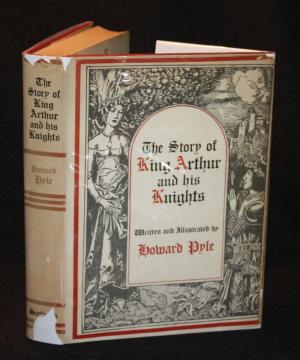
We’ve suggested before that one possible visual resource for JRRT’s images of medieval warfare was the work of the American illustrator, Howard Pyle (1853-1911), in books like The Story of King Arthur and His Knights (1903), which Tolkien could have read as a boy.

image9pyle.jpg

And here’s a well-known illustration—with a knight in a great helm, in fact.

image10pyle.jpg

But what did Pyle use for models?

In Pyle’s time, the collection and classification of armor was still at its very beginnings (the Metropolitan Museum of Art in New York only instituted an Arms and Armor Department in 1912, for example).  We can only assume, then, that he thought “knights = medieval” and so any armor might do.  (If Arthur were real—there’s been argument about this for many years—he would have lived centuries before the medieval period and so would have had neither knights nor the military equipment of later days anyway.  As myth, Arthur can live at any time, of course.  We think of Hal Foster’s Prince Valiant, where, at one moment, we’re facing Huns and, at the next moment, Vikings.)

If Pyle were one of JRRT’s sources, then, “helm” can easily stand for any kind of protective headgear made of metal and vaguely medieval.  We think that there is more to be said on this, however, and we’ll go into a bit more detail about helmets in The Lord of the Rings in the third part of this little series, but, for now, we want to concentrate on one helmet in particular.

Normally, one thinks of helmets as protection, but, in the novel, we see one also used as a disguise, as Eowyn becomes “Dernhelm” (Old English dirne, “hidden/secret” + helm “head covering/helmet”, so, something like “a helm which hides”?).

What kind of helmet, we asked ourselves, would Eowyn be wearing which would:

  1. keep her identity hidden
  2. blend in with the helmets of other Rohirrim?

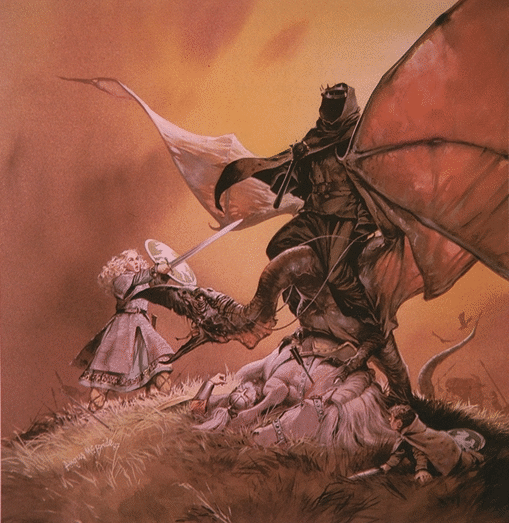
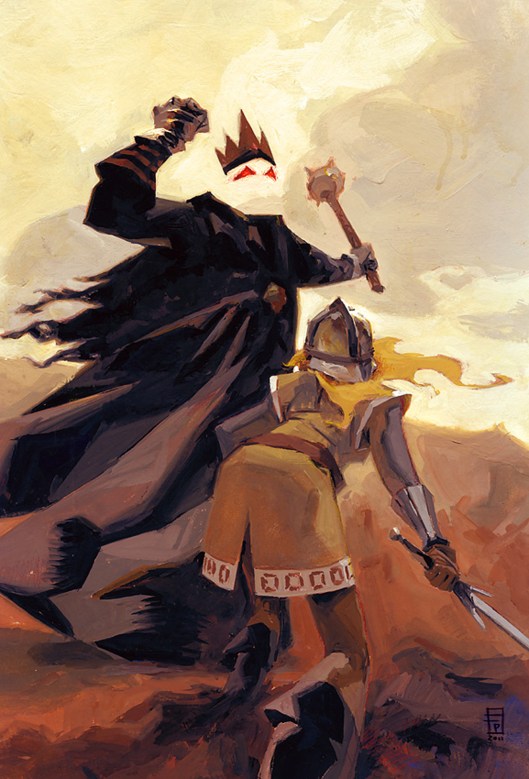
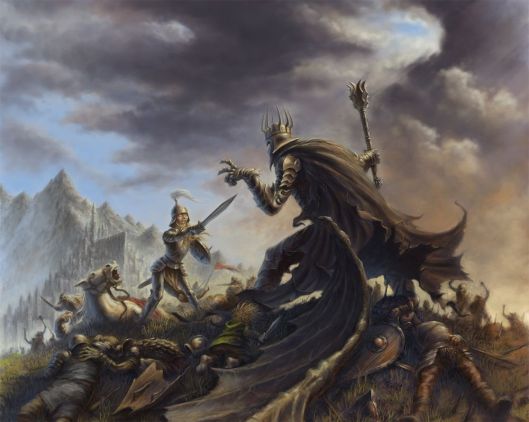
We began by looking at modern illustrations of Eowyn but, unfortunately, a cursory survey shows us that almost all modern illustrators appear to have chosen the same scene:  the moment when Eowyn has removed her helmet when facing the Witch King.

image11eowyn.gif

So far, we’ve found only a few artists who capture the previous moment:

  1. whose name so far has eluded us, but who shows a rear view of something which looks rather like a French Great War helmet.

image12helm.jpg

image13rear.jpg

  1. the second, another anonymous (to us), again shows Eowyn from behind, but with a style of helmet which appears to owe more to fantasy than to any medieval reality—

image14eo.jpg

and perhaps a little something to Monty Python and the Holy Grail.

image15monty.jpg

  1. the third is Christian Schwager, based in New Zealand.

image16schwager.jpg Her armor is full plate, which, in our world, is later medieval.  As for the helmet, it somewhat resembles a visored sallet, but only vaguely.
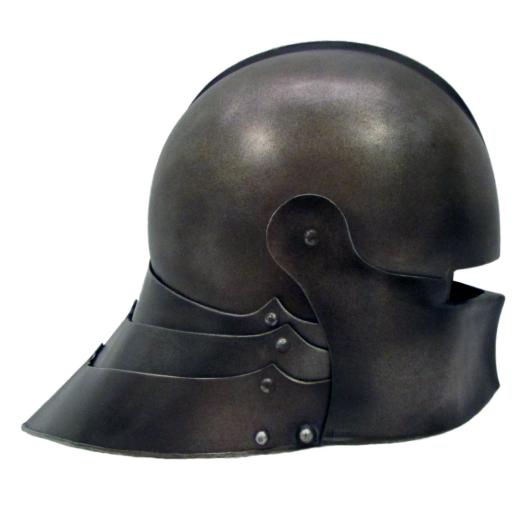
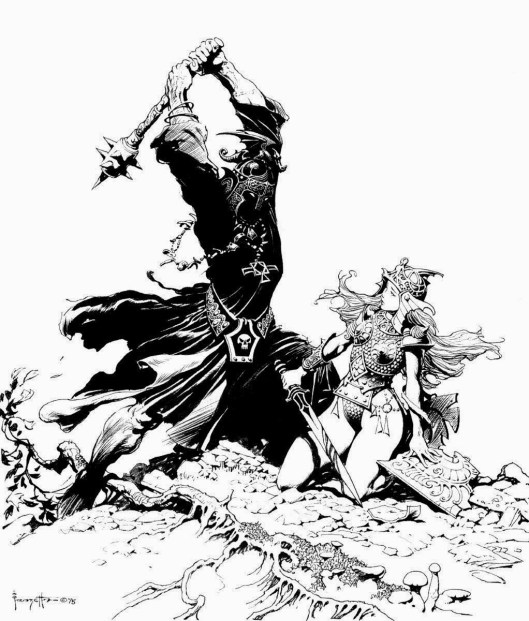
image17sallet.jpg

And that plume and its placement strike us as problematic, at best.

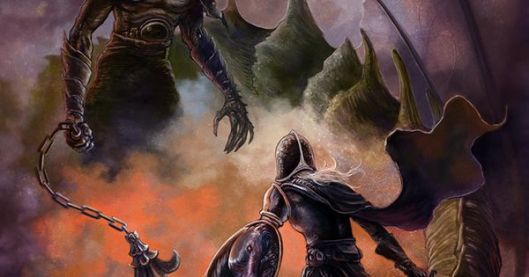
  1. the last is the well-known fantasy illustrator, Frank Frazetta, and although we enjoy some of his work, this illustration suggests to us that the artist doesn’t appear to have taken the scene–or Eowyn– seriously—or practically.

image18fraz.jpg

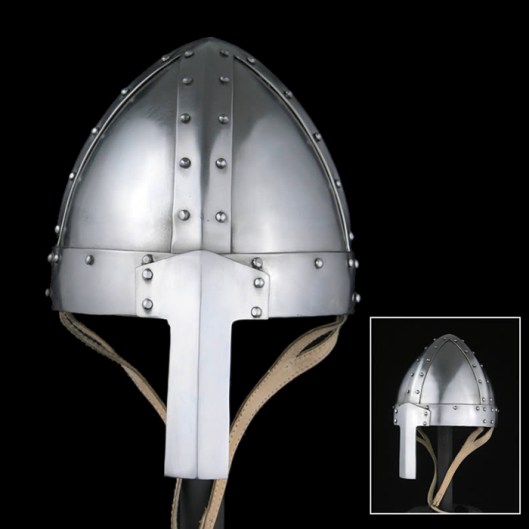
As we wrote in a post some time ago, the basis of the Rohirrim is Anglo-Saxon, men who wore long mail shirts and conical spangenhelm,

image19spangen.jpg

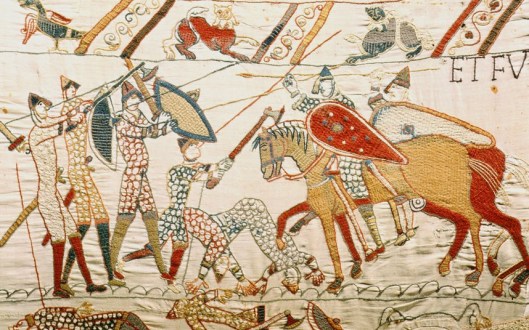
making them look very much like dismounted versions of their Norman opponents, both being shown in the following panel from the Bayeux Tapestry.

image20bayeux.jpg

A characteristic feature of the spangenhelm is that nasal—the bar which comes down to protect the wearer’s nose.

image21spang.jpg

Potentially, this and the helmet’s brim might shade the eyes and make the face less visible.

image22


So, with the need for disguise and blending-in being crucial, and only “helm” to go on in the text, we asked ourselves what did the two artists who acted as inspiration for Jackson’s films, Alan Lee and John Howe, choose to do? Here’s a picture of the battlefield confrontation by Lee—

image23lee


Eowyn is, as in the case  of other illustrators, here depicted as having removed her helmet, and, even under magnification, it’s difficult to make much out.  Howe, however, has given us a very detailed picture.

image24howe.jpg

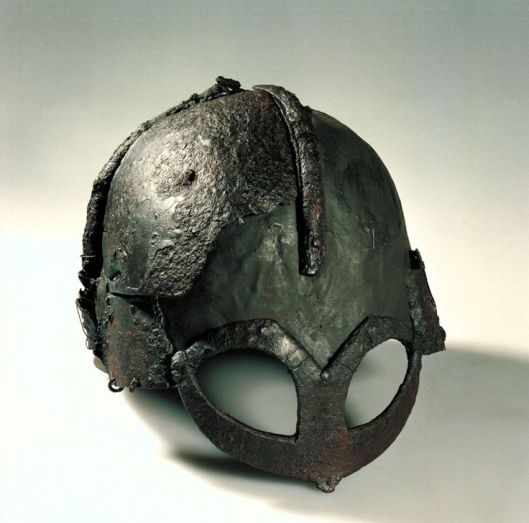
It’s clear, however, that, in choosing to emphasize the dirne in “Dernhelm”, he’s stepped away from the world of knights entirely and into a slightly older world, that of the Vikings, as his helmet more closely resembles the so-called “spectacle helmets”, of which a few examples survive from Viking burials, like this, reconstructed from a discovery at Gjermundbu, in Norway.  (For a very useful view of Viking helmets in general, follow this LINK.)

image25spec.jpg

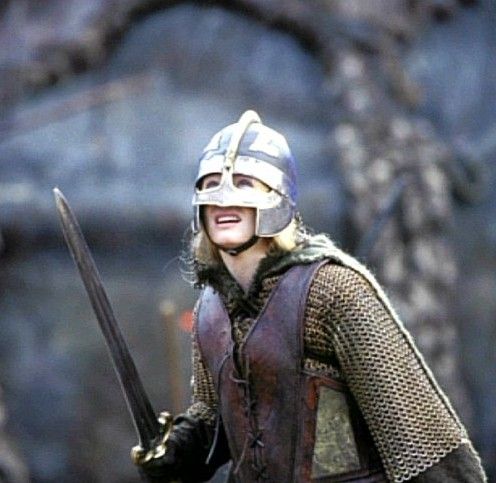
In turn, Jackson’s designers have followed Lee—

image26eo.jpg

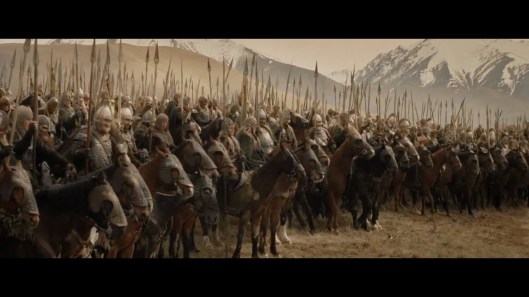
This certainly gives us the “hidden/secret” part of “Dernhelm”, but what about the idea of blending in?  Looking at a group shot of Rohirrim, we find a little surprise.

image27ro.jpg

Instead of looking like Anglo-Saxons, as depicted on the Bayeux Tapestry, Jackson’s Rohirrim look more like Vikings—and so Eowyn’s helmet blends right in (in fact, in this picture, you can see at least one other warrior with a spectacled helmet), almost as if her helmet and its secrecy requirement have been the basis for all of the warriors of Rohan.

There are lots of other helmets to pursue, however, which we’ll do in our next, so, with thanks to you, dear readers, for reading this, we’ll say

MTCIDC,

CD

The Doubtful Sea Series Facebook Page

The Doubtful Sea Series Facebook Page

  • Ollamh

Categories

  • Artists and Illustrators
  • Economics in Middle-earth
  • Fairy Tales and Myths
  • Films and Music
  • Games
  • Heroes
  • Imaginary History
  • J.R.R. Tolkien
  • Language
  • Literary History
  • Maps
  • Medieval Russia
  • Military History
  • Military History of Middle-earth
  • Narnia
  • Narrative Methods
  • Poetry
  • Research
  • Star Wars
  • Terra Australis
  • The Rohirrim
  • Theatre and Performance
  • Tolkien
  • Uncategorized
  • Villains
  • Writing as Collaborators
Follow doubtfulsea on WordPress.com

Across the Doubtful Sea

Recent Postings

  • A Moon disfigured December 17, 2025
  • On the Roads Again—Once More December 10, 2025
  • (Not) Crossing Bridges December 3, 2025
  • On the Road(s) Again—Again November 26, 2025
  • On the Road(s) Again November 19, 2025
  • To Bree (Part 2) November 12, 2025
  • To Bree (Part 1) November 5, 2025
  • A Plague o’ Both—No, o’ All Your Houses! October 29, 2025
  • It’s in Writing (2:  I’st a Prologue, or a Poesie for a Ring?) October 22, 2025

Blog Statistics

  • 103,198 Views

Posting Archive

  • December 2025 (3)
  • November 2025 (4)
  • October 2025 (5)
  • September 2025 (4)
  • August 2025 (4)
  • July 2025 (5)
  • June 2025 (4)
  • May 2025 (4)
  • April 2025 (5)
  • March 2025 (4)
  • February 2025 (4)
  • January 2025 (5)
  • December 2024 (4)
  • November 2024 (4)
  • October 2024 (5)
  • September 2024 (4)
  • August 2024 (4)
  • July 2024 (5)
  • June 2024 (4)
  • May 2024 (5)
  • April 2024 (4)
  • March 2024 (4)
  • February 2024 (4)
  • January 2024 (5)
  • December 2023 (4)
  • November 2023 (5)
  • October 2023 (4)
  • September 2023 (4)
  • August 2023 (5)
  • July 2023 (4)
  • June 2023 (4)
  • May 2023 (5)
  • April 2023 (4)
  • March 2023 (5)
  • February 2023 (4)
  • January 2023 (4)
  • December 2022 (4)
  • November 2022 (5)
  • October 2022 (4)
  • September 2022 (4)
  • August 2022 (5)
  • July 2022 (4)
  • June 2022 (5)
  • May 2022 (4)
  • April 2022 (4)
  • March 2022 (5)
  • February 2022 (4)
  • January 2022 (4)
  • December 2021 (5)
  • November 2021 (4)
  • October 2021 (4)
  • September 2021 (5)
  • August 2021 (4)
  • July 2021 (4)
  • June 2021 (5)
  • May 2021 (4)
  • April 2021 (4)
  • March 2021 (5)
  • February 2021 (4)
  • January 2021 (4)
  • December 2020 (5)
  • November 2020 (4)
  • October 2020 (4)
  • September 2020 (5)
  • August 2020 (4)
  • July 2020 (5)
  • June 2020 (4)
  • May 2020 (4)
  • April 2020 (5)
  • March 2020 (4)
  • February 2020 (4)
  • January 2020 (6)
  • December 2019 (4)
  • November 2019 (4)
  • October 2019 (5)
  • September 2019 (4)
  • August 2019 (4)
  • July 2019 (5)
  • June 2019 (4)
  • May 2019 (5)
  • April 2019 (4)
  • March 2019 (4)
  • February 2019 (4)
  • January 2019 (5)
  • December 2018 (4)
  • November 2018 (4)
  • October 2018 (5)
  • September 2018 (4)
  • August 2018 (5)
  • July 2018 (4)
  • June 2018 (4)
  • May 2018 (5)
  • April 2018 (4)
  • March 2018 (4)
  • February 2018 (4)
  • January 2018 (5)
  • December 2017 (4)
  • November 2017 (4)
  • October 2017 (4)
  • September 2017 (4)
  • August 2017 (5)
  • July 2017 (4)
  • June 2017 (4)
  • May 2017 (5)
  • April 2017 (4)
  • March 2017 (5)
  • February 2017 (4)
  • January 2017 (4)
  • December 2016 (4)
  • November 2016 (5)
  • October 2016 (6)
  • September 2016 (5)
  • August 2016 (5)
  • July 2016 (5)
  • June 2016 (5)
  • May 2016 (4)
  • April 2016 (4)
  • March 2016 (5)
  • February 2016 (4)
  • January 2016 (4)
  • December 2015 (5)
  • November 2015 (5)
  • October 2015 (4)
  • September 2015 (5)
  • August 2015 (4)
  • July 2015 (5)
  • June 2015 (5)
  • May 2015 (4)
  • April 2015 (3)
  • March 2015 (4)
  • February 2015 (4)
  • January 2015 (4)
  • December 2014 (5)
  • November 2014 (4)
  • October 2014 (6)
  • September 2014 (1)

Blog at WordPress.com.

  • Subscribe Subscribed
    • doubtfulsea
    • Join 78 other subscribers
    • Already have a WordPress.com account? Log in now.
    • doubtfulsea
    • Subscribe Subscribed
    • Sign up
    • Log in
    • Report this content
    • View site in Reader
    • Manage subscriptions
    • Collapse this bar
 

Loading Comments...