• About

doubtfulsea

~ adventure fantasy

Tag Archives: Edmund Burke

Into Those Woods

17 Wednesday May 2017

Posted by Ollamh in Fairy Tales and Myths, J.R.R. Tolkien, Literary History, Narrative Methods

≈ Leave a comment

Tags

A Midsummer Night's Dream, Athens, Burnham Wood, Caspar David Friedrich, Circe, Der Blonde Eckbert, Edmund Burke, Fangorn, forest, Gespensterwald, Grimm Brothers, Haensel and Gretel, Horace Walpole, Into the Woods, Ithilien, Jacob Grimm, John Bauer, John Walter Bratton, Lorien, Ludwig Tieck, Macbeth, Mirkwood, Misty Mountains, N.C. Wyeth, Nienhagen, Odysseus, Old Forest, Philosophical Inquiry Into the Origin of Our Ideas, Robert Frost, Robin Hood, Romanticism, Sir Walter Scott, Snow White, Steven Sondheim, Straparola, Teddy Bears' Picnic, The Castle of Otranto, The Fire Swamp, The Hobbit, The Lord of the Rings, The Princess Bride, Tolkien, Treebeard, Waldeinsamkeit, Waverly, Wilhelm Grimm, Woses

Welcome, dear readers, as always.

There is an early-twentieth-century American popular song called “Teddy Bears’ Picnic”, by John Walter Bratton. This was first published, in 1907, as “The Teddy Bears Picnic: A Characteristic Two-Step”,

image1tbears.jpeg

but in 1932, it acquired both its current title and lyrics, beginning,

“If you go down to the woods today,

You’re sure of a big surprise…”

Here’s a link, if you’d like to read more. And here’s a link to the first recording of the version with its lyrics, from 1932. WARNING: it has a catchy little tune!

This song came to us because we’ve been thinking about forests and their frequency and importance in The Hobbit and The Lord of the Rings.

Woods have always been spooky places in folktales. Think of Haensel and Gretel, for example,
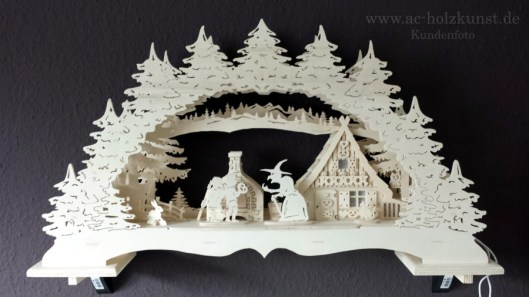
image2handg.jpg

or Snow White,

image3snowwhite.jpg

or even the story of Odysseus and Circe, as Circe’s house is set deep in a forest.

image3acirce.jpg

Among our interests is Romanticism–both in itself because it’s in Romanticism that modern adventure stories really take off (for the supernatural, think Horace Walpole, The Castle of Otranto, 1764; for historical, Sir Walter Scott, Waverly, 1814). The early Romantics were fascinated by the forest, both as a place of beauty and of fear. This is not surprising, for several reasons. First, they were influenced by the writings of Edmund Burke (1729-1797),

image4burke.jpg

who published a famous essay, “Philosophical Inquiry Into the Origin of Our Ideas of the Sublime and Beautiful” in 1757 (this is a 1770s reprint).

image5inquiry.jpg

Burke was interested in human reactions to things which, basically, are either awe-inspiring (how about this?)

image6eismeer.jpg

or beautiful

image7beautiful.jpg

Awe-inspiring (to which may even be added a little terror– you, sharp-eyed readers have probably already noticed that there are the remains of a crushed ship in the ice in the first picture) is a sort of opposite of the beautiful– we say “sort of” because they can be related, which is why we chose two pictures by the same artist– our favorite early Romantic artist, in fact, Caspar David Friedrich (1774-1840).

image8cdf.jpg

This brings us to this Friedrich painting:

image9chass.jpg

There are lots of his paintings in which we are standing behind someone who is looking off into the distance– as in the one we chose for “the beautiful”. As you can see in the above, here we have a man contemplating a path into a snowy wood. (Which reminds us of a poem by the American poet Robert Frost, 1874-1963, and we can’t resist adding it here, just for the pleasure of it:)

Stopping by Woods on a Snowy Evening

Whose woods these are I think I know.
His house is in the village though;
He will not see me stopping here
To watch his woods fill up with snow.
My little horse must think it queer
To stop without a farmhouse near
Between the woods and frozen lake
The darkest evening of the year.
He gives his harness bells a shake
To ask if there is some mistake.
The only other sound’s the sweep
Of easy wind and downy flake.
The woods are lovely, dark and deep,
But I have promises to keep,
And miles to go before I sleep,
And miles to go before I sleep.

There is menace here (note the crow on the stump in the foreground…), and yet it’s beautiful. And tempting– and that’s part of the sublime, as well.

Besides their interest in Burke, the early Romantics were also deeply interested in folktales. People had been collecting and publishing such things in early modern Europe since at least Straparola in the 16th century, but, from the Romantics, we have the work of these two men, highly-intelligent brother-scholars, the Grimms, Jacob (1785-1863) and Wilhelm (1786-1859), whose work, either in itself on in adaptation, is known throughout the whole western world.
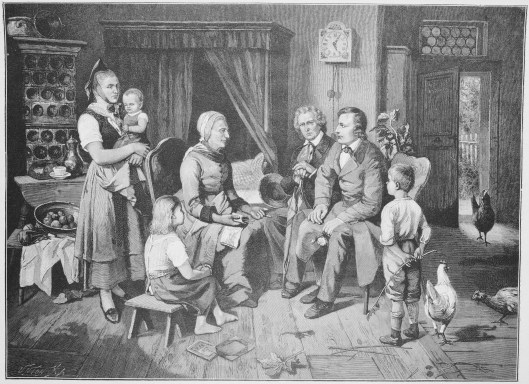
image10grimms.jpg

The story of Haensel and Gretel comes from them, in fact (as does Snow White). Because of a famous short story by Ludwig Tieck (1773-1853),
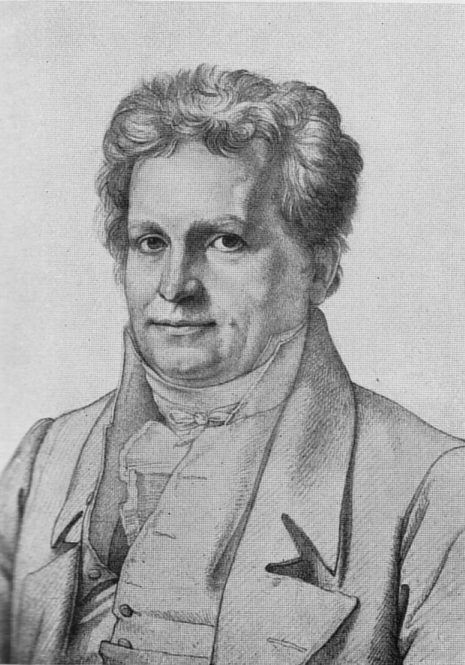
image11tieck.jpg

“Der Blonde Eckbert” (maybe “Fair-haired Eckbert” in English?), there is a word in German for this fascination for the woods, Waldeinsamkeit, meaning something like “The Sense of Being Alone in the Forest”. Like “sublime”, this word has a wide range of feeling to it, including that sense of aloneness/being alone/loneliness/ mixed with the pleasure of being alone in the forest. In the story, the word is contained in a little poem sung by a strange bird, which begins:

“Waldeinsamkeit

Die mich erfreut

So morgen wie heut

In ewger Zeit

O wie mich freut

Waldeinsamkeit.”

“Aloneness in the forest–

That delights me,

As today so tomorrow

In eternal time

Oh how it delights me

Aloneness in the forest!”

In the case of JRRT, however, although he was well known to be quite passionate in his love for trees, forests in his work do not always appear to be places for pleasure. (And how can we not be reminded of that moment in the film, The Princess Bride, when the hero and heroine are at the edge of the Fire Swamp, a kind of haunted wood,

image12fireswamp.jpg

and the hero, Westley, says, “It’s not that bad. I’m not saying that I’d like to build a summer home here, but the trees are actually quite lovely”– and only a moment later the heroine, Buttercup, is attacked by a spurt of flame from the ground itself?)

Out first wood in The Hobbit is the one into which several of the dwarves disappear, captured by three rather dimwitted trolls.

image12atrolls.jpg

When we look at this and at other JRRT illustrations, we are reminded of the world of the Swedish illustrator, John Bauer (1882-1918), some of whose fairy tale forests bear a certain strong similarity in their regularity.

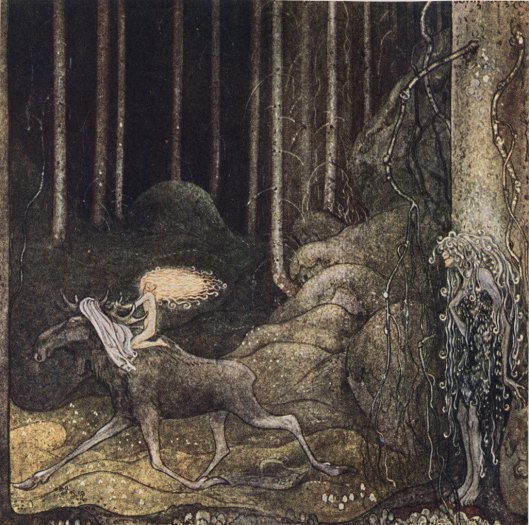
image12bbaueer.jpg

image13bauer.jpg

What’s surprising is that, in northern Europe, there actually appear to be stands of wood which actually look very like this. Here’s Nienhagen, in northern Germany.
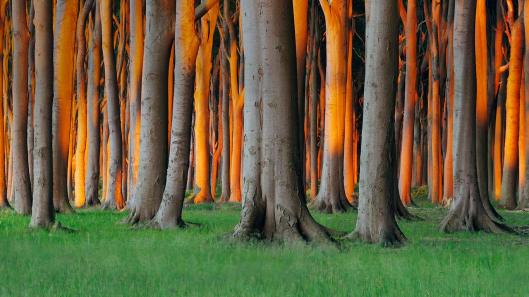
image14nienhagen.jpg

It’s a beechwood (one of JRRT’s favorite trees and ours, too– remember this big beech from N.C. Wyeth’s Robin Hood illustrations?

image15robin.jpg

Nienhagen has another name, however, Gespensterwald, “Ghostwood”, and, seeing this next picture and comparing it to Bauer’s paintings, we imagine that you’d agree with us that this is an appropriate nickname.
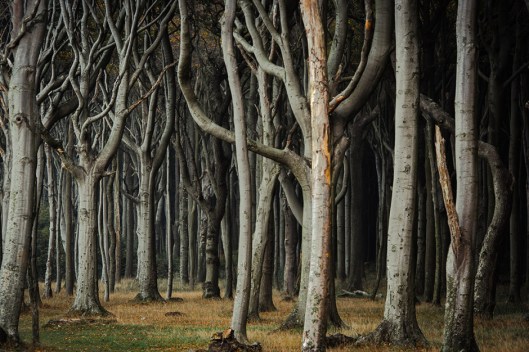
image16gespensterwald.jpg

Across the Misty Mountains, we come to Mirkwood, with its disappearing Elves, sleepy stream, and giant spiders– hardly an inviting place.
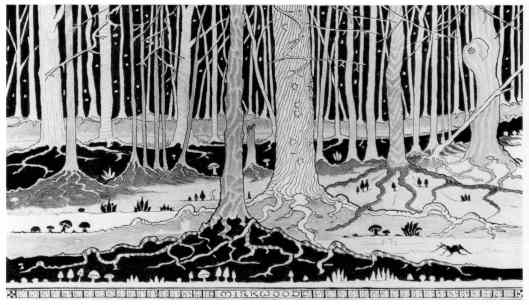
image17mirkwood.jpg

The forests of The Lord of the Rings are a bit mixed. There is the Old Forest, which is so hostile that is has to be kept off with cutting, burning, and a hedge and, in its depths, there is Old Man Willow, who almost swallows several unwary hobbits.
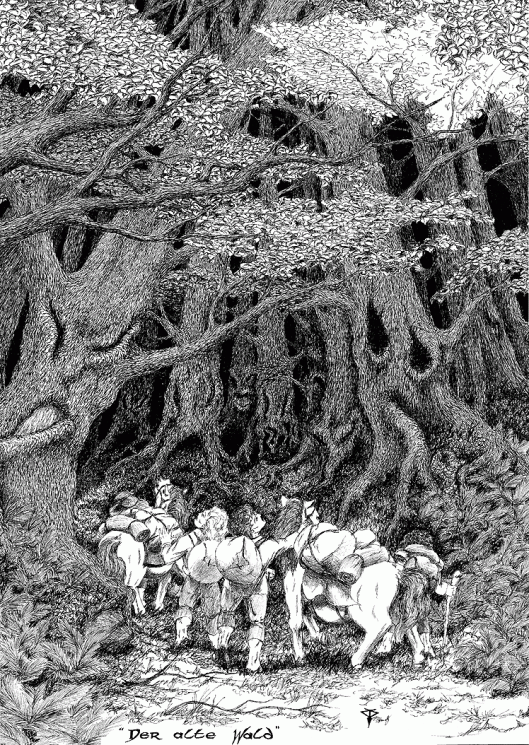
image18oldforest.gif

image19oldmanwillow.jpg

Then there is Lorien, a place of safety and healing for the Fellowship.
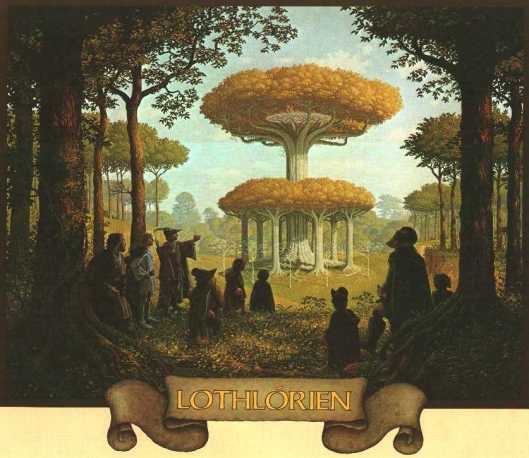
image20lorien.jpg

And, last, there is Fangorn, with its Ents, especially the thoughtful and ultimately sympathetic Treebeard.
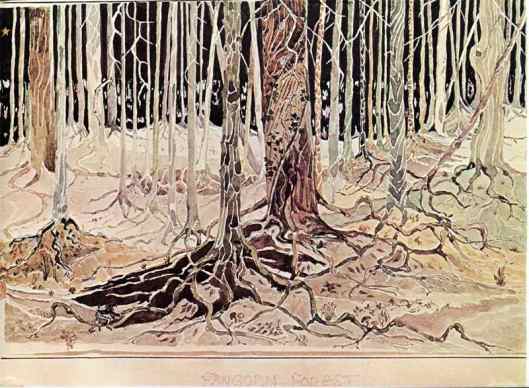
image21fangorn.jpg

image22treebeard.jpg

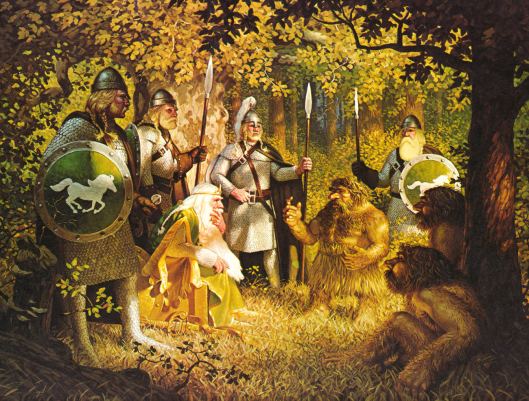
These are principal woods– there are also the woodlands of South Ithilien, there Faramir
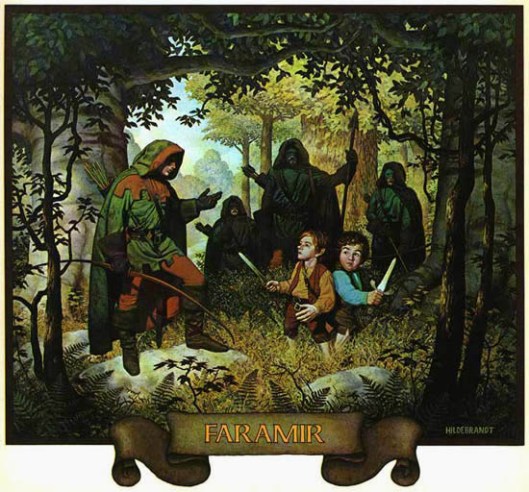
image23faramir.jpg

image23woses.jpg

and his rangers lurk, as well as the unnamed wood where the Woses live, but it’s the people there who are the focus of the story, not the forests.

This sense of a wood being dangerous goes far beyond fairy tales and even JRRT, of course. Shakespeare has several puzzling forests– as in the wood outside Athens in A Midsummer Night’s Dream
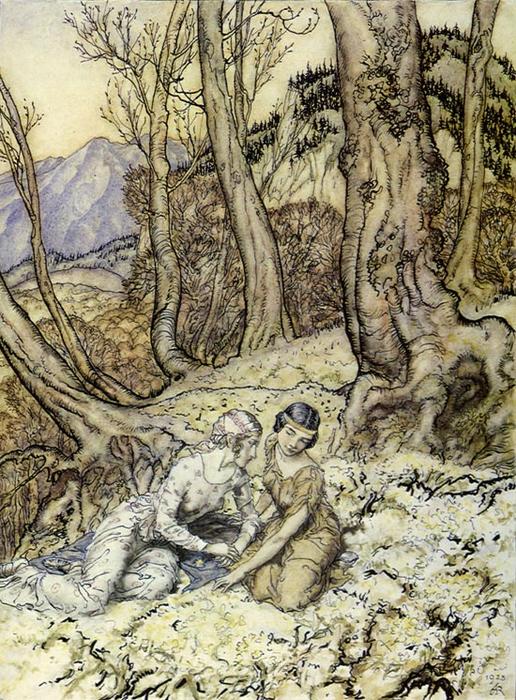
image25mnd.JPG

or the traveling Burnham Wood in Macbeth

image26burnham.jpg

And there is even the wonderful Steven Sondheim musical, Into the Woods (1986), in which going into the woods has a magical/metaphorical side.
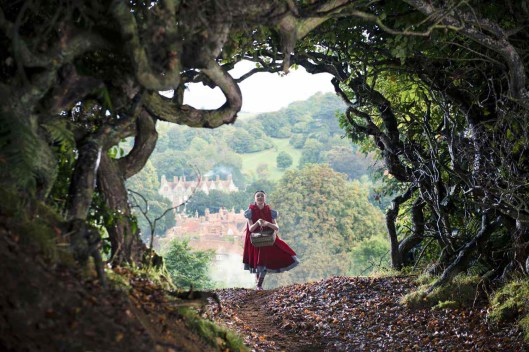
image27intothewoods.jpg

But we’ll leave you where we started– with JRRT– and a single tree…
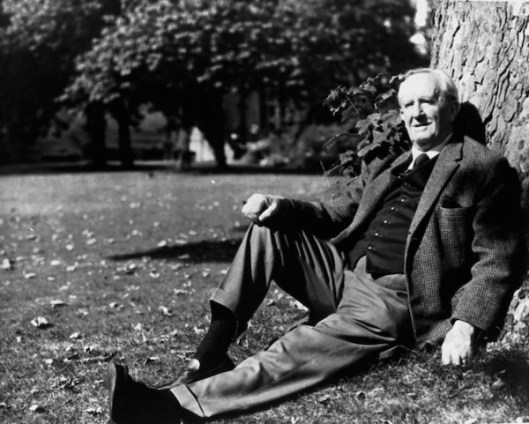
image28jrrt.jpg

Thanks, as always, for reading.

MTCIDC,

CD

Beaux Gestes? (1)

20 Wednesday Apr 2016

Posted by Ollamh in J.R.R. Tolkien, Narrative Methods, Theatre and Performance

≈ Leave a comment

Tags

Cicero, David Garrick, Edmund Burke, Elizabethan, Film, Galadriel, Globe theatre, Hamlet, Hildebrandt, Mirror of Galadriel, Quintilian, rejection, Roman theatre, The Argonath, The Lord of the Rings, The Phantom of the Opera, The Popular Entertainer and Self-Instructor in Elocution, theatre, Theatrical gesture, Tolkien

Dear Readers, welcome, as always.

In this posting, we want to begin to consider a pair of contrasting gestures in The Lord of the Rings, where they may come from, and how they may mirror each other.

We begin with Galadriel in The Fellowship of the Ring, Book II, Chapter 7, “The Mirror of Galadriel”.

In this scene, she has offered Frodo and Sam the chance to look into what appears to be a small pool of enchanted water, where she tells Frodo “You may learn something, and whether what you see be fair or evil, that may be profitable, and yet it may not. Seeing is both good and perilous.”

9ae941056ddb6946598d98690668e844.jpg

Sam goes first and endures a nightmarish depiction of the future of the Shire—although Galadriel warns him that it is perhaps potential, not fated future.

Frodo has, in turn, an even worse experience: the eye of Sauron himself appears and Frodo can feel that it is trying to discover the Ring.   It is something of which Galadriel herself is well aware, but she comforts Frodo, saying, “…I perceive the Dark Lord and know his mind, or all of his mind that concerns the Elves. And he gropes ever to see me and my thought. But the door is still closed!”

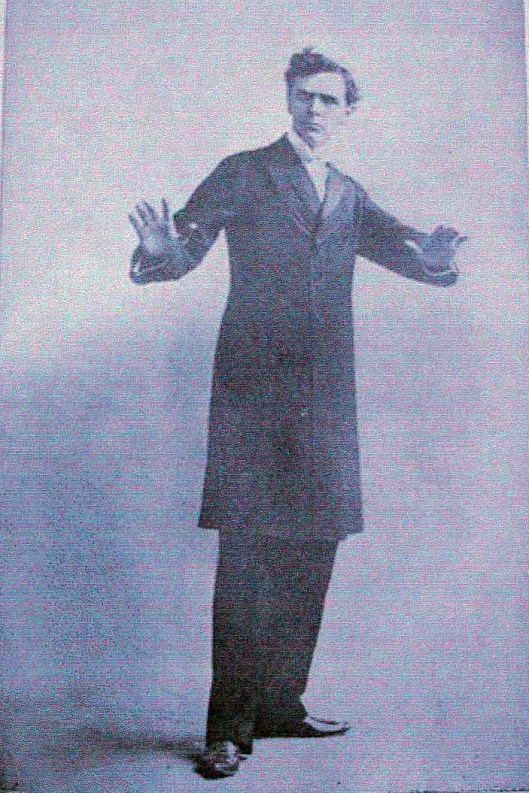
To emphasize this, “She lifted up her white arms, and spread out her hands towards the East in a gesture of rejection and denial.”

Repulsion.jpg

To modern people, like us, trying to visualize what Galadriel is doing , this might seem a very “theatrical” gesture. The closest we could find in our image bank of Galadriel actually doing it wasn’t more than a suggestion.

galadriel.jpg


And, in fact, the image we’ve chosen (obviously not Galadriel!) to depict this comes from a book published in 1898, with the intriguing title, The Popular Entertainer and Self-Instructor in Elocution.

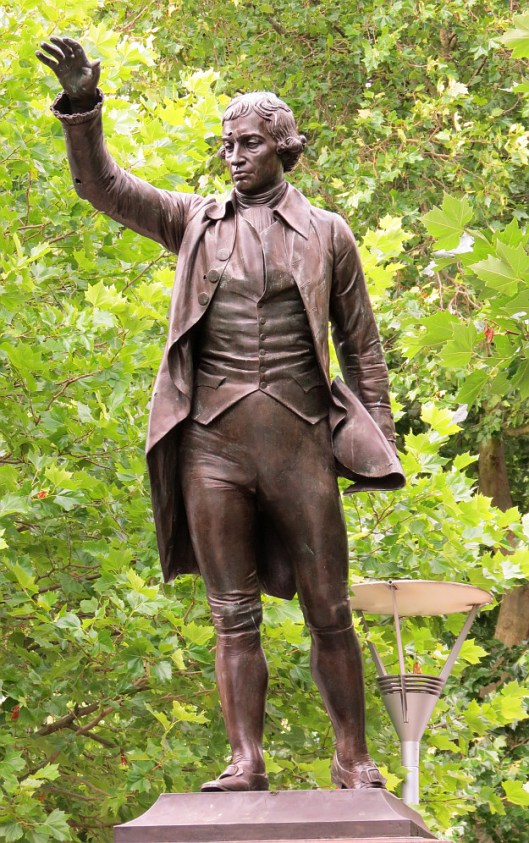
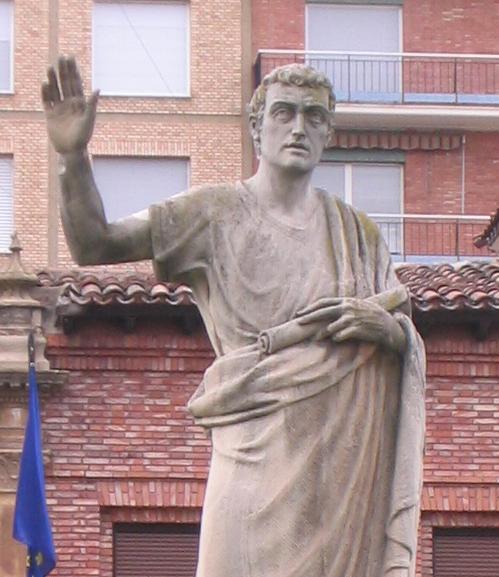
This brings us back to a time in history when public speaking was a polished art and men (primarily—although the women’s rights movement from the mid-19th century had its speakers, as well) practiced stylized gestures to help them convey their meaning in lecture halls, theatres, and open spaces. Older public statues sometimes capture such a speaker in mid-gesture—as in this of the British intellectual and politician, Edmund Burke, in Bristol.

bristolbroadquayburke.jpg

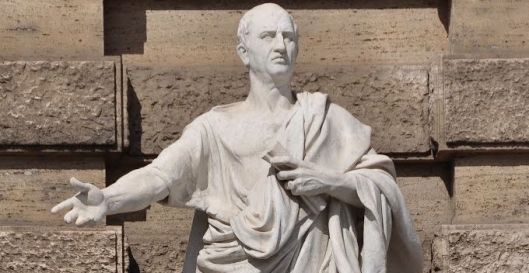
Such combinations of gesture and speech are derived from a tradition which stretches all the way back to the last century BC/first century AD in the works of the Roman orators/writers Cicero

cicero.jpg

And Quintilian.

QuintWikiImage.JPG

These men described the art of public speaking, and Quintilian, in particular, discusses the use of gesture to expand and underline the spoken text emotionally. This tradition was continued from the Renaissance and beyond initially in translations of the two into local languages, but then in expansions of their ideas. Such gestures were also found useful for the young popular theatre and continued to form part of an actor’s training into the twentieth century. Here, for instance, is the 18th-century actor, David Garrick, in a role for which he was famous, Hamlet. And you’ll notice that same gesture of rejection: arms extended, hands spread.

davidgarrickashamlet.jpg

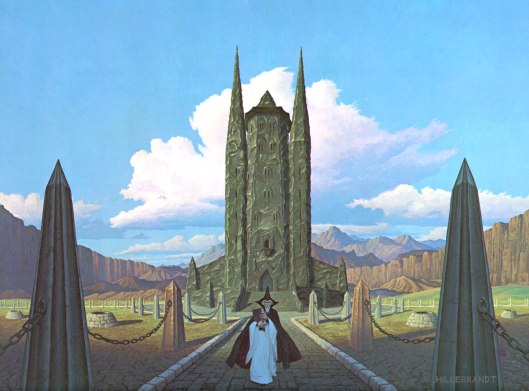
(This is not, by the way, the same gesture we see depicted on the Argonath. That seems to us more to convey the message: Stop! You have reached the boundary of Gondor—go no farther!

argonath hildebrandt.jpg

This is the Hildebrandt twins rather mild version. A fiercer one would be that from the film.)

argonathfilm.jpg

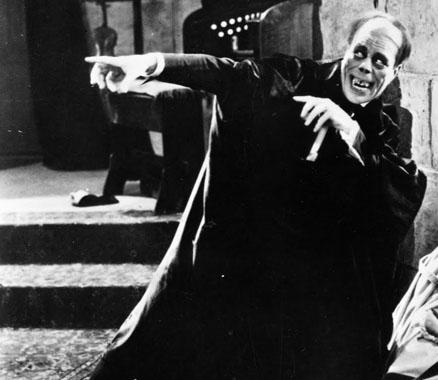
To us, such gestures may seem very overdone, if not downright silly—as in this from the 1925 film of The Phantom of the Opera.

lchaneysrphantom

And it is probably film itself which has changed our view. Originally, these gestures were developed to extend a speaker’s ability to convey thought and feeling in a public space—a big place where there was no elaborate sound system with microphones and speakers to help.

cicerovscatiline.jpg

In a big, noisy place like an Elizabethan theatre, such an extension would have proved just as useful.

Hodge's_conjectural_Globe_reconstruction.jpg

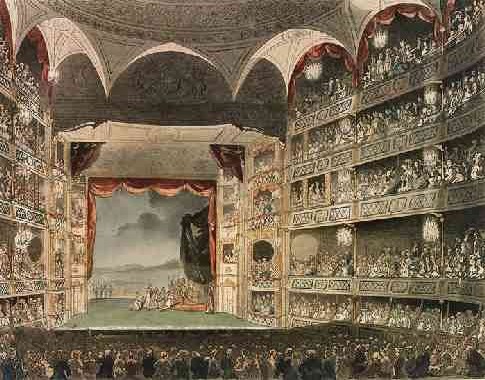
And, until artificial vocal magnification was invented in the 20th century, it would have continued to help.

Theatre_drury_lane2.jpg

sadlers_wells_interior_rowlandson_microcosm_1810.jpg

Film began as an offshoot of the stage—after all, what other model was there for actors? Film was much more intimate than the stage, however, even before sound films arrived at the very end of the 1920s. The heavy make-up and big, stylized gestures brought over from earlier drama must have seemed even more exaggerated, in time, to audiences, and everything was gradually scaled down. What Tolkien saw as a young man,

hunchback.jpg

however, having been born in 1893, would have been the product of that earlier time—a time all the way back to the Romans—and thus, when he wants to depict strong emotion, he clearly uses what would have been more appropriate for an older time, just as he uses older language, borrowed from people like William Morris and Tennyson, when he wants to add a certain weight to the words.

In our second posting, we want to continue our exploration with what we feel to be an opposing gesture—and the final gesture—of Saruman.

greg-hildebrandt-isengard-orthanc-saruman-607429-1300x962.jpg

Thanks, as always, for reading.

MTCIDC

CD

The Doubtful Sea Series Facebook Page

The Doubtful Sea Series Facebook Page

  • Ollamh

Categories

  • Artists and Illustrators
  • Economics in Middle-earth
  • Fairy Tales and Myths
  • Films and Music
  • Games
  • Heroes
  • Imaginary History
  • J.R.R. Tolkien
  • Language
  • Literary History
  • Maps
  • Medieval Russia
  • Military History
  • Military History of Middle-earth
  • Narnia
  • Narrative Methods
  • Poetry
  • Research
  • Star Wars
  • Terra Australis
  • The Rohirrim
  • Theatre and Performance
  • Tolkien
  • Uncategorized
  • Villains
  • Writing as Collaborators
Follow doubtfulsea on WordPress.com

Across the Doubtful Sea

Recent Postings

  • On the Roads Again—Once More December 10, 2025
  • (Not) Crossing Bridges December 3, 2025
  • On the Road(s) Again—Again November 26, 2025
  • On the Road(s) Again November 19, 2025
  • To Bree (Part 2) November 12, 2025
  • To Bree (Part 1) November 5, 2025
  • A Plague o’ Both—No, o’ All Your Houses! October 29, 2025
  • It’s in Writing (2:  I’st a Prologue, or a Poesie for a Ring?) October 22, 2025
  • It’s in Writing (1) October 15, 2025

Blog Statistics

  • 103,113 Views

Posting Archive

  • December 2025 (2)
  • November 2025 (4)
  • October 2025 (5)
  • September 2025 (4)
  • August 2025 (4)
  • July 2025 (5)
  • June 2025 (4)
  • May 2025 (4)
  • April 2025 (5)
  • March 2025 (4)
  • February 2025 (4)
  • January 2025 (5)
  • December 2024 (4)
  • November 2024 (4)
  • October 2024 (5)
  • September 2024 (4)
  • August 2024 (4)
  • July 2024 (5)
  • June 2024 (4)
  • May 2024 (5)
  • April 2024 (4)
  • March 2024 (4)
  • February 2024 (4)
  • January 2024 (5)
  • December 2023 (4)
  • November 2023 (5)
  • October 2023 (4)
  • September 2023 (4)
  • August 2023 (5)
  • July 2023 (4)
  • June 2023 (4)
  • May 2023 (5)
  • April 2023 (4)
  • March 2023 (5)
  • February 2023 (4)
  • January 2023 (4)
  • December 2022 (4)
  • November 2022 (5)
  • October 2022 (4)
  • September 2022 (4)
  • August 2022 (5)
  • July 2022 (4)
  • June 2022 (5)
  • May 2022 (4)
  • April 2022 (4)
  • March 2022 (5)
  • February 2022 (4)
  • January 2022 (4)
  • December 2021 (5)
  • November 2021 (4)
  • October 2021 (4)
  • September 2021 (5)
  • August 2021 (4)
  • July 2021 (4)
  • June 2021 (5)
  • May 2021 (4)
  • April 2021 (4)
  • March 2021 (5)
  • February 2021 (4)
  • January 2021 (4)
  • December 2020 (5)
  • November 2020 (4)
  • October 2020 (4)
  • September 2020 (5)
  • August 2020 (4)
  • July 2020 (5)
  • June 2020 (4)
  • May 2020 (4)
  • April 2020 (5)
  • March 2020 (4)
  • February 2020 (4)
  • January 2020 (6)
  • December 2019 (4)
  • November 2019 (4)
  • October 2019 (5)
  • September 2019 (4)
  • August 2019 (4)
  • July 2019 (5)
  • June 2019 (4)
  • May 2019 (5)
  • April 2019 (4)
  • March 2019 (4)
  • February 2019 (4)
  • January 2019 (5)
  • December 2018 (4)
  • November 2018 (4)
  • October 2018 (5)
  • September 2018 (4)
  • August 2018 (5)
  • July 2018 (4)
  • June 2018 (4)
  • May 2018 (5)
  • April 2018 (4)
  • March 2018 (4)
  • February 2018 (4)
  • January 2018 (5)
  • December 2017 (4)
  • November 2017 (4)
  • October 2017 (4)
  • September 2017 (4)
  • August 2017 (5)
  • July 2017 (4)
  • June 2017 (4)
  • May 2017 (5)
  • April 2017 (4)
  • March 2017 (5)
  • February 2017 (4)
  • January 2017 (4)
  • December 2016 (4)
  • November 2016 (5)
  • October 2016 (6)
  • September 2016 (5)
  • August 2016 (5)
  • July 2016 (5)
  • June 2016 (5)
  • May 2016 (4)
  • April 2016 (4)
  • March 2016 (5)
  • February 2016 (4)
  • January 2016 (4)
  • December 2015 (5)
  • November 2015 (5)
  • October 2015 (4)
  • September 2015 (5)
  • August 2015 (4)
  • July 2015 (5)
  • June 2015 (5)
  • May 2015 (4)
  • April 2015 (3)
  • March 2015 (4)
  • February 2015 (4)
  • January 2015 (4)
  • December 2014 (5)
  • November 2014 (4)
  • October 2014 (6)
  • September 2014 (1)

Blog at WordPress.com.

  • Subscribe Subscribed
    • doubtfulsea
    • Join 78 other subscribers
    • Already have a WordPress.com account? Log in now.
    • doubtfulsea
    • Subscribe Subscribed
    • Sign up
    • Log in
    • Report this content
    • View site in Reader
    • Manage subscriptions
    • Collapse this bar
 

Loading Comments...