• About

doubtfulsea

~ adventure fantasy

Tag Archives: David Gwillim

Too Narrow Escapes

05 Wednesday Jul 2017

Posted by Ollamh in Fairy Tales and Myths, J.R.R. Tolkien, Literary History, Narrative Methods

≈ Leave a comment

Tags

Abu al-Qasim Khalaf ibn al-Abbas al-Zahrawi, Agincourt, Albucasis, Anglo-Scots, arrow removal, arrows, bascinet, bodkin points, Dagger, David Gwillim, elf shot, Elverskud, English Longbowmen, healing, Henry V, John Bradmore, Kenneth Branagh, Laurence Olivier, Medieval, Morgul Knife, Nazgul, Neolithic, Niels W Gade, Otherworld, Philomena, poignard, Prince Henry, Renaissance, Shrewsbury, St Mary Magdalen, Tolkien, Two Men in a Trench, Weaponry, Weathertop, Wraiths

Welcome, dear readers, as ever.

We had what we thought was a very interesting idea for this posting—about the effect of a Morgul-knife and that of something from western European—perhaps specificially Germanic?—folk tradition, an “elf shot”.

“Elf shot” was once thought to be a condition in humans and animals, caused by an arrow fired by someone from the Otherworld. There was a long tradition of methods of healing, which could be a difficult problem because the entry wound might be nearly—if not completely—invisible and it took special skills to find it and to remove the arrowhead, while, in the meantime, the victim slowly withered away.

When it was supposedly removed, by someone who was believed to have competence in such matters, the arrowhead was probably actually a Neolithic point, like one of these—
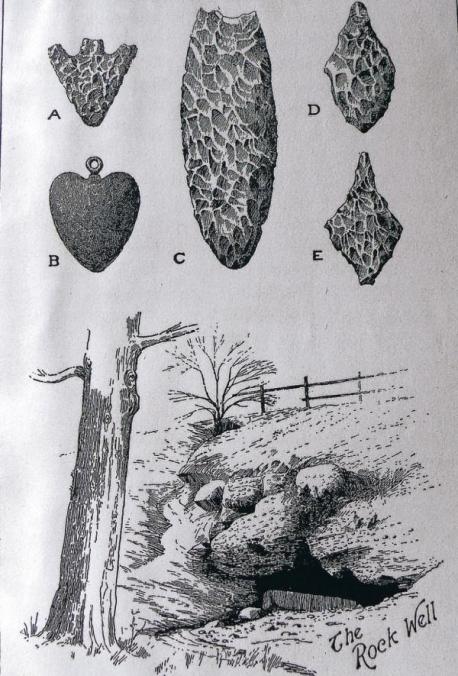
image1elfshot.jpg

picked up from somewhere and whatever had actually caused the withering was a disease brought on in the natural order of things, but all of the stories we’ve read about the belief and cures appear to end with the point removed—and the sufferer in recovery.

Hmm—we thought. Something familiar about this. On Weathertop, Frodo is attacked by Nazgul.
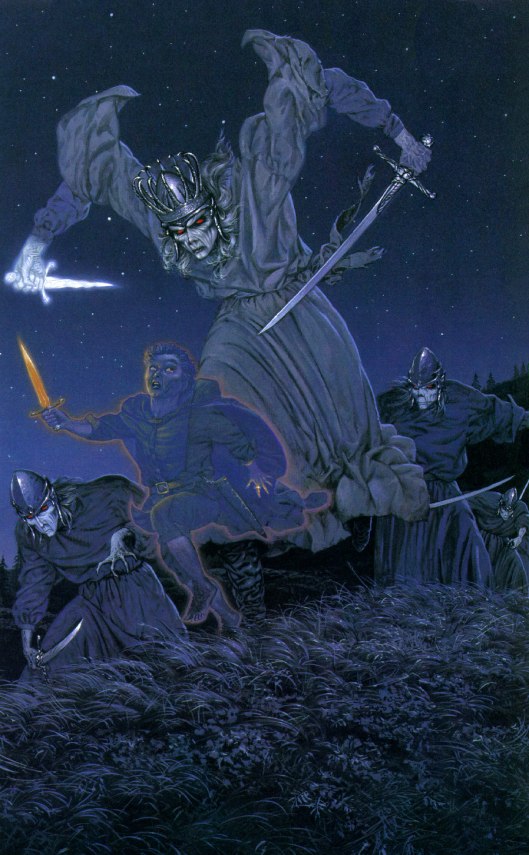
image2weathertop.jpg

“The third was taller than the others: his hair was long and gleaming and on his helm was a crown. In one hand he held a long sword, and in the other a knife; both the knife and the hand that held it glowed with a pale light. He sprang forward and bore down on Frodo.” (The Fellowship of the Ring, Book One, Chapter 11, “ A Knife in the Dark”)

The figure stabs Frodo, but the weapon which did it was no ordinary one, as Strider indicates, lifting

“…up a long thin knife. There was a cold gleam in it. As Strider raised it they saw that near the end its edge was notched and the point was broken off. But even as he held it up in the growing light, they gazed in astonishment, for the blade seemed to melt, and vanished like a smoke in the air, leaving only the hilt in Strider’s hand.” (The Fellowship of the Ring, Book One, Chapter 12, “Flight to the Ford”)

In the film, this is represented by something which looks like a medieval fighting dagger.

image3morgula.jpg

It seems that its purpose was not to act as a secondary weapon in combat, however, but to inflict a fatal stabbing wound. As Gandalf says,

“They tried to pierce your heart with a Morgul-knife which remains in the wound.” (The Fellowship of the Ring, Book Two, Chapter 1, “Many Meetings”)

Thus, we could imagine it looking like a Renaissance poignard, like this one—
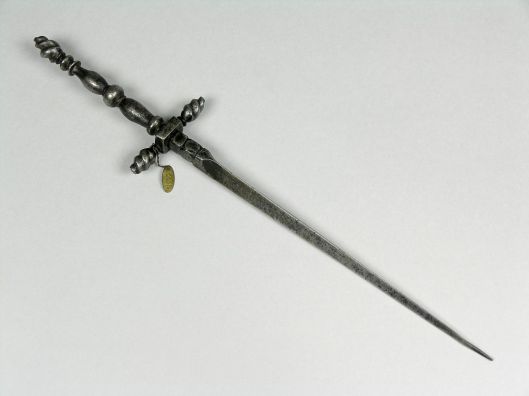
image4morgulb.jpg

Whatever its look, its point is embedded in Frodo’s shoulder and, like someone elf-shot, Frodo is fading and, also like the victim of elf-shot, the wound has changed.

“ ‘What is the matter with my master?’ asked Sam in a low voice, looking appealingly at Strider. ‘His wound was small, and it is already closed. There’s nothing to be seen but a cold white mark on his shoulder.; “ (The Fellowship of the Ring, Book One, Chapter 12, “The Flight to the Ford”)

Neither Strider nor, in turn, Glorfindel, can heal Frodo and even Gandalf was daunted:

“Elrond is a master of healing, but the weapons of our Enemy are deadly. To tell you the truth, I had very little hope; for I suspected that there was some fragment of the blade still in the closed wound. But it could not be found until last night. Then Elrond removed a splinter. It was deeply buried, and it was working inwards.” (The Fellowship of the Ring, Book Two, Chapter 1, “Many meetings”)

We thought, then, that we could write a very interesting post about the parallels between that knife and elf-shot—and then we found that it had already been done: see “Elf-shot” in Drout, Michael, ed., J.R.R. Tolkien Encyclopedia, London: RKP, 2006.

We are not given to despair, however, and something Gandalf said interested us: “Then Elrond removed the splinter.”

As our regular readers know, we take particular pleasure in linking things of Middle-earth with those of the medieval world in which JRRT spent his scholarly life. In this case, we were reminded of the removal of part of another weapon—the head of an arrow (just like elf-shot) from the head of a real person: Prince Henry of England—the future Henry V (1386-1422) of Shakespeare’s wonderful play. (We grew up on the 1944 Laurence Olivier version, which is full of color and action—the reconstruction of the Globe Theatre at the opening alone is worth watching—although, as we’ve gotten older, we’ve come to prefer both Kenneth Branagh’s 1989 filming and the 1979 David Gwillim version which we mentioned in our last posting.)

image5olivier.jpg

When he was fifteen, Prince Hal commanded the left wing of his father’s army at the battle of Shrewsbury, on 21 July, 1403.

image6shrewsmap.jpg

(Note: this is an old map, based upon the tradition that the church of St. Mary Magdalen was built on the site of the battle.

image7stmarymag.jpg

In 2006, the Anglo-Scots archaeologists, Tony Pollard and Neil Oliver, led a team to probe the churchyard, where it had long been held that there was a burial pit for some of the dead of the battle. After geophysical exploration and the digging of several test trenches, no trace of such a pit was found, leaving the tradition to remain, at least for the moment, just that. If you are interested to learn more, their visit to the site is from their 2-year series, Two Men in a Trench.  Here’s a LINK—you can watch the whole show—and we recommend the entire series for a combination of light-hearted looniness and serious archaeology.)

The battle began with a barrage of arrows from the longbowmen on each side.

image8longbowmen.jpg

The arrows had what were called bodkin points—
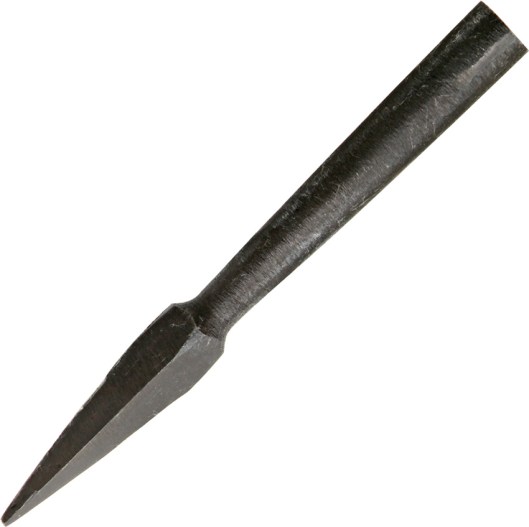
image9bodkin.jpg

which were specifically designed to penetrate plate armor of the very sort which the prince was wearing.
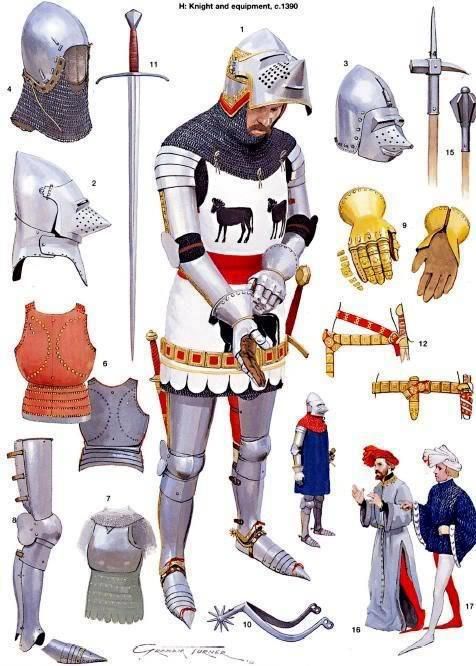
image10armor.jpg

A practiced longbowman could fire ten arrows a minute and his original battlefield issue would have been two 24-arrow linen bundles. We don’t know how many archers both sides had, but even if each had no more than a thousand, at the end of in a single minute, that would have meant 20,000 arrows in the air.

image11arrowstorm.jpg

If Hal was wearing a bascinet—as you see on the knight above–because of the shape of the helmet, many of the arrows might have glanced off. Perhaps Hal was wearing an open-face bascinet

image12openfacebasc.jpg

or had raised his visor, to give a command, say, but, instead of bouncing off, an arrow hit him in the face, below his eye (there is argument as to which eye) and penetrated his head. Had it gone all the way through, it might have been possible to saw off the arrow head and remove both arrow and shaft, but the arrow head had sunk into the bone at the back of the skull, instead. (Remarkably, it is reported that Hal continued to direct his troops, even in this condition. Tough people, those medievals!) And the first attempt at extraction had broken off the shaft, leaving the arrowhead still embedded. And this, of course, is what made us think of Elrond and the Morgul-knife splinter.

image13halarrow.jpg

We aren’t told how Elrond found or removed it. A medieval tool for removing arrowheads had been invented by the brilliant Arab physician with the splendid name of Abu al-Qasim Khalaf ibn al-Abbas al-Zahrawi, reduced by westerners to “Albucasis” (936-1013). (Here’s a LINK—this is a man of science well worth knowing much more about!)

image14alzahrawispoon.jpg

This might have worked, had the arrow been in a less delicate place, as well as not barbed, but Hal’s wound was just below his brain stem and next to all sorts of delicate blood vessels and the arrowhead was a bodkin point.

At this point, John Bradmore appeared. Interestingly, he had been a goldsmith, as well as a practicing surgeon, and the two seem to have come together as he tackled the problem. First, while he considered the possibilities, he kept the wound open and cleaned. Then he invented this—

image15extractor.jpg

It’s a simple but cunning design: the two outer parts are gradually introduced into the wound and spread it gently open. In the middle is a screw mechanism which could insert itself into the socket of the arrowhead. When it is firmly in place, the outer parts are closed as far as possible and then the whole, with, Bradmore hoped, the arrowhead, could be extracted from the wound. And it was. And then Bradmore washed out the wound with wine and kept it clean during the healing process. A completely remarkable piece of work, from the use of antisepsis to the invention and manufacture of the necessary tool.

Hal not only survived the operation (he had reportedly been dosed with henbane, which would have stupefied him but, given the wrong dose, would have killed him within a couple of days), but lived another 19 years to beat the French at Agincourt, marry the daughter of the king of France, and, for a brief time, imagine seeing his son succeed him on the now-joint thrones.

As for Bradmore, he wrote a medical treatise, Philomena, the title being a learned joke– St. Philomena was an early Christian martyr, part of whose martyrdom included surviving arrow attacks—before dying, a very well-off man, in 1412.

(If you’d like to see a very well-done visual segment on Bradmore and Prince Hal, here’s a LINK for a NOVA program of some years ago.)

In both cases, the patient survived, although it would appear that Prince Hal had a better recovery than Frodo. Then again, Hal, for all that his wound was life-threatening, hadn’t been hit by an elf-shot, but only by a mortal arrow, while the hobbit was almost doomed to the Nazgul world by a Morgul-knife.

Thanks, as ever, for reading.

MTCIDC

CD

PS

One of our favorite Danish composers, Niels W. Gade (1817-1890), has left us a very beautiful dramatic cantata, Elverskud—“Elfshot” (1854). Based upon a Danish ballad, it’s the story of Sir Oluf, who prefers the Elf king’s daughter to his own human bride and the consequences of that preference. If you’d like to hear it—we recommend it and much other music by Gade, as well—here’s a LINK.

PPS

This posting is our 151st! Five more will make exactly three years of weekly postings. Thank you for reading, and we hope to keep you interested for another 150 postings at least.

Hoards of the Things

28 Wednesday Jun 2017

Posted by Ollamh in Fairy Tales and Myths, Imaginary History, J.R.R. Tolkien, Literary History, Narrative Methods

≈ Leave a comment

Tags

A Christmas Carol, A Visit to William Blake's Inn, Aeetes, Alexander Deruchenko, Alice and Martin Provensen, Argo, Barrow-downs, Barrow-wights, Beowulf, Bilbo, Charles Dickens, Cinderella's Dress, Colchis, Collyer Brothers, David Gwillim, dragon-sickness, Dragons, Dwarves, Ebenezer Scrooge, Eurystheus, Hera, Heracles, Hoard, hordweard, Jack Gwillim, Jane Dyer, Jason and the Argonauts, Jason and the Golden Fleece, Kinder und Hausmaerchen, Ladon, Lonely Mountain, magpie, Nancy Willard, Neolithic, Scrooge McDuck, Scythians, Ted Nasmith, The Hobbit, The Lord of the Rings, Tolkien, Treasure

Welcome, dear readers, as always.

Recently, we’ve had a couple of posts on dragons and hoards, but, having done a certain amount of research and thinking and writing, we’ve come back once again to the subject, with the question: why would a dragon want a hoard to begin with?

The earliest Western European stories we know in which dragons (or serpents—the Greek word can apply to either) are associated with valuables are:

  1. the 11th labor of Heracles, in which his cousin, Eurystheus, demands that Heracles bring him the Golden Apples of the Hesperides (“children of the evening star”)—which are on an island guarded by a 100-headed (in some versions of the story) dragon/serpent called Ladon

image1hesperides.jpeg

  1. the story of Jason and the Argo, in which Jason must bring back to Greece the Golden Fleece, also guarded by a dragon/serpent (a sleepless one this time)

image2jason.png

In both of these stories, the dragon is the agent for someone else—Hera, in the case of the Golden Apples,

image3hera.jpg

and Aeetes, the king of Colchis, in that of the Golden Fleece.

image4aaetes.jpg

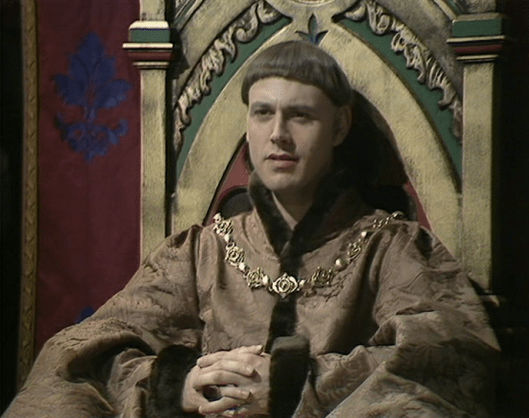
(We’ve always loved the curly beard of Jack Gwillim in Jason and the Argonauts—1963. His son, David, by the way, was a perfect Prince Hal and Henry V in BBC productions from 1979—if you can find them, we highly recommend them.)

image5dgwillim.png

After these, we see the dragon of Beowulf.

18lrnlrjcbonijpg.jpg

In his case, although he’s called hordweard, “hoard guardian/watchman”, we are told that he has come upon a treasure in a barrow, piled in for safe-keeping several hundred years before. Europeans in the Neolithic Period and long beyond buried high-status people in such places—like this, in Denmark.

image6barrow.jpg

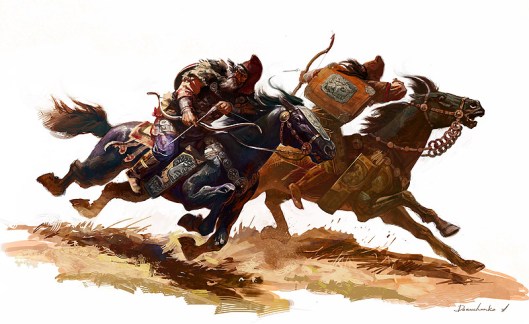
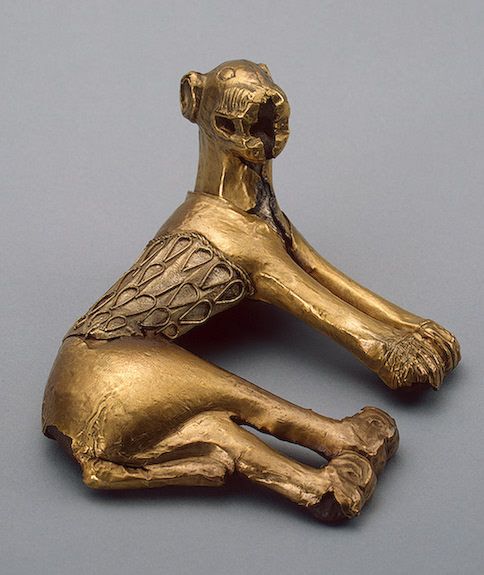
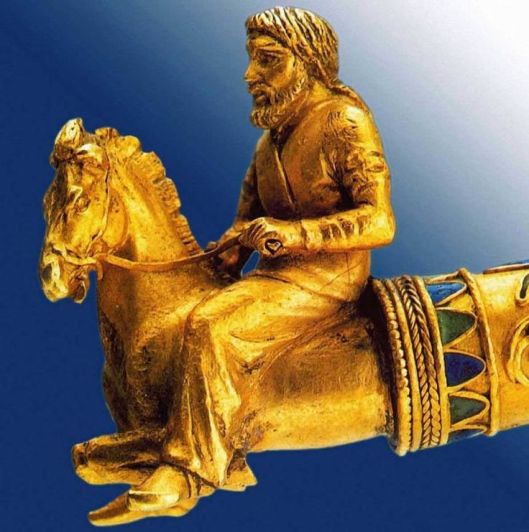
As it was the custom for high-status people to be buried with at least some of their riches, it’s easy to see how singers might be inspired to create a barrow like that of the Beowulf dragon. Some of our favorite grave goods come from the Scythians, a horse-people who once lived north of the Black Sea, and who had buried them in grave mounds with their dead.

image7ascyth.jpg

(A wonderfully atmospheric picture by Alexander Deruchenko.)

image7bscythia.jpg

image8scyth.jpg

image9scyth.jpg

image10scyth.jpg

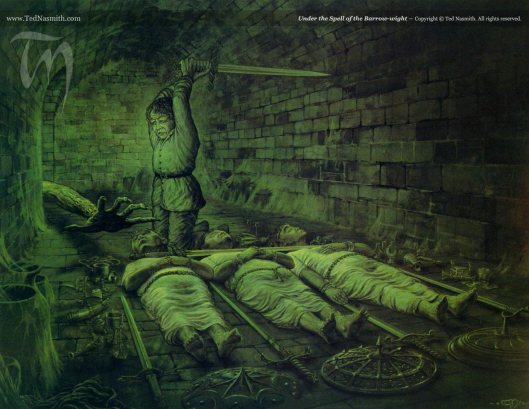
The Beowulf dragon is not the proper owner of the hoard: rather, he has taken possession (the poem may even be suggesting that dragons—or this dragon, at least– have a special affection for barrows (2270-2278), rather as the barrow wights have taken over the tumuli on the Barrow Downs, both places being much older and long-abandoned. You may remember this striking image by one of our favorite Tolkien artists, Ted Nasmith–

image11barrowwight.jpg

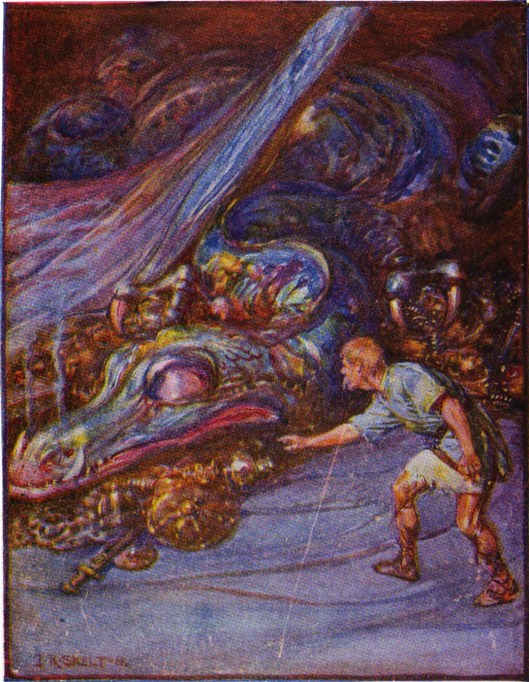
In contrast, Smaug has taken possession of the Lonely Mountain by force, burning out the rightful owners.

image12smaug.jpeg

In both cases, however, the latest owner is very sensitive about his new property: the removal of one object, as Beowulf and Bilbo find out.

image13cuptheft.jpg

(And we can’t resist this item—it’s copy of a cup used in the 2007 Beowulf film. We don’t see that it would be very useful for drinking from, but it’s certainly fun to look at!)

image14bewulfcup.jpg

It’s one thing if it’s your job to guard gold: you’re like a sheepdog with a flock. (Here’s a Maremma, in fact, with a flock.)

image15maremma.jpg

It’s another if you are occupying, seized or not, someone else’s gold. In the latter case, however, we are still left with our initial question: why is this important to a dragon?

Perhaps they just like the look of it. After all, Smaug seems quite proud of what he sees as a waistcoat of precious things. When Bilbo says: “What a magnificence to possess a waistcoat of fine diamonds!” Smaug replies “Yes, it is rare and wonderful, indeed.” (The Hobbit, Chapter 12, “Inside Information”) Yet there is the darker side:

“To say that Bilbo’s breath was taken away is no description at all. There are no words left to express his staggerment, since Men changed the language that they learned of elves in the days when all the world was wonderful. Bilbo had heard tell and sing of dragon-hoards before, but the splendor, the lust, the glory of such treasure had never yet come home to him. His heart was filled and pierced with enchantment and with the desire of dwarves; and he gazed motionless, almost forgetting the frightful guardian, at the gold beyond price and count.”   (The Hobbit, Chapter 12, “Inside Information”)

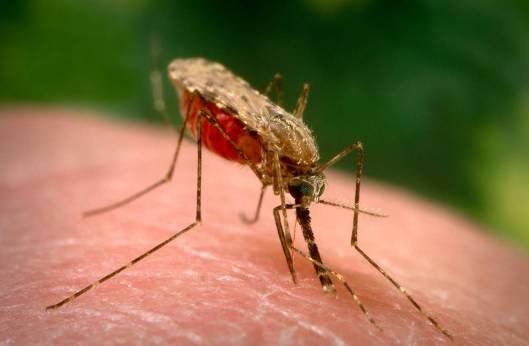
Just seeing such wealth brought on “lust” and “the desire of dwarves” and it’s clear that this is what infects Thorin after Smaug’s death and eventually brings on the “dragon-sickness” which leads to the end of the Master of Laketown (The Hobbit, Chapter 19, “The Last Stage”). As this “lust” for beautiful, valuable things seems inherent in the dwarves, it strikes us that we might imagine dragons as somehow enablers or carriers—like anopheles mosquitoes and malaria—

image16anopheles.jpg

rather than originators of the disease and that the name is derived from that combination of acquisitiveness and sensitivity we noted earlier and which so clearly disturbs Thorin’s judgement.

But perhaps there is something in the idea of hoarding itself. In our world, “hoarding” has come to have a different meaning, being a kind of psychological condition in which a person acquires and acquires and has lost the ability to discard anything for complex internal reasons. In literature, one might imagine that misers have something of this—think of Ebenezer Scrooge, in Charles Dickens’ A Christmas Carol (1843).

image17scrooge.jpg

Or, Uncle Scrooge McDuck, from Walt Disney comics. Who, as you can see, takes this to an extreme even Dickens’ Scrooge might find a bit excessive.

image18smcduck.jpg

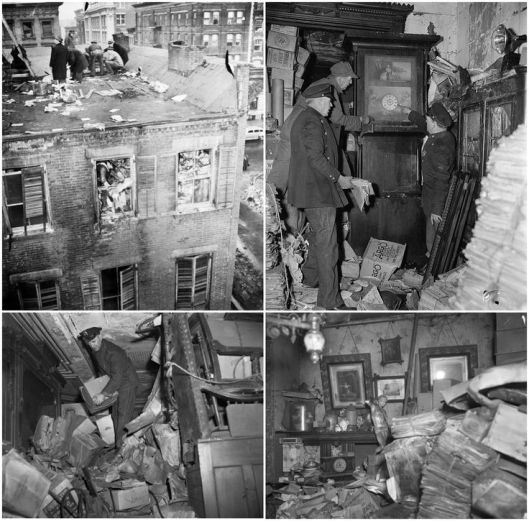
Underneath this, however, is the sad side: those who become imprisoned by their possessions, a famous case being that of the Collyer brothers in New York, whose apartment, after their joint deaths in 1947, was a subject both of curiosity and of mild horror in the New York newspapers of the time.

image19collyer.jpg

Is it possible that the Beowulf dragon and Smaug both suffer from this condition? Is that why the theft of a single piece from an uncountable hoard seems to mean so much?

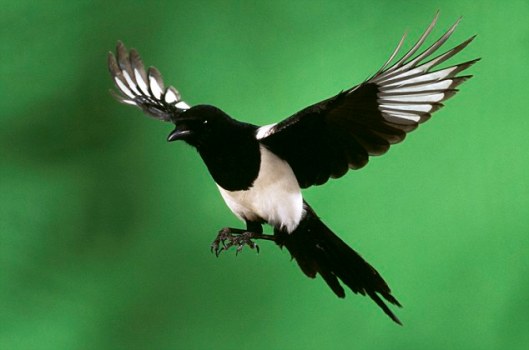
We never want to shy away from serious subjects—after all, all of the best fantasy/adventure writers never did—but it’s an early summer day where we live—just after Midsummer’s Day, in fact, and so we’d like to end with another kind of acquisitor—the magpie.

image20magpie.jpg

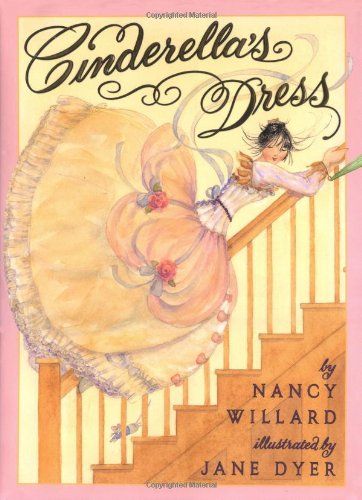
Traditionally, magpies are famous for being attracted to—and collecting—shiny objects. Our favorite magpie story, however, isn’t about obsession, but about generosity. It’s a beautiful children’s book by Nancy Willard and Jane Dyer, entitled Cinderella’s Dress.

image21cind'sdress.jpg

In this book, told in light, easy verse, we see a magpie couple as fairy godparents for Cinderella, using their cache of shiny things to—but we’ll leave that to you to discover (although the title is a bit of a give-away). Here’s another page to tease you…

image22csdresspage.jpg

Thanks, as ever, for reading.

MTCIDC


PS

Another Nancy Willard book you might enjoy is A Visit to William Blake’s Inn (1981), illustrated by Alice and Martin Provensen.

image23blakesinn.jpg

The Doubtful Sea Series Facebook Page

The Doubtful Sea Series Facebook Page

  • Ollamh

Categories

  • Artists and Illustrators
  • Economics in Middle-earth
  • Fairy Tales and Myths
  • Films and Music
  • Games
  • Heroes
  • Imaginary History
  • J.R.R. Tolkien
  • Language
  • Literary History
  • Maps
  • Medieval Russia
  • Military History
  • Military History of Middle-earth
  • Narnia
  • Narrative Methods
  • Poetry
  • Research
  • Star Wars
  • Terra Australis
  • The Rohirrim
  • Theatre and Performance
  • Tolkien
  • Uncategorized
  • Villains
  • Writing as Collaborators
Follow doubtfulsea on WordPress.com

Across the Doubtful Sea

Recent Postings

  • A Moon disfigured December 17, 2025
  • On the Roads Again—Once More December 10, 2025
  • (Not) Crossing Bridges December 3, 2025
  • On the Road(s) Again—Again November 26, 2025
  • On the Road(s) Again November 19, 2025
  • To Bree (Part 2) November 12, 2025
  • To Bree (Part 1) November 5, 2025
  • A Plague o’ Both—No, o’ All Your Houses! October 29, 2025
  • It’s in Writing (2:  I’st a Prologue, or a Poesie for a Ring?) October 22, 2025

Blog Statistics

  • 103,208 Views

Posting Archive

  • December 2025 (3)
  • November 2025 (4)
  • October 2025 (5)
  • September 2025 (4)
  • August 2025 (4)
  • July 2025 (5)
  • June 2025 (4)
  • May 2025 (4)
  • April 2025 (5)
  • March 2025 (4)
  • February 2025 (4)
  • January 2025 (5)
  • December 2024 (4)
  • November 2024 (4)
  • October 2024 (5)
  • September 2024 (4)
  • August 2024 (4)
  • July 2024 (5)
  • June 2024 (4)
  • May 2024 (5)
  • April 2024 (4)
  • March 2024 (4)
  • February 2024 (4)
  • January 2024 (5)
  • December 2023 (4)
  • November 2023 (5)
  • October 2023 (4)
  • September 2023 (4)
  • August 2023 (5)
  • July 2023 (4)
  • June 2023 (4)
  • May 2023 (5)
  • April 2023 (4)
  • March 2023 (5)
  • February 2023 (4)
  • January 2023 (4)
  • December 2022 (4)
  • November 2022 (5)
  • October 2022 (4)
  • September 2022 (4)
  • August 2022 (5)
  • July 2022 (4)
  • June 2022 (5)
  • May 2022 (4)
  • April 2022 (4)
  • March 2022 (5)
  • February 2022 (4)
  • January 2022 (4)
  • December 2021 (5)
  • November 2021 (4)
  • October 2021 (4)
  • September 2021 (5)
  • August 2021 (4)
  • July 2021 (4)
  • June 2021 (5)
  • May 2021 (4)
  • April 2021 (4)
  • March 2021 (5)
  • February 2021 (4)
  • January 2021 (4)
  • December 2020 (5)
  • November 2020 (4)
  • October 2020 (4)
  • September 2020 (5)
  • August 2020 (4)
  • July 2020 (5)
  • June 2020 (4)
  • May 2020 (4)
  • April 2020 (5)
  • March 2020 (4)
  • February 2020 (4)
  • January 2020 (6)
  • December 2019 (4)
  • November 2019 (4)
  • October 2019 (5)
  • September 2019 (4)
  • August 2019 (4)
  • July 2019 (5)
  • June 2019 (4)
  • May 2019 (5)
  • April 2019 (4)
  • March 2019 (4)
  • February 2019 (4)
  • January 2019 (5)
  • December 2018 (4)
  • November 2018 (4)
  • October 2018 (5)
  • September 2018 (4)
  • August 2018 (5)
  • July 2018 (4)
  • June 2018 (4)
  • May 2018 (5)
  • April 2018 (4)
  • March 2018 (4)
  • February 2018 (4)
  • January 2018 (5)
  • December 2017 (4)
  • November 2017 (4)
  • October 2017 (4)
  • September 2017 (4)
  • August 2017 (5)
  • July 2017 (4)
  • June 2017 (4)
  • May 2017 (5)
  • April 2017 (4)
  • March 2017 (5)
  • February 2017 (4)
  • January 2017 (4)
  • December 2016 (4)
  • November 2016 (5)
  • October 2016 (6)
  • September 2016 (5)
  • August 2016 (5)
  • July 2016 (5)
  • June 2016 (5)
  • May 2016 (4)
  • April 2016 (4)
  • March 2016 (5)
  • February 2016 (4)
  • January 2016 (4)
  • December 2015 (5)
  • November 2015 (5)
  • October 2015 (4)
  • September 2015 (5)
  • August 2015 (4)
  • July 2015 (5)
  • June 2015 (5)
  • May 2015 (4)
  • April 2015 (3)
  • March 2015 (4)
  • February 2015 (4)
  • January 2015 (4)
  • December 2014 (5)
  • November 2014 (4)
  • October 2014 (6)
  • September 2014 (1)

Blog at WordPress.com.

  • Subscribe Subscribed
    • doubtfulsea
    • Join 78 other subscribers
    • Already have a WordPress.com account? Log in now.
    • doubtfulsea
    • Subscribe Subscribed
    • Sign up
    • Log in
    • Report this content
    • View site in Reader
    • Manage subscriptions
    • Collapse this bar
 

Loading Comments...