• About

doubtfulsea

~ adventure fantasy

Tag Archives: chariots

Hybrids

01 Wednesday Jan 2025

Posted by Ollamh in Uncategorized

≈ Leave a comment

Tags

anglo-saxons, Boudica, chariots, eurasian-steppe, Huns, hybrds, Hybrids, Jacksons The Lord of the Rings, jacksons-lord-of-the-rings, Julius Caesar, Mongols, Normans, Rohirrim, Sarmatians, Scythians, Tacitus, Tolkien, Wainriders

As always, dear readers, welcome.

The title of this piece might suggest electric cars, and it definitely will mention several different wheeled vehicles, but it is actually what I hope is a little study in something Tolkien does wonderfully well:  taking different elements from different times and cultures and so blending them that they become believable new wholes.

Although I don’t always agree with elements in Jackson’s The Lord of the Rings, one thing has always given me pleasure:  the Rohirrim, whether en masse

or a small grouping.

And this is true for Edoras

as well as for Meduseld.

And yet they appear to be a kind of combination of peoples:  on the one hand, Tolkien imagined them to be Anglo-Saxons,
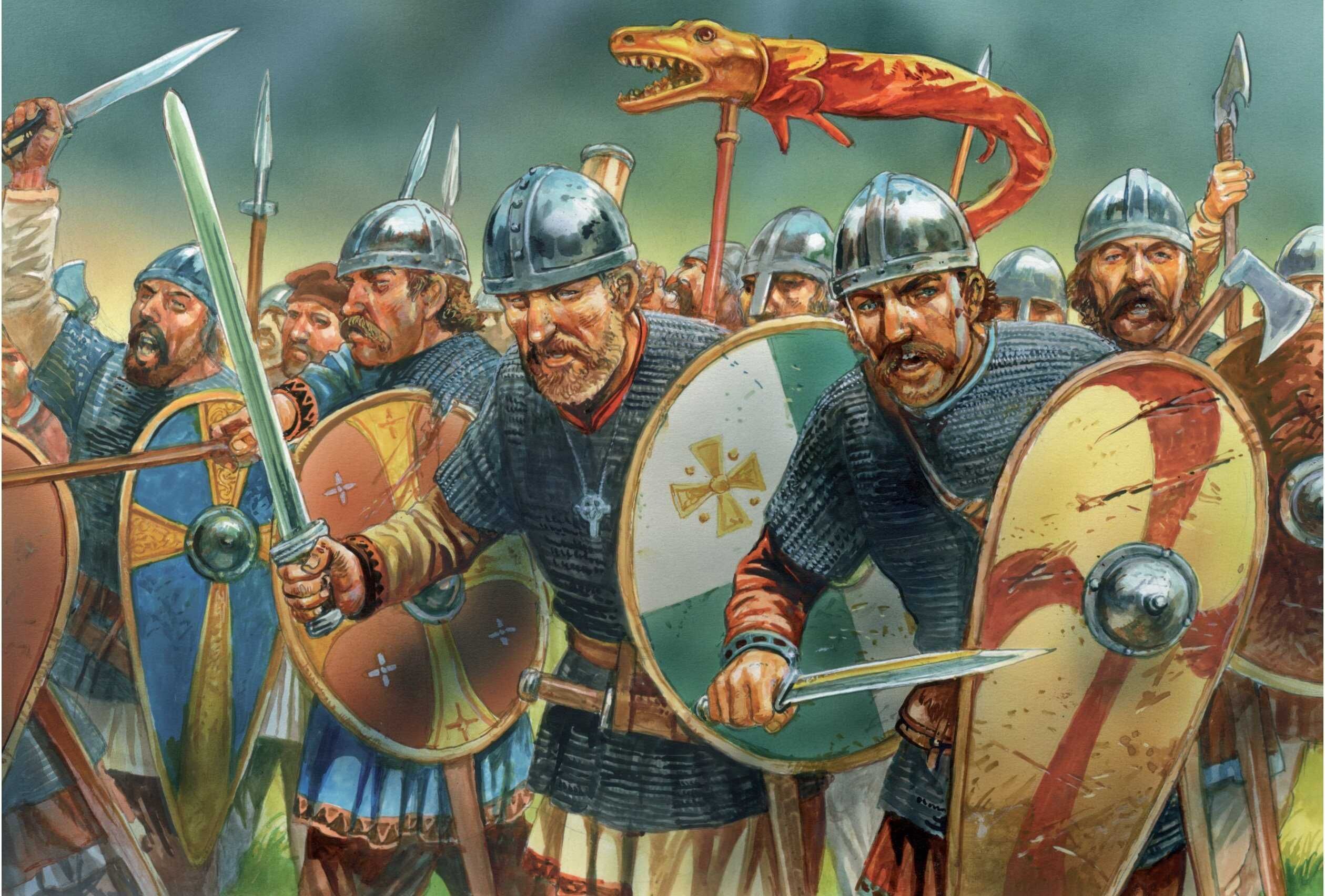
(Peter Dennis)

a people who primarily fought on foot, as at their last two major battles, Stamford Bridge,
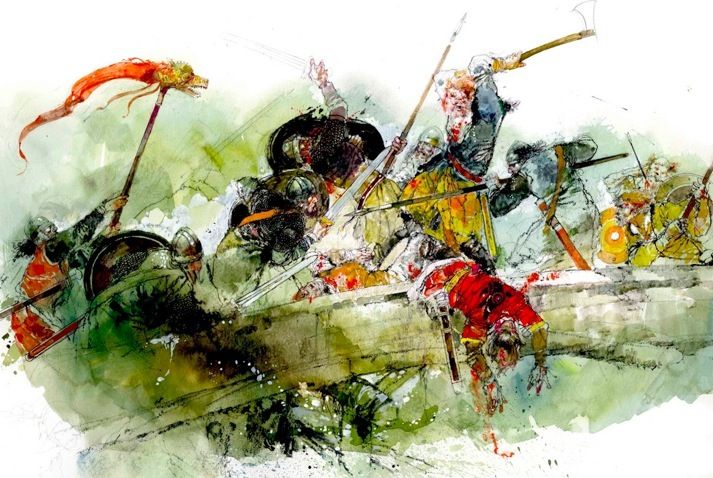
(Victor Ambrus—who worked for years with the popular British archeology series, Time Team—which is available on YouTube and much recommended)

where they defeated another infantry force, the Vikings, and Hastings,
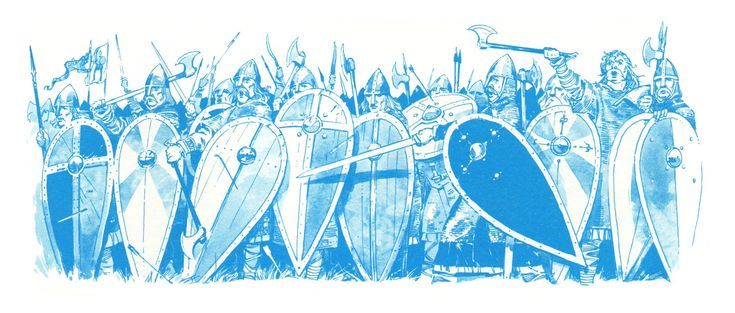
(Artist?)

in which they were overwhelmed at the battle’s conclusion by Norman cavalry.
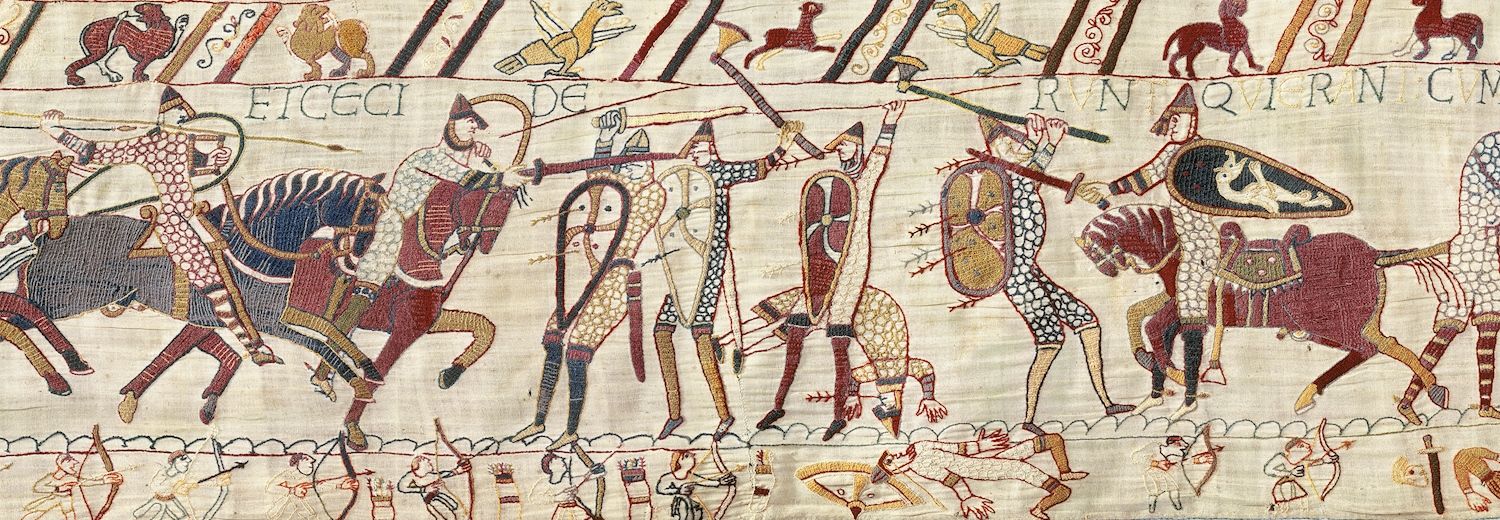
(From the wonderful “Bayeux Tapestry”—actually the “Bayeux Embroidery”—if you’d like to see the whole thing, look here:  https://www.bayeuxmuseum.com/en/the-bayeux-tapestry/discover-the-bayeux-tapestry/explore-online/  To my knowledge, there’s nothing like it from the Middle Ages for depicting a specific series of events in the medieval world.)

On the other hand, the Rohirrim were mounted, more like those Normans who defeated the Anglo-Saxons,

although the language they speak is, basically, a form of Old English, the language of the Anglo-Saxons.  Tolkien imagined them, in fact, as looking like the Normans, as well, describing them in a letter to Rhona Beare:

“The styles of the Bayeux Tapestry (made in England) fit them well enough, if one remembers that the kind of tennis-nets [the] soldiers seem to have on are only a clumsy conventional sign for chain-mail of small rings.”  (letter to Rhona Beare, 14 October, 1958, Letters, 401)

That is, their armor actually can look like this—
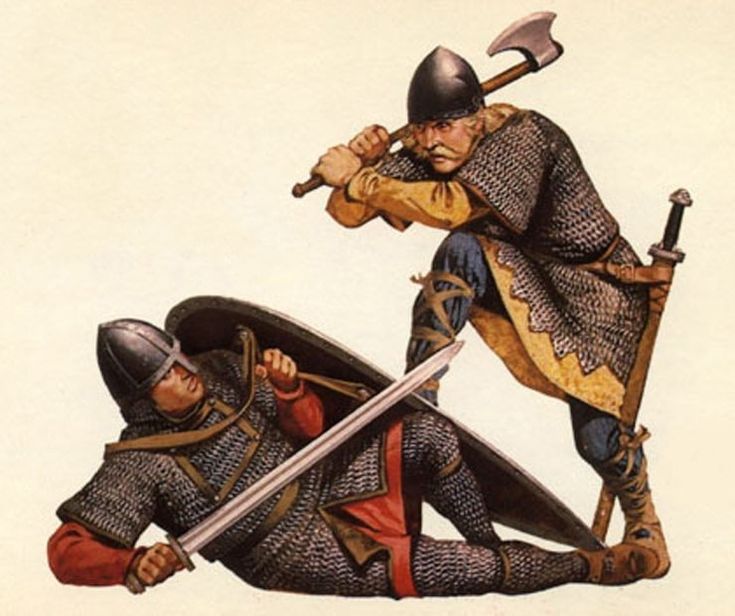
(By Angus McBride—and ironic, as, for all that McBride must have painted dozens of figures in chain mail, he once confessed in an interview that it was his least favorite part of illustrating, as the mail took so long to do.)

It’s also interesting to think about them as a people.  Anglo-Saxons were descended from a combination of locals (Romano-British) and various groups of west-Germanic tribesmen who had either been early post-Roman invaders of Britain or Germanic tribesmen brought to Britain to protect the locals from those invaders and who had become colonizers in turn.

But who were the Rohirrim and where did they come from?

“Eorl the Young was lord of the Men of Eotheod.  That land lay near the sources of Anduin, between the furthest ranges of the Misty Mountains and the northernmost parts of Mirkwood.”

(JRRT)

They had not always lived there, however:

“The Eotheod [from Old English, “Horsefolk”] had moved to those regions in the days of King Earnil II [TA 1945-2043] from lands in the vales of Anduin between the Carrock and the Gladden, and they were in origin close akin to the Beornings and the men of the west-eaves of the forest.  The forefathers of Eorl claimed descent from kings in Rhovanion, whose realm lay beyond Mirkwood before the invasions of the Wainriders…They loved best the plains and delighted in horses and in all feats of horsemanship…” (The Lord of the Rings, Appendix A II “The House of Eorl”)

The combination of “They loved best the plains and delighted in horses” makes perfect sense when one thinks about comparative history in our Middle-earth.  Consider the Eurasian Steppe, stretching from western China all the way to the Hungarian puszta.

This is an immense belt of grassland,

some 5000 miles (8000km) wide,

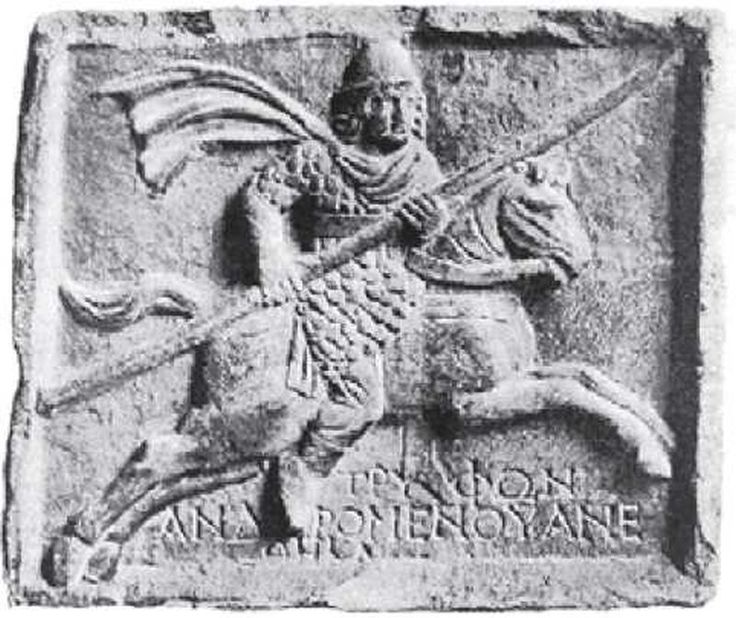
and has been the homeland of numerous horsefolk throughout history, from the Scythians
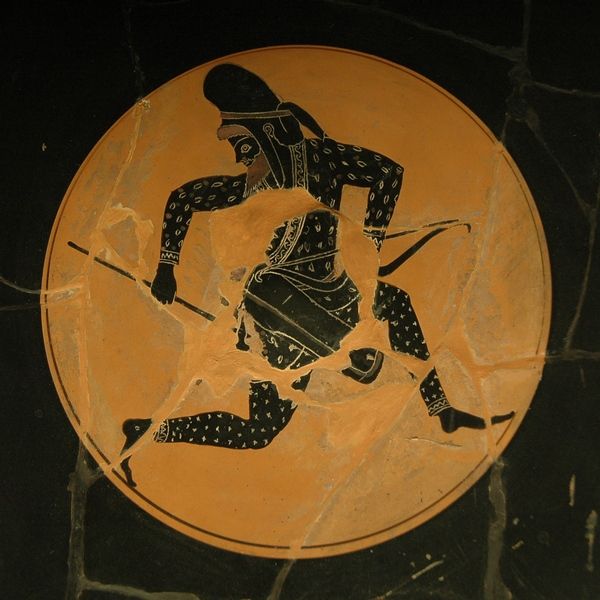
to the Sarmatians
to the Huns
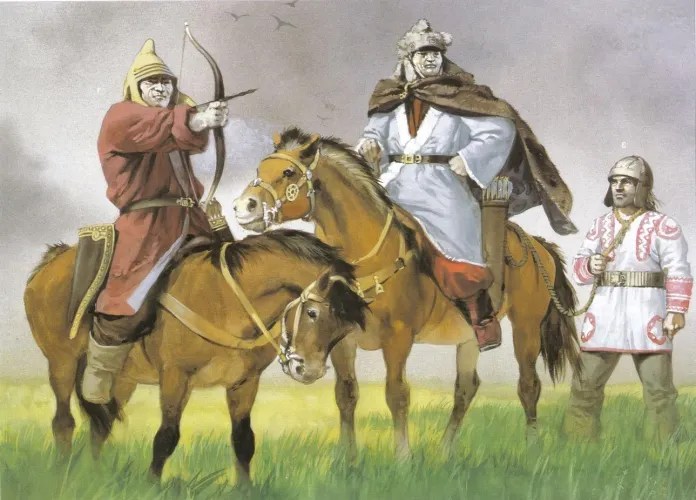
(Angus McBride)

to the Mongols.
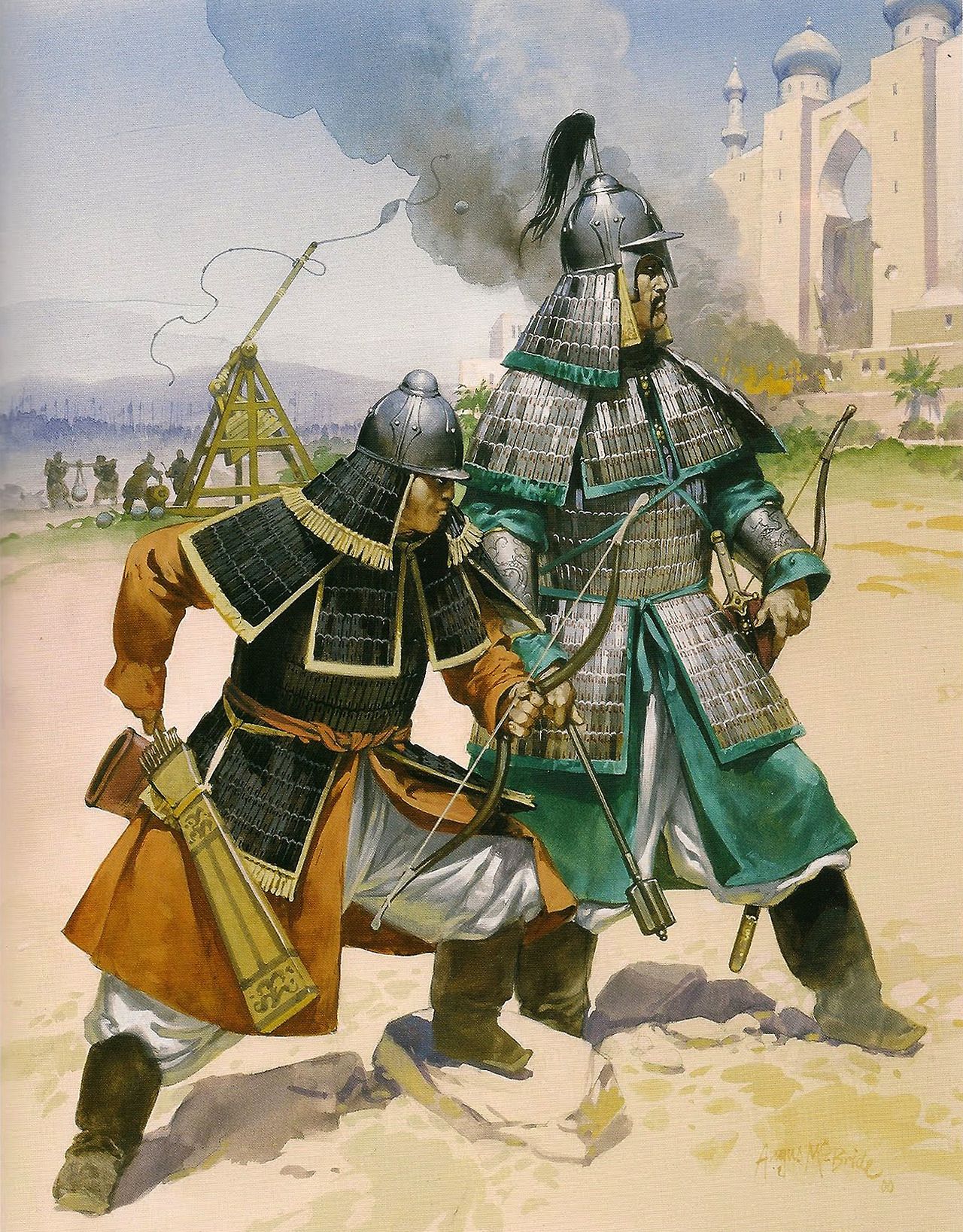
(another McBride)

All of these peoples have used the Steppe to graze their herds of horses, sometimes moving west for grazing, sometimes moving west when pressured by others further east, and sometimes as predators, like the Huns, moving west to seek new plunder.
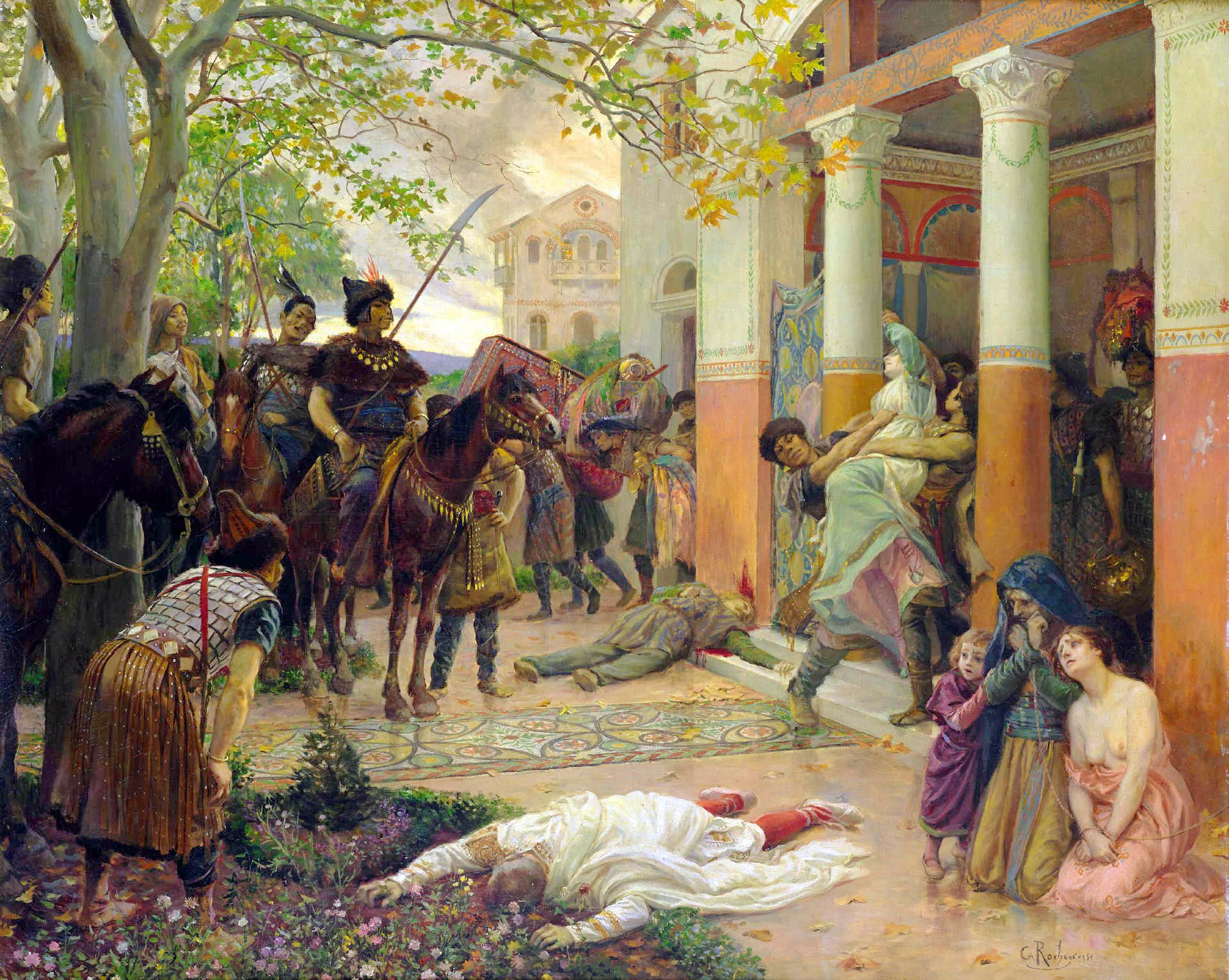
(I haven’t been able to identify an artist for this–it has the look of late-Victorian.)

In two of these cases, whole peoples might be on the move and this is perhaps where Tolkien has gotten part of his description of those Wainriders he mentions:

“The Wainriders were a people, or a confederacy of many peoples, that came from the East; but they were stronger and better armed than any that had appeared before.  They journeyed in great wains, and their chieftains fought in chariots…” 

So, we can imagine that the Eotheod, pressured by the Wainriders, were forced west, as one steppe people is pushed westward by another to the east. 

But Tolkien gives us another—or perhaps additional–possibility:

“Stirred up, as was afterwards seen, by the emissaries of Sauron, they made a sudden assault on Gondor…The people of eastern and southern Rhovanion were enslaved; and the frontiers of Gondor were for that time withdrawn to the Anduin and the Emyn Muil.” (The Lord of the Rings, Appendix A, IV “Gondor and the Heirs of Anarion”)

The Wainriders, then, might be both steppe peoples moving westwards, but also predators, like the Huns, or like the Mongols, who were both predators and empire-builders, and here we might see Mongols with their characteristic ger (a large round tent)—on a wagon—perhaps like the Wainriders?
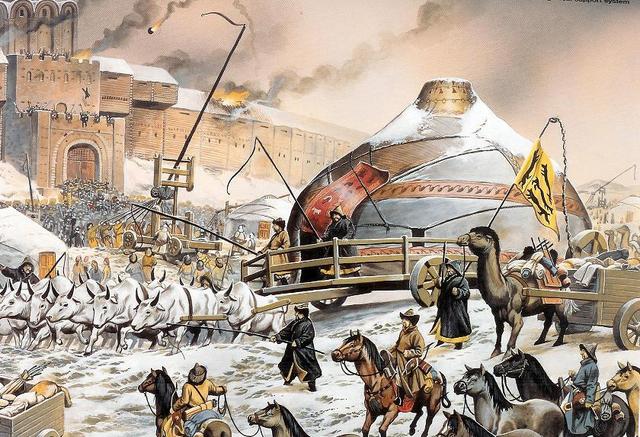
(Wayne Reynolds)

Although there is no mention in our text of the Rohirrim migrating with wagons, it’s clear from parallels in our world that the peoples who crossed the Eurasian Steppe appear to have used them regularly.  But here, like the Rohirrim, we have another odd juxtaposition.  The Rohirrim are Anglo-Saxons on horseback:  cavalry, which was true for all of those migrants across the Steppe in our world.  Chariots, however, although Tolkien says that the Wainrider chiefs fought in them (of which fact this is the only mention) were not part of those other horsefolks’ arsenals.  Where did they come from?

The answer, I think, lies in the period of British history before the Anglo-Saxons and almost before the Romans, among the earlier Celtic settlers of England.  Julius Caesar encountered chariots there and described their use:

Genus hoc est ex essedis pugnae. Primo per omnes partes perequitant et tela coiciunt atque ipso terrore equorum et strepitu rotarum ordines plerumque perturbant, et cum se inter equitum turmas insinuaverunt, ex essedis desiliunt et pedibus proeliantur. 2 Aurigae interim paulatim ex proelio excedunt atque ita currus conlocant ut, si illi a multitudine hostium premantur, expeditum ad quos receptum habeant. 3 Ita mobilitatem equitum, stabilitatem peditum in proeliis praestant, ac tantum usu cotidiano et exercitatione efficiunt uti in declivi ac praecipiti loco incitatos equos sustinere et brevi moderari ac flectere et per temonem percurrere et in iugo insistere et se inde in currus citissime recipere consuerint.

“This is the kind of fighting from chariots.  At first, they ride around in all directions and throw spears and often, by the very frightfulness of the horses and the roar of the wheels, they shake the ranks [of the enemy] and, when they have slipped themselves among the troops of [enemy] cavalry, they leap from the chariots and fight on foot.  Meanwhile, the charioteers move out a little way from the fighting and so place their vehicles that, if they [the dismounted fighters] should be pressed by a large number of the enemy, they may have an easy retreat to them.  Thus, they provide the mobility of cavalry [as well as] the steadiness of infantry in [their] battles and they accomplish so much by daily practice and exercise that they are accustomed to control their stirred-up horses on a sloping and steep place and rein [them] in quickly and to turn [them] and to run along the yoke pole and to stand on the yoke and from there to take themselves back into the vehicles extremely speedily.”  (Caesar, De Bello Gallico, Book IV, Chapter 33—my translation)

(Angus McBride)

Tolkien may have remembered this from his schooldays, when he would first have encountered the text—and he might have found those wagons there, too, although slightly later.  When, in 60-61AD, the Iceni queen, Boudica, led a revolt against Roman rule,

(Peter Dennis)

in the final battle, when the tribesmen advanced towards the Roman formation, as Tacitus (c.56-c.120AD) tells us, their families watched from their wagons, placed behind the battle line (De Vita et Moribus Iulii Agricolae, Chapter 34).  And, as a prelude to the battle, Boudica had ridden among the ranks in a chariot (Chapter 35).

(another Peter Dennis—in fact, if you’d like to know more about this amazing woman, who, for a brief time, had been a real threat to the Romans, you might invest in: 
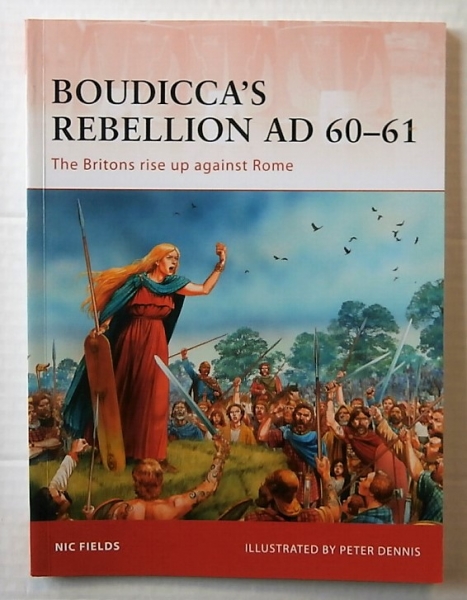
And so, as in combining Anglo-Saxon and Norman to create the Rohirrim, Tolkien may have taken Steppe people, added Celtic Britons, and produced the Wainriders. 

Thanks, as always for reading.

Stay well,

Remember that a horse will drink, on average, between 5 and 10 gallons (19-38 litres) of water a day,

And remember, as well, that there’s always

MTCIDC

O

Wains, Carts, and… (2)

14 Wednesday Feb 2018

Posted by Ollamh in Economics in Middle-earth, J.R.R. Tolkien

≈ Leave a comment

Tags

Boudica, Carts, Cassius Dio, Celts, chariots, Conestoga, Farmer Maggot, Gandalf, gur, Hobbiton, Iceni, Iron Age, Medieval, Mongols, Oregon Trail, Roman History, Romans, The Lord of the Rings, Tolkien, vikings, Wagons, Wainriders, Wains

Welcome, as always, to our blog, dear readers.

In our last, we began discussing wheeled transport in The Lord of the Rings.  We began with Gandalf’s cart, mentioned in Chapter 1.

im1gscart.jpg

The posting took us from the first traces of wheeled vehicles in western Europe, circa 3600BC (literally traces—just a pair of tracks in the clay)

im2tracks.jpg

through chariots

im3chariot.jpg

to Roman carts

im4romcart.jpg

to their descendants, medieval carts,

im5medcart.jpg

which led us back to Gandalf.

im6gcart.jpg

Continuing our discussion, we move from carts (2 wheels) to wagons (4 wheels) with the wagon Farmer Maggot uses to carry the hobbits to Bucklebury Ferry:

“I was going to say:  after a bit of supper, I’ll get out a small wagon, and I’ll drive you all to the Ferry.” (The Fellowship of the Ring, Book One, Chapter 4, “A Short Cut to Mushrooms”)

There is no description beyond that, really, but wagons are pretty generic things.  We have a few examples of early (600-500BC) Iron Age wagons—very fancy ones, too—from burials,

im7celtwag.jpg

im8celtwag.jpg

as well as this later Viking wagon.

im9oseberg.jpg

And, in between, we have Roman wagons

im10romwag.jpg

and their medieval descendants.

im11medwag.jpg

Farmer Maggott’s wagon, would probably have looked something like this (without the arms).

im12amedwag.jpg

Of course, those Roman wagons were meant for paved Roman roads.

im12romroad.jpg

Although some Roman roads remained on the surface and continued to be used, most medieval roads were merely dirt and stones—as JRRT illustrates in that picture of the Hill

im13hobbiton.jpg

and as we see in this picture.

im14medroad.jpg

In which case, medieval people relied upon pack horses to transport many of their goods.

im15sumpter.jpg

(Think of Bill the pony as a modest example.)

An old word for wagon is wain and we would like to end this brief exploration with something about wains and Wainriders.  In Appendix A, we find this:

“The third evil was the invasion of the Wainriders, which sapped the waning strength of Gondor in wars that lasted for almost a hundred years.  The Wainriders were a people, or a confederacy of many peoples, that came from the east; but they were stronger and better armed than any that had appeared before.  They journeyed in great wains, and their chieftains fought in chariots.”

We’ve been puzzled by that combination of “great wains” and “their chieftains fought in chariots”.  The only immediate reference we could think of was to the Iceni, a tribe of ancient Britain, who, led by a female chieftain named Boudica, revolted against Roman occupation in 60-61AD.  At the final battle, where they were defeated by Roman troops, they had parked wagons in a crescent formation to their rear, then advanced with their chariots and infantry against the Romans. (See Cassius Dio, Roman History, LXII.12 for a description of this battle—here’s an easy LINK to that portion of his extensive writing.)

im16boudica.jpg

There is a problem here, however.  The Britons were not migratory and their wagons were probably no more than farm wagons and carts, hardly the great wains of JRRT’s description.  If we removed the chariots, another candidate for the Wainriders might be the Mongols, however, who were migratory and traveled in something even more splendid than a wagon—a gur—like this one—

im17ger.jpg

The Mongols certainly came from the east and, in a short time, swallowed up territory from China all the way to eastern Europe.

im18mongolconquest.jpg

It is more likely, however, that JRRT combined things–it wouldn’t be the first time he synthesized—so much of his so-called legendarium is a mixture of this and that in brilliant profusion.  So, in the same spirit, we asked ourselves what we thought wains might look like and immediately saw the big wagon which was instrumental in colonizing the western part of the US, the Conestoga.

im19conestoga.jpg

Great, long lines of these and other wagons, packed with people and supplies, crossed the plains from the 1840s on.

im20wagtrain.gif

Could we then remove the 19th-century settlers and add Celts and their chariots, say?

im21celtchar.jpg

What do you think, dear readers?

Thanks, as ever, for reading.

MTCIDC

CD

Wains and Carts and… (Part I)

07 Wednesday Feb 2018

Posted by Ollamh in J.R.R. Tolkien, Literary History, Military History

≈ Leave a comment

Tags

Bronze Age, Byzantines, Carts, chariots, delivery carts, Flintbek, Gandalf, Great War, Greece, Iliad, Late-Victorian, Medieval, military, Mycenaean, Neolithic, Roman Roads, Romans, Schleswig-Holstein, The Lord of the Rings, Tolkien, Trundholm Sun Chariot, Wagons, wattle and daub

Welcome, dear readers, once more to our blog.
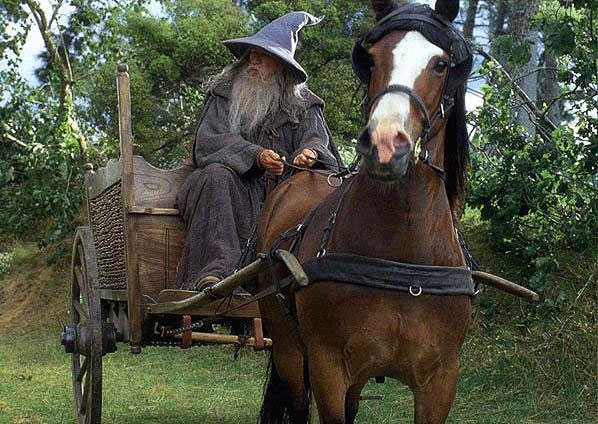
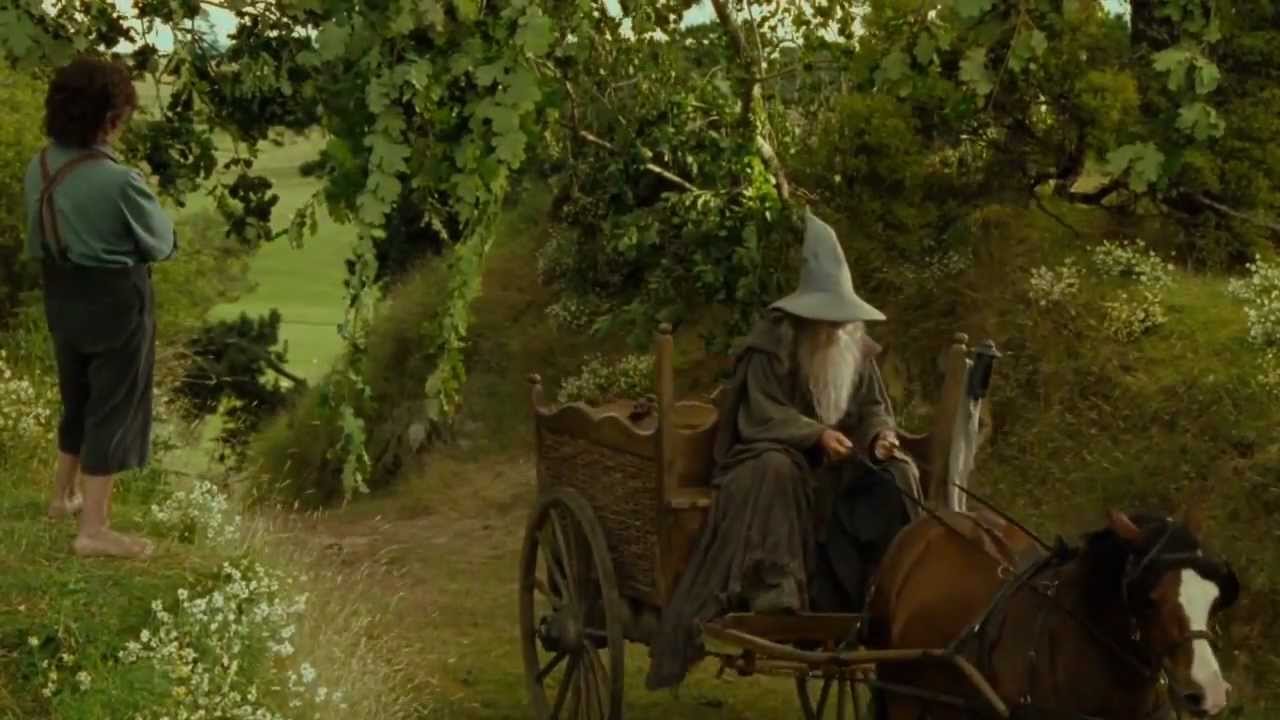
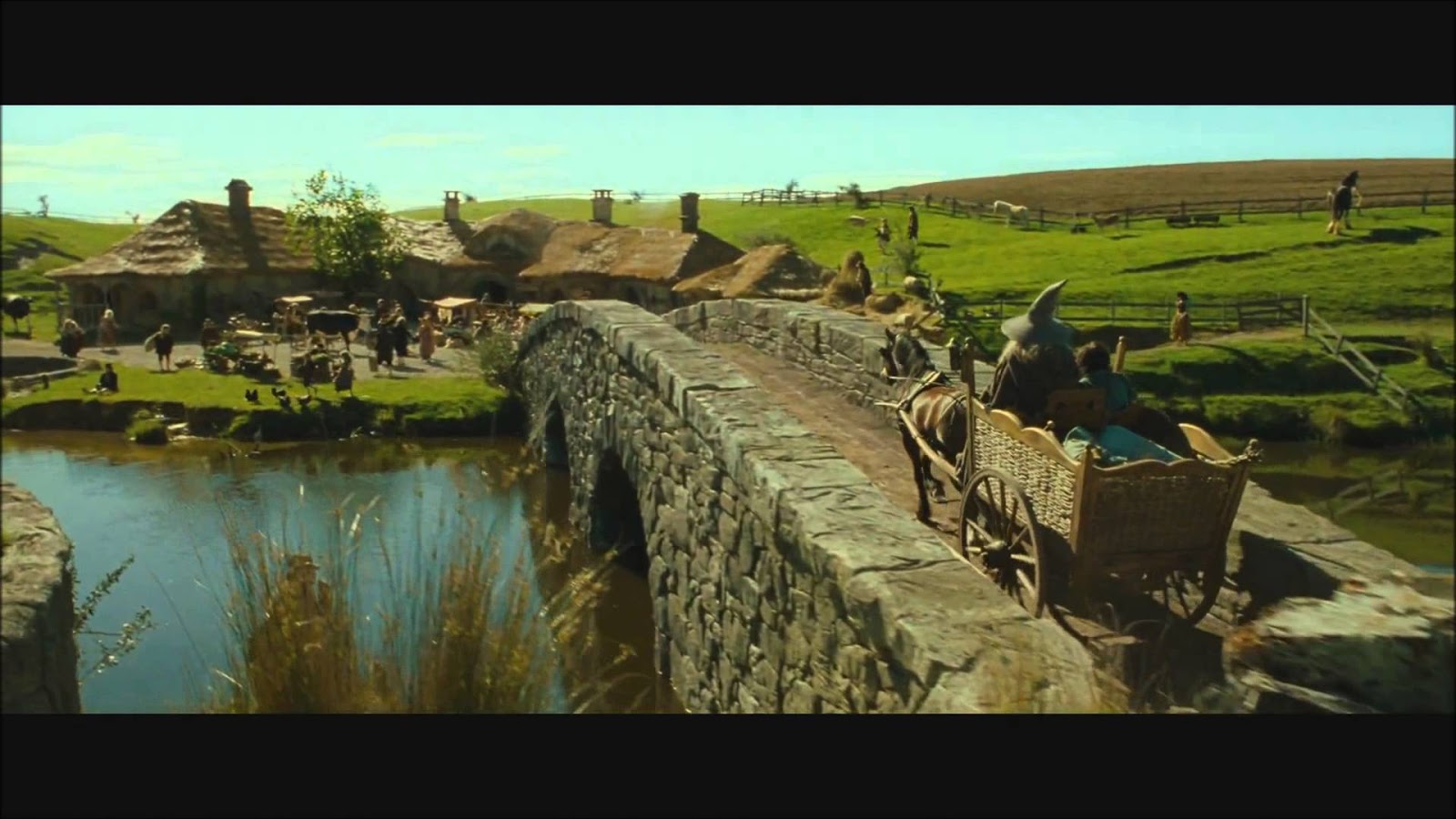
We’ve just been watching the extended version opening of The Fellowship of the Ring, in which Gandalf appears, driving a cart.
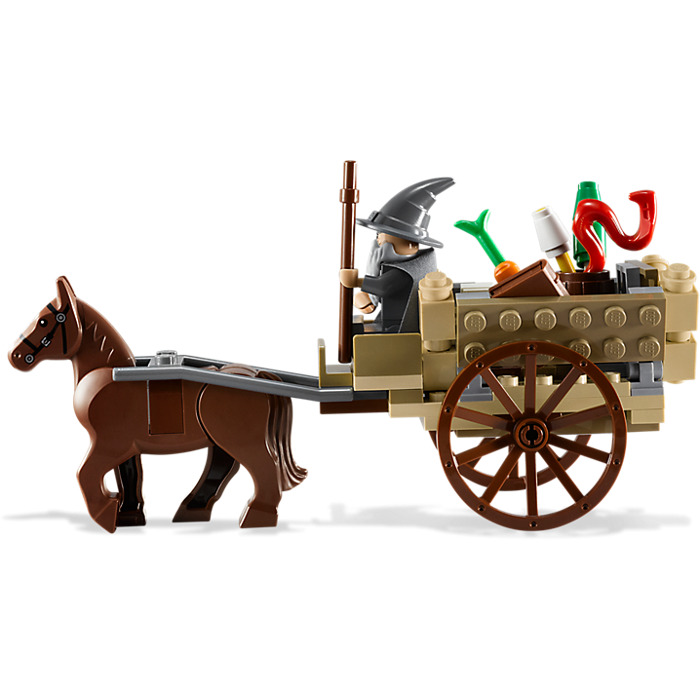
image1gandalfcart.jpg
(Sorry—we couldn’t resist! We love Legos and the older Playmobil—Vikings, pirates, Roman warship, too. Not to forget the Egyptian pyramid! )
Unlike ordinary medieval carts,
image2amedcart.jpg
it is quite elaborate.
image2gandalfcart.jpg
image3gandalfcart.jpg
You can see from our second illustration that both the medieval example and Gandalf’s have wattled sides—that is, the upright spindles below the railing top have pliable sticks (perhaps willow or hazel?) woven between them to make the sides of the cart.
This is also a common method for producing traditional house walls: you just add daub, which is clay plus fibre, as a kind of plaster to fill in around the sticks.
image4wattleanddaub.jpg
Many buildings, from the Neolithic on, were constructed using the technique,
image5technique.jpg
image6house.jpg
as well as, without the daub, miles and miles of useful fencing.
image7fence.jpg
What caught our attention, however, was the general look of the cart and the detailing of the wooden railing,
image8agscart.jpg
image8bgscart.jpg
image8cgscart.jpg
which very much reminded us of this—
image8chariot.jpg
a Celtic chariot of the sort one sees both in chariot burials
image9chariotburial.JPG
and in stirring reconstructions.
image10britchariots.jpg
But that’s not the direction we wanted to take in this post. Rather, we were, as so often, thinking about the medieval world and Middle-earth and, in this case, wheeled vehicles.
The earliest evidence in Europe currently known for such vehicles is not the remains of a vehicle itself, but rather its tracks, found under a burial mound at Flintbek, in Schleswig-Holstein, in northwest Germany.
image11flintbek.jpg
These have been dated to about 3600BC, during the late Neolithic Era. A bit later, we see this odd thing, the so-called “Trundholm Sun Chariot”, from about 1400BC
image12trundholm.jpg
which actually appears to be some sort of wagon, or at least its frame.

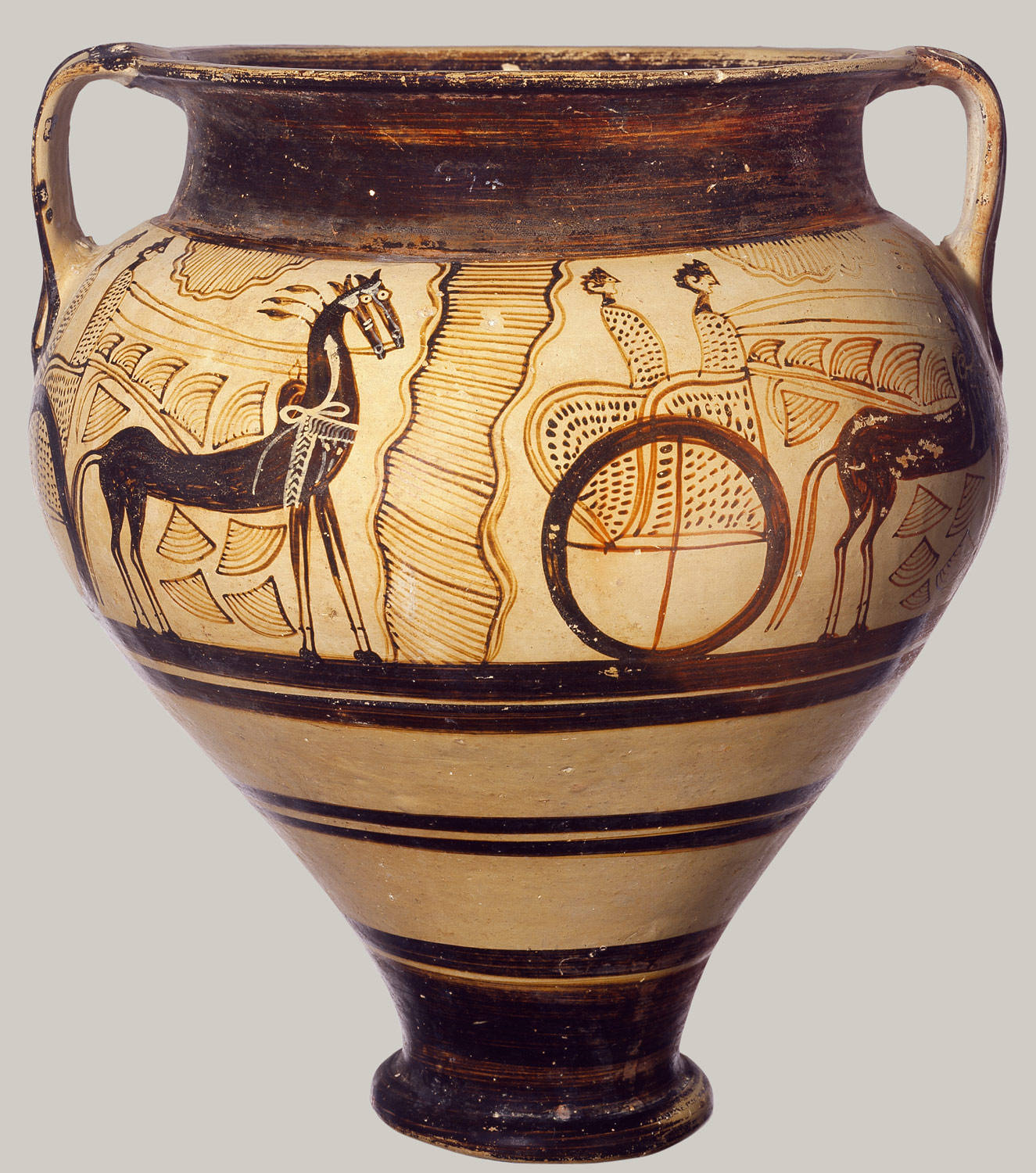
Perhaps 50 years later, there are Bronze Age Mycenaean chariots
image13mycen.jpg
but, at least as far as illustrations go, European domestic vehicle depictions are scarce, especially in contrast to those of military—or sport—vehicles. Here’s a 5th-century BC depiction of a wagon being used for a wedding,
image14grkwagon.jpg
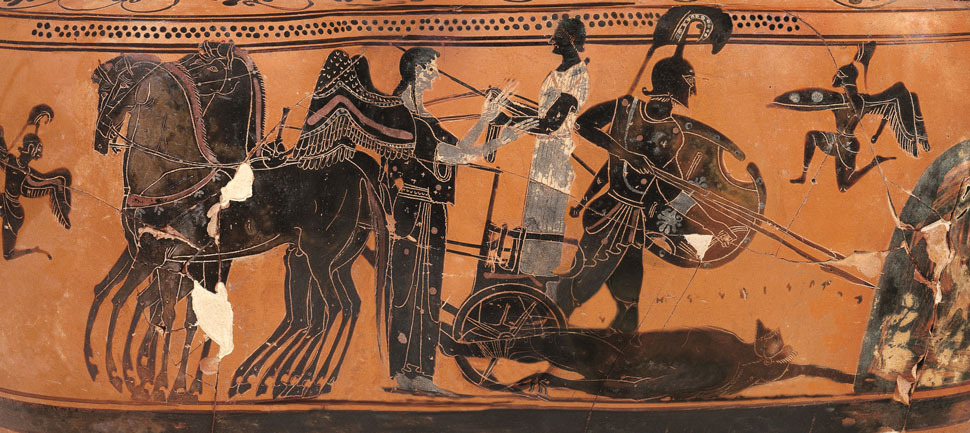
but we could then show you heaps of illustrations of chariots, used in very early Greece for warfare. You see them all over the Iliad, for example,
image15achilles.jpg
but chariots in the later Greek world were abandoned for warfare, although retained for racing, which was true for the Romans and for their successors, the Byzantines.
image16byzchar.jpg
We have lots more depictions of domestic vehicles from the Roman world, both carts
image17romancart.jpg
and wagons.
image18romwag.jpg
This shouldn’t be surprising, we suppose, given that the Romans built more than 50,000 miles of roads.
image19romrd
Judging by these depictions, it appears that the medieval world simply continued using Roman vehicle patterns, just as, where available, they continued to use Roman roads.
image19romcrt.jpg
image20medwag.png
For us, then Gandalf’s cart—which is not really described:
“At the end of the second week in September a cart came in through Bywater from the direction of Brandywine Bridge in broad daylight. An old man was driving it all alone…It had a cargo of fireworks…”
(The Fellowship of the Ring, Book One, Chapter 1, “A Long-expected Party”)
would follow what we see in manuscript illustrations.
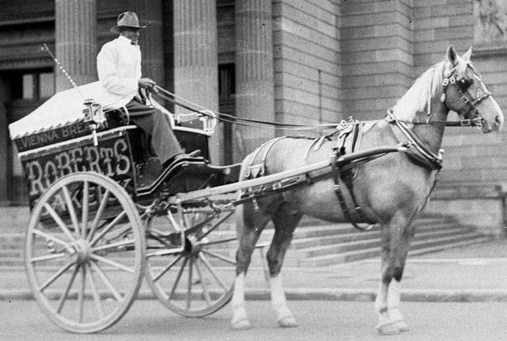
Tolkien might have been thinking of such illustrations, of course, but there is another possibility. In the late-Victorian world into which JRRT was born, horses still powered vehicles and delivery carts like this one
image21deliverycart.jpg
would have been a common site—even after the Great War. Perhaps he was thinking of something he might still have seen outside his window when he was young?
We’ll stop here for now, but will continue in Part II, where we’ll consider Farmer Maggot’s wagon and wains…

Thanks, as ever, for reading.
MTCIDC
CD

Prizes

26 Wednesday Jul 2017

Posted by Ollamh in Fairy Tales and Myths, Heroes, Imaginary History, Literary History, Narrative Methods

≈ Leave a comment

Tags

A Tale of Two Cities, Achilles, Admetus, Alcestis, Ancient Greece, Aphrodite, Archery, Atalanta, Baroness Orczy, chariots, Charles Dickens, Constantinople, contests, footrace, French Revolution, Greek, Heracles, Hippomenes, Icarius, Jacques-Louis David, King Oenomaus, King of Pherae, Lord Leighton Frederick, Odysseus, Olympia, Pelops, Penelope, The Death of Marat, The Odyssey, The Scarlet Pimpernel, Trojan War, Zeus

Welcome, as always, dear readers.
In our last posting, our second about archers, we talked about the archery contest which Penelope
image1penelope.jpg
arranged, as a way of finally ridding her house of a gang of mooching suitors. It was, in reality, a two-part contest:
1. the contestants were required to string Odysseus’ bow
2. then fire an arrow through—but the story as told in the Odyssey is a little confusing here—through a series of axe heads? Through the rings on the axe heads? Through rings on the shafts of the axes? The following illustrations will show you that there are all sorts of possibilities!
image2contest.jpg

image3contest.jpg

image4contest.jpg

image5contest.JPG
Odysseus, disguised as an old beggar, is the only one who can string the bow and fire it,
image6wyethody.jpg
and then goes on to begin picking off Penelope’s obnoxious suitors with it.
image7suitors.jpg
Prizes and women seem to be a not-uncommon theme in Greek mythology. When we were discussing Penelope and the archery contest, we also mentioned that there was an ancient story that Odysseus had actually won Penelope from her father, Icarius, in a footrace.
In general, Odysseus was regarded in Greece as neither a bowman nor a runner, but as the supreme trickster (he even has his own adjective, in fact polumetis, which we might translate “multiplotter”) but he is recorded in Book 23 of the Iliad as a runner, when he competes (and wins) in a footrace as part of the funeral games for Achilles’ beloved companion, Patroclus.
image9jldavid.jpg
(This amazing piece, from 1778, is by the “painter of the French Revolution”, Jacques-Louis David, 1748-1825. In his earlier career, David had painted grand, florid things like this, often with a classical theme. When the Revolution came, David became an enthusiast, as well as one of its visual recorders, his most dramatic painting being “The Death of Marat”, commemorating the assassination of Jean-Paul Marat, a major revolutionary, killed in his bath in 1793.
10amarat.jpg
The era of the French Revolution has been a favorite of ours for years, probably originally because we grew up with Charles Dickens’ A Tale of Two Cities, 1859,
image10tale.jpg
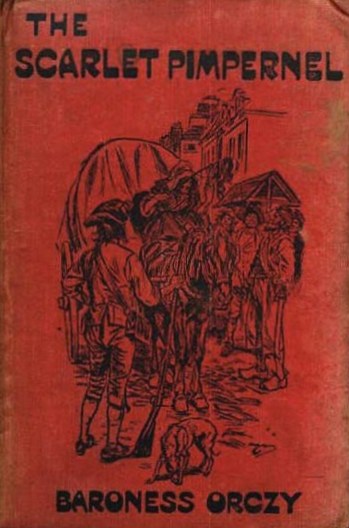
and the Baroness Orczy’s The Scarlet Pimpernel, 1903-05.
image11spimp1908.jpg
We plan to write about the Pimpernel in a later posting—he’s a very important figure for 20th-century images of heroes with double-identities, being, it would seem, the original.)
It is worth wondering whether, in the choice of the bow and the archery contest, Penelope was actually indicating that she already knew the identity of the beggar. Certainly it put a deadly weapon into the hands of someone who immediately used it to rid her of the suitors. If that’s true, then offering herself as a prize was not a kind of passive surrender, but the beginning of an attack on the occupiers. This would give us a Penelope who was the very opposite of the girl offered as a prize in her father’s footrace. But that footrace reminded us of an earlier one, in which the prize stated the terms—and then enforced them.
Several generations before the Trojan War, Atalanta was a princess and huntress,
image12atalanta.jpg
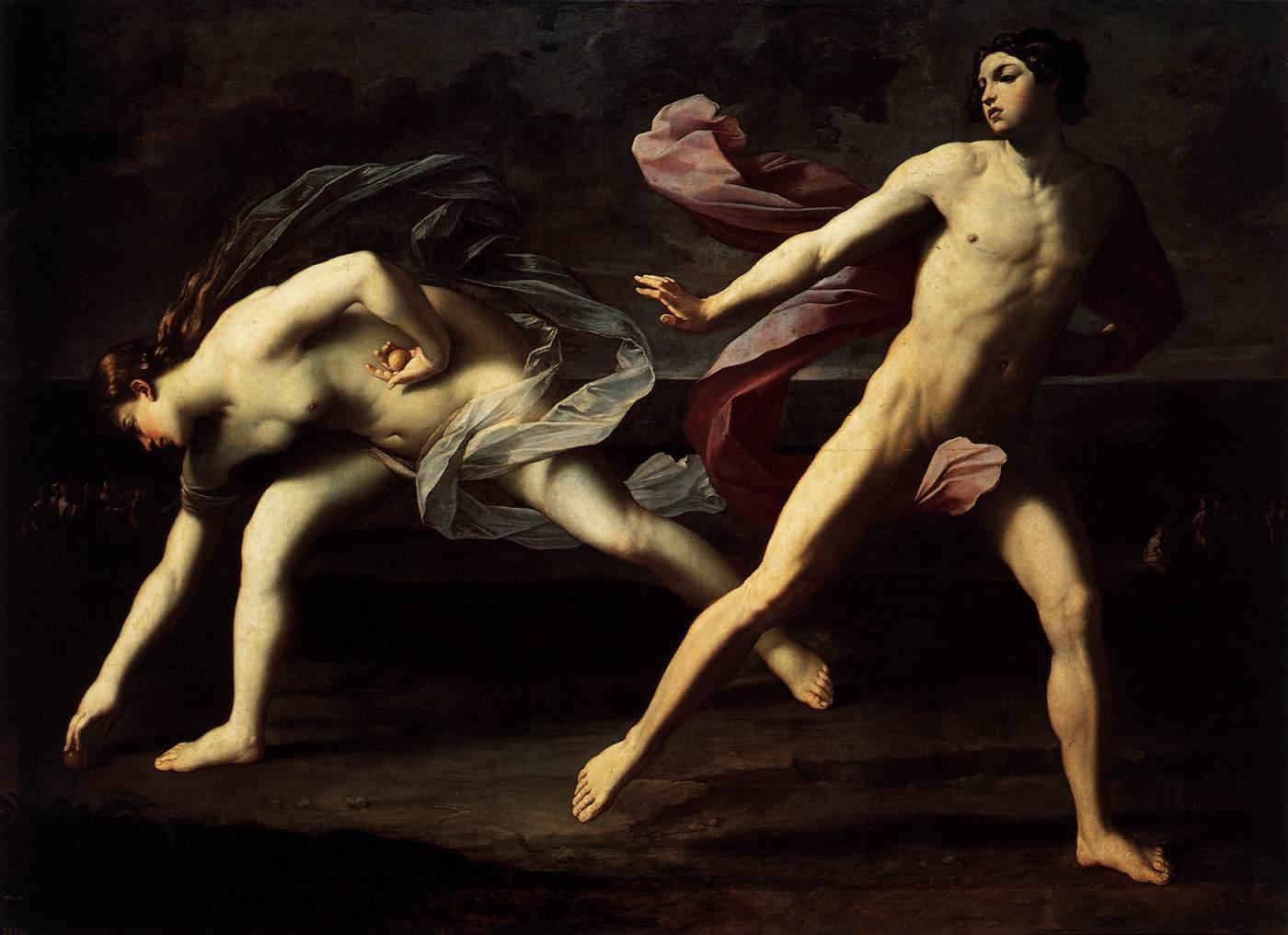
who was pressed by her father to marry. She agreed—but only on the condition that a suitor would have to join in a footrace with her and, if she beat him, she would kill him. A number of suitors tried and failed and paid the price before Hippomenes, brighter than the rest, knowing that he couldn’t outrace her, outthought her, praying to Aphrodite for help. The goddess gave him three golden apples and, as the two raced and Hippomenes was being outrun, he tossed one of the apples to the side. Atalanta was distracted and thus slowed until, after the third apple, Hippomenes won the race—and Atalanta.
image13renirace.jpg
The pattern of winning brides by races is repeated not only on foot, however. In another pre-Trojan-War story, King Oenomaus took fright from a prophecy that he would be killed by his son-in-law. When suitors came for his daughter, Hippodamia, he demanded that they join him in a chariot contest: they would race, but it was more a race for life than a sport, as, if Oenomaus caught up with the suitor, he would kill him.
So far, Oenomaus had managed to polish off eighteen suitors before Pelops, son of King Tantalus, appeared. Like Hippomenes, he was not the most scrupulous of competitors. (In one version of the story, Oenomaus displayed the heads of the unsuccessful suitors on the pillars of his palace—this might have proved a strong incentive to cheat!) In Pelops’ case, he persuaded Oenomaus’ charioteer to replace the bronze lynchpins (the pins which hold the chariot wheels on the axles) with ones made of wax and, in the (literal) heat of the contest, they melted and Oenomaus was dragged to his death. (And so the death-by-son-in-law prophecy came true!) Pelops then betrayed and murdered the charioteer, who, dying, put a curse upon Pelops and his descendants.
image14oenomaus.png
Supposedly, the chariot race which formed a central part of the Olympic games in later centuries
image15chariotrace.jpg
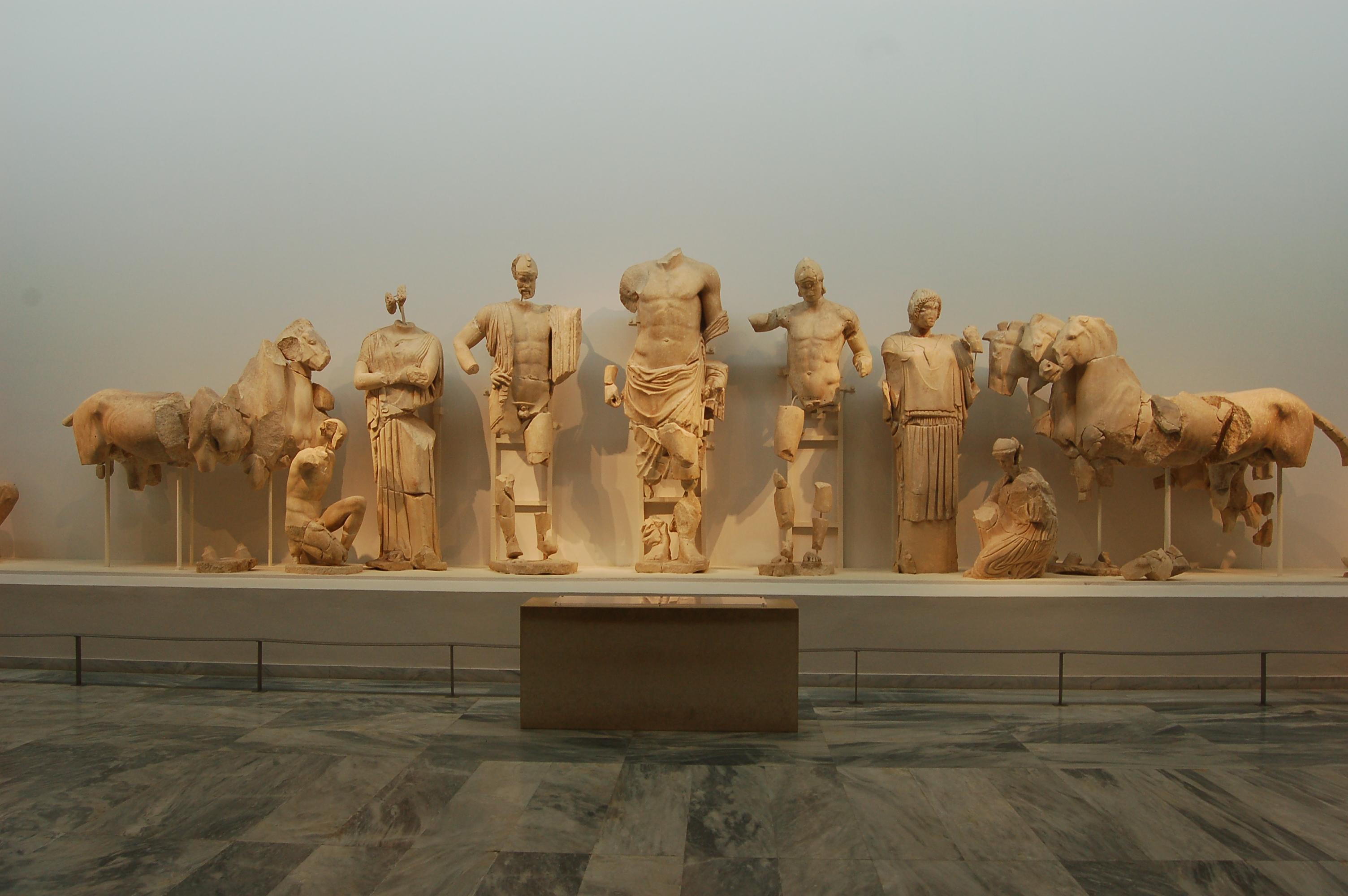
was either in commemoration of the death of Oenomaus or a celebration of the victory of Pelops. In fact, we have, on the eastern pediment (that’s the big triangular bit just below the roof) of the temple of Zeus at Olympia
image16templezeus.jpg
the main characters in the story depicted.
image17pediment.jpg
This was a very grand temple and contained one of the Seven Wonders of the Ancient World, a giant seated statue of Zeus, made of ivory and gold.
image18zeus.jpg
The statue didn’t survive the eastern Roman government’s attacks on pre-Christian culture, however, either being destroyed in a fire in the temple in 426AD, or in a fire at the eastern capital of Constantinople in 475AD.
In fact, the temple at Olympia itself was badly damaged in that fire of 426 and its whole structure was tumbled in earthquakes in 551 and 552AD, its columns collapsing onto the ground into lines of column drums like piles of stacked coins.
image19astackedcoins.jpg
image20tempzeus.jpg
Seeing that fallen building, we wonder whether Oenomaus’ charioteer’s curse extended to the site of the famous (and deadly) race!
To all of this mayhem around women as prizes at athletic events, we would add one happy occasion. Among the stories about Heracles, there was that of his wrestling match with death. This was not done to win a prize for himself, but to rescue Alcestis, the heroic wife of Admetus, King of Pherae, who had given her life to save her husband. (In fact, Admetus had won Alcestis in a challenge—but that’s a story for another posting!) Having brought her back, Heracles, to tease Admetus, says, truthfully, that Alcestis was a woman he had won in a contest—but neglects to say with whom he’d wrestled!
image21heraclesanddeath.jpg
(This, by the way, is a painting by Frederick, Lord Leighton, 1830-1896, who built much of his reputation on his reconstructions of the Greek classical and mythological world. We plan a future posting on him and on other classical myth-painters—among whom, in fact, was David, whom we mentioned above.)
Thanks, as ever, for reading.
MTCIDC
CD

The Doubtful Sea Series Facebook Page

The Doubtful Sea Series Facebook Page

  • Ollamh

Categories

  • Artists and Illustrators
  • Economics in Middle-earth
  • Fairy Tales and Myths
  • Films and Music
  • Games
  • Heroes
  • Imaginary History
  • J.R.R. Tolkien
  • Language
  • Literary History
  • Maps
  • Medieval Russia
  • Military History
  • Military History of Middle-earth
  • Narnia
  • Narrative Methods
  • Poetry
  • Research
  • Star Wars
  • Terra Australis
  • The Rohirrim
  • Theatre and Performance
  • Tolkien
  • Uncategorized
  • Villains
  • Writing as Collaborators
Follow doubtfulsea on WordPress.com

Across the Doubtful Sea

Recent Postings

  • On the Road(s) Again—Again November 26, 2025
  • On the Road(s) Again November 19, 2025
  • To Bree (Part 2) November 12, 2025
  • To Bree (Part 1) November 5, 2025
  • A Plague o’ Both—No, o’ All Your Houses! October 29, 2025
  • It’s in Writing (2:  I’st a Prologue, or a Poesie for a Ring?) October 22, 2025
  • It’s in Writing (1) October 15, 2025
  • King Trotter? October 8, 2025
  • The Voices in His Head  October 2, 2025

Blog Statistics

  • 101,966 Views

Posting Archive

  • November 2025 (4)
  • October 2025 (5)
  • September 2025 (4)
  • August 2025 (4)
  • July 2025 (5)
  • June 2025 (4)
  • May 2025 (4)
  • April 2025 (5)
  • March 2025 (4)
  • February 2025 (4)
  • January 2025 (5)
  • December 2024 (4)
  • November 2024 (4)
  • October 2024 (5)
  • September 2024 (4)
  • August 2024 (4)
  • July 2024 (5)
  • June 2024 (4)
  • May 2024 (5)
  • April 2024 (4)
  • March 2024 (4)
  • February 2024 (4)
  • January 2024 (5)
  • December 2023 (4)
  • November 2023 (5)
  • October 2023 (4)
  • September 2023 (4)
  • August 2023 (5)
  • July 2023 (4)
  • June 2023 (4)
  • May 2023 (5)
  • April 2023 (4)
  • March 2023 (5)
  • February 2023 (4)
  • January 2023 (4)
  • December 2022 (4)
  • November 2022 (5)
  • October 2022 (4)
  • September 2022 (4)
  • August 2022 (5)
  • July 2022 (4)
  • June 2022 (5)
  • May 2022 (4)
  • April 2022 (4)
  • March 2022 (5)
  • February 2022 (4)
  • January 2022 (4)
  • December 2021 (5)
  • November 2021 (4)
  • October 2021 (4)
  • September 2021 (5)
  • August 2021 (4)
  • July 2021 (4)
  • June 2021 (5)
  • May 2021 (4)
  • April 2021 (4)
  • March 2021 (5)
  • February 2021 (4)
  • January 2021 (4)
  • December 2020 (5)
  • November 2020 (4)
  • October 2020 (4)
  • September 2020 (5)
  • August 2020 (4)
  • July 2020 (5)
  • June 2020 (4)
  • May 2020 (4)
  • April 2020 (5)
  • March 2020 (4)
  • February 2020 (4)
  • January 2020 (6)
  • December 2019 (4)
  • November 2019 (4)
  • October 2019 (5)
  • September 2019 (4)
  • August 2019 (4)
  • July 2019 (5)
  • June 2019 (4)
  • May 2019 (5)
  • April 2019 (4)
  • March 2019 (4)
  • February 2019 (4)
  • January 2019 (5)
  • December 2018 (4)
  • November 2018 (4)
  • October 2018 (5)
  • September 2018 (4)
  • August 2018 (5)
  • July 2018 (4)
  • June 2018 (4)
  • May 2018 (5)
  • April 2018 (4)
  • March 2018 (4)
  • February 2018 (4)
  • January 2018 (5)
  • December 2017 (4)
  • November 2017 (4)
  • October 2017 (4)
  • September 2017 (4)
  • August 2017 (5)
  • July 2017 (4)
  • June 2017 (4)
  • May 2017 (5)
  • April 2017 (4)
  • March 2017 (5)
  • February 2017 (4)
  • January 2017 (4)
  • December 2016 (4)
  • November 2016 (5)
  • October 2016 (6)
  • September 2016 (5)
  • August 2016 (5)
  • July 2016 (5)
  • June 2016 (5)
  • May 2016 (4)
  • April 2016 (4)
  • March 2016 (5)
  • February 2016 (4)
  • January 2016 (4)
  • December 2015 (5)
  • November 2015 (5)
  • October 2015 (4)
  • September 2015 (5)
  • August 2015 (4)
  • July 2015 (5)
  • June 2015 (5)
  • May 2015 (4)
  • April 2015 (3)
  • March 2015 (4)
  • February 2015 (4)
  • January 2015 (4)
  • December 2014 (5)
  • November 2014 (4)
  • October 2014 (6)
  • September 2014 (1)

Blog at WordPress.com.

  • Subscribe Subscribed
    • doubtfulsea
    • Join 78 other subscribers
    • Already have a WordPress.com account? Log in now.
    • doubtfulsea
    • Subscribe Subscribed
    • Sign up
    • Log in
    • Report this content
    • View site in Reader
    • Manage subscriptions
    • Collapse this bar
 

Loading Comments...