• About

doubtfulsea

~ adventure fantasy

Tag Archives: books

Terror Weapon

15 Wednesday May 2024

Posted by Ollamh in Uncategorized

≈ Leave a comment

Tags

books, Fantasy, hiking, J.R.R. Tolkien, lord-of-the-rings

Welcome, dear readers, as always.

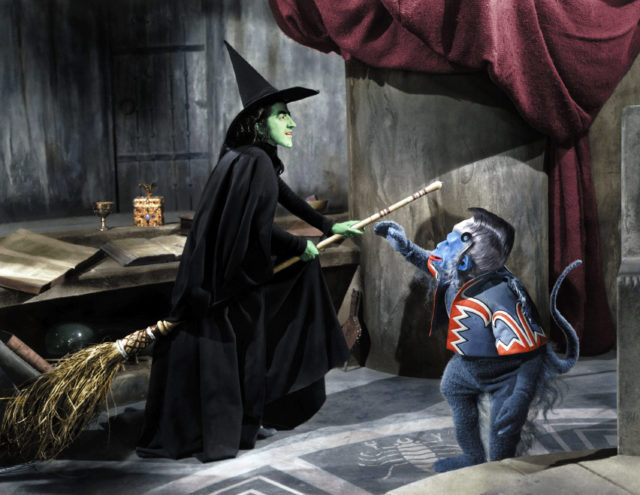
If you grew up, as I did, with the 1939 film, The Wizard of Oz,

but had never read the original,

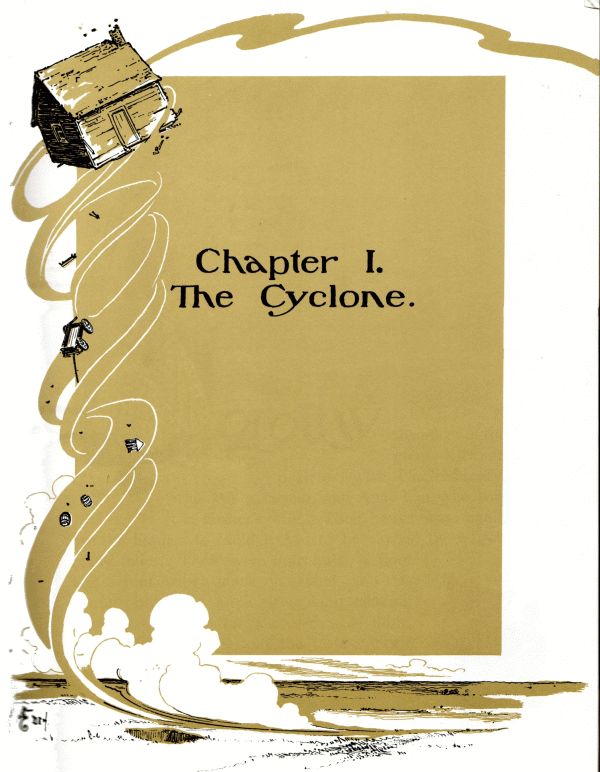
L. Frank Baum’s The Wonderful Wizard of Oz, 1900,

you would be surprised to open the book and find that Chapter 1 is entitled “The Cyclone”,

which, considering the use of that terrifying force of nature in the story isn’t surprising, but that “Miss Almira Gulch”, the initial incarnation of the story’s main antagonist, with her wonderful last name (a “gulch” is, as Etymonline tells us, a “deep ravine” suggesting that Miss Gulch is empty—and treacherous, as “ to dry gulch” someone is archaic Wild West slang for “to ambush”) is not to be seen.

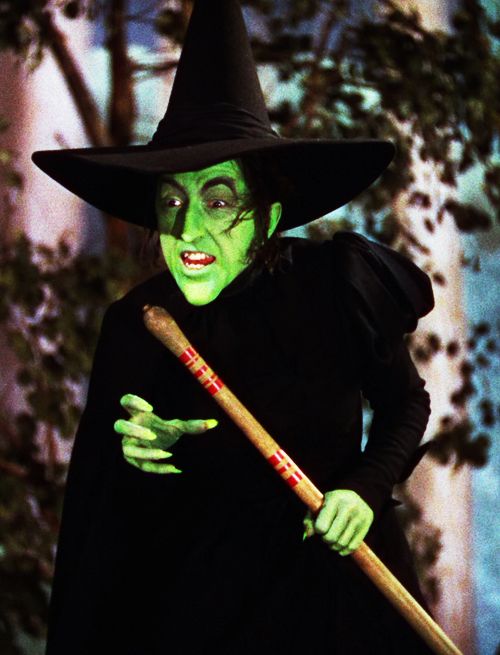
As a small child, I found almost everything about her disturbing.  As someone who, initially, wanted to deal with Toto and had the economic power to do it (shades of 1930s social commentary about the 1%), she was bad enough.  It was the green skin of her next incarnation and those dagger-like fingernails, however,

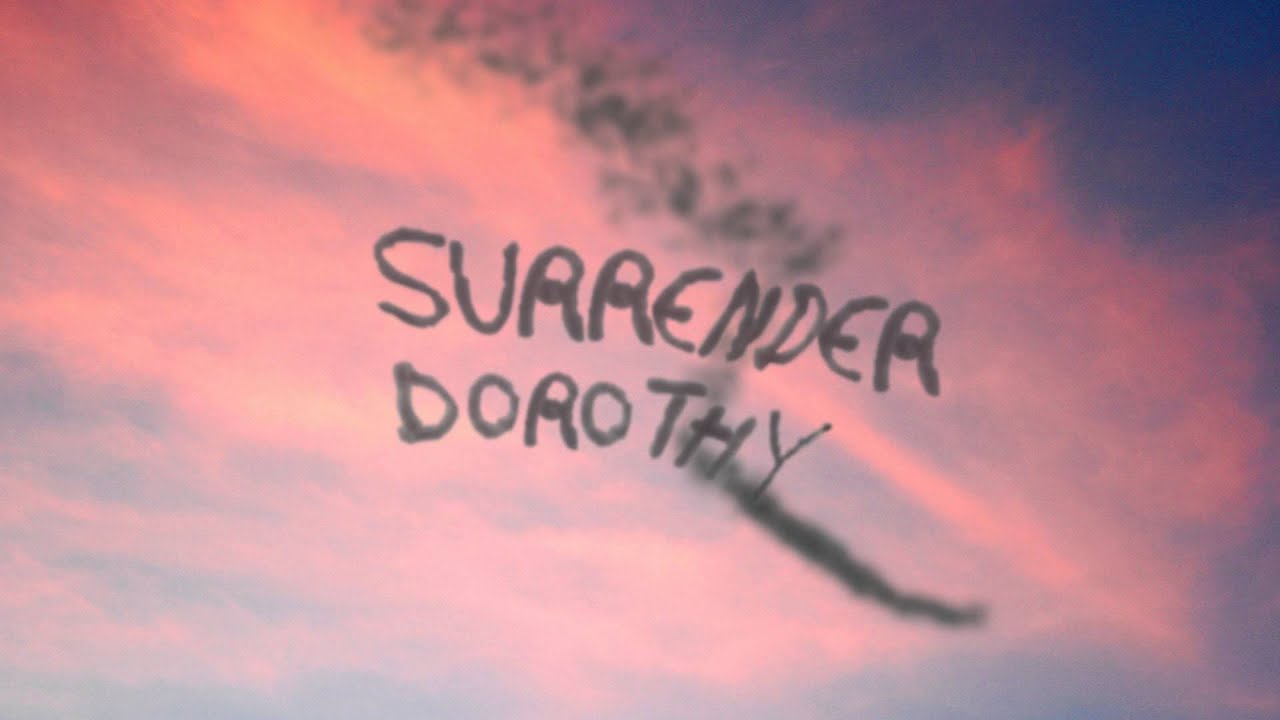
which were at the edge of nightmares, and even more so the menace of flight—not only her own skywriting,

but her nasty little airborne monkeys.

These seemed almost too prescient for what was about to happen in the real world as, on 1 September, 1939, only about two weeks after the Hollywood premiere of the film on 15 August, Germany invaded Poland, and, in less than a year, Denmark, Holland, Norway, and France, major weapons being a deadly form of those flying monkeys—

(by Mike Chappell, a favorite military artist)

paratroopers, and dive bombers, the notorious  Ju87, “Stuka” (short for “Sturzkampfflugzeug”—“dive bomber”).

To add to the effect of having such a thing racing down to drop a bomb on you, sirens were attached to the landing gear or wings, the so-called “Jericho trumpets”  (You can read more about them here:  https://www.warhistoryonline.com/instant-articles/trumpets-jericho-luftwaffe.html And you can hear one here:  https://www.youtube.com/watch?v=80bOdm2P9Y8 ), giving a wailing, screeching sound to the attacker in hopes of destroying morale even before a bomb hit.  Although designed to be support for infantry and armor, numbers were employed in the air campaign against Britain and, although Oxford was never attacked as the great ports and manufacturing centers were, I wonder if Tolkien, as a volunteer air raid warden, ever heard that sound overhead.

Even if it only appeared in a newsreel, it must have been an unforgettable noise and my wondering brought me to this:

“And Minas Morgul answered.  There was a flare of livid lightnings:  forks of blue flame springing up from the tower and from the encircling hills into the sullen clouds.  The earth groaned; and out of the city there came a cry.  Mingled with harsh high voices as of birds of prey, and the shrill neighing of horses wild with rage and fear there came a rending screech, shivering, rising swiftly to a piercing pitch beyond the range of hearing.  The hobbits wheeled round towards it, and cast themselves down, holding their hands upon their ears.”  (The Two Towers, Book Four, Chapter 8, “The Stairs of Cirith Ungol”)

In Minas Tirith, Pippin heard something very similar:

“Suddenly as they talked they were stricken dumb, frozen as it were to listening stones.  Pippin cowered down with his hands pressed to his ears…”

Not Stukas diving out of the clouds to bomb the city,

but

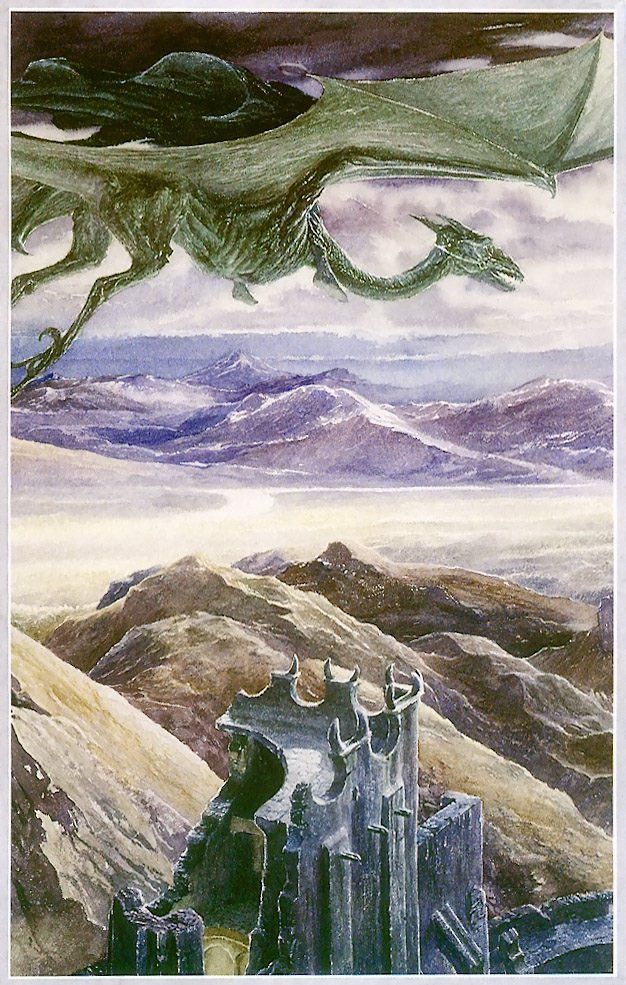
“…now wheeling swiftly across it, like shadows of untimely night, he saw in the middle airs below him five birdlike forms, horrible as carrion-fowl yet greater than eagles, cruel as death.  Now they swooped near, venturing almost within bowshot of the walls, now they circled away.

‘Black Riders!’ muttered Pippin.  ‘Black Riders of the air!’ “

And this was not the first time that any of the hobbits had heard that terrible sound:

“Pippin knew that shuddering cry that he had heard:  it was the same that he had heard long ago in the Marish of the Shire, but now it was grown in power and hatred, piercing the heart with a poisonous despair.”

It’s unclear if Frodo and Sam had heard the same cry at Cirith Ungol, but certainly what Pippin heard and to which he reacted violently:

“Another long screech rose and fell, and he threw himself back again from the wall, panting like a hunted animal.”  (The Return of the King, Book Five, Chapter 4, “The Siege of Gondor”)

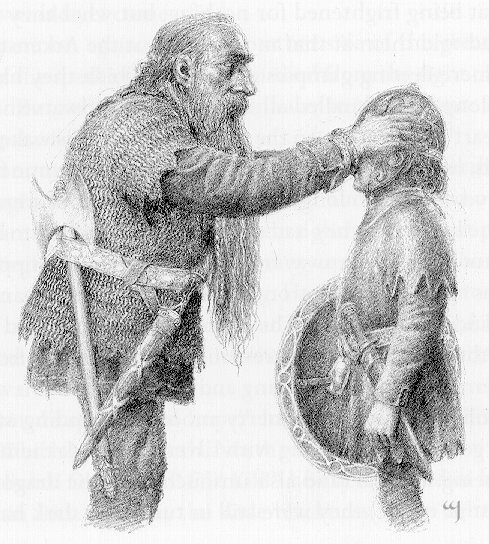
(Alan Lee)

had the same effect—and, in fact, the same effect which Stukas were intended to have upon their victims—just as the Wicked Witch, aka, Miss Gulch—had had a similar effect upon me as a little boy,

even without her creepy little simian assistants.

Thanks, as ever, for reading.

Stay well,

When going outdoors, always cast a wary eye upwards,

And remember that, as always, there’s

MTCIDC

O

PS

In case you don’t have a first edition of The Wonderful Wizard of Oz with its original illustrations, here it is for you:  https://www.youtube.com/watch?v=80bOdm2P9Y8

Yarrow

10 Wednesday Apr 2024

Posted by Ollamh in Uncategorized

≈ Leave a comment

Tags

books, english-literature, poetry, reading, Sir Walter Scott

As always, dear readers, welcome.

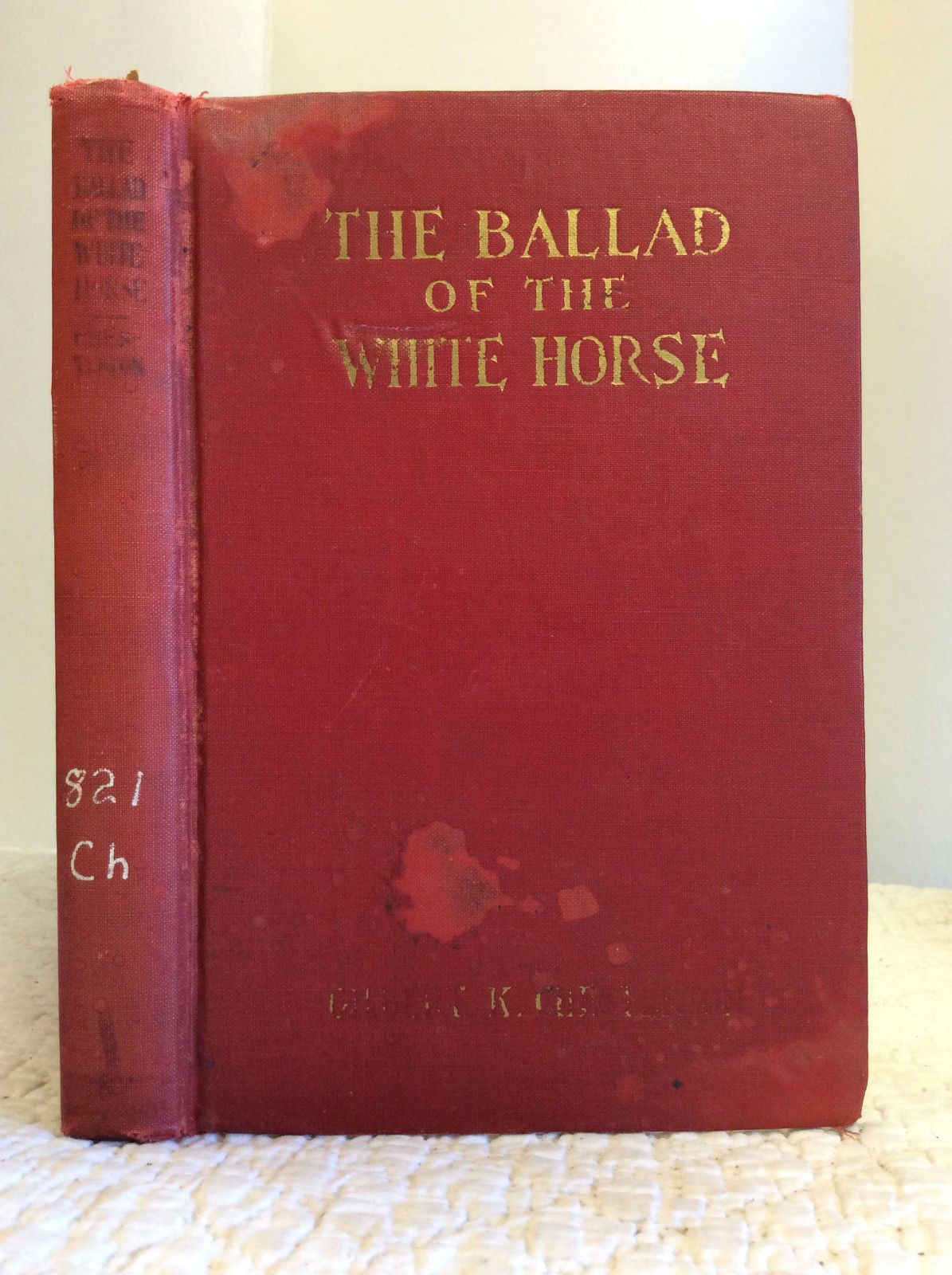
I don’t know how Tolkien thought about ballads in general, but, about what was termed a modern “ballad”, The Ballad of the White Horse, 1911,

by its author, G.K. Chesterton (1874-1936),

he had this to say:

“P[riscilla]…has been wading through The Ballad of the White Horse for the last many nights; and my efforts to explain the obscurer parts to her convince me that it is not as good as I thought.  The ending is absurd.  The brilliant smash and glitter of the words and phrases (when they come off, and not mere loud colours) cannot disguise the fact that G.K.C. knew nothing whatever about the ‘North’, heathen or Christian.”  (from an airgraph to Christopher Tolkien, 3 September, 1944, Letters, 131)

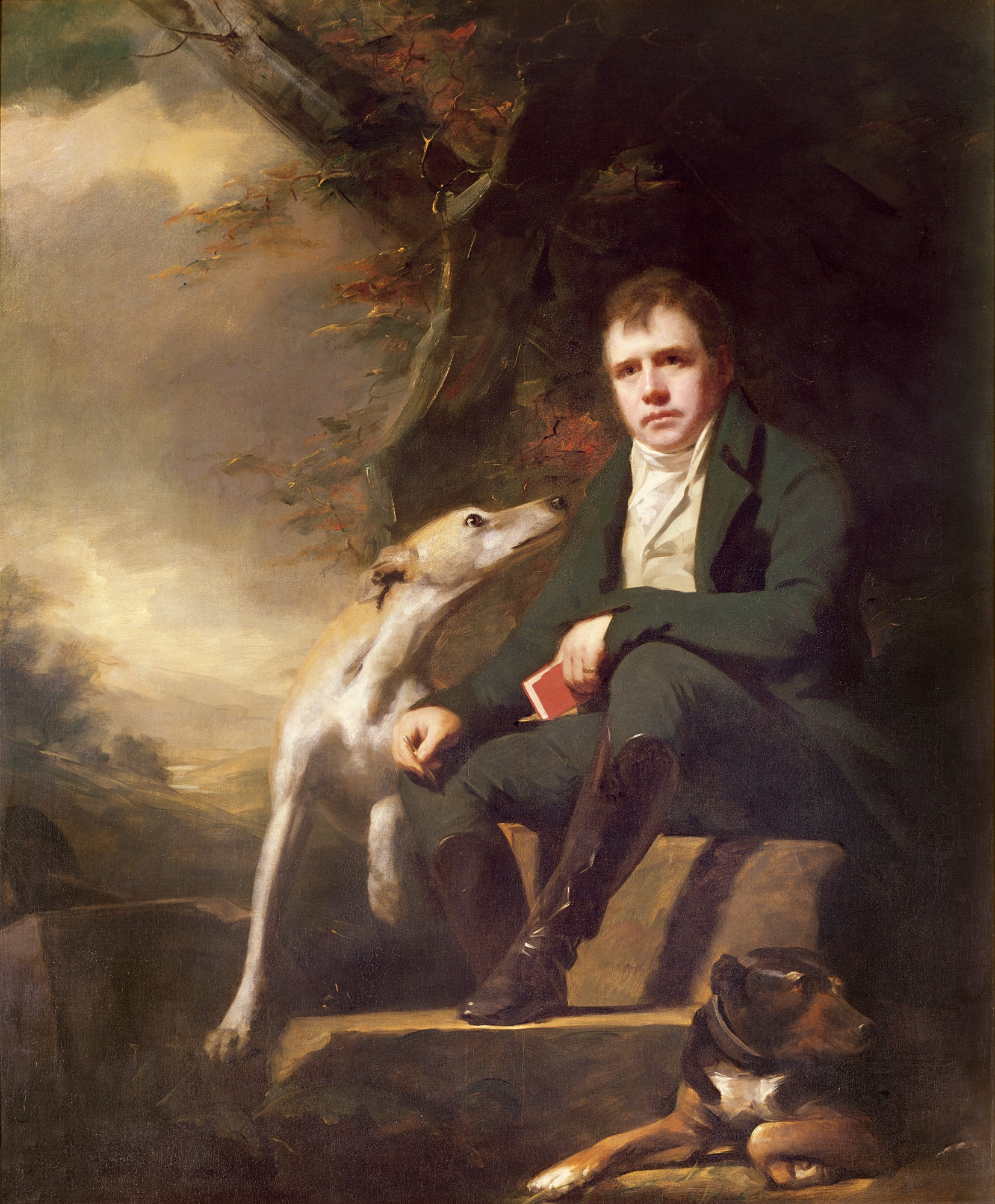
For myself, I would say that, although I’ve been reading (and singing) old ballads for a long time, I don’t think of them as having “smash and glitter”, but rather, at their best, being plain and, often, grim—and perhaps it’s in part why they have the lure they do—and have had, since at least early Romanticism.  I’m presuming that that’s a reason why, for example, following collectors who date back at least to the early 18th century, Sir Walter Scott (1770-1832),

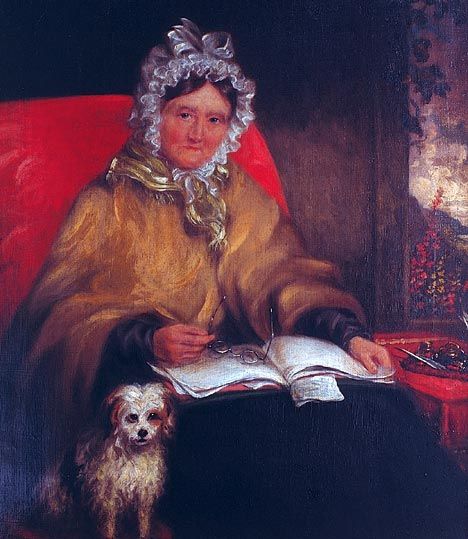
XCF277642 Portrait of Sir Walter Scott and his dogs (oil on canvas) by Raeburn, Sir Henry (1756-1823); Private Collection; (add.info.: Walter Scott (1771-1832);); Scottish, out of copyright

(portrait by Sir Henry Raeburn—who clearly captured Scott as Scott wanted to be remembered—a reader in a romantic atmosphere—with his dogs)

published Minstrelsy of the Scottish Border (1802-1830—Scott kept revising and revising),

which included not only ballads he had personally collected or had from others, but also contemporary imitations of what he admired.  (There’s a very useful article here:  https://en.wikipedia.org/wiki/Minstrelsy_of_the_Scottish_Border on Scott and his working methods and even a site about a combined Scots/German project on the collection here:  http://walterscott.eu/ )

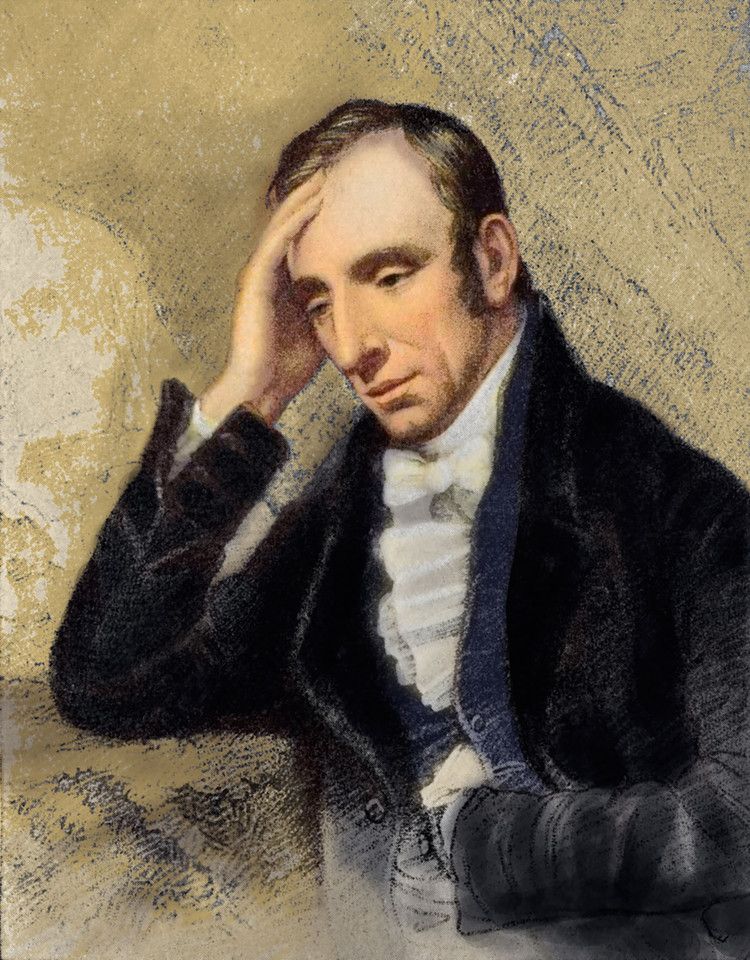
One of the ballads was clearly in the mind of another author, William Wordsworth (1770-1850),

“The Dowie Dens o Yarrow” (in modern English, perhaps something like “The Gloomy/Melancholy Dells of Yarrow”), when he wrote a very interesting poem in 1803, “Yarrow Unvisited”.

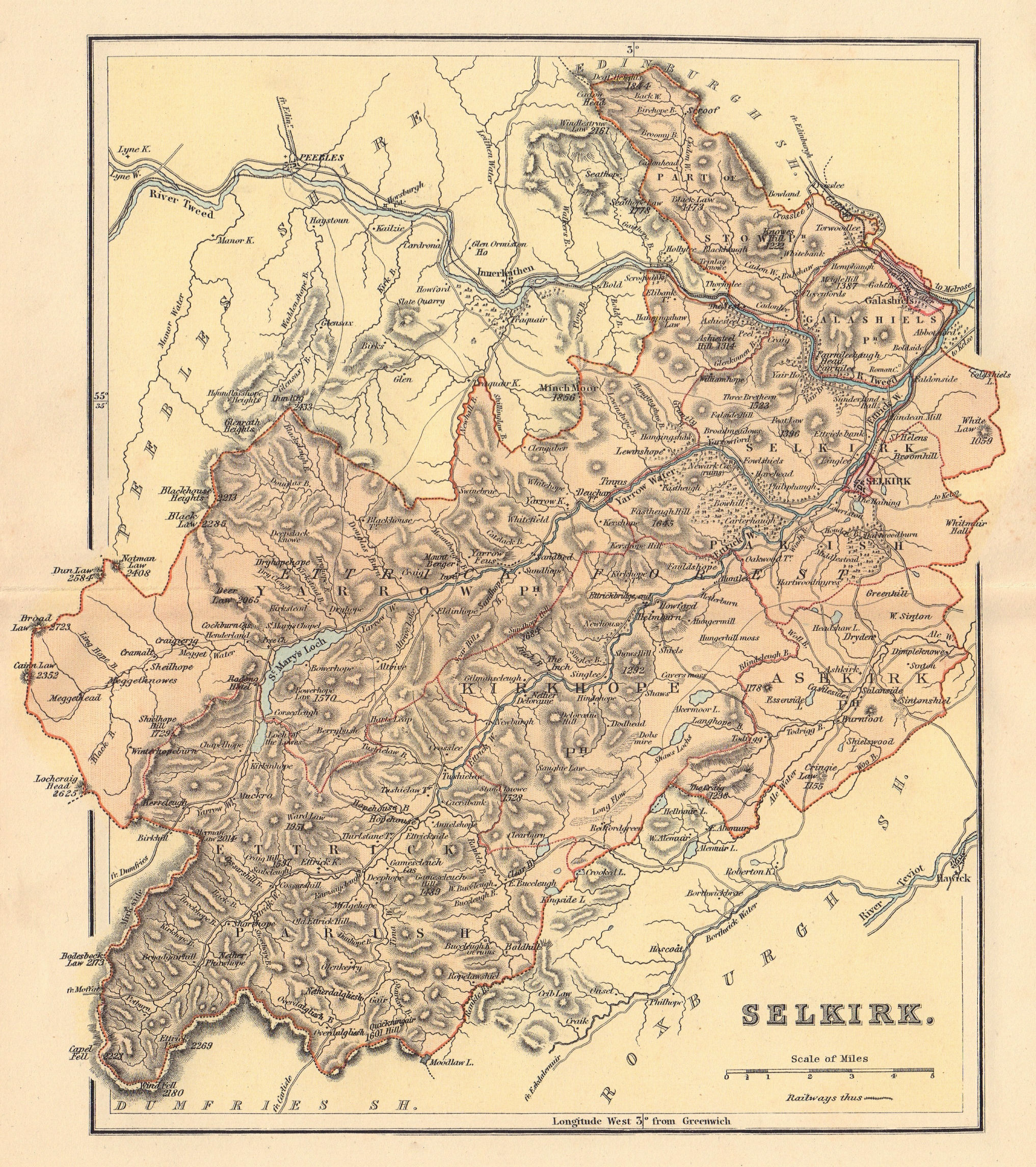
Yarrow itself is a narrow river which is a tributary of the River Tweed.  Here’s a late 19th-century map to help you to locate it—find St Mary’s Loch and follow the river line towards the Tweed.

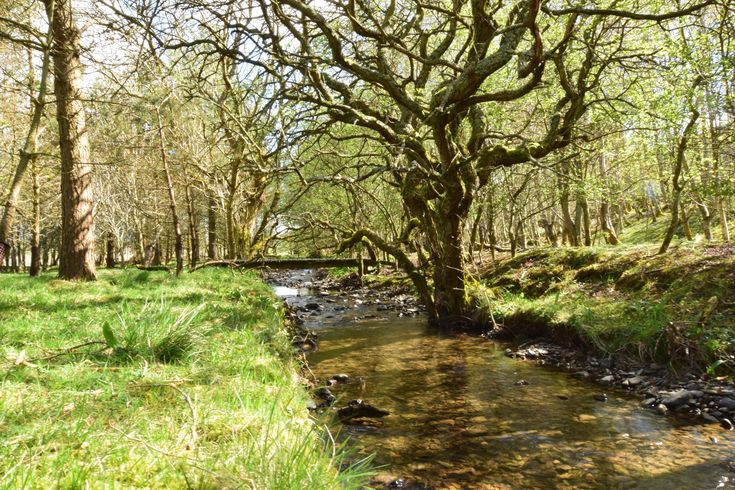
And here’s the Yarrow in full spate—appropriately in a rather stark early 20th-century photo—

The original ballad—and there are a lot of variant forms—tells the story of a lady to be fought over by a series of lords—and  their rival, in some versions, a “plough-boy lad of Yarrow” (to see variants, here are those published in FJ Child’s, 1825-1896, The English and Scottish Popular Ballads, 1882-1898, known as “Child 214” and by the title “The Braes of Yarrow” (that is, “The Hillsides of Yarrow”):   https://sacred-texts.com/neu/eng/child/ch214.htm  )  The rival defeats the lords, but is then treacherously stabbed from behind, often by the lady’s brother.  (You can hear the version I first heard and learned, sung by Ewan McColl, here:  https://www.youtube.com/watch?v=Vfsv8zUdqKM Be warned:  this performance is in line with older traditional performances, which I’ve always preferred, but might be rough, if you’re used to smoother folk singers.) 

Wordsworth, and his sister, Dorothy, (1771-1855)

had made a brief tour of southern Scotland in the late summer of 1803 and had met Walter Scott there, fresh from publishing the first edition of Minstrelsy.  I suspect that the combination of their tour, that meeting, and Scott’s collection all came together in a poem which Wordsworth then wrote, probably in the early fall of 1803, “Yarrow Unvisited”.  I’ve always liked this poem because it’s not about what Wordsworth and Dorothy did see (this becomes the subject of the later “Yarrow Visited” of 1814—a good background article:  https://en.wikipedia.org/wiki/Yarrow_poems_(Wordsworth) ), but the fact that, because they didn’t see Yarrow, they could still imagine it—perhaps imagination, Wordsworth even suggests, is better, and seeing might spoil it—and because there was always the future possibility of actually seeing it.  (I am a big fan of Dorothy’s work—she had a wonderful eye for the natural world and a shrewd eye for people—and you can read her “Recollections of a Tour Made in Scotland” here:  https://www.gutenberg.org/files/42856/42856-h/42856-h.htm )

Here’s Wordsworth’s poem, the “winsome Marrow” is Dorothy, the word  “marrow” meanIng “equal/match”, being a description of the lady in the ballad:

“FROM Stirling Castle we had seen

The mazy Forth unravell’d,

Had trod the banks of Clyde and Tay

And with the Tweed had travell’d;

And when we came to Clovenford,

Then said my “winsome Marrow,”

“Whate’er betide, we’ll turn aside,

And see the Braes of Yarrow.”

“Let Yarrow folk, frae Selkirk town,

Who have been buying, selling,

Go back to Yarrow, ’tis their own,

Each maiden to her dwelling!

On Yarrow’s banks let herons feed,

Hares couch, and rabbits burrow;

But we will downward with the Tweed,

Nor turn aside to Yarrow.

“There’s Gala Water, Leader Haughs,

Both lying right before us;

And Dryburgh, where with chiming Tweed

The lintwhites sing in chorus;

There’s pleasant Tiviotdale, a land

Made blithe with plough and harrow:

Why throw away a needful day

To go in search of Yarrow?

“What’s Yarrow but a river bare

That glides the dark hills under?

There are a thousand such elsewhere

As worthy of your wonder.”—

Strange words they seem’d of slight and scorn;

My true-love sigh’d for sorrow,

And look’d me in the face, to think

I thus could speak of Yarrow!

“Oh, green,” said I, “are Yarrow’s holms,

And sweet is Yarrow flowing!

Fair hangs the apple frae the rock,

But we will leave it growing.

O’er hilly path and open strath

We’ll wander Scotland thorough;

But, though so near, we will not turn

Into the dale of Yarrow.

“Let beeves and home-bred kine partake

The sweets of Burn-mill meadow;

The swan on still Saint Mary’s Lake

Float double, swan and shadow!

We will not see them—will not go

To-day, nor yet to-morrow;

Enough if in our hearts we know

There’s such a place as Yarrow.

“Be Yarrow stream unseen, unknown!

It must, or we shall rue it:

We have a vision of our own,

Ah! why should we undo it?

The treasured dreams of times long past,

We’ll keep them, winsome Marrow!

For when we’re there, although ’tis fair

’Twill be another Yarrow!

“If Care with freezing years should come,

And wandering seem but folly,—

Should we be loth to stir from home,

And yet be melancholy;

Should life be dull, and spirits low,

’Twill soothe us in our sorrow

That earth has something yet to show,

The bonny holms of Yarrow!”

Although Wordsworth doesn’t use a ballad metre here, he cleverly echoes the sound of the 4-line stanzas in the older poem, keeping that word “Yarrow” at the end of each stanza, and rhyming or suggesting rhyme, in the second line to match it, following this Child version (214Q):

“There lived a lady in the West,

I ne’er could find her marrow;

She was courted by nine gentlemen,

And a plough-boy lad in Yarrow.”

No “smash and glitter” here, but, in the ballad, grimness and plainness and even fierceness, and, in Wordsworth’s poem, a quiet, playful thoughtfulness and, in neither, what Tolkien said of his daughter, Priscilla’s efforts with “The Ballad of the White Horse”, a need to “wade through”—although, one could always wade the Yarrow…

As ever, thanks for reading.

Stay well,

Watch your back,

And remember that there’s always

MTCIDC

O

PS

So that you can decide for yourself about that “smash and glitter”, here’s Chesterton’s poem for you:  https://www.gutenberg.org/files/1719/1719-h/1719-h.htm   It’s interesting that JRRT comments that he doesn’t think that Chesterton knew anything about the “North”—a subject upon which Tolkien himself was passionate—see his anger at the Nazis for their pirating of the subject, in his letter to Michael Tolkien, 9 June, 1941, Letters, 77)—as Chesterton boldly states, in his “Prefatory Note” he’s perfectly willing to admit that what he writes isn’t really historical and that he’s accepting myth even as he is making his own:

“This ballad needs no historical notes, for the simple reason that it does not profess to be historical. All of it that is not frankly fictitious, as in any prose romance about the past, is meant to emphasize tradition rather than history. King Alfred is not a legend in the sense that King Arthur may be a legend; that is, in the sense that he may possibly be a lie. But King Alfred is a legend in this broader and more human sense, that the legends are the most important things about him.”

PPS

If you would like to see Scott’s version of the ballad, it’s here:  https://www.gutenberg.org/ebooks/12882  All three volumes of the Scott are available here at Gutenberg.  They appear to be the 3rd edition of 1806.  For the various Child variants in Vol.3 of his collection, see:  https://archive.org/details/englishandscott07unkngoog/page/n8/mode/2up  This—and all 7 other volumes are available at the Internet Archive. 

PPPS

A “holm” in the Wordsworth is—I’m quoting “Etymonline” here:

“small island in a river; river meadow,” late Old English, from Old Norse holmr “small island,” especially in a river or bay, or cognate Old Danish hulm, from Proto-Germanic *hul-maz, from PIE root *kel- (2) “to be prominent; hill.” Obsolete, but preserved in place names, where it has various senses derived from the basic one of “island:” “‘raised ground in marsh, enclosure of marginal land, land in a river-bend, river meadow, promontory'” [“Cambridge Dictionary of English Place-Names”].”

Setting Boundaries

27 Wednesday Mar 2024

Posted by Ollamh in Uncategorized

≈ Leave a comment

Tags

books, Fantasy, J.R.R. Tolkien, lord-of-the-rings, Tolkien

Welcome, dear readers, as always.

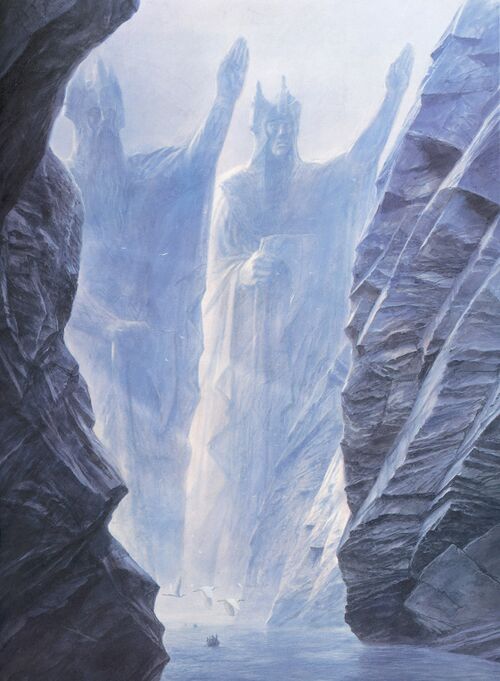
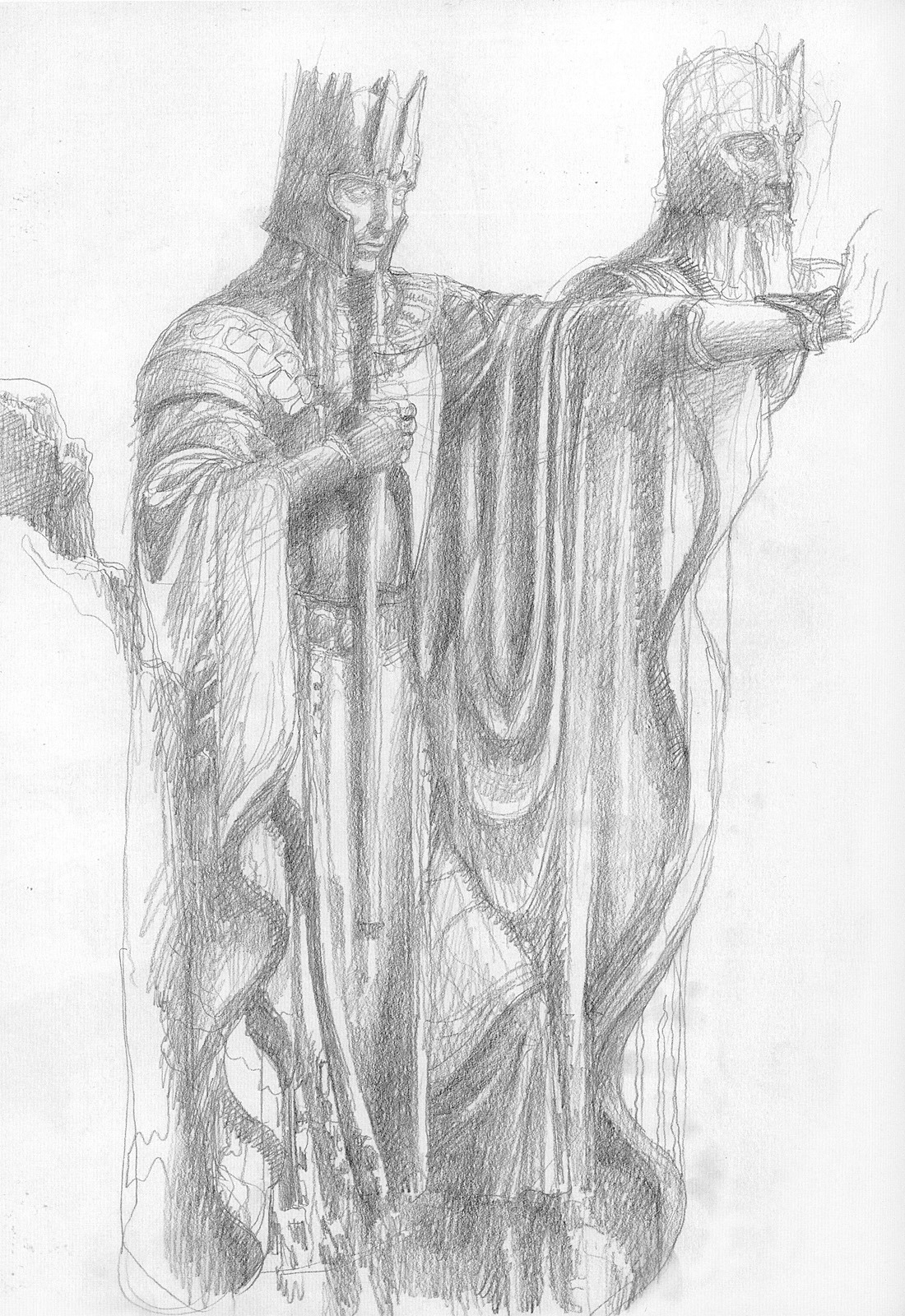
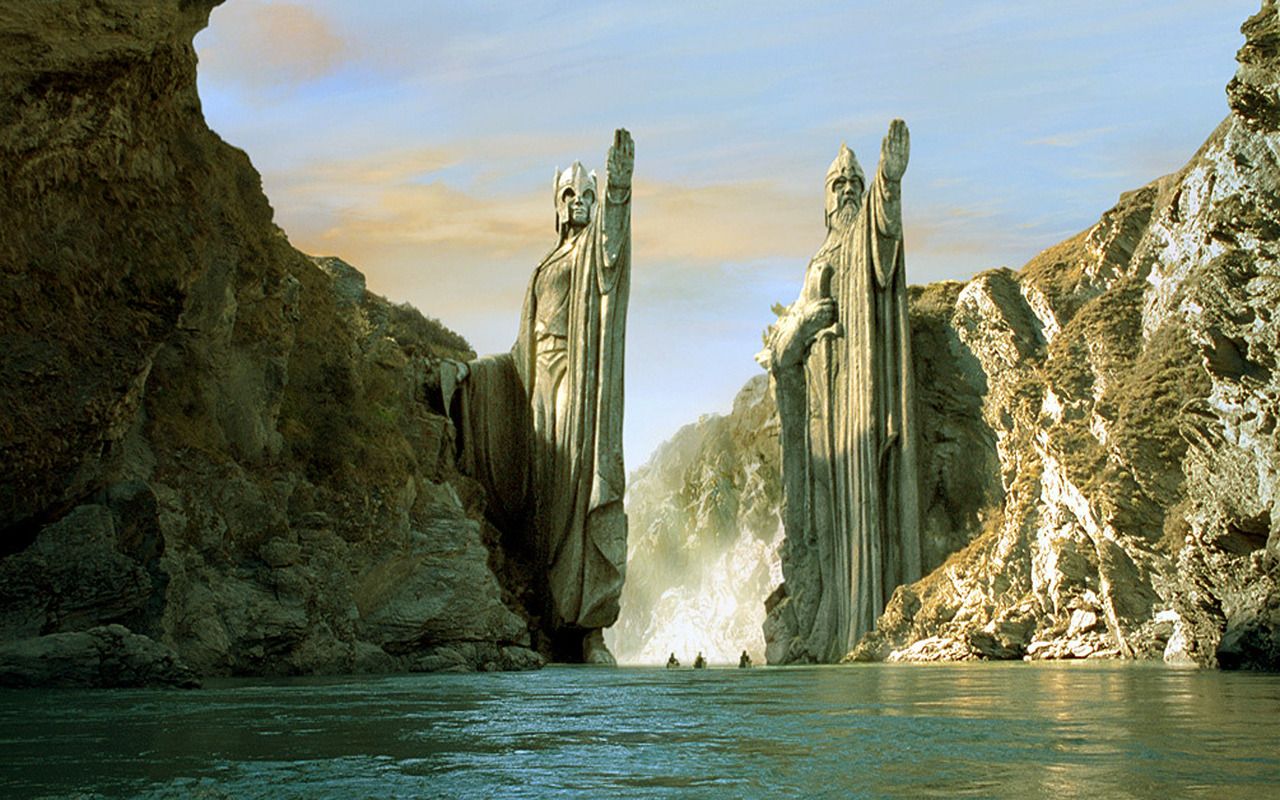
“ ‘Behold the Argonath, the Pillars of the Kings!’ cried Aragorn…

As Frodo was born towards them the great pillars rose like towers to meet him.  Giants they seemed to him, vast grey figures silent but threatening.  Then he saw that they were indeed shaped and fashioned:  the craft and power of old had wrought upon them, and still they preserved through the suns and rains of forgotten years the mighty likenesses in which they had been hewn.  Upon great pedestals founded in the deep waters stood two great kings of stone:  still with blurred eyes and crannied brows they frowned upon the North.  The left hand of each was raised palm outwards in gesture of warning; in each right hand there was an axe; upon each head there was a crumbling helm and crown.  Great power and majesty they still wore, the silent wardens of a long-vanished kingdom…” (The Fellowship of the Ring, Book Two, Chapter 9, “The Great River”)

There are a number of illustrations of this, from the Hildebrandts

to John Howe

to Alan Lee

to J.C. Barquet

and more, including in Jackson’s The Lord of the Rings,

where, in the sometimes perverse method of the films, one figure has a sword, rather than the axe which Tolkien had specifically described (true of the Alan Lee sketch, as well).  Reviewing this short list, however, the first two of these seem to portray the kings with a more peaceably raised left hand, whereas the others more clearly portray what the author wanted:  “The left hand of each was raised outwards in a gesture of warning…”

These figures, in fact, are boundary markers, set up by the Gondorian king Minalcar (later crowned as Romendacil II) some time during his regency (TA1240-1304—see The Lord of the Rings, Appendix A, (ii) “The Southern Line[:] Heirs of Anarion” and (iv) “Gondor and the Heirs of Anarion”) and the gesture is clearly meant as a warning to potential invaders.

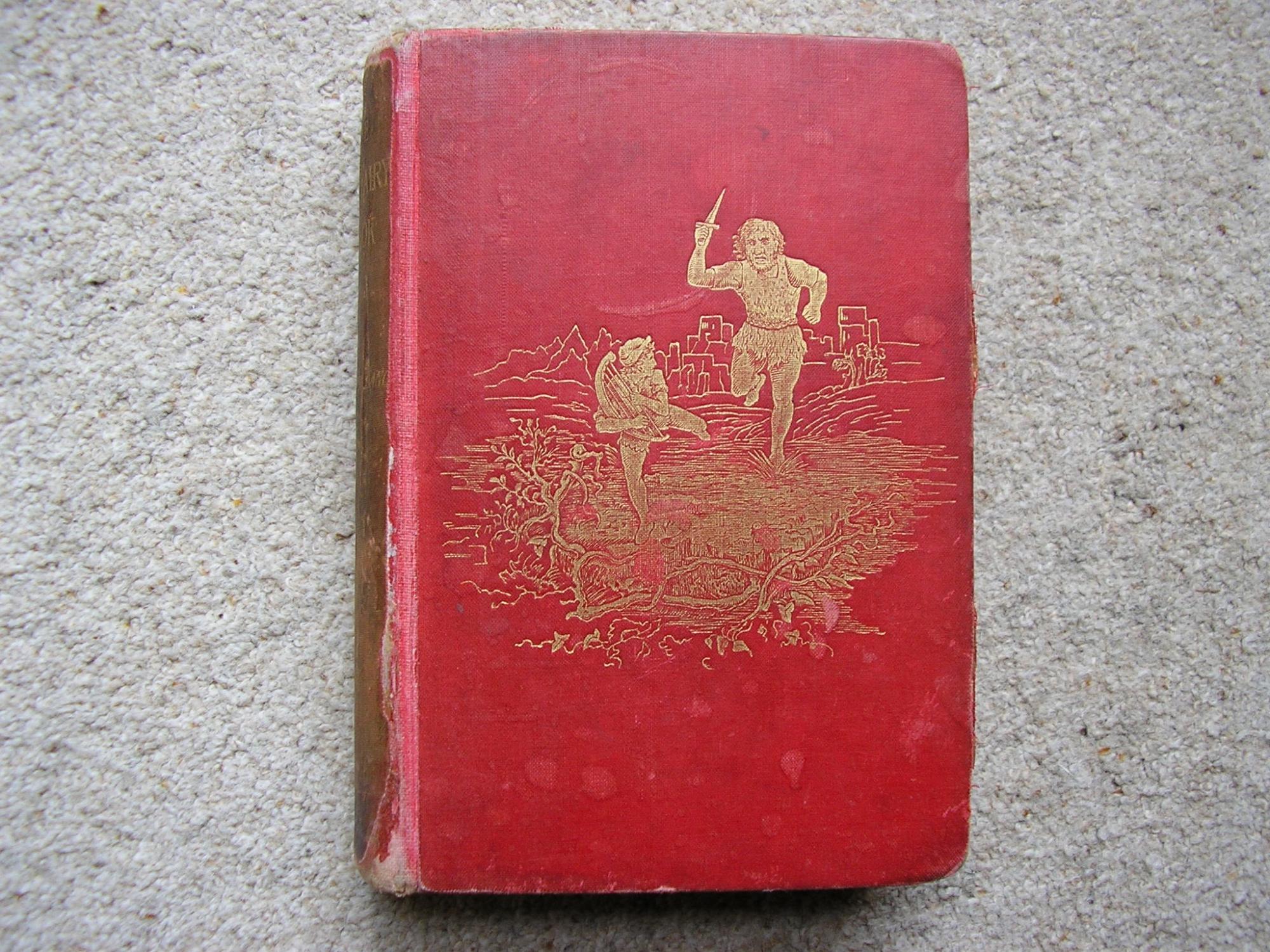
More than once, in past postings, I’ve suggested influences upon Tolkien, from The Red Fairy Book of his childhood,

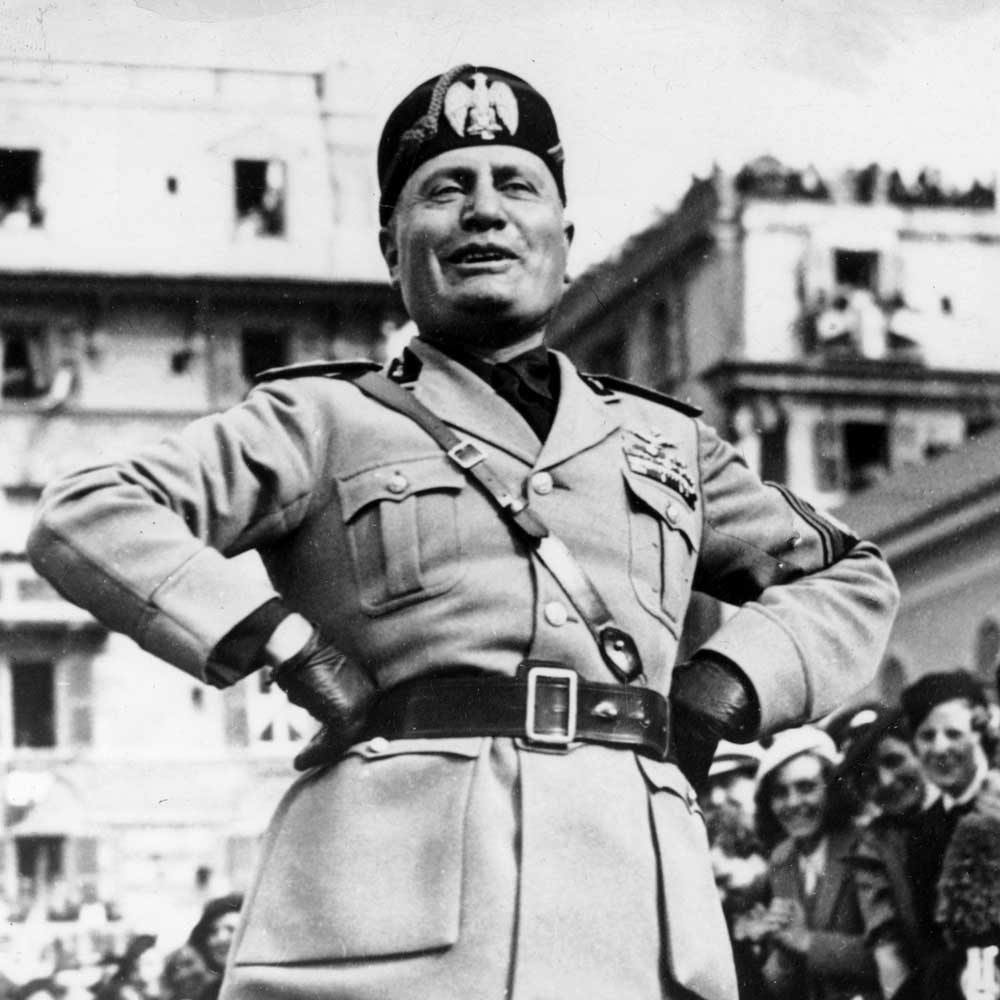
to Mussolini as a possible Saruman model.

In this posting, however, I’m moving forward, perhaps seeing a Tolkien model for something erected long after Tolkien’s death in 1973.

It begins with a bit of history in JRRT’s lifetime.

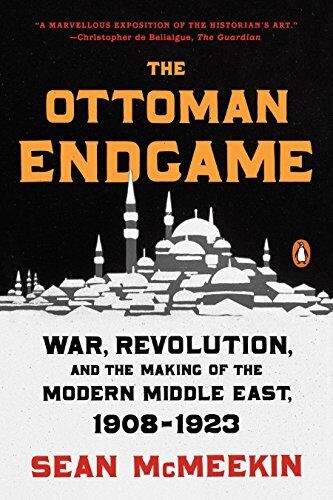
At the end of the Great War (aka “World War I”), the Middle East, the majority of it the fading Ottoman Empire, was very much in flux, with France and Britain struggling diplomatically to extend their influence over Syria, Lebanon, and the area then known as Palestine, as well as farther inland.  (For more on this, see David Fromkin’s The Peace to End All Peace, 1989,

and Sean McMeekin’s The Ottoman Endgame, 2016)

Farther north, and encouraged by the victorious Allies, Greece had invaded Turkey, hoping to expand Greece beyond its current boundaries.

This led to a number of bloody encounters between the two sides, with the Greeks advancing to within 50 miles (80km) of the capital at Ankara in the late summer of 1921 before being stopped at the climactic battle in the area of the Sakarya River.  When the Greeks finally withdrew, they had suffered 23,000 casualties (plus perhaps as many as 15,000 prisoners) against Turkish totals of 22,000 casualties and 1,000 prisoners.  This withdrawal turned into a scorched earth retreat towards the Aegean coast and ultimate evacuation of the Greek army along with thousands of civilians from Asia Minor.  (For more see:  https://www.historynet.com/the-battle-that-made-kemal-ataturk/ ) 

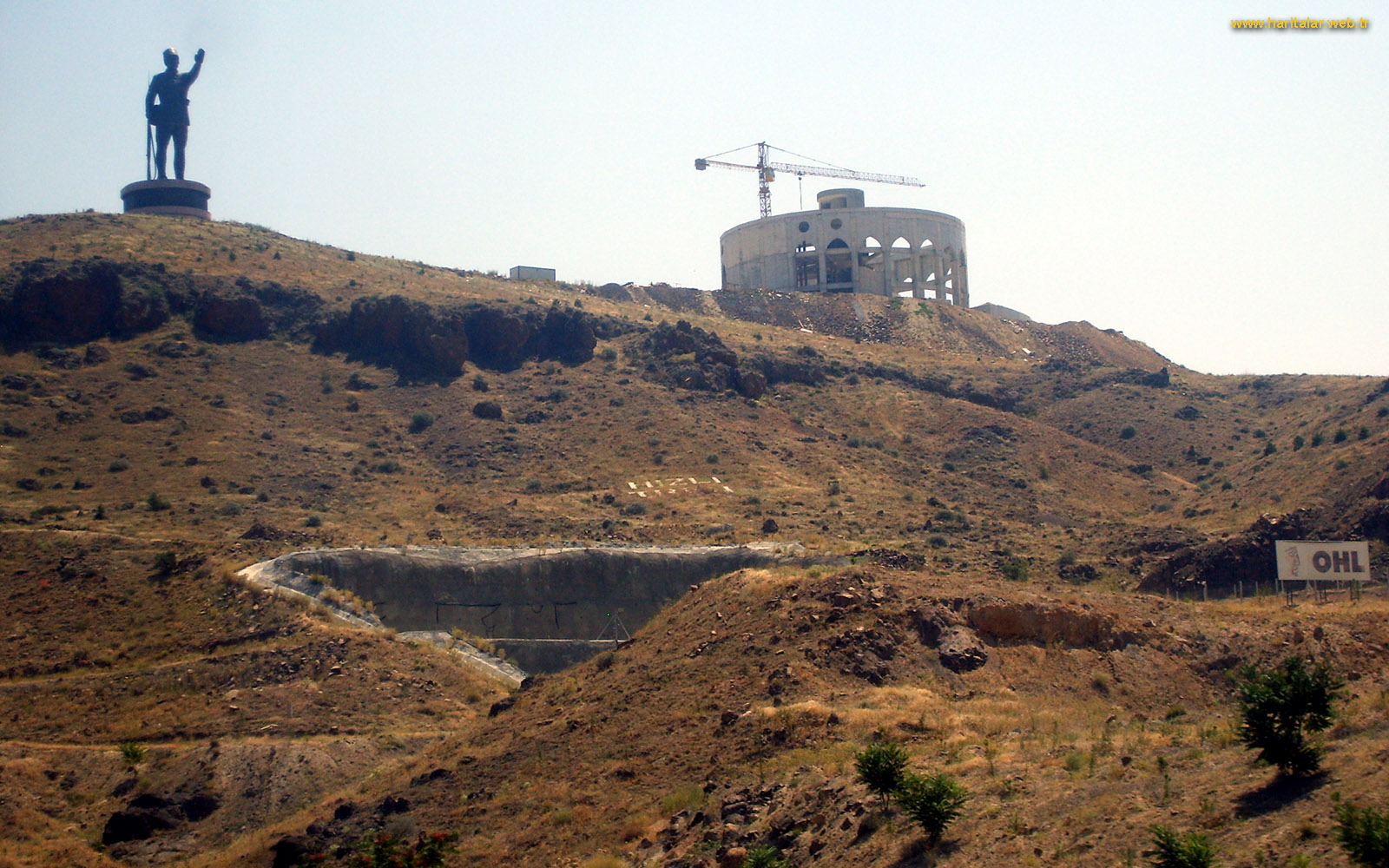
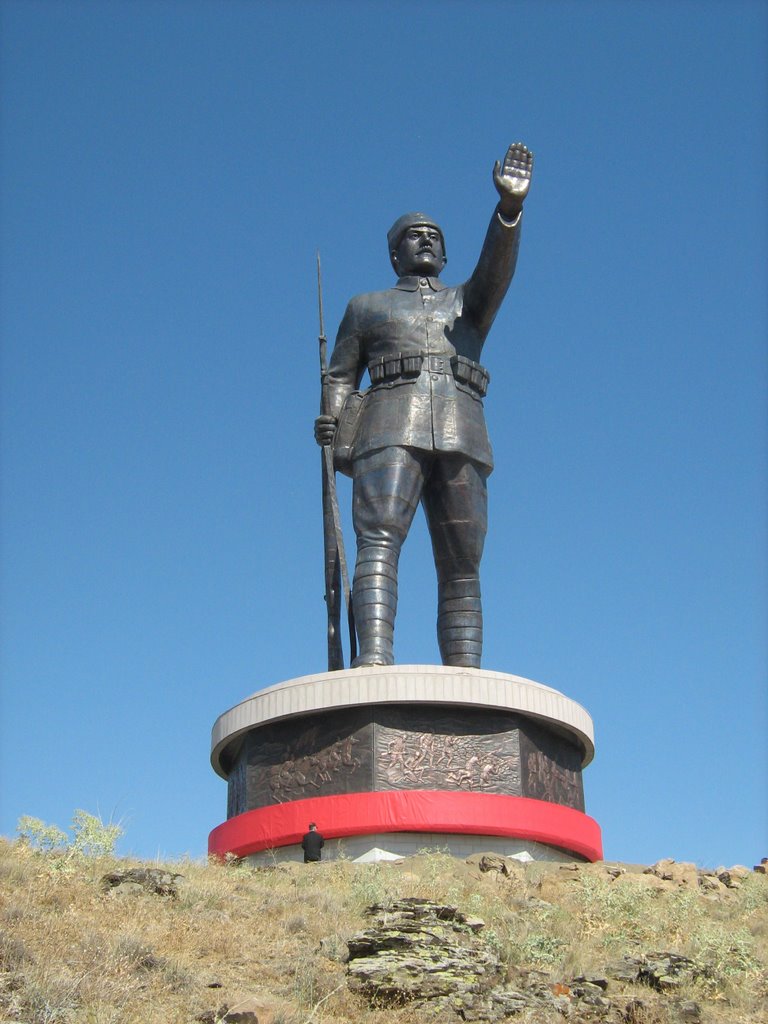
In 2015, the Turkish government established the Battle of Sakarya National Historic Park, but, in 2008, several private companies had already commemorated the battle by commissioning a statue of a Turkish infantryman to be placed on a height (Karaltepe) looking westward in the direction from which the Greek army had come.

 It’s not a boundary marker, per se, as the Argonath is meant to be, but, by marking the line of Turkish resistance to the Greek invasion, it has somewhat of the same effect.  And, though not gigantic, like the Gondorian figures, it’s over 100 feet (31m) tall on its base and the pose certainly reminds me of what Frodo sees in the river ahead,

even if it doesn’t produce the same emotional reaction as it did members of the Fellowship:

“Awe and fear fell upon Frodo, and he cowered down, shutting his eyes and not daring to look up as the boat drew near.  Even Boromir bowed his head as the boats whirled by, frail and fleeting as little leaves, under the enduring shadow of the sentinels of Numenor.”

Had the designers of the Turkish monument read The Fellowship of the Ring, or perhaps had seen the Jackson movie?

Thanks for reading, as ever.

Stay well,

What ancient monument might awe you?

And remember that, as always, there’s

MTCIDC

O

ps

In answer to my own question, I’ve always loved this—

It’s often called “the mourning Athena”, but I imagine that the goddess isn’t grieving, but reading a boundary stone and, armed with helmet and spear, seems ready to defend her city from any who would violate that boundary.  It’s nowhere near the monumental size of those images discussed above, being only about 1 ½ feet (.48m) high, but, with a goddess, does size matter?

*(A)Dun[e]-(aic)

20 Wednesday Mar 2024

Posted by Ollamh in Uncategorized

≈ Leave a comment

Tags

books, dune, Fantasy, frank-herbert, science fiction

Welcome, dear readers, as always.

If you’re a regular reader, you know that I have begun a (definitely!) long-term project to deepen my knowledge of Science Fiction.  I’ve read Sci-Fi since childhood, but totally unscientifically (sorry!), and, being interested in both Fantasy and Sci-Fi, I thought that it was more than time to have a better grasp of it and its (as I’ve found out) complicated history.

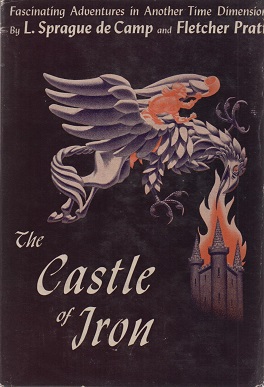
Although I’m still reading somewhat haphazardly—when I find an author whose work catches my attention, I catch myself reading more than one representative—see novels by L. Sprague de Camp (1907-2000), including those in collaboration with Fletcher Pratt (1897-1956)—like Lest Darkness Fall, 1941,

or The Castle of Iron, 1950,

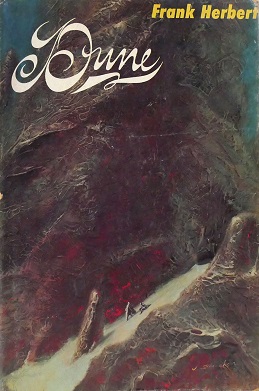
I am developing a chronological list, and, so far, have read about three dozen novels and maybe a dozen short stories, my most recent novel being Dune, 1965,

about which I’ve already written one posting (see “No Names, No…”, 10 January, 2024).  It’s an impressive beginning, full of vividly imagined things, especially anything and everything about the desert planet of Arrakis, its native inhabitants, their environment, and their survival in it.  It’s easy to see how some early reviewers compared it to The Lord of the Rings for its depth of detail.  In my earlier posting, I admitted to being less convinced by the names, which sometimes seem rather haphazard—something which Tolkien would never allow (and actually criticized in the work of E.R. Eddison, 1882-1945—see a letter to Caroline Everett, 24 June, 1957, Letters, 372)—and this brings me to the subject of this posting, which is about Chakobsa—not “Shikwoshir”, or “Shikowschir”, or even “Schakobsche” or “Farschipse”, all possible names for a Northwest Caucasian language (or perhaps invented dialect based upon one of the languages—see https://en.wikipedia.org/wiki/Chakobsa )–but one of the principal languages of Dune.

The first film based upon Dune appeared in 1984

and was not a success—I remember seeing it, but have virtually no memory of what I saw.  (For more on the tribulations of making a film of the novel, see:  https://en.wikipedia.org/wiki/Dune_(1984_film) )  If anyone spoke anything other than standard English, I couldn’t say.  There was a difference, however, in Dune, 2021,

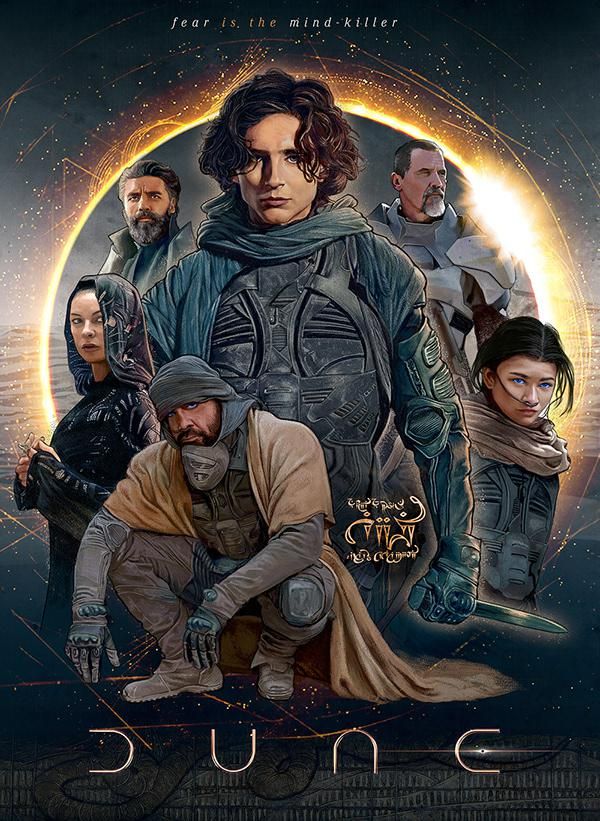
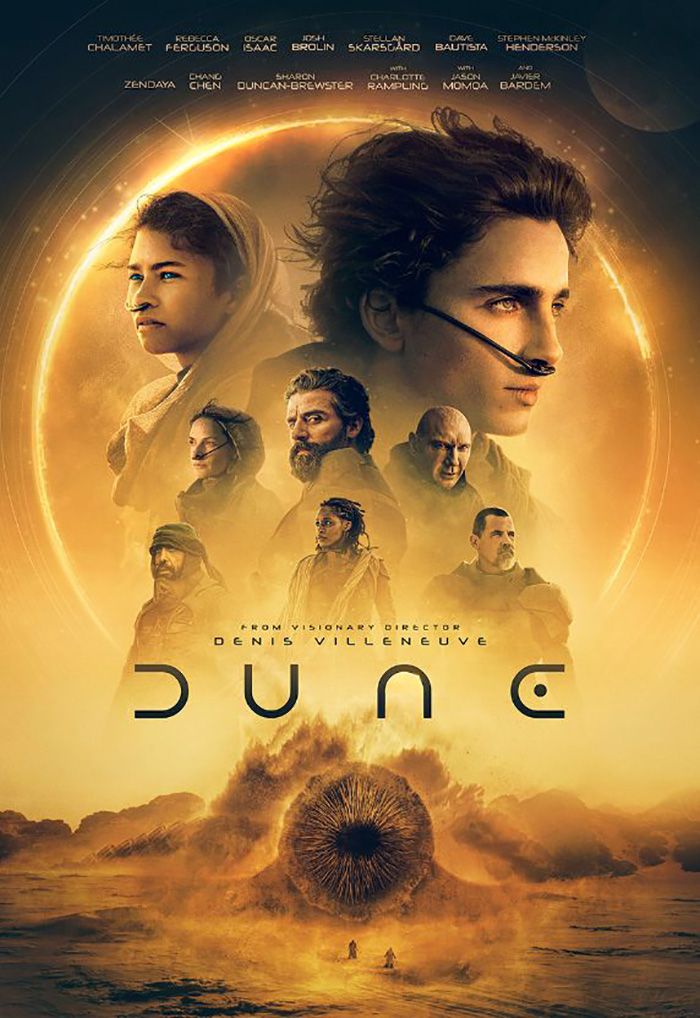
where, although English substitutes for Galach, the standard universal language (like the Common Speech of Middle-earth), the language of the natives of Arrakis, the Fremen, is in need of subtitles.  (And there seems to be a bit of confusion here about what they actually speak, which even one of its creators, in an aside in a recording, admits:  https://dune.fandom.com/wiki/%22Neo-Chakobsa%22_(2020s_film_series)?file=Work_Stream_6-_Translating_into_Chakobsa%2C_Part_1 )  The language we hear most about—and which appears even more frequently in Dune 2, 2023,

was named by the original author, Frank Herbert (1920-1986), after that Northwest Causcasian language, Chakobsa, but, linguistically, has nothing to do with it.  Instead, it was a gallimaufry (a wonderful word in itself, meaning “a hodgepodge”—see:   https://www.etymonline.com/word/gallimaufry where you’ll discover that it’s actually one of those etymologies with a question mark after it).  As Herbert’s son, Brian, says of the linguistic constructions in Dune in general:

“  The words and names in Dune are from many tongues, including Navajo, Latin, Chakobsa (a language found in the Caucasus), the Nahuatl dialect of the Aztecs, Greek, Persian, East Indian, Russian, Turkish, Finnish, Old English, and, of course, Arabic.” (Dune, “Afterword”, 878 in the Ace edition)

There is a great difference, however, between Herbert’s approach to language and that of the language created for the Fremen in the two films and the latter approach might be seen as coming directly from JRRT’s method of language construction.

In 1931, Tolkien gave a lecture to the Johnson Society at Pembroke College, Oxford.

Daringly entitled “A Secret Vice”, it was an essay about his own “vice”, the creation of languages.  In it, he used his own early experiences with everything from Esperanto to “Nevbosh”, expressing not only his long interest, but also his ideas about the possibilities to be found in such a hobby, including:

“…various other interests in the hobby.  There is the purely philological (a necessary part of the completed whole though it may be developed for its own sake):  you may, for instance, construct a pseudo-historical background and deduce the form you have actually decided on from an antecedent and different form (conceived in outline); or you can posit certain tendencies of development and see what sort of form this will produce.  In the first case you discover what sort of general tendencies of change produce this a given character; in the second you discover the character produced by given tendencies.  Both are interesting, and their exploration gives one a much greater precision and sureness in construction—in the technique in fact of producing an effect you wish to produce for its own sake.” (Tolkien, A Secret Vice:  Tolkien on Invented Languages, edited by Dimitra Fimi & Andrew Higgins, Harper/Collins, 2016, 25)

I was reminded of this passage when I watched a brief interview with the creators of Chakobsa, Jessie and David Peterson, which you can see here:  https://www.bbc.com/reel/video/p0hg5n6z/dune-and-the-art-of-creating-a-fictional-language  .  David was the creator of Valyrian and Dothraki for A Game of Thrones, as well as the author of a very entertaining and informative book on the subject of constructed languages (“conlang” for short), The Art of Language Invention (Penguin, 2015).

(For more on Valyrian, see:  https://en.wikipedia.org/wiki/Valyrian_languages .  For more on Dothraki, see:  https://en.wikipedia.org/wiki/Dothraki_language )

In the interview, Jessie talks about the “evolutionary method” of designing a language—that is, just like Tolkien, creating an older version of the language which you then “age”, using standard linguistic methods for consistent change over time.  We see an example of this in an interview the Petersons did with IndieWire:

“The most everyday terms in any language — things like “hello” and “goodbye” — are often ones that have the most history behind them. ‘You don’t try to come up with a way to say hello. You try to come up with what would have been a common phrase that was repeated when you saw someone and which ended up getting reduced to a smaller form,’ Jessie Peterson said. “

All of this was trickier, of course, for the Petersons, since, unlike Tolkien, the language they were employed to build already had some chosen, if not invented, elements—words from Herbert’s gallimaufry—which they were obliged to begin with.  In the same interview with IndieWire, David Peterson had this to say about such difficulties:

”Peterson traced the longest existing phrase in Chakobsa, a funeral rite spoken for Jamis (Babs Olusanmokun) as his water is given to the well at Sietch Tabr, to a Romani nursery rhyme. 

‘He just changed the meaning and said that it had something to do with water,’ Peterson told IndieWire. “A lot of [Chakobsa] is just borrowed kind of haphazardly from different languages. We just had to come up with our own system and incorporate it as best we could.”  (You can read the whole interview here:  https://www.indiewire.com/features/craft/dune-fremen-langauge-how-to-speak-1234958145/ )

An interesting feature in Tolkien’s language invention—and perhaps eventually crucial—

“I might fling out the view that for perfect construction of an art-language it is found necessary to construct at least in outline a mythology concomitant.  Not solely because some pieces of verse will inevitably be part of the (more or less) completed structure, but because the making of language and mythology are related functions (coeval and congenital, not related as disease to health, or as by-products to main manufacture); to give your language an individual flavour, it must have woven into it the threads of an individual mythology, individual while working within the scheme of natural human mythopoeia, as your word-form may be individual while working within the hackneyed limits of human, even European, phonetics.  The converse indeed is true, your language construction will breed a mythology.”  (Tolkien, A Secret Vice, 23-24)

So far, David, and now David and Jessie, Peterson have worked to create languages for other people’s stories and mythologies.  I wonder what they might produce if they constructed a language—or languages—for a story of their own?

As always, thanks for reading.

Stay well,

So shiira isim un-rauqizak,

And remember that, as ever, there’s

MTCIDC

O

PS

If creating languages interests you, have a look at Jessie Peterson’s website here:  https://www.quothalinguist.com/about-me/

Seem Fairer

06 Wednesday Mar 2024

Posted by Ollamh in Uncategorized

≈ Leave a comment

Tags

books, Fantasy, J.R.R. Tolkien, lord-of-the-rings, Tolkien

As ever, dear readers, welcome.

If you flip to the back of The Letters of J.R.R. Tolkien,

and page through the index to the aitches, you’ll find five references to Adolf Hitler.  The first, to his son, Michael, simply mentions the idea that Hitler must soon attack Britain (letter to Michael Tolkien, 12 January, 1941, Letters, 64).  The third is to another son, Christopher, and makes a brief reference to Stalin and Hitler (letter to Christopher Tolkien, 22 August, 1944, Letters, 131).  Both of these are neutral in tone.  The second, however, has more the tone of a rant:

“Anyway, I have in this War a burning private grudge—which would probably make me a better soldier at 49 than I was at 22:  against that ruddy little ignoramus Adolf Hitler (for the odd thing about demonic inspiration and impetus is that it in no way enhances the purely intellectual stature:  it chiefly affects the mere will).”  (letter to Michael Tolkien, 9 June, 1941, Letters, 77)

And the fourth and fifth (in the same letter) have a similar tone:

“We knew that Hitler was a vulgar and ignorant little cad, in addition to any other defects (or the source of them)…” (letter to Christopher Tolkien, 23-25 September, 1944, Letters, 133)

Both of which are entirely understandable, of course.  In terms of his family, two of his sons were involved in the Second World War, Michael as an anti-aircraft gunner, Christopher as a pilot, and Tolkien worried very much about both, as various letters to them make very plain.

That “burning private grudge”, however, was about something entirely different—and characteristic of JRRT—was his anger at the Nazi perversion of what he thought of as “that noble northern spirit”, as he says in that letter to Michael:

“Ruining, perverting, misapplying, and making for ever accursed, that noble northern spirit, a supreme contribution to Europe, which I have ever loved and tried to present in its true light.”

This being under the direction of:

“…a man inspired by a mad, whirlwind, devil:  a typhoon, a passion:  that makes the poor old Kaiser look like an old woman knitting.”

For all that Tolkien descends to name-calling (not his usual method of dealing with whom or what he doesn’t like), there is a certain—I won’t call it respect—but wary awe of someone he calls a “mad, whirlwind, devil” and, as always when I think about JRRT, his time, and his influences, I wonder about how he his impression of that “vulgar and ignorant little cad”—and “whirlwind devil”—might have influenced his work.

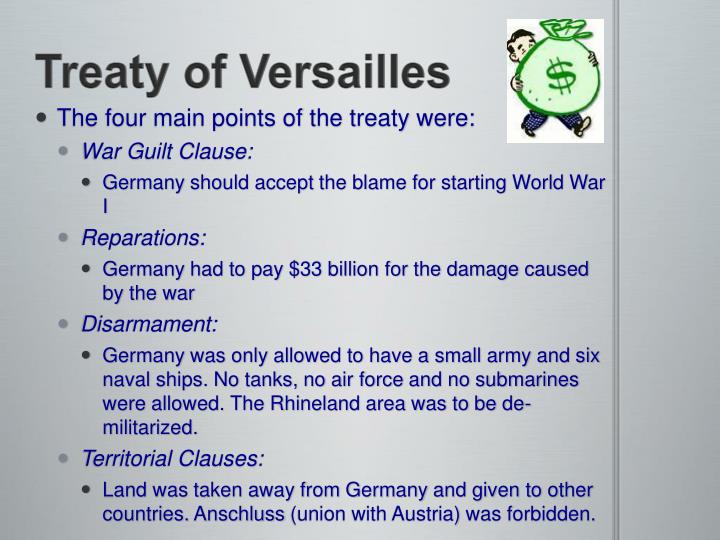
Germany after the Great War was economically and socially in ruins.  The 1919 Treaty of Versailles, blaming Germany for the war and designed to exact severe punishment for that, had done much to put her in that condition.

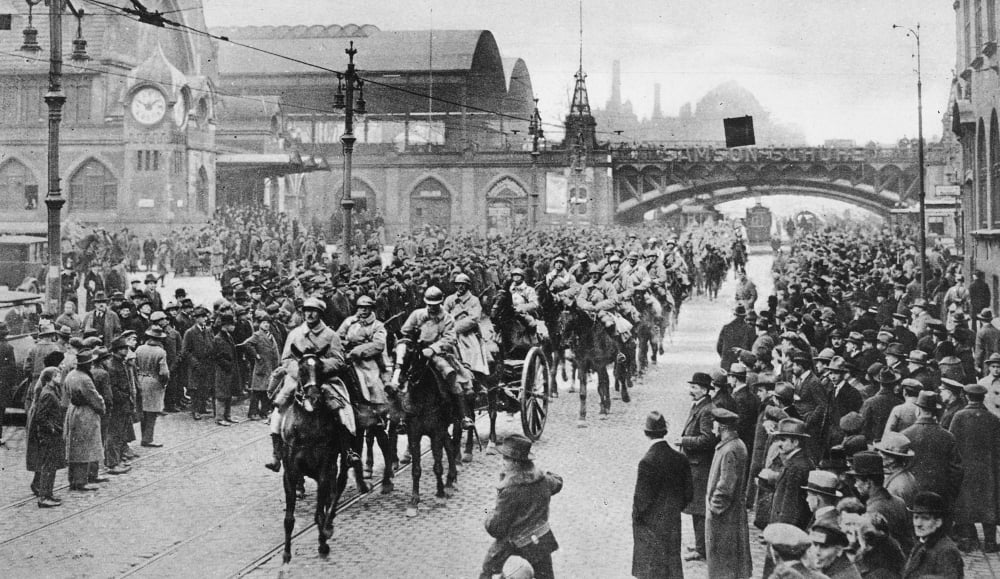
When Germany was unable to pay the amount demanded on time, parts of western Germany were then occupied by several of the Allies.

Bankruptcy, monetary depreciation,

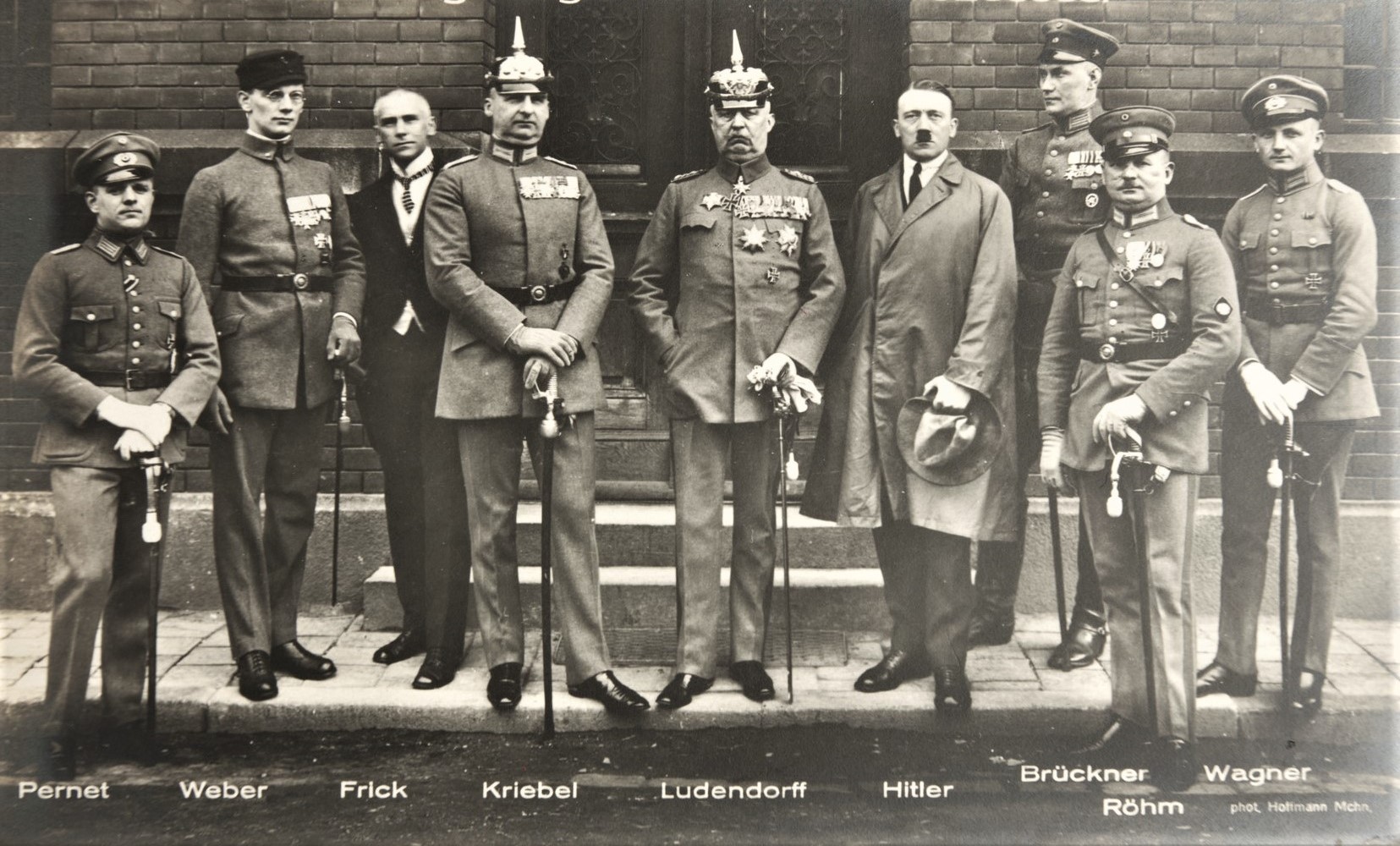
and ideas of revolution swirled—including a brief attempt at revolution in Munich, in 1923.

The leader of this attempt was an ex-serviceman named Hitler.

With a sympathetic court, instead of being executed for treason, he was given a light sentence and soon was out on the streets again, presenting himself not as a violent revolutionary, but as a reformer, someone who was working to bring his country back from the wreckage it has suffered from war, a brutal treaty, a ruined economy, and social unrest (some of which he himself had inspired—and would continue to inspire).

In time, he was so successful at this that he became his country’s director, under the very neutral title of Fuehrer, “Leader” and the economy did improve, living conditions did improve—

but under all of this improvement was something else and here I’m immediately reminded of Sauron:

“Sauron was of course not ‘evil’ in origin…until he became the main representative of Evil of later ages.  But at the beginning of the Second Age he was still beautiful to look at, or could still assume a beautiful visible shape—and was not indeed wholly evil, not unless all ‘reformers’ who want to hurry up with ‘reconstruction’ and ‘reorganization’ are wholly evil, even before pride and the lust to exert their will eat them up.” (draft of a letter to Peter Hastings, September, 1954, Letters, 284)

“But many of the Elves listened to Sauron.  He was still fair in that early time, and his motives and those of the Elves seemed to go partly together:  the healing of the desolate lands.  Sauron found their weak point, suggesting that, helping one another, they could make Western Middle-earth as beautiful as Valinor.” (to Milton Waldman, typescript, “late 1951”, Letters, 212)

And here are the consequences:

“[Sauron] lingers in Middle-earth.  Very slowly, beginning with fair motives:  the reorganizing and rehabilitation of the ruin of Middle-earth, ‘neglected by the gods’, he becomes a reincarnation of Evil, and a thing lusting for Complete Power—and so consumed ever more fiercely with hate (especially of gods and Elves).  All through the twilight of the Second Age the Shadow is growing in the East of Middle-earth, spreading its sway more and more over Men…” (to Milton Waldman, typescript, “late 1951”, Letters, 211)

The title of this posting, as I’ll bet you all know, is part of a remark which Frodo makes just after Strider has appeared and approached him at The Prancing Pony in Bree:

(the Hildebrandts)

“You have frightened me several times tonight, but never in the way that the servants of the Enemy would, or so I imagine.  I think that one of his spies would—well, seem fairer and feel fouler, if you understand.”

To which Strider makes a reply one would never expect Hitler—or Sauron– to have made—
“ ‘I see,’ laughed Strider.  ‘I look foul and feel fair.  Is that it?’ “

As always, thanks for reading.

Stay well,

When it comes to reformers, it might always be wise to question their ultimate motives,

And remember that, as always, there’s

MTCIDC

O

Romance

14 Wednesday Feb 2024

Posted by Ollamh in Uncategorized

≈ Leave a comment

Tags

books, Fantasy, lord-of-the-rings, The Lord of the Rings, Tolkien

Welcome, as ever, dear readers.

As I believe I’ve reported before, I’ve been rewatching Jackson’s The Lord of the Ring films after a number of years and something struck me in his The Fellowship of the Ring which has brought to mind Tolkien’s own remarks about going from book to film.

In 1958, it was proposed to make a film of The Lord of the Rings.  Tolkien, via Forrest J. Ackerman, was sent a story-line created by a “Mr. Zimmerman” and spent a good deal of time reading through and commenting.  There are only some sections of this commentary available to us in Letters, but these suggest that what he read seriously dismayed and displeased him:

“The commentary goes along page by page, according to the copy of Mr. Zimmerman’s work, which was left with me, and which I now return.  I earnestly hope that someone will take the trouble to read it.

If Z and/or others do so, they may be irritated or aggrieved by the tone of many of my criticisms.  If so, I am sorry (though not surprised).  But I would ask them to make an effort of imagination sufficient to understand the irritation (and on occasion the resentment) of an author, who finds, increasingly as he proceeds, his work treated as it would seem carelessly in general, in places recklessly, and with no evident signs of any appreciation of what it is all about…

The canons of narrative art in any medium cannot be wholly different; and the failure of poor films is often precisely in exaggeration, and in the intrusion of unwarranted matter owing to not perceiving where the core of the original lies.” (from an undated—June, 1958—letter to Forrest J. Ackerman, Letters, 389-390)

As I watched, I found myself thinking about what Tolkien wrote and about, of all things, romance, but, as it’s Valentine’s Day, 14 February, what could be more appropriate for a posting?

Valentine’s Day was once celebrated in the Christian calendar as the occasion of the martyrdom of Valentinus, a 3rd-century AD priest, the date first (perhaps) officially appearing in the 8th-century Gelasian Sacramentary,

aka the Liber Sacramentorum Ecclesiae Romanae, where you’ll find, inLiber Secundus, XI, “Orat. in Natali Valentini, Vitalis, Feliculae”–“Prayers on the Martyrdom of Valentinus, Vitalis, and Felicula”, dated for “xvi Kal. Martias”—that is, 14 February.  (You can read it here:  https://books.google.com/books?id=S-20jhQQZBMC&dq=sacramentary&pg=RA3-PA1#v=onepage&q=sacramentary&f=false  The Gelasius mentioned is a 5th-century pope who probably had nothing whatever to do with the book—for more see:  https://en.wikipedia.org/wiki/Gelasian_Sacramentary )

Valentinus was squeezed out of the ecclesiastical calendar in 1969 (which you can read about here:  https://aleteia.org/2022/02/09/why-is-st-valentines-feast-day-not-on-the-churchs-calendar/ ), but St Valentine’s day has been part of Western romantic tradition since at least the later Middle Ages and began to become a commercial success in the 19th century, when preprinted cards first appeared.

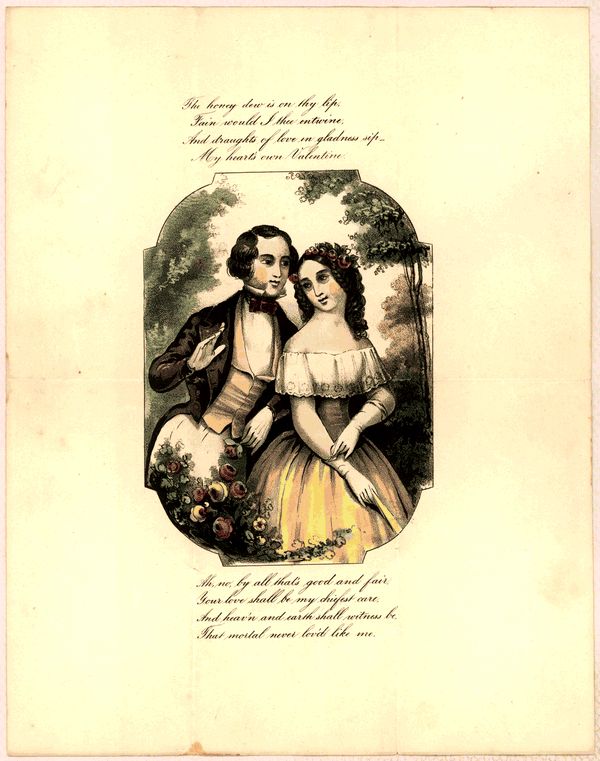
(And I can’t resist this—possibly the first printed valentine—which dates, in fact, to 1797.

See this for more:  https://www.bbc.co.uk/ahistoryoftheworld/objects/L1NM_6mWRymAMKXcRDlXJA

and see this for more on early commercial valentines:  http://www.go-star.com/antiquing/early-valentines.htm )

The romance I want to talk about in this posting, however, comes from a different time although, according to its author, Tolkien, not from a different place.

In a way, it’s actually a kind of echo-romance, in which the first part happened some 6500 years before the second part, in the First Age of Middle-earth, but many of its conditions were the same. 

The Tale of Beren and Lúthien, by J.R.R. Tolkie

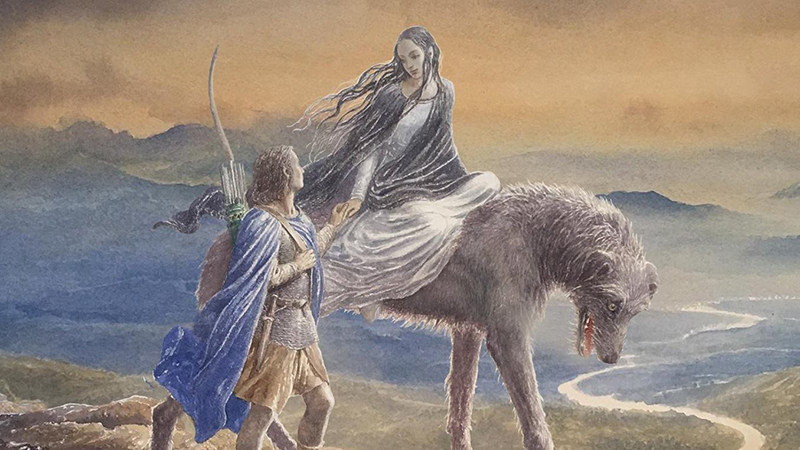
(Alan Lee)

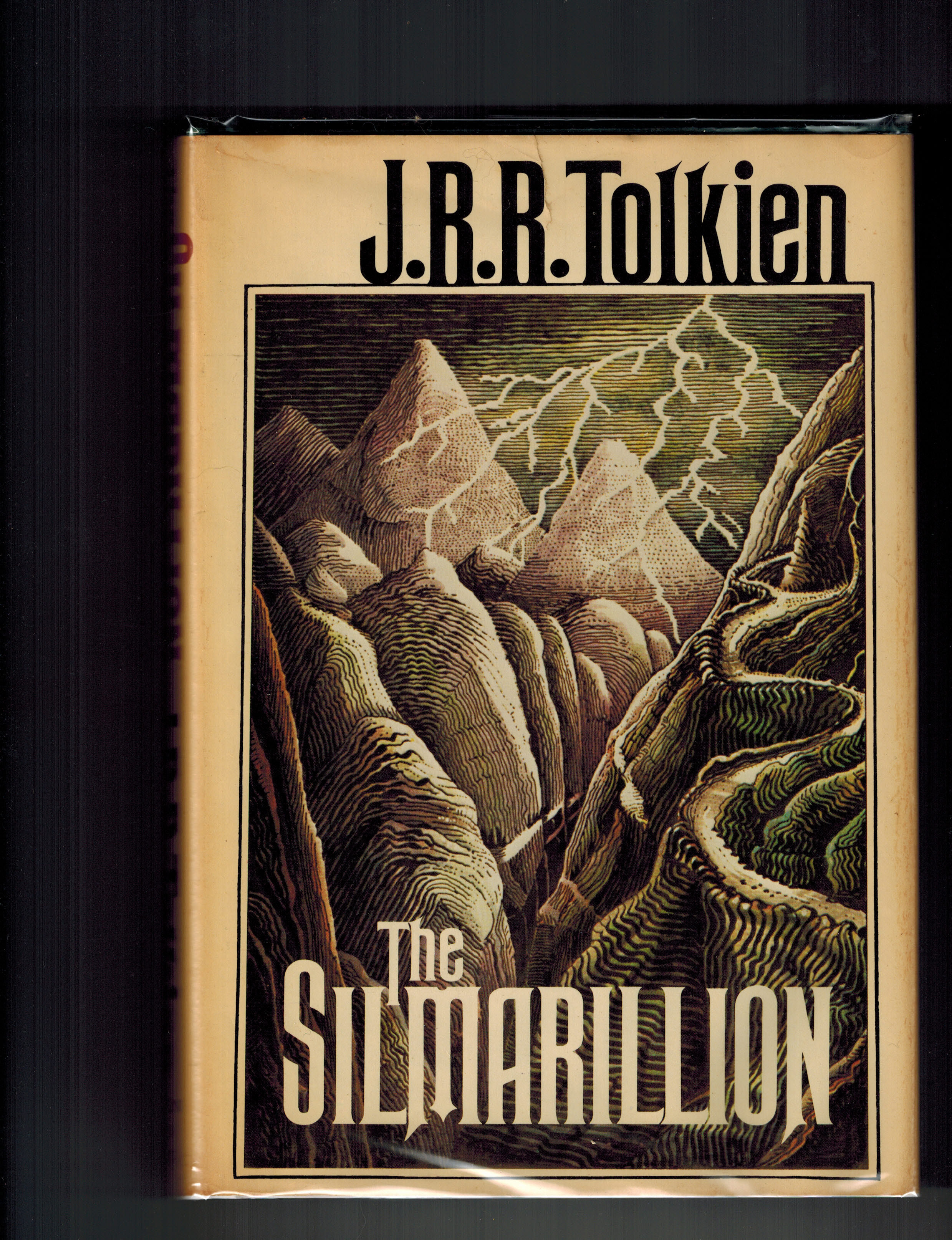
A note, however:   this is a very complex story, which JRRT developed over many years, appearing in one form in the Silmarillion, 1977,

and in a multiform, Beren and Luthien, 2017, both versions edited by Christopher Tolkien.

For my purposes, I’m going to compress the story into the simplest form possible—something like this:

1. Beren is a mortal, who falls in love with Luthien, an elven immortal and the daughter of Thingol, king of Doriath

2. Thingol sets Beren a task:  for Beren to wed Luthien, he must retrieve one of the Silmarils from the crown of Morgoth

3. Beren, with Luthien’s help, finally manages to do this and can marry Luthien, but, later, is killed and Luthien goes to the Halls of Mandos (basically, the ruler of the dead) and manages, through song (yes, Orpheus and Eurydice is in there somewhere)

to regain him, but is faced with a choice:  she can retain her immortality and go on to Valinor, the home of the immortal Valar, without Beren, or she can go back to Middle-earth with Beren, become mortal, and die

4. She stays with Beren and, from that comes “the Choice of Luthien”—giving up immortality to remain with a mortal loved one

This brings us to the echo:  Aragorn and Arwen, the many details of which you can read in Appendix A, V, in The Lord of the Rings, “Here Follows a Part of the Tale of Aragorn and Arwen”, but, in simplified form:

1. Aragorn, a mortal, falls in love with Arwen, an elf and daughter of Elrond

2. Elrond sets the condition that only if Aragorn can make himself king of Gondor and Arnor can he marry Arwen

3. we know how this turns out:  Aragorn eventually becomes king and gains Arwen

(the Hildebrandts)

4. but she, too, must make the “Choice of Luthien” and, as JRRT tells us:

“When the Great Ring was unmade and the Three were shorn of their power, then Elrond grew weary at last and forsook Middle-earth, never to return.  But Arwen became as a mortal woman, and yet it was not her lot to die until all that she had gained was lost.”  (The Lord of the Rings, Appendix A, V,
“Here Follows a Part of the Tale of Aragorn and Arwen”)

It’s clear that this choice, once made, is irrevocable, as Arwen tells the fading Aragorn, when he suggests that she can still make the journey to Valinor after his passing: 

“Nay, dear lord…that choice is long over.  There is now no ship that would bear me hence, and I must indeed abide the Doom of Men, whether I will or I nill:  the loss and the silence.”

And, to me, this is what takes Tolkien’s story from being a wonderful fantasy to a higher level:  heroic people here make choices which will bring bitter loss, but still choose to make them:  Frodo to save the Shire, as he tells us he originally hoped, Arwen to remain with Aragorn, fully aware of the consequences.   It’s grown-up romance and Arwen’s choice is central to that.

In Jackson’s film of The Fellowship of the Ring, however, we’re shown a completely different reason for Arwen’s choice:  she trades her immortality for Frodo’s life.  Here’s what happens in Scene 21:

“Frodo suddenly becomes very weak as Arwen lies [sic] him on the ground.

ARWEN:  No! Frodo! No!  Frodo don’t give in, not now.

Tears spring into her eyes as she hugs him.

ARWEN

VOICE:  What grace has given me, let it pass to him.  Let him be spared.

Visions of Rivendell appear.  Frodo appears sleeping in the visions.

ARWEN

VOICE:  Save him.

ELROND:  (face appears in the vision)  Lasto beth non.  Tolo dan na ngalad.  (Hear my voice, come back to the light)” (You can read the whole text of the film here:  http://www.ageofthering.com/atthemovies/scripts/fellowshipofthering1to4.php )

Much of Tolkien’s criticism of “Mr. Zimmerman’s” script is that, as he says, it shows “no evident appreciation of what it is all about”.  In this case, this is Arwen’s sacrifice not for someone she, in the book, will not meet at this point in the story, the script-writers having replaced the actual character who attempts to rescue Frodo, the elf lord Glorfindel, with Arwen, but her sacrifice of her immortality for her love, Aragorn, just as Luthien had done for Beren, thousands of years before.  The echo, besides its poignancy, is intentional on Tolkien’s part:

“Arwen is not ‘a re-incarnation’ of Luthien…but a descendant very like her in looks, character, and fate.  When she weds Aragorn…she ‘makes the choice of Luthien’…” (draft of a letter to Peter Hastings, September, 1954, Letters, 288)

In 1963, Tolkien tried to explain not her choice, which, to him, was evident, but the reason behind Frodo’s ability to pass to the West:

“It is not made explicit how she could arrange this.  She could not of course just transfer her ticket on the boat like that!  For any except those of the Elvish race ‘sailing was not permitted, and any exception required ‘authority’, and she was not in direct communication with the Valar, especially not since her choice to become ‘mortal’.”  (from the drafts of a letter to Mrs. Eileen Elgar, September, 1963, Letters, 462)

Eventually, he suggests that Gandalf must have been involved, but what’s important here—and for the romance with which I began—is that Arwen’s surrender of her immortality was not a generous act to save a fading hobbit, but rather the renewal of a sacrifice made for the same reason by a distant ancestor, Luthien (who is also, in fact, a distant ancestor of Aragorn, as well), many years earlier.  As I said before, it’s grown-up romance and her choice is central to that.

All of that being said, happy Valentine’s Day.

Thanks, as always, for reading.

Stay well,

Be glad for saints—the good ones have much to teach us,

And remember that, as always, there’s

MTCIDC

O

PS

There is, in fact, competition for the title of St. Valentine of the cards, flowers, and chocolate.  See:  https://en.wikipedia.org/wiki/Saint_Valentine )

Arabian Nights for Days

31 Wednesday Jan 2024

Posted by Ollamh in Uncategorized

≈ Leave a comment

Tags

book-review, book-reviews, books, Fantasy, reading

As always, dear readers, welcome.

C.S. Lewis once remarked that, “You can’t get a cup of tea large enough or a book long enough to suit me.”  (from a transcript of a lecture given by Lewis’ sometime editor and biographer, Walter Hooper—here’s the whole piece:  https://www.historyspage.com/post/cs-lewis-inklings-memories-walter-hooper )

Considering my affection, not only for

but

and such works as these,

as well as a life-long love of

(but such a small cup!),

it’s clear that I’m in whole-hearted agreement with “Jack”, as his brother, “Warnie”, had named him in childhood.

In this spirit, during the early fall, I embarked upon a project I’ve long told myself I would do:  read the whole of The Thousand Nights and One Night—in translation, unfortunately.

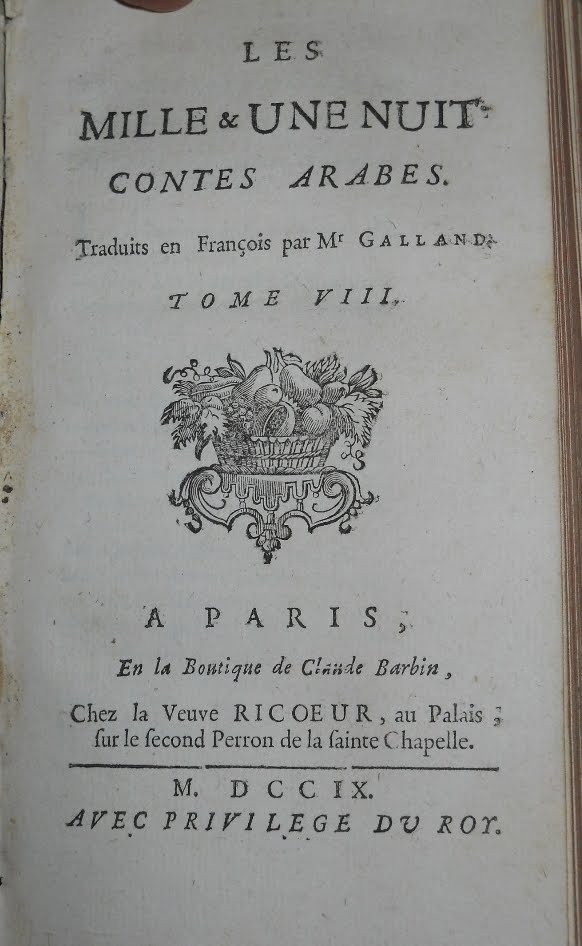
I began with this introduction—

From earlier work (and postings) on the origins of “contes des fees”, as early French authors—the creators of our literary stories, like “La Belle et La Bete”, originally written by Gabrielle-Suzanne Barbot de Villeneuve in 1740, but better known by the revised 1756 version of Jeanne-Marie Leprince de Beaumont–called them—I knew something of the story of how English-speakers first encountered The Arabian Nights in the so-called “Grub Street” edition of 1706, itself an anonymous translation of Antoine Galland’s (1646-1715)

Les Mille et Une Nuits of 1704-1717.

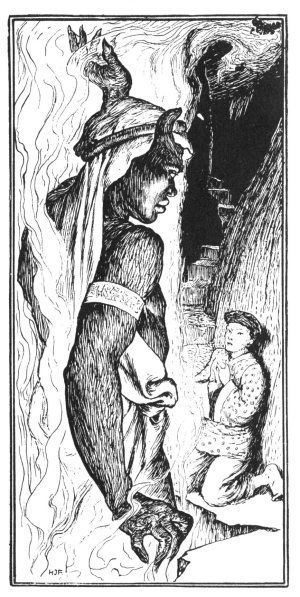
I soon discovered, however, just how much more there was to know.  In chapters with intriguing titles like “Beautiful Infidels” and “Oceans of Story”, the author, Robert Irwin, laid out the complex history of this vast collection, which most of us know from tales which aren’t even in the main collection, “orphan stories” like “Aladdin”

(Albert Robida, 1848-1926)

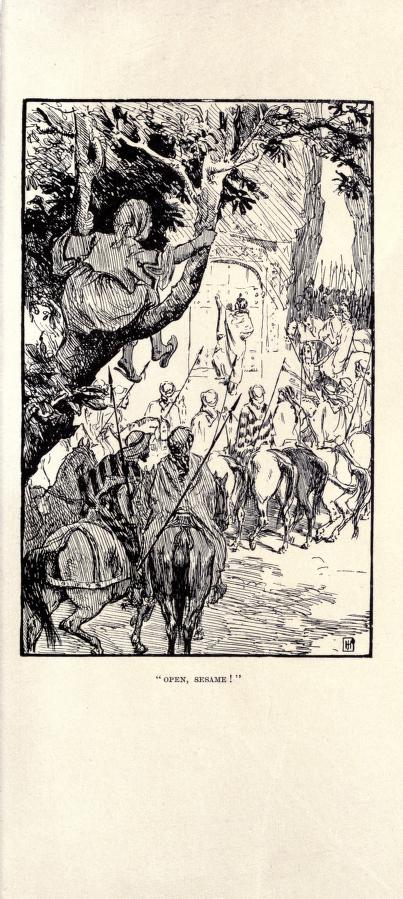
and “Ali Baba and the Forty Thieves.” 

(Edmond Dulac, 1882-1953)

(For more on translations, see: https://en.wikipedia.org/wiki/Les_mille_et_une_nuits and https://en.wikipedia.org/wiki/Translations_of_One_Thousand_and_One_Nights )

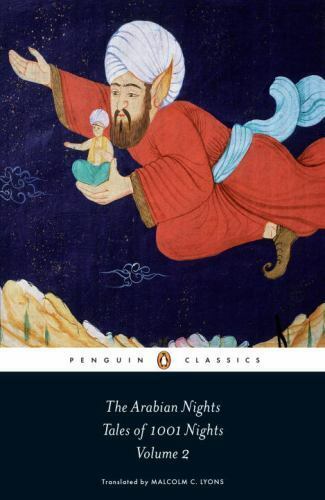
Armed with the knowledge Irwin provided, it was time to begin reading.  I chose what seemed the best translation in English, by Malcolm C. Lyons, in a set of four Penguin volumes and launched into the first.

I imagine that you know the general frame:  King Shahryar learns that his wife is unfaithful.   To keep himself from being cuckolded again, he marries a new bride every night and has her beheaded the next morning.  His Vizier’s daughter Shahrazad, decides to stop this by marrying the Sultan but then, telling one story after another, to keep him so interested night after night by stopping a story at the night’s end without finishing, to force him to suspend his murderous habit to find out what happened next. 

(Another Dulac.  If you’d like to see more of his gorgeous illustrations, look here:  https://www.gutenberg.org/cache/epub/51432/pg51432-images.html )

Finally, after 1001 stories (or perhaps a few more), he decides not to continue murdering brides, Shahrazad is saved, and, presumably, lives happily ever after (really?  Could you ever trust this man not to change his mind?).

I’ve just finished Volume 1 and set off into Volume 2

and it’s been an extremely interesting experience.  Unlike a long novel, like War and Peace, where we follow the adventures of a few main characters—Natasha, Pierre, and Andrei—even when surrounded by a host of other characters (and Tolstoy’s book has a flood of them), in The Arabian Nights, except for the shell characters—the king, the story-teller, and the story-teller’s sister, who can act as a prompter–the main characters can change often, sometimes making it difficult to remember who is doing what with or to whom.  More than once, I had to turn back a page, scan paragraphs, asking myself, “Who is Ali ibn Ishaq again?” or “Is this the brother—or is it brother-in-law?  And is this the same slave who…?”  As well, this unexpurgated text is filled with poetry, some of which is reflective of something going on in the story, some—maybe more than some—is simply poetry which has been inserted into the text.  Because it might be part of the story, I continued to read it, but often it was just what it appeared to be:  poetry inserted for some reason I didn’t understand into the text. 

At the same time, as story spawned story, stories were interwoven, stories linked themselves here and there into complex narratives, there was a certain hypnotic quality to it which kept me reading, not so much because the characters had looped me in as that the method of telling itself had.  I might not care about why X was beheaded, but I was certainly interested to understand how the story had turned in that direction and he was.  In other words, just as Shahrazad had seduced the king with her telling into wanting more and more, so she had seduced me into reading on, always wondering, “Where is this going and how will it end?”  And—just as interesting—“How will we move to the next story?”

At over 950 pages on average for each of 4 volumes, each of these would surely have (at least temporarily) satisfied C.S. Lewis—but where would we ever find a tea cup large enough to keep him—and me—going?

Thanks, as ever, for reading.

Stay well,

Uncork no bottle unless you’ve already planned how to deal with the djinn inside,

And know that, as always, there’s

MTCIDC

O

Down the Hole

24 Wednesday Jan 2024

Posted by Ollamh in Uncategorized

≈ Leave a comment

Tags

book-review, books, Fantasy, J.R.R. Tolkien, Tolkien

As ever, welcome, dear readers.

“In another moment down went Alice after it, never once considering how in the world she was to get out again.

The rabbit-hole went straight on like a tunnel for some way, and then dipped suddenly down, so suddenly that Alice had not a moment to think about stopping herself before she found herself falling down what seemed to be a very deep well.” (Alice’s Adventures in Wonderland, Chapter One, “Down the Rabbit-hole”  and you can have your own copy of the second version of the first—1865-66 edition here:  https://ia600505.us.archive.org/27/items/alicesadventur00carr/alicesadventur00carr.pdf and read about why I wrote “1865-66 edition” and much more here:   https://en.wikipedia.org/wiki/Alice%27s_Adventures_in_Wonderland )

(I discovered this image on two different pinterest sites, one in Korean, the other under the name “Ree Smith”, but with no artist identified, alas.   I love all puppets and shadow puppets in particular and this so reminded me of the work of Lotte Reiniger (1899-1981) and her “Adventures of Prince Achmed”, 1926,

that it made me wish that she had made an “Alice”.  To learn more about Reiniger and her work, see:  https://silentfilm.org/the-adventures-of-prince-achmed-1/   The original film hasn’t survived as such, but to see a reconstruction by a passionate amateur—and it’s a remarkable work—look here:  https://archive.org/details/prince-achmed-english-subtitles  )

As you can see from where I’ve just gone, English has adopted “down the rabbit hole” to mean “digressive”, which, in turn, comes from the Latin verb, digredior, “to go away from”, (literally, “to walk away from”, being a combination of dis, “apart/away from” plus gradus, “a step”)—and look, have I just begun to do a mini-rabbit hole again?

I, myself, in writing nearly 500 postings, have happily fallen down almost innumerable such holes, and this posting began with a tumble down another.

I was delighted to learn, last autumn, that there was to be a new edition of Carpenter/Tolkien’s 1981 The Letters of J.R.R. Tolkien, a mainstay for anyone with a strong interest, not only in Tolkien and his work, but in the writing of fantasy in general.

Humphrey Carpenter (1946-2005), with the aid of Christopher Tolkien, had done—as in his biography of Tolkien, 1977—an amazing job of collecting the materials (for a brief, affectionate obituary of Carpenter, see:  https://www.theguardian.com/news/2005/jan/05/guardianobituaries.booksobituaries ), but as we learn, he had done almost too good a job and the publisher was forced to have rather significant cuts made.  This new edition includes both material cut from letters and a series of letters cut from that original addition, as well.

Needless to say, it arrived and I was paging through it when I came across this rather mystifying reference in a letter to Christopher from 29 November, 1944:

“Very trying having your chief audience Ten Thousand Miles away, on or off The Walloping Window-blind.” (to Christopher Tolkien, 29 November, 1944, Letters, 147)

Unusually for Carpenter, there was no endnote as to what this was a reference, so—oh yes, yet again, a rabbit hole plunge, which revealed this:


“A capital ship for an ocean trip

Was “The Walloping Window-blind;”

No gale that blew dismayed her crew

Or troubled the captain’s mind.

The man at the wheel was taught to feel

Contempt for the wildest blow,

And it often appeared, when the weather had cleared,

That he’d been in his bunk below.

The boatswain’s mate was very sedate,

Yet fond of amusement, too;

And he played hop-scotch with the starboard watch

While the captain tickled the crew.

And the gunner we had was apparently mad,

For he sat on the after-rail,

And fired salutes with the captain’s boots,

In the teeth of the booming gale.

The captain sat in a commodore’s hat,

And dined, in a royal way,

On toasted pigs and pickles and Jigs

And gummery bread, each day.

But the cook was Dutch, and behaved as such;

For the food .that he gave the crew

Was a number of tons of hot-cross buns,

Chopped up with sugar and glue.

And we all felt ill as mariners will,

On a diet that’s cheap and rude;

And we shivered and shook as we dipped the cook

In a tub of his gluesome food.

Then nautical pride we laid aside,

And we cast the vessel ashore

On the Gulliby Isles, where the Poohpooh smiles,

And the Anagazanders roar.

Composed of sand was that favored land,

And trimmed with cinnamon straws;

And pink and blue was the pleasing hue

Of the Tickletoeteaser’s claws.

And we sat on the edge of a sandy ledge

And shot at the whistling bee;

And the Binnacle-bats wore water-proof hats

As they danced in the sounding sea.

On rubagub bark, from dawn to dark,

We fed, till we all had grown

Uncommonly shrunk, when a Chinese junk

Came by from the torriby zone.

She was stubby and square, but we didn’t much care,

And we cheerily put to sea;

And we left the crew of the junk to chew

The bark of the rubagub tree.”

This is quoted from Davy and the Goblin, 1884-5,

by Charles E. Carryl (1841-1920), a later-Victorian/Edwardian American children’s author.

(You can read your own copy here:  https://archive.org/details/davythegoblinorw00carriala , finding the poem on pages 89-90.  There are free-floating copies of this poem at various sites, but often oddly adulterated, so, if you wish to read what Carryl wrote, here it is.)

Carryl subtitled this, “or, What Followed Reading ‘Alice’s Adventures in Wonderland’ “ and the text consists of the Goblin of the title leading the Davy of the title on a “Believing Voyage”.  This is stocked with a series of characters, some from children’s literature like Sinbad and Robinson Crusoe, some fantastical creatures, including a Whale in a Waistcoat and talking waves, and the perhaps inevitable fairies, although their queen is rather more like the Queen of Hearts in Alice than something dreamlike.  

The Goblin’s goal is to persuade Davy, who has apparently maintained that he “doesn’t believe in fairies, nor in giants, nor in goblins, nor in anything the story-books tell you.”  to change his mind on the subject.  Perhaps I’m an inattentive reader, but I’m not sure that, when Davy awakes at the end of Chapter XIV (another inevitability, at least given Alice as an influence), he’s any more a believer than he was in Chapter I, but the whimsy involved has a certain charm and Carryl can get a catchy prosodic pattern going, as in “The Walloping Window-blind”.  Although that subtitle suggests not only Carroll’s episodic—perhaps even picaresque—narrative and certainly there’s something Carrollish about the poems scattered throughout, I would suggest two other influences upon the verses:  Edward Lear (1812-1888) and W.S. Gilbert (1836-1911), in such items as Gilbert’s “The Yarn of the Nancy Bell” (see:  https://allpoetry.com/The-Yarn-of-the-Nancy-Bell )–but I sense another rabbit hole dead ahead!

As always, thanks for reading,

Stay well,

Resist puns, when possible—Carryl can’t,

And remember that, as always there’s

MTCIDC

O

Newer posts →

The Doubtful Sea Series Facebook Page

The Doubtful Sea Series Facebook Page

  • Ollamh

Categories

  • Artists and Illustrators
  • Economics in Middle-earth
  • Fairy Tales and Myths
  • Films and Music
  • Games
  • Heroes
  • Imaginary History
  • J.R.R. Tolkien
  • Language
  • Literary History
  • Maps
  • Medieval Russia
  • Military History
  • Military History of Middle-earth
  • Narnia
  • Narrative Methods
  • Poetry
  • Research
  • Star Wars
  • Terra Australis
  • The Rohirrim
  • Theatre and Performance
  • Tolkien
  • Uncategorized
  • Villains
  • Writing as Collaborators
Follow doubtfulsea on WordPress.com

Across the Doubtful Sea

Recent Postings

  • Through a glass… January 7, 2026
  • Heffalumps? December 31, 2025
  • We Three Kings December 24, 2025
  • A Moon disfigured December 17, 2025
  • On the Roads Again—Once More December 10, 2025
  • (Not) Crossing Bridges December 3, 2025
  • On the Road(s) Again—Again November 26, 2025
  • On the Road(s) Again November 19, 2025
  • To Bree (Part 2) November 12, 2025

Blog Statistics

  • 104,174 Views

Posting Archive

  • January 2026 (1)
  • December 2025 (5)
  • November 2025 (4)
  • October 2025 (5)
  • September 2025 (4)
  • August 2025 (4)
  • July 2025 (5)
  • June 2025 (4)
  • May 2025 (4)
  • April 2025 (5)
  • March 2025 (4)
  • February 2025 (4)
  • January 2025 (5)
  • December 2024 (4)
  • November 2024 (4)
  • October 2024 (5)
  • September 2024 (4)
  • August 2024 (4)
  • July 2024 (5)
  • June 2024 (4)
  • May 2024 (5)
  • April 2024 (4)
  • March 2024 (4)
  • February 2024 (4)
  • January 2024 (5)
  • December 2023 (4)
  • November 2023 (5)
  • October 2023 (4)
  • September 2023 (4)
  • August 2023 (5)
  • July 2023 (4)
  • June 2023 (4)
  • May 2023 (5)
  • April 2023 (4)
  • March 2023 (5)
  • February 2023 (4)
  • January 2023 (4)
  • December 2022 (4)
  • November 2022 (5)
  • October 2022 (4)
  • September 2022 (4)
  • August 2022 (5)
  • July 2022 (4)
  • June 2022 (5)
  • May 2022 (4)
  • April 2022 (4)
  • March 2022 (5)
  • February 2022 (4)
  • January 2022 (4)
  • December 2021 (5)
  • November 2021 (4)
  • October 2021 (4)
  • September 2021 (5)
  • August 2021 (4)
  • July 2021 (4)
  • June 2021 (5)
  • May 2021 (4)
  • April 2021 (4)
  • March 2021 (5)
  • February 2021 (4)
  • January 2021 (4)
  • December 2020 (5)
  • November 2020 (4)
  • October 2020 (4)
  • September 2020 (5)
  • August 2020 (4)
  • July 2020 (5)
  • June 2020 (4)
  • May 2020 (4)
  • April 2020 (5)
  • March 2020 (4)
  • February 2020 (4)
  • January 2020 (6)
  • December 2019 (4)
  • November 2019 (4)
  • October 2019 (5)
  • September 2019 (4)
  • August 2019 (4)
  • July 2019 (5)
  • June 2019 (4)
  • May 2019 (5)
  • April 2019 (4)
  • March 2019 (4)
  • February 2019 (4)
  • January 2019 (5)
  • December 2018 (4)
  • November 2018 (4)
  • October 2018 (5)
  • September 2018 (4)
  • August 2018 (5)
  • July 2018 (4)
  • June 2018 (4)
  • May 2018 (5)
  • April 2018 (4)
  • March 2018 (4)
  • February 2018 (4)
  • January 2018 (5)
  • December 2017 (4)
  • November 2017 (4)
  • October 2017 (4)
  • September 2017 (4)
  • August 2017 (5)
  • July 2017 (4)
  • June 2017 (4)
  • May 2017 (5)
  • April 2017 (4)
  • March 2017 (5)
  • February 2017 (4)
  • January 2017 (4)
  • December 2016 (4)
  • November 2016 (5)
  • October 2016 (6)
  • September 2016 (5)
  • August 2016 (5)
  • July 2016 (5)
  • June 2016 (5)
  • May 2016 (4)
  • April 2016 (4)
  • March 2016 (5)
  • February 2016 (4)
  • January 2016 (4)
  • December 2015 (5)
  • November 2015 (5)
  • October 2015 (4)
  • September 2015 (5)
  • August 2015 (4)
  • July 2015 (5)
  • June 2015 (5)
  • May 2015 (4)
  • April 2015 (3)
  • March 2015 (4)
  • February 2015 (4)
  • January 2015 (4)
  • December 2014 (5)
  • November 2014 (4)
  • October 2014 (6)
  • September 2014 (1)

Blog at WordPress.com.

  • Subscribe Subscribed
    • doubtfulsea
    • Join 78 other subscribers
    • Already have a WordPress.com account? Log in now.
    • doubtfulsea
    • Subscribe Subscribed
    • Sign up
    • Log in
    • Report this content
    • View site in Reader
    • Manage subscriptions
    • Collapse this bar
 

Loading Comments...