• About

doubtfulsea

~ adventure fantasy

Tag Archives: 19th Century

Are You Sitting Down.1?

04 Wednesday Oct 2017

Posted by Ollamh in Imaginary History, J.R.R. Tolkien, Narrative Methods

≈ Leave a comment

Tags

19th Century, An Introduction to Old Norse, Bag End, Beorn, Charles Dodgson, E.V. Gordon, Edwardian, Elvenking, Furniture, Goblins, Hildebrandts, House, Iron Age Farmhouse, Lewis Carroll, Listen with Mother, Master of Laketown, Monty Python, Norse house, Sackville-Bagginses, The Hobbit, Through the Looking-Glass, Tolkien, Victorians

Welcome, dear readers, as always.

Several times, Monty Python skits included the pattern, “Are you sitting comfortably?  Then I’ll begin.”
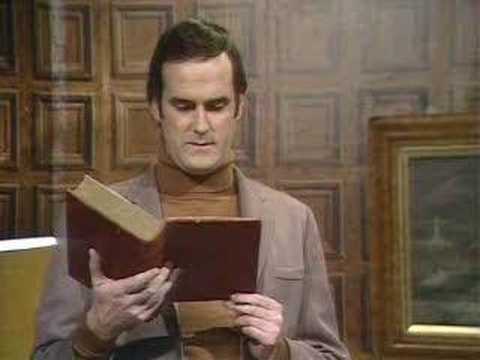
image1a.jpg

It was clear, when we first heard it, that, like so much of Python material, it was one of those references which an audience in Britain in the early 1970s would have understood immediately and chuckled at, but it was only with the advent of the all-knowing Wikipedia that the reference came clear to us.  (Here’s a LINK, so that, if you don’t know it already, you, too, can be suitably enlightened.)

But it made us think—not everything does, we promise!—of Tolkien and what must sound like a very odd subject—furniture.

Furniture?

Consider Bilbo’s Bag End:

“The Door opened on to a tube-shape hall like a tunnel:  a very comfortable tunnel without smoke, with paneled walls, and floors tiled and carpeted, provided with polished chairs, and lots and lots of pegs for hats and coats…The tunnel wound on and on, going fairly but not quite straight into the side of the hill—The Hill, as all the people for many miles round called it—and many little round doors opened out of it, first on one side and then on another.  No going upstairs for the hobbit:  bedrooms, bathrooms, cellars, pantries (lots of these), wardrobes (he had whole rooms devoted to clothes), kitchens, dining-rooms, all on the same floor, and indeed on the same passage…” (The Annotated Hobbit, Chapter 1, “An Unexpected Party”)

Here is JRRT’s version of the entryway–with Bilbo—or is that JRRT himself?  There appears to be a strong resemblance…
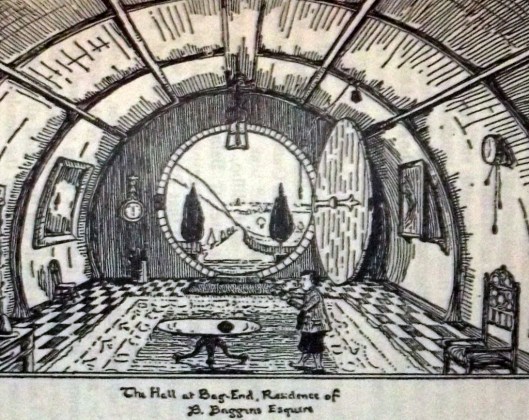
image2a.jpg

image2bilbo.jpg

As the narrator tells us, “This hobbit was a very well-to-do hobbit…”, but, at the same time, we could easily see this description (ignoring the fact that it’s about a hole, albeit “not a nasty, dirty, wet hole…nor yet a dry, bare, sandy hole…it was a hobbit-hole, and that means comfort”) applied to the kinds of late-Victorian/Edwardian interiors with which Tolkien was familiar.
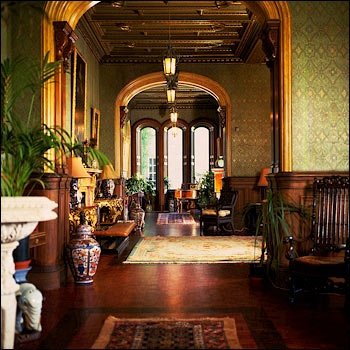
image3hall.jpg

People of this world—middle-class England—seem to have loved to live among piles of possessions—heavy furniture, thick carpets, heavy drapes, and knickknacks galore.

image4.jpg

(Oh–and swords, apparently.)

To us, this has a slightly claustrophobic effect—and we imagine that it may be why Alice in Through the Looking-Glass (1871) attempts to escape it–
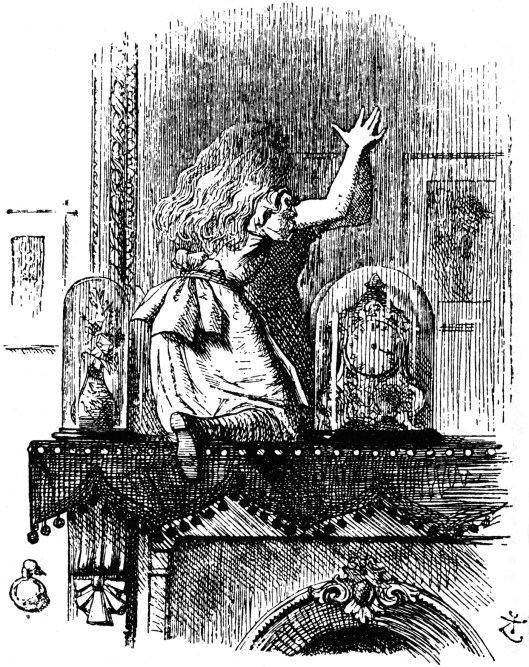
image5lookingglasshere.jpg

only to find herself in a distorted version of the same room on the other side of the mirror.
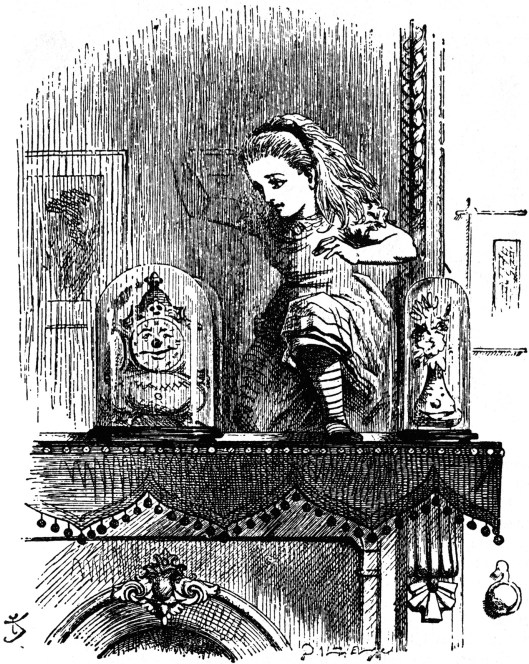
image6lookingglassthere.jpg

[Here’s the actual mirror, from the childhood home of the real Alice, which is said to have inspired Charles Dodgson/Lewis Carroll to write a sequel to the first Alice book.]

image7alicemirror.jpg

What about other Middle-earth interiors, beginning in The Hobbit?

Surprisingly, there is really nothing before the Dwarves and Co. reach Beorn’s house.  There is no description of any inside in Rivendell and, beyond that, the only “indoors” we see before Beorn is the main cave of the goblins and the only “furniture” is this:

“There in the shadows on a large flat stone sat a tremendous goblin…”  (The Hobbit, Chapter 4. “Over Hill and Under Hill”)
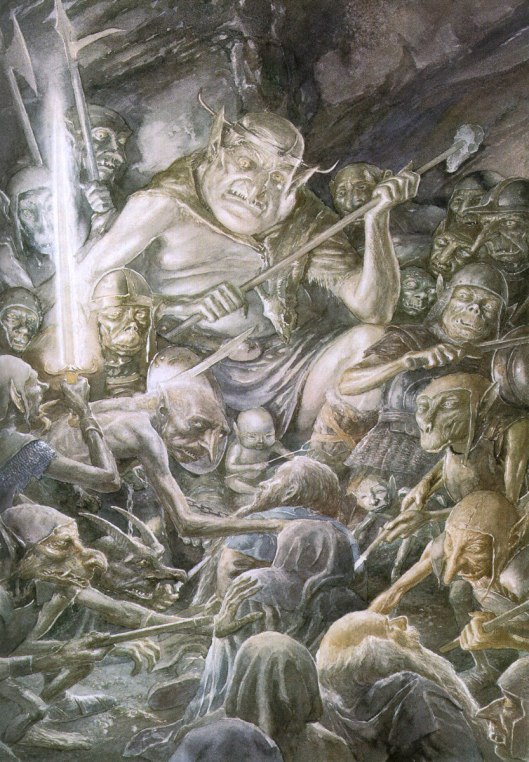
image8goblinstone.jpg

Beorn’s house, as we see in Anderson’s The Annotated Hobbit (170-171), appears to be based upon an illustration to be found in E.V. Gordon’s An Introduction to Old Norse (1927) (with an older history yet—see Anderson, 171).
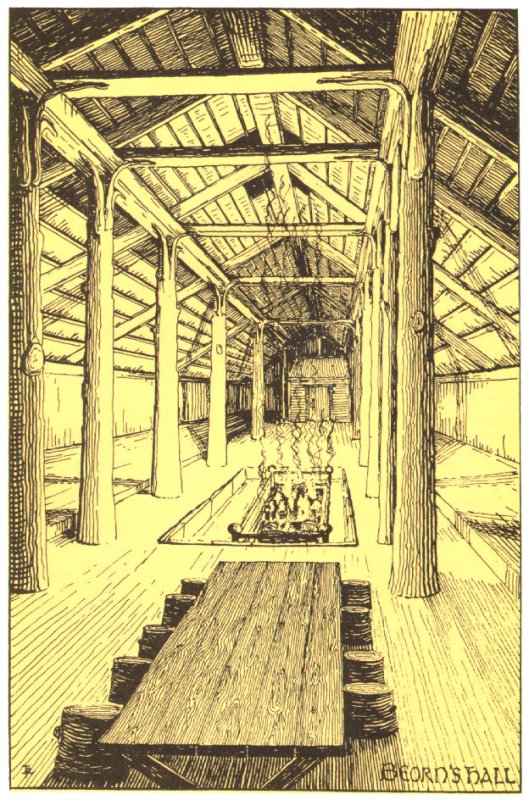
image9beornshall.jpg

The Hildebrandts saw Beorn’s house as rather like a giant log cabin,

image10aabeornshouse.jpg

but we imagine the outside of Beorn’s house to look rather more like this view of an Iron Age farmhouse
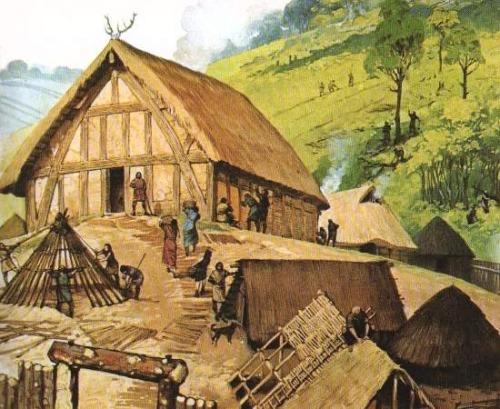
image10bb.jpg

And here’s a reconstruction of a Norse house interior which is a little more “lived-in”, to give you the idea of what Beorn’s house might look like day-to-day (without the magic animals, unfortunately).

image10bvikinghall.jpg

As Tolkien’s illustration shows, however, this is hardly based upon a Victorian parlor!  As the narrator describes it (with magic animals as the kitchen staff):

“Quickly they got out boards and trestles from the side walls and set them up near the fire…Beside them a pony pushed two low-seated benches with wide rush-bottoms and little short thick legs for Gandalf and Thorin, while at the far end he put Beorn’s big black chair of the same sort…These were all the chairs he had in his hall…What did the rest sit on?…The other ponies came in rolling round drum-shaped sections of logs, smoothed and polished, and low enough even for Bilbo…” (The Hobbit, Chapter 7, “Queer Lodgings”)

Beyond Beorn’s house, there is mention that the Elvenking sat “on a chair of carven wood” (The Hobbit, Chapter 9, “Barrels Out of Bond”) and the Master of Laketown has a “great chair” (The Hobbit, Chapter 10, “A Warm Welcome”), but we have come deeper into the Middle-earth/medieval world, it seems, where furniture (at least in the narrator’s view) is sparse and we will only begin to see more abundance, at least in a general way, when we return to the Shire and the unwelcome event of the auction of Bilbo’s possessions on June 22nd:

“The legal bother, indeed, lasted for years…and in the end to save time Bilbo had to buy back quite a lot of his own furniture.” (The Hobbit, Chapter 19, “The Last Stage”)

“Furniture” is, unfortunately, a vague word, mentioned just previously in relation to the Sackville-Bagginses who were “busy measuring his [Bilbo’s] rooms to see if their own furniture would fit.”  We’ll have to make do here with our original idea of Bilbo the Middle-earth Victorian’s house,
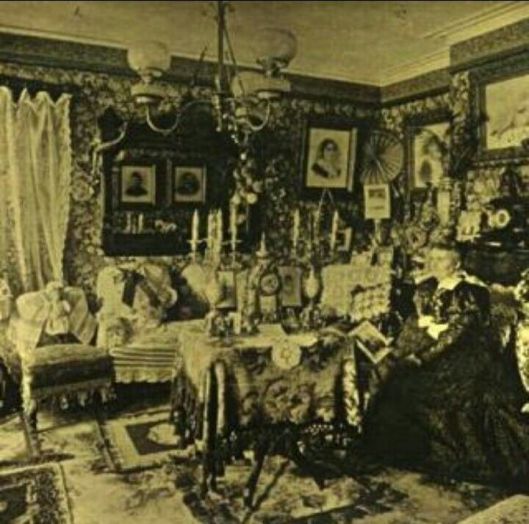
image10vicparlor.jpg

but, in our next, we’ll have a look at households (and palaces) in The Lord of the Rings, to see what we may find (and we have a hunch the inventory will include a quantity of thrones…)

Thanks, as ever, for reading!

MTCIDC

CD

Dancing with the Elves

09 Wednesday Aug 2017

Posted by Ollamh in Fairy Tales and Myths, Imaginary History, J.R.R. Tolkien, Literary History, Narrative Methods

≈ Leave a comment

Tags

19th Century, A Midsummer Night's Dream, Anglo-Saxon, Arthur Rackham, Beren and Luthien, dance, Dicky Doyle, Elbereth Gilthoniel, elf ring, Elves, Fairy, fairy ring, Fairy Tale, Folklore, In Fairyland, Kenneth Grahame, Peter Pan in Kensington Gardens, Song, The Hobbit, The Lord of the Rings, Tolkien, Victorian, William Shakespeare

Dear readers,

Welcome, as always.

In The Lord of the Rings, Elves are powerful, human-like figures– immortal, skilled, and revered as counselors. In Tolkien’s work, however, they have not always been this way– early drafts suggest a sort of Victorian confusion, as if Tolkien’s elves have ancestral ties to both the tall, beautiful elves of the Anglo-Saxons, and to the jovial, delicate elves and fay of the mid- to late- 19th century.

In the beginning of June this year, Christopher Tolkien published an edited version of his father JRRT’s story, “Beren and Luthien”, which was originally published as a part of The Silmarillion, a history of the Elves.

beren-e-luthien-alan-lee.jpg

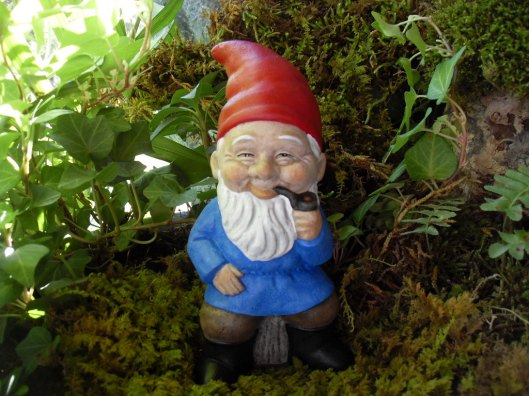
Within this book are previously unpublished earlier drafts and versions of the story, and in the introduction to them, Christopher Tolkien comments upon them: Beren was originally a gnome (which he was quick to explain meant an immortal figure– not what we would find in gardens),

il_fullxfull.1076091410_mapj.jpg

and then an elf, before his final incarnation as a mortal man. Luthien, the immortal Elven princess, is referred to by Tevildo, Prince of Cats, as “Princess of Fairies”. After being ordered to dance before him by the dark lord Melkor, Luthien began

“Such a dance as neither she nor any other sprite or fay or elf danced every before or has done since… magically beautiful as only Tinuviel ever was… and Ainu Melko for all his power and majesty succumbed to the magic of that Elf-maid, and indeed even the eyelids of Lorien had grown heavy had he been there to see” (76).

BL-back.jpg

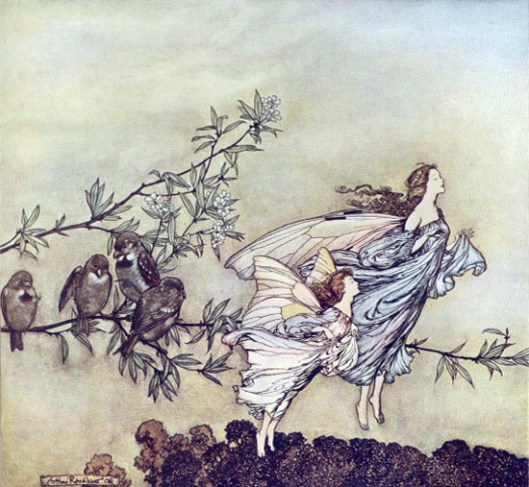
What we found curious here was JRRT’s uses of “Elf” and “Fairy” as seemingly synonymous with each other, when, depending on to which story an Elf or Fairy belongs, they may be quite different. Being people who spend a good deal of time in the Victorian world, when we think of dancing fairies, what is more likely to come to mind are the tiny winged figures who appear in Kenneth Grahame’s Peter Pan in Kensington Gardens (1906), with illustrations by Arthur Rackham.

fairy_tiff.jpg

20245801 Fairies never say we feel happy....jpg

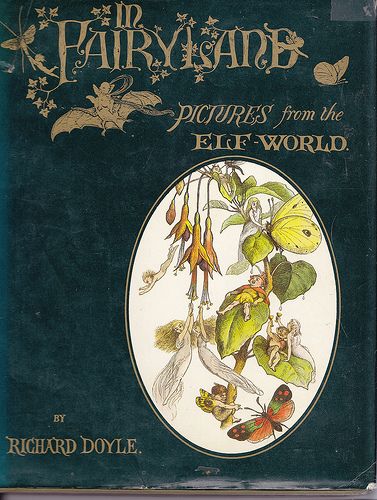
We might also be reminded of the little people who inhabit Dicky Doyle’s In Fairyland (1869)

7c11afdbc1cc79ed7cf88e64e80b8528--richard-doyle-conan.jpg

115cbac12c146d78a0f2753bfae597b9--antique-books-old-books.jpg

What we see in the Victorian sense of fairies and elves in images and stories is a revival of Elizabethan fairy-stories, which focus on little people: much like the fairies of William Shakespeare’s A Midsummer Night’s Dream, for example, the fairies in Kensington are light-footed, winged beings who wear flowing garments, and they fancy calling themselves “dancey” rather than “happy”.

Dicky Doyle’s In Fairyland finds Elves in the “Elf World” to be the same sort of creatures. The picture below gives us an idea of the jovial nature of Victorian Elves, and is captioned, “The little Elves would cross over the border, and come into the King’s fields and gardens.”:

356d133220f9a2875cd80f0ad16cab6c.jpg


J.R.R. Tolkien was born in 1896, at the end of the Victorian period. It would be understood if the Victorian sense was residual in his work– after all, he was a child when Arthur Rackham’s illustrations met the height of their popularity, at the beginning of the 20th century, and he mentions in his letters having seen them.

In his Middle-earth, however, we see a very different kind of Elf.  Tolkien describes how he imagined them in a letter to Naomi Richardson on 25 April 1954:

” ‘Elves’ is a translation, not perhaps now very suitable, but originally good enough, of Quendi. They are represented as a race similar in appearance (and more so further back) to Men, and in former days of the same stature… [they] are in fact in these histories very little akin to the Elves and Fairies of Europe; and if I were pressed to rationalize, I should say that they represent really Men with greatly enhanced aethetic and creative features, greater beauty and longer life, and nobility…” (Letters, 176).

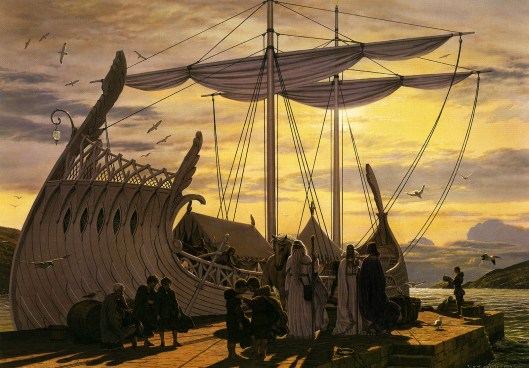
Below are a few artists’ renditions of what these Elves might look like, and they’re very different from the imaginations of Arthur Rackham and Dicky Doyle.

61954a630522d2bbce39220223dc89ef.jpg

galadriel-hildebrant.jpg

aab7b11adf539086efc6762490bc7417.jpg

ted nasmith_the complete guide to middle-earth_departure at the grey havens.jpg

tumblr_n2gwteLx4b1tnpw9xo1_500.jpg

And some images from Peter Jackson’s films, as well:

Haldir_w_elves.jpg

Gli-Galad_y_Elrond.jpg

When JRRT refers to “the former days”, we can assume that he means two things:

  1. The former days of Middle-earth, such as in The Silmarillion
  2. The former days of our world–specifically, Anglo-Saxon Elves, which resemble the Elves of Middle-earth in their stature and beauty. Thus, the “former days” refer to a former rendition of Elves– one which, belonging to the Anglo-Saxons, would be familiar to JRRT.

(Attached here is a very useful book on this subject by Alaric Hall, which provides an in-depth look at pre-Elizabethan and pre-Victorian Elves.)

These Elves are almost the polar opposite of the Elfin and Fay creatures of the Victorians, and we found it curious that they would have anything in common. As demonstrated by Rackham’s “dancey” fairies and Luthien in Beren and Luthien, however, we found one thing: a love for song and dance.

While looking through Jack Zipes’ collected anthology of Victorian Fairy Tales, The Revolt of Fairies and Elves, we came across an example of this in “Charlie Among the Elves”, in which the protagonist, a young boy who finds himself, by some sort of magic or dream, in the world of fairies and elves. The elves invite him in and greet him with a song:

“…they struck up a melody which Charlie thought was the very sweetest music which he had ever heard in the whole course of his life, and thus ran the song of the Elves:

In the waning summer light

Which the hearts of mortals love

’Tis the hour for elfin sprite

Through the flow’ry mead to rove.


Mortal eyes the spot may scan,

Yet our forms they ne’er descry;

Though so near the haunts of man,

Merrily our trade we ply.”

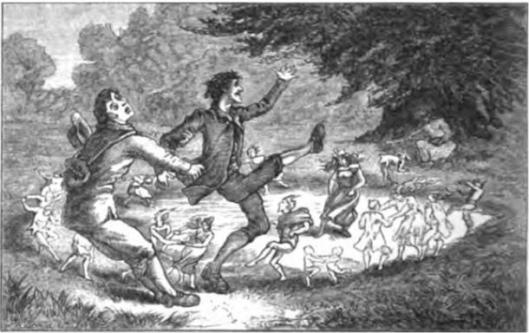
In some folklore, there is also the danger of dance. Fairy rings, also called elf rings, are supernatural places created by the dancing of either fairies, elves, or witches. They have been considered hazardous by much of Western folklore to those outside of the fairy world; in these stories, mortals who have stepped inside have been cursed, trapped, or simply disappear.

fairy-ring.jpg

Plucked-from-the-Fairy-Circle.jpg

Rackham-Come-Now-a-Roundal-L.jpg

Charlie was lucky that he had come across benevolent creatures, and this reminded us of another instance when an adventurer was greeted by Elves through song: in The Hobbit, which is where Tolkien first introduced Elves, before he later understood them. Before The Lord of the Rings and The Silmarillion, Bilbo, Thorin, and Company are greeted by Elf-song in Rivendell:

” ‘Hmmm! it smells like elves!’ thought Bilbo, and he looked up at the stars. They were burning bright and blue. Just then there came a burst of song like laughter in the trees:

‘O! What are you doing,

And where are you going?

Your ponies need shoeing!

The river is flowing!

O! tra-la-la-lally,

here down in the valley!’ ”

As the Elves in both “Charlie Among the Elves” and The Hobbit are jovial and playful in their music, we might think that Tolkien had not completely abandoned the Victorian Elfin world, after all; of course, in The Lord of the Rings and in The Silmarillion, the Elves, just as much as the stories, take a more serious turn. Playful tunes are replaced with much more serious poetry, and in their native tongue, such as the Hymn to Elbereth Gilthoniel:

“A Elbereth Gilthoniel
Silivren penna miriel
A menel aglar elennath
Na chaered palandiriel.
O Galadhremmin ennorath
Fanuilos, le linnathon
Nef aer, si nef aeron!
A Elbereth Gilthoniel!
We still remember,
We who dwell
In the lands beneath the trees
Thy starlight on the western seas.”

pl_elbereth.jpg

When trying to reconcile these sorts of Elves and Fairies, rather than assessing them through their physical and behavioral qualities, we may look at them through something just as important in understanding them: music. The Silmarillion explains that the Elves, as well as the world and everything in it, including good and evil, originated from song.

But just as Elven music changes from The Hobbit to The Lord of the Rings, so the Elves have changed– they are human-sized, but also perhaps more serious and melancholy, as a parallel to the world Tolkien had created, which was much more complex than he originally realized.

The songs in The Lord of the Rings, and the later versions of Luthien, which present her as an Elf princess– a beautiful being which Beren falls in love with as soon as he sees her dance– express that melancholy. As the tale of Beren and Luthien reflects the way Tolkien wishes us to see Elven folklore– romantic, adventurous, and, ultimately, sorrowful– perhaps we can conclude that JRRT’s Elves are really fairies grown up.

And what do you think, dear readers?

MTCIDC,

CD

The Doubtful Sea Series Facebook Page

The Doubtful Sea Series Facebook Page

  • Ollamh

Categories

  • Artists and Illustrators
  • Economics in Middle-earth
  • Fairy Tales and Myths
  • Films and Music
  • Games
  • Heroes
  • Imaginary History
  • J.R.R. Tolkien
  • Language
  • Literary History
  • Maps
  • Medieval Russia
  • Military History
  • Military History of Middle-earth
  • Narnia
  • Narrative Methods
  • Poetry
  • Research
  • Star Wars
  • Terra Australis
  • The Rohirrim
  • Theatre and Performance
  • Tolkien
  • Uncategorized
  • Villains
  • Writing as Collaborators
Follow doubtfulsea on WordPress.com

Across the Doubtful Sea

Recent Postings

  • Through a glass… January 7, 2026
  • Heffalumps? December 31, 2025
  • We Three Kings December 24, 2025
  • A Moon disfigured December 17, 2025
  • On the Roads Again—Once More December 10, 2025
  • (Not) Crossing Bridges December 3, 2025
  • On the Road(s) Again—Again November 26, 2025
  • On the Road(s) Again November 19, 2025
  • To Bree (Part 2) November 12, 2025

Blog Statistics

  • 104,125 Views

Posting Archive

  • January 2026 (1)
  • December 2025 (5)
  • November 2025 (4)
  • October 2025 (5)
  • September 2025 (4)
  • August 2025 (4)
  • July 2025 (5)
  • June 2025 (4)
  • May 2025 (4)
  • April 2025 (5)
  • March 2025 (4)
  • February 2025 (4)
  • January 2025 (5)
  • December 2024 (4)
  • November 2024 (4)
  • October 2024 (5)
  • September 2024 (4)
  • August 2024 (4)
  • July 2024 (5)
  • June 2024 (4)
  • May 2024 (5)
  • April 2024 (4)
  • March 2024 (4)
  • February 2024 (4)
  • January 2024 (5)
  • December 2023 (4)
  • November 2023 (5)
  • October 2023 (4)
  • September 2023 (4)
  • August 2023 (5)
  • July 2023 (4)
  • June 2023 (4)
  • May 2023 (5)
  • April 2023 (4)
  • March 2023 (5)
  • February 2023 (4)
  • January 2023 (4)
  • December 2022 (4)
  • November 2022 (5)
  • October 2022 (4)
  • September 2022 (4)
  • August 2022 (5)
  • July 2022 (4)
  • June 2022 (5)
  • May 2022 (4)
  • April 2022 (4)
  • March 2022 (5)
  • February 2022 (4)
  • January 2022 (4)
  • December 2021 (5)
  • November 2021 (4)
  • October 2021 (4)
  • September 2021 (5)
  • August 2021 (4)
  • July 2021 (4)
  • June 2021 (5)
  • May 2021 (4)
  • April 2021 (4)
  • March 2021 (5)
  • February 2021 (4)
  • January 2021 (4)
  • December 2020 (5)
  • November 2020 (4)
  • October 2020 (4)
  • September 2020 (5)
  • August 2020 (4)
  • July 2020 (5)
  • June 2020 (4)
  • May 2020 (4)
  • April 2020 (5)
  • March 2020 (4)
  • February 2020 (4)
  • January 2020 (6)
  • December 2019 (4)
  • November 2019 (4)
  • October 2019 (5)
  • September 2019 (4)
  • August 2019 (4)
  • July 2019 (5)
  • June 2019 (4)
  • May 2019 (5)
  • April 2019 (4)
  • March 2019 (4)
  • February 2019 (4)
  • January 2019 (5)
  • December 2018 (4)
  • November 2018 (4)
  • October 2018 (5)
  • September 2018 (4)
  • August 2018 (5)
  • July 2018 (4)
  • June 2018 (4)
  • May 2018 (5)
  • April 2018 (4)
  • March 2018 (4)
  • February 2018 (4)
  • January 2018 (5)
  • December 2017 (4)
  • November 2017 (4)
  • October 2017 (4)
  • September 2017 (4)
  • August 2017 (5)
  • July 2017 (4)
  • June 2017 (4)
  • May 2017 (5)
  • April 2017 (4)
  • March 2017 (5)
  • February 2017 (4)
  • January 2017 (4)
  • December 2016 (4)
  • November 2016 (5)
  • October 2016 (6)
  • September 2016 (5)
  • August 2016 (5)
  • July 2016 (5)
  • June 2016 (5)
  • May 2016 (4)
  • April 2016 (4)
  • March 2016 (5)
  • February 2016 (4)
  • January 2016 (4)
  • December 2015 (5)
  • November 2015 (5)
  • October 2015 (4)
  • September 2015 (5)
  • August 2015 (4)
  • July 2015 (5)
  • June 2015 (5)
  • May 2015 (4)
  • April 2015 (3)
  • March 2015 (4)
  • February 2015 (4)
  • January 2015 (4)
  • December 2014 (5)
  • November 2014 (4)
  • October 2014 (6)
  • September 2014 (1)

Blog at WordPress.com.

  • Subscribe Subscribed
    • doubtfulsea
    • Join 78 other subscribers
    • Already have a WordPress.com account? Log in now.
    • doubtfulsea
    • Subscribe Subscribed
    • Sign up
    • Log in
    • Report this content
    • View site in Reader
    • Manage subscriptions
    • Collapse this bar
 

Loading Comments...