• About

doubtfulsea

~ adventure fantasy

Category Archives: The Rohirrim

Accuracy? Well, Yes, But…

07 Wednesday Jun 2017

Posted by Ollamh in Artists and Illustrators, Heroes, J.R.R. Tolkien, Literary History, Military History, Narrative Methods, The Rohirrim

≈ Leave a comment

Tags

American Civil War, American Revolution, Concord, Don Troiani, Germantown, grenadiers, H. Charles McBarron, Harper's Monthly, Howard Pyle, Illustration, John Trumbull, Joseph Warren, King Arthur, Lexington, Pirates, Richard Simkin, The Battle of Bunker Hill, The Battle of Nashville, The Lord of the Rings, The Rohirrim, The Salem Wolf, Tolkien

Welcome, dear readers, as always.

Today’s post takes us to the question of what we like and why and how such likes may push us—who, we realize, are a little stiff on the subject of accuracy—to accept things which, if our feelings weren’t engaged, we would briskly reject.

We begin by looking at a painting by one of our favorite late Victorian/Edwardian illustrators, Howard Pyle (1853-1911).

image1hp.jpg

If you’re a regular reader (and we hope you are—or will be!), you’ll have seen his work on our pages any number of times, from his King Arthur illustrations (and here’s a LINK to a free 1922 reprint at the Internet Archive)

image2ka.jpg

to his pirates (and here’s a LINK to a later—c.1921—collection of Pyle’s pictures and writings on pirates at Internet Archive).

image3hppirates.jpg

Pyle also wrote and illustrated original fiction—just look at this haunting picture from a short story, “The Salem Wolf”, which was published in the December, 1909, issue of Harper’s Monthly Magazine.
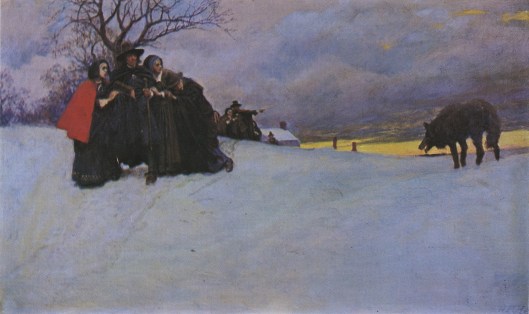
image4salemwolf.jpg

(And here’s a LINK to the story at Internet Archive)

Pyle also painted stand-alone historical pictures, such as this of “The Battle of Nashville” (1907).

MN 60

And we’re lucky to have a photograph of the artist at work on this very picture.

image6hppainting

Besides American Civil War pictures, Pyle painted several based upon incidents of the American Revolution, such as this, of the assault on the Chew House, at the Battle of Germantown (4 October, 1777).
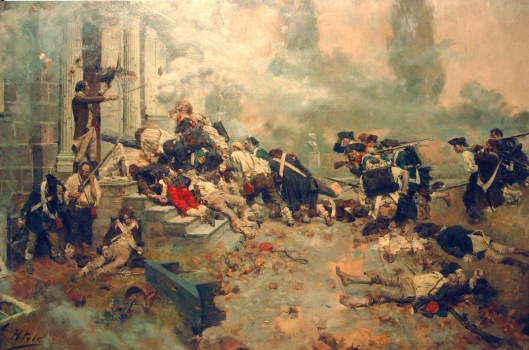
image7pylegermantown

Another of his pictures of the Revolution is the subject of this post, “The Battle of Bunker Hill” (1897).
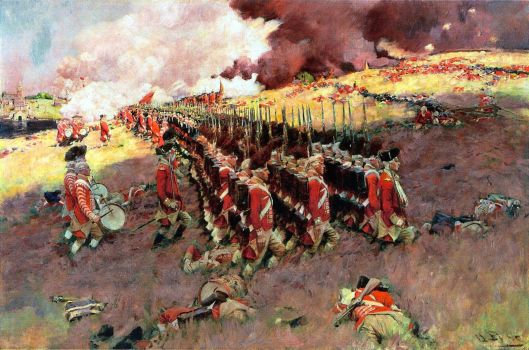
image8pylebunkerhill

We’re not sure when one of us first saw this picture—childhood, we’d guess—but we were immediately bowled over by it. It’s the adventure of it: those long ranks of redcoats stoically marching up the hill, drums beating behind. It’s not a sanitized picture—just look up the hill and all around you can see the wreck of the earlier British attacks—but its emphasis is upon the courage it must take to do what those soldiers did.

This was, in fact, the third battle of the American Revolution. The war had begun in mid-April, 1775, when a raiding party of British troops, ordered to disrupt local preparations for defense, fought two skirmishes with local militia, at Lexington
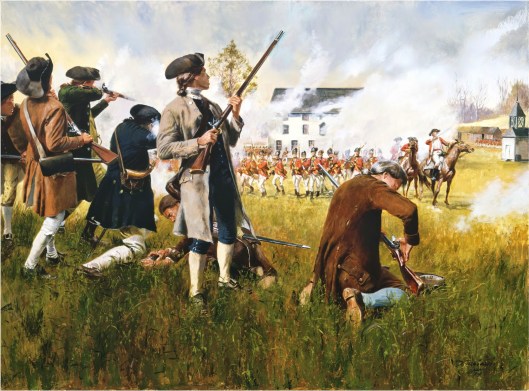
image9lexington.jpg

and Concord,

image10concord.jpg

two rural settlements some twenty miles or so west of Boston.

When the British withdrew into Boston itself, those locals, who had grown in numbers to about 15,000, drawn from all over New England, blockaded the town and there was a period of stalemate, while both sides were reinforced. When it was clear that the locals had seized a nearby hill and were planning to plant artillery there which would then be capable of bombarding Boston, the British were forced to move. Their choice was to attack that hill, which was named “Breed’s Hill” but, through an historical mix-up, the battle was named for the hill to its rear, “Bunker Hill”.

image11bunkerhill.jpg

Initially, the British plan was to have part of its force make a feint—a fake attack—against the main part of the hill, where the locals had built an open-backed fortification, called a redoubt, while the real attack was to push through the weaker local left and curve around to hit the locals from the rear.

By underestimating the defense, the British soon suffered over a thousand casualties to the local 450. As the assaults were driven back, the British plan changed and the main attack was to be uphill, straight at the redoubt and this is what is depicted in Pyle’s painting, specifically the advance of the 52nd Foot (“Foot” is 18th-century shorthand for “regiment of infantry”).
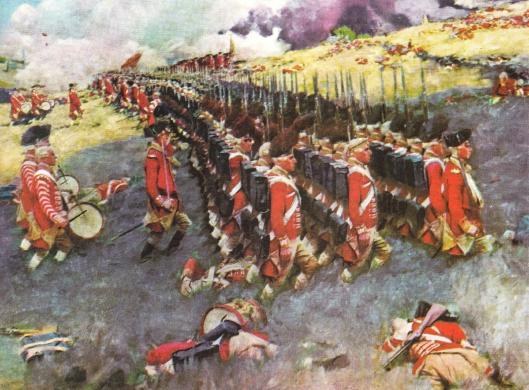
image12hpbunkerhill.jpg

This is not the first well-known painting of the battle, however. In the first third of the 19th century, John Trumbull (1756-1843), a prominent American artist, painted several versions of a work entitled, “The Death of General Warren at the Battle of Bunker’s Hill, June 17, 1775”.

image13trumbullbunkerhill.jpg

This picture belongs to what we might call both the “heroic school” and the “portrait school”, the former because of a certain flashy quality (look at the way the wind seems to be whipping everything—and where are those flames on the right coming from?), the latter because, not only is the local officer, Joseph Warren depicted, but so are a number of other figures—two of the British generals, two British majors, and a number of more minor participants.

Bunker Hill remained—and remains—a popular subject for historical painters, most of them depicting events from the local side. Here is one version, by the distinguished 20th-century American military artist, H. Charles McBarron (1902-1992).
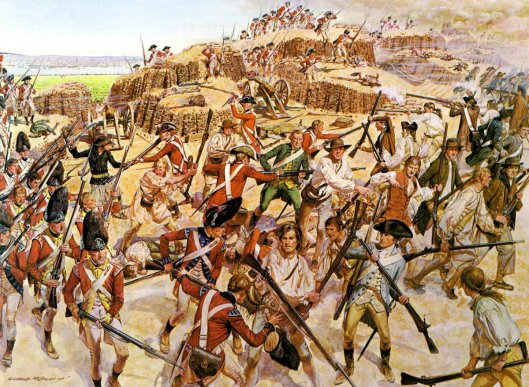
image14mcbarron.jpg

And here are two by one of our favorite contemporary American Civil War artists, Don Troiani (1949-).
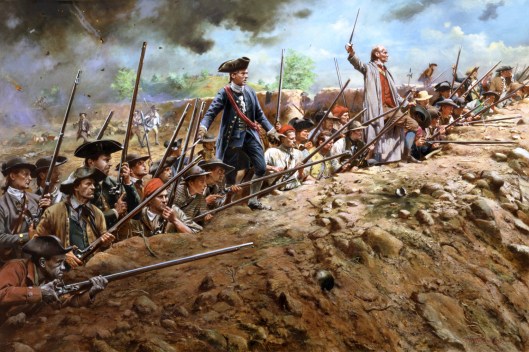
image15troi.jpg

image16troi.jpg

All pictures are not from the viewpoint of the colonists, however. The late-Victorian/Edwardian British military artist, Richard Simkin (1850-1926), gave us this view.

image17simkin.jpg

Of all of these images, the Trumbull has drawn upon his memory and upon his sketchbooks, too, we bet, to give a general impression of the look of the soldiers, but, although he was part of the colonial force besieging Boston, he only saw the battle through a telescope. McBarron was a collector of uniforms and equipment, as is Troiani, and their works are painstakingly accurate. Simkin, although he, too, was a collector, came from an earlier time, just at the beginning of serious research on weapons and uniforms of the past, and, therefore, certain elements in his picture—the plumes and cords on his men’s bearskins and those packs (left behind in Boston, in reality), for instance—are not correct. Even so, his picture is far more accurate than Pyle’s, which is full of mistakes, in everything from the uniforms and equipment to those grenadiers (those guys in the fuzzy hats in the center), who shouldn’t be there at all, having been detached to form part of the right wing assault force.

And yet the Pyle is still our favorite depiction of the battle. Why? Because it feels right: it’s a 19th-century image of courage and discipline, and appeals to our romantic souls, even though there are casualties strewn about, which, to us, only serves to emphasize the bravery and stick-to-it-iveness of those solid infantry.

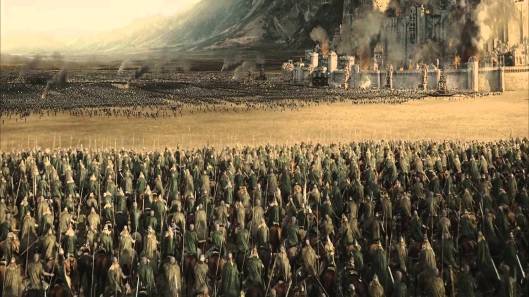
And this is where JRRT comes in. We’ve said before: our favorite part of P. Jackson’s films is anything to do with the Rohirrim.

image18rohirrim.jpg

The fact that, in the books, they live in wide, grassy plains (unavailable in New Zealand) and that their capital, Edoras, does not have “a dike and mighty wall and thorny fence” in the films, along with any other details it would be easy to extract from The Lord of the Rings, doesn’t matter to us in the least. The depiction in the films feels right and we’re content with that, even when there are other parts of the films where we have other reactions. Simple (and perhaps surprising to us) as that.

So, dear readers, do you have similar reactions? And to what? We’d love to hear!

And thanks, as always, for reading.

MTCIDC

CD

“My subject is War, and the pity of War.”

13 Wednesday Apr 2016

Posted by Ollamh in Artists and Illustrators, Heroes, J.R.R. Tolkien, Military History, Military History of Middle-earth, The Rohirrim

≈ Leave a comment

Tags

Adventure, Alexander Gardner, Alfred Waud, Alonzo Chappel, American Civil War, Antietam, Battle of the Somme, Charge of the Rohirrim, Confederate, early photography, Felice Beato, First Virginia Cavalry, Fort Geroge, Matthew Brady, Mexican-American War, Minas Tirith, Pelennor, Peter Jackson, Rohirrim, Second Opium War, The Lord of the Rings, Tolkien

Welcome, dear readers, as always.

In this posting, we want to talk a little about a subject so often left out of heroic stories: the aftermath of battle.

In Chapter 10 of The Return of the King, what we might call the GEF—the Gondorian Expeditionary Force—sets off from Minas Tirith for the Morannon. It begins with this little army mustered on the Pelennor and we see events through the eyes of one left behind, Merry:

“At last the trumpets rang and the army began to move. Troop by troop, and company by company, they wheeled and went off eastward. And long after they had passed away out of sight down the great road to the Causeway, Merry stood there. The last glint of the morning sun on spear and helm twinkled and was lost, and still he remained with bowed head and heavy heart, feeling friendless and alone.”

Considering what these folk had endured in the previous days, and what they dreaded might happen in those to come, it’s hardly surprising that it’s not described as a joyous event. What is not described, however, is the landscape in which they gather and which they initially march through.

The Minas Tirith to which Gandalf rides with Pippin

gandalfpippin.jpg

has been attacked by a massive army.

minas-tirith.jpg

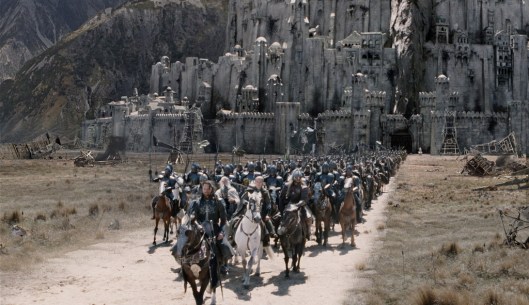
In an attempt to lift the siege, the Rohirrim have charged across the Pelennor,

rohirrimcharge.jpg

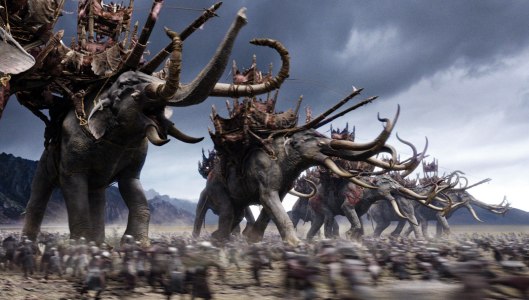
only to encounter the fierce Southrons and their mumakil.

mumakil.jpg

These are defeated, in turn, by Aragorn, his companions, and troops from South Gondor, as well as the surviving Rohirrim and a party from Gondor itself.

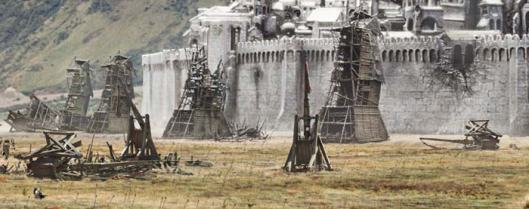
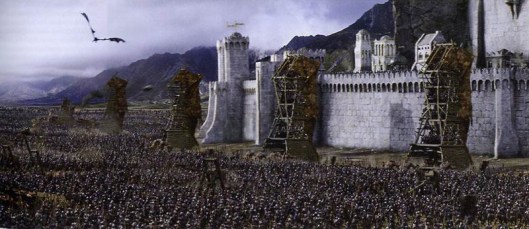
When the carnage is over and the invaders killed or driven off, the story, while touching on the burial of Snowmane, quickly moves back to the city. In real life, such destruction would have left behind a ghastly memorial, something only touched upon in the film of The Return of the King. As you can see in this still, all which seems to remain is the wreckage of the war machines.

551_2_Minas_Tirith_MPdtl.jpg


In fact, there would have been thousands of bodies, not only of men and orcs, but of horses and mumakil as well.

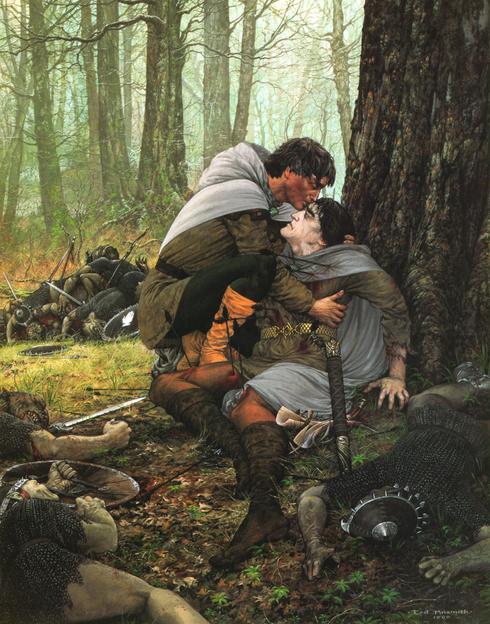
Such an aftermath has not been a popular subject for art, except in scenes where fallen heroes are lamented when found among the slain. (Think here of Boromir, surrounded by dead orcs, for example.)

boromir.jpg

That sense of war was changed, in our world, by the introduction of the camera to the battlefield, first, briefly, by Felice Beato, during the Second Opium War (1860)

beatonorthtakufort1860.jpg

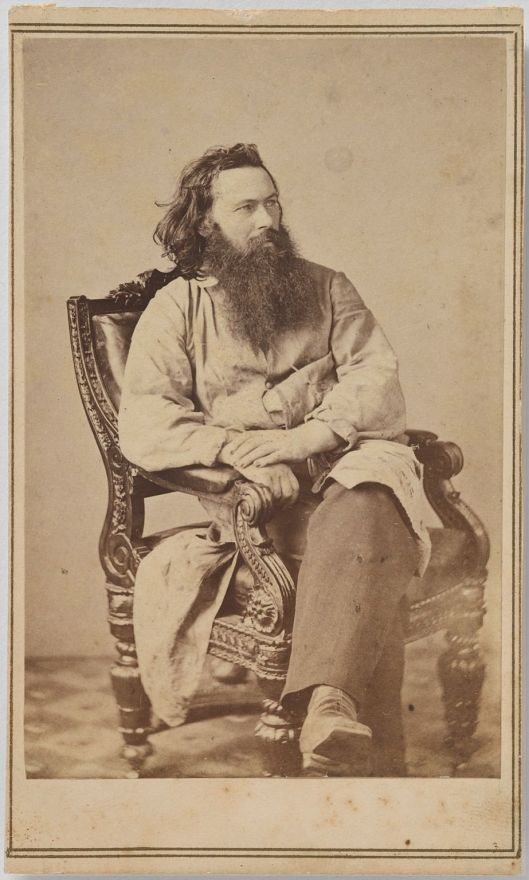
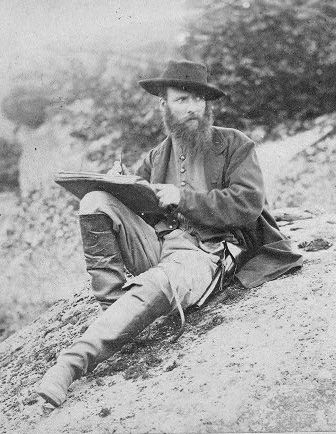
but in the US by Alexander Gardner, in the fall of 1862.

alexandergardner.jpg

Previous images of war had tended towards the glorious, full of bravery and flags, as in this engraving made from Alonzo Chappel’s painting of the taking of the Canadian Fort George in 1813—

alonzochappellftgeorge.jpg

Even if the depiction tended to be more realistic, it came heavily filtered. During the American Civil War, several northern newspapers and magazines sent artists into the field, who drew what they saw or at least heard about from those who had seen events. One of the best was the Englishman, Alfred Waud.

alfredwaud.jpg

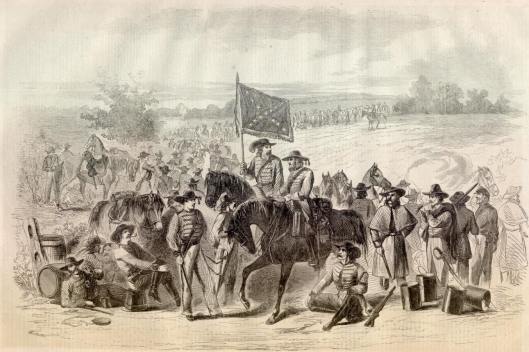
He drew from life, as in the picture of the First Virginia Cavalry, with whom he spent a brief time in late September, 1862. Here’s his original drawing, which he would have sent to his publisher, in New York.

the-first-virginia-cavalry-at-a-halt-alfred-r-waud.jpg

In New York, the drawing would have been turned into a woodblock print for ease of conversion to a magazine page.

1st-virginia-cavalry-halted-based-on-sketch-by-waud-harpers-sept-27-1862.jpg

And, thus, the reading public would have lost immediacy practically at the first step.


Photographs had been made in the US since the 1840s, and even some during the Mexican-American War of 1846-8, but they had been static pictures of soldiers off the battlefield.

wool-in-saltillo.jpg

In September, 1862, however, Gardner had been sent by his boss, Matthew Brady

Mathew-Brady.jpg

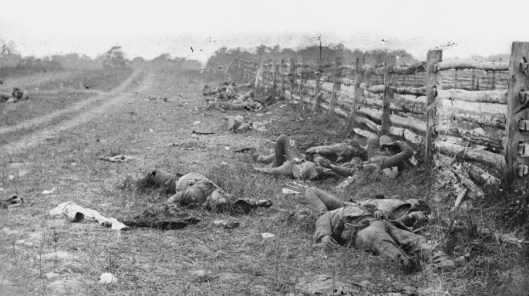
from the studio in Washington, DC, to the field of the recent battle of Antietam, which had been fought only two days before. Gardner came with his photographic wagon

brady'swhatsit.jpg

and ranged the battlefield. The battle was over, but the dead were still in place, where they had fallen, and soon he had a collection of images. Because there was already a tradition of photographing the dead (and, no, we’re not going to continue this practice here—just do google.images “photos of dead victorians” or the like and you can see this for yourself), it was probably not quite so horrifying as one might imagine, but those who saw the exhibit in Brady’s New York gallery

brady'snygallery.jpg

might have agreed with the New York Times review of 20 October, 1862, that “Mr. Brady has done something to bring home to us the terrible reality and earnestness of war.”

Gardner didn’t take the pictures he did out of a morbid interest, but because the cameras of the day were large and cumbersome

banner-civil-war-photography.jpg

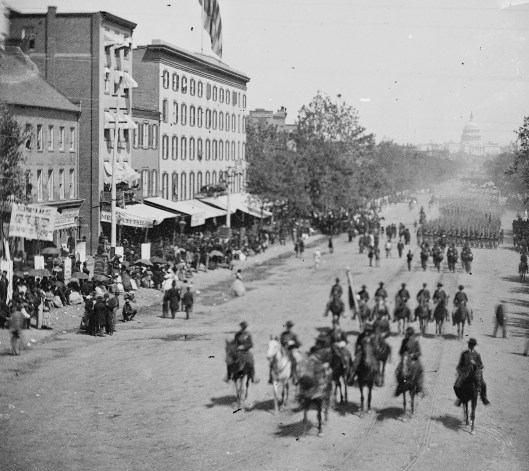
and the process necessary to make a picture took too long to capture motion (just look what happens when there is motion).

Grand Review of Army May 1865 02796u.jpg

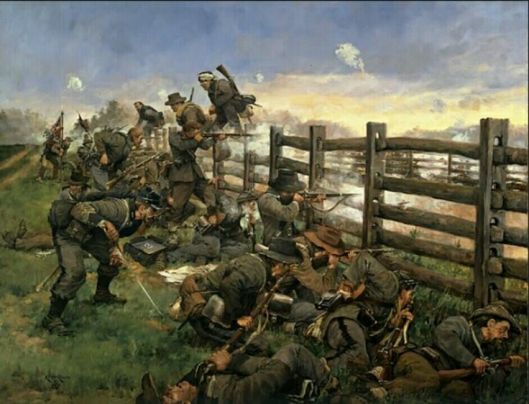
Thus, what one might see in a painting, even if it had attempted to depict reality, as in this Keith Rocco painting of a moment in the battle of Antietam when Confederates were fighting behind a fence on the Hagerstown Road,

keithroccohagerstownroad.jpg

was impossible to capture. What Gardner could capture was the aftermath. And so he did.

hith-battle-of-antietam-E.jpeg


For us, who are modern Rohirrim, as far as horses are concerned, it’s just as well that he confined himself to humans. After Gettysburg, several other photographers included them—only a few photos, but representing anywhere from 3 to 5000 horses and mules who died during the three days of battle. (And, no, again, we won’t show you those—google.images will, but we’re not sure what’s harder to look at.)

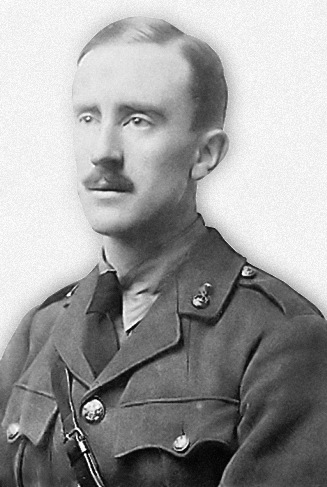
Lieutenant Tolkien

jrrtaslieut.jpg

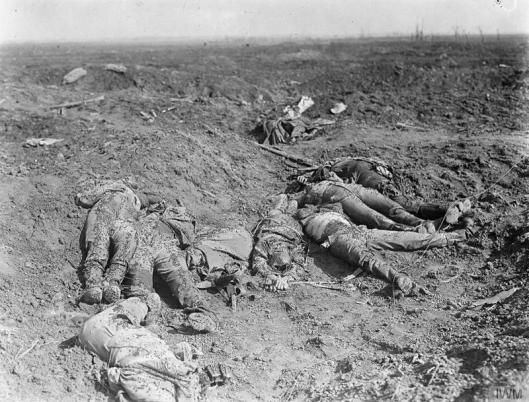
would have seen such horrors every day during the battle of the Somme

sommedead.jpg

and perhaps that’s why he moves so quickly from the battlefield to the city and healing. Perhaps it’s also why the view we are given of the GEF is through the eyes of a wounded survivor and, at this moment in the story, one full of foreboding at the thought of another battle. And it may be that Peter Jackson felt the same way.

West_To_Mordor.jpg

What do you think, dear readers?

Thanks, as always, for reading.

MTCIDC

CD
 

PS

Our title is taken from the work one of our favorite Great War poets, Wilfred Owen (1893-1918), who, having survived the entire war, was killed just before the armistice which halted the fighting.

wilfredowenaschild
wilfredowen

Where From the Rohirrim?

10 Wednesday Jun 2015

Posted by Ollamh in Heroes, J.R.R. Tolkien, Military History, Military History of Middle-earth, Narrative Methods, The Rohirrim

≈ 1 Comment

Tags

Amazons, Anglo-Saxon, Bayeux Tapestry, Burial mounds, Cavalry, Charge of the Light Brigade, descendants, Edoras, Eotheod, Horse people, Indo-European, Kurgan, language, Middle-earth, Normans, Rohan, Rohirric, Rohirrim, Scythians, The Lord of the Rings, The Mark, Tolkien, Tom Shippey

Dear Readers, welcome!

In this post, we want to think out loud a bit about the Rohirrim.

ghan Rohirrim-by-Angus-McBride-kacik-rohanskiej-adoracji-36841491-473-477 maxresdefault

Everyone knows where their language is from, as Tolkien says in a letter to “one Mr. Rang”:

“…’Anglo-Saxon’…is the sole field in which to look for the origins and meaning of words and names belonging to the speech of the Mark.” LT 381

And yet they are horse people (their own name for themselves, in fact, is Eotheod, “horse people”), which the Angles and Saxons who went to make up the Anglo-Saxons, were not.   Tolkien was well aware of this difference, saying in Appendix F of The Lord of the Rings:

“…this linguistic procedure does not imply that the Rohirrim closely resembled the ancient English otherwise, in culture or art, in weapons or modes of warfare, except in a general way due to their circumstances…” L1136

Tom Shippey, in The Road to Middle Earth, suggests that

“The Rohirrim are nothing if not cavalry. By contrast the Anglo-Saxons’ reluctance to have anything militarily to do with horses is notorious…How then can Anglo-Saxons and Rohirrim ever, culturally, be equated? A part of the answer is that the Rohirrim are not to be equated with the Anglo-Saxons of history, but with those of poetry, or legend.” (112)

Or, could there have been other models?

Tolkien may have been suggesting one when, in a letter to Rhona Beare of 14 October, 1958:

“The Rohirrim were not ‘mediaeval’ in our sense. The styles of the Bayeux Taptestry (made in England) fit them well enough, if one remembers that the kind of tennis-nets [the] soldiers seem to have on are only a clumsy conventional sign for chain-mail of small rings.” Ltr 280-281.

The Bayeux Tapestry depicts both Normans and their allies, on the one hand, and the Anglo-Saxons, on the other, but Tolkien doesn’t appear to distinguish between them. The Normans themselves are mounted, the Anglo-Saxons on foot, as was their custom (they did use horses to move rapidly from place to place, as in the race north to Stamford Bridge and then back south to face the Normans).

5191623_orig

Here, to the left, we see those mounted Normans and, to the right, the Anglo-Saxons behind their shield wall. The “tennis-nets” are clearly visible and would actually have looked like this:

huscarl

In this further illustration, by the way, it’s easy to see the consequences of having the shield wall crumble: men on horseback can have a significant advantage when their opponents lose cohesion.

34small-1000

This, however, is only their look . What about those horses and an entire culture based around them?

For a clue, we look to another element in the culture of the Rohirrim, the use of burial mounds. Here they are at Edoras.

Simbelmyne_Mounds

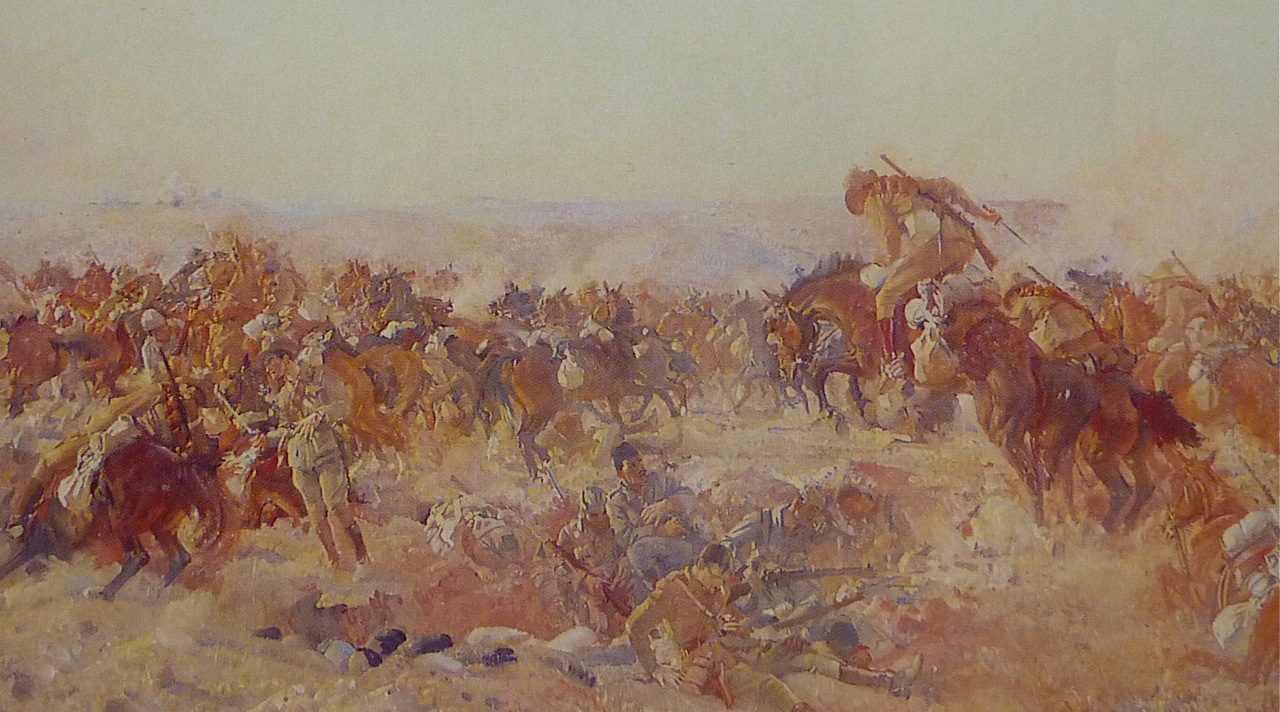
(We can’t resist, by the way, saying that our absolute favorite part of the Jackson movies is anything to do with the Rohirrim—to us, absolutely inspired and we see the depiction of the charge of the Rohirrim against the army besieging Minas Tirith as being right up there with the Charge of the Light Brigade at Balaclava in 1854 and the charge of the Australian Light Horse at Beersheba in 1917–

Rohancharge

(c) National Trust, Tredegar House; Supplied by The Public Catalogue Foundation

beersheba lambert

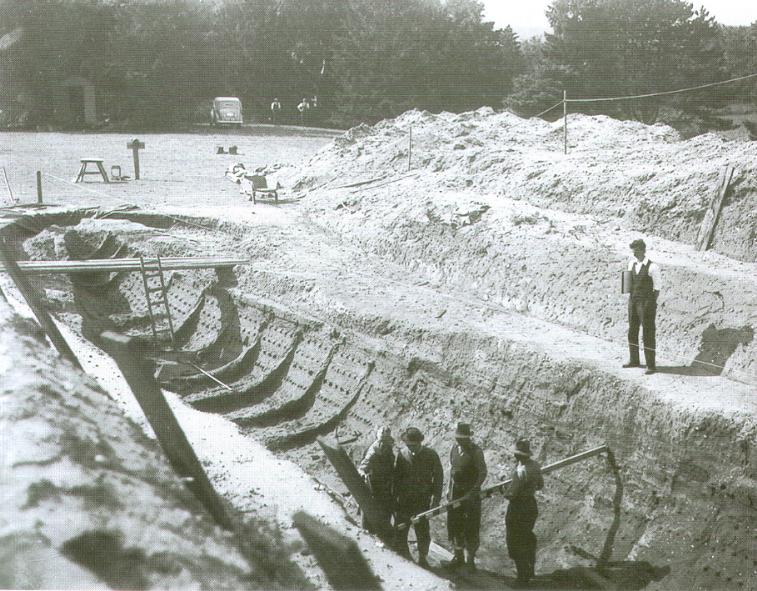
One might say, in reply, that there are Anglo-Saxon mounds—like the famous Sutton Hoo ship burial.

c52a1bf535

But that leaves us where we started, in the land of foot soldiers.

huscarl1

So, let’s go farther afield, to the north of the Black Sea.  

WRLH034-H

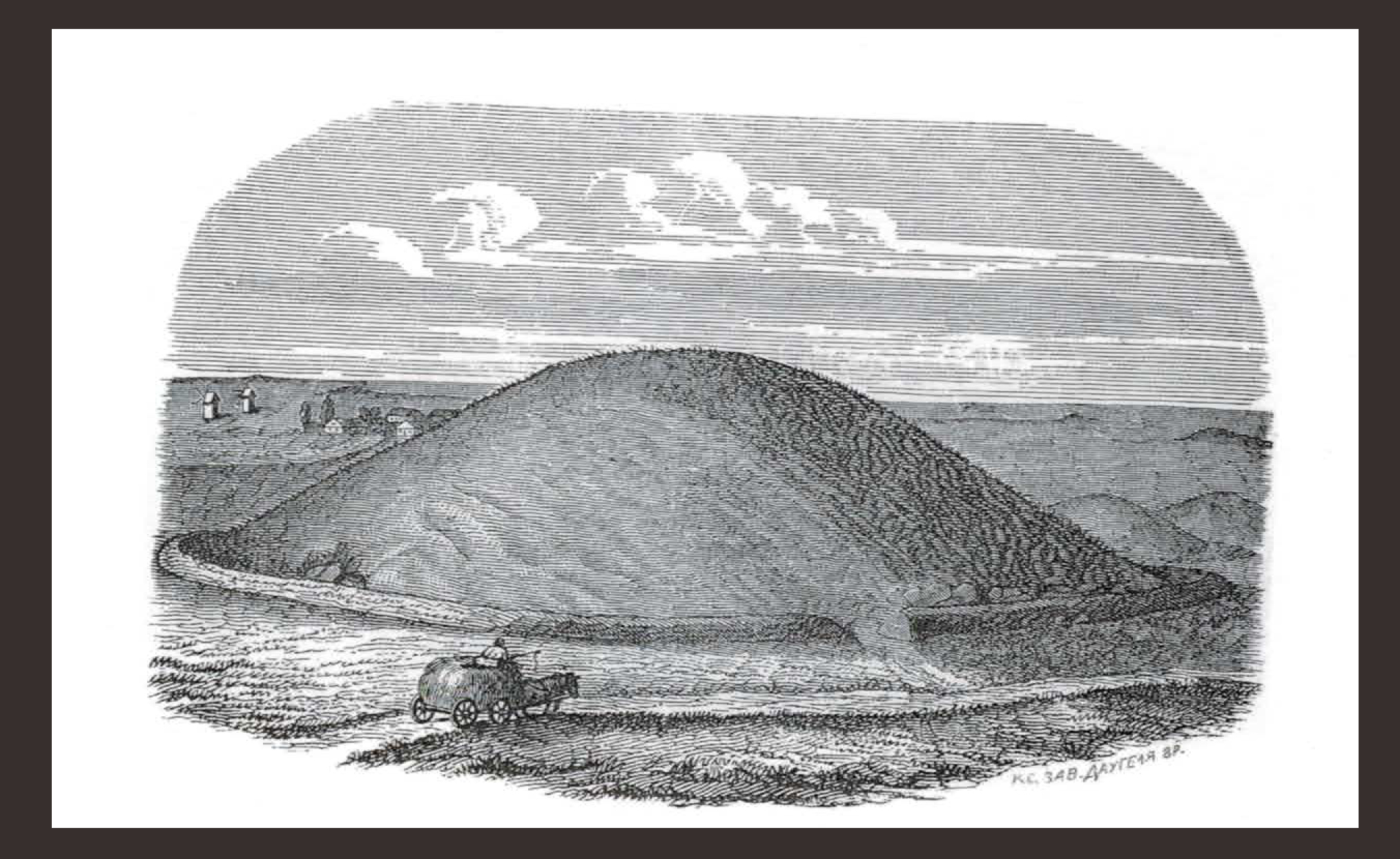
Here, we see the so-called “Kurgan Culture”, with its burial mounds

02161200-1 02161200

[This, by the way, is not to be confused with The Kurgan from the first Highlander movie

The Kurgan]

movie-villain-kurgan

These were a people who:

  1. are believed by many linguists (and some archeologists) to be the direct ancestors of the Indo-Europeans who gradually invaded Asia Minor and western Europe (including, eventually, the Anglo-Saxons) as well as moving east, to India and beyond
  2. buried their dead (at least what appear to be the high status ones) in mounds
  3. were a horse culture

And, in fact, were seemingly the forerunners of the Scythians, a later well-known Indo-European horse people

Scythia Rod-Scythian-Horseback

angus-mcbride-scythia-1

And the Scythians, in turn, may have been the model for those mythical horse folk, the Amazons.

72303amazon

In the 19th century, when the idea of Indo-Europeans began to circulate, there was a preference for a northern European origin (a theory no longer held), but the idea of an eastern home was also circulating and we would suggest that Tolkien would have known about this, as well as, from his early classical training, Scythians and Amazons, their actual and mythical descendants.

Imagine, then, that what we see in the Rohirrim is, in fact, an interesting mixture of people sprung from an earlier people (as Tolkien tells us, the Rohirrim were descended from the Edain of the First Age—see LOTR, Appendix F 1129), both in our world and in Middle Earth, who based their culture upon horses, and bury their dead in mounds, combined with people who may also bury their dead in mounds, who speak a version of Anglo-Saxon and who dress like the Normans and Anglo-Saxons of the 11th century AD.

What do you think, dear readers?

Thanks for reading, as always.

MTCIDC

CD

Newer posts →

The Doubtful Sea Series Facebook Page

The Doubtful Sea Series Facebook Page

  • Ollamh

Categories

  • Artists and Illustrators
  • Economics in Middle-earth
  • Fairy Tales and Myths
  • Films and Music
  • Games
  • Heroes
  • Imaginary History
  • J.R.R. Tolkien
  • Language
  • Literary History
  • Maps
  • Medieval Russia
  • Military History
  • Military History of Middle-earth
  • Narnia
  • Narrative Methods
  • Poetry
  • Research
  • Star Wars
  • Terra Australis
  • The Rohirrim
  • Theatre and Performance
  • Tolkien
  • Uncategorized
  • Villains
  • Writing as Collaborators
Follow doubtfulsea on WordPress.com

Across the Doubtful Sea

Recent Postings

  • Through a glass… January 7, 2026
  • Heffalumps? December 31, 2025
  • We Three Kings December 24, 2025
  • A Moon disfigured December 17, 2025
  • On the Roads Again—Once More December 10, 2025
  • (Not) Crossing Bridges December 3, 2025
  • On the Road(s) Again—Again November 26, 2025
  • On the Road(s) Again November 19, 2025
  • To Bree (Part 2) November 12, 2025

Blog Statistics

  • 104,101 Views

Posting Archive

  • January 2026 (1)
  • December 2025 (5)
  • November 2025 (4)
  • October 2025 (5)
  • September 2025 (4)
  • August 2025 (4)
  • July 2025 (5)
  • June 2025 (4)
  • May 2025 (4)
  • April 2025 (5)
  • March 2025 (4)
  • February 2025 (4)
  • January 2025 (5)
  • December 2024 (4)
  • November 2024 (4)
  • October 2024 (5)
  • September 2024 (4)
  • August 2024 (4)
  • July 2024 (5)
  • June 2024 (4)
  • May 2024 (5)
  • April 2024 (4)
  • March 2024 (4)
  • February 2024 (4)
  • January 2024 (5)
  • December 2023 (4)
  • November 2023 (5)
  • October 2023 (4)
  • September 2023 (4)
  • August 2023 (5)
  • July 2023 (4)
  • June 2023 (4)
  • May 2023 (5)
  • April 2023 (4)
  • March 2023 (5)
  • February 2023 (4)
  • January 2023 (4)
  • December 2022 (4)
  • November 2022 (5)
  • October 2022 (4)
  • September 2022 (4)
  • August 2022 (5)
  • July 2022 (4)
  • June 2022 (5)
  • May 2022 (4)
  • April 2022 (4)
  • March 2022 (5)
  • February 2022 (4)
  • January 2022 (4)
  • December 2021 (5)
  • November 2021 (4)
  • October 2021 (4)
  • September 2021 (5)
  • August 2021 (4)
  • July 2021 (4)
  • June 2021 (5)
  • May 2021 (4)
  • April 2021 (4)
  • March 2021 (5)
  • February 2021 (4)
  • January 2021 (4)
  • December 2020 (5)
  • November 2020 (4)
  • October 2020 (4)
  • September 2020 (5)
  • August 2020 (4)
  • July 2020 (5)
  • June 2020 (4)
  • May 2020 (4)
  • April 2020 (5)
  • March 2020 (4)
  • February 2020 (4)
  • January 2020 (6)
  • December 2019 (4)
  • November 2019 (4)
  • October 2019 (5)
  • September 2019 (4)
  • August 2019 (4)
  • July 2019 (5)
  • June 2019 (4)
  • May 2019 (5)
  • April 2019 (4)
  • March 2019 (4)
  • February 2019 (4)
  • January 2019 (5)
  • December 2018 (4)
  • November 2018 (4)
  • October 2018 (5)
  • September 2018 (4)
  • August 2018 (5)
  • July 2018 (4)
  • June 2018 (4)
  • May 2018 (5)
  • April 2018 (4)
  • March 2018 (4)
  • February 2018 (4)
  • January 2018 (5)
  • December 2017 (4)
  • November 2017 (4)
  • October 2017 (4)
  • September 2017 (4)
  • August 2017 (5)
  • July 2017 (4)
  • June 2017 (4)
  • May 2017 (5)
  • April 2017 (4)
  • March 2017 (5)
  • February 2017 (4)
  • January 2017 (4)
  • December 2016 (4)
  • November 2016 (5)
  • October 2016 (6)
  • September 2016 (5)
  • August 2016 (5)
  • July 2016 (5)
  • June 2016 (5)
  • May 2016 (4)
  • April 2016 (4)
  • March 2016 (5)
  • February 2016 (4)
  • January 2016 (4)
  • December 2015 (5)
  • November 2015 (5)
  • October 2015 (4)
  • September 2015 (5)
  • August 2015 (4)
  • July 2015 (5)
  • June 2015 (5)
  • May 2015 (4)
  • April 2015 (3)
  • March 2015 (4)
  • February 2015 (4)
  • January 2015 (4)
  • December 2014 (5)
  • November 2014 (4)
  • October 2014 (6)
  • September 2014 (1)

Blog at WordPress.com.

  • Subscribe Subscribed
    • doubtfulsea
    • Join 78 other subscribers
    • Already have a WordPress.com account? Log in now.
    • doubtfulsea
    • Subscribe Subscribed
    • Sign up
    • Log in
    • Report this content
    • View site in Reader
    • Manage subscriptions
    • Collapse this bar
 

Loading Comments...