• About

doubtfulsea

~ adventure fantasy

Monthly Archives: January 2026

Towering

28 Wednesday Jan 2026

Posted by Ollamh in Uncategorized

≈ Leave a comment

Tags

battering ram, Fantasy, Helm's Deep, Helms Deep, Hera, Hornburg, mangonel, movies, siege, siege tower, sieges, The Lord of the Rings, The War Of the Rohirrim, Tolkien, trebuchet, undermining, Wulf

Welcome, as always, dear readers.

This is another in a short series of mini-reviews of The War of the Rohirrim, a film which I’ve now, as is my custom, seen several times before I review it.  It’s complex enough, I would say, to make it worth taking it apart and reviewing different sections/details–for another in the series, see:  Heffalumps? 31 December, 2025.  The previous review was about the introduction of a mumak into the story, for which there was no textual authority in the 2+ pages of the original in Appendix A of The Lord of the Rings and, on the same theme, I want to talk a little more about that earlier war.

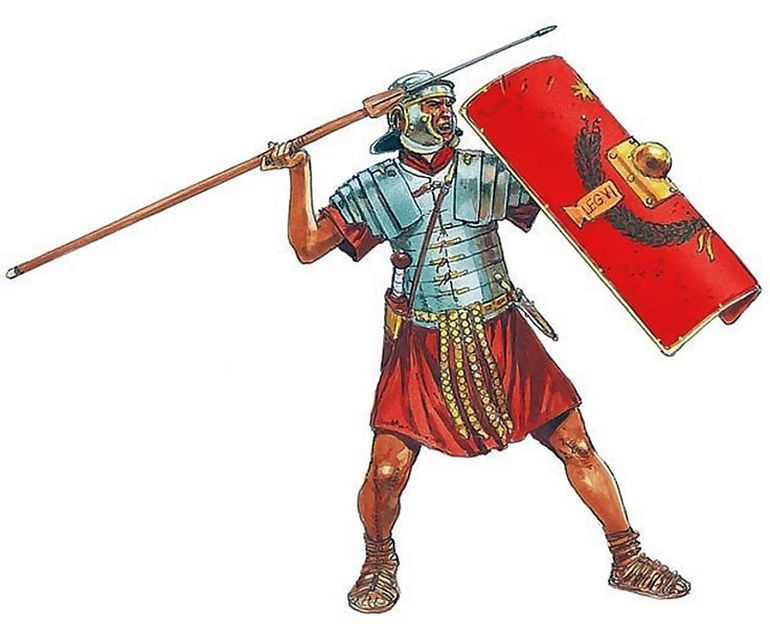
If you were an ancient Roman
or medieval
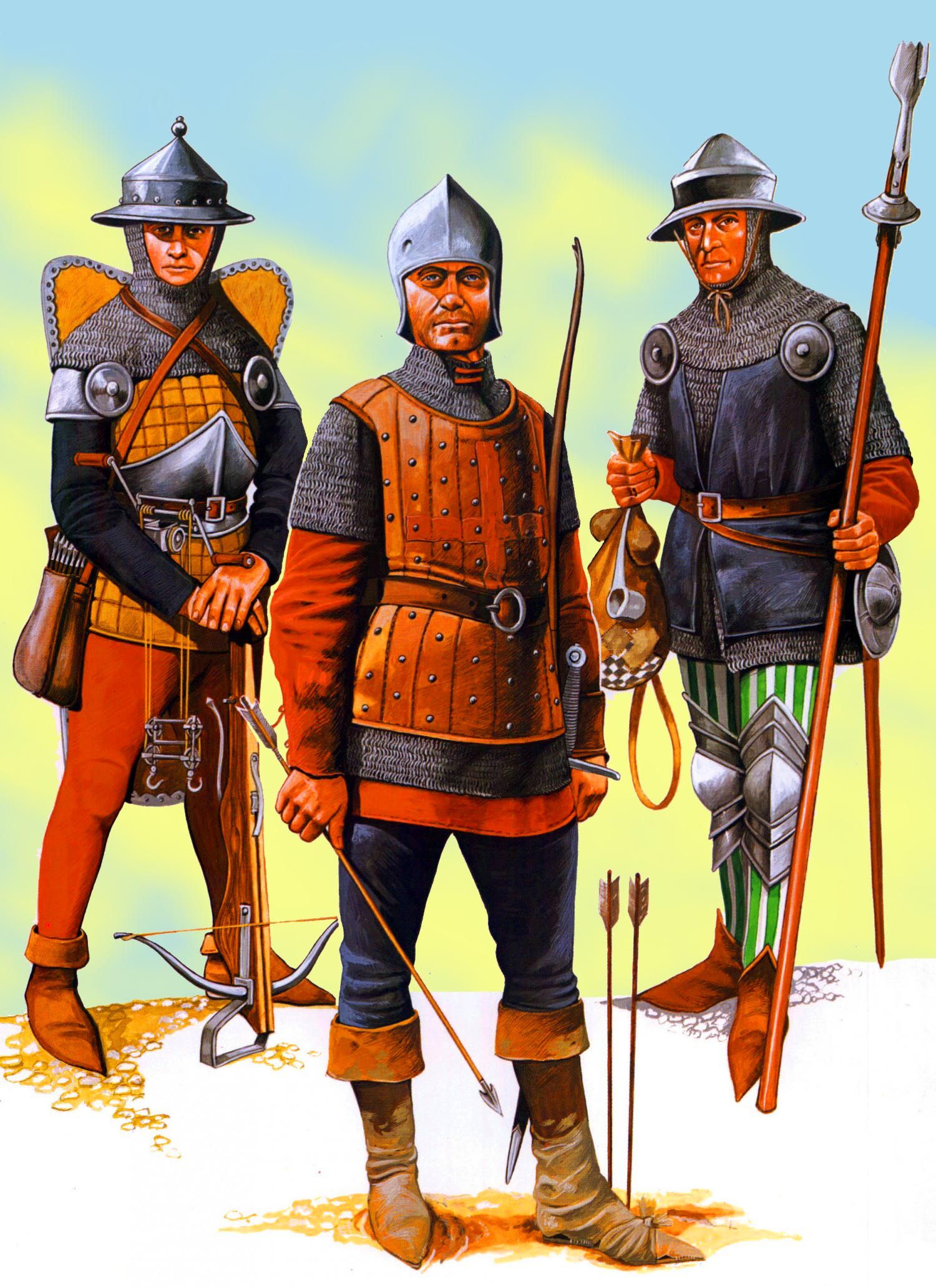
soldier, and you were faced with an enemy’s wall,
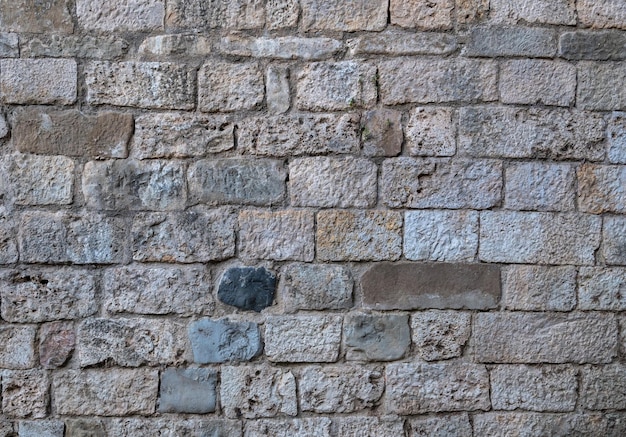
you would have a number of options.  The most dangerous would be to pick up a ladder and attempt to climb—an escalade–
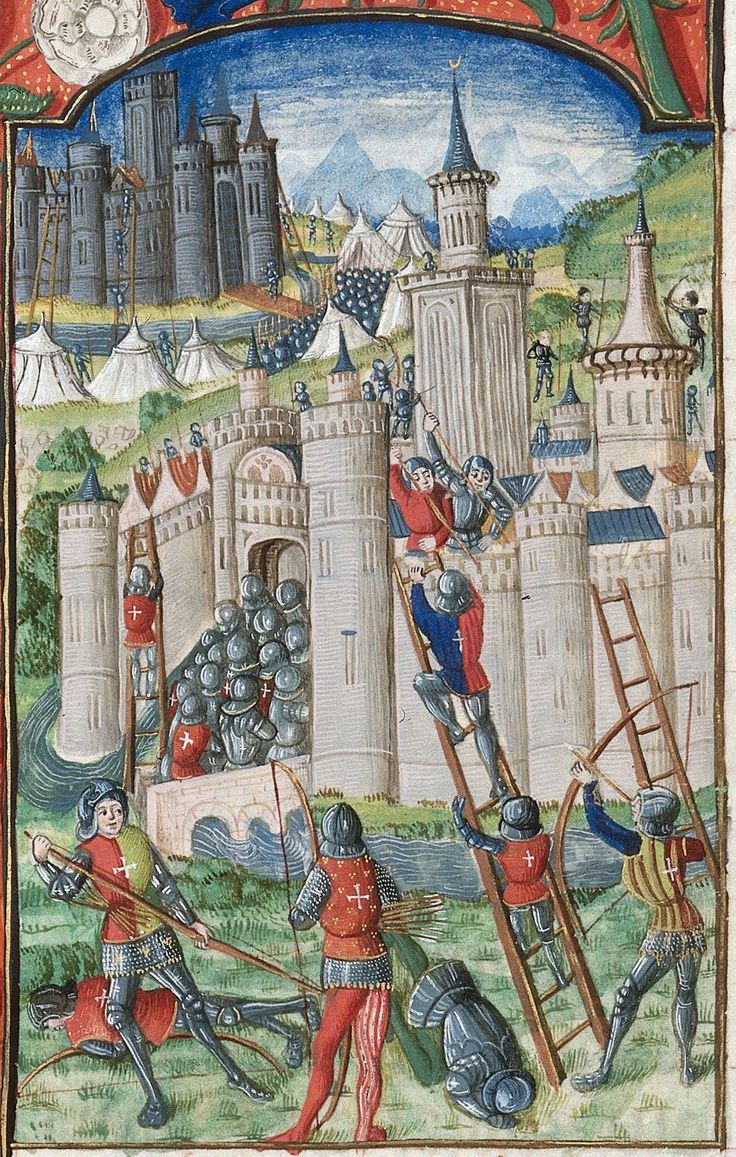
as, after all, high on a ladder, exposed to the enemy above you and, with men climbing below you making it difficult to climb down, you would be in a very awkward position—so perhaps other choices would be preferable?

One possibility would be to dig under.
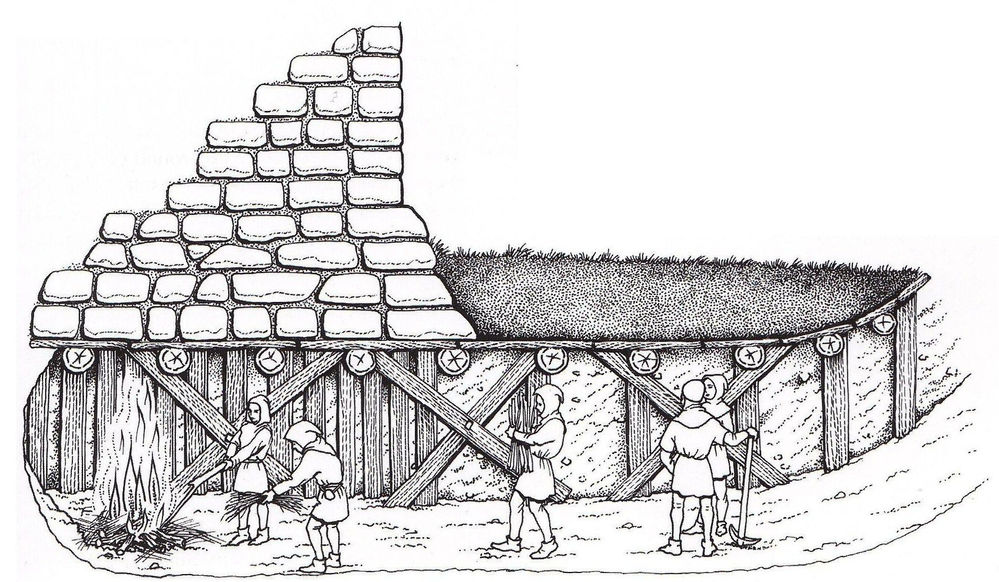
And here in this illustration we see two choices, really:

1. digging a tunnel all the way under the wall and popping out behind the defenders

2. undermining the wall:  cutting away the ground below the wall, substituting wooden props for the missing ground, then setting fire to the props so that the wall above, lacking support, would come crashing down (or so you would hope)  This worked at the siege of Rochester castle in AD1215, where it brought down a corner tower–
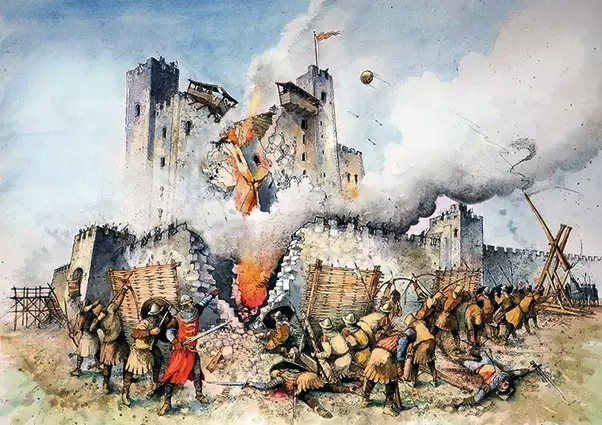
If, however, a wall had been built on a rocky base, as was sometimes the case, tunneling would not be a option.

Another choice:  try battering the wall with a ram (or the gates—often the weakest point)
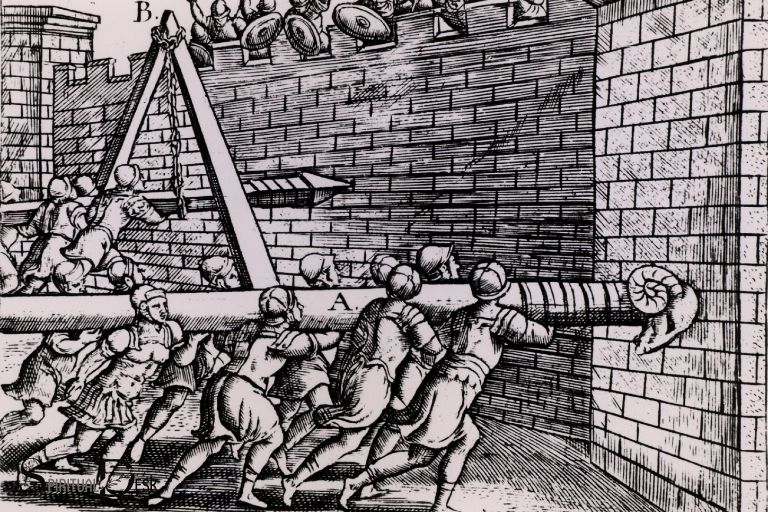
(Julius Caesar, in his commentaries on his campaigns in Gaul, used the image of battering to suggest that, although he was always inclined towards clemency, once one of his rams had touched an enemy’s town wall (in this case that of the Atuatuci) and those inside hadn’t surrendered–si prius quam murum aries attigisset se dedidissent—his clemency was at an end—and so was the town.  See Caesar De Bello Gallico, Book II, Chapter XXXII (32) for the quotation, either in Latin here:  https://www.thelatinlibrary.com/caesar/gall2.shtml or in English here:  https://classics.mit.edu/Caesar/gallic.2.2.html  Interesting to note that Caesar also describes the Roman use of a siege tower just before this—see Chapters XXX and XXXI.)
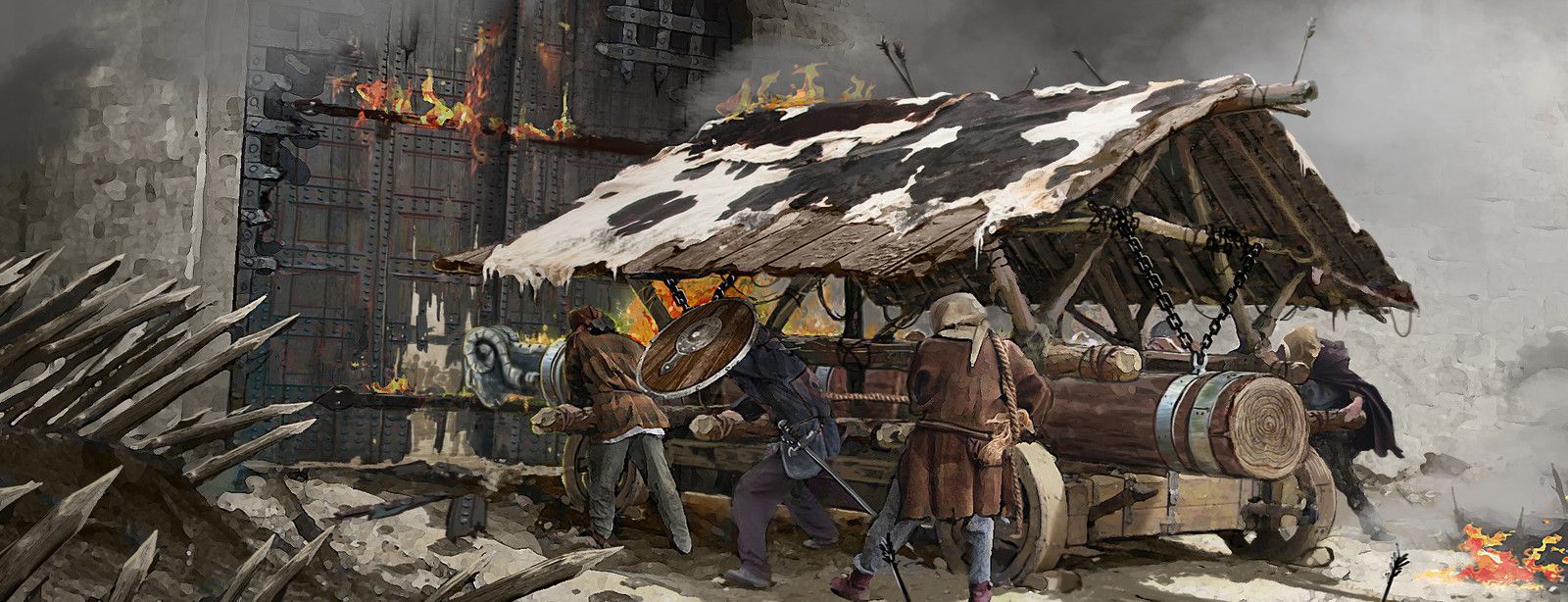
(Lincoln Renall—an artist who seems to be able to draw/paint anything—see more about his work here:  https://lincoln.artstation.com/ )

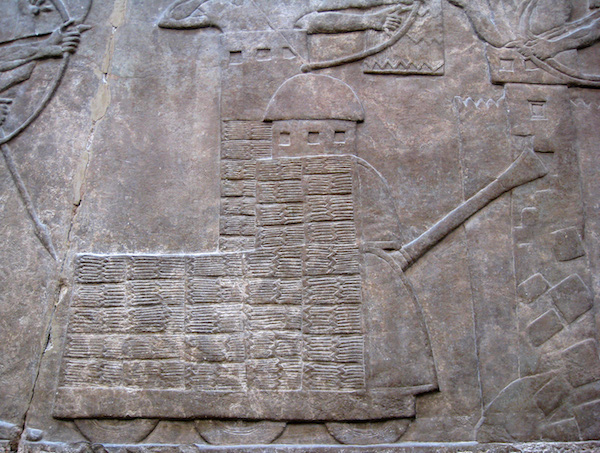
or, if the wall isn’t stone, but mud brick, try prying the wall apart—the ancient Assyrians even seem to have had a device dedicated to it (sometimes captioned as a “battering ram”, but it employed a kind of chisel, rather than a ram).
You might try a stone-thrower of some sort, gradually breaking down the wall from above, like this mangonel–
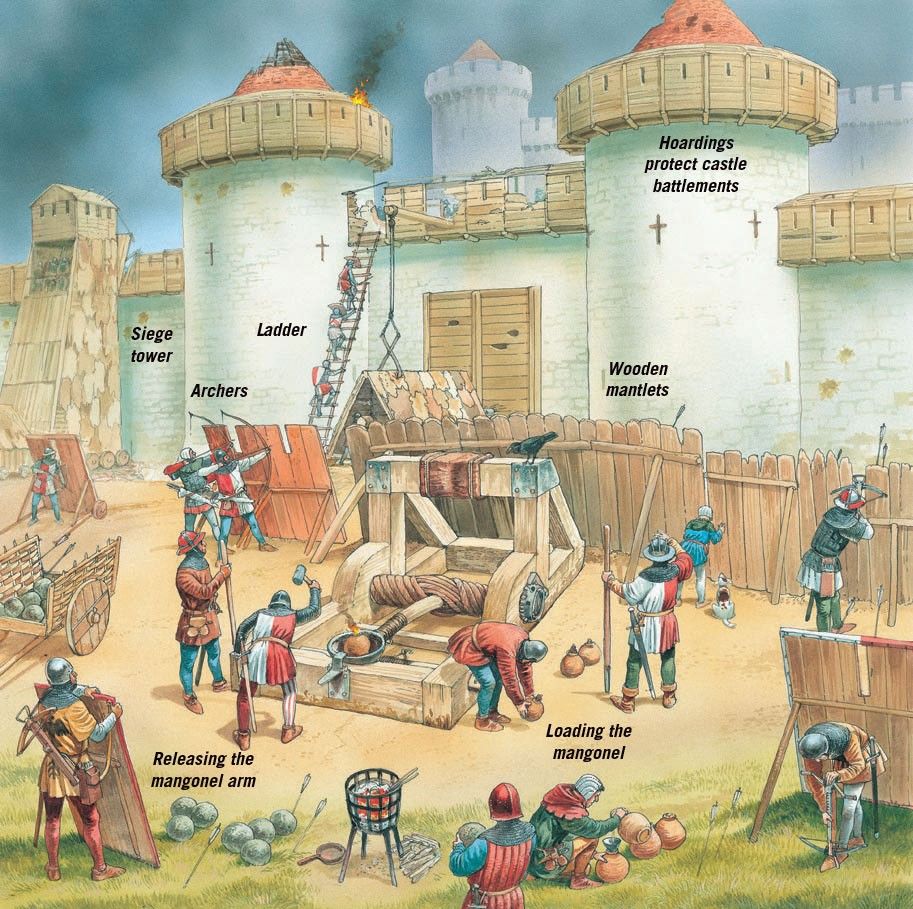
or its big brother, the trebuchet.
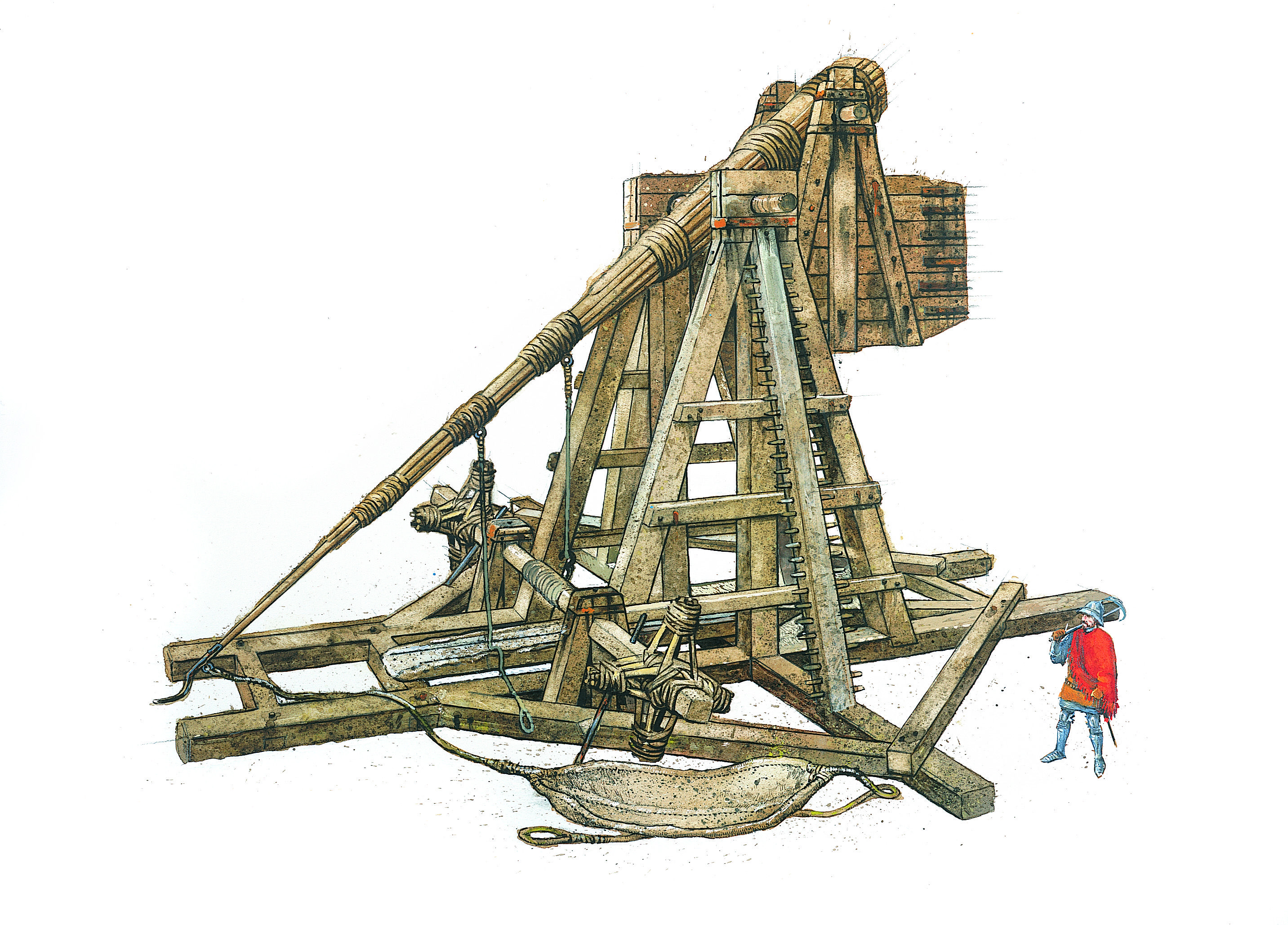
(for an interesting video on trebuchets and the damage they can do, see:  https://www.youtube.com/watch?v=QVO8VznqMeQ )

Then again, you could attempt to go over the wall with a siege tower, in what might be a safer manner than an escalade .
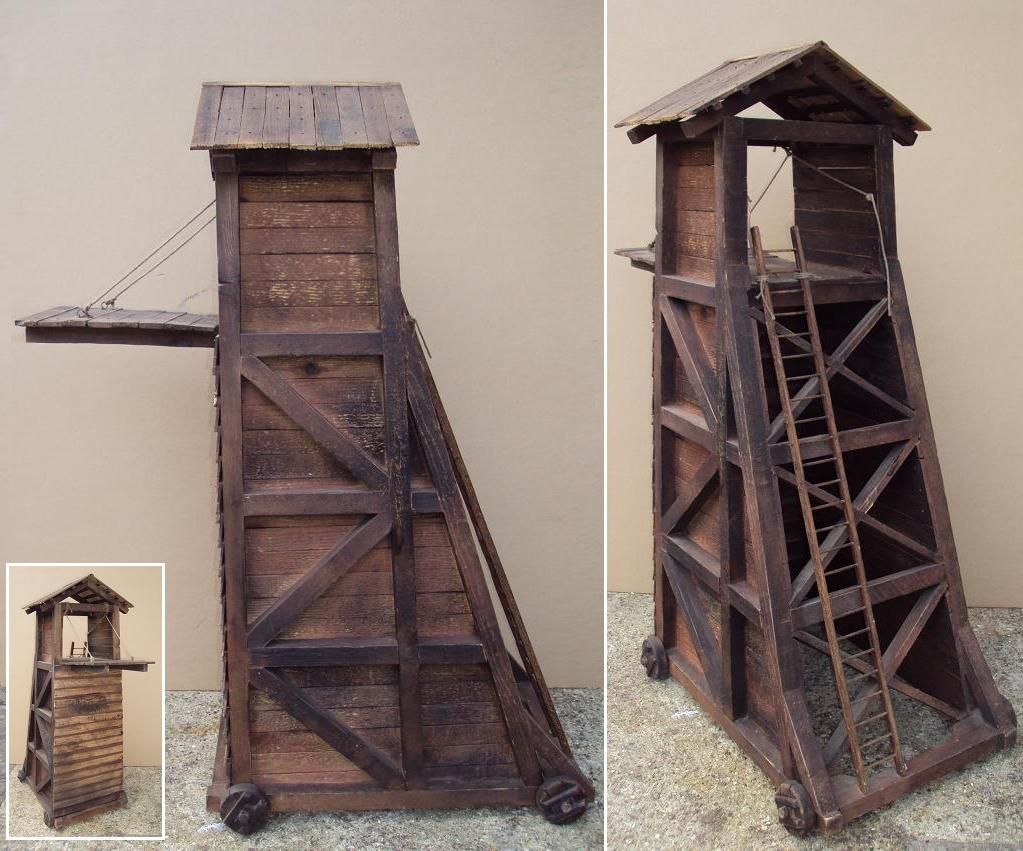
This is a machine made of wood, placed on rollers, built to approach a wall, but to be a little higher and, when it reaches the wall, a drawbridge is dropped and you and your companions rush across it, over the wall, and onto the walkway behind it, where, if your plan works, you then deal with the enemy soldiers there and move towards opening a gate below.  Instead of climbing on a totally exposed ladder set against a hostile wall, then, you will climb on a ladder protected by the tower, safe until you reach that drawbridge.  To  further insure the attackers’ safety, the tower has to be rolled as close to the wall as possible and the drawbridge has to fall onto the wall so that the assault team (you) won’t be vulnerable for long in passing from the tower to the walkway, although, after that, you’re on your own.  (The Atuatuci in Caesar’s narrative, first spot the tower from a distance and make fun of it, laughing at the idea that the Romans would build such a big thing so far away—until the Romans begin to move it closer and they stop laughing and talk surrender.)
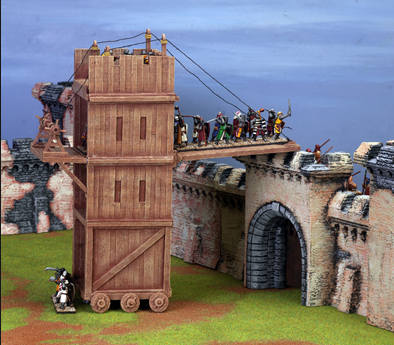
We hear of such towers at the siege of Minas Tirith:

“Then perceiving that the valour of the city was already beaten down, the hidden Captain put forth his strength.  Slowly the great siege-towers built in Osgiliath rolled forward through the dark.”  (The Return of the King, Book Five, Chapter 4, “The Siege of Gondor”)
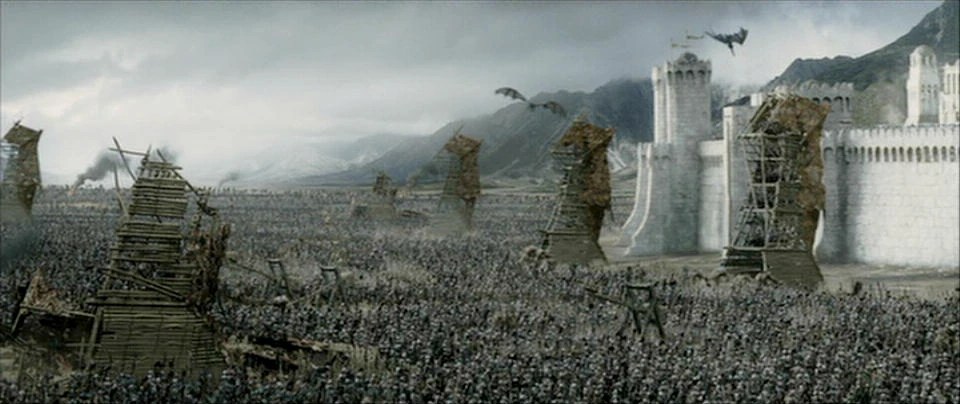
Saruman’s forces at the siege of Helm’s Deep don’t appear to use them, however, having only ladders,
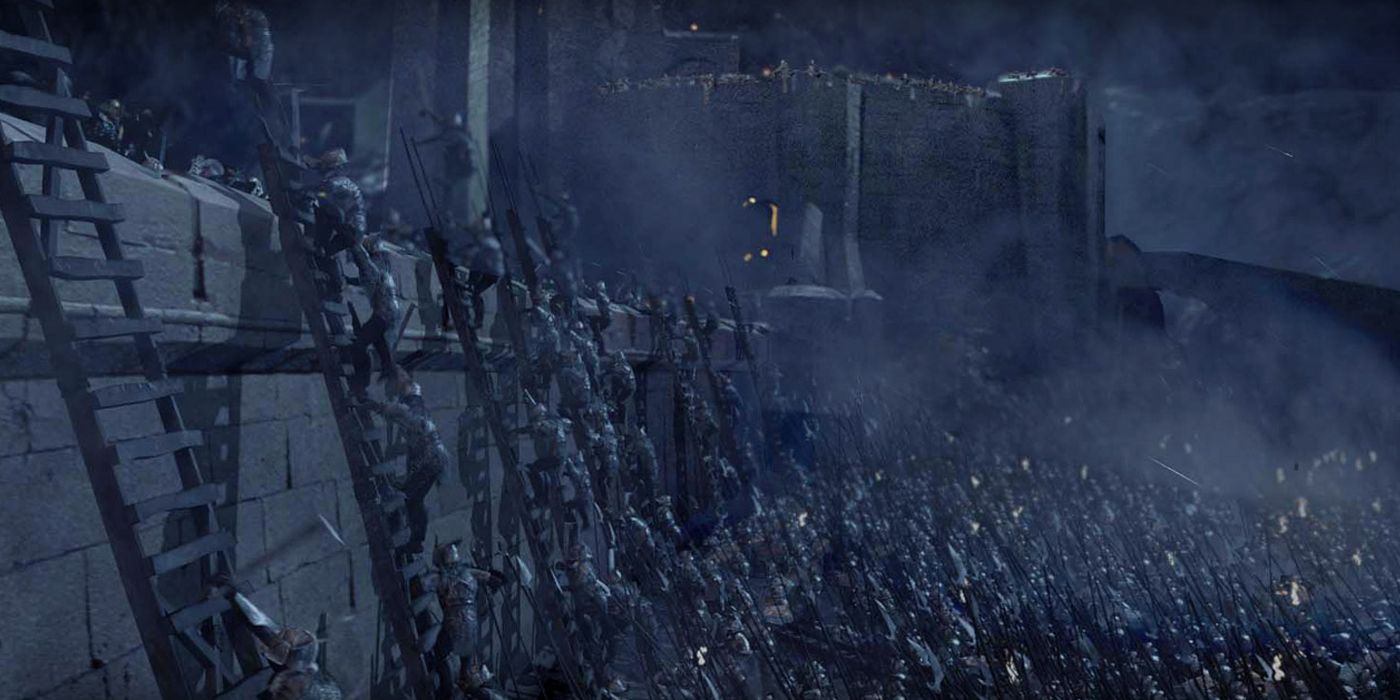
but of course they also have early gunpowder, or something like it.
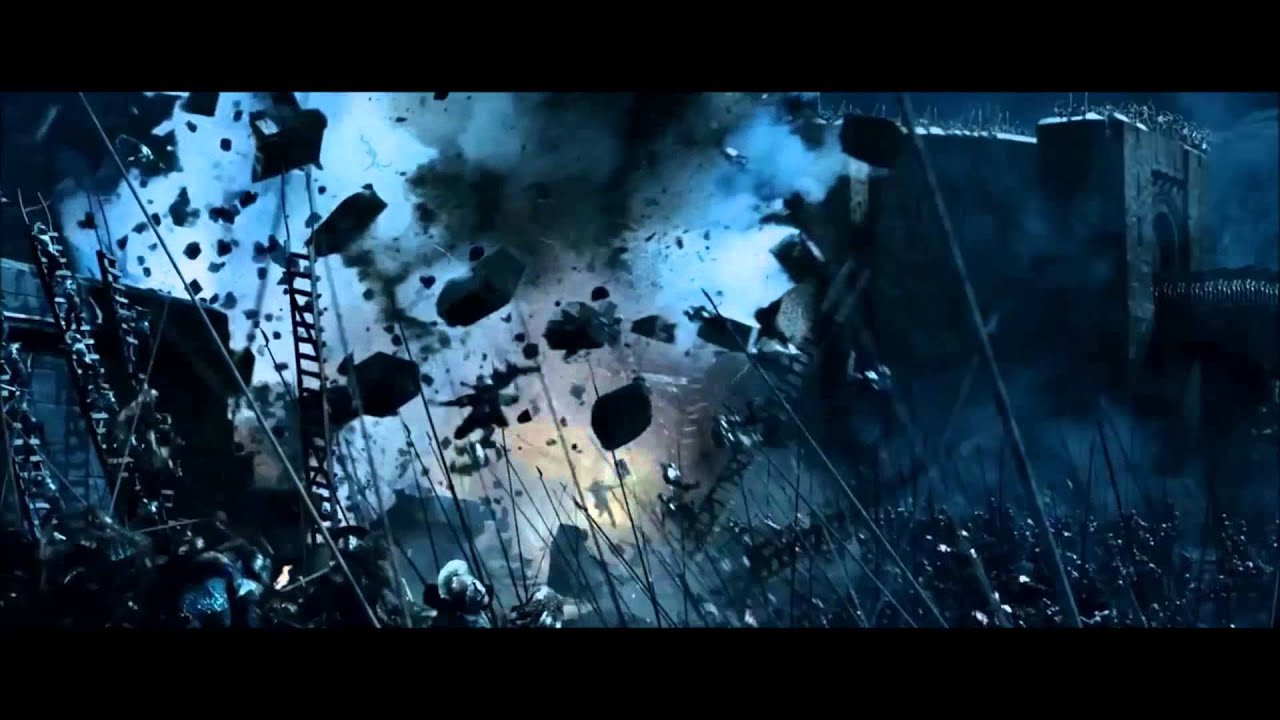
At the earlier attack on Helm’s Deep, almost 200 years before, as realized in 2024’s The War of the Rohirrim, we see an earlier use of a siege tower.  And here, as in the case of the mumak, this was created by the screen writers—there’s no mention of such a device in the brief summary of that earlier war which appears in The Lord of the Rings.  (See The Lord of the Rings, Appendix A, II “The House of Eorl”)  The siege of Helm’s Deep went through a long winter (“November to March, 2758-9” says the text), but says nothing at all about anything but a kind of standoff, in which Rohan’s enemies lay outside the Hornburg  and “Both the Rohirrim and their foes suffered grievously in the cold, and in the dearth which lasted longer.”  And it lasted until:

“Soon after the winter broke.  Then Frealaf, son of Hild, Helm’s sister, came down out of Dunharrow, to which many had fled, and with a small company of desperate men surprised Wulf in Meduseld and slew him, and regained Edoras.  There were great floods after the snows, and the vale of Entwash became a vast fen.  The Eastern invaders perished or withdrew and there came help at last from Gondor…Before the year (2759) was ended the Dunlendings were driven out, even from Isengard, and Frealaf became king.” (The Lord of the Rings, Appendix A, II “The House of Eorl”)

The film, however, has the siege continue while Wulf, the antagonist, commands the building of that siege tower—
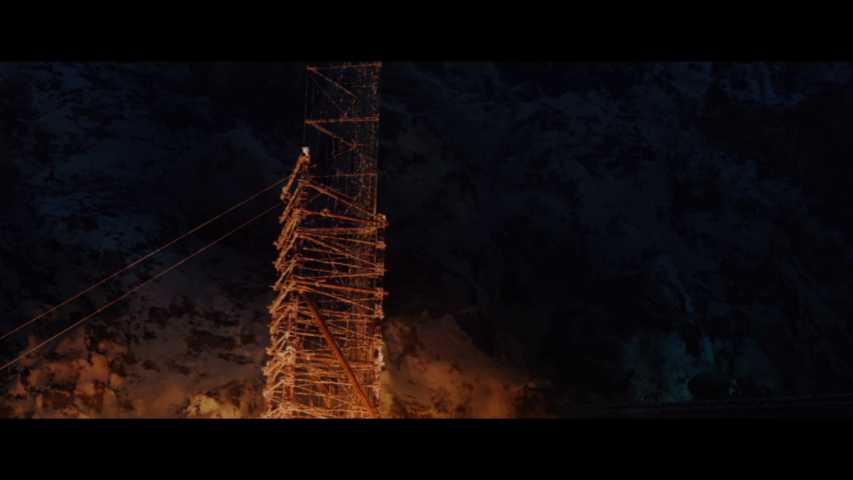
(I apologize for the somewhat dim image—it’s a screen capture from the film, the best I can provide as this whole scene is very dark in the film.)

And the tower, as depicted, is hardly something of the sort created by Roman or medieval siege engineers, being tall and spindly—rickety might also be a useful term—with no protection at all for those inside.  In fact, it is built in place, rather than rolled up to the wall, so that, when finished, it needs an enormously long drawbridge which it seems like the entire besieging army then attempts to cross at once, including horses—something no ancient or medieval soldier would do, as, first, the bridge might not be able to take such weight and movement and, second, the watching enemy would fill such a mass of men and horses full of arrows before it could even cross to the wall.
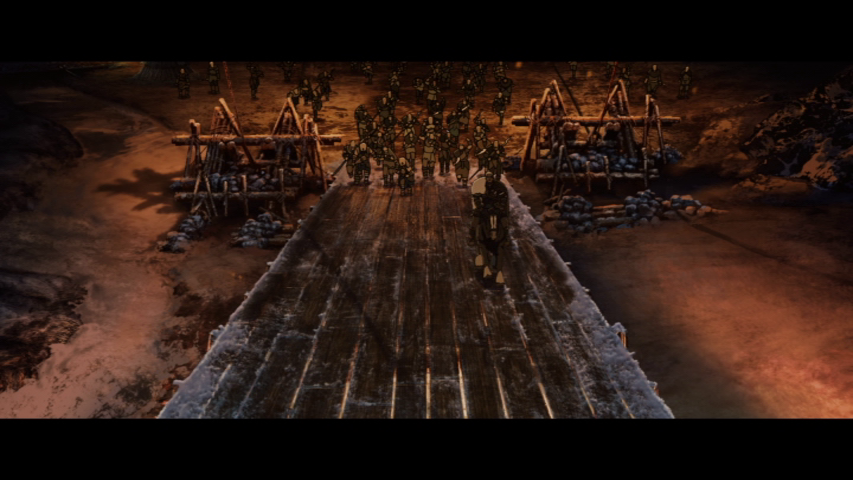
“Hera”, the protagonist, then confronts Wulf at first on that very drawbridge—and on horseback—
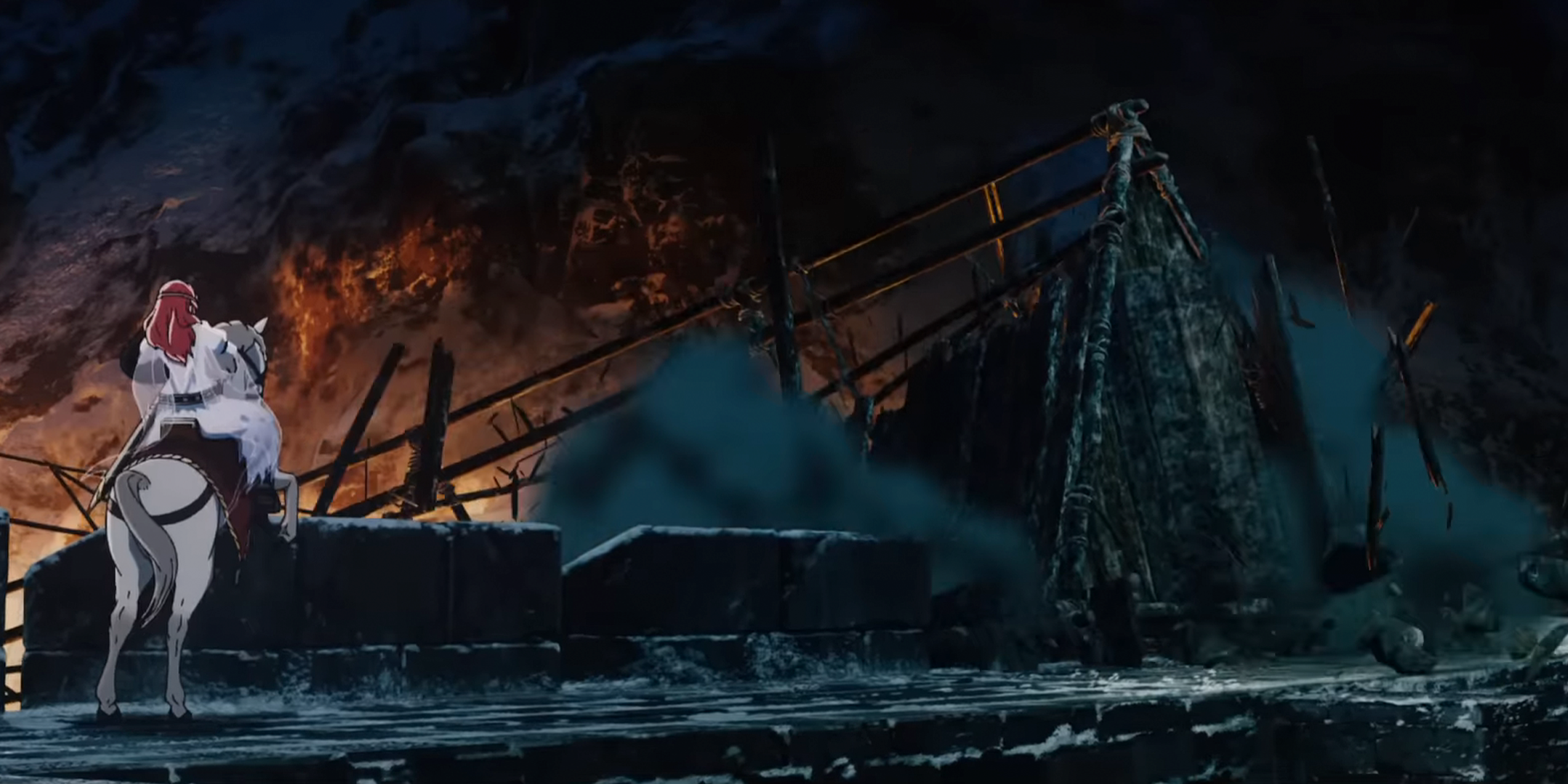
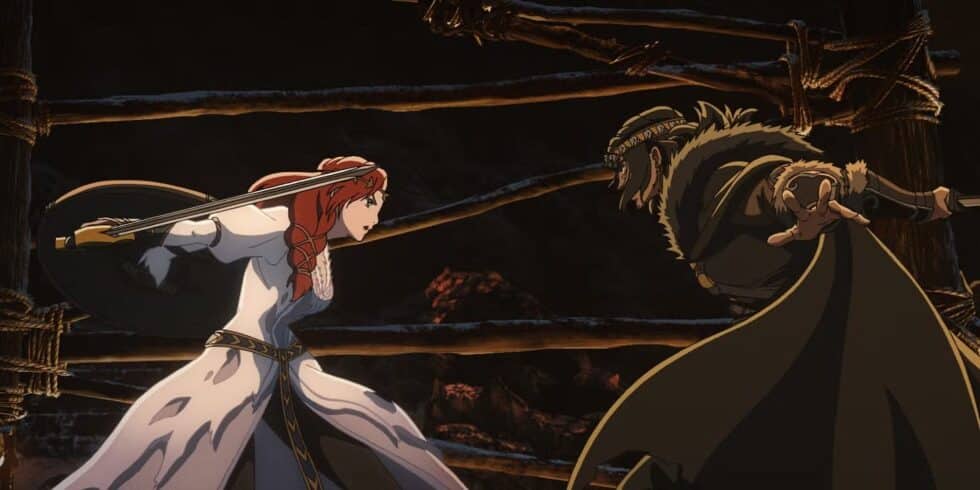
before finally killing him, rather improbably, with a shield, before standing back to see the besiegers fleeing from her cousin, Frealaf, coming like the cavalry in an old western.
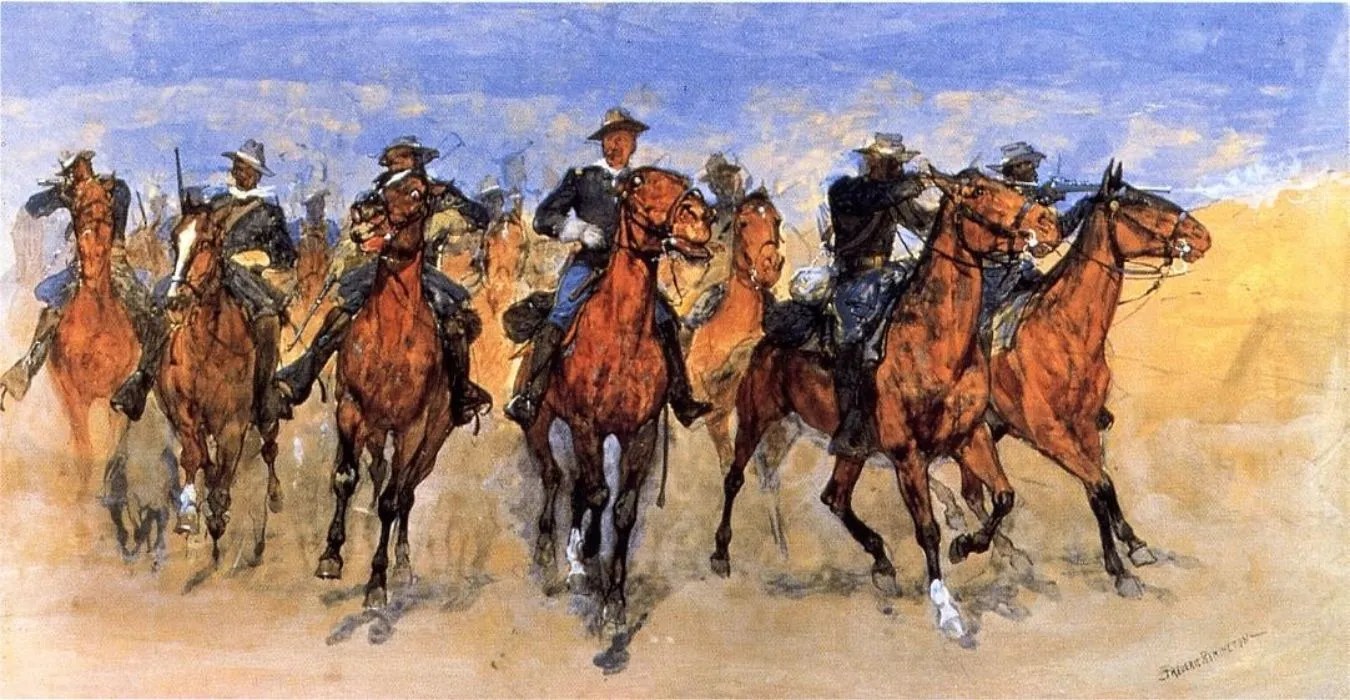
(Frederick Remington)

As I’ve said before, I have nothing but praise for the hard work in making such a film, but look at what the script writers have done to Tolkien’s short text:

1. they employ a heroine plus several supporting characters, none of whom appears in JRRT’s text,

2. who then kills the main antagonist (who appears at the siege in the film when JRRT says that he’s back in Meduseld and is killed there)

3. after he attempts an assault via an impossible tower not mentioned in the narrative which Tolkien published.

As always, I approach films and books believing that those who create them are not out to cheat us, but to provide genuine entertainment and do so after long, hard labor, which clearly The War of the Rohirrim was.  At the same time, I wonder about the honesty of making so many changes and additions to a text, then attaching it to the work of an author who, long dead, had no say in what was done and, in fact, had very strong feelings about others making changes to his work.  With so many changes, it feels more like fan fiction, than the original, and, while I think fan fiction, if well-meaning, is a good tool for learning how to write, no one doing so should then attach the original author’s name to it.  All one has to read are Tolkien’s comments on an earlier attempt at filming his work (see his letter to Forrest J. Ackerman, June, 1958, in Letters, 389-397 ) to imagine what Tolkien would say and the best I can say is that he would be both puzzled and probably very unhappy.

Thanks, as ever, for reading.

Stay well,

If not rickety towers, at least avoid rickety bridges,
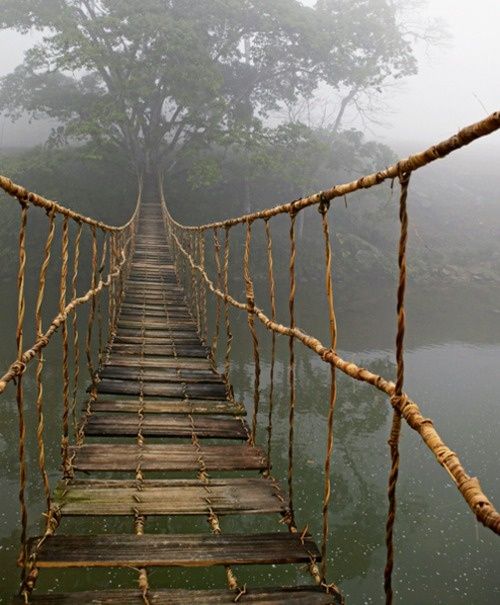
And know that, as always, there’s

MTCDIC

O
Tolkien Among the Indians

21 Wednesday Jan 2026

Posted by Ollamh in Uncategorized

≈ Leave a comment

Tags

Dickon Among the Indians, Fantasy, Ghan-buri-Ghan, James Fenimore Cooper, Native Americans, On Fairy-Stories, Orcs, Sam Gamgee, The Last of the Mohicans, The Lord of the Rings, Thte Last of the Mohicans, Tolkien, William Morris, Wose

Welcome, as always, dear readers.

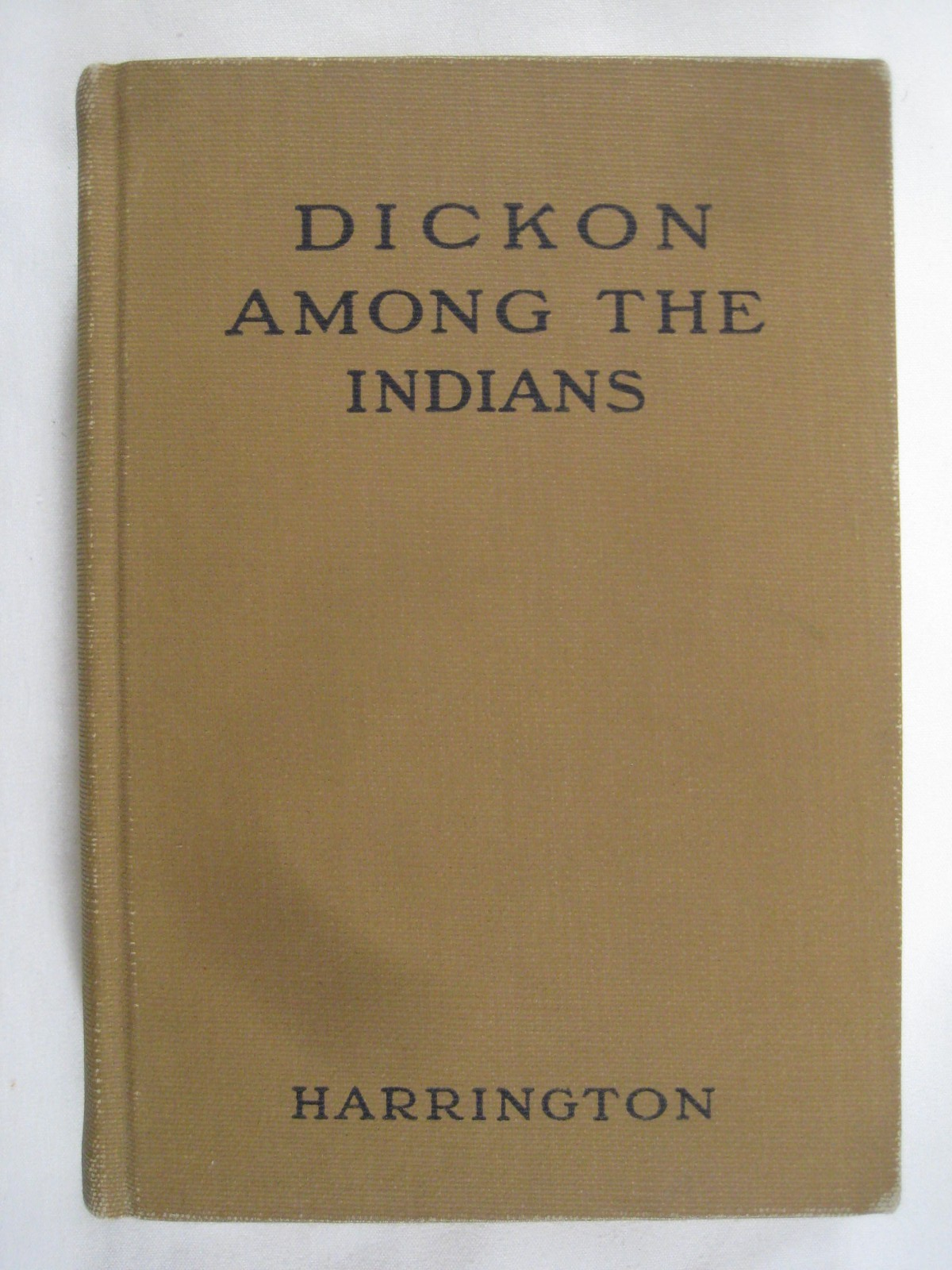
I’ve borrowed the title of this posting from a 1938 book by M.R. Harrington, Dickon Among the Lenape Indians (shortened for a reprint to Dickon Among the Indians),

a very interesting attempt to recreate the lives of Algonkian-speaking Native Americans in New Jersey and eastern Pennsylvania at the beginning of colonization.  (Harrington was fortunate in having local Native Americans to help him in his research.  For more on Harrington, see:  https://en.wikipedia.org/wiki/Mark_Raymond_Harrington , himself a very interesting man.  Please note, by the way, that, although I will use “Indians” occasionally in this piece, when appropriate, I commonly employ the now-standard “Native Americans”.)

The subject of early Native Americans is worth many postings in itself, but where does JRRT fit in? 

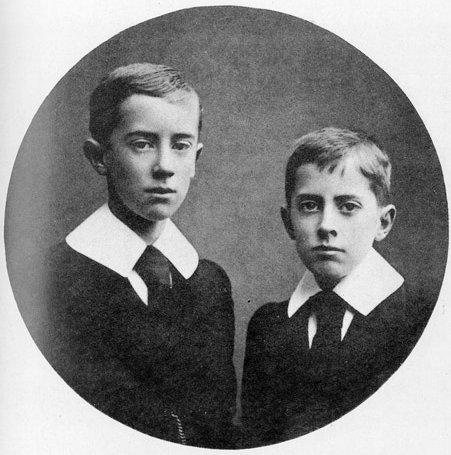
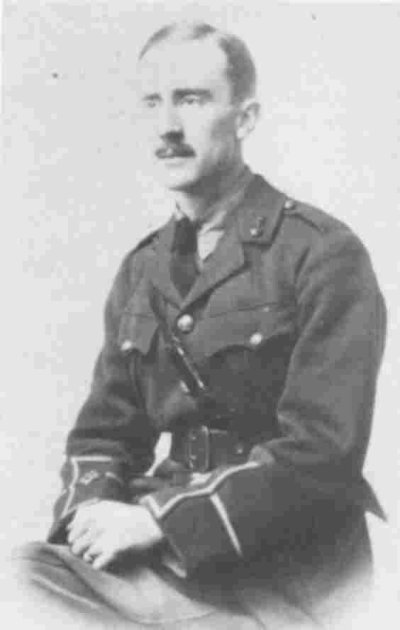
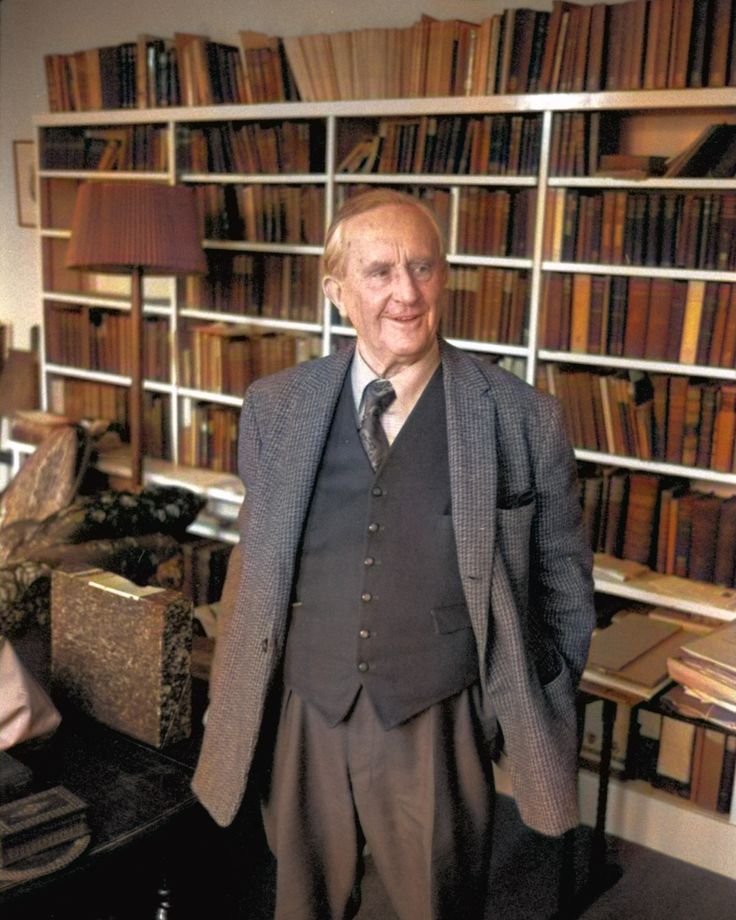
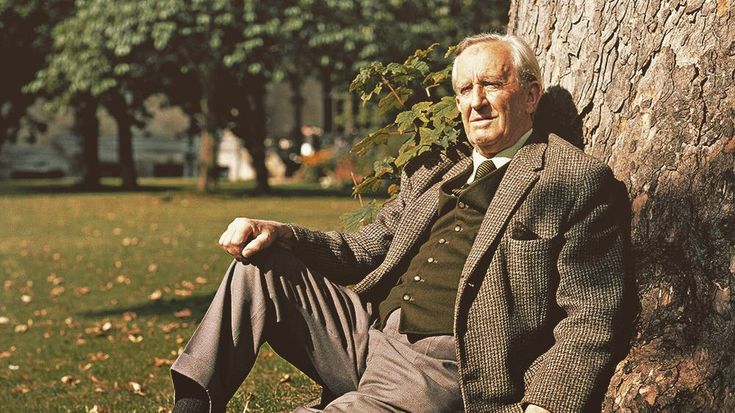
Well, when you visualize Tolkien, what do you think of?

The schoolboy?

The 2nd lieutenant?

The serious professor?

The man who loved trees?

Suppose, however, instead of military caps

or the shapeless thing we see on his head in later pictures,

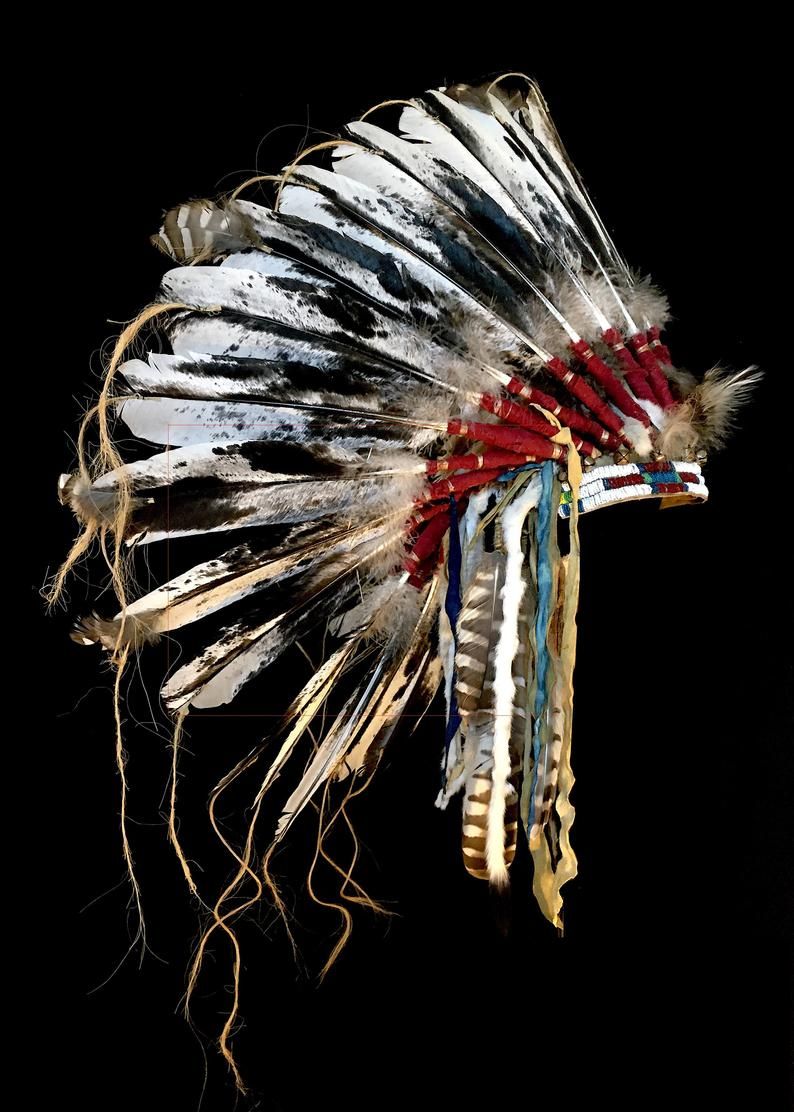
we provide him with something as splendid as this—

(A recreation of a Lakota war headdress)

As a man obsessed (a radical term, perhaps, but really accurate, I would say) with language and languages, Tolkien had set himself a problem, when it came to his approach to The Lord of the Rings.  It was meant to be a translation, and he himself the editor/translator.  Although he would mix in bits of several languages he had invented, the main body of the text would be in English—but English would, in fact, substitute for what he called the “Common Speech”.   And yet, because of his passion for language, he wouldn’t allow for complete uniformity of speech, especially as not everyone in his Middle-earth spoke the Common Speech as their first language.  One possibility would be to approximate the Common Speech with marks for different accents—the speech of the Rohirrim, for instance, as speakers of what was actually a Germanic language (Old English), might be depicted with the effects of English-speaking Germanic speakers in Tolkien’s day.  There was definitely a danger in this, of course—the effect is easily overdone and Tolkien would have been well aware of things like what was—and is—called “stage Irish” with lots of “sure an begorras!  and “top of the mornin’s”, caricaturing, in fact, Anglo-Irish.  As far as I know, JRRT never considered this approach (although we notice that Sam speaks in a different dialect from Frodo—imitated in the Jackson films by having him speak what in the UK is called “Mummershire”, based upon the distinctive sound of West Country English).  Were there other possible models?  And, if so, what might be useful?  Consider the Orcs, for instance.  As Pippin notices, to his surprise, he can understand the Orcs who have captured him and Merry because the first who speaks to him speaks “in the Common Speech, which he made almost as hideous as his own language.”  (The Two Towers, Book Three, Chapter 3, “The Uruk-hai”)  The Orcs, then, although they use the Common Speech with outsiders, have their own distinctive language (actually languages, but use the Common Speech as their lingua franca—for more, see The Lord of the Rings, Appendix F, “Of Other Races”).

What, then, might Tolkien employ as a model for an Orc leader giving a speech, one which would be in the Common Speech, but yet distinctively Orcish—and yet not “stage Orchish”?

And here is where I suggest that Tolkien turned to his childhood reading and his interest in Native Americans—at least those he found in books.

If we go by something which he himself once remarked, perhaps this isn’t so far-fetched a theory as it might appear at first:

“I had very little desire to look for buried treasure or fight pirates, and Treasure Island left me cool.  Red Indians were better:  there were bows and arrows (I had and have wholly unsatisfied desire to shoot well with a bow), and strange languages, and glimpses of an archaic mode of life, and, above all, forests in such stories.”  (On Fairy-Stories in The Monsters and the Critics, 134  For those who might like to see if they remain cool to Treasure Island, see https://archive.org/details/treasureisland00stev/mode/2up  with its beautiful illustrations by N.C. Wyeth—and, if you do open it, be sure to read the epigraph:  “To the Hesitating Purchaser” as a kind of response to JRRT, although Tolkien would have been a toddler when Stevenson died in 1894.)

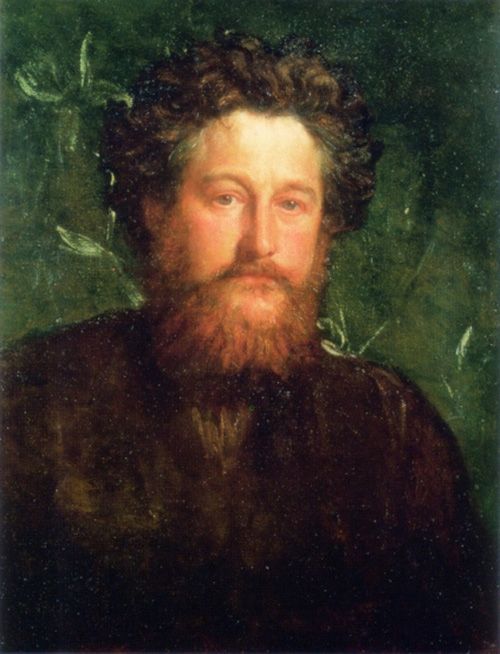
We know that William Morris (1834-1896)

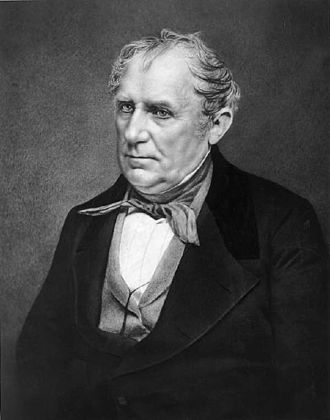
 was a strong influence on Tolkien’s writing, inspiring medieval elements in JRRT’s work, but there may have been another influence we can detect, which provided a model, using Tolkien’s “strange languages, and glimpses of an archaic mode of life” as a clue—at least for speech:  the work of James Fenimore Cooper (1789-1851), a once-famous author of historical fiction about the 18th-century US, and, probably, the first author to present Native Americans to Tolkien.

So, how does an Orc leader speak?—sometimes collectively in a highly rhetorical fashion :

“We are the fighting Uruk-hai!  We slew the great warrior.  We took the prisoners.  We are the servants of Saruman the Wise, the White Hand:  the Hand that gives us man’s-flesh to eat.  We came out of Isengard and led you here, and we shall lead you back by the way we choose.  I am Ugluk.  I have spoken.”  (The Two Towers, Book Three, Chapter 3, “The Uruk-hai”)

Compare it, then, with this:

“We came from the place where the sun is hid at night, over

great plains where the buffaloes live, until we reached the big

river. There we fought the Alligewi, till the ground was red with

their blood. From the banks of the big river to the shores of the

salt lake, there was none to meet us. The Maquas followed at a

distance. We said the country should be ours from the place

where the water runs up no longer on this stream, to a river

twenty suns’ journey toward the summer. The land we had

taken like warriors, we kept like men. We drove the Maquas

into the woods with the bears. They only tasted salt at

the licks; they drew no fish from the great lake; we threw them

the bones.”

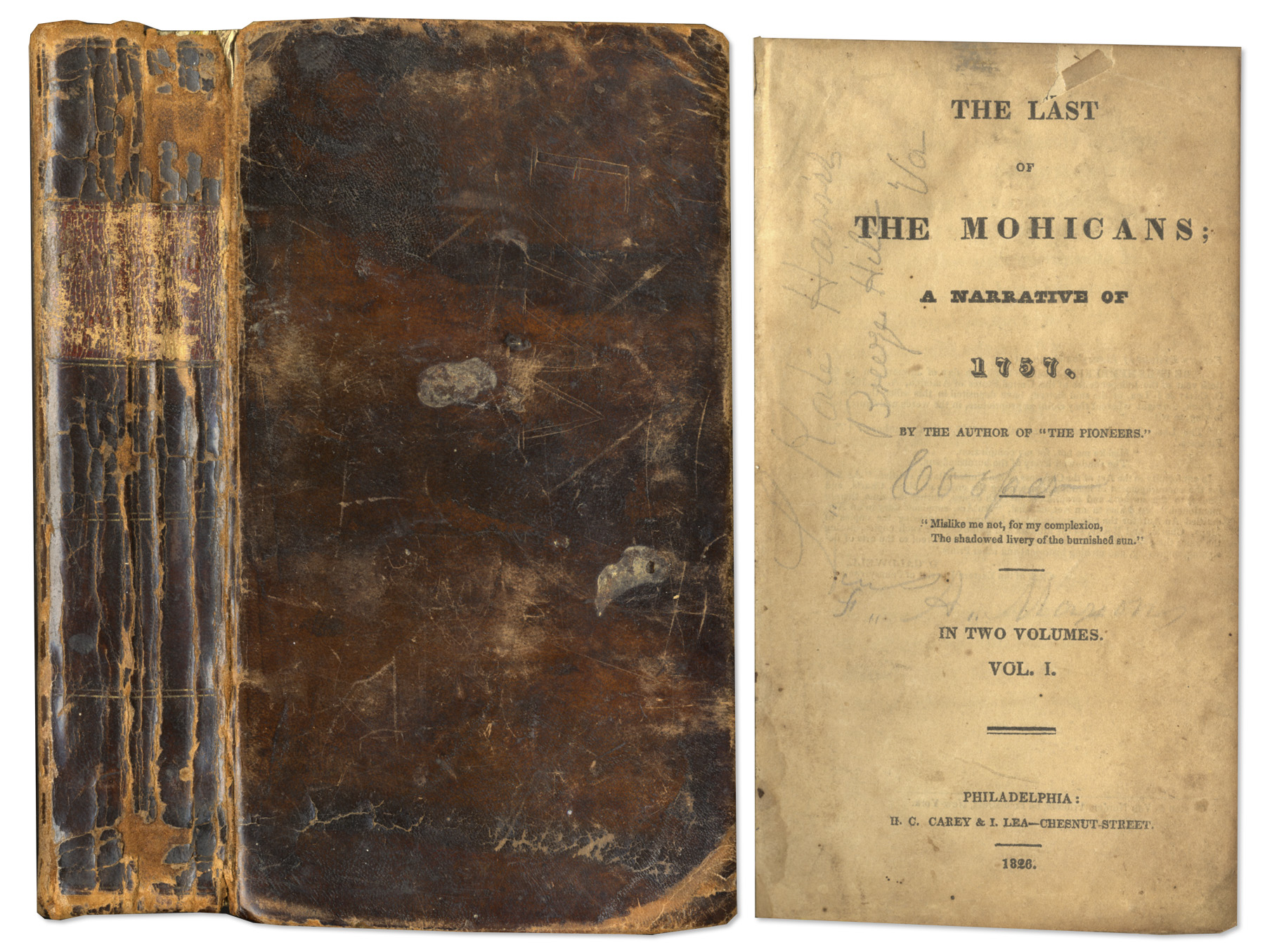
This is Chingachgook, a Mohican (the last, in fact), speaking to another major character, Natty Bumpo, in James Fenimore Cooper’s The Last of the Mohicans, 1826 (Chapter III—you can read the novel—again illustrated by N.C. Wyeth—here:   https://dn720005.ca.archive.org/0/items/lastofmohicansna00coop/lastofmohicansna00coop.pdf  I should add a small warning:  Cooper is a man of his time and therefore racism slips in here and there.  As well, he is not the world’s best prose stylist, but he was once a best-selling author and the first famous US novelist, so worth your time—and his basic story is still, as far as I’m concerned, a good one.  For comic criticism of him, however, see Mark Twain’s “Fenimore Cooper’s Literary Offences”,1895, here:  https://www.gutenberg.org/files/3172/3172-h/3172-h.htm ).

And such a manner of speaking might be adapted to other “strange languages, and glimpses of an archaic mode of life”–

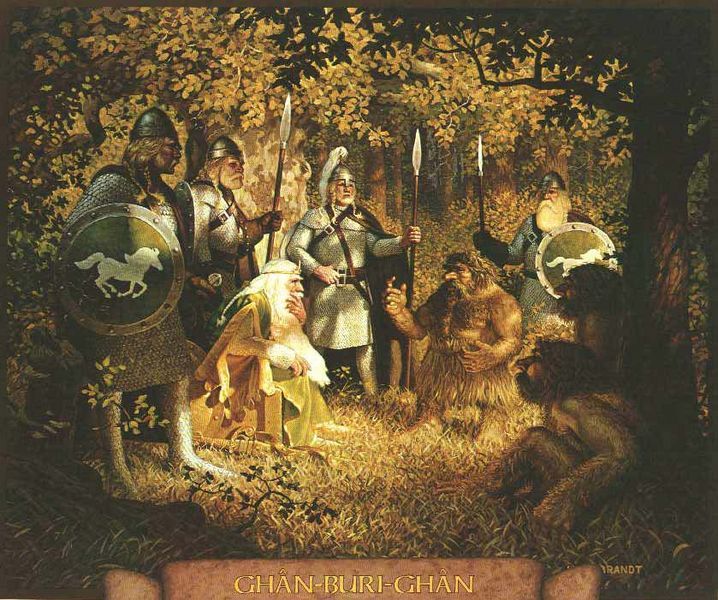
“ ‘Let Ghan-buri-Ghan finish!…More than one road he knows.  He will lead you by road where no pits are, no gorgun walk, only Wild Men and beasts.  Many paths were made when Stonehouse-folk were stronger.  They carved hills as hunters carve beast-flesh.  Wild Men think they ate stone for food.  They went through Druadan to Rimmon with great wains.  They go no longer.  Road is forgotten, but not by Wild Men.  Over hill and behind hill it lies still under grass and tree, there behind Rimmon and down to Din, and back at the end to Horse-men’s road.  Wild Men will show you that road.  Then you will kill gorgun and drive away bad dark with bright iron, and Wild Men can go back to sleep in the wild woods.” (The Return of the King, Book Five, Chapter 5, “The Ride of the Rohirrim”)

(the Hildebrandts)

This is, in fact, the chief of the Woses, an early people of Middle-earth now confined to a forest area not far from Minas Tirith.  His home language (of which JRRT tells us very little) is clearly not the Common Speech and so his address to Theoden and his lieutenants follows that of Ugluk and, in fact, of Chingachgook, suggesting, once more by the use of the model provided long before by James Fenimore Cooper, that Tolkien has earned his own place “among the Indians”.

As ever, thanks for reading.

Stay well,

If someone from many centuries before the time of The Lord of the Rings, the chief Nazgul, speaks in what is meant to be an archaic dialect, what would Sauron, older yet, sound like?

And remember that, as always, there’s

MTCIDC

O
Thin and Stretched

14 Wednesday Jan 2026

Posted by Ollamh in Uncategorized

≈ Leave a comment

Tags

Bilbo, Death, Eowyn, Fantasy, Frodo, Gandalf, John Milton, lotr, Merry, Nazgul, Paradise Lost, Rings, Ringwraiths, The Lord of the Rings, Tolkien, Witch King of Angmar, Witch-King of Angmar

Welcome, dear readers, as always.

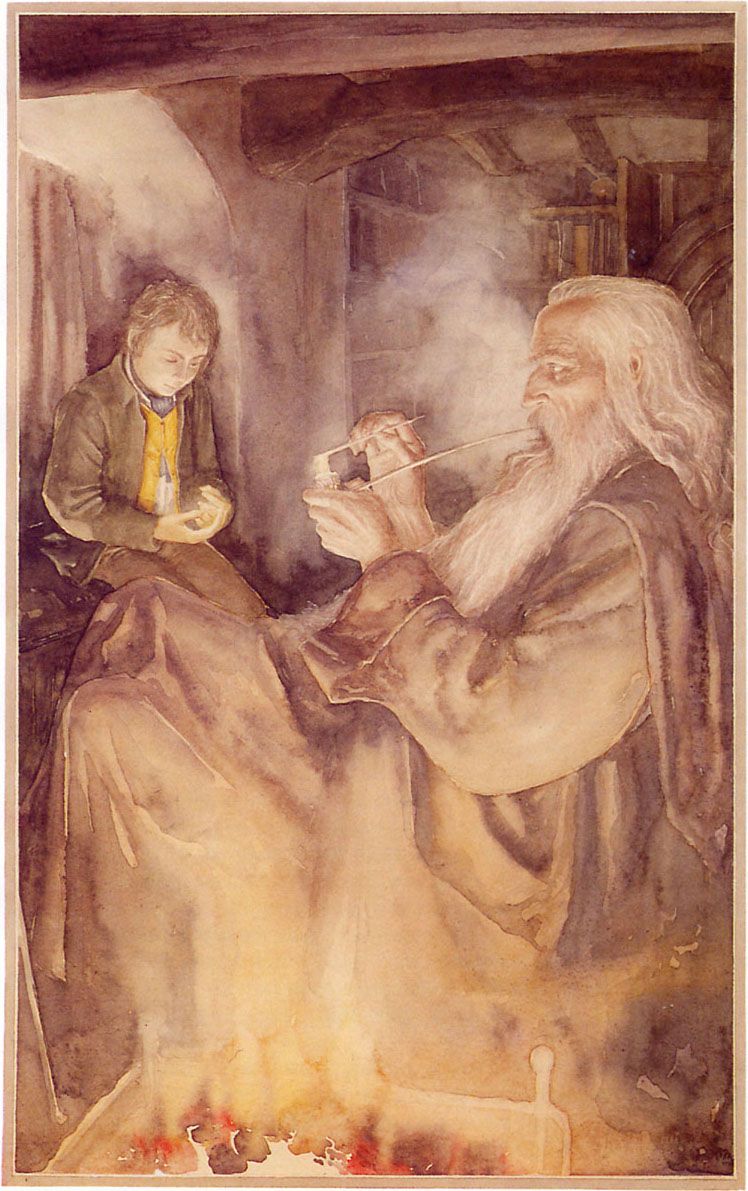
You recognized where the title of this posting comes from, I’m sure.  Bilbo and Gandalf

have been talking and Bilbo describes his current state:

“ ‘I am old, Gandalf.  I don’t look it, but I am beginning  to feel it in my heart of hearts.  Well-preserved indeed!…Why, I feel all thin, sort of stretched, if you know what I mean:  like butter that has been scraped over too much bread.’ “ (The Fellowship of the Ring, Book One, Chapter 1, “A Long-expected Party”)

(You’ll notice the pun here—as I’m sure JRRT did–in the combination of “preserve(d)”  with butter and bread—did he write this originally during breakfast one morning?)

After this, there is a very tense scene where Gandalf inquires about the Ring, Bilbo becomes hostile, but, in the end, Bilbo leaves the Ring and clearly feels great relief, even singing.

Nine years later, in a subsequent scene, after Gandalf had related, the previous night, some details about the Ring to Frodo, we can see what had been going on in Gandalf’s mind those nine years before and his concern for Bilbo then, persuading him to put the Ring aside:

“ ‘A mortal, Frodo, who keeps one of the Great Rings, does not die, but he does not grow or obtain more life, he merely continues, until at last every minute is a weariness.  And if he often uses the Ring to make himself invisible, he fades:  he becomes in the end invisible permanently, and walks in the twilight under the eye of the Dark Power that rules the Rings.  Yes, sooner or later—later, if he is strong or well-meaning to begin with, but neither strength nor good purpose will last—sooner or later the Dark Power will devour him.”  (The Fellowship of the Ring, Book One, Chapter 2, “The Shadow of the Past”)

Bilbo was, indeed, as stretched as he felt—and in more danger than he could know.  And it was a danger others had undergone before him—had they known what would happen?

(David T. Wenzel—you can see more of his work here:  https://ixgallery.com/artists/davidwenzel/  and visit his website here:  https://davidwenzel.com/   Be sure to spend time looking at his sketches—he’s a beautiful draftsman and his work is a pleasure to examine.)

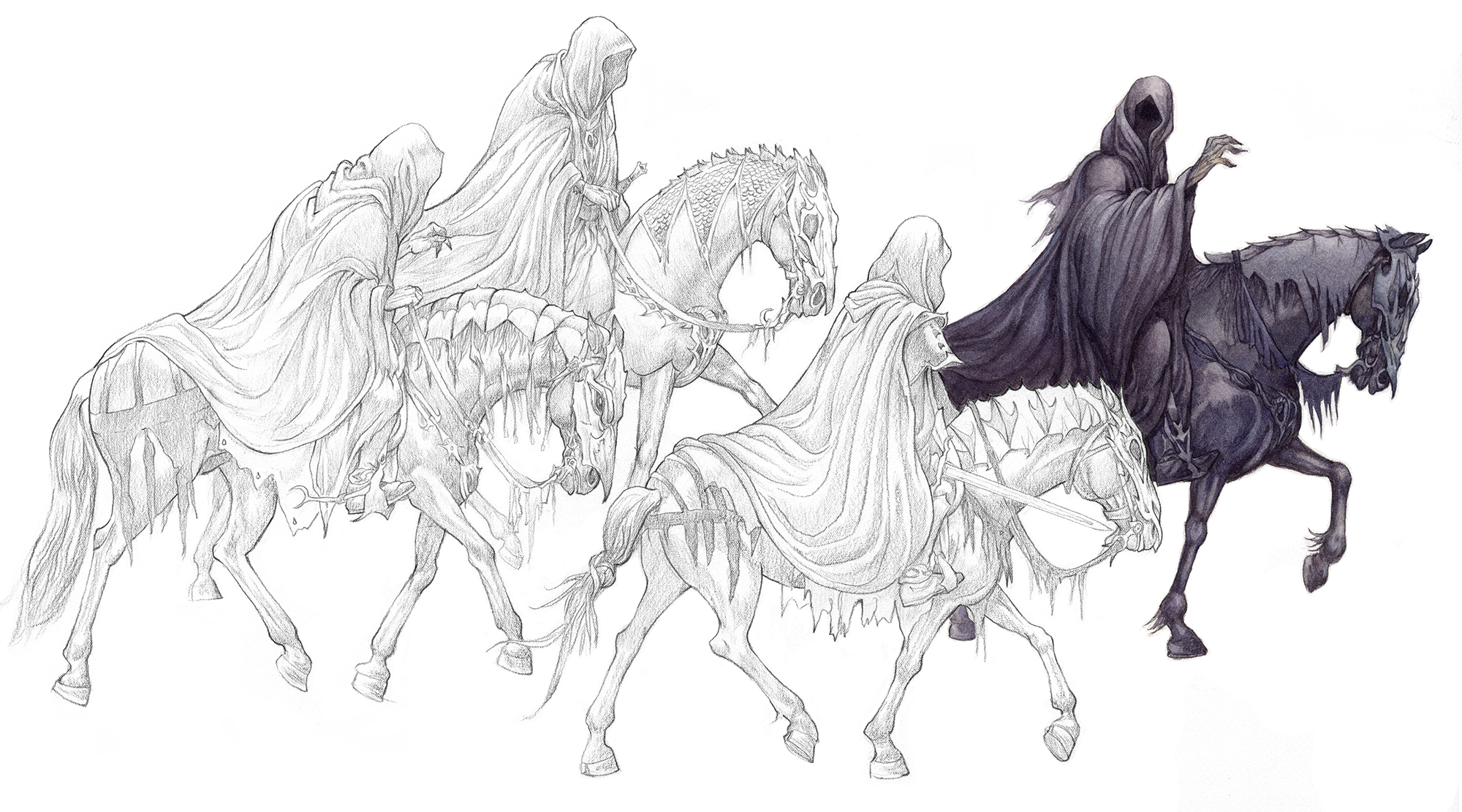
Gandalf goes on to explain the history of the Nazgul to Frodo, in relation to the very Ring we see here:

“ ‘Nine he gave to Mortal Men, proud and great, and so ensnared them.  Long ago they fell under the dominion of the One, and they became Ringwraiths, shadows under his great Shadow, his most terrible servants.  Long ago.’ “

And Gandalf continues, being more prophetic than he knows:

“ ‘It is many a year since the Nine walked abroad.  Yet who knows?  As the Shadow grows once more, they too may walk again.’ ”  (The Fellowship of the Ring, Book One, Chapter 2, “The Shadow of the Past”)

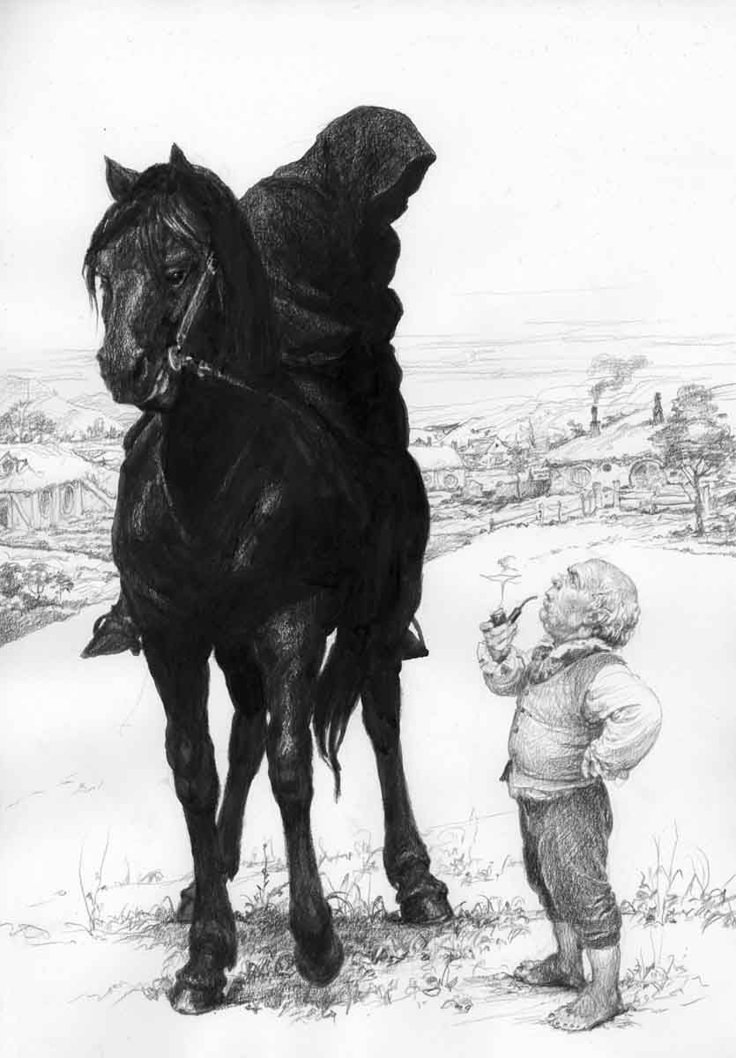
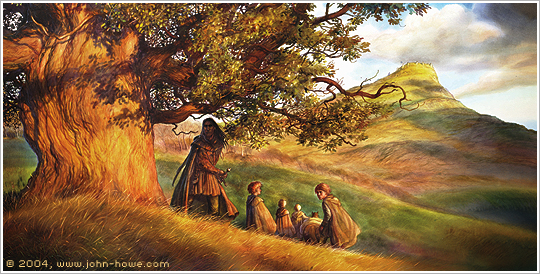
The Ringwraiths, the Nazgul, will appear again and again in the story, pursuing Frodo and his friends in their initial journey from the Shire, attempting to bribe Gaffer Gamgee,

(Denis Gordeev)

making  an attack upon Frodo and his friends at the Prancing Pony,

(Ted Nasmith)

nearly fatally wounding Frodo on Weathertop,

(John Howe)

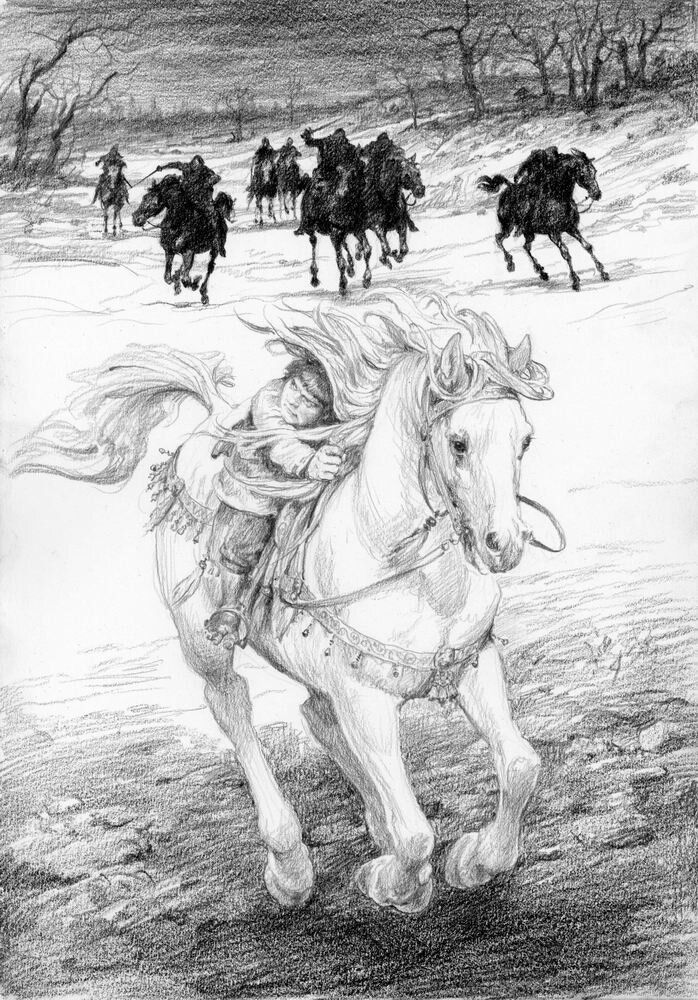
pursuing him to the ford,

(Denis Gordeev)

but, although washed away there,

(Ted Nasmith)

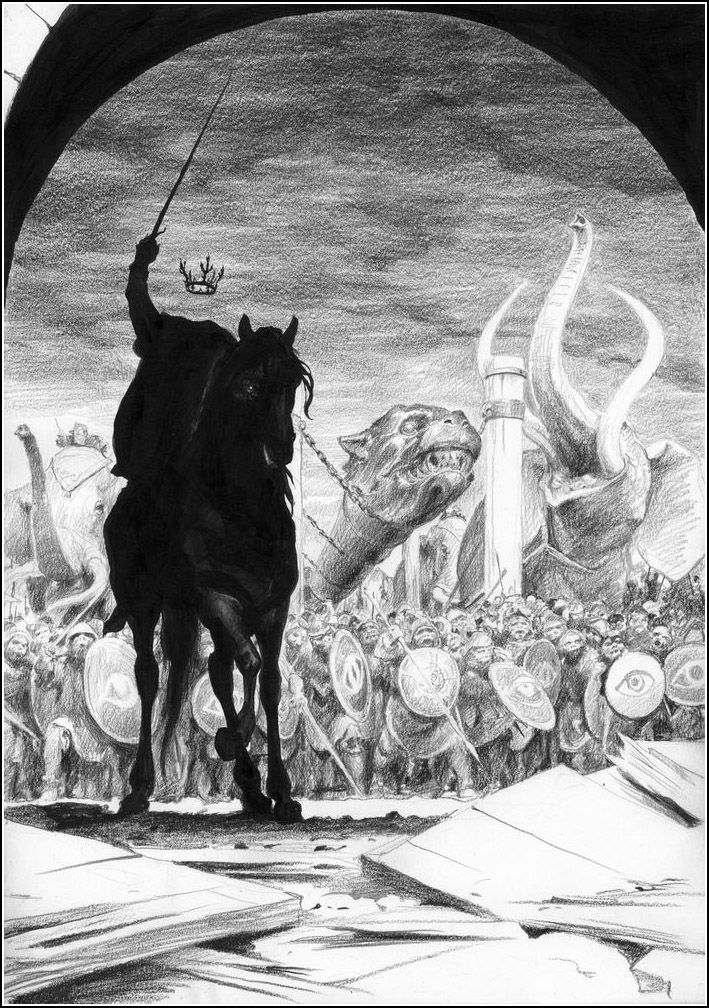
after a pause (although occasionally seen in the sky), participating in the assault on Minas Tirith,

(Denis Gordeev)

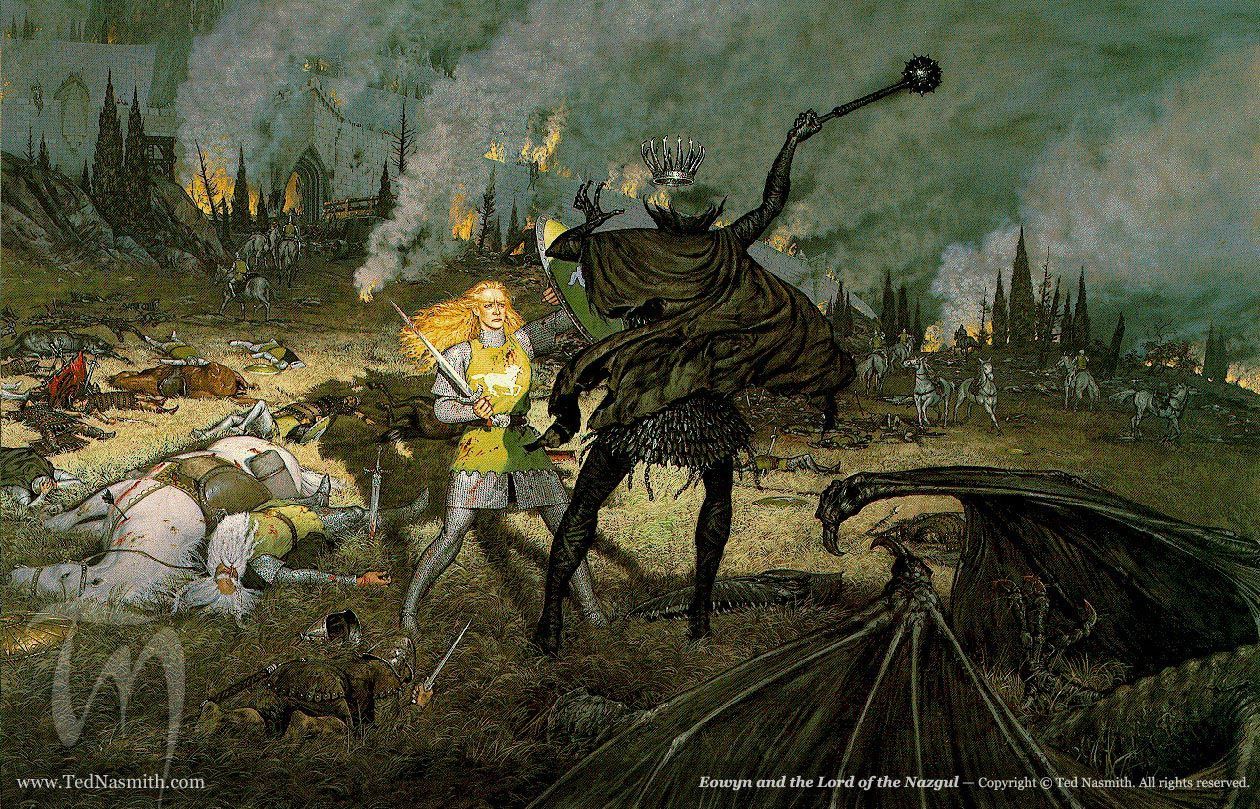
with the leader of their number finally destroyed by a combination of Eowyn and Merry.

(Ted Nasmith)

But this brings up a question:  if the Ringwraiths are “shadows under [Sauron’s] Great Shadow”, how can they:

1. carry weapons (think of the Morgul knife which wounds Frodo)

2. ride horses

3. somehow, after those horses are destroyed, make their way back to Mordor for replacements

4. although disembodied, be wounded and even destroyed by mortal weapons?

And the answer is:  unclear.  This is a place where I think JRRT wanted spookiness and substance, too, so his insubstantial menace—the Nazgul seem, in fact, to need those cloaks to be embodied—can do things like ride horses and other, unmentionable, things,

(Alan Lee)

and wield real weapons, as well as suffer wounds, like the mortals they once were.  And that leader even wears a crown—

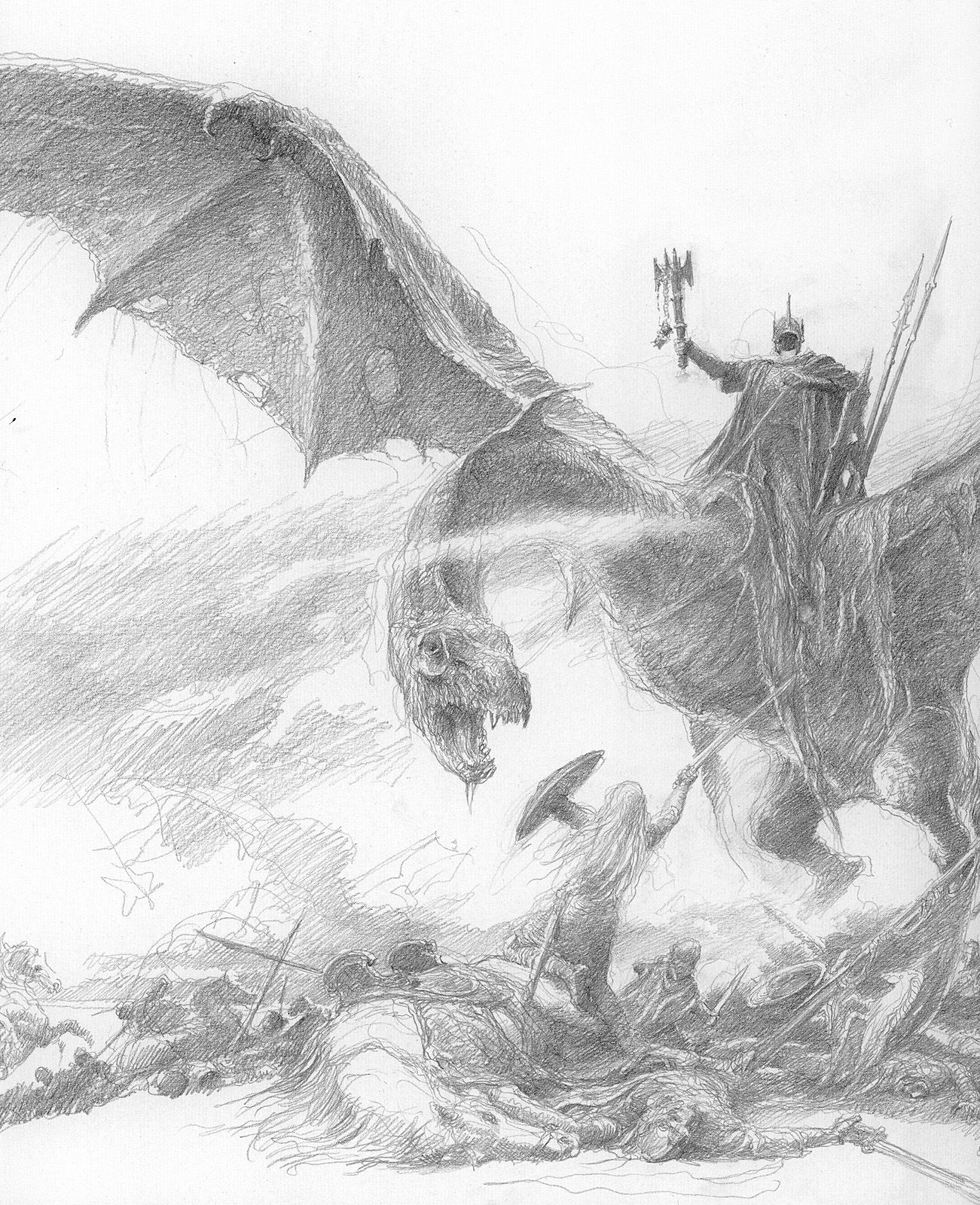
“Upon [the beast] sat a shape, black-mantled, huge and threatening.  A crown of steel he bore, but between rim and robe naught was there to see, save only a deadly gleam of eyes.” (The Return of the King, Book Five, Chapter 6, “The Battle of the Pelennor Fields”)

which might, in fact, give us a clue as to where that invisibility—and something more– might originally have sprung from.

Recently, I’ve been rereading John Milton’s (1608-1674) Paradise Lost 1667-1674),

where I came upon this scene, in which we see Satan, defeated in battle, with plans for revenge, is flying towards new-made Eden.   In his flight, he sees:

“…The other shape,

If shape it might be called that shape had none

Distinguishable in member, joint, or limb,

Or substance might be called that shadow seemed,

For each seemed either; black it stood as Night,

Fierce as ten Furies, terrible as Hell,

And shook a dreadful dart; what seemed his head

The likeness of a kingly crown had on.”  (Paradise Lost, Book II, lines 666-673)

This is, in fact, Death, we’re told, the offspring of Satan and the personification of Sin.  The Witch King of Angmar (the head of the Nazgul) may not be quite so dramatic a figure as that, and, for all that he’s the shadow of a shadow, he isn’t deathless, but the similarities—the lack of substance, the crown– are such that it makes me wonder:  while he was having that creative breakfast, did Tolkien have his copy of Paradise Lost propped up on the table in front of him?

Thanks for reading, as always.

Stay well,

Always try to come between the Nazgul and his prey,

(Federico—for more of his work, see:  https://pigswithcrayons.com/author/federico-piatti/ )

And remember that, as ever, there’s

MTCIDC

O
Through a glass…

07 Wednesday Jan 2026

Posted by Ollamh in Uncategorized

≈ Leave a comment

Tags

2nd Corinthians, Apostle Paul, Boromir, Dracula, Fantasy, Frodo, lotr, Mirror of Galadriel, mirrors, Sam, Sauron, Snow White, Through the Looking Glass, Through the Looking-Glass, Tolkien

Dear readers, as always, welcome.

When I was small, I was puzzled about this line:

“Now we see through a glass, darkly…”

which comes from the apostle, Paul’s, first letter to the Corinthians (Chapter 13, Verse 12).

I knew about glasses—I drank from them—

and I looked through them—

and all I could think of was that maybe the glass was dirty.

It was only as a grownup that I found out that “glass” was Jacobean shorthand (from the “King James Bible” of 1611) for “looking glass” as we can see in Jerome’s (c.342-420AD) Latin translation

“videmus nunc per speculum in enigmate”

of the Greek

“βλέπομεν γὰρ ἄρτι δι’ ἐσόπτρου ἐν αἰνίγματι,”

in which “speculum”, “mirror”, is his version of the Greek εἴσοπτρον (eisoptron), “mirror”. 

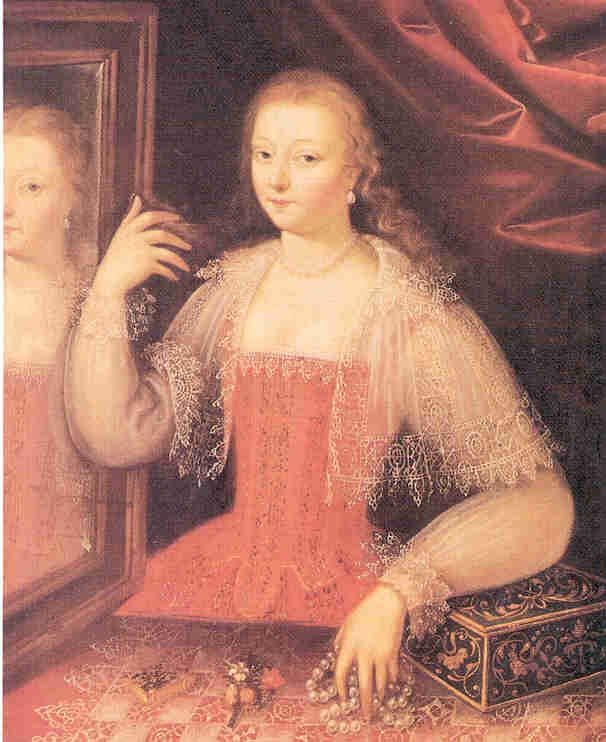
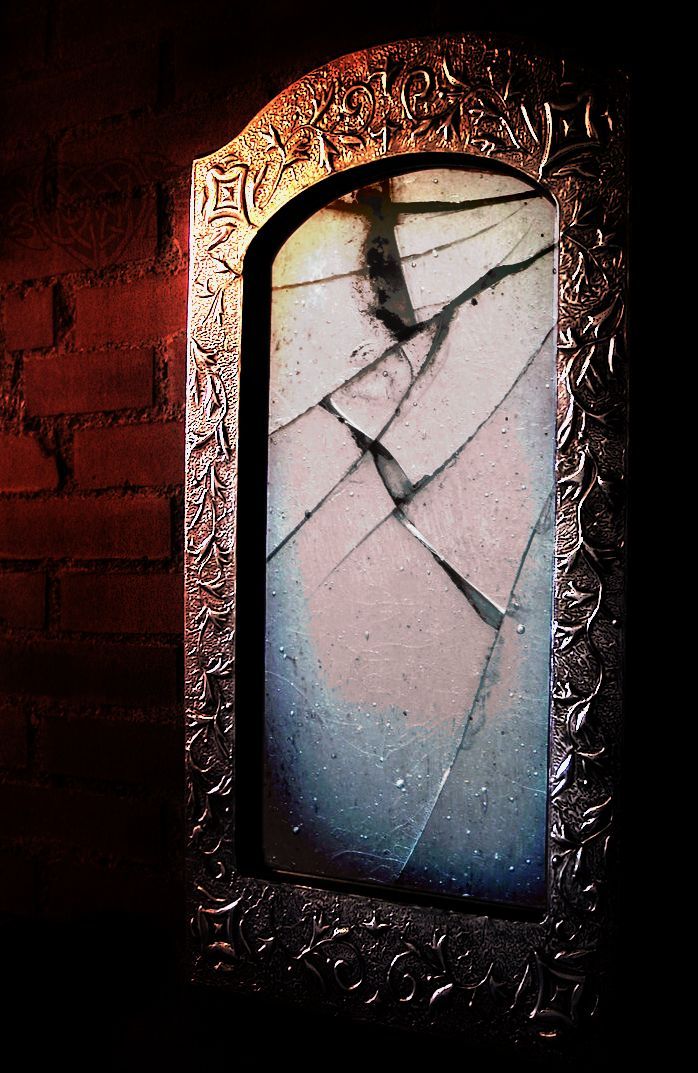
Here’s what the Jacobean translators might have thought of as a “glass”,

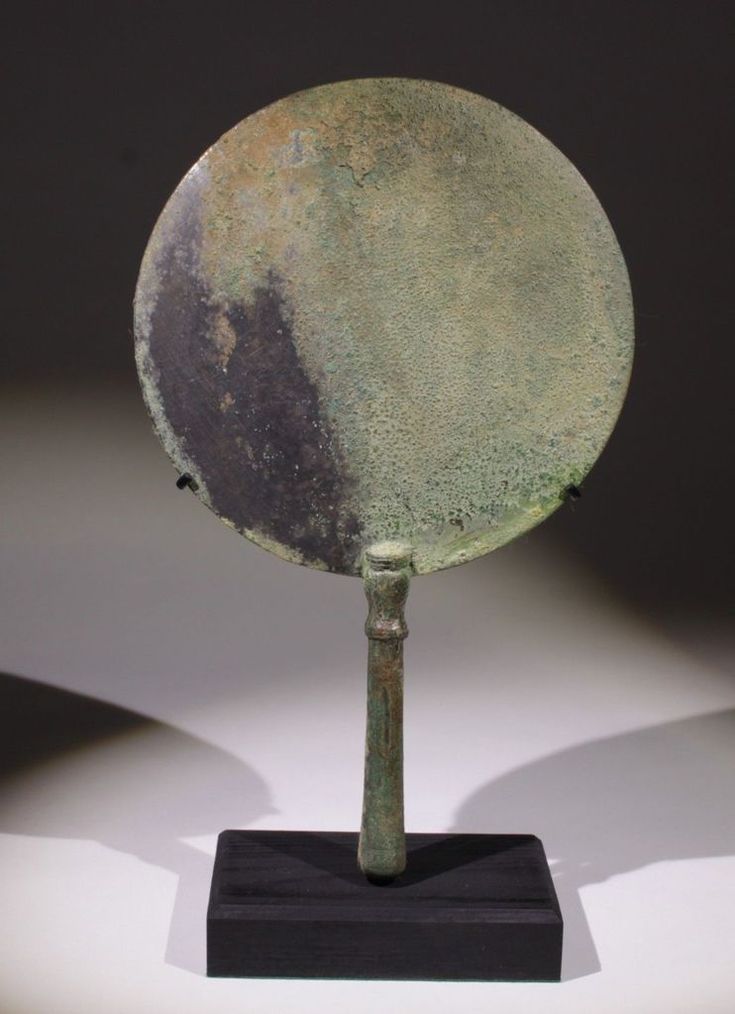
but Paul would have imagined something more like this—

which would have been made of highly-polished metal, commonly bronze, so it’s easier to imagine that “darkly”, if the metal became tarnished.

But that translation of “in enigmate” or the original ἐν αἰνίγματι, might make the mirror even darker, as it comes from αἴνιγμα, which means “riddle” and this isn’t surprising as I, at least, have always found mirrors a little odd—spooky, even—and I’m hardly alone in this—think of the wicked, vain queen in “Snow White”, with her magic mirror—

(from Disney’s 1937 “Snow White”)

or Alice’s adventures in a mirror world—

( You can read a first edition, with the original Tenniel illustrations here:    https://dn710100.ca.archive.org/0/items/throughlooking00carr/throughlooking00carr.pdf  )

or that moment in Chapter 2 of Dracula where Jonathan Harker, in Dracula’s castle, has an unnerving experience—

“I only slept a few hours when I went to bed, and feeling that I could not sleep any more, got up. I had hung my shaving glass by the window, and was just beginning to shave. Suddenly I felt a hand on my shoulder, and heard the Count’s voice saying to me, “Good-morning.” I started, for it amazed me that I had not seen him, since the reflection of the glass covered the whole room behind me. In starting I had cut myself slightly, but did not notice it at the moment. Having answered the Count’s salutation, I turned to the glass again to see how I had been mistaken. This time there could be no error, for the man was close to me, and I could see him over my shoulder. But there was no reflection of him in the mirror! The whole room behind me was displayed; but there was no sign of a man in it, except myself.”  (You can read this—and the whole book—in a first edition here:  https://gutenberg.org/files/345/345-h/345-h.htm#chap02 )

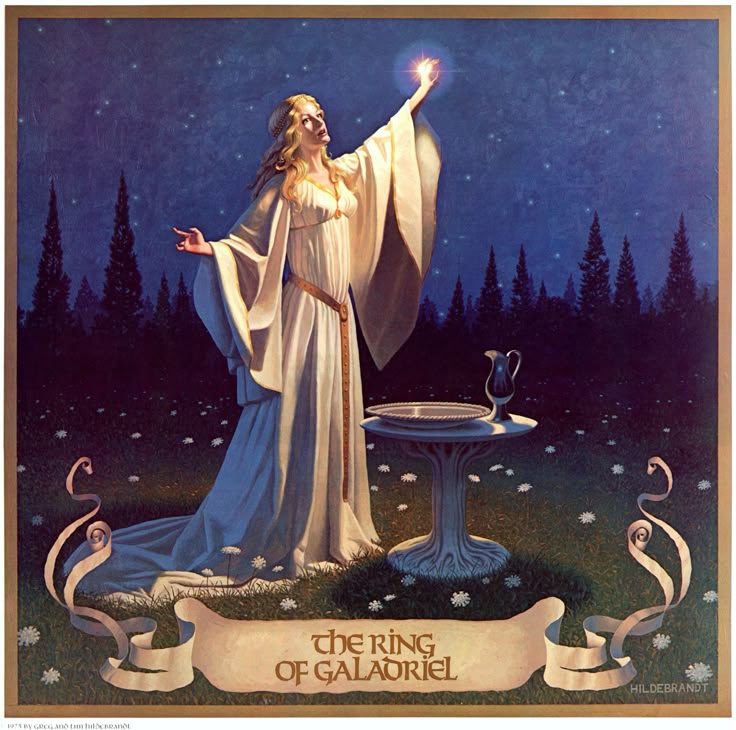
So, what about another mirror, but one not made of bronze, or silvered metal behind glass, like more modern versions—but more like a miniature reflecting pool–

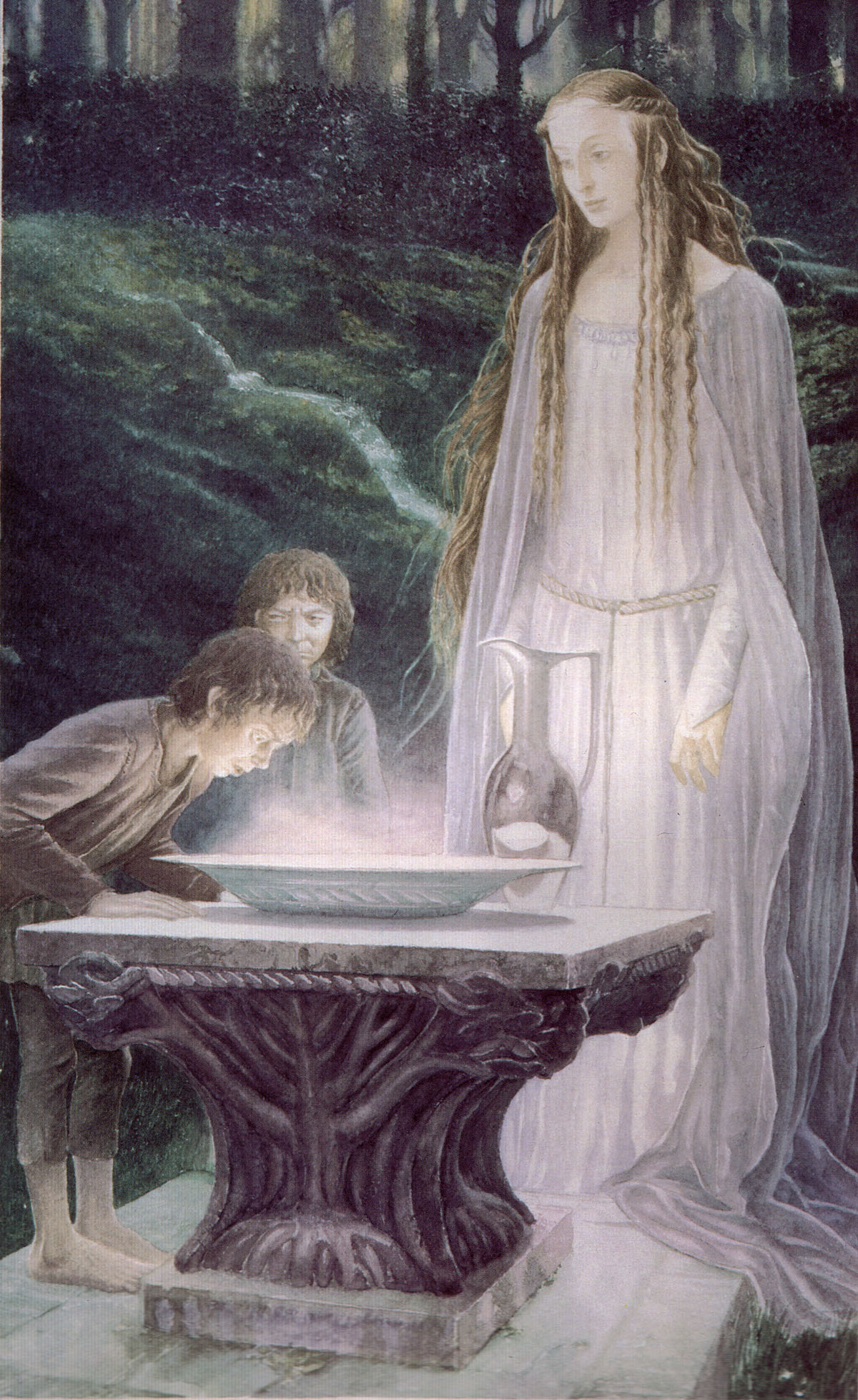
the mirror of Galadriel?

(Greg Hildebrandt)

I’ve written a little about this before  (see:   “Mirror, Mirror”, 9 December, 2015 ), but I’ve come back to this chapter with—I hope—further thoughts.  Why is it there at all?  One reason might be that, after their harrowing adventure in Moria, the Fellowship—and the readers—need a breather and, though they could continue on foot, having already come hundreds of miles that way, perhaps this is a way to vary their travels by adding water and that’s something  with which the elves can and do aid them —

“ ‘I see that you do not yet know what to do,’ said Celeborn.  ‘It is not my part to choose for you; but I will help you as I may.  There are some among you who can handle boats:  Legolas, whose folk know the swift Forest River; and Boromir of Gondor; and Aragorn the traveller.’ “ (The Fellowship of the Ring, Book Two, Chapter 8, “Farewell to Lorien”)

I would add that Lorien, Galadriel’s home, although it seems to be a place of refuge for the Fellowship,is also clearly a place for testing—and not all of that testing appears friendly, at least at first, and the deepest test for the two most important for the fate of the Ring lies in that mirror.

The testing begins, however, when Galadriel says:

“But I will say this to you:  your Quest stands upon the edge of a knife.  Stray but a little and it will fail, to the ruin of all.”

And then she continues:

“Yet hope remains while all the Company is true.”

And, having said this—

“And with that word she held them with her eyes, and in silence looked searchingly at each of them in turn.  None save Legolas and Aragorn could long endure her glance:  Sam quickly blushed and hung his head.”  (The Fellowship of the Ring, Book Two, Chapter 7, “The Mirror of Galadriel”)

Beyond her glance lies, we’re told, a kind of temptation—as Sam reveals:

“ ‘If you want to know, I felt as if I hadn’t got nothing on, and I didn’t like it.  She seemed to be looking inside me and asking me what I would do if she gave me the chance of flying back home to the Shire to a nice little hole with—with a bit of garden of my own.’ “

And, although almost none of the Fellowship reveals what he was offered, there was the same approach:

“All of them, it seemed, had fared alike:  each had felt that he was offered a choice between a shadow full of fear that lay ahead, and something that he greatly desired:  clear before his mind it lay, and to get it he had only to turn aside from the road and leave the Quest and the war against Sauron to others.”

Boromir’s experience might suggest that the test was even more revealing—and perhaps damning—than simply being allowed to leave the Quest, as Gimli says, “ ‘And it seemed to me, too…that my choice would remain secret and known only to myself.’ “  While Boromir explains:

“ ‘To me it seemed exceedingly strange…but almost I should have said that she was tempting us, and offering what she pretended to have the power to give.  It need not be said that I refused to listen.  The Men of Minas Tirith are true to their word.’ “

the narrator reveals the potentially damning part—remembering what Boromir later tried to do:

“But what he thought that the Lady had offered him Boromir did not tell.”

Did she offer him the Ring?

And now we come to the second test, a more selective one, as only Frodo and Sam are involved.

(Alan Lee)

It’s interesting to see the mirrors I’ve already mentioned and how they function in their stories.  “Snow White’s” queen employs hers as a surveillance device, in which the mirror encloses an omniscient spy and not her own reflection.  Alice’s looking glass is a barrier to another world and the fact that it’s a mirror which she must climb through suggests that, as mirrors invert things, so the world which she enters will be reversed, or at least topsey-turvey—definitely like stepping into an enigma.  Jonathan Harker’s  is a simple traveler’s shaving mirror, but stands in the middle of a mystery:  Dracula seems at first like the customer Jonathan has traveled to Transylvania to meet, businesslike, but hospitable and yet, for a nobleman living in a castle, he appears to have no servants and the castle is nearly ruined.  And then:  he has no reflection—what is Dracula?

Galadriel’s mirror, although it can repeat an image—

“Sam climbed up on the foot of the pedestal and leaned over the basin.  The water looked hard and dark.  Stars were reflected in it.”

has other properties—and, interestingly, can be controlled, to some extent, by Galadriel:

“ ‘Many things I can command the Mirror to reveal…and to some I can show what they desire to see.’ “

This has an ambiguous ring to it:  does she mean that she can make the Mirror simply reflect what people want to see, rather than what really may be seen?  If so, this seems in line with her earlier temptation/testing.  She goes on, however:

“ ‘But the Mirror will also show things unbidden, and those are often stranger and more profitable than things which we wish to behold.’”

This would then suggest that the Mirror may also have a mind of its own, beyond her control—“things unbidden”—and yet perhaps more useful—“profitable”. 

She then continues:

“ ‘What you will see, if you leave the Mirror free to work, I cannot tell.  For it shows things that were, and things that are, and things that yet may be.  But what it is that he sees, even the wisest cannot always tell.’ “

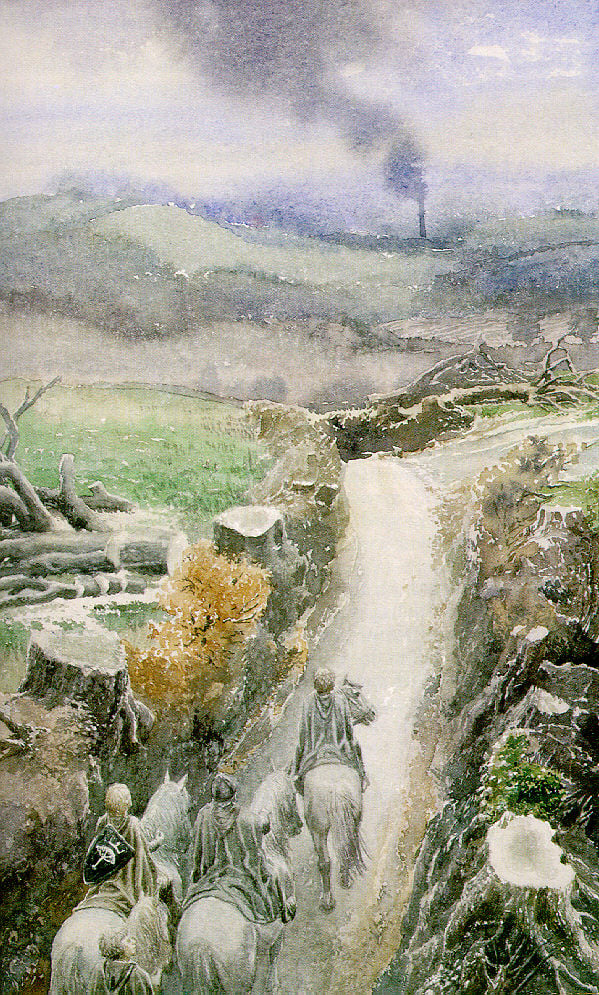
We notice right away that third part:  “things that yet may be”—and this important for what happens next.  Sam looks in, sees a little of the future which we know will happen:  “Frodo with a pale face lying fast asleep under a great dark cliff…himself going along a dim passage, and climbing an endless winding stair”—we can imagine that this is the crossing of the mountains into Mordor.  But then Sam sees the Shire and what we know will be Saruman/Sharkey’s planned industrialization—and ruin—of the Shire, with its “tall red chimney nearby” and here Sam almost fails the test, panicking and shouting “I must go home!”

(Alan Lee)

Here, Galadriel intervenes, reminding Sam of something she has already told him and Frodo:

“ ‘Remember that the Mirror shows many things, and not all have yet to come to pass.’”

To which she adds an important caution, echoing also her earlier warning:

“ ‘But I will say this to you:  your Quest stands upon the edge of a knife.  Stray but a little and it will fail, to the ruin of all.  Yet hope remains while all the Company is true.’ ”

saying to Sam:

“ ‘Some never come to be, unless those that behold the visions turn aside from their path to prevent them.  The Mirror is dangerous as a guide to deeds.’ “

And, at this, Sam, though miserable, then passes the test:

“ ‘No, I’ll go home by the long road with Mr. Frodo, or not at all.’ “

Frodo’s visions include Gandalf (although he believes that it might be Saruman), then sees what looks to be Sauron’s attack on Minas Tirith, but then something which might be the ship which takes him and others from the Grey Havens towards Valinor (“…and into the mist a small ship passed away, twinkling with lights.”) before his visions are replaced with

“…a single Eye that slowly grew, until it filled nearly all the Mirror.”

And it gets worse:

“The Mirror seemed to be growing hot and curls of steam were rising from the water.”

before Galadriel stops things by quietly saying, “Do not touch the water.”

With this interruption, however, the test, if, as it was for Sam, a test, is never completed, and so we don’t know if Frodo would have passed it.  But perhaps it is a warning:  should Frodo foolishly try to keep the Ring for himself, as he almost does before Gollum seizes it,

( Ted Nasmith)             

would he, unable to master it, be swallowed up into Sauron’s eye, or worse?

As always, thanks for reading.

Stay well,

Beware of breaking mirrors,

And remember that, as always, there’s

MTCIDC,

O
The Doubtful Sea Series Facebook Page

The Doubtful Sea Series Facebook Page

  • Ollamh

Categories

  • Artists and Illustrators
  • Economics in Middle-earth
  • Fairy Tales and Myths
  • Films and Music
  • Games
  • Heroes
  • Imaginary History
  • J.R.R. Tolkien
  • Language
  • Literary History
  • Maps
  • Medieval Russia
  • Military History
  • Military History of Middle-earth
  • Narnia
  • Narrative Methods
  • Poetry
  • Research
  • Star Wars
  • Terra Australis
  • The Rohirrim
  • Theatre and Performance
  • Tolkien
  • Uncategorized
  • Villains
  • Writing as Collaborators
Follow doubtfulsea on WordPress.com

Across the Doubtful Sea

Recent Postings

  • Towering January 28, 2026
  • Tolkien Among the Indians January 21, 2026
  • Thin and Stretched January 14, 2026
  • Through a glass… January 7, 2026
  • Heffalumps? December 31, 2025
  • We Three Kings December 24, 2025
  • A Moon disfigured December 17, 2025
  • On the Roads Again—Once More December 10, 2025
  • (Not) Crossing Bridges December 3, 2025

Blog Statistics

  • 105,532 Views

Posting Archive

  • January 2026 (4)
  • December 2025 (5)
  • November 2025 (4)
  • October 2025 (5)
  • September 2025 (4)
  • August 2025 (4)
  • July 2025 (5)
  • June 2025 (4)
  • May 2025 (4)
  • April 2025 (5)
  • March 2025 (4)
  • February 2025 (4)
  • January 2025 (5)
  • December 2024 (4)
  • November 2024 (4)
  • October 2024 (5)
  • September 2024 (4)
  • August 2024 (4)
  • July 2024 (5)
  • June 2024 (4)
  • May 2024 (5)
  • April 2024 (4)
  • March 2024 (4)
  • February 2024 (4)
  • January 2024 (5)
  • December 2023 (4)
  • November 2023 (5)
  • October 2023 (4)
  • September 2023 (4)
  • August 2023 (5)
  • July 2023 (4)
  • June 2023 (4)
  • May 2023 (5)
  • April 2023 (4)
  • March 2023 (5)
  • February 2023 (4)
  • January 2023 (4)
  • December 2022 (4)
  • November 2022 (5)
  • October 2022 (4)
  • September 2022 (4)
  • August 2022 (5)
  • July 2022 (4)
  • June 2022 (5)
  • May 2022 (4)
  • April 2022 (4)
  • March 2022 (5)
  • February 2022 (4)
  • January 2022 (4)
  • December 2021 (5)
  • November 2021 (4)
  • October 2021 (4)
  • September 2021 (5)
  • August 2021 (4)
  • July 2021 (4)
  • June 2021 (5)
  • May 2021 (4)
  • April 2021 (4)
  • March 2021 (5)
  • February 2021 (4)
  • January 2021 (4)
  • December 2020 (5)
  • November 2020 (4)
  • October 2020 (4)
  • September 2020 (5)
  • August 2020 (4)
  • July 2020 (5)
  • June 2020 (4)
  • May 2020 (4)
  • April 2020 (5)
  • March 2020 (4)
  • February 2020 (4)
  • January 2020 (6)
  • December 2019 (4)
  • November 2019 (4)
  • October 2019 (5)
  • September 2019 (4)
  • August 2019 (4)
  • July 2019 (5)
  • June 2019 (4)
  • May 2019 (5)
  • April 2019 (4)
  • March 2019 (4)
  • February 2019 (4)
  • January 2019 (5)
  • December 2018 (4)
  • November 2018 (4)
  • October 2018 (5)
  • September 2018 (4)
  • August 2018 (5)
  • July 2018 (4)
  • June 2018 (4)
  • May 2018 (5)
  • April 2018 (4)
  • March 2018 (4)
  • February 2018 (4)
  • January 2018 (5)
  • December 2017 (4)
  • November 2017 (4)
  • October 2017 (4)
  • September 2017 (4)
  • August 2017 (5)
  • July 2017 (4)
  • June 2017 (4)
  • May 2017 (5)
  • April 2017 (4)
  • March 2017 (5)
  • February 2017 (4)
  • January 2017 (4)
  • December 2016 (4)
  • November 2016 (5)
  • October 2016 (6)
  • September 2016 (5)
  • August 2016 (5)
  • July 2016 (5)
  • June 2016 (5)
  • May 2016 (4)
  • April 2016 (4)
  • March 2016 (5)
  • February 2016 (4)
  • January 2016 (4)
  • December 2015 (5)
  • November 2015 (5)
  • October 2015 (4)
  • September 2015 (5)
  • August 2015 (4)
  • July 2015 (5)
  • June 2015 (5)
  • May 2015 (4)
  • April 2015 (3)
  • March 2015 (4)
  • February 2015 (4)
  • January 2015 (4)
  • December 2014 (5)
  • November 2014 (4)
  • October 2014 (6)
  • September 2014 (1)

Blog at WordPress.com.

  • Subscribe Subscribed
    • doubtfulsea
    • Join 78 other subscribers
    • Already have a WordPress.com account? Log in now.
    • doubtfulsea
    • Subscribe Subscribed
    • Sign up
    • Log in
    • Report this content
    • View site in Reader
    • Manage subscriptions
    • Collapse this bar
 

Loading Comments...