• About

doubtfulsea

~ adventure fantasy

Tag Archives: The Last Jedi

See, the Conquering Hero?

09 Wednesday Oct 2019

Posted by Ollamh in Films and Music, Heroes, J.R.R. Tolkien, Narrative Methods

≈ Leave a comment

Tags

Battle of Culloden, Beethoven, celebrations, Crowning of Aragorn, endings, George Lucas, Haendel, Joshua, Judas Maccabaeus, oratorio, Return of the Jedi, Star Wars, The Empire Strikes Back, The Field of Cormallen, the Force, The Grey Havens, The Last Jedi, The Lord of the Rings, The Phantom Menace, The Red Book of Westmarch, The Return of the King, The Scouring of the Shire, Tolkien

Welcome, as ever, dear readers.

With Star Wars IX to appear in mid-December, completing the series, we’ve been going back through all of the previous episodes, from I (The Phantom Menace)

image1phantom.png

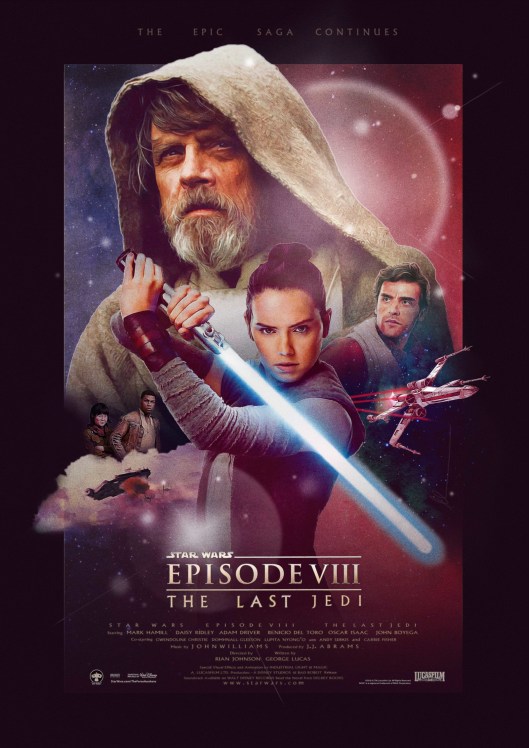
through VIII (The Last Jedi).

image2last.jpg

It’s a remarkable achievement and we’re very grateful to George Lucas,

image3gl.jpg

for bringing it so far, even if his strong sense of the story seems to have been abandoned after VI (Return of the Jedi).

Because there are now so many films (including all of the offshoots, like the animated features, as well as Rogue One and Solo), it’s sometimes hard to remember that, once upon a time, there was only Star Wars (only later A New Hope), with its triumphant conclusion—mass formations of troops, Princess Leia in an actual princess outfit, and medals all around.

image4sw1.jpg

The next film—now V (The Empire Strikes Back) had a much less secure ending, with Darth Vader and the Emperor appearing to win and Han Solo a prisoner, on his way to Jaba the Hutt,

image5ending5.jpg

but VI (The Return of the Jedi) is once more triumphant, both in its original ending, on the forest moon of Endor,

image6return.jpg

and in the later revised version, where we see galaxy-wide celebrations.
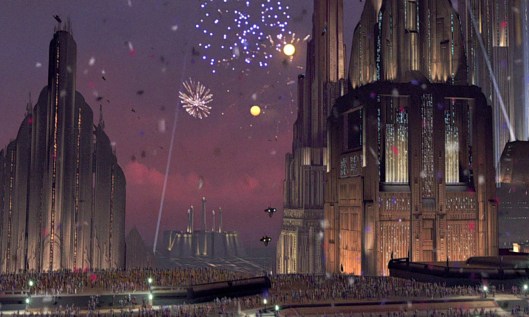
image7return.jpg

Among the other films, we’ve seen another celebration, on Naboo, at the end of I (The Phantom Menace),

image8phantom.jpg

a secret marriage in II (Attack of the Clones),
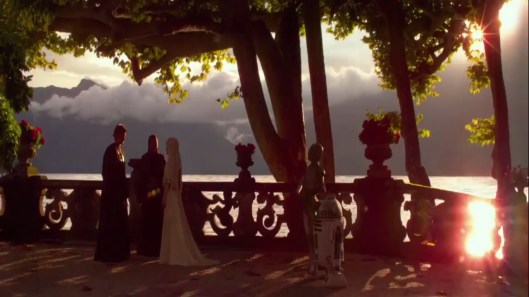
image9attack.jpg

and a complex web of plot, including the construction of the Death Star, the separation of the babies—Leia to Alderan, Luke to Tatooine—and the funeral of Padme in III (The Revenge of the Sith).
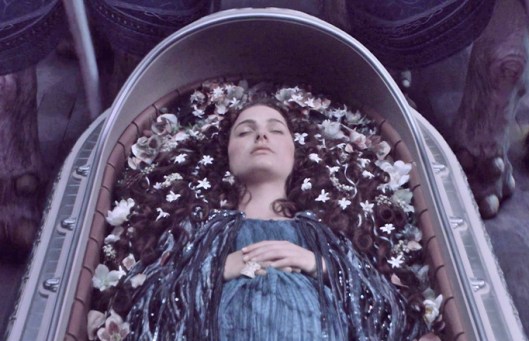
image10padme.jpg

VII (The Force Awakens) had a mysterious ending:  Rey having gone to what appears the far end of the galaxy to find—
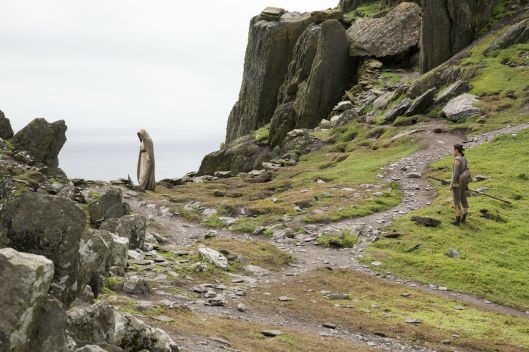
image11rey.jpg

while VIII (The Last Jedi) seemed vaguely hopeful, with an unnamed stable boy showing signs of having the Force within him, as Anakin did in I.
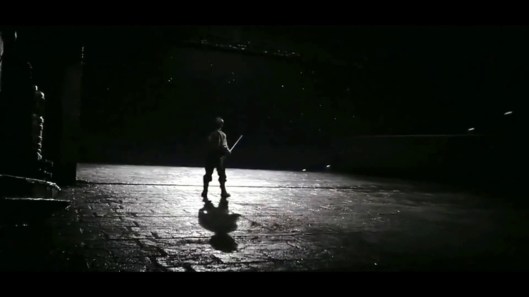
image12last.jpg

With such a build-up, we’ve been wondering how IX (The Rise of Skywalker) will end.  As it’s supposedly the final episode, we assume that it will not conclude up in the air, like V, but will it have a mass celebration, like I, IV, and VI?

Or will it, like III, have multiple endings?  As we’ve thought about it, you could really see that as the case with The Lord of the Rings.

First, like I, IV, and VI, there are celebrations:  of Frodo and Sam at the field of Cormallen, in The Return of the King, Book Six, Chapter 4, “The Field of Cormallen”.

image13afield.JPG

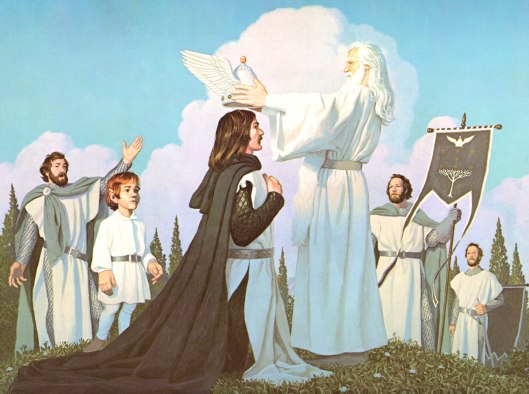
Then, in Chapter 5, “The Steward and the King”, we have the crowning of Aragorn
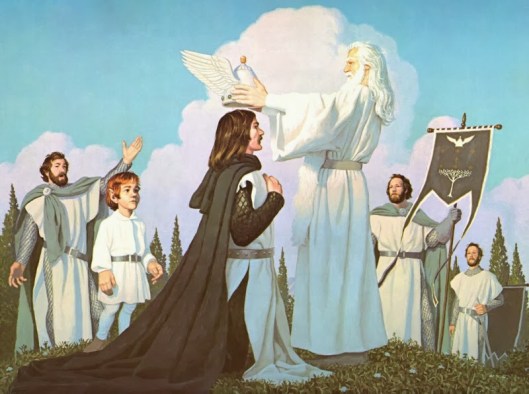
image13coronation.jpg

followed by the wedding of Arwen and Aragorn.

image14wedding.jpg

After that, we have the return of the hobbits to the Shire and the defeat and death of Saruman in Chapter 8, “The Scouring of the Shire”.  The Shire has been badly damaged by Saruman and his henchmen, however, so that, although they are gone, the healing will take many years.

image15adeath.jpg

And the story doesn’t conclude there.  Only a little time goes by and then there is another ending:  the trip to the Grey Havens and beyond in Chapter 9, “The Grey Havens”.

image16grey.jpg

And then the story finally ends—or does it?  We’ve seen in Star Wars VIII, when the stable boy seems to use the Force, though only for a moment,

image12last

the implication that perhaps the title, The Last Jedi, is more of a puzzle than it would first appear.  The very last line of The Lord of the Rings, spoken by Sam, is “Well, I’m back…”  and it’s true, as far as Sam won’t go off on another adventure.  Before this, however, Frodo has been busy writing:

“There was a big book with plain red leather covers; its tall pages were now almost filled.  At the beginning there were many leaves covered with Bilbo’s thin wavering hand, but most of it was written in Frodo’s firm flowing script.  It was divided into chapters but Chapter 80 was unfinished, and after that were some blank leaves…

‘Why, you have nearly finished it, Mr. Frodo!’ Sam exclaimed.  ‘Well, you have kept at it, I must say.’

‘I have quite finished, Sam,’ said Frodo.  ‘The last pages are for you.’”

But what does this imply?  We have no idea what Sam may have added, but the volume Frodo gave him was the origin of The Red Book of Westmarch, the basis not only for The Lord of the Rings, but for The Hobbit, as well.  Are we being told that writing about adventure is an adventure in itself, and almost as important?
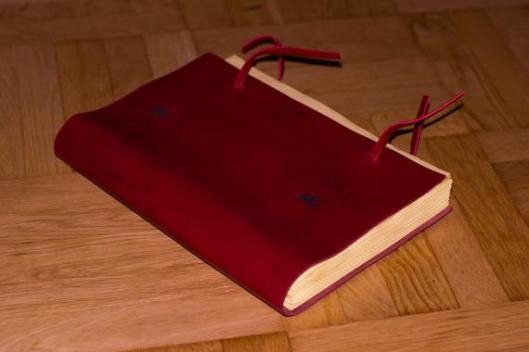
image17redbook.jpg

Thanks, as always, for reading.

MTCIDC, of course!

CD

ps

When we think of music in triumphs, the first piece which pops into our minds (after the Gungan march, of course) was one written by Haendel (1685-1759), “See, the Conquering Hero Comes”.

image18gfh


It was originally intended for his oratorio, Joshua (1747), but it fit his earlier piece, Judas Maccabaeus (1746) so well that he transferred it to the score of that oratorio.  Judas Maccabaeus was composed as a tribute to the second son of George II of England, William Augustus, the Duke of Cumberland,
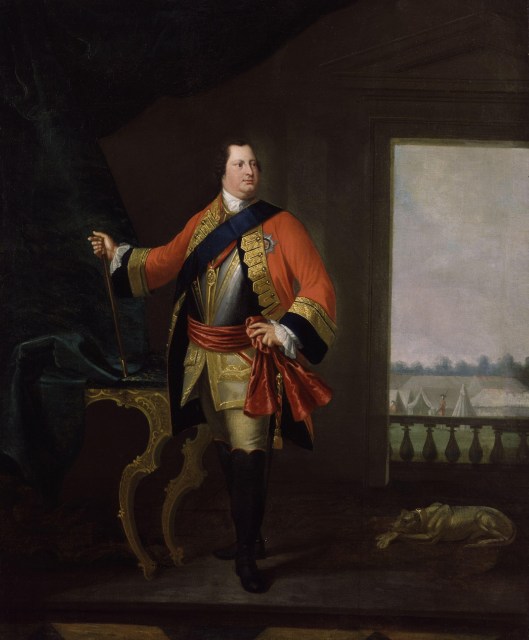
 

image19duke

after he had decisively beaten the attempt to overthrow his father and replace him with the son of the former monarch, James II, at the battle of Culloden.

image20cull.jpg

Here’s a LINK to a stirring performance.

In 1796, the young Beethoven (1770-1827)
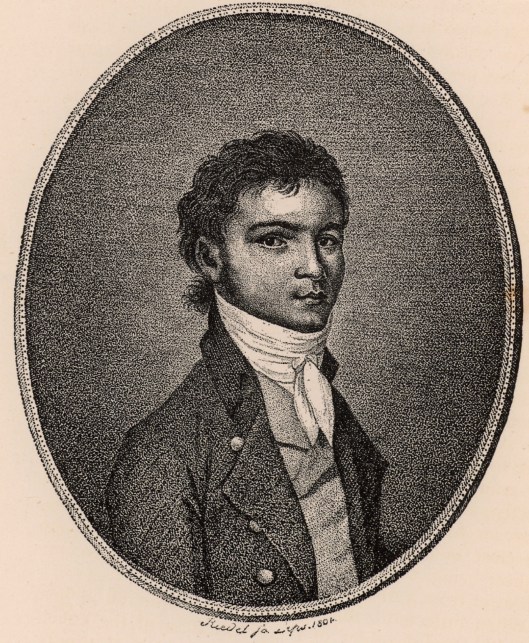
image21bvn.jpg

wrote a series of 12 variations on the theme for cello and fortepiano.  It’s a lot of fun to hear what Beethoven can do with Haendel’s tune, so we give you a LINK here.
Lost in Space

24 Wednesday Jan 2018

Posted by Ollamh in Films and Music, Heroes, Narrative Methods

≈ Leave a comment

Tags

character development, Episode VIII, Film Review, Sam Gamgee, Star Wars, The Last Jedi, The Lord of the Rings

Welcome, as always, dear readers.
When you think about Sam, what do you know about him and how do you know?
The first mention of the character is almost a footnote. The narrator is actually talking about Ham Gamgee “commonly known as the Gaffer” (a dialect form of “grandfather”):
“Now that he was himself growing old and stiff in the joints, the job was mainly carried on by his youngest son, Sam Gamgee. Both father and son were on very friendly terms with Bilbo and Frodo. They lived on the Hill itself, in Number 3 Bagshot Row just below Bag End.” (The Fellowship of the Ring, Book One, Chapter 1, “A Long-Expected Party”)
The Gaffer has been gossiping in The Ivy Bush, mostly in response to conversation about Bilbo and Frodo and he’s attempting to quell a rumor that Bag End is stuffed with jewels and gold and says of its riches:
“But my lad Sam will know more about that. He’s in and out of Bag End. Crazy about stories of the old days, he is, and he listens to all Mr. Bilbo’s tales. Mr. Bilbo has learned him his letters—meaning no harm, mark you, and I hope no harm will come of it.

‘Elves and Dragons! I says to him. Cabbages and potatoes are better for me and you. Don’t go getting mixed up in the business of your betters or you’ll land in trouble too big for you, I says to him.’ ”
So, in about three pages we know:
1. a little about Sam’s family (he is unmarried and lives with an elderly father)
2. his job (assistant gardener)
3. his social class (lower—Gaffer’s speech pattern and word choices indicate “rustic”, as does his talking to Sam about his “betters”)
4. where he lives (as a servant in this semi-feudal world would be expected to, below his master, but near)
5. his interests (“the old days”)
6. his education (he’s literate—and The Gaffer’s “meaning no harm” suggests that this is unusual, at least among his social class)
7. his character (imaginative: “crazy about stories”; perhaps independent-minded—he continues to be enthusiastic about such things even though his father cautions him against them)
In the many chapters to come, we will learn much more about Sam—his practicality, his inner toughness, his flexibility, his ability to stay grounded in the worst circumstances, and that inner resolve which keeps the two hobbits going, even to what appeared to be a terrible end:
“ ‘So that was the job I felt I had to do when I started,’ thought Sam: ‘to help Mr. Frodo to the last step and then die with him. Well, if that is the job then I must do it.’
But even as hope died in Sam, or seemed to die, it was turned to a new strength. Sam’s plain hobbit-face grew stern, almost grim, as the will hardened in him, and he felt through all his limbs a thrill, as if he was turning into some creature of stone and steel that neither despair nor weariness nor endless barren miles could subdue.” (The Return of the King, Book Six, Chapter 3, “Mount Doom”)
It’s not surprising, then, that Galadriel, with an eerie foresight, has given him the means to help the Shire heal from the terrible industrializing wounds of Sharkey & Co.:
“So Sam planted saplings in all the places where specially beautiful or beloved trees had been destroyed, and he put a grain of the precious dust in the soil at the root of each. He went up and down the Shire in this labour…And at the end he found that he still had a little of the dust left; so he went to the Three-Farthing Stone, which is as near the centre of the Shire as no matter, and cast it in the air with his blessing…” (The Return of the King, Book Six, Chapter 9, “The Grey Havens”)
Recently, we’ve seen Star Wars 8: The Last Jedi. After 7, we were not eager. We are not among those who hold that 4, 5, and 6 are the canon, although we see characters there—particularly Luke and Han—grow over time into people we include in our list of adventure-friends, like Robin Hood and David Balfour and Indiana Jones. We think that George Lucas, having developed the story of Luke and his father, was curious to see if he could reach back in time and show how Anakin Skywalker became Darth Vader, a daring and ambitious project, since, until his attack on the Emperor, Vader seemed less than sympathetic as a character.
For us, the main problem with 7 was that there seemed to be too many characters constantly flying to to too many planets, with no real attempt to develop them. Granted, JRRT had hundreds of pages and as many hours as his readers were willing to grant him to turn out characters like Sam, luxuries a film-maker is denied. At the same time, consider the opening sequence: a mysterious pilot lands on a mysterious planet which is then attacked by people who resemble the storm troopers of 4/5/6. The mysterious pilot is given something by a mysterious elderly man. Then a storm trooper mysteriously deserts his companions after finding one a casualty. And so it goes on. By the end of the film, we had a cast which included (for a short time, at least) old friends: Chewy, Han, and Leia (with minor roles for droids), plus a number of new characters who did not appear to us to be anchored in anything, just there to sustain the action. Who were they? Who knew? And, sadly, for us, who then cared? We had hopes for Rey (although the joke that she is a “Rey/Ray of Hope” is pretty obvious) and still do, but, with nothing to ground them, why, we asked ourselves, should we invest emotionally in FN-2187 and Poe (whose name is just a little too close to “Pooh”—or “Poo” for our taste)?
And then there came 8. It began as 5—evacuation from a newly-discovered base, but without the wampa or those impressive ATATs (even if snow speeders can find weaknesses in them). And then we see the unexplained Poe (the mysterious pilot in 7) once more and soon the unexplained FN-2187 (the mysterious deserter in 7) who, in turn, is soon joined by the unexplained Rose. (In time, we’ll also see the unexplained DJ, although we can’t recall that we were ever given his name, which says something about his development in the story. Why is he in the lock-up? When he betrays FN-2187 and Rose, when did he have the occasion to have set up the betrayal beforehand? And why does he occasionally stutter?) To which we add the unexplained Captain Phasma, who had a brief unexplained appearance in the previous film. (And who in the world is Snoke? And how does he come to fill in for Palpatine? We also wonder, considering the condition of his face, what happens when he eats popcorn—does it get wedged in the cracks or does it all fall out of one cheek?)
We swear by 4/5/6 and, though they are weaker films, we still believe 1/2/3 to be an important part of the story, but what we feel has happened in 7 and even more so in 8, is that character development has been sacrificed for action: instead of seeing more of who they are and why, we are too often shown what they do and this is somehow thought to be the same. Perhaps part of the point of 9 will be to explain at least some of what’s missing from 7 and 8, but imagine seeing Sam through the first five books of The Lord of the Rings simply as somebody who carries the pots and pans (and rope), then, suddenly, in Book Six, becomes the figure we have watched grow through the first five—would you believe in him and would you care?
Thanks, as always, for reading!
MTCIDC
CD
ps
We’ve had so much discussion about this that we plan a second review to follow.


In the Future, Use the Past

13 Wednesday Sep 2017

Posted by Ollamh in Artists and Illustrators, Fairy Tales and Myths, Films and Music, Heroes, J.R.R. Tolkien, Literary History, Narrative Methods

≈ Leave a comment

Tags

A New Hope, A Princess of Mars, Ages of Middle-earth, Death Star, Edgar Rice Burroughs, Emperor Palpatine, Frank Schoonover, George Lucas, Hildebrandt, Mos Eisley, Oxford, Percival Lowell, Return of the Jedi, Sauron, science fiction, special effects, Star Wars, Stonehenge, Tatooine, The Empire Strikes Back, The History of Middle-earth, The Last Jedi, The Lord of the Rings, Tolkien, tower of St Michael

Welcome, as always, dear readers.

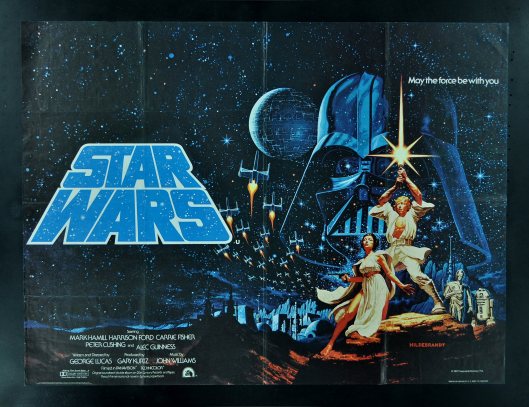
As The Last Jedi (Star Wars 8) approaches (and Star Wars Rebels, season 3 has appeared via the postman—season 4 premieres in mid-October—sadly the last season, as Disney has canceled season 5), we’ve been thinking about the original Star Wars of 1977.

image1poster.jpg

This poster—the second ever Star Wars poster, in fact (used by 20th Century Fox in the UK)– is a great link to JRRT—as if we don’t seem to make such links every time we write!  It’s by two of our favorite Tolkien illustrators, the Hildebrandt brothers.  Here’s a picture of the surviving twin, Greg, with that very poster (his brother, Tim, died in 2006).

image2gh.png

(Clink here for a LINK to an interesting little piece from 2010 about the Hildebrandts and George Lucas.)

We believe, however that there may be a deeper link.

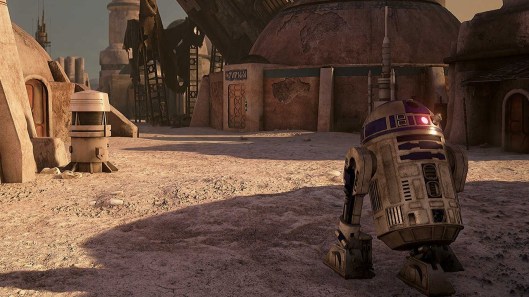
The original reviews (here’s a LINK to summaries of some of them) were a mixture, with some critics enthusiastic about what they saw and others (in our view the stodgier ones) calling the film things like “puerile”.  One element which was occasionally commented upon was the look of the picture—and not just the (for the time) dazzling special effects—but the fact that all the worlds depicted were lived-in, not shiny and new—well, almost.  Consider Mos Eisley, for example,

image3moseisley.jpg

which looks dusty and battered, suggesting the passage of time as well as the effects of the harsh desert climate of Tatooine.

Or the Jawa sandcrawler, old and clearly rusting–

image4jawasandcrawler.jpg

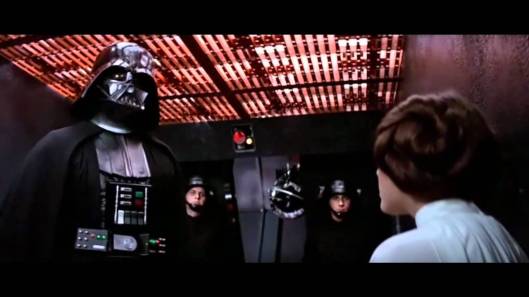
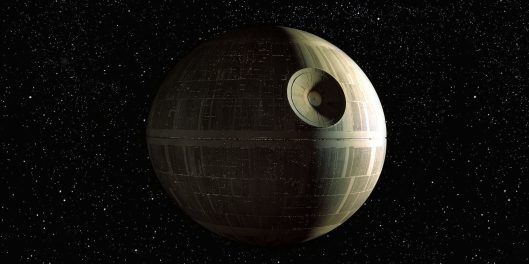
We said “almost” shiny and new because there’s one part of this galaxy with a different look:  the Death Star.

image5insidedeathstar.jpg

It looks like it’s dusted and waxed hourly, doesn’t it?  And the outside appears to be just as neat.

image6falconenteringdeathstar.jpg

What does this say about the nature of those who inhabit it?  For us, thinking about the spotless Darth Vader,

image7vader.jpg

immediately suggests that the old proverb should be changed to “Cleanliness is next to Un-godliness”!  (Okay—we’re not the neatest and most organized people we know.)

It has been pointed out, more than once and beginning with the director himself, that George Lucas was influenced by Edgar Rice Burroughs’ John Carter series, beginning with A Princess of Mars (first published serially in The All-Story, February to July, 1912).

image8princess.jpg

(And here’s another connection—this cover and the illustrations for its first publication in book form, in 1917, were by Frank Schoonover, 1877-1972, who was the student of another of our favorite illustrators, Howard Pyle, whom we have occasionally mentioned in previous postings.  The convincing detail in this cover painting shows that, just like his teacher, Schoonover did his research—in his case, by very carefully going through the text and taking note of any technical information the author might have mentioned.)

In A Princess of Mars and subsequent books,  Mars has a civilization which is old and in decline (the inspiration for which, in turn, may have come from the work of the amateur astronomer, Percival Lowell, 1855-1916, whose telescopic observations of Mars had convinced him that the planet was—or had been—the home of a dying civilization which had constructed a vast network of canals to supply themselves with water from the polar ice caps—unfortunately, numerous NASA missions have found no evidence of the desperate Martians or their canals).   It would be easy, then, to say that Lucas was just following his source material, but we would suggest that there are two better explanations for showing wear.

The first comes from something Lucas is quoted as having said to his production designers:  “What is required for true credibility is a used future.” In Lucas’ view, then, the story’s believability comes in part from its look:  if things appeared not shiny, but worn, then viewers would be more likely to accept the narrative as somehow “true”, we presume because things in our world so often look used.

There is then, we think a further presumption:  if things look worn, then they have a past, which implies that the here-and-now of the story is a small part of bigger things and, certainly, just looking at the “crawl” at the beginning of the original Star Wars,

star-wars-crawl-163729.jpeg

which leads us to  our second explanation.  This one deals with something deeper, something which we would say might provide another possible link with JRRT and is, in fact, suggested by the titles of the first three Star Wars films made and even in their sequence:  A New Hope, The Empire Strikes Back, The Return of the Jedi.

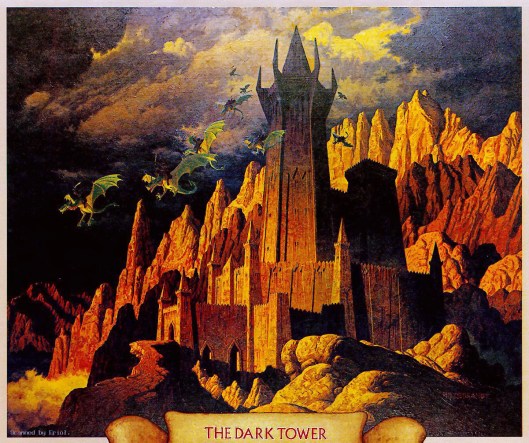
In two earlier postings, we talked about the condition of Middle-earth at the beginning of The Lord of the Rings, in which everything, from the trees to the houses of Minas Tirith, has grown old and weary—and even potentially hostile, in the case of the trees.  Part of this comes from the fact that Middle-earth is old:  one has only to turn to Appendix B, subtitled “The Tale of Years”, in The Lord of the Rings to see that, in the Second and Third Ages alone, nearly 6000 years have passed.   (In terms of our earth, that’s moving from the late Neolithic Era to modern times, 4000bc to 2017ad.)  This also emphasizes the age and depth of evil, as well as its power to corrupt in the present:  Sauron began to build Barad-dur c. SA1000—5000 years before the main narrative of The Lord of the Rings opens and, in the present, the world is crumbling.

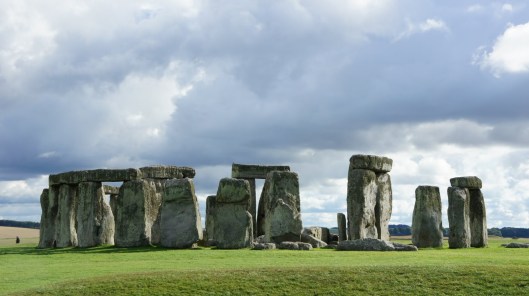
Of course, JRRT lived surrounded by the past.  The oldest surviving building in his daily Oxford is the tower of St Michael at the North Gate, dating from 1040ad, nearly a thousand years before his time,

image9stmichaels.jpg

but Neolithic Stonehenge is only 58 miles (93km) southwest of the city and that’s 5000 years old, taking us back to the time when, in Middle-earth, Sauron had begun the Barad-dur.

image10stonehenge.JPG

image11baraddur.jpg

In contrast, Lucas was born in 1944 in Modesto, California, a town only founded in 1870, and grew up in a post-World War II world, where the key was “the future”.  It is a tribute, then, to his story-telling gift that he realized how useful in telling his story the past—even an imagined one—could be and it is interesting to see how he shares that understanding with JRRT and perhaps shares a goal, as well.

We’ve said that our second explanation may be seen in the titles of Lucas’ three films, so let’s consider them in comparison with the general shape of Tolkien’s work to see what that shared goal might be.   (In an interview, Lucas even described the three as being like a three-act play, suggesting the dramatic progress inherent in the movement from one to another.)

At the beginning of the first film, it is a dark time in the galaxy:  the repressive regime of the evil Emperor Palpatine dominates and resistance is confined to “The Rebel Alliance”, which has scraped together a fleet (and, presumably an army—we see elements in Rogue One, which takes place before this film) to resist, but seems to spend most of its time running and hiding.  The past is only implied, but the fact that there is an Empire and a resistance suggests much, just as the run-down condition of places like Tatooine might suggest both age and that the galaxy has become run-down because of that Empire.

image12palpatine.jpg

At the beginning of The Lord of the Rings, we find ourselves in a place with a long history, as we see from the many pages of the “Prologue”.  It has been a quiet place, but the world outside is becoming less so, with sinister forces growing, as Frodo hears from passing dwarves:

“They were troubled, and some spoke in whispers of the Enemy and of the Land of Mordor.” (The Fellowship of the Ring, Book One, Chapter 2, “The Shadow of the Past”)

In time, readers are brought to see that the dwarves are grossly understating the case:  the Enemy is real, Sauron, and that he has not only huge armies, but the Nazgul and a would-be ally in his enemies’ camp, Saruman.  The same may be said for the Empire:  not only do they have huge fleets and armies, but they have the “ultimate weapon”, the Death Star.

image13deathstar.jpeg

We will learn, as well, that, for all his great age and might, Sauron has an Achilles’ heel:  to give the One Ring its power, he has had to pour most of his power into it.  Thus, if he regains the ring, he will be much more powerful than he is at present, but, should the ring be destroyed, Sauron will be virtually destroyed with it.  As this struggle has been going on in Middle-earth for thousands of years, the idea that Sauron is vulnerable could easily be termed “a new hope”, just as Luke, the son of the Enforcer of the Galaxy, Darth Vader/Anakin Skywalker, will provide a new hope for the Rebels (especially when we are told about “the Chosen One”—for whom he can be taken).

For a time, things do not go well for those opposed to Sauron:  he combines psychological/meteorological attacks with the march of huge armies, and even pirate raids on Gondor’s south coast. Gondor is overrun and Minas Tirith is assaulted.  This is clearly The Empire Strikes Back, just as the pursuit of the Rebel fleet to Hoth and the destruction of Echo Base disperses the Rebels and casts a shadow over the hope felt after the destruction of the Death Star.

This is not the end, however, for the Rebels or for the good people of Middle-earth.  Not only is the Ring destroyed and Sauron disembodied, but this paves the way for The Return of the King, with all of the reflowering-to-come, as we have suggested in a previous posting.

image14crowning.jpg

And there is a strong echo in the title of Lucas’ third film, The Return of the Jedi, in which the Emperor is destroyed and balance brought back to the Force—and the galaxy.  (Of course, with Star Wars 7, we see that the happy ending is only temporary, but we have hopes that, by the conclusion of 9, there will come a final rebalancing and peace at last.)

image15return.jpg

Lucas’ acknowledges many sources but, so far, we have yet to locate a quotation from an interview or anywhere else in which he says, “Yes, I’ve read Tolkien closely and, indeed, there is a strong affinity between my work and his”, but we believe that we can suggest, at least, that he, like JRRT, is following the same path in creating a world in turmoil, a visibly-aging world.  Into this world, he places his protagonist who provides a new hope, faces the might of a not-easily-defeated enemy, but, by his bravery and determination, finally brings about the destruction of that enemy (interesting in both cases he does not do so himself—Gollum inadvertently destroys the ring, just as Anakin, not his son, kills the Emperor) and the promise of renewal in the return of the Jedi—and the King.

And what do you think, dear readers?

Thanks, as ever, for reading!

MTCIDC

CD

The Doubtful Sea Series Facebook Page

The Doubtful Sea Series Facebook Page

  • Ollamh

Categories

  • Artists and Illustrators
  • Economics in Middle-earth
  • Fairy Tales and Myths
  • Films and Music
  • Games
  • Heroes
  • Imaginary History
  • J.R.R. Tolkien
  • Language
  • Literary History
  • Maps
  • Medieval Russia
  • Military History
  • Military History of Middle-earth
  • Narnia
  • Narrative Methods
  • Poetry
  • Research
  • Star Wars
  • Terra Australis
  • The Rohirrim
  • Theatre and Performance
  • Tolkien
  • Uncategorized
  • Villains
  • Writing as Collaborators
Follow doubtfulsea on WordPress.com

Across the Doubtful Sea

Recent Postings

  • A Moon disfigured December 17, 2025
  • On the Roads Again—Once More December 10, 2025
  • (Not) Crossing Bridges December 3, 2025
  • On the Road(s) Again—Again November 26, 2025
  • On the Road(s) Again November 19, 2025
  • To Bree (Part 2) November 12, 2025
  • To Bree (Part 1) November 5, 2025
  • A Plague o’ Both—No, o’ All Your Houses! October 29, 2025
  • It’s in Writing (2:  I’st a Prologue, or a Poesie for a Ring?) October 22, 2025

Blog Statistics

  • 103,228 Views

Posting Archive

  • December 2025 (3)
  • November 2025 (4)
  • October 2025 (5)
  • September 2025 (4)
  • August 2025 (4)
  • July 2025 (5)
  • June 2025 (4)
  • May 2025 (4)
  • April 2025 (5)
  • March 2025 (4)
  • February 2025 (4)
  • January 2025 (5)
  • December 2024 (4)
  • November 2024 (4)
  • October 2024 (5)
  • September 2024 (4)
  • August 2024 (4)
  • July 2024 (5)
  • June 2024 (4)
  • May 2024 (5)
  • April 2024 (4)
  • March 2024 (4)
  • February 2024 (4)
  • January 2024 (5)
  • December 2023 (4)
  • November 2023 (5)
  • October 2023 (4)
  • September 2023 (4)
  • August 2023 (5)
  • July 2023 (4)
  • June 2023 (4)
  • May 2023 (5)
  • April 2023 (4)
  • March 2023 (5)
  • February 2023 (4)
  • January 2023 (4)
  • December 2022 (4)
  • November 2022 (5)
  • October 2022 (4)
  • September 2022 (4)
  • August 2022 (5)
  • July 2022 (4)
  • June 2022 (5)
  • May 2022 (4)
  • April 2022 (4)
  • March 2022 (5)
  • February 2022 (4)
  • January 2022 (4)
  • December 2021 (5)
  • November 2021 (4)
  • October 2021 (4)
  • September 2021 (5)
  • August 2021 (4)
  • July 2021 (4)
  • June 2021 (5)
  • May 2021 (4)
  • April 2021 (4)
  • March 2021 (5)
  • February 2021 (4)
  • January 2021 (4)
  • December 2020 (5)
  • November 2020 (4)
  • October 2020 (4)
  • September 2020 (5)
  • August 2020 (4)
  • July 2020 (5)
  • June 2020 (4)
  • May 2020 (4)
  • April 2020 (5)
  • March 2020 (4)
  • February 2020 (4)
  • January 2020 (6)
  • December 2019 (4)
  • November 2019 (4)
  • October 2019 (5)
  • September 2019 (4)
  • August 2019 (4)
  • July 2019 (5)
  • June 2019 (4)
  • May 2019 (5)
  • April 2019 (4)
  • March 2019 (4)
  • February 2019 (4)
  • January 2019 (5)
  • December 2018 (4)
  • November 2018 (4)
  • October 2018 (5)
  • September 2018 (4)
  • August 2018 (5)
  • July 2018 (4)
  • June 2018 (4)
  • May 2018 (5)
  • April 2018 (4)
  • March 2018 (4)
  • February 2018 (4)
  • January 2018 (5)
  • December 2017 (4)
  • November 2017 (4)
  • October 2017 (4)
  • September 2017 (4)
  • August 2017 (5)
  • July 2017 (4)
  • June 2017 (4)
  • May 2017 (5)
  • April 2017 (4)
  • March 2017 (5)
  • February 2017 (4)
  • January 2017 (4)
  • December 2016 (4)
  • November 2016 (5)
  • October 2016 (6)
  • September 2016 (5)
  • August 2016 (5)
  • July 2016 (5)
  • June 2016 (5)
  • May 2016 (4)
  • April 2016 (4)
  • March 2016 (5)
  • February 2016 (4)
  • January 2016 (4)
  • December 2015 (5)
  • November 2015 (5)
  • October 2015 (4)
  • September 2015 (5)
  • August 2015 (4)
  • July 2015 (5)
  • June 2015 (5)
  • May 2015 (4)
  • April 2015 (3)
  • March 2015 (4)
  • February 2015 (4)
  • January 2015 (4)
  • December 2014 (5)
  • November 2014 (4)
  • October 2014 (6)
  • September 2014 (1)

Blog at WordPress.com.

  • Subscribe Subscribed
    • doubtfulsea
    • Join 78 other subscribers
    • Already have a WordPress.com account? Log in now.
    • doubtfulsea
    • Subscribe Subscribed
    • Sign up
    • Log in
    • Report this content
    • View site in Reader
    • Manage subscriptions
    • Collapse this bar
 

Loading Comments...