• About

doubtfulsea

~ adventure fantasy

Tag Archives: Morgoth

Alternatives

23 Wednesday Apr 2025

Posted by Ollamh in Uncategorized

≈ Leave a comment

Tags

lotr, Morgoth, Mouth of Sauron, Sauron, Sharkey, Tolkien, Turtledove, What If

As always, dear readers, welcome.

I’ve written before about “What Ifs”—that is, alternative views of things, be they historical,

(and interesting here to see an introduction by Harry Turtledove, who has written a raft of “what ifs” himself)
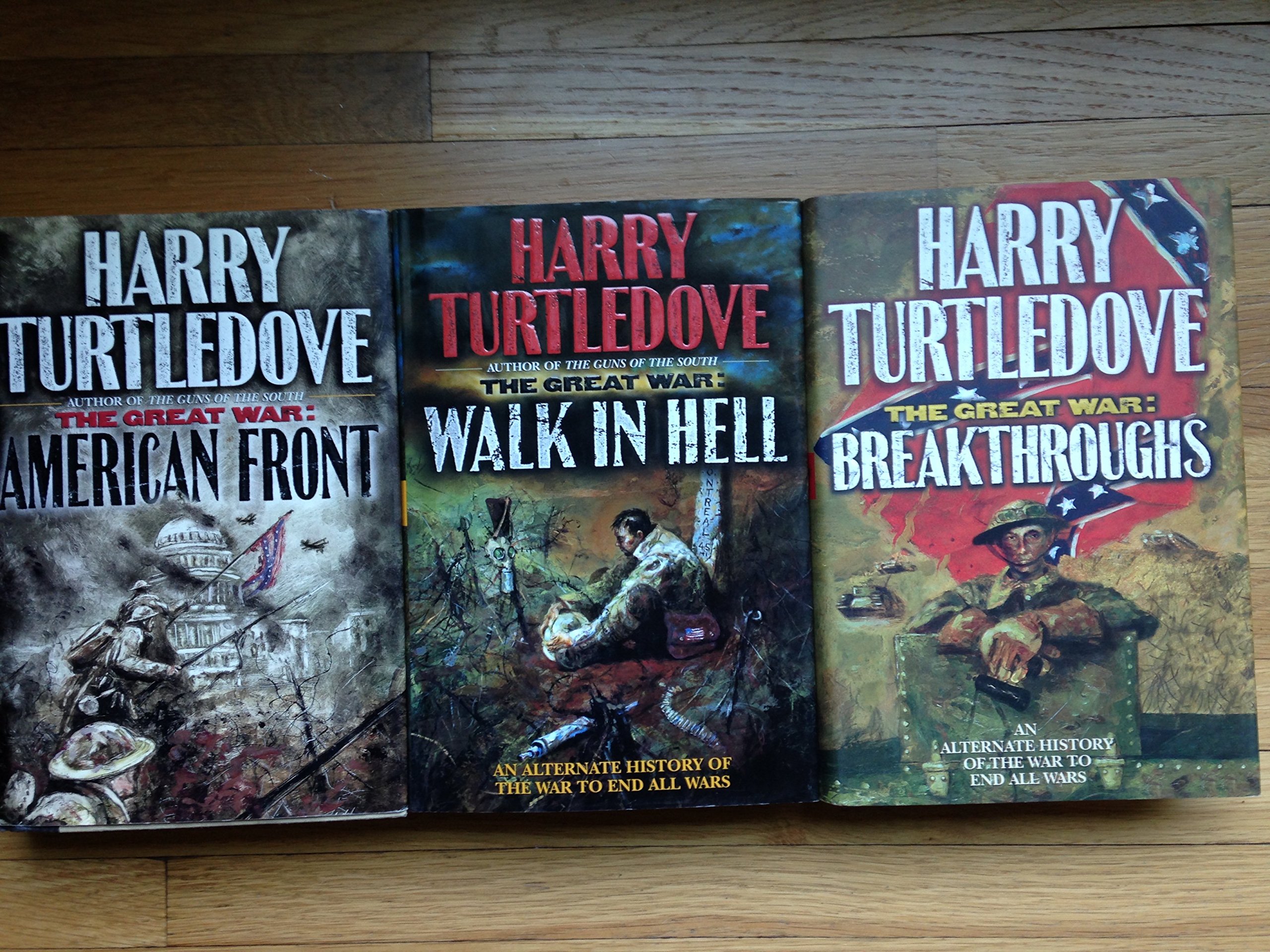
or based upon fantasy.

Recently, I wrote about Sauron’s terms, as stated by the Mouth of Sauron in “The Black Gate Opens”,

(Douglas Beekman—prolific sci-fi/fantasy artist—you can read a little about him here:  https://www.askart.com/artist/Doug_L_Beekman/122294/Doug_L_Beekman.aspx )

 to Gandalf and the others, taking apart the terms, as well as the behavior of the Mouth (see “Treating”, 26 March, 2025)), but the thought has occurred to me–a what if—what if the leaders of the West had agreed, if only to buy time?  After all, they had had no news of Frodo until the Mouth had produced his garments and, seeing them, mightn’t they have assumed that the Ring had gone back to its master?  And, if Sauron once more had the Ring, what next?

Here are the terms once more:

“ ‘The rabble of Gondor and its deluded allies shall withdraw at once beyond the Anduin, first taking oaths never again to assail Sauron the Great in arms, open or secret.  All lands east of the Anduin shall be Sauron’s for ever, solely.  West of the Anduin as far as the Misty Mountains and the Gap of Rohan shall be tributary to Mordor, and men there shall bear no weapons, but shall have leave to govern their own affairs.  But they shall help to rebuild Isengard which they have wantonly destroyed, and that shall be Sauron’s, and there his lieutenant shall dwell:  not Saruman, but one more worthy of trust.”  (The Return of the King, Book Five, Chapter 10, “The Black Gate Opens”)

At first glance, as insulting as the tone is, the terms are fairly mild, coming down to:

1. Sauron keeps Ithilien and beyond—which he mostly already holds, in fact

2. Rohan and, although it’s not named directly, we can presume Gondor:

 a. will pay tribute to Mordor

 b. but, although disarmed, will be allowed their own government

 c. although, with Isengard rebuilt, one presumes that Sauron’s lieutenant (the Mouth assumes that it will be he) will keep a close eye on Rohan and Gondor in the future

What this would mean, perhaps, is that Eomer would rule Rohan, but who would rule Gondor is uncertain—we would doubt highly that it would be Aragorn, considering that he’s already, using the Palantir, threatened Sauron—so possibly the Stewardship would continue, under Faramir?  If Sauron has a sense of irony, that would be fitting as, under his rule, there would never be a return of the King.

But was any of this real?  Would Sauron ever back down, even for a moment?  He did, many many years ago after the defeat of Morgoth, and again, when defeated by Tar-Calion, so we might see here another wavering of his purpose—after all, his minion (although he apparently isn’t aware of the fact that the Palantir has turned him into Sauron’s puppet) Saruman, has been defeated, his orc army destroyed, and his stronghold breached, and Sauron’s plan to attack Minas Tirith by land and sea has also failed, including the end of the chief of the Nazgul, Sauron’s general.  So far, things haven’t been going his way.

We’ll never know about what might have happened, however, if any of these terms were agreed to, because, upon Gandalf’s refusing them and threatening the Mouth, as in the chapter title, the Black Gate opens and the hordes of Mordor roar out to surround and nearly defeat the Westerners until eagles and the destruction of the Ring bring the whole thing to a crashing halt, literally.
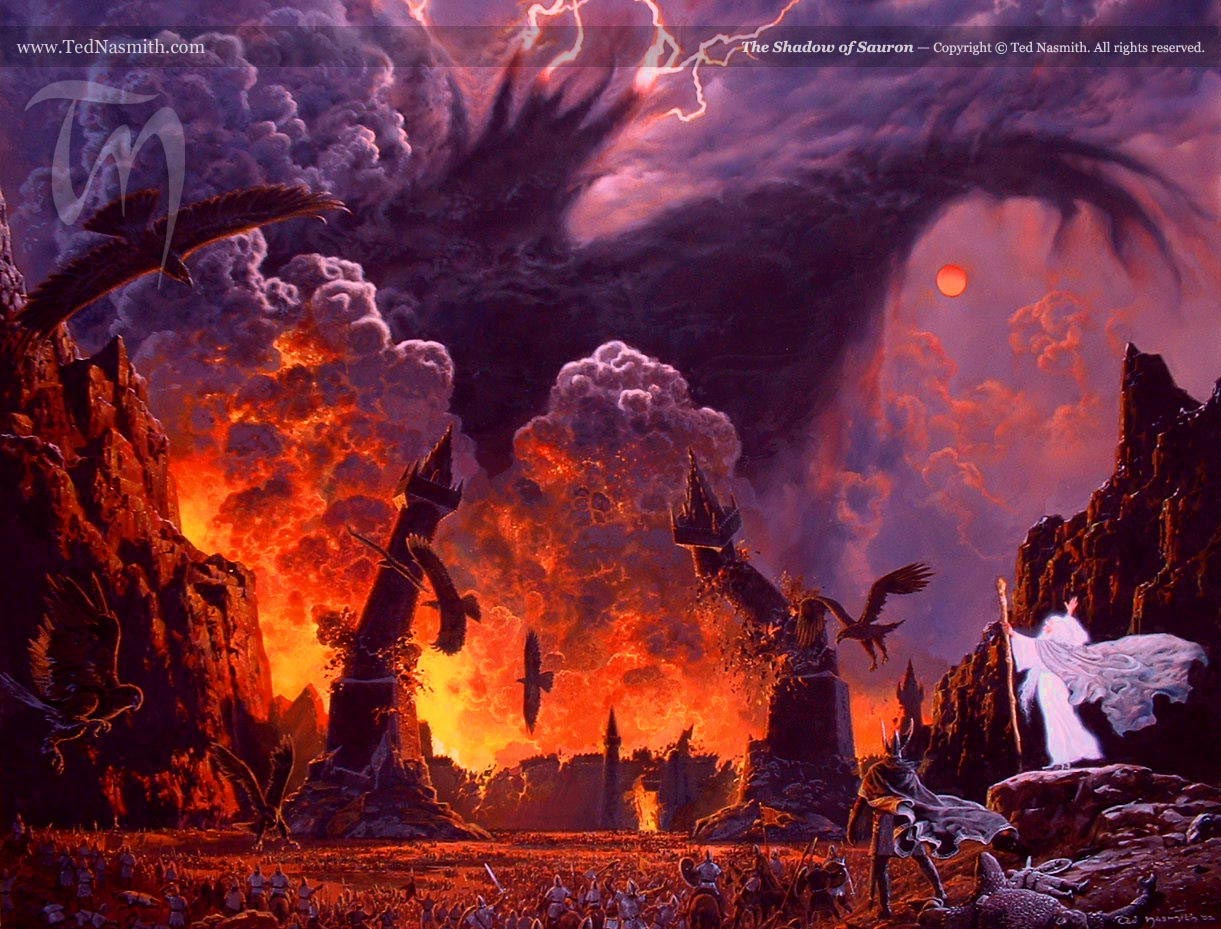
(Ted Nasmith—and hasn’t he outdone himself with this painting?)

But could any of this ever have been a possibility?  To begin with, it would have meant that Aragorn would have been on the run and Gandalf, too, for that matter, as it’s doubtful that Sauron would have let either of the two escape alive.  We can presume, as well, that he would have attacked both Lorien and Rivendell and the forest elves’ kingdom, and probably even stretched that long, threatening arm

(JRRT)

beyond Rivendell to Bree and the Shire, although, if “Sharkey” was already busy industrializing the Shire, it might have amused Sauron to let him survive there, both as a puppet and as vengeance on the Shire for having been the hiding place of the Ring for so long.

(Alan Lee)

And can we doubt that he would have ordered his new lieutenant at Isengard to deal with Fangorn and the Ents?

But would this even be the end of things?  One has only to remember Sauron’s behavior in the Second Age:

“He denies the existence of God, saying that the One is a mere invention of the jealous Valar of the West, the oracle of their own wishes.  The chief of the gods is he that dwells in the Void, who will conquer in the end, and in the void make endless realms for his servants….

A new religion, and worship of the Dark, with its temple under Sauron arises.  The Faithful are persecuted and sacrificed…”  (from a letter to Milton Waldman, late 1951, Letters, 216)

(Aztec sacrifice—as even Ted Nasmith and Denis Gordeev have yet to tackle this part of the story!)

So, might we also see new buildings and sinister ones at that?

And, when Sauron speaks of Morgoth (“chief of the gods is he that dwells in the Void”), does he have a plan to bring him back? 

As far as I know, only Ted Nasmith has tried to represent Morgoth–

even JRRT himself doesn’t appear to have done so, so perhaps this is a “what if” taken a bit too far!

Thanks, for reading, as ever.

Stay well,

Be thankful that, for all that combating evil in Middle-earth is “the long defeat”, it hasn’t won yet,

And remember that, as always, there’s

MTCIDC

O

Song in Darkness

14 Wednesday Sep 2016

Posted by Ollamh in Artists and Illustrators, Films and Music, Imaginary History, J.R.R. Tolkien, Narrative Methods

≈ Leave a comment

Tags

Ainur, Arda, Frodo, Iluvatar, In western lands beneath the Sun, Middle-earth, Morgoth, Music, Sam Gamgee, Song, The Lord of the Rings, The Silmarillion, The Tower of Cirith Ungol, Tolkien

Dear Readers,

Welcome, as always.

For this posting, we consulted the Sortes Tolkienses, and landed upon a particular passage which had us thinking about song in Middle-earth:

“It was quiet, horribly quiet. The torch, that was already burning low when he arrived, sputtered and went out; and he felt the darkness cover him like a tide. And then softly, to his own surprise, there at the vain end of his long journey and his grief, moved by what thought in his heart he could not tell, Sam began to sing. “

At this moment, Frodo has been taken by the enemy after the two Hobbits had been led into and escaped Shelob’s lair, and Sam, though only a simple gardener from the Shire, has resolved to carry Frodo’s burden and rescue him from the tower.

cirithungol

Along with carrying the Ring, which would have otherwise been taken from Frodo in the tower, Sam has also brought with him Sting, Frodo’s sword, and Galadriel’s phial, which she gave to Frodo as a gift upon their leave-taking from Lothlorien.

shelob Sam

The phial is used when the two Hobbits are pursued by Shelob, as a means both of light and of defense. Faced with a darkness he has never encountered before, however, but set on finding and rescuing Frodo, even if he’s not sure how, Sam has the option of pulling out the phial straight away when the lights in the tower of Cirith Ungol go out.

Instead, Sam sings—although he’s not quite sure why—and, in the shadow of Mordor, recalls home in the Shire:

“His voice sounded thin and quavering in the cold dark tower: the voice of a forlorn and weary hobbit that no listening orc could mistake for the clear song of an Elven-lord.  He murmured old tunes out of the Shire, and snatches of Mr. Bilbo’s rhymes that came into his mind like fleeting glimpses of the country of his home. And then suddenly new strength rose in him, and his voice rang out, while words of his own came unbidden to fit the simple tune.

            In western lands beneath the Sun

                        the flowers may rise in Spring,

            the trees may bud, the waters run,

                        the merry finches sing.

            Or there maybe ‘tis a cloudless night

                        and swaying beeches bear

            the Elven-stars as jewels white

                        amid their branching hair.


            Though here at journey’s end I lie

                        in darkness buried deep,

            beyond all towers strong and high,

                        beyond all mountains steep,

            above all shadows rides the Sun

                        and stars forever dwell:

            I will not say the Day is done,

                        nor bid the Stars farewell.”

(The talented Tolkien artist, Joe Gilronan, has illustrated what Sam would have imagined singing this song–  a clear contrast to the darkness surrounding him:)

b4d306be0fef7b0b9fdbc7daf47c4d35samwise-the-gardner-joe-gilronan

Why is this, which seems like a last, desperate gesture, successful?  After all, it not only revives Sam’s spirits, but it reaches Frodo who, badly injured as he has been, responds with the same song, enabling Sam to find him.

In Middle-earth, and in Arda more generally, song is both enjoyed and revered on a deeper level. The music of the creator Iluvatar is, as recounted in The Silmarillion, what brought the world into being, and it is such a strong force that Morgoth, the first dark lord, sought to challenge Iluvatar’s song and power with his own. Even here, however, music as a dark force failed.

“Then Iluvatar spoke, and he said: ‘Mighty are the Ainur, and mightiest among them is Melkor; but that he may know, and all the Ainur, that I am Iluvatar, those things that ye have sung, I will show them forth, that ye may see what ye have done. And thou, Melkor, shall see that no theme may be played that hath not its uttermost source in me, nor can any alter the music in my despite.’ ” (The Silmarillion)

180px-Ted_Nasmith_-_Melkor_Weaves_Opposing_Music

Thus in The Lord of the Rings, we never hear an orc song, nor do we see singing, marching uruk-hai. They are beings created by Sauron, who has not the spiritual authority of Iluvatar, and, as Iluvatar is the ultimate creator of all life, so is he the creator of all music in Arda.  In Middle-earth, besides the odd scene in The Hobbit in which the goblins sing in Goblin-town, we see only Elves singing (such as the Hymn to Elbereth), Hobbits (both snatches of Bilbo’s literary songs and drinking-songs), and Dwarves (it was their music which persuaded Bilbo to leave the Shire and join their journey).

Sam’s song, then, holds power in its own right—although it’s simply an old tune from home, its uttermost source is in Iluvatar and the first music, and it becomes clear why even a hobbit’s hum in the darkest of places can bring him comfort—it cannot be contested by darkness.

Thank you, as always, for  reading.

MTCIDC,

CD

Subsubcreations

03 Wednesday Jun 2015

Posted by Ollamh in Fairy Tales and Myths, J.R.R. Tolkien, Military History of Middle-earth, Narrative Methods, Villains

≈ Leave a comment

Tags

Chicken Run, Corsairs, Easterlings, Gorbag and Shagrat, Haradrim, Melkor, Minions, Morgoth, Nazgul, Nick and Fetcher, Orc, Robin Hood, Sauron, Star Wars, Storm Troopers, The Lord of the Rings, Tolkien, Zorro

Dear Readers,

Welcome, as always!

     Two posts ago, we talked about how it might be possible to make Sauron –the- nearly-invisible slightly more visible by means of his minions.

Minions-Film

[oh yes—minions—from Middle French, “mignon”, meaning “little/darling” and coming to have a negative meaning in English, “lackey”]

     These included the Nazgul

nazgul

various humans—corsairs, Haradrim, Easterlings—

702343aharadvetcav easterling_hassassin_by_taurus_chaoslord-d5sb6rc

And, the real stars (as Nick and Fetcher, the two rats from Chicken Run, refer to themselves)

Nick_and_Fetcher

the Orcs.

John%20Howe%20-%20Merry%20et%20Pippin%20prisonniers%20des%20orcs 36 - Orcs (MERP)

OrcsOnSentry_Alan_Lee

     Tolkien appears always to have had trouble placing them. We would suppose that this problem arose because Orcs were not the usual run-of-the-mill lackeys one usually sees in adventure, like the sheriff of Nottingham’s men

sjff_03_img1296

the soldiers of the evil commandante in the Zorro adventures

ep23d

or the hordes of faceless stormtroopers in Star Wars

Stormtrooper_Corps

       His first question—where do they come from? was immediately followed by a second—if they are created, do they have free will? That first question, any author might ask himself. The second, however, was pure Tolkien, fitting into the pattern which those who’ve only read The Lord of the Rings and not JRRT’s letters on the subject or the volumes produced by the admirable (a pale adjective!) Christopher Tolkien, would never see: the complex spiritual history which lies behind the creation of Middle Earth.

     Not that the first question was simple. In The Lord of the Rings, Fangorn says of the Orcs:

“But Trolls are only counterfeits, made by the Enemy in the Great Darkness, in mockery of Ents, as Orcs were of Elves.” L486

     The author, however, had a very different opinion:

“Their nature and origin require more thought. They are not easy to work into the theory and system.”

(Morgoth’s  Ring   409)

     Not easy because of that second question. As he wrote in an unpublished essay entitled (not surprisingly) Orcs (Morgoth’s Ring 409-413),

“…only Eru [the central creative deity] could make creatures with independent wills, and with reasoning powers. But the Orcs seem to have both: they can try to cheat Morgoth/ Sauron, rebel against him, or criticize him.”

     Morgoth (Sauron’s former master) made the Orcs in some way, but, because only the central deity, Eru, can give independent wills and reasoning powers—which Orcs display by cheating, rebelling, and criticizing– to created beings, what is to be made of Orcs? Bound by those seemingly contrary facts, the conclusion was obvious to him that “therefore they must be corruptions of something pre-existing.” (409)

But of what?

     “But Men had not yet appeared, when the Orcs already existed. Aule constructed the Dwarves out of his memory of the Music; but Eru would not sanction the work of Melkor [i.e. Morgoth] so as to allow the independence of the Orcs.

     It also seems clear…that though Melkor could utterly corrupt and ruin individuals, it is not possible to contemplate his absolute perversion of a whole people, or group of peoples, and his making that state heritable.

     In that case Elves, as a source, are very unlikely.” (409)

     Thus, logically, if the Orcs are created, not corrupted, and created by a power which hasn’t the ability to give his creations independence, then–

     “The Orcs were beasts of humanized shape (to mock Men and Elves) deliberately perverted/converted into a more close resemblance to Men. Their ‘talking’ was really reeling off ‘records’ set in them by Melkor. Even their rebellious critical words—he knew about them. Melkor taught them speech and as they bred they inherited this; and they had just as much independence as have, say, dogs or horses of their human masters. This talking was largely echoic (cf. parrots). ..Also (n.b.) Morgoth not Sauron is the source of Orc-wills. Sauron is just another (if greater) agent. Orcs can rebel against him without losing their own irremediable allegiance to evil (Morgoth).” (410-411)

     We don’t know about you, dear Readers, but we confess to a certain disappointment at the idea that the Orcs are only more complex puppets. Consider this piece of villainous dialogue between Gorbag and Shagrat:

Unknown%20-%20Bilbo%20le%20Hobbit%20(01)%20-%20Les%20orcs

     “I’d like to try somewhere where there’s none of ‘em. But the war’s on now, and when that’s over things may be easier.”

     “It’s going well, they say.”

     “They would,” grunted Gorbag. “We’ll see. But anyway, if it does go well, there should be a lot more room. What d’you say?—if we get a chance, you and me’ll slip off and set up somewhere on our own with a few trusty lads, where there’s good loot nice and handy, and no big bosses.”

     “Ah!” said Shagrat. “Like old times.” (LOTR 738)

     The plans and reminiscences of demons—how wonderful! And what an interesting sidelight into their world and even their past: they used to be masterless marauders, in the “old times”—could this suggest that perhaps they weren’t such puppets after all? We would like to imagine so!

And what is your opinion, dear readers?

Thanks, as ever, for reading.

MTCIDC

CD

The Doubtful Sea Series Facebook Page

The Doubtful Sea Series Facebook Page

  • Ollamh

Categories

  • Artists and Illustrators
  • Economics in Middle-earth
  • Fairy Tales and Myths
  • Films and Music
  • Games
  • Heroes
  • Imaginary History
  • J.R.R. Tolkien
  • Language
  • Literary History
  • Maps
  • Medieval Russia
  • Military History
  • Military History of Middle-earth
  • Narnia
  • Narrative Methods
  • Poetry
  • Research
  • Star Wars
  • Terra Australis
  • The Rohirrim
  • Theatre and Performance
  • Tolkien
  • Uncategorized
  • Villains
  • Writing as Collaborators
Follow doubtfulsea on WordPress.com

Across the Doubtful Sea

Recent Postings

  • Through a glass… January 7, 2026
  • Heffalumps? December 31, 2025
  • We Three Kings December 24, 2025
  • A Moon disfigured December 17, 2025
  • On the Roads Again—Once More December 10, 2025
  • (Not) Crossing Bridges December 3, 2025
  • On the Road(s) Again—Again November 26, 2025
  • On the Road(s) Again November 19, 2025
  • To Bree (Part 2) November 12, 2025

Blog Statistics

  • 104,044 Views

Posting Archive

  • January 2026 (1)
  • December 2025 (5)
  • November 2025 (4)
  • October 2025 (5)
  • September 2025 (4)
  • August 2025 (4)
  • July 2025 (5)
  • June 2025 (4)
  • May 2025 (4)
  • April 2025 (5)
  • March 2025 (4)
  • February 2025 (4)
  • January 2025 (5)
  • December 2024 (4)
  • November 2024 (4)
  • October 2024 (5)
  • September 2024 (4)
  • August 2024 (4)
  • July 2024 (5)
  • June 2024 (4)
  • May 2024 (5)
  • April 2024 (4)
  • March 2024 (4)
  • February 2024 (4)
  • January 2024 (5)
  • December 2023 (4)
  • November 2023 (5)
  • October 2023 (4)
  • September 2023 (4)
  • August 2023 (5)
  • July 2023 (4)
  • June 2023 (4)
  • May 2023 (5)
  • April 2023 (4)
  • March 2023 (5)
  • February 2023 (4)
  • January 2023 (4)
  • December 2022 (4)
  • November 2022 (5)
  • October 2022 (4)
  • September 2022 (4)
  • August 2022 (5)
  • July 2022 (4)
  • June 2022 (5)
  • May 2022 (4)
  • April 2022 (4)
  • March 2022 (5)
  • February 2022 (4)
  • January 2022 (4)
  • December 2021 (5)
  • November 2021 (4)
  • October 2021 (4)
  • September 2021 (5)
  • August 2021 (4)
  • July 2021 (4)
  • June 2021 (5)
  • May 2021 (4)
  • April 2021 (4)
  • March 2021 (5)
  • February 2021 (4)
  • January 2021 (4)
  • December 2020 (5)
  • November 2020 (4)
  • October 2020 (4)
  • September 2020 (5)
  • August 2020 (4)
  • July 2020 (5)
  • June 2020 (4)
  • May 2020 (4)
  • April 2020 (5)
  • March 2020 (4)
  • February 2020 (4)
  • January 2020 (6)
  • December 2019 (4)
  • November 2019 (4)
  • October 2019 (5)
  • September 2019 (4)
  • August 2019 (4)
  • July 2019 (5)
  • June 2019 (4)
  • May 2019 (5)
  • April 2019 (4)
  • March 2019 (4)
  • February 2019 (4)
  • January 2019 (5)
  • December 2018 (4)
  • November 2018 (4)
  • October 2018 (5)
  • September 2018 (4)
  • August 2018 (5)
  • July 2018 (4)
  • June 2018 (4)
  • May 2018 (5)
  • April 2018 (4)
  • March 2018 (4)
  • February 2018 (4)
  • January 2018 (5)
  • December 2017 (4)
  • November 2017 (4)
  • October 2017 (4)
  • September 2017 (4)
  • August 2017 (5)
  • July 2017 (4)
  • June 2017 (4)
  • May 2017 (5)
  • April 2017 (4)
  • March 2017 (5)
  • February 2017 (4)
  • January 2017 (4)
  • December 2016 (4)
  • November 2016 (5)
  • October 2016 (6)
  • September 2016 (5)
  • August 2016 (5)
  • July 2016 (5)
  • June 2016 (5)
  • May 2016 (4)
  • April 2016 (4)
  • March 2016 (5)
  • February 2016 (4)
  • January 2016 (4)
  • December 2015 (5)
  • November 2015 (5)
  • October 2015 (4)
  • September 2015 (5)
  • August 2015 (4)
  • July 2015 (5)
  • June 2015 (5)
  • May 2015 (4)
  • April 2015 (3)
  • March 2015 (4)
  • February 2015 (4)
  • January 2015 (4)
  • December 2014 (5)
  • November 2014 (4)
  • October 2014 (6)
  • September 2014 (1)

Blog at WordPress.com.

  • Subscribe Subscribed
    • doubtfulsea
    • Join 78 other subscribers
    • Already have a WordPress.com account? Log in now.
    • doubtfulsea
    • Subscribe Subscribed
    • Sign up
    • Log in
    • Report this content
    • View site in Reader
    • Manage subscriptions
    • Collapse this bar
 

Loading Comments...