• About

doubtfulsea

~ adventure fantasy

Tag Archives: Mongols

Drogo?

26 Wednesday Feb 2025

Posted by Ollamh in Uncategorized

≈ Leave a comment

Tags

Chingiz Khan, Drogo, Frodo, Hobbit genealogy, Mongols, Normans, Prose Edda, Saint Drogo, Tolkien

Welcome, as ever, dear readers.

If you’re a Game of Thrones fan (and I include myself here), you’ll immediately think of Khal Drogo, the leader of a tribe of the nomadic Dothraki,

whether you’ve seen the films,
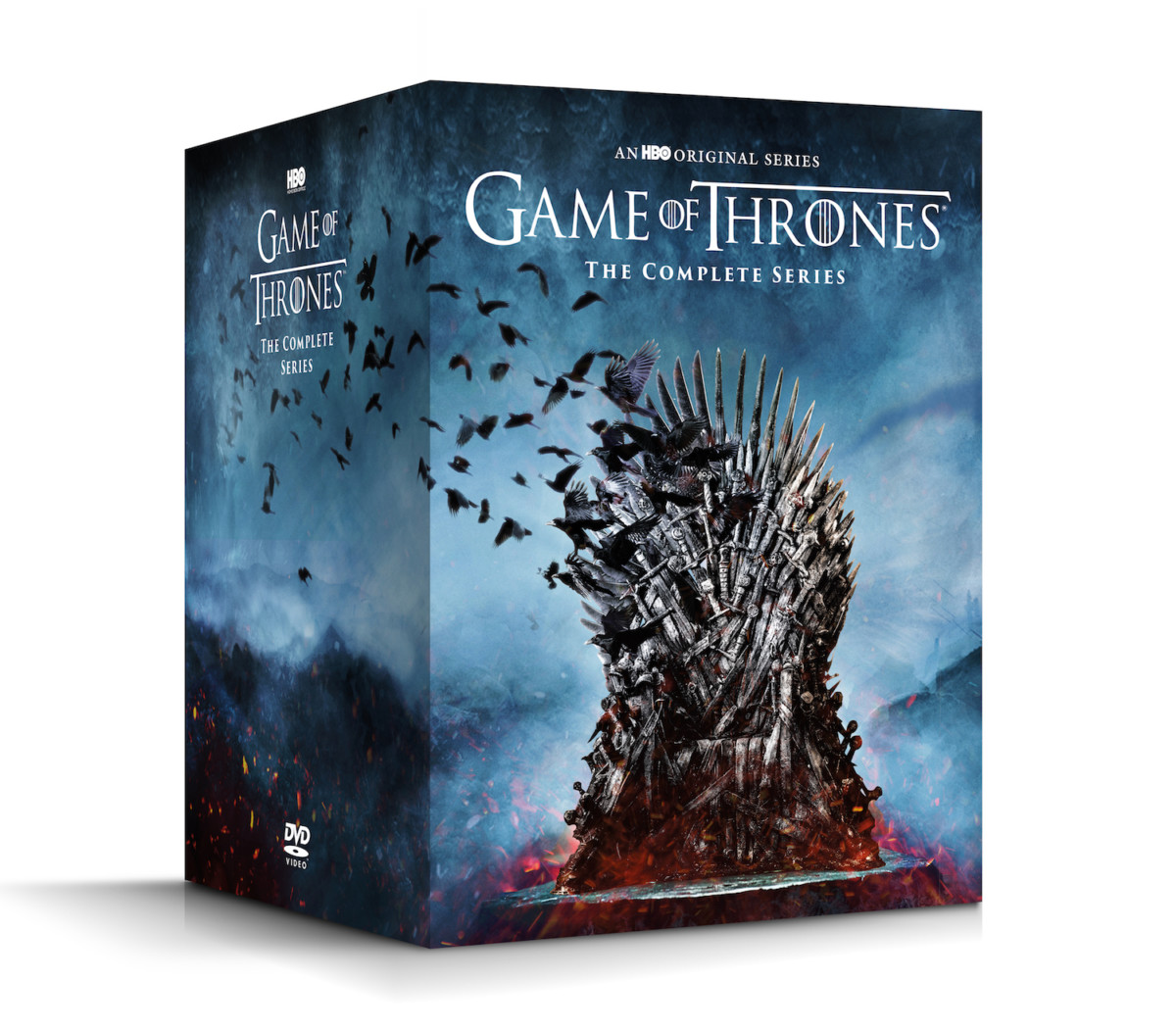
or read the books,
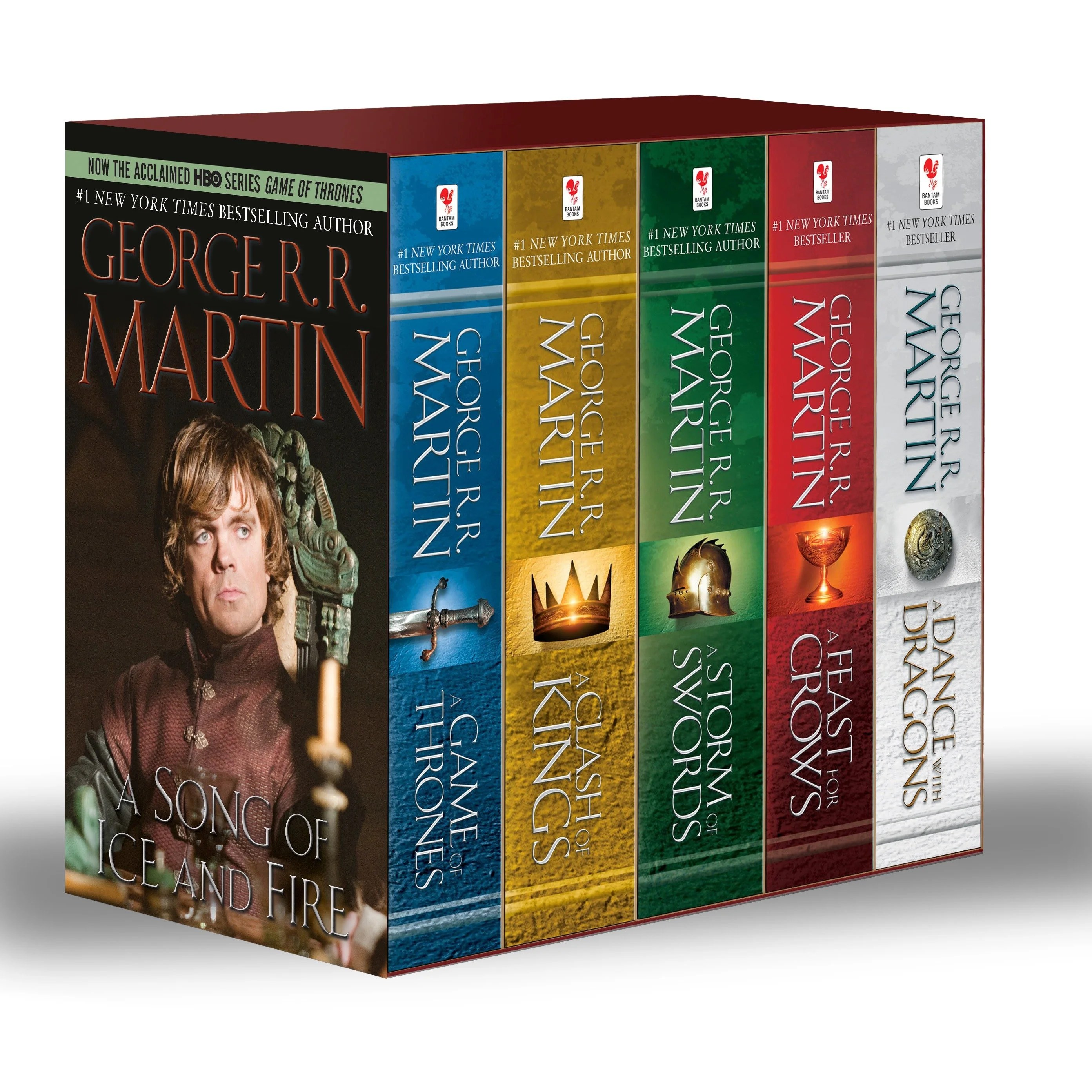
or both.  

I’m presuming that “Khal” is modeled on “khan”, a word of disputed origin among scholars, but which signifies someone above “king”—imagine something more like “high king”—and is used as the title for the ruler of an “ulus”, a “horde” in English.  (For more about the name, see:  https://en.wikipedia.org/wiki/Khan_(title) )  When you hear that word, you may think of Temujin, c.1162-1227AD, aka Chinggiz/Genghis Khan,

who founded the Mongol Empire and began the great wave of conquest from China to Russia.  (More about him here:  https://en.wikipedia.org/wiki/Genghis_Khan I’ll add here that, so far, I’ve been unable to locate an artist for the illustration below.)

But he’s not the Drogo who is the subject of this posting.

Instead, it’s a much more humble Drogo, but, without him, Sauron’s Ring

would, barring that near disaster,

(Ted Nasmith)

never have been destroyed and, with it, Sauron.

(another Nasmith—and you can see why he’s one of my favorite Tolkien illustrators:  no scene too big and also no scene less known will stop him)

JRRT has reported to us the Hobbits’ passion for genealogy:

“All Hobbits were, in any case, clannish and reckoned up their relationships with great care.  They drew long and elaborate family-trees with innumerable branches.”  (The Lord of the Rings, Prologue I, “Concerning Hobbits”) 

And here we see that name in the Appendices, C “Family Trees (Hobbits)”

     I                                        I                                I

Dora                               Drogo                         Dudo

1302-1406                    1308-1380                 1311-1409

                                         = Primula                     I

                                         Brandybuck                 I

                                              I                                I

                                         Frodo                       Daisy

                                         1368                         1350

                                                                            = Griffo

                                                                            Boffin

It is, of course, Frodo’s father, drowned in a boating accident thought suspicious by some.  (The Fellowship of the Ring, Book One, Chapter 1, “A Long-expected Party)

I don’t have either the Hobbits’—or Tolkien’s—enthusiasm for genealogy, but I was curious, as I always am, about JRRT’s sources:  just where did this name come from?  It could be entirely from his fertile imagination, of course, but, as so much good scholarship has pointed to medieval sources for certain details in his works—think about those dwarvish names, right out of Icelandic saga material—the 13th-century Prose Edda of Snorri Sturluson (whose own name has a dwarvish ring and whose work you can read here:  https://archive.org/details/proseedda01brodgoog/page/n54/mode/2up   The dwarf name list is to be found on page 26)—I thought that a medieval influence might be possible.

At the moment, I have a short list of possible medieval candidates:

1. Drogo, the short-lived Duke of Brittany (reigned 952-958AD)—who may have been murdered by the connivance of his step-father, Fulk II, the Count of Anjou.  (This is from the 11th-century Chronicle of Nantes, of which only fragments survive, but the murder plot does—Fulk threatens and persuades Drogo’s nurse to do away with him in his bath—see pages 109-110 in the 1896 edition of the fragments by Rene Merlet here:  https://archive.org/details/lachroniquedenan00merl/page/108/mode/2up )

2. Drogo de la Beuvriere (? 11th century)—a companion of William the Conqueror, best known for poisoning his wife (these Normans and their allies seem to specialize in violence, don’t they?)—this information is in little bits of gossip, with the added fact that Drogo then borrowed travel money from William to enable his escape–https://en.wikipedia.org/wiki/Drogo_de_la_Beuvri%C3%A8re

3. Drogo d’Hauteville, the Norman count of Apulia (died 1051AD)—the Normans had gradually conquered whole sections of Italy and Sicily in the 11th century

and this Drogo succeeded his brother, William, as count, only to be murdered! 

4. and then there’s Saint Drogo (1105-1186AD)—a Flemish nobleman who, suffering from a disease that made it difficult for people to look at him (leprosy?), he became a hermit and, not surprisingly, is the patron saint of shepherds  (feast day, April 16).  As, unlike the other Drogos, he seems to have died of natural causes, after a long life, I think that we should end our catalogue here!

Thanks, as always, for reading.

Stay well,

Be very suspicious of ambitious Normans,

And remember that there’s always

MTCIDC

O

PS

Perhaps the violence done to so many of those Drogos influenced Tolkien in that nasty rumor about his Drogo?

PPS

If you are Hobbitish or Tolkienean in your interest in genealogy, there’s another Drogo—Drogo de Teigne—whom you can read about here—with the warning:  if there were a genealogical rabbit hole, you’ll be standing at the mouth of it when you begin to read this:  https://www.carolbaxter.com/Drew-families-of-Devonshire-and-Ireland?r_done=1   

Hybrids

01 Wednesday Jan 2025
Posted by Ollamh in Uncategorized

≈ Leave a comment

Tags

anglo-saxons, Boudica, chariots, eurasian-steppe, Huns, hybrds, Hybrids, Jacksons The Lord of the Rings, jacksons-lord-of-the-rings, Julius Caesar, Mongols, Normans, Rohirrim, Sarmatians, Scythians, Tacitus, Tolkien, Wainriders

As always, dear readers, welcome.

The title of this piece might suggest electric cars, and it definitely will mention several different wheeled vehicles, but it is actually what I hope is a little study in something Tolkien does wonderfully well:  taking different elements from different times and cultures and so blending them that they become believable new wholes.

Although I don’t always agree with elements in Jackson’s The Lord of the Rings, one thing has always given me pleasure:  the Rohirrim, whether en masse

or a small grouping.

And this is true for Edoras

as well as for Meduseld.

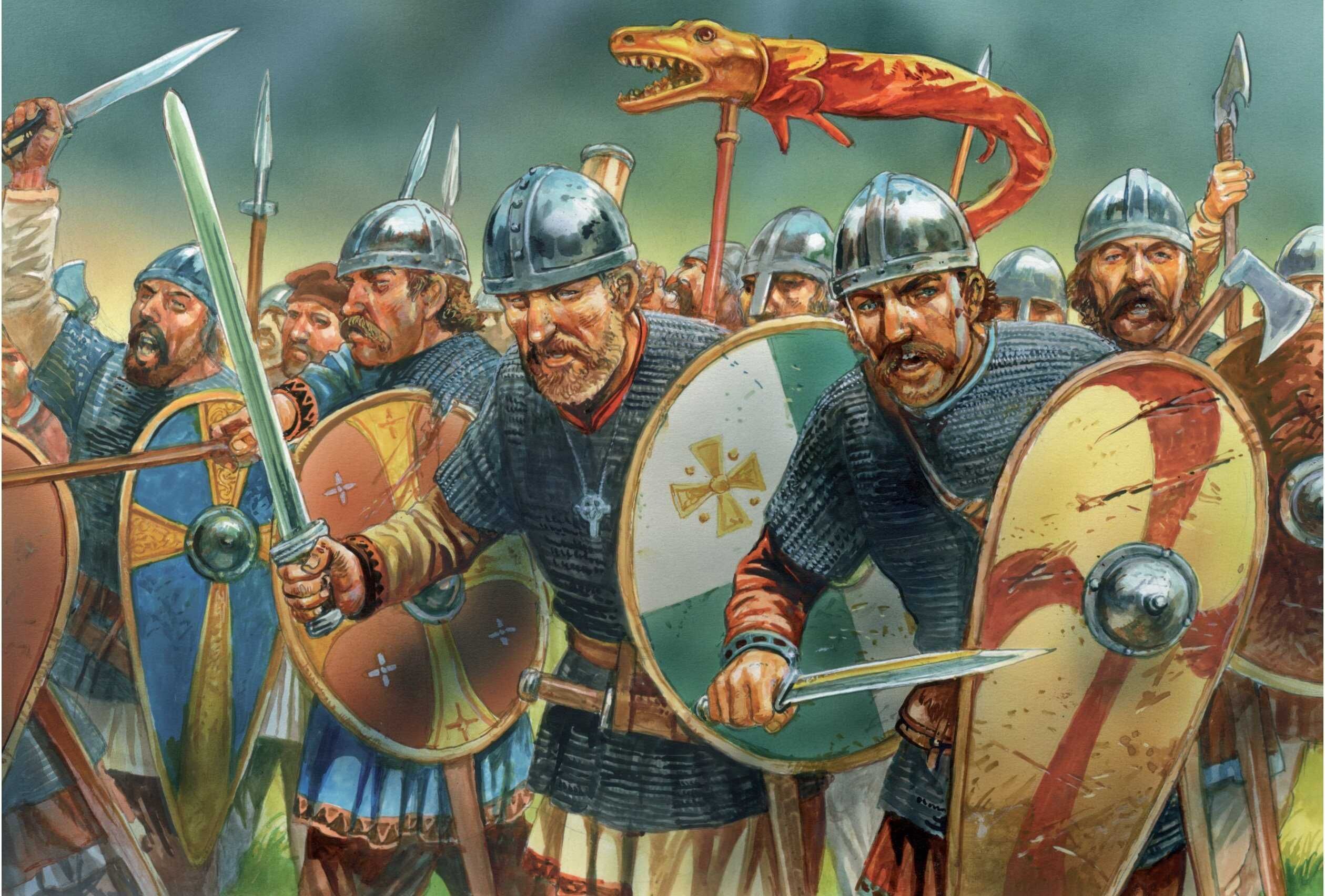
And yet they appear to be a kind of combination of peoples:  on the one hand, Tolkien imagined them to be Anglo-Saxons,

(Peter Dennis)

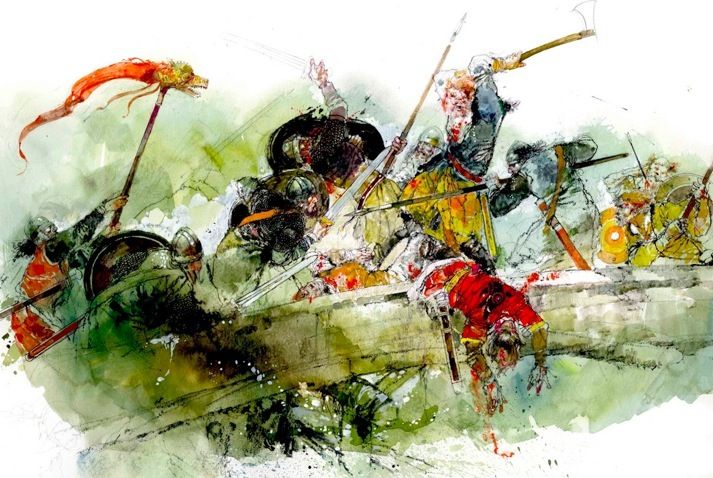
a people who primarily fought on foot, as at their last two major battles, Stamford Bridge,

(Victor Ambrus—who worked for years with the popular British archeology series, Time Team—which is available on YouTube and much recommended)

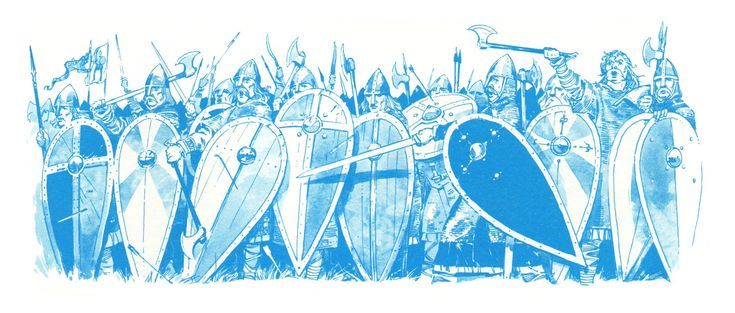
where they defeated another infantry force, the Vikings, and Hastings,

(Artist?)

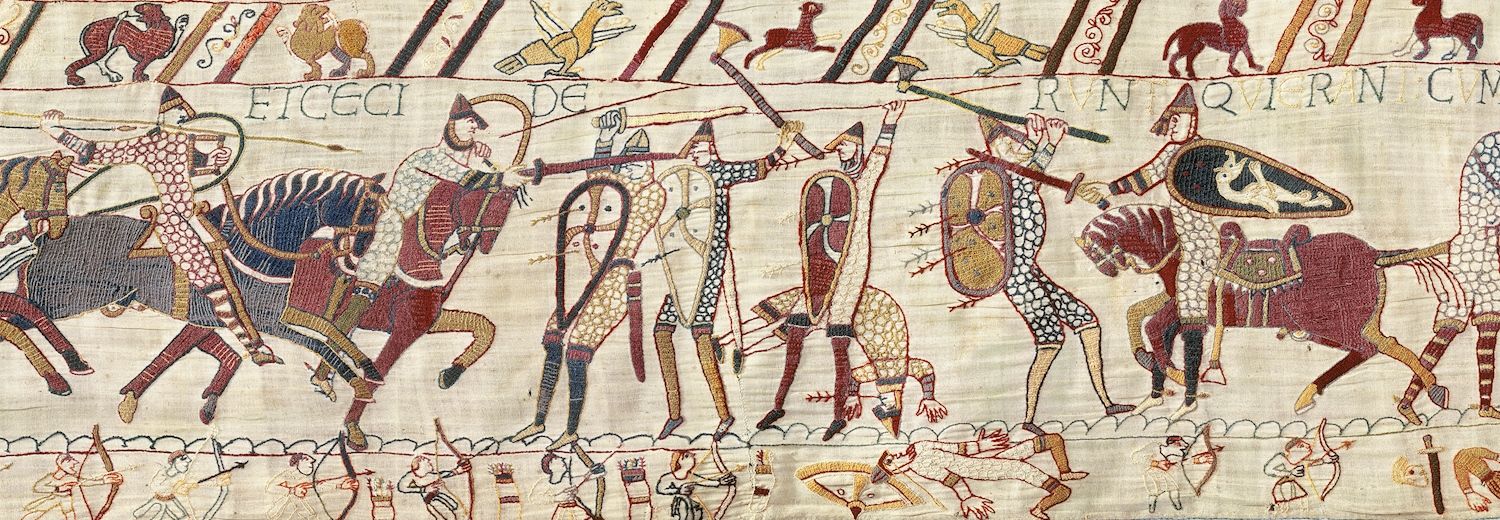
in which they were overwhelmed at the battle’s conclusion by Norman cavalry.

(From the wonderful “Bayeux Tapestry”—actually the “Bayeux Embroidery”—if you’d like to see the whole thing, look here:  https://www.bayeuxmuseum.com/en/the-bayeux-tapestry/discover-the-bayeux-tapestry/explore-online/  To my knowledge, there’s nothing like it from the Middle Ages for depicting a specific series of events in the medieval world.)

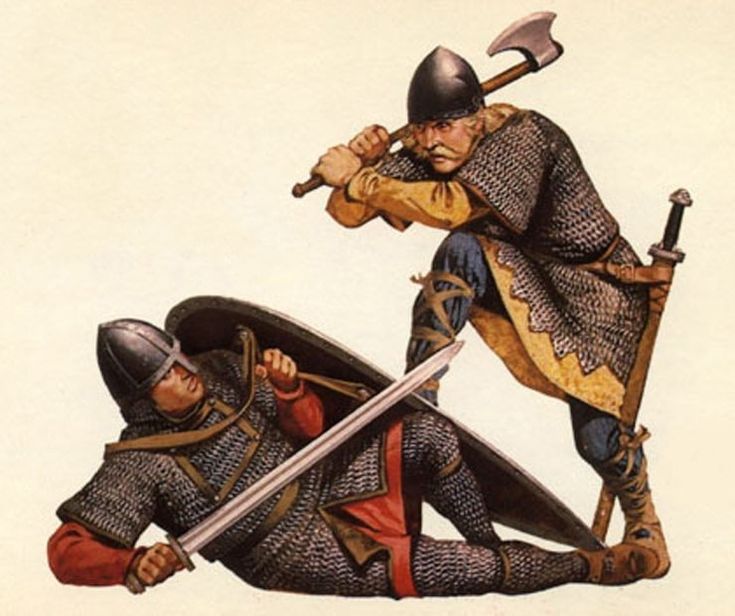
On the other hand, the Rohirrim were mounted, more like those Normans who defeated the Anglo-Saxons,

although the language they speak is, basically, a form of Old English, the language of the Anglo-Saxons.  Tolkien imagined them, in fact, as looking like the Normans, as well, describing them in a letter to Rhona Beare:

“The styles of the Bayeux Tapestry (made in England) fit them well enough, if one remembers that the kind of tennis-nets [the] soldiers seem to have on are only a clumsy conventional sign for chain-mail of small rings.”  (letter to Rhona Beare, 14 October, 1958, Letters, 401)

That is, their armor actually can look like this—

(By Angus McBride—and ironic, as, for all that McBride must have painted dozens of figures in chain mail, he once confessed in an interview that it was his least favorite part of illustrating, as the mail took so long to do.)

It’s also interesting to think about them as a people.  Anglo-Saxons were descended from a combination of locals (Romano-British) and various groups of west-Germanic tribesmen who had either been early post-Roman invaders of Britain or Germanic tribesmen brought to Britain to protect the locals from those invaders and who had become colonizers in turn.

But who were the Rohirrim and where did they come from?

“Eorl the Young was lord of the Men of Eotheod.  That land lay near the sources of Anduin, between the furthest ranges of the Misty Mountains and the northernmost parts of Mirkwood.”

(JRRT)

They had not always lived there, however:

“The Eotheod [from Old English, “Horsefolk”] had moved to those regions in the days of King Earnil II [TA 1945-2043] from lands in the vales of Anduin between the Carrock and the Gladden, and they were in origin close akin to the Beornings and the men of the west-eaves of the forest.  The forefathers of Eorl claimed descent from kings in Rhovanion, whose realm lay beyond Mirkwood before the invasions of the Wainriders…They loved best the plains and delighted in horses and in all feats of horsemanship…” (The Lord of the Rings, Appendix A II “The House of Eorl”)

The combination of “They loved best the plains and delighted in horses” makes perfect sense when one thinks about comparative history in our Middle-earth.  Consider the Eurasian Steppe, stretching from western China all the way to the Hungarian puszta.

This is an immense belt of grassland,

some 5000 miles (8000km) wide,

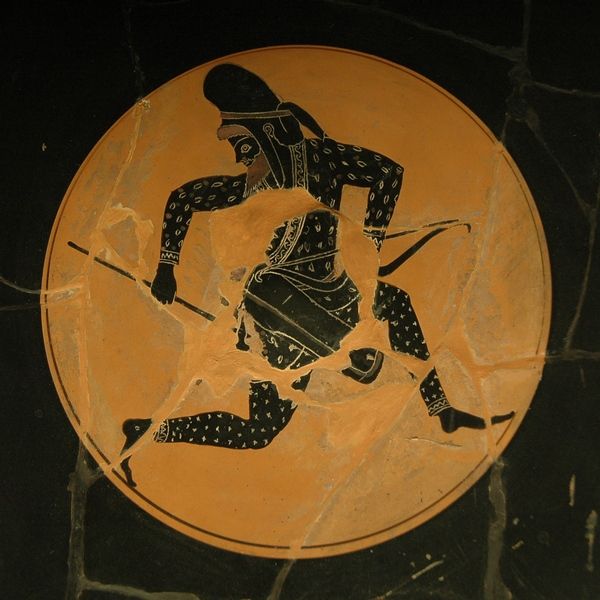
and has been the homeland of numerous horsefolk throughout history, from the Scythians

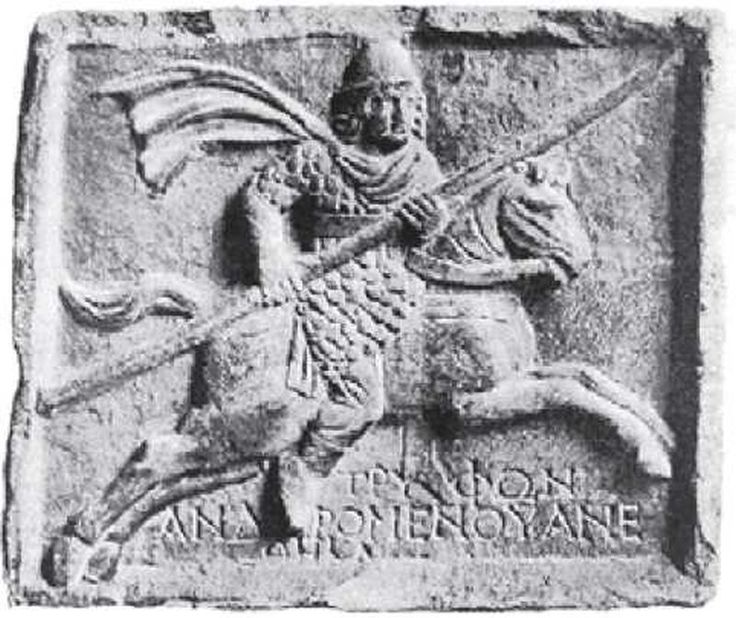
to the Sarmatians

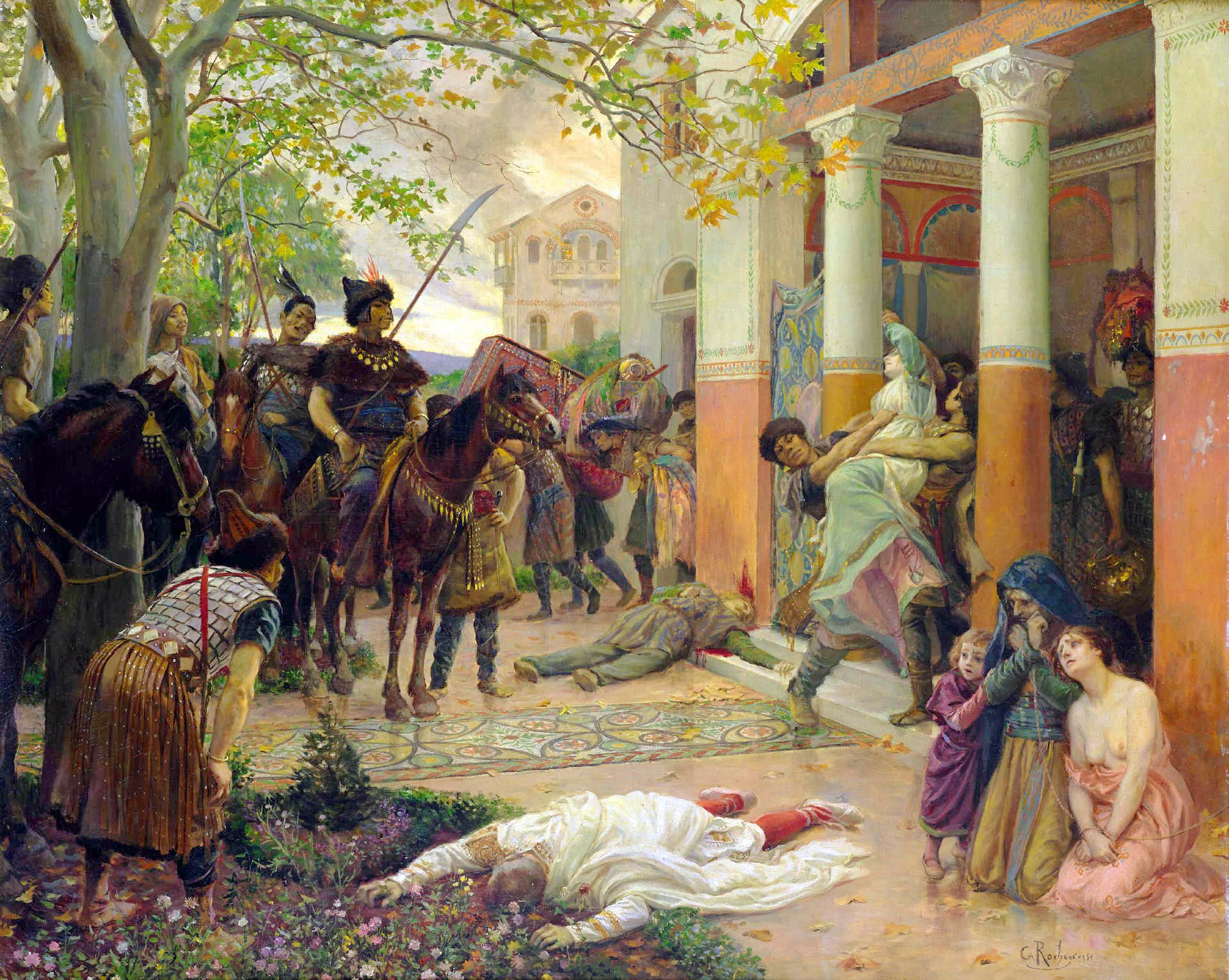
to the Huns

(Angus McBride)

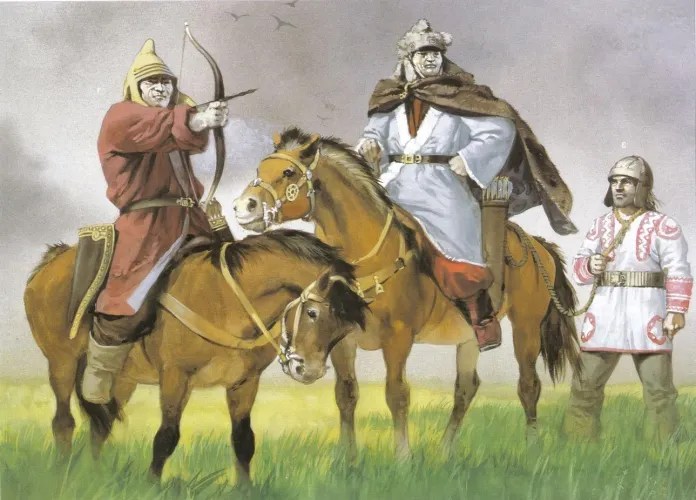
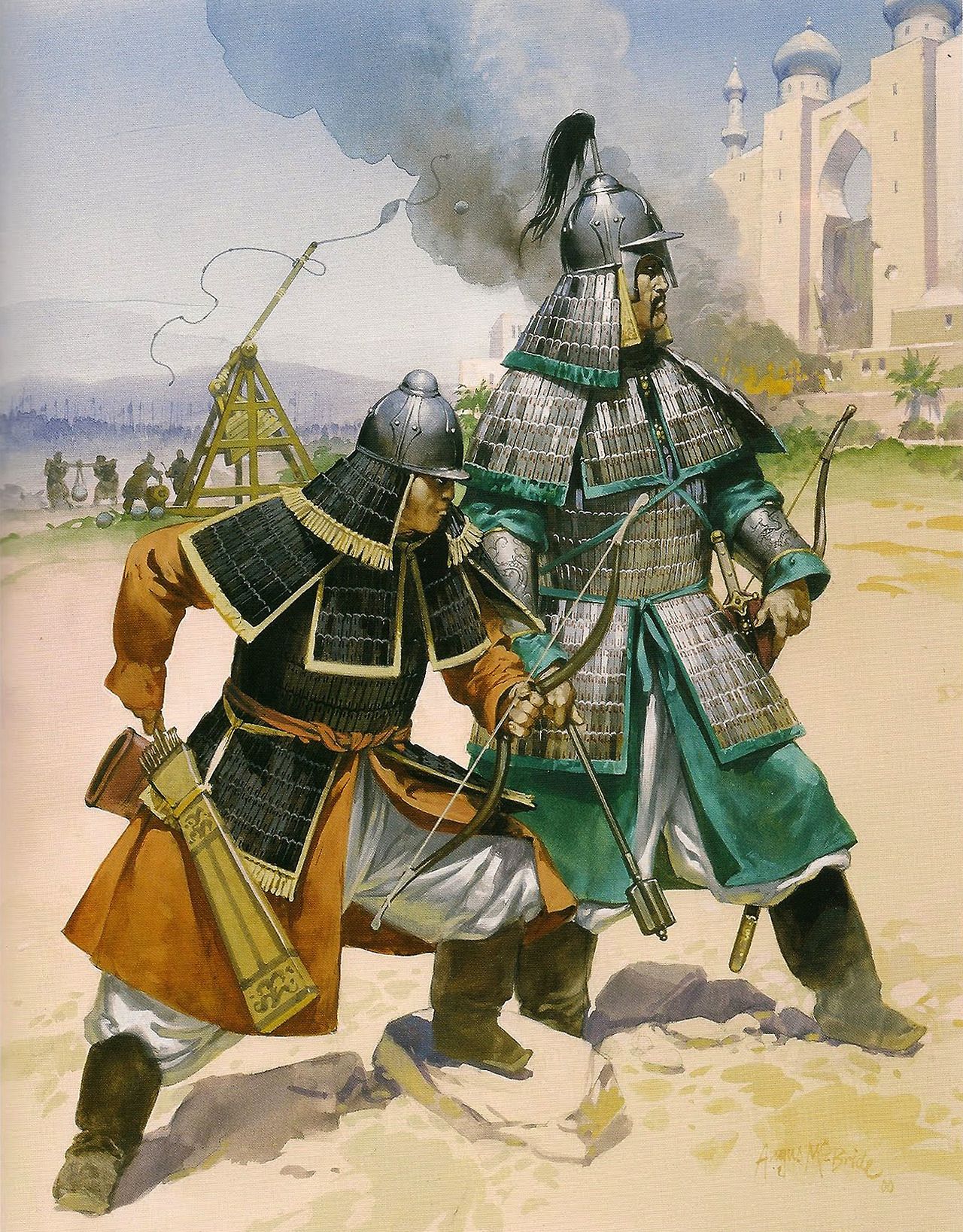
to the Mongols.

(another McBride)

All of these peoples have used the Steppe to graze their herds of horses, sometimes moving west for grazing, sometimes moving west when pressured by others further east, and sometimes as predators, like the Huns, moving west to seek new plunder.

(I haven’t been able to identify an artist for this–it has the look of late-Victorian.)

In two of these cases, whole peoples might be on the move and this is perhaps where Tolkien has gotten part of his description of those Wainriders he mentions:

“The Wainriders were a people, or a confederacy of many peoples, that came from the East; but they were stronger and better armed than any that had appeared before.  They journeyed in great wains, and their chieftains fought in chariots…” 

So, we can imagine that the Eotheod, pressured by the Wainriders, were forced west, as one steppe people is pushed westward by another to the east. 

But Tolkien gives us another—or perhaps additional–possibility:

“Stirred up, as was afterwards seen, by the emissaries of Sauron, they made a sudden assault on Gondor…The people of eastern and southern Rhovanion were enslaved; and the frontiers of Gondor were for that time withdrawn to the Anduin and the Emyn Muil.” (The Lord of the Rings, Appendix A, IV “Gondor and the Heirs of Anarion”)

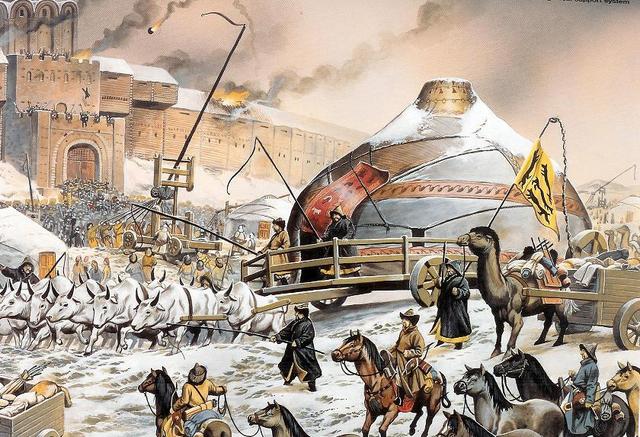
The Wainriders, then, might be both steppe peoples moving westwards, but also predators, like the Huns, or like the Mongols, who were both predators and empire-builders, and here we might see Mongols with their characteristic ger (a large round tent)—on a wagon—perhaps like the Wainriders?

(Wayne Reynolds)

Although there is no mention in our text of the Rohirrim migrating with wagons, it’s clear from parallels in our world that the peoples who crossed the Eurasian Steppe appear to have used them regularly.  But here, like the Rohirrim, we have another odd juxtaposition.  The Rohirrim are Anglo-Saxons on horseback:  cavalry, which was true for all of those migrants across the Steppe in our world.  Chariots, however, although Tolkien says that the Wainrider chiefs fought in them (of which fact this is the only mention) were not part of those other horsefolks’ arsenals.  Where did they come from?

The answer, I think, lies in the period of British history before the Anglo-Saxons and almost before the Romans, among the earlier Celtic settlers of England.  Julius Caesar encountered chariots there and described their use:

Genus hoc est ex essedis pugnae. Primo per omnes partes perequitant et tela coiciunt atque ipso terrore equorum et strepitu rotarum ordines plerumque perturbant, et cum se inter equitum turmas insinuaverunt, ex essedis desiliunt et pedibus proeliantur. 2 Aurigae interim paulatim ex proelio excedunt atque ita currus conlocant ut, si illi a multitudine hostium premantur, expeditum ad quos receptum habeant. 3 Ita mobilitatem equitum, stabilitatem peditum in proeliis praestant, ac tantum usu cotidiano et exercitatione efficiunt uti in declivi ac praecipiti loco incitatos equos sustinere et brevi moderari ac flectere et per temonem percurrere et in iugo insistere et se inde in currus citissime recipere consuerint.

“This is the kind of fighting from chariots.  At first, they ride around in all directions and throw spears and often, by the very frightfulness of the horses and the roar of the wheels, they shake the ranks [of the enemy] and, when they have slipped themselves among the troops of [enemy] cavalry, they leap from the chariots and fight on foot.  Meanwhile, the charioteers move out a little way from the fighting and so place their vehicles that, if they [the dismounted fighters] should be pressed by a large number of the enemy, they may have an easy retreat to them.  Thus, they provide the mobility of cavalry [as well as] the steadiness of infantry in [their] battles and they accomplish so much by daily practice and exercise that they are accustomed to control their stirred-up horses on a sloping and steep place and rein [them] in quickly and to turn [them] and to run along the yoke pole and to stand on the yoke and from there to take themselves back into the vehicles extremely speedily.”  (Caesar, De Bello Gallico, Book IV, Chapter 33—my translation)

(Angus McBride)

Tolkien may have remembered this from his schooldays, when he would first have encountered the text—and he might have found those wagons there, too, although slightly later.  When, in 60-61AD, the Iceni queen, Boudica, led a revolt against Roman rule,

(Peter Dennis)

in the final battle, when the tribesmen advanced towards the Roman formation, as Tacitus (c.56-c.120AD) tells us, their families watched from their wagons, placed behind the battle line (De Vita et Moribus Iulii Agricolae, Chapter 34).  And, as a prelude to the battle, Boudica had ridden among the ranks in a chariot (Chapter 35).

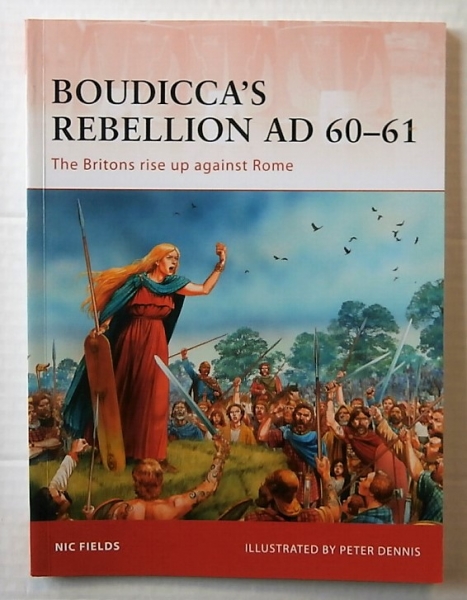
(another Peter Dennis—in fact, if you’d like to know more about this amazing woman, who, for a brief time, had been a real threat to the Romans, you might invest in: 

And so, as in combining Anglo-Saxon and Norman to create the Rohirrim, Tolkien may have taken Steppe people, added Celtic Britons, and produced the Wainriders. 

Thanks, as always for reading.

Stay well,

Remember that a horse will drink, on average, between 5 and 10 gallons (19-38 litres) of water a day,

And remember, as well, that there’s always

MTCIDC

O

Orc Arsenal.1

26 Wednesday Sep 2018

Posted by Ollamh in Artists and Illustrators, Fairy Tales and Myths, Heroes, J.R.R. Tolkien, Literary History, Military History, Military History of Middle-earth, The Rohirrim

≈ Leave a comment

Tags

Alan Lee, And Inquiry Into Ancient Armour, Angus McBride, arming sword, Battle Axe, English Longbowmen, Eowyn, Falchion, Gladius, Gondor, Hildebrandts, Howard Pyle, John Howe, King Arthur, Longbow, Mace, Medieval, Mongols, Morning Star, Orcs, Pelennor, Pitt-Rivers Museum, Robert Louis Stevenson, Rohirrim, Scimitar, Sir Arthur Conan Doyle, Sir Samuel Meyrick, Ted Nasmith, The Black Arrow, The Lord of the Rings, The White Company, Tolkien, Victorian, Wallace Collection, War Hammer, Weaponry, Witch-King of Angmar

Welcome, dear readers, as always.

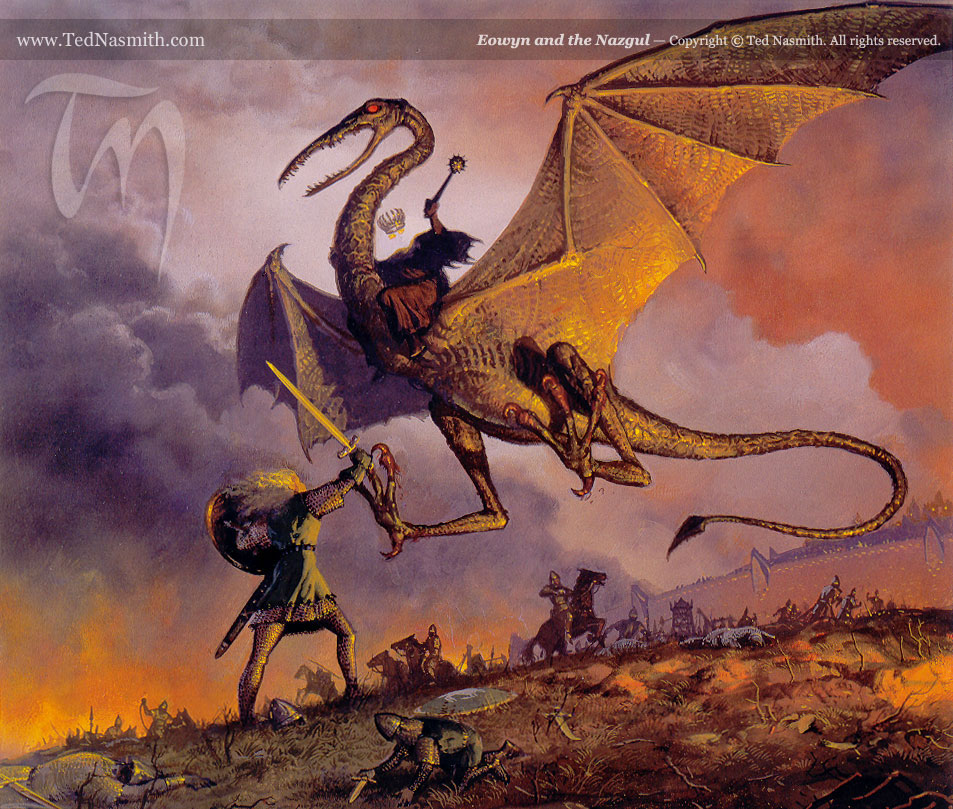
“The great shadow descended like a falling cloud.  And behold! It was a winged creature…

Upon it sat a shape, black-mantled, huge and threatening…A great black mace he wielded.”

(The Return of the King, Book Five, Chapter 6, “The Battle of the Pelennor Fields”)

This is clearly a scene which has caught the attention, over the years, of many artists, starting, we’d guess, with the Hildebrandts.

image1hild.jpg


Then others, like Angus McBride and Ted Nasmith,

image2am.jpg

image3nasmith.jpg

And Alan Lee and John Howe,


image4aleeimage4bhowe

as well as many very good artists whom we don’t know by name—

image4cimage5image6image7


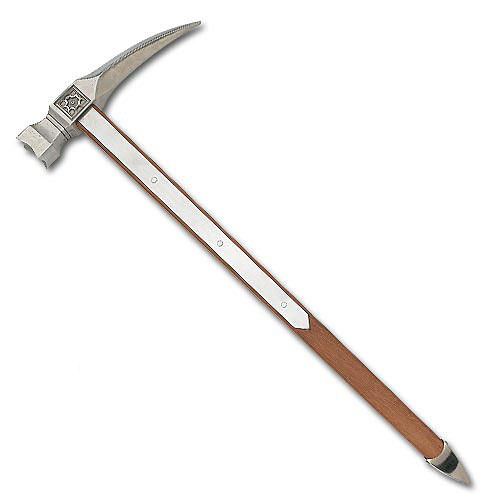
Of these, all but Lee and the unknown sixth artist follow JRRT’s description more or less closely.  Number 6—it’s a little unclear– but he might be carrying a war hammer of some sort,

image8warhammer.jpg

rather than a mace.

image9mace.jpg

image10mace.jpg

(These last two are basic patterns of a mace.)

The Lee is, well, we’re not sure what it seems to be.  It sort of looks like a battle axe

image11battleaxe.jpg

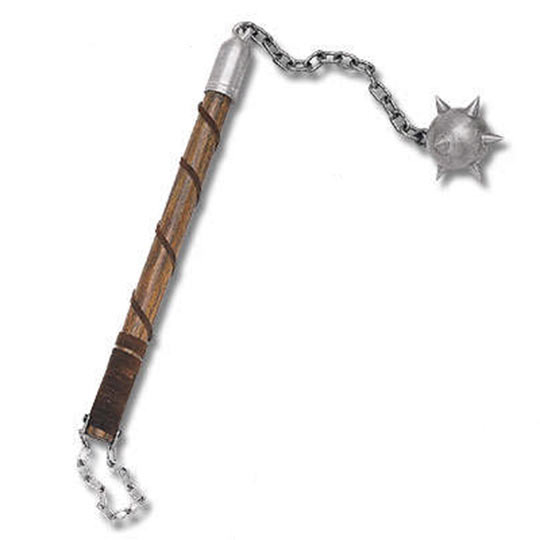
but also like what was called a “morning star”,

image12mornin.jpg

which should, we think, belong to the flail family.


image13flail

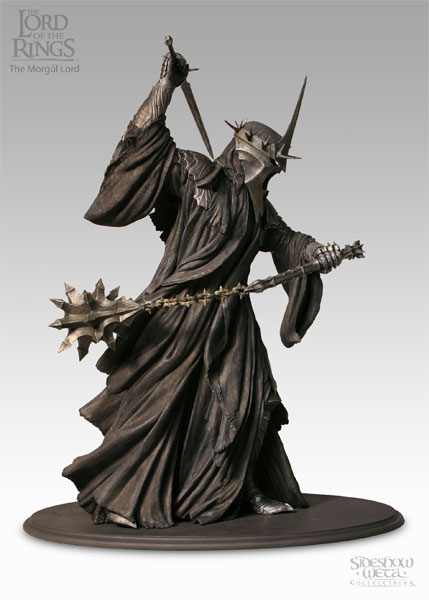
This rather fits in with the P Jackson image, shown in this model (and note that sword—definitely not in the original description—which is in his other hand).

image14mace.jpg

This difference made us curious about the weapons the Rohirrim—and the Gondorians—face and, in particular, those of the orcs.  The Hildebrandts

image15captured


provide us with odd-looking spears and what might appear to be scimitars


image16scim

but might be the suggestion of a medieval sword called a falchion.

image17falchion

McBride, who spent much of his artistic career illustrating military subjects, gives us weapons (mostly) less fanciful.

image18mcbimage19mcb

Lee

image19lee

and Howe

image20howe

veer between the practical and the fantastic and the films clearly follow them—

image21orcimage22orcimage23orc

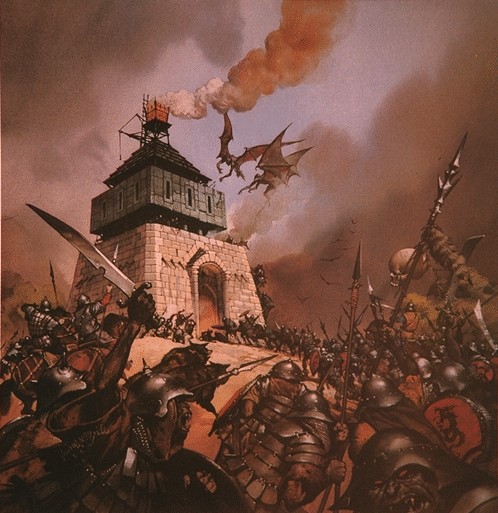
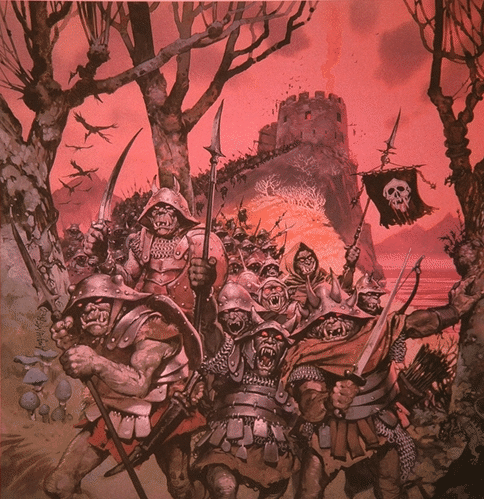
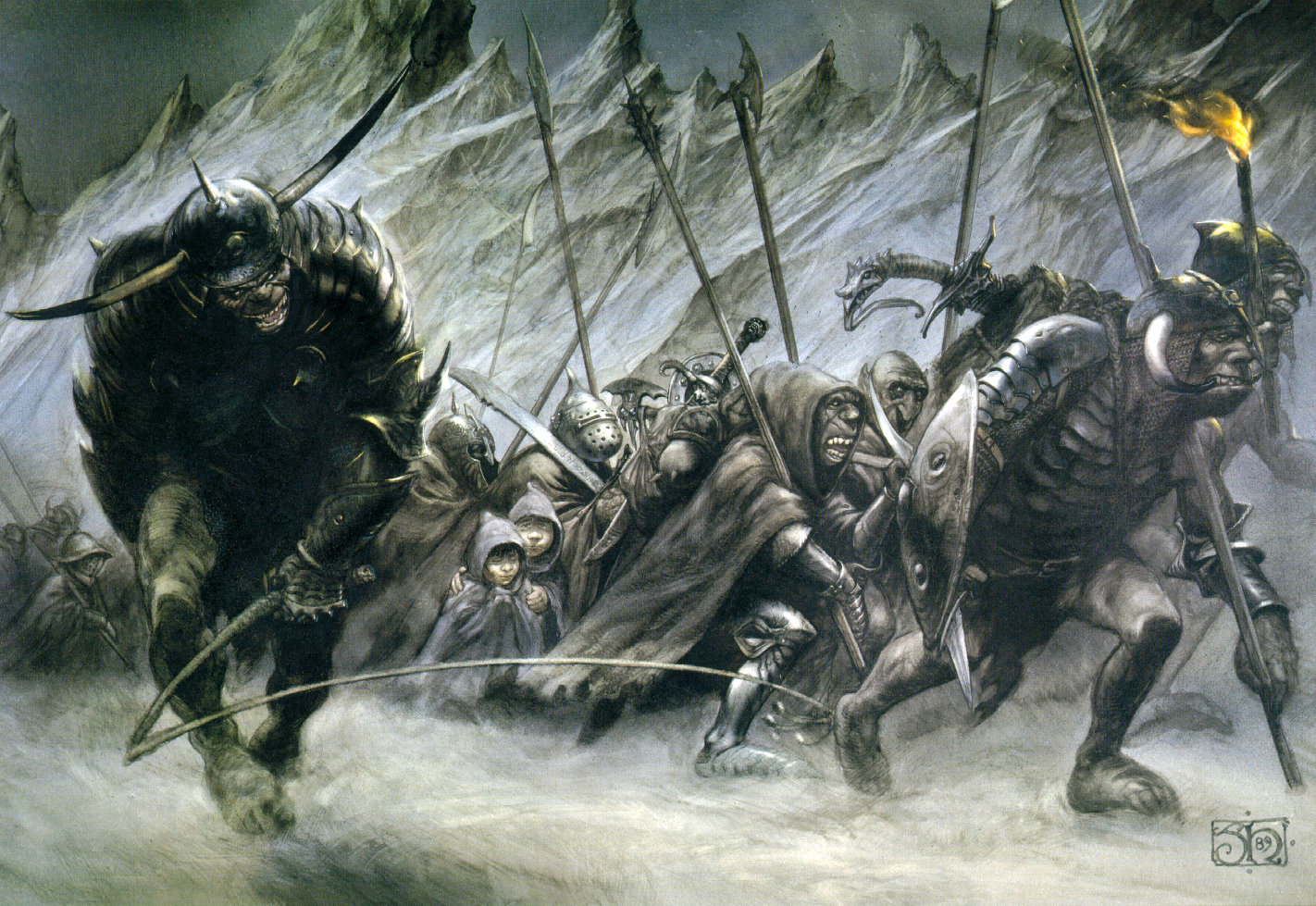
How does JRRT describe the orc weaponry?

The first armed orc we see appears in Moria:

“His broad flat face was swart, his eyes were like coals, and his tongue was red; he wielded a great spear…Sam, with a cry, hacked at the spear-shaft, and it broke.  But even as the orc flung down the truncheon and swept out his scimitar…” (The Fellowship of the Ring, Book Two, Chapter 5, “The Bridge of Khazad-dum”)

The orcs who pursue the Fellowship through Moria have similar weapons:

“Beyond the fire he saw swarming black figures:  there seemed to be hundreds of orcs.  They brandished spears and scimitars which shone red as blood in the firelight.”

After the death of Boromir, however, Aragorn, Gimli, and Legolas find a different kind of orc:

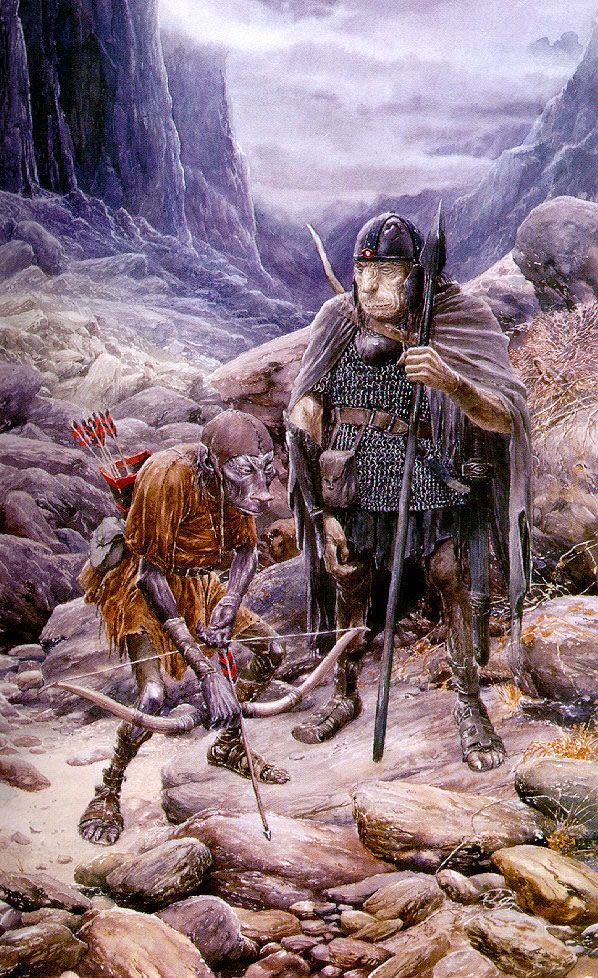
“There were four goblin-soldiers of greater stature, swart, slant-eyed, with thick legs and large hands.  They were armed with short broad-bladed swords, not with the curved scimitars usual with Orcs: and they had bows of yew, in length and shape like the bows of Men.” (The Two Towers, Book Three, Chapter 1, “The Departure of Boromir”)

So far, we’ve seen spears

image24spears

and scimitars

image25scim

and now we can add to that “short broad-bladed swords”.  Perhaps Tolkien is thinking of the medieval “arming sword”

image26arming

or even the Roman gladius?

image27gladius.jpg

When we add “bows of yew, in length and shape like the bows of Men”, we immediately see the classic English longbow.

image28longbowman.jpg

This doesn’t quite match with the first orc bowman we see in the films, however, “Lurtz”—

image29lurtz.jpg

image30lurtz.jpg

who appears to have some sort of recurved bow, possibly composite, of the sort the Mongols used

image31mongol

even though, from the white hand on his face, he is supposed to be one of those “goblin-soldiers” from Isengard.

As we were looking through Tolkien’s text, we wondered where he would have gotten his ideas for weapons from.  If the basis, as we imagine it, would have been his background in medieval literature, then he might have gone to the library and found an old standard work, Sir Samuel Meyrick’s (1783-1848)

image32meyrick.jpg

An Inquiry Into Ancient Armour, As It Existed in Europe, Particularly in Great Britain, From the Norman Conquest to the Reign of Charles the Second, first published in 1824.  (Here’s a LINK if you’d like to look at this text for yourself.)

image33mey

Meyrick was the first great English specialist in armor and the later editions of his work (in 3 volumes) have wonderful early hand-colored plates, all based upon surviving armor, tombs, manuscripts, and any other period materials he could gather.

image34meyill.jpg

If JRRT wanted to see such things for himself, he would have found more exotic weapons in the Pitt-Rivers Museum in Oxford,

image35pittriversimage36pitt

or he could have traveled up to London to see the Wallace Collection

image37wallaceimage38wallace

or, best of all, he could have visited the Tower of London, with its massive collection (the organizing of which had earned Meyrick his knighthood in 1832) of medieval arms and armor, which had been available to the public in some form even before Meyrick’s time—here’s a Victorian tour.

image39tower

image40towerimage41tower

It could have been all of the above, of course, but it seems to us that the descriptions we’re reading are actually not really very specific—“mace”, “spear”, “scimitar”—only those short swords and bows suggest anything more detailed.  Perhaps, then, Tolkien was inspired by something else—perhaps he had read, perhaps even possessed, as a boy, books like Howard Pyle’s 1903 The Story of King Arthur and His Knights

image42pyle

and been inspired by its illustrations.

image43pyle

There were plenty of illustrated tales like this—Conan Doyle’s The White Company (first published in serial form in 1891),

image44whitecompany.jpg

or Robert Louis Stevenson’s The Black Arrow (serial 1883, book 1888).

image45blackarrow.jpg

With any and all of that background, we wonder what he might have made of this, however, an orc sword from the films which looks more like something manufactured from a car part than the product of a medieval armorer…

image46sword.jpg

Thanks, as ever, for reading.

MTCIDC

CD

ps

If car part weapons don’t bother you, you might be interested in this LINK—it’s an early article on ideas for weapons and armor for the Jackson films.

Wains, Carts, and… (2)

14 Wednesday Feb 2018

Posted by Ollamh in Economics in Middle-earth, J.R.R. Tolkien

≈ Leave a comment

Tags

Boudica, Carts, Cassius Dio, Celts, chariots, Conestoga, Farmer Maggot, Gandalf, gur, Hobbiton, Iceni, Iron Age, Medieval, Mongols, Oregon Trail, Roman History, Romans, The Lord of the Rings, Tolkien, vikings, Wagons, Wainriders, Wains

Welcome, as always, to our blog, dear readers.

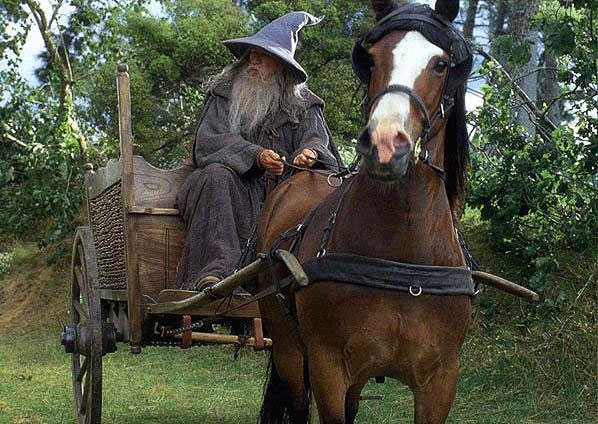
In our last, we began discussing wheeled transport in The Lord of the Rings.  We began with Gandalf’s cart, mentioned in Chapter 1.

im1gscart.jpg

The posting took us from the first traces of wheeled vehicles in western Europe, circa 3600BC (literally traces—just a pair of tracks in the clay)

im2tracks.jpg

through chariots

im3chariot.jpg

to Roman carts

im4romcart.jpg

to their descendants, medieval carts,

im5medcart.jpg

which led us back to Gandalf.

im6gcart.jpg

Continuing our discussion, we move from carts (2 wheels) to wagons (4 wheels) with the wagon Farmer Maggot uses to carry the hobbits to Bucklebury Ferry:

“I was going to say:  after a bit of supper, I’ll get out a small wagon, and I’ll drive you all to the Ferry.” (The Fellowship of the Ring, Book One, Chapter 4, “A Short Cut to Mushrooms”)

There is no description beyond that, really, but wagons are pretty generic things.  We have a few examples of early (600-500BC) Iron Age wagons—very fancy ones, too—from burials,

im7celtwag.jpg

im8celtwag.jpg

as well as this later Viking wagon.

im9oseberg.jpg

And, in between, we have Roman wagons

im10romwag.jpg

and their medieval descendants.

im11medwag.jpg

Farmer Maggott’s wagon, would probably have looked something like this (without the arms).

im12amedwag.jpg

Of course, those Roman wagons were meant for paved Roman roads.

im12romroad.jpg

Although some Roman roads remained on the surface and continued to be used, most medieval roads were merely dirt and stones—as JRRT illustrates in that picture of the Hill

im13hobbiton.jpg

and as we see in this picture.

im14medroad.jpg

In which case, medieval people relied upon pack horses to transport many of their goods.

im15sumpter.jpg

(Think of Bill the pony as a modest example.)

An old word for wagon is wain and we would like to end this brief exploration with something about wains and Wainriders.  In Appendix A, we find this:

“The third evil was the invasion of the Wainriders, which sapped the waning strength of Gondor in wars that lasted for almost a hundred years.  The Wainriders were a people, or a confederacy of many peoples, that came from the east; but they were stronger and better armed than any that had appeared before.  They journeyed in great wains, and their chieftains fought in chariots.”

We’ve been puzzled by that combination of “great wains” and “their chieftains fought in chariots”.  The only immediate reference we could think of was to the Iceni, a tribe of ancient Britain, who, led by a female chieftain named Boudica, revolted against Roman occupation in 60-61AD.  At the final battle, where they were defeated by Roman troops, they had parked wagons in a crescent formation to their rear, then advanced with their chariots and infantry against the Romans. (See Cassius Dio, Roman History, LXII.12 for a description of this battle—here’s an easy LINK to that portion of his extensive writing.)

im16boudica.jpg

There is a problem here, however.  The Britons were not migratory and their wagons were probably no more than farm wagons and carts, hardly the great wains of JRRT’s description.  If we removed the chariots, another candidate for the Wainriders might be the Mongols, however, who were migratory and traveled in something even more splendid than a wagon—a gur—like this one—

im17ger.jpg

The Mongols certainly came from the east and, in a short time, swallowed up territory from China all the way to eastern Europe.

im18mongolconquest.jpg

It is more likely, however, that JRRT combined things–it wouldn’t be the first time he synthesized—so much of his so-called legendarium is a mixture of this and that in brilliant profusion.  So, in the same spirit, we asked ourselves what we thought wains might look like and immediately saw the big wagon which was instrumental in colonizing the western part of the US, the Conestoga.

im19conestoga.jpg

Great, long lines of these and other wagons, packed with people and supplies, crossed the plains from the 1840s on.

im20wagtrain.gif

Could we then remove the 19th-century settlers and add Celts and their chariots, say?

im21celtchar.jpg

What do you think, dear readers?

Thanks, as ever, for reading.

MTCIDC

CD

The Doubtful Sea Series Facebook Page

The Doubtful Sea Series Facebook Page

  • Ollamh

Categories

  • Artists and Illustrators
  • Economics in Middle-earth
  • Fairy Tales and Myths
  • Films and Music
  • Games
  • Heroes
  • Imaginary History
  • J.R.R. Tolkien
  • Language
  • Literary History
  • Maps
  • Medieval Russia
  • Military History
  • Military History of Middle-earth
  • Narnia
  • Narrative Methods
  • Poetry
  • Research
  • Star Wars
  • Terra Australis
  • The Rohirrim
  • Theatre and Performance
  • Tolkien
  • Uncategorized
  • Villains
  • Writing as Collaborators
Follow doubtfulsea on WordPress.com

Across the Doubtful Sea

Recent Postings

  • A Moon disfigured December 17, 2025
  • On the Roads Again—Once More December 10, 2025
  • (Not) Crossing Bridges December 3, 2025
  • On the Road(s) Again—Again November 26, 2025
  • On the Road(s) Again November 19, 2025
  • To Bree (Part 2) November 12, 2025
  • To Bree (Part 1) November 5, 2025
  • A Plague o’ Both—No, o’ All Your Houses! October 29, 2025
  • It’s in Writing (2:  I’st a Prologue, or a Poesie for a Ring?) October 22, 2025

Blog Statistics

  • 103,220 Views

Posting Archive

  • December 2025 (3)
  • November 2025 (4)
  • October 2025 (5)
  • September 2025 (4)
  • August 2025 (4)
  • July 2025 (5)
  • June 2025 (4)
  • May 2025 (4)
  • April 2025 (5)
  • March 2025 (4)
  • February 2025 (4)
  • January 2025 (5)
  • December 2024 (4)
  • November 2024 (4)
  • October 2024 (5)
  • September 2024 (4)
  • August 2024 (4)
  • July 2024 (5)
  • June 2024 (4)
  • May 2024 (5)
  • April 2024 (4)
  • March 2024 (4)
  • February 2024 (4)
  • January 2024 (5)
  • December 2023 (4)
  • November 2023 (5)
  • October 2023 (4)
  • September 2023 (4)
  • August 2023 (5)
  • July 2023 (4)
  • June 2023 (4)
  • May 2023 (5)
  • April 2023 (4)
  • March 2023 (5)
  • February 2023 (4)
  • January 2023 (4)
  • December 2022 (4)
  • November 2022 (5)
  • October 2022 (4)
  • September 2022 (4)
  • August 2022 (5)
  • July 2022 (4)
  • June 2022 (5)
  • May 2022 (4)
  • April 2022 (4)
  • March 2022 (5)
  • February 2022 (4)
  • January 2022 (4)
  • December 2021 (5)
  • November 2021 (4)
  • October 2021 (4)
  • September 2021 (5)
  • August 2021 (4)
  • July 2021 (4)
  • June 2021 (5)
  • May 2021 (4)
  • April 2021 (4)
  • March 2021 (5)
  • February 2021 (4)
  • January 2021 (4)
  • December 2020 (5)
  • November 2020 (4)
  • October 2020 (4)
  • September 2020 (5)
  • August 2020 (4)
  • July 2020 (5)
  • June 2020 (4)
  • May 2020 (4)
  • April 2020 (5)
  • March 2020 (4)
  • February 2020 (4)
  • January 2020 (6)
  • December 2019 (4)
  • November 2019 (4)
  • October 2019 (5)
  • September 2019 (4)
  • August 2019 (4)
  • July 2019 (5)
  • June 2019 (4)
  • May 2019 (5)
  • April 2019 (4)
  • March 2019 (4)
  • February 2019 (4)
  • January 2019 (5)
  • December 2018 (4)
  • November 2018 (4)
  • October 2018 (5)
  • September 2018 (4)
  • August 2018 (5)
  • July 2018 (4)
  • June 2018 (4)
  • May 2018 (5)
  • April 2018 (4)
  • March 2018 (4)
  • February 2018 (4)
  • January 2018 (5)
  • December 2017 (4)
  • November 2017 (4)
  • October 2017 (4)
  • September 2017 (4)
  • August 2017 (5)
  • July 2017 (4)
  • June 2017 (4)
  • May 2017 (5)
  • April 2017 (4)
  • March 2017 (5)
  • February 2017 (4)
  • January 2017 (4)
  • December 2016 (4)
  • November 2016 (5)
  • October 2016 (6)
  • September 2016 (5)
  • August 2016 (5)
  • July 2016 (5)
  • June 2016 (5)
  • May 2016 (4)
  • April 2016 (4)
  • March 2016 (5)
  • February 2016 (4)
  • January 2016 (4)
  • December 2015 (5)
  • November 2015 (5)
  • October 2015 (4)
  • September 2015 (5)
  • August 2015 (4)
  • July 2015 (5)
  • June 2015 (5)
  • May 2015 (4)
  • April 2015 (3)
  • March 2015 (4)
  • February 2015 (4)
  • January 2015 (4)
  • December 2014 (5)
  • November 2014 (4)
  • October 2014 (6)
  • September 2014 (1)

Blog at WordPress.com.

  • Subscribe Subscribed
    • doubtfulsea
    • Join 78 other subscribers
    • Already have a WordPress.com account? Log in now.
    • doubtfulsea
    • Subscribe Subscribed
    • Sign up
    • Log in
    • Report this content
    • View site in Reader
    • Manage subscriptions
    • Collapse this bar
 

Loading Comments...