• About

doubtfulsea

~ adventure fantasy

Tag Archives: Hildebrandts

A Country for Old Men—and Old Men for a Country

11 Wednesday May 2016

Posted by Ollamh in Fairy Tales and Myths, J.R.R. Tolkien, Literary History

≈ Leave a comment

Tags

Apollonius, Aragorn, Argo, Blue Wizards, Denethor, Faramir, Gandalf and the Balrog, Grey Havens, Heracles, Hildebrandts, Hylas, Istari, Jason and the Golden Fleece, Merlin, Radaghast, sage, Saint Nicholas, Saruman, Sharkey, The Argonautica, The Fantastic Four, The Lord of the Rings, Theoden, Tiresias, Tolkien, Valar, W.B.Yeats

Dear readers, welcome, as always.

Recently, we wrote a posting about Saruman and his fate. It was fun to think about, but it made us think further about why Saruman, in the Shire, is called “Sharkey” by his thugs—supposedly from Orcish sharku, “Old Man”. If we had never read a description of Saruman, but only the nickname, we might think of “the old man” either as an older Anglo-American expression either for a father—“my old man keeps nagging me about cutting the grass, if I want my allowance” (note the use of the possessive “my”)—a naval/military term for commander—“the old man said that, on his ship, smoking would never be allowed again” (always without the possessive)—or older English for husband—“her old man is fooling around behind her back—I hope she turns around!” (again, with a possessive).

In fact, Saruman is, literally, an old man

greg-hildebrandt-isengard-orthanc-saruman-607429-1300x962.jpg

—as are all five of the Istari, the wizards sent to Middle-earth by the Valar about the year 1000 of the Third Age. As JRRT says in a letter to Robert Murray, S.J. (there’s a surviving draft on pages 200-207 of The Letters of J.R.R. Tolkien):

“They are actually emissaries from the True West, and so mediately from God, sent precisely to strengthen the resistance of the ‘good’, when the Valar become aware that the shadow of Sauron is taking shape again.” Letters, 207

He further explains their role:

“At this point in the fabulous history the purpose was precisely to limit and hinder their exhibition of ‘power’ on the physical plane, and so that they should do what they were primarily sent for: train, advise, instruct, arouse the hearts and minds of those threatened by Sauron to a resistance with their own strengths; and not just to do the job for them.” 202

JRRT could have chosen a different path, of course, and created a plot in which there was constant, open war between the wizards and Sauron, and there is mention of war of some sort, as, during the time of The Hobbit, the White Council drives “the Necromancer” out of Dol Goldur in the southern part of Mirkwood. It’s not said how, but no army is mentioned, so we presume that it was done by magic against magic (on the subject of magic, see JRRT in the letter previous to the one to Murray, Letters, 199-200).

We wonder if, in choosing to limit the wizards’ power, Tolkien made the same choice which Apollonius of Rhodes (3rd century BC) made in his version of the story of Jason and the Golden Fleece, The Argonautica. If you don’t know this story, the shortest way to explain it is to say that Jason’s wicked uncle has stolen the throne which rightfully belongs to Jason and, in an effort to make Jason disappear, his uncle has sent him off on what he hoped was a suicide mission. That mission was to bring back a magical golden fleece from the far side of the Black Sea (at the time, this would have been like a mission to Mars). To help him, Jason summons heroes from across the Greek world.

Unfortunately for Apollonius, the traditional story on which his epic is based had, over time, gradually come to include every hero from ancient Greece on Argo,

The_Argo.jpg

This means that Heracles had to be asked to join, but there is a big difficulty in including Heracles: he’s so powerful that he could do the job all by himself.

Krater_Niobid_Painter_A_Louvre_G341.jpg

Apollonius was extremely scrupulous, as far as we can tell, in following tradition, so he finds a way out. He puts Heracles’ bff, Hylas, on board the ship, then, at a watering spot, has the boy lured away by some randy water nymphs.

hylas_and_the_nymphs.waterhouse1896.jpg

When Heracles goes off to find the boy, the ship leaves without him and the problem is solved. (Although Apollonius chooses to ignore the fact that the ship is still absolutely crammed with the ancient equivalent of The Fantastic Four. We suppose that, for him, Heracles was the only really major hero.)

fantasticfour.png

Thus, we can imagine that Tolkien, believing that he could create a more interesting (and longer?) story without too much magic, has, in general, limited the wizards not in their power, but in the use of it. (There are exceptions, of course—we immediately think of Gandalf and the Balrog, for instance.)

balroggandalf.jpg

The wizards do not just have the shape of men, however, but old men—“Thus they appeared as ‘old’ sage figures” (Letters, 202).

The word “sage” here is definitely one element in Tolkien’s choice for his characters. There is a world-wide tradition that old men are wise men—think of the ancient Greek seer Tiresias, for example—

Johann_Heinrich_Füssli_tiresias.jpg

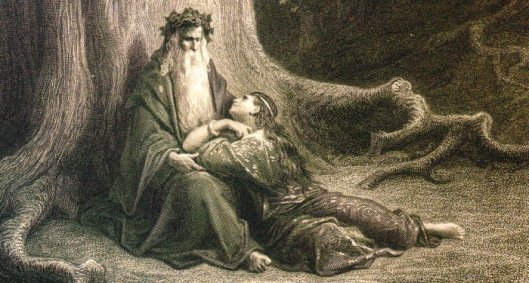
or the Arthurian Merlin

vivien-and-merlin-by-gustave-dore-cc.jpg

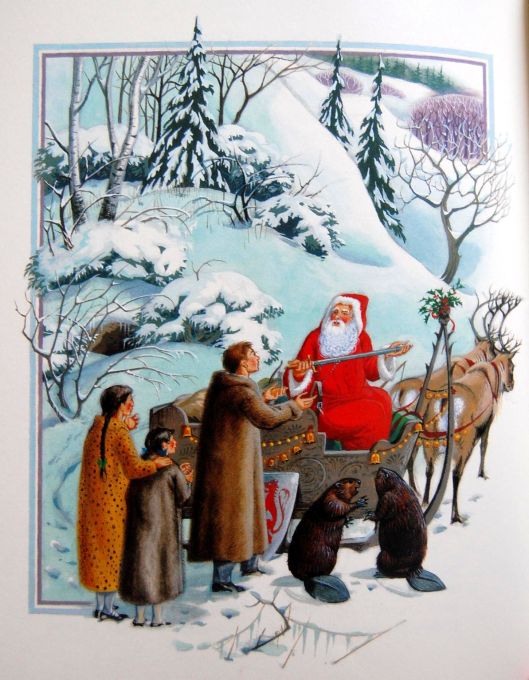
or Father Christmas/Santa Claus.

FatherChristmas.JPG

We wonder whether there might also be the idea that, dramatically, older rulers, like Theoden
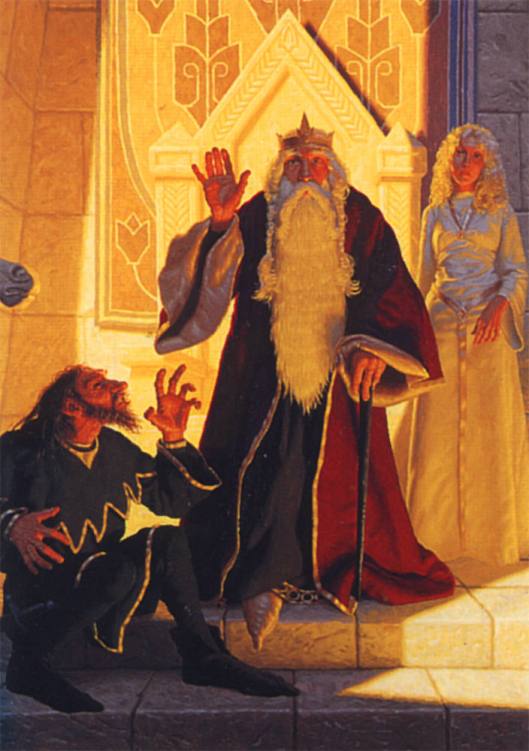
theoden.jpg

And Denethor

hildebrandtdenethor.jpg

might be more inclined to listen to such a person (although we notice that the corrupted Denethor is less than willing).

And, that younger men like Aragorn

Image result for hildebrandts aragorn

and Faramir

Tim Hildebrandt - Faramir rencontre Frodon et Sam (2).jpg

would see them as mentors.

kingreturn.jpg

And, as the Istari have been sent by the Valar, the last act on Gandalf’s part, as depicted in this Hildebrandt twins’ painting, has special significance, suggesting that, Aragorn has been given the throne with divine approval and, with his crowning, Sauron has been completely defeated and balance has been restored, even if only temporarily, to Middle-earth.

When this has been accomplished, Gandalf is then allowed to “retire”, as we seem to expect old men to do in our world (and as Tolkien himself did, in 1959), going to the Grey Havens and a final journey back to the West.

greg_tim_hildebrandt_at_the_grey_havens.jpg

We hear nothing more of Radagast and the two so-called “Blue Wizards”, but, Saruman also leaves Middle-earth—though not in Gandalf’s gentle way. And perhaps his end, shabby and disgraced, also shows a kind of divine approval: those given power must not abuse it, for the consequences not only to the world around them, but to them, can be fatal.

Thanks, as always, for reading.

MTCIDC

CD


PS

Our title is an adaptation of the first line of W.B. Yeats’ gorgeous poem, Sailing to Byzantium (first published in 1928). Although it has nothing to do with Middle-earth, it does depict a strange, magical place.
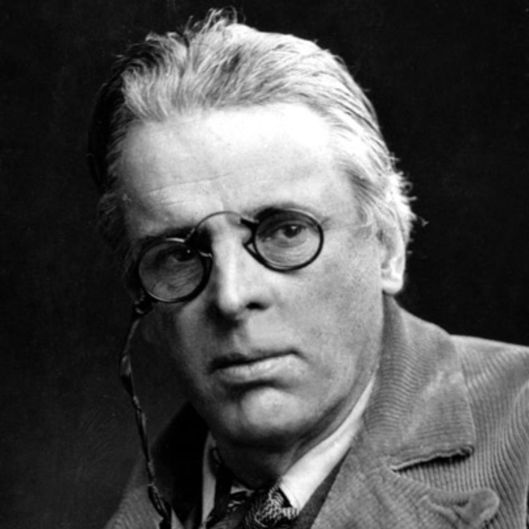
wby.jpg

Beaux Gestes? (2)

27 Wednesday Apr 2016

Posted by Ollamh in Artists and Illustrators, Fairy Tales and Myths, J.R.R. Tolkien, Villains

≈ 1 Comment

Tags

19th-century tombs, Cicero, Galadriel, Gandalf, Grey Havens, Hildebrandts, Istari, Mourning, Queen Victoria, Quintilian, Saruman, Scouring of the Shire, The Lord of the Rings, The Mirror of Galadriel, Theatrical gesture, Tolkien, Valar

Welcome, as always, dear readers.

In our last, we commenced a small examination of gesture in The Lord of the Rings, relating specifically to Galadriel and Saruman. We began with Galadriel

galadriel.jpg

and her rejection of Sauron. JRRT describes it in this way: “She lifted up her white arms, and spread out her hands towards the East in a gesture of rejection and denial.” In that post, we said that her gesture seemed theatrical, almost melodramatic, and we suggested that JRRT had been influenced by what we imagined he had seen on stage and on screen late in the 19th and into the 20th centuries, a time when such broad gestures were still considered the best way to convey strong emotion. This mode was, we proposed, ultimately based upon the writings of two ancient Romans, Cicero and Quintilian, who lived between the years 100BC and 100AD. In their day and up to the 20th century, the only magnification available to allow speakers to be heard over crowds was the human voice. Thus, a range of gestures emphatic enough to be seen and clear enough to be understood at a distance was an important component of effective speaking and such gestures were adopted and adapted by actors and used and reused for many centuries to come.

Because none of the illustrations based upon “The Mirror of Galadriel” depicts this gesture, we used a photograph from an 1898 book on public speaking to provide the sense of what we believe we were meant to see.

Repulsion.jpg

In our last, we also suggested that Galadriel’s gesture was linked to one of Saruman’s—in fact, his last gesture on Middle Earth, as far as we know.

In sudden resentment at the contemptuous treatment consistently dealt him by Saruman, Grima Wormtongue has drawn a hidden knife and cut the wizard’s throat.

“To the dismay of those that stood by, about the body of Saruman a grey mist gathered, and rising slowly to a great height like smoke from a fire, as a pale shrouded figure it loomed over the Hill. For a moment it wavered, looking to the West; but out of the West came a cold wind, and it bent away, and with a sigh dissolved into nothing.” The Lord of the Rings, Book 6, Chapter viii.

jwyatt-sarumande.jpg

Saruman had been one of the Istari, as Tolkien describes them all in describing Gandalf:

“There are naturally no precise modern terms to say what he was. I wd. venture to say that he was an incarnate ‘angel’—strictly an angelos: that is, with the other Istari, wizards, ‘those who know’, an emissary from the Lords of the West, sent to Middle-earth, as the great crisis of Sauron loomed on the horizon. By ‘incarnate’ I mean they were embodied in physical bodies capable of pain, and weariness, and of afflicting the spirit with physical fear, and of being ‘killed’, though supported by the angelic spirit they might endure long, and only show slowly the wearing of care and labour.” Letter to Robert Murray, S.J. (draft), 4 November, 1954.

Saruman, then, as another of the Istari, can be killed—and is, but what then? In his battle with the Balrog, it appears that Gandalf has met his end. He returns, however, suggesting that his physical body might be capable of the repair which Galadriel administers in Lorien.  As JRRT says in the same letter, “He was sent by a mere prudent plan of the angelic Valar or governors; but Authority had taken up this plan and enlarged it, at the moment of its failure.”—that is, Gandalf’s apparent death.

As Gandalf puts it, “I was the enemy of Sauron”, and, with Sauron defeated, apparently conclusively, Gandalf is allowed to return to the West, to do or be what, is never explained.   It is a privilege, clearly, since it is granted only to High Elves and, with special dispensation, to Bilbo and Frodo.

This brings us back to Saruman’s gesture: “For a moment it wavered, looking to the West; but out of the West came a cold wind, and it bent away, and with a sigh dissolved into nothing.”

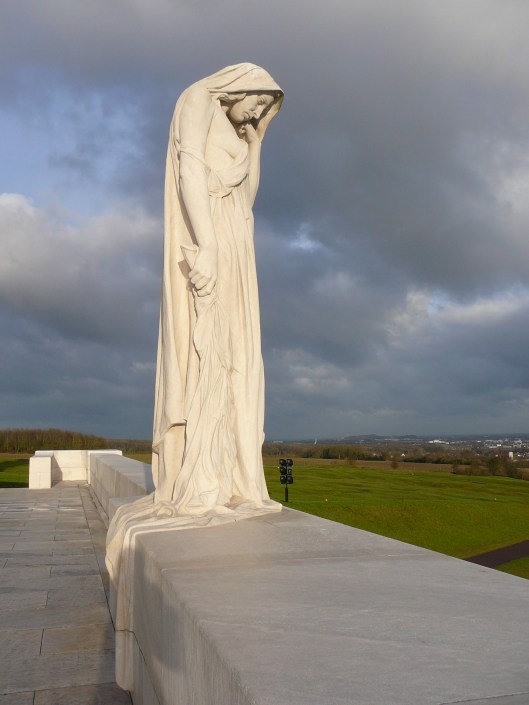
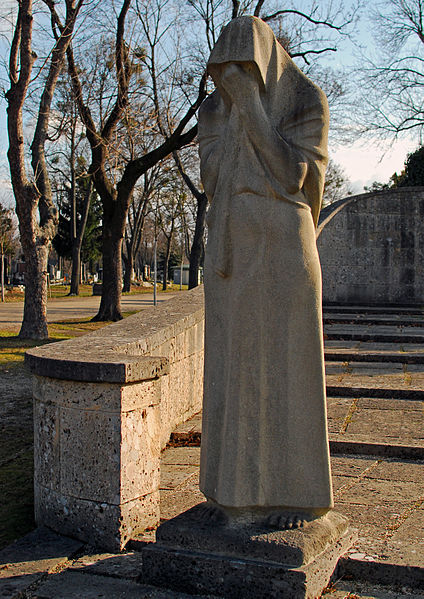
In a way, what we see here is actually a lack of gesture—it is a wavering, with a sense of hope, perhaps? Almost as if Saruman is appealing for pardon? As in the case, of Galadriel, we have no artist’s depiction of this, but we’ve used the clue of “a pale shrouded figure”, as well as that wavering, to imagine that this is someone in mourning and so we can offer several figures from later 19th-century tombs as a possible image.

d5717eeaa95186cd2e3d95447d215e2f.jpgp1140386.jpg

Statue-to-Mourning-Zentralfriedhof-Vienna.jpg

It’s interesting that these all are female, as if this is one of the expected jobs of 19th-century women, to be the Mourners in Chief. We suppose that, since Queen Victoria mourned for her husband Albert from his death in 1861 to her own death in 1901, this shouldn’t be surprising, but we are planning a later posting about mourning in The Lord of the Rings which will examine the subject within certain western traditions in more depth.

Queen-Victoria-Her-Latest-Portrait-1900_tr_4643_566.jpg

In the meantime, we return to Galadriel to match these two gestures. Saruman had failed because he had accepted the East and the deceptive words of Sauron. His fate, then, is to be met with a cold wind and to dissolve, with a sigh, into nothing, rejected by the West from which he had been sent, several thousand years before. Galadriel, on the other hand, by protecting her people and rejecting Sauron, had been accepted back into the West and the last we see of her is aboard a ship at the Grey Havens, bound for her reward.

ghavens.jpg

Thanks for reading, as always.

MTCIDC

CD

PS

We couldn’t resist this final image: the Hildebrandts with the painting.

haven-c.jpg

For all of the wonderful paintings he and his brother have given us, may Tim Hildebrandt (1939-2006) have been given a safe passage to the West, as well.


Jolly Tom.1

09 Wednesday Sep 2015

Posted by Ollamh in Narrative Methods, Poetry, Tolkien

≈ Leave a comment

Tags

Barrow-wights, Elrond, Gandalf, Hildebrandts, Nazgul, Old Man Willow, Peter Jackson, Ralph Bakshi, Sauron, Tales from the Perilous Realm, The Lord of the Rings, The Old Forest, Tolkien, Tom Bombadil

Dear Readers,

Welcome, as always!

There has been lots of discussion, if not downright argument, about Tom Bombadil and The Lord of the Rings. Although he appears in the first BBC radio adaptation in 1955 (which Tolkien disliked, saying in a letter of the period that “I thought Tom Bombadil dreadful”) and in the 1979 American radio drama, he was excised from Ralph Bakshi’s 1978 animated feature and from the 1981 BBC radio production, although reappearing in the radio adaptation of the relevant material from The Lord of the Rings in Tales from the Perilous Realm (BBC 1992).

Then we come to Peter Jackson’s The Fellowship of the Ring (2001). As anyone who has read our past postings knows, we have very mixed feelings about this and the subsequent films, but, in this posting, we want to take a completely different tack, not asking, as has always been the subject “why was Tom left out?” but, rather, “why might you keep him in?”

This is two questions, really, the first being “what would be his effect upon the story?” and, second, “just what of him would you keep?”

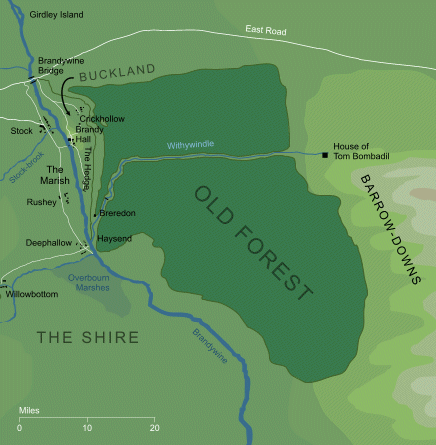
Lost in the Old Forest

oldforest

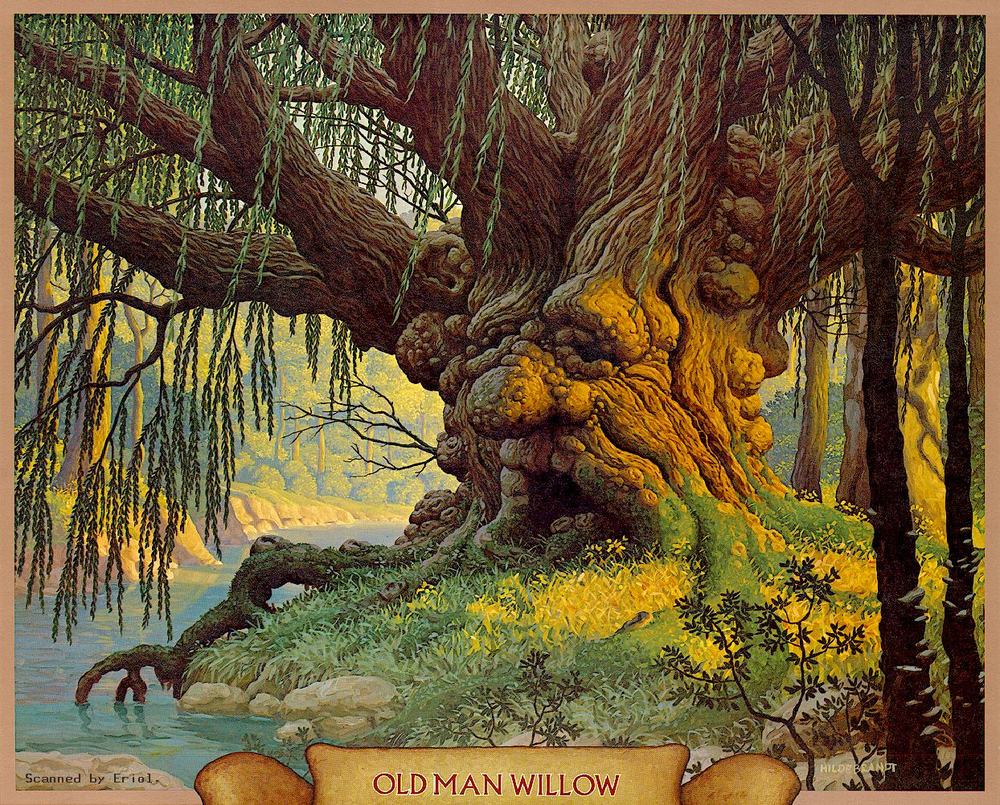
the Hobbits run afoul of Old Man Willow

TomOldManWillow

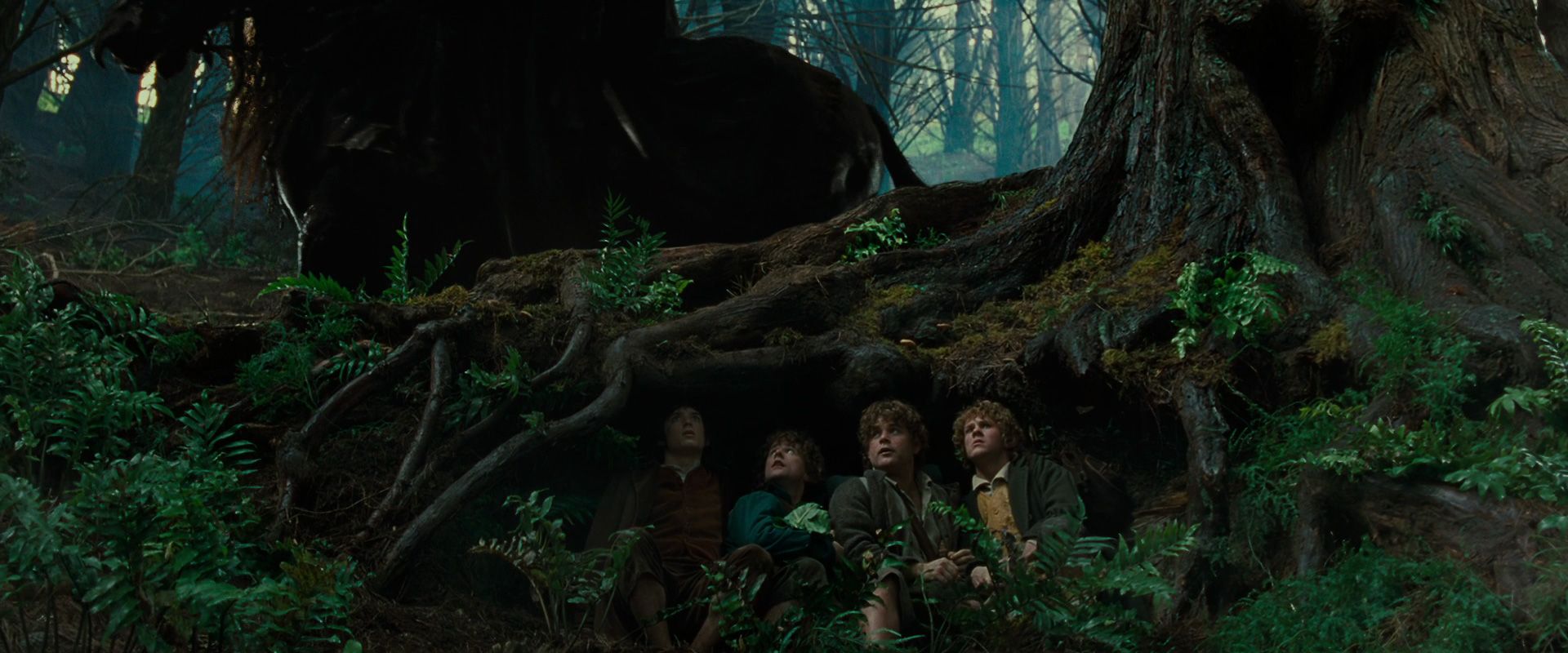
only to be rescued by Tom Bombadil

bombadil010607a

As much as we love the Hildebrandts’ work, this is not one of our favorites—this illustration really makes us wonder what kind of magic mushrooms Tom has been trading with Farmer Maggot and which Grateful Dead album is running in his head. As an antidote, here’s one of our favorites:

visite_inattendue_hildebrandt

One could say that this is part of the pattern of increasingly-dangerous encounters the Hobbits are having as they try to leave the Shire—

the first encounter was with the Nazgul

hobbits-hiding-from-nazgul

This doesn’t justify including him, though, if he’s thought to be just one more in a series—and this is clearly an opinion held by a Jackson scriptwriter, who once said:

“Tom Bombadil is part of several false starts to Frodo’s journey, and you cannot have things happening quite so episodically; that’s not what storytelling is all about.” (quoted from The One Ring, “complete list of film changes”—see the link here)

If he’s not just a “false start”, what is his function—and may he have more than one?

One of those elements of The Lord of the Rings which runs always just below the surface is the great age of Middle Earth. This is an ancient place and that fact was clearly very important, to the author, who spent years building up that narrative infrastructure, and to the story. This is clearly not a quick, little, one-time adventure, but, rather, one more part of a very old tale, of the “long defeat” as Galadriel calls the struggle with Sauron.

As a living token of that antiquity—and the first, but hardly the last, they meet—on their journey, there is Tom Bombadil. As Elrond says of him:

“But I had forgotten Bombadil, if indeed this is still the same that walked the woods and hills long ago, and even then was older than the old. That was not then his name. Iarwain Ben-adar we called him, [“Old-young, fatherless”? see The Lord of the Rings Companion, 128 for more on his names) oldest and fatherless.” LotR 265.

Thus, one of his functions is to represent a distant past, though now as shrunken as the Old Forest, “but an outlier of its northern march. Time was when a squirrel could go from tree to tree from what is now the Shire to Dunland west of Isengard.” (Elrond—LotR 265) In this, he is akin to Fangorn/Treebeard, described by Gandalf (himself so old that he was created by Iluvatar before the Music of the Ainur) as “the oldest living thing that still walks beneath the Sun upon this Middle-earth.” LotR 499.

He also, in a curious way, might be understood to represent one possible—perhaps hopeful—form of the future. When Frodo asks him, “Who are you, Master?” he replies (and it strikes us as sounding like both a Middle-earth riddle and its solution):

“Eldest, that’s what I am. Mark my words, my friends: Tom was here before the river and the trees; Tom remembers the first raindrop and the first acorn. He made paths before the Big People, and saw the little People arriving. He was here before the Kings and the graves and the Barrow-wights. When the Elves passed westward, Tom was here already, before the seas were bent. He knew the dark under the stars when it was fearless—before the Dark Lord came from Outside.” LotR 131.

Tom represents continuity, unchanging stability, then, although he is not all-powerful. As Glorfindel says:

“I think that in the end, if all else is conquered, Bombadil will fall, Last as he was First; and then Night will come.” LotR 266.

And yet he also, because of his immense age and ability to endure, might represent the unspoken possibility that, though Sauron is powerful, because he is not the creator nor rightful owner of Middle-earth, but rather an invader, he can be defeated: as there was a time before Sauron, could there not be a time after him?

(As an afterthought here, might we also add Tom’s complete immunity to the Ring? In a story full of people, from Gollum to Sauron, from Bilbo to Galadriel, so affected, in one way or another by it, is this another form of hope? That not everyone in the whole of Middle-earth wants the Ring or has to deny it strenuously lest the temptation overcome them?)

We want to continue this discussion in our next posting, but we want to end this one by considering the second part of this question, “Just what of him would you keep?”

Although the usual explanation for excising him has to do with his being a supposed “false start”, which has to do with the mechanics of plot, we believe that a real reason has to do with the large quantity of verse which appears when he appears. These verses signal that appearance:

“Hey dol! merry dol! ring a dong dillo!

Ring a dong! hop along! fal lal the willow!

Tom Bom, jolly Tom, Tom Bombadillo!” LotR 119

Although there has been verse earlier in the book, it has been scattered, not concentrated, and has seemed more apropos to what has been going on in the text. Much of this verse appears to come from nowhere, rather like Tom himself (and there’s more on 121, 122, 124, 126, and a final bit on 134—although, as a cry for help, it somehow fits better). In a story primarily in prose, with the occasional song, how would you present such a character believably on film or on tape? (Especially when one notices that even his speech is sometimes cadenced—“What be you a-thinking of? You should not be waking. Eat earth! Dig deep! Drink water! Go to sleep! Bombadil is talking!” LotR 120)

In fact, the character of Bombadil is not organic to the development of the plot of The Lord of the Rings. Tom Bombadil made his first appearance in The Oxford Magazine in 1934, when The Hobbit was being written, but three years before its initial publication. (See The Lord of the Rings Companion 124-129 for the poem and further information).

The basic plot of chapters 6 and 7 is simple: Tom frees the Hobbits from Old Man Willow, leads them to his house, the Hobbits eat and drink there and converse with Tom, but there’s little more to the two scenes. Thus, except for the distress call which Tom teaches the Hobbits on 134, does any of this verse do more than show us the poetic/almost manic side of Bombadil? If we wished to retain the character, might it be possible to cut away the verse (including a certain amount of rhythmicized prose), leaving only those elements which further the plot?

To us, this is a more pressing issue than it might at first appear—but see our next post, Jolly Tom.2, to understand our interest.

Thanks, as always, for reading.

MTCIDC

CD

Newer posts →

The Doubtful Sea Series Facebook Page

The Doubtful Sea Series Facebook Page

  • Ollamh

Categories

  • Artists and Illustrators
  • Economics in Middle-earth
  • Fairy Tales and Myths
  • Films and Music
  • Games
  • Heroes
  • Imaginary History
  • J.R.R. Tolkien
  • Language
  • Literary History
  • Maps
  • Medieval Russia
  • Military History
  • Military History of Middle-earth
  • Narnia
  • Narrative Methods
  • Poetry
  • Research
  • Star Wars
  • Terra Australis
  • The Rohirrim
  • Theatre and Performance
  • Tolkien
  • Uncategorized
  • Villains
  • Writing as Collaborators
Follow doubtfulsea on WordPress.com

Across the Doubtful Sea

Recent Postings

  • Through a glass… January 7, 2026
  • Heffalumps? December 31, 2025
  • We Three Kings December 24, 2025
  • A Moon disfigured December 17, 2025
  • On the Roads Again—Once More December 10, 2025
  • (Not) Crossing Bridges December 3, 2025
  • On the Road(s) Again—Again November 26, 2025
  • On the Road(s) Again November 19, 2025
  • To Bree (Part 2) November 12, 2025

Blog Statistics

  • 104,146 Views

Posting Archive

  • January 2026 (1)
  • December 2025 (5)
  • November 2025 (4)
  • October 2025 (5)
  • September 2025 (4)
  • August 2025 (4)
  • July 2025 (5)
  • June 2025 (4)
  • May 2025 (4)
  • April 2025 (5)
  • March 2025 (4)
  • February 2025 (4)
  • January 2025 (5)
  • December 2024 (4)
  • November 2024 (4)
  • October 2024 (5)
  • September 2024 (4)
  • August 2024 (4)
  • July 2024 (5)
  • June 2024 (4)
  • May 2024 (5)
  • April 2024 (4)
  • March 2024 (4)
  • February 2024 (4)
  • January 2024 (5)
  • December 2023 (4)
  • November 2023 (5)
  • October 2023 (4)
  • September 2023 (4)
  • August 2023 (5)
  • July 2023 (4)
  • June 2023 (4)
  • May 2023 (5)
  • April 2023 (4)
  • March 2023 (5)
  • February 2023 (4)
  • January 2023 (4)
  • December 2022 (4)
  • November 2022 (5)
  • October 2022 (4)
  • September 2022 (4)
  • August 2022 (5)
  • July 2022 (4)
  • June 2022 (5)
  • May 2022 (4)
  • April 2022 (4)
  • March 2022 (5)
  • February 2022 (4)
  • January 2022 (4)
  • December 2021 (5)
  • November 2021 (4)
  • October 2021 (4)
  • September 2021 (5)
  • August 2021 (4)
  • July 2021 (4)
  • June 2021 (5)
  • May 2021 (4)
  • April 2021 (4)
  • March 2021 (5)
  • February 2021 (4)
  • January 2021 (4)
  • December 2020 (5)
  • November 2020 (4)
  • October 2020 (4)
  • September 2020 (5)
  • August 2020 (4)
  • July 2020 (5)
  • June 2020 (4)
  • May 2020 (4)
  • April 2020 (5)
  • March 2020 (4)
  • February 2020 (4)
  • January 2020 (6)
  • December 2019 (4)
  • November 2019 (4)
  • October 2019 (5)
  • September 2019 (4)
  • August 2019 (4)
  • July 2019 (5)
  • June 2019 (4)
  • May 2019 (5)
  • April 2019 (4)
  • March 2019 (4)
  • February 2019 (4)
  • January 2019 (5)
  • December 2018 (4)
  • November 2018 (4)
  • October 2018 (5)
  • September 2018 (4)
  • August 2018 (5)
  • July 2018 (4)
  • June 2018 (4)
  • May 2018 (5)
  • April 2018 (4)
  • March 2018 (4)
  • February 2018 (4)
  • January 2018 (5)
  • December 2017 (4)
  • November 2017 (4)
  • October 2017 (4)
  • September 2017 (4)
  • August 2017 (5)
  • July 2017 (4)
  • June 2017 (4)
  • May 2017 (5)
  • April 2017 (4)
  • March 2017 (5)
  • February 2017 (4)
  • January 2017 (4)
  • December 2016 (4)
  • November 2016 (5)
  • October 2016 (6)
  • September 2016 (5)
  • August 2016 (5)
  • July 2016 (5)
  • June 2016 (5)
  • May 2016 (4)
  • April 2016 (4)
  • March 2016 (5)
  • February 2016 (4)
  • January 2016 (4)
  • December 2015 (5)
  • November 2015 (5)
  • October 2015 (4)
  • September 2015 (5)
  • August 2015 (4)
  • July 2015 (5)
  • June 2015 (5)
  • May 2015 (4)
  • April 2015 (3)
  • March 2015 (4)
  • February 2015 (4)
  • January 2015 (4)
  • December 2014 (5)
  • November 2014 (4)
  • October 2014 (6)
  • September 2014 (1)

Blog at WordPress.com.

  • Subscribe Subscribed
    • doubtfulsea
    • Join 78 other subscribers
    • Already have a WordPress.com account? Log in now.
    • doubtfulsea
    • Subscribe Subscribed
    • Sign up
    • Log in
    • Report this content
    • View site in Reader
    • Manage subscriptions
    • Collapse this bar
 

Loading Comments...