• About

doubtfulsea

~ adventure fantasy

Tag Archives: factories

Green and Quiet.1

05 Wednesday Sep 2018

Posted by Ollamh in Economics in Middle-earth, J.R.R. Tolkien, Literary History

≈ Leave a comment

Tags

Birmingham, Charles Dickens, Cottage industry, factories, Goblins, Hard Times, Hilary Tolkien, I Can't Find Brummagem, Industrial Revolution, Isengard, James Dobbs, John Ezard, Mabel Tolkien, Mills, Ornthanc, Sarehole, Sharkey, The Hobbit, The Scouring of the Shire, Tolkien, World War I

As always, dear readers, welcome.

We’ve always loved the lines

“By some curious chance one morning long ago in the quiet of the world, when there was less noise and more green…”

which open the paragraph in which Gandalf first appears in The Hobbit and the story actually begins.

For JRRT, green and quiet are the ideal, but things have clearly changed—as this sentence implies, now there is more noise and less quiet.  In our time—and even before Tolkien’s childhood in the late 19th century—the green and quiet were and are going thanks to the Industrial Revolution.  Or so we thought.  Reading Tolkien, however, we begin to believe that it’s goblins:

“Now goblins are cruel, wicked, and bad-hearted.  They make no beautiful things, but they make many clever ones.  They can tunnel and mine as well as any but the most skilled dwarves, when they take the trouble, though they are usually untidy and dirty.  Hammers, axes, swords, daggers, pickaxes, tongs, and also instruments of torture, they make very well, or get other people to do the work to make to their design, prisoners and slaves that have to work till they die for want of air and light.  It is not unlikely that they have invented some of the machines that have since troubled the world, especially the ingenious devices for killing large numbers of people at once, for wheels and engines and explosions always delighted them, and also not working with their own hands more than they could help; but in those days and those wild parts they had not advanced (as it is called) so far.”  (The Hobbit, Chapter Four, “Over Hill and Under Hill”)

In our last posting, we had linked this passage with the invention of poison gases by German scientists and their use first by German soldiers and then by the Allies in the Great War, but we would like to add to that idea that this may be in reality a larger indictment, of the Industrial Revolution and the effects it had had upon the English countryside.

This revolution had begun in the 18th century, in Britain, when the country was first becoming a major mercantile and colonial power and the demand for British goods—especially British wool and cloth—was growing.  A succession of inventions from the 1760s on had turned a (literal) “cottage industry” of clothing-making—

image1weaver.jpg

into something which produced thread and cloth on a massive scale in early factories.

image2powerlooms.jpg

These factories, often called “mills” because of their original use of waterpower,

image3waterpower.jpg

as was done in the small factories which, all the way back to Roman times, had ground grain into flour,
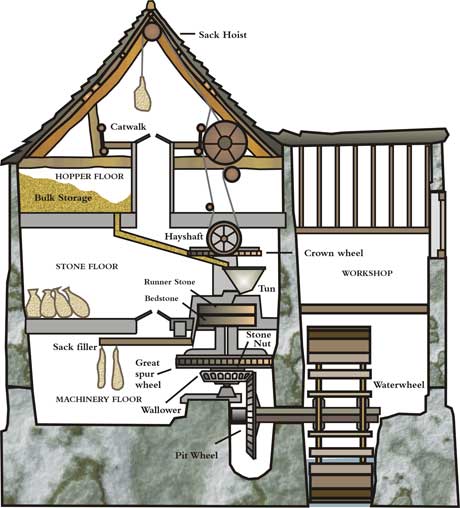
image4agrainmill.jpg

could also, in time, be run by steam power.

image4steammill.jpg

Mills of this sort soon became prototypes for factories built to mass-produce anything
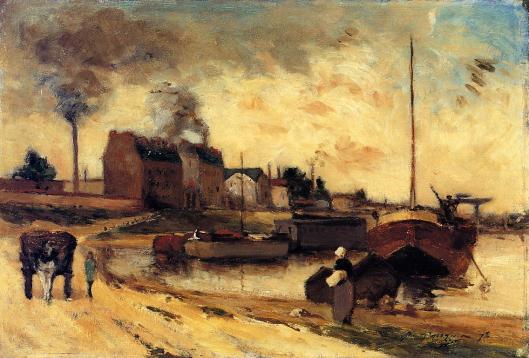
image5factory.jpg

and soon the air around cities was thick with smoke and industrial waste.
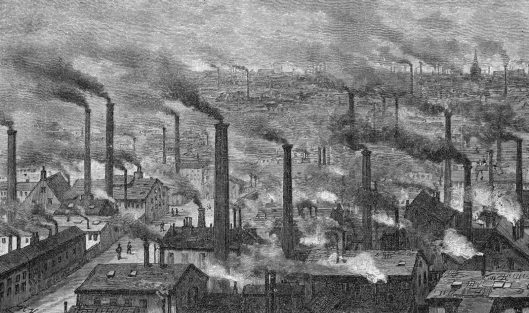
image6pollution.jpg

With no laws to stop them, mill/factory owners bought up land, employed people (many of them ex-cottage workers thrown out of work by the very factories they now sought work in) in near-slave conditions—including children–and polluted water and air with no fear of punishment.  Here is Charles Dickens’ description of a town filled such places, from his 1854 novel, Hard Times:

“It was a town of red brick, or of brick that would have been red if the smoke and ashes had allowed it; but as matters stood, it was a town of unnatural red and black like the painted face of a savage. It was a town of machinery and tall chimneys, out of which interminable serpents of smoke trailed themselves for ever and ever, and never got uncoiled. It had a black canal in it, and a river that ran purple with ill-smelling dye, and vast piles of building full of windows where there was a rattling and a trembling all day long, and where the piston of the steam-engine worked monotonously up and down, like the head of an elephant in a state of melancholy madness. It contained several large streets all very like one another, and many small streets still more like one another, inhabited by people equally like one another, who all went in and out at the same hours, with the same sound upon the same pavements, to do the same work, and to whom every day was the same as yesterday and to-morrow, and every year the counterpart of the last and the next.”

Set this next to Gandalf’s description of what had happened to Isengard and you can see what we mean about goblins (here, Saruman and his orcs—but JRRT sometimes uses goblin and orc interchangeably) as what has destroyed the quiet and green:

“I looked on it and saw that, whereas it had once been green and fair, it was now filled with pits and forges…Over all his works a dark smoke hung and wrapped itself about the sides of Orthanc.”  (The Fellowship of the Ring, Book Two, Chapter 3, “The Council of Elrond”)

image7aisengard.jpg

In 1895, Tolkien’s mother, Mabel,

image7mabel.png

who had been living in South Africa with her husband, brought her two sons, JRRT and Hilary, to the Birmingham area of England for a visit to relatives.
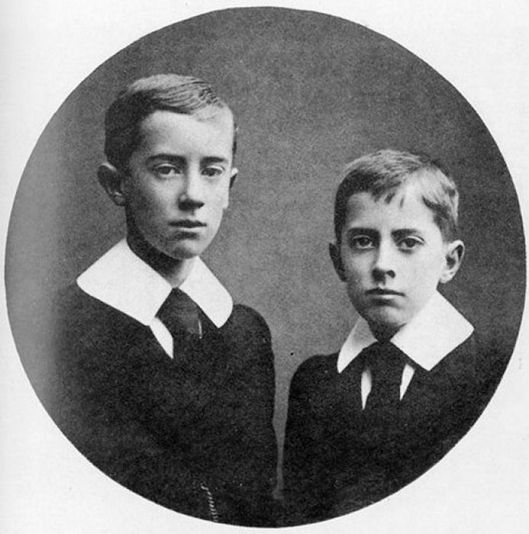
image8.jpg

Unfortunately, while they were gone, Tolkien’s father died of rheumatic fever.  Mabel decided to stay in England and found a place for her sons and herself at Sarehole, southeast of Birmingham itself.

image9housesarehole.jpg

Birmingham was a booming product of that Industrial Revolution, which we’re sure is why Mabel chose a tiny village several miles away.
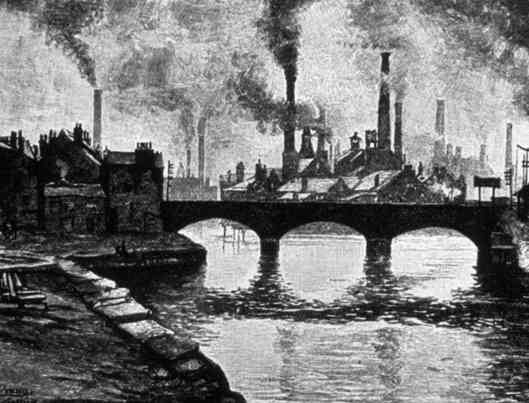
image10brum.jpg

Birmingham was also an ancient settlement, (here’s a LINK to a minitour of the medieval town) but had mushroomed, both in factories and population even at the beginning of the 19th century, as this verse from a music hall song from 1828 by James Dobbs depicts:

‘I remember one John Growse,
Who buckles made in Brummagem,
He built himself a country house,
To be out of the smoke of Brummagem
But though John’s country house stands still,
The town itself has walked up hill,
Now he lives beside a smoky mill,
In the middle of the streets of   Brummagem.”

(James Dobbs (1781-1837), “I Can’t Find Brummagem”.  Brummagem is an old local nickname for Birmingham.  Here’s a LINK so that you can see the whole song and its tune, which we know as “Duncan Grey”.  If you go to the link, you’ll notice we’ve made a few editorial additions, which we knew from another version of the song and which help the words to better fit the tune.)

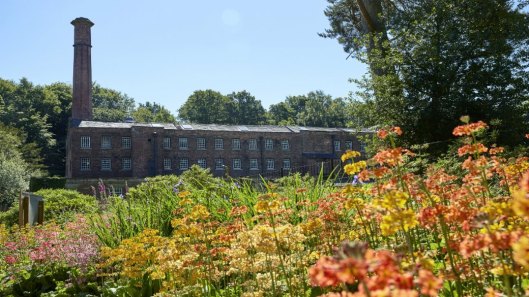
And yet, although Sarehole had an old mill, it was not like those in Birmingham or even in Dickens,

image11mill.jpg

and, in later years, in fact, Tolkien saw the little village beyond it as a kind of paradise, as he said in an interview:

‘It was a kind of lost paradise,’ he said. ‘There was an old mill that really did grind corn with two millers, a great big pond with swans on it, a sandpit, a wonderful dell with flowers, a few old-fashioned village houses and, further away, a stream with another mill. I always knew it would go – and it did.’

(This is taken from an article by John Ezard in The Guardian for 28 December, 1991—here’s a LINK so that you can read all of it.)

This strong contrast between green and quiet and its opposites, as seen in Sarehole versus Birmingham, early in Tolkien’s life, and the two stages of Isengard, will appear again in the Shire as Saruman/Sharkey has planned.  The green and quiet is literally uprooted and even Sandyman’s old mill is a victim of the goblinesque work as Farmer Cotton says:
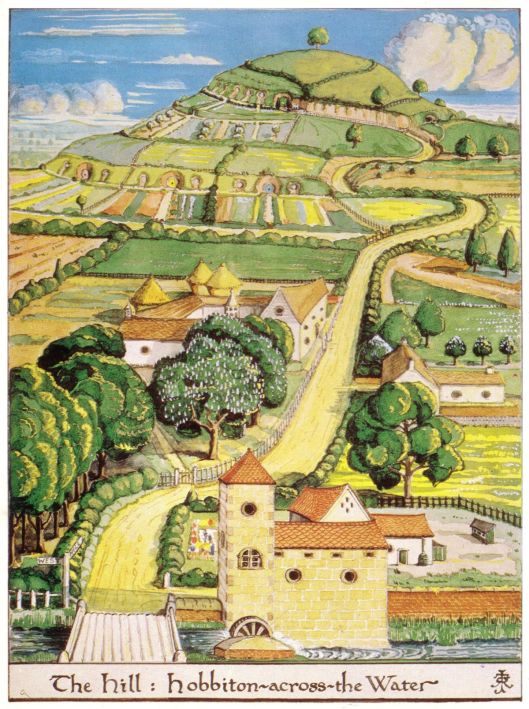
image12mill.jpg

“But since Sharkey came they don’t grind no more corn at all.  They’re always a-hammering and a-letting out a smoke and stench, and there’s no peace even at night in Hobbiton.  And they pour out filth a purpose; they’ve fouled all the lower Water, and it’s getting down into Brandywine.”

(The Return of the King,  Book Six, Chapter 8, “The Scouring of the Shire”)

image14shire.jpg

Those who work for Sharkey are men, but, as you can see, under his influence, they act very much like those destructive goblins with which we began.   For all that he rode in automobiles and trains and used telephones and typewriters, JRRT was never quite happy in the modern world and, considering that the goblins seemed always poised to ruin more green and produce more noise at the command of a modern-day Saruman, it’s perhaps not surprising.  It’s also not surprising, we would add, that his favorite creatures, trees, are the ones who destroy Saruman’s handiwork at Isengard and return it to a leafy park.

image15isen.jpg

Thanks, as ever, for reading.

MTCIDC

CD


ps

In our next, we want to talk about another aspect of quiet which had changed from Tolkien’s childhood and may be a reason why there are Rohirrim and why JRRT himself enlisted in the volunteer cavalry…
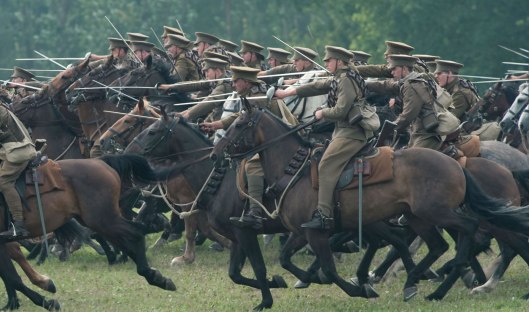

image16yeomanry.jpg

The Return of the King (Ludd)

19 Wednesday Oct 2016

Posted by Ollamh in Economics in Middle-earth, J.R.R. Tolkien, Literary History

≈ Leave a comment

Tags

allegory, anarchy, Boer War, bombing, Cold War, factories, Hitler, Labour Movement, Luddites, Monty Python and the Holy Grail, power-stations, Royal Air Force, Saruman, Second World War, Stalin, The Great War, The Lord of the Rings, The Scouring of the Shire, Theyocracy, Tolkien

Dear Readers, welcome, as always.

JRRT always actively denied that his work was allegorical, that somehow, for example, he meant Sauron to stand for Hitler (and why not Stalin?) and the Ring was the atomic bomb. In a draft of a letter from April, 1959, he wrote:

“I have no didactic purpose, and no allegorical intent. (I do not like allegory properly so called: most readers appear to confuse it with significance or applicability…” (Letters, 297-298)

And yet—

Well, someone born in 1892, who lived through everything from the Boer War (1899-1902) to the Great War (1914-1918) to the Second World War (1939-1945) and into the middle of the Cold War, with all of the proxy wars and wars for independence during the 1940s to 1970s, could not help being somehow at least affected by such large and dreadful events, particularly a man as sensitive and thoughtful as JRRT, and as historically-minded. Like it or not, Tolkien was entangled in contemporary history.

One way that this has struck us recently is rereading Letters and coming across this:

“There is only one bright spot and that is the growing habit of disgruntled men of dynamiting factories and power-stations; I hope that, encouraged now as ‘patriotism’, may remain a habit! But it won’t do any good, if it is not universal.” (JRRT to Christopher, 29 Nov 1943, Letters, 64)

Looking at that date, it is clear that what he is referring to is, in fact, the Allied bombing campaigns against the Reich (and as his son was training in the RAF—Royal Air Force—at the time, perhaps some part of him was also dreading that Christopher might be part of future bombing runs. After all, a general consensus is that the RAF lost over 50,000 killed in its war against Germany. This is, of course, small in contrast to the 60,000 casualties incurred by the British Army on the first day of the Somme, 1 July, 1916, alone, but, with warfare having become much more mobile again in 1939-1945, these were significant losses.)

Here are, in fact, photos of the bombing of a German factory and a power station—the very sort of thing Tolkien is describing.

WAR & CONFLICT BOOK
ERA:  WORLD WAR II/WAR IN THE WEST/GERMANYCopy of RAF Blenheim V6391 After Bombing Goldenburg Power Station, Cologne

(Although, for the sake of our posting, we feel that it’s necessary to show illustrations like these, it’s hard for us to do so. In those smoke clouds are the lives of men, women, and children, with all of the loss and misery which war always brings. Yoda says, “Wars not make one great” and, when we think of the human cost, it’s hard for us to disagree. We only wish that all the violence in history was confined to adventure stories and that, in real life, people got along and there was no need ever for such awful behavior against fellow human beings.)

But why does Tolkien describe current events in such an odd way, in which the pilots of the British and US Air Forces are “disgruntled men” and their bombing raids are depicted as “the growing habit…of dynamiting factories and power-stations”? We would say that it’s because he is, in a way, turning current history around and looking at the past through it metaphorically.

The letter begins:

“My political opinions lean more and more to Anarchy (philosophically understood, meaning abolition of control not whiskered men with bombs…” (Letters, 63)

Anarchy, being about resistance to organized state control, has a very long history, both east and west. What JRRT is alluding to here is, rather, the late-19th, early 20th-century cartoon version of it—

bomb-throwing-cartoon

The real anarchists were deadly (pun intended) serious people, whose goal it was to criticize what they saw as the increasingly-intrusive top-down rule of the state and to suggest (and sometimes fight for) alternatives based upon loose associations of equals. If you know Monty Python’s Holy Grail, you’ll remember the scene in which King Arthur confronts someone who sounds at least like a Marxist, if not a full-fledged anarchist. (King Arthur and the Annoying Peasant from “Monty Python and the Holy Grail”) A central portion of the text includes this:

“WOMAN: I didn’t know we had a king. I thought that we were an autonomous collective.”

DENNIS: You’re fooling yourself. We’re living in a dictatorship…A self-perpetuating autocracy in which the working classes…”

Tolkien goes on to complain of what he believed was the growth and increasing facelessness of government, what he called the “Theyocracy” (63), but it’s clear from the later remark quoted above that what particularly disturbed him was the way in which he believed the state was involved in the ongoing Industrial Revolution, hence the focus upon “dynamiting factories and power-stations”.

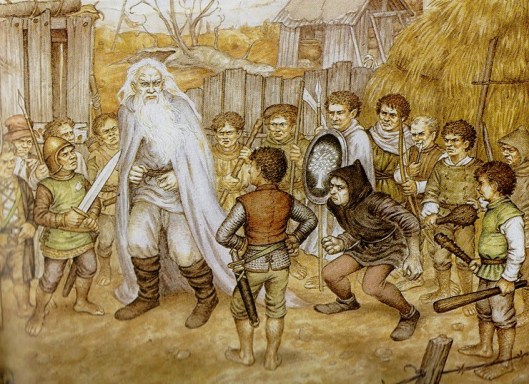
JRRT’s objections to the ruination, as he saw it, of the world of his childhood run through all of his writings, but what we always think of first is its proxy version in “The Scouring of the Shire”, with its Saruman/Sharkey boss and everything from the wanton destruction of trees and the collectivization of the population to the building of what appear to be proto-factories.

scouring_the_shire.ingeredelfeldt

And his reaction reminds us immediately of an earlier reaction to industrialization, not for aesthetic or political reasons, but for economic, that movement in early 19th-century England called “the Luddites”. The name comes from, well, there are a number of explanations, none of them being particularly believable. We know, however, that it was a secret movement of very loosely-organized groups of cloth workers, but not one large body with complex plans to overthrow the system. Perhaps as a mockery of the perception that they were such a large body, they, over time, created a mysterious “General Ludd” or even “King Ludd” to suggest that that body not only existed, but had a sinister leader.

Luddite

The Luddites were made up of various segments of the traditional cloth-making industries who saw their livelihoods—and even their relative freedom—being destroyed by the introduction of large, water-powered mills filled with machinery which could do their jobs not only faster, but, as machines have no need for rest, also at a production level no human could ever match. Even if the workers kept to their trades, then, the mills and their output would simply swamp them.

quarrybanktextile-mill-cotton-1834-granger

This was also the time of the beginning of the Labo(u)r Movement in Britain and the government (not surprisingly, considering where the economic influences upon it might come from) had already begun to try to block it with the Combination Acts of 1799 and 1800, which placed severe penalties on workers attempting to form unions, or “combinations”.

When people tried simply to hold peaceful public meetings, the local authorities felt so threatened that they turned soldiers on the demonstrators, as here in Manchester, in August, 1819. 11 demonstrators were killed and several hundred were injured.

peterloo1

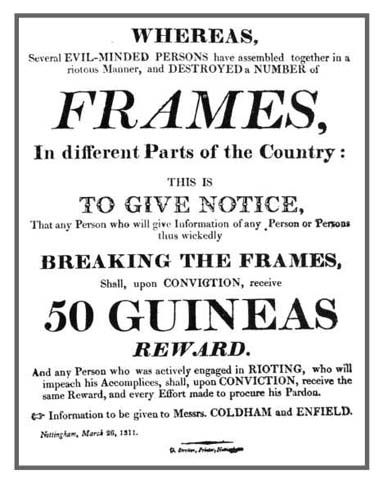
So much for peaceful demonstrations. The Luddites, seeing the attitude of the government, began to attack the mills and warehouses, as these posters show—

Radcliffe Arson Reward Poster, 21st March 1812 copyOates Wood Smithson & Dickinson Carr reward poster, 25th March 1812Cttee to Supress Outrages reward poster copyawsomne

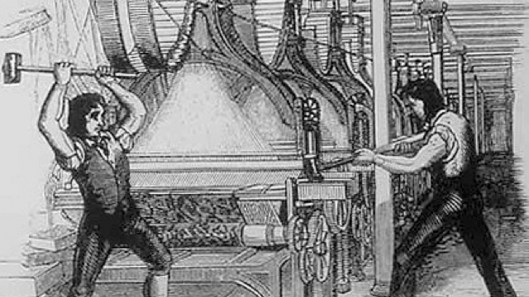
as well as the machines themselves.

luddites1

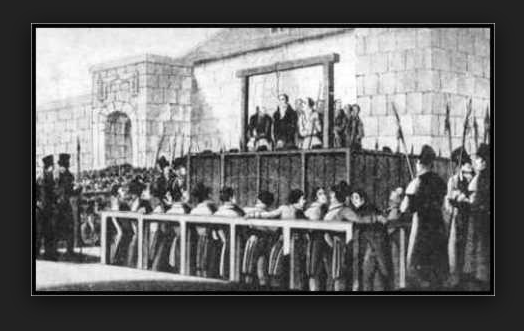
Faced with the government, its laws, and its enforcement—which could even mean executing people, as was done at York in 1813—

executionofludditesatyork1813

the Luddites were a short-lived movement and had disappeared by about 1816.

Their idea about turning back the effects of the Industrial Revolution by violent means—at least in fantasy—however, clearly was still available, at least to JRRT in 1943.

Thanks, as always, for reading.

MTCIDC

CD

The Doubtful Sea Series Facebook Page

The Doubtful Sea Series Facebook Page

  • Ollamh

Categories

  • Artists and Illustrators
  • Economics in Middle-earth
  • Fairy Tales and Myths
  • Films and Music
  • Games
  • Heroes
  • Imaginary History
  • J.R.R. Tolkien
  • Language
  • Literary History
  • Maps
  • Medieval Russia
  • Military History
  • Military History of Middle-earth
  • Narnia
  • Narrative Methods
  • Poetry
  • Research
  • Star Wars
  • Terra Australis
  • The Rohirrim
  • Theatre and Performance
  • Tolkien
  • Uncategorized
  • Villains
  • Writing as Collaborators
Follow doubtfulsea on WordPress.com

Across the Doubtful Sea

Recent Postings

  • Through a glass… January 7, 2026
  • Heffalumps? December 31, 2025
  • We Three Kings December 24, 2025
  • A Moon disfigured December 17, 2025
  • On the Roads Again—Once More December 10, 2025
  • (Not) Crossing Bridges December 3, 2025
  • On the Road(s) Again—Again November 26, 2025
  • On the Road(s) Again November 19, 2025
  • To Bree (Part 2) November 12, 2025

Blog Statistics

  • 104,101 Views

Posting Archive

  • January 2026 (1)
  • December 2025 (5)
  • November 2025 (4)
  • October 2025 (5)
  • September 2025 (4)
  • August 2025 (4)
  • July 2025 (5)
  • June 2025 (4)
  • May 2025 (4)
  • April 2025 (5)
  • March 2025 (4)
  • February 2025 (4)
  • January 2025 (5)
  • December 2024 (4)
  • November 2024 (4)
  • October 2024 (5)
  • September 2024 (4)
  • August 2024 (4)
  • July 2024 (5)
  • June 2024 (4)
  • May 2024 (5)
  • April 2024 (4)
  • March 2024 (4)
  • February 2024 (4)
  • January 2024 (5)
  • December 2023 (4)
  • November 2023 (5)
  • October 2023 (4)
  • September 2023 (4)
  • August 2023 (5)
  • July 2023 (4)
  • June 2023 (4)
  • May 2023 (5)
  • April 2023 (4)
  • March 2023 (5)
  • February 2023 (4)
  • January 2023 (4)
  • December 2022 (4)
  • November 2022 (5)
  • October 2022 (4)
  • September 2022 (4)
  • August 2022 (5)
  • July 2022 (4)
  • June 2022 (5)
  • May 2022 (4)
  • April 2022 (4)
  • March 2022 (5)
  • February 2022 (4)
  • January 2022 (4)
  • December 2021 (5)
  • November 2021 (4)
  • October 2021 (4)
  • September 2021 (5)
  • August 2021 (4)
  • July 2021 (4)
  • June 2021 (5)
  • May 2021 (4)
  • April 2021 (4)
  • March 2021 (5)
  • February 2021 (4)
  • January 2021 (4)
  • December 2020 (5)
  • November 2020 (4)
  • October 2020 (4)
  • September 2020 (5)
  • August 2020 (4)
  • July 2020 (5)
  • June 2020 (4)
  • May 2020 (4)
  • April 2020 (5)
  • March 2020 (4)
  • February 2020 (4)
  • January 2020 (6)
  • December 2019 (4)
  • November 2019 (4)
  • October 2019 (5)
  • September 2019 (4)
  • August 2019 (4)
  • July 2019 (5)
  • June 2019 (4)
  • May 2019 (5)
  • April 2019 (4)
  • March 2019 (4)
  • February 2019 (4)
  • January 2019 (5)
  • December 2018 (4)
  • November 2018 (4)
  • October 2018 (5)
  • September 2018 (4)
  • August 2018 (5)
  • July 2018 (4)
  • June 2018 (4)
  • May 2018 (5)
  • April 2018 (4)
  • March 2018 (4)
  • February 2018 (4)
  • January 2018 (5)
  • December 2017 (4)
  • November 2017 (4)
  • October 2017 (4)
  • September 2017 (4)
  • August 2017 (5)
  • July 2017 (4)
  • June 2017 (4)
  • May 2017 (5)
  • April 2017 (4)
  • March 2017 (5)
  • February 2017 (4)
  • January 2017 (4)
  • December 2016 (4)
  • November 2016 (5)
  • October 2016 (6)
  • September 2016 (5)
  • August 2016 (5)
  • July 2016 (5)
  • June 2016 (5)
  • May 2016 (4)
  • April 2016 (4)
  • March 2016 (5)
  • February 2016 (4)
  • January 2016 (4)
  • December 2015 (5)
  • November 2015 (5)
  • October 2015 (4)
  • September 2015 (5)
  • August 2015 (4)
  • July 2015 (5)
  • June 2015 (5)
  • May 2015 (4)
  • April 2015 (3)
  • March 2015 (4)
  • February 2015 (4)
  • January 2015 (4)
  • December 2014 (5)
  • November 2014 (4)
  • October 2014 (6)
  • September 2014 (1)

Blog at WordPress.com.

  • Subscribe Subscribed
    • doubtfulsea
    • Join 78 other subscribers
    • Already have a WordPress.com account? Log in now.
    • doubtfulsea
    • Subscribe Subscribed
    • Sign up
    • Log in
    • Report this content
    • View site in Reader
    • Manage subscriptions
    • Collapse this bar
 

Loading Comments...