Tags
Alan Lee, Angus McBride, Count Orlok, Denis Gordeev, Description, Frank Frazetta, Hal Foster, Hildebrandts, Illustration, John Howe, Nosferatu, Orcs, Peter Jackson, Prince Valiant, Ted Nasmith, The Lord of the Rings, Tolkien, Villains
As ever, dear readers, welcome.
Two postings ago, we were discussing henchmen and, of course, orcs were among them.
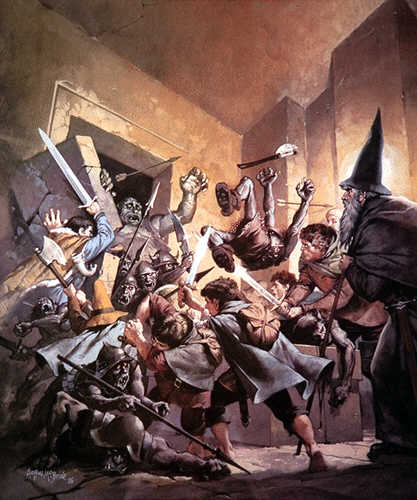
While we were discussing, we began to wonder about orcs. They appear numerous times in The Lord of the Rings, from pursuing the Fellowship in the mines of Moria
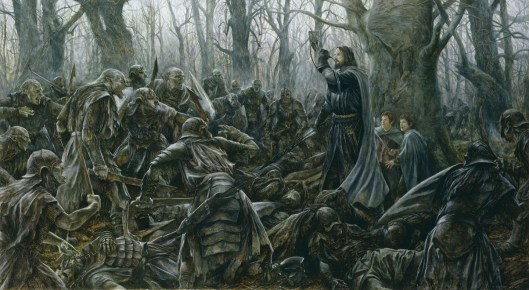
to attacking Boromir and capturing Merry and Pippin
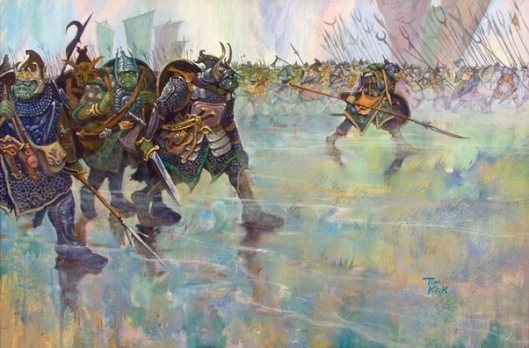
to forming the initial assault team on Minas Tirith.
But what do they really look like?
Here’s the first description we’re given, a second-hand one, spoken by Gandalf:
“There are Orcs, very many of them…And some are large and evil: black Uruks of Mordor.”
(The Fellowship of the Ring, Book Two, Chapter 5, “The Bridge of Khazad-Dum”)
Our first real view of them comes just paragraphs later:
“…a huge orc-chieftain, almost man-high, clad in black mail from head to foot, leaped into the chamber…His broad flat face was swart, his eyes were like coals, and his tongue was red.”
If this orc-chieftain is representative, then, orcs are smaller than men, with dark skin and broad flat faces. But is this a consistent description?
We next meet the orcs as casualties after the death of Boromir:
“There were four goblin-soldiers of greater stature, swart, slant-eyed, with thick legs and large hands.”
(The Two Towers, Book Three, Chapter 1, “The Departure of Boromir”)
As we know from other references to “goblins”, Tolkien came to blur the words “goblin” and “orc”, where the earlier Hobbit has only the former. Thus, that compound “goblin-soldiers” really means “orcs” and we see that word “swart”—“dark/black” (like German schwarz)—again. To which is added “slant-eyed” and the detail “of greater stature” (than the surrounding dead orcs), emphasizing a second time that many, if not most, orcs are apparently normally small creatures.
So far, then, orcs, in general, seem to be dark-skinned and little, with broad, flat faces. And their next appearance may add a little more:
“In the twilight he saw a large black Orc, probably Ugluk, standing facing Grishnakh, a short crook-legged creature, very broad and with long arms that hung almost to the ground. Round them were many smaller goblins. Pippin supposed that these were ones from the North…
Ugluk shouted, and a number of other Orcs of nearly his own size ran up.”
(The Two Towers, Book Three, Chapter 3, “The Uruk-Hai”)
This suggests that there, in fact, at least two subspecies of orcs: smaller ones (possibly from the north) in the service of Sauron, and larger ones, who are the followers of Saruman.
(There are also large orcs in Sauron’s pay, however, as we saw above in Moria.)
And we might add one more detail—at least one has rather menacing teeth:
“He stooped over Pippin, bringing his yellow fangs close to his face.”
With this much information from the text, we turned to illustrations: how close are they to these bits of description? There are many images of orcs on the internet and we ourselves have used a certain number of those images over the years, beginning with this from the Hildebrandts, which we believe must be one of the earliest.
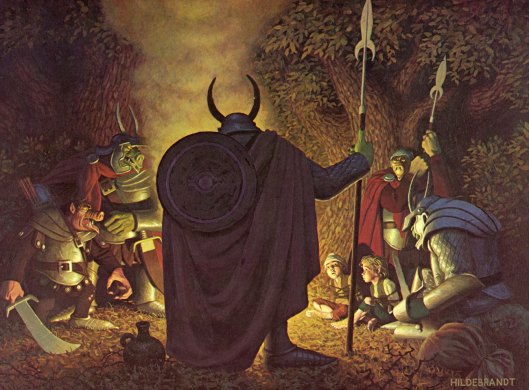
These are mostly very piglike, reminding us both of a wild boar (with a close shave)
 and of a connection which we suggested some time ago with Jabba the Hutt’s Gammorean Guard—

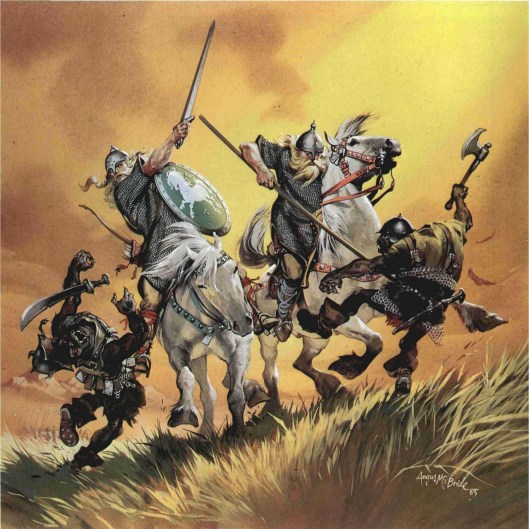
That green skin color, both on the Hildebrandt orcs and the Gammorean Guard, will follow orcs through the work of many artists, like Angus McBride,
and Ted Nasmith–

although not in this image of the wounding of Boromir–

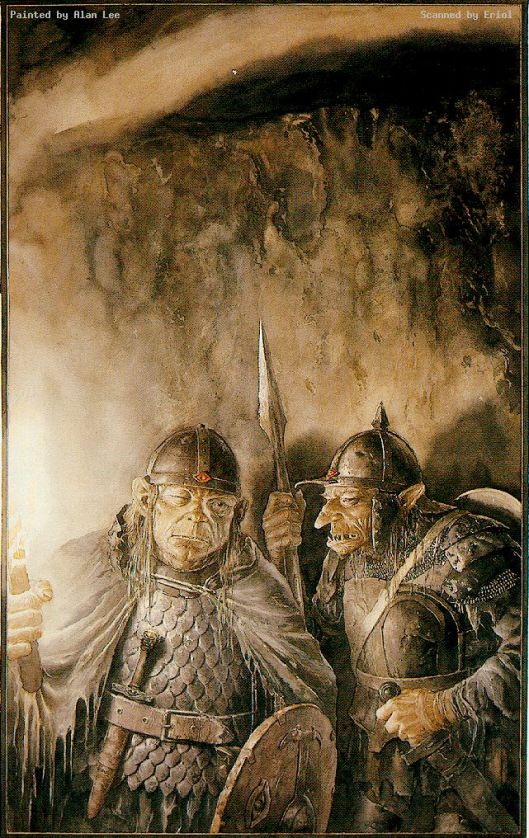
and sometimes in the work of Alan Lee,
as well as that of John Howe.
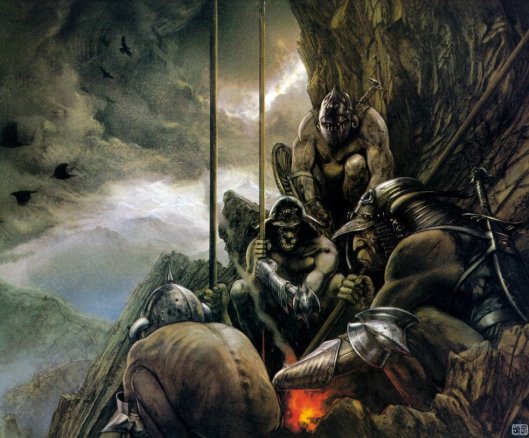
In place of the piggyness, we see a kind of apelike quality in this illustration by Frank Frazetta

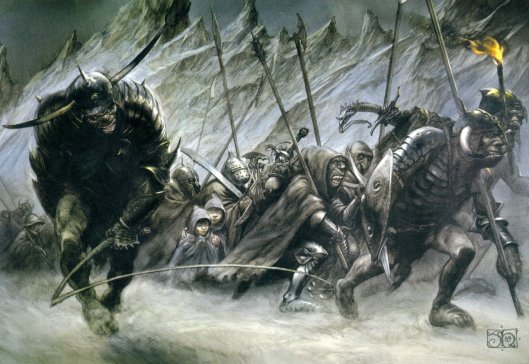
or this, by Alan Lee.
In the Jackson films, the orcs can range from what we think of as rather batlike

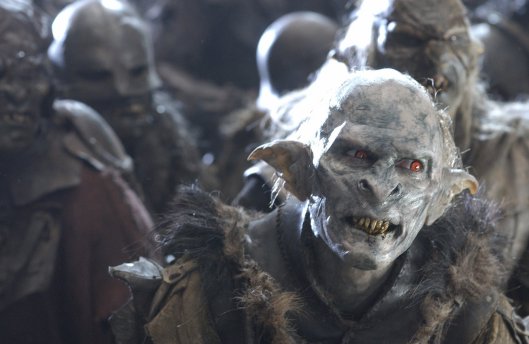
to resembling Count Orlok in Murnau’s 1922 film, Nosferatu,

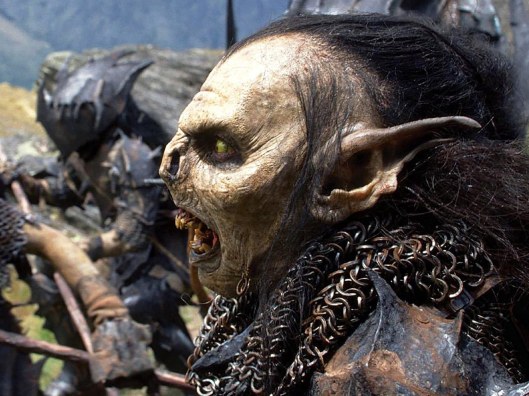
to being grossly human.
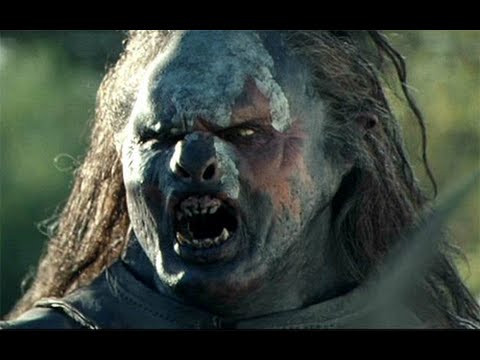
And then there’s an outlier in the illustrations of Denis Gordeev, who seems to have read a different version of The Lord of the Rings, as his orcs, whose faces are in the ape category, but who appear to be as shaggy as bears, though definitely “swart”.


Thus, we mostly see images which don’t really match the descriptions in the books, the short (or almost man-height), black-skinned, flat-faced creatures of The Lord of the Rings, have mostly turned green, come in all sizes, and have faces which range from piglike to batlike.
But does JRRT have any more to say about the look of orcs? In an undated letter from 1958 to Forrest J. Ackerman, he says of them:
“The Orcs are definitely stated to be corruptions of the ‘human’ form seen in Elves and Men. They are (or were) squat, broad, flat-nosed, sallow-skinned with wide mouths and slant eyes: in fact degraded and repulsive versions of the (to Europeans) less lovely Mongol-types.” (Letters, 274)
The skin color has changed from “swart” to “sallow”, often meaning a kind of yellowish tint, rather like this image of Snape from the Harry Potter films.

Much of this description, however, seems to match, at least roughly, the earlier ones—except for the potentially racist tone of “less lovely Mongol-types”. (We should always remember, though, that Tolkien was born in 1892, grew up in a world in which Britain controlled 2/5s of the earth’s land mass in colonies, and where a national poet like Kipling could refer to those colonized as “lesser breeds”. This might at least explain something of his approach to non-Caucasian people, if not excuse it.)
Putting aside that tone for the moment, to try to understand what he had in mind in this description, what we come up with is something like this, from illustrations done for Hal Foster’s Prince Valiant Fights Attila the Hun (1952)—


We admit that this is only a rough guess—Tolkien’s orcs, though supposedly derived from elves and therefore more humanoid than most illustrators make them, are probably smaller and perhaps more caricatured or exaggerated, but, at the same time, these figures suggest, to us, something of the barbaric look we believe that JRRT had in mind.
As we’ve seen, however, Tolkien himself seems to have changed his mind over time, turning his orcs from “swart” to “sallow”, although the general impression of smaller, broad creatures with flat faces remained pretty much the same throughout The Lord of the Rings. So many of his illustrators, however, appear to have had anything from a slightly different to a very different view, making us wish that we could read their letters to find out just where their ideas came from.
Thanks, as always, for reading and
MTCIDC
CD
ps
We do have an idea of where that green skin color came from—perhaps from a misreading of the text, in fact. In “The Bridge of Khazad-Dum”, Gandalf, in the brief initial description of orcs we quoted above, adds “…but there is something else there. A great cave-troll, I think, or more than one.”
Shortly after that, the Fellowship is attacked and:
“A huge arm and shoulder, with a dark skin of greenish scales, was thrust through the widening gap. Then a great, flat, toeless foot was forced through below.”
This appears to be one of those “great cave-troll[s]” and perhaps that “skin of greenish scales” has been accidentally transferred to the orcs?
 doubtfulsea