• About

doubtfulsea

~ adventure fantasy

Tag Archives: Ballads

Underheard

18 Wednesday Dec 2024

Posted by Ollamh in Uncategorized

≈ Leave a comment

Tags

Ballads, deck-us-all-with-boston-charlie, George Washington, god-save-the-king, mondegreen, pogo

As always, dear readers, welcome.

If you read this blog regularly, you probably imagine that, as a small child, I lived in a constant state of puzzlement—and I did.  In part, this came from the fact that, before I could read and write, and sometimes after that, I lived in an oral world, where so much of my life was spent hearing things, rather than seeing them in print—and that could lead to interesting results.

For instance, there’s a patriotic song I was taught, probably in kindergarten, which begins:

“My country, ‘tis of thee,

Sweet land of liberty,

Of thee I sing.” 

From the oddly convoluted grammar, you might suspect that it was written to an already-existing tune—and you’d be right:  it’s set to “God Save the King”.  (You can read about its history here:  https://en.wikipedia.org/wiki/My_Country,_%27Tis_of_Thee  If you think that the use of a tune about a king as the basis for a song for a republic is surprising, just consider:  these words date from 1831, but there’s a 1786 song to the same tune entitled “God Save Great Washington”—only 3 years after the founding of a country which had fought for 8 years to escape the very king the original song had been written for.  

Here’s a verse from that:  

“God save great Washington,
His worth from eve’ry tongue,
Demands applause;
Ye tuneful pow’rs combine,
And each true Whig now join
Whose heart did ne’r resign
The glorious cause.” 

About the same level as “My Country, ‘tis of thee”, I would say.  This is quoted from a usually very useful source:  https://mudcat.org/thread.cfm?threadid=39759  but the work cited there says that the lyric is from The Philadelphia Continental Journal for 7 April, 1786, and, as far as I can determine, there was no such journal in Philadelphia at that time.  Perhaps this is a mistake for the Boston-based Continental Journal and Weekly Advertiser, which ran from 1776 to 1787?  For a list of 18th-century Philadelphia newspapers, see:  https://brainly.infogalactic.com/info/List_of_newspapers_in_Pennsylvania_in_the_18th_century#Philadelphia )

And this is where orality comes in.  Hearing a teacher sing this while we stumbled along behind her, I thought that what she sang was “My country, dizzily…” which, even (or perhaps especially) to a small child, was somewhat enigmatic.   You can imagine, then, what would be the case had I then tried to teach it to another child, or even an adult.

If you’ve ever played the game called “Whisper Down the Lane” or “Telephone”, you’ve seen what happens when someone initially says something which is then passed down a chain of listeners—you can read more about it at WikiHow here:  https://www.wikihow.com/Play-the-Telephone-Game  from which this illustration comes.

As the original message passes from mouth to ear to mouth, words change and it’s sometimes quite surprising when, if you had spoken that initial message, you heard the last person in the chain repeat what she or he heard.

It’s also a very good illustration of the effect of oral tradition on songs.

For example, in Child Ballad #200, (formally, The English and Scottish Popular Ballads, edited by Francis James Child), with a variety of titles including “The Wraggle Taggle Gypsies, O”.  The basic story is that a fine lady is enticed to go off with some Gypsies (a term no longer used, “Romani People” being currently employed, but, in discussing the ballad, I’m going to stick to the older term as that’s what’s in the text) and, in many variants, the idea is that the Gypsies have (literally) enchanted her, the word  used being “glamer/glamour/glamourie/-ye”, a Scots and perhaps even then archaic word for magic/magic spell.  Except for variant G, which, instead of the Gypsies casting their glamour/glamourie over her, has:  “They called their grandmother over.”

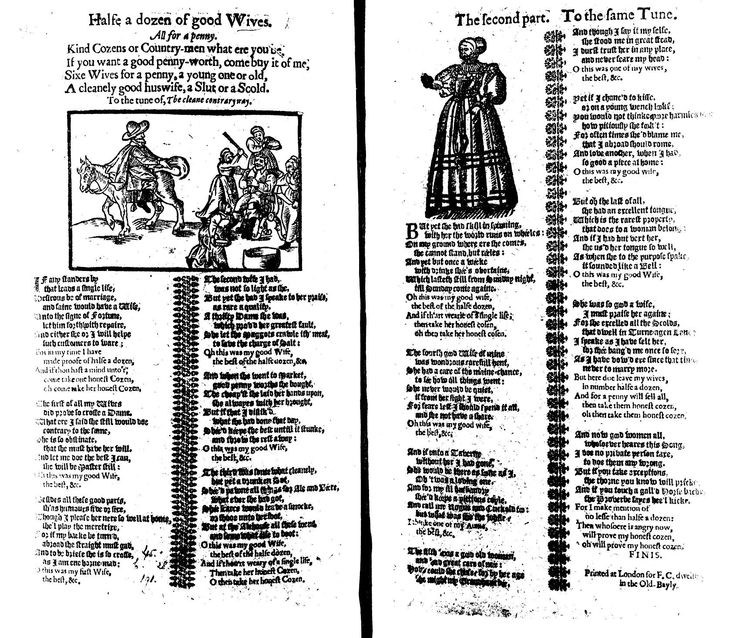
In an introductory note, Child writes that he collected it from the Roxburghe Ballads, a selection first published in 1847 (for more on this and its somewhat dubious history, see:  https://en.wikipedia.org/wiki/Roxburghe_Ballads   and for more on the original collection, see:  https://ebba.english.ucsb.edu/page/roxburghe ), and which is derived from a mass of popular sheet music of the 17th and 18th centuries. 
I suppose one could say that “grandmother” simply shows that the word “glamour/glamourie”, from Scots, was simply misunderstood by whoever was behind variant G, but, remembering “My country dizzily”, I would suggest that it’s just as likely that someone misheard the word—and a new character was added to the ballad.  (For the ballad and its variants in Child’s edition, see:   https://archive.org/details/englishandscopt104chiluoft/page/60/mode/2up )

And this is certainly true for another ballad example, in which another character sprang suddenly into being.  This is from Child #181, “The Bonnie Earl of Moray” in which the narrator sings:

 “Ye Highlands and ye Lawlands,

Oh where have you been?

They have slain the Earl o’ Moray

And layd him on the green.”

and from which came that character—Lady Mon de Green (also written Lady Mondegreen).  And what’s interesting here for me is that this has become a general term for a misheard lyric, a “mondegreen”, but invented not by a linguist, but by a humorist, Sylvia Wright (1917-1981), and published in an article in Harper’s Magazine in 1954.    (See:  “The death of Lady Mondegreen” in November’s issue)  Wright explained that she, as a child, had—you guessed it—misheard that line in “The Bonnie Earl of Moray”—so you can see that childhood (mine, Wright’s) and orality can have the same effect.  (For much more—and I mean much– on the subject, see:  https://en.wikipedia.org/wiki/Mondegreen )

But one more example—fitting for the season and what we might call a mondegreen with intent—in fact an entire song:

“Deck us all with Boston Charlie,
Walla Walla, Wash., an’ Kalamazoo!
Nora’s freezin’ on the trolley,
Swaller dollar cauliflower alley-garoo!

Don’t we know archaic barrel
Lullaby Lilla Boy, Louisville Lou?
Trolley Molly don’t love Harold,
Boola boola Pensacoola hullabaloo!

Bark us all bow-wows of folly,
Polly wolly cracker ‘n’ too-da-loo!
Donkey Bonny brays a carol,
Antelope Cantaloupe, ‘lope with you!

Hunky Dory’s pop is lolly,
Gaggin’ on the wagon, Willy, folly go through!
Chollie’s collie barks at Barrow,
Harum scarum five alarm bung-a-loo!

Dunk us all in bowls of barley,
Hinky dinky dink an’ polly voo!
Chilly Filly’s name is Chollie,
Chollie Filly’s jolly chilly view halloo!

Bark us all bow-wows of folly,
Double-bubble, toyland trouble! Woof, woof, woof!
Tizzy seas on melon collie!
Dibble-dabble, scribble-scrabble! Goof, goof, goof!”

As this is a well-known Christmas carol, I won’t supply either the original, or a translation (and how would you translate “Chollie’s collie barks at Barrow”?  or would you even want to?)  It is the work of the cartoonist/satirist Walt Kelly (1913-1973)

Kelly was the creator of the comic strip “Pogo” and it’s the characters from there who bring us this willfully misheard wonder—

You can listen to it here:  https://www.youtube.com/watch?v=SL0lPcNwRqQ and, with the lyrics above, join in.

As ever, thanks for reading.

Stay well,

Try to mishear something every day—it makes life…surprising,

And remember that, as always, there’s

MTCIDC

O
Bordering (.2: Blackmail, Battle, and Song)

05 Wednesday Apr 2017

Posted by Ollamh in Literary History, Maps, Military History

≈ Leave a comment

Tags

A Gest of Robyn Hode, Angus McBride, Ballads, Border Reivers, Carlisle Castle, Child Ballad, Connacht, Cuchulain, Cuchulain of Muirthemne, England, Ewan McColl, Faroe Islands, Francis James Child, Irish Iron Age, Johnnie of Breadisley, Kinmont Willie Armstrong, Loeg, Marches, Medb, Peggy Seeger, ring dance, Robin Hood, Scotland, Scott of Buccleuch, Sheriff of Nottingham, Sherwood Forest, skiparin, Tain Bo Cualnge, The Cattle Raid of Cooley, The English and Scottish Popular Ballads, The Tale of MacDatho's Pig, Ulster, West March of the Shire

Welcome, dear readers, as ever.

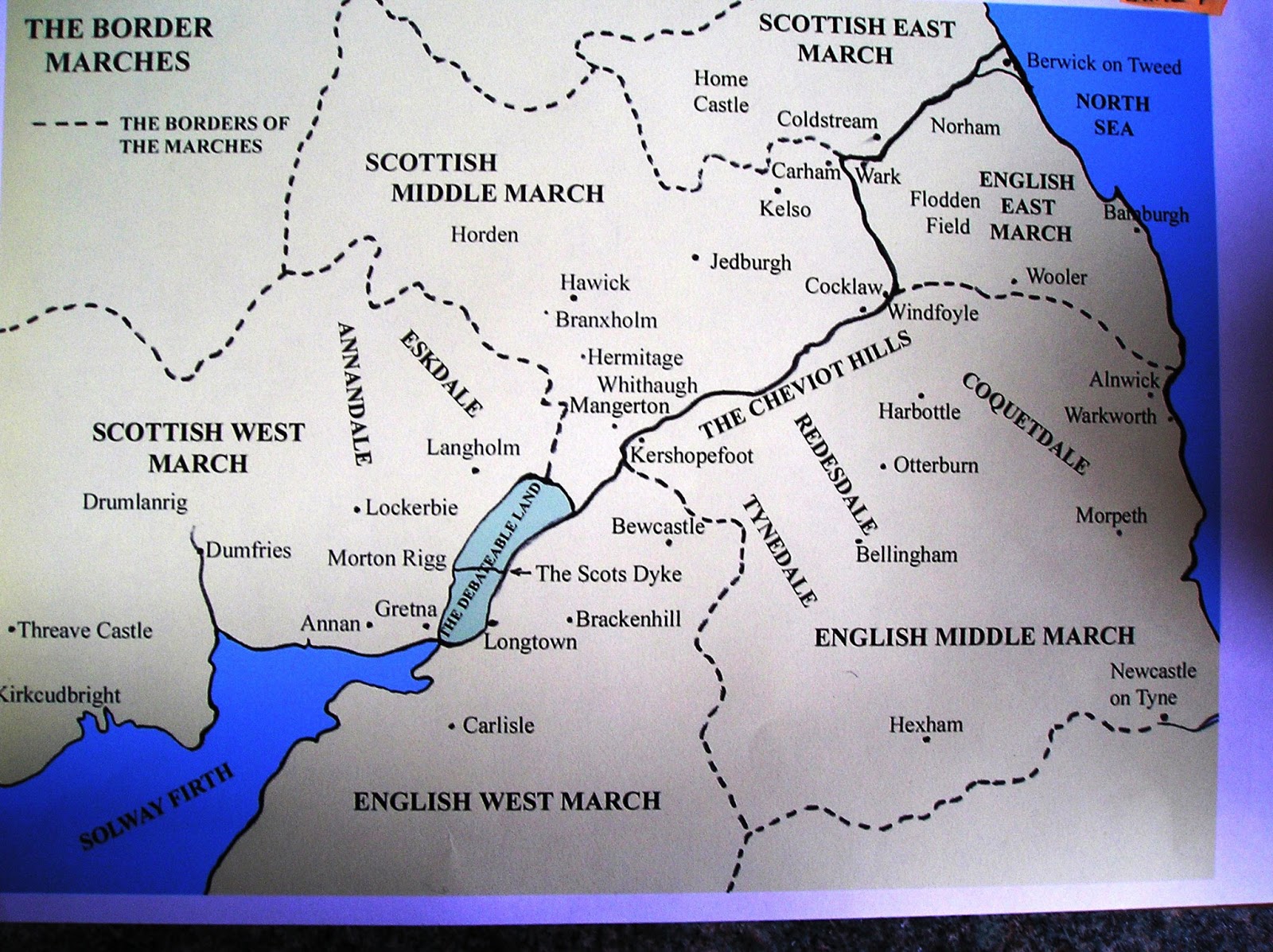
This is a continuation of our last, on borders. In that post, we began with the West March of the Shire, then talked about the idea of marches—militarized border areas—and wardens—overseers of such. Our focus was upon the border between Scotland and England and, in particular, in the very troubled 16th century.

image1bordermap.JPG

The danger, in this world, was from reivers,

image2borderreivers.jpg

a kind of border bandit, but a more complex figure than, for example, Robin Hood.

image3robinhoodwyeth.jpg

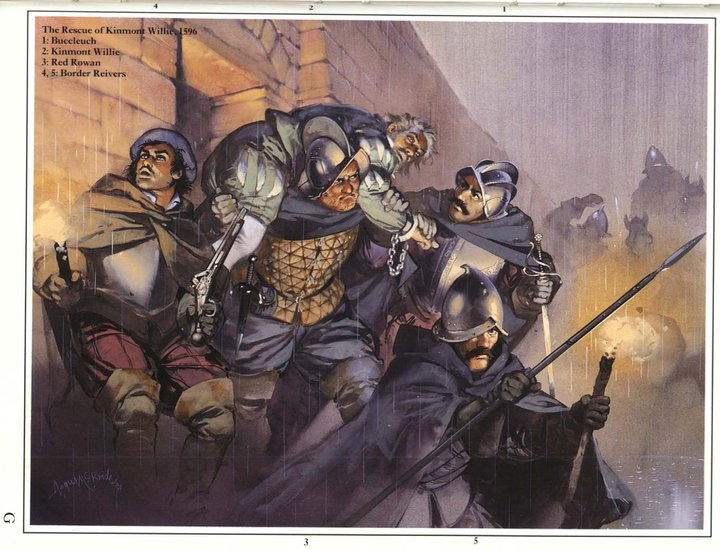
In the Marches of Scotland and England, unlike Robin vs the Sheriff of Nottingham in Sherwood, who the heroes and villains were wasn’t always clear. England and Scotland were often at war throughout the later Middle Ages and into the Renaissance and, when not openly at war, continued to skirmish with each other. War and skirmishing brought financial problems to both sides—raids could ruin a farm or even a village on either side of the border– and there was also a certain level of vendetta—families always being bound to avenge a murdered kinsman—or rescue a living one, as we see here Scott of Buccleuch (said something like “buk-LOO”) rescuing Kinmont Willie Armstrong from imprisonment by the English in Carlisle Castle in 1596. Willie had been taken prisoner illegally during a “truce day” and Scott was the official representing Scotland on that day—so, as we said, the differences between heroes and villains aren’t always so obvious in this twilight world.

image4kinmontw.jpg

One thing reivers have in common with R. Hood, however, is that both are the subject of legends and songs. One of the first collections of those songs is A Gest of Robyn Hode, printed between 1492 and 1534.

image5gest.jpg

A common form of song is the ballad. For those not familiar with the form, a ballad is a narrative poem commonly in couplets (2 rhymed lines—sometimes with a refrain—a line repeated throughout the poem—after each couplet) or in quatrains (4 lines, often rhyming on the 2nd and 4th line).

From the word, which appears to be related to the Romance language ballare/bailar/ballet, “to dance/a dance”, we might imagine that, originally, it was a song to which one danced and there are medieval illustrations of such—

image6carol.jpg

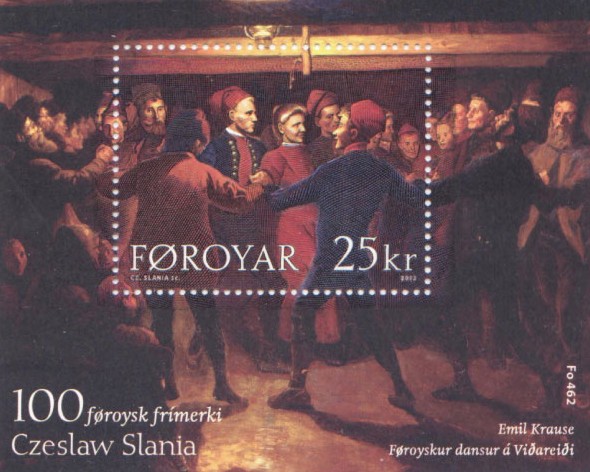
This appears to be a ring dance and, in fact, resembles the ring dance and song of the Faroe Islands, where there is a central figure, a skiparin, (“captain”—just like English “skipper”) who sings a verse and all of the dancers join in on the chorus of kvaedi, or ballads.

imaage7ringdance.jpg

The circle on such a dance/song can expand to the point where it looks more like a snake dance—as this link from a recent performance shows.

An easy example of the quatrain form of ballad might be the opening of “Johnnie of Breadisley” (Child 114):

Johnny rose on a May mornin’,

Called for water to wash his hands,

Saying loose to me my twa grey dogs

Wha’ lie bound in iron chains.

We did this from memory, it being one of the first ballads we memorized years ago. If it’s compared with the standard ballad text—that’s from Francis J. Child’s The English and Scottish Popular Ballads (1882-1898), we’re sure you’ll find that, without even knowing it, we’ve made little changes, turning it into a variant—which always happens when songs are learned by ear. (You can also see that rhyme can be very loose—sometimes only assonance, but it’s clearly less important than telling the story.) Our version came from one sung by the famous Scots folk singer/composer, Ewan McColl, shown here with Peggy Seeger, his equally-famous wife and fellow artist.

image8mccoll.jpg

You can hear his version on YouTube here.

Child

image9child

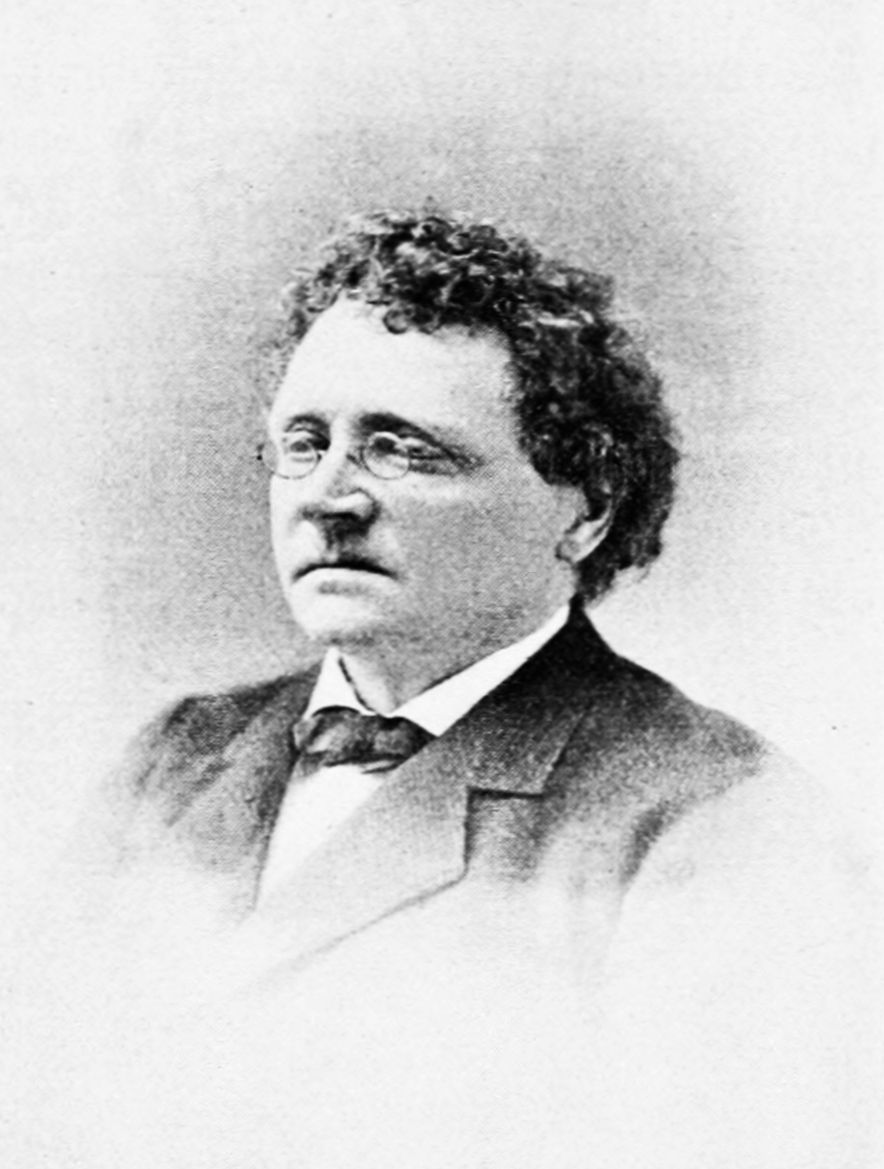
was a professor at Harvard who spent most of his adult scholarly life searching out traditional ballads and a version of his massive collection—305 ballads, with many variants—is available (based upon early editions) at the wonderful Sacred Texts. (If you are interested in adventure/fantasy/mythology and you don’t know this site, spend some time browsing it—you will be impressed.)

The border between Scotland and England wasn’t the only place in the UK which spawned heroic stories, however. During the Irish Iron Age, two of Ireland’s five provinces, Ulster and Connacht, were imagined to be constantly at war and raids across the border formed the basis or background of all kinds of tales, the most elaborate being the Tain Bo Cualnge (Tahn Boh KOO-al-nyeh)—“The Cattle Raid of Cooley”. In this story—a kind of prose epic, with occasional short verse inserts—Medb (Mi-YEDTH), the queen of Connacht, has decided that she must have a famous bull, owned by someone in Ulster. At the time, the warriors of Ulster are under a geis (gesh), a kind of magical prohibition, which keeps them from defending the province, which leaves only one—their best, in fact—the 17-year-old Cuchulain (Koo-HOO-lun), with his charioteer, Loeg (loig) to delay the Connachtmen. Here’s a rather over-the-top illustration by one of our favorite military artists, Angus McBride, of the pair rocketing towards the enemy.

image10cc.jpg

If you would like to read a translation of the Tain, here’s a link to a really useful website, which juxtaposes the Old Irish and English (and includes, as a bonus, another great story—and the first one we read in Old Irish—the Tale of MacDatho’s Pig). If you would like to read more Old Irish Stories about Ulster and Connacht, there is Lady Gregory’s Cuchulain of Muirthemne (1902). It’s available at Sacred Texts. (And a note here: Old Irish literature has a very plain-spoken way of talking about body functions, among other things, and early translators, like Lady Gregory, quietly removed or softened such things. On the whole, however, the basic stories are there—and they’re free!)

Among those stories, we find a very different idea about otherworlds—not the fairly-strict western classical one that there is a clearly-marked border between this world and the next, but something looser and therefore spookier and we want to talk about this in our next (and mention a favorite YA author and his treatment of the subject, as well).

Thanks, as always, for reading.

MTCIDC

CD

Lamentable

23 Wednesday Mar 2016

Posted by Ollamh in Fairy Tales and Myths, Heroes, J.R.R. Tolkien, Literary History, Narrative Methods, Poetry

≈ Leave a comment

Tags

Adventure, Ballads, Boromir, Child Ballad, Doune Castle, Earl of Huntly, Eglinton Tournament, Ewan MacColl, Francis James Child, James Stewart, Lallands, Lament for Boromir, Laments, Monty Python and the Holy Grail, Outlander, Scots, The Earl of Morray, The Lady of Mondegreen, The Lord of the Rings, Tolkien

Dear readers, welcome, as always.


“Ye Hielands and ye Lowlands,

O, whaur hae ye been?

They hae slain the Earl o’ Moray,

And laid him on the green.”


So begins a version of Child Ballad #181. As we are lucky enough to have readers from around the world (and thank you, every one of you, for visiting!), we might explain that a Child Ballad is not a nursery rhyme, but a distinctive type of traditional song from the massive collection of 305 such songs made by Francis James Child, a professor at Harvard, and published in five volumes between 1882 and 1898 under the title The English and Scottish Popular Ballads.

Francis_J._Child.jpg

Ballads are verse narratives, sometimes based upon folk tales, sometimes based upon actual historical events. This particular ballad is historically-based and concerns a murder in 16th-century Scotland. For our purposes, its actual historicity doesn’t matter, however, because what we’re really interested in is the fact that this is a lament for the murdered man, James Stewart, the Earl of Moray (pronounced “Murray”). We also have this posthumous painting, commissioned by his mother, to draw attention to the crime, but it doesn’t appear to have made much difference.

BonnieEarlofMoray.jpg

There are a number of different versions of this ballad, but the one which we heard first and with which we are most familiar (and from which we originally learned a tune—there’s more than one) was recorded by the famous Scots folksinger, Ewan MacColl, and is still available on the Smithsonian/Folkways CD FW03509/FG3509, “The English and Scottish Popular Ballads, Vol.1”.

Ewan-MacColl-by-Chris-Taylor.jpg

As we said, it’s a lament—just like that for Boromir in the chapter entitled “The Departure of Boromir”–and that’s really where we began to think about laments, especially a lament for a prominent person. And, as ever, we looked for a useful parallel between our world and that of Middle Earth. In this case, the murdered man in the ballad was an earl—a high-level nobleman—but he was also the son of the Regent (the temporary ruler) of Scotland and so we might see him as on about the same social level as Boromir the son of the Steward of Gondor.


Here’s how the lament for Boromir begins.

“Through Rohan over fen and field where the long grass grows

The West Wind comes walking, and about the walls it goes.

‘What news from the West, O wandering wind, do you bring to me tonight?

Have you seen Boromir the Tall by moon or by starlight?’ ”

You can see a similarity between this and the ballad already. The ballad begins by addressing all of Scotland. The lament begins by addressing the West Wind. Both appeal to something more than a listener, or even a group of listeners, as if speaking to simple mourners wouldn’t be enough: bigger forces must be involved. In the case of the ballad, the speaker (unknown—but clearly well aware of the facts) asks where the country has been. In the lament, Aragorn (as he is the initial mourner) has a more specific addressee and a more specific question: West Wind, have you seen Boromir?

The ballad then goes right to the point:

“They hae slain the Earl of Moray

And laid him on the green.”

[A footnote here. That last line became famous because of an essay by Sylvia Wright in the November, 1954 issue of the American publication, Harper’s Magazine entitled “The Death of Lady Mondegreen”. In the essay, Wright explains that, as a child, she misheard “and laid him on the green” as “Lady Mondegreen” and imagined that Stewart had been murdered along with a female companion. The word “mondegreen” has become a technical term in language studies for a misheard word which produces a new meaning.]

The next part of Aragorn’s lament is unspecific: Boromir is simply missing.

“ ‘I saw him ride over seven streams, over waters wide and grey;

I saw him walk in empty lands, until he passed away

Into the shadows of the North. I saw him then no more.

The North Wind may have heard the horn of the son of Denethor.’

‘O Boromir! From the high walls westward I looked afar,

But you came not from the empty lands where no men are.’”

The ballad then tells us something about the quality of the dead man.

“He was a braw gallant,

And he rade at the ring,

And the bonny Earl o’ Moray,

He might have been a king.”

This might need a little translation. The ballad is written in Lallans, the English—and we might really say the wonderfully rich English—originally of southern Scotland (Lallans= “Lowlands”). In general, the grammar and syntax are recognizably English, but the expressions and vocabulary are sometimes different—and sometimes very different!

So, here (so far):

Braw = “fine/splendid”

Gallant = “young man” (can also be spelled “callant”)

But the next expression is actually from medieval jousting. This was a game in which a knight would be required to ride at a ring, suspended in mid-air, and spear it on the end of his lance. Here’s an illustration from the 1839 Victorian tournament revival at Eglinton, in Scotland.

Eglinton_tournament_view.jpg

Although we might normally imagine that tournaments died out with the Middle Ages,

medievaltournament.jpg

Elizabethans and their successors, the Jacobeans, still jousted, as a kind of expensive archaic sport. Here’s Nicholas Hilliard’s c1590 portrait of George Clifford, 3rd Earl of Cumberland, dressed for a tournament as the Queen’s Champion.

Nicholas_Hilliard_003.jpg

So, we know that the speaker believes that James Stewart was a fine young man, and able at tournaments. We also know that Stewart was able enough—as far as the speaker is concerned—to be a king. As his father had been the Regent for the infant James VI, perhaps this is a quiet suggestion that James junior might have done better on the throne than James.

James_VI_of_Scotland_aged_20,_1586..jpg

In contrast, all we know at the moment about Boromir was that he was tall and that his father’s name was Denethor, with the suggestion that he was on an errand or quest in some deserted land.

But then we find out more about James Stewart.

“O lang will his lady

Lok frae the Castle Doune

Ere she see the Earl o’ Moray

Come soundin’ through the toun.”

He had a wife or mistress and we see something about where he lived: in a castle. If you just heard this ballad, rather than reading it, and you came to the next word, “Doune”, you might be confused, since you can hear “doune”, meaning “down” in Lallans. This gives you a picture of a lady standing on the castle wall, waiting for Stewart to return, which is fine, but Doune is also the name of a castle owned by James Stewart.

Castle_Doune.jpg

If you’ve seen Monty Python and the Holy Grail, you will recognize this place.

monty_python.jpg

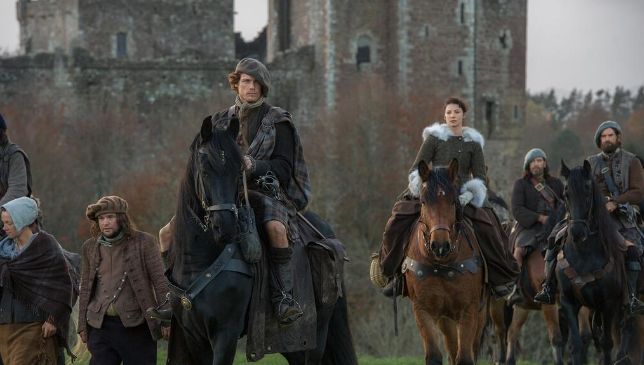
Or, if you watch Outlander.

Outlander1.jpg

As for the last line, we imagine that the Earl has a trumpeter ride in front of him, to clear the way.

mountedtrumpeter.jpg

Will we learn more about Boromir from the second stanza, which Legolas sings?

“From the mouths of the Sea the South Wind flies, from the sandhills and the stones;

The wailing of the gulls it bears, and at the gate it moans.

‘What news from the South, O sighing wind, do you bring to me at eve?

Where now is Boromir the Fair? He tarries and I grieve.’ “

With the idea that the speaker is appealing to nature for answers, we see Legolas address a second wind, but, so far, all we have added to our store of knowledge is that Boromir was good-looking (“the Fair”—and, in English, this can also mean “light-skinned/light-haired”)—and the anxiety at his absence continues.

In the ballad, we move farther into the crime, the actual murderer being spoken to.

“Now wae be to ye, Huntly,

And wherefore did ye sae?

I bade ye bring him wi’ ye,

And forbade ye him to slay.”

A little glossing first.

Wae be to ye= “may you be sad/sorrowful” (wae is Lallans for “woe”)

Bade= “ordered”

Forbade= “forbid/prohibited” (and should be pronounced “for-BAHD”)

Here we are presented—a bit obliquely—with the identity of the speaker of the ballad. He is one who gives order to lords—hence, he’s the king, meaning, historically, James VI of Scotland (soon—1603—to be James I of England, as well).

James_VI_of_Scotland_aged_20,_1586..jpg

If we only go by the verse, he has ordered “Huntly” (historically, the Earl of Huntly, ordered by James VI to arrest Stewart) to bring the Earl of Moray to the king’s court. In real life, he murdered Stewart when Stewart tried to escape, and here we see that, literarily, the same thing is suggested.

At this point, we have three characters: king, Huntly, Moray, and a murder, supposedly against the king’s orders. What more does Legolas’ lament have to tell us?

“ ‘Ask not of me where he doth dwell—so many bones there lie

On the white shores and the dark shores under the stormy sky;

So many have passed down Anduin to find the flowing Sea.

Ask of the North Wind news of them the North Wind sends to me!’

‘O Boromir! Beyond the gate the seaward road runs south,

But you came not with the wailing gulls from the grey sea’s mouth.’ ”

Nothing is said directly here, but that first line’s mention of “so many bones” might be seen to reveal what has happened to Boromir. The South Wind tells the speaker to ask the North Wind, but will that make a difference?

[Another footnote, this one about verse structure. Did JRRT have W.B. Yeats’ early (1888) “The Lake Isle of Innisfree” in the back of his mind with that last line?

William_Butler_Yeats_1890.jpg

innisfree.jpg

Here’s the last stanza of Yeats’ poem:

“I will arise and go now, for always night and day

I hear lake water lapping with low sounds by the shore;

While I stand on the roadway, or on the pavements grey,

I hear it in the deep heart’s core.”

In this poem, Yeats weights the end of each stanza both by using a shorter line and by ending with a series of one-syllable words, which slow things to a stop: deep…heart’s…core. JRRT does the same thing with one-syllable words here:   grey…sea’s…mouth.]

The next part of the ballad stanza repeats, in a variation, the earlier motif: what a wonderful person the murdered earl was.

“He was a braw gallant,

And he played at the glove;

And the bonny Earl of Murray,

He was the Queen’s true love.”

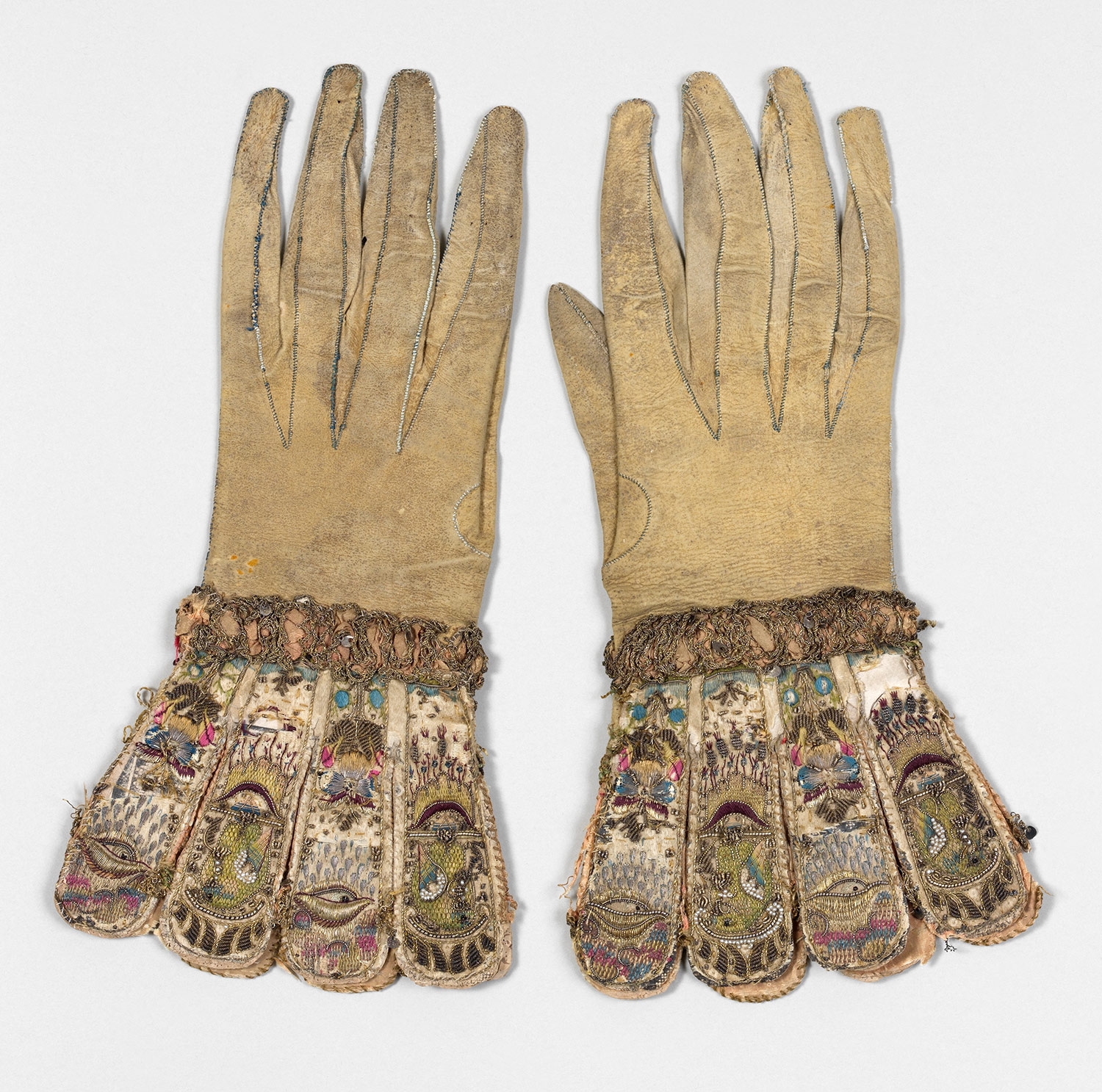
A final piece of glossing. Elizabethans used gloves as a love-present,

elizabethanglovesc1600.jpg

suggesting that the last two lines have more than a rhetorical meaning. Historically, James VI’s queen was Anne of Denmark—

1610ca-anne-of-denmark-by-2.jpeg

was this the real reason why the historical James didn’t seem to be interested in punishing Huntly?

We then have a repetition of the earlier lines:

“O lang will his lady

Lok frae the Castle Doune

Ere she see the Earl o’ Moray

Come soundin’ through the toun.”

And, with these, the ballad ends, our last image being that of the lady on the castle wall, looking for someone who will never return. This same image, in the form of an inanimate object, waits for Boromir.

“From the Gate of Kings the North Wind rides, and past the roaring falls;

And clear and cold about the tower its loud horn calls.

‘What news from the North, O mighty wind, do you bring to me today?

What news of Boromir the Bold? For he is long away.’

‘Beneath Amon Hen I heard his cry. There many foes he fought,

His cloven shield, his broken sword, they to the water brought.

His head so proud, his face so fair, his limbs they laid to rest;

And Rauros, golden Rauros, bore him upon its breast.’

‘O Boromir! The Tower of Guard shall ever northward gaze

To Rauros, golden Rauros-falls, until the end of days.’ “

boromir_funerals.jpg

Putting the various elements together, we might see this kind of lament as going something like this:

  1. a speaker appeals to a mass audience of some sort (Scotland/Winds)
  2. that speaker reveals that something is wrong (Stewart is dead/Boromir is missing)
  3. he/she can then describe what that is in some way (Stewart was murdered/Boromir has died fighting)
  4. speaker may describe the fine qualities of the person lamented (Stewart as jouster, lover, kingly/Boromir as tall, fair, died fighting)
  5. those who lament cannot be consoled—or perhaps refuse to be (lady on wall of Doune/Tower of Guard=Minas Tirith)

Using this suggested model, can you think of other laments, both in Tolkien or otherwhere which match it?

Thanks, as always, for reading.

MTCIDC

CD

The Doubtful Sea Series Facebook Page

The Doubtful Sea Series Facebook Page

  • Ollamh

Categories

  • Artists and Illustrators
  • Economics in Middle-earth
  • Fairy Tales and Myths
  • Films and Music
  • Games
  • Heroes
  • Imaginary History
  • J.R.R. Tolkien
  • Language
  • Literary History
  • Maps
  • Medieval Russia
  • Military History
  • Military History of Middle-earth
  • Narnia
  • Narrative Methods
  • Poetry
  • Research
  • Star Wars
  • Terra Australis
  • The Rohirrim
  • Theatre and Performance
  • Tolkien
  • Uncategorized
  • Villains
  • Writing as Collaborators
Follow doubtfulsea on WordPress.com

Across the Doubtful Sea

Recent Postings

  • Towering January 28, 2026
  • Tolkien Among the Indians January 21, 2026
  • Thin and Stretched January 14, 2026
  • Through a glass… January 7, 2026
  • Heffalumps? December 31, 2025
  • We Three Kings December 24, 2025
  • A Moon disfigured December 17, 2025
  • On the Roads Again—Once More December 10, 2025
  • (Not) Crossing Bridges December 3, 2025

Blog Statistics

  • 105,537 Views

Posting Archive

  • January 2026 (4)
  • December 2025 (5)
  • November 2025 (4)
  • October 2025 (5)
  • September 2025 (4)
  • August 2025 (4)
  • July 2025 (5)
  • June 2025 (4)
  • May 2025 (4)
  • April 2025 (5)
  • March 2025 (4)
  • February 2025 (4)
  • January 2025 (5)
  • December 2024 (4)
  • November 2024 (4)
  • October 2024 (5)
  • September 2024 (4)
  • August 2024 (4)
  • July 2024 (5)
  • June 2024 (4)
  • May 2024 (5)
  • April 2024 (4)
  • March 2024 (4)
  • February 2024 (4)
  • January 2024 (5)
  • December 2023 (4)
  • November 2023 (5)
  • October 2023 (4)
  • September 2023 (4)
  • August 2023 (5)
  • July 2023 (4)
  • June 2023 (4)
  • May 2023 (5)
  • April 2023 (4)
  • March 2023 (5)
  • February 2023 (4)
  • January 2023 (4)
  • December 2022 (4)
  • November 2022 (5)
  • October 2022 (4)
  • September 2022 (4)
  • August 2022 (5)
  • July 2022 (4)
  • June 2022 (5)
  • May 2022 (4)
  • April 2022 (4)
  • March 2022 (5)
  • February 2022 (4)
  • January 2022 (4)
  • December 2021 (5)
  • November 2021 (4)
  • October 2021 (4)
  • September 2021 (5)
  • August 2021 (4)
  • July 2021 (4)
  • June 2021 (5)
  • May 2021 (4)
  • April 2021 (4)
  • March 2021 (5)
  • February 2021 (4)
  • January 2021 (4)
  • December 2020 (5)
  • November 2020 (4)
  • October 2020 (4)
  • September 2020 (5)
  • August 2020 (4)
  • July 2020 (5)
  • June 2020 (4)
  • May 2020 (4)
  • April 2020 (5)
  • March 2020 (4)
  • February 2020 (4)
  • January 2020 (6)
  • December 2019 (4)
  • November 2019 (4)
  • October 2019 (5)
  • September 2019 (4)
  • August 2019 (4)
  • July 2019 (5)
  • June 2019 (4)
  • May 2019 (5)
  • April 2019 (4)
  • March 2019 (4)
  • February 2019 (4)
  • January 2019 (5)
  • December 2018 (4)
  • November 2018 (4)
  • October 2018 (5)
  • September 2018 (4)
  • August 2018 (5)
  • July 2018 (4)
  • June 2018 (4)
  • May 2018 (5)
  • April 2018 (4)
  • March 2018 (4)
  • February 2018 (4)
  • January 2018 (5)
  • December 2017 (4)
  • November 2017 (4)
  • October 2017 (4)
  • September 2017 (4)
  • August 2017 (5)
  • July 2017 (4)
  • June 2017 (4)
  • May 2017 (5)
  • April 2017 (4)
  • March 2017 (5)
  • February 2017 (4)
  • January 2017 (4)
  • December 2016 (4)
  • November 2016 (5)
  • October 2016 (6)
  • September 2016 (5)
  • August 2016 (5)
  • July 2016 (5)
  • June 2016 (5)
  • May 2016 (4)
  • April 2016 (4)
  • March 2016 (5)
  • February 2016 (4)
  • January 2016 (4)
  • December 2015 (5)
  • November 2015 (5)
  • October 2015 (4)
  • September 2015 (5)
  • August 2015 (4)
  • July 2015 (5)
  • June 2015 (5)
  • May 2015 (4)
  • April 2015 (3)
  • March 2015 (4)
  • February 2015 (4)
  • January 2015 (4)
  • December 2014 (5)
  • November 2014 (4)
  • October 2014 (6)
  • September 2014 (1)

Blog at WordPress.com.

  • Subscribe Subscribed
    • doubtfulsea
    • Join 78 other subscribers
    • Already have a WordPress.com account? Log in now.
    • doubtfulsea
    • Subscribe Subscribed
    • Sign up
    • Log in
    • Report this content
    • View site in Reader
    • Manage subscriptions
    • Collapse this bar
 

Loading Comments...