• About

doubtfulsea

~ adventure fantasy

Tag Archives: Antagonists

Personae

15 Friday May 2015

Posted by Ollamh in Artists and Illustrators, Fairy Tales and Myths, J.R.R. Tolkien, Narrative Methods, Villains

≈ Leave a comment

Tags

Alan Lee, Antagonists, Bosch, Bruegel, Christina Rossetti, Corsairs, Easterlings, Gorbag, Gruenewald, Haradrim, Minions, Nazgul, Orc, Sauron, Shagrat, The Wind, Tolkien

A man is known by the company he keeps.

                                                           Old Proverb

Who Has Seen the Wind?

Who has seen the wind?

Neither I nor you:

But when the leaves hang trembling,

The wind is passing through.


Who has seen the wind?

Neither you nor I:

But when the trees bow down their heads,

The wind is passing by.

                                             Christina Rossetti from Sing-Song: A Nursery Rhyme Book (1872)

wind


Dear Readers,

Welcome, as always!

     In our last posting, we talked about villains visible and invisible and suggested that, in the case of Sauron, rather than showing him as a searchlight eye,
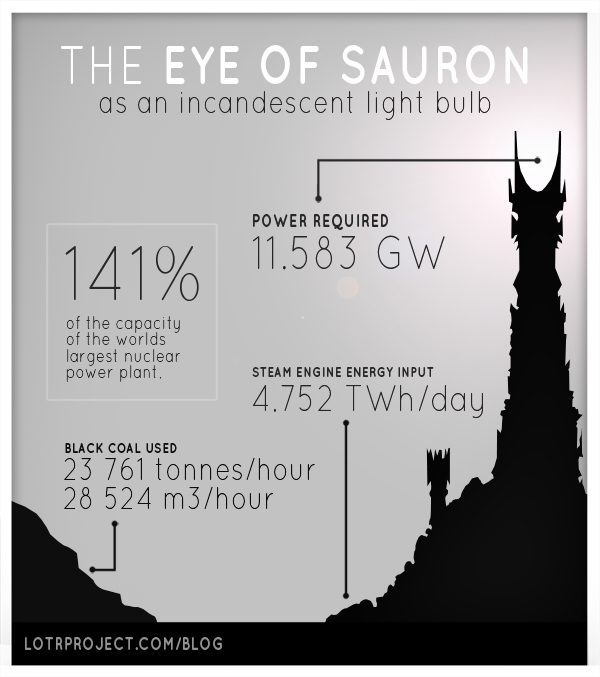
sauronbulb2png

(This is from the LOTR Project— a great site, much recommended). 

there were other and more potentially convincing ways to depict such a menacing figure.

One was seeing his reflection in his minions.

minions_2015-wide

(Can you wait for this?)

Imagine that seeing him this way is like seeing the effect a strong wind has on trees.

Palm Tree Nassau Winslow Homer

     Sauron’s minions fall into three main categories: the Nazgul, various humans, most from what appear to be the less-civilized peoples of the south—Corsairs of Umbar, Easterlings, and the Haradrim.

     The Nazgul

eowyn_nazgul

are the most daunting, but we’re told only a limited amount about them, we see them very selectively, and their speech is recorded mainly as threats. We see the humans even less and we really don’t hear them at all. It’s the Orcs of whom we’re shown the most.

     Sauron is described as once being “comely”, but his present condition (except perhaps for his eyes—make that eye) is hard to determine. Tolkien could never quite settle on the origin of the Orcs, but, they are definitely less than attractive.

     Illustrators of Orcs tend, we think, to be strongly influenced by early-Renaissance northern German painters, like Bosch, who depicted devils and demons as hybrids between humans and birds and animals.

Bosch_LJ_Vienna_Music bosch-devil Bosch,_Hieronymus_-_The_Garden_of_Earthly_Delights,_right_panel_-_man_riding_on_dotted_fish_and_bird_creature grunewald_400x478 the-devil-throughout-history-photos-3-horned_pig_devil

     This does not, however, seem to be in line with Tolkien’s thinking. If as Fangorn says, they were created as a mockery of elves, one would presume that they would be much more human in look, but perhaps with exaggerated features, and this seems to be closer to what Tolkien had in mind, although physical description tends to be less detailed.

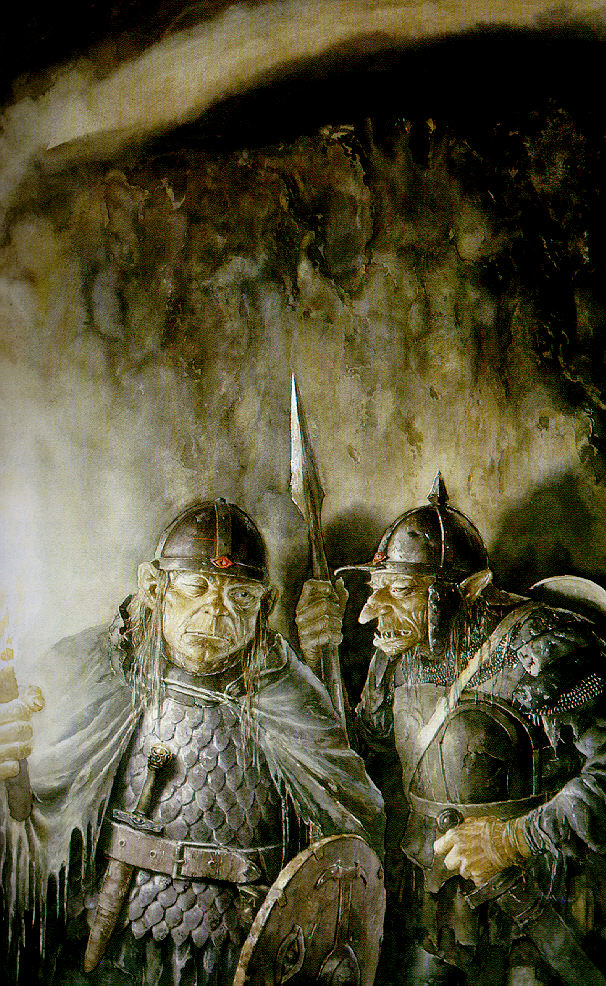
     Here’s an Alan Lee which we think is more like what Tolkien imagined.

Unknown%20-%20Bilbo%20le%20Hobbit%20(01)%20-%20Les%20orcs

     If they are northern Orcs—those whom Sauron employs—they tend to be smaller and paler. If Uruk-hai, primarily used by Saruman, larger and black. (Although a tracker for Sauron is described as small and black.) Here’s the contrast of the two types in the confrontation between Ugluk and Grishnakh:

“…a large black Orc, probably Ugluk, standing facing Grishnakh, a short crook-legged creature very broad and with long arms that hung almost to the ground.”

     As Orcs may be a mockery of Elves, their speech sounds like it’s derived from the conversations Tolkien heard among his nco’s in the trenches—foul-mouthed (in a modified form), cheerfully abusive, and full of casual threats.

     It’s also instructive to note that there appear to be no Orcs in command positions beyond captain—the rank of Ugluk and Grishnakh, Gorbag and Shagrat. Beyond are the Nazgul, whom the Orcs both dread and envy. (“Those Nazgul give me the creeps…But He likes ‘em; they’re His favorites nowadays, so it’s no use grumbling.”) When we hear these Orcs talk, then, we are being given the mass of Sauron’s soldiery, as below them there is only a babel of cries, cheers, and curses, like a translation of the baying of a pack of hounds.

     Throughout all of the Orc conversation, there runs a joint theme: criticism of superiors (no names—but even up to Sauron himself) and fear of being heard doing so, as when Gorbag says:

     “They don’t tell us all they know, do they? Not by half. But they can make mistakes, even the Top Ones can.” “Sh, Gorbag!” Shagrat’s voice was lowered, so that even with his strangely sharpened hearing could only just catch what was said. “They may, but they’ve got eyes and ears everywhere; some among my lot, as like as not…”

     This suggestion of internal spies reflects a basic uneasiness to be found everywhere under Sauron’s rule: no one trusts anyone else at any level in what Frodo calls “the spirit of Mordor”, leading to murder between rival bands of Orcs and even between individuals, as Sam and Frodo witness, when soldier and tracker trade threats and insults before tracker kills soldier with an arrow.

     So what do Sauron’s minions mirror, which would provide us with any clearer image of the nearly-invisible villain?

   Certainly, we might see that he is incapable of gaining any kind of following at all among the dominant peoples of western Middle Earth.  First, his armies are led by the ancient undead, who frighten their own side as much as they do the enemy. Second, his human recruits are half-civilized people from the far south, plunderers, with no stake in things beyond gain. Third, the bulk of his armies are made up of creatures who are, in a sense, not genuine, but simply mockeries of actual living beings and whose loyalty to their maker is, at best, questionable, even as they fear him.

     Thus, we might imagine that, for all that he is powerful enough to command magic ghosts and armies of primitive men and mutants, Sauron is, ultimately, fearful, suspicious, and divisive and so transparently a source of instability that he can neither convince nor menace any of the free peoples of Middle Earth into having anything to do with him.

     So, as always, we end by asking you, dear readers, what you think? And, as always, we thank you for reading.

MTCIDC

CD

Now You Don’t See Me, Now You Don’t

07 Thursday May 2015

Posted by Ollamh in J.R.R. Tolkien, Narrative Methods, Villains

≈ Leave a comment

Tags

1984, Antagonists, Big Brother, Hobbits, Invisible, Palantir, Paradise Lost, Prince Valiant, Ramayana, Ravana, Saruman, Sauron, The Lord of the Rings, Tolkien, Villains, Visible

Invisible-Man

Dear Readers,

Welcome, as always.

     Imagine this—and we’re sure it’s happened to you. You’re working, somewhere by yourself, maybe downstairs. It’s late. Very. Everyone else is long asleep. And you suddenly, for no easy reason, look up. It’s nothing. Nothing…visible. Is it something you heard, then? But what? Is it even a sound—and certainly not something distinctive, like things in old horror movies—chains, groans, thumping footsteps from overhead—but maybe something very quiet—almost nothing more than the disturbance of familiar patterns like appliance hums. In fact, maybe it’s the silence under the familiar patterns which magnifies it. No matter what it is, it’s there. And, at the moment you actively take notice, the creepy feeling catches hold, and you sit, listening ever more intently. (Holding your breath is optional, but a popular choice for times like this.)

     Recently, we wrote about two kinds of villains, those we called “open-ended” and those we called “terminal”. Another classification which might spring from that eerie feeling described above: villains visible and villains invisible.

     Let’s return for a moment to that not-so-quiet place where your work was disturbed by…what? If you were a small child, perhaps it would be easy to give it shape from a fairy tale book you’d read, or a movie you’d seen. One of us, for example, was haunted in far childhood by a Hal Foster Prince Valiant illustration in which Prince Valiant has been drugged by Morgan le Fay. Every night, creatures like those in the picture would creep out of the eaves doors at the far end of the room and clutch at the bottom of the bed…

PV-3-19-38

 As we’re adults (sort of), however, do we necessarily embody whatever it is at such moments? And there’s that second question: do we want to? For all that we may be creeped out, is there some odd, perverse pleasure in being creeped out? Certainly those who make horror movies think so! But is there a difference between seeing what scares you and only feeling it?

     With that in mind, suppose that you’re not you, spooking yourself (yes, pun intended) late at night in your living room, but Tolkien constructing a long and complex combination of myth and adventure. You’ve got a wide assortment of protagonists, beginning with some of those beings you created in an earlier story, Hobbits.

fellowship

     What about villains, antagonists? As we’ve discussed in a previous posting, they are necessary to provide friction, that resistance which pushes against the heroes and creates the motion which is a plot.

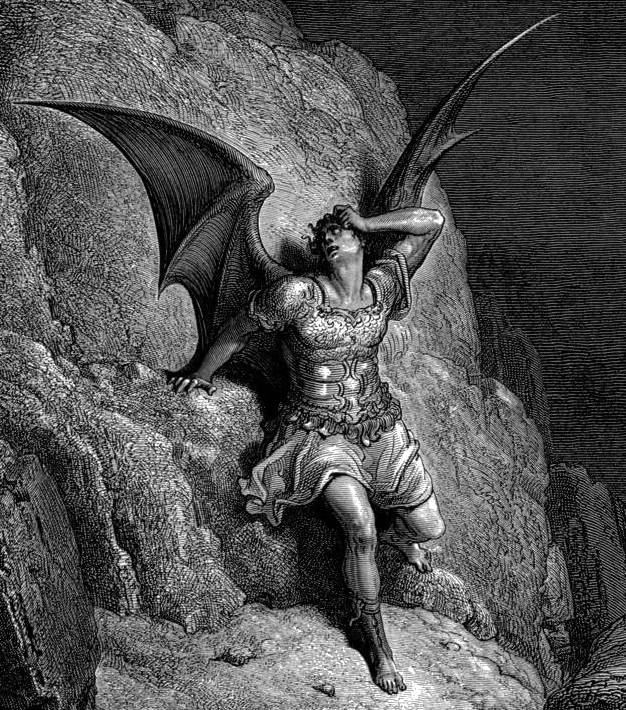
     Commonly, such a figure is visible, like Lucifer, in Paradise Lost.

GustaveDoreParadiseLostSatanProfile

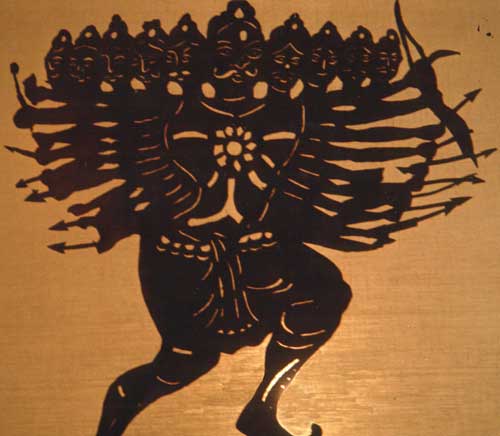
     Or he’s very visible, like Ravana in the Ramayana, with his ten heads.

page12_1

     For us, however, this is to risk circumscribing the villain, his visible body suggesting his visible limits. After all, it was a Sauron with hands who lost the Ring to a sword blade. To have a body, then, is to be vulnerable (literally, in the case above) and, more perhaps more important, in terms of story, more predictable, more bound by conventions.

     You (as JRRT) create Sauron, then, who once had a body, but now you make him nearly disembodied, being represented physically as a single, fiery eye.

Eye_of_Sauron

     This gives the effect of a brooding, ever-watchful presence, a bit like all of those posters in 1984’s London of Big Brother.

big-brother-is-watching

     This presence can be captured in the text in all sorts of ways, both direct and indirect. You have only to look up “Sauron” in the index to The Lord of the Rings to understand this: “Dark Lord, Enemy, Black One, Black Hand, Black Master, Base Master of Treachery, Dark Power, dark hands of the East, Nameless One, etc.”

     A brooding presence, however, is a real challenge for anyone trying to transfer The Lord of the Rings to the screen, which is why, after the previous defeat of Sauron, in which he appears as a huge being in black armor, he is reduced to that eye, sometimes captured in a palantir

palantir

Or Galadriel’s mirror, though, more often, as Sam and Frodo come closer to their goal, as the equivalent of a tower-mounted searchlight.

Mordor

     Film and fiction are different media, with different needs and tools to satisfy those needs, as the script writers never tire of explaining to us. In our opinion, however, this extremely literal depiction so strongly smacks of old black-and-white prison escape films,

C_71_article_1408592_image_list_image_list_item_1_image%20(1)

that we wish that those script writers could have left the Dark Lord offstage entirely, if this is the best they could do.

     With our feeling that an bodyless villain might be more powerful here than an incarnated one—remember feeling spooked at night by a subtle change in the ambience?—we would wish that the writers had been a bit more imaginative—and had read their author a little more closely. After all, he had plenty of good ideas about how to depict villains. And it is perhaps a sad commentary on their work that, increasingly, in their years of using JRRT, they abandoned him, choosing, instead, to bloat his story and turn it in directions he clearly never intended. Why not, for example, do as Tolkien did and mirror the villain not only in that long list of titles, but also in the actions and words both of his subordinates and his opponents? Would this have worked? Perhaps a reference to the amount of time “You Know Who” appears on-screen in the first Harry Potter movie in contrast to how often he is mentioned would suggest how this might have worked.

     As for villainous subordinates and their actions, we’ll have more to say about them in our next.

lee34

Thanks, as always, for reading. Remember: we want to encourage discussion and debate. If you agree with us, say so. If you don’t, say so and we can have fun working through our views.

MTCIDC

CD

The Doubtful Sea Series Facebook Page

The Doubtful Sea Series Facebook Page

  • Ollamh

Categories

  • Artists and Illustrators
  • Economics in Middle-earth
  • Fairy Tales and Myths
  • Films and Music
  • Games
  • Heroes
  • Imaginary History
  • J.R.R. Tolkien
  • Language
  • Literary History
  • Maps
  • Medieval Russia
  • Military History
  • Military History of Middle-earth
  • Narnia
  • Narrative Methods
  • Poetry
  • Research
  • Star Wars
  • Terra Australis
  • The Rohirrim
  • Theatre and Performance
  • Tolkien
  • Uncategorized
  • Villains
  • Writing as Collaborators
Follow doubtfulsea on WordPress.com

Across the Doubtful Sea

Recent Postings

  • Through a glass… January 7, 2026
  • Heffalumps? December 31, 2025
  • We Three Kings December 24, 2025
  • A Moon disfigured December 17, 2025
  • On the Roads Again—Once More December 10, 2025
  • (Not) Crossing Bridges December 3, 2025
  • On the Road(s) Again—Again November 26, 2025
  • On the Road(s) Again November 19, 2025
  • To Bree (Part 2) November 12, 2025

Blog Statistics

  • 104,098 Views

Posting Archive

  • January 2026 (1)
  • December 2025 (5)
  • November 2025 (4)
  • October 2025 (5)
  • September 2025 (4)
  • August 2025 (4)
  • July 2025 (5)
  • June 2025 (4)
  • May 2025 (4)
  • April 2025 (5)
  • March 2025 (4)
  • February 2025 (4)
  • January 2025 (5)
  • December 2024 (4)
  • November 2024 (4)
  • October 2024 (5)
  • September 2024 (4)
  • August 2024 (4)
  • July 2024 (5)
  • June 2024 (4)
  • May 2024 (5)
  • April 2024 (4)
  • March 2024 (4)
  • February 2024 (4)
  • January 2024 (5)
  • December 2023 (4)
  • November 2023 (5)
  • October 2023 (4)
  • September 2023 (4)
  • August 2023 (5)
  • July 2023 (4)
  • June 2023 (4)
  • May 2023 (5)
  • April 2023 (4)
  • March 2023 (5)
  • February 2023 (4)
  • January 2023 (4)
  • December 2022 (4)
  • November 2022 (5)
  • October 2022 (4)
  • September 2022 (4)
  • August 2022 (5)
  • July 2022 (4)
  • June 2022 (5)
  • May 2022 (4)
  • April 2022 (4)
  • March 2022 (5)
  • February 2022 (4)
  • January 2022 (4)
  • December 2021 (5)
  • November 2021 (4)
  • October 2021 (4)
  • September 2021 (5)
  • August 2021 (4)
  • July 2021 (4)
  • June 2021 (5)
  • May 2021 (4)
  • April 2021 (4)
  • March 2021 (5)
  • February 2021 (4)
  • January 2021 (4)
  • December 2020 (5)
  • November 2020 (4)
  • October 2020 (4)
  • September 2020 (5)
  • August 2020 (4)
  • July 2020 (5)
  • June 2020 (4)
  • May 2020 (4)
  • April 2020 (5)
  • March 2020 (4)
  • February 2020 (4)
  • January 2020 (6)
  • December 2019 (4)
  • November 2019 (4)
  • October 2019 (5)
  • September 2019 (4)
  • August 2019 (4)
  • July 2019 (5)
  • June 2019 (4)
  • May 2019 (5)
  • April 2019 (4)
  • March 2019 (4)
  • February 2019 (4)
  • January 2019 (5)
  • December 2018 (4)
  • November 2018 (4)
  • October 2018 (5)
  • September 2018 (4)
  • August 2018 (5)
  • July 2018 (4)
  • June 2018 (4)
  • May 2018 (5)
  • April 2018 (4)
  • March 2018 (4)
  • February 2018 (4)
  • January 2018 (5)
  • December 2017 (4)
  • November 2017 (4)
  • October 2017 (4)
  • September 2017 (4)
  • August 2017 (5)
  • July 2017 (4)
  • June 2017 (4)
  • May 2017 (5)
  • April 2017 (4)
  • March 2017 (5)
  • February 2017 (4)
  • January 2017 (4)
  • December 2016 (4)
  • November 2016 (5)
  • October 2016 (6)
  • September 2016 (5)
  • August 2016 (5)
  • July 2016 (5)
  • June 2016 (5)
  • May 2016 (4)
  • April 2016 (4)
  • March 2016 (5)
  • February 2016 (4)
  • January 2016 (4)
  • December 2015 (5)
  • November 2015 (5)
  • October 2015 (4)
  • September 2015 (5)
  • August 2015 (4)
  • July 2015 (5)
  • June 2015 (5)
  • May 2015 (4)
  • April 2015 (3)
  • March 2015 (4)
  • February 2015 (4)
  • January 2015 (4)
  • December 2014 (5)
  • November 2014 (4)
  • October 2014 (6)
  • September 2014 (1)

Blog at WordPress.com.

  • Subscribe Subscribed
    • doubtfulsea
    • Join 78 other subscribers
    • Already have a WordPress.com account? Log in now.
    • doubtfulsea
    • Subscribe Subscribed
    • Sign up
    • Log in
    • Report this content
    • View site in Reader
    • Manage subscriptions
    • Collapse this bar
 

Loading Comments...