• About

doubtfulsea

~ adventure fantasy

Tag Archives: American Revolution

Eternally Yours, or Do You Believe in Magic?

06 Wednesday Jun 2018

Posted by Ollamh in Artists and Illustrators, Fairy Tales and Myths, Films and Music, Literary History, Military History

≈ Leave a comment

Tags

17th Century fashion, AB Durand, American Revolution, Arthur Rackham, Battle of Kolin, Bram Stoker, Captain Hook, Charles II, Christopher Lee, Darling Family, Darlings, Disney, Dracula, Fenian Cycle, Frederick the Great, Gerald du Maurier, Half Moon ship, Hudson River, J.M. Barrie, N.C. Wyeth, Neverland, Nina Boucicault, Oscar Wilde, Peter and Wendy, Peter Pan, Peter Pan in Kensington Gardens, Rip Van Winkle, Saruman, Tepes, The Little White Bird, The Lord of the Rings, The Picture of Dorian Gray, The Wanderings of Oisin, Tinkerbell, Tir na nOg, Tolkien, vampire, Vlad, Washington Irving, WB Yeats

Welcome, as ever, dear readers.

In our last, we spent some time thinking about immortality and Middle-earth.  Our main focus was upon the puzzle of Saruman’s seeming dissolution after his murder by Grima.

image1deathofsaruman.jpg

As one of the Maiar, it would seem that Saruman was, at least potentially, immortal, but his melancholy disappearance would suggest otherwise—perhaps because of his gradual betrayal of the trust the Valar had put in him to be an opponent of Sauron?

We had begun, however, with Bram Stoker’s (1847-1912)

image2bramstoker.jpg

1897 vampire classic, Dracula, and this has made us consider what appears to have been a popular theme in the late-Victorian-to-Edwardian literature we imagine JRRT read, growing up:  immortality (or at least lengthened life-span) through, for want of a better word, magic, and several instances immediately spring to mind.

image3dracfirst.jpg

As for Dracula, we know that he was based upon a real late-15th-century eastern European border lord, Vlad, nicknamed “Tepes” (said TSE-pesh), “impaler”, who lived from about 1428 to 1477, when he was murdered.
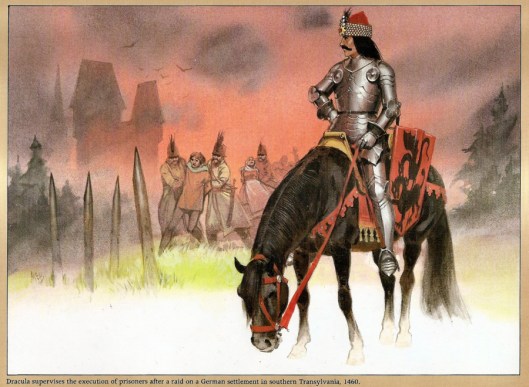
image4drac.jpg

Stoker’s character has somehow avoided that death and has lived on for a further 500 years—how?  By being “un-dead”, a condition whose origin is never really explained, but in which a dead person continues to exist—and even flourish—if able to feed upon the blood of living people.  As this is not scientifically possible—dead is dead and actual vampire bats, after all, are alive, even if they drink blood.

image5avampirebat.jpg

All that we can say, then, is that, for all of one of the protagonists’, Dr. van Helsing’s, talk of science, we have no idea what gives Dracula his extended life–though here’s Christopher Lee, as Dracula,

image5clee.jpg

from the 1958 film, Dracula (in the US, Horror of Dracula), with the basis of his continued existence fresh on his lips.

image6poster.jpg

Considering our last post, by the way, it’s an odd coincidence that, in 1958, Lee could play Dracula and in 2001-2003, he would play Saruman.

image7leeassaruman.jpg

A few years before Stoker’s novel, in 1889, the young WB Yeats (1865-1939)

image8wby.jpg

had published The Wanderings of Oisin (AW-shin).

image9wander.jpg

This is the story in verse based upon material from the “Fenian Cycle”,  the third series of tales about early Ireland preserved by medieval monks.  Yeats’ poem deals with an ancient Irish hero who traveled to the Otherworld, spent years there without knowing that it’s a place where time works differently, and returned, only to find that he’d been gone for 300 years and, once he’d actually touched Irish soil, he immediately changed from a vigorous young man to someone 3 centuries old.  The place to which Oisin traveled, called Tir na nOg, “the Land of Youth”, is, unfortunately, not found on any ancient map, so, like Dracula’s vampirism, it is simply accepted.

This time-warp also makes us think of the 1819 story of Rip Van Winkle, by Washington Irving (1783-1859).
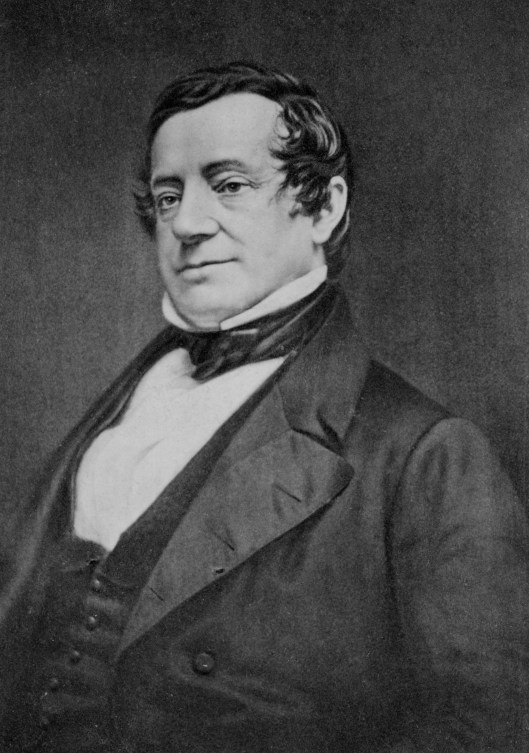
image10washirv.jpg

Rip Van Winkle goes off to hunt in the mountains, the Catskills, to the west of the Hudson River before the American Revolution.

(Here’s an 1864 painting of those mountains by AB Durand (1796-1886), who belonged to the first great group of American landscape painters, called the “Hudson River School”.)

image11hudsonriverschool.jpg

While out hunting, Rip bumps into a group of troll-like creatures, who turn out to be the enchanted members of Henry Hudson’s crew

image12huds.jpg

from his ship, the Half Moon—this is an image of the 1989 recreation of the ship—

image13haelvemaen.jpg

with which he explored the Hudson River in 1609.
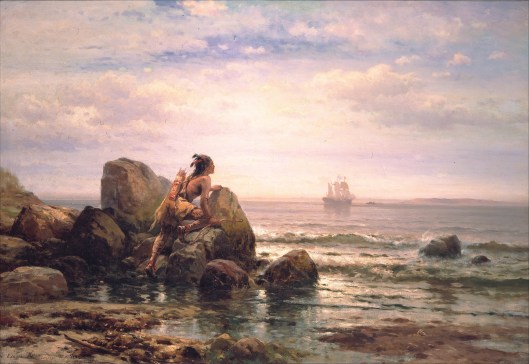
image14hudson.jpg

(We see here Edward Moran’s 1892 painting of Hudson’s ship entering New York harbor.)

Rip drinks and bowls with them,

image15ripdrinks.jpg

image16ninepins.jpg

then falls asleep, only to awaken over twenty years later to find himself old and now a citizen of the new United States.
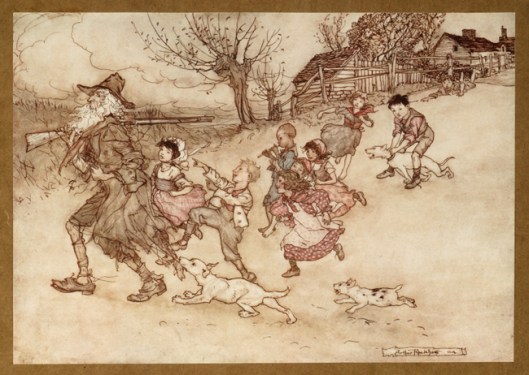
image17oldrip.jpg

(If you follow us regularly—and we hope you do!—then you know of our great affection for late-19th-early-20th-century illustrators and, when it comes to this story, we’re very lucky in that Arthur Rackham illustrated it in 1905
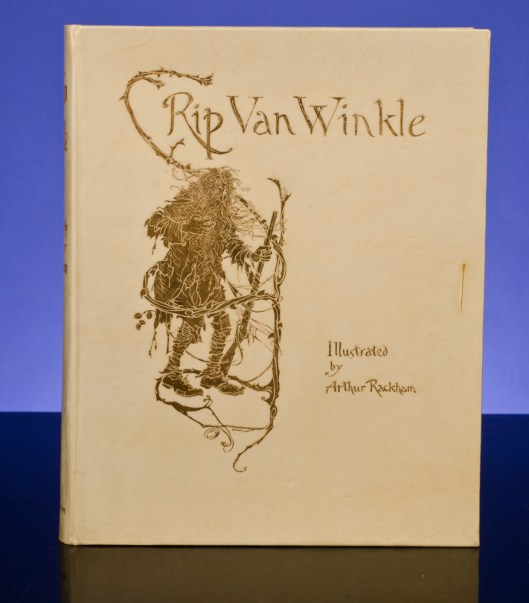
image18rackham.jpg

and NC Wyeth in 1921.)

image19wyeth.jpg

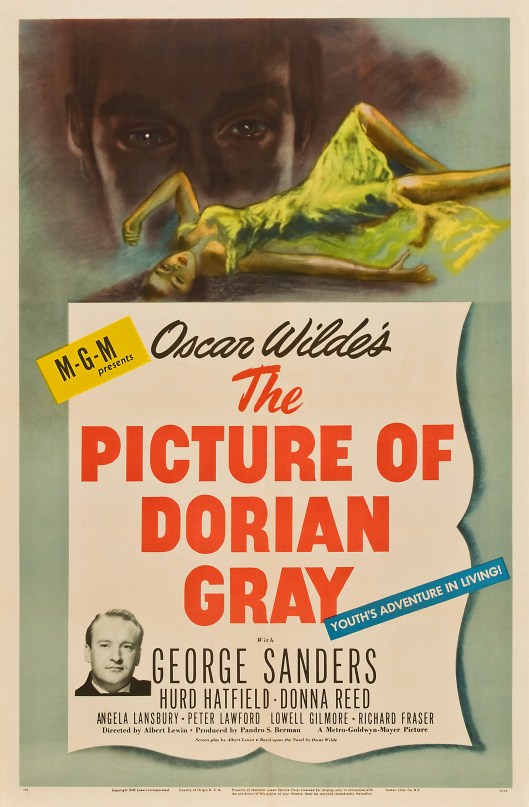
Another late-Victorian story with the theme of the supernatural and long life is Oscar Wilde’s (1854-1900)

image20wilde.jpg

The Picture of Dorian Gray, first published in book form in 1891.
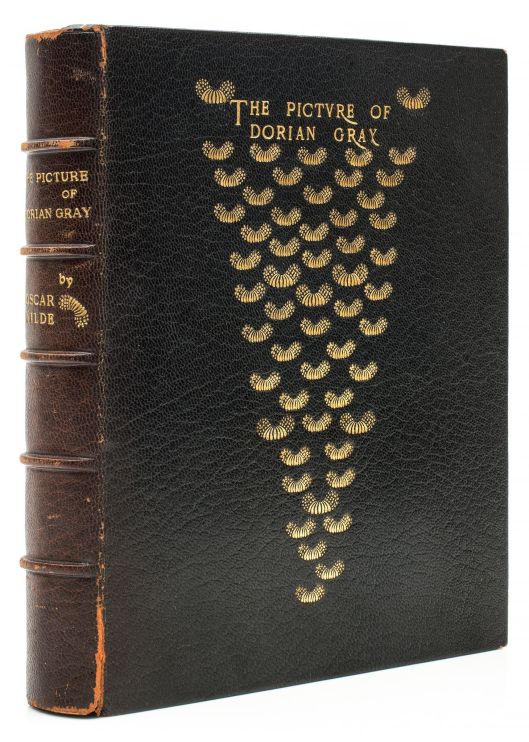
image21picture.jpg

The picture here is a sinister one:  all of that which would age the protagonist, Dorian—who has an increasingly dark, secret life—is transferred to the image on canvas, so that the sitter for the portrait never seems to age.  We can see what that would look like from this image—as well as the tinted version, which is even worse,
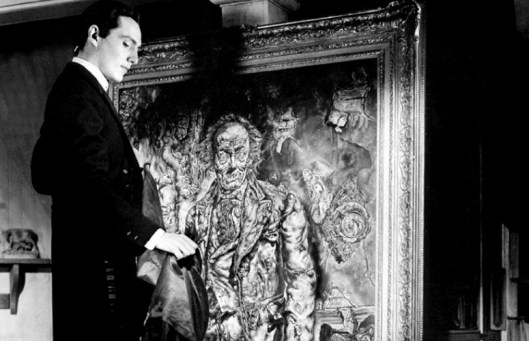
image23picture.jpg

image24pic.jpg

from the 1945 film.

image25poster.jpg

How the picture acts as a sponge for all of the worst of Dorian is, like vampirism, never explained—Dorian promises his life if he will never age, but we never see, for example, a satanic figure, standing to one side, nod in agreement.

We want to end, however, with a happier story—well, sort of.  In 1902, the Scots novelist and dramatist, JM Barrie (1860-1937),
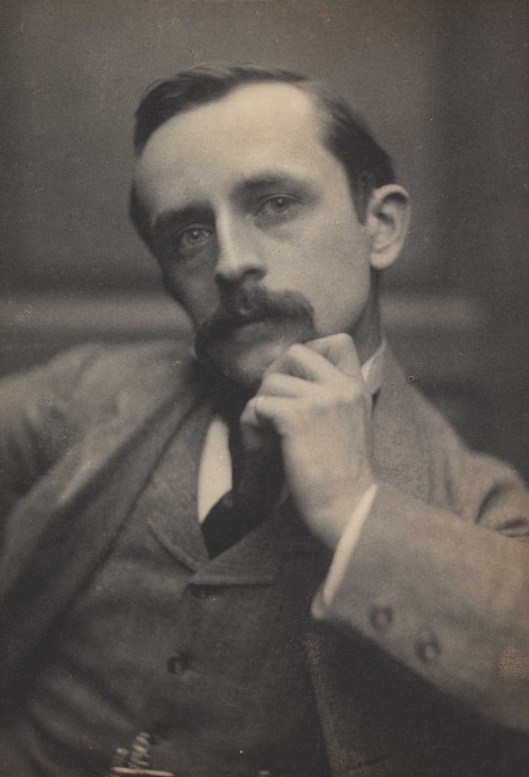
image26jmb.jpg

published a novel, The Little White Bird.

image27lwb.jpg

In it appeared for the first a seemingly-deathless character, Peter Pan.

image28ppstatue.jpg

Unlike Oisin, who has gone to a magical place, or Dorian Gray, who has his enchanted portrait, Peter just seems to be suspended in time—originally at the age of 7—days—old.

image29pp.jpg

When Barrie returned to the character, in 1904, however, he made Peter grow up–slightly.  His age isn’t exactly clear, but we know from the 1911 novelized version, Peter and Wendy,

image30pandw.png

that he still has his first set of teeth.  [Footnote:  not a very exact clue—children can begin shedding baby teeth beginning at 6 and continue till 12.]   This is the Peter of Barrie’s famous play, Peter Pan,

image31playbill.jpg

about a boy who lives on an island in Neverland

image32map.jpg

and, on a visit to London, loses his shadow while eavesdropping on the three Darling children, whose oldest sibling, Wendy, tells stories about him, which she had learned from her mother.
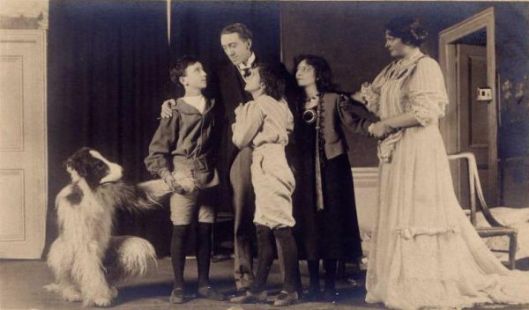
image33darlings.jpg

Peter is able to fly and, with the help of a fairy, Tinkerbell, he takes the Darling children back to Neverland with him, where they have all sorts of adventures.

The original Peter—like so many Peters over a century to come—was a woman, Nina Boucicault.
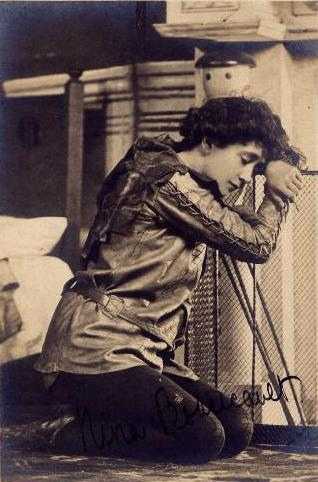
image34nina.jpg

We are lucky to have her costume, which differs a good deal from the Peter Pan everyone knows now from the 1954 Disney film.
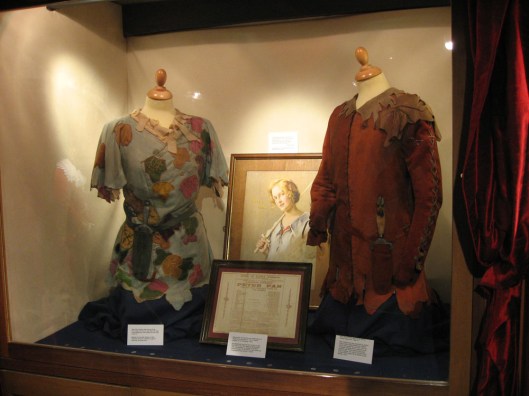
image35costume.jpg

image36disney.jpg

The villain of the piece, Captain Hook, however, has maintained his general outline from 1904.

image37capt.jpg

This is Gerald du Maurier, the original Captain.
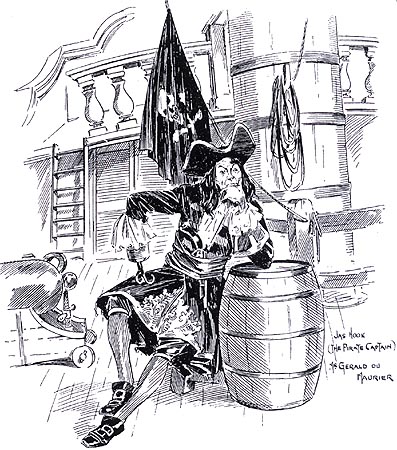
image38hook.jpg

Although Barrie himself suggested that Hook should look like someone from the time of Charles II (1660-1685),

image39achas2.jpg

to us, he appears to be modeled on the fashions of the late 17th century—note the long coat with the big cuffs, not to mention the big wig.

image39costume.jpg

And here is Disney’s 1954 Hook.

image40disney.jpg

(A footnote:  in 1904, Barrie had planned to have different actors play Mr. Darling, the children’s father, and Captain Hook, but du Maurier persuaded him to allow du Maurier to play both roles, which is still the tradition.)

The subtitle of Peter Pan is Or, the Boy Who Wouldn’t Grow Up, and here we see, for the first time on our little tour, an explanation for the immortality in which the mortal is an active agent:  unlike Dracula or Oisin or Dorian Gray, Peter defies time simply by refusing to acknowledge its effects.  He won’t age because he doesn’t want to.

We said that we wanted to end on a “sort of” happy story and Peter’s stubborn immortality might fit that, but Barrie later added a kind of epilogue, a one-act play first performed in 1908.  In it, Wendy Darling, the oldest of the Darling children, has now grown up and gotten married, and had a daughter, Jane.  One night, while Wendy is putting Jane to bed in the same nursery from which the earlier adventures began, Peter appears.

Peter_and_Wendy_pg_243.jpg

At first, he simply refuses to believe that Wendy has grown up, and wants her to return to Neverland with him, although she has lost the ability to fly.  When she tries gently to explain that she can’t go with him because she has now become an adult, he collapses in tears and she runs from the room, leaving Jane asleep in her bed.  Jane wakes up and soon Peter invites her to fly to Neverland with him.  When Wendy reappears, she is quickly convinced and off the two go, leaving Wendy behind, but with the hope that Jane will have a daughter and she, in turn, will be taken to Neverland in an endless succession of daughters—perhaps immortality of a different sort?  (Here’s a LINK to the play, if you would like to read it for yourself.)

This has been a long posting, but we can’t resist a brief ps.  In 1757, Frederick the Great, the king of Prussia (1712-1786), was losing the battle of Kolin.  Desperate to win, he tried to rally his men for a counterattack, shouting, “You rascals!  Do you want to live forever?”

image41kolin.jpg

Virtually no one followed him, so we guess that most did.

Thanks, as always, for reading.

MTCIDC

CD

PS

And another ps—in 1924, the first film version of Peter Pan appeared.

image42film.jpg

It was much praised at the time and here’s a LINK so that you can see it for yourself.

Accuracy? Well, Yes, But…

07 Wednesday Jun 2017

Posted by Ollamh in Artists and Illustrators, Heroes, J.R.R. Tolkien, Literary History, Military History, Narrative Methods, The Rohirrim

≈ Leave a comment

Tags

American Civil War, American Revolution, Concord, Don Troiani, Germantown, grenadiers, H. Charles McBarron, Harper's Monthly, Howard Pyle, Illustration, John Trumbull, Joseph Warren, King Arthur, Lexington, Pirates, Richard Simkin, The Battle of Bunker Hill, The Battle of Nashville, The Lord of the Rings, The Rohirrim, The Salem Wolf, Tolkien

Welcome, dear readers, as always.

Today’s post takes us to the question of what we like and why and how such likes may push us—who, we realize, are a little stiff on the subject of accuracy—to accept things which, if our feelings weren’t engaged, we would briskly reject.

We begin by looking at a painting by one of our favorite late Victorian/Edwardian illustrators, Howard Pyle (1853-1911).

image1hp.jpg

If you’re a regular reader (and we hope you are—or will be!), you’ll have seen his work on our pages any number of times, from his King Arthur illustrations (and here’s a LINK to a free 1922 reprint at the Internet Archive)

image2ka.jpg

to his pirates (and here’s a LINK to a later—c.1921—collection of Pyle’s pictures and writings on pirates at Internet Archive).

image3hppirates.jpg

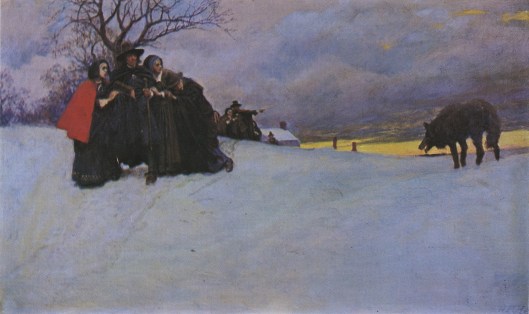
Pyle also wrote and illustrated original fiction—just look at this haunting picture from a short story, “The Salem Wolf”, which was published in the December, 1909, issue of Harper’s Monthly Magazine.

image4salemwolf.jpg

(And here’s a LINK to the story at Internet Archive)

Pyle also painted stand-alone historical pictures, such as this of “The Battle of Nashville” (1907).

MN 60

And we’re lucky to have a photograph of the artist at work on this very picture.

image6hppainting

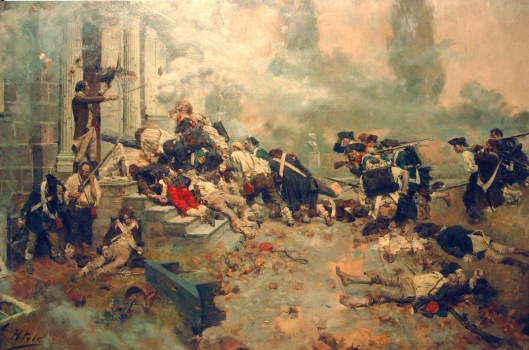
Besides American Civil War pictures, Pyle painted several based upon incidents of the American Revolution, such as this, of the assault on the Chew House, at the Battle of Germantown (4 October, 1777).

image7pylegermantown

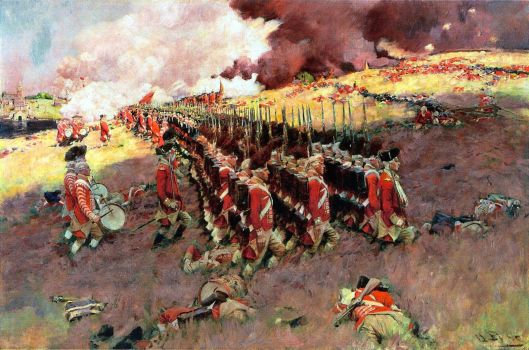
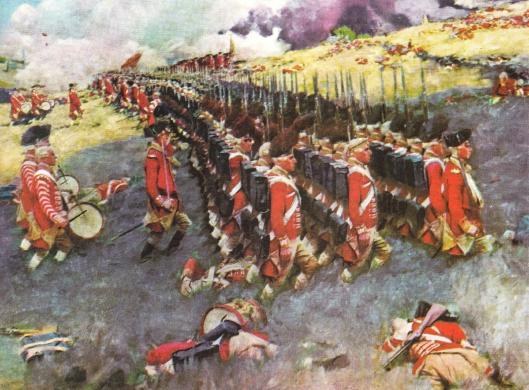
Another of his pictures of the Revolution is the subject of this post, “The Battle of Bunker Hill” (1897).

image8pylebunkerhill

We’re not sure when one of us first saw this picture—childhood, we’d guess—but we were immediately bowled over by it. It’s the adventure of it: those long ranks of redcoats stoically marching up the hill, drums beating behind. It’s not a sanitized picture—just look up the hill and all around you can see the wreck of the earlier British attacks—but its emphasis is upon the courage it must take to do what those soldiers did.

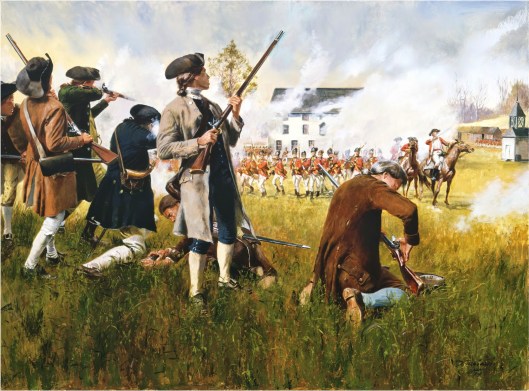
This was, in fact, the third battle of the American Revolution. The war had begun in mid-April, 1775, when a raiding party of British troops, ordered to disrupt local preparations for defense, fought two skirmishes with local militia, at Lexington

image9lexington.jpg

and Concord,

image10concord.jpg

two rural settlements some twenty miles or so west of Boston.

When the British withdrew into Boston itself, those locals, who had grown in numbers to about 15,000, drawn from all over New England, blockaded the town and there was a period of stalemate, while both sides were reinforced. When it was clear that the locals had seized a nearby hill and were planning to plant artillery there which would then be capable of bombarding Boston, the British were forced to move. Their choice was to attack that hill, which was named “Breed’s Hill” but, through an historical mix-up, the battle was named for the hill to its rear, “Bunker Hill”.

image11bunkerhill.jpg

Initially, the British plan was to have part of its force make a feint—a fake attack—against the main part of the hill, where the locals had built an open-backed fortification, called a redoubt, while the real attack was to push through the weaker local left and curve around to hit the locals from the rear.

By underestimating the defense, the British soon suffered over a thousand casualties to the local 450. As the assaults were driven back, the British plan changed and the main attack was to be uphill, straight at the redoubt and this is what is depicted in Pyle’s painting, specifically the advance of the 52nd Foot (“Foot” is 18th-century shorthand for “regiment of infantry”).

image12hpbunkerhill.jpg

This is not the first well-known painting of the battle, however. In the first third of the 19th century, John Trumbull (1756-1843), a prominent American artist, painted several versions of a work entitled, “The Death of General Warren at the Battle of Bunker’s Hill, June 17, 1775”.

image13trumbullbunkerhill.jpg

This picture belongs to what we might call both the “heroic school” and the “portrait school”, the former because of a certain flashy quality (look at the way the wind seems to be whipping everything—and where are those flames on the right coming from?), the latter because, not only is the local officer, Joseph Warren depicted, but so are a number of other figures—two of the British generals, two British majors, and a number of more minor participants.

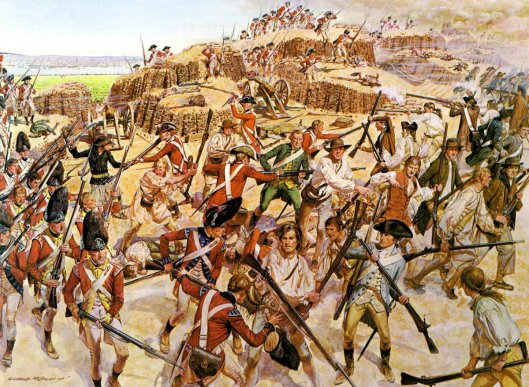
Bunker Hill remained—and remains—a popular subject for historical painters, most of them depicting events from the local side. Here is one version, by the distinguished 20th-century American military artist, H. Charles McBarron (1902-1992).

image14mcbarron.jpg

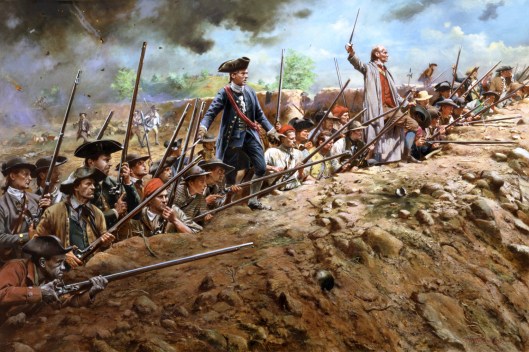
And here are two by one of our favorite contemporary American Civil War artists, Don Troiani (1949-).

image15troi.jpg

image16troi.jpg

All pictures are not from the viewpoint of the colonists, however. The late-Victorian/Edwardian British military artist, Richard Simkin (1850-1926), gave us this view.

image17simkin.jpg

Of all of these images, the Trumbull has drawn upon his memory and upon his sketchbooks, too, we bet, to give a general impression of the look of the soldiers, but, although he was part of the colonial force besieging Boston, he only saw the battle through a telescope. McBarron was a collector of uniforms and equipment, as is Troiani, and their works are painstakingly accurate. Simkin, although he, too, was a collector, came from an earlier time, just at the beginning of serious research on weapons and uniforms of the past, and, therefore, certain elements in his picture—the plumes and cords on his men’s bearskins and those packs (left behind in Boston, in reality), for instance—are not correct. Even so, his picture is far more accurate than Pyle’s, which is full of mistakes, in everything from the uniforms and equipment to those grenadiers (those guys in the fuzzy hats in the center), who shouldn’t be there at all, having been detached to form part of the right wing assault force.

And yet the Pyle is still our favorite depiction of the battle. Why? Because it feels right: it’s a 19th-century image of courage and discipline, and appeals to our romantic souls, even though there are casualties strewn about, which, to us, only serves to emphasize the bravery and stick-to-it-iveness of those solid infantry.

And this is where JRRT comes in. We’ve said before: our favorite part of P. Jackson’s films is anything to do with the Rohirrim.

image18rohirrim.jpg

The fact that, in the books, they live in wide, grassy plains (unavailable in New Zealand) and that their capital, Edoras, does not have “a dike and mighty wall and thorny fence” in the films, along with any other details it would be easy to extract from The Lord of the Rings, doesn’t matter to us in the least. The depiction in the films feels right and we’re content with that, even when there are other parts of the films where we have other reactions. Simple (and perhaps surprising to us) as that.

So, dear readers, do you have similar reactions? And to what? We’d love to hear!

And thanks, as always, for reading.

MTCIDC

CD

A Holiday Special

05 Thursday Nov 2015

Posted by Ollamh in Fairy Tales and Myths, Military History

≈ Leave a comment

Tags

American Revolution, Boston, British, Caesar, Celtic, drawing and quartering, England, Gam, Guy Fawkes, holiday, James I, Pagan, Parliament, Remember the Fifth of November, Sam, Samhain, St. Patrick's Day, tradition, traitor, Westminster

Dear Readers,

Welcome, as always.

This posting is a little bonus because of the day, November 5th.

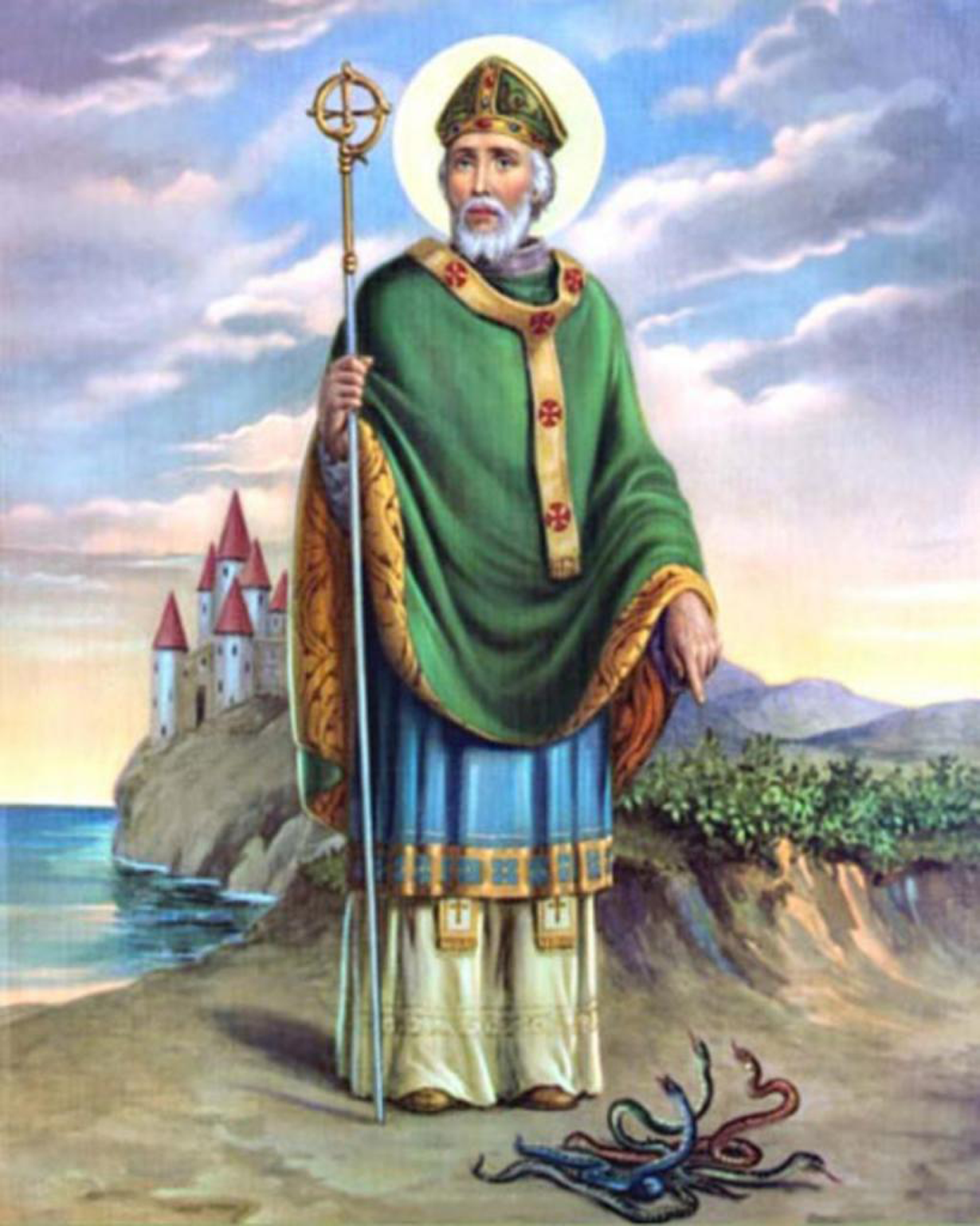
Because laws in the US tend at least to try to separate church and state, how do the people of Boston celebrate St. Patrick’s Day legally?

513_StPatrick

Easy– they dug into their history, and somebody remembered that during the American Revolution, the British abandoned their occupation of Boston on March 17th, 1776: St. Patrick’s Day.

The same is true when we follow those British soldiers home.

Samhain is the ancient Celtic holiday which celebrates that time of year between summer and winter. (Sam—in various forms, depending on which branch of Celtic you speak—means “summer” and its opposite is Gam). The Celts believed that, at that time, the doors between the worlds lay open and the dead could return.

In a Christian country like Britain, this would be rather an awkward holiday to celebrate without the same sort of adaptation the Bostonians used to celebrate St. Patrick’s Day. November 1st, All Saints’ Day, will cover some of this, but the clever British, just like the Bostonians, reached into their history and produced Guy Fawkes Day.

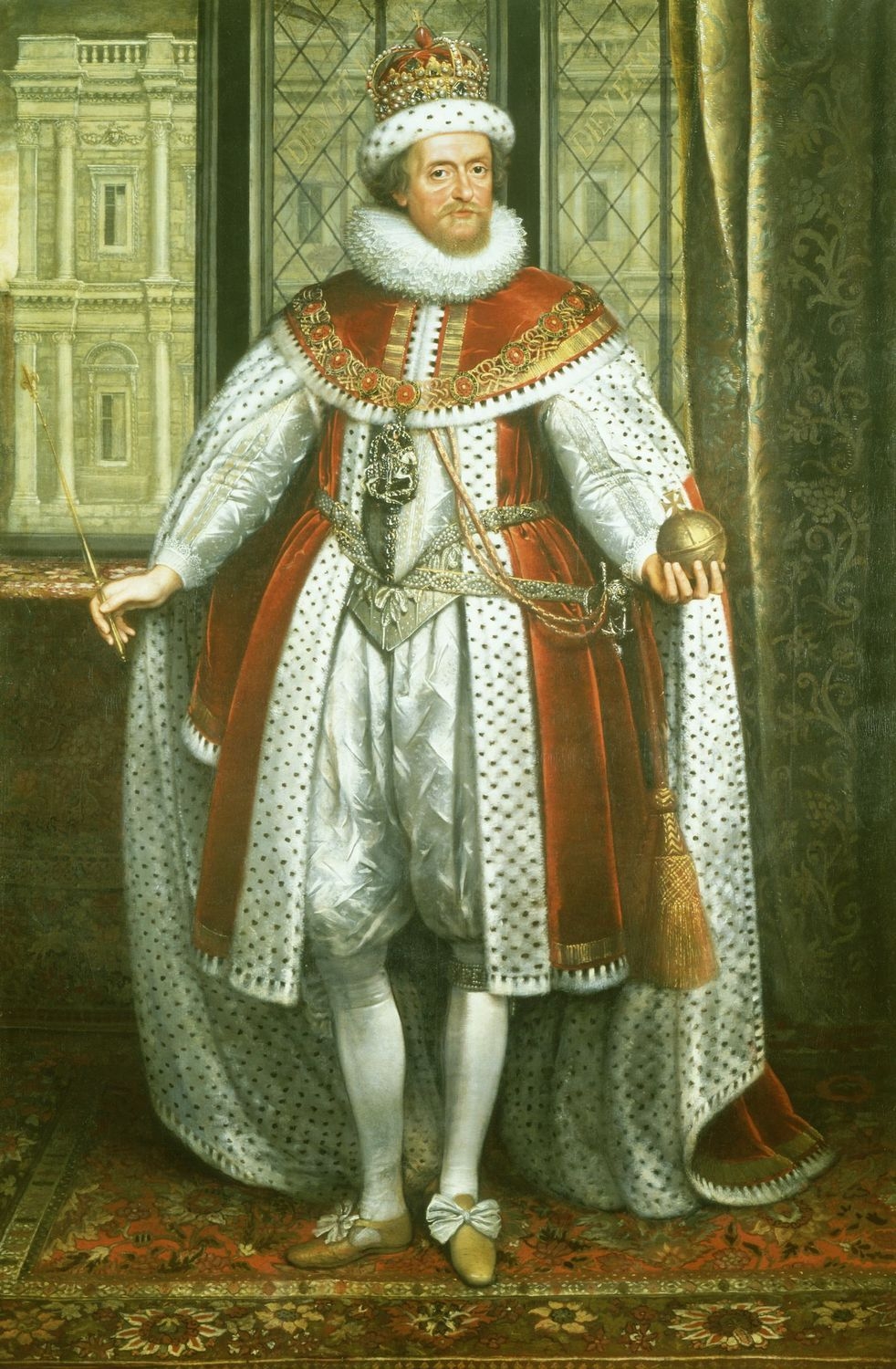
Guy Fawkes was, in fact, the leader of a group of Catholic gentlemen who wanted to block the succession of the Protestant James I to the throne of England.

2guyfawkesandconspirators

To do this, they planned to blow up Parliament with the king and his court inside on the 5th of November, 1605.

3James1

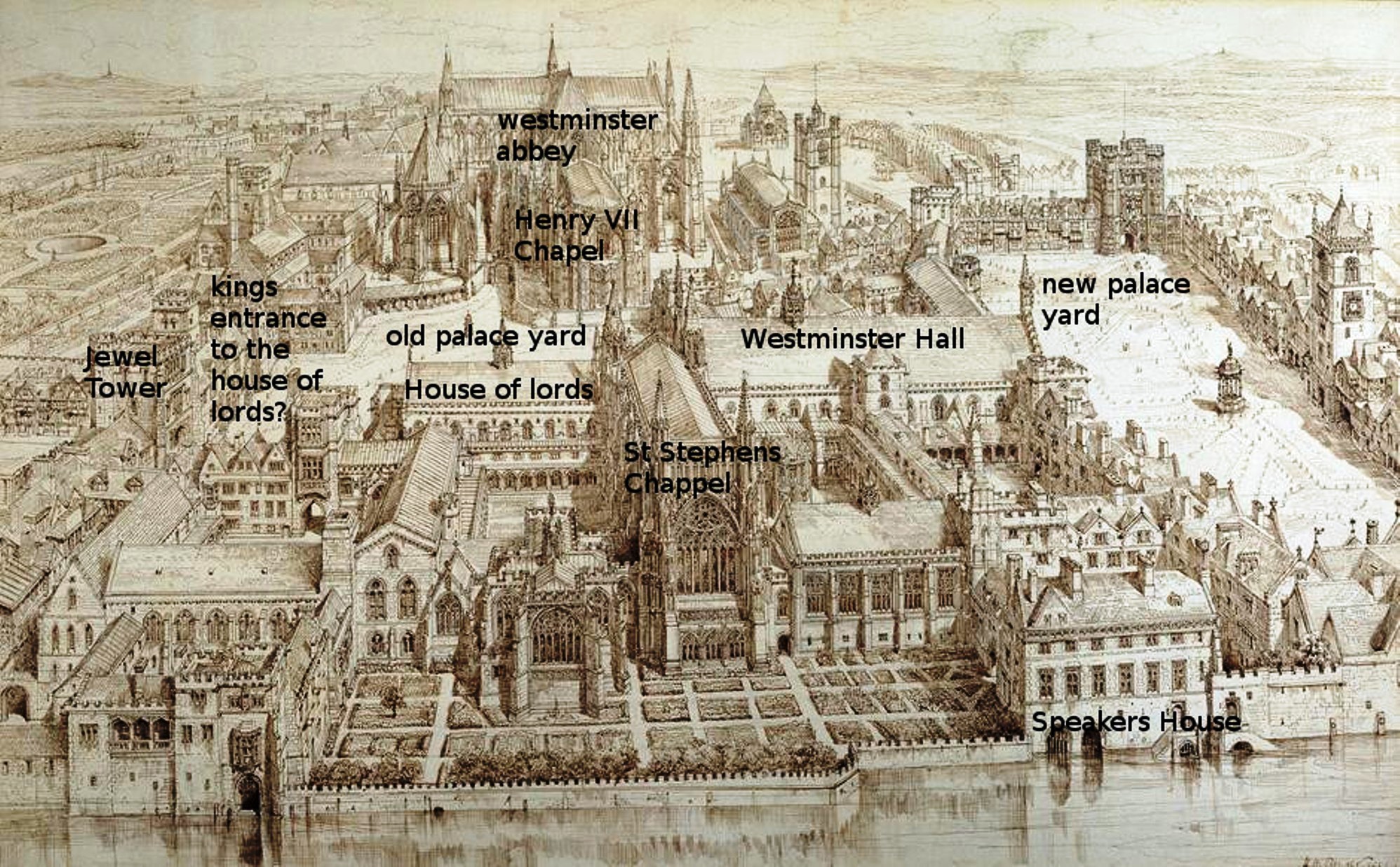
Old Houses of Parliament, Palace of Westminster, London: the Parliament House from Old Palace Yard

To do so, they managed, by using a building next door, to smuggle 3 dozen barrels of gunpowder into the basement of Parliament (and this is the old Parliament in Westminster palace, not the one we see today, which was built after the great fire of 1834).

5guyfwithgunpowder 6westminster

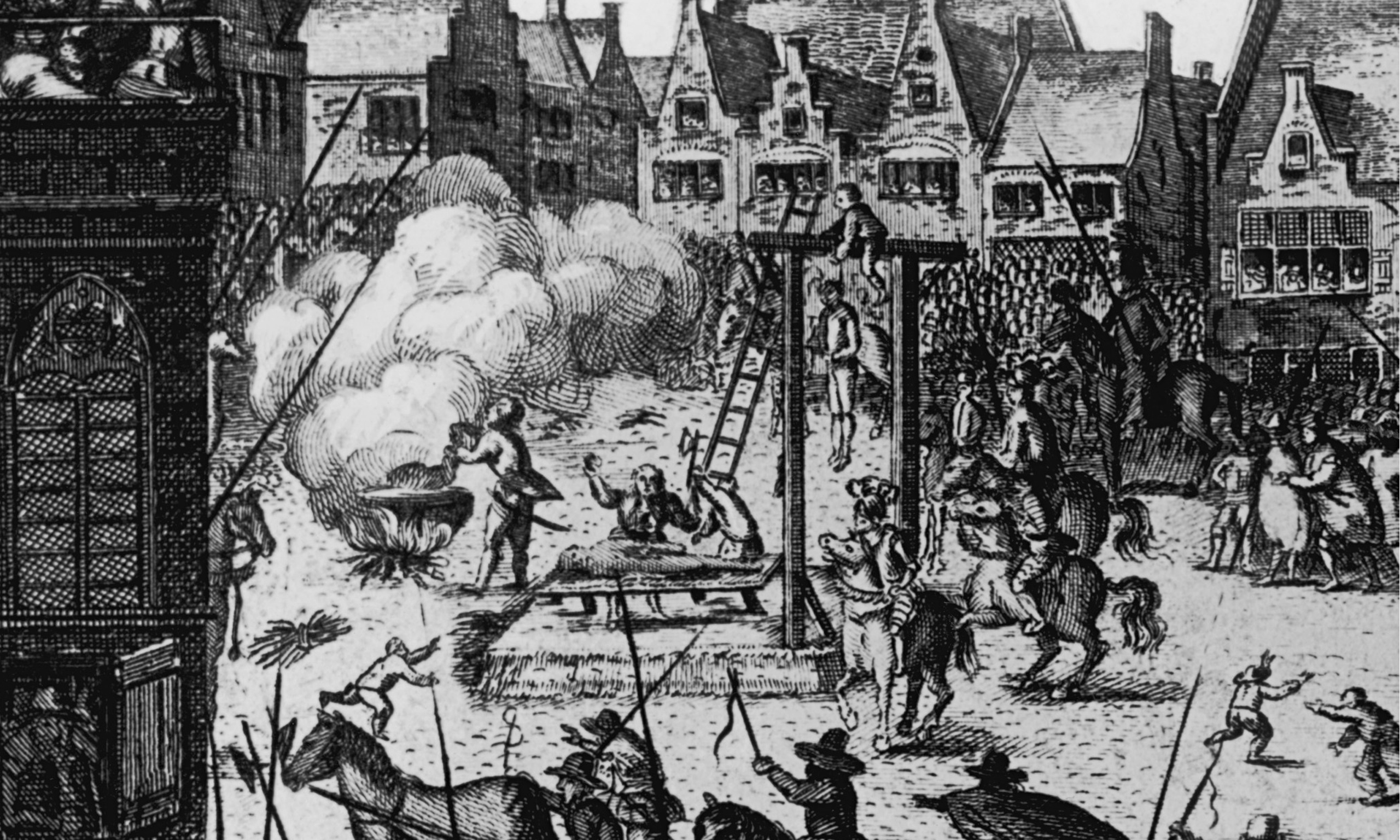
Fawkes and the others were caught, however, and suffered a gruesome end as traitors: drawing and quartering.

Execution of Guy Fawkes for treason, 1606

So, if you want to have a pagan holiday under Christian auspices—and patriotic ones, at that, you can celebrate the end of Guy Fawkes, failed conspirator and Samhain favorite.

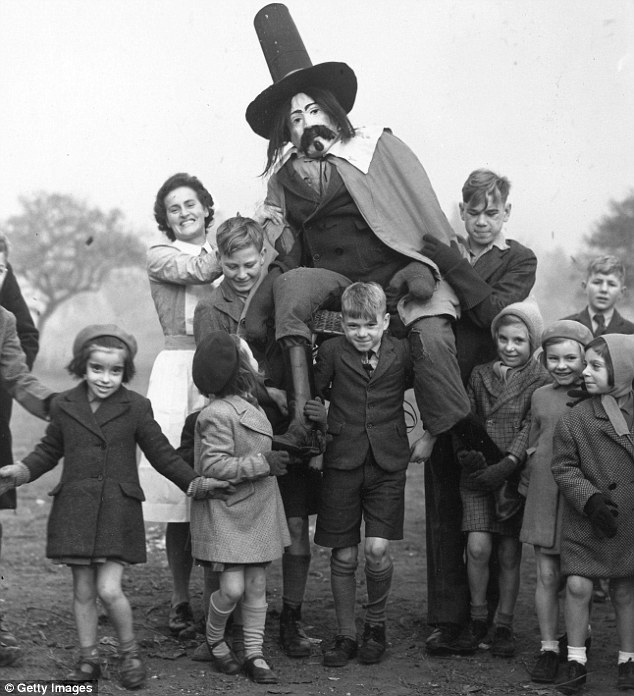
The older tradition in Britain was that children would put together a flammable dummy, called a “Guy” and take him around the neighborhood, begging for pennies under the slogans, “Penny for the Old Guy, Remember, Remember, the Fifth of November!”

8pennyfortheguy

These pennies then bought sweet and fireworks. On the evening of the 5th of November, the dummy would be set on fire, the fireworks would be set off, and the sweets consumed.

9burningtheguy

And so ancient holiday and political event could be blended and both survive.

But, although Guy Fawkes and the other conspirators might suffer horrible ends, no one was burned. There is, however, another Celtic tradition, reported by Julius Caesar. In his Gallic Wars, Caesar claimed that the priests of the Celts sacrificed victims by burning them alive in a huge woven figure. Perhaps the fiery death of the Old Guy is one more remembrance of Samhain-long-gone?

10wickerman

Happy Guy Fawkes Day!

MTCIDC

CD

The Doubtful Sea Series Facebook Page

The Doubtful Sea Series Facebook Page

  • Ollamh

Categories

  • Artists and Illustrators
  • Economics in Middle-earth
  • Fairy Tales and Myths
  • Films and Music
  • Games
  • Heroes
  • Imaginary History
  • J.R.R. Tolkien
  • Language
  • Literary History
  • Maps
  • Medieval Russia
  • Military History
  • Military History of Middle-earth
  • Narnia
  • Narrative Methods
  • Poetry
  • Research
  • Star Wars
  • Terra Australis
  • The Rohirrim
  • Theatre and Performance
  • Tolkien
  • Uncategorized
  • Villains
  • Writing as Collaborators
Follow doubtfulsea on WordPress.com

Across the Doubtful Sea

Recent Postings

  • A Moon disfigured December 17, 2025
  • On the Roads Again—Once More December 10, 2025
  • (Not) Crossing Bridges December 3, 2025
  • On the Road(s) Again—Again November 26, 2025
  • On the Road(s) Again November 19, 2025
  • To Bree (Part 2) November 12, 2025
  • To Bree (Part 1) November 5, 2025
  • A Plague o’ Both—No, o’ All Your Houses! October 29, 2025
  • It’s in Writing (2:  I’st a Prologue, or a Poesie for a Ring?) October 22, 2025

Blog Statistics

  • 103,217 Views

Posting Archive

  • December 2025 (3)
  • November 2025 (4)
  • October 2025 (5)
  • September 2025 (4)
  • August 2025 (4)
  • July 2025 (5)
  • June 2025 (4)
  • May 2025 (4)
  • April 2025 (5)
  • March 2025 (4)
  • February 2025 (4)
  • January 2025 (5)
  • December 2024 (4)
  • November 2024 (4)
  • October 2024 (5)
  • September 2024 (4)
  • August 2024 (4)
  • July 2024 (5)
  • June 2024 (4)
  • May 2024 (5)
  • April 2024 (4)
  • March 2024 (4)
  • February 2024 (4)
  • January 2024 (5)
  • December 2023 (4)
  • November 2023 (5)
  • October 2023 (4)
  • September 2023 (4)
  • August 2023 (5)
  • July 2023 (4)
  • June 2023 (4)
  • May 2023 (5)
  • April 2023 (4)
  • March 2023 (5)
  • February 2023 (4)
  • January 2023 (4)
  • December 2022 (4)
  • November 2022 (5)
  • October 2022 (4)
  • September 2022 (4)
  • August 2022 (5)
  • July 2022 (4)
  • June 2022 (5)
  • May 2022 (4)
  • April 2022 (4)
  • March 2022 (5)
  • February 2022 (4)
  • January 2022 (4)
  • December 2021 (5)
  • November 2021 (4)
  • October 2021 (4)
  • September 2021 (5)
  • August 2021 (4)
  • July 2021 (4)
  • June 2021 (5)
  • May 2021 (4)
  • April 2021 (4)
  • March 2021 (5)
  • February 2021 (4)
  • January 2021 (4)
  • December 2020 (5)
  • November 2020 (4)
  • October 2020 (4)
  • September 2020 (5)
  • August 2020 (4)
  • July 2020 (5)
  • June 2020 (4)
  • May 2020 (4)
  • April 2020 (5)
  • March 2020 (4)
  • February 2020 (4)
  • January 2020 (6)
  • December 2019 (4)
  • November 2019 (4)
  • October 2019 (5)
  • September 2019 (4)
  • August 2019 (4)
  • July 2019 (5)
  • June 2019 (4)
  • May 2019 (5)
  • April 2019 (4)
  • March 2019 (4)
  • February 2019 (4)
  • January 2019 (5)
  • December 2018 (4)
  • November 2018 (4)
  • October 2018 (5)
  • September 2018 (4)
  • August 2018 (5)
  • July 2018 (4)
  • June 2018 (4)
  • May 2018 (5)
  • April 2018 (4)
  • March 2018 (4)
  • February 2018 (4)
  • January 2018 (5)
  • December 2017 (4)
  • November 2017 (4)
  • October 2017 (4)
  • September 2017 (4)
  • August 2017 (5)
  • July 2017 (4)
  • June 2017 (4)
  • May 2017 (5)
  • April 2017 (4)
  • March 2017 (5)
  • February 2017 (4)
  • January 2017 (4)
  • December 2016 (4)
  • November 2016 (5)
  • October 2016 (6)
  • September 2016 (5)
  • August 2016 (5)
  • July 2016 (5)
  • June 2016 (5)
  • May 2016 (4)
  • April 2016 (4)
  • March 2016 (5)
  • February 2016 (4)
  • January 2016 (4)
  • December 2015 (5)
  • November 2015 (5)
  • October 2015 (4)
  • September 2015 (5)
  • August 2015 (4)
  • July 2015 (5)
  • June 2015 (5)
  • May 2015 (4)
  • April 2015 (3)
  • March 2015 (4)
  • February 2015 (4)
  • January 2015 (4)
  • December 2014 (5)
  • November 2014 (4)
  • October 2014 (6)
  • September 2014 (1)

Blog at WordPress.com.

  • Subscribe Subscribed
    • doubtfulsea
    • Join 78 other subscribers
    • Already have a WordPress.com account? Log in now.
    • doubtfulsea
    • Subscribe Subscribed
    • Sign up
    • Log in
    • Report this content
    • View site in Reader
    • Manage subscriptions
    • Collapse this bar
 

Loading Comments...