• About

doubtfulsea

~ adventure fantasy

Category Archives: Uncategorized

Kalevala, Further

29 Wednesday Apr 2020

Posted by Ollamh in Uncategorized

≈ Leave a comment

As ever, dear readers, welcome.

In our last, we had been talking about trochaic tetrameter, which, at the time, we thought sounded like the name for an exotic plant—or, possibly, an extinct bird—but is, in fact a rhythmic pattern like this:

DUM da DUM da DUM da DUM da

where a single DUM da is called a “trochee” (from 16th-century French and ultimately from Greek trecho, “to run”—so a trochee is a kind of runner)

The most familiar place to find this in English is in Henry Wadsworth Longfellow’s Hiawatha (1855), the opening line of which is:

“Should you ask me, whence these legends?”

Broken down, this can give you:

SHOULD you    ASK me    WHENCE these   LEG ends

Although this was a poem based upon Native American legends, this meter isn’t Native American.  It can be found in many places in the world, but Longfellow borrowed it from a German translation of Elias Loennrot’s compilation of Finnish folksongs, a collection which he called the Kalevala (which we are informed means something like “Herosland”).

We had first heard of the Kalevala not through literature, but through music, specifically that of Jean Sibelius (1865-1957).

image1sibelius.jpg

Sibelius is the national composer of Finland and was inspired by his reading of the collection, at first planning an opera based upon some of the stories he found there, but, instead, composing four separate pieces brought together into an orchestral suite, named after a major character in the Kalevala, Lemminkainen (pronounced, roughly, LEH-min-KY-nen), the Lemminkainen Suite, Opus 22.

In this suite are musically depicted four moments from the adventures of Lemminkainen and the one which immediately caught our attention when we first heard it was the third:  “The Swan of Tuonela” (pronounced TOO-uh-ne-la—in Finnish, this is Tuonelan Joutsen—TOO-uh-ne-lan YOHT-sen).

image2swan.jpg

Lemminkainen is depicted in the collection as a womanizer and, to win the daughter of a powerful sorceress, Louhi, he must complete several tasks.  First,he must hunt the Elk of Hiisi.

image3elk.jpg

Then he had to tame the Gelding of Hiisi

image4gelding.jpg

(This is a painting by the contemporary artist, Michel Tamer, who, like Sibelius, has been inspired by the Kalevala.  We especially like his landscapes and you might, too, at this LINK:  https://micheltamerartist.com/catalog/ )

His third and final task is to shoot the Swan which swims in the river which surrounds the island of the dead, Tuonela (TOO-un-ne-la—“the land of Tuoni”, who, along with his wife, Tuonetar, are the local rulers).

image5swan.jpg

And this is where Sibelius’ composition comes in, using an English horn to represent the song of the Swan.

image6enghorn.jpg

(Oddly, an English horn isn’t a horn at all, but a woodwind instrument.  Here’s a LINK so that you can hear this beautiful piece:  https://www.youtube.com/watch?v=X3_H5YlgKFU )

Unfortunately, instead of killing the Swan, Lemminkainen is killed himself and cut into pieces which are scattered into the river.  Luckily for him, his mother is alerted to what has happened by her son’s magic comb/brush, which, she has been told, will bleed if he’s in trouble.  It does, and she goes in search of him, first demanding what has happened to her son from Louhi, who eventually tells her.  Her quest continues until the sun pinpoints the location where Lemminkainen was killed.  Getting a special rake from the famous craftsman, Ilmarinen (ILL-ma-ri-nen), she proceeds to the river and gathers up the bits of Lemminkainen’s body, then painstakingly puts him back together, finally using a drop of honey from the gods to bring him back to life.

image7mom.jpg

This painting, as well as that of Lemminkainen and the Swan—and that of a very young Sibelius, are all the work of the Finnish artist, Akseli Gallen-Kallela (1865-1931),

image8akseli.jpg

who, among other subjects, painted a series of works based on the Kalevala.  Along with Lemminkainen, and Ilmarinen, the other main male figures are Vainamoinen (VAY-neh-moy-nen) and Kullervo (KOO-ler-voh).  Vainamoinen is a very interesting figure, being the first man, as well as a magician, and a singer, and also the first to use the kantele (KAHN-teh-leh), the traditional folk instrument of Finland.

image9kantele.JPG

This is a kind of lap harp or zither and here’s a LINK so that you can enjoy it: https://www.youtube.com/watch?v=sC0lUR3LoOg

Besides the back-and-forth rocking and matching verses style of performing the songs from which the Kalevala came (see our last posting for more on this),

image10performers.jpg

songs could also be sung or recited to the kantele, so it’s fitting that perhaps the first illustration of the Kalevala, by R. W. Ekman (1808-1873),

image11ekman.jpg

is of Vainamoinen playing the kantele.

image12kantele.jpg

Kullervo is a different sort of character entirely, being perhaps the unluckiest man in the whole Kalevala.  As a child, he is seemingly the only survivor of the massacre of his family, enslaved, tormented by the wife of his owner, murderer, seducer (although unknowingly) of his own sister and the cause of her death—it seems like there’s nothing in his life worth living for.

image13kullervo.jpg

It’s interesting that Tolkien, while an Oxford undergraduate, in 1914-1915, decided to do a version of this story, which was only published in 2010.  It would have been a grim time, with the Great War going on and JRRT struggling with his original field of study, Classics, and being drawn to Germanic languages—perhaps he was drawn also to a gloomy story because he himself felt that way?

image14kullervo.jpg

As we’re sure you can tell, there’s a great deal more to be said about the Kalevala, but we hope that we’ve given you a bit more to add to what we wrote in our last posting and we’ll close with another Gallen-Kallela painting.  Vainamoinen, after many adventures, decides to leave it all behind, but he also leaves behind the kantele—so that others could then sing about him and the other heroes and villains in the story.

image15vainamoinen.jpg

Thanks, as ever, for reading,

Stay well,

And

MTCIDC

CD


ps

Gallen-Kallela was a really remarkable artist, who traveled to and lived in Africa and the US, as well as in his native Finland, painting wherever he went.  Here’s a LINK where you can learn more about him:  https://www.gallen-kallela.fi/en/ –It’s the site for his house in Finland, which looks to be both beautiful and quirky.
And here’s a painting from his time living in Taos, New Mexico.

image16taos.jpg

“Should you ask me, whence these stories?”

22 Wednesday Apr 2020

Posted by Ollamh in Uncategorized

≈ Leave a comment

Welcome, as ever, dear readers.

Everybody who reads beyond The Hobbit and The Lord of the Rings probably knows this passage from a 1955 letter to the poet W.H. Auden (1907-1973) :

image1auden.jpg

“I mentioned Finnish, because that set the rocket off in its story.  I was immensely attracted by something in the air of the Kalevala, even in Kirby’s poor translation. I never learned  Finnish well enough to do more than plod through a bit of the original, like a schoolboy with Ovid; being mostly taken up with its effect on ‘my language’.” (Letters, 214)

Those same people will also know that the Kalevala is a collection of traditional Finnish mythological stories in verse stitched together into a sort of long epic-like thing by Elias Loennrot, (1802-1884)

image2lonn.jpg

a first version being published in 1835, but the longer and standard version in 1849.

image3kalevala.jpg

Loennrot was, by profession, a doctor, but his hobby was collecting folklore and folksong, a pastime taken up by educated enthusiasts throughout western Europe during the Romantic Era. His informants were mainly country people, both in his district in Finland, then part of the Russian Empire as the Grand Duchy of Finland, and from rural areas which he would visit during his holidays.

One method of performing these songs was for two men to sit on a bench facing each other, to join crossed hands, and to recite back and forth.

image4reciting.jpg

There was a basic metre, called by metricists, trochaic tetrameter, which might sound like the Latin name for an exotic plant, but, if we take it apart we have:  tetrameter = four beats in a line; trochaic = having a troche = a foot which can be written like this:  DUM dum.

So, a line of trochaic tetrameter would look like this:  DUM dum DUM dum DUM dum DUM dum.

In Finnish folkverse, this could have a number of little variations, although there was a big one, as well:  sometimes there could be a break (metricists called this a “caesura”—from the Latin verb caedo, “to cut”) between the second and third feet, giving you: DUM dum DUM dum    DUM dum DUM dum.  If you would like to learn more, here’s a LINK which has some useful information about the verse of the poem: https://en.wikipedia.org/wiki/Kalevala

We first met this verse form not in the Kalevala, but in a poem in English, by the famous 19th-century American poet, Henry Wadsworth Longfellow (1807-1882).

image5hwl.jpg

Longfellow was the Smith Professor of Modern Languages at Harvard from 1836 to 1854, when he retired to focus on his writing. His command of languages was impressive, including Latin (from boyhood), Spanish, French, Italian, German, Dutch, Danish, Icelandic, and Finnish. He was always in search of subjects, often choosing, for his longer works, North American ones. In 1855, he published Hiawatha,

image6hiawatha.jpg

based upon Native American mythology. (Say it “HEE-uh-wah-thuh”, by the way, as Longfellow explained in a letter.)  The metre wasn’t Native American, however, but Finnish.  Although he had some knowledge of the language, Longfellow had actually read a German translation, by Franz Anton Schiefner (1817-1879)

image7schiefner.jpg

published in 1852. This translation kept the metre of the original and Longfellow clearly found that it suited his narrative purposes. Here are the opening lines—from which we took the title of this posting:

“Should you ask me, whence these stories?
Whence these legends and traditions,
With the odors of the forest
With the dew and damp of meadows,
With the curling smoke of wigwams,
With the rushing of great rivers,
With their frequent repetitions,
And their wild reverberations
As of thunder in the mountains?”

It’s interesting, then, that the Kalevala, which so enchanted the young Tolkien that he almost lost his scholarship at Oxford because of it (Letters, 87, 214-215), and which was “the original germ of the Silmarillion” (Letters, 86), provided metrical inspiration for Longfellow in one of his most famous works.

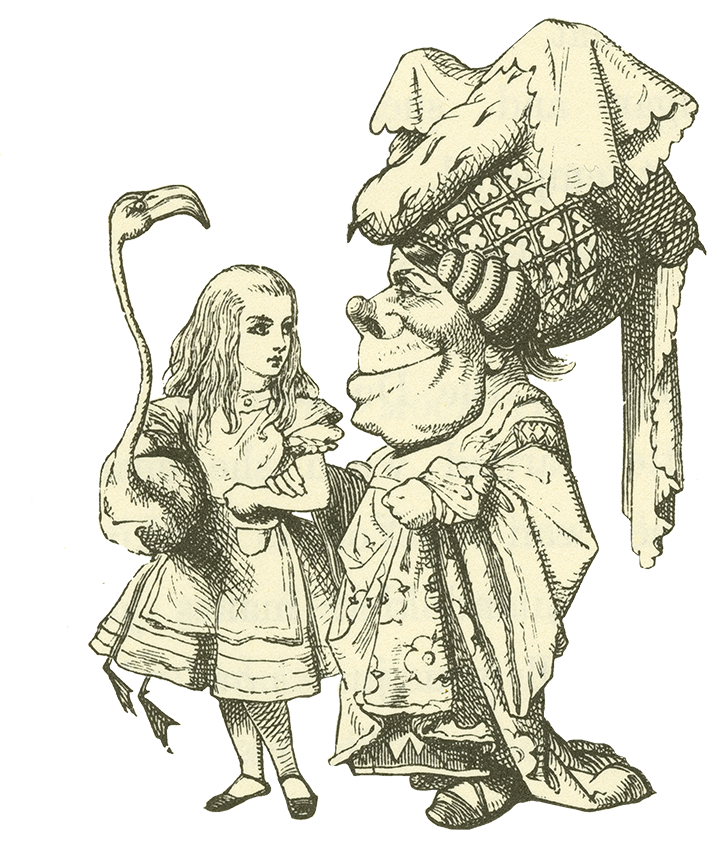
And Hiawatha was, in turn, the inspiration for another poem, by another famous (English) Victorian author, Charles Lutwidge Dodgson, “Lewis Carroll” (1832-1898),.

image8cl.jpg

the author of Alice’s Adventures in Wonderland (1865),

image9alice.jpg

among other works.

Besides being a professor of mathematics and fantasy creator, Dodgson was also a keen amateur photographer.  Here’s his image of another poet, Alfred, Lord Tennyson (1809-1892).

image10tennyson.jpg

In 1869, he published Phantasmagoria and Other Poems, including a poem entitled “Hiawatha’s Photographing”—and you can see what he’s done, can’t you? In 1883, he republished it in another collection, Rhyme? And Reason?, with the poem illustrated by Arthur B Frost.  Following our theme of  Kalevala influences, we thought that, rather than summarize, we’d simply reprint it here—without the illustrations, which we don’t seem to be able to copy–in hopes to bring a little cheer to what is a pretty grim time.  This is from the 1884 American edition, the LINK to which is right here (where you can see the illustrations for yourself):  https://ia800209.us.archive.org/5/items/cu31924013341049/cu31924013341049.pdf

(Don’t skip the intro!)

Hiawatha’s Photographing Poem

[In an age of imitation, I can claim no special merit for this slight attempt at doing what is known to be so easy. Any fairly practised writer, with the slightest ear for rhythm, could compose, for hours together, in the easy running metre of ‘The Song of Hiawatha.’ Having, then, distinctly stated that I challenge no attention in the following little poem to its merely verbal jingle, I must beg the candid reader to confine his criticism to its treatment of the subject.]

From his shoulder Hiawatha

Took the camera of rosewood,

Made of sliding, folding rosewood;

Neatly put it all together.

In its case it lay compactly,

Folded into nearly nothing;

But he opened out the hinges,

Pushed and pulled the joints and hinges,

Till it looked all squares and oblongs,

Like a complicated figure

In the Second Book of Euclid.


The camera

This he perched upon a tripod—

Crouched beneath its dusky cover—

Stretched his hand, enforcing silence—

Said, “Be motionless, I beg you!”

Mystic, awful was the process.

All the family in order

Sat before him for their pictures:

Each in turn, as he was taken,

Volunteered his own suggestions,

His ingenious suggestions.

First the Governor, the Father:

He suggested velvet curtains

Looped about a massy pillar;

And the corner of a table,

Of a rosewood dining-table.

He would hold a scroll of something,

Hold it firmly in his left-hand;

He would keep his right-hand buried

(Like Napoleon) in his waistcoat;

He would contemplate the distance

With a look of pensive meaning,

As of ducks that die in tempests.

Grand, heroic was the notion:

Yet the picture failed entirely:

Failed, because he moved a little,

Moved, because he couldn’t help it.


Next, his better half took courage;

She would have her picture taken.

She came dressed beyond description,

Dressed in jewels and in satin

Far too gorgeous for an empress.

Gracefully she sat down sideways,

With a simper scarcely human,

Holding in her hand a bouquet

Rather larger than a cabbage.

All the while that she was sitting,

Still the lady chattered, chattered,

Like a monkey in the forest.

“Am I sitting still?” she asked him.

“Is my face enough in profile?

Shall I hold the bouquet higher?

Will it come into the picture?”

And the picture failed completely.


Next the Son, the Stunning-Cantab:

He suggested curves of beauty,

Curves pervading all his figure,

Which the eye might follow onward,

Till they centered in the breast-pin,

Centered in the golden breast-pin.

He had learnt it all from Ruskin

(Author of ‘The Stones of Venice,’

‘Seven Lamps of Architecture,’

‘Modern Painters,’ and some others);

And perhaps he had not fully

Understood his author’s meaning;

But, whatever was the reason,

All was fruitless, as the picture

Ended in an utter failure.


Next to him the eldest daughter:

She suggested very little,

Only asked if he would take her

With her look of ‘passive beauty.’

Her idea of passive beauty

Was a squinting of the left-eye,

Was a drooping of the right-eye,

Was a smile that went up sideways

To the corner of the nostrils.

Hiawatha, when she asked him,

Took no notice of the question,

Looked as if he hadn’t heard it;

But, when pointedly appealed to,

Smiled in his peculiar manner,

Coughed and said it ‘didn’t matter,’

Bit his lip and changed the subject.

Nor in this was he mistaken,

As the picture failed completely.

So in turn the other sisters.


Last, the youngest son was taken:

Very rough and thick his hair was,

Very round and red his face was,

Very dusty was his jacket,

Very fidgety his manner.

And his overbearing sisters

Called him names he disapproved of:

Called him Johnny, ‘Daddy’s Darling,’

Called him Jacky, ‘Scrubby School-boy.’

And, so awful was the picture,

In comparison the others

Seemed, to one’s bewildered fancy,

To have partially succeeded.

Finally my Hiawatha

Tumbled all the tribe together,

(‘Grouped’ is not the right expression),

And, as happy chance would have it

Did at last obtain a picture

Where the faces all succeeded:

Each came out a perfect likeness.

Then they joined and all abused it,

Unrestrainedly abused it,

As the worst and ugliest picture

They could possibly have dreamed of.

‘Giving one such strange expressions—

Sullen, stupid, pert expressions.

Really any one would take us

(Any one that did not know us)

For the most unpleasant people!’

(Hiawatha seemed to think so,

Seemed to think it not unlikely).

All together rang their voices,

Angry, loud, discordant voices,

As of dogs that howl in concert,

As of cats that wail in chorus.

But my Hiawatha’s patience,

His politeness and his patience,

Unaccountably had vanished,

And he left that happy party.

Neither did he leave them slowly,

With the calm deliberation,

The intense deliberation

Of a photographic artist:

But he left them in a hurry,

Left them in a mighty hurry,

Stating that he would not stand it,

Stating in emphatic language

What he’d be before he’d stand it.

Hurriedly he packed his boxes:

Hurriedly the porter trundled

On a barrow all his boxes:

Hurriedly he took his ticket:

Hurriedly the train received him:

Thus departed Hiawatha.


Thanks for reading, as ever, stay well, and

MTCIDC

CD

“Get Up and Bar the Door!”

15 Wednesday Apr 2020

Posted by Ollamh in Uncategorized

≈ Leave a comment

No, dear readers, that’s not directed at you—although, at the current moment in the world’s health, you could easily be forgiven if you thought that it was!

Instead, it’s the title of a well-known Child Ballad—Number 275.  (We occasionally mention these, from the giant collection (305 ballads with variants) by Professor FJ Child, entitled The English and Scottish Popular Ballads, in five volumes, published from 1882-1898—in ten parts.)

image1childballads.jpg

And we chose the title because this is a post which actually originally began with a look back at a recent, serious posting, in which we found ourselves in the mines of Moria, in the Chamber of Mazarbul, defending ourselves from an orc attack—

“Heavy feet were heard in the corridor.  Boromir flung himself against the door and heaved it to; he wedged it with broken sword-blades and splinters of wood.  The Company retreated to the other side of the chamber.  But they had no chance to fly yet.  There was a blow on the door that made it quiver; and then it began to grind slowly open, driving back the wedges.  A huge arm and shoulder with a dark skin of greenish scales, was thrust through the widening gap.  Then a great flat, toeless foot was forced through below.  There was a dead silence outside…

There was a crash on the door, followed by crash after crash.  Rams and hammers were beating against it.  It cracked and staggered back, and the opening grew suddenly wide.  Arrows came whistling in, but struck the northern wall, and fell harmlessly to the floor.  There was a horn-blast and a rush of feet, and orcs one after another leaped into the chamber.”  (The Fellowship of the Ring, Book Two, Chapter 5, “The Bridge of Khazad-Dum”)

image2mazar.jpg

We wondered, as we read this, whether somewhere in the back of Tolkien’s head there was another scene of people trapped in a room under attack?

In Robert Louis Stevenson’s Kidnapped (1886), the hero, David Balfour, is trapped in the cabin of a ship with a Scottish office in the service of France, Alan Breck Stewart.  They are heavily outnumbered, but they have seized the ship’s small supply of weapons and are about to defend themselves from an attack by the ship’s crew.

“It came all of a sudden when it did, with a rush of feet and a roar, and then a shout from Alan, and a sound of blows and some one crying out as if hurt. I looked back over my shoulder, and saw Mr. Shuan in the doorway, crossing blades with Alan.

“That’s him that killed the boy!” I cried.

“Look to your window!” said Alan; and as I turned back to my place, I saw him pass his sword through the mate’s body.

It was none too soon for me to look to my own part; for my head was scarce back at the window, before five men, carrying a spare yard for a battering-ram, ran past me and took post to drive the door in. I had never fired with a pistol in my life, and not often with a gun; far less against a fellow-creature. But it was now or never; and just as they swang the yard, I cried out: “Take that!” and shot into their midst.

I must have hit one of them, for he sang out and gave back a step, and the rest stopped as if a little disconcerted. Before they had time to recover, I sent another ball over their heads; and at my third shot (which went as wide as the second) the whole party threw down the yard and ran for it.

Then I looked round again into the deck-house. The whole place was full of the smoke of my own firing, just as my ears seemed to be burst with the noise of the shots. But there was Alan, standing as before; only now his sword was running blood to the hilt, and himself so swelled with triumph and fallen into so fine an attitude, that he looked to be invincible. Right before him on the floor was Mr. Shuan, on his hands and knees; the blood was pouring from his mouth, and he was sinking slowly lower, with a terrible, white face; and just as I looked, some of those from behind caught hold of him by the heels and dragged him bodily out of the round-house. I believe he died as they were doing it.” (Kidnapped, Chapter X, “The Siege of the Round-House”)

image3pilot.jpg

(This is an illustration by NC Wyeth, from his 1913 edition of the story.)

image4kidnapped.jpg

At present, we don’t find ourselves besieged by orcs or sailors, or even by boredom or “cabin fever”—the latter of which always makes us think of Charlie Chaplin in The Gold Rush (1925), when his starving cabin mate begins to imagine him as a giant chicken—

image5goldrush.jpg

and we hope that, by reading this and our other postings, we can help you to fight off boredom and “cabin fever”, too, if not orcs and sailors.

But what about the ballad?

It’s a simple story.  A farmwife is making puddings

image6ayorkshirepudding.jpg

when her husband tells her to get up and bar the door.

image6bdoorbar.jpg

She refuses, saying that, as he seems to have the leisure, he should do it.  He refuses and a quarrel breaks out

image7rackham.png

which only ends when they agree that the next person who speaks will be obliged to do it.  They sit in silence so long that two thieves quietly slip in and proceed to rob the house—and neither husband nor wife says a word.  Finally, when one of the thieves proposes to kiss the wife, the husband loudly objects—thus being the first to speak and his wife then tells him:  “So, you get up and bar the door!”

image8bar.jpg

A silly little song and perhaps just the thing for a such a time, when many of us are stuck indoors.  Here are three versions of the ballad, if you’re not familiar with it:

275A: Get Up and Bar the Door


275A.1  IT fell about the Martinmas time,

And a gay time it was then,

When our goodwife got puddings to make,

And she’s boild them in the pan.

275A.2  The wind sae cauld blew south and north,

And blew into the floor;

Quoth our goodman to our goodwife,

‘Gae out and bar the door.’

275A.3  hand is in my hussyfskap,

Goodman, as ye may see;

An it shoud nae be barrd this hundred year,

It’s no be barrd for me.’

275A.4  y made a paction tween them twa,

They made it firm and sure,

That the first word whaeer shoud speak,

Shoud rise and bar the door.

275A.5  Then by there came two gentlemen,

At twelve o clock at night,

And they could neither see house nor hall,

Nor coal nor candle-light.

275A.6  ‘Now whether is this a rich man’s house,

Or whether is it a poor?’

But neer a word wad ane o them speak,

For barring of the door.

275A.7  And first they ate the white puddings,

And then they ate the black;

Tho muckle thought the goodwife to hersel,

Yet neer a word she spake.

275A.8  Then said the one unto the other,

‘Here, man, tak ye my knife;

Do ye tak aff the auld man’s beard,

And I’ll kiss the goodwife.’

275A.9  ‘But there’s nae water in the house,

And what shall we do than?’

‘What ails ye at the pudding-broo,

That boils into the pan?’

275A.10 O up then started our goodman,

An angry man was he:

‘Will ye kiss my wife before my een,

And scad me wi pudding-bree?’

275A.11 Then up and started our goodwife,

Gied three skips on the floor:

‘Goodman, you’ve spoken the foremost word,

Get up and bar the door.’


275B: Get Up and Bar the Door


275B.1  THERE leeved a wee man at the fit o yon hill,

John Blunt it was his name, O

And he selld liquor and ale o the best,

And bears a wondrous fame. O

Tal lara ta lilt, tal lare a lilt,

Tal lara ta lilt, tal lara

275B.2  The wind it blew frae north to south,

It blew into the floor;

Says auld John Blunt to Janet the wife,

Ye maun rise up and bar the door.

275B.3  ‘My hans are in my husseyskep,

I canna weel get them free,

And if ye dinna bar it yersel

It’ll never be barred by me.’

275B.4  They made it up atween them twa,

They made it unco sure,

That the ane that spoke the foremost word

Was to rise and bar the door.

275B.5  There was twa travellers travelling late,

Was travelling cross the muir,

And they cam unto wee John Blunt’s,

Just by the light o the door.

275B.6  ‘O whether is this a rich man’s house,

Or whether is it a puir?’

But never a word would the auld bodies speak,

For the barring o the door.

275B.7  First they bad good een to them,

And syne they bad good morrow;

But never a word would the auld bodies speak,

For the barring o the door, O.

275B.8  First they ate the white puddin,

And syne they ate the black,

And aye the auld wife said to hersel,

May the deil slip down wi that!

275B.9  And next they drank o the liquor sea strong,

And syne they drank o the yill:

‘And since we hae got a house o our ain

I’m sure we may tak our fill.’

275B.10 It’s says the ane unto the ither,

Here, man, tak ye my knife,

An ye’ll scrape aff the auld man’s beard,

While I kiss the gudewife.

275B.11 ‘Ye hae eaten my meat, ye hae drucken my drink,

Ye’d make my auld wife a whore!’

‘John Blunt, ye hae spoken the foremost word,

Ye maun rise up and bar the door.’


275C: Get Up and Bar the Door


275C.1  THERE livd a man in yonder glen,

And John Blunt was his name; O

He maks gude maut and he brews gude ale,

And he bears a wondrous fame. O

275C.2  The wind blew in the hallan ae night,

Fu snell out oer the moor;

‘Rise up, rise up, auld Luckie,’ he says,

‘Rise up, and bar the door.’

275C.3  They made a paction tween them twa,

They made it firm and sure,

Whaeer sud speak the foremost word

Should rise and bar the door.

275C.4  Three travellers that had tint their gate,

As thro the hills they foor,

They airted by the line o light

Fu straught to Johnie Blunt’s door.

275C.5  They haurld auld Luckie out o her bed

And laid her on the floor,

But never a word auld Luckie wad say,

For barrin o the door.

275C.6  ‘Ye’ve eaten my bread, ye hae druken my ale,

And ye’ll mak my auld wife a whore!’

‘A ha, Johnie Blunt! ye hae spoke the first word,

Get up and bar the door.’


Thanks, as ever, for reading, stay well, and know that, barring (yep, a bad pun) unforeseen circumstances,

MTCIDC


CD


ps

In case you don’t have your own copy of Kidnapped, here’s a LINK to an early American edition:  http://www.gutenberg.org/files/421/421-h/421-h.htm

A great read for all of us stay-at-homes!


Not So Dry As Tinder?

08 Wednesday Apr 2020

Posted by Ollamh in Uncategorized

≈ Leave a comment

Welcome, as ever, dear readers.  We hope that you are well and happy in what, unless we make it otherwise, can be a gloomy time.

Our title this time is a kind of hope, based upon our subject, which is about one of our favorite fairy tales, Hans Christian Andersen’s (1805-1875)

image1hca.jpg

“The Tinderbox” (Fyrtoget, in Danish, which looks like it actually means “fire tinder”—more about “tinder” below).

(This image of HCA comes from a very interesting website, which we’ve just recently discovered.  Here’s a LINK, if you’d like to investigate it for yourself:  https://www.terriwindling.com/)

If you, like us, grew up in a world of safety matches,

image2box.jpg

(We have no idea why these are called “Double Happiness”, by the way—perhaps because, 1. when you strike them against the box, they actually light; 2. when you try to light a fire with them, they don’t simply wink out immediately, as we have often had happen to us?)

a “tinderbox” is something from the very far past.  After all, friction matches have been with us since their invention, by John Walker, in 1826.  Before such became common—and probably, in much of the world long after—the way to light a fire was to strike a piece of flint with a piece of steel,

image3flintandsteel.jpg

causing a spark.

image4fands.jpg

For handy carrying purposes, these two could be carried in a box, and, so that you always had something for the spark to set alight (and it could be any number of things, from moss to bits of fabric), you stuffed such things, called “tinder” (from the Old English verb tendan, “to kindle/alight/set alight”) into the box along with the flight and steel—and there was a “tinderbox”.

image5tbox.png

image6tbox.jpg

In the Andersen story, first published in 1836, when tinderboxes were still the method for lighting fires, the tinderbox is actually a magical one, as a soldier discovers, after he acquires one.  When he strikes a light once, twice, or three times, bigger and bigger dogs with bigger and bigger eyes appear and will fetch him anything he may wish.

image7dogs.png

The soldier has discovered this wonderful device when he was lowered into a hollow tree by a witch—but, in this posting, we’re not going to discuss the story as story, rather, when we did a little image-searching, what caught our attention was the soldier himself—how he was dressed.  If you’re a regular reader, you’ll know that, along with the many other things we’ve taught and teach, we currently run a “History of Western Warfare” course and the look of soldiers through the ages interests us (as does dress in general).  We collected about two dozen images of the soldier hero from various tellings of the story and were interested to see the choices made for how he would be depicted.

First, however, how did the original author portray him?  What clues does he give us?  If we wanted a perfect picture, we would be disappointed, we’re afraid, as the details are few.  In the first paragraph, we are told that the soldier has a pack (tornyster) and a sabre (sabel).  A few paragraphs later, we are told that he fills his pockets (lommen) and then his kaskett, which, in modern Danish, means “hat/cap”, but we suspect, from the original French word, that, in 1836, this meant “shako”, a kind of tall, cylindrical military headgear, as the look of a Danish soldier then would have been something like this–

image8soldaten.jpg

He also fills his boots (stovler).

So—HCA has told us that our soldier has (probably) a shako, a pack, something with pockets, boots, and he’s armed with a sabre.  As he has a pack, and he’s been walking along a country road, not riding, we assume that he’s an infantryman, and so that “sabre” is actually an infantry short sword (in French, sabre-briquet), which was rapidly disappearing from an infantryman’s weaponry by the time the story would have been written, but it would have looked like this—as still worn by a Danish Footguard today.

image9livgard.jpg

Now, let’s look at some images.  We thought that we would classify them not by publication date, but by period of dress, and the first one would be this—

image10kettle.jpg

Here, we’re looking at a later-medieval infantryman, a bit like this one—

image11.jpg

wearing a breastplate and the distinctive “kettle helmet”.  No shako, pack, pockets, short sword, or boots.  It almost makes us wonder if the illustrator had actually read the story!

Here’s another—

image12lands.jpg

By his clothing, we’ve moved forward a couple of centuries, this being an early-16th-century landsknecht,

image13landsknechte.jpg

Again—everything the author mentions seems to be missing.  We admire the art of it, but, again, has the artist spent any time with the text?

Our next illustration just seems very odd—the soldier appears to have turned into an early-17th-century musketeer—or perhaps it’s puss-in-boots?

image14musk.jpg

image15musk.jpg

image16puss.jpg

We certainly don’t want to suggest in our little review that there is only one way to illustrate a story.  When it comes to Tolkien, for instance, we admire a wide variety of artists, from the first great illustrators, the Hildebrandts,

image17gandb.jpg

to Michael Hague

image18gandalf.jpeg

to the wonderful work of Ted Nasmith

image19crossroads.jpg

to many others, including Lee, Howe, and Gordeev—and there are, indeed, many, and who knows who else is out there?  Our personal preference—and maybe this makes us a little old-fashioned—is for those illustrations which stick closest to what we understand Tolkien was presenting to us and we feel the same about HCA’s (fragmentary) description.  For example, here’s what appears, by its style, to be a later-19th-century depiction of the first meeting of the witch and the soldier—

image20wands.jpg

Here you see the shako, the pack, and, in this case, what appears to be a literal (cavalry) sabre.   Even more convincing—and we’ll stress, to us—is this 2007 view.  (This is Stephen Mitchell’s version, illustrated by Bagram Ibatoulline)

image21wands.jpg

As we said, we found about two dozen different illustrations, and those were just of the soldier and the witch.  For fun, go to your usual image search engine and see what you find that pleases you:  hopefully, we have kindled a little flame of interest with this posting?

Thanks, as always, for reading,

Stay well,

And MTCIDC

CD

ps

If you don’t have a copy of “The Tinderbox” at hand, here’s a LINK to a translation:  https://www.andersenstories.com/en/andersen_fairy-tales/the_tinderbox

The same site gave us the Danish original and we apologize to any Danish reader for any mistakes made, being only beginners in that excellent language!

Messages of Doom

01 Wednesday Apr 2020

Posted by Ollamh in Uncategorized

≈ Leave a comment

Messages of Doom


As always, welcome, dear readers.  We are optimists by nature and we want to assure you that, in this time of world turbulence, our title was not meant to cast a shadow—rather, we hope to distract you with several of what we think are slightly spooky stories from the past, both historical and fictional, so read on and see.

When we were little, we once read a brief article about something called “the Lost Colony”.

In 1587, a small English colony was established on Roanoke Island on the coast of what is now North Carolina.

image1map.jpg

It wasn’t the first attempt to do this, but those earlier attempts had been unsuccessful and, as this version wasn’t doing very well, the governor, John White, sailed back to England the same year, hoping to speed up further supplies and drum up more support.  Unfortunately, the war with Spain, which led to the attempt by the Spanish to invade England the next year,

image2sparmada.jpg

delayed him until 1590 and, when he finally managed to return, he found the place empty, with only a single word “Croatoan” carved on one of the posts of the little fort the colonists had built.

image3croatoan.jpg

White assumed that this meant that, for some reason, the colonists had moved to the island of Croatoan (also the name of a local Native American tribe), farther south, but, after some tentative investigating, White’s ship—on which he was only an important passenger—set sail for the Caribbean, the promise being that it would return the next year.  Storms drove the ship off course and, eventually White found himself once more in England.  There were several failed attempts to mount a search expedition in the years following, and a number of English settlers to the north, in modern Virginia, heard garbled stories, but no one was ever seen or heard from again and that single word, “Croatoan”, has remained to haunt people ever since.

It has certainly haunted us and it has made us think of other haunting messages.  One of these is this, sent on June 25, 1876—

image4custer.jpg

In case the handwriting/s is/are a little difficult (there are two of them), it says:  “Benteen.  Come on.  Big village.  Be quick.  Bring packs.  P.S. Bring packs.  W.W. Cook.”

The “Benteen” referred to was Captain Frederick Benteen (1834-1898),

image5benteen.jpg

the “Big village” was the combined village of Lakota and Cheyenne warriors and their families being sought in the summer of 1876 by various units of the US Army,

image6village.jpg

the “packs” were containers of spare ammunition being carried on pack mules,

image7mules.jpg

and “W.W. Cook” was what the army called an “adjutant”, an officer-assistant to a superior officer.

image8acook.jpg

In this case, the superior officer was Lt. Colonel George Custer (1839-1876),

image8custer.jpg

a one-time hero in the US Civil War,

image9acw.jpg

where he rose to a very high rank.  After the war, when the Army was drastically cut, Custer stayed on, but at a much lower rank, moving from the command of a division of cavalry (many units) to the command of a single unit, the Seventh Cavalry.  Now, in the summer of 1876, Custer was in charge of one arm of a much bigger push to deal with the two most powerful tribes on the northern plains, the Lakota and the Cheyenne.  He had been ordered to search for them and had just found them.  To aid in that search, Custer had divided his command into three elements and now, having spotted what he believed was an enemy camp, he was trying to pull the third element, in the form of Benteen’s command, to join the other two, along with the mules carrying the spare ammunition.  Instead, the second element was driven off and the first element, led by Custer himself, went down to defeat

image10custer (2).jpg

at the hands of a superior number of Lakota and Cheyenne, when the camp turned out to be much larger than Custer had anticipated.

image11warriors.jpg

Although that note reached Benteen, he did not immediately follow orders, but advanced slowly, missed being killed with Custer and his whole detachment of over 200 men, and saved that note—another haunting message of doom:  like a letter asking for help sealed in a bottle which never floated to shore.

This bring us to our third.  The previous two were historical, this third came from the mind of a man about whom we often write—

image12jrrt.jpg

Gandalf has led the Fellowship

image13fellowship.jpg

to the mines of Moria

image14doorway.jpg

Now, deep within, they come to a chamber

image15maz.jpg


image16atomb.jpg

which appears to be strewn with wreckage, including a tomb and the remains of a book.  The inscription on the tomb reads:  “Balin son of Fundin Lord of Moria”, indicating that an important dwarf, and an old friend of Bilbo, lay there, but wondering why set the Fellowship to searching “for anything that would give them tidings of Balin’s fate, or show what had become of his folk.”  (The Fellowship of the Ring, Book Two, Chapter 5, “The Bridge of Khazad-Dum”)  A quick look-round revealed to them, “…many recesses cut in the rock of the walls, and in them were large, iron-bound chests of wood.  All had been broken and plundered; but beside the shattered lid of one there lay the remains of a book.  It had been slashed and stabbed and partly burned, and it was so stained with black and other dark marks like old blood that little of it could be read.”

image16page.jpg

Gandalf can still make out things here and there, however:  “It seems to be a record of the fortunes of Balin’s folk…I guess that it began with their coming to Dimrill Dale nigh on thirty years ago… “

He continues until we see this:

“It is grim reading…I fear their end was cruel.  Listen! ‘We cannot get out.  We cannot get out…They have taken the Bridge and the second hall..We cannot get out.  The end comes,’ and then ‘drums, drums in the deep.’  I wonder what that means.  The last thing written is in a trailing scrawl of elf-letters:  ‘They are coming.’ “

In the case of the Lost Colony, there is simply a single word and an end, at least until archaeological research may point in new directions.  Neither Benteen nor packs came to Custer, and we certainly know his and his men’s fate.

image17custer.jpg

For the Fellowship, however, the past will now repeat itself:

“Gandalf had hardly spoken these words, when there came a great noise:  a rolling Boom that seemed to come from depts far below, and to tremble in the stone at their feet…Then there came an echoing blast:  a great horn was blown in the hall, and answering horns and harsh cries were heard further off.  There was a hurrying sound of many feet.

‘They are coming!’ cried Legolas.

‘We cannot get out,’ said Gimli.”

And now, trapped in the Chamber of Mazarbul, those words come back not only to haunt us readers, but the very characters we’re reading about, who are about to have a life-and-death struggle on their hands.

image18battle.jpg

With a small shiver, we thank you, as ever, for reading.  Stay well, and, as we always say

MTCIDC

CD

Going Underground

25 Wednesday Mar 2020

Posted by Ollamh in Uncategorized

≈ Leave a comment

Welcome, dear readers, as always, but, although the title of this posting might suggest taking cover during this time of worldwide illness, we persist in staying calm and remaining aboveground and writing more about subjects we—and, we hope you—find interesting.

We are about to teach The Hobbit again—although this time, not being sitting in a classroom with about 20 students, talking about what we’ve been reading, but somehow on-line, which is not very happy-making, as we really enjoy the always-intriguing reactions and questions which come from in-class discussion.

One observation from last term’s Hobbit reading has stuck with us:  just how much of the dramatic action takes place underground—and there are also a number of like scenes, also very dramatic scenes, in The Lord of the Rings, as well.

We started adding them up and found, in The Hobbit:

  1. the world of the goblins under the Misty Mountains, where Gandalf kills the goblin king

image1agobking.jpg

and Bilbo finds the Ring and meets Gollum.

image1bgollum.jpg

  1. in Mirkwood, the caves where the dwarves are kept prisoner by Thranduil, the king of the Forest Elves

image1cmirk.jpg

until Bilbo frees them with his barrel-riding.

image1dbarrel.jpg

  1. the tunnels under the Lonely Mountain

image1emtn.jpg

where Bilbo and the dwarves must deal with Smaug.

image1fsmaug.jpg

In The Lord of the Rings, we find:

  1. Moria, with its mysterious western door,

image1gmoria.jpg

the chamber of Mazarbul,

image1hmazarbul.jpg

and the Balrog.

image1ibalrog.jpg

  1. the Pathways of the Dead

image1jdoor.jpg

  1. and the area around Cirith Ungol, where Shelob has her lair.

image1kshelob.jpg

Darkness, often narrow or treacherous places, full of fear–it might be supposed that Tolkien was a claustrophobe–

image1lclaustrophobia.jpg

until you read this letter from 1940, in which he tells us of having made several visits—one in 1916—to some very famous caves (in this letter, he’s replying to someone who has asked about the caverns at Helm’s Deep):

“It may interest you to know that the passage was based upon the caves in Cheddar Gorge and was written just after I had revisited these in 1940 but was still coloured by my memory of them much early before they became so commercialized.  I had been there during my honeymoon nearly 30 years before.”  (Letters, 407)

Cheddar Gorge is in Somerset, in southwest England and is famous for its caves–

image1mcheddar.jpg

as well as its cheese.

image1ncheddar.jpg

We can deduce, then, that, in fact, JRRT was interested in caves and enjoyed them.

Scary caves go back farther in his life, however.  We would suggest from childhood, when he read, one, and possibly two, stories by the once-popular Victorian children’s author, George MacDonald (1824-1905).

image1ogm.jpg

These books, The Princess and the Goblin (1872)

image1p.jpg

and The Princess and Curdy (1883),

image1q.jpg

as the titles suggest, have to do with the adventures of a princess, her friend, Curdy, and the swarms of goblins who live in a warren of caves below the palace.  JRRT himself confessed, in a 1938 letter published in The Observer, to MacDonald’s influence:

“As for the rest of the tale it is…derived from (previously digested) epic, mythology, and fairy-story—not, however, Victorian in authorship, as a rule to which George Macdonald [sic] is the chief exception.”

(Letters, 31)

For later dark underground influences, we might add two spots in Beowulf:   the lair of Grendel, which is not only underground, but underwater,

image1rgsmom.jpg

and the tumulus in which the (unnamed) dragon lives, the slaying of which causes the death of Beowulf.

image1sdrag.jpg

Perhaps the most traumatic influence might be what was a traumatic experience for many more than JRRT.

In the summer of 1916, Second Lieutenant JRR Tolkien

image1tolkienlt.jpg

arrived at the Western Front, a subterranean land of trenches which cut up the world into endless crisscrosses of deep, often elaborate ditches with thickets of barbed wire in front of them,

image2trench.jpg

protecting soldiers on both sides from the effects of heavy artillery

image3heavyarty.png

and machine guns,

image4mg.jpg

in a crooked line which stretched for nearly 500 miles from Switzerland to the North Sea.

image5map.jpg

When he arrived, he was just in time to take part in a massive attack on a portion of the German lines in an assault which is now called the Battle of the Somme.  This was a tremendous effort which cost the British on the first day alone a total of over 57,000 casualties.

image6casualties.jpg

To soften up the enemy lines, the British had dug tunnels below them at various points,

image7tunneling.jpg

filled them with explosives, called “mines”, and set them off just before the attacks.

image8hawthorn.jpg

Tolkien, as a signals officer—someone who dealt with communications after the first wave of attackers—

image1ttwave.jpg

wouldn’t have been involved in mines or the initial assault, but would have followed behind, climbing into the enemy’s trenches to set up communication facilities after the attack had moved forward.  He would certainly have seen these underground burrows, some of them extremely elaborate,

image10trench.jpg

image11dugout.jpg

and perhaps childhood reading, the Cheddar gorge, and the experience of the Great War were all in his head when he began his first novel by placing his hero in a hole in the ground, then putting him back underground again and again?

image12bilbo.jpg

Thanks, as ever, for reading.  Stay well, dear readers, with

MTCIDC

CD


Following the Signs

18 Wednesday Mar 2020

Posted by Ollamh in Uncategorized

≈ Leave a comment

As ever, dear readers, welcome.

This posting started with a signpost.  In the UK, this can be called a fingerpost, like

image1fingerpost.jpg

this wooden one, a very old one, where you can see directions and mileage from the point where the post was planted.  Where we began, there is a finger, but:

“Suddenly a tall pillar loomed up before them.  It was black; and set upon it was a great stone carved and painted in the likeness of a long White Hand.  Its finger pointed north.” (The Two Towers, Book Three, Chapter 8, “The Road to Isengard”)

Gandalf, Denethor, Aragorn, and their company have ridden north from Helm’s Deep, passing into Nan Curunir, “The Wizard’s Vale”:

“After they had ridden for some miles, the highway became a wide street, paved with great flat stones, squared and laid with skill; no blade of grass was seen in any joint.  Deep gutters, filled with trickling water, ran down on either side.”
If we were asked what JRRT had in mind here, we would say at once, “it’s a Roman road, like this one”—

image2romanroad.jpg

which, if you could see it in cross-section, would look like this—

image3roroad.gif

The Romans had mileposts, too, a bit like signposts.  This is the first one on the oldest Roman road, the Via Appia, and the long inscription tells us who put it up (the Emperor Nerva—96-98AD) and who restored it (the Emperor Vespasian—117-138AD), but also how many (Roman) miles it was from there to the center of Rome:  1.

image4mile.jpg

It’s interesting, then, to see that the fingerpost which Gandalf & Co encounter has no inscription at all, its information seeming to consist only of the indication of a direction, north.   As we thought about it, however, it occurred to us to ask:  are we ever shown any public inscriptions in Middle-earth?  And, if there were any, where are they?   We could think of only two, and neither on a road.  The first was on the western gate of Moria, with the command which puzzled Gandalf–

image5gate.jpg

the other was above the Dark Door, the entrance to the Paths of the Dead (this is a sketch by John Howe)

image6jh.jpg

where we’re only told that “Signs and figures were carved above its wide arch too dim to read”.

With no more information than a direction, we are led northwards:

“Beneath the mountain’s arm within the Wizard’s Vale through years uncounted had stood that ancient place that Men called Isengard.  Partly it was shaped in the making of the mountains, but mighty works the Men of Westernesse had wrought there of old, and Saruman had dwelt there long and had not been idle.”

image7orthanc.png

Long before Saruman arrived, those Men of Westernesse hadn’t been idle, either:

“A great ring-wall of stone, like towering cliffs, stood out from the shelter of the mountain-side, rom which it ran and then returned again.”

In trying to picture this, we thought of Iron Age hill forts, like Castle Ring, whose walls were of earth, rather than stone, but extensive, all the same.

image8castlering.jpg

“One entrance only was there made in it, a great arch delved in the southern wall.  Here through the black rock a long tunnel had been hewn, closed at either end with mighty doors of iron…One who passed in and came at length out of the echoing tunnel, beheld a plain, a great circle, somewhat hollowed like a vast shallow bowl, a mile it measured from rim to rim.”

Tunnels like this may be seen in more modern fortresses, like Ehrenbreitstein, in Germany.

image9ehren.jpg

But what has Saruman been up to?

“Once it had been green and filled with avenues, and groves of fruitful trees, watered by streams that flowed from the mountains to a lake.  But no green thing grew there in the latter days of Saruman.  The roads were paved with stone-flags, dark and hard; and beside their borders instead of trees there marched long lines of pillars, some of marble, some of copper and of iron, joined by heavy chains.”

Here, we think of what are called allees, long walks between rows of trees of the sort you can see in Europe—

image10allees.jpg

which we juxtapose with the Hildebrandt’s portrait of Saruman.

image11saruman.jpg

That vast circle is still too green in their depiction, however, as we read on:

“Many houses there were, chambers, halls, and passages, cut and tunneled back into the walls upon their inner side, so that all the open circle was overlooked by countless windows and dark doors…The plain, too, was bored and delved.  Shafts were driven deep into the ground; their upper ends were covered by low mounds and domes of stone, so that in the moonlight the Ring of Isengard looked like a graveyard of unquiet dead.”

A very vivid image!

image12moon.jpg

But too peaceful for the activity found there seemingly 24/7:

“Iron wheels revolved there endlessly, and hammers thudded.  At night plumes of vapor streamed from the vents, lit from beneath with red light, or blue, or venomous green.”

In a posting some time ago, we likened Mordor to the old industrial area in England, the Black Country, and this description certainly brings that to mind—

image13black.jpg

But in the center is this:

“There stood a tower of marvelous shape.  It was fashioned by the builders of old, who smoothed the Ring of Isengard, and yet it seemed a thing not made by the craft of Men, but riven from the bones of the earth in black and gleaming hard:  four mighty piers of many-sided stone were welded into one, but near the summit they opened into gaping horns, their pinnacles sharp as the points of spears, keen-edged as knives.”

As always, we think about where all of this may have come from.  JRRT was a medievalist, after all, and medieval models must always have been in his mind.  The idea of a circuit of walls with a central citadel says to us a place like Old Sarum

image14os.jpg

or perhaps the Tower of London—

image15tower.png

and the White Tower at the Tower of London, although the wrong color, shares a definite similarity with Orthanc, being square, with four corner towers.

image16white.jpg

Along with his written description, however, JRRT has left us some small images of what he had in mind, like—

image17jrrt.jpg

and this drawing, in particular, brought to mind something we suspect he might have rejected, but which, to us, bears a certain resemblance, the unfinished Cathedral of the Holy Family, in Barcelona, Catalunya—

image18sagrada.jpg

We are still standing at that signpost, however, and something about it suggests is that, for all of the work of the Men of Westernesse and for all of Saruman’s alterations, all may not be right in the Wizard’s Vale:

“Now Gandalf rode to the great pillar of the Hand, and passed it, and as he did so the Riders saw to their wonder that the Hand appeared no longer white.  It was stained as with dried blood; and looking closer they perceived that its nails were red.  Unheeding Gandalf rode on into the mist, and reluctantly they followed him.  All about them now, as if there had been a sudden flood, wide pools of water lay beside the road, filling the hollows, and rills went trickling down among the stones.”

Perhaps, instead of the White Hand, this would have been a better signpost?

image19oz.jpg

Thanks, as ever, for reading and

MTCIDC

CD

Ram’s Gate

11 Wednesday Mar 2020

Posted by Ollamh in Uncategorized

≈ Leave a comment

Welcome, dear readers, as ever.

In our last, we discussed Gandalf’s confrontations with evil, including his meeting with the head of the Nazgul, the Witch King of Angmar, at the main gate of Minas Tirith.  As we think about it, we believe that there’s a bit more to say—but with JRRT, isn’t there always?

image1confront.jpeg

In the background of this Ted Nasmith picture, you can see what has broken open the gate:  the giant battering ram, Grond.  Here is an image of it from the Jackson films—

image2grond.jpg

and here is Tolkien’s description—which is, although grim, in a much lower key, we would say:

“Great engines crawled across the field; and in the midst was a huge ram, great as a forest-tree a hundred feet in length, swinging on mighty chains.  Long had it been forging in the dark smithies of Mordor, and its hideous head, founded of black steel, was shaped in the likeness of a ravening wolf, on it spells of ruin lay.  Grond they named it, in memory of the Hammer of the Underworld of old.  Great beasts drew it, orcs surrounded it, and behind walked mountain-trolls to wield it.”  (The Return of the King, Book Five, Chapter 4, “The Siege of Gondor”)

At its simplest, a battering ram is just a heavy log used by a gang of men, soldiers or otherwise, to bash a wall

image3ram.gif

or bash in a gate.

image4ram.png

(You’ll notice that the first of these two images has an actual ram’s head on it.  This would give the point of the battering ram a harder surface and probably is a reference to the way two rams will actually fight, butting heads against each other.)
Grond is a more complex ram, however, being suspended on chains so that the weight of the swing of it will increase its force.  Here is a model of the ram from the film, to make it a bit clearer.

image8grond.jpg.jpg

And here is an illustration of a medieval ram so that you can see how it works.

image9ram.jpg

Rams as an engine of war have been around a long time.  The Egyptians used a very simple version,

image10egyptram

while the Assyrians employed a more complex model.

image11assram

Both of these, you’ll notice—and you can see it especially in the Assyrian example—aren’t actually attempting to slam into the wall.  Rather, they are working to drive a wedge among the wall’s blocks—probably in both cases of mud brick—so that the upper face of the wall will collapse in their direction and, with any luck, pile up enough fallen material that the besiegers might even be able to scramble up it and into the city.

You’ll notice, too, that the Assyrian ram is covered in something—possibly animal hides?  These would not only protect those inside from missiles shot or thrown from the wall above, but would also (those who constructed it must have hoped) make it somewhat nonflammable.  In fact, here’s another illustration where the besieged are trying to throw torches at it and the besiegers are attempting to keep the covering wet in return.  (JRRT is aware of this—as he says of Grond:  “Upon its housing no fire would catch…”)

image12assram

The Assyrians also appear to have used an actual battering ram—this image showing one aimed at a gate,

image13ram

as is Grond.  And this is the Witch King’s target:

“It was against the Gate that he would throw his heaviest weight.  Very strong it might be, wrought of steel and iron, and guarded with towers and bastions of indomitable stone, yet it was the key, the weakest point in all that high and impenetrable wall.”

Tolkien appears to have left us only a few images of Minas Tirith, and the two we’ve seen are very rudimentary (this is the only one we could post), and

image14mt

probably made to help him to visualize the position of the seven gates.  As far as we know, he has not left us any image of the Gate itself, except the description above.  In the Jackson films, the gate has been elaborated—

image16gate

The outermost frame is in the style known as Romanesque.  Here is a good example from the church of Santa Maria Seu d’Urgell, in Catalonia.

image18smaria

Just under the arch of the Gate at Minas Tirith is the suggestion of another part of a gate structure, a portcullis.  Ordinarily, this would be a full-size inner gate behind the main gate and would act as a secondary defense.

image19port

It would be worked by a system of pulleys and weights, as in this diagram.

image20port

As this isn’t mentioned in Tolkien’s description, however, we presume that the Gate of Minas Tirith isn’t backed up by one—and it doesn’t appear in the Jackson films, only this hint of one.

Tolkien says that the Gate itself is made of “steel and iron” and seems to lack any features.  As you can see, the gate of Jackson’s Minas Tirith has figures upon it, like certain elaborate medieval cathedral doors.

image21gate

Such figures are usually part of the outer structure of the door, being cast bronze, like the famous door leaves from the church of St Michael in Hildesheim, in Germany.

image22stm

We don’t know who the figures are meant to be on Jackson’s gate, although it’s clear that some are warriors, being in armor, and there is one woman, at least, in the top row.  Founders of Gondor?

Whoever they were meant to be, even if they had been on Tolkien’s Gate, they would have been no defense against what happened next:

“The drums rolled and rattled.  With a vast rush Grond was hurled forward by huge hands.  It reached the Gate.  It swung.  A deep boom rumbled through the City like thunder running in the clouds.  But the doors of iron and posts of steel withstood the stroke.

Then the Black Captain rose in his stirrups and cried aloud in a dreadful voice, speaking in some forgotten tongue words of power and terror to rend both heart and stone.”

We have seen earlier—and written earlier—about the use of some sort of explosive device both at Helm’s Deep and at the Rammas Echor, the outward defensive wall of the Pelennor, the far boundary of the fields outside Minas Tirith.  Here, however, something else is at work, magic of some sort.  Grond has had “spells of ruin” laid upon it and now:

“Thrice he cried.  Thrice the great ram boomed.  And suddenly upon the last stroke the Gate of Gondor broke.  As if stricken by some blasting spell it burst asunder:  there was a flash of searing lightning, and the doors tumbled in riven fragments to the ground.”

All of which brings us back to our last posting—

“In rode the Lord of the Nazgul.  A great black shape against the fires beyond he loomed up, grown to a vast menace of despair.  In rode the Lord of the Nazgul, under the archway that no enemy ever yet had passed, and all fled before his face.

All save one.”

image23gate

What an ending—or, really, a beginning.  As we can’t better it, we’ll simply say thanks, as always, for reading and

MTCIDC

CD

Confrontational

04 Wednesday Mar 2020

Posted by Ollamh in Uncategorized

≈ Leave a comment

As ever, dear readers, welcome.

We recently received an e-mail from our dear friend, Erik, which included a new Ted Nasmith illustration of Gandalf opposing the Witch King of Angmar at the ruined main gate of Minas Tirith (see The Return of the King, Book Five, Chapter 4, “The Siege of Gondor”).

image1gandwk.jpeg

As Ted Nasmith is one of our favorite Tolkien artists, this would have been a treat in itself, but Erik included a quotation from the artist, which we present here since, so far, this is the only direct description we’ve seen of such an artist at work–

“I’m pleased to present a newly completed commission, ‘Gandalf Defies the Witch King’. A lot of thought went into this work, and it was more focused and difficult than some. How to capture the intensity of this scene, where the wizard is described as “silent and still”, so I’ve used perspective (seeing from a low angle), and the wizard’s staff alit to evoke his power and steadiness in the face of the onslaught by Sauron’s minions and their Captain.

The riven doors of Minas Tirith were another concern. A blow powerful enough to shatter iron was tricky to depict, and I spent a good deal of effort showing the imagined effect, and recognized that it in itself gave the viewer a perfect metaphor for the destruction and violence the Enemy was bringing to the war.

Pippin is not described in detail at this point, but was present. It is impressed upon us that anyone in the vicinity of the Witch King was seized with intense terror, but I chose that Pippin, a Guard of Minas Tirith in uniform, would need to be at least standing, if frightened, waiting to confront Gandalf with the news he brings so urgently about what was unfolding far above at Rath Dinan, with Faramir and his father Denethor. And yes, I included the rooster which heralds the dawn, and whose crowing is answered by the horns of Rohan.”
Throughout The Lord of the Rings, we see numerous Gandalfs:  the wise counselor of Bilbo and Frodo, in turn, the scholar of the Ring, the hardy traveler in the trip south, the mysterious figure in white seemingly returned from the dead, but a role which he assumes only a few times is that of which he really is, one of the Maiar, spirits sent from Valinor to Middle-earth to combat the influence of Sauron, himself one of them before his corruption by Melkor.  In this role, Gandalf speaks with an authority he rarely uses.  We see this the first time when the Fellowship is desperately trying to escape the Mines of Moria and they are being pursued by orcs and trolls—and something more:

“The ranks of the orcs had opened, and they crowded away, as if they themselves were afraid.  Something was coming up behind them.  What it was could not be seen:  it was like a great shadow, in the middle of which was a dark form, of man-shape maybe, yet greater; and a power and terror seemed to be in it and to go before it.
It came to the edge of the fire and the light faded as if a cloud had bent over it.  Then with a rush it leaped across the fissure.  The flames roared up to greet it, and wreathed about it; and a black smoke swirled in the air.  Its streaming mane kindled, and blazed behind it.  In its right hand was a blade like a stabbing tongue of fire; in its left it held a whip of many thongs.
‘Ai! ai! wailed Legolas.  ‘A Balrog!  A Balrog is come!’ “ (The Fellowship of the Ring, Book Two, Chapter 5, “The Bridge of Khazad-Dum”)

As Gandalf encourages the others to run—“Over the bridge!  Fly!…This is a foe beyond any of you.  I must hold the narrow way.  Fly!”—he himself stands in the middle of the bridge, “leaning on the staff in his left hand, but in his other hand Glamdring gleamed, cold and white.”

There are many depictions of this—and here are just a few.  First, by the Hildebrandts,

image2hild.jpg

then a rough sketch by John Howe

image3howe.jpg

and some preliminary work by Alan Lee

image4lee.jpg


image5lee.jpgand finally two complete pictures by Ted Nasmith.

image6tn.jpg

image7tn.jpgIt interests us to see what will be the focus of the illustration.  In JRRT’s complete description of the scene, we see the two figures juxtaposed when Gandalf challenges him:

“The Balrog made no answer  The fire in it seemed to die, but the darkness grew  It stepped forward slowly on to the bridge, and suddenly it drew itself up to a great height, and its wings were spread from wall to wall; but still Gandalf could be seen, glimmering in the gloom; he seemed small, and altogether alone:  grey and bent, like a wizened tree before the onset of a storm.”

In the images we’ve selected, the focus is generally on the physical confrontation, but the first of the two Nasmiths shows a defiant Gandalf, mirroring his actual challenge:

“ ‘You cannot pass,’ he said.  The orcs stood still and a dead silence fell.  ‘I am a servant of the Secret Fire, wielder of the flame of Anor.  You cannot pass.  The dark fire will not avail you, flame of Udun.  Go back to the Shadow!  You cannot pass.’ “

Here, for a moment, Gandalf sheds his pose as an elderly counselor, revealing that he is one of the Maiar, a servant of the divine figure Eru Illuvatar, who had placed that Secret Fire at the heart of Arda, or earth.  The Balrog is itself a Maia, but Gandalf then makes a strong contrast between them.  “Anor” is the sun, the flame of which burns away the shadows.  “Udun” presents two possibilities.  In the present, it’s a valley on the northwest side of Mordor, whose exit is the Black Gate, thus tying the Balrog to Sauron.  In the past, it’s a version of the name of a stronghold of the rebel Vala, Melkor, Utumno.  Thus, Gandalf is implying that, even though a Maia, the Balrog has less power as servant of the “Shadow”, that is, Sauron, who has lost his previous form and only appears as the searching eye or, at his fall, as “a huge shape of shadow, impenetrable, lightning-crowned, filling all the sky” (The Return of the King, Book Six, Chapter 4, “The Field of Cormallen”) before collapsing and disappearing.

The second time Gandalf reveals himself, it is in the scene with which we began.

“And suddenly upon the last stroke the Gate of Gondor broke.  As if stricken by some blasting spell it burst asunder; there was a flash of searing lightning, and the doors tumbled in riven fragments to the ground.

In rode the Lord of the Nazgul.  A great black shape against the fires beyond he loomed up, grown to a vast menace of despair.  In rode the Lord of the Nazgul, under the archway that no enemy ever yet had passed, and all fled before his face.

All save one.  There waiting, silent and still in the space before the Gate, sat Gandalf upon Shadowfax.”

(The Return of the King, Book Five, Chapter 4, “The Siege of Gondor”).

We’ve already seen Nasmith’s illustration, but here are several more.

The first we believe is by the Hildebrandts

image8hild.jpg

and the second is by Angus McBride, mostly known as a military artist, but who also did a series of Tolkien illustrations.

image9mcb.jpg

The difference in focus is clear:  the Hildebrandts want us to see Gandalf facing the Witch King, with all of his servants behind and the gate barely there at all.  In the McBride, Gandalf is placed directly on top of the fragments of the gate, sharing the focus, his hand raised to block the King, who is framed in the arch of the gate.  In the Nasmith,

image10gate.jpeg

the gate has become much more developed and detailed, being a long passageway, into which the King has ridden, behind him Grond, the ram which has (perhaps along with the power of the King?) destroyed the gate.  The center of the picture is Gandalf and, in contrast to all of that detail—from the elaborate ram in the background to the fragments of the gate and even to the King’s horse’s breastband—he is the picture of simplicity:  Shadowfax has no tack (saddle, saddle cloth, halter, reins) and Gandalf himself is dressed simply in a long, white robe.

Against this are Gandalf’s words, not quite so revealing as those he spoke to the Balrog, but with the same force—here not in sun/flame imagery, but in prophecy:

“ ‘You cannot enter here,’ said Gandalf, and the huge shadow halted.  ‘Go back to the abyss prepared for you!  Go back!  Fall into the nothingness that awaits you and your master.  Go!’ ”

In return, the Witch King laughs and threatens, but the simple crowing of a cock—and then the sound of distant horns—both reassure us that dawn is coming and the Shadow to which Gandalf presents a contrast:  Witch King black to Gandalf white, will soon be swept away.

Thanks, as ever, for reading and, as always,

MTCIDC

CD

A Sword Upstairs

26 Wednesday Feb 2020

Posted by Ollamh in Uncategorized

≈ Leave a comment

When I was young,
I had not given a penny for a song
Did not the poet Sing it with such airs
That one believed he had a sword upstairs…

WB Yeats “All Things Can Tempt Me” from Responsibilities and Other Poems (1916)

Welcome, dear readers, as always.  In this posting, we want to think out loud about swords—actually, about one in particular, as named by Bilbo Baggins in Chapter Eight of The Hobbit (“Flies and Spiders”), when having killed a giant spider, he says to it “I will give you a name…and I shall call you Sting.”  As it appears in The Hobbit, and then in The Lord of the Rings, we wondered whether we might see its use or abandonment as somehow symbolic of stages of growth in the lives of its owners, defining or redefining those who wield it.

From his childhood and beyond, Tolkien would have been familiar with swords, as they appear in virtually every fairy tale and heroic story he had ever read:  what heroic character would be without one?

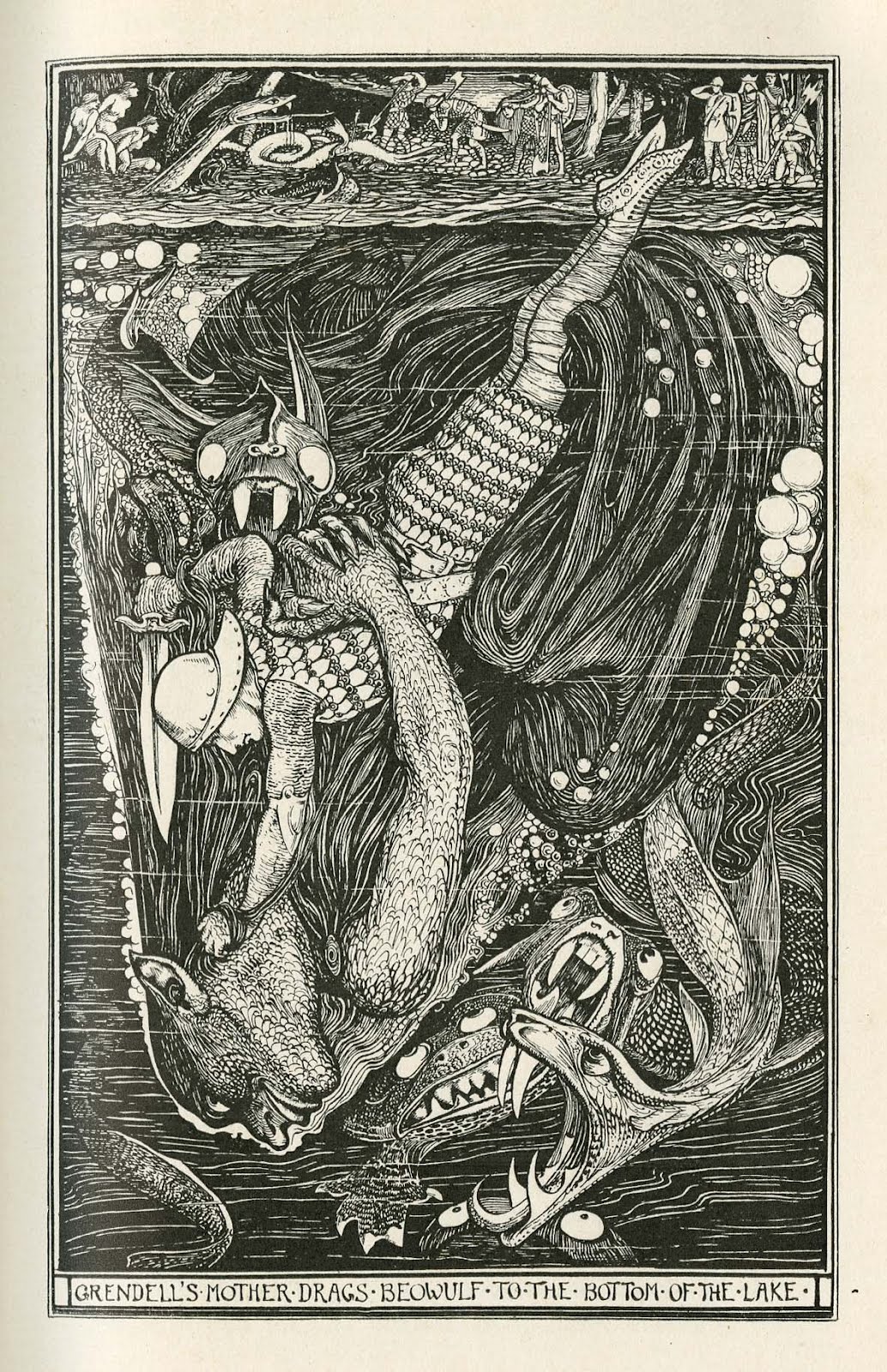
There’s the sword “made by giants” which Beowulf pulls down from a wall in Grendel’s lair to put an end to Grendel’s mother.

image1amum.jpg

There’s the sword which Arthur pulled out of a stone/anvil and the very pulling of which proved his right to rule England.

image1sword.jpg

(See here TH White’s wonderful 1938 novel about the young Arthur, The Sword in the Stone,

image2sword.jpg

which, adapted, would later form part of his longer volume The Once and Future King (1958).  There’s also a Disney animated feature based upon the book, but we’ve never found it so good as the book itself.)

image3once.jpg


image4asword.jpg


And there’s the second Arthurian sword, Excalibur, which comes from a lake and must be returned at Arthur’s death.

image4lake.jpg

(For another view of Arthur’s heritage and power, revealed by his sword, see this LINK, in which characters from another version of the Arthur story have something to say:   https://www.youtube.com/watch?v=t2c-X8HiBng )

Then there is the sword Gram, which appears in the story of Sigurd and the dragon, Fafnir, a story which Tolkien probably first encountered in Andrew Lang’s The Red Fairy Book (1890), which we know that he read as a child.

image5red.jpg

You can have your own copy of this book—from which Tolkien may also have unconsciously gotten the name “Moria”, as well—at this LINK:  https://www.gutenberg.org/files/540/540-h/540-h.htm.

As a medievalist, Tolkien could hardly have escaped the story of Tristan and Isolde, in which Tristan wounds an Irish knight and is identified later in the story by the fact that a piece of Tristan’s blade has remained in the knight.

image6tris.jpg

(There are a number of early versions of the Tristan and Isolde story, but a familiar one would be that in Sir Thomas Malory’s Le Morte d’Arthur (1485), Volume I, Book VIII.  Here’s a LINK:  http://www.gutenberg.org/files/1251/1251-h/1251-h.htm)

Even into the age of gunpowder, there are still swords everywhere in literature—in Shakespeare (this is from Romeo and Juliet, c.1595)

image7randj.jpg

and in 19th-century fiction, like The Three Musketeers (1844-45).

image8musk.jpg

and Kidnapped (1886).

image9kid.jpg

Although they were by then antiquated (and then prohibited by regulation from the battlefield), even British Army officers were still required to purchase them in the Great War—this is the model 1897 with which Tolkien in 1916

image10jrrt.jpg

would have had to outfit himself

image11sword.jpg

so that he would have looked like these officers.

image12officers.jpg

Bilbo’s Sting was acquired in a much more casual way.  After the trolls had been tricked by Gandalf to expose themselves to sunlight and therefore were turned to stone,

image13trolls.jpg

Gandalf prodded the dwarves into locating the trolls’ hideout.  Inside, among other things, they found:

“…several swords of various makes, shapes, and sizes…Gandalf and Thorin each took one of these, and Bilbo took a knife in a leather sheath.  It would have made only a tiny pocket-knife for a troll, but it was as good as a short sword for the hobbit.”  (The Hobbit, Chapter Two, “Roast Mutton”)

There is more to this knife, as Bilbo discovers when, after being left behind in the hollows under the mountains, he draws it:

“It shone pale and dim before his eyes.  ‘So it is an elvish blade, too,’ he thought.” (The Hobbit, Chapter 5, “Riddles in the Dark”)

As the story continues, Bilbo finds more uses for it—to keep Gollum at a distance

image14gollum.jpg

and to deal with the giant spiders of Mirkwood,

image15spiders.jpg

and it’s here that we see Bilbo at his boldest physically—which makes it an appropriate moment to give his little sword a fierce little name.

Bilbo has an heroic moment with his weapon in his struggle with the spiders, rescuing the dwarves, but it’s clear that, although heroes in literature traditionally have swords, swords do not make heroes.  In the Battle of the Five Armies, Bilbo makes a disappearance, rather than an appearance, and we hear no more of Sting in The Hobbit until, in the last chapter of the book, we learn that, finally returning to Bag End, “His sword he hung over the mantelpiece.” (The Hobbit, Chapter Nineteen, “The Last Stage”)

This is not the end of the story of Sting, however, which will have a second—really third life, as it appears to have been made in Gondolin for the Goblin Wars many years before, since it is associated with Thorin’s (and Gandalf’s) sword, which “had killed hundreds of goblins in its time, when the fair elves of Gondolin hunted them in the hills or did battle before their walls.” (The Hobbit, Chapter Four, “Over Hill and Under Hill”)

image16gondolin.jpg

(Gondolin by Kenneth Sofia)

This third life, in the hands of Frodo, parallels, to a degree, Bilbo’s experience, but the little sword’s ultimate fate is more complex than the act of simply being hung up at the story’s end.

It begins this life, however, with its previous owner, Bilbo, about to depart from the Shire after his notorious birthday party vanishing act:

“Then he put on quickly some old untidy garments, and fastened round his waist a worn leather belt  On it he hung a short sword in a battered black-leather scabbard.”  (The Fellowship of the Ring, Book One, Chapter One, “A Long-Expected Party”)

Sting, then, will travel to Rivendell with Bilbo, but not remain there.  As the new Fellowship is about to leave Rivendell years later, Bilbo:

“…took from the box a small sword in an old shabby leathern scabbard.  Then he drew it, and its polished and well-tended blade glittered suddenly, cold and bright.  ‘This is Sting,’ he said, and thrust it with little effort deep into a wooden beam.  ‘Take it, if you like.  I shan’t want it again, I expect.’

Frodo accepted it gratefully.”  (The Fellowship of the Ring, Book Two, Chapter 3, “The Ring Goes South”)

Although he has gladly accepted it, Frodo, like Bilbo before him, will not be a very active fighter with Sting.  He will stab a goblin in the foot (The Fellowship of the Ring, Book Two, Chapter 5, “The Bridge of Khazad-Dum”), but, otherwise, it will be Sam who will employ it, temporarily defeating and driving off Shelob with it, (The Two Towers, Book Four, Chapter 10, “The Choices of Master Samwise”) then wounding an orc named Snaga, who falls through an open trapdoor to his death. (The Return of the King, Book Six, Chapter 1, “The Tower of Cirith Ungol”)

Sam continues to carry Sting all the way to Mt Doom, but something has happened to Frodo during that long journey and it reveals itself in “The Scouring of the Shire”, the next-to-last chapter in the story.  Things in the Shire have not gone well in the year Frodo and his friends have been away.  It has been taken over by what Pippin calls “half-orcs and ruffians”, who owe allegiance to someone they call “Sharkey” and all seem bent on turning the place into a miniature fascist state.  And yet, when Pippin says that they’ll have to be fought, Frodo replies:

“Fight?…Well, I suppose it may come to that.  But remember:  there is to be no slaying of hobbits, not even if they have gone over to the other side.  Really gone over, I mean; not just obeying ruffians’ orders because they are frightened.  No hobbit has ever killed another on purpose in the Shire, and it is not to begin now.  And nobody is to be killed at all, if it can be helped.”  (The Return of the King, Book Six, Chapter 8, “The Scouring of the Shire”)

Frodo persists in this approach to violence even after “Sharkey” turns out to be Saruman, who then attempts to knife Frodo.  Saruman is thrown to the ground and Sam, drawing his sword (perhaps Sting?  it never appears that he returns it to Frodo), seems to be about to stop him from trying again when Frodo says:

“No, Sam!…Do not kill him even now.  For he has not hurt me.  And in any case I do not wish him to be slain in this evil mood.  He was great once, of a noble kind that we should not dare to raise our hands against.  He is fallen, and his cure is beyond us; but I would still spare him, in the hope that he may find it.”

We have seen a progression in the life of Sting, from its initial finding by the timid Bilbo, who then becomes the battler of spiders, even if later, involved in an actual battle, he chooses to be less a participant than an observer.  He passes the sword on to Frodo, who uses it aggressively only once, before it comes into the hands of Sam for the rest of the story.  And we can understand that, even offered it, Frodo will never touch it again.  Instead, he will be as Saruman then says:

“You have grown, Halfling…Yes, you have grown very much.  You are wise—” but Saruman goes on to add “and cruel” and this shows how little Saruman himself has grown.  “You have robbed my revenge of sweetness, and now I must go hence in bitterness in debt to your mercy.  I hate it and you!”

Saruman’s bitterness is not long-lasting, however, as, a moment later, his now-lackey, Grima Wormtongue, uses another blade to cut his throat, dying a moment later himself, pierced by several hobbit arrows.

From what we can tell, at this final stage, unless it’s in Sam’s hands—and even if it is–Sting has completely disappeared from the story.  Considering how Frodo has changed into the wiser, non-violent, person whom Saruman recognizes, we suppose that it’s not surprising that it has.  And, with Sauron—and his Ring– gone and the King reestablishing control over much of western Middle-earth, we expect that there will no longer be any need for such weapons.

Then again, Sauron has been defeated before and returned…

Thanks, as always, for reading and

MTCIDC

CD

← Older posts
Newer posts →

The Doubtful Sea Series Facebook Page

The Doubtful Sea Series Facebook Page

  • Ollamh

Categories

  • Artists and Illustrators
  • Economics in Middle-earth
  • Fairy Tales and Myths
  • Films and Music
  • Games
  • Heroes
  • Imaginary History
  • J.R.R. Tolkien
  • Language
  • Literary History
  • Maps
  • Medieval Russia
  • Military History
  • Military History of Middle-earth
  • Narnia
  • Narrative Methods
  • Poetry
  • Research
  • Star Wars
  • Terra Australis
  • The Rohirrim
  • Theatre and Performance
  • Tolkien
  • Uncategorized
  • Villains
  • Writing as Collaborators
Follow doubtfulsea on WordPress.com

Across the Doubtful Sea

Recent Postings

  • Subterranean April 22, 2026
  • Serendipity? April 15, 2026
  • Serendipity April 8, 2026
  • Verisimilitude April 1, 2026
  • Goblins and Goblin March 25, 2026
  • Crowing and Raven March 18, 2026
  • The Damage of Dragons March 11, 2026
  • Encouragement March 4, 2026
  • Eavesdropping February 25, 2026

Blog Statistics

  • 111,792 Views

Posting Archive

  • April 2026 (4)
  • March 2026 (4)
  • February 2026 (4)
  • January 2026 (4)
  • December 2025 (5)
  • November 2025 (4)
  • October 2025 (5)
  • September 2025 (4)
  • August 2025 (4)
  • July 2025 (5)
  • June 2025 (4)
  • May 2025 (4)
  • April 2025 (5)
  • March 2025 (4)
  • February 2025 (4)
  • January 2025 (5)
  • December 2024 (4)
  • November 2024 (4)
  • October 2024 (5)
  • September 2024 (4)
  • August 2024 (4)
  • July 2024 (5)
  • June 2024 (4)
  • May 2024 (5)
  • April 2024 (4)
  • March 2024 (4)
  • February 2024 (4)
  • January 2024 (5)
  • December 2023 (4)
  • November 2023 (5)
  • October 2023 (4)
  • September 2023 (4)
  • August 2023 (5)
  • July 2023 (4)
  • June 2023 (4)
  • May 2023 (5)
  • April 2023 (4)
  • March 2023 (5)
  • February 2023 (4)
  • January 2023 (4)
  • December 2022 (4)
  • November 2022 (5)
  • October 2022 (4)
  • September 2022 (4)
  • August 2022 (5)
  • July 2022 (4)
  • June 2022 (5)
  • May 2022 (4)
  • April 2022 (4)
  • March 2022 (5)
  • February 2022 (4)
  • January 2022 (4)
  • December 2021 (5)
  • November 2021 (4)
  • October 2021 (4)
  • September 2021 (5)
  • August 2021 (4)
  • July 2021 (4)
  • June 2021 (5)
  • May 2021 (4)
  • April 2021 (4)
  • March 2021 (5)
  • February 2021 (4)
  • January 2021 (4)
  • December 2020 (5)
  • November 2020 (4)
  • October 2020 (4)
  • September 2020 (5)
  • August 2020 (4)
  • July 2020 (5)
  • June 2020 (4)
  • May 2020 (4)
  • April 2020 (5)
  • March 2020 (4)
  • February 2020 (4)
  • January 2020 (6)
  • December 2019 (4)
  • November 2019 (4)
  • October 2019 (5)
  • September 2019 (4)
  • August 2019 (4)
  • July 2019 (5)
  • June 2019 (4)
  • May 2019 (5)
  • April 2019 (4)
  • March 2019 (4)
  • February 2019 (4)
  • January 2019 (5)
  • December 2018 (4)
  • November 2018 (4)
  • October 2018 (5)
  • September 2018 (4)
  • August 2018 (5)
  • July 2018 (4)
  • June 2018 (4)
  • May 2018 (5)
  • April 2018 (4)
  • March 2018 (4)
  • February 2018 (4)
  • January 2018 (5)
  • December 2017 (4)
  • November 2017 (4)
  • October 2017 (4)
  • September 2017 (4)
  • August 2017 (5)
  • July 2017 (4)
  • June 2017 (4)
  • May 2017 (5)
  • April 2017 (4)
  • March 2017 (5)
  • February 2017 (4)
  • January 2017 (4)
  • December 2016 (4)
  • November 2016 (5)
  • October 2016 (6)
  • September 2016 (5)
  • August 2016 (5)
  • July 2016 (5)
  • June 2016 (5)
  • May 2016 (4)
  • April 2016 (4)
  • March 2016 (5)
  • February 2016 (4)
  • January 2016 (4)
  • December 2015 (5)
  • November 2015 (5)
  • October 2015 (4)
  • September 2015 (5)
  • August 2015 (4)
  • July 2015 (5)
  • June 2015 (5)
  • May 2015 (4)
  • April 2015 (3)
  • March 2015 (4)
  • February 2015 (4)
  • January 2015 (4)
  • December 2014 (5)
  • November 2014 (4)
  • October 2014 (6)
  • September 2014 (1)

Blog at WordPress.com.

  • Subscribe Subscribed
    • doubtfulsea
    • Join 75 other subscribers
    • Already have a WordPress.com account? Log in now.
    • doubtfulsea
    • Subscribe Subscribed
    • Sign up
    • Log in
    • Report this content
    • View site in Reader
    • Manage subscriptions
    • Collapse this bar
 

Loading Comments...