• About

doubtfulsea

~ adventure fantasy

Monthly Archives: April 2025

Hair Today

30 Wednesday Apr 2025

Posted by Ollamh in Uncategorized

≈ Leave a comment

Tags

Andrew Lang, Basile, d'Urfey, de-caumont, fairy-tales, friederich-schulz, Gingerbread, Grimm Brothers, Munchkins, Pentamerone, Persinette, Petrosinella, rampion, Rapunzel, Rock Parsley, Romeo and Juliet, Seurat, Shahnameh, Tolkien

As always, dear readers, welcome.

I often pass by a very unusual house, one which I would find hard to describe—perhaps something the Munchkins might build,

combined with a gingerbread house,

in the spotty colors and patterns of a Seurat pointillismist painting.
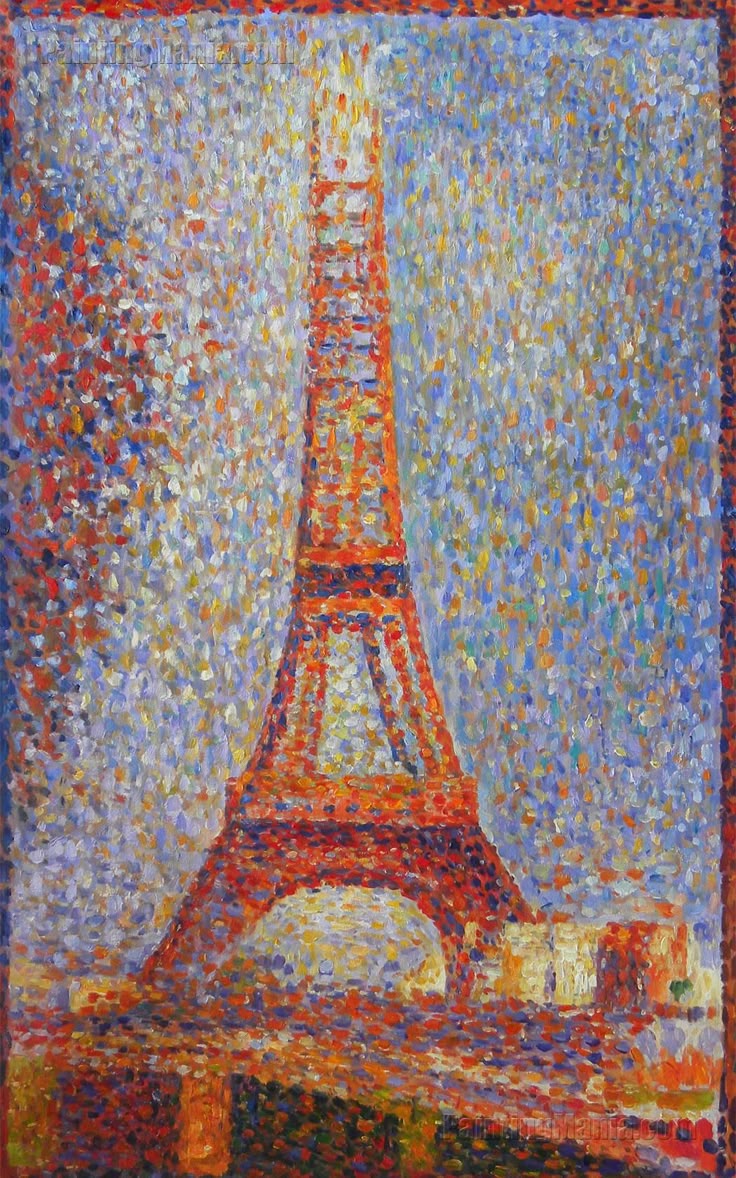
(Seurat, “La Tour Eiffel” , 1889—if you like the look of this, see:  https://www.georgesseurat.net/  for lots more—and, for more about this painting:  https://artincontext.org/the-eiffel-tower-by-georges-seurat/ )

All of that might make you slam on the brakes and drive as slowly as possible past, but there’s an added detail—for the past year, there has been a ladder propped from the ground to a closed window on the second floor.  It’s not anything exotic, just a plain aluminum extension ladder.

When I first spotted it, I probably thought:  fixing a storm window or painting trim and didn’t think about it again. 

But, after seeing it for a year, and remembering what the house looks like, I began to consider other possibilities—and I’m sure that, with that combination, you’re considering them, too. 

Dismissing fire drills, it struck me that, as the house has a fairy tale look, it must have something to do with such stories,

First, ir could be something Romeo and Julietesque—but, instead of standing under her balcony

and then scaling it,
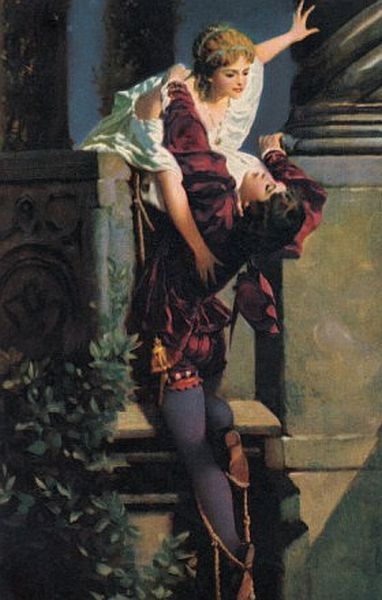
Romeo stopped by the local hardware store and properly equipped himself.    (They eloped, as planned, this time, without the tragic ending, where everyone’s been stabbed or poisoned.)

Or—not Romeo and Juliet, but Rapunzel and her (fill in name here—“Charming” being a common place-holder) Prince, who is, for a change, a little more considerate than the usual prince in the story..

After all, have you ever had your hair pulled?  Granted, if you’ve got fifteen feet or more of it—but wait—let’s go back a bit.

(Although, in an interesting variant of this theme, from Ferdowsi’s  10th/11th-century epic poem “Shahnameh”, a prince, Zal, when offered a princess, Rudaba’s,, hair as a means of escalade, takes a lariat from a retainer, instead.  See:  https://archive.org/details/shahnama01firduoft/page/270/mode/2up  )

It all seems to begin with a late Renaissance story collection, Giambattista Basile’s (1583-1632 )
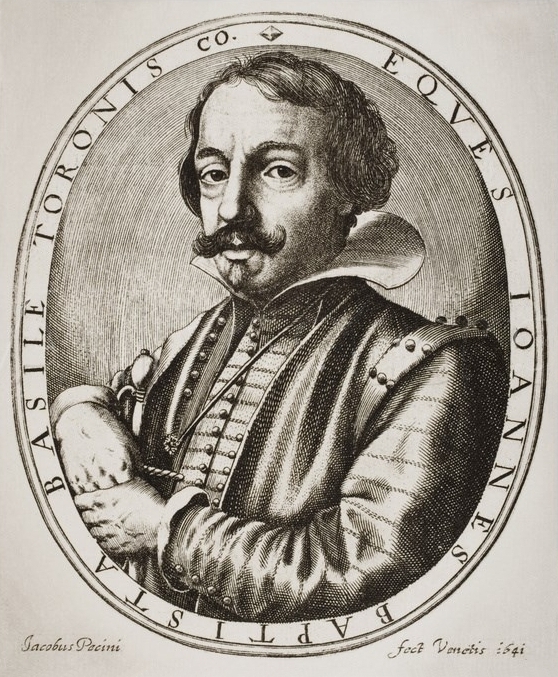
 Pentamerone.

(so far the earliest printing I can find—as you can see, it’s dated 1749—but it gives away a secret:  Giambattista Basile was actually Gian Alesio Abbattutis—although “abbattuto” in modern Italian means “depressed”—so was his work, like Thomas d’Urfey’s subtitle to his “Wit and Mirth”—“ or Pills to Purge Melancholy”,  an eventual 6-volume collection of poems and songs, published between 1698 and 1720, an attempt to relieve despair?  You can see all six of d’Urfey’s volumes here:  https://archive.org/details/imslp-and-mirth-or-pills-to-purge-melancholy-durfey-thomas/PMLP144559-Vol._1/page/n5/mode/2up  Don’t be confused by the spelling of the subtitle of the Basile, by the way:  this is the southern Italian/Sicilian spelling of “conto”—“story”, so it means “the story of stories”, meaning “the very best of stories” .)

published posthumously by his sister, Adriana, in two volumes, in 1634 and 1636.

Its title means something like “Five Days” and the title comes from the framing story—which you can read about here:  https://en.wikipedia.org/wiki/Pentamerone  In sum, ten story-tellers are hired each to tell one story a day for five days, making a total of fifty stories.

The first story on the second day is “Petrosinella”—“Parsley”, the title coming from the name of the main character.  (The modern Italian word is “prezzemolo” so I’m assuming that this is dialectal/archaic or both.  Pliny, in his Natural History, Book XX, Chapter 47, mentions “petroselinon”—the Latin form being “petroselinum”—“rock (petra) parsley”, so I’m guessing that “Petrosinella” is what is called a metathetic form, where part of the word has been transposed with another, like “calvary” for “cavalry”.  Maybe also confused with the Italian diminutive ending “-ella”, as if the meaning is “Little Parsley”.  If you’d like to read what Pliny has to say about it—including being useful for snake bite, see:   https://www.perseus.tufts.edu/hopper/text?doc=Perseus%3Atext%3A1999.02.0137%3Abook%3D20%3Achapter%3D47 )

A brief summary of the plot:

A pregnant woman repeatedly visits the garden of an orca (ogress—now, however, a killer whale—not what Basile had in mind, I’m sure)) to steal parsley,   The ogress catches her, but lets her go on condition that the ogress  gets the child.  Sounds familiar, doesn’t it?  Eventually, she gets the child, whom she puts into a tower with only one high window and visits her by using the girl’s hair.

And, if you know “Rapunzel”, you know what happens next—prince, etc—but then the story becomes quite different, with Petrosinella and the prince escaping and the ogress eventually being killed.  (Here’s the whole story for you in  J.E. Taylor’s  1847 translation in a 1911 illustrated reprinting:  https://archive.org/details/31383047427094/page/82/mode/2up )

Well, until the later part of the story, this looks more or less familiar, but, if this is the Rapunzel story, why is the main character called “Parsley”?

For that, we need to move to its next incarnation, “Persinette”, by Charlotte-Rose de Caumont de la Force, who published her version of the story, which she claimed was original, in a volume the title of which suggests that she had, in fact, read Basile:  Les Contes des Contes (1698), making a slight change by pluralizing that first story in Basile’s subtitle, not to mention the fact that her heroine is named “Little Parsley” (“Persinette”—although one might expect “Persilette”, as the French word for parsley is “persil”).

A major difference between this and Basile’s text is that de Caumont’s is much more elaborate—including the detail that parsley was not available at that time and that the Fairy (no longer an ogress) has had to have it imported from India!  Much of the basic story we read in Basile is there—the hair, the tower, but more has been added, beginning with it being Persinette’s father-to-be who steals the parsley, rather than her mother, the fact that the Fairy causes the tower to appear by magic, that, finding Persinette to be pregnant, the Fairy isolates her in a cottage by the sea, that Persinette has twins there, that the Fairy tricks the prince, who leaps from the tower and is blinded—so much more of which fits in with the familiar Rapunzel story.  (Here’s a summary:  https://en.wikipedia.org/wiki/Persinette  but, for the complete story, so far I’ve only managed to find a 1785 French version, which, if you have some French—with 18th-century spelling conventions—you can read here:  https://en.wikipedia.org/wiki/Persinette )

But, although there are lots more familiar details here, we’re still in the land of parsley—how did we move  to “rapunzel”—which isn’t parsley, but something called “rampion”?

This is an edible plant, once commonly grown and eaten, but now seems to have lost its popularity (for more, see here:  https://botanical.com/botanical/mgmh/r/rampio03.html  And a more scientific description here:  https://www.missouribotanicalgarden.org/PlantFinder/PlantFinderDetails.aspx?taxonid=278824 )

The answer to the question of name change is:  we move from Italian to French to German, as rampion replaces parsley in Friedrich Schulz’ 1790 collection Kleine Romane, “Little Novels”, in which he included his translation of de Caumont (available here in a transcription from the Fraktur (old German script) of the original:  https://babel.hathitrust.org/cgi/ssd?id=chi.81388905;page=ssd;view=plaintext;seq=281;num=271#seq281  and pages beyond–I’ve done a quick survey of the text, which sticks  pretty closely to the French—except for that “rapunzel”, which is noted to be a rare plant, just as the parsley is in de Caumont, although the Fairy doesn’t get it from India.) 

This, in turn, was used by the Grimm brothers in the first edition of Kinder und Hausmaerchen (something like “Children’s and Domestic Wonder-tales”) in 1812.

But one more but—how does the story come into English?

The first “translation” of the Grimm brothers’ work is the two volumes by Edgar Taylor, published in 1823 and 1826.

This is, in fact, only a selection, and doesn’t include “Rapunzel”, possibly because of Rapunzel’s pregnancy out of wedlock.  As far as I can currently determine, the first English translation to include the story is the Edward H. Wehnert Household Stories, 1853, in two volumes, “Rapunzel” being in the first, and you can read it here:  https://archive.org/details/householdstorie01grimgoog/page/n6/mode/2up?view=theater

From there we can move to  Margaret Hunt’s 1884 translation in 2 volumes (here:  https://archive.org/details/grimmshouseholdt01grim/page/n3/mode/2up?view=theater  for volume 1 and here:  https://archive.org/details/grimmshouseholdt2grim/page/n7/mode/2up for volume 2.  This translation is noted in particular as it includes the Grimms’ editiorial notes, the first edition to do so.)

And, interesting–this edition had an introduction by Andrew Lang, who then included it in his 1890 The Red Fairy Book (https://www.gutenberg.org/files/540/540-h/540-h.htm ), where JRRT probably read it, as we know he knew other stories from the volume.

So, why is that ladder there?  An updated fairy tale?   Or just an absent-minded repairman?  I’d prefer to think the former, although, in comparison with that long column of golden hair in the old stories

an aluminum extension ladder seems awfully drab.

Thanks, as ever, for reading.

Stay well,

If you’re acrophobic, best to seek adventure among dwarves,

And remember that, as always, there’s

MTCIDC

O

PS

The change from “parsley” to “rampion”—and even which plant is “rampion”—has been the subject of scholarly discussion.  See:   https://writinginmargins.weebly.com/home/what-is-the-plant-in-rapunzel  .Edward Taylor, in his 1846 collection, The Fairy Ring, even decided that either name was inappropriate for his British readers and changed her name to “Violet”!  You can read his version here:  https://babel.hathitrust.org/cgi/ssd?id=uc1.31158001207546;page=ssd;view=plaintext;seq=367;num=321#seq367  

PPS

If you would like to compare various English translations, from 1823 to 1927, see:  https://archive.org/details/householdstorie01grimgoog/page/n6/mode/2up?view=theate

Alternatives

23 Wednesday Apr 2025

Posted by Ollamh in Uncategorized

≈ Leave a comment

Tags

lotr, Morgoth, Mouth of Sauron, Sauron, Sharkey, Tolkien, Turtledove, What If

As always, dear readers, welcome.

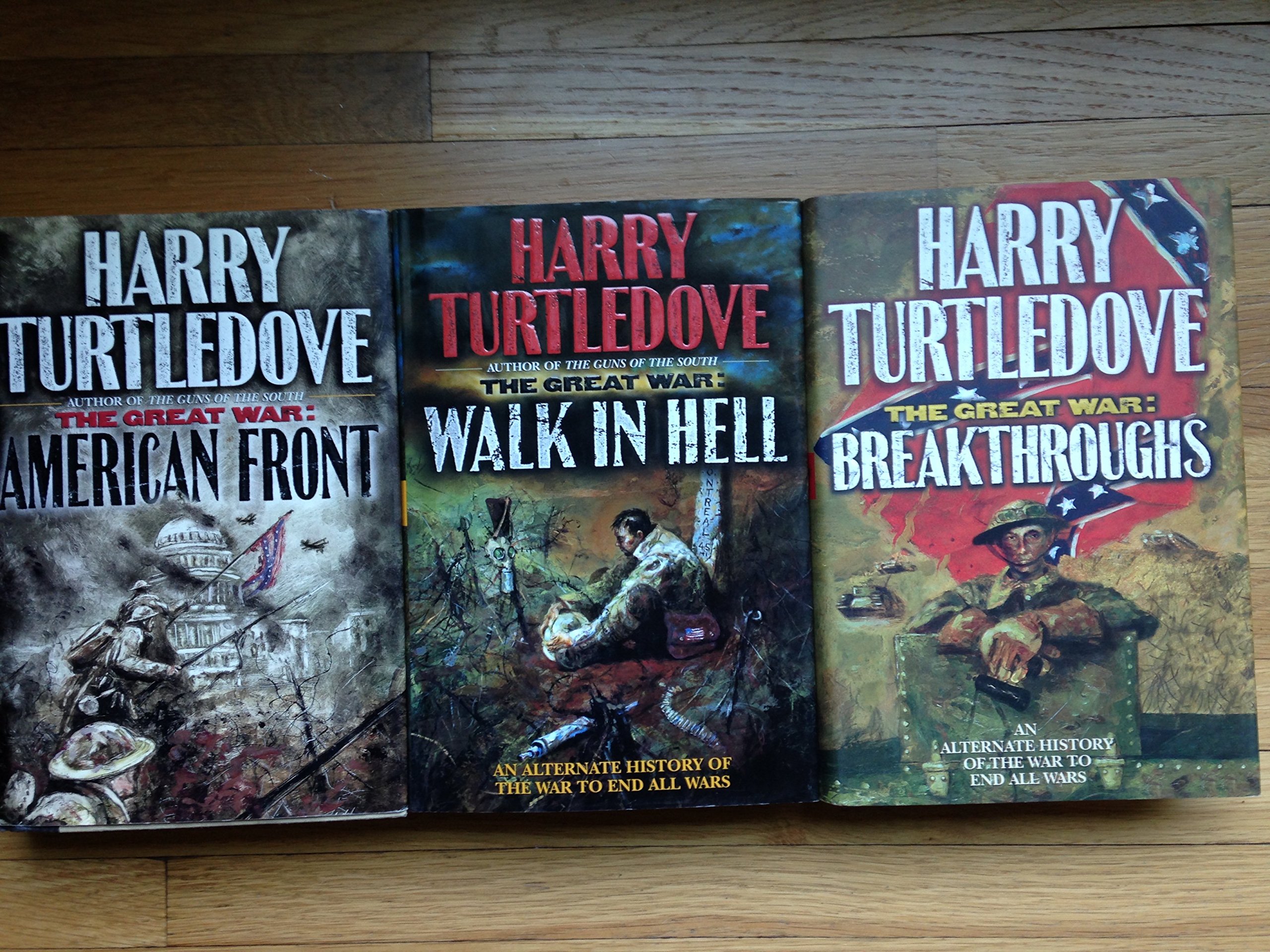
I’ve written before about “What Ifs”—that is, alternative views of things, be they historical,

(and interesting here to see an introduction by Harry Turtledove, who has written a raft of “what ifs” himself)

or based upon fantasy.

Recently, I wrote about Sauron’s terms, as stated by the Mouth of Sauron in “The Black Gate Opens”,

(Douglas Beekman—prolific sci-fi/fantasy artist—you can read a little about him here:  https://www.askart.com/artist/Doug_L_Beekman/122294/Doug_L_Beekman.aspx )

 to Gandalf and the others, taking apart the terms, as well as the behavior of the Mouth (see “Treating”, 26 March, 2025)), but the thought has occurred to me–a what if—what if the leaders of the West had agreed, if only to buy time?  After all, they had had no news of Frodo until the Mouth had produced his garments and, seeing them, mightn’t they have assumed that the Ring had gone back to its master?  And, if Sauron once more had the Ring, what next?

Here are the terms once more:

“ ‘The rabble of Gondor and its deluded allies shall withdraw at once beyond the Anduin, first taking oaths never again to assail Sauron the Great in arms, open or secret.  All lands east of the Anduin shall be Sauron’s for ever, solely.  West of the Anduin as far as the Misty Mountains and the Gap of Rohan shall be tributary to Mordor, and men there shall bear no weapons, but shall have leave to govern their own affairs.  But they shall help to rebuild Isengard which they have wantonly destroyed, and that shall be Sauron’s, and there his lieutenant shall dwell:  not Saruman, but one more worthy of trust.”  (The Return of the King, Book Five, Chapter 10, “The Black Gate Opens”)

At first glance, as insulting as the tone is, the terms are fairly mild, coming down to:

1. Sauron keeps Ithilien and beyond—which he mostly already holds, in fact

2. Rohan and, although it’s not named directly, we can presume Gondor:

 a. will pay tribute to Mordor

 b. but, although disarmed, will be allowed their own government

 c. although, with Isengard rebuilt, one presumes that Sauron’s lieutenant (the Mouth assumes that it will be he) will keep a close eye on Rohan and Gondor in the future

What this would mean, perhaps, is that Eomer would rule Rohan, but who would rule Gondor is uncertain—we would doubt highly that it would be Aragorn, considering that he’s already, using the Palantir, threatened Sauron—so possibly the Stewardship would continue, under Faramir?  If Sauron has a sense of irony, that would be fitting as, under his rule, there would never be a return of the King.

But was any of this real?  Would Sauron ever back down, even for a moment?  He did, many many years ago after the defeat of Morgoth, and again, when defeated by Tar-Calion, so we might see here another wavering of his purpose—after all, his minion (although he apparently isn’t aware of the fact that the Palantir has turned him into Sauron’s puppet) Saruman, has been defeated, his orc army destroyed, and his stronghold breached, and Sauron’s plan to attack Minas Tirith by land and sea has also failed, including the end of the chief of the Nazgul, Sauron’s general.  So far, things haven’t been going his way.

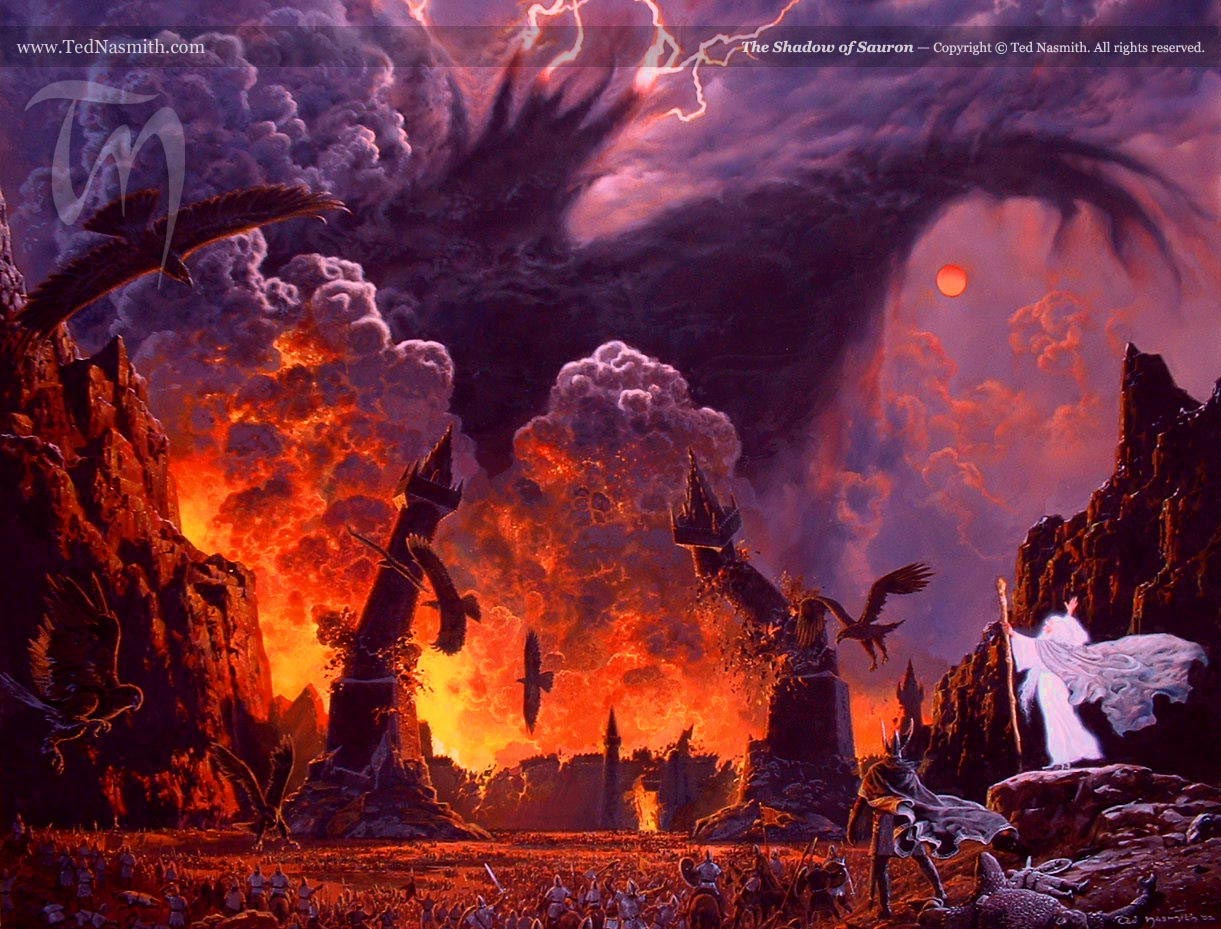
We’ll never know about what might have happened, however, if any of these terms were agreed to, because, upon Gandalf’s refusing them and threatening the Mouth, as in the chapter title, the Black Gate opens and the hordes of Mordor roar out to surround and nearly defeat the Westerners until eagles and the destruction of the Ring bring the whole thing to a crashing halt, literally.

(Ted Nasmith—and hasn’t he outdone himself with this painting?)

But could any of this ever have been a possibility?  To begin with, it would have meant that Aragorn would have been on the run and Gandalf, too, for that matter, as it’s doubtful that Sauron would have let either of the two escape alive.  We can presume, as well, that he would have attacked both Lorien and Rivendell and the forest elves’ kingdom, and probably even stretched that long, threatening arm

(JRRT)

beyond Rivendell to Bree and the Shire, although, if “Sharkey” was already busy industrializing the Shire, it might have amused Sauron to let him survive there, both as a puppet and as vengeance on the Shire for having been the hiding place of the Ring for so long.

(Alan Lee)

And can we doubt that he would have ordered his new lieutenant at Isengard to deal with Fangorn and the Ents?

But would this even be the end of things?  One has only to remember Sauron’s behavior in the Second Age:

“He denies the existence of God, saying that the One is a mere invention of the jealous Valar of the West, the oracle of their own wishes.  The chief of the gods is he that dwells in the Void, who will conquer in the end, and in the void make endless realms for his servants….

A new religion, and worship of the Dark, with its temple under Sauron arises.  The Faithful are persecuted and sacrificed…”  (from a letter to Milton Waldman, late 1951, Letters, 216)

(Aztec sacrifice—as even Ted Nasmith and Denis Gordeev have yet to tackle this part of the story!)

So, might we also see new buildings and sinister ones at that?

And, when Sauron speaks of Morgoth (“chief of the gods is he that dwells in the Void”), does he have a plan to bring him back? 

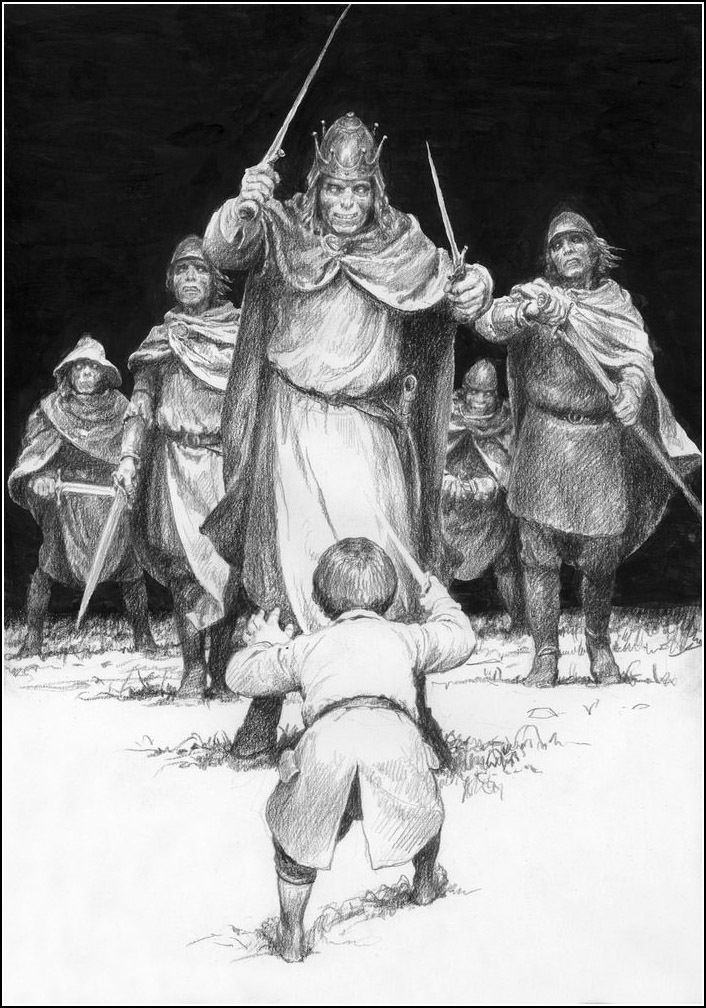
As far as I know, only Ted Nasmith has tried to represent Morgoth–

even JRRT himself doesn’t appear to have done so, so perhaps this is a “what if” taken a bit too far!

Thanks, for reading, as ever.

Stay well,

Be thankful that, for all that combating evil in Middle-earth is “the long defeat”, it hasn’t won yet,

And remember that, as always, there’s

MTCIDC

O

Lingua Orca

16 Wednesday Apr 2025

Posted by Ollamh in Uncategorized

≈ Leave a comment

Tags

Black Speech, Fantasy, lingua franca, lotr, Merry and Pippin, Native American sign language, Nazgul, Orcs, Orkish, the-black-speech, Tok Pisin, Tolkien

Welcome, dear readers, as always.

I begin this posting with a riddle:  how are Tolkien and Sauron alike? 

But we’ll come back to that.

Before that, I want to talk about the title of this posting. 

When Boromir is killed by the Orcs.

(Ted Nasmith)

Merry and Pippin are captured and carried off across country,

(Denis Gordeev)

Pippin waking eventually to this—

“He struggled a little, quite uselessly.  One of the Orcs sitting near laughed and said something to a companion in their abominable language..  ‘Rest while you can, little fool!’ he then said to Pippin, in the Common Speech, which he made almost as hideous as his own language.”

But what does that “abominable language” sound like?  Another Orc, equally gentle, gives us an example.

“ ‘If I had my way, you’d wish that you were dead now,’ said the other….’Don’t draw attention to yourself, or I may forget my orders,’ he hissed.  Curse the Isengarders!  Ugluk u bagronk sha pushdug Saruman-glob bubhosh skai’:  he passed into a long angry speech in his own tongue that slowly died away into muttering and snarling.”

One word is easy to pick out, of course—Saruman—but the rest calls for translating, something which Tolkien doesn’t provide in The Lord of the Rings, but there are, in fact, at least three translations:

1. “Ugluk to the cesspool, sha!  the dungfilth; the great Saruman-fool, skai!”  which comes from a draft of Appendix F of The Peoples of Middle-earth

2. “Ugluk to the dung-pit with stinking Saruman-filth—pig-guts, gah!”  which is a translation by Carl Hostetter in Vinyar Tengwar 26

3. “Ugluk to torture(chamber) with stinking Saruman-filth.  Dung-heap.  Skai!”  which is from Parma Eldalamberon XVII

(You can see the whole reference here:  https://tolkiengateway.net/wiki/Ugl%C3%BAk_u_bagronk_sha_pushdug_Saruman-glob_b%C3%BAbhosh_skai   For a bit more, including JRRT’s comment on Orkish, suggesting that he has bowdlerized this a bit in that 3rd translation, see:  https://glaemscrafu.jrrvf.com/english/ugluk.html )

Pippin can’t understand a word of this—

“Terrified Pippin lay still, though the pain at his wrists and ankles was growing, and the stones beneath him were boring into his back.  To take his mind off himself he listened intently to all that he could hear.  There were many voices round about, and though orc-speech sounded at all times full of hate and anger, it seemed plain that something like a quarrel had begun, and was getting hotter.” 

but still senses that there is strong emotion behind the Orcs’ words and part of how that “hate and anger” was conveyed to Pippin probably from the very sounds of the language—full of the hissing SH—sha, push-dug, bub-hosh—and words of only one or two syllables—Ug-luk, ba-gronk, sha, push-dug, bub-hosh, skai, making it sound abrupt.  And you can then see that 3-syllable “Saruman” was clearly a foreign word, which was then turned into an Orkish compound with that final single-syllable “glob”.

And yet:

“To Pippin’s surprise he found that much of the talk was intelligible; many of the Orcs were using ordinary language.”

“ordinary language” here is Pippin’s tongue—the Common Speech of Middle-earth (“Westron”)—which is also the language in which The Lord of the Rings was supposed  originally to have been written.

Dazed as he might be (“I suppose I was knocked on the head” he says to himself when he first wakes), Pippin, listening, comes to a clever conclusion as to why the Common Speech is employed by the Orcs who, after all, appear to have their own language:

“Apparently the members of two or three quite different tribes were present, and they could not understand one another’s orc-speech.”  (all of the above quotations from The Fellowship of the Ring, Book Two, Chapter 3, “The Uruk-hai”)

It’s interesting to see what the Orcs are doing here:  finding a way to converse because their own languages—or at least their dialects—are not mutually intelligible.

This has been a problem throughout history, wherever one people meets another with which it doesn’t share a language.

Several different approaches have been created.

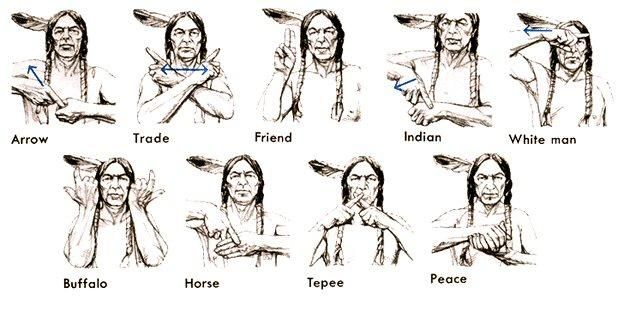
On the Great Plains of the US West, for example,

Native Americans produced a kind of universal sign language, which employed standardized gestures for common concepts and ideas.  Here’s a chart of a few of those gestures—

and here’s a possible extension—although I must say that it strikes me that it would take two very linguistically talented people, with a wide gesture vocabulary, to convey all of this.

(You can read about it here, which includes a wonderful piece of film in which various Native Americans and a seemingly-fluent US Government representative converse in gesture:  https://en.wikipedia.org/wiki/Plains_Indian_Sign_Language )

Besides gesture, people have constructed what’s called a “lingua franca”—literally “French tongue”—that is, a kind of trade tongue, which might have a base in one language, but which then borrows words from other regional languages to build its working vocabulary.  The term comes from such a language employed from the early medieval period up into the 19th century in the Mediterranean, “franca” being used really to mean not “French” so much as “foreign”.    (You can read more about it here:  https://en.wikipedia.org/wiki/Lingua_franca )

In contemporary Papua/New Guinea,

there is the English-based Tok Pisin, which has become so useful that it has become the first language of some groups.  (For more, see:  https://en.wikipedia.org/wiki/Tok_Pisin , which includes a demonstration of TP as spoken, although the background noise makes it a little difficult to hear.  Fortunately, there are a fair number of YouTube videos, should you want to hear more—and I hope you do.  YouTube is full of languages, both living and now no longer in use—I won’t say “dead”, because, if any language is still comprehensible, even if the last speakers are gone, I wouldn’t write an epitaph for it, myself– and we’re so lucky to be given so much to learn and understand.)

The Orcs, however, have simply resorted to employing another language entirely—although it would be interesting to see whether, had we more of their speech, we might find elements from other languages—there’s a clue in that “Saruman-glob”, where the speaker takes a word from another language and simply attaches an Orc word to it.

What was that “orc-speech”, which Pippin couldn’t understand?

“The Orcs were first bred by the Dark Power of the North in the Elder Days.  It is said that they had no language of their own, but took what they could of other languages and perverted it to their own liking, yet they made only brutal jargons, scarcely sufficient even for their own needs, unless it were for curses and abuse.  And these creatures, being filled with malice, hating even their own kind, quickly developed as many barbarous dialects as there were groups or settlements of their race, so that their Orkish speech was of little use to them in intercourse between different tribes.”

And so what we’re seeing is that the Orcs were actually developing a series of languages rather like linguae francae—basing them on whatever other language was locally available, then adding the odd curse or form of abuse which appealed to them, all of which turned their speech, even if once based upon a common borrowed language, into something incomprehensible to others from the same race.

It’s clear that Sauron, from whom Saruman got his definition of what Saruman claimed was always the goal of the Istari:  “Knowledge, Rule, Order”, wished Rule and Order to be at the heart of his dominion and therefore:

“It is said that the Black Speech was devised by Sauron in the Dark Years, and that he desired to make it the language of all those who served him…”

but the power of the Linguae Orcae, as we can call them, won out:

“…but [Sauron] failed in that purpose.  From the Black Speech, however, were derived many of the words that were in the Third Age wide-spread among the Orcs, such as ghash, ‘fire’, but after the first overthrow of Sauron this language in its ancient form was forgotten by all but the Nazgul.” 

And so even their master’s invention became nothing more than a vocab pool, from which to draw that which the Orcs fancied—and we know their preferences.

It’s no wonder, then, that

“So it was that in the Third Age Orcs used for communication between breed and breed the Westron tongue; and many indeed of the older tribes, such as those that still lingered in the North and in the Misty Mountains, had long used the Westron as their native language…”—just like those for whom Tok Pisin had moved from a trade tongue to a first tongue—but here’s an Orkish difference:  “though in such a fashion as to make it hardly less lovely than Orkish.” (all quotations from “The Orcs were first bred…” on from The Lord of the Rings, Appendix F)

And the answer to the riddle—I think that you’ve guessed it already:  “How are Tolkien and Sauron alike?”  Both were creators of languages, the difference being that it seems that virtually everyone in Middle-earth, from Elves to Dwarves to Ents to Orcs, speaks Westron, while no one speaks the Black Speech but Sauron’s last and soon to be lost, enslaved kings, the Nazgul.

(Denis Gordeev)

Thanks, as always, for reading.

Stay well,

Consider the endless borrowings which English has made from world languages,

And remember that, as always, there’s

MTCIDC

O

Two Fingers

09 Wednesday Apr 2025

Posted by Ollamh in Uncategorized

≈ Leave a comment

Tags

Captain Hook, Dracula, Pirates, poison ivy, Remington, rum, Sherlock Holmes, The Lord of the Rings, Tolkien, Tolkien typing, typewriters, whisky

As ever, dear readers, welcome.

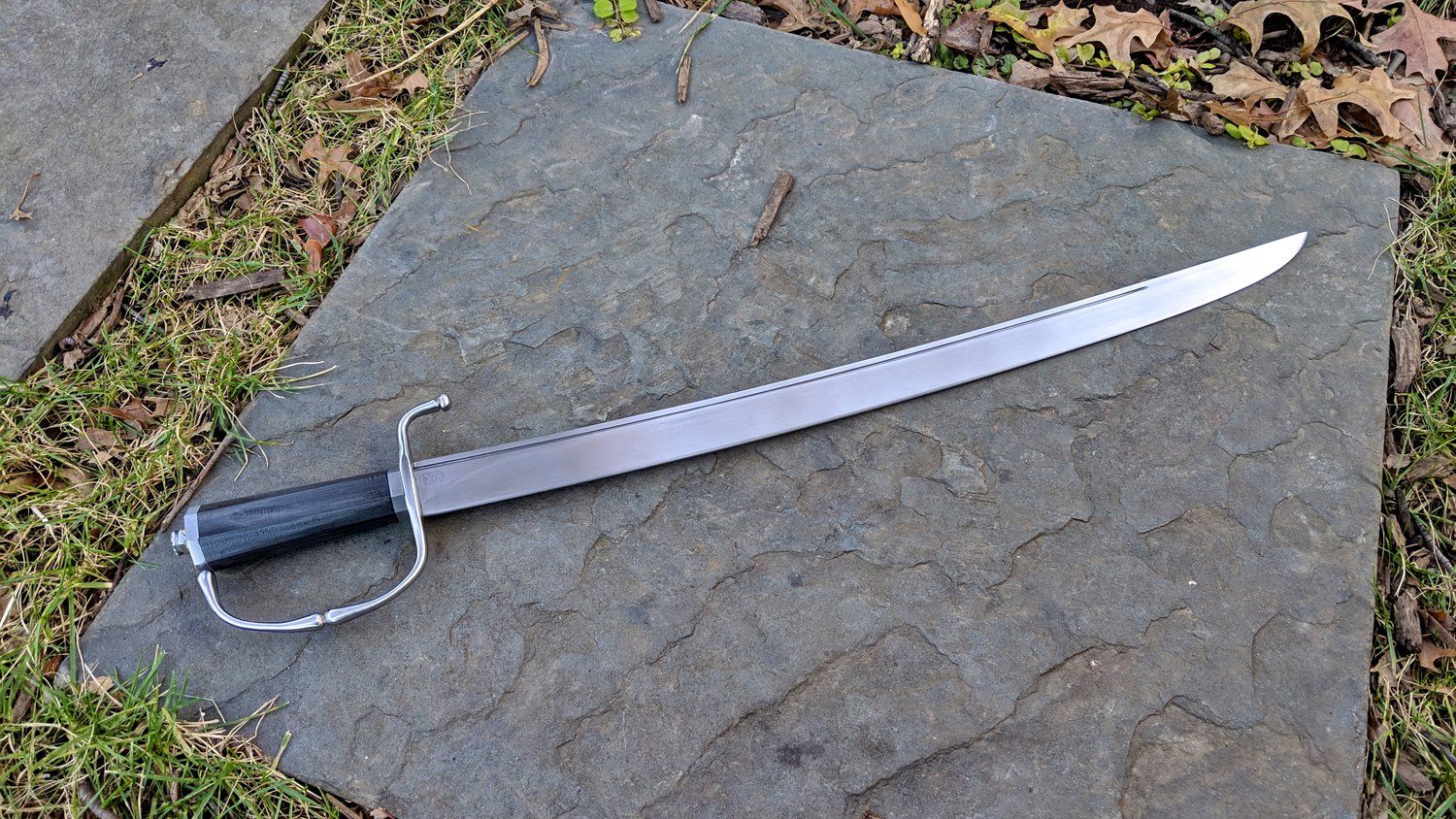
From the title of this posting, you, imaginative readers, might create any number of topic subjects.  It could be the name of a pirate,

his other fingers lost to a cutlass.

It could be the order by that pirate for whiskey,

since the barkeep has run out of rum–

or perhaps the pirate is an elegant gentleman, like James Hook,

(William Nicholson’s costume design for the original captain, 1904, in the V&M–Victoria and Albert Museum—collection)

a graduate of Eton College,

who knows his malts and knows that “two fingers” is a standard measure.

In Philip Pullman’s The Subtle Knife,

one of the protagonists, Will Parry, has lost two fingers in gaining the knife of the title—could this be the topic?

In the US, poison ivy

has the colloquial name “Three-fingered Jack”—perhaps this is a variant so deadly that it only needs two fingers? 

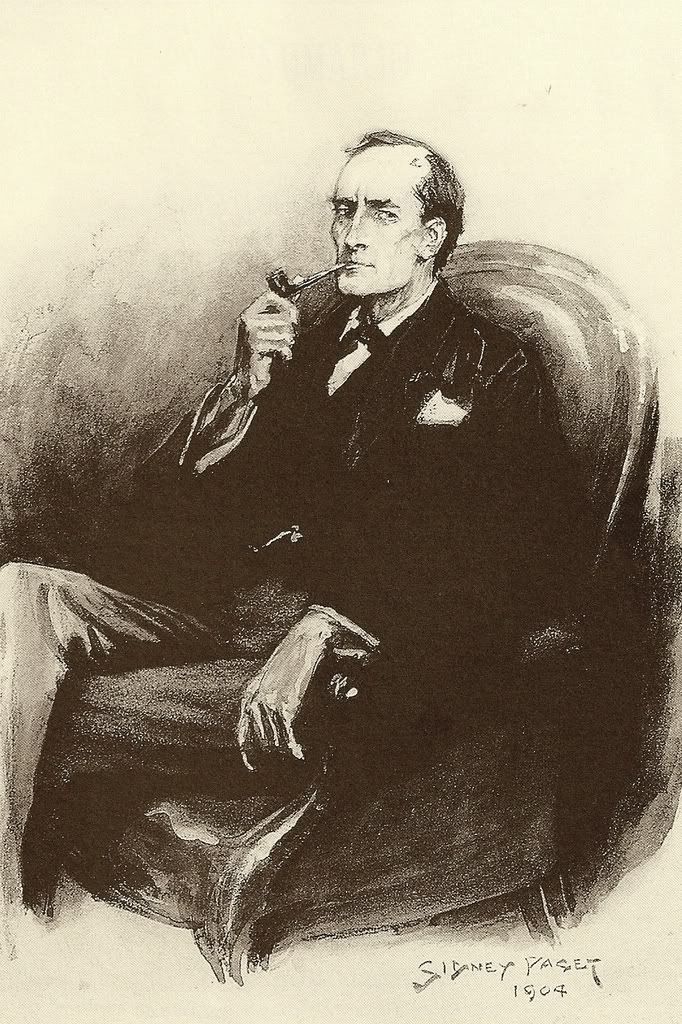
Or is this the title for one of Sherlock Holmes’

cases that Watson is so desperate to see—but never will:  “The Adventure of the Two Fingers”?

As you’re imaginative, I’ll let you go on from there, and I hope that you won’t be disappointed to learn that it’s none of the above, but, instead, it’s about typing.

The history of typewriters is a complex one (you can read all about it here:  https://historycooperative.org/who-invented-the-typewriter/  but, if the history of technology interests you as it does me, be sure to veer over to the article on the Hansen “writing ball”, which you can find here:  https://en.wikipedia.org/wiki/Hansen_Writing_Ball )

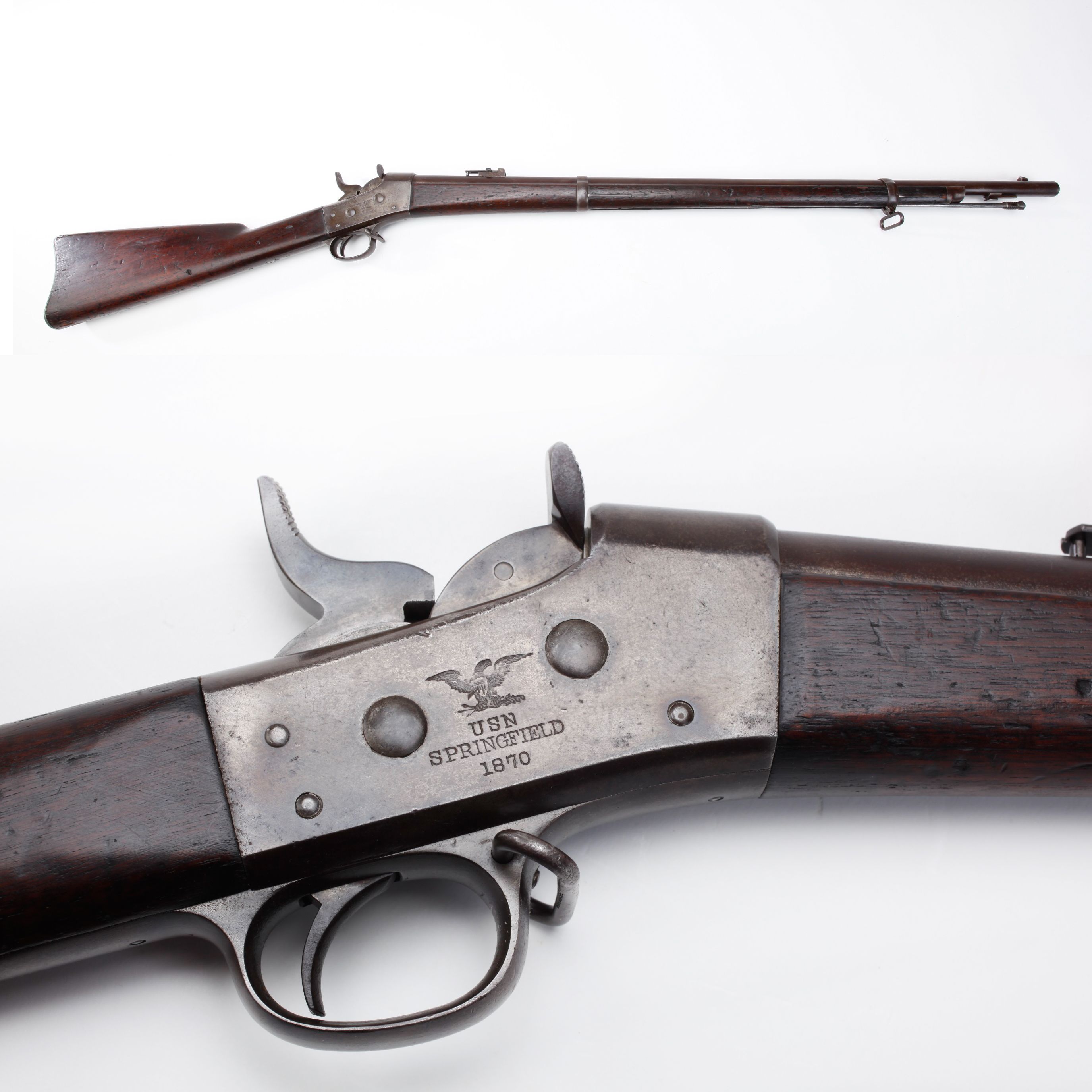
but Christopher Latham Sholes (along with Samuel Soule , Carlos Glidden, and James Densmore) is credited with producing the first commercially viable machine in 1868, the “Remington No.1”,

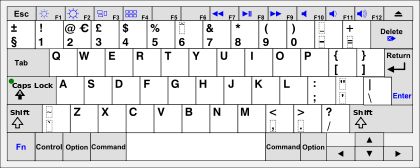
which employed the QWERTY pattern still seen today.

(For a wonderfully-detailed and enlighteningly-illustrated article on this, see:   https://readmultiplex.com/2022/10/21/the-actual-reasons-the-qwerty-keyboard-layout-was-invented-and-how-it-changed-us/   And yes, that “Remington” was the firearms company, which was diversifying.)

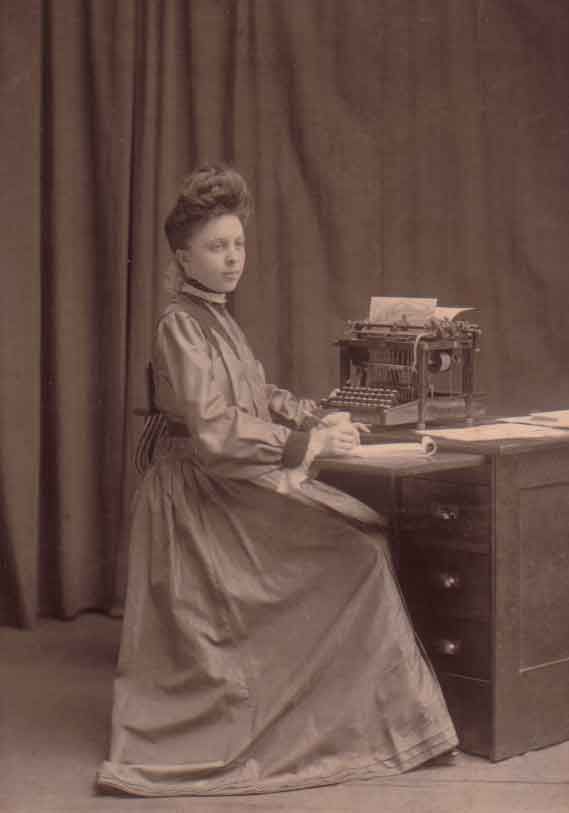
In the later 19th century, the Industrial Revolution seemed  to begin to find a second wind and offices were increasingly full of typewriters and typists (one of the ways in which young women came into the workforce).

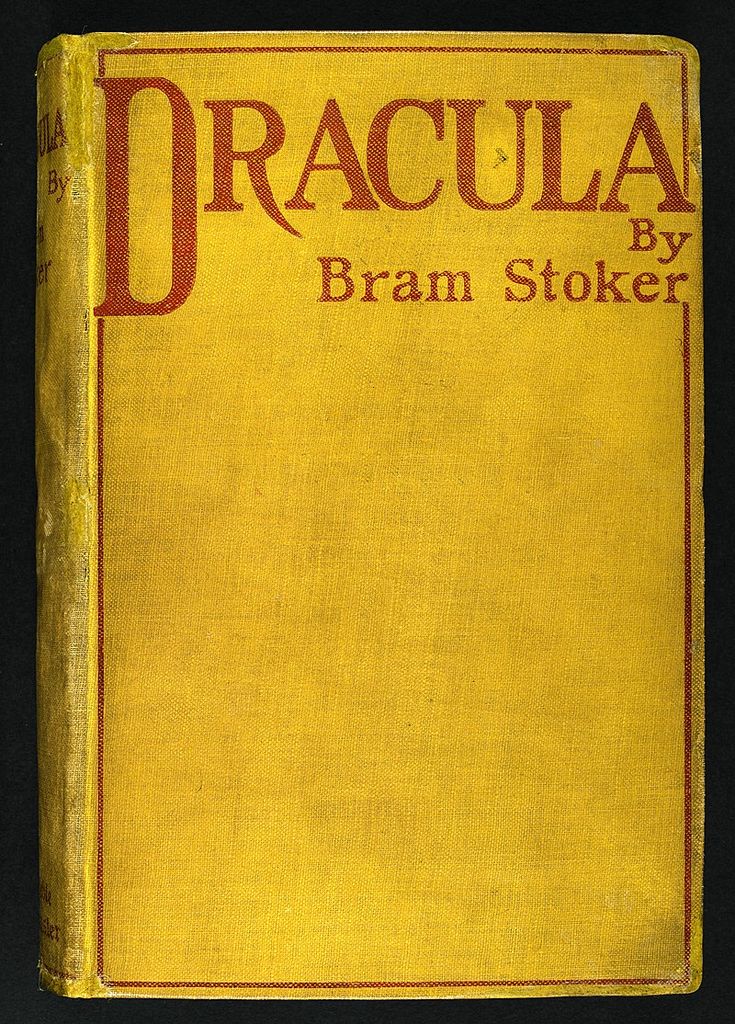
You can really see this in 1897’s Dracula,

where a major character, Mina Harker, uses her typing and other secretarial skills to help to defeat the vampire.  (And, if you’ve never read it, here’s an American first edition for you:    https://www.gutenberg.org/cache/epub/45839/pg45839-images.html  For more on using the office to defeat Dracula, see “Take a Letter”, 30 December, 2020 on this blog)

But the machine which is the focus of this posting—and appears above, just after that Sidney Paget image of Holmes, wasn’t a Remington, but a Hammond, first put on the market in 1884.

(for more on early Hammonds, see:  https://www.antikeychop.com/hammondno1typewriter )

A much later version of one of these was owned by a Professor JRR Tolkien and, as he tells us, on which “I typed nearly all of The Lord of the Rings” (letter to Rayner Unwin, 22 June, 1952, Letters, 236).

The Hammond was a very different machine from the Remingtons in their various iterations, including, in time, the ability to shift typefaces (JRRT mentions in an airmail letter to Christopher during the war that he’s using a “midget” typeface to cram in more writing in the limited space of an airmail letter—see the letter of 7 July, 1944, Letters, 124.  For a very good article on Tolkien’s writing habits, see:  https://tonyriches.blogspot.com/2014/06/j-r-r-tolkiens-writing-habits.html )

With 1200 pages of manuscript, and only Tolkien to do the typing (or most of it, from his various accounts it’s unclear if he did every page himself—he had earlier typed out The Hobbit—see the letter to Christopher Bretherton, 16 July, 1964, Letters,  257), it’s not surprising that it took him so long to do a readable draft (and he only had one, as he tells Hugh Brogan –from a letter to Hugh Brogan, 4 September, 1950, Letters, 199-200), especially as he was not a trained typist.  “Touch typing” appeared as early as the 1880s, but it was a specialized skill (see https://en.wikipedia.org/wiki/Touch_typing )and we can only presume that JRRT was self-taught. 

And that he typed everything with only two fingers (see Philip Norman, “The Prevalence of Hobbits” in the New York Times Book Review, 15 January, 1967, which you can find here:   https://archive.nytimes.com/www.nytimes.com/books/01/02/11/specials/tolkien-mag67.html ).

And that’s where the two fingers of the title meet Tolkien’s Hammond typewriter.

Thanks, as always, for reading.

Stay well,

Imagine what JRRT could have done with a laptop,

And remember that there’s always

MTCIDC

O

Rad Aghast

02 Wednesday Apr 2025

Posted by Ollamh in Uncategorized

≈ Leave a comment

Tags

Forrest J Ackerman, Lon Chaney Sr, lotr, Radagast, The Hobbit, Tolkien

As ever, dear readers, welcome.

I was very pleased when the new, expanded edition of The Letters of JRR Tolkien appeared in 2023,

not only for what new information might be contained in that word “expanded”, but also as, having used my paperback copy of the first edition to the point where, although the pages were still intact, the whole book seemed a little tired, as if it had been employed a little more often than it would have preferred.

When I first opened this new edition, I immediately paged through to what I had hoped was among the expanded letters:  “From a Letter to Forrest J. Ackerman” (“Not dated; June 1958”, Letters, 389-397).

This, as Humphrey Carpenter’s note tells us, was “Tolkien’s comments on the film ‘treatment’ of The Lord of the Rings”.

Ackerman doesn’t appear in Carpenter’s Tolkien biography, but he does appear in several letters, including the long excerpt, and Carpenter makes reference to him, as “agent for the film company” (Letters, 628).  In fact, he was a major figure in the American world of fantasy/science fiction/horror in the 1950s and 1960s, including being the editor of an early fan magazine, Famous Monsters of Filmland, 1958-1983, which provided an impressionable young man with this particularly haunting image—

(This is Lon Chaney, Sr., in the missing London After Midnight, 1927, which you can read about here:   https://silentology.wordpress.com/2022/10/31/everything-you-ever-wanted-to-know-about-london-after-midnight-practically/  If, like me, you love silent film, this is a good site to learn from.  You can read about the rather tangled history  of Famous Monsters  here:   https://en.wikipedia.org/wiki/Forrest_J_Ackerman and about Ackerman here:  https://en.wikipedia.org/wiki/Forrest_J_Ackerman )

From the additional material available in the new edition, we can see that Tolkien liked the visual samples with which he was presented, but—there’s no other word for it—appalled by the “treatment”, of which he wrote:

“If Z. [Zimmerman, the writer of the treatment] and/or others do so [that is, read Tolkien’s comments], they may be irritated or aggrieved by the tone of many of my criticisms.  If so, I am sorry (though not surprised).  But I would ask them to make an effort of imagination sufficient to understand the irritation (and on occasion resentment) of an author, who finds, increasingly as he proceeds, his work treated as it would seem carelessly in general, in places recklessly, and with no evident signs of any appreciation of what it is all about…”   (From a Letter…,389)

What I had hoped for was the complete letter, as, from what has actually been printed, Tolkien tells us, in his criticism, just what he might have wanted in a film of The Lord of the Rings and, in the process, provides us with a different perspective on his perspective.  Certainly, what is included  underscores what he wrote in the beginning of the letter, and something I take from it is that the writer has imagined much of the book as being downright clownish—as in Tolkien’s comments on the presentation of Tom Bombadil:

“7. The first paragraph misrepresents Tom Bombadil.  He is not the owner of the woods; and he would never make any such threat. 

‘Old scamp!’ This is a good example of the general tendency that I find in Z to reduce and lower the tone towards that of a more childish fairy-tale. “  (Letters, 391)

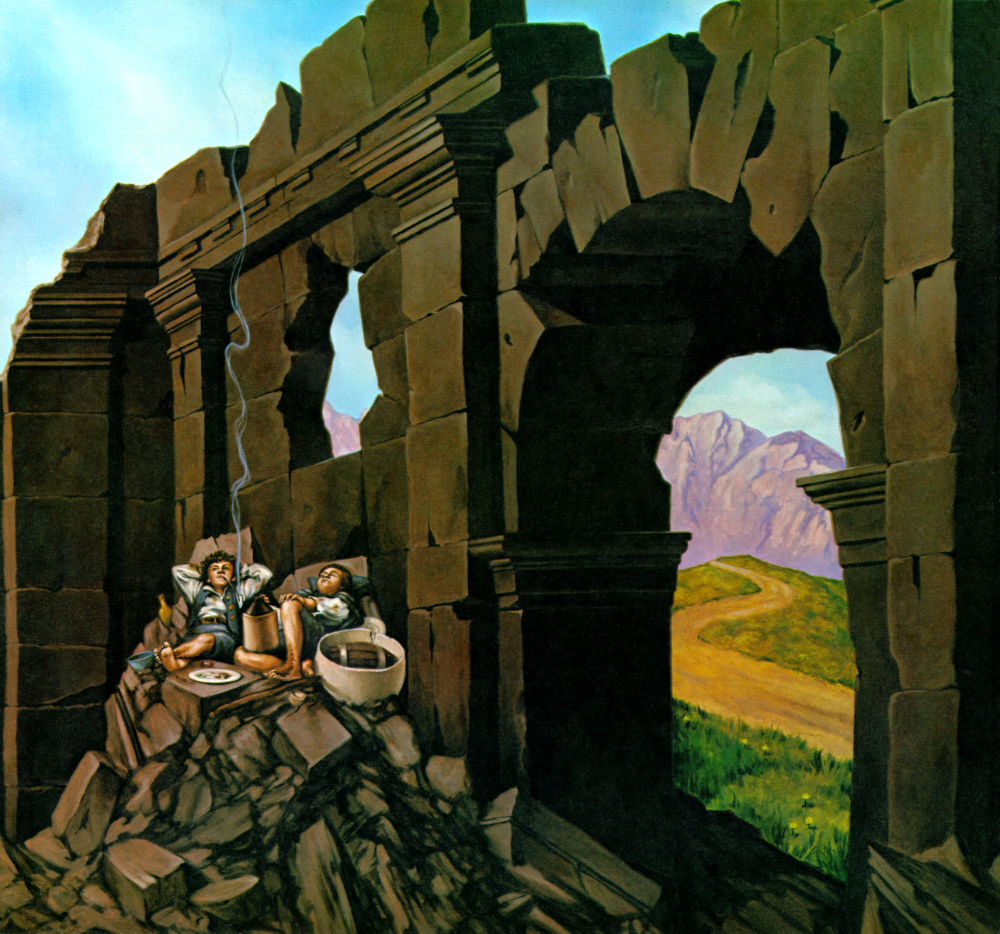
Add to this Tolkien’s later comment on the appearance of Merry and Pippin as Saruman’s “door-keepers”:

“14. Why on earth should Z say that the hobbits ‘were munching ridiculously long sandwiches’?” (Letters, 396)

(Michael Herring—you can see more of his work here:  https://www.artnet.com/artists/michael-herring/ )

Of himself, Tolkien once wrote:

“[I] have a very simple sense of humour (which even my appreciative critics find tiresome)” (from a letter to Deborah Webster, 25 October, 1958, Letters, 412)

So he was not against comedy in general:

“I return Rayner’s [Rayner Unwin, the son of Sir Stanley, Tolkien’s publisher] remarks with thanks to you both.  I am sorry he felt overpowered, and I particularly miss any reference to the comedy, with which I imagined the first ‘book’ [that is, The Fellowship] was well supplied.  It may have misfired.  I cannot bear funny books or plays myself, I mean those that set out to be all comic; but it seems to me that in real life, as here, it is precisely against the darkness of the world that comedy arises…” (letter to Sir Stanley Unwin, 31 July, 1947, Letters, 172)

Tolkien could even be a practical joker—see Humphrey Carpenter, JRR Tolkien:  A Biography, 134, for more on this.

And yet we can see, from his Ackerman comments, that, when it came to his creative work, he was not only serious, but expected others to take it seriously—to treat it seriously—as well.

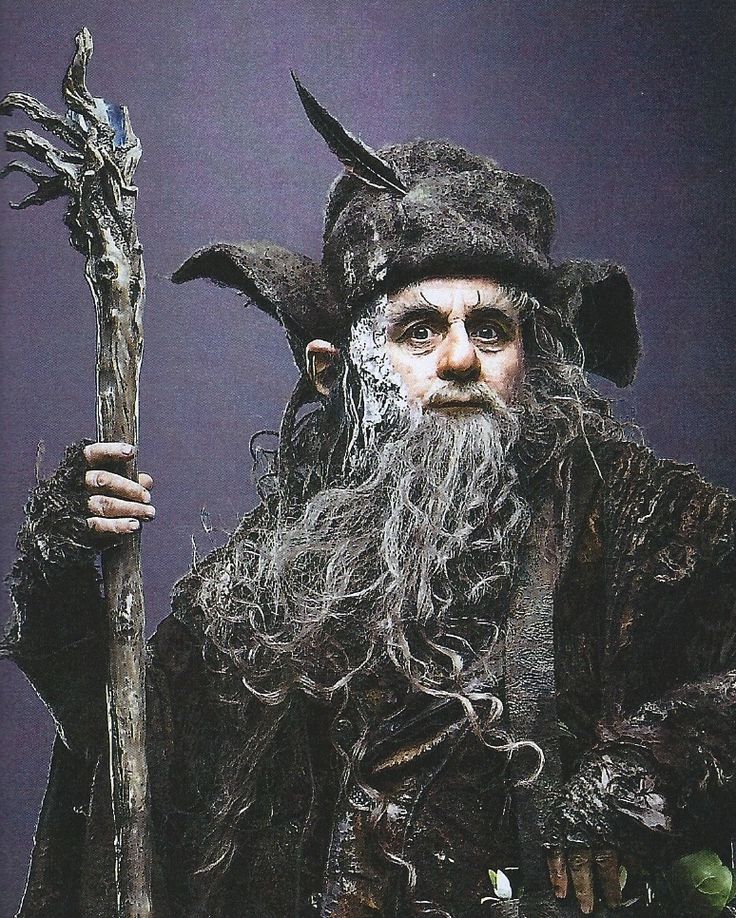
So what are we to make of the portrayal of Radagast the Brown in The Hobbit of P. Jackson and Co.?

Well, we might begin by saying that he is only mentioned in Tolkien’s Hobbit, (Chapter 7, “Queer Lodgings”) and appears, but only briefly, as a messenger from Saruman in The Fellowship of the Ring, Book Two, Chapter 2, “The Council of Elrond”. 

He is one of the 5 Istari, sent to Middle-earth as a counter-balance to Sauron.  (On the Istari, see Unfinished Tales, 405-412).  It may be that Tolkien himself thought that he had become a little too acclimatized:

“Indeed, of all the Istari, one only remained faithful, and he was the last-comer.  For Radagast, the fourth, became enamoured of the many beasts and birds that dwelt in Middle-earth, and forsook Elves and Men, and spent his days among the wild creatures.”  (JRR Tolkien, The Lost Tales, 407)

But this doesn’t mean that he’s become what Saruman sneeringly calls him:  “Radagast the Bird-tamer!  Radagast the Simple!  Radagast the fool!” (The Fellowship of the Ring, Book Two, Chapter 2, “The Council of Elrond”)—although he could easily be taken for that in Jackson’s Hobbit, for all that he’s had invented for him a role that seems to want to combine the clownish with the heroic, but, for me,  as JRRT did not create this role and would certainly have been upset by the clownish aspects of it–

see his comment  on illustrations for a German translation of The Hobbit sent him by Horus Engels:

“He has sent me some illustrations (of the Trolls and Gollum) which despite certain merits, such as one would expect of a German, are I fear too ‘Disnified’ for my taste:  Bilbo with a dribbling nose, and Gandalf as a figure of vulgar fun rather than the Odinic wanderer that I think of…” (letter to Sir Stanley Unwin, 7 December, 1946, Letters 171-172)

he seems not only unnecessary, but exactly what disturbed Tolkien about the Zimmerman “treatment” of The Lord of the Rings, the reaction of an author who finds:

“…increasingly as he proceeds, his work treated as it would seem carelessly , in places recklessly, and with no evident signs  of any appreciation of what it is all about…”

Hence the title of this posting—not  the fear generated by the Old English gaest , of the original word, but certainly a sense of disturbance of the sort JRRT felt in that “treatment” and I’m sure would have felt even more strongly seeing what had happened to his character in the hands of those who, at best, are reckless.

Thanks, as always, for reading,

Stay well,

Believe that the author means what she/he says,

And remember that, as always, there’s

MTCIDC

O

PS

For me, this illustration, by Lucas Graciano, seems a better depiction—

(you can see more of his imaginative art here:  https://www.lucasgraciano.com/ )

The Doubtful Sea Series Facebook Page

The Doubtful Sea Series Facebook Page

  • Ollamh

Categories

  • Artists and Illustrators
  • Economics in Middle-earth
  • Fairy Tales and Myths
  • Films and Music
  • Games
  • Heroes
  • Imaginary History
  • J.R.R. Tolkien
  • Language
  • Literary History
  • Maps
  • Medieval Russia
  • Military History
  • Military History of Middle-earth
  • Narnia
  • Narrative Methods
  • Poetry
  • Research
  • Star Wars
  • Terra Australis
  • The Rohirrim
  • Theatre and Performance
  • Tolkien
  • Uncategorized
  • Villains
  • Writing as Collaborators
Follow doubtfulsea on WordPress.com

Across the Doubtful Sea

Recent Postings

  • A Moon disfigured December 17, 2025
  • On the Roads Again—Once More December 10, 2025
  • (Not) Crossing Bridges December 3, 2025
  • On the Road(s) Again—Again November 26, 2025
  • On the Road(s) Again November 19, 2025
  • To Bree (Part 2) November 12, 2025
  • To Bree (Part 1) November 5, 2025
  • A Plague o’ Both—No, o’ All Your Houses! October 29, 2025
  • It’s in Writing (2:  I’st a Prologue, or a Poesie for a Ring?) October 22, 2025

Blog Statistics

  • 103,189 Views

Posting Archive

  • December 2025 (3)
  • November 2025 (4)
  • October 2025 (5)
  • September 2025 (4)
  • August 2025 (4)
  • July 2025 (5)
  • June 2025 (4)
  • May 2025 (4)
  • April 2025 (5)
  • March 2025 (4)
  • February 2025 (4)
  • January 2025 (5)
  • December 2024 (4)
  • November 2024 (4)
  • October 2024 (5)
  • September 2024 (4)
  • August 2024 (4)
  • July 2024 (5)
  • June 2024 (4)
  • May 2024 (5)
  • April 2024 (4)
  • March 2024 (4)
  • February 2024 (4)
  • January 2024 (5)
  • December 2023 (4)
  • November 2023 (5)
  • October 2023 (4)
  • September 2023 (4)
  • August 2023 (5)
  • July 2023 (4)
  • June 2023 (4)
  • May 2023 (5)
  • April 2023 (4)
  • March 2023 (5)
  • February 2023 (4)
  • January 2023 (4)
  • December 2022 (4)
  • November 2022 (5)
  • October 2022 (4)
  • September 2022 (4)
  • August 2022 (5)
  • July 2022 (4)
  • June 2022 (5)
  • May 2022 (4)
  • April 2022 (4)
  • March 2022 (5)
  • February 2022 (4)
  • January 2022 (4)
  • December 2021 (5)
  • November 2021 (4)
  • October 2021 (4)
  • September 2021 (5)
  • August 2021 (4)
  • July 2021 (4)
  • June 2021 (5)
  • May 2021 (4)
  • April 2021 (4)
  • March 2021 (5)
  • February 2021 (4)
  • January 2021 (4)
  • December 2020 (5)
  • November 2020 (4)
  • October 2020 (4)
  • September 2020 (5)
  • August 2020 (4)
  • July 2020 (5)
  • June 2020 (4)
  • May 2020 (4)
  • April 2020 (5)
  • March 2020 (4)
  • February 2020 (4)
  • January 2020 (6)
  • December 2019 (4)
  • November 2019 (4)
  • October 2019 (5)
  • September 2019 (4)
  • August 2019 (4)
  • July 2019 (5)
  • June 2019 (4)
  • May 2019 (5)
  • April 2019 (4)
  • March 2019 (4)
  • February 2019 (4)
  • January 2019 (5)
  • December 2018 (4)
  • November 2018 (4)
  • October 2018 (5)
  • September 2018 (4)
  • August 2018 (5)
  • July 2018 (4)
  • June 2018 (4)
  • May 2018 (5)
  • April 2018 (4)
  • March 2018 (4)
  • February 2018 (4)
  • January 2018 (5)
  • December 2017 (4)
  • November 2017 (4)
  • October 2017 (4)
  • September 2017 (4)
  • August 2017 (5)
  • July 2017 (4)
  • June 2017 (4)
  • May 2017 (5)
  • April 2017 (4)
  • March 2017 (5)
  • February 2017 (4)
  • January 2017 (4)
  • December 2016 (4)
  • November 2016 (5)
  • October 2016 (6)
  • September 2016 (5)
  • August 2016 (5)
  • July 2016 (5)
  • June 2016 (5)
  • May 2016 (4)
  • April 2016 (4)
  • March 2016 (5)
  • February 2016 (4)
  • January 2016 (4)
  • December 2015 (5)
  • November 2015 (5)
  • October 2015 (4)
  • September 2015 (5)
  • August 2015 (4)
  • July 2015 (5)
  • June 2015 (5)
  • May 2015 (4)
  • April 2015 (3)
  • March 2015 (4)
  • February 2015 (4)
  • January 2015 (4)
  • December 2014 (5)
  • November 2014 (4)
  • October 2014 (6)
  • September 2014 (1)

Blog at WordPress.com.

  • Subscribe Subscribed
    • doubtfulsea
    • Join 78 other subscribers
    • Already have a WordPress.com account? Log in now.
    • doubtfulsea
    • Subscribe Subscribed
    • Sign up
    • Log in
    • Report this content
    • View site in Reader
    • Manage subscriptions
    • Collapse this bar
 

Loading Comments...