• About

doubtfulsea

~ adventure fantasy

Monthly Archives: September 2024

Hands Up

25 Wednesday Sep 2024

Posted by Ollamh in Uncategorized

≈ Leave a comment

Tags

books, Fantasy, J.R.R. Tolkien, lord-of-the-rings, Tolkien

As always, dear readers, welcome.

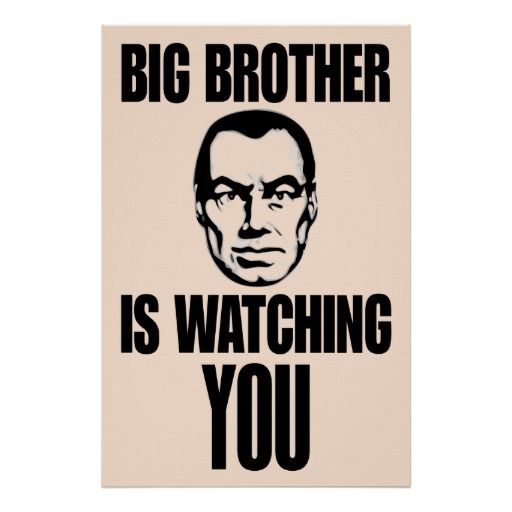
“The hallway smelt of boiled cabbage and old rag mats. At

one end of it a coloured poster, too large for indoor display,

had been tacked to the wall. It depicted simply an enor-

mous face, more than a metre wide: the face of a man of

about forty-five, with a heavy black moustache and rugged-

ly handsome features. Winston made for the stairs. It was no

use trying the lift.  Even at the best of times it was seldom

working, and at present the electric current was cut

off during daylight hours. It was part of the economy drive

in preparation for Hate Week. The flat was seven flights up,

and Winston, who was thirty-nine and had a varicose ulcer

above his right ankle, went slowly, resting several times on

the way. On each landing, opposite the lift-shaft, the poster

with the enormous face gazed from the wall. It was one of

those pictures which are so contrived that the eyes follow

you about when you move. BIG BROTHER IS WATCHING

YOU, the caption beneath it ran.” (George Orwell, 1984, Part One, Chapter 1)

This is the second paragraph in the first chapter of “George Orwell”’s (aka Eric Blair, 1903-1950) 1948 dystopian novel, 1984.  It’s an extremely thoughtful, well-written book, but its view of the future seems so hopeless and grim that it’s not easy to  read—you can do it here, however:  https://archive.org/details/GeorgeOrwells1984

I’ve been interested in that poster.

The first film made from the book, in 1956, doesn’t appear to have believed the kind of image of “Big Brother” which Orwell described—
nor does the second film, from, appropriately enough, 1984—

The first is lacking that mustache (and looks more like a man in a staring contest) and the second to me appears to be the image of someone earnestly trying to sell us something.  I wonder if what Orwell (who loathed Stalinist Russian and who used it as a model for his future Britain) actually had in mind was something like this—

combined with this—

(the British Field Marshall and Secretary of State for War, H.H. Kitchener, 1850-1916, on probably the most influential recruiting poster of the Great War/WW1)

The stare—a kind of commanding gaze—is clearly very important.  As Orwell tells us:  “It was one of those pictures which are so contrived that the eyes follow you about when you move”, which made me immediately think about Sauron as he appears in The Lord of the Rings—or, rather, doesn’t appear in actual physical form, but is only represented by what Frodo sees in Galadriel’s Mirror:

“But suddenly the Mirror went altogether dark, as dark as if a hole had opened in the world of sight, and Frodo looked into emptiness.  In the black abyss there appeared a single Eye that slowly grew, until it filled nearly all the Mirror.  So terrible was it that Frodo stood rooted, unable to cry out or to withdraw his gaze.  The Eye was rimmed with fire, but was itself glazed, yellow as a cat’s, watchful and intent, and the black slit of its pupil opened on a pit, a window into nothing.”

(an actual yellow cat’s eye)

This is powerful enough, but then—

“Then the Eye began to rove, searching this way and that; and Frodo knew with certainty and horror that among the many things that it sought he himself was one.”  (The Fellowship of the Ring, Book Two, Chapter 7, “The Mirror of Galadriel”) 

When, much later in the story, Pippin makes the mistake of looking into Saruman’s Palantir, he discovers just how powerful that gaze can be:

“ ‘I, I took the ball and looked at it…and I saw things that frightened me.  And I wanted to go away, but I couldn’t.  And then he came and questioned me; and he looked at me, and, and,  that is all I remember…Then suddenly he seemed to see me, and he laughed at me.  It was cruel.  It was like being stabbed with knives…Then he gloated over me.  I felt I was falling to pieces…’ “ (The Two Towers, Book Three, Chapter 11, “The Palantir”)

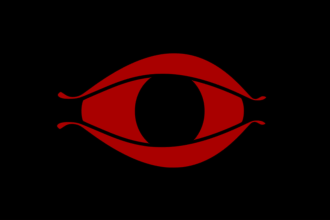
Just like the eyes of Big Brother, and of Field Marshall Kitchener, then, Sauron’s eye radiates authority and sends the same signal:  “Sauron is watching YOU”, which is why it appears even on the equipment of Sauron’s orcs—who would dare to flinch or fail when Sauron may actually be watching you personally?

(Angus McBride)

It is the badge, then, of never-sleeping watchfulness.
We know, from the narrator, that Saruman had plans to imitate Sauron—although he was deceived into thinking that he was doing so:

“A strong place and wonderful was Isengard, and long had it been beautiful…But Saruman had slowly shaped it to his shifting purposes, and made it better, as he thought, being deceived—for all those arts and subtle devices, for which he forsook his former wisdom, and which fondly he imagined were his own, came from Mordor; so that what he made was naught, only a little copy, a child’s model or a slave’s flattery, of that vast fortress, armoury, prison, furnace of great power, Barad-dur, the Dark Tower, which suffered no rival, and laughed at flattery, biding its time, secure in its pride and its immeasurable strength.”  (The Two Towers, Book Three, Chapter 8, “The Road to Isengard”)

If the all-seeing, ever-watchful Eye was Sauron’s badge, it’s interesting to see what Saruman chose:

“Suddenly a tall pillar loomed before them.  It was black; and set upon it was a great stone, carved and painted in the likeness of a long White Hand.” 

We first meet this sign when Aragorn, Legolas, and Gimli are looking through the Orc dead after Boromir’s death:

“There were four goblin-soldiers of greater stature, swart, slant-eyed, with thick legs and large hands.  They were armed with short broad-bladed swords, not with the curved scimitars usual with Orcs; and they had bows of yew, in length and shape like the bows of Men  Upon their shields they bore a strange device:  a small white hand in the centre of a black field; on the front of their iron helms was set an S-rune, wrought of some white metal.” (The Two Towers, Book Three, Chapter 1, “The Departure of Boromir”)

(Inger Edelfeldt)

I don’t believe we ever see that “S-rune” again,

but the White Hand, along with the Eye, will appear as the Orcs carry Merry and Pippin off to the west.

(Denis Gordeev)

But what does it signify?  Saruman, as he has become unknowingly corrupted by Sauron, has become “Saruman of Many Colours”, as he explains to Gandalf (see the dialogue between them in The Fellowship of the Ring, Book Two, Chapter 2, “The Council of Elrond”), but he began as Saruman the White, and that might explain the color of the hand.  On that pillar outside Isengard, the hand, then, might indicate a warning:  “Stop.  This is the Land of Saruman.  Go Back.”, as we imagine the two figures of the Argonath might be indicating by their gesture—
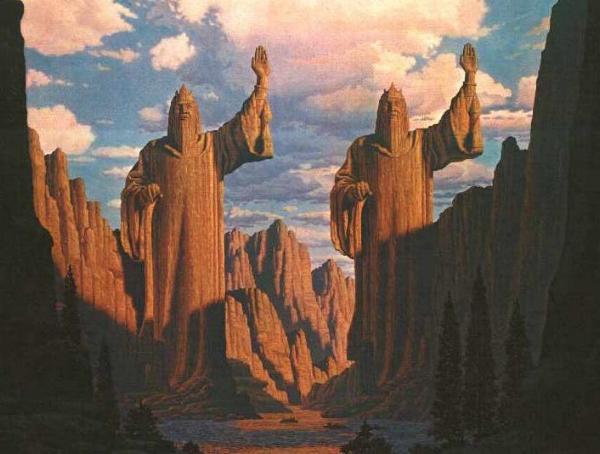
(the Hildebrandts)

This might work for a boundary pillar, but what about those shields?  Can we add a second meaning? 

Ugluk the captain of the Isengard Orcs might offer a very grim one:

“We are the servants of Saruman the Wise, the White Hand:  the Hand that gives us man’s flesh to eat.”  (The Two Towers, Book Three, Chapter 3, “The Uruk-hai”)

Could this then be another warning:  “If you face us, not only will we defeat you, but then we’ll eat you”?

Perhaps a clue to this possibility may be found in a closer examination of that pillar:

“Now Gandalf rode to the great pillar of the Hand, and passed it; and as he did so the Riders saw to their wonder that the Hand appeared no longer white.  It was stained as with dried blood; and looking closer they perceived that its nails were red.” (The Two Towers, Book Three, Chapter 8, “The Road to Isengard”)

It’s just as well, then, for Pippin when:

“An Orc stooped over him, and flung him some bread and a strip of raw dried flesh…”

that

“He ate the stale grey bread hungrily, but not the meat.”

Thanks, for reading, as ever.

Stay well,

Sometimes it may be good to be a picky eater,

And remember that, as always, there’s

MTCIDC

PS

While poking around for white hand images, I found this:

If you’d like to know more about it, see:  https://www.shirepost.com/products/white-hand-of-saruman-silver-coin 

Stratigraphy

18 Wednesday Sep 2024

Posted by Ollamh in Uncategorized

≈ Leave a comment

Tags

Fantasy, J.R.R. Tolkien, lord-of-the-rings, The Lord of the Rings, Tolkien

Welcome, as always, dear readers.

If you read this blog regularly, you know that one thing which always interests me is Tolkien’s sources, both direct and indirect.  In my last, for example, you would have read about one which he directly acknowledged, S.R. Crockett’s 1899 historical novel, The Black Douglas.

(See “Wolfing”, 11 September, 2024 for more)

In this posting, however, I want to begin with a source which prompted my writing this.

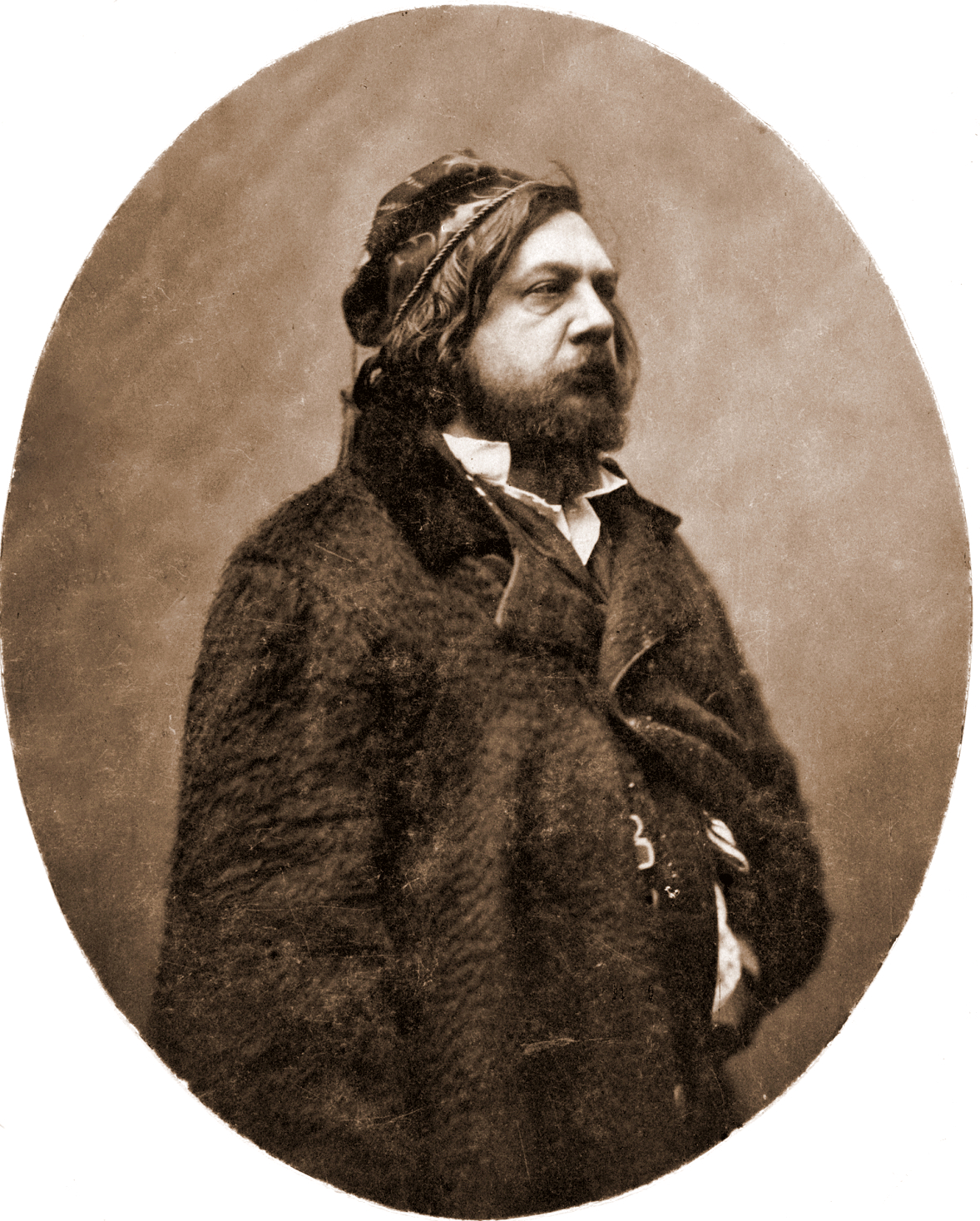
It is a pair of stanzas from Theophile Gautier’s (1811-1872)   

poem “L’Art”, which I read just the other day (my translation)–

“Toute passe—L’art robuste

Seul a l’eternite;

   Le buste

Survit a la cite.

Et la medaille austere

Que trouve un laboureur

   Sous terre

Revele un empereur.”

“Everything passes–only sturdy art

To eternity;

The bust survives the city

And the austere medallion

Which the workman finds

Under the ground

Reveals an emperor.”

Gautier belonged to the beginnings of a 19th-century movement which was called “Art for Art’s Sake” and this poem is a declaration, directed towards artists themselves, of his belief that art survives—and should survive—the ages. 

What really caught my attention was the second of these two stanzas, first because the medallion reminded me of this medallion, which I use to teach the Germanification of the later western Roman Empire–

It was minted for the first Ostrogothic king, Theoderic (454-526), who controlled Italy and some areas to the east from 493-526AD, ruling as an ostensible agent of the eastern Roman Empire, but actually a kind of smaller version of the former western Roman emperors.  I’ve always found this image useful because it suggests several things at once:

1. although it’s in Latin (“Theodericus Rex Pius Princi[p]s—for “Princeps”—originally “Headman”—primum caput—in Roman Republican terms, the speaker of the Senate—later an imperial honorific—now the basis of our word “prince”), “Theoderic, king, religious, prince”, underneath that name is the Gothic language which, along with Latin and Greek, Theoderic (or the older spelling, Theodoric) spoke, his Gothic name being something like “Thiudareiks”.  The Greco-Roman name would mean “Gift of God (theo- god, originally Zeus, + dor- gift)”, whereas the Gothic name is a compound of thiuda, “people” and reiks, “ruler”, so “ruler of the people”.   And the name, being in two languages at once, would seem to suggest, perhaps inadvertently, that Theoderic is the ruler of both the older Roman population and the newer Gothic.

2. this message is underlined by the portrait of the king himself–although he has the general look of a later Roman ruler—his lamellar armor (armor made of overlapping metal plates) and the little Nike (not sneaker, but the angelic figure in his left hand, symbolizing victory)—his haircut and the mustache are definitely not, being Germanic.

(For more on this medallion, see:  https://pancoins.org/wp-content/uploads/2018/03/Theorodoric-entire-article.pdf and https://cccrh.org/wp-content/uploads/2021/05/the-coins-of-theoderic-the-ostrogoth.pdf )

The second reason that stanza caught my attention was Gautier’s suggestion that the medallion, along with the bust, are archaeological finds which have survived as emblems of a previous age, itself long lost.

Sometimes, as in the case of Gautier’s workman, finds are simply stumbled upon. The famous Rosetta Stone, for example,

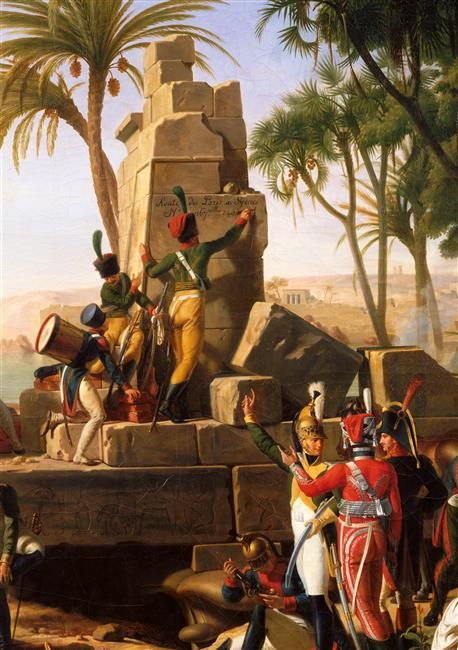
was found built into a wall by French engineers from Napoleon’s 1798 invasion of Egypt,

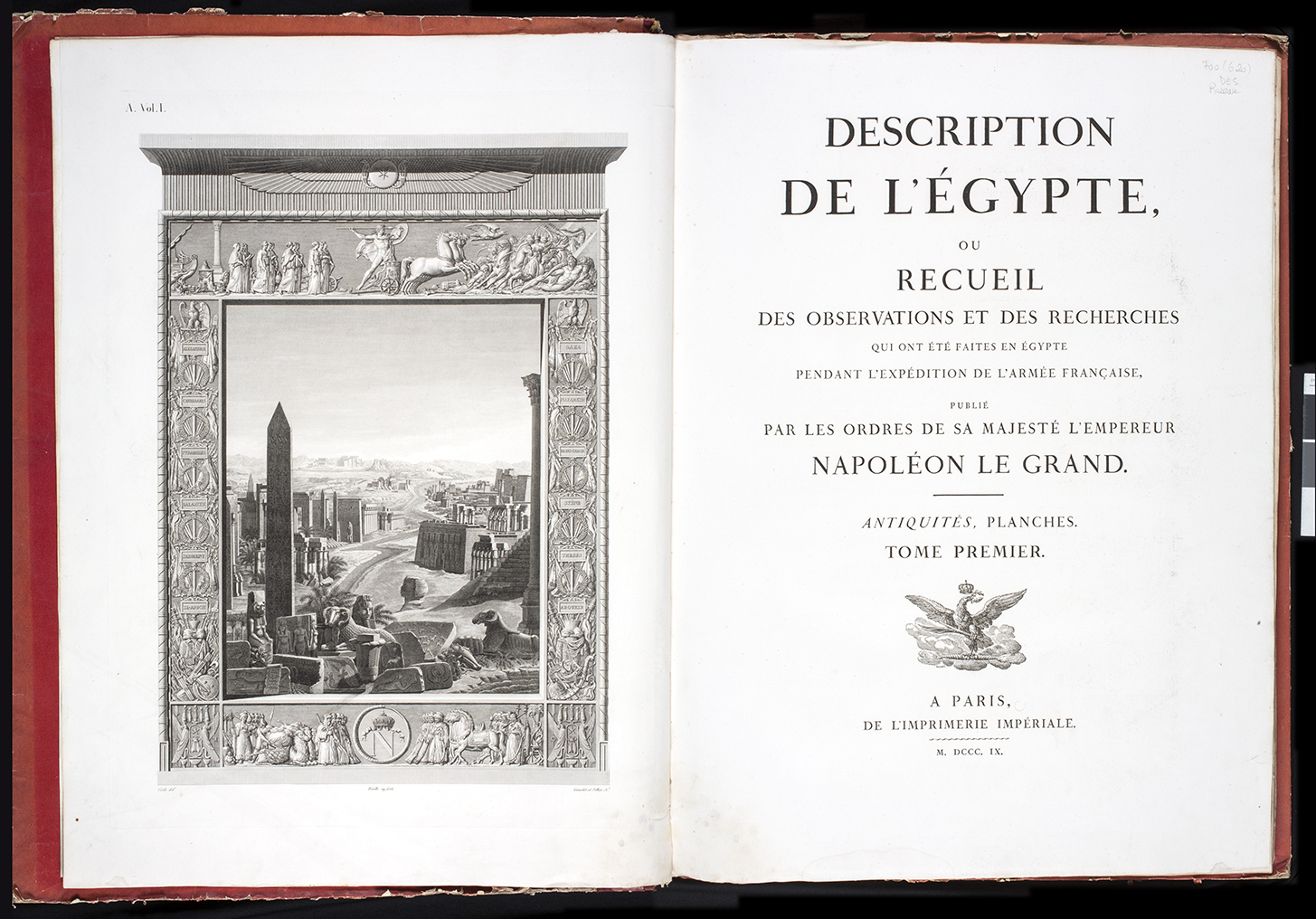
who were, in fact, not looking for antiquities (although Napoleon’s expeditionary force actually had a scientific element attached—here’s an image of one of the volumes which, eventually, they published),

but were improving some fortifications at the time.

As time went on, however, scientific archaeology developed and began very carefully recording discoveries brought from the ground layer by layer, which is called stratigraphy, and is used by geologists and paleontologists, as well.

The thinking behind this is simply logical:  that which you find below something else is older (unless the ground is disturbed, which can and does happen), that which you find above is newer.

Something I’ve always loved about Tolkien’s work (and Tolkien himself) is the careful, patient way he’s built up Middle-earth, which is, in fact, stratigraphically designed.  For an easy example, look at Appendix A of The Lord of the Rings:

“Annals of the Kings and Rulers”,

which is then divided into:

“I  The Numenorean Kings”

which is then subdivided in turn into:

“(i) Numenor

(ii) The Realms in Exile

(iii) Eriador, Arnor, and the Heirs of Isildur

(iv) Gondor and the Heirs of Anarion

The Stewards”

to which is added

(v) Here Follows a Part of the Tale of Aragorn and Arwen”

before we move on to

“II. The House of Eorl”

Layer by layer, JRRT piles on time and its events—and this isn’t just in annalistic form—that is, a date is provided, then an event is briefly recorded (although we see this form at the beginning of Appendix B in“The Tale of Years”)—instead, we find whole short stories, like that of King Arvedui, which occupies about 2 full pages in the 50th anniversary edition which I use in these postings (1041-1043).

The consequence of this is always a sense that Middle-earth is extremely old, inhabited, colonized, with stratum after stratum of human/elvish/dwarfish activity laid on top of each other—and sometimes standing long after those originally involved are long gone.  Consider, for example, the “Pukel-men”:

“At each turn of the road there were great standing stones that had been carved in the likeness of men, huge and clumsy-limbed, squatting cross-legged with their stumpy arms folded on fat bellies.  Some in the wearing of the years had lost all features save the dark holes of their eyes that still stared sadly at the passers-by…

Such was the dark Dunharrow, the work of long-forgotten men.  Their name was lost and no song or legend remembered it.  For what purpose they had made this place, as a town or secret temple or a tomb of kings, none in Rohan could say.  Here they laboured in the Dark Years, before ever ship came to the western shores, or Gondor of the Dunedain was built; and now they had vanished, and only the old Pukel-men were left, still sitting at the turnings of the road.” (The Return of the King, Book Five, Chapter 3, “The Muster of Rohan”)

On its own, this careful, detailed building of the past gives tremendous power to present events:  for ages, other people have struggled, built, fought, and perished in Middle-earth and left behind a long record of their deeds—although sometimes only nearly-forgotten monuments are all that survives.

But I think that we might also see a larger picture here, as well.

Middle-earth was not chosen just because Tolkien, as a medievalist, had it in his vocabulary.  As he tells us:

“I am historically minded.  Middle-earth is not an imaginary world.  The name is the modern form (appearing in the 13th century and still in use) of midden-erd >middel-erd, an ancient word for the ‘oikoumene’, the abiding place of Men, the objectively real world, in use specifically opposed to imaginary worlds (as Fairyland) or unseen worlds (as Heaven and Hell).  The theatre of my tale is this earth, the one in which we now live, but the historical period is imaginary.  The essentials of that abiding place are all there (at any rate for inhabitants of N.W. Europe), so naturally it feels familiar, even if a little glorified by the enchantment of distance in time.” (“Notes on W.H. Auden’s review of The Return of the King, 1956?, Letters,345)

To which we might add:

“May I say that all this is ‘mythical’…As far as I know it is merely an imaginative invention, to express, in the only way I can, some of my (dim) apprehensions of the world.  All I can say is that, if it were ‘history’ it would be difficult to fit the lands and events (or ‘cultures’) into such evidence as we possess, archaeological or geological, concerning the nearer or remoter part of what is now called Europe…I could have fitted things in with greater verisimilitude, if the story had not become too far developed, before the question ever occurred to me.  I doubt if there would have been much gain; and I hope the, evidently long but undefined, gap in time between the Fall of Barad-dur and our Days is sufficient for ‘literary credibility’, even for readers acquainted with what is known or surmised of ‘pre-history’. “

And Tolkien has footnoted this with:

“I imagine the gap to be about 6000 years:  that is we are now at the end of the Fifth Age, if the Ages were about the same length as S.A. and T.A.  But they have, I think, quickened; and I imagine we are actually at the end of the Sixth Age, or in the Seventh.”  (Letter to Rhona Beare, 14 October, 1958, Letters, 404)

In other words, what Tolkien has done for his version of our world is to create a simulacrum of what humans in time have done for our version of our world and, as we read The Lord of the Rings, including its appendices, we are acting as something like literary archaeologists, beginning at the surface of the Third Age in its last years and reading slowly down through its strata, just as archaeologists in our world work their way down through the historical layers, recording the strata as they dig.  Although I’m admirer of good fan fiction, I don’t think that I would ever write it, but I can imagine a story which begins with an archaeologist in our world (6000 years after the Third Age) digging more deeply than ever and coming upon

“…a tall pillar loomed up before them.  It was black; and set upon it was a great stone, carved and painted in the likeness of a long White Hand…” (The Two Towers, Book Three, Chapter 8, “The Road to Isengard”)

Where might the story go from there?

Thanks, as ever, for reading.

Stay well,

When excavating always keep a careful record,

And remember that, as always, there’s

MTCIDC

O

Wolfing

11 Wednesday Sep 2024

Posted by Ollamh in Uncategorized

≈ Leave a comment

Tags

book-review, fairy-tales, Fiction, picture-books

Welcome, dear readers, as always.

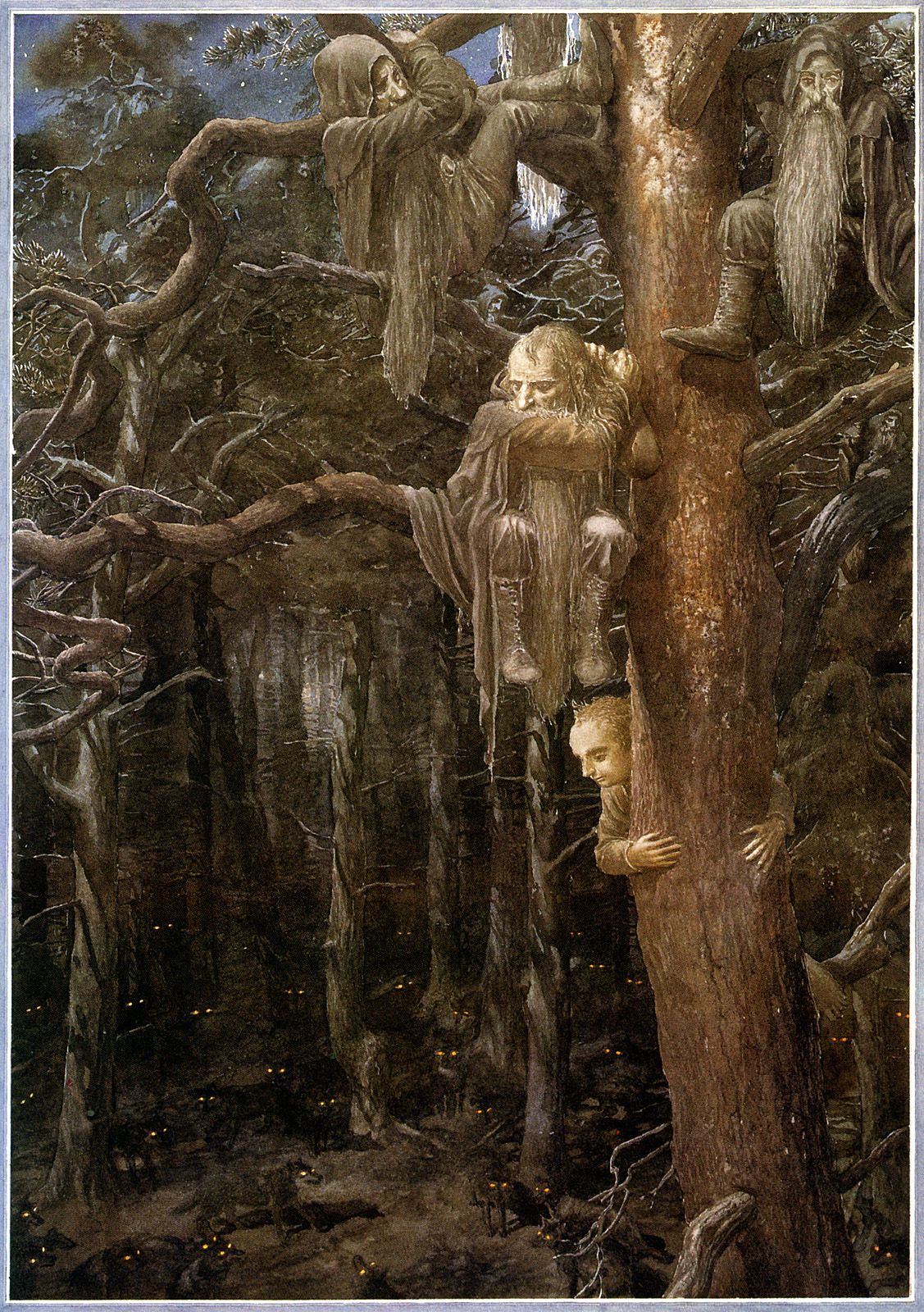
“All of a sudden they heard a howl away down hill, a long shuddering howl.  It was answered by another away to the right and a good deal nearer to them; then by another not far away to the left.  It was wolves howling at the moon, wolves gathering together!”  (The Hobbit, Chapter 6, “Out of the Frying Pan Into the Fire”)

(Alan Lee)

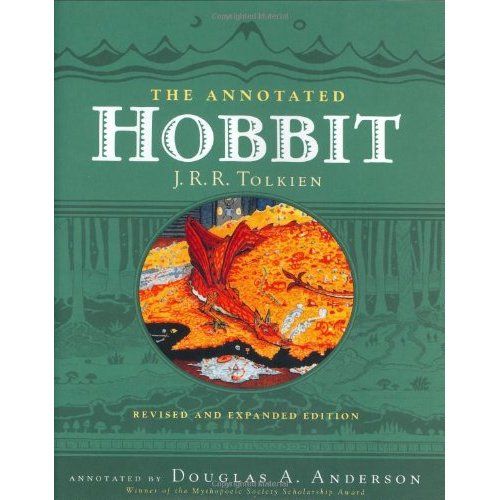
In his invaluable The Annotated Hobbit,

Douglas Anderson points to a letter by Tolkien suggesting an influence, if not inspiration, for this scene of wargs (i.e. wolves) vs treed dwarves (and hobbit), as JRRT tells us:

“Though the episode of the ‘wargs’ is in part derived from a scene in S.R. Crockett’s The Black Douglas, probably his best romance and anyway one that deeply impressed me in school-days, though I have never looked back again.  It includes Gil de Rez as a Satanist.” (“from a letter to Michael Tolkien…sometime after Aug.25, 1967”, Letters, 550)

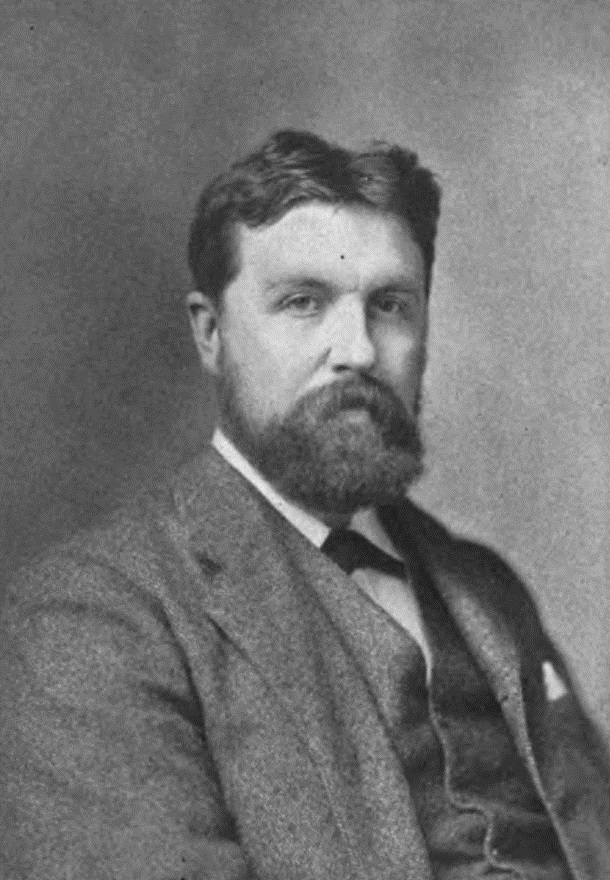
Published in 1899, The Black Douglas,

Is one of a series of Scots historical novels by S(amuel).R(utherford). Crockett (1859-1914),

based upon actual events—in this case, it has, as a basis, the short life and judicial murder of William, the 6th Earl of Douglas and his younger brother, David, in 1440.  It also has supernatural elements, however, including the sinister (but historical) figure of Gilles de Rais (c.1405-1440–Tolkien was clearly spelling from memory), one-time companion of Joan of Arc, who appears to be a werewolf, and, it’s a scene where the protagonists are attacked by werewolves

to which JRRT was referring—although the three don’t climb trees, but put their backs to them to fight on the ground, killing many of their attackers (and not being rescued by eagles—it’s Chapter XLIX and you can read it here:  https://dn790000.ca.archive.org/0/items/blackdouglas00croc/blackdouglas00croc.pdf ).

Wolves—or wargs—as we see in The Hobbit, are pack animals.

Crockett imagined even werewolves as behaving like the wolves they turn into and this led me to a question which occurred when, recently, as part of an exercise in story-telling, I asked a class to tell me the story of “The Three Little Pigs”. 

I’m sure that you know it, with its typical for Western fairy tales pattern of 3s:   porcine architecture—straw,

sticks, bricks–attempts by the wolf to enter, replies by the pigs, subsequent action by the wolf and his parboiled demise.

 Because of its simplicity and that pattern, it’s very useful as a subject for helping students to learn how stories work and how even such a simple story is built upon such basic narrative principles as foreshadowing and repetition to build tension.

But, the 3 pigs sing mockingly in the 1933 Disney version,

“Who’s afraid of the big, bad wolf,

Big, bad wolf,

Big, bad wolf?

Who’s afraid of the big, bad wolf?

Tra la la la la!”

(There’s actually a much longer song and you can read it here:  https://www.lyrics.com/lyric/27101857/Disney/Who%27s+Afraid+of+the+Big+Bad+Wolf and hear and see it here:  https://www.youtube.com/watch?v=leAh00n3hno )

and that made me notice something odd:  not “Big, bad wolves”—what happened to the pack?

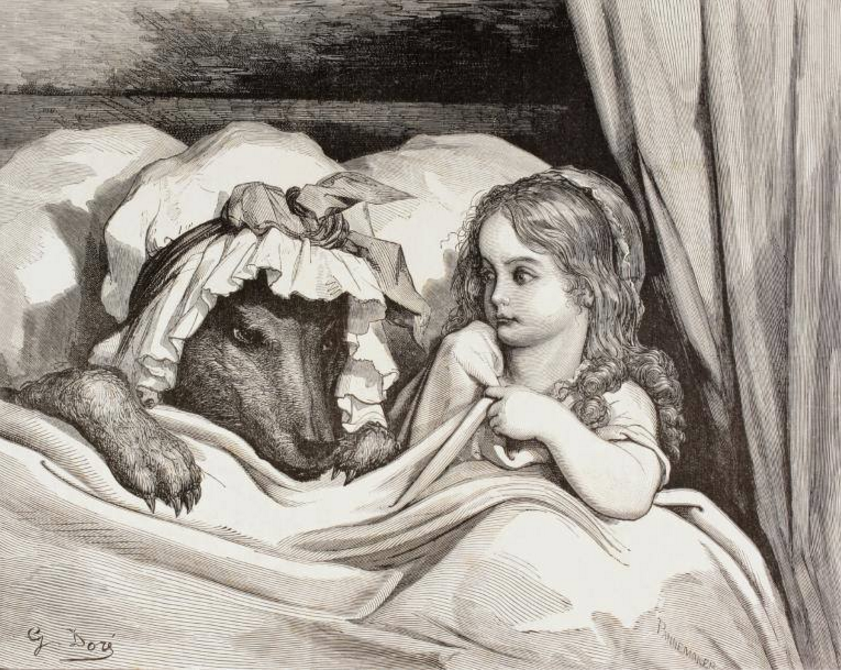
The idea of the “lone wolf” turns up in other fairy tales—think of “Little Red Riding Hood” for example,

(Perhaps my favorite illustration, by Gustave Dore—LRR seems to have a rather skeptical look—perhaps because in the version Dore illustrated, the last line of the story is:  “Et en disant ces mots, le méchant loup se jeta sur le petit Chaperon rouge, et la mangea.”—“And, in saying these words, the wicked wolf threw himself upon Little Red Riding Hood and ate her.”)

where a single wolf meets Red, and the perhaps less familiar “The Wolf and the Seven Kids”.

(This is by a well-known Victorian illustrator, Walter Crane, 1845-1915, from an 1882 collection of the Grimm fairy tales which you can see here:  https://en.wikisource.org/wiki/Household_stories_from_the_collection_of_the_Bros_Grimm_(L_%26_W_Crane)/The_Wolf_and_the_Seven_Little_Goats  You can also read a translation at this site, which is specifically devoted to the works of the Grimms:  https://www.grimmstories.com/en/grimm_fairy-tales/the_wolf_and_the_seven_little_goats )

Traditional fairy tales all have variants—sometimes numerous ones—and some appear even on a world-wide basis, like “Cinderella” (see an ancient Chinese version here:   https://www.ancient-origins.net/news-myths-legends/fish-wish-your-heart-makes-2200-year-old-tale-chinese-cinderella-003506 ), but a little preliminary research has suggested another possibility. 

Unlike other fairy tales, although scholars believe “The Three Little Pigs” to be an old story, I was surprised to learn that its first citation is only to an 1853 volume with a title which would not suggest that such a story would be included:  English Forests and Forest Trees, Historical, Legendary, and Descriptive.  It’s to be found in Chapter IX, “Dartmoor Forest” and, even more surprising, the characters aren’t pigs, but pixies, the villain of the piece isn’t a wolf, but a fox, and the houses are made of wood, stone, and iron.   You can read it here:  https://ia601307.us.archive.org/13/items/englishforestsa01unkngoog/englishforestsa01unkngoog.pdf on pages 189-190.

The version familiar to most of us first appears in the fifth edition of James Halliwell-Phillipps’ The Nursery Rhymes of England (1886), in which the third little pig (who survives, as his two brothers do not) has a lot more to do than in what must have been the simplified version I knew as a child—and this actually closely matches the Dartmoor version (except for the pixies and the fox).  You can read it here:  https://archive.org/details/nurseryrhymesofe00hall/page/36/mode/2up on pages 37-41.  (For an entertaining essay on Halliwell-Phillipps and his work, see:  https://reactormag.com/questionable-scholars-and-rhyming-pigs-j-o-halliwell-phillipps-the-three-little-pigs/  )

It’s admittedly just a guess on my part, Halliwell-Phillipps doesn’t credit a source, and, instead of a fox as the villain, there’s a wolf, but both stories, have the same pattern of threes, although building materials differ, and the three pixies have a different identity, but what we see here is the same story, which made me wonder:

  1. Did “pixies” become (possibly through mishearing of an oral telling) “pigsies”—that is, “little pigs”?
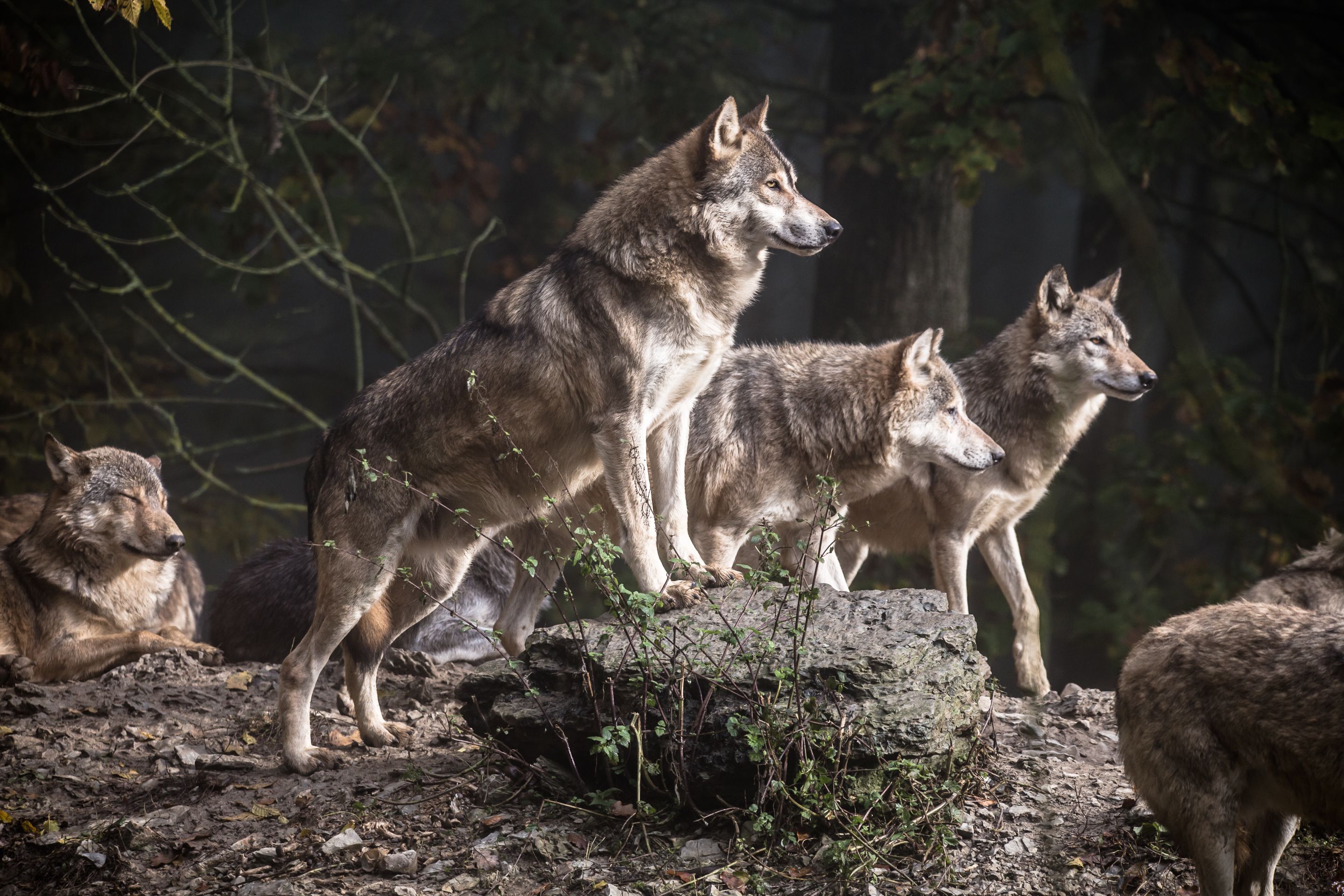
  2. Did the fox become a wolf because wolves can be quite large

(by NatsumeWolf—you can see more of her art here:  https://www.furaffinity.net/gallery/natsumewolf/ )

and therefore more menacing in a story than a diminutive, but tricky, fox?

As well, that wolf in “Little Red Riding Hood” appears in Charles Perrault’s late-17th century story collection, Histoires ou Contes du Temps passe, first translated into English in the early 18th century, appearing, as well, along with “The Wolf and the Seven Kids”, in the Grimms’ early 19th century Kinder und Hausmaerchen, first translated into English in the 1820s, both being, therefore, readily available.  So, could that frightening wolf from other stories perhaps have been leaning over Halliwell-Phillipps’ shoulder, pushing him to replace the fox, even as he turned pixies into pigsies?  After all, he had nothing to lose but his pack…

Thanks, as ever, for reading.

Stay well,

If threatened by a wolf, try to out-fox him,

And remember that there’s always

MTCIDC

O

PS

For another, rather eerie story with—well, no spoiler alert, just read it: https://ia601303.us.archive.org/8/items/thetoysofpeacean01477gut/1477-h/1477-h.htm

This is by HH Munro, 1870-1916, who used the pen name “Saki”.  I’ve mentioned him before, but I’m sure to mention him and his witty and sometimes weird short stories again in the future.

Hey, Hay

04 Wednesday Sep 2024

Posted by Ollamh in Uncategorized

≈ Leave a comment

As ever, dear readers, welcome.

As I reread The Hobbit for the fall semester, I came across this-

“Far, far away to the West, where things were blue and faint, Bilbo knew there lay his own country of safe and comfortable things…

‘The summer is getting on down below,’ thought Bilbo, ‘and haymaking is going on and picnics.  They will be harvesting and blackberrying, before we even begin to go down the other side at this rate.’ “ (The Hobbit, Chapter 4, “Over Hill and Under Hill”)

Gandalf, the dwarves, and the hobbit are beginning their trip through the Misty Mountains, an increasingly bleak place

(JRRT’s sketch, but from the far side of the Mountains)

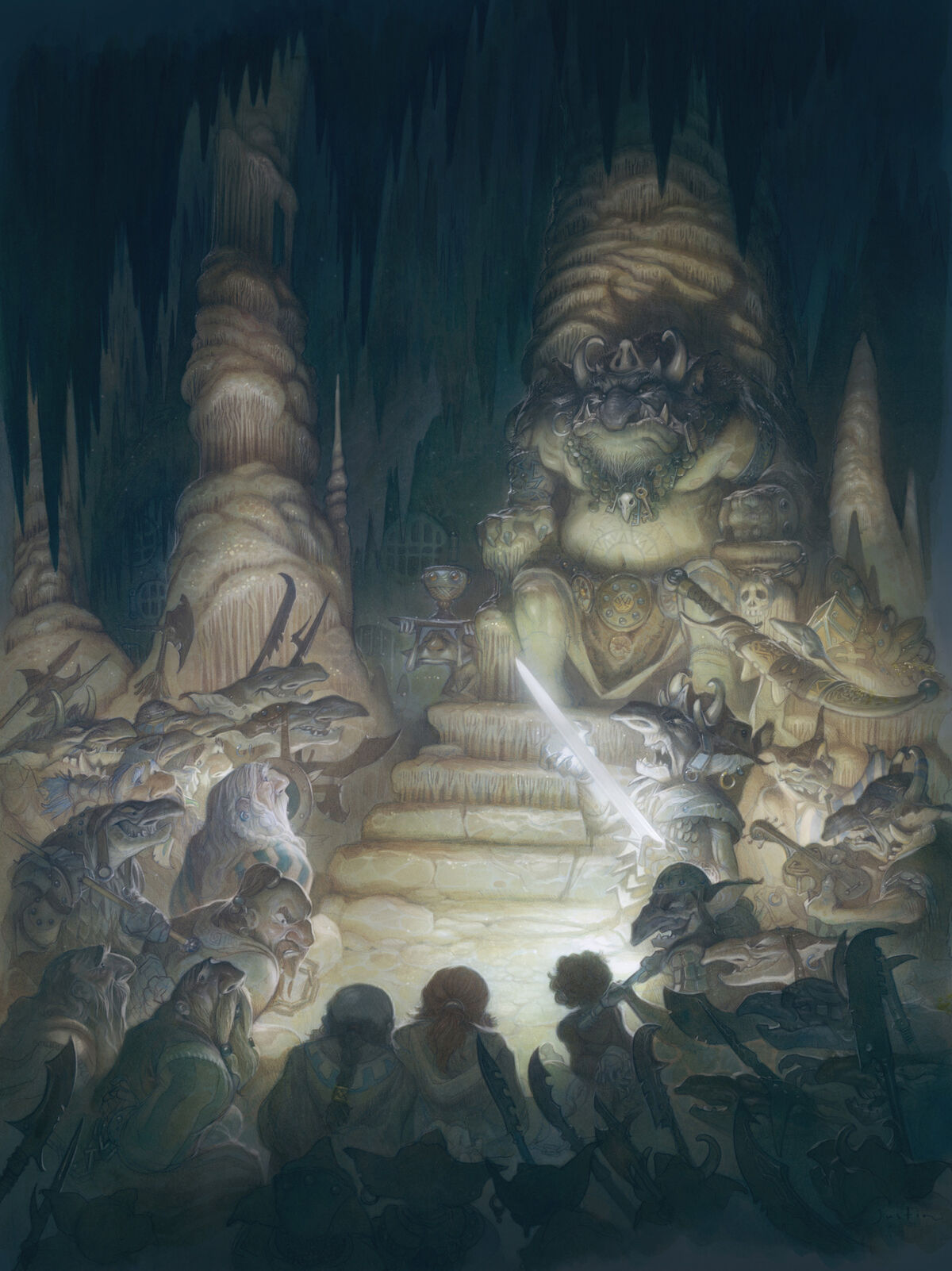
which, although they don’t know it yet, will lead the group to goblins

(This is by Justin Gerard and you can see more of his striking work here:  https://www.gallerygerard.com/the-art-of-justin-gerard )

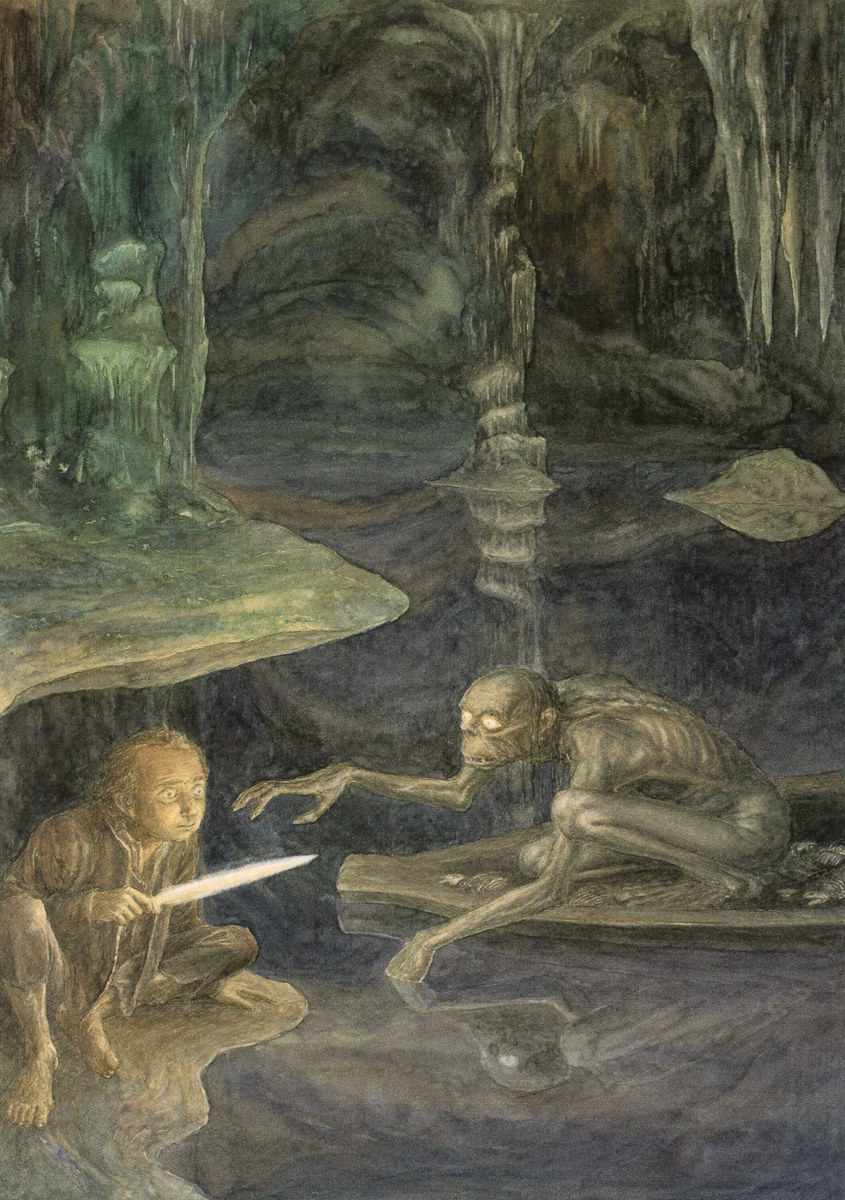
and Bilbo to “Riddles in the Dark”,

(Alan Lee)

so it’s easy to understand why Bilbo is thinking of pleasanter things (being safe in bed and eating bacon and eggs are also daydreaming possibilities for him).  But what about haymaking?  A common older proverb in English is “Make hay while the sun shines”, meaning “do something when you can best accomplish it”, but how do you “make hay”?

From Tolkien’s map of the Shire

and from hints here and there, principally in The Lord of the Rings, it’s clear that much of it is an agricultural landscape (as Tolkien writes to Naomi Mitchison:  “The Shire is placed in a water and mountain situation and a distance from the sea and a latitude what would give it a natural fertility, quite apart from the stated fact that it was a well-tended region when they took it over…” (letter to Naomi Mitchison, 25 September, 1954, Letters, 292)

We know that the South Farthing, for example, has tobacco (“smoke leaf”) plantations,

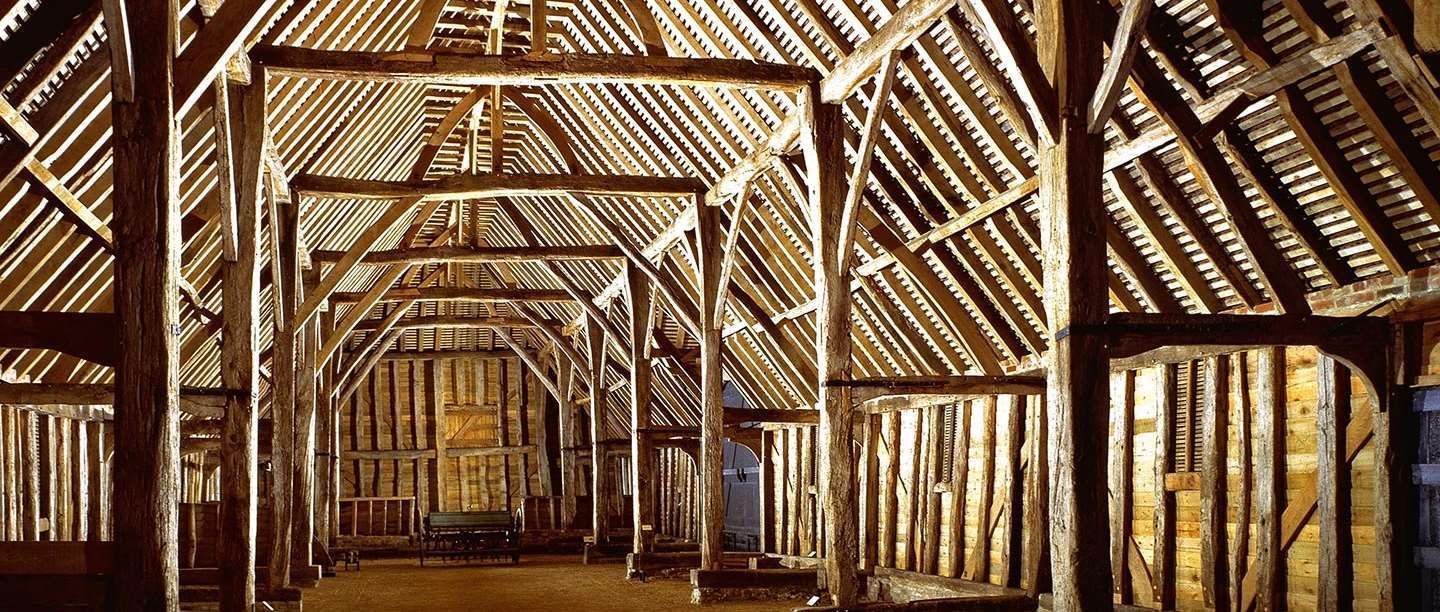
(although this is an all-too-modern barn—I imagine that hobbit barns would be more medieval-looking

like Prior’s Hall Barn here, built in the mid-15th century.)

Farmer Maggot, in the East Farthing, grows turnips,

and, as it’s probable that he brews his own beer, he’ll be growing barley

and, for flavoring, may grow hops.

(Those odd-looking buildings in the background are oast houses, where the hops are dried before use.)

Hay can be made from any number of plant products and come from fields devoted entirely to the hay-making process, but Farmer Maggot may also set aside some of his barley-fields, which will be cut before quite ripe, to keep as much of the nutrition for cattle-feed in the hay.

This can be a tricky operation as, to preserve the goodness of the hay, it needs to be spread out and dried in the sun before it’s collected (a process called “tedding”).  Sudden wet weather can ruin a crop by dampening it to the point that there will be too much moisture, which can cause rot or encourage disease.  (For a very practical 16th-century description of this process, see pages 33-34 of  Sir Anthony Fitzherbert’s  The Book of Husbandry, 1534, edited by Walter Skeat for the English Dialect Society in 1881, at:  https://archive.org/details/bookofhusbandry00fitzuoft/page/32/mode/2up )  Once the hay is dried on both sides, it’s forked into haycocks (you can see them in the background of the previous image—Fitzherbert recommends doing this twice, gathering the hay into larger cocks the second time–from which it can be loaded onto carts and taken to be stored in a barn–also depicted in this image).

(This is the beautifully-reconstructed interior of the Prior’s Hall Barn.)

What Bilbo thinks he’s missing, then, is the (hopefully) sunny days when hay is mown (late June, early July in the UK) and tedded (not that he, who is a wealthy gentleman, would ever be doing any of that manual labor.)  But what about picnics? 

As is the case with many words in English, there is a scholarly tussle over just when and where this word first appears–probably the 18th century–but I’ll leave it to this article to say more about the word and its usage:  https://www.historytoday.com/archive/historians-cookbook/history-picnic

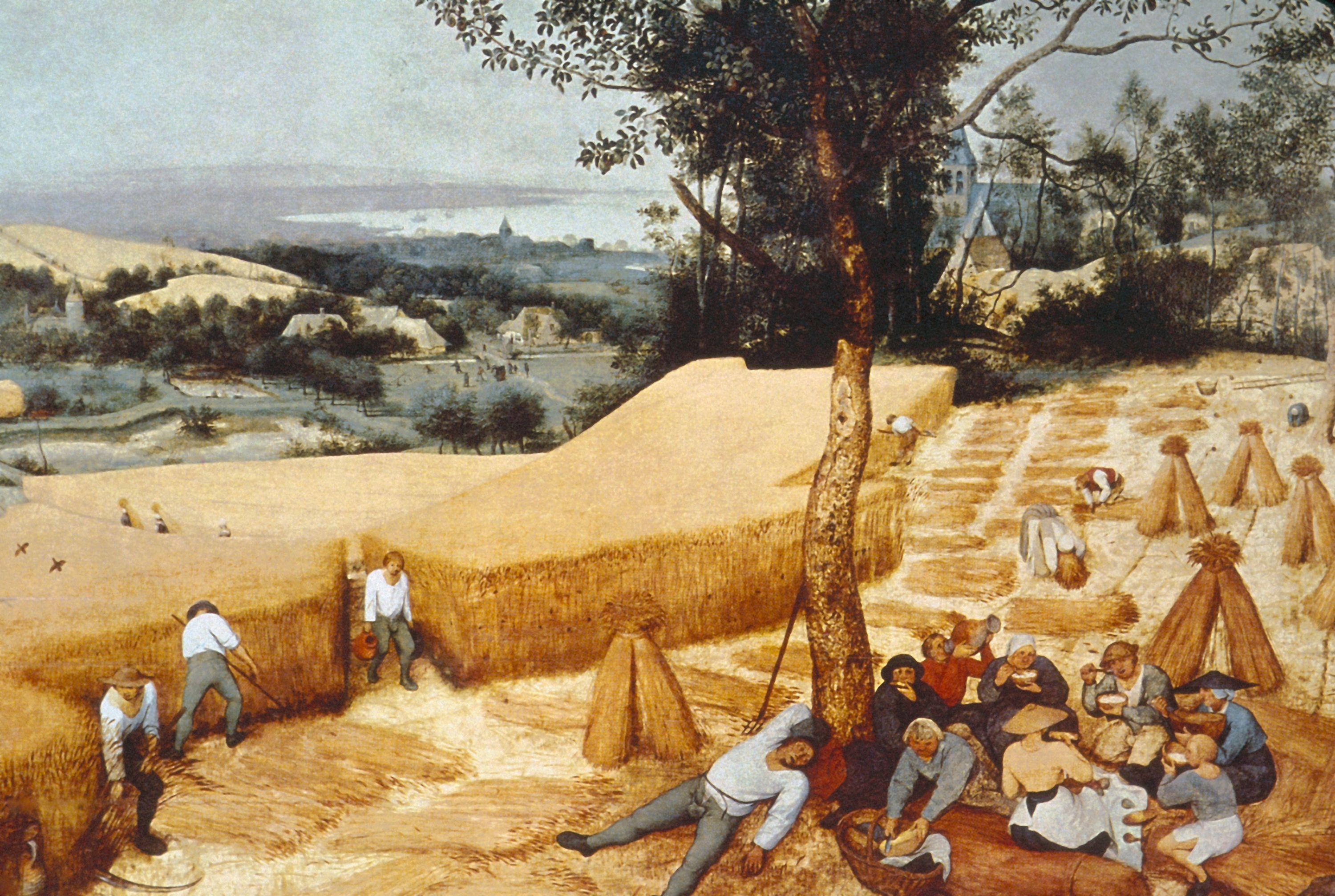
and, instead, wonder who was doing the picnicking and where?  Is Bilbo actually thinking about a genteel outdoor meal, like this 19th-century painting of an 18th century festivity?

or something more rustic, like this 16th-century image of workers taking time off from the field?

In any event, just as in his longing for the comfort of eggs and bacon, his inclusion of picnics with haymaking

reminds us of a strong trait of hobbits—

“Their faces were as a rule good-natured rather than beautiful…with mouths apt to laughter, and to eating and drinking.  And laugh they did, and eat, and drink, often and heartily, being fond of simple jests at all times, and of six meals a day (when they could get them).”  (The Lord of the Rings, Prologue, I, Concerning Hobbits)

No wonder a dream of far-off comfort includes eating.

Thanks, as always, for reading.

Stay well,

Hope for three sunny days in hay-making time,

And remember that there’s always

MTCIDC

O

PS

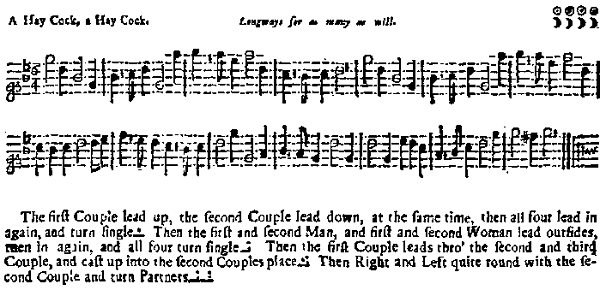
In case, after haymaking and picnicking, you feel inclined to join the fiddler,

(Cornelis Dusart, 1660-1704)

here’s a 17th-century dance with an appropriate title (and directions on how to do it)—

And here’s a transcription into modern notation, if that earlier form is a bit puzzling:  https://playforddances.com/dances-2-3/hay-cock-a-hay-cock/

PPS

And I can’t resist adding what seems like an appropriate poem by Robert Frost (1874-1963)

Mowing

There was never a sound beside the wood but one,

And that was my long scythe whispering to the ground.

What was it it whispered? I knew not well myself;

Perhaps it was something about the heat of the sun,

Something, perhaps, about the lack of sound—

And that was why it whispered and did not speak.

It was no dream of the gift of idle hours,

Or easy gold at the hand of fay or elf:

Anything more than the truth would have seemed too weak

To the earnest love that laid the swale in rows,

Not without feeble-pointed spikes of flowers

(Pale orchises), and scared a bright green snake.

The fact is the sweetest dream that labor knows.

My long scythe whispered and left the hay to make.

This comes from Frost’s 1915 collection A Boy’s Will and you can read the whole collection here:  https://archive.org/details/boyswill00fros/mode/2up   A couple of vocabulary words–forgive me if these are already known to you—

Scythe

which you probably know from images of “the Grim Reaper”, who cuts down everyone the way a harvester cuts down all the grain—

Swale

This is defined as a “valley or low place” in a Webster’s An American Dictionary of the English Language from 1865—you can read that definition here:  https://archive.org/details/americandictiona00websuoft/page/1336/mode/2up

As I’m sure that you have seen plenty of those, I include this Eastman Johnson (1824-1906) of a harvester sharpening his scythe.

Orchis

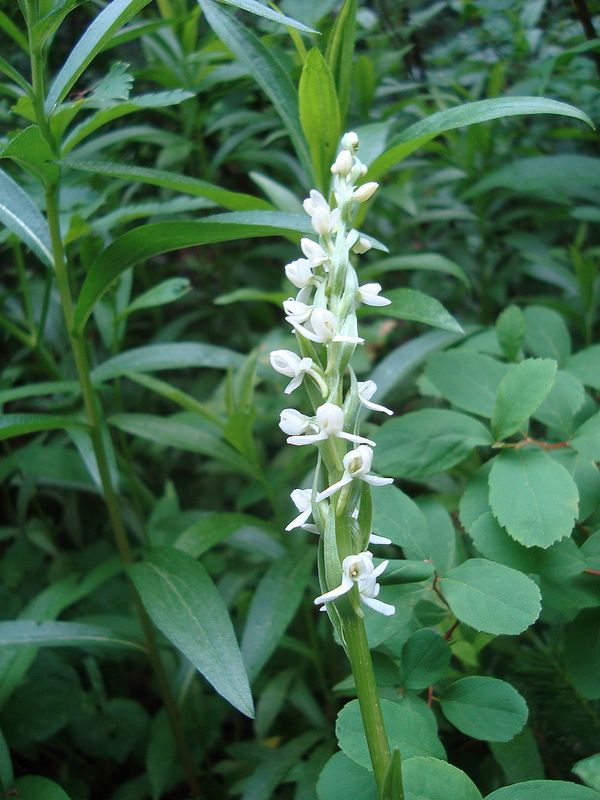
This is somewhat puzzling, as the Orchis is a genus in the Orchid family which doesn’t appear to be native to North America.  I’m presuming that Frost is employing an earlier or perhaps American form of  “orchid” ( in that same Webster’s An American Dictionary of the English Language from 1865, you can see that use:  https://archive.org/details/americandictiona00websuoft/page/918/mode/2up )of which there are a good number of types available in North America.  Using Frost’s clues—“feeble pointed spikes” and “pale”, as clues, I’ve included the image of a “White Fringed Bog Orchid” (Platanthera Blephariglottis) as a guess.

The Doubtful Sea Series Facebook Page

The Doubtful Sea Series Facebook Page

  • Ollamh

Categories

  • Artists and Illustrators
  • Economics in Middle-earth
  • Fairy Tales and Myths
  • Films and Music
  • Games
  • Heroes
  • Imaginary History
  • J.R.R. Tolkien
  • Language
  • Literary History
  • Maps
  • Medieval Russia
  • Military History
  • Military History of Middle-earth
  • Narnia
  • Narrative Methods
  • Poetry
  • Research
  • Star Wars
  • Terra Australis
  • The Rohirrim
  • Theatre and Performance
  • Tolkien
  • Uncategorized
  • Villains
  • Writing as Collaborators
Follow doubtfulsea on WordPress.com

Across the Doubtful Sea

Recent Postings

  • A Moon disfigured December 17, 2025
  • On the Roads Again—Once More December 10, 2025
  • (Not) Crossing Bridges December 3, 2025
  • On the Road(s) Again—Again November 26, 2025
  • On the Road(s) Again November 19, 2025
  • To Bree (Part 2) November 12, 2025
  • To Bree (Part 1) November 5, 2025
  • A Plague o’ Both—No, o’ All Your Houses! October 29, 2025
  • It’s in Writing (2:  I’st a Prologue, or a Poesie for a Ring?) October 22, 2025

Blog Statistics

  • 103,189 Views

Posting Archive

  • December 2025 (3)
  • November 2025 (4)
  • October 2025 (5)
  • September 2025 (4)
  • August 2025 (4)
  • July 2025 (5)
  • June 2025 (4)
  • May 2025 (4)
  • April 2025 (5)
  • March 2025 (4)
  • February 2025 (4)
  • January 2025 (5)
  • December 2024 (4)
  • November 2024 (4)
  • October 2024 (5)
  • September 2024 (4)
  • August 2024 (4)
  • July 2024 (5)
  • June 2024 (4)
  • May 2024 (5)
  • April 2024 (4)
  • March 2024 (4)
  • February 2024 (4)
  • January 2024 (5)
  • December 2023 (4)
  • November 2023 (5)
  • October 2023 (4)
  • September 2023 (4)
  • August 2023 (5)
  • July 2023 (4)
  • June 2023 (4)
  • May 2023 (5)
  • April 2023 (4)
  • March 2023 (5)
  • February 2023 (4)
  • January 2023 (4)
  • December 2022 (4)
  • November 2022 (5)
  • October 2022 (4)
  • September 2022 (4)
  • August 2022 (5)
  • July 2022 (4)
  • June 2022 (5)
  • May 2022 (4)
  • April 2022 (4)
  • March 2022 (5)
  • February 2022 (4)
  • January 2022 (4)
  • December 2021 (5)
  • November 2021 (4)
  • October 2021 (4)
  • September 2021 (5)
  • August 2021 (4)
  • July 2021 (4)
  • June 2021 (5)
  • May 2021 (4)
  • April 2021 (4)
  • March 2021 (5)
  • February 2021 (4)
  • January 2021 (4)
  • December 2020 (5)
  • November 2020 (4)
  • October 2020 (4)
  • September 2020 (5)
  • August 2020 (4)
  • July 2020 (5)
  • June 2020 (4)
  • May 2020 (4)
  • April 2020 (5)
  • March 2020 (4)
  • February 2020 (4)
  • January 2020 (6)
  • December 2019 (4)
  • November 2019 (4)
  • October 2019 (5)
  • September 2019 (4)
  • August 2019 (4)
  • July 2019 (5)
  • June 2019 (4)
  • May 2019 (5)
  • April 2019 (4)
  • March 2019 (4)
  • February 2019 (4)
  • January 2019 (5)
  • December 2018 (4)
  • November 2018 (4)
  • October 2018 (5)
  • September 2018 (4)
  • August 2018 (5)
  • July 2018 (4)
  • June 2018 (4)
  • May 2018 (5)
  • April 2018 (4)
  • March 2018 (4)
  • February 2018 (4)
  • January 2018 (5)
  • December 2017 (4)
  • November 2017 (4)
  • October 2017 (4)
  • September 2017 (4)
  • August 2017 (5)
  • July 2017 (4)
  • June 2017 (4)
  • May 2017 (5)
  • April 2017 (4)
  • March 2017 (5)
  • February 2017 (4)
  • January 2017 (4)
  • December 2016 (4)
  • November 2016 (5)
  • October 2016 (6)
  • September 2016 (5)
  • August 2016 (5)
  • July 2016 (5)
  • June 2016 (5)
  • May 2016 (4)
  • April 2016 (4)
  • March 2016 (5)
  • February 2016 (4)
  • January 2016 (4)
  • December 2015 (5)
  • November 2015 (5)
  • October 2015 (4)
  • September 2015 (5)
  • August 2015 (4)
  • July 2015 (5)
  • June 2015 (5)
  • May 2015 (4)
  • April 2015 (3)
  • March 2015 (4)
  • February 2015 (4)
  • January 2015 (4)
  • December 2014 (5)
  • November 2014 (4)
  • October 2014 (6)
  • September 2014 (1)

Blog at WordPress.com.

  • Subscribe Subscribed
    • doubtfulsea
    • Join 78 other subscribers
    • Already have a WordPress.com account? Log in now.
    • doubtfulsea
    • Subscribe Subscribed
    • Sign up
    • Log in
    • Report this content
    • View site in Reader
    • Manage subscriptions
    • Collapse this bar
 

Loading Comments...