Tags
Adventure, akaletes, Baggins, Bilbo, Chico, cyclops, Gollum, Groucho, Marx Brothers, Odysseus, Polyphemus, Riddles in the Dark, The Hobbit, The Lord of the Rings, The Odyssey, Tolkien, trolls, xenia
Welcome, as always, dear readers.
In this posting, we are interested in the use and danger of using names in the history of the Ring, as well as looking at a possible parallel from an earlier heroic story. How dangerous can a name be?
In Chapter 5 of The Hobbit, Bilbo makes what is almost a fatal mistake—not for himself so much as for Frodo, and not at the time, so much as some 77 years later.
Confronted by the curious Gollum deep under the Misty Mountains, Bilbo has responded to Gollum’s, “What iss he, my preciouss?” with, “I am Mr. Bilbo Baggins.”

First, of course, he hasn’t answered the question. He was asked what, not who. And, from Gollum’s viewpoint, in which seemingly all animate things are potentially at least a snack, if not a full meal (“I guess it’s a choice feast; at least a tasty morsel it’d make us, gollum!” The Hobbit, Chapter 5, “Riddles in the Dark”), “What is it?” is the more appropriate question.
Second, depending on the culture, names can have a much greater significance than simply being social identifiers. If your culture has a strong belief in magic, then your personal name is a point of vulnerability: someone who wishes to control you can use it in summoning spells. This is probably why, for example, Circe, in Book 10 of the Odyssey, when she can’t turn Odysseus into a pig, as she had already done with part of his crew, says that he’s akaletes—literally, “uncallable by name”. Although the story as we have it doesn’t say so, we can presume that, as he does in another circumstance—which we’re about to discuss—he gives the enchantress a false name and therefore escapes her magic.
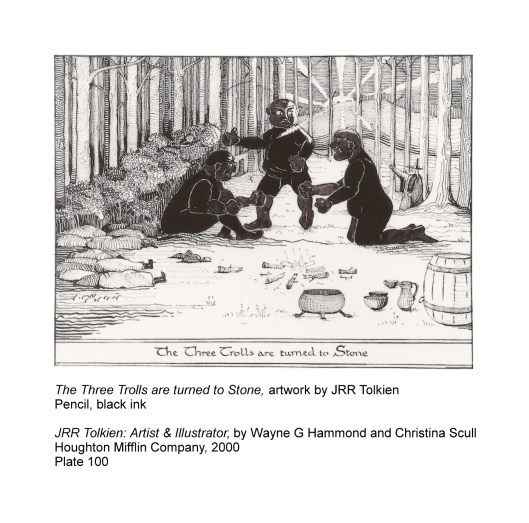
This is not the first time Bilbo has slipped, however. William, the troll, has already asked, “What are yer?” And Bilbo has replied, “Bilbo Baggins, a bur-a hobbit.” (The Hobbit, Chapter 2, “Roast Mutton”)

(By one of our favorite Tolkien artists, Ted Nasmith)
Again, Bilbo has given the wrong answer (reminding us of a scene in the Marx Brothers movie, Horsefeathers, 1932, where Chico, as Baravelli, the doorkeeper of a speakeasy, demands of Groucho, “Who are you?” to which Groucho replies, “I’m fine, thanks. Who are you?”).
He has also complicated matters by almost saying “burglar” (he’s just tried to steal William’s purse, after all, which has, in fact, asked him “’Ere, ‘oo are you?”), but, by changing it at the last moment, he’s then created a new confusion, as the trolls simultaneously ask, “A burrahobbit?” and William adds, “What’s a burrahobbit got to do with my pocket, anyways?”
(We also ask, is there a very mild joke here—“burra” could easily sound like “burrow” and, since hobbits traditionally lived in tunnels…?)
Gandalf and daylight take care of the trolls,
but Gollum is another matter. Bilbo, caught off guard, gives him his name. This, in turn, under torture, is passed on to Sauron, now aware that the Ring has (literally) resurfaced on Middle-earth. And, somehow, the names “hobbits” and “Shire” have been added to Bilbo’s name, as Gandalf tells Frodo (The Fellowship of the Ring, Chapter 2, “The Shadow of the Past”). To find out more, Sauron sends out his search team, the Nazgul, and the danger begins…
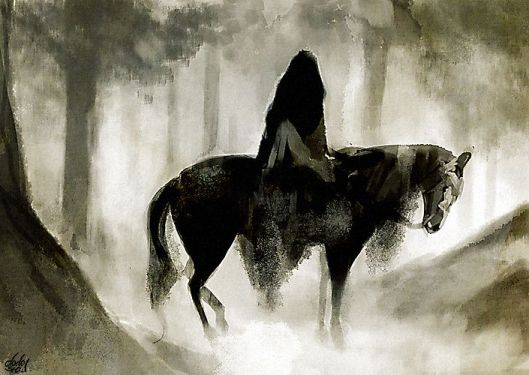
(A wonderfully atmospheric watercolor by Ella Kurki)
Odysseus, whom we mentioned earlier, has also been involved with a large and menacing creature, Polyphemus, the Cyclops, in Book 9 of the Odyssey.
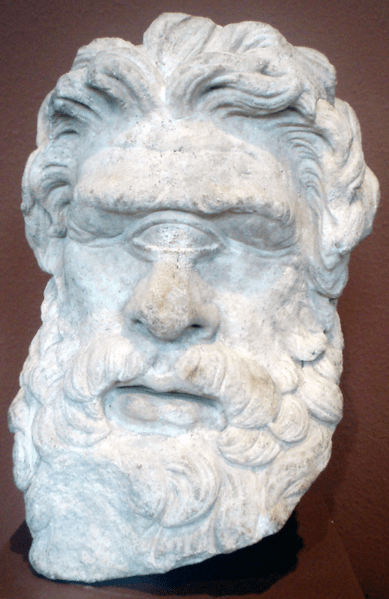
Having a little more experience of danger and living in a world where magic may be anywhere, he is more wary, however, than Bilbo and, when asked his name, replies “Ootis”, which is Greek for “Nobody”.
Scholars have argued for a very long time as to why Polyphemus, who has a Greek name (“The Much-Spoken-Of”) and speaks perfectly good Greek, can be so easily taken in by such a transparent trick and there are lots of theories to explain it. Perhaps, however, the answer is simply to point to Bilbo’s trolls, whom Tolkien describes as “slow in the uptake”—that is, they are not very quick to assess a new situation. Is this the case with Polyphemus? Or, being as big as he is, and not fearing the gods (as he informs Odysseus), perhaps he ignores Odysseus’ reply as simply part of the guest ritual known as xenia, in which, it is clear from his behavior, he does not believe anyway?
Over and over again, in the Odyssey, we see this social pattern, called xenia, which means something like “guest-friendship”, enacted In this pattern, a person comes to another’s house in need of food and shelter. There is then a ritual, in which:
- the potential guest appeals to the householder
- the householder fulfills that person’s wants
- in return the person tells his name and his story
- the host gives the person guest-gifts and sends him on his way
- should he—or anyone to whom he’s related—be in the guest’s territory in the future, he can claim the same hospitality from the guest—and this can be passed down through generations
In the case of Polyphemus, Odysseus and his men have come to Polyphemus’ cave and helped themselves to his food while he was absent, therefore immediately disturbing the pattern. When the Cyclops comes home, his response is to kill and eat two of Odysseus’ men, a grim parody of the custom, in which he should be feeding them, not feeding on them. The situation escalates, with more men eaten, until Odysseus formulates an escape plan which includes getting the Cyclops drunk
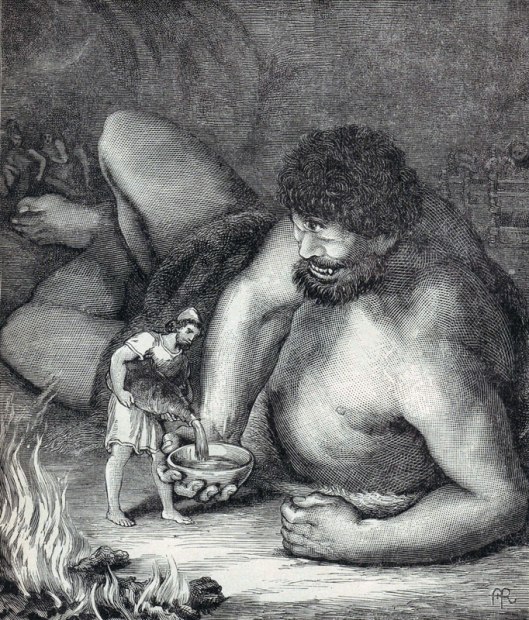
and putting out his eye,
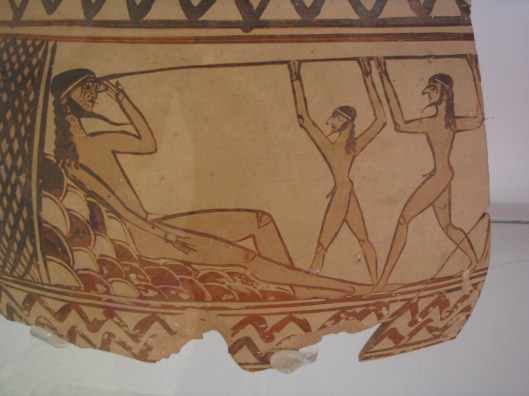
then using a flock of sheep as an escape vehicle.

In the meantime, however, Polyphemus has asked for Odysseus’ name, gotten the “Nobody” answer, and offered a guest-gift in return: the Cyclops will eat Odysseus last. The plan works, Odysseus and his surviving men escape (with the sheep), and get back to their ship, but then things go wrong again. Even blind, Polyphemus pursues them and, tossing mountain tops, almost brings them back to shore.
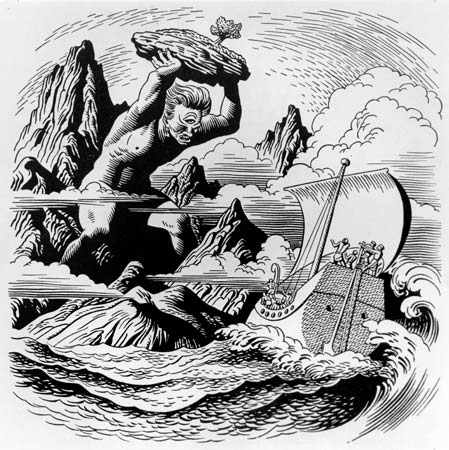
They do manage to row out of range, however, but then Odysseus, seeming to destroy completely his earlier “Nobody” trick, and much to his crew’s horror, shouts out to the Cyclops not only who he really is, but where he lives, as well. What’s going on here?
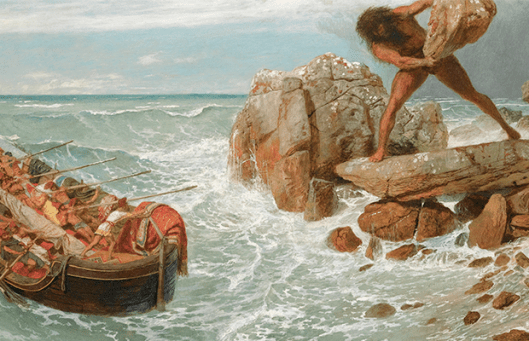
Bilbo has twice, inadvertently, provided others with his name, if not his address. Although Odysseus may be more able when it comes to thinking quickly in a dangerous situation than Bilbo, he also belongs to what is called a “face culture”. This means that who you are is a public thing. You only gain credit if you do things publically and your name is attached to what you do. In Odysseus’ case, he has bested a monster and avenged the deaths of his crewmen and it is important that that monster knows who did it. Unfortunately, that monster is the son of the sea god, Poseidon, to whom he prays for revenge and, knowing Odysseus’ name and address, this is a bit more pinpointed than simply saying, “Get that guy who put out my eye, dad!”
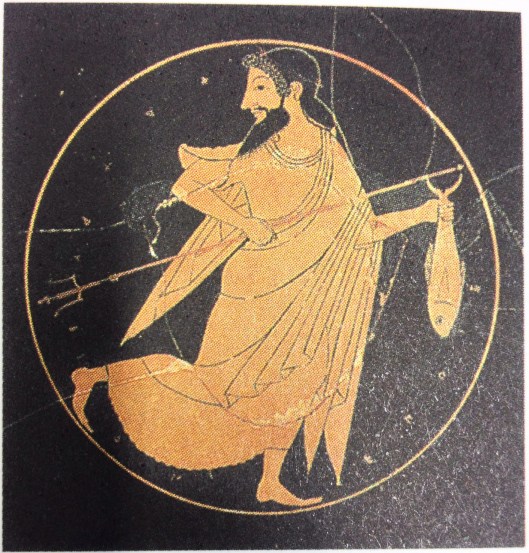
Bilbo blundered into the territory of Gollum and, through inexperience and surprise, brought trouble, in time, to Frodo. Odysseus, having concealed his identity successfully, then exposed himself because his society and his position in that society required it. In turn, he returns home alone and on someone else’s ship, having brought trouble on himself and his crew. In answer to our initial question, “How dangerous can a name be?” The answer appears to be, “Very.”
Thanks, as always, for reading.
MTCIDC
CD
 doubtfulsea