• About

doubtfulsea

~ adventure fantasy

Tag Archives: travel

To Bree (Part 2)

12 Wednesday Nov 2025

Posted by Ollamh in Uncategorized

≈ Leave a comment

Tags

Barrow-downs, Barrow-wight, Bilbo, Bree, bridge-of-strongbows, Fantasy, Frodo, Great East Road, Nazgul, Shire, The Bridge of Stonebows, The Lord of the Rings, The Prancing Pony, Tolkien, Tom Bombadil, travel

As always, welcome, dear readers.

In “To Bree (Part 1)”, we had followed Bilbo & Co.
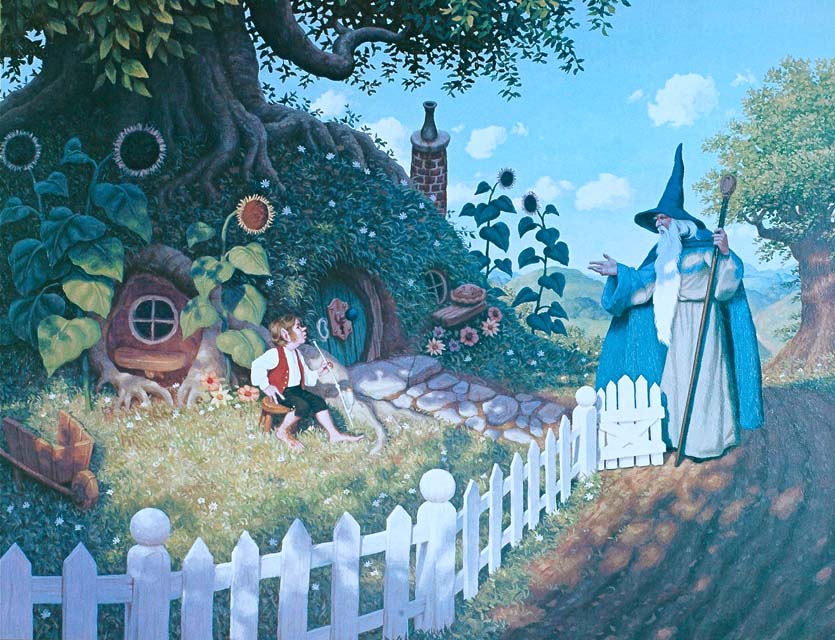
(Hildebrandts)
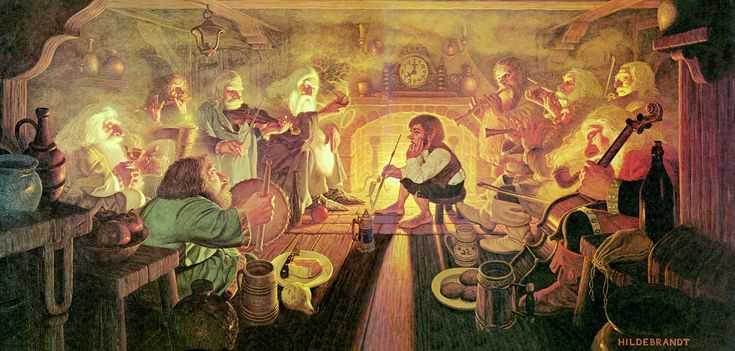
(Hildebrandts)

eastwards,
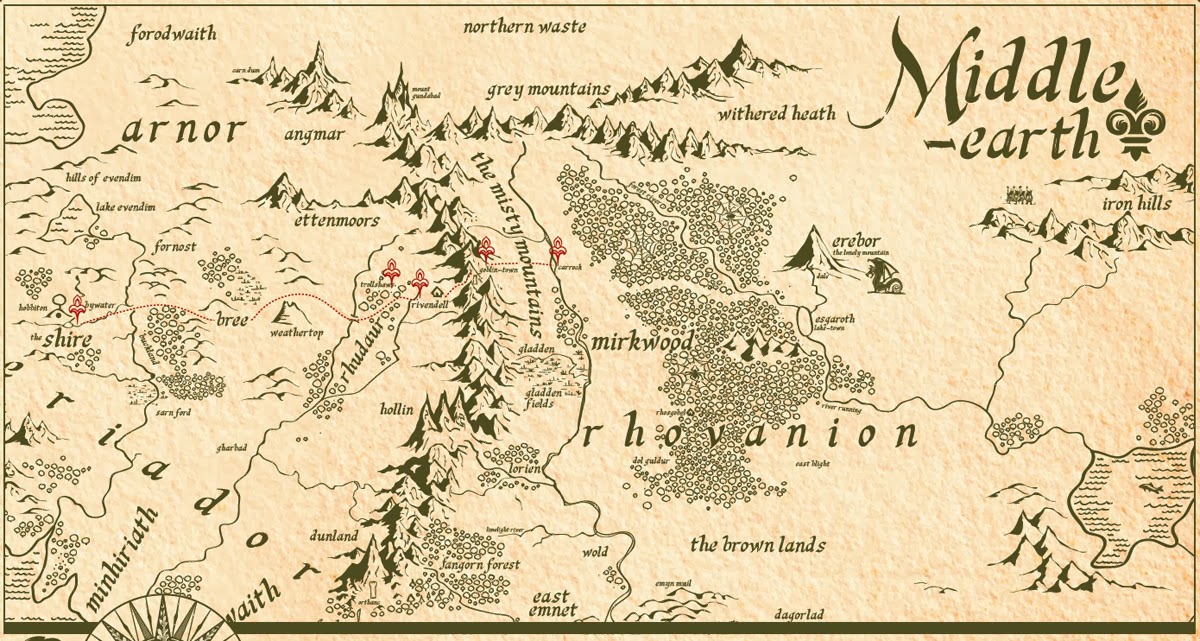
but only as far as Bree, echoing the remark in The Lord of the Rings:

“It was not yet forgotten that there had been a time when there was much coming and going between the Shire and Bree.” (The Fellowship of the Ring, Book One, Chapter 9, “At the Sign of the Prancing Pony”)

Oddly, however, although I supposed that we were traveling through the East Farthing

(Christopher Tolkien)

through Frogmorton and Whitfurrows,
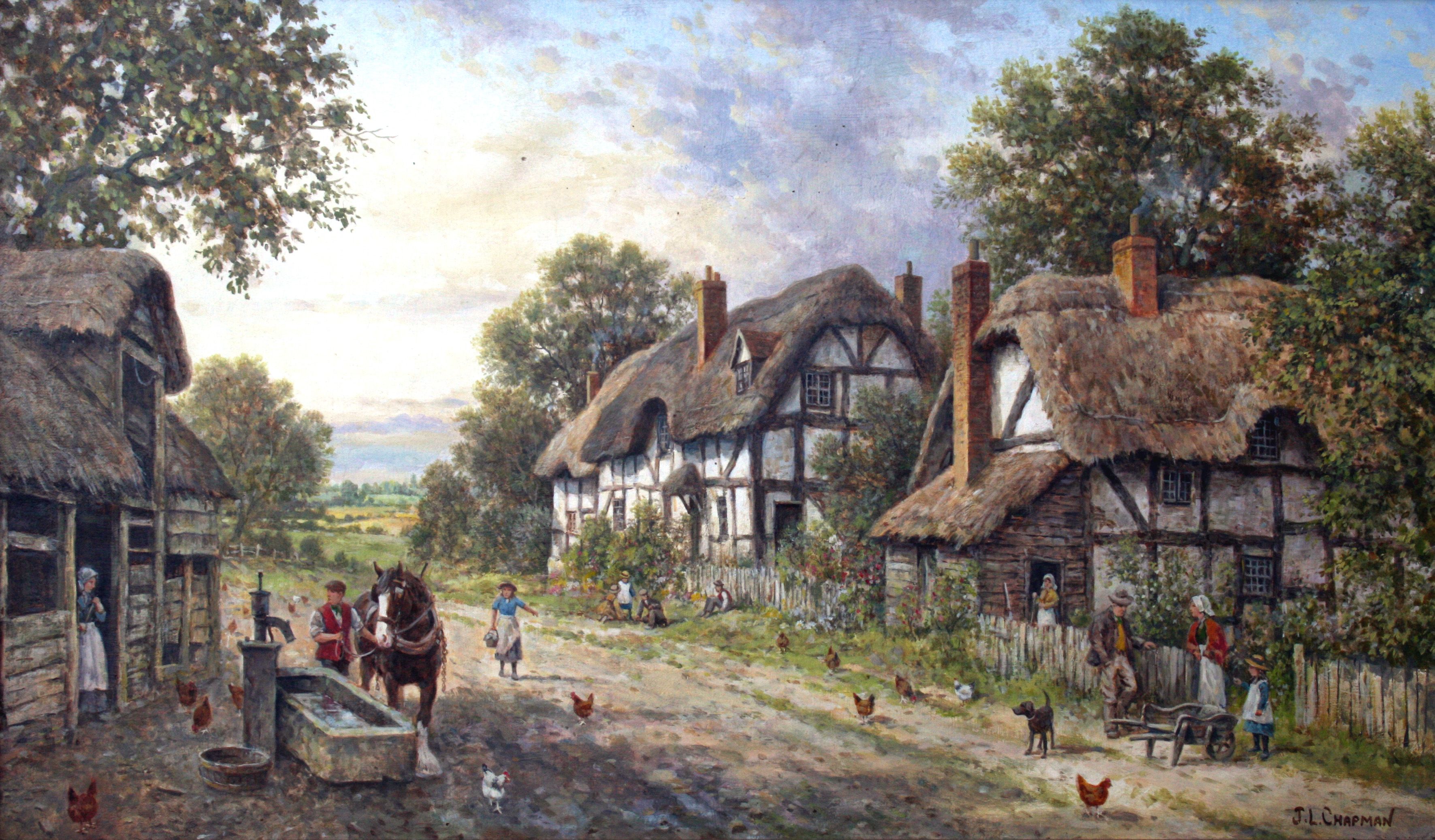
to the Bridge of Strongbows,

(Stirling Bridge, actually—for more see:  https://www.historicenvironment.scot/visit-a-place/places/stirling-old-bridge/ )

the description in The Hobbit was wildly different:

“Then they came to lands where people spoke strangely, and sang songs Bilbo had never heard before.  Now they had gone on far into the Lone-lands, where there were no people left, no inns, and the roads grew steadily worse.  Not far ahead were dreary hills, rising higher and higher, dark with trees.  On some of them were old castles with an evil look, as if they had been built by wicked people.”  (The Hobbit, Chapter 2, “Roast Mutton”) 

with, eventually, a surprise for us Bree-bound folk:  no Bree.

So, back we went to the Green Dragon, in Bywater, where Bilbo started and now we begin again, with Frodo.  Times have changed, however, and unlike the innocent Bilbo, we are in a different world, where Mordor isn’t just a distant place name and its servants are looking for Baggins.
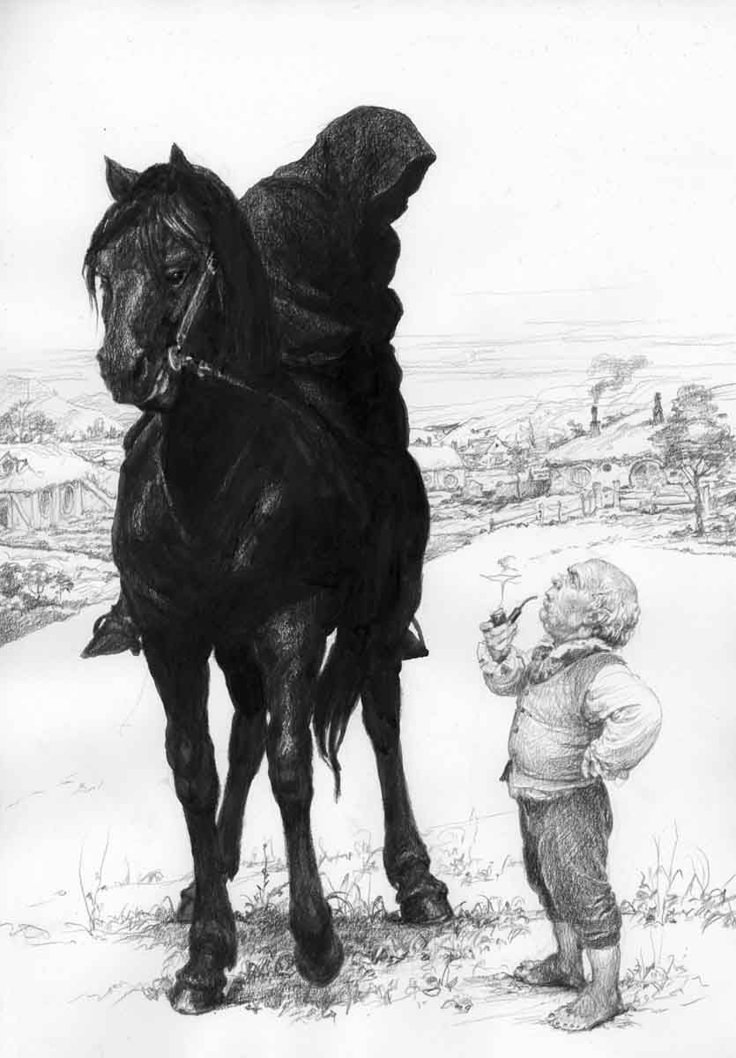
(Denis Gordeev)

Frodo doesn’t take the Great East Road,

(Christopher Tolkien)

but cuts across country, narrowly avoiding one of the searchers,
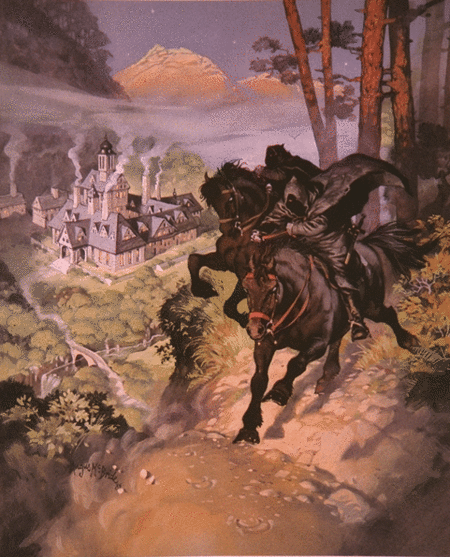
(Angus McBride)

taking shelter with a local farmer, and finally reaching the ferry across the Brandywine just ahead of his pursuers.

Although this is a very indirect route, Frodo and his companions eventually reach Bree, but even though I would love to meet Tom Bombadil,

(the Hildebrandts)

I prefer a direct route, so we’ll continue on the Great East Road, cross the Bridge of Strongbows, and head eastwards. 

(from Barbara Strachey, The Journeys of Frodo, a much-recommended book, if you don’t have a copy)

So what do we see?  

Over the bridge—and here’s another possibility for it, the Clopton Bridge at Stratford-upon-Avon—

(you can see more of Stratford and the shire—Warwickshire, that is—here:  https://www.ourwarwickshire.org.uk/content/catalogue_wow/stratford-upon-avon-clopton-bridge-2 )

the road runs, not surprisingly, due eastwards and here, consulting our map,
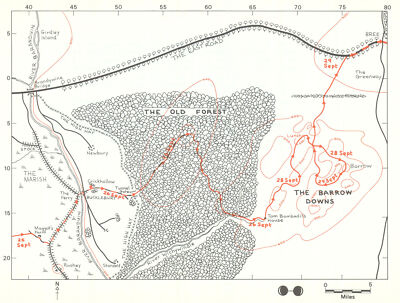
 is the Old Forest to our right,

described, by our narrator, as Frodo and his friends see it on their detour away from the Great East Road:

“Looking ahead they could see only tree-trunks of innumerable sizes and shapes:  straight or bent, twisted, leaning, squat or slender, smooth or gnarled and branched; and all the stems were green or grey with moss and slimy, shaggy growths.” (The Fellowship of the Ring, Book One, Chapter 6, “The Old Forest”)

Keep in mind, however, that we’re seeing it through a long line of trees planted alongside the road, probably as a windbreak.

We know that they’re there because Merry says:

“ ‘That is a line of trees,’ said Merry, ‘and that must mark the Road.  All along it for many leagues east of the Bridge there are trees growing.  Some say they were planted in the old days.’ “ (The Fellowship of the Ring, Book One, Chapter 8, “Fog on the Barrow-downs”)

As we travel farther along the road, if we look to our right, through the trees, we then come to the edge of the Barrow-downs,

with their ancient standing stones
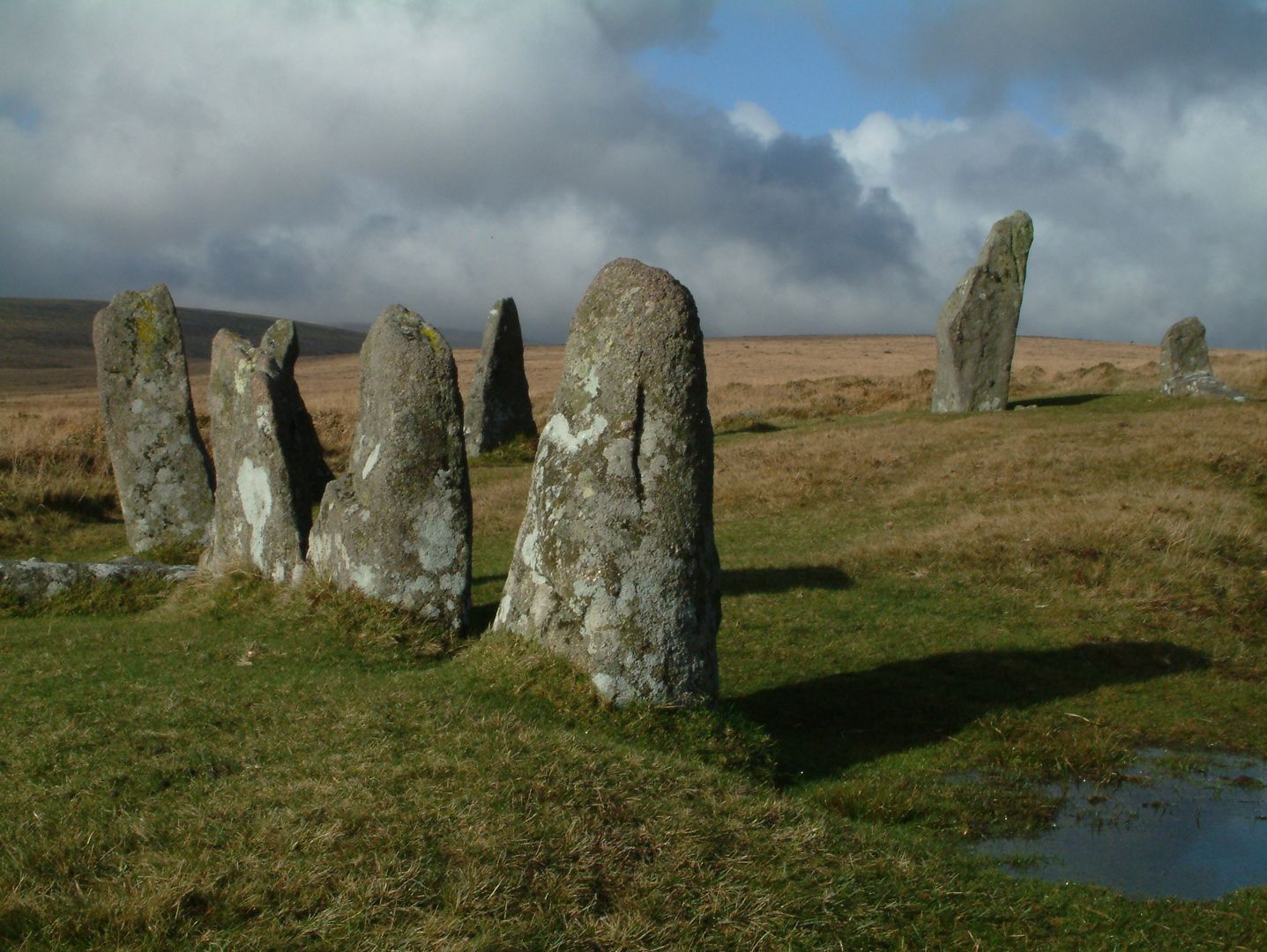
and tumuli—
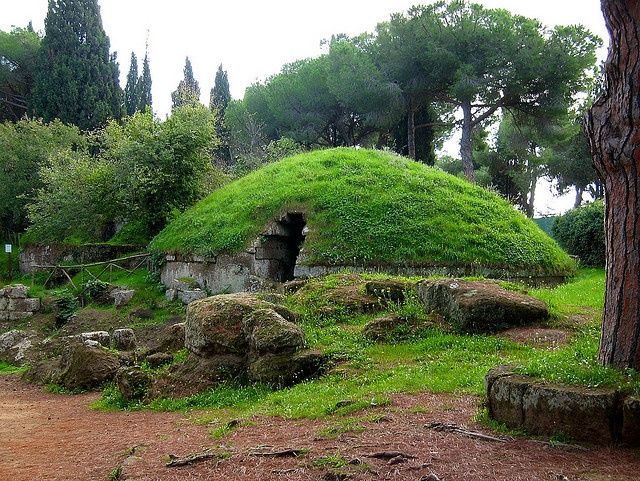
where Frodo and his friends almost end their trip.
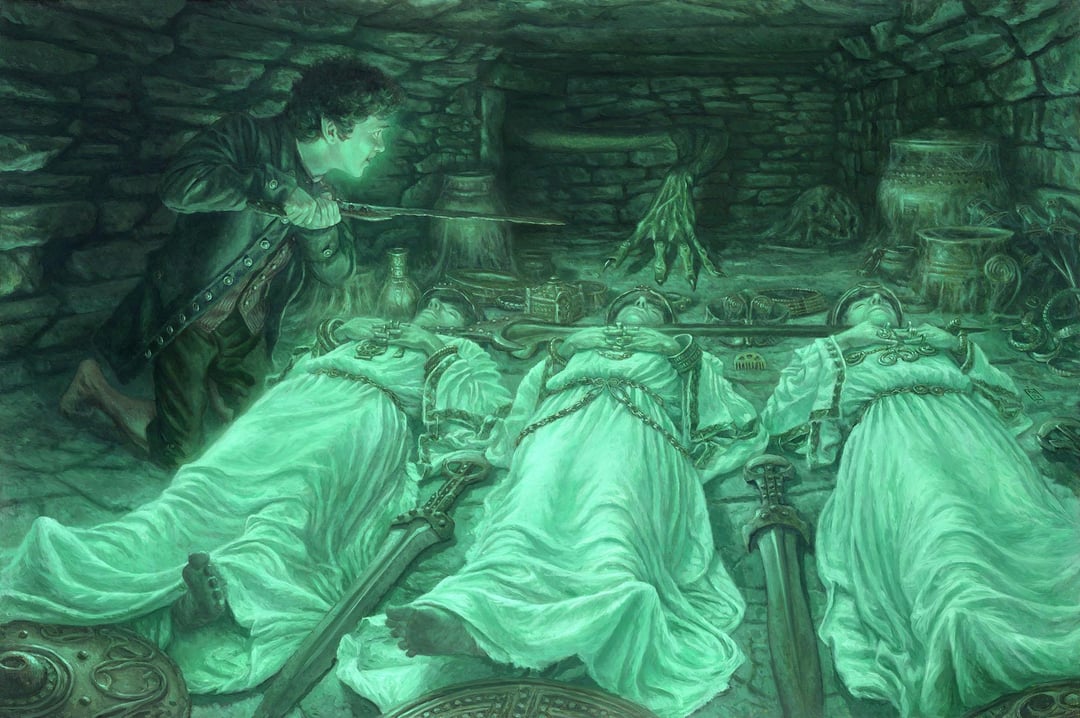
(Matthew Stewart)

But we haven’t strayed, as they did, and, passing the Downs, we see, again on our right:

“The dark line they had seen was not a line of trees but a line of bushes growing on the edge of a deep dike, with a steep wall on the further side.”

A dike is a ditch, usually with an earthen embankment made from the spoil of the ditch.  There are several of these in England, like Offa’s Dyke—

The narrator adds:

“…with a steep wall on the further side”

and I’m presuming that that is the earthen embankment, with:

“…a gap in the wall” through which Frodo and friends rode and

…when at last they saw a line of tall trees ahead…they knew that they had come back to the Road.”

If you’re read the first part of this posting, you will know that I’ve been assuming that that Road, laid in ancient times to a stone bridge and beyond, would be like a Roman road, and be paved,

if a bit weedy, but now we find:

“…the Road, now dim as evening drew on, wound away below them.  At this point it ran nearly from South-west to North-east, and on their right it fell quickly down into a wide hollow.  It was rutted and bore many signs of the recent heavy rain; there were pools and pot-holes full of water.”

Does this suggest that it was, at best and in the past, simply a dirt road, through well-kept?  Or is it a very run-down road, worn and covered over with leaves and dirt, the ancient blocks gradually becoming separated under the weight of centuries, allowing for pot-holes?
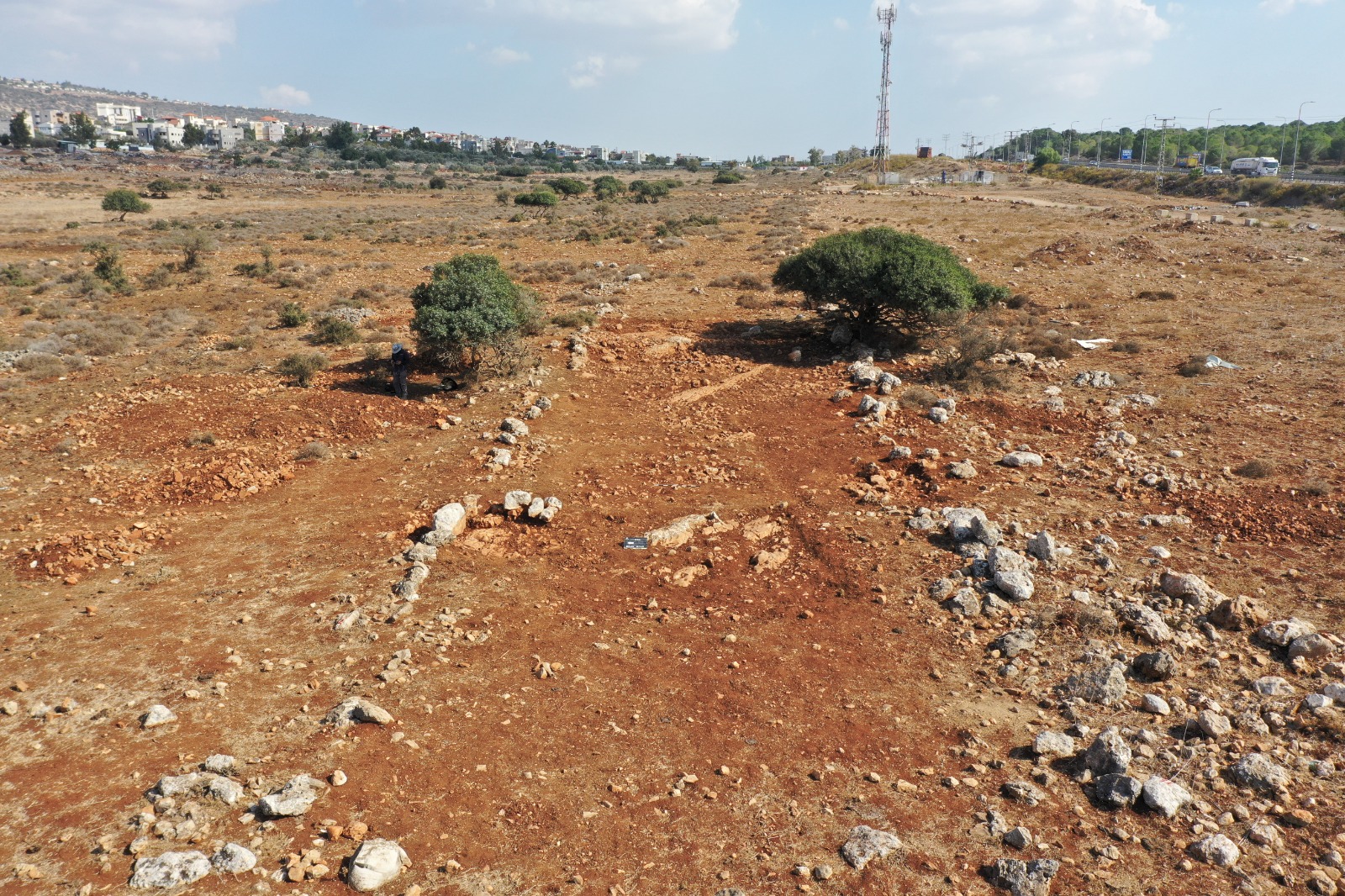
In any event, we now continue our journey with Frodo and his compantions until–

“…they saw lights twinkling some distance ahead.

Before them rose Bree-hill barring the way, a dark mass against misty stars; and under its western flank nestled a large village.  Towards it they [and we] now hurried desiring only to find a fire, and a door between them and the night.”

We’re not in Bree yet, however, as:

“The village of Bree had some hundred stone houses of the Big Folk, mostly above the Road, nestling on the hillside with windows looking west.  On that side, running in more than half a circle from the hill and back to it, there was a deep dike with a thick hedge on the inner side.  Over this the Road crossed by a causeway; but where it pierced the hedge it was barred by a great gate.  There was another gate in the southern corner where the Road ran out of the village.  The gates were closed at nightfall; but just inside them were small lodges for the gatekeepers.”  (The Fellowship of the Ring, Book One, Chapter 9, “At the Sign of the Prancing Pony”)

We’ve seen a dike just now, at the Great East Road, but now we have to add a hedge
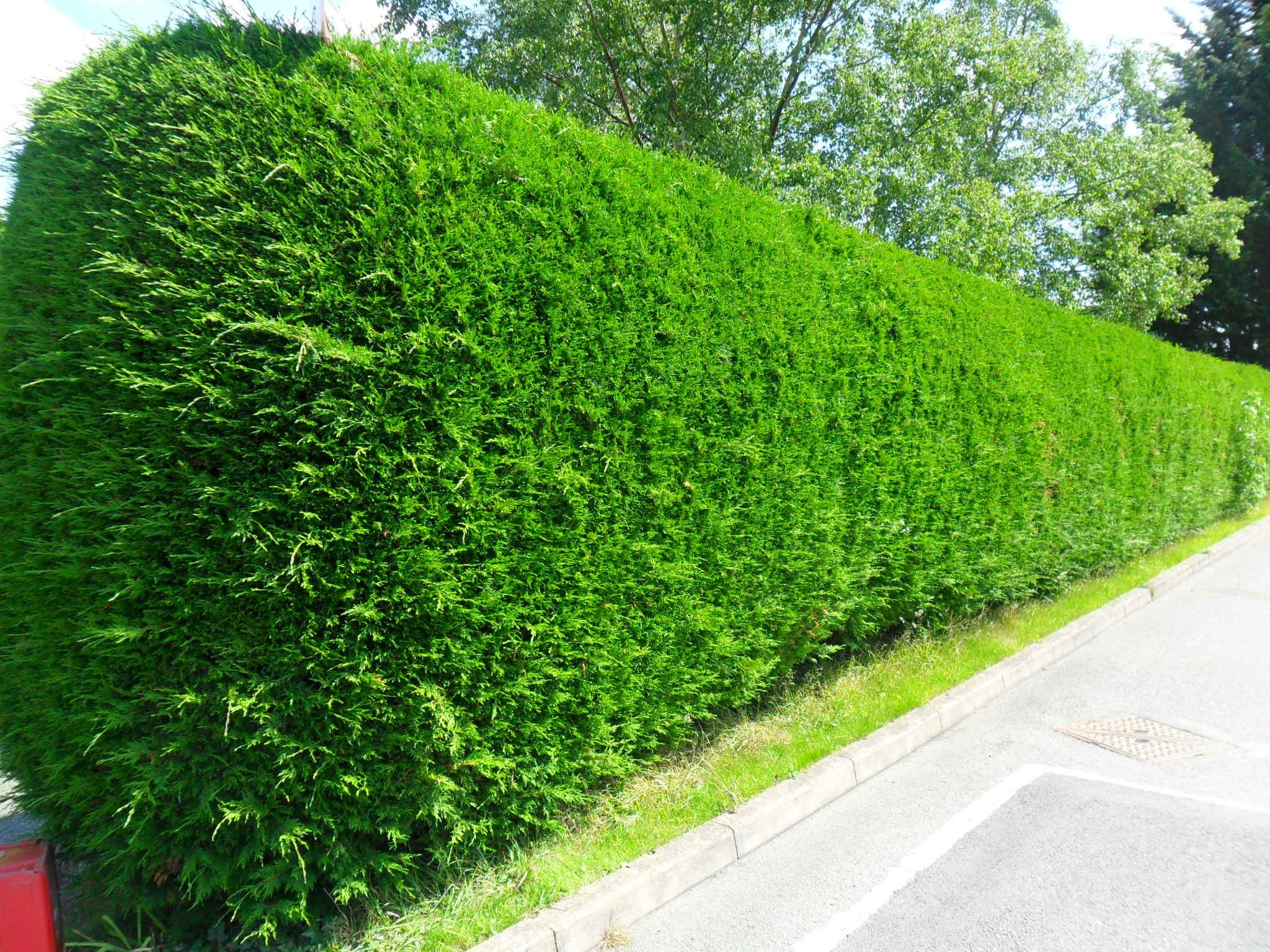
and a gate.

Once inside, however, lies the Prancing Pony

(Ted Nasmith)

and one more pint before bed.

As always, thanks for reading.

Stay well,

Read road signs carefully,

And remember that, as always, there’s

MTCIDC

O

Istanbul, not…

12 Wednesday Jun 2024

Posted by Ollamh in Uncategorized

≈ Leave a comment

Tags

Byzantium, History, istanbul, travel, Turkey

Welcome, dear readers, as always. Last’s weeks visit to Harry Turtledove’s Videssos (aka Byzantium) brought a certain song to mind and so the title of this posting comes from a 1953 pop hit by a Canadian vocal group called “The Four Lads”.

It’s perhaps an “ear worm”, based pretty much on the rhythm IS-tan-BUL, not CON-stan-ti-NOP-le, repeated throughout, so parental caution.  Here’s the whole lyric—

“Istanbul was Constantinople
Now it’s Istanbul, not Constantinople
Been a long time gone, Constantinople
Now it’s Turkish delight on a moonlit night

Every gal in Constantinople
Lives in Istanbul, not Constantinople
So if you’ve a date in Constantinople
She’ll be waiting in Istanbul

Even old New York was once New Amsterdam
Why they changed it I can’t say
People just liked it better that way

So, take me back to Constantinople
No, you can’t go back to Constantinople
Been a long time gone, Constantinople
Why did Constantinople get the works?
That’s nobody’s business but the Turks

Istanbul, Istanbul

Istanbul, Istanbul

Even old New York was once New Amsterdam
Why they changed it I can’t say
People just liked it better that way

Istanbul was Constantinople
Now it’s Istanbul, not Constantinople
Been a long time gone, oh Constantinople
Why did Constantinople get the works?
That’s nobody’s business but the Turks

So, take me back to Constantinople
No, you can’t go back to Constantinople
Been a long time gone, Constantinople
Why did Constantinople get the works?
That’s nobody’s business but the Turks

Istanbul!”

(from a site called “Songfacts”—although they credit it to the 1990 cover by They Might Be Giants.  You can hear the original here:  https://www.youtube.com/watch?v=Wcze7EGorOk )

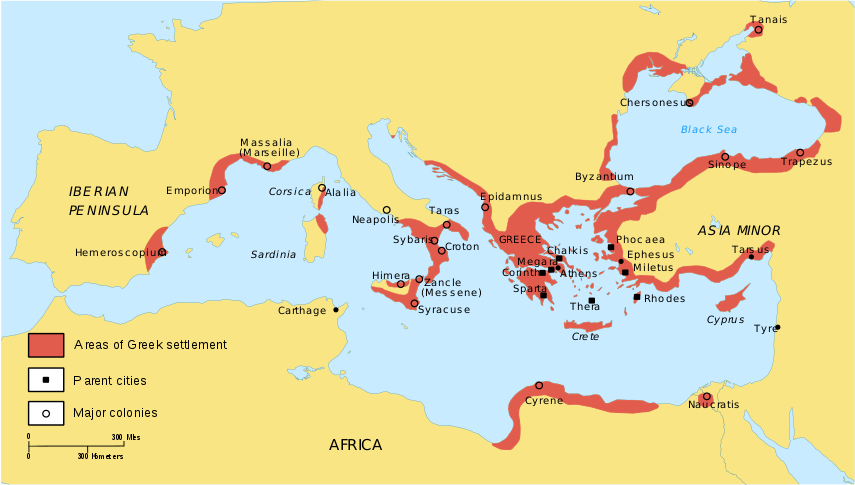
“Constantinople” was originally “Byzantium”,  meaning of the name unknown.  It was a 7th-century BC Greek settlement based upon an earlier Thracian one.

In 330AD, the Roman emperor whom we call Constantine I (c272-337AD),

to be closer not only to the goods and raw materials which came from the Black Sea region, but also to keep an eye on the Empire’s latest eastern threat, the Sassanids.

Constantine, clearly intending to indicate the continuity of his choice of capital, even if it was far from the old heartland of Italy, called it Nova Roma, but the inhabitants tended to call it “the city of Constantine” or “Constantinoupolis”—or, for short, simply “the city” “he polis” (say “he” as “hay”—it’s the definite article “the”—and the custom of shortening can even be seen here in the US:  people who live around New York City never call it “New York City”, but always “the City”). 

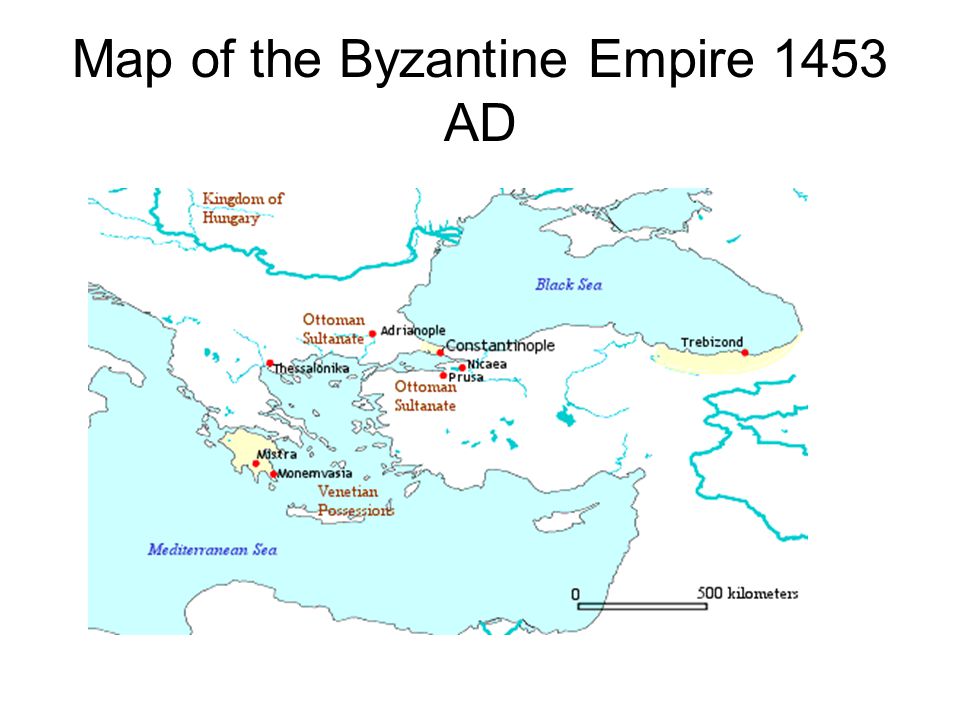
As if Constantine’s name for it had a charm, this “new Rome”, successfully weathered the changes which turned the western empire, with its ancient capital of “old Rome”, into a series of Germanic kingdoms, surviving into the mid-15th century AD.  By its later years, however, its territory, like its power, shrank and shrank

to a couple of small enclaves and the City itself.  

And this is what Tolkien was thinking of when he wrote

“In the south Gondor rises to a peak of power, almost reflecting Numenor, and then fades slowly to decayed Middle Age, a kind of proud, venerable, but increasingly impotent Byzantium.”  (from a letter to Milton Waldman, “probably written late in 1951”, Letters, 219)

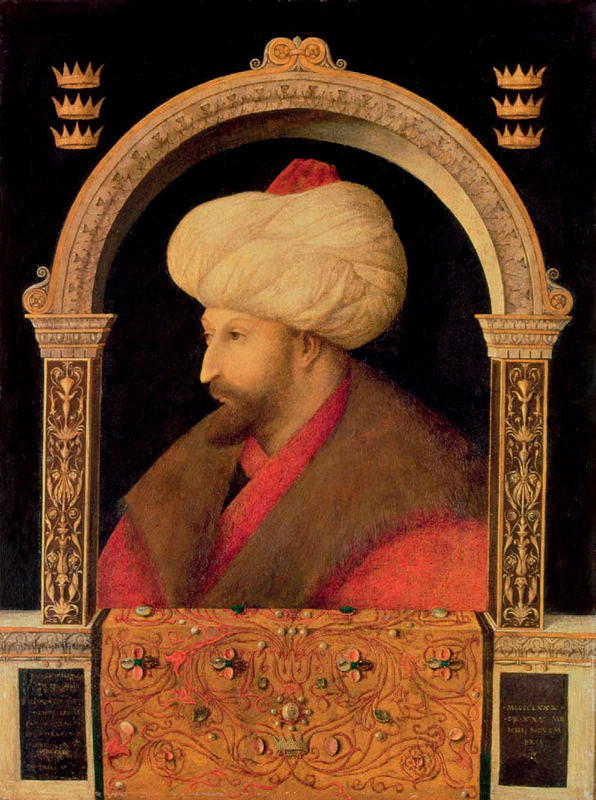
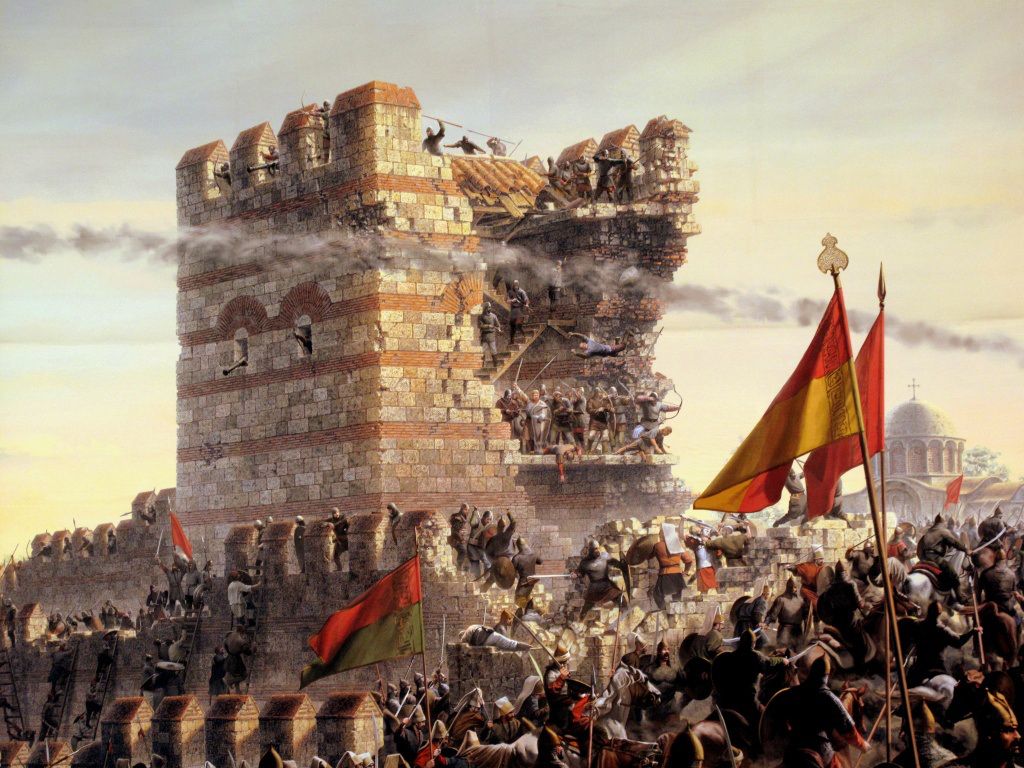
This impotence finally came to an end, at least for “New Rome”, on 29 May, 1453, when a huge Ottoman army, under Mehmet II,

using that very modern weapon, the bombard,

broke into the city and captured it.

In earlier postings, I went into a comparison of the two, Byzantium and Minas Tirith, their look and their sieges, in some detail (see “The Fall of Two Cities?”, 9 March, 2016, and “A Kind of Proud, Venerable, But Increasingly Impotent Byzantium”, 1 June, 2016), but as JRRT himself went to some lengths in more than one letter to discuss toponymy (place names and their study) and the proper translation of place names (see, for instance, the letter to Rayner Unwin, 3 July, 1956, Letters, 359-361), I find it interesting to see what happened to Byzantium/New Rome/Constantinople.

The song says that it’s “Istanbul, not Constantinople”, but, surprisingly, this isn’t an Ottoman Turkish name and here we see that, although the Ottoman Sultan may have captured the city, he somehow never captured what it was called.  As I wrote above, the locals had called it “Constantinoupolis”, or simply “he Polis”.  Thus, when someone might ask, “Where are you going?” you might reply, “Eis ten Polin”—“to/towards the City” and that form, spoken casually, probably became “Is-tan-bul”, thus retaining part of its ancient Byzantine nomenclature—which it retains to this day, the name being legalized as the name in 1930.

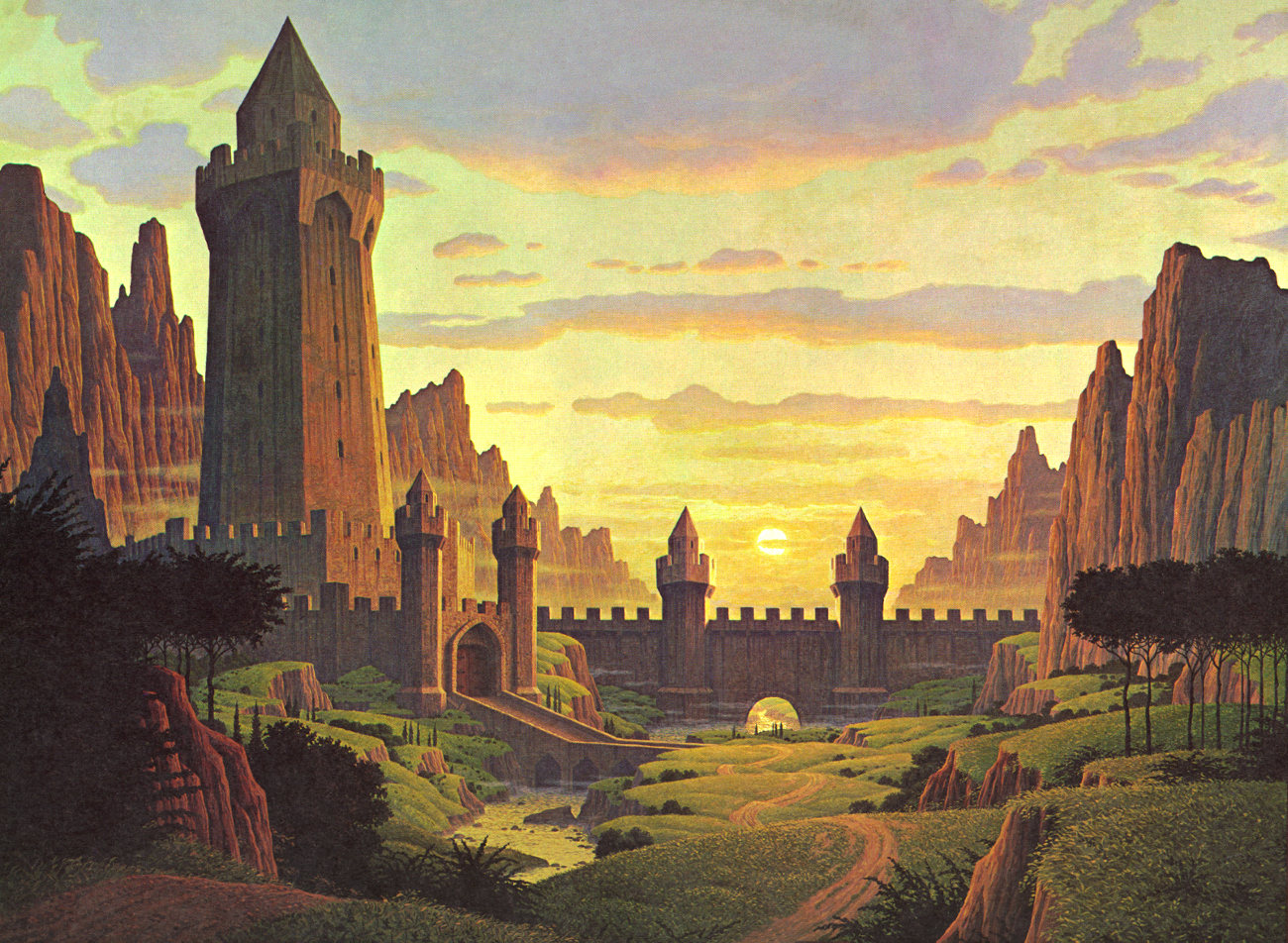
But this brings me to an interesting point.  Minas Tirith, “the Tower of Guard” (formerly Minas Anor, “the Tower of the Sun”—even in Middle-earth names move around, depending upon historical circumstance) survived Sauron’s attack, which Byzantium/New Rome/Constantinople did not—and yet its name survived.

(Ted Nasmith)

When Sauron’s forces captured Minas Tirith/Anor’s matching fortress, Minas Ithil (“the Tower of the Moon”), its name was changed to the grim-sounding Minas Morgul (“the Tower of Dark Sorcery”).

(and another Ted Nasmith)

Had Minas Tirith fallen to Sauron, what might have happened to its name—or is that nobody’s business but the orcs’?

Thanks, as ever, for reading.

Stay well,

Imagine what maps and signposts would look like in the Black Speech (“One Road to Rule Them All, One Road to Lose Them”?).

And remember that, as always, there’s

MTCIDC

O
PS

Reading about “Istanbul” by the Four Lads, I noted that a jazz critic suggested that it was actually written in reply to a 1928 song, “Constantinople”, which you can listen to (warning:  it’s catchy) here:  https://www.youtube.com/watch?v=OFDdPT9H_dQ

Weathered Top

03 Wednesday Apr 2024

Posted by Ollamh in Uncategorized

≈ Leave a comment

Tags

Castle, History, travel, united-kingdom, wales

Welcome, as always, dear readers.

Although he denies, in an annoyed letter to Allen & Unwin, that “…I never walked in Wales or the marches in my youth…” (response to Ake Ohlmarks’ introduction to The Lord of the Rings, in which Ohlmark appears to have created an entire fictitious biography of JRRT, letter to Allen & Unwin, 23 February, 1961, Letters, 437), Tolkien did say that “I am very untraveled, though I know Wales…” and “I love Wales (what is left of it, when mines, and the even more ghastly sea-side resorts have done their worst)…” (letter to Deborah Webster, 25 October, 1958, Letters, 412).

And these remarks came readily to mind when, last evening, I discovered Snodhill Castle, while watching an archeology program, Digging for Britain, on YouTube.  One of its segments took us to the borderland between England and Wales, where the Norman conquerors of England had sought to expand their territory, eventually building a large number of castles as strongpoints during their several centuries of takeover.

(This is from the Royal Commission on the Ancient and Historical Monuments of Wales website:  https://rcahmw.gov.uk/2018-year-in-review-our-improvements-to-coflein/ )

The early fortifications were once thought to have been what are called “motte and bailey”—

that is, a mound (“motte” is a late Latin word, mota, meaning “mound”) with a wooden tower on it with the addition of a palisaded lower court (“bailey” has a vaguer etymology, but I’m betting that behind it, ultimately, is Latin palus, “stake”, just as it is behind “palisade”).  For invaders who need an instant fort, this would be easy and quick to build—especially if you rounded up the locals (non-Normans, either Anglo-Saxons or Welsh, depending on your area of conquest) and made them build it for you under watchful Norman eyes.

In the 12th century, these were gradually converted to stone, as you can see at Launceston, in Cornwall.

Recent archeological work (including that done for Digging for Britain—which you can watch here:  https://www.youtube.com/watch?v=wM_jnNSpOoI ), however, suggests that Snodhill may have been built from stone, dating from its earliest beginnings, c.1067AD (?  the first documentary evidence appears to be from 1136—for more, see the wonderfully detailed report from Historic England here:  https://historicengland.org.uk/research/results/reports/7209/SnodhillCastlePeterchurchHerefordshireArchaeologicalArchitecturalandAerialInvestigationandSurvey   For a quick overview, see:  https://historicengland.org.uk/research/results/reports/7209/SnodhillCastlePeterchurchHerefordshireArchaeologicalArchitecturalandAerialInvestigationandSurvey ).

Here’s what it looked like in 1848, long after its eventual abandonment,

when most of the stone had been robbed out and used, in part, to build Snodhill Court Farm—

(this is from British History Online, which you can see here:  https://www.british-history.ac.uk/rchme/heref/vol1/plate-192  And, for more on the site, see:  https://www.snodhillcastle.org/history/ )

Here’s a recent photo of part of the site—

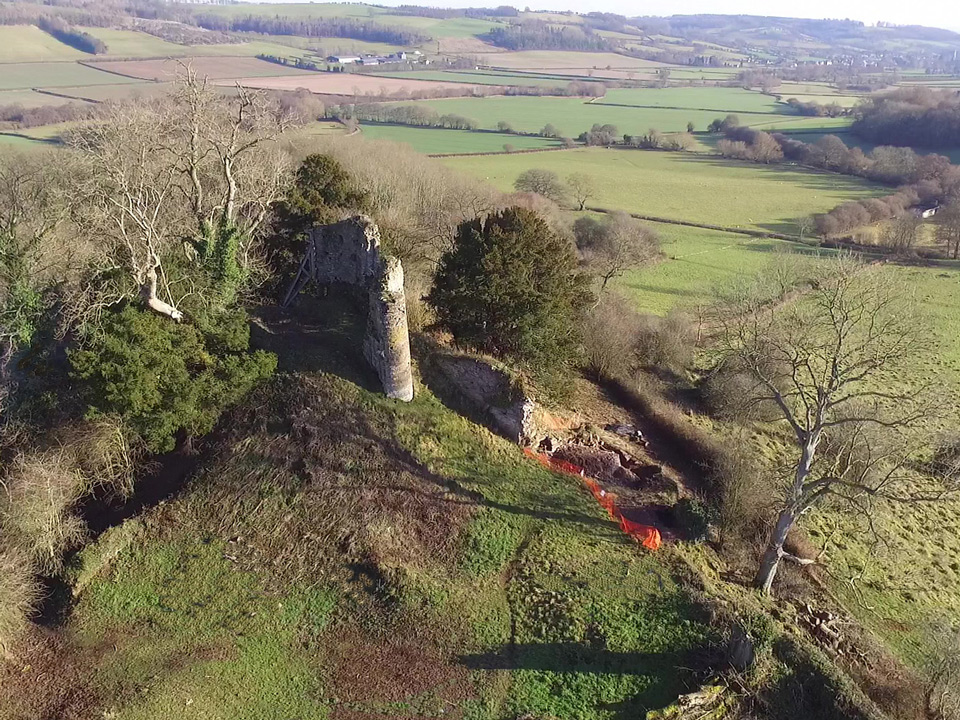
interesting, if you love castles, as I do, but more interesting, it seemed to me, was this aerial view—

which reminded me of:

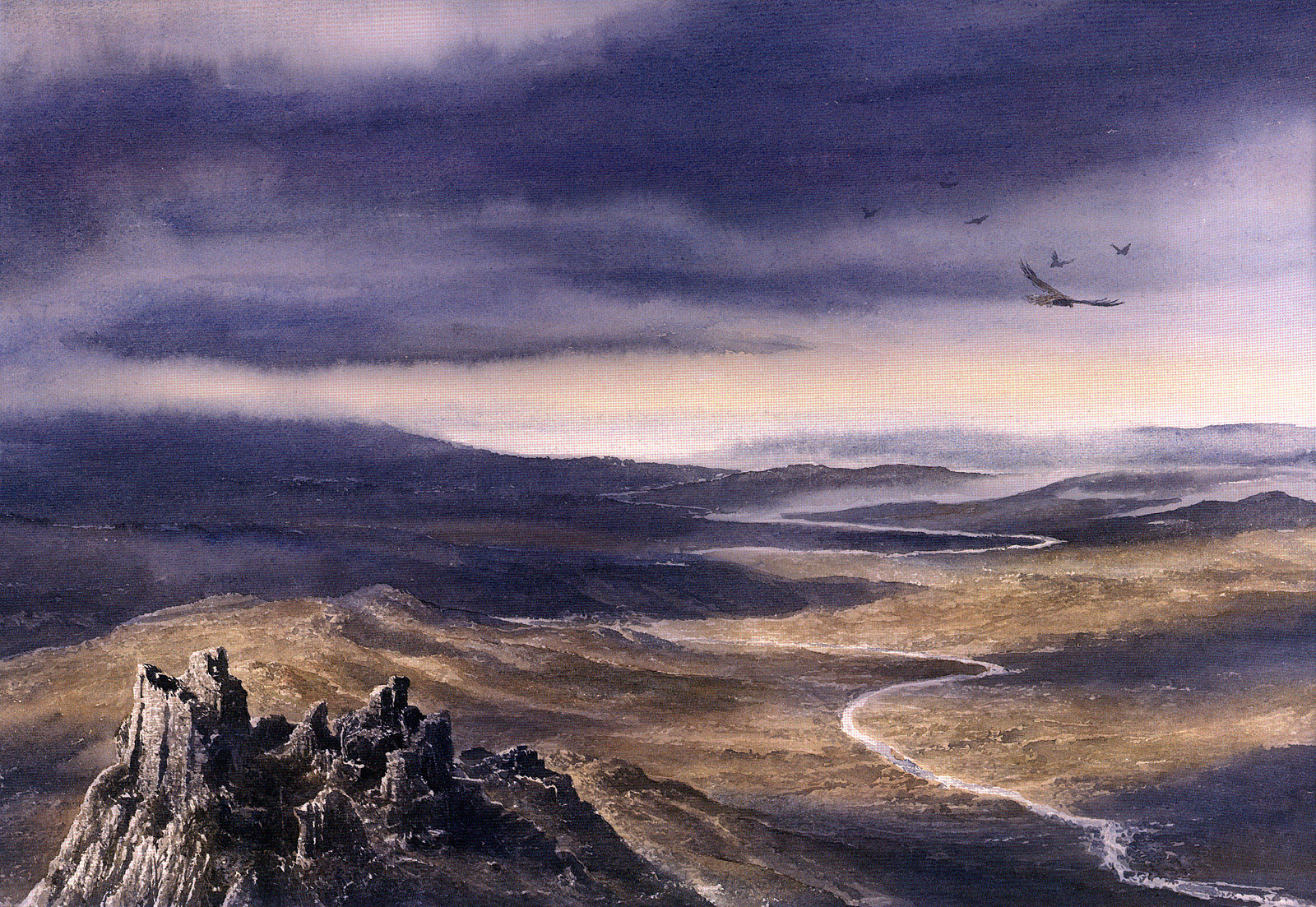
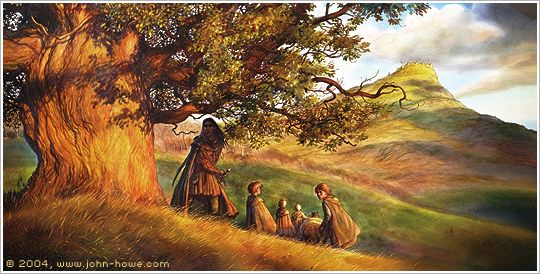
“But long before, in the first days of the North Kingdom, they built a great watch-tower on Weathertop, Amon Sul they called it.  It was burned and broken, and nothing remains of it now but a tumbled ring, like a rough crown on the old hill’s head.  Yet once it was tall and fair.”  (The Fellowship of the Ring, Book One, Chapter 11, “A Knife in the Dark”)

Aragorn is reassuring Merry, who has expressed an unease about the place—“It has a—well, rather a barrow-wightish look.  Is there any barrow on Weathertop?”—his reassurance being that it was never lived in and that it had once, in fact, been an important defensive feature from the early days of the northern realm of Arnor, “for the Tower of Amon Sul held the chief Palantir of the North…” (The Lord of the Rings, Appendix A, I, “The Numenorean Kings”, (iii) “Eriador, Arnor, and the Heirs of Isildur”)

(the Hildebrandts)

Here’s Alan Lee’s interpretation of Weathertop–

and John Howe’s greener, more “English” version—

and a second view from the air of Snodhill—

At the moment, I have no documentation that Tolkien ever walked or motored through western Herefordshire and spotted Snodhill off in the distance at the top of a long valley, but, combining his self-proclaimed love for, and knowledge of, Wales, I wonder—had he seen it once, on a tall hill, in its ruined state, and would he have remembered it and placed it on his growing mental map of Middle-earth and its long and troubled history?

Thanks, as ever, for reading.

Stay well,

When thinking of castles, remember this:

“The splendor falls on castle walls
And snowy summits old in story:
The long light shakes across the lakes
And the wild cataract leaps in glory.
Blow, bugle, blow, set the wild echoes flying,
Blow, bugle; answer, echoes dying, dying, dying.

O hark, O hear! how thin and clear,
And thinner, clearer, farther going!
O sweet and far from cliff and scar
The horns of Elfland faintly blowing!
Blow, let us hear the purple glens replying,
Blow, bugle; answer, echoes dying, dying, dying.

O love they die in yon rich sky,
They faint on hill or field, or river:
Our echoes roll from soul to soul,
And grow forever and forever.
Blow, bugle, blow, set the wild echoes flying,
And answer, echoes, answer, dying, dying, dying.”

(from Alfred Tennyson’s The Princess, 1847—this lyric added to the 1850 edition—which you can read here:  https://archive.org/details/tennysonprincess/page/n5/mode/2up )

And remember that, as always, there’s

MTCIDC

O

Glittering Caves, or, Cheese, Hobbit!

13 Wednesday Mar 2024

Posted by Ollamh in Uncategorized

≈ Leave a comment

Tags

Fantasy, J.R.R. Tolkien, lord-of-the-rings, The Lord of the Rings, travel

Welcome, dear readers, as ever.

In a letter to a “Mr. Wrigley”, Tolkien made this remark:

“I fear you may be right that the search for the sources of The Lord of the Rings is going to occupy academics for a generation or two.  I wish this need not be so.  To my mind it is the particular use in a particular situation of any motive, whether invented, deliberately borrowed, or unconsciously remembered that is the most interesting thing to consider.”  (letter to Mr. Wrigley, 25 May, 1972, Letters, 587)

I would like to add:  not just unconsciously remembered, but also consciously, as in the Caves of Aglarond.

“Strange are the ways of Men, Legolas!” Gimli suddenly burst out, continuing:  “Here they have one of the marvels of the Northern World, and what do they say of it?  Caves, they say!  Caves!  Holes to fly to in time of war, to store fodder in!  My good Legolas, do you know that the caverns of Helm’s Deep are vast and beautiful?  There would be an endless pilgrimage of Dwarves, merely to gaze at them, if such things were known to be.  Aye indeed, they would pay pure gold for a brief glance!”  (The Two Towers, Book Three, Chapter 8, “The Road to Isengard”)

Gimli and Legolas have just survived Saruman’s failed attack on Helm’s Deep,

(the Hildebrandts)

where Gimli, separated from his companions, has taken refuge in the very caves he is now raving about.

(Ted Nasmith—and, as ever, he has chosen a moment no one else has thought to illustrate—one of the many reasons I so admire his work)

As Gimli goes on—and he does for half a page—we hear of

“immeasurable halls, filled with an everlasting music of water that tinkles into pools, as fair as Kheled-zaram in the starlight…gems and crystals and veins of precious ore glint in the polished walls; and the light glows through folded marbles, shell-like, translucent as the living hands of Queen Galadriel.”

Remembering Gimli’s ultimate request from Galadriel—a strand of her hair:

“…which surpasses the gold of the earth as the stars surpass the gems of the mine.” (The Fellowship of the Ring, Book Two, Chapter 8, “Farewell to Lorien”)

this is an impressive comparison.  But, for all of JRRT’s wonderful imagination, in fact these caves, although perhaps embroidered by that imagination, were based upon a real place, as Tolkien tells us in a letter:

“I was most pleased by your reference to the description of ‘glittering caves’.  No other critic, I think, has picked it out for special mention.  It may interest you to know that the passage was based on the caves in Cheddar Gorge and was written just after I had revisited these in 1940 but was still coloured by my memory of them much earlier before they became so commercialized.  I had been there during my honeymoon nearly thirty years earlier.”  (letter to P. Rorke, SJ, 4 February, 1971, Letters, 572)

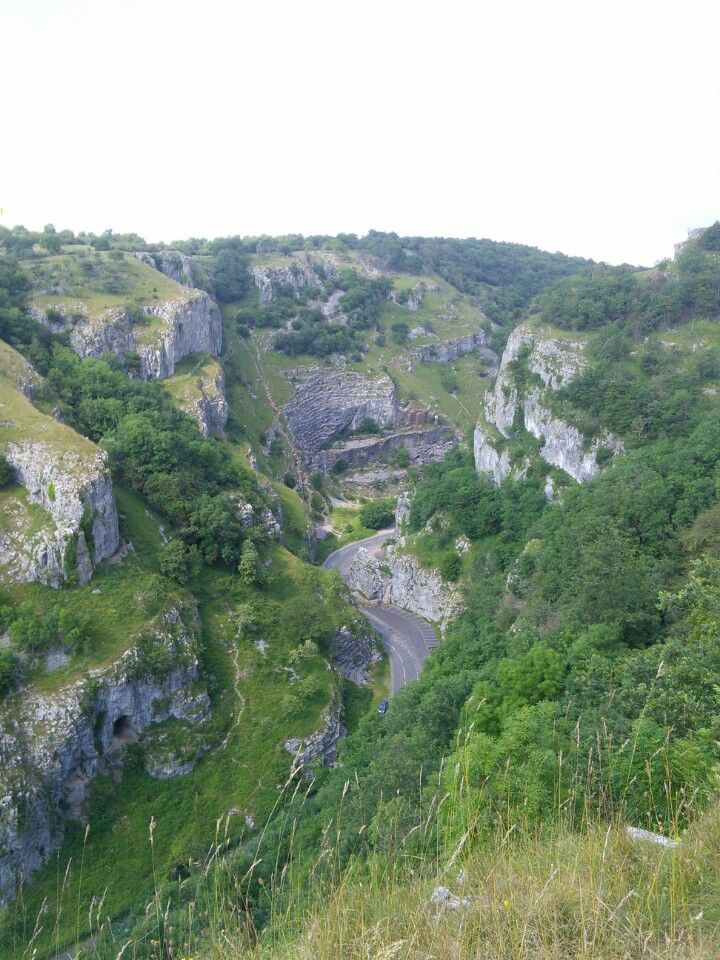
Cheddar Gorge is a natural feature in Dorset, in southwest England in the area of the Mendip Hills.

A gorge is a kind of valley and Cheddar Gorge is one which has cut through layers of limestone to form it.

As you can see, this is spectacular in itself, but there is an attraction within the attraction:  a series of caves in the limestone and this is the sort of thing which Tolkien might have seen on his two visits—

which then inspired Gimli’s impassioned speech (which, by the way, is totally unnecessary to the plot, but which brilliantly illuminates (sorry!) Gimli’s character and adds to his growing friendship with Legolas, who, persuaded by the dwarf’s rhetoric, pledges to return to the caves with him—in return for visiting Fangorn Forest with Legolas).

For those who love cheese, there is another connection here, of course:  billed as “the world’s most popular cheese”, there is Cheddar, a tangy, solid variety, which seems to have originated—yes, in the village of Cheddar, just below the Gorge (and it has been suggested that some of the caves were used to age the cheese in the past).

In a left (or perhaps wrong) turn from Tolkien’s “the particular use in a particular situation of any motive, whether invented, deliberately borrowed, or unconsciously remembered that is the most interesting thing to consider”, I found that, once I made the association:  Caves of Aglarond, Cheddar Gorge, my next step was directly to Cheddar Cheese and, from there, to another English cheese, Wensleydale, made to the northeast, in Yorkshire.

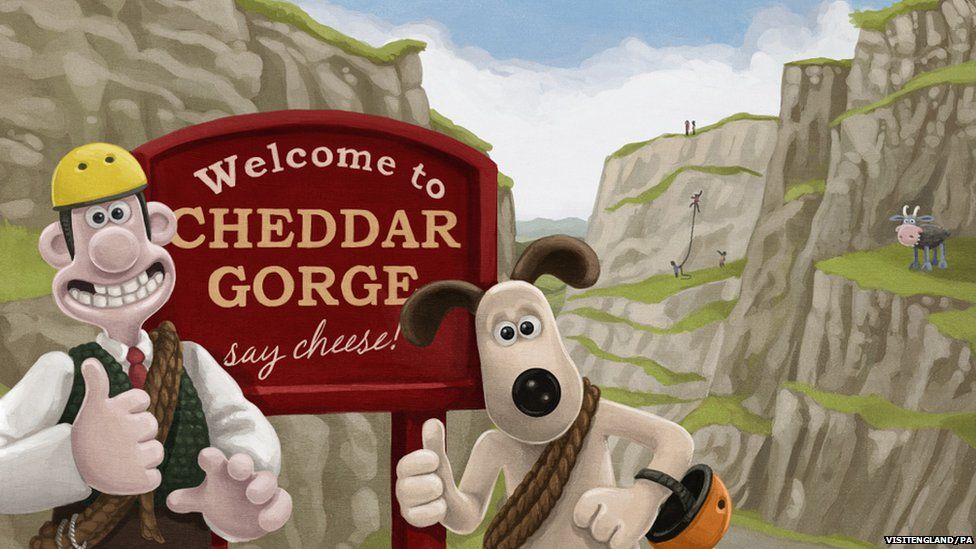
And here’s where cheese and hobbits became intertwined with the characters most devoted to Wensleydale, Wallace and his skeptical dog, Gromit.

These are the brilliant stop-motion creations of Nick Park,

beginning with the pair’s first adventure, “A Grand Day Out” (1989)

in which, in search of a cheese holiday,

they visit the moon in a ramshackle rocket which Wallace (a part-time inventor) built for the trip.

Since then, they have had a number of adventures—“The Wrong Trousers” (1993), “A Close Shave” (1995), and “A Matter of Loaf and Death” (2008), all shorts, along with a feature-length film, “The Curse of the Were-Rabbit” (2005).  If you don’t know them, you can see “A Grand Day Out” for free at the wonderful Internet Archive:  https://archive.org/details/agranddayout_202001 and, if this delights you as much as it’s always delighted me, you can see more at the Archive under “Aardman Animations”, including a series of very short films highlighting some of Wallace’s inventions:  https://archive.org/details/94920

This is very much English humor:  wacky, but played straight, as if visiting the Moon in search of exotic cheese is a perfectly normal thing to do.  I don’t know if JRRT would have enjoyed Wallace and Gromit, but he says this of hobbits:

“…I am personally immensely amused by hobbits as such, and can contemplate them eating and making their rather fatuous jokes indefinitely…” (letter to D.A. Furth, 24 July, 1938, Letters, 49)

so perhaps the adventures of two eccentrics—well, one eccentric and one very sensible canine–

would tickle him.  As I was writing this, I discovered, however, that someone else had already made the association of Cheddar (Gorge) and Wallace and Gromit, at least–

Thanks for reading, as always,

Stay well,

Squirrel away, as Wallace does, Jacob’s Cream Crackers—you just shouldn’t run out,

And remember that there’s always

MTCIDC

O

PS

For more on Cheddar Gorge, see:  https://en.wikipedia.org/wiki/Cheddar_Gorge   For more on Cheddar cheese see:  https://en.wikipedia.org/wiki/Cheddar_cheese

Circuses (But No Bread)

25 Wednesday Jan 2017

Posted by Ollamh in Theatre and Performance

≈ Leave a comment

Tags

A.J. Bailey, American Civil War, Amphitheatre, Barnum & Bailey, Ben Hur, bread and circuses, Charles Dickens, Circus, Circus Maximus, Claude Debussy, closing, clowns, Colosseum, Elephants, equestrian, gladiators, Hard Times, Jimbo's Lullaby, John Bill Ricketts, Jumbo, Juvenal, London Zoo, macadamized roadways, Museum, P.T. Barnum, panem et circenses, parade, Philip Astley, racing, railways, Ringling Bros, Rome, tents, travel, Valley Pike

Welcome, dear readers, as ever, to our latest posting.

We’re taking a slight detour from our usual work on adventure and fantasy because we’ve just read something on the BBC website. It was announced there (as on other news websites) that the famous Ringling Brothers/Barnum and Bailey Circus will close for good in May of this year.

rbbbdurbar.jpg

If you are clownophobic (and it seems that many people are), this may be a relief to you.

evil_clown_horror_fantasy_dark_abstract_hd-wallpaper-687546.jpg

If you love elephants (we do), you may be glad to see them freed from their slavery to humans (here—but not yet so in the rest of the world, perhaps).

2circuselephants1936.jpg

If you, like us, love popular entertainments and their traditions, you may feel more ambivalent—or even ambivalent about feeling ambivalent—as we do.

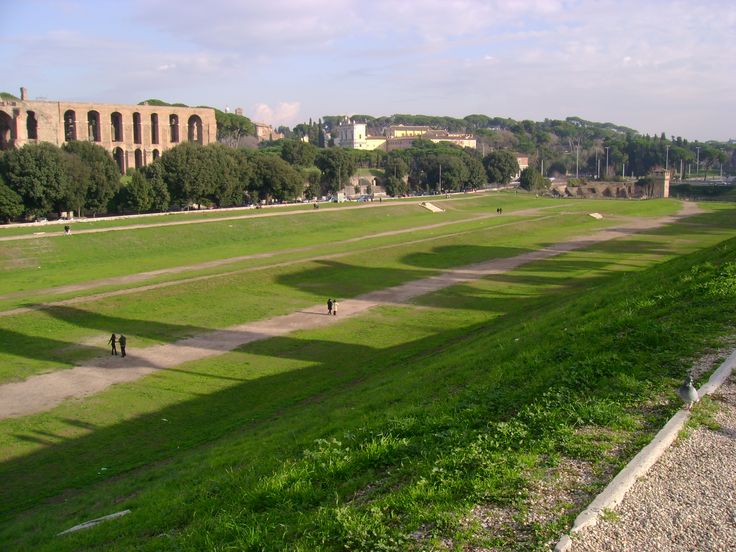
After all, the word “circus” brings back a very ancient past—Rome and the Circus Maximus: the center for the Roman passion for chariot racing.

Imperial Rome: Circus Maximus (pen & ink and pencil on paper)

6circusmaxtoday.jpg

If you know the 1959 movie Ben Hur, you’ll know the amazing chariot race scene (set in Antioch, rather than Rome), which gives you an idea why this was the favorite Roman competitive spectator sport.

6achariotrace.jpg

It’s also the basis of the remark by the Roman satirist, Juvenal (c.100AD), that the formerly independent people of Rome had gradually given up their rights and now anxiously awaited only two things: panem et circenses, “bread and circuses”, meaning a free grain dole and free public entertainment.

It’s a bit of climb from there to modern circuses, of course. There were animal shows in Roman arenas (places used for blood-sport spectacles, mostly), like the Colosseum in Rome.

7colosseumexterior

8gladiators

(You’ll notice, by the way that we’ll show gladiators, but not beast-fights.)

But, afterwards, with the exception of private menageries kept by monarchs and nobles over the centuries, there was nothing like the modern circus until 1768, in London, where an ex-cavalry sergeant, named Philip Astley,

9pastley.jpg

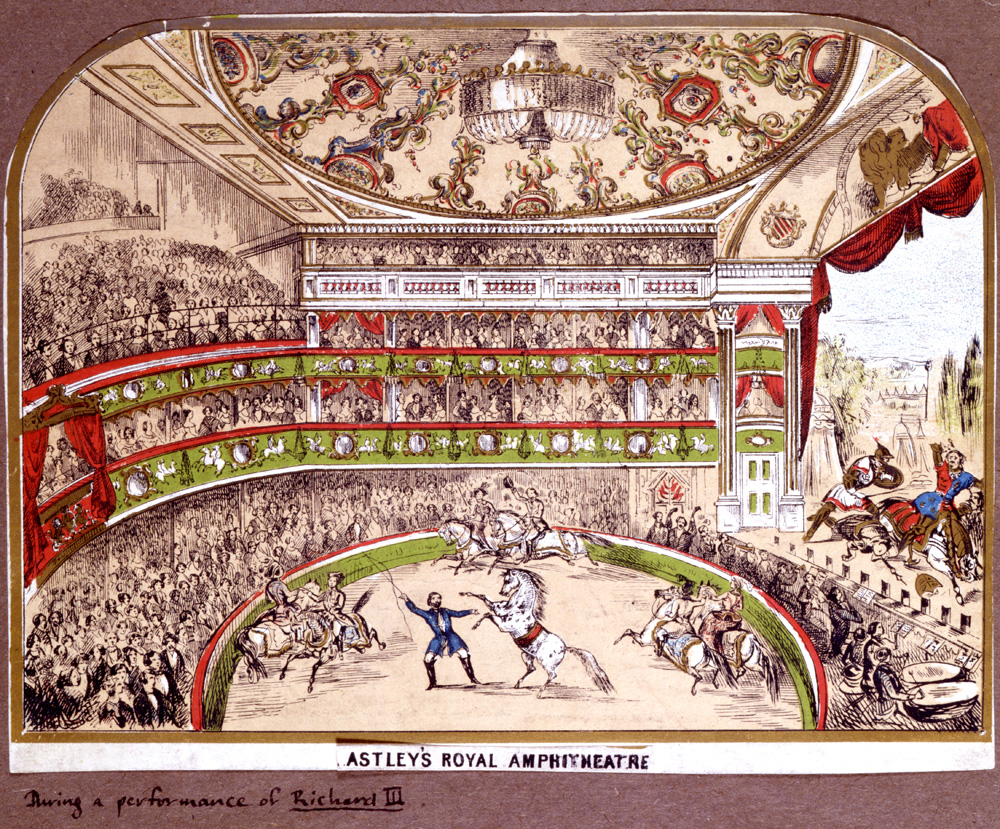
gave a demonstration of equestrian skill which soon brought him both fame and fortune. A competitor came up with the name “circus”, but it was Astley and his “Amphitheatre” who started it off.

10astleysamphi.jpg

And also inspired Charles Dickens (1812-1870)

11dickens.jpg

to portray a comic (and not so comic) traveling version in his 1854 novel, Hard Times.

12firstedhardtimes.jpg

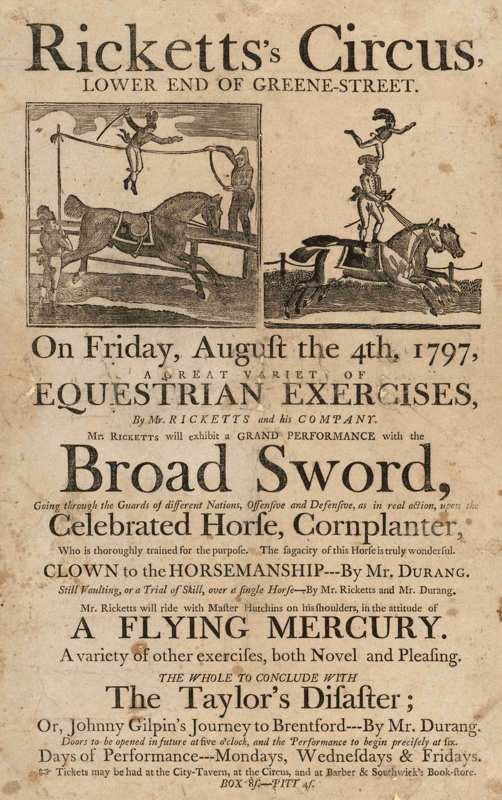
The first American circus, founded by the English equestrian, John Bill Ricketts, appeared in 1792, in Philadelphia.

13rickettsposter.jpg

14rickettstheatre.jpg

By the early 19th century, these had become traveling tent shows, which brought a little something exotic to rural communities in the US before the Civil War.

15tent.jpg

But then enter P.T. Barnum (1810-1891).

15ptbarnum.jpg

(He’s the taller one on the left.)

Beginning in the 1830s, Barnum had a very long career in show business, including all sorts of hoaxes, a number of them displayed at his famous New York City museum—

16barnummuseum.jpg

After two disastrous fires, Barnum moved on, in 1870 founding his own circus, with a typically bombastic name: “P.T. Barnum’s Grand Traveling Museum, Menagerie, Caravan & Hippodrome”.

17barnumposter.jpg

Never one to stand still, Bailey was an early user of the railways to move his circus.

18acircustrain.jpg

In a world made up almost entirely of dirt roads for wheeled traffic, this was a very good idea. The most advanced roads were “macadamized”—meaning that they had layers of crushed stone, like the Valley Pike in the Shenandoah Valley of Virginia.

18valleypike.jpg

Otherwise, travel on anything other than a dry day could look like this—

19wagoninmud.jpg

In 1881, Barnum took on a partner, A.J. Bailey—

20barnumandbailey.jpg

and, in 1882, he bought, from the London Zoo, an elephant, Jumbo.

21jumbo1882.jpg

From Jumbo, we get “jumbo-sized” and, of course, Claude Debussy’s (1862-1918),

22debussy.jpg

“Jimbo’s Lullabye”, from his “Children’s Corner Suite”.

23jimboslullabye.gif

Meanwhile, the Ringling Brothers, of Baraboo, Wisconsin (now home of an impressive circus museum), put their own show on the road.

23ringlingbros.jpeg

Early in the 20th century, the Ringlings bought Barnum and Bailey and, after a short time running two separate circuses, they joined them to become Ringling Brothers, Barnum and Bailey, which is now about to fold its tents forever.

24aposter.jpeg

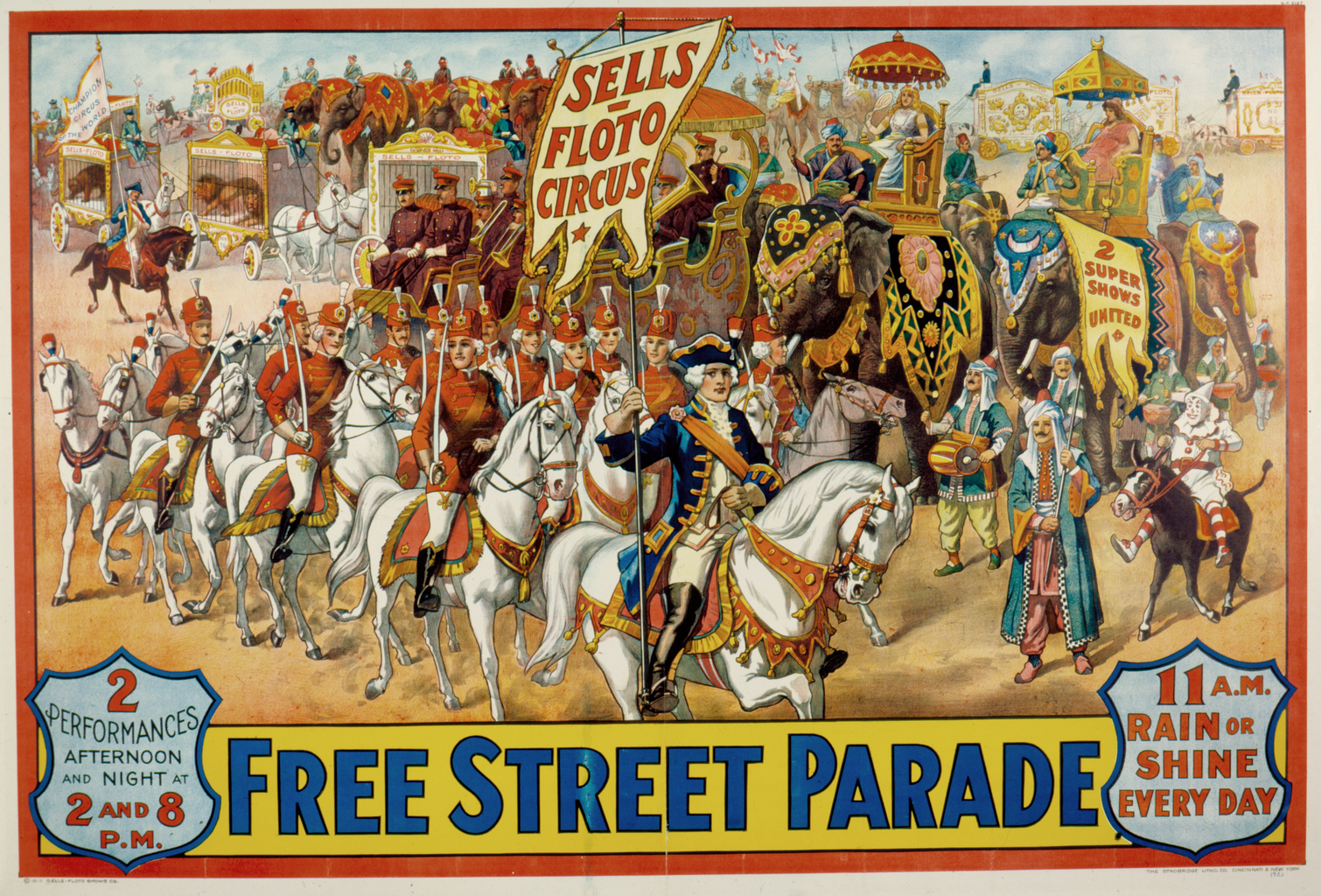
We have never been big circus-goers, but one of our grandmothers used to tell the most haunting story. When she was a little girl, she sat on the front porch of her house and watched the circus—probably in fact Ringling Brothers, Barnum and Bailey—all its wagons pulled entirely by horses—parade down her street and, when she told the story, she returned to that porch and took us with her. So, as a small tribute to an old tradition, we close with a few images of those circus parades of the now far past.

26barnum1883

24flotoscircusparade.png

25bandbparade.jpg

27toycircus.jpg

Thanks, as always, for reading.

MTCIDC

CD

The Doubtful Sea Series Facebook Page

The Doubtful Sea Series Facebook Page

  • Ollamh

Categories

  • Artists and Illustrators
  • Economics in Middle-earth
  • Fairy Tales and Myths
  • Films and Music
  • Games
  • Heroes
  • Imaginary History
  • J.R.R. Tolkien
  • Language
  • Literary History
  • Maps
  • Medieval Russia
  • Military History
  • Military History of Middle-earth
  • Narnia
  • Narrative Methods
  • Poetry
  • Research
  • Star Wars
  • Terra Australis
  • The Rohirrim
  • Theatre and Performance
  • Tolkien
  • Uncategorized
  • Villains
  • Writing as Collaborators
Follow doubtfulsea on WordPress.com

Across the Doubtful Sea

Recent Postings

  • A Moon disfigured December 17, 2025
  • On the Roads Again—Once More December 10, 2025
  • (Not) Crossing Bridges December 3, 2025
  • On the Road(s) Again—Again November 26, 2025
  • On the Road(s) Again November 19, 2025
  • To Bree (Part 2) November 12, 2025
  • To Bree (Part 1) November 5, 2025
  • A Plague o’ Both—No, o’ All Your Houses! October 29, 2025
  • It’s in Writing (2:  I’st a Prologue, or a Poesie for a Ring?) October 22, 2025

Blog Statistics

  • 103,198 Views

Posting Archive

  • December 2025 (3)
  • November 2025 (4)
  • October 2025 (5)
  • September 2025 (4)
  • August 2025 (4)
  • July 2025 (5)
  • June 2025 (4)
  • May 2025 (4)
  • April 2025 (5)
  • March 2025 (4)
  • February 2025 (4)
  • January 2025 (5)
  • December 2024 (4)
  • November 2024 (4)
  • October 2024 (5)
  • September 2024 (4)
  • August 2024 (4)
  • July 2024 (5)
  • June 2024 (4)
  • May 2024 (5)
  • April 2024 (4)
  • March 2024 (4)
  • February 2024 (4)
  • January 2024 (5)
  • December 2023 (4)
  • November 2023 (5)
  • October 2023 (4)
  • September 2023 (4)
  • August 2023 (5)
  • July 2023 (4)
  • June 2023 (4)
  • May 2023 (5)
  • April 2023 (4)
  • March 2023 (5)
  • February 2023 (4)
  • January 2023 (4)
  • December 2022 (4)
  • November 2022 (5)
  • October 2022 (4)
  • September 2022 (4)
  • August 2022 (5)
  • July 2022 (4)
  • June 2022 (5)
  • May 2022 (4)
  • April 2022 (4)
  • March 2022 (5)
  • February 2022 (4)
  • January 2022 (4)
  • December 2021 (5)
  • November 2021 (4)
  • October 2021 (4)
  • September 2021 (5)
  • August 2021 (4)
  • July 2021 (4)
  • June 2021 (5)
  • May 2021 (4)
  • April 2021 (4)
  • March 2021 (5)
  • February 2021 (4)
  • January 2021 (4)
  • December 2020 (5)
  • November 2020 (4)
  • October 2020 (4)
  • September 2020 (5)
  • August 2020 (4)
  • July 2020 (5)
  • June 2020 (4)
  • May 2020 (4)
  • April 2020 (5)
  • March 2020 (4)
  • February 2020 (4)
  • January 2020 (6)
  • December 2019 (4)
  • November 2019 (4)
  • October 2019 (5)
  • September 2019 (4)
  • August 2019 (4)
  • July 2019 (5)
  • June 2019 (4)
  • May 2019 (5)
  • April 2019 (4)
  • March 2019 (4)
  • February 2019 (4)
  • January 2019 (5)
  • December 2018 (4)
  • November 2018 (4)
  • October 2018 (5)
  • September 2018 (4)
  • August 2018 (5)
  • July 2018 (4)
  • June 2018 (4)
  • May 2018 (5)
  • April 2018 (4)
  • March 2018 (4)
  • February 2018 (4)
  • January 2018 (5)
  • December 2017 (4)
  • November 2017 (4)
  • October 2017 (4)
  • September 2017 (4)
  • August 2017 (5)
  • July 2017 (4)
  • June 2017 (4)
  • May 2017 (5)
  • April 2017 (4)
  • March 2017 (5)
  • February 2017 (4)
  • January 2017 (4)
  • December 2016 (4)
  • November 2016 (5)
  • October 2016 (6)
  • September 2016 (5)
  • August 2016 (5)
  • July 2016 (5)
  • June 2016 (5)
  • May 2016 (4)
  • April 2016 (4)
  • March 2016 (5)
  • February 2016 (4)
  • January 2016 (4)
  • December 2015 (5)
  • November 2015 (5)
  • October 2015 (4)
  • September 2015 (5)
  • August 2015 (4)
  • July 2015 (5)
  • June 2015 (5)
  • May 2015 (4)
  • April 2015 (3)
  • March 2015 (4)
  • February 2015 (4)
  • January 2015 (4)
  • December 2014 (5)
  • November 2014 (4)
  • October 2014 (6)
  • September 2014 (1)

Blog at WordPress.com.

  • Subscribe Subscribed
    • doubtfulsea
    • Join 78 other subscribers
    • Already have a WordPress.com account? Log in now.
    • doubtfulsea
    • Subscribe Subscribed
    • Sign up
    • Log in
    • Report this content
    • View site in Reader
    • Manage subscriptions
    • Collapse this bar
 

Loading Comments...