Tags
Barrow-wights, Elrond, Gandalf, Hildebrandts, Nazgul, Old Man Willow, Peter Jackson, Ralph Bakshi, Sauron, Tales from the Perilous Realm, The Lord of the Rings, The Old Forest, Tolkien, Tom Bombadil
Dear Readers,
Welcome, as always!
There has been lots of discussion, if not downright argument, about Tom Bombadil and The Lord of the Rings. Although he appears in the first BBC radio adaptation in 1955 (which Tolkien disliked, saying in a letter of the period that “I thought Tom Bombadil dreadful”) and in the 1979 American radio drama, he was excised from Ralph Bakshi’s 1978 animated feature and from the 1981 BBC radio production, although reappearing in the radio adaptation of the relevant material from The Lord of the Rings in Tales from the Perilous Realm (BBC 1992).
Then we come to Peter Jackson’s The Fellowship of the Ring (2001). As anyone who has read our past postings knows, we have very mixed feelings about this and the subsequent films, but, in this posting, we want to take a completely different tack, not asking, as has always been the subject “why was Tom left out?” but, rather, “why might you keep him in?”
This is two questions, really, the first being “what would be his effect upon the story?” and, second, “just what of him would you keep?”
Lost in the Old Forest
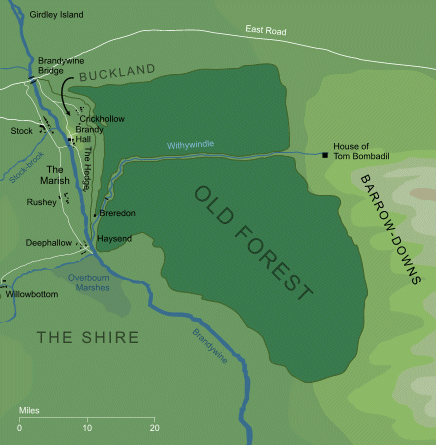
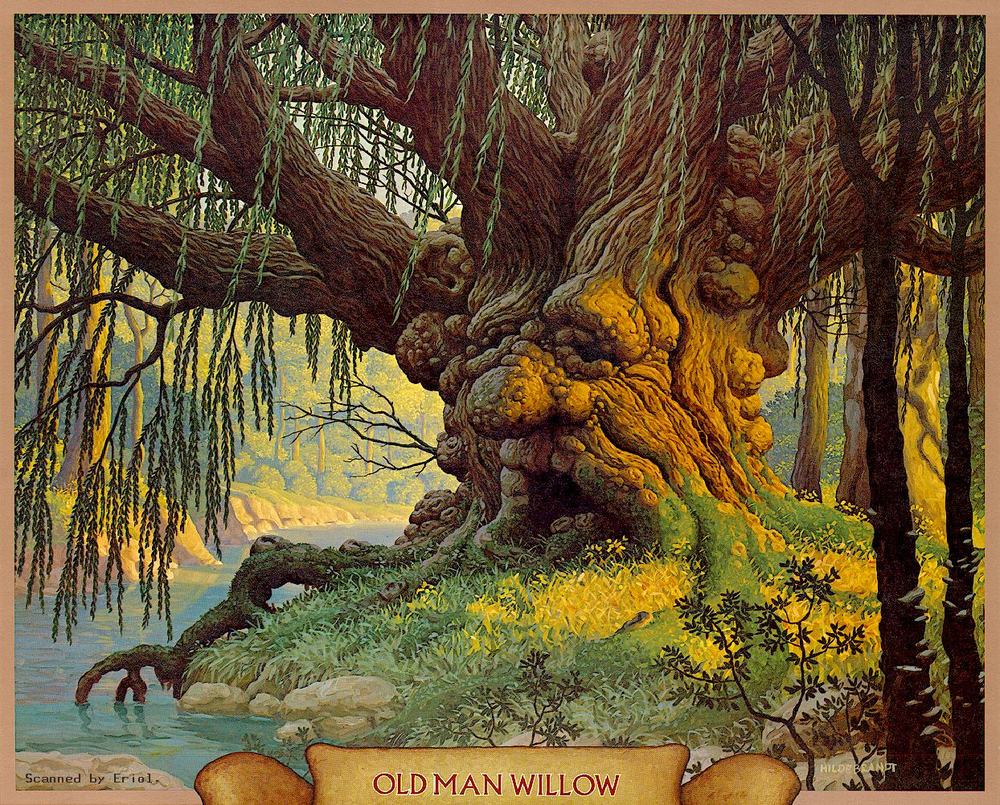
the Hobbits run afoul of Old Man Willow
only to be rescued by Tom Bombadil

As much as we love the Hildebrandts’ work, this is not one of our favorites—this illustration really makes us wonder what kind of magic mushrooms Tom has been trading with Farmer Maggot and which Grateful Dead album is running in his head. As an antidote, here’s one of our favorites:

One could say that this is part of the pattern of increasingly-dangerous encounters the Hobbits are having as they try to leave the Shire—
the first encounter was with the Nazgul
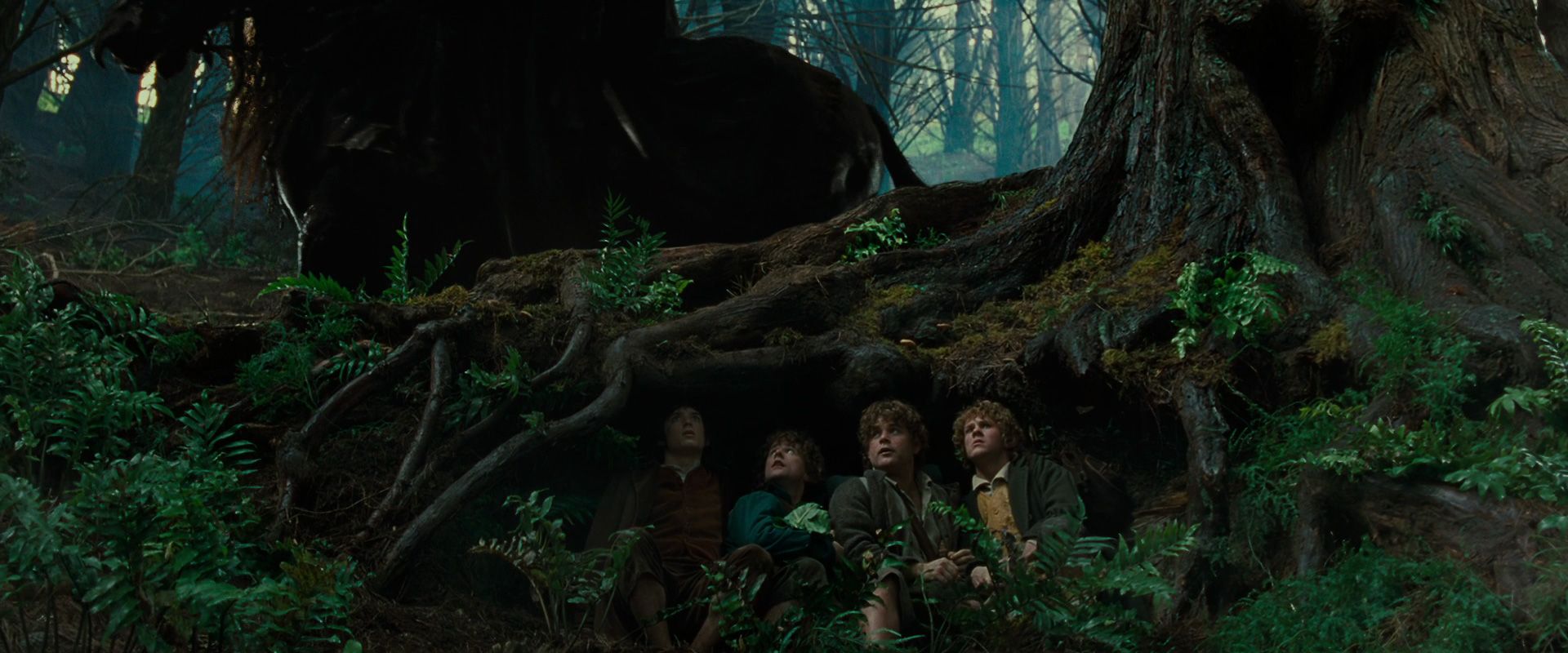
This doesn’t justify including him, though, if he’s thought to be just one more in a series—and this is clearly an opinion held by a Jackson scriptwriter, who once said:
“Tom Bombadil is part of several false starts to Frodo’s journey, and you cannot have things happening quite so episodically; that’s not what storytelling is all about.” (quoted from The One Ring, “complete list of film changes”—see the link here)
If he’s not just a “false start”, what is his function—and may he have more than one?
One of those elements of The Lord of the Rings which runs always just below the surface is the great age of Middle Earth. This is an ancient place and that fact was clearly very important, to the author, who spent years building up that narrative infrastructure, and to the story. This is clearly not a quick, little, one-time adventure, but, rather, one more part of a very old tale, of the “long defeat” as Galadriel calls the struggle with Sauron.
As a living token of that antiquity—and the first, but hardly the last, they meet—on their journey, there is Tom Bombadil. As Elrond says of him:
“But I had forgotten Bombadil, if indeed this is still the same that walked the woods and hills long ago, and even then was older than the old. That was not then his name. Iarwain Ben-adar we called him, [“Old-young, fatherless”? see The Lord of the Rings Companion, 128 for more on his names) oldest and fatherless.” LotR 265.
Thus, one of his functions is to represent a distant past, though now as shrunken as the Old Forest, “but an outlier of its northern march. Time was when a squirrel could go from tree to tree from what is now the Shire to Dunland west of Isengard.” (Elrond—LotR 265) In this, he is akin to Fangorn/Treebeard, described by Gandalf (himself so old that he was created by Iluvatar before the Music of the Ainur) as “the oldest living thing that still walks beneath the Sun upon this Middle-earth.” LotR 499.
He also, in a curious way, might be understood to represent one possible—perhaps hopeful—form of the future. When Frodo asks him, “Who are you, Master?” he replies (and it strikes us as sounding like both a Middle-earth riddle and its solution):
“Eldest, that’s what I am. Mark my words, my friends: Tom was here before the river and the trees; Tom remembers the first raindrop and the first acorn. He made paths before the Big People, and saw the little People arriving. He was here before the Kings and the graves and the Barrow-wights. When the Elves passed westward, Tom was here already, before the seas were bent. He knew the dark under the stars when it was fearless—before the Dark Lord came from Outside.” LotR 131.
Tom represents continuity, unchanging stability, then, although he is not all-powerful. As Glorfindel says:
“I think that in the end, if all else is conquered, Bombadil will fall, Last as he was First; and then Night will come.” LotR 266.
And yet he also, because of his immense age and ability to endure, might represent the unspoken possibility that, though Sauron is powerful, because he is not the creator nor rightful owner of Middle-earth, but rather an invader, he can be defeated: as there was a time before Sauron, could there not be a time after him?
(As an afterthought here, might we also add Tom’s complete immunity to the Ring? In a story full of people, from Gollum to Sauron, from Bilbo to Galadriel, so affected, in one way or another by it, is this another form of hope? That not everyone in the whole of Middle-earth wants the Ring or has to deny it strenuously lest the temptation overcome them?)
We want to continue this discussion in our next posting, but we want to end this one by considering the second part of this question, “Just what of him would you keep?”
Although the usual explanation for excising him has to do with his being a supposed “false start”, which has to do with the mechanics of plot, we believe that a real reason has to do with the large quantity of verse which appears when he appears. These verses signal that appearance:
“Hey dol! merry dol! ring a dong dillo!
Ring a dong! hop along! fal lal the willow!
Tom Bom, jolly Tom, Tom Bombadillo!” LotR 119
Although there has been verse earlier in the book, it has been scattered, not concentrated, and has seemed more apropos to what has been going on in the text. Much of this verse appears to come from nowhere, rather like Tom himself (and there’s more on 121, 122, 124, 126, and a final bit on 134—although, as a cry for help, it somehow fits better). In a story primarily in prose, with the occasional song, how would you present such a character believably on film or on tape? (Especially when one notices that even his speech is sometimes cadenced—“What be you a-thinking of? You should not be waking. Eat earth! Dig deep! Drink water! Go to sleep! Bombadil is talking!” LotR 120)
In fact, the character of Bombadil is not organic to the development of the plot of The Lord of the Rings. Tom Bombadil made his first appearance in The Oxford Magazine in 1934, when The Hobbit was being written, but three years before its initial publication. (See The Lord of the Rings Companion 124-129 for the poem and further information).
The basic plot of chapters 6 and 7 is simple: Tom frees the Hobbits from Old Man Willow, leads them to his house, the Hobbits eat and drink there and converse with Tom, but there’s little more to the two scenes. Thus, except for the distress call which Tom teaches the Hobbits on 134, does any of this verse do more than show us the poetic/almost manic side of Bombadil? If we wished to retain the character, might it be possible to cut away the verse (including a certain amount of rhythmicized prose), leaving only those elements which further the plot?
To us, this is a more pressing issue than it might at first appear—but see our next post, Jolly Tom.2, to understand our interest.
Thanks, as always, for reading.
MTCIDC
CD
 doubtfulsea